

A Review and Bibliometric Analysis of Unmanned Aerial System (UAS) Noise Studies Between 2015 and 2024



Abstract
1. Introduction
- What is the current state of scientific studies on UAS noise monitoring, assessment, and predictions?
- What are the trends regarding topics, active researchers, and collaborations of these studies?
- What are the challenges and future opportunities of scientific studies on UAS noise monitoring, assessment, and predictions?
2. Materials and Methods
2.1. Identify Keywords and Initial Search
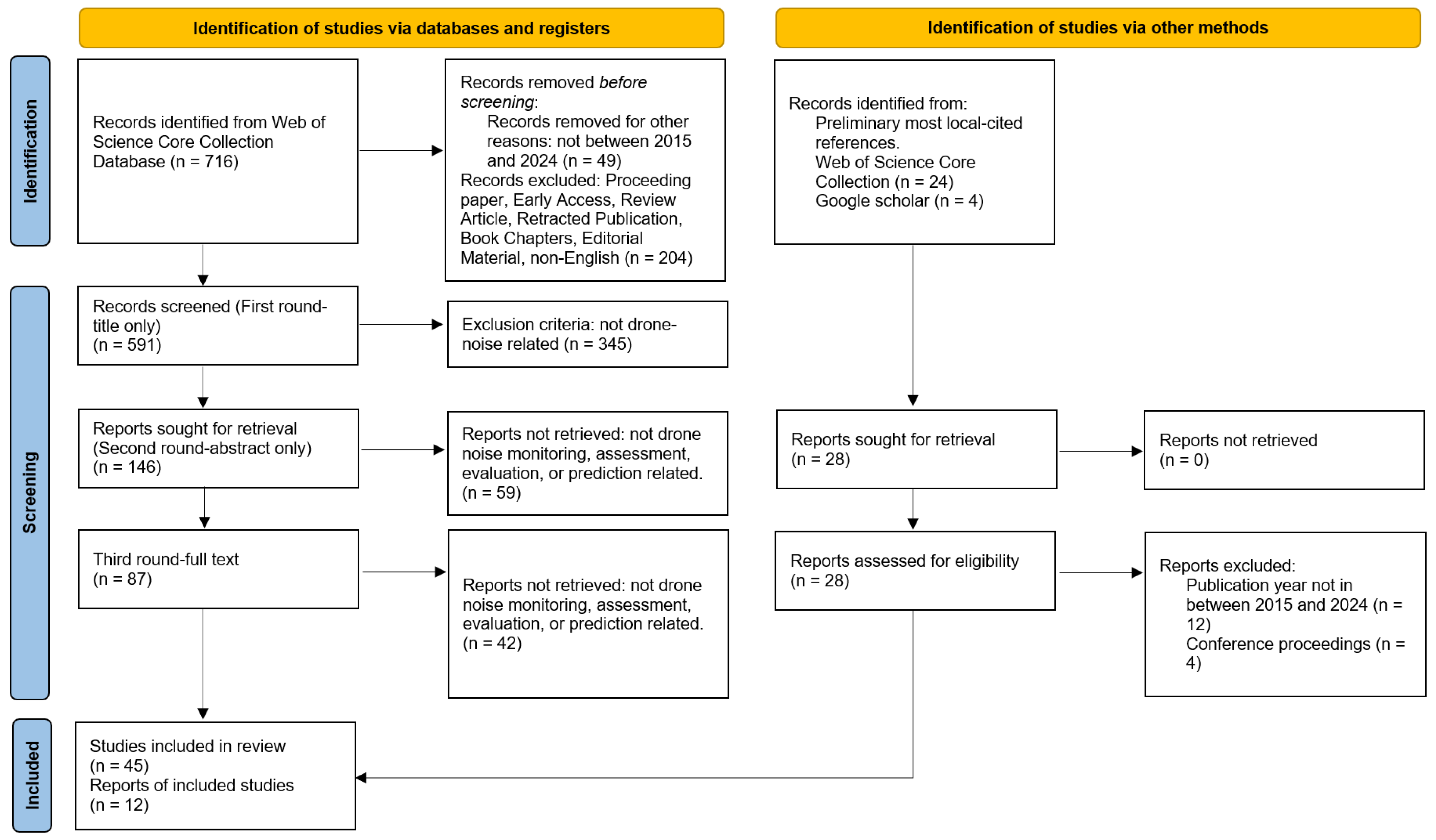
2.2. Configure Exclusion and Inclusion Criteria
2.3. Preliminary Most Local Cited References Examination
2.4. Assessment of Full Bibliometric Information for Eligibility
2.5. Limitations
3. Results
3.1. Bibliometric and Citation Analysis
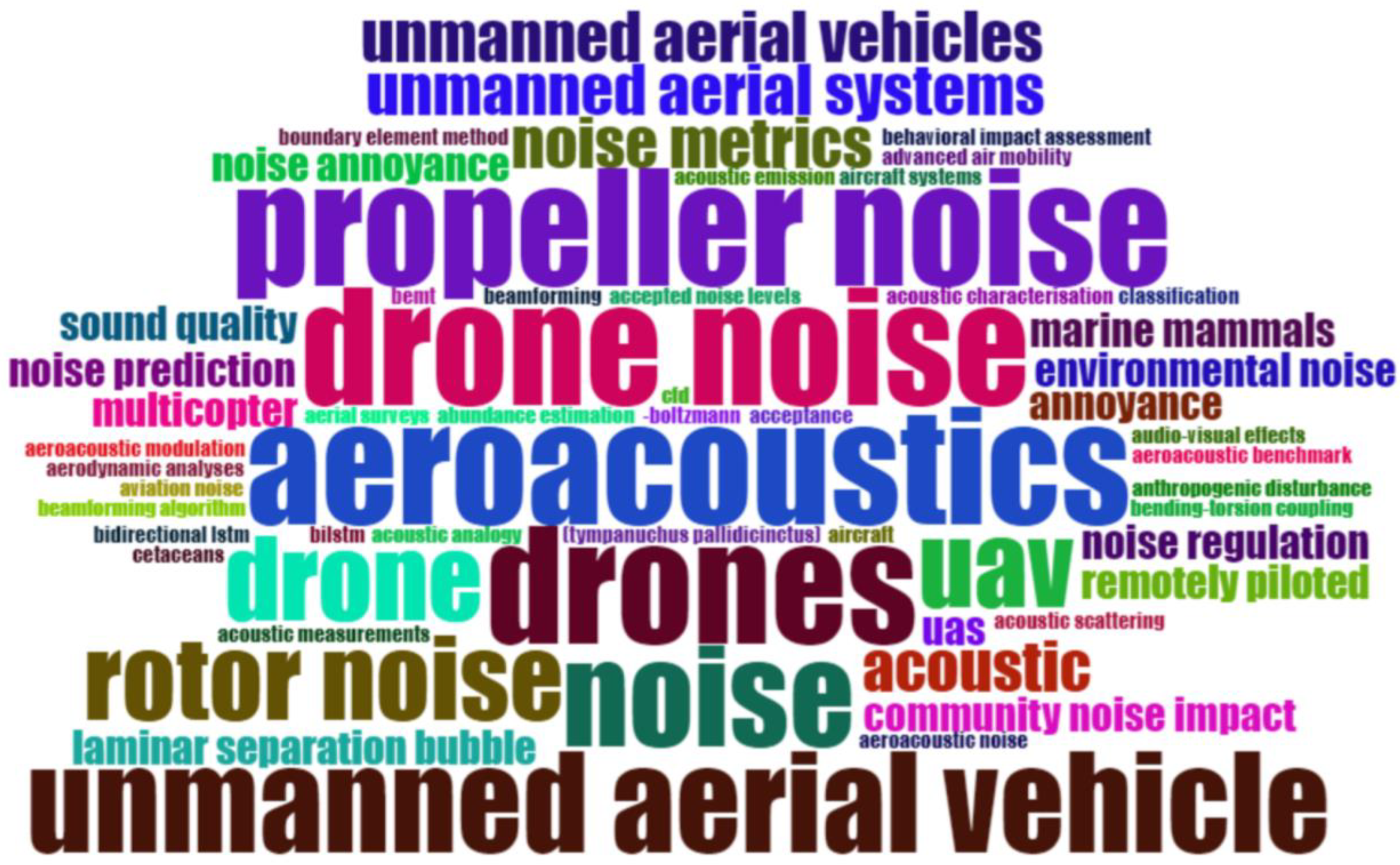
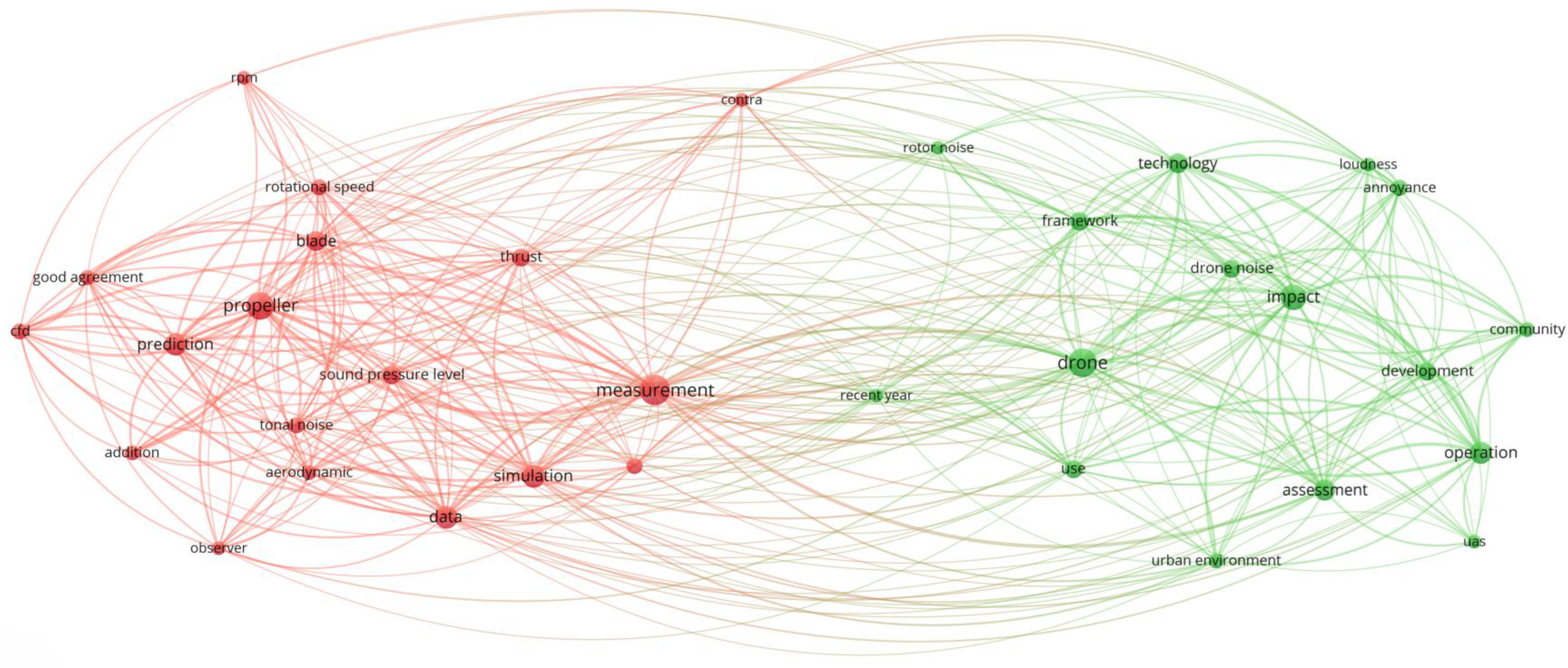
3.1.1. Co-Occurrence Analysis (Title and Abstract)
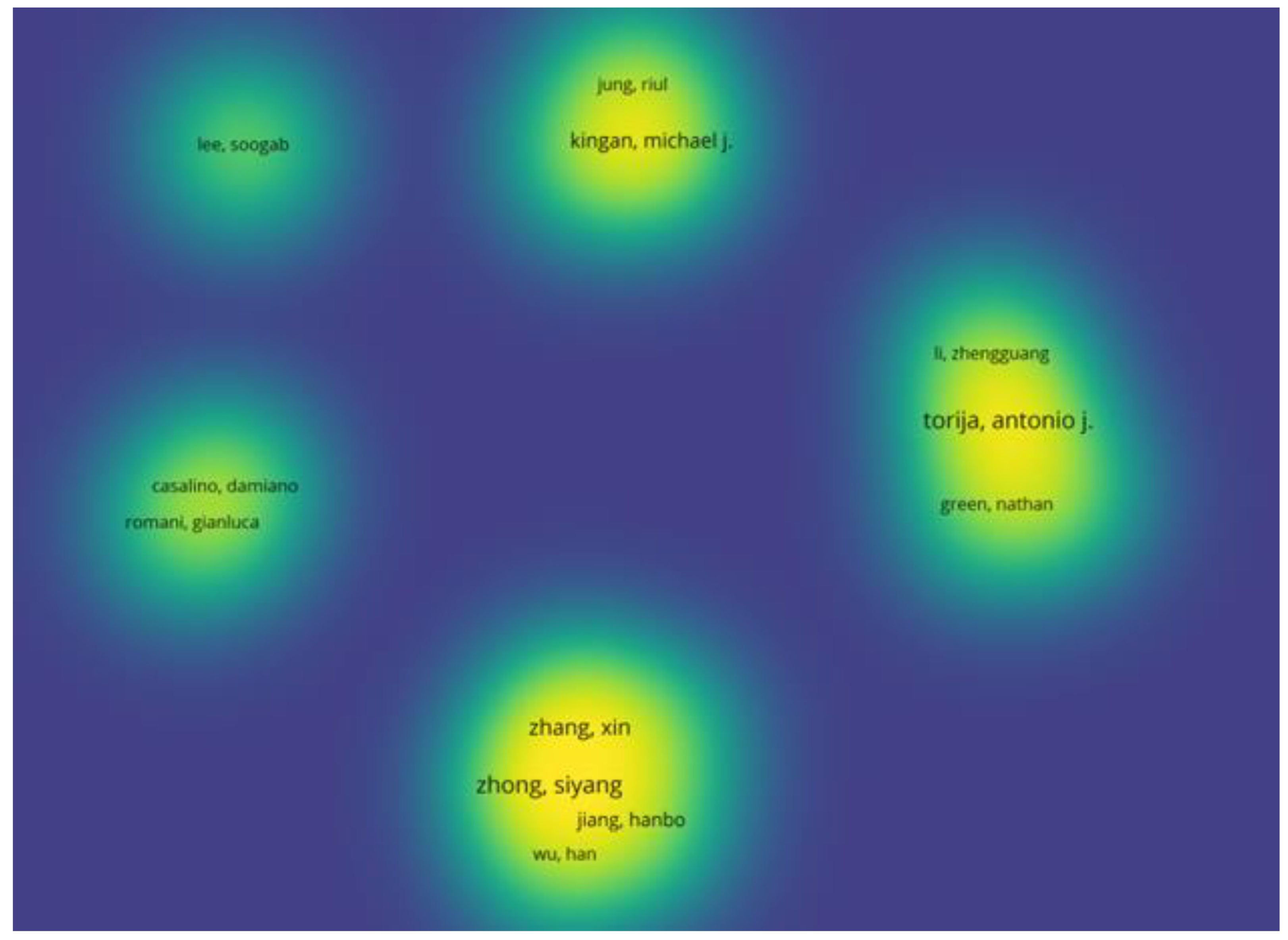
3.1.2. Co-Authorship and Author Citation Analysis
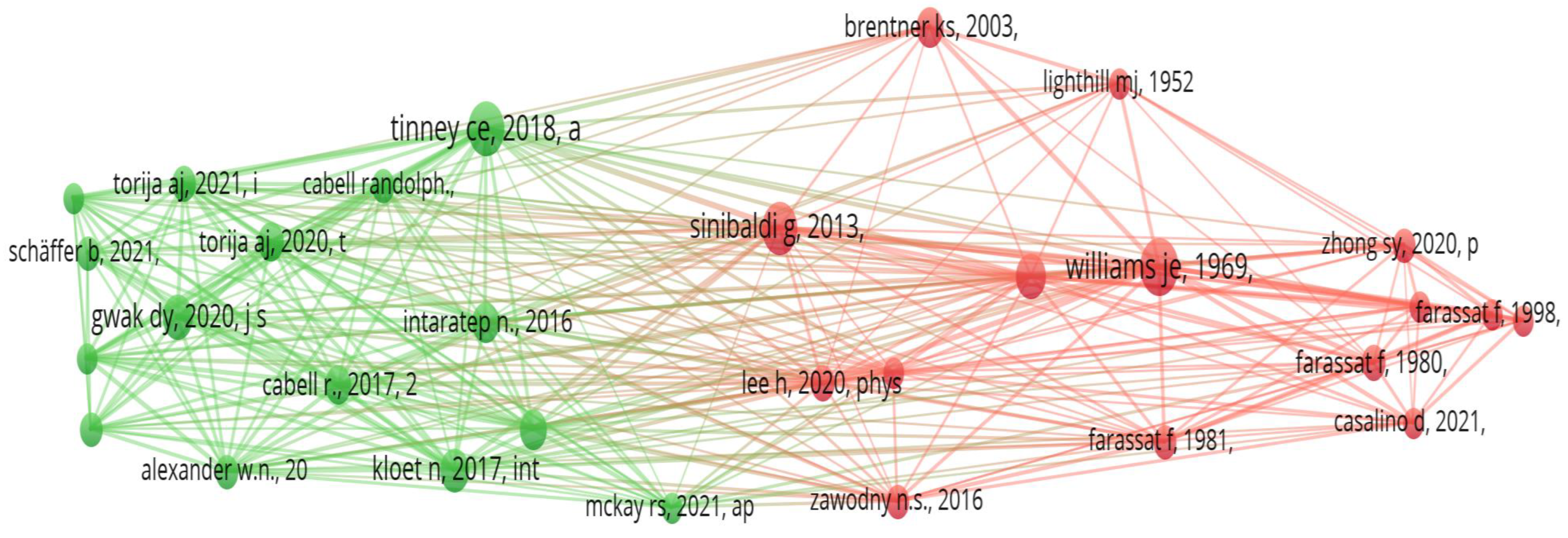
3.1.3. Co-Citation Analysis (Literature)
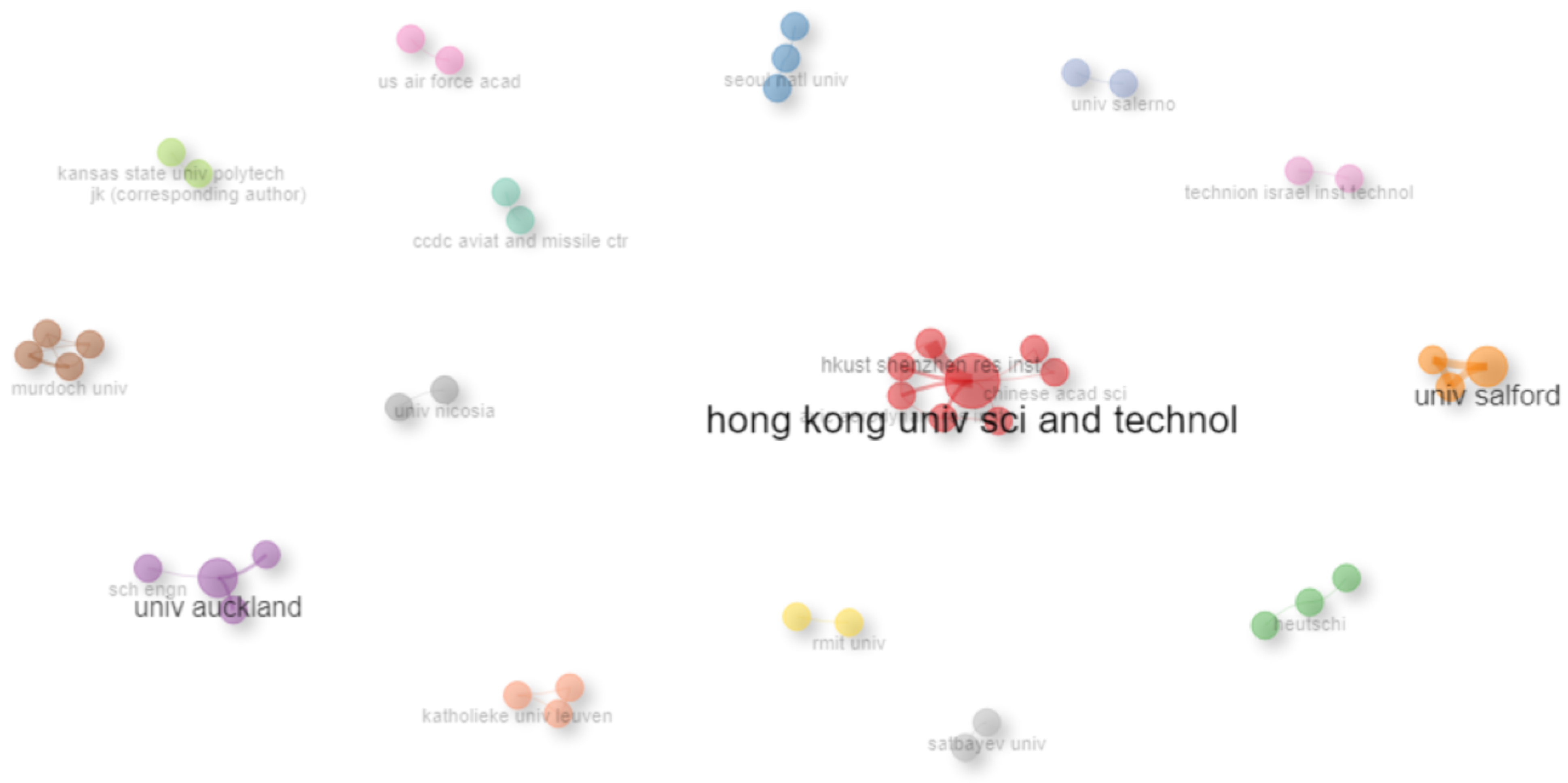
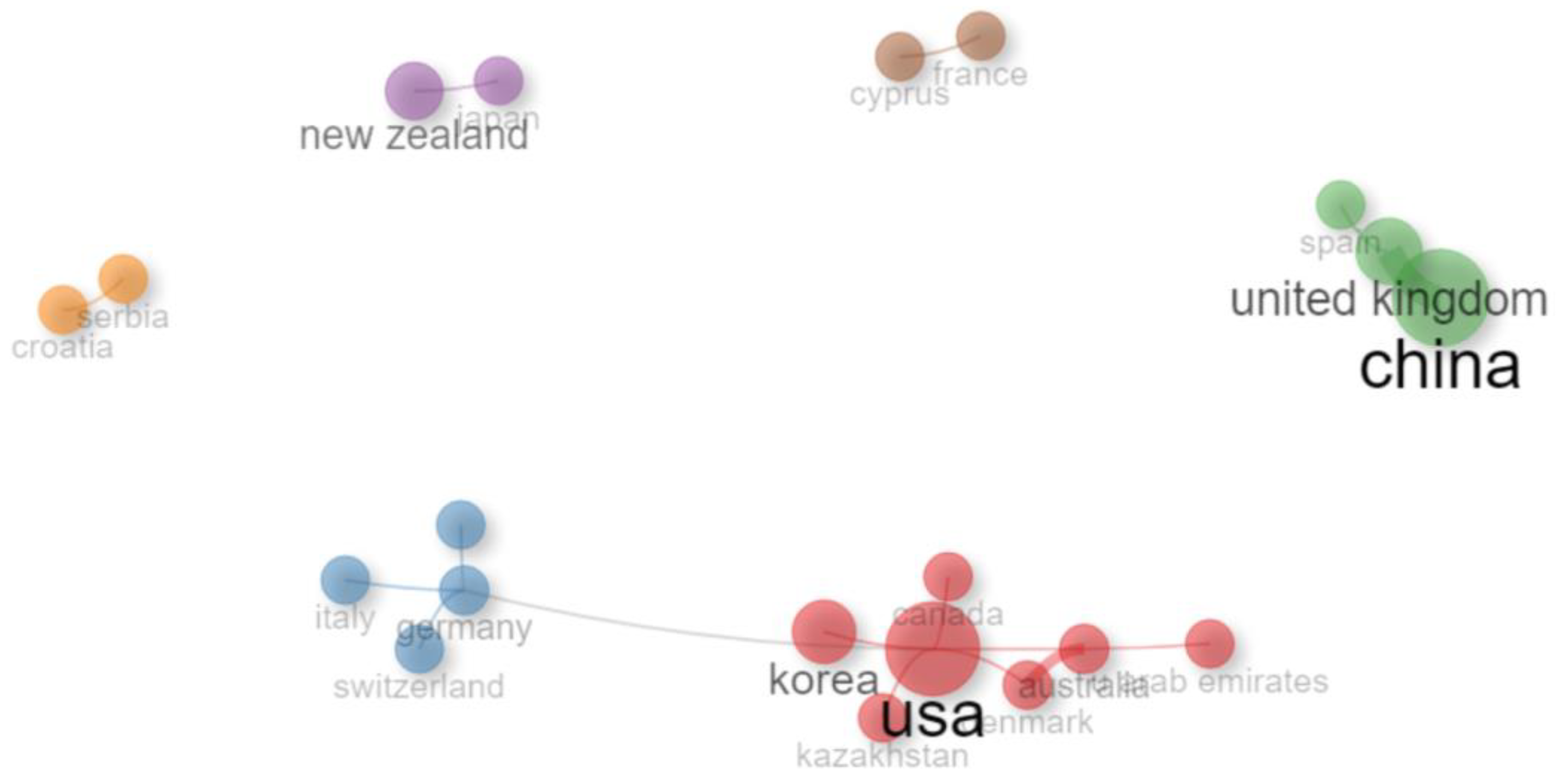
3.1.4. Collaboration Analysis (Country and Institution)
3.2. The Recent Progress of UAS Noise Monitoring, Assessment, and Prediction
3.2.1. Aeroacoustics
3.2.2. Psychoacoustics
3.2.3. Other Findings
4. Discussion
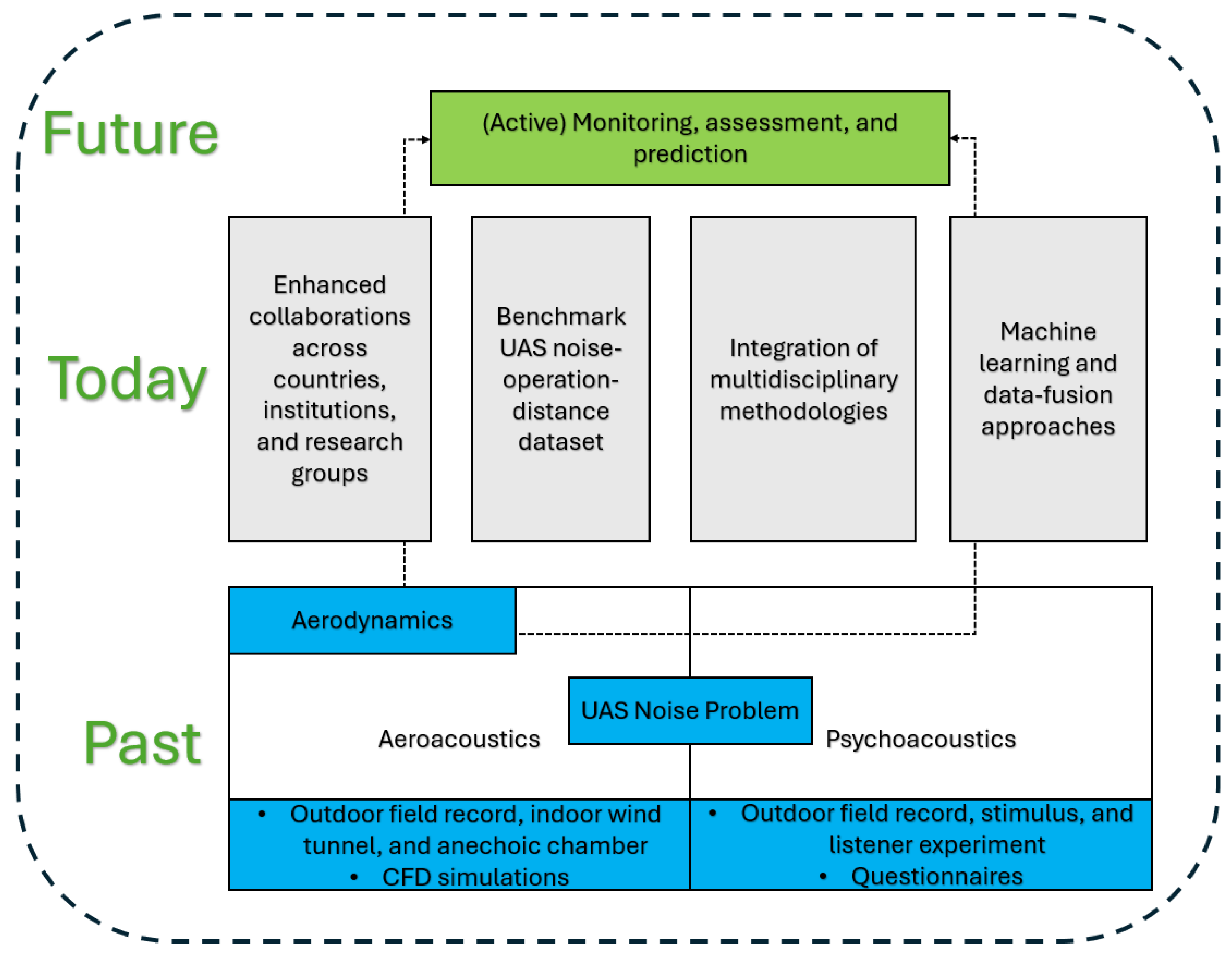
4.1. General
4.2. Aeroacoustics
4.3. Psychoacoustics
5. Conclusions
Author Contributions
Funding
Data Availability Statement
Conflicts of Interest
Abbreviations
| AAM | Advanced Air Mobility |
| ADS-B | Automatic Dependent Surveillance-Broadcast |
| AUVSI | Association for Uncrewed Vehicle Systems International |
| BiLSTM | Bidirectional Long Short-Term Memory |
| CAA | Computational Aeroacoustics |
| CFD | Computational fluid dynamics |
| DDES | Detached eddy simulation |
| FAA | Federal Aviation Administration (USA) |
| GA | General Aviation |
| GRU | Gated Recurrent Unit |
| ICAO | International Civil Aviation Organization |
| LBM | Lattice Boltzmann Method |
| LSTM | Long Short-Term Memory |
| NASA | National Aeronautics and Space Administration |
| RANS | Reynolds-averaged Navier–Stokes models |
| RPM | Rotation per minute |
| SimpleRNN | Simple Recurrent Neural Networks |
| PRISMA | Preferred Reporting Items for Systematic Reviews and Meta-Analysis |
| UAM | Urban Air Mobility |
| UAS | Unmanned Aerial System/ Unmanned Aircraft System |
| UAV | Unmanned Aerial Vehicle/Uncrewed Aerial Vehicle |
| VTOL | Vertical Takeoff and Landing Aircraft |
Appendix A
References
- Basner, M.; Clark, C.; Hansell, A.; Hileman, J.I.; Janssen, S.; Shepherd, K.; Sparrow, V. Aviation noise impacts: State of the science. Noise Health 2017, 19, 41–50. [Google Scholar] [PubMed]
- Clark, C.; Paunovic, K. WHO environmental noise guidelines for the European region: A systematic review on environmental noise and cognition. Int. J. Environ. Res. Public Health 2018, 15, 285. [Google Scholar] [CrossRef] [PubMed]
- Yang, C.; Mott, J.H. Developing a cost-effective assessment method for noise impacts at non-towered airports: A case study at Purdue University. Transp. Res. Rec. 2022, 2676, 786–797. [Google Scholar] [CrossRef]
- Yang, C.; Mott, J.H. An Experimental and Analytical Approach to Evaluate Transponder-Based Aircraft Noise Monitoring Technology. Aerospace 2024, 11, 199. [Google Scholar] [CrossRef]
- Aviation Noise. Available online: https://www.faa.gov/regulations_policies/policy_guidance/noise (accessed on 4 September 2024).
- Community Response to Noise: Annoyance due to Noise. Available online: https://www.faa.gov/regulations_policies/policy_guidance/noise/community (accessed on 4 September 2024).
- Aircraft Noise: Balanced Approach to Aircraft Noise Management. Available online: https://www.icao.int/environmental-protection/Pages/noise.aspx (accessed on 4 September 2024).
- Aircraft Noise: Noise from Emerging Technology Aircraft. Available online: https://www.icao.int/environmental-protection/Pages/noise_new_concepts.aspx (accessed on 4 September 2024).
- Noise Certification of UAS/AAM Using Rule of Particular Applicability. Available online: https://www.faa.gov/about/office_org/headquarters_offices/apl/aee/noise/uas_noise_certification (accessed on 4 September 2024).
- Torija, A.J.; Li, Z.; Self, R.H. Effects of a hovering unmanned aerial vehicle on urban soundscapes perception. Transp. Res. Part D Transp. Environ. 2020, 78, 102195. [Google Scholar] [CrossRef]
- Ren, X.H.; Cheng, C.X. Model of Third-Party Risk Index for Unmanned Aerial Vehicle Delivery in Urban Environment. Sustainability 2020, 12, 8318. [Google Scholar] [CrossRef]
- Škultéty, F.; Bujna, E.; Janovec, M.; Kandera, B. Noise Impact Assessment of UAS Operation in Urbanised Areas: Field Measurements and a Simulation. Drones 2023, 7, 314. [Google Scholar] [CrossRef]
- Ramos-Romero, C.; Green, N.; Roberts, S.; Clark, C.; Torija, A.J. Requirements for Drone Operations to Minimise Community Noise Impact. Int. J. Environ. Res. Public Health 2022, 19, 9299. [Google Scholar] [CrossRef]
- Liu, H.; Fan, K.; He, B.; Wang, W. Unmanned Aerial Vehicle Acoustic Localization Using Multilayer Perceptron. Appl. Artif. Intell. 2021, 35, 537. [Google Scholar] [CrossRef]
- Guo, J.F.; Ahmad, L.; Chang, K.H. Classification, positioning, and tracking of drones by HMM using acoustic circular microphone array beamforming. EURASIP J. Wirel. Commun. Netw. 2020, 2020, 9. [Google Scholar] [CrossRef]
- Brents, R.G., Jr.; Winter, S.R.; Gawron, V.; Keebler, J.R. Intention to complain about unmanned aircraft system noise: A structural equation analysis. Technol. Soc. 2024, 76, 102412. [Google Scholar] [CrossRef]
- Williams, J.F.; Hawkings, D.L. Sound generation by turbulence and surfaces in arbitrary motion. Philos. Trans. R. Soc. London. Ser. A Math. Phys. Sci. 1969, 264, 321–342. [Google Scholar]
- Brentner, K.S.; Farassat, F. Modeling aerodynamically generated sound of helicopter rotors. Prog. Aerosp. Sci. 2003, 39, 83–120. [Google Scholar] [CrossRef]
- Ghoreyshi, M.; Aref, P.; Wisniewski, C.F.; Seidel, J.; Van Treuren, K.W. Computational investigation of quiet propeller designs for small unmanned aerial vehicles. Aerosp. Sci. Technol. 2023, 138, 108351. [Google Scholar] [CrossRef]
- Casalino, D.; Romani, G.; Pii, L.M.; Colombo, R. Flow confinement effects on sUAS rotor noise. Aerosp. Sci. Technol. 2023, 143, 108756. [Google Scholar] [CrossRef]
- Jiang, H.B.; Zhong, S.Y.; Zhang, X.; Huang, X. Boundary element analysis on the fuselage scattering of drone noise. Int. J. Aeroacoustics 2022, 21, 43–56. [Google Scholar] [CrossRef]
- Jung, R.L.; Kingan, M.J.; Dhopade, P.; Sharma, R.N.; McKay, R.S.; Dai, Z.Q.; Symons, D.; Pearse, J. The effect of blade skew on the interaction tones produced by a contra-rotating unmanned aerial vehicle rotor system. J. Sound Vibrat. 2024, 572, 118186. [Google Scholar] [CrossRef]
- Tinney, C.E.; Sirohi, J. Multirotor drone noise at static thrust. AIAA J. 2018, 56, 2816–2826. [Google Scholar] [CrossRef]
- Yu, K.; Ko, J.; Jeong, J.; Lee, S. Comparative analysis of fixed-pitch and variable-pitch control systems for multirotor drones: Acoustic characteristics and rotor phase control. J. Sound Vibrat. 2024, 573, 118187. [Google Scholar] [CrossRef]
- Stalnov, O.; Faran, M.; Koral, Y.; Furst, M. Auditory detection probability of propeller noise in hover flight in presence of ambient soundscape. J. Acoust. Soc. Am. 2022, 151, 3719–3728. [Google Scholar] [CrossRef]
- Langen, T.; Nunavath, V.; Dahle, O.H. A Conceptual Framework Proposal for a Noise Modelling Service for Drones in U-Space Architecture. Int. J. Environ. Res. Public Health 2022, 19, 223. [Google Scholar] [CrossRef] [PubMed]
- Tan, Q.C.; Bian, H.Y.; Guo, J.W.; Zhou, P.; Lo, H.K.; Zhong, S.Y.; Zhang, X. Virtual flight simulation of delivery drone noise in the urban residential community. Transp. Res. Part D Transp. Environ. 2023, 118, 103686. [Google Scholar] [CrossRef]
- Purtell, C.; Hong, S.-J.; Hiatt, B. Bibliometric analysis on advanced air mobility and drones. J. Air Transp. Manag. 2024, 116, 102569. [Google Scholar] [CrossRef]
- Yang, C.; Huang, C. Natural Language Processing (NLP) in Aviation Safety: Systematic Review of Research and Outlook into the Future. Aerospace 2023, 10, 600. [Google Scholar] [CrossRef]
- Page, M.J.; Moher, D.; Bossuyt, P.M.; Boutron, I.; Hoffmann, T.C.; Mulrow, C.D.; Shamseer, L.; Tetzlaff, J.M.; Akl, E.A.; Brennan, S.E. PRISMA 2020 explanation and elaboration: Updated guidance and exemplars for reporting systematic reviews. BMJ 2021, 372, n160. [Google Scholar] [CrossRef]
- Page, M.J.; McKenzie, J.E.; Bossuyt, P.M.; Boutron, I.; Hoffmann, T.C.; Mulrow, C.D.; Shamseer, L.; Tetzlaff, J.M.; Akl, E.A.; Brennan, S.E. The PRISMA 2020 statement: An updated guideline for reporting systematic reviews. BMJ 2021, 372, n71. [Google Scholar] [CrossRef]
- Aria, M.; Cuccurullo, C. bibliometrix: An R-tool for comprehensive science mapping analysis. J. Informetr. 2017, 11, 959–975. [Google Scholar] [CrossRef]
- Van Eck, N.; Waltman, L. Software survey: VOSviewer, a computer program for bibliometric mapping. Scientometrics 2010, 84, 523–538. [Google Scholar] [CrossRef]
- Sinibaldi, G.; Marino, L. Experimental analysis on the noise of propellers for small UAV. Appl. Acoust. 2013, 74, 79–88. [Google Scholar] [CrossRef]
- Gwak, D.Y.; Han, D.; Lee, S. Sound quality factors influencing annoyance from hovering UAV. J. Sound Vibrat. 2020, 489, 115651. [Google Scholar] [CrossRef]
- Stephenson, J.H.; Weitsman, D.; Zawodny, N.S. Effects of flow recirculation on unmanned aircraft system (UAS) acoustic measurements in closed anechoic chambers. J. Acoust. Soc. Am. 2019, 145, 1153–1155. [Google Scholar] [CrossRef] [PubMed]
- Kloet, N.; Watkins, S.; Clothier, R. Acoustic signature measurement of small multi-rotor unmanned aircraft systems. Int. J. Micro Air Veh. 2017, 9, 3–14. [Google Scholar] [CrossRef]
- Torija, A.J.; Li, Z.G.; Chaitanya, P. Psychoacoustic modelling of rotor noise. J. Acoust. Soc. Am. 2022, 151, 1804–1815. [Google Scholar] [CrossRef] [PubMed]
- Intaratep, N.; Alexander, W.N.; Devenport, W.J.; Grace, S.M.; Dropkin, A. Experimental Study of Quadcopter Acoustics and Performance at Static Thrust Conditions. In Proceedings of the 22nd AIAA/CEAS Aeroacoustics Conference, Lyon, France, 30 May–1 June 2016; p. 2873. [Google Scholar]
- Christian, A.W.; Cabell, R. Initial Investigation into the Psychoacoustic Properties of Small Unmanned Aerial System Noise. In Proceedings of the 23rd AIAA/CEAS aeroacoustics conference, Denver, CO, USA, 5–9 June 2017; p. 4051. [Google Scholar]
- Christiansen, F.; Rojano-Doñate, L.; Madsen, P.T.; Beider, L. Noise Levels of Multi-Rotor Unmanned Aerial Vehicles with Implications for Potential Underwater Impacts on Marine Mammals. Front. Mar. Sci. 2016, 3, 277. [Google Scholar] [CrossRef]
- Lee, H.; Lee, D.-J. Rotor interactional effects on aerodynamic and noise characteristics of a small multirotor unmanned aerial vehicle. Phys. Fluids 2020, 32, 047107. [Google Scholar] [CrossRef]
- Casalino, D.; Grande, E.; Romani, G.; Ragni, D.; Avallone, F. Definition of a benchmark for low Reynolds number propeller aeroacoustics. Aerosp. Sci. Technol. 2021, 113, 106707. [Google Scholar] [CrossRef]
- Schäffer, B.; Pieren, R.; Heutschi, K.; Wunderli, J.M.; Becker, S. Drone noise emission characteristics and noise effects on humans—A systematic review. Int. J. Environ. Res. Public Health 2021, 18, 5940. [Google Scholar] [CrossRef]
- Arona, L.; Dale, J.; Heaslip, S.G.; Hammill, M.O.; Johnston, D.W. Assessing the disturbance potential of small unoccupied aircraft systems (UAS) on gray seals (Halichoerus grypus) at breeding colonies in Nova Scotia, Canada. PeerJ 2018, 6, e4467. [Google Scholar] [CrossRef]
- Torija, A.J.; Clark, C. A psychoacoustic approach to building knowledge about human response to noise of unmanned aerial vehicles. Int. J. Environ. Res. Public Health 2021, 18, 682. [Google Scholar] [CrossRef]
- Torija, A.J.; Chaitanya, P.; Li, Z. Psychoacoustic analysis of contra-rotating propeller noise for unmanned aerial vehicles. J. Acoust. Soc. Am. 2021, 149, 835–846. [Google Scholar] [CrossRef]
- Casalino, D.; Romani, G.; Zhang, R.; Chen, H. Lattice-Boltzmann calculations of rotor aeroacoustics in transitional boundary layer regime. Aerosp. Sci. Technol. 2022, 130, 107953. [Google Scholar] [CrossRef]
- McKay, R.S.; Kingan, M.J.; Go, S.T.; Jung, R. Experimental and analytical investigation of contra-rotating multi-rotor UAV propeller noise. Appl. Acoust. 2021, 177, 107850. [Google Scholar] [CrossRef]
- Han, D.; Gwak, D.Y.; Lee, S. Noise prediction of multi-rotor UAV by RPM fluctuation correction method. J. Mech. Sci. Technol. 2020, 34, 1429–1443. [Google Scholar] [CrossRef]
- Chen, Y.; Zhao, Y.; Wu, Y. Recent progress in air traffic flow management: A review. J. Air Transp. Manag. 2024, 116, 102573. [Google Scholar] [CrossRef]
- Wunderli, J.M.; Meister, J.; Boolakee, O.; Heutschi, K. A Method to Measure and Model Acoustic Emissions of Multicopters. Int. J. Environ. Res. Public Health 2023, 20, 96. [Google Scholar] [CrossRef]
- Jiang, H.B.; Wu, H.; Chen, W.Q.; Zhou, P.; Zhong, S.Y.; Zhang, X.; Zhou, G.C.; Chen, B. Toward high-efficiency low-noise propellers: A numerical and experimental study. Phys. Fluids 2022, 34, 076116. [Google Scholar] [CrossRef]
- Ramos-Romero, C.; Green, N.; Torija, A.J.; Asensio, C. On-field noise measurements and acoustic characterisation of multi-rotor small unmanned aerial systems. Aerosp. Sci. Technol. 2023, 141, 108537. [Google Scholar] [CrossRef]
- Fruncillo, F.; Federico, L.; Cicala, M.; Citarella, R. Development and Validation of an Aeropropulsive and Aeroacoustic Simulation Model of a Quadcopter Drone. Drones 2022, 6, 143. [Google Scholar] [CrossRef]
- Wu, Y.; Kingan, M.J.; Go, S.T. Propeller-strut interaction tone noise. Phys. Fluids 2022, 34, 055116. [Google Scholar] [CrossRef]
- Jiang, H.B.; Zhong, S.Y.; Wu, H.; Zhang, X.; Huang, X.; Zhou, G.C.; Chen, B. Radiation Modes of Propeller Tonal Noise. J. Vib. Acoust. Trans. ASME 2022, 144, 021009. [Google Scholar] [CrossRef]
- Utebayeva, D.; Ilipbayeva, L.; Matson, E.T. Practical Study of Recurrent Neural Networks for Efficient Real-Time Drone Sound Detection: A Review. Drones 2023, 7, 26. [Google Scholar] [CrossRef]
- Ahuja, V.; Little, D.S.; Majdalani, J.; Hartfield, R.J. On the prediction of noise generated by urban air mobility (UAM) vehicles. Part II. Implementation of the Farassat F1A formulation into a modern surface-vorticity panel solver. Phys. Fluids 2022, 34, 116118. [Google Scholar] [CrossRef]
- Zhou, T.; Jiang, H.B.; Sun, X.Y. Noise source imaging measurements for small-scale multi-propeller systems. Appl. Acoust. 2022, 194, 108801. [Google Scholar] [CrossRef]
- Dbouk, T.; Drikakis, D. Quadcopter drones swarm aeroacoustics. Phys. Fluids 2021, 33, 057112. [Google Scholar] [CrossRef]
- Bu, H.X.; Wu, H.; Bertin, C.; Fang, Y.; Zhong, S.Y. Aerodynamic and acoustic measurements of dual small-scale propellers. J. Sound Vibrat. 2021, 511, 116330. [Google Scholar] [CrossRef]
- Dbouk, T.; Drikakis, D. Computational aeroacoustics of quadcopter drones. Appl. Acoust. 2022, 192, 108738. [Google Scholar] [CrossRef]
- Go, S.T.; Kingan, M.J.; Wu, Y.; Sharma, R.N. Experimental and numerical investigation of the sound field produced by a shrouded UAV propeller. Appl. Acoust. 2023, 211, 109523. [Google Scholar] [CrossRef]
- Alkmim, M.; Cardenuto, J.; Tengan, E.; Dietzen, T.; Van Waterschoot, T.; Cuenca, J.; De Ryck, L.; Desmet, W. Drone noise directivity and psychoacoustic evaluation using a hemispherical microphone array. J. Acoust. Soc. Am. 2022, 152, 2735–2745. [Google Scholar] [CrossRef]
- Kim, D.H.; Park, C.H.; Moon, Y.J. Aerodynamic Analyses on the Steady and Unsteady Loading-Noise Sources of Drone Propellers. Int. J. Aeronaut. Space Sci. 2019, 20, 611–619. [Google Scholar] [CrossRef]
- Lotinga, M.; Ramos-Romero, C.; Green, N.; Torija, A.J. Noise from Unconventional Aircraft: A Review of Current Measurement Techniques, Psychoacoustics, Metrics and Regulation. Curr. Pollut. Rep. 2023, 9, 724–745. [Google Scholar] [CrossRef]
- Read, D.R.; Senzig, D.A.; Cutler, C.J.; Elmore, E.; He, H. Noise Measurement Report: Unconventional Aircraft-Choctaw Nation of Oklahoma: July 2019; Volpe, J.A., Ed.; National Transportation Systems Center: Cambridge, MA, USA, 2020. [Google Scholar]
- Bian, H.; Tan, Q.; Zhong, S.; Zhang, X. Assessment of UAM and drone noise impact on the environment based on virtual flights. Aerosp. Sci. Technol. 2021, 118, 106996. [Google Scholar] [CrossRef]
- Choi, Y.S.; Hong, S.Y.; Song, J.H. Numerical investigation of bending-torsion coupling effect on aeroacoustic noise of a flexible unmanned aerial vehicle propeller. Proc. Inst. Mech. Eng. Part G J. Aerosp. Eng. 2023, 237, 1174–1184. [Google Scholar] [CrossRef]
- Mankbadi, R.R.; Afari, S.O.; Golubev, V.V. High-Fidelity Simulations of Noise Generation in a Propeller-Driven Unmanned Aerial Vehicle. AIAA J. 2021, 59, 1020–1039. [Google Scholar] [CrossRef]
- Ivoševi’c, J.; Ganic, E.; Petosic, A.; Radisic, T. Comparative UAV Noise-Impact Assessments through Survey and Noise Measurements. Int. J. Environ. Res. Public Health 2021, 18, 6202. [Google Scholar] [CrossRef] [PubMed]
- Jung, R.L.; Kingan, M.J.; Dhopade, P.; Sharma, R.N.; McKay, R.S. Investigation of the Interaction Tones Produced by Contra-Rotating Unmanned Aerial Vehicle Rotor Systems. AIAA J. 2023, 61, 3142–3157. [Google Scholar] [CrossRef]
- Kapoor, R.; Kloet, N.; Gardi, A.; Mohamed, A.; Sabatini, R. Sound Propagation Modelling for Manned and Unmanned Aircraft Noise Assessment and Mitigation: A Review. Atmosphere 2021, 12, 1424. [Google Scholar] [CrossRef]
- Christiansen, F.; Nielsen, M.; Charlton, C.; Bejder, L.; Madsen, P.T. Southern right whales show no behavioral response to low noise levels from a nearby unmanned aerial vehicle. Mar. Mamm. Sci. 2020, 36, 953–963. [Google Scholar] [CrossRef]
- Hui, C.; Kingan, M.J.; Hioka, Y.; Schmid, G.; Dodd, G.; Dirks, K.N.; Edlin, S.; Mascarenhas, S.; Shim, Y.M. Quantification of the Psychoacoustic Effect of Noise from Small Unmanned Aerial Vehicles. Int. J. Environ. Res. Public Health 2021, 18, 8893. [Google Scholar] [CrossRef]
- Augustine, J.K.; Burchfield, D. Evaluation of unmanned aerial vehicles for surveys of lek-mating grouse. Wildl. Soc. Bull. 2022, 46, e1333. [Google Scholar] [CrossRef]
- Park, M.; Jang, J.; Lee, D. Noise Prediction of Ducted Fan Unmanned Aerial Vehicles considering Strut Effect in Hover. Int. J. Aeronaut. Space Sci. 2017, 18, 144–153. [Google Scholar] [CrossRef]
- Zhong, S.; Zhou, P.; Fattah, R.; Zhang, X. A revisit of the tonal noise of small rotors. Proc. R. Soc. A 2020, 476, 20200491. [Google Scholar] [CrossRef] [PubMed]
- Aircraft Noise and Performance (ANP) Data. Available online: https://www.easa.europa.eu/en/domains/environment/policy-support-and-research/aircraft-noise-and-performance-anp-data (accessed on 4 September 2024).
- Yang, C.; Marshall, Z.A.; Mott, J.H. A Novel Platform Design for Aircraft Noise Impact Assessment. In Proceedings of the 2021 Systems and Information Engineering Design Symposium (SIEDS), Charlottesville, VA, USA, 29–30 April 2021; IEEE: Piscataway, NJ, USA, 2021; pp. 1–6. [Google Scholar]
- Yang, C.; Mott, J.H. Using Transponder Signals to Model Aircraft Performance at Non-Towered Airports. In Proceedings of the 2021 IEEE Aerospace Conference (50100), Big Sky, MT, USA, 6–13 March 2021; IEEE: Piscataway, NJ, USA, 2021; pp. 1–8. [Google Scholar]
- Mott, J.H.; Yang, C.; Bullock, D.M. Atmospheric pressure calibration to improve accuracy of transponder-based aircraft operations counting technology. J. Aviat. Technol. Eng. 2020, 9, 35. [Google Scholar] [CrossRef]
- Remote Identification of Drones. Available online: https://www.faa.gov/uas/getting_started/remote_id (accessed on 4 October 2024).





| Title | Author, Year | Journal | Total LCS |
|---|---|---|---|
| Sound generation by turbulence and surfaces in arbitrary motion | Williams and Hawkings, 1969 [17] | Philosophical Transactions of the Royal Society of London. Series A, Mathematical and Physical Sciences | 18 |
| Multirotor drone noise at static thrust | Tinney and Sirohi, 2018 [23] | AIAA Journal | 16 |
| Experimental analysis on the noise of propellers for small UAV | Sinibaldi and Marino, 2013 [34] | Applied Acoustics | 15 |
| Sound quality factors influencing annoyance from hovering UAV | Gwak et al., 2020 [35] | Journal of Sound and Vibration | 11 |
| Effects of flow recirculation on Unmanned Aircraft System (UAS) acoustic measurements in closed anechoic chambers | Stephenson et al., 2019 [36] | The Journal of the Acoustical Society of America | 11 |
| Acoustic signature measurement of small multi-rotor Unmanned Aircraft Systems | Kloet et al., 2017 [37] | International Journal of Micro Air Vehicles | 10 |
| Modeling aerodynamically generated sound of helicopter rotors | Brentner and Farassat, 2003 [18] | Progress in Aerospace Sciences | 9 |
| Psychoacoustic modelling of rotor noise | Torija et al., 2022 [38] | The Journal of the Acoustical Society of America | 9 |
| Experimental study of quadcopter acoustics and performance at static thrust conditions | Intaratep et al., 2016 [39] | 22nd AIAA/CEAS Aeroacoustics Conference | 9 |
| Effects of a hovering Unmanned Aerial Vehicle on urban soundscapes perception | Torija et al., 2020 [10] | Transportation Research Part D: Transport and Environment | 8 |
| Initial investigation into the psychoacoustic properties of small Unmanned Aerial System noise | Christian and Cabell, 2017 [40] | 23rd AIAA/CEAS Aeroacoustics Conference | 8 |
| Authors | Articles | Articles Fractionalized (Rank) |
|---|---|---|
| Antonio J. Torija | 6 | 1.92 (1) |
| Xin Zhang | 6 | 1.13 (2) |
| Siyang Zhong | 5 | 1.02 (4) |
| Michael J. Kingan | 5 | 1.04 (3) |
| Hanbo Jiang | 4 | 0.84 (7) |
| Damiano Casalino | 3 | 0.62 (14) |
| Tyaek Go Sung | 3 | 0.83 (8) |
| Nathan Green | 3 | 0.67 (9) |
| Riul Jung | 3 | 0.53 |
| Soogab Lee | 3 | 0.92 (6) |
| Sources | Articles | LCS (Rank) |
|---|---|---|
| International Journal of Environmental Research and Public Health | 7 | 42 (6) |
| Aerospace Science and Technology | 6 | 49 (5) |
| Journal of the Acoustical Society of America | 5 | 134 (1) |
| Physics of Fluids | 5 | 28 (8) |
| Applied Acoustics | 4 | 60 (4) |
| Journal of Sound and Vibration | 4 | 107 (2) |
| AIAA Journal | 3 | 94 (3) |
| Drones | 3 | 4 (69) |
| International Journal of Aeronautical and Space Sciences | 2 | 3 (97) |
| Transportation Research Part D: Transport and Environment | 2 | 23 (10) |
| Affiliation (Region) | Articles |
|---|---|
| Hong Kong University of Science and Technology (China) | 24 |
| The University of Auckland (New Zealand) | 15 |
| University of Salford (United Kingdom) | 14 |
| Seoul National University (South Korea) | 9 |
| HKUST-Shenzhen Research Institute (China) | 6 |
| Korea Advanced Institute of Science and Technology (South Korea) | 5 |
| Dassault Systemes Deutschland GmbH (Germany), Shenzhen Research Institute (China) | 4 |
| RMIT University (Australia), University of Southampton (UK), University of Texas Austin (USA), University of Zagreb (Croatia), U.S. Air Force Academy (USA), Zhejiang University of Science and Technology (China) | 3 |
| Title | Author, Year | Journal | Total GCS | Mean GCS per Year |
|---|---|---|---|---|
| Noise levels of multi-rotor Unmanned Aerial Vehicles with implications for potential underwater impacts on marine mammals | Christiansen et al., 2016 [41] | Frontiers in Marine Science | 107 | 11.89 |
| Multirotor drone noise at static thrust | Tinney and Sirohi, 2018 [23] | AIAA Journal | 79 | 11.29 |
| Rotor interactional effects on aerodynamic and noise characteristics of a small multirotor unmanned aerial vehicle | Lee, Hakjin and Lee, Duck-Joo, 2020 [42] | Physics of Fluids | 60 | 12.00 |
| Acoustic signature measurement of small multi-rotor unmanned aircraft systems | Kloet et al., 2017 [37] | International Journal of Micro Air Vehicles | 51 | 6.38 |
| Definition of a benchmark for low Reynolds number propeller aeroacoustics | Casalino et al., 2021 [43] | Aerospace Science and Technology | 48 | 12.00 |
| Effects of a hovering Unmanned Aerial Vehicle on urban soundscapes perception | Torija et al., 2020 [10] | Transportation Research Part D: Transport and Environment | 47 | 9.40 |
| Drone noise emission characteristics and noise effects on humans—A systematic review | Schäffer et al., 2021 [44] | International Journal of Environmental Research and Public Health | 43 | 10.75 |
| Assessing the disturbance potential of small Unoccupied Aircraft Systems (UAS) on gray seals (Halichoerus grypus) at breeding colonies in Nova Scotia, Canada | Arona et al., 2018 [45] | PeerJ | 36 | 5.14 |
| Sound quality factors influencing annoyance from hovering UAV | Gwak et al., 2020 [35] | Journal of Sound and Vibration | 35 | 7.0 |
| A psychoacoustic approach to building knowledge about human response to noise of Unmanned Aerial Vehicles | Torija and Clark, 2021 [46] | International Journal of Environmental Research and Public Health | 31 | 7.75 |
| Title | Author, Year | Journal | Total LCS | LC/GC (%) |
|---|---|---|---|---|
| Multirotor drone noise at static thrust | Tinney and Sirohi, 2018 [23] | AIAA Journal | 16 | 20.25 |
| Effects of flow recirculation on Unmanned Aircraft System (UAS) acoustic measurements in closed anechoic chambers | Stephenson et al., 2019 [36] | The Journal of the Acoustical Society of America | 11 | 36.67 |
| Acoustic signature measurement of small multi-rotor Unmanned Aircraft Systems | Kloet et al., 2017 [37] | International Journal of Micro Air Vehicles | 10 | 19.61 |
| Psychoacoustic analysis of contra-rotating propeller noise for Unmanned Aerial Vehicles | Torija et al., 2021 [47] | The Journal of the Acoustical Society of America | 9 | 30.00 |
| Rotor interactional effects on aerodynamic and noise characteristics of a small multirotor Unmanned Aerial Vehicle | Lee, Hakjin and Lee, Duck-Joo, 2020 [42] | Physics of Fluids | 7 | 11.67 |
| Lattice-Boltzmann calculations of rotor aeroacoustics in transitional boundary layer regime | Casalino et al., 2022 [48] | Aerospace Science and Technology | 5 | 10.42 |
| Experimental and analytical investigation of contra-rotating multi-rotor UAV propeller noise | McKay et al., 2021 [49] | The Journal of the Applied Acoustics | 5 | 20.00 |
| Noise prediction of multi-rotor UAV by RPM fluctuation correction method | Han et al., 2020 [50] | Journal of Mechanical Science and Technology | 3 | 25.00 |
| Psychoacoustic modelling of rotor noise | Torija et al., 2022 [38] | The Journal of the Acoustical Society of America | 3 | 30.00 |
| Noise levels of multi-rotor Unmanned Aerial Vehicles with implications for potential underwater impacts on marine mammals | Christiansen et al., 2016 [41] | Frontiers in Marine Science | 2 | 1.87 |
| Literature (Ref.) | Region | Problem Solving and Innovation | Method | |||
|---|---|---|---|---|---|---|
| CN | EU | Others | US | |||
| Casalino et al., 2022 [48] | × | × | A recently developed variant of PowerFlow VLES model is validated to predict trailing edge noise radiation. | Simulation | ||
| Casalino et al., 2021 [43] | × | A preliminary step towards defining a benchmark configuration for low Reynolds number propeller aeroacoustics. | Force and noise measurements carried out in a low-speed semi-anechoic wind tunnel were compared to scale-resolved CFD simulations. | |||
| Wunderli et al., 2022 [52] | × | A modeling approach in combination with a measurement concept is validated using three different multi-copter models. | A multiple regression approach. | |||
| Jiang et al., 2022 [53] | × | Numerical simulations, including RANS and DDES computations, were conducted to evaluate the designed high-efficiency, low-noise propellers’ aerodynamic and acoustic performance. | Both field experiments and simulation | |||
| Ramos-Romero et al., 2023 [54] | × | A measurement and analysis framework for the acoustic characterization of sUAS through calculating conventional noise metrics, frequency, and directivity features. | Field experiment based on a multi-channel approach, and back-propagating the sound from ground microphone to source. | |||
| Casalino et al., 2023 [20] | × | The effects of flow confinement on the noise generated by a sUAS rotor were measured and simulated in a partially closed test room. | Both field experiments and simulations were conducted. | |||
| Fruncillo et al., 2022 [55] | × | The experimental–numerical comparisons on the simulation model combine flight dynamics and aeroacoustics. | Experimental flight data were used to validate the simulation model. | |||
| Wu et al., 2022 [56] | × | A detailed investigation of tonal noise produced by a UAS rotor operating with a circular strut mounted downstream. | Experiment measurement and CFD simulations | |||
| Yu et al., 2023 [24] | × | × | Aeroacoustics attributes of fixed- and variable-pitch control drones were compared. | Simulation-based on the multirotor noise assessment framework | ||
| Torija et al., 2022 [38] | × | × | A psychoacoustic annoyance model optimized for rotor noise to account for the perceptual effect of impulsiveness. | A listening experiment was conducted in which participants assessed a series of sound stimuli with various design parameters. | ||
| Stalnov et al., 2022 [25] | × | A framework for estimating rotor-based UAV auditory detection probability on the ground for a listener in a real-life scenario. | Outdoor soundscape recordings and measurement of propeller acoustic signature in anechoic chamber. | |||
| Jiang et al., 2021 [57] | × | The thickness noise and loading noise model of rotors has been formulated in spherical coordinates, simplifying the numerical evaluation of the integral noise source. | CFD and experiment show that the noise prediction model’s performance is reliable. | |||
| Utebayeva et al., 2023 [58] | × | × | Machine learning models (SimpleRNN, LSTM, BiLSTM, and GRU) recurrent network models for real-time UAS sound recognition systems based on Mel-spectrogram using Kapre layers | Training data are collected from field experiments. Models are tested in simulation. | ||
| Ahuja et al., 2022 [59] | × | Integrate established acoustic prediction techniques directly into a surface–vorticity solver. | Embed metrics into a simple and user-friendly simulation-based flow solver. | |||
| Zhou et al., 2022 [60] | × | Noise source features of multi-rotor systems are experimentally studied using microphone arrays and the conventional beamforming algorithm. | Dual-propeller measurement and flight test in anechoic chamber. | |||
| Dbouk and Drikakis, 2021 [61] | × | A high-resolution computation methodology for predicting aeroacoustic footprints emitted from a swarm of multi-rotor drones. | A virtual blade model is integrated into the CFD solver to impose the propeller’s downwash and upwash effects. | |||
| Bu et al., 2021 [62] | × | The influence of the propeller separation distance for various propellers at different rotation speeds and rotational directions was studied. | Field experiments in an anechoic chamber and numerical simulations. | |||
| Guo et al., 2020 [15] | × | A monitoring system that identifies and tracks illegal UAS based on acoustic features using a microphone array, a hidden Markov model (HMM), and adaptive beamforming. | Field experiments scan the sky, find sound sources, and identify illegal drones. Performance is evaluated through simulations. | |||
| Bbouk & Drikakis, 2022 [63] | × | × | A CFD study of quadcopter aeroacoustics, which is integrated in the framework of Reynolds–Averaged Navier–Strokes with the Ffowcs Williams–Hawkings (FW-H) model. | Simulation results agree with experimental data at a moderate computational cost. | ||
| Go et al., 2023 [64] | × | The effect of an acoustically rigid shroud on the tonal noise produced by a UAS propeller is studied. | CFD simulations showed good agreement with measurements of the time-average rotating pressure field made by a probe microphone on the inner surface of the shroud. | |||
| Gwak et al., 2020 [35] | × | Psychoacoustic aspects of the noise of multi-rotor UAS are studied. | The first experiment collected field UAS noise data and generated new stimuli; the second was a psychoacoustic experiment. | |||
| Ghoreyshi et al., 2023 [19] | × | Two different computational setups are used to study the performance and aeroacoustics of twelve different UAS propeller designs. | Two experiments were conducted in the wind tunnel with microphones (one fixed-position and another radially traversing). | |||
| Alkmim et al., 2022 [65] | × | An experimental setup for measuring the sound radiation of a quadrotor UAS using a hemispherical microphone array. | A hemi-anechoic chamber was used for the field experiment. | |||
| Kim et al., 2019 [66] | × | The unsteady Reynolds-averaged Navier–Stokes (uRANS) equations were solved to investigate the steady and unsteady loading noise sources around the blades with a radius of 17 cm rotating at 5000 rpm. | The three-dimensional uRANS simulation result was compared with data from NASA’s experiment. | |||
| Lotinga et al., 2023 [67] | × | Review and discuss the current state of UAS noise measurement and assessment practices. | Review | |||
| Langen et al., 2022 [26] | × | A conceptual framework for UAS noise in U-Space architecture with a use case scenario and verification method. | Simulation | |||
| Jung et al., 2024 [22] | × | An investigation on blade skew effect on interaction tones by a contra-rotating UAS. | CFD simulation and experiment in an anechoic chamber. | |||
| Arona et al., 2018 [45] | × | The acoustic properties of sUAS with low ambient noise conditions are assessed using sound equivalent level (Leq) with a calibrated U-MIK 1 and a 1/3 octave band soundscape approach. | Field experiment recorded acoustic data using a calibratedUMIK-1 and connected to an Apple iPad running Faber Acoustical SoundMeter Pro. | |||
| Jiang et al., 2021 [21] | × | A boundary element method (BEM)-based solver is employed to evaluate the scattering of rotor noise of UAS fuselage. | Simulation | |||
| Liu et al., 2021 [16] | × | A remolded acoustic energy decay model preserved in acoustic energy attenuation inverse of distance square was used to generate training data for UAS localization. | Simulation | |||
| Ramos-Romero et al., 2022 [13] | × | A modeling framework for setting recommendations for UAS operations to minimize community noise impact. | An acoustics database is referred from Volpe [68]. | |||
| Bian et al., 2021 [69] | × | An in-house solver, Environmental Acoustic Ray-Tracing Code (EnvARC), was used to investigate noise UAS noise impact. | Simulation | |||
| Tan et al., 2023 [27] | × | The noise impact of delivery drones in an urban community is assessed using an efficient Gaussian bean tracing method. | Simulation | |||
| Choi et al., 2023 [70] | × | A method for predicting rotor UAV aeroacoustic noise considering bending–torsion coupling. | Simulation | |||
| Mankbadi et al., 2021 [71] | × | High-fidelity simulations of unsteady flow and radiated rotor UAS noise were conducted to capture the broad-band noise associated with the propeller and its wake. | Computational simulations on the dilatation field, the Lighthill’s stress tensor, and each term in the Ffowcs Williams–Hawking’s integral solution of the far field. | |||
| Ren and Cheng, 2020 [11] | × | Noise impact was assessed and integrated into a comprehensive third-party risk index model of UAS urban logistics. | Field experiments and simulations. | |||
| Ivoševi’c et al., 2021 [72] | × | UAS noise measurement and survey were conducted for a comparative analysis of two UAS’s different performances. | Field experiments and surveys on human subjects. | |||
| Jung et al., 2023 [73] | × | The interaction tones produced by the periodic unsteadying loading on the blades of two different contra-rotating UAS were studied. | CFD simulations and experimental measurements showed generally good agreement. | |||
| Škultéty et al., 2023 [12] | × | An assessment of psychoacoustic UAS noise impact in several weight categories concerning the urban environment. | Field experiments and simulations. | |||
| Han et al., 2020 [50] | × | An innovative rotation per minute (RPM) fluctuation correction method considering the frequency modulation effects was developed. | Field experiments and simulations. | |||
| Kapoor et al., 2021 [74] | × | A review of current state of manned and unmanned aircraft noise assessment and mitigation approaches. | Review | |||
| Christiansen et al., 2020 [75] | × | × | × | UAS noise impact on marine mammals was examined. | Acoustic cue perceptibility of UAS noise was examined by measuring the received UAS underwater noise level on whales equipped with acoustic tags (DTAGs). | |
| Christiansen et al., 2016 [41] | × | × | UAS noise underwater levels on marine mammals were measured to assess potential impact on marine mammals. | In-air and in-water noise from two common UAS were measured. | ||
| Hui et al., 2021 [76] | × | An evaluation on human perception of four rotor UAS. | Field experiments and surveys on human subjects. | |||
| Augustine and Burchfield, 2022 [77] | × | A preliminary study of rotor UAS noise impact on wildlife. | Field experiments. | |||
| Park et al., 2017 [78] | × | A noise prediction method for a ducted fan UAS with complicated geometry. | Experiments and simulations for aerodynamic analysis and noise prediction. | |||
| Lee and Lee, 2020 [42] | × | A study on mutual rotor-to-rotor interactional effects on the aerodynamic performance, wake structure, and aeroacoustics. | CFD simulation results were compared to the NASA experimental data. | |||
| Schäffer et al., 2021 [44] | × | A systematic review on drone noise emissions and noise effects on humans. | Review | |||
| Stephenson et al., 2019 [36] | × | Identifying effects of flow recirculation on an isolated rotor’s acoustic emissions in a closed anechoic chamber. | Indoor experiment | |||
| Tinney and Sirohi, 2018 [23] | × | A first-principles understanding of the sound field produced by UAS in hover was presented. | Indoor experiment | |||
| Torija et al., 2021 [47] | × | × | Investigating the optimal rotor spacing distance configuration to minimize noise annoyance | Indoor experiment | ||
| Torija and Clark, 2021 [46] | × | The state-of-the-art evidence on human response to aircraft noise was reviewed, and its application for UAS was discussed. | Review | |||
| Torija et al., 2020 [10] | × | × | A series of audiovisual scenarios was created to investigate the effects of UAS noise on the reported psychoacoustic metrics of seven different types of urban soundscapes. | The outdoor field recorded audio-visual data, generating stimuli used for the experiment. | ||
| Zhong et al., 2020 [79] | × | An asymptotic analysis of the frequency-domain formulation to compute the tonal noise of UAS | Indoor experiments and simulations | |||
| Kloet et al., 2017 [37] | × | An acoustic signature profile of a sUAS was generated. | Outdoor field experiments and indoor laboratory testing | |||
Disclaimer/Publisher’s Note: The statements, opinions and data contained in all publications are solely those of the individual author(s) and contributor(s) and not of MDPI and/or the editor(s). MDPI and/or the editor(s) disclaim responsibility for any injury to people or property resulting from any ideas, methods, instructions or products referred to in the content. |
© 2024 by the authors. Licensee MDPI, Basel, Switzerland. This article is an open access article distributed under the terms and conditions of the Creative Commons Attribution (CC BY) license (https://creativecommons.org/licenses/by/4.0/).
Share and Cite
Yang, C.; Wallace, R.J.; Huang, C. A Review and Bibliometric Analysis of Unmanned Aerial System (UAS) Noise Studies Between 2015 and 2024. Acoustics 2024, 6, 997-1020. https://doi.org/10.3390/acoustics6040055
Yang C, Wallace RJ, Huang C. A Review and Bibliometric Analysis of Unmanned Aerial System (UAS) Noise Studies Between 2015 and 2024. Acoustics. 2024; 6(4):997-1020. https://doi.org/10.3390/acoustics6040055
Chicago/Turabian StyleYang, Chuyang, Ryan J. Wallace, and Chenyu Huang. 2024. "A Review and Bibliometric Analysis of Unmanned Aerial System (UAS) Noise Studies Between 2015 and 2024" Acoustics 6, no. 4: 997-1020. https://doi.org/10.3390/acoustics6040055
APA StyleYang, C., Wallace, R. J., & Huang, C. (2024). A Review and Bibliometric Analysis of Unmanned Aerial System (UAS) Noise Studies Between 2015 and 2024. Acoustics, 6(4), 997-1020. https://doi.org/10.3390/acoustics6040055