1. Introduction
Chloride induced corrosion is one of the most critical deterioration mechanisms affecting reinforced concrete infrastructures located in marine and splash zones, where the ingress of aggressive species through the porous network of concrete leads to depassivation of the reinforcement and an accelerated loss of structural capacity [
1]. The passive behaviour of carbon steel in simulated concrete pore solutions has been extensively investigated [
2,
3], highlighting the decisive influence of parameters such as pH, electrolyte chemical composition, and chloride presence on passive film stability. However, the understanding of the properties, growth mechanisms, and electronic nature of passive films formed on alternative ferrous materials, such as ductile iron, remains incomplete. Studies by Sun et al. [
4] demonstrated that this material develops a protective film in highly alkaline solutions (pH 13.5), but not under less alkaline conditions (pH 11.5), while Liu et al. [
5] suggested that high silicon contents promote the formation of pseudo-passive layers [
6].
Furthermore, the presence of chlorides in potable waters whether desalinated, industrial, or domestic may induce passive film breakdown once the chloride threshold value (CTV) is exceeded [
7]. This parameter is widely used to describe the susceptibility of steel to corrosion initiation and subsequent mechanical degradation of reinforced concrete. Investigations by Yang et al. [
8] showed that the CTV strongly depends on surface finishing, reaching higher values for diamond-polished samples, whereas Ichimiya et al. [
9] attributed CTV variability primarily to the physico-microstructural conditions of the steel–concrete interface. Nevertheless, the role of intrinsic casting defects such as micro cavities, porous zones, or shrinkage defects on the formation, stability, and breakdown of passive films remains poorly understood [
8]. This limitation highlights the need for cementitious materials and modified matrices capable of providing more stable and depassivation resistant environments [
10].
In this context, geopolymeric and alkali activated materials have emerged as high-performance alternatives for chloride-rich environments due to their inherently dense microstructure, sustained high alkalinity, and reduced susceptibility to ionic transport compared with conventional Portland cement matrices [
11,
12,
13]. In parallel, eco-cellular concretes based on the controlled incorporation of preformed foam offer the possibility of producing lightweight matrices with predominantly closed pores, provided that paste viscosity and foam stability are adequately controlled [
14,
15]. However, the literature reports that traditional cellular concretes may exhibit interconnected porosity and high capillary connectivity when porosity is not optimised, thereby compromising reinforcement protection [
16,
17].
Within this framework, porous geopolymers represent a more eco efficient and functional alternative to Portland cement-based cellular concretes. Geopolymers are obtained through the alkaline activation of solid aluminosilicates using concentrated alkaline solutions, commonly based on Na
+ or K
+ systems, at ambient or slightly elevated temperatures, resulting in the formation of N-(C)-A-S-H type gel networks with low permeability [
18]. In alkali-activated materials and geopolymeric systems, different notations have been adopted in the literature to describe the main binding gels, depending on the relative contents of Ca, alkali cations (Na
+ or K
+), Al, and Si. In this work, the nomenclature proposed by Myers, Bernal and Provis is adopted, where N-A-S-H denotes sodium aluminosilicate hydrate gel, C-A-S-H denotes calcium aluminosilicate hydrate gel, and C-(N)-A-S-H or N-(C)-A-S-H denotes hybrid gels in which calcium partially substitutes alkali cations within the aluminosilicate framework. This notation reflects the coexistence and interaction of alkali-rich and calcium-rich binding phases commonly observed in blended alkali-activated systems containing slag and low-calcium aluminosilicate precursors [
19]. Porosity in these matrices can be generated through two main approaches: (i) chemical foaming agents that react in alkaline media to produce gas bubbles—commonly hydrogen—that are trapped during setting, or (ii) mechanical agents based on surfactants that incorporate air bubbles during mixing [
19,
20]. The chemical method, typically based on aluminium powder, generates pores through the reaction of Al
0 with water and hydroxide ions in alkaline media, producing hydrogen and hydrolysed complexes that expand the paste, although it may lead to stability issues and increased costs [
21,
22]. Consequently, several studies have proposed the use of aluminium-rich industrial by-products, such as Paval—a residue from the recycling of saline slags in the aluminium industry—to generate porosity in a more economical and sustainable manner [
23]. This material, composed of mixtures of Al
0, Al
2O
3, SiO
2, and Fe, Mg, Ca, and Na oxides, has demonstrated diverse industrial applications and has been investigated for stabilised aggregate production, aluminosilicate glass synthesis, and aluminium recovery via hydrothermal methods [
24,
25].
Despite these advances, the application of eco-cellular geopolymeric systems specifically optimised to enhance the electrochemical performance of reinforcing steel in chloride environments remains scarcely explored [
26,
27]. The simultaneous integration of: (i) a highly alkaline geopolymeric matrix, (ii) an eco-cellular design with predominantly closed pores and low capillary connectivity, and (iii) a ternary precursor based on highly reactive industrial residues, represents a novel and promising strategy to significantly increase resistance to chloride ingress and enhance steel passivity stability, overcoming the limitations observed in both cement-based cellular concretes and chemically foamed porous geopolymers [
28,
29].
The combination of alkaline activation and controlled eco-cellular design therefore constitutes a highly promising route for developing matrices with low diffusivity, sustained high alkalinity, and limited chloride transport capacity [
30]. Nevertheless, studies integrating both approaches remain scarce, particularly when employing ternary precursors derived from industrial by-products such as fluid catalytic cracking residue (FCC), Class F fly ash, and ground granulated blast furnace slag (BFS) [
31]. From a global environmental perspective, the use of Class F fly ash and BFS is particularly relevant, as both materials are generated in large quantities worldwide as industrial by-products and are considered highly recyclable resources [
30]. Their valorisation as partial or total substitutes for Portland cement contributes directly to reducing CO
2 emissions associated with cement production, mitigating landfill disposal of industrial residues, and promoting circular economy strategies within the construction sector [
31]. In addition to their environmental benefits, Class F fly ash and BFS exhibit favourable chemical and mineralogical characteristics that enable the formation of stable aluminosilicate and calcium–aluminosilicate hydrate networks when properly activated, thereby combining sustainability with enhanced durability and long-term performance [
32]. Although each of these materials has demonstrated reactivity and the ability to generate dense aluminosilicate gels, the structural and electrochemical synergy arising from their combined use within eco-cellular systems specifically aimed at mitigating steel corrosion remains largely unexplored [
32]. This knowledge gap is particularly relevant given that chloride resistance depends on the simultaneous interaction between binder chemistry, pore architecture, and available alkalinity at the steel–matrix interface [
33]. Accordingly, the present study investigates the electrochemical behaviour of reinforcing steel embedded in an alkali activated eco-cellular geopolymer concrete designed to reduce chloride ingress in marine coastal environments [
34]. The material incorporates a ternary precursor composed of FCC, Class F fly ash, and BFS, activated with an alkaline solution and combined with preformed foam to obtain a microstructure with predominantly closed pores and low capillary connectivity [
32]. Electrochemical characterisation includes open circuit potential (OCP) measurements, Tafel polarisation, electrochemical impedance spectroscopy (EIS), and potentiodynamic tests under accelerated NaCl exposure, enabling a comprehensive assessment of corrosion mechanisms and steel passivity stability [
28].
The results demonstrate substantial improvements relative to conventional Portland cement matrices, including shifts in OCP towards more noble values, reductions of 45–65% in corrosion current density (Icorr), and increases of up to fourfold in charge transfer resistance (Rct). This behaviour is attributed to the formation of dense N-(C)-A-S-H and C-(A)-S-H gels, the reduction in capillary connectivity induced by the eco-cellular design, and the stable high alkalinity generated by alkaline activation, which act synergistically to enhance steel passivity and limit chloride action. Collectively, these findings position the material as a sustainable, robust, and technically viable alternative for structures exposed to chloride-rich environments. The goal of this contribution is to present a comprehensive electrochemical assessment of reinforcing steel embedded in an alkali activated eco-cellular geopolymer concrete designed for chloride-rich environments. The material is formulated using a ternary precursor composed of fluid catalytic cracking residue (FCC), Class F fly ash, and ground granulated blast furnace slag (BFS), combined with preformed foam to achieve a predominantly closed pore architecture with low capillary connectivity. The electrochemical behaviour of the steel is evaluated through open circuit potential (OCP) measurements, Tafel polarisation, electrochemical impedance spectroscopy (EIS), and potentiodynamic tests under accelerated NaCl exposure. By correlating electrochemical parameters with microstructural and mineralogical features, this study aims to elucidate the mechanisms governing chloride transport limitation and passive film stability, thereby demonstrating the potential of eco-cellular geopolymer concretes as durable and sustainable alternatives for reinforced concrete structures exposed to aggressive chloride environments.
2. Materials and Methods
2.1. Raw Materials and Reagents
The raw materials used for the preparation of the eco cellular geopolymer concrete included fluid catalytic cracking residue (FCC), Class F fly ash, and ground granulated blast furnace slag (BFS). FCC was supplied by Reficar S.A.S. (Cartagena, Colombia) and used as received. Class F fly ash was obtained from Termozipa S.A. E.S.P. (Tocancipá, Colombia). Ground granulated blast furnace slag (BFS) was supplied by Acerías Paz del Río S.A. (Belencito, Boyacá, Colombia) and ground to a Blaine fineness comparable to that of the fly ash.
The alkaline activator was prepared using analytical-grade sodium hydroxide (NaOH, ≥98% purity, Sigma-Aldrich, St. Louis, MO, USA) and commercial sodium silicate solution (Na2O·nSiO2, SiO2/Na2O molar ratio 2.0–2.5, Merck KGaA, Darmstadt, Germany). Deionized water produced by a laboratory purification system (Milli-Q®, Millipore, Burlington, MA, USA) was used for the preparation of the activator and all mixtures.
The electrolyte employed in the electrochemical measurements was a 3.5 wt.% NaCl aqueous solution, prepared using analytical-grade sodium chloride (NaCl, ≥99.5% purity, Sigma-Aldrich, St. Louis, MO, USA) and deionized water.
Foam was generated using a commercial surfactant-based foaming agent compatible with highly alkaline environments (pH ≈ 12.5–14) (Sika Colombia S.A.S., Bogotá, Colombia). Washed siliceous sand (maximum particle size < 2 mm) was supplied by a local construction materials provider (Tunja, Colombia).
2.2. Formation of the Eco-Cellular Structure
The ecocellular structure was generated through the incorporation of preformed foam, which was produced independently using a commercial surfactant based foaming agent (Sika Colombia S.A.S., Bogotá, Colombia) and subsequently integrated into the fresh geopolymer paste. The foam content was adjusted to achieve target dry densities in the range of 1100–1200 kg·m−3, selected as a compromise between weight reduction and the preservation of mechanical and electrochemical performance.
The volumetric fraction of foam was maintained between 20% and 30%, using additives compatible with highly alkaline environments (pH ≈ 12.5–14) characteristic of alkali activated systems, in order to ensure bubble stability during both mixing and setting. This approach enabled the formation of a predominantly closed pore network, effectively reducing capillary connectivity and limiting the transport of aggressive species, particularly chloride ions, towards the steel–matrix interface.
The formulation was designed without coarse aggregates, resulting in an eco cellular geopolymer mortar. Washed siliceous sand (maximum particle size < 2 mm), supplied by a local construction materials provider (Tunja, Colombia), was incorporated at a dosage between 500 and 700 kg·m−3 to minimise weak interfacial transition zones and to ensure a homogeneous distribution of stresses and microstructural properties around the embedded steel reinforcement.around the embedded steel reinforcement.
2.3. Specimen Preparation and Accelerated Chloride Exposure
Cylindrical specimens were cast with reinforcing steel bars (ASTM A615 Grade 60, Gerdau Diaco S.A., Tuta, Boyacá, Colombia) centrally embedded, ensuring a uniform concrete cover provided by the eco-cellular matrix. Steel surfaces not exposed to the testing environment were carefully sealed using an epoxy-based insulating coating (Sikadur 32, Sika Colombia S.A.S., Bogotá, Colombia) to precisely define the electrochemically active area during measurements.
After an initial curing period of 28 days under laboratory conditions (23 ± 2 °C and relative humidity 60 ± 5 percent), the specimens were subjected to an accelerated chloride exposure protocol designed to simulate conditions representative of marine and coastal environments. The protocol involved partial immersion in a 3.5 wt.% NaCl solution prepared using analytical-grade sodium chloride (NaCl, ≥99.5% purity, Sigma-Aldrich, St. Louis, MO, USA) and deionized water, combined with controlled wet and dry cycles at ambient temperature (23 ± 2 °C). These conditions promoted progressive chloride ingress towards the steel matrix interface, enabling the evaluation of passive stability under aggressive exposure.
2.4. Electrochemical Measurements
Electrochemical characterisation of the embedded steel was carried out using a Gamry Interface 1010E electrochemical workstation (Gamry Instruments Inc., Warminster, PA, USA), employing a conventional three-electrode configuration. Data acquisition and analysis were performed using Gamry Framework software version 7.10 and Echem Analyst software version 7.10 (Gamry Instruments Inc., Warminster, PA, USA). The reinforcing steel bar acted as the working electrode, a graphite rod (Alfa Aesar, Ward Hill, MA, USA) was used as the counter electrode, and a saturated calomel electrode SCE (Gamry Instruments Inc., Warminster, PA, USA) served as the reference electrode.
All electrochemical measurements were performed using a 3.5 wt.% NaCl aqueous solution as the electrolyte, prepared using analytical-grade sodium chloride (NaCl, ≥99.5% purity, Sigma-Aldrich, St. Louis, MO, USA) and deionized water. The electrolyte was in direct contact with the exposed concrete surface, allowing ionic transport.
Open circuit potential OCP measurements were recorded for a period of 1 h, or until quasi stationary conditions were achieved, to assess the thermodynamic tendency of the system and the stability of the passive film formed on the steel surface. Potentiodynamic polarisation curves were subsequently obtained starting from the OCP, allowing the determination of the corrosion potential Ecorr and the corrosion current density Icorr, which were used to quantify corrosion kinetics.
Electrochemical impedance spectroscopy EIS measurements were conducted over a frequency range from 105 to 10−2 Hz using a small amplitude sinusoidal perturbation of 10 mV. The impedance spectra were analysed using Nyquist plots and fitted with an R(QR) type equivalent electrical circuit using Echem Analyst software version 7.10 to extract parameters associated with charge transfer resistance and the capacitive behaviour of the steel matrix interface. Additionally, potentiodynamic scans were performed at a sweep rate of 0.2 mV/s to evaluate passive film breakdown, the extent of passive regions, and anodic kinetics under conditions of high chloride aggressiveness.
2.5. Mechanical Testing
The mechanical performance of the eco-cellular geopolymer concrete was evaluated through compressive strength tests conducted on cylindrical specimens after 28 days of curing. The tests were performed using an Instron 3282 universal testing machine (Instron, Norwood, MA, USA), applying monotonic axial loading until failure. Load and displacement data were recorded using Bluehill software version 3.0 (Instron, Norwood, MA, USA).
Six specimens were tested for each mix composition, and the results were reported as mean values accompanied by standard deviations, allowing assessment of the repeatability and consistency of the mechanical behaviour.
2.6. Porosity Measurement
The open connected porosity of the eco-cellular geopolymer concretes was determined using a water absorption method based on Archimedes’ principle, following a procedure consistent with ASTM C642 [
35]. Cylindrical specimens were oven-dried at 105 ± 5 °C until constant mass was achieved using a laboratory drying oven (Memmert GmbH, Schwabach, Germany), and the dry mass Md was recorded using an analytical balance with a precision of 0.01 g (Ohaus Corporation, Parsippany, NJ, USA).
The specimens were then immersed in deionized water produced by a laboratory purification system (Milli Q system, Millipore, Burlington, MA, USA) until saturation, and the saturated surface dry mass Mssd was measured. Subsequently, the apparent immersed mass Msub was obtained by weighing the specimens while fully submerged in water using a hydrostatic weighing setup (Ohaus Corporation, Parsippany, NJ, USA). The open porosity Popen was calculated according to Equation (1):
At least three specimens were tested for each mixture (M1–M4), and the results were reported as mean values with corresponding standard deviations. This method allows the quantification of the porosity effectively connected to the external surface, which is directly related to capillary transport and ionic accessibility in chloride-exposed environments.
2.7. X-Ray Diffraction Analysis
Mineralogical characterisation of the geopolymer matrix was performed using X-ray diffraction XRD to identify crystalline phases and evaluate the nature of the reaction products formed during alkaline activation after chloride exposure.
Diffraction patterns were obtained using an Empyrean X-ray diffractometer (Malvern Panalytical B.V., Almelo, The Netherlands) operating with monochromatic Co Kα radiation (λ = 1.78900 Å), under Bragg Brentano geometry with a theta/theta goniometer configuration. Scans were conducted over a 2θ range from 10° to 90°, using a step size of 0.02° and a counting time of 0.2 s per step.
Phase identification was carried out using HighScore Plus software version 4.9 (Malvern Panalytical B.V., Almelo, The Netherlands) with reference to the ICDD PDF-4+ database (International Centre for Diffraction Data, Newtown Square, PA, USA).
3. Results
3.1. Compressive Strength
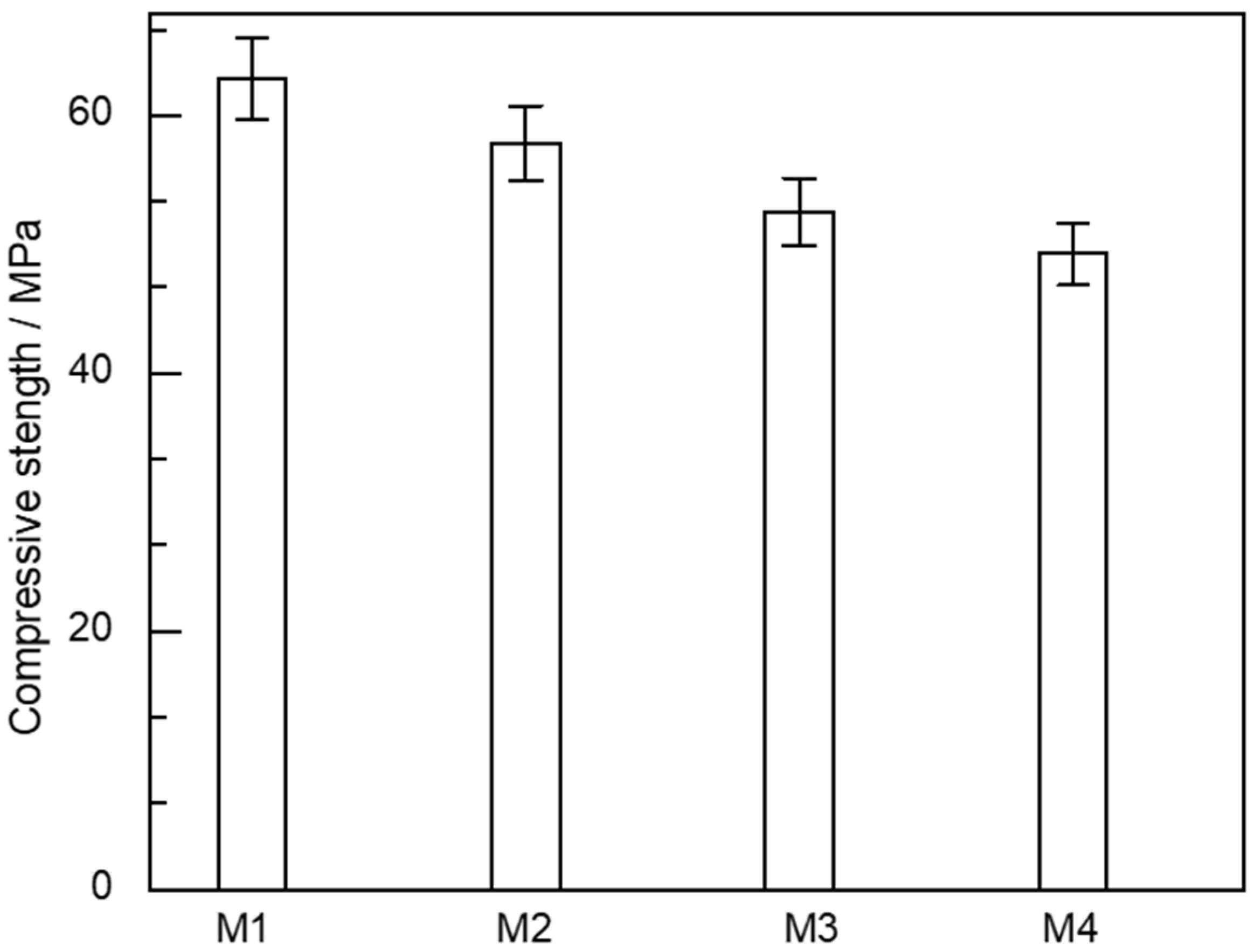
The compressive strength results (
Figure 1) reveal a clear and systematic decreasing trend from mix M1 to mix M4, with average values declining from approximately 62–63 MPa to 48–49 MPa. This evolution does not indicate an abrupt loss of structural capacity; rather, it reflects the sensitivity of the eco-cellular geopolymer concrete to controlled variations in formulation and pore architecture, confirming the adjustable and optimisable nature of the developed system.
The high compressive strength achieved by mix M1 suggests the presence of a near-optimal compositional condition, in which the synergy between the components of the ternary FCC Class F fly ash BFS precursor promotes a high degree of geopolymerisation and efficient matrix densification [
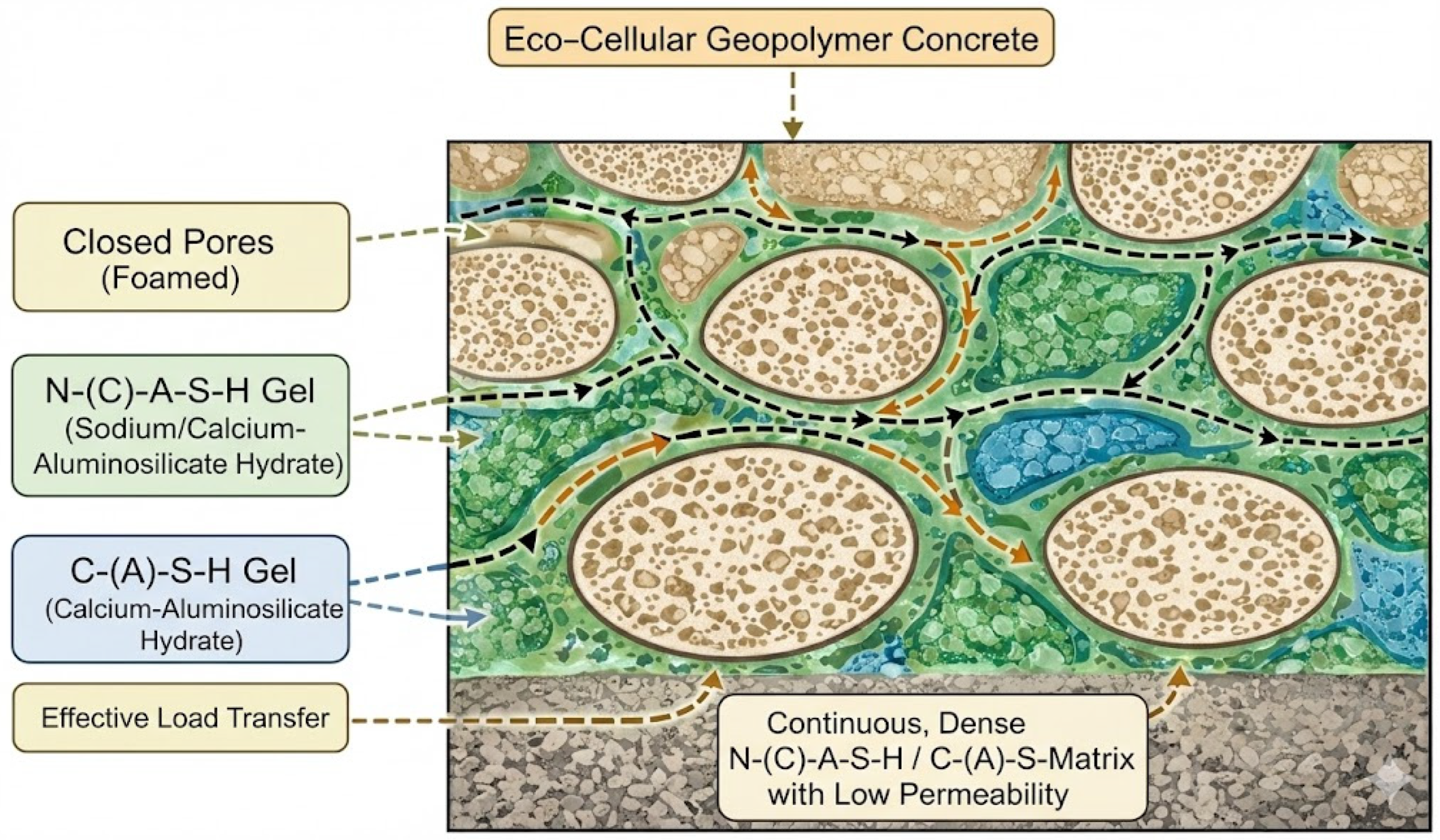
36]. In this formulation, the amorphous silica and alumina-rich fractions provided by FCC and fly ash, combined with the reactive calcium supplied by BFS, favour the simultaneous and well-integrated formation of N-(C)-A-S-H and C-(A)-S-H gels. This results in a continuous load-bearing network capable of effectively transferring stresses even in the presence of intentionally induced porosity.
This continuous load-bearing behaviour arises from the percolation of the geopolymeric gel phases throughout the matrix, forming a rigid and interconnected skeleton that bridges the interparticle spaces and surrounds the closed pores generated by the eco-cellular design. As a result, applied stresses are redistributed through the solid gel network rather than being concentrated at pore boundaries, allowing effective stress transmission despite the presence of a significant void volume. The predominance of closed and well-dispersed pores further limits stress localisation, preserving the mechanical integrity of the matrix.
As the formulation shifts from M1 towards M4, the progressive reduction in compressive strength can be interpreted as the consequence of a gradual decrease in effective matrix densification [
37]. This behaviour is attributed to variations in the balance between precursor components, the availability of reactive calcium, and the equilibrium between paste viscosity and foam stability. In eco-cellular systems, relatively small changes in these parameters can lead to noticeable differences in binder phase continuity and stress distribution under load, without necessarily compromising the overall functionality of the material.
The relationship between the eco-cellular geopolymer architecture and the formation of dense N-(C)-A-S-H and C-(A)-S-H gels is schematically illustrated in
Figure 2. As shown in the scheme, the preformed foam defines a system of predominantly closed pores at the macroscopic scale, while the alkaline activation of the ternary precursor promotes the formation of a continuous and percolated gel network at the microscale. These dense gel phases surround and bridge the closed pores, generating a rigid load-bearing framework that ensures effective stress transfer throughout the matrix. As a consequence, the eco-cellular porosity does not disrupt mechanical integrity, since load transmission, low permeability, and structural continuity are governed by the dense and interconnected N-(C)-A-S-H/C-(A)-S-H gel matrix rather than by the pore volume itself.
From a microstructural perspective, the observed trend can be associated with variations in the connectivity of the gel network and in the efficiency of interparticle space filling during the alkaline activation process. Formulations closer to M1 exhibit higher matrix continuity and internal cohesion, enabling a more homogeneous redistribution of applied stresses. In contrast, formulations approaching M4 are increasingly influenced by the eco-cellular porosity, which may induce local stress concentrations and reduce global strength without compromising the fundamental structural stability of the material [
37].
The eco-cellular architecture therefore plays a decisive role in the mechanical response of the system. The presence of predominantly closed pores, stabilised through the use of preformed foam and additives that are compatible with highly alkaline environments, allows a partial decoupling of the classical density–strength relationship. However, the efficiency of this decoupling is critically dependent on the balance between foam volume fraction and the ability of the geopolymer binder to generate a sufficiently rigid continuous phase. The decreasing trend observed from M1 to M4 suggests that this balance progressively shifts towards a less favourable, yet still functional, condition within the evaluated range.
From a durability standpoint, these mechanical results have direct implications for the corrosion behaviour of the reinforcing steel. A matrix with higher compressive strength, such as those observed for mixes M1 and M2, exhibits a lower susceptibility to cracking, thereby reducing the formation of preferential pathways for the ingress of chlorides and other aggressive species [
36]. In this sense, mix M1 not only represents the most mechanically favourable condition, but also provides a potentially more protective environment for the embedded steel, in agreement with the electrochemical results discussed in subsequent sections.
Overall, the observed mechanical trend supports the hypothesis that the performance of eco-cellular geopolymer concrete is not governed solely by apparent density, but by the complex interaction between binder chemistry, developed microstructure, and pore design. The ability to maintain compressive strengths above 45 MPa even in the least favourable formulation demonstrates that the FCC fly ash BFS system offers a wide compositional adjustment window, enabling the material to be tailored to diverse structural and durability requirements in aggressive environments.
3.2. Open Porosity
The open porosity values determined by the water absorption/Archimedes method (
Section 2.6) exhibit a clear monotonic increase from mixture M1 to M4. Mixture M1 shows the lowest open porosity, with an average value of approximately 8.5 ± 0.6%, consistent with its higher compressive strength and more compact microstructure. A moderate increase in connected porosity is observed for mixture M2, reaching 10.8 ± 0.7%, followed by a more pronounced rise for mixture M3 (13.9 ± 0.9%). The highest open porosity corresponds to mixture M4, with values close to 16.8 ± 1.1%, reflecting a significantly more connected pore network. This progressive increase in open porosity correlates well with the reduction in compressive strength and the electrochemical response discussed in subsequent sections. In particular, mixtures with lower open porosity exhibit higher polarisation resistance and lower corrosion current densities, indicating that reduced pore connectivity effectively limits ionic transport and chloride access to the steel–matrix interface under aggressive exposure conditions.
3.3. Corrosion Potential
The corrosion behaviour of reinforcing steel embedded in eco-cellular geopolymer concretes was assessed through the analysis of the corrosion potential (Ecorr) under exposure to a 3.5 wt.% NaCl solution. This technique allows the thermodynamic stability of the passive film on the steel surface to be estimated in a highly aggressive environment and provides comparative information on the influence of the cementitious matrix on the electrochemical conditions surrounding the reinforcement.
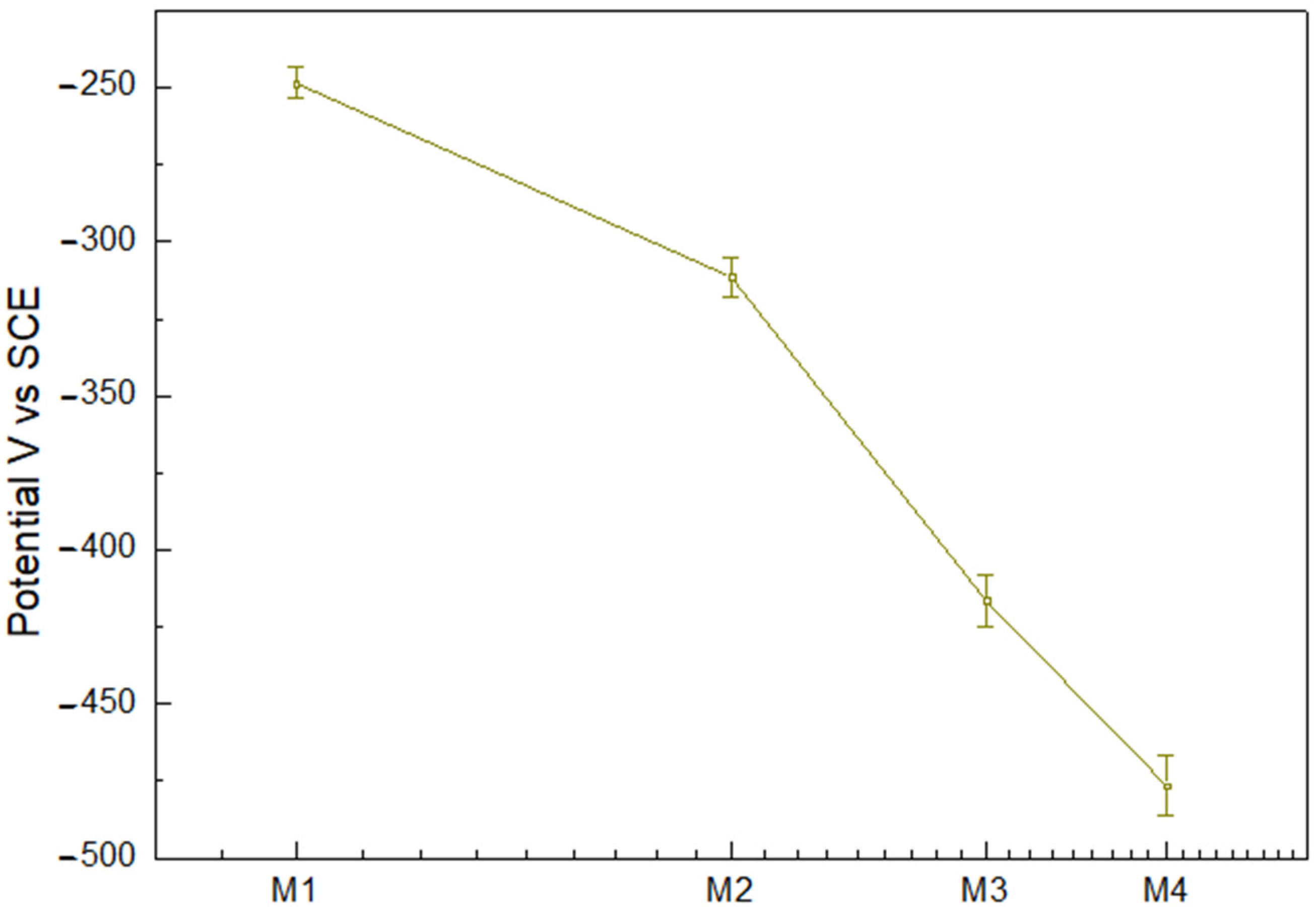
The results obtained (
Figure 3) show a clear and systematic trend as a function of matrix formulation, highlighting the direct influence of the eco-cellular design and the developed microstructure on the electrochemical response of the system [
38]. A progressive shift in the potential towards more negative values is observed from mixture M1 to mixture M4, with Ecorr values evolving from −248.4 mV to −476.4 mV vs. saturated calomel electrode (SCE) [
39]. This monotonic trend reflects a gradual decrease in the thermodynamic stability of the passive film on the steel, associated with changes in the electrochemical environment provided by the geopolymer matrix in the presence of chlorides.
Mixture M1 exhibits the most noble potential among the formulations studied, indicating that this composition provides a more favourable environment for the preservation of steel passivity. This behaviour can be attributed to a higher degree of microstructural densification, lower capillary connectivity and reduced mobility of ionic species within the matrix, all of which limit electrochemical interaction between the steel and the chloride containing medium. In this context, the high and stable alkalinity characteristic of alkali-activated systems plays a decisive role in maintaining the passive state.
For mixtures M2 and M3, a progressive shift in the potential towards more negative values is observed, with the change being particularly pronounced between M2 and M3. This behaviour suggests the existence of a microstructural threshold beyond which the ability of the matrix to buffer the effect of chlorides decreases significantly. A reduction in the continuity of the aluminosilicate gel network and a relative increase in capillary connectivity favour higher effective conductivity of the porous medium, resulting in more negative corrosion potentials.
Mixture M4 presents the most negative potential of the series (−476.4 mV vs. SCE), falling within a range that, according to conventional electrochemical criteria, is commonly associated with a higher probability of steel depassivation. Nevertheless, it should be noted that in highly alkaline geopolymer systems with elevated ionic conductivity, absolute potential values can be influenced by the measurement environment and do not necessarily imply the onset of active corrosion [
40]. For this reason, corrosion potential data should be interpreted from a comparative perspective, in which the relative evolution between mixtures is more representative than a direct classification based on threshold values.
The trend observed in the corrosion potential is consistent with the mechanical results obtained for the same formulations. Mixtures exhibiting higher compressive strength correspond to more noble potentials, whereas those with lower microstructural densification display more negative values. This correlation reinforces the link between material microstructure, its ability to limit chloride transport and the electrochemical stability of the embedded reinforcing steel.
3.4. Potentiodynamic Polarisation
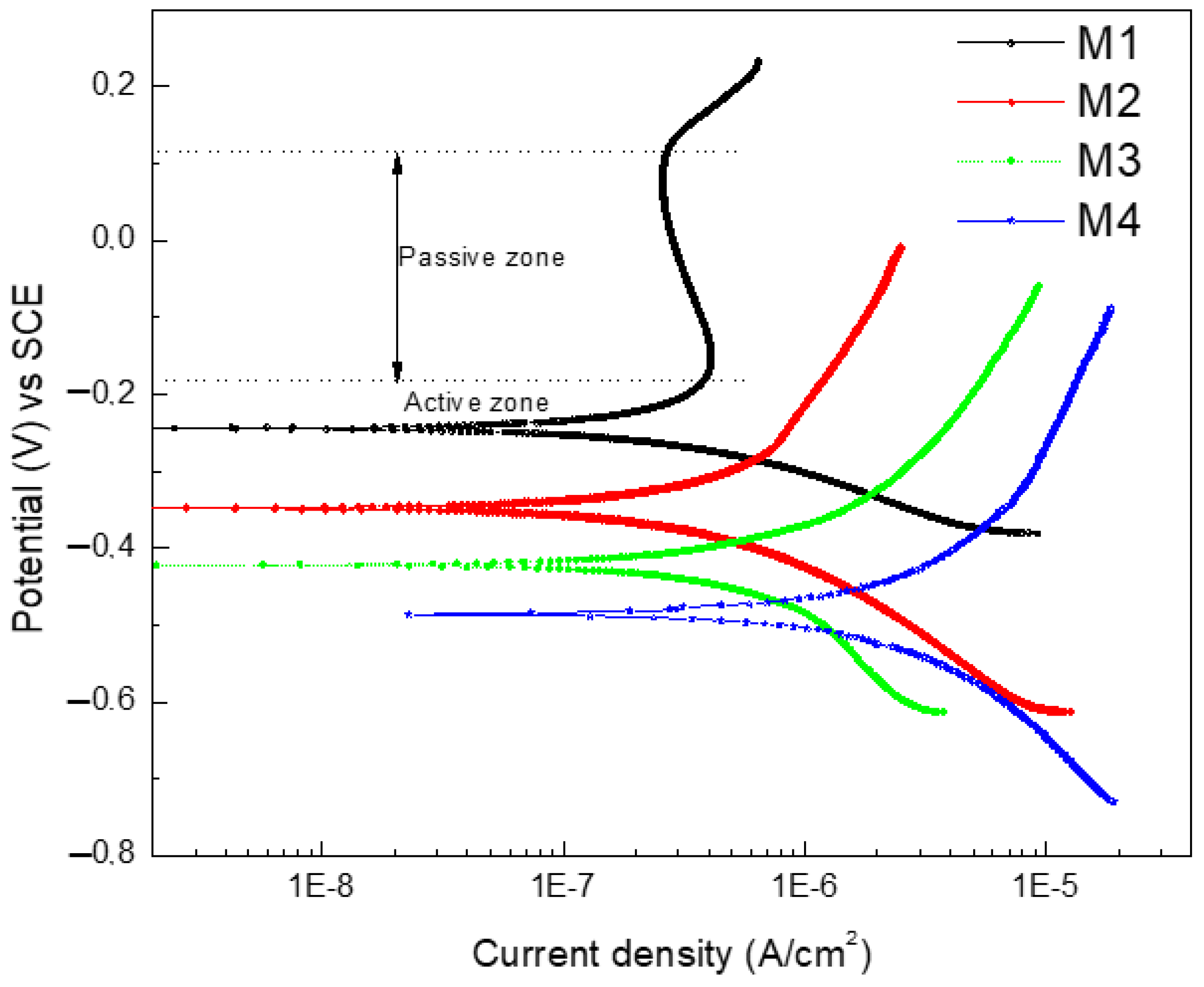
The potentiodynamic polarisation curves obtained for the reinforcing steel embedded in the eco-cellular geopolymeric concretes (
Figure 4) allow clear differences in the anodic corrosion mechanisms to be identified as a function of the matrix formulation. This type of curve is widely used to distinguish regions associated with active, passive or transient steel behaviour, particularly in highly alkaline media in the presence of chlorides, and its interpretation is especially robust when complemented by corrosion current density (Icorr) values.
In general terms, as the applied potential is increased from values close to the equilibrium potential, an initial increase in anodic current density is observed, associated with the activation of the iron dissolution process. This behaviour corresponds to the so called active region, in which corrosion kinetics are governed by charge transfer at the steel electrolyte interface [
41]. In this region, the increase in current with potential reflects the progressive release of electrons from the steel into the chloride containing medium, enabling the determination of Icorr values representative of the intensity of the corrosion process.
In the case of mixture M1, the anodic branch exhibits a significant deviation from purely active behaviour. Following the initial activation region, a potential interval is identified in which the current density shows only limited variation, suggesting the formation of a partially stable protective film on the steel surface. This phenomenon may be interpreted as a pseudo passive or unstable passive region, characteristic of carbon steels in highly alkaline environments. This behaviour is reflected in the low corrosion current density obtained for this mixture (0.347 µA cm−2), corresponding to a low corrosion regime, confirming that the eco-cellular matrix of M1 provides favourable conditions for slowing anodic steel dissolution even under chloride exposure.
By contrast, the curves corresponding to mixtures M2, M3 and M4 do not exhibit a clearly defined passive region. In these cases, the anodic current density increases continuously with potential, indicating predominantly active behaviour. This electrochemical response is consistent with the progressively higher corrosion current densities determined for these formulations. In particular, mixture M2 presents an Icorr value of 0.577 µA cm−2, associated with a low-to-moderate corrosion regime, whereas mixture M3 reaches 1.06 µA cm−2, indicative of moderate corrosion. For mixture M4, Icorr increases to 2.87 µA cm−2, corresponding to a moderate-to-high corrosion regime, evidencing early and sustained activation of the corrosion process.
At higher potentials, all curves show a pronounced increase in current density, associated with additional electrochemical processes such as water oxidation and oxygen evolution. These processes may induce local changes in the chemistry of the steel–electrolyte interface and, in chloride-containing media, promote the progressive breakdown of any residual protective film, leading to an accelerated steel dissolution regime. This behaviour explains the elevated Icorr values observed for the lower-performing mixtures.
Comparison among mixtures highlights that the extent and stability of the pseudo-passive region are strongly dependent on the formulation of the eco-cellular geopolymeric concrete. Mixture M1 exhibits the greatest ability to sustain a regime of limited anodic current, reflected in the lowest Icorr value, whereas mixtures M3 and M4 show early activation and significantly higher corrosion current densities, consistent with their classification within moderate and moderate to high corrosion regimes, respectively.
From a microstructural perspective, this behaviour is attributed to the greater matrix densification and lower capillary connectivity in mixture M1, which restrict chloride transport and favour the stability of the passive film [
42]. In contrast, less densified matrices allow increased access of the chloride-containing electrolyte to the steel surface, promoting the breakdown of the protective film and intensification of the corrosion process, as evidenced by the progressive increases in Icorr.
3.5. Electrochemical Impedance Spectroscopy (EIS)
As established for porous cementitious materials and alkali activated matrices, electrochemical impedance spectroscopy enables the discrimination of overlapping processes occurring at the steel matrix system through the analysis of time constants associated with the interfacial response. In heterogeneous systems such as reinforcing steel embedded in eco-cellular concretes, the electrochemical response does not usually appear as an ideal capacitive arc, but rather as a combination of distributed resistive and capacitive contributions [
43]. This behaviour is influenced by the tortuosity of the porous network, the effective capillary connectivity and the non-uniform nature of the steel electrolyte interface.
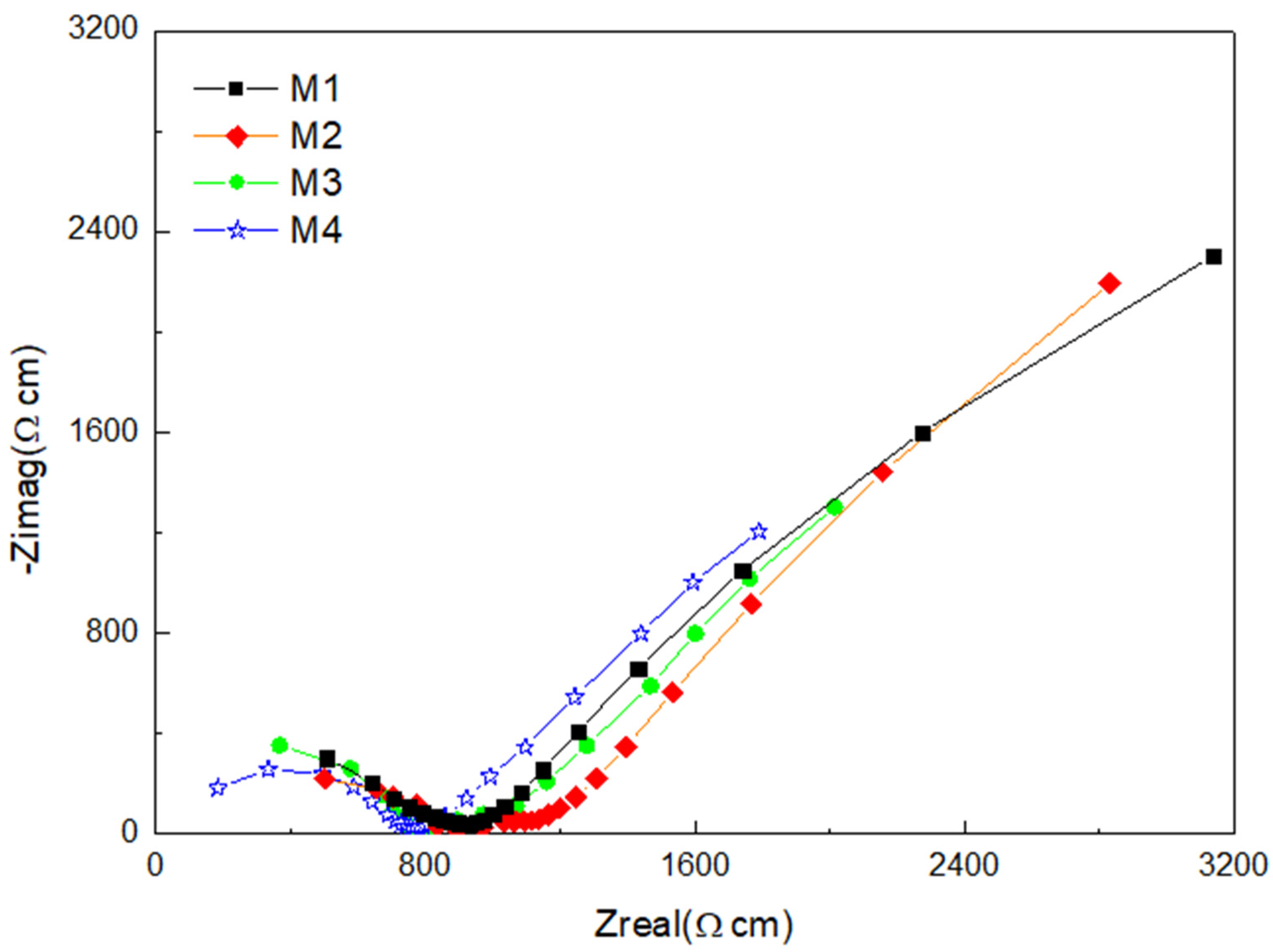
Figure 5 presents the Nyquist diagrams obtained for mixtures M1–M4 after exposure to a 3.5% NaCl solution. In all cases, the response is characterised by depressed capacitive arcs and the presence of more than one time constant, indicating that the electrochemical behaviour of the system is governed by simultaneous interfacial processes rather than by a single controlling phenomenon. This type of response has been widely reported for cementitious and geopolymeric matrices subjected to aggressive ionic environments and is commonly associated with the coexistence of contributions arising from both the porous medium related to ionic conduction through the interstitial solution and the direct electrochemical interface at the steel surface, which is linked to charge transfer processes and the formation or alteration of the surface film.
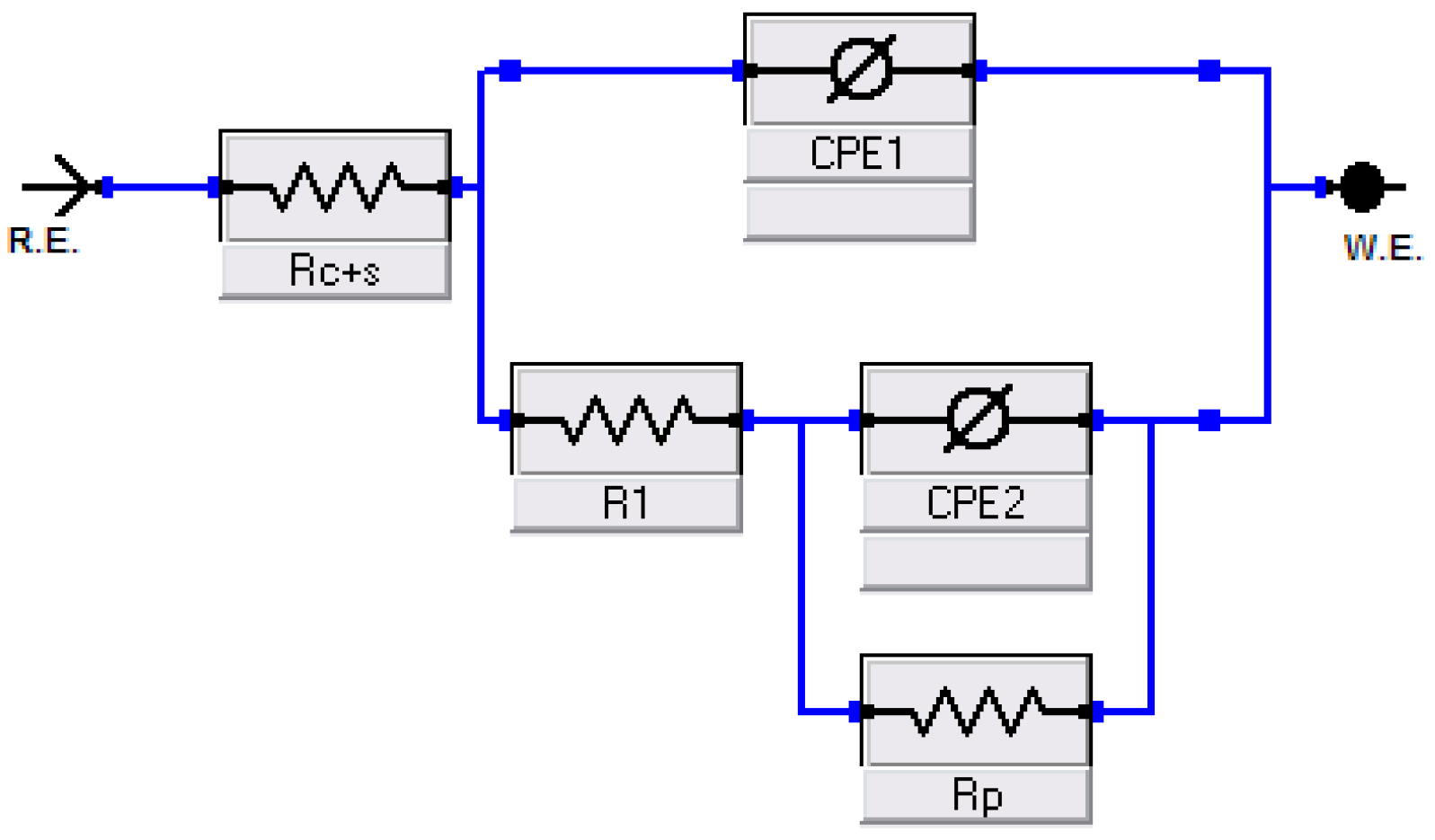
To enable a quantitative interpretation of this response, the experimental spectra were fitted using the equivalent electrical circuit shown in
Figure 6. The model comprises an ohmic resistance, Rc+s, in series with a parallel network consisting of two resistances and two constant phase elements (CPEs), which represent the high- and low-frequency interfacial contributions of the system. This approach is particularly suitable for porous materials, as the use of CPEs allows the deviation from ideal capacitive behaviour to be described, accounting for surface heterogeneity, pore size distribution, local compositional variations and the dispersion of time constants.
The parameters obtained from the fitting procedure are summarised in
Table 1. First, the ohmic resistance Rc+s remains within a relatively narrow range among the different formulations (≈408–752 Ω·cm), indicating that the overall ionic conduction through the interstitial electrolyte is not the determining factor governing the electrochemical differences observed between mixes [
44]. Consequently, the most relevant variations are concentrated in the interfacial parameters, particularly R1 and Rp, as well as in the capacitive response described by CPE1, CPE2 and their corresponding exponents n1 and n2.
The parameter R1, associated with the high-frequency interfacial response often related to near-surface heterogeneities at the steel interface or to an initial surface layer exhibits higher values for the mixtures showing superior electrochemical performance. Specifically, R1 reaches 1.342 kΩ·cm2 for mixture M1 and progressively decreases to 0.805 kΩ·cm2 for M4. This trend indicates that the steel matrix interface in M1 provides a greater resistance to charge transfer in the rapid response region of the system. Consistently, the exponent n1 attains a value of 0.91 for M1, suggesting a less dispersed response and behaviour closer to that of an ideal capacitor, which is indicative of a more uniform and electrochemically stable interface.
The dominant contribution associated with the kinetics of the faradaic process is reflected in the polarisation resistance Rp, which shows a monotonic decrease from 5513 Ω·cm2 for M1 to 3510 Ω·cm2 for M4. Since Rp represents the overall resistance of the system to charge-transfer reactions, its progressive reduction indicates an increasing activation of faradaic processes related to steel dissolution. This tendency is fully consistent with the increase in corrosion current density obtained from the polarisation curves, reinforcing the direct relationship between eco-cellular matrix formulation and interfacial resistance under chloride exposure.
Regarding the low-frequency capacitive response, the parameters CPE2 and the exponent n2 provide insight into the stability of the electrical double layer and the homogeneity of the electrochemical environment surrounding the steel. The increase in n2 from 0.89 for M4 to 0.94 for M1 indicates that mixture M1 develops a more stable and less dispersed interface, whereas lower performance formulations exhibit greater capacitive heterogeneity. This dispersion may be associated with local variations in pore connectivity and increased accessibility of the aggressive electrolyte to electrochemically active sites on the steel surface.
Overall, the integrated interpretation of the Nyquist plots (
Figure 5), the equivalent circuit model (
Figure 6), and the fitted parameters (
Table 1) demonstrates that the differences among mixtures are not governed by the ohmic resistance of the medium, but rather by the interfacial response of the system. In particular, the progressive reduction in Rp and the increase in capacitive dispersion towards mixture M4 explain the deterioration of electrochemical performance. In this context, mixture M1 exhibits the most favourable behaviour by combining the highest polarisation resistance, elevated high frequency interfacial resistances, and n exponents closer to unity, indicating a more homogeneous and electrochemically stable steel matrix interface under chloride exposure.
3.6. X-Ray Diffraction After Chloride Exposure
The mineralogical characterisation of the geopolymeric matrix was carried out by X-ray diffraction (XRD) after completion of the chloride exposure stage, with the aim of identifying the remaining crystalline phases and assessing the mineralogical stability of the reaction products formed during alkaline activation under highly aggressive conditions. The diffractograms were obtained from powdered samples of the eco-cellular geopolymeric matrices M1–M4 and analysed to establish the relationship between binder chemistry, the developed microstructure, and the observed electrochemical performance.
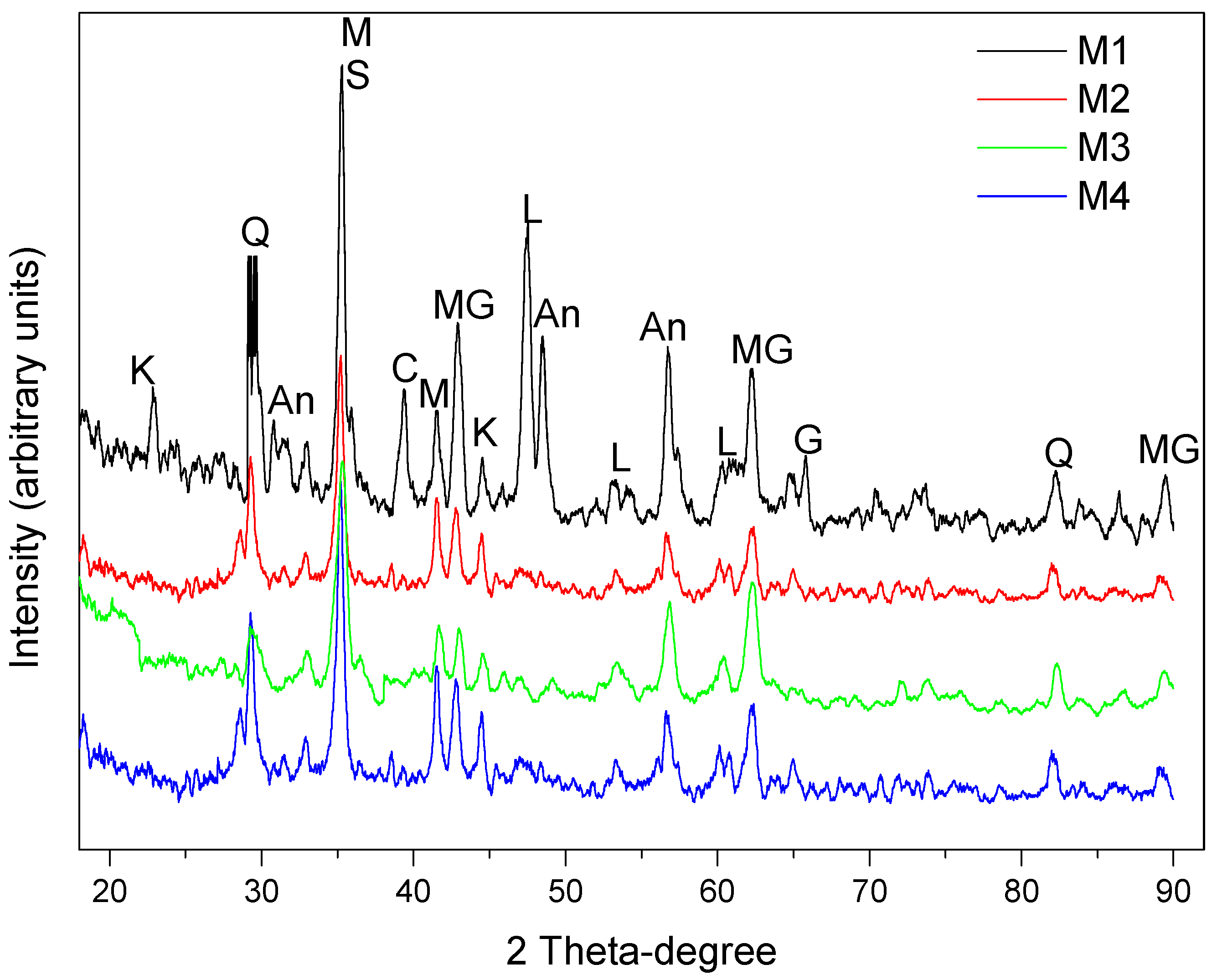
Figure 7 shows that, even after prolonged exposure to chloride-rich environments, the matrices retain a predominantly amorphous structure, as evidenced by the broadening of the diffraction background, which is characteristic of aluminosilicate gels of the N-(C)-A-S-H and C-(A)-S-H types [
45]. Although these gels do not exhibit well defined crystaline reflections, their presence can be indirectly inferred from the relative attenuation of the original crystalline phases of the precursor and the increase in the amorphous halo. This behaviour is consistent with partially reacted geopolymeric systems that remain chemically stable against chloride ingress.
With respect to the crystalline phases identified, the persistence of zeolitic structures such as faujasite (F) and analcime (Am) is observed, together with high-temperature aluminosilicates including andalusite (An), sillimanite (S), kyanite (K), and mullite (M). The phase labelled as AN corresponds to andalusite (Al2SiO5), identified mainly by its characteristic reflection associated with the (121) crystallographic plane. The retention of these phases after chloride exposure indicates that no significant mineralogical degradation of the crystalline framework occurs, suggesting a high degree of chemical stability of the alkali-activated system. The presence of quartz (Q) is associated with essentially inert phases, which do not actively participate in the activation process or in chloride-induced degradation mechanisms.
In addition, several iron-rich phases were identified, including goethite (G), lepidocrocite (L), haematite (HM), magnetite (MG), and wüstite (W). The coexistence of these phases after chloride exposure reflects the presence of different iron oxidation states and suggests that no significant mineralogical transformation is induced by the aggressive environment.
Although a full Rietveld refinement was not performed, the relative intensity of the diffraction peaks allows a semi-quantitative assessment of the corrosion products formed on the steel surface. Goethite (G) and lepidocrocite (L) are identified as the dominant phases, as evidenced by their higher peak intensities, indicating the prevalence of Fe3+ oxyhydroxides associated with relatively stable passive or pseudo-passive conditions. In contrast, haematite (HM) and magnetite (MG) appear with lower relative intensities, suggesting a secondary contribution related to localised redox transformations. The presence of wüstite (W) is limited, indicating that reduced Fe2+ phases are not dominant under the investigated exposure conditions. The relative persistence and evolution of these phases provide indirect quantitative insight into the oxidation state distribution and electrochemical stability of the steel surface.
From an electrochemical perspective, these phases may act as local electroactive sites; however, their overall effect appears to be mitigated by the densified geopolymeric matrix, as evidenced by the higher charge transfer resistance values and lower corrosion current densities observed for mixtures with a higher amorphous fraction.
A comparison among mixtures M1–M4 reveals variations in the relative intensity of crystalline peaks and in the magnitude of the amorphous background, indicating differences in the degree of reaction and in microstructural stability under chloride attack. In particular, formulations with a higher amorphous contribution exhibit more favourable electrochemical performance, characterised by lower corrosion current densities (Icorr) and higher charge transfer resistance values (Rct). This behaviour suggests that the gel-rich matrix acts as an effective physical and chemical barrier against ionic transport, limiting chloride access to the steel matrix interface.
Overall, the XRD results obtained after chloride exposure confirm that the eco-cellular geopolymeric matrix preserves its mineralogical integrity and predominantly amorphous character, supporting the superior electrochemical performance observed. The stability of the formed aluminosilicate gels and the absence of expansive phases or chloride-induced degradation products position this system as a viable, durable, and technically robust alternative for structural applications in highly aggressive environments.
4. Conclusions
The combination of alkaline activation and controlled eco-cellular design proved to be an effective strategy for mitigating reinforcement steel corrosion in chloride-rich environments. The ternary geopolymeric concrete based on FCC, Class F fly ash and BFS developed a densified microstructure with low capillary connectivity, providing a chemically stable environment that favours the preservation of the passive state of the embedded steel, in agreement with behaviours reported in the literature for alkali-activated systems.
The material achieved high compressive strengths, ranging from 48 to 63 MPa, within a dry density interval of 1100–1200 kg·m−3, demonstrating the ability of the eco-cellular geopolymeric binder to sustain an efficient load bearing network despite the deliberate introduction of porosity. Among the studied formulations, mixture M1 was identified as the optimal composition, as it combined the highest mechanical performance with the most favourable electrochemical response, confirming the close relationship between microstructural densification, mechanical integrity and durability.
Electrochemical analyses showed that mixture M1 exhibited the lowest corrosion current density (0.347 µA·cm−2), a well-defined pseudo passive region and the highest polarisation resistance (≈5513 Ω·cm), indicating a more homogeneous and electrochemically stable steel matrix interface. In contrast, mixtures M2–M4 displayed progressively higher corrosion activity and increased interfacial dispersion, consistent with their lower degree of microstructural densification.
Overall, the results demonstrate that alkali-activated eco-cellular geopolymeric concretes constitute a sustainable and technically robust alternative for protecting reinforcing steel in structures exposed to chloride aggressive environments, overcoming limitations commonly associated with traditional cementitious matrices in terms of ionic transport and passive stability.