
Article

Interrelated Behavior of Friction, Interfacial Electrical Resistance, and Phosphate Reactivity on Automotive GA-Coated Steel Sheets as a Function of Lubricant Protective Film Coating Weight


1
Automotive Chassis Application Engineering Team, Hyundai-Steel R&D Center, Dangjin 31719, Republic of Korea
2
Automotive Body Application Engineering Team, Hyundai-Steel R&D Center, Dangjin 31719, Republic of Korea
*
Author to whom correspondence should be addressed.
Surfaces 2026, 9(3), 63; https://doi.org/10.3390/surfaces9030063
Submission received: 16 June 2026 / Revised: 3 July 2026 / Accepted: 9 July 2026 / Published: 14 July 2026
(This article belongs to the Topic Engineered Surfaces and Tribological Performance)

Abstract

A lubricant protective film (LP) formed on automotive Zn-coated steel sheets is a functional surface layer that controls shear resistance at the die–sheet interface while also affecting the electrical contact state during resistance spot welding and the surface reactivity during paint pretreatment. In this study, the effect of LP coating weight on surface friction, interfacial electrical resistance, and degreasing–phosphate reactivity was analyzed for 340 MPa-grade galvannealed (GA) steel sheets within a unified surface-governed framework. The LP coating weight was controlled in the range of 0–1008 mg/m2 on a single-sided basis. The friction coefficient, cup-drawing limit blank holding force (BHF), resistance spot welding current range, resistance–time product obtained by integrating dynamic resistance with respect to time, residual LP after degreasing, phosphate coating formation behavior, and forming simulation results using experimentally measured friction coefficients as input were comparatively evaluated. With increasing LP coating weight, the friction coefficient decreased from approximately 0.163 to 0.130 and then increased again to approximately 0.145 in the high-coating-weight regime. This surface-state change increased the limit BHF during cup drawing, whereas it narrowed the current range and increased the resistance–time product during resistance spot welding. In addition, under conditions above approximately 550 mg/m2, residual LP after degreasing increased, and local no-growth regions of the phosphate coating were identified. These results show that, within the present test conditions, LP coating weight is not merely the amount of lubricant applied but a surface-state variable that concurrently influences frictional, electrical, and chemical responses. Therefore, within the scope of the present laboratory-scale framework, an LP coating weight of approximately 300–550 mg/m2 should be interpreted not as a universal optimum, but as an operational surface window derived by balancing formability, the RSW process window, and phosphate reactivity under the present experimental conditions.

1. Introduction

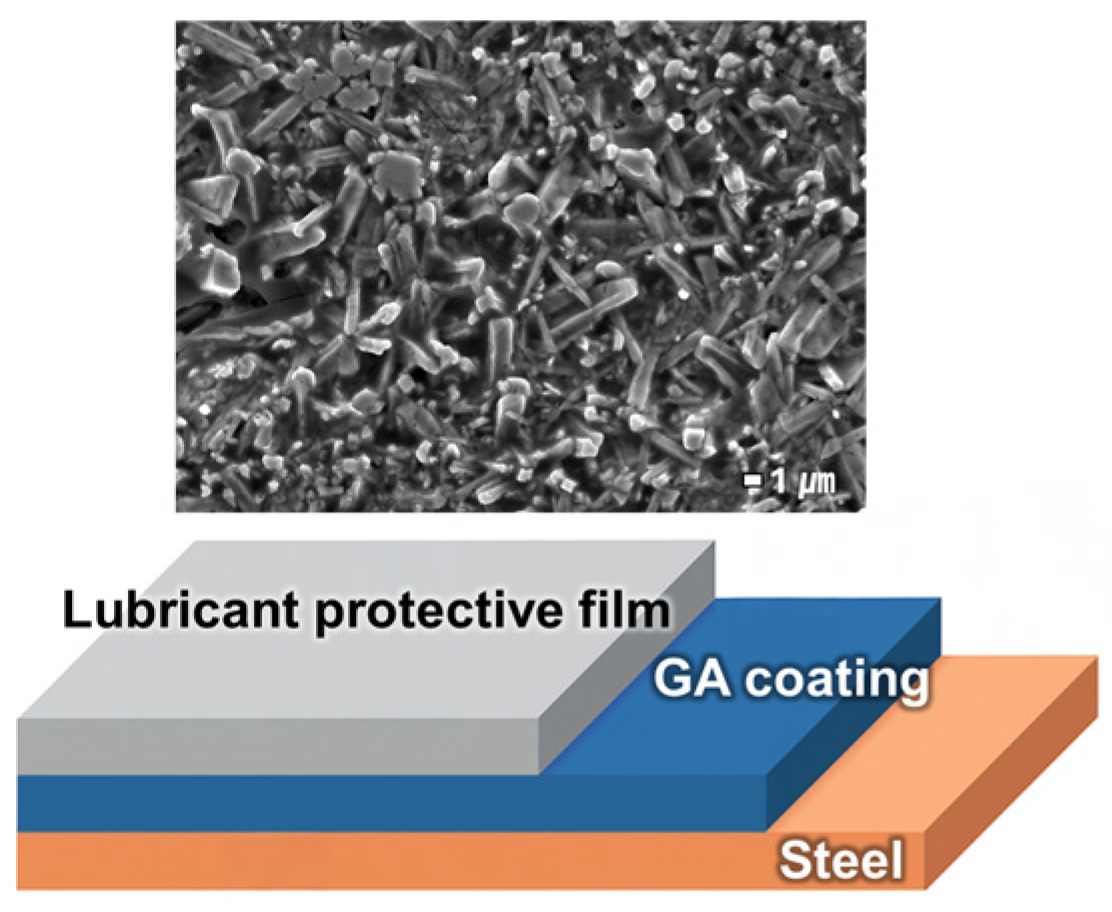
Automotive coated steel sheets are multifunctional materials required to simultaneously satisfy lightweight body design [1], long-term corrosion protection [2], high-quality appearance [3], high-speed automated productivity [4], and joining reliability [5], as well as other integrated performance requirements [6,7]. In particular, galvannealed (GA) and galvanized (GI) steel sheets, which are widely used for automotive outer and inner panels, provide excellent corrosion resistance and paintability. However, manufacturing stability in actual production is strongly influenced by the surface condition of the coating layer, frictional characteristics, interfacial adhesion behavior, and downstream process reactivity [8,9]. In drawing operations, increased friction at the die–sheet interface restricts blank inflow and may consequently induce sticking, galling, powdering/flaking, local thinning, and fracture [10,11]. Therefore, surface lubrication control of automotive coated steel sheets should not be regarded as a simple process-aiding technique, but as a key surface-design factor for jointly controlling the contact state and surface reactivity of the material surface. Regarding surface lubricant films on GA steel sheets, Sakurai et al. [12] reported reduced friction coefficients and improved press formability for GA steel sheets treated with a Ni-based inorganic lubricant film. Sugimoto et al. [13] proposed a highly lubricated GA steel sheet using an ultrathin Ni–Fe–O film and an organic lubricant film, with simultaneous consideration of press formability, anti-galling performance, spot weldability, and adhesive compatibility. Huang et al. [9] also reported that a lubricant film applied to automotive GA steel sheets can improve formability while maintaining chemical treatment compatibility [9,14,15]. These studies demonstrate that lubricant films control the frictional state of coated steel surfaces. However, because resistance spot welding (RSW) and paint pretreatment are performed sequentially after forming in actual automotive manufacturing, the function of a lubricant film cannot be limited to friction reduction alone. After the press shop, automotive steel sheets pass through RSW in the body shop and then the degreasing–surface conditioning–phosphating–electrodeposition process in the paint shop. During this process sequence, the lubricant protective film (LP) can act as a layer that lowers shear resistance at the die–sheet interface during forming, while functioning as a resistive interfacial layer that changes the electrical contact area at the electrode–sheet and sheet–sheet interfaces during RSW [5,16,17,18]. In the paint pretreatment stage, residual organic layers can also restrict the accessibility of reactive species to active sites on the Zn surface, thereby suppressing phosphate nucleation and crystal growth [2,19]. Therefore, evaluation of LP coating weight requires consideration not only of the minimization of the friction coefficient, but also of simultaneous changes in mechanical contact, electrical contact, and surface chemical reactions (Figure 1).
The objective of this study is to clarify how changes in LP coating weight alter the frictional state, interfacial electrical contact resistance, and degreasing–phosphate reactivity on the surface of automotive GA-coated steel sheets. For this purpose, the LP coating weight was controlled in the range of 0–1008 mg/m2 on a single-sided basis, and the friction coefficient, cup-drawing limit blank holding force (BHF), RSW current range, resistance–time product, residual LP after degreasing, phosphate coating growth behavior, and forming simulation results incorporating experimentally measured friction coefficients were compared. The focus of this study is not a parallel comparison of individual process performances, but rather a mechanistic interpretation of how LP coating weight acts as a functional surface layer that simultaneously modifies mechanical contact during forming, electrical contact during RSW, and chemical surface reactions during pretreatment. From this perspective, LP coating weight is treated not as a single process-control variable, but as a surface-state variable that governs the branching of mechanical, electrical, and chemical interfacial responses.

2. Materials and Methods

2.1. Materials and Evaluation of Mechanical Properties

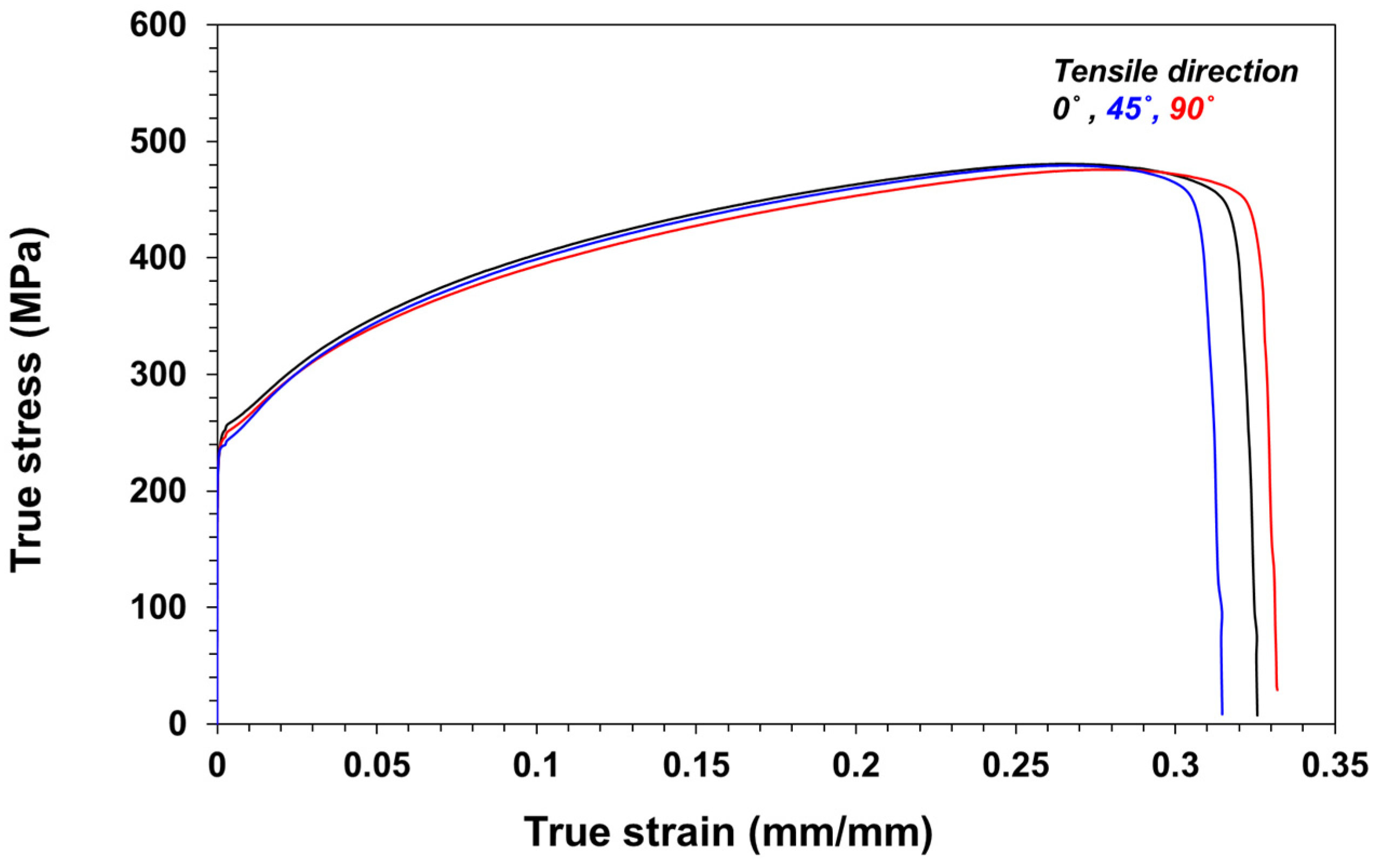
The test material used in this study was a 340 MPa-grade GA-coated steel sheet for automotive body panels. This material is an automotive steel sheet that sequentially undergoes press forming, RSW, and paint pretreatment processes and is therefore suitable for evaluating the interfacial behavior of the LP applied to its surface [8,15]. Mechanical properties were evaluated by room-temperature uniaxial tensile testing in accordance with JIS Z 2241:2022 [20], using a Z600 universal testing machine (ZwickRoell GmbH & Co. KG, Ulm, Germany). Tensile specimens with JIS No. 5 geometry were machined with their longitudinal axes oriented at 0°, 45°, and 90° relative to the rolling direction. The gauge length and width of the parallel section were 50 mm and 12.5 mm, respectively, and the tests were performed at 25 ± 3 °C. The initial strain rate was set to 1.0 × 10⁻³ s−1 [21,22], and load and elongation were continuously measured to obtain nominal stress–strain curves, which were then converted into true stress–true strain curves. Yield strength was determined using the 0.2% offset criterion, and tensile strength was calculated as the stress at the maximum load [8,23,24]. From the directional true stress–true strain curves shown in Figure 2, the yield strength, tensile strength, and total elongation of the steel sheet were evaluated to be approximately 240–250 MPa, approximately 470 MPa, and approximately 31–33%, respectively. These mechanical properties were subsequently used as basic input values for the material model in the forming simulation and were applied as reference properties for analyzing the effect of surface friction conditions, caused by changes in LP coating weight, on local thinning and shape response.

2.2. LP Coating Weight Conditions and Measurement Method

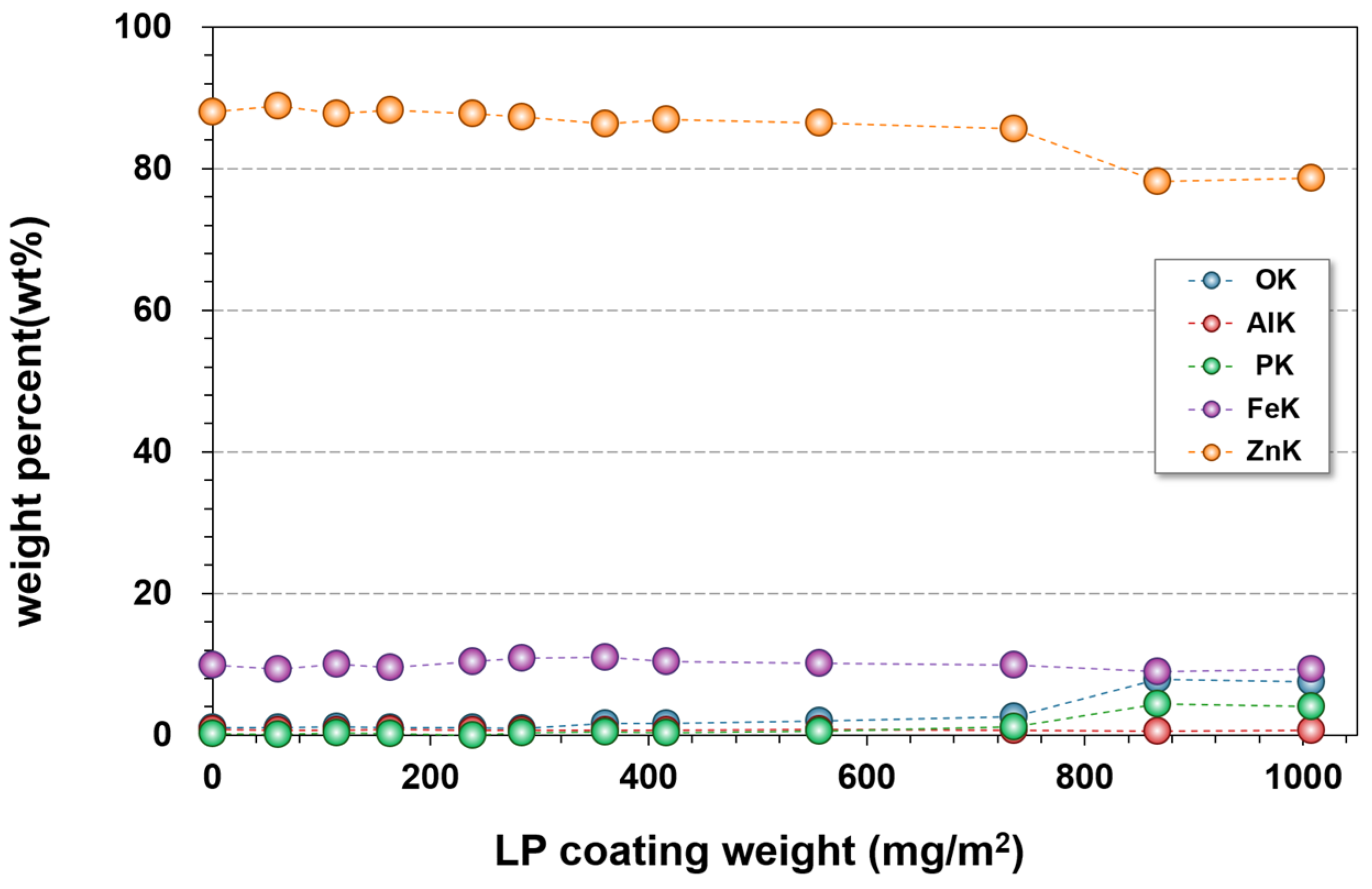
LP coating weight was selected as a primary control variable that changes the frictional behavior [8], interfacial contact characteristics [17], and surface reactivity [2] of GA-coated steel sheets. All LP coating weights were expressed as mass per unit area on a single-sided basis (mg/m2). The LP coating weights used in the experiments were 0, 60, 114, 163, 239, 284, 360, 416, 557, 735, 867, and 1008 mg/m2, thereby covering conditions from no coating to high-coating-weight conditions of approximately 1000 mg/m2. LP coating weight was controlled based on the target coating weight for each coating condition and verified using the mass difference before and after wet removal from specimens having the same measured area. The wet removal method using a 0.5% CrO3 (Nipsea Chemical Co., Ltd., Ansan-si, Republic of Korea) aqueous solution was applied as an auxiliary gravimetric method in which the mass change before and after LP removal was converted into mass per unit area. Because the CrO3 solution may react with the Zn-based coating layer or surface oxides, an identical GA blank specimen without LP was treated under the same conditions, and the blank mass change was used for correction [25]. The values obtained by this method were defined as the LP-equivalent amount removed under the CrO3 treatment condition, and all specimens were measured under identical conditions after rinsing and drying. To complement the gravimetric verification of LP coating weight, the surface elemental compositions of the as-coated specimens were additionally examined by SEM–EDS (JEOL Ltd., Akishima, Tokyo, Japan) before degreasing and phosphating. As shown in Figure 3, the relative surface concentrations of O and P increased progressively with increasing nominal LP coating weight, whereas the Zn concentration decreased correspondingly. This compositional trend is consistent with increased surface coverage by the LP layer on the GA coating and supports that the LP coating-weight series was systematically controlled across the investigated specimen set. For consistency in interpretation, the LP coating weight range was divided into three regimes. The range of 0–200 mg/m2 was defined as the low-coating-weight regime. In this regime, the LP was considered insufficient to continuously cover the overall surface, and direct metal-to-metal contact and asperity interlocking at the die–sheet interface were regarded as relatively dominant [23,26]. The range of 200–550 mg/m2 was defined as the intermediate-coating-weight regime. In this regime, the LP was assumed to form a sufficiently covered state to act as an effective lubricating layer at the interface, while maintaining surface accessibility and phosphate reactivity after degreasing to a comparatively high degree [8]. The range above 550 mg/m2 was classified as the high-coating-weight or over-threshold regime. This regime corresponds to a condition in which excessive LP accumulation may increase the residual organic layer after degreasing and restrict access to active sites on the Zn surface [2,12,19].
This classification is comparable with the functional divisions of thin lubricant layers, ultrathin inorganic films, organic dry films, and lubricant-treated GA/GI steel sheets reported by Sakurai et al. [12], Sugimoto et al. [13], Nakajima et al. [27], and Huang et al. [9,28]. In the present study, the coating-weight classification was used not as a simple, convenient categorization, but as an experimental framework for examining whether surface friction, interfacial electrical contact, and chemical reactivity change stepwise with increasing LP coating weight.

2.3. Evaluation of Friction Coefficient and Cup-Drawing Formability

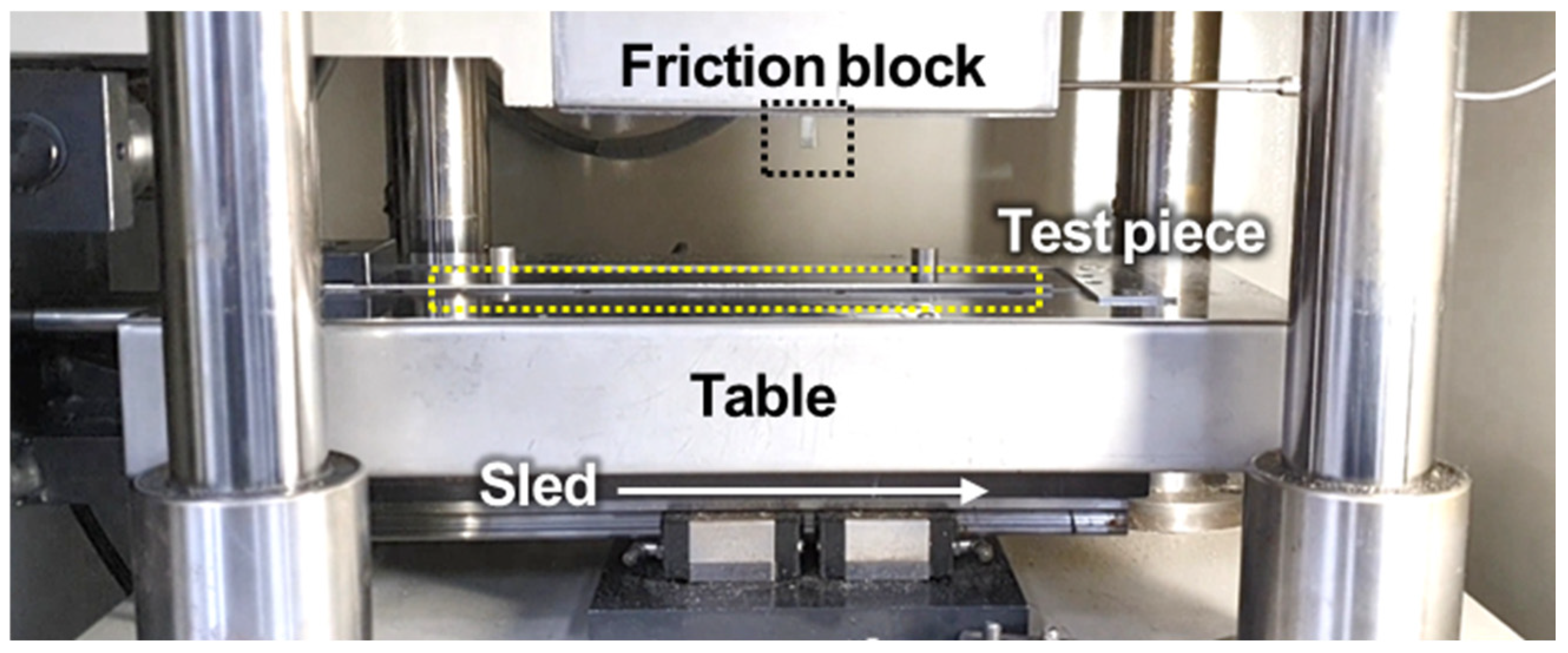
The interfacial lubrication behavior as a function of LP coating weight was quantified using the friction coefficient, which represents shear resistance at the die–sheet interface [8,19,29,30,31]. In studies of lubricant films on automotive GA-coated steel sheets, flat sliding tests, strip draw tests, and draw-bead-based tests are commonly used [8,24,30]. In the present study, the local interfacial shear behavior associated with changes in LP coating weight was evaluated using an in-house single-sided sliding friction tester developed at the Hyundai-Steel R&D Center (Dangjin-si, Republic of Korea), as shown in Figure 4. ISO 22462:2020 [32] specifies a test method for measuring and comparing the frictional properties of hot-dip galvanized, lubricated, and resin-coated steel sheets under identical test conditions and is therefore consistent with the purpose of the present study. Friction tests were conducted at 23 °C and 50% RH. A constant load of 600 N was applied during the test, and the average contact pressure calculated based on a contact area of 30 mm2 was 20 MPa. The sliding speed was fixed at 0.2 m/min to compare LP-induced changes in interfacial shear resistance under a controlled sliding condition, rather than to reproduce the full range of sliding speeds encountered in industrial stamping [8]. Five repeated measurements were performed for each LP coating weight condition, and the average value was used as the representative friction coefficient for that condition. The forming response was evaluated using a cup-drawing test system (Chongro Scientific Co., Ltd., Seoul, Republic of Korea). The blanks used in the test were prepared as circular specimens with a diameter of 110 mm, and forming was performed at room temperature using a standard cup-drawing die [33,34]. The punch speed was set to 5 mm/s, and the blank holding force (BHF) was increased stepwise. Five repeated tests were performed under each condition, and the maximum BHF immediately before fracture at the wall or corner region was defined as the limit BHF [35,36]. This test was used as an experimental indicator for comparing the effect of the surface friction state induced by changes in LP coating weight on material inflow and local fracture resistance. Mean values were used to compare trends across LP coating weights, and small differences between adjacent coating-weight conditions were interpreted with consideration of the measurement dispersion.

2.4. Evaluation of Resistance Spot Welding Characteristics

RSW tests were performed using a resistance spot welding system (Chowel Co., Ltd., Ansan-si, Republic of Korea) to evaluate the effect of LP coating weight on the electrical contact states at the electrode–sheet and sheet–sheet interfaces [16,17,37]. Because the RSW behavior of galvanized and galvannealed steel sheets is strongly affected by interfacial contact resistance, current distribution, coating morphology, and local heat input, the spot weld current range and resistance–time product were used as representative indicators of interfacial electrical behavior [5,37,38]. Cu–Cr alloy electrodes were used for welding, and the electrode tip diameter was set to 6.0 mm. The electrode force was fixed at 250 kgf (approximately 2.45 kN) [18,39,40,41,42], and the welding current was applied using an alternating-current mode. The welding time was set to 14 cycles, corresponding to approximately 0.23 s at 60 Hz. The reference welding current was set to 8.5 kA, and the allowable current range for each LP coating weight condition was evaluated by varying the current stepwise around this value [38,40,42].
The current range was defined as the difference (ΔkA) between the allowable minimum and maximum currents [43]. The lower current limit corresponded to unstable nugget formation or weld strength below the acceptance criterion, whereas the upper current limit corresponded to the onset of spatter or expulsion. Dynamic resistance was converted into mΩ and integrated over time to obtain the resistance–time product in mΩ·s. This value was used as a comparative indicator of the interfacial electrical and heat-input response induced by differences in LP coating weight under the same welding condition [38,43].

2.5. Evaluation of Residual LP After Degreasing and Phosphate Coating Formation

To evaluate the effect of changes in LP coating weight on surface accessibility during degreasing and phosphate coating formation, a surface pretreatment sequence commonly applied to automotive coated steel sheets was implemented at laboratory scale [4,6]. Pretreatment performance was assessed based on the amount of LP remaining on the surface after degreasing and the nucleation and crystal growth behavior of the coating after phosphating [2,4,19]. Alkaline degreasing was performed using an alkaline aqueous degreasing agent (Samyang Chemical Industries Co., Ltd., Yangsan-si, Republic of Korea) [4]. The degreasing solution was prepared under conditions including a nonionic surfactant, and the operating concentration was maintained at 5 g/L. The solution pH was controlled at 11.5 ± 0.2, and the treatment temperature was controlled at 50 ± 2 °C. Specimens were immersed in the degreasing solution for 5 ± 0.5 min, and mechanical stirring at 100 rpm was applied during treatment. After degreasing, the specimens were rinsed twice with deionized water at 30 °C, with each rinsing step set to 2 min. After rinsing, the specimens were naturally dried at room temperature and then used for subsequent phosphating or residual LP evaluation. These conditions were used as a laboratory-scale reference condition for comparing LP removability and accessibility to surface active sites under identical pretreatment conditions, rather than as a direct reproduction of a specific production paint-shop line [4,6]. After degreasing and rinsing, Zn-based tricationic phosphating was performed. The phosphate solution was prepared with Zn2+, Mn2+, and Ni2+ concentrations of 7–9 g/L, 1.5–2.5 g/L, and 0.3–0.7 g/L, respectively, and the pH was maintained at 6.5 ± 0.1 using a Na2HPO4/NaH2PO4 buffer system [4]. The treatment temperature and time were set to 25 ± 1 °C and 3 ± 0.3 min, respectively. The phosphate solution was applied by spraying, and the spray pressure was maintained in the range of 40–60 psi [4,6]. After phosphating, the specimens were rinsed twice with deionized water at 30 °C and dried in a circulating oven at 80 °C for 10 min. The degreasing–phosphating conditions used in this study were defined as a bench-scale pretreatment protocol for comparing the relative effect of LP coating weight on residual LP after degreasing and phosphate coating formation under identical experimental conditions, rather than as a direct reproduction of all operating variables in a continuous industrial paint-shop line. In alkaline degreasing, LP removal behavior can be affected by treatment temperature, treatment time, agitation conditions, and surfactant chemistry. In phosphating, phosphate nucleation and crystal growth are governed by bath chemistry, spray impingement, pH, treatment temperature, and the accessibility of active sites on the Zn surface. Therefore, the increase in residual LP and the occurrence of phosphate no-growth regions observed under high-coating-weight conditions should be interpreted not as a direct reproduction of production-line defects, but as comparative indicators showing that a residual LP layer can reduce surface reactivity under the same laboratory-scale pretreatment conditions. In the SEM observations, regions where phosphate crystals were not continuously formed were defined as no-growth regions. Active-site blocking by a residual organic barrier is therefore presented as a possible surface-reaction mechanism consistent with the SEM observations and residual LP results, rather than as chemically resolved direct evidence of a specific blocking mechanism.
Residual LP after degreasing was converted into the residual amount per unit area (mg/m2) using the mass difference in the specimens before and after degreasing [13]. The phosphate coating formation behavior was observed by scanning electron microscopy (SEM), and the analysis focused on phosphate crystal formation, uniformity of crystal distribution, and occurrence of local no-growth areas [2,4]. SEM observations were performed at the same magnification and in identical representative regions, and local no-growth areas were defined as surface regions in which phosphate crystals were not continuously observed. This method was used as an experimental basis for comparing the effect of changes in LP coating weight on accessibility to active sites on the Zn surface, as well as phosphate nucleation and crystal growth.

2.6. Forming Simulation Conditions and Evaluation Variables

A forming simulation was performed using the commercial finite element method (FEM) software PAM-STAMP 2024.0 (ESI Group, a part of Keysight Technologies, Rungis, France) to evaluate how the experimentally determined LP-dependent friction coefficients influenced the local deformation behavior of a representative automotive outer-panel component [34,35,44]. The simulation was used as an auxiliary analytical tool for quantitatively comparing the effect of differences in surface friction conditions on the local deformation field and final shape response during forming [8,45].
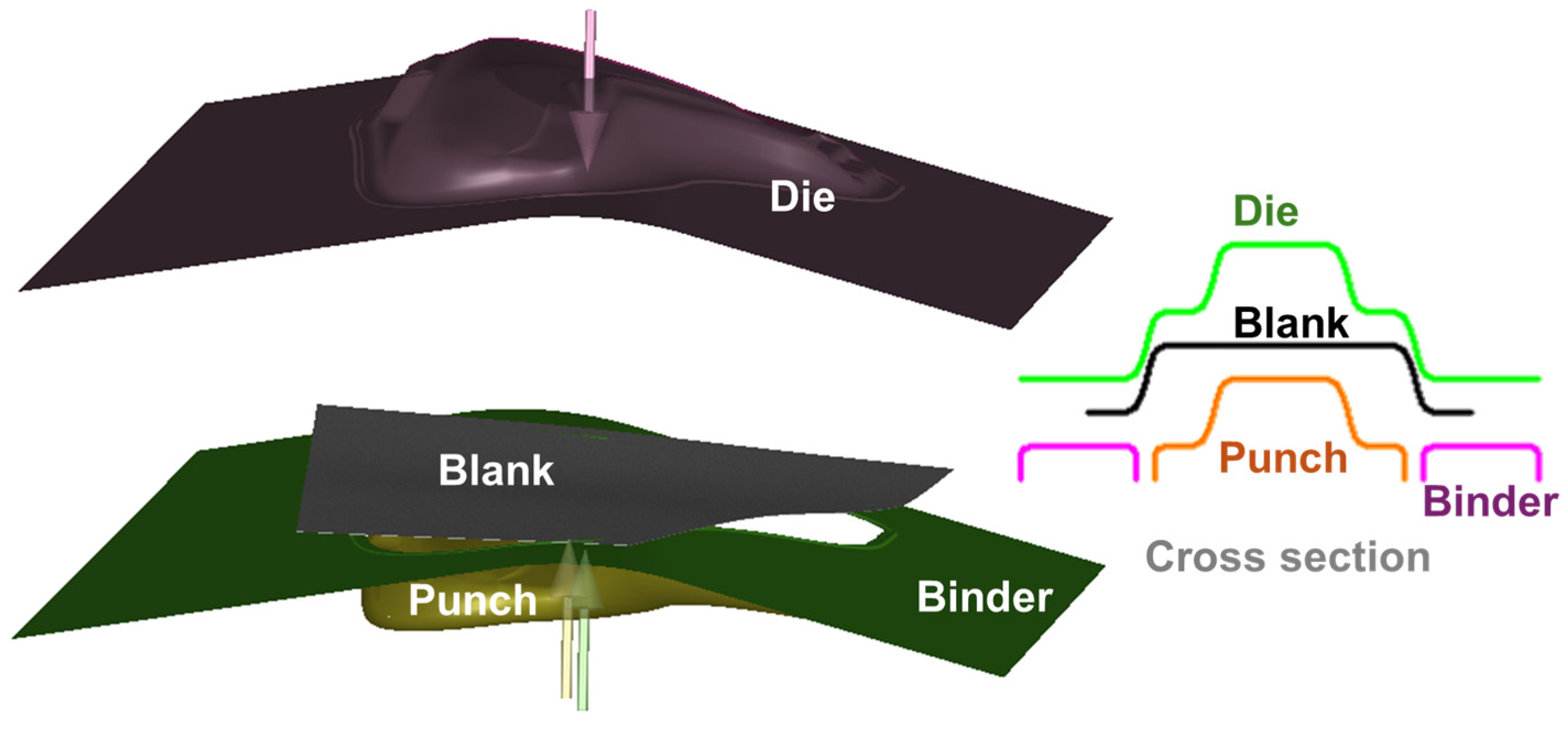
As shown in Figure 5, the forming simulation model was constructed based on the geometry of a fender component that can represent automotive outer-panel forming, and a four-tool system consisting of die, blank, punch, and binder was applied [46,47,48]. The mechanical properties of the 340 MPa GA-coated steel sheet used in the experiments were applied to the blank material, and the blank thickness was set to 0.7 mm. The blank size was defined to include an allowance region of approximately 20–30% relative to the component boundary so that sufficient material inflow could occur during forming [48,49]. The blank holder force was set to 100 tonnes (approximately 980 kN), considering the forming condition of the fender component [47,48]. The press speed was set to 300 mm/s. Shell elements based on an implicit formulation were used for element modeling, and 11 integration points per element were applied to evaluate stress and strain through the thickness direction [48,50,51]. Adaptive mesh refinement was applied to ensure analysis accuracy in the die shoulder and corner regions with large local deformation gradients, and the mesh refinement level was set to five [34,50]. Material behavior was defined using an anisotropic hardening model based on the Hill48 yield criterion [52]. The true stress–true strain curves were input based on the tensile test results described in Section 2.1. After forming was completed, springback analysis was performed, and the analysis procedure was configured to sequentially reflect the drawing–trimming–restriking–springback stages [51]. The friction coefficients measured for each LP coating weight condition were used as input values and maintained as constants throughout the analysis [30,31,45,53].
The simulation results were evaluated mainly in terms of thickness reduction contours and dimension distortion contours [47,50]. Thickness reduction was analyzed with a focus on the maximum thinning ratio at the die shoulder and corner regions [54], and dimension distortion was defined as the maximum displacement (mm) relative to the reference geometry after forming and springback [50,55,56]. This simulation was conducted as a comparative analysis to isolate the relative effect of LP-dependent friction coefficient changes on local thinning. Although the Hill48 yield criterion was applied to account for planar anisotropy, the friction coefficient measured for each LP condition was applied as a constant input throughout the analysis. Therefore, the FEM results should be interpreted as an auxiliary comparison of the relative influence of LP-dependent friction states on local thinning, rather than as an absolute prediction of springback or dimensional accuracy under production forming conditions incorporating pressure- and velocity-dependent frictional behavior.

3. Results

3.1. Change in Friction Coefficient with LP Coating Weight

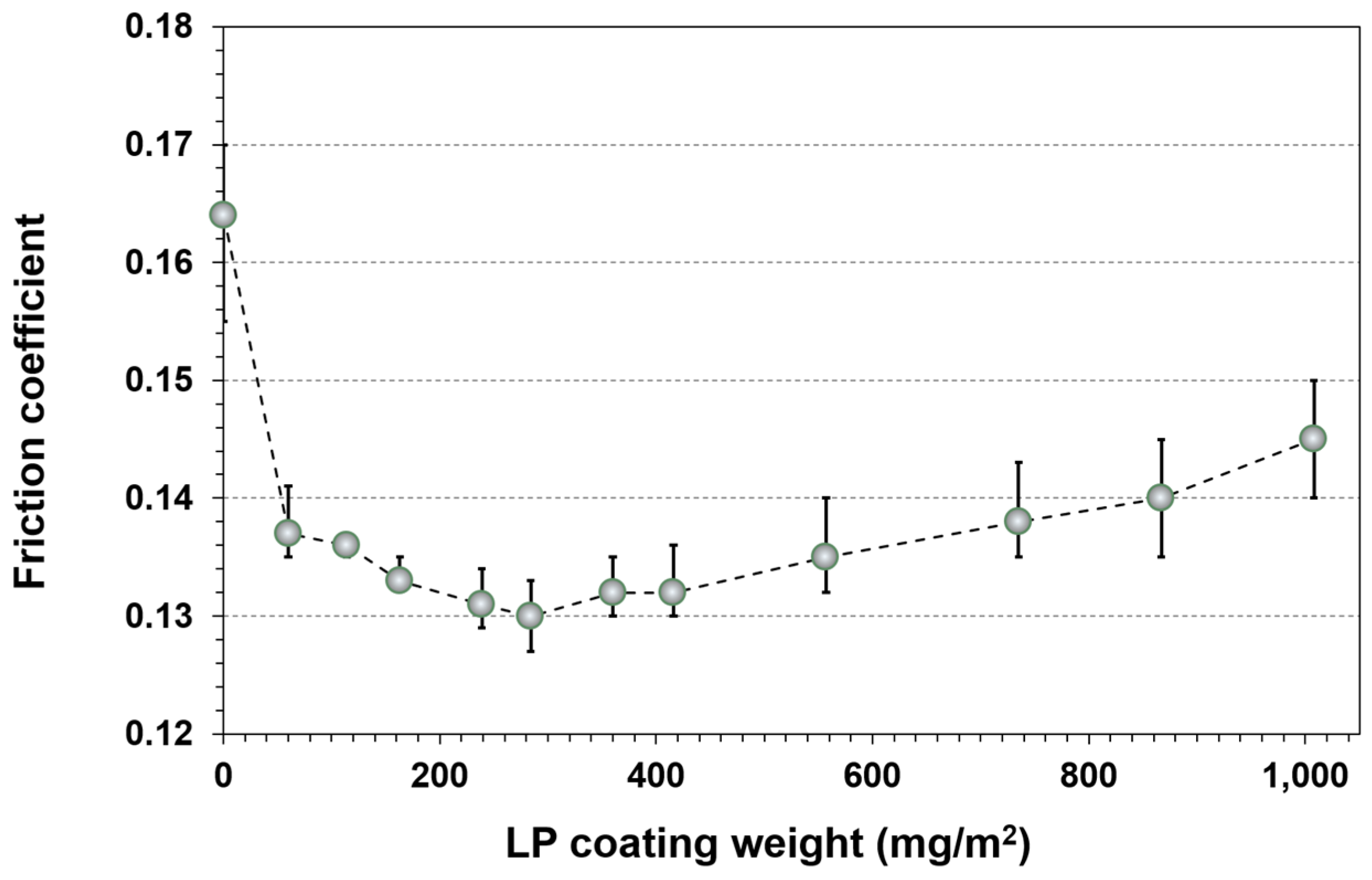
The change in friction coefficient as a function of LP coating weight is shown in Figure 6. Under the no-coating or extremely low-coating conditions, the friction coefficient was highest, at approximately 0.163. As the LP coating weight increased, the friction coefficient rapidly decreased in the range of approximately 50–300 mg/m2, reaching a minimum value of approximately 0.130. Thereafter, the friction coefficient increased again in the high-coating-weight regime and reached approximately 0.145 near 1000 mg/m2. The results in Figure 6 show a non-monotonic relationship between LP coating weight and friction coefficient. A distinct decrease in friction coefficient was observed when moving from the low-coating-weight regime to the intermediate-coating-weight regime [31], whereas a re-increase in friction coefficient was confirmed in the high-coating-weight regime. The average friction coefficient obtained for each LP condition was subsequently used as an input value for the forming simulation. Because the re-increase in the high-coating-weight regime was smaller than the initial friction reduction, this trend was interpreted as a comparative response and evaluated together with the dispersion of repeated measurements.

3.2. Change in Cup-Drawing Limit BHF with LP Coating Weight

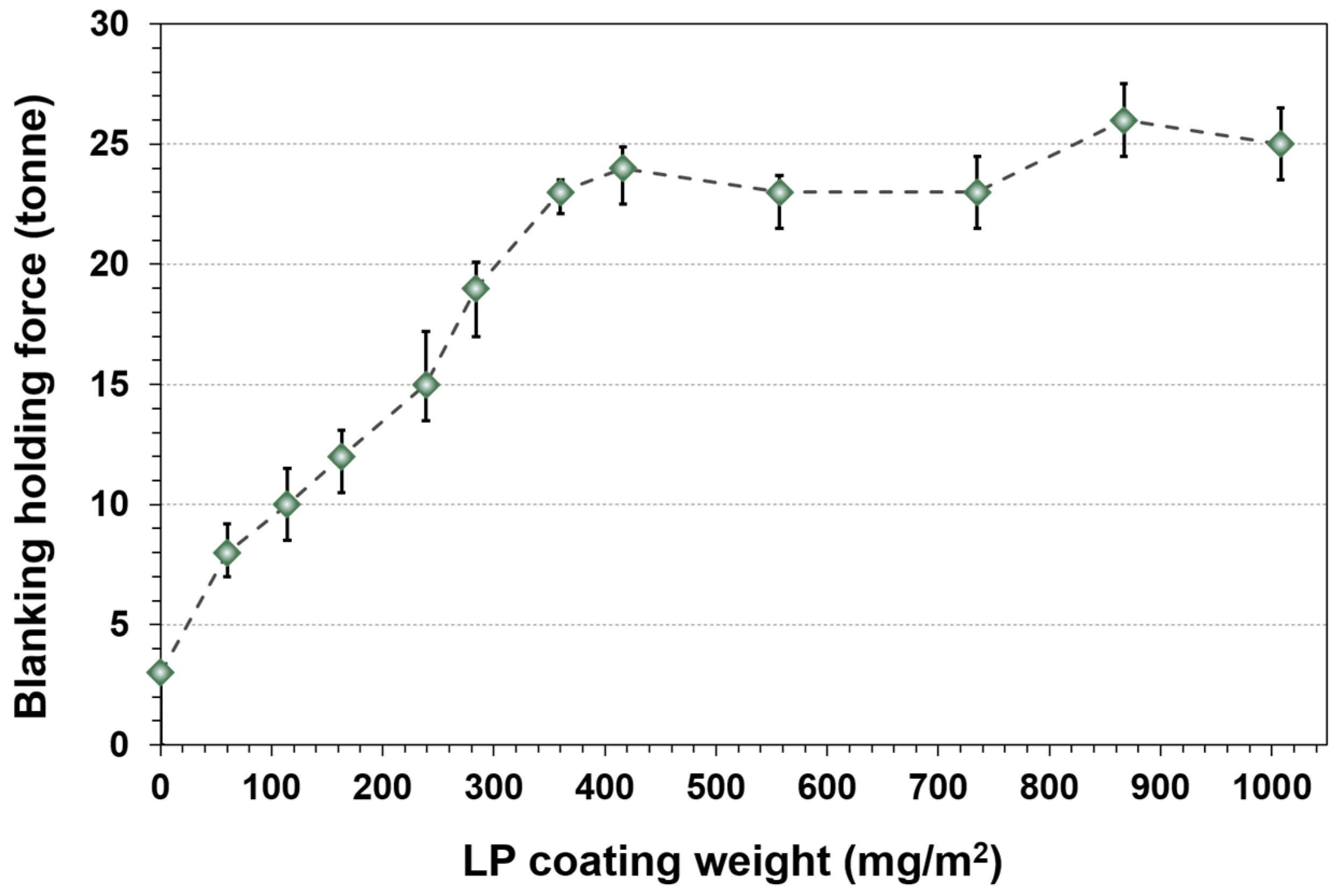
The change in the limit BHF with increasing LP coating weight in the cup-drawing test is shown in Figure 7. Under the no-coating or low-coating-weight conditions, the limit BHF was approximately three tonnes. As the LP coating weight increased, the limit BHF increased rapidly and reached a maximum of approximately 26 tonnes. The increase in the limit BHF was pronounced during the transition from the low-coating-weight regime to the intermediate-coating-weight regime. Above approximately 416 mg/m2, the increase in the limit BHF became gradual, and the overall response exhibited an increase followed by saturation. The results in Figure 7 indicate that changes in LP coating weight affect the forming limit in cup drawing [33,34].

3.3. Changes in Resistance Spot Welding Current Range and Resistance–Time Product with LP Coating Weight

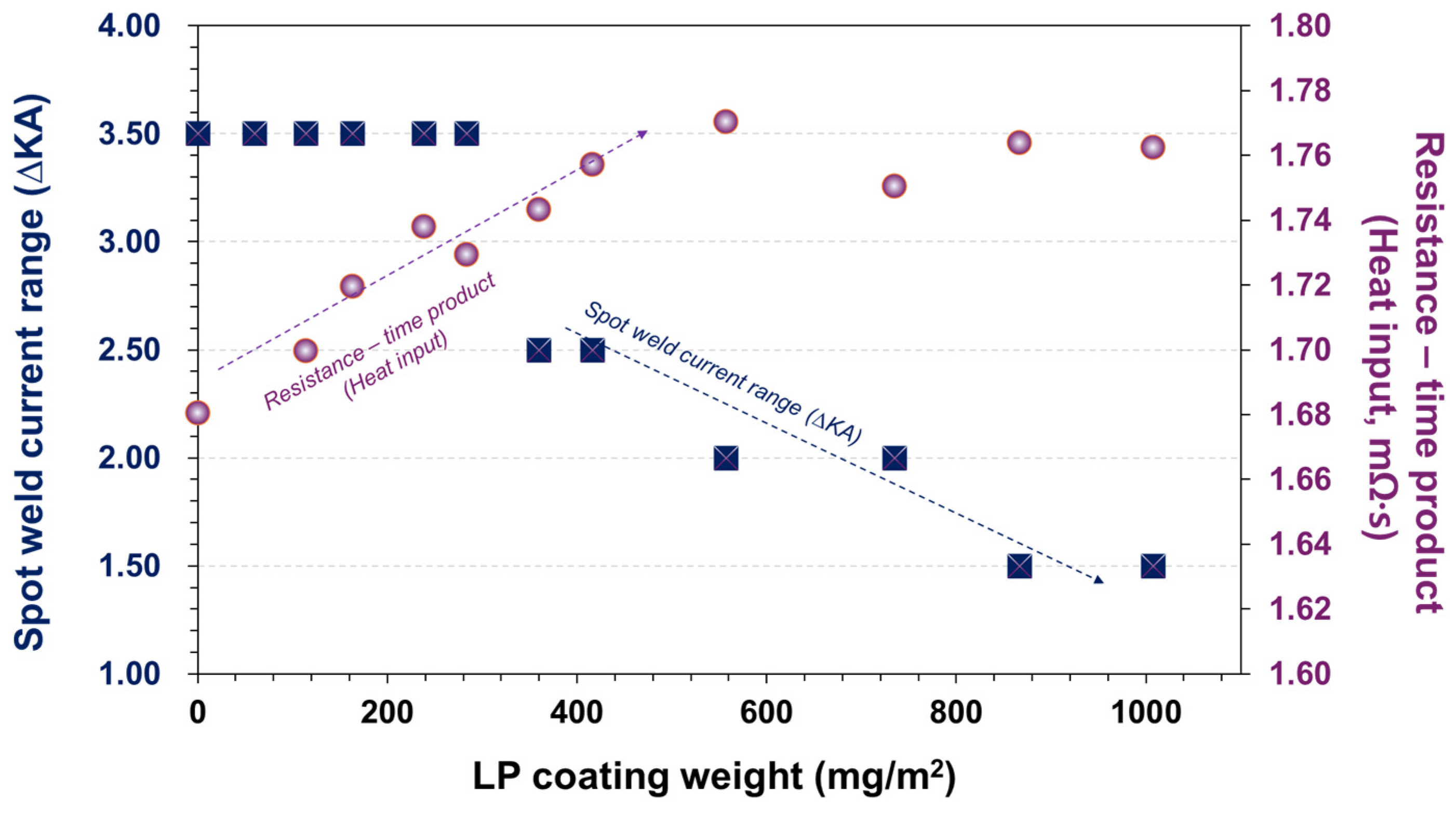
The RSW test results are shown in Figure 8. As the LP coating weight increased, the spot weld current range decreased from approximately 3.5 kA to approximately 1.5 kA. In contrast, the resistance–time product obtained by integrating dynamic resistance with respect to time increased from approximately 1.68 mΩ·s to 1.77 mΩ·s. In Figure 8, opposite trends were observed: the current range narrowed and the resistance–time product increased as the LP coating weight increased. These results indicate that LP coating weight affected the interfacial electrical response under the same welding conditions [18]. The current range, defined as the difference between the minimum and maximum currents, was narrower in the high-LP coating weight regime. Because the absolute change in resistance–time product is relatively small, this parameter is interpreted together with the concurrent narrowing of the weld current range rather than as a standalone measure of weld quality.

3.4. Residual LP After Degreasing and Phosphate Coating Formation Behavior

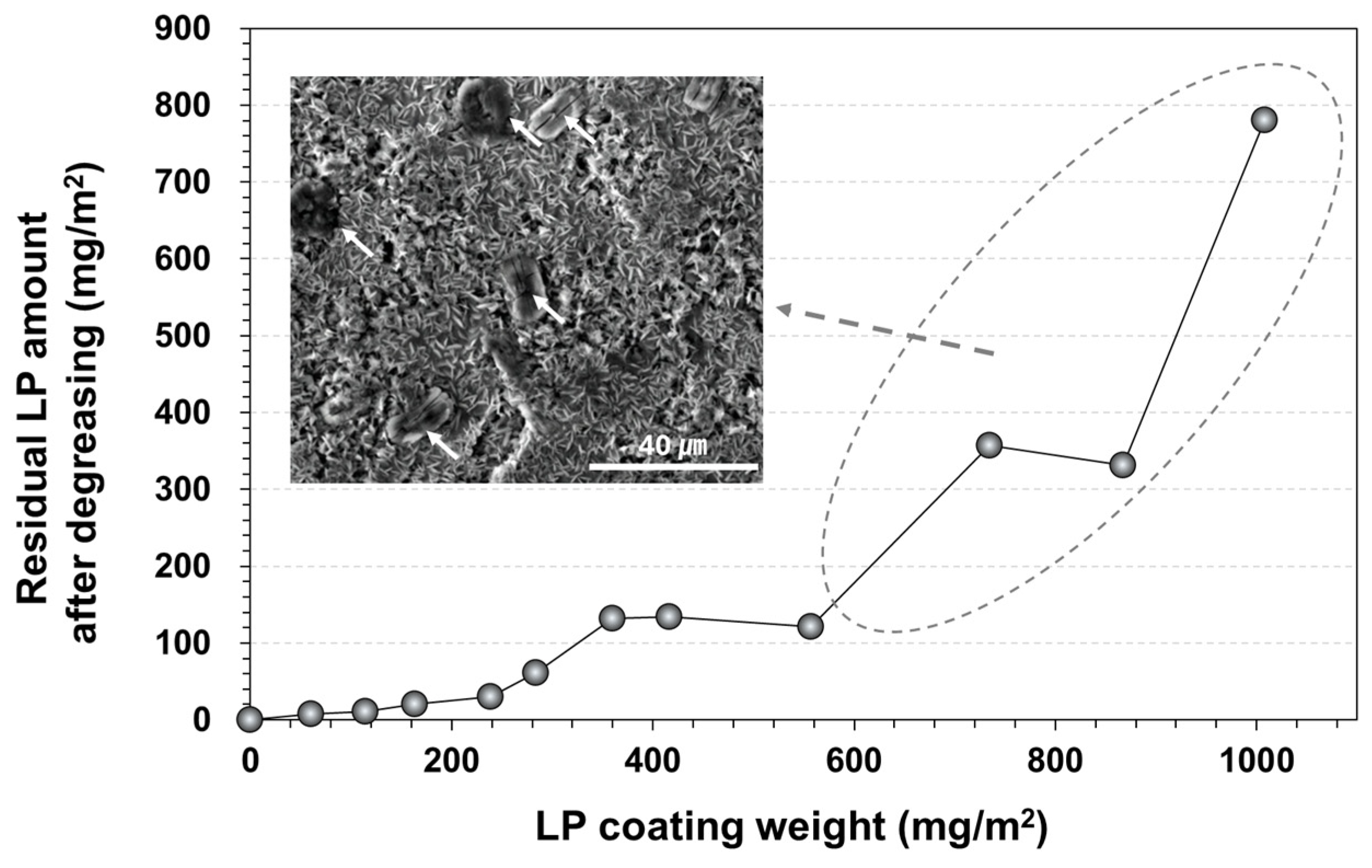
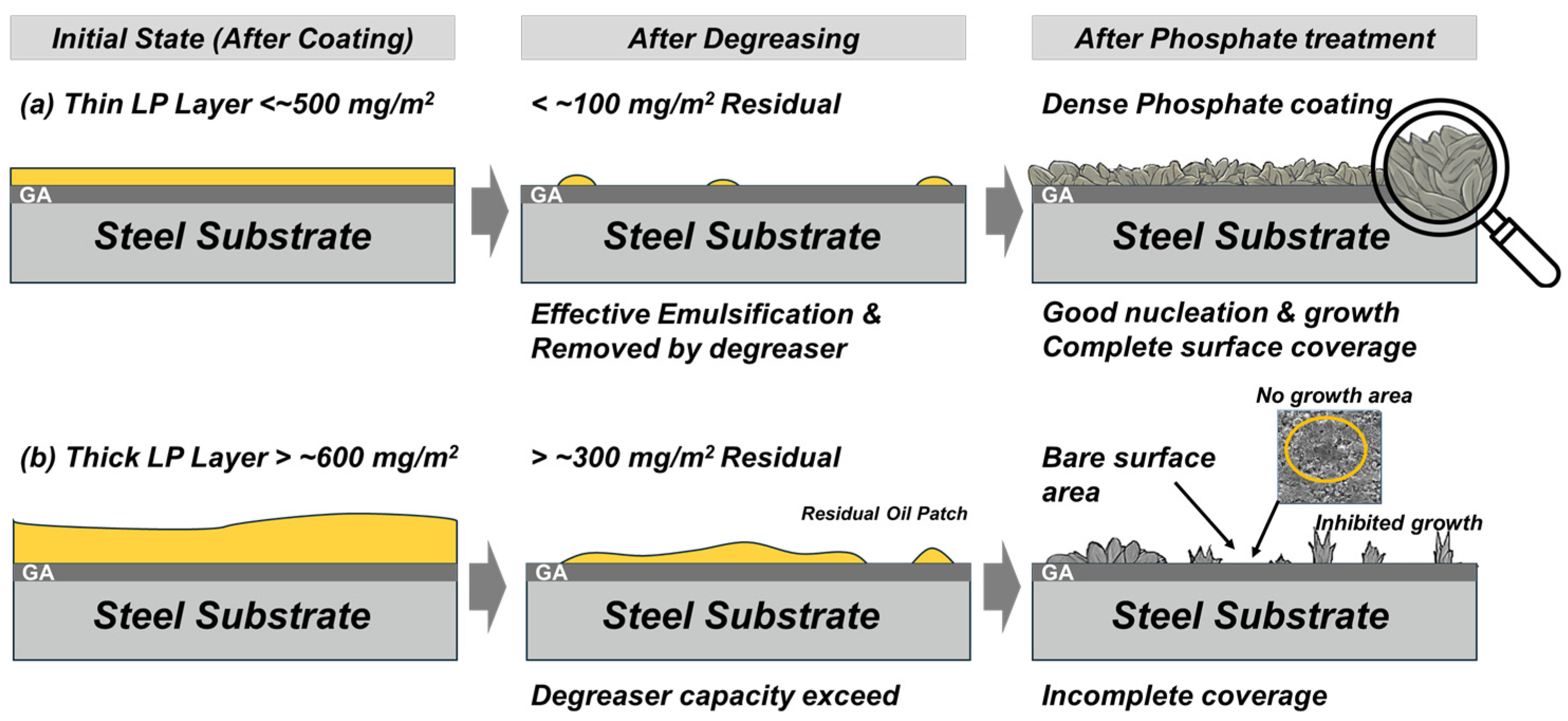
Residual LP after degreasing and phosphate coating formation behavior are shown in Figure 9 and Figure 10. Under low-coating-weight conditions, residual LP after degreasing remained at a low level. In contrast, under high-coating-weight conditions above approximately 550 mg/m2, residual LP after degreasing increased. SEM observations confirmed local regions in which phosphate crystals did not grow continuously under high-coating-weight conditions. The schematic illustration in Figure 10 shows that the degreasing–phosphate coating formation behavior may differ between thin-LP and thick-LP conditions [2,19]. In particular, under the thick-LP condition, surface regions corresponding to no-growth areas were found to occur.

3.5. Forming Simulation Results Incorporating Experimentally Measured Friction Coefficients

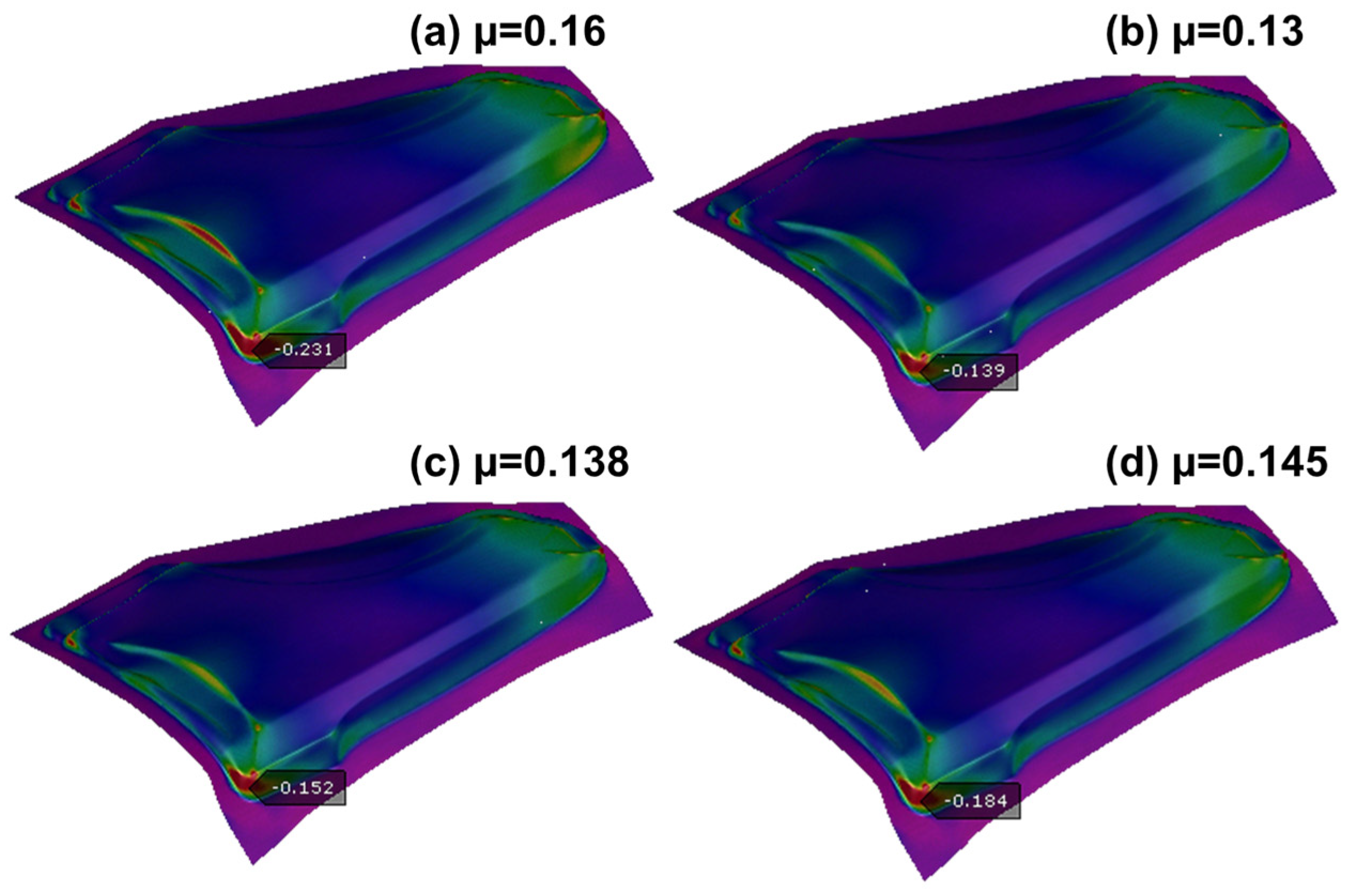
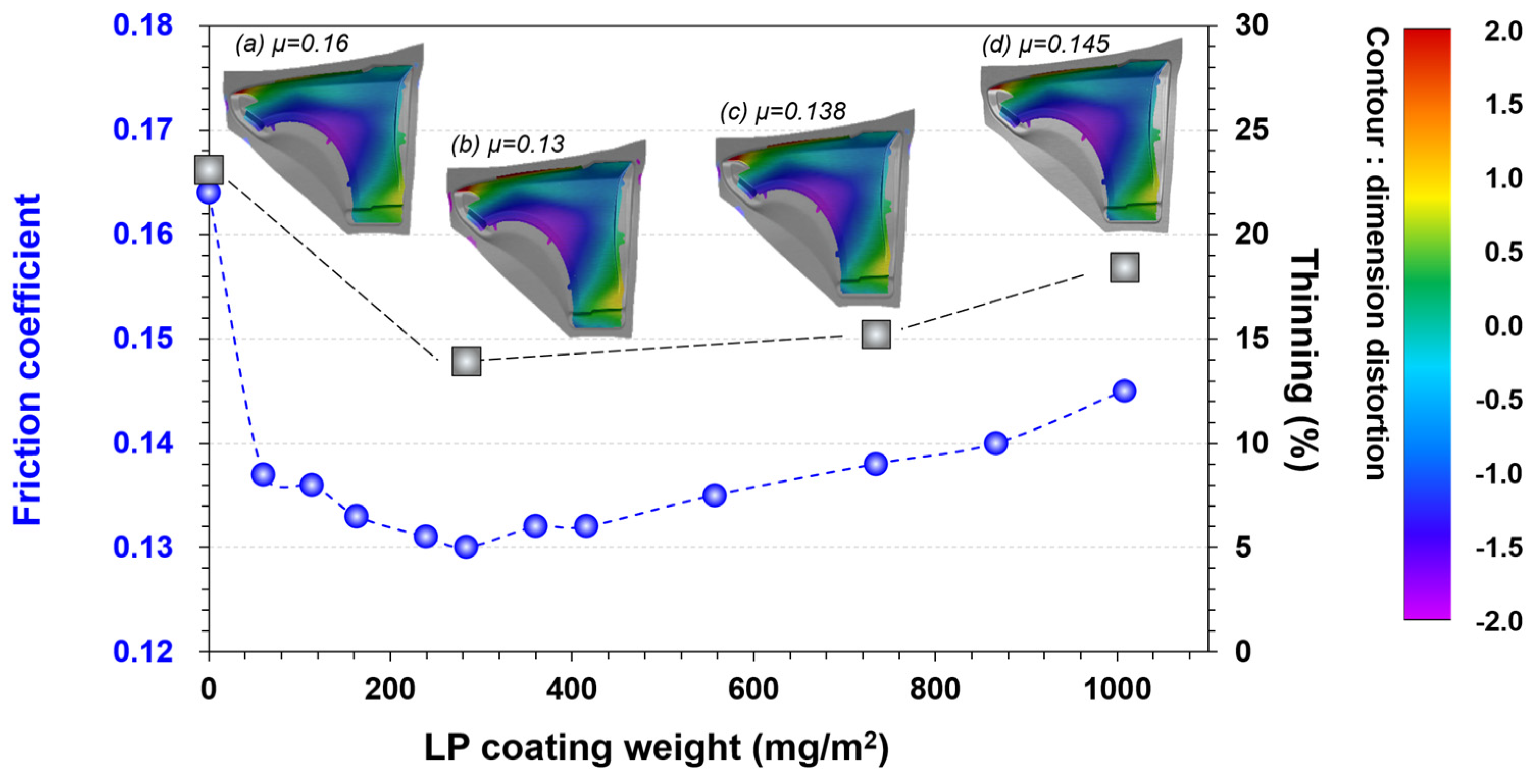
The forming simulation results obtained by applying experimentally measured friction coefficients as FEM input values are shown in Figure 11 and Figure 12. Under the μ = 0.16 condition, the maximum thickness reduction in the transition and corner regions of the fender geometry was approximately 23.1%. Under the μ = 0.13 condition, thinning decreased to approximately 13.9%, whereas under the μ = 0.145 condition, thinning increased again to approximately 18.4%. Dimension distortion remained within approximately 2 mm under all friction conditions. Figure 12 presents an integrated comparison of the relationships among LP coating weight, friction coefficient, thickness reduction, and dimension distortion [24,28,31]. Thickness reduction changed distinctly with the friction coefficient, whereas the variation in dimension distortion was relatively limited.

4. Discussion

The central finding of this study is not simply that LP coating weight affects individual process performance of automotive GA-coated steel sheets, but that a single change in surface state branches into mechanical, electrical, and chemical interfacial responses [9,10,11,12]. The LP acts as a lubricating layer that reduces shear resistance at the die–sheet interface during forming, while functioning as a resistive interfacial layer that alters the electrical contact state at the electrode–sheet and sheet–sheet interfaces during RSW [16,17,18]. In addition, during degreasing and phosphating, the residual organic layer may restrict the accessibility of reactive species to active sites on the Zn surface. Therefore, LP coating weight can be interpreted, within the limits of the present measurements, not as a simple coating amount or auxiliary process variable but as a surface-governing parameter that simultaneously influences multiple interfacial responses on GA-coated steel sheets [9].
The non-monotonic change in friction coefficient is consistent with a change in the interfacial contact state as LP coating weight increases: direct asperity contact is likely reduced in the intermediate range, whereas excessive LP in the high-coating-weight range may introduce additional shear resistance associated with film non-uniformity and lubricant-layer deformation [11,19]. The friction condition in this study is closer to controlled surface-contact sliding under relatively high contact pressure than to a fully developed high-speed hydrodynamic lubrication regime. From a contact-mechanics viewpoint, coating/layer thickness, stiffness, rough-surface contact, and surface anisotropy can significantly influence real contact area and frictional response [57,58,59,60]. Therefore, the re-increase in friction in the high-coating-weight regime is interpreted as being consistent with additional shear resistance within a mixed interfacial sliding state, rather than as direct evidence of an elastohydrodynamic lubrication transition. Because LP morphology and thickness distribution were not directly quantified in the present analytical scope, this interpretation is framed as a contact-mechanics-based explanation consistent with the observed trend rather than as a quantified lubrication-regime transition [8,57,58,59,60].
The cup-drawing and FEM results indicate that the LP-induced friction state is reflected mainly in the local deformation field. The increase in limit BHF represents improved material inflow in the flange region caused by reduced shear resistance at the die–sheet interface, rather than a universal improvement in all forming responses [34]. The saturation of BHF beyond the intermediate-coating-weight regime further indicates that friction reduction alone cannot continuously improve component-level shape response [13]. In this study, local thinning or fracture margin was therefore treated as the primary forming-related response to LP coating weight, whereas dimension distortion was interpreted as a coupled outcome of structural stiffness, material hardening, residual stress, and springback [47,51,56].
In RSW, increasing LP coating weight produced a response opposite to the forming response because the governing interfacial quantity changed from shear resistance to electrical contact area and current density. A reduced direct metal-to-metal contact state is beneficial for forming, but in RSW, the same surface condition can increase contact resistance and concentrate local heat input [16,17,38]. Therefore, the increase in the resistance–time product indicates a larger contribution of interfacial dynamic resistance under the same current condition, while the narrowed current range indicates a reduced allowable welding window. Thus, the formability–weldability relationship is better described as a process-specific bifurcation of the same surface state rather than as a simple performance trade-off. The resistance–time product was used as an integral indicator of the dynamic electrical response during RSW. In this study, this parameter was interpreted together with the weld current range to compare LP-induced changes in interfacial electrical behavior, rather than as a standalone weld-quality metric. Accordingly, nugget geometry, weld strength, failure mode, expulsion occurrence, and detailed dynamic-resistance curve morphology were regarded as complementary quality descriptors that can further support the interpretation of weld quality, but they were not used as primary criteria in the present comparative analysis.
The pretreatment results provide the surface-chemical basis for defining the upper side of the LP coating weight window. Residual LP after degreasing can reduce access to Zn surface active sites where phosphate nucleation begins. Because phosphate coating formation proceeds through nucleation on the metal surface followed by crystal growth, local coverage by residual organic species can delay or suppress reaction initiation even when the surrounding surface remains reactive [2,4,6]. Below the proposed operating window, insufficient lubricant coverage limits friction reduction; above this range, excessive LP accumulation increases residual LP after degreasing and promotes electrical and chemical surface-response penalties. The no-growth regions observed after phosphating are consistent with limited access of reactive species to Zn surface active sites due to residual organic layers. However, within the analytical scope of the present study, these regions are interpreted as surface-reaction non-uniformities inferred from SEM observations and residual LP trends, rather than as chemically resolved direct evidence of a specific organic blocking species or mechanism.
In this study, the proposed operating window was defined using threshold-based process responses rather than a single best-performance point. No single response variable was used alone to determine this window. Rather, the 300–550 mg/m2 range was defined by jointly considering the friction/BHF response, retention of the RSW process window, the onset of increased residual LP after degreasing, and the occurrence of phosphate no-growth regions. The lower boundary corresponds mainly to the transition from insufficient lubrication to a stable low-friction and improved cup-drawing response, whereas the upper boundary corresponds to the combined onset of weldability narrowing and pretreatment non-uniformity. Therefore, this range should be interpreted as a balanced surface-state window in which the LP layer provides sufficient lubrication for forming while avoiding excessive deterioration of weldability and phosphate reactivity under the present test conditions, rather than as a universal production acceptance limit.
Overall, the present study should be regarded as a controlled comparative analysis of LP coating weight effects rather than as a complete reproduction of industrial forming, welding, and pretreatment conditions. The friction test used a single controlled sliding condition; the degreasing–phosphating response was evaluated using a bench-scale pretreatment protocol, AFM/XPS/EDS characterization of the LP layer, and residual organic species were not included in the primary analytical matrix, and LP-dependent friction coefficients were applied as constant FEM inputs. These scope boundaries do not weaken the comparative trends observed within the same LP coating weight series; instead, they define the level at which the proposed operating window can be interpreted before validation under production-relevant process windows.

5. Conclusions

This study analyzed how LP coating weight on automotive GA-coated steel sheets simultaneously changes surface friction, interfacial electrical contact, and degreasing–phosphate reactivity. Within the present experimental framework, LP coating weight acted as a surface-state variable that jointly changed the die–sheet contact state, the electrode–sheet electrical contact condition, and the accessibility of active sites on the Zn surface.
The friction coefficient did not decrease monotonically with increasing LP coating weight. In the intermediate-coating-weight regime, interfacial shear resistance decreased owing to the increased contribution of the LP lubricating layer. However, in the high-coating-weight regime, the friction coefficient increased again, which may be associated with lubricant-layer shear resistance, local film non-uniformity, and redistribution of asperity-scale contact. This non-monotonic behavior provides the physical basis for optimizing LP coating weight within the present experimental scope.
Changes in the surface friction state were directly reflected in the cup-drawing limit, BHF, and FEM-based thickness reduction. Under low-friction conditions, material inflow improved, and local thinning was reduced, whereas changes in dimension distortion were limited to approximately 2 mm. This indicates that the LP mainly acts as a surface factor controlling the local deformation field and thinning behavior, while the global shape response is jointly determined by structural and material models.
In RSW, the current range decreased and the resistance–time product increased with increasing LP coating weight. These results show that the LP can act as a resistive interfacial layer that changes the electrical contact state. Under high-coating-weight conditions, residual LP after degreasing increased, and local no-growth regions of the phosphate coating were observed. This behavior is consistent with the possibility that residual organic species restrict access to active sites on the Zn surface and thereby hinder phosphate nucleation and crystal growth. Accordingly, LP coating weight governs not only surface friction but also the initiation conditions of chemical pretreatment reactions.
Within the scope of the present laboratory-scale framework, an LP coating weight of approximately 300–550 mg/m2 is suggested as a surface-controlled operating window in which reduced surface friction, a retained weldability window, and maintained phosphate reactivity can be balanced concurrently. This range should not be regarded as a universal optimum, but as an operational surface window derived by balancing formability, the RSW process window, and phosphate reactivity under the present experimental conditions. These findings indicate that LP coating weight should be treated as a functional interfacial design variable for automotive coated steel sheets, rather than as a simple lubricant application amount, because the same surface layer governs frictional, electrical, and chemical responses in different downstream processes.

Author Contributions

Conceptualization, J.-Y.K. and S.-C.Y.; methodology, J.-Y.K.; investigation, J.-Y.K., H.-Y.J. and W.Y.; data curation, J.-Y.K. and H.-Y.J.; formal analysis, W.Y. and S.-C.Y.; forming simulation and validation, S.-C.Y.; writing—original draft preparation, S.-C.Y. and J.-Y.K.; writing—review and editing, S.-C.Y.; visualization, J.-Y.K. and H.-Y.J.; supervision, S.-C.Y. and J.-Y.K.; project administration, S.-C.Y. All authors have read and agreed to the published version of the manuscript.

Funding

This research received no external funding.

Institutional Review Board Statement

Not applicable.

Informed Consent Statement

Not applicable.

Data Availability Statement

The data presented in this study are available from the corresponding author upon reasonable request.

Conflicts of Interest

The authors declare no conflicts of interest.

Abbreviations

The following abbreviations are used in this manuscript:
GAGalvannealed
GIGalvanized
RSWResistance Spot Welding
LPLubricant Protective Film
FEMFinite Element Method
BHFBlank Holding Force
SEMScanning Electron Microscopy

References

  1. Li, Y.; Lin, Z.; Jiang, A.; Chen, G. Use of high strength steel sheet for lightweight and crashworthy car body. Mater. Des. 2003, 24, 177–182. [Google Scholar] [CrossRef]
  2. Fouladi, M.; Amadeh, A. Effect of phosphating time and temperature on microstructure and corrosion behavior of magnesium phosphate coating. Electrochim. Acta 2013, 106, 1–12. [Google Scholar] [CrossRef]
  3. De Souza, J.H.C.; de Almeida, D.T.; Fischer, V.F.S. Effect of the blank surface conditions on the quenching behavior of a high thickness 22MnB5 steel in presshardening process. Tecnol. Metal. Mater. Min. 2019, 16, 112–120. [Google Scholar] [CrossRef]
  4. Balasubramanian, J.; Kumar, V.; Kirubakaran, M.; Lalwani, R. A study on automotive sheet metal surface pretreatment: Liquid activation and low temperature phosphating. In Proceedings of the International Conference on Automotive Materials and Manufacturing (AMM 2023), Pune, India, 31 May–2 June 2023; Paper 2023-28-1324; SAE: Warrendale, PA, USA, 2023. [Google Scholar] [CrossRef]
  5. Banerjee, G.; Pal, T.K.; Bandyopadhyay, N.; Bhattacharjee, D. Effect of welding conditions on corrosion behaviour of spot welded coated steel sheets. Corros. Eng. Sci. Technol. 2011, 46, 64–69. [Google Scholar] [CrossRef]
  6. Akafuah, N.; Poozesh, S.; Salaimeh, A.; Patrick, G.; Lawler, K.; Saito, K. Evolution of the automotive body coating process—A review. Coatings 2016, 6, 24. [Google Scholar] [CrossRef]
  7. Hofer, C.; Stadler, M.; Kurz, T.; Maier-Kiener, V.; Mayerhofer, A.; Hebesberger, T.; Schnitzer, R. Bending behavior of zinc-coated hot stamping steels. Steel Res. Int. 2021, 92, 2100149. [Google Scholar] [CrossRef]
  8. Kim, J.-Y.; Yoon, S.-C.; Jin, B.-K.; Jeon, J.-H.; Hyun, J.-S.; Lee, M.-G. Friction characteristics of low and high strength steels with galvanized and galvannealed zinc coatings. Materials 2024, 17, 5031. [Google Scholar] [CrossRef] [PubMed]
  9. Huang, H.-W.; Chang, H.-S.; Lo, I.-H.; Wu, Y.-L.; Yang, T.-E. Development of lubricating coated galvannealed steel for automobiles. China Steel Tech. Rep. 2024, 37, 43–51. [Google Scholar]
  10. Bernick, L.M.; Hilsen, R.R.; Wandrei, C.L. Development of a quantitative sheet galling test. Wear 1978, 48, 323–346. [Google Scholar] [CrossRef]
  11. Kirkhorn, L.; Bushlya, V.; Andersson, M.; Ståhl, J.-E. The influence of tool steel microstructure on friction in sheet metal forming. Wear 2013, 302, 1268–1278. [Google Scholar] [CrossRef]
  12. Sakurai, M.; Hiraya, A.; Inoue, S.; Yamasaki, Y.; Matsuda, Y.; Hashimoto, S.; Urakawa, T.; Inagaki, J. Properties of a newly developed galvannealed steel sheet with modified surface. In Proceedings of the International Congress & Exposition, Detroit, MI, USA, 24 February 1997; Paper 970718; SAE: Warrendale, PA, USA, 1997. [Google Scholar] [CrossRef]
  13. Sugimoto, Y.; Sakurai, M.; Kato, C. Lubricant treated anti-corrosion steel sheets for automotive use—Galvannealed steel sheets with excellent press formability. JFE Tech. Rep. 2004, 4, 50–54. [Google Scholar]
  14. Losch, A. Sheet metal forming lubricants. In Encyclopedia of Lubricants and Lubrication; Mang, T., Ed.; Springer: Berlin/Heidelberg, Germany, 2014; pp. 1747–1769. [Google Scholar] [CrossRef]
  15. Marder, A.R. The metallurgy of zinc-coated steel. Prog. Mater. Sci. 2000, 45, 191–271. [Google Scholar] [CrossRef]
  16. Gedeon, S.A.; Eagar, T.W. Resistance spot welding of galvanized steel: Part I. Material variations and process modifications. Metall. Trans. B 1986, 17, 879–885. [Google Scholar] [CrossRef]
  17. Gedeon, S.A.; Eagar, T.W. Resistance spot welding of galvanized steel: Part II. Mechanisms of spot weld nugget formation. Metall. Trans. B 1986, 17, 887–901. [Google Scholar] [CrossRef]
  18. Khan, M.S.; Bhole, S.D.; Chen, D.L.; Boudreau, G.; Biro, E.; Deventer, J.V. Resistance spot welding characteristics and mechanical properties of galvannealed HSLA 350 steel. Can. Metall. Q. 2009, 48, 303–310. [Google Scholar] [CrossRef]
  19. Saffarzade, P.; Amadeh, A.A.; Agahi, N. Study of tribological and friction behavior of magnesium phosphate coating and comparison with traditional zinc phosphate coating under dry and lubricated conditions. Tribol. Int. 2020, 144, 106122. [Google Scholar] [CrossRef]
  20. JIS Z 2241:2022; Metallic Materials—Tensile Testing—Method of Test at Room Temperature. Japanese Standards Association: Tokyo, Japan, 2022.
  21. Cornette, D.; Hourman, T.; Hudin, O.; Laurent, J.P.; Reynaert, A. High strength steels for automotive safety parts. In Proceedings of the SAE 2001 World Congress, Detroit, MI, USA, 5–8 March 2001; Paper 2001-01-0078; SAE: Warrendale, PA, USA, 2001. [Google Scholar] [CrossRef]
  22. Chen, W.J.; Zhang, S.H.; Tian, W.H.; Li, Y. Enhanced yield strength and total elongation of an ultrahigh strength hot-stamped steel via tempering treatment. Steel Res. Int. 2024, 95, 2300644. [Google Scholar] [CrossRef]
  23. VDA 230-213:2024-11; Testing Procedure for Product Classes Prelube, Prelube2, Hotmelt, Spot Lubricant. Verband der Automobilindustrie e.V.: Berlin, Germany, 2024.
  24. Park, H.; Jeong, Y.-J.; Lee, K.; Yoon, S.C.; Kim, Y. Interface exfoliation mechanism of galvannealed steel sheet in bead-slide during press-forming. Mater. Today Commun. 2020, 25, 101669. [Google Scholar] [CrossRef]
  25. ASTM A90/A90M-21; Standard Test Method for Weight [Mass] of Coating on Iron and Steel Articles with Zinc or Zinc-Alloy Coatings. ASTM International: West Conshohocken, PA, USA, 2021.
  26. Lovell, M.; Higgs, C.F.; Deshmukh, P.; Mobley, A. Increasing formability in sheet metal stamping operations using environmentally friendly lubricants. J. Mater. Process. Technol. 2006, 177, 87–90. [Google Scholar] [CrossRef]
  27. Nakajima, S.; Katagiri, T.; Kato, C. Inorganic dry film lubricant coated galvannealed steel sheet with excellent press formability and adhesive compatibility. Kawasaki Steel Tech. Rep. 2003, 48, 23–27. [Google Scholar]
  28. Coduti, P.L. Tribological behavior of solid lubricant films on bare and coated sheet steel products. In Proceedings of the SAE International Congress and Exposition, Detroit, MI, USA, 23–27 February 1987; Paper 870648; SAE: Warrendale, PA, USA, 1987. [Google Scholar] [CrossRef]
  29. Kim, H.; Altan, T.; Yan, Q. Evaluation of stamping lubricants in forming advanced high strength steels (AHSS) using deep drawing and ironing tests. J. Mater. Process. Technol. 2009, 209, 4122–4133. [Google Scholar] [CrossRef]
  30. Masters, I.G.; Williams, D.K.; Roy, R. Friction behaviour in strip draw test of pre-stretched high strength automotive aluminium alloys. Int. J. Mach. Tools Manuf. 2013, 73, 17–24. [Google Scholar] [CrossRef]
  31. Lovell, M.R.; Deng, Z. Characterization of interfacial friction in coated sheet steels: Influence of stamping process parameters and wear mechanisms. Tribol. Int. 2002, 35, 85–95. [Google Scholar] [CrossRef]
  32. ISO 22462:2020; Metallic and Other Inorganic Coatings—Test Method for the Friction Coefficient Measurement of Chemical Conversion Coatings. International Organization for Standardization: Geneva, Switzerland, 2020.
  33. Kim, J.-Y.; Yoon, S.-C.; Kim, H.-J.; Lee, M.-G. Enhanced hydrogen delayed fracture of 1.5 GPa hot stamping steel sheet with sheared surface by double punching method. Int. J. Precis. Eng. Manuf. 2023, 24, 173–186. [Google Scholar] [CrossRef]
  34. Yoon, S.C.; Lyo, I.W.; Cho, M.H. Analysis of the high formability of automotive steel sheets by the surface texturing effect. Korean J. Met. Mater. 2012, 50, 8–12. [Google Scholar] [CrossRef]
  35. Wang, N.-M.; Budiansky, B. Analysis of sheet metal stamping by a finite-element method. J. Appl. Mech. 1978, 45, 73–82. [Google Scholar] [CrossRef]
  36. Wiklund, D.; Wihlborg, A.; Rosén, B.-G. Evaluation of surface topography parameters for friction prediction in stamping. Wear 2004, 257, 1296–1300. [Google Scholar] [CrossRef]
  37. Franczak, K.; Kwaśniewski, P.; Kiesiewicz, G.; Ściężor, W.; Sadzikowski, M.; Kordaszewski, S.; Noga, P. Research on zinc diffusion in the resistance spot welding process of galvanised steels using Cu-Sc and Cu-Zr alloy electrodes. Weld. World 2025, 70, 2643–2658. [Google Scholar] [CrossRef]
  38. Aslanlar, S.; Ogur, A.; Ozsarac, U.; Ilhan, E.; Demir, Z. Effect of welding current on mechanical properties of galvanized chromided steel sheets in electrical resistance spot welding. Mater. Des. 2007, 28, 2–7. [Google Scholar] [CrossRef]
  39. Jou, M. Real time monitoring weld quality of resistance spot welding for the fabrication of sheet metal assemblies. J. Mater. Process. Technol. 2003, 132, 102–113. [Google Scholar] [CrossRef]
  40. Katundi, D.; Tosun-Bayraktar, A.; Bayraktar, E.; Toueix, D. Corrosion behaviour of the welded steel sheets used in automotive industry. J. Achiev. Mater. Manuf. Eng. 2010, 38, 146–153. [Google Scholar]
  41. Matthews, A.E.; Davies, G.M. Precoated steels development for the automotive industry. Proc. Inst. Mech. Eng. Part D J. Automob. Eng. 1997, 211, 319–324. [Google Scholar] [CrossRef]
  42. Perka, A.K.; John, M.; Kuruveri, U.B.; Menezes, P.L. Advanced high-strength steels for automotive applications: Arc and laser welding process, properties, and challenges. Metals 2022, 12, 1051. [Google Scholar] [CrossRef]
  43. Pawar, S.; Singh, A.K.; Park, K.-S.; Choi, S.-H. Effect of welding current on the microstructural evolution and lap-shear performance of resistance spot-welded 340BH steel. Mater. Charact. 2023, 203, 113126. [Google Scholar] [CrossRef]
  44. Skowronek, A.; Wróbel, I.; Grajcar, A. Design, simulation and experimental evaluation of hot-stamped 22MnB5 steel autobody part. Symmetry 2022, 14, 2625. [Google Scholar] [CrossRef]
  45. Park, H.; Yoon, J.; Kang, M.; Kim, C. Microstructure and hardness behavior of friction stir welds of 2 GPa strength hot press forming steel. J. Mater. Eng. Perform. 2024, 33, 13067–13078. [Google Scholar] [CrossRef]
  46. Majidi, O.; Barlat, F.; Lee, M.; Kim, D. Formability of AHSS under an attach–detach forming mode. Steel Res. Int. 2015, 86, 98–109. [Google Scholar] [CrossRef]
  47. Li, K.P.; Carden, W.P.; Wagoner, R.H. Simulation of springback. Int. J. Mech. Sci. 2002, 44, 103–122. [Google Scholar] [CrossRef]
  48. Mori, K.; Akita, K.; Abe, Y. Springback behaviour in bending of ultra-high-strength steel sheets using CNC servo press. Int. J. Mach. Tools Manuf. 2007, 47, 321–325. [Google Scholar] [CrossRef]
  49. Feistle, M.; Golle, R.; Volk, W. Edge crack test methods for AHSS steel grades: A review and comparisons. J. Mater. Process. Technol. 2022, 302, 117488. [Google Scholar] [CrossRef]
  50. Liu, X.; Cao, J.; Chai, X.; Liu, J.; Zhao, R.; Kong, N. Investigation of forming parameters on springback for ultra high strength steel considering Young’s modulus variation in cold roll forming. J. Manuf. Process. 2017, 29, 289–297. [Google Scholar] [CrossRef]
  51. Wagoner, R.H.; Lim, H.; Lee, M.-G. Advanced issues in springback. Int. J. Plast. 2013, 45, 3–20. [Google Scholar] [CrossRef]
  52. Hill, R. A theory of the yielding and plastic flow of anisotropic metals. Proc. R. Soc. Lond. A Math. Phys. Sci. 1948, 193, 281–297. [Google Scholar] [CrossRef]
  53. Karlsson, P.; Gåård, A.; Krakhmalev, P. Influence of tool steel microstructure on friction and initial material transfer. Wear 2014, 319, 12–18. [Google Scholar] [CrossRef]
  54. Kriechenbauer, S.; Müller, P.; Mauermann, R.; Drossel, W.-G. Evolutionary optimization of deep-drawing processes on servo screw presses with freely programmable force and motion functions. Procedia CIRP 2021, 104, 1482–1487. [Google Scholar] [CrossRef]
  55. Jiang, H.-J.; Dai, H.-L. A novel model to predict U-bending springback and time-dependent springback for a HSLA steel plate. Int. J. Adv. Manuf. Technol. 2015, 81, 1055–1066. [Google Scholar] [CrossRef]
  56. Xu, W.L.; Ma, C.H.; Li, C.H.; Feng, W.J. Sensitive factors in springback simulation for sheet metal forming. J. Mater. Process. Technol. 2004, 151, 217–222. [Google Scholar] [CrossRef]
  57. Persson, B.N.J.; Ballone, P. Squeezing lubrication films: Layering transition for curved solid surfaces with long-range elasticity. J. Chem. Phys. 2000, 112, 9524–9542. [Google Scholar] [CrossRef]
  58. Greenwood, J.A.; Williamson, J.B.P. Contact of nominally flat surfaces. Proc. R. Soc. Lond. A Math. Phys. Sci. 1966, 295, 300–319. [Google Scholar] [CrossRef]
  59. Afferrante, L.; Putignano, C.; Menga, N.; Carbone, G. Friction in rough contacts of linear viscoelastic surfaces with anisotropic statistical properties. Eur. Phys. J. E 2019, 42, 80. [Google Scholar] [CrossRef] [PubMed]
  60. Menga, N.; Putignano, C.; Afferrante, L.; Carbone, G. The contact mechanics of coated elastic solids: Effect of coating thickness and stiffness. Tribol. Lett. 2019, 67, 24. [Google Scholar] [CrossRef]
Figure 1. Conceptual schematic of the LP structure on GA-coated automotive steel sheet.
Surfaces 09 00063 g001
Figure 2. True stress–true strain curves of the 340 MPa GA steel sheet measured along 0°, 45°, and 90° to the rolling direction.
Surfaces 09 00063 g002
Figure 3. SEM–EDS surface elemental composition of as-coated GA steel sheets as a function of nominal LP coating weight.
Surfaces 09 00063 g003
Figure 4. Single-sided sliding-type friction test apparatus used for friction coefficient measurements.
Surfaces 09 00063 g004
Figure 5. Stamping simulation model using experimentally measured friction coefficients as input parameters.
Surfaces 09 00063 g005
Figure 6. Variation in friction coefficient as a function of LP coating weight.
Surfaces 09 00063 g006
Figure 7. Variation in cup-drawing limit blank-holding force as a function of LP coating weight.
Surfaces 09 00063 g007
Figure 8. Variation in spot weld current range and resistance–time product as a function of LP coating weight.
Surfaces 09 00063 g008
Figure 9. Residual LP after degreasing and SEM observations of phosphate coating formation as a function of LP coating weight.
Surfaces 09 00063 g009
Figure 10. Schematic illustration of LP-controlled degreasing and phosphate coating formation: (a) thin LP and (b) thick LP.
Surfaces 09 00063 g010
Figure 11. Forming simulation results obtained using experimentally measured friction coefficients: (a) μ = 0.16, (b) μ = 0.13, (c) μ = 0.138, and (d) μ = 0.145.
Surfaces 09 00063 g011
Figure 12. Integrated relationship among LP coating weight, friction coefficient, thickness reduction, and dimension distortion.
Surfaces 09 00063 g012
Disclaimer/Publisher’s Note: The statements, opinions and data contained in all publications are solely those of the individual author(s) and contributor(s) and not of MDPI and/or the editor(s). MDPI and/or the editor(s) disclaim responsibility for any injury to people or property resulting from any ideas, methods, instructions or products referred to in the content.