
Femtosecond Laser-Induced Copper Oxide Nanospheres on Copper Foam Surfaces


Abstract
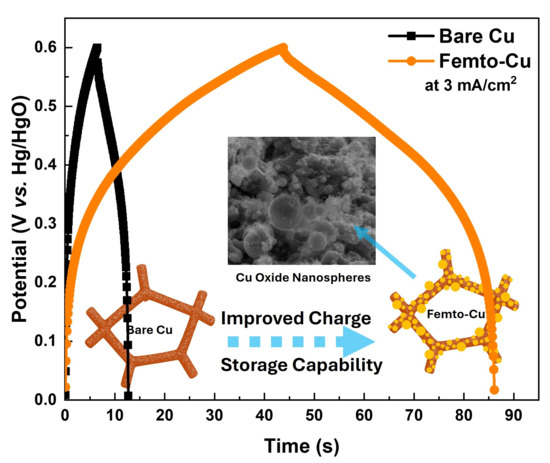
1. Introduction
2. Experimental
2.1. Materials
2.2. Electrodes Preparation
2.3. Characterization
3. Results and Discussion

4. Conclusions
Supplementary Materials
Funding
Data Availability Statement
Acknowledgments
Conflicts of Interest
References
- Abubakr, M.; Elahi, E.; Rehman, S.; Dahshan, A.; Khan, M.A.; Rabeel, M.; Abbas, Z.; Maqsood, M.F.; Rehman, M.A.; Jonghwa, E. Innovations in self-powered nano-photonics of emerging and flexible two-dimensional materials. Mater. Today Phys. 2023, 39, 101285. [Google Scholar] [CrossRef]
- Fong, K.C.; Armand, S.; Basnet, R.; Yan, D.; Ernst, M.; De Carvalho, G.B.L.; Varghese, A.R.; Maqsood, M.F.; Kremer, F.; Wang, J. Highly Transparent Nanoscale Tunnel Oxide Polysilicon Passivated Contacts: Optimisation, Analysis, and Impact Study. Solar RRL 2025, 9, 2500246. [Google Scholar] [CrossRef]
- Rabani, I.; Hussain, T.; Kumar, A.; Dastgeer, G.; Maqsood, F.; De Wael, K.; Seo, Y.-S. Morphology-controlled Fe3O4@ CNF nanocomposites for sustainable paper-based energy storage with recyclability. J. Mater. Chem. A 2026, 14, 8742–8758. [Google Scholar] [CrossRef]
- Maqsood, M.F.; Fong, K.C.; Ghafoor, F.; Azhar, U.; Rabani, I. Solar vapor generation: Advances in materials engineering and structural design for efficient water evaporation. Mater. Today Phys. 2025, 59, 101938. [Google Scholar] [CrossRef]
- Latif, U.; Maqsood, M.F. Lanthanum-zinc mixed metal oxide as electrode material for supercapacitor applications. Mater. Chem. Phys. 2024, 317, 129158. [Google Scholar] [CrossRef]
- Latif, U.; Maqsood, M.F.; Mehdi, S.M.Z.; Ghafoor, F.; Azhar, U.; Abbas, S.H.; Khan, M.F. Effect of Lithium Doping on the Electrochemical Properties of Bi2Sr2Co2Oy Misfit-Layered Oxides for Supercapacitor Applications. Electrochim. Acta 2025, 526, 146171. [Google Scholar] [CrossRef]
- Raza, M.A.; Rehman, Z.U.; Tanvir, M.G.; Maqsood, M.F. Metal oxide-conducting polymer-based composite electrodes for energy storage applications. In Renewable Polymers and Polymer-Metal Oxide Composites; Elsevier: Amsterdam, The Netherlands, 2022; pp. 195–251. [Google Scholar]
- Seenivasan, S.; Adhikari, S.; Sivagurunathan, A.T.; Kim, D.-H. Supercapatteries: Unlocking the potential of battery-supercapacitor fusion. Energy Environ. Sci. 2025, 18, 1054–1095. [Google Scholar] [CrossRef]
- Libber, M.; Gariya, N.; Kumar, M. A comprehensive analysis of supercapacitors with current limitations and emerging trends in research. J. Solid State Electrochem. 2025, 29, 513–527. [Google Scholar] [CrossRef]
- Kadam, S.L.; Ingole, R.S.; Kim, Y.T.; Lee, J.S.; Kim, K.; Kim, M.; Ok, J.G. From Lab to Life: Progress in Supercapacitor Electrode Materials for Real-Life Electrochemical Energy Storage Applications. Small Struct. 2026, 7, e202500775. [Google Scholar] [CrossRef]
- Latif, U.; Raza, M.A.; Rehman, Z.U.; Iqbal, J.; Lee, N.; Mehdi, S.M.Z.; Maqsood, M.F.; Hussain, S. Binder free heteroatom-doped graphene oxide as high energy density electrodes for supercapacitor applications. Int. J. Energy Res. 2022, 46, 9643–9666. [Google Scholar] [CrossRef]
- Rehman, Z.U.; Raza, M.A.; Hussnain, A.; Chishti, U.N.; Inam, A.; Ali, F.; Maqsood, M.F. Effect of morphology of manganese oxide on the capacitive behavior of electrodes. Mater. Res. Express 2019, 6, 115552. [Google Scholar] [CrossRef]
- Rehman, Z.U.; Raza, M.A.; Tariq, A.; Chishti, U.N.; Maqsood, M.F.; Lee, N.; Awais, M.H.; Mehdi, S.M.Z.; Inam, A. La0.75Sr0.25Cr0.5Mn0.5O3 perovskite developed for supercapacitor applications. J. Energy Storage 2020, 32, 101951. [Google Scholar] [CrossRef]
- Saju, D.M.; Sapna, R.; Deka, U.; Hareesh, K. MXene material for supercapacitor applications: A comprehensive review on properties, synthesis and machine learning for supercapacitance performance prediction. J. Power Sources 2025, 647, 237302. [Google Scholar] [CrossRef]
- Kumar, M.; Samal, S.K.; Maharana, T. Conducting polymers: An approach towards flexible supercapacitors. Polym. Plast. Technol. Mater. 2025, 64, 309–328. [Google Scholar] [CrossRef]
- Ali, A.; Ahmed, S.; Jiang, W.; Park, G.; Oh, S.J. Harnessing MOF intrinsic properties for enhanced supercapacitor performance. Curr. Opin. Electrochem. 2025, 50, 101640. [Google Scholar] [CrossRef]
- Kareem, A.; Maqsood, M.F.; Sofi, F.A.; Al-Sayah, M.H.; El-Kadri, O.M. Enhanced electrochemical performance of carbonized porous organic polymers towards supercapacitor application. Discov. Appl. Sci. 2026, 8, 21. [Google Scholar] [CrossRef]
- Maqsood, M.F.; Latif, U.; Mehdi, S.M.Z.; Rehman, Z.U.; Raza, M.A.; Ghafoor, F.; Abubakr, M.; Lee, N.; Khan, M.F. Effect of “Mn” substitution at B-site, on the crystal structure and energy storage performance of the La0.75Sr0.25CoO3 perovskite. J. Ind. Eng. Chem. 2024, 139, 587–600. [Google Scholar] [CrossRef]
- Maqsood, M.F.; Latif, U.; Sheikh, Z.A.; Abubakr, M.; Rehman, S.; Khan, K.; Khan, M.A.; Kim, H.; Ouladsmane, M.; Rehman, M.A. A comprehensive study of Bi2Sr2Co2Oy misfit layered oxide as a supercapacitor electrode material. Inorg. Chem. Commun. 2023, 158, 111487. [Google Scholar] [CrossRef]
- Xiong, C.; Su, Y. Recent Progress of Transition Metal-Based Oxide Composite Electrode Materials in Supercapacitor. Adv. Sustain. Syst. 2025, 9, 2400578. [Google Scholar] [CrossRef]
- Askari, M.B.; Salarizadeh, P.; Moghadam, M.T.T.; Azizi, S. Binary transition metal oxide/carbon compounds-based electrode materials for supercapacitor application: A comprehensive review. J. Alloys Compd. 2025, 1027, 180573. [Google Scholar] [CrossRef]
- Sahoo, G.; Rout, C.S. MXene-transition metal chalcogenide hybrid materials for supercapacitor applications. Chem. Commun. 2025, 61, 6439–6461. [Google Scholar] [CrossRef]
- Rehman, Z.U.; Raza, M.A.; Chishti, U.N.; Hussnain, A.; Maqsood, M.F.; Iqbal, M.Z.; Iqbal, M.J.; Latif, U. Role of Carbon Nanomaterials on Enhancing the Supercapacitive Performance of Manganese Oxide-Based Composite Electrodes. Arab. J. Sci. Eng. 2022, 48, 8371–8386. [Google Scholar] [CrossRef]
- Saleem, M.H.; Ejaz, U.; Vithanage, M.; Bolan, N.; Siddique, K.H. Synthesis, characterization, and advanced sustainable applications of copper oxide nanoparticles: A review: MH Saleem et al. Clean Technol. Environ. Policy 2025, 27, 5719–5744. [Google Scholar] [CrossRef]
- Salman, M.D.; Radzi, Y.M.; Salih, E.Y.; Oglat, A.A.; Rahman, A.A.; Dheyab, M.A. Synthesis techniques and modern applications of copper oxide nanoparticles in cancer treatment and radiotherapy: A review. J. Mol. Struct. 2025, 1322, 140301. [Google Scholar] [CrossRef]
- Keyvani, B.; Aghayari, R.; Yosefi, F.; Toghraie, D.; Salahshour, S. Synthesis of copper oxide nanoparticles and their efficiency in automotive radiator heat transfer systems. Powder Technol. 2025, 457, 120887. [Google Scholar] [CrossRef]
- Qian, Y.; Sun, X.; Deng, X.; Yin, S.; Zhang, T. Cellulose aerogel-based copper oxide/carbon composite for supercapacitor electrode. RSC Adv. 2025, 15, 6774–6782. [Google Scholar] [CrossRef]
- Kumbhar, M.B.; Patil, V.V.; Chandak, V.S.; Shaikh, S.B.; Chitare, Y.M.; Gunjakar, J.L.; Kulal, P.M. Exploring copper-doped nickel oxide as a superior cathode electrode material for flexible hybrid solid-state supercapacitor device. J. Ind. Eng. Chem. 2025, 147, 422–435. [Google Scholar] [CrossRef]
- Morariu, M.-I.; Nicolaescu, M.; Hulka, I.; Duţeanu, N.; Orha, C.; Lăzău, C.; Bandas, C. Fabrication of Cu2O/CuO nanowires by one-step thermal oxidation of flexible copper mesh for supercapacitor applications. Batteries 2024, 10, 246. [Google Scholar] [CrossRef]
- Rajkumar, S.; Elanthamilan, E.; Wang, S.-F.; Chryso, H.; Balan, P.V.D.; Merlin, J.P. One-pot green recovery of copper oxide nanoparticles from discarded printed circuit boards for electrode material in supercapacitor application. Resour. Conserv. Recycl. 2022, 180, 106180. [Google Scholar] [CrossRef]
- Kalaiselvi, K.; Ali, M.M.; Prabhu, S.; Mareeswaran, P.M.; Ramesh, R. Evaluation of nickel oxide-copper oxide nano flowers from saponin for hybrid supercapacitor applications. Inorg. Chem. Commun. 2024, 162, 112145. [Google Scholar] [CrossRef]
- Heng, B.; Qing, C.; Sun, D.; Wang, B.; Wang, H.; Tang, Y. Rapid synthesis of CuO nanoribbons and nanoflowers from the same reaction system, and a comparison of their supercapacitor performance. RSC Adv. 2013, 3, 15719–15726. [Google Scholar] [CrossRef]
- Patake, V.; Joshi, S.; Lokhande, C.; Joo, O.-S. Electrodeposited porous and amorphous copper oxide film for application in supercapacitor. Mater. Chem. Phys. 2009, 114, 6–9. [Google Scholar] [CrossRef]
- Subhadarshini, S.; Peyada, N.; Goswami, D.K.; Das, N.C. Review of battery-type transition metal (Cu, co, and Ni) oxide based electrodes: From fundamental science to fabrication of a hybrid supercapacitor device. Energy Fuels 2024, 38, 11455–11493. [Google Scholar] [CrossRef]
- Moosavifard, S.E.; El-Kady, M.F.; Rahmanifar, M.S.; Kaner, R.B.; Mousavi, M.F. Designing 3D highly ordered nanoporous CuO electrodes for high-performance asymmetric supercapacitors. ACS Appl. Mater. Interfaces 2015, 7, 4851–4860. [Google Scholar] [CrossRef]
- Kumar, R.; Chand, P.; Sharma, S.; Kadyan, P. Electrochemical performance of copper-oxide flakes as an electrode material for supercapacitor applications. Ionics 2025, 31, 11021–11034. [Google Scholar] [CrossRef]
- Alam, I.; Arooj, M.; Alomayri, T.; Obodo, R.M.; Afzal, S. Self-ion implantation induced structural, optical, and electrochemical changes in copper oxide (CuO) for supercapacitor application. Mater. Chem. Phys. 2025, 334, 130356. [Google Scholar] [CrossRef]
- Patil, U.; Nam, M.-S.; Lee, S.C.; Liu, S.; Kang, S.; Park, B.; Jun, S.C. Temperature influenced chemical growth of hydrous copper oxide/hydroxide thin film electrodes for high performance supercapacitors. J. Alloys Compd. 2017, 701, 1009–1018. [Google Scholar] [CrossRef]
- Viswanathan, A.; Shetty, A.N. Facile in-situ single step chemical synthesis of reduced graphene oxide-copper oxide-polyaniline nanocomposite and its electrochemical performance for supercapacitor application. Electrochim. Acta 2017, 257, 483–493. [Google Scholar] [CrossRef]
- Stepniowski, W.J.; Misiolek, W.Z. Review of fabrication methods, physical properties, and applications of nanostructured copper oxides formed via electrochemical oxidation. Nanomaterials 2018, 8, 379. [Google Scholar] [CrossRef]
- Ghadge, T.; Jadhav, A.; Lokhande, B. Synthesis and electrochemical study of ruthenium influenced copper oxide electrodes prepared by self anodization. J. Alloys Compd. 2020, 824, 153860. [Google Scholar] [CrossRef]
- Ansari, M.Z.; Seo, K.-M.; Kim, S.-H.; Ansari, S.A. Critical aspects of various techniques for synthesizing metal oxides and fabricating their composite-based supercapacitor electrodes: A review. Nanomaterials 2022, 12, 1873. [Google Scholar] [CrossRef]
- Jha, K.; Raula, M.; Gomey, S.; Kalyani, C. Recent advances on catalytic potentials of copper oxides (I & II): Fundamentals to applications. Crit. Rev. Solid State Mater. Sci. 2025, 1–43. [Google Scholar] [CrossRef]
- Verma, N.; Kumar, N. Synthesis and biomedical applications of copper oxide nanoparticles: An expanding horizon. ACS Biomater. Sci. Eng. 2019, 5, 1170–1188. [Google Scholar] [CrossRef] [PubMed]
- Rajeevan, S.; John, S.; George, S.C. Polyvinylidene fluoride: A multifunctional polymer in supercapacitor applications. J. Power Sources 2021, 504, 230037. [Google Scholar] [CrossRef]
- Skorupa, M.; Karon, K.; Marchini, E.; Caramori, S.; Pluczyk-Małek, S.; Krukiewicz, K.; Carli, S. PEDOT: Nafion for highly efficient supercapacitors. ACS Appl. Mater. Interfaces 2024, 16, 23253–23264. [Google Scholar] [CrossRef]
- Fu, X.; Wang, J.; Peng, F.; Wang, Y.; Hu, S.; Zhang, R.; Liu, Q. A hybrid PEMFC/supercapacitor device with high energy and power densities based on reduced graphene oxide/Nafion/Pt electrode. Int. J. Hydrogen Energy 2023, 48, 16072–16082. [Google Scholar] [CrossRef]
- Al Kiey, S.A.; Menazea, A.; Ismail, A. Flexible free standing electrodes based on laser-irradiated PVC/PVDF/AuNPs for the development of high performance supercapacitor electrodes. J. Energy Storage 2023, 72, 108723. [Google Scholar] [CrossRef]
- Liu, H.; Yang, M.; Li, J.; Chen, Y.; Liu, Q.; Gu, J. Polyacrylonitrile as a binder realizes high-rate activated-carbon-based supercapacitors. Electrochim. Acta 2024, 500, 144754. [Google Scholar] [CrossRef]
- Pershaanaa, M.; Farhana, N.; Kamarulazam, F.; Loh, K.H.; Prasankumar, T.; Bashir, S.; Ramesh, K.; Ramesh, S. Effect of PVDF binder on the performance of Zn-Ni carbonate hydroxide hydrate battery electrode in supercapattery. J. Alloys Compd. 2024, 1008, 176645. [Google Scholar] [CrossRef]
- Wang, Z.; Wang, L.; Meng, Y.; Wen, Y.; Pei, J. Effects of conductive carbon black on thermal and electrical properties of barium titanate/polyvinylidene fluoride composites for road application. J. Renew. Mater. 2023, 11, 2469. [Google Scholar] [CrossRef]
- Guo, H.; Yan, J.; Jiang, L.; Deng, S.; Lin, X.; Qu, L. Femtosecond Laser Bessel Beam Fabrication of a Supercapacitor with a Nanoscale Electrode Gap for High Specific Volumetric Capacitance. ACS Appl. Mater. Interfaces 2022, 14, 39220–39229. [Google Scholar] [CrossRef] [PubMed]
- Kim, Y.-R.; Nam, H.K.; Lee, Y.; Yang, D.; Le, T.-S.D.; Kim, S.-W.; Park, S.; Kim, Y.-J. Green supercapacitor patterned by synthesizing MnO/laser-induced-graphene hetero-nanostructures on wood via femtosecond laser pulses. Biochar 2024, 6, 36. [Google Scholar] [CrossRef]
- Ding, Y.; Wang, C.; Jia, X.; Liu, L.; Gao, Z.; Jiang, X.; Wang, S.; Yan, D.; Lin, N.; Li, Z. Laser-optical-field-modulation fabricating large-aperture dual-band antireflection windows for MWIR and LWIR imaging. Int. J. Extrem. Manuf. 2026, 8, 025004. [Google Scholar] [CrossRef]
- Ding, Y.; Wang, C.; Jia, X.; Liu, L.; Gao, Z.; Jiang, X.; Wang, S.; Yan, D.; Lin, N.; Li, Z. Machine learning-driven optimization of burst femtosecond laser processing for high-performance anti-reflective windows. ACS Appl. Mater. Interfaces 2025, 17, 65300–65309. [Google Scholar] [CrossRef]
- Ding, Y.; Wang, C.; Jia, X.; Liu, L.; Gao, Z.; Jiang, X.; Wang, S.; Yan, D.; Lin, N.; Duan, J.-a. Biomimetic ZnS windows fabricated by femtosecond laser optical field modulation assisted with wet etching for high-performance infrared monitoring of EV charging. ACS Appl. Mater. Interfaces 2025, 17, 42462–42473. [Google Scholar] [CrossRef]
- Han, W.; Zhao, K.; Wei, D.; Guo, Q.; Tong, J.; Zhang, Y.; Hu, J.; Cheng, Q.; Wang, C.; Pan, C. Femtosecond Laser Non-Diffracting-Beam Lithography via Phase Modulation for Dielectric Metasurface Fabrication. Adv. Mater. 2026, 38, e21635. [Google Scholar] [CrossRef]
- Yuan, Y.; Zhang, Z.; Li, X.; Jiang, L.; Zhang, X.; Zuo, P.; Xu, C.; Ma, L.; Wang, S.; Zhao, Y. Bottom-up scalable temporally-shaped femtosecond laser deposition of hierarchical porous carbon for ultrahigh-rate micro-supercapacitor. Sci. China Mater. 2022, 65, 2412–2420. [Google Scholar] [CrossRef]
- Zhang, Y.; Zou, T.; Jiang, H.; Fu, X.; Xin, W.; Meng, Y.; Li, X.; Cao, J.-M.; Yang, L.; Li, Y. High-efficiency femtosecond laser fabrication of graphene-hybrid planar micro-supercapacitors with micro/nanostructured electrodes. Light Sci. Appl. 2026, 15, 75. [Google Scholar] [CrossRef]
- Kuznetsov, O.; Ivashchyshyn, F.; Lotnyk, A.; Braun, N.; Prager, A.; Babizhetskyy, V.; Zayats, A.V.; Gnilitskyi, I. High-Performance Supercapacitors with Femtosecond-Laser-Nanostructured Current Collectors. ACS Appl. Eng. Mater. 2025, 3, 3742–3750. [Google Scholar] [CrossRef]
- Paula, K.T.; Facure, M.H.; Andrade, M.B.; Correa, D.S.; Mendonca, C.R. Femtosecond Laser Microfabrication of Ti3C2Tx MXene for Micro-Supercapacitor Electrodes. ACS Omega 2026, 11, 5384–5395. [Google Scholar] [CrossRef]
- Xiao, J.; Yin, K.; Wang, L.; Pei, J.; Song, X.; Huang, Y.; He, J.; Duan, J.-A. Femtosecond laser atomic–nano–micro fabrication of biomimetic perovskite quantum dots films toward durable multicolor display. ACS Nano 2025, 19, 23431–23441. [Google Scholar] [CrossRef]
- Wang, L.; Yin, K.; Xiao, J.; Song, X.; Pei, J.; He, J.; Duan, J.-A. Femtosecond laser synthesis of multiscale high-entropy alloys/graphene composites for high-performance Joule heating. Nat. Commun. 2026, 17, 2121. [Google Scholar] [CrossRef]
- Jia, X.; Chen, Y.; Yi, Z.; Lin, J.; Luo, J.; Li, K.; Wang, C.; Duan, J.A.; Polyakov, D.S.; Veiko, V.P. Tailoring sapphire–invar welds using burst femtosecond laser. Light Adv. Manuf. 2026, 7, 111–127. [Google Scholar] [CrossRef]
- Wang, L.; Ding, Y.; Li, J.; Guan, Y.; Yang, L.; Fang, H.; Lv, X.; Yuan, J. Femtosecond laser induced one-step nanopatterning and preparation of rGO/RuO2 electrodes for high-performance micro-supercapacitors. J. Electroanal. Chem. 2022, 919, 116501. [Google Scholar] [CrossRef]
- Le, T.S.D.; Lee, Y.A.; Nam, H.K.; Jang, K.Y.; Yang, D.; Kim, B.; Yim, K.; Kim, S.W.; Yoon, H.; Kim, Y.J. Green flexible graphene–inorganic-hybrid micro-supercapacitors made of fallen leaves enabled by ultrafast laser pulses. Adv. Funct. Mater. 2022, 32, 2107768. [Google Scholar] [CrossRef]
- Chen, X.; Luan, H.; Gu, M. Beyond high-voltage capacitors: Supercapacitor arrays based on laser-scribed subwavelength-featured graphene patterns. ACS Appl. Energy Mater. 2022, 5, 9315–9323. [Google Scholar] [CrossRef]
- Yuan, Y.; Li, X.; Jiang, L.; Liang, M.; Zhang, X.; Wu, S.; Wu, J.; Tian, M.; Zhao, Y.; Qu, L. Laser maskless fast patterning for multitype microsupercapacitors. Nat. Commun. 2023, 14, 3967. [Google Scholar] [CrossRef] [PubMed]
- Zhai, J.; Yu, Z.; Hu, J. Femtosecond laser-driven synthesis of laser-induced graphene: Optimizing microstructure and electrochemical performance for flexible electrodes. J. Colloid Interface Sci. 2025, 703, 139061. [Google Scholar] [CrossRef]
- Wang, S.; Yang, J.; Deng, G.; Zhou, S. Femtosecond Laser Direct Writing of Flexible Electronic Devices: A Mini Review. Materials 2024, 17, 557. [Google Scholar] [CrossRef]
- Wang, S.; Hu, J.; Jiang, L.; Li, X.; Cao, J.; Wang, Q.; Wang, A.; Li, X.; Qu, L.; Lu, Y. High–performance 3D CuO/Cu flowers supercapacitor electrodes by femtosecond laser enhanced electrochemical anodization. Electrochim. Acta 2019, 293, 273–282. [Google Scholar] [CrossRef]
- Maqsood, M.F.; Ghafoor, F.; Mehdi, S.M.Z.; Rabani, I. In situ polypyrrole coating on copper foam via femtosecond laser-irradiation for supercapacitor applications. Dalton Trans. 2025, 54, 16792–16804. [Google Scholar] [CrossRef] [PubMed]
- Maqsood, M.F.; Boltaev, G.; Ialyshev, V.; El-Kadri, O.M.; El-Kaderi, H.M.; Alnaser, A.S. Femtosecond Laser-Structured Nickel Foams in Different Atmospheres as Current Collectors for Supercapacitor Applications. ACS Appl. Energy Mater. 2024, 7, 8098–8109. [Google Scholar] [CrossRef]
- Maqsood, M.F.; Boltaev, G.S.; El-Kadri, O.M.; El-Kaderi, H.M.; Alnaser, A.S. Boosting the charge storage capability of Ni foams via femtosecond laser structuring in different solvents. Mater. Chem. Phys. 2025, 333, 130306. [Google Scholar] [CrossRef]
- Pawar, S.M.; Kim, J.; Inamdar, A.I.; Woo, H.; Jo, Y.; Pawar, B.S.; Cho, S.; Kim, H.; Im, H. Multi-functional reactively-sputtered copper oxide electrodes for supercapacitor and electro-catalyst in direct methanol fuel cell applications. Sci. Rep. 2016, 6, 21310. [Google Scholar] [CrossRef]
- Hosseini, M.; Chin, A.W.; Behzadinasab, S.; Poon, L.L.; Ducker, W.A. Cupric oxide coating that rapidly reduces infection by SARS-CoV-2 via solids. ACS Appl. Mater. Interfaces 2021, 13, 5919–5928. [Google Scholar] [CrossRef]
- Sudha, V.; Murugadoss, G.; Thangamuthu, R. Structural and morphological tuning of Cu-based metal oxide nanoparticles by a facile chemical method and highly electrochemical sensing of sulphite. Sci. Rep. 2021, 11, 3413. [Google Scholar] [CrossRef]
- Jorgensen, D.J.; Titus, M.S.; Pollock, T.M. Femtosecond laser ablation and nanoparticle formation in intermetallic NiAl. Appl. Surf. Sci. 2015, 353, 700–707. [Google Scholar] [CrossRef]
- Hu, J.; Wang, K.; Wu, C. Femtosecond laser induced surface metallization of glass. Opt. Laser Technol. 2025, 192, 114067. [Google Scholar] [CrossRef]
- Wu, S.; Wang, Y.; Jiang, X.; Hu, S.; Yao, C.; Dong, B.; Ma, C.; Lu, L.; Chen, J. Bioinspired femtosecond laser surface texturing for enhancing tribological properties of Ti6Al4V titanium alloy. Tribol. Int. 2025, 213, 110987. [Google Scholar] [CrossRef]
- Ouyang, G.; Wang, C.; Yang, G. Surface energy of nanostructural materials with negative curvature and related size effects. Chem. Rev. 2009, 109, 4221–4247. [Google Scholar] [CrossRef] [PubMed]
- Molleman, B.; Hiemstra, T. Size and shape dependency of the surface energy of metallic nanoparticles: Unifying the atomic and thermodynamic approaches. Phys. Chem. Chem. Phys. 2018, 20, 20575–20587. [Google Scholar] [CrossRef] [PubMed]
- Tian, N.; Wen, Y.-H.; Zhou, Z.-Y.; Sun, S.-G. Shape-Controlled Synthesis of Metal Nanoparticles of High Surface Energy and Their Applications in Electrocatalysis. In Complex-Shaped Metal Nanoparticles: Bottom-Up Syntheses and Applications; Wiley: Hoboken, NJ, USA, 2012; p. 117. [Google Scholar]
- Khot, M.; Kiani, A. A review on the advances in electrochemical capacitive charge storage in transition metal oxide electrodes for pseudocapacitors. Int. J. Energy Res. 2022, 46, 21757–21796. [Google Scholar] [CrossRef]
- Latif, U.; Raza, M.A.; Rehman, Z.U.; Maqsood, M.F.; Mehdi, S.M.Z.; Ali, S.; Khan, M.F.; Kumar, S. Role of sulfur and phosphorous doping on the electrochemical performance of graphene oxide-based electrodes. Electrochim. Acta 2024, 497, 144581. [Google Scholar] [CrossRef]
- Allison, A.; Andreas, H. Minimizing the Nyquist-plot semi-circle of pseudocapacitive manganese oxides through modification of the oxide-substrate interface resistance. J. Power Sources 2019, 426, 93–96. [Google Scholar] [CrossRef]
- Perdana, M.Y.; Johan, B.A.; Abdallah, M.; Hossain, M.E.; Aziz, M.A.; Baroud, T.N.; Drmosh, Q.A. Understanding the behavior of supercapacitor materials via electrochemical impedance spectroscopy: A review. Chem. Rec. 2024, 24, e202400007. [Google Scholar] [CrossRef]
- Eftekhari, A. The mechanism of ultrafast supercapacitors. J. Mater. Chem. A 2018, 6, 2866–2876. [Google Scholar] [CrossRef]
- Lindström, H.; Södergren, S.; Solbrand, A.; Rensmo, H.; Hjelm, J.; Hagfeldt, A.; Lindquist, S.-E. Li+ ion insertion in TiO2 (anatase). 2. Voltammetry on nanoporous films. J. Phys. Chem. B 1997, 101, 7717–7722. [Google Scholar] [CrossRef]
- Ardizzone, S.; Fregonara, G.; Trasatti, S. “Inner” and “outer” active surface of RuO2 electrodes. Electrochim. Acta 1990, 35, 263–267. [Google Scholar] [CrossRef]
- Wang, J.; Polleux, J.; Lim, J.; Dunn, B. Pseudocapacitive contributions to electrochemical energy storage in TiO2 (anatase) nanoparticles. J. Phys. Chem. C 2007, 111, 14925–14931. [Google Scholar] [CrossRef]




| From CV | From GCD | ||
|---|---|---|---|
| Scan Rate (mV/s) | Csp (mF/cm2) | Current Density (mA/cm2) | Csp (mF/cm2) |
| 2 | 204.4 | 1 | 243.8 |
| 4 | 182.6 | 3 | 215.3 |
| 6 | 170.6 | 5 | 203.3 |
| 8 | 160.1 | 8 | 192.7 |
| 10 | 150.7 | 10 | 186.6 |
| 25 | 133.1 | 15 | 175.0 |
| 50 | 117.9 | 20 | 166.6 |
| 100 | 98.8 | 30 | 150.0 |
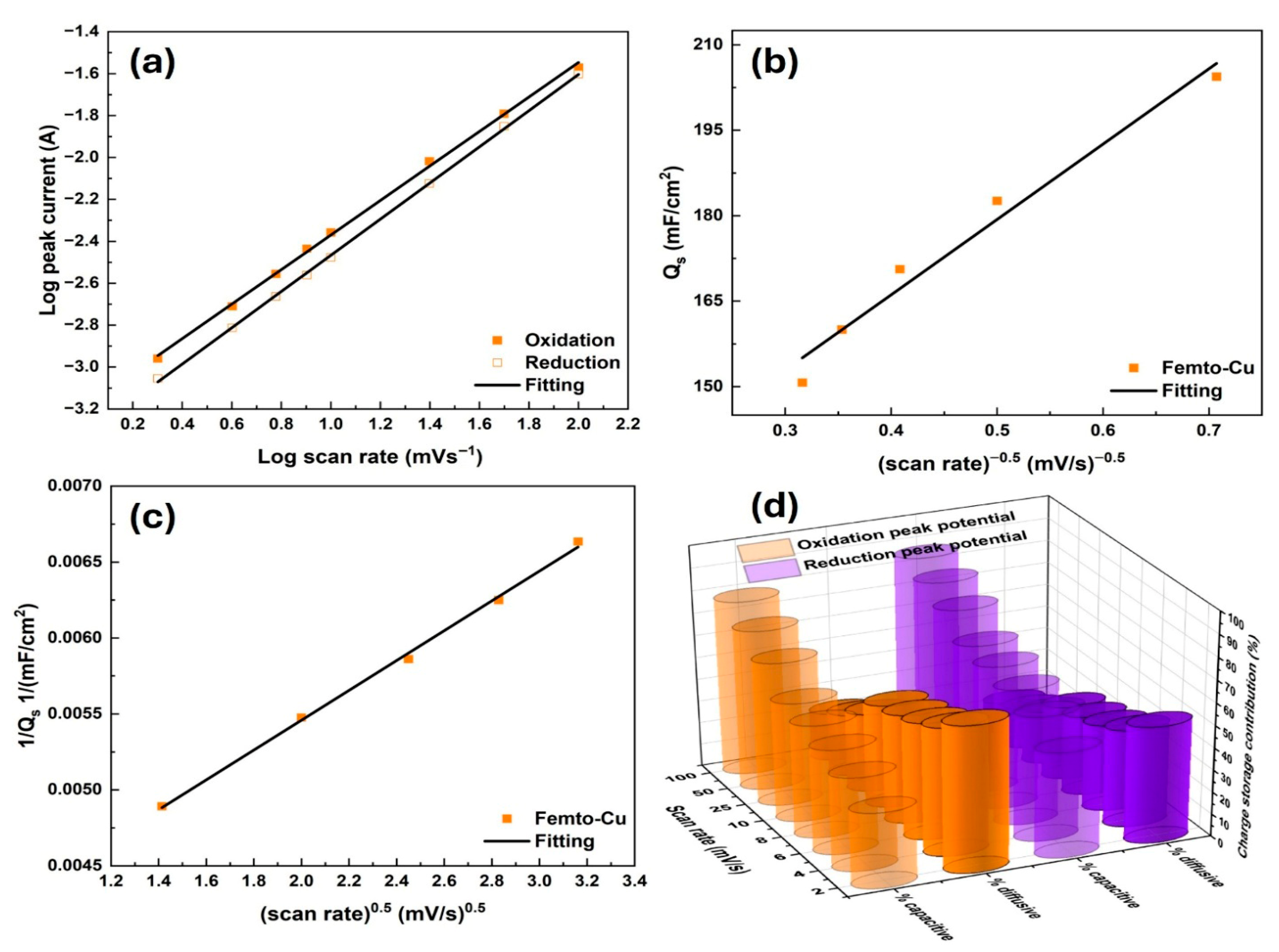
| Scan Rate (mV/s) | Oxidation | Reduction | ||
|---|---|---|---|---|
| % q capacitive | % q diffusive | % q capacitive | % q diffusive | |
| 2 | 34.08 | 65.92 | 47.56 | 52.44 |
| 4 | 42.23 | 57.77 | 56.19 | 43.81 |
| 6 | 47.24 | 52.76 | 61.10 | 38.90 |
| 8 | 50.83 | 49.17 | 64.46 | 35.54 |
| 10 | 53.61 | 46.39 | 66.97 | 33.03 |
| 25 | 64.63 | 35.37 | 76.23 | 23.77 |
| 50 | 72.10 | 27.90 | 81.93 | 18.07 |
| 100 | 78.52 | 21.48 | 86.51 | 13.49 |
Disclaimer/Publisher’s Note: The statements, opinions and data contained in all publications are solely those of the individual author(s) and contributor(s) and not of MDPI and/or the editor(s). MDPI and/or the editor(s) disclaim responsibility for any injury to people or property resulting from any ideas, methods, instructions or products referred to in the content. |
© 2026 by the author. Licensee MDPI, Basel, Switzerland. This article is an open access article distributed under the terms and conditions of the Creative Commons Attribution (CC BY) license.
Share and Cite
Maqsood, M.F. Femtosecond Laser-Induced Copper Oxide Nanospheres on Copper Foam Surfaces. Surfaces 2026, 9, 43. https://doi.org/10.3390/surfaces9020043
Maqsood MF. Femtosecond Laser-Induced Copper Oxide Nanospheres on Copper Foam Surfaces. Surfaces. 2026; 9(2):43. https://doi.org/10.3390/surfaces9020043
Chicago/Turabian StyleMaqsood, Muhammad Faheem. 2026. "Femtosecond Laser-Induced Copper Oxide Nanospheres on Copper Foam Surfaces" Surfaces 9, no. 2: 43. https://doi.org/10.3390/surfaces9020043
APA StyleMaqsood, M. F. (2026). Femtosecond Laser-Induced Copper Oxide Nanospheres on Copper Foam Surfaces. Surfaces, 9(2), 43. https://doi.org/10.3390/surfaces9020043