Article

From Hydrothermal Extraction to Catalytic Conversion: Mesoporous ZrO2-Assisted Valorization of Wheat Bran Sugars and Polysaccharides


by
Lucas E. Retamar
,
Federico A. Piovano
,
Alicia V. Boix
and
Soledad G. Aspromonte
*
Research Institute in Catalysis and Petrochemistry—INCAPE (FIQ, UNL-CONICET), Santiago del Estero 2829, Santa Fe 3000, Argentina
*
Author to whom correspondence should be addressed.
Surfaces 2026, 9(1), 22; https://doi.org/10.3390/surfaces9010022

Submission received: 7 January 2026 / Revised: 17 February 2026 / Accepted: 18 February 2026 / Published: 21 February 2026
(This article belongs to the Special Issue Design of Catalytic Surfaces for Waste Valorization)

Abstract

Wheat bran (WB) is an abundant agro-industrial residue rich in starch and structural polysaccharides, representing an attractive feedstock for sustainable biorefinery applications. In this work, an integrated strategy combining mild hydrothermal extraction and catalytic hydrothermal conversion was proposed to promote sugar recovery from unmilled WB and its subsequent transformation into organic acids. Conventional (HE-CH) and microwave-assisted hydrothermal extraction (HE-MW) were compared at 80–100 °C and 5–30 min. Under these soft conditions, total sugar recoveries of up to 6.45 g/100 g WB (5 min) and 8.71 g/100 g WB (30 min) were achieved, with a clear predominance of bound sugars and preferential extraction of hemicellulosic (C5) fractions, without formation of degradation products. Microwave-assisted extraction enhanced sugar recovery and selectivity by improving access to the wheat bran cell wall through volumetric heating and enhanced mass transfer. The resulting liquid extracts were subsequently converted at 180 °C and 40 bar (N2) using a mesoporous hydrated ZrO2 catalyst. In the absence of a catalyst, the system exhibited autothermal behavior but low efficiency (X < 20%). In contrast, catalytic conversion led to total sugar conversions above 75% at 90 min, with high lactic acid yields and LA/GA ratios consistently above unity, particularly for HE-MW-derived extracts. Overall, this work demonstrates that coupling microwave-assisted extraction under mild conditions with heterogeneous catalysis enables efficient access to WB cell-wall carbohydrates and their selective upgrading into value-added organic acids, offering a low-severity and sustainable route for wheat bran valorization.

1. Introduction

The increasing demand for sustainable and renewable chemical platforms has intensified research efforts aimed at the valorization of lignocellulosic biomass as an alternative to petroleum-based feedstocks [1]. Among agro-industrial residues, wheat bran (WB) emerges as a promising second-generation biomass source due to its global availability, low cost, and high content of valuable biopolymers such as cellulose, hemicellulose, and starch [2]. As a by-product of wheat milling, WB typically represents 12–18% of the grain mass and contains around 30–35% dietary fiber, 15–20% proteins, and close to 50% of carbohydrates, including significant fractions of arabinoxylans and β-glucans [3]. Animal feed remains a major outlet, accounting for roughly one-third of total wheat bran utilization, but emerging strategies of WB valorization would contribute to the global market of this by-product. Wheat bran (WB) is an abundant, low-cost by-product of the milling industry, making it an attractive feedstock for biorefinery applications. The valorization of its carbohydrate fraction, starch, arabinoxylans, β-glucans, and cellulose, enables the production of platform chemicals such as organic acids (e.g., lactic and succinic acids) and alcohols (e.g., ethanol and butanol), representing a sustainable alternative to fossil-based feedstocks [4].
A key strategy in this context is the production of lactic acid (LA) and glycolic acid (GA), which are important platform chemicals that can be co-polymerized to form poly(lactic-co-glycolic acid) (PLGA), a biodegradable, biocompatible polymer with widespread applications in biomedical and packaging materials [5]. While most studies focus on purified substrates, the use of real biomass feedstocks, such as WB, introduces new challenges [6]. A key limitation is the initial biomass fractionation and pretreatment of derived sugars, which critically affect efficiency and selectivity in subsequent transformation. Efficient valorization requires sequential extraction strategies that progressively isolate and valorize each major carbohydrate fraction (starch, hemicellulose, and cellulose), preserving chemical integrity and facilitating downstream conversions. The subsequent catalytic transformation of the extracted sugars into value-added chemicals represents a crucial stage in WB valorization. In contrast to microbial fermentation, which is often limited by substrate inhibition and requires complex downstream processing, heterogeneous catalytic conversion provides shorter residence times, higher selectivity, and simplified product separation [7].
A wide range of processes has been reported in the literature for the fractionation of wheat bran. For instance, alkaline extraction of wheat bran has been extensively investigated, employing agents such as hydrogen peroxide for the extraction of non-cellulosic glucose [8] or wheat bran bleaching [9], potassium hydroxide for arabinoxylans extraction [10], and sodium hydroxide for phenolics extraction [11]. Acid hydrolysis with concentrated sulfuric or hydrochloric acid can achieve yields in reducing sugars in the range of 26 to 81% [12,13]. However, both alkaline and acid-based processes require long times and strong acidic and basic conditions, which entail safety risks, high costs, and significant environmental impact. Alternatively, enzymatic hydrolysis has been proposed as a milder and more environmentally friendly route, with reported enzyme-extractable arabinoxylans yields ranging from 17 to 91% [14,15]. Nevertheless, its application is hindered by drawbacks such as enzyme recovery difficulties, long reaction times, strict operating requirements, and high enzyme costs. In this context, hydrothermal fractionation using hot compressed water, assisted by heterogeneous catalysis, emerges as a promising alternative, enabling efficient biomass transformation under more sustainable conditions, while combining high selectivity with lower environmental impact—making it a viable strategy for advancing biorefinery processes [16].
In a previous contribution by our group [17], the multi-step fractionation of WB was proposed as a critical strategy to obtain C5- and C6-rich fractions for subsequent catalytic valorization. The combination of supercritical water hydrolysis in ultra-fast reactors, with the subsequent hydrolysis of the cello-oligosaccharides on silver-exchanged mesoporous mordenite zeolite, offered a clear enhancement in the conversion of cellulose and glucose formation.
Hydrothermal extraction (HE) is considered a green technology, as it relies solely on water under moderate temperatures to achieve the selective solubilization of hemicellulose and starch, thereby minimizing the use of chemicals and preserving polysaccharide quality [18,19,20]. Microwave-assisted hydrothermal extraction (HE-MW) provides additional advantages, such as rapid and uniform heating, enhanced mass transfer, and improved disruption of cereal cell walls, leading to higher extraction yields and selectivity for thermolabile components [21,22,23]. Despite these benefits, only a limited number of studies have systematically compared microwave-assisted hydrothermal extraction with conventional heating (HE-CH) in real wheat bran systems. In particular, the influence of these approaches on the selective release of C5 (xylose, arabinose) and C6 (glucose), and their subsequent impact on catalytic upgrading, remains insufficiently explored.
Within this domain, zirconia (ZrO2) catalysts have emerged as a promising solid acid-base catalyst for sugar conversion, due to their amphoteric surface sites and thermal stability [24]. ZrO2 allows key reaction steps such as isomerization, retro-aldol cleavage, and dehydration, all relevant to produce lactic acid and furans from both C5 and C6 sugars [25]. Our group has made significant contributions to this field. Piovano et al. [26] conducted hydrothermal conversion of model sugar mixtures (xylose, arabinose, glucose) using sol–gel synthesized ZrO2 catalysts, achieving mass selectivity up to ~35% for lactic acid at optimized conditions, and proposing reaction mechanisms based on HPLC-detected intermediates. In a subsequent investigation, a response surface methodology (RSM) was applied to a real wheat bran hydrolysate, optimizing operating variables (temperature, time, pressure, catalyst loading) to maximize lactic acid yield from complex sugar mixtures [27]. A recent study based on the synthesis of nanoporous hydrated zirconia using different solvent systems (water, ethanol, and isopropanol) was reported. This demonstrated that catalysts prepared in isopropanol had greater specific surface area (320–360 m2/g), pore volume (0.20–0.43 cm3/g), and acid site density, achieving lactic acid yields of ~34.8% from glucose–xylose–arabinose mixtures and 18.3% from real WB extract [28]. Despite these advances, key gaps remain in understanding how the extraction method (HE CH vs. HE MW) influences sugar composition and subsequent catalytic conversion performance.
In this context, the present work leads to a comprehensive evaluation of soft wheat bran, including its granulometry, chemical, and thermal properties. Two HE strategies (HE-CH and HE-MW) are applied and compared for their efficiency in extracting water-soluble C5 and C6 sugars and polysaccharides. The liquid extracts obtained from both extraction methods are subjected to hydrothermal catalytic reactions using a mesoporous ZrO2 catalyst. The amounts of LA and GA, alongside 5-HMF and furfural, were analyzed. This work aims to elucidate the influence of the extraction strategy on sugar composition and reactivity. This integrated approach offers valuable insights into how the extraction strategy influences catalytic performance, contributing to the development of efficient routes for producing biodegradable polymer precursors from wheat bran.

2. Materials and Methods

2.1. Mesoporous ZrO2 Catalyst

2.1.1. Catalyst Synthesis

The catalyst was synthesized through a sol–gel method using a non-ionic templating agent [28]. Zirconium n-propoxide (70 wt. %), Pluronic P123, isopropanol and hydrochloric acid (36 wt. %) served as metal precursor, templating agent, solvent, and hydrolysis catalyst, respectively. The procedure was initiated with the dissolution of zirconium n-propoxide and Pluronic in isopropanol under continuous stirring for 1 h. Once completed, diluted hydrochloric acid was added drop by drop until achieving the desired molar composition: H+/H2O/Pluronic/isopropanol/Zr = 0.1/4/0.05/40/1. The resulting translucent gel was aged at 60 °C for 72 h. It was then dried in two successive stages, at 60 °C and 100 °C for 24 h.
Template removal was carried out by microwave-assisted solvent extraction using a Flexiwave Microwave Synthesis Platform (Milestone Srl, Sorisole, Italy). The extraction process consisted of four cycles, each using 15 mL of ethanol per gram of material at 80 °C for 2 h (heating rate: 3 °C/min). The solid was separated by centrifugation and dried overnight at 100 °C.

2.1.2. Catalyst Characterization

The textural properties of the catalyst were determined by nitrogen adsorption–desorption isotherms measured at −196 °C using a Micromeritics ASAP 2020 surface area and porosity analyzer (Micromeritics Instrument Corporation, Norcross, GA, USA) analyzer. Prior to analysis, the sample was degassed under vacuum at 150 °C for 8 h. The specific surface area (SBET) was evaluated using the Brunauer–Emmett–Teller (BET) method, following the Rouquerol consistency criteria [29]. The total pore volume (VP) was determined at a relative pressure of 0.98. Pore size distribution (PSD) was obtained through Non-Local Density Functional Theory (NLDFT), employing a slit-shaped pore model for N2 (MicroActive software version 4.02). Additionally, the morphology of the catalyst was analyzed through transmission electron microscopy (TEM) performed in a JEOL-2100 plus microscope (JEOL Ltd., Tokyo, Japan) operated at 200 kV. Samples were dispersed in ethanol and fixed on a copper 300-mesh grid.
The acidic properties of the catalyst were assessed by potentiometric titration using a 950 ROSS FASTQC titrator (Thermo Fisher Scientific, Beverly, MA, USA) with an ADWA AD1113 glass electrode. Typically, 35 mg of sample was dispersed in 20 mL of 0.1 N KNO3 to ensure a constant ionic strength. A standardized titrant (0.025 N KOH + 0.075 N KNO3) was added in 0.05 mL increments every 40 s, and the potential was monitored until a stable response was achieved. Acid site (AS) density was calculated using the first derivative of the titration curve. The acid strength was defined as the maximum potential difference (Emax) reached at the beginning of the titration.

2.2. Raw Material Characterization

Wheat bran (WB) kindly provided by the Cañuelas brand (Buenos Aires, Argentina) was used as raw material, which was kept in a refrigerator to prevent its degradation before being subjected to an exhaustive physicochemical characterization. Wheat bran was used without an additional milling step in order to exclusively evaluate the influence of the heating method on the extraction process.
Analyses to determine WB composition were adapted from the Laboratory Analytical Procedure (LAP) for biomass, developed by the National Renewable Energy Laboratory, NREL [30].

2.2.1. Particle Size Analysis

The particle size distribution of wheat bran was analyzed by a grinding process. The solid was classified in a vibratory sieve shaker, model AS 200 (RETSCH GmbH, Haan, Germany), equipped with analytical sieves according to ASTM Standard E-11 [31]. The sieves used were 10, 20, 40, 50, 100 and 170 mesh, corresponding to an aperture of 2000, 840, 420, 297, 149 and 88 microns, respectively. The percentage retained (R%) on each sieve was determined by weighing and using the following equation:
R   % = m T + R m T m W B × 100
where mT was the mass of the sieve, mT+R was the mass of the sieve with the retained mass, and mWB was the initial wheat bran mass.
On the other hand, to determine the particle size ranges of wheat bran, the throughs values were obtained. These values show the percentage of WB passing through the opening of each sieve used. The following equation was used to calculate these values:
T h r o u g h s   % = 100 R   %

2.2.2. Ash and Moisture

Ash content was carried out by calcination in a muffle furnace with a ramping program from 25 to 575 °C (ASTM Standard Method Number E1755-01) [32].
The dry matter percentage (% DM) was determined in a convective air oven at 105 °C until the sample weight remained constant (PROMEFA-v2 AOAC Protocol, 1990 No. 130.15 and No. 167.03) [33,34]. Once the DM content was determined, the amount of moisture was calculated with the following equation:
M o i s t u r e   % = 100 D M   %

2.2.3. Proteins and Starch

The protein content was determined following a standardized Kjeldahl method (AOAC, 1998 No. 976.05) [35], and the starch content was measured by the modified Ewers polarimetric method (IRAM, 1980) [36].

2.2.4. Structural Characteristics

The morphological configuration of wheat bran was recorded using a stereo microscope, model EZ4, (Leica Microsystems GmbH, Wetzlar, Germany).

2.2.5. Cellulose, Hemicellulose and Lignin

Cellulose, hemicellulose and lignin fractions were obtained by neutral detergent fiber (NDF—ANKOM method based on ISO 16472:2006) [37]; acid detergent fiber (ADF—ANKOM method based on ISO 13906:2008) [38] and acid detergent lignin (ADL—PROMEFA V2 protocol for ANKOM equipment) [39] were thus also obtained. The WB sample was treated with a neutral detergent solution (NDS) and rinsed with thermostable amylase to solubilize the sugars, starch and pectins. The remaining residues are composed of indigestible or less digestible substances of the cell wall (hemicellulose, cellulose and lignin). Thus, the hemicellulose fraction was solubilized with an acid detergent solvent (ADS). The residue, which contains cellulose and lignin, was then treated with concentrated sulfuric acid, thus dissolving the cellulose and leaving the lignin in the residue. These steps can be carried out consecutively or separately to determine neutral detergent fiber (NDF, cellulose + hemicellulose + lignin), acid detergent fiber (ADF, cellulose + lignin) and acid detergent lignin (ADL, lignin). Consequently, the percentages of cellulose, hemicellulose and lignin were calculated with the following equations:
C e l l u l o s e   % = A D F % A D L %
H e m i c e l l u l o s e   % = N D F % A D F %
L i g n i n   % = A D L %

2.3. Aqueous Thermal Extraction

Once the raw material was characterized, the different fractions identified in the WB were extracted. For this purpose, the hydrothermal extraction under conventional heating (HE-CH), and assisted with a microwave (HE-MW), was studied. A flexiWAVE microwave digestion system, model MA186-001 (Milestone Srl, Sorisole, Italy), was used.
Thus, the fractionation process was tested at 80, 90 and 100 °C under continuous stirring. Typical procedure was performed with suspensions of 0.033 g/mL (g WB/mL H2O) and variable time of extraction (5, 10 and 30 min). Once the extraction was finished, the aqueous phase was separated by filtration from the remaining solid. Samples were stored in a refrigerator. Such a procedure was related to others already reported in the literature [40].

2.4. Characterization of the Liquid Extract

2.4.1. Monomeric Sugars and Degradation Products

Quantification of monomeric sugars (FS: arabinose, xylose and glucose) and furfural or 5-HMF in the liquid extract was performed by direct injection of an aliquot into the HPLC system.

2.4.2. Total Sugars (TS)

The content of total sugars was determined by hydrolysis with sulfuric acid according to the NREL method [NREL/TP-510-42618] [41]. The procedure involves the addition of 0.8 mL of H2SO4 72 wt. % to 20 mL of extract, incubated at 121 °C for 60 min in an autoclave, cooled and filtered. The sample was neutralized using calcium carbonate and analyzed by HPLC. An aliquot of the liquid was immediately analyzed by High-Pressure Liquid Chromatography (HPLC) to quantify monomeric sugars such as arabinose, xylose, glucose and fructose.

2.4.3. Bound Sugars (BS)

The content of bound sugars was calculated as follows:
B S i ,   g 100   g   W B = T S i F S i i n i t i a l   m a s s   o f   W B ×   100
where TS and FS represent the total sugars (after acid hydrolysis of the liquid extract) and monomeric sugars (before acid hydrolysis of the extract), respectively, and i refers to the C6 sugar group (starch + cellulose) or the C5 sugar group (xylose + arabinose).

2.5. Catalytic Evaluation

Liquid extracts obtained were evaluated in the catalytic hydrothermal reaction to obtain lactic acid and furans. Catalytic evaluation was carried out in an AISI 304 stainless steel batch reactor with 200 mL internal volume.
In a typical experiment, 100 mL of EWB and 200 mg of ZrO2 catalyst were added into reactor. The system was closed and purged several times with high-purity N2. The reaction conditions were 180 °C, 40 bar (N2 atmosphere), 30–120 min and 600 rpm. Samples were taken every 30 min to study performance over time. Once reaction time concluded (120 min), the reactor was quickly cooled down in a water bath, and the remaining solid was recovered by centrifugation. All liquid samples obtained were analyzed by HLPC. Reaction conditions were optimized in a previous work of our group [27].
Sugar conversion and product molar yields were typically calculated as follows:
X % =   1 C i / M i C i ° / M i × 100
Y P % = C P / M P C i ° / M i × 100
Y F % = Y F u + Y H M F
where i = Xy: xylose, Ar: arabinose, Gl: glucose; X: total sugars conversion; YP: molar yield to p = LA: lactic acid, GA: glycolic acid, Fu: furfural, HMF: 5-hydroxymethylfurfura; YF: total furans molar yield; M: molar mass (g·mol−1); C: measured concentration (g L−1); and C0: initial concentration in the liquid extract (g·L−1).

2.6. HPLC Procedure

All liquid samples obtained either by hydrothermal extractions, acid hydrolysis, or derived from catalytic tests were analyzed and quantified by HPLC using a Nexera LC40 series chromatograph (Shimadzu Corporation, Kyoto, Japan) equipped with a refractive index detector (RID) and UV-Vis detector, with a Carbomix H-NP10 column (Sepax Technologies, Newark, DE, USA) at 80 °C. A 5 mM sulfuric acid solution was used as mobile phase, with a flow rate of 0.6 mL/min.
Samples were previously filtered through a 0.45 µm syringe filter and diluted five times in the mobile phase. Quantification was carried out by calibration curves from respective pure standard compounds. Glucose (Gl), fructose (Fr), xylose (Xy), arabinose (Ar), lactic (LA), glycolic (GA), formic (FA), acetic (AA) and levulinic (LeA) acids, as well as glyceraldehyde (GH) and hydroxyacetone (HA), were quantified using an RI detector. Furfural (Fu) and hydroxymethylfurfural (5-HMF) were quantified using a UV–Vis detector set at 280 nm.

3. Results and Discussion

3.1. Synthesis and Characterization of Mesoporous ZrO2

The catalyst used for the extract conversion tests consisted of mesoporous hydrated zirconia synthesized via a sol–gel method, followed by a microwave-assisted template removal procedure. It helps avoid severe thermal treatments intended to remove the templating agent allowed for the preservation of enhanced surface area and density of acid sites, as previously demonstrated by our group [27,28].
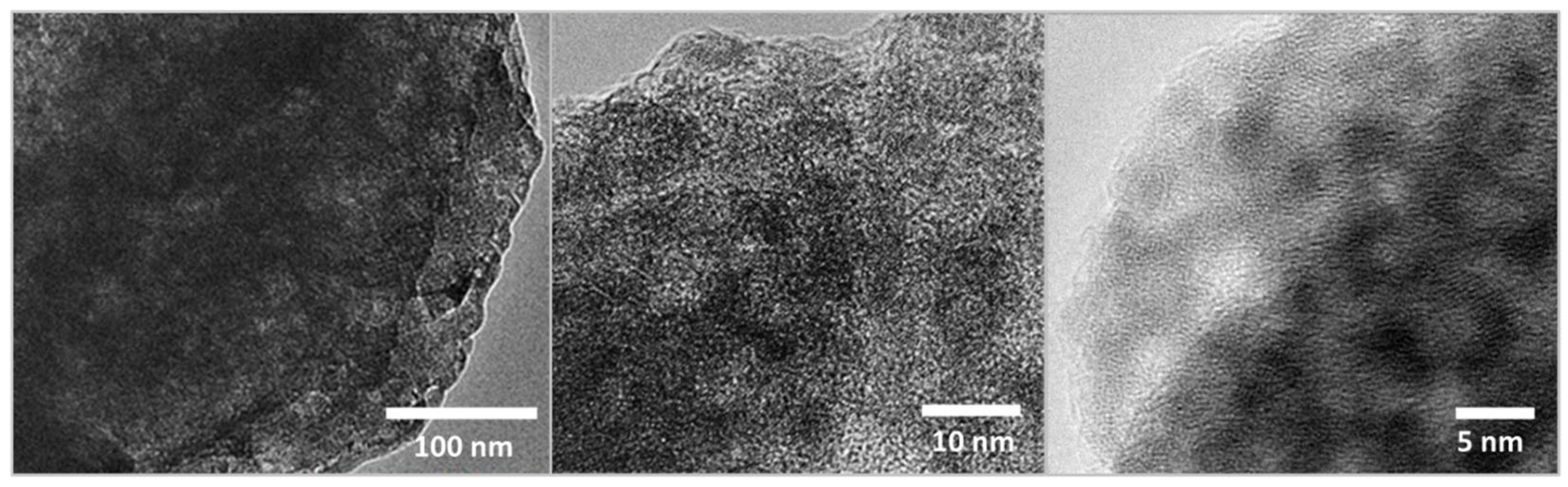
The material exhibited a high surface area of 304 m2/g and a significant pore volume of 0.20 cm3/g, which was notable considering typical values for d-block transition metal oxides. Pore size distribution revealed a bimodal pattern, with narrow mesopores around 1.9 nm and wider mesopores of 4.4 nm in diameter. This observation was corroborated by TEM micrographs (Figure 1), which revealed a primary porous structure as well as larger pores resulting from the aggregation of nanoparticles with an average size of approximately 5 nm.
The acid strength of the solid was 199 mV, and it was estimated from the Emax value. According to Vázquez et al. [42], a maximum potential difference above 100 mV was indicative of strong acid sites. Additionally, the resulting acid site density (1.49 mmol/g) was consistent with highly porous metal oxides possessing accessible Brønsted and Lewis acid sites [43]. Several studies have shown how these acid sites, present in various catalysts, actively participate in the hydrolysis and catalytic conversion processes of lignocellulosic biomass [44]. Thus, the use of a material with these characteristics was essential for our study, in order to valorize the WB.

3.2. Wheat Bran Characterization

3.2.1. Granulometric Study

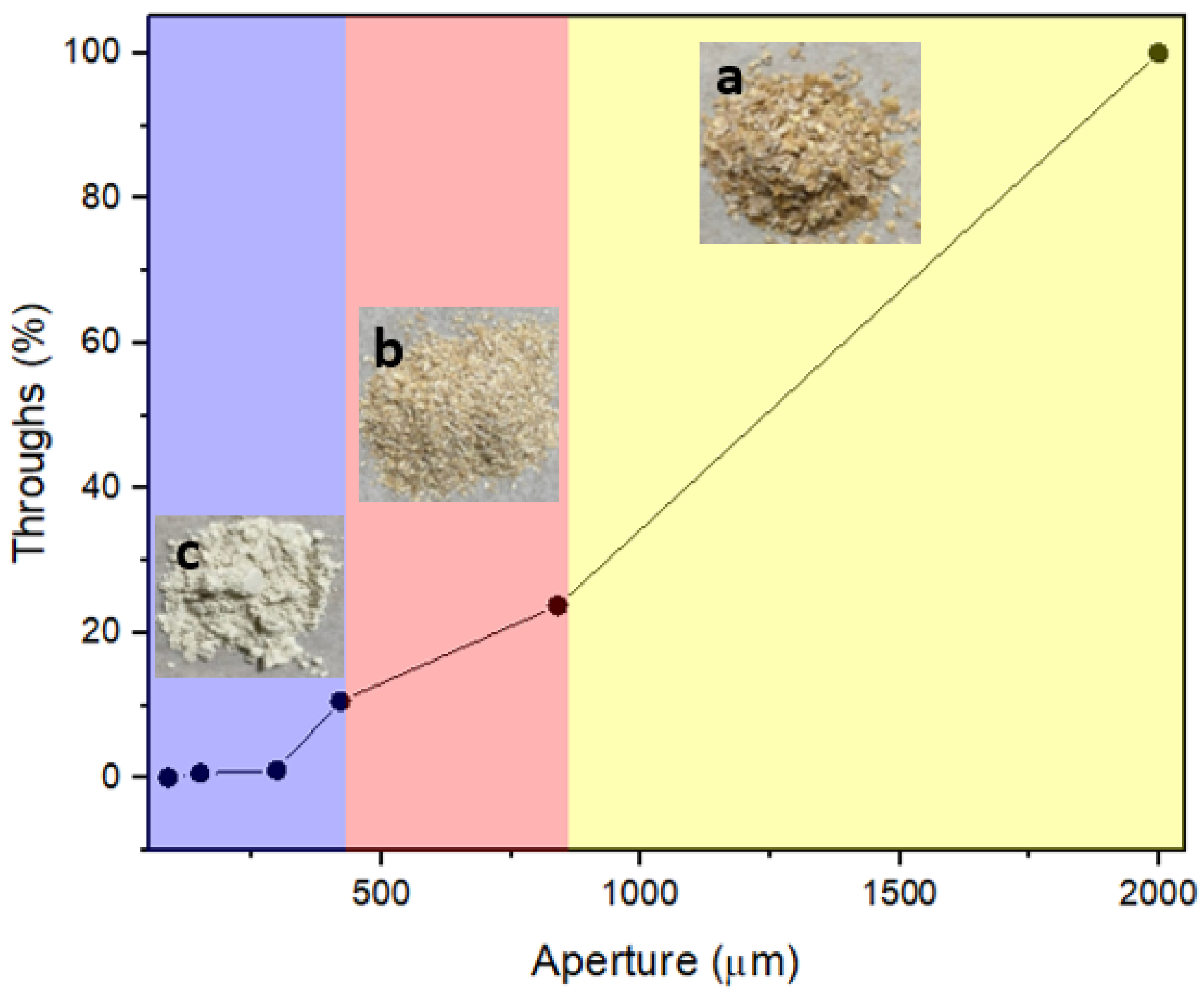
Wheat bran was separated by sieving into six particle size fractions, named as WB 10–20, WB 20–40, WB 40–50, WB 50–100, WB 100–170 and WB -170, corresponding to apertures sizes of 20 (840 µm), 40 (420 µm), 50 (297 µm), 100 (149 µm) and 170 (88 µm) mesh, respectively. The particle size distribution curve, expressed as the percentage of material passing through each sieve, is shown in Figure 2. Particle size of wheat bran was divided into three main regions: large-size, medium and fine. The large-sized fraction (2000–840 µm) accounts for the majority of the material, comprising 76.2% of the total wheat bran (Figure 2a). The medium fraction (840–420 µm) represents 14.2% (Figure 2b), while the fine fraction (particles smaller than 420 µm) constitutes only 9.6% (Figure 2c).
Thus, wheat bran is predominantly composed of large particles, likely enriched in structural polysaccharides such as cellulose, hemicellulose and lignin. In contrast, the fine fraction (<420 µm) displays characteristics consistent with starch-rich components commonly found in wheat bran.

3.2.2. Morphology

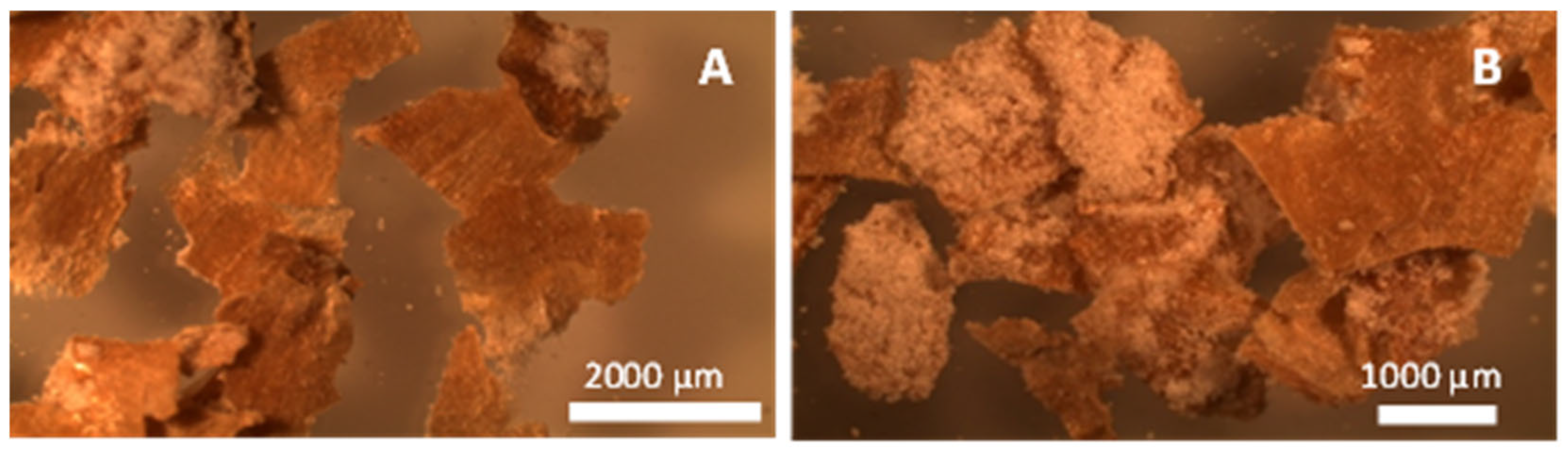
Figure 3 shows microscopic images of WB obtained at magnification of 40× (Figure 3A) and 100× (Figure 3B). The micrographs reveal the presence of thin, beige-brown laminar structures with a slightly wrinkled surface and visible cracks. These sheet-like particles are consistent with the morphological characteristics expected from fibrous plant tissues. Superimposed on these laminar, small, fine, opaque white particles can also be observed, scattered across the surface.
These morphological observations correlate well with the particle size distribution described in Section 3.2.1. The large laminar fragments correspond to the largest particle size fraction (2000–840 µm), referred to as the large-sized region, which represents the majority (76.2%) of the wheat bran. This region is typically rich in structural polysaccharides such as cellulose, hemicellulose and lignin, which form the outer layers of the WB grain. The fibrous, irregular shape and robustness of these sheets support this compositional inference.
On the other hand, the fine opaque white particles observed are associated with the smaller size region (<420 µm) corresponding to the fine region of the granulometric profile. These finer particles likely originate from the residual starchy endosperm adhered to the bran layers during milling. Their rounded or amorphous appearance and high opacity are characteristic of starch-rich components, suggesting they are predominantly composed of floury material, such as damaged starch granules or fragmented endosperm cells.
In summary, the morphological analysis provides complementary evidence to the granulometric classification of WB, confirming the presence of distinct structural and compositional regions. The coexistence of fibrous sheets and starch-rich fine particles underscores the heterogeneous nature of wheat bran, both in terms of particle size and chemical composition.

3.2.3. Chemical Properties of WB

The composition of the wheat bran used was summarized in Table 1. The sample presented a dry matter content of 93.7% after treatment at 105 °C, indicative of low residual moisture and suitable for characterization and valorization studies. The protein content was 17.5%, while the ash content reached 5.8% on a wet basis. Ash represents the total mineral and inorganic matter present in the biomass, and it can be classified into two categories: structural ash, which is tightly bound within the plant cell wall matrix, and extractable ash, which can be removed by simple washing procedures. The relatively low ash content (<10%) observed in this study suggests a moderate presence of inorganic constituents, likely distributed between both structural and extractable forms.
Furthermore, the fiber-related parameters presented in Table 1 include neutral detergent fiber (NDF), acid detergent fiber (ADF), and acid detergent lignin (ADL) with values of 41.1, 13.6 and 2.8 wt. %, respectively. These parameters are essential for estimating the content of key structural carbohydrates. Based on standard calculation (Equations (4)–(6)), cellulose, hemicellulose and lignin contents were obtained from these detergent fiber values.
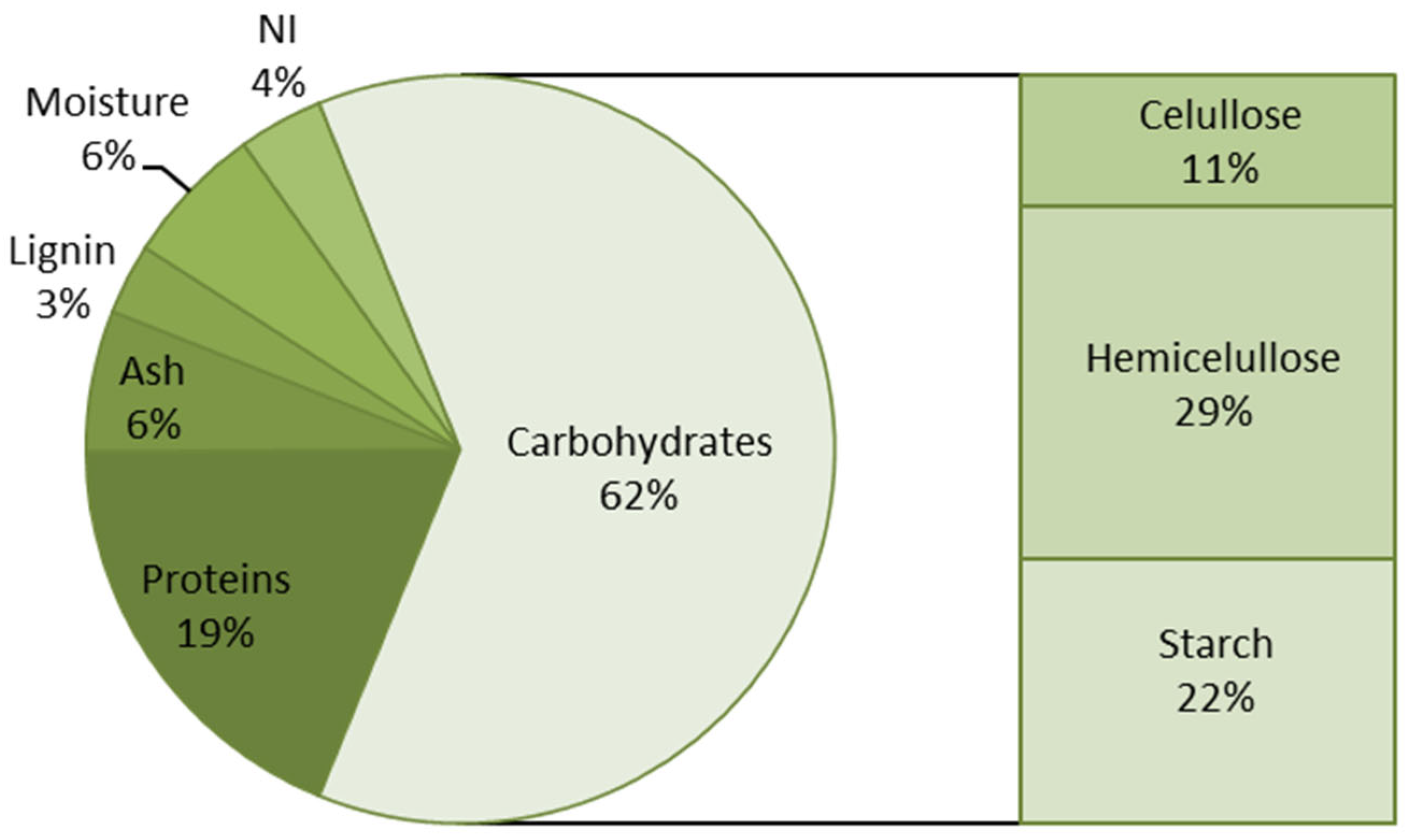
On a dry matter basis (Figure 4), wheat bran contained approximately 11, 29 and 3% of cellulose, hemicellulose and lignin, respectively. Furthermore, the starch content of the sample was 22% on a dry basis, while total protein content increased slightly to 19% on a dry basis. In addition, the sum of convertible carbohydrates of interest (cellulose, hemicellulose and starch) reached 62% on the dry weight, as illustrated in Figure 4. This high-carbohydrate fraction underscores the potential of wheat bran as a promising feedstock for bioconversion processes for the extraction of value-added compounds.
In summary, the chemical characterization of WB reveals a complex and heterogeneous composition, with a significant presence of both structural polysaccharides and starchy components, along with moderate protein and ash content. These features support its applicability in both nutritional and biotechnological contexts, particularly for processes aimed at utilizing lignocellulosic or carbohydrate-rich biomass.
Among the polysaccharides present in the lignocellulosic biomass, cellulose, hemicelluloses, and starch are of particular interest for revalorization processes due to their abundance and potential for conversion into high-value-added products [45]. Cellulose is a linear homopolysaccharide composed of between 2000 and 14,000 glucose units (C6) linked by β-1,4-glucosidic bonds. The hydroxyl (-OH) groups of adjacent glucose molecules form inter- and intramolecular hydrogen bonds, which stabilize the highly crystalline microfibrillar structure of cellulose and confer high resistance to chemical degradation [46].
In contrast, hemicelluloses are branched heteropolysaccharides composed of both C5 (xylose, arabinose) and C6 (mannose, galactose, glucose) sugars. They consist of relatively short polymer chains (50–200 sugar units) connected by a variety of α- or β-glycosidic linkages, such as 1 → 2, 1 → 3, 1 → 4 and 1 → 6. Due to their amorphous and non-crystalline nature, hemicellulose is more readily hydrolyzed than cellulose and can be partially solubilized in aqueous solutions under appropriate conditions [47].
Starch, on the other hand, is a homopolysaccharide composed entirely of glucose units, but, unlike cellulose, these units are linked by α-glycosidic bonds (mainly, α-1,4 and α-1,6) [48]. The difference in bonding results in a less compact, more accessible structure, making starch highly susceptible to catalytic hydrolysis. Moreover, both hemicelluloses and starch are especially valuable in the context of biomass valorization, as these polymers can be depolymerized under mild conditions to release convertible sugars, which can then be converted into biofuels, bioplastics, and other high-value-added products.
Considering the composition of wheat bran, hydrolysis was performed to break both α- and β-glycosidic bonds, to release monomeric units, and significantly reduce the degree of polymerization. This step is essential to facilitate the downstream transformation of these monomers into compounds of industrial interest.

3.3. Hydrothermal Extraction

Hydrothermal extraction is a widely used technique for recovering target compounds from several organic and inorganic matrices [49,50,51]. The use of high temperatures, combined with optimal extraction times, improves the solubilization and release of C6 and C5 monomeric sugars. However, it is essential to ensure that the selected time and temperature conditions do not lead to degradation of the interest products.
In this study, the influence of two key variables, such as temperature and extraction time, was analyzed in order to determine their effect on the amount of recovered products. Both soluble polysaccharides and monosaccharides were expected to be obtained under these conditions. Therefore, the amounts of total sugars (TS), free sugars (FS: monosaccharides), and bound sugars (BS: polysaccharides) recovered in each extract were reported. The influence of microwave-assisted heating and conventional heating was systematically evaluated.

3.3.1. Influence of the Extraction Temperature

To evaluate the influence of temperature on sugar extraction, HE-CH and HE-MW experiments were performed at a constant extraction time of 5 min, while varying the temperature between 80 and 100 °C. This temperature range was selected to operate under mild fractionation conditions, aiming to enhance sugar solubilization while minimizing thermal degradation and the formation of secondary products. In addition, working close to the boiling point allowed a direct comparison between heating modes without introducing high-pressure effects.
The results summarized in Table 2 and Table 3 show that increasing temperature promoted sugar recovery for both heating methods, although the effect was markedly more pronounced under microwave-assisted heating. In all cases, bound sugars (BSs) largely predominated over free sugars (FSs), indicating that the extraction process mainly involved the solubilization of oligomeric and polymeric carbohydrates rather than extensive depolymerization into monomeric sugars.
A clear selectivity toward hemicellulosic fractions was observed for both methods. The C6/C5 ratios of total and bound sugars remained consistently below unity, confirming the preferential extraction of C5 sugars under all evaluated conditions. In contrast, the free sugar fraction, although minor, was dominated by C6 sugars, likely associated with partial starch hydrolysis.
When comparing both heating strategies, the HE-MW method systematically led to higher total sugar recovery than HE-CH across the entire temperature range, with the largest differences observed at 100 °C. This enhancement was mainly associated with increased recovery of bound sugars, suggesting that microwave heating promoted a more efficient disruption of the hemicellulosic network. Importantly, no furans or organic acids were detected under any extraction conditions, confirming that the selected temperature range enabled selective carbohydrate recovery while avoiding thermal degradation.
Overall, these results demonstrated that microwave-assisted hydrothermal extraction intensified sugar solubilization from wheat bran under mild conditions, improving recovery while preserving sugar integrity.

3.3.2. Influence of Extraction Time

The influence of extraction time on hydrothermal fractionation was evaluated at a constant temperature of 90 °C. This temperature was selected based on previous results obtained in this study, which demonstrated effective sugar recovery at short processing times. In addition, the literature reports identifying 90 °C as an adequate condition for carbohydrate extraction from lignocellulosic materials such as wheat bran [40,52].
As shown in Table 4 and Table 5, increasing extraction time enhanced sugar recovery for both heating methods. However, this effect was significantly more pronounced under microwave-assisted heating, where total sugar extraction increased sharply with time. In contrast, conventional heating exhibited a more moderate increase, consistently yielding lower total sugar recovery than microwave-assisted extraction at all evaluated times.
In all cases, bound sugars clearly predominated over free sugars, indicating that longer extraction times mainly promoted the solubilization of polysaccharides and oligomers rather than extensive depolymerization into monosaccharides. The free sugar fraction remained low and relatively constant, suggesting that the applied conditions did not favor significant hydrolysis of solubilized polysaccharides.
A strong selectivity toward hemicellulosic fractions was observed throughout the entire time range studied (Table 5). The C6/C5 ratios of total and bound sugars remained below unity, confirming the preferential extraction of C5 sugars regardless of extraction time or heating mode. Conversely, the minor free sugar fraction was dominated by C6 sugars, most likely originating from partial starch hydrolysis.
Importantly, no degradation products such as furans or organic acids were detected even at the longest extraction time evaluated, demonstrating that extending extraction time within the studied range did not compromise sugar stability.
Overall, these results indicate that increasing extraction time enhances carbohydrate solubilization, particularly under microwave-assisted heating, while preserving selectivity toward hemicellulosic fractions and avoiding thermal degradation.

3.3.3. Comparison Between the Effects of Time and Temperature

When comparing the effects of extraction time (Table 4 and Table 5) with those previously observed for temperature (Table 2 and Table 3), it became evident that both variables positively influenced sugar extraction, although with different intensities depending on the heating method. Increasing temperature produced marked improvements at short times, whereas extending extraction time allowed further enhancement of total sugar recovery, particularly under microwave-assisted heating.
Microwave-assisted extraction (HE-MW) more efficiently combined both factors, achieving higher extraction yields at elevated temperatures and longer times without detectable sugar degradation. These results indicated that microwave heating not only intensified the extraction process but also broadened the operational window in terms of time and temperature, promoting selective carbohydrate recovery from wheat bran.
Although both heating methods proved effective within the evaluated conditions, HE-MW showed clear advantages over conventional heating. In particular, it enabled higher recovery of hemicellulosic components (C5) under all studied conditions, suggesting more effective disruption of the plant cell wall structure. This enhanced extraction of C5 sugars, achieved without evidence of degradation, highlighted the potential of microwave-assisted heating to intensify hydrothermal fractionation processes.
In this context, the comparative analysis provided relevant insight into the role of heating mode in selective sugar recovery and established a solid basis for the design of subsequent hydrothermal conversion steps aimed at the valorization of lignocellulosic residues such as wheat bran.

3.4. Catalytic Performance

Table 6 summarizes the catalytic performance of the extracts obtained under different heating modes, including total sugar conversion (XST), molar yields of lactic acid (YLA), glycolic acid (YGA), and furanic products (YF), as well as the LA/GA ratio as a function of reaction time.
In the absence of a catalyst (MW, 90 °C, 5 min), sugar conversion remained low throughout the reaction, never exceeding 20% even after 120 min. Likewise, lactic and glycolic acid yields were minimal and comparable, indicating that thermal activation alone was insufficient to promote efficient and selective sugar conversion. These results confirmed the autothermal nature of the system but also its limited intrinsic efficiency without catalytically active sites.
In contrast, catalyst addition led to a substantial enhancement in both conversion and product formation. Under microwave-assisted extraction conditions, total sugar conversion progressively increased, exceeding 90% at 120 min, together with high molar yields of lactic acid (≈84%) and glycolic acid (≈39%). The LA/GA ratio remained consistently above unity (≈2–3), indicating a clear preference toward lactic acid formation.
For conventional heating conditions, although catalytic performance improved significantly compared to the non-catalytic system, conversion and yields were systematically lower than those obtained from microwave-derived extracts. After 120 min, XST reached approximately 60%, with reduced acid yields and lower LA/GA ratios, suggesting lower overall efficiency and selectivity.
The enhanced catalytic performance observed in the presence of ZrO2 was attributed to its accessible acid sites combined with its mesoporous structure, which facilitated sugar diffusion and promoted acid-catalyzed pathways such as isomerization, retro-aldol cleavage, and rearrangement reactions leading to hydroxy acids. This acid–structure synergy was particularly effective for microwave-derived extracts, resulting in higher conversion levels and more favorable LA/GA ratios [53].
Furanic product formation increased with reaction time in all systems, reflecting the progressive contribution of secondary degradation pathways. Nevertheless, at intermediate reaction times, their formation remained moderate.
From an application perspective, the LA/GA ratio was identified as a key parameter because it directly influenced the physicochemical properties of poly(lactic-co-glycolic acid) (PLGA), including crystallinity, degradation rate, and mechanical properties [54,55]. Ratios above unity, such as those achieved under microwave-assisted catalytic conditions, favored the formation of PLGA formulations with slower degradation rates and enhanced mechanical performance.
Based on these results, a reaction time of 90 min was selected as representative for comparing extract performance. At this time, an appropriate balance was achieved between high sugar conversion, high organic acids yields, and limited formation of degradation products. Under microwave-derived extracts, conversions above 75% were obtained together with high lactic and glycolic acid yields and stable LA/GA ratios, without significant increases in furan formation.
As evidenced, longer reaction times led to similar or slightly higher conversions, but were accompanied by a greater contribution of secondary degradation pathways, reflected in the increased formation of furanic products. In this sense, a reaction time of 90 min was selected to limit undesired degradation while ensuring representative and reproducible catalytic performance.
This reaction time provided a suitable basis for comparing the impact of extraction conditions and heating mode, allowing a clearer assessment of how pretreatment variables influenced conversion and selectivity.
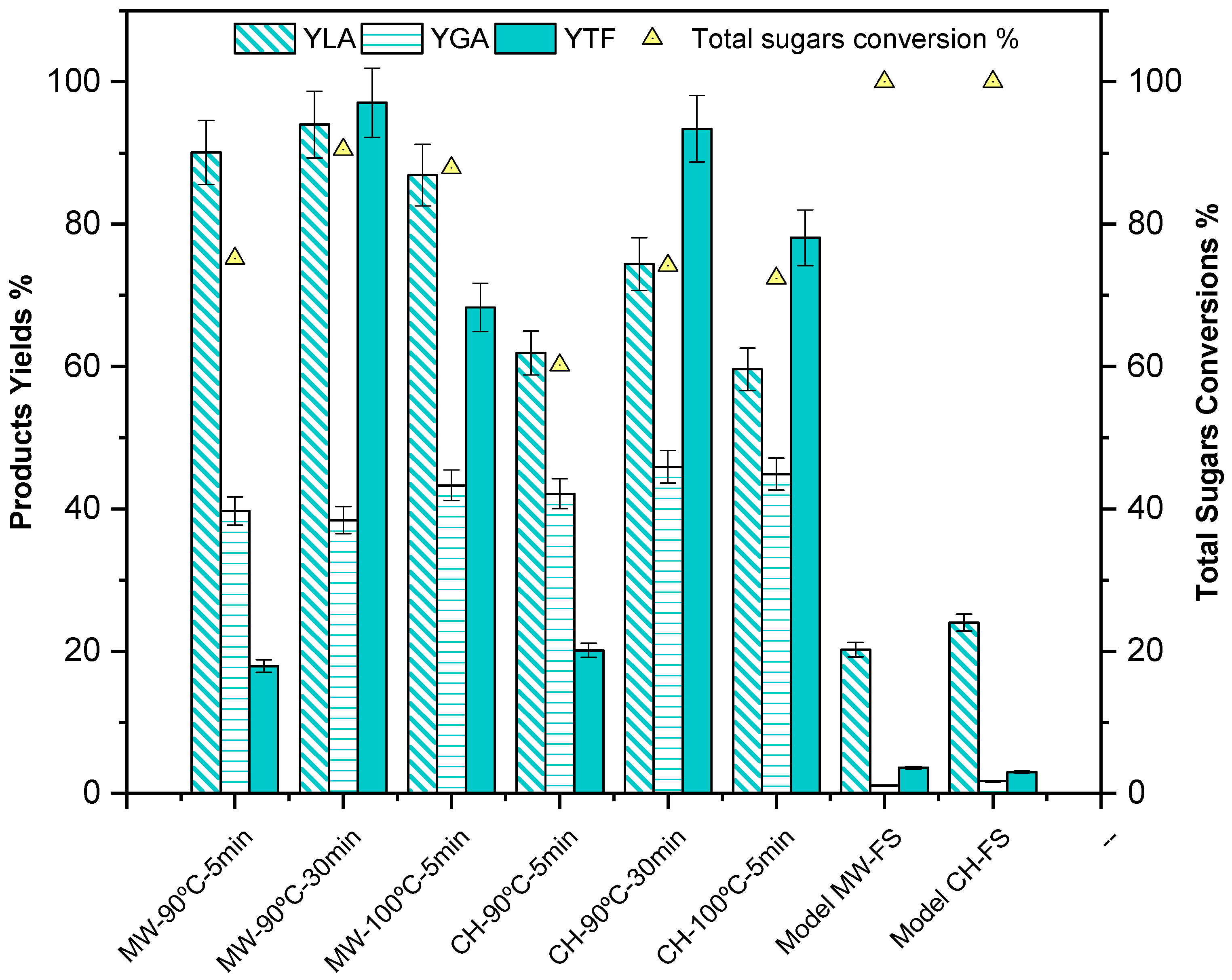
Figure 5 illustrates the catalytic performance of the most representative liquid extracts, selected based on the previous analysis and evaluated at a reaction time of 90 min. This time was chosen because it provided a suitable balance between high sugar conversion, elevated organic acids yields, and limited formation of degradation products, allowing a robust comparison among extraction conditions and heating modes.
Extracts obtained under microwave-assisted extraction generally resulted in higher total sugar conversions and lactic acid yields compared to those obtained under conventional heating. In particular, extracts produced at 90 °C under microwave heating exhibited the highest lactic acid yields, together with stable LA/GA ratios and moderate formation of furanic products. This behavior was consistent with the more efficient disruption of the lignocellulosic matrix and improved sugar accessibility achieved during microwave-assisted extraction, which enhanced subsequent catalytic conversion.
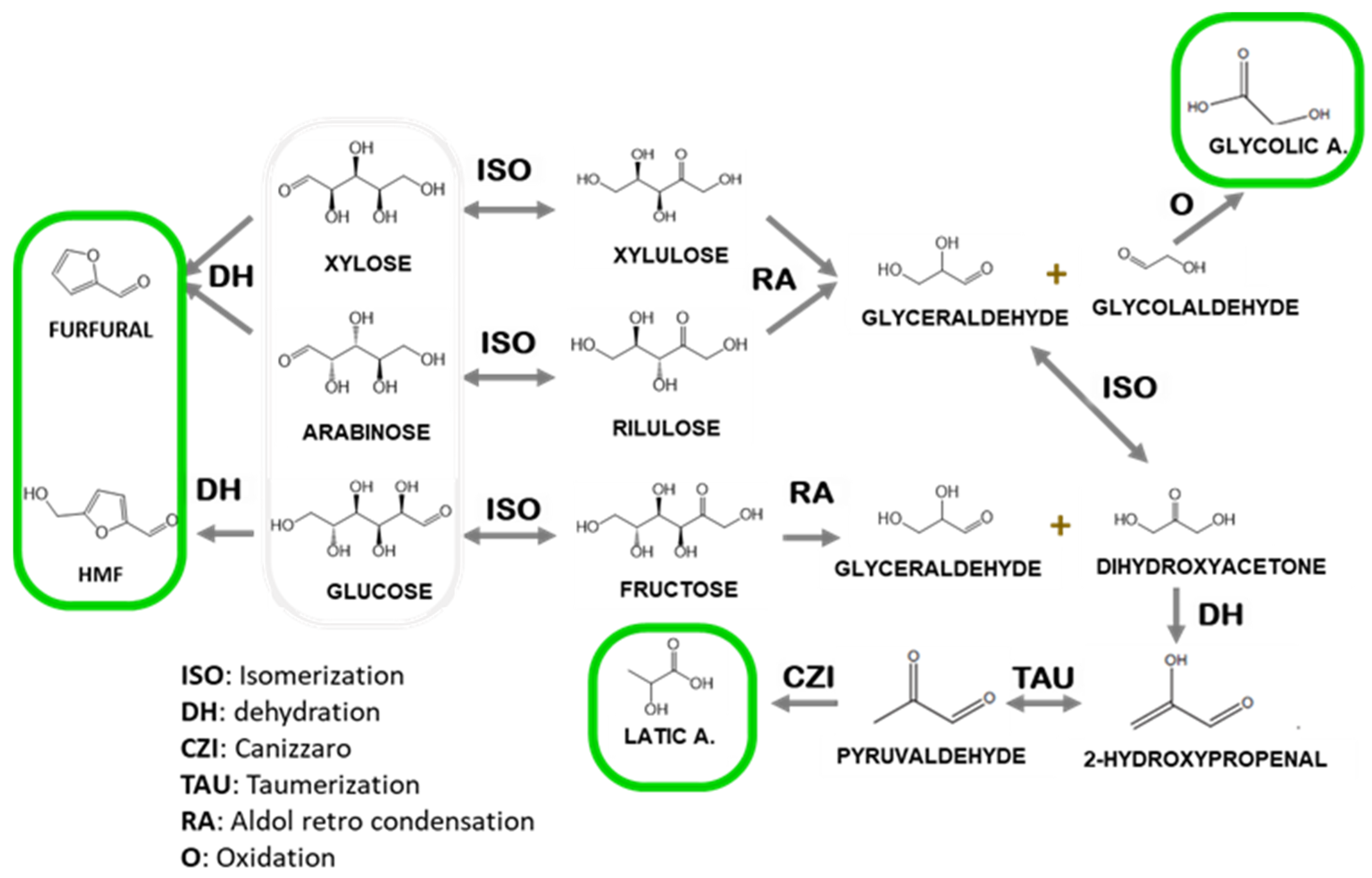
Extracts obtained at higher extraction temperatures (100 °C) or longer extraction times showed similar or slightly higher conversions; however, these conditions promoted increased formation of degradation by-products, particularly furanic compounds, indicating the onset of secondary reaction pathways. As observed in Figure 6, furfural and 5-hydroxymethylfurfural (5-HMF) were generated from the dehydration of C5 and C6 sugars, respectively. From these furanic intermediates, humins could be formed, which are considered the main contributors to catalyst deactivation [56]. These results reinforced the selection of moderate extraction severity combined with a reaction time of 90 min as optimal for maximizing organic acid production while limiting degradation.
Comparison with model sugar solutions with only free sugars (MW–FS and CH–FS) highlighted the complexity of real biomass-derived extracts. Although model systems exhibited high conversion levels, their organic acid yields were significantly lower than those obtained from wheat bran extracts, demonstrating the influence of extract composition and matrix-derived species on catalytic performance.
The superior performance observed for microwave-derived extracts was attributed to the intrinsic advantages of microwave heating in lignocellulosic fractionation, particularly the preferential solubilization of hemicellulosic components. Unlike conventional heating, microwave irradiation produced volumetric heating through interaction with dipolar molecules, enabling rapid and uniform energy distribution [57,58,59]. This effect generated localized increases in temperature and pressure within the biomass structure, promoting disruption of hydrogen bonding and cleavage of glycosidic linkages, especially in the hemicellulosic network, thereby increasing the availability of sugars for catalytic conversion.
From a mechanistic perspective, lactic acid was formed from both C5 and C6 monomeric sugars through isomerization, retro-aldol cleavage, and rearrangement reactions, while glycolic acid originated from oxidation of glycolaldehyde intermediates generated during C5 sugar conversion. Overall, the combination of microwave-assisted extraction and catalytic hydrothermal conversion favored pathways toward organic acid while maintaining controlled levels of degradation products.
From the extraction-stage perspective, the results obtained in this work were particularly relevant when compared with values reported in the literature. Under mild microwave-assisted hydrothermal extraction conditions (90–100 °C, 5 min), total sugar recoveries of up to 6.45 g/100 g of wheat bran were achieved, with a predominance of bound sugars and a clear preference toward the hemicellulosic fraction (C5), without detection of degradation products.
In contrast, previous studies reported comparable or lower extraction yields under significantly more severe conditions. For example, Carvalheiro et al. [60] reported hemicellulosic sugar recoveries of 8–10 g/100 g of wheat bran using hydrothermal treatments at 160–180 °C for 30–60 min, accompanied by substantial formation of furanic compounds. Similarly, Garrote et al. [61] indicated that significant xylan extraction from cereal residues required temperatures above 170 °C, where high process severity promoted sugar degradation.
Regarding microwave-assisted processes, Zhang et al. [62] demonstrated that hemicellulose extraction could be accelerated under microwave heating; however, temperatures above 120–150 °C were generally required to reach comparable extraction levels. Similarly, Kaparaju et al. [63] reported that conventional hydrothermal treatments below 120 °C were largely ineffective unless prolonged reaction times or additional chemical steps were applied.
In this context, the extraction performance observed in this work was notable, as sugar recoveries in the range of 4–6 wt. % were achieved using unmilled wheat bran, moderate temperatures, and very short contact times. These results suggested that microwave-assisted heating efficiently promoted hemicellulosic solubilization through volumetric heating and enhanced mass transfer, thereby reducing the need for severe conditions that often compromise sugar integrity.
Most literature studies on lactic acid production from carbohydrates reported significantly harsher conditions, typically involving temperatures in the range of 180–240 °C, prolonged reaction times, and purified sugars as substrates. For example, Lai et al. [64] reported lactic acid yields of 68–75% from glucose and cellulose under severe hydrothermal conditions, while Deng et al. [65] obtained comparable yields using metal oxide catalysts and concentrated monosaccharide solutions. For C5 sugars, efficient conversion of xylose and arabinose into lactic and glycolic acids generally required temperatures above 160–200 °C and was often accompanied by increased formation of furans and humins [66,67].
Several studies also investigated the catalytic conversion of wheat bran-derived substrates into hydroxy acids using solid catalysts under severe conditions. For instance, Wattanapaphawong et al. [68] reported lactic acid yields of 55–70% from wheat bran at temperatures between 180 and 220 °C, but with significant formation of degradation products. Similarly, other authors reported lactic acid yields of approximately 60–65% using bifunctional catalysts at temperatures above 180 °C and long reaction times, often requiring pre-hydrolyzed substrates [69].
In contrast, the present work achieved total sugar conversions above 75% at 90 min and exceeding 90% at 120 min, together with lactic acid molar yields up to ~84%, using real wheat bran extracts obtained under mild microwave-assisted hydrothermal extraction conditions (≤100 °C, short contact times) followed by catalytic conversion at 180 °C. These yields were comparable to or higher than those reported in the literature, despite the much lower extraction severity and the absence of purified sugars or aggressive pretreatments.
The ability to reach high lactic acid yields while maintaining moderate levels of furanic by-products highlights the effectiveness of ZrO2-based catalysts in directing the reaction network toward retro-aldol and rearrangement pathways rather than dehydration routes. This behavior was consistent with previous studies showing that zirconia catalysts with accessible weak-to-moderate acid sites favored hydroxy acid formation from complex biomass-derived feeds. In particular, Piovano et al. [43] demonstrated that zirconia-based catalysts enabled selective conversion of mixed C5/C6 sugar systems and real biomass extracts into lactic and glycolic acids, emphasizing the importance of acid site accessibility.
Overall, compared with previously reported wheat bran valorization strategies, the integrated low-severity extraction and ZrO2-catalyzed conversion approach presented here offered a clear advantage by combining competitive lactic acid yields, high sugar conversion, and reduced process severity, which was highly relevant for sustainable wheat bran valorization within biorefinery schemes.

4. Conclusions

This work demonstrated that wheat bran can be efficiently valorized through the integration of mild hydrothermal extraction and heterogeneous catalytic conversion, avoiding the need for severe temperatures, long residence times, or chemical reagents. Both conventional and microwave-assisted extraction enabled selective solubilization of carbohydrates, with bound sugars largely predominating over free sugars, indicating that extraction mainly promoted the release of oligomeric and polymeric fractions while preserving sugar integrity. Microwave-assisted hydrothermal extraction showed clear advantages, enhancing total sugar recovery and selectivity toward hemicellulosic (C5) fractions by facilitating access to the wheat bran cell wall through volumetric heating and improved mass transfer, without inducing degradation even at higher severities. Subsequent catalytic hydrothermal conversion over mesoporous hydrated ZrO2 markedly improved sugar conversion and organic-acid yields compared to the autothermal system, highlighting the essential role of accessible acid sites and mesoporosity. A reaction time of 90 min was identified as optimal, providing a balance between high conversion, elevated lactic and glycolic acid yields, and limited furan formation. Compared with literature reports that rely on harsher extraction and conversion conditions, the present approach achieved competitive performance under significantly milder conditions. Overall, the results confirm that the combination of microwave-assisted extraction and ZrO2-catalyzed conversion constitutes an efficient and selective low-severity pathway for transforming wheat bran into organic-acid precursors suitable for downstream applications such as biodegradable polymer synthesis.

Author Contributions

All authors contributed to the study conception and design. Material preparation, data collection and analysis were performed by L.E.R., F.A.P., A.V.B. and S.G.A. The first draft of the manuscript was written by L.E.R., and all authors commented on previous versions of the manuscript. All authors have read and agreed to the published version of the manuscript.

Funding

This work was financially supported by Conicet (PIP 11220200100607CO) and ANPCyT (PICT 2021-I-A-00794).

Data Availability Statement

The research data supporting the results of this study will be made available by the corresponding author upon request.

Acknowledgments

The authors acknowledge the financial support of UNL, Conicet, ASACTEI, and ANCPyT. Thanks are given to Yohana Martínez for the TEM measurements. In addition, the authors gratefully acknowledge Esther Alonso (University of Valladolid) for her valuable advice and support regarding the analytical techniques employed in this work.

Conflicts of Interest

The authors declare no conflicts of interest.

References

  1. Adams, P.; Bridgwater, T.; Lea-Langton, A.; Ross, A.; Watson, I. Biomass Conversion Technologies. In Greenhouse Gas Balances of Bioenergy Systems; Academic Press: Cambridge, MA, USA, 2018; pp. 107–139. [Google Scholar] [CrossRef]
  2. Prückler, M.; Siebenhandl-Ehn, S.; Apprich, S.; Höltinger, S.; Haas, C.; Schmid, E.; Kneifel, W. Wheat bran-based biorefinery 1: Composition of wheat bran and strategies of functionalization. LWT 2014, 56, 211–221. [Google Scholar] [CrossRef]
  3. Onipe, O.O.; Jideani, A.I.O.; Beswa, D. Composition and functionality of wheat bran and its application in some cereal food products. Int. J. Food Sci. Technol. 2015, 50, 2509–2518. [Google Scholar] [CrossRef]
  4. Apprich, S.; Tirpanalan, Ö.; Hell, J.; Reisinger, M.; Böhmdorfer, S.; Siebenhandl-Ehn, S.; Novalin, S.; Kneifel, W. Wheat bran-based biorefinery 2: Valorization of products. LWT 2014, 56, 222–231. [Google Scholar] [CrossRef]
  5. Elmowafy, E.M.; Tiboni, M.; Soliman, M.E. Biocompatibility, biodegradation and biomedical applications of poly(lactic acid)/poly(lactic-co-glycolic acid) micro and nanoparticles. J. Pharm. Investig. 2019, 49, 347–380. [Google Scholar] [CrossRef]
  6. Yousuf, A.; Pirozzi, D.; Sannino, F. Fundamentals of lignocellulosic biomass. In Lignocellulosic Biomass to Liquid Biofuels; Academic Press: Cambridge, MA, USA, 2020; pp. 1–15. [Google Scholar] [CrossRef]
  7. Sánchez-Bastardo, N.; Romero, A.; Alonso, E. Extraction of arabinoxylans from wheat bran using hydrothermal processes assisted by heterogeneous catalysts. Carbohydr. Polym. 2017, 160, 143–152. [Google Scholar] [CrossRef] [PubMed]
  8. Maes, C.; Delcour, J. Alkaline Hydrogen Peroxide Extraction of Wheat Bran Non-starch Polysaccharides. J. Cereal Sci. 2001, 34, 29–35. [Google Scholar] [CrossRef]
  9. Aider, M.; Zaddem, M.; Karim, A. Digital monitoring and response surface methodology optimization of wheat bran bleaching by hydrogen peroxide and its incorporation into wheat Flour. Futur. Foods 2024, 9, 100327. [Google Scholar] [CrossRef]
  10. Zhang, Y.; Pitkänen, L.; Douglade, J.; Tenkanen, M.; Remond, C.; Joly, C. Wheat bran arabinoxylans: Chemical structure and film properties of three isolated fractions. Carbohydr. Polym. 2011, 86, 852–859. [Google Scholar] [CrossRef]
  11. Stavova, E.; Porizka, J.; Stursa, V.; Enev, V.; Divis, P. Extraction of ferulic acid from wheat bran by alkaline hydrolysis. MendelNet 2017, 24, 574–579. [Google Scholar]
  12. Verma, B.; Hucl, P.; Chibbar, R.N. Phenolic acid composition and antioxidant capacity of acid and alkali hydrolysed wheat bran fractions. Food Chem. 2009, 116, 947–954. [Google Scholar] [CrossRef]
  13. Demirel, F.; Germec, M.; Turhan, I. Fermentable sugars production from wheat bran and rye bran: Response surface model optimization of dilute sulfuric acid hydrolysis. Environ. Technol. 2021, 43, 3779–3800. [Google Scholar] [CrossRef]
  14. Beaugrand, J.; Crônier, D.; Debeire, P.; Chabbert, B. Arabinoxylan and hydroxycinnamate content of wheat bran in relation to endoxylanase susceptibility. J. Cereal Sci. 2004, 40, 223–230. [Google Scholar] [CrossRef]
  15. Aguedo, M.; Fougnies, C.; Dermience, M.; Richel, A. Extraction by three processes of arabinoxylans from wheat bran and characterization of the fractions obtained. Carbohydr. Polym. 2014, 105, 317–324. [Google Scholar] [CrossRef]
  16. Sánchez-Bastardo, N.; Alonso, E. Maximization of monomeric C5 sugars from wheat bran by using mesoporous ordered silica catalysts. Bioresour. Technol. 2017, 238, 379–388. [Google Scholar] [CrossRef]
  17. Aspromonte, S.G.; Romero, A.; Boix, A.V.; Alonso, E. Hydrolysis of cellulose to glucose by supercritical water and silver mesoporous zeolite catalysts. Cellulose 2019, 26, 2471–2485. [Google Scholar] [CrossRef]
  18. Sugano, M.; Yuze, M.; Komatsu, A.; Enomoto, T.; Kakuta, Y.; Hirano, K. Extraction of Valuable Compounds from Hydrothermally Reacted Rice Bran and Wheat Bran. Waste Biomass—Valorization 2012, 3, 381–393. [Google Scholar] [CrossRef]
  19. Merali, Z.; Collins, S.R.A.; Elliston, A.; Wilson, D.R.; Käsper, A.; Waldron, K.W. Characterization of cell wall components of wheat bran following hydrothermal pretreatment and fractionation. Biotechnol. Biofuels 2015, 8, 23. [Google Scholar] [CrossRef]
  20. Schmidt, M.; Wiege, B.; Hollmann, J. Comparison of Alkaline/Oxidative and Hydrothermal Extraction of Wheat Bran Arabinoxylans. Foods 2021, 10, 826. [Google Scholar] [CrossRef] [PubMed]
  21. Wang, T.-H.; Lu, S. Production of xylooligosaccharide from wheat bran by microwave assisted enzymatic hydrolysis. Food Chem. 2013, 138, 1531–1535. [Google Scholar] [CrossRef] [PubMed]
  22. Aguedo, M.; Ruiz, H.A.; Richel, A. Non-alkaline solubilization of arabinoxylans from destarched wheat bran using hydrothermal microwave processing and comparison with the hydrolysis by an endoxylanase. Chem. Eng. Process.—Process. Intensif. 2015, 96, 72–82. [Google Scholar] [CrossRef]
  23. Lou, H.; Khashaba, R.; Gu, Z.; Omer, S.H.S.; Wang, X.; Zhao, R. Enhancing Wheat Bran Quality: Comparing the Effects of Conventional Thermal Processing and Microwave-Assisted Hydrolysis on Minor Bioactive Compounds; SSRN: Amsterdam, The Netherlands, 2025. [Google Scholar] [CrossRef]
  24. Pattnaik, F.; Tripathi, S.; Patra, B.R.; Nanda, S.; Kumar, V.; Dalai, A.K.; Naik, S. Catalytic conversion of lignocellulosic polysaccharides to commodity biochemicals: A review. Environ. Chem. Lett. 2021, 19, 4119–4136. [Google Scholar] [CrossRef]
  25. Yang, L.; Su, J.; Carl, S.; Lynam, J.G.; Yang, X.; Lin, H. Catalytic conversion of hemicellulosic biomass to lactic acid in pH neutral aqueous phase media. Appl. Catal. B Environ. 2015, 162, 149–157. [Google Scholar] [CrossRef]
  26. Piovano, F.A.; Aspromonte, S.G.; Bergamini, C.V.; Giménez, P.; Boix, A.V. Catalytic hydrothermal conversion of bio-derived sugars for lactic acid production using sol-gel synthesized zirconia. Lat. Am. Appl. Res. 2023, 53, 1–6. [Google Scholar] [CrossRef]
  27. Piovano, F.A.; Aspromonte, S.G.; Gross, M.S.; Bergamini, C.; Boix, A.V. Optimizing lactic acid production for agricultural wastes revalorization via sugars hydrothermal conversion with zirconia-based catalysts: Response surface methodology. Biomass- Convers. Biorefinery 2024, 14, 15563–15585. [Google Scholar] [CrossRef]
  28. Piovano, F.; Aspromonte, S.; Boix, A. Study on the synthesis of nanoporous hydrated zirconia applied to hydrothermal conversion of biomass-derived sugars. Microporous Mesoporous Mater. 2024, 368, 113029. [Google Scholar] [CrossRef]
  29. Thommes, M.; Kaneko, K.; Neimark, A.V.; Olivier, J.P.; Rodriguez-Reinoso, F.; Rouquerol, J.; Sing, K.S.W. Physisorption of gases, with special reference to the evaluation of surface area and pore size distribution (IUPAC Technical Report). Pure Appl. Chem. 2015, 87, 1051–1069. [Google Scholar] [CrossRef]
  30. Sluiter, J.B.; Ruiz, R.O.; Scarlata, C.J.; Sluiter, A.D.; Templeton, D.W. Compositional Analysis of Lignocellulosic Feedstocks. Review and Description of Methods. J. Agric. Food Chem. 2010, 58, 9043–9053. [Google Scholar] [CrossRef]
  31. ASTM E11-22; Standard Specification for Woven Wire Test Sieve Cloth and Test Sieves. ASTM International: West Conshohocken, PA, USA, 2022.
  32. ASTM E1755-01; Standard Test Method for Ash in Biomass. ASTM International: West Conshohocken, PA, USA, 2001.
  33. PROMEFA. Acid Detergent Lignin Determination (PROMEFA V2 Protocol); European Feed Analysis Network (PROMEFA): Milan, Italy, 1992. [Google Scholar]
  34. AOAC. Official Methods of Analysis of the Association of Official Analytical Chemists, 15th ed.; AOAC International: Arlington, VA, USA, 1990; Methods 130.15 and 167.03. [Google Scholar]
  35. AOAC. Official Methods of Analysis of AOAC International, Method 976.05; AOAC International: Gaithersburg, MD, USA, 1998. [Google Scholar]
  36. IRAM. IRAM Standard 1587: Determination of Crude Fiber in Food Products; Instituto Argentino de Normalización y Certificación (IRAM): Buenos Aires, Argentina, 1980. [Google Scholar]
  37. ISO 16472:2006; Animal Feeding Stuffs—Determination of Neutral Detergent Fibre Content Using Amylase. International Organization for Standardization: Geneva, Switzerland, 2006.
  38. ISO 13906:2008; Animal Feeding Stuffs—Determination of Acid Detergent Fibre and Acid Detergent Lignin Contents. International Organization for Standardization: Geneva, Switzerland, 2008.
  39. ANKOM Technology. Acid Detergent Lignin in Feeds Filter Bag Technique (Method 8); ANKOM Technology: Macedon, NY, USA, 2017. [Google Scholar]
  40. Shang, X.-L.; Liu, C.-Y.; Dong, H.-Y.; Peng, H.-H.; Zhu, Z.-Y. Extraction, purification, structural characterization, and antioxidant activity of polysaccharides from Wheat Bran. J. Mol. Struct. 2021, 1233, 130096. [Google Scholar] [CrossRef]
  41. Sluiter, A.; Hames, B.; Ruiz, R.; Scarlata, C.; Sluiter, J.; Templeton, D.; Crocker, D. Determination of Structural Carbohydrates and Lignin in Biomass; NREL Laboratory Analytical Procedure (NREL/TP-510-42618); National Renewable Energy Laboratory: Golden, CO, USA, 2008. [Google Scholar]
  42. Vázquez, P.; Pizzio, L.; Cáceres, C.; Blanco, M.; Thomas, H.; Alesso, E.; Finkielsztein, L.; Lantaño, B.; Moltrasio, G.; Aguirre, J. Silica-supported heteropolyacids as catalysts in alcohol dehydration reactions. J. Mol. Catal. A Chem. 2000, 161, 223–232. [Google Scholar] [CrossRef]
  43. Weingarten, R.; Tompsett, G.A.; Conner, W.C.; Huber, G.W. Design of solid acid catalysts for aqueous-phase dehydration of carbohydrates: The role of Lewis and Brønsted acid sites. J. Catal. 2011, 279, 174–182. [Google Scholar] [CrossRef]
  44. Kobayashi, H.; Fukuoka, A. Current Catalytic Processes for Biomass Conversion. In New and Future Developments in Catalysis: Catalytic Biomass Conversion; Elsevier: Amsterdam, The Netherlands, 2013; pp. 29–52. [Google Scholar]
  45. Sun, Y.; Cheng, J. Hydrolysis of lignocellulosic materials for ethanol production: A review. Bioresour. Technol. 2002, 83, 1–11. [Google Scholar] [CrossRef]
  46. Zhang, Y.-H.P.; Himmel, M.E.; Mielenz, J.R. Outlook for cellulase improvement: Screening and selection strategies. Biotechnol. Adv. 2006, 24, 452–481. [Google Scholar] [CrossRef]
  47. Ebringerová, A.; Heinze, T. Xylan and xylan derivatives—Biopolymers with valuable properties, 1, Naturally occurring xylans structures, procedures and properties. Macromol. Rapid Commun. 2000, 21, 542–556. [Google Scholar] [CrossRef]
  48. Hoover, R. Composition, molecular structure, and physicochemical properties of tuber and root starches: A review. Carbohydr. Polym. 2001, 45, 253–267. [Google Scholar] [CrossRef]
  49. Tekin, K.; Karagöz, S.; Bektaş, S. A review of hydrothermal biomass processing. Renew. Sustain. Energy Rev. 2014, 40, 673–687. [Google Scholar] [CrossRef]
  50. Hrnčič, M.K.; Kravanja, G.; Knez, Ž. Hydrothermal treatment of biomass for energy and chemicals. Energy 2016, 116, 1312–1322. [Google Scholar] [CrossRef]
  51. Gao, Y.; Remón, J.; Matharu, A.S. Microwave-assisted hydrothermal treatments for biomass valorisation: A critical review. Green Chem. 2021, 23, 3502–3525. [Google Scholar] [CrossRef]
  52. Liu, C.-Y.; Meng, J.; Qiu, J.-Y.; Geng, X.-Q.; Sun, H.-Q.; Zhu, Z.-Y. Structural characterization and prebiotic potential of an acidic polysaccharide from Imperial Chrysanthemum. Nat. Prod. Res. 2020, 36, 586–594. [Google Scholar] [CrossRef] [PubMed]
  53. Piovano, F.A.; Gómez, L.E.; Retamar, L.E.; Boix, A.V.; Aspromonte, S.G. Catalytic aqueous-phase conversion of sugars and biomass to hydroxy acids: Role of weak acid sites on zirconia-supported metal oxides. J. Environ. Chem. Eng. 2025, 13, 120423. [Google Scholar] [CrossRef]
  54. Makadia, H.K.; Siegel, S.J. Poly lactic-co-glycolic acid (PLGA) As biodegradable controlled drug delivery carrier. Polymers 2011, 3, 1377–1397. [Google Scholar] [CrossRef]
  55. Middleton, J.C.; Tipton, A.J. Synthetic biodegradable polymers as orthopedic devices. Biomaterials 2000, 21, 2335–2346. [Google Scholar] [CrossRef]
  56. Calderón, J.C.V.; Arora, J.S.; Mushrif, S.H. Mechanistic Investigation into the Formation of Humins in Acid-Catalyzed Biomass Reactions. ACS Omega 2022, 7, 44786–44795. [Google Scholar] [CrossRef]
  57. Kim, K.H.; Hong, J. Pretreatment of agricultural biomass for anaerobic digestion: Current state and challenges. Bioresour. Technol. 2017, 245, 1182–1189. [Google Scholar] [CrossRef] [PubMed]
  58. Fernandes, A.; Cruz-Lopes, L.; Esteves, B.; Evtuguin, D.V. Microwaves and Ultrasound as Emerging Techniques for Lignocellulosic Materials. Materials 2023, 16, 7351. [Google Scholar] [CrossRef] [PubMed]
  59. Pérez, A.S.L.; Castro, J.J.L.; Fajardo, C.A.G. Application of Microwave Energy to Biomass: A Comprehensive Review of Microwave-Assisted Technologies, Optimization Parameters, and the Strengths and Weaknesses. J. Manuf. Mater. Process. 2024, 8, 121. [Google Scholar] [CrossRef]
  60. Carvalheiro, F.; Duarte, L.C.; Gírio, F.M. Hemicellulose biorefineries: A review on biomass pretreatments. J. Sci. Ind. Res. 2008, 67, 849–864. [Google Scholar]
  61. Garrote, G.; Domínguez, H.; Parajó, J.C. Hydrothermal processing of lignocellulosic materials. Holz Roh Werkst. 1999, 57, 191–202. [Google Scholar] [CrossRef]
  62. Zhang, Z.; O’Hara, I.M.; Doherty, W.O.S. Pretreatment of sugarcane bagasse by microwave assisted alkali for the production of fermentable sugars. Bioresour. Technol. 2012, 120, 13–18. [Google Scholar]
  63. Kaparaju, P.; Felby, C. Characterization of lignin during hydrothermal pretreatment of wheat straw. Bioresour. Technol. 2010, 101, 4666–4671. [Google Scholar] [CrossRef]
  64. Lai, R.; Qu, F.; Ju, M.; Xie, C.; Qian, H.; Xia, T.; Wang, C.; Yu, G.; Tang, Y.; Bai, X.; et al. Review on synthesis of lactic acid and lactates from biomass derived carbohydrates via chemocatalysis routes. Bioresour. Technol. 2025, 419, 132031. [Google Scholar] [CrossRef]
  65. Deng, W.; Wang, P.; Wang, B.; Wang, Y.; Yan, L.; Li, Y. Transformation of cellulose and related carbohydrates into lactic acid with bifunctional Al(iii)–Sn(ii) catalysts. Green Chem. 2018, 20, 735–744. [Google Scholar] [CrossRef]
  66. Kumar, A.; Gautam, A.; Dutt, D. Biotechnological transformation of lignocellulosic biomass into industrial products: An overview. Adv. Biosci. Biotechnol. 2016, 7, 149–168. [Google Scholar] [CrossRef]
  67. Li, L.; Ding, J.; Zhao, H.; Wang, Z. Catalytic conversion of wheat bran hydrolysates to lactic acid in aqueous phase. Bioresour. Technol. 2017, 245, 936–944. [Google Scholar]
  68. Wattanapaphawong, P.; Reubroycharoen, P.; Yamaguchi, A. Conversion of cellulose into lactic acid using zirconium oxide catalysts. RSC Adv. 2017, 7, 18561–18568. [Google Scholar] [CrossRef]
  69. Nocito, F.; Daraselia, D.; Dibenedetto, A. Catalytic Biomass Conversion into Fuels and Materials: Sustainable Technologies and Applications. Catalysts 2025, 15, 948. [Google Scholar] [CrossRef]
Figure 1. TEM micrographs of mesoporous hydrated zirconia catalyst.
Surfaces 09 00022 g001
Figure 2. Particle-size curve of WB. (a) Large-sized, (b) medium and (c) fine region.
Surfaces 09 00022 g002
Figure 3. Optical microscopic images of WB with a magnification of (A) 40× and (B) 100×.
Surfaces 09 00022 g003
Figure 4. Chemical composition of WB on dry basis.
Surfaces 09 00022 g004
Figure 5. Molar yields of lactic acid (YLA), glycolic acid (YGA), and total furanic products (YTF), together with total sugar conversion (Δ), were obtained during the catalytic hydrothermal conversion of wheat bran-derived liquid extracts using microwave-assisted heating (MW) and conventional heating (CH). Results correspond to different extraction conditions (temperature and time) and a reaction time of 90 min. For comparison, a model solution based on the free-sugar (FS) extract (MW–FS and CH–FS) was also included. Replicates, n = 2.
Surfaces 09 00022 g005
Figure 6. Reaction paths.
Surfaces 09 00022 g006
Table 1. Wheat bran characterization on wet basis.
DM (a)NDF (b)ADF (c)ADL (d)ProteinStarchAsh
(wt. %)
WB93.741.113.62.817.520.15.8
(a) DM: dry matter at 105 °C, (b) NDF: neutral detergent fiber, (c) ADF: acid detergent fiber, (d) ADL: acid detergent lignin.
Table 2. Amount of total (TSs), bound (BSs), and free sugars (FSs) obtained at 5 min using conventional hydrothermal extraction (HE-CH) and microwave-assisted hydrothermal extraction (HE-MW), at extraction temperatures (ET) of 80, 90, and 100 °C. C6: glucose-derived sugars; C5: xylose + arabinose. Replicates, n = 2.
ET (a)g/100 g WB
TSC6TSC5BSC6BSC5FSC6FSC5
HE-MW
801.13 ± 0.102.57 ± 0.101.10 ± 0.052.55 ± 0.050.03 ± 0.0010.02 ± 0.003
901.29 ± 0.052.58 ± 0.101.26 ± 0.042.56 ± 0.030.03 ± 0.0030.02 ± 0.001
1002.10 ± 0.104.35 ± 0.132.07 ± 0.054.33 ± 0.050.03 ± 0.0010.02 ± 0.002
HE-CH
801.29 ± 0.101.94 ± 0.101.26 ± 0.041.92 ± 0.060.03 ± 0.0020.02 ± 0.003
901.61 ± 0.121.77 ± 0.091.57 ± 0.061.76 ± 0.090.04 ± 0.0040.01 ± 0.002
1002.26 ± 0.053.06 ± 0.102.22 ± 0.023.05 ± 0.050.04 ± 0.0010.01 ± 0.005
(a) Extraction temperature (°C).
Table 3. Ratio of C6/C5 sugars, amount of total (TSs), bound (BSs), and free sugars (FSs) obtained at 5 min using conventional hydrothermal extraction (HE-CH) and microwave-assisted hydrothermal extraction (HE-MW), at extraction temperatures of 80, 90, and 100 °C. Replicates, n = 2.
ET (a)Total SugarsBound SugarsFree Sugars
g/100 g WBC6/C5 (b)g/100 g WBC6/C5 (c)g/100 g WBC6/C5 (d)
HE-MW
803.70 ± 0.100.443.65 ± 0.050.430.05 ± 0.0011.29
903.87 ± 0.050.503.82 ± 0.030.490.05 ± 0.0021.57
1006.45 ± 0.100.486.40 ± 0.050.490.05 ± 0.0031.37
HE-CH
803.23 ± 0.100.673.18 ± 0.050.660.05 ± 0.0021.79
903.39 ± 0.120.913.33 ± 0.070.890.06 ± 0.0032.83
1005.32 ± 0.050.745.27 ± 0.030.730.05 ± 0.0022.11
(a) Extraction temperature (°C); (b), (c), and (d) ratio of extracted C6/C5 sugars (total, bound, or free, respectively).
Table 4. Amount of total (TSs), bound (BSs), and free sugars (FSs) obtained at 90 °C using conventional hydrothermal extraction (HE-CH) and microwave-assisted hydrothermal extraction (HE-MW), at extraction times (Et) of 5, 10, and 30 min. C6: Glucose-derived sugars; C5: Xylose + arabinose. Replicates, n = 2.
Et (a)g/100 g WB
TSC6TSC5BSC6BSC5FSC6FSC5
HE-MW
51.29 ± 0.102.58 ± 0.101.26 ± 0.052.56 ± 0.020.03 ± 0.0030.02 ± 0.001
101.61 ± 0.103.39 ± 0.101.58 ± 0.023.37 ± 0.050.03 ± 0.0020.02 ± 0.002
302.90 ± 0.205.81 ± 0.102.86 ± 0.085.79 ± 0.030.04 ± 0.0010.02 ± 0.004
HE-CH
51.61 ± 0.091.77 ± 0.101.57 ± 0.131.76 ± 0.150.04 ± 0.0050.01 ± 0.002
102.10 ± 0.102.26 ± 0.112.06 ± 0.072.24 ± 0.080.04 ± 0.0020.02 ± 0.006
303.06 ± 0.123.23 ± 0.063.02 ± 0.103.21 ± 0.100.04 ± 0.0060.01 ± 0.007
(a) Extraction time (min) at 90 °C.
Table 5. Ratio of C6/C5 sugars, amount of total (TSs), bound (BSs), and free sugars (FSs) obtained at 90 °C using conventional hydrothermal extraction (HE-CH) and microwave-assisted hydrothermal extraction (HE-MW), at extraction times of 5, 10, and 30 min. Replicates, n = 2.
Et (a)Total SugarsBound SugarsFree Sugars
g/100 g WBC6/C5 (b)g/100 g WBC6/C5 (c)g/100 g WBC6/C5 (d)
HE-MW
53.87 ± 0.100.503.82 ± 0.050.490.05 ± 0.0011.57
105.00 ± 0.050.474.95 ± 0.030.470.05 ± 0.0021.42
308.71 ± 0.100.508.65 ± 0.050.490.05 ± 0.0031.65
HE-CH
53.39 ± 0.100.913.33 ± 0.050.890.05 ± 0.0022.83
104.35 ± 0.120.934.30 ± 0.070.920.06 ± 0.0032.62
306.29 ± 0.050.956.23 ± 0.030.940.05 ± 0.0023.11
(a) Extraction times (min) used at 90 °C; (b), (c), (d) ratio of extracted C6/C5 sugars (total, bound, or free, respectively).
Table 6. Catalytic results obtained using liquid extracts at 90 °C and an extraction time of 5 min, employing microwave-assisted heating (MW) and conventional heating (CH), in the absence and presence of mesoporous ZrO2 as a catalyst. Reaction conditions: 180 °C, 40 bar N2, and 2 g/L catalyst load.
Time (min)XST (%) (a)YLA (%) (b)YGA (%) (c)YF (%) (d)LA/GA (e)
Substrate = HE-MW extract (T: 90 °C, time: 5 min); without catalyst
010.2 ± 0.054.6 ± 0.038.7 ± 0.030.5 ± 0.070.5 ± 0.05
3012.3 ± 0.0714.2 ± 0.0512.4 ± 0.032.4 ± 0.111.2 ± 0.09
6012.9 ± 0.0514.6 ± 0.1317.8 ± 0.035.2 ± 0.050.8 ± 0.03
9015.7 ± 0.1117.8 ± 0.0517.9 ± 0.058.6 ± 0.031.0 ± 0.05
12019.1 ± 0.0918.0 ± 0.1020.3 ± 0.0614.0 ± 0.060.9 ± 0.11
Substrate = HE-MW extract (T: 90 °C, time: 5 min); ZrO2 as catalyst
045.2 ± 0.1047.3 ± 0.0716.2 ± 0.051.2 ± 0.092.9 ± 0.05
3049.3 ± 0.0671.8 ± 0.0927.1 ± 0.117.5 ± 0.032.6 ± 0.07
6060.2 ± 0.0579.6 ± 0.0534.1 ± 0.1012.4 ± 0.072.3 ± 0.03
9075.2 ± 0.1390.1 ± 0.1039.7 ± 0.0517.9 ± 0.062.3 ± 0.05
12090.3 ± 0.0584.1 ± 0.1038.9 ± 0.0624.9 ± 0.112.7 ± 0.09
Substrate = HE-CH extract (T: 90 °C, time: 5 min); ZrO2 as catalyst
059.9 ± 0.0953.4 ± 0.0516.9 ± 0.060.4 ± 0.033.2 ± 0.03
3040.5 ± 0.0756.5 ± 0.1137.9 ± 0.0911.7 ± 0.031.5 ± 0.05
6043.6 ± 0.1357.8 ± 0.0738.9 ± 0.0515.6 ± 0.051.5 ± 0.11
9060.2 ± 0.1061.9 ± 0.1042.1 ± 0.0620.1 ± 0.131.5 ± 0.05
12059.7 ± 0.0564.6 ± 0.1044.7 ± 0.09± 0.061.4 ± 0.07
(a) Total sugar conversion; (b), (c), and (d) the molar yields of lactic acid, glycolic acid, and total furans, respectively; and (e) LA/GA ratio: lactic-to-glycolic acid ratio. Replicates, n = 2.
Disclaimer/Publisher’s Note: The statements, opinions and data contained in all publications are solely those of the individual author(s) and contributor(s) and not of MDPI and/or the editor(s). MDPI and/or the editor(s) disclaim responsibility for any injury to people or property resulting from any ideas, methods, instructions or products referred to in the content.