


Abstract
Quaternary Ni-Zn-Mg-Al metallic mixed oxide (MMO) catalysts were synthesized by co-precipitation from layered double hydroxide precursors. The effect of varying Zn content on physicochemical properties and catalytic performance was evaluated. Mg-Al and ternary Ni-Mg-Al and Zn-Mg-Al catalysts were synthetized for comparative purposes. XRD, N2 sorption, MP-AES, CO2-TPD, NH3-TPD, SEM, and EDS characterized the materials’ physicochemical properties. The tested reaction was the transesterification between glycerol and dimethyl carbonate to obtain glycerol carbonate to improve the biodiesel industry. The catalyst containing both Ni and Zn showed the highest glycerol conversion among the evaluated materials. This was related to the increased number and strength of surface basic and acid active sites. Specifically, a high density of strong basic sites and acid ones in the quaternary catalysts was required for the reaction mechanism. The catalyst with 20 at% of Zn (MMO-Ni15Zn20) achieved the highest glycerol carbonate yield (89.6%) under mild reaction conditions and was solvent-free. MMO-Ni15Zn20 catalytic performance was associated with its high total basicity and predominance of strong basic sites and a moderate amount of acid sites. The differences observed between catalytic performances suggest that these results depend on the influence of structural, textural, acid, and basic properties. Reuse tests of the MMO-Ni15Zn20 catalyst showed moderate stability, with a progressive decrease in activity due to the loss of strong basic sites and the formation of agglomerated regions. Nevertheless, MMO-Ni15Zn20 maintained a GC selectivity of 100% in the successive cycles.
1. Introduction
Biodiesel has emerged as a key renewable fuel within the global energy transition. However, its large-scale production generates crude glycerol as a major byproduct (10 wt.%), which represents a significant challenge for the economic and environmental sustainability of the biodiesel industry. In this context, the catalytic valorization of glycerol into high-value-added products has become a central topic within waste-derived feedstock upgrading strategies.
Among the different glycerol transformation pathways, glycerol carbonate (GC) stands out as a particularly attractive target molecule due to its excellent physicochemical properties, such as low toxicity, low flammability, high biodegradability, low vapor pressure, and high hydration capacity, which are fully aligned with green chemistry principles [1,2,3]. GC has found applications as a solvent and intermediate in polymers, resins, surfactants, adhesives, paints, and lithium-ion batteries, with new applications continuously emerging.
Traditionally, GC has been produced via reactions involving phosgene, urea, or carbonylation with CO2 or CO. However, these routes suffer from severe drawbacks, including toxicity, corrosiveness, the need for continuous byproduct removal, or harsh operating conditions such as high pressures and temperatures [4,5,6]. In contrast, the transesterification of glycerol with dimethyl carbonate (DMC) represents a more sustainable and efficient alternative, as it can be conducted under relatively mild conditions and avoids the use of hazardous reagents. This reaction requires basic catalysts, although homogeneous systems, despite their high activity, present significant limitations related to separation, corrosion, and catalyst recovery. As a result, heterogeneous catalysts have attracted increasing attention due to their reusability, operational simplicity, and potential for surface property tuning [7].
Among the heterogeneous catalysts reported for this transesterification reaction, CaO [8], KNO3/CaO [9], and Li/ZnO [10] could be mentioned. Nevertheless, many of these catalysts still face important challenges, such as carbonation, excessive reactant ratios, solvent use, high reaction temperatures, or demanding calcination treatments. These limitations highlight the need for the rational design of catalytic surfaces capable of combining high activity, selectivity, and stability under mild and sustainable conditions.
In this regard, mixed metal oxides (MMOs) derived from layered double hydroxides (LDHs) have gained increasing relevance as tunable heterogeneous catalysts for glycerol carbonate synthesis [11]. The catalytic performance of MMOs is strongly governed by their surface properties, particularly the nature, strength, and distribution of basic and acidic sites, which directly influence the reaction mechanism [12,13].
LDH-derived MMOs offer remarkable versatility, as their acid–base surface characteristics can be finely adjusted by modifying the type and proportion of metal cations incorporated into the structure. Moreover, LDHs can be synthesized through simple, reproducible, and environmentally friendly co-precipitation methods, followed by controlled thermal decomposition to generate highly dispersed mixed oxides with high surface areas and structural stability [14,15,16,17,18]. LDHs are anionic nanoclays, which can be found in nature or synthesized in the laboratory. The structure of Mg-Al LDH mimics the mineral brucite structure, consisting of stacked sheets of octahedral magnesium hydroxides, where the magnesium ions are coordinated to six hydroxyl groups. The partial replacement of Mg2+ by Al3+ generates positive charges in the brucite-like layers, which are compensated by interlayer carbonate anions. LDHs can be generally described by the formula , where and represent divalent and trivalent ions, respectively. Anions and a specific number of water molecules, symbolized by A and m, respectively occupy the space between the sheets. The value of x can vary between 0.17 and 0.33. Mg2+ ions can be replaced by other divalent metal ions with a similar ionic radius [15].
Several magnesium-based heterogeneous mixed metal oxide catalysts, such as MgCr2O4 [19], MgO/La2O3 [20], Mg/Zr/Sr [21], MgO/Al2O3 [22], Mg/Al/Zr [23], and LiNO3/Mg4AlO5.5 [24], were applied in GC synthesis. These catalysts achieved glycerol conversions of 70–99% in a reaction temperature range of 75–100 °C, although they required calcination temperatures above 500 °C. The authors reported a correlation between catalytic activity and surface basicity, but did not report data on the acidity of the MMOs. Wang et al. also reported Mg-Al-Zr catalysts, although their maximum performance required a reduced pressure of 10 kPa and a temperature of 140 °C [5]. These authors reported surface acidity results associated with catalytic activity. On the other hand, glycidol is a byproduct generated by decarboxylation of GC in the presence of strong bases [25], high reaction temperatures [26], or defects produced by oxygen vacancies in CeO2 that favor CO2 adsorption [27]. These observations underscore the importance of designing catalytic surfaces with a balanced distribution of basic and acid sites to maximize GC yield while suppressing side reactions.
Accordingly, this work proposes the rational design of quaternary Ni-Zn-Mg-Al mixed metal oxide catalysts derived from LDH precursors, aiming to tune surface acid–base properties through controlled Ni and Zn incorporation. To the best of our knowledge, Ni-Zn-Mg-Al MMOs have not been previously reported for glycerol carbonate synthesis. The influence of Zn loading on the structural, textural, and surface properties of the catalysts was systematically investigated and correlated with their catalytic performance. Additionally, ternary Ni-Mg-Al and Zn-Mg-Al systems, along with the unmodified Mg-Al matrix, were synthesized for comparative purposes. Through comprehensive characterization, this study establishes clear structure–surface–activity relationships, contributing to the design of efficient catalytic surfaces for sustainable glycerol valorization.
2. Materials and Methods
2.1. Catalysts Synthesis
LDH precursors were prepared using the co-precipitation method. The molar ratio between divalent and trivalent metals (M/Al, where M represents the whole amount of divalent metals: Mg, Ni, and Zn) was a constant value of 3. Three solutions named A, B, and C were prepared. Solution A contained the metal ions to be incorporated, according to the LDH to be synthetized. The metal sources were Mg(NO3)2·6H2O (Biopack, Buenos Aires, Argentina, analytical grade), Al(NO3)3·9H2O (Biopack, analytical grade), Ni(NO3)2·6H2O (Tetrahedron, Buenos Aires, Argentina, analytical grade), and Zn(NO3)2·6H2O (Sigma-Aldrich, St. Louis, MO, USA, 98.0%). The solutes are dissolved in distilled water with a total cation concentration of 0.95 M. Solution B contained 0.12 M of Na2CO3 (Cicarelli, Buenos Aires, Argentina, analytical grade) as a source of carbonate anions with [CO32−] = 0.5 [M3+]. Solution C contained 2.00 M NaOH (Biopack, analytical grade). The three solutions were added simultaneously to 30 mL of distilled water at a dropping rate of 60 mL h−1. The pH was kept constant (10.0 ± 0.2) with the NaOH solution. Co-precipitation was carried out at room temperature. The obtained gel was kept under stirring for 4 h and then aged for 18 h. The gel was separated by filtration and washed with distilled water until reaching a pH of 7. Finally, the solid was dried in an oven at 90 °C. All samples were calcined in an air atmosphere at 450 °C for 9 h (heating rate = 3 °C min−1). The Ni load was kept to constant value of 15% from the total amount of M, while different Zn loads were used to evaluate their effect on the properties of LDHs and their calcination products. For this purpose, 0, 15, 20, and 25 atomic percentages of Zn replaced the Mg one. The transition metal-free material was designated as LDH-MgAl and MMO-MgAl, regarding the precursor and calcined solid, respectively. The other solid materials obtained have the nomenclatures LDH-NixZny and MMO-NixZny, where x and y indicate the percentage of Mg replacement by Ni and Zn, respectively. Consequently, the materials contain Mg, Al, and one or two transition metals, called ternary or quaternary solids, respectively. The compositions are presented in Table 1 as theoretical atomic percentage (at. %) for each metal to incorporate. The respective column indicates the metal atomic percentage results considering the four metals’ contents in the material’s structure as 100%. The letter M, used in Table 1, represents the sum of the atomic percentages of Ni, Zn, and Mg.
Table 1.
Theoretical composition of the synthesized LDHs.
2.2. Characterization Techniques
Material elemental analysis was performed using microwave plasma atomic emission spectrometry (MP-AES), using Agilent 4200 equipment (Agilent, Santa Clara, CA, USA). The samples were previously exposed to acid digestion according to the U.S. EPA Method 3052A.
The powder solids were characterized by X-ray diffraction (XRD) to study the crystal structure and phases present using an X’Pert Pro-PANalytical diffractometer (PANalytical, Almelo, The Netherlands) equipped with CuKα radiation (λ = 1.54 Å). The diffractograms were measured in a 2θ range between 4° and 70° with a step size of 0.03 and 4.5 s/step. Crystalline phases were identified using PANalytical X’pert High Score software (version 3.1), with reference to the International Center for Diffraction Data/Joint Committee on Powder Diffraction Standards (ICDD/JCPDS) database. Crystallite size (D) was estimated using the Debye–Scherrer equation, D = K λ/β cosθ, where K is the Scherrer constant (0.94), λ is the wavelength of the X-ray radiation (λ = 1.54 Å), θ is the scattering angle of the principal reflection, and β is the reflection width at half maximum (FWHM).
Calcined materials’ morphology was analyzed using high-resolution scanning electron microscopy on a Σigma-ZEISS instrument (Carl Zeiss, Oberkochen, Germany). This instrument also included an energy-dispersive X-ray analyzer (EDS, Oxford AZTec, Oxford Instruments, Abingdon, United Kingdom). EDS analysis was used to add elemental composition information to the electron microscopy images. The samples were metallized with Au/Pd of a 70/30 weight ratio.
The surface basicity of the oxides was studied by temperature-programmed desorption (CO2-TPD) with CO2 as the probe molecule, using Chemisorb 2720 equipment (Micromeritics, Norcross, GA, USA). The samples (0.04 g) were pretreated under N2 flow (20 mL min−1) at 150 °C for 30 min. They were subsequently saturated with CO2 (50 mL min−1) at 80 °C for 1 h and purged with He (20 mL min−1) at 100 °C for 45 min. Desorption profiles were recorded from 80 to 950 °C (10 °C min−1) under He (50 mL min−1), and the CO2 removal was monitored with a thermal conductivity detector (TCD). The surface acidity of the oxides was determined by temperature-programmed desorption of NH3 (NH3-TPD) performed on an AutoChem III instrument (Micromeritics, USA). Approximately 0.04 g of the sample was pretreated in a stream of He at 450 °C for 30 min. The sample was then saturated with a flow of NH3 (50 mL min−1) at 100 °C for 15 min, and the excess was removed with a flow of He (50 mL min−1) at 100 °C for 30 min. Finally, desorption was performed from 60 to 550 °C (10 °C min−1), and NH3 desorption was monitored by mass spectrometry. The signals obtained by CO2-TPD and NH3-TPD were deconvoluted using Gaussian functions via Origin software (version 9.5).
The coordination and aggregation of the metallic species present in the samples were recorded using UV-vis diffuse reflectance spectroscopy (UV-vis DR). For this analysis, a JASCO-V650 spectrophotometer (JASCO Corporation, Tokyo, Japan) equipped with an integrating sphere for diffuse reflectance was used. Measurements were made in a wavelength range between 200 and 900 nm. The obtained data were transformed using the Kubelka–Munk equation. The reference material was BaSO4.
2.3. Catalytic Experiments
Scheme 1 shows the catalytic transesterification reactions between glycerol (Gly) (Cicarelli, 99.5%) and dimethyl carbonate (DMC) (Sigma-Aldrich, >99%). The reaction was performed in a 20 mL glass batch reactor with magnetic stirring, which was immersed in a thermostated bath and fitted with a condensation system. The reaction parameters used corresponded to previous experiments with similar catalysts. A total of 24 mmol of dimethyl carbonate, 12 mmol of glycerol, and 7.5% by weight of catalyst (based on the mass of Gly) were placed in the reactor for 270 min at 85 °C, without solvents. When the reaction time was over, the catalyst was separated from the reaction medium by centrifugation and filtration. The recovered solid was washed several times with methanol before drying at 120 °C overnight. Then, the dried material was calcined at 450 °C for 9 h for reuse and stability studies. The reaction medium was analyzed by gas chromatography on an Agilent Technologies 7820A chromatograph equipped with a capillary column (HP-20M, 25 m × 0.20 mm × 0.20 μm) and a flame ionization detector (FID). Quantitative analysis of the reaction mixture was performed using response factors and cyclohexanol (Merck, Darmstadt, Germany, reagent grade) as an internal standard. Product identification was performed by gas chromatography using pure standards of methanol (solvent), glycerol, glycerol carbonate, and glycidol. The absence of additional peaks in the chromatograms indicates that the formation of other carbonate derivatives or oligomeric byproducts is negligible under the investigated reaction conditions (Figure S1). Standard deviations were calculated from three repeated injections of each reaction sample into the gas chromatograph. This procedure allowed for the estimation of the variability associated with the instrumental analysis and ensured the precision of product quantification.
Scheme 1.
Synthesis of glycerol carbonate by transesterification reaction between Gly and DMC.
3. Results and Discussion
3.1. Elemental Composition
MMOs’ elemental composition obtained by MP-AES and EDS is presented in Table 2. The metal content values obtained by MP-AES were close to the theoretical ones. This indicates successful metal incorporation. EDS analysis revealed a slight increase in the nickel atomic percentage with increasing zinc loading. In contrast, the aluminum atomic percentage decreased compared to the theoretical value as the zinc load increased. The M/Al ratio was close to the theoretical value in the bulk (MP-AES). However, near the surface (EDS), there was slight M/Al growth when Zn concentration increased, which is consistent with the decrease in aluminum load.
Table 2.
Metallic composition of the MMOs obtained by MP-AES and EDS.
3.2. X-Ray Diffraction
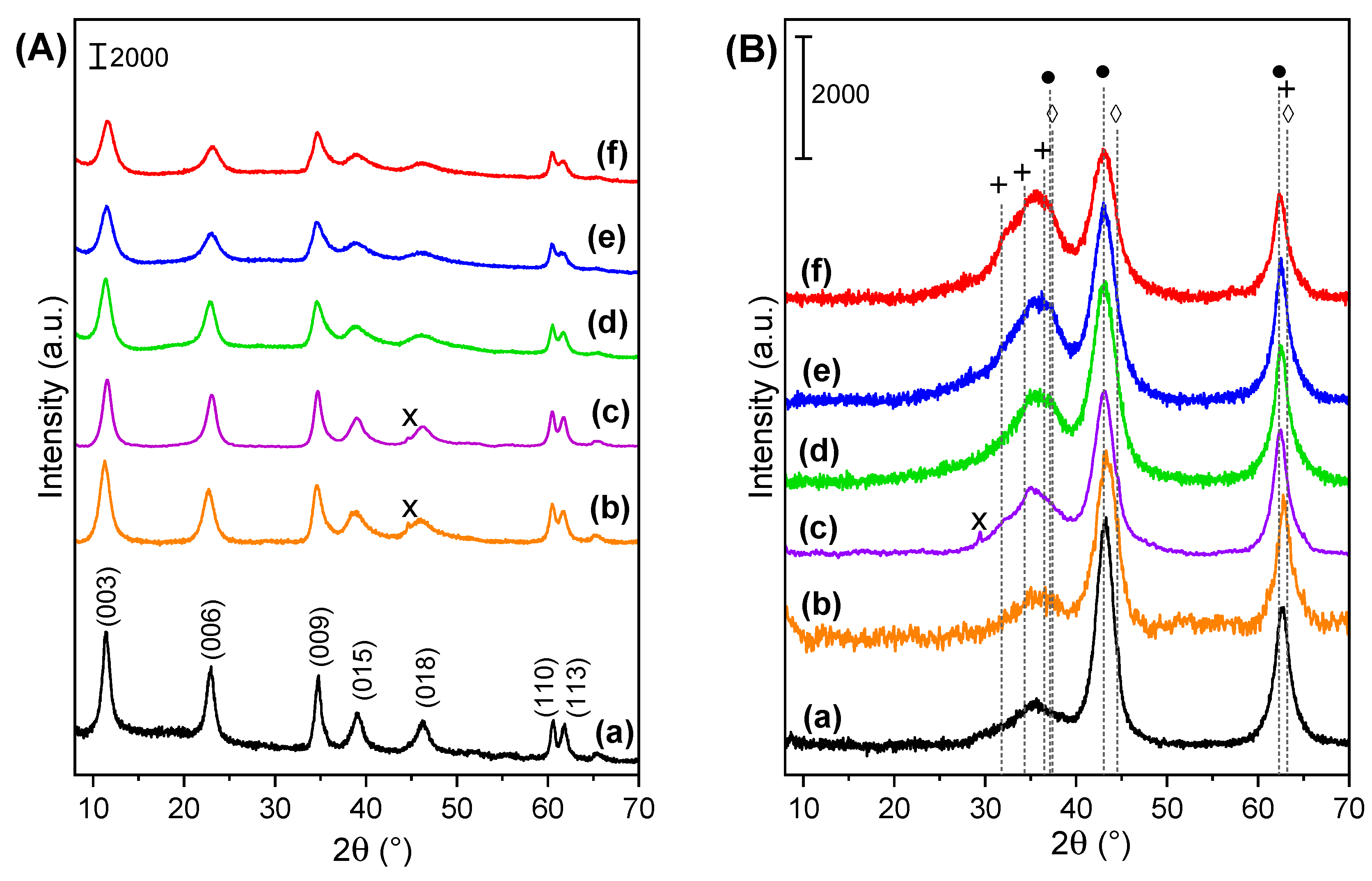
Figure 1A shows the diffractograms of LDHs, while crystallographic parameters are listed in Table 3. Typical reflections of these materials were obtained at 2θ values of 11, 23, 35, 39, 46, 60, and 62°, corresponding to the crystal planes of LDHs [28,29,30,31,32,33,34,35]. The absence of any other crystalline phases suggests the incorporation of Ni2+ and Zn2+ ions into the brucite-like layer structure. This behavior can be attributed to the similar ionic radii of the divalent cations (Mg2+: 0.65 Å, Ni2+: 0.72 Å, and Zn2+: 0.74 Å) [15,36]. The lattice parameters c and a, related to basal spacing and average cation–cation distance, respectively, were calculated from the (003) and (110) reflections using: c = 3 × d003, and a = 2 × d110. The values obtained for both parameters were similar to those reported in the literature for LDHs with carbonate ions in the interlayer space. These results indicate that the incorporation of Ni2+ and Zn2+ does not significantly alter the LDH layer structure [30,37,38]. The average crystallite size in the c direction (stacking direction perpendicular to the layers) was estimated from the (003) reflection using the Scherrer equation. A decrease in crystallite size along the c direction was observed with increasing Zn content. Furthermore, these values calculated were in agreement with those reported in the bibliography [18].
Table 3.
Crystallographic parameters of LDHs and MMOs.
Figure 1B shows the diffractograms of the corresponding MMOs. Disordered phases of Mg, Ni, or Zn oxides were identified [39]. A periclase-like structure was observed in MMO samples, Mg(Ni, Zn)O, with broaden reflections located at 2θ = 37, 43 and 62° (JCPDS 00-001-1235) [40]. Additionally, diffraction lines corresponding to the NiO (JCPDS 00-001-1239) and ZnO (JCPDS 00-001-1136) phases were detected. The absence of reflections corresponding to the Al2O3 phase suggests that Al2O3 is present in a highly dispersed amorphous form or with crystallite sizes below the XRD detection limit [18,33,41,42]. The network parameter a values (Table 3) were slightly lower than those reported in the literature [37,43,44]. The average crystallite size was estimated from the (200) reflection (2θ = 43°) corresponding to MgO by the Scherrer equation. Similarly to the LDHs, a decrease in MMOs crystallite size was observed with increasing Zn content, which is in agreement with previous reports [18,45].
Figure 1.
(A) XRD patterns of precursors: (a) LDH-MgAl, (b) LDH-Ni15Zn0, (c) LDH-Ni0Zn15, (d) LDH-Ni15Zn15, (e) LDH-Ni15Zn20, and (f) LDH-Ni15Zn25. (B) XRD patterns of mixed oxides: (a) MMO-MgAl, (b) MMO-Ni15Zn0, (c) MMO-Ni0Zn15, (d) MMO-Ni15Zn15, (e) MMO-Ni15Zn20, and (f) MMO-Ni15Zn25. (●) MgO, (◊) NiO, and (+) ZnO. (x) represents the signal attributed to the sample holder [46,47].
3.3. Textural Properties
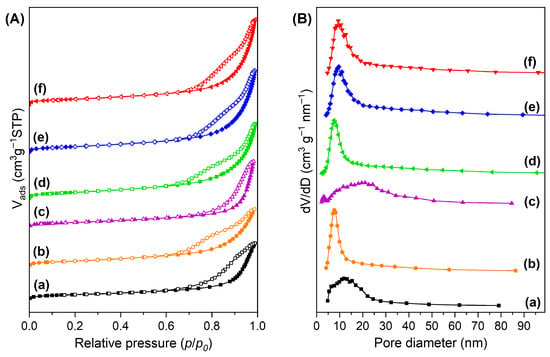
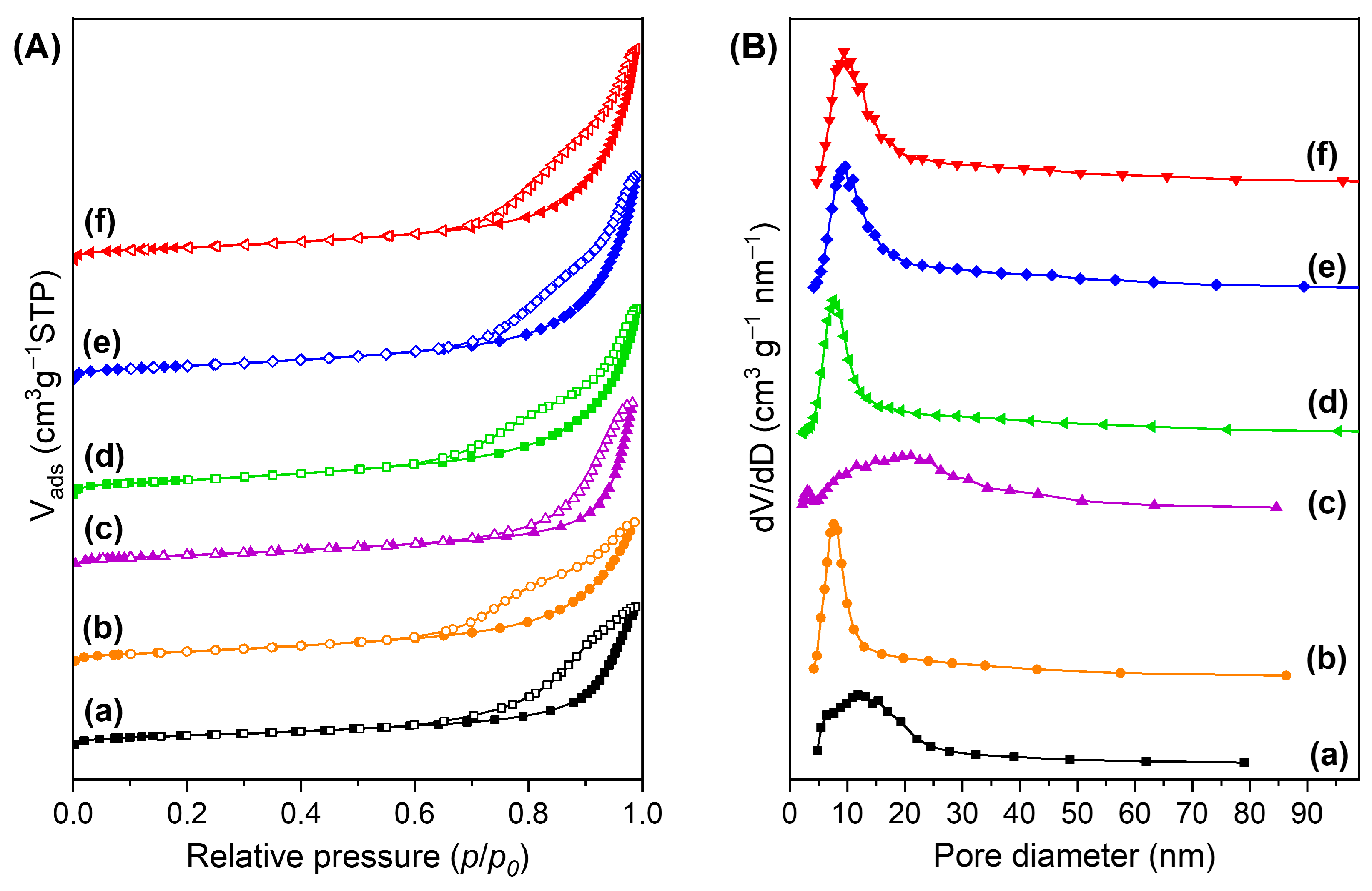
Table 4 presents the textural parameters calculated from the N2 adsorption–desorption isotherms of the calcined materials. As a result of calcination, the MMOs exhibited a larger surface area compared to their LDH precursors. Figure 2A shows the N2 adsorption–desorption isotherms of the MMOs, which correspond to type IV isotherms with H3-type hysteresis loops according to the IUPAC classification. This suggests a mesoporous structure with particle aggregates forming slit-shaped pores of non-uniform size [32,38,48]. Slight variations in the shape of the hysteresis loops can be attributed to the combined influence of geometry and pore size distribution [49]. The pore size distributions are shown in Figure 2B, revealing a widening of the pores with increasing zinc loading. Accordingly, both pore diameter and pore volume increased slightly as the zinc content increased, as summarized in Table 4.
Table 4.
Textural parameters of the materials.
Figure 2.
(A) MMO N2 adsorption–desorption isotherms. (B) Pore size distribution of the MMOs. (a) MMO-MgAl, (b) MMO-Ni15Zn0, (c) MMO-Ni0Zn15, (d) MMO-Ni15Zn15, (e) MMO-Ni15Zn20, and (f) MMO-Ni15Zn25.
3.4. Surface Morphology
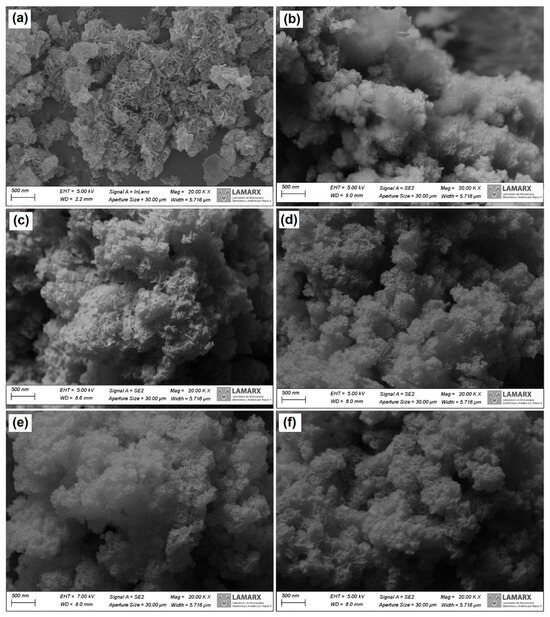
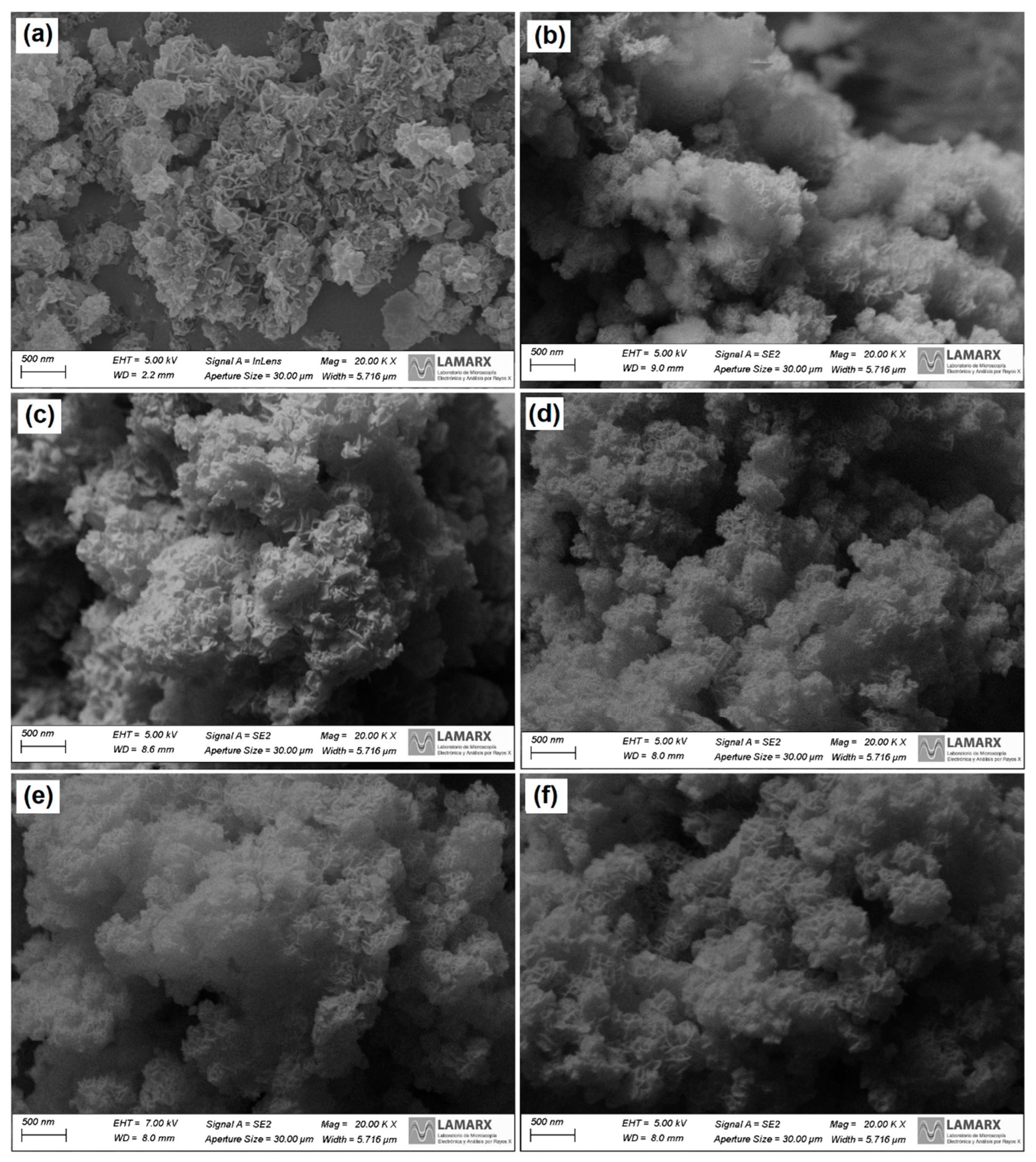
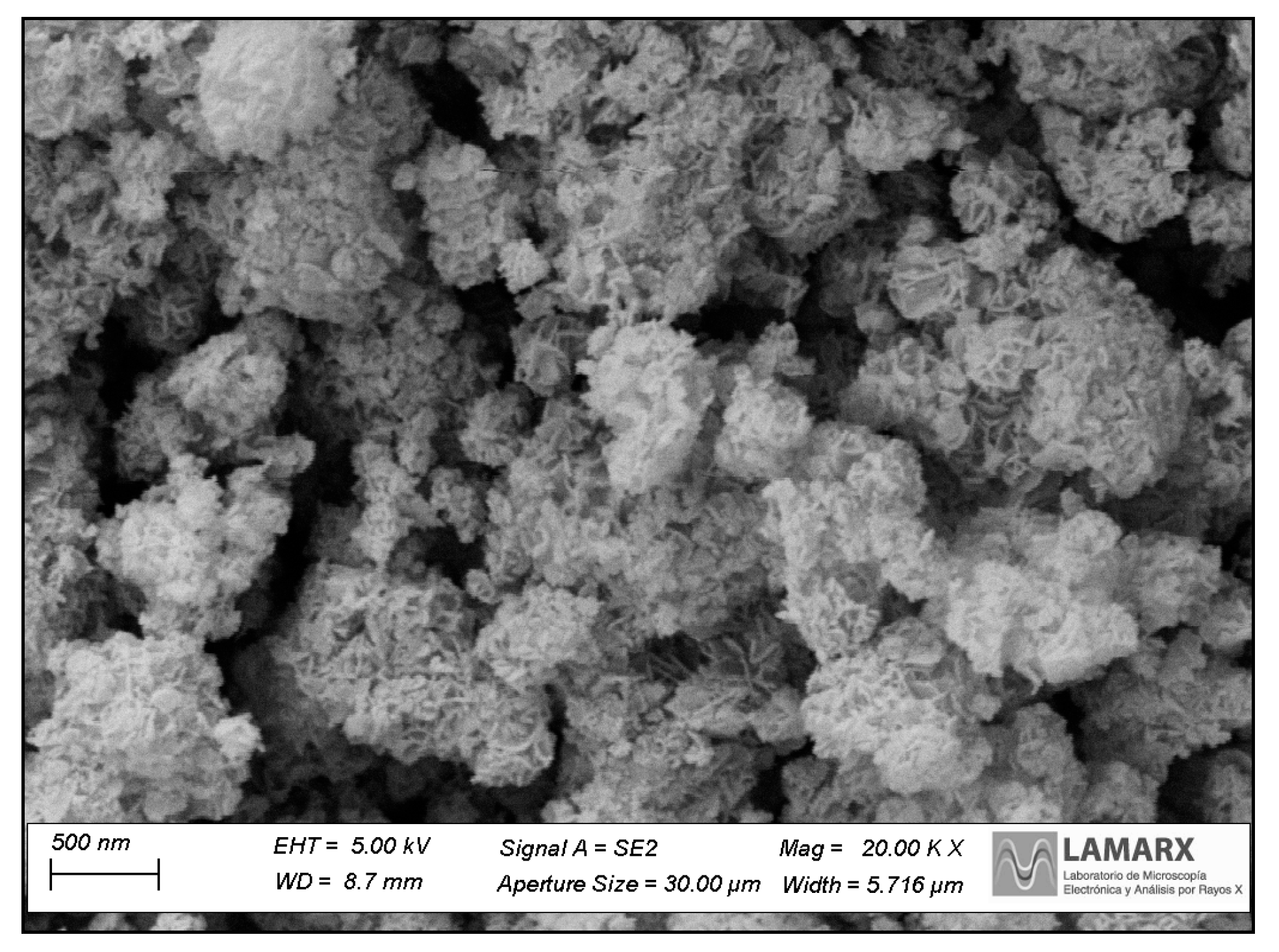
The morphologies of the MMOs observed by SEM are shown in Figure 3. Typical overlapped and disordered nanoplate structures were observed, in agreement with previous reports [50,51,52]. In general, with an increase in nanoplate size, showing a more open structure would be evident with zinc content increase. Elemental mapping by EDS revealed a homogeneous distribution of Ni, Zn, Mg, and Al throughout the MMO structures (Supplementary Material, Figures S2–S7).
Figure 3.
MMO SEM micrographs: (a) MMO-MgAl, (b) MMO-Ni15Zn0, (c) MMO-Ni0Zn15, (d) MMO-Ni15Zn15, (e) MMO-Ni15Zn20, and (f) MMO-Ni15Zn25.
3.5. Basic and Acid Properties
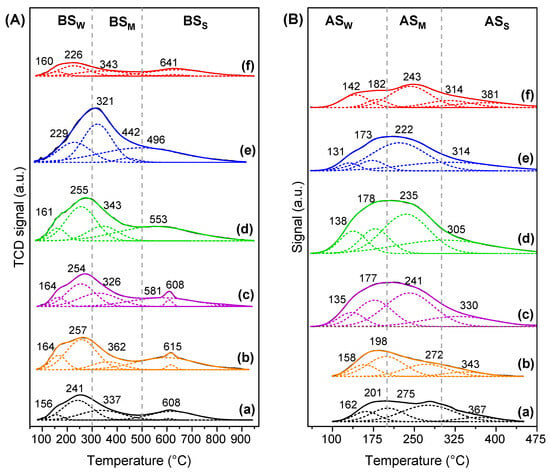
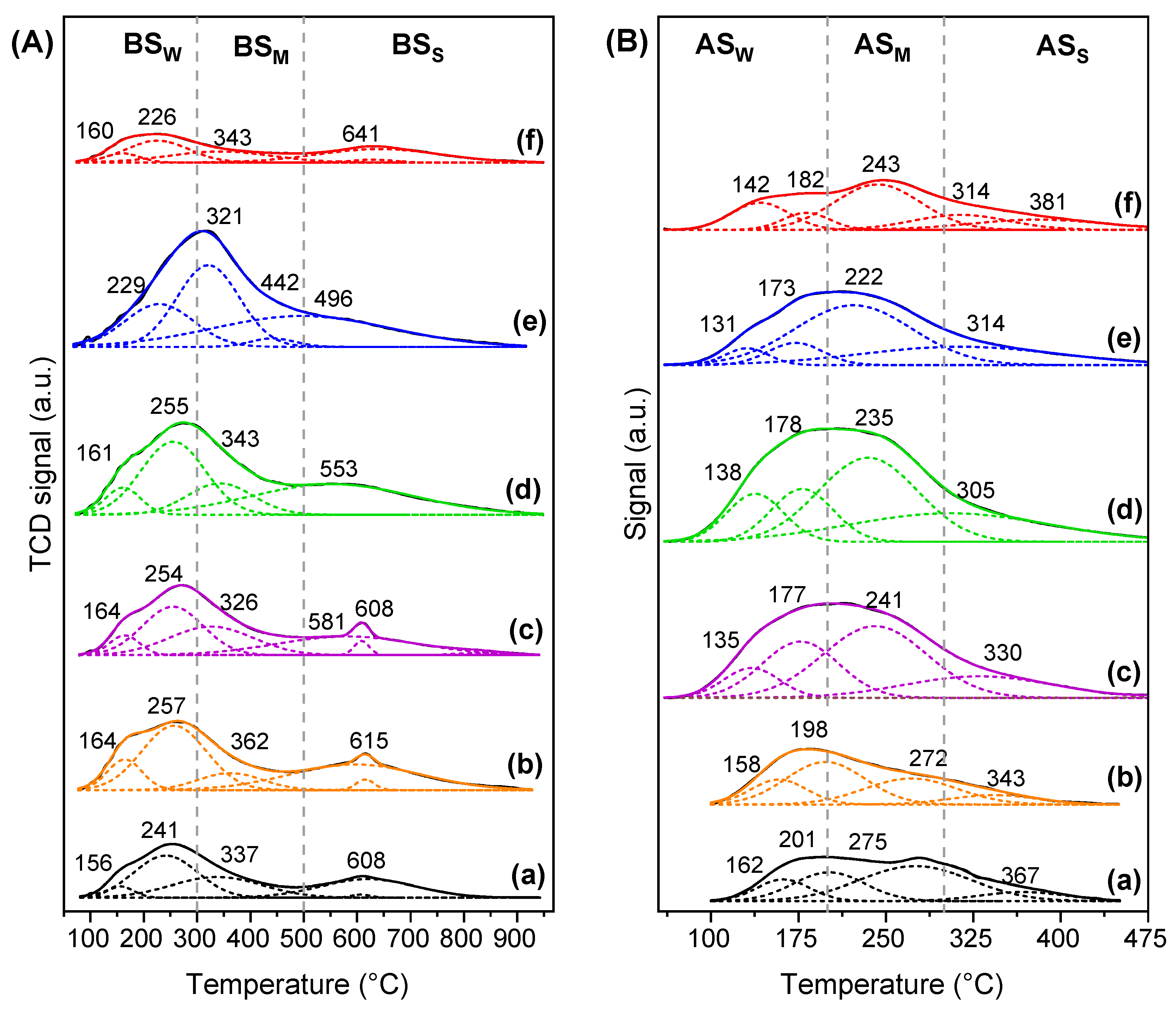
The basicity of the calcined materials was investigated by CO2 temperature-programmed desorption (CO2-TPD), and the corresponding profiles are shown in Figure 4A. The number of basic sites (BS) was calculated by deconvolution and integration of the areas under the curves and is summarized in Table 5. Three main desorption regions were identified based on the CO2 desorption temperature, in agreement with previous reports [28]. The first region, between 50 and 300 °C, was associated with weak basic sites (BSW), commonly attributed to surface hydroxyl groups and weakly adsorbed carbonate species [34,53]. The second region, between 300 and 500 °C, corresponded to moderate basic sites (BSM), related to Mn+−O2− ion pairs [54,55]. The third region, above 500 °C, was assigned to strong basic sites (BSS), associated with isolated low-coordination O2− ions [56,57]. The incorporation of Ni or Zn into the ternary oxides enhanced the basicity, as evidenced by a higher proportion of strong basic sites compared to the MgAl MMO (Table 5). Furthermore, a more pronounced increase in both basic strength and total basicity was observed for the quaternary oxides MMO-Ni15Zn15 and MMO-Ni15Zn20.
Figure 4.
Temperature-programmed desorption profiles of (A) CO2 and (B) NH3 of the MMOs. (a) MMO-MgAl, (b) MMO-Ni15Zn0, (c) MMO-Ni0Zn15, (d) MMO-Ni15Zn15, (e) MMO-Ni15Zn20, and (f) MMO-Ni15Zn25.
Table 5.
Quantification of basicity and acidity of the MMOs.
NH3 temperature-programmed desorption (NH3-TPD) was employed to evaluate the strength and number of acid sites (AS) of the MMOs. The corresponding profiles are shown in Figure 4B, and the quantification of AS is summarized in Table 5. Consistent with the CO2-TPD analysis, higher desorption temperatures indicate stronger acid sites, while the amount of NH3 desorbed—estimated from the integrated areas of the deconvoluted profiles—is proportional to the number of acid sites. After deconvolution, three desorption regions were identified: 50–200 °C, corresponding to weak acid sites (ASW); 200–300 °C, associated with moderate acid sites (ASM); and temperatures above 300 °C, attributed to strong acid sites (ASS). The first desorption region is related to surface hydroxyl groups, whereas the second region is associated with acid–base pairs Al3+–O2—M2+. The third region is mainly attributed to electron-deficient Al3+ species [31,58]. The incorporation of Ni into the ternary MMO-Ni15Zn0 resulted in a slight decrease in total acidity compared to the MMO-MgAl. In contrast, the incorporation of Zn into the Mg-Al structure (MMO-Ni0Zn15) led to an increase in total acid sites [58]. Among the materials studied, the quaternary MMO-Ni15Zn15 exhibited the highest concentration of ASW, ASM, and ASS. Further increasing the Zn content caused a decrease in ASM and ASS populations, resulting in an overall reduction in total acidity.
3.6. UV-Vis Diffuse Reflectance Spectroscopy
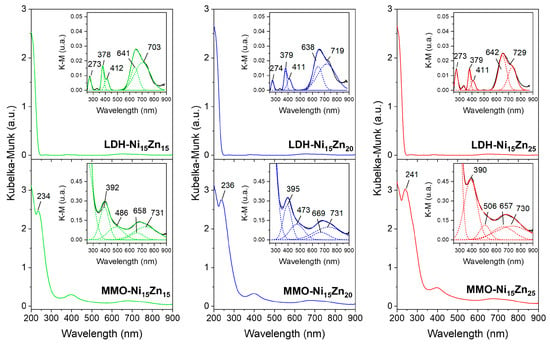
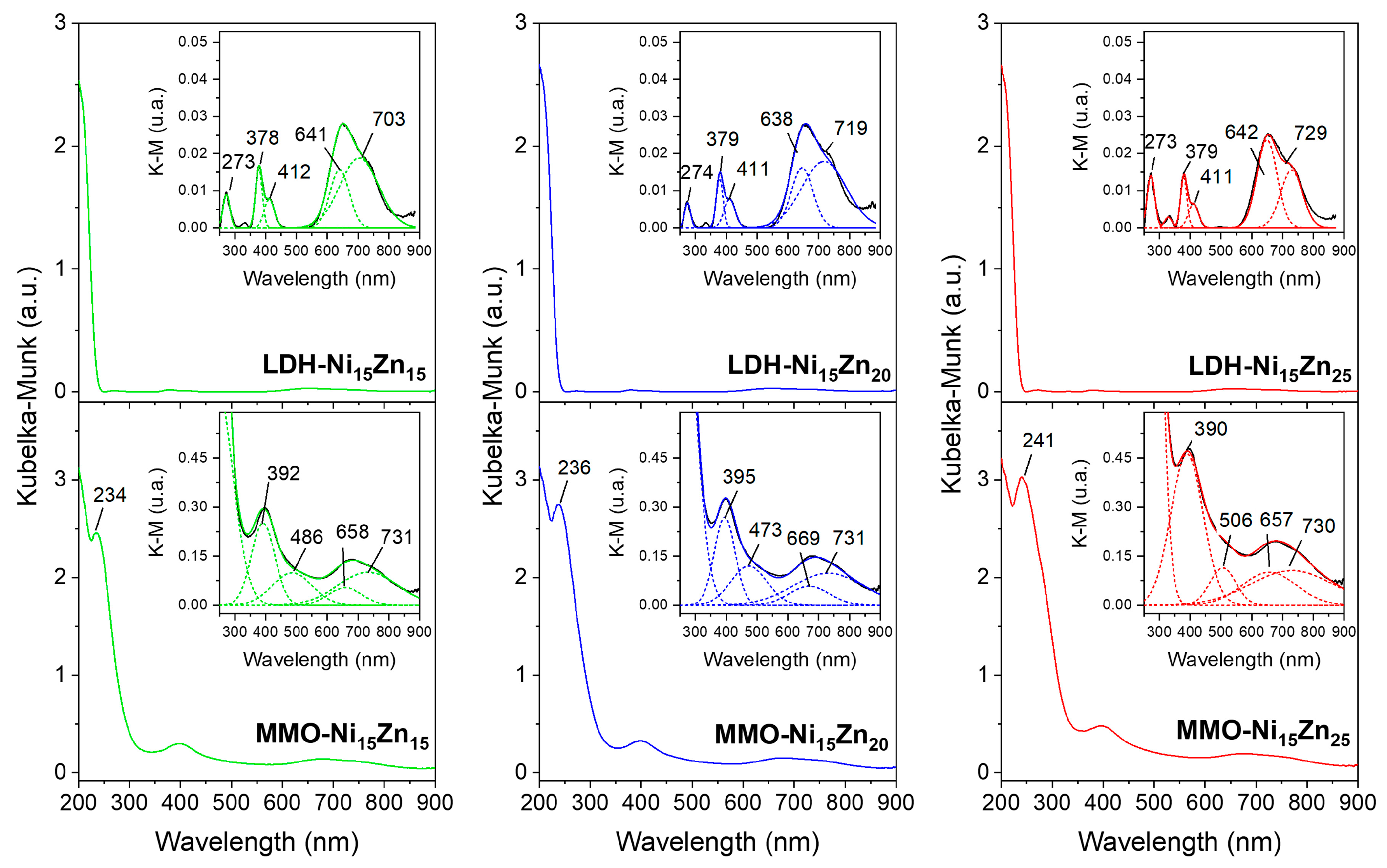
UV-vis diffuse reflectance spectroscopy (UV-vis DRS) was employed to investigate the coordination environment of nickel species in the solids, complementing the information obtained from XRD analysis. The spectra are shown in Figure 5, and the region between 200 and 900 nm was deconvoluted into five main bands.
Figure 5.
UV-vis diffuse reflectance spectra of the LDH and MMO-Ni15Zny. The insets show the magnified regions between 250 and 900 nm.
The UV-vis DRS spectra of the LDH-Ni15Zny precursors were very similar. A ligand-to-metal charge transfer (LMCT) transition from O 2p to Ni 3d (t2g) orbitals was observed in the 200–300 nm region [59]. Compared to the corresponding MMOs, the LDH samples exhibited lower band intensities and absorption features shifted toward lower wavelengths (378, 411, 638–641, and 703–729 nm). These features are consistent with those reported by Zhou et al. for Ni-Mg-Al LDHs and suggest the presence of octahedrally coordinated Ni2+ species in the LDH structure [60].
In the UV-vis DRS spectra of the MMO-Ni15Zny samples, an intense band located at 234–241 nm was assigned to LMCT transitions (O2−→Ni2+) [61]. Additionally, bands at 390–395 nm and around 730 nm indicate the presence of octahedrally coordinated Ni2+ species, which are characteristic features of NiO [62,63]. These observations are consistent with the XRD results, confirming the formation of NiO phases in the MMOs. The band observed at 657–669 nm was attributed to d-d transitions of tetrahedrally coordinated Ni2+ species within the NiO structure [64,65,66,67,68], in agreement with previous reports by Smoláková et al. [68]. Finally, absorption bands in the 473–506 nm range were assigned to d-d transitions of octahedrally coordinated Ni2+ ions.
3.7. MMOs’ Catalytic Performance
3.7.1. Catalytic Activity Results and Their Relationship with MMOs’ Physicochemical Properties
The catalytic performance of the MMOs was evaluated in the transesterification reaction under conditions previously optimized using catalysts with similar compositions. The experimental results are summarized in Table 6. Several studies have reported that a higher density of basic and acid sites enhances catalytic activity in this reaction [12,13,69]. According to mechanisms commonly proposed in the literature, strong basic sites (Oδ−) abstract the proton from the primary hydroxyl group of glycerol, increasing its nucleophilic character in the initial reaction step [13,27,70]. Simultaneously, moderate and strong acid sites associated with metal ions (Mn+) activate the carbonyl carbon of dimethyl carbonate (DMC). Subsequently, an intramolecular nucleophilic substitution takes place, leading to the formation of glycerol carbonate (GC). Based on these considerations and previous literature, a plausible reaction mechanism for GC formation, including the possible pathways for side-product formation, is proposed and schematically illustrated in the Supplementary Material (Figure S8).
Table 6.
Catalytic experiment results.
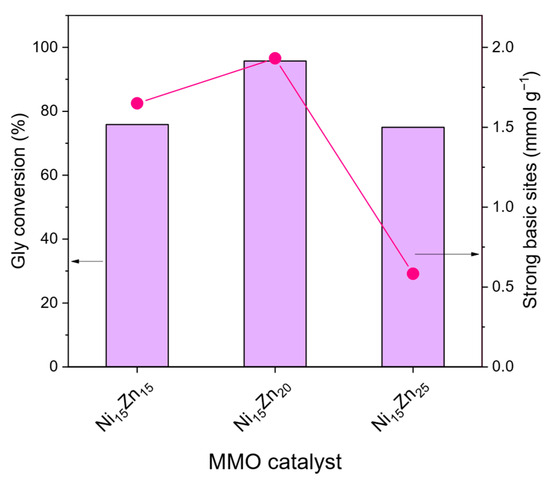
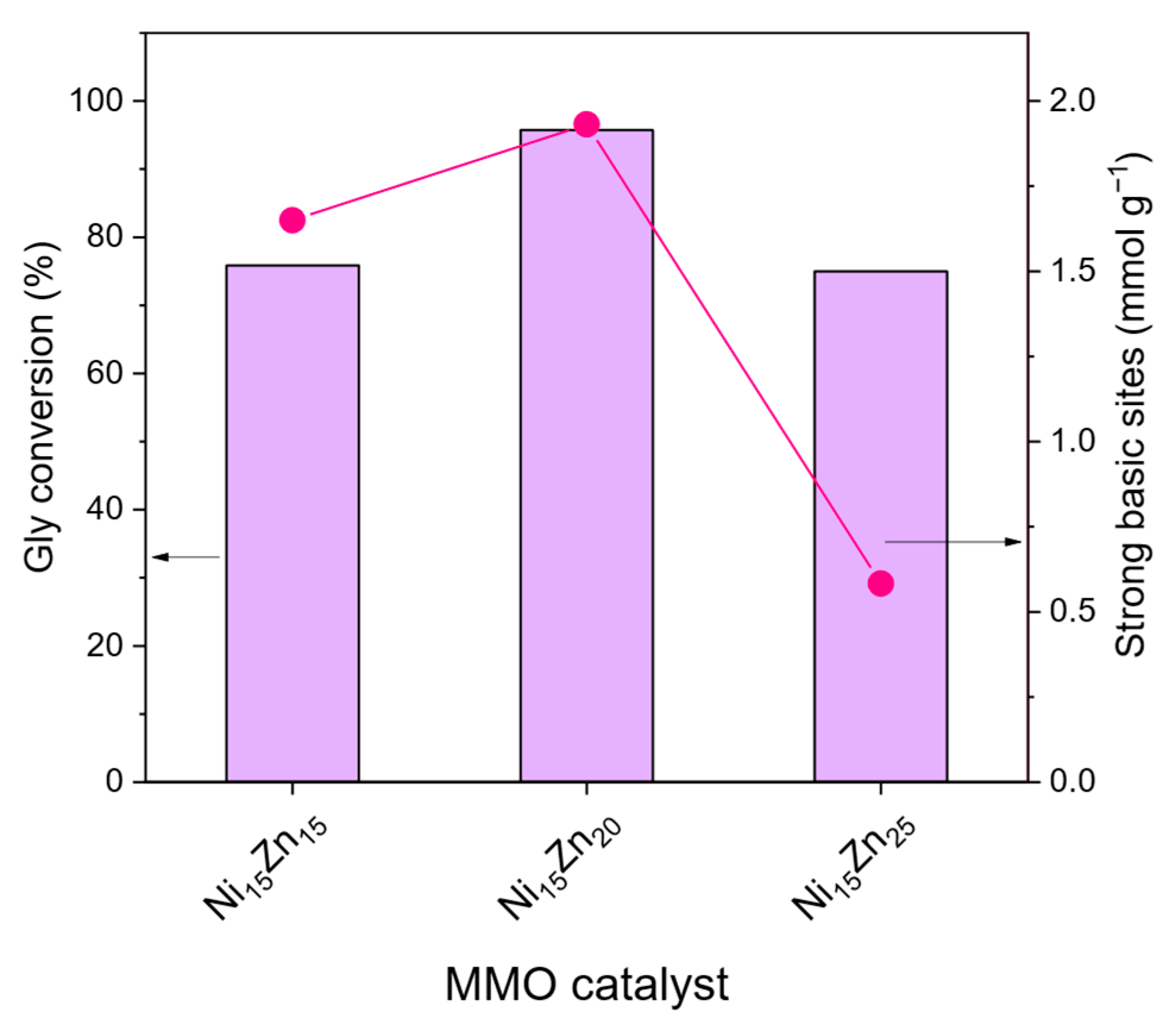
The relationship between the basic–acid properties and catalytic activity was investigated. The quaternary MMO-Ni15Zny catalysts exhibited the highest glycerol conversions, which were associated with their larger amounts of strong basic sites (BSS) (Figure 6). These results highlight the role of surface basicity in governing catalytic performance. Although the catalyst containing 20 at.% Zn (MMO-Ni15Zn20) showed the highest glycerol conversion, it exhibited the lowest GC selectivity. This decrease in selectivity was attributed to the formation of glycidol (GD), a byproduct that can be generated under certain reaction conditions and in the presence of strong surface basicity [27,28]. Nevertheless, this catalyst achieved the highest GC efficiency, reaching a GC yield of 74.4%.
Figure 6.
Correlation between glycerol conversion and the amount of strong basic sites for the MMOs. Violet bars represent glycerol conversion, and dashed lines correspond to strong basic sites.
The MMO-Ni15Zn15 catalyst also displayed a predominance of strong basic sites (Table 5), although in lower amounts than MMO-Ni15Zn20, which is consistent with its glycerol conversion and GC selectivity, resulting in a GC yield of 74.1%.
In addition, a possible correlation between catalytic behavior and acidic properties was examined. The relatively high conversions achieved by the quaternary MMOs (MMO-Ni15Zny) can also be related to the increased concentration of acid sites (ASM + ASS).
To further support these findings, textural and morphological properties were considered (Figure 3). Although all MMO catalysts exhibit disordered and overlapping nanosheet structures with relatively uniform sizes, the MMO-Ni15Zny samples showed larger pore volumes, which likely improved reactant accessibility to the active sites.
Overall, these results highlight the complexity of the factors governing the catalytic performance of MMOs and emphasize the need to consider multiple structural, textural, and surface properties. Nevertheless, the results indicate that glycerol conversion is primarily governed by the presence and nature of the catalyst’s basic sites.
3.7.2. Reaction Conditions Optimization
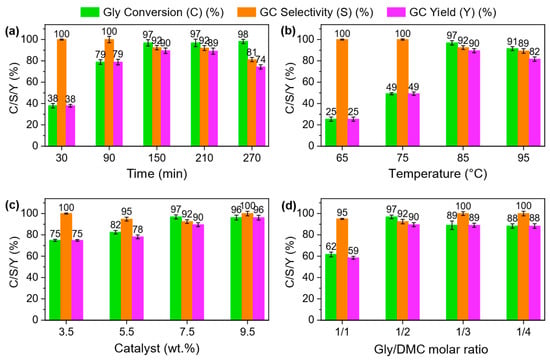
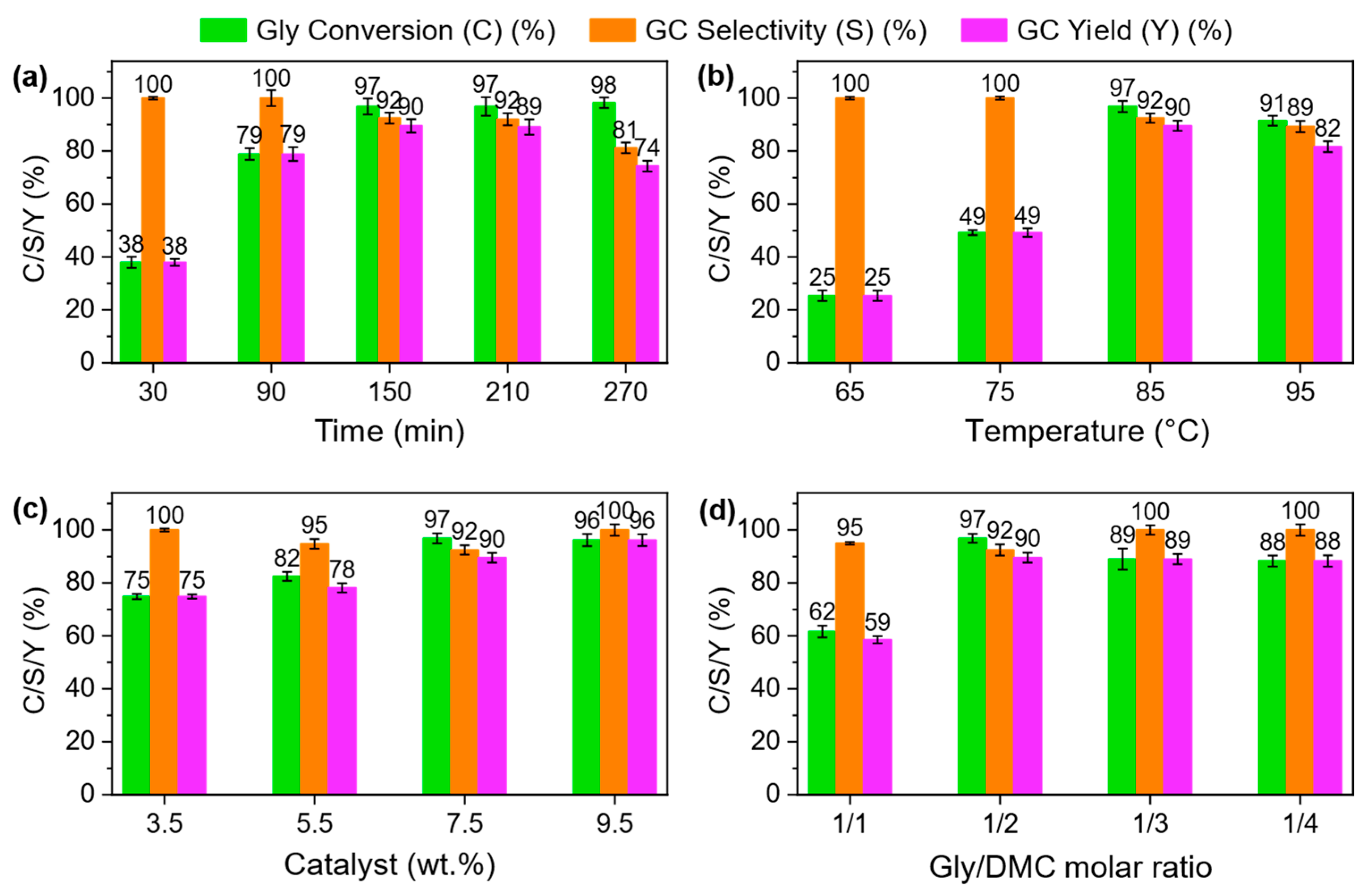
Reaction parameter optimization was performed using the MMO-Ni15Zn20 catalyst, as it exhibited the highest GC yield. In this study, reaction time, temperature, catalyst loading, and reactant molar ratio were evaluated in order to determine the optimal operating conditions, with particular emphasis on maximizing GC selectivity and suppressing side reactions leading to glycidol (GD) formation (Figure 7).
Figure 7.
Variation in the reaction parameters of MMO-Ni15Zn20: (a) Reaction time (85 °C, 7.5 wt.% catalyst, Gly/DMC = 1/2); (b) temperature (150 min, 7.5 wt.% catalyst, Gly/DMC = 1/2); (c) catalyst loading (85 °C, 150 min, Gly/DMC = 1/2); and (d) molar ratio of reactants (150 min, 85 °C, 7.5 wt.% catalyst).
First, the effect of reaction time was investigated (Figure 7a). The results showed that glycerol conversion increased progressively with time. However, due to an increase in glycidol selectivity, the GC yield began to decrease after 150 min, which was therefore established as the optimal reaction time.
Subsequently, the influence of reaction temperature was analyzed in the range of 65–95 °C (Figure 7b). Glycerol conversion increased with temperature, reaching a maximum at 85 °C. This behavior can be attributed to the reduction in the viscosity of the reaction medium. Nevertheless, at higher temperatures, a decrease in GC yield was observed, likely due to an increased tendency toward GC decarboxylation to GD and CO2 under more severe thermal conditions [71]. Consequently, 85 °C was selected as the optimal reaction temperature.
The effect of catalyst loading was then evaluated (Figure 7c). An increase in catalyst loading led to a progressive enhancement in glycerol conversion, which can be attributed to improved accessibility to the active sites on the catalyst surface. Although the highest GC yield was obtained with a catalyst loading of 9.5 wt.%, a loading of 7.5 wt.% was selected to reduce catalyst usage without significantly compromising process efficiency. In addition, excessive catalyst loading may promote particle agglomeration [72].
Finally, the effect of the glycerol-to-DMC molar ratio was examined in the range from 1:1 to 1:4 (Figure 7d). A molar ratio of 1:1 resulted in the lowest glycerol conversion but the highest GC selectivity. When the glycerol-to-DMC ratio exceeded 1:2, glycerol conversion decreased, possibly due to restricted access of glycerol to the catalyst’s active sites in the presence of excess DMC. Based on these results, a glycerol-to-DMC molar ratio of 1:2 was selected as optimal [73].
Overall, the optimal reaction conditions were determined as a reaction time of 150 min, a temperature of 85 °C, a catalyst loading of 7.5 wt.%, and a glycerol-to-DMC molar ratio of 1:2.
3.7.3. Green Chemistry Metrics
To provide additional insight into the process-related efficiency of the glycerol transesterification reaction, selected green chemistry metrics, namely atom economy and E-factor, were calculated. These parameters are commonly employed as preliminary indicators of material efficiency and waste generation in chemical processes:
The E-factor, defined as the ratio between the mass of waste generated and the mass of the desired product, provides a direct measure of process greenness. Lower E-factor values indicate reduced waste generation and improved environmental compatibility. In the present system, methanol is the main stoichiometric byproduct of the transesterification reaction, while glycidol may be formed as a secondary product under certain reaction conditions. The calculated E-factor was 0.79, indicating relatively low waste generation compared with previously reported heterogeneous catalytic systems for glycerol carbonate synthesis [74]. Atom economy, which reflects the efficiency of reactant incorporation into the desired product, reached 73.6%, highlighting effective utilization of the reactants toward glycerol carbonate formation. Catalyst reusability and solvent recovery were not considered in these calculations, in accordance with common practice in the literature [74,75]. Overall, these metrics suggest a favorable material efficiency for the studied reaction system under the investigated conditions.
3.7.4. Reuse Behavior of MMO-Ni15Zn20
The reuse behavior of the MMO-Ni15Zn20 catalyst was investigated over consecutive reaction cycles in order to evaluate catalyst deactivation phenomena rather than long-term operational stability (Table 7). This study allowed monitoring the evolution of catalytic activity and identifying possible physicochemical changes affecting performance after successive uses. After each reaction, the catalyst was recovered by centrifugation and filtration, washed with methanol, and dried overnight at 120 °C. Prior to reuse, the recovered solid was reactivated by calcination at 450 °C for 9 h in order to remove organic species adsorbed on the surface. It should be noted that, although this regeneration step partially restores catalytic activity, it is energy-intensive and highlights a current limitation of the system in terms of practical sustainability. Without this regeneration step, a drastic decrease in glycerol conversion was observed in subsequent cycles. Alternative milder regeneration strategies were not assessed in this study; therefore, the conclusions regarding catalyst stability and regeneration are restricted to the recalcination protocol evaluated.
Table 7.
MMO-Ni15Zn20 catalytic results of reuse experiments.
During the stability tests, glycerol conversion decreased after each reuse, while GC selectivity remained at 100% throughout all cycles. To quantify catalyst deactivation in a realistic manner, the percentage loss of activity between consecutive reuse cycles was calculated based on glycerol conversion. The activity loss increased from 16.5% between the first and second cycles to 46.9% between the second and third cycles, followed by 39.5% between the third and fourth cycles, indicating a non-linear and progressive deactivation behavior. To elucidate the causes of catalyst deactivation, physicochemical characterizations were performed on the spent catalyst.
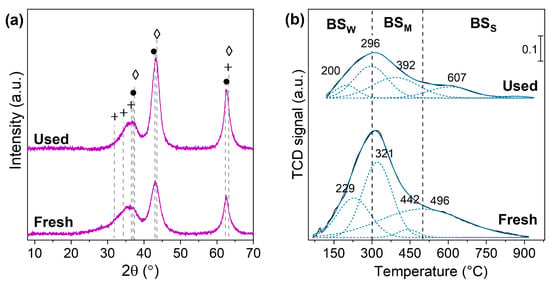
XRD patterns of the used MMO-Ni15Zn20 catalyst showed no detectable changes in crystalline phases compared to the fresh material (Figure 8a). However, an increase in diffraction line intensity and crystallite size (from 32.6 to 35.5 Å) was observed, indicating enhanced crystallinity, likely associated with crystallite growth and sintering processes during repeated calcination and reaction cycles.
Figure 8.
(a) XRD patterns and (b) CO2-TPD profiles of the fresh and once-used MMO-Ni15Zn20 catalyst after recalcination prior to analysis. (●) MgO, (◊) NiO, and (+) ZnO.
CO2-TPD analysis (Figure 8b and Table 8) revealed a reduction in the amount of moderate and strong basic sites (BSM and BSS), as well as in total basicity, compared to the fresh material. This decrease is expected to negatively affect catalytic activity, particularly due to the key role of strong basic sites in the transesterification reaction.
Table 8.
Basicity and metallic composition of fresh catalyst, used once and recalcined MMO-Ni15Zn20.
Metal leaching was evaluated by MP-AES analysis of the reaction medium after the first catalytic cycle under the optimized reaction conditions. The detected concentrations were 0 ppm for Ni, 1 ppm for Zn, 3 ppm for Mg, and 1 ppm for Al. These results indicate negligible metal leaching during the first reaction cycle, ruling out a significant contribution from homogeneous catalysis under these conditions. However, since metal leaching was only assessed after the first use, possible changes in metal stability during subsequent catalytic cycles cannot be completely excluded and may contribute, together with surface restructuring phenomena, to the gradual loss of activity observed upon reuse.
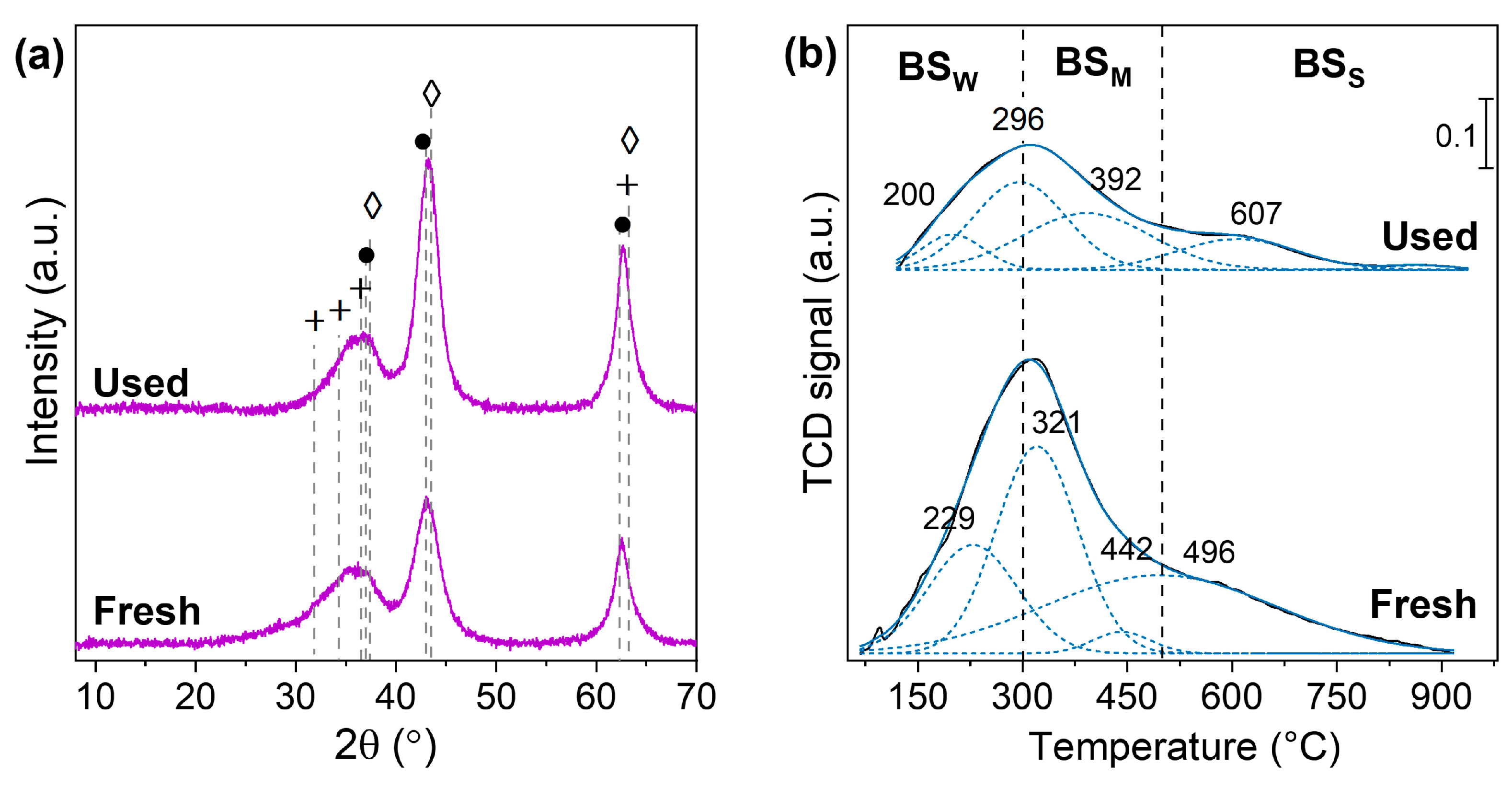
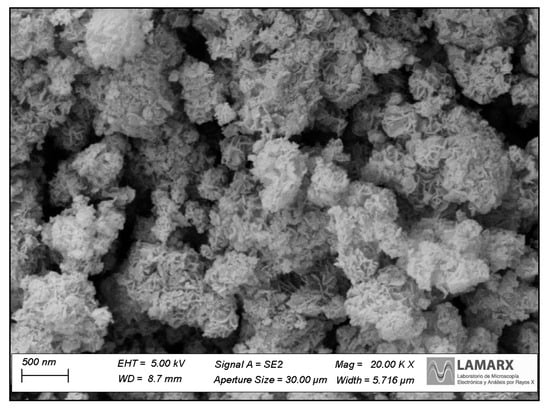
EDS analysis (Table 8) evidenced changes in metal distribution after use, suggesting partial modification of the catalyst composition. In particular, a decrease in the surface concentration of transition metals was observed, which correlates with the reduction in basicity and the loss of catalytic activity. Importantly, MP-AES analysis of the reaction medium after the first catalytic cycle showed negligible metal leaching, suggesting that the changes detected by EDS are not primarily related to metal dissolution into the liquid phase but rather to surface-level modifications. Additionally, SEM images of the used catalyst (Figure 9) showed overlapping and disordered nanoplates, along with a loss of definition at the platelet edges and a certain degree of agglomeration. These structural changes could hinder reactant accessibility to the active sites, further contributing to catalyst deactivation.
Figure 9.
SEM micrograph of the once-used and recalcined MMO-Ni15Zn20.
The catalytic performance of the MMOs synthesized in this work compares favorably with previously reported catalysts for glycerol transesterification with DMC. This comparison can be discussed not only in terms of reaction conditions, but also by considering differences in their surface basic properties.
Malyaadri et al. reported a glycerol carbonate yield of 94% using Mg-Al-Zr mixed oxides obtained by calcination of LDH precursors at 650 °C, under harsher thermal conditions than those applied in the present study [23]. The superior activity of that catalyst was associated with its higher density of basic sites and increased basic strength.
Liu et al. reported a Mg-Ni-Al mixed oxide catalyst, obtained by calcination of the LDH precursor at 500 °C, which achieved the highest GC yield at 100 °C and a Gly/DMC molar ratio of 1:3 [37]. The authors attributed this enhanced performance to the Ni2+ doping effect, which strengthened all three types of basic sites and increased the overall surface basicity.
Similarly, Marimuthu et al. obtained a GC yield of 91.2% with Mg-Al-Cu catalysts using a higher DMC excess (Gly/DMC = 1:5), and attributed the improved catalytic activity to the presence of a high concentration of total basic sites, particularly strong basic sites [28].
Overall, these results highlight the potential of Ni- and Zn-modified Mg–Al mixed oxides as efficient catalysts for glycerol valorization under mild reaction conditions. Future work will focus on complementary characterizations (MP-AES, TGA, XPS, and TEM) to gain deeper insight into catalyst deactivation mechanisms and to guide the development of strategies aimed at improving catalyst stability and lifetime. These strategies involve modifying calcination temperatures and heating ramps during LDH thermal decomposition in order to enhance metal anchoring and structural stability.
4. Conclusions
Ni-Zn-Mg-Al quaternary mixed metal oxides were successfully synthesized via a co-precipitation route using layered double hydroxides as precursors and evaluated as heterogeneous catalysts for the transesterification of glycerol with dimethyl carbonate to produce glycerol carbonate. For comparison, Mg-Al, Ni-Mg-Al, and Zn-Mg-Al mixed oxides were also synthesized and tested.
The results demonstrate that the simultaneous incorporation of Ni and Zn into the Mg-Al oxide matrix contributes to enhanced catalytic performance. Quaternary Ni-Zn-Mg-Al catalysts exhibited higher glycerol conversions and glycerol carbonate yields than the corresponding ternary systems, mainly due to their increased surface basicity in both strength and density, combined with a suitable population of moderate and strong acid sites. Among them, the MMO-Ni15Zn20 catalyst achieved the highest glycerol carbonate yield (89.6%) under mild and solvent-free reaction conditions.
Structure–activity relationship analysis revealed that catalytic efficiency is governed by the combined effects of surface acid–base properties, textural parameters, and morphology. In particular, the larger pore volumes of the quaternary oxides favored reactant accessibility to active sites, contributing to improved performance.
Reuse experiments performed with MMO-Ni15Zn20 evidenced a progressive decrease in glycerol conversion upon consecutive cycles, indicating limited catalyst stability under the applied regeneration protocol. This deactivation was associated with a reduction in strong basic sites, surface agglomeration, and changes in metal surface distribution, while no phase transformation was detected. Notably, complete selectivity toward glycerol carbonate was preserved throughout reuse, highlighting the intrinsic selectivity of the catalytic surface despite activity loss.
Overall, this study emphasizes the importance of rational surface design, suggesting that the catalytic performance is associated with compositional effects arising from Ni-Zn incorporation and the resulting acid–base balance in mixed metal oxides. While further optimization of catalyst stability and regeneration strategies is required, the results provide valuable insights for the rational design of mixed metal oxide catalysts aimed at the efficient conversion of waste-derived glycerol.
Supplementary Materials
The following supporting information can be downloaded at: https://www.mdpi.com/article/10.3390/surfaces9010019/s1; Figure S1. Representative chromatogram of the reaction between dimethyl carbonate and glycerol using the MMO-Ni15Zn20 catalyst; Figure S2. EDS elemental mapping of MMO-MgAl; Figure S3. EDS elemental mapping of MMO-Ni15Zn0; Figure S4. EDS elemental mapping of MMO-Ni0Zn15; Figure S5. EDS elemental mapping of MMO-Ni15Zn15; Figure S6. EDS elemental mapping of MMO-Ni15Zn20; Figure S7. EDS elemental mapping of MMO-Ni15Zn25; Figure S8. Proposed mechanism for transesterification between Gly and DMC, along with the subsequent decarboxylation of CG to GD. References [76,77,78] are cited in the supplementary materials.
Author Contributions
Conceptualization, E.R.-C., N.F.B., G.A.E., and M.E.C.; methodology, D.S.A. and S.M.M.; formal analysis, D.S.A., S.M.M., and E.R.-C.; investigation, D.S.A. and S.M.M.; writing—original draft preparation, D.S.A. and N.F.B.; writing—review and editing, D.S.A. and N.F.B.; visualization, D.S.A. and N.F.B.; supervision and project administration, N.F.B., G.A.E., and M.E.C. All authors have read and agreed to the published version of the manuscript.
Funding
This research was funded by CONICET (Argentina) through a doctoral fellowship. Additional financial support was provided by Universidad Tecnológica Nacional (UTN), project MATCCO0008617TC. E.R.C. thanks to the Spanish Ministry of Science and Innovation, PID2021-126235OB-C32 funded by MCIN/AEI/10.13039/501100011033 and FEDER funds. The APC was not funded by these institutions.
Data Availability Statement
The original contributions presented in this study are included in the article and Supplementary Material. Further inquiries can be directed to the corresponding author.
Acknowledgments
The authors acknowledge the Secretaría de Ciencia, Tecnología y Posgrado of the Universidad Tecnológica Nacional and the Consejo Nacional de Investigaciones Científicas y Técnicas (CONICET).
Conflicts of Interest
The authors declare no conflicts of interest.
References
- Koranian, P.; Huang, Q.; Dalai, A.K.; Sammynaiken, R. Chemicals Production from Glycerol through Heterogeneous Catalysis: A Review. Catalysts 2022, 12, 897. [Google Scholar] [CrossRef] [Scilit]
- Kosamia, N.M.; Samavi, M.; Uprety, B.K.; Rakshit, S.K. Valorization of Biodiesel Byproduct Crude Glycerol for the Production of Bioenergy and Biochemicals. Catalysts 2020, 10, 609. [Google Scholar] [CrossRef] [Scilit]
- Gade, S.M.; Saptal, V.B.; Bhanage, B.M. Perception of Glycerol Carbonate as Green Chemical: Synthesis and Applications. Catal. Commun. 2022, 172, 106542. [Google Scholar] [CrossRef] [Scilit]
- Burk, R.M.; Roof, M.B. A Safe and Efficient Method for Conversion of 1,2- and 1,3-Diols to Cyclic Carbonates Utilizing Triphosgene. Tetrahedron Lett. 1993, 34, 395–398. [Google Scholar] [CrossRef] [Scilit]
- Wang, D.; Zhang, X.; Cong, X.; Liu, S.; Zhou, D. Influence of Zr on the Performance of Mg-Al Catalysts via Hydrotalcite-like Precursors for the Synthesis of Glycerol Carbonate from Urea and Glycerol. Appl. Catal. A Gen. 2018, 555, 36–46. [Google Scholar] [CrossRef] [Scilit]
- Zhang, J.; He, D. Surface Properties of Cu/La2O3 and Its Catalytic Performance in the Synthesis of Glycerol Carbonate and Monoacetin from Glycerol and Carbon Dioxide. J. Colloid Interface Sci. 2014, 419, 31–38. [Google Scholar] [CrossRef] [Scilit] [PubMed]
- Narasimhan, M.; Chandrasekaran, M.; Govindasamy, S.; Aravamudhan, A. Heterogeneous Nanocatalysts for Sustainable Biodiesel Production: A Review. J. Environ. Chem. Eng. 2021, 9, 104876. [Google Scholar] [CrossRef] [Scilit]
- Simanjuntak, F.S.H.; Kim, T.K.; Lee, S.D.; Ahn, B.S.; Kim, H.S.; Lee, H. CaO-Catalyzed Synthesis of Glycerol Carbonate from Glycerol and Dimethyl Carbonate: Isolation and Characterization of an Active Ca Species. Appl. Catal. A Gen. 2011, 401, 220–225. [Google Scholar] [CrossRef] [Scilit]
- Hu, K.; Wang, H.; Liu, Y.; Yang, C. KNO3/CaO as Cost-Effective Heterogeneous Catalyst for the Synthesis of Glycerol Carbonate from Glycerol and Dimethyl Carbonate. J. Ind. Eng. Chem. 2015, 28, 334–343. [Google Scholar] [CrossRef] [Scilit]
- Song, X.; Wu, Y.; Cai, F.; Pan, D.; Xiao, G. High-Efficiency and Low-Cost Li/ZnO Catalysts for Synthesis of Glycerol Carbonate from Glycerol Transesterification: The Role of Li and ZnO Interaction. Appl. Catal. A Gen. 2017, 532, 77–85. [Google Scholar] [CrossRef] [Scilit]
- Das, A.; Kodgire, P.; Li, H.; Basumatary, S.; Baskar, G.; Rokhum, S.L. Recent Advances in Conversion of Glycerol: A Byproduct of Biodiesel Production to Glycerol Carbonate. J. Chem. 2023, 2023, 8730221. [Google Scholar] [CrossRef] [Scilit]
- Pattanaik, P.P.; Kumar, P.M.; Raju, N.; Lingaiah, N. Continuous Synthesis of Glycerol Carbonate by Transesterification of Glycerol with Dimethyl Carbonate Over Fe–La Mixed Oxide Catalysts. Catal. Lett. 2021, 151, 1433–1443. [Google Scholar] [CrossRef] [Scilit]
- Ji, Y. Recent Development of Heterogeneous Catalysis in the Transesterification of Glycerol to Glycerol Carbonate. Catalysts 2019, 9, 581. [Google Scholar] [CrossRef] [Scilit]
- Üçöz, S.I.; Sert, M.; Sert, E. Fabrication of Mixed Metal Oxides Derived from Quaternary Layered Double Hydroxides for Utilization of Glycerol. Polyhedron 2025, 281, 117747. [Google Scholar] [CrossRef] [Scilit]
- Cavani, F.; Trifiro, F.; Vaccari, A. Hydrotalcite-Type Anionic Clays: Preparation, Properties and Applications. Catal. Today 1991, 11, 173–301. [Google Scholar] [CrossRef] [Scilit]
- Gevers, B.R.; Naseem, S.; Leuteritz, A.; Labuschagné, F.J.W.J. Comparison of Nano-Structured Transition Metal Modified Tri-Metal MgMAl-LDHs (M = Fe, Zn, Cu, Ni, Co) Prepared Using Co-Precipitation. RSC Adv. 2019, 9, 28262–28275. [Google Scholar] [CrossRef] [Scilit] [PubMed]
- Bukhtiyarova, M.V. A Review on Effect of Synthesis Conditions on the Formation of Layered Double Hydroxides. J. Solid State Chem. 2019, 269, 494–506. [Google Scholar] [CrossRef] [Scilit]
- Rizescu, C.; Sun, C.; Popescu, I.; Urdă, A.; Da Costa, P.; Marcu, I.C. Hydrodeoxygenation of Benzyl Alcohol on Transition-Metal-Containing Mixed Oxides Catalysts Derived from Layered Double Hydroxide Precursors. Catal. Today 2021, 366, 235–244. [Google Scholar] [CrossRef] [Scilit]
- Pradhan, G.; Jaiswal, S.; Sharma, Y.C. Exploring the Promotional Effect of Transition Metals (Cr and V) on the Catalytic Activity of MgO for Glycerol Carbonate Synthesis. Mol. Catal. 2022, 526, 112332. [Google Scholar] [CrossRef] [Scilit]
- Simanjuntak, F.S.H.; Widyaya, V.T.; Kim, C.S.; Ahn, B.S.; Kim, Y.J.; Lee, H. Synthesis of Glycerol Carbonate from Glycerol and Dimethyl Carbonate Using Magnesium-Lanthanum Mixed Oxide Catalyst. Chem. Eng. Sci. 2013, 94, 265–270. [Google Scholar] [CrossRef] [Scilit]
- Parameswaram, G.; Srinivas, M.; Hari Babu, B.; Sai Prasad, P.S.; Lingaiah, N. Transesterification of Glycerol with Dimethyl Carbonate for the Synthesis of Glycerol Carbonate over Mg/Zr/Sr Mixed Oxide Base Catalysts. Catal. Sci. Technol. 2013, 3, 3242–3249. [Google Scholar] [CrossRef] [Scilit]
- Liu, P.; Derchi, M.; Hensen, E.J.M. Synthesis of Glycerol Carbonate by Transesterification of Glycerol with Dimethyl Carbonate over MgAl Mixed Oxide Catalysts. Appl. Catal. A Gen. 2013, 467, 124–131. [Google Scholar] [CrossRef] [Scilit]
- Malyaadri, M.; Jagadeeswaraiah, K.; Sai Prasad, P.S.; Lingaiah, N. Synthesis of Glycerol Carbonate by Transesterification of Glycerol with Dimethyl Carbonate over Mg/Al/Zr Catalysts. Appl. Catal. A Gen. 2011, 401, 153–157. [Google Scholar] [CrossRef] [Scilit]
- Liu, Z.; Wang, J.; Kang, M.; Yin, N.; Wang, X.; Tan, Y.; Zhu, Y. Structure-Activity Correlations of LiNO3/Mg4AlO5.5 Catalysts for Glycerol Carbonate Synthesis from Glycerol and Dimethyl Carbonate. J. Ind. Eng. Chem. 2015, 21, 394–399. [Google Scholar] [CrossRef] [Scilit]
- Song, X.; Pan, D.; Wu, Y.; Cheng, P.; Wei, R.; Gao, L.; Zhang, J.; Xiao, G. Synthesis of Glycerol Carbonate over Porous La-Zr Based Catalysts: The Role of Strong and Super Basic Sites. J. Alloys Compd. 2018, 750, 828–837. [Google Scholar] [CrossRef] [Scilit]
- Bolívar-Diaz, C.L.; Calvino-Casilda, V.; Rubio-Marcos, F.; Fernández, J.F.; Bañares, M.A. New Concepts for Process Intensification in the Conversion of Glycerol Carbonate to Glycidol. Appl. Catal. B Environ. 2013, 129, 575–579. [Google Scholar] [CrossRef] [Scilit]
- Kondawar, S.E.; Patil, C.R.; Rode, C.V. Tandem Synthesis of Glycidol via Transesterification of Glycerol with DMC over Ba-Mixed Metal Oxide Catalysts. ACS Sustain. Chem. Eng. 2017, 5, 1763–1774. [Google Scholar] [CrossRef] [Scilit]
- Marimuthu, M.; Marimuthu, P.; Ashok, A.K.; Palanivelu, S.; Rajagopalan, V. Tuning the Basicity of Cu-Based Mixed Oxide Catalysts towards the Efficient Conversion of Glycerol to Glycerol Carbonate. Mol. Catal. 2018, 460, 53–62. [Google Scholar] [CrossRef] [Scilit]
- Chen, Y.; Yan, J.; Ouyang, D.; Qian, L.; Han, L.; Chen, M. Heterogeneously Catalyzed Persulfate by CuMgFe Layered Double Oxide for the Degradation of Phenol. Appl. Catal. A Gen. 2017, 538, 19–26. [Google Scholar] [CrossRef] [Scilit]
- Basąg, S.; Piwowarska, Z.; Kowalczyk, A.; Węgrzyn, A.; Baran, R.; Gil, B.; Michalik, M.; Chmielarz, L. Cu-Mg-Al Hydrotalcite-like Materials as Precursors of Effective Catalysts for Selective Oxidation of Ammonia to Dinitrogen—The Influence of Mg/Al Ratio and Calcination Temperature. Appl. Clay Sci. 2016, 129, 122–130. [Google Scholar] [CrossRef] [Scilit]
- Mazarío, J.; Concepción, P.; Ventura, M.; Domine, M.E. Continuous Catalytic Process for the Selective Dehydration of Glycerol over Cu-Based Mixed Oxide. J. Catal. 2020, 385, 160–175. [Google Scholar] [CrossRef] [Scilit]
- Zhang, H.; Jia, Q.; Yan, F.; Wang, Q. Heterogeneous Activation of Persulfate by CuMgAl Layered Double Oxide for Catalytic Degradation of Sulfameter. Green Energy Environ. 2022, 7, 105–115. [Google Scholar] [CrossRef] [Scilit]
- Fu, X.; Ren, X.; Shen, J.; Jiang, Y.; Wang, Y.; Orooji, Y.; Xu, W.; Liang, J. Synergistic Catalytic Hydrogenation of Furfural to 1,2-Pentanediol and 1,5-Pentanediol with LDO Derived from CuMgAl Hydrotalcite. Mol. Catal. 2021, 499, 111298. [Google Scholar] [CrossRef] [Scilit]
- Shi, J.; He, Y.; Ma, K.; Tang, S.; Liu, C.; Yue, H.; Liang, B. Cu Active Sites Confined in MgAl Layered Double Hydroxide for Hydrogenation of Dimethyl Oxalate to Ethanol. Catal. Today 2021, 365, 318–326. [Google Scholar] [CrossRef] [Scilit]
- Wang, J.; Zhang, T.; Li, K.; Cao, Y.; Zeng, Y. Dehydrogenation Catalysts for Synthesis of O-Phenylphenol via Cu/Ni/Mg/Al Hydrotalcite-like Compounds as Precursors. Catalysts 2018, 8, 186. [Google Scholar] [CrossRef] [Scilit]
- Ferreira, K.A.; Ribeiro, N.F.P.; Souza, M.M.V.M.; Schmal, M. Structural Transformation of Cu-Mg-Al Mixed Oxide Catalysts Derived from Hydrotalcites during Shift Reaction. Catal. Lett. 2009, 132, 58–63. [Google Scholar] [CrossRef] [Scilit]
- Liu, P.; Derchi, M.; Hensen, E.J.M. Promotional Effect of Transition Metal Doping on the Basicity and Activity of Calcined Hydrotalcite Catalysts for Glycerol Carbonate Synthesis. Appl. Catal. B Environ. 2014, 144, 135–143. [Google Scholar] [CrossRef] [Scilit]
- Aloui, M.; Cecilia, J.A.; Moreno-Tost, R.; Ghorbel, S.B.; Saïd Zina, M.; Rodríguez-Castellón, E. Glycerol Etherification towards Selective Diglycerol over Mixed Oxides Derived from Hydrotalcites: Effect of Ni Loading. J. Sol-Gel Sci. Technol. 2021, 97, 351–364. [Google Scholar] [CrossRef] [Scilit]
- Jirátová, K.; Kovanda, F.; Ludvíková, J.; Balabánová, J.; Klempa, J. Total Oxidation of Ethanol over Layered Double Hydroxide-Related Mixed Oxide Catalysts: Effect of Cation Composition. Catal. Today 2016, 277, 61–67. [Google Scholar] [CrossRef] [Scilit]
- Dębek, R.; Motak, M.; Galvez, M.E.; Grzybek, T.; Da Costa, P. Promotion Effect of Zirconia on Mg(Ni,Al)O Mixed Oxides Derived from Hydrotalcites in CO2 Methane Reforming. Appl. Catal. B Environ. 2018, 223, 36–46. [Google Scholar] [CrossRef] [Scilit]
- Cui, G.; Meng, X.; Zhang, X.; Wang, W.; Xu, S.; Ye, Y.; Tang, K.; Wang, W.; Zhu, J.; Wei, M.; et al. Low-Temperature Hydrogenation of Dimethyl Oxalate to Ethylene Glycol via Ternary Synergistic Catalysis of Cu and Acid−base Sites. Appl. Catal. B Environ. 2019, 248, 394–404. [Google Scholar] [CrossRef] [Scilit]
- Feng, R.; Al-Megren, H.; Li, X.; Al-Kinany, M.C.; Qiao, K.; Liu, X.; Yan, Z. The Effects of Magnesium of Zn–Mg–Al Additives on Catalytic Cracking of VGO and in Situ Reduction of Sulfur in Gasoline. Appl. Petrochem. Res. 2014, 4, 329–336. [Google Scholar] [CrossRef] [Scilit]
- Millange, F.; Walton, R.I.; O’Hare, D. Time-Resolved in Situ X-Ray Diffraction Study of the Liquid-Phase Reconstructitm of Mg-Al-Carboaate Hydrotalcite-like Compounds. J. Mater. Chem. 2000, 10, 1713–1720. [Google Scholar] [CrossRef] [Scilit]
- Basąg, S.; Kovanda, F.; Piwowarska, Z.; Kowalczyk, A.; Pamin, K.; Chmielarz, L. Hydrotalcite-Derived Co-Containing Mixed Metal Oxide Catalysts for Methanol Incineration: Role of Cobalt Content, Mg/Al Ratio and Calcination Temperature. J. Therm. Anal. Calorim. 2017, 129, 1301–1311. [Google Scholar] [CrossRef] [Scilit]
- de Souza Rossi, J.; Perrone, O.M.; Siqueira, M.R.; Volanti, D.P.; Gomes, E.; Da-Silva, R.; Boscolo, M. Effect of Lanthanide Ion Doping on Mg−Al Mixed Oxides as Active Acid−base Catalysts for Fatty Acid Ethyl Ester Synthesis. Renew. Energy 2019, 133, 367–372. [Google Scholar] [CrossRef] [Scilit]
- El-Faramawy, N.; Gad, A.; Alazab, H.A.; Farouk, S. Thermoluminescence Assessment of Quartz Veins Emplaced in Talc-Schist Metamorphic Rocks, Egypt. J. Mater. Res. 2022, 37, 3784–3791. [Google Scholar] [CrossRef] [Scilit]
- Lee, S.Y.; Huang, E.W.; Woo, W.; Yoon, C.; Chae, H.; Yoon, S.G. Dynamic Strain Evolution around a Crack Tip under Steady- and Overloaded-Fatigue Conditions. Metals 2015, 5, 2109–2118. [Google Scholar] [CrossRef] [Scilit]
- Bezerra, D.M.; Assaf, E.M. Influence of the Preparation Method on the Structural Properties of Mixed Metal Oxides. Sci. Technol. Mater. 2018, 30, 166–173. [Google Scholar] [CrossRef] [Scilit]
- Thommes, M.; Kaneko, K.; Neimark, A.V.; Olivier, J.P.; Rodriguez-Reinoso, F.; Rouquerol, J.; Sing, K.S.W. Physisorption of Gases, with Special Reference to the Evaluation of Surface Area and Pore Size Distribution (IUPAC Technical Report). Pure Appl. Chem. 2015, 87, 1051–1069. [Google Scholar] [CrossRef] [Scilit]
- Shen, L.L.; Xia, K.; Lang, W.Z.; Chu, L.F.; Yan, X.; Guo, Y.J. The Effects of Calcination Temperature of Support on PtIn/Mg(Al)O Catalysts for Propane Dehydrogenation Reaction. Chem. Eng. J. 2017, 324, 336–346. [Google Scholar] [CrossRef] [Scilit]
- Wen, N.; Su, Y.; Deng, W.; Zhou, H.; Zhao, B. Selective Catalytic Reduction of NO with C3H6 over CuFe-Containing Catalysts Derived from Layered Double Hydroxides. Fuel 2021, 283, 119296. [Google Scholar] [CrossRef] [Scilit]
- Jian, J.; Yang, D.; Liu, P.; You, K.; Sun, W.; Zhou, H.; Yuan, Z.; Ai, Q.; Luo, H. Solvent-Free Partial Oxidation of Cyclohexane to KA Oil over Hydrotalcite-Derived Cu-MgAlO Mixed Metal Oxides. Chin. J. Chem. Eng. 2021, 42, 269–276. [Google Scholar] [CrossRef] [Scilit]
- Parameswaram, G.; Rao, P.S.N.; Srivani, A.; Rao, G.N.; Lingaiah, N. Magnesia-Ceria Mixed Oxide Catalysts for the Selective Transesterification of Glycerol to Glycerol Carbonate. Mol. Catal. 2018, 451, 135–142. [Google Scholar] [CrossRef] [Scilit]
- Rosset, M.; Féris, L.A.; Perez-Lopez, O.W. Biogas Dry Reforming Using Ni–Al-LDH Catalysts Reconstructed with Mg and Zn. Int. J. Hydrogen Energy 2021, 46, 20359–20376. [Google Scholar] [CrossRef] [Scilit]
- Ren, J.; Mebrahtu, C.; Palkovits, R. Ni-Based Catalysts Supported on Mg-Al Hydrotalcites with Different Morphologies for CO2 Methanation: Exploring the Effect of Metal-Support Interaction. Catal. Sci. Technol. 2020, 10, 1902–1913. [Google Scholar] [CrossRef] [Scilit]
- Dahdah, E.; Estephane, J.; Gennequin, C.; Aboukaïs, A.; Aouad, S.; Abi-Aad, E. Effect of La Promotion on Ni/Mg-Al Hydrotalcite Derived Catalysts for Glycerol Steam Reforming. J. Environ. Chem. Eng. 2020, 8, 104228. [Google Scholar] [CrossRef] [Scilit]
- Guo, X.; Gao, D.; He, H.; Traitangwong, A.; Gong, M.; Meeyoo, V.; Peng, Z.; Li, C. Promotion of CO2 Methanation at Low Temperature over Hydrotalcite-Derived Catalysts-Effect of the Tunable Metal Species and Basicity. Int. J. Hydrogen Energy 2021, 46, 518–530. [Google Scholar] [CrossRef] [Scilit]
- Kuljiraseth, J.; Wangriya, A.; Malones, J.M.C.; Klysubun, W.; Jitkarnka, S. Synthesis and Characterization of AMO LDH-Derived Mixed Oxides with Various Mg/Al Ratios as Acid–Basic Catalysts for Esterification of Benzoic Acid with 2-Ethylhexanol. Appl. Catal. B Environ. 2019, 243, 415–427. [Google Scholar] [CrossRef] [Scilit]
- Das, S.; Patnaik, S.; Parida, K. Dynamic Charge Transfer through Fermi Level Equilibration in the P-CuFe2O4/n-NiAl LDH Interface towards Photocatalytic Application. Catal. Sci. Technol. 2020, 10, 6285–6298. [Google Scholar] [CrossRef] [Scilit]
- Zhou, W.; Tao, Q.; Pan, J.; Liu, J.; Qian, J.; He, M.; Chen, Q. Effect of Basicity on the Catalytic Properties of Ni-Containing Hydrotalcites in the Aerobic Oxidation of Alcohol. J. Mol. Catal. A Chem. 2016, 425, 255–265. [Google Scholar] [CrossRef] [Scilit]
- Nandi, M.; Roy, P.; Uyama, H.; Bhaumik, A. Functionalized Mesoporous Silica Supported Copper(II) and Nickel(II) Catalysts for Liquid Phase Oxidation of Olefins. Dalton Trans. 2011, 40, 12510–12518. [Google Scholar] [CrossRef] [Scilit] [PubMed]
- Guo, Z.; Huo, W.; Jia, M.; Li, K.; Wang, Z.; Zhang, W. Hydrodealkylation of 1,2,4-Trimethylbenzene over Reduced Ni-Al Mixed Oxide Catalysts Prepared by Co-Precipitation Method. J. Mol. Catal. A Chem. 2010, 326, 82–87. [Google Scholar] [CrossRef] [Scilit]
- Skoufa, Z.; Xantri, G.; Heracleous, E.; Lemonidou, A.A. A Study of Ni-Al-O Mixed Oxides as Catalysts for the Oxidative Conversion of Ethane to Ethylene. Appl. Catal. A Gen. 2014, 471, 107–117. [Google Scholar] [CrossRef] [Scilit]
- Jabłońska, M.; Nocuń, M.; Gołąbek, K.; Palkovits, R. Effect of Preparation Procedures on Catalytic Activity and Selectivity of Copper-Based Mixed Oxides in Selective Catalytic Oxidation of Ammonia into Nitrogen and Water Vapour. Appl. Surf. Sci. 2017, 423, 498–508. [Google Scholar] [CrossRef] [Scilit]
- Heracleous, E.; Lee, A.F.; Wilson, K.; Lemonidou, A.A. Investigation of Ni-Based Alumina-Supported Catalysts for the Oxidative Dehydrogenation of Ethane to Ethylene: Structural Characterization and Reactivity Studies. J. Catal. 2005, 231, 159–171. [Google Scholar] [CrossRef] [Scilit]
- Jiménez-González, C.; Boukha, Z.; De Rivas, B.; Delgado, J.J.; Cauqui, M.Á.; González-Velasco, J.R.; Gutiérrez-Ortiz, J.I.; López-Fonseca, R. Structural Characterisation of Ni/Alumina Reforming Catalysts Activated at High Temperatures. Appl. Catal. A Gen. 2013, 466, 9–20. [Google Scholar] [CrossRef] [Scilit]
- Scheffer, B.; Heijeinga, J.J.; Moulijn, J.A. An Electron Spectroscopy and X-Ray Diffraction Study of Nickel Oxide/Alumina and Nickel-Oxide-Tungsten Trioxide/Alumina Catalysts. J. Phys. Chem. 1987, 91, 4752–4759. [Google Scholar] [CrossRef] [Scilit]
- Smoláková, L.; Čapek, L.; Botková, Š.; Kovanda, F.; Bulánek, R.; Pouzar, M. Activity of the Ni-Al Mixed Oxides Prepared from Hydrotalcite-like Precursors in the Oxidative Dehydrogenation of Ethane and Propane. Top. Catal. 2011, 54, 1151–1162. [Google Scholar] [CrossRef] [Scilit]
- Sahani, S.; Jaiswal, S.; Mishra, S.; Sharma, Y.C.; Han, S.S. Recent Advances in Bio-Glycerol Valorization to Glycerol Carbonate by Heterogenous Base-Catalyzed Transesterification. Mol. Catal. 2023, 550, 113508. [Google Scholar] [CrossRef] [Scilit]
- Das, B.; Mohanty, K. A Green and Facile Production of Catalysts from Waste Red Mud for the One-Pot Synthesis of Glycerol Carbonate from Glycerol. J. Environ. Chem. Eng. 2019, 7, 102888. [Google Scholar] [CrossRef] [Scilit]
- Endah, Y.K.; Kim, M.S.; Choi, J.; Jae, J.; Lee, S.D.; Lee, H. Consecutive Carbonylation and Decarboxylation of Glycerol with Urea for the Synthesis of Glycidol via Glycerol Carbonate. Catal. Today 2017, 293–294, 136–141. [Google Scholar] [CrossRef] [Scilit]
- Jaiswal, S.; Pradhan, G.; Sharma, Y.C. Green and Facile Synthesis of Glycerol Carbonate from Bio-Glycerol Assisted by Lithium Titanate: A Robust and Selective Heterogeneous Catalyst. J. Taiwan Inst. Chem. Eng. 2021, 128, 388–399. [Google Scholar] [CrossRef] [Scilit]
- Teng, W.K.; Ngoh, G.C.; Yusoff, R.; Aroua, M.K. A Review on the Performance of Glycerol Carbonate Production via Catalytic Transesterification: Effects of Influencing Parameters. Energy Convers. Manag. 2014, 88, 484–497. [Google Scholar] [CrossRef] [Scilit]
- Pradhan, G.; Chandra Sharma, Y. Studies on Green Synthesis of Glycerol Carbonate from Waste Cooking Oil Derived Glycerol over an Economically Viable NiMgOx Heterogeneous Solid Base Catalyst. J. Clean. Prod. 2020, 264, 121258. [Google Scholar] [CrossRef] [Scilit]
- Jaiswal, S.; Sahani, S.; Shar, Y.C. Enviro-Benign Synthesis of Glycerol Carbonate Utilizing Bio-Waste Glycerol over Na-Ti Based Heterogeneous Catalyst: Kinetics and E- Metrics Studies. J. Environ. Chem. Eng. 2022, 10, 107485. [Google Scholar] [CrossRef] [Scilit]
- Das, B.; Mohanty, K. Exploring the Promotional E Ff Ects of K, Sr, and Mg on the Catalytic Stability of Red Mud for the Synthesis of Glycerol Carbonate from Renewable Glycerol. Ind. Eng. Chem. Res. 2019, 58, 15803–15817. [Google Scholar] [CrossRef] [Scilit]
- Kondawar, S.; Rode, C. Solvent-Free Glycerol Transesterification with Propylene Carbonate to Glycerol Carbonate over a Solid Base Catalyst. Energy Fuels 2017, 31, 4361–4371. [Google Scholar] [CrossRef] [Scilit]
- Ochoa-Gómez, J.R.; Gómez-Jiménez-Aberasturi, O.; Maestro-Madurga, B.; Pesquera-Rodríguez, A.; Ramírez-López, C.; Lorenzo-Ibarreta, L.; Torrecilla-Soria, J.; Villarán-Velasco, M.C. Synthesis of Glycerol Carbonate from Glycerol and Dimethyl Carbonate by Transesterification: Catalyst Screening and Reaction Optimization. Appl. Catal. A Gen. 2009, 366, 315–324. [Google Scholar] [CrossRef] [Scilit]



Disclaimer/Publisher’s Note: The statements, opinions and data contained in all publications are solely those of the individual author(s) and contributor(s) and not of MDPI and/or the editor(s). MDPI and/or the editor(s) disclaim responsibility for any injury to people or property resulting from any ideas, methods, instructions or products referred to in the content. |
© 2026 by the authors. Licensee MDPI, Basel, Switzerland. This article is an open access article distributed under the terms and conditions of the Creative Commons Attribution (CC BY) license.