Article

On the Effective Medium Theory for Silica Nanoparticles with Size Dispersion

1
School of Materials Science and Physics, China University of Mining and Technology, Xuzhou 221116, China
2
Department of Physics, Shaoxing University, Shaoxing 312010, China
3
YongAn Optics (Ningbo) Co., Ltd., Ningbo 312000, China
*
Author to whom correspondence should be addressed.
Surfaces 2026, 9(1), 11; https://doi.org/10.3390/surfaces9010011 (registering DOI)
Submission received: 13 November 2025 / Revised: 8 January 2026 / Accepted: 8 January 2026 / Published: 17 January 2026
(This article belongs to the Special Issue Surface Engineering of Thin Films)

Abstract

Silica nanoparticles (SNPs) are pivotal in designing functional optical films, but accurately modeling their properties is hindered by the limitations of classical effective medium theories, which break down for larger particles and complex morphologies. We introduce a robust, effective medium theory that overcomes these limitations by incorporating full Mie scattering solutions, thereby accounting for size-dependent and multipolar effects. Our model is comprehensively developed for unshelled, shelled, mixed, and hollow SNPs randomly dispersed in a host medium. Its accuracy is rigorously benchmarked against 3D finite-element method simulations. This work establishes a practical and reliable framework for predicting the optical response of SNP composites, significantly facilitating the rational design of high-performance coatings, such as anti-glare layers, with minimal computational cost.

1. Introduction

Silica nanoparticles (SNPs), with radii typically ranging from 30 to 150 nanometers, have become a cornerstone of modern nanotechnology due to their excellent biocompatibility, facile synthesis, and highly tunable surface chemistry. Their applications span a diverse range of fields, including targeted drug delivery, where they serve as inert carriers [1,2,3]; high-performance battery anodes, where their nanostructure accommodates volume changes [4,5,6]; and advanced functional coatings, where they impart properties such as scratch resistance and self-cleaning [7,8,9]. In optical coatings, in particular, the tunability of their size and porosity makes them exceptionally suitable for fabricating high-efficiency anti-glare (anti-reflection) films [10,11].
The fundamental principle behind an anti-reflection film is the suppression of Fresnel reflections at an interface through destructive interference. In designing such multilayer films, the effective dielectric constant is a critical material property that governs light propagation and the phase relationships necessary for this interference [12,13]. The ideal scenario, as proposed in graded-index coatings, is a dielectric constant ε ( d ) that varies continuously from the substrate to air as a function of film thickness d. This gradient structure achieves broadband and omnidirectional anti-reflection, outperforming discrete single-layer coatings [14,15].
Predicting the effective dielectric constant of composite materials like SNP films is a classic problem in theoretical electromagnetism. The foundational approach is effective medium theory (EMT), which homogenizes a microscopically heterogeneous mixture into a macroscopically uniform medium with a single, effective dielectric function. The most established EMTs are the Maxwell Garnett (MG) [16] and Bruggeman [17] models. Both can be derived from the Clausius–Mossotti (CM) relation, which links the macroscopic dielectric constant to the microscopic polarizability of the inclusions, under the critical assumption that the embedded particles are point-like dipoles responding to a uniform, local electric field in the electrostatic (long-wavelength) limit [18,19]. These models have been successfully applied to a wide range of subwavelength composites for decades [20].
However, the accurate prediction of the dielectric constant for practical SNP mixtures presents significant challenges that render these classical EMTs inadequate. The first challenge arises from the presence of complex scattering mechanisms beyond simple dielectric contrast. This is particularly pronounced when SNPs are coated with a metallic shell to create core–shell structures, which can support strong, localized surface plasmon resonances that dramatically enhance and localize the electromagnetic field [21,22,23]. Classical EMTs often fail to capture the line shape and magnitude of these resonances accurately.
The second, and more fundamental for purely dielectric particles, is the breakdown of the dipole approximation. When the particle radius becomes a significant fraction of the wavelength of light inside the host medium (i.e., when 2 π r / λ is not 1 ), the incident field can no longer be considered uniform across the particle. This leads to the excitation of significant higher-order multipolar responses (magnetic dipoles, quadrupoles, octupoles, etc.) and the onset of spatial dispersion effects [24]. Furthermore, the unavoidable polydispersity (size distribution) inherent in synthesized SNPs drastically alters the optical properties of the composite, as the scattering and absorption cross-sections are highly size-dependent [25,26]. These finite-size and statistical effects are entirely neglected in models that treat polarizability as a quasi-static, monodisperse quantity, leading to potentially large errors in predicting reflectance and transmittance [27].
To address these issues, a more rigorous approach that transcends the electrostatic limit is required. Mie theory provides an exact, analytical solution for the scattering of a plane wave by a homogeneous, spherical particle of any size, encapsulating the contributions from all electric and magnetic multipole orders [19,28]. Incorporating Mie solutions into an EMT framework, such as the CM relation, provides a powerful pathway to develop a more accurate homogenization theory. This approach effectively replaces the static polarizability with a dynamic, size-dependent polarizability derived from the Mie coefficients [29,30,31]. By subsequently averaging the effective dielectric constant over the SNP radius distribution, one can realistically model the impact of polydispersity, which tends to smear out sharp resonant features and more closely represent experimental conditions [26].
In this work, we develop an EMT for randomly distributed silica nanoparticles by combining the CM relation with full-order Mie solutions for unshelled, shelled, mixed, and hollow structures. We validate our EMT against numerical calculations performed with full-wavelength simulations using the finite-element method (FEM) in COMSOL Multiphysics 5.2. This EMT provides a practical tool for designing functional films by controlling the filling ratio and radius of SNPs with significantly reduced computational effort. In addition, the FEM simulation code is useful for numerical calculations of randomly dispersed spheres with various structures. The general concept of this work is illustrated in Figure 1a, where the dispersed spheres in a host medium are modeled by their corresponding Mie solutions and homogenized into an effective medium with dielectric constant ε ( R , f ) , where R and f are the mean sphere radius and filling ratio, respectively. Figure 1b shows the extinction cross-section of a single silica sphere with a radius of 100 nm, where the discrepancy between the total extinction cross-section and the electric–dipole contribution becomes obvious for a large size parameter R / λ . Although Mie-based extensions of effective medium theory have been explored previously for specific nanoparticle systems, most existing approaches either rely on monodisperse particle assumptions, truncate the multipolar response, or validate their predictions using simplified two-dimensional or idealized configurations. In contrast, the present work introduces a unified and fully electrodynamic effective medium framework that simultaneously incorporates (i) full-order Mie scattering contributions, (ii) realistic nanoparticle size dispersion, and (iii) three-dimensional validation against full-wave finite element simulations. To the best of our knowledge, this is the first EMT framework that combines full-order Mie theory, nanoparticle size dispersion, and three-dimensional full-wave validation for silica nanoparticle composites relevant to optical coating design. Moreover, the theory is systematically developed for unshelled, shelled, mixed, and hollow silica nanoparticle architectures within a single formalism. By explicitly averaging the Mie-derived effective polarizability over a statistical size distribution and benchmarking the resulting dielectric response against realistic 3D random ensembles, this work establishes a quantitatively reliable and computationally efficient EMT that bridges the gap between idealized theory and experimentally relevant nanoparticle coatings.
The remainder of the paper is organized as follows: In Section 2, we begin with the classical CM relation, replace the polarizability with the Mie solution, and develop the EMT for unshelled, shelled, mixed, and hollow SNP media. In Section 3, we compare the reflection and transmission coefficients obtained from our EMT for all four structures with those from the FEM simulations. A summary and discussion of future research directions are provided in Section 4.

2. CM Relation and Mie Solutions

2.1. Foundation: The CM Relation and Its Limitations

The cornerstone of our EMT is the CM relation, which connects the macroscopic effective dielectric constant ε eff of a composite material to the microscopic polarizability α of its inclusions [18]. For a random dispersion of spherical particles with a dielectric constant ε , radius R, and volume filling ratio f in a host medium of dielectric constant ε d , the CM relation is given by
ε eff ε d ε eff + 2 ε d = f 4 π R 3 ε 0 α ,
where ε 0 is the vacuum permittivity. In the electrostatic, or long-wavelength limit, the polarizability of a sphere is described by the static dipole polarizability:
α static = 4 π ε 0 ε d R 3 ε ε d ε + 2 ε d .
Substituting Equation (2) into Equation (1) yields the well-known MG equation [16]:
ε eff = ε d ( 1 + 2 f ) ε + 2 ( 1 f ) ε d ( 1 f ) ε + ( 2 + f ) ε d .
A critical limitation of this classical approach is immediately apparent: the resulting ε eff in Equation (3) is independent of the particle radius R. This assumption holds only when the particle is vanishingly small compared to the wavelength of light ( 2 π R / λ 1 ), where it behaves as a pure point dipole. For SNPs with radii of 30–150 nm, this condition is frequently violated. At these sizes, several effects become significant:
  • Higher-order Multipoles: Quadrupole, octupole, and higher-order modes contribute substantially to the scattering.
  • Dynamic Depolarization: The incident field can no longer be considered uniform across the particle.
  • Magnetic Response: Time-varying magnetic fields induce circulating currents, leading to a magnetic dipole response even in dielectric particles.
These effects are particularly pronounced in core-shell structures featuring metallic layers, where strong, size-dependent plasmonic resonances occur. To develop a predictive EMT, we must replace the static polarizability α static with a more general, size-dependent effective polarizability α eff that encapsulates the full electrodynamic response.

2.2. Mie Theory and the Effective Polarizability

To overcome the limitations of the electrostatic approximation, we incorporate Mie theory, which provides an exact analytical solution for the scattering of a plane wave by a spherical particle of arbitrary size [19,28]. The total extinction cross section σ ext , which quantifies the sum of absorbed and scattered power, is given within Mie theory by an infinite series over electric and magnetic multipoles:
σ ext = 2 π k 2 n = 1 ( 2 n + 1 ) Re ( a n + b n ) ,
where k = 2 π n d / λ is the wavenumber in the host medium, n d = ε d is the refractive index of the host medium, and a n and b n are the Mie coefficients characterizing the electric and magnetic multipole responses of order n (e.g., n = 1 for dipole, n = 2 for quadrupole).
We now define an effective polarizability α eff such that, for a single sphere, it reproduces the Mie-theory extinction cross-section via the dipole-like relation [29,30]:
σ ext = k ε 0 ε d Im ( α eff ) .
By combining Equations (4) and (5), we can solve for α eff , obtaining
α eff = 2 π ε 0 ε d k 3 n = 1 i ( 2 n + 1 ) ( a n + b n ) .
This α eff is a complex, frequency-dependent, and size-dependent quantity. Its real part relates to the phase shift introduced by the particle, while its imaginary part quantifies the extinction. Crucially, it incorporates contributions from all multipole orders. For computational feasibility, the infinite sum in Equation (6) is truncated at a maximum order n cut determined by the Wiscombe criterion [32]: n cut = q + 4 q 1 / 3 + 2 , where q = k R is the size parameter.

2.3. Mie Coefficients for Different SNP Structures

The specific form of the Mie coefficients a n and b n depends on the internal structure of the nanoparticle.
  • For a solid, homogeneous sphere (unshelled SNP) with refractive index n 1 = ε , the coefficients are given by [19]
    a n = n 1 ψ n ( q 1 ) ψ n ( q ) ψ n ( q ) ψ n ( q 1 ) n 1 ψ n ( q 1 ) ζ n ( q ) ζ n ( q ) ψ n ( q 1 ) ,
    b n = ψ n ( q 1 ) ψ n ( q ) n 1 ψ n ( q ) ψ n ( q 1 ) ψ n ( q 1 ) ζ n ( q ) n 1 ζ n ( q ) ψ n ( q 1 ) .
    Here, q = k R , q 1 = n 1 q / n d , and ψ n ( ρ ) and ζ n ( ρ ) are the Riccati–Bessel functions, and ψ n , ζ n are the corresponding derivatives.
  • For a core–shell sphere, the expressions for the Mie coefficients a n ( 2 ) and b n ( 2 ) are more complex, accounting for the boundary conditions at both the core–shell and shell–medium interfaces. They are functions of the core radius R 1 and dielectric constant ε 1 , the shell radius R 2 and dielectric constant ε 2 , and the host dielectric constant ε d , which are given as
    a n ( 2 ) = ψ n ( q ) [ ψ n ( q 2 ) A κ ( q 2 ) ] n 2 ψ n ( q ) [ ψ n ( q 2 ) A n κ n ( q 2 ) ] ζ n ( q 2 ) [ ψ n ( q w ) A κ ( q 2 ) ] n 2 ζ n ( q 2 ) [ ψ n ( q 2 ) A n κ n ( q 2 ) ] ,
    b n ( 2 ) = n 2 ψ ( q ) [ ψ n ( q 2 ) B n κ ( q 2 ) ] ψ n ( q ) [ ψ n ( q 2 ) B n κ n ( q 2 ) ] n 2 ζ n ( q ) [ ψ n ( q 2 ) B n ζ n ( q 2 ) ] ζ n ( q ) [ ψ n ( q 2 ) B n κ n ( q 2 ) ] ,
    where q 2 = 2 π R 2 n 2 λ with n 2 and R 2 the refractive index and the radius of the shell, κ n is the Bessel function of the second kind, and A n , B n are defined as
    A n = n 2 ψ n ( n 2 q 1 / n 1 ) ψ n ( q 1 ) n 1 ψ ( n 2 q 1 / n 1 ) ψ n ( q 1 ) n 2 κ n ( n 2 q 1 / n 1 ) ψ n ( q 1 ) n 1 κ n ( n 2 q 1 / n 1 ) ψ ( q 1 ) ,
    B n = n 2 ψ n ( q 1 ) ψ n ( n 2 q 1 / n 1 ) n 1 ψ ( n 2 q 1 / n 1 ) ψ n ( q 1 ) n 2 κ n ( n 2 q 1 / n 1 ) ψ n ( q 1 ) n 1 κ n ( n 2 q 1 / n 1 ) ψ n ( q 1 ) .
All these Mie coefficients for homogeneous spheres and core–shell spheres can be calculated numerically using readily available MATLAB code [32].
We now compare the local (static) polarizability with the effective polarizability derived from Mie theory for shelled and hollow structures. For a core–shell particle, the local polarizability in the electrostatic approximation is [21]
α shell = 4 π ε 0 R 2 3 ( ε 2 ε d ) ( ε 1 + 2 ε 2 ) + f R ( ε 1 ε 2 ) ( ε d + 2 ε 2 ) ( ε 2 + 2 ε d ) ( ε 1 + 2 ε 2 ) + f R ( 2 ε 2 2 ε d ) ( ε 1 ε 2 )
where R 1 ( ε 1 ) and R 2 ( ε 2 ) are the radius (dielectric constant) of the core and shell, respectively, and f R = R 1 3 / R 2 3 is the volume ratio of the core. The effective polarizability of unshelled, shelled, and hollow structures can be calculated using Equation (6) combined with the corresponding Mie coefficients given in Equations (7)–(10).
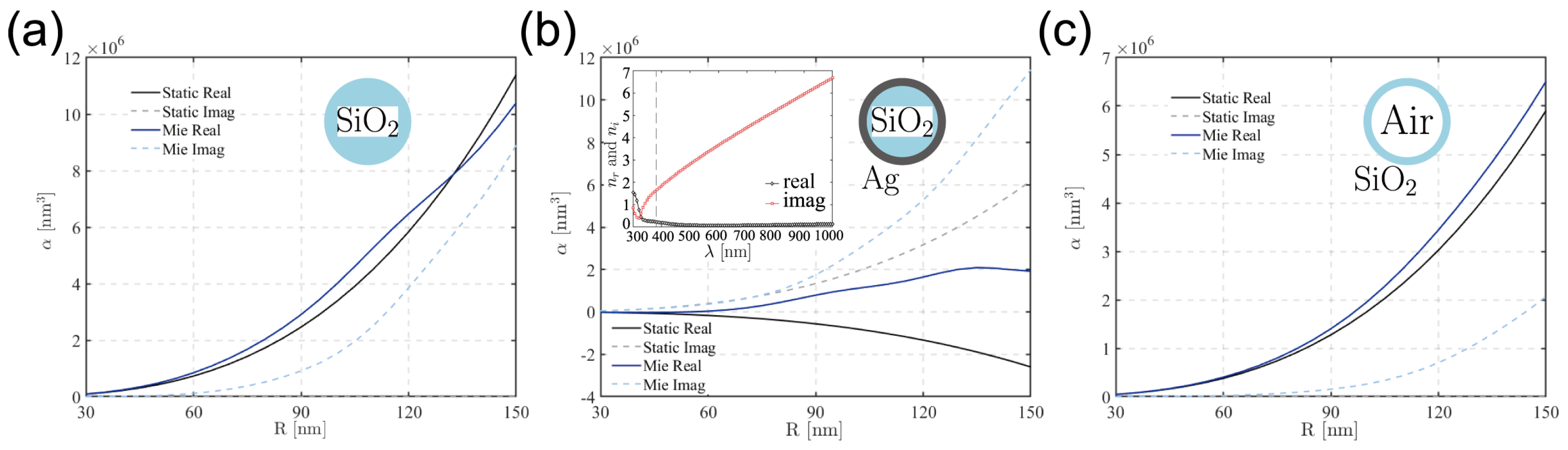
Figure 2 shows a comparison between the polarizabilities obtained from the static approximation and those obtained from EMT using the Mie solution for three different structures: (a) homogeneous spheres, (b) silver-shelled spheres, and (c) hollow spheres. The parameters chosen for the calculations are given as follows. The refractive indices of the host medium and the silica are set to 1.0 and 1.45, respectively. For the core–shell particles, the core radius is 80% of the shell radius. The dielectric function of silver, including both real and imaginary parts, is taken from experimental data [33]. The incident wavelength is set to 380 nm.
The comparison in Figure 2 between the static approximation and the Mie solution for polarizability reveals distinct behaviors across the different nanoparticle structures. For unshelled silica spheres (a), the two methods show reasonable agreement for the real part of the polarizability at smaller sizes, while the Mie solution introduces a non-zero imaginary component, indicating the presence of scattering losses that the static model does not capture. In the case of Ag-shelled particles (b), the results show that in the static case, the real part of the polarizability becomes negative for larger radii, while it remains positive in the Mie-solution case. For the hollow silica structure (c), the results from both models are closer for smaller particles, but discernible deviations emerge as the size increases, reflecting the influence of the hollow geometry on the optical response. The above analysis indicates that as the size parameter R / λ increases, the assumption of a uniform incident field breaks down, leading to the excitation of significantly higher-order multipoles and dynamic depolarization effects that are entirely absent in the static model. Overall, the data demonstrate that incorporating the Mie solution provides a more reasonable description of the polarizability, particularly for larger particles and complex core–shell architectures.

2.4. Incorporating Polydispersity and the Final EMT Formula

Synthesized SNPs are never perfectly monodisperse. To account for this realistic size distribution, we model the distribution of radii R using a normalized Gaussian function:
P ( R ) = 1 2 π σ 2 exp ( R μ ) 2 2 σ 2 ,
where μ is the mean radius and σ is the standard deviation.
The core of our Mie-enhanced EMT is to replace the static polarizability in the CM relation with the effective polarizability, averaged over the size distribution. This leads to the final expression for the effective dielectric constant:
ε eff ε d ε eff + 2 ε d = f R 3 R min R max P ( R ) α eff ( R ) 4 π ε 0 ε d d R ,
where R 3 = R 3 P ( R ) d R is the mean cubed radius.
The integration in Equation (15) is performed numerically over a sufficiently large number of sampling points (we used 5000) between lower and upper cutoffs R min and R max . This final formulation provides a robust and computationally efficient method for calculating the effective optical properties of polydisperse SNP composites.
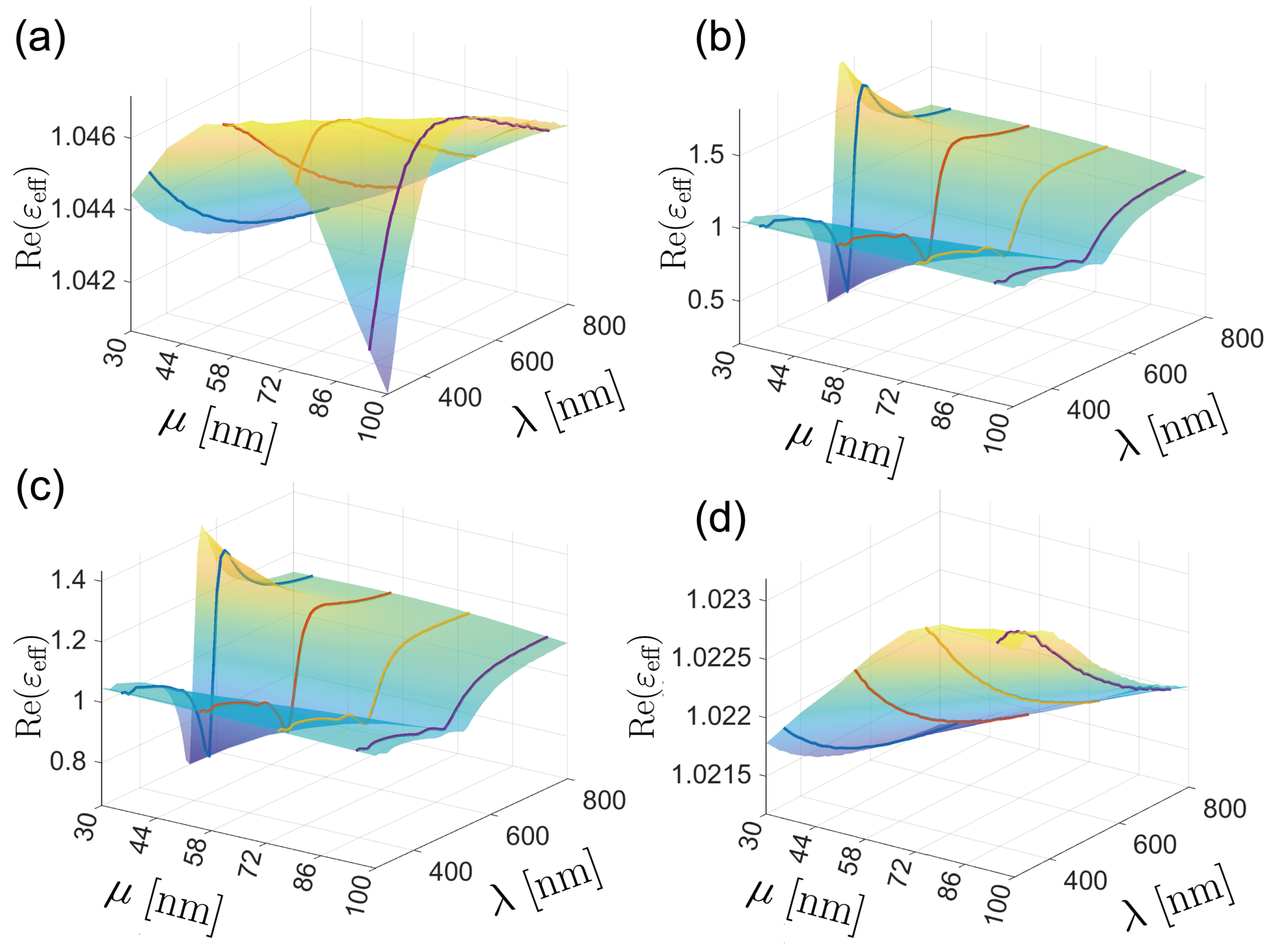
The calculated real part of the effective dielectric constant from Equation (15), using α eff for (a) unshelled, (b) Ag-shelled, and (c) hollow SNPs, is displayed in Figure 3 for different incident wavelengths and mean radii. The parameters for the calculations are chosen as follows. The filling ratio is 0.05, and σ = μ / 3 nm . R min and R max are set as 10 nm and 2 μ nm, respectively. The dielectric constant of the host medium is set as 1.0. The integration was performed with 5000 sampling points.
The results in Figure 3 demonstrate a spectrum of optical behaviors, from non-resonant to strongly resonant for both small and large μ s. For the unshelled and hollow structures, the effective dielectric constant exhibits a smooth, monotonic decrease with increasing wavelength for small μ , which is one characteristic of normal dielectric dispersion, and the hollow SNPs achieve a lower overall magnitude due to their air-filled cores. For large μ , the effective dielectric constant of the unshelled and hollow structures is no longer monotonic because of contributions from higher-order electric and magnetic multipoles. In stark contrast, the Ag-shelled structure displays a sharp, singular feature near 600 nm for small μ , a signature of a localized surface plasmon resonance that drastically alters the dispersion. The mixed structure, comprising a 1:1 ratio of unshelled and Ag-shelled particles, exhibits an intermediate response with a resonant peak that is both blue-shifted to approximately 550 nm and reduced in strength compared to the pure Ag-shelled case. For large μ , the resonance peak becomes shallower because of higher-order contributions from electric and magnetic multipoles.

3. Validation of EMT Against Full-Wave Simulation

3.1. FEM Simulation Setup

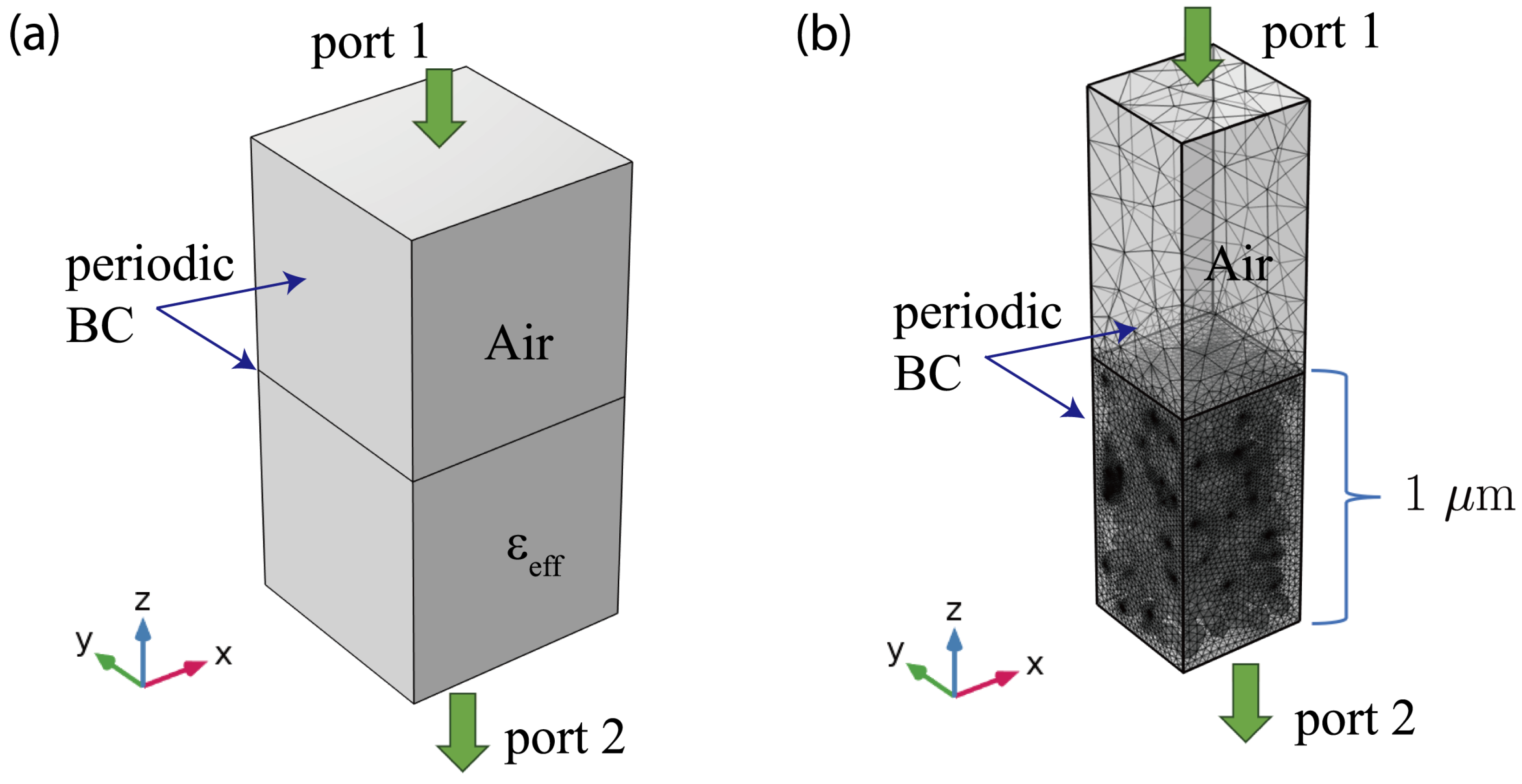
We now validate our EMT by comparing its predictions for reflectance and transmittance with results from full-wave FEM simulations. For the EMT calculation, we construct the FEM setup shown in Figure 4a. As shown in Figure 4a, the model consists of a layered cube with air on top and a uniform effective medium of dielectric constant ε eff (obtained in the previous section) on the bottom. On the side faces (parallel to the x y plane), we apply periodic boundary conditions. On the top and bottom faces, we define two ports for the incident wave and for computing transmittance and reflectance. As an example, we set the electric field polarized along the x direction and use normal incidence.
In Figure 4b, we show the meshed geometry for randomly dispersed SNPs in the FEM simulation. Similar to Figure 4a, the upper part of the layered cube is air, and the lower part is a thin film containing randomly dispersed SNPs.
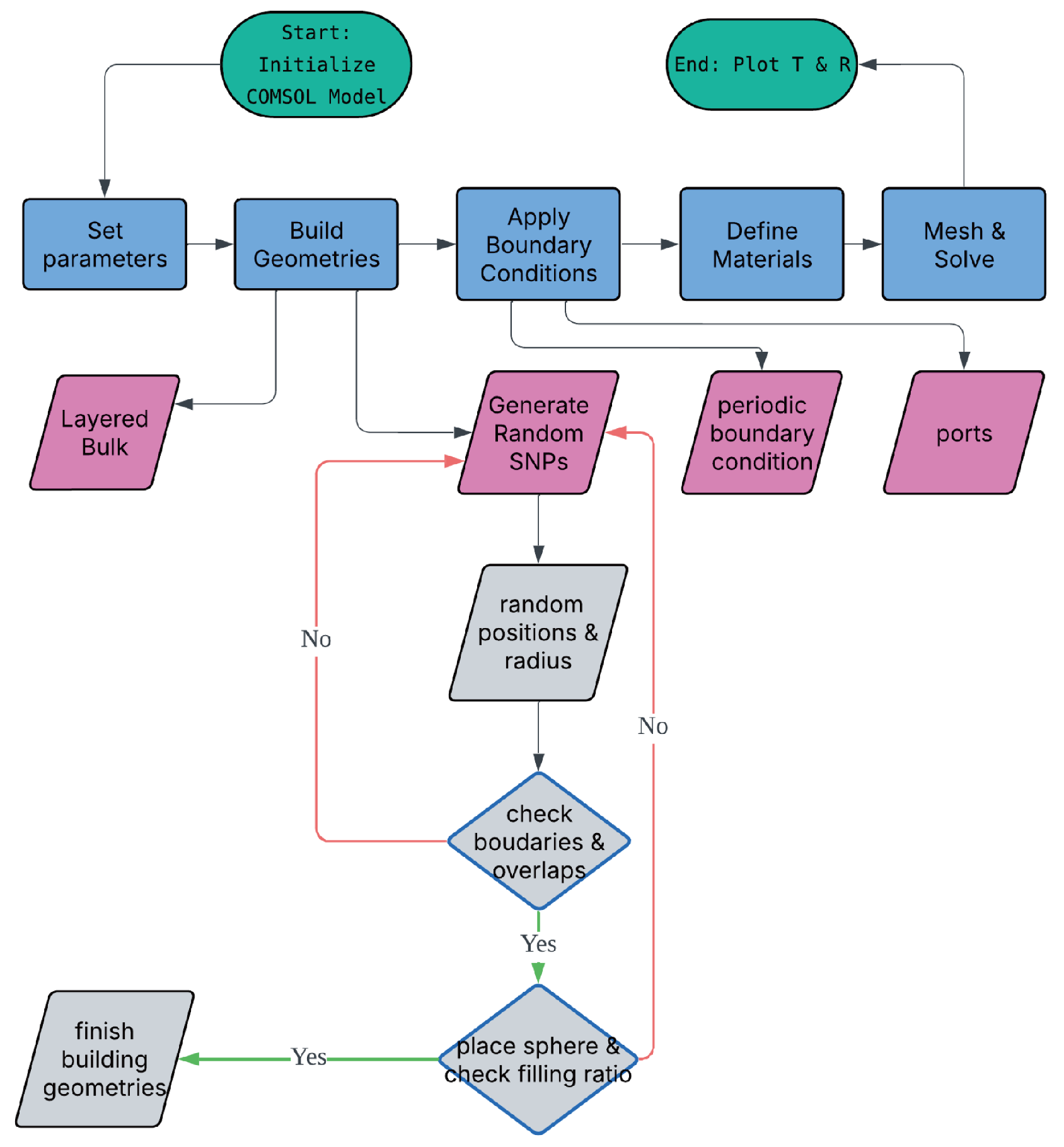
The flowchart of the source code that builds the FEM structure is shown in Figure 5, which describes the workflow for calculating the transmittance and reflectance of the thin film composed of SNPs (Supplementary File for the source code of FEM simulation). The process begins with parameter initialization, setting geometric properties including filling ratio, particle size distribution, and layer dimensions. The core geometry generation uses Monte Carlo rejection sampling to place non-overlapping spherical particles within the composite layer, with iterative boundary checking and overlap detection ensuring physically realistic configurations. Once the target filling ratio is achieved, the model applies Floquet-periodic boundary conditions to simulate infinite lateral extent and defines wave ports for incident and transmitted light. Material properties are assigned with wavelength-dependent dielectric functions, followed by adaptive mesh generation that refines near particle interfaces. Finally, the frequency-domain electromagnetic solver computes field distributions, from which reflectance and transmittance spectra are extracted for comparison with effective medium theory predictions. This comprehensive approach generates statistically representative microstructures that validate the theoretical models while accounting for realistic particle distributions and interactions.

3.2. Comparison Between the EMT and FEM Methods

To validate the developed Mie-enhanced effective medium theory, we compared its predictions for reflectance and transmittance against full-wave FEM simulations. Here, we choose the Ag-shelled SNP structure for validation due to its complexity and unambiguous spectral features. A Monte Carlo rejection sampling algorithm was employed to generate non-overlapping spherical particles, ensuring a physically realistic configuration that matches the target filling ratio ( f = 0.05 ) and Gaussian size distribution (mean radius μ and standard deviation σ = μ / 3 nm). The wavelength was swept from 300 nm to 600 nm to obtain the spectral response.
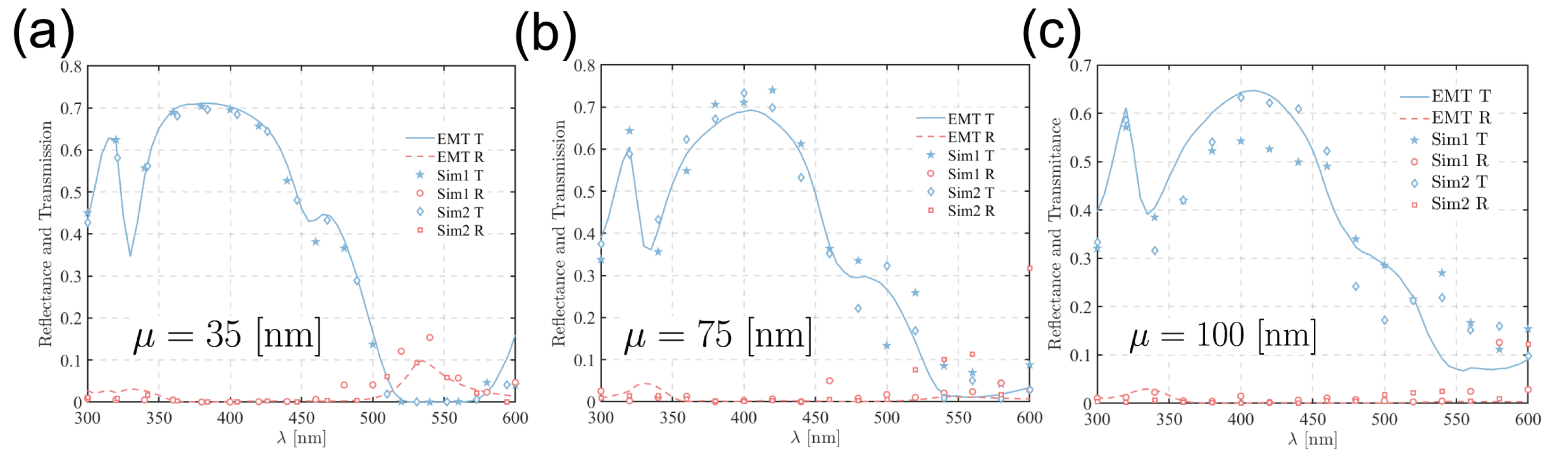
The comparison for Ag-shelled SNPs with different μ values is presented in Figure 6, with solid and dashed lines indicating the results obtained by the Mie-enhanced EMT, and scatter points (see legends) indicating the results obtained by the FEM simulation.
From Figure 6, we can see that the reflectance and transmittance obtained by the Mie-enhanced EMT agree well with those obtained by the full-wavelength simulations, even for a large mean radius μ = 100 nm . The nearly zero reflectance in all three panels is due to the strong absorption of silver. For all three values of μ , we observe a sudden drop in T due to the resonance between the Ag shell and the silica core around 550 nm in both the EMT and FEM results. In particular, for μ = 100 nm , the Mie-enhanced EMT successfully captures the reduced resonance around 550 nm, consistent with the FEM results. The FEM results appear to fluctuate more for larger μ because the number of SNPs is smaller, limited by computational resources.
While this numerical validation establishes the theoretical foundation of our EMT, experimental verification remains an essential next step. Future work will focus on fabricating SNP coatings with controlled parameters and characterizing their optical properties through spectroscopic ellipsometry and integrating sphere measurements. Such experimental correlation would account for real-world factors, including particle aggregation, interfacial effects, and manufacturing variations that are challenging to fully capture in simulations. The strong agreement between our EMT and FEM results, particularly for Ag-shelled SNPs, provides confidence that the model can serve as a reliable guide for designing experimental protocols and interpreting measured optical responses from fabricated SNP films.

4. Summary and Future Research Directions

In this work, we have developed a Mie-enhanced EMT to accurately predict the optical properties of thin films comprising randomly distributed SNPs, incorporating size dispersion. By integrating the full Mie scattering solution into the Clausius-Mossotti relation, our model successfully overcomes the limitations of classical EMTs, which neglect size-dependent and multipolar effects. The theory was comprehensively developed for unshelled, shelled, mixed, and hollow spherical structures. Validation against full-wave FEM simulations demonstrated excellent agreement for non-resonant dielectric SNPs (unshelled and hollow) and captured the essential resonant behavior of plasmonic Ag-shelled and mixed composites, establishing it as a powerful and computationally efficient tool for the design of functional optical coatings.
Building upon this foundation, several promising future research directions emerge, such as experimental validation and microstructural correlation, more advanced EMT for complex systems, and multi-scale and inverse design. By pursuing these directions, the Mie-enhanced EMT can serve as a cornerstone for the rational design of next-generation optical films, with potential impacts spanning high-efficiency photovoltaics, advanced displays, optical sensors, and thermal management systems.

Supplementary Materials

The following supporting information can be downloaded at: https://www.mdpi.com/article/10.3390/surfaces9010011/s1, Supplementary file for the source code of FEM simulation.

Author Contributions

Y.X. initiated the project, and F.L. and X.L. conceptualized the core idea. All authors have read and agreed to the published version of the manuscript.

Funding

This research received no external funding.

Data Availability Statement

The authors will supply the relevant data in response to reasonable requests.

Conflicts of Interest

Authors Feng Liu and Yao Xu were employed by the company YongAn Optics (Ningbo) Co., Ltd. The remaining author declares that the research was conducted in the absence of any commercial or financial relationships that could be construed as a potential conflict of interest.

References

  1. Sharma, J.; Polizos, G. Hollow Silica Particles: Recent Progress and Future Perspectives. Nanomaterials 2020, 10, 1599. [Google Scholar] [CrossRef] [PubMed]
  2. Slowing, I.I.; Vivero-Escoto, J.L.; Wu, C.W.; Lin, V.S.Y. Mesoporous silica nanoparticles as controlled release drug delivery and gene transfection carriers. Adv. Drug Deliv. Rev. 2008, 60, 1278–1288. [Google Scholar] [CrossRef] [PubMed]
  3. Kazemzadeh, P.; Sayadi, K.; Toolabi, A.; Sayadi, J.; Zeraati, M.; Chauhan, N.P.S.; Sargazi, G. Structure-Property Relationship for Different Mesoporous Silica Nanoparticles and its Drug Delivery Applications: A Review. Front. Chem. 2022, 10, 823785. [Google Scholar] [CrossRef] [PubMed]
  4. Li, M.; Yu, Y.; Li, J.; Chen, B.; Wu, X.; Tian, Y.; Chen, P. Nanosilica/carbon composite spheres as anodes in Li-ion batteries with excellent cycle stability. J. Mater. Chem. A 2015, 3, 1476–1482. [Google Scholar] [CrossRef]
  5. Janjua, T.I.; Cao, Y.; Kleitz, F.; Linden, M.; Yu, C.; Popat, A. Silica nanoparticles: A review of their safety and current strategies to overcome biological barriers. Adv. Drug Deliv. Rev. 2023, 203, 115115. [Google Scholar] [CrossRef]
  6. Dai, X.; Liu, H.; Liu, X.; Liu, Z.; Liu, Y.; Cao, Y.; Tao, J.; Shan, Z. Silicon nanoparticles encapsulated in multifunctional crosslinked nano-silica/carbon hybrid matrix as a high-performance anode for Li-ion batteries. Chem. Eng. J. 2021, 418, 129468. [Google Scholar] [CrossRef]
  7. Li, X.; Du, X.; He, J. Self-Cleaning Antireflective Coatings Assembled from Peculiar Mesoporous Silica Nanoparticles. Langmuir 2010, 26, 13528–13534. [Google Scholar] [CrossRef]
  8. Thompson, C.; Fleming, R.; Zou, M. Transparent self-cleaning and antifogging silica nanoparticle films. Sol. Energy Mater. Sol. Cells 2013, 115, 108–113. [Google Scholar] [CrossRef]
  9. Chi, F.; Liu, D.; Wu, H.; Lei, J. Mechanically robust and self-cleaning antireflection coatings from nanoscale binding of hydrophobic silica nanoparticles. Sol. Energy Mater. Sol. Cells 2019, 200, 109939. [Google Scholar] [CrossRef]
  10. Sun, J.; Cui, X.; Zhang, C.; Zhang, C.; Ding, R.; Xu, Y. A broadband antireflective coating based on a double-layer system containing mesoporous silica and nanoporous silica. J. Mater. Chem. C 2015, 3, 7187–7194. [Google Scholar] [CrossRef]
  11. Tao, C.; Zou, X.; Du, K.; Zhang, L.; Yan, H.; Yuan, X. Ultralow-refractive-index optical thin films built from shape-tunable hollow silica nanomaterials. Opt. Lett. 2018, 43, 1802–1805. [Google Scholar] [CrossRef] [PubMed]
  12. Hiller, J.; Mendelsohn, J.D.; Rubner, M.F. Reversibly erasable nanoporous anti-reflection coatings from polyelectrolyte multilayers. Nat. Mater. 2002, 1, 59–63. [Google Scholar] [CrossRef]
  13. Macleod, H.A. Thin-Film Optical Filters, 4th ed.; CRC Press: Boca Raton, MA, USA, 2010. [Google Scholar]
  14. Southwell, W.H. Gradient-index antireflection coatings. Opt. Lett. 1989, 8, 584–586. [Google Scholar] [CrossRef] [PubMed]
  15. Raut, H.K.; Ganesh, V.A.; Nair, A.S.; Ramakrishna, S. Anti-reflective coatings: A critical, in-depth review. Energy Environ. Sci. 2011, 4, 3779–3804. [Google Scholar] [CrossRef]
  16. Garnett, J.C.M., XII. Colours in metal glasses and in metallic films. Philos. Trans. R. Soc. Lond. 1904, 203, 385–420. [Google Scholar] [CrossRef]
  17. Bruggeman, D.A.G. Berechnung verschiedener physikalischer Konstanten von heterogenen Substanzen. I. Dielektrizitätskonstanten und Leitfähigkeiten der Mischkörper aus isotropen Substanzen. Ann. Phys. 1935, 416, 636–664. [Google Scholar] [CrossRef]
  18. Sihvola, A. Electromagnetic Mixing Formulas and Applications; The Institution of Engineering and Technology: London, UK, 1999. [Google Scholar]
  19. Bohren, C.F.; Huffman, D.R. Absorption and Scattering of Light by Small Particles; Wiley-VCH: New York, NY, USA, 1983. [Google Scholar]
  20. Félidj, N.; Aubard, J.; Lévi, G. Discrete dipole approximation for ultraviolet–visible extinction spectra simulation of silver and gold colloids. J. Chem. Phys. 1999, 111, 1195–1208. [Google Scholar] [CrossRef]
  21. Malasi, A.; Kalyanaraman, R.; Garcia, H. From Mie to Fresnel through effective medium approximation with multipole contributions. J. Opt. 2014, 16, 065001. [Google Scholar] [CrossRef]
  22. Colom, R.; Devilez, A.; Enoch, S.; Stout, B.; Bonod, N. Polarizability expressions for predicting resonances in plasmonic and Mie scatterers. Phys. Rev. A 2017, 95, 063833. [Google Scholar] [CrossRef]
  23. Prodan, E.; Radloff, C.; Halas, N.J.; Nordlander, P. A hybridization model for the plasmon response of complex nanostructures. Science 2003, 302, 419–422. [Google Scholar] [CrossRef]
  24. Maier, S.A. Plasmonics: Fundamentals and Applications; Springer: New York, NY, USA, 2007. [Google Scholar]
  25. Khlebtsov, N.G. T-matrix method in plasmonics: An overview. J. Quant. Spectrosc. Radiat. Transf. 2013, 123, 184–217. [Google Scholar] [CrossRef]
  26. Gopinath, A.; Boriskina, S.V.; Reinhard, B.M.; Negro, L.D. Deterministic aperiodic arrays of metal nanoparticles for surface-enhanced Raman scattering (SERS). Opt. Express 2009, 17, 3741–3753. [Google Scholar] [CrossRef] [PubMed]
  27. Choy, T.C. Effective Medium Theory: Principles and Applications, 2nd ed.; International Series of Monographs on Physics; Oxford University Press: London, UK, 2016. [Google Scholar]
  28. Mie, G. Beiträge zur Optik trüber Medien, speziell kolloidaler Metallösungen. Ann. Phys. 1908, 330, 377–445. [Google Scholar] [CrossRef]
  29. Foldy, L.L. The multiple scattering of waves. I. General theory of isotropic scattering by randomly distributed scatterers. Phys. Rev. 1945, 67, 107–119. [Google Scholar] [CrossRef]
  30. Mackay, T.G.; Weiglhofer, W.S. Homogenization of biaxial composite materials: Dissipative anisotropic properties. J. Opt. A Pure Appl. Opt. 2000, 2, 426. [Google Scholar] [CrossRef]
  31. Qin, F.; Peng, M.; Estevez, D.; Brosseau, C. Electromagnetic composites: From effective medium theories to metamaterials. J. Appl. Phys. 2022, 132, 101101. [Google Scholar] [CrossRef]
  32. Schäfer, J.; Lee, S.C.; Kienle, A. Calculation of the near fields for the scattering of electromagnetic waves by multiple infinite cylinders at perpendicular incidence. J. Quant. Spectrosc. Radiat. Transf. 2012, 113, 2113–2123. [Google Scholar] [CrossRef]
  33. Ciesielski, A.; Skowronski, L.; Trzcinski, M.; Szoplik, T. Controlling the optical parameters of self-assembled silver films with wetting layers and annealing. Appl. Surf. Sci. 2017, 421, 349–356. [Google Scholar] [CrossRef]
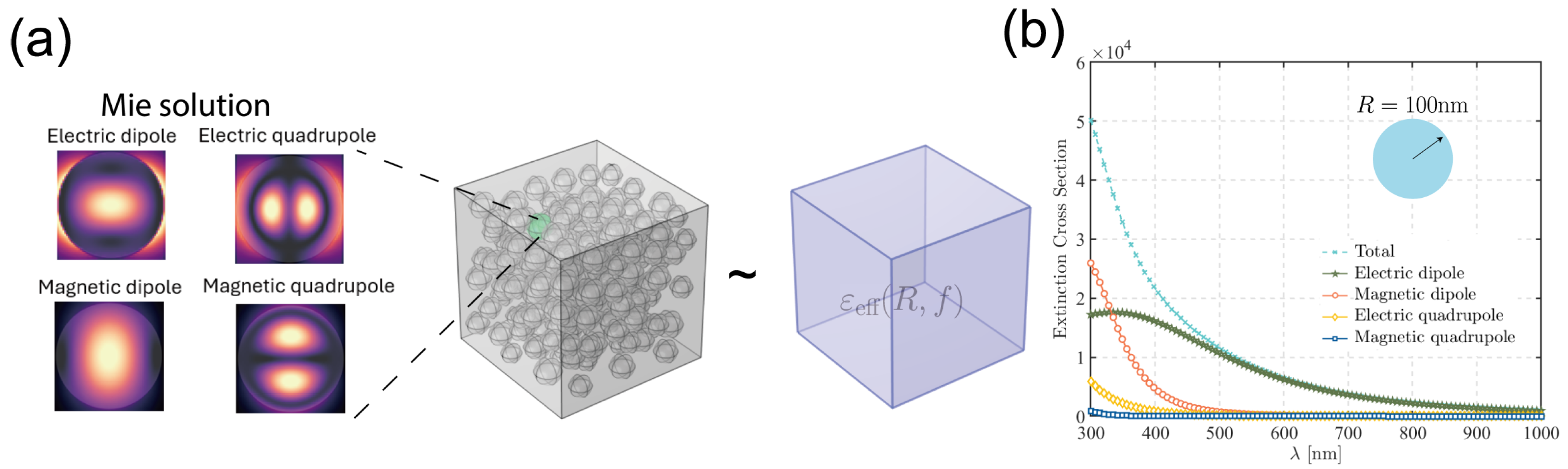
Figure 1. Schematic illustration of Mie-enhanced effective medium theory for silica nanoparticle composites, and extinction cross section of a single silica sphere for various wavelengths in the visible range: (a) Random dispersion of SNPs with mean radius R and filling ratio f (left) is homogenized into a uniform effective medium with dielectric constant ε eff ( R , f ) (right) by incorporating full Mie scattering solutions into the Clausius–Mossotti relation. This approach captures size-dependent multipolar effects and enables accurate prediction of optical properties for coating design. (b) Extinction cross-section of a silica sphere of radius R = 100 nm versus wavelength. For size parameters R / λ that are not much smaller than 1, higher-order contributions from electric and magnetic multipoles are obvious, as indicated by the figure legend.
Surfaces 09 00011 g001
Figure 2. Comparison of effective polarizability for silica nanoparticles calculated using the static approximation (black and gray lines) and full Mie solutions (blue and light blue lines). Real (solid lines) and imaginary (dashed lines) components are shown for (a) unshelled, (b) Ag-shelled, and (c) hollow SNP structures at different radii. Host medium: air ( n = 1.0 ); silica refractive index: n = 1.45 . Incident wavelength: 380 nm. For core–shell structures, the core radius is 80% of the shell radius. The inset of (b) shows the dielectric function of silver used, where a dashed line marks the position of λ = 380 nm. Note that the static approximation yields only real values (zero imaginary component) for the unshelled sphere and deviates increasingly from Mie theory as particle size increases for all three cases.
Surfaces 09 00011 g002
Figure 3. Wavelength and mean-radius dependent effective dielectric constant for SNP composites calculated using Mie-enhanced EMT, where the colorful lines are ε eff ( λ ) at different μ , such that blue, red, yellow, and purple are for μ = 35 , 55, 75 and 95 nm, respectively. Real part of ε eff for (a) unshelled, (b) Ag-shelled, (c) mixed (1:1 as unshelled:Ag-shelled ratio), and (d) hollow structures of SNPs. Parameters: filling ratio f = 0.05 , standard deviation σ = μ / 3 nm, integration range 10–2 μ nm with 5000 sampling points. Note the smooth dispersion in dielectric structures (a,d) versus pronounced plasmonic resonances in metallic core-shell structures (b,c), even for small μ .
Surfaces 09 00011 g003
Figure 4. Computational geometry for optical property calculations using EMT and full-wave simulation by FEM. (a) EMT approach: bilayer structure with air (top) and an effective homogeneous medium with dielectric constant ε eff (bottom, 1 μ m thick). (b) FEM approach: explicit random distribution of SNPs (dark spheres) within a 1 μ m-thick layer, overlaid with an adaptive triangular mesh. Both configurations use periodic boundary conditions in the x–y plane with port 1 (incident wave, z direction) and port 2 (transmitted wave) for reflectance and transmittance calculations.
Surfaces 09 00011 g004
Figure 5. Workflow for FEM simulation of randomly distributed SNP composites in COMSOL Multiphysics. The algorithm initializes model parameters, builds layered geometry, and iteratively generates random particle positions with radii sampled from a Gaussian distribution P ( R ) . Overlap detection and boundary checks ensure physical constraints (no interpenetration, particles confined to designated layer). Upon achieving the target filling ratio f, periodic boundary conditions and ports are applied, materials assigned, mesh generated, and a full-wave electromagnetic solver executed to obtain reflectance R ( λ ) and transmittance T ( λ ) .
Surfaces 09 00011 g005
Figure 6. Validation of Mie-enhanced EMT against full-wave FEM simulations. Reflectance (R) and transmittance (T) spectra for EMT predictions (solid and dashed lines) and FEM results (scatter points indicated by legends) for Ag-shelled SNPs with different mean radii: (a) μ = 35 nm , (b) μ = 75 nm , (c) μ = 100 nm .
Surfaces 09 00011 g006
Disclaimer/Publisher’s Note: The statements, opinions and data contained in all publications are solely those of the individual author(s) and contributor(s) and not of MDPI and/or the editor(s). MDPI and/or the editor(s) disclaim responsibility for any injury to people or property resulting from any ideas, methods, instructions or products referred to in the content.