
The Effect of Co/TiN Interfaces on Co Interconnect Resistivity


Abstract
1. Introduction
2. Materials and Methods
3. Results and Discussion
4. Conclusions
Author Contributions
Funding
Data Availability Statement
Conflicts of Interest
References
- Kim, H. Recent Trends in Copper Metallization. Electronics 2022, 11, 2914. [Google Scholar] [CrossRef]
- Rossnagel, S.M.; Kuan, T.S. Alteration of Cu Conductivity in the Size Effect Regime. J. Vac. Sci. Technol. B 2004, 22, 240–247. [Google Scholar] [CrossRef]
- Ciofi, I.; Contino, A.; Roussel, P.J.; Baert, R.; Vega-Gonzalez, V.-H.; Croes, K.; Badaroglu, M.; Wilson, C.J.; Raghavan, P.; Mercha, A.; et al. Impact of Wire Geometry on Interconnect RC and Circuit Delay. IEEE Trans. Electron Devices 2016, 63, 2488–2496. [Google Scholar] [CrossRef]
- Huynh-Bao, T.; Ryckaert, J.; Tokei, Z.; Mercha, A.; Verkest, D.; Thean, A.V.Y.; Wambacq, P. Statistical Timing Analysis Considering Device and Interconnect Variability for BEOL Requirements in the 5-Nm Node and Beyond. IEEE Trans. Very Large Scale Integr. Syst. 2017, 25, 1669–1680. [Google Scholar] [CrossRef]
- Xu, W.H.; Wang, L.; Guo, Z.; Chen, X.; Liu, J.; Huang, X.J. Copper Nanowires as Nanoscale Interconnects: Their Stability, Electrical Transport, and Mechanical Properties. ACS Nano 2015, 9, 241–250. [Google Scholar] [CrossRef]
- Rogozhin, A.E.; Glaz, O.G. Materials for Interconnections of Integrated Circuits with Design Standards Less Than 5 Nm. Russ. Microelectron. 2024, 53, 91–103. [Google Scholar] [CrossRef]
- Lee, R.T.P.; Imakita, K.; Pattanaik, G.; Yonezawa, R.; Yu, K.-H.; Mayersky, J.; Suzuki, H.; Wajda, C. Interconnect Technology for the Angstrom Era and Beyond. In Proceedings of the 2025 22nd International Workshop on Junction Technology (IWJT), Kyoto, Japan, 4–6 June 2025; IEEE: New York, NY, USA, 2025; pp. 41–43. [Google Scholar]
- Ceyhan, A.; Naeemi, A. Overview of the Interconnect Problem. In Carbon Nanotubes for Interconnects; Springer International Publishing: Cham, Switzerland, 2017; pp. 3–36. [Google Scholar]
- Gall, D. The Search for the Most Conductive Metal for Narrow Interconnect Lines. J. Appl. Phys. 2020, 127, 050901. [Google Scholar] [CrossRef]
- Gall, D. Electron Mean Free Path in Elemental Metals. J. Appl. Phys. 2016, 119, 085101. [Google Scholar] [CrossRef]
- Reider, A.M.; Kronthaler, A.; Zappa, F.; Menzel, A.; Laimer, F.; Scheier, P. Comparison of Continuous and Pulsed Low-Power DC Sputtered Ti Thin Films Deposited at Room Temperature. Surfaces 2025, 8, 36. [Google Scholar] [CrossRef]
- Naeemi, A.; Pan, C.; Ceyhan, A.; Iraei, R.M.; Kumar, V.; Rakheja, S. BEOL Scaling Limits and next Generation Technology Prospects. In Proceedings of the 51st Annual Design Automation Conference, San Francisco, CA, USA, 1–5 June 2014; pp. 1–6. [Google Scholar]
- Barmak, K.; Coffey, K.R. Epitaxial Metals for Interconnects Beyond Cu: Resistivity, Reliability. In Proceedings of the 2020 International Symposium on VLSI Technology, Systems and Applications (VLSI-TSA), Hsinchu, Taiwan, 10–13 August 2020; IEEE: New York, NY, USA, 2020; pp. 115–116. [Google Scholar]
- Han, H.J.; Kumar, S.; Jin, G.; Ji, X.; Hart, J.L.; Hynek, D.J.; Sam, Q.P.; Hasse, V.; Felser, C.; Cahill, D.G.; et al. Topological Metal MoP Nanowire for Interconnect. Adv. Mater. 2023, 35, e2208965. [Google Scholar] [CrossRef]
- Jeng, C.; Wan, W.; Lin, H.; Liang, M.-S.; Tang, K.; Kao, I.; Lo, H.; Chi, K.; Huang, T.; Yao, C.; et al. BEOL Process Integration of 65nm Cu/Low k Interconnects. In Proceedings of the IEEE 2004 International Interconnect Technology Conference (IEEE Cat. No.04TH8729), Burlingame, CA, USA, 7–9 June 2004; IEEE: New York, NY, USA, 2004; pp. 199–201. [Google Scholar]
- Chawla, J.S.; Zhang, X.Y.; Gall, D. Epitaxial TiN(001) Wetting Layer for Growth of Thin Single-Crystal Cu(001). J. Appl. Phys. 2011, 110, 043714. [Google Scholar] [CrossRef]
- Shen, P.; Gall, D. Electron Scattering at Interfaces in Epitaxial W(001)-Mo(001) Multilayers. J. Appl. Phys. 2024, 136, 075305. [Google Scholar] [CrossRef]
- Shen, P.; Lavoie, C.; Gall, D. Electron Scattering at Interfaces in Ru(0001)/Co(0001) Multilayers. J. Appl. Phys. 2025, 137, 025303. [Google Scholar] [CrossRef]
- Lanzillo, N.A.; Restrepo, O.D.; Bhosale, P.S.; Cruz-Silva, E.; Yang, C.C.; Youp Kim, B.; Spooner, T.; Standaert, T.; Child, C.; Bonilla, G.; et al. Electron Scattering at Interfaces in Nano-Scale Vertical Interconnects: A Combined Experimental and Ab Initio Study. Appl. Phys. Lett. 2018, 112, 163107. [Google Scholar] [CrossRef]
- Lee, J.W.; Song, J.Y. Synethesis of Single-Crystal Cu Via for BEOL Interconnect. In Proceedings of the 2025 IEEE International Interconnect Technology Conference (IITC), Busan, Republic of Korea, 2–5 June 2025; IEEE: New York, NY, USA, 2025; pp. 1–3. [Google Scholar]
- Henriquez, R.; Flores, M.; Moraga, L.; Kremer, G.; González-Fuentes, C.; Munoz, R.C. Electron Scattering at Surfaces and Grain Boundaries in Thin Au Films. Appl. Surf. Sci. 2013, 273, 315–323. [Google Scholar] [CrossRef]
- Lee, H.-C.; Ok Park, O. Electron Scattering Mechanisms in Indium-Tin-Oxide Thin Films: Grain Boundary and Ionized Impurity Scattering. Vacuum 2004, 75, 275–282. [Google Scholar] [CrossRef]
- Zhu, Y.F.; Lang, X.Y.; Zheng, W.T.; Jiang, Q. Electron Scattering and Electrical Conductance in Polycrystalline Metallic Films and Wires: Impact of Grain Boundary Scattering Related to Melting Point. ACS Nano 2010, 4, 3781–3788. [Google Scholar] [CrossRef]
- Zhang, M.; Gall, D. Resistivity Scaling in Epitaxial CuAl2(001) Layers. IEEE Trans. Electron Devices 2022, 69, 5110–5115. [Google Scholar] [CrossRef]
- Choi, D.; Barmak, K. On the Potential of Tungsten as Next-Generation Semiconductor Interconnects. Electron. Mater. Lett. 2017, 13, 449–456. [Google Scholar] [CrossRef]
- Vyas, A.A.; Zhou, C.; Yang, C.Y. On-Chip Interconnect Conductor Materials for End-of-Roadmap Technology Nodes. IEEE Trans. Nanotechnol. 2018, 17, 4–10. [Google Scholar] [CrossRef]
- Chen, L.; Ando, D.; Sutou, Y.; Koike, J. CuAl2 Thin Films as a Low-Resistivity Interconnect Material for Advanced Semiconductor Devices. J. Vac. Sci. Technol. B Nanotechnol. Microelectron. Mater. Process. Meas. Phenom. 2019, 37, 031215. [Google Scholar] [CrossRef]
- Kumar, R.; Pathania, S.; Guglani, S.; Kumar, A.; Kumar, S.; Roy, S.; Kaushik, B.K.; Sharma, R. Role of Grain Size on the Effective Resistivity of Cu-Graphene Hybrid Interconnects. In Proceedings of the 2020 IEEE 70th Electronic Components and Technology Conference (ECTC), Online, 3–30 June 2020; IEEE: New York, NY, USA, 2020; pp. 1620–1625. [Google Scholar]
- Zhang, M.; Adelmann, C. Prospects and Challenges of Compound Conductors for Advanced Interconnect Applications. J. Appl. Phys. 2025, 138, 090902. [Google Scholar] [CrossRef]
- Zhang, M.; Scheerder, J.E.; Soulie, J.-P.; Wu, C.; Park, S.; Tőkei, Z.; Fleischmann, C.; Adelmann, C. Reduced Compositional Fluctuations in Epitaxial NiAl Thin Films. In Proceedings of the 2025 IEEE International Interconnect Technology Conference (IITC), Busan, Republic of Korea, 2–5 June 2025; IEEE: New York, NY, USA, 2025; pp. 1–3. [Google Scholar]
- Hu, C.K.; Gignac, L.; Rosenberg, R. Electromigration of Cu/Low Dielectric Constant Interconnects. Microelectron. Reliab. 2006, 46, 213–231. [Google Scholar] [CrossRef]
- Kaloyeros, A.E.; Eisenbraun, E. Ultrathin Diffusion Barriers/Liners for Gigascale Copper Metallization. Annu. Rev. Mater. Sci. 2000, 30, 363–385. [Google Scholar] [CrossRef]
- Zhang, X.; Cao, L.; Ryan, V.; Ho, P.S.; Taylor, B.; Witt, C.; Labelle, C. Co Liner Impact on Microstructure of Cu Interconnects. ECS J. Solid State Sci. Technol. 2015, 4, N3177–N3179. [Google Scholar] [CrossRef]
- Hayashi, R.; Ogawa, M.; Oshio, S.; Adachi, K.; Tanaka, T.; Tada, M. Low Resistive Ru Thin Film on Dielectrics without Adhesive Liner for Sub-2 nm Interconnects. In Proceedings of the 2025 IEEE International Interconnect Technology Conference (IITC), Busan, Republic of Korea, 2–5 June 2025; IEEE: New York, NY, USA, 2025; pp. 1–3. [Google Scholar]
- Wen, L.G.; Roussel, P.; Pedreira, O.V.; Briggs, B.; Groven, B.; Dutta, S.; Popovici, M.I.; Heylen, N.; Ciofi, I.; Vanstreels, K.; et al. Atomic Layer Deposition of Ruthenium with TiN Interface for Sub-10 Nm Advanced Interconnects beyond Copper. ACS Appl. Mater. Interfaces 2016, 8, 26119. [Google Scholar] [CrossRef]
- He, M.; Zhang, X.; Nogami, T.; Lin, X.; Kelly, J.; Kim, H.; Spooner, T.; Edelstein, D.; Zhao, L. Mechanism of Co Liner as Enhancement Layer for Cu Interconnect Gap-Fill. J. Electrochem. Soc. 2013, 160, D3040–D3044. [Google Scholar] [CrossRef]
- Edelstein, D.; Uzoh, C.; Cabral, C.; DeHaven, P.; Buchwalter, P.; Simon, A.; Cooney, E.; Malhotra, S.; Klaus, D.; Rathore, H.; et al. A High Performance Liner for Copper Damascene Interconnects. In Proceedings of the IEEE 2001 International Interconnect Technology Conference (Cat. No.01EX461), Burlingame, CA, USA, 6 June 2001; IEEE: New York, NY, USA, 2001; pp. 9–11. [Google Scholar]
- van der Veen, M.H.; Jourdan, N.; Gonzalez, V.V.; Wilson, C.J.; Heylen, N.; Pedreira, O.V.; Struyf, H.; Croes, K.; Bommels, J.; Tokei, Z. Barrier/Liner Stacks for Scaling the Cu Interconnect Metallization. In Proceedings of the 2016 IEEE International Interconnect Technology Conference/Advanced Metallization Conference (IITC/AMC), San Jose, CA, USA, 23–26 May 2016; IEEE: New York, NY, USA, 2016; pp. 28–30. [Google Scholar]
- Chen, G.S.; Lin, M.J.; Huang, C.W.; Cheng, Y.L.; Fang, J.S.; Lin, C.I. The Impact of Titanium Alloying on Altering Nanomechanical Properties and Grain Structures of Sputter-Deposited Cobalt for Electromigration Reliability Enhancement. J. Alloys Compd. 2024, 1003, 175564. [Google Scholar] [CrossRef]
- Josell, D.; Brongersma, S.H. Size-Dependent Resistivity in Nanoscale Interconnects. Annu. Rev. Mater. Res. 2009, 39, 231–256. [Google Scholar] [CrossRef]
- Konar, A.; Shinde, P.P.; Pandian, S.; Adiga, S.P.; Subramanya Mayya, K.; Cho, Y.; Shin, H.-J.; Park, S. Non-Specular Scattering of Carriers from Surface Defects in Thin Metal Interconnects. J. Appl. Phys. 2020, 128, 185103. [Google Scholar] [CrossRef]
- Sondheimer, E.H. The Mean Free Path of Electrons in Metals. Adv. Phys. 1952, 1, 1–42. [Google Scholar] [CrossRef]
- Lucas, M.S.P. Electrical Conductivity of Thin Metallic Films with Unlike Surfaces. J. Appl. Phys. 1965, 36, 1632–1635. [Google Scholar] [CrossRef]
- Nies, C.L.; Natarajan, S.K.; Nolan, M. Control of the Cu Morphology on Ru-Passivated and Ru-Doped TaN Surfaces-Promoting Growth of 2D Conducting Copper for CMOS Interconnects. Chem. Sci. 2022, 13, 713–725. [Google Scholar] [CrossRef] [PubMed]
- Nogami, T.; Gluschenkov, O.; Sulehria, Y.; Nguyen, S.; Huang, H.; Lanzillo, N.A.; DeSilva, A.; Mignot, Y.; Church, J.; Lee, J.; et al. Advanced BEOL Interconnects. In Proceedings of the 2020 IEEE International Interconnect Technology Conference (IITC), Online, 5–9 October 2020; IEEE: New York, NY, USA, 2020; pp. 1–3. [Google Scholar]
- Zeng, Z.; Yu, B.; Cao, Y.; Xue, X.; Xu, J.; Zhang, Y.; Wang, X.; Fang, J.; Zhang, Y. BEOL Cu Gap-Fill Performance Improvement for 14 nm Technology Node. In Proceedings of the 2020 China Semiconductor Technology International Conference (CSTIC), Online, 17–29 June 2020; IEEE: New York, NY, USA, 2020; pp. 1–5. [Google Scholar]
- Park, K.; Simka, H. Advanced Interconnect Challenges beyond 5 nm and Possible Solutions. In Proceedings of the 2021 IEEE International Interconnect Technology Conference (IITC), Online, 6–9 July 2021; IEEE: New York, NY, USA, 2021; pp. 1–3. [Google Scholar]
- Moon, J.H.; Jeong, E.; Kim, S.; Kim, T.; Oh, E.; Lee, K.; Han, H.; Kim, Y.K. Materials Quest for Advanced Interconnect Metallization in Integrated Circuits. Adv. Sci. 2023, 10, e2207321. [Google Scholar] [CrossRef]
- Tallapalli, S.K.; Vijayakumar, V.; Panigrahy, A.K.; Vignesh, N.A. Defect Analysis and Optimization of Nanomaterial-Based Liner Materials for 3D-IC Integration. Analog Integr. Circuits Signal Process. 2025, 124, 36. [Google Scholar] [CrossRef]
- Ren, X.; Wu, Y.; Su, H.; Sun, Y. Develop Self-Forming Conformal Multifunctional Interconnect Layer to Meet the Demands of Advanced Cu Interconnect. In Proceedings of the 2025 26th International Conference on Electronic Packaging Technology (ICEPT), Shanghai, China, 5–7 August 2025; IEEE: New York, NY, USA, 2025; pp. 1–3. [Google Scholar]
- Jog, A.; Gall, D. Electron Scattering at Surfaces and Grain Boundaries in Rh Layers. IEEE Trans. Electron Devices 2022, 69, 3854. [Google Scholar] [CrossRef]
- Kitada, H.; Suzuki, T.; Akiyama, S.; Nakamura, T. Influence of Titanium Liner on Resistivity of Copper Interconnects. Jpn. J. Appl. Phys. 2009, 48, 04C026. [Google Scholar] [CrossRef]
- Mont, F.W.; Zhang, X.; Wang, W.; Kelly, J.J.; Standaert, T.E.; Quon, R.; Ryan, E.T. Cobalt Interconnect on Same Copper Barrier Process Integration at the 7 nm Node. In Proceedings of the 2017 IEEE International Interconnect Technology Conference (IITC), Hsinchu, Taiwan, 16–18 May 2017; IEEE: New York, NY, USA, 2017; pp. 1–3. [Google Scholar]
- Bekiaris, N.; Wu, Z.; Ren, H.; Naik, M.; Park, J.H.; Lee, M.; Ha, T.H.; Hou, W.; Bakke, J.R.; Gage, M.; et al. Cobalt Fill for Advanced Interconnects. In Proceedings of the 2017 IEEE International Interconnect Technology Conference (IITC), Hsinchu, Taiwan, 16–18 May 2017; IEEE: New York, NY, USA, 2017; pp. 1–3. [Google Scholar]
- Nogami, T.; Patlolla, R.; Kelly, J.; Briggs, B.; Huang, H.; Demarest, J.; Li, J.; Hengstebeck, R.; Zhang, X.; Lian, G.; et al. Cobalt/Copper Composite Interconnects for Line Resistance Reduction in Both Fine and Wide Lines. In Proceedings of the 2017 IEEE International Interconnect Technology Conference (IITC), Hsinchu, Taiwan, 16–18 May 2017; IEEE: New York, NY, USA, 2017; pp. 1–3. [Google Scholar]
- Kelly, J.; Kamineni, V.; Lin, X.; Pacquette, A.; Hopstaken, M.; Liang, Y.; Amanapu, H.; Peethala, B.; Jiang, L.; Demarest, J.; et al. Annealing and Impurity Effects in Co Thin Films for MOL Contact and BEOL Metallization. J. Electrochem. Soc. 2019, 166, D3100–D3109. [Google Scholar] [CrossRef]
- Kelly, J.; Chen, J.H.-C.; Huang, H.; Hu, C.K.; Liniger, E.; Patlolla, R.; Peethala, B.; Adusumilli, P.; Shobha, H.; Nogami, T.; et al. Experimental Study of Nanoscale Co Damascene BEOL Interconnect Structures. In Proceedings of the 2016 IEEE International Interconnect Technology Conference/Advanced Metallization Conference (IITC/AMC), San Jose, CA, USA, 23–26 May 2016; IEEE: New York, NY, USA, 2016; pp. 40–42. [Google Scholar]
- van der Veen, M.H.; Vandersmissen, K.; Dictus, D.; Demuynck, S.; Liu, R.; Bin, X.; Nalla, P.; Lesniewska, A.; Hall, L.; Croes, K.; et al. Cobalt Bottom-Up Contact and via Prefill Enabling Advanced Logic and DRAM Technologies. In Proceedings of the 2015 IEEE International Interconnect Technology Conference and 2015 IEEE Materials for Advanced Metallization Conference (IITC/MAM), Grenoble, France, 18–21 May 2015; IEEE: New York, NY, USA, 2015; pp. 25–28. [Google Scholar]
- Thakral, A.; Jog, A.; Gall, D. Resistivity Size Effect in Epitaxial Face-Centered Cubic Co(001) Layers. Appl. Phys. Lett. 2024, 124, 121601. [Google Scholar] [CrossRef]
- Griggio, F.; Palmer, J.; Pan, F.; Toledo, N.; Schmitz, A.; Tsameret, I.; Kasim, R.; Leatherman, G.; Hicks, J.; Madhavan, A.; et al. Reliability of Dual-Damascene Local Interconnects Featuring Cobalt on 10 Nm Logic Technology. In Proceedings of the 2018 IEEE International Reliability Physics Symposium (IRPS), Burlingame, CA, USA, 11–15 March 2018; IEEE: New York, NY, USA, 2018; pp. 6E.3-1–6E.3-5. [Google Scholar]
- Yeoh, A.; Madhavan, A.; Kybert, N.; Anand, S.; Shin, J.; Asoro, M.; Samarajeewa, S.; Steigerwald, J.; Ganpule, C.; Buehler, M.; et al. Interconnect Stack Using Self-Aligned Quad and Double Patterning for 10 nm High Volume Manufacturing. In Proceedings of the IEEE International Interconnect Technology Conference (IITC), Santa Clara, CA, USA, 4–7 June 2018; IEEE: New York, NY, USA, 2018; p. 144. [Google Scholar]
- Hung, R.; Park, J.H.; Ha, T.H.; Lee, M.; Hou, W.; Lei, J.; Bakke, J.R.; Sharma, S.; Sharma, K.R.; Kim, N.S.; et al. Extreme Contact Scaling with Advanced Metallization of Cobalt. In Proceedings of the 2018 IEEE International Interconnect Technology Conference (IITC), Santa Clara, CA, USA, 4–7 June 2018; IEEE: New York, NY, USA, 2018; pp. 30–32. [Google Scholar]
- Vega-Gonzalez, V.; Montero, D.; Versluijs, J.; Pedreira, O.V.; Jourdan, N.; Puliyalil, H.; Chehab, B.; Peissker, T.; Haider, A.; Batuk, D.; et al. Process Integration of High Aspect Ratio Vias with a Comparison Between Co and Ru Metallizations. In Proceedings of the 2021 IEEE International Interconnect Technology Conference (IITC), Online, 6–9 July 2021; IEEE: New York, NY, USA, 2021; pp. 1–3. [Google Scholar]
- Hsu, C.P.S.; Chen, P.Y.T. Selective Ru or Co Etch for 3 nm Applications. Solid State Phenom. 2021, 314, 307–311. [Google Scholar] [CrossRef]
- Zhang, L.; Wang, S.; Wang, T.; Lu, X. Polishing Mechanisms of Various Surfactants in Chemical Mechanical Polishing Relevant to Cobalt Interconnects. Int. J. Adv. Manuf. Technol. 2023, 128, 5425–5436. [Google Scholar] [CrossRef]
- Naik, M. Interconnect Trend for Single Digit Nodes. In Proceedings of the 2018 IEEE International Electron Devices Meeting (IEDM), San Francisco, CA, USA, 1–5 December 2018; IEEE: New York, NY, USA, 2018; pp. 5.6.1–5.6.4. [Google Scholar]
- Cheng, Y.L.; Wei, B.J.; Shih, F.H.; Wang, Y.L. Stability and Reliability of Ti/TiN as a Thin Film Resistor. ECS J. Solid State Sci. Technol. 2013, 2, Q12–Q15. [Google Scholar] [CrossRef]
- Lee, D.; Park, J.; Park, S.; Woo, J.; Moon, K.; Cha, E.; Lee, S.; Song, J.; Koo, Y.; Hwang, H. BEOL Compatible (300 °C) TiN/TiOx/Ta/TiN 3D Nanoscale (~10 nm) IMT Selector. In Proceedings of the 2013 IEEE International Electron Devices Meeting, Washington, DC, USA, 9–11 December 2013; IEEE: New York, NY, USA, 2013; pp. 10.7.1–10.7.4. [Google Scholar]
- Lehninger, D.; Mertens, K.; Gerlich, L.; Lederer, M.; Ali, T.; Seidel, K. Room Temperature PVD TiN to Improve the Ferroelectric Properties of HZO Films in the BEoL. MRS Adv. 2021, 6, 535–539. [Google Scholar] [CrossRef]
- Lee, C.-C.; Shen, Y.-L.; Kang, Y. Prediction of Interfacial Adhesion Strength of Nanoscale Al/TiN Films Passed through Patterned BEOL Interconnects. Mater. Sci. Semicond. Process. 2015, 39, 1–5. [Google Scholar] [CrossRef]
- Sagi, K.V.; Amanapu, H.P.; Alety, S.R.; Babu, S.V. Potassium Permanganate-Based Slurry to Reduce the Galvanic Corrosion of the Cu/Ru/TiN Barrier Liner Stack During CMP in the BEOL Interconnects. ECS J. Solid State Sci. Technol. 2016, 5, 256. [Google Scholar] [CrossRef]
- Shen, P.; Gall, D. Electron Scattering at Ru–TiN–Ru Interface Stacks. IEEE Trans. Electron Devices 2024, 71, 6970–6975. [Google Scholar] [CrossRef]
- Shen, P.; Gall, D. Metal-Metal Contact Resistance Measurements. In Proceedings of the 2024 IEEE International Interconnect Technology Conference (IITC), San Jose, CA, USA, 3–6 June 2024; IEEE: New York, NY, USA, 2024; pp. 1–3. [Google Scholar]
- Smits, F.M. Measurement of Sheet Resistivities with the Four-Point Probe. Bell Syst. Tech. J. 1958, 37, 711–718. [Google Scholar] [CrossRef]
- Fuchs, K. The Conductivity of Thin Metallic Films According to the Electron Theory of Metals. Math. Proc. Cambridge Philos. Soc. 1938, 34, 100–108. [Google Scholar] [CrossRef]
- Mayadas, A.F.; Shatzkes, M. Electrical-Resistivity Model for Polycrystalline Films: The Case of Arbitrary Reflection at External Surfaces. Phys. Rev. B 1970, 1, 1382. [Google Scholar] [CrossRef]
- Milosevic, E.; Kerdsongpanya, S.; McGahay, M.E.; Zangiabadi, A.; Barmak, K.; Gall, D. Resistivity Scaling and Electron Surface Scattering in Epitaxial Co(0001) Layers. J. Appl. Phys. 2019, 125, 245105. [Google Scholar] [CrossRef]
- Milosevic, E.; Gall, D. Electron Scattering at Co(0001) Surfaces: Effects of Ti and TiN Capping Layers. AIP Adv. 2020, 10, 055213. [Google Scholar] [CrossRef]
- Milosevic, E.; Kerdsongpanya, S.; Gall, D. The Resistivity Size Effect in Epitaxial Ru(0001) and Co(0001) Layers. In Proceedings of the 2018 IEEE Nanotechnology Symposium (ANTS), Albany, NY, USA, 14–15 November 2018; IEEE: New York, NY, USA, 2018; pp. 1–5. [Google Scholar]
- Pal, A.K.; Chaudhuri, S.; Barua, A.K. The Electrical Resistivity and Temperature Coefficient of Resistivity of Cobalt Films. J. Phys. D. Appl. Phys. 1976, 9, 2261–2267. [Google Scholar] [CrossRef]
- Wislicenus, M.; Liske, R.; Gerlich, L.; Vasilev, B.; Preusse, A. Cobalt Advanced Barrier Metallization: A Resistivity Composition Analysis. Microelectron. Eng. 2015, 137, 11–15. [Google Scholar] [CrossRef]
- Dulmaa, A.; Cougnon, F.G.; Dedoncker, R.; Depla, D. On the Grain Size-Thickness Correlation for Thin Films. Acta Mater. 2021, 212, 116896. [Google Scholar] [CrossRef]
- Ali, A.; Park, K.R.; Haq, M.A.; Sung, J.M.; Jeong, D.W.; Song, Y.; Kim, B.S. In-Situ Nitriding of CoTi Powders for TiN Shell Formation via Diffusion-Controlled Mechanism. J. Alloys Compd. 2025, 1036, 181886. [Google Scholar] [CrossRef]
- Ago, H.; Ito, Y.; Mizuta, N.; Yoshida, K.; Hu, B.; Orofeo, C.M.; Tsuji, M.; Ikeda, K.; Mizuno, S. Epitaxial Chemical Vapor Deposition Growth of Single-Layer Graphene over Cobalt Film Crystallized on Sapphire. ACS Nano 2010, 4, 7407–7414. [Google Scholar] [CrossRef]
- Choi, J.W.; Ham, D.; Han, S.; Noh, D.Y.; Kang, H.C. Nanoscale Soft Wetting Observed in Co/Sapphire During Pulsed Laser Irradiation. Nanomaterials 2021, 11, 268. [Google Scholar] [CrossRef]
- Wongpiya, R.; Ouyang, J.; Chung, C.J.; Duong, D.T.; Deal, M.; Nishi, Y.; Clemens, B. Structural and Electrical Characterization of CoTiN Metal Gates. J. Appl. Phys. 2015, 117, 075304. [Google Scholar] [CrossRef]
- Hosseini, M.; Koike, J. Amorphous CoTix as a Liner/Diffusion Barrier Material for Advanced Copper Metallization. J. Alloys Compd. 2017, 721, 134–142. [Google Scholar] [CrossRef]



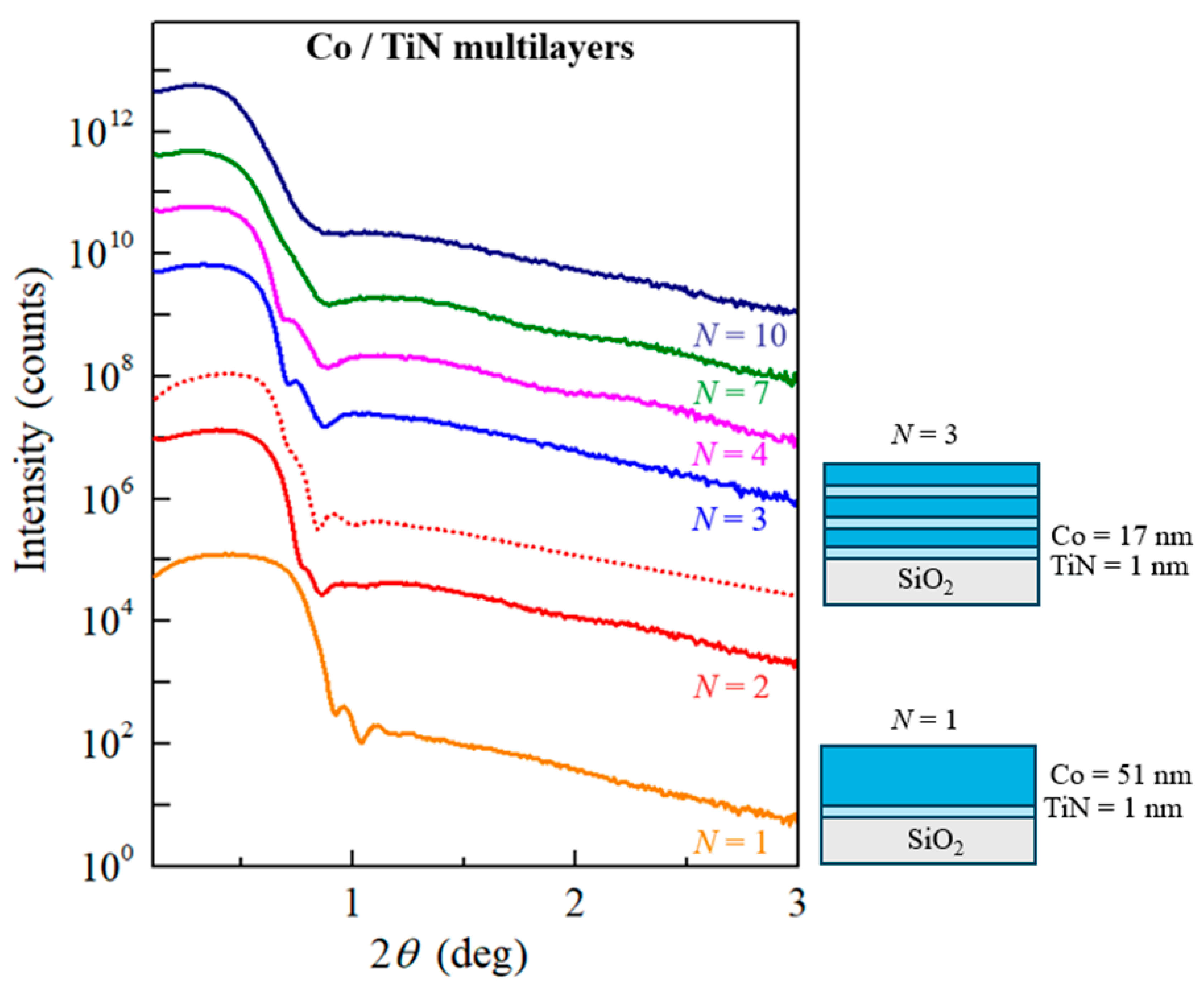
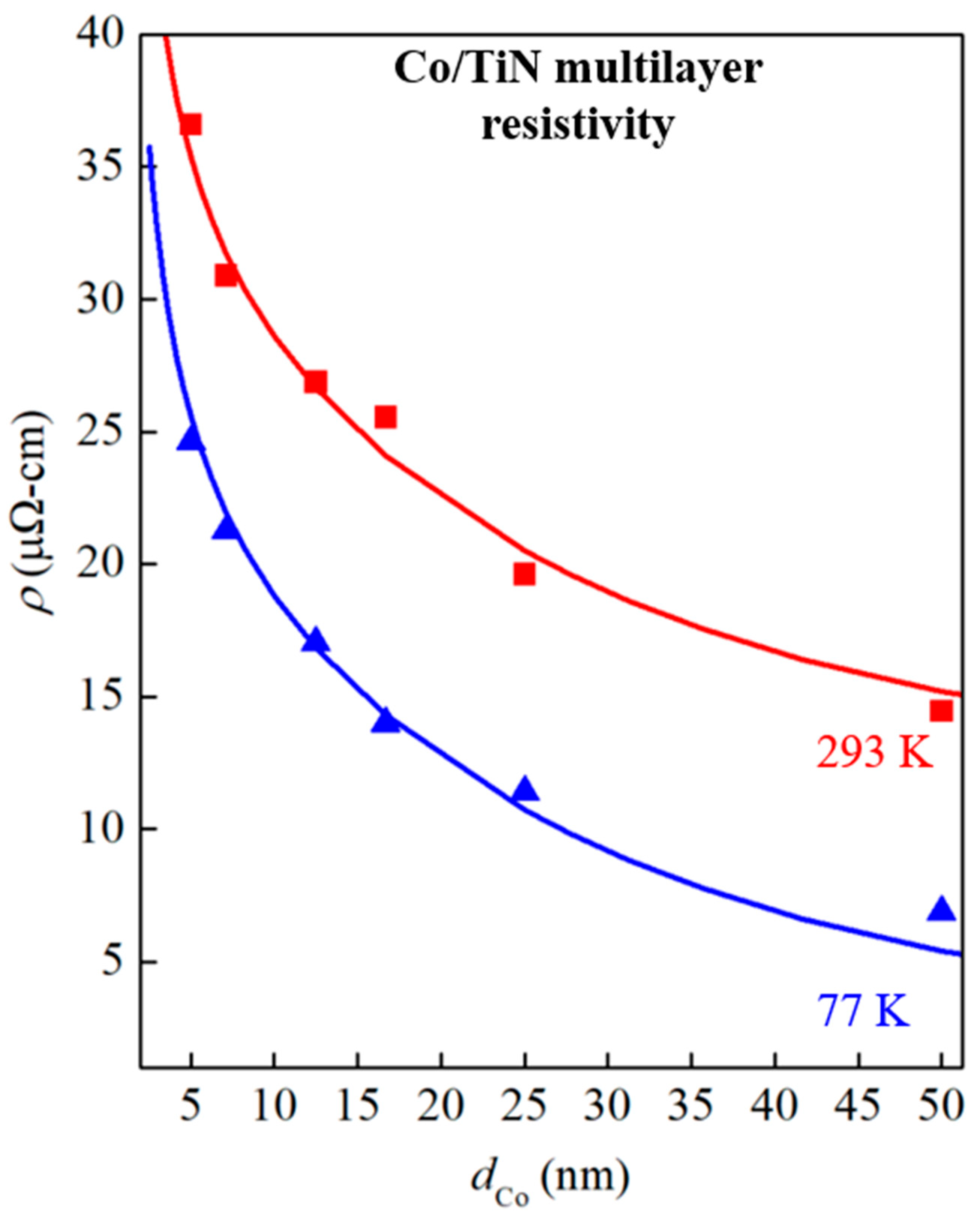
| N | ρ (µΩ-cm) | |||
|---|---|---|---|---|
| 1 | Co | /TiN | /SiO2 | 14.4 |
| 51 nm | 1 nm | |||
| 2 | (Co | /TiN) × 2 | /SiO2 | 19.6 |
| 25.5 nm | 1 nm | |||
| 3 | (Co | /TiN) × 3 | /SiO2 | 25.5 |
| 17.0 nm | 1 nm | |||
| 4 | (Co | /TiN) × 4 | /SiO2 | 26.9 |
| 12.8 nm | 1 nm | |||
| 7 | (Co | /TiN) × 7 | /SiO2 | 30.9 |
| 7.3 nm | 1 nm | |||
| 10 | (Co | /TiN) × 10 | /SiO2 | 36.6 |
| 5.1 nm | 1 nm |
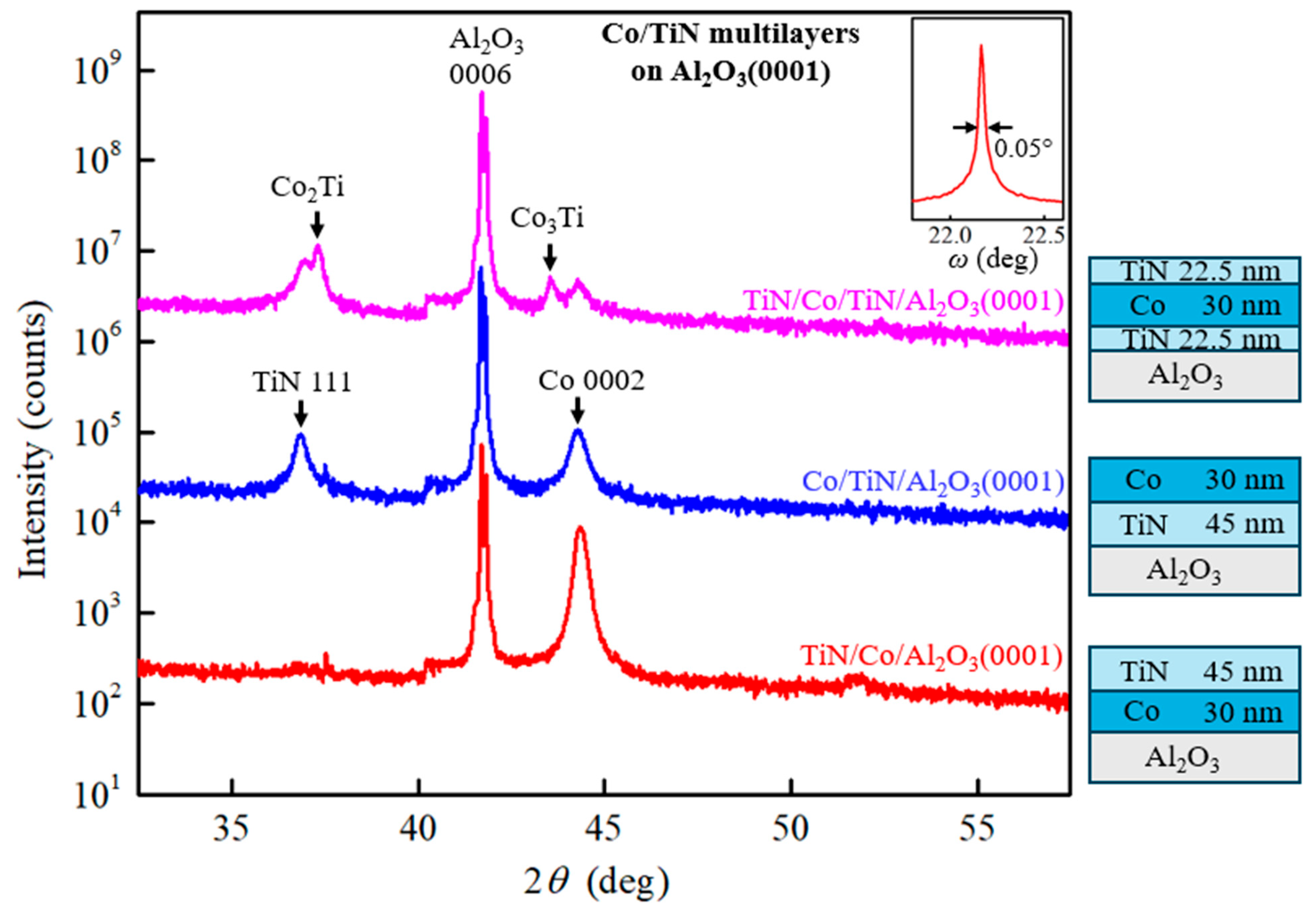
| Rs (Ω/sq) | ||||
|---|---|---|---|---|
| TiN | /Co | /Al2O3(0001) | 4.7 | |
| 45 nm | 30 nm | |||
| Co | /TiN | /Al2O3(0001) | 8.0 | |
| 30 nm | 45 nm | |||
| TiN | /Co | /TiN | /Al2O3(0001) | 18.1 |
| 22.5 nm | 30 nm | 22.5 nm | ||
| TiN | /Al2O3(0001) | 23.8 | ||
| 45 nm | ||||
| Co | /Al2O3(0001) | 3.3 | ||
| 30 nm |
Disclaimer/Publisher’s Note: The statements, opinions and data contained in all publications are solely those of the individual author(s) and contributor(s) and not of MDPI and/or the editor(s). MDPI and/or the editor(s) disclaim responsibility for any injury to people or property resulting from any ideas, methods, instructions or products referred to in the content. |
© 2025 by the authors. Licensee MDPI, Basel, Switzerland. This article is an open access article distributed under the terms and conditions of the Creative Commons Attribution (CC BY) license (https://creativecommons.org/licenses/by/4.0/).
Share and Cite
Shen, P.; Rahman, S.; Syracuse, D.M.; Gall, D. The Effect of Co/TiN Interfaces on Co Interconnect Resistivity. Surfaces 2025, 8, 89. https://doi.org/10.3390/surfaces8040089
Shen P, Rahman S, Syracuse DM, Gall D. The Effect of Co/TiN Interfaces on Co Interconnect Resistivity. Surfaces. 2025; 8(4):89. https://doi.org/10.3390/surfaces8040089
Chicago/Turabian StyleShen, Poyen, Sanzida Rahman, Daniel M. Syracuse, and Daniel Gall. 2025. "The Effect of Co/TiN Interfaces on Co Interconnect Resistivity" Surfaces 8, no. 4: 89. https://doi.org/10.3390/surfaces8040089
APA StyleShen, P., Rahman, S., Syracuse, D. M., & Gall, D. (2025). The Effect of Co/TiN Interfaces on Co Interconnect Resistivity. Surfaces, 8(4), 89. https://doi.org/10.3390/surfaces8040089