
Article

Balancing Hydrophobicity and Water-Vapor Transmission in Sol–Silicate Coatings Modified with Colloidal SiO2 and Silane Additives

1
Department of Material Engineering and Chemistry, Faculty of Civil Engineering, Czech Technical University in Prague, Thákurova 2077/7, 166 29 Prague 6, Czech Republic
2
Department of Physics, Faculty of Civil Engineering, Czech Technical University in Prague, Thákurova 2077/7, 166 29 Prague 6, Czech Republic
3
Institute for Nanomaterials, Advanced Technologies and Innovation, Technical University of Liberec, Bendlova 1409/7, 460 01 Liberec, Czech Republic
*
Author to whom correspondence should be addressed.
Surfaces 2025, 8(4), 88; https://doi.org/10.3390/surfaces8040088 (registering DOI)
Submission received: 20 October 2025 / Revised: 26 November 2025 / Accepted: 27 November 2025 / Published: 29 November 2025

Abstract

This study investigates the optimization of sol–silicate façade coatings modified with colloidal silica and a silane-based hydrophobizing additive to enhance hydrophobicity while maintaining a high water-vapor transmission rate (V). The effects of the binder ratio between potassium water glass (WG) and colloidal silica (CS), the type of colloidal silica (unmodified or epoxy-silanized), and the concentration of the hydrophobizing additive (HA) were systematically evaluated. Water-vapor transmission was determined according to EN ISO 7783, and surface wettability was measured before and after accelerated UV-A aging. Dynamic viscosity was monitored for two years to assess long-term storage stability. The optimized formulation contained 7 wt % potassium water glass, 15 wt % colloidal silica, and 1 wt % hydrophobizing additive. It exhibited stable viscosity over time (≈19,000 mPa·s after six months), high water-vapor transmission (V > 6700 g·m−2·d−1, class V1), and an initial contact angle of 118°, which decreased only moderately after UV-A exposure. Coatings containing epoxy-silanized colloidal silica showed slightly lower transmission but still remained within the high V range suitable for vapor-open façade systems. The results confirm that balanced sol–silicate systems can combine durable hydrophobicity with long-term rheological and functional stability.

1. Introduction

Mineral sol–silicate waterborne coatings are widely applied in anticorrosive, fire-protective, and anti-reflective systems due to their sol–gel processability, strong adhesion to mineral substrates, and long-term chemical stability [1,2,3,4]. Recent reviews have emphasized that polymer-modified sol–gel silica systems exhibit tunable porosity, condensation kinetics, and enhanced hydrophobicity depending on the organic modification used [5].
Advances in sol–gel chemistry have expanded their applicability to both mineral and selected non-mineral materials such as wood and metals [6,7,8,9,10,11,12]. Modified sol–silicate paints are valued for their physicochemical properties—high water-vapor permeability, chemical bonding to the substrate, low VOC content, biocide-free composition, and high pH, which suppresses microbial growth [13,14,15,16]. These features, combined with excellent aging resistance, have led to their increasing use in heritage conservation and façade restoration [17,18].
Within sol–silicate formulations, the ratio between water glass (WG) and colloidal silica (CS) is crucial for maintaining liquid-state stability, controlling pH level, and ensuring UV resistance [19,20]. Changes in surface free energy strongly influence hydrophobicity, aging behavior, dirt pickup, and microbial contamination [21,22,23,24,25].
Silicate coatings use an aqueous colloidal solution of alkali silicates, commonly known as water glass, as the primary binder. It consists of silicate anions ranging from monomers and dimers to higher-order polymers that coexist in equilibrium depending on the SiO2 content and the stabilizing alkali oxide. Upon curing, these reactive species condense to form a continuous three-dimensional Si–O–Si network [19,26,27]. Potassium water glass with a silica modulus above 3.2 and SiO2 concentrations up to 40 wt % represents the most common binder used in silicate-based coating formulations. Variations in viscosity are typically controlled and stabilized through quaternary ammonium compounds such as tetramethylammonium hydroxide or other organic modifiers [19,28,29]. The surface chemistry and polymerization of amorphous silica species were comprehensively described by Iler [30], who outlined the key factors controlling silanol density, polycondensation rates, and colloidal stability in silicate solutions.
De-alkalized water glass, also referred to as colloidal silica, usually exhibits a pH range of 7–10 depending on the type and surface modification of the silica particles [31]. The dispersed SiO2 particles are amorphous, compact, and non-porous, with specific surface area determined by particle size [32,33]. Sodium hydroxide commonly acts as the stabilizing alkali, providing a negative surface charge and maintaining dispersion stability [31]. The Na2O content is much lower than in water glass, typically 0.1–0.6 wt %, depending on the manufacturer. Colloidal silica products are available in a wide range of particle sizes and SiO2 concentrations. Their surfaces can be modified with silane agents such as epoxy- or alkyl-silanes to improve compatibility with silicate binders and enhance film-forming stability [34,35,36].
The application of colloidal silica in silicate coatings relies on its ability to transform into a gel during water evaporation or pH reduction to approximately 5–6 [29,37]. In combination with water glass, colloidal silica lowers the pH of the system while maintaining binding capability, improving weathering resistance, and influencing both water absorption and vapor permeability [10,38]. Through hydrolysis and condensation reactions, Si-OH groups form Si–O–Si linkages that control gelation kinetics and long-term stability of sol–silicate binders [39]. This network formation directly governs the viscosity evolution observed in the present formulations [3,38,40].
Silicate coatings exhibit high water-vapor permeability, enabling unhindered vapor transport between the substrate and the environment [19]. However, their liquid-water absorption is usually high, which necessitates internal or external hydrophobization to improve water resistance [41]. Proper formulation can achieve a low degree of liquid-water absorption while maintaining vapor openness, ensuring balanced moisture transport within façade systems [20,42].
The objective of this study was to examine how the modification of silicate coatings with colloidal silica and a silane-based hydrophobizing additive affects water-vapor permeability and long-term viscosity stability. The main aim was to determine the optimal ratio between potassium water glass (WG), colloidal silica (CS), and the hydrophobizing additive (HA) to achieve a rheologically stable, vapor-open coating after curing. The investigated system combines WG as the main binder with CS to preserve the mineral nature of the coating while improving its rheological stability, while HA enhances resistance to liquid-water absorption. These modifications were designed to balance moisture transport between the substrate, the coating, and the surrounding environment. Surface wettability was also evaluated before and after artificial UV-A aging to assess the retention of hydrophobicity over time.
Previous studies have mainly focused on improving the durability and water repellence of sol–silicate coatings, whereas the relationship between long-term viscosity stability and water-vapor permeability has been insufficiently addressed. This study, therefore, introduces an integrated approach combining rheological and functional evaluation of sol–silicate coatings modified with different types of colloidal silica and silane-based hydrophobizing additives. The results provide new insight into how the WG/CS ratio and surface modification of silica govern processability and long-term hydrophobic performance.

2. Materials and Methods

Based on the literature review and defined objectives, the methodology was developed to examine how binder composition affects the functional and rheological behavior of sol–silicate coatings. The study focused on the water-glass-to-colloidal-silica (WG/CS) ratio and the addition of a silane-based hydrophobizing additive (HA) in relation to viscosity stability, water-vapor permeability, and surface wettability. Model formulations were prepared and tested under controlled laboratory conditions, with particular attention to long-term storage stability and hydrophobicity retention after UV-A exposure.

2.1. Materials

2.1.1. Modified Coating Formulations

The following raw materials were used for the preparation of modified silicate coating formulations: potassium water glass (WG) with a molar ratio higher than 3.2 and a SiO2 content up to 40 wt % (Vodní sklo a.s., Brno, Czech Republic); base colloidal nanosilica 29 wt % SiO2 [CS] (Chemiewerk Bad Köstritz GmbH, Bad Köstritz, Germany); epoxy-silanized and unmodified colloidal silica dispersions under the commercial names Levasil CC-301 (CS 28epoxy), Levasil CC-401 (CS 37epoxy), and Levasil CS-616 (CS 30) (all from Akzo Nobel, Köln, Germany). Their main characteristics are summarized in Table 1.
Additional ingredients included the amino stabilizer Betolin Q40 (Woellner GmbH, Ludwigshafen, Germany), the styrene–acrylic binder Acronal Eco 6258 (BASF SE, Ludwigshafen, Germany), the defoamer Agiten 100 (Münzing Chemie, Abstatt, Germany), the dispersing agent Sapetin D 20 (Woellner GmbH, Ludwigshafen, Germany), the hydrophobizing additive, an aqueous solution of potassium methylsilanetriolate salts Lukofib 39 (Lučební závody a.s. Kolín, Kolín, Czech Republic), the hydroxyethylcellulose (HEC) thickener Tylose H 15 000 YP2 (SE Tylose GmbH, Wiesbaden, Germany), and titanium dioxide Pretiox RGU (Precheza, Přerov, Czech Republic). The filler system consisted of talc KT5/B (Koltex Color a.s., Mnichovo Hradiště, Czech Republic), calcium carbonate Omyacarb 2 (Omya International AG, Oftringen, Switzerland), and muscovite-type mica (Mica N, Aspanger Bergbau und Mineralwerke GmbH, Aspang-Markt, Austria).
All coating series were prepared on the same day under identical laboratory conditions. The reference base formulation contained 15 wt % potassium water glass, 0.5 wt % amino stabilizer, 36.4 wt % fillers (6.6 wt % talc, 3.3 wt % mica, and 26.5 wt % calcium carbonate), 30.2 wt % water, 8 wt % styrene–acrylic dispersion, 7.5 wt % titanium dioxide, 1 wt % hydrophobizing additive, 0.7 wt % dispersing agent, 0.4 wt % thickener, and 0.3 wt % defoamer. This reference formulation (WG 15) was prepared in bulk and subsequently divided into sub-batches to which a concentration series of colloidal silica (CS) was added.
Four types of colloidal silica were used for the modifications. Their detailed specifications are summarized in Table 1.
The formulation process of the sol–silicate coatings is illustrated in Figure 1. The coatings were prepared by combining selected ingredients in varying proportions to achieve a balanced binder composition and improved hydrophobic performance. Detailed formulations and concentration ratios are presented in subsequent sections.

2.1.2. Verification Series

To evaluate the influence of binder chemistry on coating stability, a verification series of model formulations was prepared using different binder types: silicate, silicone resin, and polysiloxane emulsion systems. Each formulation contained a constant amount of colloidal silica as the main modifying component and 8 wt % of styrene–acrylic dispersion (Acronal Eco 6258, BASF SE, Ludwigshafen, Germany) to accelerate drying before the silification process occurred. The formulations were designed to allow a direct comparison between coatings containing various proportions of inorganic and organic binders while maintaining a comparable total solids content.
The compositions were as follows: (i) a silicate-based coating containing 15 wt % potassium water glass and 10 wt % colloidal silica; (ii) a silicone-resin-based coating containing 15 wt % silicone resin (SREP BS 45, Wacker Chemie AG, Burghausen, Germany) and 10 wt % colloidal silica; and (iii) a polysiloxane-modified coating containing 10 wt % colloidal silica, 10 wt % silicone resin (SREP BS 45, Wacker Chemie AG, Burghausen, Germany), and 5 wt % polysiloxane emulsion (Silres BS 1340, Wacker Chemie AG, Burghausen, Germany). All formulations were derived from the same reference recipe containing 15 wt % potassium water glass, but the total binder fraction was increased to 25 wt % by proportionally reducing the water content to maintain a total of 100 wt %.
Preliminary testing confirmed that 500 h of UV-A exposure was sufficient to reveal distinct trends in surface-energy variation. Consequently, wettability measurements for the modified coatings were performed after 500 h of UV-A aging, which was found to reliably indicate surface degradation effects among the compared binder systems.

2.2. Methods

2.2.1. Dynamic Viscosity

Dynamic viscosity measurements were carried out using a Brookfield DV2T rotational viscometer (model DV2T-RV, AMETEK Brookfield, Middleboro, MA, USA) equipped with spindle RV6 at a rotational speed of 30 rpm and a temperature of 22–23 °C. Measurements were performed immediately after mixing, and subsequently after 1 month, 6 months, and 2 years of storage.
Samples were classified as not acceptable when their viscosity fell below the reliable detection range of the instrument or exceeded the practical limit for brush application. Extremely low viscosities (≈1900 mPa·s after 1 month) indicated sedimentation and irreversible phase separation, whereas excessively high viscosities (>32,000 mPa·s) represented complete gelation or polymerization of the entire mixture. Such formulations were discarded and excluded from further evaluation.
Formulations that maintained measurable viscosities using the RV6 spindle at 30 rpm after 6 months were considered storage-stable and subjected to extended testing. The total period of viscosity monitoring in storage was 2 years.

2.2.2. Water-Vapor Transmission Test and Coating Classification

The water-vapor transmission rate of non-self-supporting coating systems was determined according to EN ISO 7783:2019 Paints and varnishes—Determination of water-vapor transmission properties—Dry-cup method [43]. The water-vapor transmission rate V [g·m−2·d−1] was calculated using Equation (1):
V =   V S   ×   V C S   V S V C S
where VCS is the water-vapor transmission rate of the coated substrate, and Vs. is that of the uncoated substrate.
The water-vapor transmission rate of the coated substrate VCS [g·m−2·d−1] was determined using Equation (2):
V c s = 24   ×   p p 0   ×   G c s A c s
where GCS is the hourly water-vapor mass flow through the coated substrate [g·h−1]; ACS is the exposed surface area [m2]; p/p0 is the correction factor to standard atmospheric pressure; and the factor 24 converts the mass flow from grams per hour to grams per day. The same procedure was applied to determine Vs.
For the dry-cup method (3% RH inside the test cup using pre-dried silica gel and 50% RH in the test chamber, ΔpV = 1400 Pa at 23 °C and 101,325 Pa), the equivalent air-layer thickness, sd [m], was calculated according to Equation (3):
s d = 23.7 V
where V is the water-vapor transmission rate [g·m−2·d−1], and sd represents the water-vapor diffusion-equivalent air-layer thickness [m].
The dry-film thickness (DFT) [mm] was calculated from the coating application rate [g·m−2] and the solids content of the coating mixture, following the general procedure described in ISO 3233-1:2019 Paints and Varnishes—Determination of Non-Volatile-Matter Content—Part 1: General Method [44]. The DFT was not measured directly because the polyethylene (PE) frit substrate used (pore size 40 µm, D 90 × 6 mm; KIK Kunststofftechnik GmbH, Königswinter, Germany) is absorbent and porous, which could distort direct thickness measurements. The coatings were applied with a brush in two layers. All reported values represent the mean of six measurements following EN ISO 7783.
The classification of coatings based on water-vapor permeability was performed in accordance with EN 1062-1:2005 Paints and varnishes—Coating materials and coating systems for exterior masonry and concrete—Part 1: Classification [45]. According to this standard, class V1 requires a vapor transmission rate V > 150 [g·m−2·d−1] and an equivalent air-layer thickness Sd ≤ 0.14 m. The modifications were designed to maintain high water-vapor permeability while meeting the requirements of class V1 according to EN 1062-1.

2.2.3. Wettability and Contact Angle Measurement

Wettability characterizes the ability of a liquid to spread over a solid surface and is typically quantified by the contact angle (θ) formed at the liquid–solid interface. Small contact angles (θ < 90°) indicate high wettability, whereas large angles (θ > 90°) correspond to low wettability [46]. The contact angle can be determined either by direct optical methods or by indirect force methods such as the Wilhelmy balance technique. In this study, the sessile drop method was employed, representing the most common optical approach for evaluating surface wettability.
Contact angle measurements were performed using a Theta Lite Optical Tensiometer (Biolin Scientific Oy, Espoo, Finland) equipped with a video camera, LED light source, adjustable sample stage, and automatic dispenser. A droplet of 5 μL of distilled water was deposited onto the sample surface using the automatic dispenser. The droplet was back-illuminated, and its profile was continuously recorded by the camera. The OneAttension software (Biolin Scientific Oy, Espoo, Finland) was used for drop-shape analysis and contact-angle calculation based on the Young–Laplace equation. The baseline between the droplet and the sample surface was manually adjusted for each measurement.
The time-dependent contact angle was monitored for at least 3200 frames (≈240 s) to capture the absorption of the liquid into the sample. Measurements were performed five times at different locations on each sample under controlled laboratory conditions (23 ± 2 °C; constant humidity) to minimize environmental influences. The reported contact angle values represent the average of the five measurements.
The contact angle was measured on the samples both before and after accelerated aging (500 h, UV-A) to determine the change in surface wettability.

2.2.4. Artificial Aging Tests

Accelerated aging was performed using a Q-UV Spray/RP chamber (Q-Lab Corporation, Westlake, OH, USA) equipped with UV-A fluorescent lamps (340 nm) operating at an irradiance of 0.68 W·m−2. The total exposure time was 500 h, following the procedures described in Q-LAB Method LU-0819, LU-0822, and LU-8012 standards [47,48,49].
The coating formulations were applied with a brush in two layers onto cement-fiber boards (CEMVIN, CIDEM Hranice, Hranice, Czech Republic) and allowed to cure for 28 days prior to testing. After completion of the UV-A exposure, all samples were visually inspected for color changes, surface cracking, and gloss reduction. The contact-angle measurements described in Section 2.2.3 were then repeated on the aged surfaces to evaluate the effect of UV-induced degradation on surface wettability (contact angle). The contact angle was measured both on the UV-exposed areas and on the non-exposed (shielded) parts of each specimen, allowing direct comparison of surface wettability before and after aging.

2.2.5. Microscopic Characterization

The surface and cross-sectional morphology of the coatings was examined to assess film continuity, homogeneity, and interfacial adhesion between the coating and the substrate. Surface topography was observed using a Zeiss AxioZoom V16 optical microscope (Carl Zeiss Microscopy GmbH, Jena, Germany) under reflected light to evaluate film uniformity, the presence of surface pores, and the distribution of fillers. Image acquisition and analysis were performed using ZEN Blue 3.5 software (Carl Zeiss GmbH, Oberkochen, Germany).
Cross-sectional microstructural observations were carried out using a Zeiss ULTRA Plus field-emission scanning electron microscope (FE-SEM) (Carl Zeiss GmbH, Oberkochen, Germany) equipped with a Schottky emitter and multiple detectors. The angle-selective backscatter detector (AsB) was used to enhance compositional contrast and to clearly distinguish the coating–substrate interface. Imaging was performed at an accelerating voltage of 5–10 kV, a working distance of approximately 8 mm, and without conductive coating to preserve the original morphology and prevent artefacts in the silicate matrix.
Elemental composition was analyzed using an energy-dispersive X-ray spectroscopy (EDS) system (Oxford Instruments, Abingdon, UK) coupled to the FE-SEM. Elemental mapping and spot analyses were performed to determine the spatial distribution of major elements such as silicon, calcium, and titanium, which serve as indicators for differentiating the silicate coating layer from the mineral substrate. The presence of titanium, originating from TiO2 pigment, improved the visibility of the coating boundaries and allowed for accurate determination of coating thickness. All EDS spectra and maps were processed using AZtecEnergy software (Oxford Instruments, Abingdon, UK; version 3.0).

2.2.6. Data Processing and Evaluation

All numerical data obtained from experimental measurements were processed and evaluated using Microsoft Excel 2016 (Microsoft Corporation, Redmond, WA, USA). The software was used for data organization, calculation of basic statistical parameters, and graphical visualization. Basic statistical parameters, including arithmetic mean and standard deviation, were calculated directly from the raw datasets. Standard deviations are not reported for the equivalent air-layer thickness, as this parameter is calculated directly from the measured water vapour transmission rate values. All graphs and derived values presented in this study were derived from the primary experimental data using built-in Excel tools.
All tests were carried out under controlled laboratory conditions. The obtained data provided the basis for evaluating the interrelation between viscosity stability, water-vapor permeability, and surface hydrophobicity in the following section.

3. Results and Discussion

3.1. Surface and Cross-Sectional Morphology of the Coatings

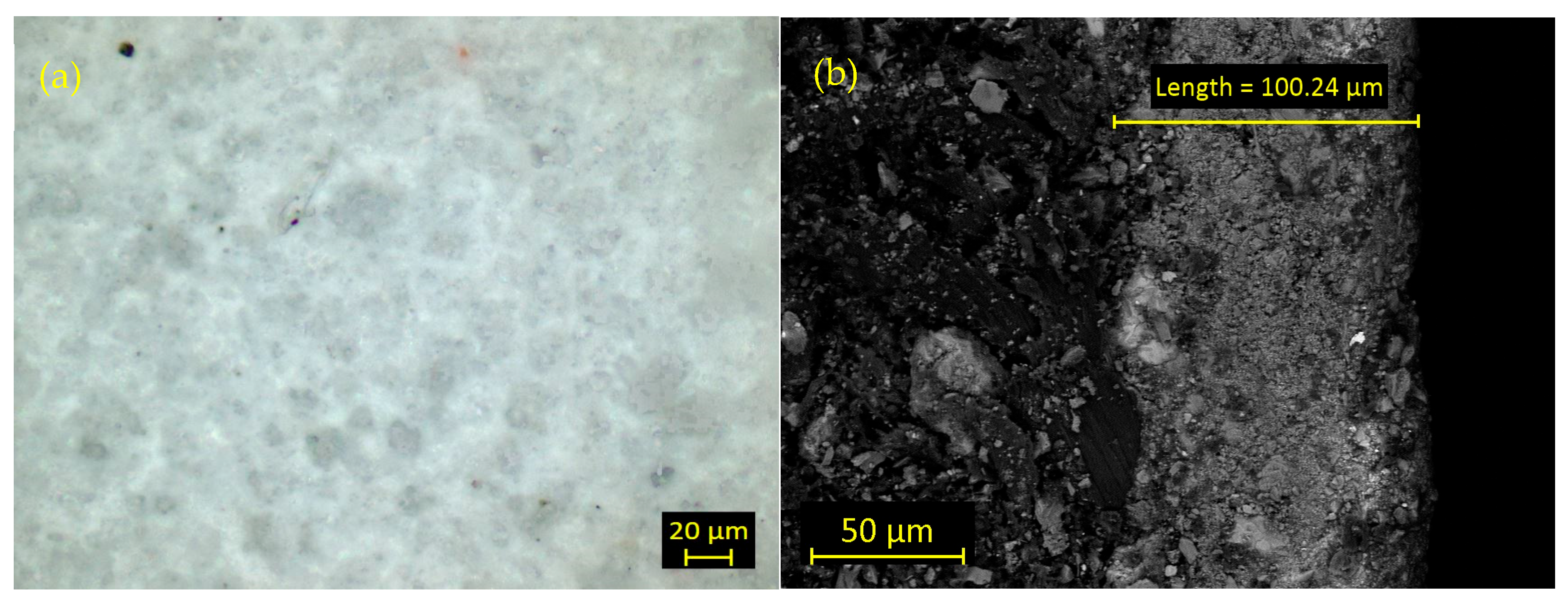
The surface and cross-sectional structure of the applied silicate coatings were examined using optical and scanning electron microscopy. Top-view optical micrograph (Figure 2a) shows a continuous film with locally heterogeneous texture, visible surface pores, and dispersed silica-sand filler. Cross-sectional SEM images (Figure 2b) reveal a compact silicate layer with variable thickness and good interfacial contact with the substrate.
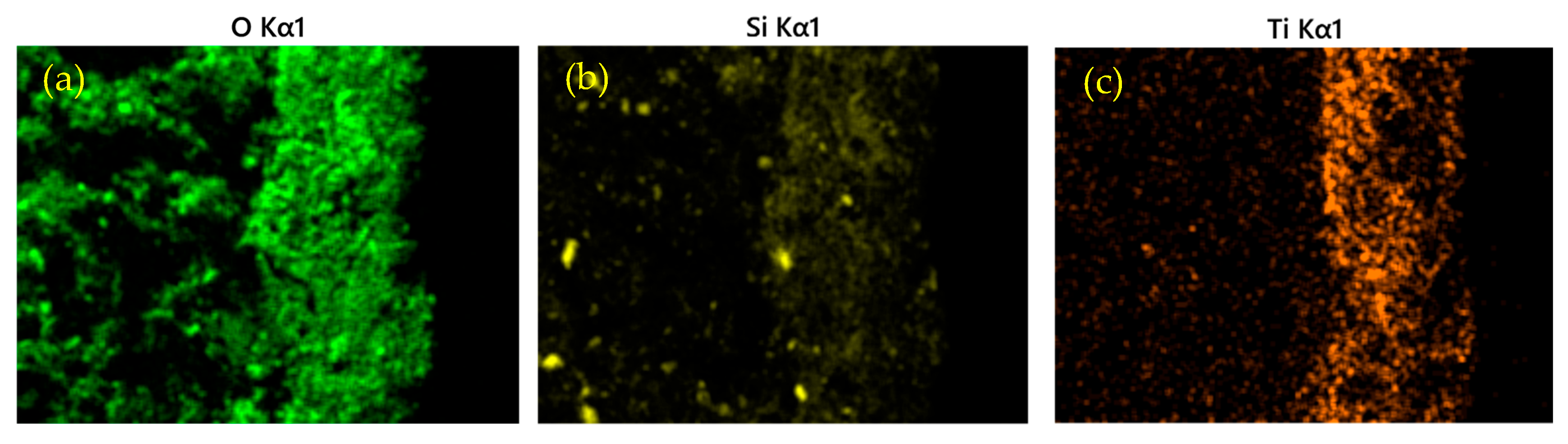
Elemental mapping by EDS (Figure 3a–c), acquired on the same cross-section shown in Figure 2b, shows O, Si, and Ti distributions that distinguish the silicate coating from the mineral substrate and make coating boundaries readily traceable.
Across samples, the measured dry coating thickness obtained from SEM cross-sections was lower than the theoretical value calculated from the formulation. The difference is attributed to evaporation of water and solvent during film formation, which reduces the residual solids volume, partial penetration of silicate species into substrate pores with in-pore reaction and densification that relocate a fraction of solids below the free surface [18,44,50], and the effect of substrate roughness and microtexture, which increase the effective interface area and reduce the apparent planar thickness above surface peaks (ISO 2808:2019) [51].
For classification according to EN 1062-1, the calculated DFT was used. Cross-sectional SEM imaging was performed to verify coating uniformity and to check for possible defects or discontinuities within the film. These microstructural observations confirmed the uniformity and good adhesion of the coating films, providing a structural basis for interpreting the rheological and permeability behavior discussed below.

3.2. Viscosity and Storage Stability of Coating Mixtures

The modification of the silicate coating with colloidal SiO2 affects both water-vapor permeability and viscosity stability. The goal was to identify the composition that remains rheologically stable over time while retaining processability.
The base composition of the modified silicate coating was prepared with 15 wt % potassium water glass (WG 15) and subsequently modified with standard colloidal nanosilica (CS) at concentrations of 0, 2, 5, 7, and 10 wt %. This initial series with 15 wt % WG was not optimal, as the modified coatings were rheologically unstable during storage and the corresponding water-vapor transmission results fluctuated significantly.
According to Burg et al. [52], the sol–gel transition in silicate-based systems depends on the balance between condensation of silanol groups and the formation of a continuous Si–O–Si network, as also reported by Greenwood [19] and Seljelid et al. [53] for similar water–glass–colloidal silica gel systems. A properly developed gel structure, such as that formed in water–glass–colloidal silica systems, consists of interconnected colloidal particles, dimers, and trimers surrounded by a continuous liquid phase. If this balance is disrupted, the system either remains too fluid or polymerizes into an unmixable solid mass.
The mechanisms of hydrolysis and condensation in silicate sols were comprehensively described by Brinker and Scherer [54], who clarified how gelation and network connectivity govern the stability and viscoelastic behavior of sol–gel systems. This theoretical description corresponds well with the observed behavior of the tested formulations, where mixtures with a low WG/CS ratio exhibited reduced viscosity, while those with an excessive CS content tended to partially gel or polymerize irreversibly during storage.
Therefore, a second series was prepared using 10 wt % potassium water glass (WG 10), modified with standard colloidal silica at concentrations of 0, 2, 5, 7, and 10 wt %. The dynamic viscosity values obtained during storage are summarized in Table 2.
The acceptable viscosity range for coatings stored for at least one month was determined to be between 9000 and 32,000 mPa·s, based on previous experiments with silicate-based paints. The viscosity values measured immediately after mixing are only indicative, as silicate coatings gradually thicken and typically stabilize after approximately one month, beyond which only minor changes occur.
The optimal viscosity development was observed for formulations containing unmodified colloidal silica (CS-standard and CS 30), which gradually increased from approximately 2000 mPa·s immediately after mixing to around 19,000 mPa·s after six months of storage. In contrast, formulations with epoxy-silanized colloidal silica (CS 28epoxy and CS 37epoxy) remained at low viscosity and did not develop a stable gel structure within the same period.
Similar findings were reported by Greenwood [19], who investigated sol–silicate coatings modified with colloidal and epoxy–silane-functionalized silica. He observed a comparable decrease in viscosity with increasing silicate modulus, attributed to partial disruption of the colloidal gel network. Despite viscosity differences, vapor transmission remained in the high range for sol–silicate coatings.

3.3. Properties of Coatings with WG as the Predominant Binder

For the series in which WG served as the main binder, a clear decrease in viscosity was confirmed with increasing CS content (i.e., with increasing silicate modulus), which is consistent with the findings of other authors [13]. In the present study, the formulations based on 15 wt % WG exhibited poor rheological stability. The series prepared with 10 wt % WG showed better viscosity stability up to a CS content of 5 wt %, whereas higher CS concentrations again led to instability.
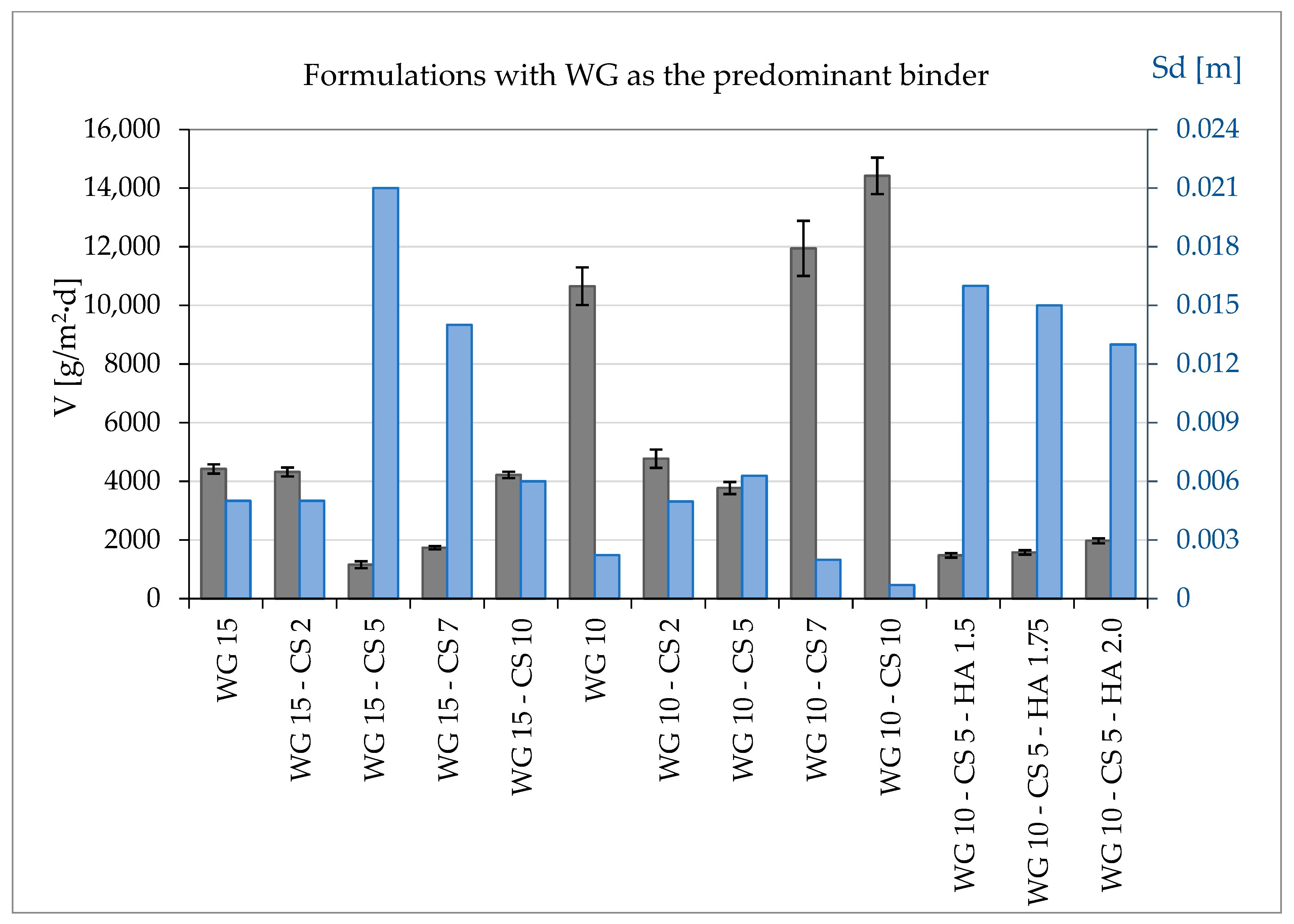
The water-vapor transmission rate decreased with increasing colloidal silica concentration up to 5 wt %, yet the resulting values remained satisfactory (see Table 3 and Figure 4). Therefore, the composition with 10 wt % WG and 5 wt % CS (WG 10–CS 5) was evaluated as the most suitable and was selected for further investigation of the influence of the hydrophobizing additive (HA) at concentrations of 1.5, 1.75, and 2 wt %.
According to Du et al. [55], the curing of waterborne silicate coatings involves the progressive formation of a three-dimensional anionic silicate network composed of monomers, dimers, and oligomeric species. When the concentration of potassium water glass is too high, condensation and crosslinking reactions proceed rapidly, resulting in the formation of a dense gel and a highly viscous mixture. Once the polymerization threshold is exceeded, the system may irreversibly solidify into a non-redispersible mass. This mechanism explains the limited workability and poor storage stability observed for the formulations containing excessive WG content in this study.
The results of vapor permeability measurements showed that all prepared modified coatings exhibited high water-vapor transmission rates. According to EN 1062-1, all coatings met class V1 (Sd ≤ 0.14 m). The measured vapor-transmission values (V > 680 g·m−2·d−1) further confirm their high permeability. However, the formulations with 15 wt % WG and subsequent CS modification were unstable during storage and therefore excluded from further analysis.
The formulations containing 10 wt % WG achieved higher water-vapor transmission than those with 15 wt % WG. At lower CS concentrations (2 and 5 wt %), the vapor transmission decreased compared to the unmodified sample, while at higher CS levels (7 and 10 wt %) the vapor transmission increased. Nevertheless, these highly modified coatings lacked viscosity stability, supporting the conclusion that the composition WG 10–CS 5 represents the most balanced formulation between stability and permeability. This mixture was therefore used for studying the effect of the hydrophobizing additive (HA) in the concentration range of 1.5–2 wt %, as presented in Table 3 and Figure 4.
Figure 4 and Table 3 demonstrate that all modified coatings achieved very high water-vapor permeability. The incorporation of HA led to a further improvement in both water-vapor transmission and storage stability. As the HA concentration increased, the vapor transmission rate slightly increased as well, confirming that the hydrophobizing additive did not block diffusion paths in the silicate matrix but instead improved phase compatibility and prevented premature gel densification.
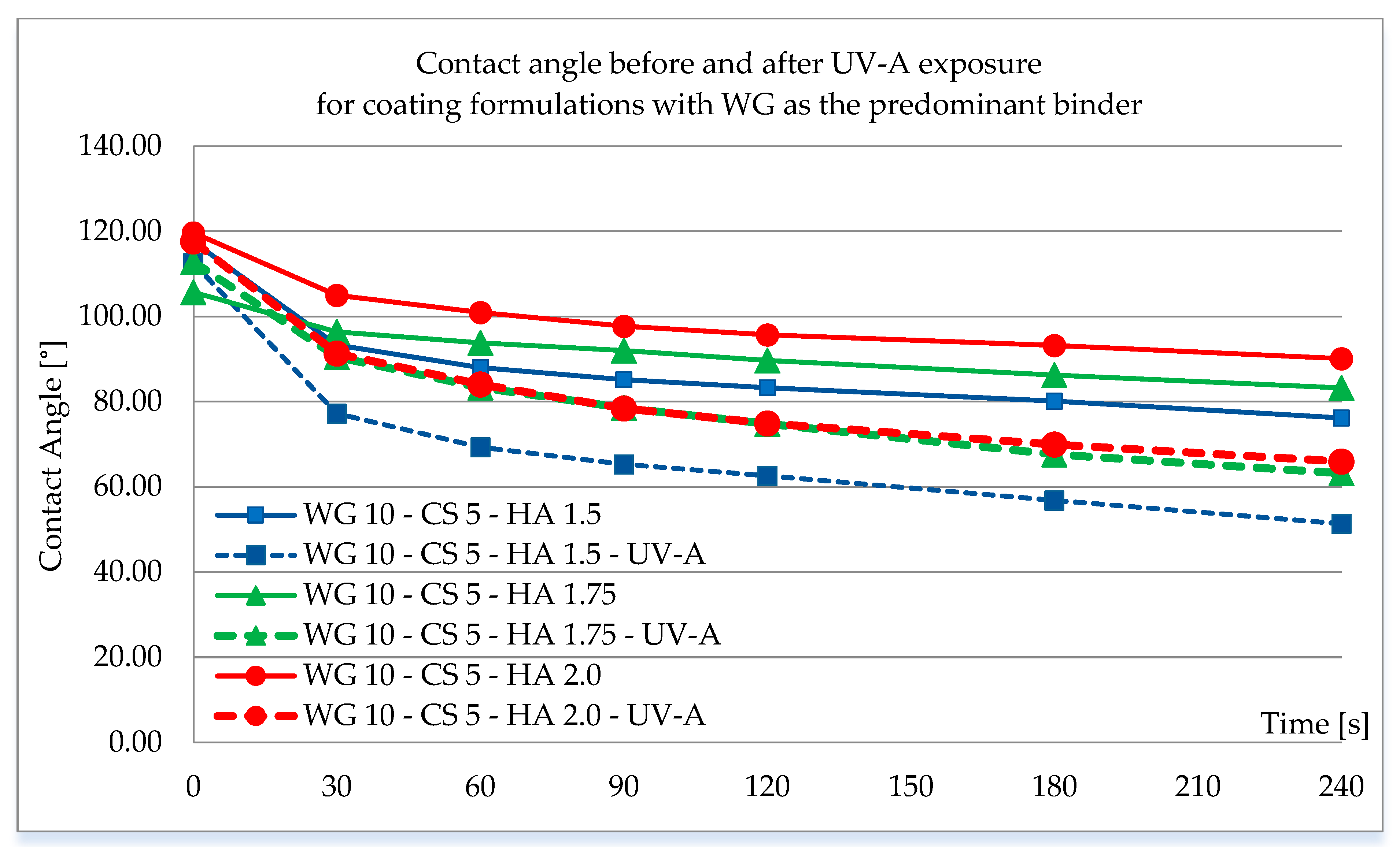
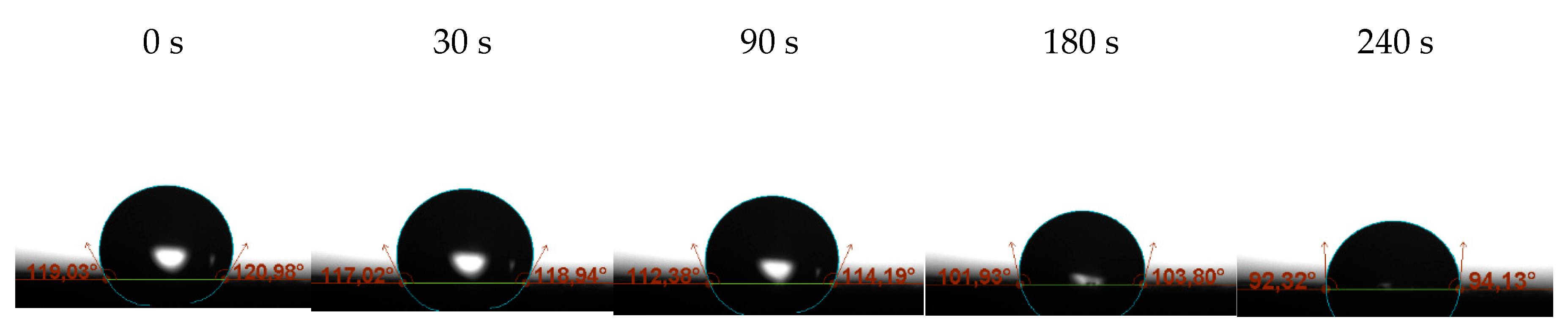
The evolution of the contact angle for the base formulation WG 10 is illustrated in Figure 5, and the effect of HA concentration in the WG 10–CS 5 series is shown in Figure 6, both before and after UV-A exposure.
The time-dependent behavior of the contact angle is primarily attributed to the adsorption and penetration of water molecules on the low-energy silicate surface. As shown in Figure 5, the contact angle of the WG 10 sample was initially higher than 90°, decreasing below 90° within approximately 10 s. This behavior reflects partial surface absorption and hydrophilic domain exposure during wetting.
For the HA-modified series (WG 10–CS 5–HA 1.5–2.0), all samples initially exhibited high contact angles, indicating a pronounced hydrophobic surface character. After UV-A exposure, a notable decrease in the contact angle was observed for all coatings, indicating increased surface wettability due to partial degradation of the surface modification. Nevertheless, the coatings retained moderate hydrophobic character, suggesting that the silane-based HA provided partial resistance against photoinduced oxidation and surface energy increase.
Given that the coatings containing 7–10 wt % CS exhibited exceptionally high vapor transmission (see Figure 4), an additional experimental series was prepared in which colloidal silica served as the predominant binder, while potassium water glass was introduced as the modifying component in varying proportions. This approach allowed for a direct comparison between the WG-dominated and CS-dominated systems, clarifying the effect of binder inversion on vapor transport and hydrophobic behavior. This binder inversion enabled a direct evaluation of how CS-dominated formulations behave with respect to vapor transport, surface hydrophobicity, and long-term viscosity development. The corresponding results are presented in Section 3.4.

3.4. Properties of Coatings with CS as the Predominant Binder

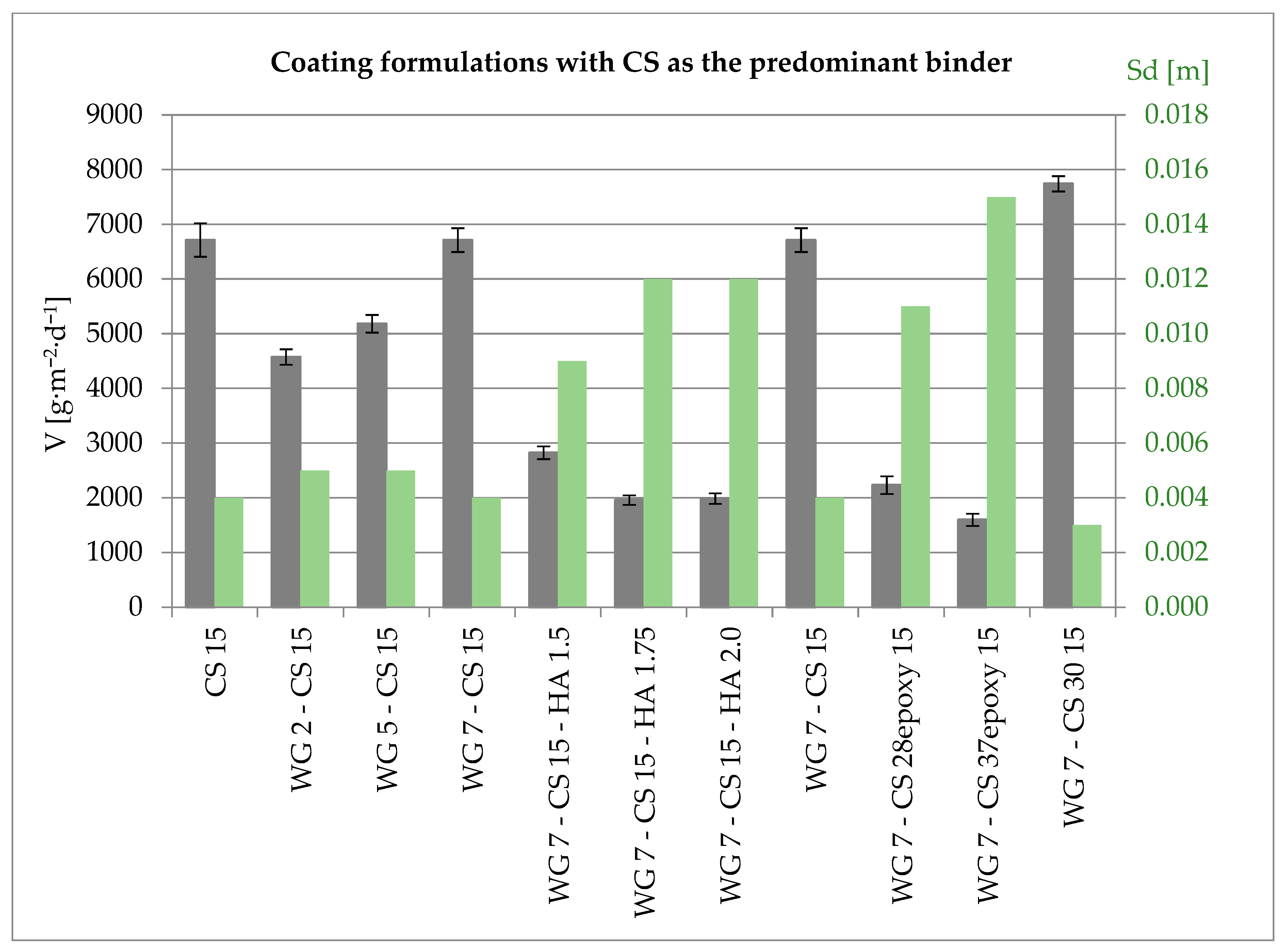
The results of measurements for coatings in which colloidal silica (CS) acted as the predominant binder are summarized in Table 4 and illustrated in Figure 7. These data provide an overview of the functional parameters, including water-vapor transmission rate (V), equivalent air-layer thickness (Sd), and calculated dry-film thickness (DFT).
Silicate coatings containing a constant 15 wt % of standard colloidal nanosilica (CS 15) were modified by the addition of potassium water glass (WG) in increasing amounts of 0, 2, 5, and 7 wt %. The experimental results showed that the coating without any WG addition achieved almost the same vapor transmission as the one containing 7 wt % WG. With increasing WG content (2–7 wt %), the water-vapor transmission rate generally increased, reflecting a gradual enhancement in the open-pore structure and partial rearrangement of the silicate network.
Unmodified colloidal silica (CS-standard and CS 30) exhibited the highest permeability, reaching water-vapor transmission values approximately three times greater than those of epoxy-silanized variants (CS 28epoxy and CS 37epoxy). Although the functionalized types showed lower permeability, their values still remained within a range typically considered high for sol–silicate coatings. Comparable results were reported by Greenwood [19] and Yona et al. [3], who observed that surface-modified sol–silicate systems maintain sufficient vapor transmission for use in vapor-open façade applications despite partial densification of the gel network. This finding confirms that epoxy-modified coatings remain fully applicable for breathable façade protection where both permeability and durability are required.
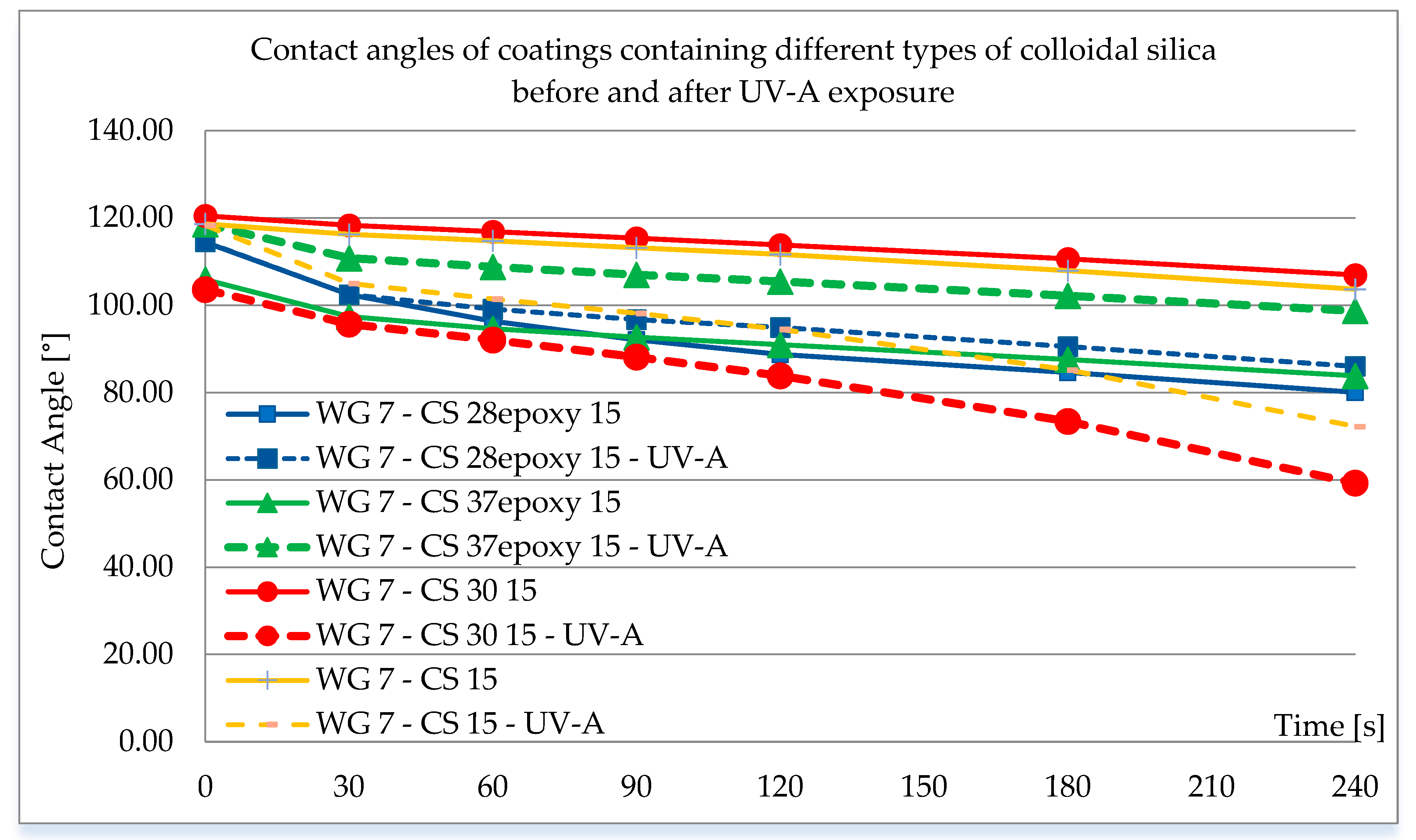
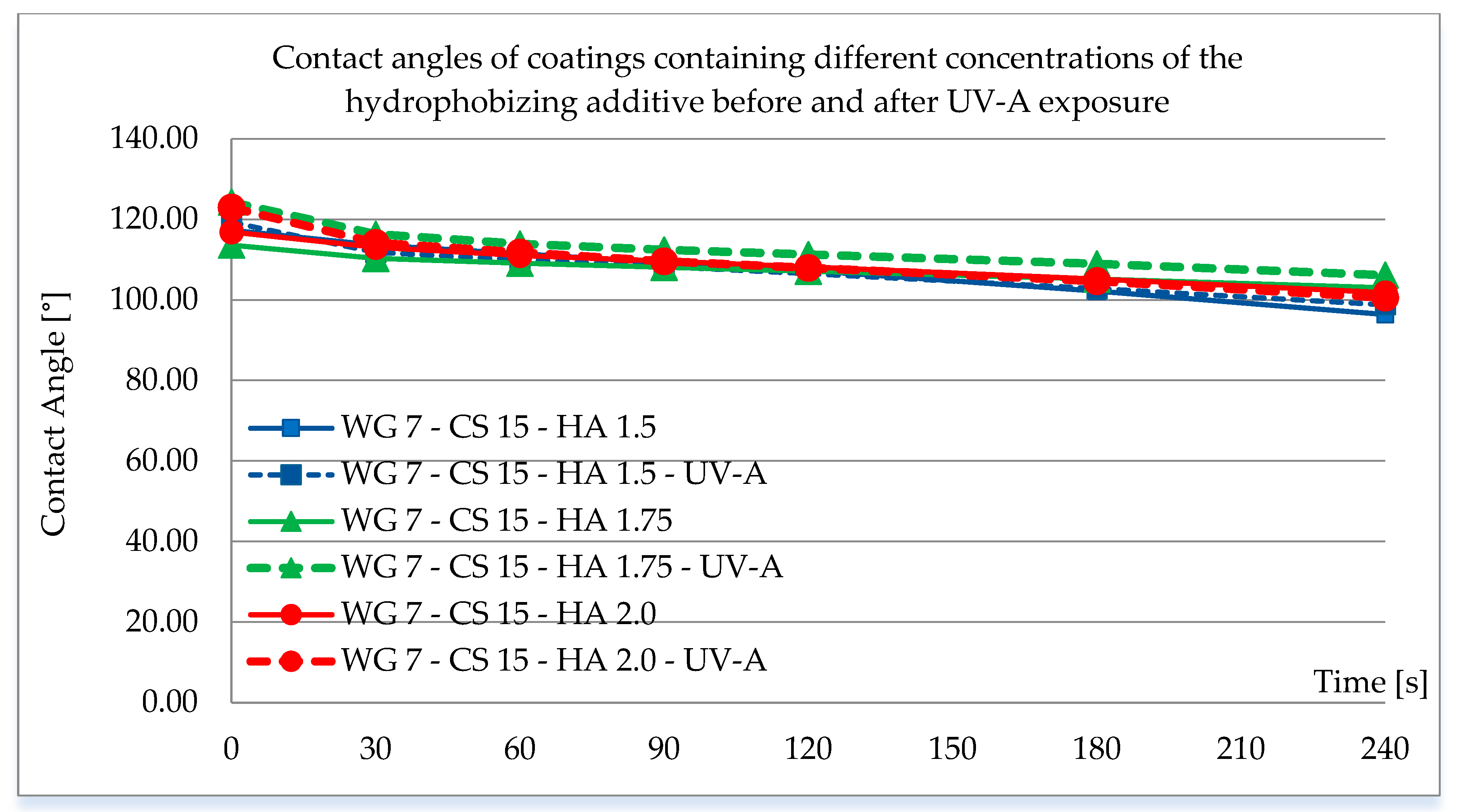
From the standpoint of the overall silicate–binder balance and viscosity stability, the coating containing 15 wt % CS and 7 wt % WG (WG 7–CS 15) was identified as the most stable formulation. This mixture was therefore used for evaluating the influence of the hydrophobizing additive (HA) at concentrations of 1.5, 1.75, and 2 wt %. The results are presented in Figure 8, Figure 9 and Figure 10, illustrating both the contact-angle behavior and the effect of different CS modifications before and after UV-A exposure.
Samples with the WG 7–CS 15 composition remained almost unwetted during the entire 240 s observation period. Only slight spreading of the droplet was observed, indicating a very low surface energy and limited interaction with water molecules. This confirms the strong hydrophobicity of the coating prior to UV-A aging. According to the Zhuravlev model [56], the maximum surface density of hydroxyl (–SiOH) groups on amorphous silica is about 4.6–4.9 OH nm−2, and the balance between dehydroxylation and rehydroxylation processes governs the surface energy and wettability of silicate materials.
The contact angle values demonstrated that the coating containing unmodified colloidal silica CS 30 reached the highest and most stable hydrophobicity among the compared variants. However, a significant decrease in the contact angle occurred after UV-A exposure, suggesting partial photodegradation of the surface silane layer.
The initial contact angle of the coating containing standard colloidal silica reached 118°, confirming strong surface hydrophobicity. After UV-A exposure, the CS 30 sample exhibited a 14% decrease in contact angle, while the epoxy-silanized CS 37epoxy showed a 12% increase, which can be attributed to photoinduced reorganization of silane groups and partial surface crosslinking. These variations illustrate the contrasting mechanisms of aging in unmodified and epoxy-modified colloidal silica systems. Similar improvements in hydrophobicity due to silane-functionalized sol–gel networks were reported by Baskaran et al. [5], who demonstrated that organic modifiers can stabilize silica matrices and reduce surface energy recovery after aging.
In contrast, both coatings modified with epoxy-silanized colloidal silica (CS 28epoxy and CS 37epoxy) exhibited an opposite trend: after UV-A exposure, their contact angles increased slightly, indicating the formation of new low-energy surface groups or partial surface reorganization due to photo-induced silane crosslinking.
The coating containing 15 wt % colloidal silica and 7 wt % WG (WG 7–CS 15) showed a very favorable and well-balanced behavior, combining high and stable contact-angle values before and after UV-A exposure. The minor changes in contact angle after aging confirmed good surface cohesion and resistance to photoinduced alterations. Furthermore, this formulation maintained a high water-vapor transmission rate and excellent long-term storage stability, making it the most suitable modification among all tested systems.
The partial decline in contact angle after UV-A exposure is consistent with previous reports on silane-modified coatings. Zhizhchenko et al. [57] observed that even covalently bound silane layers gradually lose hydrophobicity due to hydrolysis and oxidation during moisture exposure. Similarly, Wu et al. [58] demonstrated that incorporation of hydrophobic silane species into sol–gel silica networks improves contact-angle retention and reduces surface energy recovery after aging. More recently, Ghamarpoor et al. [59] confirmed that silane-modified nanosilica enhances both initial hydrophobicity and UV resistance, although moderate degradation over time remains unavoidable.
In summary, the comparative analysis of both WG- and CS-based systems confirmed that the WG 7–CS 15 formulation provides the most balanced combination of vapor permeability, hydrophobicity, and long-term rheological stability. This formulation can therefore be regarded as an optimized hybrid sol–silicate system suitable for durable, vapor-open façade coatings. Taken together, these results provide a coherent understanding of how the WG/CS binder balance and silane-based modification govern the key functional properties of sol–silicate coatings. The broader relevance of these findings is introduced in the concluding section.

4. Conclusions

All tested sol–silicate coatings achieved a high water-vapor transmission rate and met the class V1 requirements defined in EN 1062-1, as determined according to EN ISO 7783. Although permeability is an essential property, it was not the key criterion for selecting suitable formulations. The decisive factor for long-term performance was the rheological stability of the liquid coating during storage. Such stability is essential for practical on-site application, where consistent viscosity determines workability and coating uniformity across large façade areas.
The balance between potassium water glass and colloidal silica proved to be crucial. The formulation WG 7–CS 15 (7 wt % WG, 15 wt % CS, and 1 wt % HA) provided the most consistent performance, showing stable viscosity over time, high vapor permeability, and improved resistance to UV-A aging when compared with the WG 10–CS 5 series. When the WG/CS ratio was properly adjusted, the formulations remained stable for up to two years.
The type of colloidal silica had a pronounced influence on both transport and surface properties. Coatings containing unmodified CS exhibited the highest vapor transmission and the most persistent hydrophobicity. In contrast, epoxy-silanized CS variants showed lower permeability and slower viscosity development during storage. The silane-based hydrophobizing additive enhanced water repellency while maintaining vapor permeability. Its influence on contact angle was not strictly proportional to concentration, and a moderate post-UV decrease was still observed. Even after artificial aging, the HA-modified coatings retained a distinct hydrophobic character.
The results confirm that balanced sol–silicate formulations composed of colloidal silica, a moderate fraction of WG, and a silane-type hydrophobizing agent can simultaneously ensure long-term rheological stability, high vapor openness, and durable surface hydrophobicity. These findings provide a basis for the rational design of hybrid sol–silicate coatings that maintain good film integrity for durable façade protection. Future research will address long-term outdoor exposure and the chemical evolution of the hybrid network during aging.

Author Contributions

Conceptualization, D.N. and M.B.; methodology, K.K. and D.N.; validation, D.N., P.K., and M.B.; formal analysis, D.N. and I.B.; investigation, D.N., D.K., and P.K.; resources, M.B.; data curation, D.N., K.K., and I.B.; writing—original draft preparation, D.N.; writing—review and editing, M.B., K.K., and P.T.; visualization, D.N. and D.K.; supervision, M.B.; funding acquisition, K.K. All authors have read and agreed to the published version of the manuscript.

Funding

This research was partially funded by the Czech Science Foundation, project No. 24-10395S.

Data Availability Statement

All data supporting the findings of this study are included within the article. Primary experimental datasets are available from the corresponding author upon reasonable request. Additional data are not publicly accessible due to ongoing related investigations.

Acknowledgments

The authors would like to thank Vojtěch Pommer (Department of Materials Engineering and Chemistry, Czech Technical University in Prague) for his valuable technical assistance during the experimental work. The authors also gratefully acknowledge the Institute for Nanomaterials, Advanced Technologies and Innovation, Technical University of Liberec, for providing access to its electron microscopy facilities.

Conflicts of Interest

The authors declare no conflicts of interest.

References

  1. Figueira, R.B. Hybrid sol-gel coatings for corrosion mitigation: A critical review. Polymers 2020, 12, 689. [Google Scholar] [CrossRef] [PubMed]
  2. Le, C.M.; Le, T.H. The Study’s Chemical Interaction of the Sodium Silicate Solution with Extender Pigments to Investigate High Heat Resistance Silicate Coating. J. Anal. Methods Chem. 2021, 2021, 5510193. [Google Scholar] [CrossRef]
  3. Yona, A.M.C.; Žigon, J.; Kamlo, A.N.; Pavlic, M.; Dahle, S.; Petric, M. Silicate and Sol-Silicate Inorganic—Organic Hybrid Dispersion Coatings for Wood. Materials 2021, 14, 3559. [Google Scholar] [CrossRef]
  4. Kumar, D.S.A.; Viswanath, B.A.; Raghul, P. A Review of Preparation and Characterization of Sol-Gel coating forCorrosion Mitigation. Int. J. Eng. Technol. Manag. Sci. 2024, 8, 11–24. [Google Scholar] [CrossRef]
  5. Baskaran, K.; Ali, M.; Gingrich, K.; Porter, D.L.; Chong, S.; Riley, B.J.; Peak, C.W.; Naleway, S.E.; Zharov, I.; Carlson, K. Sol-gel derived silica: A review of polymer-tailored properties for energy and environmental applications. Microporous Mesoporous Mater. 2022, 336, 111874. [Google Scholar] [CrossRef]
  6. Huang, L.; Yan, H.; Yan, L.; Liu, T.; Zhang, Z.; Yang, K.; Li, C.; Qian, Y. Improvement of the environmental stability of sol-gel silica anti-reflection coatings. J. Sol-Gel Sci. Technol. 2022, 101, 630–636. [Google Scholar] [CrossRef]
  7. Durán, A.; Castro, Y.; Conde, A.; de Damborenea, J.J. Preface to the First Edition; Springer International Publishing: Cham, Switzerland, 2018; ISBN 9783319321011. [Google Scholar]
  8. Purcar, V.; Rădiţoiu, V.; Raduly, F.M.; Rădiţoiu, A.; Căprărescu, S.; Frone, A.N.; Şomoghi, R.; Anastasescu, M.; Stroescu, H.; Nicolae, C.A. Influence of Perfluorooctanoic Acid on Structural, Morphological, and Optical Properties of Hybrid Silica Coatings on Glass Substrates. Appl. Sci. 2023, 13, 1669. [Google Scholar] [CrossRef]
  9. Macera, L.; Pullini, D.; Boschetto, A.; Bottini, L.; Mingazzini, C.; Falleti, G.L. Sol–Gel Silica Coatings for Corrosion Protection of Aluminum Parts Manufactured by Selective Laser Melting (SLM) Technology. Coatings 2023, 13, 1081. [Google Scholar] [CrossRef]
  10. Su, Y.; Wang, X.; Zhao, H.; Zhang, C.; Yuan, F.; Guo, J.; Feng, C.; Shen, J. UV resistance of sol-gel hydrophobic silica antireflective coatings. J. Sol-Gel Sci. Technol. 2023, 106, 381–392. [Google Scholar] [CrossRef]
  11. del Olmo, R.; Tiringer, U.; Milošev, I.; Visser, P.; Arrabal, R.; Matykina, E.; Mol, J.M.C. Hybrid sol-gel coatings applied on anodized AA2024-T3 for active corrosion protection. Surf. Coat. Technol. 2021, 419, 127251. [Google Scholar] [CrossRef]
  12. Wang, Y.; Ran, Y.; Shao, Y.; Zhu, J.; Du, C.; Yang, F.; Bao, Q.; Shan, Y.; Zhang, W. A Novel Intumescent MCA-Modified Sodium Silicate/Acrylic Flame-Retardant Coating to Improve the Flame Retardancy of Wood. Molecules 2024, 29, 3021. [Google Scholar] [CrossRef]
  13. Loganina, V.I.; Kislitsyna, S.N.; Mazhitov, Y.B. Development of sol-silicate composition for decoration of building walls. Case Stud. Constr. Mater. 2018, 9, e00173. [Google Scholar] [CrossRef]
  14. Loganina, V.I.; Frolov, M.V.; Mazhitov, E.B. Influence of protective and decorative coatings based on sol-silicate paints on the moisture regime of external walls of buildings. Constr. Geotech. 2021, 12, 103–114. [Google Scholar] [CrossRef]
  15. Alonso-Villar, E.M.; Rivas, T.; Pozo-Antonio, J.S. Sol-silicate versus organic paints: Durability after outdoor and ultraviolet radiation exposures. Prog. Org. Coat. 2022, 168, 106843. [Google Scholar] [CrossRef]
  16. Bös, M.; Gabler, L.; Leopold, W.M.; Steudel, M.; Weigel, M.; Kraushaar, K. Molecular Design and Nanoarchitectonics of Inorganic—Organic Hybrid Sol—Gel Systems for Antifouling Coatings. Gels 2024, 10, 768. [Google Scholar] [CrossRef] [PubMed]
  17. Melo, R.H.R.Q.; Falcão, J.R.; Bersch, J.D.; Baptista, D.T.; Masuero, A.B. Performance and Durability of Paints for the Conservation of Historic Façades. Buildings 2024, 14, 1016. [Google Scholar] [CrossRef]
  18. Li, J.; Song, J.; Zhang, S.; Liu, W.; Cui, Z.; Li, W. The Effects of Various Silicate Coatings on the Durability of Concrete: Mechanisms and Implications. Buildings 2024, 14, 381. [Google Scholar] [CrossRef]
  19. Greenwood, P.; Gevert, B. Aqueous silane modified silica sols: Theory and preparation. Pigment Resin Technol. 2011, 40, 275–284. [Google Scholar] [CrossRef]
  20. Loganina, V.I.; Mazhitov, Y.B. Estimation of porosity of coatings based on sol of silicate paint. IOP Conf. Ser. Mater. Sci. Eng. 2020, 962, 022001. [Google Scholar] [CrossRef]
  21. Pal, S.; Contaldi, V.; Licciulli, A.; Marzo, F. Self-cleaning mineral paint for application in architectural heritage. Coatings 2016, 6, 48. [Google Scholar] [CrossRef]
  22. Pandey, P.; Kiran, U. V Degradation of Paints and Its Microbial Effect on Health and Environment. J. Crit. Rev. 2020, 7, 4879–4884. [Google Scholar]
  23. Ravikumar, H.R.; Rao, S.S.; Karigar, C.S. Biodegradation of paints: A current status. Indian J. Sci. Technol. 2012, 5, 1977–1987. [Google Scholar] [CrossRef]
  24. Swift, T. Stabilisation of acrylic latexes containing silica nanoparticles for dirt repellent coating applications. Polymer 2023, 271, 125830. [Google Scholar] [CrossRef]
  25. Brown, S.C.; Diebold, M.; Kraiter, D.; Velez, C.; Jernakoff, P. Towards a Comprehensive Understanding of Dirt Pickup Resistance. J. Coat. Technol. Res. 2020, 17, 14–27. [Google Scholar]
  26. Belton, D.J.; Deschaume, O.; Perry, C.C. An overview of the fundamentals of the chemistry of silica with relevance to biosilicification and technological advances. FEBS J. 2012, 279, 1710–1720. [Google Scholar] [CrossRef]
  27. Danks, A.E.; Hall, S.R.; Schnepp, Z. The evolution of “sol-gel” chemistry as a technique for materials synthesis. Mater. Horiz. 2016, 3, 91–112. [Google Scholar] [CrossRef]
  28. Antoš, P.; Burian, A. Vodní Sklo; Silchem: Ústí nad Labem, Czech Republic, 2002; ISBN 802389515X. [Google Scholar]
  29. Greenwood, P. Modified Colloidal Silica for Enhancement of Dirt Pick-Up Modified Colloidal Silica for Enhancement of Dirt Pick-Up Resistance and Open Time in Decorative Paints. In Proceedings of the SLF Congress, Prague, Czech Republic, 27–28 February 2015. [Google Scholar]
  30. Iler, R.K. The Chemistry of Silica: Solubility, Polymerization, Colloid and Surface Properties, and Biochemistry; Wiley: New York, NY, USA, 1979; ISBN 978-0-471-02404-0. [Google Scholar]
  31. Zárate-Reyes, J.M.; Flores-Romero, E.; Cheang-Wong, J.C. Systematic preparation of high-quality colloidal silica particles by sol–gel synthesis using reagents at low temperature. Int. J. Appl. Glas. Sci. 2022, 13, 54–62. [Google Scholar] [CrossRef]
  32. Singh, L.P.; Bhattacharyya, S.K.; Kumar, R.; Mishra, G.; Sharma, U.; Singh, G.; Ahalawat, S. Sol-Gel processing of silica nanoparticles and their applications. Adv. Colloid Interface Sci. 2014, 214, 17–37. [Google Scholar] [CrossRef]
  33. Frankel, G.S.; Vienna, J.D.; Lian, J.; Scully, J.R.; Gin, S.; Ryan, J.V.; Wang, J.; Kim, S.H.; Windl, W.; Du, J. A comparative review of the aqueous corrosion of glasses, crystalline ceramics, and metals. npj Mater. Degrad. 2018, 2, 15. [Google Scholar] [CrossRef]
  34. Loganina, V.I.; Kislitsyna, S.N.; Mazhitov, E.B. Long-Term Strength of Coatings Based on Sol-Silicate Paint. Vestn. MGSU 2018, 13, 877–884. [Google Scholar] [CrossRef]
  35. Afsharimani, N.; Durán, A.; Galusek, D.; Castro, Y. Hybrid sol–gel silica coatings containing graphene nanosheets for improving the corrosion protection of AA2024-T3. Nanomaterials 2020, 10, 1050. [Google Scholar] [CrossRef] [PubMed]
  36. Azani, M.R.; Hassanpour, A. Nanotechnology in the Fabrication of Advanced Paints and Coatings: Dispersion and Stabilization Mechanisms for Enhanced Performance. ChemistrySelect 2024, 9, e202400844. [Google Scholar] [CrossRef]
  37. Lima, M.; Avó, J.; Berberan-Santos, M.N.M.S.; Crucho, C.I.C. PH-Responsive Silica Coatings: A Generic Approach for Smart Protection of Colloidal Nanoparticles. ACS Appl. Nano Mater. 2022, 5, 9460–9468. [Google Scholar] [CrossRef]
  38. Heiman-Burstein, D.; Dotan, A.; Dodiuk, H.; Kenig, S. Hybrid sol-gel superhydrophobic coatings based on alkyl silane-modified nanosilica. Polymers 2021, 13, 539. [Google Scholar] [CrossRef]
  39. Lebedeva, E.Y.; Kazmina, O.V. Nature and quantity of silicate filler influence on silicate paint properties with lowered content of volatile compounds. ChemChemTech 2018, 61, 70–76. [Google Scholar] [CrossRef]
  40. Essen, B.; Oggermueller, H. Neuburg Siliceous Earth in Silicate Emulsion Paints; Hoffmann Mineral: Neuburg, Germany, 2021. [Google Scholar] [CrossRef]
  41. Weldon, D.G. Failure Analysis of Paints and Coatings: Revised Edition; Wiley: Hoboken, NJ, USA, 2009; pp. 1–362. [Google Scholar] [CrossRef]
  42. Hall, C.; Lo, G.J.; Hamilton, A. Water vapour permeability of inorganic construction materials. Mater. Struct. Constr. 2024, 57, 39. [Google Scholar] [CrossRef]
  43. EN ISO 7783:2019; Paints and Varnishes—Determination of Water-Vapour Transmission Properties—Cup Method. CEN: Brussels, Belgium; ISO: Geneva, Swizterland, 2019.
  44. ISO 3233-1:2019; Paints and Varnishes—Determination of Non-Volatile-Matter Content—Part 1: General Method. International Organization for Standardization: Geneva, Swizterland, 2019.
  45. EN 1062-1:2005; Paints and Varnishes—Coating Materials and Coating Systems for Exterior Masonry and Concrete—Part 1: Classification. CEN: Brussels, Belgium, 2005.
  46. Young, T., III. An essay on the cohesion of fluids. Philos. Trans. R. Soc. Lond. 1805, 95, 65–87. [Google Scholar] [CrossRef]
  47. Q-Lab Corporation. Q-UV Accelerated Weathering Tester—Operating Procedure for UVA-340 Lamps; Q-Lab Corporation: Westlake, OH, USA, 2023. [Google Scholar]
  48. Q-Lab Corporation. Q-UV Accelerated Weathering Tester—Spray Function Procedure; Q-Lab Corporation: Westlake, OH, USA, 2023. [Google Scholar]
  49. Q-Lab Corporation. Q-UV Accelerated Weathering Tester—Calibration and Verification Guidelines; Q-Lab Corporation: Westlake, OH, USA, 2023. [Google Scholar]
  50. Zang, J.; Pan, C.; Li, X.; Chen, K.; Chen, D. Research on Salt Corrosion Resistance of Lithium-Based Protective Coating on Mortar Substrate. Materials 2023, 16, 3463. [Google Scholar] [CrossRef]
  51. ISO 2808:2019; Paints and Varnishes—Determination of Film Thickness. International Organization for Standardization: Geneva, Swizterland, 2019.
  52. Burg, A.; Yadav, K.K.; Meyerstein, D.; Kornweitz, H.; Shamir, D.; Albo, Y. Effect of Sol–Gel Silica Matrices on the Chemical Properties of Adsorbed/Entrapped Compounds. Gels 2024, 10, 441. [Google Scholar] [CrossRef]
  53. Seljelid, K.K.; Neto, O.T.; Akanno, A.N.; Ceccato, B.T.; Ravindranathan, R.P.; Azmi, N.; Cavalcanti, L.P.; Fjelde, I.; Knudsen, K.D.; Fossum, J.O. Growth kinetics and structure of a colloidal silica-based network: In situ RheoSAXS investigations. Eur. Phys. J. Spec. Top. 2024, 233, 2757–2773. [Google Scholar] [CrossRef]
  54. Brinker, C.J.; Scherer, G.W. Sol–Gel Science: The Physics and Chemistry of Sol–Gel Processing; Academic Press: San Diego, CA, USA, 1990; ISBN 978-0-12-134970-7. [Google Scholar]
  55. Du, T.; Li, H.; Sant, G.; Bauchy, M. New insights into the sol-gel condensation of silica by reactive molecular dynamics simulations. J. Chem. Phys. 2018, 148, 234504. [Google Scholar] [CrossRef] [PubMed]
  56. Zhuravlev, L.T. The Surface Chemistry of Amorphous Silica. Zhuravlev Model. Colloids Surf. A Physicochem. Eng. Asp. 2000, 173, 1–38. [Google Scholar] [CrossRef]
  57. Zhizhchenko, A.Y.; Shabalina, A.V.; Aljulaih, A.A.; Gurbatov, S.O.; Kuchmizhak, A.A.; Iwamori, S.; Kulinich, S.A. Stability of Octadecyltrimethoxysilane-Based Coatings on Aluminum Alloy Surface. Materials 2022, 15, 1804. [Google Scholar] [CrossRef]
  58. Wu, L.Y.L.; Soutar, A.M.; Zeng, X.T. Increasing hydrophobicity of sol-gel hard coatings by chemical and morphological modifications. Surf. Coat. Technol. 2005, 198, 420–424. [Google Scholar] [CrossRef]
  59. Ghamarpoor, R.; Jamshidi, M.; Joshaghani, M. Hydrophobic silanes-modified nano-SiO2; reinforced polyurethane nanocoatings with superior scratch resistance, gloss retention, and metal adhesion. Sci. Rep. 2025, 15, 31555. [Google Scholar] [CrossRef]
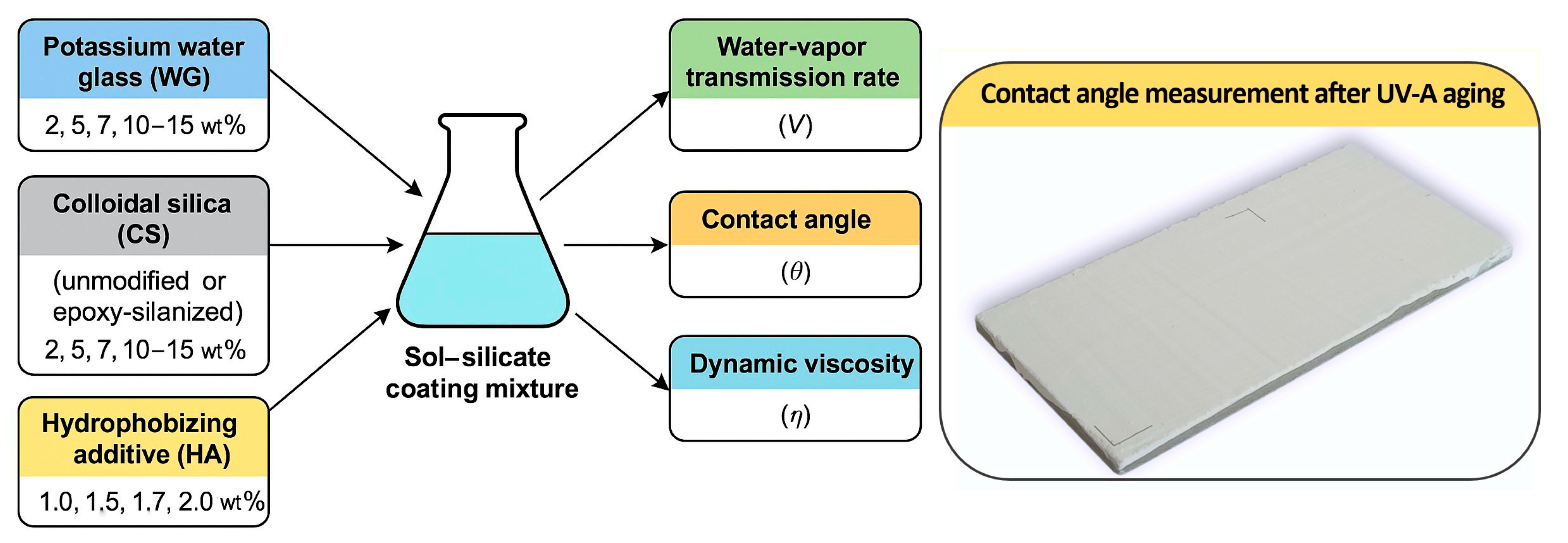
Figure 1. Schematic representation of the mixing procedure for sol–silicate coating formulations. The diagram illustrates the stepwise mixing sequence and the origin of each formulation series used in the subsequent experimental testing. On the right side of the scheme, a sample prepared for UV-A exposure tests is shown.
Surfaces 08 00088 g001
Figure 2. Optical micrograph illustrating film continuity, surface pores, and dispersed silica-sand filler at 500× magnification (a). SEM cross-section showing coating thickness variation and interface integrity at 500× magnification (b).
Surfaces 08 00088 g002
Figure 3. EDS elemental maps displaying O, Si, and Ti within the coating-substrate system, with a clear distinction between SiO2- and TiO2-rich regions originating from the coating (ac).
Surfaces 08 00088 g003
Figure 4. Water-vapor transmission rate (V) and equivalent air-layer thickness (Sd) of coating formulations with WG as the predominant binder. Dark columns represent mean V values (n = 6), and vertical bars indicate standard deviation. Blue columns correspond to calculated Sd values.
Surfaces 08 00088 g004
Figure 5. Time-dependent change of contact angles formed by distilled water droplets on sample WG 10 before UV-A exposure. Representative images were extracted from recorded videos.
Surfaces 08 00088 g005
Figure 6. Comparison of WG 10–CS 5 formulations with different concentrations of the hydrophobizing additive.
Surfaces 08 00088 g006
Figure 7. Water-vapor transmission rate (V) and equivalent air-layer thickness (Sd) of coating formulations with CS as the predominant binder. Dark columns represent mean V values (n = 6), and vertical bars indicate standard deviation. Green columns correspond to calculated Sd values.
Surfaces 08 00088 g007
Figure 8. Time-dependent change of contact angles formed by distilled-water droplets on the WG 7–CS 15–HA 1.5 coating before UV-A exposure. Representative images were extracted from the recorded videos.
Surfaces 08 00088 g008
Figure 9. Time-dependent evolution of the contact angle for coatings containing different types of colloidal silica before and after UV-A exposure.
Surfaces 08 00088 g009
Figure 10. Contact angles of samples with various concentrations of the hydrophobizing additive (HA) before and after UV-A exposure.
Surfaces 08 00088 g010
Table 1. Specification of colloidal nanosilica types.
IDCAS No. *Surface
Modification
SiO2
Content [wt %]
Particle Size [nm]Neutralization AgentpHDensity 20 °C [g·cm−3]Viscosity 25 °C [mPa·s]
CS 7631-86-9-29.1150.28 wt % Na2O8.5–101.25
CS 28epoxy1239225-81-0Epoxysilane28.072.5 wt % ethanol81.25
CS 37epoxy1239225-81-0Epoxysilane37.0122.5 wt % ethanol81.268
CS 307631-86-9-30.050.15 wt % ammonia9.51.25
* Notes: CAS = Chemical Abstracts Service registry number; CS = colloidal silica. All Levasil colloidal silica dispersions were supplied as aqueous products by Akzo Nobel (Köln, Germany). Density and viscosity data were provided by the manufacturers.
Table 2. Dynamic viscosity (RV6, 30 rpm) of WG/CS silicate coating mixtures [mPa·s].
η [mPa·s]
- WG as the Main Binder
Storage Periodη [mPa·s]
- CS as the Main Binder
Storage Period
1 d1 mo6 mo2 yr1 d1 mo6 mo2 yr
WG 1514608600NA *CS 15126012331300NA
WG 15-CS 22100963026,93328,100WG 2-CS 15103010,200NA
WG 15-CS 51280NMWG 5-CS 15113012,500NA
WG 15-CS 71933NMWG 7-CS 15161010,76628,00030,800
WG 15-CS 101680NMWG 10-CS 151400NA
WG 103233650019,15020,320WG 7-CS 15-HA 1.55633866621,70027,900
WG 10-CS 22900593113,90018,700WG 7-CS 15-HA 1.753033706021,30026,500
WG 10-CS 5253310,93315,10020,900WG 7-CS 15-HA 2.04266896011,03017,700
WG 10-CS 723009066NAWG 7-CS 151900978019,83319,800
WG 10-CS 10196812,466NAWG 7-CS 28epoxy 15191019201920NA
WG 10-CS 5-HA 1.563008060NAWG 7-CS 37epoxy 15153022704200NA
WG 10-CS 5-HA 1.756200783330,38032,000WG 7-CS 30 15180018,60023,83324,500
WG 10-CS 5-HA 2.04910776029,65031,600
* “NA” (not acceptable) indicates that viscosity values measured after one month were below 9000 mPa·s and showed a continuous decrease over time, thus classified as unsatisfactory. Samples with viscosities above 32,000 mPa·s or those that could not be homogenized and were polymerized throughout the entire volume were also considered unacceptable.
Table 3. Water-vapor transmission rate (V) and related application and thickness parameters of coating formulations with WG as the predominant binder.
WG 15WG 15-CS 2WG 15-CS 5WG 15-CS 7WG 15-CS 10WG 10WG 10-CS 2WG 10-CS 5WG 10-CS 7WG 10-CS 10WG 10-CS 5-HA 1.5WG 10-CS 5-HA 1.75WG 10-CS 5-HA 2.0
Application rate [kg·m−2]0.260.250.370.380.280.240.390.340.350.380.320.390.4
Dry coating mass [g]0.700.680.981.020.720.631.080.940.951.040.921.071.07
V [g·m−2·d−1]4424431911561731421810,6554771377411,94514,416147815741972
Sd [m]0.0050.0050.0210.0140.0060.0020.0050.0060.0020.0010.0160.0150.013
Calculated DFT [mm]0.1370.1330.2010.2080.1550.1220.2020.1830.1890.2100.1720.2050.210
Notes: WG = water glass (solids content, %), CS = colloidal silica (%), HA = hydrophobizing agent (%), V = water-vapor transmission rate, Sd = water-vapor diffusion-equivalent air-layer thickness, Calculated DFT = calculated dry film thickness.
Table 4. Water-vapor transmission rate (V) and related application and film-thickness parameters of coating formulations with CS as the predominant binder.
CS 15WG 2-CS 15WG 5-CS 15WG 7-CS 15WG 7-CS 15-HA 1.5WG 7-CS 15-HA 1.75WG 7-CS 15-HA 2.0WG 7-CS 15WG 7-CS 28epoxy 15WG 7-CS 37epoxy 15WG 7-CS 30 15
Application rate (wet) [kg·m−2]0.170.240.330.360.360.360.380.360.400.420.43
Dry coating mass [g]0.470.640.871.050.940.981.021.050.941.150.88
V [g·m−2·d−1]67124574518267122822195719876712223115977742
Sd [m]0.0040.0050.0050.0040.0090.0120.0120.0040.0110.0150.003
Calculated dry film thickness [mm]0.0890.1270.1750.1750.1700.1750.1850.1750.1910.2080.205
Notes: WG = water glass (solids content, %), CS = colloidal silica (%), HA = hydrophobizing agent (%), V = water-vapor transmission rate, Sd = water-vapor diffusion-equivalent air-layer thickness.
Disclaimer/Publisher’s Note: The statements, opinions and data contained in all publications are solely those of the individual author(s) and contributor(s) and not of MDPI and/or the editor(s). MDPI and/or the editor(s) disclaim responsibility for any injury to people or property resulting from any ideas, methods, instructions or products referred to in the content.