

From Stakeholder Value Perceptions to Collaborative Interpretation in World Cultural Heritage Management: Evidence from the Longmen Grottoes (China)


Abstract
1. Introduction
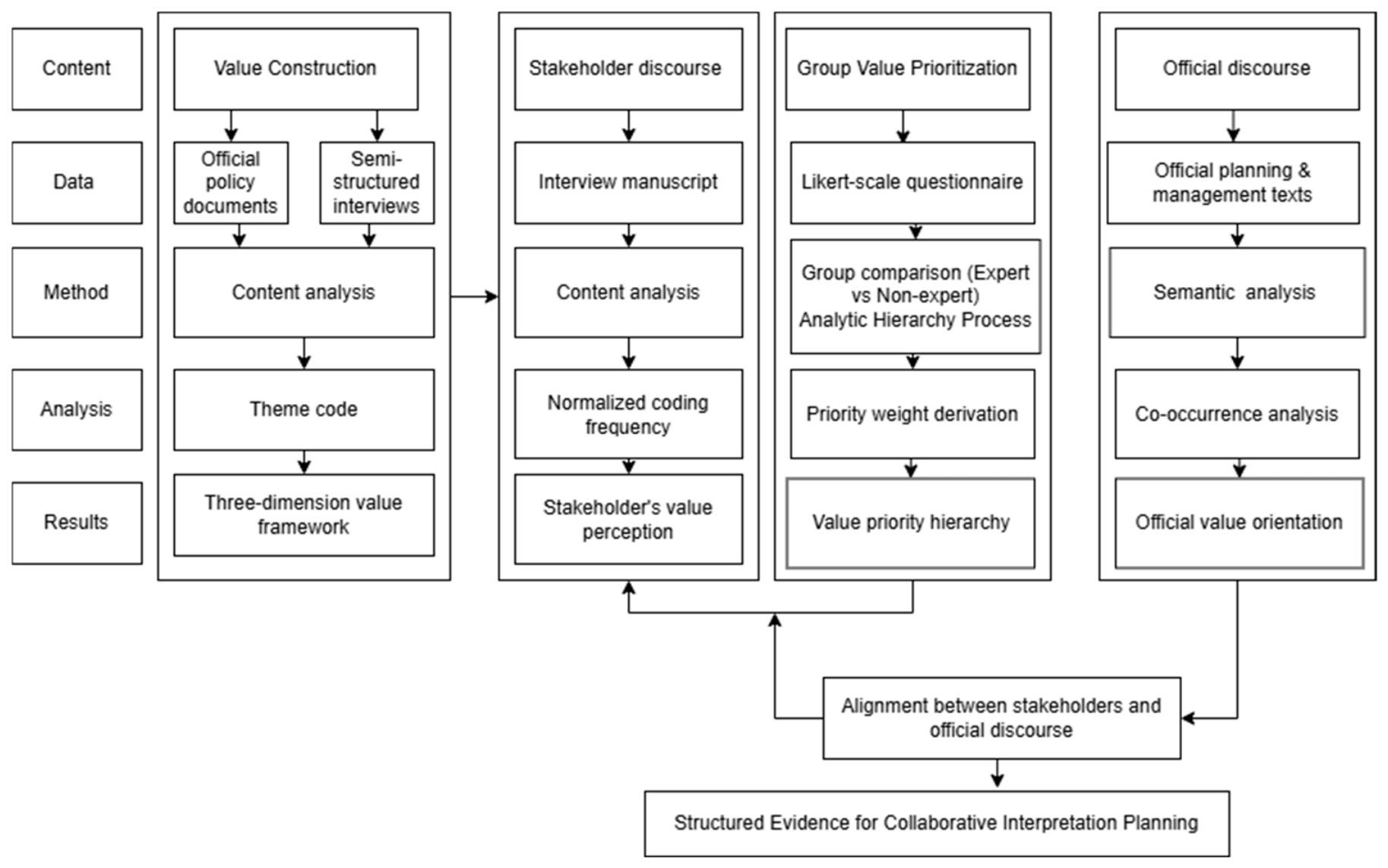
2. Materials and Methods
3. Results
3.1. Three-Dimensional Value Framework
3.2. Divergence Value Perception Characteristics of Different Stakeholders from the Interviews
3.2.1. Divergence in Intrinsic Value
3.2.2. Divergence in Instrumental Value
3.2.3. Divergence in Institutional Value
3.3. Value Priority Results
3.3.1. Judgment Matrix Construction and Consistency Check
3.3.2. Overall Value Priority Results
3.4. Official Semantic Analysis
4. Discussion
4.1. Divergence Value Perception Among Different Stakeholders
4.2. Alignment and Misalignment Between Stakeholder Values and Official Discourse
5. Conclusions
Author Contributions
Funding
Informed Consent Statement
Data Availability Statement
Acknowledgments
Conflicts of Interest
Appendix A. Semi-Structured Interview Questions
- When you mention the Longmen Grottoes, what comes to your mind first?
- What does the Longmen Grottoes, as a World Cultural Heritage Site, mean to you?
- When talking about the value of the Longmen Grottoes, what key words would you think of?
Appendix B. Illustrative Example of NVivo Coding from Stakeholder Statements to Value Dimensions

| Code | Selective Coding | Axial Coding | Open Coding | Original Statement |
|---|---|---|---|---|
| IV01a | Intrinsic value | Historical value | Historical figures | “Emperor Xiaowen greatly expanded the construction of temples.” |
| IV01b | Intrinsic value | Historical value | Temple history | “The Guanghua temple, the ancestral temple of Tang Mi Buddhism, is adjacent to the Longmen Grottoes.” |
| IV02a | Intrinsic value | Cultural value | Buddhist culture | “The Longmen Grottoes embody the prosperity of Buddhism during the Tang Dynasty.” |
| IV02b | Intrinsic value | Cultural value | Site culture | “The Huangjue temple has a well that is over a thousand years old.” |
| IV04a | Intrinsic value | Scientific value | Restoration and conservation | “Heritage preservation is crucial; restoration and maintenance must adhere to the principle of ‘restoring old structures to their original condition’ without altering their original appearance.” |
| IV04b | Intrinsic value | Scientific value | Construction methods | “The project is massive, especially the uniqueness of the Lushena Great Buddha.” |
| IV05a | Intrinsic value | Spiritual value | Pilgrimage | “Worshiping the Buddha, temple meditation, sitting meditation and chanting sutras.” |
| IV05b | Intrinsic value | Spiritual value | Religious atmosphere | “The removal of the monks from Xiangshan Temple has left the temple without a soul.” |
| IV06a | Intrinsic value | Artistic value | Carving details | “The carving of Wu Zetian’s face is exquisite.” |
| IN01a | Instrumental value | Educational value | Integration of ancient and modern elements | “Tea ceremony, incense ceremony, flower arrangement, and Zen meditation classes.” “Fun activities such as counting the Arhats to learn about their different images and meanings.” |
| IN01b | Instrumental value | Educational value | A contemporary approach | “Eliminating rigid religious elements, using culture as a medium to transform the teachings of Buddhist sages into a cultural form.” |
| IN02a | Instrumental value | Service value | Facility services | “The temple provides tea and other refreshments free of charge to everyone.” |
| IN02b | Instrumental value | Service value | A contemporary approach to pilgrimage | “Adapting to the development of the new era and people’s spiritual needs.” |
| IN03a | Instrumental value | Social value | Improvement of the surrounding environment | “Improving the surrounding environment, widening roads, and enhancing greenery.” |
| IN03b | Instrumental value | Social value | Cultural confidence | “Longmen Grottoes is one of China’s four major stone grottoes and is very famous.” |
| IN04a | Instrumental value | Economic value | Facility costs | The government should provide more financial support to the surrounding temples to improve the appearance.” |
| IS01a | Instrumental value | Collaborative value | Surrounding area synergy | “More media should be used to promote the temples with profound historical significance around the World Heritage Site.” |
| IS01b | Instrumental value | Collaborative value | Departmental collaboration | “The government’s current policies have played a good role in protecting ancient buildings.” |
| IS01c | Instrumental value | Collaborative value | Multi-cooperate | We must unite all available resources. |
| IS02a | Instrumental value | Sustainable value | Intergenerational memory | “It is important to make more people know these temples’ relationship with Longmen Grottoes to enhance the memory.” |
| IS02b | Instrumental value | Sustainable value | Religious atmosphere and spiritual continuity | “,but first we must resolve internal matters within the temple.” |
| IS03a | Instrumental value | Identity value | World Cultural Heritage status | “If the monks can be invited back, the Buddhist significance of the Longmen Grottoes can be better preserved.” |
| IS03b | Instrumental value | Identity value | Pride | “As a member of the religious group, I feel proud to see current development of Longmen Grottoes.” |
Appendix C. Calculation for Radar Charts
Appendix D. Questionnaire
| Dear Participants: Hello! I am a student at the University of Malaya and I am conducting a survey on the perceived value of visitors to the Longmen Grottoes. Thank you very much for taking the time to fill it out. We will conduct a statistical analysis of the questionnaire. The respondents and the content will be anonymous and not made public. Please make your choice based on the actual situation, and thank you again for your support! Your gender: | |||||
| ○ Male | Female | ||||
| Your age is: | |||||
| ○ A. 18–24 | |||||
| ○ B. 25–34 | |||||
| ○ C. 35–44 | |||||
| ○ D. 45–54 | |||||
| ○ E. 55–64 | |||||
| ○ F. >65 | |||||
| Your educational background is: | |||||
| ○ A. Primary school | |||||
| ○ B. Junior high school | |||||
| ○ C. High School | |||||
| ○ D. College | |||||
| ○ E. Master’s degree | |||||
| ○ F. Doctor | |||||
| ○ G. Others _________________ | |||||
| Your profession: | |||||
| ○ A. Civil servants | |||||
| ○ B. Staff of public institutions | |||||
| ○ C. Enterprise unit personnel | |||||
| ○ D. Individual business owner | |||||
| ○ E. Farmer/Worker | |||||
| ○ F. Retirees | |||||
| ○ G. Others _________________ | |||||
| For the purpose of visiting Longmen Grottoes: | |||||
| ◯ Heritage enthusiasts who come specifically to learn about the history and culture of the heritage | ◯ Mainly for leisure and entertainment, with a certain interest in heritage | ||||
| ◯ Leisure sightseeing | ◯ Interested in religion, worship Education, family trips | ||||
| ◯ Academic research, field trips | ◯ Education, family trips | ||||
| ◯ Have a special interest in architecture, art, etc. | ◯ Local tourists | ||||
| ◯ Not the main destination, just drop by | ◯ Others | ||||
| Your place of residence (city/province): [Fill-in-the-blank] ____________________________________ | |||||
| Please rate the importance of the following historical values: Completely disapproving = 1, Disapproving = 2, Neutral = 3, Approving = 4, Very approving = 5 | |||||
| Historical value item | 1 | 2 | 3 | 4 | 5 |
| The figures associated with the Longmen Grottoes (such as Jin Gang Zhi, Shan Wu Wu, Wu Zetian, Emperor Xiaowen of the Northern Wei Dynasty, Bai Juyi, etc.) and related historical events are important components of the historical value of the Longmen Grottoes | ○ | ○ | ○ | ○ | ○ |
| The Longmen Grottoes are the largest existing grotto temple site in China, representing the high achievements of Chinese Buddhist art from the 5th to the 10th century AD, and are an important part of the historical value of the Longmen Grottoes | ○ | ○ | ○ | ○ | ○ |
| The various temples associated with the Longmen Grottoes (Xiangshan Temple, the Ten Temples of Longmen, Fengxian Temple, Qianxi Temple, the site of Fengxian Temple, the site of Tang Dynasty Xiangshan Temple and unearthed artifacts, etc.) are important components of the historical value of the Longmen Grottoes | ○ | ○ | ○ | ○ | ○ |
| The Longmen Grottoes, which witnessed the development and changes in many fields such as politics, economy, religion and culture in ancient China, are an important part of the historical value of the Longmen Grottoes. | ○ | ○ | ○ | ○ | ○ |
| Please rate the importance of the following cultural values: Completely disapproving = 1, Disapproving = 2, Neutral = 3, approving = 4, very approving = 5 | |||||
| Cultural value item | 1 | 2 | 3 | 4 | 5 |
| Buddhist culture is an important part of the cultural value of the Longmen Grottoes | ○ | ○ | ○ | ○ | ○ |
| Grotto temple culture is an important part of the cultural value of the Longmen Grottoes | ○ | ○ | ○ | ○ | ○ |
| The Longmen Grottoes are a witness to the cultural exchange and integration between China and the West along the Silk Road, and have had a profound influence on grotto and sculpture art in China and Asia. They are an important part of cultural value | ○ | ○ | ○ | ○ | ○ |
| Folk activities and some intangible cultural heritages (such as peony stones, Tang Sancai, etc.) are important components of the cultural value of the Longmen Grottoes | ○ | ○ | ○ | ○ | ○ |
| Please rate the importance of the following environmental values: Completely disapproving = 1, Disapproving = 2, Neutral = 3, Approving = 4, Very approving = 5 | |||||
| Environment value item | 1 | 2 | 3 | 4 | 5 |
| The site landscape formed by the Longmen Grottoes and the surrounding East and West Hills as well as the Yi River is a masterpiece of the perfect integration of human sculptural art and natural mountain and water beauty, and it is an important component of the environmental value of the Longmen Grottoes. | ○ | ○ | ○ | ○ | ○ |
| The overall appearance of the important viewing points (Baiyuan, Linggutai, Fengxian Temple) is an important part of the environmental value of the Longmen Grottoes | ○ | ○ | ○ | ○ | ○ |
| The stone quality of the Longmen Grottoes is an important component of the environmental value of the Longmen Grottoes | ○ | ○ | ○ | ○ | ○ |
| The ecological forest, the Yique Wetland, the riverside park and the willows along the river in the scenic area are important components of the environmental value of the Longmen Grottoes | ○ | ○ | ○ | ○ | ○ |
| Please rate the importance of the following scientific values: Completely disapproving = 1, Disapproving = 2, Neutral = 3, approving = 4, very approving = 5 | |||||
| Scientific value item | 1 | 2 | 3 | 4 | 5 |
| The construction technology of the Longmen Grottoes, as well as the paintings, costumes and medicines, are important components of the scientific value of the Longmen Grottoes | ○ | ○ | ○ | ○ | ○ |
| The restoration and 3D restoration techniques of the Longmen Grottoes are important components of their scientific value | ○ | ○ | ○ | ○ | ○ |
| Continuous archaeological excavations are important components of the scientific value of the Longmen Grottoes | ○ | ○ | ○ | ○ | ○ |
| Please rate the importance of the following spiritual values: Completely disapproving = 1, Disapproving = 2, Neutral = 3, approving = 4, very approving = 5 | |||||
| Spiritual value item | 1 | 2 | 3 | 4 | 5 |
| People visiting the Longmen Grottoes to worship and burning incense at the surrounding temples are important components of the spiritual value of the Longmen Grottoes | ○ | ○ | ○ | ○ | ○ |
| The religious atmosphere of the Longmen Grottoes themselves and the surrounding temples are important components of the spiritual value of the Longmen Grottoes | ○ | ○ | ○ | ○ | ○ |
| Please rate the importance of the following artistic values: Completely disapproving = 1, Disapproving = 2, Neutral = 3, approving = 4, Very approving = 5 | |||||
| Artistic value item | 1 | 2 | 3 | 4 | 5 |
| The carving details of the Buddha statues, the elegant and graceful figures of the Northern Wei Dynasty, the wide sleeves of the robes, and the plump bodies and round faces of the Tang Dynasty are important components of the artistic value of the Longmen Grottoes | ○ | ○ | ○ | ○ | ○ |
| The style of the statues from different dynasties, the difference between the early “Central Plains style” and the late “Great Tang style”, are important components of the artistic value of the Longmen Grottoes | ○ | ○ | ○ | ○ | ○ |
| The inscriptions on the steles of the Longmen Grottoes, especially the calligraphy art of the “Twenty Masterpieces of Longmen”, are an important part of the artistic value of the Longmen Grottoes | ○ | ○ | ○ | ○ | ○ |
| Please rate the importance of the following educational values: Completely disapproving = 1, Disapproving = 2, Neutral = 3, approving = 4, Very approving = 5 | |||||
| Educational value item | 1 | 2 | 3 | 4 | 5 |
| People will make comparisons between the past and the present and raise awareness of the heritage and its protection is an important part of educational value | ○ | ○ | ○ | ○ | ○ |
| The strong desire to bring the stolen relics home after the viewing is an important part of the educational value of the Longmen Grottoes | ○ | ○ | ○ | ○ | ○ |
| The fact that everyone has different details of the grottoes that they want to know further is an important part of the educational value of the Longmen Grottoes | ○ | ○ | ○ | ○ | ○ |
| The educational value of the Longmen Grottoes is reflected in various interesting forms (tea ceremony, flower arrangement, counting arhats, etc.) to introduce people to the Buddhist culture, dynasty history, etc., of the Longmen Grottoes | ○ | ○ | ○ | ○ | ○ |
| Please rate the importance of the following service values: Completely disapproving = 1, Disapproving = 2, Neutral = 3, approving = 4, very approving = 5 | |||||
| Service value item | 1 | 2 | 3 | 4 | 5 |
| Whether the service facilities of the Longmen Grottoes (catering, rest, toilets, shops, etc.) are sufficient is important for the service value of the Longmen Grottoes | ○ | ○ | ○ | ○ | ○ |
| Whether the presentation facilities of the Longmen Grottoes (display boards, museums, etc.) are sufficient to help visitors understand the value connotation of the Longmen Grottoes is important for the service value of the Longmen Grottoes | ○ | ○ | ○ | ○ | ○ |
| The convenience of parking electric bikes, motor vehicles and public transportation is important for the service value | ○ | ○ | ○ | ○ | ○ |
| Whether the tour and visiting patterns of the grottoes can be arranged from the perspective of tourists is important for the service value of Longmen Grottoes | ○ | ○ | ○ | ○ | ○ |
| Please rate the importance of the following social values: Completely disapproving = 1, Disapproving = 2, Neutral = 3, approving = 4, very approving = 5 | |||||
| Social value item | 1 | 2 | 3 | 4 | 5 |
| The title of World Heritage attracts more visitors, which is an important manifestation of the social value of the Longmen Grottoes | ○ | ○ | ○ | ○ | ○ |
| The cultural and commercial activities (performances, themed events, and exhibitions) organized by the Longmen Grottoes enrich the Luoyang city tour experience and serve as a key manifestation of the Longmen Grottoes’ social value. | ○ | ○ | ○ | ○ | ○ |
| The Longmen Grottoes are of great significance in promoting cultural inheritance and enhancing national confidence, and they are important parts of the social value of the Longmen Grottoes | ○ | ○ | ○ | ○ | ○ |
| The improvement of the surrounding environment of the Longmen Grottoes is an important manifestation of its social value | ○ | ○ | ○ | ○ | ○ |
| Please rate the importance of the following economic values: Completely disapproving = 1, Disapproving = 2, Neutral = 3, approving = 4, Very approving = 5 | |||||
| Economic value item | 1 | 2 | 3 | 4 | 5 |
| The economic value of the Longmen Grottoes is reflected in whether the entrance fee, museum fee, tour guide fee, and accommodation, food and transportation are reasonable | ○ | ○ | ○ | ○ | ○ |
| Whether the villagers and merchants around the Longmen Grottoes can increase their income by taking advantage of the World Heritage status of the Longmen Grottoes is an important indicator of economic value | ○ | ○ | ○ | ○ | ○ |
| Longmen Grottoes can drive the overall economic development of the surrounding area and even the city is an important manifestation of economic value | ○ | ○ | ○ | ○ | ○ |
| Please rate the importance of the following collaborative values: Completely disapproving = 1, disapproving = 2, Neutral = 3, approving = 4, very approving = 5 | |||||
| Collaborative value item | 1 | 2 | 3 | 4 | 5 |
| Whether the Longmen Grottoes can drive the tourism promotion of other surrounding attractions (Guanghua Temple, Guanlin, Peony Pavilion, etc.) is an important manifestation of the value of the Longmen Grottoes’ collaboration and cooperation | ○ | ○ | ○ | ○ | ○ |
| Whether the government and the Longmen Grottoes Research Institute can listen to the suggestions of other stakeholders (tourists, residents, merchants, religious figures) and cooperate to promote the scenic spots together is an important manifestation of the value of the Longmen Grottoes’ collaboration and cooperation | ○ | ○ | ○ | ○ | ○ |
| The transparency of the planning information of the Longmen Grottoes is an important manifestation of the collaborative and cooperative value of the Longmen Grottoes | ○ | ○ | ○ | ○ | ○ |
| Please rate the importance of the following sustainable values: Completely disapproving = 1, Disapproving = 2, Neutral = 3, Approving = 4, Very approving = 5 | |||||
| Sustainable value item | 1 | 2 | 3 | 4 | 5 |
| Making the next generation remember the Longmen Grottoes is an important part of the sustainable value of the Longmen Grottoes | ○ | ○ | ○ | ○ | ○ |
| Developing tourism while maintaining a religious atmosphere is important for the sustainable value of the Longmen Grottoes | ○ | ○ | ○ | ○ | ○ |
| Constantly improving the service facilities of the Longmen Grottoes, exploring their connotations and expanding their extensions are reflection of the sustainable value of the Longmen Grottoes | ○ | ○ | ○ | ○ | ○ |
| Please rate the importance of the following Identity values: Completely not recognized = 1, not recognized = 2, Neutral = 3, recognized = 4, very recognized = 5 | |||||
| Identity value item | 1 | 2 | 3 | 4 | 5 |
| Whether the image of the Longmen Grottoes can meet people’s expectations for the title of World Heritage is an important manifestation of identity value | ○ | ○ | ○ | ○ | ○ |
| Feeling proud and shocked after seeing the grottoes is an important part of the identity value | ○ | ○ | ○ | ○ | ○ |
| The understanding and support from all sides for the protection and promotion of the Longmen Grottoes is an important manifestation of the value of identity | ○ | ○ | ○ | ○ | ○ |
| What other value classifications and contents do you think are missing, please add: [Fill-in-the-blank question] __________________________________________ | |||||
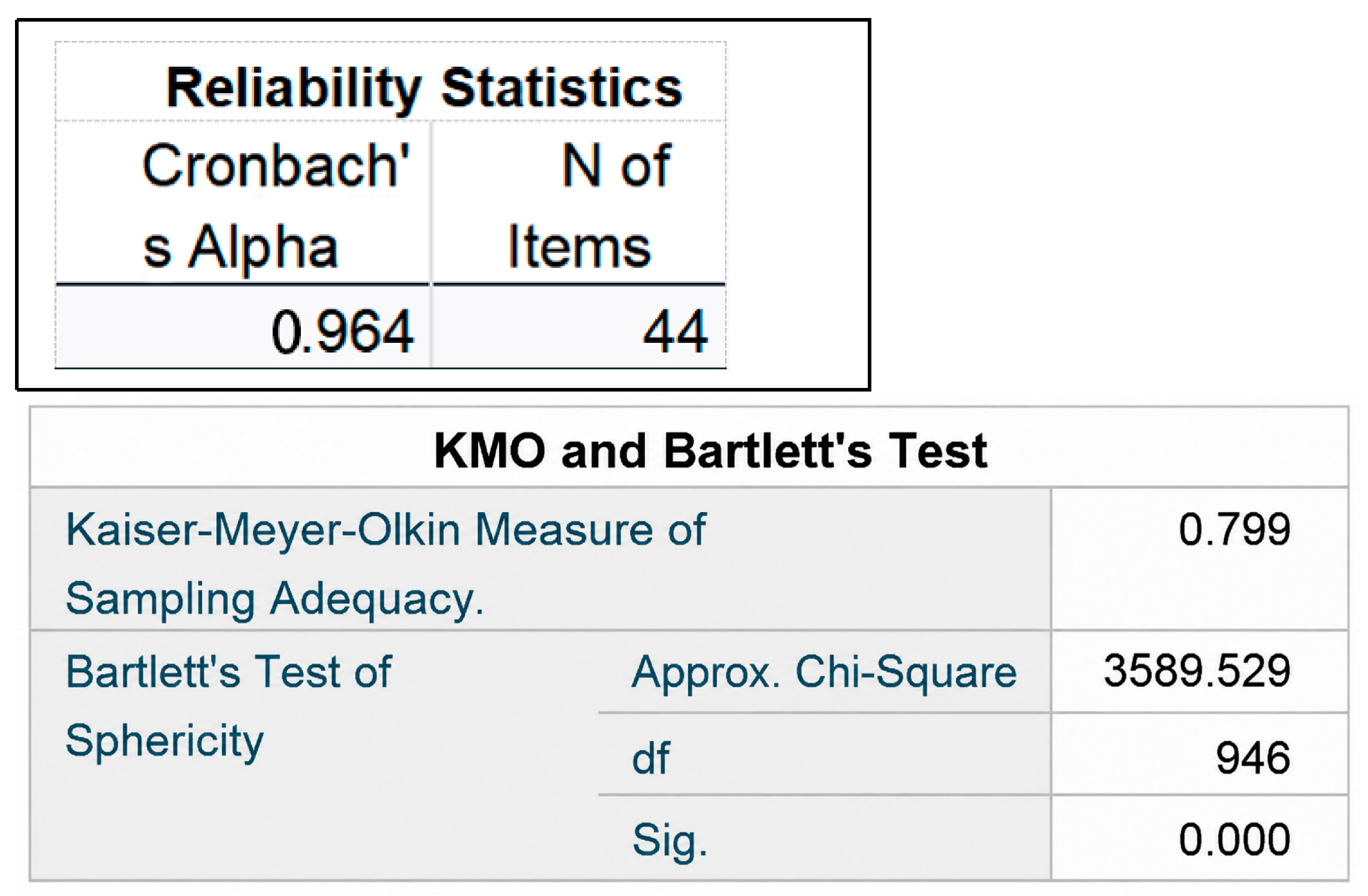
Appendix E. Questionnaire Reliability and Validity
References
- Riegl, A. The Modern Cult of Monuments: Its Character and Its Origin. Oppos. J. Ideas Crit. Archit. 1982, 25, 20–51. [Google Scholar]
- UNESCO. Convention Concerning the Protection of the World Cultural and Natural Herita. In Proceedings of the General Conference at Its Seventeenth Session, Paris, France, 17 October–21 November 1972. [Google Scholar]
- Australia ICOMOS. The Burra Charter (The Australia ICOMOS Charter for Places of Cultural Significance); Australia ICOMOS: Burwood, Australia, 1999. [Google Scholar]
- Harrison, R. Heritage: Critical Approaches; Routledge: London, UK, 2013. [Google Scholar]
- Smith, L. Uses of Heritage; Routledge: Philadelphia, PA, USA; Mississauga, ON, Canada, 2006; pp. 283–285. [Google Scholar]
- Chiricescu, A. Who Are the Real Stakeholders of a Nominated UNESCO Site? A Glimpse into the Contextualisation of a Rather Scientific Approach to World Heritage Nominations. Plur. Hist. Cult. Soc. 2020, 8, 48–60. [Google Scholar] [CrossRef] [PubMed]
- Orea-Giner, A.; Fuentes-Moraleda, L.; Molinero, N.E.M. World Heritage Sites and the Local Stakeholder’s Participation Mechanism: An Exploratory Study. In Managing Natural and Cultural Heritage for a Durable Tourism; Trono, A., Castronuovo, V., Kosmas, P., Eds.; Springer: Cham, Switzerland, 2024. [Google Scholar]
- Lipe, W.D. Value and Meaning in Cultural Resources. In Approaches to the Archaeological Heritage: A Comparative Study of World Cultural Resource Management Systems; Cambridge University Press: Cambridge, UK, 1984. [Google Scholar]
- Frey, B.S. The Evaluation of Cultural Heritage: Some Critical Issues. In Economic Perspectives on Cultural Heritage; Palgrave Macmillan: London, UK, 1997. [Google Scholar]
- Throsby, D. Economics and Culture; Cambridge University Press: Cambridge, UK, 2001. [Google Scholar]
- Hewison, R.; Holden, J. The Cultural Leadership Handbook: How to Run a Creative Organization; Routledge: London, UK, 2011. [Google Scholar]
- Avrami, E.; Mason, R.; Torre, M.d.l. Values and Heritage Conservation Research Report; The Getty Conservation Institute: Los Angeles, CA, USA, 2000. [Google Scholar]
- Fredheim, L.H.; Khalaf, M. The significance of values: Heritage value typologies re-examined. Int. J. Herit. Stud. 2016, 22, 466–481. [Google Scholar] [CrossRef]
- Heras, V.C.; Wijffels, M.S.M.C.a.A.; Tenze, A.; Paredes, D.E.J. Heritage values: Towards a holistic and participatory management approach. J. Cult. Herit. Manag. Sustain. Dev. 2018, 9, 199–211. [Google Scholar] [CrossRef]
- Alazaizeh, M.M.; Ababneh, A.; Jamaliah, M.M. Preservation vs. use: Understanding tourism stakeholders’ value perceptions toward Petrab Archaeological Park. J. Tour. Cult. Change 2019, 18, 252–266. [Google Scholar] [CrossRef]
- Kryder-Reid, E.; Foutz, J.W.; Wood, E.; Zimmerman, L.J. ‘I just don’t ever use that word’: Investigating stakeholders’ understanding of heritage. Int. J. Herit. Stud. 2017, 24, 743–763. [Google Scholar] [CrossRef]
- Xu, Q.; Taylor, K.; Han, F. Recognising values of China’s scenic and historic interest areas as world heritage cultural landscapes: Lushan case study. Int. J. Herit. Stud. 2021, 27, 39–56. [Google Scholar] [CrossRef]
- Mishra, P.S.; Muhuri, S. Incorporating Perceptions of Multiple Stakeholders while Assessing Architectural Heritage Value: A Case of Odishan Temple Architecture in India. J. Plan. Educ. Res. 2024, 44, 1431–1447. [Google Scholar]
- Healey, P. Collaborative Planning Shaping Places in Fragmented Societies; UBC Press: Vancouver, BC, Canada, 1997. [Google Scholar]
- Innes, J.E.; Booher, D.E. Collaborative policymaking: Governance through dialogue. In Deliberative Policy Analysis Understanding Governance in the Network Society; Cambridge University Press: Cambridge, UK, 2003. [Google Scholar]
- Tully, G.; Ridges, M.; Isaksen, L.; Madgwick, R. Collaborative Heritage Management; Tully, G., Ridges, M., Eds.; Gorgias Press LLC: Piscataway, NJ, USA, 2016. [Google Scholar]
- UNESCO. Policy for the Integration of A Sustainable Development Perspective into the Processes of the World Heritage Convention; UNESCO: Paris, France, 2015. [Google Scholar]
- UNESCO WHIPIC. Interpretation and Presentation: Inclusive Understandings of World Heritage Sites in Africa [Guidelines and Case Studies]; UNESCO WHIPIC: Sejong-si, Republic of Korea, 2024. [Google Scholar]
- UNESCO. World Heritage Convention Nomination of Cultural Properties for Inscription on the World Heritage List: China Longmen Grottoes; UNESCO: Paris, France, 2000. [Google Scholar]
- UNESCO. Outstanding Universal Value. Available online: https://whc.unesco.org/en/list/1003/ (accessed on 10 April 2026).
- UNESCO. Periodic Reporting Cycle 3, Section II; UNESCO: Paris, France, 2023. [Google Scholar]
- The State Administration of Cultural Relics. Notice of the National Cultural Heritage Administration on Issuing the Specialized Plan for the Protection and Utilization of Grotto Temples During the 14th Five-Year Plan Period. Available online: https://www.gov.cn/zhengce/zhengceku/2021-12/08/content_5659232.htm (accessed on 10 April 2026).
- Li, J.; Qi, J.; Shan, M. Construction of Tourists’ Perceived Value Dimensionin Cultural Heritage Tourism Destinations from the Perspective of WebText Analysis: A Case Study of Longmen Grottoes in Luoyang. Tour. Forum 2023, 16, 89–97. [Google Scholar] [CrossRef]
- Qiu, Y.; Liang, L.; Su, X.; Sun, Y. Analysis of Tourists’ Emotion in Grotto Temple Scenic Spot under the Background of Cultual and Tourism Integration: A Case Study of Longmen Grottoes in Luoyang. J. Henan Univ. (Nat. Sci.) 2022, 52, 34–42. [Google Scholar] [CrossRef]
- Ma, X. Research on the Cultural Heritage Value Assessment of Longmen Grottoes. Collect. Invest. 2022, 13, 138–141. [Google Scholar] [CrossRef]
- Shang, Z. The Evaluation of Cultural Heritage Value: A Case Study of Longmen Grottoes. Cult. J. 2021, 14–16. [Google Scholar]
- Chinese Academy of Cultural Heritage. The Planning Text of the Conservation and Management Plan for Longmen Grottoes (Draft for Comment); Chinese Academy of Cultural Heritage: Beijing, China, 2022. [Google Scholar]
- Dutta, M.; Husain, Z. An application of Multicriteria Decision Making to built heritage. The case of Calcutta. J. Cult. Herit. 2009, 10, 237–243. [Google Scholar] [CrossRef]
- Saaty, T.L.; Peniwati, K. Group Decision Making Drawing Out and Reconciling Differences; RWS Publications: Pittsburgh, PA, USA, 2008. [Google Scholar]
- Marttunen, M.; Mustajoki, J.; Dufva, M.; Karjalainen, T.P. How to design and realize participation of stakeholders in MCDA processes? A framework for selecting an appropriate approach. EURO J. Decis. Process. 2015, 3, 187–214. [Google Scholar] [CrossRef]
- Yang, S.; Li, S.; Ye, X.; He, F. Content Mining and Network Analysis of Microblog Spam. J. Converg. Inf. Technol. 2010, 5, 135–140. [Google Scholar] [CrossRef]
- Waterton, E.; Smith, L. The recognition and misrecognition of community heritage. Int. J. Herit. Stud. 2010, 16, 4–15. [Google Scholar] [CrossRef]
- Olsen, D.H. Heritage, Tourism, and the Commodification of Religion. Tour. Recreat. Res. 2003, 28, 99–104. [Google Scholar] [CrossRef]
- Shackley, M. Managing Sacred Sites: Service Provision and Visitor Experience; Thomson: London, UK, 2001. [Google Scholar]
- Labadi, S. UNESCO, Cultural Heritage, and Outstanding Universal Value: Value-Based Analyses of the World Heritage and Intangible Cultural Heritage Conventions; AltaMira Press: Lanham, MD, USA, 2013. [Google Scholar]
- Packer, J.; Ballantyne, R. Conceptualizing the Visitor Experience: A Review of Literature and Development of a Multifaceted Model. Visit. Stud. 2016, 19, 128–143. [Google Scholar] [CrossRef]
- McKercher, B.; Cros, H.D. Cultural Tourism: The Partnership Between Tourism and Cultural Heritage Management; Routledge: London, UK, 2002. [Google Scholar]
- Timothy, D.J.; Boyd, S.W. Tourism and Trails: Cultural, Ecological and Management Issues; Channel View Publications: Bristol, UK, 2014. [Google Scholar]
- Ashworth, G.J.; Graham, B.; Tunbridge, J.E. Pluralising Pasts: Heritage, Identity and Place in Multicultural Societies; Pluto Press: London, UK, 2007. [Google Scholar]
- Innes, J.E.; Booher, D.E. Planning with Complexity An Introduction to Collaborative Rationality for Public Policy; Routledge: London, UK, 2010. [Google Scholar]


| Stakeholder Category | Main Actors in the Longmen Grottoes Context | Form of Influence | Potential Impact |
|---|---|---|---|
| Experts | Longmen Grottoes institution, Luoyang cultural relics, Luoyang urban planning, and design institution | Formal influence | Policy direction, protection, planning, conservation priorities, research, and design |
| Visitors | Tourists and public audiences | Informal influence | Visitor experience and public understanding |
| Residents | Local communities and nearby residents, including relocated residents where relevant | Informal influence | Local memory, place attachment, daily life relationship with the heritage site, and community identity |
| Tourism operators | Tour guides, tourism service providers, surrounding businesses, and tourism-related enterprises | Informal influence | Visitor services, tourism experience, local livelihoods, and commercial operation of heritage |
| The religious group | Members of the religious group associated with the Buddhist meanings of the site | Informal influence | Buddhist meanings, sacred memory, religious continuity, and spiritual interpretation of heritage |
| Value Typology | Value Dimensions |
|---|---|
| Intrinsic value | Historical value, cultural value, environmental value, scientific value, spiritual value, and artistic value |
| Instrumental value | Educational value, service value, economic value, and social value |
| Institutional value | Collaborative value, sustainable value, and identity value |
| Criteria | λmax | CI | CR | Consistency Test | Results |
|---|---|---|---|---|---|
| Experts | 13.06516451 | 0.005430376 | 0.00348101 | <0.01 | Acceptable |
| Non-experts | 13.06852697 | 0.005711 | 0.003661 | <0.01 | Acceptable |
| Value Typology | Non-Expert Weight | Expert Weight | Sort by Rank (Public) | Sort by Rank (Expert) |
|---|---|---|---|---|
| Sustainable value | 0.080534855 | 0.079333142 | 1 | 4 |
| Identity value | 0.079676143 | 0.078183386 | 2 | 6 |
| Historical value | 0.078986107 | 0.080195458 | 3 | 2 |
| Scientific value | 0.078388076 | 0.07703363 | 4 | 8 |
| Social value | 0.078204067 | 0.077608508 | 5 | 7 |
| Artistic value | 0.077958721 | 0.079333142 | 6 | 3 |
| Educational value | 0.077560033 | 0.081057775 | 7 | 1 |
| Collaborative value | 0.076854663 | 0.079333142 | 8 | 5 |
| Cultural value | 0.076639985 | 0.076746191 | 9 | 9 |
| Environmental value | 0.075811942 | 0.076746191 | 10 | 10 |
| Service value | 0.075029902 | 0.074159241 | 11 | 12 |
| Economic value | 0.074891894 | 0.074734119 | 12 | 11 |
| Spiritual value | 0.069463612 | 0.065536074 | 13 | 13 |
| Semantic Cluster | Co-Occurring Terms | Related Value |
|---|---|---|
| Protection–management–planning | Management–protection (238); planning–protection (165); planning–management (137) | Historical value; scientific value; sustainability value |
| Engineering–monitoring–measures | Engineering–protection (72); monitoring–protection (59); measures–protection (68) | Scientific value; sustainable value |
| Research–research institutions–protection | Research–Grottoes (122); research–protection (114); research institute–Grottoes (79) | Scientific value; educational value |
| Culture–cultural relics–heritage | Heritage–culture (131); Grottoes–culture (127); protection–cultural relics (114) | Cultural value; artistic value |
| Environment–range–protection | Environment–Grottoes (86); environment–Longmen (83); range–protection (78) | Environmental value; sustainability value |
| Utilization–development–protection | Protection–utilization (70); development–Grottoes (70); utilization–Longmen (62) | Service value; economic value |
| Tourists–exhibition–service experimental | Grottoes–tourists (52); exhibition–Grottoes (83); exhibition–protection (58) | Service value; experiential value |
| Absence of social participation and identity | Public (23); residents (17); participation (26) | Identity value; social value |
Disclaimer/Publisher’s Note: The statements, opinions and data contained in all publications are solely those of the individual author(s) and contributor(s) and not of MDPI and/or the editor(s). MDPI and/or the editor(s) disclaim responsibility for any injury to people or property resulting from any ideas, methods, instructions or products referred to in the content. |
© 2026 by the authors. Licensee MDPI, Basel, Switzerland. This article is an open access article distributed under the terms and conditions of the Creative Commons Attribution (CC BY) license.
Share and Cite
Li, W.; Mohidin, H.H.B.; Ali, Z.M. From Stakeholder Value Perceptions to Collaborative Interpretation in World Cultural Heritage Management: Evidence from the Longmen Grottoes (China). Heritage 2026, 9, 239. https://doi.org/10.3390/heritage9060239
Li W, Mohidin HHB, Ali ZM. From Stakeholder Value Perceptions to Collaborative Interpretation in World Cultural Heritage Management: Evidence from the Longmen Grottoes (China). Heritage. 2026; 9(6):239. https://doi.org/10.3390/heritage9060239
Chicago/Turabian StyleLi, Wanqing, Hazrina Haja Bava Mohidin, and Zuraini Md Ali. 2026. "From Stakeholder Value Perceptions to Collaborative Interpretation in World Cultural Heritage Management: Evidence from the Longmen Grottoes (China)" Heritage 9, no. 6: 239. https://doi.org/10.3390/heritage9060239
APA StyleLi, W., Mohidin, H. H. B., & Ali, Z. M. (2026). From Stakeholder Value Perceptions to Collaborative Interpretation in World Cultural Heritage Management: Evidence from the Longmen Grottoes (China). Heritage, 9(6), 239. https://doi.org/10.3390/heritage9060239