1. Introduction
Preserved underground workings provide evidence for prehistoric tin mining in Asia [
1,
2,
3]. However, the archaeological record of ancient tin mining in Europe is nearly invisible because the ore was extracted from unconsolidated gravels in dynamic riverine environments [
4,
5]. Tools such as grinding stones or picks are rare [
6,
7], as are slag and other products of pyrotechnology [
8,
9]. Accordingly, only a small number of Bronze and Iron Age tin placer extraction sites have been identified and studied: Erzgebirge [
5,
10], Serbia [
6], and southwest England [
11]. New techniques are necessary to facilitate the identification of such sites for study and preservation. The serendipitous discovery of detrital sand grains of slag at the Serbian placer tin mining site of Spasovine (
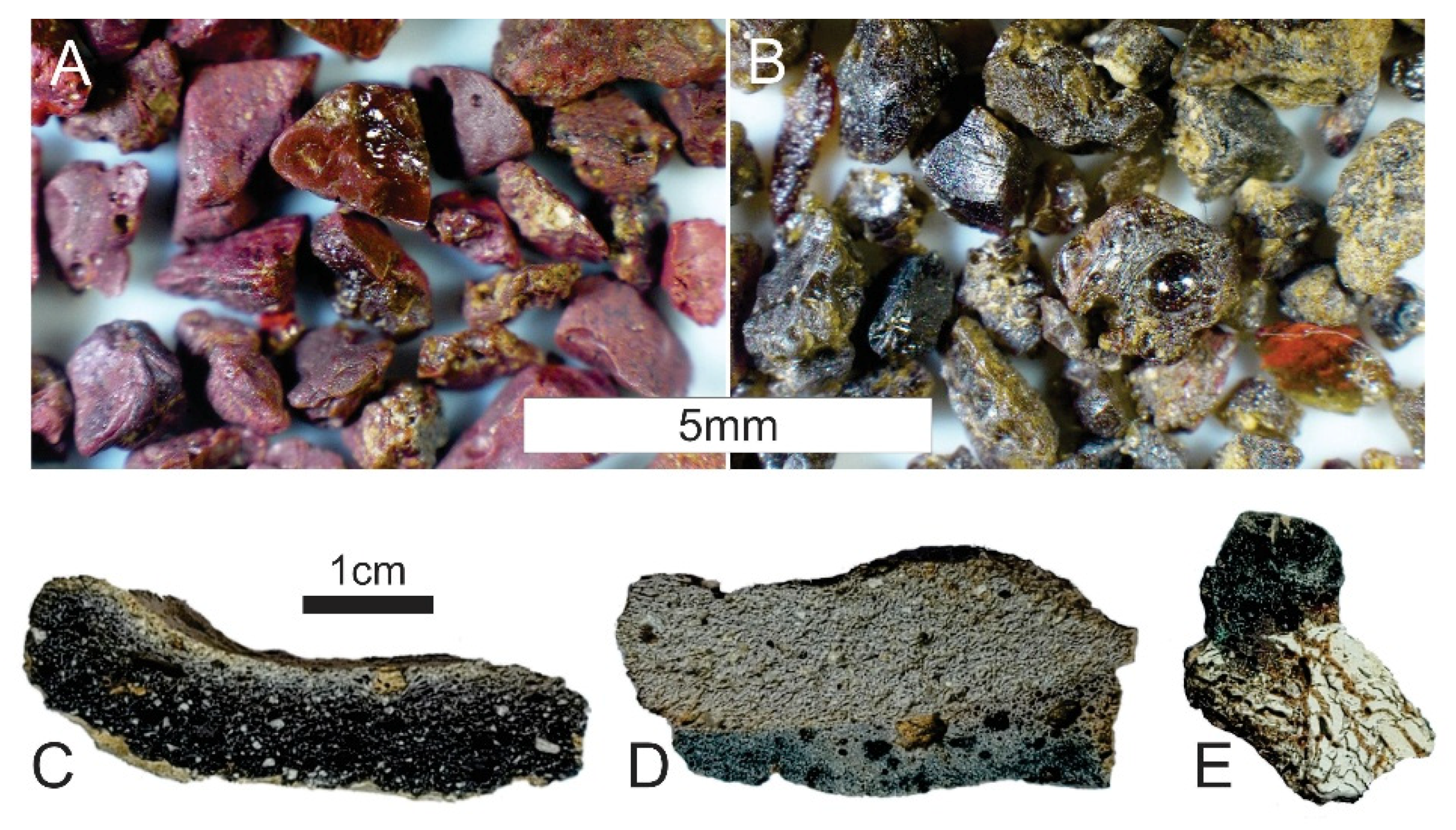
Figure 1A,B), reported herein, may suggest one such method of prospecting for as yet undiscovered workings of stream tin.
1.1. The Spasovine Site
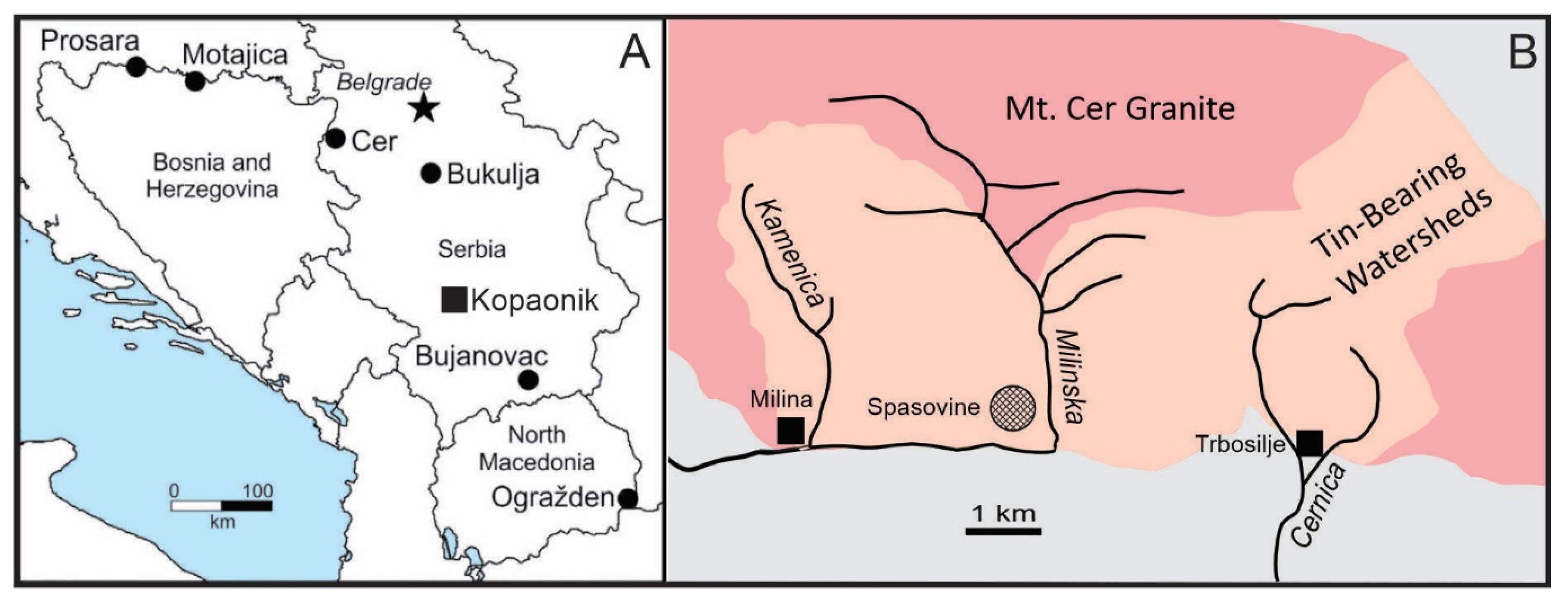
The Spasovine archaeological site is located on the west bank of the tin-bearing Milinska River at its confluence with the Lešnica River (
Figure 2). It was investigated by the Archaeological Institute of Serbia as a possible site of prehistoric tin mining by pedestrian survey, magnetic survey, and test trenches. Two Late Neolithic/Early Eneolithic dwellings were excavated [
12], but no evidence of long-term habitation during subsequent periods was evident at the site. Surface material collected from the site consists of ceramics and lithics. The condition of pottery sherds is consistent with surface material from later Bronze Age sites and single-period Eneolithic sites in the area south of the Danube. Such sites are shallow, usually consisting of a single cultural layer covered by active humus.
No evidence of kilns or hearths was detected, nor were sizeable fragments of slag discovered. However, several objects suggest that metallurgical activities occurred at the Spasovine site: a pin mold, grinding stones, and a total of fifteen fragments of metal-enriched ceramics [
6,
14]. Based on typology and composition, the set of black-bodied sherds with thin red internal vitreous layers enriched in Pb, Cu, and Sn dates to the Iron Age (
Figure 1C) [
14]. The finer-tempered, grey-bodied sherds with deep impregnation of Zn and thick black vitrified layers enriched in Zn, Pb, Cu, and Sn are of Roman origin (
Figure 1D) [
14]. An additional sherd that is composed of bleached white ceramic cut by veinlets of high-Pb glass was found at Spasovine (
Figure 1E), but the small size and altered state of the ceramic fragment do not allow for the assignment of an age of production.
Although rare, tin slags from Cornwall [
9,
15], Iberia [
16], southern Africa [
17], and Turkey [
8] have been described chemically and mineralogically, as have modern tin slags [
18]. Each of these examples is relatively rich in Fe (6–24 wt%) and contains crystallites of Fe-bearing phases. Only two of the 15 crucible fragments from Spasovine include such Fe-rich glass and crystalline phases (olivine, wüstite), both associated with Zn-bearing glass rather than tin [
14]. Thus, there is no indication that tin ore was smelted directly to form tin metal at Spasovine. Rather, the association of Sn with Cu and Pb, and the paucity of ferrous phases, suggests that people were engaged in the production of leaded tin bronze, possibly through the process of cementation (alloy production involving the addition of cassiterite to copper metal). The increased fluidity of molten bronze resulting from the addition of lead allowed for the casting of high-relief, plastic forms of adornment (bracelets, belts, and torques) that became common regionally in the latter part of the Iron Age (La Tène) [
19]. While leaded bronze was well-suited to the production of intricate jewelry, the increased brittleness of lead-rich bronze made it impractical for the casting of tools.
1.2. Discovery of Detrital Slag Grains in Serbian Tin Streams
During analysis of Serbian placer tin ores, cassiterite (SnO
2) was obtained for isotopic analysis by sluicing in rivers flowing from the granitic highlands of Mt. Cer and Bukulja [
6]. The associated heavy mineral assemblages were consistent with upstream input from the erosion of rare-element pegmatites and included spessartine garnet (Mn
3Al
2(SiO
4)
3), ilmenite (FeTiO
3), cassiterite (SnO
2), columbite (FeNb
2O
6), monazite ((Ce,La)(PO
4)), and euxenite ((Y,Ca,Ce,U,Th)(Nb,Ta,Ti)
2O
6). Trace amounts of the Zn-bearing mineral gahnite (ZnAl
2SiO
4) were documented, but no copper or lead-bearing minerals were found. However, Pb-rich-glass grains were discovered unexpectedly in the heavy mineral concentrates from these central Balkan sites [
20].
SEM-EDS analysis of the red and honey-yellow glass grains (
Figure 1A,B) determined that all were Pb-rich (up to 59 wt%), and that a subset additionally contains Cu (up to 6.5 wt%) and Sn (up to 4.3 wt%). No such glass grains were found in stream sediments from neighboring tin-barren streams. No copper or lead mineralization lies within the glass-bearing watersheds, although such ores are present in the surrounding region.
Similarities in the composition of the glass sand and the Pb-rich crucible glassy coatings suggest that the detrital glass grains might be a serendipitous find of crushed or eroded metallurgical byproducts associated with on-site metal production. Such material would have a broader footprint than ceramic sherds, be easier and faster to locate in surveys, and provide an additional means of prospecting for potential sites of ancient metallurgical activities. To test this hypothesis and evaluate the potential of sluicing as an exploration technique, the form and composition of glass sand grains found in the Milinska, Kamenica, and Cernica rivers at Mt. Cer, as well as Dugačko Creek, a tributary of the Veliki Bukulja River, were documented, and the results are presented herein.
2. Materials and Methods
A bulk sample was obtained from each of 43 individual streams in regions in which tin mineralization had been reported [
13]: Motajica and Prosara (Bosnia and Herzegovina), Bujanovac and Cer (Serbia), and Ogražden (North Macedonia) (
Figure 1A). See [
6,
20] for locations. An initial heavy mineral concentrate was obtained by feeding sieved sand through a portable sluice laid within the stream bed. The sluice concentrates were sieved, and the medium sand fraction (0.5–1 mm) was further purified by heavy liquid separation (sodium polytungstate, 2.82 g/cm
3). The most magnetic fraction was collected using a hand magnet before feeding each heavy mineral concentrate into a Frantz isodynamic magnetic separator to subdivide the sample into seven fractions (0.4 A, 0.5 A, 0.7 A, 1.0 A, 1.2 A, 1.7 A, and non-magnetic) based on magnetic susceptibility.
For each of four central Serbian rivers (Milinska, Cernica, Kamenica, and Dugačko), eight polished thin sections grain mounts were prepared, one for each magnetic cut (a total of 32 polished thin sections). Glass grains were found only in the two least magnetic fractions. Additional glass grains were hand-picked from the remaining mineral separates, yielding a total of 106 grains for study: Bukulja (24), Cernica (39), Kamenica (8), and Milinska (35). Together, the polished sections allowed examination of grain interiors, while the grain mounts allowed examination of surface features. Mineral and glass grains were identified using a polarized light microscope and an SEM-EDS (Hitachi TM3030Plus scanning electron microscope (Tokyo, Japan) at 15 kV and an Oxford Instruments Aztec energy-dispersive spectrometer (EDS) with the AZtecOne software platform (v1.1). X-ray maps and line analyses were used to document compositional variation across grains, and point analyses were used to provide elemental composition.
3. Results
Angular grains of Pb-rich glass were found in gravels from the cassiterite-rich Milinska, Kamenica, and Cernica rivers at Mt. Cer, as well as the Dugačko Creek at Bukulja (
Figure 2). No glass sand was present in the Lepenica River (Motajica), nor in the rivers at Ogražden, although each was found to contain trace amounts of cassiterite [
20]. No metal-rich glass was found in stream sediments that lacked cassiterite.
The glass ranges in color from brick-red to honey-brown (
Figure 1A,B), with both colors occurring together in some grains. Red grains from the Cernica River are slightly enriched in Al and K relative to the yellow ones, while the color varieties in the other rivers are indistinguishable, suggesting redox control over color. The glass is most commonly vesicular and displays fine flow banding textures.
The composition of glass from the three rivers at Mt. Cer, as well as the stream at Bukulja, is similar in composition (
Table 1 and
Supplementary Material). PbO content ranges from 35 to 47 wt%. SiO
2 is moderate from 32 to 38 wt%, and is inversely related to the PbO content. Unlike those from Mt. Cer, the heavy mineral concentrate from Bukulja was rich in ilmenite (FeTiO
3) [
20], which appears to be reflected in the higher TiO
2 content of the Bukulja glass.
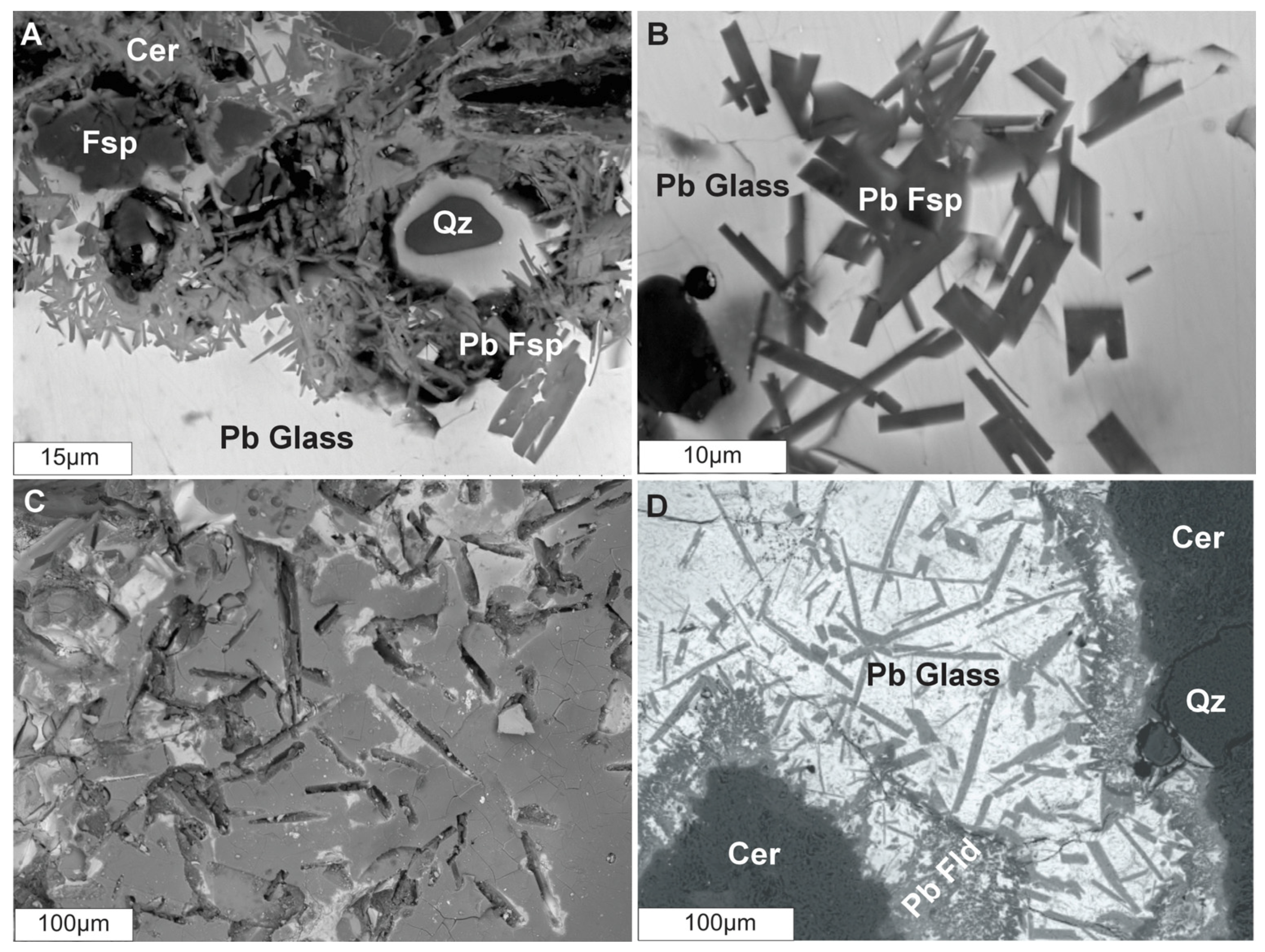
Several examples of ceramic remnants were found on the edges of Pb-glass grains (
Figure 3). Euhedral plumbian feldspar microlites extend into the Pb-glass along the interface and commonly display graphic intergrowth (
Figure 3). Weathered-out forms similar in size and shape can be seen on the surface of some glass grains (
Figure 3C). Quartz and alkali feldspar within the ceramic body have been partially melted and now display coronas of Pb-glass and scalloped embayments, indicating the partial melting of the ceramic body (
Figure 3A).
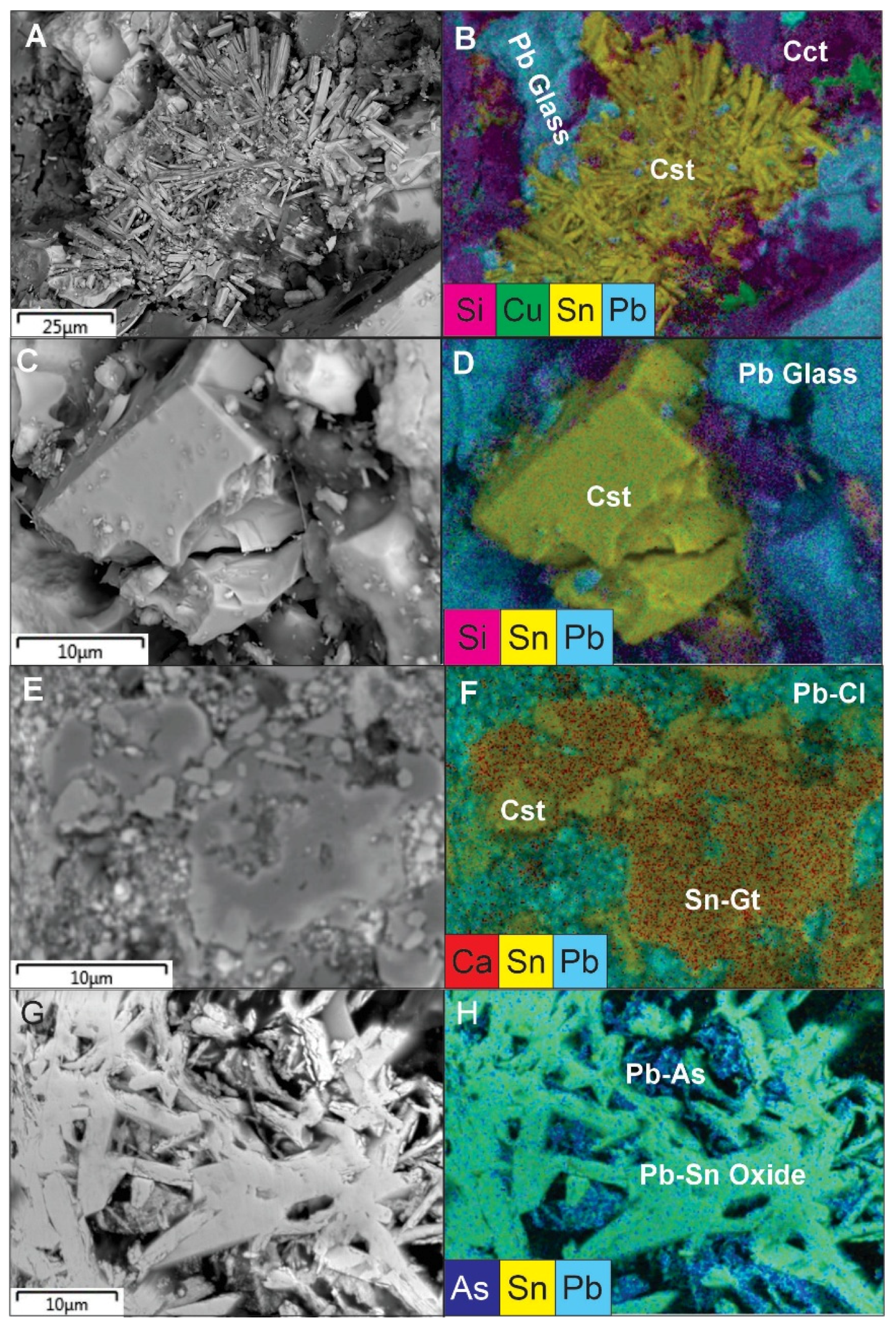
In addition to Sn as a glass component, several tin phases were identified within and on the surfaces of glass grains. Cassiterite is the most common, occurring as clusters of radiating needles in voids (
Figure 4A,B) and as blocky or elongate crystals embedded within the glass (
Figure 4C,D). One cassiterite-bearing grain from the Cernica River contains a 100 μm ovoid cluster of 5–10 μm crystals displaying 3-fold and 4-fold rotational symmetry (
Figure 4E,F). The composition is stoichiometrically consistent with garnet if Fe is in the ferric state: (Ca,Mg)
3(Al,Sn
4+,Ti,Fe
3+)
2(SiO
4)
3 (
Supplementary Material). This composite garnet grain displays a rim of 10 μm crystals of a more Sn-rich garnet (
Supplementary Material).
A grain composed predominantly of Pb chlorides has a core zone containing cassiterite that is overgrown by Sn-rich garnet (Gt2 in
Supplementary Material). The cassiterite and garnet lie within masses of a bladed Pb-Sn oxide phase (
Figure 4G,H) with a 1:1 ratio of Pb and Sn (PbSnO
4) (
Supplementary Material). With the exception of a few rare sulfosalts (e.g., cylindrite Pb
3Sn
4FeSb
2S
14), tin and lead do not form natural compounds due, in part, to mismatches in charge and ionic radius. However, PbSnO
4 can be synthesized by the oxidation of Pb-Sn alloys as a mixed oxide with a layered or chain structure under moderate to high oxygen fugacity [
21] and has been documented as a component of slags [
22]. A Pb-As phase (<5 μm) is interstitial to the Pb-Sn-oxide crystals (
Figure 4H).
Patches and coatings of a Sn-phosphate phase occur on one Pb-glass grain from the Milinska River. Although a clean EDS spectrum of this thin coating could not be obtained, the ratio of P to Sn is 2:1, consistent with a pyrophosphate (SnP
2O
7), which can be produced in slags under highly oxidizing conditions [
23].
4. Discussion
The metal-rich detrital glass grains panned from the mouth of the Milinska River provide a new line of evidence supporting the existence of ancient metallurgical activities at Spasovine. Similar glass grains within the watersheds of the Cernica, Kamenica, and Bukovik rivers suggest metallurgical activity at these tin streams as well, where other archaeological evidence has yet to be uncovered. While typology and composition allow for chronological assignment of crucible-ceramic sherds, the detrital glass grains lack chronological context. However, the abundance of Pb requires that the material be no older than the Iron Age, since intentionally leaded bronze does not appear in the region until it was introduced during the Hallstatt period and subsequently adopted widely by the La Tène culture.
4.1. Nature of the Pb-Cu-Sn Glass Grains
No Fe-rich glassy material that could be attributed to primary tin slag was found in any of the heavy mineral concentrates examined. Aside from cassiterite, the most common crystallites observed in tin slags are spinels and rutile [
16,
17]. Spinels and rutile are absent from the Serbian detrital glass grains. However, they do contain Sn-bearing silicates, including garnets. Such phases have been documented in modern second-stage tin-refining slag [
18], but such metallurgical technology does not appear until the Early Modern Period (1500–1600 AD) with increased demand for high-purity tin and sufficient control over furnace temperature and redox conditions [
24]. Furthermore, tin refining would not account for the high concentrations of Pb in the stream glass.
Red slags associated with lead-silver production in the 12th century. The AD Na Slupi site in Central Prague [
25] bears similarities to the Serbian glass in terms of color, texture, and chemical composition. While such cupellation-related glass has many features with Serbian Pb-glass grains, it does not account for the common presence of tin in both glass and crystalline phases, nor would slags formed from the smelting of Pb ore, which would occur under reducing conditions [
26].
Another method by which a lead-rich slag can be produced is the melting or refinement of leaded bronze [
27]. Production of leaded bronze from the alloying of metals involves the addition of lead metal to a molten tin-copper alloy, while refinement of leaded bronze involves the separation of Pb from existing leaded bronze scrap. The glassy byproducts associated with these two processes are distinct due to differences in the redox conditions under which the processes occur. Alloying is done under reducing to weakly oxidizing conditions, under which lead does not oxidize aggressively and so remains mixed within the molten alloy. Any associated slag is minimal in volume, viscous, and low in PbO and SnO
2.
Upon heating under oxidizing conditions for leaded bronze refinement, Pb is oxidized to PbO, which acts as a flux that results in the melting of the silicate assemblages that comprise the crucible or furnace lining. As a network modifier [
28], the addition of PbO produces a low viscosity silicate melt, consistent with the fine flow banding observed in the Serbian glass. With a higher standard oxidation potential [
29], tin oxidizes more slowly and so may form secondary crystalline phases such as cassiterite. The lower solubility of Sn in the silicate melt results in a high-Pb, low Sn slag that commonly contains crystallites of cassiterite. Since iron is essentially absent from both the alloy being recycled and the ceramic material, the glass has a low Fe content. Examples of Pb-rich, glassy silicate glass produced from leaded bronze refining include Iron Age and Roman England [
30,
31] and France [
32], as well as sites of Medieval European bell-founding [
33].
Glass associated with the production or refinement of leaded bronze are most consistent with the features of the Pb-rich glass found in Serbian tin streams: (1) high Pb, low Sn, and low Cu composition; (2) crystalline phases formed under oxidizing conditions; (3) low Fe content and absence of Fe-rich phases; (4) presence of secondary cassiterite crystallites; and (5) evidence of melting of ceramic silicate components to form a Pb-rich silicate glass.
4.2. Comparison of Stream Glass with Spasovine Crucible Glass
Three groupings of technical ceramic sherds with metal-rich vitreous components have been defined at Spasovine [
14]: (1) five black-bodied ceramics with variable ratios of quartz and feldspar temper and enrichment in Cu-Sn-Pb; (2) eight grey-bodied sherds with predominantly quartz temper and enriched in Zn ± Pb-Sn; and (3) a single example of a white-bodied ceramic fragment with roughly equal amounts of quartz and feldspar temper, Cu-Pb-rich glass coating, and fractures filled with Cu-Pb glass (
Figure 1). The black-bodied ceramics were interpreted to be associated with the smelting of leaded tin bronze during the Iron Age, while the grey fragments are pieces of Roman brass-cementation vessels that were repurposed for bronze production [
14]. No age or function had been assigned to the single white-bodied sherd.
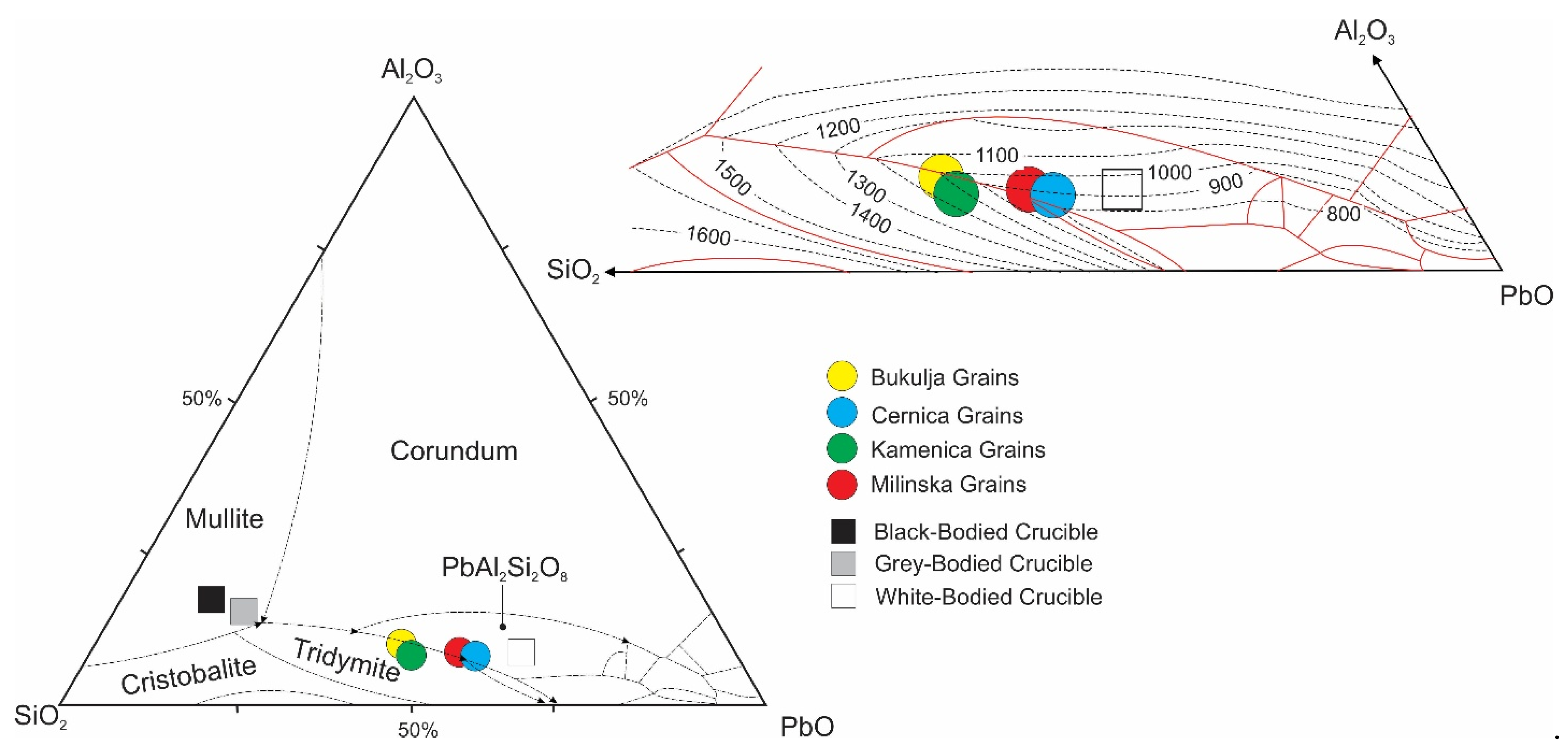
The glass coatings on the black and grey show similar ratios of Si:Al:Pb, with average PbO contents of 10.6 and 15.0 weight percent, respectively (
Figure 5,
Table 1). In comparison, the glass layer on the white-bodied sherd contains 53.9 wt% PbO, substantially lower SiO
2, at 26.4 wt%, and lower Fe content (
Figure 5,
Table 1). The glass grains from Bukulja, Cernica, Kamenica, and Milinska show similarly high PbO concentrations 34.6 to 46.7 wt%, SiO
2 (32.1 to 37.0 wt%), and Fe
2O
3 (1.2–2.7 wt%) (
Figure 5,
Table 1). Euhedral microlites of plumbian feldspar occur at the ceramic-glass boundary in both the white crucible fragment and one of the Pb-glass grains from the Cernica River (
Figure 3). Thus, it appears that the detrital Pb-glass grains most likely correlate with the white-bodied ceramic fragment, rather than the grey or black sherds.
The glass grains and the Pb-glass in the white ceramic sherd lie along the cotectic line between PbAl
2Si
2O
8 (plumbian feldspar) and tridymite (SiO
2) (
Figure 5), indicating melting temperatures between 900 and 1100 °C, consistent with minimum temperatures required to melt tin bronze. In contrast, the metal-bearing glass on the black and grey-bodied ceramics falls within the higher temperature mullite (Al
4+2xSi
2-2xO
10-x) field of the PbO-SiO
2-Al
2O
3 phase diagram [
34] (
Figure 5).
4.3. The Question of Chronology
The age of the Pb-glass remains speculative since the grains lack direct context. Pb metallurgy was absent from the region until the Iron Age, and so the leaded bronze refinement must post-date the Bronze Age. Technical ceramics with vitreous coatings from both the Iron Age and Roman Period have been collected at Spasovine. However, the composition of these artifacts does not correspond to that of the stream glass.
Since 2000, more than ten pedestrian surveys have been conducted on the southern slopes of Mt. Cer. Material evidence uncovered during these investigations shows that habitation in the area was limited to specific time periods. With a shift in land use and settlement patterns in the interval between 1200 and 850 BC, several settlements and the stronghold of Trojanov Grad were established in the area [
35], possibly to maintain access to tin ore. However, there is no evidence of the use of leaded bronze in the region during this earlier period of the Iron Age. The emergence of leaded bronze in the Central Balkans began in the 7th century BC, but there are no confirmed finds from that period in the vicinity of the Milinska River. The next interval of occupation occurred during the Roman Period, during which time leaded bronze objects outnumbered those composed of a binary tin bronze alloy, as noted in the collections of the National Museum of Serbia (unpublished data).
There is no archaeological evidence of a population in the southern Cer region after the 4th century AD. However, there is a small Medieval fort in the Central Cer massif, which likely controlled the approach to Mt. Cer and acted as reconnaissance and defense of the neighboring monastery and the north slopes of Cer that overlook the Pannonian Plain. Thus, the broader archaeological record of the region would suggest a Roman, or possibly Medieval age, for the stream Pb-glass produced during leaded bronze refinement.
5. Conclusions
The question remains as to why bronze refinement would have been conducted along the four tin-bearing rivers. The seasonal nature of placer tin mining provides a plausible explanation. The tin placers at Cer and Bukulja were likely exploited intermittently and/or seasonally when conditions were conducive to panning and sluicing. While on-site for tin mining and possible tin smelting, people may have engaged in additional pyrotechnical activities, including the refinement of bronze, perhaps enriching the new bronze with tin produced on-site. The abundance of detrital slag grains in the river, the paucity of related crucible material, and the lack of larger fragments of lead-rich slag discoveries from pedestrian surveys suggest that the slag was intentionally crushed and washed in the streams to collect residual metal trapped within the glass.
Detrital grains like the ones described herein provide a new and additional source of data regarding metallurgical activities conducted at placer tin mining sites. Furthermore, they may have the potential to act as a prospecting tool that would allow for vectoring to as yet undocumented archaeological material upstream; essentially a modified form of standard geochemical methods used for prospecting for ore deposits.
At Mt. Cer, pedestrian surveys in farm fields uncovered crucible fragments and other metallurgical artifacts (e.g., pin mold). The presence of Pb-rich stream glass serves to support and expand the interpretation of Spasovine as a site of periodic tin mining and metal production for over a millennium. However, the Bukulja site is heavily forested. No pedestrian surveys have been conducted, and no prior evidence of mining/metallurgical activities has been documented. Thus, at Bukulja, the presence of polymetallic glass grains in a tin-rich stream provides the first evidence of this site having been worked in antiquity. This example demonstrates that sluicing for metal-rich glass in tin streams has the potential to rapidly and inexpensively identify watersheds that may contain as yet undiscovered archaeological evidence of mining and metal production, allowing for their study and preservation from further stream erosion.
Author Contributions
Conceptualization, W.P.; methodology, W.P.; validation, W.P. and V.F.; formal analysis, M.A., I.S. and W.P.; investigation, M.A., I.S. and W.P.; resources, H.A.B., A.B., V.F. and W.P.; data curation, W.P.; writing—original draft preparation, M.A., V.F. and W.P.; writing—review and editing, M.A., W.P., H.A.B., A.B. and V.F.; visualization, W.P.; supervision, W.P.; project administration, W.P., A.B. and V.F.; funding acquisition, W.P. All authors have read and agreed to the published version of the manuscript.
Funding
This research was funded by the US National Science Foundation (grant number 2335664) and the Tow Mentorship Program at Brooklyn College.
Data Availability Statement
Acknowledgments
We wish to thank the Tow Mentoring Initiative for its support of research opportunities for undergraduates at Brooklyn College. Financial support for this work was provided by grant NSF-2335664 and the Tow Mentoring Initiative.
Conflicts of Interest
The authors declare no conflicts of interest.
References
- Garner, J. Bronze Age tin mines in central Asia. In Archaeometallurgy in Europe III; Hauptmann, A., Modarressi-Tehrani, D., Eds.; Deutsches Bergbau-Museum: Bochum, Germany, 2015; pp. 135–143. [Google Scholar]
- Stöllner, T.; Samaschev, Z.; Berdenov, S.; Cierny, J.; Doll, M.; Garner, J.; Gontscharov, A.; Gorelik, A.; Hauptmann, A.; Herd, R.; et al. Tin from Kazakhstan-Steppe Tin for the West? In Beiträge des im November 2008 in Bochum verans talteten Internationalen Symposiums; Metal, V.A., Ed.; Deutschen Bergbau-Museum: Bochum, Germany, 2011; Volume 180, pp. 231–252. [Google Scholar]
- Yener, K.A.; Özbal, H.; Kaptan, E.; Pehlivan, A.N.; Goodway, M. Kestel: An Early Bronze Age source of tin ore in the Taurus Mountains, Turkey. Science 1989, 244, 200–203. [Google Scholar] [CrossRef] [PubMed]
- Thorndycraft, V.R.; Pirrie, D.; Brown, A.G. Alluvial records of medieval and prehistoric tin mining on Dartmoor, southwest England. Geoarchaeology 2014, 19, 219–236. [Google Scholar] [CrossRef]
- Tolksdorf, J.F.; Schröder, F.; Petr, L.; Herbig, C.; Kaiser, K.; Kočár, P.; Fülling, A.; Heinrich, S.; Hönig, H.; Hemker, C. Evidence for Bronze Age and Medieval tin placer mining in the Erzgebirge mountains, Saxony (Germany). Geoarchaeology 2020, 35, 198–216. [Google Scholar] [CrossRef]
- Huska, A.; Powell, W.; Bankoff, H.A.; Bulatović, A.; Filipović, V.; Boger, R.; Mitrović, S. Placer Tin Ores from Mt. Cer, West Serbia, and Their Potential Exploitation during the Bronze Age. Geoarchaeology 2014, 29, 477–493. [Google Scholar] [CrossRef]
- Penhallurick, R.D. Tin in Antiquity: Its Mining and Trade Throughout the Ancient World with Particular Reference to Cornwall; Routledge: Oxfordshire, UK, 1986. [Google Scholar]
- Adriaens, A. Elemental composition and microstructure of early bronze age and medieval tin slags. Microchim. Acta 1996, 124, 89–98. [Google Scholar] [CrossRef]
- Malham, A. The Classification and Interpretation of Tin Smelting Remains from South West England. Unpublished Ph.D. Dissertation, University of Bradford, Bradford, UK, 2010. [Google Scholar]
- Bouzek, J.; Koutecký, D.; Simon, K. Tin and prehistoric mining in the Erzgebirge (Ore Mountains): Some new evidence. Oxf. J. Arch. 1989, 8, 203–212. [Google Scholar] [CrossRef]
- Williams, R.A.; Montesanto, M.; Badreshany, K.; Berger, D.; Jones, A.M.; Aragón, E.; Brügmann, G.; Ponting, M.; Roberts, B.W. From Land’s End to the Levant: Did Britain’s tin sources transform the Bronze Age in Europe and the Mediterranean? Antiquity 2025, 99, 708–726. [Google Scholar] [CrossRef]
- Bulatović, A.; Bankoff, H.A.; Powell, W.; Filipović, V. Some remarks on the genesis of the early Eneolithic in the Central Balkans. Starinar 2020, 70, 9–40. [Google Scholar] [CrossRef]
- Durman, A. Tin in southeastern Europe? Opvscvla Arch. 1997, 21, 7–14. [Google Scholar]
- Pacifico, L.; Powell, W.; Bankoff, H.A.; Filipović, V.; Bulatović, A. Iron Age and Roman Metallurgical Activities at the Spasovine Placer Tin Deposit, West Serbia. J. Arch. Sci. Rep. 2022, 45, 103619. [Google Scholar]
- Tylecote, R.F.; Photos, E.; Earl, B. The composition of tin slags from the south-west of England. World Arch. 1989, 20, 434–445. [Google Scholar] [CrossRef]
- Figueiredo, E.; Fonte, J.; Lima, A.; Veiga, J.P.; Silva, R.J.; Mirão, J. Ancient tin production: Slags from the Iron Age Carvalhelhos hillfort (NW Iberian Peninsula). J. Arch. Sci. 2018, 93, 1–16. [Google Scholar] [CrossRef]
- Chirikure, S.; Heimann, R.B.; Killick, D. The technology of tin smelting in the Rooiberg Valley, Limpopo Province, South Africa, ca. 1650–1850 CE. J. Arch. Sci. 2010, 37, 1656–1669. [Google Scholar] [CrossRef]
- Butler, B.C.M. Tin-rich garnet, pyroxene, and spinel from a slag. Min. Mag. 1978, 42, 487–492. [Google Scholar] [CrossRef]
- Kavur, B.; Kavur, M.B. Celts on Their Way to the “South”. Once Again Discussing Some Finds from the Balkans. Folia Arch. Balc. 2018, 4, 149–168. [Google Scholar]
- Powell, W.; Mladenović, O.; Cruse, S.; Bankoff, H.A.; Mathur, R. Revisiting “Tin in Southwest Europe?”. Starinar 2020, 70, 85–94. [Google Scholar] [CrossRef]
- Rabenau, A.; Schulz, H. The crystal chemistry of lead-tin oxides. J. Less-Common Met. 1976, 46, 87–96. [Google Scholar]
- Prengaman, R.D. Lead–Tin Oxide Compounds in Lead Smelting Slags. Met. Trans. B 1986, 17B, 133–140. [Google Scholar]
- Ma, S.; Sichen, D.; Seetharaman, S. Phosphate capacity of CaO-SiO2-FeOx slags. Metal. Mat. Trans. B 2022, 33, 415–422. [Google Scholar]
- Craddock, P.T. Early Metal Mining and Production; Edinburgh University Press: Edinburgh, UK, 1995. [Google Scholar]
- Ettler, V.; Johan, Z.; Zavřel, J.; Wallisová, M.S.; Mihaljevič, M.; Šebek, O. Slag remains from the Na Slupi site (Prague, Czech Republic): Evidence for early medieval non-ferrous metal smelting. J. Arch. Sci. 2015, 53, 72–83. [Google Scholar] [CrossRef]
- Warchulski, R.; Szczuka, M.; Kupczak, K. Reconstruction of 16th–17th century lead smelting processes on the basis of slag properties: A case study from Sławków, Poland. Minerals 2020, 10, 1039. [Google Scholar] [CrossRef]
- Bayley, J. Non-ferrous metalworking at Caerleon. In The Caerleon Excavations, Britannia Monograph Series 11; Marvell, A.G., Owen-Jones, H.S., Eds.; Society for the Promotion of Roman Studies: London, UK, 1990; pp. 191–209. [Google Scholar]
- Sahu, P.; Sheikh, M.A. Microscopic structure of lead-silicate glass and its correlation with thermal, mechanical, and radiation shielding properties. Appl. Phys. A 2022, 131, 935. [Google Scholar] [CrossRef]
- Rumble, J. CRC Handbook of Chemistry and Physics; CRC Press: Boca Raton, FL, USA, 2017; Volume 102. [Google Scholar]
- Bayley, J. Non-Ferrous Metalworking in England: Late Iron Age to Early Medieval; University of London, University College London: London, UK, 1992. [Google Scholar]
- Bayley, J. Non-ferrous metalworking in Iron Age Britain. In The Iron Age in Britain and Ireland: Recent Trends; Sharples, M., Chapman, C., Eds.; Leicester University Press: Leicester, UK, 1992; pp. 115–132. [Google Scholar]
- Bourgarit, D.; Mille, B. Recycling practices in bronze metallurgy: The example of Gaul. J. Arch. Sci. 2003, 30, 753–763. [Google Scholar]
- Dungworth, D. The production of copper alloys in medieval England. Hist. Metal. 2000, 34, 73–83. [Google Scholar]
- Chen, S.; Zhao, B.; Hayes, P.C.; Jak, E. Experimental study of phase equilibria in the PbO-Al2O3-SiO2 system. Metal. Mat. Trans. B 2001, 32, 997–1005. [Google Scholar]
- Bulatović, A.; Filipović, V.; Gligorić, R. Loznica–Kulturna Stratigrafija Praistorijskih Lokaliteta u Jadru, Rađevini i Azbukovici; Belgrade–Loznica, Arheološki Institut: Belgrade, Serbia, 2017. [Google Scholar]
| Disclaimer/Publisher’s Note: The statements, opinions and data contained in all publications are solely those of the individual author(s) and contributor(s) and not of MDPI and/or the editor(s). MDPI and/or the editor(s) disclaim responsibility for any injury to people or property resulting from any ideas, methods, instructions or products referred to in the content. |




 and
and