
An Experimental Study on the Consolidation of Earthen Surfaces Using Nanoparticle-Based Products



Abstract
1. Introduction
2. Overview of Surface Consolidation Treatments on Earthen Substrates
2.1. In the World
2.2. In China
3. Materials and Methods
3.1. Preparation of Earthen Material Specimens
3.2. Treatments
3.3. Earthen Materials Characterizations
3.3.1. Mineralogical Composition
3.3.2. Calcimetry
3.3.3. Grain Size Distribution
3.4. Performance Evaluation
3.4.1. Consolidation Effectiveness
3.4.2. Absence of Drawbacks of Applied Treatments
- -
- Amount of water absorbed at 120 min per unit area (Qf);
- -
- Capillary absorption coefficient (CA), given by the initial slope of the regression line of the water absorption curves;
- -
- Protective efficacy (EP), calculated as follows:
4. Results
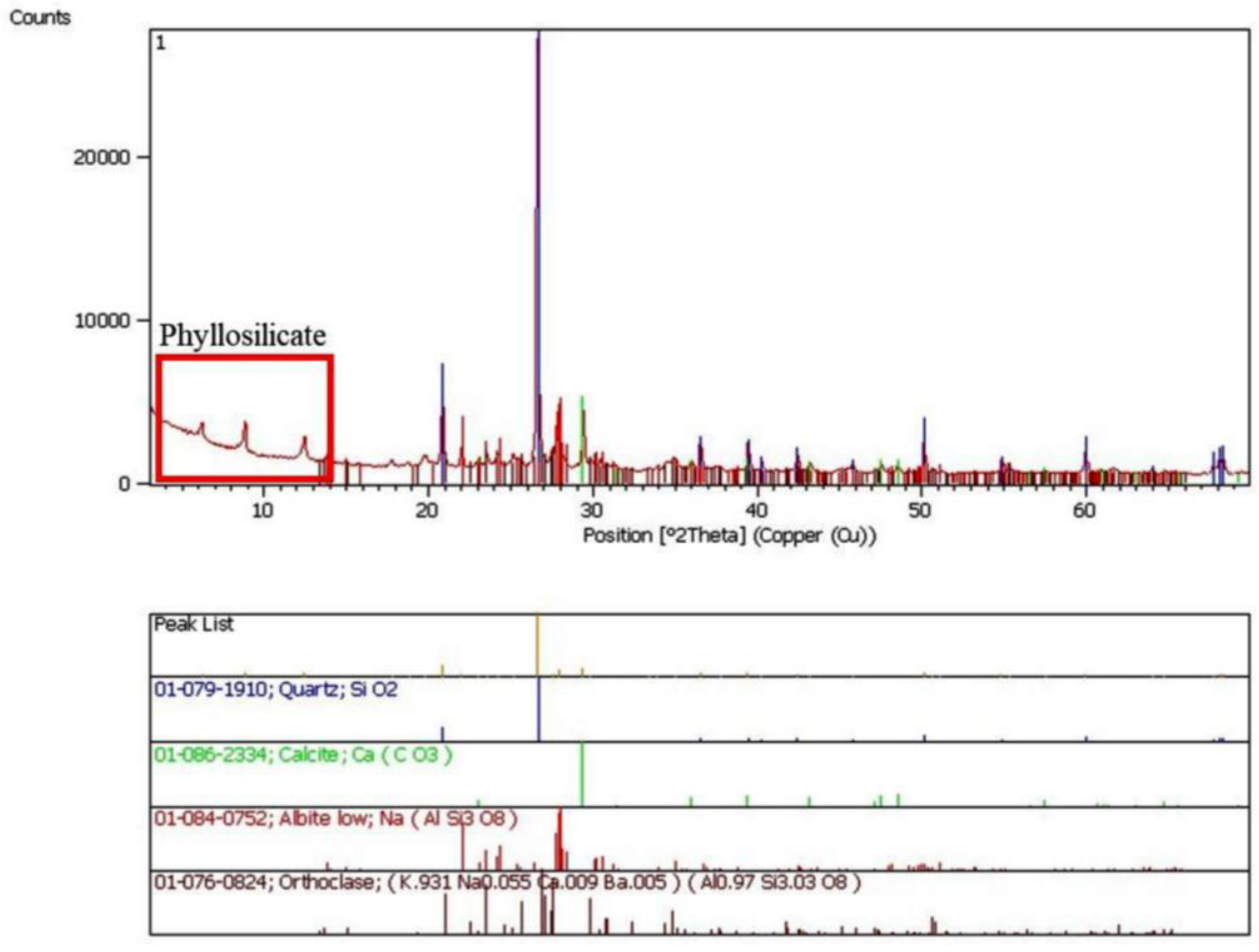
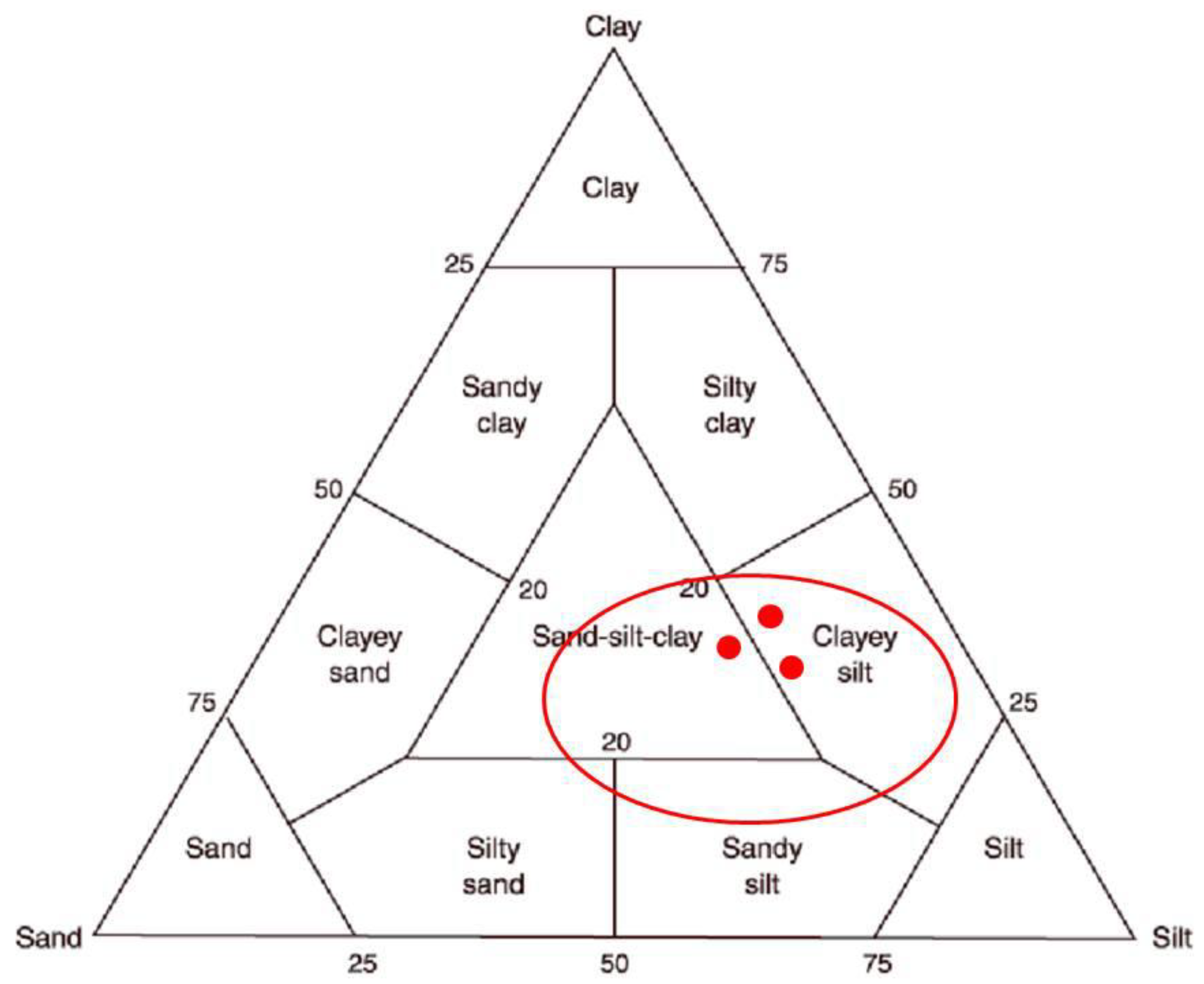
4.1. Earthen Materials Characterisation
4.2. Performance Evaluation Outcomes
4.2.1. Drilling Resistance and Microdurometer
- -
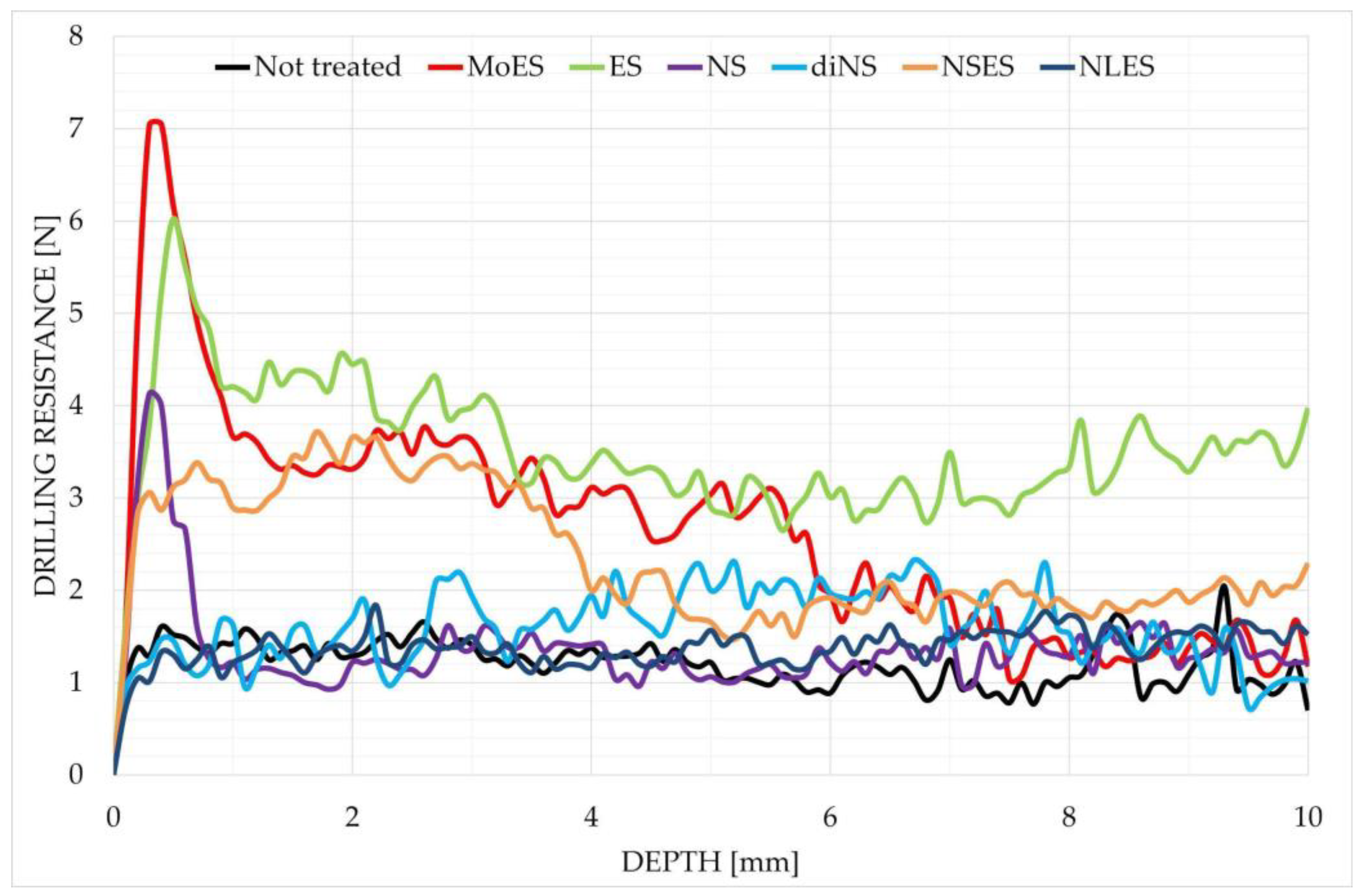
- MoES: The presence of a hard surface crust, about 1 mm thick, with drilling resistance values of about 5.0 N (±1.5 N). Subsequently, the drilling resistance values remain around 3.0 N (±0.5 N) up to a depth of 6 mm and then fall to values comparable with those of the untreated 1.4 N (±0.4 N) (Figure 5 and Table 5).
- -
- ES: The presence of a hard surface crust about 1 mm thick with drilling resistance values of about 4.3 N (±1.3 N). In the range between 1 mm and 10 mm, the values of resistance to drilling remain constant at around 3.5 N (±0.7 N), never lowering to the values of the untreated reference (Figure 5 and Table 5).
- -
- NSES: There is no surface crust; the product, up to 4 mm, gives the adobe brick a resistance to drilling equal to about 3.0 N (±0.6 N). Then, in the following interval of 4–10 mm, the values of the resistance profile to the drill are lowered to those of the untreated reference (1.8 N ± 0.4 N) (Figure 5 and Table 5).
- -
- -
4.2.2. Colour Measurements
4.2.3. Water Absorption by Capillarity
- -
- -
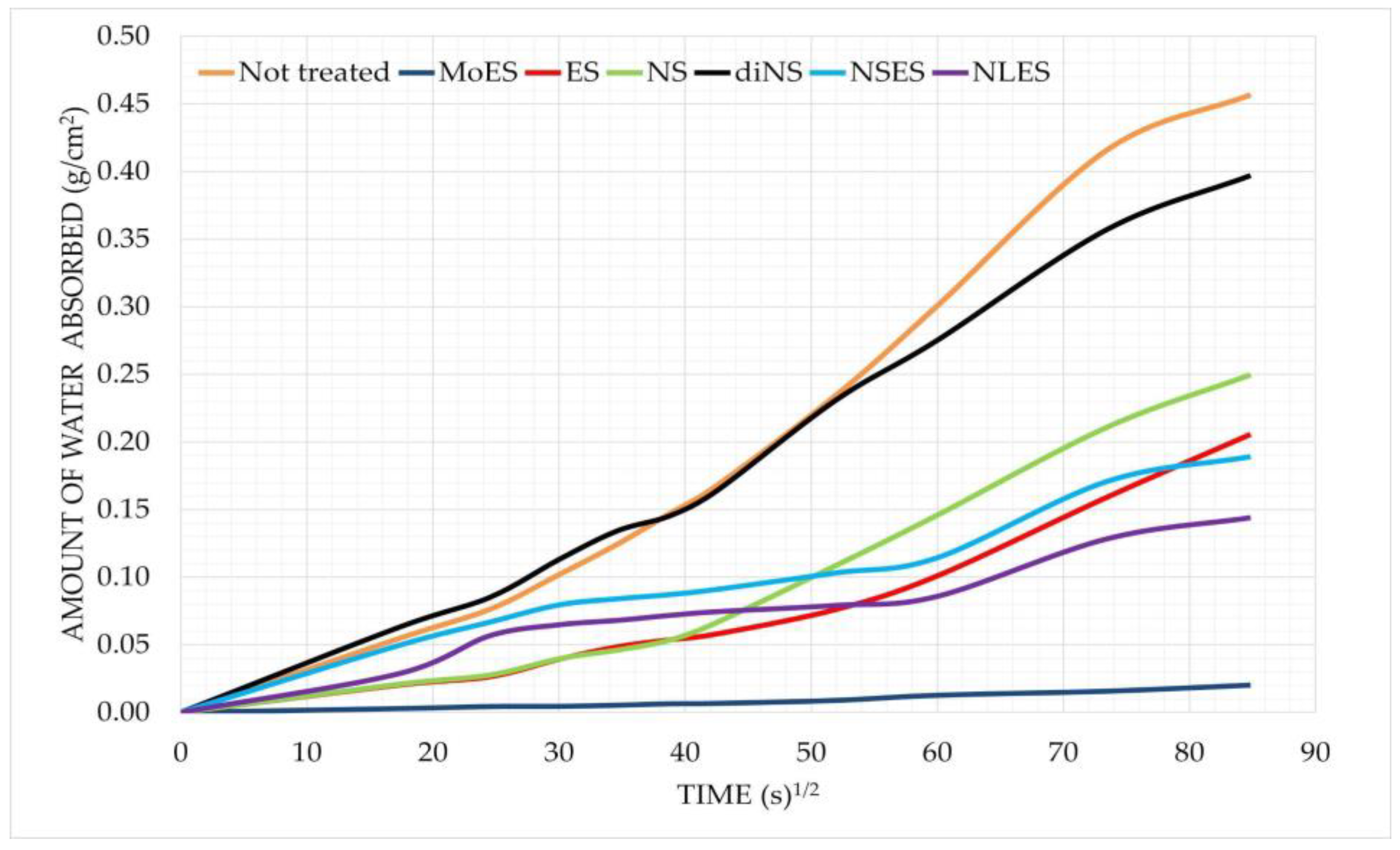
- ES and NS: Both show similar behaviour. The amount of water absorbed at the end of the test is about half that of the untreated reference and the protective efficacy values are 55% and 45% respectively (Table 8). The capillary absorption coefficient is low and can be observed from the graph, which, after about 30 min, begins to increase with a speed (slope of the curve) like that of the untreated reference for NS, and like the untreated reference but slightly lower for ES (Figure 7).
- -
- -
- NSES and NLES: Both show similar behaviour. The two capillary absorption curves are practically parallel, although the initial absorption coefficient is slightly higher for the NSES (Figure 7). Protective efficacy is good, at around 60% for both (Table 8). It should be noted that both curves have an intermediate plateau between 10 and 60 min, after which the absorption coefficient starts to increase with an absorption speed approximately equal to that at the beginning of the test (Figure 7).
4.2.4. Water Vapour Permeability
5. Discussion
6. Conclusions
Author Contributions
Funding
Data Availability Statement
Acknowledgments
Conflicts of Interest
References
- World Heritage List. Available online: https://whc.unesco.org/en/list/ (accessed on 14 January 2026).
- Bertagnin, M. Architetture di terra in Italia. In Tipologie, Tecnologie e Culture Costruttive; Edicom Ed.: Monfalcone, Italy, 1999. [Google Scholar]
- Bollini, G. Terra Cruda Tra Tradizione e Innovazione; Edicom Ed.: Manzano, Italy, 2008. [Google Scholar]
- Conti, G. (Ed.) Le case di terra: Orgoglio e pregiudizio. In Antologia Della Terra Cruda 1997–2004; Viaggio Nella Terra Cruda in Italia; Casa Editrice Tinari: Villamagna, Italy, 2004. [Google Scholar]
- Mattone, M. Prevenire il degrado: La protezione delle costruzioni in terra cruda. In Proceedings of the Scienza e Beni Culturali XXVI, 2010—Pensare la Prevenzione: Manufatti, Usi, Ambienti; Biscontin, G., Driussi, G., Eds.; Arcadia Ricerche: Venice, Italy, 2010; pp. 141–150. [Google Scholar]
- Mattone, R. Il Paesaggio Delle Case in Terra Cruda; L’Artistica Editrice: Savigliano, Italy, 2010. [Google Scholar]
- Eires, R.; Camões, A.; Jalali, S. Ancient materials and techniques to improve the earthen building durability. Key Engin. Mat. 2014, 634, 357–366. [Google Scholar] [CrossRef]
- Gomes, M.I.; Goncalves, T.D.; Faria, P. Earth-based repair mortars: Experimental analysis with different binders and natural fibers. In Proceedings of the RESTAPIA 2012, Valencia, Italy, 21–23 June 2012; Vegas, F., Cristini, V., Eds.; Taylor & Francis Group: London, UK, 2012; pp. 661–668. [Google Scholar]
- Mattone, M.; Ibnoussina, M.; Rescic, S.; Fratini, F.; Magrini, D.; Mecchi, A.M. Stabilization of earthen plasters: Exchange of knowledge and experiences between Italy and Morocco. J. Mat. Environ. Sci. 2016, 7, 3647–3655. [Google Scholar]
- Mattone, M.; Rescic, S.; Fratini, F.; Del Fa, M. Experimentation of earth-gypsum plasters for the conservation of earthen constructions. Int. J. Arch. Herit. 2017, 11, 763–772. [Google Scholar] [CrossRef]
- Stazi, F.; Nacci, A.; Tittarelli, F.; Pasqualini, E.; Munafò, P. An experimental study on earthen plasters for earthen building protection: The effect of different admixtures and surface treatments. J. Cult. Herit. 2016, 17, 27–41. [Google Scholar] [CrossRef]
- Beas, M.I.G. Traditional Architectural Renders on Earthen Surface. Master’s Thesis, Graduate School of Arts and Sciences, University of Pennsylvania, Philadelphia, PA, USA, 1991. [Google Scholar]
- Salazar-Hernández, C.; Puy-Alquiza, M.J.; Miranda-Avilés, R.; Salazar-Hernández, M.; Mendoza-Miranda, J.M.; Mocada-Sánchez, C.D.; del Ángel-Soto, J. Comparative study of TEOS-consolidants for adobe building conservation. J. Sol-Gel Sci. Technol. 2021, 97, 685–696. [Google Scholar] [CrossRef]
- Elert, K.; Pardo, E.S.; Rodriguez-Navarro, C. Alkaline activation as an alternative method for the consolidation of earthen architecture. J. Cult. Herit. 2015, 16, 461–469. [Google Scholar] [CrossRef]
- Elert, K.; Bel-Anzué, P.; Monasterio-Guillot, L.; Pardo, S. Performance of alkaline activation for the consolidation of earthen architecture. J. Cult. Herit. 2019, 39, 93–102. [Google Scholar] [CrossRef]
- Elert, K.; Jroundi, F.; Benavides-Reyes, C.; Gómez, E.C.; Gulotta, D.; Rodriguez-Navarro, C. Consolidation of clay-rich earthen building materials: A comparative study at the Alhambra fortress (Spain). J. Build. Eng. 2022, 50, 104081. [Google Scholar] [CrossRef]
- Elert, K.; Biçer-Simşir, B.; Correa, E.; Rodriguez-Navarro, C.; Gulotta, D. Surface characterization of consolidated earthen substrates using an innovative multi-analytical strategy. Constr. Build. Mater. 2024, 438, 137154. [Google Scholar] [CrossRef]
- Lohnas, D.E. Evaluating the Effectiveness of Calcium Hydroxide Nanoparticle Dispersions for the Consolidation of Painted Earthen Architectural Surfaces. Master’s Thesis, University of California, Los Angeles, CA, USA, 2012. [Google Scholar]
- Lanzón, M.; Madrid, J.A.; Martínez-Arredondo, A.; Mónaco, S. Use of diluted Ca(OH)2 suspensions and their transformation into nanostructured CaCO3 coatings: A case study in strengthening heritage materials (stucco, adobe and stone). Appl. Surf. Sci. 2017, 424, 20–27. [Google Scholar] [CrossRef]
- Lanzón, M.; De Stefano, V.; Molina Gaitán, J.C.; Bestué Cardiel, I.; Gutiérrez-Carrillo, M.L. Characterisation of earthen walls in the Generalife (Alhambra): Microstructural and physical changes induced by deposition of Ca(OH)2 nanoparticles in original and reconstructed samples. Constr. Build. Mater. 2020, 232, 117202. [Google Scholar] [CrossRef]
- García-Vera, V.E.; Tenza-Abril, A.J.; Lanzón, M. The effectiveness of ethyl silicate as consolidating and protective coating to extend the durability of earthen plasters. Constr. Build. Mater. 2020, 236, 117445. [Google Scholar] [CrossRef]
- Elert, K.; Sebastian, E.; Valverde, I.; Rodriguez-Navarro, C. Alkaline treatment of clay minerals from the Alhambra formation: Implications for the conservation of earthen architecture. Appl. Clay Sci. 2008, 39, 122–132. [Google Scholar] [CrossRef]
- Camerini, R.; Chelazzi, D.; Giorgi, R.; Baglioni, P. Hybrid nano-composites for the consolidation of earthen masonry. J. Coll. Interface Sci. 2019, 539, 504–515. [Google Scholar] [CrossRef] [PubMed]
- Tonelli, M.; Camerini, R.; Baglioni, P.; Ridi, F. Activation of ground granulated blast-furnace slag with calcium hydroxide nanoparticles towards the consolidation of adobe. Constr. Build. Mater. 2024, 439, 137285. [Google Scholar] [CrossRef]
- Parracha, J.L.; Pereira, A.S.; da Silva, R.V.; Almeida, N.; Faria, P. Efficacy of iron-based bioproducts as surface biotreatment for earth-based plastering mortars. J. Clean. Prod. 2019, 237, 117803. [Google Scholar] [CrossRef]
- Agnew, N.; Demas, M. Principles for the Conservation of Heritage Sites in China; Getty Conservation Institute: Los Angeles, CA, USA, 2002. [Google Scholar]
- Li, Z.; Zhang, H.; Wang, X. Reinforcement of ancient earthen structures. Dunhuang Stud. 1995, 3, 1–18. [Google Scholar]
- Li, Z.; Zhao, L.; Sun, M. Deterioration of earthen sites and consolidation with PS material along Silk Road of China. Yanshilixue Yu Gongcheng Xuebao/Chin. J. Rock Mech. Eng. 2009, 28, 1047–1054. [Google Scholar]
- Li, Z.; Shao, M.; Chen, R. Impact of PS on permeability of unsaturated ruins clay. Yantu Lixue/Rock Soil Mech. 2011, 32, 2039–2044. [Google Scholar]
- Li, Z.; Wang, X.; Sun, M.; Chen, W.; Guo, Q.; Zhang, H. Conservation of Jiaohe ancient earthen site in China. J. Rock Mech. Geotech. Eng. 2011, 3, 270–281. [Google Scholar] [CrossRef]
- Wang, X.; Li, Z.; Zhang, L. Condition, conservation, and reinforcement of the Yumen Pass and Hecang earthen ruins near Dunhuang. In Conservation of Ancient Sites on the Silk Road, Proceedings of the Second International Conference on the Conservation of Grotto Sites, Mogao Grottoes, Dunhuang, China, 28 June–3 July 2004; Agnew, N., Ed.; Getty Conservation Institute: Los Angeles, CA, USA, 2004; pp. 370–377. [Google Scholar]
- Li, L.; Shao, M.; Wang, S.; Li, Z. Preservation of earthen heritage sites on the Silk Road, northwest China from the impact of the environment. Environ. Earth Sci. 2011, 64, 1625–1639. [Google Scholar] [CrossRef]
- Zhang, Y.; Guo, S.; Yin, X.; Han, S.L.; Shao, S. Evolution of the anti-weathering characteristics of clay at earthen sites treated with K2SiO3 solutions: Micromechanism analysis based on SEM tests. Bull. Eng. Geol. Environ. 2022, 81, 439. [Google Scholar] [CrossRef]
- Zhang, G.; Zhang, G.; Liu, P.; Zhang, H.; Zhou, L.; Zhang, X. Laboratory investigation the consolidation of Chinese ancient earthen sites (Andier City Ruins) with potassium silicate material. In Engineering Geology for a Habitable Earth: IAEG XIV Congress 2023 Proceedings, Chengdu, China. IAEG 2023; Wang, S., Huang, R., Azzam, R., Marinos, V.P., Eds.; Environmental Science and Engineering; Springer: Singapore, 2023; pp. 281–304. [Google Scholar] [CrossRef]
- Zhou, S.; Yuan, S.; Guo, B.; Xia, Y. Nonaqueous dispersions and their antiweathering performance for earthen buildings, monuments, and archaeological sites. In Conservation of Ancient Sites on the Silk Road, Proceedings of the Second International Conference on the Conservation of Grotto Sites, Mogao Grottoes, Dunhuang, People’s Republic of China, 28 June–3 July 2004; Agnew, N., Ed.; Getty Conservation Institute: Los Angeles, CA, USA, 2004; pp. 399–403. [Google Scholar]
- Wan, T.; Lin, J. A new inorganic-organic hybrid material as consolidation material for Jinsha archaeological site of Chengdu. J. Cent. South Univ. 2014, 21, 487–492. [Google Scholar] [CrossRef]
- Zhao, D.; Lu, W.; Wang, Y.; Mao, X.; Ai, Y.; Jiang, H. Experimental studies on earthen architecture sites consolidated with BS materials in arid regions. Adv. Mat. Sci. Engin. 2016, 6836315. [Google Scholar] [CrossRef]
- Du, X.; Wu, Q.; Fu, G.; Ma, Q.; Shen, G.; Li, H. Preparation of a consolidation material of organosilica-modified acrylate emulsion for earthen sites and the evaluation of its effectiveness. Coatings 2024, 14, 587. [Google Scholar] [CrossRef]
- Han, P.; Zhang, H.; Zhang, R.; Tan, X.; Zhao, L.; Liang, Y.; Su, B. Evaluation of the effectiveness and compatibility of nanolime for the consolidation of earthen-based murals at Mogao Grottoes. J. Cult. Herit. 2022, 58, 266–273. [Google Scholar] [CrossRef]
- Chen, W.; Zhang, Y.; Zhang, J.; Dai, P. Consolidation effect of composite materials on earthen sites. Constr. Build. Mater. 2018, 187, 730–737. [Google Scholar] [CrossRef]
- Zeng, R.; Schwantes, G. Investigation of the effect of relative humidity on micro lime consolidation of degraded earthen structures. Herit. Sci. 2024, 12, 267. [Google Scholar] [CrossRef]
- Chen, W.; Yan, B.; Guo, S.; Liu, Y.; Yang, F.; Zhang, K.; Wang, L.; Sun, M.; Shen, Y.; Mao, W. An in-situ conservation method of the rammed earth sites using a new silica protective agent. Constr. Build. Mater. 2024, 452, 138960. [Google Scholar] [CrossRef]
- Li, J.; Zhu, F.; Wu, F.; Chen, Y.; Richards, J.; Li, T.; Li, P.; Shang, D.; Yu, J.; Viles, H.; et al. Impact of soil density on biomineralization using EICP and MICP techniques for earthen sites consolidation. J. Environ. Manag. 2024, 363, 121410. [Google Scholar] [CrossRef]
- Cui, K.; Du, Y.; Zhang, Y.; Wu, G.; Yu, L. An evaluation system for the development of scaling off at earthen sites in arid areas in NW China. Herit. Sci. 2019, 7, 14. [Google Scholar] [CrossRef]
- Ürümqi Climate (China), Data and Graphs for Weather & Climate in Ürümqi. Available online: https://en.climate-data.org/asia/china/xinjiang/ueruemqi-2588 (accessed on 20 January 2026).
- Chiari, G. Chemical surface treatments and capping techniques of earthen structures: A long term evaluation. In Proceedings of the 6th International Conference on the Conservation of Earthen Architecture, Las Cruces, NM, USA, 14–19 October 1990; Taylor, N.M., Balderrama, A.A., Houben, H., Grimstad, K., Eds.; The Getty Conservation Institute: Los Angeles, CA, USA, 1990; pp. 267–273. [Google Scholar]
- Ferron, A. The Consolidation of Earthen Surface Finishes: A Study of Disaggregating Plasters at Mesa Verde National Park. Doctoral Dissertation, University of Pennsylvania, Philadelphia, PA, USA, 2007. [Google Scholar]
- Ferron, A.; Matero, F.G. A comparative study of ethyl-silicate–based consolidants on Earthen Finishes. J. Am. Inst. Conserv. 2011, 50, 49–72. [Google Scholar] [CrossRef]
- García-Vera, V.E.; Tenza-Abril, A.J.; Solak, A.M.; Lanzon, M. Calcium hydroxide nanoparticles coatings applied on cultural heritage materials: Their influence on physical characteristics of earthen plasters. Appl. Surf. Sci. 2020, 504, 144195. [Google Scholar] [CrossRef]
- He, J.; Otero, J.; Crespo-López, L.; Monasterio-Guillot, L.; Benavides-Reyes, C.; Elert, K.; Rodriguez-Navarro, C. Ethyl silicate–nanolime treatment for the consolidation of calcareous building materials. Constr. Build. Mater. 2024, 418, 135437. [Google Scholar] [CrossRef]
- Barberena-Fernández, A.M.; Blanco-Varela, M.T.; Carmona-Quiroga, P.M. Use of nanosilica- or nanolime-additioned TEOS to consolidate cementitious materials in heritage structures: Physical and mechanical properties of mortars. Cem. Concr. Compos. 2019, 95, 271–276. [Google Scholar] [CrossRef]
- Borsoi, G.; Tavares, M.; Veiga, R.; Silva, A.S. Microstructural characterization of consolidant products for historical renders: An innovative nanostructured lime dispersion and a more traditional ethyl silicate limewater solution. J. Microsc. Soc. Am. 2012, 18, 1181–1189. [Google Scholar] [CrossRef] [PubMed]
- Maryniak-Piaszczynski, E.; Wolf, V.; Ghaffari, E. The combination of calcium hydroxide-sol and silici acid ester as new mothod for structural consoldiatoin of object built od tuff, lime marl, trachyte. Latest findings. In Proceedings of the 12th, International Congress on the Deterioration and Conservation of Stone Columbia University, New York, NY, USA, 22–26 October 2012. [Google Scholar]
- Miliani, C.; Velo-Simpson, M.L.; Scherer, G.W. Particle-modified consolidants: A study on the effect of particles on solegel properties and consolidation effectiveness. J. Cult. Herit. 2007, 8, 1–6. [Google Scholar] [CrossRef]
- Peterová, A.; Mayo, S.G.; Polonský, J.; Knotek, V.; Kotlík, P. Influence of Different Nanoparticles in Stone Silicon-Based Consolidant. Key Eng. Mater. 2016, 714, 90–94. [Google Scholar] [CrossRef]
- Verganelaki, A.; Kapridaki, C.; Maravelaki-Kalaitzaki, P. Modified tetraethoxysilane with nanocalcium oxalate in one-pot synthesis for protection of building materials. Ind. Eng. Chem. Res. 2015, 54, 7195−7206. [Google Scholar] [CrossRef]
- Borsoi, G.; Veiga, R.; Santos Silva, A. Effect of nanostructured lime-based and silica-based products on the consolidation of historical render. In Proceedings of the 3rd Historic Mortars Conference, Glasgow, UK, 11–14 September 2013. [Google Scholar] [CrossRef]
- Ciancio, D.; Beckett, C.T.S.; Carraro, J.A.H. Optimum lime content identification for lime-stabilised rammed earth. Constr. Build. Mater. 2014, 53, 59–65. [Google Scholar] [CrossRef]
- Falchi, L.; Fratini, F.; Rescic, S.; Pirolandi, L.; Ricci, G.; Zendri, E. From the historical sugar refinery of Chichaoua (Morocco) to the lab: A reverse engineering experimentation on the hydration of earthen materials stabilized with lime. J. Mater. Environ. Sci. 2016, 7, 3595–3604. [Google Scholar]
- Slíková, Z.; Frankeová, D. Strengthening of Weak Historic Renders with Traditional and Innovated Consolidation Treatment. In Proceedings of the 21st International Conference Engineering Mechanics 2015, Svratka, Czech Republic, 11–14 May 2015; pp. 282–283. [Google Scholar]
- Al-Dosari, M.A.; Darwish, S.; El-Hafez, M.A.; Elmarzugi, N.; Al-Mouallimi, N.; Mansour, S. Effects of adding nanosilica on performance of ethylsilicate (TEOS) as consolidation and protection materials for highly porous artistic stone. J. Mat. Sci. Eng. A 2016, 6, 92–204. [Google Scholar] [CrossRef][Green Version]
- Technical Leaflet: Wacker SILRES BS OH 100, by Wacker Chemie-Germany. Available online: https://fr.scribd.com/document/755400336/SILRES-BS-OH-100-en-2024-06-16 (accessed on 14 January 2026).
- Technical Leaflet: Surfapore FX WB by Nanophos-Greece. Available online: https://nanophos.com/wp-content/uploads/2021/04/SurfaPore-FXWB_TDS_E%CE%9D_v09082022.pdf (accessed on 14 January 2026).
- Technical Leaflet: Nano Estel by C.T.S. Srl Products, Equipments and Systems for Art Restoration Service in General Catalogue. Available online: https://ctsconservation.com/it/consolidanti-protettivi-e-malte/6023-nano-estel-conf-1-kg.html (accessed on 14 January 2026).
- Technical Leaflet: CaLoSiL®Colloidal Nano-Particles of Lime for Stone and Plaster Consolidation by IBZ-Salzchemie GmbH & Co. KG-Germany. Available online: https://www.calosil.de/downloads-en (accessed on 14 January 2026).
- Cipriani, C. Ricerche sui minerali costituenti le arenarie: I) sulla composizione mineralogica della frazione argillosa di alcune arenarie Macigno. Atti Soc. Toscana Sci. Nat. Mem. 1958, 65, 86–106. [Google Scholar]
- Cipriani, C.; Malesani, P.G. Composizione mineralogica delle frazioni pelitiche delle formazioni del Macigno e Marnoso-arenacea (Appennino settentrionale). Mem. Ist. Geol. Min. 1972, 29, 1–25. [Google Scholar]
- Giampaolo, C.; Lo Mastro, S.; Aldega, L. Metodo Ufficiale n°IV.2—Diffrattometria a raggi X. analisi mineralogica semiquantitative. In 79 del 06-04-2006 Supplemento Ordinario Gazzetta Ufficiale n. 60; Istituto di Istruzione Superiore Lazzaro Spallanzani: Vignola, Italy, 2005; pp. 36–41. [Google Scholar]
- Leone, G.; Leoni, L.; Sartori, F. Revisione di un metodo-gasometrico per la determinazione di calcite e dolomite. Atti Soc. Toscana Sci. Nat. Mem. 1968, 95, 7–20. [Google Scholar]
- ASTM D2217–85; Standard Practice for Wet Preparation of Soil Samples for Particle-Size Analysis and Determination of Soil Constants. ASTM International: Conshohocken, PA, USA, 1998. Available online: https://www.astm.org/search/result?q=D2217 (accessed on 26 February 2026).
- ASTM D422–63; Standard Test Method for Particle-Size Analysis of Soils. ASTM International: Conshohocken, PA, USA, 1990. Available online: https://www.astm.org/search/result?q=D422 (accessed on 26 February 2026).
- Papamichos, E.; Papanicolopolus, S.A.; Larsen, I.; Alnæ, L.; Rescic, S. Method for in situ, quasi non destructive diagnosis of mechanical properties and damage of natural building stones. In Proceedings of the Gulf Rock 2004, the 6th American Rock Mechanics Symposium (NARMS): Rock Mechanics Across Borders and Disciplines, Houston, TX, USA, 5–9 June 2004. ARMA/NARMS 2004, paper n° 04-583. [Google Scholar]
- Rescic, S.; Fratini, F.; Tiano, P. Onsite evaluation of the mechanical properties of Maastricht limestone and their relationship with the physical characteristics. Geol. Soc. Lond. Spec. Publ. 2010, 331, 203–207. [Google Scholar]
- Valentini, E.; Benincasa, A.; Tiano, P.; Fratini, F.; Rescic, S. On site drilling resistance profiles of natural stones. In Proceedings of the International Workshop In Situ Monitoring of Monumental Sufaces, Florence, Italy, 27–29 October 2008; Tiano, P., Pardini, C., Eds.; Edifir: Firenze, Italy, 2008; pp. 195–204. [Google Scholar]
- CIELAB. Commission Internationale de l’Eclairage; ResearchGate GmbH.: Berlin, Germany, 1976. [Google Scholar]
- EN 15886:2010; Conservation of Cultural Property—Test Method—Colour Measurements of Surfaces. Management Center: Brussels, Belgium, 2010.
- Gomes, R.; Folque, J. O Uso da Terra Com Material de Construção (The Use of Earth as Construction Material); Technical Document—C.I.T Nº9 1953, Series D-4; LNEC: Lisbon, Portugal, 1953. [Google Scholar]
- EN 15803:2009; Conservation of Cultural Property—Test Methods—Determination of Water Vapour Permeability(δp). Management Center: Brussels, Belgium, 2009.
- Houben, H.; Guillaud, H. Traité de Construction en Terre; Editions Parenthèses: Marseille, France, 1989. [Google Scholar]
- Guillaud, H. A global challenge: Preserving earthen architecture. World Herit. 2008, 48, 4–15. [Google Scholar]
- Mokrzycki, W.S.; Tatol, M. Color difference Delta E—A survey. Mach. Graph. Vis. 2011, 20, 383–411. [Google Scholar]
- Barsottelli, M.; Fratini, F.; Giorgetti, G.; Manganelli Del Fa, C. Microfabric and alteration in the Carrara marble: A preliminary study. Sci. Technol. Cult. Herit. 1998, 7, 109–120. [Google Scholar]



| Treatment | ID | Product Concentration (w/w) | Applied Mixture Concentration (w/w) | Amount of Treatment Applied (mg/cm2) |
|---|---|---|---|---|
| Ethyl Silicate | ES | 100% | 50% in ethanol | 39 ± 8 |
| Modified Ethyl Silicate | MoES | as supplied | as supplied | 22 ± 5 |
| Ethyl Silicate + Nano-Silica (1:1 v/v) | NSES | 100% + 30% in water | 3% in ethanol + 3.75% in water | 5 ± 1 |
| Ethyl Silicate + Nano-Lime (1:1 v/v) | NLES | 100% + 3% in ethanol | 5% in ethanol + 3% in ethanol | 4 ± 1 |
| Nano-Silica | NS | 30% in water | 30% in water | 21 ± 5 |
| Nano-Silica 3.75% | diNS | 30% in water | 3.75% in water | 3 ± 1 |
| Sample | Quartz | Feldspars | Calcite * | Phyllosilicate + Accessory Minerals |
|---|---|---|---|---|
| Adobe 1 | x | X | 15 | x |
| Adobe 2 | x | X | 11 | x |
| Adobe 3 | x | X | 13 | x |
| Sample | Kaolinite * | Illite * | Chlorite * | Smectite * |
|---|---|---|---|---|
| Adobe 1 | 25 | 35 | 20 | 20 |
| Adobe 2 | 30 | 40 | 15 | 15 |
| Adobe 3 | 25 | 50 | 15 | 10 |
| Sample | Sand% | Silt% | Clay% |
|---|---|---|---|
| Ø > 63 µm | 4 µm < Ø < 63 µm | Ø < 4 µm | |
| Adobe 1 | 20 | 49 | 31 |
| Adobe 2 | 17 | 54 | 36 |
| Adobe 3 | 23 | 55 | 32 |
| Treatment | Depth Range (mm) | Drilling Resistance [N] | |||
|---|---|---|---|---|---|
| Sample 1 | Sample 2 | Sample 3 | Average | ||
| Not treated | 0–1 | 1.39 ± 0.25 | 1.79 ± 0.22 | 0.96 ± 0.13 | 1.38 ± 0.17 |
| 1–10 | 1.31 ± 0.33 | 1.24 ± 0.62 | 1.02 ± 0.24 | 1.19 ± 0.45 | |
| 0–10 | 1.30 ± 0.35 | 1.28 ± 0.62 | 1.00 ± 0.25 | 1.20 ± 0.46 | |
| ES | 0–1 | 4.45 ± 1.43 | 4.01 ± 1.27 | 4.57 ± 1.54 | 4.34 ± 1.32 |
| 1–10 | 3.56 ± 0.68 | 3.65 ± 0.80 | 3.21 ± 0.48 | 3.47 ± 0.69 | |
| 0–10 | 3.60 ± 0.89 | 3.64 ± 0.93 | 3.31 ± 0.84 | 3.51 ± 0.89 | |
| MoES | 0–1 | 5.25 ± 1.89 | 4.66 ± 1.78 | 4.93 ± 1.44 | 4.95 ± 1.65 |
| 1–10 | 2.60 ± 1.12 | 2.39 ± 1.01 | 2.30 ± 0.73 | 2.43 ± 0.97 | |
| 0–10 | 2.82 ± 1.47 | 2.58 ± 1.31 | 2.52 ± 1.16 | 2.64 ± 1.32 | |
| NSES | 0–1 | 2.81 ± 0.66 | 2.65 ± 0.57 | 3.28 ± 0.53 | 2.91 ± 0.56 |
| 1–10 | 2.59 ± 0.65 | 2.06 ± 0.67 | 2.32 ± 0.84 | 2.32 ± 0.75 | |
| 0–10 | 2.58 ± 0.70 | 2.09 ± 0.71 | 2.39 ± 0.89 | 2.35 ± 0.80 | |
| NLES | 0–1 | 1.24 ± 0.25 | 1.12 ± 0.34 | 1.09 ± 0.26 | 1.15 ± 0.20 |
| 1–10 | 1.53 ± 0.23 | 1.41 ± 0.28 | 1.27 ± 0.27 | 1.41 ± 0.28 | |
| 0–10 | 1.49 ± 0.29 | 1.37 ± 0.33 | 1.25 ± 0.30 | 1.37 ± 0.32 | |
| NS | 0–1 | 1.76 ± 1.35 | 2.96 ± 1.37 | 2.04 ± 1.50 | 2.25 ± 1.17 |
| 1–10 | 1.11 ± 0.17 | 0.58 ± 0.46 | 0.89 ± 0.36 | 0.86 ± 0.41 | |
| 0–10 | 1.16 ± 0.49 | 0.80 ± 0.93 | 1.00 ± 0.67 | 0.99 ± 0.73 | |
| diNS | 0–1 | 1.39 ± 0.16 | 0.86 ± 0.37 | 1.65 ± 0.46 | 1.30 ± 0.25 |
| 1–10 | 1.92 ± 0.65 | 1.18 ± 0.38 | 1.82 ± 0.65 | 1.64 ± 0.66 | |
| 0–10 | 1.86 ± 0.66 | 1.14 ± 0.40 | 1.78 ± 0.66 | 1.59 ± 0.67 | |
| Treatment | Micro-Hardness (μm) |
|---|---|
| Not treated | 55 ± 5 |
| ES | 23 ± 5 |
| MoES | 20 ± 5 |
| NSES | 34 ± 5 |
| NLES | 52 ± 5 |
| NS | 32 ± 5 |
| diNS | 45 ± 5 |
| Treatment | ΔL* | Δa* | Δb* | ΔE* |
|---|---|---|---|---|
| Not treated | 0.23 ± 0.10 | −0.03 ± 0.07 | −0.03 ± 0.62 | 0.54 ± 0.27 |
| ES | −1.24 ± 0.87 | 0.09 ± 0.13 | −0.10 ± 0.37 | 1.30 ± 0.82 |
| MoES | 8.64 ± 0.52 | −0.64 ± 0.18 | 3.67 ± 0.84 | 9.44 ± 0.25 |
| NSES | −3.14 ± 0.53 | 1.33 ± 0.13 | 4.27 ± 0.56 | 5.46 ± 0.32 |
| NLES | −8.46 ± 0.65 | 2.56 ± 0.16 | 11.69 ± 0.48 | 14.65 ± 0.27 |
| NS | 3.71 ± 0.67 | −0.27 ± 0.14 | −1.11 ± 0.79 | 3.97 ± 0.39 |
| diNS | 1.85 ± 0.98 | −0.26 ± 0.18 | −0.46 ± 0.16 | 1.94 ± 0.96 |
| Treatment | Qf (g/cm2) | CA (g/cm2s1/2) | EP (%) |
|---|---|---|---|
| Not treated | 0.457 ± 0.023 | 0.0038 ± 0.0005 | - |
| ES | 0.206 ± 0.015 | 0.0014 ± 0.0002 | 55 ± 1 |
| MoES | 0.020 ± 0.005 | 0.0002 ± 0.0001 | 95 ± 1 |
| NSES | 0.189 ± 0.013 | 0.0022 ± 0.0003 | 58 ± 1 |
| NLES | 0.154 ± 0.011 | 0.0018 ± 0.0003 | 66 ± 1 |
| NS | 0.250 ± 0.018 | 0.0014 ± 0.0002 | 45 ± 1 |
| diNS | 0.397 ± 0.021 | 0.0037 ± 0.0005 | 13 ± 1 |
| Treatment | Water Vapour Resistance Factor μ (-) |
|---|---|
| Not treated | 8.3 ± 0.4 |
| ES | 9.7 ± 0.5 |
| MoES | 9.3 ± 0.5 |
| NSES | 8.7 ± 0.4 |
| NLES | 8.9 ± 0.5 |
| NS | 8.4 ± 0.4 |
| diNS | 8.1 ± 0.3 |
Disclaimer/Publisher’s Note: The statements, opinions and data contained in all publications are solely those of the individual author(s) and contributor(s) and not of MDPI and/or the editor(s). MDPI and/or the editor(s) disclaim responsibility for any injury to people or property resulting from any ideas, methods, instructions or products referred to in the content. |
© 2026 by the authors. Licensee MDPI, Basel, Switzerland. This article is an open access article distributed under the terms and conditions of the Creative Commons Attribution (CC BY) license.
Share and Cite
Rescic, S.; Luvidi, L.; Cuzman, O.A.; Sacchi, B. An Experimental Study on the Consolidation of Earthen Surfaces Using Nanoparticle-Based Products. Heritage 2026, 9, 130. https://doi.org/10.3390/heritage9040130
Rescic S, Luvidi L, Cuzman OA, Sacchi B. An Experimental Study on the Consolidation of Earthen Surfaces Using Nanoparticle-Based Products. Heritage. 2026; 9(4):130. https://doi.org/10.3390/heritage9040130
Chicago/Turabian StyleRescic, Silvia, Loredana Luvidi, Oana Adriana Cuzman, and Barbara Sacchi. 2026. "An Experimental Study on the Consolidation of Earthen Surfaces Using Nanoparticle-Based Products" Heritage 9, no. 4: 130. https://doi.org/10.3390/heritage9040130
APA StyleRescic, S., Luvidi, L., Cuzman, O. A., & Sacchi, B. (2026). An Experimental Study on the Consolidation of Earthen Surfaces Using Nanoparticle-Based Products. Heritage, 9(4), 130. https://doi.org/10.3390/heritage9040130