
Article

Hidden Narratives: The Role of Archival Exploration in Decoding Liu Kang’s Painting Practice

Department of Conservation and Built Heritage, Faculty for the Built Environment, University of Malta, University Ring Rd., Msida MSD 2080, Malta
Heritage 2026, 9(3), 88; https://doi.org/10.3390/heritage9030088
Submission received: 2 December 2025 / Revised: 2 February 2026 / Accepted: 22 February 2026 / Published: 24 February 2026

Abstract

This article examines the critical role of archival exploration in decoding the painting practice of a modern Singaporean artist Liu Kang (1911–2004). Given Liu Kang’s undocumented artistic process and the absence of preserved paint tubes or technical notes, the research methodology combined a wide range of primary and secondary archival records with previous analytical investigations of his paintings. By examining works from the National Gallery Singapore and the Liu family collections created between 1927 and 1999, the research deduced the brands and types of materials he used. Hence, this article highlights the crucial and complementary role of diverse archival sources in technical art research. Consequently, primary archival sources, such as interviews with the artist, studio photographs and a TV documentary, provided evidence of his tools and methods. These were cross-referenced with secondary sources, including colourmen printed advertisements, trade directories and colourmen catalogues, which established the availability of art supplies in Shanghai, Paris, and Singapore throughout his career. Ultimately, these diverse archival sources enriched our understanding of Liu Kang’s painting practice. They connected the historical context of his artistic activities with the technical data, allowing the research to piece together narratives that might otherwise have remained obscured.

1. Introduction

Archival sources play a fundamental role in technical art research by providing documentary evidence that complements and enhances findings from scientific analyses of the artworks. Moreover, they empower researchers to move beyond mere material identification, allowing for the exploration of artists’ intentions, accessibility of materials and the historical context of painting practices. For instance, these sources may offer insights into the availability of painting materials and tools during specific periods. This information is essential for a nuanced understanding of the evolving artistic practices, a richer appreciation of an artist’s oeuvre and a more informed evaluation of artwork deterioration processes.
Artists’ willingness to share details about their painting processes with conservators offers invaluable benefits in designing preventive approaches, as exemplified by the case of Ellsworth Kelly (1923–2015) [1]. Moreover, interviews with artists are key tools in the conservation of modern and contemporary artworks. As artists continuously experiment with materials and methods to enrich their creative processes, new conservation issues relating to their artworks often arise. Through documented interviews, artists can describe their materials, processes and concepts to help conservators make informed conservation decisions for successful preservation. For instance, the interviews with Francis Bacon (1909–1992) gave the conservators insight into the artist’s use of materials and unconventional tools, like scrubbing brushes and rags to apply paint and create textures [2]. Similarly, research concerning Jack Chambers (1931–1978) drew on direct interviews and technical explanations from the artist, which provided context for his working methods [3].
In addition to interviews, an artist’s studio, especially one containing a well-documented collection of painting materials and tools, can be exceptionally useful for researchers. For instance, a multi-analytical research project focused on Mariano Fortuny y Madrazo’s (1871–1949) atelier identified the materials and tools he used and traced their commercial origins [4]. Similarly, researchers analysed painting materials from Francis Bacon’s studio, including paint tins, tubes, spray cans, pigments and pastels [2]. Other notable studies include the examination of painting materials belonging to John Opie (1761–1807) [5] and the extensive collection of paint tubes and other artistic media left by Edvard Munch (1863–1944) [6,7,8].
Furthermore, archival photographs and video documentaries capturing artists at work effectively depict the reality of their creative process, studio setup and even the specific materials and tools they employed. For instance, archival photographs significantly supported the technical art research on Claude Monet’s (1840–1926) paintings by providing crucial visual documentation of his studio environment and working conditions at Giverny. Furthermore, the photographs gave an impression of the considerable quantities of materials involved, including numerous brushes and boxes of tube paints. Moreover, as recorded in contemporary photographs, the arrangement of several large paintings in the studio provided visual support for findings from technical analyses of paint layers, which suggested Monet worked on multiple compositions simultaneously. Thus, the photographs offered valuable context and corroboration for the technical examination of the paintings [9]. Similarly, a study of Lovis Corinth’s (1855–1925) paintings integrated analyses of his brushstrokes with a documentary film capturing him at work along with the artist’s own written accounts [10].
On the other hand, when firsthand information about an artist’s materials and technical preferences, or reference collections of materials and tools, are lacking, diverse archival sources can help reconstruct the historical and commercial context of their activities. The combination of archival sources and analytical data in technical art research has already been adopted, with outcomes depending on both the quality and quantity of archival sources and the extent of the analytical data derived from the artworks. For instance, van Gogh’s (1853–1890) letters offered crucial context for interpreting the analyses of his painting technique and material choices [11]. Correlating the dates of letters detailing specific materials purchases with findings from technical analyses of paintings from the same period helps establish a clearer picture of the artist’s evolving practices, material usage and technical development.
Likewise, Jack Chamber’s notebooks, letters and archival photographs taken in his studio in 1972 provided detailed documentary evidence of his materials and working methods [3]. This firsthand information was directly correlated with results of scientific analyses to confirm the material usage and elucidate the deterioration processes occurring in his paintings.
Similarly, the research on Georgette Chen (1906–1993), a pioneering Singapore artist, employed documentary sources that enabled a more complete understanding of her practice and material preferences within Singapore’s historical and cultural context [12]. The research drew on newspaper articles, colourmen advertisements and trade directories to gain insights into the material supply chains of post-war Malaya and Singapore, where Chen was professionally active. For example, newspaper advertisements in Singapore after the Second World War provided evidence of the availability of art materials, including newer synthetic paints being promoted by companies like Imperial Chemical Industries (ICI). This information enables researchers to broaden their knowledge of the changing landscape of available materials and the potential influences on artists’ choices. Additionally, knowledge about Chen’s suppliers and her material preferences, gleaned from her correspondence, was successfully combined with the scientific analyses of her artworks.
The investigation of colourmen catalogues reveals their significant potential in complementing analytical studies of painting materials. Cross-referencing analytical data from paint layers with pigment listings and their chemical descriptions in colourmen catalogues provided insights into the local art materials market available to Impressionist and Post-Impressionist Puerto Rican artists [13].
Winsor & Newton’s (W&N) printed catalogues from 1928 to 1951 served as informative documentary sources detailing the availability, prices, special characteristics and recommended uses of their canvases, and even included illustrations of texture and weave. These catalogues provided researchers with a comprehensive understanding of the commercially prepared canvases available to artists during that period, and such technical knowledge can support technical studies of canvas painting supports originating from this manufacturer [14]. Likewise, studies of 19th-century catalogues from companies like Lefranc and Bourgeois Aîné offer insights into the technical characteristics of artists’ painting support production, including the developments in canvas and stretcher manufacturing. Knowing when such innovations occurred can help researchers to narrow down the potential date range or origin of a painting’s primary and auxiliary supports [15].
While colourmen catalogues can complement scientific findings and enrich their interpretation, it is crucial to recognise the diversity among these publications. Art material manufacturers printed different types of catalogues, ranging from brief pocket editions with limited product information to comprehensive publications that included the chemical composition of pigments or pigment mixtures. Some colourmen, notably W&N, Lefranc and Talens [to the author’s knowledge], consistently provided this detailed information, making their catalogues potentially useful for interpreting the analytical results of paint mixtures in artworks. However, directly linking specific pigments or mixtures identified in paint layers to colour names in colourmen catalogues or paint tube labels carries the risk of confusion, as a single material might have multiple names, or multiple materials might share a single name [16]. Hence, the chemical compositions of pigments listed in these catalogues may require verification. This investigative approach is currently underway, with substantial research focused on detailed pigment identification from selected colourmen using their catalogue swatches or reference samples. Analytical results from a range of spectroscopy methods have been cross-referenced with catalogue descriptions and manufacturer labels for brands, including Lefranc [17], W&N [18] and Talens [19,20,21], as well as several German brands, such as Redeker & Hennis, H. Schmincke & Co. Düsseldorf and Pelikan [22]. Similarly, historic Ripolin paint swatches were investigated through various analytical techniques and the results compared with the paint finish of a sculpture, Figure (1935), by Pablo Picasso (1881–1973); Picasso was known to have utilised the Ripolin brand [23]. Furthermore, analyses of powdered pigments from the Lefranc Archives were conducted [24], and efforts were made to recreate W&N pigment fabrication processes using the original recipes [25,26,27,28,29]. These combined approaches are crucial for advancing our knowledge of the chemistry of pigments available to artists.
The examples discussed demonstrate the insights gained from archival sources. However, while many studies rely on only one or a few types of archival records, the investigation into the artistic process of Liu Kang (1911–2004) [30], one of Singapore’s most renowned artists, took a more comprehensive approach by utilising a wide range of archival material types. The adopted research method provided a deeper understanding of his creative process and offered valuable historical and commercial context. Ultimately, this led to the successful decoding of Liu Kang’s undocumented painting techniques and material choices.
Liu Kang was born in China and settled permanently in Singapore in 1945. His pivotal 1952 field trip to Bali, undertaken together with fellow artists Cheong Soo Pieng, Chen Chong Swee, and Chen Wen His, directly led to his contribution to the emerging Nanyang style. This style is a distinctive fusion of Western modernist aesthetics, particularly Post-Impressionism and Fauvism, with traditional Chinese calligraphic principles, and local Southeast Asian subject matter [31,32,33,34].
Liu Kang’s artistic achievements were officially recognised with the Public Service Star (1970) and the Meritorious Service Medal (1996). In 2003, he donated more than one thousand works to the Singapore Art Museum, a gift that was honoured by the establishment of the dedicated Liu Kang Gallery within the National Gallery Singapore (NGS). To further honour his legacy, the NGS organised the major retrospective Liu Kang: A Centennial Celebration in 2011 [35].
Prominent Singapore art historians have offered varied interpretations of Liu Kang’s artistic expression. Sullivan described him as the country’s boldest colourist [36]. Sabapathy argued that Liu Kang’s success stems from his skilful adaptation of Western techniques to convey the distinctive “localness” of Southeast Asia—its landscapes, villages, and people [31,33,37]. Wai Hon identified Liu Kang as one of the few Singaporean artists who consistently incorporated the human figure into his compositions, developing a particular interest in the nude [38]. Expanding on this, Low contends that Liu Kang’s fascination with Bali and nudity was instrumental in formulating the Nanyang style [39]. In broader art-historical terms, Chow highlighted Liu Kang’s role in establishing the Singapore Art Society in 1949, which was instrumental in fostering a multicultural artistic community in post-war Singapore [40]. Conversely, Siew Kah argued that, during the immediate postwar years, Liu Kang remained primarily committed to the creation of a modern Chinese art, rather than a narrowly defined Singaporean art [41].

2. Materials and Methods

Given the extensive body of work, produced across four key periods of Liu Kang’s artistic development—Paris (1929–1932), Shanghai (1933–1937), Malaya (1937–1945) and Singapore (1945–2004)—questions naturally arose regarding the specific brands of paints he used and the paint suppliers. However, the absence of surviving paint tubes or technical notes from the artist complicated efforts to answer these questions definitively. Hence, the research methodology combined a wide range of archival records with previous analytical investigations of his paintings.
A consistent archival research approach was adopted involving the examination of primary archival sources related to Liu Kang. These are direct, firsthand pieces of documentary evidence offering immediate insights into an artist’s practice and context. They included the artist’s interviews, a handful of studio photographs, and a few still images from a TV documentary about his artistic journey. The research also encompassed the study of secondary archival sources. These materials provide valuable historical and commercial context for an artist’s activities and the availability of materials, aiding in the interpretation of analytical data. They often reflect broader market trends and commercial information, encompassing newspaper advertisements, trade directories, and colourmen catalogues.
Additionally, the selected results of previous analytical investigations were brought to exemplify the interconnectivity between scientific data and archival evidence. The analytical findings regarding Liu Kang’s painting materials have been extensively published previously and are cited accordingly; furthermore, comprehensive summary tables of the materials identified in his work can be found in the general overview of his materials and techniques [30].
Hence, this paper exemplifies the complementary role of varied archival sources in technical art research and illustrates their impact on the interpretation of scientific findings from earlier technical analyses of Liu Kang’s paintings. It also aims to contribute to a richer historical narrative and commercial context, thereby enhancing the broader understanding of Liu Kang’s artistic choices and the distribution of art materials in 20th-century Shanghai, Malaya and Singapore. Consequently, this article validates the hypothesis that integrating rigorous archival exploration with technical analysis is essential for interpreting artistic practice, even in the absence of physical material evidence like paint tubes.

3. Archival Sources and Their Role in the Research Process

3.1. Primary Sources

3.1.1. Interviews

While many interviews with Liu Kang exist, none were conducted by conservators. These interviews, primarily given to newspapers and journals, do not delve into the technical aspects of his painting practice. This is likely because Liu Kang was not asked specific questions, and discussions at the time did not prioritise details of his studio processes. Instead, the interviews largely offer insight into his remarkable artistic journey, which spanned some of the most vibrant cultural centres of his time.
Notably, the 1955 essay by Ho Kok Hoe is the only written source that lists some of the commercial names of the paints used by Liu Kang that year [42]. According to the essay, Liu Kang’s favourite colours were viridian (PG18), Prussian blue (PB27) and vermilion (PR106). The brands of the paints used by the artist were not specified. This information was cross-referenced with data from the analysed paint mixtures collected from paintings created in the 1950s [43]. As a result, the consistent presence of viridian was confirmed; however, the analyses did not validate his stated predilection for Prussian blue, which was usually incorporated as an admixture for green paints and never used as the prevailing blue pigment. The analyses also did not identify vermilion (mercuric sulfide—HgS) in the paint samples.
Through the interviews conducted with Liu Kang in 1981, 1989 and 1993, invaluable insights into the health challenges that profoundly impacted his work may be gained. The 1981 interview was the artist’s first public disclosure of his worsening eyesight: “Today, even with his eyesight deteriorating, Liu Kang is seeking new visions to enrich and broaden his work [44].”
Liu Kang’s family recalled that the artist often repaired paint losses on his own works, especially during the 1980s and 1990s. This practice coincided with an unsuccessful cornea surgery in 1986, which affected his colour sensitivity. His deteriorating eyesight during this period led to low-quality retouchings he made on many artworks; painting was also increasingly challenging for him.
In a 1989 interview, Liu Kang revealed the severity of his post-1986 surgery condition: “Before the operations, I was very upset and reluctant to work. […] I was depressed. But after the cornea operations in 1986, I slowly started to paint again. Of course, there is a difference. The colours are different. I used too much blue and green and my children would point it out to me. I can’t paint for periods now. Before, I could paint through the whole day. Now, I get tired. It is a problem” [45]. Such a severe decline in vision evidently presented significant hardship for a prolific artist, drastically diminishing his productivity. By 1992, the vision in his left eye was substantially impaired. Liu Kang further referenced his laborious painting practice in a 1993 interview: “Since I couldn’t see with my left eye, I am painting at much slower pace now. A painting which needed only two to three days to do in the past now takes me about two to three weeks” [46]. Fortunately, a subsequent cornea transplant in 1993 enabled him to regain full functionality.
This rich historical context is invaluable for fully appreciating Liu Kang’s paintings. Awareness of the artist’s health challenges, which influenced the condition of his artworks, is critical to prevent future conservators from unintentionally removing his retouchings. This approach ensures Liu Kang’s authentic modifications—reflective of his artistic progression and personal struggles—are preserved, maintaining the integrity of his artistic legacy.

3.1.2. Archival Photographs

Archival photographs played a crucial role in reconstructing Liu Kang’s working methods and material choices. This was especially important given the absence of a reference collection of painting materials and detailed written accounts of his techniques, whether by the artist himself or through interviews. Moreover, these photographs, complemented by technical analyses of his paintings and other archival materials like colourmen catalogues, collectively offer a multifaceted perspective on the evolution of his artistic practice.
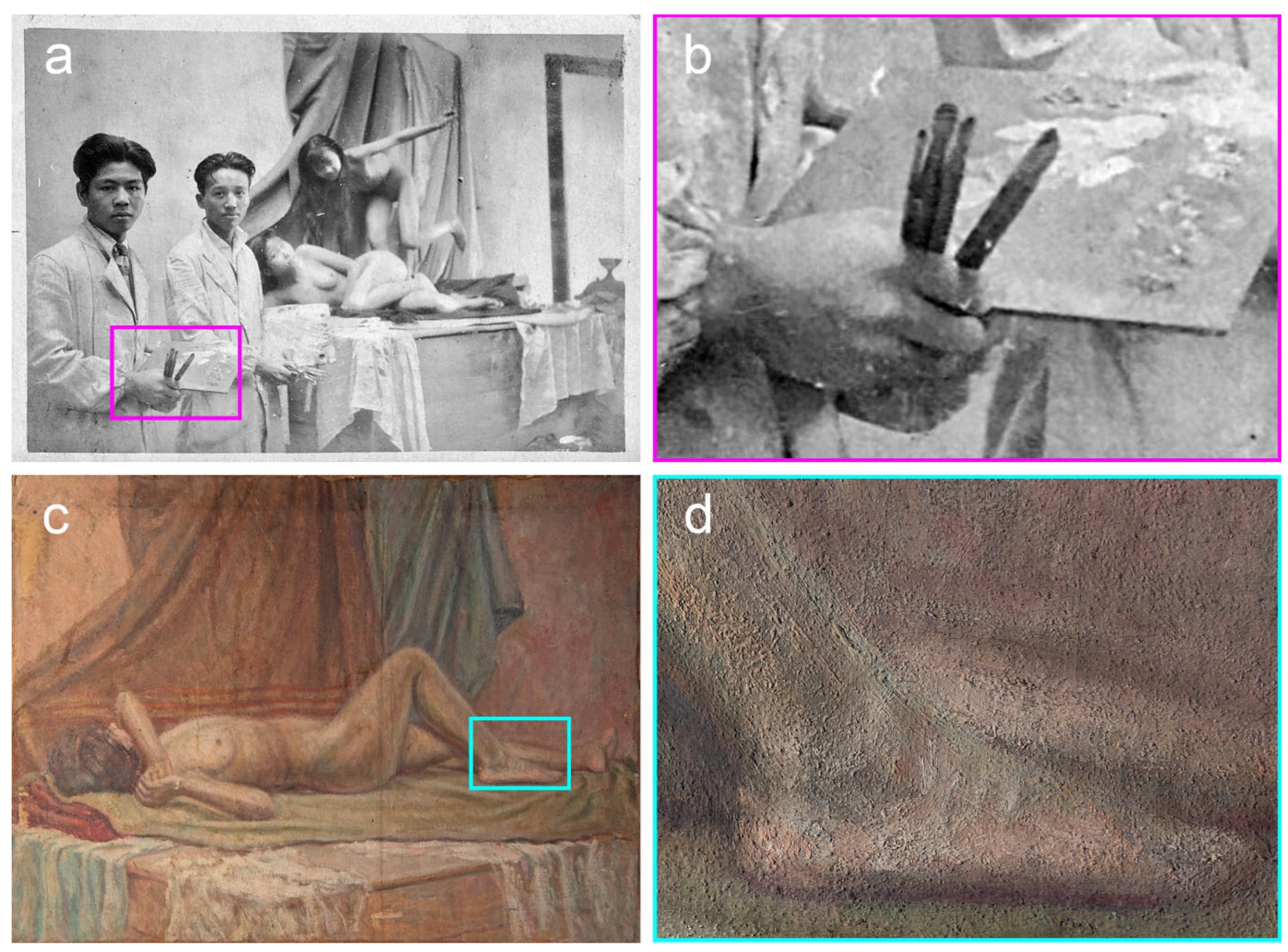
Liu Kang’s passion for photography proved fortunate, as it led him to capture moments during the painting process. The earliest photograph, from his student years at Xinhua Arts Academy in Shanghai (1926–1928), is an archival image taken during a live nude painting class (Figure 1a). It reveals the small and medium-sized brushes (Figure 1b) Liu Kang used for his painting Nude (1927) (Figure 1c). This choice required complex wet-on-wet paint manipulation, which created the rich texture characteristic of the artwork (Figure 1d).
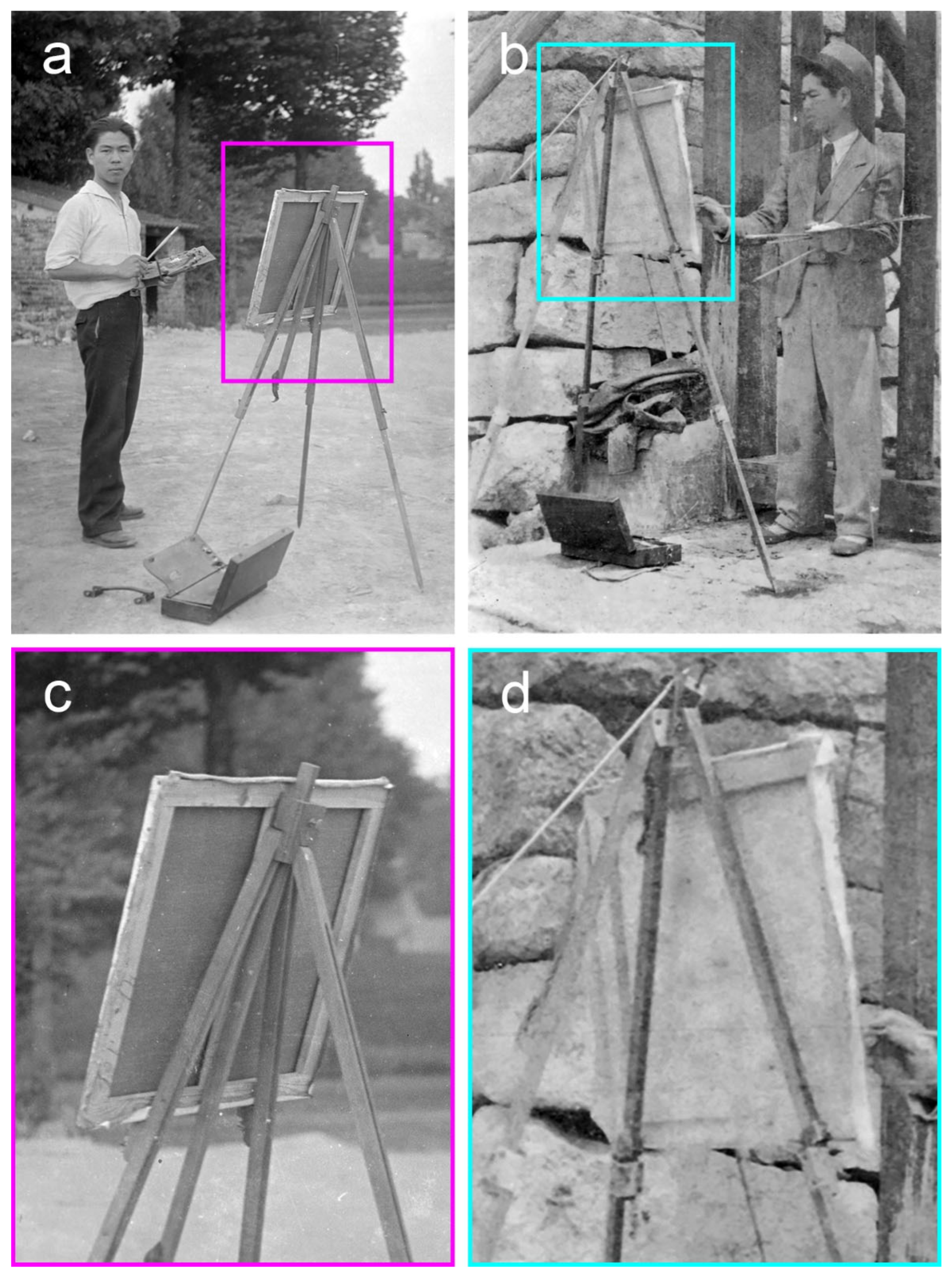
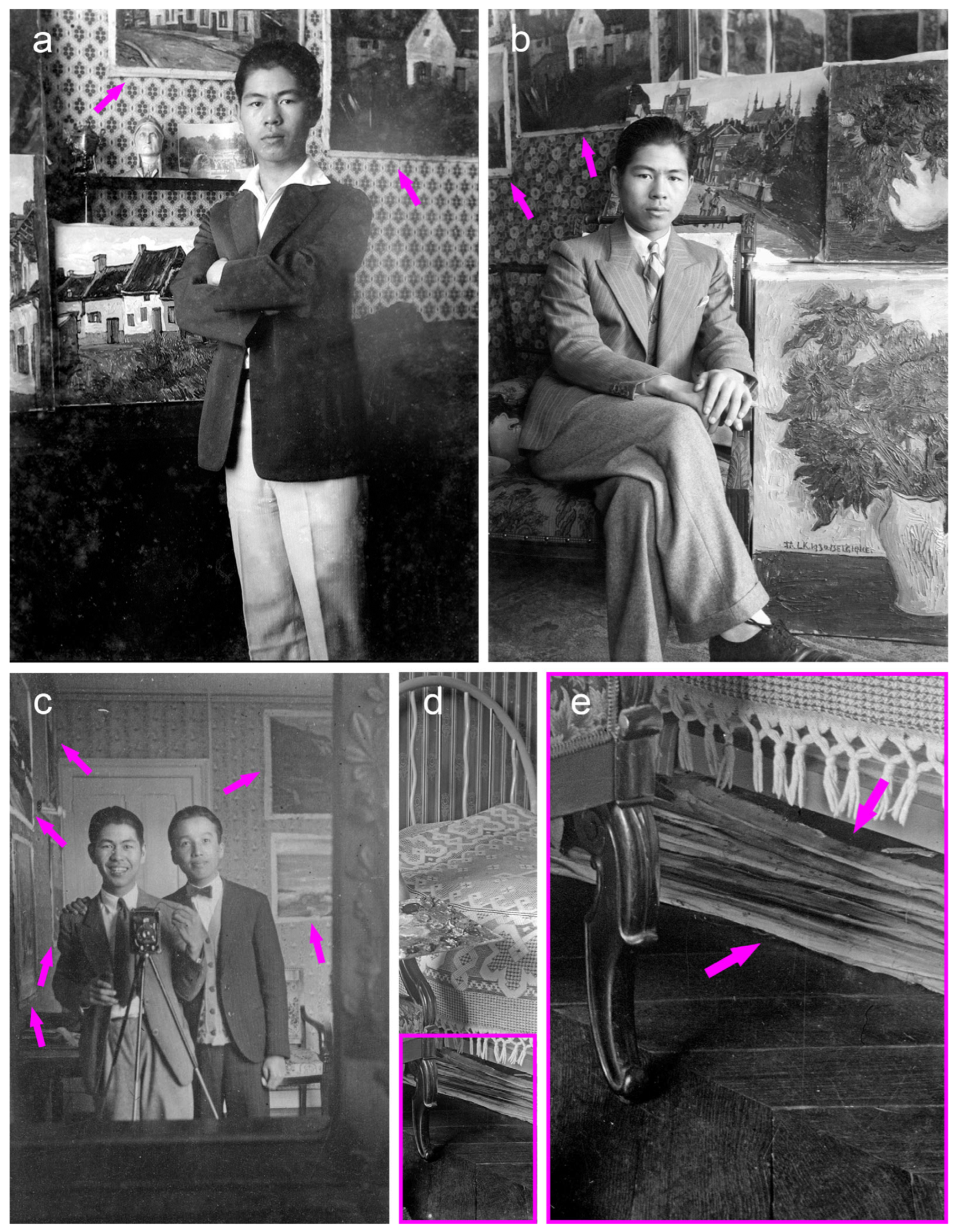
Although none of Liu Kang’s paintings from his time in Paris and Shanghai retain their original auxiliary supports, photographic evidence indicates the artist employed unbranded strainers (Figure 2a–d). A review of LeFranc and Bourgeois Aine catalogues confirmed that the strainers were cheaper than stretchers, leading to the conclusion that Liu Kang likely chose them for their affordability and accessibility. Nevertheless, financial constraints necessitated the reuse of these strainers, leading him to either hang completed but unstretched works on the walls or pile them under his bed, as documented in photographs of his rented rooms in Paris from 1931 and 1932 (Figure 3a–e). Remarkably, one photograph from Liu Kang’s Paris period, showing paintings stored under the bed (Figure 3d,e), was vital in explaining a peculiar damage found on Village scene (1931). The painting’s flattened impastos and contaminated paint layer—containing embedded foreign paint fragments and bits of printed paper—appear to have resulted from this unsuitable storage [47].
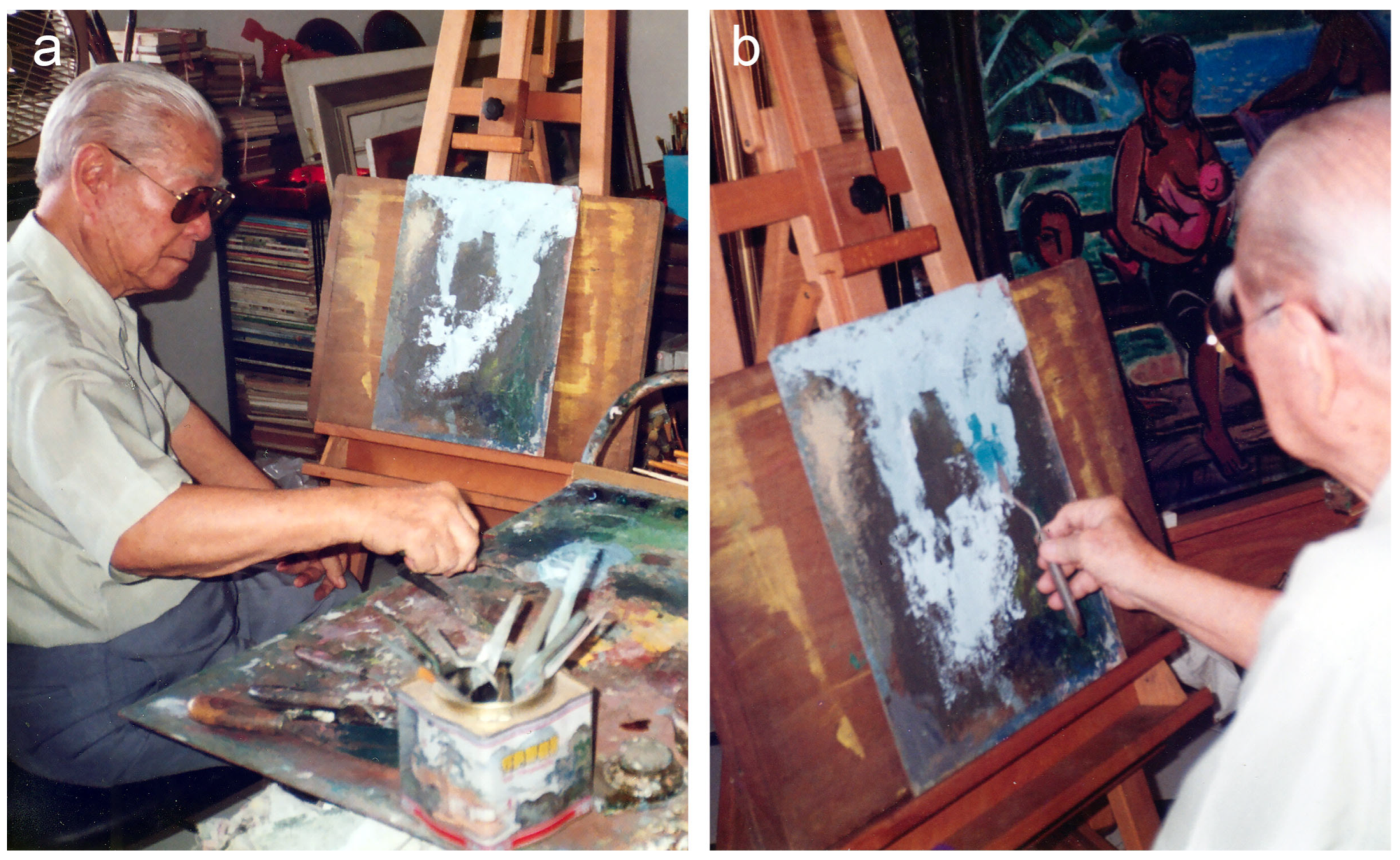
The photographs from the 1990s show Liu Kang recycling an earlier painting on hardboard for a new composition without applying a primer, further demonstrating his pragmatic approach to painting materials (Figure 4a,b). This choice was likely motivated more by the artist’s dissatisfaction with his earlier compositions than by financial limitations, especially as he was already beginning to gain professional recognition.
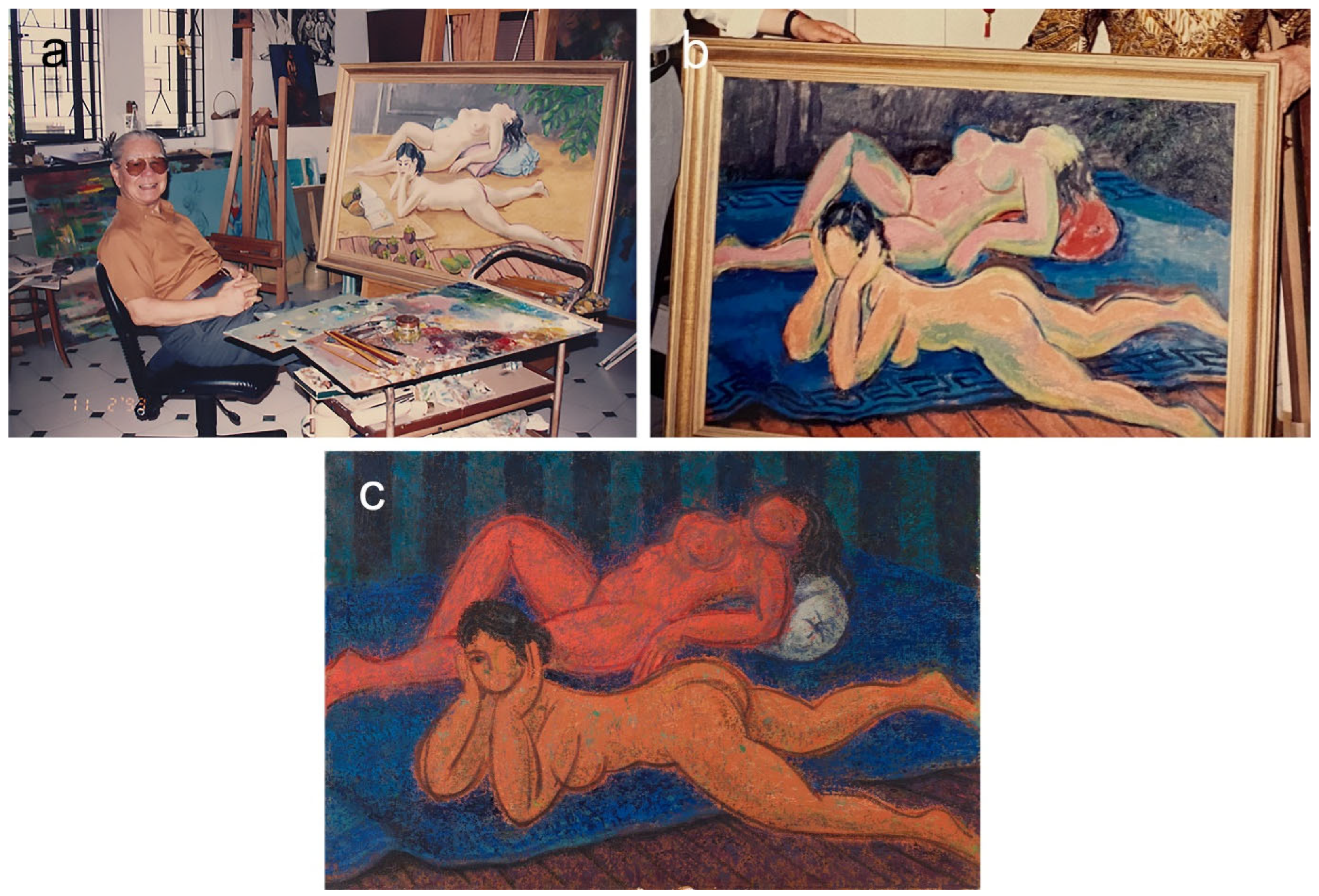
A compelling example of this practice is illustrated through a set of three images (Figure 5). The first, a 1993 photograph, shows the artist with what appears to be a completed painting depicting two reclining nudes (Figure 5a). However, Liu Kang later rejected the original style and repainted the work. A subsequent undated photograph shows a similar subject rendered in a new style, appearing as a work in progress executed over the earlier composition (Figure 5b). This reworking ultimately resulted in the final version currently known as Beauties at Rest II (1998), which is a modified, expressionistic rendition of the earlier piece seen in the 1993 photograph (Figure 5c). The near-infrared (NIR) and X-ray radiography (XRR) images of this artwork were instrumental in the discovery of a hidden composition beneath the surface, confirming it as the very image seen in the 1993 archival photograph [48]. In conclusion, integrating archival visual materials with technical imaging provided critical insights into the significant alterations made to the painting, offering a more nuanced and comprehensive understanding of Liu Kang’s working process.
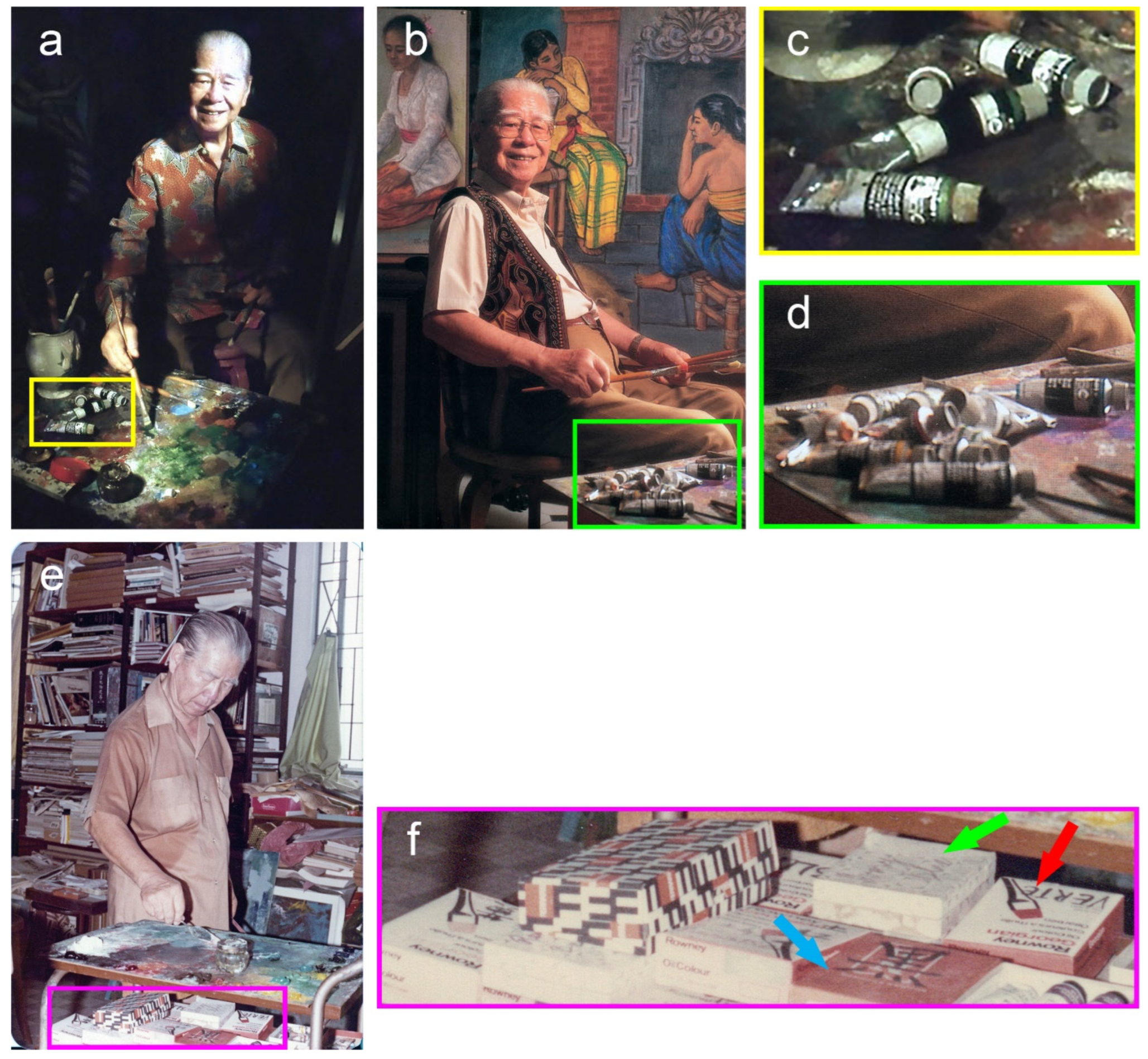
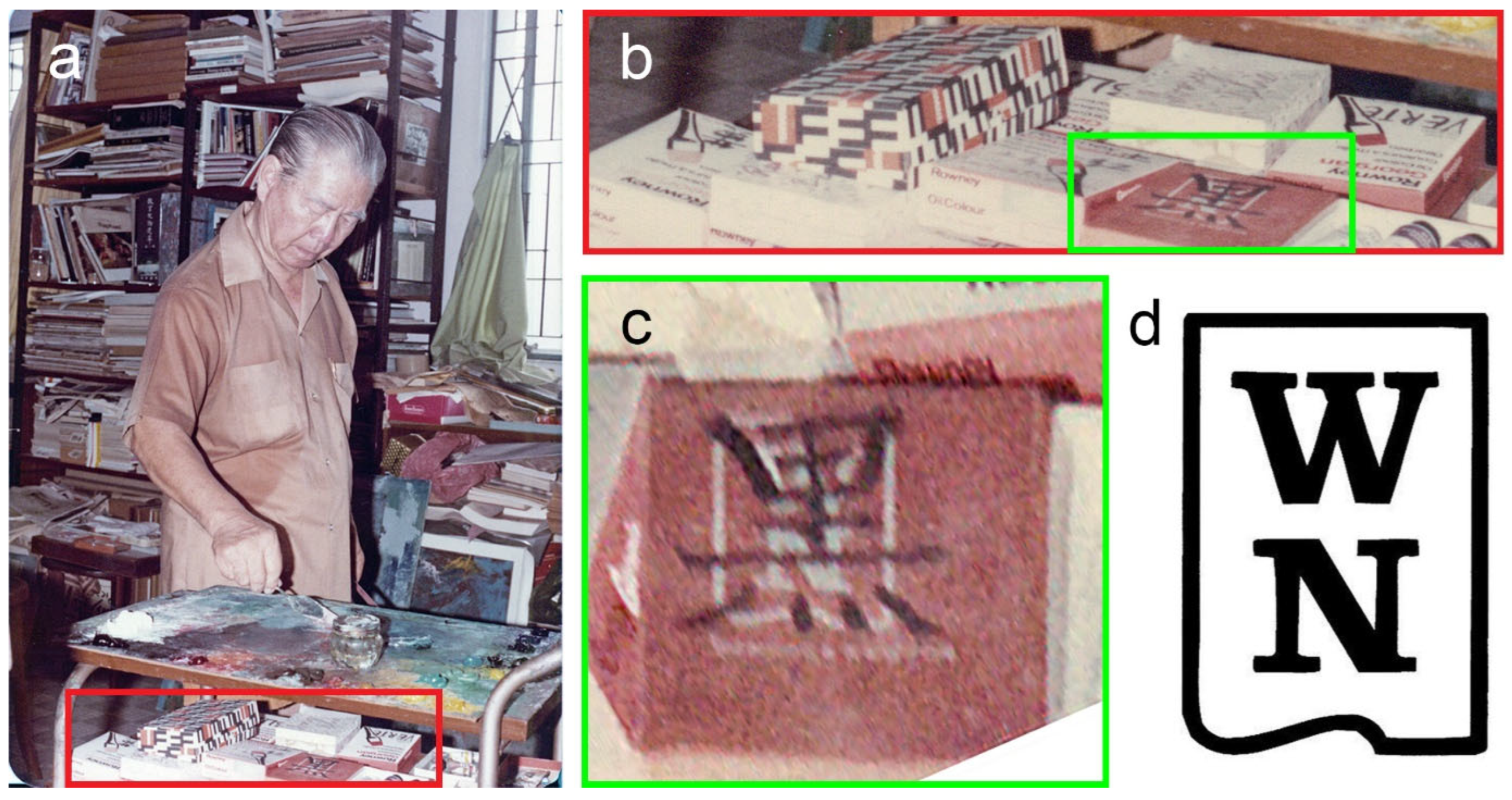
Moving forward, photographs from Liu Kang’s 1997 and 1998 exhibition catalogues [49,50] offer crucial insights into the brands of painting materials he used. Since none of his paint tubes have been preserved, these photographs provide crucial evidence of his preferred brands. They reveal commercial oil paint tubes from Talens (Rembrandt series), filling a gap left by written documentation (Figure 6a–d). Additionally, an archival photograph from the 1990s (Figure 6e,f) shows his studio trolley stocked with box sets from Talens, Rowney (Georgian series), and W&N, suggesting a preference for bulk purchases, likely to minimise interruptions to his artistic process. Notably, while the design of the Rowney and Talens box sets in this photograph relates to those manufactured at the time the photograph was taken, the W&N box design appears much older, suggesting Liu Kang used older stock materials (Figure 6f). Furthermore, some of these photographic records reveal that Liu Kang’s most common painting tools were bristle brushes and palette knives. For example, the 1990s photographs (Figure 4a,b and Figure 6e) show the artist in his studio during the painting process with various-sized palette knives, whereas the 1997 and 1998 photographs (Figure 6a,b) present the artist working with hog bristle brushes. Also, these photographic records, together with scientific analyses of the paintings and colourmen catalogues, provide valuable insights into the artist’s paint mixtures and a comprehensive understanding of his resourcefulness.

3.1.3. TV Documentary

The 1982 TV documentary Portrait of an artist: Liu Kang [51] offers valuable visual evidence of some of Liu Kang’s working methods, complementing findings from painting analyses from that period and archival photographs from the 1990s. Although the full painting process is not shown, the documentary reveals for the first time that Liu Kang used oil paint tubes from brands like Rowney (Georgian series), Talens (Van Gogh series) and W&N (shot at 00:07). A significant insight from the documentary is Liu Kang’s brief mixing of blue and white paints with a palette knife (shot at 00:35). This observation supports the finding of partially mixed paint application in some of his works, particularly Mountain (1995) [52]. Complementing photographic records, the documentary also reveals his use of bristle brushes, showing a basket containing various sizes of mostly flat, hog bristle brushes (shot at 00:37) [52].

3.2. Secondary Sources

3.2.1. Colourmen Printed Advertisements

Advertisements printed by colourmen played a crucial role in revealing the availability of art materials to Liu Kang throughout his artistic career across different locations and periods. These advertisements, found in exhibition catalogues, journals and newspapers, offered valuable insights into the types and brands of art materials available in the markets of that time.
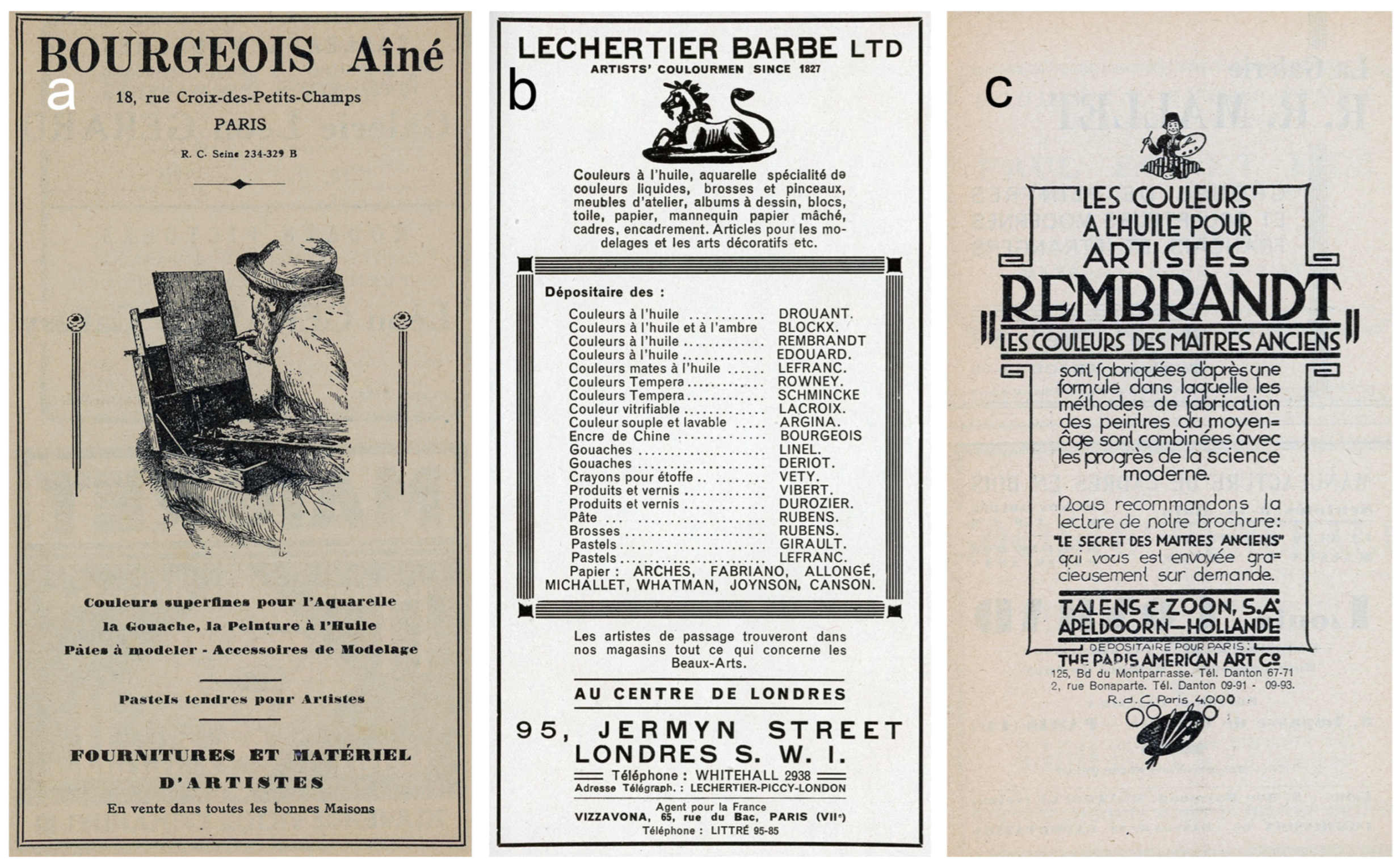
While he was in Paris from 1929 to 1932, Liu Kang was likely exposed to a wide array of French and imported painting materials available to artists. Exhibition catalogues from Le Salon in 1930 and 1932 [53,54] and from Salon des indépendants in 1930 [55] featured advertisements from prominent art materials manufacturers and retailers. These included local brands such as Lefranc and Bourgeois Ainé as well as imported materials from Rowney, W&N, Talens and Schmincke (Figure 7a–c). While these advertisements do not explicitly confirm Liu Kang’s purchases, they offer valuable evidence of the range of options that would have been available to the artist during this period.
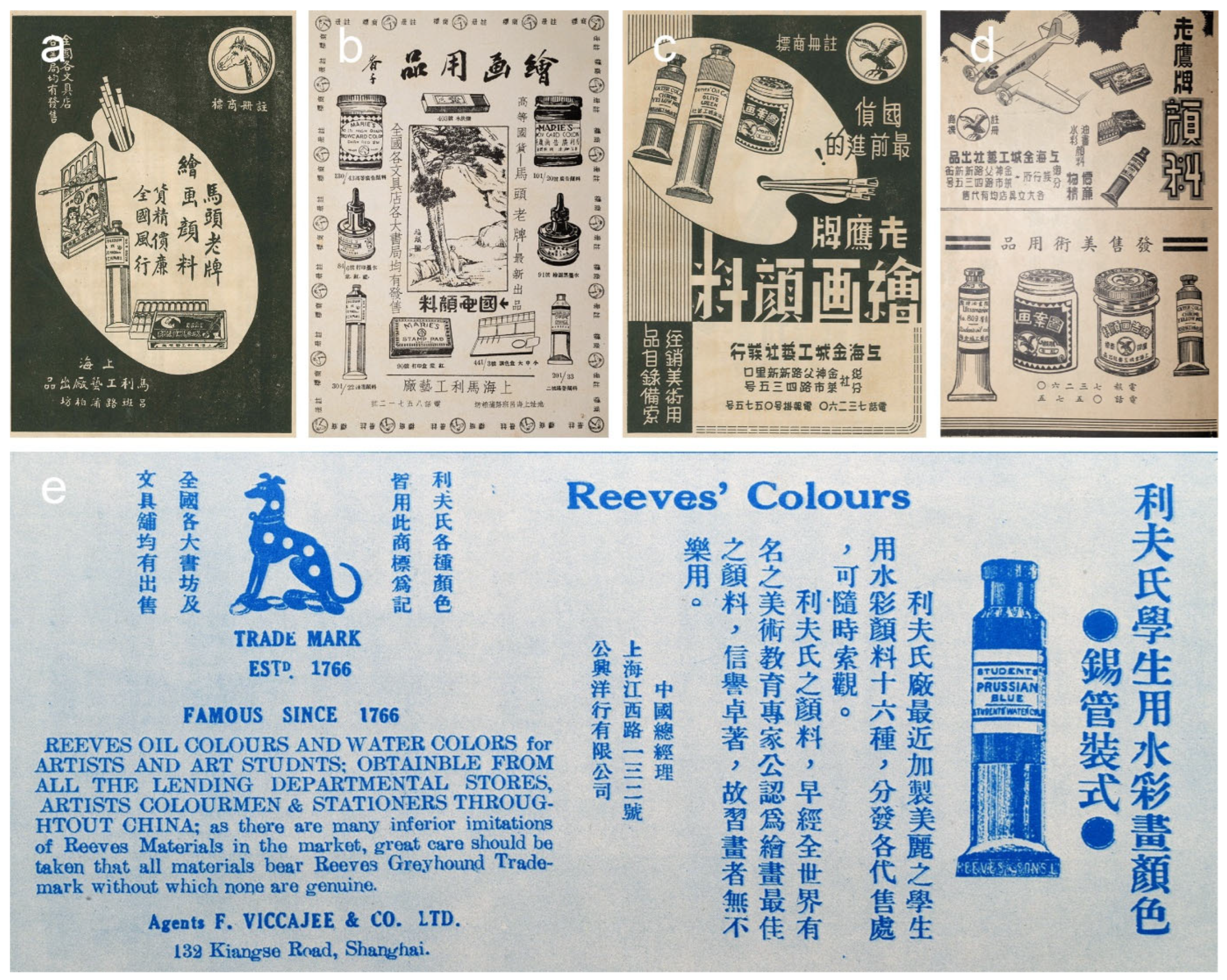
Upon his return to China in 1933, Liu Kang’s artistic activity in Shanghai coincided with a burgeoning art market driven by a high demand for commercial art and the growth of art schools. Advertisements in the Shanghai Art Academy Graduation Yearbook [56,57,58,59] and Shanghai pictorials, such as The Young Companion [60,61,62] and Arts and Life [63], reveal a diverse market for art materials in pre-war Shanghai. Local brands such as Marie’s (Figure 8a,b) and Eagle (Figure 8c,d) competed with imported materials from W&N and R&S, as well as painting materials imported from America [64]. Artists’ materials were commonly available at stationery shops and bookstores.
To counter fierce competition from local manufacturers imitating their products, R&S actively advertised to protect their brand reputation. Their campaigns in The Young Companion [60,61,62] and Arts and Life [63] warned customers about inferior imitations while emphasising the superior quality of their authentic products (Figure 8e).
Although no definitive evidence exists regarding Liu Kang’s specific choices, the advertisements suggest his access to a mix of local and imported brands. It is also possible that he accessed painting materials from French and other overseas manufacturers, which he could have purchased in Paris and later brought to Shanghai for use. Given his likely modest income as a teacher at the Shanghai Art Academy [64,65], it is plausible that he opted for more affordable local brands like Marie’s or Eagle.
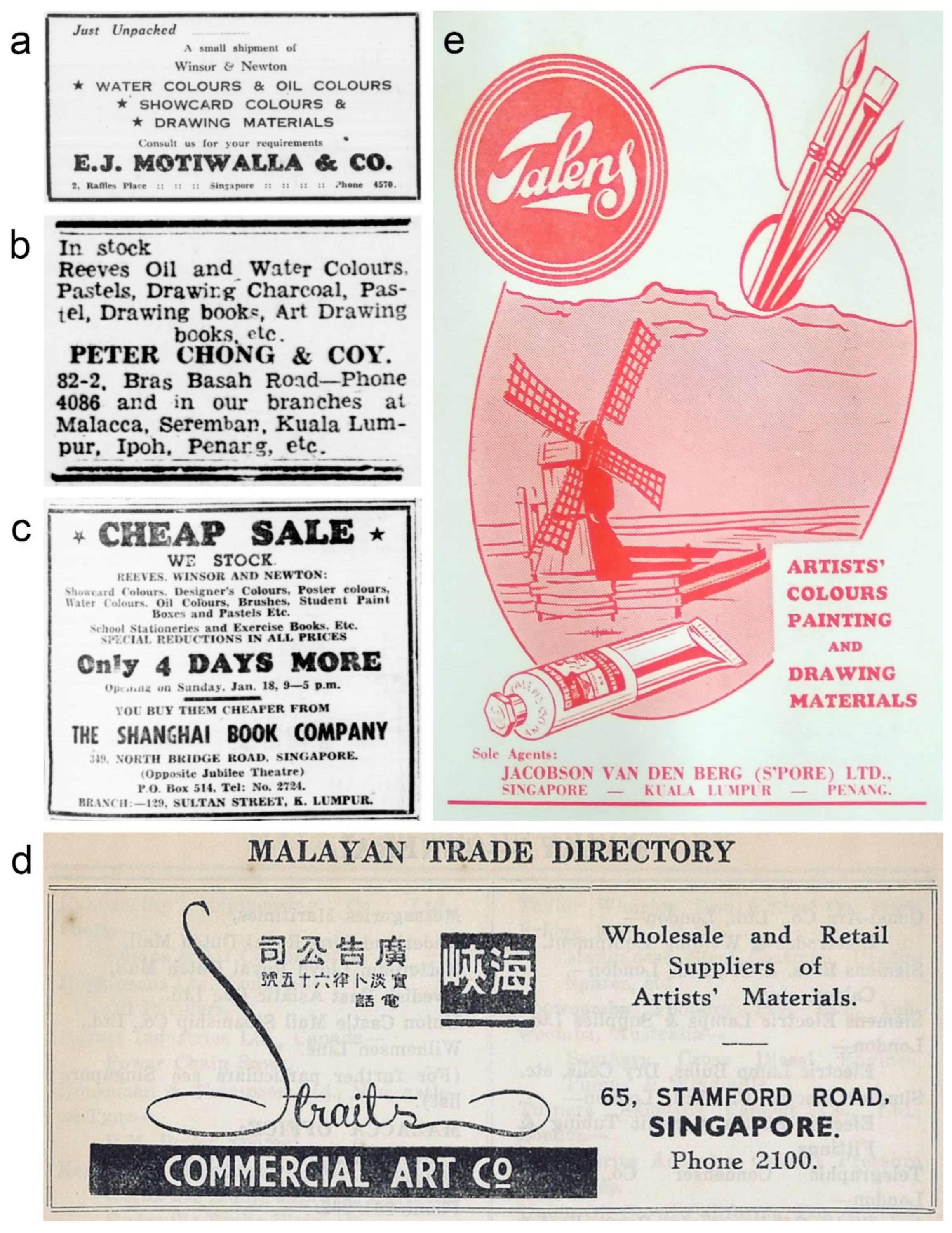
Following Liu Kang’s permanent relocation to Singapore in 1945, newspaper advertisements from the late 1940s indicate that imported art brands such as R&S and W&N were distributed island-wide through stationery and bookstores like E.J. Motiwalla & Co., Peter Chong & Co. and The Shanghai Book Company (with stores in Singapore and Kuala Lumpur) (Figure 9a–c) [66,67,68]. Other notable suppliers included the Nanyang Book Company, founded in 1943 (with stores in Kuala Lumpur and Penang) [69], and The Straits Commercial, established in 1947 in Singapore (Figure 9d) [69,70]. However, these late 1940s advertisements also highlighted stock shortages, reflecting the continued disruption of distribution channels due to the Second World War. This scarcity, coupled with the slow recovery of the pre-war art community—exemplified by the Nanyang Academy of Fine Arts reopening only in 1946 after closing during the Japanese Occupation—likely contributed to low local demand for art materials among both students and professional artists. This situation likely explains the low productivity of Singaporean artists during this period [71]. As President of the influential Society of Chinese Artists (1946–1958), Liu Kang possessed deep insight into the contemporary local art scene. His 1948 essay powerfully conveys the lingering effects of the war: “It is a miserable fact that there was a total of 12 large and small exhibitions in Singapore last year, with an average of one a month. This is miserable. Of the 12 exhibitions, six were by European artists and five were by artists from China. Only one exhibition, the Seventh Annual National Day Art Exhibition, was organised by the local art community. This is regrettable! [72]”
The 1950s saw an improvement in Singapore’s art materials market, aligning with Liu Kang’s growing prominence within the Singapore art scene. Artists gained access to supplies from established local retailers, including The Straits Commercial [69,70], alongside stationery and bookshops like E. J. Motiwalla & Co. [73] and The Shanghai Book Co., Ltd. [73]. Given their 1940s advertisements, it can be reasonably presumed that these retailers maintained their distribution of W&N and R&S products. Furthermore, a 1955 advertisement indicates that painting materials were also available from Jacobson van den Berg Ltd., an importer of Talens products (Figure 9e) [74]. Singapore’s free trade status under British rule further suggests the potential availability of other international brands.
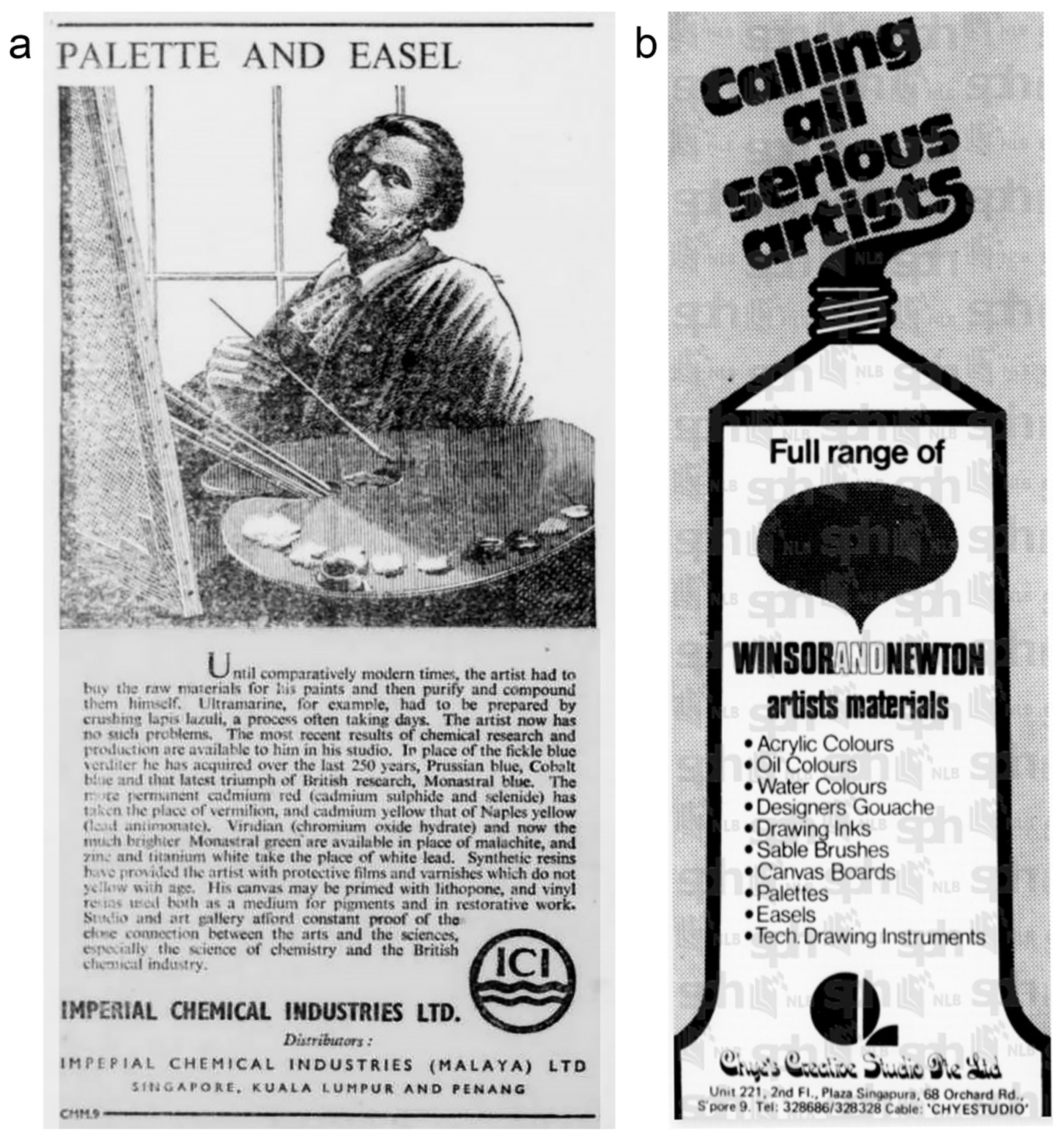
At this point, the commercial advertisement offers valuable insight into the materials identified in Liu Kang’s painting supports from the 1950s onwards. The consistent presence of lithopone in the ground layers of his paintings from the 1950s to the 1990s [30] is corroborated by an advertisement from the British company ICI [75]. ICI, which had operated a Singapore office since 1931 and established a factory branch in Kuala Lumpur, Malaya, in 1962 [12], advertised lithopone’s use as a canvas primer, specifically targeting the artist’s community (Figure 10a). This is important information, as other sources confirm lithopone’s prominence as a white pigment by the 1950s before its subsequent decline [76,77].
During the 1970s, Chye’s Creative Studio Pte. Ltd., an art materials supplier in Singapore, strongly promoted W&N products. This indicates the potential availability of these painting materials to Liu Kang during that period (Figure 10b) [78].
The advertisements presented historical snapshots, revealing the vibrant landscape of art materials available in the locations and periods where Liu Kang flourished. They shed light on the specific brands he may have utilised, but more importantly, they reveal the larger trends and inherent challenges within the art materials market. This knowledge significantly deepens our appreciation of Liu Kang’s artistic journey and the difficulties he likely faced. Crucially, the advertisements offer valuable clues about accessible brands, thus guiding future archival research towards relevant colourmen catalogues.

3.2.2. Colourmen Catalogues

Having identified potential art material brands available to Liu Kang in Paris, Shanghai and Singapore, the next logical step in the research involved cross-referencing the results from the previous analytical investigation of his paintings [30] with relevant colourmen catalogues accessible to the author. This approach enriched the interpretation of the analytical data and enabled a more comprehensive understanding of his artistic choices and material use.
The previous analyses revealed that the artist employed a limited colour palette, primarily utilising inorganic and organic pigments that evolved minimally over time [30]. The sporadic use of certain pigments in Liu Kang’s paint mixtures, such as cobalt yellow (PY40), zinc yellow (PY36) and emerald green (PG21), as well as a composite paint cadmium green (PG14), raises questions about whether these were deliberate artistic choices, commercially pre-mixed paints, accidental inclusions or consequences of inconsistent availability. Another intriguing point was the use of vermillion by Liu Kang, mentioned in Ho Kok Hoe’s interview but not confirmed by the paint analyses. The crucial role of these archival sources in the interpretation of the analytical data is illustrated in the examples discussed below.
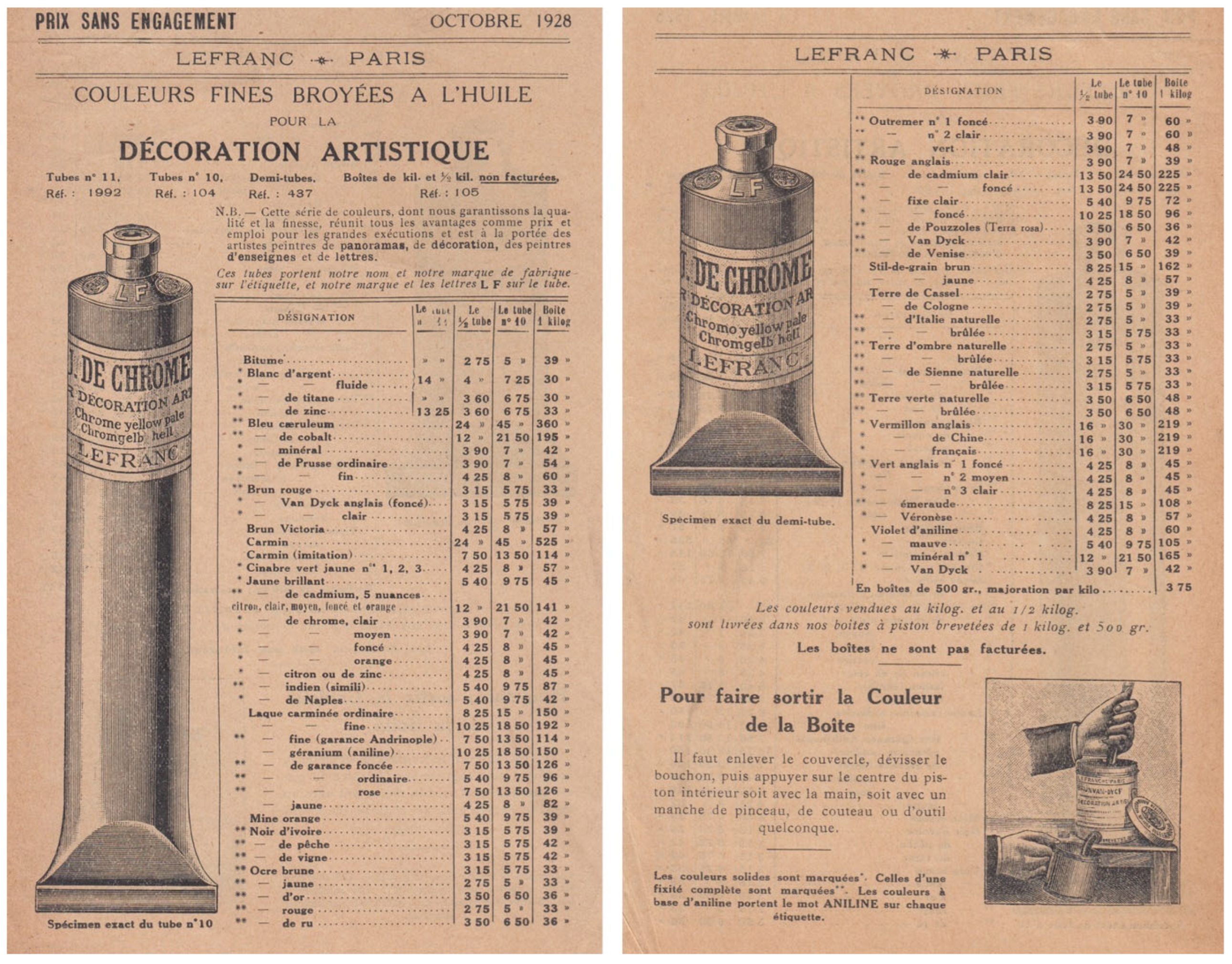
Liu Kang’s potential interest in Lefranc oil paints, particularly during his Parisian period, is evidenced by two pages from an October 1928 Lefranc catalogue that he had preserved and brought to Shanghai (Figure 11). These pages detail Lefranc’s “fines” oil colours and their corresponding prices. Despite the preservation of these catalogue pages, which hints at a potential interest in Lefranc’s offerings, it is premature to draw definitive conclusions about Liu Kang’s actual use of their paints during his time in Paris. An investigation of colourmen advertisements indicated that Liu Kang might have used a broad range of painting materials, including both local and imported European brands, that were available to him (Figure 7).
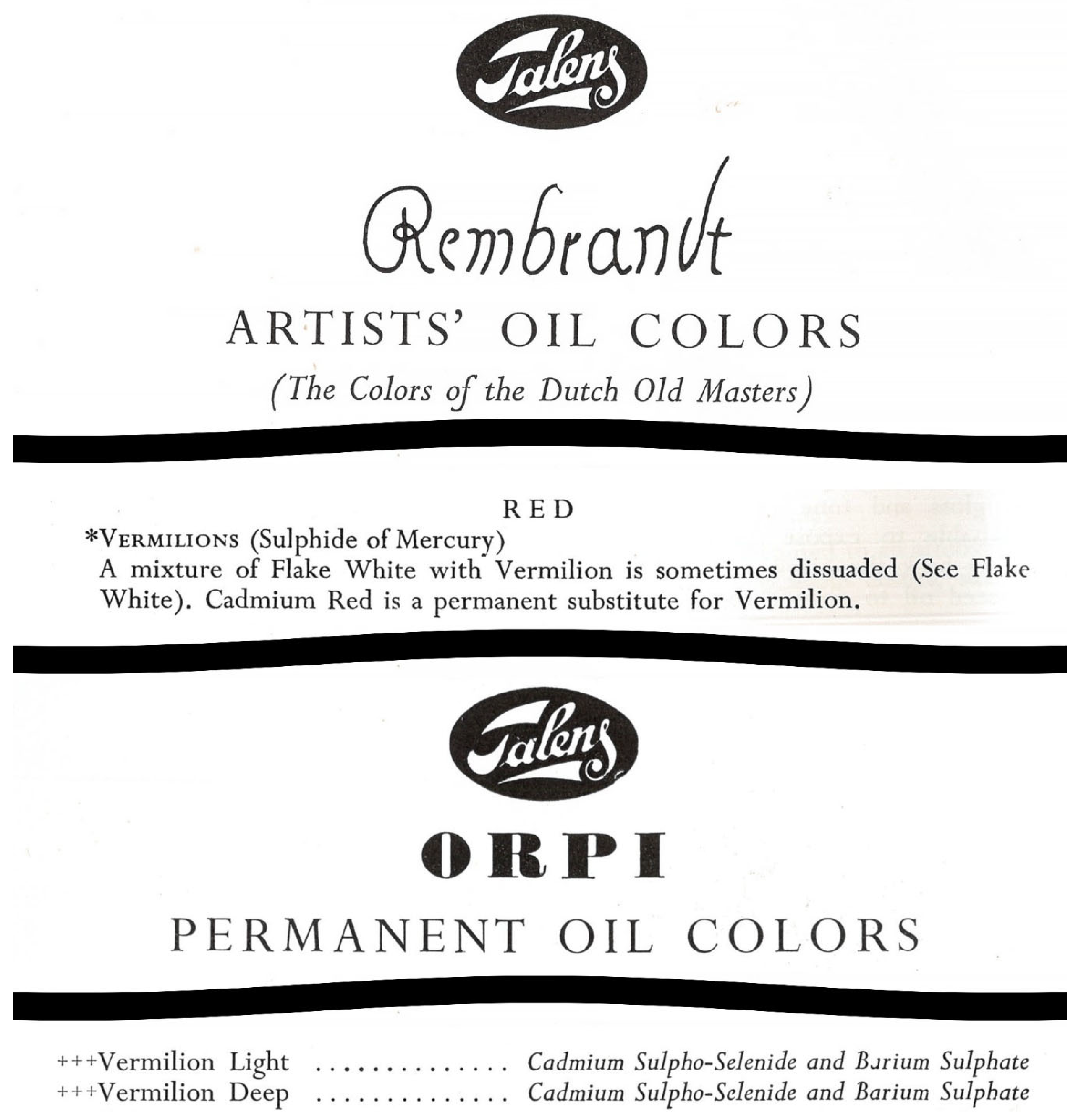
Cross-referencing the information from Ho Kok Hoe’s interview with the analytical data from Liu Kang’s paint mixtures and colourmen catalogues clarified the use of vermillion by the artist. The analytical data confirmed that Liu Kang did not, in fact, use vermillion pigment, even though it was listed by W&N, Reeves & Sons (R&S), and Talens (Appendix A, Figure A1), all of whom likely offered it in Singapore at the time of the interview [43]. It is possible that during the Ho Kok Hoe interview, Liu Kang was referring to a vermillion substitute. Such substitutes, like “vermilionette” or “American vermilion”, are composite paints containing eosin-based lake pigment or scarlet dye combined with red lead or chrome red [79,80,81]. This possibility is supported by a study of Talens paints from 1920 to 1950, which identified vermilion imitations containing three synthetic organic pigments (PR51, PR3 and PR63) [21]. Furthermore, in its 1954 catalogue, Talens listed “Vermillion Light” and “Deep” alongside authentic vermilion, both of which were technically vermillion imitations based on cadmium red (PR108) (Appendix A, Figure A1). This cadmium red pigment was indeed identified in Liu Kang’s paintings from the 1950s [43]. Therefore, while the information from Ho’s 1955 essay may not have been entirely accurate, it significantly assisted in the interpretation of the analyses of Liu Kang’s paints from that period. It provided context for the use of certain pigments and prompted further clarification through cross-referencing with analytical results. Additionally, it highlighted the scarcity of credible information regarding the technicalities of Liu Kang’s working practice.
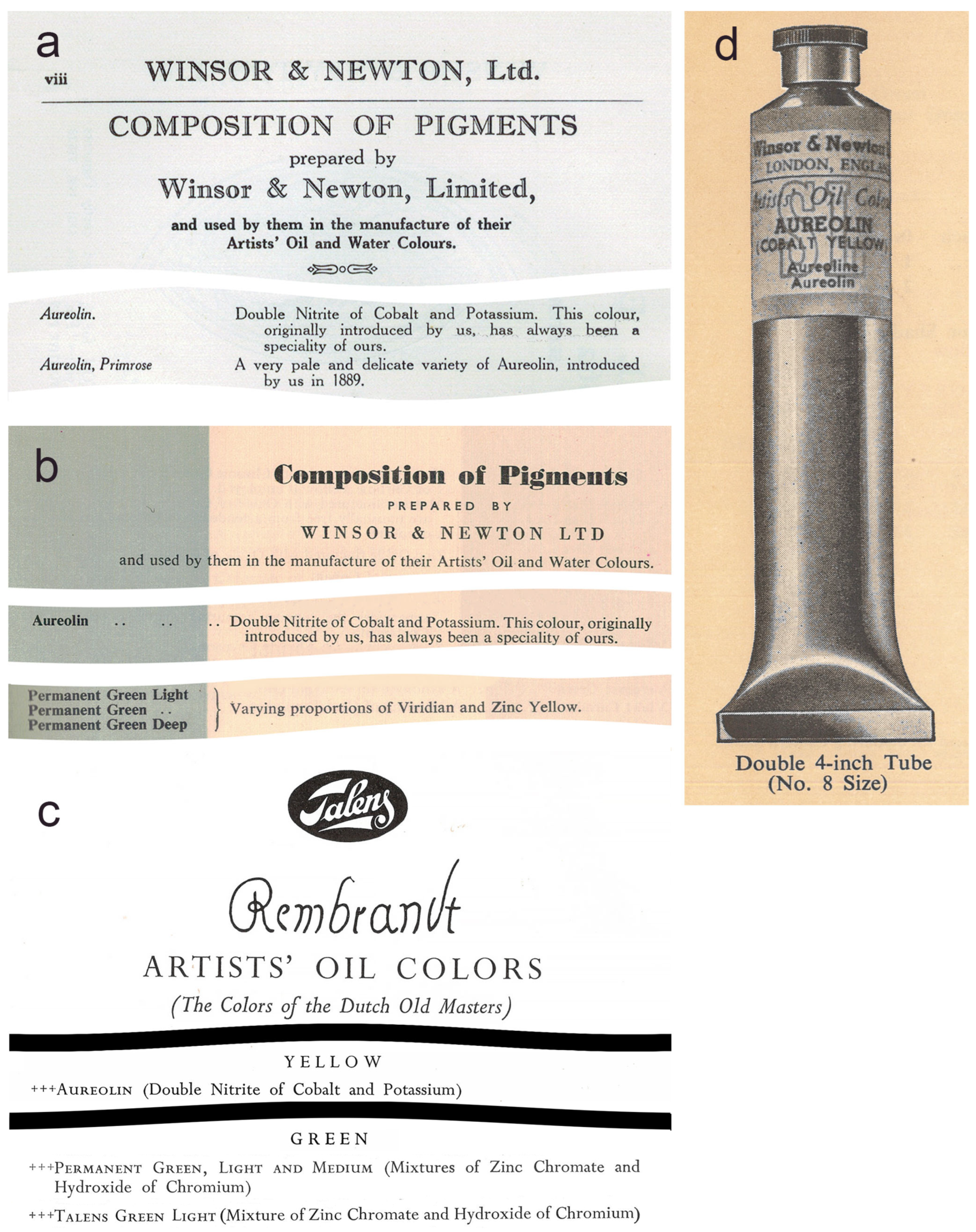
Previous analyses of Liu Kang’s paint layers confirmed the use of cobalt yellow (also known as aureolin) in only three paintings across Liu Kang’s oeuvre: one from his Paris phase Landscape in Switzerland (1930) and two from his Singapore period, Bali Scene (1953) and Char Siew seller (1958) [30]. Technical literature notes that cobalt yellow is an uncommon choice for oil painters due to its low opacity in oil mediums, making it generally more suitable for watercolours [82,83]. The author’s catalogue search further confirmed its low popularity. While cobalt yellow appears in Bourgeois Ainé and Lefranc catalogues as a dry pigment and in watercolour and gouache paints in the 1930s, it is featured in W&N’s oil paint catalogues at the same time (Appendix A, Figure A2a). This suggests that Liu Kang might have deliberately acquired this pigment in Paris for specific artistic effects or experiments. Moreover, the availability of cobalt yellow oil paint from W&N but not Lefranc in the 1930s reinforces the idea that Liu Kang sourced materials from diverse manufacturers, including W&N, despite retaining Lefranc catalogue pages that strongly imply his use of Lefranc colours. In the 1950s, cobalt yellow oil paint was available from W&N and Talens, both brands present in Singapore at that time (Appendix A, Figure A2b–d).
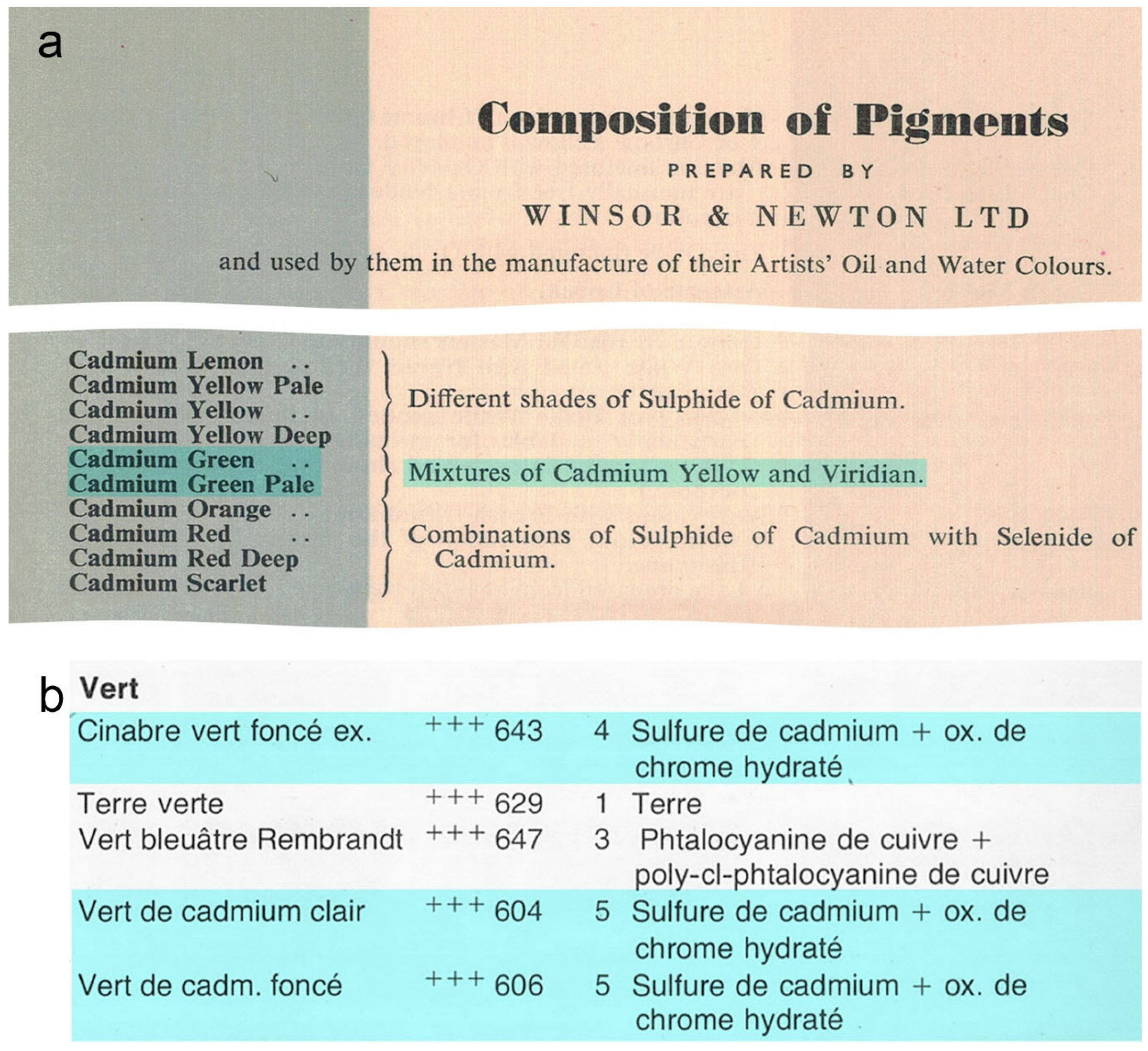
In addition, the previous analyses of green paints in Village (1950) [43] and Mount Huangshan (1993) [52] revealed mixtures of viridian with cadmium yellow (PY35). This combination may point to the use of commercially available cadmium green [79], as catalogues show that it was offered in two hues by W&N in the 1950s (Appendix A, Figure A3a). By the 1980s, Talens provided cadmium green in three variants, which may have been accessible to Liu Kang. This possibility is supported by the 1990s archival photographs depicting Talens tubes in his studio from the period when Mount Huangshan was painted (Figure 6c,d,f). Thus, by referencing these catalogues, it is possible to infer that Liu Kang likely chose pre-mixed green paints rather than mixing them himself.
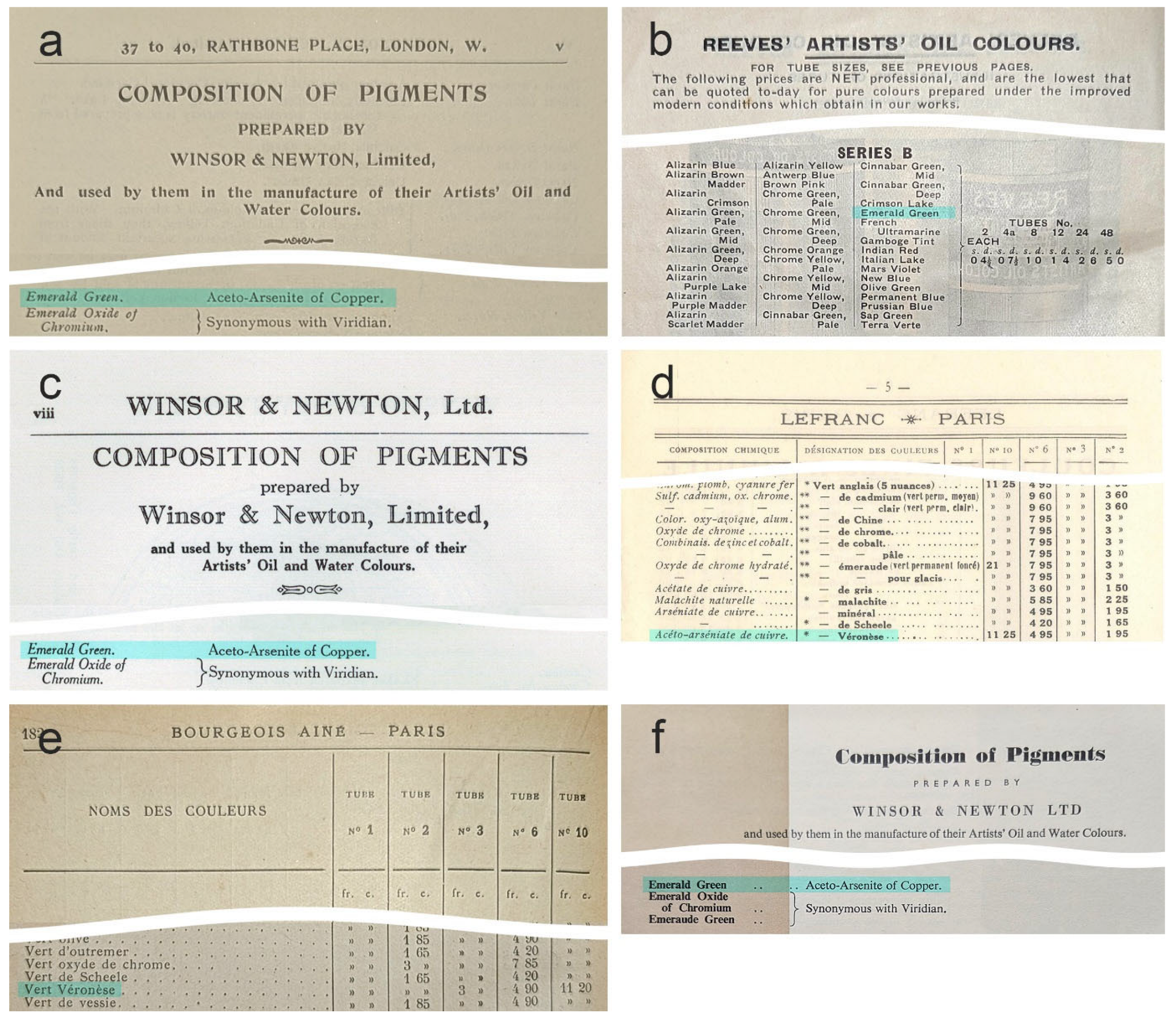
Given its inherent arsenic (As) toxicity, the previous identification of emerald green (vert Veronese in French) in paint mixtures necessitated further investigation into its availability at Liu Kang’s working locations and the timeline of its market withdrawal, in order to better understand the artist’s use of this pigment. Colourmen catalogues confirm that emerald green was consistently accessible to Liu Kang throughout his time in Shanghai, Paris and Singapore. Evidence of its use includes its presence in Nude (1927), which was painted during his studies at the Xinhua Arts Academy [48]. Catalogues from W&N and R&S, active in Shanghai at that time, confirm the availability of emerald green (Appendix A, Figure A4a,b). During his Paris period, Liu Kang’s artworks also featured this green pigment [84]. This is supported by W&N, Lefranc’s and Bourgeois Ainé catalogues, which listed arsenic-containing green oil paints like vert Veronese (emerald green) (Appendix A, Figure A4c–e). Even after his return to Shanghai, Liu Kang’s artworks, such as Countryside in China (1933) [85] continued to contain emerald green, though it is plausible that he continued using tubes purchased in Paris. Interestingly, Liu Kang’s Village (1950) and Orchids (1952) also demonstrate discernible use of the same pigment in Singapore [43]. W&N catalogues from the 1950s, indicate the continued availability of emerald green (Appendix A, Figure A4f). Nevertheless, the possibility remains that the artist utilised older tubes acquired in Paris or Shanghai. Notably, this pigment was easily available to artists at least until the end of the 1960s [86].
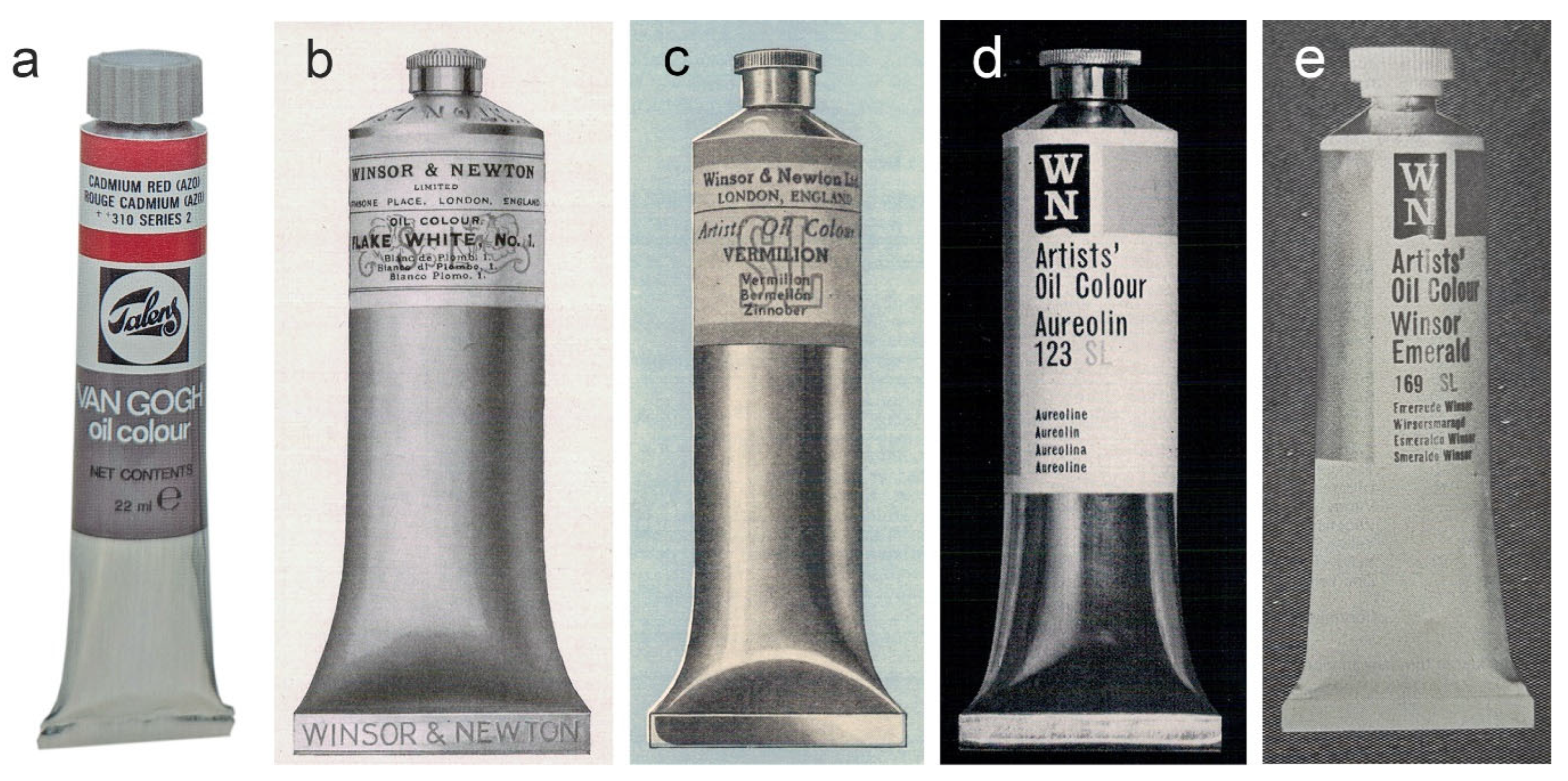
This approach is practically demonstrated by identifying and approximately dating a W&N paint tube captured in the 1982 TV documentary (shot at 00:07) [51,52]. This W&N tube appeared considerably older than the Rowney (Georgian series) and Talens (Van Gogh series), whose design and labels are consistent with those manufactured in the 1980s (Figure 12a). Through comparative analysis with W&N catalogues from 1934, 1957, 1963 and 1979, it was determined that its design and labelling matched those in use until at least 1957, prior to significant changes in 1963 (Figure 12b–e).
Another example is the identification and approximate dating of the W&N paint box set captured in the 1990s archival photograph of Liu Kang at work (Figure 13a,b). While other paint box sets from Talens, Rowney (Georgian series) are consistent with the time the photograph was taken, the W&N box appeared much older. To improve the legibility of the graphic features seen on the box lid, the perspective of the source image was manipulated. Hence, the letters “W” and “N” can be seen arranged vertically and placed in the background with the outline of the painting palette. Additionally, the photograph shows a black Chinese character 黑 (hēi) painted on the box lid, likely by the artist, to indicate it contained black paints (Figure 13c). Cross-referencing this logo with those in the company’s catalogues available to the author revealed that it was used between 1964 to at least 1979 (Figure 12d,e and Figure 13d). A different W&N logo was subsequently featured in the 1982 catalogue, the next one available for review. Nevertheless, given Liu Kang’s apparent preference for purchasing paint colours in bulk, the presence of older stock paints, such as the W&N, is not unexpected. It is highly probable that certain materials would not be used immediately and could, therefore, appear on the artist’s palette much later. These cases demonstrate how catalogue illustrations of colourmen logo and tube designs over time help approximate the dating of physical evidence, such as the paint box set identified in the 1990s archival photograph and paint tube captured in a 1982 TV documentary.

4. Discussion

In technical art history, the relationship between written accounts and evidence derived from analyses of the artworks is often complex. For instance, Jack Chambers, archival notes proved largely consistent with subsequent analytical findings [3]. Conversely, studies of Van Gogh’s outdoor painting practice revealed that while his letters provide a rich record, they are often incomplete or ambiguous when assessed against material evidence [11]. In the case of Liu Kang, who produced no comparable technical documentation, this study challenges the assumption that his interviews alone constitute definitive evidence, highlighting the necessity of validating archival information through physical analyses. For example Ho Kok Hoe’s 1955 essay, one of the few written accounts listing the artist’s preferred colours, stated that Liu Kang favoured vermilion [42]. Yet, paint analyses of works from that period consistently failed to confirm the presence of authentic vermilion (mercuric sulfide—HgS). This discrepancy necessitated further archival investigation, leading to the deduction that Liu Kang was likely referring to a vermilion substitute (such as vermilionette or pigments based on cadmium red). This was supported by the discovery in Talens’ 1954 catalogue of “Vermillion Light” and “Deep,” which were cadmium red-based imitations, a pigment indeed identified in Liu Kang’s 1950s paintings [30,43]. Thus, while the direct claim was refuted, the finding significantly enhanced understanding of his material choices and the competitive market’s reliance on pigment alternatives during that era.
Despite their limitations as technical evidence, interviews nonetheless proved valuable for contextualising Liu Kang’s artistic development. In particular, they were crucial for understanding the impact of Liu Kang’s worsening eyesight on his later work, including the quality of his retouchings and his changing working practices.
Unlike the studies of Francis Bacon [2], Mariano Fortuny y Madrazo [4], Edward Much [6,7] or Harriet Backer [87], which benefited from many preserved painting materials and tools even in a physical studio, this research relies on TV documentary and studio photographs. They proved highly reliable, offering critical visual evidence of Liu Kang’s working methods, such as the types of brushes and palette knives he used, his pragmatic approach to materials, and his storage practices that directly affected the condition of his artworks. They also documented his practice of recycling painting supports, and suggested a preference for bulk purchases, providing clues about his working habits. These visual sources were especially valuable for identifying potential commercial brands of paint tubes Liu Kang might have used, such as Talens, Rowney, and W&N, in the absence of preserved paint tubes or technical notes, and for approximating the dating of these materials by comparing tube and box designs with historical catalogues.
Secondary archival sources, including colourmen printed advertisements, trade directories, and colourmen catalogues, provided essential historical and commercial context. These sources reveal the dynamic art market landscape in Paris, Shanghai, and Singapore, showcasing the availability of local and imported brands, distribution channels, market competition, and post-war stock shortages, factors that likely influenced Liu Kang’s material choices. Furthermore, the advertisements were reliable in guiding further archival research towards relevant colourmen catalogues. They even corroborated the presence of certain materials like lithopone, which was found in the ground layers of Liu Kang’s paintings from the 1950s to the 1990s [30]. This finding suggests the use of locally fabricated supports using household paints validating the regional relevance of Imperial Chemical Industries (ICI), which marketed lithopone as a canvas primer in Singapore as early as 1948. The identification of such materials in the works of both Liu Kang and Georgette Chen [12] confirms that these pioneering Nanyang artists utilised locally available, household-grade materials for pragmatic reasons during periods of shortage.
A similar reliance on secondary archival sources was employed in research regarding Georgette Chen’s painting practice and proved equally effective. Both studies, contribute to reconstruction the Malaya and Singapore art materials market, confirming the dominance of British and Dutch colourmen painting materials distributed through local retailers. However, the present study on Liu Kang distinguishes itself by introducing colourmen catalogues as a critical bridge between scientific analysis and visual documentation (primary sources).
Colourmen catalogues were crucial for interpreting the scientific analytical data from Liu Kang’s paintings. By cross-referencing pigment identifications from the analyses with pigment listings, chemical descriptions and commercial names in catalogues from brands that Liu Kang likely used (such as W&N, R&S, Lefranc, Bourgeois Ainé and Talens), it was possible to assess the commercial availability of certain pigments and infer the artist’s potential reliance on readily accessible paints. In addition, the catalogues confirmed the continued availability of the toxic emerald green well into the 20th-century, providing context for its identification in Liu Kang’s works across different periods. Furthermore, catalogue illustrations of companies’ logos and paint tube designs across different periods were instrumental in dating physical evidence, such as the W&N tube seen in the 1982 TV documentary and W&N paint box set captured in the 1990s photograph, suggesting the artist’s habit of using older stock.
While direct written technical accounts from the artist were scarce and sometimes inconsistent, the approach utilising both primary (especially visual) and secondary archival sources provided a comprehensive and reliable framework for understanding Liu Kang’s material choices, working methods, and the broader artistic context of his extensive career.

5. Conclusions

This article demonstrates that a combination of scientific analyses and diverse archival sources is crucial for technical art research, especially in cases like Liu Kang’s, where direct information about his working methods is scarce. A multifaceted approach provided vital historical and commercial context and documentary evidence that helped explain previous analytical findings—insights that material identification alone could not offer. The archival sources illuminated Liu Kang’s artistic choices, working methods, material usage habits, the challenges he faced and the evolving art materials market in the regions where he worked. This comprehensive approach has significantly enriched the understanding of Liu Kang’s artistic journey and contributed to a deeper historical narrative of his practice, acknowledging the intricate interplay among material availability, artistic innovation and personal preferences. Moreover, this research affirms its scientific contribution by defining the reliability of different source types and situating Liu Kang’s practice within the regional availability of materials in the 20th century by systematic comparison of the archival sources with physical evidence derived from the analyses of his paintings. Hence, the insights gained are also invaluable for future conservation and preservation strategies for his artworks.
The most significant limitation of this research was scarcity of primary written records detailing Liu Kang’s technical approaches to painting. Furthermore, while the artist’s photographic archives are extensive, their utility diminishes when seeking specific visual evidence of the materials or tools he employed. Nevertheless, it is highly advantageous that the majority of archival primary sources remain accessible through the artist’s family in Singapore.
Another constraint was the reliance on advertisements rather than comprehensive colourmen catalogues or detailed articles that could have assisted in reconstructing the commercial context of pre-war Shanghai. Therefore, expanding research into Chinese-language art journals and colourmen catalogues would be a robust area for future investigation. If comprehensive Chinese catalogues were consulted, they could provide precise pigment listings and pigment chemical compositions for Chinese brands, enabling researchers to establish stronger links between the materials identified in Liu Kang’s Shanghai-period paintings and those he likely purchased locally. Hence, future research can build on this foundation by deepening the investigation into the regional market and applying this methodology to other pioneering Singaporean artists.

Funding

This research received no external funding.

Data Availability Statement

The data presented in this study are available upon request from the corresponding author.

Acknowledgments

The author wishes to thank Gretchen Liu for sharing the artist’s archival photographs. Additionally, the author would like to thank the reviewers for their comments and constructive feedback, which greatly improved the quality of this article.

Conflicts of Interest

The author declares no conflicts of interest.

Appendix A

Figure A1. Vermillion oil paint, its imitations and their chemical compositions, listed in the catalogue of Talens from 1954.
Heritage 09 00088 g0a1
Figure A2. Selected compositions of pigments listed in the W&N catalogues from 1928 (a) and 1957 (b), and Talens catalogue from 1954 (c). Corresponding image of W&N oil paint tube with aureolion (cobalt yellow) from the 1957 catalogue (d).
Heritage 09 00088 g0a2
Figure A3. Selected compositions of pigments listed in the catalogues of W&N from 1957 (a) and Talens (French edition) from 1982 (b). The highlighted details indicate cadmium green variants that are tentatively linked to the pigments identified within the paint mixtures in Liu Kang’s paintings.
Heritage 09 00088 g0a3
Figure A4. Selected compositions of pigments listed in the catalogues of W&N from 1925 (a), R&S from 1926 (b), W&N from 1928 (c), Lefranc from 1929 (d), Bourgeois Ainé from 1931 (e), and W&N from 1955 (f). The highlighted details indicate the availability of emerald green (vert Veronese).
Heritage 09 00088 g0a4

References

  1. Gridley, M.H. Ellsworth Kelly: The studio and beyond. In Conservation of Modern Oil Paintings; van den Berg, K.J., Bonaduce, I., Burnstock, A., Ormsby, B., Scharff, M., Carlyle, L., Heydenreich, G., Keune, K., Eds.; Springer International Publishing: Cham, Switzerland, 2019; pp. 121–137. [Google Scholar]
  2. Russell, J.E.; Singer, B.W.; Perry, J.J.; Bacon, A. Investigation of the materials found in the studio of Francis Bacon (1909–1992). Stud. Conserv. 2012, 57, 195–206. [Google Scholar] [CrossRef]
  3. Helwig, K.; Thibeault, M.-E.; Poulin, J. Jack Chambers’ mixed media paintings from the 1960s and 1970s: Painting technique and condition. Stud. Conserv. 2013, 58, 226–244. [Google Scholar] [CrossRef]
  4. Izzo, F.C.; Zanin, C.; Van Keulen, H.; Da Roit, C. From pigments to paints: Studying original materials from the atelier of the artist Mariano Fortuny y Madrazo. Int. J. Conserv. Sci. 2017, 8, 547–564. [Google Scholar]
  5. Skipper, L.K.; Mark, B.; Natalia, S.; Alkaseem, M. The technical examination of nineteenth-century artists’ pigments from John Opie’s paintbox. Stud. Conserv. 2025, 70, 37–50. [Google Scholar] [CrossRef]
  6. Kutzke, H.; Topalova-Casadiego, B. Exploring an artist’s practice: Edvard Munch’s paint tubes. In The Artist’s Process: Technology and Interpretation: Proceedings of the Fourth Symposium of the Art Technological Source Research Working Group; Eyb-Green, S., Townsend, J.H., Clarke, M., Nadolny, J., Kroustallis, S., Eds.; Archetype Publications Ltd.: London, UK, 2012; pp. 172–175. [Google Scholar]
  7. Sandu, I.C.A.; Sandbakken, E.G.; Ferrer, J.S.; Syversen, T.; Hull, A. The art historical materials collection at Munch: Colours, brands, labels. Int. J. Conserv. Sci. 2022, 13, 1653–1664. [Google Scholar]
  8. La Nasa, J.; Doherty, B.; Rosi, F.; Braccini, C.; Broers, F.T.H.; Degano, I.; Matinero, J.M.; Miliani, C.; Modugno, F.; Sabatini, F.; et al. An integrated analytical study of crayons from the original art materials collection of the MUNCH museum in Oslo. Sci. Rep. 2021, 11, 7152. [Google Scholar] [CrossRef]
  9. Roy, A. Monet’s palette in the twentieth century: “Water-Lilies” and “Irises”. Natl. Gallery Tech. Bull. 2007, 28, 58–68. [Google Scholar]
  10. Krämer, T. Aspects of Lovis Corinth’s painting technique in his late work: Working process and colour structure captured in paint and on film. In Conservation of Modern Oil Paintings; van den Berg, K.J., Bonaduce, I., Burnstock, A., Ormsby, B., Scharff, M., Carlyle, L., Heydenreich, G., Keune, K., Eds.; Springer International Publishing: Cham, Switzerland, 2019; pp. 219–227. [Google Scholar]
  11. Ormond, D.; Meedendorp, T.; Geldof, M.; Megens, L.; Pilz, K.; Eyb-Green, S.; Townsend, J.; Clarke, M. Interpreting Van Gogh’s plein air painting practice: Written sources versus painted image. In The Artist’s Process. Technology and Interpretation. Proceedings of the Fourth Symposium of the Art Technological Source Research Working Group; Eyb-Green, S., Townsend, J.H., Clarke, M., Nadolny, J., Kroustallis, S., Eds.; Archetype Publications Ltd.: London, UK, 2012; pp. 176–183. [Google Scholar]
  12. O’Donnell, E.; Tse, N.; Ahmad, A. Material availability and painting practice: A case study of Singapore artist Georgette Chen. AICCM Bull. 2015, 36, 147–159. [Google Scholar] [CrossRef]
  13. Vermeulen, M.; Miranda, A.S.O.; Tamburini, D.; Delgado, S.E.R.; Walton, M. A multi-analytical study of the palette of impressionist and post-impressionist Puerto Rican artists. Herit. Sci. 2022, 10, 44. [Google Scholar] [CrossRef]
  14. Harley, R.D. Artists’ prepared canvases from Winsor & Newton 1928–1951. Stud. Conserv. 1987, 32, 77–85. [Google Scholar] [CrossRef]
  15. Labreuche, P. The industrialisation of artists’ prepared canvas in nineteenth century Paris. Canvas and stetchers: Technical developments up to the period of Impressionism. In Proceedings of the International Symposium at the Wallraf-Richartz-Museum & Fondation Corboud Cologne. Latest Research into Painting Techniques of Impressionists and Postimpressionists, Cologne, Germany, 12–14 June 2008; pp. 316–328. [Google Scholar]
  16. Ferraz, Â.; Félix Campos, M.; Sanches, D.; Carlyle, L. The use of pigments in 19th-century oil painting in Portugal: A comparative study of documentary sources and artists’ practice. In Proceedings of the Expression and Sensibility. Art Technological Sources and the Rise of Modernism, Proceedings of the Seventh Symposium of the ICOM-CC Working Group on Art Technological Source Research, Stuttgart, Germany, 10–11 November 2016; State Academy of Fine Art and Design: Stuttgart, Germany, 2018; pp. 42–49. [Google Scholar]
  17. Balcar, N.; Vila, A. Chemical composition of artistic paint: Lefranc reference samples from the first half of 20th century. In Proceedings of the From Can to Canvas. Early Uses of House Paints by Picasso and His Contemporaries in the First Half of the 20th Century, Marseille, France, 25–27 May 2011. [Google Scholar]
  18. Pozzi, F.; Lombardi, J.R.; Leona, M. Winsor & Newton original handbooks: A surface-enhanced Raman scattering (SERS) and Raman spectral database of dyes from modern watercolor pigments. Herit. Sci. 2013, 1, 23. [Google Scholar] [CrossRef]
  19. Pause, R.; van der Werf, I.D.; van den Berg, K.J. Identification of pre-1950 synthetic organic pigments in artists’ paints. A non-Invasive approach using handheld Raman spectroscopy. Heritage 2021, 4, 1348–1365. [Google Scholar] [CrossRef]
  20. Sundberg, B.N.; Pause, R.; van der Werf, I.D.; Astefanei, A.; van den Berg, K.J.; van Bommel, M.R. Analytical approaches for the characterization of early synthetic organic pigments for artists’ paints. Microchem. J. 2021, 170, 106708. [Google Scholar] [CrossRef]
  21. Pause, R.; Neevel, J.G.; van den Berg, K.J. Synthetic organic pigments in Talens oil paint 1920–1950—The case of Vermillion imit. In Conservation of Modern Oil Paintings; van den Berg, K.J., Bonaduce, I., Burnstock, A., Ormsby, B., Scharff, M., Carlyle, L., Heydenreich, G., Keune, K., Eds.; Springer International Publishing: Cham, Switzerland, 2019; pp. 109–118. [Google Scholar]
  22. Sessa, C.; Steuer, C.; Quintero Balbas, D.; Sciutto, G.; Prati, S.; Stege, H. Analytical studies on commercial artists’ colour charts from Das Deutsche Farbenbuch (1925)—Identification of synthetic and natural organic colourants by Raman microscopy, surface-enhanced Raman spectroscopy and metal underlayer ATR-FTIR spectroscopy. Herit. Sci. 2022, 10, 109. [Google Scholar] [CrossRef]
  23. Gautier, G.; Bezur, A.; Muir, K.; Casadio, F.; Fiedler, I. Chemical fingerprinting of ready-mixed house paints of relevance to artistic production in the first half of the twentieth century. Part I: Inorganic and organic pigments. Appl. Spectrosc. 2009, 63, 597–603. [Google Scholar] [CrossRef]
  24. Degano, I.; Tognotti, P.; Kunzelman, D.; Modugno, F. HPLC-DAD and HPLC-ESI-Q-ToF characterisation of early 20th century lake and organic pigments from Lefranc archives. Herit. Sci. 2017, 5, 7. [Google Scholar] [CrossRef]
  25. Otero, V.; Carlyle, L.; Vilarigues, M.; Melo, M.J. Chrome yellow in nineteenth century art: Historic reconstructions of an artists’ pigment. RSC Adv. 2012, 2, 1798–1805. [Google Scholar] [CrossRef]
  26. Marques, R.; Carlyle, L.; Laurence, d.V.; Pombo Cardoso, I.; Boon, J.J. Winsor & Newton’s 19th century bitumen brown oil paint. Part I: A critical analysis of W&N production records. In Proceedings of the Reflecting on Reconstructions. The Role of Sources and Performative Methods in Art Technological Studies. Proceedings of the eighth symposium of the ICOM-CC Working Group on Art Technological Source Research, Cologne, Germany, 26–27 September 2019; Cologne Institute of Conservation Sciences, University of Applied Sciences: Cologne, Germany, 2019; pp. 49–64. [Google Scholar]
  27. Marques, R.; Carlyle, L.; Laurence, d.V.; Pombo Cardoso, I.; Boon, J.J. Winsor & Newton’s 19th century bitumen brown oil paint. Part II: The reconstruction. In Proceedings of the Reflecting on Reconstructions. The Role of Sources and Performative Methods in Art Technological Studies. Proceedings of the Eighth Symposium of the ICOM-CC Working Group on Art Technological Source Research, Cologne, Germany, 26–27 September 2019; Cologne Institute of Conservation Sciences, University of Applied Sciences: Cologne, Germany, 2019; pp. 65–75. [Google Scholar]
  28. Veiga, T.; Moro, A.J.; Nabais, P.; Vilarigues, M.; Otero, V. A first approach to the study of Winsor & Newton’s 19th-century manufacture of madder red lake pigments. Heritage 2023, 6, 3606–3621. [Google Scholar]
  29. Vitorino, T.; Otero, V.; Carlyle, L.; Melo, M.J.; Parola, A.; Picollo, M. Nineteenth-century cochineal lake pigments from Winsor & Newton: Insight into their methodology through reconstructions. In Proceedings of the ICOM-CC 18th Triennial Conference Preprints, Copenhagen, Denmark, 4–8 September 2017; pp. 4–8. [Google Scholar]
  30. Lizun, D.; Rogóż, J. Overview of materials and techniques of paintings by Liu Kang made between 1927 and 1999 from the National Gallery Singapore and Liu family collections. Heritage 2023, 6, 3271–3291. [Google Scholar] [CrossRef]
  31. Sabapathy, T.K. The Nanyang artists: Some general remarks. In Pameran Retrospektif Pelukis-Pelukis Nanyang. Muzium Seni Negara Malaysia, 26hb Oktober-23hb Disember 1979; Muzium Seni Negara Malaysia: Kuala Lumpur, Malaysia, 1979; pp. 43–48. [Google Scholar]
  32. Ong, E. The Nanyang artists: Eclectic expressions of the South Seas. In Imagining Identities: Narratives in Malaysian Art; Khairuddin, N.H., Yong, B., Sabapathy, T.K., Eds.; Rogue Art: Kuala Lumpur, Malaysia, 2012; Volume 1, pp. 59–70. [Google Scholar]
  33. Sabapathy, T.K. Forty years and after: The Nanyang artists. Remarks on art and history. In New Directions 1980–1987: Modern Paintings in Singapore; Thang, K.H., Ed.; Horizon Publishing: Singapore, 1987; p. 6. [Google Scholar]
  34. Tan, M.K. The Evolution of the Nanyang Art Style: A Study in the Search for an Artistic Identity in Singapore, 1930–1960. Master’s Thesis, Hong Kong University of Science and Technology, Hong Kong, China, 1997. [Google Scholar]
  35. Zou, K. Art, Artist, and Identification: Liu Kang and Nanyang Art; National University of Singapore: Singapore, 2016. [Google Scholar]
  36. Sullivan, F. Liu Kang—His art and life. In Liu Kang; Liu Kang: Singapore, 1957. [Google Scholar]
  37. Sabapathy, T.K. Bali, Almost Re-Visited; Singapore Mint: Singapore, 1994. [Google Scholar]
  38. Wai Hon, C. Liu Kang at 87. In Liu Kang at 87; Han Wue, T., Ed.; National Arts Council, National Heritage Board: Singapore, 1997; p. 25. [Google Scholar]
  39. Low, Y. In search of the uncontroversial nude: Liu Kang’s modernist pursuit in Nanyang. World Art 2024, 14, 181–208. [Google Scholar] [CrossRef]
  40. Chow, K.K. Channels & Confluences. A History of Singapore Art; National Heritage Board, Singapore Art Museum: Singapore, 1996.
  41. Yow, S.K. Cosmopolitanising the modernised Chinese painting: Liu Kang on art. In Liu Kang: Essays on Art and Culture; Siew, S., Ed.; National Art Gallery: Singapore, 2011; pp. 10, 12. [Google Scholar]
  42. Hoe, H.K. Liu Kang. Singap. Artist. 1955, 1, 14–19. [Google Scholar]
  43. Lizun, D.; Kurkiewicz, T.; Mądry, M.; Szczupak, B. The emergence of Liu Kang’s new painting style (1950–1958): A multi-analytical approach for the study of the artist’s painting materials and technique. Herit. Sci. 2022, 10, 16. [Google Scholar] [CrossRef]
  44. Mahbubani, G. Journey of a pioneer artist. The Straits Times, 1 December 1981; p. 1. [Google Scholar]
  45. Sasitharan, T. Coloured by time. The Straits Times, 21 July 1989; p. 1. [Google Scholar]
  46. Weng Kam, L. Artist Liu keeps at it despite failing sight. The Sunday Times, 10 January 1993; p. 1. [Google Scholar]
  47. Lizun, D. New insight into Liu Kang’s Village Scene (1931): A non-invasive investigation by technical imaging. Heritage 2023, 6, 4919–4933. [Google Scholar] [CrossRef]
  48. Lizun, D.; Kurkiewicz, T.; Mądry, M.; Szczupak, B.; Rogóż, J. Evolution of Liu Kang’s palette and painting practice for the execution of female nude paintings: The analytical investigation of a genre. Heritage 2022, 5, 896–935. [Google Scholar] [CrossRef]
  49. Liu, K. I am eighty-seven. In Liu Kang at 87; Han Wue, T., Ed.; National Arts Council, National Heritage Board: Singapore, 1997; p. 29. [Google Scholar]
  50. Liu, K. Liu Kang at 88; Singapore Soka Association: Singapore, 1998; p. 16. [Google Scholar]
  51. McClure, L.; Perera, A.; Tan, S.H.; Lee, K.B.; Lee, T.Y.; Soh, K.C.; Yong, S.C.; Ngo, K.C.; Ng, L.S.; Tan, A.B.; et al. Portrait of an Artist: Liu Kang. 1982. Available online: https://rb.gy/olbf7u (accessed on 2 November 2025).
  52. Lizun, D.; Kurkiewicz, T.; Szczupak, B.; Rogóż, J. Painting materials and technique for the expression of Chinese inheritance in Liu Kang’s Huangshan and Guilin landscapes (1977–1996). Materials 2022, 15, 7481. [Google Scholar] [CrossRef]
  53. Le Salon 1930. Société des Artistes Français; Imprimerie Georges Lang: Paris, France, 1930. [Google Scholar]
  54. Le Salon 1932. Société des Artistes Français; Imprimerie Georges Lang: Paris, France, 1932. [Google Scholar]
  55. Catalogue de la 41e Exposition au Grand Palais des Champs-Elysées du 17 Janvier au 2 Mars 1930; Société des Artistes Indépendants: Paris, France, 1930.
  56. Shanghai Art Academy Graduation Yearbook; Shanghai Art Academy: Shanghai, China, 1934.
  57. Shanghai Art Academy Graduation Yearbook; Shanghai Art Academy: Shanghai, China, 1935.
  58. Shanghai Art Academy Graduation Yearbook; Shanghai Art Academy: Shanghai, China, 1936.
  59. Shanghai Art Academy Graduation Yearbook; Shanghai Art Academy: Shanghai, China, 1937.
  60. The Young Companion; The Young Companion Publishing Co., Ltd.: Shanghai, China, 1932; Volume 71.
  61. The Young Companion; The Young Companion Publishing Co., Ltd.: Shanghai, China, 1933; Volume 74.
  62. The Young Companion; The Young Companion Publishing Co., Ltd.: Shanghai, China, 1934; Volume 89.
  63. Arts & Life; K&K Printing Company: Shanghai, China, 1935; Volume 21.
  64. Zheng, J. The Modernization of Chinese Art: The Shanghai Art College 1913–1937; Leuven University Press: Leuven, Belgium, 2016; pp. 53, 259–265, 330. [Google Scholar]
  65. Liu, K. Liu Haisu and contemporary Chinese art. In Liu Kang: Essays on Art and Culture; Siew, S., Ed.; National Art Gallery: Singapore, 2011; pp. 154–155. [Google Scholar]
  66. Motiwalla, E.J. & Co. Advertisement. The Straits Times, 21 February 1947; p. 5. [Google Scholar]
  67. Chong, P. & Coy. Advertisement. Malaya Tribune, 5 August 1947; p. 2. [Google Scholar]
  68. The Shanghai Book Company. Advertisement. The Singapore Free Press, 16 January 1948; p. 5. [Google Scholar]
  69. Tse, N.; Sloggett, R. Southeast Asian oil paintings: Supports and preparatory layers. In Preparation for Painting: The Artist’s Choice and Its Consequence; Townsend, J., Doherty, T., Heydenreich, G., Ridge, J., Eds.; Archetype Publications: London, UK, 2008; p. 153. [Google Scholar]
  70. Malayan Trade Directory 1949–1952; M Sinn: Singapore, 1950; Volume 2, p. 462.
  71. Ong, Z.M. The History of Nanyang Academy of Fine Arts (1938–1990). Master’s Thesis, National University of Singapore, Singapore, 2007. [Google Scholar]
  72. Liu, K. Commemorative post-war art festival. In Liu Kang: Essays on Art and Culture; Siew, S., Ed.; National Art Gallery: Singapore, 2011; pp. 28, 29. [Google Scholar]
  73. Motiwalla, E.J. & Co. Advertisement. Malaya Tribune, 11 December 1950; p. 18. [Google Scholar]
  74. Van der Berg, J. The Singapore Artist. J. Singap. Art Soc. 1955, 1. [Google Scholar]
  75. Palette and Easel. Advertisement. The Straits Time, 18 November 1948; p. 6. [Google Scholar]
  76. Croll, S. Overview of developments in the paint industry since 1930. In Proceedings of the Modern Paints Uncovered. A Symposium Organised by the Getty Conservation Institute, Tate, and the National Gallery of Art, Tate Modern, London, UK, 16–19 May 2006; pp. 17–29. [Google Scholar]
  77. Picollo, M.; Bacci, M.; Magrini, D.; Radicati, B.; Trumpy, G.; Tsukada, M.; Kunzelman, D. Modern white pigments: Their identification by means of non-invasive ultraviolet, visible, and infrared fiber optic reflectance spectroscopy. In Proceedings of the Modern Paints Uncovered. A Symposium Organised by the Getty Conservation Institute, Tate, and the National Gallery of Art, Tate Modern, London, 2007, London, UK, 16–19 May 2006; pp. 118–128. [Google Scholar]
  78. Calling all serious artists. New Nation, 8 March 1975; p. 8.
  79. Eastaugh, N.; Walsh, V.; Chaplin, T.; Siddall, R. Pigment Compendium: A Dictionary and Optical Microscopy of Historical Pigments; Butterworth-Heinemann: London, UK, 2008; pp. 17, 74, 157, 302, 393, 415. [Google Scholar]
  80. Gettens, R.J.; Feller, R.L.; Chase, W.T. Vermilion and cinnabar. Stud. Conserv. 1972, 17, 45–69. [Google Scholar] [CrossRef]
  81. Gettens, R.J.; Feller, R.L.; Chase, W.T. Vermilion and cinnabar. In Artists’ Pigments: A Handbook of Their History and Characteristics; Roy, A., Ed.; National Gallery of Art: Washington, DC, USA, 1993; Volume 2, p. 171. [Google Scholar]
  82. Gettens, R.J.; Stout, G.L. Painting Materials: A Short Encyclopaedia; Dover Publications: New York, NY, USA, 2015; p. 110. [Google Scholar]
  83. Corman, M. Cobalt yellow (Aureolin). In Artists’ Pigments: A Handbook of Their History and Characteristics; Feller, R.L., Ed.; National Gallery of Art: Washington, DC, USA, 1986; Volume 1, p. 37. [Google Scholar]
  84. Lizun, D.; Kurkiewicz, T.; Szczupak, B. Exploring Liu Kang’s Paris practice (1929–1932): Insight into painting materials and technique. Heritage 2021, 4, 828–863. [Google Scholar] [CrossRef]
  85. Lizun, D.; Kurkiewicz, T.; Szczupak, B.; Rogóż, J. A multi-analytical investigation of Liu Kang’s colour palette and painting technique from the Shanghai period (1933–1937). Appl. Sci. 2023, 13, 2414. [Google Scholar] [CrossRef]
  86. Fiedler, I.; Bayeard, M.A. Emerald green and Sheele’s green. In Artists’ Pigments: A Handbook of Their History and Characteristics; West FitzHugh, E., Ed.; National Gallery of Art: Washington, DC, USA, 1997; Volume 3, p. 225. [Google Scholar]
  87. Caruso, F.; Mantellato, S.; Streeton, N.L.W.; Frøysaker, T. Unveiling Harriet Backer: ICP–OES study for the characterisation of the colour tubes from her original paint box. Herit. Sci. 2019, 7, 1. [Google Scholar] [CrossRef]
Figure 1. An archival photograph from 1927 showing the artist, first from the left, attending a live nude painting class at Xinhua Arts Academy in Shanghai (a). Detail of the photograph highlighting the small and medium-sized brushes (b) likely used for the painting Nude (1927), oil on canvas, 45 × 60 cm (c). The textural quality of the paint layer in the painting (d) directly corresponds to the presumed use of these specific brushes. Liu Kang family collection. Images courtesy of Liu family.
Heritage 09 00088 g001
Figure 2. Liu Kang during an outdoor painting session in Saint-Gingolph, Switzerland, in 1929 (a), in Shanghai, in 1933 (b), and corresponding details (c,d) showing strainers of his paintings. Liu Kang Family Collection. Images courtesy of Liu family.
Heritage 09 00088 g002
Figure 3. Archival photographs of Liu Kang in his rented rooms in Paris in 1931 (a,b) and 1932 (c) with arrows indicating unstretched paintings on the walls. Fragment of an archival photograph of the artist’s another rented room in Paris in 1931 with the marked area under the bed (pink rectangle) (d) and corresponding detail showing stacked paintings indicated by arrows (e). Liu Kang family collection. Images courtesy of the Liu family.
Heritage 09 00088 g003
Figure 4. Archival photographs from the 1990s show Liu Kang at work, revealing his artistic process. Image (a) captures the initial underpainting of the sky (white paint) over an earlier composition (dark paint), while (b) shows the subsequent application of blue colour for the depiction of vegetation or distant hilltops. Liu Kang family collection. Images courtesy of the Liu family.
Heritage 09 00088 g004
Figure 5. The 1993 archival photograph of the artist at his nude painting (a). Liu Kang family collection. Image courtesy of Liu family. An undated archival photograph showing the nude painting during the transition from an earlier to the present version of the composition (b). Liu Kang Collection, National Library Singapore. The final version of the nude painting Beauties at rest II, 1998, oil on canvas by Liu Kang, 85 × 127 cm (c). Gift of the artist’s family. Collection of National Gallery Singapore.
Heritage 09 00088 g005
Figure 6. Archival photographs of Liu Kang for his 1997 (a) and 1998 (b) exhibition catalogues and undated photograph, probably from the 1990s (e), showing the artist’s paint tubes (yellow and green rectangles) and paint box sets (pink rectangle). Corresponding details of the photographs showing the: paint tubes from Talens (Rembrandt series) (c,d) and the paint tube box sets from Talens, Rowney (Georgian series) and W&N (f), indicated with green, red and blue arrows respectively. Liu Kang family collection. Image courtesy of Liu family.
Heritage 09 00088 g006
Figure 7. Advertisements by official retailers of local and imported art materials, available in Paris in 1930 and 1932: Bourgeois Ainé (a); Lechertier Barbe LTD (b), and Talens and Zoon, S.A. (c). Reproduced with permission of the Archive de la Société des Artistes Français.
Heritage 09 00088 g007
Figure 8. Advertisements by Marie from 1935 (a) and 1937 (b), and by Eagle from 1936 (c,d), highlighting specific products. Advertisement by R&S from 1934, warning of local imitations of their product (e).
Heritage 09 00088 g008
Figure 9. Advertisements by official retailers of art materials available in Singapore: (a) E.J. Motiwalla & Co in 1947; (b) Peter Chong & Coy in 1947; (c) The Shanghai Book Company in 1948; (d) the Straits Commercial Art Co. in 1950; (e) Jacobson van den Berg (S’pore) Ltd. in 1955.
Heritage 09 00088 g009
Figure 10. Advertisement by ICI in Singapore in 1948 (a) and Singapore retailer Chey’s Creative Studio in 1975 (b).
Heritage 09 00088 g010
Figure 11. Oil colours (fines) listed in a Lefranc catalogue, Paris, October 1928. Detail showing two pages of the catalogue that Liu Kang preserved and brought home. Liu Kang Family Collection. Images courtesy of Liu family.
Heritage 09 00088 g011
Figure 12. Talens (Van Gogh series) oil paint tube from the 1982 catalogue (a) and W&N oil paint tubes advertised in the company’s catalogues from: 1934 (b), 1957 (c), 1963 (d) and 1979 (e).
Heritage 09 00088 g012
Figure 13. Undated archival photograph of Liu Kang, probably from the 1990s, showing paint box sets (red rectangle) (a). Liu Kang family collection. Image courtesy of Liu family. Corresponding details of the photograph showing the paint box sets, from Talens, Rowney (Georgian series) and W&N (green rectangle) (b); detail of a W&N paint box set after perspective manipulation (c). W&N logo from the 1979 catalogue (d).
Heritage 09 00088 g013
Disclaimer/Publisher’s Note: The statements, opinions and data contained in all publications are solely those of the individual author(s) and contributor(s) and not of MDPI and/or the editor(s). MDPI and/or the editor(s) disclaim responsibility for any injury to people or property resulting from any ideas, methods, instructions or products referred to in the content.