Next Article in Journal
Conserving the Memory of Hammurabi: A Sustainable Model for Ancient Heritage Management at the Old Babylonian Site of Tell Muhammad, Iraq
Previous Article in Journal
Sustainability in Heritage Tourism: Evidence from Emerging Travel Destinations
 
 
Due to scheduled maintenance work on our servers, there may be short service disruptions on this website between 11:00 and 12:00 CEST on March 28th.
Article

Spectacularity on the Frontline: An Interactive Materialization of the Costume of the Burgundian Prostitute in Louis Braun’s Panorama of the Battle of Murten


1
Department of Design, URBN Center, Drexel University, 3501 Market Street, Philadelphia, PA 19104, USA
2
Independent Researcher, Philadelphia, PA 19143, USA
*
Author to whom correspondence should be addressed.
Heritage 2026, 9(2), 46; https://doi.org/10.3390/heritage9020046
Submission received: 10 December 2025 / Revised: 23 January 2026 / Accepted: 25 January 2026 / Published: 27 January 2026

Abstract

The dressed body can reveal a great deal about the social, economic, political and artistic milieu that propelled a fashion style. Louis Braun used fashion to augment the narrative of his artwork, the Murten Panorama, a 10 m × 100 m cylindrical painting commemorating the Swiss victory against the army of the Duchy of Burgundy, 1476. The Laboratory for Experimental Museology, Ecole Polytechnique Fédérale de Lausanne, led by Sarah Kenderdine, has digitized the panorama, producing a 1.6-trillion-pixel digital twin, the largest digital image of a particular object ever created. Exhibitions of the twin are in progress across Switzerland and other international venues to commemorate the 550th anniversary of the Burgundian wars. Volumetric videos, 3D objects and historic costume characters, motion capture and a dynamic soundscape present a multisensory immersive experience. This paper outlines our method of ‘materializing’, in 3D, the dress of the Burgundian prostitute, a prominent character in the panorama. Researching the sartorial, historical and artistic influences affecting Braun while he created the artwork revealed multiple layers of fashion interpretation and informed our research on how to embody the materiality of the character’s costume. We discuss our multi-disciplinary process to ‘materialize’ the character and the software used in the development.

Graphical Abstract

1. Introduction

Commissioned by a consortium of supporters in 1893, The Panorama of the Battle of Murten is a national treasure commemorating the Swiss victory against the army of the Duchy of Burgundy in The Battle of Murten, 1476. The battle prevented Charles the Bold, Duke of Burgundy, from expanding Burgundy into an uninterrupted territory stretching from the North Sea to the Alps and defined the Swiss identity by preserving the independence of the Swiss Confederacy, significantly influencing the course of European history. The moment when events turned to victory is represented in a 10 m × 100 m panoramic painting created over a period of ten months in 1893 by Louis Braun (1836–1916), Germany’s most renowned painter of panoramas, and his company of artists [1].
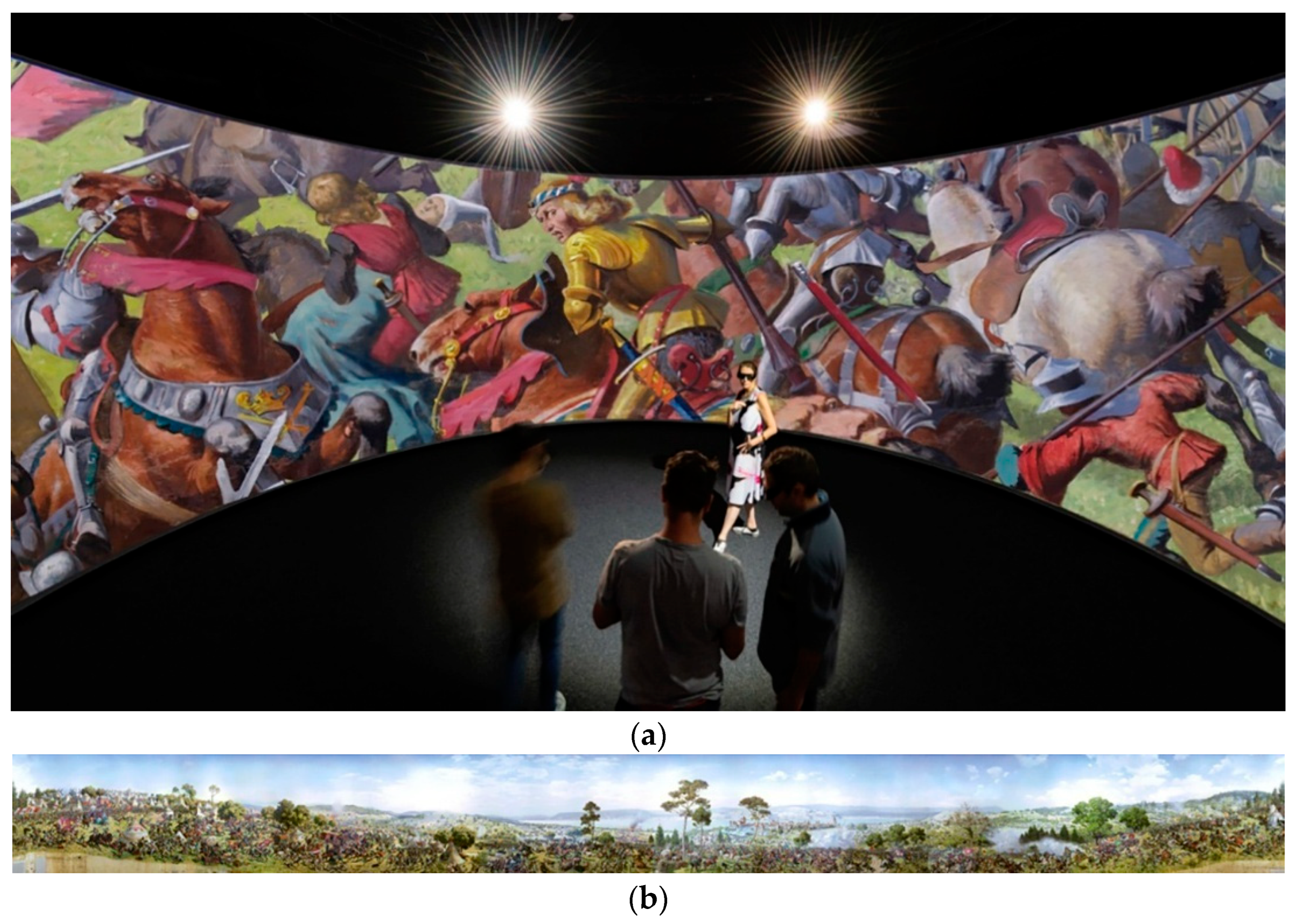
In 2022–2023, The Terapixel Panorama project, conceived and managed by the Laboratory for Experimental Museology (eM+), Ecole Polytechnique Fédérale de Lausanne, under the leadership of Professor Sarah Kenderdine, conserved and digitized the Murten Panorama. The result is the largest single seamless digital image of a particular object ever created: a 1.6-trillion-pixel digital twin of the panorama, validated by the Guiness Book of World Records (Figure 1) [2].
Interactive audio-visual effects augment the Terapixel Panorama for a multisensory immersive experience of the 19th century panoramic painting. Volumetric videos, 3D objects and historic costume characters, motion capture and a dynamic soundscape present multimodal storytelling. A historically informed soundscape, based on research into medieval chronicles, letters, narrative literature and other archival documents, situates the viewer in the heart of the battle. The physical exhibition of the Terapixel Panorama includes a digital-olfactive experience of synthetic smells diffused on experimental devices worn around the neck of the visitor. Aromas of paint and canvas evoke the physical materiality of the painted panorama, while the smells of horses, gunpowder, smoke, sweat and blood call up the business of the battlefield. Sweeter scents, incense, countryside, tree and lake, illustrate the dichotomy of the painting’s visual narrative—the horrors of war against the bucolic background of the gentle hills and lake of Murten [3]. Our role in the project was to augment this digital Swiss heritage narrative by producing 3D digital twins for selected characters represented in the panorama.

1.1. Goals

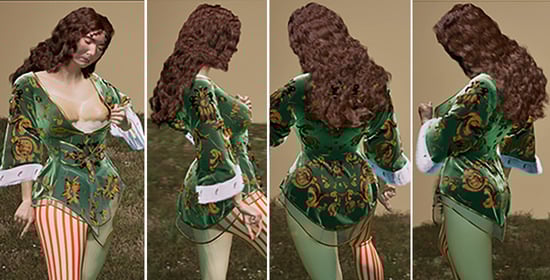
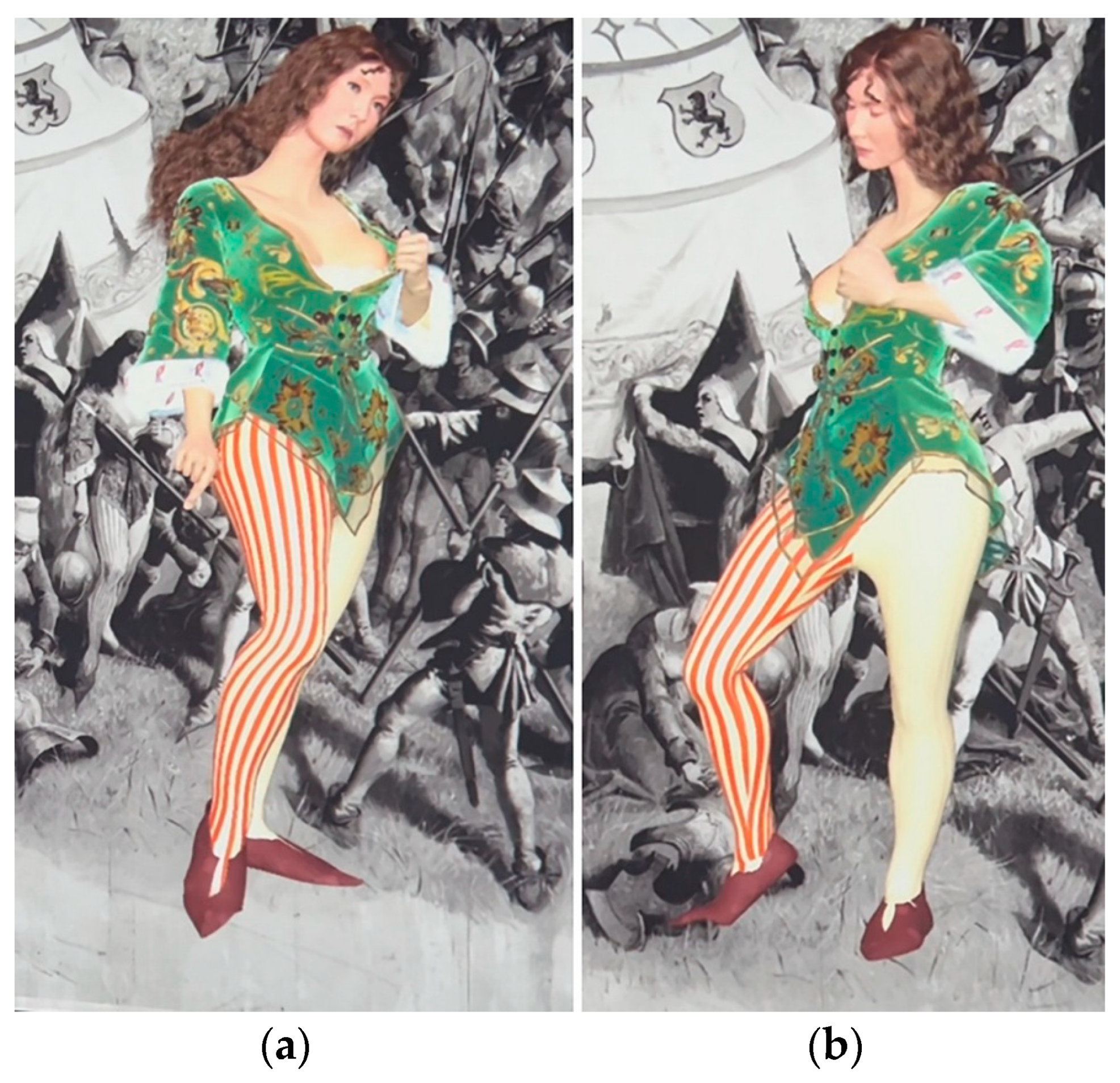
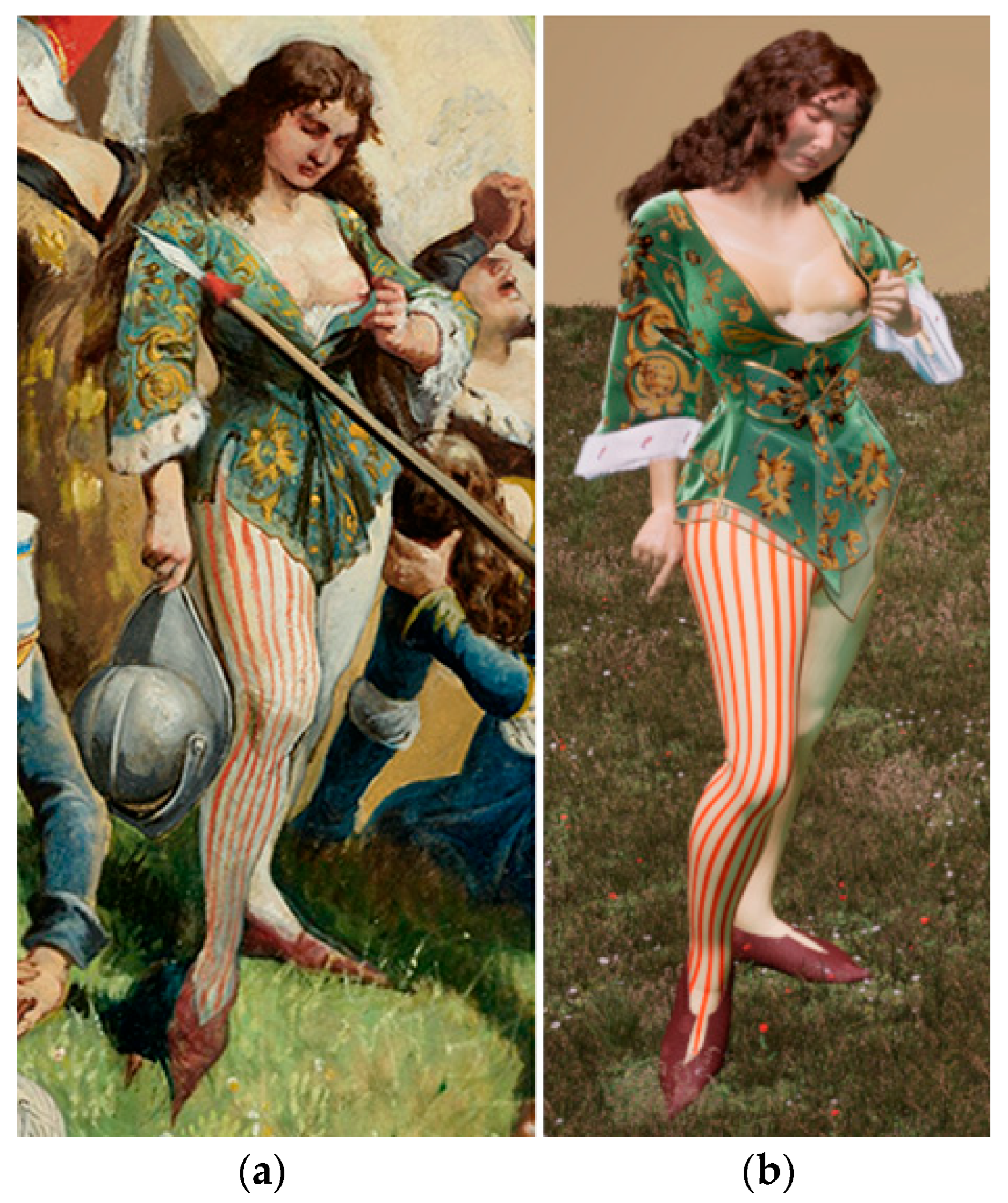
The objective of our research for this project was to create a 3D digital twin of the Burgundian prostitute character in the Murten Panorama that was viewable from 360 degrees. Visual fidelity to Louis Braun’s painted image from all angles was required during the rotation (Figure 2). The files generated for the twin needed to be of a size and type that was manageable for integration into the Terapixel Panorama. Our output needed to meet the technical requirements for integration into the Terapixel Panorama; the content interests of the Foundation for the Panorama of the Battle of Murten, partners in the project; the scrutiny of medieval costume and history scholars; and the engagement of the general public who will be viewing the Terapixel Panorama as part of the 2026 celebration of the 550-year anniversary of the battle.
The challenges of creating a three-dimensional virtual character from a two-dimensional image were multiple, as were the layers of interpretation we unraveled in constructing the ‘historically accurate’ costume (the terms costume, dress and fashion are used interchangeably throughout this article). From the two-dimensional images in the painted panorama, we could glean enough information about the body shape and size, the color and basic silhouette and the possible textiles of the garment to create the first frame of a 360-degree rotation. From this information, we needed to create an avatar and attire that were believable from all angles of the rotation (Figure 2).
Braun created volumes of preliminary sketches for the panorama, researched from medieval paintings and tapestries, for the soldiers, knights, royalty and animals, particularly the horses [4]. We found no sketches for the Burgundian prostitute character. With no preliminary studies of multiple views of the prostitute’s ensemble, we needed to imagine a three-dimensional creation that was consistent with the body of historic fashion design-making knowledge without veering from Braun’s conception. We relied on the expertise of the designers of traditional and virtual fashion, the costume historian and digital artists on the project team to create the remaining views of the 3D digital twin with authenticity to Braun’s vision and to the laws of physics involved in 3D fashion reproduction.
Before beginning the avatar and garment design, we needed to determine what style of fashion Braun was envisioning for the character. As important as solving the mechanics of the reconstruction process was the interpretation process: what we could ‘read’ from the dress about the many layered influences on the artist. A critical analysis of the 19th century image was essential for this interpretation. Our research started with an investigation of medieval garments and body types illustrated by resources (paintings, tapestries) created during the period, and of fashion design and ephemera from the milieu in which Braun painted the panorama.

1.2. Background

Developments in virtual fashion design processes have played a significant role in spurring new trajectories in interactive visual culture. Vandi, Bertla and Suh, in their digital reconstruction of an haute couture jacket by Gianfranco Ferré, maintain that unraveling the craft involved in the making of a fashion object can aid in re-materializing the object as a “culturally intensive artefact” and lead us to new ways to engage the audience. The expanded representation can trigger various forms of individual, collective, and social interactions that are not activated by the 2D object [5] (p. 69). Reimagining a cultural artifact from a flat, painted image to a virtual image that is able to rotate 360 degrees can imbue materiality to the object.
In 2005 the MIRALab at the University of Geneva and the Digital Clothing Center at Seoul National University were offering frameworks which brought together digital fashion design tools for cloth simulation and animation with those focused on draping and construction. An important feature of both developments was the ability to manipulate and fit garment patterns on virtual mannequins [6,7].
At the MIRALab, a web-based virtual try-on for fashion design allowed the customer to modify generic bodies using a 2D image and measurements of themselves to create a custom avatar. The patterns for the fashion garment were then recalculated from the avatar measurements to fit the user and the attire and avatar were put into motion in a predetermined animation [8]. In 2008, the Drexel Digital Museum (DDM) project began working with the Digital Clothing Center (DCC) to create virtual embodiments of selections from Drexel University’s Fox Historic Costume Collection. At the time, the DCC was developing the Digital Clothing Suite (DCS), which used similar processes to those of the MIRALab research. Measurements were extracted from the physical historic costume; in this example, this was a high fashion linen gown from the 1930s by Polish American fashion designer and cosmetics entrepreneur Helena Rubinstein. An avatar chosen from a DCS library of sizes and shapes was modified to fit the costume measurements and given hair and makeup from the period. Patterns were created from the extracted measurements. A linen textile with the material properties, drape, weight and surface texture of the Rubinstein gown were selected from the DCS fabric library. Details of the surface texture, a finely detailed appliqué pattern, were added using high resolution images of the original textile. The results were fitted onto the custom 1930s avatar, and the avatar posed into a predetermined animation [9]. This video shows the physical garment imaged as an ObjectVR first, and then the 3D virtual embodiment in motion in a fashion catwalk https://vimeo.com/796415909?&login=true#_=_ (accessed on 15 October 2010) [9].
Art Station, a platform for emerging digital artists, features the work and accompanying tutorials for purchase of freelance computer graphics and 3D artist Marianna Yakimova [10]. Yakimova uses Marvelous Designer 2025.2, a Clo 3D Fashion Design 2025.0 product geared to the gaming industry, and Substance Designer 11.0 to design and computationally texture the surface of historic dress. The results are noteworthy but lack the artistic ‘messiness’ of Braun’s painterly style. Other work on Art Station effectively illustrates and celebrates living representatives of a particular culture [11]. For this project, a 3D digital twin of King Abdel Azziz, the artist had access to still and moving images from many angles of the person to reference for the avatar. The result is quite life-like. The project focusses on cultural accuracy but there is no recorded permission to use the likeness of the King. Some of the problems of attribution of virtual fashion are discussed in Section 3.
In a web-based interactive project for the Bunka Gakuen Costume Museum, designers recreated a missing skirt from a Japanese western-style ceremonial court dress that originally belonged to the Meiji Empress. The project was designed to provide information about the Meiji Empress’ court dress in virtual 3D for the exhibition “Dresses of the Meiji Era A Treasured Legacy (受け継がれし明治のドレス),” held at the Meiji Jingu Museum 6 April–6 May 2024. This project illustrates the role that 3D fashion can play in museum conservation and the restoration of cultural artifacts [12].
The DCS is no longer available. In 2009, Clo 3D Fashion Design developers began to streamline the process with tools to afford intuitive comprehension of the digital creation process, greater realism of the output and interoperability of the software. CLO 3D is now a leader in the digital transformation of the fashion industry, offering realistic prototyping and expedient production/manufacturing at the enterprise and individual level. Its features and affordability make it a good match for our project requirements.

2. Methods

2.1. Methodological Approach: Layered Interpretation

The first challenge of this project was determining what period Braun was representing. In her guide to identifying changing fashion, How to Read a Dress, fashion historian Lydia Edwards instructs us on how to identify the period of a dress by the changing necklines, sleeves, hem lengths, skirt volume, body silhouette, etc., [13]. To begin the digital reconstruction, we applied Edwards’ methodology to the character’s dress in the panorama and compared it to images of historic dress in paintings and tapestries of both the period of the Battle of Murten represented in the panorama, 1476, and the period in which Braun created the artwork, 1893–1894. The outcome of our research, detailed in the following section, revealed that the prostitute’s ensemble was deeply inspired by the fashions of the 1890s: Braun’s Romantic revivalist interpretation of medieval clothing.

2.1.1. Historical Research

“Clothing constitutes an object admired and coveted and possesses an ephemeral power of fascination [14] (p. 19).”
Louis Braun was a skilled recorder of the battlefield, following the Austrian army as an illustrator during the Danish War of 1864 and accompanying the German armies in the Franco-Prussian War of 1870–1871. To capture the Murten battlefield setting, Braun used drawings, paintings, photographs and visits to the site of the battle [15]. He made a volume of preliminary sketches from medieval paintings, prints and tapestries in his research on the costume of the warriors and their leaders, munitions and horses [4]. He most likely studied the archeological sketches published by French Gothic architect and restorer of medieval architecture, Eugène-Emmanuel Viollet-le-Duc [9]. Braun painted small studies of individual scenes within the panorama to instruct his company of artists on the implementation of his research onto the massive circular canvas [16]. Preliminary sketches for the armor and accouterments of the knights and soldiers in the battle are numerous. Two characters were fully developed in our research: Charles the Bold, in a full suit of golden armor, astride his horse in retreat from the battle with his troops, and the Burgundian prostitute, prominently featured in front of her tent in the foreground of the panorama. Our example for this paper is the character of the Burgundian prostitute. We did not find any sketches for her ensemble by Braun in our research.

2.1.2. Who Was/Is the Burgundian Prostitute

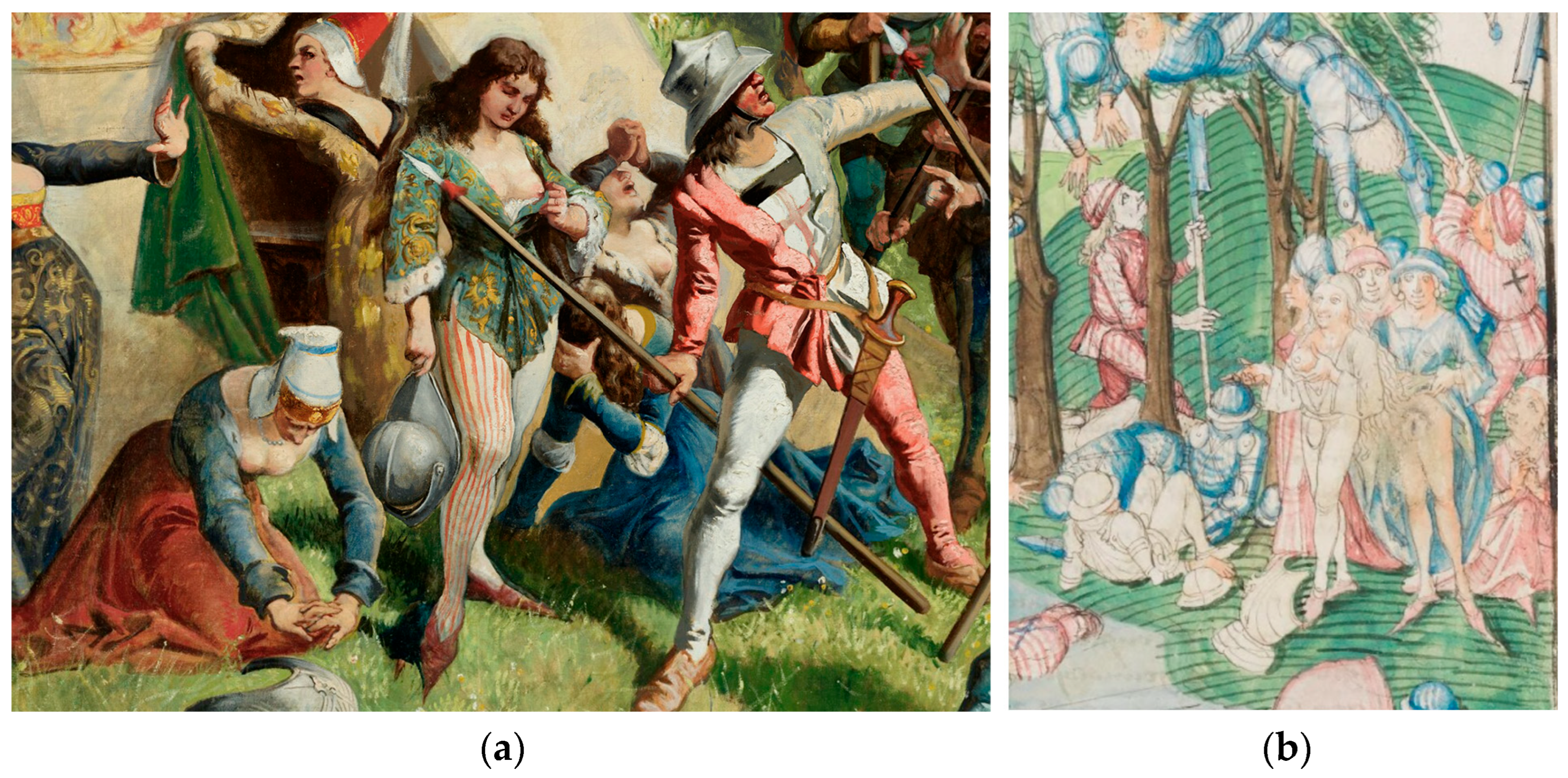
At the edge of the chaos of the battle, in the panorama’s foreground, is the Burgundian prostitutes’ tent. Wailing and praying women in fancy dress surround a central figure in a state of semi-dress. She is holding the helmet of a knight and baring her breast. A Confederate lance man stands with his hand outstretched, with his lance at the ready, poised to defend her from the advancing soldiers. This representation originates with an anecdote documented (and illustrated) in a chronicle by an eyewitness of the Murten battle, Diebold Schilling (1436–1486), a chronicler of Swiss history. He tells the story of the aftermaths of the battle, where women would have to show their private parts to be identified as women and not be executed [17] (Figure 3).
To begin our historical research, we looked at some of the source material that may have inspired Braun’s depiction of the character’s costume, body and demeanor. Braun’s inspiration for the prostitutes’ bodies and their dress on the battlefield appears to be derived from a mélange of historic perspectives on prostitution, observation of historic costume in medieval artwork and the fashion style that was current to when he produced the panorama. In medieval times, in southern and central Germany, northern Italy, southern France, the Low Countries and Iberia, provision for public brothels was regarded as an outlet for young and unmarried men who might otherwise endanger ‘honorable’ women. Licensed and regulated, prostitutes had a visible public face and were often included in the ‘hospitality’ of town celebrations [18]. As noted in a criminal investigation into the conduct of the brothel-keeper, Lienhart Fryermut, and his partner, Barbara Tarschenfeindin, in Nördlingen, southern Germany, in the winter of 1471, the women in these brothels were exploited in a similar manner to today’s illicit sex trade. One woman testified to having all her clothes stripped, except for her skirt, and sold to a purveyor of goods, and then being beaten. Another received a forced abortion [18]. The military could hire them to accompany men in battle. On the battlefield, in addition to sexual functions, women also served as cooks and washerwomen and performed basic medical care [19].

2.1.3. The Dress

Our Burgundian lady is wearing a medieval woman’s côté-de-hardie, constructed of a luxe textile in imitation of her social superiors. However, the stripes on her hose mark her as a lady of the sex trade, rather than a lady of society. Sumptuary laws and decrees concerning dress proliferated in the towns of southern Europe at the end of the Middle Ages to reinforce social hierarchies, as well as to limit consumption of foreign goods competing with local production. Prostitutes, entertainers (jugglers and clowns) and hangmen were sometimes required to wear either an entirely striped suit of clothing, or more often, just an item of striped clothing to identify them as practitioners of trades that were not those of ‘honest’ citizens. Whether the stripes were horizontal or vertical parlayed different meanings. Horizontal stripes marked you as the lowest criminal: an outcast. Vertical stripes were less damning and denoted that you were merely disreputable and existing outside of respectable society [20] (pp. 12–32).
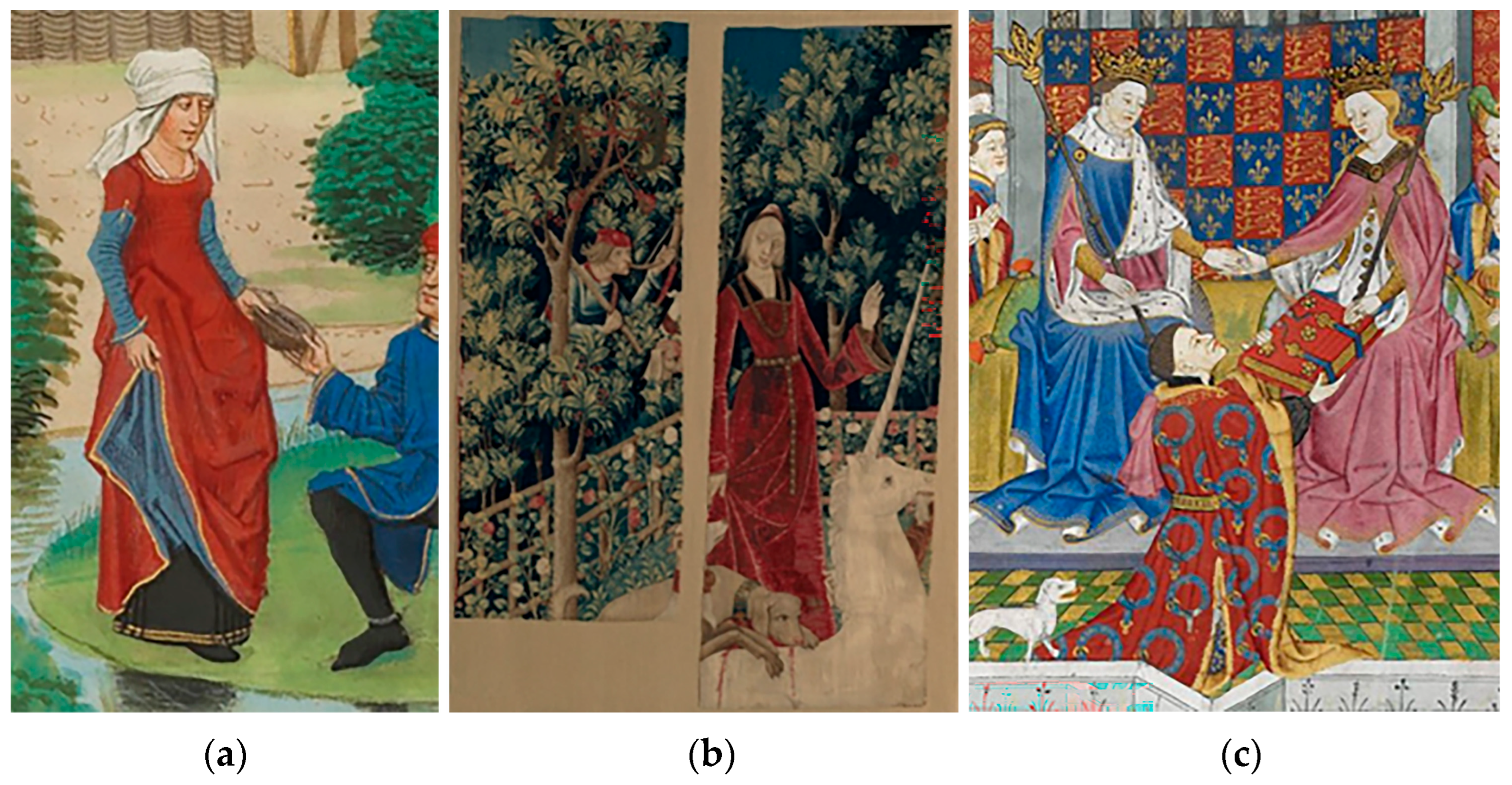
Scant examples of medieval costume exist. We, as did Braun, relied on paintings and tapestries of the period for our initial investigation. Literally underlying a period style is the body shape, formed by the deformation of the body by the undergarments and by the current ideal of beauty in fashion. The medieval ideal of a beautiful female body was pear-shaped, with small breasts, a short torso and a rounded abdomen, as in the detail from the illuminated manuscript produced by Loyset Liédet, 1467–1472, in the example in Figure 4a. The overall silhouette was lean and narrow, then flared at the skirt, with tightly fitting sleeves as worn by the Maiden from the Unicorn Tapestries, 1495–1505, in Figure 4b. These tapestries disappeared from public view in the 1730s after being plundered from the Verteuil château of owner François VI de La Rochefoucauld. They were rediscovered in 1850 to great fanfare and discussion by museums, collectors and artists around the world [21].
An example of a noblewoman’s late medieval period jacket, a short côté-de-hardie with a tight waist and ermine trim, can be seen on Margaret of Anjou, from the frontispiece of The Shrewsbury Book in Figure 4c. This richly illuminated medieval manuscript was commissioned in 1444 by military commander John Talbot, Earl of Shrewsbury, and given to the British Museum by George II in 1757 as part of the Old Royal Library of the British Museum [22]. Established in 1753, the British Museum was the first public national museum, and the manuscript probably served as inspiration for medieval costume historians and theatrical designers. As an artist and recorder of history, Braun was probably exposed to the examples of medieval dress and body form included in these, or similar, artworks while designing the costume for the characters in the panorama. For the Burgundian prostitute, however, he chose to use a body type that was formed by conventions of late 19th century beauty, rather than those of the late medieval period of the battle.
By the second half of the 1800s, Europe was in the golden age of brothels, which were accepted as part of all levels of social life. The state tax authorities collected 50–60 percent of the profit from the trade. Maxime du Camp, a chronicler of the 19th century world and the founder of the Revue de Paris, recorded 155,000 women who were officially registered as prostitutes from approximately 1871 to 1903. During the same period, the police stopped 725,000 others for clandestine prostitution [23]. The 1890s were a time of political and social changes in Switzerland as the new Swiss Confederacy, established in 1848, evolved and a new political movement to establish a republic began in 1890 [24]. As a trained artist, Braun was aware of the use of historical painting to represent contemporary thinking through paintings like Liberty Leading the People, French painter Eugène Delacroix’s allegorical painting of 1830 [25]. Art historian Ann Sexton illustrates the shift in creative society’s consideration of the prostitute by outlining the evolution of artists’ depictions of them from the romantic exotic Grande Odalisque, painted by Jean Auguste Dominique Ingres, 1814, to Degas’ and Lautrec’s unglamorous portrayals in the late 1800s [26]. By Braun’s time, wearing striped clothing shifted from being the mark of society’s outcasts to a symbol of freedom through the individual fashion statement [20]. The prostitute’s style and demeanor appear to reflect the changes in the public’s view of prostitution.
Braun, with the perspective of a Romantic revivalist, paints the Burgundian prostitute as something more than a sex worker. Although she has been caught in mid-dress, like many of the prostitutes painted by Degas and Lautrec, she meets her fate with demure nobility, eyes cast downward, ready to reveal her femininity and accept her fate. We can speculate as to why she holds the helmet. Does it belong to a regular patron, lost to the battle? Did she grab it for herself to head into the battle a la Delacroix’s Liberty, hastily neglecting to don a skirt over her undergarments? Did Braun adapt Delacroix’s Romantic view of an earlier revolutionary moment in French history, the unification of the French people together against the ruling King Charles X, represented by Liberty, to the character of the Burgundian lady in his depiction of the Battle of Murten [25]?
Whatever the impetus, the prostitute materializes through Braun’s interpretation of the fashions of the late 1800s. She becomes a 19th century courtesan, with the narrow, highly corseted waist, uplifted bust, ample thighs and soft flesh of the ideal woman in the late 1800s in Europe. To obtain a realistic representation of the costume for the models posing for the panorama, Braun designed physical garments; had them constructed by the skilled seamstresses of the growing theatrical trade; and fitted onto dressed live models in the character’s pose [27]. Costume design as a profession started emerging in 19th century Europe, with the rise in popularity of the Renaissance Theater and the Opera Comique in Paris. Fashion of the times required costume to be ‘over the top’ in rich detailing and surface design. Artists often dressed their subjects in medieval and Renaissance dress in the manner of French portrait painter Fragonard (1732–1806). James Laver, curator of the Victoria and Albert Museum, 1922–1959, notes, “… (ever) since 1500 in Europe the key word for costumes was indeed spectacularity [28] (p. 78).” And what better call for ‘spectacularity’ than the situation of the Burgundian prostitute.
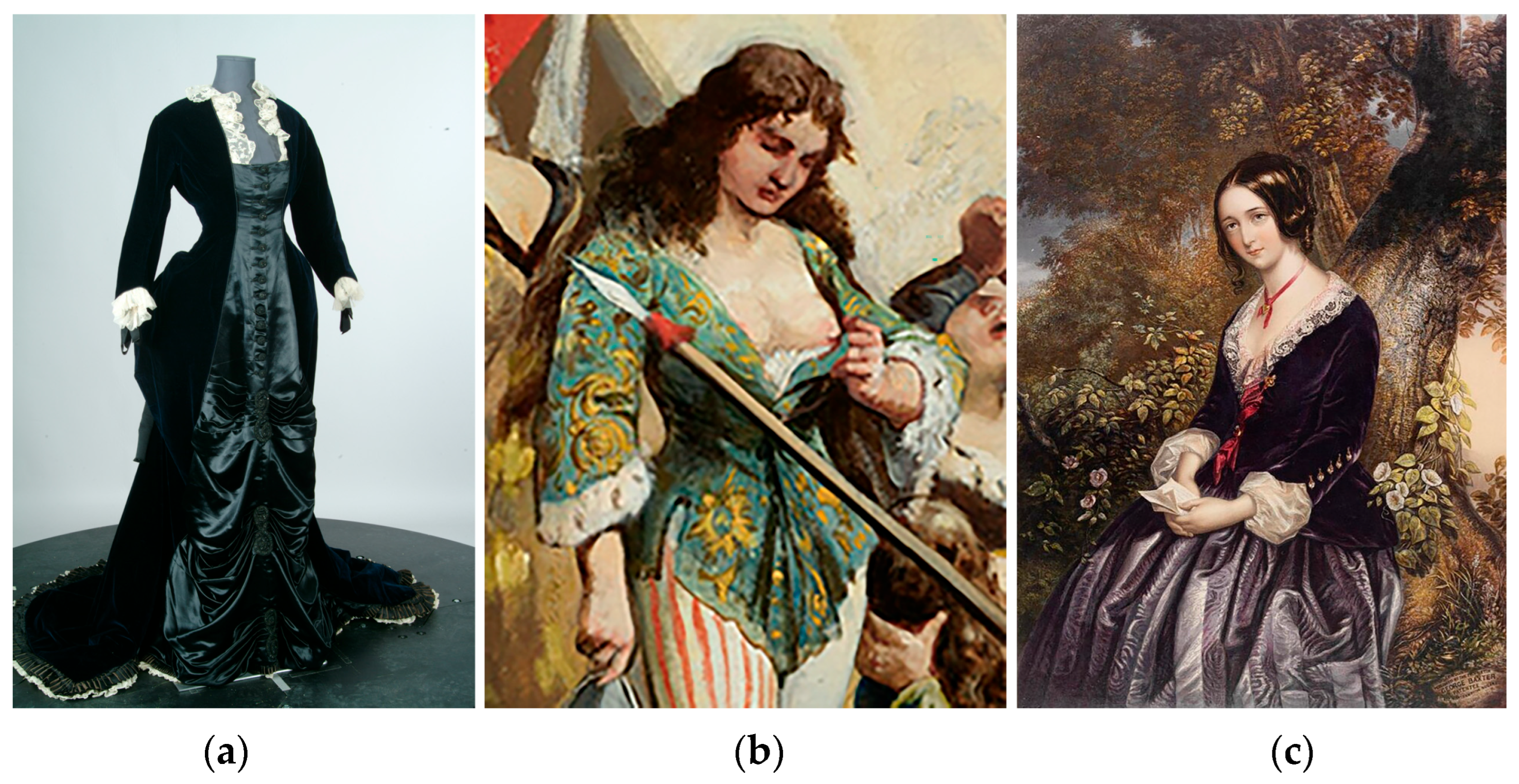
Fashionable women’s ensembles during Braun’s production time, such as the dress in the example in Figure 5a, usually comprised layers of garments that could be added or removed and replaced if necessary. Braun may have adapted the structured outer layer of a typical Gilded Age dress for the prostitute’s jacket. The top layer of the skirt in the 1883 example in Figure 5a was open to show another layer of a different, sumptuous fabric. In an interesting connection to the Murten panorama project, this style option is thought to have originated in the late medieval times, when it became fashionable to slash external garments to show luxe textiles underneath, inspired by what Laver identifies as “the Swiss soldiers following the Battle of Grandson, in 1476… (who) patched tattered clothes with fabrics plundered from dead nobles [28] (p. 78).” The Grandson battle was the second defeat, after Murten, for Charles the Bold, leader of the defeated Burgundian army in the Battle of Murten, a few months before the Grandson battle. Charles was killed during the Battle of Nancy, on 5 January 1477 [29].
The painting on the right in Figure 5c, by Fanny Corbaux, was reproduced as a print by George Baxter in 1854 and widely circulated for sale as an art reproduction [30]. This image may also have been an inspiration for Braun. The similarities between the jacket worn by Corbaux’s model and that worn by Braun’s prostitute are striking The overall hourglass silhouette of the jacket in the print matches that of the côté-de-hardie in the panorama, as do many of the details: the sleeves are both ¾ length, slightly padded, slightly belled; the plunge of the necklines match; the waists are both tightly cinched; and a shaped peplum covers the pelvis. There are two differences in the costume design. Under the jacket, Braun replaces the lace bertha with a corset, and the shirt sleeves extend from the sleeve with ermine fur cuffs. Corbaux’s skilled rendering of each of the textiles in the ensemble makes them identifiable as velvet, satin and lace. This informed our fabric choices for the jacket of the digital twin.
Our charge in the project was to produce virtual characters to augment the panorama and make their appearance look as close as possible to their depiction in the panorama. The visual information in the panorama painting about silhouette, form and volume clearly place the style of the body and costume in Braun’s 1890s milieu, rather than in a medieval time and place. Perhaps he was influenced by his collaborations with theatrical costume designers and their dramatic interpretations of medieval fashion. The prostitute character could be viewed as being costumed for a play about the battle, rather than as being part of an authentic recording of what transpired in 1476.

2.2. Realization Method

An excellent method for understanding historic fashion (dress) is to recreate it (13). To make the character’s digital twin believable, our modeling process requires the interdisciplinary expertise of fashion designers that are skilled in both traditional and digital patternmaking, 3D modelers of the human body, costume scholars to ensure the authenticity of the design, software technologists and the creative license of Louis Braun’s esthetic lens. According to archivist Paul Conway, to establish the trust that is essential to the acceptance of digital surrogates as sources of scholarship, the surrogate should create a match to the viewer’s experience, ideology, social conditioning and other factors. Our 3D interpretations were progressed by the knowledge of our experts, knowledge embodied in the surface, silhouette and volume of the virtual garment and by the viewers’ experience of wearing various styles of clothing. Transformative perspectives can emerge when the human mind draws on the body’s learned inventory of actions in the physical world to understand the digital twin [31] (p. 54).
To virtually model the prostitute’s costume, we needed to determine a process for converting the high-resolution data scanned from the two-dimensional physical panorama into a three-dimensional digital representation that could be processed, analyzed and managed by computer applications. The current experimental computational approaches to this challenge include the explicit representation method, which uses a statistical template model such as the Clothed Auto Person Encoding (CAPE) dataset of high-precision human scan data to reconstruct the human body [32]. This method works well for tight-fitting clothing, but not for garments without continuous contact with the body. In an implicit representation method, detailed 3D shapes with arbitrary topologies, derived from front and back depth maps of the 2D image, are constructed to represent loose clothing but without regard for the structure of the human body. Most methods for single-image human body reconstruction integrate explicit and implicit approaches and assume prior knowledge of the parametric human body model [33]. We chose to model the characters using off-the-shelf 3D fashion and digital media design software and our professional expertise in fashion design and costume history.

2.2.1. Building the Avatar

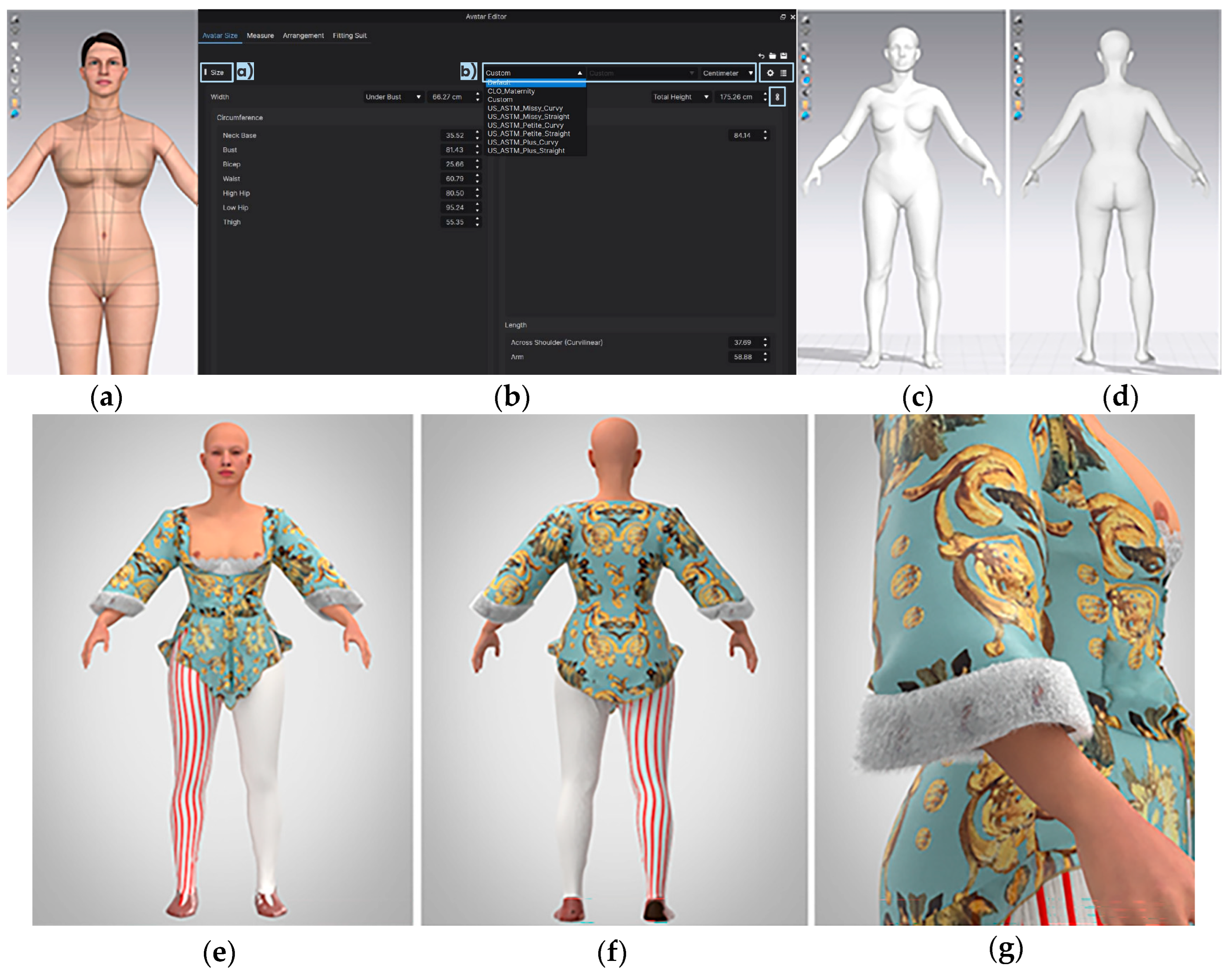
Our process uses CLO 3D Fashion Design 2025.1 (CLO) [34], Metahuman Creator 5.0–5.4 (MHC) [35], Photoshop 2023 [36], Substance Painter 2023 [37], Autodesk Maya 2023–2024 [38], Blender 3.2 [39], Daz 3D [40] and Unreal Engine 5.0–5.4(UE) [41] software. MHC for UE offers high fidelity facial customization, trained on a vast library of scanned human facial features alongside a complex rig for human motions with realistic deformation. At the time of our development, 2024 to mid-2025, MHC avatars were limited to 3 pre-sets for a binary gender. Built into Clo is a large library of preset avatars using ASTM (American Society for Testing and Materials) standard body measurements. Through the CLO avatar measurement editor, MHC avatars’ preset body proportions can be modified while retaining their custom heads (Figure 6).
We converted an MHC pre-set female average weight avatar into a CLO measure-editable avatar and calculated the measurement changes based on research in historic population demographics at the University of Oxford, England, using 5 ft. 3 inches as the estimated stature of the prostitute. According to their research, the average woman’s height in the medieval period, 5 foot 3 inches, was close to that of a late 1800s woman’s height of 5 foot 2–3 inches [42]. We measured the width of the bust, waist, hips and thighs of the body of the prostitute in the panorama and determined the widths and circumferences of the avatar body relative to those values on a 5 ft. 3-inch-tall avatar. The 3D ‘sketch’ was then compared to the panorama by overlaying it onto the painting, using reference tools such as Pure Ref 1.11.1 to highlight gaps between the ‘sketch’ and the painting. The ‘sketch’ was then exported into UE. There, it was recombined and matched to the pose in the panorama, using a set perspective digital camera that was aligned as best as possible to Braun’s perspective.
Body iterations for muscle definition and volume redistribution of key areas were added in Autodesk Maya through modification of the geometry of the body and the underlying complex skeletal rig, toggling between Maya and UE for further scrutiny. Supplementary software, such as 4.22 Daz3D, Blender 2.79, Adobe Photoshop version 27.x and Substance Painter Version 10.0, was used for hair and skin enhancements to the MHCC avatar. The refined and finished avatar, with an animation from the ‘A’ pose used for initial patternmaking, was then exported back to CLO for patternmaking and the simulation of the components of the costume. Fabrics were selected from the CLO library that have the properties of medieval textiles and the appearance of the material depicted in the panorama.

2.2.2. Costume Design

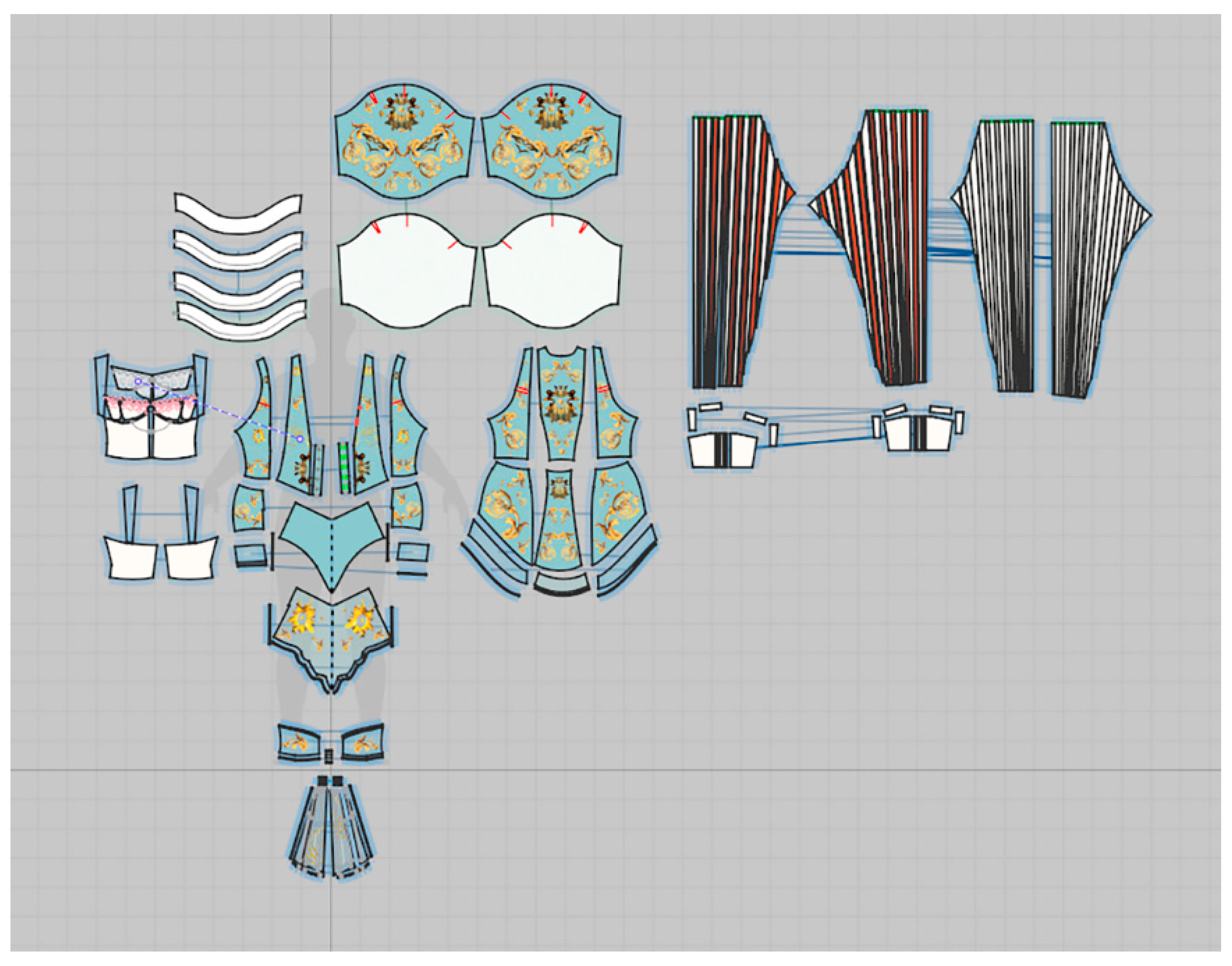
The jacket construction has a tight bodice fitting over a torso constricted by a corset underpinning: a style shared by fashion in both the medieval and the hourglass silhouette of the late 1800s eras that inspired Braun. The fashion designer and historian on the team are well versed in this style and were able to convert the visual information into garment patterns (Figure 7). The sleeves, which are lightly padded, bell shaped, ¾ length, ermine cuffed sleeves have the same shape and fabric as those in the Corbaux portrait in Figure 5c. The front closure is loosely tied and pinned: a fashionable adaptation of the lacing closures used by women in the 14th century [43]. Braun renders a fancifully designed transparent overskirt with a knotted sash attached to princess seams in the front bodice of the jacket. The surface design Braun applied to the jacket in the panorama is a reasonable adaptation of a medieval large scale embroidery or jacquard pattern. We followed medieval textile pattern layouts that were similar to those in Figure 5c to imagine the pattern across the back of the jacket.
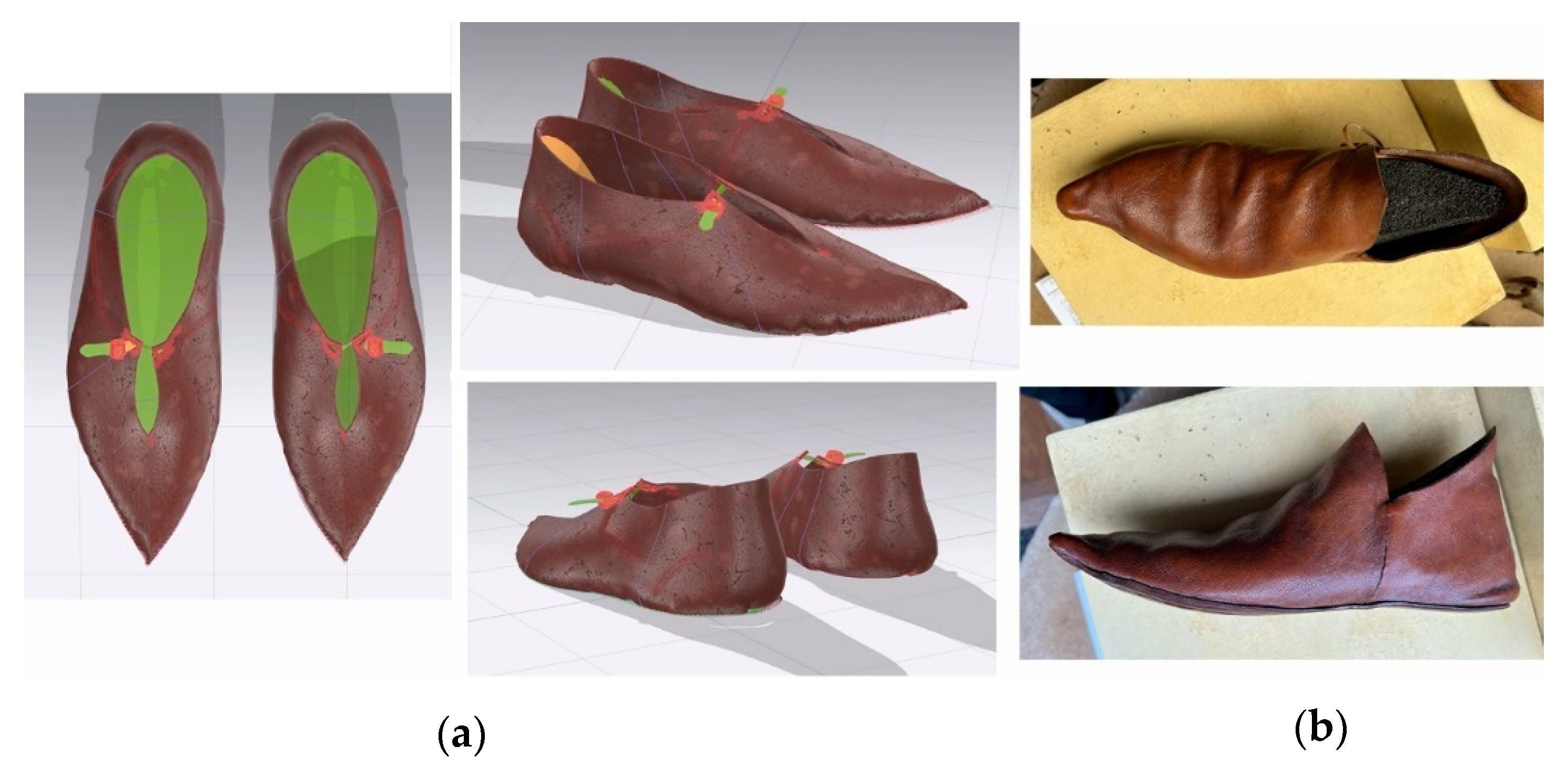
The shoe design (Figure 8) was based on research of archeological footwear during a visit to the Musée de la Chaussure in Lausanne, with advice from Marketa Volken, the founder of the Musée and a renowned leather archeologist and calceologist [44], and from illustrations of shoe patterns published by archeologist Olaf Goubitz [45].
In a digital twin, representing a garment’s textile with a richly detailed surface and believable drape on the body can enhance the viewer’s sensory experience of that surface [46]. According to the Distinguished Research Professor N.K. Hayles, the drape and the tactile feel of a fabric (the ‘hand’) can connect the textile to the neural network of an individual and mesh with their cognitive development, memory retention and emotional states. The nature of the medium in which the object is instantiated matters. Hayles notes the importance of the ‘hand’ of the technology that is used to produce and distribute the digital artifact and the physical limitations to which it is subjected, in affecting an understanding of an artifact’s physical surface treatment [47] (p. 75).
Other projects recreating historic costumes have been able to scan the textile from the existing fashion artifact or a reasonable facsimile to realistically represent the surface [5]. The scanned image was then overlaid onto a textile with a preset of material properties from the 3D fashion design software to simulate the surface effect of the fabric [5]. We had no direct physical references for the textiles represented by Braun and his painterly brushwork abstracts, other than defining the textiles’ surface. We decided to use this lack of definition as an opportunity to interject medieval era authenticity and base our fabric choices, for the most part, on research on textiles produced in the late period of medieval dress. With this decision made, we could interpret and apply the textile’s material properties in CLO.
The jacket features ermine cuffs, signifying wealth and power, so we can assume the body of the garment to be a luxe textile. Silk velvet production in Italy and Spain from 1400 to 1600 was producing spectacular patterned velvet textiles. These textiles were exported all over Europe, as well as to the Ottoman empire, making silk velvet a believable choice for the jacket [48]. The transparent overskirt appears to be silk chiffon. Made exclusively from raw silk, the cost of chiffon made it available to only the very wealthy and signified elevated status. This textile did not arrive in Europe until 1700, but, as visually matching our virtual character to Braun’s painted character is a prime goal of the project, in this instance we defer to his 1890s-inspired design choice [49]. The material properties for each pattern piece were applied in CLO, and the textures were separated into layers of the embroidery and the underlying fabric. The fabric simulation data were exported to UE, allowing for realistic and dynamic drape. CLO Live Sync provides real-time sharing of updates from CLO to UE. This made re-syncing the changes made in Clo to UE expedient. Other modifications in UE were made using blueprints of the fabrics that were matched to the properties in CLO.
Braun depicts the bold stylized botanical motifs of the textile’s surface design in a painterly manner, with luscious, but ambiguous, brushstrokes. We experimented with various ways to digitally reproduce stitches that were common to the medieval seamstress for the embroidered embellishment. The results looked stiff and a bit like a cartoon, similar to the Yakimova textiles mentioned in Section 1.2. The best method to maintain visual authenticity to the painting was to translate the brushstrokes to pixels using the high-resolution scans of the Terapixel Panorama to make Photoshop brushes. The normal map intensity was adjusted to enhance the depth of the surface topology. After studying medieval textile motif layouts in period paintings, we then imagined repeating the brush motifs for the continuation of the pattern across the views of the jacket that are not visible in the panorama.
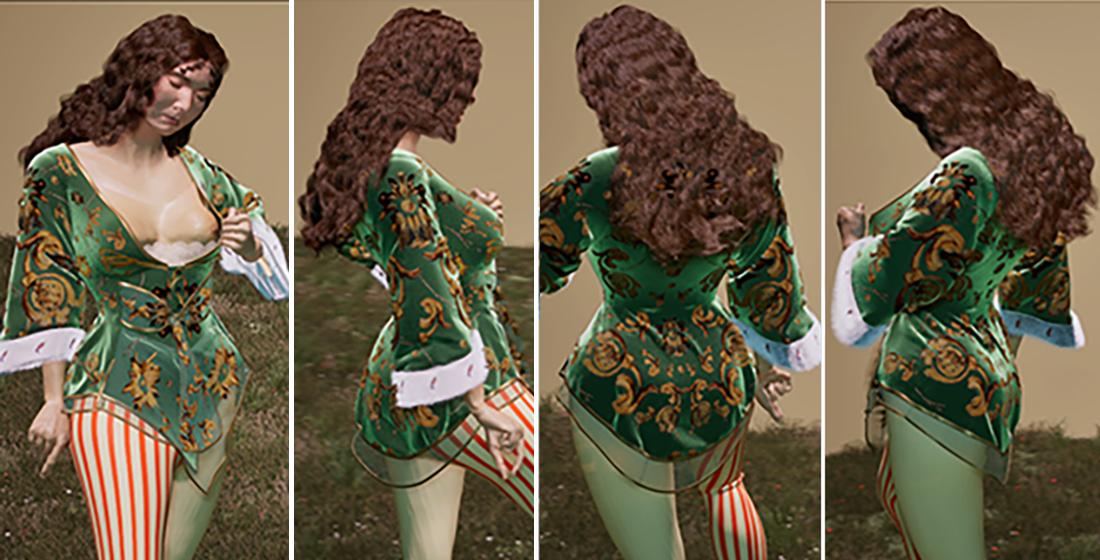
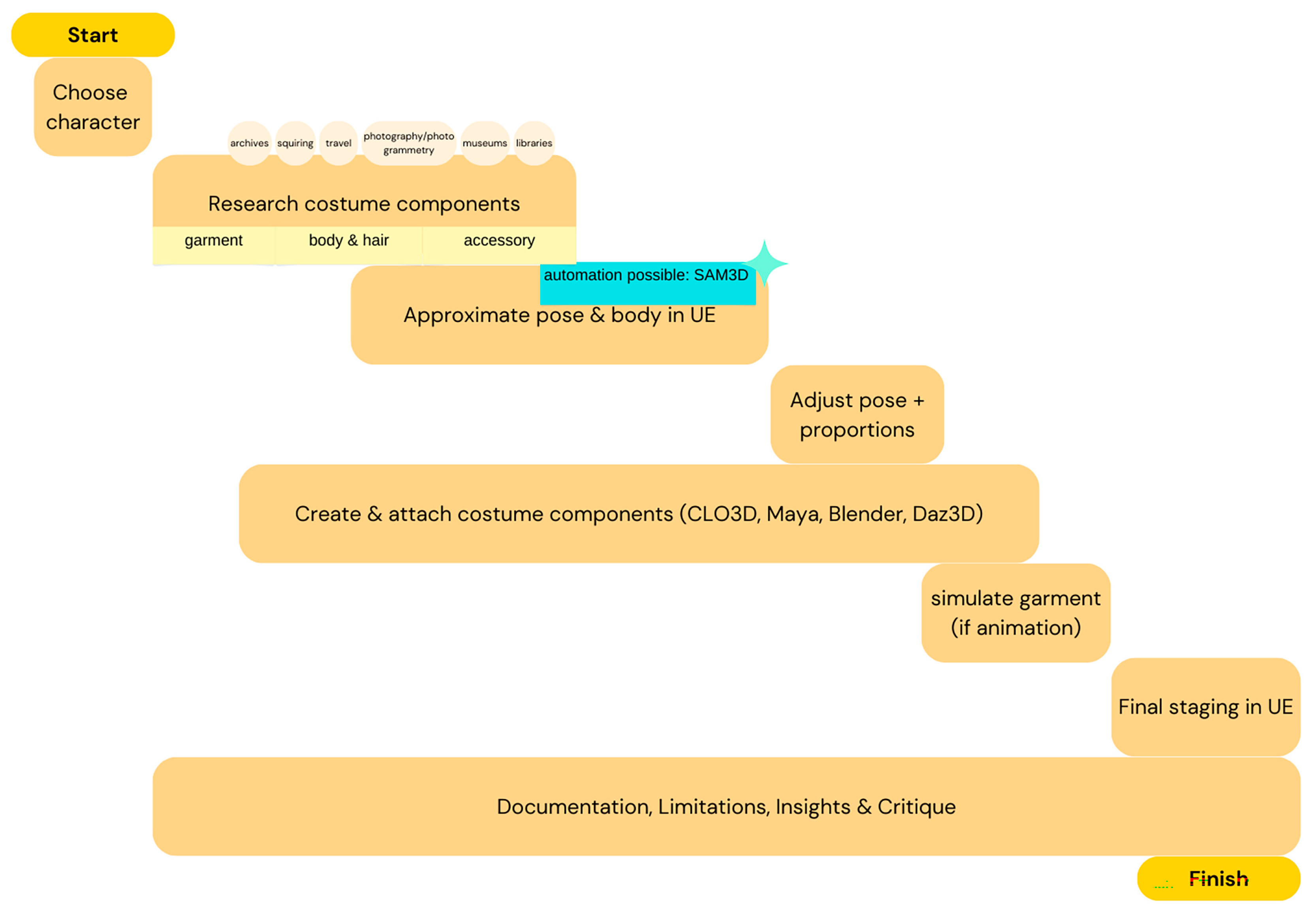
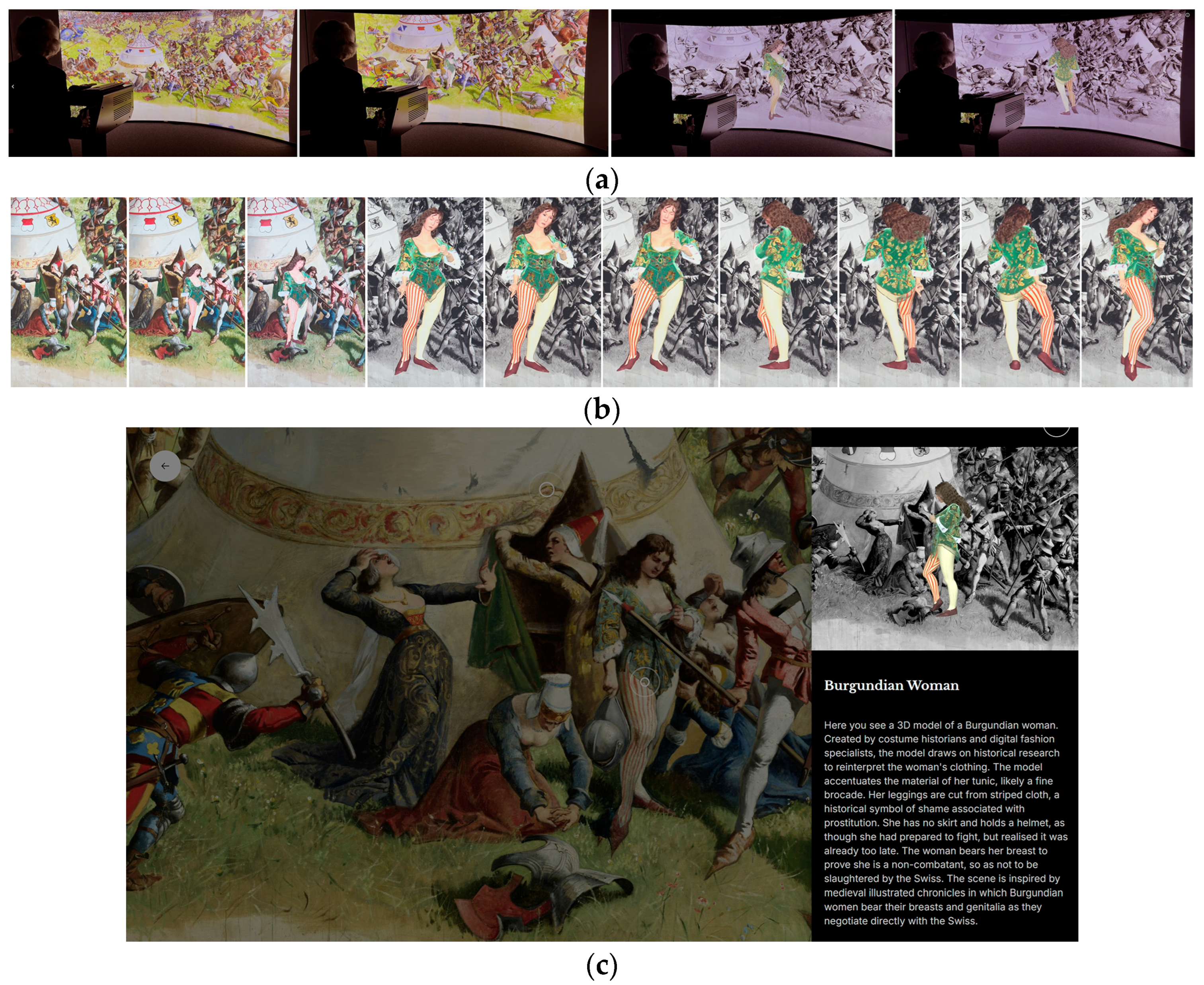
The character was then exported to Photoshop, Blender and Substance Painter for posing, additional hair grooming and skin enhancement (Figure 9). Workflow chart is show on Figure 10. When the 3D interactive prostitute is activated, unlike her two-dimensional counterpoint, she rotates 360 degrees and can be zoomed in on from any view to examine the details of her dress (Figure 11).

2.3. Integration into the Terapixel Panorama

In the Terapixel Panorama, the 3D prostitute image is superimposed on the Terapixel image. Different variations for the activation of the augmentation were explored, such as portals with external characters in greyscale or silhouette, or dissolving/fading the MHC character in and out of the panorama backdrop. In the full version of the immersive image, when the viewer guides the interactive interface over the Terapixel Panorama character, the interactive prostitute emerges from her painted/pixeled instantiation to the foreground, zooming to a larger-than-life size. Color in the panorama fades to greyscale to accentuate the colorful 3D image. The scent of Queen of Hungary Water—a blend of lavender and rosemary—mixed with sweat wafts from the tent, hinting at what may have transpired within its dark interior [3]. As the animation begins, her downcast eyes open, and her breathing becomes noticeable; she glances at the viewer, and rotates 360 degrees, creating a multidimensional narrative that reflects her predicament within the virtual environment.
A website featuring additional content from the exhibition system version brings this experience to anyone with an internet connection (Figure 11c). The site opens with a background soundscape of Charles the Bold in retreat, having lost the battle. Sounds of the galloping horses, the clangs of clashing swords, knives and halberds and resonances of the slaughter as the crossbows, pikes and lances hit their mark draw the viewer into the battle scene. Viewers may choose “Explore the panorama” and pan through the Terapixel Panorama, zoom in on details of the painting and select hotspots to view the interactive augmentations and stories. A hotspot on our character takes the viewer to text speculating on the woman’s identity. An animation of the character opens and closes her eyes and rotates 360 degrees, inviting the viewer to see that she is indeed female from all angles and should, according to Diebolt’s chronicle, be spared from the massacre. The viewer may choose “Guided tours” and choose from a library of narratives on various aspects of the project. The website deepens viewer engagement with the project and Switzerland’s 2026 Burgundian war commemorations [50].

2.4. Integration Challenges

A panoramic display can extend the experience of a painting beyond the limitations of the two-dimensional canvas into an immersive experience. Since the 1900s, when the panorama became a central art form, panoramic artists have used multiple vanishing points and perspectives to give the illusion of the viewer being in the midst of an historic event or exotic locale [51]. The more complex the composition, such as that created by the vast number of horses and humans populating Braun’s canvas and the expansive depth of field of the views of Murten, the more perspectives need to be incorporated. The physical, painted Murten Panorama is cylindrical, with the center of the sides curving inward. Braun adapts to this by manipulating the perspective at the top and bottom of the cylinder. Integration of the files produced in our research into the Terapixel Panorama created a set of visual anomalies. In our 3D imaging, certain elements, like the character’s hand grasping the neckline of the jacket, when reproduced from the set perspective of the panorama’s horizon line and vanishing points, can look unrealistic when examined from other angles and vantage points (Figure 12). This leads to unrealistic posing and body distortions when the field is flattened. Resolving this issue required considerable fine-tuning to the pose. Starting from a frontal pose matched exactly to the pose in the painting, subtle manual manipulations to each view of the pose were made to make it appear realistic in all 360 degrees of the rotation.
Adapting the character for display on the 360 degree Panorama+ system and for use in other distribution modes, such as the web (GLB/GLTF format), required additional optimizations and changes to the interaction approach. Manipulations to reduce file size include removing parts of the body hidden by the costume, converting hair strands into mesh-planes (hair cards) with baked textures (lower quality), reducing topology, removing some animations and simplifying materials at the UE level of avatar development. Although UE has hair physics simulation, the custom nature of the prostitute’s hair and curl and the addition of a breathing animation to the character pose cause clipping with the CLO clothing simulation. Remedying this prevented enabling of the physics simulation that was necessary for the hair to drape properly across the shoulders. In a version change, UE removed displacement maps as a material property. Hence, realistic dimensions of the garment textures depicted in CLO, such as the raised edges of the ‘embroidery’ in the jacket, could only be adapted as normal maps. This affected the surface quality of the hair, the ermine cuffs and the shimmer of the gold embroidery and velvet fabric.

2.5. Scalability

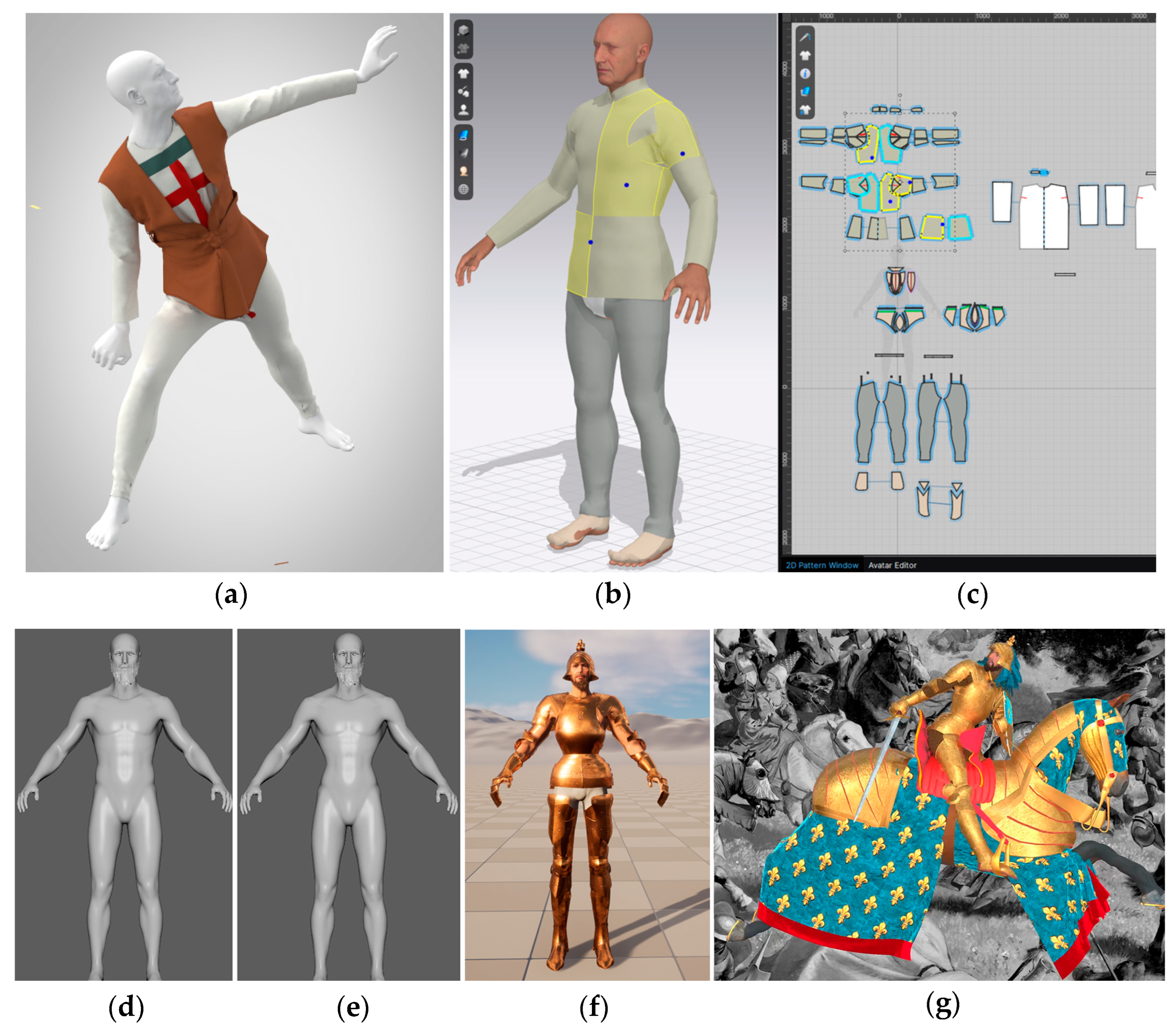
A substantial amount of time creating the Prostitute was spent figuring out the initial avatar pipeline for Unreal 5.4 by trial and error and in online forums and documenting key processes for custom bodies and hair. With the extension of Unreal Engine’s capabilities in late 2025, with the novel 5.6 update, the intricacies of creating parametric bodies on Metahuman 5.6 avatars have been simplified and now include the ability to quickly mask limbs covered by clothing. This will accelerate the modeling process considerably. Our avatars for the Burgundian prostitute and the lance man serve as basic models for medieval (in Braun’s vision) male and female body types. The original male avatar was developed for the lance man’s character (Figure 13a). The avatar and several of the patterns were repurposed for a knight character wearing the necessary undergarments when wearing armor (Figure 13b). The same avatar was again modified to match the specifications for the character of Charles the Bold, including cinching in the waist as was typical in armor of the medieval period (Figure 13d–f). The incorporation of AI technology for scaling future work is discussed in Section 3.

3. Discussion

Ann Hollander, in writing about Casper David Friedrich’s Woman Before Setting Sun, observes, “…the shape and aura of her dressed self and its own ambience suggest—to the artist and through him to the viewer—her possibilities [52] (p. 167)”.
Material culture encompasses not only the ways people perceive and respond to the culturally prescribed significance associated with heritage artifacts, but also the ways that people extract meaning from the objects themselves in each of their instantiations. Effective use of new technology should allow the explorer of cultural heritage to transcend the limits of place and time and interact with cultural heritage objects in previously unimagined ways. The technology we use provides a structural form upon which to encode the contemporary practices of society and capture the expression of human ideas through the material state [53]. Our digital twins are meant to involve the viewer perceptually, to evoke memory and to inform through the various areas of knowledge embedded in the digital manifestation. Our re-interpretation of Braun’s interpretation of medieval dress was a construct that was required to materialize the prostitute’s dress. Deriving meaning from the fashion artifact within both the medieval and the Romantic revivalist contexts serves to imbue the Terapixel Panorama with added cultural significance.
The novelty of the virtual character and her story within the panorama can invigorate fantasy in the viewer, including those who are not particularly interested in historic content. Painted, and later cinematic, panoramas were a major means of entertainment and enlightenment in the 1900s [51]. Immersive environments continue to entertain and enlighten the public, as well as create dialog with scholars of art and history. Pure Land: Inside the Mogao Grottoes at Dunhuang, a UNESCO World Heritage site, is a full-scale augmented digital facsimile of the murals on Cave 220, one of the famous Chinese Buddhist cave temples of Dunhuang. It utilizes an immersive display much like that of the Terapixel Panorama. It has been displayed to rave reviews in 11 exhibitions since its launch in 2002 [54].
Clo and MHC update their synchronistic development compatibility regularly. This hybridization of technology eases the use of the software and opens the path to innovative, interdisciplinary approaches for the in-depth study of fashion artifacts. As technology advances, we should be able to integrate larger files without reducing the quality and interactivity of the image.
In further discussion of scalability, we must project the role AI will play in the future virtual embodiment of cultural heritage artifacts. Our current process is time consuming. In the fashion industry, AI-enabled software such as Midjourney 7Flow 11 and PromeAI 6.15 are being used to generate a fully rendered 3D garment on a human body from a combination of fashion sketch and prompt [55,56,57]. AI Enhance can be used to combine an AI-generated background and an image of a live model with a rendered Clo garment for a virtual fashion ‘shoot’ [58]. The author’s time for an average generation is 15–20 min. The patternmaking and avatar creation data we collected for the prostitute, the lance man and Charles the Bold in our manual/virtual process could be fed into a secure database and the remaining 100+ characters in the panorama could be AI generated from these resources.
SAM 3D Body 2024 (3DB) can reconstruct a 3D full-body human mesh from a single image. From an image input, 3DB estimates the human pose of the body, feet and hands, based on the Momentum Human Rig 2025, an anatomically inspired parametric full-body digital human model developed at Meta, Menlo Park, CA, USA. The model is “trained on high-quality annotations from a multi-stage annotation pipeline using differentiable optimization, multi-view geometry, dense keypoint detection and a data engine to collect and annotate data covering both common and rare poses across a wide range of viewpoints [59].” It can be modified by user prompts for improved accuracy and interpretability. As this software is refined, it could be a game changer in our 3D fashion process.
Ethical considerations regarding data privacy and algorithmic bias are abound with AI involved in the process. We will need to consider how to effectively balance the benefits of efficiency and innovation with fair use of heritage data. In 2025 UNESCO published guidelines for mapping ethical considerations, as AI instigates a fundamental restructuring of cultural production. It forewarns as follows: “cultural, linguistic and gender biases present in training data can be transferred to artistic creations and cultural heritage preservation, perpetuating stereotypes” and “the risk of cultural appropriation of local expressions by major technology firms, causing decontextualization and misrepresentation, particularly when AI systems draw on material from indigenous or marginalized communities [60] (p. 14).” The guidelines highlight the inequitable access to AI tools “undermining the principle of culture as a global public good” and the “algorithmic homogenization that compresses diverse creative practices into efficiency-optimized template [60] (pp. 14, 38).” This is especially significant in the current global political climate of revisionist history.
As no controlled surveys of visitors’ use were implemented during the various exhibitions of our work to date, the reactions to the results were anecdotal but positive. The Bern History Museum, where the exhibition will open in 23 February 2026, has agreed to run an evaluation for the panorama experience. We anticipate that the augmentations will stimulate dialog between the viewer and the digital twin and extend our character’s “possibilities [52] (p. 167).” The viewer’s cognitive experience, evolved by the technological learning experience, should result in a rewarding three-dimensional narrative and become part of the “generation system of collective intelligence [60] (p. 25)”.
The public can participate face-to-face in this enriched encounter with history from August 2025 to May 2027, through a series of exhibitions at the Museum für Gestaltung Zürich, Museum Murten, Bernisches Historisches Museum, Château de Grandson, Swissnex in San Francisco USA and other international venues, and through the website.

Author Contributions

Conceptualization, K.M.; software, M.J. and K.M.; investigation, K.M. and M.J.; resources, K.M.; writing—original draft preparation, K.M. and M.J.; writing—review and editing, K.M.; supervision, K.M.; project administration, K.M.; funding acquisition, K.M. All authors have read and agreed to the published version of the manuscript.

Funding

The virtual prostitute project was funded by The Terapixel Panorama Project, The Research Office, Drexel University and friends of the Drexel Digital Museum Project. The Terapixel Panorama project was created by the Laboratory for Experimental Museology (eM+), EPFL, in partnership with the Foundation for the Panorama of the Battle of Murten (Stiftung für das Panorama der Schlacht bei Murten, 1476). It was funded and supported by Loterie Romande (Fribourg), Loterie Romande (Conférence des Présidents des Organes de Répartition), Loterie Romande (Vaud), Municipality of Murten, Canton of Fribourg, the Federal Office for Culture, the Association of the Friends of the Panorama, the Foundation Etrillard, Phase One, the Swiss National Science Foundation, Ernst Göhner Stiftung, Stiftung für Kunst, Kultur und Geschichte, UBS Culture Foundation and the Association Suisse d’Histoire et de Sciences Militaires. The Terapixel Panorama Project was awarded an Optimus Agora Prize in 2024. In-kind resources from EPFL have been invested in the project, such as communication and legal services, research space and infrastructure, digital storage and software and hardware. The main camera used in the digitizing process was sponsored by the manufacturer Phase One. The transport of the rolls has been covered by the Swiss Army (negotiated by the Foundation). In-kind resources from Drexel University included legal services, research space and infrastructure, software and hardware.

Data Availability Statement

The original contributions presented in this study are included in the article. Further inquiries can be directed to the corresponding author.

Acknowledgments

Thank you to Sarah Kenderdine, Laboratory for Experimental Museology lead and Terapixel Panorama project lead, for inviting us to contribute to the project; to Daniel Jaquet, project manager and military historian, for his contributions to our research on the characters in the Panorama of Murten; to Marketa Volken for advice on the digital recreation of footwear; to Adriano Viegas Milani, software engineer for the Terapixel Panorama project, for their work integrating the digital characters into the Terapixel panorama; and to Marinella Sofia Gkinko, science communicator, and Tonia Ramogida, project researcher, for their help in editing this document.

Conflicts of Interest

The authors declare no conflicts of interest.

Abbreviations

The following abbreviations are used in this manuscript:
CAPEClothed Auto Person Encoding
CLOCLO 3D Fashion Design
MHCMetahuman Creator
UEUnreal Engine
ASTMAmerican Society for Testing and Materials
DDMDrexel Digital Museum
DCCDigital Clothing Center
DCSDigital Clothing Suite

References

  1. Jaquet, D.; Kenderdine, S. The Murten Panorama, from 2D to 4D. Int. Panor. Counc. J. 2020, 3, 102–109. [Google Scholar]
  2. Jaquet, D.; Kenderdine, S. The Digitization of the Murten Panorama: Notes on the Creation of the World’s Largest Image. In Panoramic and Immersive Media Studies Yearbook; De Gruyter Oldenbourg: Berlin, Boston, 2024; pp. 295–306. [Google Scholar] [CrossRef]
  3. Ramogida, T.; Kenderdine, S. Scenting Heritage: Real-Time Olfactory Augmentation. In Digital Heritage; The Eurographics Association: Eindhoven, The Netherlands, 2025. [Google Scholar] [CrossRef]
  4. The Braun Collection. Hällisch-Fränkisches Museum, Schwäbisch Hall (Germany). Available online: https://www.haellisch-fraenkisches-museum.de/de/sammlung/stadtmuehle/louis-braun-1836-1916-haellische-kunst-im-19-jahrhundert (accessed on 15 May 2024).
  5. Vandi, A.; Bertola, P.; Suh, E. Human-computer interactions to rematerialise fashion heritage artefacts: A collaborative project between the Gianfranco Ferré research center Politecnico di Milano and the Massachusetts Institute of Technology. Fash. Highlight 2024, 3, 68–77. [Google Scholar] [CrossRef]
  6. Volino, P.; Cordier, F.; Magnenat-Thalmann, N. From early virtual garment simulation to interactive fashion design. In Computer-Aided Design; Elsevier: Amsterdam, The Netherlands, 2005; Volume 37, pp. 593–608. [Google Scholar] [CrossRef]
  7. Martin, K.; Ko, H.-S. Imagining Historic Fashion: Digital Tools for the Examination of Historic Dress. In Proceedings of the Second International Conference on Culture and Computing, Kyoto, Japan, 20–22 October 2011; pp. 51–56. [Google Scholar] [CrossRef]
  8. Cordier, F.; Lee, W.-S.; Magnenat-Thalmann, N. From 2D Photos of Yourself to Virtual Try-On Dress on the Web. In People and Computers XV—Interaction Without Frontiers; Blandford, A., Vanderdonckt, J., Gray, P., Eds.; Springer: London, UK, 2001. [Google Scholar] [CrossRef]
  9. Martin, K.; Mauriello, D. Motion and Embodiment 3D Simulations for Historic Fashion. In Proceedings of Digital Heritage International Congress 2013, Marseille, France, 28 October–1 November 2013; IEEE Explore: Piscataway, NJ, USA, 2013; Volume 2, pp. 329–332. ISBN 978-1-4799-3168-2. [Google Scholar] [CrossRef]
  10. Yakimova, M. Art Station. Available online: https://www.artstation.com/marketplace/p/JgMXj/hyperreal-3d-digital-fashion-mastering-historic-dress-modeling-in-marvelous-designer (accessed on 10 January 2026).
  11. Orris Arena. Art Station. Available online: https://www.artstation.com/artwork/OvKZ38 (accessed on 10 January 2026).
  12. Glaasey, B. Dresses of the Meiji Era. Fashionlacrum. 6 June 2024. Available online: https://www.fashionlacrum.com/articles/virtual-experience-meiji-court-dress (accessed on 10 January 2026).
  13. Edwards, L. How to Read a Dress, a Guide to Changing Fashion from the 16th to the 21st Century; Bloomsbury: London, UK, 2021. [Google Scholar]
  14. Alessia, M.; Giurdanella, M. For a Contemporary Vision of the History and the Phenomenology of Fashion. J. Manag. Policy Pract. 2024, 25, 19. [Google Scholar]
  15. Louis Braun. Available online: https://en.wikipedia.org/wiki/Louis_Braun (accessed on 15 January 2025).
  16. Eugène-Emmanuel Viollet-le-Duc, French Architect. Brittanica 2024. Available online: https://www.britannica.com/biography/Eugene-Emmanuel-Viollet-le-Duc (accessed on 15 May 2024).
  17. Schilling, D. Amtlicht Berner Chronikle. In e-Codices-Virtual Manuscript Library of Switzerland; Bergerbiblioteck: Bern, Switzerland, 1480; p. 267. Available online: https://www.e-codices.unifr.ch/de/bbb/Mss-hh-I0003/767 (accessed on 15 August 2024).
  18. Page, J. Inside the Medieval Brothel. Hist. Today 2019, 69, 6. [Google Scholar]
  19. Curry, A. Sex and the Soldier in Lancastrian Normandy, 14-15-1450. The Society for Medieval Military History 23. 02. 2014. Available online: https://deremilitari.org/2014/02/sex-and-the-soldier-in-lancastrian-normandy-1415-1450/ (accessed on 10 June 2024).
  20. Pastoureau, M.; Gladding, J., Translators; The Devil’s Cloth: A History of Stripes; Columbia University Press: New York, NY, USA, 2003; pp. 12–35. [Google Scholar]
  21. Jow, T. Why the Mystery of the Met’s Unicorn Tapestries Remains Unsolved. ART SY 27. 07. 2017. Available online: https://www.artsy.net/article/artsy-editorial-mystery-mets-unicorn-tapestries-remains-unsolved (accessed on 15 November 2024).
  22. The Talbot Shrewsbury Book. On Art and Aesthetics, 2017. Available online: https://onartandaesthetics.com/2017/05/26/the-talbot-shrewsbury-book-normandy-1444-45/ (accessed on 15 November 2024).
  23. Maxime du Camp. Available online: https://en.wikipedia.org/wiki/Maxime_Du_Camp (accessed on 1 October 2025).
  24. The Federal Assembly–The Swiss Parliament. Available online: https://www.parlament.ch/en/%C3%BCber-das-parlament/how-does-the-swiss-parliament-work/Rules-governing-parliamentary-procedures/federal-constitution (accessed on 1 October 2025).
  25. du Plessis, A. “Liberty Leading the People” by Eugène Delacroix–A Detailed Analysis Art in Context. Posted 4 May 2022 Updated 27 September 2023. Available online: https://artincontext.org/liberty-leading-the-people-by-eugene-delacroix/ (accessed on 15 January 2025).
  26. Sexton, A. Inside the Brothel: Depictions of Prostitution in 19th Century France. The Collector 13 June 2021. Available online: https://www.thecollector.com/19th-century-brothel-french-impressionism-paintings/ (accessed on 15 August 2024).
  27. The Panorama of the Battle of Murten. Available online: https://www.murtenpanorama.ch/en/home/index.php (accessed on 15 October 2024).
  28. Laver, J. The Concise History of Costume and Fashion; H. N. Abrams: New York, NY, USA, 1969; p. 78. [Google Scholar]
  29. Brittanica. Available online: https://www.britannica.com/biography/Charles-duke-of-Burgundy (accessed on 5 November 2024).
  30. Welcome to George Baxter.com. Available online: https://www.georgebaxter.com/george-baxter (accessed on 20 December 2024).
  31. Conway, P. Digital transformations and the archival nature of surrogates. Arch. Sci. 2025, 15, 51–69. [Google Scholar] [CrossRef]
  32. Ma, Q.; Yang, J.; Ranjan, A.; Pujades, S.; Pons-Moll, G.; Tang, S.; Black, M.J. Learning to Dress 3D People in Generative Clothing. In Proceedings of the Computer Vision and Pattern Recognition 2020, Seattle, WA, USA, 14–19 June 2020; Available online: https://cape.is.tue.mpg.de/ (accessed on 20 March 2024).
  33. Li, Y.; Yang, Z.; Peng, W.; Fang, M. A single-image human body reconstruction method combining normal recovery and frequency domain completion. Metaverse 2023, 4, 2295. [Google Scholar] [CrossRef]
  34. CLO 3D Fashion Design. Available online: https://www.clo3d.com/en/ (accessed on 25 January 2025).
  35. Metahuman Creator. Available online: https://www.metahuman.com/en-US/create (accessed on 25 January 2025).
  36. Photoshop. Available online: https://www.adobe.com/products/photoshop/ (accessed on 25 January 2025).
  37. Substance Painter. Available online: https://www.adobe.com/products/substance3d/apps/painter (accessed on 25 January 2025).
  38. Autodesk Maya. Available online: https://www.autodesk.com/ (accessed on 15 February 2025).
  39. Blender. Available online: https://www.blender.org/ (accessed on 15 February 2025).
  40. Daz 3D. Available online: https://www.daz3d.com/ (accessed on 15 February 2025).
  41. Unreal Engine. Available online: https://www.unrealengine.com/en-US (accessed on 15 February 2025).
  42. Galofré-Vilà, G.; Hinde, A.; Guntupalli, A. Highs and lows of an Englishman’s Average Height over 2000 years. In Research in Economic History, Volume 34; Emerald Publishing Limited: Leeds, UK, 2018; pp. 67–98. [Google Scholar] [CrossRef]
  43. Watt, M. Buttons. In The Berg Companian to Fashion; Valerie, S., Ed.; Berg: Providence, RI, USA, 2010; p. 108. [Google Scholar]
  44. Musée de la Chaussure. Available online: https://shoemuseum.ch/about/historique/ (accessed on 15 September 2024).
  45. Goubitz, O.; Driel-Murray, C.; Groenman-van Watteringe, W. Archeological Footwear from Prehistoric Times Until 1800; Stichting Promotie Archeologie: Zwolle, The Netherlands, 2011; pp. 31–91. [Google Scholar]
  46. Dix, A.; Jones, E.; Cowgill, R.; Armstrong, C.; Ridgewell, R.; Twidale, M.; Downie, J.S.; Reagan, M.; Bashford, C.; Bainbridge, D.; et al. Enriching Cultural Heritage Communities: New Tools and Technologies. Interact. Comput. 2024, 36, 141–153. [Google Scholar] [CrossRef]
  47. Hayles, N.K. Print is Flat, Code is Deep: The Importance of Media-Specific Analysis. Poet. Today 2004, 25, 67–90. [Google Scholar] [CrossRef]
  48. A Brief History of Velvet; TRC, the Textile Research Center: Leiden, The Netherlands, 2024; Available online: https://www.trc-leiden.nl/trc/index.php/en/agenda?id=768 (accessed on 12 September 2024).
  49. Chiffon Fabric: History, Properties, How It’s Made. ATHM, American Textile History Museum. Available online: https://www.athm.org/fabric/chiffon/#google_vignette (accessed on 15 April 2025).
  50. The Terapixel Panorama of the Battle of Murten. EPFL Laboratory for Experimental Museology. Available online: https://terapixelpanorama.ch/ (accessed on 15 April 2025).
  51. Trumpener, K. On the Viewing Platform: The Panorama and its Afterlives. In Art & Architecture; Yale University Press: New Haven, CT, USA, 2021; Available online: https://yalebooks.yale.edu/2021/05/19/on-the-viewing-platform-the-panorama-and-its-afterlives/ (accessed on 16 January 2026).
  52. Hollander, A. Women as Dress. In Fabric of Vision, Dress and Drapery in Painting; Bloomsbury Publishing: New York, NY, USA, 2002; p. 167. [Google Scholar]
  53. Sanchez-Climent, A. Materiality and Immateriality: Exploring Material Culture in the Construction of Cultural Meanings. Glob. J. Cult. Stud. 2024, 3, 116–125. [Google Scholar] [CrossRef]
  54. Kenderdine, S. “Pure Land”: Inhabiting the Mogao Caves at Dunhuang. Curator Mus. J. Wiley Online J. 2013, 56, 199–218. [Google Scholar] [CrossRef]
  55. Midjourney. Available online: https://www.midjourney.com/home (accessed on 15 February 2025).
  56. FashionFlow. Available online: https://fashionflow.ai/ (accessed on 10 January 2026).
  57. PromeAI. Available online: https://www.promeai.pro/ (accessed on 10 January 2026).
  58. AI Enhance. Available online: https://aienhancer.ai/ (accessed on 10 January 2026).
  59. Meta SAM 3D. Available online: https://sam3ai.com/3d/ (accessed on 10 January 2026).
  60. Report of the Independent Expert Group on Artificial Intelligence and Culture 2025, MondiaCult, España. Available online: https://www.unesco.org/sites/default/files/medias/fichiers/2025/09/CULTAI_Report%20of%20the%20Independent%20Expert%20Group%20on%20Artificial%20Intelligence%20and%20Culture%20%28final%20online%20version%29%201.pdf (accessed on 5 January 2026).
Figure 1. (a) Preview of the Terapixel Panorama in the eM+ laboratory. Images credit: Representation of the Terapixel Panorama in the interactive and augmented 360 degree Panoramic Navigator system (2025) © Laboratory for Experimental Museology, EPFL+. (b) The original Panorama of the Battle of Murten. Painting: Louis Braun (1836–1916), Panorama of the Battle of Murten, 1893/1894. Oil on canvas, 10 × 100 m. Digital Image: Laboratory for Experimental Museology, EPFL and Foundation for the Panorama of the Battle of Murten, 2023.
Heritage 09 00046 g001
Figure 2. (a) Louis Braun’s painted image of the Burgundian prostitute. Image credits: Representation of the Terapixel Panorama in the interactive and augmented 360 degree environment (2025) © Laboratory for Experimental Museology, EPFL. (b) The 3D interactive digital twin. Image credits: Drexel University.
Heritage 09 00046 g002
Figure 3. (a) Prostitutes’ tent, detail from the Terapixel Panorama of the Battle of Murten. Image credit: Representation of the Terapixel Panorama in the interactive and augmented 360 degree Panorama+ system (2025) © Laboratory for Experimental Museology, EPFL. (b) Image source: Swiss Chronicles by Diebold Schilling (15th/16th century). Diebold Schilling, Amtliche Berner Chronik, 1478–1483 (Bern Bergerbibliothek. Mss.h.h.l.3, vol. 3, p. 767), pen and ink, parchment, 380 mm × 275 mm detail. Image E-codice, 2012. Photography credit: Daniel Jaquet.
Heritage 09 00046 g003
Figure 4. Medieval female body silhouette. (a) Fifteen Cuttings from Histoire de Charles Martel. Loyset Liédet and Pol Fruit, illuminators. David Aubert, scribe. Flemish, 1467–1472. Image credit: J. Paul Getty Museum. Public domain. (b) The Unicorn Surrenders to a Maiden (from the Unicorn Tapestries). Tapestry, wool warp with wool, silk, silver and gilt wefts. French (cartoon)/South Netherlandish (woven), 1495–1505. Gift of John D. Rockefeller Jr., 1938. Image credit: The Metropolitan Museum, NYC. Public domain. (c) Detail of a miniature of John Talbot presenting ‘Talbot Shrewsbury book’ to Queen Margaret of Anjou, seated in a palace beside King Henry VI of England, and surrounded by their court, from Poems and Romances (the ‘Talbot Shrewsbury book’), France (Rouen), c. 1445, Royal 15 E. vi, f. 2v. The Talbot Shrewsbury Book Goes Online—Medieval manuscripts blog. Public domain.
Heritage 09 00046 g004
Figure 5. (a) A typical silhouette for women’s dress at the time of Braun executing the panorama. Dress: silk satin, silk velvet, cotton lace, 1883. Robert and Penny Fox Historic Costume Collection, Drexel University. Image credit: Drexel Digital Museum, 2000. (b) Braun’s Burgundian prostitute. Image credits: Representation of the Terapixel Panorama in the interactive and augmented 360 degree Panorama+ system (2025) © Laboratory for Experimental Museology, EPFL. (c) The Day Before Marriag, after a painting by Fanny Corbaux. Print, published 1854, by George Baxter. Image credit: https://www.georgebaxter.com/ (accessed on 12 March 2024).
Heritage 09 00046 g005
Figure 6. Avatar and garment development. (a) Prostitute body sketch, using Clo 3D Fashion Design. (b) Clo avatar editor. (c,d) Clo avatar imported into Metahuman Creator. (e,f) Avatar in development, modified and rigged for motion in MHC. Garment patterns sewn and draped, textile properties applied in CLO. (g) Surface design graphics and material properties applied in CLO. Image credit: Drexel University.
Heritage 09 00046 g006
Figure 7. Patternmaking in Clo 3D Fashion Design software, Latest Ver. 2025.2.256. Image credit: Drexel University.
Heritage 09 00046 g007
Figure 8. (a) Digital twin of prostitute’s shoe. (b) Physical reproduction of 15th century European shoe by Marketa Loeb, Musee de la Chaussure. Photography credit: Kathi Martin.
Heritage 09 00046 g008
Figure 9. The virtual Burgundian prostitute in 360 degree rotation. Image credits: Drexel University. Video credit: Kathi Martin https://vimeo.com/1141816083?share=copy&fl=sv&fe=ci (created on 15 April 2025).
Heritage 09 00046 g009
Figure 10. Workflow chart.
Heritage 09 00046 g010
Figure 11. User experience 3D augmentation. (a) User guiding interface to activate character. (b) The 3D character emerges from Terapixel Panorama. (c) The 360 degree rotation and background notes accessed from the Terapixel Panorama website. Image credits: Video credits: Adriano Viegas Milani and Prof. Kathi Martin (2025) © Laboratory for Experimental Museology, EPFL and Drexel University. https://vimeo.com/1141672589?share=copy&fl=sv&fe=ci. https://terapixelpanorama.ch/ (created on 15 October 2025).
Heritage 09 00046 g011
Figure 12. (a,b) Distortion of the prostitute’s hand, due to multiple horizons in the set perspective of Braun’s painted panorama. (a) Note the match of the pose of the virtual prostitute to that of her instantiation in the Terapixel Panorama. Image credits: Representation of the Terapixel Panorama in the interactive and augmented 360 degree Panorama+ system (2025) © Laboratory for Experimental Museology, EPFL.
Heritage 09 00046 g012
Figure 13. Additional characters from repurposed assets and processes. (a) Lance man. (b) Knight in undergarments. (c) Undergarment patterns. (df) Lance man avatar modified for Charles the Bold. Image credits Drexel University. (g) Charles the Bold character materializing from the Terapixel Panorama. Image credits: Representation of the Terapixel Panorama in the interactive and augmented 360 degree Panorama+ system (2025) © Laboratory for Experimental Museology, EPFL.
Heritage 09 00046 g013
Disclaimer/Publisher’s Note: The statements, opinions and data contained in all publications are solely those of the individual author(s) and contributor(s) and not of MDPI and/or the editor(s). MDPI and/or the editor(s) disclaim responsibility for any injury to people or property resulting from any ideas, methods, instructions or products referred to in the content.