
Article

Better Late than Never: Current Understanding of the Archaic Period in Central Belize
1
Department of Sociology, Anthropology and Criminology, Keene State College, Keene, NH 03435-3400, USA
2
Department of Anthropology, Northern Arizona University, Flagstaff, AZ 86011-5200, USA
3
Department of Anthropology, Michigan State University, East Lansing, MI 48824-2600, USA
*
Author to whom correspondence should be addressed.
Heritage 2026, 9(1), 31; https://doi.org/10.3390/heritage9010031
Submission received: 14 December 2025 / Revised: 3 January 2026 / Accepted: 13 January 2026 / Published: 15 January 2026
(This article belongs to the Section Archaeological Heritage)

Abstract

The Archaic period in the Maya lowlands of Mesoamerica emerged around 8000 BCE and likely lasted until about 1000 BCE; however, both the development and complex cultural adaptations representative of Archaic peoples present challenges for archaeologists. In central Belize, archaeological evidence for Archaic people is limited, especially when compared to northern and southern Belize. Nevertheless, our knowledge of Archaic lifestyles in this part of the world has substantially increased over the last twenty years or so. This paper reviews the current understanding of the Archaic period in central Belize based primarily on radiocarbon dates from stratigraphic excavations, diagnostic lithic artifacts, and both faunal and floral remains recovered from excavations, and compares these data to archaeological evidence from northern and southern Belize for regional contextualization and synthesis. Although some aspects of Archaic lifestyles in central Belize appear quite clear based on the available archaeological evidence, others remain elusive. More regional surveys to find sites and an increased number of excavations with datable stratigraphic contexts are needed to more accurately reconstruct the lives of the people who initially inhabited central Belize prior to the emergence of the first culturally recognizable Maya.

1. Introduction

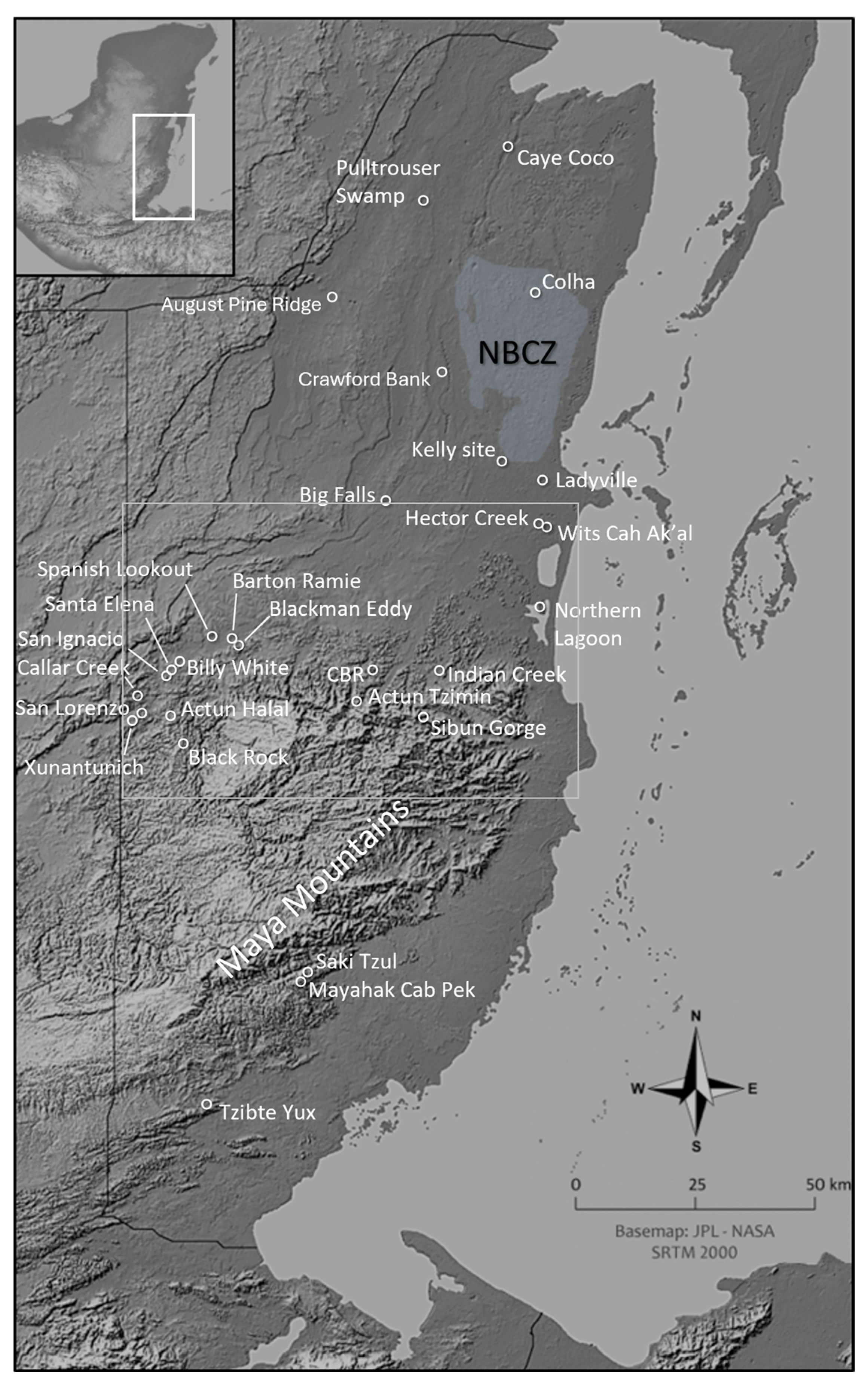
It is fair to say that we do not know that much about the Archaic-period (ca. 8000–1000 BCE) people who once lived in central Belize [the region south of Wits Cah Ak’al and Big Falls in the Belize and Cayo Districts and north of the Maya Mountains in the Stann Creek District and north of the southern boundary (Challilo Lake/Macal River) of the Mountain Pine Ridge Forest Reserve in the Cayo District] (Figure 1). This is not surprising given how relatively little we know of this period overall in what would become Mayan Mesoamerica. Observing this period archaeologically in the Maya lowlands relies on recognizing a suite of cultural adaptations and developments that characterize an ‘Archaic’ lifestyle. However, what culturally constitutes the ‘Archaic’ lifestyle in the Maya lowlands of Mesoamerica, as well as the necessary archaeological evidence to reconstruct this period of both transition and stasis in widely different geographic regions, is still debated [1,2,3,4,5,6,7,8,9,10,11,12,13]. Moreover, determining when an ‘Archaic’ lifestyle first emerges and then disappears in the Maya lowlands is also fraught with issues. Thus, to expand our understanding of these people and what their lives were like, it is necessary to consider the archaeological evidence for technological change, the organization of socio-economic relationships, the subsistence roles of foraging and farming, and patterns of mobility and sedentism in this region. In the case of central Belize, as of the mid-1990s, only seven preceramic chipped stone tools had been reported as surface finds [14,15]. Since then, further evidence from Archaic-period archaeological contexts in central Belize has emerged slowly, is still relatively limited, and is predominantly represented by lithic technology. However, important discoveries include new stone tool styles/types, limited faunal and floral remains, and a small number of radiocarbon dates. In this paper, we review this current evidence from central Belize and provide a partial, rather piece-meal, reconstruction of ‘Archaic’ lifeways in this part of the Maya lowlands. We also consider the possible role of central Belize, as a transitional zone between northern and southern Belize.

2. The Archaic in the Maya Lowlands

Humans first reached Mesoamerica at least as early as 13,000 years ago. We know this based on dated human skeletal remains, DNA evidence, and chipped stone tools, notably fluted lanceolate (or Clovis-like) and fluted fishtail points [3,4,8,12,16,17,18,19,20,21,22]. In Mesoamerica, fluted points are assigned to the Paleoindian period based on relatively few associated radiocarbon dates, as well as their diagnostic technologies that are consistent with dated points from North and South America. Humans initially arrived as small bands of nomadic hunter-gatherers who preyed, to some degree, upon ice-age megafauna and other animals using this fluted point technology and seem to have quickly settled into various ecological zones, including what would become known as the Maya lowlands [4,12,16].
The widespread development of tropical forest that accompanied the transition from the end of the colder, arid Pleistocene to the onset of the warmer, more humid Early Holocene (ca. 9700 BCE) was significant for the beginning of the period archaeologists call the Archaic [23,24,25,26]. As early hunter-gatherers adapted to different ecological zones in Mesoamerica, their populations grew, their mobility declined, they began to exploit local resources, and their own localized cultural adaptations emerged. Following the transition to the Holocene, preceramic populations began to shift subsistence strategies to take advantage of greater varieties of wild plants, animals, and fish in these emerging new environments characterized by broadleaf tropical forests, savannahs, mangrove swamps, river systems, riparian zones, and seacoasts. Moreover, early domesticates, including maize, gourds, squashes, avocados, and chili peppers, began to appear at different points in time in the diets of early Late Archaic peoples in Mesoamerica [1,9,10,27,28,29,30,31,32]. An increasing reliance on cultigens throughout Mesoamerica, including the Maya lowlands, may have been hastened by a global climatic drying event documented between 4200–3900 BP; however, the effects of this drying event and the responses of people to it, specifically in terms of maize consumption, may have varied regionally [9,10,11,29,33,34,35,36,37].
Traditionally, the Archaic period in the Maya lowlands was considered a period of transition that occurred between the end of the fluted point traditions of nomadic Paleoindian hunter-gatherers and the emergence of sedentary, ranked, pottery-producing farmers [9,38]. Notably, Willey and Phillips’ [39] concepts of Lithic, Archaic, and Formative stages did not mention Belize at all. This overly simplistic bracketing of the Archaic is problematic for numerous reasons, some of which can be demonstrated by the following examples. First, ‘Archaic’ stemmed points with basal thinning have been dated to Paleoindian times in southern Belize and Honduras and their relationship to fluted points is not clear [4,7,12,19,40]. Second, archaeologists once relied on the appearance of the first pottery as a cultural marker for the origins of the Maya in the Early/Middle Formative period (ca. 1000 BCE); however, early ceramics appeared at slightly different times in different regions of the Maya lowlands and overlap with what was once thought to be ‘Archaic’ lithic technology [2,3,9,11,12]. Third, sedentism and stone architecture were long viewed as markers of the earliest Maya; however, there is evidence for ceremonial complex construction involving groups of varying levels of mobility in Guatemala, and settled villagers may have co-existed with mobile foragers there for a few centuries [41]. Fourth, in the Middle Usumacinta of Mexico, early monumental architecture developed among residentially mobile people and in the absence of a centralized hierarchy [42]. Rather than a firm boundary, the division between the Archaic and the Early Formative period in the Maya lowlands is more realistically a ‘grey zone’ within which relationships between Archaic non-Maya and Formative Maya peoples may have variably existed as in situ transitions, migrations, diffusions, replacements, and/or co-existences [11]. Notably, this likely occurred as a gradual process of complex cultural changes [1,3,9,12,37] that may have been more rapid in some areas than others [42].

3. Maize and the Archaic in Belize

A significant question for understanding the Archaic in Mayan Mesoamerica concerns the dietary reliance on maize. Evidence for maize and other cultigens appears in the Archaic well before the appearance of pottery and increased sedentism in Belize. Starch grains on a hammerstone and a plano-convex biface from a pit feature at Caye Coco, northern Belize, provide a date of about 6500 cal BP for maize, manioc, and chili pepper [43]. At other sites in Belize, Guatemala, and Honduras, however, archaeological evidence, in the form of preserved cobs, pollen, and human bone isotopes, focuses on a date range from roughly 5500–3000 years ago for the appearance of maize [2,3,9,10,29,35,36,44,45]. According to Lohse et al. [36], “maize entry into the interior of what became the Maya area was limited and sporadic as early as about 5500 years ago and only became widespread after around 4700 years ago”. A greater reliance on domesticated plants, specifically the consumption of maize as a staple, likely began sometime between 4200–3000 BP in much of Belize [2,8,10,29,35,43,44,45,46]; however, the timing of a widespread adoption of maize and other plant domesticates is debated, as is the specific evidence supporting an earlier versus later end of this range. As a case in point, isotopic data from human skeletons recovered from rockshelters in southern Belize provide evidence for an early reliance on maize (4700–4000 cal BP), but comparative isotopic data for the Archaic do not exist for the Maya lowlands further north [8,29]. Given the reality of emerging localized cultural differences in the Archaic, changes in subsistence practices, sedentism, technology, and developing structural inequality were not necessarily synchronous throughout the Maya lowlands [3,9]. As such, in some places in Belize, Guatemala, and Honduras, reliance on maize developed prior to sedentism and pottery; in other locations, such as the Yucatan Peninsula of Mexico, maize horticulture seems to have appeared around the same time as ceramic technology and early settled village life. Significantly, maize as a food staple developed in the Maya lowlands over a thousand years later than elsewhere in Mesoamerica ([36] for summary) and the establishment of settled villages and early pottery use in the Maya lowlands also appeared between five to eight hundred years later than in other regions of Mesoamerica [11,12].

4. The Archaic Period: Research in Belize

Although there were earlier excavations and surface finds in the highlands of Guatemala and Honduras [4,9,47], the first evidence for the Archaic in the Maya lowlands can be traced to a few heavily patinated bifaces recovered as surface finds in northern Belize [48]. Efforts to document the Archaic began in earnest in the 1980s with the Belize Archaic Archaeological Reconnaissance (BAAR) Project’s regional surveys and limited excavations in northern Belize [49,50]. Based on the data recovered, MacNeish and Nelken-Terner [49] proposed a six-phase preceramic sequence of stone tools for Belize from 9000–2000 BCE. MacNeish and Nelken-Terner [49] collected substantial data that they used to comment on proposed changes in settlement types, subsistence practices, and mobility from the Paleoindian through Archaic periods; however, much of what they originally recovered has remained unanalyzed. The six-phase BAAR chronology included few supporting radiocarbon dates and is no longer used today [12,15,18]. Most work on the Archaic in the Maya lowlands continued to focus on northern Belize throughout the 1980s into the mid-1990s, with special attention paid to sites in and around a very large outcrop of high-quality chert—the Northern Belize Chert-bearing Zone (NBCZ)—that was exploited by Archaic people and Formative period Maya populations [2,3,12,14,15,51,52]. Sites in and around the NBCZ provided substantial information about stone tool types and production techniques. Moreover, work by Jacobs [53] and Jones [54] demonstrated forest clearance and early use of domesticates, including manioc and maize, around 2500 BCE. To the northwest, Pohl et al. [46] undertook excavations and coring at sites in the region between the Río Hondo and New River of Belize, producing more technological, environmental, and subsistence data related to deforestation, and the use of domesticates (specifically maize and manioc) in the Late Archaic. Excavations of sites with Archaic deposits continued in northern Belize in the Freshwater Creek drainage in the early 2000s [9,43,55,56,57] with evidence for Archaic lithic technology, domesticated plants (maize, manioc, beans, chilis), and a possible living floor based on two pit features and a posthole. Significantly, Rosenswig and Masson have initiated a new project in the Freshwater Creek drainage searching for more Archaic sites in places with an orange soil horizon, which was associated with the Archaic deposits in their earlier excavations [9,58,59]. Regional land-use survey and excavations into preceramic occupations in northern Belize are also currently ongoing at Crawford Bank in the Crooked Tree Lagoon watershed and areas in and around the NBCZ [33,60,61,62,63]. Moreover, there is a new preceramic project in the August Pine Ridge of northwestern Belize with evidence for Palaeoindian through Late Archaic lithic technology [17,19]. Projects like these that are recovering evidence for aceramic deposits with Archaic period stone tools and debitage have expanded our knowledge of regional diversity in stone tool technology and resource exploitation in different ecological zones. Other clues about climatic and environmental conditions, deforestation, and the appearance of cultigens, particularly maize, throughout the Maya lowlands have been provided by various projects focused on reconstructing paleoecology, often relying on sediment cores [34,59,64,65,66,67,68,69,70].
Evidence for Archaic period use of rockshelters first emerged thanks to excavations in the 2000s at Actun Halal in central Belize [2,3,18,71], as well as diagnostic stone tool finds in or near other rockshelters [18,47,72]. Moreover, dated preceramic deposits with informal lithics have been found in paleosols beneath Maya occupations at sites in central Belize as well [73,74].
Aside from some chipped stone tools recovered from surface locations [18,47], preceramic occupations had not been reported from southern Belize until recently [7,8,26,29]. Notably, radiocarbon-dated Paleoindian and Archaic period deposits containing chipped stone tools, human skeletal remains, and evidence for the beginning of a maize diet in the Archaic were discovered in three rockshelters (Mayahak Cab Pek, Saki Tzul, and Tzibte Yux) in the Bladen River Nature Reserve south of the Maya Mountains.

5. The Archaic Chronology and Lithic Technology of Belize

Overall, the relative paucity of sites with reliable dates for the Archaic in Belize has meant that stone tools have often served as the primary means by which the presence of Archaic people has been identified and regionally documented. Specifically, surface finds and aceramic deposits lacking radiocarbon dates have been assigned to the preceramic based on diagnostic stone tool types or their recovery from paleosol. Based primarily on stone tools and few radiocarbon dates, the standard Archaic chronology for Belize for the last twenty-five years or so consists of an Early Archaic period (ca. 8000–3400 BCE) and a Late Archaic period (3400–900 BCE). The Late Archaic is further sub-divided into an Early Preceramic phase (3400–1900 BCE) and a Late Preceramic phase (1500–900 BCE) [14,18].
Published radiocarbon dates from southern Belize [7,8] have established that preceramic peoples were in this part of the Maya lowlands as early as 10,500 cal BCE and continued to live there well into the Late Archaic. Moreover, radiocarbon dates reported from about 20 sites in northern and central Belize have served as the basis for a late Early Archaic to Maya Middle Formative timeline [1,2,3,14,15,43,46,50]. Most calibrated radiocarbon dates from sites in central Belize, such as Actuncan, Actun Halal, Blackman Eddy, Cahal Pech, Chechem Ha Cave, Pacbitun, and Xunantunich, fall within the range of transition from the end of the Late Archaic into the beginning of the Maya Formative periods (ca. 1200–900 BCE) [1].

The Early to Late Archaic

Until recently, there were only a couple of Early Archaic radiocarbon dates and no diagnostic Early Archaic tool types in Belize. However, excavations in the Mayahak Cab Pek and Tzibte Yux rockshelters in Southern Belize have provided reliable radiocarbon dates establishing a human presence in the Early Archaic, including four wide-stemmed, barbed, and alternately edge-beveled chert bifaces (8750–6500 cal. BCE), known as Lowe points, recovered from sealed, stratified contexts [7,8]. The techniques used to make these points include hard-hammer and soft-hammer percussion, indirect percussion for notching, and pressure flaking. Prior to these discoveries, Lowe points were originally dated to the Early Preceramic phase of the Late Archaic (see below). The radiocarbon dates from Mayahak Cab Pek and Tzibte Yux suggest stemmed, barbed, alternately beveled Lowe points first appear in Belize in the Terminal Pleistocene/Early Holocene and should be considered Late Paleoindian to Early Archaic in age. Some chert and obsidian points with expanding, bifurcated, basally thinned stems from the Early Archaic Esperanza phase (ca. 9200–7600 BCE) in El Gigante rockshelter, Honduras, bear some similarities to the Lowe points and provide additional support for an Early Archaic date for stemmed points in southern Mesoamerica [3,35,40,75,76]. Lowe points and other associated chipped chert tools (e.g., scraper forms) that Prufer et al. [7,8] termed the “Lowe Complex” are much older than previously thought and may extend over a much longer temporal range in Belize; however, more detailed descriptions of this complex’s other stone tool types and reduction techniques are required [77]. It is also significant that Prufer (pers. comm., 2023) has reported obsidian from highland sources (i.e., El Chayal, Guatemala, and La Esperanza, Honduras) in the deepest deposits of occupation. The source of the Guatemalan obsidian is roughly 400 km from southern Belize and raise a series of questions about long-distance exchange in the preceramic.
In Belize, hard-hammer chert macroblades, macroflakes, macrocores, flake-blade cores, pointed unifaces, and small blades appeared in the Early Preceramic phase (3400–1900 BCE) of the Late Archaic. Prior to the discoveries in the rockshelters of southern Belize, the aforementioned Lowe points were dated to this phase (2500–1900 BCE) as well based on a radiocarbon date in proximity of two points from Ladyville 1 and a radiocarbon date associated with one point from Pulltrouser Swamp, both in northern Belize [14,18,46]. However, there are questions about the reliability of the contextual relationships between the points and radiocarbon-dated materials at Ladyville 1 and Pulltrouser Swamp. Although lacking associated radiocarbon dates, technologically and morphologically similar, yet smaller, stemmed and barbed points called Sawmill have also been recovered in Belize and were generally assumed to be of the same age, if not more recent in time [15].
Although an exact count is difficult to determine, currently, there are at least 124 stemmed and barbed preceramic bifaces documented in Belize by archaeologists–91 Lowe points, 26 Sawmill points, five provisional Allspice points, and two provisional Ya’axche’ points (Supplementary Materials) [7,8,13,15,17,47,63,78,79]. It has been suggested that Allspice points are just reworked Lowe points and should not be considered a separate type [15]. Four newly described stemmed points, provisionally called Pine Ridge, have also been reported in Belize. Based on their similarity to Paijan points from South America, it is possible Pine Ridge points date to the Palaeoindian period (ca. 10,500–9500 BCE) rather than the Archaic [17,19].
A diagnostic tool type from the Late Preceramic phase of the Late Archaic into the early Middle Formative is the chert constricted uniface [14,18]. These unifacial tools are dated to ca. 1500-900 BCE, based on radiocarbon dates from Colha and Pulltrouser Swamp in northern Belize [14,46,51]. Moreover, a constricted biface from Actun Halal in central Belize has been dated to 2200 BCE [2,3,71]. There are somewhere between 150–200 examples of constricted unifaces currently known with most having been found in northern Belize and none reported from southern Belize. Constricted unifaces come in a variety of sizes and shapes, which show a wide range of variation, and were produced using hard-hammer percussion (Supplementary Materials). Iceland [14] discussed the presence of other chert tool types in the Late Preceramic phase (1500–900 BCE) from numerous sites in northern Belize, including the aforementioned hard-hammer chert macroblades, macrocores, flake-blade cores, and small blades, as well as small bifacial celts [17,49,63]. Lastly, the presence of groundstone (some identified as sandstone) bowls has been noted for the preceramic period, but no dated examples are known thus far [17,19,49,61,67].

6. Archaic Chipped Stone Artifacts from Central Belize: Contexts and Conditions

The current inventory of diagnostic chipped stone tool evidence from central Belize consists of 16 Lowe points, seven Sawmill points, two provisional Allspice points [15,47,78,79], seven (possibly eight) constricted unifaces [14,78,80] and one constricted biface [2,18,71]. There is another lanceolate biface that is most likely preceramic (see below) based on similar points from northwestern Belize [13,17].

6.1. Lowe Points

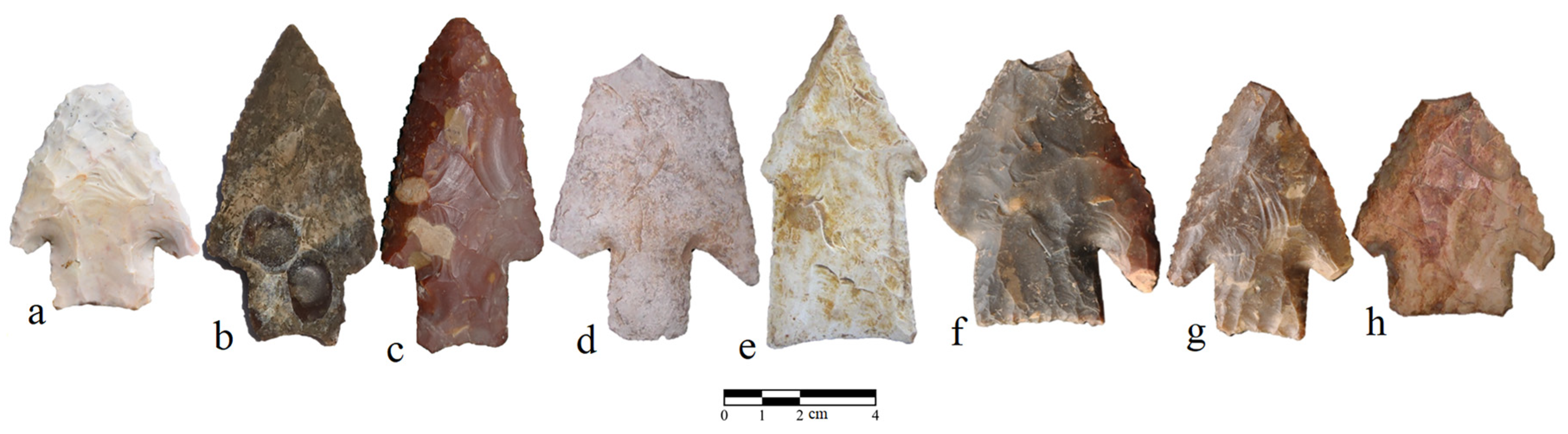
The majority (N = 13) of the Lowe chert points were originally found on the surface in proximity to creeks or rivers (Figure 2). Some were also found in or near rockshelters (Caves Branch Rockshelter [CBR] and Indian Creek). Two points (CBR and San Lorenzo) were recovered from archaeological deposits containing Maya material culture [72,73]. Most Lowe points from central Belize are damaged to variable degrees, often missing the distal tips and the barbs, along with some post-depositional edge chipping. All but one of the points—the possible preform from Wits Cah Ak’al [80]—possess alternate edge beveling resulting from resharpening them. The biface from San Lorenzo was burnt (Figure 2b), but the biface from Indian Creek, based on its red color and ‘waxy’ surface, may have been intentionally heat-treated to improve flaking (Figure 2c). Intentional heat treatment does not seem to be a standard technique in Lowe point production.

6.2. Sawmill Points

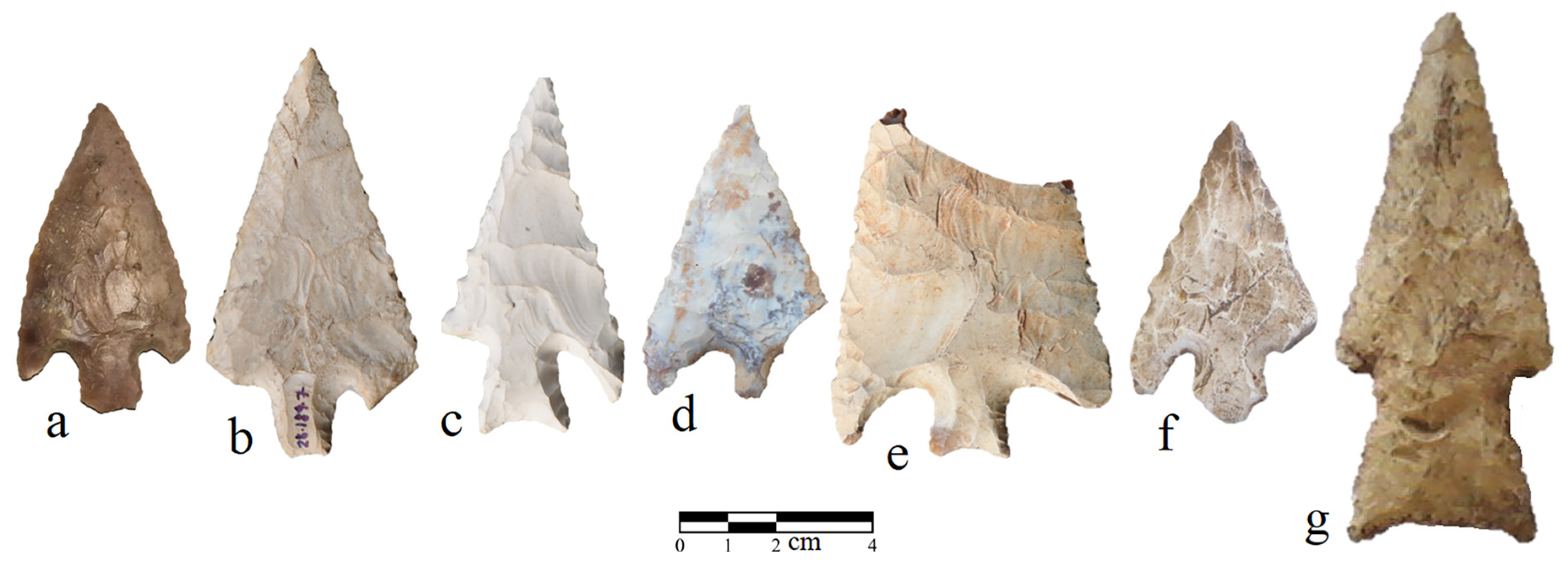
All seven of the Sawmill chert points from central Belize were surface finds and, therefore, are undated [47,78,79] and were found within a few kilometers of a major waterway (Figure 3a–f). One point was found at the opening of a cave (Actun Tzimin). Much like the Lowe points, there is minimal contextual information for them. Four of the bifaces demonstrate significant resharpening in the form of steep alternate edge beveling. The large fragment from Callar Creek lacks the resharpening of the edges. It is considerably wider than the other points, which raises the question of whether Sawmill points originated as larger points than the heavily resharpened, shorter, and narrower forms that are typically recovered by archaeologists. The point from Actun Tzimin also does not have the heavy alternate edge resharpening noted on other Sawmill points [18]. None of the points were intentionally heat treated.

6.3. Provisional Allspice Points

The only two provisional Allspice chert points in central Belize come from Northern Lagoon [15] and the Sibun Gorge [47] (Figure 3g). Although their specific locations of recovery are unclear, both came from areas close to water. Like most other preceramic points, both examples come from undatable contexts and are heavily patinated. The point edges are alternately beveled due to resharpening.

6.4. Constricted Unifaces and Biface

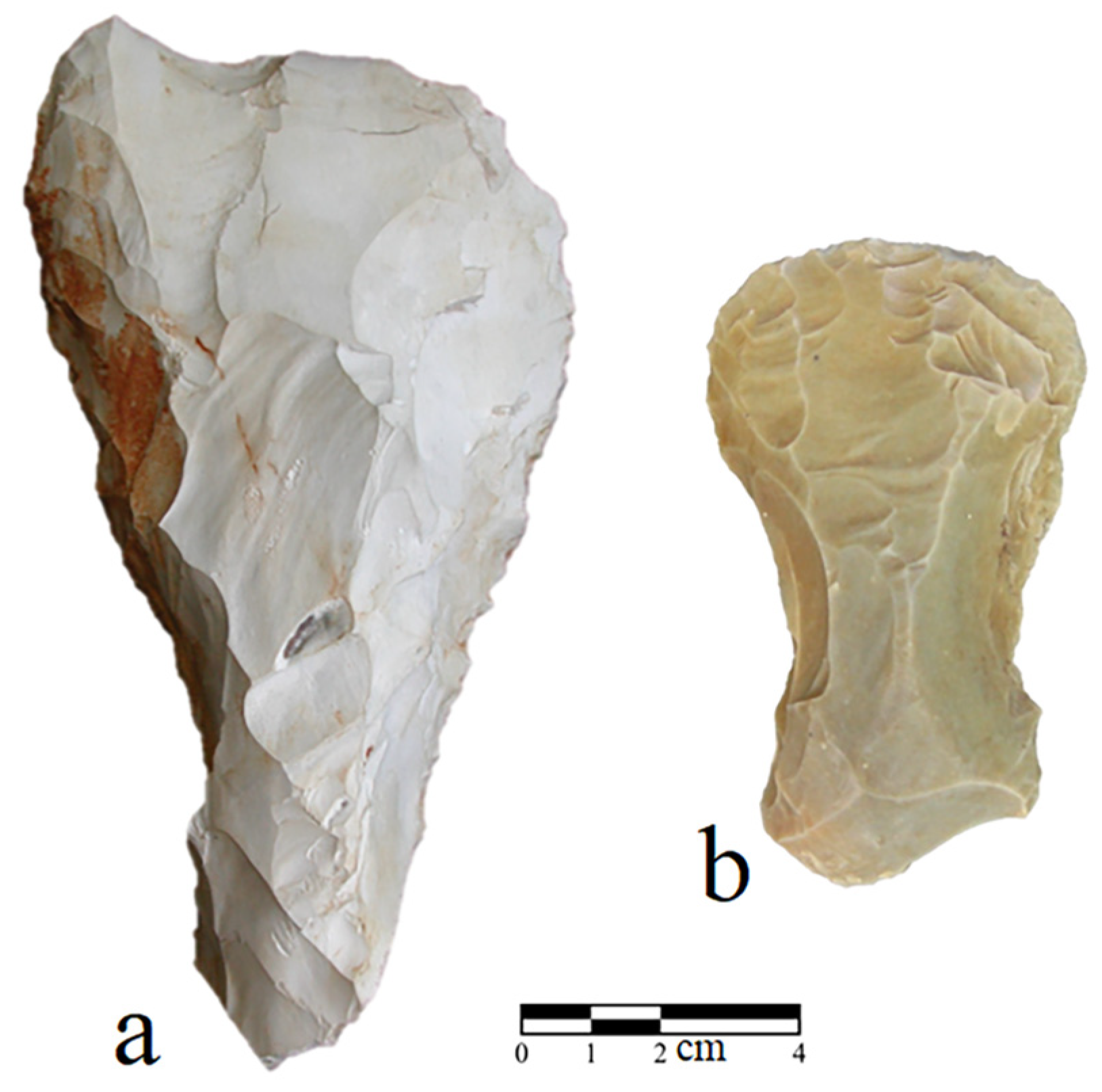
The seven (possibly eight) chert constricted unifaces from central Belize are surface finds (Figure 4). Of these seven, four were originally from a private collection at Cockloft Farm near San Ignacio in the Cayo District of Western Belize, but little else is reported about the context of their recovery [14]. One of the constricted unifaces from the Cayo District was recovered within close proximity to the Sibun River [78], whereas the other two (possibly three) were found closer to the coast near the Maya site of Wits Cah Ak’al [80]. The unifaces are of variable sizes and shapes with the four examples from Cockloft Farm/San Ignacio and one from Wits Cah Ak’al being clearly “pear-shaped” and lacking the mid-section narrowing observed on many of the examples recovered from northern Belize [14]. The unifaces demonstrate variable degrees of distal bit end resharpening and related differences in bit edge angle. The only constricted tool to come from excavations is the bifacial example from Actun Halal [2,71]. Stratigraphic and radiocarbon evidence within the cave place this constricted biface in the Late Archaic (2200 BCE). It is the only constricted tool from a cave or rockshelter location and the only diagnostic tool from a dated preceramic stratigraphic context in central Belize.

6.5. A “New” Unfluted Lanceolate Biface

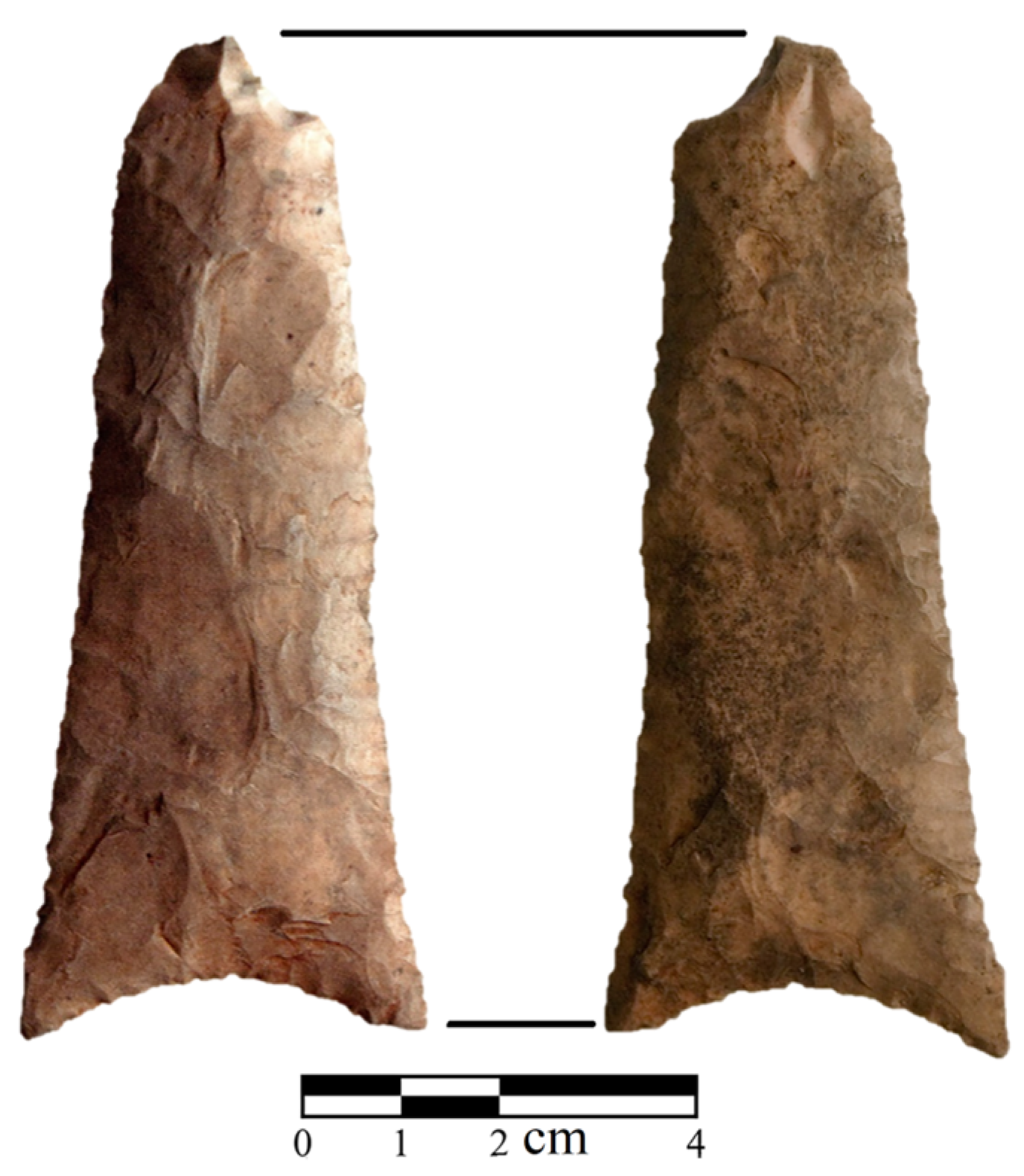
We include a brief discussion of a chert biface recovered from CBR that we suspect to be preceramic, possibly Late Palaeoindian (Figure 5). Notably, it has a concave base with basal thinning flake scars like some other preceramic points from Belize, but it is not fluted on either face. The point narrows towards the distal end and possesses some soft-hammer bifacial flake scars that cross the longitudinal midline of the blade portion, extending nearly to the opposite edge of the tool, as seen on other preceramic points from Belize. The biface is heavily patinated and burnt (based on the potlids on the distal end), but there is no evidence for deliberate heat treatment. Because the deposits within CBR were badly disturbed by numerous Maya burials [72], this biface lacks a reliable stratigraphic context. As previously noted, a Lowe point was also recovered from the mixed deposits in CBR. This unfluted lanceolate biface resembles one recently reported in northwestern Belize by Valdez et al. [13] and bears some similarity to four additional biface fragments published by Lohse and Pagano [17] based on a general assessment of size, morphology, and technology.

6.6. Other Chipped Stone Tools and Debitage

In central Belize, three excavated sites with chert tools and/or debitage—Actun Halal, early Xunantunich, and Callar Creek—have produced Archaic period radiocarbon dates. Radiocarbon dates from Actun Halal indicate that some cortical and non-cortical chert debitage is Early Archaic, but more is Late Archaic [2,71]. In Group E at the site of Xunantunich, Brown et al. [73] recovered heavily patinated chert debitage in paleosol in two different excavation units. Although some ceramic sherds were recovered near the top of the paleosol layer in both units, there was no pottery farther down. There were two radiocarbon assays from material in the paleosol—one from the bottom of the layer (3320–2910 cal BCE) and one from the top (1210–940 cal BCE). At Callar Creek, there were no reported dates from an aceramic paleosol with chert debitage, but one radiocarbon date (1225–1045 cal BCE) came from early construction fill with lithics and ceramics in Structure 4 at Callar Creek Quarry 1 (CCQ-1) [74]. The date from Structure 4 and the one from the top of the paleosol from Xunantunich both bridge the appearance of the earliest Cunil and Kanocha ceramics recovered in central Belize (ca. 1200–900 BCE) [1,81,82]. Some radiocarbon dates from Actun Halal deposits with informal lithics also fall within this transitional preceramic/ceramic range [1,5].
None of the debitage from these three sites is identified as coming from the NBCZ in northern Belize, and some of the least patinated flakes and chunks appear similar to cherts found in the western part of central Belize [71,74]. Overall, the debitage is the product of hard-hammer percussion to produce flakes for use [71,74]. None of this debitage is diagnostic of biface production, unlike some of the flakes from August Pine Ridge in northwestern Belize [17,19].

7. Lithic Raw Materials, Tool Production, and Exchange

In the preceramic in Belize, there was a reliance on lithic raw materials found locally, as well as non-local stone acquired from greater distances. Almost all known preceramic stone points from Belize appear to be made from high quality, fine-grained chert; however, the Lowe point reported from Pulltrouser Swamp in northern Belize [14,46] and the translucent gray chert/chalcedony Lowe point from the Billy White quarry in central Belize [78] were both made from chalcedony. The chalcedonies are lower quality stone compared to the fine-grained cherts and, as such, may have been selected based on access to raw material rather than flaking quality. The heavy to complete patination of most chert points makes it very difficult to visually recognize specific chert types and link them to source locations. At least some of the Lowe points from central Belize that are not too heavily patinated possess visual characteristics (i.e., honey-brown, chocolate-brown, yellow-golden, gray, and grayish-brown in color, often with banding or mottling) consistent with lithic material from the NBCZ [2,47,52]. The Lowe point from San Lorenzo is made from a generally fine-grained brown chert; however, identification of the raw material source is hampered by significant patination and burning of the artifact. Nevertheless, this chert is consistent with material from local sources in the vicinity of Callar Creek and early Xunantunich [74,79]. The fact that the San Lorenzo Lowe point was made from locally available stone introduces the possibility that biface production in the Archaic period occurred in this area of central Belize, and that not all Lowe points recovered from central Belize were necessarily acquired in finished form from elsewhere.
With the exception of the partially patinated example from Actun Tzimin, all of the Sawmill points from central Belize are completely to almost completely patinated. Unlike the Lowe points, none of the Sawmill points from central Belize can be visually confirmed as NBCZ raw material. In terms of possible production locales, Kelly [15] reported small finely flaked end-scrapers in association with Sawmill points and knapping debris at Ladyville 32 near the NBCZ. However, the Actun Tzimin Sawmill point is chipped from an unbanded and unmottled brownish/honey-colored chert, which likely derives from an as-yet-unidentified local source according to Lohse [2,78]. Like the Lowe point from San Lorenzo, this raises the possibility that it was made in central Belize. The provisional Allspice point from the Sibun is also completely covered in a white patina and, therefore, the source of the stone from which it was made is also not known. Given its condition, the specific chert type of the provisional Allspice point from Northern Lagoon is also not known. Although it is possible that some stemmed and barbed bifaces, such as the Lowe point from San Lorenzo and the Sawmill point from Actun Tzimin, were produced from local cherts in central Belize, no biface production locations have been identified there.
Most of the constricted unifaces recovered in Belize are heavily to completely patinated; however, some were made from raw material that can be assigned to the NBCZ based on visual characteristics and some chemical sourcing data [14]. Relatedly, based on tool preforms and debitage, the only two currently known quarry/production locations for this tool type are in the NBCZ [the Kelly site; Op. 4046 at Colha] [14,59]. In terms of the central Belize lithics, at least two of the Cockloft Farm/San Ignacio constricted unifaces have been chemically sourced to the NBCZ [14]. Although partially patinated, one of the constricted unifaces from the Sibun may also be NBCZ chert [78]. The constricted biface from Actun Halal was produced on a cobble of milky white chert [71] that was likely locally procured.
It is worth noting that other tools collected from the surface around Wits Cah Ak’al, specifically macroblades and pointed unifaces, are completely to heavily patinated, but a couple show banding similar to NBCZ chert [80]. A large patinated macroflake with banding recovered near Wits Cah Ak’al in central Belize is also likely NBCZ chert [80]. This banded macroflake may have been intended as a tool blank, suggesting possible constricted uniface production using NBCZ chert south of the NBCZ.
There is relatively little information about raw material sources for debitage from aceramic/preceramic contexts in central Belize. As previously noted, most debitage with stone types that can be recognized, such as at Actun Halal and Callar Creek [71,74], appears to be local chert. Debitage recovered from Actun Halal indicates that neither formal tool-making nor much tool repair occurred there. The lithic evidence indicates that there was a reliance on ad hoc/expedient technology [71], as documented at sites in northern Belize [57,63]. The recovery of chert debitage from aceramic paleosol below a Maya quarry at Callar Creek in central Belize suggests Archaic or earlier people used this location to provision themselves with raw material. However, no diagnostic preceramic tools have been recovered. Given the larger sizes of hard-hammer flakes in the paleosol versus those from the upper levels with Maya ceramics, Horowitz [74] posits that the Callar Creek quarry may have been a ‘retooling’ location for mobile hunter-gatherers where cobbles were tested and decorticated.
In central Belize, there is no reliable evidence for formal tool (i.e., stemmed bifaces, constricted unifaces) manufacture in the Archaic. Although some stemmed bifaces recovered in central Belize were made from NBCZ chert, how these preceramic people got their NBCZ chert tools is not clear. Most likely, these formal tools were acquired in finished form. This interpretation is based on the absence of NBCZ tool preforms or debitage in central Belize that can be securely dated to the preceramic using radiocarbon dates or that were recovered from aceramic stratigraphic deposits. Whether hunter-gatherers from central Belize acquired the tools directly while moving through the NBCZ during a seasonal round that brought them to northern Belize or the finished tools reached them through some form of exchange, possibly down-the-line trading, is not known [2]. Once acquired, however, many of the bifaces were heavily curated through unifacial retouch/resharpening on alternate edges to minimize the loss of stone, as demonstrated by the extremely reduced example recovered near Hector Creek in the Sibun [83]. These tools were no doubt very valuable due to the variable access to raw material for seasonally mobile hunter-gatherers and/or difficulty of manufacture of certain types of tools, such as the stemmed and barbed bifaces [84,85,86]. Like the stemmed bifaces, evidence indicates constricted unifaces of NBCZ in central Belize were acquired in finished form and were quite heavily curated through bit end retouch.

8. Subsistence

Because the majority of archaeological evidence for Archaic people in central Belize is chipped stone, it is extremely difficult to reconstruct aspects of subsistence. Nevertheless, the types of formal tools, specifically the stemmed bifaces and constricted unifaces provide some clues. Based on metric and use-wear analyses, as well as other design features, the Lowe points were likely used on thrusting or throwing spears/harpoons and possibly as knives; whereas the Sawmill points were most likely hafted to spear-thrower darts and used as cutting tools [15,47]. These points could have been used to hunt various types of tropical forest animals (see below). The morphologies and bit-end resharpening of constricted unifaces suggest they were designed as hafted adzing or chopping tools [14]. Support for these functions is provided by use-wear evidence indicating wood contact and digging in soil on some constricted unifaces recovered in northern Belize, as well as experimental work supporting the possible use of constricted unifaces for land clearance and field maintenance associated with the use of cultigens as early as the Late Archaic [14,18,63]. Although constricted unifaces have been recovered from central Belize, only the constricted biface from Actun Halal, which is radiocarbon dated to the Late Archaic, reportedly has use-wear evidence consistent with contact with wood and sediment [71].
Non-lithic evidence for subsistence practices in central Belize is minimal. At Actun Halal, Lohse [2] recovered faunal remains from common agouti (Dasyprocta) in association with a small quantity of chipped chert debitage from deposits dating to near the end of the Early Archaic. To date, this is the only known example of Early Archaic faunal remains in central Belize. Lohse [2] also recovered the remains of common agouti (Dasyprocta), snake, armadillo (Dasypus novemcinctus), and possibly white-tailed deer (Artiodactyl) from Late Archaic contexts in the same cave. This skeletal evidence suggests the exploitation of a range of animals from a tropical forest environment. Currently, there is no evidence for exploitation of fish or other riverine or lacustrine resources in central Belize in the Archaic. However, faunal remains from northern Belize document the use of snakes (Colubridae), turtles (Staurotypus sp.), freshwater fish (Cichlasoma sp., Ictalurus sp., Synbranchus sp.), and freshwater mollusks in the Late Archaic [2,18,46,87]. Blue land crab (Cardisoma guanhumi), brocket deer (Mazama sp.), armadillo (Dasypus novemcinctus), opossum (Didelphis virginiana), pocket gopher (Orthogeomys hispidus), paca (Cuniculus paca), agouti (Dasyprocta punctata), raccoon or coati (Procyonidae), peccary (Tayassuidae), turtle (Testudinata), bird (Aves), fish (Actinopterygii), reptile (Reptilia), rodent (Rodentia), and feline (Felidae) remains were found in preceramic levels at Mayahak Cab Pek rockshelter, southern Belize [88]. Jute snails (Pachichylus spp.) were noted as a significant Archaic period food source in southern Belize [7,8] and were also found, along with agouti (Dasyprocta punctata), paca (Cuniculus paca), armadillo (Dasypus novemcinctus), opossum (Didelphis. marsupialis), iguana (Iguanidae), and turtle, in the Archaic faunal assemblage from El Gigante rockshelter, Honduras [76]. The faunal evidence indicates that Archaic peoples throughout Belize and Honduras focused on many of the same medium to small animals for subsistence, which may coincide with a shift in technology from large, stemmed bifaces around 6000 BCE [8,12].
In terms of floral remains, to date, Actun Halal is the only location in central Belize with evidence for Late Archaic plant use. Based on recovered pollen, Lohse [2,3,36,71] “… identified early domesticates including both maize and cotton dating to between 2210 and 1380 B.C.”. He also identified additional possible ‘forest foods’, such as hog plum (Spondias), star apple (Chrysophyllum), sapote (Sapotaceae), and sea grape (Coccoloba). Collectively, the pollen data reveal a mixture of domesticated foods and gathered wild resources. Despite the minimal archaeological evidence (e.g., pollen, constricted unifaces and biface), the Upper Belize River Valley is noted for rich alluvial soils conducive to agriculture in Maya times, so early horticulture in the region is plausible [14]. Lohse [71] suggested that the cotton pollen from Actun Halal may be indicative of ritual activity in the cave (as it is a non-edible domesticate). Moreover, morning glory pollen (Convolvulaceae) in the cave may have had ritual associations given that some species of morning glory are hallucinogens; however, this is speculative [71].
Overall, the minimal faunal and floral evidence from excavations suggests a mixed hunting and gathering—horticultural adaptation existed in central Belize by the Late Archaic. Although maize is associated with Late Archaic people in central Belize based on pollen evidence from Actun Halal, how significant a role it played in Late Archaic diets in this region is not known. The proportion of hunted animal resources versus plants, notably domesticates, that comprised the diets of preceramic hunter-gatherers over time is unknown in central Belize, but such knowledge would contribute to a better understanding of settlement and mobility patterns in terms of investment in place and longevity of occupation [86].

9. Settlement and Mobility

Based on ethnographic evidence, modern hunter-gatherers in tropical environments, like that of post-Pleistocene Belize, tend to rely on residential mobility, that is, camp movement and foraging occur together, which generally limits the distance between the camps of these foragers [85,86,89]. However, there is minimal evidence from central Belize that permits any significant reconstruction of settlement and mobility patterns by preceramic peoples. There are no identifiable open-air sites known (i.e., no postholes, no hearths) or task-oriented extraction locations as in northern Belize [10,14,15,43,55,56,63].
Rockshelters and caves provide some examples of locations in central Belize that may have been inhabited for at least a brief period, possibly seasonally. Use of these permanent landscape features may have reduced residential mobility to some degree and encouraged logistical mobility by Archaic people in the form of more frequent and longer foraging trips from their home bases [85]. Stemmed and barbed bifaces have been found both in and near some rockshelters in central Belize [47], but only Actun Halal provides stratigraphic and radiocarbon evidence for cave use in the Archaic. Mobile hunter-gatherers may have visited Actun Halal at various times in the preceramic and possibly used it as a place to shelter. By way of contrast, substantially more evidence for use of rockshelters by preceramic peoples comes from southern Belize where human skeletal remains, faunal and floral remains, and chipped stone tools have been recovered. These locations document much longer sequences of use/occupation, based on stratigraphy and radiocarbon dates beginning in the Late Paleoindian period, and a reliance on some different resources [7,8].
One common feature of the preceramic evidence, specifically the chipped stone tools, in central Belize is their proximity to rivers or other smaller waterways. Many stemmed bifaces have been recovered near rivers or creeks, hinting at the possibility that preceramic peoples traveled along, and possibly camped near, waterways. This makes sense in many ways given the availability of fresh water, animal and plant resources, and the comparative ease of movement when compared to dense tropical forest. However, it may also be that discoveries along riverbanks are simply a product of the distribution pattern of modern towns and villages in central Belize, which increases the probability that artifacts will be found.

10. Discussion and Conclusions

Twenty years ago, almost nothing was known about the preceramic in central Belize. Only within the last two decades has more evidence, in the form of stone tools, some faunal remains, some floral remains, and a small number of radiocarbon dates, been recovered. Based on the recent radiocarbon dates associated with Lowe points from southern Belize [7,8,47], the 16 Lowe points reported in central Belize provide evidence for a Late Paleoindian/Early Archaic presence there. This would suggest hunter-gatherers used thrusting spears/harpoons and knives to acquire their prey. The Sawmill and Allspice points may be contemporaneous with Lowe points, but this remains speculative. If Lowe and Sawmill points are contemporaneous, then spear-throwers were likely used in the Early Archaic too [47].
Although the new date range for Lowe points extends back into the Early Archaic (8000–3400 BCE), this period is still not clearly defined archaeologically in central Belize due to the lack of other diagnostic stone tools and only a few radiocarbon dates from Actun Halal [2,5]. It is worth noting that Prufer et al. [8] report that bifacial thinning flakes are not present after ca. 6000 cal. BCE in preceramic deposits in southern Belize rockshelters. Relatedly, Scheffler et al. [35,40] note the absence of bifaces [projectile points] after about 8000 BCE in Honduras and other regions of lower Central America. These observations further support the likelihood that stemmed and barbed points in Belize are earlier than the Late Archaic. Additionally, the concave base lanceolate biface from CBR may be Late Paleoindian—Early Archaic in age [17], but this interpretation remains tentative.
Currently, we do not know if different point types (i.e., Lowe, Sawmill, Allspice, and Ya’axche’) reflect chronological changes given the absence of radiocarbon dates for all but a handful of Lowe points, nor do we know if they somehow reflect cultural or ethnic variation. However, there are current spatial patterns that indicate different regional distributions. Lowe points have been recovered in northern, central, and southern Belize, with the earliest examples coming from southern Belize [7,8]. This supports an argument that Lowe points appeared in the south first and then moved north into central and northern Belize. However, this interpretation assumes the dating of the Lowe points from northern Belize to the Late Archaic is reliable (see above). So far, Sawmill and Allspice points have not been found south of the Maya Mountains in southern Belize [12,47]. Pine Ridge points, which possibly date to the Palaeoindian period (see above), have only been recovered in northwestern Belize [17,19] and Ya’axche’ points have only been found in southern Belize thus far [47,78]. It may be that these point types reflect differently distributed groups of Archaic peoples, with central Belize serving as a zone of transition or boundary. As previously noted, however, without radiocarbon dates for the other stemmed point types, this remains conjecture. Relatedly, to date, Archaic points made from NBCZ chert have only been reported from northern and central Belize.
By the Late Archaic (3400–900 BCE), lithic technology in central Belize is represented by constricted tools, pointed unifaces from around Wits Cah Ak’al, and debitage from dated deposits from Actun Halal, Callar Creek, and early Xunantunich. Contact with northern Belize is demonstrated by the constricted unifaces from Cockloft Farm/San Ignacio. Preceramic tools, such as the San Lorenzo Lowe point, the Actun Tzimin Sawmill point, and the constricted biface made from hard-hammer reduction of a cobble from Actun Halal, suggest some tools were made in central Belize from locally available chert. As noted above, debitage from paleosol or dated stratigraphic deposits is the product of hard-hammer reduction of generalized flake cores of local chert at Actun Halal and Callar Creek [71,74]. It is possible stemmed and barbed bifaces, such as Sawmill and Allspice, also existed in the Late Archaic, but dating is less certain after the discovery of the Lowe points from levels with Late Palaeoidian/Early Archaic dates in southern Belize.
Based on current archaeological evidence, the origins and identities of preceramic people in central Belize remain mysteries. Variation within a point type, such as Lowe [78], might be indicative of different groups or ethnic identities. However, currently, there are not enough of these bifaces with different stem morphologies, basal thinning techniques, or stem sizes to reliably establish any non-functional style-based categories. Significantly, the lithic technology from Late Archaic sites in central Belize suggests there is no cultural continuity between preceramic people and the first ceramic-making Maya [Cunil/Kanocha phase] in this region [1,90]. In contrast, the presence of chert macroblade and blade technology in both the Late Archaic and Middle Formative (ca. 1000–300 BCE) at Colha has been used to argue a cultural connection between preceramic people and the Maya in northern Belize [14,63,91,92].
With the transition to the earliest ceramic phase [Cunil and Kanocha] (ca. 1200–900 BCE) in the western part of central Belize, a reliance on expedient hard-hammer flake technology continues from the Late Archaic with some bipolar percussion as well. Cortical and non-cortical flakes of local chert, in addition to some flake cores and fragments are dominant forms. Notably, there are no bifaces associated with Cunil and Kanocha deposits, although some flakes are unifacially retouched into tools (e.g., scrapers) [90]. A significant change in this earliest ceramic phase is the appearance of hard-hammer cortical and non-cortical flakes made from El Chayal obsidian from highland Guatemala. This obsidian flake technology is eventually accompanied and then replaced by blade technology during the transition from the Cunil/Kanocha ceramic phase to the subsequent Early facet Kanluk/Jenney Creek ceramic phase beginning around 900 BCE. Large bifaces/celts, bifacial thinning flakes, and blades made from local cherts also appear after 900 BCE in the western part of central Belize [90].
Near the end of the Archaic, a more significant horticultural lifestyle began to emerge in Belize, with evidence for maize and manioc cultivation and deforestation to create milpas (crop fields) for planting [1,2,14,43,44,46,87]. Clearly, by 1000 BCE, a significant increase in maize-based horticulture developed in northern Belize alongside ceramic use among sedentary villagers [9,10,13,45]. Although the best evidence for a reliance on plant resources, notably maize, in the preceramic is currently reported in northern and southern Belize, evidence for gathered tropical forest foods, as well as early use of maize, in central Belize, only exists at Actun Halal [2,3,18,71]. Both the limited floral remains and the constricted unifaces and constricted biface from central Belize provide some evidence suggesting the early use of cultigens and land transformation for planting food.
How preceramic people in central Belize adapted to this region remains poorly understood, although they demonstrate lifestyles that were similar, to varying degrees, to those from other parts of Belize. Ultimately, we need more archaeological evidence from regional surveys and datable stratigraphic contexts from central Belize in order to make greater headway in reconstructing the preceramic period and to better understand the transition to the first ceramic-using Maya [1]. To do this, there must be more projects like those in northern and southern Belize [7,8,10,14,19,33,43,51,55,56,59,61,67] that focus on locating and excavating preceramic sites. Such efforts would enable the reconstruction of what has, heretofore, been a very ephemeral pre-Maya past in central Belize.

Supplementary Materials

The following supporting information can be downloaded at: https://www.mdpi.com/article/10.3390/heritage9010031/s1. Table S1: Morphological, Technological, and Metric Data for Stemmed Points and Constricted Unifaces in Belize.

Author Contributions

Conceptualization, W.J.S. and J.J.A.; methodology, W.J.S., J.J.A. and G.D.W.; validation, W.J.S., J.J.A. and G.D.W.; investigation, W.J.S., J.J.A. and G.D.W.; resources, W.J.S., J.J.A. and G.D.W.; data curation, W.J.S., J.J.A. and G.D.W.; writing—original draft preparation, W.J.S.; writing—review and editing, W.J.S., J.J.A. and G.D.W.; visualization, W.J.S. and J.J.A.; supervision, W.J.S. All authors have read and agreed to the published version of the manuscript.

Funding

This research was funded by a Social Sciences and Humanities Research Council of Canada (SSHRC) grant and financial support from the Western Belize Regional Cave Project (WBRCP), the Belize Valley Archaeological Reconnaissance (BVAR), the University of Mississippi, and Keene State College.

Data Availability Statement

Data are contained within the article.

Conflicts of Interest

The authors declare no conflicts of interest.

References

  1. Awe, J.J.; Ebert, C.E.; Stemp, W.J.; Brown, M.K.; Sullivan, L.A.; Garber, J.F. Lowland Maya Genesis: The Late Archaic to Late Early Middle Formative Transition in the Upper Belize River Valley. Anc. Mesoam. 2021, 32, 519–544. [Google Scholar] [CrossRef]
  2. Lohse, J.C. Archaic Origins of the Lowland Maya. Lat. Am. Antiq. 2010, 21, 312–352. [Google Scholar] [CrossRef]
  3. Lohse, J.C. Archaic Maya Matters. In Maya World; Hutson, S.R., Ardren, T., Eds.; Routledge: New York, NY, USA, 2020; pp. 11–28. [Google Scholar]
  4. Lohse, J.C. When is a Mesoamerican? Pleistocene Origins of the Mesoamerican Tradition. In Preceramic Mesoamerica; Lohse, J.C., Borejsza, A., Joyce, A.A., Eds.; Routledge: London, UK, 2021; pp. 1–36. [Google Scholar]
  5. Lohse, J.C. The End of An Era: Closing Out the Archaic in the Maya Lowlands. In Pre-Mamom Pottery Variation and the Preclassic Origins of the Lowland Maya; Walker, D.S., Ed.; University Press of Colorado: Denver, CO, USA, 2023; pp. 33–56. [Google Scholar]
  6. Marcus, J. Recent Advances in Maya Archaeology. J. Archaeol. Res. 2003, 11, 71–148. [Google Scholar] [CrossRef]
  7. Prufer, K.M.; Alsgaard, A.V.; Robinson, M.; Meredith, C.R.; Culleton, B.J.; Dennehy, T.; Magee, S.; Huckell, B.B.; Stemp, W.J.; Awe, J.J.; et al. Linking Late Paleoindian Stone Tool Technologies and Populations in North, Central and South America. PLoS ONE 2019, 14, e0219812. [Google Scholar] [CrossRef] [PubMed]
  8. Prufer, K.M.; Robinson, M.; Kennett, D.J. Terminal Pleistocene through Middle Holocene Occupations in Southeastern Mesoamerica: Linking Ecology and Culture in the Context of Neotropical Foragers and Early Farmers. Anc. Mesoam. 2021, 32, 439–460. [Google Scholar] [CrossRef]
  9. Rosenswig, R.M. A Mosaic of Adaptation: The Archaeological Record for Mesoamerica’s Archaic Period. J. Archaeol. Res. 2015, 23, 115–162. [Google Scholar] [CrossRef]
  10. Rosenswig, R.M. Opinions on the Lowland Maya Late Archaic Period with Some Evidence from Northern Belize. Anc. Mesoam. 2021, 32, 461–474. [Google Scholar] [CrossRef]
  11. Rosenswig, R.M. Who Were the First Ceramic-using Villagers in the Maya Lowlands? In Pre-Mamom Pottery Variation and the Preclassic Origins of the Lowland Maya; Walker, D.S., Ed.; University Press of Colorado: Denver, CO, USA, 2023; pp. 57–88. [Google Scholar]
  12. Stemp, W.J.; Awe, J.J.; Marcus, J.; Helmke, C.; Sullivan, L.A. The Preceramic and Early Ceramic Periods in Belize and the Central Maya Lowlands. Anc. Mesoam. 2021, 32, 416–438. [Google Scholar] [CrossRef]
  13. Valdez, F., Jr.; Sullivan, L.A.; Buttles, P.J.; Aebersold, L. The Origins and Identification of the Early Maya from Colha and Northern Belize. Anc. Mesoam. 2021, 32, 502–518. [Google Scholar] [CrossRef]
  14. Iceland, H.B. The Preceramic Origins of the Maya: The Results of the Colha Preceramic Project in Northern Belize. Ph.D. Thesis, University of Texas, Austin, TX, USA, 1997. [Google Scholar]
  15. Kelly, T.C. Preceramic Projectile-Point Typology in Belize. Anc. Mesoam. 1993, 4, 205–227. [Google Scholar] [CrossRef]
  16. Acosta-Ochoa, G.; Pérez-Martínez, P.; Ulloa-Montemayor, X. The Clovis-like and Fishtail Occupations of Southern Mexico and Central America: A Reappraisal. In People and Culture in Ice Age Americas: New Dimensions in Paleoamerican Archaeology; Suárez, R., Ardelean, C.F., Eds.; University of Utah Press: Salt Lake City, UT, USA, 2019; pp. 93–107. [Google Scholar]
  17. Lohse, J.C.; Pagano, V.C. (Eds.) Initial Results of the 2023 Season of the Pine Ridge Preceramic Project, August Pine Ridge, Belize; Occasional Papers Number 1; The Gault School for Archaeological Research: Florence, TX, USA, 2024. [Google Scholar]
  18. Lohse, J.C.; Awe, J.; Griffith, C.; Rosenswig, R.M.; Valdez, F., Jr. Preceramic Occupations in Belize: Updating the Paleoindian and Archaic Record. Lat. Am. Antiq. 2006, 17, 209–226. [Google Scholar] [CrossRef]
  19. Lohse, J.C.; McBride, M.; Perrot-Minnot, S. The Early Paleoindian Record from August Pine Ridge: A New Site with Implications for Pleistocene Settling-in in Central America. Res. Rep. Belizean Archaeol. 2025, 19, 311–322. [Google Scholar]
  20. Posth, C.; Lazaridis, I.; Skoglund, P.; Mallick, S.; Lamnidis, T.C.; Rohland, N.; Nägele, K.; Adamski, N.; Bertolini, E.; Broomandkhoshbacht, N.; et al. Reconstructing the Deep Population History of Central and South America. Cell 2018, 175, 1185–1197. [Google Scholar] [CrossRef] [PubMed]
  21. Stinnesbeck, W.; Becker, J.; Hering, F.; Frey, E.; González González, A.; Fohlmeister, J.; Stinnesbeck, S.; Frank, N.; Terrazas Mata, A.; Benavente, M.E.; et al. The Earliest Settlers of Mesoamerica Date Back to the Late Pleistocene. PLoS ONE 2017, 12, e0183345. [Google Scholar] [CrossRef]
  22. Wrobel, G.D.; Hoggarth, J.A.; Marshall, A. Before the Maya: Review of Paleoindian and Archaic Human Skeletons Found in the Maya Region. Anc. Mesoam. 2021, 32, 475–485. [Google Scholar] [CrossRef]
  23. Grauel, A.-L.; Hodell, D.A.; Bernasconi, S.M. Quantitative Estimates of Tropical Temperature Change in Lowland Central America during the Last 42 ka. Earth Planet. Sci. Lett. 2016, 438, 37–46. [Google Scholar] [CrossRef]
  24. Haug, G.H.; Hughen, K.A.; Sigman, D.M.; Peterson, L.C.; Röhl, U. Southward Migration of the Intertropical Convergence Zone through the Holocene. Science 2001, 293, 1304–1308. [Google Scholar] [CrossRef] [PubMed]
  25. Hodell, D.A.; Anselmetti, F.S.; Ariztegui, D.; Brenner, M.; Curtis, J.H.; Gilli, A.; Grzesik, D.A.; Guilderson, T.J.; Müller, A.D.; Bush, M.B.; et al. An 85-ka Record of Climate Change in Lowland Central America. Quat. Sci. Rev. 2008, 27, 1152–1165. [Google Scholar] [CrossRef]
  26. Prufer, K.M.; Kennett, D.J. The Holocene Occupations of Southern Belize. In Approaches to Monumental Landscapes of the Ancient Maya; Houk, B.A., Arroyo, B., Powis, T.G., Eds.; University of Florida Press: Gainesville, FL, USA, 2020; pp. 16–38. [Google Scholar]
  27. Flannery, K.V. Guilá Naquitz: Archaic Foraging and Early Agriculture in Oaxaca, Mexico; Left Coast Press: Walnut Creek, CA, USA, 2009. [Google Scholar]
  28. Flannery, K.V.; Hole, F. Cueva Blanca: Social Change in the Archaic of the Valley of Oaxaca. Memoirs of the Museum of Anthropology No. 60; University of Michigan: Ann Arbor, MI, USA, 2019. [Google Scholar]
  29. Kennett, D.J.; Prufer, K.M.; Culleton, B.J.; George, R.J.; Robinson, M.; Trask, W.R.; Buckley, G.M.; Moes, E.; Kate, E.J.; Harper, T.K.; et al. Early Isotopic Evidence for Maize as a Staple Grain in the Americas. Sci. Adv. 2020, 6, eaba3245. [Google Scholar] [CrossRef] [PubMed]
  30. MacNeish, R.S. A Summary of the Subsistence. In The Prehistory of the Tehuacan Valley: Environment and Subsistence; Byers, D.S., Ed.; University of Texas Press: Austin, TX, USA, 1967; Volume 1, pp. 290–309. [Google Scholar]
  31. Piperno, D.R. The Origins of Plant Cultivation and Domestication in the New World Tropics: Patterns, Process, and New Developments. Curr. Anthropol. 2011, 52, 5453–5470. [Google Scholar] [CrossRef]
  32. Piperno, D.R.; Smith, B.D. The Origins of Food Production in Mesoamerica. In The Oxford Handbook of Mesoamerican Archaeology; Nichols, D.L., Pool, C.A., Eds.; Oxford University Press: Oxford, UK, 2012; pp. 151–164. [Google Scholar]
  33. Brouwer Burg, M.; Harrison-Buck, E. Modeling Archaic Land Use and Mobility in North-central Belize. J. Anthropol. Archaeol. 2024, 74, 101583. [Google Scholar] [CrossRef]
  34. Harrison-Buck, E.; Krause, S.M.; Brouwer Burg, M.; Willis, M.; Perrotti, A.; Bailey, K. Late Archaic large-scale fisheries in the wetlands of the pre-Columbian Maya Lowlands. Sci. Adv. 2024, 10, eadq1444. [Google Scholar] [CrossRef] [PubMed]
  35. Kennett, D.J.; Thakar, H.B.; VanDerwarker, A.M.; Webster, D.L.; Culleton, B.J.; Harper, T.K.; Kistler, L.; Scheffler, T.E.; Hirth, K. High-Precision Chronology for Central American Maize Diversification from El Gigante Rockshelter, Honduras. Proc. Natl. Acad. Sci. USA 2017, 14, 9026–9031. [Google Scholar] [CrossRef] [PubMed]
  36. Lohse, J.C.; Morgan, M.; Jones, J.G.; Brenner, M.; Curtis, J.; Hamilton, W.D.; Cardona, K. Early Maize in the Maya Area. Lat. Am. Antiq. 2022, 33, 677–692. [Google Scholar] [CrossRef]
  37. Rosenswig, R.M. Sedentism and Food Production in Early Complex Societies of the Soconusco, Mexico. World Archaeol. 2006, 38, 330–355. [Google Scholar] [CrossRef]
  38. Marcus, J. Lowland Maya Archaeology at the Crossroads. Am. Antiq. 1983, 48, 454–488. [Google Scholar] [CrossRef]
  39. Willey, G.R.; Phillips, P. Method and Theory in American Archaeology; University of Chicago Press: Chicago, IL, USA, 1958. [Google Scholar]
  40. Scheffler, T.E.; Hirth, K.G.; Hasemann, G. The El Gigante Rockshelter: Preliminary Observations on an Early to Late Holocene Occupation in Southern Honduras. Lat. Am. Antiq. 2012, 23, 597–610. [Google Scholar] [CrossRef]
  41. Inomata, T.; MacLellan, J.; Triadan, D.; Munson, J.; Burham, M.; Aoyama, K.; Nasu, H.; Pinzón, F.; Yonenobu, H. Development of Sedentary Communities in the Maya Lowlands: Coexisting Mobile Groups and Public Ceremonies at Ceibal, Guatemala. Proc. Natl. Acad. Sci. USA 2015, 112, 4268–4273. [Google Scholar] [CrossRef]
  42. Inomata, T.; Triadan, D.; Vázquez López, V.A.; Fernandez-Diaz, J.C.; Omori, T.; Méndez Bauer, M.B.; García Hernández, M.; Beach, T.; Cagnato, C.; Aoyama, K.; et al. Monumental Architecture at Aguada Fénix and the Rise of Maya Civilization. Nature 2020, 582, 530–533. [Google Scholar] [CrossRef]
  43. Rosenswig, R.M.; Pearsall, D.M.; Masson, M.A.; Culleton, B.J.; Kennett, D.J. Archaic Period Settlement and Subsistence in the Maya Lowlands: New Starch Grain and Lithic Data from Freshwater Creek, Belize. J. Archaeol. Sci. 2014, 41, 308–321. [Google Scholar] [CrossRef]
  44. Cagnato, C. Gathering and Sowing Across the Central Maya Lowlands: A Review of Plant Use by Preceramic Peoples and the Early to Middle Preclassic Maya. Anc. Mesoam. 2021, 32, 486–501. [Google Scholar] [CrossRef]
  45. Rosenswig, R.M.; VanDerwarker, A.M.; Culleton, B.J.; Kennett, D.J. Is it Agriculture Yet? Intensified Maize-use at 1000 cal BC in the Soconusco and Mesoamerica. J. Anthropol. Archaeol. 2015, 40, 89–108. [Google Scholar] [CrossRef]
  46. Pohl, M.D.; Pope, K.O.; Jones, J.G.; Jacob, J.S.; Piperno, D.R.; deFrance, S.D.; Lentz, D.L.; Gifford, J.A.; Danforth, M.E.; Josserand, J.K. Agriculture in the Maya Lowlands. Lat. Am. Antiq. 1996, 7, 355–372. [Google Scholar] [CrossRef]
  47. Stemp, W.J.; Awe, J.J.; Prufer, K.M.; Helmke, C.G.B. Design and Function of Lowe and Sawmill Points from the Preceramic Period of Belize. Lat. Am. Antiq. 2016, 27, 279–299. [Google Scholar] [CrossRef][Green Version]
  48. Hester, T.R.; Shafer, H.J.; Kelly, T.C. Lithics from a Preceramic Site in Belize: A Preliminary Note. Lithic Technol. 1980, 9, 9–10. [Google Scholar] [CrossRef]
  49. MacNeish, R.S.; Nelken-Terner, A. Final Annual Report of the Belize Archaic Archaeological Reconnaissance; Center for Archaeological Studies, Boston University: Boston, MA, USA, 1983. [Google Scholar]
  50. Zeitlin, R.N. A Summary Report on Three Seasons of Field Investigations into the Archaic Period Prehistory of Lowland Belize. Am. Anthropol. 1984, 86, 358–368. [Google Scholar] [CrossRef]
  51. Hester, T.R.; Iceland, H.B.; Hudler, D.B.; Shafer, H.J. The Colha Preceramic Project: Preliminary Results from the 1993–1995 Field Seasons. Mexicon 1996, 18, 45–50. [Google Scholar]
  52. Hester, T.R.; Shafer, H.J. Exploitation of Chert Resources by the Ancient Maya of Northern Belize, Central America. World Archaeol. 1984, 16, 157–173. [Google Scholar] [CrossRef]
  53. Jacob, J.S. Ancient Maya Wetland Agricultural Fields in Cobweb Swamp, Belize: Construction, Chronology and Function. J. Field Archaeol. 1995, 22, 175–190. [Google Scholar] [CrossRef]
  54. Jones, J.G. Pollen Evidence for Early Settlement and Agriculture in Northern Belize. Palynology 1994, 18, 205–211. [Google Scholar] [CrossRef]
  55. Rosenswig, R.M. New Archaeological Excavation Data from the Late Archaic Occupation of Northern Belize. Res. Rep. Belizean Archaeol. 2004, 1, 267–277. [Google Scholar]
  56. Rosenswig, R.M.; Masson, M.A. Seven New Preceramic Sites Documented in Northern Belize. Mexicon 2001, 23, 138–140. [Google Scholar]
  57. Stemp, W.J.; Rosenswig, R.M. Archaic Period Lithic Technology, Sedentism, and Subsistence in Northern Belize: What Can Debitage at Caye Coco and Fred Smith Tell Us? Lat. Am. Antiq. 2022, 33, 520–539. [Google Scholar] [CrossRef]
  58. Rosenswig, R.M. (Ed.) Belize Archaic Project 2019: Survey and Initial Excavation Report to the Institute of Archeology, Belmopan Belize. Institute of Mesoamerican Studies, Occasional Publication No. 18; University at Albany—SUNY: Albany, NY, USA, 2022. [Google Scholar]
  59. Rosenswig, R.M. Renewing the Belize Archaic Project in 2019. Res. Rep. Belizean Archaeol. 2023, 18, 177–184. [Google Scholar] [CrossRef]
  60. Brouwer Burg, M. Hunter Gatherers in the Wetlands: Further Investigations at the Preceramic Occupation of Crawford Bank, Crooked Tree Island. In Investigations of the Belize River East Archaeology Project: A Report of the 2019–2020 Field Seasons, Occasional Paper 10; Harrison-Buck, E., Brouwer Burg, M., Eds.; University of New Hampshire: Durham, NH, USA, 2022; pp. 49–73. [Google Scholar]
  61. Brouwer Burg, M.; Harrison-Buck, E.; Krause, S. Raising the “BAAR” Through Improved Method and Theory: Reinvigorating Regional Research on Archaic Occupations in Northern Belize. Res. Rep. Belizean Archaeol. 2023, 18, 277–288. [Google Scholar]
  62. Harrison-Buck, E.; Willis, M.; Murata, S.; Craig, J. Investigating Ancient Maya Settlement, Wetland Features, and Preceramic Occupation Around Crooked Tree, Belize: Excavations and Aerial Mapping with Drones. Res. Rep. Belizean Archaeol. 2018, 15, 307–317. [Google Scholar]
  63. Stemp, W.J.; Harrison-Buck, E. Pre-Maya Lithic Technology in the Wetlands of Belize: The Chipped Stone from Crawford Bank. Lithic Technol. 2019, 44, 183–198. [Google Scholar] [CrossRef]
  64. Aragón-Moreno, A.A.; Islebe, G.A.; Roy, P.D.; Torrescano-Valle, B.; Mueller, A.D. Climate Forcings on Vegetation in the Southeastern Yucatán Peninsula (Mexico) during the Middle to Late Holocene. Palaeogeogr. Palaeoclimatol. Palaeoecol. 2018, 495, 214–226. [Google Scholar] [CrossRef]
  65. Beach, T.; Luzzadder-Beach, S.; Dunning, N.; Jones, J.; Lohse, J.; Guderjan, T.; Bozarth, S.; Millspaugh, S.; Bhattacharya, T. A Review of Human and Natural Changes in Maya Lowland Wetlands over the Holocene. Quat. Sci. Rev. 2009, 28, 1710–1724. [Google Scholar] [CrossRef]
  66. Bermingham, A.; Whitney, B.S.; Loughlin, N.J.D.; Hoggarth, J.A. Island Resource Exploitation by the Ancient Maya during Periods of Climate Stress, Ambergris Caye, Belize. J. Archaeol. Sci. Rep. 2021, 37, 10300. [Google Scholar] [CrossRef]
  67. Brouwer Burg, M.; Harrison-Buck, E.; Krause, S. Sustainable Legacies of the Preceramic Archaic Maya: Resiliency Strategies for Environmental and Climatic Change. Res. Rep. Belizean Archaeol. 2025, 19, 25–35. [Google Scholar]
  68. Carillo-Bastos, A.; Islebe, G.A.; Torrescano-Valle, N. 3800 Years of Quantitative Precipitation Reconstruction from the Northwest Yucatan Peninsula. PLoS ONE 2013, 8, e84333. [Google Scholar] [CrossRef]
  69. Mueller, A.D.; Islebe, G.A.; Hillesheim, M.B.; Grzesik, D.A.; Anselmetti, F.S.; Ariztegui, D.; Brenner, M.; Curtis, J.H.; Hodell, D.A.; Venz, K.A. Climate Drying and Associated Forest Decline in the Lowlands of Northern Guatemala during the Late Holocene. Quat. Res. 2009, 71, 133–141. [Google Scholar] [CrossRef]
  70. Wahl, D.; Byrne, R.; Anderson, L. An 8700 Year Paleoclimate Reconstruction from the Southern Maya Lowlands. Quat. Sci. Rev. 2014, 103, 19–25. [Google Scholar] [CrossRef]
  71. Lohse, J.C.; LeCount, L.; Jones, J.G.; Beach, T.; Hallock, A. In Search of the Preceramic: 2006 Season Investigations at Actun Halal, Belize; FAMSI: Crystal River, FL, USA, 2007; Available online: http://www.famsi.org/reports/06019/06019Lohse01.pdf (accessed on 13 April 2019).
  72. Wrobel, G.; Tyler, J.; Hardy, J. Rockshelter Excavations in the Caves Branch River Valley. Res. Rep. Belizean Archaeol. 2007, 4, 187–196. [Google Scholar]
  73. Brown, M.K.; Cochran, J.; McCurdy, L.; Mixter, D. Preceramic to Postclassic: A Brief Synthesis of the Occupation History of Group E, Xunantunich. Res. Rep. Belizean Archaeol. 2011, 8, 209–220. [Google Scholar]
  74. Horowitz, R.A. Understanding Ancient Maya Economic Variability: Lithic Technological Organization in the Mopan Valley, Belize. Ph.D. Thesis, Tulane University, New Orleans, LA, USA, 2017. [Google Scholar]
  75. Iceland, H.B.; Hirth, K.G. The Paleoindian to Archaic Transition in Central America: Esperanza Phase Projectile Points Recovered at the El Gigante Rockshelter Site, Honduras. In Preceramic Mesoamerica; Lohse, J.C., Borejsza, A., Joyce, A.A., Eds.; Routledge: London, UK, 2021; pp. 1–19. [Google Scholar]
  76. Scheffler, T.E. The El Gigante Rock Shelter, Honduras. Ph.D. Thesis, Pennsylvania State University, University Park, PA, USA, 2008. [Google Scholar]
  77. Lohse, J.C. Early Holocene Cultural Diversity in Central America: Comment on Prufer et al. (2019) “Linking Late Paleoindian Stone Tool Technologies and Populations in North, Central and South America”. Lithic Technol. 2020, 45, 59–67. [Google Scholar] [CrossRef]
  78. Stemp, W.J.; Awe, J.J. Possible Variation in the Late Archaic Period Bifaces in Belize: New Finds from the Cayo District of Western Belize. Lithic Technol. 2013, 38, 17–31. [Google Scholar] [CrossRef]
  79. Helmke, C.; Wrobel, G.; Awe, J. Four Preceramic Points Newly Discovered in Belize: A Comment on Stemp et al. (2016: 279–299). Lat. Am. Antiq. 2018, 29, 394–397. [Google Scholar]
  80. Murata, S.; Maya, S.; Maya, P. The Archaeology of Multicrafting on Non-Residential Mounds at Wits Cah Ak’al, Belize. Ph.D. Thesis, Boston University, Boston, MA, USA, 2011. [Google Scholar]
  81. Awe, J.J. Dawn in the Land Between the Rivers: Formative Occupation at Cahal Pech, Belize and Its Implications for Preclassic Development in the Maya Lowlands. Ph.D. Thesis, University of London, London, UK, 1992. [Google Scholar]
  82. Garber, J.F.; Brown, M.K.; Awe, J.J.; Hartman, C.J. The Terminal Early Formative Kanocha Phase (1100–900 B.C.) at Blackman Eddy. Res. Rep. Belizean Archaeol. 2004, 1, 13–25. [Google Scholar]
  83. McAnany, P.A.; Murata, S.; Thomas, B.S.; López Varela, S.L.; Finamore, D.; Buck, D.G. The Deep History of the Sibun River Valley. Res. Rep. Belizean Archaeol. 2004, 1, 295–310. [Google Scholar]
  84. Andrefsky, W. Raw-Material Availability and the Organization of Technology. Am. Antiq. 1994, 59, 21–34. [Google Scholar] [CrossRef]
  85. Binford, L.R. Willow Smoke and Dogs’ Tails: Hunter-Gatherer Settlement Systems and Archaeological Site Formation. Am. Antiq. 1980, 45, 4–20. [Google Scholar] [CrossRef]
  86. Kelly, R.L. The Foraging Spectrum: Diversity in Hunter-Gatherer Lifeways; Smithsonian Institution Press: Washington, DC, USA, 1995. [Google Scholar]
  87. Iceland, H.B.; Hester, T.R. Lowland Mesoamerican Archaic. In Encyclopedia of Prehistory, Volume 5: Middle America; Peregrine, P.N., Ember, M., Eds.; Springer: New York, NY, USA, 2001; pp. 292–302. [Google Scholar]
  88. Orsini, S.R. 2016 From Turkeys to Tamales: Paleoindian to Preclassic Period Faunal Use at Maya Hak Cab Pek Rockshelter in Southern Belize. Master’s Thesis, University of Mississippi, Oxford, MS, USA, 2016. [Google Scholar]
  89. Murdock, G.P. The Ethnographic Atlas: A Summary. Ethnology 1967, 7, 109–236. [Google Scholar] [CrossRef]
  90. Stemp, W.J.; Awe, J.J.; Brown, K.M.; Garber, J.F. Rock Bottom: Maya Lithic Technology in the Early Terminal to Late Middle Preclassic Periods at Cahal Pech and Blackman Eddy, Cayo District, Belize. Res. Rep. Belizean Archaeol. 2018, 15, 79–91. [Google Scholar]
  91. Clark, J.E.; Cheetham, D. Mesoamerica’s Tribal Foundations. In The Archaeology of Tribal Societies, International Monographs in Prehistory, Archaeological Series 15; Parkinson, W.A., Ed.; University of Michigan: Ann Arbor, MI, USA, 2002; pp. 278–339. [Google Scholar]
  92. Iceland, H.B. The Preceramic to Early Middle Formative Transition in Northern Belize: Evidence for the Ethnic Identity of the Preceramic Inhabitants. In New Perspectives on Formative Mesoamerican Cultures; BAR International Series 1377; Powis, T.G., Ed.; British Archaeological Reports: Oxford, UK, 2005; pp. 15–26. [Google Scholar]
Figure 1. Map of Belize showing Archaic sites and surface finds mentioned in the text. The Northern Belize Chert-bearing Zone (NBCZ) is indicated in light gray. Central Belize is outlined by the light gray rectangle. The location of Belize is identified by the white rectangle in the inset map (upper left).
Heritage 09 00031 g001
Figure 2. Lowe points from central Belize: (a) Blackman Eddy (Forestry Lodge), (b) San Lorenzo, (c) Indian Creek, (d) Black Rock Lodge 2, (e) Big Falls Ranch 1, (f) Caves Branch Rockshelter [CBR], (g) San Ignacio (Ada Awe Wood), and (h) Black Rock Lodge 1 (photographs by J. Awe and W.J. Stemp).
Heritage 09 00031 g002
Figure 3. Sawmill points from central Belize: (a) Spanish Lookout, (b) Santa Elena (K.B. Smith Farm), (c) Barton Ramie (Iguana Creek), (d) Spanish Lookout (KS003), (e) Callar Creek Village, and (f) Big Falls Ranch 2. Allspice point from central Belize: (g) Sibun River Valley (RTI 64) (photographs by J. Awe, K. Solmo, and W.J. Stemp).
Heritage 09 00031 g003
Figure 4. Constricted unifaces from central Belize: (a) near Wits Cah Ak’al and (b) Sibun Valley (photographs by J. Awe and S. Murata).
Heritage 09 00031 g004
Figure 5. Concave base lanceolate biface from Caves Branch Rockshelter [CBR], central Belize (photograph by G. Wrobel).
Heritage 09 00031 g005
Disclaimer/Publisher’s Note: The statements, opinions and data contained in all publications are solely those of the individual author(s) and contributor(s) and not of MDPI and/or the editor(s). MDPI and/or the editor(s) disclaim responsibility for any injury to people or property resulting from any ideas, methods, instructions or products referred to in the content.