Review

AI Chatbots and Remote Sensing Archaeology: Current Landscape, Technical Barriers, and Future Directions

Department of Civil Engineering and Geomatics, Faculty of Engineering and Technology, Cyprus University of Technology, Saripolou 2-8, 3036 Limassol, Cyprus
*
Author to whom correspondence should be addressed.
Heritage 2026, 9(1), 32; https://doi.org/10.3390/heritage9010032
Submission received: 19 November 2025 / Revised: 24 December 2025 / Accepted: 2 January 2026 / Published: 16 January 2026
(This article belongs to the Section Digital Heritage)

Abstract

Chatbots have emerged as a promising interface for facilitating access to complex datasets, allowing users to pose questions in natural language rather than relying on specialized technical workflows. At the same time, remote sensing has transformed archaeological practice by producing vast amounts of imagery from LiDAR, drones, and satellites. While these advances have created unprecedented opportunities for discovery, they also pose significant challenges due to the scale, heterogeneity, and interpretative demands of the data. In related scientific domains, multimodal conversational systems capable of integrating natural language interaction with image-based analysis have advanced rapidly, supported by a growing body of survey and review literature documenting their architectures, datasets, and applications across multiple fields. By contrast, archaeological applications of chatbots remain limited to text-based prototypes, primarily focused on education, cultural heritage mediation or archival search. This review synthesizes the historical development of chatbots, examines their current use in remote sensing, and evaluates the barriers to adapting such systems for archaeology. Four major challenges are identified: data scale and heterogeneity, scarcity of training datasets, computational costs, and uncertainties around usability and adoption. By comparing experiences across domains, this review highlights both the opportunities and the limitations of integrating conversational AI into archaeological workflows. The central conclusion is that domain-specific adaptation is essential if multimodal chatbots are to become effective analytical partners in archaeology.

1. Introduction

Archaeology has consistently advanced in parallel with technological innovation, with each new tool reshaping the questions that could be asked and the scales at which they could be explored [1]. The adoption of computers in the 1960s introduced early computational methods into archaeological practice [2], while the widespread use of Geographic Information Systems (GIS) in the 1990s enabled large-scale spatial analyses and new forms of data integration [3,4]. These developments have been described as successive “digital revolutions” that fundamentally transformed the discipline [2,5]. More recently, the exponential increase in digital datasets has created what Grosman terms a “point of no return,” where archaeology can no longer function without computational infrastructures [2]. Within this broader digital turn, remote sensing has emerged as a decisive milestone, providing archaeologists with unprecedented access to high-resolution satellite imagery, airborne LiDAR and drone-based photogrammetry [2,6]. These techniques have revealed hidden landscapes, identified previously undetectable sites, and enabled investigations at regional scales. At the same time, they have generated vast and heterogeneous datasets, the interpretation of which requires significant technical expertise and computational resources [2,4].
In parallel with these technological transformations in archaeology, conversational systems—commonly referred to as chatbots—have undergone a profound evolution over the past six decades. The earliest chatbot, ELIZA, was developed by Joseph Weizenbaum at MIT in 1966 and simulated by a Rogerian psychotherapist by applying pattern-matching and substitution rules to user inputs [7,8]. Despite its simplicity, ELIZA demonstrated that limited linguistic cues could create the illusion of understanding, giving rise to what later became known as the “ELIZA effect.” The canonical CACM publication provides a detailed description of ELIZA’s pattern-matching logic and early human–computer dialogue behavior [8]. A few years later, PARRY (1972), created by Kenneth Colby, introduced rudimentary modelling of beliefs and emotions, representing one of the first attempts to simulate human reasoning [9]. Colby’s later work expanded this approach by introducing affective modelling and belief systems in conversation design [9]. These pioneering systems were followed by increasingly complex rule-based and retrieval-based models through the 1980s and 1990s, including Jabberwacky, ALICE, and Mitsuku, which used pattern databases and hand-crafted scripts to sustain conversation [10].
The emergence of statistical natural language processing in the early 2000s marked a decisive turning point. Data-driven models enabled chatbots to move beyond fixed templates and to learn from corpora of real dialogues [11,12]. With the introduction of deep learning and transformer architectures, modern conversational systems such as OpenAI’s GPT series [13], Google’s LaMDA [14], and Microsoft’s XiaoIce [15] now integrate context, memory, and multimodal capabilities that combine text, image, and speech [12,16]. This rapid progress has positioned chatbots as central tools across multiple sectors, including healthcare, education, environmental monitoring, and customer support [17].
However, despite this acceleration, applications in archaeology remain limited. Most existing archaeological chatbots such as the CHATBot developed by Casillo et al. [18] are text-based, designed for visitor engagement or archival retrieval rather than analytical interpretation of imagery. By contrast, in domains such as remote sensing, geospatial analysis, and environmental monitoring, multimodal conversational agents have already begun to assist in data analysis and interpretation. This discrepancy underscores a key gap: while the technology to integrate natural language interaction with image-based analysis exists, its adaptation to archaeological remote sensing has yet to be achieved.
The intersection of these two technological trajectories, remote sensing and conversational artificial intelligence, represents a new frontier for digital archaeology. Remote sensing has transformed archaeological discovery by revealing landscapes at unprecedented scales [2,6], while chatbots have reshaped human–computer interaction through natural language communication [10,15]. However, no integrated framework currently exists that combines these capabilities to support archaeological analysis. Existing archaeological chatbots remain text-based, designed for education or heritage communication [19,20,21]. In contrast, multimodal systems capable of processing imagery have advanced rapidly in other fields such as agriculture, environmental monitoring, and geospatial analysis [22,23,24]. This disparity reveals a clear research gap, since archaeology has not yet benefited from multimodal conversational agents that can analyze remote sensing imagery through dialogue.
The purpose of this review study is to synthesize the state of the art in chatbots for remote sensing and archaeology, to evaluate the challenges that constrain their adaptation, and to highlight opportunities for developing domain sensitive multimodal conversational systems. By bridging these disciplines, this paper aims to demonstrate how conversational artificial intelligence can lower technical barriers, democratize access to analytical tools and enhance archaeological interpretation within the broader digital transformation of the field.

2. History of Chatbots

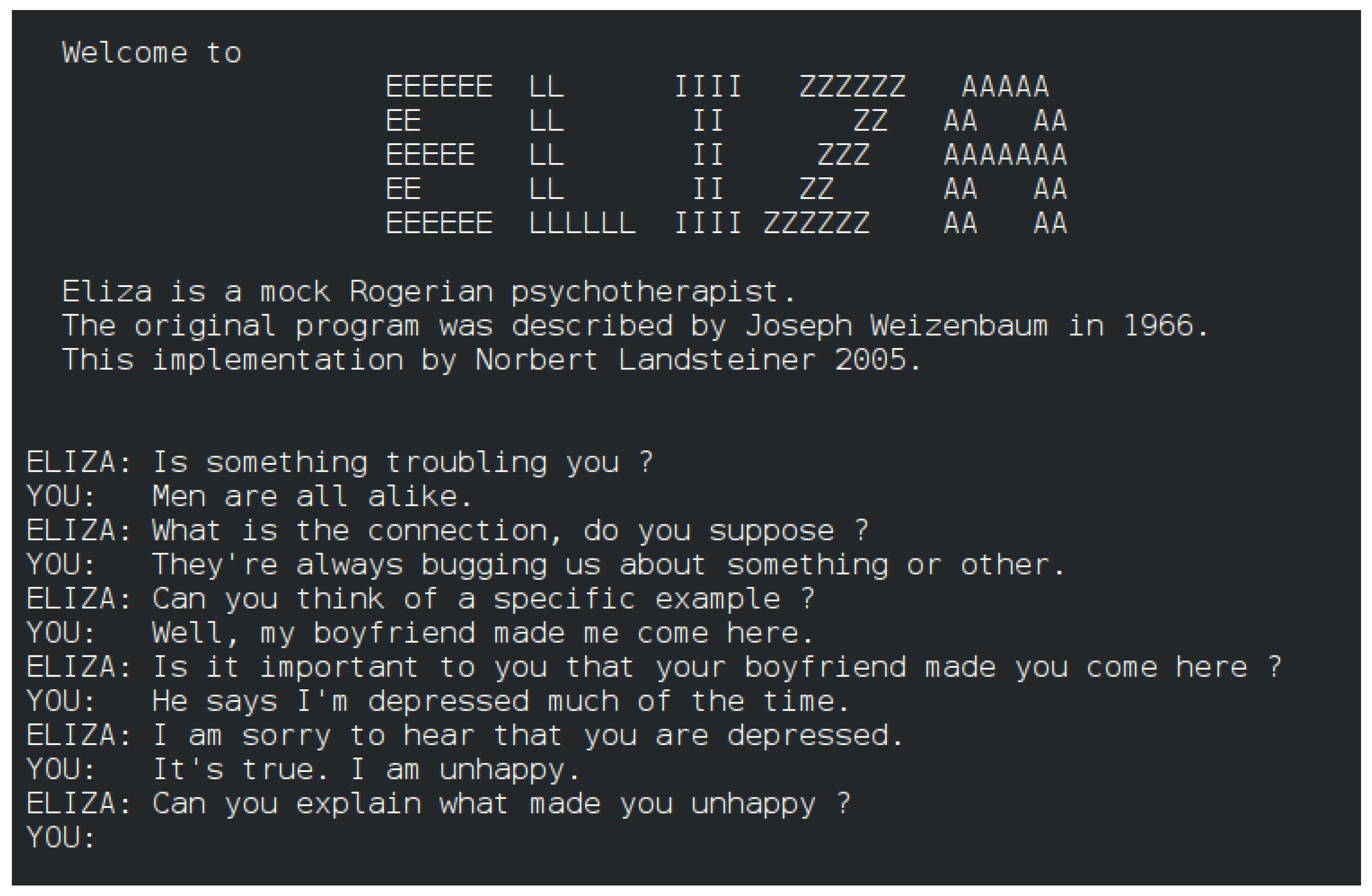
The concept of human–machine conversation has developed over more than half a century and reflects the broader evolution of artificial intelligence research. The earliest system regarded as a chatbot was ELIZA, created by Joseph Weizenbaum at the Massachusetts Institute of Technology in 1966 [8]. ELIZA simulated a Rogerian psychotherapist through simple pattern matching and text substitution, producing short replies that mirrored the user’s own statements. Although the system lacked any real semantic understanding, it demonstrated that minimal linguistic cues were sufficient to create the illusion of dialogue, a phenomenon later termed the ELIZA effect. The interaction style of the original ELIZA system is illustrated in Figure 1.
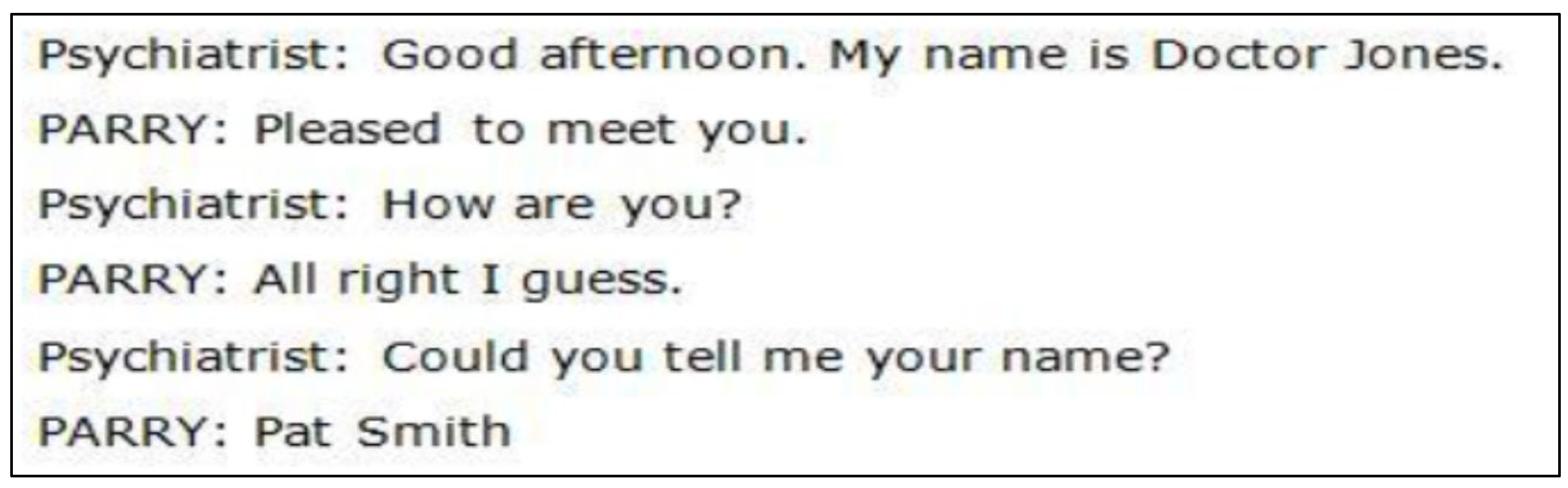
A few years later, Kenneth Colby designed PARRY (1972), which attempted to model human reasoning by representing beliefs, goals and emotions [26]. In controlled tests, psychiatrists were sometimes unable to distinguish between transcripts of PARRY and those of real patients. These early systems established the foundation for rule-based conversation engines that dominated chatbot design for several decades. This is illustrated in Figure 2, which shows a sample interaction between a psychiatrist and PARRY.
During the 1980s and 1990s, improvements in computing power and data storage encouraged the creation of more sophisticated pattern matching chatbots such as Jabberwacky, ALICE, and Mitsuku, which employed extensive databases of predefined responses [10,27]. Despite their limitations, these systems popularized conversational interfaces and inspired the first public chatbot competitions, including the Loebner Prize.
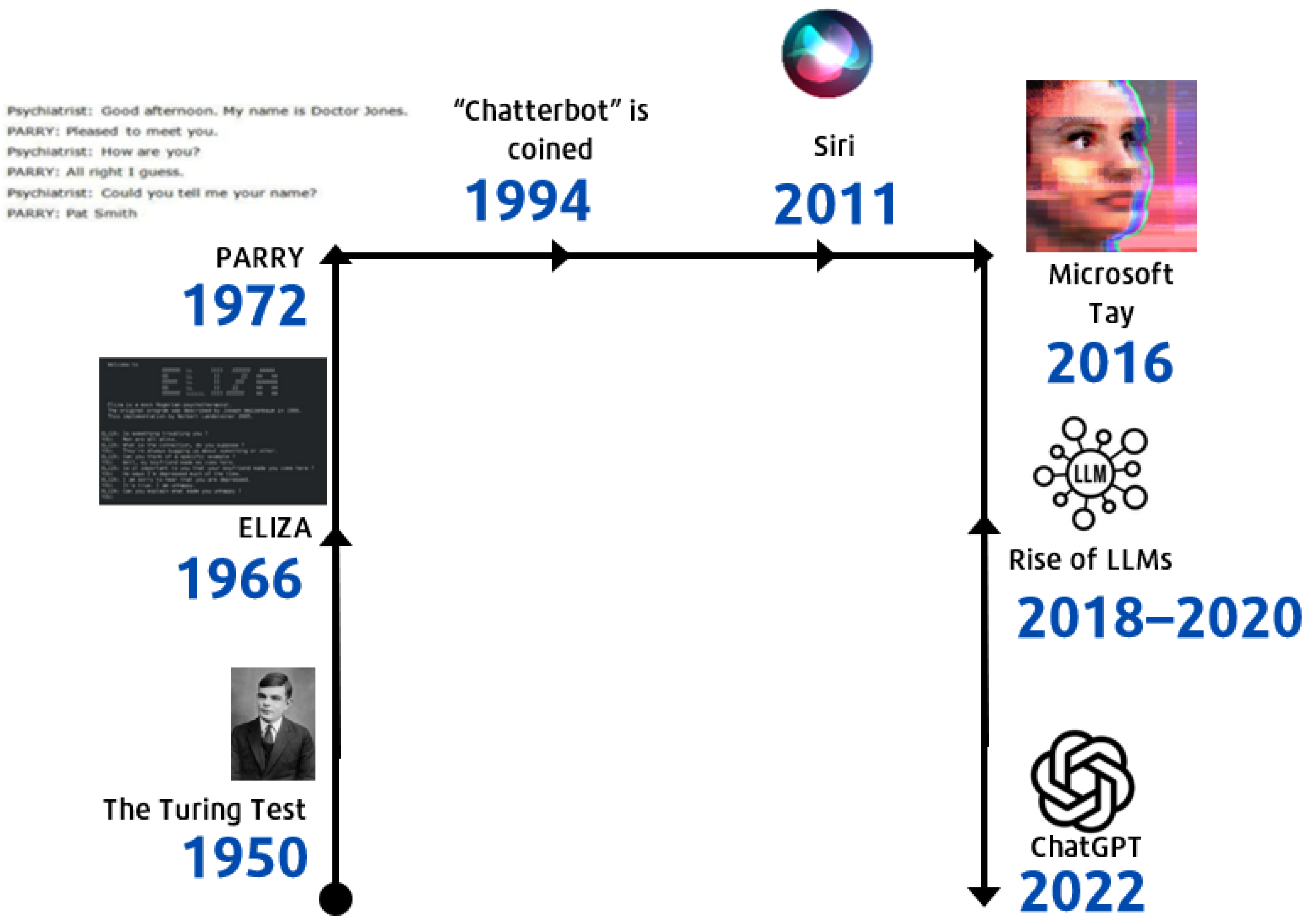
The emergence of statistical natural language processing in the early 2000s marked a turning point. Machine learning techniques enabled chatbots to move beyond static scripts and to learn from corpora of real dialogues [15]. The introduction of deep learning and transformer architectures further advanced the field, leading to models that can generate coherent, context aware dialogue. Contemporary systems such as OpenAI’s GPT series, Google’s LaMDA, and Microsoft’s XiaoIce integrate context, memory and multimodal capacities that combine text, image, and speech [12,16]. This rapid evolution has expanded the role of chatbots far beyond information retrieval, enabling their application in healthcare, education, environmental monitoring, and customer support [17]. This technological progression from early rule-based systems to contemporary multimodal conversational models is summarized in Figure 3.

2.1. Foundations and Architectures of Chatbots

Chatbots can be broadly divided into two principal categories: rulebased systems and datadriven or machinelearning systems.
Rulebased chatbots rely on predefined scripts, patternmatching templates and decision trees to produce answers that follow specific conversation paths [10]. Rulebased chatbots operate through explicitly defined linguistic patterns, where every possible user input is matched to a predefined template stored in the system’s knowledge base. These early systems often relied on keyword detection and simple decision trees to trigger scripted responses using frameworks such as AIML (Artificial Intelligence Markup Language) [11]. Because the dialogue logic was entirely deterministic, these chatbots could simulate coherent exchanges within narrow domains but failed when queries deviated from expected inputs. Despite their rigidity, rule-based models laid the foundation for human–machine dialogue by formalizing the structure of conversational turns and illustrating the feasibility of computer mediated communication [8,26,28]. Although predictable and easy to implement, such systems are predictable and easy to implement but limited in their ability to manage unstructured queries. Early examples include ELIZA and PARRY, which applied deterministic rules to generate responses without real semantic processing [8,26]. Although they demonstrated that humanlike conversation was technically achievable, these chatbots were unable to interpret context or adapt to new topics.
Data driven approaches emerged with advances in natural language processing and statistical learning. These methods represent a fundamental shift from handcrafted linguistic rules to systems that learn conversational patterns directly from data. Instead of relying on predefined templates, these models use large dialogue corpora to infer statistical regularities in language. Early frameworks employed probabilistic methods such as Hidden Markov Models (HMMs) and ngram models to estimate the likelihood of word sequences, forming the basis for speech recognition and intent detection. Subsequent developments in machine learning introduced sequence to sequence architectures capable of mapping user inputs to responses through supervised training. This paradigm enabled chatbots to generalize beyond fixed scripts and generate more contextually relevant answers, marking the transition from symbolic to statistical natural language understanding [12,15]. In the 2000s, probabilistic models such as Hidden Markov Models and sequence to sequence networks allowed systems to learn linguistic structures directly from dialogue corpora [15]. These techniques were further refined through deep learning, which enabled models to represent language as high dimensional embeddings that capture syntactic and semantic relations [29]. Transformer-based architectures revolutionized natural language processing by introducing a self attention mechanism that enables models to weigh the importance of each word in relation to all others in a sentence [30]. Unlike recurrent or convolutional models, transformers process entire sequences in parallel, allowing them to capture long range dependencies and contextual nuances more efficiently [12]. This design underpins large language models (LLMs) such as GPT3, GPT4, LaMDA and XiaoIce, which are trained on massive text corpora containing billions of tokens the basic computational units of language that represent words, sub words or punctuation. During training, each token is converted into a vector in a high dimensional embedding space, allowing the model to learn grammatical relationships, semantic meaning and contextual patterns between them. The greater the number of tokens a model is exposed to, the richer and more generalizable its linguistic representation becomes, though this also increases computational cost and memory requirements. Consequently, transformer-based chatbots achieve remarkable fluency and contextual understanding but face ongoing challenges of bias, interpretability and efficiency [16,17,31].
While the transition from rule-based to transformer-based architectures represents a major technological leap, it also redefines the notion of a chatbot itself. Modern conversational agents are no longer fixed question–answer tools but adaptive systems capable of reasoning, content generation and multimodal interaction. This transformation forms the technical basis upon which new domain specific applications, including those for remote sensing and archaeology, are now being developed.
Table 1 summarizes the main technological stages in chatbot evolution, from rule-based pattern matching to transformer-based multimodal systems. The comparison outlines how each generation introduced new capabilities—shifting from scripted dialogue to contextual reasoning and adaptive language generation—while also revealing persistent limitations such as restricted contextual understanding and increasing computational demands. Overall, the table highlights the steady transition from deterministic to data driven and pretrained models that define modern conversational AI.

2.2. Conversational Artificial Intelligence for Remote Sensing Analysis

Remote sensing generates vast and complex datasets that are often difficult for nonspecialists to interpret [32,33]. The increasing availability of high resolution satellite imagery, LiDAR surveys and drone photogrammetry has transformed how environmental and archaeological landscapes are analyzed, yet the diversity and scale of the data create substantial barriers for researchers who lack advanced computational expertise [23]. Recent advances in conversational artificial intelligence and large language models (LLMs) have introduced new possibilities for bridging this gap. Chatbots equipped with natural language interfaces can translate user queries into data processing tasks, enabling interaction with imagery and geospatial information through simple text input [34].
Early experiments such as LLMFind treated the language model as a decision making core rather than a text generator [34]. The system was able to retrieve geospatial data, generate code snippets for image processing and visualize outputs in real time through a QGIS plugin. A similar autonomous GIS agent [35] demonstrated end to end automation within QGIS, integrating natural language queries and workflow execution [35]. This approach demonstrated that conversational agents could operate as workflow managers, automating the technical steps between a user’s question and the resulting dataset.
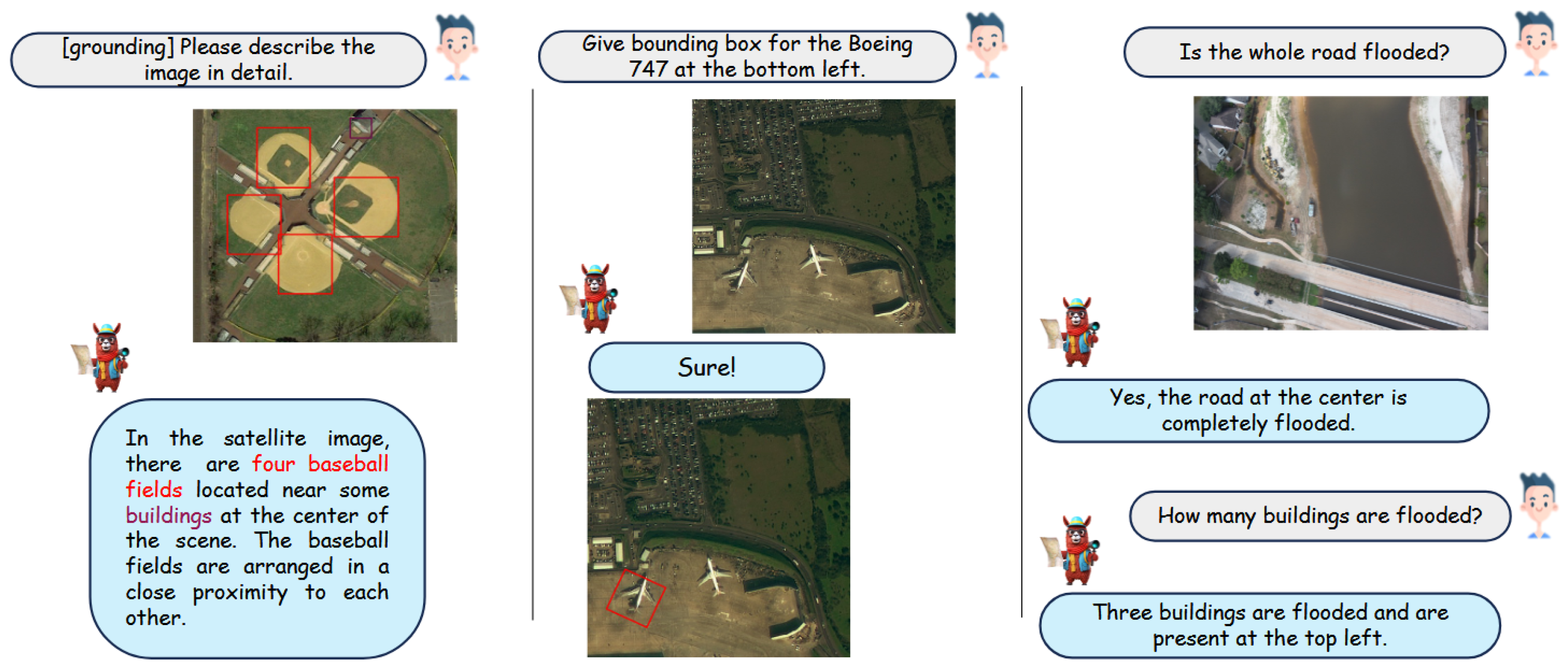
The introduction of multimodal systems expanded these capabilities further. Visual ChatGPT, developed by Osco et al. [23], combined text and image processing in a single interactive framework, allowing users to upload imagery and request operations such as edge detection, segmentation, or classification. Similarly, ChangeChat by Deng et al. [23] was trained on more than 87,000 instruction–response pairs to describe and quantify changes between two remote sensing images. ChangeChat constitutes the first bitemporal vision–language model designed specifically for interactive change analysis through multimodal instruction tuning [36]. An independent evaluation by Osco et al. (2023) [23] in Remote Sensing confirmed its ability to perform edge detection and segmentation on domain specific datasets. Complementary work by Pierdicca et al. demonstrated how large language models can function as natural language interfaces for translating user queries into GIS-based spatial analysis workflows, illustrating the potential of domain-specific task-oriented designs [37]. The model outperformed general purpose LLMs in binary classification and change detection accuracy, illustrating the potential of domain specific finetuning. Representative qualitative results from geospatially grounded conversational models are illustrated in Figure 4.
Recent developments have also focused on geospatially grounded models such as GeoChat, which integrates large vision–language models for remote sensing question answering and image captioning [38]. GeoChat, presented recently at CVPR 2024, enables region specific dialogue and spatial reasoning on high resolution imagery, integrating grounded visual tokens for location aware responses [38]. These systems demonstrate that conversational AI can interpret complex visual data, summarize spatial patterns and even generate analytical outputs in accessible language. Complementary research by Pierdicca et al. [37] explored the use of large language models as natural language interfaces for translating plain language queries into GIS-based spatial analysis workflows. In parallel, Labba et al. [39] introduced IArch, an AI-based system designed to support interactive exploration and structured analysis of archaeological datasets through intelligent data access mechanisms. In a related study, Rane et al. [40] showed that ChatGPT could be employed to interpret remote sensing and GIS datasets on demand, summarizing temporal and spatial changes directly from imagery. Task oriented chatbots embedded in geoportals offer an HCIcentric approach that exposes persistent metadata and interoperability constraints [41].
Collectively, these examples reveal a clear trajectory in the field of remote sensing. Conversational agents have evolved from simple information brokers to multimodal assistants capable of performing spatial analyses and interpreting visual data. This evolution provides the conceptual and technical foundation for adapting similar approaches to archaeology, where comparable challenges of data scale, heterogeneity and accessibility persist. Beyond individual system implementations, recent surveys and reviews demonstrate that these efforts form part of a broader and rapidly evolving research landscape in multimodal conversational AI and vision–language models, supported by diverse datasets, architectures, and evaluation frameworks across domains such as remote sensing and geospatial analysis.
While the systems discussed above primarily target analytical interaction with remote sensing and geospatial data, conversational agents have also been explored in educational and outreach-oriented contexts within archaeology. In these cases, chatbots are designed less as analytical tools and more as interfaces for communicating archaeological knowledge to non-specialist audiences, including students, visitors, and the general public.

2.3. Artificial Intelligence Applications in Archaeology

Artificial intelligence has been integrated into archaeological research primarily through machine learning, computer vision, and predictive modelling approaches rather than through conversational systems. Over the past two decades, AI-driven geospatial analysis has become a central component of archaeological prospection, landscape archaeology, and heritage management, particularly in the context of remote sensing and GIS-based workflows [2,4,42]. Neural networks, ensemble models, and probabilistic predictive frameworks have been widely applied to site detection, artefact classification, landscape pattern analysis, and modelling of human–environment interactions, often producing results that directly inform field strategies, excavation planning, and regional research agendas [42,43].
These approaches have demonstrated substantial impact across diverse archaeological contexts, enabling the analysis of large-scale spatial datasets that would be impractical to interpret manually. Machine learning techniques have been used to identify subtle anthropogenic features in satellite imagery and LiDAR data, to detect microtopographic anomalies, and to model settlement patterns across different environmental settings [23,42,44]. In many cases, these methods have shifted archaeological practice from opportunistic discovery toward hypothesis-driven and probabilistic exploration of landscapes. Compared to conversational systems, such AI methods have achieved broader disciplinary uptake and are now widely recognized as foundational tools within computational and geospatial archaeology [2,4].
By contrast, conversational systems in archaeology have so far seen limited uptake and remain largely experimental. Existing chatbot-based applications have largely focused on educational, outreach, or information-retrieval purposes, such as supporting visitor engagement at heritage sites or facilitating access to textual archives [19,20,21]. While these systems demonstrate the feasibility of natural language interaction with archaeological knowledge, they are best understood as experimental or proof-of-concept implementations rather than as general-purpose analytical tools. Their development has typically been project-specific, and they have not been widely embedded within routine research workflows or employed for systematic interpretation of remote sensing imagery [36,45].
The limited impact of chatbots in archaeology does not reflect a lack of technical potential, but rather a misalignment between conversational interfaces and the established analytical practices of the discipline. Archaeological reasoning commonly relies on the integration of spatial imagery, environmental data, and contextual textual evidence, a process that has so far been more effectively supported by machine learning pipelines and GIS-based analytical environments than by dialogue-based systems [2,42]. As a result, conversational agents currently occupy a peripheral position within archaeological AI ecosystems, functioning more as access points to information than as active components of analytical reasoning.
Nevertheless, recent advances in multimodal conversational systems in the broader field of remote sensing point toward a possible future trajectory for archaeology. Rather than competing with established AI methods, chatbots may act as mediating interfaces that link users to existing analytical infrastructures, translating archaeological questions into computational operations and lowering technical barriers to complex workflows [34,38,40]. From this perspective, the relevance of chatbots lies less in their current disciplinary impact and more in their potential to complement mature AI-driven geospatial methods by supporting more accessible, human-centred engagement with archaeological data and interpretative processes.
While these examples illustrate early and exploratory applications of conversational systems in archaeological contexts, they should not be interpreted as representative of widespread or mature disciplinary practice [19,20,21]. Rather than continuing with a case-by-case discussion, the following section deliberately shifts to a broader analytical perspective, situating chatbots within the wider landscape of artificial intelligence methods that have shaped archaeological research more substantially over the past two decades [2,4].
To synthesize the diverse ways in which conversational systems have been explored within archaeological contexts, Table 2 provides a conceptual overview of key chatbot categories, functionalities, and design characteristics. Rather than enumerating individual project-specific implementations, the table abstracts recurring patterns and roles of conversational agents across educational, outreach, information-retrieval, and research-oriented applications. This schematic perspective supports a comparative understanding of how chatbots have been positioned within archaeological practice while avoiding overemphasis on isolated or experimental case studies.

3. Chatbots in Remote Sensing

The integration of conversational artificial intelligence into remote sensing workflows represents a growing area of research. This section examines how remote sensing technologies operate across different scientific domains and explores how these methods have been adopted in archaeological contexts. Section 3.1 provides an overview of remote sensing fields and analytical methods, while Section 3.2 focuses specifically on their application to archaeology and the emerging role of conversational systems in supporting image-based interpretation.

3.1. Remote Sensing Fields

Remote sensing has become one of the most powerful sources of spatial and environmental information, providing continuous coverage of the Earth’s surface through multispectral, hyperspectral, radar and LiDAR sensors [4,6,46]. Recent syntheses emphasize that Earth observation has entered a bigdata era increasingly mediated by AI assisted interpretation [47,48]. The integration of these technologies enables the detection of physical and chemical characteristics of materials, the monitoring of land use changes and the analysis of vegetation indices that support ecological and agricultural research [24,40]. Over the past two decades, the combination of satellite, airborne and drone-based platforms has made it possible to collect high resolution imagery across large temporal and spatial scales, transforming how landscapes are analyzed [2].
Traditional remote sensing workflows involve a sequence of steps such as image preprocessing, segmentation, feature extraction and classification [49]. These procedures require both computational resources and specialized expertise, particularly when dealing with multisource data of varying resolutions [2,47,50]. The rapid increase in the availability of open access imagery from missions such as Landsat, Sentinel and World View has further intensified the need for automated processing pipelines [6,51]. Consequently, artificial intelligence has become a cornerstone of modern remote sensing analysis. Deep learning models such as convolutional neural networks (CNNs) and transformer architectures have been applied for classification, object detection and change detection tasks with notable success [23,24,29]. Complementary studies explore ChatGPT-3.5 driven interpretation pipelines that automate classification and reporting within RS and GIS workflows [40,52].
Recent research has also introduced conversational and multimodal frameworks that integrate natural language interaction with image-based processing. Examples include the LLMFind system [34], which allows for geospatial data retrieval via natural language queries, and GeoChat [38], a large vision–language model capable of interpreting satellite images and answering domain specific questions. Similarly, Visual ChatGPT [24,53] and ChangeChat [23] combine image recognition with dialogue-based reasoning, enabling users to perform segmentation and change analysis without manual coding. These developments demonstrate a growing convergence between remote sensing, machine learning, and conversational artificial intelligence [39,40].
As a result, remote sensing is no longer limited to data collection and image analysis but is evolving towards interactive systems that can understand context, summarise results and communicate them through natural language [17]. This progression not only enhances accessibility for nonspecialists but also provides a conceptual foundation for extending such approaches into other data intensive domains, including archaeology. The following subsection explores how remote sensing has been adopted within archaeological research and how its integration with conversational systems can further transform data interpretation.

3.2. Remote Sensing in Archaeology

Remote sensing has transformed archaeological practice by expanding the spatial and temporal scales at which past human activities can be observed and analyzed. The integration of satellite imagery, airborne LiDAR, multispectral data and drone-based photogrammetry allows archaeologists to detect features that are invisible at ground level and to reconstruct past landscapes with unprecedented precision [2,6]. Applications include site detection, mapping of settlement systems, monitoring of environmental change and the preservation of cultural heritage [42,46]. These technologies enable the identification of subtle anthropogenic signatures such as cropmarks, soil discoloration and microtopographic variations, which often indicate buried structures or ancient land use patterns [19].
The introduction of open access remote sensing datasets and cloud-based analytical tools has democratized archaeological investigation, allowing a wider community of researchers to access and process geospatial information [4,24]. However, the heterogeneity of data formats and the technical complexity of image processing continue to restrict broader adoption. Empirical evaluation of Visual ChatGPT in RS indicates that similar domain gaps could affect archaeological imagery interpretation [24]. Many archaeological projects rely on collaborations with remote sensing specialists, and the analytical results are often mediated through specialized software environments such as QGIS, ArcGIS or Python-based workflows [2,41], which do not explicitly report software version numbers. These requirements can create barriers for smaller institutions or projects that lack computational resources.
Recent research efforts have sought to overcome these limitations through automation and artificial intelligence. Machine learning and deep learning models have been applied to classify archaeological features, detect structures in LiDAR point clouds and identify patterns in satellite imagery [24,42]. The human–AI collaboration model proposed by Casini et al. [42] illustrates how interactive systems can combine human interpretative expertise with computational efficiency to improve site detection accuracy [43]. Despite these advances, most archaeological analyses still depend on expert driven interpretation rather than conversational or interactive frameworks.
The emergence of conversational artificial intelligence introduces a new opportunity to close this gap. Chatbots and multimodal systems capable of processing imagery and text could enable archaeologists to query datasets using natural language, simplifying interaction with complex digital infrastructures [39,40]. For instance, an archaeologist could ask a chatbot to identify possible enclosures in a LiDAR hill shade or to summarize landscape change across multiple temporal scenes. Such interaction would lower the technical threshold for data analysis and enhance accessibility without compromising scientific rigor. Grounded VLMs such as GeoChat demonstrate that image-based question answering can be applied to cultural landscape scenes [22].
In summary, remote sensing has become an indispensable component of modern archaeology, enabling largescale landscape reconstruction and long-term environmental analysis. The challenge that remains is to integrate these powerful techniques with conversational systems that can translate archaeological questions into analytical operations [34]. This convergence represents the conceptual foundation for the next stage of development, where multimodal chatbots could act as intelligent mediators between remote sensing data and archaeological interpretation.

4. Current Challenges and Research Gaps

Despite rapid advances in conversational artificial intelligence and remote sensing technologies, the integration of multimodal chatbots into archaeological workflows remains limited [2,4,24]. This section examines the key technical, methodological, and ethical challenges that constrain their adoption and identifies critical research gaps that must be addressed to enable meaningful and responsible use within archaeology [54].

4.1. Challenges

The integration of conversational artificial intelligence into archaeological remote sensing faces several structural and methodological challenges. The first concerns the scale and heterogeneity of remote sensing data per se. Archaeology increasingly depends on multisource imagery acquired from satellites, drones and LiDAR systems, which differ in spatial resolution, spectral range and data format [2,4,6]. These variations complicate data harmonization and require advanced preprocessing techniques, such as radiometric and atmospheric corrections, which extend beyond typical interpretative workflows and are primarily relevant when imagery is integrated into automated or AI-driven analytical pipelines. The limited standardization of metadata and the partial interoperability of existing archives further restrict the ability of conversational systems to retrieve and interpret information reliably at scale [39].
A second challenge involves the limited availability of curated training datasets suitable for archaeological applications [55]. Unlike domains such as agriculture or environmental monitoring, archaeology has limited availability of standardized, annotated image corpora specifically designed to support the training of multimodal vision–language models [24,42]. Existing datasets are often small, site-specific, and created through manual labelling for particular research objectives, which constrains their scalability and generalization for machine learning applications. Without sufficient examples of archaeological features, conversational agents struggle to learn the subtle differences between natural and anthropogenic patterns. It is important to note that this limitation does not reflect a general lack of accessible remote sensing data in archaeology, but rather the additional requirements involved in transforming such data into curated training sets suitable for AI-driven analysis.
Another important limitation concerns computational costs and infrastructure requirements. High resolution imagery and LiDAR point clouds are computationally demanding, often requiring powerful hardware and specialized software environments [24]. Running large vision–language models such as Visual ChatGPT or ChangeChat in real time involves high memory usage and processing power, which may exceed the computational resources available in many archaeological research settings [23,40]. Cloud-based platforms can mitigate these issues, yet they raise concerns about sustainability, cost and long-term accessibility.
Finally, there are challenges related to usability, transparency and adoption. Archaeological workflows are shaped by disciplinary traditions and interpretative practices that may not easily adapt to automated systems [1]. Users must understand the limitations of conversational models and retain interpretative control over analytical outcomes through transparent workflows. The success of AI-assisted archaeology therefore depends not only on technological maturity, but also on the alignment of conversational systems with established archaeological workflows through intuitive interfaces, transparent algorithms, and interdisciplinary collaboration [50,56].

4.2. Gaps and Research Opportunities

This review of the existing literature reveals a clear asymmetry between advances in remote sensing and their practical adoption within archaeology. While multimodal chatbots have achieved remarkable progress in other scientific domains, archaeological applications remain primarily text oriented [44,57]. This gap results from both technical and disciplinary constraints. The absence of large, well annotated datasets limits the ability of models to recognize the subtle morphological and spectral characteristics of archaeological features [2,42]. Collaborative initiatives that promote open data sharing and standardized annotation could help overcome this limitation and provide the foundation for training domain sensitive conversational agents [4,6]. A recent technical note on archaeological object detection using airborne LiDAR identifies priorities for developing scalable and transferable workflows for automated feature recognition and site mapping [23,44]. These approaches emphasize the need for reproducible pipelines that can adapt to different landscapes and data resolutions, facilitating broader application across archaeological case studies.
Another major research opportunity lies in the integration of image-based and textual data. Archaeological reasoning typically relies on the combination of spatial imagery, excavation reports and historical records, yet most existing systems treat these sources separately [21]. Future research should aim to develop hybrid frameworks that allow conversational agents to interpret visual evidence while simultaneously linking it to contextual information. Such integration would enable archaeologists to query both images and texts through natural language, resulting in richer and more interpretatively coherent analyses [24,39].
There is also a need for lightweight and resource efficient prototypes that can operate under the computational constraints typical of archaeological institutions. Models such as Visual ChatGPT, which integrates ChatGPT with task-specific vision models without specifying a fixed language model version [24], and ChangeChat, which is built on the Vicuna-v1.5 large language model backbone [23], demonstrate the technical feasibility of multimodal analysis, although their high computational costs limit scalability. Optimizing these systems for smaller datasets and local execution environments would increase accessibility and sustainability, especially for projects in regions with limited infrastructure [4].
Finally, consideration must be given to usability and disciplinary adoption. Archaeologists should remain active participants in the design and evaluation of conversational systems to ensure that AI tools complement, rather than replace, expert interpretation [19,20]. Participatory design, transparency and explainability should therefore guide future development. Evaluations should not be confined to technical accuracy but should also assess whether the system genuinely supports archaeological reasoning and decision making.
Overall, the synthesis of these research gaps points to a clear direction for future work: the creation of domain specific, multimodal conversational agents capable of analyzing imagery, integrating textual context and operating within the interpretative frameworks of archaeology. Such systems have the potential to transform how archaeological data are explored, interpreted and shared, fostering a new generation of digital collaboration between humans and intelligent machines.

4.3. Ethical Considerations and Data Governance

The increasing integration of artificial intelligence into archaeological research raises ethical concerns that extend beyond technical feasibility and methodological integration. At a general level, debates on AI ethics emphasize issues of data provenance, intellectual property, transparency, and accountability, particularly in relation to systems trained on large and heterogeneous corpora of visual and textual data [58,59]. Multimodal conversational systems intensify these concerns [60] by enabling natural language access to analytical outputs, potentially obscuring the origins, assumptions, and biases embedded within training datasets and algorithmic decision-making processes [61].
Within archaeology, these ethical challenges acquire heightened significance due to the sensitive nature of archaeological and spatial information [62]. Machine learning and vision–language models capable of detecting, classifying, or mapping archaeological features from remote sensing imagery rely on training datasets that may contain precise locational data. While such information is essential for model performance, its integration into conversational interfaces risks lowering barriers to access in ways that may inadvertently facilitate site looting, illicit excavation, or unsustainable tourism [63,64]. The ability of users to query AI systems for site identification or spatial patterning from imagery underscores the need for careful control over data exposure and output resolution.
These risks are particularly acute in relation to Indigenous heritage and culturally sensitive landscapes. Not all archaeological sites are intended for public disclosure, and unrestricted dissemination of spatial knowledge may conflict with Indigenous data sovereignty, community values, and ethical research practices, particularly in relation to sacred places and culturally restricted landscapes [65,66,67]. From this perspective, the deployment of conversational AI systems raises fundamental questions regarding authority over archaeological knowledge, responsibilities toward descendant communities, and the long-term implications of automated discovery and disclosure.
Addressing these concerns requires an ethics-by-design approach in which considerations of data sensitivity, cultural authority, and potential misuse are embedded into system architectures and governance frameworks from the outset. Practical measures may include spatial obfuscation of sensitive locations, tiered access models based on user roles, and the co-design of AI systems in collaboration with local and Indigenous communities [68,69]. Without such safeguards, the same AI technologies that promise analytical innovation risk undermining established principles of archaeological stewardship and responsible management of cultural heritage.
In addition to these concerns, the phenomenon of so-called “hallucinations” in generative and multimodal AI systems constitutes a critical epistemic risk for archaeological interpretation. Large language and vision–language models may generate plausible but incorrect descriptions, associations, or spatial inferences that are not grounded in the underlying data, potentially leading to misinterpretation of archaeological evidence [69,70]. In archaeology, where interpretation is inherently probabilistic and context-dependent, such errors risk reinforcing unfounded hypotheses or obscuring uncertainty rather than clarifying it. This reinforces the necessity of maintaining human oversight and expert validation in any AI-assisted analytical workflow, ensuring that conversational systems remain interpretative aids rather than authoritative sources [58]. Addressing hallucinations through transparency, uncertainty communication, and human-in-the-loop design is therefore essential for the responsible adoption of generative AI in archaeological research.

5. Discussion

This synthesis of current research indicates that the convergence of conversational artificial intelligence and remote sensing has the potential to reshape the analytical landscape of archaeology. Remote sensing has already become an essential source of archaeological evidence, allowing researchers to reconstruct past environments, detect buried features and monitor cultural landscapes at multiple scales [2,4,6]. An editorial overview in Remote Sensing (2024) frames this convergence as a defining trend for AI-mediated Earth observation [59]. The recent introduction of large vision–language models and multimodal chatbots represents a logical extension of this digital transformation, offering new forms of interaction with complex geospatial data [23,24]. However, the practical implementation of such systems within archaeology remains in its infancy.
Several factors contribute to this situation. Technical complexity and the lack of standardized infrastructures hinder the smooth integration of AI systems into archaeological workflows [39]. Data related challenges, such as the limited availability of annotated training sets and the heterogeneity of remote sensing imagery, restrict the performance of multimodal chatbots [19,42,60]. Equally significant are cultural and methodological issues. Archaeological interpretation depends on human expertise, contextual reasoning and theoretical frameworks that are difficult to replicate algorithmically [19]. Therefore, the introduction of conversational systems should be understood as a form of augmentation rather than automation.
Future research should focus on the codesign of tools that align computational efficiency with disciplinary practice. Lightweight models capable of local deployment could address the resource limitations of smaller institutions, while hybrid frameworks linking imagery and textual archives would better reflect the nature of archaeological reasoning [40]. The ultimate challenge is to create systems that are not only technically proficient but also epistemologically compatible with archaeology’s interpretative character. Achieving this balance will define the success of conversational AI as an assistive partner in the evolving ecosystem of digital archaeology. The maturity of multimodal conversational systems in other scientific domains [55,56,57,58,59] provides a comparative horizon for archaeology. Rather than framing adoption solely as a technological challenge, this comparison invites reflection on what new forms of archaeological questioning such systems might enable. In particular, AI-mediated interaction could support exploratory engagement with uncertainty, facilitate the dynamic integration of visual and textual evidence, and help articulate alternative hypotheses about past human activity, extending archaeological inquiry beyond efficiency-driven applications.

6. Conclusions

This review examined the intersection of conversational artificial intelligence and remote sensing in archaeology, highlighting the opportunities and challenges that arise from their integration. The analysis showed that while multimodal chatbots have demonstrated strong potential in fields such as environmental monitoring and geospatial analysis [23,24], their adoption in archaeology remains limited to text-based applications [19,20,40]. The primary barriers include data heterogeneity, the absence of curated training datasets, high computational requirements and uncertainties surrounding usability and disciplinary acceptance [2,4,39,42]. Addressing these challenges will require collaborative initiatives for dataset creation, the development of lightweight multimodal frameworks and participatory design processes involving archaeologists. The combination of conversational interfaces with remote sensing workflows has the potential to democratize access to complex imagery, enhance interpretative capacity and foster new forms of human–AI collaboration. By aligning technological innovation with archaeological practice, conversational AI can evolve from a communication tool into a genuine analytical partner that supports the future of digital archaeology.
Future research should extend beyond proof-of-concept studies to the development of operational multimodal chatbots capable of analyzing both spatial and textual archaeological datasets in real time [53,56]. Integrating conversational AI with image recognition models, GIS workflows and cloud-based repositories could enable the automatic retrieval and interpretation of excavation records, satellite imagery and sensor data. A further priority is the creation of domain specific datasets and evaluation benchmarks that reflect the diversity of archaeological contexts. Collaborative platforms involving archaeologists, computer scientists and heritage institutions are essential to ensure transparency, interpretability and ethical compliance. Ultimately, advancing these directions will transform conversational systems from assistive interfaces into autonomous analytical partners that enhance archaeological reasoning and support evidence-based cultural heritage management.

Author Contributions

Conceptualization, methodology, software, validation, formal analysis, investigation, resources, data curation, writing—original draft preparation, writing—review and editing, visualization, N.M. and A.A.; supervision, A.A.; funding acquisition, A.A. All authors have read and agreed to the published version of the manuscript.

Funding

This paper was supported by the CONNECTING project. The CONNECTING project has received funding from the European Regional Development Fund and the Republic of Cyprus through the Research and Innovation Foundation of Cyprus under contract SMALL SCALE INFRASTRUCTURES/1222/0062.

Data Availability Statement

No new data were created or analyzed in this study. Data sharing is not applicable to this article.

Acknowledgments

This research forms part of the Ph.D. thesis of N.M., conducted at the EOcult: Earth Observation Cultural Heritage Lab (https://web.cut.ac.cy/eocult/, accessed on 23 July 2025), Department of Civil Engineering and Geomatics, Cyprus University of Technology. The author acknowledges the use of AI-based assistants (ChatGPT (version GPT5) by OpenAI) to improve the readability and grammar of the manuscript. The authors have thoroughly reviewed and revised all AI-generated text and take full responsibility for the content and interpretations presented in this publication.

Conflicts of Interest

The author declares no conflicts of interest. The views and opinions expressed are, however, those of the authors only.

References

  1. Djindjian, F. Archaeology and Computers: A Long Story in the Making of Modern Archaeology. Archeol. Calc. 2019, 30, 13–20. [Google Scholar]
  2. Grosman, L. Reaching the Point of No Return: The Computational Revolution in Archaeology. Annu. Rev. Anthropol. 2016, 45, 129–145. [Google Scholar] [CrossRef]
  3. Hetrick, V.; Leventhal, R.M.; Read, D.M. A Design to Use Computational Science for Archaeological Interpretation. Comput. Graph. 1992, 26, 179–181. [Google Scholar] [CrossRef]
  4. McManamon, F.P.; Kintigh, K.W. Transforming Archaeological Data into Knowledge. SAA Archaeol. Rec. 2010, 10, 37–40. [Google Scholar]
  5. Cobb, P.J. Large Language Models and Generative AI, Oh My! Archaeology in the Time of ChatGPT, Midjourney, and Beyond. Adv. Archaeol. Pract. 2023, 11, 363–369. [Google Scholar] [CrossRef]
  6. Agapiou, A.; Lysandrou, V. Interacting with the Artificial Intelligence (AI) Language Model ChatGPT: A Synopsis of Earth Observation and Remote Sensing in Archaeology. Heritage 2023, 6, 4072–4085. [Google Scholar] [CrossRef]
  7. Abu Shawar, B.; Atwell, E. Chatbots: Are They Really Useful? J. Lang. Technol. Comput. Linguist. 2007, 22, 29–49. [Google Scholar] [CrossRef]
  8. Weizenbaum, J. ELIZA—A Computer Program for the Study of Natural Language Communication Between Man and Machine. Commun. ACM 1966, 9, 36–45. [Google Scholar] [CrossRef]
  9. Colby, K. Artificial Paranoia: A Computer Simulation of Paranoid Processes; Pergamon Press: Oxford, UK, 1975. [Google Scholar]
  10. Shum, H.Y.; He, X.; Li, D. From Eliza to XiaoIce: Challenges and Opportunities with Social Chatbots. Front. Inf. Technol. Electron. Eng. 2018, 19, 10–26. [Google Scholar] [CrossRef]
  11. Vidya, G.; Vernekar, N.K.; Kelkar, G. Comparative Study on Chatbot Frameworks. Int. J. Res. Appl. Sci. Eng. Technol. (IJRASET) 2023, 11, 3602–3610. [Google Scholar] [CrossRef]
  12. Adamopoulou, E.; Moussiades, L. An Overview of Chatbot Technology. In Artificial Intelligence Applications and Innovations (AIAI 2020); Maglogiannis, I., Iliadis, L., Pimenidis, E., Eds.; Springer: Cham, Switzerland, 2020; pp. 373–383. [Google Scholar] [CrossRef]
  13. Thoppilan, R.; De Freitas, D.; Hall, J.; Shazeer, N.; Kulshreshtha, A.; Cheng, H.T.; Jin, A.; Bos, T.; Baker, L.; Du, Y.; et al. LaMDA: Language Models for Dialog Applications. arXiv 2022, arXiv:2201.08239. Available online: https://arxiv.org/abs/2201.08239 (accessed on 3 August 2025).
  14. Casillo, M.; Clarizia, F.; D’Aniello, G.; De Santo, M.; Lombardi, M.; Santaniello, D. CHATBot: A Cultural Heritage Aware TellerBot for Supporting Touristic Experiences. Pattern Recognit. Lett. 2020, 131, 234–243. [Google Scholar] [CrossRef]
  15. AlAmin, M.; Ali, M.S.; Salam, A.; Khan, A.; Ali, A.; Ullah, A.; Alam, M.N.; Chowdhury, S.K. History of Generative Artificial Intelligence (AI) Chatbots: Past, Present, and Future Development. arXiv 2024, arXiv:2402.05122. [Google Scholar] [CrossRef]
  16. Chakraborty, C.; Pal, S.; Bhattacharya, M.; Dash, S.; Lee, S.S. Overview of Chatbots with Special Emphasis on Artificial Intelligence–Enabled ChatGPT in Medical Science. Front. Artif. Intell. 2023, 6, 1237704. [Google Scholar] [CrossRef] [PubMed]
  17. Shrager, J. ELIZA Reinterpreted: The World’s First Chatbot Was Not Intended as a Chatbot at All. arXiv 2024, arXiv:2406.17650. [Google Scholar]
  18. Lombardi, M.; Pascale, F.; Santaniello, D. An Application for Cultural Heritage Using a Chatbot. In Proceedings of the 2019 2nd International Conference on Computer Applications & Information Security (ICCAIS), Riyadh, Saudi Arabia, 1–3 May 2019. [Google Scholar]
  19. Godewithana, N.; Kirindage, G. Intelligent Hybrid Chatbot Solution for Archaeological Sites Tracking. In Proceedings of the Sixth International Conference on Inventive Computation Technologies (ICICT 2021), Coimbatore, India, 20–22 January 2021; pp. 517–522. [Google Scholar] [CrossRef]
  20. Paijmans, H.; Brandsen, A. Searching in Archaeological Texts: Problems and Solutions Using an Artificial Intelligence Approach. PalArch’s J. Archaeol. Egypt/Egyptol. 2010, 7, 1–6. [Google Scholar]
  21. Kuska, M.T.; Wahabzada, M.; Paulus, S. AIChatbots for Agriculture, Where Can Large Language Models Provide Substantial Value? Comput. Electron. Agric. 2024, 221, 108924. [Google Scholar] [CrossRef]
  22. Deng, P.; Zhou, W.; Wu, H. ChangeChat: An Interactive Model for Remote Sensing Change Analysis via Multimodal Instruction Tuning. In Proceedings of the 2025 IEEE International Conference on Acoustics, Speech and Signal Processing (ICASSP), Hyderabad, India, 6–11 April 2025. [Google Scholar]
  23. Osco, L.P.; de Lemos, E.L.; Gonçalves, W.N.; Ramos, A.P.M.; Marcato Junior, J. The Potential of Visual ChatGPT for Remote Sensing. Remote Sens. 2023, 15, 3232. [Google Scholar] [CrossRef]
  24. Wikipedia Contributors. ELIZA. In Wikipedia, The Free Encyclopedia; Wikimedia Foundation, Last Edited 31 October 2025. Available online: https://en.wikipedia.org/wiki/ELIZA (accessed on 15 June 2025).
  25. Adamopoulou, E.; Moussiades, L. Chatbots: History, Technology, and Applications. Mach. Learn. Appl. 2020, 2, 100006. [Google Scholar] [CrossRef]
  26. Rudolph, J.; Tan, S.; Tan, S. War of the Chatbots: Bard, Bing Chat, ChatGPT, Ernie and Beyond. The New AI Gold Rush and Its Impact on Higher Education. J. Appl. Learn. Teach. 2023, 6, 364–389. [Google Scholar] [CrossRef]
  27. Zhu, X.X.; Tuia, D.; Mou, L.; Xia, G.S.; Zhang, L.; Xu, F.; Fraundorfer, F. Deep Learning in Remote Sensing: A Comprehensive Review and List of Resources. IEEE Geosci. Remote Sens. Mag. 2017, 5, 8–36. [Google Scholar] [CrossRef]
  28. Dritsas, E.; Trigka, M. Remote Sensing and Geospatial Analysis in the Big Data Era: A Survey. Remote Sens. 2025, 17, 550. [Google Scholar] [CrossRef]
  29. Fiorucci, M.; Verschoofvan der Vaart, W.B.; Soleni, P.; Le Saux, B.; Traviglia, A. Deep Learning for Archaeological Object Detection on LiDAR: New Evaluation Measures and Insights. Remote Sens. 2022, 14, 1694. [Google Scholar] [CrossRef]
  30. Vaswani, A.; Shazeer, N.; Parmar, N.; Uszkoreit, J.; Jones, L.; Gomez, A.N.; Kaiser, Ł.; Polosukhin, I. Attention Is All You Need. Adv. Neural Inf. Process. Syst. 2017, 30, 5998–6008. [Google Scholar] [CrossRef]
  31. Ning, H.; Li, Z.; Akinboyewa, T.; Lessani, M.N. An Autonomous GIS Agent Framework for Geospatial Data Retrieval. Int. J. Digit. Earth 2025, 18, 2458688. [Google Scholar] [CrossRef]
  32. Mountrakis, G.; Im, J.; Ogole, C. Support vector machines in remote sensing: A review. ISPRS J. Photogramm. Remote Sens. 2011, 66, 247–259. [Google Scholar] [CrossRef]
  33. Van der Meer, F.D.; van der Werff, H.M.A.; van Ruitenbeek, F.J.A.; Hecker, C.A.; Bakker, W.H.; Noomen, M.F.; van der Meijde, M.; Carranza, E.J.M.; de Smeth, J.B.; Woldai, T. Multi- and Hyperspectral Geologic Remote Sensing: A Review. Int. J. Appl. Earth Obs. Geoinf. 2012, 14, 112–128. [Google Scholar] [CrossRef]
  34. Kuckreja, K.; Danish, M.S.; Naseer, M.; Das, A.; Khan, S.; Khan, F.S. GeoChat: Grounded Large Vision–Language Model for Remote Sensing. In Proceedings of the IEEE/CVF Conference on Computer Vision and Pattern Recognition (CVPR), Seattle, WA, USA, 16–22 June 2024; pp. 27831–27840. [Google Scholar]
  35. Vahidnia, M.H. Empowering Geoportals HCI with TaskOriented Chatbots Through NLP and Deep Transfer Learning. Big Earth Data 2024, 8, 608–648. [Google Scholar] [CrossRef]
  36. Rane, J.; Kaya, Ö.; Mallick, S.K.; Rane, N.L. Artificial IntelligencePowered Spatial Analysis and ChatGPTDriven Interpretation of Remote Sensing and GIS Data. In Generative Artificial Intelligence in Agriculture, Education, and Business; Deep Science Publishing: San Francisco, CA, USA, 2024; pp. 162–217. [Google Scholar]
  37. Pierdicca, R.; Muralikrishna, N.; Tonetto, F.; Ghianda, A. On the Use of Large Language Models for GIS-Based Spatial Analysis. ISPRS Int. J. Geo-Inf. 2025, 14, 401. [Google Scholar] [CrossRef]
  38. Ciccone, G. ChatGPT as a Digital Assistant for Archaeology: Insights from the Smart Anomaly Detection Assistant Development. Heritage 2024, 7, 5428–5445. [Google Scholar] [CrossRef]
  39. Labba, C.; Alcouffe, A.; Crubézy, E.; Boyer, A. IArch: An AI Tool for Digging Deeper into Archaeological Data. In Proceedings of the 2023 IEEE 35th International Conference on Tools with Artificial Intelligence (ICTAI), Atlanta, GA, USA, 6–8 November 2023; 2023; pp. 22–29. [Google Scholar]
  40. Bellat, M.; Orellana Figueroa, J.D.; Reeves, J.S.; TaghizadehMehrjardi, R.; Tennie, C.; Scholten, T. Machine Learning Applications in Archaeological Practices: A Review. arXiv 2025, arXiv:2501.03840. [Google Scholar] [CrossRef]
  41. Ali, G.; Mijwil, M.M.; Adamopoulos, I.; Ayad, J. Leveraging the Internet of Things, Remote Sensing and Artificial Intelligence for Sustainable Forest Management. Babylonian J. Internet Things 2025, 1, 1–65. [Google Scholar] [CrossRef] [PubMed]
  42. BroniBediako, C.; Xia, J.; Yokoya, N. Real-Time Semantic Segmentation: A brief survey and comparative study in remote sensing. IEEE Geosci. Remote Sens. Mag. 2023, 11, 94–124. [Google Scholar] [CrossRef]
  43. Patel, N. Generative Artificial Intelligence and Remote Sensing: A Perspective on the Past and the Future. IEEE Geosci. Remote Sens. Mag. 2023, 11, 86–88. [Google Scholar] [CrossRef]
  44. Lin, H.; Hong, D.; Ge, S.; Luo, C.; Jiang, K.; Jin, H.; Wen, C. RSMoE: A VisionLanguage Model with Mixture of Experts for Remote Sensing Image Captioning and Visual Question Answering. IEEE Trans. Geosci. Remote Sens. 2025, 63, 5614918. [Google Scholar] [CrossRef]
  45. Casini, L.; Orr, V.; Montanucci, A.; Marchetti, N.; Roccetti, M. Archaeological Sites Detection with a HumanAI Collaboration Workflow. arXiv 2023, arXiv:2302.05286. [Google Scholar] [CrossRef]
  46. Agapiou, A. Unequal Horizons: Global North–South Disparities in Archaeological Earth Observation (2000–2025). Remote Sens. 2025, 17, 3371. [Google Scholar] [CrossRef]
  47. Drpinghaus, J.; Weil, V.; Rockenfeller, R.; Mangroliya, M.P. A Novel Approach Towards the Robustness of Centrality Measures in Networks. Soc. Sci. Humanit. Open 2025, 11, 101183. [Google Scholar] [CrossRef]
  48. Hazan, S. The Promise of Pastiche: How AI Systems Pervade the Cultural Heritage Sector. In The Arts and Computational Culture: Real and Virtual Worlds; Giannini, T., Bowen, J.P., Eds.; Springer: Cham, Switzerland, 2024; pp. 253–274. [Google Scholar] [CrossRef]
  49. AI in QGIS: Integration of LargeLanguageModel Plugins (Promptly, QLLM, and Others). QGIS Repository Documentation 2025. Available online: https://plugins.qgis.org (accessed on 3 August 2025).
  50. Gattiglia, G. Managing Artificial Intelligence in Archaeology: An Overview. J. Cult. Herit. 2025, 71, 225–233. [Google Scholar] [CrossRef]
  51. Zeynali, R.; Mandanici, E.; Bitelli, G. A Technical Note on AI-Driven Archaeological Object Detection in Airborne LiDAR Derivative Data, with CNN as the Leading Technique. Remote Sens. 2025, 17, 2733. [Google Scholar] [CrossRef]
  52. Casini, L.; Marchetti, N.; Montanucci, A.; Orr, V.; Roccetti, M. A HumanAI Collaboration Workflow for Archaeological Sites Detection. Sci. Rep. 2023, 13, 8699. [Google Scholar] [CrossRef]
  53. Klein, K.; Müller, A.; Wohde, A.; Gorelik, A.V.; Heyd, V.; Lämmel, R.; Diekmann, Y.; Brami, M. AutArch: An AI-Assisted Workflow for Object Detection and Data Collection from Archaeological Catalogues. J. Archaeol. Sci. 2025, 179, 106244. [Google Scholar] [CrossRef]
  54. El Behairy, R.A.; El Arwash, H.M.; El Baroudy, A.A.; Ibrahim, M.M.; Mohamed, E.S.; Rebouh, N.Y.; Shokr, M.S. Artificial Intelligence Integrated GIS for Land Suitability Assessment of Wheat Crop Growth in Arid Zones to Sustain Food Security. Agronomy 2023, 13, 1281. [Google Scholar] [CrossRef]
  55. Sundar, A.; Heck, L. Multimodal Conversational AI: A Survey of Datasets and Approaches. In Proceedings of the 4th Workshop on NLP for Conversational AI. 2022. Available online: https://aclanthology.org/2022.nlp4convai-1.12/ (accessed on 1 August 2025).
  56. Carolan, K.; Fennelly, L.F.; Smeaton, A.F. A review of multimodal large language and vision models. arXiv 2024, arXiv:2404.01322. [Google Scholar] [CrossRef]
  57. Singh, G. A Review of Multimodal Vision–Language Models: Foundations, Applications, and Future Directions. 2025; preprint. [Google Scholar] [CrossRef]
  58. Tao, L.; Zhang, H.; Jing, H.; Liu, Y.; Yan, D.; Wei, G.; Xue, X. Advancements in Vision–Language Models for Remote Sensing: Datasets, Capabilities, and Enhancement Techniques. Remote Sens. 2025, 17, 162. [Google Scholar] [CrossRef]
  59. Xu, W.; Yu, R.; Xue, M.; Wang, X.; Zhang, Y.; Wei, Z.; Zhang, Z.; Peng, M.; Wu, Y. A survey on Earth observation multimodal large language models: Framework, core technologies, and future perspectives. J. Radars, 2025; in press. [Google Scholar] [CrossRef]
  60. Wang, J.; Jiang, H.; Liu, Y.; Ma, C.; Zhang, X.; Pan, Y.; Liu, M.; Gu, P.; Xia, S.; Li, W.; et al. A comprehensive review of multimodal large language models: Performance and challenges across different tasks. arXiv 2024, arXiv:2408.01319. [Google Scholar] [CrossRef]
  61. Abate, N.; Visone, F.; Sileo, M.; Danese, M.; Minervino Amodio, A.; Lasaponara, R.; Masini, N. Potential Impact of Using ChatGPT3.5 in the Theoretical and Practical MultiLevel Approach to OpenSource RemoteSensing Archaeology: Preliminary Considerations. Heritage 2023, 6, 7640–7659. [Google Scholar] [CrossRef]
  62. Floridi, L.; Cowls, J.; Beltrametti, M.; Chatila, R.; Chazerand, P.; Dignum, V.; Luetge, C.; Madelin, R.; Pagallo, U.; Rossi, F.; et al. AI4People—An ethical framework for a good AI society: Opportunities, risks, principles, and recommendations. Minds Mach. 2018, 28, 689–707. [Google Scholar] [CrossRef]
  63. Mittelstadt, B.D.; Allo, P.; Taddeo, M.; Wachter, S.; Floridi, L. The ethics of algorithms: Mapping the debate. Big Data Soc. 2016, 3, 2053951716679679. [Google Scholar] [CrossRef]
  64. Tapete, D.; Cigna, F. Detection of archaeological looting from space: Methods, achievements and challenges. Remote Sens. 2019, 11, 2389. [Google Scholar] [CrossRef]
  65. Carroll, S.; Garba, I.; Figueroa-Rodríguez, O.; Holbrook, J.; Lovett, R.; Materechera, S.; Parsons, M.; Raseroka, K.; Rodriguez-Lonebear, D.; Rowe, R.; et al. The CARE Principles for Indigenous Data Governance. Data Sci. J. 2020, 19, 43. [Google Scholar] [CrossRef]
  66. Nicholas, G.P. Indigenous archaeology. In Oxford Bibliographies in Anthropology; Oxford University Press: Oxford, UK, 2020. [Google Scholar] [CrossRef]
  67. Rainie, S.C.; Kukutai, T.; Walter, M.; Figueroa-Rodríguez, O.L.; Walker, J.; Axelsson, P. Indigenous data sovereignty. In State of Open Data: Histories and Horizons; Davies, T., Walker, S., Rubinstein, M., Perini, F., Eds.; African Minds: Cape Town, South Africa, 2019; pp. 300–319. [Google Scholar] [CrossRef]
  68. Cochran, P.A.L.; Marshall, C.A.; Garcia-Downing, C.; Kendall, E.; Cook, D.; McCubbin, L.; Gover, R.M.S. Indigenous ways of knowing: Implications for participatory research and community engagement. Am. J. Public Health 2008, 98, 22–27. [Google Scholar] [CrossRef]
  69. OpenAI. GPT-4 technical report. arXiv 2023, arXiv:2303.08774. [Google Scholar] [CrossRef]
  70. Ji, Z.; Lee, N.; Frieske, R.; Yu, T.; Su, D.; Xu, Y.; Ishii, E.; Bang, Y.J.; Madotto, A.; Fung, P. A survey of hallucination in natural language generation. ACM Comput. Surv. 2023, 55, 1–38. [Google Scholar] [CrossRef]
Figure 1. Example dialogue from Joseph Weizenbaum’s ELIZA program (1966), demonstrating the simulated psychotherapy interaction that gave rise to the “ELIZA effect.” [25].
Heritage 09 00032 g001
Figure 2. Interface example and simulated dialogue from PARRY (1972), an early chatbot developed by Kenneth Colby to emulate a patient with paranoid schizophrenia. The image illustrates the system’s belief–emotion reasoning approach to conversation [9].
Heritage 09 00032 g002
Figure 3. Evolution of chatbots and conversational artificial intelligence, from early rule-based systems such as ELIZA to contemporary domain-specific and multimodal conversational models, providing conceptual context for their potential application in archaeology and remote sensing.
Heritage 09 00032 g003
Figure 4. Qualitative results of GeoChat [22]. Results are shown on grounding, referring object detection, and disaster/damage detection. The user can provide task-specific tokens (e.g., [grounding]) to shape model responses according to the desired behavior. Red bounding boxes indicate regions identified by the model during grounding and referring object detection tasks.
Heritage 09 00032 g004
Table 1. Evolution and Characteristics of Chatbot Architectures.
GenerationPeriodCore TechnologyPresentative SystemsMain CapabilitiesKey LimitationsReferences
Rule-based1960s–1990sPattern matching, decision treesELIZA [8], PARRY [26], ALICE [10]Predefined dialogue, basic text substitutionNo contextual understanding, static rules[8,10,26]
Statistical/NLP-based2000sProbabilistic models, ngram, HMMEarly FAQ bots, retrieval modelsLearned responses from corpora, improved relevanceLimited coherence, domain specific tuning required[15]
Deep learning/Seq2Seq2010sRecurrent neural networks, attentionEarly neural dialogue modelsContextual learning, adaptive phrasingPoor long term memory, training data dependency[12,15]
Transformer-based LLMs2018–presentSelf attention, largescale pretrainingGPT3/4 [13], LaMDA [13], XiaoIce [12]Contextaware, multiturn dialogue, multimodal inputHigh computational cost, potential bias[16,17]
Table 2. Artificial intelligence approaches in archaeology and their analytical roles.
AI Approach CategoryPrimary Data TypesTypical Archaeological ApplicationsLevel of Disciplinary AdoptionAnalytical Role
Machine learning and predictive modellingSpatial, environmental, remote sensing dataSite prediction, landscape modelling, settlement pattern analysisHighCore analytical methodology
Computer vision and deep learningSatellite imagery, LiDAR, photogrammetryFeature detection, classification, automated mappingIncreasingAutomated interpretation
Rule-based and retrieval-oriented chatbotsTextual archives, metadataEducation, heritage communication, information accessLowInterface and access support
Multimodal conversational systemsText and imageryExperimental analytical mediation, exploratory interactionEmergingPotential future interface
Summarizes the main categories of AI approaches in archaeology and their analytical roles.
Disclaimer/Publisher’s Note: The statements, opinions and data contained in all publications are solely those of the individual author(s) and contributor(s) and not of MDPI and/or the editor(s). MDPI and/or the editor(s) disclaim responsibility for any injury to people or property resulting from any ideas, methods, instructions or products referred to in the content.