


Abstract
Multilayer samples are used in a wide range of sectors for their functionality. In the field of cultural heritage, multilayer samples are also common, as in the case of gilded or silvered alloys in the pigment layers in paintings. The X-ray ratios Lα/Lβ, Kα/Kβ, or K/L for an element or for different elements in a multilayer sample depend on the chemical composition and thickness of the superimposed layers and on the chemical composition and thickness of the layer in which the element is situated. Gold decorations of paintings on wood represent examples of multilayered structures and, for this reason, it is important to be able to determine the thickness of the gold layer. In the present paper, gold coatings of several paintings on gilded wood, by Italian artist Taddeo Gaddi (1300–1366 AD), were examined using portable energy-dispersive X-ray fluorescence (ED-XRF) in order to calculate the thickness of the gold layer on ochre by measuring the intensity ratio of the Au-Lα/Fe-Kα X-ray. The experimental results obtained showed that the gold leaves used by the artist have a thickness of approximately 0.3 to 0.4 µm; this also demonstrates the artist’s remarkable ability in creating the gilding.
1. Introduction
Many objects in common use have a multilayered structure composed by a substrate and one or more superficial coatings [1,2]. In the industrial sector, multilayer samples are widely used, not only to improve or modify their aesthetic appearance, but, more commonly, to improve their chemical–physical and mechanical–structural properties; examples of these include corrosion resistance, minimizing stresses, improving substrate adhesion, modifying resistance, and improving hardness.
When two or more materials are combined, each layer, with its own chemical composition, thickness, and properties, performs separate tasks and contributes to modifying the properties of the resulting object.
Adjusting the chemical composition, sequence, and thickness of each layer contributes to determining the final properties of the artifact and, consequently, the specific applications that the multilayer sample will have on the market.
For example, a very common practice in different fields is the use of metal coatings on the surfaces of objects with the aim of giving more value to the manufact, protecting the surface, or obtaining specific properties [3].
Ancient populations used several metals in order to embellish and decorate objects of historical art, such as paintings, frescoes, doors, ceramics, jewellery, and statues. The metals most commonly used were gold, silver, copper, mercury, lead, tin, and iron [4].
Thus, in the field of cultural heritage, multilayer materials are very common [5,6,7]. In the case of paintings, many layers are generally present (substrate, preparation, several pigment layers) [8]. Also, the use of gold leaf is important; it was used in antiquity to cover objects made of various materials such as wood, glass, metal, ceramic, and stone [9,10,11].
Examples of multilayer samples are the gilding of paintings on wood which were very popular in the Italian Renaissance. For example, gold leaf is very common in many works of art of the Italian Renaissance in the 13th and 14th centuries, where it was used as a background, for decoration, and for the halos of the saints.
In “Libro dell’arte” by Cennino Cennini [12,13], the procedure to be used for the creation of gilding on wood is described in detail: The well-polished table (“ancona”) was primed with chalk or calcium carbonate and animal glue. Then, the smoothing was carried out using animal skin until the surface was “ivory-like”. Subsequently, the drawing was carried out with charcoal. A layer of Armenian bole (iron oxide, Fe2O3) mixed with egg white and water was then spread. When the layer of bole was well dried and smoothed, the gold leaf was spread using fish glue or rabbit glue and then it was smoothed (burnishing).
Energy-dispersive X-ray fluorescence (ED-XRF) is a very convenient technique for the analysis of multilayered samples because it is non-destructive, portable, and does not require sample pretreatment procedures [14,15].
ED-XRF analyses are frequently combined with the partial least squares (PLS) regression method, Monte Carlo simulations, and FLUKA simulations to improve the accuracy of the experimental results [16,17,18,19].
For this type of research, confocal XRF can also be employed, which can also be used to perform 3D scanning [20,21]. Other methods for determining the chemical composition and thickness of surface layers are grazing emission XRF (GE-XRF), grazing incident XRF (GI-XRF), X-ray reflectivity (XRR), and angle-resolved XRF (AR-XRF) [22,23].
When a multilayered sample is analysed using energy-dispersive X-ray fluorescence (ED-XRF), it is of fundamental importance to determine the correct position of the various layers, the chemical composition of each layer, and the thickness of the various layers [24]. In fact, by varying these parameters, the intensity of the various fluorescence radiations changes.
Therefore, the determination of gold leaf thickness is very useful in deducing the characteristics of the manufact [25].
In this work, several paintings on wood with gilding by the artist Taddeo Gaddi, from the period between 1335 and 1340 AD, known as “Formelle dell’armadio della sacrestia di Santa Croce” (Florence, Italy), were examined using portable ED-XRF in order to calculate the thickness of the gold layer.
2. Materials and Methods
2.1. The “Formelle Dell’armadio Della Sacrestia di Santa Croce”
The “Formelle dell’armadio della sacrestia di Santa Croce” are so called because they were the painted panels of a cabinet for the sacristy of the Franciscan Basilica of Santa Croce in Florence, Italy.
Without a shadow of a doubt, they represent one of the most fascinating pictorial cycles of the 14th century. They consist of twenty-eight paintings on wood with gilding by Taddeo Gaddi (1300–1366), painted between 1335 and 1340 [26,27]. Taddeo Gaddi was Giotto’s favourite pupil.
In particular, the “Formelle dell’armadio della sacrestia di Santa Croce” are twenty-six barbed quatrefoils (35 × 30 cm2 o 35 × 25 cm2) and two semi-lunettes (67 × 76 cm2), which decorated a wooden reliquary cabinet.
The quatrefoils depict stories from the Life of Christ (thirteen quatrefoil panels) and stories from the Life of Saint Francis (thirteen quatrefoils) and the semi-lunette is divided in two: one part represents the Ascension, and the second part represents the Annunciation.
In 1945, twenty-two of the panels and the two semi-lunettes were reunited to recreate the piece at the Galleria dell’Accademia in Florence, Italy, where they have remained ever since.
Four of the paintings, which were originally part of the work, had been placed on the antiques market and today reside in Germany: two at the Gemäldegalerie in Berlin (Pentecost and Resurrection of the Child) and two at the Alte Pinakothek in Munich (Trial by Fire, the Death of the Knight of Celano).
This paper reports the experimental results obtained using portable ED-XRF to evaluate the thickness of the gilding of the precious artefacts, which were created by the artist Taddeo Gaddi and are now preserved in the Galleria dell’Accademia in Florence.
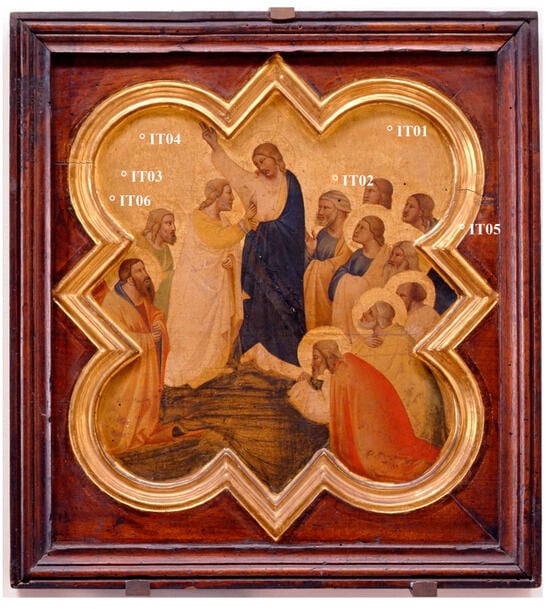
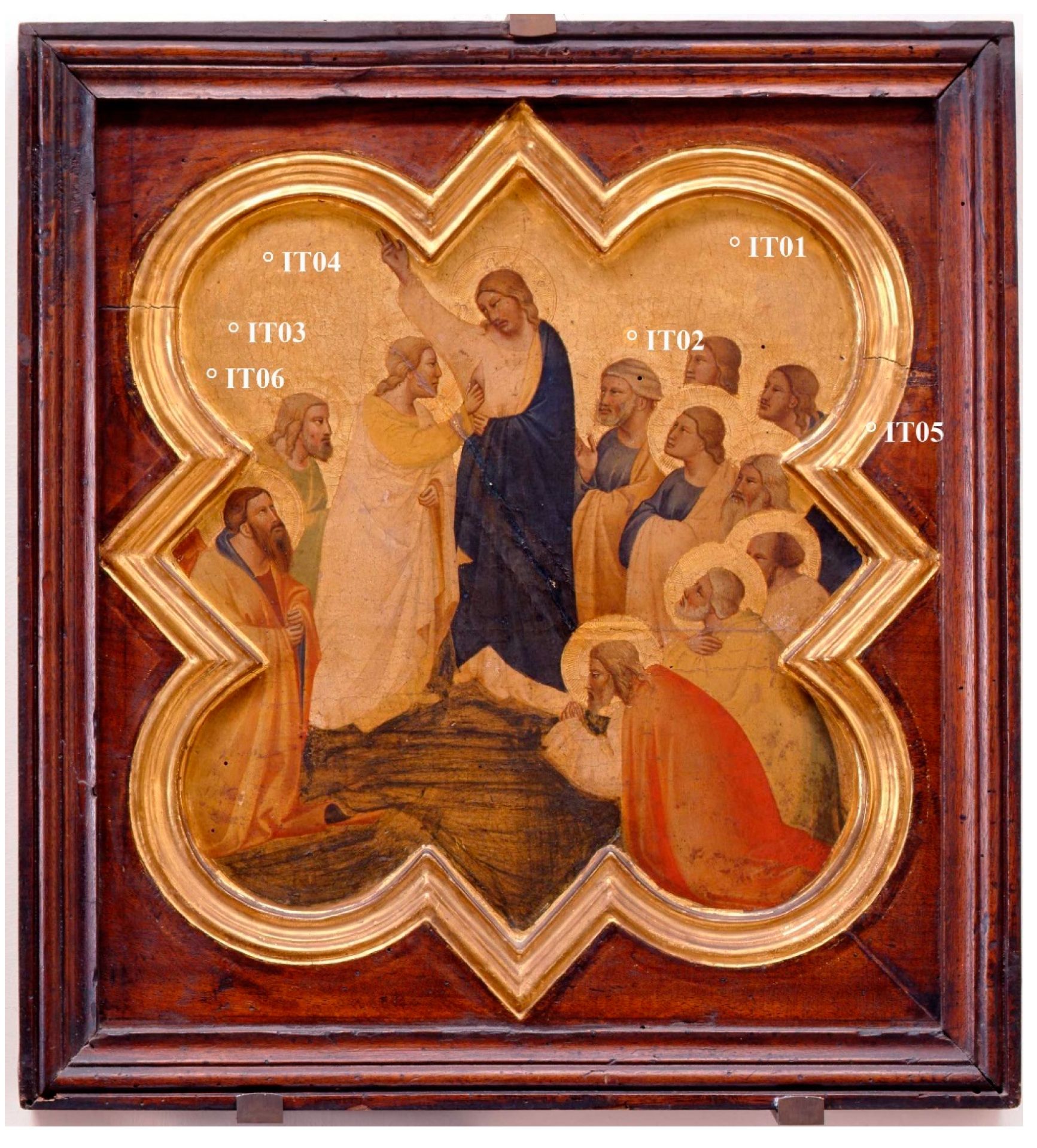
Figure 1.
Photo of the Incredulity of St. Thomas (inventory number 8593). The measuring points IT01, IT04, IT05, and IT06 are with single gold leaf, point n. IT02 is double leaf, and point IT03 is triple leaf. Height: 40.5 cm; width: 36.5 cm.
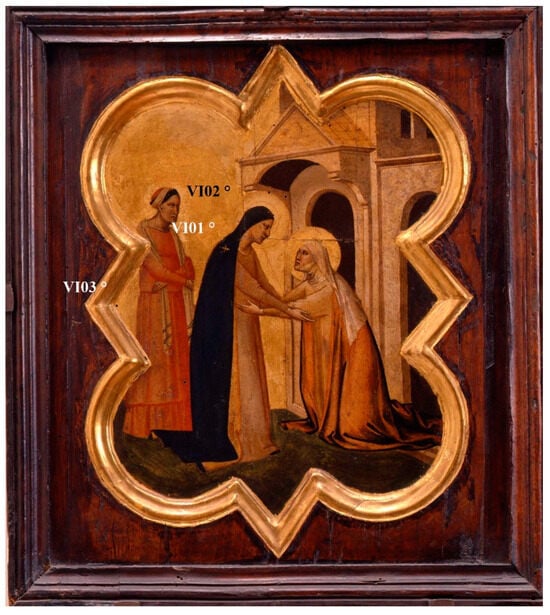
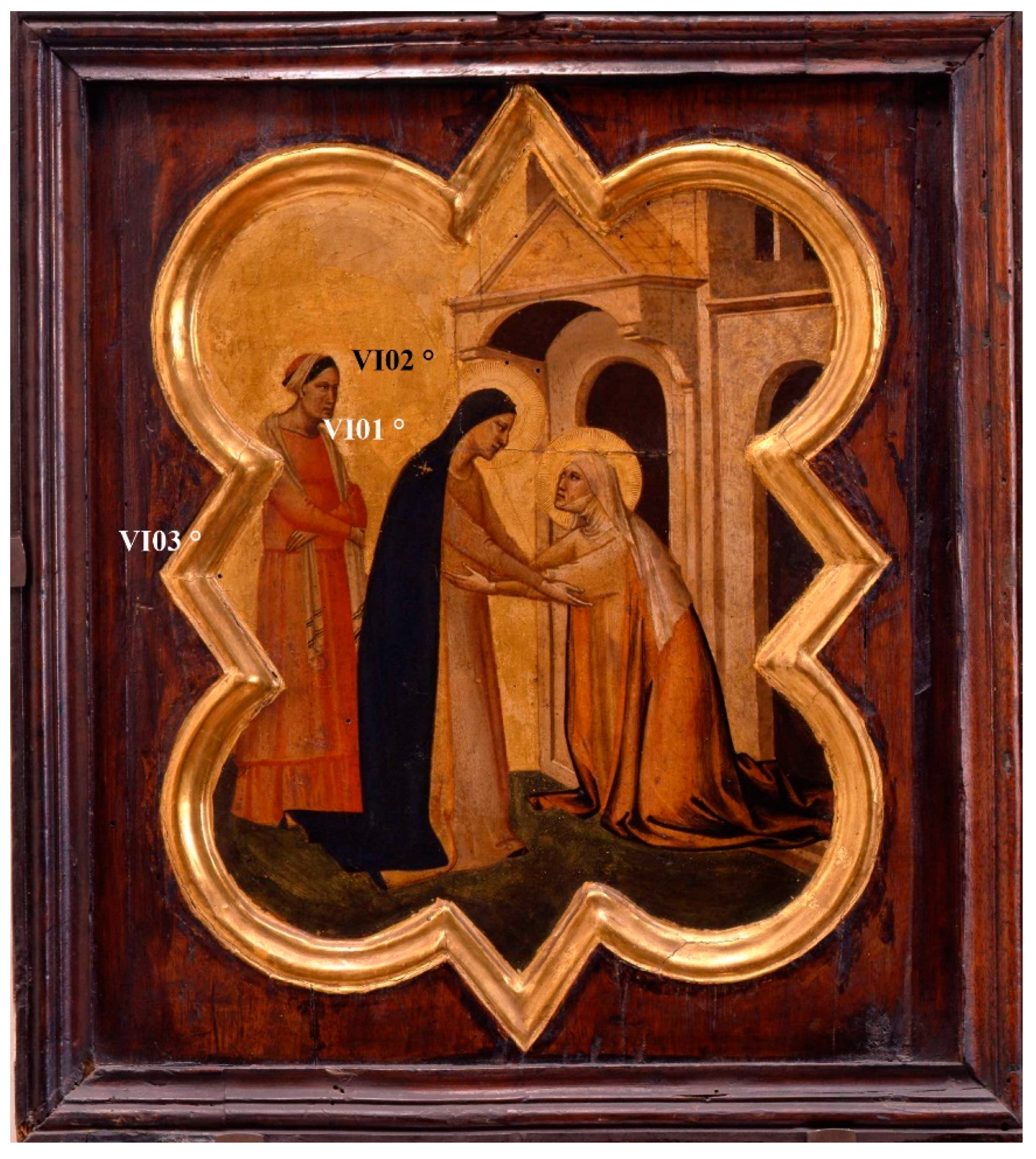
Figure 2.
Photo of The Visitation (inventory number 8582). Height: 35.5 cm; Width: 25.5 cm.
2.2. Instrument
Energy-dispersive X-ray fluorescence (ED-XRF) analysis was performed using a portable instrument designed at the University of Salento [28]. It is composed of an X-ray tube produced by MOXTEK® (Orem, UT, USA) with a palladium anode operating at 4–40 kV voltage and 0–100 µA current, and a Si-PIN detector produced by AMPTEK®, model XR_100CR, thermoelectrically cooled, with a beryllium window of 25 µm.
It has a resolution of 150 eV at 5.9 keV, a resolution of about 250 eV in the range 10–15 keV, and a pocket multi-channel analyser produced by AMPTEK® (Bedford, MA, USA), model MCA8000A, interfaced with a laptop.
An aluminium filter, with a thickness of 20 μm, was placed in front of the X-ray tube.
The working distance between instrument and paintings is equal to 5 mm.
The diameter of the X-ray beam is an ellipse, whose axes are equal to 2 mm and 3 mm.
Experimental measurements were carried out by using commercial gold leaf purchased from Sigma-Aldrich® (St. Louis, MO, USA) (thickness of 0.20 ± 0.02 μm; 99.9% wt). In particular, the different thicknesses of the gold were obtained by superimposing two, three, and four layers of gold leaf. This allowed us to obtain the standards used for calibration.
All samples were analysed at 15 kV voltage and 5 µA current, with an acquisition time of 60 s.
For each sample, three acquisitions were performed, and it was observed that the variations in the signal intensity values were less than 5%. In particular, for each acquisition, the intensities of the Au-Lα and Fe-Kα signals were determined by calculating their ratio with the respective uncertainties. The reported data were obtained by determining the weighted average of the three values.
The intensities of the ED-XRF peaks were determined using the Microcalc-Origin® 2020 software.
2.3. Determining the Thickness of the Gold
The peak intensity ratios of K or L line for selected elements are measured in order to determine the thickness. In particular, for infinitely thin samples, values for Kα/Kβ and Lα/Lβ peak intensity ratios (here, on Kα/Kβ or Lα/Lβ ratios) are generally tabulated [29,30].
The gold layer on the surface of a sample of thickness l (µm), with the appropriate energy excitement, produces a fluorescence X line Lα of intensity IAu; self-attenuation effects must be considered, as given by Equation (1).
where A represents a constant that takes into account the intensity of the radiation incident on the sample, the fluorescence yield for the radiation considered, the efficiency of the detector, and the relative distances among the sample, source, and detector; µ0 is the linear attenuation coefficient (µm−1) of element Au at incident energy E0; µ1 is the linear attenuation coefficient (µm−1) of element Au at energy of fluorescence E1 (9.7 keV).
The intensity IFe of the Kα fluorescence radiation produced by the iron at energy E2 = 6.4 keV, assumed to be of infinitesimal thickness, underlying the gold foil, can be determined from Equation (2) [31]:
where B represents a constant that takes into account the intensity of the radiation incident on the sample, the fluorescence yield for the radiation considered, the efficiency of the detector, and the relative distances between the sample, source, and detector; µ2 is the linear attenuation coefficient (µm−1) of element Au at fluorescence energy E2 (6.4 keV).
By considering the ratio between the two intensities (IAu/IFe) and indicating the overall constant with C, Equation (3) is obtained:
where the constants µ0, µ1, and µ2 are tabulated values, and so C is the only unknown parameter. Therefore, Equation (3) can be written in the form of Equation (4):
where the P2 and P3 parameters are tabulated, while the P1 parameter was determined by interpolation.
Therefore, for each measurement point, by measuring the ratio IAu/IFe with the relative uncertainty and knowing the values P2 and P3, it was possible to determine the gold thickness (l), with the relative uncertainty, by graphic extrapolation also taking into account the error on the parameter P1.
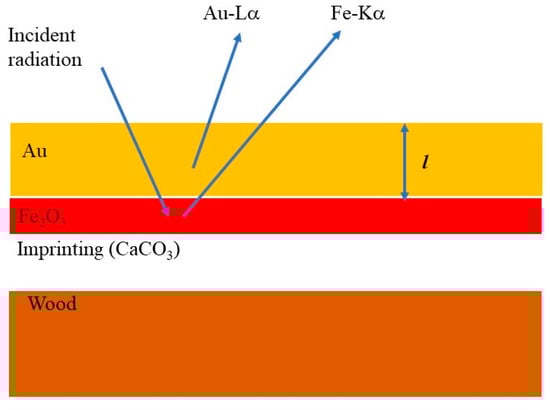
In order to determine the parameter P1, a multilayer sample was prepared as follows: a layer of calcium carbonate (CaCO3) was spread on a wooden board as a primer. This layer was then covered with bole (red ochre, Fe2O3) and finally the commercial gold leaf.
The different thicknesses of the gold were obtained by superimposing two, three, and four layers of gold leaf.
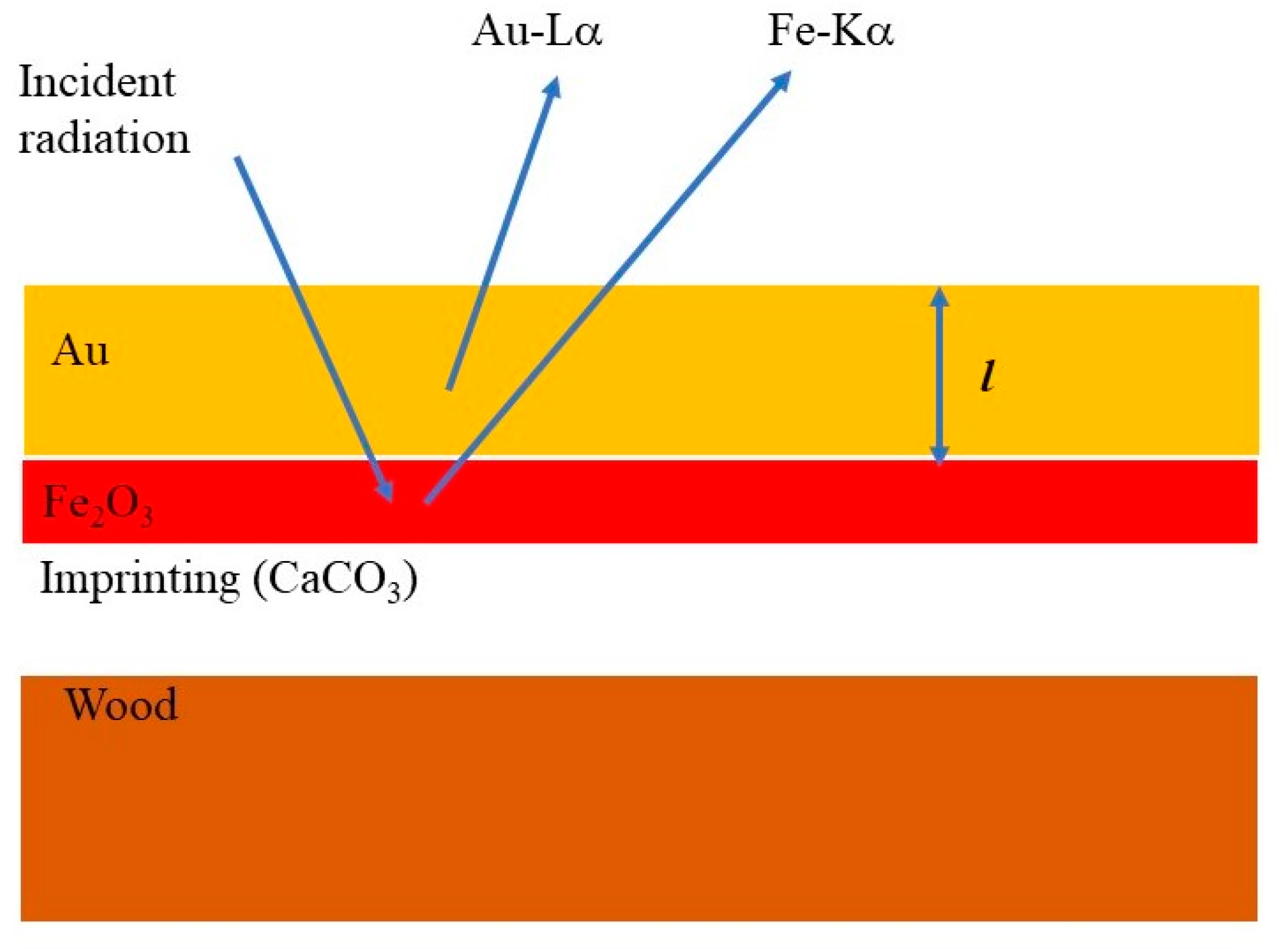
Figure 3 shows a simplified schematic of the sequence of layers of the multilayer sample prepared in laboratory.
Figure 3.
Simplified diagram of the sequence of the layers of the multilayer sample prepared in the laboratory.
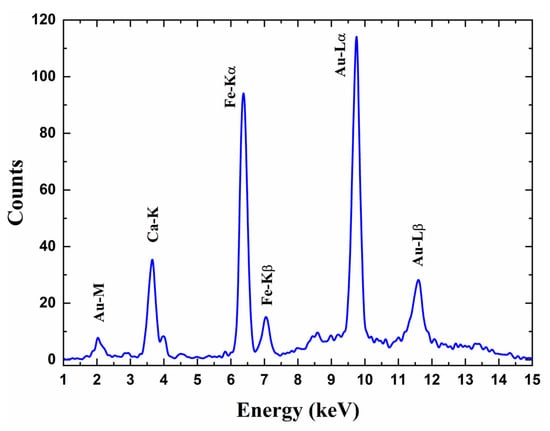
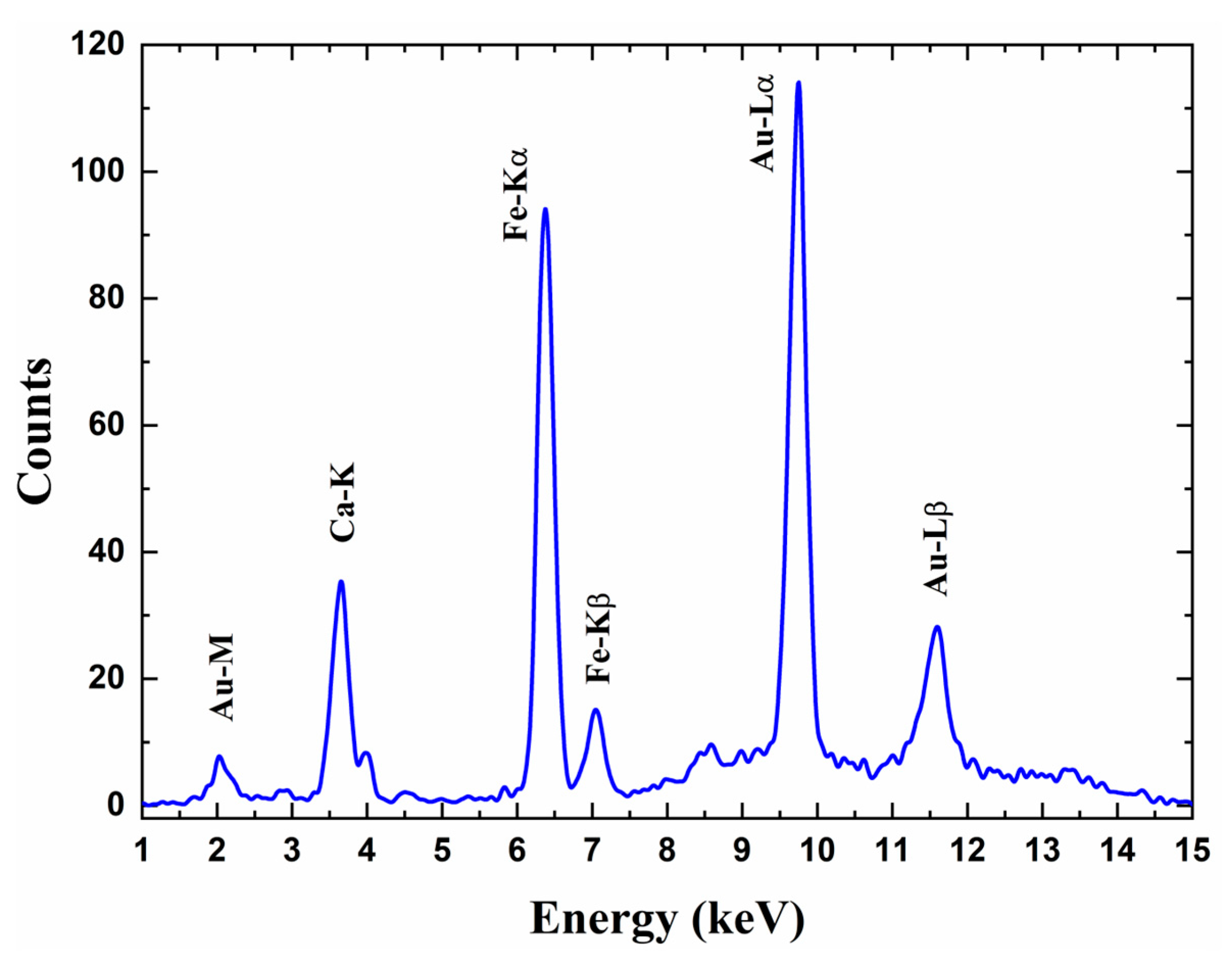
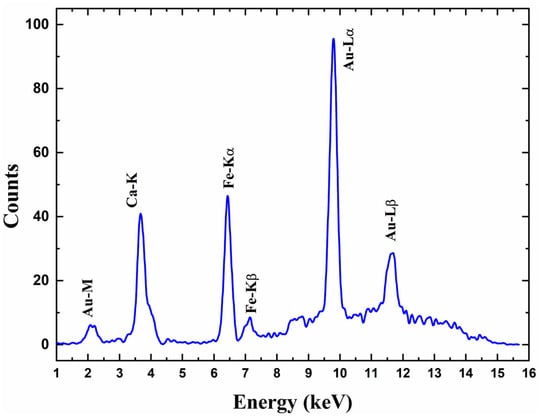
Figure 4 shows the ED-XRF spectrum of standard 4, which highlights the signals of the Ca-K (primer), Fe-Kα, and Kβ lines relating to the Armenian bolus and the Au-Lα, Au-Lβ, and Au-M lines, relating to gold coating.
Figure 4.
ED-XRF spectrum of a standard.
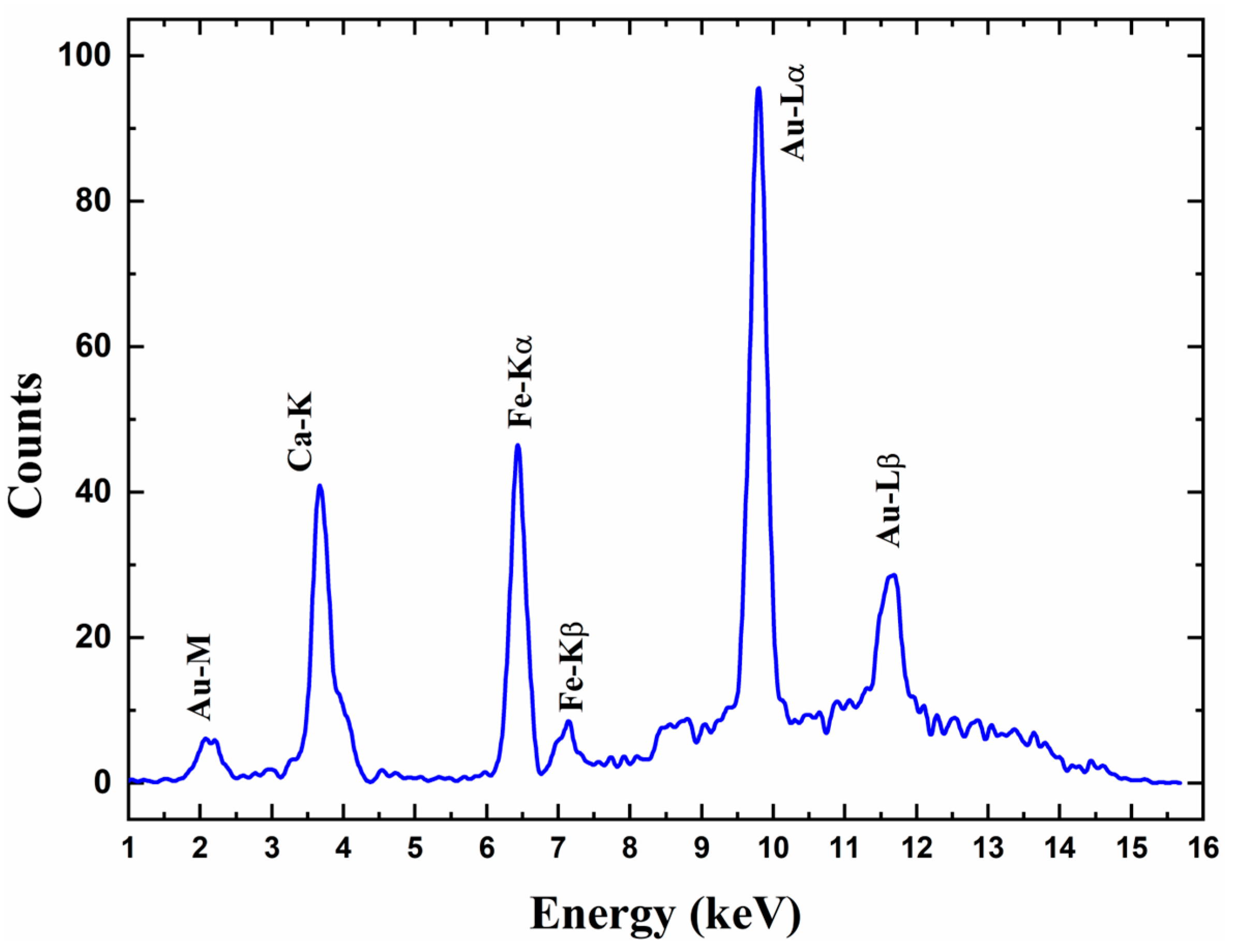
Figure 5 shows a typical ED-XRF spectrum of an analysed sample, which highlights the same signals. The intensities of the Fe-Kα and Kβ signals (given the partial overlap of the two signals) and Au-Lα were determined using the Microcalc-Origin® software using the Gaussian function:
where A is the signal intensity, xc represents the signal energy to be integrated, y0 represents the background, and w represents the peak width at half height (FWHM).
Figure 5.
Typical ED-XRF spectrum of the analysed samples.
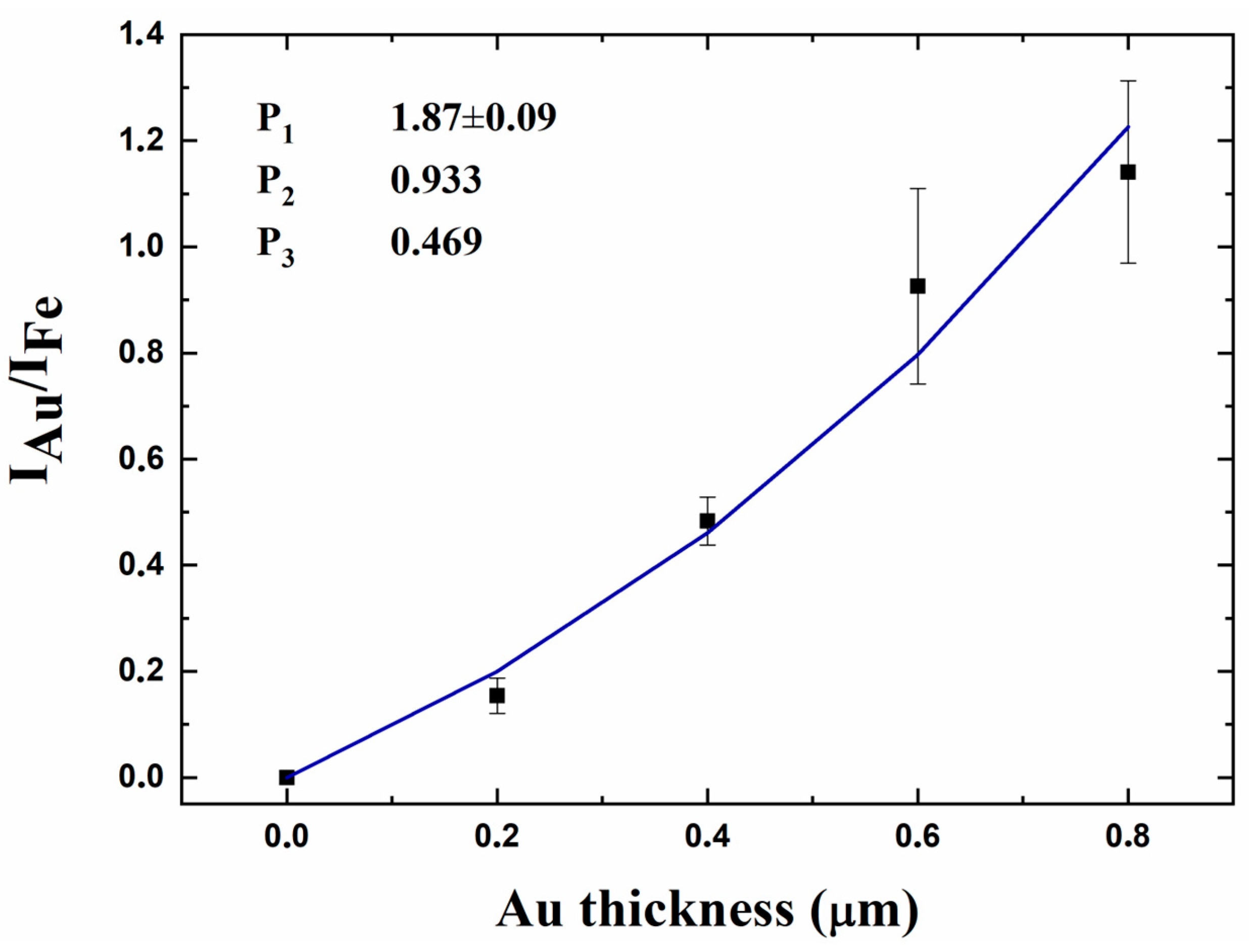
Figure 6 shows the intensity ratios as a function of gold thickness. The experimental data were interpolated with the function reported in Equation (4) in order to determine the parameter P1. The results obtained established that the parameter P1 is equal to (1.87 ± 0.09).
Figure 6.
Intensity ratios IAu/IFe as a function of gold thickness. The experimental data were interpolated with the function reported in Equation (4).
In particular, with an anode voltage of 15 kV, a maximum excitation energy of 10 keV can be assumed and the absorption coefficient of gold at this energy is equal to µ0 = 0.2125 µm−1 (tabulated value), the mass absorption coefficient of gold at 6.4 keV (energy of Fe-Kα radiation) is equal to µ2 = 0.7206 µm−1 (tabulated value), and the mass absorption coefficient of gold at 9.7 keV (energy of Au-Lα radiation) is equal to µ1 = 0.2512 µm−1 (tabulated value) [32].
In Equation (4), P2 = µ0 + µ2 and P3 = µ2 − µ1, which are without uncertainty since they are the sum and difference of the tabulated values.
We assumed that the calibration curve maintains the same trend even in the uncalibrated range (up to 1.22 µm).
Moreover, the effect of calcium (in the imprinting) was not considered since the calcium carbonate layer is underneath. Therefore, the calcium signal is attenuated by both the iron (ochre layer) and the gold layer.
3. Results and Discussion
Overall, 106 regions were analysed in situ and the determined gold thicknesses ranged from approximately 0.30 µm to 1.20 µm.
Table 1 provides a brief description of the measurement points analysed and their gold thicknesses.
Table 1.
Brief description of the measurement points analysed and their gold thickness.
The errors were determined by propagating the uncertainties on the calibration parameter P1 and on the intensities of the analytical signals of gold and iron. In particular, taking into account the calibration curves obtained for P1 ± ∆P1 and taking into account the range of the IAu/IFe ratio from Figure 6, by graphical extrapolation, a range of the gold thickness was obtained. Therefore, the mean value of this range provides the best estimate of the gold thickness, and the half-width of the range provides the uncertainty of the thickness.
The 106 analysed regions can be differentiated into three large clusters.
The first cluster includes approximately 75 regions with thicknesses between 0.30 µm and 0.60 µm. This group includes all the frames and unrestored backgrounds where there is no obvious overlapping of gold leaf. This allows us to evaluate the average thickness of the gold leaf used by Taddeo Gaddi in the creation of the precious artifacts. Performing the weighted average of the values relating to these regions, we find an average value of (0.34 ± 0.03) µm.
The second cluster includes 15 regions with gold thicknesses between 0.60 µm and 0.74 µm. This group contains most of the regions showing restorations: prevalent holes in which restoration interventions with additions of gold leaves are evident and rare degraded regions. These regions, identified visually, did not show the presence of other chemical elements by ED-XRF.
The third group includes 15 regions with gold thicknesses between 0.75 µm and 1.00 µm. These areas are all regions that visually show the overlapping of two layers of gold leaf. The weighted average of the thicknesses of these regions is equal to (0.75 ± 0.05) µm.
Within experimental errors, this thickness is comparable to double the value determined for a single layer of gold leaf.
Finally, there is the region indicated IT_03, where the overlapping of three layers of gold leaf is evident. The average thickness over multiple measurements performed in the same region is equal to (1.17 ± 0.08) µm. Within experimental errors, this value is comparable to three times the value determined for the individual layers.
Table 2 shows the average values of the gold thicknesses analysed and the gold thickness referred to a single gold leaf.
Table 2.
Average thickness values of the gold coating analysed, and gold thickness referring to a single gold leaf.
The experimental results obtained show that the thickness of the gold referred to a single gold leaf is very similar for the various areas analysed. This result demonstrates the skill and the remarkable technological capacity of the artists of the time in beating the gold and obtaining the desired decorations.
4. Conclusions
The analytical procedure used in this work allowed us to quantitatively determine, in a non-invasive and in situ way, the thickness of the gold leaf.
In particular, we investigated by ED-XRF the gold decorations used by Italian artist Taddeo Gaddi in the creation of the valuable artifacts known as “Formelle dell’armadio della sacrestia di Santa Croce” in Florence, Italy.
The experimental results obtained showed that the gold leaves used by the artist have thicknesses of approximately 0.3 and 0.4 µm. The regions showing restorations, holes, areas with added gold leaf, and degraded regions, did not show any different chemical compositions.
This methodology can certainly be used for other precious manufacts with gold coatings on ochre. In particular, the future hope is certainly to apply the same analytical methodology to the four paintings by Taddeo Gaddi preserved in the museums of Berlin and Munich in order to confirm the results obtained.
Author Contributions
Conceptualization, G.B., R.C., A.C., A.S., F.P. and A.B.; methodology, G.B., R.C., A.C., A.S., F.P. and A.B.; validation, G.B., R.C., A.C., A.S., F.P. and A.B.; formal analysis, G.B., R.C., A.C., A.S., F.P. and A.B.; investigation, G.B., R.C., A.C., A.S., F.P. and A.B.; resources, G.B., R.C., A.C., A.S., F.P. and A.B.; data curation, G.B., R.C., A.C., A.S., F.P. and A.B.; writing—original draft preparation, G.B., R.C., A.C., A.S., F.P. and A.B.; writing—review and editing, G.B., R.C., A.C., A.S., F.P. and A.B. All authors have read and agreed to the published version of the manuscript.
Funding
This research received no external funding.
Data Availability Statement
Data are contained within the article.
Acknowledgments
The authors thank Massimo Luggeri of the University of Salento, who has contributed to improving the quality of the figures.
Conflicts of Interest
The authors declare no conflicts of interest.
References
- Nazir, A.; Gokcekaya, O.; Md Masum Billah, K.; Ertugrul, O.; Jiang, J.; Sun, J.; Hussain, S. Multi-Material Additive Manufacturing: A Systematic Review of Design, Properties, Applications, Challenges, and 3D Printing of Materials and Cellular Metamaterials. Mater. Des. 2023, 226, 111661. [Google Scholar] [CrossRef] [Scilit]
- Dhez, P.; Weisbuch, C. Physics, Fabrication, and Applications of Multilayered Structures; Springer: Boston, MA, USA, 1988; p. 337. ISBN 978-1-4757-0093-0. [Google Scholar]
- Brocchieri, J.; Sabbarese, C. Coating Thickness of Plated Objects Using XRF Technique Concentrations. Il Nuovo Cimento C 2021, 43, 1–9. [Google Scholar] [CrossRef] [Scilit]
- Scott, D.A.; Dodd, L.S. Examination, Conservation and Analysis of a Gilded Egyptian Bronze Osiris. J. Cult. Herit. 2002, 3, 333–345. [Google Scholar] [CrossRef] [Scilit]
- Manfredda, N.; Buscaglia, P.; Gallo, P.; Borla, M.; Aicardi, S.; Poggi, G.; Baglioni, P.; Nervo, M.; Scalarone, D.; Borghi, A.; et al. An Ancient Egyptian Multilayered Polychrome Wooden Sculpture Belonging to the Museo Egizio of Torino: Characterization of Painting Materials and Design of Cleaning Processes by Means of Highly Retentive Hydrogels. Coatings 2021, 11, 1335. [Google Scholar] [CrossRef] [Scilit]
- Duran, A.; Perez-Rodríguez, J.L.; Jimenez De Haro, M.C.; Herrera, L.K.; Justo, A. Degradation of Gold and False Golds Used as Gildings in the Cultural Heritage of Andalusia, Spain. J. Cult. Herit. 2008, 9, 184–188. [Google Scholar] [CrossRef] [Scilit]
- Manca, R.; Chiarantini, L.; Tartaglia, E.; Soldovieri, F.; Miliani, C.; Catapano, I. Non-Invasive Characterization of Maiolica Layer Structure by Terahertz Time-Domain Imaging. Coatings 2023, 13, 1268. [Google Scholar] [CrossRef] [Scilit]
- Ricci, C.; Buscaglia, P.; Angelici, D.; Piccirillo, A.; Matteucci, E.; Demonte, D.; Tasso, V.; Sanna, N.; Zenucchini, F.; Croci, S.; et al. A Technical Study of Chinese Buddhist Sculptures: First Insights into a Complex History of Transformation through Analysis of the Polychrome Decoration. Coatings 2024, 14, 344. [Google Scholar] [CrossRef] [Scilit]
- Guerra, M.F.; Calligaro, T. Gold Cultural Heritage Objects: A Review of Studies of Provenance and Manufacturing Technologies. Meas. Sci. Technol. 2003, 14, 1527–1537. [Google Scholar] [CrossRef] [Scilit]
- Darque-Ceretti, E.; Felder, E.; Aucouturier, M. Gilding of Cultural Heritage Artefacts: An Elaborated Technology. Surf. Eng. 2013, 29, 146–152. [Google Scholar] [CrossRef] [Scilit]
- Tissot, I.; Troalen, L.G.; Manso, M.; Ponting, M.; Radtke, M.; Reinholz, U.; Barreiros, M.A.; Shaw, I.; Carvalho, M.L.; Guerra, M.F. A Multi-Analytical Approach to Gold in Ancient Egypt: Studies on Provenance and Corrosion. Spectrochim. Acta Part B At. Spectrosc. 2015, 108, 75–82. [Google Scholar] [CrossRef] [Scilit]
- Cennini, C.; Serchi, M. Il Libro dell’Arte, 1st ed.; F. Le Monnier: Firenze, Italy, 1991; 194p, ISBN 978-88-00-85999-8. [Google Scholar]
- Herringham, C.J.P. The Book of the Art of Cennino Cennini: A Contemporary Practical Treatise on Quattrocento Painting; George Allen & Unwin: London, UK, 1922; p. 334. [Google Scholar]
- Brocchieri, J.; Sabbarese, C. Thickness Determination of the Gilding on Brass Materials by XRF Technique. Nucl. Instrum. Methods Phys. Res. Sect. B Beam Interact. Mater. At. 2021, 496, 29–36. [Google Scholar] [CrossRef] [Scilit]
- Scialla, E.; Brocchieri, J.; Sabbarese, C. Comparison of Different Methodologies for Estimating Gold Thickness in Multilayer Samples Using XRF Spectra. Appl. Radiat. Isot. 2023, 191, 110517. [Google Scholar] [CrossRef] [Scilit] [PubMed]
- Pessanha, S.; Queralt, I.; Carvalho, M.L.; Sampaio, J.M. Determination of Gold Leaf Thickness Using X-Ray Fluorescence Spectrometry: Accuracy Comparison Using Analytical Methodology and Monte Carlo Simulations. Appl. Radiat. Isot. 2019, 152, 6–10. [Google Scholar] [CrossRef] [Scilit] [PubMed]
- Gójska, A.M.; Miśta-Jakubowska, E.A.; Kozioł, K.; Wasilewski, A.; Diduszko, R. The K-X-Ray Intensity Ratios as a Tool of Examination and Thickness Measurements of Coating Layers. Measurement 2024, 224, 113871. [Google Scholar] [CrossRef] [Scilit]
- Porcaro, M.; Cesareo, R.; Bustamante, A.; Brunetti, A. Characterization of an Ancient Bimetallic Alloy from Moche Civilization (Peru). Materials 2023, 16, 7211. [Google Scholar] [CrossRef] [Scilit]
- Lopes, F.; Melquiades, F.L.; Appoloni, C.R.; Cesareo, R.; Rizzutto, M.; Silva, T.F. Thickness Determination of Gold Layer on pre-Columbian Objects and a Gilding Frame, Combining pXRF and PLS Regression. X-Ray Spectrom. 2016, 45, 344–351. [Google Scholar] [CrossRef] [Scilit]
- Trojek, T.; Prokeš, R.; Šefců, R.; Bilavčíková, H.; Čechák, T. Confocal X-Ray Fluorescence Spectrometer for in-Situ Analyses of Paintings. Radiat. Phys. Chem. 2017, 137, 238–242. [Google Scholar] [CrossRef] [Scilit]
- Mori, K.; Hourai, T.; Matsuyama, T.; Zhuo, S.; Tsuji, K. Confocal Micro-X-Ray Fluorescence Analysis for Difference Identification of Ceramic Samples. Anal. Sci. 2024, 40, 367–373. [Google Scholar] [CrossRef] [Scilit]
- Fiorini, C.; Gianoncelli, A.; Longoni, A.; Zaraga, F. Determination of the Thickness of Coatings by Means of a New XRF Spectrometer. X-Ray Spectrom. 2002, 31, 92–99. [Google Scholar] [CrossRef] [Scilit]
- Orsilli, J.; Migliori, A.; Padilla-Alvarez, R.; Martini, M.; Galli, A. AR-XRF Measurements and Data Treatment for the Evaluation of Gilding Samples of Cultural Heritage. J. Anal. At. Spectrom. 2023, 38, 174–185. [Google Scholar] [CrossRef] [Scilit]
- Cesareo, R.; Rizzutto, M.A.; Brunetti, A.; Rao, D.V. Metal Location and Thickness in a Multilayered Sheet by Measuring Kα/Kβ, Lα/Lβ and Lα/Lγ X-Ray Ratios. Nucl. Instrum. Methods Phys. Res. Sect. B Beam Interact. Mater. At. 2009, 267, 2890–2896. [Google Scholar] [CrossRef] [Scilit]
- Ciarlo, L.; Chiari, M.; Galassi, M.C.; Ferretti, M.; Sideras-Haddad, E.; Zucchiatti, A.; Castagnotto, E. Practices and Rules of 16th Century Genoese Gilding: Exploring Gold Leaf Thickness and Caratage through X-Ray and Ion Beam Techniques. Heritage 2024, 7, 3630–3642. [Google Scholar] [CrossRef] [Scilit]
- Klic, L.; Nelson, J.K.; Pattuelli, M.C.; Provo, A. Florentine Renaissance Drawings: A Linked Catalog for the Semantic Web. Art Doc. J. Art Libr. Soc. N. Am. 2018, 37, 33–43. [Google Scholar] [CrossRef] [Scilit]
- Micheluzzi, G.M. Der Schlagschatten im Trecento am Beispiel von Taddeo Gaddis Verkündigung an die Hirten. Z. Lit. Linguist. 2015, 45, 98–120. [Google Scholar] [CrossRef] [Scilit]
- Buccolieri, A.; Castellano, A.; Degl’Innocenti, E.; Cesareo, R.; Casciaro, R.; Buccolieri, G. EDXRF Analysis of Gold Jewelry from the Archaeological Museum of Taranto, Italy. X-Ray Spectrom. 2017, 46, 421–426. [Google Scholar] [CrossRef] [Scilit]
- Cesareo, R.; De Assis, J.T.; Roldán, C.; Bustamante, A.D.; Brunetti, A.; Schiavon, N. Multilayered Samples Reconstructed by Measuring Kα/Kβ or Lα/Lβ X-Ray Intensity Ratios by EDXRF. Nucl. Instrum. Methods Phys. Res. Sect. B Beam Interact. Mater. At. 2013, 312, 15–22. [Google Scholar] [CrossRef] [Scilit]
- Cesareo, R.; Buccolieri, G.; Castellano, A.; Lopes, R.T.; De Assis, J.T.; Ridolfi, S.; Brunetti, A.; Bustamante, A. The Structure of Two-layered Objects Reconstructed Using EDXRF-analysis and Internal X-ray Ratios. X-Ray Spectrom. 2015, 44, 233–238. [Google Scholar] [CrossRef] [Scilit]
- Beckhoff, B.; Kanngießer, B.; Langhoff, N.; Wedell, R.; Wolff, H. Handbook of Practical X-Ray Fluorescence Analysis; Springer: Berlin/Heidelberg, Germany, 2006; p. 863. ISBN 978-3-540-28603-5. [Google Scholar]
- Seltzer, S. Tables of X-Ray Mass Attenuation Coefficients and Mass Energy-Absorption Coefficients, NIST Standard Reference Database 126 1995. Available online: http://physics.nist.gov/PhysRefData/XrayMassCoef/cover.html (accessed on 8 December 2024).

Disclaimer/Publisher’s Note: The statements, opinions and data contained in all publications are solely those of the individual author(s) and contributor(s) and not of MDPI and/or the editor(s). MDPI and/or the editor(s) disclaim responsibility for any injury to people or property resulting from any ideas, methods, instructions or products referred to in the content. |
© 2025 by the authors. Licensee MDPI, Basel, Switzerland. This article is an open access article distributed under the terms and conditions of the Creative Commons Attribution (CC BY) license (https://creativecommons.org/licenses/by/4.0/).