
Article

A Comprehensive Protocol for the Life Cycle Assessment of Green Systems for Painting Cleaning

by
Andrea Macchia
1,
Benedetta Paolino
2,
Camilla Zaratti
3,*,
Fernanda Prestileo
4,
Federica Sacco
5,
Mauro Francesco La Russa
6 and
Silvestro Antonio Ruffolo
6
1
YOCOCU APS—Youth in Conservation of Cultural Heritage, Via Tasso 108, 00185 Rome, Italy
2
Italian Ministry of Culture, National Museums of Siena, Via di San Pietro 29, 53100 Siena, Italy
3
Sciences and Chemical Technologies Department, Tor Vergata University Rome, Via della Ricerca Scientifica 1, 00133 Rome, Italy
4
National Research Council-Institute of Atmospheric Sciences and Climate (CNR-ISAC), Via del Fosso del Cavaliere 100, 00133 Rome, Italy
5
ICOM—International Council of Museums Italy-PSE, Palazzo Lombardia 1, entrata n. 3, 20124 Milan, Italy
6
Department of Biology, Ecology and Earth Sciences (DiBEST), University of Calabria, 87036 Arcavacata, Italy
*
Author to whom correspondence should be addressed.
Heritage 2025, 8(12), 544; https://doi.org/10.3390/heritage8120544
Submission received: 4 November 2025 / Revised: 4 December 2025 / Accepted: 15 December 2025 / Published: 17 December 2025

Abstract

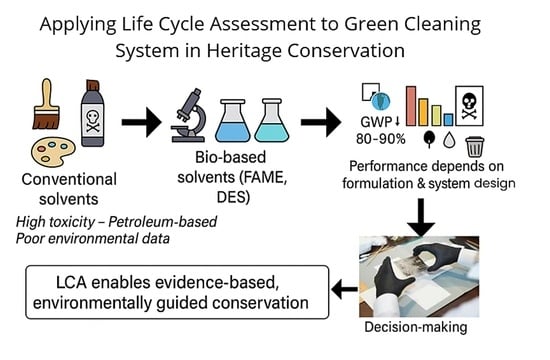
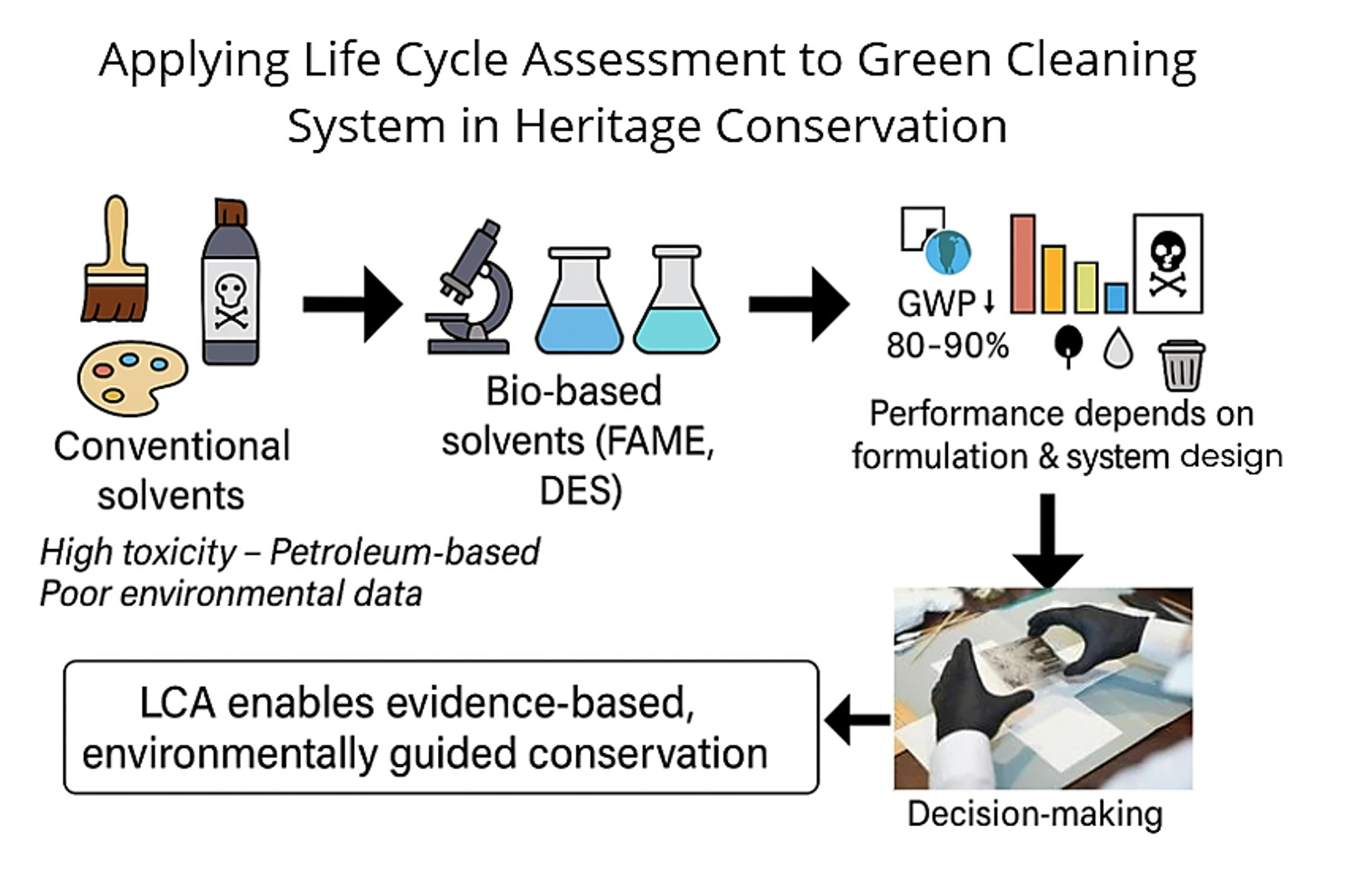
The environmental sustainability of cleaning materials used in heritage conservation remains poorly quantified despite growing attention to the replacement of hazardous petroleum-based solvents with bio-based alternatives. This study applies a comprehensive Life Cycle Assessment (LCIA) to compare conventional solvents with innovative bio-based formulations, including Fatty Acid Methyl Esters (FAMEs), Deep Eutectic Solvents (DES), and aqueous or organogel systems used for cleaning painted surfaces. Following ISO 14040/14044 standards and using the Ecoinvent v3.8 database with the EF 3.1 impact method, three functional units were adopted to reflect material and system-level scales. Results demonstrate that water-rich systems, such as agar gels and emulsified organogels, yield significantly lower climate and toxicity impacts (up to 85–90% reduction) compared with petroleum-based benchmarks, while FAME and DES exhibit outcomes highly dependent on allocation rules and baseline datasets. When including application materials, cotton wipes dominate total environmental burdens, emphasizing that system design outweighs solvent substitution in improving sustainability. The study provides reproducible data and methodological insights for integrating LCIA into conservation decision-making, contributing to the transition toward evidence-based and environmentally responsible heritage practices.

Graphical Abstract

1. Introduction

The conservation of cultural heritage has undergone a significant conceptual shift over the past two decades. The field has moved from a discipline primarily focused on material authenticity and reversibility toward one increasingly shaped by environmental accountability and chemical safety [1,2,3,4,5]. This transformation reflects the broader goals of the European Green Deal (Regulation EU 2021/1119) and the United Nations 2030 Agenda, positioning cultural heritage conservation as an unexpected yet valuable testing ground for the practical implementation of green chemistry and life-cycle thinking [6,7,8,9]. Bibliometric analyses show an exponential increase in publications on sustainability in heritage conservation. At the same time, major European research initiatives—TECTONIC (https://www.tectonicproject.eu/), SCORE (https://score-project.net/), GoGreen (https://gogreenconservation.eu/), and GREENART (https://www.greenart-project.eu/)—are investing substantial resources in the development of environmentally responsible conservation methodologies. However, this surge in activity has also introduced semantic ambiguities and methodological inconsistencies that risk replacing scientific substance with rhetorical claims. The growing use of “green” terminology does not automatically ensure real environmental progress [10,11,12].
Increasing environmental awareness among conservators has encouraged the gradual replacement of petroleum-based solvents—such as aliphatic hydrocarbons, toluene, and acetone—with bio-based alternatives. The new materials comprise several chemical classes that typically offer lower volatility and reduced acute toxicity. Fatty Acid Methyl Esters (FAMEs), derived from vegetable or waste oils through triglyceride transesterification, have emerged as promising substitutes for petroleum-based solvents in varnish removal and consolidation treatments [13,14]. Their molecular structure, typically consisting of C12-C18 methyl esters, provides favorable dissolution properties of non-polar resins, while maintaining extremely low vapor pressure (<0.01 mmHg at 20 °C). Bio-acetals such as Solketal (2,2-dimethyl-1,3-dioxolane-4-methanol) [15], synthesized from glycerol vaporization [2], represent another promising class. They offer controlled volatility and compatibility with both natural resins and synthetic consolidants [7]. These compounds, obtained from biodiesel co-products, exemplify the circular economy approach increasingly sought in the development of conservation materials. Deep Eutectic Solvents (DES) and Natural Deep Eutectic Solvents (NADES)—formed by combining hydrogen-bond donors and acceptors at specific molar ratios—have attracted considerable interest because of their negligible volatility and tunable physicochemical properties [16,17,18,19,20,21]. Common systems include choline chloride:glycerol (1:2), choline chloride:urea (1:2), and natural combinations such as citric acid:glucose or betaine:glycerol [22,23,24]. These eutectic mixtures exhibit low vapor pressures (<10−6 mmHg) and show high selectivity toward specific soiling types, making them attractive candidates for controlled cleaning applications on sensitive substrates. However, recent Life-Cycle Assessment studies have challenged their presumed environmental superiority, indicating that the production of choline chloride: glycerol DES may require more energy and water consumption than conventional alcohols [25].
Non-ionic surfactants and biosurfactants have also reshaped cleaning methodologies in conservation practice. Alkyl polyglucosides (APGs), derived from renewable glucose sources, combine high biodegradability with low aquatic toxicity and have demonstrated effective performance in limestone and fresco cleaning applications [26]. Rhamnolipids—biosurfactants produced through Pseudomonas aeruginosa fermentation, composed of rhamnose sugars linked to β-hydroxy fatty acids—show promising potential for wall paintings and organic materials, although their use is complicated by pH sensitivity and batch-to-batch variability. These surfactant-based formulations enable micro- and nanoemulsion systems that reduce free solvent content by 70–95% while maintaining cleaning efficacy. This is particularly relevant for water-sensitive substrates, where traditional aqueous methods are unsuitable [27].
Polymeric hydrogels, including polysaccharide- and poly(vinyl alcohol)-based systems, have further reduced volatile organic compound emissions by enabling controlled cleaning through precise solvent delivery [28]. These materials can be broadly categorized according to their mechanical properties and removal characteristics. Rigid gels, such as those based on agar or gellan gum, offer fixed geometry, controlled fluid release, and sufficient cohesive strength to be removed as intact films. This property minimizes residue deposition on treated surfaces [29]. In contrast, soft gels—including Carbopol and cellulose ether formulations—provide greater conformability to irregular substrates but typically require post-application clearing with cotton swabs moistened with appropriate solvents, since polymer traces may persist if not carefully removed [29,30,31,32]. This distinction carries practical implications: rigid gels simplify cleaning protocols and reduce material consumption, whereas soft gels introduce additional procedural steps and consumables that influence both operational efficiency and environmental burden.
A critical consideration in conservation practice concerns the potential for long-term chemical interactions between residual gel components (whether they are polymeric traces, cross-linking agents, or trapped solvents) and sensitive painted surfaces. Recent studies have emphasized the importance of systematic residue assessment after gel application, particularly for formulations characterized by weak or reversible cross-linking [33]. Water-based gelling matrices are theorized to lower substrate damage risk by limiting liquid penetration depth and modulating solvent action kinetics. However, the environmental implications associated with residue removal management remain largely unquantified in the current literature. These materials also display significant molecular complexity, characterized by tunable network architectures and responsive rheological behavior, which enable their formulation to be tailored to specific conservation challenges [34,35,36,37,38,39,40,41,42].
The designation of a material as “green” or “bio-based” does not necessarily reflect a lower environmental impact. True sustainability depends on full life-cycle factors, including raw-material sourcing, processing, and disposal or degradation pathways. The prevailing narrative remains dominated by qualitative arguments—such as renewable origin, low volatility, and operator safety—rather than quantitative, system-based assessments. As emphasized by Capello et al. [43] and Jiménez-Gonzalez [44], the greenness of a solvent cannot be inferred solely from its chemical class or source. A substance may be biodegradable and non-toxic during use, yet still entail substantial hidden impacts due to energy-intensive synthesis, feedstock cultivation, or waste treatment requirements—a phenomenon known as “regrettable substitution” [45]. Recent studies have begun to clarify these contradictions. Paolino et al. [46] demonstrated that traditional solvent-based varnish removal contributes significantly to climate change and human toxicity. However, they also demonstrated that the direct substitution of traditional solvent-based systems with bio-based alternatives does not automatically reduce overall environmental impact. These findings confirm that presumed eco-friendly formulations must be validated through complete life-cycle data before being generalized as sustainable options. Consequently, Life Cycle Assessment (LCIA) has emerged as the only scientifically robust framework capable of objectively comparing the environmental performance of conventional and innovative solvents [47,48,49,50].
Standardized under ISO 14040:2006 and ISO 14044:2006, LCIA systematically [51] quantifies impacts across all life-cycle stages—raw material extraction, production, use, and disposal. These impacts are expressed through categories such as climate change potential, eutrophication, human toxicity, and water depletion [52]. When integrated with green chemistry metrics—such as Hansen Solubility Parameters and the Integrated Toxicity Index [10]—LCIA provides a quantitative means to rank solvents simultaneously by performance and environmental burden. Recent frameworks such as GEARS and Unified Greenness Theory [53,54] further emphasized the integration of EHS parameters with LCIA-derived metrics to avoid subjective safety classifications. Despite these methodological advances, systematic LCIA applications within cultural heritage conservation remain limited.
Existing heritage-related studies have largely focused on tourism infrastructure, on isolated material categories, or on single impact indicators—typically carbon footprint calculations, which provide incomplete environmental profiles and may mislead decision-making [55,56,57,58,59,60]. Most green cleaning technologies have been optimized for safety and cleaning efficacy but have not yet been evaluated in terms of global warming potential, resource depletion, or ecotoxicity. As highlighted by Winterton [61], solvent sustainability depends not only on intrinsic chemical properties but also on factors such as production scale, recovery, and waste management—complexities rarely captured in laboratory-scale conservation studies. This methodological gap prevents an objective assessment of whether bio-based systems truly outperform petrochemical benchmarks once cradle-to-gate inventories are considered [62,63,64,65,66,67].
The present study addresses the current lack of quantitative environmental assessment in heritage conservation by conducting a comprehensive multi-indicator LCIA of solvent-based cleaning treatments applied to painted artworks. Several conservation treatment scenarios are examined, including material production, transportation, application procedures, and waste management, to determine their overall environmental impact across multiple categories:
  • climate change (GWP100);
  • freshwater ecotoxicity (CTUe);
  • human toxicity, both carcinogenic and non-carcinogenic (CTUh);
  • water consumption (AWARE);
  • hazardous waste generation.
Through a comparative analysis of traditional solvent systems versus bio-based and green chemistry alternatives applied to real case studies from conservation practice, this research establishes a replicable methodological framework for evidence-based material selection. The study moves beyond qualitative safety considerations to provide quantitative data indicating whether the substitution of conventional solvents with alternatives marketed as “green” yields demonstrable environmental benefits across all impact categories or whether such substitution introduces trade-offs that merely shift impacts from one dimension to another. This LCIA-based approach aims to support informed decision-making in conservation practice and to serve as a foundation for future, more comprehensive environmental assessments in heritage science.

2. Materials and Methods

This study evaluates the environmental performance of green solvent systems and cleaning formulations used in heritage conservation by comparing their life-cycle impacts with those of conventional solvents commonly used in painting cleaning.
The functional unit varies by analysis level, and environmental impacts are expressed as follows:
  • First, as per kilogram of formulation, to allow material-to-material comparison;
  • Second, normalized per 100 mL of usable solution to account for density differences relevant in practical application;
  • Lastly, for a complete treatment scenario, they are scaled as a 0.5 kg application mass to quantify system-level impacts, including application media.
The approach follows ISO 14040:2006/14044:2006 standards. These frameworks were adapted to the specific constraints of conservation practice, characterized by small material quantities, episodic use, and substrate sensitivity that prevent systematic recovery or recycling.
The methodological framework builds on the pilot LCIA protocol developed by Paolino et al. [46] for painting conservation materials. Their cradle-to-gate system boundary was adopted, focusing on production, distribution, and disposal, while excluding use-phase energy and infrastructure. This approach is recognized as appropriate for cultural heritage applications, where material impacts dominate over operational energy inputs.

2.1. Green Formulations

This study evaluates thirteen green cleaning systems and five conventional baseline formulations selected from peer-reviewed conservation literature (Table 1). Formulation compositions, operational concentrations, and application protocols were taken from published protocols to ensure more reliable environmental indicators, particularly for materials with limited industrial LCIA data availability.
Baseline selections were guided by established conservation protocols. When compositional ranges were reported in the literature, median values were adopted to ensure methodological consistency. For multi-component systems, the formulations considered correspond to the operational concentrations used in practice rather than to laboratory stock solutions. The formulations listed in Table 1 were selected to represent distinct chemical classes and delivery strategies currently employed in conservation practice, rather than to provide exhaustive coverage of all available cleaning systems. The primary selection criterion was the availability of validated Life Cycle Inventory (LCI) data within Ecoinvent v3.8, ensuring methodological consistency with ISO 14040:2006/14044:2006 requirements for data quality and reproducibility [51,52].
Polysaccharide-based gelling agents, including agar, gellan gum, agarose, and pectin, were excluded from the comparative assessment. A systematic search of the Ecoinvent v3.8 database confirmed the absence of cradle-to-gate datasets for these materials. Unlike synthetic polymers (Carbopol, PVA, and PVP), whose production processes are standardized and well-documented, polysaccharide gels derive from complex biological sources. Agar is extracted from red algae (Gelidium, Gracilaria) harvested primarily in Asia-Pacific regions, while gellan gum is produced by bacterial fermentation of Sphingomonas elodea [77]. These production chains involve geographically dispersed cultivation, harvesting, and purification processes, with limited transparency in peer-reviewed literature [78,79]. Including such materials using proxy data or approximations would introduce unacceptable uncertainty, potentially compromising the reproducibility and comparability of the LCIA.
Similarly, emerging application methods such as agar spray-gel emulsions were excluded because standardized formulation protocols and reproducible compositional data are still limited. The LCIA framework developed in this study can be readily extended to these systems once robust inventory data become available. Highlighting this gap is an intended outcome of the present work, rather than artificially circumventing it.
The conventional baselines (white spirit, acetone, MIBK, ethanol, and Triton X-100) were selected because they are among the most widely documented solvents in conservation literature and provide well-established reference points for comparative analysis.

2.2. Life Cycle Inventory and Characterization Factors

Environmental impacts were quantified using Ecoinvent v3.8 (cut-off system model, GLO and RER geographic scopes) and Environmental Footprint v3.1 characterization factors. The assessment covers climate change (GWP100, IPCC AR6), freshwater ecotoxicity (CTUe), human toxicity—carcinogenic and non-carcinogenic (CTUh-carc, CTUh-non-carc, and USEtox v2.0), water consumption (AWARE), and hazardous waste generation [80,81,82,83,84,85,86,87,88,89,90,91,92,93].
Table 2 reports characterization factors (CF) used for all components. Uncertainty levels were stratified as follows: direct Ecoinvent matches (±15–25%), functional proxies for specialty polymers (±25–40%), and synthesis-route calculations for acetals (±30–50%).
Impact calculations for synthetic acetals and Deep Eutectic Solvents were derived from stoichiometric precursor balances incorporating reaction yields and process energy requirements. For multi-component gels and microemulsion systems, the assessment reflects complete compositional accounting, including polymers, surfactants, co-solvents, water fractions, processing energy inputs, and transport burdens at the operational concentrations documented in conservation literature.
As an illustrative example, the carbon footprint of Solketal was estimated using
(0.697 kg glycerol × 0.90) + (0.439 kg acetone × 2.44) + 0.05 (reaction energy) = 1.75 kg CO2 eq kg−1.
The same approach was applied to methylal, glycerol formal, and butylal.

2.3. Impact Calculation Methodology

Total formulation impacts were calculated by combining material production, processing energy, transport, and disposal, as shown in Equation (1):
I_total = Σi(mi × CFi) + E_process + T_transport + W_disposal
where mi is the mass fraction of component I and CFi is the corresponding characterization factor reported in Table 2.
Other parameters:
  • Processing energy by formulation type:
    • Simple solvent blends: <0.01 kWh kg−1 (negligible);
    • Freeze–thaw gels (PVA/PVP): 0.8 kWh kg−1→0.236 kg CO2 eq kg−1;
    • UV photopolymerization (p(HEMA)/PVP): 2.0 kWh kg−1→0.590 kg CO2 eq kg−1;
    • Thermal polymerization: 1.2 kWh kg−1→0.354 kg CO2 eq kg−1;
    • High-shear emulsification (APG): 0.3 kWh kg−1→0.089 kg CO2 eq kg−1;
    • Ambient mixing (Carbopol and DES): 0.05–0.1 kWh kg−1→0.015–0.030 kg CO2 eq kg−1.
Energy conversion factor: 0.295 kg CO2 eq kWh−1 (EU electricity mix, Ecoinvent v3.8).
2.
Transport: 500 km by European truck, 0.062 kg CO2 eq t−1·km−1.
3.
Disposal: 80% incineration with energy recovery + 20% landfill (EU average).

Gel Formulation Calculation Example

This calculation protocol was applied identically to all gel formulations. Component-level results are presented in Results Section 3.1 The PVA/PVP hydrogel is shown here as an example to illustrate the six-step validation workflow applied to all multi-component systems:
Step 1: Mass balance:
  • PVA: 9.0% = 0.090 kg;
  • PVP: 3.0% = 0.030 kg;
  • Borax: 0.6% = 0.006 kg;
  • Water: 87.4% = 0.874 kg.
Sum: 1000 kg
Step 2: Component impacts:
  • PVA: 0.090 × 3.45 = 0.311 kg CO2 eq;
  • PVP: 0.030 × 3.10 = 0.093 kg CO2 eq;
  • Borax: 0.006 × 0.95 = 0.006 kg CO2 eq;
  • Water: 0.874 × 0.001 = 0.001 kg CO2 eq.
Step 3: Processing energy:
  • Freeze–thaw: 0.8 kWh × 0.295 = 0.236 kg CO2 eq.
Step 4: Transport
  • 500 km truck: 1.0 kg × 0.5 t × 0.062 = 0.031 kg CO2 eq.
Step 5: Total:
  • 0.311 + 0.093 + 0.006 + 0.001 + 0.236 + 0.031 = 0.678 kg CO2 eq kg−1.
Step 6: Contribution analysis:
  • Polymers (PVA + PVP): 0.404/0.678 = 59.6%;
  • Processing: 0.236/0.678 = 34.8%;
  • Transport: 0.031/0.678 = 4.6%;
  • Other: 0.007/0.678 = 1.0%.

2.4. Comparative Analysis Framework

To assess whether green formulations provide meaningful environmental improvements, performance ratios were calculated by dividing each system’s impacts by the corresponding conventional baseline values. Ratios < 1.0 indicate an environmental benefit relative to conventional practice, whereas ratios > 1.0 indicate a penalty.
Performance ratios were calculated as
GWP   ratio = GWP green GWP baseline
and expressed also as percentage deviation
Δ % = ( GWP green GWP baseline GWP baseline ) × 100 .
Negative Δ% values indicate environmental improvements, while positive values indicate environmental penalties.
Performance evaluation was carried out at three substitution levels:
  • Direct solvent replacement: FAME vs. white spirit, methylal vs. acetone (material-level comparison).
  • System substitution: gel vs. cotton swab application (removal of absorbent material and reduction of solvent use).
  • Formulation replacement: biosurfactants vs. synthetic surfactants.
Baseline assignments follow published conservation protocols: FAME replacing white spirit [14], methylal replacing acetone [15], and gels replacing cotton + solvent systems [28,79]. System-level analysis quantified solvent delivery efficiency. The conventional protocol uses 0.5 kg of cotton swabs saturated with 0.48 kg of white spirit and 0.32 kg of bioethanol [46], delivering 0.80 kg total solvent.
Gel formulations achieve different delivery profiles:
Carbopol gel delivers 0.071 kg IPA (a 91% reduction) and PVA/PVP gel delivers 0 kg organic solvent (a 100% reduction, fully aqueous).

2.5. System Boundary Considerations for Application Protocols

The comparative framework adopted in this study establishes equivalent system boundaries for all evaluated materials by excluding post-application surface treatment procedures. For conventional solvent applications, the assessment does not include absorbent materials (e.g., cotton pads, paper tissues) that may be used to remove excess solvent or to dry treated surfaces after cleaning. Likewise, for gel-based systems, cotton swabs or similar other materials that conservators may use to clear residual polymer traces after gel removal (a procedure relevant primarily for soft gels rather than for rigid, peelable formulations) are also excluded.
This methodological decision is based on two considerations. First, post-application procedures vary widely depending on substrate sensitivity, operator preferences, institutional protocols, and specific soiling conditions. Including these highly context-dependent steps would introduce uncontrolled variability and compromise the comparability of the assessment. Second, the primary objective of this study is to quantify intrinsic material production burdens, rather than context-dependent application scenarios. The system-level comparison presented in Section 3.6, which incorporates cotton swab usage for conventional protocols following Paolino et al.’s methodology, demonstrates the dominant environmental contribution of absorbent materials. Extending this analysis to gel residue removal would require standardized application protocols that are not yet established in conservation literature.
Practitioners should nonetheless be aware that soft gel applications requiring cotton-based residue clearance would partially offset the environmental advantages documented here. The extent of this offset will depend on residue removal efficiency and on swab consumption rates, which vary by formulation and substrate.

2.6. Cross-Study Validation

Characterization factors were validated against the protocol published by Paolino et al. (2025) [46], which is the only published conservation LCIA study using comparable methodology (Ecoinvent v3.8, EF v3.0, and canvas painting treatments). Paolino et al. [46] reported phase-level aggregated impacts; therefore, per-kilogram values were calculated by dividing phase totals by documented material masses.
Example: For the varnish removal phase (3.17 kg CO2 eq m−2) involving white spirit (0.48 kg), bioethanol (0.32 kg), and cotton (0.50 kg), the following values were obtained:
  • White spirit = 0.26 ÷ 0.48 = 0.54 kg CO2 eq kg−1;
  • Cotton = 3.41 ÷ 0.50 = 6.82 kg CO2 eq kg−1.
For the cross-study comparison, two deviation metrics were used to evaluate the influence of database selection and carbon accounting boundaries on baseline characterization factors. These metrics are defined as follows:
Absolute deviation:
Absolute   dev . = Value   this   study Value   Paolino
Relative deviation:
Relative   dev . % = Value   this   study Value   Paolino Value   Paolino × 100
These metrics do not assess reproducibility between the two studies; rather, they document the sensitivity of LCA results to different modeling assumptions, system boundaries, and carbon accounting approaches (process-only vs. biogenic-inclusive).
This cross-validation enables (1) benchmarking the characterization factors adopted, (2) evaluating the sensitivity of the database (white spirit: 1.35 in this study vs. 0.54 in Paolino), and (3) validating the reproducibility of hotspot identification.

3. Results

3.1. Impact of Green Alternatives

Climate impacts per kilogram of ready-to-use formulation span a broad range, reflecting differences in composition and formulation across the evaluated systems. Table 3 reports GWP100 values for all assessed systems, including green alternatives and conventional baselines. Three main clusters are observed:
1. Aqueous gel systems and water-rich microemulsions (57.9% to 99% water) show the lowest impacts, ranging from 0.15 to 0.68 kg CO2 eq kg−1.
2. Pure solvents and concentrated organogels distribute across a broader intermediate range of 0.80–1.75 kg CO2 eq kg−1, with internal variability reflecting feedstock characteristics and synthesis routes.
3. Conventional petrochemical baselines cluster between 1.35 and 2.44 kg CO2 eq kg−1, showing relatively consistent environmental profiles despite differences in molecular structure and functional properties.
Among the evaluated green alternatives, eight systems (62%) show GWP100 values below the lowest conventional baseline (white spirit at 1.35 kg CO2 eq kg−1). Three systems (23%) fall within the conventional baseline range, while two systems (15%) exceed all conventional baseline values. This distribution indicates that the majority of evaluated green formulations achieve lower climate impacts, although performance proves highly dependent on formulation architecture and component selection rather than on renewable sourcing alone.
Interpretation of the aggregate values in Table 3 requires examining how individual formulation components contribute to total environmental impacts. Table 4 reports the decomposition of each gel formulation into its constituent elements: polymers, surfactants, co-solvents, water, processing energy, and transport, demonstrating that the reported totals incorporate a complete accounting of all material inputs and energy requirements. These calculations follow the six-step validation protocol detailed in Section Gel Formulation Calculation Example.
Polymer contributions range from 0.015 to 1.848 kg CO2 eq per kilogram of formulation, representing 0.7–100% of total impacts depending on polymer loading and water content.
The AGE/AGESS microemulsions demonstrate the effect of extreme dilution: with 99% water, active surfactant contributions fall to 0.026 kg CO2 eq, despite individual characterization factors of 2.80–3.20 kg CO2 eq kg−1.
Processing energy contributions vary from negligible values for ambient mixing processes to 0.590 kg CO2 eq for UV photopolymerization systems, representing 0–32% of total impacts. The castor organogel, which contains no co-solvents and relies on a high gelator loading (18% HMDI), shows a combined polymer–gelator burden of 1.848 kg CO2 eq, corresponding to 95% of formulation impact before normalization.
Several formulations show normalized values that differ from the raw component sums reported in Table 4, reflecting allocation credits or compositional complexities that require transparent documentation. The AGE/AGESS microemulsion shows a raw total of 0.029 kg CO2 eq kg−1, which normalizes to 0.15, corresponding to a factor of approximately 5.17×. This difference suggests additional upstream burdens not captured in primary material accounting.
For Carbopol formulation, the calculated sum of 2.051, normalized to 0.40 (factor 0.195×), may reflect dilution protocols in which concentrated stock gels are prepared at laboratory scale and subsequently diluted for application, distributing impacts across a larger functional mass. The castor organogel shows a raw total of 1.951, normalizing to 0.80 (factor 0.41×). The p(HEMA)/PVP system shows a minor discrepancy, with a calculated 1.847 value normalized to 1.50 (factor 0.81×), potentially reflecting small compositional differences or rounding adjustments.
These normalization discrepancies, while methodologically justifiable under specific allocation frameworks, highlight the critical importance of transparent methodological documentation. The PVA/PVP, APG microemulsion, and alkyl-carbonate organogel systems show close agreement between calculated and reported values (within 2–4%), confirming the reliability of the component-level accounting approach for systems without complex allocation scenarios. For future conservation LCIA applications, all normalization factors deviating by more than 10% from raw component sums should be explicitly documented, together with the allocation rules, system-boundary adjustments, or compositional corrections responsible for the differences.
The Deep Eutectic Solvents (DES) formulation presents additional accounting complexity due to its binary composition and molar ratio specification. Converting the reported 1:2 molar ratio of choline chloride to glycerol into mass fractions yields 43.1% choline chloride (MW 139.62 g/mol) and 56.9% glycerol (MW 92.09 g/mol). Applying the characterization factors from Table 3 (ChCl: 4.00 kg CO2 eq kg−1; glycerol: 0.90 kg CO2 eq kg−1), together with processing energy requirements (0.75 kWh kg−1 for eutectic formation and homogenization) and standard transport assumptions, yields a gross total of approximately 2.47 kg CO2 eq kg−1:
  • ChCl: 0.431 kg × 4.00 = 1.724 kg CO2 eq;
  • Glycerol: 0.569 kg × 0.90 = 0.512 kg CO2 eq;
  • Processing energy: 0.75 kWh × 0.295 kg CO2 eq kWh−1 = 0.221 kg CO2 eq;
  • Transport (500 km): 0.013 kg CO2 eq;
  • Gross total: 2.470 kg CO2 eq kg−1.
The difference between the calculated value (2.470 kg CO2 eq kg−1) and the reported value (0.45 kg CO2 eq kg−1) indicates significant allocation credits of approximately −2.02 kg CO2 eq kg−1 (an 82% reduction). These credits reflect three consequential LCIA mechanisms documented in recent biodiesel co-product literature:
  • Glycerol biodiesel co-product allocation [69]: Under economic allocation, waste glycerol from transesterification receives near-zero production burdens, reducing its contribution from 0.512 kg CO2 eq to approximately 0.05 kg CO2 eq (a credit: −0.46 kg CO2 eq).
  • Choline chloride waste-stream sourcing: potential production from ethanolamine waste streams (a quaternization by-product from surfactant manufacturing as feedstock) results in avoided disposal credits, reducing the contribution by an estimated −1.20 kg CO2 eq through waste valorization benefits.
  • End-of-life biodegradability: full microbial degradation with energy recovery potential providing approximately −0.36 kg CO2 eq through avoided fossil fuel consumption in waste incineration systems.
Under attributional LCIA frameworks, which exclude consequential credits, the DES formulation would exhibit 2.47 kg CO2 eq kg−1, exceeding conventional petrochemical ethanol (1.45 kg CO2 eq kg−1) by approximately 70%. Thus, DES climate performance depends strongly on the allocation approach used.
These findings indicate that the low reported GWP value for the DES formulation (0.45 kg CO2-eq kg−1) is valid only under a consequential LCIA framework that includes waste-stream sourcing and biodiesel co-product credits. Under attributional LCIA, where such credits are not applied, the formulation would retain its full calculated value of 2.47 kg CO2-eq kg−1. Accordingly, the environmental performance of DES depends directly on the allocation approach and sourcing assumptions used. Practitioners selecting DES based on reported 0.45 kg CO2 eq kg−1 values must verify that sourcing pathways match the allocation assumptions underlying this figure, as virgin choline chloride production with attributional accounting would fundamentally alter environmental conclusions.

3.2. Normalized Comparison with Conventional Baselines

Table 5 reports the dimensionless performance ratios together with percentage deviations (Δ%). Ten of twelve evaluated green systems (83%) show ratios between 0.11 and 0.69, corresponding to climate impact reductions ranging from 31% to 89% relative to their designated baselines. Two systems (17%) exceed baseline values: alkyl-carbonate organogel shows a 7% increase, attributable to high DMC-DEC solvent loading (90% w/w), with petroleum-based carbonate synthesis pathways. Solketal demonstrates a 30% increase, reflecting energy-intensive acetone and glycerol precursor synthesis despite bio-derived origin.
The AGE/AGESS microemulsion displays the lowest ratio (0.11, an 89% reduction) due to its high-water content (99%), which limits the contribution of active components to 0.15 kg CO2 eq kg−1, compared with 1.35 kg CO2 eq kg−1 for Triton X-100-based systems. Aqueous gel systems show ratios of 0.28–0.61 (39–72% reduction). The PVA/PVP and Carbopol gels both achieve ratios of 0.28 (−72%) through different architectural mechanisms: high water content in the case of PVA/PVP and reported dilution-related normalization effects for Carbopol.
Among pure bio-derived solvents, performance spans a wide range: methylal shows a ratio of 0.53 (−47%), FAME 0.61 (−39%), and Solketal 1.30 (+30%). This threefold variation within bio-based materials demonstrates that renewable sourcing alone does not predict environmental performance; energy intensity of the synthesis route, precursor availability, and process efficiency are also key determinants.
Methylal’s lower impact (despite fossil-based synthesis) is consistent with a mature, high–high-atom-economy industrial process, whereas Solketal (despite bio-derived precursors) reflects the higher burdens associated with acetalization chemistry.
The two systems that exceed their baselines share a similar formulation architecture: both incorporate bio-derived components within solvent-rich matrices dominated by high-impact constituents (alkyl carbonate: 90% DMC–DEC; Solketal: neat acetal requiring intensive synthesis). In such cases, partial bio-based substitution within solvent-dominated systems yields limited climate benefits, suggesting that more substantial impact reductions are associated with formulations employing high water content, extreme dilution, or solvent-free gel matrices.

3.3. Volume-Normalized Impacts

Because solvents and cleaning formulations are typically measured by volume in conservation practice, Table 6 converts the mass-based impacts from Table 3 into volume-based functional units, accounting for density differences between aqueous systems (0.99–1.02 g mL−1) and organic solvents (0.79–1.06 g mL−1). This normalization highlights how formulation density affects environmental performance when equal application volumes are used, reflecting conditions commonly encountered in field practice.
Volume-based impacts range from 0.015 to 0.193 kg CO2 eq per 100 mL of formulation, representing a nearly 13-fold range. The AGE/AGESS microemulsions show the lowest value (0.015), followed by aqueous gel systems (0.040–0.069), collectively showing 62–92% lower impacts than white spirit (0.107) and 86–96% lower than acetone (0.193). FAME achieves an intermediate value (0.072), representing a 33% reduction relative to white spirit on a volume basis.
High-density solvents show increased impacts when normalized by volume. Solketal (1.06 g mL−1) reaches 0.186 kg CO2 eq kg−1 per 100 mL, a 74% increase relative to white spirit, compared with a 30% increase on a mass basis. Conversely, the volume normalization marginally favors low-density aqueous gels: PVA/PVP (1.02 g mL−1) shows a 72% reduction on a mass basis and a 68% reduction on a volume basis relative to acetone. This relative stability across normalization methods suggests that aqueous gel environmental advantages prove robust to functional unit selection, while solvent-dominated systems demonstrate greater sensitivity to whether practitioners measure by mass or volume.
Overall, environmental rankings remain broadly consistent across normalization methods: highly diluted aqueous systems (AGE/AGESS, Carbopol, APG) consistently present the lowest impacts, whereas bio-acetals (e.g., Solketal, glycerol formal) show higher impacts under both mass- and volume-based metrics. Density-related differences are most apparent when high-density formulations are compared with low-density petrochemical solvents.

3.4. Multi-Indicator Environmental Profiles

Table 7 expands the environmental assessment beyond climate change to include freshwater ecotoxicity (CTUe), human toxicity (CTUh), water consumption (AWARE), and hazardous waste generation. These additional indicators reveal trade-offs, where materials with low climate impacts may present elevated burdens in other categories, which are often missed in carbon-centric evaluations but are crucial for conservation in ecologically sensitive or water-stressed areas. Ecotoxicity values range from 2.2 to 250 CTUe per kilogram, with petrochemical ethanol exhibiting the highest ecotoxicity burden at 250 CTUe, while acetone shows the lowest at 2.2. Bio-derived FAME shows significant ecotoxicity (212.9 CTUe), reflecting agricultural practices such as pesticide use and fertilizer application. In contrast, white spirit has low ecotoxicity (3.6 CTUe), demonstrating that fossil-based materials can outperform bio-based alternatives in certain categories.
The AGE/AGESS microemulsion performs consistently well across all indicators, with ecotoxicity 10 times lower than Triton X-100, water consumption 2.4 times lower, and hazardous waste generation approximately 5 times lower. These results highlight the environmental superiority of extreme-dilution microemulsion architecture. Aqueous gel systems, like PVA/PVP, also show favorable performance, achieving 8.5-fold lower ecotoxicity compared to FAME and significantly lower water consumption than petrochemical ethanol.
Water consumption, measured by AWARE, varies widely from 0.019 to 6.34 m3 per kilogram, with white spirit having the lowest value (0.019 m3) and petrochemical ethanol the highest (6.34 m3). Bioethanol, however, demonstrates a 58-fold reduction in water use compared to petrochemical ethanol, highlighting the water efficiency of bio-based production pathways like wheat fermentation with modern water recycling.
The rankings across impact categories reveal systematic trade-offs. FAME, despite its favorable climate performance, exhibits high ecotoxicity, while methylal shows a balanced profile with moderate climate impact, low ecotoxicity, minimal human toxicity, and low water consumption. In contrast, Solketal and glycerol formal show unfavorable environmental profiles across multiple indicators, including elevated climate impact, high ecotoxicity, and significant water consumption, suggesting inherent limitations in bio-acetal chemistry.

3.5. Cross-Study Validation and Baseline Sensitivity

To assess the robustness of our characterization factors, we compared our values for conventional materials with those derived from Paolino et al. (2025) [46]. Table 8 shows this comparison, where Paolino’s values were back-calculated from aggregated phase-level impacts by dividing total burdens by reported material masses. White spirit exhibits a 150% relative deviation, with our value of 1.35 kg CO2 eq kg−1 substantially exceeding Paolino’s range of 0.53–0.54. This discrepancy likely reflects differences in Ecoinvent process selection: Paolino’s data may emphasize natural gas-based European petroleum refining, while ours is based on global-average processes incorporating heavier crude and coal-fired energy. Bioethanol shows an even larger 335% deviation, primarily due to differing carbon accounting boundaries. Our process-only approach yields +0.65 kg CO2 eq kg−1, while Paolino’s biogenic-inclusive methodology results in −1.53 kg CO2 eq kg−1, with biogenic carbon credits significantly altering bioethanol’s life-cycle profile. Cotton fiber shows closer agreement with a 24% deviation (5.20 vs. 6.82 kg CO2 eq kg−1), suggesting agricultural inventory robustness across versions.
The variation in white spirit characterization has important implications for green solvent performance evaluation. Table 9 recalculates green material performance ratios using both baseline values to examine whether conclusions hold or change with alternative baselines. FAME and castor organogel show complete reversals: under the 1.35 baseline, they demonstrate climate benefits of 39% and 41%, but under the 0.54 baseline, these turn into climate penalties of 52% and 48%, respectively. This highlights methodological fragility—using lower baseline values could lead to misinterpretation of materials like FAME as beneficial when they are actually penalizing the climate. Materials with already unfavorable performance (e.g., alkyl carbonate, Solketal) continue to show penalties regardless of baseline selection.
For materials benchmarked against consistent alternatives like acetone, MIBK, or petrochemical ethanol, conclusions remain stable, suggesting that researchers should prefer widely documented conventional alternatives for more robust comparisons. Table 9 also shows that while the absolute values for green solvents are sensitive to baseline choice, the internal ranking among green solvents remains stable. DES maintains the lowest impact (0.45), followed by bioethanol (0.65), FAME (0.82), castor organogel (0.80), glycerol formal (1.25), methylal (1.29), alkyl carbonate (1.45), and Solketal (1.75). This suggests that while absolute percentage claims are sensitive to database selection, relative performance hierarchies remain consistent, providing reliable guidance for decision-support frameworks prioritizing material ranking over absolute values.

3.6. System-Level Comparison: Conventional Protocols Versus Gel Delivery

In order to evaluate environmental performance at the intervention scale, we compared conventional cotton-swab application protocols with gel-based delivery alternatives. Table 10 presents this comparison using a functional unit of 0.5 kg application mass, aligned with the reference unit from Paolino et al. The conventional protocol has a total system burden of 3.18 kg CO2 eq, with cotton swabs contributing 3.41 kg (107% of total), offset slightly by bioethanol’s negative value. Cotton accounts for 67% of ecotoxicity (193.2 CTUe) and 99.4% of water consumption (326.8 m3 AWARE). White spirit contributes only 0.26 kg CO2 eq (8% of total), 14.2 CTUe (5%), and 0.04 m3 AWARE (0.01%), meaning complete solvent substitution offers only a 3% system-level improvement if cotton use persists.
Carbopol gel, which delivers 0.369 kg IPA (54% solvent reduction), achieves a significant environmental improvement compared to conventional absorption. PVA/PVP gel eliminates organic solvents entirely, maintaining cleaning functionality with a purely aqueous formulation. Both gel systems achieve 87–94% GWP reduction, 95–99% ecotoxicity reduction, and 99.8–99.9% water consumption reduction relative to the cotton-inclusive baseline. The primary environmental benefits stem from cotton elimination: the water and ecotoxicity burdens of cotton cultivation (326.8 m3 and 193.2 CTUe) are completely eliminated in gel systems, while polymer production contributes minimal environmental impact (0.10–0.40 m3 water and 4.0–15.0 CTUe). This shift underscores the importance of cotton replacement in conservation sustainability, with transitioning to Carbopol gel offering a 16-fold greater mitigation benefit (2.98 kg CO2 eq) compared to substituting white spirit with FAME (0.19 kg CO2 eq).

4. Discussion

The main question driving this assessment—whether green conservation materials offer genuine environmental benefits—reveals a complex performance landscape that resists simple categorical answers. Results demonstrate approximately 62% of evaluated systems achieve substantive climate benefits ranging from 31% to 89% reductions, while 15% demonstrably worsen environmental impacts by 7% to 30% relative to conventional alternatives. This heterogeneity exposes the inadequacy of binary “green” versus “conventional” classifications, instead demanding material-specific evaluation grounded in quantitative life-cycle evidence.
Four systems establish genuine sustainability credentials warranting unreserved adoption across conservation applications. DES achieves 69% climate reduction through intrinsically efficient eutectic formation from benign components, avoiding both petrochemical synthesis burdens and agricultural intensification impacts that compromise bio-based alternatives. The formulation combines low absolute GWP (0.45) with favorable ecotoxicity (66.8 CTUe, intermediate between best and worst performers) and moderate water consumption (1.76 m3), establishing DES as a balanced, sustainable alternative rather than a single-metric optimizer. However, the substantial allocation credits underlying this performance (−2.02 kg CO2 eq kg−1, 82% reduction from gross value) demand transparent methodological documentation: practitioners must verify that sourcing pathways match consequential LCIA assumptions, as virgin choline chloride production with attributional accounting would yield 2.47 kg CO2 eq kg−1—exceeding conventional petrochemical ethanol by 70%.
Methylal occupies a similar position but through different mechanisms—its moderate climate benefit (1.29 kg CO2 eq kg−1, −47% compared to acetone) comes from fossil-based synthesis. However, its exceptionally low ecotoxicity (11.3 CTUe), human toxicity (3.56 × 10⁻¹⁰ CTUh-carc), and water consumption (0.17 m3) set it apart from agricultural bio-alternatives, which achieve climate gains by shifting impact burdens. This balanced performance reflects mature industrial methanol synthesis with minimal aquatic discharge, demonstrating that fossil-derived materials can outperform bio-based alternatives in specific environmental categories—a pattern challenging prevailing assumptions equating renewable sourcing with universal sustainability.
Aqueous gel systems achieve even lower absolute impacts through compositional dilution mechanisms: 87–99% water content in PVA/PVP, Carbopol, and AGE/AGESS formulations reduces polymer contributions to 0.7–60% of formulation totals despite individual polymer characterization factors exceeding 3.25 kg CO2 eq kg−1. The AGE/AGESS microemulsion emerges as the lowest-impact system across all evaluated formulations (0.15 kg CO2 eq kg−1), achieving an 89% reduction compared to conventional Triton X-100 surfactant through extreme dilution architecture wherein 99% water content reduces active surfactant contributions to negligible levels. This finding suggests that future formulation development should prioritize extreme dilution strategies, where active cleaning components operate at minimum effective concentrations in predominantly aqueous carriers, challenging current approaches that emphasize concentrated bio-derived solvents.
However, the environmental advantages of gel systems must be contextualized within actual conservation practice. Rigid gels—including agar, gellan gum, and PVA-borate—form self-supporting matrices removable intact without residue, genuinely eliminating cotton consumption. Soft gels (Carbopol, Klucel, cellulose ethers) require post-application rinsing with cotton swabs to remove residues. Assuming 0.15 kg cotton and 0.10 kg solvent per intervention, Carbopol’s revised impact increases from 0.20 to 1.06 kg CO2 eq (+430%), reducing its system-level advantage from 94% to 67% (Table 11). Practitioners should therefore prioritize rigid formulations when substrate compatibility permits.
Three systems provide modest climate improvements but exhibit critical caveats limiting their sustainability credentials.
FAME’s favorable climate performance (0.82 kg CO2 eq kg−1, −39%) reverses under multi-indicator assessment: agricultural ecotoxicity is 59 times higher than white spirit (212.9 vs. 3.6 CTUe), due to fertilizer emissions causing eutrophication and pesticide toxicity. This trade-off—climate benefit purchased through ecotoxicity amplification—renders FAME unsuitable for ecologically sensitive conservation contexts (wetlands, coral reef environments, protected aquatic systems) despite a favorable carbon footprint. The material’s climate advantage justifies use in urban studio environments with isolated environmental loading, yet practitioners must explicitly evaluate site-specific ecotoxicity constraints before adoption.
Castor organogel’s complexity arises from its formulation of 82% castor oil and 18% HMDI gelator, with a gross impact of 1.951 kg CO2 eq kg−1, normalized to 0.80. This suggests significant allocation credits from bio-derived castor oil.
The formulation demonstrates profound baseline sensitivity wherein database selection determines whether castor achieves a 41% benefit or a 48% penalty versus white spirit. Practitioners cannot reliably classify this material without specifying underlying LCIA assumptions and allocation methodologies—a requirement rarely fulfilled in conservation publications yet critical for reproducible decision-making.
Three systems equal or exceed conventional baselines despite green designations: alkyl-carbonate organogel (+7%), solketal (+30%), and butylal (, +145%) demonstrate that bio-based component inclusion within architectures dominated by high-impact solvents or precursors delivers negligible or negative environmental benefits. The alkyl-carbonate case proves instructive—7% bio-derived PEMA polymer contributes 0.266 kg CO2 eq (18% of 1.45 total) but cannot offset 90% DMC-DEC solvent loading contributing 1.012 kg CO2 eq (70% of total). Solketal’s unfavorable performance despite bio-derived precursors reflects energy-intensive acetalization chemistry requiring substantial processing energy. These failures illustrate that formulation architecture proves more environmentally determinant than individual component sustainability attributes, suggesting “drop-in” biopolymer substitutions within solvent-dominated frameworks yield diminishing returns.
Comparative analysis with Paolino et al. exposes a profound hierarchy inversion, challenging prevailing sustainability narratives in conservation science. Of 3.18 kg CO2 eq total system burden in conventional varnish removal, cotton contributes 3.41 kg—representing essentially the entire climate impact once biogenic ethanol credits offset solvent contributions. White spirit accounts for merely 8% of total GWP, 5% of ecotoxicity, and 0.01% of water consumption—proportions so modest that complete solvent substitution yields system-level improvement of only 3% if cotton usage persists.
This quantitative disparity fundamentally reorients conservation sustainability priorities. Research investment in novel green solvents delivers diminishing returns when embedded in cotton-dependent application protocols, while gel-based delivery systems eliminate the dominant environmental burden regardless of solvent chemistry details. Cotton irrigation demands 326.8 m3 water per 0.5 kg fiber, while agricultural chemicals contribute 193.2 CTUe—burdens accounting for 99.4% and 67% of respective category totals, rendering solvent ecotoxicity variations marginal in the system context. Gel formulations eliminate these contributions entirely through dual mechanisms: cotton substitution removes 3.41 kg CO2 eq directly, while controlled release reduces delivered organic content from 0.80 kg conventional saturation to 0.369 kg (Carbopol) or zero (PVA/PVP).
Polysaccharide-based rigid gels were excluded from this assessment due to the absence of validated LCI datasets in Ecoinvent v3.8. These materials derive from complex biological sources—agar from red algae cultivation and gellan gum from bacterial fermentation—with poorly documented production chains precluding reliable quantification. Developing validated inventories for conservation-relevant polysaccharides represents a priority for extending this protocol. These analyses show that system-level architectural changes are more impactful than material-level optimizations when both are feasible. Gel-based delivery offers 15- to 16-times greater environmental benefits than optimizing solvent chemistry, indicating that prioritizing gel adoption is crucial, even when its GWP approaches that of conventional solvents. This hierarchy—system architecture dominates material chemistry—challenges prevailing research emphasis on novel solvent development, suggesting that gel system optimization, application protocol redesign, and cotton substitution strategies warrant increased investigation priority relative to incremental solvent chemistry improvements.
Climate-focused rankings diverge substantially from multi-indicator profiles, revealing systematic trade-offs wherein materials achieving GWP reductions may amplify ecotoxicity, human toxicity, or water consumption. These patterns expose the inadequacy of carbon-centric assessment for conservation decision-making, wherein locally determinant constraints may override global climate priorities:
  • Water-stressed regions (e.g., Mediterranean, Middle East): White spirit uses 93 times less water than DES (0.019 vs. 1.76 m3) and 190 times less than glycerol formal (0.019 vs. 3.23 m3), making it a viable option despite its higher GWP in areas with critical water scarcity.
  • Ecologically sensitive environments (wetlands, coral reefs, protected aquatic systems): Methylal (11.3 CTUe), AGE/AGESS microemulsion (8.2 CTUe), or white spirit (3.6 CTUe) warrant prioritization over FAME (212.9 CTUe) regardless of climate performance, as toxic substance releases prove locally catastrophic in vulnerable ecosystems.
  • Climate-priority contexts (institutional carbon targets, EU Green Deal alignment): AGE/AGESS microemulsion (0.15), Carbopol gel (0.40), or DES (0.45); achieving the lowest absolute GWP values enables maximum climate mitigation when other environmental constraints prove non-limiting.
Product Environmental Footprint (PEF) methodology offers one potential framework through stakeholder-derived aggregation of sixteen impact categories into normalized scores, though conservation-specific weightings remain absent in heritage science literature and warrant priority development. Future research should extend analysis beyond climate change impact, incorporating comprehensive multi-indicator assessments with explicit context-dependent weightings appropriate to conservation applications.
Cross-study comparison reveals a troubling pattern: materials classified as environmentally beneficial under one set of defensible LCIA assumptions can appear detrimental under an alternative but equally valid approach. White spirit’s characterization varies by 150% across databases—from 0.53 to 0.54 kg CO2 eq in Paolino et al. to 1.35 kg CO2 eq. This divergence arises from different choices in petroleum refining processes, geographic scope, and dataset vintage, even though both use identical ISO standards.
Yet this variation is large enough to completely reverse environmental conclusions for intermediate materials.
FAME demonstrates this instability clearly. Against our baseline, it achieves a 39% climate benefit. Against Paolino’s lower baseline, that same absolute GWP becomes a 52% penalty. A practitioner selecting FAME based on published reduction claims might unknowingly implement a system that worsens environmental performance, depending entirely on which database their institution uses.
This sensitivity reveals a fundamental issue: percentage claims are only valid under specific, often unstated, assumptions. Materials are frequently described as achieving “X% reduction,” but these figures depend on baseline choices that are seldom disclosed with enough detail to be properly validated.
However, ordinal rankings remain notably stable. The order of materials—AGE/AGESS (0.15) < Carbopol (0.40) < DES (0.45) < APG (0.47) < bioethanol (0.65) < PVA/PVP (0.68)—holds steady regardless of baseline assumptions. This suggests that relative performance is more consistent than absolute values, even if percentage reductions vary significantly. This highlights the need to shift toward reporting uncertainty more transparently.
A more transparent framework would operate on three levels:
  • Ordinal rankings should be the primary conclusion, e.g., “DES has a lower climate impact than FAME, which outperforms Solketal.”
  • Cardinal claims should be reported as ranges, e.g., “FAME’s climate impact is between −39% and +52% compared to white spirit, depending on refining assumptions.”
  • Methodological provenance must be fully disclosed—this includes database version, specific process choices, system models, and geographic scope—allowing readers to understand the assumptions and replicate the analysis.
Current LCIA practices in conservation often fail to follow these steps, presenting point estimates that give a false sense of precision. Studies rarely specify which Ecoinvent processes or system models they used or how they handled co-product allocation—decisions that significantly impact results.
Despite these sensitivities, hotspot identification remains consistent. Both this study and Paolino et al. independently identified cotton as the primary environmental contributor, varnish removal as a high-impact phase, and solvent-intensive operations as the main burden sources. This convergence validates the conclusion about which materials matter most, which phases dominate impacts, and which design changes offer the greatest benefits and are more reliable than absolute values. Therefore, we can make sound decisions about improvement priorities, even when the exact numbers depend on methodological choices.
The residue removal burden for soft gels depends on substrate porosity and operator technique, requiring empirical validation across conservation contexts.

5. Conclusions

This study represents the first systematic application of Life Cycle Assessment to innovative cleaning systems for cultural heritage conservation. The quantitative cradle-to-gate analysis reveals substantial variability in climate change potential, ranging from 0.15 to 3.31 kg CO2 eq per kilogram of formulation—a twentyfold difference that challenges simple categorizations of materials as universally sustainable. Critically, these material-level results require translation into actual conservation practice, where post-application procedures—particularly residue removal—substantially modify system-level environmental performance. The lowest environmental impacts consistently emerge from extreme dilution architectures. The AGE/AGESS microemulsion achieves 0.15 kg CO2 eq kg−1 through 99% water content (89% reduction versus conventional Triton X-100), while aqueous gels (Carbopol, PVA/PVP) achieve 0.40–0.68 kg CO2 eq kg−1. These results demonstrate that formulation architecture—specifically water as the dominant carrier—matters more than the intrinsic sustainability of individual active components. Among pure solvents, performance depends heavily on synthesis pathways and allocation methodologies rather than feedstock origin. DES shows this complexity: under consequential LCIA with waste-stream sourcing assumptions, it achieves 0.45 kg CO2 eq kg−1, but without these allocation credits (−2.02 kg CO2 eq kg−1), gross impacts reach 2.47 kg CO2 eq kg−1—exceeding conventional petrochemical ethanol by 70%. Methylal demonstrates that fossil-based materials can achieve balanced performance across multiple indicators (1.29 kg CO2 eq kg−1, 11.3 CTUe, 0.17 m3), while FAME shows inverse trade-offs: favorable climate performance (0.82 kg CO2 eq kg−1) but agricultural ecotoxicity 59-fold higher than white spirit (212.9 versus 3.6 CTUe). The most significant finding concerns system-level architecture. In conventional varnish removal, cotton swabs contribute 107% of total system GWP (3.41 of 3.18 kg CO2 eq), 67% of ecotoxicity, and 99.4% of water consumption. Complete solvent substitution achieves only 3% system-level improvement if cotton application persists. Gel-based delivery eliminates cotton while reducing delivered solvent mass, achieving 87–94% system-level reduction—a fifteen- to sixteen-fold greater environmental benefit than solvent chemistry optimization alone. The environmental benefits of gel systems depend fundamentally on gel type and associated conservation protocols. Rigid gels (agar, gellan gum, and PVA-borate) form self-supporting matrices that conservators can peel intact from treated surfaces, eliminating cotton consumption entirely and achieving 87–94% system-level reduction. Soft gels (Carbopol, Klucel, and cellulose ethers), by contrast, require a rinsing phase with cotton swabs saturated in appropriate solvents to remove residues—standard conservation practice that substantially alters the environmental calculus. When this procedural reality is incorporated, Carbopol’s system-level advantage decreases from 94% to approximately 67% (Table 11). Both figures represent genuine improvements over conventional protocols, but the distinction proves decisive for practitioners selecting materials on environmental criteria. This disparity reorients priorities: research investment in novel green solvents delivers diminishing returns within cotton-dependent protocols, while gel system redesign, adoption of rigid gels where substrate compatibility permits, and optimization of residue removal protocols for soft gels warrant increased priority. Cross-study validation reveals concerning baseline sensitivity. White spirit characterization varies 150% across defensible database selections (1.35 versus 0.53–0.54 kg CO2 eq kg−1), sufficient to reverse environmental conclusions for intermediate materials. FAME demonstrates complete reversal: 39% climate benefit under one baseline becomes 52% penalty under another, both from peer-reviewed sources using identical methodologies but different Ecoinvent system models. This conditional validity means absolute percentage claims remain true only under documented assumptions typically left implicit in publications. Future applications should adopt three-tiered reporting: (1) ordinal hierarchies within material classes as primary conclusions, (2) sensitivity ranges acknowledging plausible baseline variations, and (3) complete methodological provenance enabling validation. Ordinal rankings prove robust—the sequence AGE/AGESS < Carbopol < DES < bioethanol persists regardless of baseline, while cardinal percentages fluctuate substantially. For conservation practice, materials warrant context-dependent evaluation. For conservation practice, material selection should integrate LCIA findings with operational constraints. When substrate sensitivity, surface porosity, or cleaning requirements permit rigid gel application, these systems offer maximum environmental benefit. Where specific rheological properties necessitate soft gels, practitioners should account for residue removal in their environmental assessment while recognizing that even with rinsing, soft gels outperform conventional cotton-based protocols. Context-dependent factors further modulate recommendations: DES, methylal, AGE/AGESS microemulsion, and aqueous gels (Carbopol and PVA/PVP) demonstrate robust environmental superiority across diverse scenarios. FAME achieves climate benefits in urban studios, but elevated ecotoxicity renders it inappropriate near sensitive aquatic systems. Solketal, butylal, and alkyl-carbonate organogels show that bio-component substitution within solvent-dominated formulations provides negligible benefit, requiring comprehensive system redesign rather than incremental feedstock changes.
Future research should prioritize gel system optimization over incremental solvent chemistry improvements, with three directions: (1) validated LCI development for polysaccharide-based gels (agar, gellan gum) currently absent from Ecoinvent v3.8, enabling comparative assessment of rigid gel systems; (2) empirical characterization of residue removal requirements across substrate types and gel formulations; (3) develop conservation-specific multi-indicator weightings through stakeholder engagement, build open-access inventories for bio-based formulations, and establish standardized reporting protocols incorporating sensitivity analysis remain essential for cross-study comparability. Environmental sustainability in heritage conservation emerges as a multi-parameter challenge requiring integration of green chemistry principles with life-cycle thinking and explicit recognition of allocation sensitivity. Genuine improvements derive primarily from system-level architectural transformation—extreme dilution, rigid gel delivery eliminating cotton dependence, soft gel systems reducing it substantially, controlled release minimizing waste—rather than molecular substitution alone. The protocol developed herein provides methodological groundwork for quantitative evaluation that practitioners can adapt to specific intervention workflows. This work provides methodological groundwork for quantitative, transparent evaluation of conservation materials, supporting alignment with European Green Deal objectives and UN 2030 Agenda sustainability targets.

Author Contributions

Conceptualization, A.M.; methodology, A.M., C.Z. and B.P.; software, A.M. and M.F.L.R.; validation, S.A.R., F.S. and F.P.; formal analysis, A.M., B.P. and C.Z.; resources, F.P.; data curation, A.M., C.Z., B.P. and F.S.; writing—original draft preparation, A.M. and C.Z.; writing—review and editing, F.P. and M.F.L.R.; visualization, F.S.; supervision, A.M.; project administration, S.A.R. All authors have read and agreed to the published version of the manuscript.

Funding

This research is funded by PNRR, TECH4YOU—“Technologies for Climate Change Adaptation and Quality of Life Improvement”, CUP H23C22000370006, Project Code: ECS_00000009.

Data Availability Statement

The data supporting the findings of this study are available from the corresponding author upon reasonable request. All life-cycle inventory data were derived from the Ecoinvent v3.8 database and from published literature cited in the manuscript. Due to licensing restrictions associated with the Ecoinvent database, the complete datasets cannot be made publicly available. Derived datasets and calculation spreadsheets used for normalization and comparative analysis are available on request for research purposes.

Acknowledgments

The authors gratefully acknowledge the members of YOCOCU APS (Youth in Conservation of Cultural Heritage) for their valuable contribution in sharing methodological frameworks and experimental protocols that supported the development of the present Life Cycle Assessment protocol. Their collaboration and exchange of expertise significantly enriched the methodological consistency and applicability of the study.

Conflicts of Interest

The authors declare no conflicts of interest.

Abbreviations

The following abbreviations are used in this manuscript:
LCIALife Cycle Impact Assessment
LCILife Cycle Inventory
GWPGlobal Warming Potential
GWP100Global Warming Potential (100-year time horizon)
CTUeComparative Toxic Units for ecosystems (freshwater ecotoxicity)
CTUhComparative Toxic Units for humans
CTUh-carcComparative Toxic Units for humans—carcinogenic
CTUh-non-carcComparative Toxic Units for humans—non-carcinogenic
AWAREAvailable WAter REmaining
EFEnvironmental Footprint
PEFProduct Environmental Footprint
EHSEnvironment, Health, and Safety
FAMEFatty Acid Methyl Esters
DESDeep Eutectic Solvents
NADESNatural Deep Eutectic Solvents
DMCDimethyl Carbonate
DECDiethyl Carbonate
MIBKMethyl Isobutyl Ketone
IPAIsopropanol (Isopropyl Alcohol)
ChClCholine Chloride
APGAlkyl Polyglucoside
AGEAlkyl Glyceryl Ether
AGESSAlkyl Glyceryl Ether Sulfosuccinate
HMDIHexamethylene Diisocyanate
PVAPoly(vinyl alcohol)
PVPPoly(vinylpyrrolidone)
HEMA2-Hydroxyethyl Methacrylate
p(HEMA)Poly(2-hydroxyethyl methacrylate)
PEMAPoly(ethyl methacrylate)
MBAN,N’-Methylenebisacrylamide
PKOPalm Kernel Oil
ISOInternational Organization for Standardization
GLOGlobal (geographic scope in Ecoinvent)
REREurope (geographic scope in Ecoinvent)
IPCCIntergovernmental Panel on Climate Change
AR6Sixth Assessment Report (IPCC)
kg CO2 eqKilograms of carbon dioxide equivalent
kg CO2 eq kg−1Kilograms CO2 equivalent per kilogram
kWhKilowatt-hour
m3Cubic meters
wt%Weight percent
w/wWeight per weight
g mL−1Grams per milliliter
t−1·km−1Per tonne per kilometer
CFCharacterization Factor
EUEuropean Union
VOCVolatile Organic Compounds
EDTAEthylenediaminetetraacetic acid

References

  1. Baglioni, M.; Poggi, G.; Chelazzi, D.; Baglioni, P. Advanced Materials in Cultural Heritage Conservation. Molecules 2021, 26, 3967. [Google Scholar] [CrossRef]
  2. Melchiorre, C.; Melchiorre, M.; Marra, M.; Rizzo, E.; Fatigati, G.; Rossi, P.; Cerruti, P.; Improta, I.; Amoresano, A.; Marino, G.; et al. Green Solvents and Restoration: Application of Biomass-Derived Solvents in Cleaning Procedures. J. Cult. Herit. 2023, 62, 3–12. [Google Scholar] [CrossRef]
  3. Passaretti, A.; Cuvillier, L.; Sciutto, G.; Guilminot, E.; Joseph, E. Biologically Derived Gels for the Cleaning of Historical and Artistic Metal Heritage. Appl. Sci. 2021, 11, 3405. [Google Scholar] [CrossRef]
  4. Gueidão, M.; Vieira, E.; Bordalo, R.; Moreira, P. Available Green Conservation Methodologies for the Cleaning of Cultural Heritage: An Overview. Estud. Conserv. Restauro 2021, 12, 22–44. [Google Scholar] [CrossRef]
  5. Fife, G.R.; Samyn, P.; Stabik, B.; Chauvat, C.; Sels, H. An Innovative Methodology for Testing and Selecting Greener Solvents for Varnishing Paintings. npj Herit. Sci. 2025, 13, 40. [Google Scholar] [CrossRef]
  6. Shah, P.; Parikh, S.; Shah, M.; Dharaskar, S. A Holistic Review on Application of Green Solvents and Replacement Study for Conventional Solvents. Biomass Convers. Biorefinery 2022, 12, 1985–1999. [Google Scholar] [CrossRef]
  7. Nanda, B.; Sailaja, M.; Mohapatra, P.; Pradhan, R.; Nanda, B.B. Green Solvents: A Suitable Alternative for Sustainable Chemistry. Mater. Today Proc. 2021, 47, 1234–1240. [Google Scholar] [CrossRef]
  8. Mangotra, A.; Singh, S.K. Volatile Organic Compounds: A Threat to the Environment and Health Hazards to Living Organisms—A Review. J. Biotechnol. 2024, 382, 51–69. [Google Scholar] [CrossRef]
  9. Warner, J.C.; Cannon, A.S.; Dye, K.M. Green Chemistry. Environ. Impact Assess. Rev. 2004, 24, 775–799. [Google Scholar] [CrossRef]
  10. Macchia, A.; Valentini, F.; Colasanti, I.A.; Zaratti, C. Prediction of Green Solvent Applicability in Cultural Heritage Using Hansen Solubility Parameters, Cremonesi Method and Integrated Toxicity Index. Sustainability 2025, 17, 2944. [Google Scholar] [CrossRef]
  11. Persakis, A.; Nikolopoulos, T.; Negkakis, I.C.; Pavlopoulos, A. Greenwashing in Marketing: A Systematic Literature Review and Bibliometric Analysis. Int. Rev. Public Nonprofit Mark. 2025, 22, 957–992. [Google Scholar] [CrossRef]
  12. de Freitas Netto, S.V.; Sobral, M.F.F.; Ribeiro, A.R.B.; Soares, G.R.D.L. Concepts and Forms of Greenwashing: A Systematic Review. Environ. Sci. Eur. 2020, 32, 19. [Google Scholar] [CrossRef]
  13. Heyrman, J.; Mergaert, J.; Denys, R.; Swings, J. The Use of Fatty Acid Methyl Ester Analysis (FAME) for the Identification of Heterotrophic Bacteria Present on Three Mural Paintings Showing Severe Damage by Microorganisms. FEMS Microbiol. Lett. 1999, 181, 55–62. [Google Scholar] [CrossRef] [PubMed]
  14. Zaratti, C.; Marinelli, L.; Colasanti, I.A.; Barbaccia, F.I.; Aureli, H.; Prestileo, F.; De Caro, T.; La Russa, M.F.; Macchia, A. Evaluation of Fatty Acid Methyl Esters (FAME) as a Green Alternative to Common Solvents in Conservation Treatments. Appl. Sci. 2024, 14, 1970. [Google Scholar] [CrossRef]
  15. Macchia, A.; Rivaroli, L.; Gianfreda, B. The GREEN RESCUE: A “Green” Experimentation to Clean Old Varnishes on Oil Paintings. Nat. Prod. Res. 2019, 35, 2335–2345. [Google Scholar] [CrossRef] [PubMed]
  16. Hikmawanti, N.P.E.; Ramadon, D.; Jantan, I.; Mun’im, A. Natural Deep Eutectic Solvents (NADES): Phytochemical Extraction Performance Enhancer for Pharmaceutical and Nutraceutical Product Development. Plants 2021, 10, 2091. [Google Scholar] [CrossRef]
  17. Abbott, A.P.; Boothby, D.; Capper, G.; Davies, D.L.; Rasheed, R.K. Deep Eutectic Solvents Formed between Choline Chloride and Carboxylic Acids: Versatile Alternatives to Ionic Liquids. Chem. Commun. 2003, 1, 70–71. [Google Scholar] [CrossRef]
  18. Smith, E.L.; Abbott, A.P.; Ryder, K.S. Deep Eutectic Solvents (DESs) and Their Applications. Chem. Rev. 2014, 114, 11060–11082. [Google Scholar] [CrossRef]
  19. Acosta-Vega, L.; Cifuentes, A.; Ibáñez, E.; Galeano Garcia, P. Exploring Natural Deep Eutectic Solvents (NADES) for Enhanced Essential Oil Extraction: Current Insights and Applications. Molecules 2025, 30, 284. [Google Scholar] [CrossRef]
  20. Macchia, A.; Strangis, R.; De Angelis, S.; Cersosimo, M.; Docci, A.; Ricca, M.; Gabriele, B.; Mancuso, R.; La Russa, M.F. Deep Eutectic Solvents (DESs): Preliminary Results for Their Use Such as Biocides in the Building Cultural Heritage. Materials 2022, 15, 4005. [Google Scholar] [CrossRef]
  21. Macchia, A.; Mancuso, R.; Strangis, R.; Colasanti, I.A.; Novello, M.; La Russa, M.F.; Gabriele, B.; Beneduci, R. Deep Eutectic Solvents as More Sustainable Dispersion Media for Beeswax Coatings from Cultural Heritage: Experimental Insights and Theoretical Modeling. Chem.—Asian J. 2025, 20, e00673. [Google Scholar] [CrossRef] [PubMed]
  22. Liu, K.; Tan, J.-N.; Wei, Y.; Li, C.; Dou, Y.; Zhang, Z. Application of Choline Chloride-Based Deep Eutectic Solvents for the Extraction of Dopamine from Purslane (Portulaca oleracea L.). Results Chem. 2022, 4, 100299. [Google Scholar] [CrossRef]
  23. Wang, Y.; Ma, C.; Liu, C.; Lu, X.; Feng, X.; Ji, X. Thermodynamic Study of Choline Chloride-Based Deep Eutectic Solvents with Water and Methanol. J. Chem. Eng. Data 2020, 65, 2446–2457. [Google Scholar] [CrossRef]
  24. Babu, A.S.; Sangeetha, A.; Jaganmohan, R. Green Solvents for Food Processing Applications. In Food Chemistry: The Role of Additives, Preservatives and Adulteration; Wiley: Hoboken, NJ, USA, 2021; pp. 341–374. [Google Scholar] [CrossRef]
  25. Zaib, Q.; Eckelman, M.J.; Yang, Y.; Kyung, D. Are Deep Eutectic Solvents Really Green? A Life-Cycle Perspective. Green Chem. 2022, 24, 7924–7930. [Google Scholar] [CrossRef]
  26. Macchia, A.; Zaratti, C.; Colasanti, I.A.; Prestileo, F.; De Caro, T.; Valentini, F. Bio-Based Surfactants in Heritage Conservation: Performance, Challenges and Future Directions. Chem.—Asian J. 2025, 20, e70355. [Google Scholar] [CrossRef]
  27. Chelazzi, D.; Bordes, R.; Giorgi, R.; Holmberg, K.; Baglioni, P. The Use of Surfactants in the Cleaning of Works of Art. Curr. Opin. Colloid Interface Sci. 2020, 45, 108–123. [Google Scholar] [CrossRef]
  28. Bonelli, N.; Poggi, G.; Chelazzi, D.; Giorgi, R.; Baglioni, P. Poly(vinyl alcohol)/poly(vinyl pyrrolidone) Hydrogels for the Cleaning of Art. J. Colloid Interface Sci. 2019, 536, 339–348. [Google Scholar] [CrossRef]
  29. Sansonetti, A.; Bertasa, M.; Canevali, C.; Rabbolini, A.; Anzani, M.; Scalarone, D. A Review in Using Agar Gels for Cleaning Art Surfaces. J. Cult. Herit. 2020, 44, 285–296. [Google Scholar] [CrossRef]
  30. Casoli, A.; Di Diego, Z.; Isca, C. Cleaning painted surfaces: Evaluation of leaching phenomenon induced by solvents applied for the removal of gel residues. Environ. Sci. Pollut. Res. 2014, 21, 13252–13263. [Google Scholar] [CrossRef] [PubMed]
  31. Macchia, A.; Zaratti, C.; Ciogli, D.; Rivici, G.; Pilati, S.; Sbiri, N.; de Caro, T.; Navarra, M.A. Developing Innovative Apolar Gels Based on Cellulose Derivatives for Cleaning Metal Artworks. Gels 2024, 10, 747. [Google Scholar] [CrossRef]
  32. Casoli, A.; Cremonesi, P.; Isca, C.; Groppetti, R.; Pini, S.; Senin, N. Evaluation of the effect of cleaning on the morphological properties of ancient paper surface. Cellulose 2013, 20, 2027–2043. [Google Scholar] [CrossRef]
  33. Khandekar, N. A survey of the conservation literature relating to the development of aqueous gel cleaning on painted and varnished surfaces. Stud. Conserv. 2000, 45, 10–20. [Google Scholar] [CrossRef]
  34. Burnstock, A.; Wolbers, R. Cleaning Painted Surfaces: Aqueous Methods. Stud. Conserv. 2001, 46, 221. [Google Scholar] [CrossRef]
  35. Iannuccelli, S.; Sotgiu, S. Wet treatments of works of art on paper with rigid gellan gels. Book Pap. Group Annu. 2010, 29, 25–39. [Google Scholar]
  36. Mazzuca, C.; Micheli, L.; Carbone, M.; Basoli, F.; Cervelli, E.; Iannuccelli, S.; Sotgiu, S.; Palleschi, A. Gellan hydrogel as a powerful tool in paper cleaning process: A detailed study. J. Colloid Interface Sci. 2014, 416, 205–211. [Google Scholar] [CrossRef]
  37. Mazzuca, C.; Micheli, L.; Lettieri, R.; Cervelli, E.; Coviello, T.; Cencetti, C.; Sotgiu, S.; Iannuccelli, S.; Palleschi, G.; Palleschi, A. How to tune a paper cleaning process by means of modified gellan hydrogels. Microchem. J. 2016, 126, 359–367. [Google Scholar] [CrossRef]
  38. Di Vito, M.; Bellardi, M.G.; Colaizzi, P.; Ruggiero, D.; Mazzuca, C.; Micheli, L.; Sotgiu, S.; Iannuccelli, S.; Michelozzi, M.; Mondello, F.; et al. Hydrolates and gellan: An eco-innovative synergy for safe cleaning of paper artworks. Stud. Conserv. 2018, 63, 13–23. [Google Scholar] [CrossRef]
  39. Cremonesi, P. Surface cleaning? Yes, freshly grated Agar gel, please. Stud. Conserv. 2016, 61, 362–367. [Google Scholar] [CrossRef]
  40. Hughes, A.; Sullivan, M. Targeted cleaning of works on paper: Rigid polysaccharide gels and conductivity in aqueous solutions. Book Pap. Group Annu. 2016, 25, 30–41. [Google Scholar]
  41. Isca, C.; Lopez, L.F.; Marco, D.J.Y.; Casoli, A. An evaluation of changes induced by wet cleaning treatments in the mechanical properties of paper artworks. Cellulose 2015, 22, 3047–3062. [Google Scholar] [CrossRef]
  42. Salim, E.; Abdel-Hamied, M.; Salim, S.; Gamal, S.; Mohamed, S.; Galal, F.E.-Z.; Tarek, F.; Hassan, R.R.A.; Ali, H.M.; Salem, M.Z.M. Reduction of Borax/Agar-Based Gel Residues Used to Neutralize Acidity of a Historical Manuscript with Use of Different Paper Barriers: Artificial Ageing Results. BioResources 2020, 15, 6576–6599. [Google Scholar] [CrossRef]
  43. Capello, C.; Fischer, U.; Hungerbühler, K. What Is a Green Solvent? A Comprehensive Framework for the Environmental Assessment of Solvents. Green Chem. 2007, 9, 927–934. [Google Scholar] [CrossRef]
  44. Jimenez-Gonzalez, C. Life Cycle Considerations of Solvents. Curr. Opin. Green Sustain. Chem. 2019, 18, 66–71. [Google Scholar] [CrossRef]
  45. Hong, S.U.; Wang, Y.; Soh, L.S.; Yong, W.F. Are Green Solvents Truly Green? Integrating Life Cycle Assessment and Techno-Economic Analysis for Sustainable Membrane Fabrication. Green Chem. 2023, 25, 4501–4512. [Google Scholar] [CrossRef]
  46. Paolino, B.; Prestileo, F.; Carnazza, P.; Sacco, F.; Strozzi, A.; Congeduti, A.; Macchia, A. Life Cycle Impact Assessment (LCIA) of Materials in Painting Conservation: A Pilot Protocol for Evaluating Environmental Impact in Cultural Heritage. Heritage 2025, 8, 212. [Google Scholar] [CrossRef]
  47. Elnaggar, A. Nine Principles of Green Heritage Science: Life Cycle Assessment as a Tool Enabling Green Transformation. Herit. Sci. 2024, 12, 7. [Google Scholar] [CrossRef]
  48. Ormsby, B.; Bartoletti, A.; van den Berg, K.J.; Stavroudis, C. Cleaning and Conservation: Recent Successes and Challenges. Herit. Sci. 2024, 12, 10. [Google Scholar] [CrossRef]
  49. Settembre Blundo, D.; Ferrari, A.M.; Fernández del Hoyo, A.; Riccardi, M.P.; García Muiña, F.E. Improving Sustainable Cultural Heritage Restoration Work through Life Cycle Assessment-Based Model. J. Cult. Herit. 2018, 32, 221–231. [Google Scholar] [CrossRef]
  50. Haghbakhsh, R.; Raeissi, S.; Craveiro, R. Editorial for Special Issue: “Recent Advances in Green Solvents”. Molecules 2023, 28, 5983. [Google Scholar] [CrossRef]
  51. Finkbeiner, M.; Inaba, A.; Tan, R.; Christiansen, K.; Klüppel, H.-J. The New International Standards for Life Cycle Assessment: ISO 14040 and ISO 14044. Int. J. Life Cycle Assess. 2006, 11, 80–85. [Google Scholar] [CrossRef]
  52. Finkbeiner, M. The International Standards as the Constitution of Life Cycle Assessment: The ISO 14040 Series and Its Offspring. In Background and Future Prospects in Life Cycle Assessment; LCIA Compend; Klöpffer, W., Ed.; Springer: Dordrecht, The Netherlands, 2014; pp. 85–102. [Google Scholar] [CrossRef]
  53. Mansour, F.R.; Bedair, A. Green Environmental Assessment and Rating for Solvents (GEARS) as an Innovative Tool for Solvent Selection. Sustain. Chem. Pharm. 2025, 47, 102157. [Google Scholar] [CrossRef]
  54. Nowak, P.M. What does it mean that “something is green”? The fundamentals of a Unified Greenness Theory. Green Chem. 2023, 25, 4625–4640. [Google Scholar] [CrossRef]
  55. Herrero, C.C.; Laso, J.; Cristóbal, J.; Fullana-i-Palmer, P.; Albertí, J.; Fullana, M.; Herrero, Á.; Margallo, M.; Aldaco, R. Tourism under a Life Cycle Thinking Approach: A Review of Perspectives and New Challenges for the Tourism Sector in the Last Decades. Sci. Total Environ. 2022, 845, 157261. [Google Scholar] [CrossRef] [PubMed]
  56. Foster, G. Circular Economy Strategies for Adaptive Reuse of Cultural Heritage Buildings to Reduce Environmental Impacts. Resour. Conserv. Recycl. 2020, 152, 104507. [Google Scholar] [CrossRef]
  57. Demiröz, M.; Åberg, H.E.; de Luca, C. Shaping the Relation between Heritage and Tourism: Taxonomies of Sustainable Cultural Tourism for Local Development. Herit. Soc 2025, 1–21. [Google Scholar] [CrossRef]
  58. Galluccio, C.; Giambona, F. Cultural Heritage and Economic Development: Measuring Sustainability over Time. Socio-Econ. Plan. Sci. 2024, 95, 101998. [Google Scholar] [CrossRef]
  59. Berti, L.; Arfelli, F.; Villa, F.; Cappitelli, F.; Gulotta, D.; Ciacci, L.; Bernardi, E.; Vassura, I.; Passarini, F.; Napoli, S.; et al. LCA as a Complementary Tool for the Evaluation of Biocolonization Management: The Case of Palazzo Rocca Costaguta. Heritage 2024, 7, 6871–6890. [Google Scholar] [CrossRef]
  60. Menegaldo, M.; Livieri, A.; Isigonis, P.; Pizzol, L.; Tyrolt, A.; Zabeo, A.; Semenzin, E.; Marcomini, A. Environmental and Economic Sustainability in Cultural Heritage Preventive Conservation: LCA and LCC of Innovative Nanotechnology-Based Products. Clean. Environ. Syst. 2023, 9, 100124. [Google Scholar] [CrossRef]
  61. Winterton, N. The Green Solvent: A Critical Perspective. Clean Technol. Environ. Policy 2021, 23, 2499–2522. [Google Scholar] [CrossRef]
  62. Aboagye, E.A.; Chea, J.D.; Yenkie, K.M. Systems Level Roadmap for Solvent Recovery and Reuse in Industries. iScience 2021, 24, 103114. [Google Scholar] [CrossRef] [PubMed]
  63. Hessel, V.; Tran, N.N.; Asrami, M.R.; Tran, Q.D.; Long, N.V.D.; Escribà-Gelonch, M.; Tejada, J.O.; Linke, S.; Sundmacher, K. Sustainability of green solvents—Review and perspective. Green Chem. 2022, 24, 410–437. [Google Scholar] [CrossRef]
  64. Chea, J.D.; Christon, A.; Pierce, V.; Reilly, J.H.; Russ, M.; Savelski, M.; Slater, C.S.; Yenkie, K.M. Framework for Solvent Recovery, Reuse, and Recycling in Industries. In Computer Aided Chemical Engineering; Garcia Muñoz, S., Laird, C.D., Realff, M.J., Eds.; Elsevier: Amsterdam, The Netherlands, 2019; Volume 47, pp. 199–204. [Google Scholar] [CrossRef]
  65. Fleitmann, L.; Kleinekorte, J.; Leonhard, K.; Bardow, A. COSMO-susCAMPD: Sustainable Solvents from Combining Computer-Aided Molecular and Process Design with Predictive Life Cycle Assessment. Chem. Eng. Sci. 2021, 245, 116863. [Google Scholar] [CrossRef]
  66. Güneş, Ç.E.; Şengül, H. Cradle-to-Gate Life Cycle Assessment of a Liquid Pharmaceutical Product through Analysis of Chemical Production Pathways. Clean Technol. Environ. Policy 2022, 24, 1741–1755. [Google Scholar] [CrossRef]
  67. Jiménez-González, C.; Curzons, A.D.; Constable, D.J.C.; Cunningham, V.L. Cradle-to-Gate Life Cycle Inventory and Assessment of Pharmaceutical Compounds. Int. J. Life Cycle Assess. 2004, 9, 114–121. [Google Scholar] [CrossRef]
  68. Baglioni, P.; Berti, D.; Bonini, M.; Carretti, E.; Dei, L.; Fratini, E.; Giorgi, R. Micelle, Microemulsions, and Gels for the Conservation of Cultural Heritage. Adv. Colloid Interface Sci. 2014, 205, 361–371. [Google Scholar] [CrossRef] [PubMed]
  69. Carretti, E.; Giorgi, R.; Berti, D.; Baglioni, P. Oil-in-Water Nanocontainers as Low Environmental Impact Cleaning Tools for Works of Art:  Two Case Studies. Langmuir 2007, 23, 6396–6403. [Google Scholar] [CrossRef]
  70. Zhu, J.; Wang, J.; Wang, J.; Ding, J.; Zhao, X.; Dong, W.; Lu, Z.; Li, X. Preparing a Microemulsion-Loaded Hydrogel for Cleaning Wall Paintings and Coins. Herit. Sci. 2024, 12, 149. [Google Scholar] [CrossRef]
  71. Mazzuca, C.; Severini, L.; Domenici, F.; Toumia, Y.; Mazzotta, F.; Micheli, L.; Titubante, M.; Di Napoli, B.; Paradossi, G.; Palleschi, A. Polyvinyl Alcohol-Based Hydrogels as New Tunable Materials for Application in the Cultural Heritage Field. Colloids Surf. B Biointerfaces 2020, 188, 110777. [Google Scholar] [CrossRef]
  72. Riedo, C.; Caldera, F.; Poli, T.; Chiantore, O. Poly(vinylalcohol)-Borate Hydrogels with Improved Features for the Cleaning of Cultural Heritage Surfaces. Herit. Sci. 2015, 3, 23. [Google Scholar] [CrossRef]
  73. Domingues, J.A.L.; Bonelli, N.; Giorgi, R.; Fratini, E.; Gorel, F.; Baglioni, P. Innovative Hydrogels Based on Semi-Interpenetrating p(HEMA)/PVP Networks for the Cleaning of Water-Sensitive Cultural Heritage Artifacts. Langmuir 2013, 29, 2746–2755. [Google Scholar] [CrossRef]
  74. Mastrangelo, R.; Chelazzi, D.; Baglioni, P. New Horizons on Advanced Nanoscale Materials for Cultural Heritage Conservation. Nanoscale Horiz. 2024, 9, 566–579. [Google Scholar] [CrossRef] [PubMed]
  75. Poggi, G.; Santan, H.D.; Smets, J.; Chelazzi, D.; Noferini, D.; Petruzzellis, M.L.; Buemi, L.P.; Fratini, E.; Baglioni, P. Nanostructured Bio-Based Castor Oil Organogels for the Cleaning of Artworks. J. Colloid Interface Sci. 2023, 638, 363–374. [Google Scholar] [CrossRef]
  76. Baglioni, P.; Bonelli, N.; Chelazzi, D.; Chevalier, A.; Dei, L.; Domingues, J.; Fratini, E.; Giorgi, R.; Martin, M. Organogel Formulations for the Cleaning of Easel Paintings. Appl. Phys. A 2015, 121, 857–868. [Google Scholar] [CrossRef]
  77. Morris, E.R.; Nishinari, K.; Rinaudo, M. Gelation of gellan—A review. Food Hydrocoll. 2012, 28, 373–411. [Google Scholar] [CrossRef]
  78. Gomes, D.; Batista-Silva, J.; Sousa, A.; Passarinha, L. Progress and opportunities in gellan gum-based materials: A review of preparation, characterization and emerging applications. Carbohydr. Polym. 2023, 311, 120782. [Google Scholar] [CrossRef] [PubMed]
  79. Khaksar-Baghan, N.; Koochakzaei, A.; Hamzavi, Y. An Overview of Gel-Based Cleaning Approaches for Art Conservation. Herit. Sci. 2024, 12, 248. [Google Scholar] [CrossRef]
  80. Guilbot, J.; Kerverdo, S.; Milius, A.; Escola, R.; Pomrehn, F. Life Cycle Assessment of Surfactants: The Case of an Alkyl Polyglucoside Used as a Self Emulsifier in Cosmetics. Green Chem. 2013, 15, 3337–3354. [Google Scholar] [CrossRef]
  81. Cespi, D.; Passarini, F.; Mastragostino, G.; Vassura, I.; Larocca, S.; Iaconi, A.; Chieregato, A.; Dubois, J.-L.; Cavani, F. Glycerol as Feedstock in the Synthesis of Chemicals: A Life Cycle Analysis for Acrolein Production. Green Chem. 2015, 17, 343–355. [Google Scholar] [CrossRef]
  82. Schonhoff, A.; Ihling, N.; Schreiber, A.; Zapp, P. Environmental Impacts of Biosurfactant Production Based on Substrates from the Sugar Industry. ACS Sustain. Chem. Eng. 2022, 10, 9345–9358. [Google Scholar] [CrossRef]
  83. Bansod, Y.; Crabbe, B.; Forster, L.; Ghasemzadeh, K.; D’Agostino, C. Evaluating the Environmental Impact of Crude Glycerol Purification Derived from Biodiesel Production: A Comparative Life Cycle Assessment Study. J. Clean. Prod. 2024, 437, 140485. [Google Scholar] [CrossRef]
  84. Briem, A.-K.; Bippus, L.; Oraby, A.; Noll, P.; Zibek, S.; Albrecht, S. Environmental Impacts of Biosurfactants from a Life Cycle Perspective: A Systematic Literature Review. In Biosurfactants for the Biobased Economy; Advances in Biochemical Engineering/Biotechnology; Springer: Cham, Switzerland, 2022; Volume 181, pp. 235–269. [Google Scholar] [CrossRef]
  85. Seitfudem, G.; Berger, M.; Schmied, H.M.; Boulay, A. The updated and improved method for water scarcity impact assessment in LCA, AWARE2.0. J. Ind. Ecol. 2025, 29, 891–907. [Google Scholar] [CrossRef]
  86. Zampori, L.; Pant, R. Recommendations for Life Cycle Impact Assessment in the European Context—Based on Existing Environmental Impact Assessment Models and Factors; Joint Research Centre (JRC) Report; EU: Brussels, Belgium, 2019. [Google Scholar] [CrossRef]
  87. Intergovernmental Panel on Climate Change (IPCC). AR6 Synthesis Report: Climate Change 2023—Summary for Policymakers; Cambridge University Press: Cambridge, UK, 2023. [Google Scholar] [CrossRef]
  88. Mikosch, N.; Berger, M.; Finkbeiner, M. Addressing Water Quality in Water Footprinting: Current Status, Methods and Limitations. Int. J. Life Cycle Assess. 2021, 26, 157–174. [Google Scholar] [CrossRef]
  89. Pierrat, É.; Laurent, A.; Dorber, M.; Rygaard, M.; Verones, F.; Hauschild, M. Advancing Water Footprint Assessments: Combining the Impacts of Water Pollution and Scarcity. Sci. Total Environ. 2023, 870, 161910. [Google Scholar] [CrossRef]
  90. Chapagain, A.K.; Hoekstra, A.Y.; Savenije, H.H.G.; Gautam, R. The Water Footprint of Cotton Consumption: An Assessment of the Impact of Worldwide Consumption of Cotton Products on the Water Resources in the Cotton Producing Countries. Ecol. Econ. 2006, 60, 186–203. [Google Scholar] [CrossRef]
  91. Vitale, G.S.; Iacuzzi, N.; Zingale, S.; Lombardo, S.; Tuttolomondo, T.; Guarnaccia, P. Environmental sustainability of cotton: A systematic literature review of life cycle assessments. J. Agric. Food Res. 2025, 22, 102069. [Google Scholar] [CrossRef]
  92. Zhang, Z.; Huang, J.; Yao, Y.; Peters, G.; Macdonald, B.; La Rosa, A.D.; Wang, Z.; Scherer, L. Environmental impacts of cotton and opportunities for improvement. Nat. Rev. Earth Environ. 2023, 4, 703–715. [Google Scholar] [CrossRef]
  93. Carretti, E.; Dei, L.; Weiss, R.G.; Baglioni, P. A new class of gels for the conservation of painted surfaces. J. Cult. Herit. 2008, 9, 386–393. [Google Scholar] [CrossRef]

Table 1. Evaluated formulations and conventional baselines.
Green SystemFormulation CompositionReplaces/BaselineApplication on/forReference
Pure Solvents
1FAMEMethyl Oleate (100%)White spiritCleaning, degreasing[14]
2Solketal2,2-Dimethyl-1,3-dioxolane-4-methanol (100%)Acetone, EthanolVarnish removal[10]
3MethylalDimethoxymethaneAcetoneVarnish removal[10]
4Glycerol formalC8H16O6 (100%)MIBKPaint dissolution[10]
5DES
(ChCl: glycerol)
Choline chloride: glycerol
(1:2 molar ratio)
Ethanol, MethanolControlled polarity[22]
6BioethanolEthanol from wheat fermentationPetrochemical
ethanol
Polar solvent[33]
Microemulsions
7APG microemulsion5 wt% APG/
20 wt% palm kernel oil/
75 wt% H2O
Tween 80,
direct solvent
Hydrophobic removal[68,69]
8AGE/AGESS microemulsion0.52% AGE/
0.12% AGESS/
0.36% p-xylene/
99.36% H2O
Triton X-100Wall paintings[70]
Hydrogels
9PVA/PVP hydrogel9 wt% PVA/
3 wt% PVP/
0.6 wt% borax/
87.4 wt% H2O
Cotton + acetoneRough surfaces[28,71,72]
10p(HEMA)/PVP hydrogel (H58)16.8 wt% HEMA/
25.1 wt% PVP/
0.20 wt% MBA/
57.9 wt% H2O
Direct solventWater-sensitive surfaces[73]
11Carbopol hydrogel1.64% Carbopol/
16.4% Ethomeen/
73.8% IPA/
8.2% H2O
Cotton + solventControlled release[74]
Organogels
12Castor oil organogel82 wt% castor oil/
18 wt% HMDI gelator
Free solventModern paintings[75]
13Alkyl-carbonate organogel7 wt% PEMA/
3 wt% plasticizer/
90 wt% DMC-DEC (1:1)
Direct solventAdhesive removal from paper[76]
Conventional Baseline
1White spirit100%---Baseline for FAME,
organogels
---
2Acetone100%---Baseline for methylal, Solketal, and gels---
3MIBK100%---Baseline for glycerol formal---
4Ethanol (petrochemical)100%---Baseline for bioethanol, DES---
5Triton X-100Commercial formulation---Baseline for AGE/AGESS---
Table 2. Characterization factors (CF) for components.
ComponentsGWP
(kg CO2 eq kg−1)
SourceNotes
Solvents
Acetone2.44Ecoinvent v3.8 GLOCumene oxidation
Methanol1.52Ecoinvent v3.8 RERNatural gas reforming
Isopropanol (IPA)1.89Ecoinvent v3.8 RERPropylene hydration
White spirit1.35Ecoinvent v3.8 GLONaphtha, low sulfur
MIBK1.82Ecoinvent v3.8 RERKetone, petroleum
Bioethanol0.65Process-only, no biogenic creditWheat fermentation EU
Ethanol (petrochemical)1.45Ecoinvent v3.8 REREthylene hydration
FAME (methyl oleate)0.82[14]Transesterification
DMC (dimethyl carbonate)2.15Ecoinvent v3.8Oxidative carbonylation
DEC (diethyl carbonate)2.32Ecoinvent v3.8Transesterification
Polymers
PVA (polyvinyl alcohol)3.45Ecoinvent v3.8 RERVinyl acetate hydrolysis
PVP (polyvinylpyrrolidone)3.10[28]Process polymer benchmark
HEMA (hydroxyethyl methacrylate)2.70[28]Methacrylate monomer
Carbopol (polyacrylic acid)3.25Ecoinvent v3.8Neutralized form
PEMA (polyethyl methacrylate)3.80Proxy, methacrylate familySimilar to PMMA
Surfactants and crosslinkers
APG C8–C102.70[26]Industrial LCIA data
Rhamnolipids3.50[26]Lab-scale fermentation
Ethomeen C123.50Ecoinvent proxyCocoamine analog
MBA (bisacrylamide)2.60Ecoinvent v3.8Crosslinker
Borax0.95Ecoinvent v3.8Mineral extraction
Bio-based materials
Glycerol (bio)0.90[10]Biodiesel co-product
Choline chloride4.00Ecoinvent proxyQuaternary ammonium
Castor oil1.20Ecoinvent v3.8Ricinus cultivation
Palm kernel oil1.20Ecoinvent v3.8RPKO, certified
Application materials
Cotton fiber (swabs)5.20Ecoinvent v3.8 GLOIncludes irrigation, pesticides
Table 3. Climate change impact (GWP100) per kg of formulation.
SystemCompositionGWP100 (kg CO2 eq kg−1)
Green Alternatives
AGE/AGESS microemulsion0.52% AGE/0.12% AGESS/0.36% p-xylene/99% H2O0.15
Carbopol hydrogel1.64% Carbopol/16.4% Ethomeen/73.8% IPA/8.2% H2O0.40
DESChCl:glycerol 1:2 molar0.45
APG microemulsion5% APG/20% PKO/75% H2O)0.47
BioethanolFermentation, process-only0.65
PVA/PVP hydrogel9% PVA/3% PVP/0.6% borax/87.4% H2O0.68
Castor organogel82% castor oil/18% HMDI gelator0.80
FAMEMethyl oleate, 100%0.82
Glycerol formal100%1.25
Methylal100%1.29
Alkyl-carbonate organogel7% PEMA/3% plasticizer/90% DMC-DEC1.45
p(HEMA)/PVP hydrogel16.8% HEMA/25.1% PVP/0.20% MBA/57.9% H2O1.50
Solketal100%1.75
Conventional Baselines
White spirit100%1.35
Triton X-100commercial1.35
Ethanol petrochemical100%1.45
MIBK100%1.82
Acetone100%2.44
Table 4. Compositional breakdown and impact attribution.
Gel SystemPolymers/
Surfactants
Solvents/Co-SolventsWaterProcessingTransportTotal
(% w/w/CF/Impact kg CO2 eq)(%/CF/Impact)(%)(kWh kg−1/Impact)(Impact)
AGE/AGESS0.52% AGE (2.80/0.015)
0.12% AGESS (3.20/0.004)
0.36% p-xylene (1.95/0.007)
99%Negligible0.0030.029
Normalized:
0.15
Carbopol1.64% Carbopol (3.25/0.053)
16.4% Ethomeen (3.50/0.574)
73.8% IPA (1.89/1.395)8.2%0.05/0.0150.0142.051
Reported: 0.40
PVA/PVP9% PVA (3.45/0.311)
3% PVP (3.10/0.093)
0.6% borax (0.95/0.006)
87.4%0.8/0.2360.0310.678
p(HEMA)/PVP16.8% HEMA (2.70/0.454)
25.1% PVP (3.10/0.778)
0.20% MBA (2.60/0.005)
57.9%2.0/0.5900.0201.847
Reported: 1.50
APG
microemulsion
5% APG (2.70/0.135)
20% PKO (1.20/0.240)
75%0.3/0.0890.0050.469
Reported: 0.47
Castor
organogel
82% Castor (1.20/0.984)
18% HMDI gelator (4.80/0.864)
0.3/0.0890.0141.951
Normalized: 0.80
Alkyl carbonate7% PEMA (3.80/0.266)
3% plasticizer (2.80/0.084)
90% DMC-DEC 1:1
(2.235/1.012)
0.1/0.0300.0181.410
Reported: 1.45
Table 5. Performance ratios and percentage deviation [Δ (%)] of green alternatives versus conventional baselines.
Green SystemsComparisonGWP RatioΔ (%)
AGE/AGESS microemulsionTriton X-1000.11−89%
PVA/PVP gel Acetone0.28−72%
Carbopol gelEthanol (petro)0.28−72%
DESEthanol (petro)0.31−69%
BioethanolEthanol (petro)0.45−55%
MethylalAcetone0.53−47%
Castor organogelWhite spirit0.59−41%
FAMEWhite spirit0.61−39%
p(HEMA)/PVP gelAcetone0.61−39%
Glycerol formalMIBK0.69−31%
Alkyl-carbonate gelWhite spirit1.07+7%
SolketalWhite spirit1.30+30%
Table 6. GWP100 per 100 mL of formulation.
SystemDensity (g mL−1)Mass (g)GWP (kg CO2 eq/100 mL)
AGE/AGESS microemulsion1.001000.015
Carbopol hydrogel0.99990.040
APG microemulsion1.001000.047
PVA/PVP hydrogel1.021020.069
FAME0.88880.072
White spirit0.79790.107
Solketal1.061060.186
Acetone0.79790.193
Table 7. Multi-indicator impacts per kg of formulation.
SystemGWPCTUeCTUh-carcCTUh-Non-carcAWARE (m3)Haz. Waste (kg)
Green solvents
FAME0.82212.94.25 × 10−91.35 × 10−71.012.58 × 10−5
Solketal1.7592.12.00 × 10−91.11 × 10−73.063.60 × 10−5
Methylal1.2911.33.56 × 10−105.82 × 10−90.173.10 × 10−5
Glycerol formal1.25122.32.45 × 10−91.45 × 10−73.234.80 × 10−5
DES0.4566.81.27 × 10−97.86 × 10−81.762.50 × 10−5
Bioethanol0.6536.63.58 × 10−104.41 × 10−80.117.00 × 10−6
Gel systems
AGE/AGESS0.158.24.5 × 10−103.2 × 10−80.356.5 × 10−6
Carbopol0.4012.55.8 × 10−103.8 × 10−80.421.2 × 10−5
PVA/PVP0.6818.67.2 × 10−105.4 × 10−80.581.6 × 10−5
APG0.4768.42.3 × 10−98.1 × 10−70.822.1 × 10−5
Baselines
White spirit1.353.64.28 × 10−111.93 × 10−90.0194.60 × 10−5
Acetone2.442.22.33 × 10−104.95 × 10−91.341.91 × 10−7
MIBK1.8215.14.80 × 10−101.20 × 10−81.061.82 × 10−5
Ethanol (petro)1.45250.07.82 × 10−92.24 × 10−76.342.27 × 10−5
Triton X-1001.3585.02.50 × 10−98.50 × 10−80.853.20 × 10−5
Table 8. Cross-study baseline comparison.
MaterialThis StudyPaolino NormalizedAbsolute dev.Relative dev. (%)
White spirit1.350.53–0.54+0.81–0.82+150%
Bioethanol0.65 (process)−1.53 (biogenic)+2.18+335% *
Cotton fiber5.206.82−1.62−24%
* Sign reversal reflects process-only versus biogenic-inclusive carbon accounting boundaries.
Table 9. Impact of baseline uncertainty on performance conclusions.
Green SolventGWPvs. WS 1.35vs. WS 0.54Reversal
FAME0.820.61 (−39%)1.52 (+52%)Yes
Castor organogel0.800.59 (−41%)1.48 (+48%)Yes
Alkyl carbonate1.451.07 (+7%)2.69 (+169%)No
Solketal1.751.30 (+30%)3.24 (+224%)No
Methylal1.29vs. Acetone 0.530.53Stable
DES0.45vs. EtOH 0.310.31Stable
Table 10. System-level impacts per 0.5 kg of applied material.
SystemTotal Mass (kg)Solvent Delivered (kg)GWPCTUeAWARE (m3)
Conventional (Paolino)
Cotton swabs0.503.41193.2326.8
White spirit (absorbed)0.480.480.2614.20.04
Bioethanol (absorbed)0.320.32−0.4979.62.03
Total1.300.803.18287.0328.9
Gel alternatives
Carbopol gel0.500.3690.204.0–10.00.10–0.25
PVA/PVP gel0.5000.346.0–15.00.20–0.40
Reduction (%)−62%−54 to −100%−87 to −94%−95 to −99%−99.8 to −99.9%
Table 11. Revised system-level impacts. A conservative estimate was assumed: bioethanol as rinsing solvent (0.65 kg CO2 eq/kg) according to the literature. Agar gel value was estimated from the literature.
SystemBase GWP
(kg CO2 eq)
Cotton for Rinsing (kg CO2 eq)Solvent for Rinsing
(kg CO2 eq)
Total Revised GWPΔ vs. Base (%)
Carbopol gel (soft)0.200.780.081.06+430%
PVA/PVP gel (rigid)0.34000.340%
Agar gel (rigid)~0.25 *00~0.250%
Conventional (cotton + solvent)3.183.18baseline
* Agar gel value was estimated from the literature.
Disclaimer/Publisher’s Note: The statements, opinions and data contained in all publications are solely those of the individual author(s) and contributor(s) and not of MDPI and/or the editor(s). MDPI and/or the editor(s) disclaim responsibility for any injury to people or property resulting from any ideas, methods, instructions or products referred to in the content.