
Cacao Was Also Consumed in the Andean Region: First Evidence of Consumption in Quito, Ecuador, During the Integration Period (AD 500–1500)
 , , , , and
Abstract
1. Introduction
2. Materials and Methods
2.1. Archaeobotanical Research in the Collection of Museo de Arte Precolombino Casa del Alabado, Ecuador
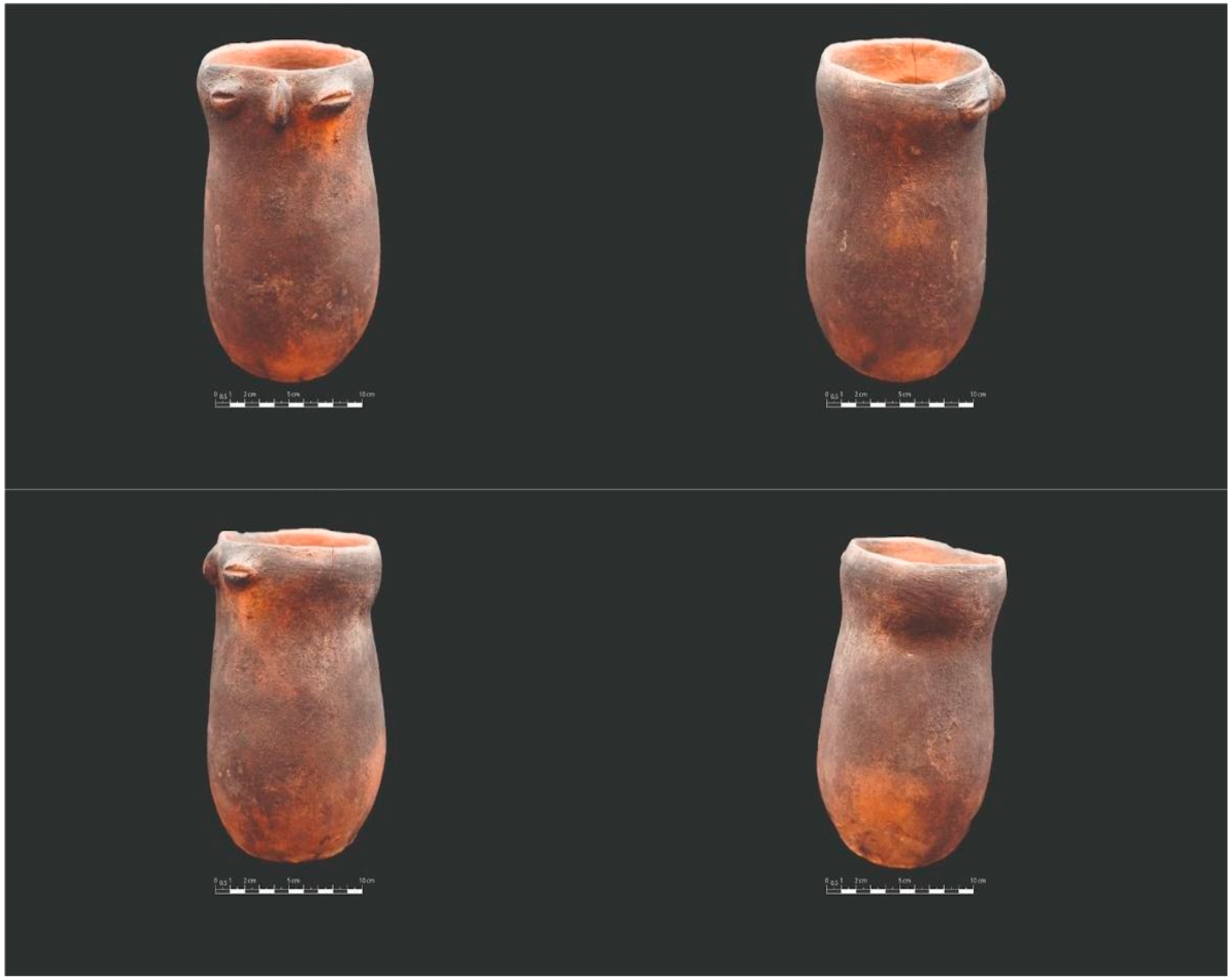
2.2. The Anthropomorphic Vessel
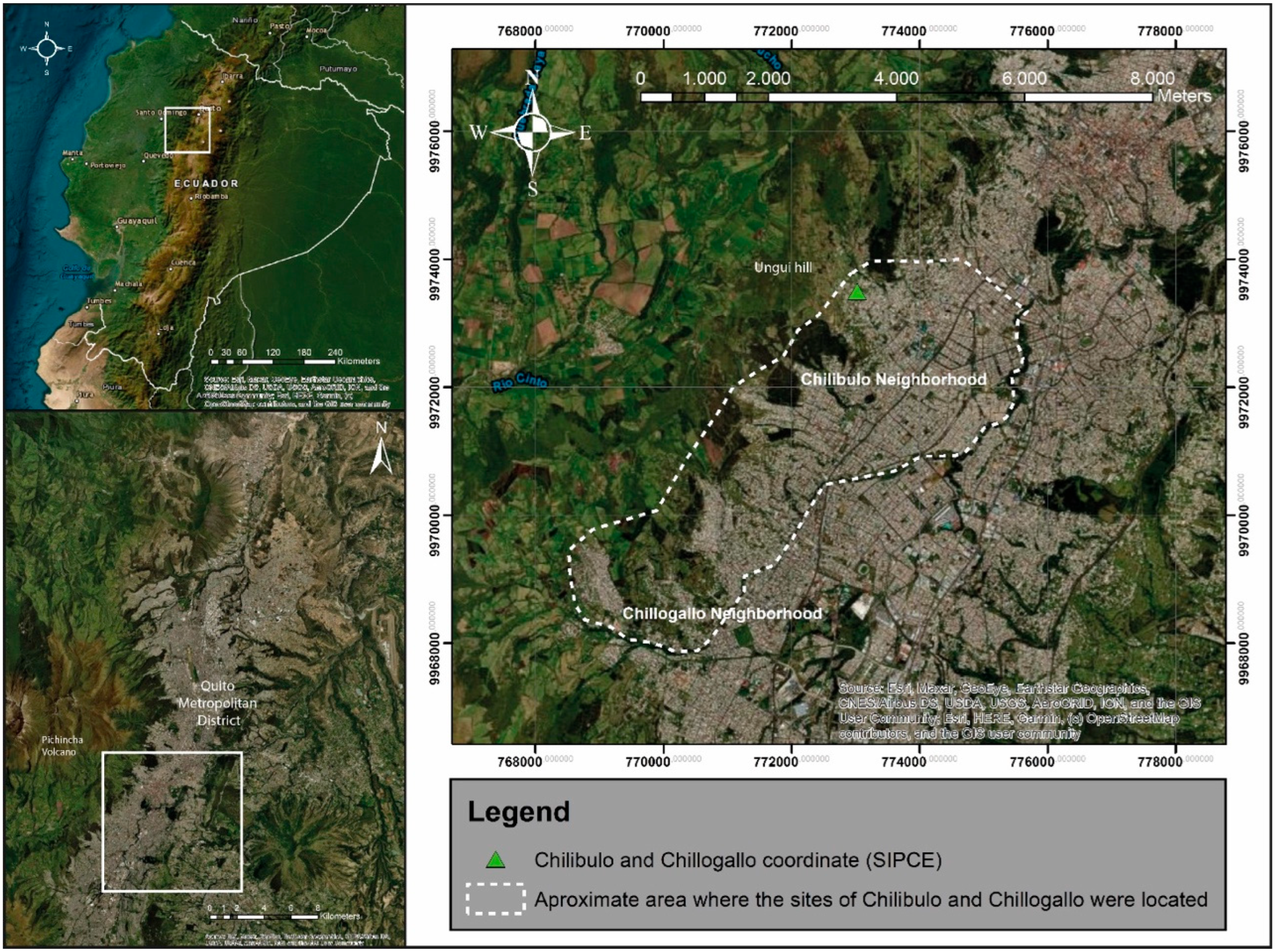
2.3. Provenance and Archaeological Context
2.4. Selection of Analytical Methods for Cacao Identification
2.5. Sample Extraction
2.6. Starch Identification
2.7. Chemical Analysis for the Identification of Theobromine
2.7.1. Sample Preparation
2.7.2. Reagents and Materials
2.7.3. UPLC/MS/MS System
3. Results
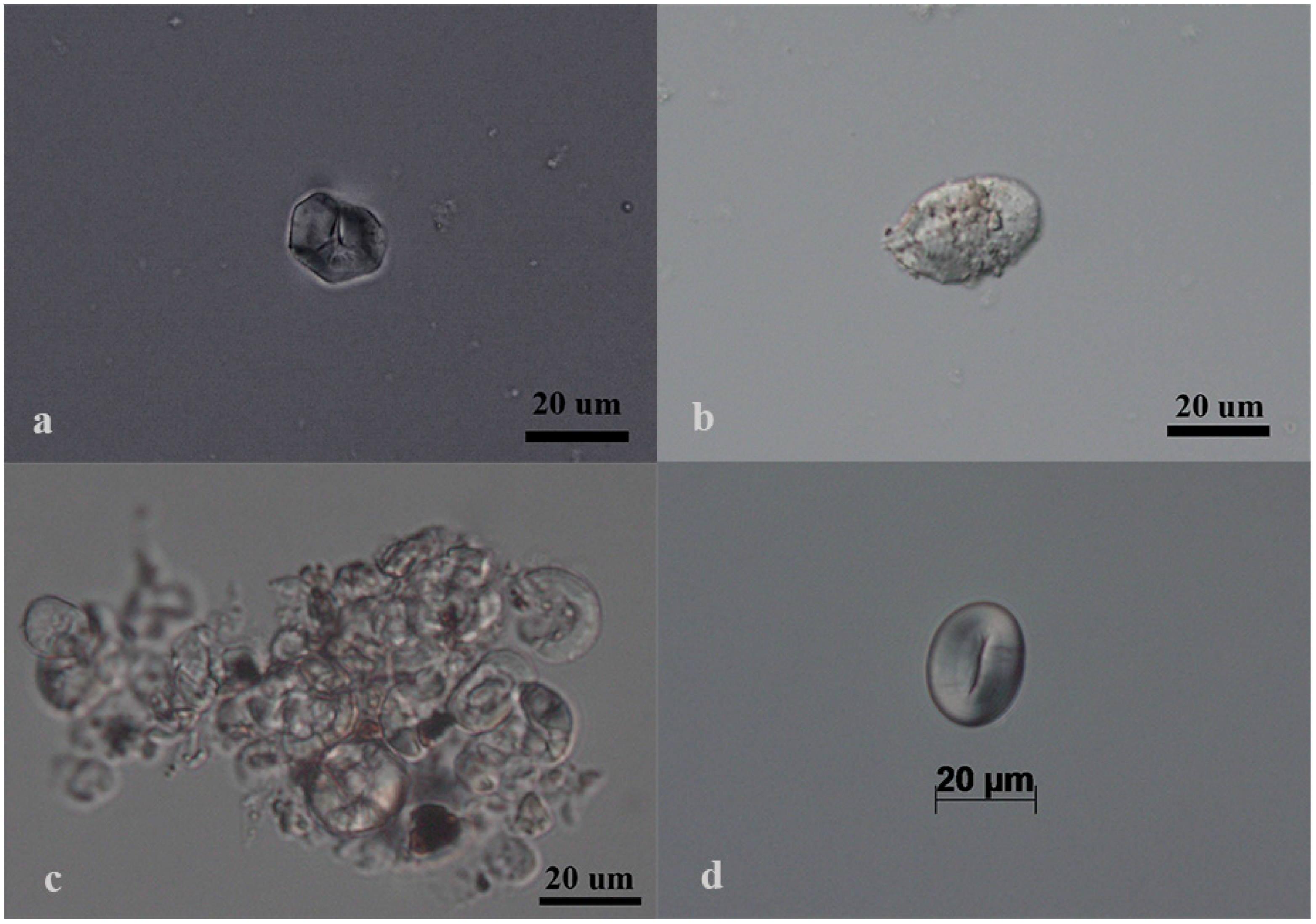
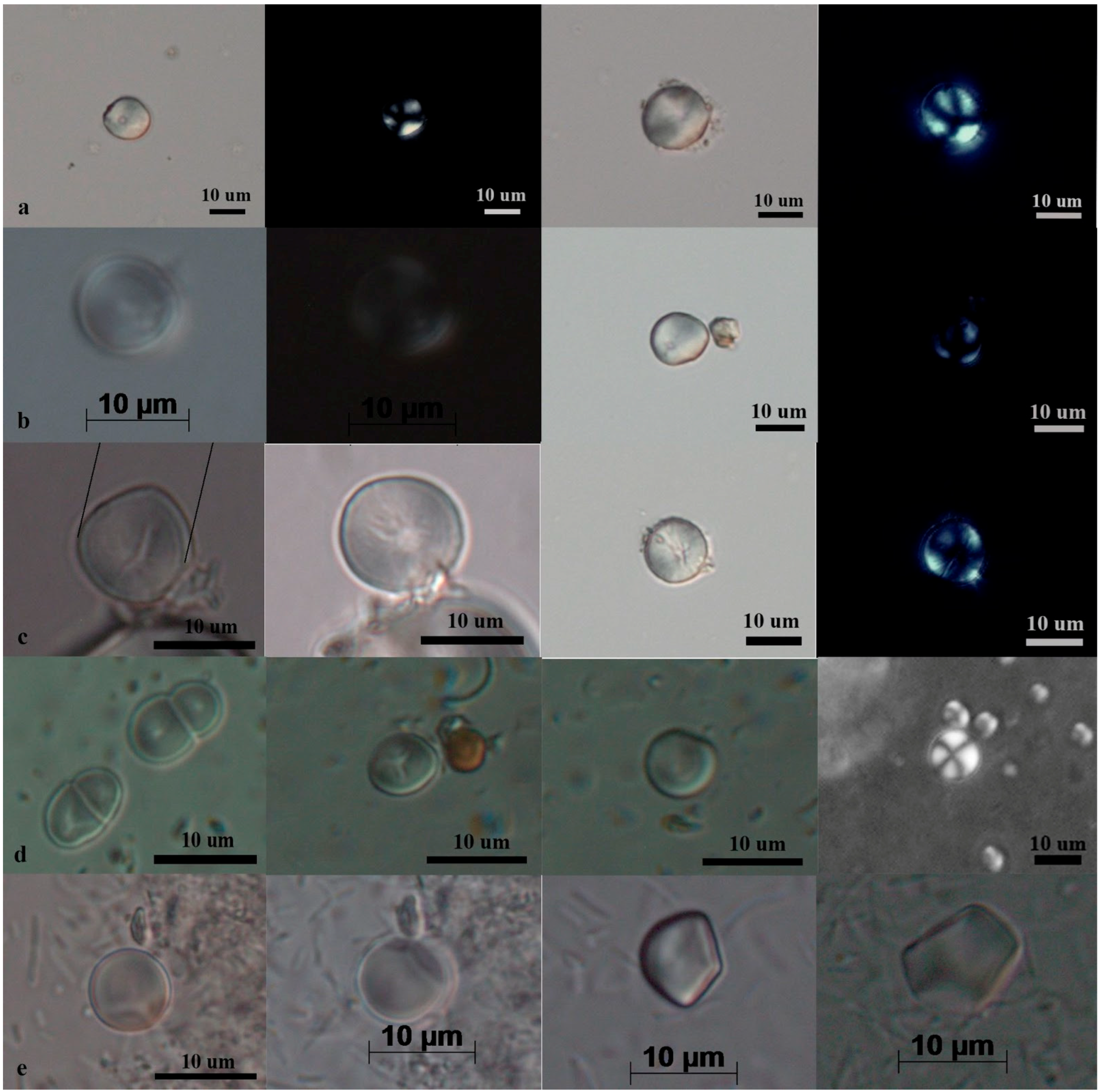
3.1. Starch
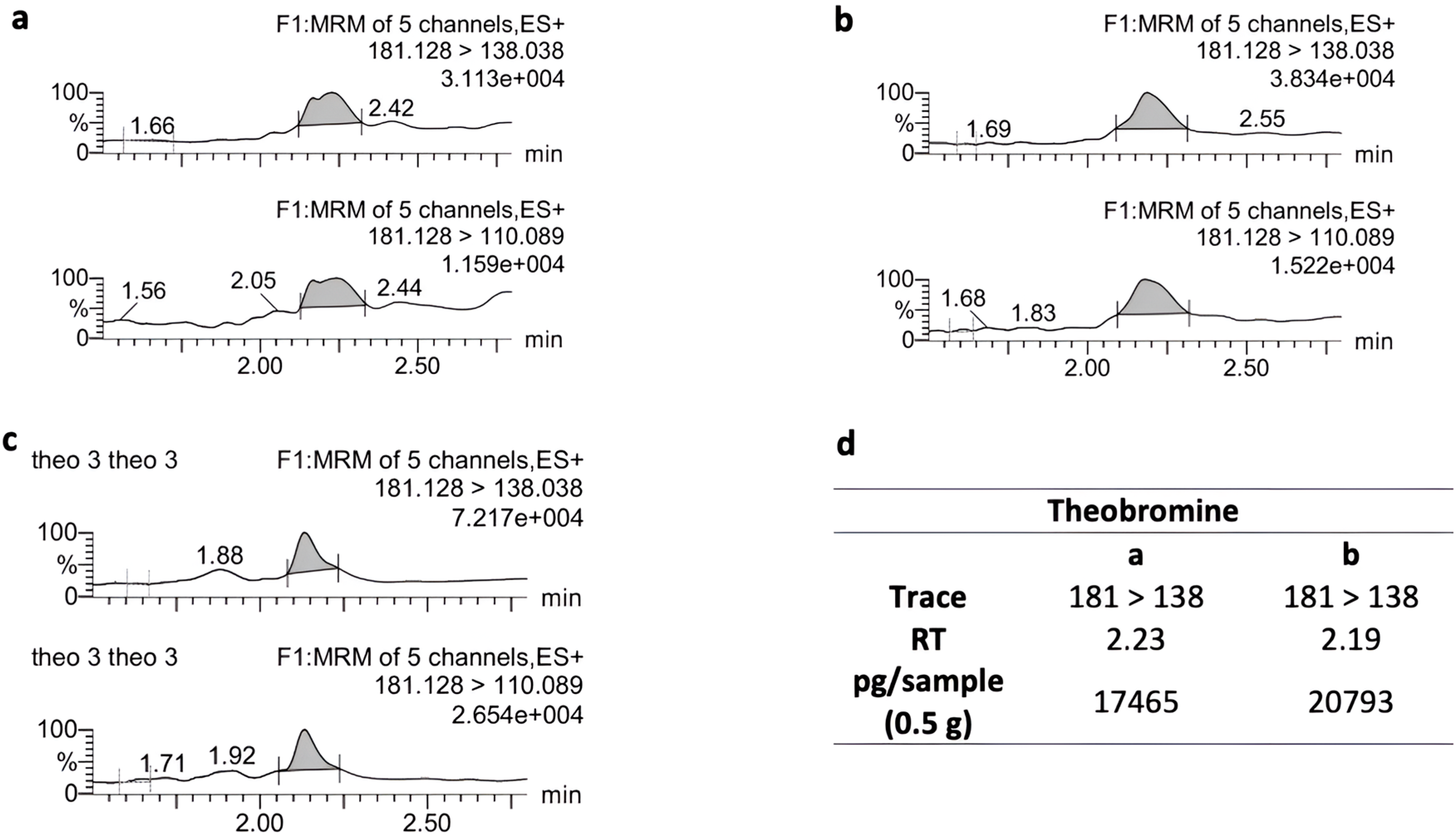
3.2. Theobromine
4. Discussion
5. Conclusions
Supplementary Materials
Author Contributions
Funding
Data Availability Statement
Acknowledgments
Conflicts of Interest
References
- Zarrillo, S.; Gaikwad, N.; Lanaud, C.; Powis, T.; Viot, C.; Lesur, I.; Fouet, O.; Argout, X.; Guichoux, E.; Salin, F.; et al. The use and domestication of Theobroma cacao during the mid-Holocene in the upper Amazon. Nat. Ecol. Evol. 2018, 2, 1879–1888. [Google Scholar] [CrossRef]
- Lanaud, C.; Vignes, H.; Utge, J.; Valette, G.; Rhoné, B.; Caputi, M.G.; Nieto, N.S.A.; Fouet, O.; Gaikwad, N.; Zarrillo, S.; et al. A revisited history of cacao domestication in pre-Columbian times revealed by archaeogenomic approaches. Sci. Rep. 2024, 14, 2972. [Google Scholar] [CrossRef] [PubMed]
- Valdez, F. Primeras Sociedades de la Alta Amazonia: La Cultura Mayo Chinchipe-Marañón; IRD Edition: Marseille, France, 2018. [Google Scholar] [CrossRef]
- Zarrillo, S.; Valdez, F. Evidencias del cultivo de maíz. Arqueol. Amaz 2013. [Google Scholar] [CrossRef]
- Zarrillo, S.; Blake, M. Tracing the movement of ancient cacao (Theobroma cacao L.) in the Americas: New approaches. In Waves of Influence: Revisiting Coastal Connections Between Pre-Columbian Northwest South America and Mesoamerica; Beekman, C., McEwan, C., Eds.; Sheridan Books, Inc: Ann Arbor, MI, USA, 2022; pp. 121–144. Available online: https://www.csusb.edu/sites/default/files/upload/file/Hepp%202022_Capacha%20problem_small.pdf (accessed on 20 November 2025).
- Valdez, F. Primeras Sociedades de la Alta Amazonía: La Cultura Mayo Chinchipe—Marañon. In Arqueol. Amaz; IRD Edition: Quito, Ecuador, 2013. Available online: https://horizon.documentation.ird.fr/exl-doc/pleins_textes/divers17-07/010070442.pdf (accessed on 20 November 2025).
- Powis, T.G.; Hurst, W.J.; del Carmen Rodríguez, M.; Ortíz, C.P.; Blake, M.; Cheetham, D.; Coe, M.D. Oldest chocolate in the New World. Antiquity 2007, 81. Available online: https://www.antiquity.ac.uk/projgall/powis314 (accessed on 20 November 2025).
- Powis, T.; Cyphers, A.; Gaikwad, N.; Grivetti, L.; Cheong, K. Cacao use and the San Lorenzo Olmec. Proc. Natl. Acad. Sci. USA 2011, 108, 8595–8600. [Google Scholar] [CrossRef] [PubMed]
- Cyphers, A.; Powis, T.G.; Gaikwad, N.G.; Grivetti, L.; Cheong, K.; Guevara, E.H. La detección de teobromina en vasijas de cerámica olmeca: Nuevas evidencias sobre el uso del cacao en San Lorenzo, Veracruz. Arqueología 2013, 46, 153–166. [Google Scholar]
- Pagán-Jimenez, J. Residuos vegetales antiguos identificados en varios utensilios de preparación de alimentos (sitio arqueológico Cochasquí, Ecuador). In Cochasquí Revisitado: Historiografía, Investigaciones Recientes Y Perspectivas; Ugalde, M., Ed.; Gobierno Autónomo Descentralizado de Pichincha: Quito, Ecuador, 2015; pp. 133–147. [Google Scholar]
- Zarrillo, S. Human Adaptation. Food Production. and Cultural Interaction during the Formative Period in Highland Ecuador. Ph.D. Thesis, University of Calgary, Calgary, AB, Canada, 2012. [Google Scholar]
- Ordoñez-Araque, R.; Romero-Bastidas, M.; Dyrdahl, E.; Criollo-Feijoo, J.; Mosquera, A.; Ramos-Guerrero, L.; Vargas-Jentzsch, P.; Montalvo-Puente, C.; Ruales, J. Discovering the dietary practices of pre-Hispanic Quito-Ecuador: Consumption of ancient starchy foods during distinct chronological periods (3500–750 cal BP). J. Archaeol. Sci. Rep. 2025, 64, 105097. [Google Scholar] [CrossRef]
- Dyrdahl, E. Obsidian acquisition networks in northern Ecuador from 1600 to 750 cal BCE. J. Archaeol. Sci. Rep. 2022, 44, 103530. [Google Scholar] [CrossRef]
- Valdez, F. Inter-zonal Relationships in Ecuador. In The Handbook of South American Archaeology; Springer: New York, NY, USA, 2008; pp. 865–888. [Google Scholar] [CrossRef]
- Ugalde, M.; Dyrdahl, E. Sedentism, Production, and Early Interregional Interaction in the Northern Sierra of Ecuador. In South American Contributions to World Archaeology; Springer International Publishing: Cham, Switerland, 2021; pp. 337–371. [Google Scholar] [CrossRef]
- Salomon, F. Los Señores Étnicos de Quito en la Época de Los Incas; Instituto Otavaleño de Antropología: Otavalo, Ecuador, 1980. [Google Scholar]
- Salomon, F. Los Señores Ètnicos de Quito en la Època de Los Incas: La Economía Polí;tica de los Señoríos Norandinos; Instituto Metropolitano de Patrimonio, Universidad Andina Simón Bolívar: Quito, Ecuador, 2011. [Google Scholar]
- Porras, P. Arqueología del Ecuador; Gallocapitán: Otavalo, Ecuador, 1980. [Google Scholar]
- Echeverría, J. Contribución al conocimiento arqueológico de la provincia de Pichincha: Sitios Chilibulo y Chillogallo. Rev. Univ. Católica 1977, 17, 181–218. [Google Scholar]
- Echeverría, J. Contribución al Conocimiento Arqueológico de la Provincia de Pichincha: Sitios Chilibulo y Chillogallo; Pontificia Universidad Católica del Ecuador: Quito, Ecuador, 1976. [Google Scholar]
- Torres, K. Informe de Avance, Resultados de Los Análisis Proyecto: Investigación Arqueológica Mediante Análisis y Estudios de Laboratorio 2023-IMP; Informe Inédito Presentado al; Instituto Metropolitano de Patrimonio: Quito, Ecuador, 2024. [Google Scholar]
- Ordoñez-Araque, R.; Ruales, J.; Vargas-Jentzsch, P.; Ramos-Guerrero, L.; Romero-Bastidas, M.; Montalvo-Puente, C.; Serrano-Ayala, S. Pre-Hispanic Periods and Diet Analysis of the Inhabitants of the Quito Plateau (Ecuador): A Review. Heritage 2022, 5, 3446–3462. [Google Scholar] [CrossRef]
- Porras, P. Arqueología de Quito: I. Fase Cotocollao; Centro de Investigaciones Arqueológicas, PUCE: Quito, Ecuador, 1982. [Google Scholar]
- SIPCE. Sistema de Información del Patrimonio Cultural del Ecuador. 2023. Available online: http://sipce.patrimoniocultural.gob.ec:8080/IBPWeb/paginas/inicio.jsf (accessed on 15 January 2025).
- Mielke, J.E.; Long, A. Smithsonian Institution Radiocarbon Measurements V. Radiocarbon 1969, 11, 163–182. [Google Scholar] [CrossRef]
- Hogg, A.; Heaton, T.J.; Hua, Q.; Palmer, J.G.; Turney, C.S.; Southon, J.; Bayliss, A.; Blackwell, P.G.; Boswijk, G.; Ramsey, C.B.; et al. SHCal20 Southern Hemisphere Calibration, 0–55,000 Years cal BP. Radiocarbon 2020, 62, 759–778. [Google Scholar] [CrossRef]
- Ramsey, B. Bayesian analysis of radiocarbon dates. Radiocarbon 2009, 51, 337–360. [Google Scholar] [CrossRef]
- Torres, K. Quito Antes de la Urbe: Dinámicas de Constitución del Espacio Quiteño, Entre el Período de Integración y la Colonia Temprana; FLACSO: Quito, Ecuador, 2023. [Google Scholar]
- Buys, J.; Domínguez, V. Hace Dos Mil Años En Cumbayá Proyecto Arqueológico ‘Jardín Del Este’; Instituto Nacional de Patrimonio Cultural e Instituto General de Cooperación al Desarrollo de Bélgica: Quito, Ecuador, 1988.
- Montalvo-Puente, C.; Juape-Paneluisa, G.; Mosquera, A.; Merino, A.; Dyrdahl, E. Investigación Sobre Arquitectura Monumental En Tierra en el Distrito Metropolitano de Quito; Informe Inédito; IMP: Quito, Ecuador, 2023. [Google Scholar]
- Mosquera, A. Modificación del paisaje y subsistencia durante el Periodo de Integración en la subcuenca del río Pachijal, Pacto, Ecuador. Arqueol. Iberoam. 2022, 49, 104–116. [Google Scholar]
- Erazo, R. Yacimiento de La Florida, Quito, Ecuador; Unpublished report from the National Institute of Cultural Heritage of Ecuador, not publicly released; 2008. [Google Scholar]
- Molestina, M. El pensamiento simbólico de los habitantes de La Florida (Quito-Ecuador). Bull. L’institut Français D’études Andin. 2006, 35, 377–395. [Google Scholar] [CrossRef]
- Powis, T.G.; Hurst, W.J.; del Carmen Rodríguez, M.; Ponciano, O.C.; Blake, M.; Cheetham, D.; Coe, M.D.; Hodgson, J.G. The Origins of Cacao Use in Mesoamerica. Mexicon 2008, 30, 35–38. [Google Scholar]
- Henderson, J.; Joyce, R.; Hall, G.; Hurst, W.; McGovern, P. Chemical and archaeological evidence for the earliest cacao beverages. Proc. Natl. Acad. Sci. USA 2007, 104, 18937–18940. [Google Scholar] [CrossRef]
- Hurst, W.J.; Tarka, S.; Powis, T.; Valdez, F.; Hester, T. Cacao usage by the earliest Maya civilization. Nature 2002, 418, 289–290. [Google Scholar] [CrossRef]
- Powis, T.; Valdez, F.; Hester, T.; Hurst, W.; Tarka, S. Spouted Vessels and Cacao Use among the Preclassic Maya. Lat. Am. Antiq. 2002, 13, 85–106. [Google Scholar] [CrossRef]
- Hall, G.; Tarka, S.; Hurst, W.J.; Stuart, D.; Adams, R. Cacao Residues in Ancient Maya Vessels from Rio Azul, Guatemala. Am. Antiq. 1990, 55, 138–143. [Google Scholar] [CrossRef]
- Hurst, W.; Martin, R.; Tarka, S.; Hall, G. Authentication of cocoa in maya vessels using high-performance liquid chromatographic techniques. J. Chromatogr. A 1989, 466, 279–289. [Google Scholar] [CrossRef]
- Owens, S.; Berenbeim, J.A.; Ligare, M.R.; Gulian, L.E.; Siouri, F.M.; Boldissar, S.; Tyson-Smith, S.; Wilson, G.; Ford, A.; de Vries, M.S. Direct Analysis of Xanthine Stimulants in Archaeological Vessels by Laser Desorption Resonance Enhanced Multiphoton Ionization. Anal. Chem. 2017, 89, 2838–2843. [Google Scholar] [CrossRef] [PubMed]
- Ford, A.; Williams, A.; de Vries, M. New light on the use of Theobroma cacao by Late Classic Maya. Proc. Natl. Acad. Sci. USA 2022, 119, e2121821119. [Google Scholar] [CrossRef]
- Crown, P.; Gu, J.; Hurst, W.J.; Ward, T.J.; Bravenec, A.D.; Ali, S.; Kebert, L.; Berch, M.; Redman, E.; Lyons, P.D.; et al. Ritual drinks in the pre-Hispanic US Southwest and Mexican Northwest. Proc. Natl. Acad. Sci. USA 2015, 112, 11436–11442. [Google Scholar] [CrossRef]
- Washburn, D.; Washburn, W.; Shipkova, P.; Pelleymounter, M. Chemical analysis of cacao residues in archaeological ceramics from North America: Considerations of contamination, sample size and systematic controls. J. Archaeol. Sci. 2014, 50, 191–207. [Google Scholar] [CrossRef]
- Crown, P.; Hurst, W. Evidence of cacao use in the Prehispanic American Southwest. Proc. Natl. Acad. Sci. USA 2009, 106, 2110–2113. [Google Scholar] [CrossRef]
- Ordoñez-Araque, R.; Ramos-Guerrero, L.; Vargas-Jentzsch, P.; Romero-Bastidas, M.; Rodríguez-Herrera, N.; Vallejo-Holguín, R.; Fuentes-Gualotuña, C.; Ruales, J. Fatty Acids and Starch Identification within Minute Archaeological Fragments: Qualitative Investigation for Assessing Feasibility. Foods 2024, 13, 1090. [Google Scholar] [CrossRef]
- Ordoñez-Araque, R.; Mosquera, A.; Román-Carrión, J.L.; Vargas-Jentzsch, P.; Ramos-Guerrero, L.; Rivera-Parra, J.L.; Romero-Bastidas, M.; Montalvo-Puente, C.; Ruales, J. Evidence of eared doves consumption and the potential toxic exposure during the Regional Development period in Quito-Ecuador. Sci. Rep. 2025, 15, 554. [Google Scholar] [CrossRef] [PubMed]
- Ciofalo, A.; Keegan, W.; Pateman, M.; Pagán-Jiménez, J.; Hofman, C. Determining precolonial botanical foodways: Starch recovery and analysis, Long Island, The Bahamas. J. Archaeol. Sci. Rep. 2018, 21, 305–317. [Google Scholar] [CrossRef]
- Pagán-Jiménez, J.; Guachamín-Tello, A.; Romero-Bastidas, M.; Constantine-Castro, A. Late ninth millennium B.P. use of Zea mays L. at Cubilán area, highland Ecuador, revealed by ancient starches. Quat. Int. 2016, 404, 137–155. [Google Scholar] [CrossRef]
- Venegas, B.; Herrera-Parra, E.; Pérez, M. Análisis e identificación de almidones arqueológicos en instrumentos líticos y cerámica del conjunto residencial Limón de Palenque, Chiapas, México. Comechingonia Rev. Arqueol. 2021, 25, 25–44. [Google Scholar] [CrossRef]
- Pagán-Jiménez, J.; Rostain, S. Uso de plantas económicas y rituales (médicinales o energizantes) en dos comunidades precolombinas de la Alta Amazonía ecuatoriana: Sangay (Huapula) y Colina Moravia (400 a.C.–1200 d.C.). In Antes de Orellana. Actas del 3er Encuentro Internacional de Arqueología Amazónica; IFEA: Quito, Ecuador, 2013; pp. 313–322. [Google Scholar]
- Pagán-Jiménez, J.; Rodríguez-Ramos, R.; Reid, B.A.; van den Bel, M.; Hofman, C. Early dispersals of maize and other food plants into the Southern Caribbean and Northeastern South America. Quat. Sci. Rev. 2015, 123, 231–246. [Google Scholar] [CrossRef]
- Ciofalo, A.; Sinelli, P.; Hofman, C. Late Precolonial Culinary Practices: Starch Analysis on Griddles from the Northern Caribbean. J. Archaeol. Method. Theory 2019, 26, 1632–1664. [Google Scholar] [CrossRef]
- Louderback, L.; Pavlik, B. Starch granule evidence for the earliest potato use in North America. Proc. Natl. Acad. Sci. USA 2017, 114, 7606–7610. [Google Scholar] [CrossRef]
- Atchison, J.; Fullagar, R. Starch residues on pounding implements from Jinmium rock-shelter. In A Closer Look: Recent Australian Studies of Stone Tools; Archaeological Computing Laboratory, School of Archaeology: Sidney, Australia, 1998. [Google Scholar]
- King, A.; Powis, T.; Cheong, K.; Gaikwad, N. Cautionary tales on the identification of caffeinated beverages in North America. J. Archaeol. Sci. 2017, 85, 30–40. [Google Scholar] [CrossRef]
- LeCount, L. Like Water for Chocolate: Feasting and Political Ritual among the Late Classic Maya at Xunantunich, Belize. Am. Anthropol. 2001, 103, 935–953. [Google Scholar] [CrossRef]
- Ordoñez-Araque, R.; Landines-Vera, E.F.; Urresto-Villegas, J.C.; Caicedo-Jaramillo, C.F. Microorganisms during cocoa fermentation: Systematic review. Foods Raw Mater. 2020, 8, 155–162. [Google Scholar] [CrossRef]
- Sandoval-Cañas, G.; Casa-López, F.; Criollo-Feijoó, J.; Landines-Vera, E.F.; Ordoñez-Araque, R. South American fermented legume, pulse, and oil seeds-based products. In Indigenous Fermented Foods for the Tropics; Academic Press: Cambridge, MA, USA, 2023; pp. 97–115. [Google Scholar] [CrossRef]
- Sacoto, C.; Barzallo, A.; Asang, S.; Martillo, J. Caracterización morfológica del cacao nacional “Theobroma cacao L.” del cantón Naranjal, Ecuador. Rev. Tecnol.-ESPOL 2022, 34, 80–97. [Google Scholar] [CrossRef]
- IEE-MAGAP Generación de Geoinformación Para la Gestión del Territorio a Nivel Nacional Escala 1:25.000. Memoria Técnica, Cantón Quito; Clima e hidrología; Instituto Espacial Ecuatoriano-IEE y Ministerio de Ministerio de Agricultura SIGAGRO-MAGAP: Quito, Ecuador, 2013. Available online: https://www.geoportaligm.gob.ec/proyecto_nacional/ (accessed on 20 January 2025).
- Lippi, R.; Gudiño, A. Palmitopamba: Yumbos e incas en el bosque tropical al noroeste de Quito (Ecuador). Bull. L’institut Français D’études Andin. 2010, 39, 623–640. [Google Scholar] [CrossRef]
- Salomon, F. Los Yumbos, Niguas y Tsatchila o ‘Colorados’ Durante La Colonia Española: Etnohistoria Del Noroccidente de Pichincha; Quito Ediciones Abya-Yala: Quito, Ecuador, 1997. [Google Scholar]
- Garcés, J. Plan Del Camino de Quito al Río Esmeraldas Según las Observaciones Astronómicas de Jorge Juan y Antonio de Ulloa; Publicaciones del Archivo Municipal: Quito, Ecuador, 1942. Available online: https://biblioteca.culturaypatrimonio.gob.ec/cgi-bin/koha/opac-detail.pl?biblionumber=63537 (accessed on 20 November 2025).
- Oberem, U. Los Quijos: Historia de La Transculturación de Un Grupo Indígena En El Oriente Ecuatoriano; Instituto Otavaleño de Antropología: Quito, Ecuador, 1980. [Google Scholar]
- Taylor, A. Relaciones Entre Las Sociedades Amazónicas y Andinas Entre Los Siglos XV y XVII. Las Vertientes Orientales de Los Andes Septentrionales: De Los Bracamoros a Los Quijos. In Al Este de los Andes; Institut français d’études andines, Centro Cultural Abya-Yala: Quito, Ecuador, 1988; Volume 2. [Google Scholar] [CrossRef]
- Bravo, E. La Cerámica Cosanga del Valle de Cumbaya, Provincia de Pichincha (Z3B3-O22): Una Aproximación a la Definición de su rol en los Contextos Funerarios del Sitio La Comarca; Escuela Superior Politécnica del Litoral: Guayaquil, Ecuador, 2005. [Google Scholar]
- Constantine, A.; Coloma, M.; Sánchez, F. Rumipamba Bajo la Sombra del Pichincha. Estudio de Complementación de Datos Actualísticos Parque Arqueológico—Ecológico Rumipamba; Informe Final Inédito Entregado al FONSAL; Instituto Metropolitano de Patrimonio: Quito, Ecuador, 2013. [Google Scholar]
- Constantine, A.; Chacon, R.; Ugalde, M.; Mejia, F. Rumipamba Bajo La Sombra Del Pichincha; Informe Final Inédito Entregado al; Instituto Nacional de Patrimonio Cultural: Quito, Ecuador, 2009. [Google Scholar]
- Serrano, S. Etnoarqueología de Intercambio de Bienes y Productos en los Caminos Precolombinos de Pichincha y Napo; Universidad Politécnica del Litoral: Guayaquil, Ecuador, 2017. [Google Scholar]
- Pierre, F. Viaje de Exploración al Oriente Ecuatoriano, 1887–1888; Centro Cultural Abya Yala del Ecuador: Quito, Ecuador, 1999. [Google Scholar]
- Timbie, D.; Sechrist, L.; Keeney, P. Application of high-pressure liquid chromatography to the study of variables affecting theobromine and caffeine concentrations in cocoa beans. J. Food Sci. 1978, 43, 560–565. [Google Scholar] [CrossRef]
- Mihai, R.A.; Abarca, P.A.L.; Romero, B.A.T.; Florescu, L.I.; Catană, R.; Kosakyan, A. Abiotic Factors from Different Ecuadorian Regions and Their Contribution to Antioxidant, Metabolomic and Organoleptic Quality of Theobroma cacao L. Beans, Variety “Arriba Nacional”. Plants 2022, 11, 976. [Google Scholar] [CrossRef] [PubMed]
- Sotelo, A.; Alvarez, R. Chemical Composition of Wild Theobroma Species and Their Comparison to the Cacao Bean. J. Agric. Food Chem. 1991, 39, 1940–1943. [Google Scholar] [CrossRef]
- Wise, G.; Negrin, A. A critical review of the composition and history of safe use of guayusa: A stimulant and antioxidant novel food. Crit. Rev. Food Sci. Nutr. 2020, 60, 2393–2404. [Google Scholar] [CrossRef]
- Meneses, M.; Guzmán, J.; Cabrera, J.; Magallanes, J.; Valarezo, E.; Guamán-Balcázar, M.d.C. Green Processing of Ilex guayusa: Antioxidant Concentration and Caffeine Reduction Using Encapsulation by Supercritical Antisolvent Process. Molecules 2024, 29, 5309. [Google Scholar] [CrossRef]
- Kapp, R.; Mendes, O.; Roy, S.; McQuate, R.; Kraska, R. General and Genetic Toxicology of Guayusa Concentrate (Ilex guayusa). Int. J. Toxicol. 2016, 35, 222–242. [Google Scholar] [CrossRef]
- Erazo-Garcia, M.; Guadalupe, J.J.; Rowntree, J.K.; Borja-Serrano, P.; Monteros-Silva, N.E.d.L.; Torres, M.d.L. Assessing the genetic diversity of Ilex guayusa loes., a medicinal plant from the ecuadorian amazon. Diversity 2021, 13, 182. [Google Scholar] [CrossRef]
- León, B.; Montero, A.; Mollocana, D.; Calderón, D.; Torres, M. Optical aptasensor for in situ detection and quantification of methylxanthines in Ilex guayusa. ACI Av. Cienc. Ing. 2022, 14, 20. [Google Scholar]
- Kelebek, H.; Sasmaz, H.K.; Aksay, O.; Selli, S.; Kahraman, O.; Fields, C. Exploring the Impact of Infusion Parameters and In Vitro Digestion on the Phenolic Profile and Antioxidant Capacity of Guayusa (Ilex guayusa Loes.) Tea Using Liquid Chromatography, Diode Array Detection, and Electrospray Ionization Tandem Mass Spectrometry. Foods 2024, 13, 694. [Google Scholar] [CrossRef] [PubMed]
- Dueñas, J.; Jarrett, C.; Cummins, I.; Logan–Hines, E. Amazonian Guayusa (Ilex guayusa Loes.): A Historical and Ethnobotanical Overview. Econ. Bot. 2016, 70, 85–91. [Google Scholar] [CrossRef]
- Sánchez-Polo, A.; Briceño, S.; Jamett, A.; Galeas, S.; Campaña, O.; Guerrero, V.; Arroyo, C.R.; Debut, A.; Mowbray, D.J.; Zamora-Ledezma, C.; et al. An Archaeometric Characterization of Ecuadorian Pottery. Sci. Rep. 2019, 9, 2642. [Google Scholar] [CrossRef]
- Montalvo-Puente, C.; Lago, G.; Cardarelli, L.; Pérez-Molina, J. Money or ingots? Metrological research on pre-contact Ecuadorian “axe-monies”. J. Archaeol. Sci. Rep. 2023, 49, 103976. [Google Scholar] [CrossRef]



| Lab Code | Reference | 14C Date (yrs B.P.) Based on the Half-Life of | Cal. Date OxCal V4.4.4 | ||
|---|---|---|---|---|---|
| 5730 yrs | 5558 yrs | SHCal 20 | Probability | ||
| N-4155 | P.I.-CH Corte 8, 70–80 | 1260 ± 75 | 1220 ± 70 | AD 673–987 | 95.4% |
| N-4156 | P.I.-CH Corte 18, 40–50 | 1150 ± 80 | 1120 ± 80 | AD 690–705 AD 717–737 AD 771–1050 AD 1083–1145 | 1.1% 1.4% 88.2% 4.8% |
| N-4157 | P.I.-CH Corte 17, 90–100 | 1740 ± 85 | 1690 ± 80 | AD 127–187 AD 196–542 | 5.5% 89.9% |
| SI-354 | P.I.-CH | 850 ± 120 | AD 995–1002 AD 1020–1395 | 0.5% 94.9% | |
| Chronology | Site | Actual Country | Methylxanthines/ Theobromine a | Starch | DNA | Source |
|---|---|---|---|---|---|---|
| 3900 BC–AD 1532 | Nineteen cultures from the Amazon and the Pacific coast of South and Central American countries. | Ecuador, Colombia, Peru, Panama, Mexico, and Belize | Yes | No | Yes | Lanaud et al. (2024) [2] |
| 3500 BC | Santa Ana, La Florida | Ecuador | Yes | Yes | Yes | Zarrillo et al. (2018) [1] |
| 1900–1500 BC | Mokaya site of Paso de la Amada and Olmec site of El Manatí | Mexico | Yes | No | No | Powis et al. (2008, 2007) [8,34] |
| 1800–1000 BC | San Lorenzo (Olmec capital) | Mexico | Yes | No | No | Powis et al. (2011) [9] |
| 1300–900 BC | Puerto Escondido, Río Ulúa Valley | Honduras | Yes | No | No | Henderson et al. (2007) [35] |
| 600 BC–AD 250 | Maya site of Colha | Belize | Yes | No | No | Hurst et al. (2002); Powis et al. (2002) [36,37] b |
| AD 460–480 | Maya site of Rio Azul | Guatemala | Yes | No | No | Hall et al. (1990); Hurst et al. (1989) [38,39] |
| AD 600–900 | El Pilar (major Maya center) | Belize/Guatemala | Yes | No | No | Ford et al. (2022); Owens et al. (2017) [40,41] |
| AD 750–1400 | Northern and southwestern New Mexico, northern Chihuahua, and east-central Arizona | Mexico/USA | Yes | No | No | Crown et al. (2015) [42] |
| AD 1000–1400 | Mississippian Platform Mound | USA | Yes | No | No | Owens et al. (2017); Washburn et al. (2014) [40,43] c |
| AD 1000–1125 | Pueblo Bonito, Chaco Canyon | USA | Yes | No | No | Crown and Hurst, (2009) [44] |
Disclaimer/Publisher’s Note: The statements, opinions and data contained in all publications are solely those of the individual author(s) and contributor(s) and not of MDPI and/or the editor(s). MDPI and/or the editor(s) disclaim responsibility for any injury to people or property resulting from any ideas, methods, instructions or products referred to in the content. |
© 2025 by the authors. Licensee MDPI, Basel, Switzerland. This article is an open access article distributed under the terms and conditions of the Creative Commons Attribution (CC BY) license (https://creativecommons.org/licenses/by/4.0/).
Share and Cite
Montalvo-Puente, C.; Ordoñez-Araque, R.; Romero-Bastidas, M.; Ramírez-Bustamante, J.; Ramos-Guerrero, L.; Medina, A.; Minda, A.; Torres, K.; Vargas-Jentzsch, P.; Landines-Vera, E. Cacao Was Also Consumed in the Andean Region: First Evidence of Consumption in Quito, Ecuador, During the Integration Period (AD 500–1500). Heritage 2025, 8, 537. https://doi.org/10.3390/heritage8120537
Montalvo-Puente C, Ordoñez-Araque R, Romero-Bastidas M, Ramírez-Bustamante J, Ramos-Guerrero L, Medina A, Minda A, Torres K, Vargas-Jentzsch P, Landines-Vera E. Cacao Was Also Consumed in the Andean Region: First Evidence of Consumption in Quito, Ecuador, During the Integration Period (AD 500–1500). Heritage. 2025; 8(12):537. https://doi.org/10.3390/heritage8120537
Chicago/Turabian StyleMontalvo-Puente, Carlos, Roberto Ordoñez-Araque, Martha Romero-Bastidas, Johanna Ramírez-Bustamante, Luis Ramos-Guerrero, Alexander Medina, Alex Minda, Kyra Torres, Paul Vargas-Jentzsch, and Edgar Landines-Vera. 2025. "Cacao Was Also Consumed in the Andean Region: First Evidence of Consumption in Quito, Ecuador, During the Integration Period (AD 500–1500)" Heritage 8, no. 12: 537. https://doi.org/10.3390/heritage8120537
APA StyleMontalvo-Puente, C., Ordoñez-Araque, R., Romero-Bastidas, M., Ramírez-Bustamante, J., Ramos-Guerrero, L., Medina, A., Minda, A., Torres, K., Vargas-Jentzsch, P., & Landines-Vera, E. (2025). Cacao Was Also Consumed in the Andean Region: First Evidence of Consumption in Quito, Ecuador, During the Integration Period (AD 500–1500). Heritage, 8(12), 537. https://doi.org/10.3390/heritage8120537