The Tuscany Masonry Database Website


Abstract
1. Introduction
2. Reference Database
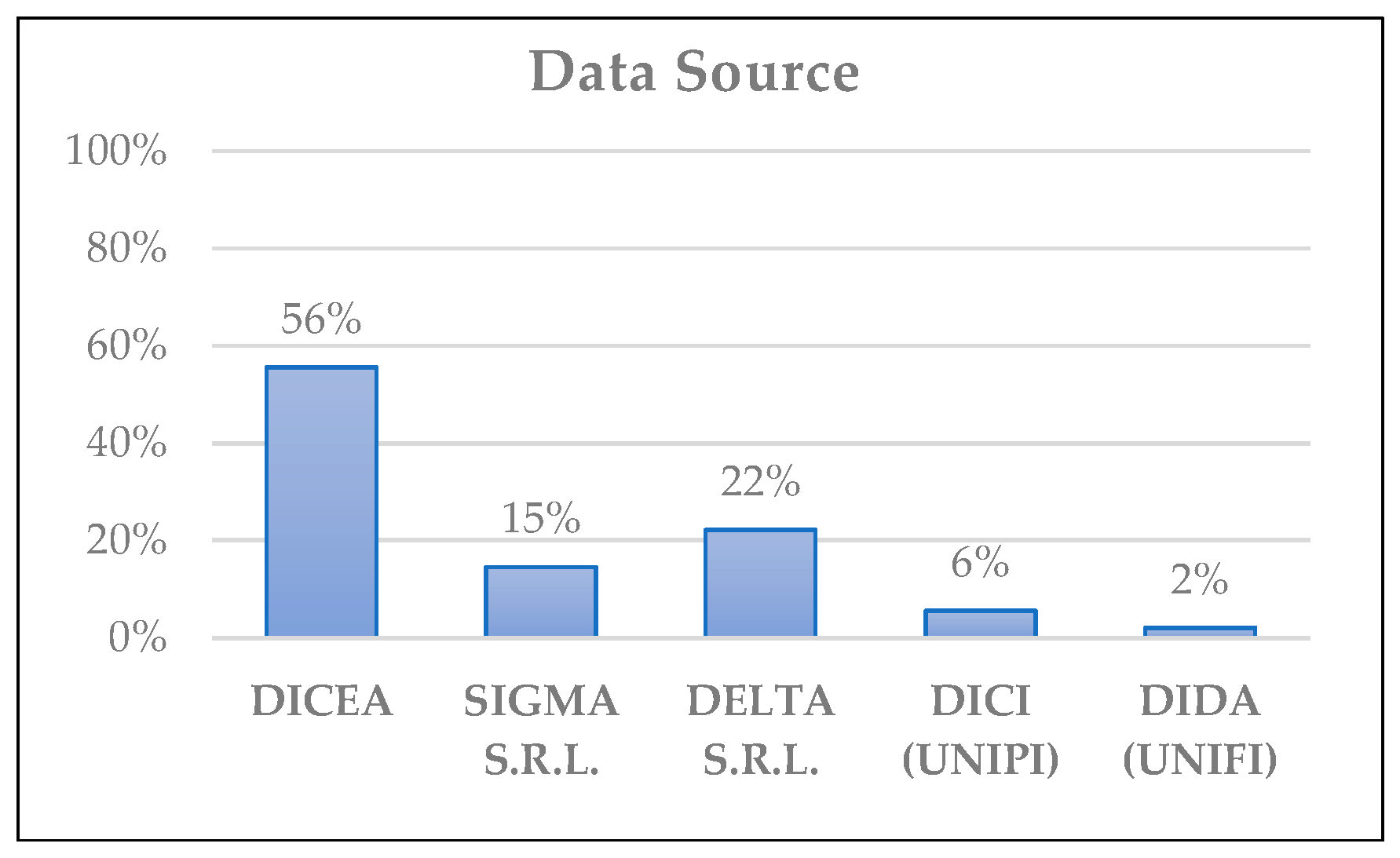
- Scientific collaborations between the DICEA and public and private clients; the tests were performed by the Structural and Materials Testing Laboratory in connection with DICEA;
- The activity of the private company SIGMA Laboratory SRL, tests on building materials for private and public clients);
- The activity of the private company DELTA Laboratory SRL, tests on building materials for private and public clients);
- Scientific collaborations between the DICEA of the University of Florence and the Consiglio Nazionale delle Ricerche (CNR), Institute for the Conservation and Enhancement of Cultural Heritage.
- “9” if the masonry has mortar with particularly poor characteristics (average compressive strength fm < 0.7 N/mm2), for which MIT 2019 [17] proposes the use of a reduction coefficient of 0.7 for the resistances and 0.8 for the elastic modules;
- “10” if the brick masonry has thick mortar joints, that is greater than 13 mm, for which MIT 2019 [17] proposes the use of a reduction coefficient of 0.7 for resistances and 0.8 for elastic modulus;
- “11” for the presence of deep wedges in Category II, for which MIT 2019 [17] proposes the use of an improved coefficient of 1.2 for stiffness and strength.
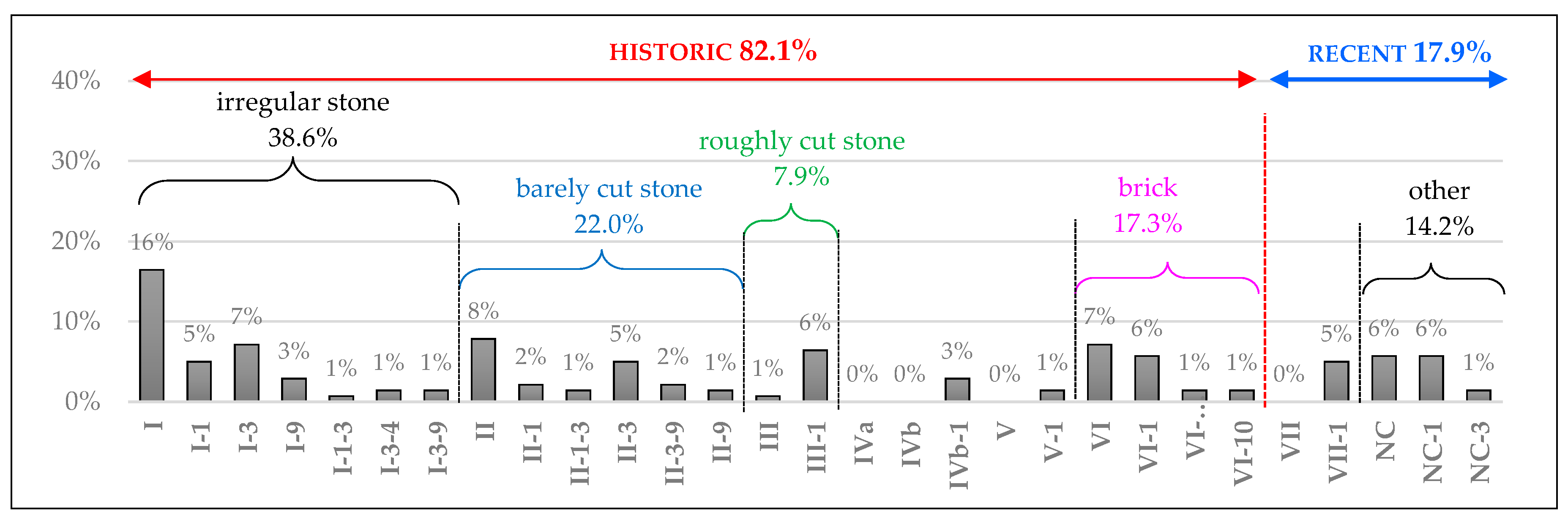
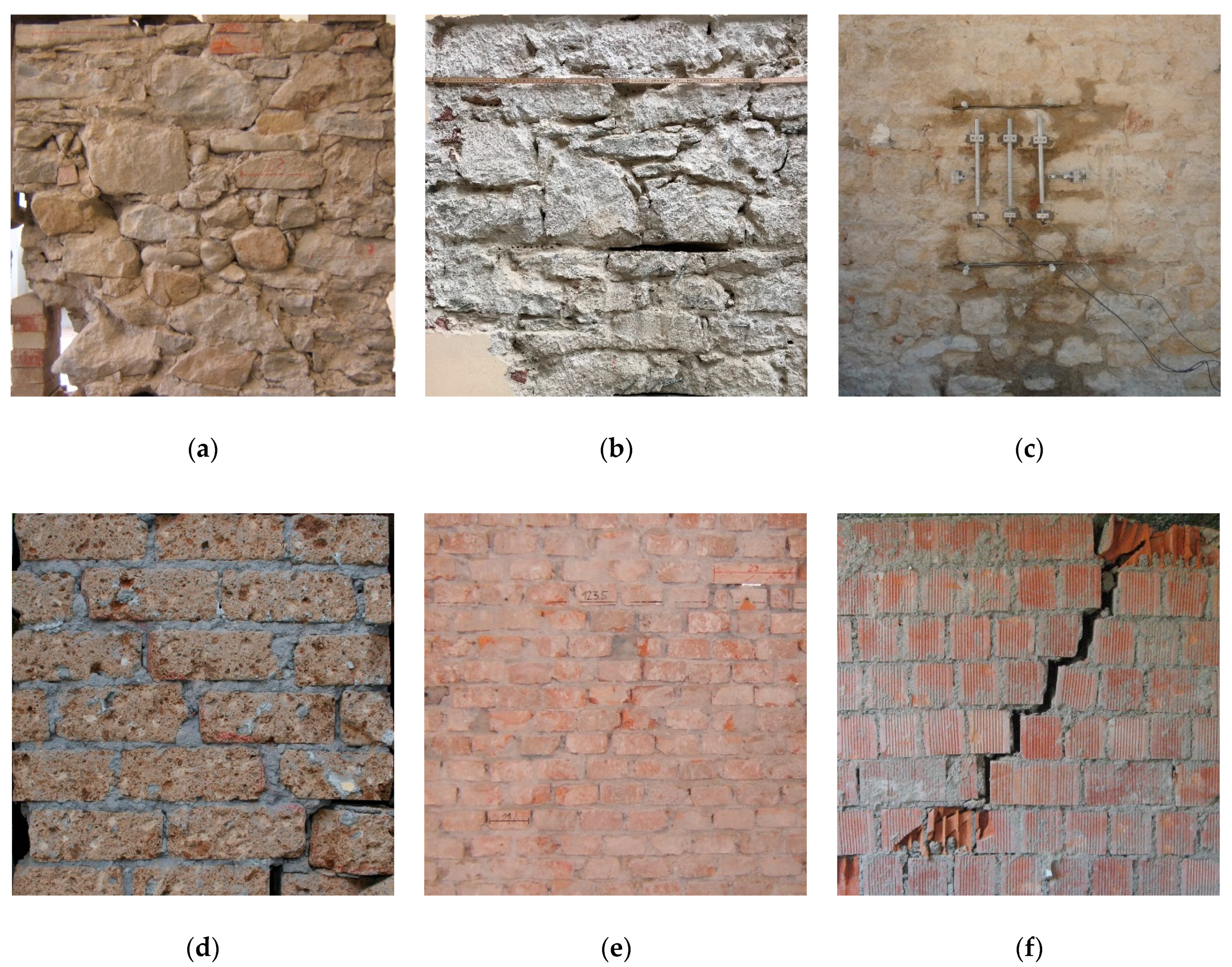
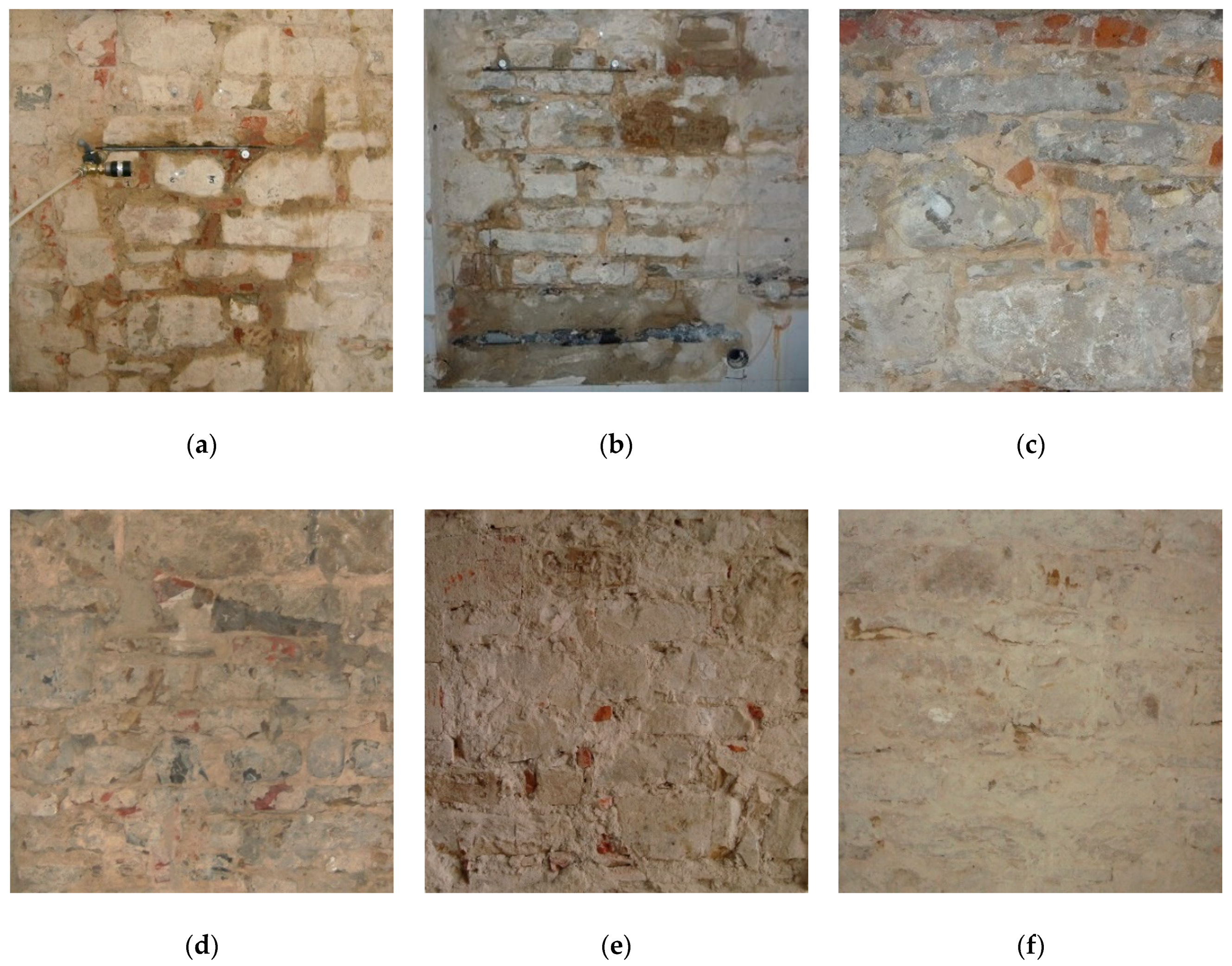
- About 39% of the tests were performed on irregular stone masonry (Figure 6a), of which 7% have stringcourses (I-3) and 5% have good mortar (I-1);
- About 22% of the tests were performed on barely cut stone masonry (Figure 6b), of which 5% have brick stringcourses (II-3);
- About 8% of the tests were performed on roughly cut stone masonry with good texture, with medium-large stones of regular square shape (Figure 6c);
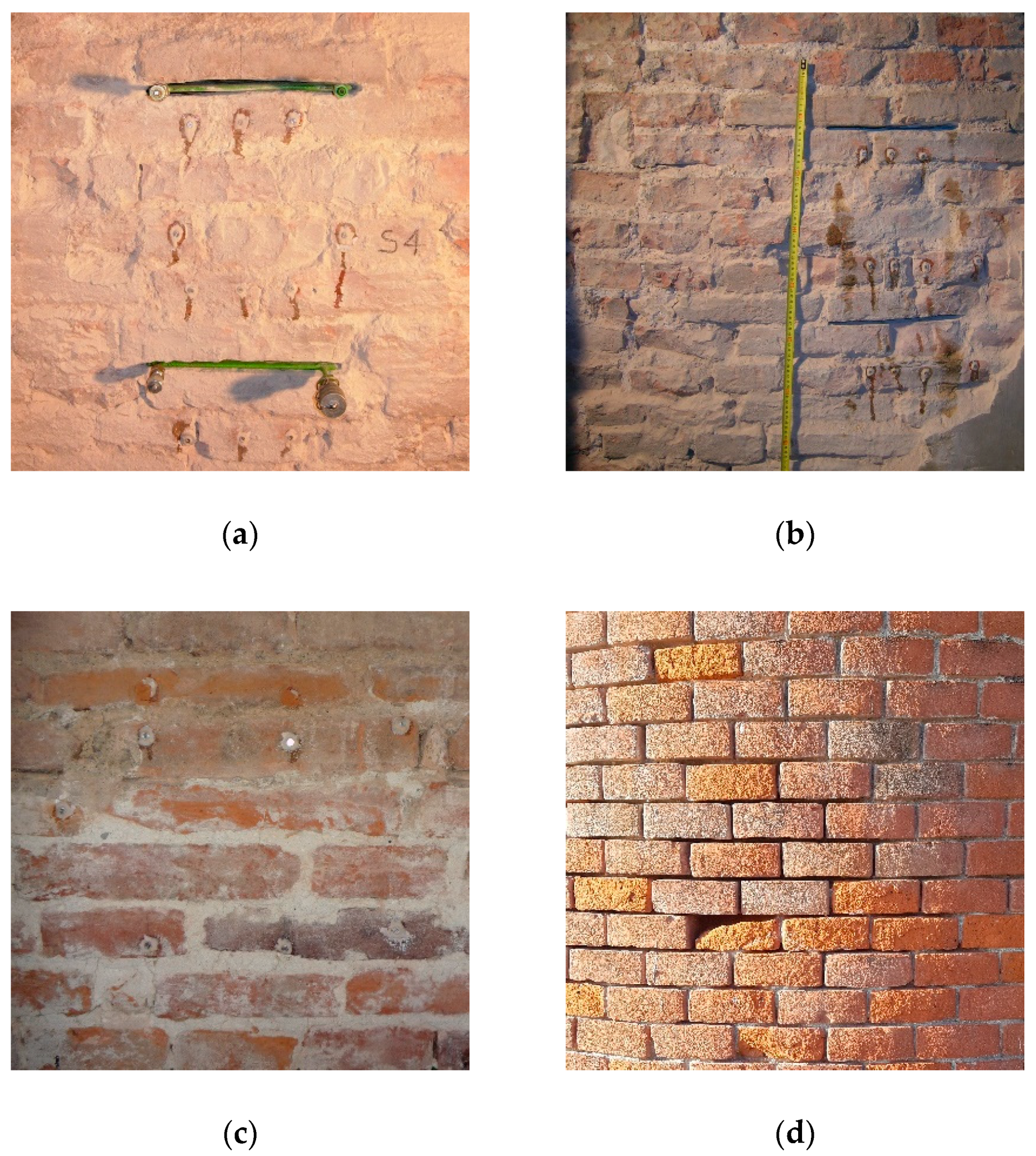
- About 17% of the sample consists of brick masonry (Figure 6e), of which 6% have good mortar (VI-1);
- The tuff walls are only 3% of the sample, all characterized by good mortar (IVb-1, Figure 6d);
- About 1% of the sample consists of stone square block masonry made up of large square stone blocks (even larger than 50 cm) with good mortar (V-1);
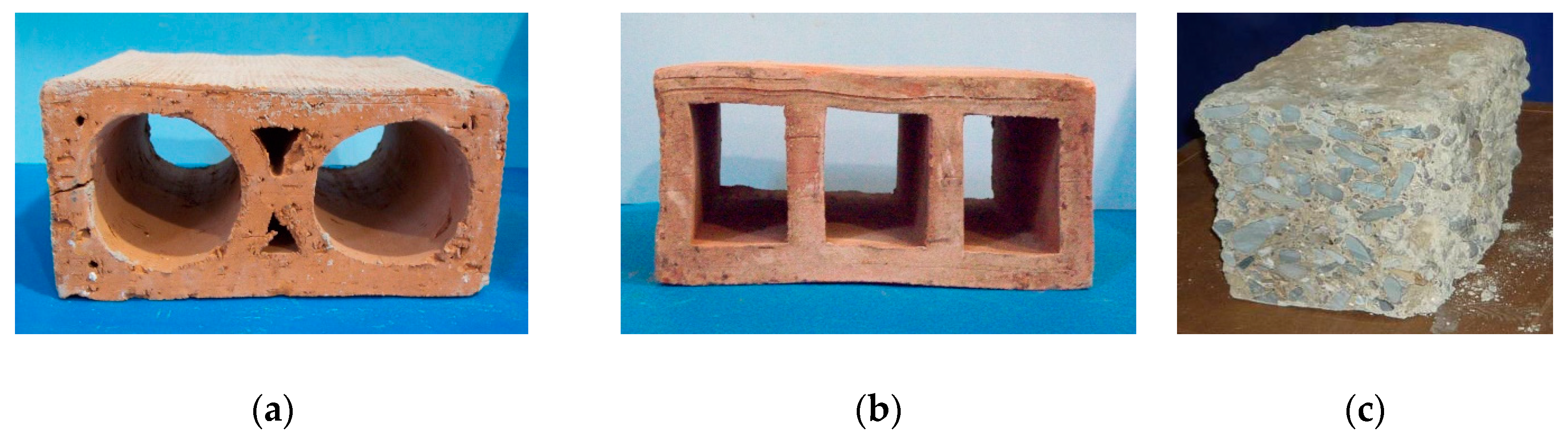
- About 14% of the sample concerns non-classifiable masonry (NC), not included in the Italian classification. These include tests on mixed masonry, consisting of stones and bricks, and on particular masonries ([4]), such as the hollow brick block masonry (so-called “occhialoni”, Figure 7a, or “foratoni”, Figure 7b), characterized by a perforation percentage greater than 45%, and the hand-made concrete block masonry (so-called “masselli”, Figure 7c), composed of built-in-work-site concrete elements, made up of sand and river pebbles with a great granulometric irregularity.
3. The TMDB Website
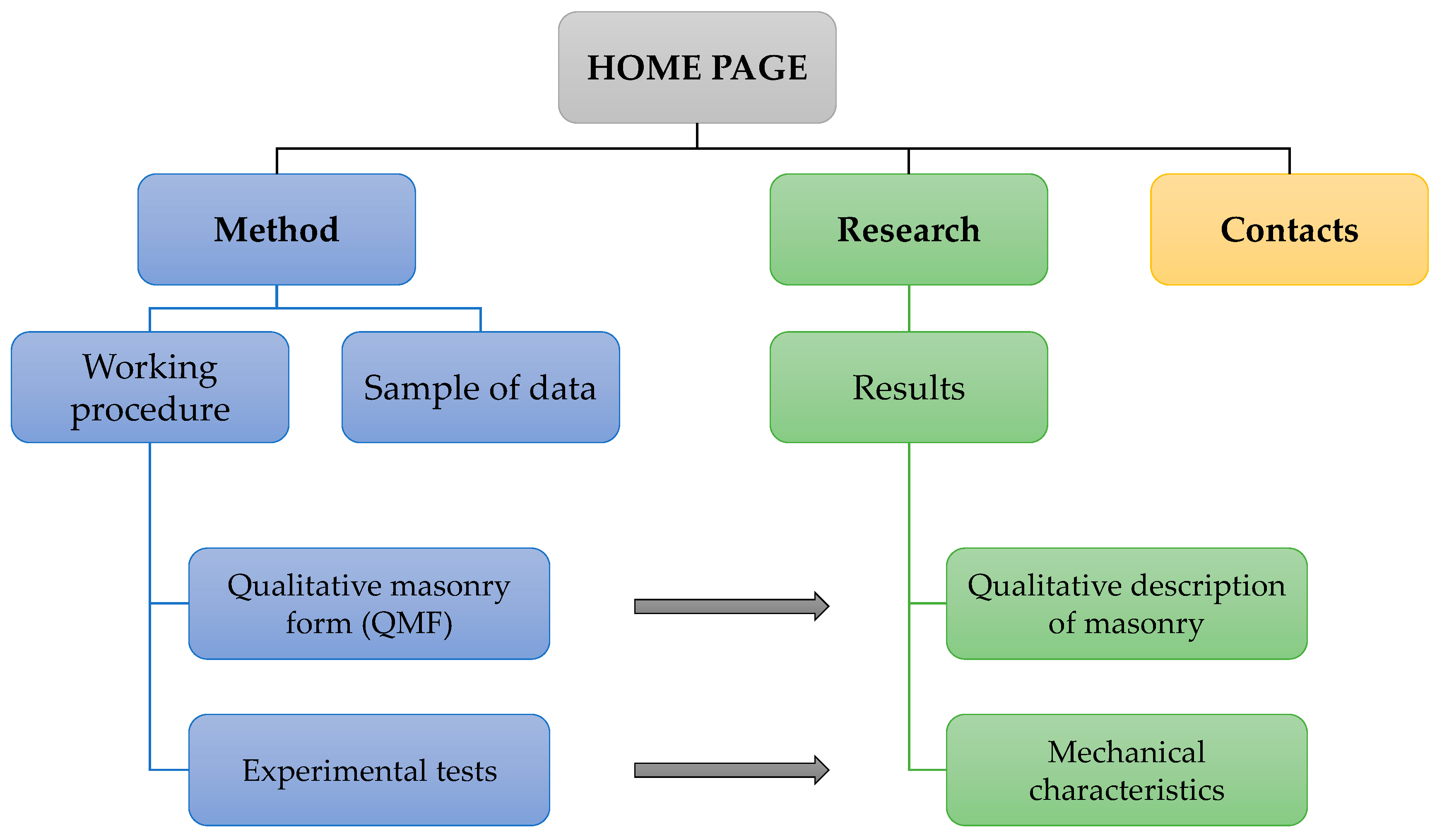
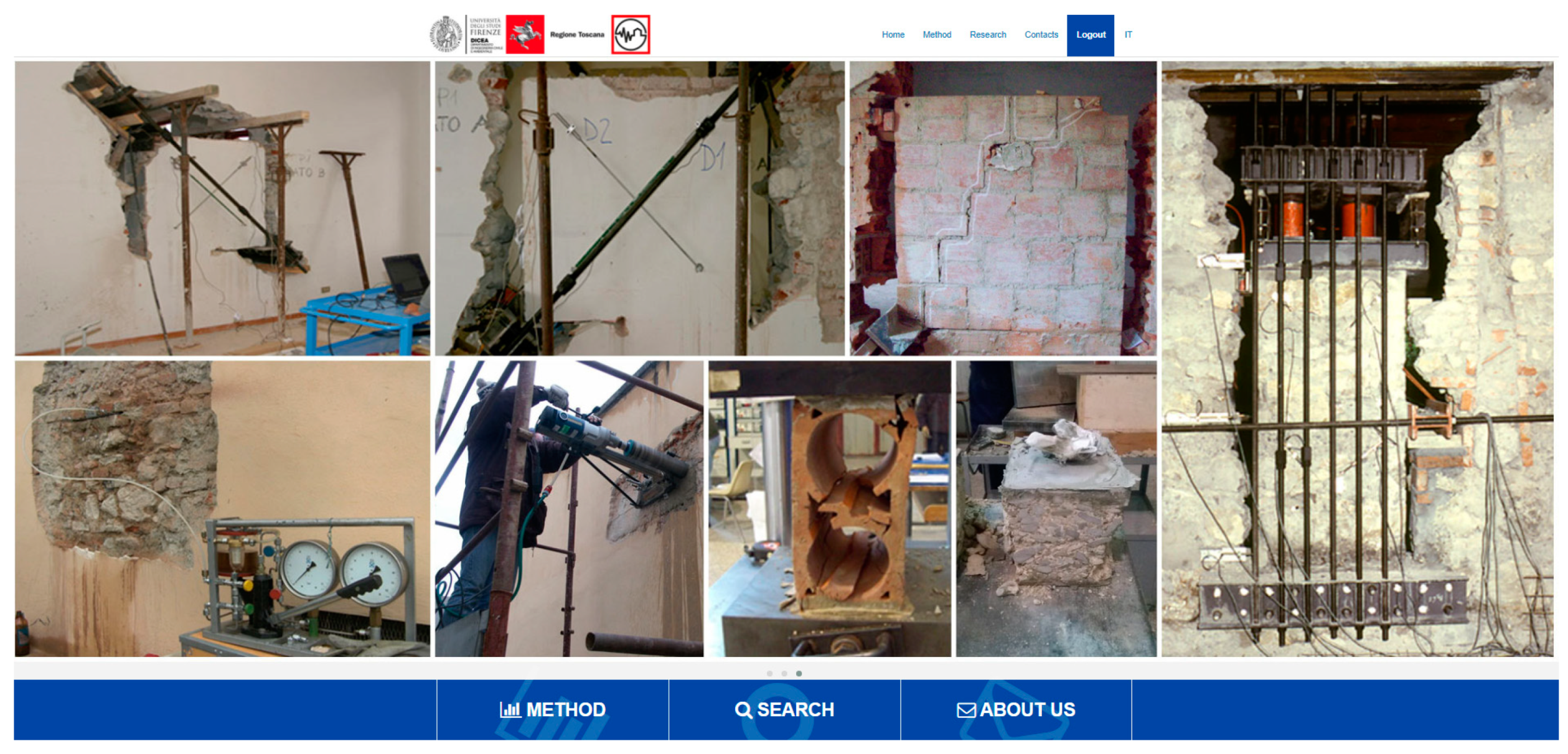
3.1. Home Page
3.2. Method Page
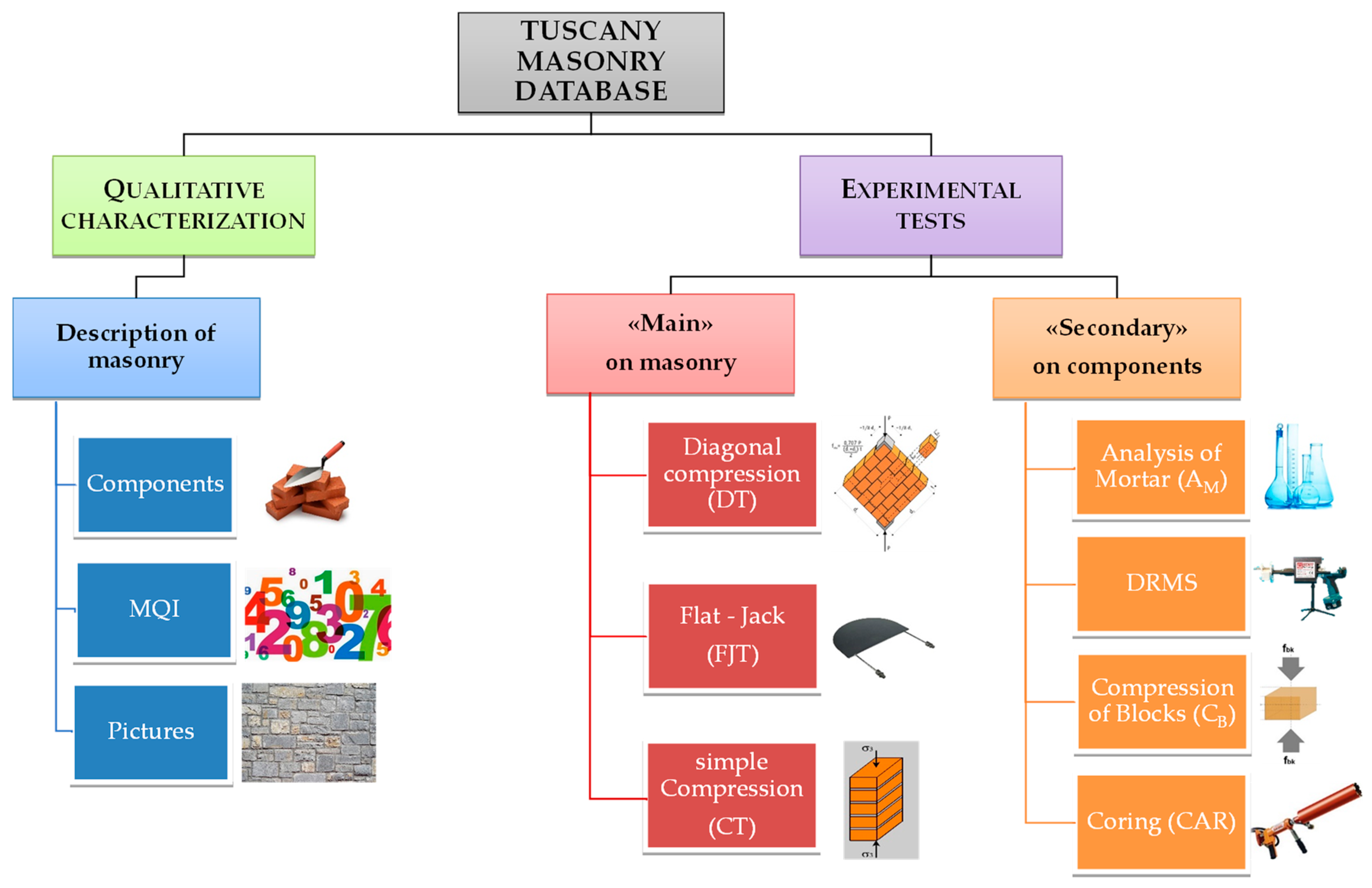
- Data collection and cataloging: acquisition of all available documentation of the experimental tests (photographic documentation, qualitative descriptions, diagnostic reports, test certificates, etc.) and their georeferencing.
- Treatment of tests and processing of numerical results according to a unitary approach. This step was crucial as the results were often treated differently since, for in situ tests of masonry characterization, there are no binding codified regulations and, consequently, results were not comparable to each other.
3.2.1. Qualitative Characterization of Masonry
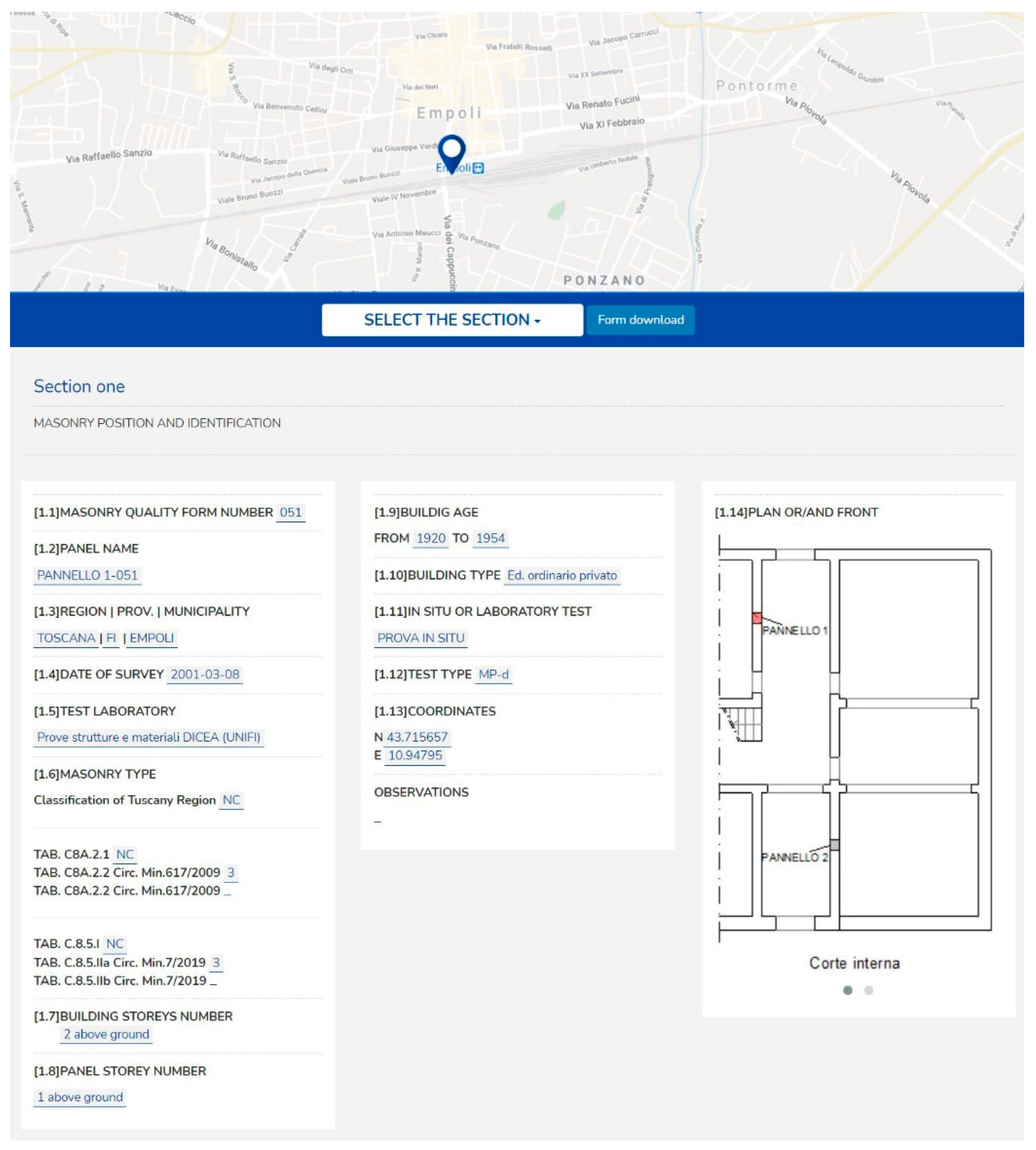
- Section one (Figure 10): Contains general information about the building and the masonry type, such as the name of the panel, the location in the building, some pictures, the date of the survey, and information about the detector. Furthermore, it contains information about the masonry category according to the regional [43] and national [16,17] classification; this attribution can only be made after compiling the entire form.
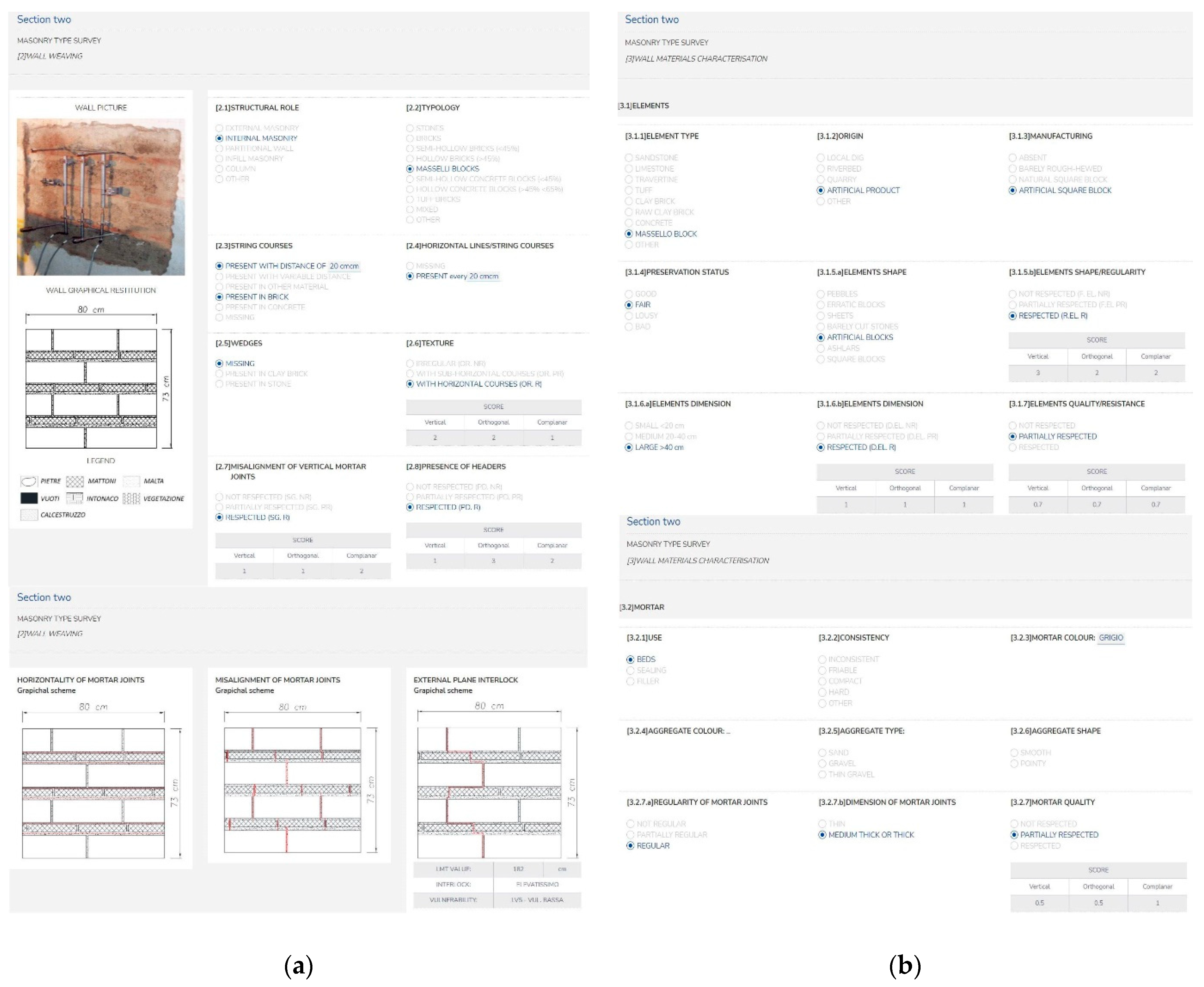
- Section two (Figure 11): Contains the main macroscopic characteristics of the wall and the section (if evaluable). The masonry elements (blocks and mortar) are characterized by shape, size, type, origin, and so forth.
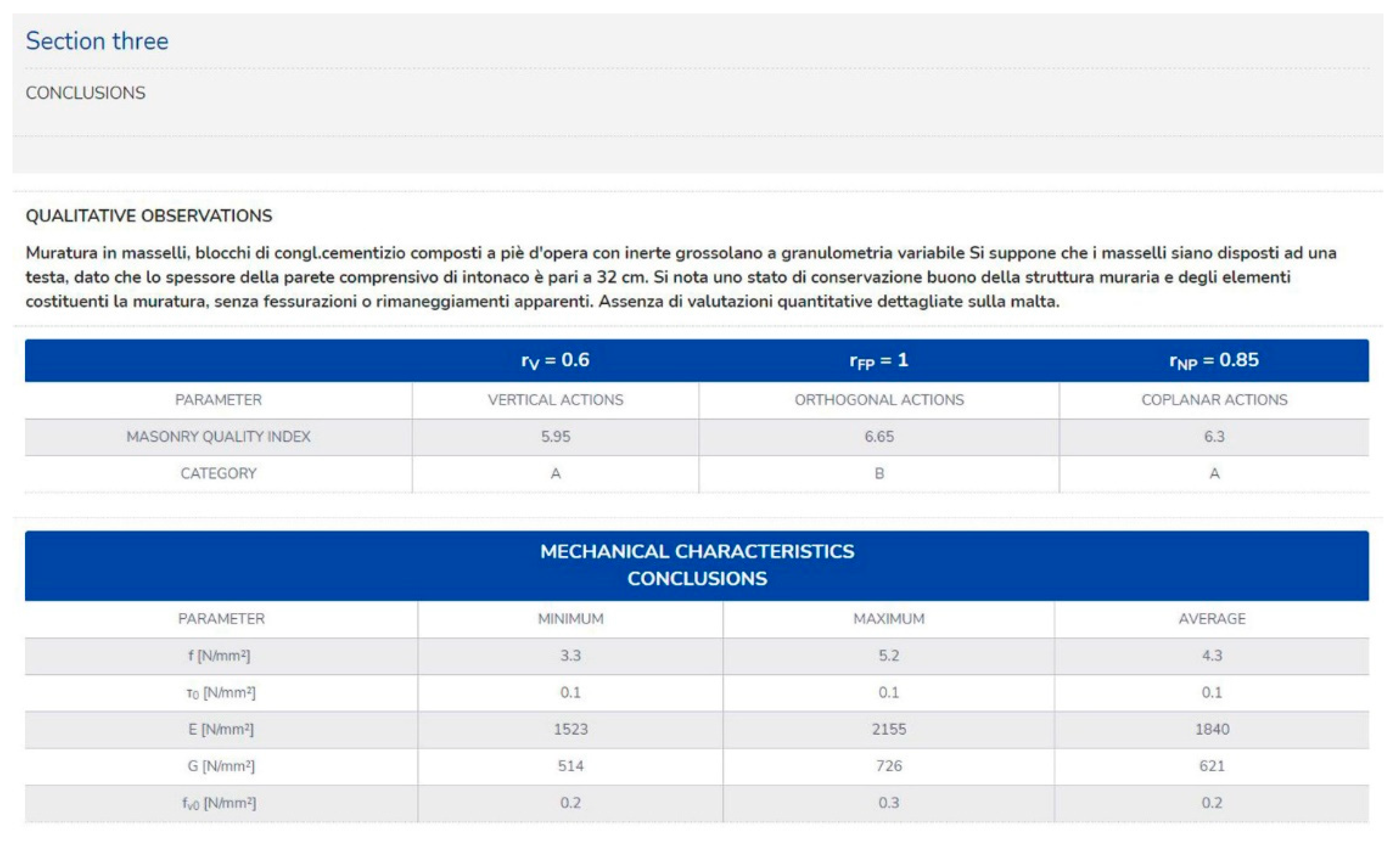
- Section three (Figure 12): Contains the observations deriving from the compilation of the first two sections, in relation to the masonry type and the state of conservation. Furthermore, based on the results obtained from the compilation, the MQI is attributed to the masonry.
3.2.2. Experimental Tests
3.3. Research Page
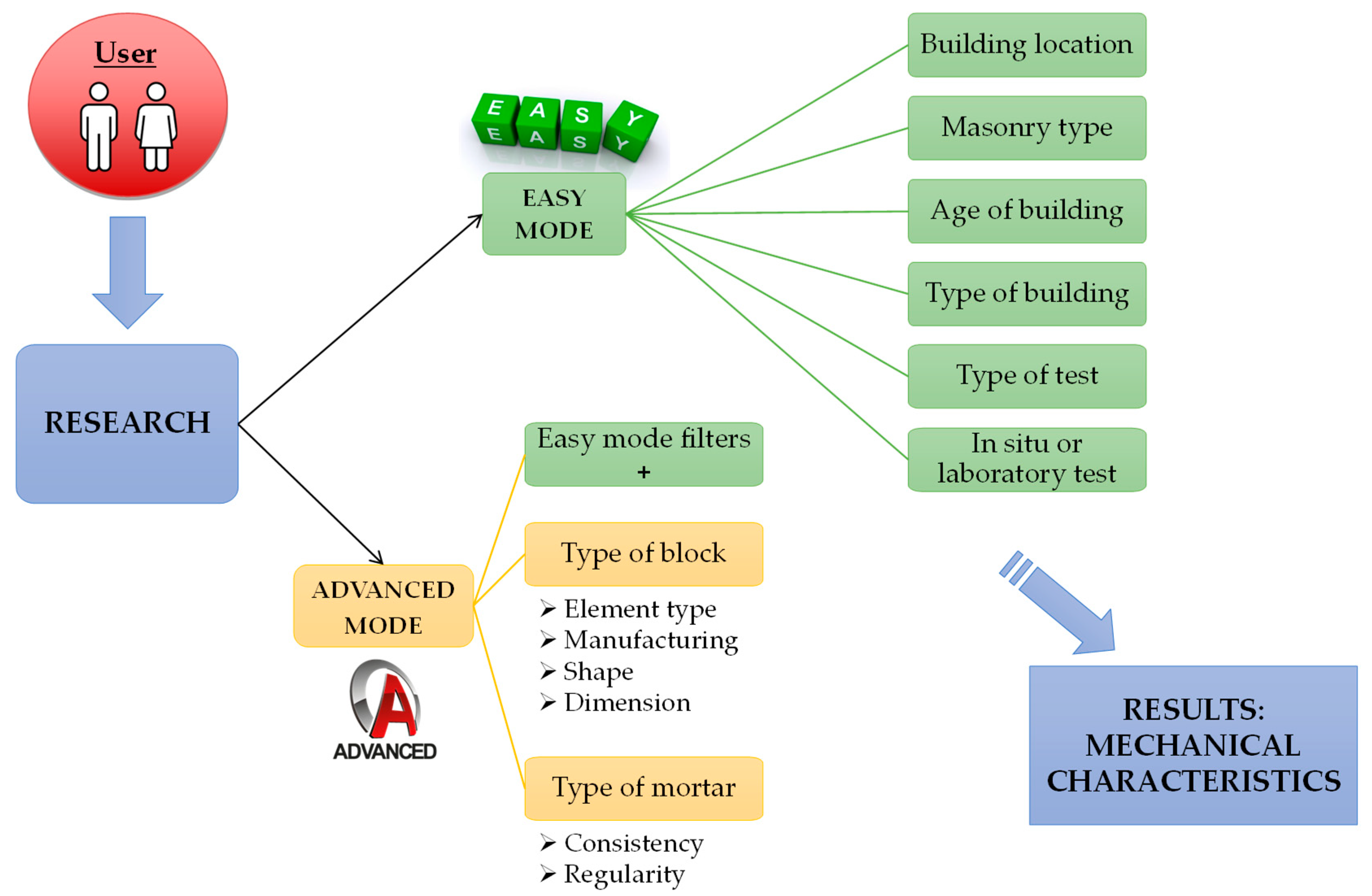
- easy research, filtering results through macro-topics;
- advanced research, using the easy research filters and some detailed search keys (such as type of masonry, block, mortar, etc.).
3.3.1. Easy Research
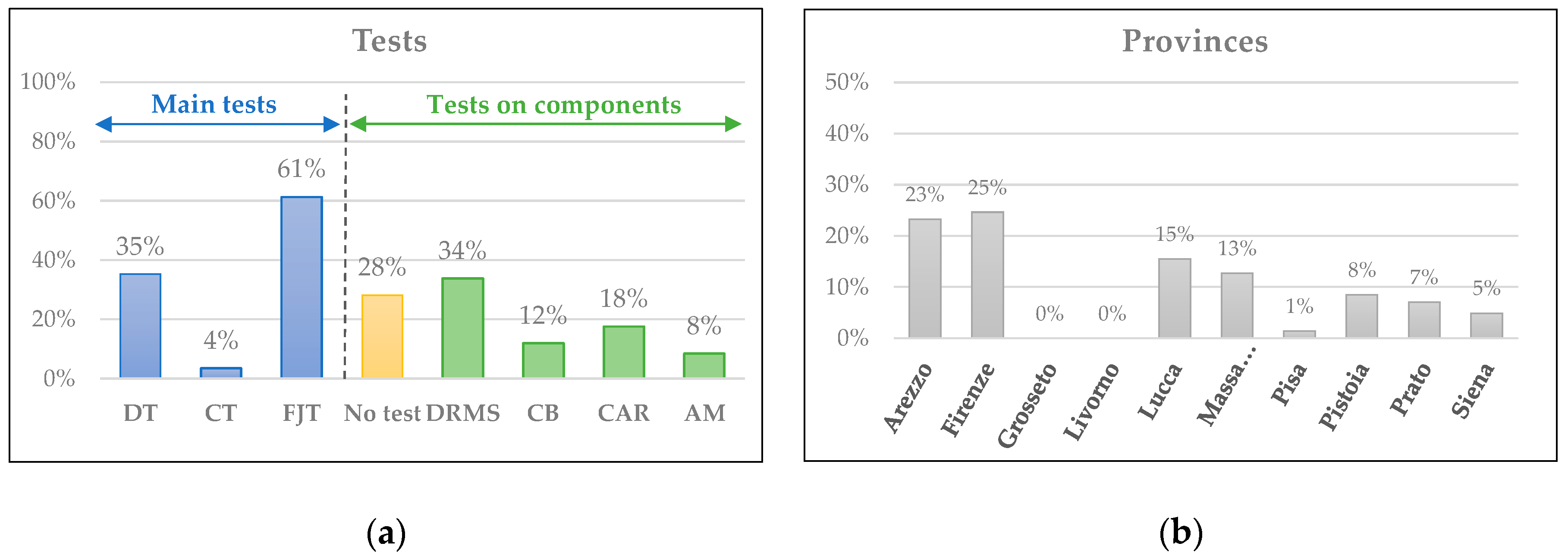
- Building location: all tests are georeferenced, and this aspect allows the user to search by geographical area (i.e., Region, Province, Municipality, or coordinates).
- Masonry type: this aspect allows the user to identify masonry types with similar typological/mechanical correspondence. The user can search for: classification of Tuscany Region [43], classification of Table C8A2.1 and Table C8A2.1 [16], classification of Table C.8.5.I and Table C.8.5.II [17], or masonry type (identified on the basis of the constituent material, if not included in the previous classifications).
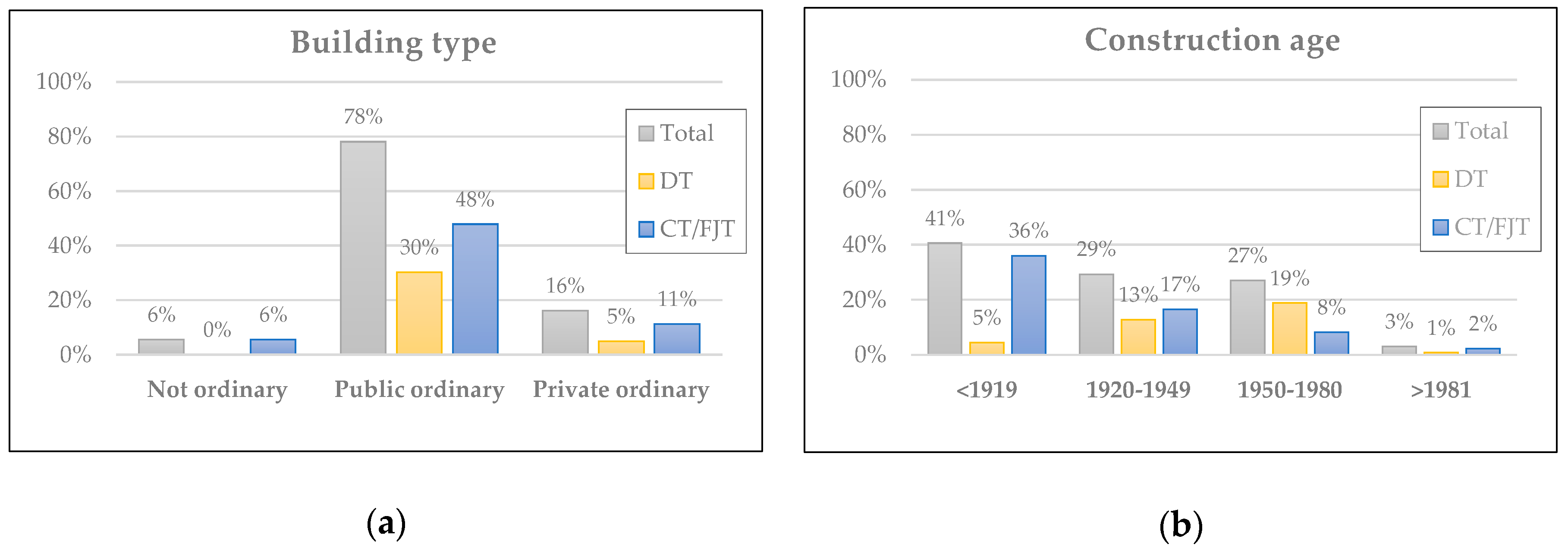
- Age of building: this filter allows the user to choose the time interval of the age of the construction to compare the masonry types by period of construction.
- Type of building: buildings are classified by destination use, that is, “private ordinary”, “public ordinary”, and “not ordinary”. This aspect allows the user to extract results related to the type of building more similar to the one of interest and excludes those with very different construction features. The choices can be multiple.
- Type of test: the user can search by test type; the choices can be made based on the main tests (i.e., DT, CT, and FJT) and can be multiple. Further filters relating to the secondary tests (i.e., DRMS, CB, AM, and CAR) can be added to them.
- In situ or laboratory test: the search can be filtered by choosing between in situ or laboratory tests. At present, the database includes only in situ tests.
3.3.2. Advanced Research
- Type of block: blocks can be filtered by considering the element type (i.e., the composition, such as sandstone, limestone, travertine, tuff, concrete, etc.), the manufacturing (i.e., absent, barely rough-hewed, natural square block, or artificial square block), the shape (i.e., pebbles, erratic block, sheets, ashlars, etc.) and the dimension (i.e., small, medium, or large).
- Type of mortar: mortar can be filtered by considering the consistency (i.e., inconsistency, friable, compact, or hard) and the regularity of the joints (i.e., not regular, partially regular, or regular).
3.3.3. Results
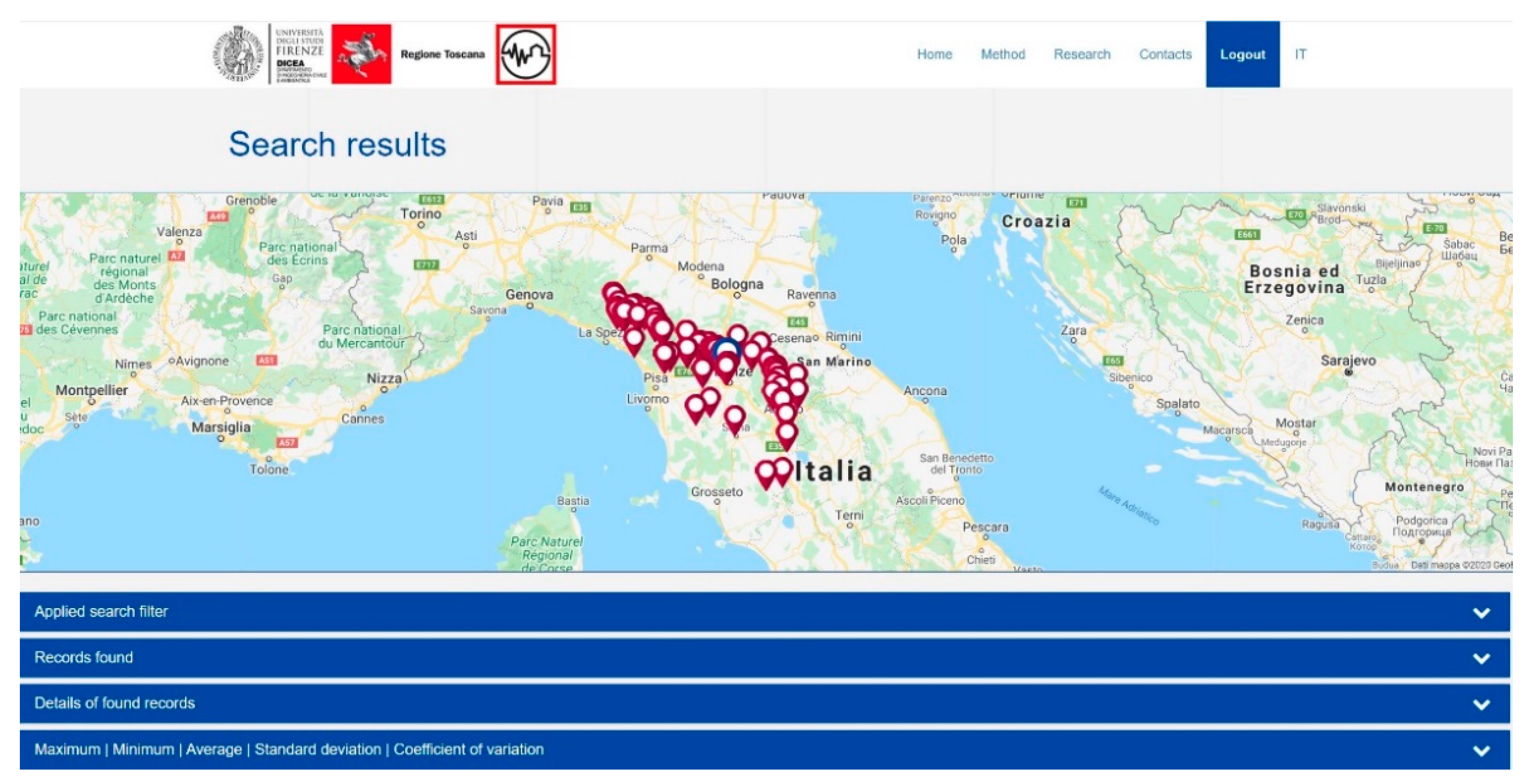
- Applied search filter: this section shows the summary of the set filters.
- Records found: this section shows the overall results of the records found, divided by type of test.
- Details of found records: this section shows the details of each record (i.e., ID form, picture, type of test, classification of Tuscany Region [43], classification of Table C8A2.1 and Table C8A2.1 [16], classification of Table C.8.5.I and Table C.8.5.II [17], QMI for vertical and coplanar actions, and the results of the mechanical characteristics associated with the tests). This section is interactive and allows the user to open in-depth pages explaining the found results.
- Statistics of the sample (i.e., maximum, minimum, average, standard deviation, and coefficient of variation): this section is interactive and shows the results of some basic statistics of the extrapolated sample for homogeneous mechanical quantities.
3.4. Contacts Page
3.5. Examples of Easy Research
3.5.1. Brick Masonry in not Ordinary Buildings
- Building location: Region = Tuscany
- Masonry type: classification of Table C.8.5.I = VI (“bricks and lime mortar”)
- Type of building: not ordinary buildings
- Type of test: FJT
3.5.2. Roughly Cut Stone Masonry in Ordinary Public Buildings
- Building location: Region = Tuscany; Province = Florence
- Masonry type: classification of Table C.8.5.I = III (roughly cut stone with good texture); classification of Table C.8.5.II = 1 (good mortar)
- Type of building: ordinary public buildings.
- Type of test: FJT.
4. Conclusions
Author Contributions
Funding
Conflicts of Interest
References
- ReLUIS. DPC 2014–2018. Available online: http://www.reluis.it/index.php?option=com_content&view=article&id=320&Itemid=170&lang=it (accessed on 19 October 2020).
- Boschi, S.; Bernardini, C.; Borghini, A.; Ciavattone, A.; del Monte, E.; Giordano, S.; Vignoli, A. Analisi dei risultati di prove sperimentali su murature Toscane. In Proceedings of the XVI Convegno Nazionale ANIDIS, L’Aquila, Italia, 13–17 September 2015. [Google Scholar]
- Boschi, S.; Giordano, S.; Signorini, N.; Vignoli, A. Abaco delle Murature della Regione Toscana. In Proceedings of the XVI Convegno Nazionale ANIDIS, Pistoia, Italy, 17–21 September 2017. [Google Scholar]
- Boschi, S.; Bernardini, C.; Borghini, A.; Ciavattone, A.; del Monte, E.; Giordano, S.; Vignoli, A. Mechanical characterization of particular masonry panels in Tuscany. In Proceedings of the XVI International Brick and Block Masonry Conference 1561–1570, Padova, Italy, 26–30 June 2016. [Google Scholar] [CrossRef] [Scilit]
- Vignoli, A.; Boschi, S.; Modena, C.; Cescatti, E. In-situ mechanical characterization of existing masonry typologies: A research project in Italy finalized to update the structural codes. In Proceedings of the XVI International Brick and Block Masonry Conference 1983–1991, Padova, Italy, 26–30 June 2016. [Google Scholar] [CrossRef] [Scilit]
- Boschi, S.; Galano, L.; Vignoli, A. Mechanical characterisation of Tuscany masonry typologies by in situ tests. Bull. Earthq. Eng. 2019, 17, 413–438. [Google Scholar] [CrossRef] [Scilit]
- Binda, L.; Gambarotta, L.; Lagomarsino, S.; Modena, C. A multilevel approach to the damage assessment and the seismic improvement of masonry buildings in Italy. In Seismic Damage to Masonry Buildings; Bernardini, A., Ed.; Balkema: Rotterdam, The Netherlands, 1999; pp. 179–194. [Google Scholar] [CrossRef] [Scilit]
- Tondelli, M.; Rota, M.; Penna, A.; Magenes, G. Evaluation of uncertainties in the seismic assessment of existing masonry buildings. J. Earthq. Eng. 2012, 16, 36–64. [Google Scholar] [CrossRef] [Scilit]
- Rota, M.; Penna, A.; Magenes, G. A framework for the seismic assessment of existing masonry buildings accounting for different sources of uncertainty. Earthq. Eng. Struct. Dyn. 2014. [Google Scholar] [CrossRef] [Scilit]
- Cattari, S.; Lagomarsino, S.; Bosiljkov, V.; D’Ayala, D. Sensitivity analysis for setting up the investigation protocol and defining proper confidence factors for masonry buildings. Bull. Earthq. Eng. 2015, 13, 129–151. [Google Scholar] [CrossRef] [Scilit]
- Binda, L.; Cardani, G. Seismic vulnerability of historic centers: A methodology to study the vulnerability assessment of masonry building typologies in seismic area. In Handbook of Research on Seismic Assessment and Rehabilitation of Historic Structures; IGI Global: Hershey, PA, USA, 2015; pp. 1–29. [Google Scholar] [CrossRef] [Scilit]
- European Committee for Standardization (CEN). Eurocode 8: Design of Structures for Earthquake Resistance–Part. 3: Assessment and Retrofitting of Buildings; European Committee for Standardization (CEN): Brussels, Belgium, 2005. [Google Scholar]
- Federal Emergency Management Agency. Prestandard and Commentary for the Seismic Rehabilitation of Buildings; FEMA 356; Federal Emergency Management Agency: Washington, DC, USA, 2000. [Google Scholar]
- NTC 2008. D.M. del Ministero delle Infrastrutture e dei Trasporti del 14/01/2008. Nuove Norme Tecniche per le Costruzioni. G.U. n. 29 del 04.02.2008, S.O. n. 30; Rome, Italy, 2008
- NTC 2018. D.M. del Ministero delle Infrastrutture e dei Trasporti del 17/01/2018. Aggiornamento delle “Norme Tecniche per le Costruzioni”. G.U. n. 42 del 20 febbraio 2018; Rome, Italy, 2018. (In Italian)
- MIT 2009. Circolare del Ministero delle Infrastructure e dei Trasporti, n.617 del 2 Febbraio 2009: ‘Istruzioni per l’applicazione Nuove Norme Tecniche per le Costruzioni di cui al D.M. 14 gennaio 2008′; Rome, Italy, 2009. (In Italian).
- MIT 2019. Circolare del Ministero delle Infrastructure e dei Trasporti, n.7 del 21 Gennaio 2019: ‘Istruzioni per l’applicazione dell’aggiornamento delle Norme Tecniche per le Costruzioni di cui al D.M. 17 gennaio 2018′. Consiglio Superiore dei Lavori Pubblici. G.U. n.35 del 11.02.2019; Rome, Italy, 2019. (In Italian).
- Antonelli, A.; Bartoli, G.; Betti, M. Experimental and numerical analyses for static retrofitting intervention on the ‘Cappella dei Principi’ in Firenze. In Structural Analysis of Historic Construction: Preserving Safety and Significance; CRC Press: Boca Raton, CA, USA, 2008. [Google Scholar] [CrossRef] [Scilit]
- Betti, M.; Orlando, M.; Vignoli, A. Static behaviour of an Italian Medieval Castle: Damage assessment by numerical modelling. Comput. Struct. 2011, 89, 1956–1970. [Google Scholar] [CrossRef] [Scilit]
- Cardani, G.; Binda, L. Guidelines for the evaluation of the load-bearing masonry quality in built heritage. Res. Dev. 2015. [Google Scholar] [CrossRef] [Scilit]
- Bartoli, G.; Betti, M.; Vignoli, A. A numerical study on seismic risk assessment of historic masonry towers: A case study in San Gimignano. Bull. Earthq. Eng. 2016, 14, 1475–1518. [Google Scholar] [CrossRef] [Scilit]
- Betti, M.; Borghini, A.; Boschi, S.; Ciavattone, A.; Vignoli, A. Comparative seismic risk assessment of basilica-type churches. J. Earthq. Eng. 2018. [Google Scholar] [CrossRef] [Scilit]
- Dall’Asta, A.; Leoni, G.; Meschini, A.; Petrucci, E.; Zona, A. Integrated approach for seismic vulnerability analysis of historic massive defensive structures. J. Cult. Herit. 2019, 35, 86–98. [Google Scholar] [CrossRef] [Scilit]
- Haddad, J.; Cattari, S.; Lagomarsino, S. Sensitivity and preliminary analyses for the seismic assessment of Ardinghelli Palace: An interdisciplinary approach. In Structural Analysis of Historical Constructions; Springer International Publishing: London, UK, 2019; pp. 2412–2421. [Google Scholar] [CrossRef] [Scilit]
- Turnsek, V.; Sheppard, P. Shear and flexural resistance of masonry walls. In Proceedings of the International Research Conference on Earthquake Engineering, 30 June–3 July 1980; pp. 517–573. [Google Scholar]
- Sheppard, P.F. In-situ test of the shear strength and deformability of an 15th Century stone-and brick masonry wall. In Proceedings of the 7th International Brick-Masonry Conference, Melobourne, Autralia, 17–20 February 1985; pp. 149–160. [Google Scholar]
- Chiostrini, S.; Vignoli, A. An experimental research program on the behavior of stone masonry structures. J. Test. Eval. 1992, 20, 190–206. [Google Scholar]
- Chiostrini, S.; Vignoli, A. In-situ determination of the strength properties of masonry walls by destructive shear and compression tests. Mason. Int 1993, 7, 87–96. [Google Scholar]
- Tomaževič, M.; Lutman, M.; Petković, L. Seismic Behavior of Masonry Walls: Experimental Simulation. J. Struct. Eng. 1996, 122, 1040–1047. [Google Scholar] [CrossRef] [Scilit]
- Binda, L.; Saisi, A.; Tiraboschi, C. Investigation procedures for the diagnosis of historic masonries. Constr. Build. Mater. 2000, 14, 199–233. [Google Scholar] [CrossRef] [Scilit]
- Chiostrini, S.; Galano, L.; Vignoli, A. In situ shear and compression tests in ancient stone masonry walls of Tuscany, Italy. J. Test. Eval. 2003, 31, 289–303. [Google Scholar]
- Borri, A.; Corradi, M.; Speranzini, E. Caratterizzazione meccanica di murature del XX secolo: Alcune sperimentazioni. In Proceedings of the XIII Convegno Nazionale ANIDIS, Bologna, Italy, 28 June–2 July 2009. [Google Scholar]
- Borri, A.; Castori, G.; Corradi, M.; Speranzini, E. Shear behavior of unreinforced and reinforced masonry panels subjected to in situ diagonal compression tests. Constr. Build. Mater. 2011, 25, 4403–4414. [Google Scholar] [CrossRef] [Scilit]
- Milosevic, J.; Gago, A.S.; Lopes, M.; Bento, R. Experimental assessment of shear strength parameters on rubble stone masonry specimens. Constr. Build. Mater. 2013, 47, 1372–1380. [Google Scholar] [CrossRef] [Scilit]
- Borri, A.; Castori, G.; Corradi, M. Determination of shear strength of masonry panels through different tests. Int. J. Archit. Herit. 2015, 9, 913–927. [Google Scholar] [CrossRef] [Scilit]
- Vicente, R.; Ferreira, T.M.; Mendes da Silva, J.A.R.; Varum, H. In situ flat-jack testing of traditional masonry walls: Case study of the old city center of Coimbra, Portugal. Int. J. Archit. Herit. 2015, 9, 794–810. [Google Scholar] [CrossRef] [Scilit]
- Boschi, S.; Ferreira, T.M.; Vicente, R.; Vignoli, A. Comparative analysis between Tuscan and Portuguese traditional masonries: Qualitative and mechanical characterisation. In Proceedings of the 10th International Masonry Conference (10 IMC), Milan, Italy, 9–11 July 2018. [Google Scholar]
- Borri, A.; Corradi, M.; Castori, G.; de Maria, A. A method for the analysis and classification of historic masonry. Bull. Earthq. Eng. 2015, 13, 2647–2665. [Google Scholar] [CrossRef] [Scilit]
- Borri, A.; de Maria, A. The masonry quality index after the 2019 Italian Guidelines. Structural 2019, 222, 1–21. [Google Scholar]
- Borri, A.; Corradi, M. The failure of masonry walls by disaggregation and the masonry quality index. Heritage 2020, 3, 1162–1198. [Google Scholar] [CrossRef] [Scilit]
- Alecci, V.; Fagone, M.; Rotunno, T.; de Stefano, M. Shear strength of brick masonry walls assembled with different types of mortar. Constr. Build. Mater. 2013. [Google Scholar] [CrossRef] [Scilit]
- Andreini, M.; de Falco, A.; Giresini, L.; Sassu, M. Mechanical characterization of masonry walls with chaotic texture: Procedures and results of in-situ tests. Int. J. Archit. Herit. 2014. [Google Scholar] [CrossRef] [Scilit]
- Ferrini, M.; Melozzi, A.; Pagliazzi, A.; Scarparo, S. Rilevamento della vulnerabilità sismica degli edifici in muratura. Manuale per la compilazione della Scheda GNDT/CNR di II livello-Versione modificata dalla Regione Toscana; Regione Toscana: Toscana, Italy, 2003. (in Italian) [Google Scholar]
- Binda, L.; Borri, A.; Cardani, G.; Doglioni, F. Scheda qualità muraria: Relazione finale e linee guida per la compilazione della scheda di valutazione della qualità muraria. Rep. Progett. ReLUIS 2009, 2005–2008. [Google Scholar]
- ASTM E519/E519M-15. Standard Test Method for Diagonal Tension (Shear) in Masonry Assemblages; ASTM International: West Coshohocken, PA, USA, 2015. [Google Scholar] [CrossRef] [Scilit]
- 46. RILEM TC. 76-LUM. 76-LUM. Diagonal Tensile Strength Tests of Small Wall Specimens; RILEM: London, UK, 1994; pp. 488–489. [Google Scholar]
- ReLUIS. Linea di Ricerca 1-Valutazione e Riduzione Della Vulnerabilità di Edifici in Muratura-Sub Task 3b3-Indagini Diagnostiche su Tipologie Murarie; ReLUIS: Naples, Italy, 2009. [Google Scholar]
- ASTM C1197-14a. Standard Test Method for In Situ Measurement of Masonry Deformability Properties Using the Flatjack Method; ASTM International: West Coshohocken, PA, USA, 2014. [Google Scholar] [CrossRef] [Scilit]
- RILEM TC 177. Masonry durability and on-site testing-D.5: In-situ stress-strain behaviour tests based on the flat jack. Mater. Struct. 2004, 37, 497–501. [Google Scholar]
- UNI EN 772-1. Metodi di Prova Per Elementi Per Muratura - Parte 1: Determinazione Della Resistenza a Compressione; UNI: Milan, Italy, 2015. (in Italian) [Google Scholar]
- Del Monte, E.; Vignoli, A. In situ mechanical characterization of the mortar in masonry buildings with DRMS. In SACoMaTiS 2008-RILEM Symposium on Site Assessment of Concrete, Masonry and Timber Structures; RILEM: Paris, France, 2008; pp. 421–430. [Google Scholar]
- Del Monte, E.; Boschi, S.; Vignoli, A. Prediction of compression strength of ancient mortars through in situ drilling resistance technique. Constr. Build. Mater. 2020. [Google Scholar] [CrossRef] [Scilit]




| Masonry Type | Cat. | fm N/mm2 | τ0 N/mm2 | fV0 N/mm2 | E N/mm2 | G N/mm2 | w N/mm3 |
|---|---|---|---|---|---|---|---|
| Disorganized irregular stone | I | 1.0 2.0 | 0.018 0.032 | - | 690 1050 | 230 350 | 19 |
| Barely cut stone with leaves of uneven thickness | II | 2.0 | 0.035 0.051 | - | 1020 1440 | 340 480 | 20 |
| Roughly cut stone with good texture | III | 2.6 3.8 | 0.056 0.074 | - | 1500 1980 | 500 660 | 21 |
| Irregular soft stone (tuff, limestone, etc.) | IVa | 1.4 2.2 | 0.028 0.042 | - | 900 1260 | 300 420 | 13–16 |
| Ashlars of soft stone (tuff, limestone, etc.) | IVb | 2.0 3.2 | 0.04 0.08 | 0.10 0.19 | 1200 1620 | 400 500 | 13–16 |
| Stone square blocks | V | 5.8 8.2 | 0.09 0.12 | 0.18 0.28 | 2400 3300 | 800 1100 | 22 |
| Bricks and lime mortar | VI | 2.6 4.3 | 0.05 0.13 | 0.13 0.27 | 1200 1800 | 400 600 | 18 |
| Hollow bricks with cementitious mortar (e.g., holes <= 40%) | VII | 5.0 8.0 | 0.08 0.17 | 0.20 0.36 | 3500 5600 | 875 1400 | 15 |
| State of Fact | Strengthening Interventions | Maximum Overall Coefficient | |||||
|---|---|---|---|---|---|---|---|
| Code | 1 | 3 | 4 | 6 | 7 | 8 | |
| Cat. | Good Mortar | Stringcourses or Edging | Transversal Connections | Injections | Jacketing | Reinforced Joints Sealing | |
| I | 1.5 | 1.3 | 1.5 | 2 | 2.5 | 1.6 | 3.5 |
| II | 1.4 | 1.2 | 1.5 | 1.7 | 2.0 | 1.5 | 3.0 |
| III | 1.3 | 1.1 | 1.3 | 1.5 | 1.5 | 1.4 | 2.4 |
| IVa | 1.5 | 1.2 | 1.3 | 1.4 | 1.7 | 1.1 | 2.0 |
| IVb | 1.6 | - | 1.2 | 1.2 | 1.5 | 1.2 | 1.8 |
| V | 1.2 | - | 1.2 | 1.2 | 1.2 | - | 1.4 |
| VI | - | 1.3 | 1.2 | 1.5 | 1.2 | 1.8 | |
| VII | 1.2 | - | - | - | 1.3 | - | 1.3 |
| Test | Reference Documents | Derived Parameters | Minimum Panel Dimensions |
|---|---|---|---|
| DT | ASTM E 519-07 [45] RILEM TC [46] ReLUIS [47] | τ0, G | 120 cm × 120 cm |
| CT | ReLUIS [47] | fc, E | 90 cm × 180 cm |
| FJT | ASTM C 1196-1197 [48] RILEM TC [49] ReLUIS [47] | (fc) E | 100 cm × 100 cm |
| CB | UNI EN 772-1 2015 [50] | fb | - |
| DRMS | Procedure defined in [51,52] | fcm | 100 cm × 100 cm |
| AM | - | Macro and microscopic description of the mortar | - |
| CAR | - | Analysis of the wall section | - |
| ID Panel | MQI Vertical Actions | MQI Coplanar Actions | f [N/mm2] | E [N/mm2] |
|---|---|---|---|---|
| 070 | 4.2 | 5.525 | - | 1240 |
| 071 | 4.2 | 5.525 | - | 1767 |
| 072 | 1.3 | 0.55 | - | 832 |
| 120 | 3.9 | 5.1 | 2.31 | 2051 |
| Average | 1472.5 | |||
| Standard deviation | 543.35 | |||
| Variation coefficient | 37% | |||
| ID Panel | MQI Vertical Actions | MQI Coplanar Actions | f [N/mm2] | E [N/mm2] |
|---|---|---|---|---|
| 064 | 3.5 | 3 | - | 2700 |
| 075 | 6 | 6 | - | 2573 |
| 076 | 6 | 6 | - | 2408 |
| 077 | 5.5 | 5 | - | 1675 |
| 090 | 3.5 | 3 | 2.08 | 2442 |
| 092 | 6.5 | 5.5 | 3.12 | 3117 |
| Average | 2.60 | 2485.83 | ||
| Standard deviation | 0.74 | 472.71 | ||
| Variation coefficient | 28% | 19% | ||
Publisher’s Note: MDPI stays neutral with regard to jurisdictional claims in published maps and institutional affiliations. |
© 2021 by the authors. Licensee MDPI, Basel, Switzerland. This article is an open access article distributed under the terms and conditions of the Creative Commons Attribution (CC BY) license (http://creativecommons.org/licenses/by/4.0/).
Share and Cite
Boschi, S.; Bernardini, C.; Vignoli, A. The Tuscany Masonry Database Website. Heritage 2021, 4, 230-248. https://doi.org/10.3390/heritage4010014
Boschi S, Bernardini C, Vignoli A. The Tuscany Masonry Database Website. Heritage. 2021; 4(1):230-248. https://doi.org/10.3390/heritage4010014
Chicago/Turabian StyleBoschi, Sonia, Chiara Bernardini, and Andrea Vignoli. 2021. "The Tuscany Masonry Database Website" Heritage 4, no. 1: 230-248. https://doi.org/10.3390/heritage4010014
APA StyleBoschi, S., Bernardini, C., & Vignoli, A. (2021). The Tuscany Masonry Database Website. Heritage, 4(1), 230-248. https://doi.org/10.3390/heritage4010014