
Article

Forecasting Demand Under Limited Data: Benchmark Models for Workforce Capacity Planning in Translation Services


by
Lorena Hernández-Mastrapa
1,2,
Daniel René Tasé-Velázquez
2,3,
Renato Máximo-Sátiro
4,
Gelmar García-Vidal
5,
Alexander Sánchez-Rodríguez
6,* and
Reyner Pérez-Campdesuñer
2,5
1
Graduate Program in Production Engineering, São Carlos School of Engineering, University of São Paulo, São Paulo 05508-220, Brazil
2
General Directorate of Postgraduate Studies, Universidad UTE, Quito 170508, Ecuador
3
Hermínio Ometto Foundation University Center—FHO, São Paulo 13607-339, Brazil
4
Accounting and Economics (FACE), Faculty of Administration, Federal University of Goiás (UFG), Goiânia 74690-900, Brazil
5
Faculty of Law, Administrative and Social Sciences, Universidad UTE, Quito 170527, Ecuador
6
Faculty of Engineering Sciences and Industries, Universidad UTE, Quito 170527, Ecuador
*
Author to whom correspondence should be addressed.
Forecasting 2026, 8(5), 85; https://doi.org/10.3390/forecast8050085

Submission received: 2 August 2026 / Revised: 9 September 2026 / Accepted: 10 September 2026 / Published: 13 September 2026
(This article belongs to the Special Issue Benchmark Models in Time Series Forecasting)

Abstract

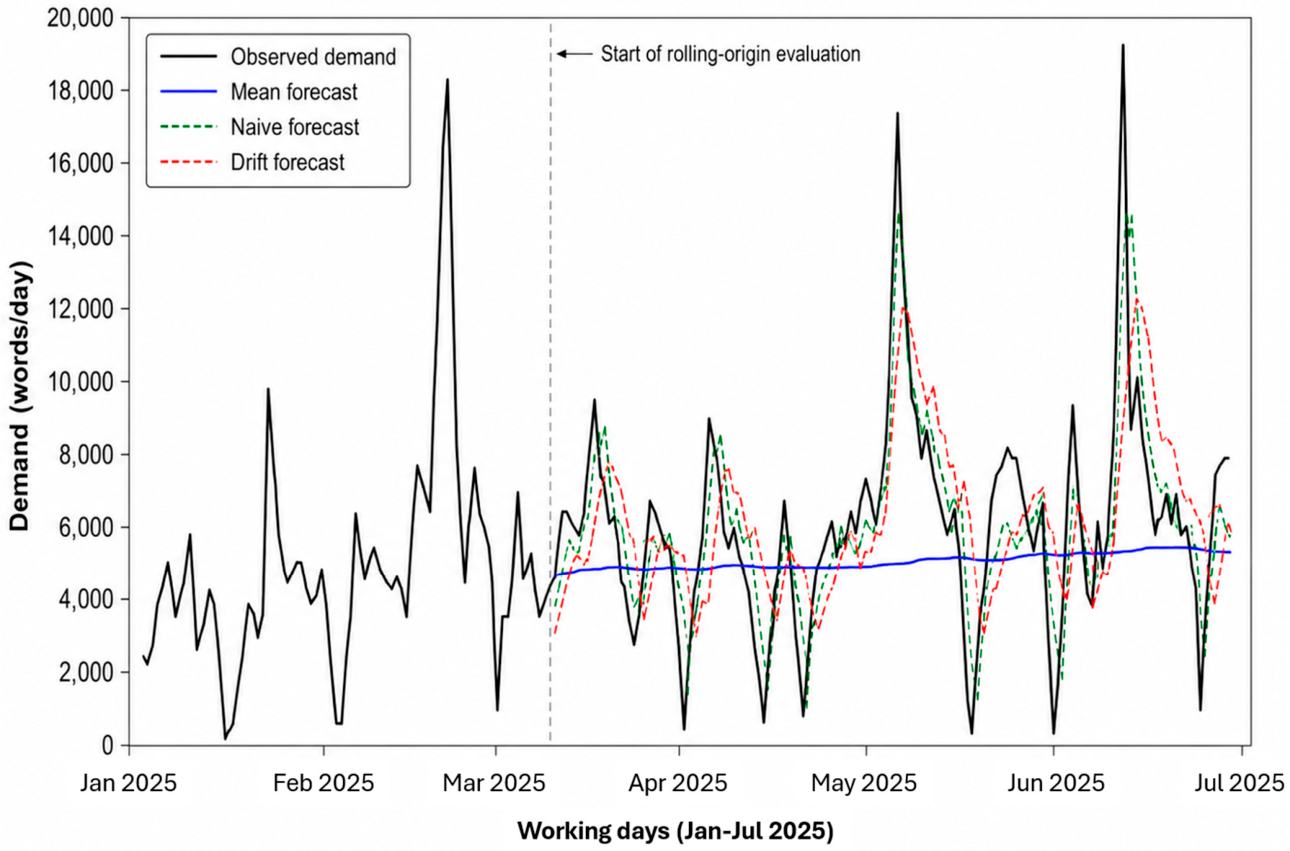
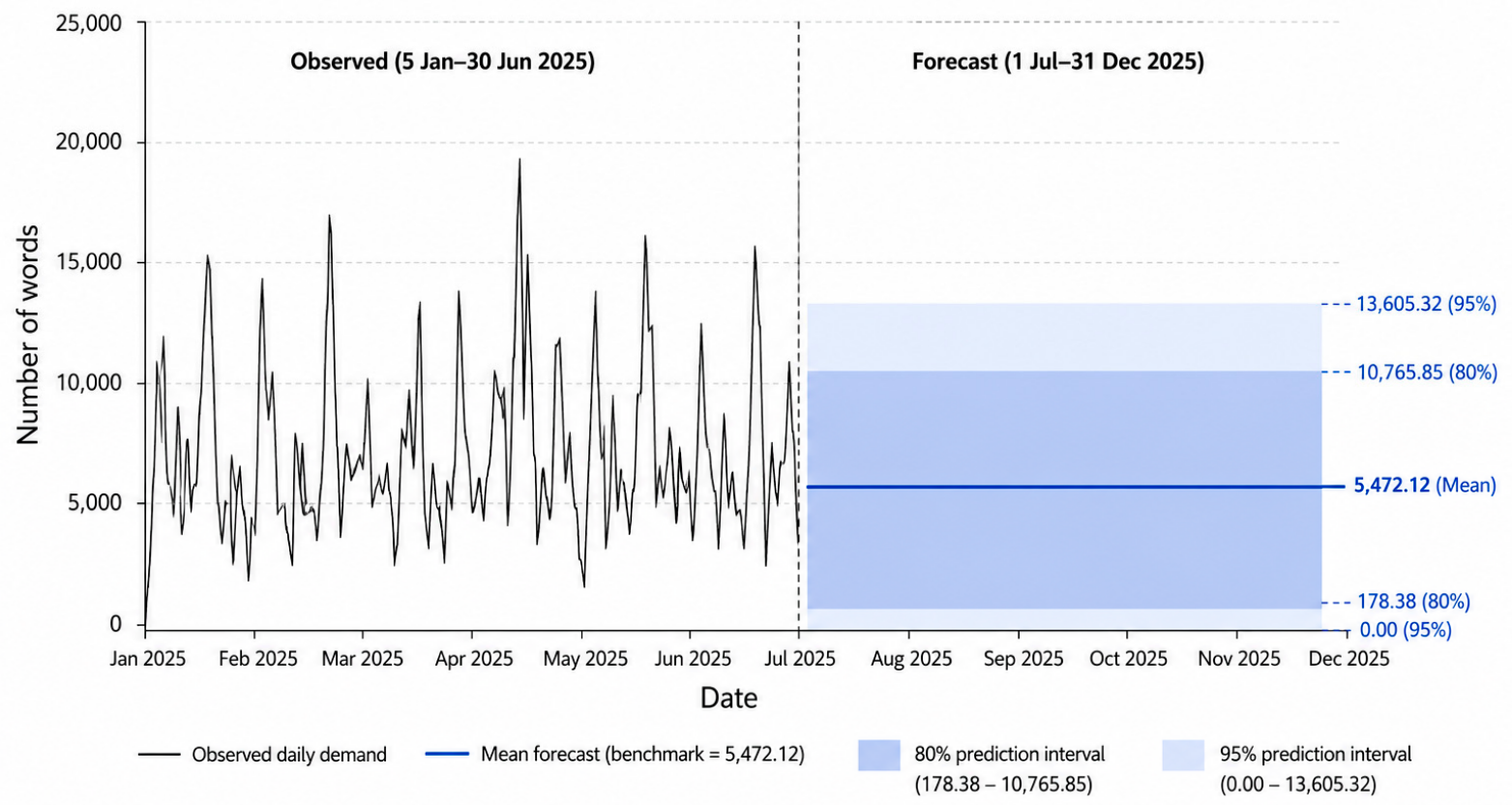
Demand variability complicates workforce capacity planning in knowledge-intensive services, particularly when only short historical records are available. This study evaluates parsimonious benchmark models for forecasting translation-service demand and translating the resulting forecasts into staffing requirements. The empirical analysis used 122 daily observations collected over six months from a translation team providing services in English and Spanish. Demand was measured as the number of words requested per working day, while nominal individual capacity was operationalized as 2000 translated words per day. Three benchmark forecasting methods—Naive, Mean, and Drift—were compared through expanding-window rolling-origin evaluation using ME, MAE, RMSE, MASE, and sMAPE. At the one-working-day horizon, the Mean benchmark achieved the lowest MAE (3221.66 words), RMSE (4424.81 words), MASE (0.845), and sMAPE (58.14%), and it maintained the lowest values for these measures at five- and twenty-working-day horizons. Re-estimated using all 122 observations, the Mean benchmark generated a point forecast of 5472.12 words per working day, equivalent to 2.74 translator-equivalents and a baseline requirement of three translators under the nominal productivity assumption. However, observed demand exceeded three-translator capacity on 34.43% of working days, indicating the need for flexible contingency capacity. The study provides a transparent framework connecting benchmark forecast evaluation with workforce-capacity decisions under limited temporal coverage.
Keywords: parsimonious forecasting; short time series; forecast accuracy; service operations; workforce planning; capacity–demand alignment; knowledge-intensive services parsimonious forecasting; short time series; forecast accuracy; service operations; workforce planning; capacity–demand alignment; knowledge-intensive services