Article

Treatment of Greywater with Emerging Contaminants Using Hollow Fiber Membrane Bioreactor

1
Departamento de Química Inorgánica, Facultad de Química y de Farmacia, Pontificia Universidad Católica de Chile, Avenida Vicuña Mackenna 4860, Macul, Santiago 7820436, Chile
2
Departamento de Ingeniería Hidráulica y Ambiental, Pontificia Universidad Católica de Chile, Avenida Vicuña Mackenna 4860, Macul, Santiago 7820436, Chile
3
Escuela de Biotecnología, Universidad Mayor, Camino La Pirámide 5750, Huechuraba, Santiago 8580745, Chile
4
Laboratory of Foods and Drugs Research, Faculty of Chemistry and Pharmacy, Pontificia Universidad Católica de Chile, Santiago 7820436, Chile
5
Centro de Investigación en Nanotecnología y Materiales CIEN-UC, Pontificia Universidad Católica de Chile, Avenida Vicuña Mackenna 4860, Macul, Santiago 7820436, Chile
6
Consorcio Tecnológico del Agua CoTH2O, CTI250001, Santiago 7820436, Chile
7
Centro de Derecho y Gestión de Aguas, Pontificia Universidad Católica de Chile, Avenida Vicuña Mackenna 4860, Macul, Santiago 7820436, Chile
*
Author to whom correspondence should be addressed.
Clean Technol. 2026, 8(5), 146; https://doi.org/10.3390/cleantechnol8050146
Submission received: 20 July 2026 / Revised: 21 August 2026 / Accepted: 1 September 2026 / Published: 7 September 2026

Abstract

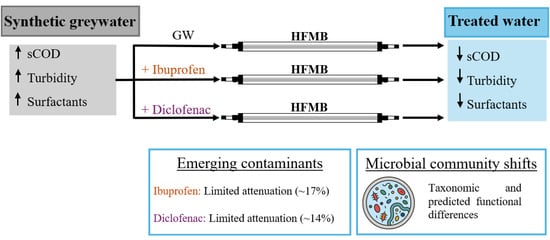
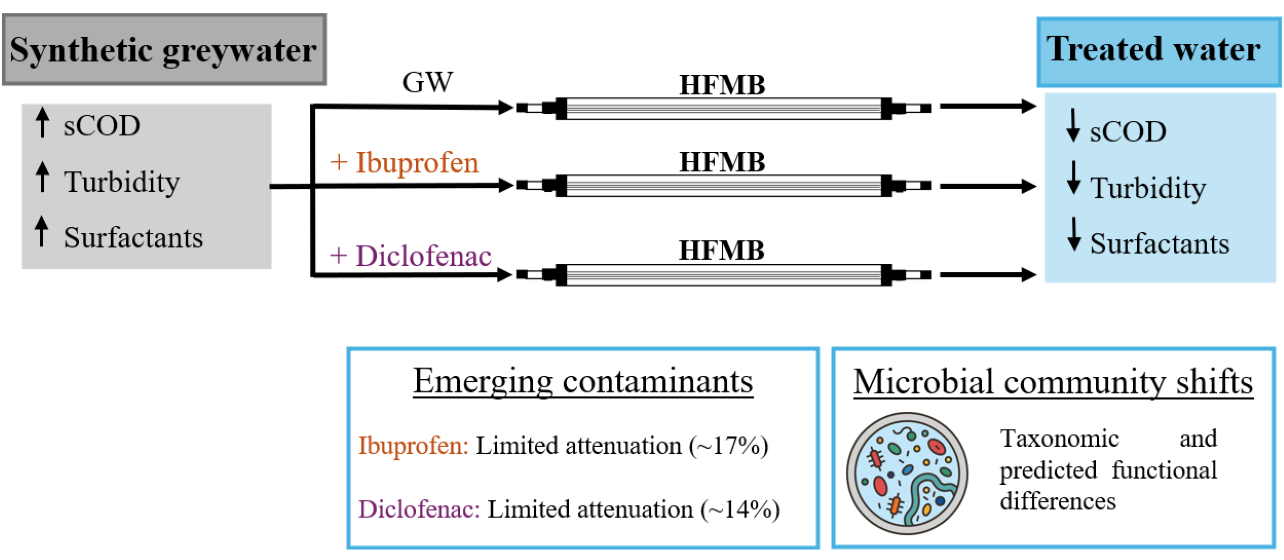
Greywater reuse has emerged as a promising strategy to reduce pressure on freshwater resources, but little is known about the impact that emerging contaminants may have on its safe application. This study evaluated the performance of hollow fiber membrane bioreactors (HFMBs) for synthetic greywater treatment under control conditions and exposure to two widely used pharmaceutical compounds: ibuprofen and diclofenac. Nine HFMBs were operated for 11 days using synthetic greywater without pharmaceuticals (control), ibuprofen-amended greywater, or diclofenac-amended greywater. Reactor performance was assessed through physicochemical parameters and microbial community analysis. Turbidity and soluble chemical oxygen demand (sCOD) decreased in all reactors and were adequately described by an empirical temporal stabilization model. Turbidity removal was comparable among treatments, whereas final sCOD removal differed among reactor conditions. Anionic surfactants were markedly reduced, with removal efficiencies above 98% in all systems. In contrast, ibuprofen and diclofenac showed small and variable decrease in measured concentrations, but no statistically significant differences were detected between initial and final concentrations. Microbial community analysis revealed that Pseudomonadota was the dominant phylum in the HFMB reactors. Functional prediction further indicated an enrichment of pathways associated with aromatic compound degradation and biofilm-related processes across the reactor configuration and operating conditions. Moreover, the diclofenac treatment exhibited an additional enrichment of functions related to environmental stress resistance and an enhanced potential for aromatic compound degradation compared with the control treatment.

Graphical Abstract

1. Introduction

The water crisis is a phenomenon affecting numerous countries and human settlements, and it has intensified in recent decades due to the continuous increase in freshwater demand associated with factors such as population growth, economic development, and changes in consumption and dietary patterns [1]. In this context, the treatment and subsequent reuse of wastewater, particularly greywater, has emerged as an alternative to help address the growing demand for this resource [2,3]. Unlike other domestic wastewater streams, greywater is continuously generated through everyday activities and has high potential for reuse in non-potable applications, such as irrigation, toilet flushing, and cleaning of floors and outdoor surfaces. Therefore, greywater recovery at a decentralized scale can reduce potable water consumption, decrease wastewater discharge volumes, and promote more circular management of water resources. Moreover, on-site or clustered decentralized systems offer greater management flexibility and operational simplicity, making them a reliable and cost-effective long-term alternative for decentralized applications in residential buildings and small communities [4].
Greywater refers to domestic wastewater generated from bathtubs, showers, hand basins, kitchen sinks, dishwashers and laundry machines [5]. It differs from blackwater, which originates from toilet flushing, because it generally contains lower concentrations of organic matter, nutrients, and pathogenic microorganisms [6]. Greywater is commonly classified as light greywater, mainly generated from showers, bathtubs, and hand basins, and dark greywater, which includes kitchen, dishwasher, and laundry effluents and is characterized by higher concentrations of organic matter, suspended solids, fats, and detergents [7]. Due to this higher biodegradable organic load, dark greywater may be especially suitable for biological treatment processes. Greywater accounts for approximately 70% of total domestic wastewater production [8], making it a relevant and readily available source for water reuse.
In addition to conventional pollutants, greywater may contain a wide range of contaminants of emerging concern derived from household and personal care activities, including pharmaceuticals, personal care products, surfactants, preservatives, and cleaning agents [9]. Other pharmaceutical classes, including antibiotics, have also been detected in greywater, highlighting the broader diversity of contaminants of emerging concern that may be present in these streams [10,11]. Among them, non-steroidal anti-inflammatory drugs such as ibuprofen and diclofenac are of particular interest because of their widespread consumption, frequent detection in domestic wastewater streams, and potential environmental effects even at low concentrations [12,13]. In greywater, these pharmaceuticals have generally been reported at concentrations in the low µg/L range, although their occurrence and concentration depend strongly on the greywater source and household activities. Reported concentrations have reached up to 88.7 µg/L for Ibuprofen, and 38.4 µg/L for diclofenac [14,15,16]. Their occurrence in greywater may result from body excretions or from their topical application as ointments, which can facilitate their transfer to clothing and bed linens and subsequently laundry greywater, as well as from direct release during showering. Their presence in greywater introduces an additional challenge for treatment systems, since removal may depend not only on physical separation but also on biodegradation, adsorption, and possible transformation processes. Therefore, evaluating the capacity of greywater treatment technologies to tolerate and remove these compounds is essential for assessing their suitability for safe water reuse.
Several technologies have been developed for greywater treatment and can be broadly classified into simple, chemical, physical, biological, and extensive systems [17]. Simple systems generally combine coarse filtration and disinfection, while chemical and physical technologies include processes such as photocatalysis, electrocoagulation, coagulation, sand filtration, adsorption, and membrane separation [18]. Biological alternatives, including biological aerated filters, rotating biological contactors, and membrane bioreactors, are particularly relevant for greywater streams with biodegradable organic matter, whereas extensive systems, such as constructed wetlands, rely on natural or low-intensity treatment processes and are usually associated with lower operational complexity but larger land requirements [18]. However, the removal of contaminants of emerging concern in these systems may depend on multiple mechanisms, including biodegradation, adsorption, membrane retention, and transformation processes, which are not always captured by conventional water quality parameters.
Among biological alternatives, membrane bioreactors (MBRs) have attracted attention because they combine biological degradation of dissolved contaminants with membrane filtration, which acts as a physical barrier for sludge, suspended solids, and microorganisms [19]. This configuration provides several advantages, including a reduced footprint, biomass retention within the reactor, and high removal efficiency for organic matter, nutrients, and microorganisms [20]. However, MBR implementation may still be limited by operational challenges such as membrane fouling, energy demand, and associated operation and maintenance costs.
Given these limitations, hollow fiber membrane bioreactors (HFMBs) have been explored as a compact membrane-based configuration for biological treatment. HFMBs consist of a cylindrical housing containing bundles of porous hollow fiber membranes, commonly made of polymeric materials such as polysulfone or polymethyl methacrylate. In these systems, the hollow fibers can provide a high specific surface area for biomass attachment and promote close contact between the liquid phase and the associated biofilm within a compact reactor configuration [21,22]. In addition to the advantages associated with MBRs, hollow fiber modules offer high packing density and a large surface contact area, making them attractive for compact and decentralized greywater treatment applications [23].
Although HFMBs are promising for compact and decentralized greywater treatment, their performance has been mainly evaluated through conventional water quality parameters, such as organic matter, turbidity, suspended solids, nutrients, and microbial indicators. However, limited information is available on their response to contaminants of emerging concern and their capacity to remove pharmaceutical compounds from greywater while maintaining stable treatment performance. This represents an important knowledge gap, since the suitability of greywater reuse systems depends not only on the removal of conventional pollutants but also on their ability to tolerate and reduce the presence of micropollutants. Therefore, the novelty of this study lies in the integrated evaluation of HFMB performance for synthetic greywater treatment under both conventional operating conditions and exposure to ibuprofen and diclofenac.

2. Materials and Methods

2.1. Sludge Sample Collection

The bioreactors were inoculated with sludge collected from an operating reactor at the La Farfana wastewater treatment plant, located in Maipú, Metropolitan Region of Chile. The sludge samples were transported to the laboratory in 5 L HDPE bottles and stored under dark refrigerated conditions at 4 °C until bioreactor assembly and subsequent analysis.

2.2. Synthetic Greywater Preparation

Synthetic greywater was prepared following the methodology described by Arunbabu et al. (2015) [24]. For each reactor, 1 L of synthetic greywater was prepared using the composition shown in Table 1. The formulation included lactic acid to represent compounds associated with the human body, cellulose to simulate suspended solids, sodium dodecyl sulfate (SDS) as an anionic surfactant representative of soaps and personal care products, and glycerol as a component associated with moisturizing and personal care products. Sodium bicarbonate was included as a pH buffer, while sodium sulfate was used as a viscosity-control agent [25]. The solution was prepared using analytical-grade reagents and distilled water.

2.3. HFMB Configuration and Inoculation

Nine HFMBs were assembled using cylindrical glass tubes measuring 20 cm in length and 0.5 cm in internal diameter. Each glass tube contained 25 hollow fibers extending along the entire length of the module. The fibers consisted of a composite membrane (HFM200TL, Mitsubishi Rayon, Tokyo, Japan) comprising a microporous polyethylene support and a dense polyurethane core. The polyurethane layer is non-porous and therefore does not have a conventional nominal pore size. The fibers had an outer diameter of 280 µm. Based on the external diameter and effective length of the fibers, the total external fiber surface area within each module was approximately 0.0044 m2. The nominal liquid volume of the module, calculated from the internal volume of the glass tube after subtracting the volume occupied by the fibers, was approximately 3.62 mL.
Each end of the glass tubes was connected to a 1 L Schott bottle using silicone tubing with an internal diameter of 5 mm, stopcocks, and three-way connectors of 4 mm. For biofilm formation, the previously collected sludge was first enriched for ten days under aerobic conditions at 30 °C in Luria–Bertani broth (Miller formulation), purchased from Merck/Sigma-Aldrich Química Ltda. (Santiago, Chile). This pre-enrichment step was included to increase the amount of active biomass available for attachment to the hollow fibers. The enriched sludge was added to each reactor until the glass tube was completely filled. The systems were then maintained under inoculation conditions for 28 days to allow biomass attachment and biofilm development on the external surface of the hollow fibers. Biofilm formation on the hollow fibers was visually assessed by microscopy before the treatment experiments were initiated.

2.4. Experimental Setup and Reactor Operation

After the inoculation period, the reactors were operated under three experimental conditions: synthetic greywater without pharmaceutical compounds, used as the control (GW); synthetic greywater supplemented with ibuprofen at a nominal concentration of 0.1 mg/L (IBU); synthetic greywater supplemented with diclofenac at a nominal concentration of 0.1 mg/L (DCF). Ibuprofen (I4883-5G, 98% GC purity) and diclofenac (D6899-25G, 98% GC purity) were purchased from Merck/Sigma-Aldrich Química Ltda. (Santiago, Chile). The selected concentration was higher than concentrations typically reported in greywater and was used as a controlled exposure condition to evaluate the response of the system to pharmaceutical presence. Each condition was operated in triplicate, resulting in a total of nine reactors.
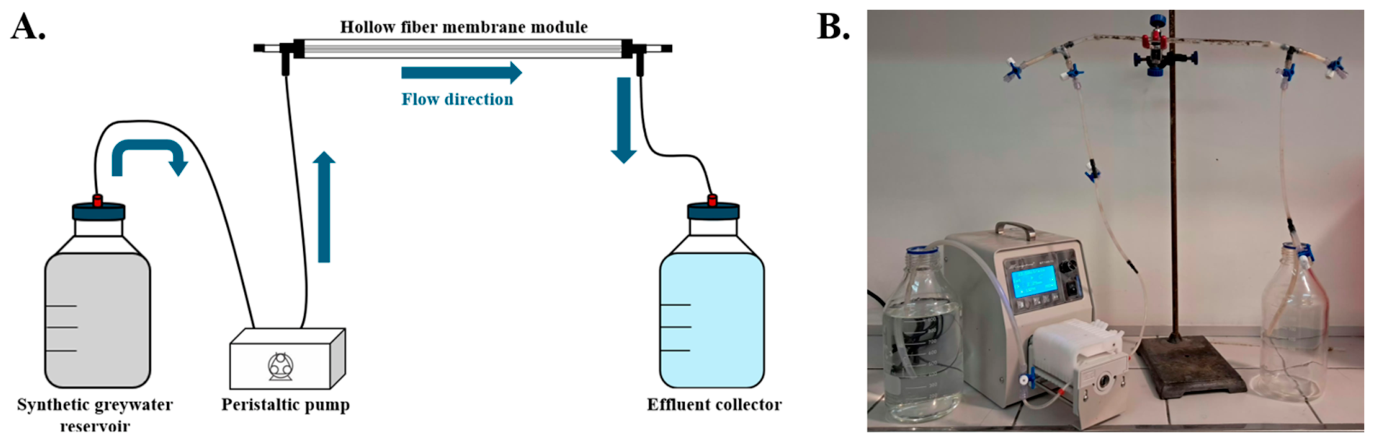
To promote contact between the synthetic greywater and the hollow fiber membranes, each reactor was operated under single-pass flow conditions. For each reactor, 1 L of synthetic greywater was placed in a Schott bottle and fed through the HFMB module using a peristaltic pump (BT100-1L multi-channel, Longer Precision Pump Co., Ltd., Baoding, China) at a flow rate of 3.89 mL/h. The influent entered the glass module and flowed longitudinally through the shell-side space surrounding the hollow fibers, remaining in direct contact with their external surfaces and the associated biofilm. The treated effluent was collected in a separate bottle after a single passage through the module. Based on the nominal liquid volume of the module (3.62 mL) and the applied flow rate, the nominal hydraulic retention time within the HFMB module was approximately 0.93 h. No external aeration was supplied during reactor operation, and the modules remained open to the atmosphere, allowing passive gas exchange. The reactors were operated at laboratory ambient temperature (approximately 22 °C). Dissolved oxygen was not monitored. A schematic representation and photograph of the experimental setup, including the influent reservoir, peristaltic pump, HFMB module, flow direction, and effluent collection system, are shown in Figure 1. The 1 L influent volume was processed over an 11-day operating period at the applied flow rate. During reactor operation, pH, electrical conductivity, and turbidity were measured daily during the first week and every two days during the second week. Soluble chemical oxygen demand (sCOD) was measured daily during the first three days and again at the end of the experiment. Anionic surfactants and emerging contaminants were measured at the beginning and end of the experimental period.

2.5. Analytical Measurements

The pH and electrical conductivity were measured using HACH probes (PHC201 and CDC401, respectively; HACH, Loveland, CO, USA). Turbidity was determined using a TurbiQuant® 1100T turbidimeter (Merck KGaA, Darmstadt, Germany). Soluble chemical oxygen demand (sCOD) was determined after filtering the samples through a 0.22 µm membrane filter. The filtrate was analyzed colorimetrically using Method 8000 and a DR3900 spectrophotometer (HACH, Loveland, CO, USA). Anionic surfactants were determined using the TNT874 kit and a DR3900 spectrophotometer (HACH, Loveland, CO, USA).
Ibuprofen and diclofenac concentrations were determined by high-performance liquid chromatography (HPLC) with a Waters HPLC system (Milford, MA, USA) equipped with a Quaternary Solvent Manager-R pump, a Sample Manager FTN-R autosampler, a CH-30A column oven, a Kinetex® XB-C18 column (Phenomenex, Torrance, CA, USA; 3.5 µm, 150 mm × 4.6 mm, 100 Å) at a temperature of 40 °C, and a UV detector set at 220 nm and 280 nm. Prior to analysis, samples were concentrated 100-fold by solid-phase extraction using CHROMABOND® HLB cartridges (MACHEREY-NAGEL GmbH & Co. KG, Düren, Germany), following the protocol established by Escobar et al. (2023) [25].
The initial pharmaceutical concentrations used for the calculation of attenuation efficiencies corresponded to the analytically measured concentrations in freshly prepared synthetic greywater, immediately after pharmaceutical addition and before entering the reactor system.

2.6. Data and Statistical Analysis

The temporal behavior of turbidity and sCOD was evaluated using removal efficiencies and an empirical first-order stabilization model with a residual value. Removal efficiencies were calculated from the initial and final values of each parameter according to Equation (1):
R e m o v a l   e f f i c i e n c y   ( % ) = C 0 C f C 0 × 100
where and C 0 and C f are the initial and final values of turbidity or sCOD, respectively.
To account for differences in initial values, the empirical stabilization model was applied to normalized turbidity and sCOD profiles. For each reactor, values were expressed as C t / C 0 , and the model was adapted as shown in Equation (2):
C t C 0 = C n o r m + ( 1 C n o r m ) e k t
where C t is the value of the parameter at time, C 0 is the initial value, C n o r m is the normalized residual or stabilized value, and k is the empirical model constant. This approach was selected because turbidity and sCOD profiles showed an initial decrease followed by a stabilization phase. The model was used as an empirical tool to compare the temporal evolution of turbidity and sCOD during the 11-day operating period. The quality of the fit was evaluated using the coefficient of determination (R2) and visual inspection of the fitted curves.
Each individual reactor was considered an independent experimental unit. The experimental conditions were operated in triplicate (n = 3 reactors per condition). Final normalized turbidity and sCOD removal values were compared among reactor conditions using the Kruskal–Wallis test with exact p values. When significant differences were detected, Dunn’s multiple-comparison test with multiplicity-adjusted p values was applied for post hoc comparisons. Initial and final pharmaceutical concentrations were compared using the two-tailed Wilcoxon matched-pairs signed-rank test with exact p values. Statistical significance was defined as p < 0.05. Statistical analyses were performed using GraphPad Prism 8.0.1.

2.7. DNA Extraction and Microbial Community Analysis

DNA was extracted from the enriched sludge immediately before inoculation of the hollow fibers (Initial Sludge) and from the HFMB reactors at the end of the experiment. For each experimental condition, DNA from the replicate reactors was combined to obtain one representative pooled sample for sequencing. Therefore, microbial community comparisons among treatments were interpreted descriptively rather than through replicate-based inferential statistics. The extraction was performed using 2 mL of each sample with the DNeasy® PowerSoil® Pro Kit (QIAGEN, Hilden, Germany), following the manufacturer’s protocol. DNA integrity was assessed using a NanoDrop UV-Vis 2000 spectrophotometer (Thermo Scientific, Waltham, MA, USA), measuring the concentration in ng/μL and verifying purity using the A260/A280 and A260/A230 absorbance ratios. Subsequently, the DNA samples were stored at −20 °C until sequencing.
Amplicon sequencing targeting V3-V4 regions of the gene encoding the bacterial 16S rRNA subunit was performed for microbial community taxonomic profiling of the samples. Amplification was carried out using primers 341F/785R (CCTACGGG-NGGCWGCAG/GACTACHVGGGTATCTAATCC) and sequencing was performed by Integrated Microbiome Resource (IMR, Dalhousie University, Halifax, NS, Canada) on an Illumina MiSeq i100 platform (Illumina, Inc., San Diego, CA, USA).
Bioinformatic processing of the raw sequences included: (i) removal of adapters and quality control with Cutadapt v2.10 and Trimmomatic v0.39, retaining reads with Phred quality ≥ Q30; (ii) amplicon sequence variant (ASV) inference using DADA2 implemented in R (version 4.3.3); (iii) taxonomic assignment using the Bayesian RDP classifier with a bootstrap threshold ≥ 50% and the SILVA v138.2 reference database; and (iv) diversity analysis from an ASV matrix. Relative abundance plots were constructed using Python (version 3.13.15) from tables generated with Phyloseq. Alpha diversity analysis was performed using Scikit-bio (version 0.7.3).
Functional prediction was performed using PICRUSt2 (version 2.5.3) based on the observed amplicon sequence variants (ASVs). To assess adaptative changes in the predicted functional profiles from the inoculum to the hollow fiber system, log2 fold change (Log2FC) values were calculated using the functional abundances of the initial inoculum (anammox sludge) as the reference condition. To identify functional changes between the ibuprofen (IBU) and diclofenac (DCF) treatments and the control, log2 fold change (Log2FC) values were calculated using the control treatment as the reference condition. The GW control underwent the same enrichment, biofilm-development, and operating procedures as the pharmaceutical treatments, but without ibuprofen or diclofenac addition. Functions exhibiting the largest changes in predicted abundance were then identified and visualized to highlight the metabolic pathways most affected by each treatment. Functions exhibiting the largest changes in abundance were identified and visualized in Python through comparative analyses of the Log2FC values.

3. Results and Discussion

3.1. HFMB Treatment Performance

3.1.1. Turbidity and sCOD Removal

Throughout the experimental period, pH remained within a narrow range of 7.0–7.6 in all treatments, while electrical conductivity varied between 300 and 800 µS/cm. No marked differences were observed among the conditions studied. The initial and final values of pH, electrical conductivity, turbidity, sCOD, and anionic surfactants for each individual reactor are provided in Table S1.
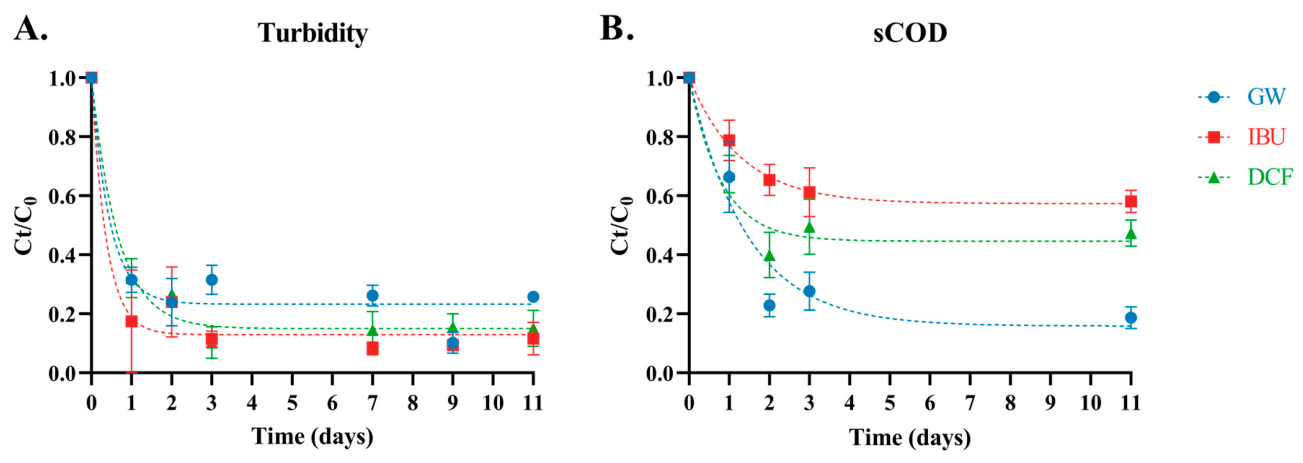
Turbidity and sCOD decreased over time in all treatments, with most of the reduction occurring during the initial stage of operation and a subsequent tendency toward stabilization (Figure 2). This pattern was well described by the empirical stabilization model. For turbidity, the model showed high goodness of fit, with R2 values of 0.91, 0.91, and 0.94 for the GW, IBU, and DCF reactors, respectively. The normalized residual fractions were 0.23, 0.13, and 0.15, respectively, suggesting that all treatments reached low residual turbidity levels by the end of operation.
The sCOD profiles also showed a decreasing trend and were adequately described by the model, with R2 values of 0.88, 0.82, and 0.85 for the GW, IBU and DCF reactors, respectively. The corresponding empirical model constants (k) were 0.70, 0.78, and 1.26 d−1, while the normalized residual fractions were 0.16, 0.57, and 0.45. These results indicate that sCOD decreased in all reactor conditions, although a higher residual fraction was observed in the IBU and DCF reactors compared with the control reactor. The observed temporal behavior may reflect several simultaneous processes, including biodegradation, retention of particulate-associated organic matter, adsorption, and changes in the composition of soluble organic compounds during operation.
As a complementary approach, final removal efficiencies were calculated from reactor-level normalized values and compared among reactor conditions using the Kruskal–Wallis test. For sCOD, significant differences were observed among treatments (H = 5.357, p = 0.0286), indicating that final relative removal differed among reactor conditions. However, Dunn’s multiple comparison test did not detect significant pairwise differences after adjustment for multiple comparisons, although the lowest adjusted p value was observed between the GW and IBU reactors (p = 0.06). In contrast, no significant differences were found for turbidity removal (H = 3.139, p = 0.2429), suggesting that turbidity reduction was comparable among the GW, IBU and DCF reactors.
The rapid decrease in turbidity observed in all treatments suggests effective removal of suspended and colloidal material under the evaluated conditions. In the present reactor configuration, this response was likely associated with the combined effects of particle retention and interactions with the fiber-supported biofilm, including attachment, aggregation, and biological transformation. Low turbidity values have also been widely reported in membrane-based greywater treatment systems. In their review of MBRs for greywater treatment, Cecconet et al. (2019) reported that effluent turbidity values in MBR-treated greywater are commonly low, often below 5 NTU, despite variability in influent characteristics [20]. Similarly, Bani-Melhem et al. (2015) reported an effluent turbidity of 3 FTU in a submerged membrane bioreactor treating real greywater [26]. In the present study, no statistically significant differences in turbidity removal were detected among treatments under the evaluated conditions.
The behavior of sCOD was more differentiated among reactor conditions. Although sCOD decreased in all treatments, the higher normalized residual fractions observed in IBU and DCF reactors suggest that the removal of soluble organic matter was less complete than in the GW reactors. This result is consistent with the fact that sCOD removal in biological membrane-based systems is not governed only by physical separation, but also by biodegradation, adsorption, and interactions between soluble compounds, biomass, and membrane-associated layers. Wu et al. (2013) described the contribution of bio-cake layers to sCOD removal in submerged membrane bioreactors through combined back-transport, adsorption, and biodegradation processes [27]. In addition, recent studies on biological greywater treatment systems have reported high organic matter removal efficiencies, such as in bioelectrochemical reactors and granular activated carbon biofilters treating synthetic greywater [28], as well as bio-enhanced granular activated carbon dynamic biofilm reactors for on-site greywater treatment [29]. Therefore, the higher residual sCOD fractions observed in the pharmaceutical-amended reactors may reflect differences in the persistence or biodegradability of the soluble organic fraction rather than a change in turbidity-related removal mechanisms.

3.1.2. Anionic Surfactant Removal

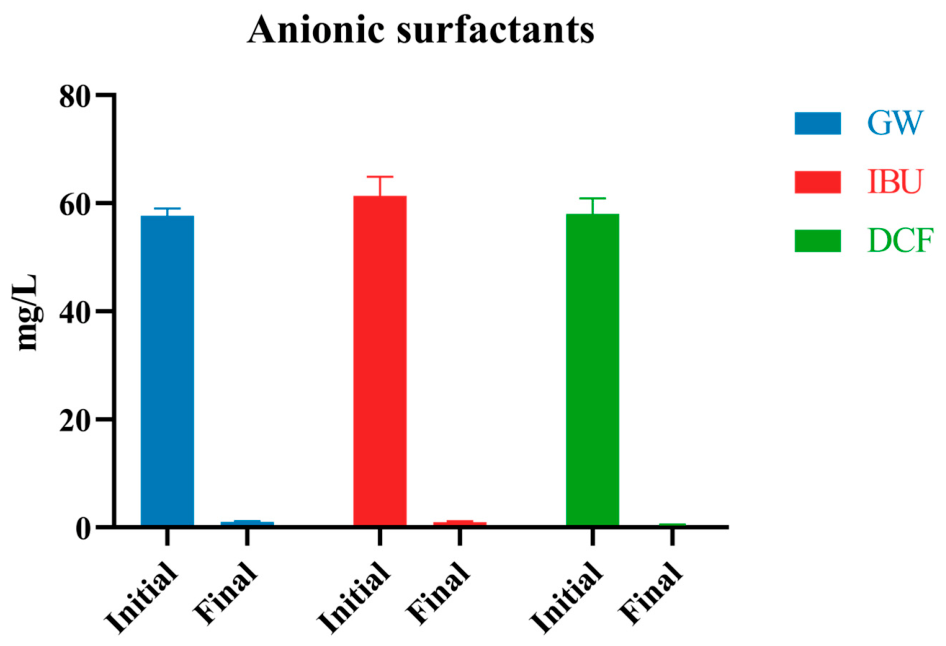
Anionic surfactants were also markedly reduced during HFMB operation in all reactor conditions (Figure 3). Initial concentrations were similar among treatments, with values close to 60 mg/L, whereas final concentrations decreased to near-zero levels after 11 days of operation. All systems achieved removal efficiencies above 98%, indicating that the HFMBs were highly effective in reducing anionic surfactants under the evaluated conditions.
This high removal is consistent with the nature of the surfactant used in the synthetic greywater formulation. Sodium dodecyl sulfate (SDS) is an anionic surfactant widely used in detergents and personal care products, and it is considered biodegradable under biological treatment conditions. Previous studies have shown that SDS can be degraded by microbial consortia in wastewater treatment systems, although high concentrations may exert inhibitory effects on microbial activity due to its interaction with cell membranes and proteins [30]. In biofilm-based greywater treatment systems, rapid surfactant decrease may also be promoted by initial adsorption onto extracellular polymeric substances and biofilm surfaces, followed by biodegradation. This two-step behavior has been described for linear alkylbenzene sulfonate (LAS), another common anionic surfactant in greywater, where extracellular polymeric substances (EPS) adsorption contributes to rapid accumulation in the biofilm and biodegradation drives sustained removal [31].

3.1.3. Changes in Emerging Contaminant Concentrations

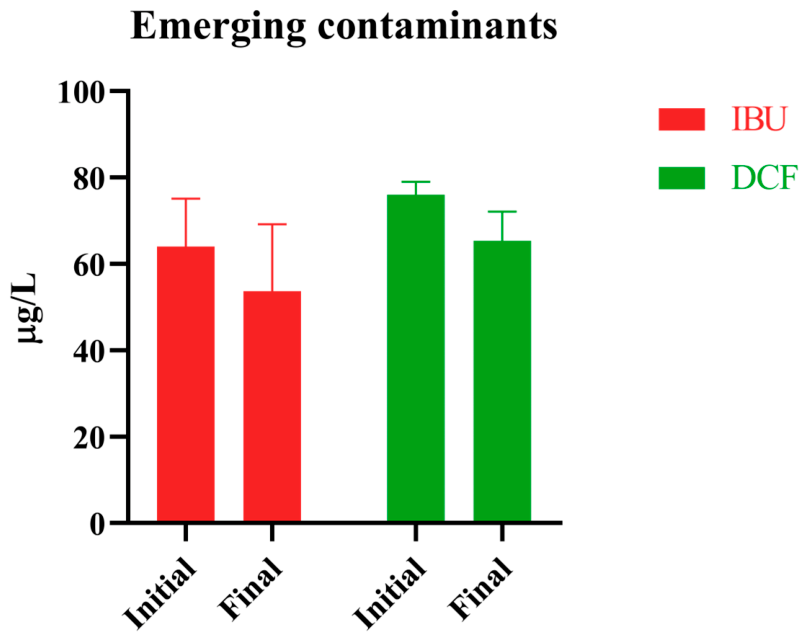
The concentrations of the selected emerging contaminants showed a partial decrease after HFMB operation (Figure 4). Ibuprofen decreased from 64.0 ± 11.1 µg/L to 53.7 ± 15.5 µg/L, corresponding to a mean concentration decrease of approximately 17.1%. Diclofenac decreased from 76.0 ± 3.0 µg/L to 65.3 ± 6.8 µg/L, corresponding to a mean concentration decrease of approximately 13.8%. The measured initial concentrations were lower than the nominal spiked concentration of 100 µg/L. Because these samples were analyzed immediately after pharmaceutical addition and before entering the reactor system, this difference likely reflects variability associated with solution preparation, sample handling, and/or analytical recovery rather than processes occurring during reactor operation. Attenuation efficiencies were therefore calculated using the measured initial concentrations. Although final concentrations tended to be lower than initial concentrations, the differences were not statistically significant according to the two-tailed Wilcoxon matched-pairs signed rank test for either ibuprofen (exact p = 0.25) or diclofenac (exact p = 0.50). The median paired differences (final − initial) were −14 and −16 µg/L for ibuprofen and diclofenac, respectively. These results indicate that the observed concentration decreases were limited and variable among reactors under the evaluated operating conditions.
This limited attenuation contrasts with the strong removal of turbidity, sCOD, and anionic surfactants, suggesting that conventional greywater treatment performance does not necessarily imply efficient removal of emerging contaminants. Previous biodegradation studies have reported that ibuprofen can be biologically transformed into activated sludge systems, whereas diclofenac tends to be more persistent and often requires additional treatment or adsorption-based processes to achieve more complete removal [32,33,34]. The present analysis was limited to ibuprofen and diclofenac; therefore, the relative contributions of adsorption, biodegradation, and transformation processes could not be distinguished, and potential transformation products were not evaluated. Nevertheless, the presence of ibuprofen and diclofenac may have acted as a selective pressure on the microbial communities, which was further explored through taxonomic and functional prediction analyses.
Given the low applied flow rate, the influent remained in the feed reservoir for different periods before entering the HFMB module, during which settling, adsorption, or physicochemical and biological transformations may have occurred and contributed to some extent to the observed changes. The interpretation of treatment-related differences should therefore consider the experimental scale and the number of replicate reactors used in this study. In addition, the observed responses reflect the specific pharmaceutical concentration and operating period evaluated. Although synthetic greywater provided controlled and reproducible experimental conditions, it does not fully represent the compositional variability of authentic household greywater. Further studies across a broader range of concentrations and longer operating periods would help assess the consistency of these responses over time.

3.2. Microbial Community Analysis

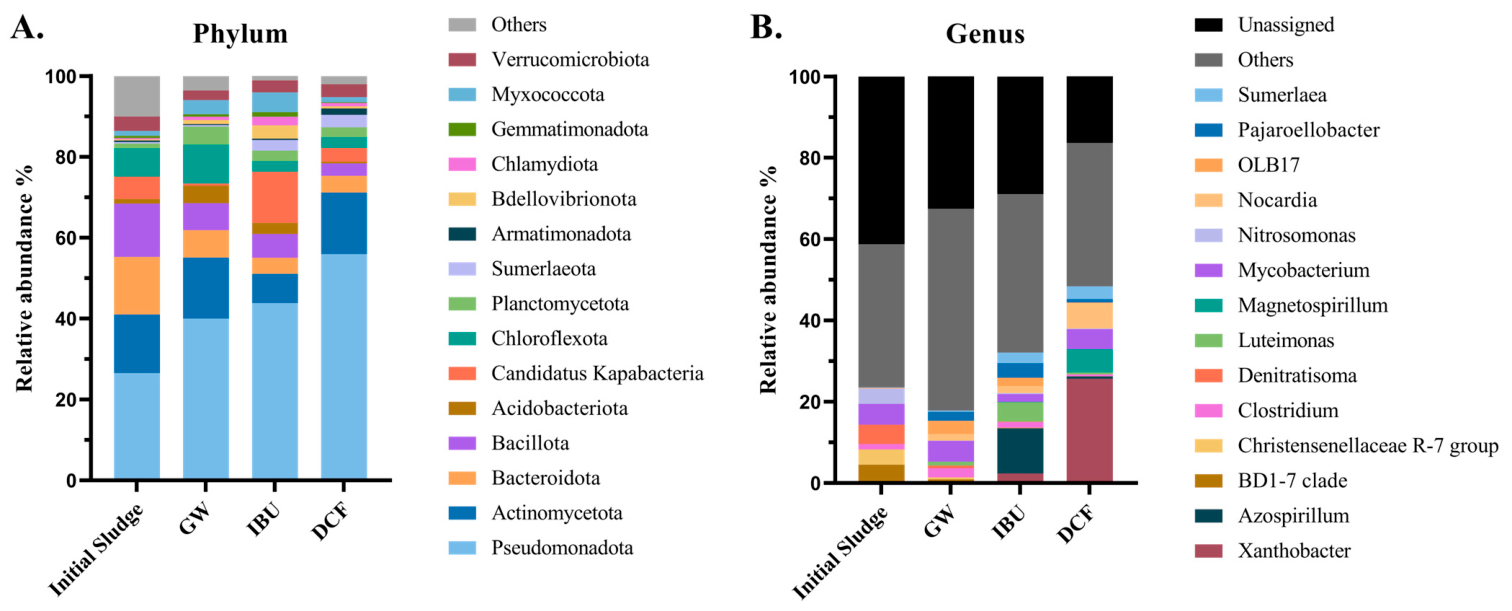
Microbial community composition was evaluated in the inoculum sludge and in the HFMB reactors (Figure 5). Alpha diversity analysis revealed differences in microbial richness and diversity among the initial sludge and the different experimental conditions. The Initial Sludge exhibited the highest overall diversity, with a Shannon index of 5.94 and a Simpson index of 0.993, as well as the highest observed richness (1373 Observed ASVs). Among the experimental conditions, DCF maintained the highest microbial diversity and richness, with a Shannon index of 5.40, a Simpson index of 0.984, and 1201 observed ASVs. In comparison, GW showed lower diversity and richness (Shannon = 4.80, Simpson = 0.966, 881 observed ASVs), whereas IBU exhibited the lowest diversity, with Shannon and Simpson indices of 4.30 and 0.927, respectively, and 859 observed ASVs. These results suggest a reduction in microbial alpha diversity and richness relative to the initial sludge under all experimental conditions. Statistical significance could not be assessed because only one sample per condition was sequenced.
At the phylum level, Pseudomonadota was the dominant taxon in GW (40.03%), IBU (43.86%), DCF (55.90%), and Initial Sludge (26.52%). Actinomycetota was also highly abundant in GW (15.08%), DCF (15.22%), and Initial Sludge (14.54%). In addition, Bacteroidota (14.22%) and Bacillota (13.17%) showed relatively high abundances in Initial Sludge, whereas Candidatus Kapabacteria was particularly enriched in IBU, accounting for 12.66% of the community.
The increased relative abundance of Pseudomonadota in the HFMB reactors compared with the enriched inoculum suggests that this phylum was favored during biofilm development and subsequent reactor operation. This is consistent with previous reports describing the enrichment of Pseudomonadota in microbial cultures exposed to surfactants such as sodium dodecyl sulfate (SDS). For example, a study by Mokoena et al. (2025) reported that enrichment cultures amended with surfactants, including sodium dodecyl sulfate (SDS), were dominated by members of the phylum Pseudomonadota, which accounted for 85–95% of the microbial community [35]. Enrichment was established using a microbial consortium derived from oil-contaminated soil. The relatively high abundance of Actinomycetota may also be relevant in the context of SDS-containing greywater, as previous studies have associated this phylum with SDS exposure. Zhu et al. (2026) observed an increase in Actinomycetota abundance under elevated SDS concentrations, followed by a decrease as SDS concentrations declined [36]. In addition, the enrichment of Candidatus Kapabacteria in the IBU reactor may be associated with sulfur-related transformations, since members of this phylum have been proposed to include potential sulfate-reducing microorganisms involved in the reduction of oxidized sulfur compounds [37].
At the genus level, Xanthobacter was particularly abundant in the DCF reactor, reaching 25.63% of the community, followed by Nocardia (6.28%) and Magnetospirillum (5.72%) in the same sample. Azospirillum was enriched in the IBU reactor, representing 11.07% of the community, whereas Denitratisoma showed its highest abundance in the inoculum sludge (4.73%). Several of the most abundant genera, including Azospirillum, Denitratisoma, Luteimonas, Magnetospirillum, Nitrosomonas, and Xanthobacter, belong to the phylum Pseudomonadota, supporting the dominance of this group at both taxonomic levels. Overall, the taxonomic profiles indicate substantial community restructuring between the enriched inoculum and the final HFMB communities, together with differences among the final reactor conditions.
At the species level, Xanthobacter flavus was the dominant identified species in the DCF treatment, accounting for 24.65% of the community, followed by Magnetospirillum gryphiswaldense (5.72%). X. flavus is a Gram-negative, pleomorphic rod-shaped bacterium that grows organoheterotrophically under aerobic or microaerophilic conditions and is capable of degrading a wide range of aromatic compounds [38]. M. gryphiswaldense is a spiral-shaped, Gram-negative magnetotactic bacterium that is microaerophilic and facultatively anaerobic, using either oxygen or nitrate as terminal electron acceptors for respiration [39].
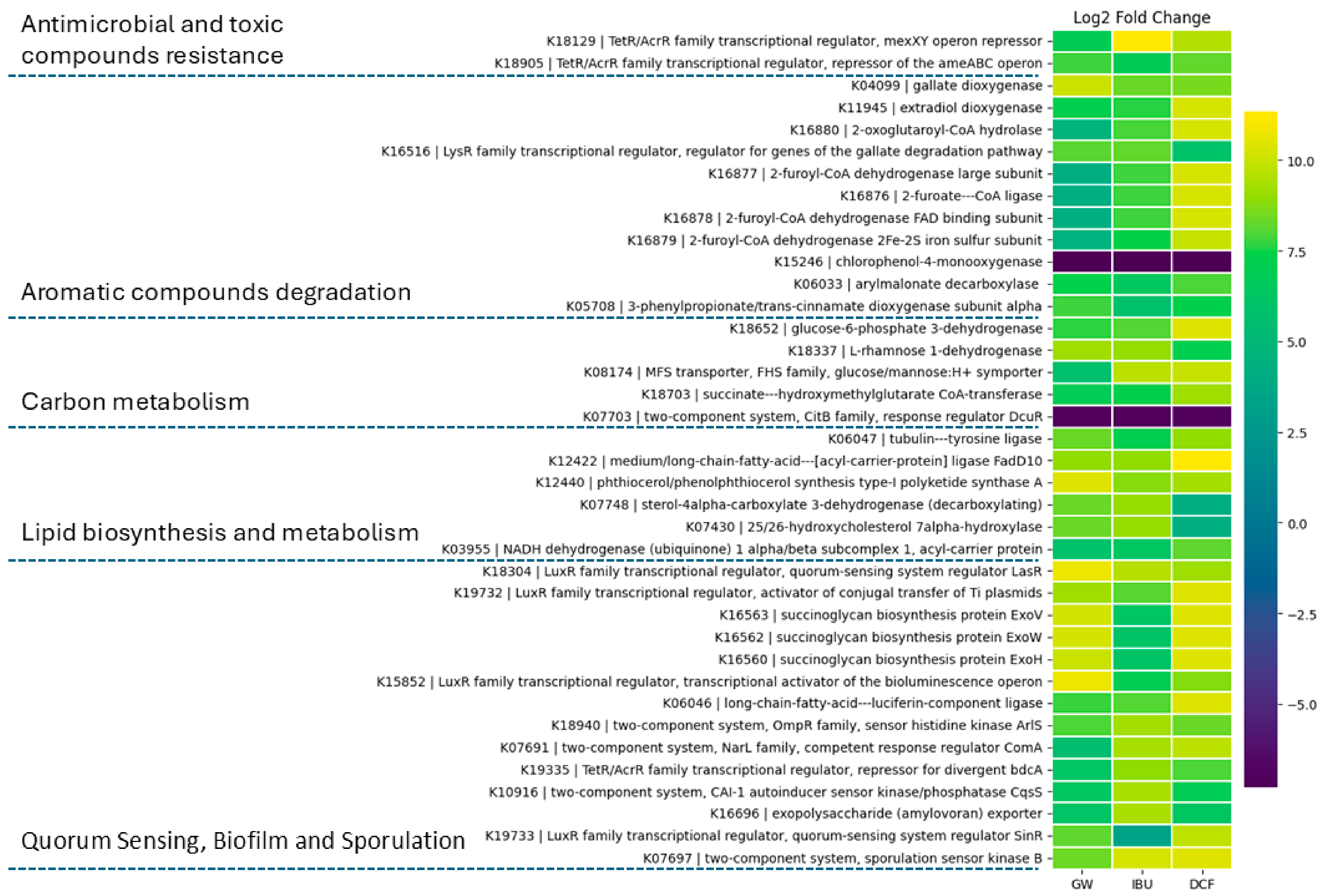
To complement the taxonomic analysis, functional prediction was performed for the HFMB reactors using the initial sludge as reference (Figure 6). Using the enriched inoculum as the reference, the comparison with the final HFMB communities captures the microbial changes associated with biofilm development and subsequent reactor operation. Treatment-specific differences were evaluated separately by comparing the IBU and DCF reactors with the GW control.
Functions involved in succinoglycan biosynthesis showed a strong positive enrichment, with Log2FC values of approximately 10 in GW and DCF reactors, corresponding to an estimated ~1000-fold increase in predicted abundance relative to the initial anammox sludge. In contrast, IBU reactor exhibited a lower Log2FC value of approximately 6 (≈64-fold increase). This comparatively lower enrichment may indicate a reduced genetic potential for succinoglycan production and, consequently, a lower capacity for biofilm formation in the IBU microbial community. Because DCF reactor corresponds to the diclofenac treatment, these results suggest that the presence of diclofenac may have influenced the enrichment of biofilm-related functions. However, this interpretation should be considered tentative, as PICRUSt2 provides predictions of functional potential rather than direct measurements of gene expression or biofilm production.
Extradiol dioxygenase has a central role in the degradation of aromatic compounds. Liu et al. (2023) described an extradiol dioxygenase that facilitates the oxidative cleavage of aromatic rings during the catabolism of aromatic hydrocarbons [40]. The enrichment of extradiol dioxygenase in the three treatments is particularly relevant because this enzyme catalyzes the oxidative cleavage of aromatic rings, a key step in the mineralization of a wide range of aromatic compounds, including intermediates generated during pharmaceutical degradation. In the ibuprofen degradation pathway of Rhizorhabdus wittichii MPO218, Aulestia et al. (2022) reported that the intermediate 4-isobutylcatechol is converted by an extradiol-2,3-dioxygenase and a dehydrogenase into 2-hydroxy-5-isobutylhexa-2,4-dienoic acid, resulting in the cleavage of the aromatic ring [41]. This reaction represents a crucial step toward the complete degradation of ibuprofen, suggesting that the enrichment of this function may reflect an increased metabolic potential for the catabolism of aromatic intermediates produced during ibuprofen biodegradation.
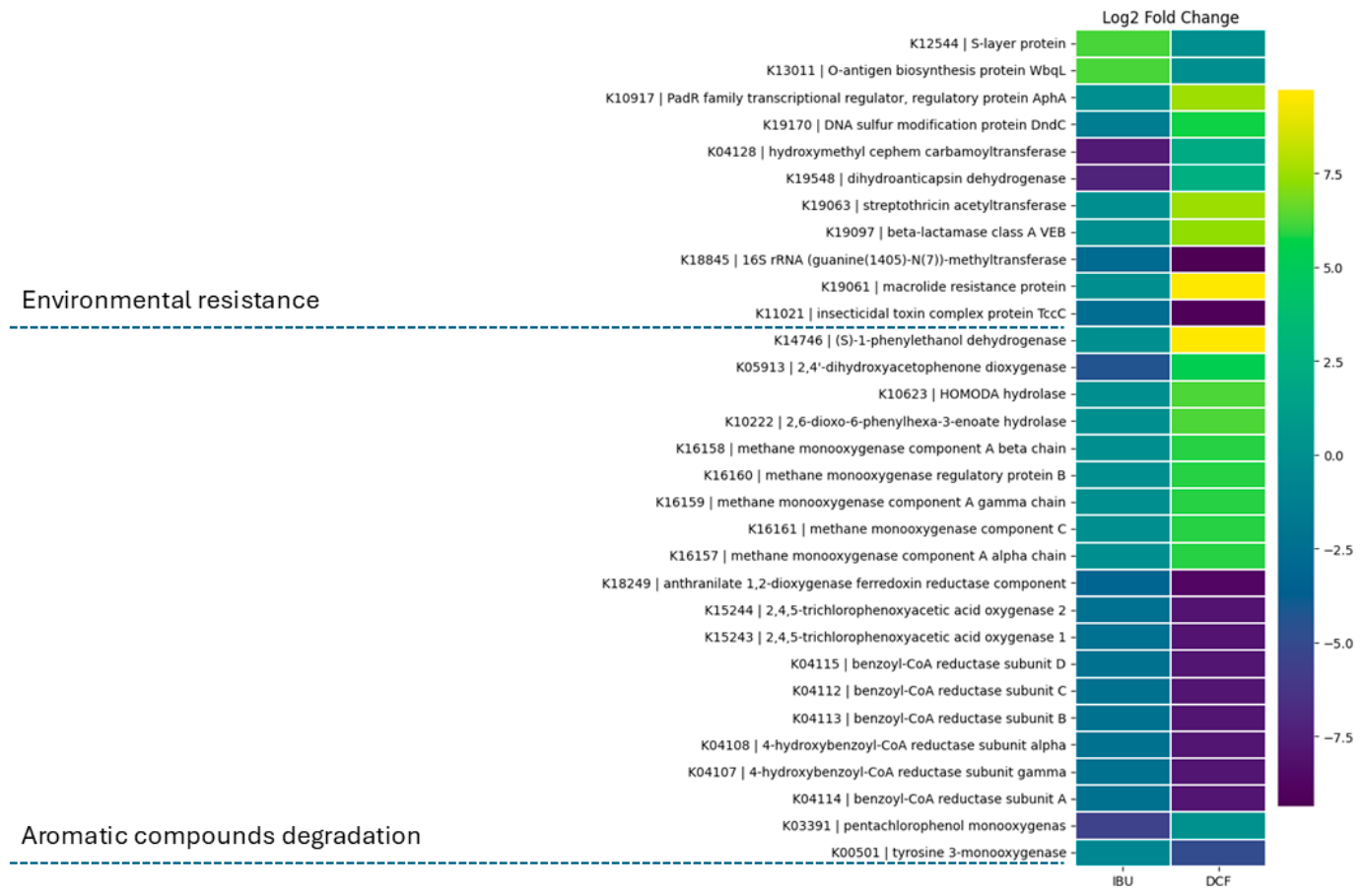
Treatment-specific functional differences were evaluated using the GW reactors as the reference condition, since these reactors underwent the same biofilm-development and operating conditions without pharmaceutical addition (Figure 7). The DCF treatment showed enrichment of several functions involved in the degradation of aromatic compounds, including (S)-1-phenylethanol dehydrogenase, 2,4′-dihydroxyacetophenone dioxygenase, HOMODA hydrolase, 2,6-dioxo-6-phenylhexa-3-enoate hydrolase, and the methane monooxygenase complex, whereas these functions were not enriched under the ibuprofen treatment. The enrichment of these enzymes suggests an increased metabolic potential for the transformation of aromatic compounds, which is consistent with the aromatic structure of diclofenac.
In addition, the DCF treatment exhibited a higher abundance of functions associated with quorum sensing (PadR family transcriptional regulator), DNA protection (DNA sulfur modification protein DndC), and antimicrobial resistance, including β-lactamase VEB, streptothricin acetyltransferase, and macrolide resistance protein. These results suggest that diclofenac exposure may promote microbial stress-response mechanisms, cell-to-cell communication, and resistance-related functions.
In contrast, the ibuprofen treatment was primarily enriched in S-layer protein and O-antigen biosynthesis protein. These functions are involved in cell envelope organization, lipopolysaccharide biosynthesis, cell adhesion, biofilm formation, and cell–surface interactions, suggesting that adaptation to ibuprofen was mainly associated with modifications of the bacterial cell surface rather than with an increased potential for aromatic compound degradation.

4. Conclusions

  • This study evaluated the performance and microbial response of hollow fiber membrane bioreactors (HFMBs) for the treatment of synthetic greywater containing emerging contaminants, specifically ibuprofen and diclofenac. The reactors effectively reduced conventional greywater parameters, including sCOD and turbidity, although some differences in treatment response were observed among the experimental conditions. All treatment conditions were also highly effective in removing anionic surfactants, achieving removal efficiencies above 98%. Overall, conventional greywater treatment performance was maintained across the evaluated conditions, while treatment-related differences should be interpreted within the scope of the experimental design.
  • In contrast, the changes in pharmaceutical concentrations were limited and variable. Ibuprofen and diclofenac showed mean concentration decreases of approximately 17.1% and 13.8%, respectively, with no statistically significant differences between initial and final concentrations. Therefore, the observed concentration decreases should be interpreted cautiously under the evaluated conditions.
  • Microbial community analysis showed that HFMB operation selected distinct microbial communities compared with the inoculum, with Pseudomonadota dominating all reactor conditions. The functional predictions suggest that, compared with the initial inoculum, all three treatments exhibited an increased potential for biofilm formation and the degradation of aromatic compounds. In addition, the diclofenac treatment showed a greater predicted functional potential for aromatic compound degradation and environmental stress adaptation than the control treatment. These findings suggest that the diclofenac condition was associated with a stronger microbial response, including predicted functions related to xenobiotic degradation and mechanisms that may enhance survival under stressful conditions.
  • Further assessment under longer operating periods and using authentic greywater would be necessary to evaluate additional aspects relevant to water reuse, including microbial quality, nutrient removal, operational stability, and compliance with reuse standards. Future studies could also explore data-driven and artificial intelligence-based approaches for process monitoring, optimization, and long-term operation of decentralized greywater treatment systems.

Supplementary Materials

The following supporting information can be downloaded at: https://www.mdpi.com/article/10.3390/cleantechnol8050146/s1, Table S1: Initial and final physicochemical parameters measured in each HFMB reactor.

Author Contributions

Conceptualization, E.C., C.R. and E.L.; methodology, E.C., H.G., L.P.-A., M.A. and E.L.; formal analysis, C.R., D.R., H.G., J.S., L.P.-A., M.A. and L.B.; investigation, E.C., C.R. and E.L.; resources, writing—original draft preparation, E.C.; writing—review and editing, C.R., D.R., J.S., L.B. and E.L.; visualization, D.R.; supervision, E.L. All authors have read and agreed to the published version of the manuscript.

Funding

This research was funded by Fondecyt Regular N° 1241833 (2024–2028), Fondecyt de Exploración Nº 13240224 (2024–2028), Consorcio Tecnológico del Agua CoTH2O, CTI250001, FONDEQUIP EQM210203, EQM 230177 and EQY220018.

Data Availability Statement

The original contributions presented in this study are included in the article. Further inquiries can be directed to the corresponding author.

Conflicts of Interest

The authors declare no conflicts of interest.

Abbreviations

The following abbreviations are used in this manuscript:
ASVAmplicon sequence variant
DCFSynthetic greywater supplemented with diclofenac
DNADeoxyribonucleic acid
EPSExtracellular polymeric substances
GWSynthetic greywater (control condition)
HDPEHigh-density polyethylene
HFMBHollow fiber membrane bioreactor
HPLCHigh-performance liquid chromatography
IBUSynthetic greywater supplemented with ibuprofen
LASLinear alkylbenzene sulfonate
Log2FCLog2 fold change
MBRMembrane bioreactor
RDPRibosomal database project classifier
sCODSoluble chemical oxygen demand
SDSSodium dodecyl sulfate

References

  1. Liu, J.; Yang, H.; Gosling, S.N.; Kummu, M.; Flörke, M.; Pfister, S.; Hanasaki, N.; Wada, Y.; Zhang, X.; Zheng, C.; et al. Water scarcity assessments in the past, present, and future. Earth’s Future 2017, 5, 545–559. [Google Scholar] [CrossRef] [Scilit] [PubMed]
  2. Al-Najjar, H.; Ceribasi, G.; Ceyhunlu, A.I. Effect of unconventional water resources interventions on the management of Gaza coastal aquifer in Palestine. Water Supply 2021, 21, 4205–4218. [Google Scholar] [CrossRef] [Scilit]
  3. Yánez, D.; Espinoza, L.C.; Vargas, I.; Romero, J.; Aguirre, M.J.; Arce, R.; Quijada-Maldonado, E.; Abejon, R. Treated greywater as a novel water resource: The perspective of greywater treatment for reuse from a bibliometric analysis. Water Sci. Technol. 2024, 90, 3076–3110. [Google Scholar] [CrossRef] [Scilit] [PubMed]
  4. Khajvand, M.; Mostafazadeh, A.K.; Drogui, P.; Tyagi, R.D. Management of greywater: Environmental impact, treatment, resource recovery, water recycling, and decentralization. Water Sci. Technol. 2022, 86, 909–937. [Google Scholar] [CrossRef] [Scilit] [PubMed]
  5. Noutsopoulos, C.; Andreadakis, A.; Kouris, N.; Charchousi, D.; Mendrinou, P.; Galani, A.; Mantziaras, I.; Koumaki, E. Greywater characterization and loadings—Physicochemical treatment to promote onsite reuse. J. Environ. Manag. 2018, 216, 337–346. [Google Scholar] [CrossRef] [Scilit] [PubMed]
  6. Widyarani; Wulan, D.R.; Hamidah, U.; Komarulzaman, A.; Rosmalina, R.T.; Sintawardani, N. Domestic wastewater in Indonesia: Generation, characteristics and treatment. Environ. Sci. Pollut. Res. 2022, 29, 32397–32414. [Google Scholar] [CrossRef] [Scilit] [PubMed]
  7. Oteng-Peprah, M.; Acheampong, M.A.; Devries, N.K. Greywater Characteristics, Treatment Systems, Reuse Strategies and User Perception—A Review. Water Air Soil Pollut. 2018, 229, 255. [Google Scholar] [CrossRef] [Scilit] [PubMed]
  8. Antonopoulou, G.; Kirkou, A.; Stasinakis, A.S. Quantitative and qualitative greywater characterization in Greek households and investigation of their treatment using physicochemical methods. Sci. Total Environ. 2013, 454–455, 426–432. [Google Scholar] [CrossRef] [Scilit] [PubMed]
  9. García-Gómez, E.; Gil-Solsona, R.; Mikkolainen, E.; Hytti, M.; Ytreberg, E.; Gago-Ferrero, P.; Petrović, M.; Gros, M. Identification of emerging contaminants in greywater emitted from ships by a comprehensive LC-HRMS target and suspect screening approach. Environ. Pollut. 2024, 366, 125524. [Google Scholar] [CrossRef] [Scilit] [PubMed]
  10. Craddock, H.A.; Panthi, S.; Rjoub, Y.; Lipchin, C.; Sapkota, A.; Sapkota, A.R. Antibiotic and herbicide concentrations in household greywater reuse systems and pond water used for food crop irrigation: West Bank, Palestinian Territories. Sci. Total Environ. 2020, 699, 134205. [Google Scholar] [CrossRef] [Scilit] [PubMed]
  11. Noman, E.A.; Mohamed, R.M.S.R.; Al-Gheethi, A.A.; Al-Shaibani, M.M.; Al-Wrafy, F.A.; Al-Maqtari, Q.A.; Vo, D.-V.N. Antibiotics and antibiotic-resistant bacteria in greywater: Challenges of the current treatment situation and predictions of future scenario. Environ. Res. 2022, 212, 113380. [Google Scholar] [CrossRef] [Scilit] [PubMed]
  12. Tyumina, E.A.; Bazhutin, G.A.; Gómez, A.D.P.C.; Ivshina, I.B. Nonsteroidal Anti-inflammatory Drugs as Emerging Contaminants. Microbiology 2020, 89, 148–163. [Google Scholar] [CrossRef] [Scilit]
  13. Przedpełska, L.; Witczak, A.; Pokorska-Niewiada, K. Non-steroidal anti-inflammatory drugs as emerging water and food contaminants: Review. Rev. Environ. Sci. Bio/Technol. 2025, 24, 571–605. [Google Scholar] [CrossRef] [Scilit]
  14. Rivadulla, M.; Lois, M.; Elena, A.; Balboa, S.; Suarez, S.; Berendonk, T.; Romalde, J.; Garrido, J.; Omil, F. Occurrence and fate of CECs (OMPs, ARGs and pathogens) during decentralised treatment of black water and grey water. Sci. Total Environ. 2024, 915, 169863. [Google Scholar] [CrossRef] [Scilit] [PubMed]
  15. Butkovskyi, A.; Leal, L.H.; Rijnaarts, H.; Zeeman, G. Fate of pharmaceuticals in full-scale source separated sanitation system. Water Res. 2015, 85, 384–392. [Google Scholar] [CrossRef] [Scilit] [PubMed]
  16. Zraunig, A.; Estelrich, M.; Gattringer, H.; Kisser, J.; Langergraber, G.; Radtke, M.; Rodriguez-Roda, I.; Buttiglieri, G. Long term decentralized greywater treatment for water reuse purposes in a tourist facility by vertical ecosystem. Ecol. Eng. 2019, 138, 138–147. [Google Scholar] [CrossRef] [Scilit]
  17. Pidou, M.; Memon, F.A.; Stephenson, T.; Jefferson, B.; Jeffrey, P. Greywater recycling: Treatment options and applications. Proc. Inst. Civ. Eng. Eng. Sustain. 2007, 160, 119–131. [Google Scholar] [CrossRef] [Scilit]
  18. Awasthi, A.; Gandhi, K.; Rayalu, S. Greywater treatment technologies: A comprehensive review. Int. J. Environ. Sci. Technol. 2023, 21, 1053–1082. [Google Scholar] [CrossRef] [Scilit]
  19. Jabornig, S.; Podmirseg, S.M. A novel fixed fibre biofilm membrane process for on-site greywater reclamation requiring no fouling control. Biotechnol. Bioeng. 2014, 112, 484–493. [Google Scholar] [CrossRef] [Scilit] [PubMed]
  20. Cecconet, D.; Callegari, A.; Hlavínek, P.; Capodaglio, A.G. Membrane bioreactors for sustainable, fit-for-purpose greywater treatment: A critical review. Clean Technol. Environ. Policy 2019, 21, 745–762. [Google Scholar] [CrossRef] [Scilit]
  21. Menshutina, N.V.; Guseva, E.V.; Safarov, R.R.; Boudrant, J. Modelling of hollow fiber membrane bioreactor for mammalian cell cultivation using computational hydrodynamics. Bioprocess Biosyst. Eng. 2019, 43, 549–567. [Google Scholar] [CrossRef] [Scilit] [PubMed]
  22. Dolasa, A.R.; Ergas, S.J. Membrane Bioreactor for Cometabolism of Trichloroethene Air Emissions. J. Environ. Eng. 2000, 126, 969–973. [Google Scholar] [CrossRef] [Scilit]
  23. Razaviarani, V.; Ruiz-Urigüen, M.; Jaffé, P.R. Denitrification of Nitric Oxide Using Hollow Fiber Membrane Bioreactor; Effect of Nitrate and Nitric Oxide Loadings on the Reactor Performance and Microbiology. Waste Biomass Valorization 2018, 10, 1989–2000. [Google Scholar] [CrossRef] [Scilit]
  24. Arunbabu, V.; Sruthy, S.; Antony, I.; Ramasamy, E. Sustainable greywater management with Axonopus compressus (broadleaf carpet grass) planted in sub surface flow constructed wetlands. J. Water Process. Eng. 2015, 7, 153–160. [Google Scholar] [CrossRef] [Scilit]
  25. Escobar, J.; Hernández, L.; González, J.L.; Salazar-González, R.; Calzadilla, W.; Guerrero, L.; Escalona, N.; Huiliñir, C. Removal of Ibuprofen and Diclofenac in Batch Nitrifying Reactors: Effect of Natural Zeolite on the Process. Water 2023, 15, 2665. [Google Scholar] [CrossRef] [Scilit]
  26. Bani-Melhem, K.; Al-Qodah, Z.; Al-Shannag, M.; Qasaimeh, A.; Qtaishat, M.R.; Alkasrawi, M. On the performance of real grey water treatment using a submerged membrane bioreactor system. J. Membr. Sci. 2015, 476, 40–49. [Google Scholar] [CrossRef] [Scilit]
  27. Wu, J.; He, C.; Bi, D.; Yu, J.; Zhang, Y. A bio-cake model for the soluble COD removal by the back-transport, adsorption and biodegradation processes in the submerged membrane bioreactor. Desalination 2013, 322, 1–12. [Google Scholar] [CrossRef] [Scilit]
  28. Gallardo-Bustos, C.; Tapia, N.; Vargas, I.T. Synthetic greywater treatment using a scalable granular activated carbon bioelectrochemical reactor. Bioelectrochemistry 2024, 159, 108741. [Google Scholar] [CrossRef] [Scilit] [PubMed]
  29. Wang, Z.; Yang, Y.; Xiang, W.; Wu, B.; Cui, X.; Zhou, Y. Performance and mechanisms of greywater treatment in a bio-enhanced granular-activated carbon dynamic biofilm reactor. npj Clean Water 2022, 5, 56. [Google Scholar] [CrossRef] [Scilit]
  30. Chakraborty, I.; Bhowmick, G.D.; Nath, D.; Khuman, C.; Dubey, B.; Ghangrekar, M. Removal of sodium dodecyl sulphate from wastewater and its effect on anodic biofilm and performance of microbial fuel cell. Int. Biodeterior. Biodegrad. 2021, 156, 105108. [Google Scholar] [CrossRef] [Scilit]
  31. Cui, X.; Ren, Q.; Zhang, J.; Zhou, Y. Removal kinetics of linear alkylbenzene sulfonate in a batch-operated oxygen based membrane biofilm reactor treating greywater: Quantitative differentiation of adsorption and biodegradation. Sci. Total Environ. 2022, 806, 150523. [Google Scholar] [CrossRef] [Scilit] [PubMed]
  32. Jia, Y.; Yin, L.; Khanal, S.K.; Zhang, H.; Oberoi, A.S.; Lu, H. Biotransformation of ibuprofen in biological sludge systems: Investigation of performance and mechanisms. Water Res. 2020, 170, 115303. [Google Scholar] [CrossRef] [Scilit] [PubMed]
  33. Langenhoff, A.; Inderfurth, N.; Veuskens, T.; Schraa, G.; Blokland, M.; Kujawa-Roeleveld, K.; Rijnaarts, H. Microbial Removal of the Pharmaceutical Compounds Ibuprofen and Diclofenac from Wastewater. BioMed Res. Int. 2013, 2013, 325806. [Google Scholar] [CrossRef] [Scilit] [PubMed]
  34. Elshikh, M.S.; Hussein, D.S.; Al-Khattaf, F.S.; El-Naggar, R.A.R.; Almaary, K.S. Diclofenac removal from the wastewater using activated sludge and analysis of multidrug resistant bacteria from the sludge. Environ. Res. 2022, 208, 112723. [Google Scholar] [CrossRef] [Scilit] [PubMed]
  35. Mokoena, M.I.; Nkuna, R.; Matambo, T.S. Metagenomic and Proxy Monitoring of Surfactant Degradation by Microbial Consortia from Oil-Contaminated Soil. Appl. Microbiol. 2025, 6, 3. [Google Scholar] [CrossRef] [Scilit]
  36. Zhu, Q.; Zeng, L.; Zheng, Y.; Ye, Z.; Ye, C.; Li, C. Effects of sodium dodecyl sulfate (SDS) pollution on carbon and nitrogen cycling driven by microbes in the lake-terrestrial ecotone. Environ. Technol. Innov. 2025, 41, 104730. [Google Scholar] [CrossRef] [Scilit]
  37. Cubillos, C.F.; Aguilar, P.; Moreira, D.; Bertolino, P.; Iniesto, M.; Dorador, C.; López-García, P. Exploring the prokaryote-eukaryote interplay in microbial mats from an Andean athalassohaline wetland. Microbiol. Spectr. 2024, 12, e00072‐24. [Google Scholar] [CrossRef] [Scilit] [PubMed]
  38. Wiegel, J. The genus Xanthobacter. Prokaryotes 2006, 5, 290–314. [Google Scholar] [CrossRef] [Scilit]
  39. Schüler, D.; Monteil, C.L.; Lefevre, C.T. Magnetospirillum gryphiswaldense. Trends Microbiol. 2020, 28, 947–948. [Google Scholar] [CrossRef] [Scilit] [PubMed]
  40. Liu, Y.; Li, J.; Zeng, J.; Yu, X.; Sun, X.; Zhou, Z.; Xu, J.; Xu, L.; Li, L. Complete oxidative degradation of diclofenac via coupling free radicals and oxygenases of a micro/nanostructured biogenic Mn oxide composite from engineered Pseudomonas sp. MB04R-2. J. Hazard. Mater. 2023, 456, 131657. [Google Scholar] [CrossRef] [Scilit] [PubMed]
  41. Aulestia, M.; Flores, A.; Acosta-Jurado, S.; Santero, E.; Camacho, E.M. Genetic Characterization of the Ibuprofen-Degradative Pathway of Rhizorhabdus wittichii MPO218. Appl. Environ. Microbiol. 2022, 88, e00388‐22. [Google Scholar] [CrossRef] [Scilit] [PubMed]
Figure 1. Experimental configuration of the hollow fiber membrane bioreactor (HFMB). (A) Schematic representation of the single-pass experimental setup, including the synthetic greywater reservoir, peristaltic pump, HFMB module, flow direction, and effluent collection system. (B) Photograph of the experimental setup used in this study.
Cleantechnol 08 00146 g001
Figure 2. Temporal profiles of turbidity and soluble chemical oxygen demand (sCOD) during HFMB operation. Symbols represent mean values and error bars represent standard deviation. Continuous lines represent the fitted empirical stabilization model.
Cleantechnol 08 00146 g002
Figure 3. Initial and final concentrations of anionic surfactants during HFMB operation under control greywater (GW), ibuprofen-amended (IBU), and diclofenac-amended (DCF) conditions. Bars represent mean values and error bars represent standard deviation.
Cleantechnol 08 00146 g003
Figure 4. Initial and final concentrations of ibuprofen (IBU) and diclofenac (DCF) during HFMB operation. Bars represent mean values and error bars represent standard deviation.
Cleantechnol 08 00146 g004
Figure 5. Relative abundance of the main bacterial taxa identified in the inoculum sludge and HFMB reactors at the (A) phylum and (B) genus levels.
Cleantechnol 08 00146 g005
Figure 6. Predicted functional profiles of the HFMB reactors relative to the initial sludge. The heatmap shows log2 fold changes in selected genes.
Cleantechnol 08 00146 g006
Figure 7. Predicted functional response to ibuprofen and diclofenac exposure relative to GW. The heatmap shows log2 fold changes in selected functional genes for IBU and DCF reactors using the GW reactor as the reference condition.
Cleantechnol 08 00146 g007
Table 1. Composition of the synthetic greywater used in this study.
ReagentFormulaConcentration [mg/L]
Lactic acidC3H6O3100
CelluloseC6H10O5100
Sodium dodecyl sulfateNaC12H25SO450
GlycerolC3H8O3200
Sodium bicarbonateNaHCO370
Sodium sulfateNa2SO450
Potassium nitrateKNO336
Potassium dihydrogen phosphateKH2PO422
Disclaimer/Publisher’s Note: The statements, opinions and data contained in all publications are solely those of the individual author(s) and contributor(s) and not of MDPI and/or the editor(s). MDPI and/or the editor(s) disclaim responsibility for any injury to people or property resulting from any ideas, methods, instructions or products referred to in the content.