
Clean Technology Assessment of Green and Grey Hydrogen Pathways: Energy–Exergy Benchmarking Against Natural Gas Power Generation

Abstract
1. Introduction
- A unified energy–exergy assessment framework for evaluating hydrogen-based decarbonization pathways.
- A consistent benchmarking of hydrogen systems against natural gas under identical system boundaries.
- A scenario-based comparison integrating both hydrogen production routes (grey and green) and conversion technologies (combustion and fuel cells).
- Quantification of exergy destruction as a key indicator of thermodynamic sustainability in decarbonization studies.
- Demonstration that hydrogen-based decarbonization is only effective when combined with low-exergy-loss pathways.
- Validate or challenge existing conclusions about green hydrogen’s viability.
- Identify gaps in current infrastructure or cost assumptions that may hinder its adoption.
- Propose actionable insights for policymakers, engineers, and investors based on the thermodynamic and economic feasibility of each pathway.
2. Material and Methods
2.1. Methodological Framework
2.2. System Boundaries, Assumptions and Input Parameters
- The useful output of all systems was fixed at 1 MW net electrical output.
- All systems were evaluated under steady-state operating conditions.
- Natural gas was used as the fossil-fuel reference case.
- Grey hydrogen was assumed to be produced through conventional fossil-based pathways.
- Green hydrogen was assumed to be produced using renewable electricity.
- Hydrogen was evaluated in two end-use pathways: combustion-based conversion and PEM fuel cell conversion.
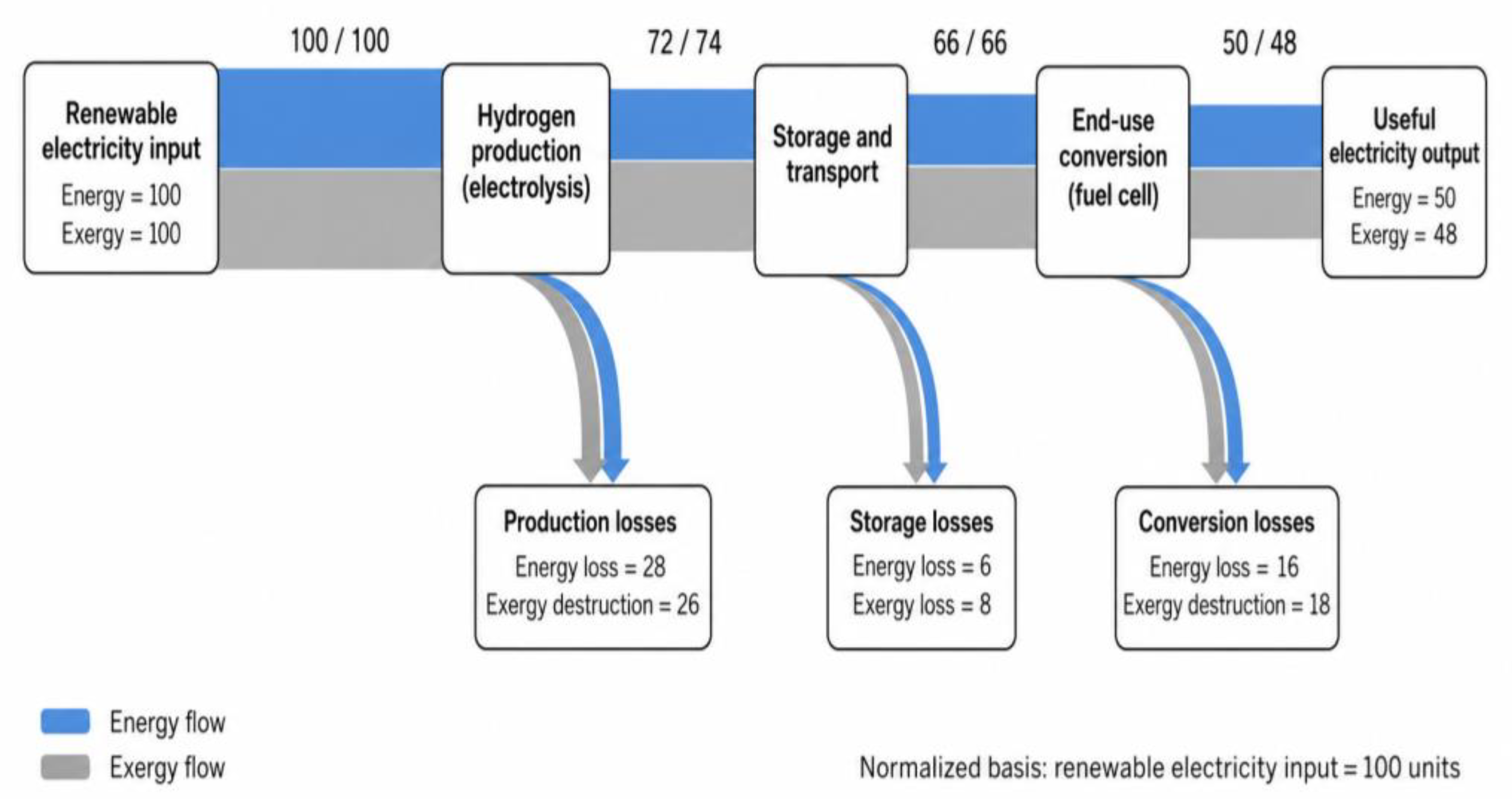
- Storage and transport losses were acknowledged but not explicitly modeled in the base-case calculations.
- Lower heating value values were used consistently for fuel energy input calculations.
- Chemical exergy input was calculated using fuel-specific exergy coefficients.
- A natural gas-fired power generation system serving as the reference fossil fuel benchmark.
- Hydrogen combustion-based systems, representing retrofitted or modified combustion applications.
- Hydrogen fuel cell-based systems, representing electrochemical energy conversion pathways.
2.3. Energy Analysis Parameters
2.4. Exergy Analysis Parameters
2.5. Scenario Definition and Comparative Approach
- S0: Natural gas combustion-based power generation (reference case)
- S1: Grey hydrogen combustion-based power generation
- S2: Grey hydrogen utilization in fuel cell systems
- S3: Green hydrogen combustion-based power generation
- S4: Green hydrogen utilization in fuel cell systems
2.6. Comparative Performance Metrics
- Energy efficiency
- Exergy efficiency
- Exergy destruction rate
- Carbon emission characteristics at the point of use
- Qualitative assessment of decarbonization potential
- Energy efficiency:
- Exergy efficiency:
- Specific exergy destruction:
2.7. Visualization and Interpretation
3. Results and Discussion
3.1. Hydrogen and Fossil Fuels from an Energy Analysis Perspective
3.2. Hydrogen and Fossil Fuels from an Exergy Analysis Perspective
3.3. Case Study: Thermodynamic Evaluation of Green Hydrogen vs. Natural Gas for Power Generation
3.3.1. System Description and Assumptions
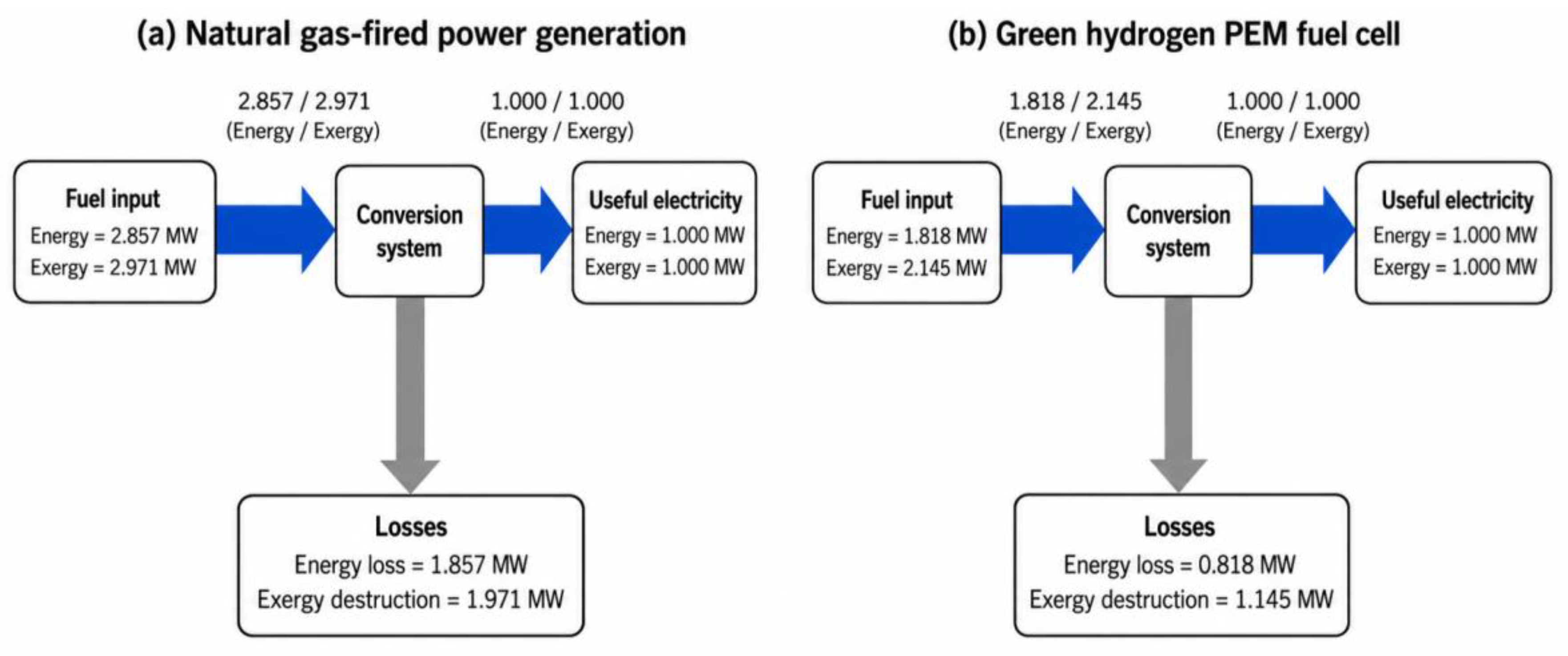
- System A: Natural Gas-Fired Power Generation System
- System B: Proton Exchange Membrane (PEM) fuel cell powered by green hydrogen produced via renewable-based electrolysis
- The chemical exergy of fuels is estimated using fuel-specific exergy coefficients (β), taken as 1.04 for natural gas and 1.18 for hydrogen, in accordance with classical exergy theory [20].
- Hydrogen is assumed to be produced using renewable electricity, resulting in negligible direct CO2 emissions during the power generation phase.
3.3.2. Energy Analysis
3.3.3. Exergy Analysis
- Natural gas system:
- Hydrogen system:
- which yields:
3.3.4. Exergy Destruction and Decarbonization Implications
3.4. Extended Scenario Analysis Including Natural Gas Benchmark
3.4.1. Definition of Scenarios
- S0: Natural gas combustion-based power generation (reference case)
- S1: Grey hydrogen + combustion-based power generation
- S2: Grey hydrogen + PEM fuel cell system
- S3: Green hydrogen + combustion-based power generation
- S4: Green hydrogen + PEM fuel cell system
3.4.2. Simplified Carbon Emission Assessment
- S0 and S1 exhibit high CO2 emissions.
- S2 shows reduced emissions compared to S1 due to higher conversion efficiency, but remains carbon-intensive upstream.
- S3 eliminates upstream CO2 emissions but suffers from combustion-related inefficiencies and NOx formation.
- S4 achieves the lowest overall carbon footprint.
3.4.3. Energy and Exergy Performance Comparison
- Switching from natural gas combustion (S0) to grey hydrogen combustion (S1) does not improve thermodynamic performance and increases upstream emissions.
- Replacing combustion with fuel cell technology (S2) significantly improves exergy efficiency but does not eliminate upstream CO2 emissions.
- The combination of green hydrogen and fuel cell technology (S4) provides both thermodynamic superiority and deep decarbonization.
3.4.4. Integrated Scenario Comparison
3.4.5. Sensitivity Analysis
4. Conclusions
Author Contributions
Funding
Institutional Review Board Statement
Informed Consent Statement
Data Availability Statement
Conflicts of Interest
References
- Pea-Assounga, J.B.B.; Bambi, P.D.R.; Opoko Apendi, D.A. Impact of agriculture, industry, food production, renewable energy consumption, urbanization, and consumer price index on ecological footprint: Evidence from Asian economies. Front. Sustain. Food Syst. 2025, 9, 1653025. [Google Scholar] [CrossRef]
- Iqbal, B.; Alabbosh, K.F.; Jalal, A.; Suboktagin, S.; Elboughdiri, N. Sustainable food systems transformation in the face of climate change: Strategies, challenges, and policy implications: B. Iqbal et al. Food Sci. Biotechnol. 2025, 34, 871–883. [Google Scholar] [PubMed]
- He, W.; Liu, Y.; Sun, H.; Taghizadeh-Hesary, F. How does climate change affect rice yield in China? Agriculture 2020, 10, 441. [Google Scholar] [CrossRef]
- Khan, P.; Aziz, T.; Jan, R.; Kim, K.M. Effects of elevated CO2 on maize physiological and biochemical processes. Agronomy 2025, 15, 202. [Google Scholar] [CrossRef]
- Borup, R.; Krause, T.; Brouwer, J. Hydrogen is essential for industry and transportation decarbonization. Electrochem. Soc. Interface 2021, 30, 79. [Google Scholar] [CrossRef]
- Kurien, C.; Mittal, M. Utilization of green ammonia as a hydrogen energy carrier for decarbonization in spark ignition engines. Int. J. Hydrogen Energy 2023, 48, 28803–28823. [Google Scholar] [CrossRef]
- Balbo, A.; Colucci, G.; Nicoli, M.; Savoldi, L. Exploring the role of hydrogen to achieve the Italian decarbonization targets using an open-source energy system optimization model. Int. J. Energy Power Eng. 2023, 17, 89–100. [Google Scholar]
- Ostadi, M.; Paso, K.G.; Rodriguez-Fabia, S.; Øi, L.E.; Manenti, F.; Hillestad, M. Process integration of green hydrogen: Decarbonization of chemical industries. Energies 2020, 13, 4859. [Google Scholar] [CrossRef]
- Shi, J.; Zhu, Y.; Feng, Y.; Yang, J.; Xia, C. A prompt decarbonization pathway for shipping: Green hydrogen, ammonia, and methanol production and utilization in marine engines. Atmosphere 2023, 14, 584. [Google Scholar] [CrossRef]
- Akhtar, M.S.; Khan, M.A.; Khaligh, V.; Liu, J. Comparative Analysis of Direct Ammonia and Hydrogen Utilization: A Holistic Sustainability Perspective for Decarbonizing Transport and Power Sectors. ACS Sustain. Chem. Eng. 2025, 13, 13071–13084. [Google Scholar] [CrossRef]
- Cormos, C.C. Green hydrogen production from decarbonized biomass gasification: An integrated techno-economic and environmental analysis. Energy 2023, 270, 126926. [Google Scholar] [CrossRef]
- Franco, A.; Rocca, M. Industrial decarbonization through blended combustion of natural gas and hydrogen. Hydrogen 2024, 5, 519–539. [Google Scholar] [CrossRef]
- Juangsa, F.B.; Cezeliano, A.S.; Darmanto, P.S.; Aziz, M. Thermodynamic analysis of hydrogen utilization as alternative fuel in cement production. S. Afr. J. Chem. Eng. 2022, 42, 23–31. [Google Scholar] [CrossRef]
- Dumbrava, I.D.; Cormos, C.C. Techno-economical evaluations of decarbonized hydrogen production based on direct biogas conversion using thermo-chemical looping cycles. Int. J. Hydrogen Energy 2021, 46, 23149–23163. [Google Scholar] [CrossRef]
- Atak, Y.N.; Ince, A.C.; Colpan, C.O.; Iulianelli, A.; Serincan, M.F.; Pasaogullari, U. Thermoeconomic analysis of an integrated membrane reactor and carbon dioxide capture system producing decarbonized hydrogen. Energy Convers. Manag. 2025, 326, 119506. [Google Scholar] [CrossRef]
- International Energy Agency (IEA). The Future of Hydrogen; International Energy Agency: Paris, France, 2019. [Google Scholar]
- Hydrogen Council. Hydrogen Insights Report; Hydrogen Council: Brussels, Belgium, 2022. [Google Scholar]
- Bu, Q.; Chen, K.; Morgan, H.M.; Liang, J.; Zhang, X.; Yan, L.; Mao, H. Thermal behavior and kinetic study of the effects of zinc-modified biochar catalyst on lignin and low-density polyethylene (LDPE) co-pyrolysis. Trans. ASABE 2018, 61, 1783–1793. [Google Scholar] [CrossRef]
- Bejan, A. Advanced Engineering Thermodynamics; John Wiley & Sons: Hoboken, NJ, USA, 2016. [Google Scholar]
- Szargut, J.; Morris, D.R.; Steward, F.R. Exergy Analysis of Thermal, Chemical, and Metallurgical Processes; Hemisphere Publishing: London, UK, 1988. [Google Scholar]
- Rosen, M.A.; Dincer, I. Exergy analysis of fuel cell systems. Int. J. Hydrogen Energy 2004, 29, 1527–1541. [Google Scholar]
- Dincer, I.; Acar, C. Review and evaluation of hydrogen production methods for better sustainability. Int. J. Hydrogen Energy 2015, 40, 11094–11111. [Google Scholar] [CrossRef]
- Dincer, I.; Rosen, M.A. Exergy: Energy, Environment and Sustainable Development; Elsevier: Amsterdam, The Netherlands, 2021. [Google Scholar]
- Utlu, Z.; Aydin, D.; Kincay, O. Comprehensive thermodynamic analysis of a renewable energy sourced hybrid heating system combined with latent heat storage. Energy Convers. Manag. 2014, 84, 311–325. [Google Scholar] [CrossRef]
- Anand, C.; Chandraja, B.; Nithiya, P.; Akshaya, M.; Tamizhdurai, P.; Shoba, G.; Subramani, A.; Kumaran, R.; Yadav, K.K.; Gacem, A.; et al. Green hydrogen for a sustainable future: A review of production methods, innovations, and applications. Int. J. Hydrogen Energy 2025, 111, 319–341. [Google Scholar] [CrossRef]
- Bhuiyan, M.M.H.; Siddique, Z. Hydrogen as an alternative fuel: A comprehensive review of challenges and opportunities in production, storage, and transportation. Int. J. Hydrogen Energy 2025, 102, 1026–1044. [Google Scholar] [CrossRef]
- Venizelou, V.; Poullikkas, A. The potential of green hydrogen as an alternative to natural gas power generation. Renew. Sustain. Energy Rev. 2025, 224, 116028. [Google Scholar] [CrossRef]
- Sahin, H. Solar-based green hydrogen production for decarbonizing natural gas: An emissions perspective. Int. J. Hydrogen Energy 2026, 209, 153580. [Google Scholar] [CrossRef]
- Yue, J.; Fu, L.; Chen, X.; Zhou, Y.; Shen, B. Energy, exergy, economic, environmental analysis of scaled energy storage through green hydrogen. J. Energy Storage 2026, 152, 120359. [Google Scholar] [CrossRef]
- Utlu, Z.; Karabuga, A. Conventional and enhanced exergy analysis of a hydrogen liquefaction system. Int. J. Hydrogen Energy 2021, 46, 2296–2305. [Google Scholar] [CrossRef]
- Çengel, Y.A.; Boles, M.A. Thermodynamics: An Engineering Approach; McGraw-Hill: Columbus, OH, USA, 2019. [Google Scholar]
- Moran, M.J.; Shapiro, H.N.; Boettner, D.D.; Bailey, M.B. Fundamentals of Engineering Thermodynamics; Wiley: Hoboken, NJ, USA, 2020. [Google Scholar]
- U.S. Environmental Protection Agency (EPA). Emission Factors for Greenhouse Gas Inventories; U.S. Environmental Protection Agency (EPA): Washington, DC, USA, 2002.
- U.S. Department of Energy (DOE). Fuel Cell Technologies Office Multi-Year Program Plan; U.S. Department of Energy (DOE): Washington, DC, USA, 2023.
- IPCC. Guidelines for National Greenhouse Gas Inventories; IPCC: Geneva, Switzerland, 2006. [Google Scholar]



| Criterion | Fossil Fuels (Coal/Oil/Natural Gas) | Hydrogen (H2) |
|---|---|---|
| Chemical structure | Carbon–hydrogen compounds | Carbon-free |
| Combustion products | CO2, CO, NOx, SOx, particulates | H2O (water vapor) |
| CO2 emissions | High | Zero (at point of use) |
| Lower heating value (MJ/kg) | 42–50 (oil), ~50 (NG) | ~120 |
| Volumetric energy density | High | Very low |
| Typical energy efficiency | 30–45% (combustion-based systems) | 50–60% (fuel cells) |
| Typical exergy efficiency | Low to moderate | Moderate to high |
| Irreversibilities | High (combustion-related) | Low (especially in fuel cells) |
| Emission control requirements | High (SCR, filters, CCS) | Very low |
| Ease of storage | High (ambient conditions) | Low (high pressure/ cryogenic) |
| Transportation infrastructure | Mature and widespread | Limited, under development |
| Renewable energy integration | Limited | High (green hydrogen) |
| Decarbonization potential | Low | Very high |
| Long-term sustainability | Limited | High |
| Criterion | Fossil Fuels | Hydrogen (H2) |
|---|---|---|
| Primary energy carrier | Coal, oil, natural gas | Energy carrier |
| Carbon content | High | None |
| Main conversion mechanism | Combustion | Combustion/Electrochemical |
| Lower heating value (MJ/kg) | 42–50 | ~120 |
| Volumetric energy density | High | Very low |
| Typical energy efficiency (%) | 30–45 | 50–60 (fuel cells) |
| Typical exergy efficiency (%) | 25–40 | 45–65 |
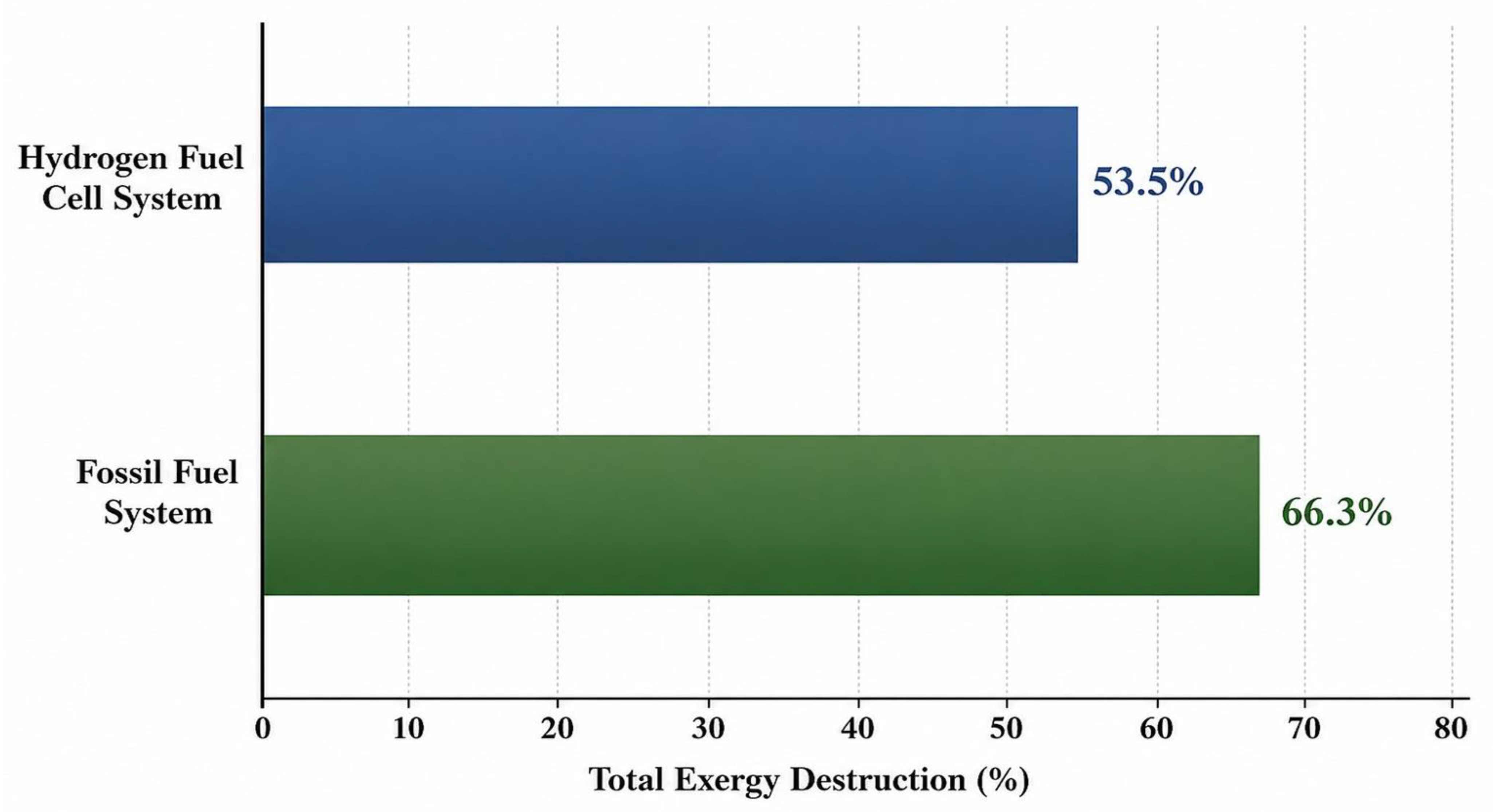
| Exergy destruction (%) | 40–65 | 20–40 |
| Dominant irreversibility source | Combustion and heat transfer | Electrochemical losses, compression |
| CO2 emissions | High | Zero at point of use |
| NOx formation | Significant | Low/negligible |
| Storage-related exergy losses (%) | 2–5 | 10–30 |
| System-level decarbonization potential | Low | Very high |
| Long-term thermodynamic sustainability | Limited | High |
| Scenario | Representative Conversion Efficiency (%) | Fuel Input (MW) | H2 Consumption (kg/h) | Upstream CO2 (kg/h) | End-Use CO2 (kg/h) | Total CO2 (kg/h) |
|---|---|---|---|---|---|---|
| S0: Natural gas combustion | 35 | 2.86 | 0 | 0 | 577 | 577 |
| S1: Grey H2 + combustion | 35 | 2.86 | 85.7 | 857 | 0 | 857 |
| S2: Grey H2 + PEM fuel cell | 55 | 1.82 | 54.5 | 545 | 0 | 545 |
| S3: Green H2 + combustion | 35 | 2.86 | 85.7 | ≈0 | 0 | ≈0 |
| S4: Green H2 + PEM fuel cell | 55 | 1.82 | 54.5 | ≈0 | 0 | ≈0 |
| Scenario | Energy Efficiency (%) | Exergy Efficiency (%) | Exergy Destruction (%) | Carbon Intensity (kg CO2/MWh) |
|---|---|---|---|---|
| S0: NG Combustion | 35 | 33.7 | 66.3 | 550–650 |
| S1: Grey H2 + Combustion | 30–35 | 25–35 | 65–75 | 700–900 |
| S2: Grey H2 + Fuel Cell | 50–55 | 45–50 | 50–55 | 450–650 |
| S3: Green H2 + Combustion | 30–35 | 30–40 | 60–70 | ~0 |
| S4: Green H2 + Fuel Cell | 55–60 | 50–65 | 35–50 | ~0 |
| System | Base Case | Sensitivity Range |
|---|---|---|
| Natural Gas | 35% | 30–40% |
| PEM Fuel Cell | 55% | 50–60% |
| Scenario | Efficiency (%) | Fuel Input (MW) |
|---|---|---|
| NG (Low) | 30 | 3.33 |
| NG (Base) | 35 | 2.86 |
| NG (High) | 40 | 2.50 |
| PEMFC (Low) | 50 | 2.00 |
| PEMFC (Base) | 55 | 1.82 |
| PEMFC (High) | 60 | 1.67 |
Disclaimer/Publisher’s Note: The statements, opinions and data contained in all publications are solely those of the individual author(s) and contributor(s) and not of MDPI and/or the editor(s). MDPI and/or the editor(s) disclaim responsibility for any injury to people or property resulting from any ideas, methods, instructions or products referred to in the content. |
© 2026 by the authors. Licensee MDPI, Basel, Switzerland. This article is an open access article distributed under the terms and conditions of the Creative Commons Attribution (CC BY) license.
Share and Cite
Utlu, Z.; Önal, B.S. Clean Technology Assessment of Green and Grey Hydrogen Pathways: Energy–Exergy Benchmarking Against Natural Gas Power Generation. Clean Technol. 2026, 8, 118. https://doi.org/10.3390/cleantechnol8040118
Utlu Z, Önal BS. Clean Technology Assessment of Green and Grey Hydrogen Pathways: Energy–Exergy Benchmarking Against Natural Gas Power Generation. Clean Technologies. 2026; 8(4):118. https://doi.org/10.3390/cleantechnol8040118
Chicago/Turabian StyleUtlu, Zafer, and Büşra Selenay Önal. 2026. "Clean Technology Assessment of Green and Grey Hydrogen Pathways: Energy–Exergy Benchmarking Against Natural Gas Power Generation" Clean Technologies 8, no. 4: 118. https://doi.org/10.3390/cleantechnol8040118
APA StyleUtlu, Z., & Önal, B. S. (2026). Clean Technology Assessment of Green and Grey Hydrogen Pathways: Energy–Exergy Benchmarking Against Natural Gas Power Generation. Clean Technologies, 8(4), 118. https://doi.org/10.3390/cleantechnol8040118