1. Introduction
Postharvest food loss remains a critical challenge in rural agricultural supply chains due to weak infrastructure, unreliable electricity, and limited access to continuous cooling. In many low- and middle-income regions, losses of perishable commodities frequently exceed 20–40%, disproportionately affecting smallholder farmers and undermining both income stability and food security [
1,
2,
3,
4,
5,
6]. Conventional refrigeration technologies require stable electricity, high capital investment, and regular maintenance—conditions that are rarely met in remote farming communities [
1,
6,
7,
8].
CTES has emerged as a promising solution for rural postharvest cooling by enabling the storage of cooling energy in the form of ice, chilled water, or PCMs. CTES allows load shifting and peak shaving, supports off-grid or weak-grid operation, and improves the compatibility of cold storage with solar PV systems [
9,
10,
11,
12]. By buffering the intermittency of solar energy, CTES enables more reliable and continuous cold-room operation without exclusive dependence on electrochemical batteries.
Recent advances in smart-farm technologies, including IoT-based sensing, cloud-connected monitoring, and predictive control algorithms, further enhance CTES performance. These tools enable real-time supervision of temperature, compressor operation, and state of charge, while optimizing charging and discharging schedules based on solar availability, cooling demand, and economic signals [
13,
14]. The integration of CTES with digital control layers, therefore, supports intelligent, autonomous, and energy-efficient rural cooling infrastructures.
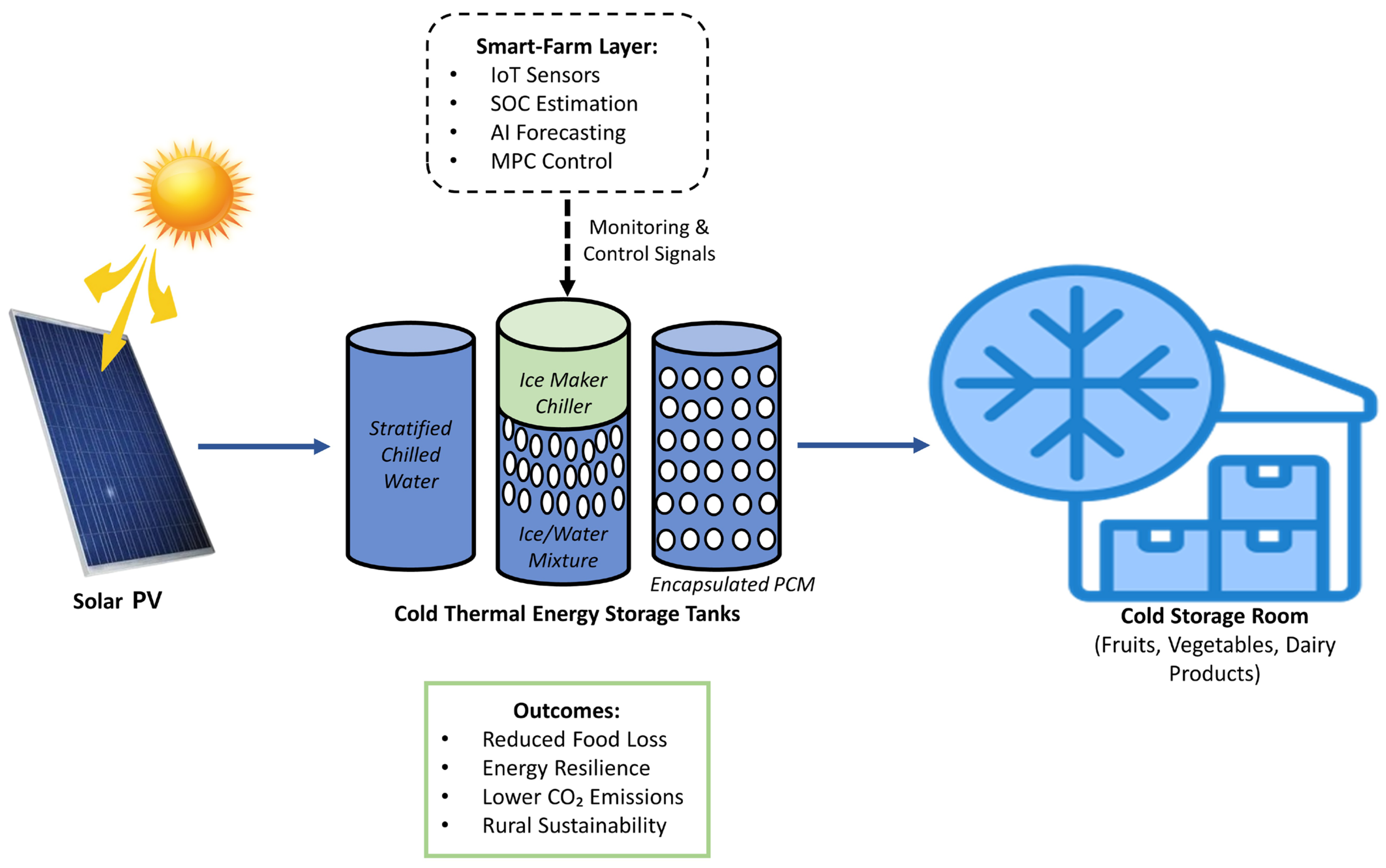
Previous reviews have primarily focused on material properties or standalone CTES systems, whereas this review uniquely integrates smart-farm digital control architectures and multi-level performance analysis. This integrated perspective is crucial for designing scalable, energy-efficient, and resilient rural cold chains. This review critically synthesizes recent developments in smart-farm-integrated CTES for solar-powered rural postharvest cooling. It examines CTES technologies (ice, chilled water, and PCM systems), smart integration strategies (monitoring, state-of-charge estimation, and predictive control), and key agricultural applications such as village cold rooms, milk cooling centers, and fruit and vegetable storage. Major research gaps are identified in system modeling, material durability, multi-scale optimization, and AI-based control. Overall, the review highlights the role of CTES as a foundation for resilient, low-carbon, and economically viable rural cold-chain systems (
Figure 1).
The objective of this review is to systematically compare CTES technologies and smart-farm control strategies for solar-powered rural postharvest cooling, and to evaluate their relative performance, techno-economic implications, and application-specific suitability. This review provides a scientific contribution by integrating material-level (ice, chilled water, and PCM), system-level (configurations and control architectures), and application-level (produce, dairy, and transport) perspectives into a unified analytical framework. Through mutual comparison of results reported in the literature, this work identifies performance trade-offs, key design principles, and critical research gaps that guide future development of resilient and low-carbon rural cold-chain systems.
2. Fundamentals
CTES technologies are classified into sensible, latent, and thermochemical storage based on their energy storage mechanisms. The comparative literature indicates that latent and thermochemical systems provide higher storage density, while sensible systems remain attractive due to simplicity and low cost [
15,
16,
17]. Rather than describing individual systems, this section synthesizes common performance trends and limitations reported across studies. The suitability of each technology depends on storage duration, space constraints, and agricultural temperature requirements.
2.1. Sensible Cold Storage
Sensible storage systems using chilled water or packed-bed materials operate at 4–7 °C and are widely reported as cost-effective solutions for short-term cooling [
15]. However, their low energy density requires large storage volumes, limiting application in compact rural cold rooms [
16]. Packed-bed systems improve heat transfer but suffer from pressure losses and thermal stratification [
16]. While Yan et al. [
18] reported stable long-term operation of sensible chilled-water storage exceeding 10,000 cycles, Ezan et al. [
19] and Dincer [
20] demonstrated that ice-based systems achieved nearly five times higher energy density but required sub-zero operation and more complex system configurations.
2.2. Latent Cold Storage (Ice and Phase Change Materials)
Latent CTES systems, including ice and PCM-based storage, provide high energy density and near-isothermal cooling in the range of −5 to +10 °C. Ice-based systems are widely used in solar-powered milk and vegetable cold rooms, offering effective temperature stability and improved compressor operation [
21,
22]. PCMs allow melting temperatures tailored to specific commodities, providing superior temperature control for fruits and vegetables [
23,
24]. A general trade-off exists: PCMs offer enhanced thermal regulation, while ice storage remains more economical and operationally robust for rapid cooling tasks. Long-term studies report that PCM performance can degrade over repeated cycles [
24,
25,
26,
27]. For a detailed discussion of PCM types, thermophysical properties, and deployment considerations, see
Section 4.3.
2.3. Thermochemical Cold Storage (TCS)
Thermochemical storage using zeolites, silica gel, and metal salts provides very high theoretical energy density with negligible standby losses [
28,
29]. However, slow reaction kinetics, material degradation, and system complexity limit practical performance [
30,
31]. Most reported studies remain at the laboratory or pilot scale, with limited evidence of long-term field applicability in agricultural cold chains.
2.4. Thermal Performance Metrics
Latent and thermochemical systems consistently exhibit higher storage density than sensible storage [
21,
32,
33]. SOC-based control strategies improve the operation of solar-powered systems under variable irradiance [
34,
35]. Exergy analyses show that narrow-temperature-range systems (ice and PCMs) outperform broad-range sensible storage [
9,
36,
37]. Nevertheless, the absence of standardized testing methods limits direct comparison across studies, emphasizing the need for long-term, harmonized field evaluations.
3. Materials and Methods
Data Collection
A structured literature search was conducted in ScienceDirect, Scopus, Web of Science, and Google Scholar using the keywords “cold thermal energy storage”, “CTES”, “phase-change materials”, “solar-powered cooling”, and “rural postharvest cold chain”. After title and abstract screening, studies were selected based on relevance to agricultural postharvest cooling, CTES materials or system configurations, and integration with solar or smart-farm technologies. Both experimental and modeling studies were included, while papers without agricultural relevance or focused solely on unrelated laboratory-scale systems were excluded. In total, 105 publications were critically analyzed and synthesized to identify common performance trends, technological limitations, and research gaps in CTES for rural cold-chain applications.
4. CTES Materials and Technologies
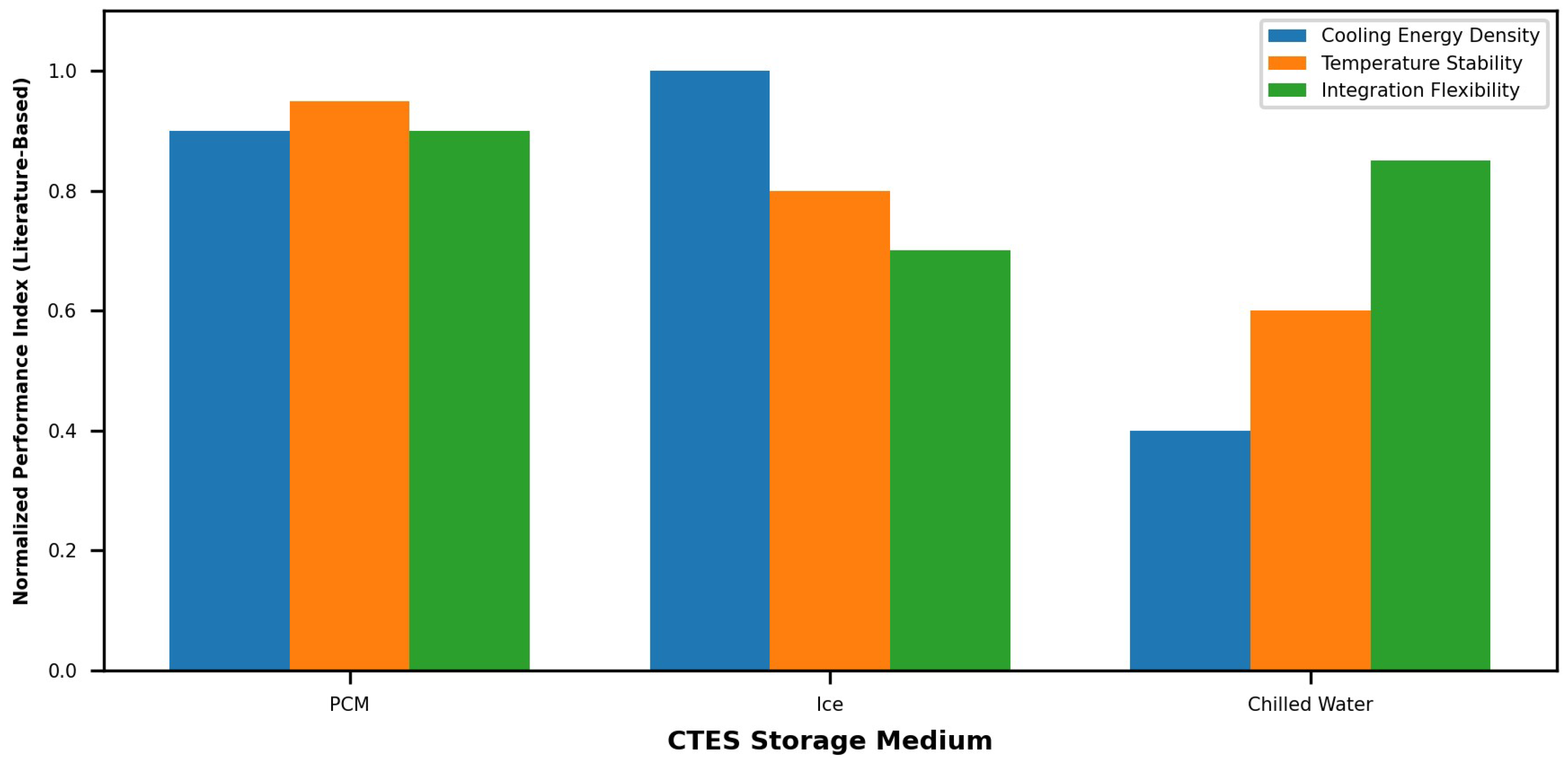
CTES materials for rural postharvest cooling are commonly classified into sensible (chilled water), latent (ice and PCMs), and sorption-based systems. These categories differ in energy density, operating temperature range, system complexity, and suitability for solar-powered cold-chain applications. A qualitative comparison of chilled-water-, ice-, and PCM-based storage in terms of energy density, temperature stability, and system integration flexibility is presented in
Figure 2, while representative thermophysical properties and operating temperature ranges of PCMs reported in the literature are summarized in
Table S1 (Supplementary Materials) [
9,
38,
39].
Table S1 highlights systematic trade-offs among PCM classes for refrigeration-relevant CTES applications. Organic PCMs in the 2–15 °C range exhibit superior temperature stability and cycling durability compared with inorganic salt hydrates, which frequently suffer from phase segregation and supercooling during repeated operation. Ice-based systems provide high latent heat at low cost but require sub-zero operation, resulting in reduced refrigeration efficiency and increased system complexity. Composite PCMs improve thermal conductivity and mitigate supercooling; however, their higher viscosity, agglomeration risk, and encapsulation cost limit large-scale deployment.
While ice-based storage systems reported by Ezan et al. [
19] and Dincer [
20] achieved high energy densities (~85 kWh m
−3) with long cycle stability (5000–20,000 cycles), PCM-encapsulated systems studied by Hunt et al. [
40] and Hoseini Rahdar et al. [
41] exhibited lower energy densities (11–43 kWh m
−3) and showed gradual changes in thermophysical properties under repeated cycling (2000–20,000 cycles). Field demonstrations in India and East Africa typically involve 1–10 ton cold rooms serving 50–200 farmers per site [
1,
42,
43], highlighting both practical applicability and the need for monitoring PCM performance over time.
4.1. Chilled-Water Storage
Chilled-water storage is the most mature sensible cooling technology, typically operating within 0–10 °C by storing cooling energy through the temperature reduction of water [
38,
44,
45]. Its advantages include low cost, simplicity, and operational robustness. However, its low volumetric energy density requires large storage tanks, and performance strongly depends on effective thermal stratification control [
46,
47]. Consequently, chilled-water systems are most suitable where space availability is not a limiting factor.
4.2. Ice Storage System
Ice storage exploits the latent heat of fusion of water (≈334 kJ·kg
−1), providing significantly higher energy density than chilled-water systems [
48,
49]. Ice-based CTES enables high cooling output over short durations and is effective for load shifting in solar-powered refrigeration. However, sub-zero operation reduces refrigeration efficiency and increases system complexity. In addition, secondary chilled-water loops are required to avoid freezing damage to temperature-sensitive produce [
50].
4.3. PCM-Based CTES
PCM-based CTES systems store cooling energy at near-constant temperatures corresponding to the PCM melting point, offering higher energy density and improved temperature stability compared with chilled-water systems. Common agricultural PCMs include organic compounds, salt hydrates, and eutectic mixtures with melting temperatures between −2 and 10 °C [
39,
51]. Operating at higher temperatures than ice storage improves refrigerationCoefficient of Performance (COP) and supports narrow temperature bands required for produce preservation. Key challenges include low thermal conductivity and cycling degradation, particularly in inorganic salt hydrates [
52]. Strategies to mitigate these issues include encapsulation, composite formulations, and enhanced heat exchanger designs [
53,
54]. Field studies indicate that organic PCMs generally provide superior cycling stability, while deployment examples highlight applications in fruits, vegetables, and dairy cold chains.
4.4. Adsorption and Absorption Cold Storage
Sorption-based CTES systems rely on reversible thermochemical reactions, such as water–silica gel and ammonia–salt pairs, and can be driven by low-grade thermal energy [
55,
56]. These systems offer high theoretical storage density and minimal standby losses. However, slow reaction kinetics, complex reactor design, and high capital costs currently limit their application to laboratory and pilot-scale demonstrations in rural cold-chain contexts [
57].
4.5. Physicochemical Selection Criteria for CTES Materials
Selection of CTES materials for postharvest cooling requires an appropriate melting temperature to prevent chilling injury, high energy density to minimize storage volume, adequate thermal conductivity for rapid heat transfer, long-term cycling stability, and low cost, with a safe, non-toxic composition [
58,
59,
60]. The low intrinsic thermal conductivity of PCMs (typically 0.2–0.6 W·m
−1·K
−1) remains the principal material-level constraint, motivating the development of composites incorporating graphite, metal foams, and nano-enhancers. Hybrid systems combining chilled water, ice, and PCMs are increasingly investigated to exploit complementary advantages and enhance operational flexibility.
These material properties directly influence system configuration, energy management strategies, and digital integration approaches discussed in
Section 6.
5. Solar-Powered Cooling Systems in Rural Agriculture
Solar-powered cooling systems play a critical role in reducing postharvest losses in rural agricultural regions where grid electricity is unreliable or unavailable. Significant quality deterioration of fruits, vegetables, dairy, and animal-based foods continues due to inadequate cold storage infrastructure [
59,
61]. Integration of solar energy with CTES and smart-farm management technologies enables resilient, low-carbon, and economically sustainable rural cold chains [
38,
62,
63,
64].
Solar cooling configurations are generally classified into PV direct-drive refrigeration, solar-powered heat pumps, PV systems combined with batteries or CTES, and hybrid photovoltaic–thermal (PVT) systems [
9,
65]. A qualitative comparison of these approaches is summarized in
Table S2 (Supplementary Materials), highlighting the advantages of CTES-based and hybrid storage systems for rural agricultural applications [
9,
36,
42,
59,
60,
62,
63,
65,
66].
Table S2 reveals clear performance trade-offs among solar-powered cooling system configurations for rural applications. PV direct-drive systems offer low capital cost and minimal maintenance but suffer from limited cooling reliability under cloudy or nighttime conditions, restricting their use to short-term storage of vaccines and fresh produce. In contrast, PV + CTES and hybrid PV–battery–CTES systems provide the highest temperature stability and operational reliability due to combined electrical and thermal storage, making them more suitable for rural cold-chain and multi-day storage applications. Battery-based systems enable power supply to multiple farm loads but exhibit higher capital cost, maintenance complexity, and environmental impact due to battery degradation and replacement requirements. Solar heat pump + CTES and PVT-based cooling systems achieve high efficiency and temperature control; however, their higher system complexity limits scalability in low-resource rural settings.
5.1. Solar PV Direct-Drive Refrigeration
PV direct-drive systems connect PV panels directly to refrigeration units and commonly incorporate ice- or PCM-based CTES for short-term thermal buffering [
38,
59,
67]. Their mechanical simplicity, low maintenance requirements, and avoidance of batteries make them suitable for vaccine storage, milk cooling, and produce preservation in off-grid regions [
1,
60,
68,
69,
70,
71,
72]. However, system performance remains strongly dependent on solar availability, and adequate CTES integration is required to maintain temperature stability during nighttime and cloudy periods [
59].
5.2. Solar-Powered Heat Pumps for Cooling
Solar-powered heat pumps use PV-generated electricity to operate high-efficiency refrigeration systems with superior coefficients of performance (COP), particularly for storage temperatures between 0 and 10 °C [
38]. When coupled with CTES, these systems can store cooling energy during peak solar hours and deliver stable operation during non-solar periods. Despite their high efficiency and reduced carbon emissions, adoption is constrained by higher capital costs and the need for skilled installation and maintenance in resource-limited rural settings [
73,
74].
5.3. PV + Battery vs. PV + CTES
Battery storage provides electrical flexibility for multiple farm loads but is limited by high capital cost, restricted lifespan, and environmental concerns associated with material extraction and disposal [
75,
76]. In contrast, PV + CTES systems store energy directly in thermal form, avoiding electrochemical conversion losses and offering longer service life with lower environmental impact. Ice-, chilled-water-, and PCM-based CTES are well matched to agricultural cooling demand profiles [
9,
66,
77].
Thermal storage systems typically achieve service lifetimes of approximately 15–25 years, compared with 5–10 years for batteries under rural operating conditions, making PV + CTES systems more cost-effective for cooling-dominated applications. Hybrid systems combining small battery capacities with CTES are increasingly proposed to balance electrical flexibility with thermal efficiency in smart-farm environments [
60,
78]. A conceptual comparison of electrical and thermal storage roles is illustrated in
Figure S1 (Supplementary Materials).
5.4. Hybrid Photovoltaic–Thermal (PVT) Systems
Studies on hybrid PVT systems indicate that they simultaneously generate electricity and recover thermal energy from PV modules, enabling combined cooling, drying, and water-heating functions in integrated farm systems [
65]. When coupled with adsorption or absorption-based CTES, PVT systems can support solar-driven cold storage with minimal electrical input [
79].
However, their application remains limited by higher system complexity, higher initial costs, and the need for careful matching between thermal output and cooling demand [
80].
5.5. Synthesis
The reviewed literature consistently indicates that systems integrating CTES—either as standalone thermal storage or within hybrid battery-assisted architectures—provide the most balanced combination of reliability, sustainability, and affordability for rural agricultural cold chains.
6. Architecture of Smart-Farm-Integrated CTES Systems
Beyond hardware configuration (
Section 4), reliable operation of solar-powered CTES under variable irradiance requires intelligent monitoring and control. The literature increasingly reports the integration of digital technologies—IoT sensing, data platforms, and adaptive control algorithms—as a key enabler of resilient and energy-efficient rural cold chains. A generalized architecture of smart-farm-integrated CTES systems is illustrated in
Figure S2 (Supplementary Materials).
Temperature and relative humidity are consistently identified as the most critical parameters governing postharvest quality and shelf life. IoT-based sensors deployed in cold rooms, CTES tanks, and ambient environments allow continuous monitoring of thermal conditions and early detection of temperature non-uniformity or stratification. Low-power wireless sensors are particularly suited to solar-powered rural systems and support timely corrective actions to reduce quality degradation and postharvest losses [
81,
82].
Smart controllers combine sensor data with adaptive control strategies to regulate refrigeration operation and CTES charging–discharging cycles. Studies indicate that prioritizing CTES charging during peak solar availability and discharging during low-generation periods enhances system autonomy and reduces reliance on grid electricity or diesel backup [
9,
36]. Variable-speed pumps and automated valves further optimize chilled-water or secondary-refrigerant flow according to cooling demand and CTES state of charge, lowering parasitic energy consumption and improving heat transfer efficiency [
83].
Cloud-based platforms (e.g., AWS IoT, ThingsBoard, and Blynk) are frequently reported in the literature as tools for centralized data storage, visualization, and remote supervision via mobile or web dashboards. Such platforms enable aggregation of performance data across multiple cold rooms, support benchmarking of cold-chain operations, and facilitate regional-scale optimization strategies [
84,
85]. Remote alarm systems provide early warnings of temperature excursions, equipment malfunction, or power shortages, enabling rapid intervention and preventing severe postharvest losses [
86].
Reported case studies consistently demonstrate the technical feasibility of smart-farm-integrated CTES systems, including IoT-monitored village cold rooms for fruits and vegetables [
87] and solar-powered milk-chilling centers using predictive algorithms for optimized CTES operation [
88].
7. System Configurations for Rural Postharvest Cooling
CTES enables flexible cooling system configurations adapted to rural agricultural contexts characterized by intermittent energy supply, limited infrastructure, and cost constraints. By integrating CTES with solar energy and smart control strategies, cooling demand can be decoupled from real-time power availability, ensuring temperature stability across production, storage, and transport stages. Representative CTES-enabled configurations are summarized in
Table 1, illustrating low-emission and storage-assisted cooling solutions for rural cold chains.
The literature identifies village-level cold rooms as one of the most widely implemented CTES applications. Solar-powered systems combined with chilled-water- or PCM-based CTES provide continuous cooling despite diurnal solar variability by storing excess cooling energy during peak irradiance and releasing it at night or during cloudy periods. PCM-enhanced systems maintain stable produce-specific temperatures (4–10 °C), limiting physiological degradation and chilling injury while reducing dependence on batteries or diesel backup [
51,
59]. These shared facilities significantly reduce postharvest losses and greenhouse gas emissions while improving economic viability and inclusive rural access [
61,
92]. The operational energy-flow dynamics are illustrated in
Supplementary Figure S3.
Milk-cooling in micro-dairy farms is a time-critical operation requiring high cooling capacity immediately after milking. CTES-based systems typically employ ice banks or chilled-water tanks to decouple cooling demand from energy availability and ensure milk quality during early-morning and evening milking cycles [
87,
88]. Sustainability benefits include reduced milk rejection, improved food safety, and displacement of diesel-powered chillers, with thermal storage offering longer service life and lower environmental impact than electrochemical batteries under rural operating conditions [
9,
38].
CTES-integrated packhouses support rapid field-heat removal through chilled-water tanks or PCM heat exchangers, enabling peak-load shaving and near-isothermal cooling conditions that minimize moisture loss and physiological stress in horticultural produce [
39,
89]. Integration with smart monitoring platforms further enables traceability and quality assurance across the cold chain [
59,
86], extending shelf life and reducing downstream energy demand.
Transport refrigeration using CTES ice batteries or PCM plates provides a low-energy alternative to diesel-driven refrigeration units. Thermal storage is charged at solar-powered packhouses or cold rooms and supplies cooling during transport without continuous power input, making these systems suitable for short- to medium-distance transport of fruits, vegetables, dairy, and fish [
9,
90]. Key sustainability advantages include reduced fossil fuel consumption, lower operating costs, and enhanced cold-chain resilience in regions with weak infrastructure [
62].
On-farm zero-energy cooling chambers (ZECCs) offer low-cost passive cooling using evaporative cooling principles. Recent designs incorporate PCM panels or water-based thermal buffers to improve temperature stability [
91]. When combined with solar-powered fans and sensors, ZECCs function as semi-controlled storage systems for short-term produce preservation, with minimal environmental footprint and reliance on locally available materials aligned with climate-smart and circular-agriculture principles [
61].
8. Control Strategies for CTES in Smart Farming
Control strategies are essential for the reliable operation of a CTES integrated with solar-powered postharvest cooling, particularly under fluctuating solar radiation, ambient temperature, and cooling demand. Effective coordination of renewable energy generation, CTES charging–discharging, and cooling loads are crucial to maintaining produce quality while enhancing energy efficiency. This section synthesizes the primary control approaches reported in agricultural CTES applications, ranging from simple rule-based logic to predictive and data-driven methods. The conceptual charging–discharging behavior and state-of-charge (SOC) estimation approaches are illustrated in
Supplementary Figures S4 and S5, and the key strategies are summarized in
Table 2.
Table 2 illustrates a clear progression from simple heuristic control to predictive and data-driven strategies for CTES-integrated solar cooling systems. Rule-based control remains the most suitable option for off-grid rural installations due to its robustness, low cost, and minimal hardware requirements. However, its reactive nature limits the ability to respond to rapid solar fluctuations and dynamic cooling demand. IoT-based adaptive control improves temperature stability and energy efficiency through real-time monitoring and adaptive adjustment, though it introduces reliance on sensors, connectivity, and digital infrastructure.
Advanced approaches, including Model Predictive Control (MPC) and forecast-driven optimization, allow anticipatory operation by integrating system models and future solar/load predictions. These methods maximize renewable energy utilization and reduce operating costs but require significant computational resources and accurate modeling, which can restrict deployment to centralized or cloud-assisted systems. Machine-learning-based SOC estimation further enhances storage utilization and prevents oversizing, though its effectiveness depends on sufficient historical data and robust model training.
Overall, selecting a suitable control strategy requires balancing technological complexity against operational performance and sustainability objectives. Rule-based and IoT-adaptive approaches are most appropriate for rural CTES systems due to their simplicity, robustness, and minimal hardware needs [
9,
38,
84,
85]. In contrast, MPC, forecast-driven optimization, and ML-based SOC estimation offer superior energy efficiency and anticipatory control, making them better suited for digitally enabled smart farms and integrated energy systems [
83,
93,
94,
95,
96,
98]. Nevertheless, practical deployment in rural contexts is often constrained by data availability, computational demands, and the long-term reliability of PCM materials under repeated cycling.
9. Applications in Food and Agriculture Supply Chains
CTES stabilizes temperatures across agricultural supply chains, particularly in rural and off-grid contexts with intermittent energy availability, by decoupling cooling demand from real-time power supply and enabling renewable energy integration. Reported applications include fresh produce, dairy, meat and fish, seed preservation, and community-scale cold infrastructure, contributing to food security, income stability, and environmental sustainability. A conceptual illustration of CTES integration for packhouse pre-cooling is provided in
Supplementary Figure S6.
In fruit and vegetable storage, CTES-supported cold rooms buffer metabolic heat loads and maintain commodity-specific temperatures (0–2 °C for apples and leafy greens; 10–13 °C for chilling-sensitive crops such as bananas and tomatoes). PCMs matched to produce requirements (typically 2–12 °C) reduce temperature fluctuations and compressor cycling [
39,
51,
53,
59,
67]. In dairy systems, ice-based CTES and low-temperature PCMs integrated with bulk milk coolers enable rapid cooling below 4 °C within 2–3 h, decreasing dependence on diesel and batteries while improving food safety and market access [
38,
49,
88,
99,
100].
For meat, fish, and poultry cold chains, ice storage and sub-zero PCM modules maintain temperatures between −1 and 4 °C during processing, storage, and transport, thereby reducing spoilage and supporting hygiene compliance in off-grid regions [
9,
38,
59,
61]. Seed storage applications similarly benefit from PCM-based CTES maintaining stable conditions (5–15 °C) under fluctuating ambient temperatures, supporting biodiversity conservation and climate-resilient agriculture with low maintenance requirements [
38,
51,
59,
61,
100].
At the community scale, CTES enables shared cold infrastructure such as village cold rooms, cooperative milk-cooling centers, and multi-commodity cold banks integrated with solar PV or micro-grids. These systems reduce battery cycling, improve overall efficiency, extend component lifetimes, and lower greenhouse gas emissions while strengthening resilience to climate variability and market shocks [
9,
38,
62]. Collectively, the literature demonstrates that CTES enhances temperature stability, improves supply chain resilience, and supports low-carbon, climate-smart agricultural systems.
10. Techno-Economic and Environmental Assessment
Techno-economic and environmental assessments consistently show that CTES-based solar cooling systems achieve lower lifecycle cost and carbon intensity than battery-dominant configurations in rural postharvest applications. Reported capital costs mainly relate to storage media, heat exchangers, insulation, and control units, with typical CAPEX of 200–800 USD/kWh and OPEX of 5–20 USD/kWh/year. The corresponding levelized cost of cooling (LCOC) generally falls within 0.05–0.15 USD/kWh, depending on system scale and storage technology [
9,
38,
49,
62]. A comparative techno-economic evaluation of ice, chilled water, organic and inorganic PCM systems, and hybrid configurations is summarized in
Table S3.
Table S3 highlights clear techno-economic trade-offs among CTES technologies for agricultural cold-chain applications. Ice storage and chilled-water systems exhibit the lowest capital and operating costs and the shortest payback periods (3–6 years), making them attractive for community-scale cold rooms and dairy cooling in low-income rural settings. However, their applicability is restricted to near-freezing or above-freezing temperature ranges and requires larger storage volumes. Organic PCMs provide more stable and near-isothermal cooling in the 2–15 °C range, which is particularly suitable for fruits and vegetables, but their higher material cost increases payback time compared with water-based systems. Inorganic PCMs offer higher energy density but suffer from long-term reliability issues such as phase segregation and degradation, which reduce their practical lifetime and increase maintenance risks. Hybrid CTES systems demonstrate the most flexible performance by combining thermal storage with reduced battery dependence; however, their higher system and control complexity may limit deployment in resource-constrained rural environments. Overall, the literature suggests that cost-effective rural cold-chain solutions favor chilled water and organic PCM systems, while hybrid CTES configurations are better suited for smart cold rooms and micro-grid-integrated agricultural facilities.
Economic feasibility is strongly influenced by local energy prices and diesel displacement, with reported payback periods of 3–7 years and additional indirect benefits from reduced postharvest losses and improved product quality [
49,
59]. Compared with battery storage, CTES avoids cycle-related degradation and frequent replacement, enabling service lifetimes exceeding 20 years and lowering both operational costs and environmental burdens.
Figure S7 presents a normalized comparison of LCOC for CTES-based systems (ice, PCM, and chilled water) versus battery-based solar cooling in rural cold-chain applications.
Lifecycle assessments further indicate significant CO
2 emission reductions due to higher renewable energy utilization and the lower embodied energy of CTES materials, such as water and food-grade PCMs, relative to lithium-ion batteries [
38,
39]. Hybrid systems provide a compromise between operational flexibility and sustainability for rural cold chains [
9,
62].
11. Challenges, Research Gaps, and Future Directions
Despite growing interest in CTES for solar-powered rural postharvest cooling, several technical, economic, and institutional barriers limit large-scale adoption. Key technical challenges include durable food-safe PCM development and standardized SOC estimation for reliable long-term operation.
System integration is further constrained by limited high-resolution cooling demand data and the continued reliance on simple rule-based control strategies, while field validation of intelligent control approaches in rural contexts is still scarce. From an economic and institutional perspective, weak financing mechanisms, a lack of incentives recognizing thermal energy storage benefits, and limited policy support for CTES within agricultural and climate-resilience programs hinder deployment. Social barriers, including low technical awareness and inadequate maintenance capacity, further challenge long-term sustainability.
Future research should focus on high-conductivity PCM composites, robust SOC estimation and digital monitoring frameworks, adaptive control strategies, and modular plug-and-play CTES designs. Long-term field studies are needed to evaluate system durability, lifecycle performance, and socio-economic impacts. Integrating CTES with smart-farm platforms, rural micro-grids, and sustainable cold-chain infrastructures is essential to establish CTES as a scalable and resilient solution for postharvest preservation.
12. Conclusions
This review synthesized recent advances in CTES materials, system configurations, and control strategies for solar-powered rural postharvest cooling. The literature consistently demonstrates that CTES-based systems provide superior temperature stability, longer service life, and lower lifecycle cost and carbon emissions compared with battery-dominant refrigeration. A comparative synthesis of CTES technologies indicates that each storage approach offers distinct operational advantages depending on the temperature requirements, storage duration, and scale of agricultural cold-chain applications. Evidence from the reviewed studies shows that PCM-based CTES systems achieve near-isothermal storage for fruits and vegetables with reported cycle stability of 2000–20,000 cycles, whereas ice-based CTES provides higher energy densities (~85 kWh m−3) and is most effective for rapid milk cooling below 4 °C. In contrast, chilled-water storage offers a simple and low-cost solution for community-scale cold rooms but requires larger storage volumes, making it better suited for installations with sufficient space and infrastructure. Simple rule-based and IoT-adaptive controls are most suitable for decentralized rural systems, while predictive and data-driven approaches improve renewable energy utilization in digitally enabled installations. Overall, the comparative evidence indicates that PCM-based CTES is most suitable for stable horticultural storage, ice-based systems are preferable for rapid dairy cooling and high-load applications, and chilled-water storage provides the most economical solution for large community-scale cold rooms where space is available. Field studies from India and East Africa confirm the practical applicability of CTES systems, highlighting the importance of long-term monitoring of PCM performance to ensure reliable operation. Key research gaps remain in PCM durability, standardized state-of-charge estimation, control-oriented modeling, and long-term field validation under real rural conditions. Addressing these challenges is critical to improving the reliability and scalability of CTES technologies for agricultural cold chains, particularly in remote regions where maintenance resources and technical expertise are limited. Future work should focus on durable PCM development, low-cost adaptive control frameworks, and multi-year demonstration projects to support scalable, resilient, and low-carbon rural cold-chain systems capable of reducing postharvest losses, improving food security, and supporting sustainable agricultural value chains.
Supplementary Materials
The following supporting information can be downloaded at:
https://www.mdpi.com/article/10.3390/cleantechnol8020048/s1, Table S1: Representative phase change materials (PCMs) reported in the literature for cold thermal energy storage at refrigeration-relevant temperature ranges; Table S2: Performance metrics and comparative characteristics of solar-powered cooling system configurations for rural agricultural applications, based on reported studies on PV direct-drive refrigeration, solar-powered heat pumps, battery storage, CTES, and hybrid PV–battery–CTES systems; Table S3: Techno-economic comparison of CTES technologies for agricultural cold-chain applications; Figure S1: Conceptual schematic (not to scale) illustrating the functional roles of battery storage versus cold thermal energy storage (CTES) in a hybrid solar photovoltaic (PV)-powered cooling system for rural cold-chain applications; Figure S2: Integrated smart-farm architecture supporting CTES-based postharvest cooling; Figure S3: Energy-flow-oriented diagram of a solar-powered village-level cold room integrated with cold thermal energy storage (CTES) for rural postharvest cooling; Figure S4: Illustrative (conceptual) charging–discharging behavior of CTES under smart and predictive control in solar-powered postharvest cooling; Figure S5: Qualitative comparison of CTES state-of-charge (SOC) estimation approaches in smart-farm and solar-powered cold storage applications, based on trends reported in the literature; Figure S6: Application-level conceptual integration of solar PV systems with CTES for packhouse pre-cooling and short-term cold storage in rural agricultural supply chains; Figure S7: Normalized levelized cost of cooling (LCOC) for different postharvest cooling technologies.
Author Contributions
Conceptualization, A.M., H.-S.M., S.-B.R. and C.-J.Y.; Writing—original draft preparation, A.M. and H.-S.M.; Data curation, Formal analysis and Investigation: A.M., H.-S.M., E.B.L., J.-G.K., H.-R.P., M.S., M.K.H., Y.-H.K. and S.-B.R.; Visualization: A.M., H.-S.M., S.-B.R., J.-G.K. and Y.-H.K.; Methodology: A.M., H.-S.M., E.B.L., H.-R.P., M.S., M.K.H. and S.-B.R.; Writing—review and editing: A.M., H.-S.M. and S.-B.R.; Project Administration, Resources, Supervision and Funding Acquisition, C.-J.Y. All authors have read and agreed to the published version of the manuscript.
Funding
This research received no external fundings.
Data Availability Statement
As this is a review article, no new data were created.
Acknowledgments
This work was supported by the Korea Institute of Planning and Evaluation for Technology in Food, Agriculture and Forestry (IPET) and Korea Smart Farm R&D Foundation through Smart Farm Innovation Technology Development Program, funded by the Ministry of Agriculture, Food and Rural Affairs (MAFRA) and Ministry of Science and ICT (MSIT) and Rural Development Administration (RDA) (RS-2025-02219443).
Conflicts of Interest
Author Sang-Bum Ryu was employed by the company Soo Energy Co., Ltd. The remaining authors declare that the research was conducted in the absence of any commercial or financial relationships that could be construed as a potential conflict of interest.
Abbreviations
The following abbreviations are used in this manuscript:
| CTES | Cold Thermal Energy Storage |
| PV | Photovoltaic |
| IoT | Internet of Things |
| PCMs | Phase Change Materials |
| SOC | State of Charge |
| COP | Coefficient of Performance |
| LMD | Lauric-Myristic-Dodecanol |
| PVT | Photovoltaic–Thermal |
| ZECCs | Zero-Energy Cooling Chambers |
| MPC | Model Predictive Control |
| ML | Machine Learning |
| CAPEX | Capital Expenditure |
| OPEXO | Operating Expenditure |
| LCOC | Levelized Cost of Cooling |
| Nomenclature | |
| Symbols | |
| K | Thermal Conductivity (W/m·K) |
| Δt | Temperature Difference (°C) |
References
- Amjad, W.; Munir, A.; Akram, F.; Parmar, A.; Precoppe, M.; Asghar, F.; Mahmood, F. Decentralized Solar-Powered Cooling Systems for Fresh Fruit and Vegetables to Reduce Post-Harvest Losses in Developing Regions: A Review. Clean Energy 2023, 7, 635–653. [Google Scholar] [CrossRef]
- Chen, C.; Chaudhary, A.; Mathys, A. Nutritional and Environmental Losses Embedded in Global Food Waste. Resour. Conserv. Recycl. 2020, 160, 104912. [Google Scholar] [CrossRef]
- Kiaya, V. Post-Harvest Losses and Strategies to Reduce Them. Tech. Pap. Postharvest Losses Action Contre La Faim (ACF) 2014, 25, 1–25. [Google Scholar]
- Kitinoja, L. Use of Cold Chains for Reducing Food Losses in Developing Countries. Population 2013, 6, 5–60. [Google Scholar]
- Onwude, D.I.; Chen, G.; Eke-emezie, N.; Kabutey, A.; Khaled, A.Y.; Sturm, B. Recent Advances in Reducing Food Losses in the Supply Chain of Fresh Agricultural Produce. Processes 2020, 8, 1431. [Google Scholar] [CrossRef]
- Sadiq, S.M.; Singh, I.P.; Ahmad, M.M.; Sani, B.S. Cold Storage Solutions to Reduce Post-Harvest Loss: Start-Ups for Youth in the Agricultural Supply Chain. New Countrys. 2025, 4, 37–44. [Google Scholar] [CrossRef]
- Sibanda, S. Development of a Wind and Solar Powered Mobile Evaporative Cooling System for Temporary Storage and Transportation of Fruits and Vegetables. Ph.D. Thesis, School of Engineering University of KwaZulu-Natal Pietermaritzburg, Pietermaritzburg, South Africa, 2013. [Google Scholar]
- Vilakazi, B.A. Low-Cost Refrigeration System for Impoverished Rural Communities. Ph.D. Thesis, Faculty of Engineering and the Built Environment, University of the Witwatersrand, Johannesburg, South Africa, 2025. [Google Scholar]
- Arteconi, A.; Hewitt, N.J.; Polonara, F. State of the Art of Thermal Storage for Demand-Side Management. Appl. Energy 2012, 93, 371–389. [Google Scholar] [CrossRef]
- Eze, V.H.U.; Robert, O.; Sarah, N.I.; Tamball, J.S.; Uzoma, O.F.; Okafor, W.O. Transformative Potential of Thermal Storage Applications in Advancing Energy Efficiency and Sustainability. IDOSR J. Appl. Sci. 2024, 9, 51–64. [Google Scholar] [CrossRef]
- Kapilan, N.; Kumar, K.A.; Gowda, K. Recent Advances in Applications of Phase Change Materials in Cold Storage—A Review. Mater. Today Proc. 2021, 47, 2410–2414. [Google Scholar] [CrossRef]
- Yenare, R.R.; Sonawane, C.R.; Sur, A.; Singh, B.; Panchal, H.; Kumar, A.; Sadasivuni, K.K.; Siddiqui, M.I.H.; Bhalerao, Y. A Comprehensive Review of Portable Cold Storage: Technologies, Applications, and Future Trends. Alex. Eng. J. 2024, 94, 23–33. [Google Scholar] [CrossRef]
- Liu, X.; Chen, J.; Wang, Y.; Zhang, X. An Optimization Strategy of Cold Storage Temperature Control Based on Energy Consumption Prediction. J. Build. Eng. 2025, 111, 113471. [Google Scholar] [CrossRef]
- Mohammed, M.; Riad, K.; Alqahtani, N. Design of a Smart IoT-Based Control System for Remotely Managing Cold Storage Facilities. Sensors 2022, 22, 4680. [Google Scholar] [CrossRef]
- Sarbu, I.; Sebarchievici, C. A Comprehensive Review of Thermal Energy Storage. Sustainability 2018, 10, 191. [Google Scholar] [CrossRef]
- Zanganeh, G.; Pedretti, A.; Haselbacher, A.; Steinfeld, A. Design of Packed Bed Thermal Energy Storage Systems for High-Temperature Industrial Process Heat. Appl. Energy 2015, 137, 812–822. [Google Scholar] [CrossRef]
- Wickramasinghe, Y.W.; Zhang, L. Life Cycle Assessment of Sensible, Latent and Thermochemical Thermal Energy Storage Systems for Climate Change Mitigation–A Systematic Review. J. Energy Technol. Policy 2022, 12, 17–31. [Google Scholar]
- Yan, C.; Shi, W.; Li, X.; Zhao, Y. Optimal Design and Application of a Compound Cold Storage System Combining Seasonal Ice Storage and Chilled Water Storage. Appl. Energy 2016, 171, 1–11. [Google Scholar] [CrossRef]
- Ezan, M.A.; Erek, A.; Dincer, I. Energy and Exergy Analyses of an Ice-on-Coil Thermal Energy Storage System. Energy 2011, 36, 6375–6386. [Google Scholar] [CrossRef]
- Dincer, I. On Thermal Energy Storage Systems and Applications in Buildings. Energy Build. 2002, 34, 377–388. [Google Scholar] [CrossRef]
- Bhatt, S. Ice Based Energy Storage Integration with Solar PV Power Plants for Cooling Energy. Power Res.—A J. CPRI 2016, 12, 297–316. [Google Scholar]
- Rismanchi, B.; Saidur, R.; Masjuki, H.H.; Mahlia, T.M.I. Energetic, Economic and Environmental Benefits of Utilizing the Ice Thermal Storage Systems for Office Building Applications. Energy Build. 2012, 50, 347–354. [Google Scholar] [CrossRef]
- Ilangovan, A.; Hamdane, S.; Silva, P.D.; Gaspar, P.D.; Pires, L. Promising and Potential Applications of Phase Change Materials in the Cold Chain: A Systematic Review. Energies 2022, 15, 7683. [Google Scholar] [CrossRef]
- Oró, E.; de Gracia, A.; Castell, A.; Farid, M.M.; Cabeza, L.F. Review on Phase Change Materials (PCMs) for Cold Thermal Energy Storage Applications. Appl. Energy 2012, 99, 513–533. [Google Scholar] [CrossRef]
- Bharathi, A.L.K.; Manikandan, C.; Bhuvanesh, M.; Kalaiselvam, S. Experimental Investigation on the Thermal Storage Performance of Nanocomposite-Enhanced Fatty Acid Eutectic PCM and the Effect of Ultrasonic Vibration for Application in Cold Storage. J. Energy Storage 2024, 101, 113797. [Google Scholar] [CrossRef]
- Hussain, S.I.; Dinesh, R.; Roseline, A.A.; Dhivya, S.; Kalaiselvam, S. Enhanced Thermal Performance and Study the Influence of Sub Cooling on Activated Carbon Dispersed Eutectic PCM for Cold Storage Applications. Energy Build. 2017, 143, 17–24. [Google Scholar] [CrossRef]
- Sidik, N.A.C.; Kean, T.H.; Chow, H.K.; Rajaandra, A.; Rahman, S.; Kaur, J. Performance Enhancement of Cold Thermal Energy Storage System Using Nanofluid Phase Change Materials: A Review. Int. Commun. Heat Mass Transf. 2018, 94, 85–95. [Google Scholar] [CrossRef]
- Bao, H.; Ma, Z. Thermochemical Energy Storage. In Storing Energy; Elsevier: Amsterdam, The Netherlands, 2022; pp. 651–683. [Google Scholar]
- Ding, Y.; Riffat, S.B. Thermochemical Energy Storage Technologies for Building Applications: A State-of-the-Art Review. Int. J. Low-Carbon Technol. 2013, 8, 106–116. [Google Scholar] [CrossRef]
- Cuypers, R.; Maraz, N.; Eversdijk, J.; Finck, C.; Henquet, E.; Oversloot, H.; Spijker, H.V.; de Geus, A. Development of a Seasonal Thermochemical Storage System. Energy Procedia 2012, 30, 207–214. [Google Scholar] [CrossRef]
- de Jong, A.-J.; Trausel, F.; Finck, C.; van Vliet, L.; Cuypers, R. Thermochemical Heat Storage—System Design Issues. Energy Procedia 2014, 48, 309–319. [Google Scholar] [CrossRef]
- Heine, K.; Tabares-Velasco, P.C.; Deru, M. Design and Dispatch Optimization of Packaged Ice Storage Systems Within a Connected Community. Appl. Energy 2021, 298, 117147. [Google Scholar] [CrossRef]
- Teggar, M.; Laouer, A.; Arıcı, M.; Ismail, K.A.R. Heat Transfer Enhancement of Ice Storage Systems: A Systematic Review of the Literature. J. Therm. Anal. Calorim. 2022, 147, 11611–11632. [Google Scholar] [CrossRef]
- Bastida, H.; De la Cruz Loredo, I.; Saikia, P.; Ugalde Loo, C. Discrete-Time State-of-Charge Estimator for Latent Heat Thermal Energy Storage Units Based on a Recurrent Neural Network. Appl. Energy 2024, 371, 123526. [Google Scholar] [CrossRef]
- Oloyede, M.O.; Akpakwu, G.A.; Myburgh, H.C.; De Freitas, A.; Kunatsa, T. A Review on State-of-Charge Estimation Methods, Energy Storage Technologies and State-of-the-Art Simulators: Recent Developments and Challenges. World Electr. Veh. J. 2024, 15, 381. [Google Scholar] [CrossRef]
- Dincer, I.; Rosen, M.A. Exergy: Energy, Environment and Sustainable Development; Newnes: London, UK, 2012. [Google Scholar]
- Khare, S.; Dell’Amico, M.; Knight, C.; McGarry, S. Selection of Materials for High Temperature Latent Heat Energy Storage. Sol. Energy Mater. Sol. Cells 2012, 107, 20–27. [Google Scholar] [CrossRef]
- Dincer, I.; Rosen, M.A. Thermal Energy Storage: Systems and Applications; John Wiley & Sons: Hoboken, NJ, USA, 2011. [Google Scholar]
- Zalba, B.; Marín, J.M.; Cabeza, L.F.; Mehling, H. Review on Thermal Energy Storage with Phase Change: Materials, Heat Transfer Analysis and Applications. Appl. Therm. Eng. 2003, 23, 251–283. [Google Scholar] [CrossRef]
- Hunt, J.D.; Issa, R.; Sanjivy, K.; Lucas, F.; Wada, Y. Integrating Seawater Air Conditioning and Mobilized Thermal Energy Storage. J. Energy Storage 2025, 113, 115638. [Google Scholar] [CrossRef]
- Rahdar, M.H.; Emamzadeh, A.; Ataei, A. A Comparative Study on PCM and Ice Thermal Energy Storage Tank for Air-Conditioning Systems in Office Buildings. Appl. Therm. Eng. 2016, 96, 391–399. [Google Scholar] [CrossRef]
- Natarajan, B.; Chellachi Kathiresan, A.; Subramanium, S.K. Development and Performance Evaluation of a Hybrid Portable Solar Cold Storage System for the Preservation of Vegetables and Fruits in Remote Areas. J. Energy Storage 2023, 72, 108292. [Google Scholar] [CrossRef]
- GSHV. GSHV Solar Cold Room: A Solution Gaining Momentum—GSHV’s Blog. In Global South Health Ventures GSHV; GSHV Blog: Nairobi, Kenya, 2025. [Google Scholar]
- ASHRAE. Edition, S.I 2011 ASHRAE Handbook HVAC Applications; ASHRAE: Atlanta, GA, USA, 2011. [Google Scholar]
- Sharp, T. 2019 ASHRAE Handbook: HVAC Applications-Chapter 37-Energy Use and Management; Oak Ridge National Laboratory (ORNL): Oak Ridge, TN, USA, 2019.
- Fang, G.; Tang, F.; Cao, L. Dynamic Characteristics of Cool Thermal Energy Storage Systems—A Review. Int. J. Green Energy 2016, 13, 1–13. [Google Scholar] [CrossRef]
- Karim, M.A. Experimental Investigation of a Stratified Chilled-Water Thermal Storage System. Appl. Therm. Eng. 2011, 31, 1853–1860. [Google Scholar] [CrossRef]
- Ban, M.; Krajačić, G.; Grozdek, M.; Ćurko, T.; Duić, N. The Role of Cool Thermal Energy Storage (CTES) in the Integration of Renewable Energy Sources (RES) and Peak Load Reduction. Energy 2012, 48, 108–117. [Google Scholar] [CrossRef]
- Hasnain, S.M. Review on Sustainable Thermal Energy Storage Technologies, Part II: Cool Thermal Storage. Energy Convers. Manag. 1998, 39, 1139–1153. [Google Scholar] [CrossRef]
- Slaviero, G.; Zilio, C.; Noro, M.; Traverso, D.; Traverso, F.; Mancin, S. Feasibility Study of Potential Application of Off-Grid Cold Room with LTES for Food Preservation in Remote Areas of Africa. J. Energy Storage 2025, 118, 116237. [Google Scholar] [CrossRef]
- Sharma, A.; Tyagi, V.V.; Chen, C.R.; Buddhi, D. Review on Thermal Energy Storage with Phase Change Materials and Applications. Renew. Sustain. Energy Rev. 2009, 13, 318–345. [Google Scholar] [CrossRef]
- Geetha, N.B.; Velraj, R. Novel Concept of PCM Based Thermal Storage Integration in Active and Passive Cooling Systems for Energy Management in Buildings. Energy Eng. 2013, 110, 41–66. [Google Scholar] [CrossRef]
- Akeiber, H.; Nejat, P.; Majid, M.Z.A.b.d.; Wahid, M.A.; Jomehzadeh, F.; Zeynali Famileh, I.; Calautit, J.K.; Hughes, B.R.; Zaki, S.A. A Review on Phase Change Material (PCM) for Sustainable Passive Cooling in Building Envelopes. Renew. Sustain. Energy Rev. 2016, 60, 1470–1497. [Google Scholar] [CrossRef]
- Farid, M.; Khudhair, A.M.; Razack, S.A.K.; Al-Hallaj, S. A Review on Phase Change Energy Storage: Materials and Applications. In Thermal Energy Storage with Phase Change Materials; CRC Press: Boca Raton, FL, USA, 2021; pp. 4–23. [Google Scholar]
- Henninger, S.K.; Jeremias, F.; Kummer, H.; Janiak, C. MOFs for Use in Adsorption Heat Pump Processes. Eur. J. Inorg. Chem. 2012, 2012, 2625–2634. [Google Scholar] [CrossRef]
- Wang, R.Z.; Oliveira, R.G. Adsorption Refrigeration—An Efficient Way to Make Good Use of Waste Heat and Solar Energy. Prog. Energy Combust. Sci. 2006, 32, 424–458. [Google Scholar] [CrossRef]
- Abedin, A.H.; Rosen, M.A. A Critical Review of Thermochemical Energy Storage Systems. Open Renew. Energy J. 2011, 4, 42–46. [Google Scholar] [CrossRef]
- Hussain, G.; Sultan, M.; Aleem, M.; Shahzad, M.W.; Ahamed, M.S.; Farooq, M.; Sajjad, U.; Zhang, Z.; Ahmad, S. Development and Performance Evaluation of Solar-Powered Cold Storage System for Perishable Agricultural Products. Int. Commun. Heat Mass Transf. 2025, 168, 109408. [Google Scholar] [CrossRef]
- James, S.J.; James, C. The Food Cold-Chain and Climate Change. Food Res. Int. 2010, 43, 1944–1956. [Google Scholar] [CrossRef]
- Sadi, M.; Arabkoohsar, A.; Joshi, A.K. Techno-Economic Optimization and Improvement of Combined Solar-Powered Cooling System for Storage of Agricultural Products. Sustain. Energy Technol. Assess. 2021, 45, 101057. [Google Scholar] [CrossRef]
- Gustavsson, J.; Cederberg, C.; Sonesson, U.; Van Otterdijk, R.; Meybeck, A. Global Food Losses and Food Waste: Extent, Causes and Prevention; Food and Agriculture Organization (FAO): Rome, Italy, 2011. [Google Scholar]
- Coulomb, D.; Dupont, J.-L.; Pichard, A. The Role of Refrigeration in the Global Economy-29. Informatory Note on Refrigeration Technologies; International Institute of Refrigeration/Institut International du Froid: Paris, France, 2015. [Google Scholar]
- Dupont, J.-L.; Domanski, P.; Lebrun, P.; Ziegler, F. The Role of Refrigeration in the Global Economy-38. Informatory Note on Refrigeration Technologies; International Institute of Refrigeration/Institut International du Froid: Paris, France, 2019. [Google Scholar]
- Heard, B.R.; Miller, S.A. Critical Research Needed to Examine the Environmental Impacts of Expanded Refrigeration on the Food System. Environ. Sci. Technol. 2016, 50, 12060–12071. [Google Scholar] [CrossRef] [PubMed]
- Zondag, H.A. Flat-Plate PV-Thermal Collectors and Systems: A Review. Renew. Sustain. Energy Rev. 2008, 12, 891–959. [Google Scholar] [CrossRef]
- Meng, X.; He, Y.; He, L.; Zhao, C.; Wang, L.; You, W.; Zhu, J. A Review of the Energy-Saving Potential of Phase Change Material-Based Cascaded Refrigeration Systems in Chinese Food Cold Chain Industry. Energies 2024, 17, 4762. [Google Scholar] [CrossRef]
- Canton, H. Food and Agriculture Organization of the United Nations—FAO. In The Europa Directory of International Organizations 2021; Routledge: London, UK, 2021; pp. 297–305. [Google Scholar]
- de S. Garcia, E.; Quaresma, N.; Aemro, Y.B.; Coimbra, A.P.; de Almeida, A.T. Cooling with the Sun: Empowering off-Grid Communities in Developing Countries with Solar-Powered Cold Storage Systems. Energy Res. Soc. Sci. 2024, 117, 103686. [Google Scholar] [CrossRef]
- Iqbal, A.; Faruq, M.U.; Chowdhury, S.; Srijan, M.H. Development and Implementation of a Battery and Solar Powered DC Compressor Based Cold Storage for Off Grid Rural Areas Ensuring Food Security. Ph.D. Thesis, BRAC University, Dhaka, Bangladesh, 2016. [Google Scholar]
- Luerssen, C.; Sekhar, C.; Cheong, D.; Reindl, T. Solar-Powered Cooling for the Remote Tropics. In Sustainable Energy Solutions for Remote Areas in the Tropics; Gandhi, O., Srinivasan, D., Eds.; Green Energy and Technology; Springer International Publishing: Cham, Switzerland, 2020; pp. 31–62. [Google Scholar]
- Odeyemi, O.M.; Ikegwuonu, N.C. Solar-Powered Cold Storage: ColdHubs in Nigeria. In Cold Chain Management for the Fresh Produce Industry in the Developing World; CRC Press: Boca Raton, FL, USA, 2021; pp. 175–182. [Google Scholar]
- Tomar, M.S.; Pradhan, R.C. Recent Developments in Solar-Powered Refrigeration Systems and Energy Storage Methods for on-Farm Preservation of Fruits and Vegetables. Sustain. Energy Technol. Assess. 2024, 72, 104032. [Google Scholar] [CrossRef]
- Almihat, M.G.M.; Munda, J.L. Comprehensive Review on Challenges of Integration of Renewable Energy Systems into Microgrid. Sol. Energy Sustain. Dev. J 2025, 14, 199–236. [Google Scholar] [CrossRef]
- Barzigar, A.; Hosseinalipour, S.M.; Mujumdar, A.S. Toward Sustainable Post-Harvest Practices: A Critical Review of Solar and Wind-Assisted Drying of Agricultural Produce with Integrated Thermal Storage Systems. Dry. Technol. 2025, 43, 1463–1494. [Google Scholar] [CrossRef]
- Diaz, P.M.; El-Khozondar, H.J. Electrical Energy Storage Technologies and the Application Potential in Power System Operation: A Mini Review. In Proceedings of the 2019 IEEE 7th Palestinian International Conference on Electrical and Computer Engineering (PICECE); IEEE: New York, NY, USA, 2019; pp. 1–9. [Google Scholar]
- Luo, X.; Wang, J.; Dooner, M.; Clarke, J. Overview of Current Development in Electrical Energy Storage Technologies and the Application Potential in Power System Operation. Appl. Energy 2015, 137, 511–536. [Google Scholar] [CrossRef]
- Togun, H.; Basem, A.; Jweeg, M.J.; Mohammed, H.I.; Abed, A.M.; Anqi, A.E.; Chattopadhyay, A.; Biswas, N. Development and Innovation Using PCM in PV Cooling Systems: Passive and Active Approaches. J. Therm. Anal. Calorim. 2025, 150, 10725–10760. [Google Scholar] [CrossRef]
- Sharma, D.K.; Sharma, D.; Ali, A.H.H. A State of the Art on Solar-Powered Vapor Absorption Cooling Systems Integrated with Thermal Energy Storage. Env. Sci. Pollut. Res. 2020, 27, 158–189. [Google Scholar] [CrossRef] [PubMed]
- Calise, F.; d’Accadia, M.D.; Vanoli, L. Design and Dynamic Simulation of a Novel Solar Trigeneration System Based on Hybrid Photovoltaic/Thermal Collectors (PVT). Energy Convers. Manag. 2012, 60, 214–225. [Google Scholar] [CrossRef]
- Jawad, H.M.; Nordin, R.; Gharghan, S.K.; Jawad, A.M.; Ismail, M. Energy-Efficient Wireless Sensor Networks for Precision Agriculture: A Review. Sensors 2017, 17, 1781. [Google Scholar] [CrossRef] [PubMed]
- Ruiz-Garcia, L.; Lunadei, L.; Barreiro, P.; Robla, I. A Review of Wireless Sensor Technologies and Applications in Agriculture and Food Industry: State of the Art and Current Trends. Sensors 2009, 9, 4728–4750. [Google Scholar] [CrossRef]
- Cabeza, L.F.; Castell, A.; Barreneche, C.; de Gracia, A.; Fernández, A.I. Materials Used as PCM in Thermal Energy Storage in Buildings: A Review. Renew. Sustain. Energy Rev. 2011, 15, 1675–1695. [Google Scholar] [CrossRef]
- Verdouw, C.N.; Wolfert, J.; Beulens, A.J.M.; Rialland, A. Virtualization of Food Supply Chains with the Internet of Things. J. Food Eng. 2016, 176, 128–136. [Google Scholar] [CrossRef]
- Wolfert, S.; Ge, L.; Verdouw, C.; Bogaardt, M.-J. Big Data in Smart Farming—A Review. Agric. Syst. 2017, 153, 69–80. [Google Scholar] [CrossRef]
- Badia-Melis, R.; Mishra, P.; Ruiz-García, L. Food Traceability: New Trends and Recent Advances. A Review. Food Control 2015, 57, 393–401. [Google Scholar] [CrossRef]
- Al-Shannaq, R.; Auckaili, A.; Farid, M. Cooling of Milk on Dairy Farms: An Application of a Novel Ice Encapsulated Storage System in New Zealand. In Food Engineering Innovations Across the Food Supply Chain; Elsevier: Amsterdam, The Netherlands, 2022; pp. 207–228. [Google Scholar]
- Sidney, S.; Prabakaran, R.; Kim, S.C.; Dhasan, M.L. A Novel Solar-Powered Milk Cooling Refrigeration Unit with Cold Thermal Energy Storage for Rural Application. Env. Sci Pollut. Res. 2022, 29, 16346–16370. [Google Scholar] [CrossRef]
- Chebli, F.; Mechighel, F. Phase Change Materials: Classification, Use, Phase Transitions, and Heat Transfer Enhancement Techniques: A Comprehensive Review. J. Therm. Anal. Calorim. 2025, 150, 1353–1411. [Google Scholar] [CrossRef]
- Altuntas, M.; Erdemir, D.; Unalan, S. A Comprehensive Performance Evaluation of Phase Change Materials for Cold Energy Storage Systems. Energy Build. 2025, 330, 115349. [Google Scholar] [CrossRef]
- Asare-Baah, L.M. Estimating Food Loss Among Fruit and Vegetable Farmers and Their Willingness to Adopt Storage Facilities for Food Loss Reduction. Ph.D. Thesis, Tuskegee University, Tuskegee, AL, USA, 2023. [Google Scholar]
- Coulomb, D. Refrigeration and Cold Chain Serving the Global Food Industry and Creating a Better Future: Two Key IIR Challenges for Improved Health and Environment. Trends Food Sci. Technol. 2008, 19, 413–417. [Google Scholar] [CrossRef]
- Ma, Y.; Kelman, A.; Daly, A.; Borrelli, F. Predictive Control for Energy Efficient Buildings with Thermal Storage: Modeling, Stimulation, and Experiments. IEEE Control Syst. Mag. 2012, 32, 44–64. [Google Scholar] [CrossRef]
- Oldewurtel, F.; Parisio, A.; Jones, C.N.; Gyalistras, D.; Gwerder, M.; Stauch, V.; Lehmann, B.; Morari, M. Use of Model Predictive Control and Weather Forecasts for Energy Efficient Building Climate Control. Energy Build. 2012, 45, 15–27. [Google Scholar] [CrossRef]
- Kamal, R.; Moloney, F.; Wickramaratne, C.; Narasimhan, A.; Goswami, D.Y. Strategic Control and Cost Optimization of Thermal Energy Storage in Buildings Using EnergyPlus. Appl. Energy 2019, 246, 77–90. [Google Scholar] [CrossRef]
- Yu, Z.; Huang, G.; Haghighat, F.; Li, H.; Zhang, G. Control Strategies for Integration of Thermal Energy Storage into Buildings: State-of-the-Art Review. Energy Build. 2015, 106, 203–215. [Google Scholar] [CrossRef]
- Zhang, Y.; Wang, J.; Wang, X. Review on Probabilistic Forecasting of Wind Power Generation. Renew. Sustain. Energy Rev. 2014, 32, 255–270. [Google Scholar] [CrossRef]
- Morales Sandoval, D.A.; De La Cruz Loredo, I.; Bastida, H.; Badman, J.J.R.; Ugalde-Loo, C.E. Design and Verification of an Effective State-of-Charge Estimator for Thermal Energy Storage. IET Smart Grid 2021, 4, 202–214. [Google Scholar] [CrossRef]
- Mondher, B.S.; Omar, M.; Torres, T.V.; Farah, M.; Mourad, R.; El-Dine, H.M. Field Testing of an Innovative Solar Powered Milk Cooling Solution for Small Dairy Farms. In Proceedings of the XIIth International Congress on Renewable Energy and the Environment, Sousse, Tunisia, 26–28 March 2018; pp. 22–24. [Google Scholar]
- Sivamani, S.; Choi, S.H.; Lee, D.H.; Park, J.; Chon, S. Automatic Posture Detection of Pigs on Real-Time Using YOLO Framework. Int. J. Res. Trends Innov. 2020, 5, 81–88. [Google Scholar]
- De Vitis, M.; Hay, F.R.; Dickie, J.B.; Trivedi, C.; Choi, J.; Fiegener, R. Seed Storage: Maintaining Seed Viability and Vigor for Restoration Use. Restor. Ecol. 2020, 28, S249–S255. [Google Scholar] [CrossRef]
| Disclaimer/Publisher’s Note: The statements, opinions and data contained in all publications are solely those of the individual author(s) and contributor(s) and not of MDPI and/or the editor(s). MDPI and/or the editor(s) disclaim responsibility for any injury to people or property resulting from any ideas, methods, instructions or products referred to in the content. |




 ,
,