
Recent Advances in Renewable Hydrogen Purification Technologies: A General Review

 ,
,  ,
,  ,
,  ,
,  and
and 
Highlights
- Renewable hydrogen derived from biomass has various impurities, and no single purification technology can satisfy all requirements for purity, cost, and flexibility.
- Recent advances in porous membrane materials demonstrate significant potential to match or exceed the performance of traditional pressure swing adsorption and cryogenic systems under specific conditions.
- Integrating various purification methods in hybrid systems—such as membrane–PSA, membrane–cryogenic, or membrane–catalytic polishing—provides the most efficient and scalable approach for future renewable hydrogen production.
- Large scale deployment will depend on the development of more robust membrane materials, modular purification units, and harmonised techno economic and life cycle assessment methods.
Abstract
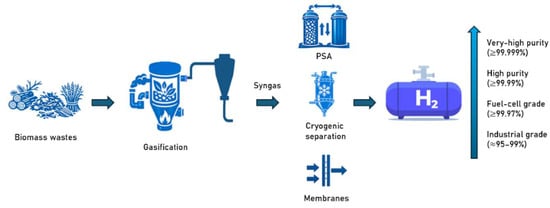
1. Introduction
2. Purity Requirements for Renewable Hydrogen Applications
3. Biomass-Derived Renewable Hydrogen Purification Technologies
3.1. Established Industrial Purification Technologies
3.1.1. Adsorption-Based Purification

| Technology | TRL | Typical H2 Purity (%) | Recovery (%) | CAPEX (€/kW) | OPEX (%/yr) | Specific CAPEX (€/kWh) * | Production Cost (€/kg H2) | Ref. |
|---|---|---|---|---|---|---|---|---|
| Conventional PSA (zeolite 5A, activated carbon) | 9 | ~99.0 | 75–85 | 300–500 | 3–5 | 120–250 | 1.6–2.0 | [5,15,36,38,45] |
| VPSA (metal hydrides, e.g., LaNi5-based) | 7–8 | 99.0–99.9 | 90–95 | 400–700 | 4–6 | 150–280 | 1.8–2.3 | [36,39,42,45] |
| TSA (Thermal swing adsorption) | 6–7 | 99.0–99.9 | 75–90 | 500–800 | 5–7 | 160–300 | 1.9–2.4 | [17,36,40,41] |
| Hybrid PSA–membrane | 6–8 | 99.0–99.9 | 91–92 | 450–900 | 4–6 | 180–320 | 1.5–1.9 | [39,40,41,42] |
| MOF-based adsorption (pilot) | 4–6 | 95–99 | 80–92 | 800–1200 | 6–8 | 200–400 | 2.0–2.7 | [38,41,42] |
3.1.2. Cryogenic Separation
3.2. Membrane-Based Purification Technologies
3.2.1. Polymeric Membranes
3.2.2. Inorganic Membranes
3.2.3. Mixed Matrix Membranes
4. Cross-Cutting Comparison and Deployment Guidance
4.1. Advanced Polishing and Post-Purification Technologies
4.2. Integrated Purification Configurations and Sequencing Rationale
4.3. Evidence from Pilot-Scale and Techno-Economic Case Studies
5. Outlook and Future Perspectives for Renewable Hydrogen Purification Systems
5.1. Ongoing Projects and Demonstrations in Europe
5.2. Key Challenges and Research Directions
5.3. Expected Technology Trajectory (2025–2035)
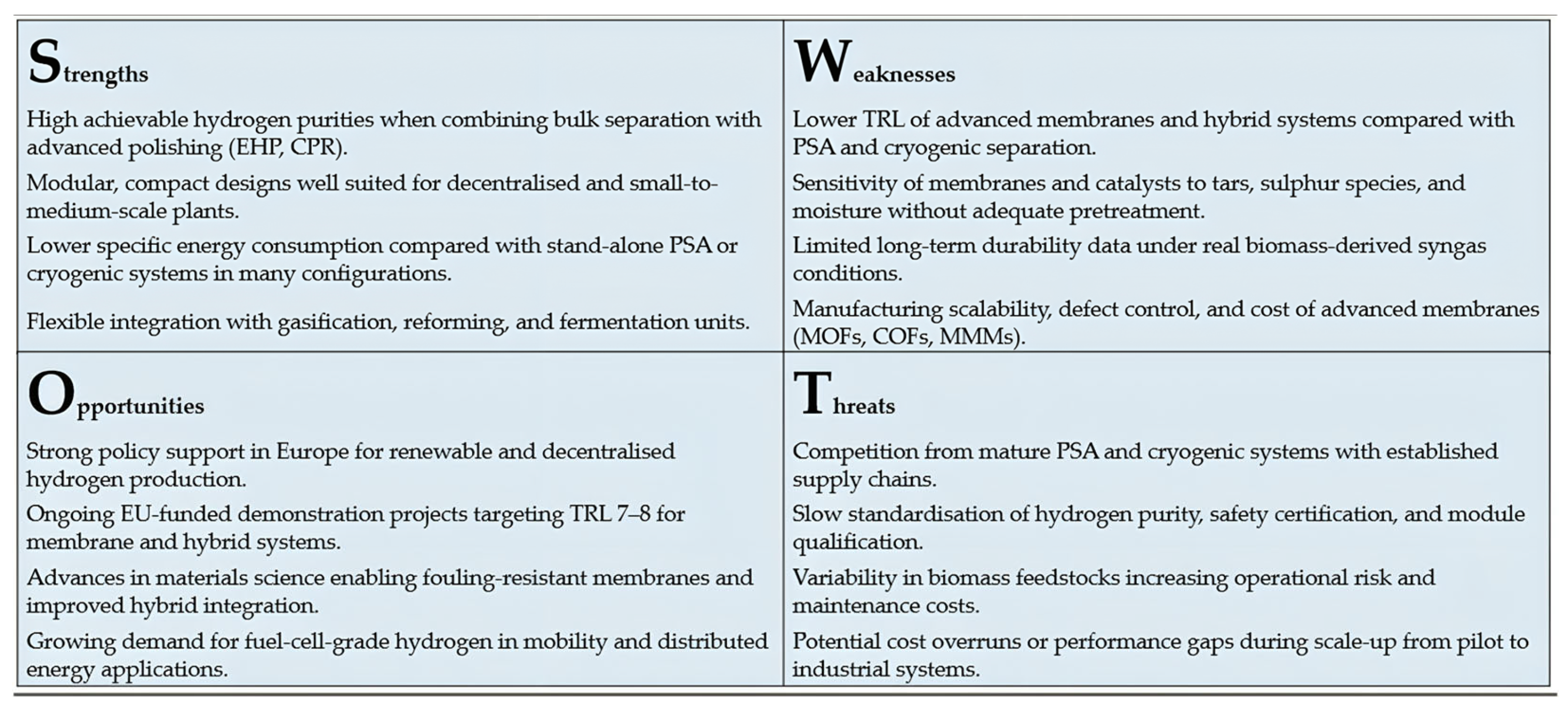
5.4. System-Level SWOT Analysis of Renewable Hydrogen Purification Technologies
6. Conclusions
Author Contributions
Funding
Data Availability Statement
Conflicts of Interest
Abbreviations
| BDC | Benzene-1,4-dicarboxylate (terephthalate) |
| CA | Cellulose Acetate |
| CAPEX | Capital Expenditure |
| CMSM | Carbon Molecular Sieve Membrane |
| CNTs | Carbon nanotubes |
| COF | Covalent Organic Framework |
| CPR | Catalytic Polishing Reactor |
| CVD | Chemical Vapour Deposition |
| DDR | Deca-dodecasil 3R (zeolite type) |
| EHP | Electrochemical Hydrogen Pump |
| ELP | Electroless Plating |
| GDP | Glassy Dense Polymer |
| GHG | Greenhouse gases |
| GPU | Gas Permeation Unit |
| H2S | Hydrogen Sulphide |
| IEA | International Energy Agency |
| LCA | Life-Cycle Assessment |
| LCOH | Levelised Cost of Hydrogen |
| MIL | Materials Institute Lavoisier (MOF family) |
| MMMs | Mixed Matrix Membranes |
| MOF | Metal–Organic Framework |
| MXene | Transition-metal carbide/nitride 2D material |
| OPEX | Operational Expenditure |
| PBI | Polybenzimidazole |
| PDMS | Polydimethylsiloxane |
| PEI | Polyetherimide |
| PEM | Proton-exchange membrane |
| PEMFC | Proton exchange membrane fuel cells |
| PFR | Phenol–Formaldehyde Resin |
| PIM | Polymer of Intrinsic Microporosity |
| PSA | Pressure Swing Adsorption |
| PSf | Polysulfone |
| PVAc | Polyvinyl Acetate |
| PVDF | Polyvinylidene Fluoride |
| SOFC | Solid Oxide Fuel Cell |
| SOC | Solid Oxide Cell |
| SWOT | Strengths, weaknesses, opportunities, and threats |
| SWCNT/MWCNT | Single-/Multi-Walled Carbon Nanotube |
| Tg | Glass Transition Temperature |
| TEA | Techno-Economic Assessment |
| TEOS | Tetraethyl Orthosilicate |
| TRL | Technology Readiness Level |
| UiO-66 | University of Oslo MOF-66 |
| VPSA | Vacuum Pressure Swing Adsorption |
| YSZ | Yttria-Stabilised Zirconia |
| ZIF | Zeolitic Imidazolate Framework |
References
- Gao, F.-Y.; Yu, P.-C.; Gao, M.-R. Seawater Electrolysis Technologies for Green Hydrogen Production: Challenges and Opportunities. Curr. Opin. Chem. Eng. 2022, 36, 100827. [Google Scholar] [CrossRef]
- Hermesmann, M.; Müller, T.E. Green, Turquoise, Blue, or Grey? Environmentally Friendly Hydrogen Production in Transforming Energy Systems. Prog. Energy Combust. Sci. 2022, 90, 100996. [Google Scholar] [CrossRef]
- Pal, D.B.; Singh, A.; Bhatnagar, A. A Review on Biomass Based Hydrogen Production Technologies. Int. J. Hydrogen Energy 2022, 47, 1461–1480. [Google Scholar] [CrossRef]
- Mosca, L.; Medrano Jimenez, J.A.; Wassie, S.A.; Gallucci, F.; Palo, E.; Colozzi, M.; Taraschi, S.; Galdieri, G. Process Design for Green Hydrogen Production. Int. J. Hydrogen Energy 2020, 45, 7266–7277. [Google Scholar] [CrossRef]
- IEA. Global Hydrogen Review 2024: International Energy Agency. Available online: https://www.iea.org/events/global-hydrogen-review-2024-technical-webinar (accessed on 9 October 2025).
- Akhlaghi, N.; Najafpour-Darzi, G. A Comprehensive Review on Biological Hydrogen Production. Int. J. Hydrogen Energy 2020, 45, 22492–22512. [Google Scholar] [CrossRef]
- Faraloni, C.; Torzillo, G.; Balestra, F.; Moia, I.C.; Zampieri, R.M.; Jiménez-Conejo, N.; Touloupakis, E. Advances and Challenges in Biohydrogen Production by Photosynthetic Microorganisms. Energies 2025, 18, 2319. [Google Scholar] [CrossRef]
- Openshaw, D.; Bagnato, G. Recent Progress in Bio-Hydrogen Production for Sustainable Energy and Chemical Production. Renew. Sustain. Energy Rev. 2026, 226, 116307. [Google Scholar] [CrossRef]
- Sajdak, M.; Muzyka, R.; Gałko, G. Recent Progress in Biomass Pyrolysis and High Value Utilisation of Pyrolytic Carbon. Energies 2025, 18, 3919. [Google Scholar] [CrossRef]
- Worku, A.K.; Ayele, D.W.; Deepak, D.B.; Gebreyohannes, A.Y.; Agegnehu, S.D.; Kolhe, M.L. Recent Advances and Challenges of Hydrogen Production Technologies via Renewable Energy Sources. Adv. Energy Sustain. Res. 2024, 5, 2300273. [Google Scholar] [CrossRef]
- Shahbaz, M.; Al-Ansari, T.; Aslam, M.; Khan, Z.; Inayat, A.; Athar, M.; Naqvi, S.R.; Ahmed, M.A.; McKay, G. A State of the Art Review on Biomass Processing and Conversion Technologies to Produce Hydrogen and Its Recovery via Membrane Separation. Int. J. Hydrogen Energy 2020, 45, 15166–15195. [Google Scholar] [CrossRef]
- Bernardo, G.; Araújo, T.; da Silva Lopes, T.; Sousa, J.; Mendes, A. Recent Advances in Membrane Technologies for Hydrogen Purification. Int. J. Hydrogen Energy 2020, 45, 7313–7338. [Google Scholar] [CrossRef]
- Yassari, M.; Bagherzadeh, A.; Docoslis, A.; Daymond, M.R.; Sadrzadeh, M. Advancements in Adsorption and Membrane Technologies for Hydrogen Isotope Separation: Exploring New Materials and Emerging Techniques. Sep. Purif. Technol. 2025, 374, 133666. [Google Scholar] [CrossRef]
- Gao, N.; Mao, X.; Nan, N.; Zhang, T.; Liu, B.; Sun, C.; Chen, G.; Deng, C. Hybrid Membrane/Absorption-Adsorption Separation of Hydrogen-Blended Natural Gas at Receiving Terminal: Process Modelling and Multi-Objective Optimization. Sep. Purif. Technol. 2025, 360, 131088. [Google Scholar] [CrossRef]
- Krótki, A.; Bigda, J.; Spietz, T.; Ignasiak, K.; Matusiak, P.; Kowol, D. Performance Evaluation of Pressure Swing Adsorption for Hydrogen Separation from Syngas and Water–Gas Shift Syngas. Energies 2025, 18, 1887. [Google Scholar] [CrossRef]
- Cerone, N.; Zito, G.D.; Florio, C.; Fabbiano, L.; Zimbardi, F. Recent Advancements in Pd-Based Membranes for Hydrogen Separation. Energies 2024, 17, 4095. [Google Scholar] [CrossRef]
- Król, A.; Gajec, M.; Holewa-Rataj, J.; Kukulska-Zając, E.; Rataj, M. Hydrogen Purification Technologies in the Context of Its Utilization. Energies 2024, 17, 3794. [Google Scholar] [CrossRef]
- Bhalani, D.V.; Lim, B. Hydrogen Separation Membranes: A Material Perspective. Molecules 2024, 29, 4676. [Google Scholar] [CrossRef]
- Maceiras, R.; Feijoo, J.; Perez-Rial, L.; Alvarez-Feijoo, M.A.; Eslami, N. Influence of Activated Carbon Granulometry on H2 Purification in Glycerol Reforming Syngas: Adsorption and Kinetic Analysis. Energies 2024, 17, 6011. [Google Scholar] [CrossRef]
- Aguilloso, G.; Arpia, K.; Khan, M.; Sapico, Z.A.; Lopez, E.C.R. Recent Advances in Membrane Technologies for Biogas Upgrading. Eng. Proc. 2024, 67, 57. [Google Scholar]
- Eluwah, C.; Fennell, P.S.; Tighe, C.J.; Dawood, A. Al A Novel Technological Blue Hydrogen Production Process: Industrial Sorption Enhanced Autothermal Membrane (ISEAM). Energy Adv. 2023, 2, 1476–1494. [Google Scholar] [CrossRef]
- Suyitno; Rosyadi, I.; Arifin, Z.; Sutardi, T.; Sunaryo; Ilminnafik, N. Advanced Modification of Natural Zeolites for Optimized Biogas, Syngas, and Hydrogen Production and Purification. Cogent Eng. 2024, 11, 2398912. [Google Scholar] [CrossRef]
- Dorel, S.; Lucian, M.; Gheorghe, L.; Cristian, L.G. Green Hydrogen, a Solution for Replacing Fossil Fuels to Reduce CO2 Emissions. Processes 2024, 12, 1651. [Google Scholar] [CrossRef]
- ISO 14687:2025; Hydrogen Fuel—Product Specification. ISO: Geneva, Switzerland, 2025.
- SAE J2719:2021; Hydrogen Fuel Quality for Fuel Cell Vehicles. SAE: Warrendale, PA, USA, 2021.
- ISO 14687:2025; Hydrogen Fuel Quality for Fuel Cell Vehicles. SAE International: Warrendale, PA, USA, 2020. [CrossRef]
- Du, Z.; Liu, C.; Zhai, J.; Guo, X.; Xiong, Y.; Su, W.; He, G. A Review of Hydrogen Purification Technologies for Fuel Cell Vehicles. Catalysts 2021, 11, 393. [Google Scholar] [CrossRef]
- Haimerl, F.; Kumar, S.; Heere, M.; Bandarenka, A.S. Electrochemical impedance spectroscopy of PEM fuel cells at low hydrogen partial pressures: Efficient cell tests for mass production. Ind. Chem. Mater. 2025, 2, 132–140. [Google Scholar] [CrossRef]
- Show, K.Y.; Yan, Y.G.; Lee, D.J. Biohydrogen Production from Algae: Perspectives, Challenges, and Prospects. In Biomass, Biofuels, Biochemicals: Biofuels from Algae, 2nd ed.; Elsevier: Amsterdam, The Netherlands, 2019; pp. 325–343. [Google Scholar] [CrossRef]
- Kim, Y.; Yang, H. Hydrogen Purity: Influence of Production Methods, Purification Techniques, and Analytical Approaches. Energies 2025, 18, 741. [Google Scholar] [CrossRef]
- Rostrup-Nielsen, J.R.; Christiansen, L.J. Concepts in Syngas Manufacture; Imperial College Press: London, UK, 2011; ISBN 978-1-84816-560-8. [Google Scholar]
- Zhao, Y.; Mao, Y.; Zhang, W.; Tang, Y.; Wang, P. Reviews on the Effects of Contaminations and Research Methodologies for PEMFC. Int. J. Hydrogen Energy 2020, 45, 23174–23200. [Google Scholar] [CrossRef]
- Sanghvi, A.H.; Manjoo, A.; Rajput, P.; Mahajan, N.; Rajamohan, N.; Abrar, I. Advancements in Biohydrogen Production—A Comprehensive Review of Technologies, Lifecycle Analysis, and Future Scope. RSC Adv. 2024, 14, 36868–36885. [Google Scholar] [CrossRef]
- Jamali, S.; Mofarahi, M.; Rahideh, H.; Lee, C.H. Cu-BTC Adsorbent for H2 Purification: A Study on Adsorption Kinetics and PSA Performance. Sep. Purif. Technol. 2025, 360, 131095. [Google Scholar] [CrossRef]
- Krishna, R. Metrics for Evaluation and Screening of Metal–Organic Frameworks for Applications in Mixture Separations. ACS Omega 2020, 5, 16987–17004. [Google Scholar] [CrossRef]
- Ohs, B.; Falkenberg, M.; Wessling, M. Optimizing Hybrid Membrane-Pressure Swing Adsorption Processes for Biogenic Hydrogen Recovery. Chem. Eng. J. 2019, 364, 452–461. [Google Scholar] [CrossRef]
- Hamedi, H.; Brinkmann, T. Green Hydrogen Extraction from Natural Gas Transmission Grids Using Hybrid Membrane and PSA Processes Optimized via Bayesian Techniques. Digit. Chem. Eng. 2025, 15, 100234. [Google Scholar] [CrossRef]
- Iaquaniello, G.; Giaconia, A.; Morico, B.; Palo, E. Integrated Membrane Systems for Ultrapure Hydrogen Production. In Current Trends and Future Developments on (Bio-) Membranes Advances on Membrane Engineering; Elsevier: Amsterdam, The Netherlands, 2024; pp. 653–664. [Google Scholar] [CrossRef]
- Sikiru, S.; Oladosu, T.L.; Amosa, T.I.; Olutoki, J.O.; Ansari, M.N.M.; Abioye, K.J.; Rehman, Z.U.; Soleimani, H. Hydrogen-Powered Horizons: Transformative Technologies in Clean Energy Generation, Distribution, and Storage for Sustainable Innovation. Int. J. Hydrogen Energy 2024, 56, 1152–1182. [Google Scholar] [CrossRef]
- López Núñez, A.R.; Rumbo Morales, J.Y.; Salas Villalobos, A.U.; De La Cruz-Soto, J.; Ortiz Torres, G.; Rodríguez Cerda, J.C.; Calixto-Rodriguez, M.; Brizuela Mendoza, J.A.; Aguilar Molina, Y.; Zatarain Durán, O.A.; et al. Optimization and Recovery of a Pressure Swing Adsorption Process for the Purification and Production of Bioethanol. Fermentation 2022, 8, 293. [Google Scholar] [CrossRef]
- Naquash, A.; Qyyum, M.A.; Chaniago, Y.D.; Riaz, A.; Yehia, F.; Lim, H.; Lee, M. Separation and Purification of Syngas-Derived Hydrogen: A Comparative Evaluation of Membrane- and Cryogenic-Assisted Approaches. Chemosphere 2023, 313, 137420. [Google Scholar] [CrossRef] [PubMed]
- Zohuri, B. Cryogenics and Liquid Hydrogen Storage. In Hydrogen Energy; Springer International Publishing: Cham, Switzerland, 2019; pp. 121–139. [Google Scholar]
- Lider, A.; Kudiiarov, V.; Kurdyumov, N.; Lyu, J.; Koptsev, M.; Travitzky, N.; Hotza, D. Materials and Techniques for Hydrogen Separation from Methane-Containing Gas Mixtures. Int. J. Hydrogen Energy 2023, 48, 28390–28411. [Google Scholar] [CrossRef]
- Aasadnia, M.; Mehrpooya, M.; Ghorbani, B. A Novel Integrated Structure for Hydrogen Purification Using the Cryogenic Method. J. Clean. Prod. 2021, 278, 123872. [Google Scholar] [CrossRef]
- Jordan, T. Hydrogen Technologies. In Hydrogen Safety for Energy Applications: Engineering Design, Risk Assessment, and Codes and Standards; Butterworth-Heinemann: Oxford, UK, 2022; pp. 25–115. [Google Scholar] [CrossRef]
- Chen, M.; Luo, J.; Yu, B.; Jiang, F.; Wen, M.; Hu, J.; Yao, Y.; Zhang, X.; Li, P.; Shi, Y.; et al. Process Design and Dynamic Simulation of Cryogenic Batch Distillation for Hydrogen Isotope Separation. Fusion Eng. Des. 2025, 217, 115148. [Google Scholar] [CrossRef]
- Zito, P.F.; Iulianelli, A. CO2 Capture Combined with H2 and CH4 Purification via a Membrane Plant: Process Design, Energy Integration and Economic Analysis. Energy Convers. Manag. 2026, 347, 120538. [Google Scholar] [CrossRef]
- Ko, Y.; Kang, J.H.; Do, H.; Kum, J.; Lee, C.H. Hybrid Process Using Cryogenic and Pressure Swing Adsorption Process for CO2 Capture and Extra H2 Production from a Tail Gas in a Steam Methane Reforming Plant. Energy Convers. Manag. 2025, 328, 119561. [Google Scholar] [CrossRef]
- Udemu, C.; Cann, D.; Font-Palma, C. Cryogenic Separation Techniques for Hydrogen Recovery. In Reference Module in Earth Systems and Environmental Sciences; Elsevier: Amsterdam, The Netherlands, 2025. [Google Scholar] [CrossRef]
- De Miranda, T.D.C.R.D.; Figueiredo, F.R.; de Souza, T.A.; Ahón, V.R.R.; Prata, D.M. Eco-Efficiency Analysis and Intensification of Cryogenic Extractive Distillation Process for Separating CO2–C2H6 Azeotrope through Vapor Recompression Strategy. Chem. Eng. Process.-Process Intensif. 2024, 196, 109636. [Google Scholar] [CrossRef]
- Robeson, L.M. The Upper Bound Revisited. J. Membr. Sci. 2008, 320, 390–400. [Google Scholar] [CrossRef]
- Xu, J.; Suleiman, A.; Liu, G.; Perez, M.; Zhang, R.; Jiang, M.; Guo, R.; Luo, T. Superior Polymeric Gas Separation Membrane Designed by Explainable Graph Machine Learning. Cell Rep. Phys. Sci. 2024, 5, 102067. [Google Scholar] [CrossRef]
- Hou, M.; Li, L.; Song, J.; Xu, R.; He, Z.; Lu, Y.; Pan, Z.; Song, C.; Wang, T. Polyimide-Derived Carbon Molecular Sieve Membranes for High-Efficient Hydrogen Purification: The Development of a Novel Phthalide-Containing Polyimide Precursor. Sep. Purif. Technol. 2022, 301, 121982. [Google Scholar] [CrossRef]
- Farnam, M.; bin Mukhtar, H.; bin Mohd Shariff, A. A Review on Glassy and Rubbery Polymeric Membranes for Natural Gas Purification. ChemBioEng Rev. 2021, 8, 90–109. [Google Scholar] [CrossRef]
- Gutierrez, D.B.; Caldona, E.B.; Yang, Z.; Suo, X.; Cheng, X.; Dai, S.; Espiritu, R.D.; Advincula, R.C. PDMS-Silica Composite Gas Separation Membranes by Direct Ink Writing. J. Appl. Polym. Sci. 2023, 140, e54277. [Google Scholar] [CrossRef]
- Al-Rowaili, F.N.; Khaled, M.; Jamal, A.; Zahid, U. Mixed Matrix Membranes for H2/CO2 Gas Separation- a Critical Review. Fuel 2023, 333, 126285. [Google Scholar] [CrossRef]
- Xu, X.; Wang, J.; Zhou, A.; Dong, S.; Shi, K.; Li, B.; Han, J.; O’Hare, D. High-Efficiency CO2 Separation Using Hybrid LDH-Polymer Membranes. Nat. Commun. 2021, 12, 3069. [Google Scholar] [CrossRef]
- Guo, L.; Liu, W.; Yang, Y.; Ali, A.; Hon Lau, C.; Bermeshev, M.V.; Shao, L. Recent Progress in Thermally Rearranged (TR) Polymer Based Membranes for Sustainable Gas Separations. Sep. Purif. Technol. 2025, 355, 129690. [Google Scholar] [CrossRef]
- Wilson Ong, W.S.; Yong, W.F. Emerging Innovations in Rubbery Polymeric Membranes for CO2 Separation: A Review. Prog. Mater. Sci. 2025, 152, 101454. [Google Scholar] [CrossRef]
- Ramirez-Kantun, M.D.L.A.; Weigelt, F.; Neumann, S.; Shishatskiy, S.; Brinkmann, T. Temperature Stable, Polymeric Thin-Film Composite Membrane for Hydrogen Separation. J. Membr. Sci. 2024, 695, 122519. [Google Scholar] [CrossRef]
- Jin, X.; Wu, X.; Ng, D.; Freeman, B.D.; He, T.; Xie, Z. Challenges and Prospects of Microporous Membranes for High-Temperature Hydrogen Separation. Small Struct. 2025, 6, 2400521. [Google Scholar] [CrossRef]
- Akhtar, F.H.; Kumar, M.; Villalobos, L.F.; Vovusha, H.; Shevate, R.; Schwingenschlögl, U.; Peinemann, K.-V. Polybenzimidazole-Based Mixed Membranes with Exceptionally High Water Vapor Permeability and Selectivity. J. Mater. Chem. A 2017, 5, 21807–21819. [Google Scholar] [CrossRef]
- Liu, M.; Emery, J.; Guo, R. Microporous Pentiptycene-Based Polybenzimidazole Membranes for High Temperature H2/CO2 Separation. J. Membr. Sci. 2025, 718, 123673. [Google Scholar] [CrossRef]
- McKeown, N.B. Polymers of Intrinsic Microporosity (PIMs). Polymer 2020, 202, 122736. [Google Scholar] [CrossRef]
- Budd, P.M.; Ghanem, B.S.; Makhseed, S.; McKeown, N.B.; Msayib, K.J.; Tattershall, C.E. Polymers of Intrinsic Microporosity (PIMs): Robust, Solution-Processable, Organic Nanoporous Materials. Chem. Commun. 2004, 2, 230–231. [Google Scholar] [CrossRef]
- Zhang, Y.; Lee, W.H.; Seong, J.G.; Bae, J.Y.; Zhuang, Y.; Feng, S.; Wan, Y.; Lee, Y.M. Alicyclic Segments Upgrade Hydrogen Separation Performance of Intrinsically Microporous Polyimide Membranes. J. Membr. Sci. 2020, 611, 118363. [Google Scholar] [CrossRef]
- Abdulhamid, M.A.; Topuz, F.; Oldal, D.G.; Holtzl, T.; Szekely, G. Nanofibrous Membranes from Catalytic Arene–Norbornene Annulation (CANAL)-Based Polymers for Scavenging Organic Micropollutants. ACS Appl. Polym. Mater. 2024, 6, 14064–14075. [Google Scholar] [CrossRef]
- Liu, C.; Zhang, X.; Zhai, J.; Li, X.; Guo, X.; He, G. Research Progress and Prospects on Hydrogen Separation Membranes. Clean Energy 2023, 7, 217–241. [Google Scholar] [CrossRef]
- Hazazi, K.; Wang, Y.; Bettahalli, N.M.S.; Ma, X.; Xia, Y.; Pinnau, I. Catalytic Arene-Norbornene Annulation (CANAL) Ladder Polymer Derived Carbon Membranes with Unparalleled Hydrogen/Carbon Dioxide Size-Sieving Capability. J. Membr. Sci. 2022, 654, 120548. [Google Scholar] [CrossRef]
- Wu, H.; Fu, L.; Li, X.; Zhang, Y.; Chen, T. Hierarchical PBI Membranes: Integrating Porosity and Compact Layers Suited for Medium-Temperature H2 Separation in Water-Gas Shift Process. J. Membr. Sci. 2025, 733, 124340. [Google Scholar] [CrossRef]
- Bitter, J.H.; Asadi Tashvigh, A. Recent Advances in Polybenzimidazole Membranes for Hydrogen Purification. Ind. Eng. Chem. Res. 2022, 61, 6125–6134. [Google Scholar] [CrossRef]
- Balcik, M.; Ogieglo, W.; Wang, Y.; Pinnau, I. Exploring Physical Aging in PIM-1 Using Molecular Dynamics. J. Membr. Sci. 2024, 706, 122918. [Google Scholar] [CrossRef]
- Robinson, A.M.; Xia, Y. Regioisomeric Spirobifluorene CANAL Ladder Polymers and Their Gas Separation Performance. ACS Macro Lett. 2024, 13, 118–123. [Google Scholar] [CrossRef] [PubMed]
- Lai, H.W.H.; Benedetti, F.M.; Ahn, J.M.; Robinson, A.M.; Wang, Y.; Pinnau, I.; Smith, Z.P.; Xia, Y. Hydrocarbon Ladder Polymers with Ultrahigh Permselectivity for Membrane Gas Separations. Science 2022, 375, 1390–1392. [Google Scholar] [CrossRef] [PubMed]
- Topuz, F.; Abdellah, M.H.; Budd, P.M.; Abdulhamid, M.A. Advances in Polymers of Intrinsic Microporosity (PIMs)-Based Materials for Membrane, Environmental, Catalysis, Sensing and Energy Applications. Polym. Rev. 2024, 64, 251–305. [Google Scholar] [CrossRef]
- Ayyaz, A.; Foster, A.B.; Cseri, L.; Szekely, G.; Budd, P.M. Greener Synthesis of the Polymer of Intrinsic Microporosity PIM-1 for Gas Separation. ACS Sustain. Chem. Eng. 2025, 13, 2784–2792. [Google Scholar] [CrossRef]
- Hossain, I.; Kim, K.I.; Husna, A.; Kang, J.H.; Kim, T.; Park, H.B. Metal-Coordinated, Dual-Crosslinked PIM Polymer Membranes for Upgraded CO2 Separation: Aging and Plasticization Resistance. Small 2025, 21, e2407973. [Google Scholar] [CrossRef]
- Refaat, D.; Yahia, M.; Martínez-Hernández, H.D.; Jimenez-Ruiz, M.; Galván, V.; Petrenko, V.I.; Fernández de Luis, R.; Coronas, J. Mixed Matrix Membranes of PIM-1 Incorporating MOF-808 Functionalized with Amino Acids for Enhanced CO2/CH4 Separation. J. Mater. Chem. A Mater. 2025, 13, 39254–39270. [Google Scholar] [CrossRef]
- Qiu, B.; Gao, Y.; Gorgojo, P.; Fan, X. Membranes of Polymer of Intrinsic Microporosity PIM-1 for Gas Separation: Modification Strategies and Meta-Analysis. Nanomicro Lett. 2025, 17, 114. [Google Scholar] [CrossRef]
- Wang, W.; Olguin, G.; Hotza, D.; Seelro, M.A.; Fu, W.; Gao, Y.; Ji, G. Inorganic Membranes for In-Situ Separation of Hydrogen and Enhancement of Hydrogen Production from Thermochemical Reactions. Renew. Sustain. Energy Rev. 2022, 160, 112124. [Google Scholar] [CrossRef]
- Hao, A.; Wan, X.; Liu, X.; Yu, R.; Shui, J. Inorganic Microporous Membranes for Hydrogen Separation: Challenges and Solutions. Nano Res. Energy 2022, 1, e9120013. [Google Scholar] [CrossRef]
- Prasetya, N.; Wenten, I.G.; Ladewig, B.P. Advances in Membranes from Microporous Materials for Hydrogen Separation from Light Gases. Energy Environ. Mater. 2025, 8, e12843. [Google Scholar] [CrossRef]
- Alentiev, D.A.; Bermeshev, M.V.; Volkov, A.V.; Petrova, I.V.; Yaroslavtsev, A.B. Palladium Membrane Applications in Hydrogen Energy and Hydrogen-Related Processes. Polymers 2025, 17, 743. [Google Scholar] [CrossRef] [PubMed]
- Jiang, P.; Feng, Z.; Wang, X. Palladium-Related Metallic Membranes for Hydrogen Separation and Purification: A Review. Fuel 2025, 386, 134192. [Google Scholar] [CrossRef]
- Cardoso, S.P.; Azenha, I.S.; Lin, Z.; Portugal, I.; Rodrigues, A.E.; Silva, C.M. Inorganic Membranes for Hydrogen Separation. Sep. Purif. Rev. 2018, 47, 229–266. [Google Scholar] [CrossRef]
- Chen, W.H.; Wu, D.R.; Chang, M.H.; Rajendran, S.; Ong, H.C.; Lin, K.Y.A. Modeling of Hydrogen Separation through Pd Membrane with Vacuum Pressure Using Taguchi and Machine Learning Methods. Int. J. Hydrogen Energy 2025, 140, 1004–1016. [Google Scholar] [CrossRef]
- Petriev, I.; Pushankina, P.; Drobotenko, M. New Approaches to the Creation of Highly Efficient Pd-Ag and Pd-Cu Membranes and Modeling of Their Hydrogen Permeability. Int. J. Mol. Sci. 2024, 25, 12564. [Google Scholar] [CrossRef]
- Pati, S.; Das, S.; Dewangan, N.; Jangam, A.; Kawi, S. Facile Integration of Core–Shell Catalyst and Pd-Ag Membrane for Hydrogen Production from Low-Temperature Dry Reforming of Methane. Fuel 2023, 333, 126433. [Google Scholar] [CrossRef]
- Wang, P.-H.; Yoshida, Y.; Yasaka, S.; Maesato, M.; Nakano, Y.; Kitagawa, H. Molecule-Based Proton–Electron Mixed Conductor with the Highest Ambipolar Conductivity. J. Am. Chem. Soc. 2025, 147, 3804–3812. [Google Scholar] [CrossRef]
- Buonomenna, M.G. Proton-Conducting Ceramic Membranes for the Production of Hydrogen via Decarbonized Heat: Overview and Prospects. Hydrogen 2023, 4, 807–830. [Google Scholar] [CrossRef]
- He, H.; Yang, Z.; Xu, Y.; Smith, A.T.; Yang, G.; Sun, L. Perovskite Oxides as Transparent Semiconductors: A Review. Nano Converg. 2020, 7, 32. [Google Scholar] [CrossRef] [PubMed]
- Ge, L.; Jiao, J.; Zhu, Z.; Zhang, Q.; Zheng, Y.; Chen, H.; Guo, L. A Facile Method to Fabricate Proton-Conducting BaZr0·85Y0·15O3-δ Electrolyte with a Large Grain Size and High Conductivity. Ceram. Int. 2019, 45, 24946–24952. [Google Scholar] [CrossRef]
- Swift, G.; Gajjala, S.R.; Koc, R. Electrical Conductivity of High-Entropy Calcium-Doped Six- and Seven-Cation Perovskite Materials. Crystals 2025, 15, 686. [Google Scholar] [CrossRef]
- Zhu, Y.; Liu, J.; Liu, Z.; Liu, G.; Jin, W. Design of CO2-Resistant High-Entropy Perovskites Based on Ba0.5Sr0.5Co0.8Fe0.2O3-δ Materials. Materials 2024, 17, 4672. [Google Scholar] [CrossRef]
- Peng, Z.; Han, Y.; Wang, X.; Qi, H.; Tu, B.; Xiong, C.; Zheng, H.; Qiu, P. Enhancement of CO2 Tolerance of BaCeO3 by B-Site Regulation for Protonic Ceramic Electrolytes. Chem. Eng. J. 2025, 521, 166712. [Google Scholar] [CrossRef]
- Yang, C.; Zhao, H.; Du, Z.; Shen, Y.; Yan, C. Effect of Titanium Doping on Chemical and Structural Stability and Electrical Properties of Proton-Conducting Solid Electrolyte BaCe0.8Sm0.2O3−δ. J. Membr. Sci. 2016, 508, 104–112. [Google Scholar] [CrossRef]
- Mercadelli, E.; Gondolini, A.; Montaleone, D.; Pinasco, P.; Escolástico, S.; Serra, J.M.; Sanson, A. Production Strategies of Asymmetric BaCe0.65Zr0.20Y0.15O3-δ–Ce0.8Gd0.2O2-δ Membrane for Hydrogen Separation. Int. J. Hydrogen Energy 2020, 45, 7468–7478. [Google Scholar] [CrossRef]
- Piticescu, R.-R.; Florentina Ciobota, C.; Botan, M.; Gyorgy Okos, A. Synthesis of Ultra-High Temperature Pyrochlore Ceramics for Extreme Conditions. In Advanced Ceramic Materials-Emerging Technologies; IntechOpen: London, UK, 2024. [Google Scholar]
- Zhao, Z.; Chen, H.; Xiang, H.; Dai, F.-Z.; Wang, X.; Xu, W.; Sun, K.; Peng, Z.; Zhou, Y. High Entropy Defective Fluorite Structured Rare-Earth Niobates and Tantalates for Thermal Barrier Applications. J. Adv. Ceram. 2020, 9, 303–311. [Google Scholar] [CrossRef]
- Yang, Y.; Li, X.; Liang, X.; Chen, R.; Guo, J.; Fu, H.; Liu, D. A Two-Step Electroless Plating Method for Pd Composite Membranes with Enhanced Hydrogen Selectivity and Superior High-Temperature Stability. J. Environ. Chem. Eng. 2022, 10, 108477. [Google Scholar] [CrossRef]
- Pushankina, P.; Andreev, G.; Petriev, I. Hydrogen Permeability of Composite Pd–Au/Pd–Cu Membranes and Methods for Their Preparation. Membranes 2023, 13, 649. [Google Scholar] [CrossRef]
- Martinez-Diaz, D.; Michienzi, V.; Calles, J.A.; Sanz, R.; Caravella, A.; Alique, D. Versatile and Resistant Electroless Pore-Plated Pd-Membranes for H2-Separation: Morphology and Performance of Internal Layers in PSS Tubes. Membranes 2022, 12, 530. [Google Scholar] [CrossRef] [PubMed]
- Yang, M.; He, F.; Zhou, C.; Dong, F.; Yang, G.; Zhou, W.; Shao, Z. New Perovskite Membrane with Improved Sintering and Self-Reconstructed Surface for Efficient Hydrogen Permeation. J. Membr. Sci. 2021, 620, 118980. [Google Scholar] [CrossRef]
- Alami, A.H.; Alashkar, A.; Abdelkareem, M.A.; Rezk, H.; Masdar, M.S.; Olabi, A.G. Perovskite Membranes: Advancements and Challenges in Gas Separation, Production, and Capture. Membranes 2023, 13, 661. [Google Scholar] [CrossRef] [PubMed]
- Kwon, Y.; Nam, G.D.; Lee, G.; Choi, S.; Joo, J.H. Recent Progress and Challenges in Mixed Ionic–Electronic Conducting Membranes for Oxygen Separation. Adv. Energy Sustain. Res. 2022, 3, 2200086. [Google Scholar] [CrossRef]
- Lei, L.; Lindbråthen, A.; Hillestad, M.; He, X. Carbon Molecular Sieve Membranes for Hydrogen Purification from a Steam Methane Reforming Process. J. Membr. Sci. 2021, 627, 119241. [Google Scholar] [CrossRef]
- Akamatsu, K.; Suzuki, J.; Nakao, S.I.; Wang, X. lin Trimethylmethoxysilane-Derived Silica Membranes with High Hydrogen Permeance and High Hydrogen/Nitrogen Selectivity Prepared by Chemical Vapor Deposition. Int. J. Hydrogen Energy 2025, 183, 151876. [Google Scholar] [CrossRef]
- Nishida, R.; Tago, T.; Saitoh, T.; Seshimo, M.; Nakao, S. Development of CVD Silica Membranes Having High Hydrogen Permeance and Steam Durability and a Membrane Reactor for a Water Gas Shift Reaction. Membranes 2019, 9, 140. [Google Scholar] [CrossRef]
- Bui, V.; Tandel, A.M.; Satti, V.R.; Haddad, E.; Lin, H. Engineering Silica Membranes for Separation Performance, Hydrothermal Stability, and Production Scalability. Adv. Membr. 2023, 3, 100064. [Google Scholar] [CrossRef]
- Wolek, A.T.Y.; Hicks, K.E.; Notestein, J.M. Tuning Acidity in Silica-Overcoated Oxides for Hydroalkoxylation. J. Catal. 2023, 426, 113–125. [Google Scholar] [CrossRef]
- Liu, B.; Gao, M. Highly Mixed ZrO2/SiO2 Hybrid Aerogel Deriving from Freely Tangled Weakly Branched Primary Clusters Enables Improved Thermal Stability and Excellent Thermal Insulating Performance. 2019. Available online: https://chemrxiv.org/doi/full/10.26434/chemrxiv.9164786.v1 (accessed on 17 October 2025).
- Pang, J.; Qiao, L.; Wang, H.; Zhang, C.; Yu, L.; Fan, W.; Fan, L.; Wang, R.; Kang, Z.; Sun, D. Zeolite-Based “Particle Board” Membranes for Rapid and Selective Hydrogen Permeation. Adv. Funct. Mater. 2025, 35, 2415063. [Google Scholar] [CrossRef]
- Wang, N.; Dang, G.; Bai, Z.; Wang, Q.; Liu, B.; Zhou, R.; Xing, W. In Situ Synthesis of Cation-Free Zirconia-Supported Zeolite CHA Membranes for Efficient CO2/CH4 Separation. ACS Appl. Mater. Interfaces 2023, 15, 16853–16864. [Google Scholar] [CrossRef] [PubMed]
- Chen, G.; Zhao, N.; Chen, Y.; Zhao, J.; Zhu, R.; Hong, M. Recent Advances in Synthetic Strategies and Physicochemical Modifications of SSZ-13 Zeolites: A Review. Mater. Today Catal. 2024, 4, 100037. [Google Scholar] [CrossRef]
- Li, L. Microwave Synthesis in Zeolite and MOF Membranes. Membranes 2025, 15, 275. [Google Scholar] [CrossRef] [PubMed]
- Choi, H.L.; Jeong, Y.; Lee, H.; Bae, T.-H. High-Performance Mixed-Matrix Membranes Using a Zeolite@MOF Core–Shell Structure Synthesized via Ion-Exchange-Induced Crystallization and Post-Synthetic Conversion. JACS Au 2024, 4, 253–262. [Google Scholar] [CrossRef]
- Song, S.; Liu, Q.; Swathilakshmi, S.; Chi, H.-Y.; Zhou, Z.; Goswami, R.; Chernyshov, D.; Agrawal, K.V. High-Performance H2/CO2 Separation from 4-Nm-Thick Oriented Zn2(Benzimidazole)4 Films. Sci. Adv. 2024, 10, eads6315. [Google Scholar] [CrossRef]
- Ma, Q.; Kim, S.; Jeong, Y.; Jang, E.; Choi, J. Construction of a Thermally Stable ZIF-8 Membrane Embedded inside a Porous Support for H2/CO2 Separation: Close Interlocking between Membrane Grains and Porous Support Grains. J. Membr. Sci. 2023, 677, 121654. [Google Scholar] [CrossRef]
- Li, B.; Zhong, F.; Wang, R.; Jiang, Y.; Han, R. A Comparative Analysis of the Performances of a Syngas Port Injection plus Gasoline Direct Injection Combined-Injection Spark-Ignition Engine under Lean-Homogeneous Charge and Lean-Stratified Charge Modes. Energy 2024, 308, 132883. [Google Scholar] [CrossRef]
- Kukobat, R.; Sakai, M.; Tanaka, H.; Otsuka, H.; Vallejos-Burgos, F.; Lastoskie, C.; Matsukata, M.; Sasaki, Y.; Yoshida, K.; Hayashi, T.; et al. Ultrapermeable 2D-Channeled Graphene-Wrapped Zeolite Molecular Sieving Membranes for Hydrogen Separation. Sci. Adv. 2022, 8, eabl3521. [Google Scholar] [CrossRef]
- Li, J.; Yu, J.; Chen, G.; Zhu, H.; Liu, G.; Xie, Y.; Liu, G.; Jin, W. Stability of MFI Zeolite-Based Membranes: Current Status and Perspectives. Sep. Purif. Technol. 2024, 330, 125603. [Google Scholar] [CrossRef]
- Jia, Y.; Yang, J.; Liu, P.; Chen, K.; Li, J.; Pi, X.; Han, C.; Zhang, Y. Mixed Matrix Membranes Containing Oriented Two-Dimensional ZIF-L Nanosheets for Efficient H2/CO2 Separation. Sep. Purif. Technol. 2024, 338, 126589. [Google Scholar] [CrossRef]
- Chuah, C.Y.; Bae, T.H. Polyimide-Derived Carbon Molecular Sieve Membranes for Advanced Gas Separation: From Membrane Development to Pilot-Scale Operations. Sep. Purif. Technol. 2023, 320, 124114. [Google Scholar] [CrossRef]
- Niu, Z.; He, N.; Yao, Y.; Ma, A.; Zhang, E.; Cheng, L.; Li, Y.; Lu, X. Mixed Matrix Membranes for Gas Separations: A Review. Chem. Eng. J. 2024, 494, 152912. [Google Scholar] [CrossRef]
- Szwast, M.; Polak, D. Hybrid MOF-COF Structures for Advanced Gas Separation Membranes: A Short Review of Synthesis, Performance Analysis and Application Potential. Rev. Chem. Eng. 2025, 41, 525–538. [Google Scholar] [CrossRef]
- Wang, L.; Yang, J. Zirconia-Doped Methylated Silica Membranes via Sol-Gel Process: Microstructure and Hydrogen Permselectivity. Nanomaterials 2022, 12, 2159. [Google Scholar] [CrossRef] [PubMed]
- Zhang, L.; Li, Y.; Liu, Q.; Li, W.; Xing, W. Fabrication of Ionic Liquids-Functionalized PVA Catalytic Composite Membranes to Enhance Esterification by Pervaporation. J. Membr. Sci. 2019, 584, 268–281. [Google Scholar] [CrossRef]
- Iulianelli, A.; Ghasemzadeh, K.; Basile, A. Progress in Methanol Steam Reforming Modelling via Membrane Reactors Technology. Membranes 2018, 8, 65. [Google Scholar] [CrossRef]
- Wei, Z.; Li, Z.; Yan, Y.; Zhang, D.; Zhang, M. High Piezoelectric Coefficient in W6+-Doped 0.08 Pb(In0.5Nb0.5)O3- 0.92 Pb(Hf0.47Ti0.53)O3 Ceramic with Enhanced Thermal Stability. Ceram. Int. 2021, 47, 29392–29399. [Google Scholar] [CrossRef]
- Kamio, E.; Yoshioka, T.; Matsuyama, H. Recent Advances in Carbon Dioxide Separation Membranes: A Review. J. Chem. Eng. Jpn. 2023, 56, 1–44. [Google Scholar] [CrossRef]
- Hasegawa, Y.; Abe, C.; Natsui, M.; Ikeda, A. Gas Permeation Properties of High-Silica CHA-Type Zeolite Membrane. Membranes 2021, 11, 249. [Google Scholar] [CrossRef]
- Li, W.; Chuah, C.Y.; Kwon, S.; Goh, K.; Wang, R.; Na, K.; Bae, T.-H. Nanosizing Zeolite 5A Fillers in Mixed-Matrix Carbon Molecular Sieve Membranes to Improve Gas Separation Performance. Chem. Eng. J. Adv. 2020, 2, 100016. [Google Scholar] [CrossRef]
- Gou, M.; Zhu, W.; Sun, Y.; Guo, R. Introducing Two-Dimensional Metal-Organic Frameworks with Axial Coordination Anion into Pebax for CO2/CH4 Separation. Sep. Purif. Technol. 2021, 259, 118107. [Google Scholar] [CrossRef]
- Wang, J.; Li, L.; Li, X.; Zhang, J. Constructing Double-Faced CO2-Capture Domains by Sandwich-like Fillers in Membranes for Efficient CO2 Separation. Chem. Eng. Sci. 2024, 283, 119374. [Google Scholar] [CrossRef]
- Hayakawa, E.; Himeno, S. Preparation of Al-Containing ZSM-58 Zeolite Membranes Using Rapid Thermal Processing for CO2/CH4 Mixture Separation. Membranes 2021, 11, 623. [Google Scholar] [CrossRef] [PubMed]
- Dou, H.; Xu, M.; Wang, B.; Zhang, Z.; Wen, G.; Zheng, Y.; Luo, D.; Zhao, L.; Yu, A.; Zhang, L.; et al. Microporous Framework Membranes for Precise Molecule/Ion Separations. Chem. Soc. Rev. 2021, 50, 986–1029. [Google Scholar] [CrossRef]
- Xu, R.; He, L.; Li, L.; Hou, M.; Wang, Y.; Zhang, B.; Liang, C.; Wang, T. Ultraselective Carbon Molecular Sieve Membrane for Hydrogen Purification. J. Energy Chem. 2020, 50, 16–24. [Google Scholar] [CrossRef]
- He, W.; Du, J.; Liu, L.; Sun, Q.; Song, Z.; Ma, J.; Cao, D.; Lim, W.; Hassan, S.U.; Liu, J. Nanoarchitectonics of Carbon Molecular Sieve Membranes with Graphene Oxide and Polyimide for Hydrogen Purification. RSC Adv. 2023, 13, 10168–10181. [Google Scholar] [CrossRef]
- Huang, C.; Zuo, C.; Chen, X.; Xing, W. Research Progress and Challenges in Polyimide and Polyimide-Derived Gas Separation Membranes: A Review. Adv. Membr. 2025, 5, 100154. [Google Scholar] [CrossRef]
- Llosa Tanco, M.A.; Medrano, J.A.; Cechetto, V.; Gallucci, F.; Pacheco Tanaka, D.A. Hydrogen Permeation Studies of Composite Supported Alumina-Carbon Molecular Sieves Membranes: Separation of Diluted Hydrogen from Mixtures with Methane. Int. J. Hydrogen Energy 2021, 46, 19758–19767. [Google Scholar] [CrossRef]
- Torres, D.; Pérez-Rodríguez, S.; Cesari, L.; Castel, C.; Favre, E.; Fierro, V.; Celzard, A. Review on the Preparation of Carbon Membranes Derived from Phenolic Resins for Gas Separation: From Petrochemical Precursors to Bioresources. Carbon N. Y. 2021, 183, 12–33. [Google Scholar] [CrossRef]
- Ramezanzadeh, M.; Ramezanzadeh, B.; Mahdavian, M.; Bahlakeh, G. Development of Metal-Organic Framework (MOF) Decorated Graphene Oxide Nanoplatforms for Anti-Corrosion Epoxy Coatings. Carbon N. Y. 2020, 161, 231–251. [Google Scholar] [CrossRef]
- Riaz, A.; Wu, C.; Li, X.; Sarfraz, M.; Sun, L.; Liu, L.; Song, Y.; Ma, X. Huge Improved Gas Separation Performance of Carbon Molecular Sieve Membranes by Incorporating Polyimide COF into a Linear Polyimide Precursor. J. Membr. Sci. 2025, 728, 124103. [Google Scholar] [CrossRef]
- Teh, J.Y.; Yong, W.F. Recent Advances in H2 Purification and CO2 Capture: Evolving from Flat Sheet to Hollow Fiber Membranes. Carbon Capture Sci. Technol. 2024, 13, 100334. [Google Scholar] [CrossRef]
- Hannes, L.; Tan, X.; Vankelecom, I. Critical Parameters to Prepare High-Loaded Mixed-Matrix Membranes for Gas Separation. J. Membr. Sci. 2025, 738, 124833. [Google Scholar] [CrossRef]
- Chen, R.; Chai, M.; Hou, J. Metal-Organic Framework-Based Mixed Matrix Membranes for Gas Separation: Recent Advances and Opportunities. Carbon Capture Sci. Technol. 2023, 8, 100130. [Google Scholar] [CrossRef]
- Yazid, A.F.; Mukhtar, H.; Nasir, R.; Mohshim, D.F. Incorporating Carbon Nanotubes in Nanocomposite Mixed-Matrix Membranes for Gas Separation: A Review. Membranes 2022, 12, 589. [Google Scholar] [CrossRef]
- Zhang, Z.; Jiang, Y.; Du, Y.; Jiao, J.; Liu, B.; Cai, D.; Shan, H. Synergistic Improvement in Performance: Recent Advances and Applications in Hybrid MOF/COF Materials. Coord. Chem. Rev. 2025, 544, 216970. [Google Scholar] [CrossRef]
- Durán-Egido, V.; García-Giménez, D.; Martínez-López, J.C.; Pérez-Vidal, L.; Carretero-González, J. Metal–Organic Frameworks as Fillers in Porous Organic Polymer-Based Hybrid Materials: Innovations in Composition, Processing, and Applications. Polymers 2025, 17, 1941. [Google Scholar] [CrossRef]
- Ren, Y.; He, D.; Wang, T.; Qi, H. Effect of ZIF-7 Doping Content on H2/CO2 Separation Performance of 1,2-Bis(Triethoxysilyl)Ethane-Derived Organosilica Membranes. Sep. Purif. Technol. 2023, 311, 123347. [Google Scholar] [CrossRef]
- Sharma, A.; Saini, N.; Awasthi, K.; Pandey, K. ZIF-67@polyvinylidene Fluoride Mixed Matrix Membranes towards Improved Hydrogen Separation Performance. Environ. Sci. Pollut. Res. 2024, 31, 53424–53436. [Google Scholar] [CrossRef]
- Fan, H.; Peng, M.; Strauss, I.; Mundstock, A.; Meng, H.; Caro, J. MOF-in-COF Molecular Sieving Membrane for Selective Hydrogen Separation. Nat. Commun. 2021, 12, 38. [Google Scholar] [CrossRef]
- Das, S.; Ben, T. A [COF-300]-[UiO-66] Composite Membrane with Remarkably High Permeability and H2/CO2 Separation Selectivity. Dalton Trans. 2018, 47, 7206–7212. [Google Scholar] [CrossRef] [PubMed]
- Das, S.; Ben, T.; Qiu, S.; Valtchev, V. Two-Dimensional COF-Three-Dimensional MOF Dual-Layer Membranes with Unprecedentedly High H2/CO2 Selectivity and Ultrahigh Gas Permeabilities. ACS Appl. Mater. Interfaces 2020, 12, 52899–52907. [Google Scholar] [CrossRef] [PubMed]
- Cheng, Y.; Ying, Y.; Zhai, L.; Liu, G.; Dong, J.; Wang, Y.; Christopher, M.P.; Long, S.; Wang, Y.; Zhao, D. Mixed Matrix Membranes Containing MOF@COF Hybrid Fillers for Efficient CO2/CH4 Separation. J. Membr. Sci. 2019, 573, 97–106. [Google Scholar] [CrossRef]
- Liang, C.; Zhang, Y.; Li, K.; Li, X. A Steric Hindrance-Driven Amorphization Strategy on MOF/COF for Boosting CO2 Separation in Mixed Matrix Membranes. J. Mater. Chem. A Mater. 2024, 12, 17260–17269. [Google Scholar] [CrossRef]
- Ma, C.; Urban, J.J. Enhanced CO2 Capture and Hydrogen Purification by Hydroxy Metal–Organic Framework/Polyimide Mixed Matrix Membranes. ChemSusChem 2019, 12, 4405–4411. [Google Scholar] [CrossRef]
- Sabouri, R.; Ladewig, B.P.; Prasetya, N. Mixed Matrix Membranes for Hydrogen Separation: A Comprehensive Review and Performance Analysis. J. Mater. Chem. A Mater. 2025, 14, 681–701. [Google Scholar] [CrossRef]
- Kamble, A.R.; Patel, C.M.; Murthy, Z.V.P. A Review on the Recent Advances in Mixed Matrix Membranes for Gas Separation Processes. Renew. Sustain. Energy Rev. 2021, 145, 111062. [Google Scholar] [CrossRef]
- Ahmad, M.Z.; Peters, T.A.; Konnertz, N.M.; Visser, T.; Téllez, C.; Coronas, J.; Fila, V.; De Vos, W.M.; Benes, N.E. High-Pressure CO2/CH4 Separation of Zr-MOFs Based Mixed Matrix Membranes. Sep. Purif. Technol. 2020, 230, 115858. [Google Scholar] [CrossRef]
- Carta, M.; Antonangelo, A.R.; Jansen, J.C.; Longo, M. The Difference in Performance and Compatibility between Crystalline and Amorphous Fillers in Mixed Matrix Membranes for Gas Separation (MMMs). Polymers 2023, 15, 2951. [Google Scholar] [CrossRef]
- Yang, Z.; Wu, Z.; Peh, S.B.; Ying, Y.; Yang, H.; Zhao, D. Mixed-Matrix Membranes Containing Porous Materials for Gas Separation: From Metal–Organic Frameworks to Discrete Molecular Cages. Engineering 2023, 23, 40–55. [Google Scholar] [CrossRef]
- Zhao, Y.; Zhao, D.; Kong, C.; Zhou, F.; Jiang, T.; Chen, L. Design of Thin and Tubular MOFs-Polymer Mixed Matrix Membranes for Highly Selective Separation of H2 and CO2. Sep. Purif. Technol. 2019, 220, 197–205. [Google Scholar] [CrossRef]
- Li, G.; Kujawa, J.; Knozowska, K.; Kareiva, A.; Favre, E.; Castel, C.; Kujawski, W. The Advancements in Mixed Matrix Membranes Containing Functionalized MOFs and 2D Materials for CO2/N2 Separation and CO2/CH4 Separation. Carbon Capture Sci. Technol. 2024, 13, 100267. [Google Scholar] [CrossRef]
- Hussain, A.; Farrukh, S.; Hussain, A.; Ayoub, M. Carbon Capture from Natural Gas Using Multi-Walled CNTs Based Mixed Matrix Membranes. Environ. Technol. 2019, 40, 843–854. [Google Scholar] [CrossRef] [PubMed]
- Rayekan Iranagh, F.; Asghari, M.; Parnian, M.J. Dispersion Engineering of MWCNT to Control Structural and Gas Transport Properties of PU Mixed Matrix Membranes. J. Environ. Chem. Eng. 2020, 8, 104493. [Google Scholar] [CrossRef]
- Hadavand, B.S.; Jouyandeh, M.; Paran, S.M.R.; Khalili, R.; Vahabi, H.; Bafghi, H.F.; Laoutid, F.; Vijayan, P.P.; Saeb, M.R. Silane-Functionalized Al2O3-Modified Polyurethane Powder Coatings: Nonisothermal Degradation Kinetics and Mechanistic Insights. J. Appl. Polym. Sci. 2020, 137, 49412. [Google Scholar] [CrossRef]
- Zhang, Q.; Li, S.; Wang, C.; Chang, H.-C.; Guo, R. Carbon Nanotube-Based Mixed-Matrix Membranes with Supramolecularly Engineered Interface for Enhanced Gas Separation Performance. J. Membr. Sci. 2020, 598, 117794. [Google Scholar] [CrossRef]
- Nine, M.J.; Kabiri, S.; Sumona, A.K.; Tung, T.T.; Moussa, M.M.; Losic, D. Superhydrophobic/Superoleophilic Natural Fibres for Continuous Oil-Water Separation and Interfacial Dye-Adsorption. Sep. Purif. Technol. 2020, 233, 116062. [Google Scholar] [CrossRef]
- Chuah, C.Y.; Jiang, X.; Goh, K.; Wang, R. Recent Progress in Mixed-Matrix Membranes for Hydrogen Separation. Membranes 2021, 11, 666. [Google Scholar] [CrossRef]
- Peydayesh, M.; Mohammadi, T.; Bakhtiari, O. Effective Hydrogen Purification from Methane via Polyimide Matrimid® 5218- Deca-Dodecasil 3R Type Zeolite Mixed Matrix Membrane. Energy 2017, 141, 2100–2107. [Google Scholar] [CrossRef]
- Maggay, I.V.; Yeh, T.H.; Venault, A.; Hsu, C.H.; Dizon, G.V.; Chang, Y. Tuning the Molecular Design of Random Copolymers for Enhancing the Biofouling Mitigation of Membrane Materials. J. Membr. Sci. 2019, 588, 117217. [Google Scholar] [CrossRef]
- Magaña-Gómez, P.G.; Ramos-de-la-Peña, A.M.; Aguilar, O. Pegylated Species Separation through an Innovative PEG-Grafted Agarose-Based Resin, Association Quantified by Microcalorimetry. Sep. Purif. Technol. 2020, 253, 117507. [Google Scholar] [CrossRef]
- Widiastuti, N.; Widyanto, A.R.; Caralin, I.S.; Gunawan, T.; Wijiyanti, R.; Wan Salleh, W.N.; Ismail, A.F.; Nomura, M.; Suzuki, K. Development of a P84/ZCC Composite Carbon Membrane for Gas Separation of H2/CO2 and H2/CH4. ACS Omega 2021, 6, 15637–15650. [Google Scholar] [CrossRef] [PubMed]
- Luo, W.; Niu, Z.; Mu, P.; Li, J. Pebax and CMC@MXene-Based Mixed Matrix Membrane with High Mechanical Strength for the Highly Efficient Capture of CO2. Macromolecules 2022, 55, 9851–9859. [Google Scholar] [CrossRef]
- Embaye, A.S.; Martínez-Izquierdo, L.; Malankowska, M.; Téllez, C.; Coronas, J. Poly(Ether-Block-Amide) Copolymer Membranes in CO2 Separation Applications. Energy Fuels 2021, 35, 17085–17102. [Google Scholar] [CrossRef]
- Yan, T.; Liu, D.; Yang, Q.; Zhong, C. Screening and Design of COF-Based Mixed-Matrix Membrane for CH4/N2 Separation. Chin. J. Chem. Eng. 2022, 42, 170–177. [Google Scholar] [CrossRef]
- Jose, N.A.; Kovalev, M.; Bradford, E.; Schweidtmann, A.M.; Chun Zeng, H.; Lapkin, A.A. Pushing Nanomaterials up to the Kilogram Scale—An Accelerated Approach for Synthesizing Antimicrobial ZnO with High Shear Reactors, Machine Learning and High-Throughput Analysis. Chem. Eng. J. 2021, 426, 131345. [Google Scholar] [CrossRef]
- Aydin, S.; Altintas, C.; Erucar, I.; Keskin, S. Computational Investigation of Dual Filler-Incorporated Polymer Membranes for Efficient CO2 and H2 Separation: MOF/COF/Polymer Mixed Matrix Membranes. Ind. Eng. Chem. Res. 2023, 62, 2924–2936. [Google Scholar] [CrossRef]
- Essalhi, M.; Mahmoud, E.H.; Tayeb, A.; Al-Qahtani, R.A.; Farooqi, A.S.; Abdelnaby, M. Structural Design of Covalent Organic Frameworks and Their Recent Advancements in Carbon Capture Applications: A Review. Carbon Capture Sci. Technol. 2025, 14, 100370. [Google Scholar] [CrossRef]
- Zhang, Y.; Tong, Y.; Li, X.; Guo, S.; Zhang, H.; Chen, X.; Cai, K.; Cheng, L.; He, W. Pebax Mixed-Matrix Membrane with Highly Dispersed ZIF-8@CNTs to Enhance CO2/N2 Separation. ACS Omega 2021, 6, 18566–18575. [Google Scholar] [CrossRef]
- Ren, Z.; Chen, B.; Li, Y.; Carabineiro, S.A.C.; Duan, Y.; Dong, F. Remarkable Formaldehyde Photo-Oxidation Efficiency of Zn2SnO4 Co-Modified by Mo Doping and Oxygen Vacancies. Sep. Purif. Technol. 2023, 310, 123202. [Google Scholar] [CrossRef]
- Luo, W.; Hou, D.; Guan, P.; Li, F.; Wang, C.; Li, H.; Zhang, X.; Huang, G.; Lu, X.; Li, Y.; et al. Pebax Membranes-Based on Different Two-Dimensional Materials for CO2 Capture: A Review. Sep. Purif. Technol. 2024, 340, 126744. [Google Scholar] [CrossRef]
- Wang, Y.; Shen, B.; Luo, N.; Li, C.; Wu, H.; Wang, Y.; Tian, S.; Li, X.; Liu, R.; Li, X.; et al. Self-Enhanced Nanohydrogel Electrochemiluminescence Biosensor Based on CRISPR/Cas12a and Gold Platinum Nanoparticles Modification for High-Sensitivity Detection of Burkholderia Pseudomallei. Chem. Eng. J. 2024, 486, 150279. [Google Scholar] [CrossRef]
- Jaid, G.M.; AbdulRazak, A.A.; Meskher, H.; Al-Saadi, S.; Alsalhy, Q.F. Metal-Organic Frameworks (MOFs), Covalent Organic Frameworks (COFs), and Hydrogen-Bonded Organic Frameworks (HOFs) in Mixed Matrix Membranes. Mater. Today Sustain. 2024, 25, 100672. [Google Scholar] [CrossRef]
- Chen, Z.; Li, X.; Yang, C.; Cheng, K.; Tan, T.; Lv, Y.; Liu, Y. Hybrid Porous Crystalline Materials from Metal Organic Frameworks and Covalent Organic Frameworks. Adv. Sci. 2021, 8, 2101883. [Google Scholar] [CrossRef]
- Anvari, A.; Kekre, K.M.; Azimi Yancheshme, A.; Yao, Y.; Ronen, A. Membrane Distillation of High Salinity Water by Induction Heated Thermally Conducting Membranes. J. Membr. Sci. 2019, 589, 117253. [Google Scholar] [CrossRef]
- Shan, M.; Geng, X.; Imaz, I.; Broto-Ribas, A.; Ortín-Rubio, B.; Maspoch, D.; Ansaloni, L.; Peters, T.A.; Tena, A.; Boerrigter, M.E.; et al. Metal- and Covalent-Organic Framework Mixed Matrix Membranes for CO2 Separation: A Perspective on Stability and Scalability. J. Membr. Sci. 2024, 691, 122258. [Google Scholar] [CrossRef]
- Zhang, J.; Sun, Y.; Fan, F.; Zhao, Q.; He, G.; Ma, C. Enhanced Mechanical Robustness and Separation Performance in Triptycene Modulated Thermally Rearranged Copolyimide Membranes. J. Membr. Sci. 2023, 688, 122115. [Google Scholar] [CrossRef]
- Jia, C.; Chen, X.; Peng, W.; Yu, Q.; Zhang, D.; Huang, Y.; Li, G.; Rezakazemi, M.; Huang, R. MOF Membranes for Enhanced Gas Separation: Materials, Mechanisms, and Application Prospects—A Comprehensive Survey. Adv. Compos. Hybrid Mater. 2024, 7, 221. [Google Scholar] [CrossRef]
- Abawalo, M.; Pikoń, K.; Landrat, M.; Ścierski, W. Hydrogen Production from Biowaste: A Systematic Review of Conversion Technologies, Environmental Impacts, and Future Perspectives. Energies 2025, 18, 4520. [Google Scholar] [CrossRef]
- Puteri, M.N.; Gew, L.T.; Ong, H.C.; Ming, L.C. Biomass-to-Biohydrogen Conversion: Comprehensive Analysis of Processes, Environmental, and Economic Implications. Biomass Bioenergy 2025, 200, 107943. [Google Scholar] [CrossRef]
- Hidalgo, D.; Martín-Marroquín, J.M. Cryogenic Technologies for Biogas Upgrading: A Critical Review of Processes, Performance, and Prospects. Technologies 2025, 13, 364. [Google Scholar] [CrossRef]
- Sadeq, A.M.; Homod, R.Z.; Hussein, A.K.; Togun, H.; Mahmoodi, A.; Isleem, H.F.; Patil, A.R.; Moghaddam, A.H. Hydrogen Energy Systems: Technologies, Trends, and Future Prospects. Sci. Total Environ. 2024, 939, 173622. [Google Scholar] [CrossRef] [PubMed]
- Bobadilla, L.F.; Azancot, L.; González-Castaño, M.; Ruíz-López, E.; Pastor-Pérez, L.; Durán-Olivencia, F.J.; Ye, R.; Chong, K.; Blanco-Sánchez, P.H.; Wu, Z.; et al. Biomass Gasification, Catalytic Technologies and Energy Integration for Production of Circular Methanol: New Horizons for Industry Decarbonisation. J. Environ. Sci. 2024, 140, 306–318. [Google Scholar] [CrossRef] [PubMed]
- Wen, D.; Wei, X.; Bruneau, A.; Maroonian, A.; Maréchal, F.; Van Herle, J. Techno-Economic Analysis of Ammonia to Hydrogen and Power Pathways Considering the Emerging Hydrogen Purification and Fuel Cell Technologies. Appl. Energy 2025, 390, 125871. [Google Scholar] [CrossRef]
- IEA. Global Hydrogen Review 2023. 2023. Available online: https://www.iea.org/reports/global-hydrogen-review-2023 (accessed on 23 October 2025).
- IRENA. Green Hydrogen: A Guide to Policy Making; International Renewable Energy Agency: Abu Dhabi, United Arab Emirates, 2020; ISBN 9789292602864. [Google Scholar]
- Tengku Hassan, T.N.A.; Shariff, A.M.; Mohd Pauzi, M.M.; Khidzir, M.S.; Surmi, A. Insights on Cryogenic Distillation Technology for Simultaneous CO2 and H2S Removal for Sour Gas Fields. Molecules 2022, 27, 1424. [Google Scholar] [CrossRef]
- Naquash, A.; Riaz, A.; Yehia, F.; Chaniago, Y.D.; Lim, H.; Lee, M. Hydrogen Purification through a Membrane–Cryogenic Integrated Process: A 3 E’s (Energy, Exergy, and Economic) Assessment. Gases 2023, 3, 92–105. [Google Scholar] [CrossRef]
- Naquash, A.; Islam, M.; Qyyum, M.A.; Haider, J.; Chaniago, Y.D.; Lim, H.; Lee, M. Membrane and Desublimation Integrated Hydrogen Separation Followed by Liquefaction Process: An Energy, Exergy, and Economic Evaluation. Int. J. Hydrogen Energy 2024, 54, 1295–1306. [Google Scholar] [CrossRef]
- Kalman, V.; Voigt, J.; Jordan, C.; Harasek, M. Hydrogen Purification by Pressure Swing Adsorption: High-Pressure PSA Performance in Recovery from Seasonal Storage. Sustainability 2022, 14, 14037. [Google Scholar] [CrossRef]
- Golmakani, A.; Wadi, B.; Manović, V.; Nabavi, S.A. Comparative Evaluation of PSA, PVSA, and Twin PSA Processes for Biogas Upgrading: The Purity, Recovery, and Energy Consumption Dilemma. Energies 2023, 16, 6840. [Google Scholar] [CrossRef]
- Costa, A.; Henrotin, A.; Heymans, N.; Dubois, L.; Thomas, D.; De Weireld, G. Multi-Objective Optimization of a Hybrid Carbon Capture Plant Combining a Vacuum Pressure Swing Adsorption (VPSA) Process with a Carbon Purification Unit (CPU). Chem. Eng. J. 2024, 493, 152345. [Google Scholar] [CrossRef]
- Gkotsis, P.; Peleka, E.; Zouboulis, A. Membrane-Based Technologies for Post-Combustion CO2 Capture from Flue Gases: Recent Progress in Commonly Employed Membrane Materials. Membranes 2023, 13, 898. [Google Scholar] [CrossRef] [PubMed]
- Park, J.W.; Heo, S.; Yeo, J.-G.; Lee, S.; Kim, J.-K.; Lee, J.H. Membrane-Based CO2 Capture Across Industrial Sectors: Process Conditions, Case Studies, and Implementation Insights. Membranes 2025, 15, 200. [Google Scholar] [CrossRef] [PubMed]
- Sweeney, D.M.; Alves, V.; Sakhai, S.; Dinh, S.; Lima, F.V. Techno-Economic Analysis and Optimization of Intensified, Large-Scale Hydrogen Production with Membrane Reactors. Ind. Eng. Chem. Res. 2023, 62, 19740–19751. [Google Scholar] [CrossRef] [PubMed]
- Alique, D.; Leo, P.; Martinez-Diaz, D.; Calles, J.A.; Sanz, R. Environmental and Cost Assessments Criteria for Selection of Promising Palladium Membranes Fabrication Strategies. Int. J. Hydrogen Energy 2024, 51, 302–319. [Google Scholar] [CrossRef]
- Adot Veetil, K.; Husna, A.; Kabir, M.H.; Jeong, I.; Choi, O.; Hossain, I.; Kim, T.-H. Developing Mixed Matrix Membranes with Good CO2 Separation Performance Based on PEG-Modified UiO-66 MOF and 6FDA-Durene Polyimide. Polymers 2023, 15, 4442. [Google Scholar] [CrossRef]
- Budhathoki, S.; Ajayi, O.; Steckel, J.A.; Wilmer, C.E. High-Throughput Computational Prediction of the Cost of Carbon Capture Using Mixed Matrix Membranes. Energy Environ. Sci. 2019, 12, 1255–1264. [Google Scholar] [CrossRef]
- Ahmad, K.; Awan, M.M.A.; Kashif, M.; Qureshi, K.; Ahmad, I.; Nazir, M.A.; Shah, H.U.R.; Ashfaq, M. MOFs@COFs Composites: Advances, Challenges, and Multifunctional Applications in Emerging Technologies. Hybrid Adv. 2025, 9, 100419. [Google Scholar] [CrossRef]
- Nordio, M.; Wassie, S.A.; Van Sint Annaland, M.; Pacheco Tanaka, D.A.; Viviente Sole, J.L.; Gallucci, F. Techno-Economic Evaluation on a Hybrid Technology for Low Hydrogen Concentration Separation and Purification from Natural Gas Grid. Int. J. Hydrogen Energy 2021, 46, 23417–23435. [Google Scholar] [CrossRef]
- Monteiro, E.; Ferreira, S. Some Perspectives for the Gasification Process in the Energy Transition World Scenario. Energies 2023, 16, 5543. [Google Scholar] [CrossRef]
- Altintas, C.; Erucar, I.; Keskin, S. MOF/COF Hybrids as next Generation Materials for Energy and Biomedical Applications. CrystEngComm 2022, 24, 7360–7371. [Google Scholar] [CrossRef]
- Choe, C.; Cheon, S.; Gu, J.; Lim, H. Critical Aspect of Renewable Syngas Production for Power-to-Fuel via Solid Oxide Electrolysis: Integrative Assessment for Potential Renewable Energy Source. Renew. Sustain. Energy Rev. 2022, 161, 112398. [Google Scholar] [CrossRef]
- Singh, R.; Prasad, B.; Ahn, Y.H. Recent Developments in Gas Separation Membranes Enhancing the Performance of Oxygen and Nitrogen Separation: A Comprehensive Review. Gas Sci. Eng. 2024, 123, 205256. [Google Scholar] [CrossRef]
- Wang, J.; Yuan, C.; Li, C.; Geng, G.; Song, J.; Yang, N.; Kawi, S.; Sunarso, J.; Tan, X.; Liu, S. Nickel-Based Metallic Membranes for Hydrogen Production in Membrane Reactor: A Brief Overview. Sep. Purif. Technol. 2025, 358, 130435. [Google Scholar] [CrossRef]
- Madadi Avargani, V.; Zendehboudi, S.; Duan, X.; Abdlla Maarof, H. Advancements in Non-Renewable and Hybrid Hydrogen Production: Technological Innovations for Efficiency and Carbon Reduction. Fuel 2025, 395, 135065. [Google Scholar] [CrossRef]
- Ban, Y.; Cheng, A.; Xiao, W.; Zheng, W.; Wang, H.; Jiang, X.; He, G.; Ruan, X. Design and Multi-Objective Optimization of Hybrid Process of Membrane Separation and Electrochemical Hydrogen Pump for Hydrogen Production from Biogas. Sep. Purif. Technol. 2025, 354, 129506. [Google Scholar] [CrossRef]
- Xiao, W.; Wang, H.; Cheng, A.; Wang, H.; Yang, Z.; Wu, X.; Jiang, X.; He, G. Design and Optimization of a Novel Hybrid Membrane–Electrochemical Hydrogen Pump Process for Recovering Helium from NRU off Gas. Membranes 2023, 13, 689. [Google Scholar] [CrossRef]
- Bagacki, R.; Reinhardt, M.; Schlatmann, R.; Calnan, S.; van de Krol, R.; Browne, M.P. Electrochemical Hydrogen Pumps: A Researcher’s Guide and Review. Chem. Commun. 2025, 61, 10210–10227. [Google Scholar] [CrossRef]
- Alptekin, F.M.; Celiktas, M.S. Review on Catalytic Biomass Gasification for Hydrogen Production as a Sustainable Energy Form and Social, Technological, Economic, Environmental, and Political Analysis of Catalysts. ACS Omega 2022, 7, 24918–24941. [Google Scholar] [CrossRef]
- Rossetti, I.; Tripodi, A. Catalytic Production of Renewable Hydrogen for Use in Fuel Cells: A Review Study. Top. Catal. 2024, 67, 1286–1305. [Google Scholar] [CrossRef]
- Zito, P.F.; Brunetti, A.; Barbieri, G. Hydrogen Concentration and Purification by Membrane Process: A Multistage Analysis. Renew Energy 2023, 218, 119243. [Google Scholar] [CrossRef]
- ROXIA What is Polishing Filtration? Available online: https://roxia.com/polishing-filtration/ (accessed on 24 October 2025).
- Esposito, M.A.; Peterson, D.H.; Miller, E.H.; Stanford, J.H.; Rodezno, E.; Roizen, J.F.; McMurtry, B.; Satyapal, S.O.; Rinaldi, K.H.; Vickers, J.H.; et al. Hydrogen Shot Water Electrolysis Technology Assessment. 2025. Available online: https://www.energy.gov/sites/default/files/2024-12/hydrogen-shot-water-electrolysis-technology-assessment.pdf (accessed on 17 October 2025).
- Kim, S.; Ko, D.; Row, S.W.; Kim, J. Techno-Economic Evaluation of Hybrid Systems of Pressure Swing Adsorption and Membrane Processes for Coalbed Methane Separation. Chem. Eng. Res. Des. 2016, 115, 230–240. [Google Scholar] [CrossRef]
- Li, B.; He, G.; Jiang, X.; Dai, Y.; Ruan, X. Pressure Swing Adsorption/Membrane Hybrid Processes for Hydrogen Purification with a High Recovery. Front. Chem. Sci. Eng. 2016, 10, 255–264. [Google Scholar] [CrossRef]
- Jaschik, M.; Tanczyk, M.; Jaschik, J.; Janusz-Cygan, A. The Performance of a Hybrid VSA-Membrane Process for the Capture of CO2 from Flue Gas. Int. J. Greenh. Gas Control 2020, 97, 103037. [Google Scholar] [CrossRef]
- Azadi Tabar, M.; Maghsoudi, H.; Denayer, J.F.M. Hybrid Optimization of Integrated Membrane and Vacuum Pressure Swing Adsorption for Biogas Upgrading to Biomethane. Ind. Eng. Chem. Res. 2025, 64, 12215–12227. [Google Scholar] [CrossRef]
- Sreenath, S.; Sam, A.A. Hybrid Membrane-Cryogenic CO2 Capture Technologies: A Mini-Review. Front. Energy Res. 2023, 11, 1–9. [Google Scholar] [CrossRef]
- Borisov, G.; Borisov, N.; Slavcheva, E. Electrochemical Hydrogen Pump/Compressor in Single- and Double-Stage Regime. Hydrogen 2025, 6, 14. [Google Scholar] [CrossRef]
- Ivanov, B.V.; Mensharapov, R.M.; Ivanova, N.A.; Spasov, D.D.; Sinyakov, M.V.; Grigoriev, S.A.; Fateev, V.N. Experimental Study of the Electrochemical Hydrogen Pump Based on Proton Exchange Membrane for the Application in Fusion Fuel Cycle. Process Saf. Environ. Prot. 2023, 180, 744–751. [Google Scholar] [CrossRef]
- Shao, W.; Li, S. Tandem Electrochemical Hydrogen Pumps with Ion-Pair Membranes. Joule 2025, 9, 101848. [Google Scholar] [CrossRef]
- Bak, C.U.; Lim, C.J.; Kim, Y.D.; Kim, W.S. Multi-Stage Adsorptive Purification Process for Improving Desulfurization Performance of Biogas. Sep. Purif. Technol. 2019, 227, 115702. [Google Scholar] [CrossRef]
- Vermaak, L.; Neomagus, H.W.J.P.; Bessarabov, D.G. Recent Advances in Membrane-Based Electrochemical Hydrogen Separation: A Review. Membranes 2021, 11, 127. [Google Scholar] [CrossRef]
- Upadhyay, A.; Kovalev, A.A.; Zhuravleva, E.A.; Kovalev, D.A.; Litti, Y.V.; Masakapalli, S.K.; Pareek, N.; Vivekanand, V. Recent Development in Physical, Chemical, Biological and Hybrid Biogas Upgradation Techniques. Sustainability 2022, 15, 476. [Google Scholar] [CrossRef]
- Naquash, A.; Qyyum, M.; Chaniago, Y.; Riaz, A.; Sial, N.; Islam, M.; Min, S.; Lim, H.; Lee, M. Membrane-and-Cryogenic-Assisted Hydrogen Separation and Purification Process. In Proceedings of the International Conference on Applied Energy 2021, Bangkok, Thailand, 29 November 29–2 December 2021. [Google Scholar]
- Amin, M.; Butt, A.S.; Ahmad, J.; Lee, C.; Azam, S.U.; Mannan, H.A.; Naveed, A.B.; Farooqi, Z.U.R.; Chung, E.; Iqbal, A. Issues and Challenges in Hydrogen Separation Technologies. Energy Rep. 2023, 9, 894–911. [Google Scholar] [CrossRef]
- Fuel Cells and Hydrogen Joint Undertaking (FCH-JU). HY2SEPS-2 (Hybrid Membrane-Pressure Swing Adsorption (PSA) Hydrogen Purification Systems); Project No. 278538; European Commission: Luxembourg, 2015. [Google Scholar]
- HERMES Consortium. Hydrogen Efficient Purification Using Membranes in Industrial Gas Streams. Available online: https://cordis.europa.eu/project/id/101192352 (accessed on 23 October 2025).
- SINTEF CARMA-H2 Carbon-Negative Pressurized Hydrogen Production from Waste Using an Energy Efficient Protonic Membrane Reformer CARMA-H2 2024. Available online: https://www.sintef.no/en/projects/2024/carma-h2/ (accessed on 23 October 2025).
- HYIELD-EU Funding. A Novel Multi-Stage Steam Gasification and Syngas Purification Demonstration Plant for Waste to Hydrogen Conversion. Available online: https://ec.europa.eu/info/funding-tenders/opportunities/portal/screen/opportunities/projects-details/43108390/101137792/HORIZON (accessed on 23 October 2025).
- CORDIS-EU. Projects & Results. 2025. Available online: https://cordis.europa.eu/projects (accessed on 23 October 2025).
- Ghorbani, B.; Zendehboudi, S.; Saady, N.M.C. Advancing Hybrid Cryogenic Natural Gas Systems: A Comprehensive Review of Processes and Performance Optimization. Energies 2025, 18, 1443. [Google Scholar] [CrossRef]
- European Hydrogen Observatory. The European Hydrogen Policy Landscape. 2025. Available online: https://observatory.clean-hydrogen.europa.eu/sites/default/files/2025-01/The%20European%20hydrogen%20policy%20landscape-%20January%202025.pdf (accessed on 23 October 2025).


| End-Use | H2 Purity (vol.%) | Typical Impurity Limits for Key Contaminants | Relevance | Ref. |
|---|---|---|---|---|
| PEMFC (mobility & stationary) | ≥99.97 | CO ≤ 0.2 ppm; H2O ≤ 5 ppm; CH4 ≤ 100 ppm; O2 ≤ 5 ppm; Total sulphur (as H2S) ≤ 4 ppb; NH3 ≤ 100 ppb | Most stringent targets due to catalyst & membrane sensitivity | [24,25,27,28] |
| SOFC | ≥99.9 | CO ≤ 100 ppm; H2O ≤ 50 ppm; H2S ≤ 100 ppb; | Higher CO tolerance; sulphur still critical | [32,33] |
| Ammonia synthesis | 95–99.9 | CO ≤ 10–50 ppm; H2S (Total sulphur) ≤ 10–100 ppb; H2O ≤ 50 ppm; | Sulphur & CO poison catalysts | [34,35] |
| Refinery hydrotreating | ~95–99.9 | CO & H2S control required depending on downstream catalysts | Application-specific impurity tolerance | [33,34] |
| Hydrogen grid injection/blending | ~98–99 | H2O ≤ 50 ppm; O2 ≤ 5 ppm; Total sulphur (H2S) ≤ 10–20 ppb; | Infrastructure compatibility; less severe than fuel cells | [33] |
| Industrial hydrogen (baseline) | ≥95 | Typical industrial non-fuel-cell limits | Broad category; use-specific tolerances | [34] |
| Component | Boiling Point (°C, 1 atm) | Freezing Point (°C, 1 atm) | Critical Temperature (°C) | Critical Pressure (bar) |
|---|---|---|---|---|
| H2 | −252.9 | −259.2 | −239.9 | 13.0 |
| CO | −191.5 | −204.9 | −139.9 | 34.9 |
| CO2 | −78.5 | −78.5 | 30.9 | 73.8 |
| N2 | −195.8 | −210.0 | −146.9 | 34.0 |
| CH4 | −161.0 | −182.5 | −81.9 | 46.0 |
| Polymer | Polymer Type | Tg (°C, Typical) | H2/CO2 Selectivity | H2/CH4 Selectivity | Ref. |
|---|---|---|---|---|---|
| Matrimid® | Glassy polyimide | 300–315 | 5–10 | 80–150 | [15,16,17,85,86] |
| 6FDA–ODA polyimide | Glassy polyimide | ~300 | 8–15 | 70–120 | [15,16,17,87] |
| 6FDA–DAM polyimide | Glassy polyimide | ~290 | 6–12 | 60–110 | [15,16,17,87,88] |
| P84 co-polyimide | Glassy polyimide | ~315 | 6–12 | 60–100 | [18,85,89] |
| Polysulfone (PSf) | Glassy polymer | 180–190 | 4–8 | 40–80 | [15,16,87] |
| Polyetherimide (PEI) | Glassy polymer | ~215 | 4–9 | 35–70 | [17,85,88] |
| PEBAX® 1657 | Rubbery block copolymer | ~−40 | 4–8 | 10–25 | [18,19,87] |
| PDMS | Rubbery silicone | ~−120 | 2–5 | 5–15 | [15,16,87] |
| Membrane (Alloy/Composition) | Support/Form | Preparation Method | T (°C) | Pressure (bar) | Permeance/Permeability (mol·m−2/s·Pa−0.5) or Flux | Ref. |
|---|---|---|---|---|---|---|
| Dense metal (Pd-based) inorganic membranes | ||||||
| Pd–Cu (thin layer, composite on porous oxide support) | Porous Al2O3/YSZ support (composite) | Two-step electroless plating (ELP) | 300–500 | 1–6 (varies) | e.g., 9.9 × 10⁻⁶ mol·m−2/s·Pa−0.5 reported at 300 °C (Pd–60Cu layer example). | [108] |
| Pd–Cu (sputtered/composite) | Self-support/thin film | Magnetron sputtering/surfactant-induced ELP | ~300 | 0.5–7 | Typical reported permeances: 1 × 10⁻⁶–1 × 10⁻⁵ (depends on thickness). | [109] |
| Pd–Ag (supported/dense film) | Stainless steel or porous oxide support | Magnetron sputtering/ELP | 300–400 | 0.8–2.0 | High flux examples reported in literature; permeance ~(1–2) ×10−5 (thin films) depending on microstructure. | [110] |
| Pd–Au and Pd–Ag–Y variants (alloys) | Self-support or supported | Magnetron sputtering/metallurgical | 350–450 | varied | Recent alloy studies show improved CO/H2S tolerance with moderate flux trade-offs; permeance often 10−6–10−5 (thin films). | [16] |
| Pd–Ru, Pd–Ni (alloyed layers) | Porous oxide support | ELP/Electrodeposition | 350–500 | varied | Reported permeances vary (10−6–10−5) depending on composition; alloying improves mechanical/chemical robustness. | [16] |
| Membrane composition (dense ceramics/cermets) | Thickness δ (mm) if reported | T (°C) | H2 flux/Permeance (reported) | Feed composition (reported) | Ref. | |
| Dense ceramic (protonic/mixed conducting) inorganic membranes | ||||||
| SrCe0.95Tm0.05O3-δ (perovskite proton conductor) | 0.15 mm | 900 | H2 flux ≈ 9.4 ×10⁻⁴ mol·m−2/s (reported under 10 mol% H2/He) | 10 mol% H2/He | [111] | |
| SrCe0.95Yb0.1O3-δ | 0.05 mm | 1000 | H2 flux ≈ 7.6 ×10⁻⁴ mol·m−2·s−1 (80 mol% H2/He reported) | 80 mol% H2/He | [112] | |
| BaCe0.8Y0.2O3-α (cerate) | - | 1045 | Reported very high flux in some literature (order 10−3–10−2 mol·m−2·s−1 at high temp/thin membranes) | 25 mol% H2/He | [111] | |
| Sr(Ce0.6Zr0.4)0.85Y0.15O3-δ | 0.17 mm | 795 | Reported H2 flux values vary; some high flux examples reported (10−3–10−2) when optimised | Pure H2 or H2/He feeds | [112] | |
| Tungstate/W-based oxides (e.g., La5.5W0.8Re0.2O11.25-δ) | 0.5–0.9 mm | 695–995 | H2 flux reported across works in 10−4–10−3 range (50 mol% H2/He) | 50 mol% H2/He | [112] | |
| Ni–cerate cermet (Ni–BaZr0.1Ce0.7Y0.2O3-δ) | 0.15 mm | 895 | H2 flux reported up to 5 × 10⁻³–5 × 10⁻² in some cermet studies (composition & measurement dependent) | 20 mol% H2/N2 | [113] | |
| Ta–Y2O3 stabilised ZrO2 | 0.5 mm | 295 | Some dense oxide membranes show high H2 flux under pure hydrogen; reported values vary widely | Pure H2 | [112] | |
| Membrane Type | Support | Preparation | Precursor or Modifier | T (K) | ΔP (kPa) | H2 Permeance (×10−8 mol m−2/s Pa) | H2 Selectivity | Main Gas Pair | Ref. |
|---|---|---|---|---|---|---|---|---|---|
| Silica membranes | |||||||||
| SiO2–ZrO2 composite | γ-Al2O3/ α-Al2O3 | Sol–gel | BTESE | 573 | 100 | 9.8 × 10² | H2/CO2 ≈ 10 | H2/CO2 | [134] |
| Pure silica thin film | α-Al2O3 | Dip-coating + calcination | TEOS | 523 | 200 | 1.0 × 10² | H2/CH4 ≈ 12 | H2/CH2 | [135] |
| SiO2/γ-Al2O3 bilayer | α-Al2O3 | CVD | TPMS (Triphenylmethoxysilane) | 573 | 500 | 1.2 × 10² | H2/N2 ≈ 15 | H2/N2 | [136,137] |
| Doped silica | |||||||||
| Nb-doped silica (33 mol %) | γ-Al2O3/ α-Al2O3 | Sol–gel | BTESE + Nb ethoxide | 473 | 50 | 5.1 | H2/CO2 ≈ 9 | H2/CO2 | [137] |
| Zr-SiO2 hybrid | α-Al2O3 | CVD | TEOS + Zr(OPr)4 | 873 | 100 | 7.3 | H2/CO2 ≈ 11 | H2/CO2 | [138] |
| Zeolite membranes | |||||||||
| CHA-type (High-silica) | α-Al2O3 tube | Ionothermal synthesis | Silica precursor (TEOS) | 303–473 | 100 | 7.0 × 101 | H2/CH4 ≈ 50 | H2/CH4 | [139] |
| SAPO-34 | α-Al2O3 tube | Steam-assisted growth | TEOS + AlPO gel | 298 | 100 | 6.9 × 10² | H2/CO2 ≈ 40 | H2/CO2/CH4 | [140,141,142] |
| DDR zeolite | Clay–alumina tube | Secondary growth | Si-Al gel | 303 | 100 | 4.0 × 101 | H2/CO2 ≈ 22 | H2/CO2/CH4 | [143] |
| SSZ-13 CHA | α-Al2O3 hollow fibres | Secondary growth + dip-coating | Silica gel | 473 | 500 | 1.8 × 101 | H2/CO2 ≈ 30 | H2/CO2 | [91,144] |
| Carbon molecular sieve membranes | |||||||||
| PI-derived dual-crosslinked CMSM | Flat film | Pyrolysis (850 °C, N2) | Polyimide precursor | 298 | 100 | 3.5 × 10³ | H2/CH4 ≈ 3800 | H2/CH4 | [145] |
| GO–polyimide composite CMSM | Flat film | Carbonization + GO dispersion | Polyimide + GO | 298 | 100 | 5.5 × 10² | H2/CO2 ≈ 32 | H2/CO2 | [146,147] |
| Phenol–formaldehyde resin (PFR) CMSM | α-Al2O3 tube | Sol–gel + pyrolysis | PFR precursor | 303 | 1300 | 1.4 × 10² | H2/CO2 ≈ 25 | H2/CO2 | [148,149] |
| Hyperbranched polyimide-derived CMSM | Flat film | Controlled pyrolysis | HPI precursor | 308 | 100 | 2.0 × 10⁻² | H2/CO2 ≈ 15 | H2/CO2 | [150,151] |
| Polymer Matrix | Material | Filler (wt.%) | Feed Composition (Inlet Gas Mixture) | H2 Permeance | Selectivity (H2/Other Gas) | Ref. |
|---|---|---|---|---|---|---|
| 6FDA–ODA Polyimide | Cu3(BTC)2 (HKUST-1) MOF | 6 | Binary H2/CH4 mixed-gas (equimolar unless otherwise specified in [159]) | — | 240 | [167] |
| Matrimid® | MOF-5 | 30 | Binary H2/CH4 mixed-gas (reported mixed-gas tests in [160,161]) | — | 120 | [168,169] |
| PBI | ZIF-7 | 50 | Binary H2/CO2 mixed-gas (composition as reported in [152]) | — | 7.2 | [161] |
| 6FDA–DAM Polyimide | Zr-MOF | 16 | Binary CO2/CH4 mixed-gas (equimolar unless specified in [162]) | — | 25.4 | [170] |
| Matrimid® | MIL-88B(Fe) | 10 | Binary H2/CH4 mixed-gas (reported in [163]) | — | 80 | [171] |
| Polyimide (6FDA–ODA) | NH2–CAU-1 | 20 | Binary H2/CO2 mixed-gas (reported in [164]) | — | 32.8 | [172] |
| Polysulfone (PSf) | UiO-66-NH2 | 15 | Binary H2/CO2 mixed-gas (reported in [165,166]) | — | 27.0 | [173,174] |
| PEI (Polyetherimide) | Functionalized MWCNT | 1 | Binary H2/N2 mixed-gas (reported in [167,168,169]) | — | 3.75 | [175,176,177] |
| 6FDA–TA Polyimide | SWCNT (functionalized) | 2 | Binary H2/CH4 mixed-gas (reported in [166,170,171]) | — | 88 | [174,178,179] |
| Udel® PES | Zeolite Nu-6(2) | 15 | Binary H2/CH4 mixed-gas (reported in [172]) | — | >398 | [180] |
| Matrimid® | Deca-dodecasil 3R zeolite | 20 | Binary H2/CH4 mixed-gas (reported in [172,173,174]) | — | 375 | [180,181,182] |
| PVDF | Zeolite 4A | 10 | Binary H2/CO2 mixed-gas (reported in [126,175]) | — | 3.5 | [132,183] |
| P84 Co-polyimide | ZCC (Zeolite–Carbon Composite) | 1 | Binary H2/N2 mixed-gas (reported in [176]) | — | 4.9 | [184] |
| PEBAX® 1657 | MXene (Ti3C2Tx) | 1 | Binary H2/CO2 mixed-gas (reported in [177,178]) | — | 63 | [185,186] |
| GDP polymer | COF (TpPa-1) | 40 | Binary H2/CH4 mixed-gas (reported in [179,180]) | 165.5 GPU | — | [187,188] |
| GDP polymer | COF (TpBD) | 20 | Binary H2/CO2 mixed-gas (reported in [181,182]) | — | 31.4 | [154,189] |
| PEBAX® 1657 | MXene (Ti3C2Tx) | 0.15 | Binary H2/CO2 mixed-gas (reported in [177,183,184]) | — | 72.5 | [185,190,191] |
| Pebax® 1657 | Cu(BDC–NH2)/TpPa (MOF–COF hybrid) | 10 | Binary CO2/CH4 mixed-gas (reported in [127,185,186]) | 815.9 Barrer | 20.3 | [133,192,193] |
| Polysulfone (PSf) | NH2–UiO-66@TpPa-1 (MOF–COF hybrid) | 15 | Binary CO2/CH4 mixed-gas (reported in [187,188,189]) | 7.1 Barrer | 46.7 | [194,195,196] |
| Free-standing hybrid film | ZIF-67–TpPa-155 (MOF–COF) | — | Binary H2/CH4 and H2/CO2 mixed-gas (reported in [154,190,191]) | 3800 GPU | 37–38 | [163,197,198] |
| Layered hybrid membrane | [COF-300]@[UiO-66] (MOF–COF) | — | Binary H2/CO2 mixed-gas (reported in [154,155]) | 13,000 GPU | 12.6 | [163,164] |
| Free-standing layered MOF–COF | H2P–DHPh COF/UiO-66 | — | Binary H2/CO2 mixed-gas (reported in [127,192]) | 108,341 GPU | 32.9 | [133,199] |
| Technology | TRL | Typical H2 Purity (%) | H2 Recovery (%) | CAPEX (€/kW) | OPEX (%/Year) | Lifetime (Years) | Specific Energy (kWh/kg H2) | LCOH Contribution (€/kg H2) | Ref. |
|---|---|---|---|---|---|---|---|---|---|
| Cryogenic separation | 7–8 | 99.9 | 90–95 | 1800–2500 | 4–6 | 20–25 | 3.0–3.5 | 0.8–1.2 | [44,207,208,209,210] |
| PSA | 9 | 99.9 | 70–85 | 900–1200 | 3–5 | 15–20 | 2.6–3.1 | 0.7–1.0 | [27,202,207,208] |
| TSA or VPSA | 6–8 | 99.0–99.9 | 75–90 | 1000–1500 | 3–5 | 15–20 | 2.8–3.3 | 0.8–1.1 | [15,85,211] |
| Polymeric membranes | 7–8 | 98–99.9 | 75–90 | 600–900 | 2–4 | 10–15 | 1.6–2.3 | 0.5–0.8 | [18,86,89] |
| Inorganic membranes (Pd-based) | 5–7 | 99.99 | 85–95 | 2000–4000 | 5–8 | 5–10 | 2.8–3.6 | 1.0–1.4 | [17,206,207] |
| MMMs (MOF/COF hybrids) | 4–6 | 99.9–99.99 | 90–98 | 800–1500 (projected) | 2–4 | 10–15 | 1.2–2.0 | 0.4–0.7 | [166,212,213,214] |
| Technology | Principle | H2 Purity (vol.%) | TRL | Typical Scale | CAPEX (€/kg H2 d−1) | OPEX (€/kg H2) | Energy Use (kWh/kg H2) | Lifetime (Years) | Ref. |
|---|---|---|---|---|---|---|---|---|---|
| EHP | Proton-exchange transport under applied voltage | >99.99 | 6–7 | Modular (10–500 kg H2 d−1): scalable for decentralised or small-scale biorefineries | 250–400 | 0.15–0.25 | 2–3 | 8–12 | [220,221] |
| CPR | Oxidation or water-gas-shift of residual CO/O2/hydrocarbons | >99.99 | 7–8 | Industrial (>1000 kg-H2/d−1) | 150–250 | 0.10–0.20 | 0.8–1.2 (thermal) | 10–15 | [222,223] |
| Cryogenic polishing (hybrid) | Condensation of residual impurities before membrane/EHP | >99.99 | 5–6 | Pilot (50–200 kg H2 d−1): compatible with combined adsorbent polishing for trace NH3, H2S, halides | 350–500 | 0.20–0.30 | 3–5 | 8–10 | [18,226] |
| Hybrid membrane + EHP | Dual-stage (membrane pre-separation + electrochemical polishing) | >99.99 | 5–6 | Pilot: modular, suitable for decentralised, small-to-medium scale plants | 400–600 | 0.25–0.35 | 2.5–3 | 10 | [147,210,219] |
| Configuration | Process Description | Key Advantages | Considerations | Ref. |
|---|---|---|---|---|
| Class I: Membrane → PSA | The membrane unit provides bulk separation (removing CO2 and CH4); a downstream PSA delivers final polishing. | Reduces PSA vessel size, adsorbent inventory, and regeneration duty; increases overall H2 recovery. | The membrane stage may require pretreatment to prevent fouling; additional compression may be necessary. | [39,227] |
| Class II: PSA → Membrane | PSA performs coarse purification; the membrane provides final polishing or dehydration. | Effective for high-contaminant feeds; PSA rapidly removes heavy species before membrane exposure. | Trade-offs in compressor duty; risk of membrane fouling if PSA breakthrough occurs. | [228,229,230] |
| Membrane ↔ Cryogenic (partial condensation hybrids) | The membrane removes non-condensables while the cryogenic unit condenses CO2, H2O, CH4, and other condensables. | Achieves very high recovery (>95%); reduces refrigeration load compared with stand-alone cryogenic systems. | More complex control strategies are required; sensitive to feed composition variability. | [44,231] |
| Membrane + EHP | Membrane pre-separation followed by EHP producing ultrapure, compressed H2. | Ideal for small to medium-sized decentralised renewable hydrogen production or refuelling applications; facilitates purification and compression in a compact design. | Currently, lower TRL, long-term durability, and cost targets are still under validation. | [232,233,234] |
| Multistage mixed approaches | Combinations such as Membrane → PSA → CPR or Membrane → Cryogenic → Membrane. | Addresses complex feeds (tars, H2S, NH3, halides); increases resilience to variable syngas quality. | Higher system complexity; requires advanced control strategies and optimisation. | [235,236,237] |
| Hybrid Configuration | Representative Performance Metrics | Techno-Economic Impact | Ref. |
|---|---|---|---|
| Membrane–cryogenic hybrid | H2 purity ≈ 99.99%; recovery ≈ 95.9%; energy use ≈ 2.37 kWh·kg−1 H2 | Lower refrigeration duty vs. stand-alone cryogenic; high recovery with reduced operating cost | [44] |
| Membrane–PSA hybrid | Increased recovery; reduced PSA vessel size and adsorbent mass | Lower CAPEX and OPEX for PSA stage; improved efficiency especially at 10–100 kg H2·day−1 | [39] |
| Membrane pre-cleaning + PSA | Effective removal of CO2 and heavy hydrocarbons before PSA | Extends adsorbent lifetime and lowers regeneration cost | [228,229,230] |
| Cryogenic pre-treatment + membrane | Condensation/removal of tars and H2O before membrane separation | Reduces membrane fouling; stabilises long-term performance | [44,231] |
| Multistage hybrid chains (Membrane → PSA → CPR) | Enhanced removal of trace contaminants (H2S, NH3, hydrocarbons) | Maximises purity and recovery for highly variable biomass-derived streams | [235,236,237] |
| Consortium | Project | Scale (Reported) | Key Metrics | Year (Start/Recent) | Ref. |
|---|---|---|---|---|---|
| FORTH, UPorto, partners (EU FP7) | HY2SEPS-2 (Hybrid Membrane-PSA) | Pilot/lab → small pilot (project budget ≈ € 1.6M) | Membrane + PSA hybrid design for reformate, optimisation of carbon membranes and layered adsorbents; demonstrates modularity for small-scale units; aims to increase recovery & reduce CAPEX. | 2011–2013 (FP7) | [240] |
| H2SITE, Tecnalia, SNAM, TUPRAS + partners (Clean Hydrogen Partnership) | HERMES (Hydrogen Efficient Purification Using Membranes) | Demonstration at industrial sites; prototypes ~100 kg H2/day (TRL7 target) | Scale up Pd-based and carbon molecular sieve membranes; aim <€1/kg purification cost and <3.5 kWh/kg energy; industrial demos in Italy & Türkiye. | 2024–2027 (grant 101192352) | [241] |
| SINTEF and partners | CARMA-H2 | Pilot/TRL5 → TRL7 planned | Evaluate membrane durability to biogas impurities (focus on H2S tolerance); advancing membranes for biogenic streams. | 2024–2025 (active) | [242] |
| WtE/consortium(WTE AS + partners) | HYIELD (waste-to-hydrogen) | Industrial demonstration (hundreds of t H2/yr planned) | Waste-to-green H2 via gasification + demonstration of purification/upgrading chain for industrial scale. Focus on process integration and modular deployment. | 2023–2026 (announced 2024) | [243] |
| Academic/Industrial consortia (various) | Membrane–Cryogenic integration studies (research projects & pilots) | Lab to pilot | Demonstrated membrane + cryogenic sequences achieving high recovery and reduced energy duty in case studies (process modelling and small pilot tests); validation of hybrid sequences and benchmarking against PSA-only and cryogenic-only systems. | Ongoing academic work (2021–2025) | [44] |
| Multiple (Horizon/national calls) | HORIZON-JTI CLEAN H2 calls (topic on demonstration of purification systems) | Varies | Funding topic explicitly calls for demonstration of purification systems for renewable hydrogen (membranes, electrochemical, thermochemical); supports scale-up and industrial integration of hybrid technologies. | 2024–ongoing | [244] |
| Challenge | Research & Development Priorities | Ref. |
|---|---|---|
| Feed variability and fouling: Biomass-derived syngas contains tars, condensable organics, H2S, NH3, and particulates that foul adsorbents and degrade polymeric/inorganic membranes. Fouling reduces lifetime and increases OPEX. | Develop fouling-resistant materials (e.g., anti-sulphur membranes, protective interlayers); integrate pre-cleaning; evaluate long-term performance in real syngas; conduct long-term testing under real syngas conditions. | [242] |
| Module scale-up and cost reduction: Outstanding lab-scale performance of MOF, COF, and CMS membranes rarely translates to industrial-scale manufacturing due to reproducibility, defect control, and cost barriers. | Industrial-scale fabrication of defect-free membranes; reproducible roll-to-roll or coating processes; target cost < € 1/kg purified H2 for industrial deployment (e.g., HERMES project). | [241] |
| Control, dynamics, and system integration: Hybrid systems require coordinated operation across multiple separation principles, increasing control complexity, sensitivity to feed swings, and start–stop behaviour issues. | Develop dynamic control strategies; advanced process modelling; validate integrated PSA–membrane and cryogenic hybrids at pilot scale; include predictive maintenance and real-time monitoring. | [39,245] |
| Standardisation and safety: Lack of harmonised hydrogen purity standards, module certification, and safety protocols complicates cross-border deployment and integration with existing energy systems. | Create unified certification and safety protocols; harmonise purity standards; integrate with EU and international hydrogen roadmaps; develop modular safety assessment procedures for hybrid units. | [246] |
| System-level LCA and techno-economic assessment: Current LCA/TEA studies rarely include full membrane lifecycle, replacement, and end-of-life handling, leading to incomplete economic and environmental assessments. | Develop full-chain TEA/LCA; include manufacturing impacts; quantify environmental and cost advantages versus PSA/cryogenic alternatives; consider circular economy and recycling strategies. | [241,242] |
| Timeframe | Expected Developments | Milestones | Ref. |
|---|---|---|---|
| Short term (2025–2028) |
|
| [241,242] |
| Medium term (2028–2032) |
|
| [241] |
| Long term (2032–2035) |
|
| [241,242] |
Disclaimer/Publisher’s Note: The statements, opinions and data contained in all publications are solely those of the individual author(s) and contributor(s) and not of MDPI and/or the editor(s). MDPI and/or the editor(s) disclaim responsibility for any injury to people or property resulting from any ideas, methods, instructions or products referred to in the content. |
© 2026 by the authors. Licensee MDPI, Basel, Switzerland. This article is an open access article distributed under the terms and conditions of the Creative Commons Attribution (CC BY) license.
Share and Cite
Rey, J.C.; Nobre, C.; Rijo, B.; Longo, A.; Brito, P.; Mateos-Pedrero, C. Recent Advances in Renewable Hydrogen Purification Technologies: A General Review. Clean Technol. 2026, 8, 35. https://doi.org/10.3390/cleantechnol8020035
Rey JC, Nobre C, Rijo B, Longo A, Brito P, Mateos-Pedrero C. Recent Advances in Renewable Hydrogen Purification Technologies: A General Review. Clean Technologies. 2026; 8(2):35. https://doi.org/10.3390/cleantechnol8020035
Chicago/Turabian StyleRey, José Copa, Catarina Nobre, Bruna Rijo, Andrei Longo, Paulo Brito, and Cecilia Mateos-Pedrero. 2026. "Recent Advances in Renewable Hydrogen Purification Technologies: A General Review" Clean Technologies 8, no. 2: 35. https://doi.org/10.3390/cleantechnol8020035
APA StyleRey, J. C., Nobre, C., Rijo, B., Longo, A., Brito, P., & Mateos-Pedrero, C. (2026). Recent Advances in Renewable Hydrogen Purification Technologies: A General Review. Clean Technologies, 8(2), 35. https://doi.org/10.3390/cleantechnol8020035