Article

Thermal Behavior Analysis of Bis(2-hydroxyethyl) Terephthalate for Recovery from Polyethylene Terephthalate Glycolysis


1
Max Planck Institute for Dynamics of Complex Technical Systems, 39106 Magdeburg, Germany
2
Department of Process Systems Engineering, Otto von Guericke University, 39106 Magdeburg, Germany
3
Sulzer Chemtech Ltd., CH-4123 Allschwil, Switzerland
*
Author to whom correspondence should be addressed.
Clean Technol. 2026, 8(2), 29; https://doi.org/10.3390/cleantechnol8020029
Submission received: 5 December 2025 / Revised: 21 January 2026 / Accepted: 28 January 2026 / Published: 28 February 2026

Abstract

In recent years, sustainability and the concept of a circular economy have grown in importance within almost all industrial sectors. Especially in the chemical industry, recycling of polymer waste streams has become an important pathway to avoid plastic waste being landfilled or incinerated. Additionally, traditional carbon sources, such as fossil fuels, can be substituted with streams of recycled polymer. For example, polyethylene terephthalate (PET), which is utilized in plastic bottles and textiles, may be recycled via glycolysis. This depolymerization yields the monomer bis(2-hydroxyethyl) terephthalate (BHET). This study focuses on the thermal behavior and stability of BHET, both in pure form as well as in the presence of ethylene glycol (EG), as it results from PET glycolysis. For this, differential scanning calorimetry (DSC), Fourier transform infrared spectroscopy (FTIR), high-performance liquid chromatography (HPLC), powder X-ray diffraction (PXRD), and thermogravimetry (TG) were utilized. The results exhibited pure BHET polymerizing to PET at temperatures above 120 °C, while further increasing temperatures increased the reaction kinetics. Additionally, no reaction was observed in BHET/EG mixtures at any temperature investigated, which can be attributed to the presence of EG shifting the equilibrium of the reaction towards the BHET, thus inhibiting polymerization. Based on these results and the determined BHET/EG (solubility) phase diagram, potential purification strategies based on crystallization are proposed.

1. Introduction

Plastic waste is an ever-growing problem in the modern world and is related to topics such as climate change, health-related issues due to microplastics, and more. To achieve a sustainable circular economy, plastic waste is a major concern which needs to be addressed. Annually, an estimated 350 to 380 million tons of plastic waste is produced, the majority for packaging purposes and fibers [1]. Traditionally, a significant part of such waste streams are put into landfills or incinerated for thermal energy utilization [2]. Less than 20% of the plastics used for packaging are recycled. The principles of a circular economy are introduced to reduce waste, reuse products wherever possible, and recycle end-of-life products [3]. Further, efficient recycling reduces the demand for fossil sources as carbon feedstocks. There are several strategies in recycling end-of-life plastic waste, ranging from so-called physical to chemical recycling [4]. Physical recycling aims to recoup and purify polymers from a waste mixture; for example, selective dissolution of polymers, which can subsequently be precipitated and reused as polymer feedstock [5]. However, during such processes, the polymer chains might degrade and accumulate over time, leading to a decreasing product quality. On the other hand, chemical recycling focuses on chemically breaking the polymers down into usable products. Examples for this are pyrolysis [6], resulting in fundamental building blocks such as fuels and synthetic gas, and solvolysis [7], during which the polymers are depolymerized into their monomers. Both methods allow for a complete reconstruction of the polymer in the process chain and thus guarantee stable product quality. However, chemical recycling is often more energy-intensive when compared to physical recycling [8]. In a perfect circular economy, it is likely that both pathways would be utilized to minimize energy consumption by physical recycling wherever possible and rebuilding the polymers wherever needed to ensure consistent product quality.
One polymer, which is widely utilized in everyday life, is polyethylene terephthalate (PET). Apart from physical PET recycling, there are a multitude of chemical solvolysis recycling strategies, which result in various monomers. For example, PET can be depolymerized via hydrolysis, glycolysis, alcoholysis, ammonolysis, or aminolysis, with each strategy resulting in a different monomer configuration [9]. Generally, glycolysis is the favored process, due to its economic efficiency and its lower environmental impact [10]. During glycolysis, PET is depolymerized with ethylene glycol (EG) or other glycols at elevated temperatures in the presence of a homogeneous transesterification catalyst, e.g., metal salts [11] (see Figure 1).
High conversion rates of PET of over 99% can be achieved, while the yield of the desired product, the monomer bis(2-hydroxyethyl) terephthalate (BHET), ranges from 60 to over 90% depending on the reaction conditions like catalyst, catalyst concentration, glycol to PET ratio, reaction time, and temperature [12,13]. The purified BHET can then be repolymerized to PET and other polyester products [14]. High-purity monomers are needed for producing high-quality polymers. However, the separation and crystallization of BHET from the reaction mixture is challenging due to the presence of the catalyst and side products, such as BHET dimers and oligomers from the higher-temperature glycolysis [15]. While the aforementioned studies, among others, focused on the reactions and kinetics of the polymerization and depolymerization, fundamental thermal characterization of BHET is only sparingly reported in the literature.
Thus, this work focuses on the characterization of the glycolysis product BHET, also in mixtures with EG, specifically its thermal behavior and stability, as well as the determination of the related BHET/EG (solubility) phase diagram as a basis for a potential crystallization-based BHET monomer recovery from PET glycolysis.

2. Materials and Methods

2.1. Chemicals

Different BHET samples were acquired from Sigma Aldrich (Taufkirchen, Germany) and TCI (Eschborn, Germany) with purities of ≥94.5% and >85.0%, respectively. EG was obtained from Carl Roth (Karlsruhe, Germany) with a purity of ≥99.5%. For HPLC analysis, HPLC-grade methanol (MeOH) was supplied by VWR Chemicals (Darmstadt, Germany). The chemicals were used as received without further purification. Additional details of the utilized chemicals are given in Table 1.

2.2. Thermal Investigations

2.2.1. Thermal Characterization of BHET and EG

BHET and EG were characterized via DSC measurements in a Setaram DSC 131 (Setaram Instrumentation, Caluire, France) to obtain insight regarding their melting temperatures and enthalpies. For this, in an aluminum (Al) crucible, a pure sample of BHET was heated to 125 °C with 2 K/min and then cooled to 35 °C with 10 K/min. EG, having a sub-zero melting temperature, was cooled with 2 K/min to −40 °C and held for 20 min to allow for complete solidification. Subsequently, it was heated to 25 °C at 5 K/min to achieve melting.

2.2.2. Thermal Stability of BHET

BHET samples were sealed into 40 µL Al crucibles and placed in a Mettler DSC3 (Mettler-Toledo International Inc., Greifensee, Switzerland). The samples were heated to 250 °C with a heating rate of 5 K/min. After keeping the samples at 250 °C for 10 min, they were cooled down to 25 °C, again with a rate of 5 K/min. This temperature cycle was repeated an additional time after the initial measurement. After DSC measurement, the samples were analyzed via PXRD and HPLC.
To further study the stability of BHET, two fresh samples were again sealed into 120 µL stainless steel crucibles (medium pressure) and heated to 120 and 150 °C, respectively, and kept at these temperatures for 4 h. Then, the samples were cooled to 25 °C and, after 10 min, heated to 200 °C and directly cooled to 25 °C again. For all heating and cooling steps, a rate of 2 K/min was utilized.

2.2.3. Thermal Stability of BHET/EG Mixtures

To obtain insight into the effect of EG as a solvent on the stability of BHET, mixed samples of 1:5 and 1:7.5 BHET–EG (by mass) were prepared in medium-pressure stainless steel crucibles and analyzed in a Mettler DSC3. The following temperature program was employed with a heating and cooling rate of 2 K/min: initially, the samples were heated to 120 °C to allow for complete dissolution, then they were subsequently cooled to −20 °C for recrystallization. The now more homogeneously mixed suspensions were heated to 190 °C, held for 3 h, cooled to −20 °C and again held for 10 min. In the last cycle, the samples were heated to 120 °C to observe the effects of the temperature cycle and afterwards cooled to 25 °C to end the experimental run.

2.2.4. Thermogravimetry

Thermogravimetry combined with DSC (TG-DSC) measurements was additionally conducted to investigate the thermal stability at elevated temperatures above the melting point of BHET. All experiments were performed in a Setaram Sensys (Setaram Instrumentation, Caluire, France), with open crucibles and utilizing helium as purge gas. Two BHET samples were heated to 120 and 150 °C, respectively, held for 8 h, and subsequently cooled to 30 °C. These heating and cooling cycles were repeated two additional times. Both heating and cooling were conducted at a rate of 2 K/min.

2.3. Binary Phase Diagram of BHET and EG

Various mixtures of BHET and EG were prepared in 10 mL vials and homogenized by heating to 100 °C for one hour. Afterwards, specific amounts of the samples were placed into closed Al crucibles and placed into a Setaram DSC 131. The following temperature program was applied utilizing heating and cooling rates of 2 K/min. Starting at ambient temperature, the samples were heated to 120 °C and held for 15 min to once again allow for complete dissolution of the solid phase. To solidify the sample, it was cooled to −40 °C and held for 15 min. This heating and cooling cycle was repeated three additional times to obtain melting properties and insight into the thermal stability of BHET in the presence of EG. After heating to 120 °C in the last cycle, the samples were cooled to 25 °C and removed from the DSC. The binary phase diagram was constructed using the onset temperature of thermal events from the first heating cycle.

2.4. High-Performance Liquid Chromatography (HPLC)

HPLC measurements were performed in a HPLC (Agilent 1260 Infinity) (Agilent Technologies, Santa Clara, CA, USA) using a reverse-phase Ascentix Xpress C18 (Merck KGaA, Darmstadt, Germany) (150 × 4.6 mm) column. A 70/30 (v/v) MeOH/water mixture was utilized as the eluent at a flow rate of 1 mL/min and the sample injection volume was 1 µL. BHET was detected using a diode array detector (DAD) detector at 254 nm at a retention time of 1.06 min. The method was calibrated with samples of known BHET concentration while taking the purity of BHET from a commercial supplier into account. Each calibration and unknown sample was measured in triplicate.

2.5. Fourier Transform Infrared Spectroscopy (FTIR)

The standard BHET, standard PET, and the temperature-treated BHET samples were characterized by FTIR spectroscopy. Spectra were collected on an FTIR spectrometer ALPHA II (Bruker Optik GmbH, Ettlingen, Germany) with an ATR accessory and OPUS 6.5 software. The main functional groups were identified using 64 scans in the absorbance range from 4000 to 400 cm−1 with a spectral resolution of 4 cm−1.

2.6. Powder X-Ray Diffraction (PXRD)

Solid samples were analyzed with a PANalytical X’Pert Pro (PANalytical GmbH, Kassel, Germany) diffractometer using Cu-Kα radiation in a 2θ range from 3 to 40°, a step size of 0.017°, and a counting time of 50 s per step.

3. Results

3.1. Thermal Behavior of BHET

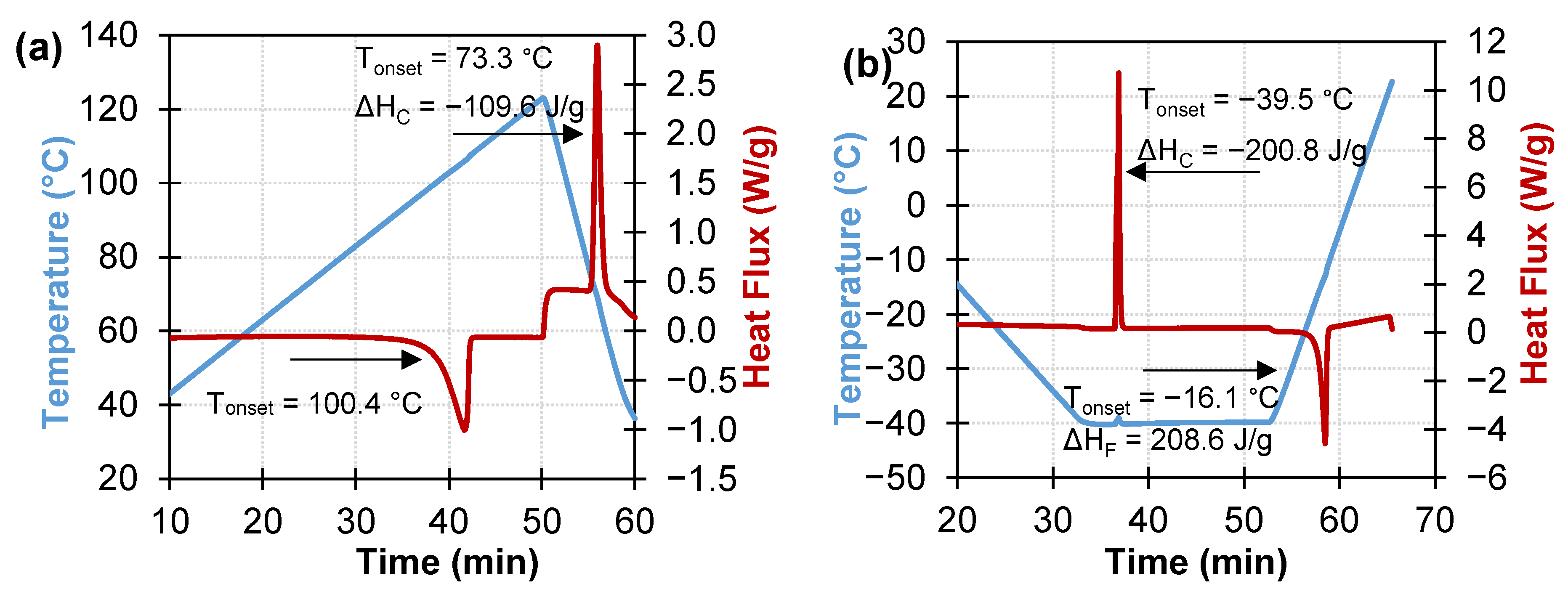
Initial investigations focused on the thermal characterization of pure BHET and EG as detailed in Section 2.2.1. The time-resolved graphs of the DSC measurements for BHET and EG are shown in Figure 2.
The melting of BHET begins at 100.4 °C and ends at 107.3 °C, which is in agreement with the temperature range of 106–109 °C for melting given by the distributor Sigma-Aldrich [16]. Fang et al. (2018) measured a higher onset temperature of 111.3 °C for the melting of BHET; however, a higher heating rate of 10 K/min was utilized [17]. Fehér et al. (2022) reported a melting temperature of 109 °C without specifying measurement details [18]. The slightly lower melting temperature measured in our work could additionally be explained by the relatively low purity of 94.5% of the BHET sample, which is supported by the broadened melting peak (Figure 2a). The absolute values of the resulting enthalpies of −145.1 J/g and 109.6 J/g for melting and crystallization, respectively, differ significantly, indicating a non-complete recrystallization of the sample. This can be attributed to the impurities melting but not recrystallizing alongside BHET. In the literature, the melting enthalpies of BHET are only scarcely reported. A melting enthalpy of 25.8 J/g was reported in [19], which is over 80% lower than our values. Additional measurements conducted during this work, using different DSC devices, resulted in melting enthalpies between 140 and 152 J/g. Thus, we conclude our measurements to be more reasonable.
As shown in Figure 2b, EG exhibited a melting temperature of −16.1 °C and a melting enthalpy of 208.6 J/g. In the literature, melting points between −16 and −12.7 C are given [20,21]. Melting enthalpies found in the literature are slightly lower than the values determined in this work, with 161.1 and 186.9 J/g [22,23].

3.2. Thermal Stability of BHET

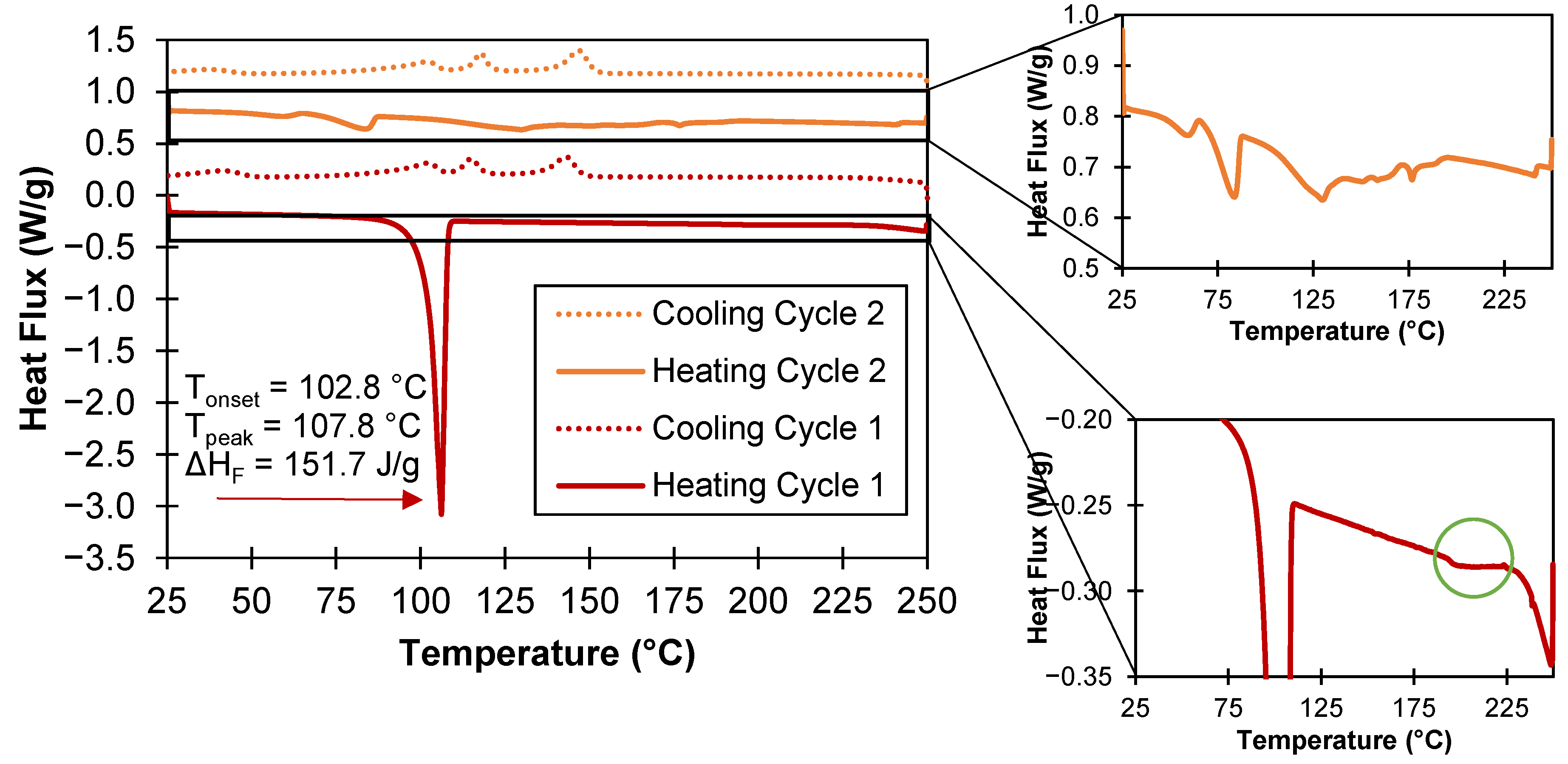
The thermal stability of BHET up to 250 °C was investigated via DSC measurements. The procedure is given in Section 2.2.2, while the resulting graphs for two consecutive heating and cooling cycles are presented in Figure 3.
As illustrated, an initial melting of the sample is observed during the first heating cycle (red solid line), with temperature and enthalpy of melting consistent with our previous findings. An additional, much smaller endothermic event (green cycle) is observed at roughly 200 °C, which is followed by a significantly larger peak starting at ~225 °C. Upon cooling the sample to 25 °C, multiple distinct exothermic events are observed at 142.8, 114.9, 102.0, and 41.6 °C (dotted red line). Heating the sample again to 250 °C in the second cycle (orange line) results in multiple small endothermic events, e.g., at 58.9, 83.3, 129.8, 176.8, and 241.0 °C (peak temperatures); the following cooling cycle shows similar behavior as the first one.
In the literature [17] degradation of BHET is reported starting at 190–200 °C, with a mass loss of ~40% (via TG). During our experiment, after two cycles, a mass loss of only 4.6% was recorded; however, the crucibles were sealed and thus mass loss was hindered. The reported degradation starting-point of 190–200 °C matches the minor peak observed at 200 °C in the first heating cycle. The peaks above 200 °C could be due to the endothermic polymerization of BHET, during which EG is produced as a by-product and evaporated, explaining the mass loss. Given the melting point of the BHET dimer and PET of 162–166 °C and >230 °C [18], it is reasonable to assume trimer and larger oligomers of BHET to have higher melting points than BHET. Thus, during the second heating cycle, several peaks might indicate BHET oligomers by their higher melting temperatures. The peaks at 58.9 and 83.3 °C might be attributed to the eutectic melting of BHET and products formed in the mixture.
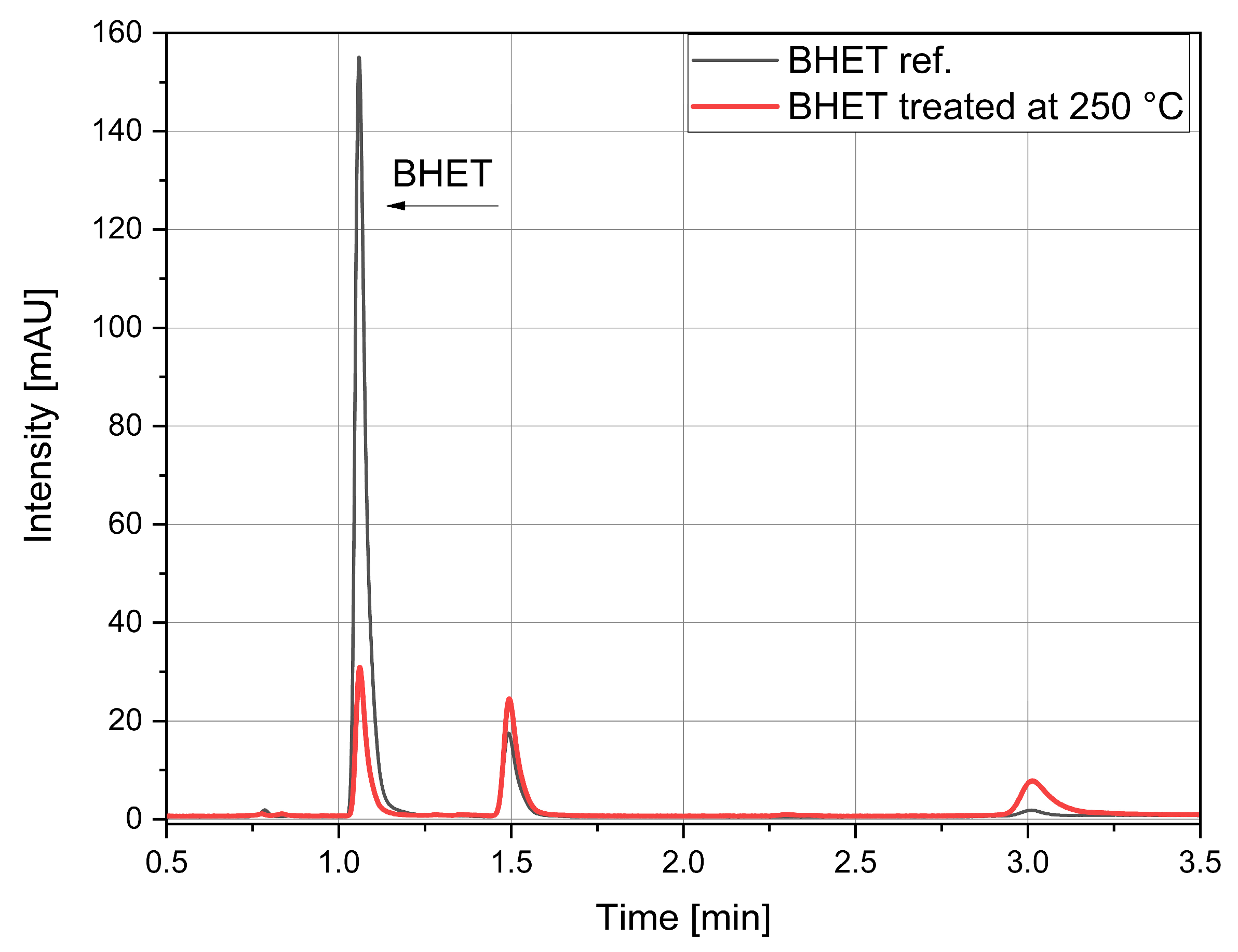
Subsequent analysis of the sample via HPLC and PXRD was performed to gain more insight into the BHET degradation at elevated temperatures. In Figure 4, HPLC chromatograms are shown for the initial (black curve) and heat-treated samples (red curve). The analysis revealed that the initial BHET content strongly decreased after heating to 250 °C, while the impurity content, with retention times of 1.5 and 3 min, increased relative to the initial sample. This indicates a stronger interaction with the non-polar C18 column and thus, such compounds are less polar than BHET, e.g., BHET dimers, trimers, and higher oligomers.
The result of the PXRD measurement is shown in Figure S1 alongside a reference diffractogram of BHET. After heating to 250 °C, the re-solidified sample appears to be a semi-crystalline (or partly amorphous) mixture from which most reflexes can be attributed to BHET, as in the reference provided. Especially at 18° (green arrow), a major broad reflex indicates at least one additional crystalline phase. Potential further products seem to largely possess an amorphous character.
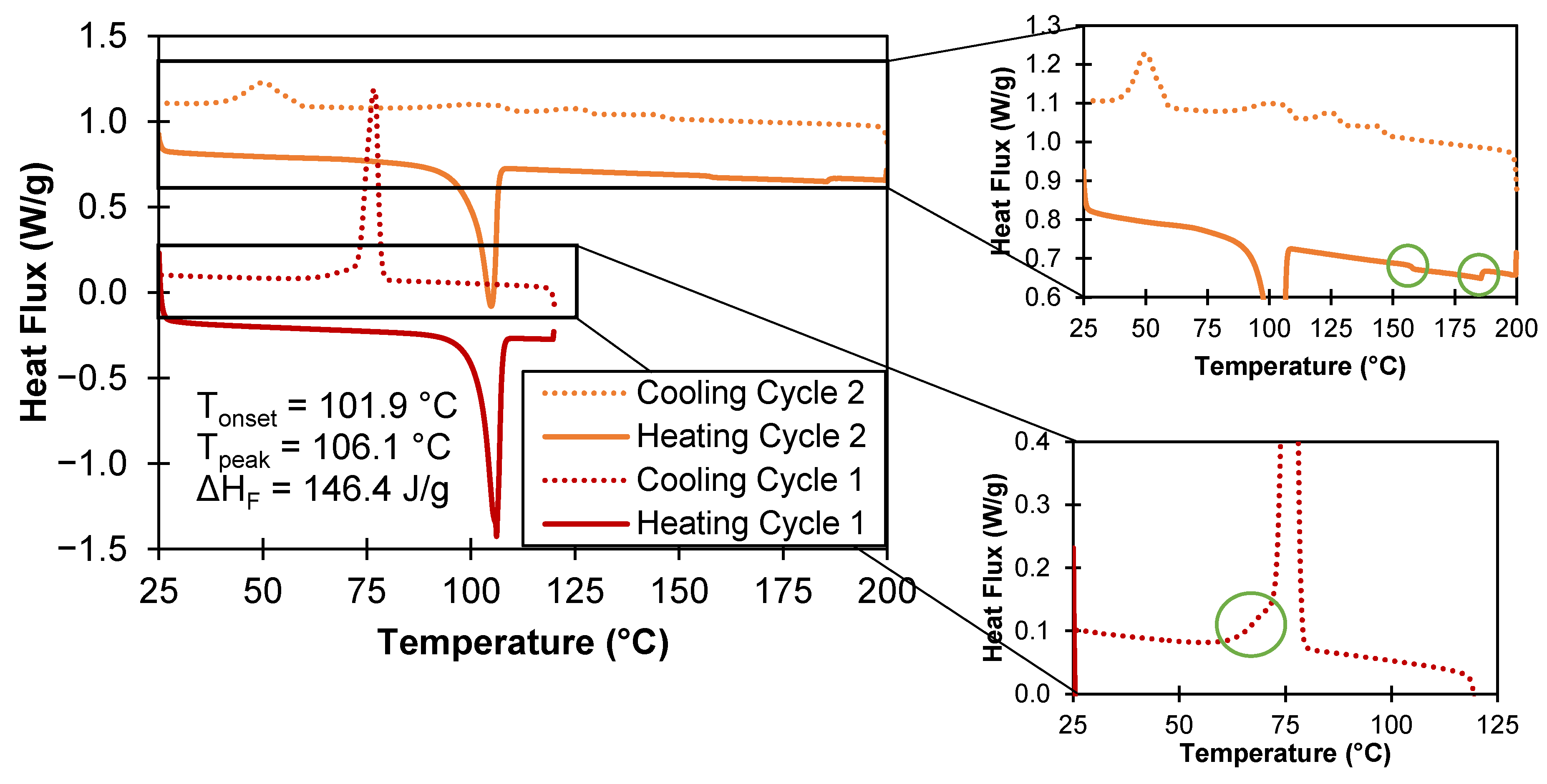
To better understand the degradation of BHET at lower temperatures, additional DSC studies were performed at 120 and 150 °C. To gauge the effects at a specific temperature, the samples were held at the top temperature for an extended time of 4 h (cycle 1), subsequently cooled, and then re-heated to 200 °C (cycle 2). Figure 5 shows the thermograms for the sample tempered at 120 °C.
Initial melting of the BHET is observed starting at 101.9 °C with a melting enthalpy of 146.4 J/g, confirming the melting data discussed before. After being held at 120 °C for 4 h, the sample largely recrystallized, starting at 78.3 °C, with a slight shoulder (see green circle on dotted red line) around 70 °C. The solidification enthalpy of −124.2 J/g is roughly 15% smaller than the corresponding melting enthalpy. In cycle 2, melting starts at 100.1 °C with 135.6 J/g, thus melting starts slightly earlier with slightly less energy required. Minor decomposition occurring during the first cycle could explain this phenomenon. Afterwards, additional small thermal events are observed at 156.3 and 185.5 °C (green circles on orange line), indicating the transformation of BHET. Following, during cooling, multiple exothermic events occurred at 143.7, 124.9, 100.5, and 50.3 °C (peak temperatures). These events are comparable to the exothermic peaks observed in the experiments detailed earlier in this section (see Figure 3).
Similarly, another run was performed for which the top temperature during cycle 1 was 150 °C. The resulting diagram is presented in Figure 6.
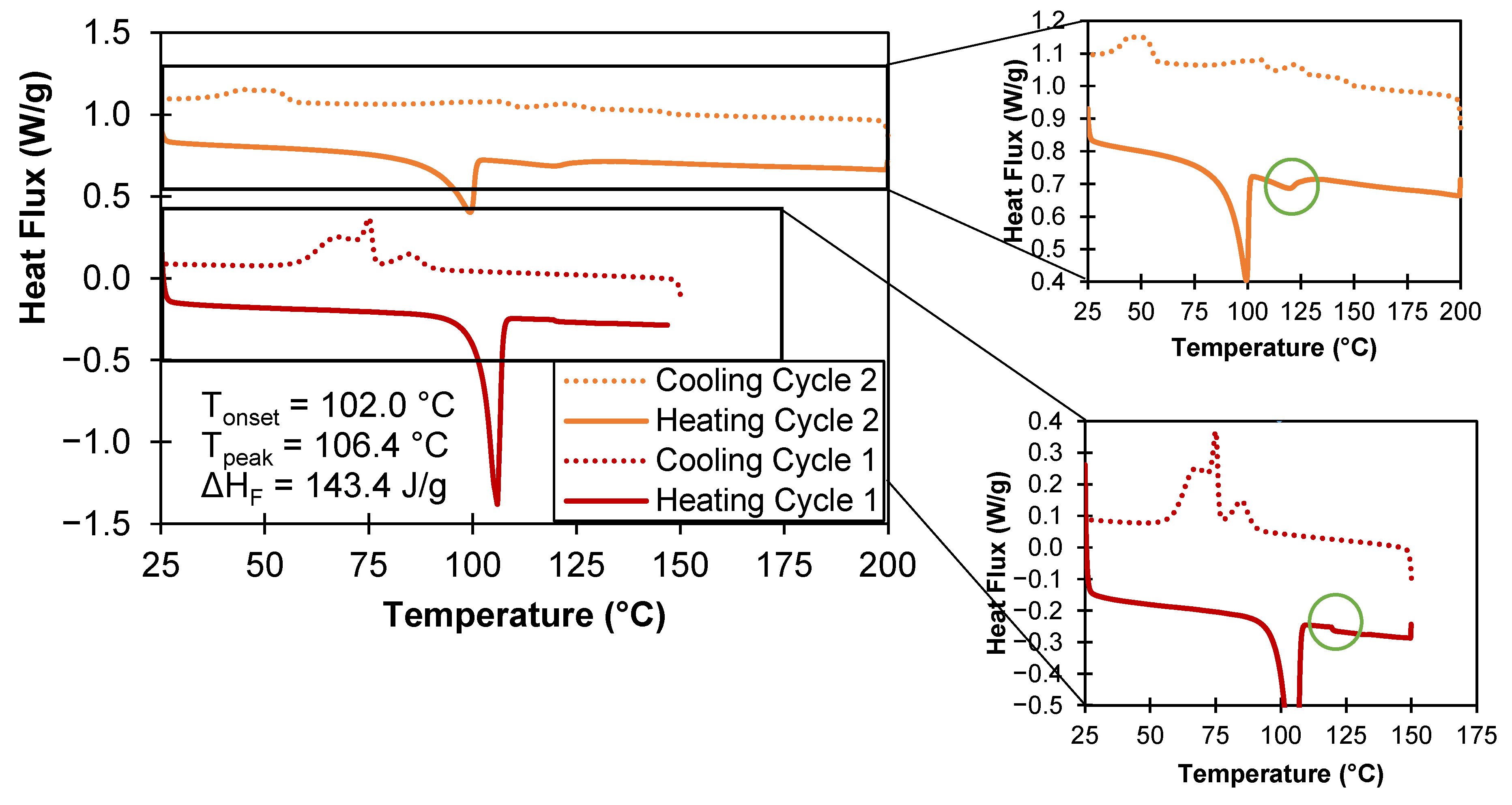
In accordance with previously discussed values, the initial melting occurred at 102.0 °C with an enthalpy of 143.4 J/g. The small baseline shift observed at around 120 °C (green circle on red curve) might be an artifact of the measurement caused by a distortion of the closed Al crucible due to the vapor pressure of the sample [24]. During the cooling cycle, thermal events at 84.9, 75.0, and 67.2 °C can be observed, indicating changes within the BHET sample. The second heating cycle shows the typical melting behavior of a binary mixture with a larger sharp peak at 91.3 °C and a broader effect at 119.7 °C (green circle on orange curve). The initial peak possesses a melting enthalpy of 76.8 J/g, which is almost half of the value of the initial cycle. Subsequent cooling resulted in multiple peaks, which are comparable to previously described behaviors shown in Figure 5. Total mass loss during the two heating cycles was 0.2 and 0.8% for the samples at 120 and 150 °C, respectively. Comparing the results for the two temperatures clearly shows a more substantial reduction in BHET at 150 °C over an extended period of time when compared to 120 °C, where almost no change was observed. After heating to 200 °C, both samples again exhibited comparable behavior with multiple new thermal events.
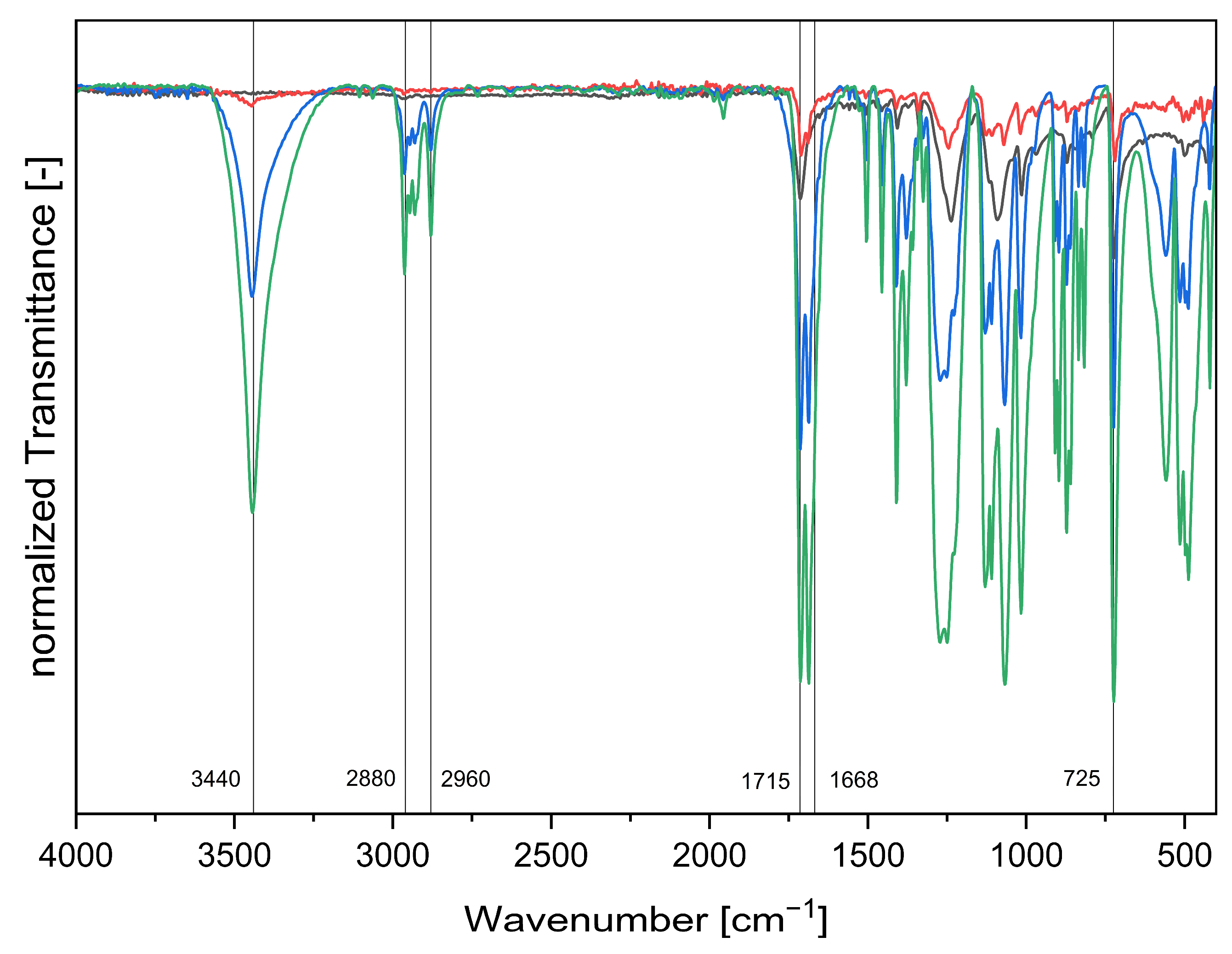
For further interpretation of the BHET thermal behavior, FTIR analyses have been conducted. Figure 7 presents the normalized FTIR spectra of the BHET reference sample (green curve), temperature-treated BHET samples up to 150 °C and 250 °C (blue and red curves), and a pure PET sample (black curve). The spectra were normalized to the carbonyl stretching band at 1715 cm−1, which remained essentially unchanged upon heating. This reference enables clearer observation of relative changes in other BHET samples after thermal treatment.
The absorption peak observed at approximately 3440 cm−1 in the FTIR spectrum of pure BHET corresponds to OH stretching vibrations, indicative of hydroxyl functional groups. As shown, the intensity of this peak decreases progressively with increasing thermal treatment. Notably, at 250 °C, this band is significantly diminished, appearing only as a minor peak near 3440 cm−1 (red curve). In the case of PET, this peak is absent, which is consistent with its fully polymerized structure. The systematic reduction in hydroxyl group signal intensity in thermally treated BHET samples suggests progressive polymerization, leading to the formation of dimers and oligomers [25,26]. Furthermore, the intensity of the alkyl C–H stretching vibrations, observed at 2960 and 2880 cm−1 in pure BHET, also decreases upon thermal treatment. By 250 °C, the spectral profile of the sample closely resembles that of PET, indicating significant structural transformation.
Additional characteristic absorption bands include a strong peak at 1715 cm−1, corresponding to C=O stretching vibrations, and peaks at 1688 cm−1 and within the 700–800 cm−1 region, which are attributed to aromatic ring vibrations. The PET sample retains strong signals for aromatic and carbonyl functionalities, as expected for its polymeric structure [25,26,27].
These findings indicate that increasing the temperature above 150 °C initiates polymerization of BHET, as evidenced by the gradual loss of functional group signals in the FTIR spectra. This thermal transformation is further supported by TG–DSC data, which reveal only a ~1.2 wt.% weight loss for samples treated at 120 °C for 8 h but a ~12 wt.% weight loss for treatment at 150 °C with a continuous increase to ~18.5 wt.% after a second cycle for the latter (see Figures S2 and S3). The suggested polymerization of BHET under the release of ethylene glycol is most likely occurring under an elevated temperature (210–270 °C), as reported by others, and explains the higher weight loss for the 150 °C treated sample [26,27]. For future studies, techniques such as nuclear magnetic resonance (NMR) spectroscopy or mass spectrometry (MS) could be employed to gain deeper insights into the structural and compositional changes in the heat-treated samples.

3.3. Thermal Behavior of BHET in the Presence of EG

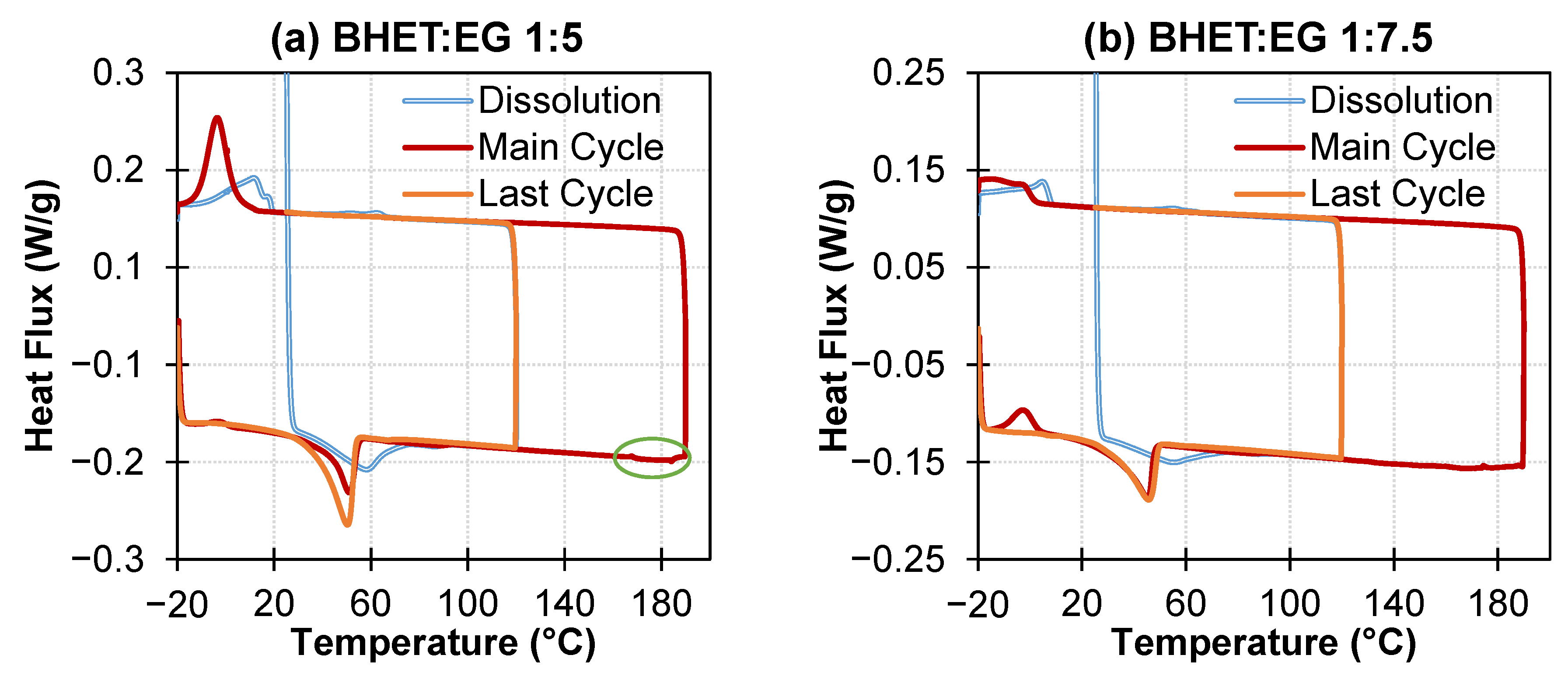
During more realistic conditions, i.e., during the glycolysis of PET, BHET will be in the presence of EG (either dissolved or in suspension). Thus, in this section, the thermal stability of BHET and EG mixtures is investigated in the typical ratios used for glycolysis reactions. When using metal salt catalysts for glycolysis reactions, the PET-to-EG ratios vary between 1:5 and 1:10 [28,29,30]. The corresponding experimental procedure is given in Section 2.2.3. The resulting thermograms of two mixtures with mass ratios of 1:5 and 1:7.5 BHET–EG are presented in Figure 8.
Both samples show an initial endothermic effect due to the dissolution of BHET in EG. Dissolution was completed at 59 and 53 °C (peak temperatures) for the 1:5 and 1:7.5 samples, respectively. Additionally, since more BHET is present in the 1:5 sample, the dissolution peak is larger than in the 1:7.5 sample. For the 1:5 sample, cooling after the initial dissolution of the sample resulted in multiple smaller peaks at 69, 18, and 12 °C. As expected, since no change in BHET was observed at 120 °C before, during the subsequent heating to 190 °C, melting of the BHET/EG mixture occurred as a singular endothermic peak starting at 42.1 °C with an enthalpy of 18.3 J/g. Additional minor exothermic and endothermic events can be observed at 167.3 and 183.8 °C (see green circle). Upon cooling, one single exothermic peak for recrystallization was detected with an onset temperature of 4.5 °C and an enthalpy of solidification of −28.8 J/g. There is a difference in the cooling curves of the dissolution and the main cycle, and also a higher crystallization than melting enthalpy, which could be due to incomplete homogenization and solidification of the sample during the dissolution cycle. Heating the sample again resulted in a larger melting peak starting at 37.6 °C with a melting enthalpy of 31.5 J/g, which almost reflects the previous recrystallization enthalpy and thus verifies the stability of BHET in the EG mixture. The mass loss after the measurement was insignificant, with 0.7%.
Initial dissolution and cooling of the 1:7.5 sample showed comparable behavior to the 1:5 sample, with a crystallization at ~5 °C. However, during the main heating cycle, at −3 °C, another exothermic event was observed. As aforementioned, it could be that the time given for homogenization and recrystallization during the dissolution/cooling cycle was not sufficient. At 32.9 °C, the sample starts melting/dissolving, and the related enthalpy recorded is 20.1 J/g. Another tiny exothermic peak was detected at 174.4 °C. Recrystallization during subsequent cooling seems to be inhibited compared to the previously discussed cooling curves; it starts at 1 °C as a broad event with at least two peaks and is not finished at −20 °C. Nevertheless, the following (last) cycle gives almost identical melting behavior to the main cycle with a single melting peak at 32.5 °C and a melting/dissolution enthalpy of 21.3 J/g, again resembling the previous heating. The mass loss of the sample after the measurement was 1.0%.
Both BHET/EG samples exhibited a much lower loss of BHET, either due to decomposition or polymerization, at higher temperatures in the presence of EG as opposed to in previous experiments using pure BHET samples. This is an important finding with regard to PET glycolysis processes at elevated temperatures, as the desired product BHET will stay stable in the EG solution and does not tend to polymerize or undergo other reactions. In addition, the results indicate that crystallization of BHET from EG is an option for separating. Melting of BHET was observed on average at 40 °C for the 1:5 mixture, and at 33 °C for the 1:7.5 mixture. Conversely, crystallization ideally starts at the same temperatures. Thus, cooling down the reaction mixture below these temperatures will enable BHET to crystallize and separate. To find the boundaries of the cooling crystallization, the binary phase diagram was measured.

3.4. Solubility Phase Diagram of BHET/EG Mixtures

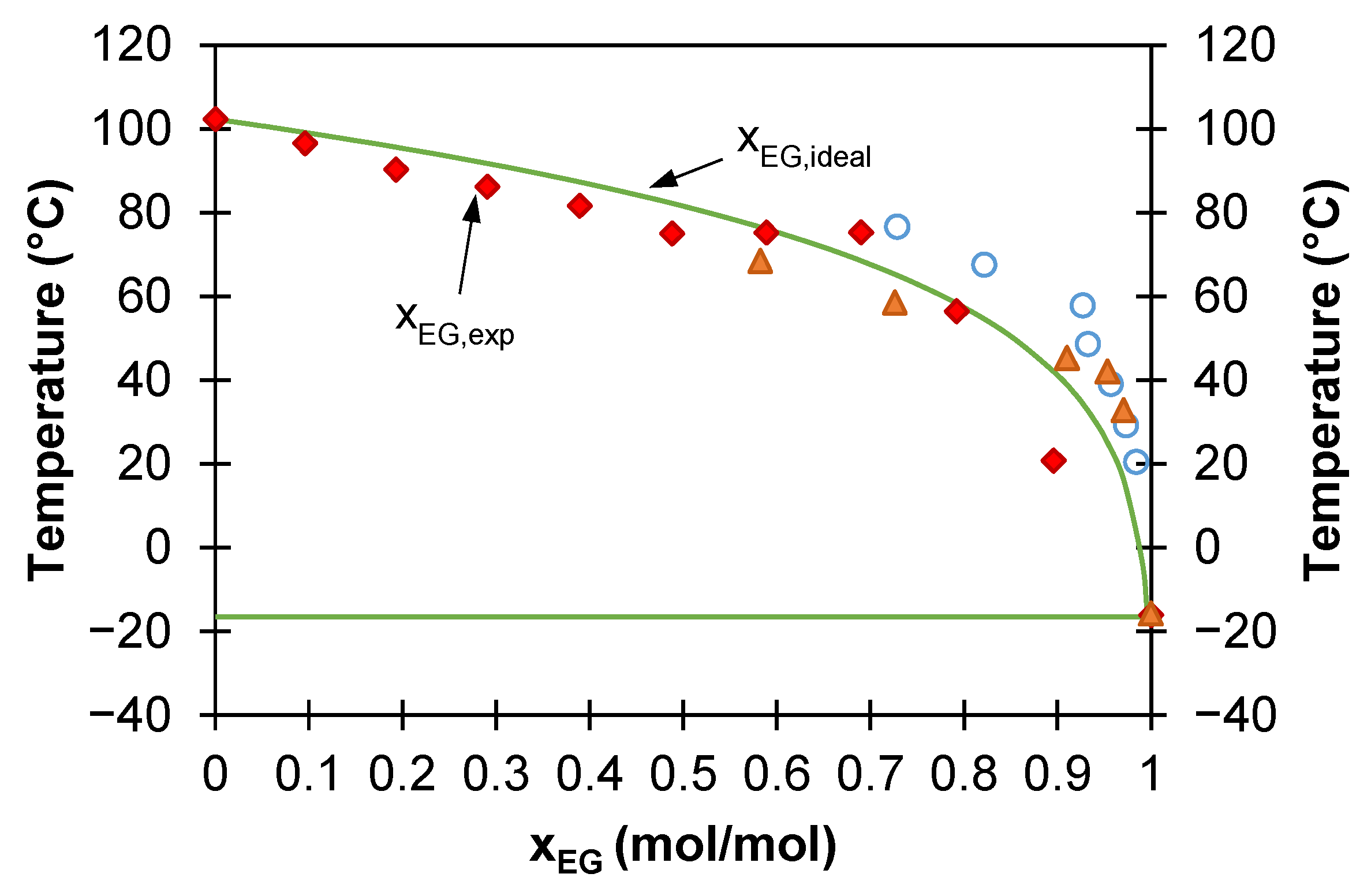
As detailed in Section 2.3, the binary BHET/EG phase diagram was constructed using DSC measurements. For this, varying compositions ranging from 10 to 90 mol% BHET in EG were prepared and their melting behavior analyzed. Using the onset temperatures of the observed thermal events, the points on the liquidus line within the binary phase diagram can be found. During these measurements, eutectic melting events were not observed. In addition, some measurements were repeated using medium-pressure crucibles to reduce the noise of the signals. The drawback of these measurements is that the pressure might not be constant. To construct the liquidus line, assuming ideal behavior, the simplified Schroeder-van-Laar equation is utilized [31].
ln x i d e a l = Δ H F R 1 T 1 T F
where xideal is the molar fraction of BHET in the saturated liquid solution, assuming ideal behavior, R is the universal gas constant, T is the temperature, and ΔHF and TF are the melting enthalpy and temperature, respectively. The molar fraction of EG is calculated via x i = 1 . The constructed binary phase diagram is shown in Figure 9.
The binary mixture reveals eutectic behavior, and the solidus line (lower green line in Figure 9) is located at a temperature of −16.6 °C, which is very close to the melting temperature of pure EG. The simplified Schroeder-van-Laar equation is able to adequately describe the measured values, and thus the mixture exhibits close to ideal behavior. Solubility determined via an isothermal gravimetric approach is reported in [32] and illustrated in Figure 9 as black circles. Yao et al. (2022) determined comparable solubilities by equilibrating excess BHET in the corresponding solvent [19]. At lower BHET concentrations (xEG = 0.7 to 0.9), our values exhibit slightly higher solubilities. These differences might be explained by the different methods utilized to determine the liquidus line, e.g., due to improper mixing during the DSC measurements. Nevertheless, all three data sets are in relatively good agreement and portray comparable results.

4. Conclusions

The thermal behavior and stability of BHET, also in mixtures with EG, were investigated in this work. For that, pure BHET and samples in the presence of the solvent EG were heated to various temperatures up to 250 °C, and the effect of temperature was recorded via DSC, TG-DSC, PXRD, FTIR, and HPLC analyses. Samples heated to just 120 °C exhibited only insignificant changes after the heat treatment, whereas samples kept at 150 °C for an extended time showed significant phase transformations. Increasing the temperature to 250 °C further intensified these observations. The phase transitions were not reversible via cooling of the sample and thus indicated a reaction and the formation of one or more additional compounds, likely oligomers of the BHET polymerizing to PET. Interestingly, this behavior was not observed in samples initially containing BHET and EG, revealing stable thermal behavior of BHET in the presence of EG. As EG is produced as a byproduct of the polymerization reaction, the presence of EG likely shifts the reaction equilibrium closer to BHET, reducing the reactivity and thus stabilizing the BHET at temperatures below the boiling point of EG. It should be noted that if EG is not present in excess, partial polymerization might still occur in the presence of EG. Quantifying the exact thresholds of EG content could be investigated in future work. The thermal behavior determined for process-like mixtures of BHET and EG revealed that crystallization of BHET from the liquid phase via cooling is an option. For a BHET–EG weight ratio of 1:5, crystallization can be expected at temperatures below 40 °C, while for a ratio of 1:7.5, it is anticipated at temperatures below 30 °C. The minimum temperature limit for a cooling crystallization of ~−16 °C was derived from the construction of the binary phase diagram of BHET and EG.
To obtain the fundamental insight required for the design of a downstream separation process based on cooling crystallization, solubilities of BHET in pure EG were determined at various temperatures via DSC measurements. From such solubility data sets, an efficient crystallization procedure from the liquid phase can be designed. Alternatively, in the literature, water has been shown to act as an effective anti-solvent for BHET in EG [33,34]. Utilizing anti-solvent crystallization as a downstream unit operation reduces the need for high-temperature regimes in which polymerization might occur, but, on the other hand, requires higher efforts for solvent recycling. In this context, an example for the separation of caprolactam from a depolymerization reaction mixture of polyamide 6 has been studied by the authors in previous work [35].
In the future, further studies should focus on the analysis of the heat-treated material to determine the polymerization degree and to obtain potential polymerization kinetics. Additional temperature programs within the TG-DSC can be utilized to further narrow the temperature window in which the reaction occurs. This would yield a deeper understanding of the thermal stability of BHET. Further solubility measurements could aid in the downstream process design and accelerate process development. For real applications, where BHET needs to be separated from EG, i.e., after glycolysis of PET, influences of additives, such as dyes and flame retardants often found in real waste streams, should be considered during the downstream process design. Additionally, for real mixed waste feed streams, a more sophisticated analysis framework must be developed.

Supplementary Materials

The following supporting information can be downloaded at: https://www.mdpi.com/article/10.3390/cleantechnol8020029/s1. Figure S1: PXRD patterns of BHET after heat-treatment at 250 °C compared to BHET reference. Figure S2: TG-DSC of the temperature-treated BHET sample at 120 °C. The orange curve represents the sample temperature, the green curve the mass loss in wt.%, and the red curve the heat flow. The latter indicates melting and re-solidification of the sample before and after the thermal treatment. Figure S3: TG-DSC of the temperature-treated BHET sample at 150 °C. The orange curve represents the sample temperature, the green curve the mass loss in wt.%, and the red curve the heat flow.

Author Contributions

Conceptualization, E.T., H.L. and S.W.; methodology, S.W., V.T. and A.P.; validation, S.W., V.T. and A.P.; formal analysis, S.W., V.T. and A.P.; investigation, S.W., V.T. and A.P.; writing—original draft preparation, S.W., V.T. and A.P.; writing—review and editing, S.W., V.T., A.P., E.T. and H.L.; visualization, S.W., V.T. and A.P.; supervision, H.L.; project administration, H.L.; funding acquisition, H.L. All authors have read and agreed to the published version of the manuscript.

Funding

This work was partly supported by the Research Initiative “SmartProSys: Intelligent Process Systems for the Sustainable Production of Chemicals” funded by the Ministry for Science, Energy, Climate Protection and the Environment of the State of Saxony-Anhalt/Germany. V.T. was supported by the European Regional Development Fund (ERDF) within the program Research and Innovation—Grant Number ZS/2023/12/182075.

Data Availability Statement

The original contributions presented in this study are included in the article/Supplementary Materials. Further inquiries can be directed to the corresponding author.

Acknowledgments

The authors thank Andreas Seidel-Morgenstern and Kai Sundmacher, at the Max Planck Institute for Dynamics of Complex Technical Systems, for the financial support during the research work. Further, we are grateful to Jacqueline Kaufmann and Stefanie Oberländer for their continuous support in the lab work.

Conflicts of Interest

Author Erik Temmel was employed by the company Sulzer Chemtech Ltd. The remaining authors declare that the research was conducted in the absence of any commercial or financial relationships that could be construed as a potential conflict of interest.

Abbreviations

The following abbreviations are used in this manuscript:
AlAluminum
BHETBis(2-hydroxyethyl) terephthalate
DADDiode array detector
DSCDifferential scanning calorimetry
EGEthylene glycol
FTIRFourier transform infrared spectroscopy
HPLCHigh-performance liquid chromatography
NMR Nuclear magnetic resonance spectroscopy
MeOHMethanol
MSMass spectrometry
PETPolyethylene terephthalate
PXRDPowder X-ray diffraction
TGThermogravimetry

References

  1. Shen, L.; Worrell, E. Plastic recycling. In Handbook of Recycling; Elsevier: Amsterdam, The Netherlands, 2024; pp. 497–510. [Google Scholar] [CrossRef]
  2. Joseph, T.M.; Azat, S.; Ahmadi, Z.; Jazani, O.M.; Esmaeili, A.; Kianfar, E.; Haponiuk, J.; Thomas, S. Polyethylene terephthalate (PET) recycling: A review. Case Stud. Chem. Environ. Eng. 2024, 9, 100673. [Google Scholar] [CrossRef]
  3. Awan, U.; Gölgeci, I.; Makhmadshoev, D.; Mishra, N. Industry 4.0 and circular economy in an era of global value chains: What have we learned and what is still to be explored? J. Clean. Prod. 2022, 371, 133621. [Google Scholar] [CrossRef]
  4. Ragaert, K.; Delva, L.; Van Geem, K. Mechanical and chemical recycling of solid plastic waste. Waste Manag. 2017, 69, 24–58. [Google Scholar] [CrossRef] [PubMed]
  5. Goldhahn, R.; Minor, A.-J.; Rihko-Struckmann, L.; Ohl, S.-W.; Pfeiffer, P.; Ohl, C.-D.; Sundmacher, K. Recycling of Bulk Polyamide 6 by Dissolution-Precipitation in CaCl2-EtOH-H2O Mixtures. Recycling 2025, 10, 5. [Google Scholar] [CrossRef]
  6. Gebre, S.H.; Sendeku, M.G.; Bahri, M. Recent Trends in the Pyrolysis of Non-Degradable Waste Plastics. ChemistryOpen 2021, 10, 1202–1226. [Google Scholar] [CrossRef]
  7. Xanthos, M.; Patel, S.H. Solvolysis. In Frontiers in the Science and Technology of Polymer Recycling; Akovali, G., Bernardo, C.A., Leidner, J., Utracki, L.A., Xanthos, M., Eds.; Springer: Dordrecht, The Netherlands, 1998; pp. 425–436. [Google Scholar] [CrossRef]
  8. Klotz, M.; Oberschelp, C.; Salah, C.; Subal, L.; Hellweg, S. The role of chemical and solvent-based recycling within a sustainable circular economy for plastics. Sci. Total Environ. 2024, 906, 167586. [Google Scholar] [CrossRef]
  9. Conroy, S.; Zhang, X. Theoretical insights into chemical recycling of polyethylene terephthalate (PET). Polym. Degrad. Stab. 2024, 223, 110729. [Google Scholar] [CrossRef]
  10. Barnard, E.; Arias, J.J.R.; Thielemans, W. Chemolytic depolymerisation of PET: A review. Green Chem. 2021, 23, 3765–3789. [Google Scholar] [CrossRef]
  11. Zahova, S.; Tsacheva, I.; Troev, K.; Mitova, V. Conventional and MW assisted PET glycolysis promoted by titanium based catalyst. Polym. Degrad. Stab. 2023, 212, 110353. [Google Scholar] [CrossRef]
  12. Wang, Z.; Shi, J.; Jin, Y.; Xiao, G.; Su, H. Recyclable Zinc Cyanamide Dual-Site Catalyst Enables Efficient PET Glycolysis. ACS Appl. Polym. Mater. 2025, 7, 1609–1617. [Google Scholar] [CrossRef]
  13. Zhu, M.L.; Liu, Y.Q.; Yan, R.Y.; Wang, H.; Li, Z.X.; Lu, X.M. Glycolysis of Polyethylene Terephthalate Catalyzed by Solid Superacid. Adv. Mater. Res. 2011, 233–235, 512–518. [Google Scholar] [CrossRef]
  14. Wang, Y.; Park, B.; Vu, V.; Lee, S. Self-healing conducting composite electrodes derived from chemical recycling of PET plastic wastes for flexible supercapacitors. Polym. Eng. Sci. 2025, 65, 1854–1867. [Google Scholar] [CrossRef]
  15. Schlüter, M.; Held, C.; Wohlgemuth, K. BHET Crystallization in Water-Free PET Glycolysis Systems. Ind. Eng. Chem. Res. 2025, 64, 1189–1201. [Google Scholar] [CrossRef]
  16. Sigma-Aldrich. Bis(2-hydroxyethyl) terephthalate. In Safety Data Sheet 465151; Sigma-Aldrich: St. Louis, MO, USA, 2025. [Google Scholar]
  17. Fang, P.; Liu, B.; Xu, J.; Zhou, Q.; Zhang, S.; Ma, J.; Lu, X. High-efficiency glycolysis of poly(ethylene terephthalate) by sandwich-structure polyoxometalate catalyst with two active sites. Polym. Degrad. Stab. 2018, 156, 22–31. [Google Scholar] [CrossRef]
  18. Fehér, Z.; Kiss, J.; Kisszékelyi, P.; Molnár, J.; Huszthy, P.; Kárpáti, L.; Kupai, J. Optimisation of PET glycolysis by applying recyclable heterogeneous organocatalysts. Green Chem. 2022, 24, 8447–8459. [Google Scholar] [CrossRef]
  19. Yao, H.; Yan, D.; Lu, X.; Zhou, Q.; Bao, Y.; Xu, J. Solubility determination and thermodynamic modeling of bis-2-hydroxyethyl terephthalate (BHET) in different solvents. Chin. J. Chem. Eng. 2022, 45, 294–300. [Google Scholar] [CrossRef]
  20. Haynes, W.M. (Ed.) CRC Handbook of Chemistry and Physics, 93rd ed.; CRC Press: Boca Raton, FL, USA, 2016; ISBN 9780849305955. [Google Scholar]
  21. Dechema; PTB; BAM. CHEMSAFE Database, version 16.0. Entry of melting point of ethylene glycol. Dechema: Frankfurt am Main, Germany; PTB: Braunschweig, Germany; BAM: Berlin, Germany, 1989.
  22. Parks, G.S.; Kelley, K.K. Thermal data on organic compounds. II. The heat capacities of five organic compounds. The entropies and free energies of some homologous series of aliphatic compounds. J. Am. Chem. Soc. 1925, 47, 2089–2097. [Google Scholar] [CrossRef]
  23. Nikolaev, P.N.; Rabinovich, I.B. Heat capacity of ethylene glycol and ethylene deuteroglycol in the temperature range 80–300K. Russ. J. Phys. Chem. A 1967, 41, 2191–2194. [Google Scholar]
  24. Schaw, J.; Riesen, R.; Widmann, J.; Schubnell, M.; Röhrmann, U. Information for users of Mettler-Toledo thermal analysis systems. In UserCom 11; Mettler Toledo: Columbus, OH, USA, 2000. [Google Scholar]
  25. Zhou, X.; Lu, X.; Wang, Q.; Zhu, M.; Li, Z. Effective catalysis of poly(ethylene terephthalate) (PET) degradation by metallic acetate ionic liquids. Pure Appl. Chem. 2012, 84, 789–801. [Google Scholar] [CrossRef]
  26. Zhao, Y.; Liu, M.; Zhao, R.; Liu, F.; Ge, X.; Yu, S. Heterogeneous CaO(SrO, BaO)/MCF as highly active and recyclable catalysts for the glycolysis of poly(ethylene terephthalate). Res. Chem. Intermed. 2018, 44, 7711–7729. [Google Scholar] [CrossRef]
  27. Mohammadi, S.; Bouldo, M.G.; Enayati, M. Controlled Glycolysis of Poly(ethylene terephthalate) to Oligomers under Microwave Irradiation Using Antimony(III) Oxide. ACS Appl. Polym. Mater. 2023, 5, 6574–6584. [Google Scholar] [CrossRef]
  28. Pingale, N.D.; Palekar, V.S.; Shukla, S.R. Glycolysis of postconsumer polyethylene terephthalate waste. J. Appl. Polym. Sci. 2010, 115, 249–254. [Google Scholar] [CrossRef]
  29. Xi, G.; Lu, M.; Sun, C. Study on depolymerization of waste polyethylene terephthalate into monomer of bis(2-hydroxyethyl terephthalate). Polym. Degrad. Stab. 2005, 87, 117–120. [Google Scholar] [CrossRef]
  30. López-Fonseca, R.; Duque-Ingunza, I.; De Rivas, B.; Arnaiz, S.; Gutiérrez-Ortiz, J.I. Chemical recycling of post-consumer PET wastes by glycolysis in the presence of metal salts. Polym. Degrad. Stab. 2010, 95, 1022–1028. [Google Scholar] [CrossRef]
  31. Beckmann, W. Crystallization: Basic Concepts and Industrial Applications; Wiley-VCH: Weinheim, Germany, 2013. [Google Scholar]
  32. Schlüter, M.; Bhutani, S.; Bahr, J.; Wohlgemuth, K.; Held, C. Measurement and PC-SAFT Modeling of the Solubility of the BHET Monomer, the BHET Dimer, and PET in Single Solvents. J. Chem. Eng. Data 2024, 69, 1326–1334. [Google Scholar] [CrossRef]
  33. Lee, T.; Peng, Y.-K.; Lee, H.L.; Pratama, D.E. Chemical Recycling Development of Poly(ethylene terephthalate) by Glycolysis and Cooling Crystallization with Water. Ind. Eng. Chem. Res. 2023, 62, 19873–19883. [Google Scholar] [CrossRef]
  34. Yuan, P.; Liu, B.; Li, Q.; Sun, H. Solubility Determination and Correlation for Bis(2-hydroxyethyl) Terephthalate (BHET) in Four Binary Solvents from 283.15 to 323.15 K. J. Chem. Eng. Data 2022, 67, 2693–2705. [Google Scholar] [CrossRef]
  35. Schultheis, A.; Tenberg, V.; Rihko-Struckmann, L.; Sundmacher, K.; Lorenz, H. Crystallization-Based Separation of ε-Caprolactam from a Depolymerization Reaction Mixture–Fundamentals and Potential Separation Strategies. Chem. Ing. Tech. 2024, 96, 1620–1631. [Google Scholar] [CrossRef]
Figure 1. Reaction scheme of the glycolysis of PET with EG to BHET.
Cleantechnol 08 00029 g001
Figure 2. Time-resolved DSC graphs of (a) BHET and (b) EG. Blue curve: temperature; red curve: heat flux; ∆HF: melting temperature; ∆HC: crystallization enthalpy.
Cleantechnol 08 00029 g002
Figure 3. DSC curves for the thermal stability of BHET up to 250 °C with partial curve magnifications on the right. Solid and dotted lines: heating and cooling cycles, respectively.
Cleantechnol 08 00029 g003
Figure 4. HPLC chromatograms of BHET samples detected at 254 nm. Black: initial sample (94.5% purity); red: heat-treated sample heated to 250 °C.
Cleantechnol 08 00029 g004
Figure 5. DSC curves of BHET held at 120 °C for four hours (cycle 1, red) and heated to 200 °C (cycle 2, orange). Solid and dashed lines: heating and cooling cycles, respectively.
Cleantechnol 08 00029 g005
Figure 6. DSC curves of BHET held at 150 °C for four hours (cycle 1, red) and heated to 200 °C (cycle 2, orange). Solid and dotted lines: heating and cooling cycles, respectively.
Cleantechnol 08 00029 g006
Figure 7. Normalized FT-IR spectra of BHET (green curve), temperature-treated BHET at 150 °C and 250 °C (blue and red curves), and a PET sample (black curve).
Cleantechnol 08 00029 g007
Figure 8. DSC curves of BHET dissolved in EG at 120 °C (blue), heated to 190 °C and held for 3 h (red) in the 2nd (main) cycle, and heating to 120 °C to observe effects of the temperature treatment in the 3rd (last) cycle.
Cleantechnol 08 00029 g008
Figure 9. Binary phase diagram of BHET and EG. Upper green curve: liquidus curve (ideal behavior) calculated with Equation (1); red ◊: experimental data obtained via DSC measurements (Section 2.3); orange Δ: additional experimental data using medium-pressure crucibles; blue o: data reported in [32].
Cleantechnol 08 00029 g009
Table 1. Chemicals used in this work.
MaterialCAS-No.SupplierPurity
Bis(2-hydroxyethyl) terephthalate959-26-2Sigma Aldrich≥94.5%
Ethylene glycol107-21-1Carl Roth≥99.5%
Methanol67-56-1VWR Chemicals≥99.9%
Polyethylene terephthalate25038-59-9Goodfellow Cambridge Ltd. (Hamburg, Germany)n.a.
Disclaimer/Publisher’s Note: The statements, opinions and data contained in all publications are solely those of the individual author(s) and contributor(s) and not of MDPI and/or the editor(s). MDPI and/or the editor(s) disclaim responsibility for any injury to people or property resulting from any ideas, methods, instructions or products referred to in the content.