
This is an early access version, the complete PDF, HTML, and XML versions will be available soon.
Article

Soil Organic Matter Dynamics in the Ericaceous and Afroalpine Belts of the Bale Mountains, Ethiopia: Influence of Vegetation, Fire, and Topographic Factors


1
Department of Plant Biology and Biodiversity Management, College of Natural and Computational Sciences, Addis Ababa University, Addis Ababa P.O. Box 3434, Ethiopia
2
Department of Biology, College of Natural and Computational Sciences, Wolkite University, Wolkite P.O. Box 07, Ethiopia
3
Plant Ecology and Geobotany, Faculty of Biology, Philipps University of Marburg, 35037 Marburg, Germany
4
Deutsches Biomasseforschungszentrum Gemeinnützige GmbH, 04347 Leipzig, Germany
5
Department of Geography, Philipps University of Marburg, 35037 Marburg, Germany
6
Department of Soil Science, University of Bayreuth, 95440 Bayreuth, Germany
*
Author to whom correspondence should be addressed.
Soil Syst. 2026, 10(5), 58; https://doi.org/10.3390/soilsystems10050058 (registering DOI)

Submission received: 25 March 2026 / Revised: 6 May 2026 / Accepted: 7 May 2026 / Published: 9 May 2026

Abstract

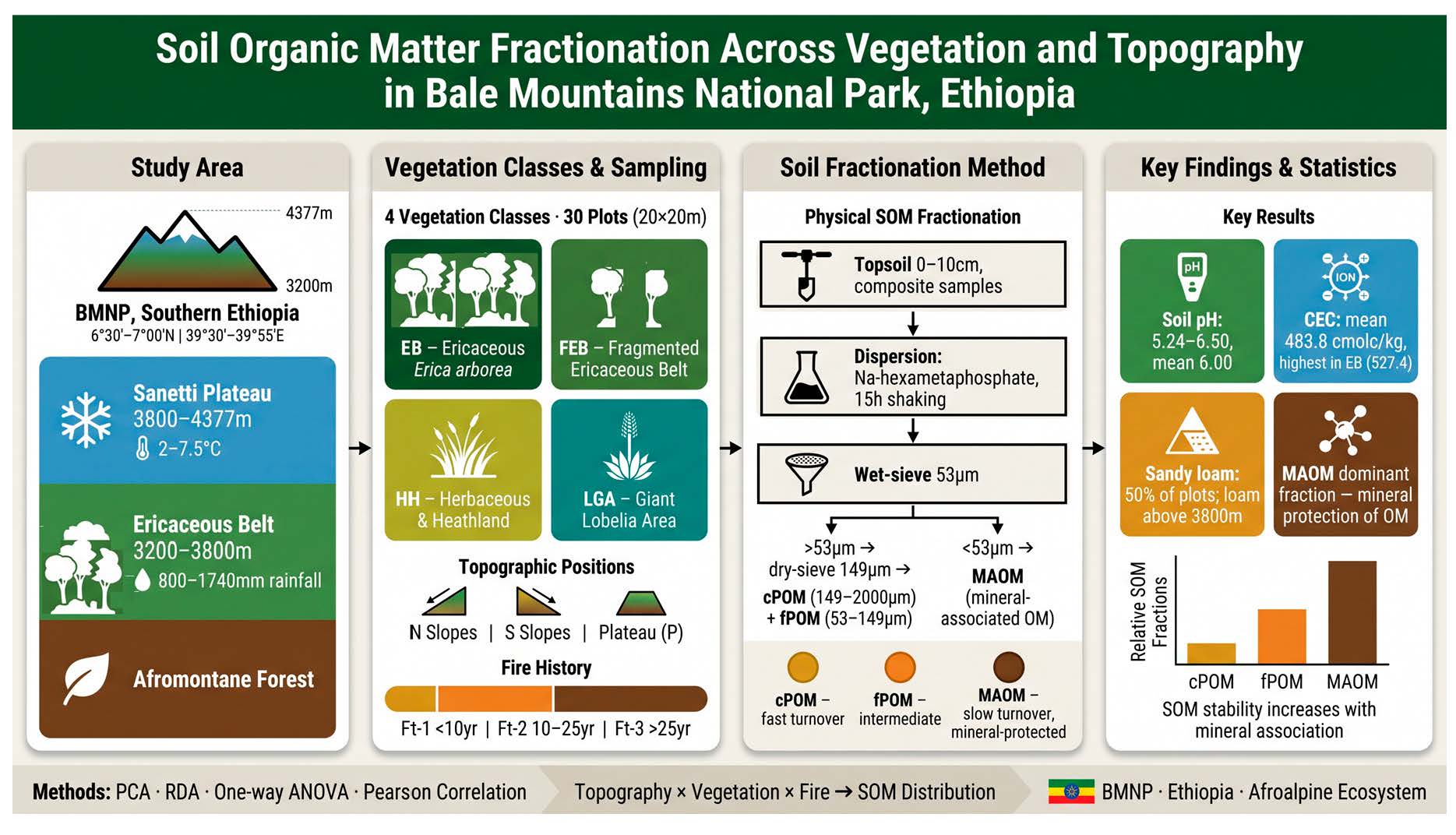
Soil organic matter (SOM) dynamics in tropical montane ecosystems remain poorly understood, particularly regarding the relative importance of particulate versus mineral-associated fractions under varying disturbance regimes. This study investigated SOM fraction distribution across the Ericaceous and Afroalpine belts of Bale Mountains National Park, Ethiopia, an Andosol-dominated landscape subject to recurrent fire. Using a stratified sampling design (n = 30 plots) across four vegetation classes (Ericaceous belt, fragmented Ericaceous belt, herbaceous and heathland, and giant Lobelia areas), three fire history categories (<10, 10–25, and >25 years since fire), and three topographic positions (northern slopes, southern slopes, and central plateau), we quantified coarse particulate organic matter (cPOM: 149–2000 μm), fine particulate organic matter (fPOM: 53–149 μm), and mineral-associated organic matter (MAOM: <53 μm). Particulate fractions dominated the SOM pool, with cPOM and fPOM together accounting for >99% of measured organic carbon. Multivariate ordination revealed a primary gradient (PC1, 61.7%) contrasting particulate-dominated soils in less disturbed areas with relatively MAOM-enriched soils in fire-impacted and fragmented zones. A global comparison reveals a profound stability gap: the Bale Mountains utilize <2% of the mineral stabilization potential of comparable Andosols, demonstrating that extreme fire frequency (<25 yr return interval) overrides even the most reactive mineralogy. We critically evaluate whether standard size-based fractionation adequately captures mineral-associated carbon in volcanic soils and discuss methodological limitations. These results provide baseline data for conservation planning in this biodiversity hotspot and underscore the need for fire management strategies that balance ecological integrity with carbon storage objectives.
Keywords: Bale Mountains; carbon fractions; Ericaceous and Afroalpine; fire disturbance; soil organic carbon; soil organic matter; vegetation Bale Mountains; carbon fractions; Ericaceous and Afroalpine; fire disturbance; soil organic carbon; soil organic matter; vegetation
Graphical Abstract