

Interactive Effects of Tillage, Nitrogen Fertilisation, and Herbicide Management: Impacts on Soil CO2 Emissions and Agroecosystem Dynamics in a Maize Production

 , , , , ,
Abstract
1. Introduction
- Quantify the effects of CT and MT systems on soil CO2 emissions and selected soil physical properties.
- Assess the response of vegetation vigour (NDVI) to different soil management practices, including CT and MT.
- Evaluate the effects of herbicide dose on vegetation vigour under CT and MT systems at different nitrogen fertilisation rates.
- Examine the combined effects of nitrogen fertilisation and herbicide dose on vegetation vigour within each tillage system.
- Analyse weed diversity patterns using Simpson’s Index and explore their relationships with vegetation vigour and soil CO2 emissions under different agricultural practices.
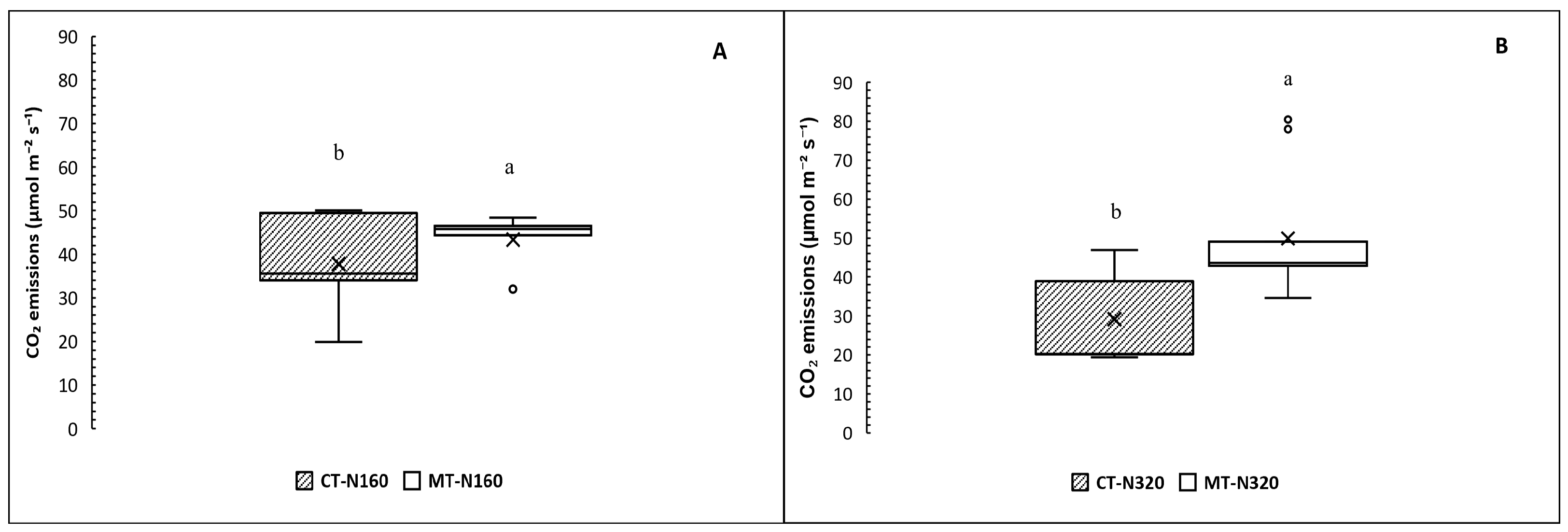
- Assess soil CO2 emissions under different tillage systems at the same nitrogen fertilisation levels and herbicide doses.
- Examine the interactive effects of nitrogen fertilisation and herbicide application on soil CO2 emissions within CT and MT systems.
2. Materials and Methods
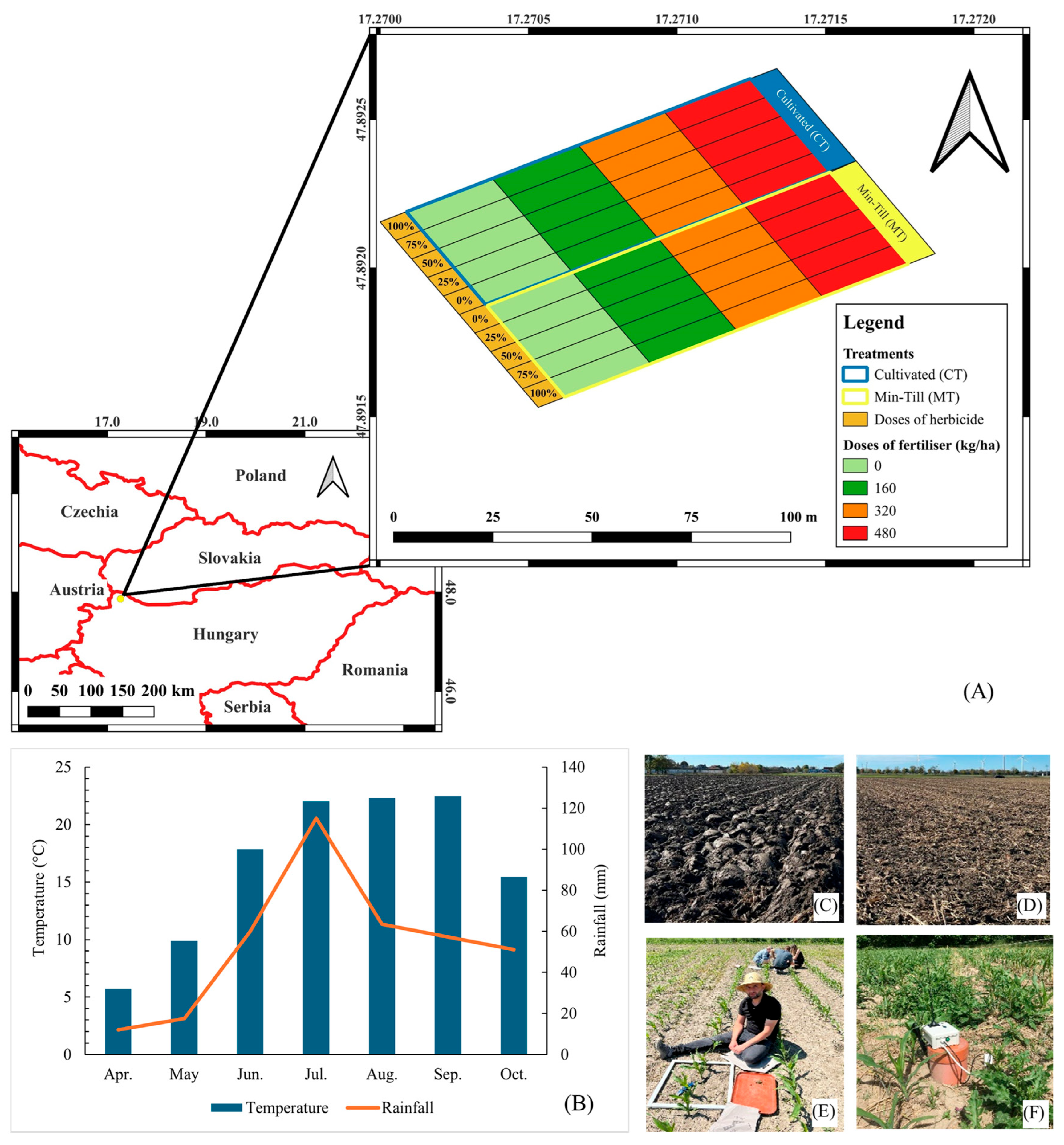
2.1. Site Description and Experimental Design
2.2. Measurements of CO2 Emissions, Soil Temperature, Moisture, and Penetration Resistance
2.3. Aboveground Measurements

2.4. Statistical Analysis
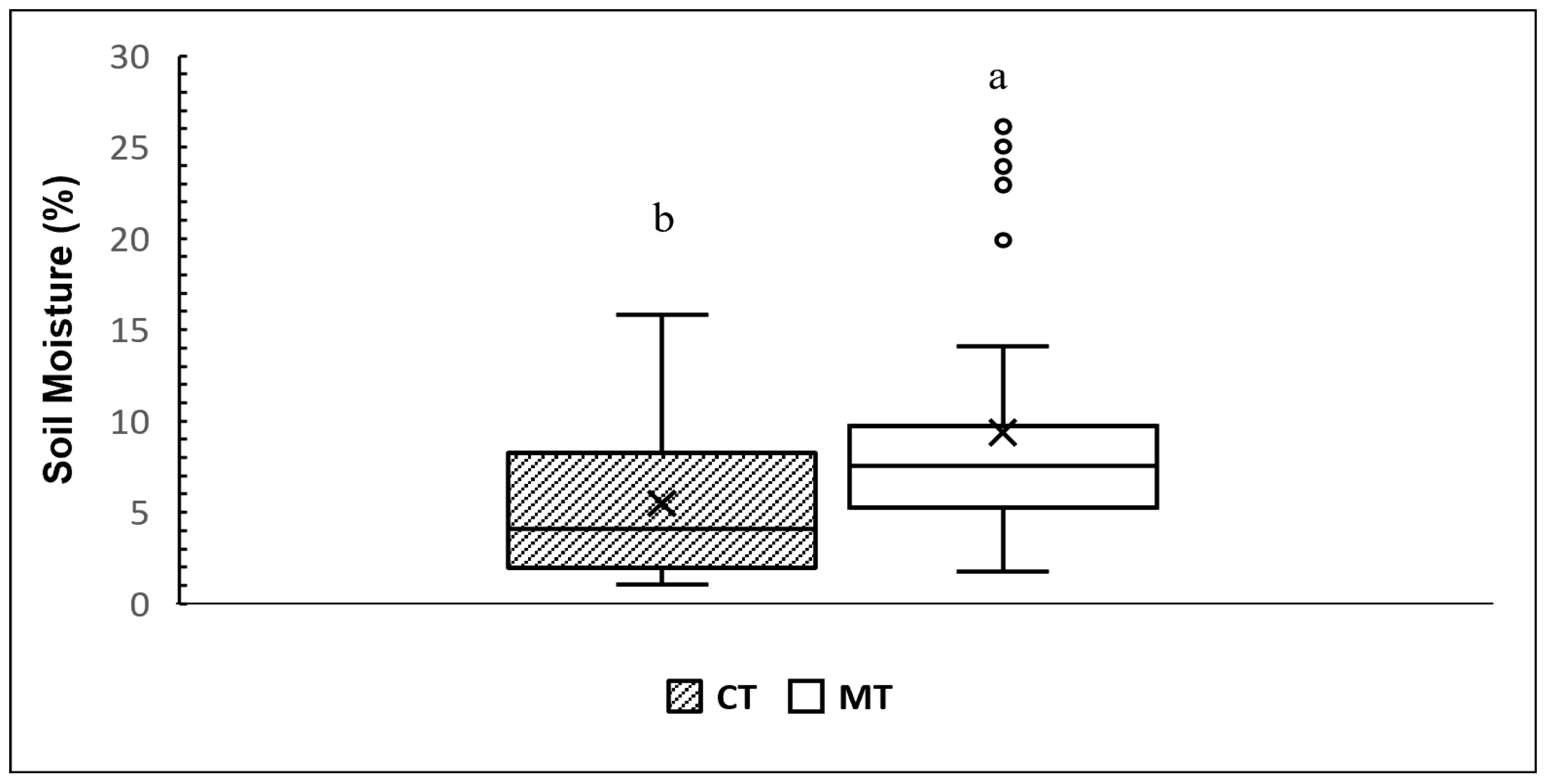
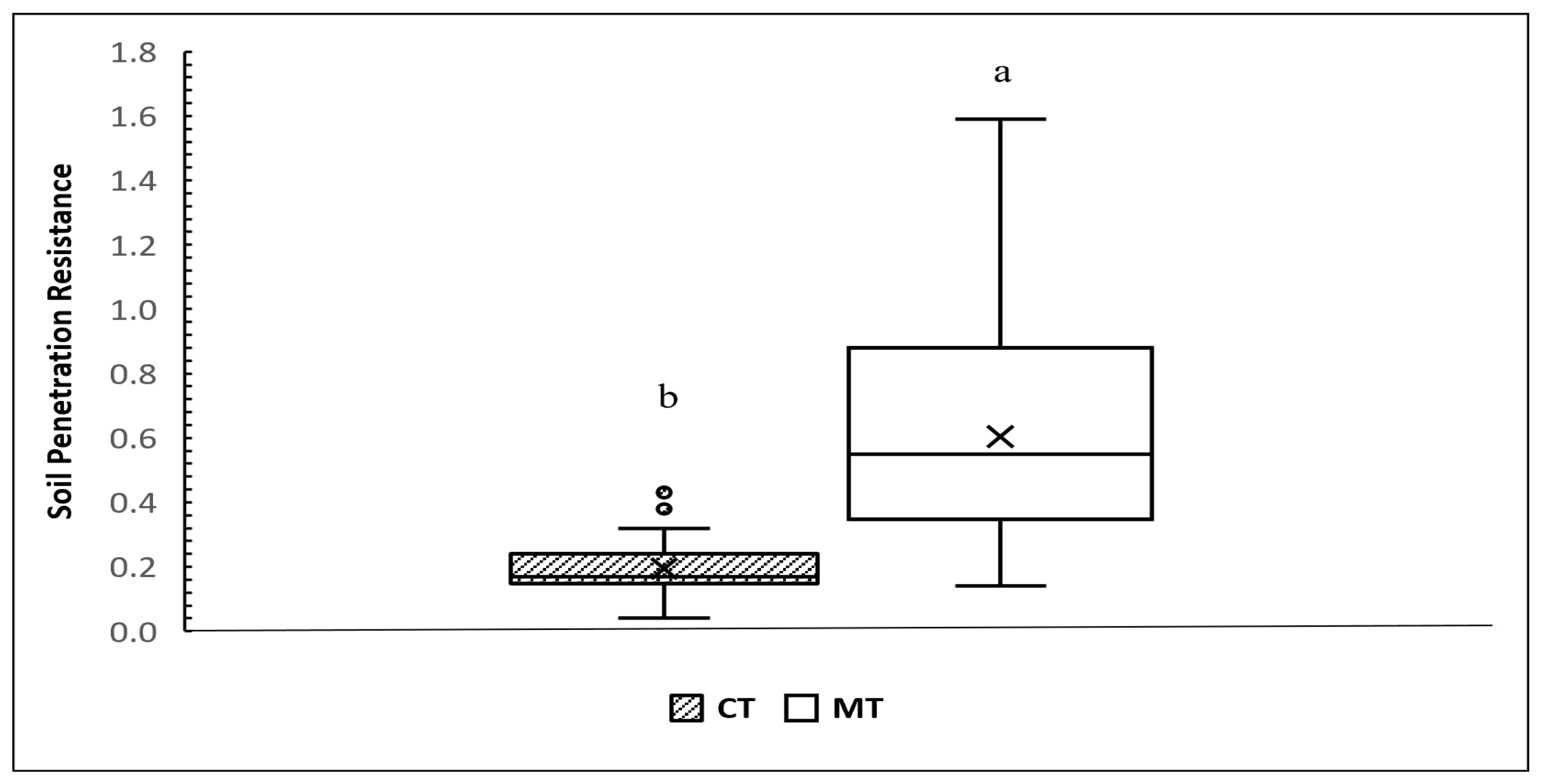
- Section 3.1: Comparison of soil physical properties (temperature, moisture, and compaction) between CT and MT.
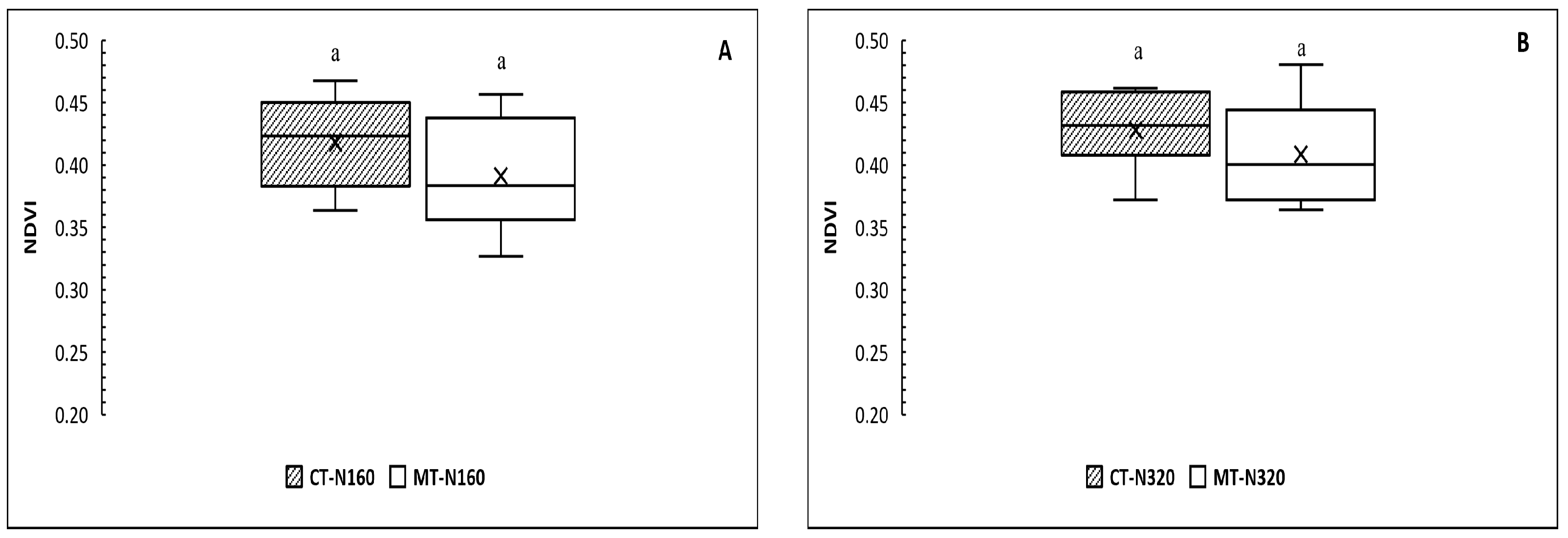
- Section 3.1.1: Comparison of NDVI under different soil management practices.
- Section 3.3.1 and Section 3.3.2: Comparison of soil CO2 emissions under CT and MT at the same nitrogen level and herbicide dose, and under the same nitrogen level.
- Section 3.1.2 and Section 3.1.3: Effects of herbicide rate on NDVI under CT and MT.
- Section 3.2: Simpson’s diversity index analysis of weed diversity.
- Section 3.3.3 and Section 3.3.4: Effects of herbicide rates on soil CO2 emissions under CT and MT.
- Section 3.1.4 and Section 3.1.5: NDVI assessments under CT and MT.
- Section 3.3.5 and Section 3.3.6: Soil CO2 emissions under CT and MT.
3. Results
3.1. Soil Physical Properties Response to Different Tillage Systems in Agricultural Practices
3.1.1. NDVI Under Different Soil Management Practices
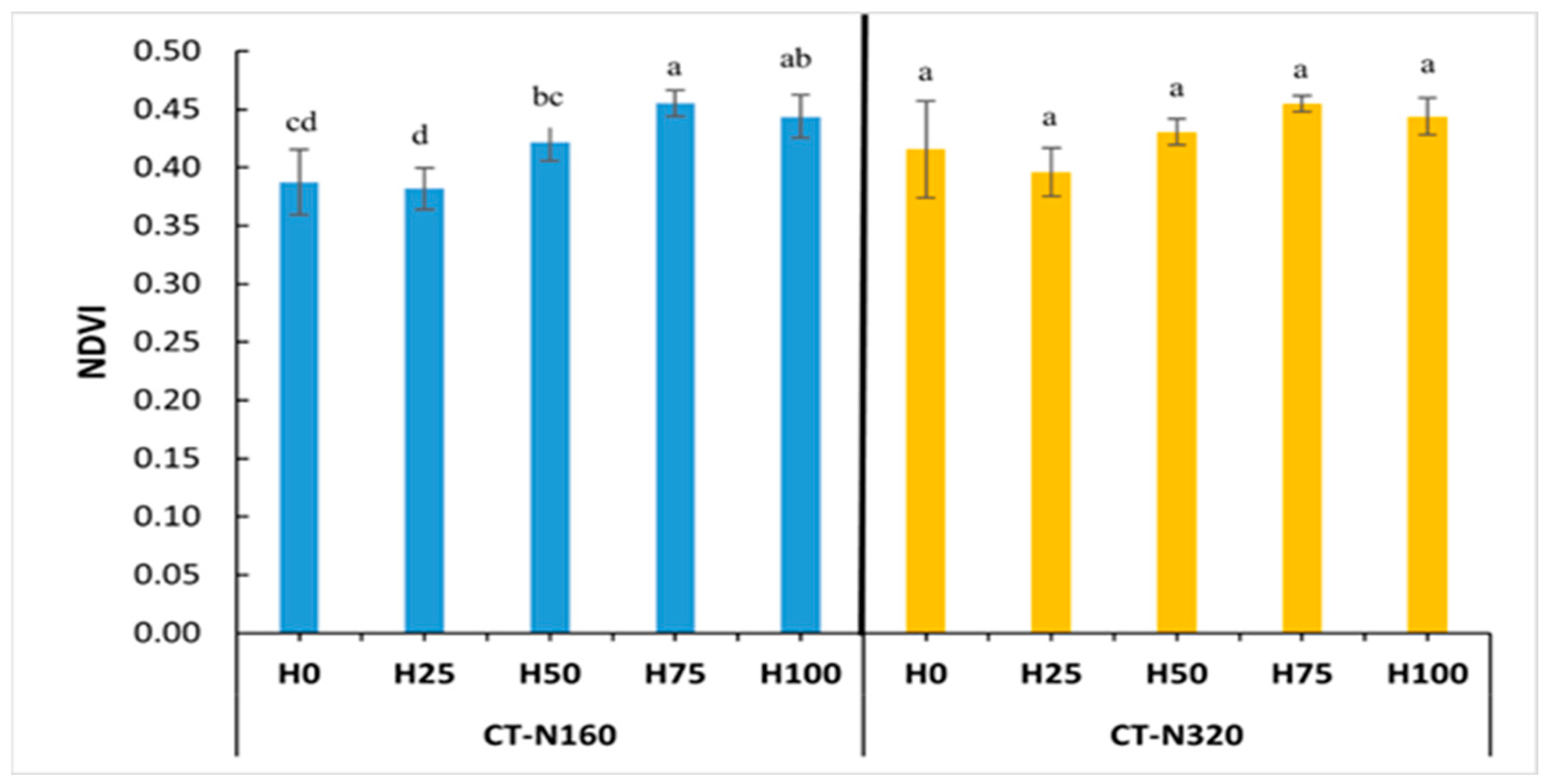
3.1.2. Effect of Herbicide Dose on NDVI Under Conventional Tillage with Different Nitrogen Input
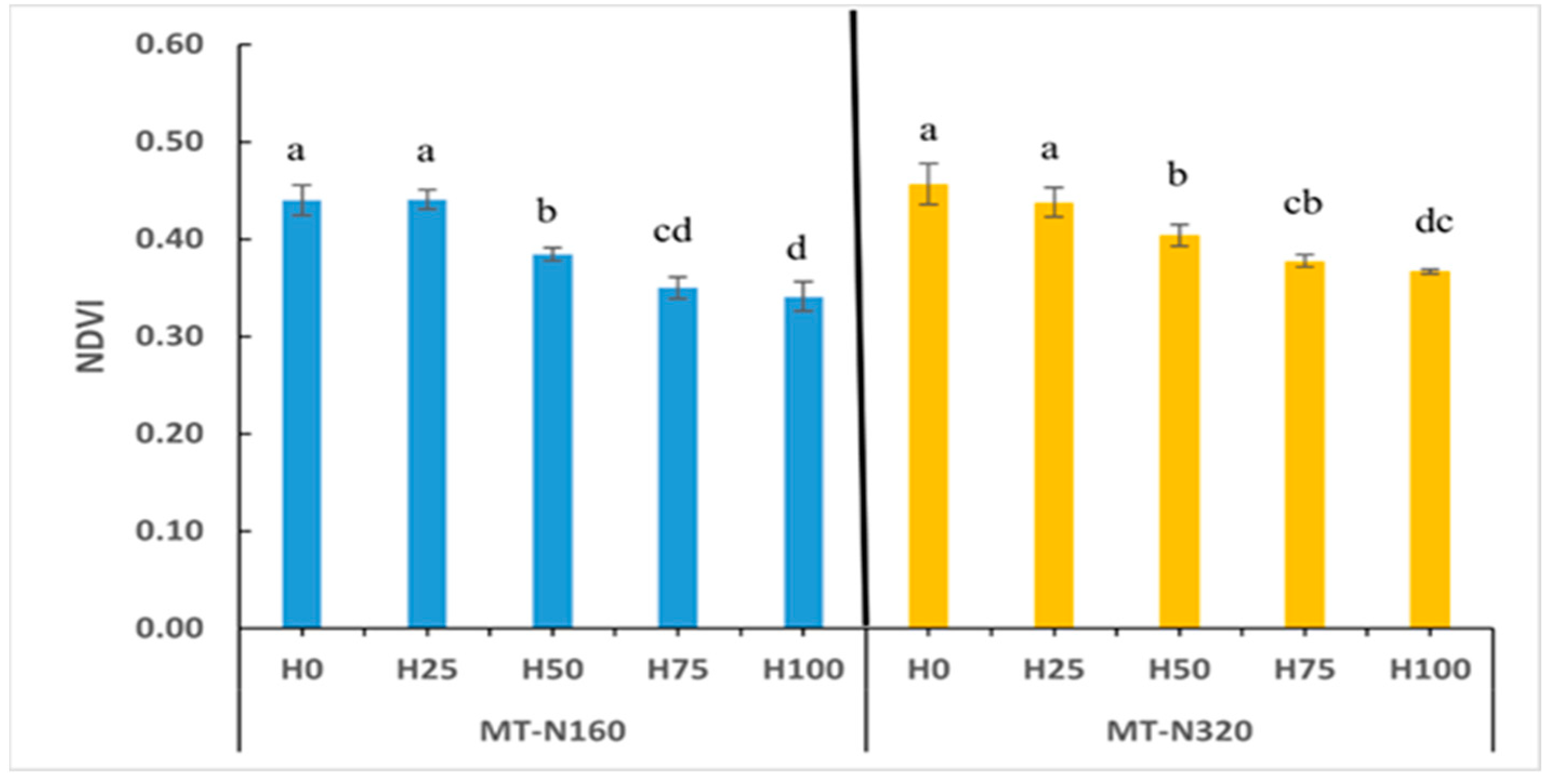
3.1.3. Effect of Herbicide Dose on NDVI Under Minimum Tillage with Different Nitrogen Input
3.1.4. Effect of Nitrogen and Herbicide Dose on NDVI Under Conventional Tillage
3.1.5. Effect of Nitrogen and Herbicide Dose on NDVI Under Minimum Tillage
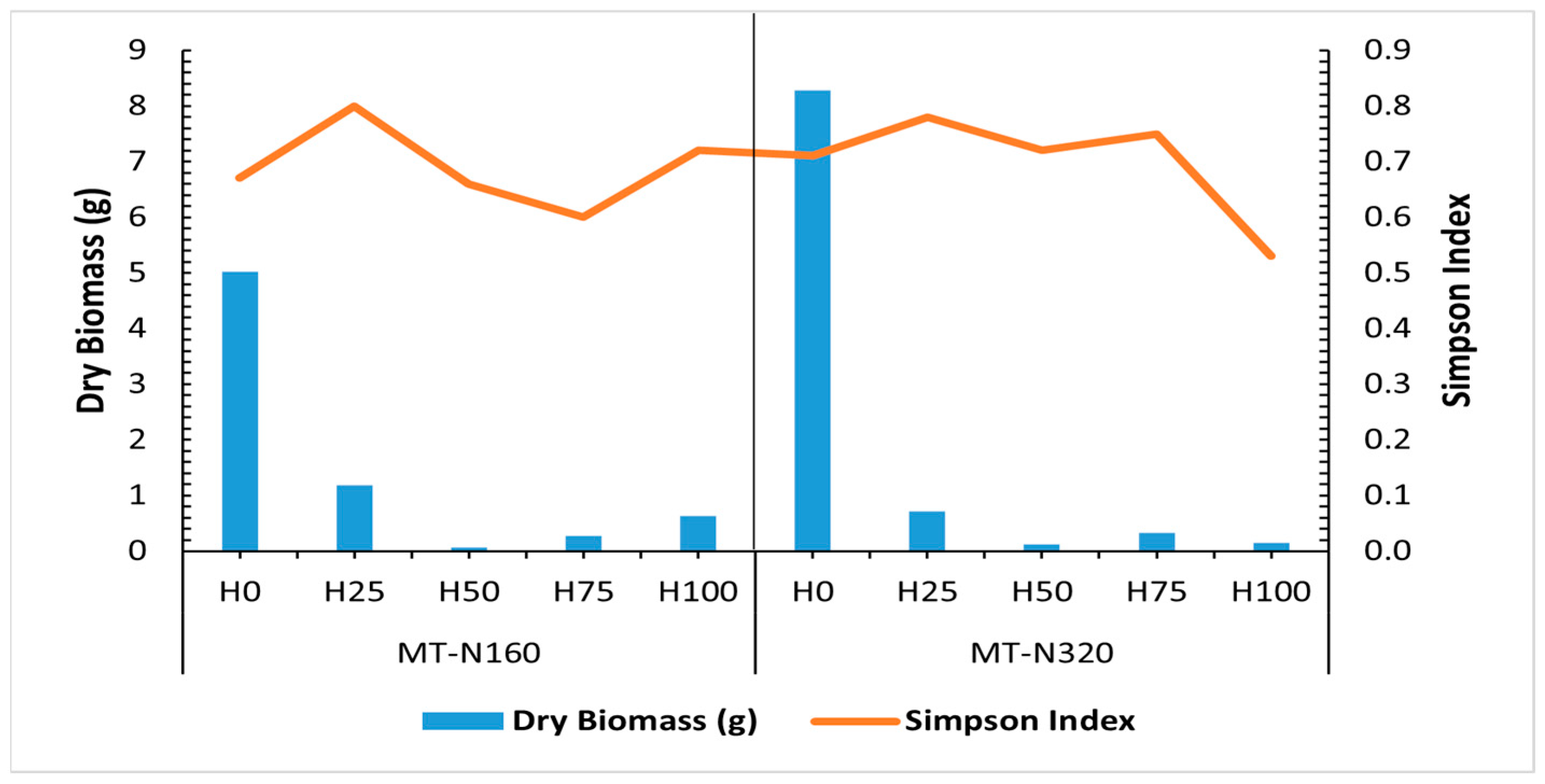
3.2. Simpson’s Index Analysis of Weed Diversity Under Different Agricultural Practices
- Conventional tillage
- Minimum tillage
Relationships Among Weed Diversity, NDVI, and Soil CO2 Emissions
3.3. Soil CO2 Emissions
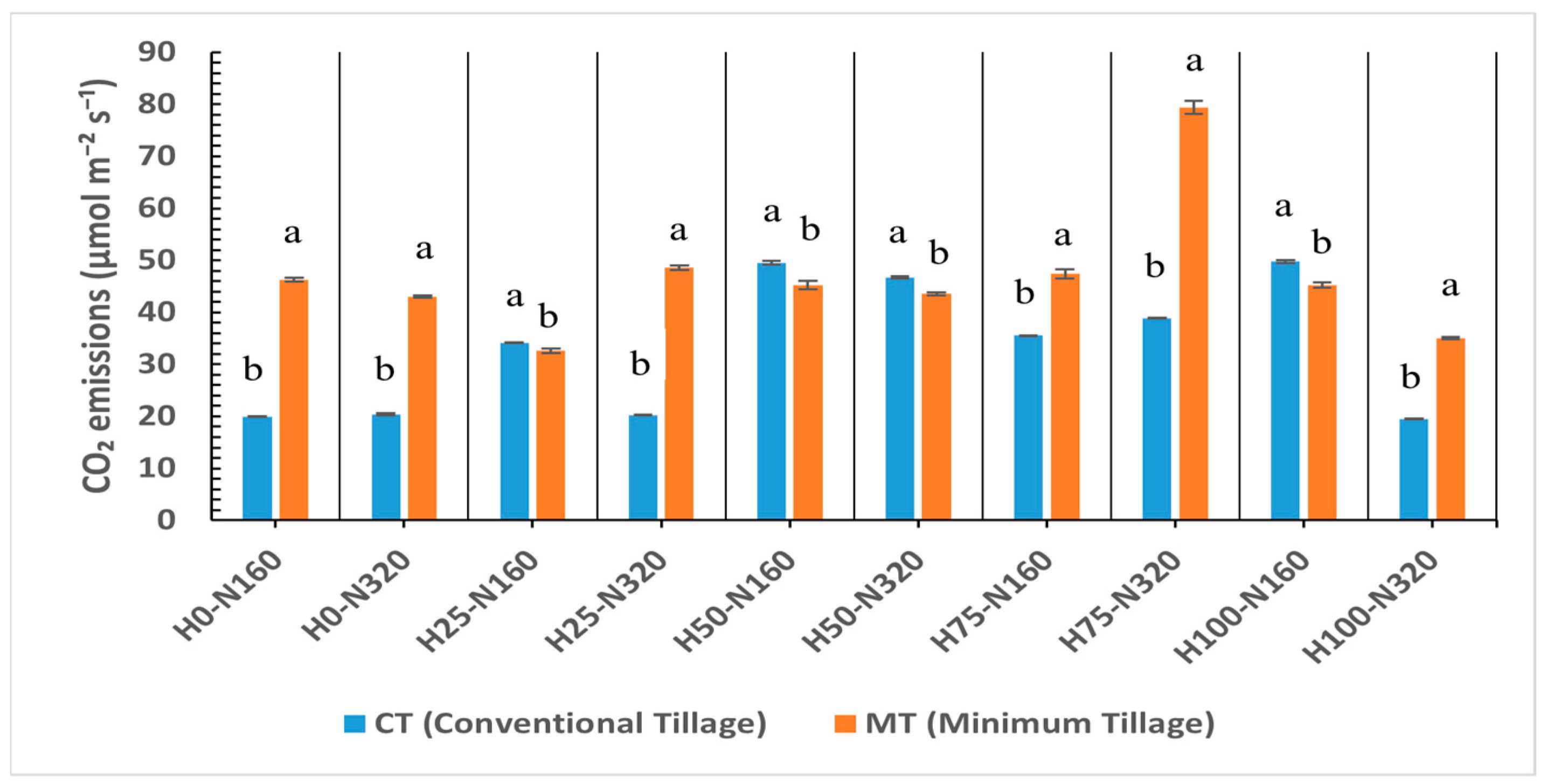
3.3.1. Soil CO2 Emissions Under Different Tillage Systems, Same Nitrogen Level, and Herbicide Dose
3.3.2. Soil CO2 Emissions Under Different Tillage Systems and Same Nitrogen Levels
3.3.3. Effect of Herbicide Dose on Soil CO2 Emissions Under Conventional Tillage Across Two Nitrogen Input Levels
3.3.4. Effect of Herbicide Application Rate on Soil CO2 Emissions Under Minimum Tillage with Two Nitrogen Input Levels
3.3.5. Effect of Nitrogen and Herbicide Dose on Soil CO2 Emissions Under Conventional Tillage
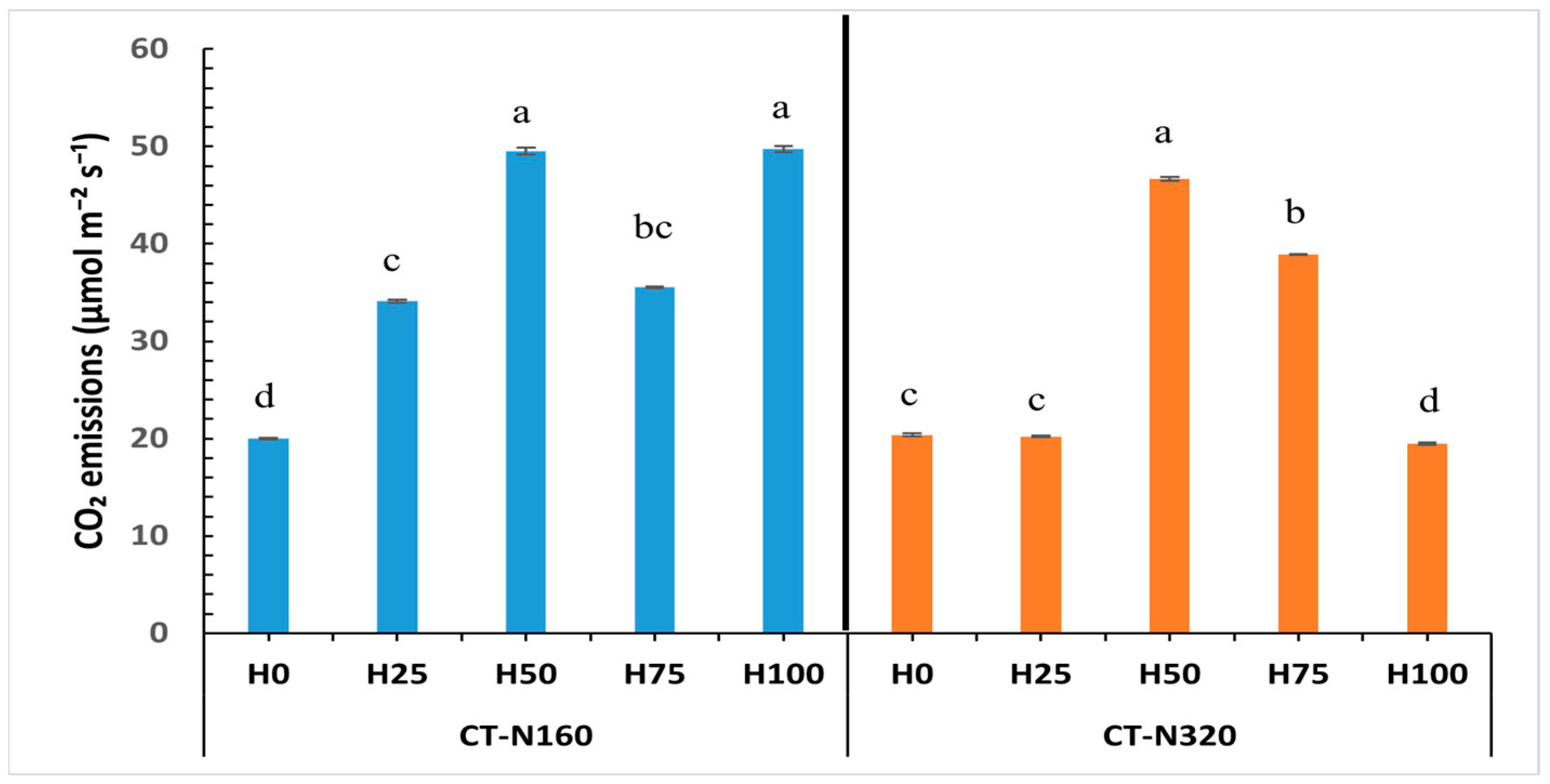
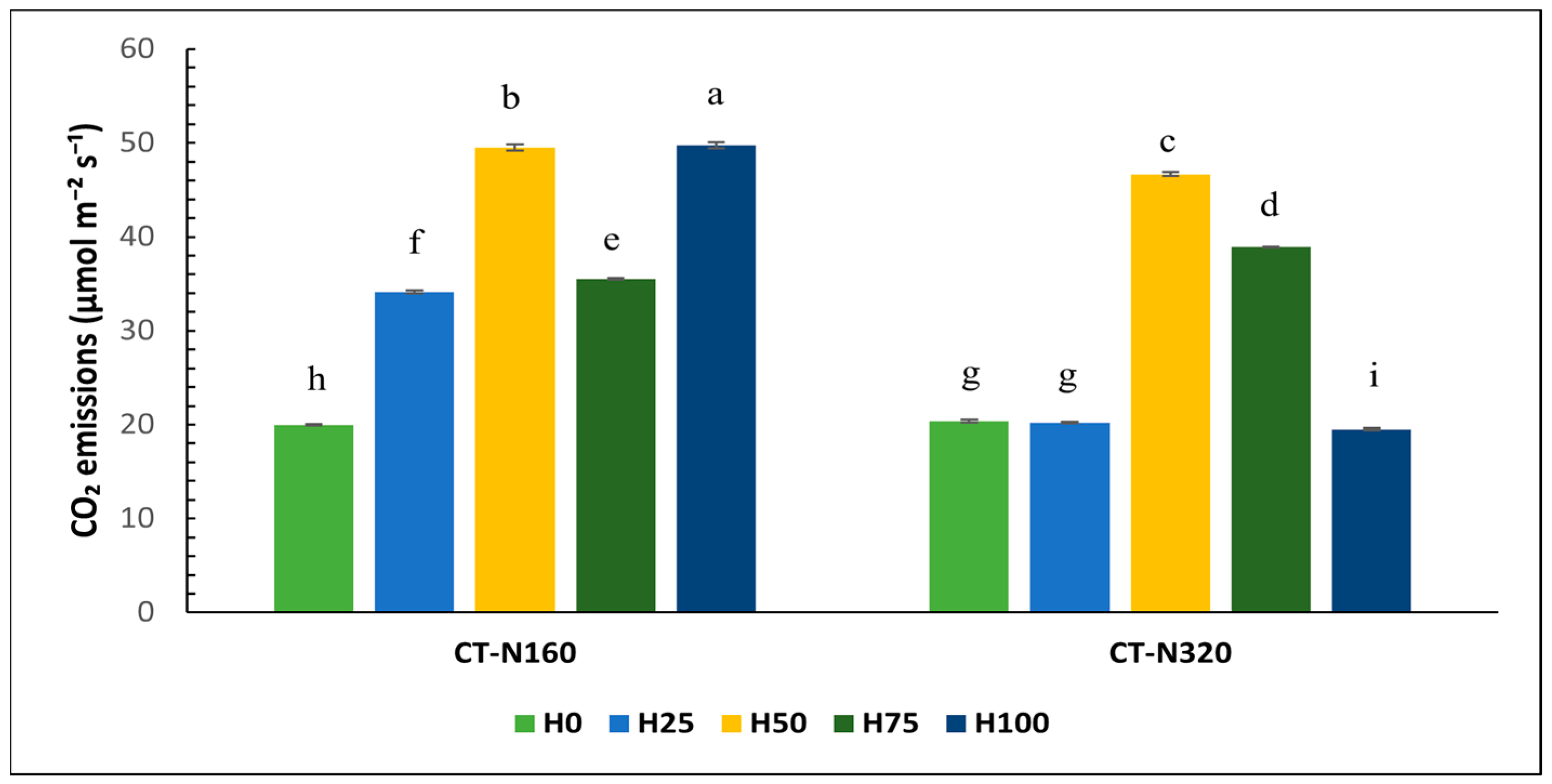
- 74 kg N ha−1: H100 (49.7 ± 0.3 µmol m−2 s−1), H50 (49.4 ± 0.2 µmol m−2 s−1), H75 (35.5 ± 0.0 µmol m−2 s−1), H25 (34.1 ± 0.1 µmol m−2 s−1), H0 (19.9 ± 0.0).
- 147 kg N ha−1: H100 (19.4 ± 0.1 µmol m−2 s−1), H50 (46.6 ± 0.2 µmol m−2 s−1), H75 (38.9 ± 0.0 µmol m−2 s−1), H25 (20.2 ± 0.0 µmol m−2 s−1), H0 (20.3 ± 13.7 µmol m−2 s−1).
3.3.6. Effect of Nitrogen and Herbicide Dose on Soil CO2 Emissions Under Minimum Tillage
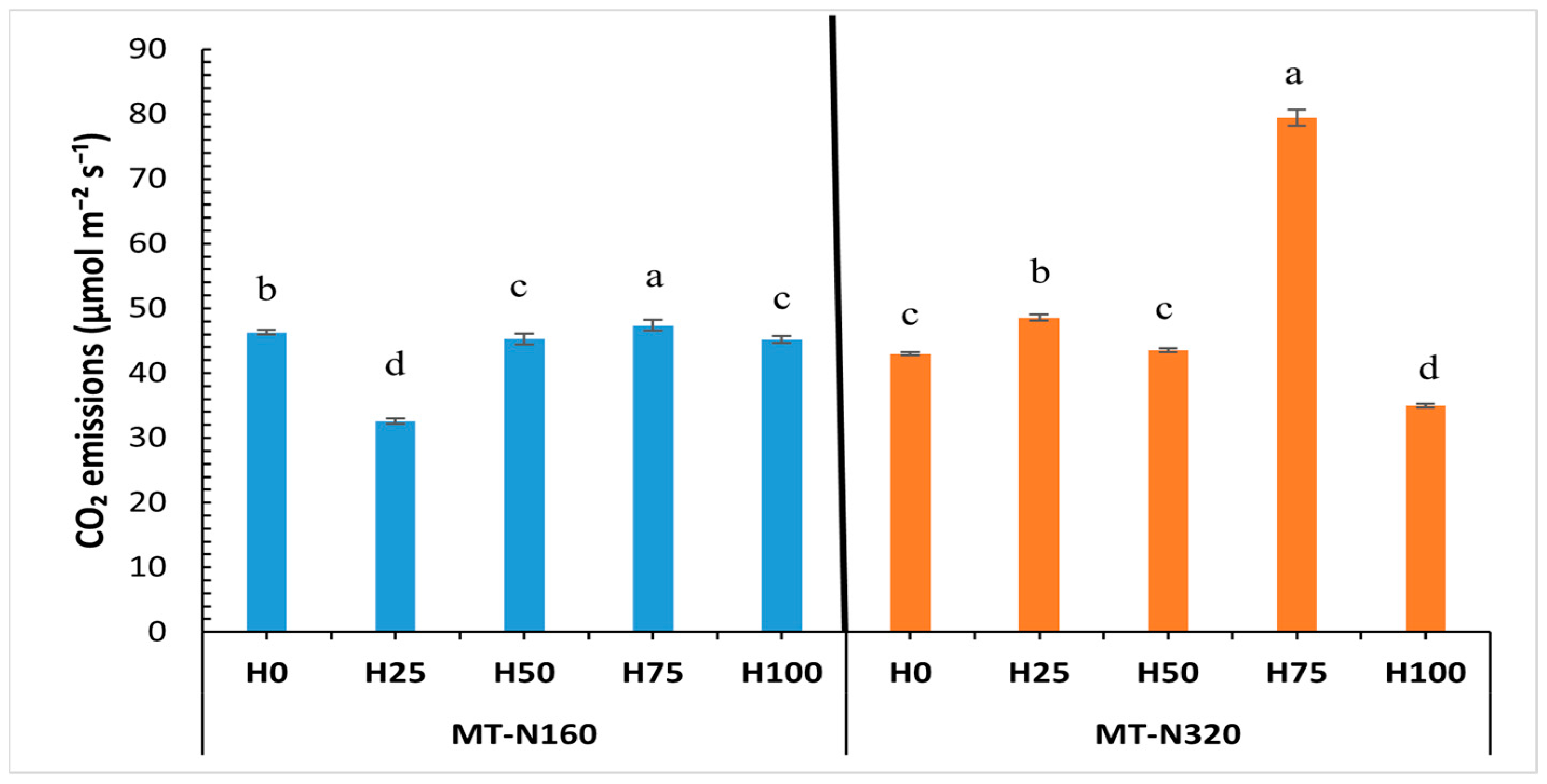
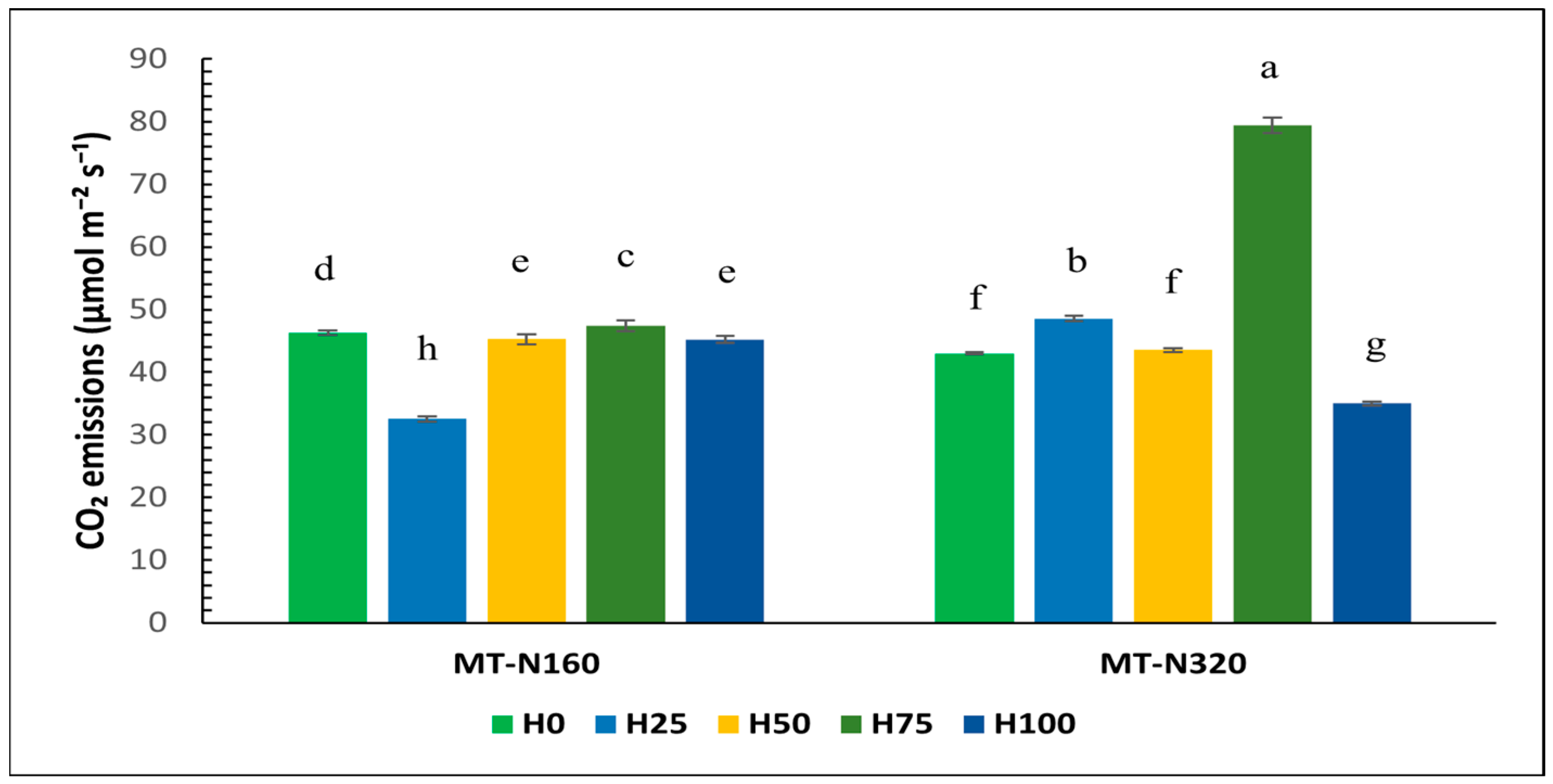
- 74 kg N ha−1: H100 (45.2 ± 0.5 µmol m−2 s−1), H75 (47.3 ± 0.8 µmol m−2 s−1), H50 (45.2 ± 0.8 µmol m−2 s−1), H25 (32.5 ± 0.4 µmol m−2 s−1), and H0 (46.3 ± 0.3 µmol m−2 s−1).
- 147 kg N ha−1: H100 (35.0 ± 0.2 µmol m−2 s−1), H75 (79.4 ± 1.2 µmol m−2 s−1), H50 (43.5 ± 0.3 µmol m−2 s−1), H25 (48.5 ± 0.4 µmol m−2 s−1), and H0 (42.9 ± 0.2 µmol m−2 s−1).
4. Discussion
4.1. Effect of Tillage on Soil Physical Properties
4.2. Vegetation Response to Tillage and Management Practices
4.3. Weed Community Structure and Diversity Responses
4.4. Soil CO2 Emissions in Response to Management Practices
- Under CT, peak emissions occurred at intermediate to high herbicide doses (H50–H100), particularly at 74 kg N ha−1, where H100 recorded 49.7± 0.3 µmol m−2 s−1.
- Under MT, the highest emissions were consistently observed at H75: 47.3 ± 0.8 µmol m−2 s−1 at 74 kg N ha−1 and 79.4 ± 1.2 µmol m−2 s−1 at 147 kg N ha−1, which were the highest emissions recorded in this study.
4.5. Study Limitations and Future Research Directions
5. Conclusions
Author Contributions
Funding
Data Availability Statement
Conflicts of Interest
Abbreviations
| CT | Conventional Tillage |
| MT | Minimum Tillage |
| NT | No-Tillage |
| NDVI | Normalised Difference Vegetation Index |
| CO2 | Carbon Dioxide |
| N2O | Nitrous Oxide |
| CH4 | Methane |
| N160 | Nitrogen fertiliser applied at 74 kg N ha−1 |
| N320 | Nitrogen fertiliser applied at 147 kg N ha−1 |
| H0 | 0% Herbicide Dose (No Herbicide) |
| H25 | 25% Herbicide Dose |
| H50 | 50% Herbicide Dose |
| H75 | 75% Herbicide Dose |
| H100 | 100% Herbicide Dose (Full Recommended Rate) |
| LSD0.05 | Least Significant Difference at p < 0.05 |
| ANOVA | Analysis of Variance |
| SD | Standard Deviation |
| MPa | Megapascal |
| µmol m−2 s−1 | Micromoles per square metre per second (unit of CO2 flux) |
| GHG | Greenhouse Gas |
| GIS | Geographic Information System |
| CV | Coefficient of Variation |
References
- Alsafadi, K.; Mohammed, S.A.; Ayugi, B.; Sharaf, M.; Harsányi, E. Spatial–temporal evolution of drought characteristics over Hungary between 1961 and 2010. Pure Appl. Geophys. 2020, 177, 3961–3978. [Google Scholar] [CrossRef] [Scilit]
- Mohammed, S.; Al-Ebraheem, A.; Holb, I.J.; Alsafadi, K.; Dikkeh, M.; Pham, Q.B.; Linh, N.T.T.; Szabo, S. Soil management effects on soil water erosion and runoff in central Syria—A comparative evaluation of general linear model and random forest regression. Water 2020, 12, 2529. [Google Scholar] [CrossRef] [Scilit]
- Mohammed, S.; Alsafadi, K.; Takács, I.; Harsányi, E. Contemporary changes of greenhouse gases emission from the agricultural sector in the EU-27. Geol. Ecol. Landsc. 2020, 4, 282–287. [Google Scholar] [CrossRef] [Scilit]
- Tessum, C.W.; Hill, J.D.; Marshall, J.D. Life cycle air quality impacts of conventional and alternative light-duty transportation in the United States. Proc. Natl. Acad. Sci. USA 2014, 111, 18490–18495. [Google Scholar] [CrossRef] [Scilit]
- Oertel, C.; Matschullat, J.; Zurba, K.; Zimmermann, F.; Erasmi, S. Greenhouse gas emissions from soils—A review. Geochemistry 2016, 76, 327–352. [Google Scholar] [CrossRef] [Scilit]
- Yue, X.L.; Gao, Q.X. Contributions of natural systems and human activity to greenhouse gas emissions. Adv. Clim. Change Res. 2018, 9, 243–252. [Google Scholar] [CrossRef] [Scilit]
- Mohammed, S.; Gill, A.R.; Alsafadi, K.; Hijazi, O.; Yadav, K.K.; Hasan, M.A.; Khan, A.H.; Islam, S.; Cabral-Pinto, M.M.S.; Harsanyi, E. An overview of greenhouse gases emissions in Hungary. J. Clean. Prod. 2021, 314, 127865. [Google Scholar] [CrossRef] [Scilit]
- Intergovernmental Panel on Climate Change (IPCC). Mitigation of Climate Change; Climate Change; IPCC: Geneva, Switzerland 2022; Available online: https://www.ipcc.ch/report/ar6/wg3/ (accessed on 17 October 2023).
- Mohammed, S.; Mirzaei, M.; Pappné Törő, Á.; Anari, M.G.; Moghiseh, E.; Asadi, H.; Szabó, S.; Kakuszi-Széles, A.; Harsányi, E. Soil carbon dioxide emissions from maize (Zea mays L.) fields as influenced by tillage management and climate. Irrig. Drain. 2022, 71, 228–240. [Google Scholar] [CrossRef] [Scilit]
- Platis, D.P.; Anagnostopoulos, C.D.; Tsaboula, A.D.; Menexes, G.C.; Kalburtji, K.L.; Mamolos, A.P. Energy analysis, and carbon and water footprint for environmentally friendly farming practices in agroecosystems and agroforestry. Sustainability 2019, 11, 1664. [Google Scholar] [CrossRef] [Scilit]
- Follett, R.F.; Shafer, S.R.; Jawson, M.D.; Franzluebbers, A.J. Research and implementation needs to mitigate greenhouse gas emissions from agriculture in the USA. Soil Tillage Res. 2005, 83, 159–166. [Google Scholar] [CrossRef] [Scilit]
- Lal, R.; Follett, R.F.; Stewart, B.A.; Kimble, J.M. Soil carbon sequestration to mitigate climate change and advance food security. Soil Sci. 2007, 172, 943–956. [Google Scholar] [CrossRef] [Scilit]
- Intergovernmental Panel on Climate Change (Ed.) Climate Change 2013—The Physical Science Basis; Cambridge University Press: Cambridge, UK, 2014. [Google Scholar] [CrossRef] [Scilit]
- Wattiaux, M.A.; Uddin, M.E.; Letelier, P.; Jackson, R.D.; Larson, R.A. Invited Review: Emission and mitigation of greenhouse gases from dairy farms: The cow, the manure, and the field. Appl. Anim. Sci. 2019, 35, 238–254. [Google Scholar] [CrossRef] [Scilit]
- Ma, S.; Xiong, J.; Cui, R.; Sun, X.; Han, L.; Xu, Y.; Kan, Z.; Gong, X.; Huang, G. Effects of intermittent aeration on greenhouse gas emissions and bacterial community succession during large-scale membrane-covered aerobic composting. J. Clean. Prod. 2020, 266, 121551. [Google Scholar] [CrossRef] [Scilit]
- Nawaz, A.; Lal, R.; Shrestha, R.K.; Farooq, M. Mulching affects soil properties and greenhouse gas emissions under long-term no-till and plough-till systems in alfisol of Central Ohio. Land Degrad. Dev. 2017, 28, 673–681. [Google Scholar] [CrossRef] [Scilit]
- Al-Kaisi, M.M.; Kruse, M.L.; Sawyer, J.E. Effect of nitrogen fertilizer application on growing season soil carbon dioxide emission in a corn–soybean rotation. J. Environ. Qual. 2008, 37, 325–332. [Google Scholar] [CrossRef] [Scilit]
- He, M.; Ma, W.; Zelenev, V.V.; Khodzaeva, A.K.; Kuznetsov, A.M.; Semenov, A.M.; Semenov, V.M.; Blok, W.; van Bruggen, A.H.C. Short-term dynamics of greenhouse gas emissions and cultivable bacterial populations in response to induced and natural disturbances in organically and conventionally managed soils. Appl. Soil Ecol. 2017, 119, 294–306. [Google Scholar] [CrossRef] [Scilit]
- Doyeni, M.O.; Stulpinaite, U.; Baksinskaite, A.; Suproniene, S.; Tilvikiene, V. Greenhouse gas emissions in agricultural cultivated soils using animal waste-based digestates for crop fertilization. J. Agric. Sci. 2021, 159, 23–30. [Google Scholar] [CrossRef] [Scilit]
- Smith, P.; Martino, D.; Cai, Z.; Gwary, D.; Janzen, H.; Kumar, P.; McCarl, B.; Ogle, S.; O’Mara, F.; Rice, C.; et al. Greenhouse gas mitigation in agriculture. Philos. Trans. R. Soc. Lond. B Biol. Sci. 2008, 363, 789–813. [Google Scholar] [CrossRef] [Scilit]
- Ren, X.; Tang, J.; Liu, X.; Liu, Q. Effects of microplastics on greenhouse gas emissions and the microbial community in fertilized soil. Environ. Pollut. 2020, 256, 113347. [Google Scholar] [CrossRef] [Scilit] [PubMed]
- Li, H.; Jin, X.; Shan, W.; Han, B.; Zhou, Y.; Tittonell, P. Optimizing agricultural management in China for soil greenhouse gas emissions and yield balance: A regional heterogeneity perspective. J. Clean. Prod. 2024, 452, 142255. [Google Scholar] [CrossRef] [Scilit]
- Oertel, C.; von Bodenentgasungen, A. Sachsen Mit Kammersystemen. Ph.D. Thesis, Technische Universität Bergakademie Freiberg, Freiberg, Germany, 2017. [Google Scholar]
- Oyeogbe, A.I.; Das, T.K.; Bhatia, A.; Singh, S.B. Adaptive nitrogen and integrated weed management in conservation agriculture: Impacts on agronomic productivity, greenhouse gas emissions, and herbicide residues. Environ. Monit. Assess. 2017, 189, 198. [Google Scholar] [CrossRef] [Scilit]
- Rehman, A.; Ma, H.; Irfan, M.; Ahmad, M. Does carbon dioxide, methane, nitrous oxide, and GHG emissions influence the agriculture? Evidence from China. Environ. Sci. Pollut. Res. 2020, 27, 28768–28779. [Google Scholar] [CrossRef] [Scilit]
- Popp, J.; Oláh, J.; Neményi, M.; Nyéki, A. Global challenges and the ‘farm to fork’ strategies of the European Green Deal: Blessing or curse. Prog. Agric. Eng. Sci. 2024, 20, 101–111. [Google Scholar] [CrossRef] [Scilit]
- Reicosky, D.C.; Lindstrom, M.J. Fall tillage method: Effect on short-term carbon dioxide flux from soil. Agron. J. 1993, 85, 1237–1243. [Google Scholar] [CrossRef] [Scilit]
- Cillis, D.; Maestrini, B.; Pezzuolo, A.; Marinello, F.; Sartori, L. Modeling soil organic carbon and carbon dioxide emissions in different tillage systems supported by precision agriculture technologies under current climatic conditions. Soil Tillage Res. 2018, 183, 51–59. [Google Scholar] [CrossRef] [Scilit]
- Almaraz, J.J.; Zhou, X.; Mabood, F.; Madramootoo, C.; Rochette, P.; Ma, B.L.; Smith, D.L. Greenhouse gas fluxes associated with soybean production under two tillage systems in southwestern Quebec. Soil Tillage Res. 2009, 104, 134–139. [Google Scholar] [CrossRef] [Scilit]
- Fuentes, M.; Hidalgo, C.; Etchevers, J.; De León, F.; Guerrero, A.; Dendooven, L.; Verhulst, N.; Govaerts, B. Conservation agriculture, increased organic carbon in the top-soil macro-aggregates and reduced soil CO2 emissions. Plant Soil 2012, 355, 183–197. [Google Scholar] [CrossRef] [Scilit]
- Rutkowska, B.; Szulc, W.; Sosulski, T.; Skowrońska, M.; Szczepaniak, J. Impact of reduced tillage on CO under maize cultivation. Soil Tillage Res. 2018, 180, 21–28. [Google Scholar] [CrossRef] [Scilit]
- Bista, P.; Norton, U.; Ghimire, R.; Norton, J.B. Effects of tillage system on greenhouse gas fluxes and soil mineral nitrogen in wheat (Triticum aestivum, L.)-fallow during drought. J. Arid. Environ. 2017, 147, 103–113. [Google Scholar] [CrossRef] [Scilit]
- Passianoto, C.C.; Ahrens, T.; Feigl, B.J.; Steudler, P.A.; Do Carmo, J.B.; Melillo, J.M. Emissions of CO2, N2O, and NO in conventional and no-till management practices in Rondônia, Brazil. Biol. Fertil. Soils 2003, 38, 200–208. [Google Scholar] [CrossRef] [Scilit]
- Dachraoui, M.; Sombrero, A. Effect of tillage systems and different rates of nitrogen fertilisation on the carbon footprint of irrigated maize in a semiarid area of Castile and León, Spain. Soil Tillage Res. 2020, 196, 104472. [Google Scholar] [CrossRef] [Scilit]
- Holland, J.M. The environmental consequences of adopting conservation tillage in Europe: Reviewing the evidence. Agric. Ecosyst. Environ. 2004, 103, 1–25. [Google Scholar] [CrossRef] [Scilit]
- Hendrix, P.F.; Han, C.-R.; Groffman, P.M. Soil respiration in conventional and no-tillage agroecosystems under different winter cover crop rotations. Soil Tillage Res. 1988, 12, 135–148. [Google Scholar] [CrossRef] [Scilit]
- Fortin, M.C.; Rochette, P.; Pattey, E. Soil carbon dioxide fluxes from conventional and no-tillage small-grain cropping systems. Soil Sci. Soc. Am. J. 1996, 60, 1541–1547. [Google Scholar] [CrossRef] [Scilit]
- Oorts, K.; Merckx, R.; Gréhan, E.; Labreuche, J.; Nicolardot, B. Determinants of annual fluxes of CO2 and N2O in long-term no-tillage and conventional tillage systems in northern France. Soil Tillage Res. 2007, 95, 133–148. [Google Scholar] [CrossRef] [Scilit]
- Aslam, T.; Choudhary, M.A.; Saggar, S. Influence of land-use management on CO2 emissions from a silt loam soil in New Zealand. Agric. Ecosyst. Environ. 2000, 77, 257–262. [Google Scholar] [CrossRef] [Scilit]
- Bilandžija, D.; Zgorelec, Ž.; Kisić, I. Influence of tillage practices and crop type on soil CO2 emissions. Sustainability 2016, 8, 90. [Google Scholar] [CrossRef] [Scilit]
- Ma, Y.; Qian, C.; Sun, D.; Deng, L.; Huang, G.; Lu, W. Effect of nitrogen fertilizer application on greenhouse gas emissions from soil in paddy field. Trans. Chin. Soc. Agric. Eng. 2016, 32, 128–134. [Google Scholar] [CrossRef]
- Yu, W.J.; Li, X.S.; Chen, Z.J.; Zhou, J.B. Effects of nitrogen fertilizer application on carbon dioxide emissions from soils with different inorganic carbon contents. Ying Yong Sheng Tai Xue Bao 2018, 29, 2493–2500. [Google Scholar] [CrossRef] [Scilit]
- Kong, D.; Liu, N.; Ren, C.; Li, H.; Wang, W.; Li, N.; Yang, G. Effect of nitrogen fertilizer on soil CO2 emission depends on crop rotation strategy. Sustainability 2020, 12, 5271. [Google Scholar] [CrossRef] [Scilit]
- Wang, J.; Xie, J.; Li, L.; Effah, Z.; Xie, L.; Luo, Z.; Zhou, Y.; Jiang, Y. Fertilization treatments affect soil CO2 emission through regulating soil bacterial community composition in the semiarid Loess Plateau. Sci. Rep. 2022, 12, 20123. [Google Scholar] [CrossRef] [Scilit]
- Guo, C.; Liu, X.; He, X. A global meta-analysis of crop yield and agricultural greenhouse gas emissions under nitrogen fertilizer application. Sci. Total Environ. 2022, 831, 154982. [Google Scholar] [CrossRef] [Scilit]
- Wilson, H.M.; Al-Kaisi, M.M. Crop rotation and nitrogen fertilization effect on soil CO2 emissions in central Iowa. Appl. Soil Ecol. 2008, 39, 264–270. [Google Scholar] [CrossRef] [Scilit]
- Singh, B. Are nitrogen fertilizers deleterious to soil health? Agronomy 2018, 8, 48. [Google Scholar] [CrossRef] [Scilit]
- Tahat, M.M.; Alananbeh, K.M.; Othman, Y.A.; Leskovar, D.I. Soil health and sustainable agriculture. Sustainability 2020, 12, 4859. [Google Scholar] [CrossRef] [Scilit]
- Kinney, C.A.; Mosier, A.R.; Ferrer, I.; Furlong, E.T.; Mandernack, K.W. Effects of the herbicides prosulfuron and metolachlor on fluxes of CO2, N2O, and CH4 in a fertilized Colorado grassland soil. J. Geophys. Res. 2004, 109, D05. [Google Scholar] [CrossRef] [Scilit]
- Zabaloy, M.C.; Gómez, M.A. Microbial respiration in soils of the Argentine Pampas after metsulfuron methyl, 2,4-D, and glyphosate treatments. Commun. Soil Sci. Plant Anal. 2008, 39, 370–385. [Google Scholar] [CrossRef] [Scilit]
- Sándor, Z.; Kincses, I.; Tállai, M.; Lowy, D.A.; Melendez, J.R.; Guananga Diaz, N.I.; Guevara Iñiguez, L.E.; Cuenca Nevarez, G.; Talledo Solórzano, V.; Kátai, J. Effect of herbicides on soil respiration: A case study conducted at Debrecen-Látókép Plant Cultivation Experimental Station. F1000Research 2020, 9, 1348. [Google Scholar] [CrossRef] [Scilit]
- Goranovska, S. Biological efficacy of herbicide systems tested over local maize hybrid KN 509 and influence over its productivity. Sci. Works 2018, 2, 18. [Google Scholar]
- Meseldžija, M.; Dudić, M. Terbuthylazine application with herbicides of different mode of action in maize crop. In Proceedings of the IX International Agricultural Symposium “Agrosym 2018”, East Sarajevo, Bosnia and Herzegovina, 4–7 October 2018; pp. 1019–1025. [Google Scholar]
- Schulte, M.; Weichert, H.; Bassermann, K. CALARIS® MAXX—Eine Neuformulierung zur Kontrolle von Unkräutern und Ungräsern unter sich ändernden Anforderungen im Maisanbau. Julius-Kühn-Arch 2022, 468, 258–263. [Google Scholar] [CrossRef]
- Hashim, Z.K.; De Silva, A.G.S.D.; Hassouni, A.A.; Vona, V.M.; Bede, L.; Stencinger, D.; Horváth, B.; Zsebő, S.; Kulmány, I.M. Effects of various herbicide types and doses, tillage systems, and nitrogen rates on CO2 emissions from agricultural land: A literature review2 emissions from agricultural land: A literature review. Agriculture 2024, 14, 1800. [Google Scholar] [CrossRef] [Scilit]
- Pinke, Z.; Decsi, B.; Demeter, G.; Kalicz, P.; Kern, Z.; Acs, T. Continental lowlands face rising crop vulnerability: Structural change in regional climate sensitivity of crop yields, Hungary (Central and Eastern Europe), 1921–2010. Reg. Environ. Change 2024, 24, 33. [Google Scholar] [CrossRef] [Scilit]
- Peel, M.C.; Finlayson, B.L.; McMahon, T.A. Updated world map of the Köppen–Geiger climate classification. Hydrol. Earth Syst. Sci. 2007, 11, 1633–1644. [Google Scholar] [CrossRef] [Scilit]
- Izsák, B.; Szentimrey, T.; Lakatos, M.; Pongrácz, R.; Szentes, O. Creation of a representative climatological database for Hungary from 1870 to 2020. Időjárás 2022, 126, 1–26. [Google Scholar] [CrossRef] [Scilit]
- Kulmány, I.M. Kukorica Termesztése Során Keletkező Üvegházhatású Gázok Nyomon Követése, Különös Tekintettel a Szén-dioxid-Kibocsátásra. Ph.D. Thesis, Széchenyi István University, Mosonmagyaróvár, Hungary, 2022. [Google Scholar] [CrossRef] [Scilit]
- Kulmány, I.M.; Bede-Fazekas, Á.; Beslin, A.; Giczi, Z.; Milics, G.; Kovács, B.; Kovács, M.; Ambrus, B.; Bede, L.; Vona, V. Calibration of an Arduino-based low-cost capacitive soil moisture sensor for smart agriculture. J. Hydrol. Hydromech. 2022, 70, 153–164. [Google Scholar] [CrossRef] [Scilit]
- Cohen, M.J.; Prenger, J.P.; DeBusk, W.F. Visible–near infrared reflectance spectroscopy for rapid, nondestructive assessment of wetland soil quality. J. Environ. Qual. 2005, 34, 1422–1434. [Google Scholar] [CrossRef] [Scilit]
- Viscarra Rossel, R.A.; Walvoort, D.J.J.; McBratney, A.B.; Janik, L.J.; Skjemstad, J.O. Visible, near infrared, mid infrared or combined diffuse reflectance spectroscopy for simultaneous assessment of various soil properties. Geoderma 2006, 131, 59–75. [Google Scholar] [CrossRef] [Scilit]
- Campbell, D.J.; O’Sullivan, M.F. The cone penetrometer in relation to trafficability, compaction and tillage. In Soil Analysis: Physical Methods; Smith, K.A., Mullins, C.E., Eds.; Marcel Dekker Inc.: New York, NY, USA, 1991. [Google Scholar]
- NEN 5140:1996 nl; Geotechnics—Determination of the Cone Resistance and the Sleeve Friction of Soil—Electric Penetration Test. NEN: Delft, The Netherlands, 1996; Volume 5140. Available online: https://www.nen.nl/en/nen-5140-1996-nl-19464 (accessed on 17 August 2023).
- Krähmer, H.; Andreasen, C.; Economou-Antonaka, G.; Holec, J.; Kalivas, D.; Kolářová, M.; Novák, R.; Panozzo, S.; Pinke, G.; Salonen, J.; et al. Weed surveys and weed mapping in Europe: State of the art and future tasks. Crop. Prot. 2020, 129, 105010. [Google Scholar] [CrossRef] [Scilit]
- Veloso, A.; Mermoz, S.; Bouvet, A.; Le Toan, T.; Planells, M.; Dejoux, J.F.; Ceschia, E. Understanding the temporal behavior of crops using Sentinel-1 and Sentinel-2-like data for agricultural applications. Remote Sens. Environ. 2017, 199, 415–426. [Google Scholar] [CrossRef] [Scilit]
- Zsebő, S.; Bede, L.; Kukorelli, G.; Kulmány, I.M.; Milics, G.; Stencinger, D.; Teschner, G.; Varga, Z.; Vona, V.; Kovács, A.J. Yield prediction using NDVI values from GreenSeeker and MicaSense cameras at different stages of winter wheat phenology. Drones 2024, 8, 88. [Google Scholar] [CrossRef] [Scilit]
- Morris, E.K.; Caruso, T.; Buscot, F.; Fischer, M.; Hancock, C.; Maier, T.S.; Meiners, T.; Müller, C.; Obermaier, E.; Prati, D.; et al. Choosing and using diversity indices: Insights for ecological applications from the German biodiversity exploratories. Ecol. Evol. 2014, 4, 3514–3524. [Google Scholar] [CrossRef] [Scilit]
- Guajardo, S.A. Measuring diversity in police agencies. J. Ethn. Crim. Justice 2015, 13, 1–15. [Google Scholar] [CrossRef] [Scilit]
- Fisher, R.A. The logic of inductive inference. J. R. Stat. Soc. 1935, 98, 39–82. [Google Scholar] [CrossRef] [Scilit]
- Williams, L.J.; Abdi, H. Fisher’s least significant difference (LSD) test. In Encyclopedia of Research Design; Salkind, N.J., Ed.; Sage Publications: Thousand Oaks, CA, USA, 2010; pp. 840–853. Available online: https://www.researchgate.net/publication/242181775 (accessed on 10 October 2024).
- Al-Rawi, K.M.; Aziz, A.; Ali, M.K. Design and Analysis of Agricultural Experiments; Ministère de l’Enseignement Supérieur et de la Recherche Scientifique, Gouvernement de la République Algérienne, University of Baghdad: Baghdad, Iraq, 2000; 360p. [Google Scholar]
- Yang, X.M.; Drury, C.F.; Reeb, M.R. No-tillage had warmer over-winter soil temperatures than conventional tillage in a Brookston clay loam soils in southwestern Ontario. Soil Sci. Soc. Am. J. 2018, 82, 307–314. [Google Scholar] [CrossRef] [Scilit]
- Johnson, M.D.; Lowery, B. Effect of three conservation tillage practices on soil temperature and thermal properties. Soil Sci. Soc. Am. J. 1985, 49, 1547–1552. [Google Scholar] [CrossRef] [Scilit]
- Muñoz-Romero, V.; López-Bellido, L.; López-Bellido, R.J. Effect of tillage system on soil temperature in a rainfed Mediterranean vertisol. Int. Agrophys. 2015, 29, 467–473. [Google Scholar] [CrossRef] [Scilit]
- Dao, T.H. Tillage system and crop residue effects on surface compaction of a Paleustoll. Agron. J. 1996, 88, 141–148. [Google Scholar] [CrossRef] [Scilit]
- Sarkar, S.; Singh, S.R. Interactive effect of tillage depth and mulch on soil temperature, productivity and water use pattern of rainfed barley (Hordium vulgare L.). Soil Tillage Res. 2007, 92, 79–86. [Google Scholar] [CrossRef] [Scilit]
- Shen, Y.; McLaughlin, N.B.; Zhang, X.; Xu, M.; Liang, A. Effect of tillage and crop residue on soil temperature following planting for a Black soil in Northeast China. Sci. Rep. 2018, 8, 4500. [Google Scholar] [CrossRef] [Scilit]
- Yeom, J.; Jung, J.; Chang, A.; Ashapure, A.; Maeda, M.; Maeda, A.; Landivar, J. Comparison of vegetation indices derived from UAV data for differentiation of tillage effects in agriculture. Remote Sens. 2019, 11, 1548. [Google Scholar] [CrossRef] [Scilit]
- Singh, V.K.; Yadvinder-Singh, B.S.; Dwivedi, B.S.; Singh, S.K.; Majumdar, K.; Jat, M.L.; Mishra, R.P.; Rani, M. Soil physical properties, yield trends and economics after five years of conservation agriculture based rice–maize system in north-western India. Soil Tillage Res. 2016, 155, 133–148. [Google Scholar] [CrossRef] [Scilit]
- Özgöz, E.; Akbş, F.; Çetin, M.; Erşahin, S.; Günal, H. Spatial variability of soil physical properties as affected by different tillage systems. N. Z. J. Crop Hortic. Sci. 2007, 35, 1–13. [Google Scholar] [CrossRef] [Scilit]
- Celik, I. Effects of tillage methods on penetration resistance, bulk density and saturated hydraulic conductivity in clayey soil conditions. J. Agric. Sci. 2011, 17, 143–156. [Google Scholar] [CrossRef] [Scilit]
- Kuhwald, M.; Blaschek, M.; Minkler, R.; Nazemtseva, Y.; Schwanebeck, M.; Winter, J.; Duttmann, R. Spatial analysis of long-term effects of different tillage practices based on penetration resistance. Soil Use Manag. 2016, 32, 240–249. [Google Scholar] [CrossRef] [Scilit]
- Li, Y.; Li, Z.; Cui, S.; Zhang, Q. Trade-off between soil pH, bulk density and other soil physical properties under global no-tillage agriculture. Geoderma 2020, 361, 114099. [Google Scholar] [CrossRef] [Scilit]
- Steponavičienė, V.; Žiūraitis, G.; Rudinskienė, A.; Jackevičienė, K.; Bogužas, V. Long-term effects of different tillage systems and their impact on soil properties and crop yields. Agronomy 2024, 14, 870. [Google Scholar] [CrossRef] [Scilit]
- Salem, H.M.; Valero, C.; Muñoz, M.Á.; Rodríguez, M.G.; Silva, L.L. Short-term effects of four tillage practices on soil physical properties, soil water potential, and maize yield. Geoderma 2015, 237–238, 60–70. [Google Scholar] [CrossRef] [Scilit]
- Farahani, E.; Emami, H.; Forouhar, M. Effects of tillage systems on soil organic carbon and some soil physical properties. Land Degrad. Dev. 2022, 33, 1307–1320. [Google Scholar] [CrossRef] [Scilit]
- Smith, P.; Martino, D.; Cai, Z.; Gwary, D.; Janzen, H.; Kumar, P.; McCarl, B.; Ogle, S.; O’Mara, F.; Rice, C.; et al. Policy and technological constraints to implementation of greenhouse gas mitigation options in agriculture. Agric. Ecosyst. Environ. 2007, 118, 6–28. [Google Scholar] [CrossRef] [Scilit]
- Pezzuolo, A.; Cillis, D.; Marinello, F.; Sartori, L. Relationship between satellite-derived NDVI and soil electrical resistivity: A case study. In Proceedings of the 6th International Conference on Trends in Agricultural Engineering, Prague, Czech Republic, 7–9 September 2016. [Google Scholar]
- Huang, Y.; Ren, W.; Wang, L.; Hui, D.; Grove, J.H.; Yang, X.; Tao, B.; Goff, B. Greenhouse gas emissions and crop yield in no-tillage systems: A meta-analysis. Agric. Ecosyst. Environ. 2018, 268, 144–153. [Google Scholar] [CrossRef] [Scilit]
- Angon, P.B.; Suchi, S.A.; Roy, A.R. Challenges, developments, and perspectives of conservation agriculture (CA) in modern agricultural systems. Int. J. Agron. 2023, 2023, 1939379. [Google Scholar] [CrossRef] [Scilit]
- Verhulst, N.; Govaerts, B.; Sayre, K.D.; Deckers, J.; François, I.M.; Dendooven, L. Using NDVI and soil quality analysis to assess influence of agronomic management on within-plot spatial variability and factors limiting production. Plant Soil 2009, 317, 41–59. [Google Scholar] [CrossRef] [Scilit]
- Calcagno, F.; Romano, E.; Furnitto, N.; Jamali, A.; Failla, S. Remote sensing monitoring of durum wheat under no tillage practices by means of spectral indices interpretation: A preliminary study. Sustainability 2022, 14, 15012. [Google Scholar] [CrossRef] [Scilit]
- Hatfield, J.L.; Prueger, J.H. Value of using different vegetative indices to quantify agricultural crop characteristics at different growth stages under varying management practices. Remote Sens. 2010, 2, 562–578. [Google Scholar] [CrossRef] [Scilit]
- Blackshaw, R.E.; O’Donovan, J.T.; Harker, K.N.; Clayton, G.W.; Stougaard, R.N. Reduced herbicide doses in field crops: A review. Weed Biol. Manag. 2006, 6, 10–17. [Google Scholar] [CrossRef] [Scilit]
- Armengot, L.; Blanco-Moreno, J.M.; Bàrberi, P.; Bocci, G.; Carlesi, S.; Aendekerk, R.; Berner, A.; Celette, F.; Grosse, M.; Huiting, H.; et al. Tillage as a driver of change in weed communities: A functional perspective. Agric. Ecosyst. Environ. 2016, 222, 276–285. [Google Scholar] [CrossRef] [Scilit]
- Pardo, G.; Cirujeda, A.; Perea, F.; Verdú, A.M.C.; Mas, M.T.; Urbano, J.M. Effects of reduced and conventional tillage on weed communities: Results of a long-term experiment in southwestern Spain. Planta Daninha 2019, 37, e019201336. [Google Scholar] [CrossRef] [Scilit]
- Pätzold, S.; Hbirkou, C.; Dicke, D.; Gerhards, R.; Welp, G. Linking weed patterns with soil properties: A long-term case study. Precision Agric. 2020, 21, 569–588. [Google Scholar] [CrossRef] [Scilit]
- Ziska, L.H. The role of climate change and increasing atmospheric carbon dioxide on weed management: Herbicide efficacy. Agric. Ecosyst. Environ. 2016, 231, 304–309. [Google Scholar] [CrossRef] [Scilit]
- Sultana, S.R.; Ali, A.; Ahmad, A.; Mubeen, M.; Zia-Ul-Haq, M.; Ahmad, S.; Ercisli, S.; Jaafar, H.Z.E. Normalized Difference Vegetation Index as a tool for wheat yield estimation: A case study from Faisalabad, Pakistan. Sci. World J. 2014, 2014, 725326. [Google Scholar] [CrossRef] [Scilit]
- Hnizil, O.; Baidani, A.; Khlila, I.; Nsarellah, N.; Laamari, A.; Amamou, A. Integrating NDVI, SPAD, and canopy temperature for strategic nitrogen and seeding rate management to enhance yield, quality, and sustainability in wheat cultivation. Plants 2024, 13, 1574. [Google Scholar] [CrossRef] [Scilit] [PubMed]
- Chowdhury, M.; Khura, T.K.; Upadhyay, P.K.; Parray, R.A.; Kushwaha, H.L.; Singh, C.; Lama, A.; Mani, I. Assessing vegetation indices and productivity across nitrogen gradients: A comparative study under transplanted and direct-seeded rice. Front. Sustain. Food Syst. 2024, 8, 1351414. [Google Scholar] [CrossRef] [Scilit]
- Franzluebbers, A.J.; Hons, F.M.; Zuberer, D.A. Tillage and crop effects on seasonal dynamics of soil CO2 evolution, water content, temperature, and bulk density. Appl. Soil Ecol. 1995, 2, 95–109. [Google Scholar] [CrossRef] [Scilit]
- Bàrberi, P.; Lo Cascio, B. Long-term tillage and crop rotation effects on weed seedbank size and composition. Weed Res. 2001, 41, 325–340. [Google Scholar] [CrossRef] [Scilit]
- Locke, M.A.; Reddy, K.N.; Zablotowicz, R.M. Weed management in conservation crop production systems. Weed Biol. Manag. 2002, 2, 123–132. [Google Scholar] [CrossRef] [Scilit]
- Al-Kaisi, M.M.; Yin, X.; Licht, M.A. Soil carbon and nitrogen changes as affected by tillage system and crop biomass in a corn–soybean rotation. Appl. Soil Ecol. 2005, 30, 174–191. [Google Scholar] [CrossRef] [Scilit]
- Légère, A.; Stevenson, F.C.; Benoit, D.L. Diversity and assembly of weed communities: Contrasting responses across cropping systems. Weed Res. 2005, 45, 303–315. [Google Scholar] [CrossRef] [Scilit]
- Murphy, S.D.; Clements, D.R.; Belaoussoff, S.; Kevan, P.G.; Swanton, C.J. Promotion of weed species diversity and reduction of weed seedbanks with conservation tillage and crop rotation. Weed Sci. 2006, 54, 69–77. [Google Scholar] [CrossRef] [Scilit]
- Plaza, E.H.; Kozak, M.; Navarrete, L.; González-Andújar, J.L. Tillage system did not affect weed diversity in a 23-year experiment in Mediterranean dryland. Agric. Ecosyst. Environ. 2011, 140, 102–105. [Google Scholar] [CrossRef] [Scilit]
- Pinke, G.; Giczi, Z.; Vona, V.; Dunai, É.; Vámos, O.; Kulmány, I.; Bede-Fazekas, Á. Weed composition in Hungarian phacelia (Phacelia tanacetifolia Benth.) seed production: Could tine harrow take over chemical management? Agronomy 2022, 12, 891. [Google Scholar] [CrossRef] [Scilit]
- Cathcart, R.J.; Chandler, K.; Swanton, C.J. Fertilizer nitrogen rate and the response of weeds to herbicides. Weed Sci. 2004, 52, 291–296. [Google Scholar] [CrossRef] [Scilit]
- Buhler, D.D.; Stoltenberg, D.E.; Becker, R.L.; Gunsolus, J.L. Perennial weed populations after 14 years of variable tillage and cropping practices. Weed Sci. 1994, 42, 205–209. [Google Scholar] [CrossRef] [Scilit]
- Derksen, D.A.; Thomas, A.G.; Lafond, G.P.; Loeppky, H.A.; Swanton, C.J. Impact of post-emergence herbicides on weed community diversity within conservation-tillage systems. Weed Res. 1995, 35, 311–320. [Google Scholar] [CrossRef] [Scilit]
- Anderson, R.L.; Tanaka, D.L.; Black, A.L.; Schweizer, E.E. Weed community and species response to crop rotation, tillage, and nitrogen fertility. Weed Technol. 1998, 12, 531–536. [Google Scholar] [CrossRef] [Scilit]
- Swanton, C.J.; Shrestha, A.; Roy, R.C.; Ball-Coelho, B.R.; Knezevic, S.Z. Effect of tillage systems, N, and cover crop on the composition of weed flora. Weed Sci. 1999, 47, 454–461. [Google Scholar] [CrossRef] [Scilit]
- Shchukin, S.V.; Gornich, E.A.; Trufanov, A.M.; Voronin, A.N.; Vaganova, N.V. Effect of minimum tillage, fertilizers and herbicides on weed abundance and crop yields. IOP Conf. Ser. Earth Environ. Sci. 2022, 1045, 012161. [Google Scholar] [CrossRef] [Scilit]
- Kuzyakov, Y. Priming effects: Interactions between living and dead organic matter. Soil Biol. Biochem. 2010, 42, 1363–1371. [Google Scholar] [CrossRef] [Scilit]
- Raich, J.W.; Tufekciogul, A. Vegetation and soil respiration: Correlations and controls. Biogeochemistry 2000, 48, 71–90. [Google Scholar] [CrossRef] [Scilit]
- Hobbs, P.R.; Sayre, K.; Gupta, R. The role of conservation agriculture in sustainable agriculture. Philos. Trans. R. Soc. B Biol. Sci. 2008, 363, 543–555. [Google Scholar] [CrossRef] [Scilit] [PubMed]
- Lal, R. Soil carbon management and climate change. Carbon Manag. 2013, 4, 439–462. [Google Scholar] [CrossRef] [Scilit]
- Brochado, M.G.S.; Silva, L.B.X.D.; Lima, A.C.; Guidi, Y.M.; Mendes, K.F. Herbicides versus nitrogen cycle: Assessing the trade-offs for soil integrity and crop yield—An in-depth systematic review. Nitrogen 2023, 4, 296–310. [Google Scholar] [CrossRef] [Scilit]
- Zsembeli, J.; Tuba, G.; Juhász, C.; Nagy, I. CO2-measurements in a soil tillage experiment. Cereal Res. Commun. 2005, 33, 137–140. [Google Scholar] [CrossRef] [Scilit]
- Zsembeli, J.; Kovács, G. Dynamics of CO2 emission of the soil in conventional and reduced tillage systems. Cereal Res. Commun. 2007, 35, 1337–1340. [Google Scholar] [CrossRef] [Scilit]
- Kulmány, I.M.; Giczi, Z.; Beslin, A.; Bede, L.; Kalocsai, R.; Vona, V. Impact of environmental and soil factors in the prediction of soil carbon dioxide emissions under different tillage systems. Ecocycles 2022, 8, 27–39. [Google Scholar] [CrossRef] [Scilit]
- Zsembeli, J.; Kovács, G.; Czellér, K.; Tuba, G. Long-term effect of soil management on the carbon dioxide emission of the soil. Acta Agrar. Debr. 2018, 150, 515–527. [Google Scholar] [CrossRef] [Scilit] [PubMed]
- Juhász, C.; Huzsvai, L.; Kovács, E.; Kovács, G.; Tuba, G.; Sinka, L.; Zsembeli, J. Carbon dioxide efflux of bare soil as a function of soil temperature and moisture content under weather conditions of warm, temperate, dry climate zone. Agronomy 2022, 12, 3050. [Google Scholar] [CrossRef] [Scilit]
- de Araújo Santos, G.A.; Moitinho, M.R.; de Oliveira Silva, B.; Xavier, C.V.; Teixeira, D.B.; Corá, J.E.; Júnior, N.S. Effects of long-term no-tillage systems with different succession cropping strategies on the variation of soil CO2 emission. Sci. Total Environ. 2019, 686, 413–424. [Google Scholar] [CrossRef] [Scilit]
- Mühlbachová, G.; Růžek, P.; Kusá, H.; Vavera, R. CO2 emissions from soils under different tillage practices and weather conditions. Agronomy 2023, 13, 3084. [Google Scholar] [CrossRef] [Scilit]
- Venterea, R.T.; Bijesh, M.; Dolan, M.S. Fertilizer source and tillage effects on yield-scaled nitrous oxide emissions in a corn cropping system. J. Environ. Qual. 2011, 40, 1521–1531. [Google Scholar] [CrossRef] [Scilit]
- Omonode, R.A.; Vyn, T.J.; Smith, D.R.; Hegymegi, P.; Gál, A. Soil carbon dioxide and methane fluxes from long-term tillage systems in continuous corn and corn–soybean rotations. Soil Tillage Res. 2007, 95, 182–195. [Google Scholar] [CrossRef] [Scilit]
- Barcza, Z.; Haszpra, L.; Somogyi, Z.; Hidy, D.; Lovas, K.; Churkina, G.; Horváth, L. Estimation of the biospheric carbon dioxide balance of Hungary using the BIOME-BGC model. Időjárás 2009, 113, 203–219. [Google Scholar]
- Gagnon, B.; Ziadi, N.; Rochette, P.; Chantigny, M.H.; Angers, D.A.; Bertrand, N.; Smith, W.N. Soil-surface carbon dioxide emission following nitrogen fertilization in corn. Can. J. Soil Sci. 2016, 96, 219–232. [Google Scholar] [CrossRef] [Scilit]
- Jezierska-Tys, S.; Joniec, J.; Bednarz, J.; Kwiatkowska, E. Microbiological nitrogen transformations in soil treated with pesticides and their impact on soil greenhouse gas emissions. Agriculture 2021, 11, 787. [Google Scholar] [CrossRef] [Scilit]
- Jiang, J.; Chen, L.; Sun, Q.; Sang, M.; Huang, Y. Application of herbicides is likely to reduce greenhouse gas (N2O and CH4) emissions from rice–wheat cropping systems. Atmos. Environ. 2015, 107, 62–69. [Google Scholar] [CrossRef] [Scilit]
- Wang, F.; Chen, Y.; Wu, Z.; Jiang, F.; Weng, B.; You, Z. Effects of herbicides on urea nitrogen transformation and greenhouse gas emission from tea garden soil. J. Agro Environ. Sci. 2017, 36, 1649–1657. Available online: http://www.aes.org.cn/nyhjkxxben/ch/reader/view_abstract.aspx?file_no=20170826&flag=1 (accessed on 1 July 2024).
- Medo, J.; Maková, J.; Medová, J.; Lipková, N.; Cinkocki, R.; Omelka, R.; Javoreková, S. Changes in soil microbial community and activity caused by application of dimethachlor and linuron. Sci. Rep. 2021, 11, 12786. [Google Scholar] [CrossRef] [Scilit]







| Variable (Unit) | Conventional Tillage (CT) | Minimum Tillage (MT) |
|---|---|---|
| ENVIRONMENTAL | ||
| Mean growing season temperature (°C) | 16.5 | |
| Mean annual precipitation (mm) | 376.4 | |
| Sandy (%) | 24 | |
| Silt (%) | 48 | |
| Clay (%) | 28 | |
| Soil texture | Clay loam | |
| Soil classification | Danube alluvial soil | |
| Soil pH (H2O) | 7.9 | 7.9 |
| Organic matter (%) | 3.0 | 3.0 |
| Total nitrogen (g kg−1) | 1.9 | 1.9 |
| Phosphorus (M3) (mg kg−1) | 33.4 | 36.9 |
| Potassium (exchangeable) (mmol kg−1) | 5.4 | 6.0 |
| Calcium (exchangeable) (mmol kg−1) | 183.7 | 185.6 |
| Magnesium (exchangeable) (mmol kg−1) | 24.8 | 26.8 |
| Potentially Mineralizable Nitrogen(mgN/kg) | 69.6 | 72.3 |
| Cation exchange capacity (mmol kg−1) | 174.9 | 179.9 |
| Total aluminium (g/kg) | 38.5 | 38.1 |
| Total iron (g/kg) | 21.2 | 20.6 |
| Soil penetration resistance (MPa, 0–10 cm) | 0.2 ± 0.1 (CV = 43.4%) | 0.6 ± 0.3 (CV = 53.96%) |
| NON-CHEMICAL MANAGEMENT | ||
| Tillage type | Moldboard ploughing (MTZ 820 + KÜHNE plough) | Disc tillage (MTZ 820 + RXT3 disc harrow) |
| Soil cultivation (5 April 2022) & Seedbed preparation (7 April 2022) | New Holland TM165 (New Holland Agriculture, Basildon, UK) + Agrikon 6.6 m combinator (AGRIKON KAM Kft., Kiskunmajsa, Hungary) | |
| Sowing date (19 April 2022) | New Holland 110-90 + Kuhn MAXIMA | |
| Seeding rate (seeds ha−1) | 72,000 | |
| Intra-row spacing (cm) | 25 | |
| Inter-row spacing (cm) | 75 | |
| Nitrogen rates (kg N ha−1) | 0, 74, 147, and 221 | |
| Fertiliser type | Genezis Karbamid (46% N) | |
| Irrigation | None | |
| Harvest date (12 October) | New Holland CR890 | |
| CHEMICAL WEED CONTROL | ||
| Herbicide programme | Calaris Pro (2.3 L/ha−1), Eucarol Plus (0.5 L/ha−1), Milagro 240 (0.02 L/ha−1) | |
| Herbicide dose levels | 0%, 25%, 50%, 75%, 100% of full rate (H0–H100) | |
| Application method | using a calibrated field boom sprayer (Zakład Mechaniki Maszyn i Urządzeń Rolniczych Sławomir Biardzki, Zbuczyn, Poland), 200 L ha−1 | |
| Application timing | 11 May 2022; maize at 6-leaf stage | |
| Weed growth stage at application | Broadleaf weeds: 2–4 leaves; grass weeds: 3–5 leaves | |
| Source of Variation | d.f. | s.s. | m.s. | F | F pr. |
|---|---|---|---|---|---|
| Nitrogen (N) | 1 | 0.00078 | 0.00078 | 2.45 | 0.135 |
| Herbicide (H) | 4 | 0.01844 | 0.00461 | 14.51 | <0.001 |
| N × H | 4 | 0.00085 | 0.00021 | 0.67 | 0.621 |
| Residual | 18 | 0.00572 | 0.00032 | ||
| Total | 29 | 0.02883 |
| Source of Variation | d.f. | s.s. | m.s. | F | F pr. |
|---|---|---|---|---|---|
| Nitrogen (N) | 1 | 0.00227 | 0.00227 | 14.69 | 0.001 |
| Herbicide (H) | 4 | 0.04415 | 0.01104 | 71.54 | <0.001 |
| N × H | 4 | 0.00086 | 0.00021 | 1.39 | 0.277 |
| Residual | 18 | 0.00278 | 0.00015 | ||
| Total | 29 | 0.05039 |
| Source of Variation | d.f. | s.s. | m.s. | F | F pr. |
|---|---|---|---|---|---|
| Nitrogen (N) | 1 | 932.86082 | 932.86082 | 30,160.71 | <0.001 |
| Herbicide (H) | 4 | 4451.00225 | 1112.75056 | 35,976.80 | <0.001 |
| N × H | 4 | 1884.00305 | 471.00076 | 15,228.12 | <0.001 |
| Residual | 36 | 1.11347 | 0.03093 | ||
| Total | 49 | 7269.29392 |
| Source of Variation | d.f. | s.s. | m.s. | F | F pr. |
|---|---|---|---|---|---|
| Nitrogen (N) | 1 | 538.3119 | 538.3119 | 1723.31 | <0.001 |
| Herbicide (H) | 4 | 3692.7637 | 923.1909 | 2955.42 | <0.001 |
| N × H | 4 | 2967.3448 | 741.8362 | 2374.85 | <0.001 |
| Residual | 36 | 11.2454 | 0.3124 | ||
| Total | 49 | 7214.6913 |
Disclaimer/Publisher’s Note: The statements, opinions and data contained in all publications are solely those of the individual author(s) and contributor(s) and not of MDPI and/or the editor(s). MDPI and/or the editor(s) disclaim responsibility for any injury to people or property resulting from any ideas, methods, instructions or products referred to in the content. |
© 2026 by the authors. Licensee MDPI, Basel, Switzerland. This article is an open access article distributed under the terms and conditions of the Creative Commons Attribution (CC BY) license.
Share and Cite
Al-Musawi, Z.K.; De Silva, A.G.S.D.; Abdinoor, J.A.; Bede, L.; Stencinger, D.; Horváth, B.; Zsebő, S.; Licskai, Á.; Hegedüs, G.; Vona, V.; et al. Interactive Effects of Tillage, Nitrogen Fertilisation, and Herbicide Management: Impacts on Soil CO2 Emissions and Agroecosystem Dynamics in a Maize Production. Soil Syst. 2026, 10, 26. https://doi.org/10.3390/soilsystems10020026
Al-Musawi ZK, De Silva AGSD, Abdinoor JA, Bede L, Stencinger D, Horváth B, Zsebő S, Licskai Á, Hegedüs G, Vona V, et al. Interactive Effects of Tillage, Nitrogen Fertilisation, and Herbicide Management: Impacts on Soil CO2 Emissions and Agroecosystem Dynamics in a Maize Production. Soil Systems. 2026; 10(2):26. https://doi.org/10.3390/soilsystems10020026
Chicago/Turabian StyleAl-Musawi, Zainulabdeen Kh., Agampodi Gihan S. D. De Silva, Jabir Ali Abdinoor, László Bede, Dávid Stencinger, Bálint Horváth, Sándor Zsebő, Áron Licskai, Gergő Hegedüs, Viktória Vona, and et al. 2026. "Interactive Effects of Tillage, Nitrogen Fertilisation, and Herbicide Management: Impacts on Soil CO2 Emissions and Agroecosystem Dynamics in a Maize Production" Soil Systems 10, no. 2: 26. https://doi.org/10.3390/soilsystems10020026
APA StyleAl-Musawi, Z. K., De Silva, A. G. S. D., Abdinoor, J. A., Bede, L., Stencinger, D., Horváth, B., Zsebő, S., Licskai, Á., Hegedüs, G., Vona, V., Pinke, G., Temeltürk, B. M., Ruzsics, E., & Kulmány, I. M. (2026). Interactive Effects of Tillage, Nitrogen Fertilisation, and Herbicide Management: Impacts on Soil CO2 Emissions and Agroecosystem Dynamics in a Maize Production. Soil Systems, 10(2), 26. https://doi.org/10.3390/soilsystems10020026