
Alien Hand Syndrome Following Pontine Hemorrhage: A Case Report of Rare Mixed Phenomenology


Abstract
1. Introduction and Clinical Significance
2. Case Presentation
2.1. Patient Information and Initial Presentation
2.2. Timeline
2.3. Neurological Examination
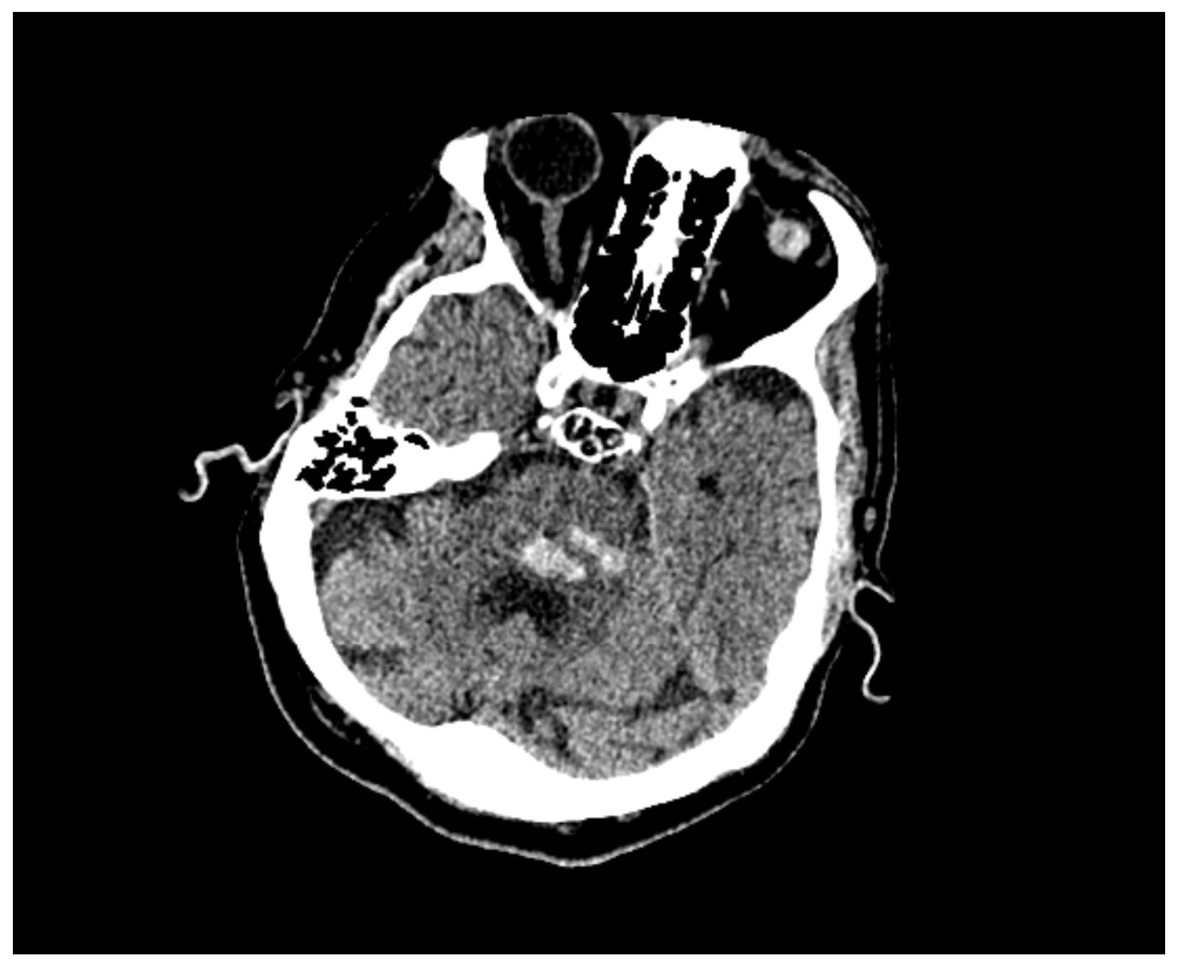
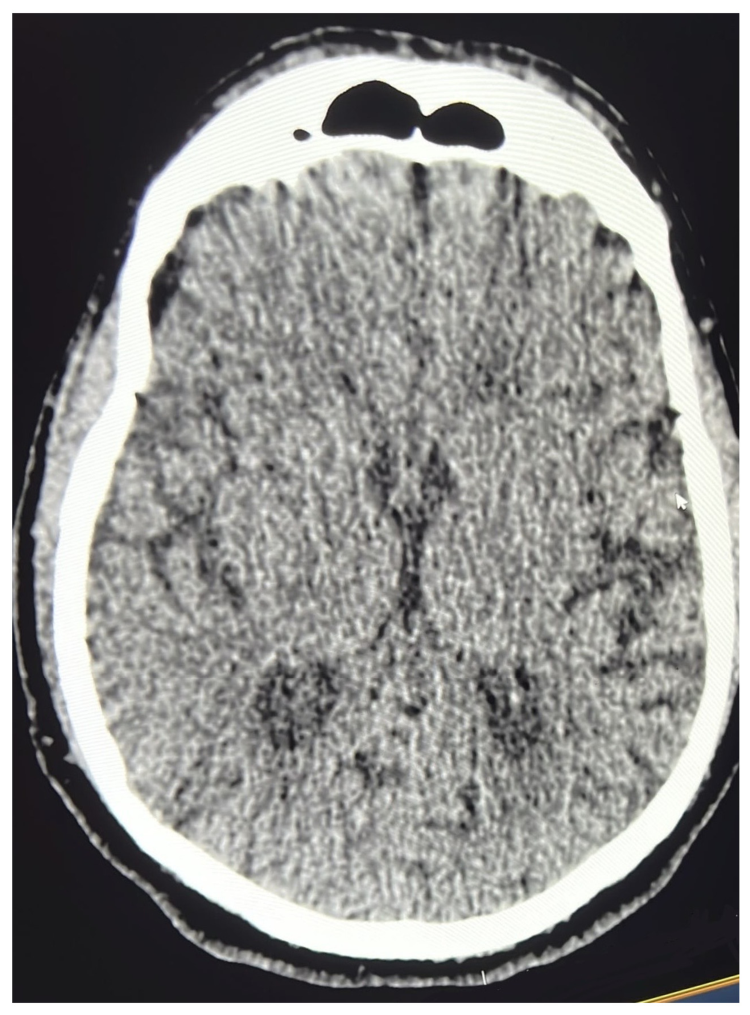
2.4. Diagnostic Assessment
2.5. Differential Diagnosis and Diagnostic Reasoning
2.6. Management and Follow-Up
2.7. Focused Literature Search
3. Discussion
3.1. Strengths and Limitations
3.2. Patient Perspective
4. Conclusions
Author Contributions
Funding
Institutional Review Board Statement
Informed Consent Statement
Data Availability Statement
Conflicts of Interest
Abbreviations
| AHS | Alien hand syndrome |
| CT | Computed tomography |
| EEG | Electroencephalography |
| ICD | International Classification of Diseases |
| ICF | International Classification of Functioning, Disability and Health |
| MRI | Magnetic resonance imaging |
| NIHSS | National Institutes of Health Stroke Scale |
References
- Doody, R.S.; Jankovic, J. The alien hand and related signs. J. Neurol. Neurosurg. Psychiatry 1992, 55, 806–810. [Google Scholar] [CrossRef] [PubMed]
- Hassan, A.; Josephs, K.A. Alien hand syndrome. Curr. Neurol. Neurosci. Rep. 2016, 16, 73. [Google Scholar] [CrossRef] [PubMed]
- Sarva, H.; Deik, A.; Severt, W.L. Pathophysiology and treatment of alien hand syndrome. Tremor Other Hyperkinet. Mov. 2014, 4, 241. [Google Scholar] [CrossRef]
- Manea, M.C.; Iliuta, F.P.; Manea, M.; Lacau, R.M.; Varlam, C.I.; Mares, A.M.; Ciobanu, C.A.; Ciobanu, A.M. Alien hand syndrome: Pathophysiology, semiology and differential diagnosis with psychiatric disorders (Review). Biomed. Rep. 2024, 20, 74. [Google Scholar] [CrossRef] [PubMed]
- Goldstein, K. Zur Lehre von der motorischen Apraxie. J. Psychol. Neurol. 1908, 11, 169–187; 270–283. [Google Scholar]
- Brion, S.; Jedynak, C.P. Troubles du transfert interhémisphérique (disconnexion calleuse). À propos de trois observations de tumeurs du corps calleux. Le signe de la main étrangère. Rev. Neurol. 1972, 126, 257–266. [Google Scholar] [PubMed]
- Della Sala, S.; Marchetti, C.; Spinnler, H. Right-sided anarchic (alien) hand: A longitudinal study. Neuropsychologia 1991, 29, 1113–1127. [Google Scholar] [CrossRef] [PubMed]
- Feinberg, T.E.; Schindler, R.J.; Flanagan, N.G.; Haber, L.D. Two alien hand syndromes. Neurology 1992, 42, 19–24. [Google Scholar] [CrossRef] [PubMed]
- Kloesel, B.; Czarnecki, K.; Muir, J.J.; Keller, A.S. Sequelae of a left-sided parietal stroke: Posterior alien hand syndrome. Neurocase 2010, 16, 488–493. [Google Scholar] [CrossRef] [PubMed]
- Nowak, D.A.; Bösl, K.; Lüdemann-Podubecka, J.; Gdynia, H.J.; Ponfick, M. Recovery and outcome of frontal alien hand syndrome after anterior cerebral artery stroke. J. Neurol. Sci. 2014, 338, 203–206. [Google Scholar] [CrossRef] [PubMed]
- Ay, H.; Buonanno, F.S.; Price, B.H.; Le, D.A.; Koroshetz, W.J. Sensory alien hand syndrome: Case report and review of the literature. J. Neurol. Neurosurg. Psychiatry 1998, 65, 366–369. [Google Scholar] [CrossRef] [PubMed][Green Version]
- Bundick, T., Jr.; Spinella, M. Subjective experience, involuntary movement, and posterior alien hand syndrome. J. Neurol. Neurosurg. Psychiatry 2000, 68, 83–85. [Google Scholar] [CrossRef] [PubMed]
- Zainudin, M.F.; Soo, K.C.; Nyein Yin, K. Case report: Callosal disconnection syndrome manifesting as mixed frontal-callosal-posterior alien hand syndrome following extensive corpus callosum infarct [version 2; peer review: 2 approved]. F1000Research 2024, 12, 529. [Google Scholar] [CrossRef] [PubMed]
- World Health Organization. ICD-10 Version: 2019. Available online: https://icd.who.int/browse10/2019/en (accessed on 13 July 2026).
- World Health Organization. ICD-11 for Mortality and Morbidity Statistics, 2026-01. Available online: https://icd.who.int/browse/2026-01/mms/en (accessed on 13 July 2026).
- World Health Organization. International Classification of Functioning, Disability and Health (ICF). Available online: https://www.who.int/standards/classifications/international-classification-of-functioning-disability-and-health (accessed on 13 July 2026).
- Rafiei, N.; Chang, G.Y. Right sensory alien hand phenomenon from a left pontine hemorrhage. J. Clin. Neurol. 2009, 5, 46–48. [Google Scholar] [CrossRef] [PubMed][Green Version]
- Mirza, M.A.; John, A.A.; Javali, M.; Mahale, R.; Mehta, A.; Srinivasa, R. Alien limb phenomenon in pontine hemorrhage: A rare presentation. Neurol. India 2016, 64, 554–556. [Google Scholar] [CrossRef] [PubMed]
- Hosokawa, K.; Sakamoto, K.; Hirayama, K.; Nakanowatari, T. A case of supernumerary phantom limb and suspected posterior alien hand syndrome after pontine hemorrhage. Neurol. India 2022, 70, 443–445. [Google Scholar] [CrossRef] [PubMed]
- Gagnier, J.J.; Kienle, G.; Altman, D.G.; Moher, D.; Sox, H.; Riley, D.; CARE Group. The CARE guidelines: Consensus-based clinical case reporting guideline development. Dtsch. Arztebl. Int. 2013, 110, 603–608. [Google Scholar] [CrossRef] [PubMed]



| Time Point | Clinical Event |
|---|---|
| Day 0 | Sudden sensation of heat in the head, transient loss of consciousness, fecal incontinence, fall, and facial injury. |
| Day 0 | Cranial CT demonstrated a left pontine hemorrhage, while diffusion-weighted MRI showed no evidence of acute ischemia; the patient was admitted to the intensive care unit. |
| Days 1–14 | Intensive care unit follow-up. |
| Week 2 | Transfer to our hospital for neurological management. |
| Week 2 | Right-sided involuntary hand movements, impaired spatial control, involuntary levitation, competitive reaching, proprioceptive impairment, and mild lower-limb involvement were documented. |
| Hospital stay | Serial cranial CT showed reduction in hemorrhage size. No specific pharmacological treatment was initiated. The NIHSS, assessed 15 days after admission to our hospital, was 6 points. |
| Discharge | Clinical condition was stable; cognitive-behavioral rehabilitation was recommended, but the patient was unable to participate because transportation difficulties prevented regular outpatient attendance; physical therapy and rehabilitation were recommended. |
| Approximately 3 months after discharge | According to information obtained from the patient’s physician relatives, abnormal movements had resolved and independent gait had improved. No formal neurological examination was performed. |
| Approximately 2 years after hemorrhage | According to information obtained from the patient’s physician relatives, no evident cognitive decline was reported. No formal neuropsychological assessment was performed. |
| Alternative Diagnosis | Reasoning in This Case |
|---|---|
| Sensory ataxia | Clearly present and likely contributory, but it did not fully account for loss of agency, involuntary levitation, competitive reaching, and autonomous apparently purposeful activity. |
| Chorea or dystonia | The movements were not primarily random, flowing, or continuously patterned. The thalamic-hand-like posture was noted but did not explain the full autonomous behavioral phenotype. |
| Ideomotor apraxia | Comprehension was preserved and the patient attempted commanded movements. Apraxia could not be formally excluded, but it would not alone explain involuntary competitive movements and the subjective loss of agency. |
| Functional neurological disorder | The syndrome emerged after a structural pontine hemorrhage with concordant focal sensory and ocular motor findings. No positive signs of inconsistency or incongruence were documented, although formal testing for functional signs was not performed. |
| Epileptic movements | EEG was not performed; however, the hand behavior was persistent rather than brief, stereotyped, or paroxysmal and occurred without altered awareness. |
| Drug-induced movements | No temporally related medication trigger was identified in the available records. |
| Time Point | Assessment Source | Clinical Status |
|---|---|---|
| Admission to our hospital | Direct neurological examination | Frequent involuntary right-hand behavior, levitation, impaired spatial control, intermanual conflict, inability to walk without support, and impaired sitting balance. The NIHSS, assessed 15 days after admission, was 6 points. |
| Discharge | Direct clinical observation | Clinically stable; physical therapy and rehabilitation recommended. No standardized functional score was recorded. |
| Approximately 3 months after discharge | Information from physician relatives | Abnormal movements reportedly resolved and independent gait improved. No formal neurological examination was performed. |
| Approximately 2 years after hemorrhage | Information from physician relatives | No evident cognitive decline was reported. No formal neuropsychological assessment was performed. |
Disclaimer/Publisher’s Note: The statements, opinions and data contained in all publications are solely those of the individual author(s) and contributor(s) and not of MDPI and/or the editor(s). MDPI and/or the editor(s) disclaim responsibility for any injury to people or property resulting from any ideas, methods, instructions or products referred to in the content. |
© 2026 by the authors. Licensee MDPI, Basel, Switzerland. This article is an open access article distributed under the terms and conditions of the Creative Commons Attribution (CC BY) license.
Share and Cite
Demir, Ü.F.; Dilbaz, F.K.; Memur, N.B. Alien Hand Syndrome Following Pontine Hemorrhage: A Case Report of Rare Mixed Phenomenology. Reports 2026, 9, 233. https://doi.org/10.3390/reports9030233
Demir ÜF, Dilbaz FK, Memur NB. Alien Hand Syndrome Following Pontine Hemorrhage: A Case Report of Rare Mixed Phenomenology. Reports. 2026; 9(3):233. https://doi.org/10.3390/reports9030233
Chicago/Turabian StyleDemir, Ülkü Figen, Fatmanur Karakuş Dilbaz, and Nur Banu Memur. 2026. "Alien Hand Syndrome Following Pontine Hemorrhage: A Case Report of Rare Mixed Phenomenology" Reports 9, no. 3: 233. https://doi.org/10.3390/reports9030233
APA StyleDemir, Ü. F., Dilbaz, F. K., & Memur, N. B. (2026). Alien Hand Syndrome Following Pontine Hemorrhage: A Case Report of Rare Mixed Phenomenology. Reports, 9(3), 233. https://doi.org/10.3390/reports9030233