All articles published by MDPI are made immediately available worldwide under an open access license. No special
permission is required to reuse all or part of the article published by MDPI, including figures and tables. For
articles published under an open access Creative Common CC BY license, any part of the article may be reused without
permission provided that the original article is clearly cited. For more information, please refer to
https://www.mdpi.com/openaccess.
Feature papers represent the most advanced research with significant potential for high impact in the field. A Feature
Paper should be a substantial original Article that involves several techniques or approaches, provides an outlook for
future research directions and describes possible research applications.
Feature papers are submitted upon individual invitation or recommendation by the scientific editors and must receive
positive feedback from the reviewers.
Editor’s Choice articles are based on recommendations by the scientific editors of MDPI journals from around the world.
Editors select a small number of articles recently published in the journal that they believe will be particularly
interesting to readers, or important in the respective research area. The aim is to provide a snapshot of some of the
most exciting work published in the various research areas of the journal.
We investigate dark photon emission from the final state leptons in the rare decay within a point-like description of the parent transition. The physical electron mass and exact three-body kinematics are retained throughout the complete phase space for each dark photon mass in the interval . By normalizing the radiative width to the corresponding non-radiative width, we obtain dimensionless radiation factors that are independent of the unknown normalization of the effective amplitude. This formulation allows the mass dependence, polarization content, and spectral shape to be studied without fixing the poorly constrained kinetic mixing parameter. A covariant decomposition separates the transverse and longitudinal dark photon contributions, while normalized dilepton invariant mass spectra describe the event kinematics. Across the scanned mass interval, the mixing-independent pseudoscalar radiation factor decreases by more than nine orders of magnitude and approaches zero at the kinematic endpoint. The transverse modes dominate throughout the scanned interval, while the longitudinal fraction remains approximately to . The normalized dilepton invariant mass spectrum shifts toward lower masses as increases. After normalization, the scalar and pseudoscalar radiation factors differ only through finite electron mass effects. These results provide a quantitative polarization-resolved benchmark for the point-like lepton final-state radiation component and can serve as baseline input for more complete phenomenological studies of rare charm decays.
The search for physics beyond the Standard Model increasingly includes light states with weak couplings, since such particles may evade direct production at high energies while remaining accessible to precision and intensity measurements. A simple realization is an additional Abelian gauge field that couples weakly to the electromagnetic current through kinetic mixing [1,2,3]. This mechanism motivates a hidden vector boson that can mediate weak interactions between the visible and secluded sectors below the electroweak scale [4]. Subsequent theoretical developments established the phenomenology of dark photons, proposed dedicated production strategies for electron fixed target experiments and electron-positron colliders, and summarized the expected experimental sensitivities over a broad range of and search channels [5,6,7,8]. The resulting experimental program now covers several complementary signatures. Electron beam experiments constrain visible production at low masses [9,10]. Electron-positron colliders and neutral meson decay measurements test narrow visible resonances [11,12,13,14]. Missing energy measurements and proton collision data probe invisible decays and muon states [15,16,17]. More recent searches have further broadened this experimental program. NA64 has set stronger missing energy constraints on light dark matter production mediated by , while NA62 has searched for visible leptonic decays of dark photons with long lifetimes using beam dump data [18,19]. Dedicated accelerator projects have also extended the future discovery reach through projected sensitivity studies for SHiP [20], the DarkSHINE missing momentum experiment [21], direct searches at FASER [22], and the proposed Lohengrin electron fixed-target experiment [23]. Taken together, these theoretical and experimental developments show that dark photon signals depend sensitively on the mixing interaction, , the available phase space, and the accessible decay channels. Consequently, the finite mass of an on-shell must be treated explicitly, and its emission cannot be obtained through a simple reinterpretation of real photon radiation.
Final state radiation (FSR) from charged leptons provides a clean framework for studying these finite mass effects separately from additional dynamical contributions. In , the dark photon can be emitted from either outgoing lepton. The two emission diagrams cannot be treated as independent contributions to the decay probability. Their amplitudes must be summed coherently to construct the complete radiation current before the squared matrix element is evaluated. The resulting current satisfies the Ward identity, and the associated interference term is an essential part of the physical decay rate. The classic analyses by Bloch and Nordsieck and by Yennie, Frautschi, and Suura established the treatment of infrared singularities in quantum electrodynamics [24,25]. Kinoshita, Lee, and Nauenberg showed how mass singularities cancel when physically degenerate final states are combined [26,27]. Weinberg further exposed the universal structure of soft radiation [28]. Those results control the massless limit, but the problem considered here has an on-shell vector with nonzero . Its mass changes the regions associated with soft and collinear enhancement, reduces the allowed three-body phase space, and introduces a physical longitudinal polarization. These effects require an exact finite-mass calculation rather than a soft vector or collinear approximation.
Rare charm decays provide a useful environment for studying this radiation component because flavor-changing neutral currents in the charm sector are strongly suppressed at short distance within the Standard Model. General analyses of rare D decays show that long-distance hadronic dynamics can dominate exclusive rates even when the underlying short-distance transition is small [29,30]. The radiative leptonic modes and have already been examined with both Standard Model and new physics contributions [31]. Correlations between – mixing and also demonstrate how rare leptonic decays can test interactions that are difficult to isolate elsewhere [32]. Related studies of inclusive and exclusive dilepton channels identify observables that may still retain sensitivity to short-distance physics and new interactions [33,34]. Experimentally, Belle obtained at confidence level [35]. The additional particle in enlarges the kinematic information but also allows several distinct radiation sources. In contrast, radiation from the final electron and positron defines a gauge-invariant point-like contribution whose mass dependence and polarization content can be studied without specifying additional hadronic amplitudes. Isolating this contribution provides a controlled baseline for more complete treatments of the decay. These considerations motivate a finite mass benchmark for the point-like lepton radiation component that resolves the physical polarizations and removes dependence on the unknown normalization of the underlying amplitude.
It is worth noting that the mass interval considered here includes the region around associated with the X17 anomaly [36,37]. For a hypothetical spin-1 X17 state with a vector coupling to electrons, the present calculation may provide a useful benchmark for the point-like lepton FSR component near this mass scale. Since X17 interpretations can involve additional model-dependent couplings and hadronic dynamics, a dedicated phenomenological analysis of the X17 hypothesis is beyond the scope of this work.
In this work, we calculate the point-like FSR contribution to , retaining the exact three-body kinematics and the full dependence on the physical electron and dark photon masses. No soft vector or collinear approximation is employed. We explicitly resolve the transverse and longitudinal physical polarizations of the on-shell massive vector and construct normalized observables for local pseudoscalar and scalar leptonic vertices. By normalizing the radiative widths to the corresponding non-radiative widths, the unknown normalization of the underlying amplitude is eliminated. The resulting radiation factors, polarization fractions, and normalized spectra therefore define a gauge-invariant benchmark for the point-like lepton radiation component, rather than a complete prediction including structure-dependent or long-distance charm contributions. The numerical implementation is described in Section 3.
2. Interaction Model and Decay Kinematics
We consider the on-shell decay of a neutral spin-zero meson into an electron, a positron, and a massive dark photon. The four-momenta of the parent meson, electron, positron, and dark photon are denoted by p, , , and k, respectively. Their masses are denoted by , , and , where is the dark photon mass. Four-momentum conservation and the on-shell conditions are
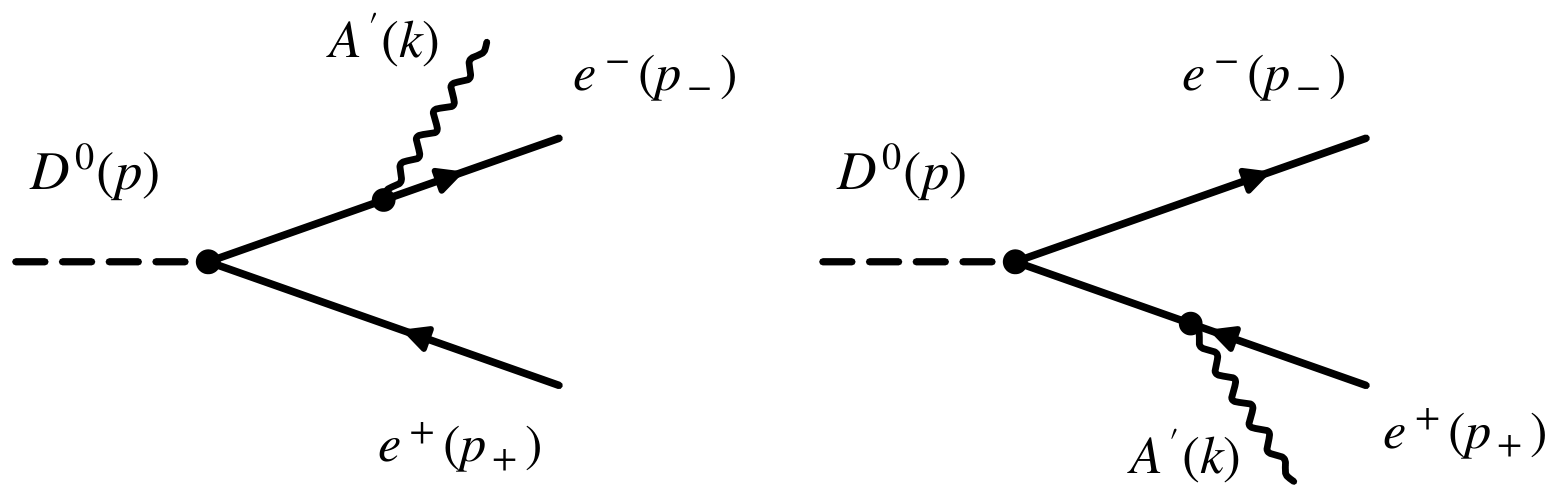
Only final-state radiation from the outgoing electron and positron is retained. The dark photon can therefore be emitted from either of the two outgoing lepton lines, as shown in Figure 1. Both diagrams contribute to the same physical final state, and their amplitudes must be summed coherently before the squared matrix element is evaluated. The non-radiative transition is represented by a local momentum-independent vertex. Consequently, the two lepton emission diagrams constitute the complete radiation current within the present point-like model. Radiation associated with hadronic structure, long-distance charm dynamics, and interference with omitted amplitudes is not included. Natural units and the metric are used throughout.
To leading order in the kinetic mixing parameter , the dark photon interaction with the electron current and the parent decay amplitude are written as
where denotes the electron field, e is the magnitude of the electron charge, and is the on-shell fine-structure constant. The label distinguishes the pseudoscalar and scalar leptonic structures of the effective transition amplitude, with and denoting the corresponding effective couplings. The pseudoscalar structure is adopted as the reference case, while the scalar structure provides an independent test of the Dirac structure of the effective interaction. The corresponding two-body width is
No initial spin average is required because the parent meson is spinless. For either choice of X, the same effective coupling appears in the radiative and non-radiative widths and therefore cancels in their ratio.
The three-body phase space is conveniently described by the Lorentz invariants
where is the electron pair invariant mass. Only s and t are independent. The exact physical region is
The allowed Dalitz region closes at both endpoints of the s interval. In particular, it collapses when approaches , which requires the integrated three-body width to vanish continuously.
After summing over final lepton spins and the three physical dark photon polarizations, the differential and integrated FSR widths are
Equation (6) is the starting point for all numerical observables discussed below. The limit is meaningful at the amplitude and differential levels, but the cut-free real photon width is infrared singular. The numerical scan therefore begins at a finite dark photon mass.
3. Radiative Amplitude and Numerical Implementation
The electron and positron emission diagrams contain the propagator denominators
With the momentum assignments of Equation (1) and the invariants of Equation (4), the complete FSR amplitude is
The relative structure and sign of the two contributions are fixed by the opposite electric charges of the outgoing electron and positron. Using the external Dirac equations, contraction of the complete current with the emitted momentum gives
This Ward identity holds at every physical phase space point for both effective vertex structures. Current conservation eliminates contributions proportional to , while leaving the physical longitudinal polarization of the massive vector intact.
A covariant separation of the longitudinal and transverse contributions is obtained from
Here represents the sum over the two transverse helicities, while isolates the single longitudinal helicity. Defining , the spin-summed tensor and the polarization-resolved widths are
Equations (9)–(11) provide complementary analytic checks. Equation (9) verifies current conservation, Equation (10) resolves the physical polarization content, and Equation (11) requires the independently integrated transverse and longitudinal contributions to reproduce the total rate. These covariant expressions are evaluated numerically over the exact three-body phase space defined in Equation (5).
All dimensional quantities are converted to GeV in the numerical evaluation, although selected masses are reported in MeV where convenient. The numerical inputs are , , and [38], with . The parent lifetime enters only when an absolute width is converted into a branching fraction and does not affect the normalized radiation factors. The electron mass is retained exactly throughout the calculation, and no soft vector or collinear approximation is employed.
For numerical stability, the physical Dalitz region is mapped onto the unit square according to
where and . This transformation prevents sampling outside the physical region and remains well conditioned when the available phase space becomes narrow near the endpoint.
The unknown normalization of the non-radiative amplitude is removed by forming dimensionless ratios. The observables used in the numerical analysis are
Each radiation amplitude contains one factor of , so every radiative width is proportional to . The calculation may therefore be performed at , after which the physical result is recovered by multiplication by . The normalized spectrum isolates the spectral shape from the rapidly changing total rate.
The two-dimensional phase space integrals in Equation (12) were evaluated using nested adaptive Gauss–Kronrod quadrature on the unit square. The Ward identity, electron-positron exchange symmetry, and polarization closure were used as internal checks of the numerical implementation. The unit normalization of and the vanishing of the width at the kinematic endpoint were also checked.
4. Numerical Results and Benchmark Implications
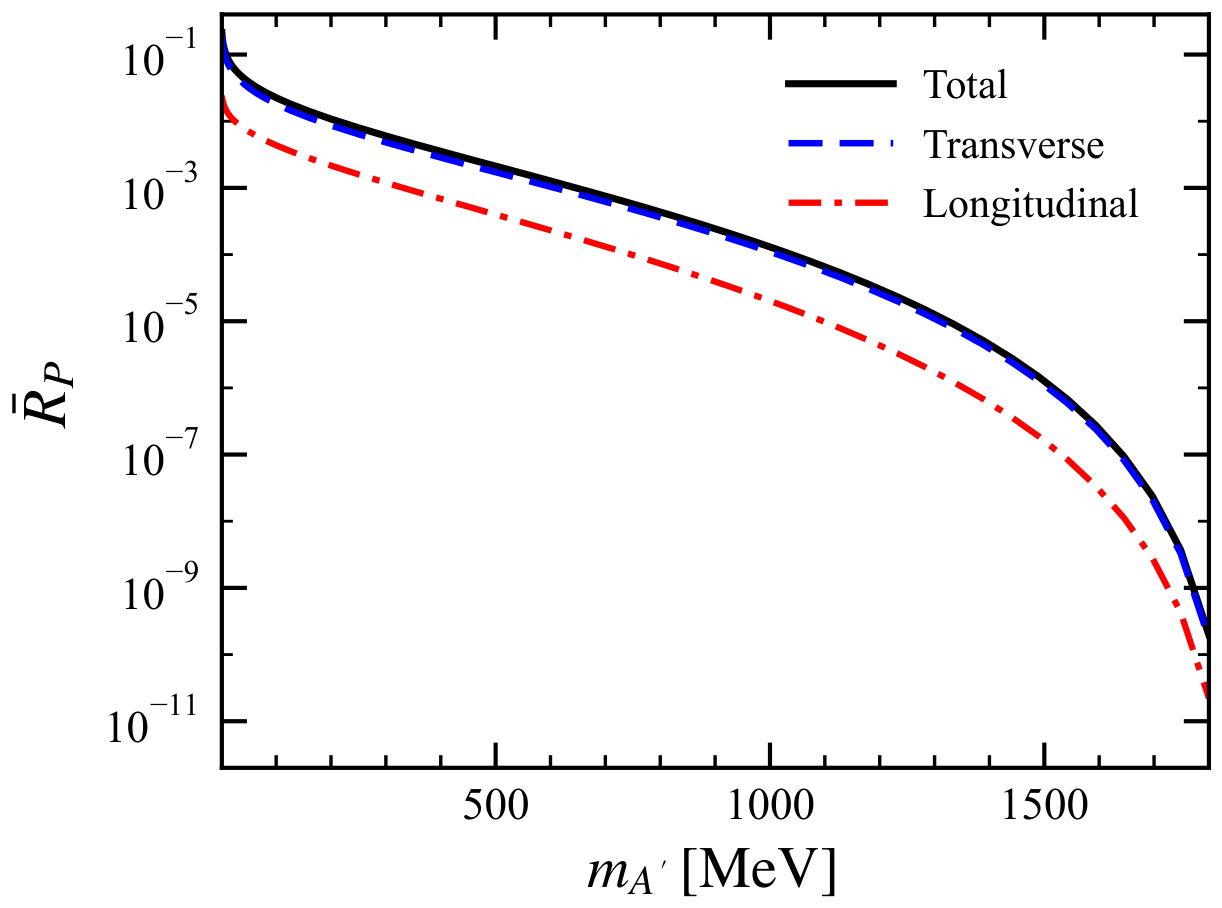
The numerical scan covers , with the upper end remaining below the exact kinematic endpoint . The benchmark lies below the threshold and should therefore be interpreted as a production-level result rather than a visible dielectron signal benchmark. We first examine the mass dependence of the total radiation factor and its polarization composition, shown in Figure 2. We then assess the sensitivity to the effective leptonic vertex structure and the associated branching fraction envelope, and finally discuss the dilepton invariant mass spectrum.
The mixing-independent pseudoscalar radiation factor decreases monotonically by more than nine orders of magnitude across the scanned mass range. At small , configurations in which the emitted vector carries little energy retain the enhancement associated with real photon radiation. As increases, this enhancement weakens while the available three-body phase space contracts. These two effects account for the rapid suppression of the radiation factor and drive the total width continuously toward zero at the kinematic endpoint.
The polarization decomposition provides complementary information about the structure of the signal. The transverse modes dominate throughout the scanned interval, while the longitudinal fraction remains approximately between and and develops a broad maximum at intermediate masses. This nonmonotonic behavior reflects the competition between the mass dependence of the longitudinal polarization vector and the reduction of the recoil phase space. It also clarifies the role of current conservation. The Ward identity removes the unphysical component parallel to , but it does not eliminate the physical longitudinal helicity of a massive vector particle. The longitudinal contribution should therefore be retained in signal modeling over the full mass range considered here.
To assess the dependence on the effective leptonic vertex structure and to connect the normalized radiation rate with the experimental constraint on the two body decay, we define
where denotes the confidence level upper limit reported by Belle [35]. This relation defines a benchmark envelope under the assumption that the point-like amplitude saturates the experimental upper limit and is not reduced by destructive interference with additional non-radiative amplitudes. Representative values of all four quantities are collected in Table 1.
After normalization to their respective two-body widths, the scalar and pseudoscalar radiation factors remain nearly identical, with relative differences below the per mille level throughout the tabulated range. Within the present point-like model, this small residual difference can be attributed to finite electron mass effects. The last column of Table 1 combines with the experimental upper limit on to give a mixing-independent branching fraction envelope. For a specified value of the kinetic mixing parameter, the corresponding physical envelope is obtained by multiplying this column by . Its rapid decrease with follows directly from the suppression of , indicating that the point-like FSR contribution is largest at low dark photon masses. The resulting envelopes apply only to this contribution and do not include other possible contributions to .
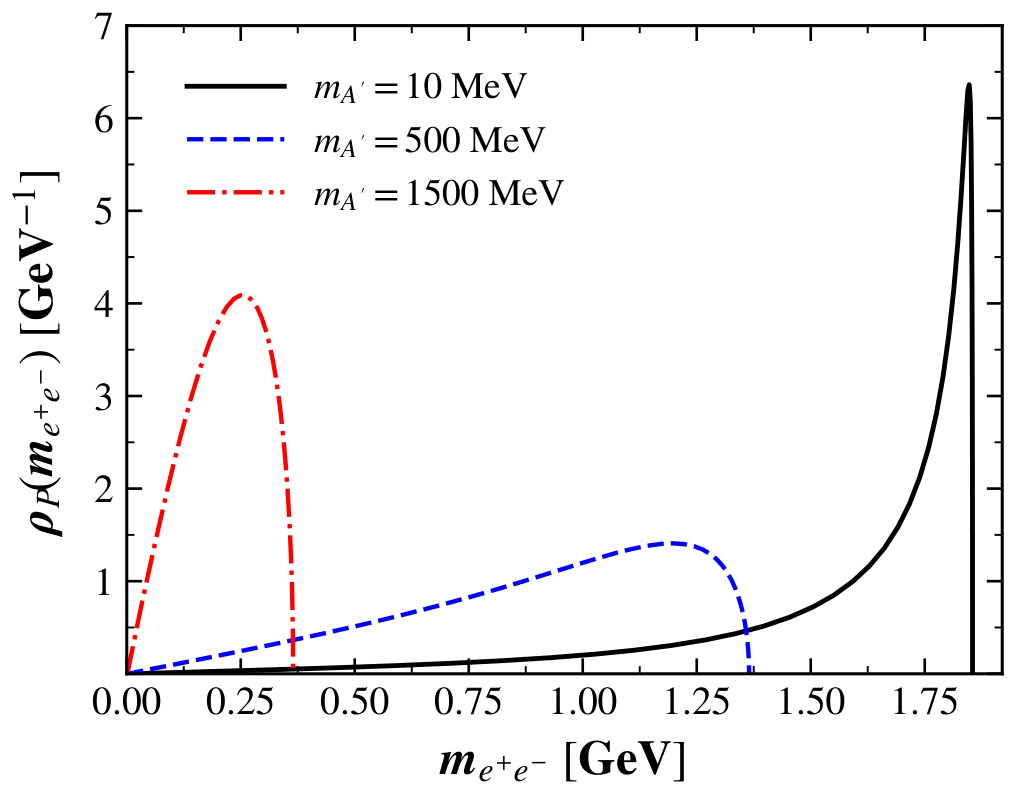
Finally, the normalized dilepton invariant mass spectrum defined in Equation (13) complements the integrated radiation factor by describing how events are distributed within the allowed phase space. Figure 3 shows the normalized pseudoscalar spectra for the representative dark photon masses , 500, and . As increases, less energy remains available to the dilepton system, and the spectral maximum moves systematically toward lower invariant masses. This behavior provides a characteristic kinematic signature of the dark photon mass hypothesis. The resulting spectral maxima should not be interpreted as resonances in , because the on-shell dark photon is emitted as the third external particle rather than appearing as an intermediate state in the dilepton channel. A prediction for an experimentally observable signal additionally requires the relevant decay branching fraction and lifetime, together with detector acceptance, selection efficiency, and background estimates.
5. Conclusions
We have presented a polarization-resolved calculation of the point-like final-state radiation contribution to , retaining the physical electron mass and exact three-body kinematics throughout the scanned dark photon mass interval. Normalizing the radiative width to the corresponding non-radiative width removes the unknown normalization of the underlying amplitude and yields dimensionless radiation factors. The resulting mass dependence provides a quantitative benchmark for the point-like dark photon radiation contribution. The longitudinal contribution remains nonnegligible throughout the scanned interval and should therefore be retained in signal modeling. The normalized dilepton invariant mass spectrum also shifts systematically toward lower values as increases, reflecting the reduced energy available to the dilepton system.
These results provide a finite mass benchmark for the point-like final state radiation contribution from leptons in rare decays. The radiation factors, polarization fractions, and normalized spectra can be used to validate independent calculations and as baseline inputs for more complete phenomenological analyses. The branching fraction envelopes apply only to the point-like lepton radiation contribution and do not constitute a complete prediction for . In particular, structure-dependent radiation, long-distance charm dynamics, and their possible interference with the lepton line contribution are beyond the scope of the present calculation. These effects may be incorporated in future extensions of the present framework.
Author Contributions
Conceptualization, methodology, data analysis, and original draft preparation, X.Z.; writing review and editing, R.C. All authors have read and agreed to the published version of the manuscript.
Funding
This study was supported by the Fujian Province Young and Middle-aged Scientists Fund (grant JAT241139), the Fujian Province Natural Science Fund General Project (grant 2025J011710), and the Longyan University Doctoral Research Startup Projects 2025 (grant LB2025003).
Data Availability Statement
The raw data supporting the conclusions of this article will be made available by the authors on request.
Conflicts of Interest
The authors declare no conflicts of interest.
References
Okun, L.B. Limits of electrodynamics: Paraphotons? Sov. Phys. J. Exp. Theor. Phys.1982, 56, 502–505. [Google Scholar]
Galison, P.; Manohar, A. Two Z’s or not two Z’s? Phys. Lett. B1984, 136, 279–283. [Google Scholar]
Holdom, B. Two U(1)’s and epsilon charge shifts. Phys. Lett. B1986, 166, 196–198. [Google Scholar]
Pospelov, M. Secluded U(1) below the weak scale. Phys. Rev. D2009, 80, 095002. [Google Scholar] [CrossRef] [Scilit]
Jaeckel, J.; Ringwald, A. The Low-Energy Frontier of Particle Physics. Annu. Rev. Nucl. Part. Sci.2010, 60, 405–437. [Google Scholar] [CrossRef] [Scilit]
Raggi, M.; Kozhuharov, V. Results and Perspectives in Dark Photon Physics. Riv. Nuovo Cim.2015, 38, 449–505. [Google Scholar] [CrossRef] [Scilit]
Filippi, A.; De Napoli, M. Searching in the Dark: The Hunt for the Dark Photon. Rev. Phys.2020, 5, 100042. [Google Scholar] [CrossRef] [Scilit]
Graham, M.; Hearty, C.; Williams, M. Searches for Dark Photons at Accelerators. Annu. Rev. Nucl. Part. Sci.2021, 71, 37–58. [Google Scholar] [CrossRef] [Scilit]
Abrahamyan, S.; Ahmed, Z.; Allada, K.; Anez, D.; Averett, T.; Barbieri, A.; Bartlett, K.; Beacham, J.; Bono, J.; Boyce, J.R.; et al. Search for a New Gauge Boson in Electron-Nucleus Fixed-Target Scattering by the APEX Experiment. Phys. Rev. Lett.2011, 107, 191804. [Google Scholar] [CrossRef] [Scilit] [PubMed]
Merkel, H.; Achenbach, P.; Ayerbe Gayoso, C.; Beranek, T.; Beričič, J.; Bernauer, J.C.; Böhm, R.; Bosnar, D.; Correa, L.; Debenjak, L.; et al. Search at the Mainz Microtron for Light Massive Gauge Bosons Relevant for the Muon g − 2 Anomaly. Phys. Rev. Lett.2014, 112, 221802. [Google Scholar] [CrossRef] [Scilit] [PubMed]
Lees, J.P.; Poireau, V.; Tisserand, V.; Grauges, E.; Palano, A.; Eigen, G.; Stugu, B.; Brown, D.N.; Feng, M.; Kerth, L.T.; et al. Search for a Dark Photon in e+e− Collisions at BABAR. Phys. Rev. Lett.2014, 113, 201801. [Google Scholar] [PubMed]
Batley, J.R.; Kalmus, G.; Lazzeroni, C.; Munday, D.J.; Slater, M.W.; Wotton, S.A.; Arcidiacono, R.; Bocquet, G.; Cabibbo, N.; Ceccucci, A.; et al. Search for the Dark Photon in π0 Decays. Phys. Lett. B2015, 746, 178–185. [Google Scholar] [CrossRef] [Scilit]
Anastasi, A.; Babusci, D.; Bencivenni, G.; Berlowski, M.; Bloise, C.; Bossi, F.; Branchini, P.; Budano, A.; Caldeira Balkeståhl, L.; Cao, B.; et al. Limit on the Production of a Low-Mass Vector Boson in e+e− → Uγ, U → e+e− with the KLOE Experiment. Phys. Lett. B2015, 750, 633–637. [Google Scholar] [CrossRef] [Scilit]
Ablikim, M.; Achasov, M.N.; Ai, X.C.; Albayrak, O.; Albrecht, M.; Ambrose, D.J.; Amoroso, A.; An, F.F.; An, Q.; Bai, J.Z.; et al. Dark Photon Search in the Mass Range between 1.5 and 3.4 GeV/c2. Phys. Lett. B2017, 774, 252–257. [Google Scholar] [CrossRef] [Scilit]
Banerjee, D.; Burtsev, V.; Cooke, D.; Crivelli, P.; Depero, E.; Dermenev, A.V.; Donskov, S.V.; Dubinin, F.; Dusaev, R.R.; Emmenegger, S.; et al. Search for Invisible Decays of Sub-GeV Dark Photons in Missing-Energy Events at the CERN SPS. Phys. Rev. Lett.2017, 118, 011802. [Google Scholar] [CrossRef] [Scilit] [PubMed]
Aaij, R.; Adeva, B.; Adinolfi, M.; Ajaltouni, Z.; Akar, S.; Albrecht, J.; Alessio, F.; Alexander, M.; Alfonso Albero, A.; Ali, S.; et al. Search for Dark Photons Produced in 13 TeV pp Collisions. Phys. Rev. Lett.2018, 120, 061801. [Google Scholar] [CrossRef] [Scilit] [PubMed]
Andreev, Y.M.; Banerjee, D.; Banto Oberhauser, B.; Bernhard, J.; Bisio, P.; Celentano, A.; Charitonidis, N.; Chumakov, A.G.; Cooke, D.; Crivelli, P.; et al. Search for Light Dark Matter with NA64 at CERN. Phys. Rev. Lett.2023, 131, 161801. [Google Scholar] [CrossRef] [Scilit] [PubMed]
Cortina Gil, E.; Jerhot, J.; Kleimenova, A.; Lurkin, N.; Zamkovsky, M.; Numao, T.; Velghe, B.; Wong, V.W.S.; Bryman, D.; Hives, Z.; et al. Search for Leptonic Decays of Dark Photons at NA62. Phys. Rev. Lett.2024, 133, 111802. [Google Scholar] [CrossRef] [Scilit] [PubMed]
SHiP Collaboration; Ahdida, C.; Akmete, A.; Albanese, R.; Alexandrov, A.; Anokhina, A.; Aoki, S.; Arduini, G.; Atkin, E.; Azorskiy, N.; et al. Sensitivity of the SHiP experiment to dark photons decaying to a pair of charged particles. Eur. Phys. J. C2021, 81, 451. [Google Scholar] [CrossRef] [Scilit]
Chen, J.; Chen, J.Y.; Chen, J.F.; Chen, X.; Fu, C.-B.; Guo, J.; He, L.; He, Z.-T.; Khaw, K.S.; Li, J.-L.; et al. Prospective study of light dark matter search with a newly proposed DarkSHINE experiment. Sci. China Phys. Mech. Astron.2023, 66, 211062. [Google Scholar] [CrossRef] [Scilit]
Abreu, H.; Anders, J.; Antel, C.; Ariga, A.; Ariga, T.; Atkinson, J.; Bernlochner, F.U.; Boeckh, T.; Boyd, J.; Brenner, L.; et al. Search for dark photons with the FASER detector at the LHC. Phys. Lett. B2024, 848, 138378. [Google Scholar] [CrossRef] [Scilit]
Bechtle, P.; Bespin, C.; Breton, D.; Orero Canet, C.; Desch, K.; Dreiner, H.; Freyermuth, O.; Gauld, R.; Gruber, M.; Blanch Gutiérrez, C.; et al. A proposal for the Lohengrin experiment to search for dark sector particles at the ELSA Accelerator. Eur. Phys. J. C2025, 85, 600. [Google Scholar] [CrossRef] [Scilit]
Bloch, F.; Nordsieck, A. Note on the Radiation Field of the Electron. Phys. Rev.1937, 52, 54–59. [Google Scholar] [CrossRef] [Scilit]
Yennie, D.R.; Frautschi, S.C.; Suura, H. The Infrared Divergence Phenomena and High-Energy Processes. Ann. Phys.1961, 13, 379–452. [Google Scholar] [CrossRef] [Scilit]
Kinoshita, T. Mass Singularities of Feynman Amplitudes. J. Math. Phys.1962, 3, 650–677. [Google Scholar] [CrossRef] [Scilit]
Lee, T.D.; Nauenberg, M. Degenerate Systems and Mass Singularities. Phys. Rev.1964, 133, B1549–B1562. [Google Scholar] [CrossRef] [Scilit]
Weinberg, S. Infrared Photons and Gravitons. Phys. Rev.1965, 140, B516–B524. [Google Scholar] [CrossRef] [Scilit]
Fajfer, S.; Prelovsek, S.; Singer, P. Rare Charm Meson Decays D → Pℓ+ℓ− and c → uℓ+ℓ− in the Standard Model and the Minimal Supersymmetric Standard Model. Phys. Rev. D2001, 64, 114009. [Google Scholar] [CrossRef] [Scilit]
Burdman, G.; Golowich, E.; Hewett, J.; Pakvasa, S. Rare Charm Decays in the Standard Model and Beyond. Phys. Rev. D2002, 66, 014009. [Google Scholar] [CrossRef] [Scilit][Green Version]
Fajfer, S.; Singer, P.; Zupan, J. The Radiative Leptonic Decays D0 → e+e−γ, μ+μ−γ in the Standard Model and Beyond. Eur. Phys. J. C2003, 27, 201–218. [Google Scholar] [CrossRef] [Scilit]
Golowich, E.; Hewett, J.; Pakvasa, S.; Petrov, A.A. Relating D0–0 Mixing and D0 → ℓ+ℓ− with New Physics. Phys. Rev. D2009, 79, 114030. [Google Scholar]
Paul, A.; Bigi, I.I.; Recksiegel, S. On D → Xuℓ+ℓ− within the Standard Model and Frameworks Like the Littlest Higgs Model with T Parity. Phys. Rev. D2011, 83, 114006. [Google Scholar] [CrossRef] [Scilit]
de Boer, S.; Hiller, G. Flavor and New Physics Opportunities with Rare Charm Decays into Leptons. Phys. Rev. D2016, 93, 074001. [Google Scholar] [CrossRef] [Scilit]
Petrič, M.; Starič, M.; Adachi, I.; Aihara, H.; Arinstein, K.; Aushev, T.; Bakich, A.M.; Balagura, V.; Barberio, E.; Belous, K.; et al. Search for Leptonic Decays of D0 Mesons. Phys. Rev. D2010, 81, 091102. [Google Scholar] [CrossRef] [Scilit]
Krasznahorkay, A.J.; Csatlós, M.; Csige, L.; Gácsi, Z.; Gulyás, J.; Hunyadi, M.; Kuti, I.; Nyakó, B.M.; Stuhl, L.; Timár, J.; et al. Observation of Anomalous Internal Pair Creation in 8Be: A Possible Indication of a Light, Neutral Boson. Phys. Rev. Lett.2016, 116, 042501. [Google Scholar] [CrossRef] [Scilit] [PubMed]
Feng, J.L.; Fornal, B.; Galon, I.; Gardner, S.; Smolinsky, J.; Tait, T.M.P.; Tanedo, P. Protophobic Fifth-Force Interpretation of the Observed Anomaly in 8Be Nuclear Transitions. Phys. Rev. Lett.2016, 117, 071803. [Google Scholar] [CrossRef] [Scilit] [PubMed]
Takahashi, F.; Hikasa, K.; Sumino, Y.; Tanabashi, M.; Tanaka, J.; Yokoyama, M.; Agashe, K.; Aielli, G.; Allanach, B.C.; Alvarez-Muñiz, J.; et al. Review of Particle Physics. Int. J. Mod. Phys. A2026, 41, 2630011. [Google Scholar] [CrossRef] [Scilit]
Figure 1.
Final state radiation (FSR) contributions to , with the dark photon emitted from the electron line (left) or the positron line (right). The two amplitudes are summed coherently.
Figure 1.
Final state radiation (FSR) contributions to , with the dark photon emitted from the electron line (left) or the positron line (right). The two amplitudes are summed coherently.
Figure 2.
Mixing independent pseudoscalar radiation factors for as functions of the dark photon mass. The black solid curve shows the total factor , while the blue dashed and red dash-dotted curves show the transverse and longitudinal contributions, and , respectively.
Figure 2.
Mixing independent pseudoscalar radiation factors for as functions of the dark photon mass. The black solid curve shows the total factor , while the blue dashed and red dash-dotted curves show the transverse and longitudinal contributions, and , respectively.
Figure 3.
Normalized dilepton invariant mass spectra for in the pseudoscalar benchmark. The black solid, blue dashed, and red dash-dotted curves correspond to , 500, and , respectively.
Figure 3.
Normalized dilepton invariant mass spectra for in the pseudoscalar benchmark. The black solid, blue dashed, and red dash-dotted curves correspond to , 500, and , respectively.
Table 1.
Representative values of the pseudoscalar radiation factor, longitudinal fraction, relative scalar and pseudoscalar difference, and mixing-independent branching fraction envelope.
Table 1.
Representative values of the pseudoscalar radiation factor, longitudinal fraction, relative scalar and pseudoscalar difference, and mixing-independent branching fraction envelope.
[MeV]
1
10
100
250
500
1000
1500
1800
Disclaimer/Publisher’s Note: The statements, opinions and data contained in all publications are solely those of the individual author(s) and contributor(s) and not of MDPI and/or the editor(s). MDPI and/or the editor(s) disclaim responsibility for any injury to people or property resulting from any ideas, methods, instructions or products referred to in the content.
Zhong, X.; Chen, R.
Polarization Resolved Dark Photon Radiation from Final State Leptons in D0 → e+e−A′. Particles2026, 9, 92.
https://doi.org/10.3390/particles9030092
AMA Style
Zhong X, Chen R.
Polarization Resolved Dark Photon Radiation from Final State Leptons in D0 → e+e−A′. Particles. 2026; 9(3):92.
https://doi.org/10.3390/particles9030092
Chicago/Turabian Style
Zhong, Xin, and Rongxin Chen.
2026. "Polarization Resolved Dark Photon Radiation from Final State Leptons in D0 → e+e−A′" Particles 9, no. 3: 92.
https://doi.org/10.3390/particles9030092
APA Style
Zhong, X., & Chen, R.
(2026). Polarization Resolved Dark Photon Radiation from Final State Leptons in D0 → e+e−A′. Particles, 9(3), 92.
https://doi.org/10.3390/particles9030092
Article Metrics
No
No
Article Access Statistics
For more information on the journal statistics, click here.
Multiple requests from the same IP address are counted as one view.
Zhong, X.; Chen, R.
Polarization Resolved Dark Photon Radiation from Final State Leptons in D0 → e+e−A′. Particles2026, 9, 92.
https://doi.org/10.3390/particles9030092
AMA Style
Zhong X, Chen R.
Polarization Resolved Dark Photon Radiation from Final State Leptons in D0 → e+e−A′. Particles. 2026; 9(3):92.
https://doi.org/10.3390/particles9030092
Chicago/Turabian Style
Zhong, Xin, and Rongxin Chen.
2026. "Polarization Resolved Dark Photon Radiation from Final State Leptons in D0 → e+e−A′" Particles 9, no. 3: 92.
https://doi.org/10.3390/particles9030092
APA Style
Zhong, X., & Chen, R.
(2026). Polarization Resolved Dark Photon Radiation from Final State Leptons in D0 → e+e−A′. Particles, 9(3), 92.
https://doi.org/10.3390/particles9030092