
Article

The Potential of the THESEUS Mission for Studies of Young Stellar Objects
1
Institute of Physics, University of Debrecen, Egyetem tér 1., H-4032 Debrecen, Hungary
2
Institute of Physics, Eötvös Loránd University, Pázmány Péter sétány 1/A, H-1117 Budapest, Hungary
3
Konkoly Observatory, HUN-REN Research Centre for Astronomy and Earth Sciences, Konkoly-Thege Miklós út 15–17, H-1121 Budapest, Hungary
4
Institute of Physics and Astronomy, ELTE Eötvös Loránd University, Pázmány Péter Sétány 1/A, H-1117 Budapest, Hungary
5
CSFK, MTA Centre of Excellence, Konkoly-Thege Miklós út 15–17, H-1121 Budapest, Hungary
6
INAF—Osservatorio di Astrofisica e Scienza dello Spazio di Bologna, Via Piero Gobetti 101, 40129 Bologna, Italy
7
School of Physics & Astronomy, University of Leicester, University Road, Leicester LE1 7RH, UK
8
Department of Astronomy, University of Geneva, ch. d’Ecogia 16, 1290 Versoix, Switzerland
9
Department of Astrophysics, University of Vienna, Türkenschanzstr. 17, 1180 Vienna, Austria
10
AIM-CEA/DRF/Irfu/Departement d’Astrophysique, CNRS, Université Paris-Saclay, Université Paris Cité, Orme des Merisiers, Bat. 709, 91191 Gif-sur-Yvette, France
11
INAF-Osservatorio Astrofisico di Arcetri, Largo E. Fermi 5, 50125 Firenze, Italy
12
Institute of Astronomy and Astrophysics, University of Tübingen, Sand 1, 72076 Tübingen, Germany
13
ESAC/ESA, Camino Bajo del Castillo, s/n., Urb. Villafranca del Castillo, Villanueva de la Cañada, 28692 Madrid, Spain
*
Author to whom correspondence should be addressed.
Particles 2026, 9(3), 91; https://doi.org/10.3390/particles9030091 (registering DOI)

Submission received: 30 June 2026 / Revised: 9 September 2026 / Accepted: 15 September 2026 / Published: 17 September 2026

Abstract

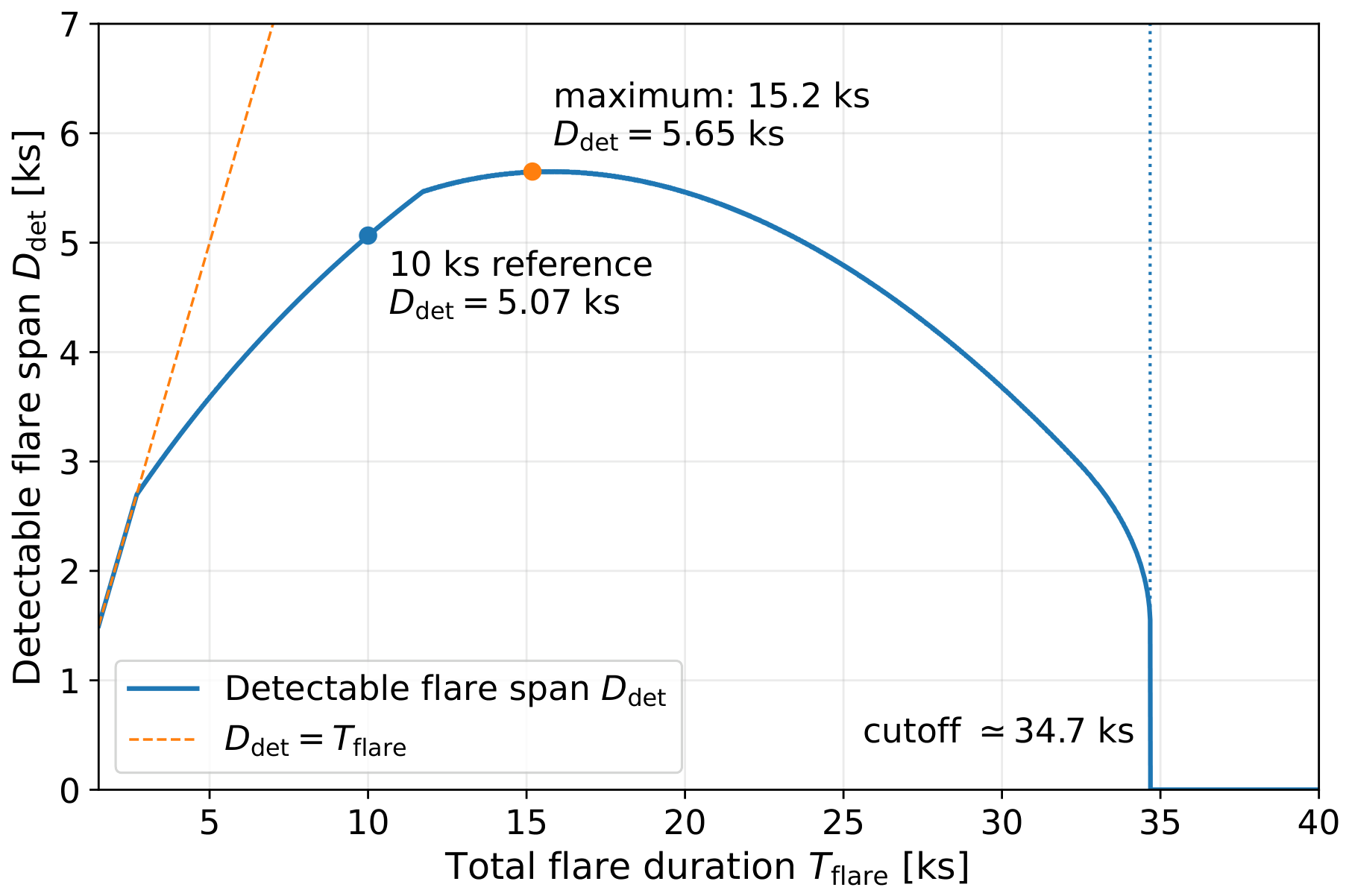
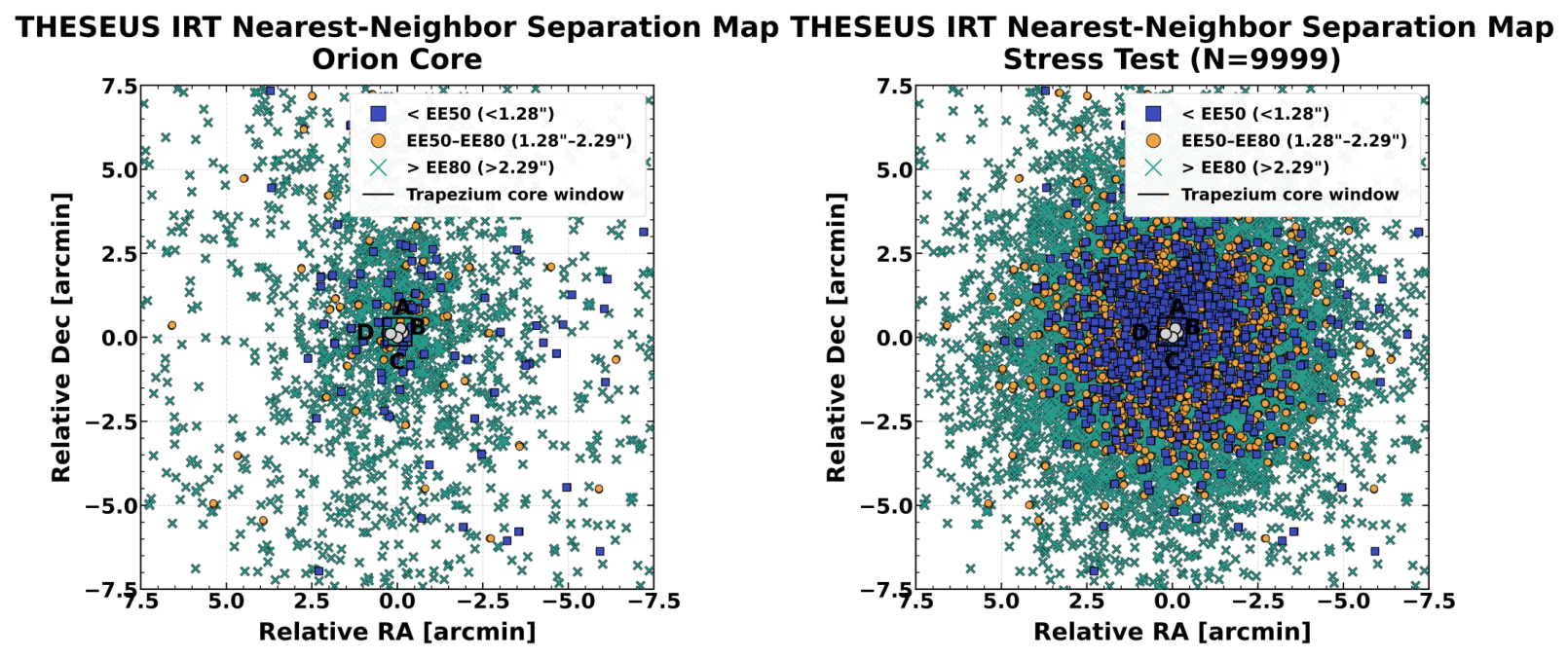
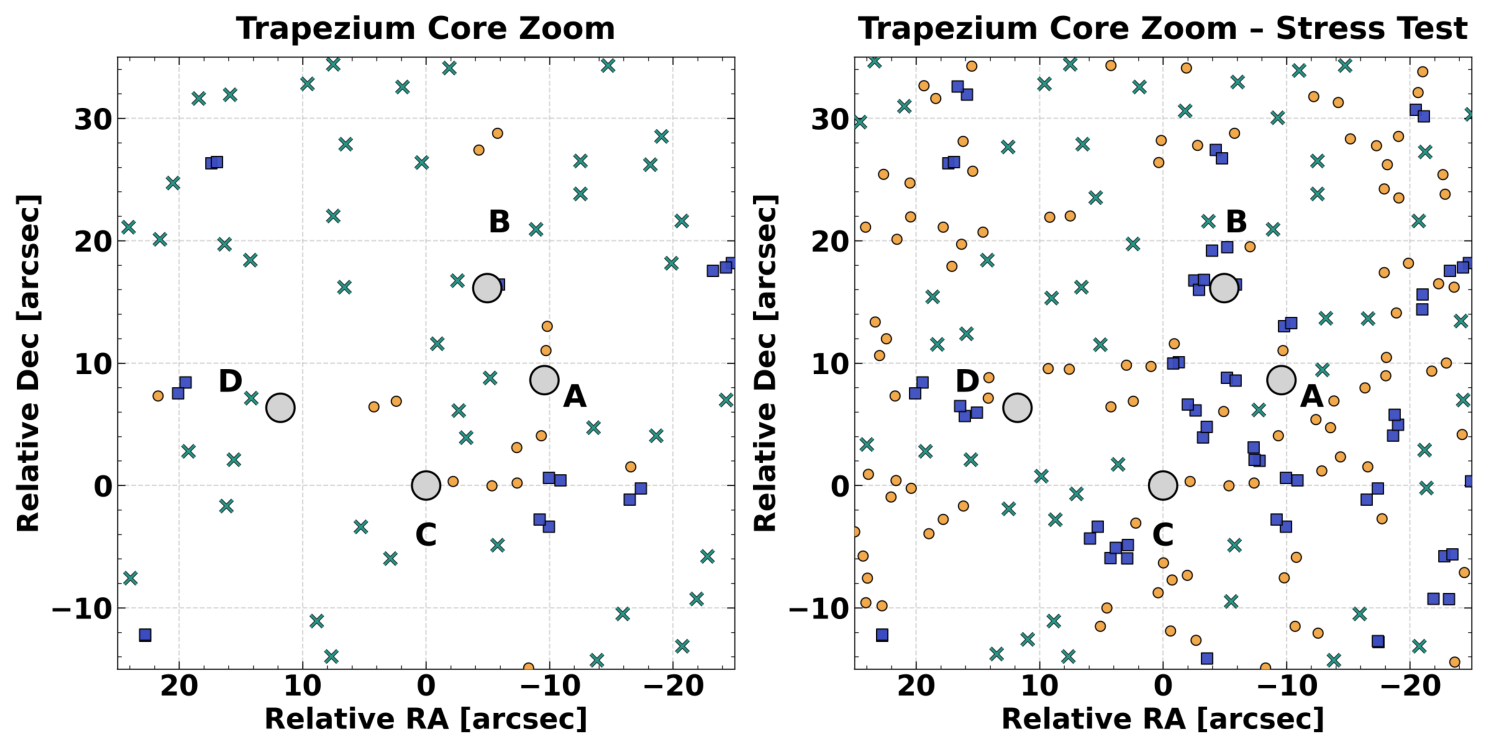
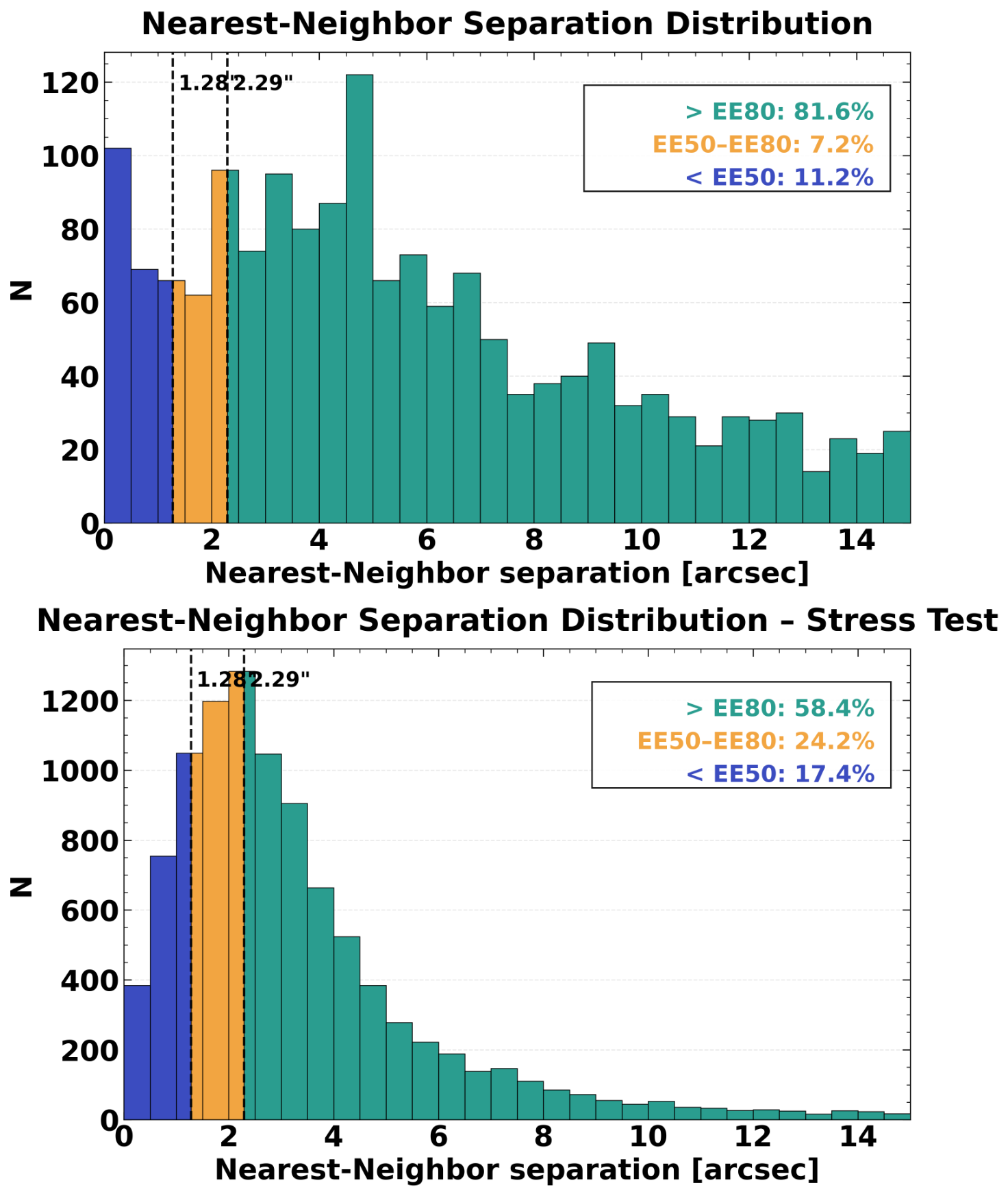
THESEUS is a proposed ESA M-class mission primarily designed for high-redshift gamma-ray burst studies, but its wide-field survey strategy and multi-instrument payload also offer significant opportunities for time-domain investigations of Galactic young stellar objects (YSOs). We assess the mission’s potential for YSO science by examining the detectability of energetic X-ray flares, the observability of Galactic star-forming regions, and the benefits of coordinated soft X-ray and near-infrared observations. Instrument characteristics are combined with literature-based YSO population estimates and Orion-derived flare statistics. SXI exposure maps are used to estimate region-dependent cumulative temporal coverage, while IRT crowding is characterized through nearest-neighbor separations relative to the expected EE50 and EE80 angular scales. The detailed distribution of the cumulative SXI exposure among individual observing intervals is not yet specified and is therefore treated separately as a temporal-sampling uncertainty, while additional sensitivity tests quantify the effects of flare duration and X-ray absorption. Using Orion as a benchmark, we derive comparative, model-dependent estimates indicating that THESEUS may detect substantial samples of energetic YSO flares during its nominal mission lifetime. A substantial fraction of sources are expected to have nearest-neighbor separations larger than the adopted IRT EE-based angular scales even in crowded regions, although unique source identification from SXI data alone may be challenging. THESEUS can therefore serve both as a transient discovery instrument and as a statistical probe of YSO high-energy variability.
Keywords: young stellar objects; X-ray flares; time-domain astronomy; star-forming regions; THESEUS mission; soft X-ray observations; infrared astronomy; stellar variability young stellar objects; X-ray flares; time-domain astronomy; star-forming regions; THESEUS mission; soft X-ray observations; infrared astronomy; stellar variability