
Article

Halo Nuclei from Ab Initio Nuclear Theory

1
TRIUMF, 4004 Wesbrook Mall, Vancouver, BC V6T 2A3, Canada
2
Department of Physics and Astronomy, University of Victoria, 3800 Finnerty Road, Victoria, BC V8P 5C2, Canada
3
Lawrence Livermore National Laboratory, 7000 East Ave, Livermore, CA 94550, USA
4
Université Paris-Saclay, CNRS/IN2P3, IJCLab, 91405 Orsay, France
5
Institut für Kernphysik, Johannes Gutenberg-Universität Mainz, 55128 Mainz, Germany
*
Author to whom correspondence should be addressed.
Particles 2026, 9(2), 57; https://doi.org/10.3390/particles9020057
Submission received: 20 March 2026 / Revised: 6 May 2026 / Accepted: 11 May 2026 / Published: 14 May 2026

Abstract

A realistic description of halo nuclei, characterized by low-lying breakup thresholds, requires a proper treatment of continuum effects. We have developed an ab initio approach, the No-Core Shell Model with Continuum (NCSMC), capable of describing both bound and unbound states in light nuclei in a unified way. With chiral two- and three-nucleon interactions as the only input, we can predict the structure and dynamics of halo and other light nuclei and, by comparing to available experimental data, test the quality of chiral nuclear forces. We review NCSMC calculations of weakly bound states and resonances of the exotic halo nuclei 6He, 8B, 11Be, and 15C. For the latter, we discuss its production in the capture reaction 14C(n, γ )15C. We highlight the challenges of a description of 6He as a Borromean n-n-4He system. Finally, we present our calculations of excited states in 10Be exhibiting a one-neutron halo structure and a large scale No-Core Shell Model investigation of 11Li as a precursor of a full n-n-9Li NCSMC study.

1. Introduction

Halo nuclei are exotic weakly bound systems with an extended single-nucleon or two-neutron density well beyond a tightly bound core. They were first discovered in the 11Li nucleus from a series of interaction cross-section measurements four decades ago [1], where the evidence suggested that this unstable nucleus exhibits a two-neutron halo structure around a central 9Li core and that the distribution of halo neutrons extends to the size of a nucleus with mass number 200 [2]. Similarly, the 6He nucleus is a prominent example of a Borromean quantum halo, i.e., a weakly-bound state of three particles ( α + n + n ) otherwise unbound in pairs, characterized by the large probability of configurations within classically forbidden regions of space [3]. Another prominent example is the 11Be featuring a parity-inverted ground state with an extended neutron-10Be S-wave halo [4].
There has been a very significant experimental effort, as well as a theoretical effort, to investigate halo nuclei [2,5,6,7,8,9,10,11]. In this paper, we discuss an ab initio, or first-principles, description of halo nuclei. Ab initio methods solve the many-body Schrödinger equation for the system of A nucleons interacting by forces derived within the chiral Effective Field Theory (EFT) formalism [12]. These methods have been applied to halo nuclei in the past, e.g., the No-Core Shell Model (NCSM) [13,14] and the nuclear lattice EFT [15,16]. As halo nuclei are characterized by low-lying breakup thresholds, a proper treatment of continuum effects is essential. Consequently, we focus on applications of the No-Core Shell Model with Continuum (NCSMC) [17,18,19], a method describing bound and unbound states in a unified way.
The paper is organized as follows. In Section 2, we describe the NCSMC method including the underlying NCSM [20] approach. In Section 3, we review NCSMC applications to neutron and proton halo nuclei. In Section 3.1, we discuss the parity-inversion in 11Be, we review the published results for the S-wave halo of its ground state, and we present new results for the P-wave halo of its first excited state. In Section 3.2, we present new results for 15C, which manifests a neutron S-wave halo ground state, and we discuss its production in the capture reaction 14C(n, γ )15C relevant for astrophysics. The properties of 8B with a P-wave proton halo ground state are reviewed in Section 3.3. Our new results for excited neutron halo states in 10Be are presented in Section 3.4. Applications of the three-body cluster NCSMC to the Borromean two-neutron halo nucleus 6He are reviewed in Section 3.5. Large-scale NCSM results for 11Li that also exhibit a Borromean two-neutron halo in its ground state are discussed in Section 3.6. These calculations serve as the prerequisite of a full three-body cluster NCSMC investigation. A concluding discussion is then given in Section 4.

2. Materials and Methods

The starting point of our method is the microscopic Hamiltonian:
H ^ = 1 A i < j = 1 A ( p ^ i p ^ j ) 2 2 m + i < j = 1 A V ^ i j N N + i < j < k = 1 A V ^ i j k 3 N ,
which describes nuclei as systems of A non-relativistic point-like nucleons interacting through realistic inter-nucleon interactions. The modern theory of nuclear forces is based on the framework of chiral Effective Field Theory (EFT) [12], with the Lagrangian expanded in powers of ( Q / Λ χ ) n , where Q is the external momentum and Λ χ represents the hard scale of the theory of the order of 1 GeV. Such an expansion allows a systematic improvement of the interaction and provides a hierarchy of the nucleon–nucleon (NN) and many-nucleon interactions which naturally arise in a consistent scheme [21,22].
As detailed in the next section, in the present work we apply several sets of chiral NN and chiral NN plus three-nucleon (3N) interactions consisting of NN interactions up to the third order (N2LO) [23], fourth order (N3LO) [24] or the fifth order (N4LO) [25] in the chiral expansion and a 3N interaction up to the N2LO order, in some cases including a sub-leading contact interaction [26], regulated by local regulators [27], non-local regulators [23] or a combination of both [28]. The interaction parameters, the low-energy constants (LECs), are determined typically in A = 2, 3, 4 nucleon systems, although the properties of medium mass nuclei can also be considered [23].
A faster convergence of our NCSMC calculations is obtained by softening the chiral interaction through the Similarity Renormalization Group (SRG) technique [29,30]. The SRG unitary transformation induces many-body forces that we include up to three-body level. The four- and higher-body induced terms are small at the λ SRG ≈ 1.8–2.0 fm−1 range of the resolution scale used in our present calculations.
In the NCSMC [17,18,19], the many-body scattering problem is solved by expanding the wave function on continuous microscopic-cluster states, describing the relative motion between target and projectile nuclei, and discrete square-integrable states, describing the static composite nuclear system. The idea behind this generalized expansion is to augment the microscopic cluster model, which enables the correct treatment of the wave function in the asymptotic region, with short-range many-body correlations that are present at small separations mimicking various deformation effects that might take place during the reaction process. The NCSMC wave function for the A-nucleon system is represented as
| Ψ A , M T J π = λ c λ J π | A λ J π T M T + ν d r r 2 γ ν J π ( r ) r A ^ ν | Φ ν r , M T J π .
The first term of Equation (2) consists of an expansion over square-integrable eigenstates of the composite nucleus indexed by λ . The second term, corresponding to an expansion over the antisymmetrized channel states in the spirit of the resonating group method (RGM) [31,32,33], is given by
| Φ ν r , M T J π = | A a λ 1 J 1 π 1 T 1 M T 1 | a λ 2 J 2 π 2 T 2 M T 2 ( s ) Y ( r ^ A a , a ) M T ( J π ) δ ( r r A a , a ) r r A a , a .
The ν index represents all the quantum numbers on the right-hand side not appearing on the left-hand side, and the subscript M T = M T 1 + M T 2 is the isospin projection, i.e., ( Z N ) / 2 . The coordinate r A a , a in Equation (3) is the separation distance between the ( A a ) -nucleon target and the a-nucleon projectile. It should be noted that the sum in the second term of Equation (2) comprises in general all the mass partitions involved in the formation of the composite system including three- or higher-body clusters (see the discussion below and in Section 3.5). For technical reasons, the NCSMC calculations are typically limited to one or two (e.g., energetically lowest [34] or charge-exchange [35]) mass partitions.
The translationally invariant eigenstates of the aggregate (A), target ( A a ), and projectile (a) nuclei are all obtained by means of the NCSM [20,36,37] using a basis of many-body harmonic oscillator (HO) wave functions with the same frequency, Ω , and maximum number of particle excitations N max from the lowest Pauli-allowed many-body configuration. The case of a = 1 is trivial; the projectile wave function is simply | 1 2 + 1 2 1 2 ( | 1 2 + 1 2 1 2 ) for proton (neutron).
We note that the approximate isospin quantum number T is included in the NCSM eigenstates in Equations (2) and (3), as they provide useful information. However, in general we do not couple the target and projectile isospins to the total isospin. An exception to this is the 11B calculation discussed in Section 3.1.
The discrete expansion coefficients c λ J π and the continuous relative-motion amplitudes γ ν J π ( r ) are the solution of the generalized eigenvalue problem derived by representing the Schrödinger equation in the model space of the expansions (2) [19]. The resulting NCSMC equations are solved by the coupled-channel R-matrix method on a Lagrange mesh [38,39].
An intuitive interpretation of the wave functions of halo nuclei is provided by the overlap of the full solution for the eigenstate | Ψ A , M T J π in Equation (2) with the cluster portion | Φ ν r , M T J π given by
r Φ ν r , M T J π | A ^ ν | Ψ A , M T J π
called cluster form factor. Integrating the cluster form factor squared, one obtains the spectroscopic factor. It is straightforward to evaluate cluster form factors within the NCSMC [40] as well as within the NCSM (i.e., with | Ψ A , M T J π replaced by | A λ J π T M T in Equation (4)) [41].
Additional important characteristics of nuclear bound states, and halo states in particular, are Asymptotic Normalization Coefficients (ANCs). In binary cluster scattering, these coefficients parameterize the bound state asymptotics of the nuclear wave function, i.e., the Coulombic tail, and they are accessible quantities in scattering experiments. In a given partial wave channel, these coefficients are defined as
lim | r | Ψ l m ( r ) = C l W η B , l + 1 / 2 ( 2 κ | r | ) | r | Y l m ( r ^ ) η B = Z a Z b e 2 μ 2 κ ,
where C l is the ANC, W is the Whittaker function, η B is the Coulomb–Sommerfeld parameter, μ is the reduced mass of the two-component system, and E = 2 κ 2 / 2 μ is the bound state energy of the system with respect to the breakup threshold.
The NCSMC can also be extended to describe systems dominated by three-body (and, in principle, several-body) breakup channels by coupling discrete NCSM eigenstates with microscopic three-cluster continuum states, enabling a unified treatment of short-range many-body correlations and correct three-body asymptotics. To accomplish this, it is convenient to introduce an appropriate set of Jacobi relative coordinates among the clusters. For a system of three clusters with mass numbers A a 23 , a 2 , and a 3 (with a 23 = a 2 + a 3 < A ), one possible choice is
η 1 , 23 = ( η 1 , 23 , θ η 1 , 23 , ϕ η 1 , 23 ) = a 23 A ( A a 23 ) i = 1 A a 23 r i A a 23 A a 23 j = A a 23 + 1 A r j ,
which is the relative vector proportional to the displacement between the center of mass of the first cluster and that of the residual two fragments, and
η 23 = ( η 23 , θ η 23 , ϕ η 23 ) = a 3 a 23 a 2 i = A a 23 + 1 A a 3 r i a 2 a 23 a 3 j = A a 3 + 1 A r j ,
which is the relative coordinate proportional to the distance between the centers of mass of clusters 2 and 3. Here, r i denotes the position vector of the ith nucleon.
Within such a three-cluster coordinate system, the ansatz for the many-body wave function of a Borromean halo nucleus such as, e.g., 6He can be written analogously to Equation (2) (see Figure 1),
| Ψ A , M T J π = λ c λ J π | A λ J π M T + ν K d ρ ρ 5 γ K ν J π ( ρ ) ρ 5 / 2 A ^ ν | Φ ν K ρ , M T J π ,
where the RGM channel states for three clusters are given by
| Φ ν K ρ , M T J π = [ | A a 23 α 1 I 1 π 1 M 1 T | a 2 α 2 I 2 π 2 M 2 T | a 3 α 3 I 3 π 3 M 3 T M 23 T ( s 23 ) M T ( S ) × Y L K x y ( Ω η ) ] M T ( J π ) δ ( ρ ρ η ) ρ 5 / 2 ρ η 5 / 2 .
Here, we have introduced the hyperradial and hyperangular coordinates ρ η = η 23 2 + η 1 , 23 2 and α η = arctan η 23 η 1 , 23 and the set of hyperangles Ω η = ( α η , θ η 1 , 23 , ϕ η 1 , 23 , θ η 23 , ϕ η 23 ) . The functions Y L K x y ( Ω η ) are hyperspherical harmonics with total orbital angular momentum L and hyperangular momentum K, and γ K ν J π ( ρ ) are unknown hyperradial amplitudes. The remaining notation follows that introduced in Equation (2). For a detailed discussion of the three-cluster RGM formalism, we refer the interested reader to, e.g., Refs. [42,43].

3. Results

3.1. Parity Inversion in 11Be

The theoretical understanding of exotic neutron-rich nuclei constitutes a tremendous challenge. These systems often cannot be explained by mean-field approaches and contradict the regular shell structure. The spectrum of 11Be has some very peculiar features. The 1 / 2 + ground state (g.s.) is loosely bound by 502 keV with respect to the n+10Be threshold and is separated by only 320 keV from its parity-inverted 1 / 2 partner, which would be the expected g.s. in the standard shell-model picture. Both these states exhibit a distinct 10Be+n halo structure. An accurate description of this complex spectrum is anticipated to be sensitive to the details of the nuclear force, such that a precise knowledge of the NN and also the 3N interaction, desirably obtained from first principles, is crucial. At the same time, an explicit treatment of continuum effects is indispensable.
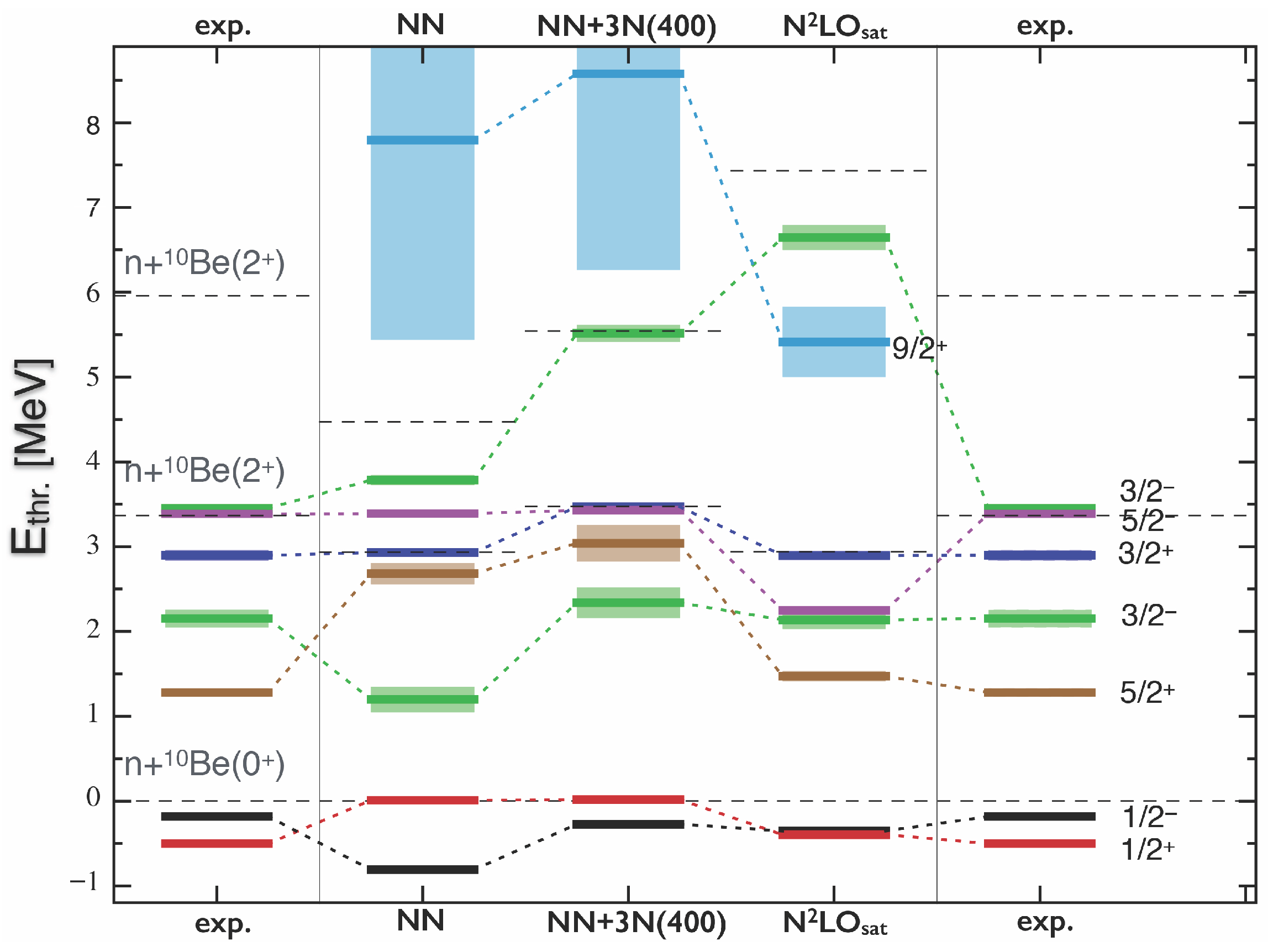
The first NCSMC investigation of 11Be was reported in Ref. [40] using several sets of chiral NN and 3N interactions. The calculations included the lowest three states of 10Be ( 0 1 + , 2 1 + , 2 2 + ) and a range of NCSM eigenstates of 11Be of both parities. A significant sensitivity to the chiral nuclear forces was found. In Figure 2, we compare calculated levels to experimental data, all relative to the n+10Be( 0 + ) threshold, for three sets of interactions. First, only the chiral N3LO NN interaction [24] was used with no chiral 3N force (SRG-induced 3N contributions were included in all the calculations). The 1 / 2 ground state was predicted incorrectly, with the 1 / 2 + state at the threshold and the 3 / 2 1 and 5 / 2 + states inverted as well. Adding the chiral 3N force with a local regulator with a cut-off of 400 MeV [44] improved the spectrum, although the incorrect level orderings remained. On the contrary, the spectrum with the NN + 3N interaction simultaneously fitted to few-nucleon systems and medium mass nuclei, named N2LOSAT [23], successfully achieving the parity inversions between the 3 / 2 1 and 5 / 2 + resonances and, albeit marginally, for the bound states. The low-lying spectrum was significantly improved and agreed well with the experimental data, presumably due to the more accurate description of long-range properties caused by the fit of the interaction to the radii of p-shell nuclei. On the other hand, the strongly overestimated splitting between the 3 / 2 2 and 5 / 2 states hints at the deficiencies of this interaction, which might originate from a too-large splitting of the p 1 / 2 p 3 / 2 subshells.
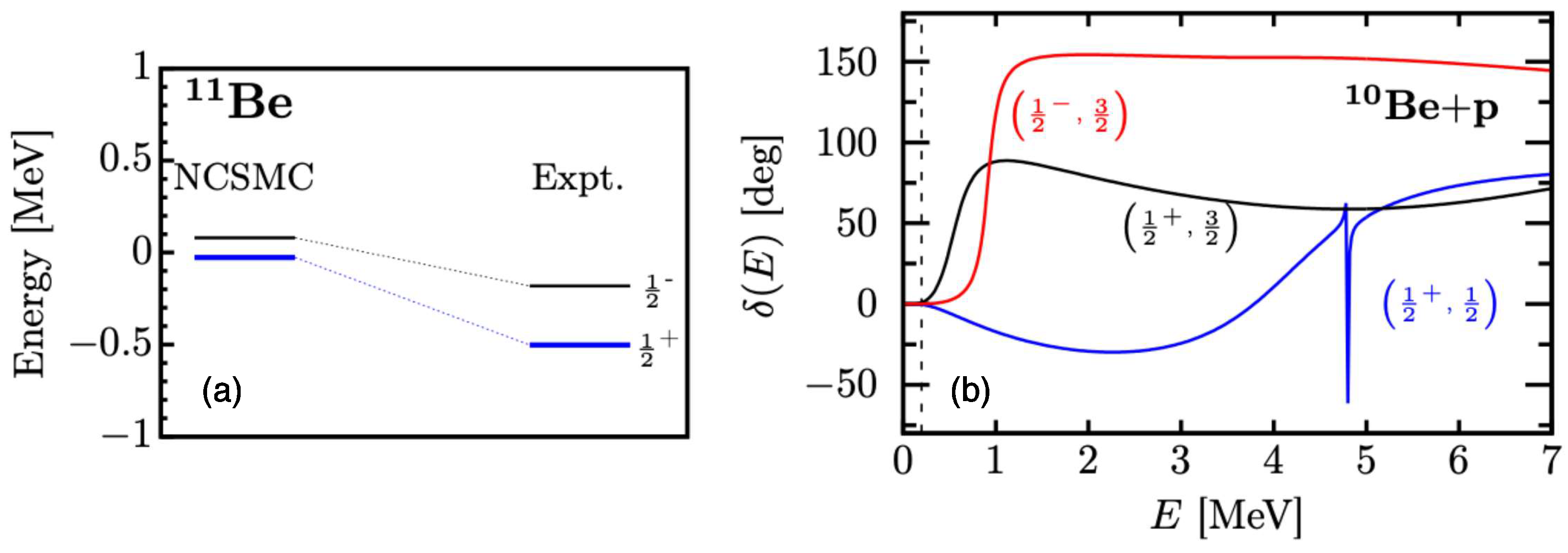
More recently, 11Be has been investigated with the NCSMC in the context of the β -delayed proton emission [45]. In that work, the chiral N4LO NN interaction [25] combined with an N2LO 3N interaction with simultaneous local and non-local regularization was used. Originally introduced in Ref. [46], it is denoted as NN-N4LO + 3Nlnl. The SRG evolution was applied with 3N-induced terms included. As shown in the left panel of Figure 3, with this interaction the parity inversion in the ground state of 11Be was comfortably reproduced. Moreover, the isospin analog states in 11B were investigated within the NCSMC, considering the 10Be+p cluster. As seen in the right panel of Figure 3, the parity inversion was also reproduced in the T = 3 / 2 resonances, in agreement with the experimental data.
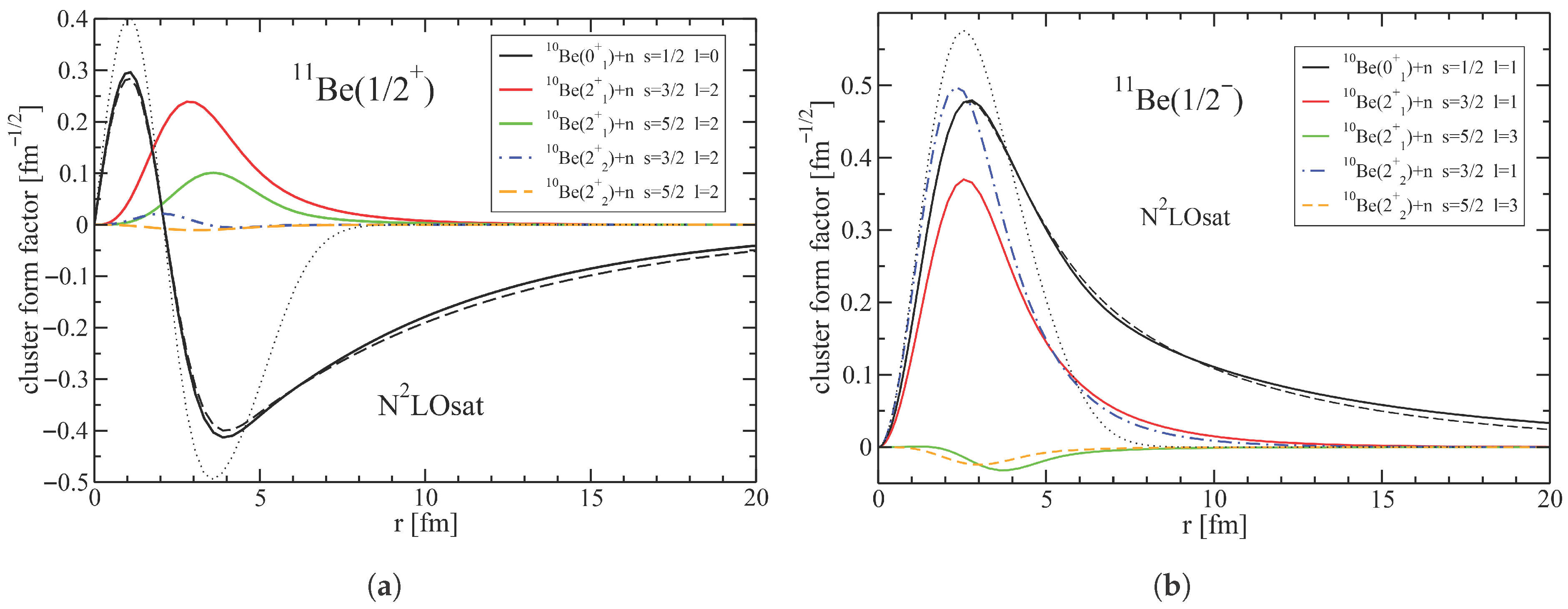
An insight into the wave functions of the two bound states of 11Be is provided in Figure 4. Cluster form factors calculated according to Equation (4) using the N2LOSAT interaction are presented for the 1 / 2 + ground state (left panel) and the first excited 1 / 2 state (right panel). A clearly extended halo structure beyond 20 fm can be identified for the S-wave and P-wave of the 10Be ( 0 + ) +n relative motion for the 1 / 2 + and 1 / 2 states, respectively. The phenomenological energy adjustment to reproduce the 10Be+n experimental separation energies, the NCSMC-pheno approach [47], only slightly influenced the asymptotic behavior of the S-wave and P-wave, as seen by comparing the solid and dashed black curves, while other partial waves are even indistinguishable on the plot resolution. The corresponding 1 / 2 + g.s. spectroscopic factors for the NCSMC-pheno approach, obtained by integrating the squared cluster form factors in the left panel of Figure 4, are S = 0.90 (S-wave) and S = 0.16 (D-wave). The S-wave Asymptotic Normalization Coefficient (ANC) is 0.786 fm−1/2. In Table 1, we summarize the ANCs and spectroscopic factors of the two bound states and compare them with ANC values from knockout reaction [48] and transfer reaction [49] analyses. The NCSMC cluster form factors can be contrasted with those obtained within the NCSM, computed as discussed below Equation (4), shown by the dotted lines in Figure 4. They drop off to zero at ≈8 fm. Interestingly, the NCSM spectroscopic factors are comparable to the NCSMC ones.
It is known that using the chiral 3N interaction with a non-local regularization improves the description of nuclear radii compared to experiment [50]. Similarly, the NCSMC investigations presented in this subsection suggest the importance of a non-local regularization of the chiral 3N interaction for the reproduction of the parity inversion in the 11Be ground state.

3.2. Halo Ground-State of 15C

The 15C is a well-known one-neutron halo nucleus [6,8]. With a rather small one-neutron separation energy of 1.22 MeV, its ground state can be well described as 14C in its 0 + ground state and a loosely bound neutron in the 1 s 1 / 2 orbital. It is relevant for nuclear astrophysics. The 15C synthesis through one-neutron radiative capture, 14C(n, γ )15C, has been suggested to be part of neutron-induced CNO cycles, which take place in the helium-burning zone of asymptotic-giant-branch (AGB) stars [51]. This reaction is also the doorstep to the production of heavy elements in inhomogeneous big-bang nucleosynthesis [52], and it has been shown to be part of possible reaction routes in the nuclear chart during the r process in Type II supernovae [53]. This cross-section is also important as a benchmark both for theories and experiments, as it can be measured directly and used for validation of the Coulomb breakup method for the neutron capture cross-section determination using the 15C beam [54].
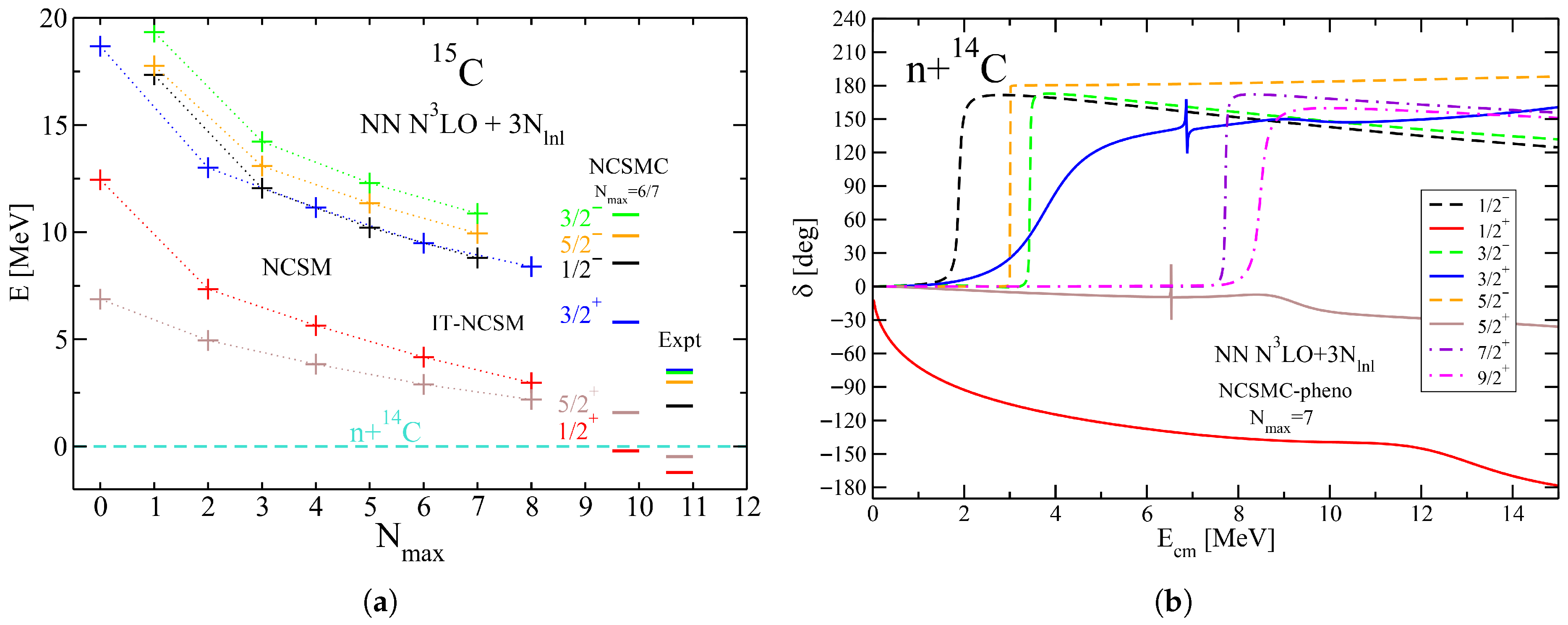
We investigated 15C within the NCSMC using the NN N3LO+3Nlnl interaction [28] that was SRG-evolved using λ SRG = 2 fm−1 with the 3N-induced terms included. In the basis expansion (2), we considered the 14C+n cluster including the 14C 0 + ground state and the first-excited 2 + state as well as 7(3) positive(negative)-parity NCSM eigenstates of 15C. The underlying NCSM calculations were performed up to N max = 8 and the NCSMC in N max = 7 ; see Figure 5a, where the energies of low-lying states of both parities are presented. The full basis space was used up to N max = 5 (6) for 15C (14C), while the importance truncated (IT) NCSM [55] was applied for higher N max . One can see the significant increase of binding for positive parity states in the NCSMC compared to the NCSM. The negative-parity states are, on the other hand, basically unchanged when the continuum is taken into account. The 1 / 2 + ground state is bound with respect to the 14C+n threshold in the NCSMC although less than in the experimental data. In contrast, in the NCSM the 5 / 2 + state was predicted to be the ground state up to at least N max = 8 . It gained binding in the NCSMC although it remained unbound in N max = 7 , contrary to the experimental data.
To gain insight into the structure of the experimentally bound 1 / 2 + and 5 / 2 + states and to facilitate the calculation of the 14C(n, γ )15C cross-section, we applied the NCSMC-pheno approach [47]. We adjusted the NCSM-calculated excitation energy of the 14C 2 + state from the N max = 6 -calculated 8.73 MeV to the experimental data 7.01 MeV, and we shifted the 15C NCSM eigenstates to reproduce the experimental energies of the bound states (and thus the experimental threshold) and known low-lying resonances in the NCSMC calculations. As a result, we obtained the 1 / 2 + and 5 / 2 + states bound as in the experimental data, and we predicted the phase shifts shown in Figure 5b with the broad 3 / 2 + resonance and the very narrow 1 / 2 , 5 / 2 , 3 / 2 resonances matching the experimental centroids. At the same time, we predicted narrow 5 / 2 + , 3 / 2 + , 7 / 2 + , 9 / 2 + resonances close to the 14C( 2 + )+n threshold.
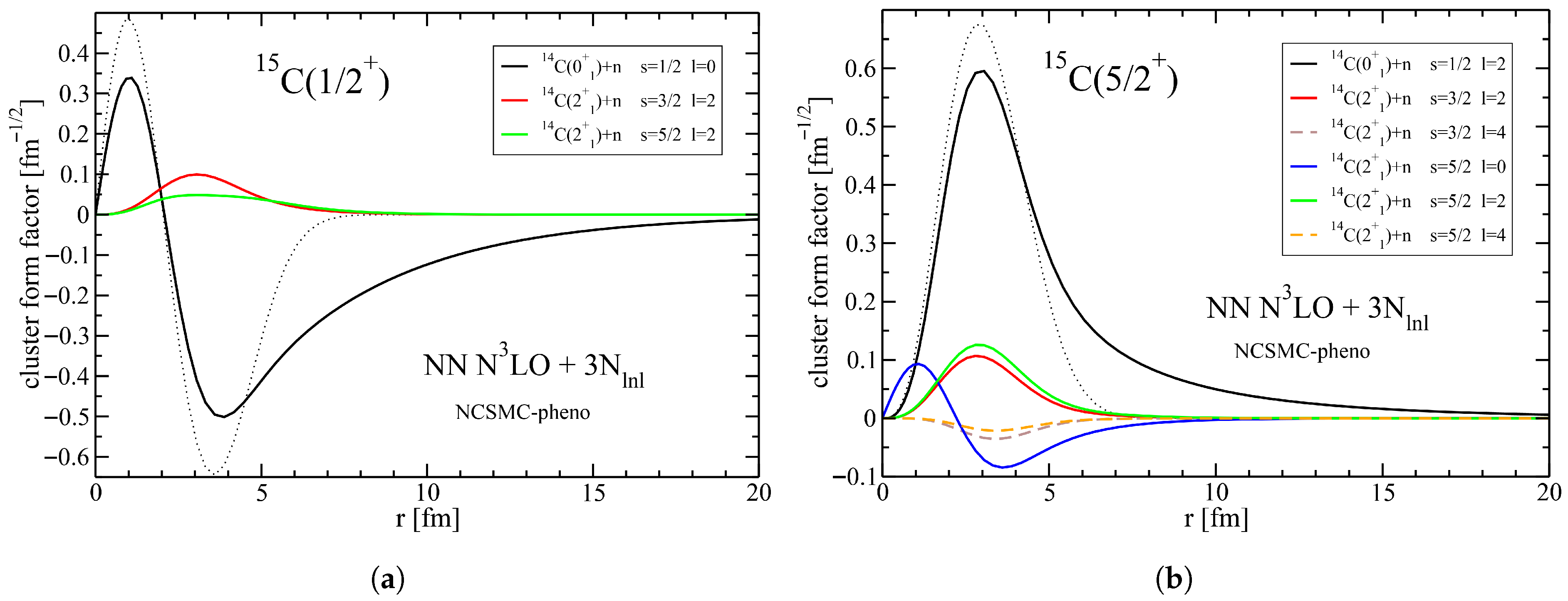
In Figure 6, we show the cluster form factors of the two 15C bound states, the 1 / 2 + ground state (a) and the 5 / 2 + excited state (b) obtained within the NCSMC-pheno approach. The 1 / 2 + state clearly manifests an S-wave neutron halo extending beyond 20 fm. The calculated ANC C 1 / 2 + = 1.282 fm−1/2 ( C 1 / 2 + 2 = 1.644 fm−1) is in excellent agreement with that of C 1 / 2 + 2 = 1.59 ± 0.06 fm−1 obtained in Ref. [54] using the halo EFT analysis of the 14C(d,p)15C transfer reaction. Similarly, it is in agreement with the ANC determination of C 1 / 2 + 2 = 1.57 ± 0.30 ± 0.18 fm−1 from 15C one-neutron knockout reaction data analysis [48]. The corresponding spectroscopic factor obtained by integrating the square of the cluster form factor is 0.96. D-wave contributions from the 14C( 2 + )+n are quite small.
The 5 / 2 + state is dominated by 14C( 0 + ) and a neutron in a D-wave. Given its weak binding of just 0.48 MeV, the cluster form factor extends beyond 15 fm. The NCSMC-pheno-calculated ANC is C 5 / 2 + = 0.048 fm−1/2 in good agreement with the the value of 0.0595 ( 36 ) fm−1/2 determined from the analysis of the 14C(d,p)15C transfer reaction [56]. The corresponding spectroscopic factor is 0.90. There are also small but visible contributions by 14C( 2 + ) and a neutron in the S- and D-waves while the G-waves are negligible.
The dotted lines in Figure 6 show the corresponding cluster form factors obtained within the NCSM. While their shapes and the spectroscopic factors are similar to the NCSMC ones, their extent is drastically different as they become negligible beyond 7 fm.
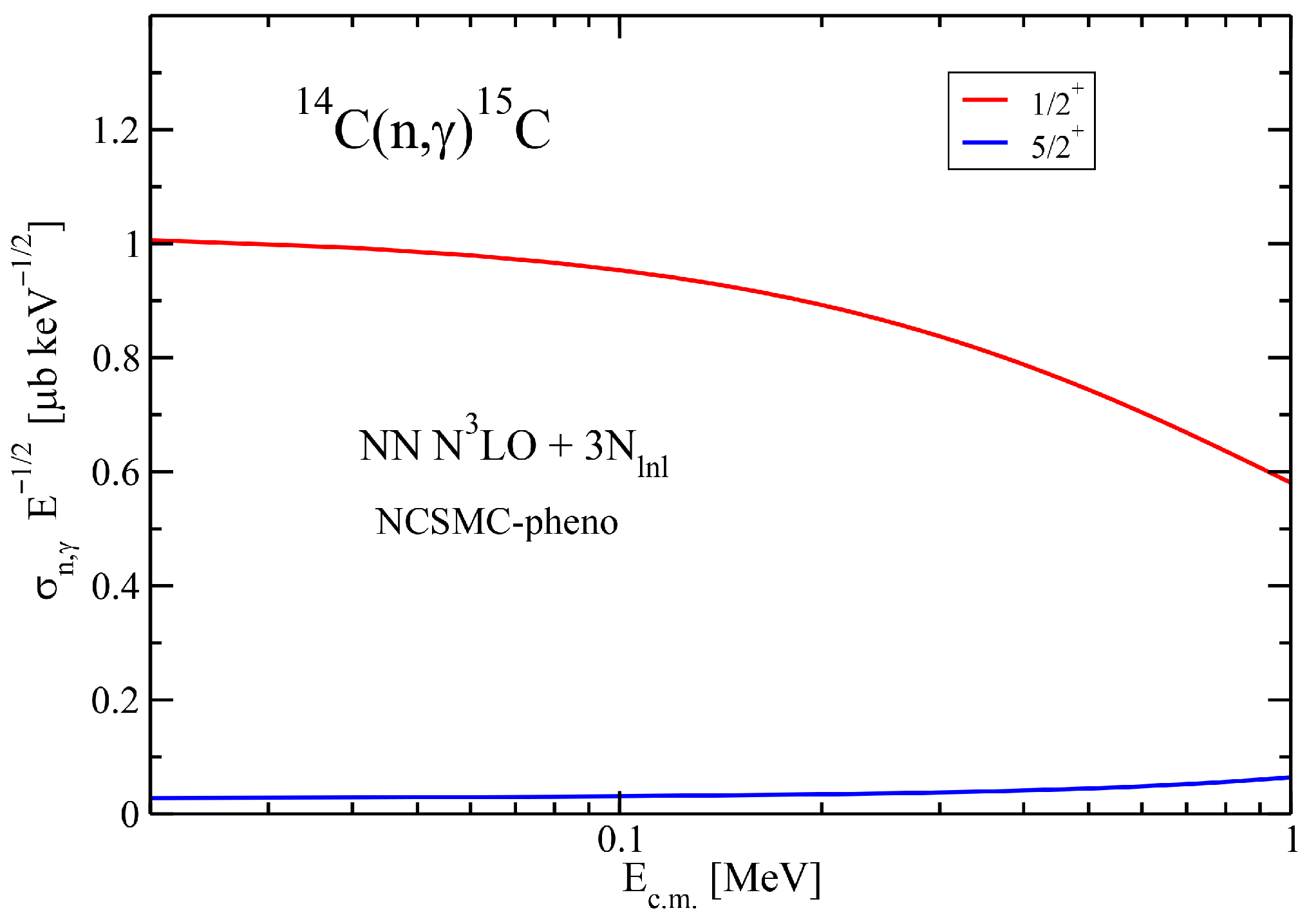
Applying the NCSMC-pheno calculations discussed above, we computed the cross-section of the 14C(n, γ )15C radiative capture reaction. The energy-scaled cross-section for energy up to 1 MeV is displayed in Figure 7, showing separately the capture to the ground state and to the 5 / 2 + excited state. Overall, the shape and magnitude is in line with recent experimental determinations [57]. Following the pioneering measurement in [58], it is customary to compare theoretical and experimental cross-sections at E c . m . = 23.3 keV. At this energy, we obtained in the present NCSMC-pheno calculations σ n , γ ( 1 / 2 + ) = 4.79 μb, σ n , γ ( 5 / 2 + ) = 0.13 μb, i.e., the total σ n , γ = 4.92 μb. This is in good agreement with the value of 4.66(14) μb reported in Ref. [54] (for the capture to the ground state) and the result of 4.75 μb obtained in Ref. [59], while it is slightly higher than the recent measurement by Jiang et al. [60] reporting 3.89(76) μb.
In Table 2, we summarize the presently obtained ANCs, spectroscopic factors and cross-sections and compare them to the results in the literature. For a more in-depth review of 14C(n, γ )15C cross-section data, we refer the reader to Ref. [59].

3.3. P-Wave Halo Nucleus 8B

8B plays an important role in astrophysics, as neutrinos from its β decay form the higher-energy part of the solar neutrino flux. It is produced in the solar proton–proton reaction chain through the proton radiative capture on 7Be, the 7Be(p, γ )8B reaction. The 2 + ground state of 8B is bound by only 137 keV with respect to the 7Be+p threshold. Consequently, it is anticipated that it manifests a P-wave proton halo. The 7Be(p, γ )8B capture reaction and the 8B structure have been investigated recently within the NCSMC approach using several sets of chiral NN + 3N interactions. We focus here on the results obtained with the NN-N4LO [25] + 3 N lnl * [26,61,62] chiral interaction (denoted as NN N4LO + 3NlnlE7 in some of the figures). In this interaction, an additional sub-leading contact term ( E 7 ) enhancing the spin-orbit strength [26] has been introduced to the 3N force. It appears to be the best-performing interaction available to us currently. Again, the SRG evolution was applied with 3N-induced terms included.
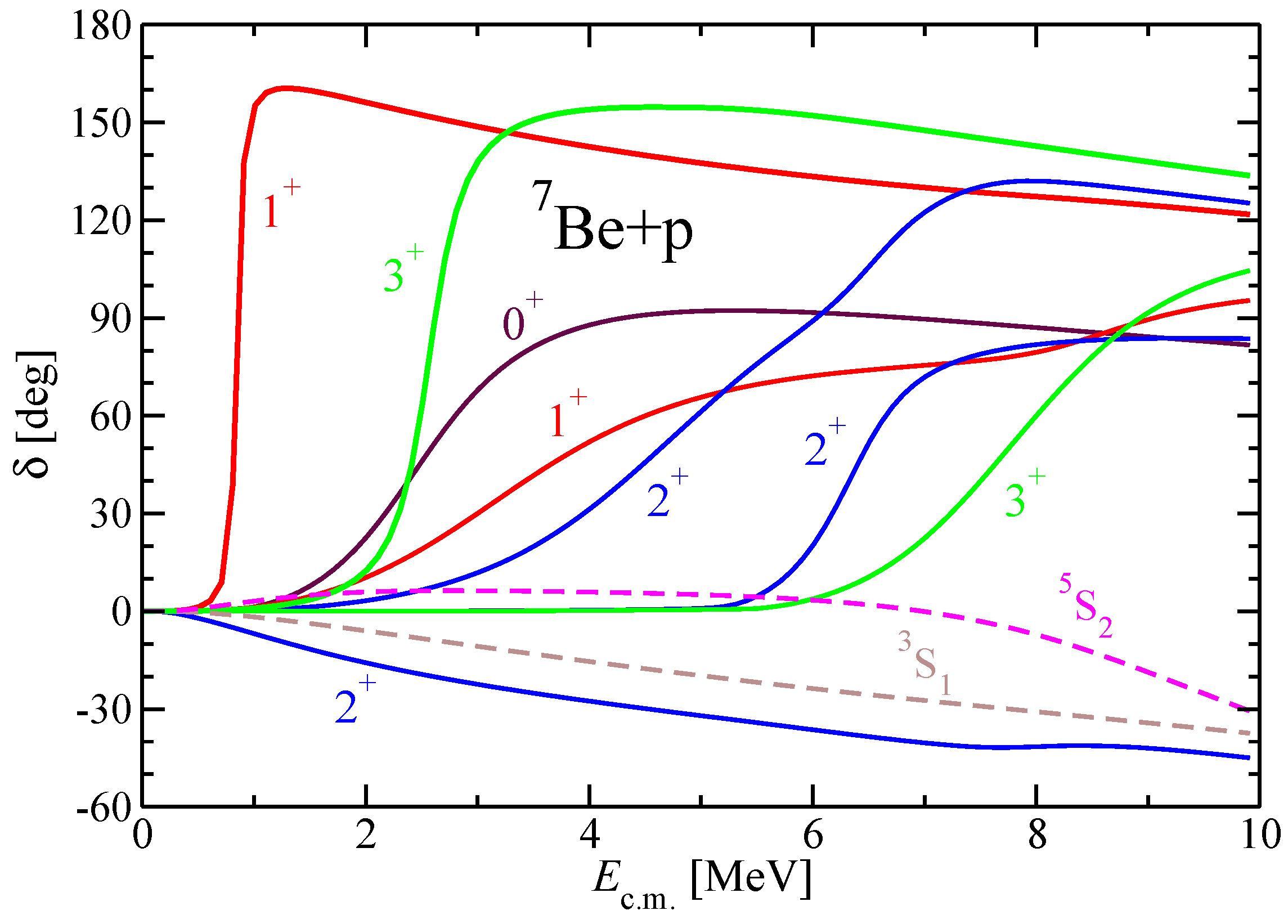
The positive-parity eigenphase shifts for 7Be+p scattering obtained using the NN-N4LO + 3 N lnl * chiral interaction, presented in Figure 8, show the well-established 1 + and 3 +  8B resonances as well as several other, yet unobserved, broad resonances. The NCSMC S-wave phase shifts manifest scattering length signs consistent with those determined in recent measurements (negative for 5 S 2 , positive for 3 S 1 [63]). We found that it was difficult to produce a bound 8B ground state with this as well as with other chiral interactions [61]. Rather, we obtained a very narrow near-threshold 2 + resonance that is not visible in the figure.
To investigate the properties of the weakly-bound 8B 2 + ground state, we resorted to the NCSMC-pheno approach [47], i.e., with the 7Be(g.s.)+p separation energy adjusted to the experimental value of 137 keV. This was achieved by shifting the NCSM eigenenergies of 7Be so that the excitation energies (and therefore the thresholds) matched the experimental ones exactly. Furthermore, the 8B NCSM eigenenergies in the 2 + channel were also modified, bringing the NCSMC states in to the experimentally observed positions.
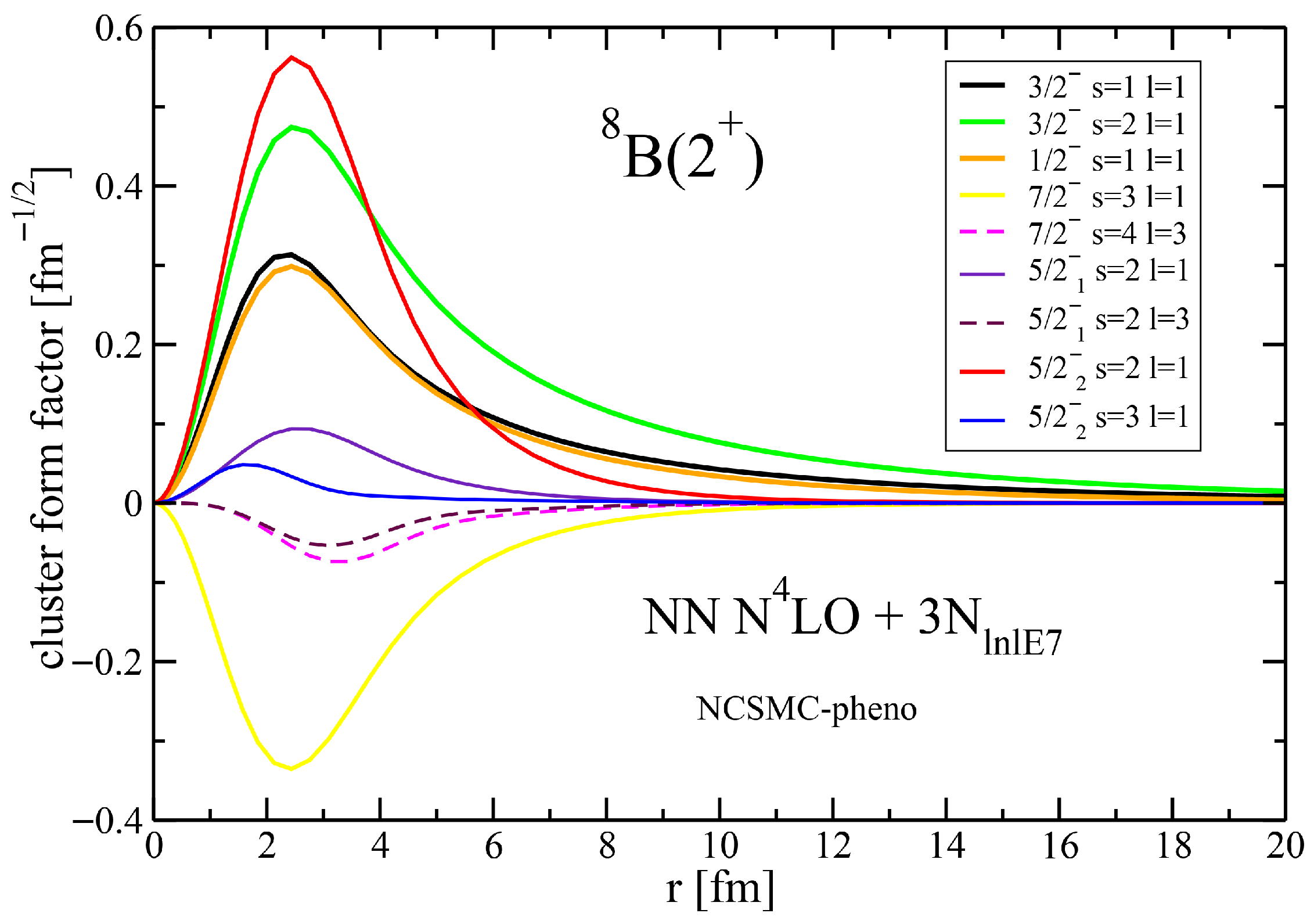
In Figure 9, we present the cluster form factor for the 2 + ground state of 8B obtained using the NN-N4LO+ 3 N lnl * interaction within the NCSMC-pheno approach. The dominant component is clearly the channel-spin s = 2 P-wave of the 7Be(g.s.)+p that extends to a distance far beyond the plotted range. The alternative channel spin coupling, s = 1 , P-wave is less pronounced but extends in a similar way. Of a comparable size is the 7Be( 1 / 2 )+p P-wave. Remarkably, we noticed a substantial contribution from the 7Be( 5 / 2 2 )+p P-wave in the channel spin s = 2 . The other possible s = 3 P-wave configuration is negligible. At the same time, the 7Be 5 / 2 2 state is dominated by a 6Li+p channel-spin s = 3 / 2 P-wave configuration. Within the NCSM framework relevant to the present calculations, this was shown (for the mirror 7Li+n system) in ref. [41]. Therefore, such a large contribution of the s = 2  7Be( 5 / 2 2 )+p P-wave to the 8B ground state seems to indicate the presence of two anti-parallel protons outside of a 6Li core and that their exchanges are important. Clearly, for a realistic description of the 8B ground state, this state must be taken into account. Finally, we note that the 7Be( 7 / 2 )+p P-wave component is also substantial. The calculated ANCs, C p 1 / 2 = 0.34 fm−1/2 and C p 3 / 2 = 0.62 fm−1/2 are close to the experimental values reported in Ref. [63]; see Table 3.

3.4. Excited Halo States in 10Be

The lowest-lying part of the dense spectrum in 10Be is well understood. What remains however is a clear understanding of the excited J π = 1 , 2 states for which there exists inherent nuclear structure interest. These two states have been experimentally measured close to the n + 9Be threshold, and both are thus anticipated to have some kind of exotic structure: either strong clustering or S-wave halo formation [64]. The appearance of two exotic, possibly-S-wave halo states so close together is a rather unique feature of the 10Be spectrum, the classification of which has naturally garnered interest over several decades, partially due to the inconclusive literature on the matter. Recently, there has been novel experimental effort in classifying the nature of these states: an experiment from TRIUMF ISAC-II investigating the angular distributions of both states via the 11 Be ( p , d ) transfer reaction provided inconclusive information regarding the cluster vs. halo nature of the states [65], while a further proposal to examine the structure of the 2 via the one-neutron-transfer reaction 9Be(11Be, 10 Be * [2]) is currently in preparation at ISOLDE [66]. In addition to these exotic bound states, there exists interest in the J π = 3 resonance state, which sits slightly above the n + 9Be threshold. As the isospin mirror of 10C, characterization of these excited states and resonances can provide insight into isospin symmetry-breaking effects arising from the strong and electromagnetic sectors.
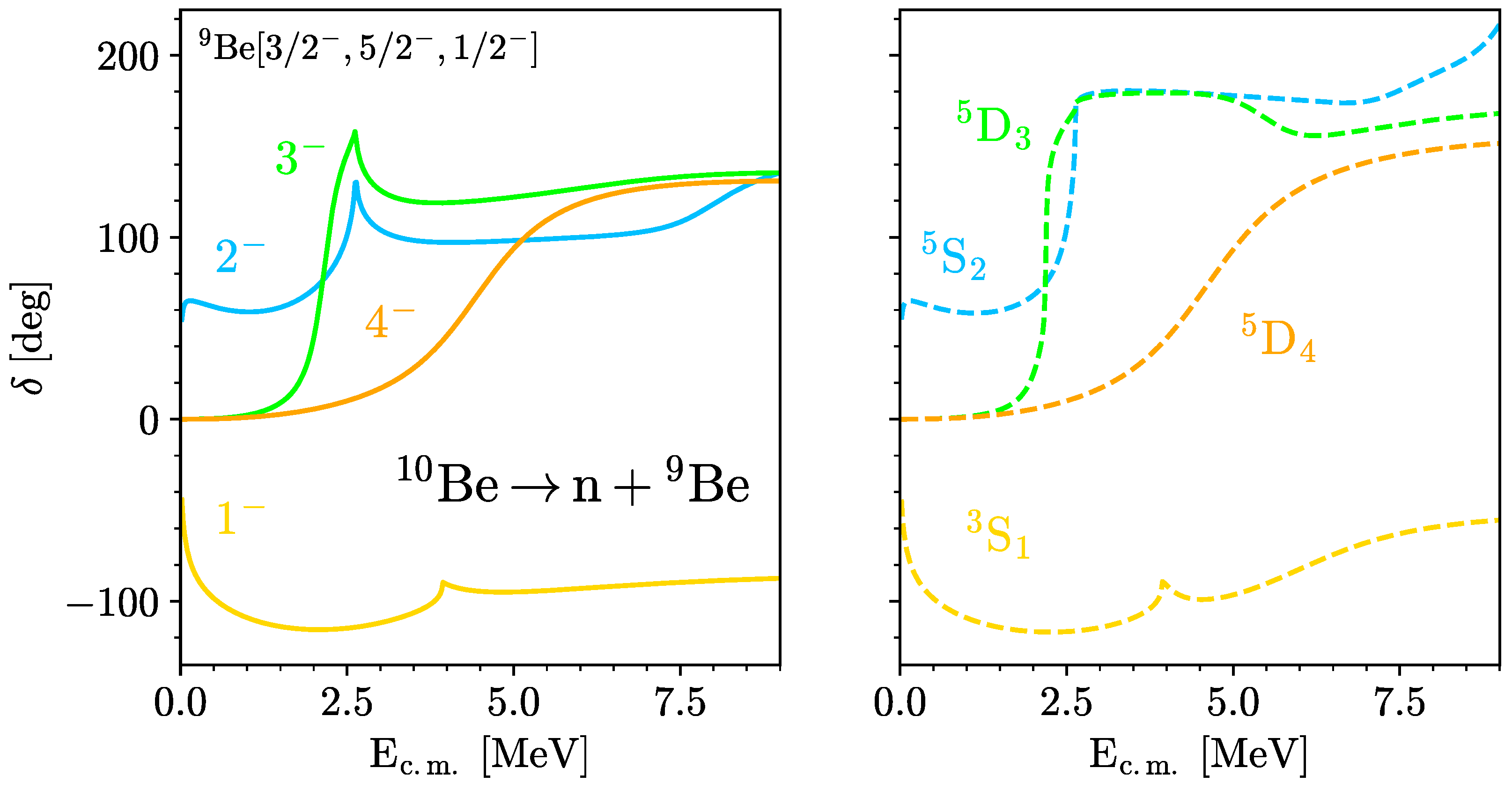
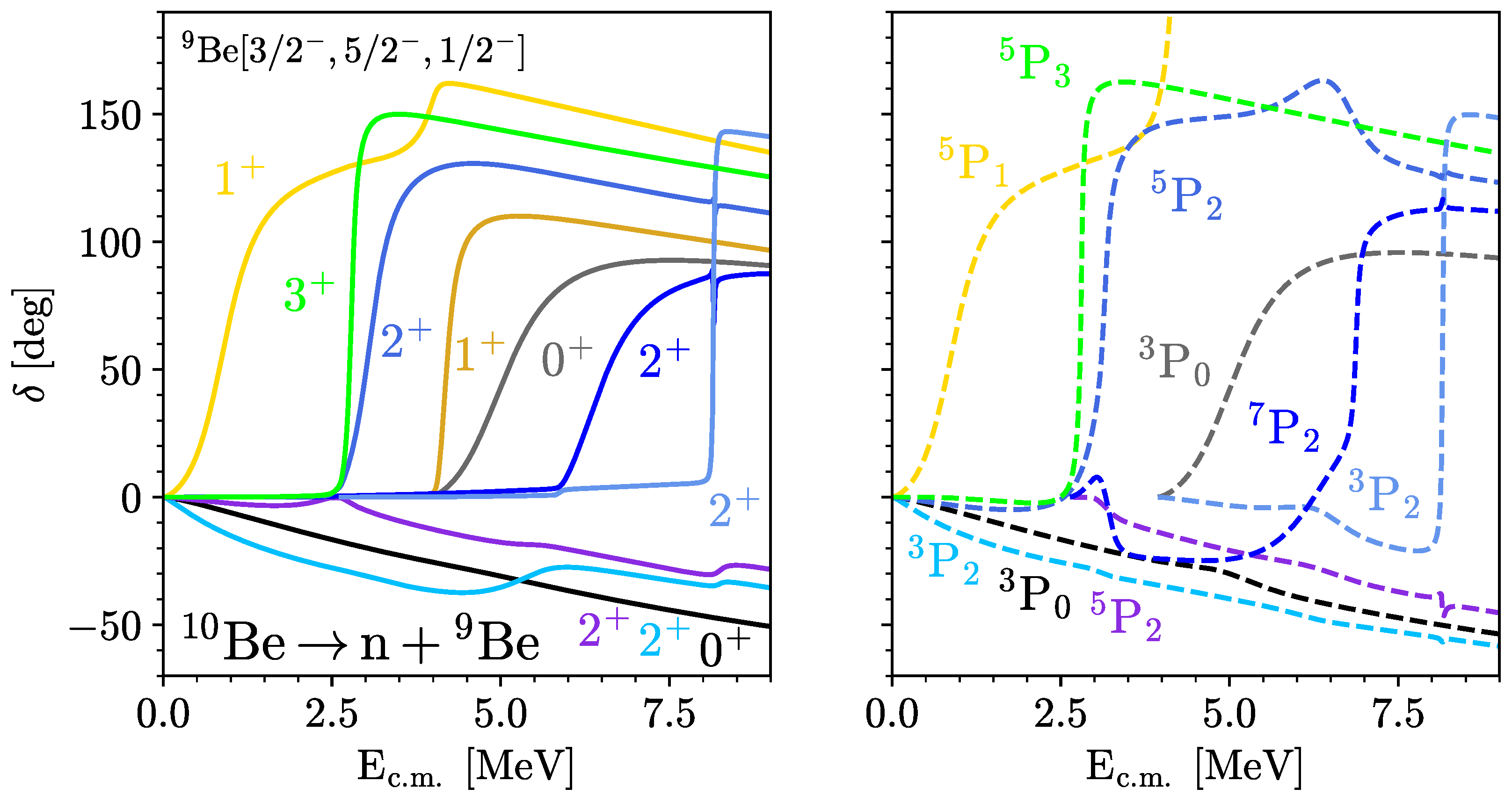
In Figure 10 and Figure 11, we present the NCSMC predictions for the negative- and positive-parity phase shifts, respectively, for the n + 9Be scattering process, with the eigenphase shifts shown on the left and the phase shifts shown on the right. These were obtained with the NN-N4LO + 3Nlnl chiral interaction and within an N max = 8 , 9 model space depending on the parity. We identified the total spin parity with a given eigenphase shift and the partial wave channel for a given phase shift in the same color as the curves. We used a mass partition, including the 3 / 2 , 5 / 2 and 1 / 2 states of 9Be and, with this configuration of states, the NCSMC bound four out of the six (both positive- and negative-parity) experimentally observed bound states [67]. We notably missed the excited J π = 0 + state, due to lacking consideration of alpha clustering in the partitions, which has been known to contribute significantly to the structure for some time [68,69].
In Figure 10, dominated by the 3 S 1 partial wave, we find that the 1 state is readily bound in the NCSMC calculation, albeit sitting shallow at −0.0295 MeV with respect to the already-quite-shallow experimental observation of −0.8523 MeV. On the other hand, the 2 remains unbound in the current model space, but exhibits the expected near-threshold behavior for resonance conversion to a bound state. It is possible that an increase in the model space dimension would drive this state below threshold, but it could be that mixing between additional mass partitions is necessary to describe this state, e.g., 6 He + α . Moreover, predicated on the inclusion of the full set of low-lying 9Be states that could contribute to the formation of these structures, the observed closeness of these states in the spectrum is driven by their sharing of the same underlying 9 Be [ 3 / 2 ] configuration with the neutron spin anti-aligned (3 S 1 ) or aligned (5 S 2 ) with the nuclear spin—but always with l = 0 relative orbital momentum. The inclusion of the 5 / 2 and 1 / 2 proved to be of little consequence to the formation of these states, with stability in the phase shifts as each consecutive state was added. A further improvement to our description of the 1 would likely come from inclusion of the 6 He + α mass partition, as analysis via microscopic cluster models with a partition of α + α + n + n suggests that a significant contribution to the structure of these states is driven by α -clustering effects [70]; notably, the 2 is not bound in such an approach, suggesting the reduced effects of α -clustering on the structure of said state.
As expected, we further see the appearance of the known 3 resonance coming from the 5 D 2 partial wave channel, consistent with that which has been similarly seen in calculations of 10C with the NCSMC [71]. Lastly, a broad 4 resonance from the 5 D 4 channel appears at relatively low c.m. energies, corresponding to the expected resonance at 2.46 MeV. While the partial waves that dominate the contribution to these states have higher total momentum, it comes primarily from the relative orbital momentum of l = 2 between the neutron and 9Be cluster, i.e., they are still largely built upon the 3 / 2 of 9Be with neutron spin either anti-aligned or aligned with the nuclear spin.
Before proceeding to the positive parity states, we present the ANCs—see Equation (5) for their definition—for the 1 and 2 halo states of 10Be in Table 4 and Table 5, respectively, using the same interaction and configuration space as in determination of the phase shifts in Figure 10. In Table 4, we provide the ANCs for the 1 state of 10Be for each partial wave channel of the n + 9Be partition. These are labeled by the spin-parity of the relevant 9Be state, the relative orbital momentum of the neutron with respect to the 9Be cluster, and the total spin of the coupled n + 9Be partition. In the first column, with the ANC results, we show the raw output of the NCSMC from the aforementioned calculations. Due to the dependence of the asymptotic wave function on κ E , the ANCs were incredibly sensitive to the prediction for the energy eigenvalues. Thus, by phenomenologically adjusting the NCSMC energy eigenvalues to match the experimental ones, one can get a more realistic picture of the ANCs. That is what is then shown in the second ANC column, labeled as ANC Pheno. One can obviously see the dramatic difference in values for the predicted ANCs coming from relatively minor shifts in the overall energy eigenvalues, typically of order 1 MeV or so. Identically, in Table 5, we show the ANCs for the 2 state of 10Be. In this case, there were no ANCs for the raw NCSMC calculation, since the state was found to be an unbound, near-threshold resonance, so we show only the ANC Pheno results coming from phenomenological adjustment of the 2 state. Based upon the extracted values for the ANCs in both the 1 and 2 states, we find dominance of the l = 0 channels, which further supports the interpretation of these states as excited halo candidates, regardless of any additional sub-structure of the 9Be partition. While in both states the dominant structure arises from the 9Be [ 3 / 2 ] n channel, there are still noteworthy contributions from the 9Be [ 5 / 2 ] n in both states and from 9Be [ 1 / 2 ] n in the 1 state. The resulting picture is therefore not that of a single-channel halo state with no internal clustering, but rather of a multi-channel system whose asymptotics are nevertheless dominated by S -wave neutron motion around a 9Be core.
In Figure 11, we find a wealth of positive-parity resonance states compared to the case of negative parity, as is characteristic of our theoretical [72,73] and experimental understanding of the rather dense 10Be spectrum. Importantly, we find that the three lowest-lying bound states as predicted by the NCSMC—that is, the 0 1 + sitting at −5.9721 MeV, the 2 1 + at −2.5104 MeV, and the 2 2 + at −0.6646 MeV—are notably all bound to the correct experimental values within an MeV or so. For reference, these are, respectively, −6.8122 MeV, −3.444 MeV, and −0.8538 MeV [67]. The corresponding partial wave channels are the 3 P 0 , 3 P 2 , and 5 P 2 . As mentioned previously, we did not bind the excited state 0 2 + , due to lacking alpha clustering effects, though we made note of a 0 + state appearance as a proper resonance of the n + 9Be system via the 3 P 0 channel seen on the right-hand side of Figure 11. Beyond inclusion of the additional 6 He + α partition, as discussed in Ref. [74], further effects of cluster polarization likely play a significant role in the formation of bound and resonant states in 10Be.
On to the scattering states: the NCSMC predicted the existence of a near-threshold 1 + resonance, already seen in earlier NCSM calculations [75], which had yet to be confirmed experimentally. This was consistent with calculations of 10C and 10B [71], and it was further anticipated to exist based on the observed isospin analogue states in the spectra of those nuclei. A second narrow and unobserved 1 + resonance was also predicted about 3 MeV higher in energy. While most of the eigenphase shifts corresponded to a single dominant partial wave channel, the 1 2 + was an exception and came from stimulation of the same partial wave channel as the 1 1 + at higher c.m. energy, as can be seen from the behavior of the 5 P 1 phase shift. Moving up in spin, we found a 2 3 + resonance built from the 5 P 2 partial wave, which we could not readily match to an experimentally observed resonance state. There existed a resonance with energy 0.7298 MeV, which was presumably related, though our calculation was about 2 MeV above this, and thus we cannot say for certain. We observed two additional 2 + resonances at higher c.m. energy coming from the 7 P 2 and 3 P 2 channels, though they were not readily discerned as any particular state seen in the known experimental spectrum. Lastly, a very narrow 3 + resonance was observed at quite low c.m. energy in the 5 P 3 channel, a place which—when referring to the experimental spectra [67]—was seemingly empty of resonance states.

3.5. Borromean Halo Nucleus 6He

A stringent test of any ab initio description of three-cluster dynamics is provided by Borromean halo nuclei, where the bound ground state emerges only through genuine three-body correlations and the wave function exhibits pronounced long-range asymptotics. The 6He nucleus is a prototypical example, with a weakly bound ground state and an extended spatial distribution that reflects its dominant α + n + n character. As such, it offered an ideal benchmark to assess whether a unified treatment can simultaneously describe both short-range many-body correlations and the correct three-body continuum behavior.
An initial ab initio description of 6He and its α + n + n continuum was obtained in a model space spanned only by microscopic cluster channels, i.e., by omitting discrete NCSM eigenstates of the composite system in the wave function ansatz [42,76]. This three-cluster treatment captured the correct three-body asymptotics and enabled continuum calculations; however, it was clear that additional short-range many-body correlations were missing and that convergence with respect to the model space was comparatively slow. This work was followed by a full NCSMC description, also including square-integrable NCSM eigenstates of the 6He system and thus accelerating convergence for bound-state and low-energy continuum observables [43,77]. The three-cluster NCSMC formalism was demonstrated and quantified through a detailed study of the 6He ground state and low-lying continuum, using SRG-evolved chiral N3LO NN interactions at two resolution scales, λ SRG = 1.5 fm 1 and 2.0 fm 1 , while omitting initial and induced 3N forces in those calculations [43,77].
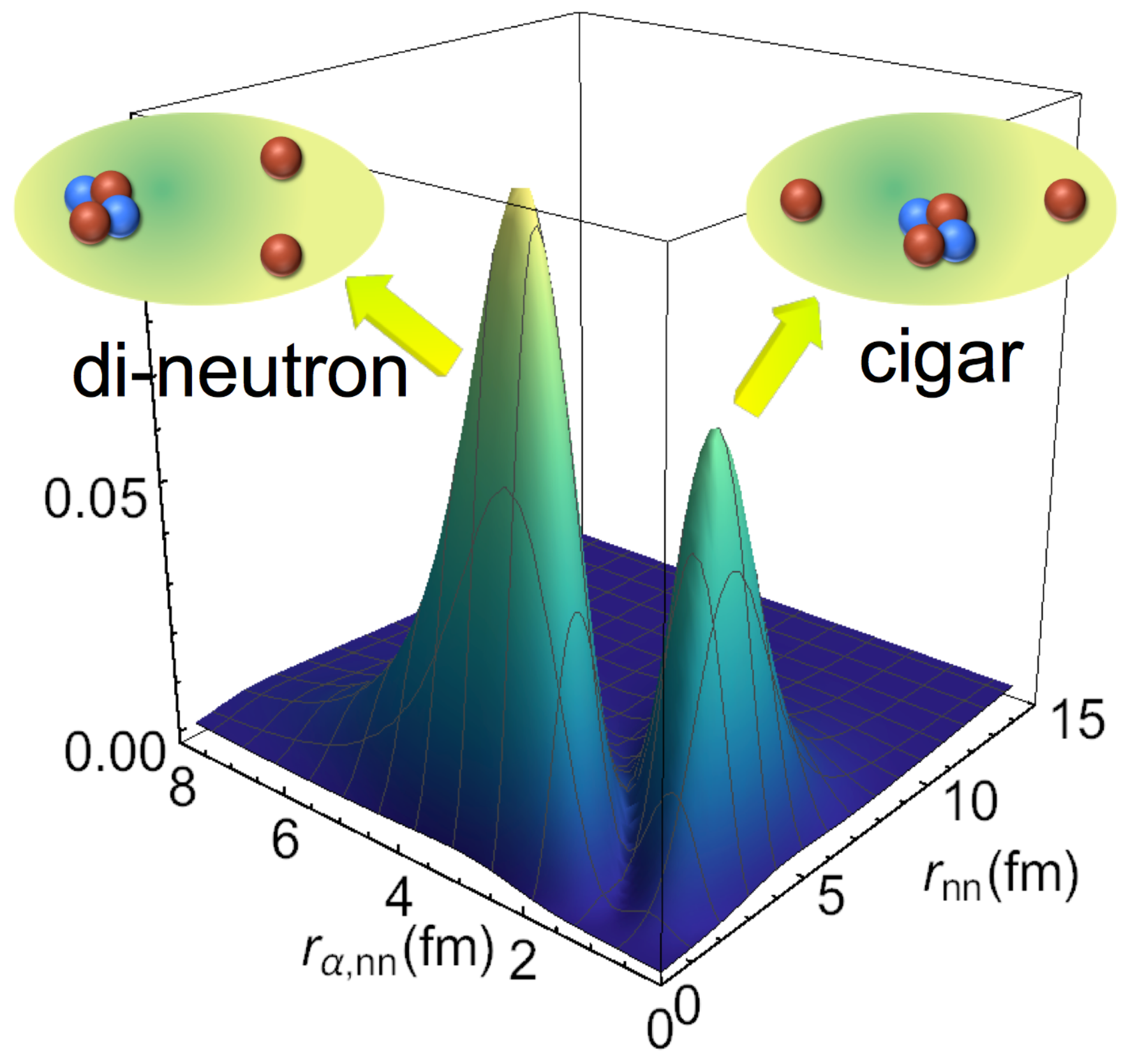
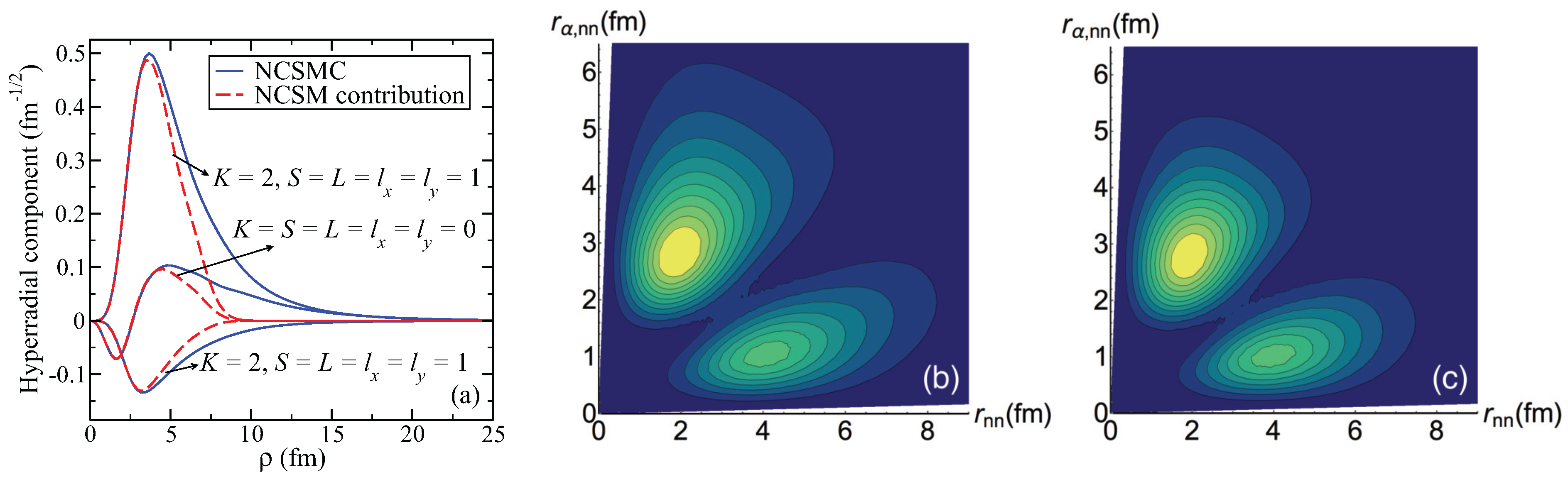
For the λ SRG = 2.0 fm 1 interaction, the NCSMC calculation yielded a realistic 6He ground-state energy of −29.17 MeV (compared to the experimental value of −29.268 MeV [78]). The corresponding g.s. wave function exhibited the expected dineutron-dominated spatial distribution when analyzed through the three-body probability density constructed from projecting the full NCSMC solution onto the microscopic three-cluster basis (Figure 12). Beyond this qualitative picture, the same continuum-coupled description yielded converged matter ( r m ) and point-proton radii ( r p p ) in computationally accessible model spaces. More importantly, it enabled simultaneously a description of the small two-neutron separation energy ( S 2 n = 0.94 ( 5 ) MeV) and the extended spatial size of 6He ( r m = 2.46 ( 2 ) fm, r p p = 1.90 ( 2 ) fm) broadly consistent with experimental constraints. This is notable, given that in traditional ab initio calculations limited to expansions on square-integrable basis states, including the NCSM, the matter and point-proton radii of 6He converge slowly with model-space increase, reflecting the difficulty of representing the long-range halo tail. This difference is exemplified by Figure 13, which compares the hyper-radial components of the α + n + n relative motion in the 6He ground state after projection of the full NCSMC wave function and of its NCSM portion onto the orthogonalized microscopic-cluster basis. The comparison makes apparent the deficiency of the square-integrable NCSM component in reproducing the long-range halo tail, and how the inclusion of explicit three-cluster continuum degrees of freedom in the NCSMC restores the correct extended behavior.
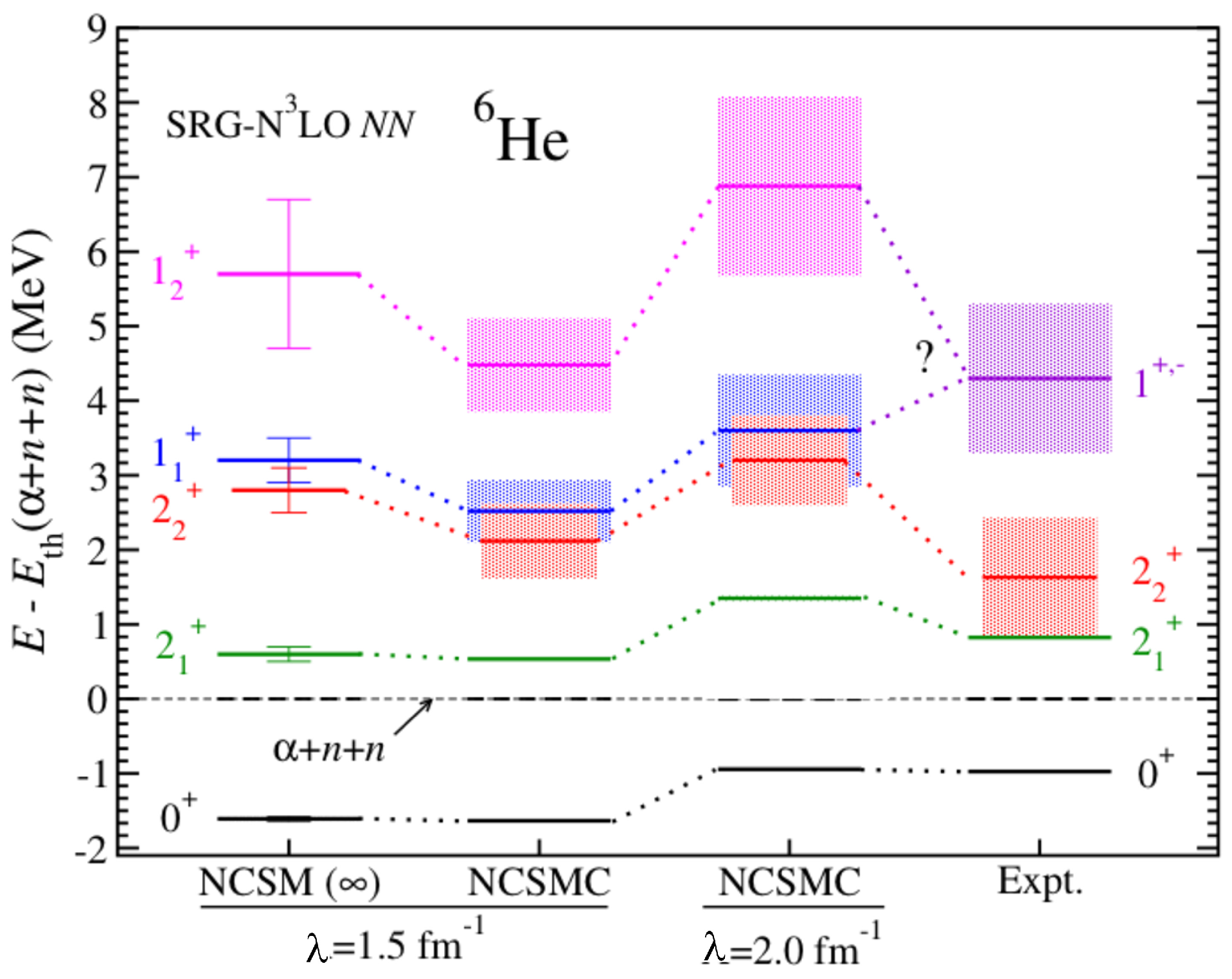
As a further illustration of the role of continuum degrees of freedom and many-body correlations, Figure 14 shows the low-lying 6He spectrum obtained with the SRG-evolved N3LO NN interaction at λ = 1.5 and 2.0 fm 1 . There, we compare the NCSMC results of Ref. [43] with the NCSM spectrum obtained by treating the 6He excited states as bound states. Besides the results in the largest accessible HO model space ( N max = 12 ), for the NCSM we also show the spectrum extrapolated to the infinite-space limit. Because the NCSM is a bound-state technique and does not yield resonance widths, only the excitation energies (with the estimated extrapolation uncertainty) are shown in that case, whereas for the NCSMC the resonances are represented by their centroids (solid lines) and widths (shaded areas). While very narrow resonances such as the first 2 + can be captured reasonably within the bound-state approximation, the description of broader states generally requires both short-range many-body correlations and explicit coupling to the three-body continuum.
The two SRG resolution scales yielded a qualitatively similar pattern, and their differences provide a rough estimate of the impact of the omitted induced three-nucleon (and higher-body) interactions that are needed to restore the formal unitarity of the SRG transformation. More generally, explicit 3N forces (including the initial chiral 3N interaction) are indispensable for an accurate description of the spectrum as a whole. Indeed, while the SRG-evolved NN interaction at λ = 2.0 fm 1 yielded a realistic energy and structure for the 6He ground state, neither of the two adopted resolution scales reproduced quantitatively the low-energy excited spectrum reported in Ref. [79].

3.6. Large-Scale NCSM Calculations for 11Li

11Li is the nucleus where a neutron halo was discovered in interaction cross-section measurements more than four decades ago [1]. This drip-line isotope has two weakly bound neutrons in its ground state with separation energy S 2 n = 369.2(6) keV that have a large spatial extent compared to the core nucleus 9Li leading to a 9Li + n + n three-body Borromean halo. This exotic structure was postulated to give rise to unconventional excitation modes. It was predicted that a low-energy dipole resonance could arise due to oscillation of the weakly bound halo neutrons against the core [80]. A non-resonant soft electric dipole mode in a Coulomb excitation process was also predicted [5]. There have been several experiments performed aimed at elucidating the nature of its ground state as well as its excitation modes [2,6,81,82,83,84,85,86,87,88,89]. Simultaneously, the properties of 11Li have been subject to numerous theoretical studies [10,11,90,91,92,93,94,95]. Yet, an ab initio description of this complex system is still lacking.
As a step in the direction of remedying this situation, we performed ab initio calculations of the 11Li nuclear structure using the NCSM approach. As input, we employed the chiral EFT NN and 3N interaction NN-N4LO + 3 N lnl * (denoted as NN N4LO + 3NlnlE7 in the figures). The interaction was softened by the SRG technique with the SRG-induced three-nucleon terms fully included. The evolution parameter λ SRG = 1.8 fm−1 was used primarily, and we checked that the observables were insensitive to the variation of the λ SRG parameter between 1.8 and 2.0 fm−1. For earlier NCSM studies reporting some 11Li results obtained using NN interactions only, see Refs. [14,96].
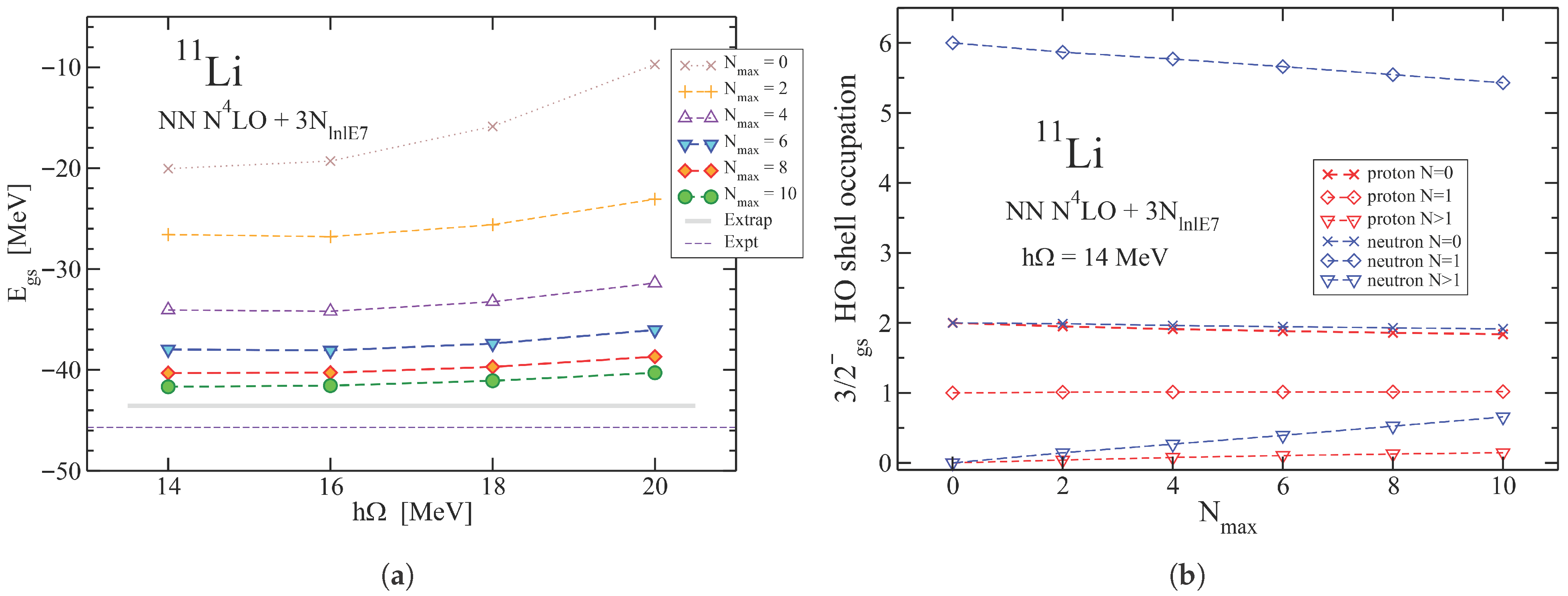
In panel (a) of Figure 15, we present the 11Li 3 / 2 ground-state energy dependence on the NCSM HO frequency in the range of Ω = 14–20 MeV for the basis size up to N max = 10 . The basis dimension reached 929 million at N max = 10 . The extrapolated results to N max using the exponential function E ( N max ) = a + b e c N max are shown by the gray band. The uncertainties were obtained by varying the number of extrapolated points, the HO frequencies and the SRG evolution parameter. In addition, we did the same for 9Li; see Ref. [97]. The predicted ground-state energy of 11Li was 43.56 ( 35 ) MeV, while that of 9Li was 43.73 ( 18 ) MeV, which can be compared to experimental 45.709 MeV and 45.34 MeV, respectively. Overall, we found a slight underbinding of ∼1.5–2 MeV and within uncertainties about the same ground-state energy of the two isotopes. We found that the experimentally well-bound 9Li ground-state energy converged faster while the very weakly bound 11Li would benefit from an inclusion of three-body cluster components in the trial wave function absent in the present NCSM calculations that might help to bind it with respect to 9Li.
In panel (b) of Figure 15, we show the occupations of the major HO shells for the 11Li 3 / 2 ground-state as they evolved with the basis size enlargement. While the proton occupations remain stable, the neutron occupation of the N = 1 (0p-shell) decreased and the neutron occupation of the higher N shells steadily increased with N max .
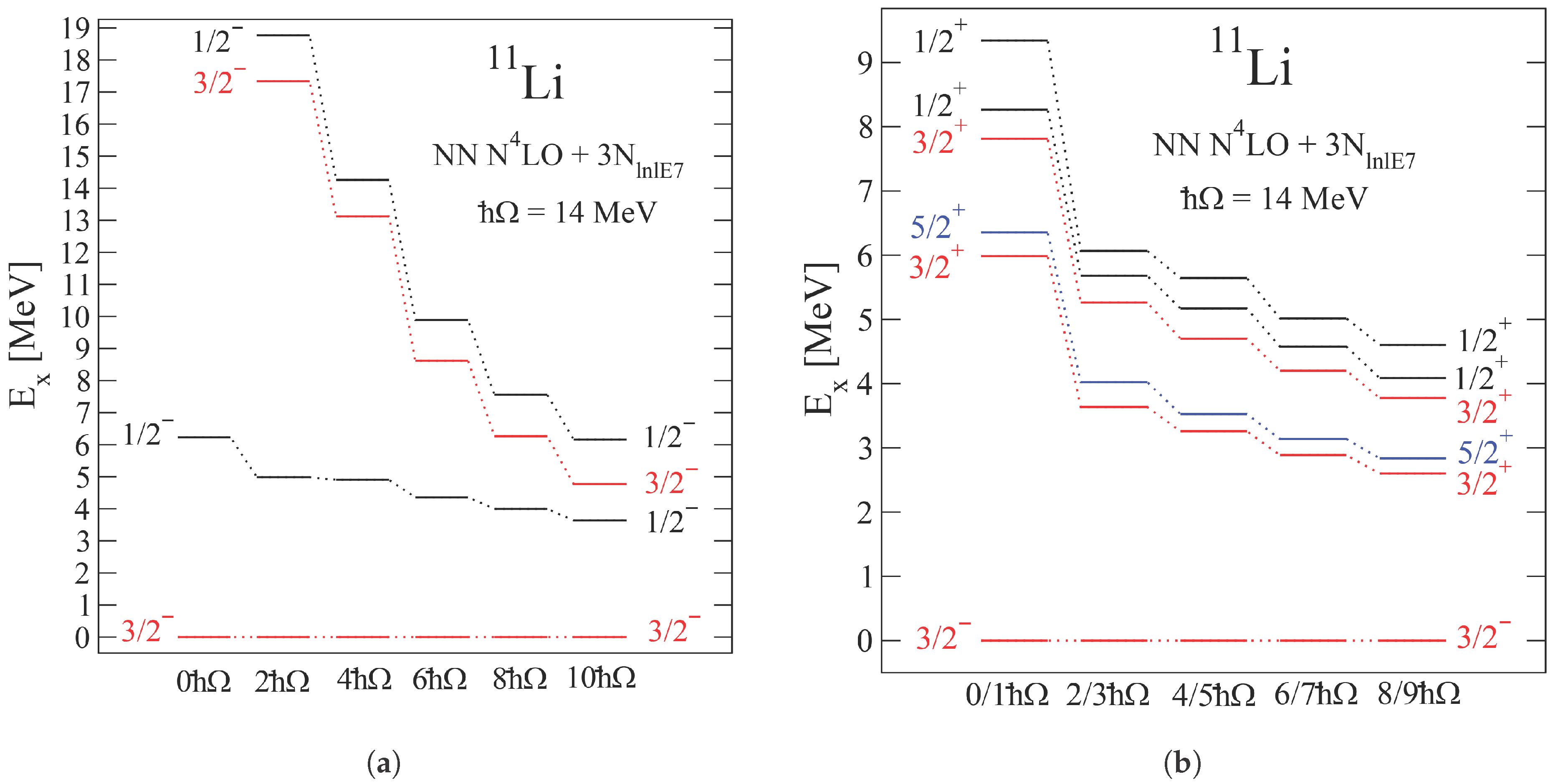
The dependence of the lowest calculated excited states on the NCSM basis size is shown in Figure 16 for negative-parity states in panel (a) and for positive-parity states in panel (b). In the latter, the negative-parity 3 / 2 ground state obtained in an N max basis space is matched with the positive-parity excited states obtained in the N max + 1 basis space. For technical reasons, the largest positive-parity space we were able to reach was N max = 9 with the dimension of 269 million. While the 1 / 2 1 state excitation energy decreased gradually with N max , the multi- Ω dominated 3 / 2 2 and 1 / 2 2 states manifested a rapid decrease of excitation energies with the basis size correlated with an increase of higher- Ω components in the 3 / 2 1 ground-state wave function, the signature of which is seen in Figure 15b. This trend was also observed in recent large-scale NCSM calculations using NN interactions only [14]. Similarly, the positive-parity state excitation energies decreased steadily with N max . As seen in Figure 16, we found the lowest positive-parity states, 3 / 2 1 + and 5 / 2 1 + , below the lowest negative-parity excited states in the largest spaces we could reach.
It should be noted that in the experimental data, only the 11Li 3 / 2 1 ground state is bound. The excited states calculated within the NCSM could approximate resonances in the continuum. To establish a connection to the experimental observations, we investigated multiple operator transitions from the ground state to excited states, with the details given in Ref. [97].
The present large-scale NCSM calculations are a prerequisite of planned investigation of 11Li within the NCSMC treating this halo nucleus as a three-body cluster system of 9Li and two neutrons that will be capable providing a realistic description of the two-neutron halo similarly as accomplished for 6He [43]; see Section 3.5.

4. Discussion

In this article, we have provided evidence of the usefulness and power of ab initio nuclear theory for the description and understanding of halo nuclei, exotic weakly bound systems with extended single-nucleon or two-neutron density beyond a tightly bound core. We have reviewed applications of the No-Core Shell Model with Continuum, a method that provides a unified description of bound and unbound nuclear states including precision chiral EFT-based NN + 3N interactions, single-neutron halo nuclei 11Be and 15C, a single-proton halo nucleus 8B, and 6He exhibiting two-neutron Borromean halo. Furthermore, we have provided an analysis of excited halo states in 10Be.
The NCSMC is currently the only method that has successfully reproduced the parity inversion in the ground state of 11Be and, at the same time, obtained wave functions of its 1 / 2 + and 1 / 2 bound states demonstrating the neutron+10Be( 0 + ) S-wave and P-wave halos, respectively, which extend well beyond 20 fm. Calculated ANCs of the two halo states agree very well with those extracted from the knockout and transfer reaction halo-EFT analyses [48,49].
We have presented new NCSMC results for the single-neutron halo nucleus 15C. Focusing on the description of its two bound states, the 14C+n S-wave halo 1 / 2 + ground state and the weakly bound 5 / 2 + excited state, we have shown good agreement of the calculated ANCs with those obtained by analysis of 14C(d,p)15C transfer and knockout reactions [48,54,56]. Also, we have performed calculations of the 14C(n, γ )15C capture reaction cross-section relevant for several astrophysical processes. Our results, obtained for both bound final states, are in line with recent experimental measurements [57] and phenomenological calculations [59], although slightly higher than the most recent experimental determination [60].
We have discussed the structure of the very weakly bound single-proton halo nucleus 8B, which plays an important role in astrophysics. We have provided a detailed analysis of its 2 + halo ground state dominated by the 7Be( 3 / 2 )+proton cluster in the relative P-wave. The ANCs obtained within the NCSMC are in good agreement with the recent experimental determination [63].
While the 10Be nucleus is well bound, it features two excited states of halo nature just below the 9Be+neutron threshold. In new calculations, we have investigated the 10Be bound and scattering states within the NCSMC, focusing particularly on the structure of the two excited halo states, 1 and 2 , dominated by 9Be( 3 / 2 )+neutron in the S-wave with spins anti-aligned and aligned, respectively. We have provided a detailed analysis of the two states with ANCs for various partial waves. In addition, we have discussed resonances above the 9Be+neutron threshold, where we have predicted, e.g., a 1 + resonance not included in the recent data evaluation [67]. The present calculations will be improved in the future by coupling the 6He+ α mass partition that lies experimentally just 600 keV above the 9Be+neutron threshold, thus impacting the structure of the low-lying positive-parity resonances.
The NCSMC has been extended recently to describe systems dominated by three-body breakup channels. Applying this formalism, we have discussed the structure of the two-neutron Borromean halo nucleus 6He described within the NCSMC as an α + n + n system. The weakly bound 0 + ground states manifested a superposition of the dineutron and cigar configurations as found in earlier cluster model calculations, here obtained microscopically from realistic nucleon–nucleon interactions. The NCSMC calculations also predicted several resonances above the α +n+n threshold, starting with a narrow 2 + state corresponding to the experimentally well-established first exited state of 6He. This was then followed by broad 2 + and 1 + resonances; the former could be matched to experimentally observed broad 2 + state [79]. Due to the complexity of the three-body cluster NCSMC calculations, the 6He results have so far been obtained using the NN interaction only, with the 3N interaction capability still to be implemented.
The next challenge for the NCSMC and for the ab initio nuclear theory in general is the description of the two-neutron Borromean halo nucleus 11Li, the exotic system discovered four decades ago [1] and later interpreted as the first-ever halo nucleus found [5]: it poses a significant challenge and added complexity compared to the achieved NCSMC 6He calculations, due to its heavier mass, non-zero spin, and the need to include excited state(s) of the 9Li core. As the required first step, we have presented here large-scale No-Core Shell Model calculations of 11Li reaching basis spaces up to N max = 10 that allow extrapolating the total binding energy. We calculated the same for 9Li and found that NCSM predicts both nuclei bound by about the same energy close to experimental one. It is reasonable to anticipate that by including the 9Li + n + n continuum within the three-body cluster NCSMC, the 11Li would become bound. We also discussed excited states of 11Li predicted by the NCSM. In the largest spaces reached, we found the lowest positive-parity states below the lowest negative-parity excited states; see Ref. [97] for further details. It will be also very important to investigate the excited states within the NCSMC, i.e., including the 9Li + n + n continuum.

Author Contributions

Conceptualization, P.N. and S.Q.; methodology, all authors; software, P.N., S.Q., G.H. and K.K.; validation, all authors; formal analysis, all authors; investigation, all authors; resources, all authors; data curation, all authors; writing—original draft preparation, P.N., S.Q. and M.G.; writing—review and editing, all authors; visualization, P.N.; supervision, P.N. and S.Q.; project administration, P.N.; funding acquisition, P.N., S.Q., G.H. and K.K. All authors have read and agreed to the published version of the manuscript.

Funding

This work was supported by the Natural Sciences and Engineering Council of Canada (NSERC) Grant No. SAPIN-2022-00019. Part of this work was performed under the auspices of the U.S. Department of Energy by Lawrence Livermore National Laboratory under contract DE-AC52-07NA27344 and under Contract DE-AC52-07NA27344. TRIUMF receives federal funding via a contribution agreement with the National Research Council of Canada. Computing support came from an INCITE Award on the Frontier supercomputer of the Oak Ridge Leadership Computing Facility (OLCF) at ORNL, from the Lawrence Livermore National Laboratory (LLNL) Institutional Computing Grand Challenge program, and from the Digital Research Alliance of Canada.

Data Availability Statement

The original data presented in the study are available on reasonable request from the corresponding author.

Acknowledgments

We acknowledge the organizers of the conference “International Symposium Commemorating the 40th Anniversary of the Halo Nuclei (HALO-40)” for the contribution invite.

Conflicts of Interest

The authors declare no conflicts of interest.

Abbreviations

The following abbreviations are used in this manuscript:
NCSMNo-Core Shell Model
NCSMCNo-Core Shell Model with Continuum
EFTEffective Field Theory
ANCAsymptotic Normalization Coefficient
SRGSimilarity Renormalization Group
RGMRenormalization Group Method

References

  1. Tanihata, I.; Hamagaki, H.; Hashimoto, O.; Shida, Y.; Yoshikawa, N.; Sugimoto, K.; Yamakawa, O.; Kobayashi, T.; Takahashi, N. Measurements of Interaction Cross Sections and Nuclear Radii in the Light p-Shell Region. Phys. Rev. Lett. 1985, 55, 2676–2679. [Google Scholar] [CrossRef]
  2. Tanihata, I.; Savajols, H.; Kanungo, R. Recent experimental progress in nuclear halo structure studies. Prog. Part. Nucl. Phys. 2013, 68, 215–313. [Google Scholar] [CrossRef]
  3. Jensen, A.S.; Riisager, K.; Fedorov, D.V.; Garrido, E. Structure and reactions of quantum halos. Rev. Mod. Phys. 2004, 76, 215–261. [Google Scholar] [CrossRef]
  4. Kelley, J.; Kwan, E.; Purcell, J.; Sheu, C.; Weller, H. Energy levels of light nuclei A = 11. Nucl. Phys. A 2012, 880, 88–195. [Google Scholar] [CrossRef]
  5. Hansen, P.; Jonson, B. The Neutron Halo of Extremely Neutron-Rich Nuclei. Europhys. Lett. 1987, 4, 409–414. [Google Scholar] [CrossRef]
  6. Tanihata, I. Neutron halo nuclei. J. Phys. G Nucl. Part. Phys. 1996, 22, 157. [Google Scholar] [CrossRef]
  7. Simon, H. Halo nuclei, stepping stones across the drip-lines. Phys. Scr. 2013, 2013, 014024. [Google Scholar] [CrossRef]
  8. Riisager, K. Halos and related structures. Phys. Scr. 2013, 2013, 014001. [Google Scholar] [CrossRef]
  9. Hammer, H.W.; Ji, C.; Phillips, D.R. Effective field theory description of halo nuclei. J. Phys. G Nucl. Part. Phys. 2017, 44, 103002. [Google Scholar] [CrossRef]
  10. Hagino, K.; Sagawa, H. Pairing correlations in nuclei on the neutron-drip line. Phys. Rev. C 2005, 72, 044321. [Google Scholar] [CrossRef]
  11. Romero-Redondo, C.; Garrido, E.; Fedorov, D.V.; Jensen, A.S. Isomeric 0 halo-states in 12Be and 11Li. Phys. Lett. B 2008, 660, 32–36. [Google Scholar] [CrossRef]
  12. Weinberg, S. Nuclear forces from chiral lagrangians. Phys. Lett. B 1990, 251, 288–292. [Google Scholar] [CrossRef]
  13. Forssén, C.; Navrátil, P.; Ormand, W.E.; Caurier, E. Large basis ab initio shell model investigation of 9Be and 11Be. Phys. Rev. C 2005, 71, 044312. [Google Scholar] [CrossRef]
  14. Johnson, C.W.; Caprio, M.A. Challenges for first-principles nuclear structure: 11Li and 29F. arXiv 2025. [Google Scholar] [CrossRef]
  15. Shen, S.; Elhatisari, S.; Lee, D.; Meißner, U.G.; Ren, Z. Ab Initio Study of the Beryllium Isotopes 7Be to 12Be. Phys. Rev. Lett. 2025, 134, 162503. [Google Scholar] [CrossRef] [PubMed]
  16. Shen, S.; Elhatisari, S.; Lee, D.; Meißner, U.G.; Ren, Z. Ab Initio Study on the Halo Structure in 11Be. Particles 2026, 9, 25. [Google Scholar] [CrossRef]
  17. Baroni, S.; Navrátil, P.; Quaglioni, S. Ab Initio Description of the Exotic Unbound 7He Nucleus. Phys. Rev. Lett. 2013, 110, 022505. [Google Scholar] [CrossRef] [PubMed]
  18. Baroni, S.; Navrátil, P.; Quaglioni, S. Unified ab initio approach to bound and unbound states: No-core shell model with continuum and its application to 7He. Phys. Rev. C 2013, 87, 034326. [Google Scholar] [CrossRef]
  19. Navrátil, P.; Quaglioni, S.; Hupin, G.; Romero-Redondo, C.; Calci, A. Unified ab initio approaches to nuclear structure and reactions. Phys. Scr. 2016, 91, 053002. [Google Scholar] [CrossRef]
  20. Barrett, B.R.; Navrátil, P.; Vary, J.P. Ab initio no core shell model. Prog. Part. Nucl. Phys. 2013, 69, 131–181. [Google Scholar] [CrossRef]
  21. Ordóñez, C.; Ray, L.; van Kolck, U. Nucleon-nucleon potential from an effective chiral Lagrangian. Phys. Rev. Lett. 1994, 72, 1982–1985. [Google Scholar] [CrossRef] [PubMed]
  22. Epelbaum, E.; Nogga, A.; Glöckle, W.; Kamada, H.; Meißner, U.G.; Witała, H. Three-nucleon forces from chiral effective field theory. Phys. Rev. C 2002, 66, 064001. [Google Scholar] [CrossRef]
  23. Ekström, A.; Jansen, G.R.; Wendt, K.A.; Hagen, G.; Papenbrock, T.; Carlsson, B.D.; Forssén, C.; Hjorth-Jensen, M.; Navrátil, P.; Nazarewicz, W. Accurate nuclear radii and binding energies from a chiral interaction. Phys. Rev. C 2015, 91, 051301. [Google Scholar] [CrossRef]
  24. Entem, D.R.; Machleidt, R. Accurate charge-dependent nucleon-nucleon potential at fourth order of chiral perturbation theory. Phys. Rev. C 2003, 68, 041001. [Google Scholar] [CrossRef]
  25. Entem, D.R.; Machleidt, R.; Nosyk, Y. High-quality two-nucleon potentials up to fifth order of the chiral expansion. Phys. Rev. C 2017, 96, 024004. [Google Scholar] [CrossRef]
  26. Girlanda, L.; Kievsky, A.; Viviani, M. Subleading contributions to the three-nucleon contact interaction. Phys. Rev. C 2011, 84, 014001, Erratum in Phys. Rev. C 2020, 102, 019903. https://doi.org/10.1103/PhysRevC.102.019903. [Google Scholar] [CrossRef]
  27. Navrátil, P. Local three-nucleon interaction from chiral effective field theory. Few-Body Syst. 2007, 41, 117–140. [Google Scholar] [CrossRef]
  28. Somà, V.; Navrátil, P.; Raimondi, F.; Barbieri, C.; Duguet, T. Novel chiral Hamiltonian and observables in light and medium-mass nuclei. Phys. Rev. C 2020, 101, 014318. [Google Scholar] [CrossRef]
  29. Wegner, F. Flow-equations for Hamiltonians. Ann. Phys. 1994, 506, 77–91. [Google Scholar] [CrossRef]
  30. Bogner, S.K.; Furnstahl, R.J.; Perry, R.J. Similarity renormalization group for nucleon-nucleon interactions. Phys. Rev. C 2007, 75, 061001. [Google Scholar] [CrossRef]
  31. Wildermuth, K.; Tang, Y. A Unified Theory of the Nucleus; Vieweg: Braunschweig, Germany, 1977. [Google Scholar]
  32. Tang, Y.; LeMere, M.; Thompsom, D. Resonating-group method for nuclear many-body problems. Phys. Rep. 1978, 47, 167–223. [Google Scholar] [CrossRef]
  33. Quaglioni, S.; Navrátil, P. Ab initio many-body calculations of nucleon-nucleus scattering. Phys. Rev. C 2009, 79, 044606. [Google Scholar] [CrossRef]
  34. Hupin, G.; Quaglioni, S.; Navrátil, P. Ab initio predictions for polarized deuterium-tritium thermonuclear fusion. Nat. Commun. 2019, 10, 351. [Google Scholar] [CrossRef]
  35. Gysbers, P.; Navrátil, P.; Kravvaris, K.; Hupin, G.; Quaglioni, S. Abinitio investigation of the 7Li(p, e+e)8Be process and the X17 boson. Phys. Rev. C 2024, 110, 015503. [Google Scholar] [CrossRef]
  36. Navrátil, P.; Vary, J.P.; Barrett, B.R. Properties of 12C in the Ab Initio Nuclear Shell Model. Phys. Rev. Lett. 2000, 84, 5728–5731. [Google Scholar] [CrossRef]
  37. Navrátil, P.; Vary, J.P.; Barrett, B.R. Large-basis ab initio no-core shell model and its application to 12C. Phys. Rev. C 2000, 62, 054311. [Google Scholar] [CrossRef]
  38. Descouvemont, P.; Baye, D. The R -matrix theory. Rep. Prog. Phys. 2010, 73, 036301. [Google Scholar] [CrossRef]
  39. Hesse, M.; Sparenberg, J.M.; Van Raemdonck, F.; Baye, D. Coupled-channel R-matrix method on a Lagrange mesh. Nucl. Phys. A 1998, 640, 37–51. [Google Scholar] [CrossRef]
  40. Calci, A.; Navrátil, P.; Roth, R.; Dohet-Eraly, J.; Quaglioni, S.; Hupin, G. Can Ab Initio Theory Explain the Phenomenon of Parity Inversion in 11Be? Phys. Rev. Lett. 2016, 117, 242501. [Google Scholar] [CrossRef]
  41. Navrátil, P. Cluster form factor calculation in the ab initio no-core shell model. Phys. Rev. C 2004, 70, 054324. [Google Scholar] [CrossRef]
  42. Quaglioni, S.; Romero-Redondo, C.; Navrátil, P. Three-cluster dynamics within an ab initio framework. Phys. Rev. C 2013, 88, 034320. [Google Scholar] [CrossRef]
  43. Quaglioni, S.; Romero-Redondo, C.; Navrátil, P.; Hupin, G. Three-cluster dynamics within the ab initio no-core shell model with continuum: How many-body correlations and α clustering shape 6He. Phys. Rev. C 2018, 97, 034332. [Google Scholar] [CrossRef]
  44. Roth, R.; Binder, S.; Vobig, K.; Calci, A.; Langhammer, J.; Navrátil, P. Medium-Mass Nuclei with Normal-Ordered Chiral NN + 3N Interactions. Phys. Rev. Lett. 2012, 109, 052501. [Google Scholar] [CrossRef] [PubMed]
  45. Atkinson, M.C.; Navrátil, P.; Hupin, G.; Kravvaris, K.; Quaglioni, S. Ab initio calculation of the β decay from 11Be to a 10Be + p resonance. Phys. Rev. C 2022, 105, 054316. [Google Scholar] [CrossRef]
  46. Gysbers, P.; Hagen, G.; Holt, J.D.; Jansen, G.R.; Morris, T.D.; Navrátil, P.; Papenbrock, T.; Quaglioni, S.; Schwenk, A.; Stroberg, S.R.; et al. Discrepancy between experimental and theoretical β-decay rates resolved from first principles. Nat. Phys. 2019, 15, 428–431. [Google Scholar] [CrossRef]
  47. Dohet-Eraly, J.; Navrátil, P.; Quaglioni, S.; Horiuchi, W.; Hupin, G.; Raimondi, F. 3He(α, γ)7Be and 3H(α, γ)7Li astrophysical S factors from the no-core shell model with continuum. Phys. Lett. B 2016, 757, 430–436. [Google Scholar] [CrossRef]
  48. Hebborn, C.; Capel, P. Halo effective field theory analysis of one-neutron knockout reactions of 11Be and 15C. Phys. Rev. C 2021, 104, 024616. [Google Scholar] [CrossRef]
  49. Yang, J.; Capel, P. Systematic analysis of the peripherality of the 10Be(d, p)11Be transfer reaction and extraction of the asymptotic normalization coefficient of 11Be bound states. Phys. Rev. C 2018, 98, 054602. [Google Scholar] [CrossRef]
  50. Hüther, T.; Vobig, K.; Hebeler, K.; Machleidt, R.; Roth, R. Family of chiral two- plus three-nucleon interactions for accurate nuclear structure studies. Phys. Lett. B 2020, 808, 135651. [Google Scholar] [CrossRef]
  51. Wiescher, M.; Görres, J.; Schatz, H. Break-out reactions from the CNO cycles. J. Phys. G Nucl. Part. Phys. 1999, 25, R133. [Google Scholar] [CrossRef]
  52. Kajino, T.; Mathews, G.J.; Fuller, G.M. Primordial Nucleosynthesis of Intermediate-Mass Elements in Baryon-Number–inhomogeneous Big Bang Models: Observational Tests. Astrophys. J. 1990, 364, 7. [Google Scholar] [CrossRef]
  53. Terasawa, M.; Sumiyoshi, K.; Kajino, T.; Mathews, G.J.; Tanihata, I. New Nuclear Reaction Flow during r-Process Nucleosynthesis in Supernovae: Critical Role of Light, Neutron-rich Nuclei. Astrophys. J. 2001, 562, 470. [Google Scholar] [CrossRef]
  54. Moschini, L.; Yang, J.; Capel, P. 15C: From halo effective field theory structure to the study of transfer, breakup, and radiative-capture reactions. Phys. Rev. C 2019, 100, 044615. [Google Scholar] [CrossRef]
  55. Roth, R. Importance truncation for large-scale configuration interaction approaches. Phys. Rev. C 2009, 79, 064324. [Google Scholar] [CrossRef]
  56. Mukhamedzhanov, A.M.; Burjan, V.; Gulino, M.; Hons, Z.; Kroha, V.; McCleskey, M.; Mrázek, J.; Nguyen, N.; Nunes, F.M.; Piskoř, Š.; et al. Asymptotic normalization coefficients from the 14C(d,p)15C reaction. Phys. Rev. C 2011, 84, 024616. [Google Scholar] [CrossRef]
  57. Reifarth, R.; Heil, M.; Forssén, C.; Besserer, U.; Couture, A.; Dababneh, S.; Dörr, L.; Görres, J.; Haight, R.C.; Käppeler, F.; et al. The 14C(n, γ) cross section between 10 keV and 1 MeV. Phys. Rev. C 2008, 77, 015804. [Google Scholar] [CrossRef]
  58. Beer, H.; Wiescher, M.; Kaeppeler, F.; Goerres, J.; Koehler, P.E. A Measurement of the 14C(n, γ)15C Cross Section at a Stellar Temperature of kT = 23.3 keV. Astrophys. J. 1992, 387, 258. [Google Scholar] [CrossRef]
  59. Tkachenko, A.S.; Burkova, N.A.; Yeleusheva, B.M.; Dubovichenko, S.B. Estimation of the effect of Tsallis non-extensive statistics on the 14C(n,γ)15C reaction rate. Front. Phys. 2025, 13, 1688864. [Google Scholar] [CrossRef]
  60. Jiang, Y.; He, Z.; Luo, Y.; Xin, W.; Chen, J.; Li, X.; Shen, Y.; Guo, B.; Li, G.; Pang, D.; et al. New Determination of the 14C(n, γ)15C Reaction Rate and Its Astrophysical Implications. Astrophys. J. 2025, 989, 231. [Google Scholar] [CrossRef]
  61. Kravvaris, K.; Navrátil, P.; Quaglioni, S.; Hebborn, C.; Hupin, G. Ab initio informed evaluation of the radiative capture of protons on 7Be. Phys. Lett. B 2023, 845, 138156. [Google Scholar] [CrossRef]
  62. Jokiniemi, L.; Navrátil, P.; Kotila, J.; Kravvaris, K. Muon capture on 6Li, 12C, and 16O from ab initio nuclear theorys. Phys. Rev. C 2020, 109, 065501. [Google Scholar] [CrossRef]
  63. Paneru, S.N.; Brune, C.R.; Giri, R.; Livesay, R.J.; Greife, U.; Blackmon, J.C.; Bardayan, D.W.; Chipps, K.A.; Davids, B.; Connolly, D.S.; et al. s-wave scattering lengths for the 7Be + p system from an R-matrix analysis. Phys. Rev. C 2019, 99, 045807. [Google Scholar] [CrossRef]
  64. Al-Khalili, J.; Arai, K. Excited state halos in 10Be. Phys. Rev. C 2006, 74, 034312. [Google Scholar] [CrossRef]
  65. Kuhn, K.; Sarazin, F.; Nunes, F.M.; Alvarez, M.A.G.; Andreoiu, C.; Bardayan, D.W.; Bender, P.C.; Blackmon, J.C.; Borge, M.J.G.; Braid, R.; et al. Experimental study of the nature of the 1 and 2 excited states in 10Be using the 11Be(p, d) reaction in inverse kinematics. Phys. Rev. C 2021, 104, 044601. [Google Scholar] [CrossRef]
  66. Chen, J.; Capel, P.; Obertelli, A.; Durant, V.; Ayyad, Y.; Browne, F.; Gernhaeuser, R.; Hoffman, C.R.; Kröll, T.; Liu, W.P.; et al. Probing the Excited Halo in 10Be Using Low-Energy One Neutron Transfer Reaction; Technical Report; European Organization for Nuclear Research: Geneva, Switzerland, 2023; Available online: https://cds.cern.ch/record/2845555/files/INTC-P-648.pdf?version=1 (accessed on 4 May 2026).
  67. TUNL Nuclear Data Evaluation Project. Energy Level Diagram, 10Be (2004). Available online: https://nucldata.tunl.duke.edu/nucldata/figures/10figs/10_04_2004.pdf (accessed on 4 May 2026).
  68. Fujimura, K.; Baye, D.; Descouvemont, P.; Suzuki, Y.; Varga, K. Low-energy α+6He elastic scattering with the resonating-group method. Phys. Rev. C 1999, 59, 817–825. [Google Scholar] [CrossRef]
  69. Zhong, M.-F.; Li, J.-X.; Zhang, D.-G.; Han, R.; Ji, J.-X.; Chen, L.-X. Clustering Structure of 10Be Studied with the Deformed RMF + BCS Method. Chin. Phys. Lett. 2010, 27, 022103. [Google Scholar] [CrossRef]
  70. Descouvemont, P.; Itagaki, N. A stochastic microscopic approach to the 10Be and 11Be nuclei. Prog. Theor. Exp. Phys. 2020, 2020, 023D02. [Google Scholar] [CrossRef]
  71. Gennari, M. Ab Initio Approaches to Nuclear Structure, Scattering and Tests of Fundamental Symmetries. Ph.D. Thesis, University of Victoria, Victoria, BC, Canada, 2021. [Google Scholar]
  72. Caprio, M.A.; McCoy, A.E.; Fasano, P.J.; Dytrych, T. Symmetry and Shape Coexistence in 10Be. Bulg. J. Phys. 2022, 49, 57–66. [Google Scholar] [CrossRef]
  73. Pieper, S.C.; Varga, K.; Wiringa, R.B. Quantum Monte Carlo calculations of A = 9, 10 nuclei. Phys. Rev. C 2002, 66, 044310. [Google Scholar] [CrossRef]
  74. Lashko, Y.; Filippov, G.; Vasilevsky, V. Microscopic three-cluster model of 10Be. Nucl. Phys. A 2017, 958, 78–100. [Google Scholar] [CrossRef]
  75. Caurier, E.; Navrátil, P.; Ormand, W.E.; Vary, J.P. Ab initio shell model for A = 10 nuclei. Phys. Rev. C 2002, 66, 024314. [Google Scholar] [CrossRef]
  76. Romero-Redondo, C.; Quaglioni, S.; Navrátil, P.; Hupin, G. 4He + n + n Continuum within an Ab initio Framework. Phys. Rev. Lett. 2014, 113, 032503. [Google Scholar] [CrossRef]
  77. Romero-Redondo, C.; Quaglioni, S.; Navrátil, P.; Hupin, G. How Many-Body Correlations and α Clustering Shape 6He. Phys. Rev. Lett. 2016, 117, 222501. [Google Scholar] [CrossRef]
  78. Brodeur, M.; Brunner, T.; Champagne, C.; Ettenauer, S.; Smith, M.J.; Lapierre, A.; Ringle, R.; Ryjkov, V.L.; Bacca, S.; Delheij, P.; et al. First Direct Mass Measurement of the Two-Neutron Halo Nucleus 6He and Improved Mass for the Four-Neutron Halo 8He. Phys. Rev. Lett. 2012, 108, 052504. [Google Scholar] [CrossRef]
  79. Mougeot, X.; Lapoux, V.; Mittig, W.; Alamanos, N.; Auger, F.; Avez, B.; Beaumel, D.; Blumenfeld, Y.; Dayras, R.; Drouart, A.; et al. New excited states in the halo nucleus He-6. Phys. Lett. 2012, B718, 441–446. [Google Scholar] [CrossRef]
  80. Ikeda, K. Structure of Neutron Rich Nuclei. Nucl. Phys. A 1992, 538, 355c–366c. [Google Scholar] [CrossRef]
  81. Bohlen, H.; Kalpakchieva, R.; Aleksandrov, D.; Gebauer, B.; Grimes, S.M.; Kirchner, T.; von Lucke-Petsch, M.; Massey, T.N.; Mukha, I.; von Oertzen, W.; et al. Spectroscopy of excited states of 11Li. Z. Phys. A 1995, 351, 7–8. [Google Scholar] [CrossRef]
  82. Korsheninnikov, A.A.; Nikolskii, E.Y.; Kobayashi, T.; Ozawa, A.; Fukuda, S.; Kuzmin, E.A.; Momota, S.; Novatskii, B.G.; Ogloblin, A.A.; Pribora, V.; et al. Spectroscopy of the halo nucleus 11Li by an experimental study of 11Li+p collisions. Phys. Rev. C 1996, 53, R537–R540. [Google Scholar] [CrossRef]
  83. Korsheninnikov, A.A.; Kuzmin, E.A.; Nikolskii, E.Y.; Bochkarev, O.V.; Fukuda, S.; Goncharov, S.A.; Ito, S.; Kobayashi, T.; Momota, S.; Novatskii, B.G.; et al. L = 1 Excitation in the Halo Nucleus 11Li. Phys. Rev. Lett. 1997, 78, 2317–2320. [Google Scholar] [CrossRef]
  84. Gornov, M.G.; Gurov, Y.; Lapushkin, S.; Morokhov, P.; Pechkurov, V. Excited States of 11Li. Phys. Rev. Lett. 1998, 81, 4325–4328. [Google Scholar] [CrossRef]
  85. Simon, H.; Meister, M.; Aumann, T.; Borge, M.; Chulkov, L.; Datta Pramanik, U.; Elze, T.; Emling, H.; Forssen, C.; Geissel, H.; et al. Systematic investigation of the drip-line nuclei 11Li and 14Be and their unbound subsystems 10Li and 13Be. Nucl. Phys. A 2007, 791, 267–302. [Google Scholar] [CrossRef]
  86. Tanihata, I.; Alcorta, M.; Bandyopadhyay, D.; Bieri, R.; Buchmann, L.; Davids, B.; Galinski, N.; Howell, D.; Mills, W.; Mythili, S.; et al. Measurement of the Two-Halo Neutron Transfer Reaction 1H(11Li; 9Li)3H at 3A MeV. Phys. Rev. Lett. 2008, 100, 192502–1–192502–5. [Google Scholar] [CrossRef]
  87. Kanungo, R.; Sanetullaev, A.; Tanaka, J.; Ishimoto, S.; Hagen, G.; Myo, T.; Suzuki, T.; Andreoiu, C.; Bender, P.; Chen, A.A.; et al. Evidence of Soft Dipole Resonance in 11Li with Isoscalar Character. Phys. Rev. Lett. 2015, 114, 192502–1–192502–5. [Google Scholar] [CrossRef]
  88. Korotkova, L.Y.; Chernyshev, B.A.; Gurov, Y.B.; Lapushkin, S.V. Spectroscopy of heavy lithium isotopes 10–12Li in stopped pion absorption reactions on the 14C target. Phys. Procedia 2015, 74, 3–8. [Google Scholar] [CrossRef][Green Version]
  89. Tanaka, J.; Kanungo, R.; Alcorta, M.; Aoi, N.; Bidaman, H.; Burbadge, C.; Christian, G.; Cruz, S.; Davids, B.; Diaz Varela, A.; et al. Halo-induced large enhancement of soft dipole excitation of 11Li observed via proton inelastic scattering. Phys. Lett. B 2017, 774, 268–272. [Google Scholar] [CrossRef]
  90. Barranco, F.; Bortignon, P.F.; Broglia, R.A.; Colò, G.; Vigezzi, E. The halo of the exotic nucleus 11Li: A single Cooper pair. Eur. Phys. J. A 2001, 11, 385–392. [Google Scholar] [CrossRef][Green Version]
  91. Ershov, S.N.; Danilin, B.V.; Vaagen, J.S.; Korsheninnikov, A.A.; Thompson, I.J. Structure of the 11Li continuum from breakup on proton target. Phys. Rev. C 2004, 70, 054608. [Google Scholar] [CrossRef]
  92. Hagino, K.; Sagawa, H. Dipole excitation and geometry of Borromean nuclei. Phys. Rev. C 2007, 76, 047302. [Google Scholar] [CrossRef]
  93. Hagino, K.; Sagawa, H.; Nakamura, T.; Shimoura, S. Two-particle correlations in continuum dipole transitions in Borromean nuclei. Phys. Rev. C 2009, 80, 031301. [Google Scholar] [CrossRef]
  94. Potel, G.; Barranco, F.; Vigezzi, E.; Broglia, R. Evidence for Phonon Mediated Pairing Interaction in the Halo of the Nucleus 11Li. Phys. Rev. Lett. 2010, 105, 172502. [Google Scholar] [CrossRef]
  95. Kikuchi, Y.; Myo, T.; Katō, K.; Ikeda, K. Coulomb breakup reactions of 11Li in the coupled-channel 9Li+n+n model. Phys. Rev. C 2013, 87, 034606. [Google Scholar] [CrossRef]
  96. Caprio, M.A.; Fasano, P.J.; Maris, P. Robust ab initio prediction of nuclear electric quadrupole observables by scaling to the charge radius. Phys. Rev. C 2022, 105, L061302. [Google Scholar] [CrossRef]
  97. Singh, M.; Kanungo, R.; Navrátil, P.; Abdikarimov, A.; Abdullah, M.; Ahmed, Z.; Alcorta, M.; Andreoiu, C.; Bagchi, S.; Bhattacharjee, S.S.; et al. Phys. Rev. Lett. 2026; submitted.
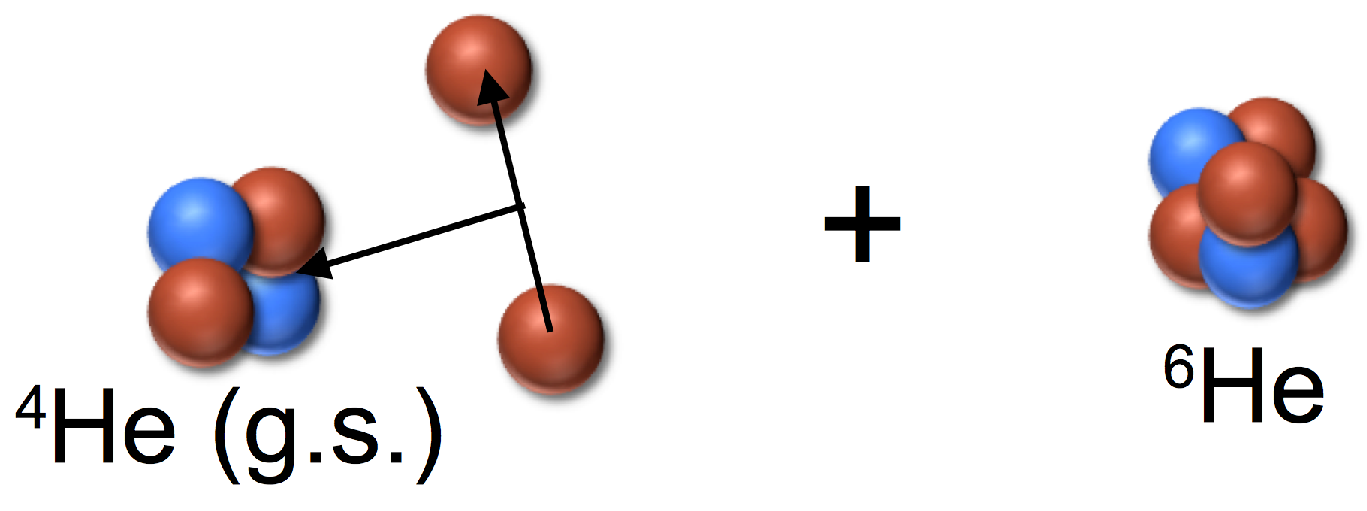
Figure 1. Schematic depiction of the NCSMC-basis expansion for 6He showing the NCSM 6He part and the three-body cluster part consisting of the 4He ground state and two neutrons.
Particles 09 00057 g001
Figure 2. NCSMC spectrum of 11Be with respect to the n+10Be threshold for different chiral interactions compared to experimental data. The dashed black lines indicate the energies of the 10Be states. The light boxes indicate resonance widths.
Particles 09 00057 g002
Figure 3. (a) NCSMC-calculated and experimental levels of 11Be. Only states corresponding to experimentally bound states with respect to the 10Be+n threshold (zero energy in the figure) are shown. (b) NCSMC-calculated 10Be + p eigenphase shifts. The vertical dashed line indicates the experimentally predicted location of the ( 1 / 2 + , 1/2) resonance at 197 keV. The NN-N4LO + 3Nlnl interaction was used. Adapted from Ref. [45].
Particles 09 00057 g003
Figure 4. Cluster form factors of 11Be 1 / 2 + (a) and 1 / 2 (b) states obtained with the N2LOsat interaction. The solid lines show the NCSMC-pheno results; the black dashed (black dotted) lines are the NCSMC (NCSM) S-wave (a) and P-wave (b) results. The legend columns show the 10Be eigenstate, the channel spin s and the relative orbital momentum l of 10Be+n. See the text for further details.
Particles 09 00057 g004
Figure 5. (a) Calculated energies of low-lying states of 15C compared to experimental data. The crosses correspond to NCSM calculations in basis spaces up to N max = 8 . The NCSMC calculations were performed in N max = 7 . All energies are with respect to the 14C+n threshold, the calculated one obtained in the consistent N max space. (b) Diagonal 14C+n phase shift dependence on the energy in the center of mass obtained within the NCSMC-pheno approach in N max = 7 space. The NN N3LO + 3Nlnl interaction and the HO frequency of Ω = 20 MeV were used in all calculations. See the text for further details.
Particles 09 00057 g005
Figure 6. Cluster form factors of 15C 1 / 2 + (a) and 5 / 2 + (b) states obtained with the NN N3LO + 3Nlnl interaction. The solid lines show the NCSMC-pheno results; the black dotted lines are the NCSM S-wave (a) and D-wave (b) results for the 14C in the 0 1 + ground state. See the text for further details.
Particles 09 00057 g006
Figure 7. Cross-sections for the radiative capture 14C(n, γ )15C to the 1 / 2 + and 5 / 2 + final states obtained within the NCSMC-pheno approach using the NN N3LO + 3Nlnl interaction.
Particles 09 00057 g007
Figure 8. 7Be+p eigenphase shifts (solid lines) and 3 S 1 and 5 S 2 diagonal phase shifts (dashed lines) obtained from the NCSMC approach with the NN-N4LO + 3 N lnl * interaction. Figure from Ref. [61].
Particles 09 00057 g008
Figure 9. Cluster form factors of 8B 2 + ground state obtained with the NN-N4LO + 3 N lnl * interaction within the NCSMC-pheno. The legend columns show the 7Be eigenstate, the channel spin s and the relative orbital momentum l of 7Be+p. See the text for further details.
Particles 09 00057 g009
Figure 10. 10Be → n + 9Be negative-parity eigenphase (left) and phase (right) shifts obtained from the NCSMC approach with the NN-N4LO + 3Nlnl chiral interaction and an N max = 9 model space. The 3 / 2 , 5 / 2 and 1 / 2 configurations are included in the 9Be mass partition.
Particles 09 00057 g010
Figure 11. 10Be → n 9Be positive-parity eigenphase (left) and phase (right) shifts obtained from the NCSMC approach with the NN-N4LO + 3Nlnl chiral interaction and an N max = 9 model space. The 3 / 2 , 5 / 2 and 1 / 2 configurations are included in the 9Be mass partition.
Particles 09 00057 g011
Figure 12. Probability distribution the J π = 0 + ground state of the 6He. Here, r n n = 2 η n n and r α , n n = 3 / 4 η α , n n are, respectively, the distance between the two neutrons and the distance between the c.m. of 4He and that of the two neutrons.
Particles 09 00057 g012
Figure 13. (a) Most relevant hyper-radial components of the α + n + n relative motion within the 6He g.s. after projection of the full NCSMC wave function (blue solid lines) as well as of its NCSM portion (red dashed lines) into the orthogonalized microscopic-cluster basis. (b,c) Contour plots of the probability distribution obtained from the projection of the full NCSMC wave function of panel (a) and its NCSM component, respectively, as a function of the relative coordinates r n n = 2 η n n and r α , n n = 3 / 4 η α , n n . Figure from Ref. [43].
Particles 09 00057 g013
Figure 14. Spectrum of low-lying energy levels of the 6He nucleus. Results for the SRG-N3LO NN interaction with λ = 1.5 fm−1 are shown on the left-hand side for both NCSM and NCSMC. The third set of energy levels corresponds to NCSMC results obtained with λ = 2.0 fm−1 and the fourth to the experimental spectrum of Ref. [79]. Figure from Ref. [77].
Particles 09 00057 g014
Figure 15. (a) 11Li 3 / 2 ground-state energy dependence on the harmonic oscillator frequency for different NCSM model space sizes characterized by N max . The gray band shows the N max extrapolated value with its uncertainty. The dotted lines correspond to the experimental ground-state energies. (b) The ground-state HO shell occupation dependence on N max for the Ω = 14 MeV calculation. The SRG-evolved NN-N4LO + 3 N lnl * interaction was used with the HO frequency of Ω = 14 MeV. See the text for further details.
Particles 09 00057 g015
Figure 16. Excitation energy dependence on the NCSM basis size for the low-lying negative-parity (panel (a)) and positive-parity (panel (b)) states of 11Li. The SRG-evolved NN-N4LO + 3 N lnl * interaction was used with the HO frequency of Ω = 14 MeV. See the text for further details.
Particles 09 00057 g016
Table 1. ANC2 of the S-wave neutron halo 1 / 2 + ground state of 11Be and the S- and D-wave spectroscopic factors and ANC of the 1 / 2 halo excited state of 11Be in the 10Be( 0 + )+n P-wave channel with the corresponding spectroscopic factor. Calculations performed with the N2LOSAT interaction within the NCSMC-pheno are compared to the results from Refs. [48,49].
11Be( 1 / 2 + )ANC2  [ fm 1 ] S-wave spectr. factorD-wave spectr. factor
NCSMC-pheno0.6180.900.16
Hebborn [48] 0.62 ± 0.06 ± 0.09
Yang [49] 0.616 ± 0.001
11Be( 1 / 2 )ANC [ fm 1 / 2 ] 10Be( 0 + )+n P-wave spectr. factor
NCSMC-pheno0.1290.85
Yang [49] 0.135 ± 0.005
Table 2. NCSMC-pheno-calculated ANCs and spectroscopic factors for the 1 / 2 + and 5 / 2 + bound states of 15C and the 14C(n, γ )15C cross-section at E c . m . = 23.3 keV for the capture to the 1 / 2 + and 5 / 2 + final states compared to results obtained by other methods.
15C( 1 / 2 + ) S-waveANC [ fm 1 / 2 ] Spectr. factor
NCSMC-pheno1.2820.96
Moschini  [54]1.26(2)1
Hebborn [48]1.25(12)1
Jiang [60]1.16(15)0.68(14)
15C( 5 / 2 + ) D-waveANC [ fm 1 / 2 ] Spectr. factor
NCSMC-pheno0.0480.90
Mukhamedzhanov [56]0.0595(36)1
σ n , γ [μb] at E c . m . = 23.3 keV 1 / 2 + 5 / 2 + Total
NCSMC-pheno4.790.134.92
Moschini [54]4.66(14)
Tkachenko [59] 4.75
Jiang [60]3.89(76)
Table 3. ANCs, in [ fm 1 / 2 ] , of the P-wave proton halo 2 + ground state of 8B obtained with the NN-N4LO+ 3 N lnl * interaction within the NCSMC-pheno compared to experimental results [63]. Estimates of chiral truncation errors are shown for theoretical values.
8B( 2 + ) C p 1 / 2 C p 3 / 2
NCSMC-pheno0.34(1)0.62(2)
Paneru [63]0.315(9)0.66(2)
Table 4. Asymptotic Normalization Coefficients (ANCs) for the 1 halo state of 10Be, calculated with the same interaction and configuration space as described in Figure 10. The ANCs are presented for a given spin-parity state of 9Be, relative orbital momentum of the neutron with respect to the 9Be cluster, and total spin of the n + 9Be partition. The first column contains the raw ANC from the calculation, whereas the second column contains the ANCs obtained by phenomenological adjustment of the NCSMC eigenenergies to their experimental values.
State of 9BelSANC [ fm 1 / 2 ] ANC Pheno [ fm 1 / 2 ]
3 / 2 010.3630.951
3 / 2 21 0.7 × 10 3 0.392 × 10 1
3 / 2 22 0.244 × 10 3 0.137 × 10 1
5 / 2 22 0.102 0.230
5 / 2 23 0.104 × 10 1 0.399 × 10 1
5 / 2 43 0.603 × 10 4 3.60 × 10 3
1 / 2 010.2570.425
1 / 2 21 0.184 × 10 1 0.506 × 10 1
Table 5. Asymptotic Normalization Coefficients (ANCs) for the 2 halo state of 10Be, calculated with the same interaction and configuration space as described in Figure 10. The ANCs are presented for a given spin-parity state of 9Be, relative orbital momentum of the neutron with respect to the 9Be cluster, and total spin of the n + 9Be partition. The only column shown contains the ANCs obtained by phenomenological adjustment of the NCSMC eigenenergies to their experimental values, given that the 2 is near-threshold but unbound in the raw calculation.
State of 9BelSANC Pheno [ fm 1 / 2 ]
3 / 2 21 0.288 × 10 1
3 / 2 02 0.756
3 / 2 22 0.103 × 10 1
3 / 2 42 0.274 × 10 4
5 / 2 02 0.451
5 / 2 22 0.164
5 / 2 42 0.849 × 10 4
5 / 2 23 0.126
5 / 2 43 0.128 × 10 3
1 / 2 20 0.184 × 10 1
1 / 2 21 0.348 × 10 1
Disclaimer/Publisher’s Note: The statements, opinions and data contained in all publications are solely those of the individual author(s) and contributor(s) and not of MDPI and/or the editor(s). MDPI and/or the editor(s) disclaim responsibility for any injury to people or property resulting from any ideas, methods, instructions or products referred to in the content.