Article

Identified-Hadron Spectra in π+ + Be at 60 GeV/c with Channel-Wise Subcollision Acceptance in PYTHIA 8 Angantyr

Physics Department, College of Science, Umm Al-Qura University, P.O. Box 715, Makkah 21421, Saudi Arabia
Particles 2026, 9(1), 8; https://doi.org/10.3390/particles9010008
Submission received: 21 December 2025 / Revised: 14 January 2026 / Accepted: 15 January 2026 / Published: 19 January 2026
(This article belongs to the Section Nuclear and Hadronic Theory)

Abstract

Identified-hadron production (p, π ± , K ± ) in π + + Be at p lab = 60 GeV / c ( s 10.6 GeV ) is investigated using Pythia 8.315 (Monash tune) with the Angantyr extension. Differential multiplicities d 2 n / ( d p d θ ) are confronted with NA61/SHINE measurements across standard θ bins. Within the fluctuating-radii Double-Strikman (DS) scheme, two unsuppressed opacity mappings are compared to quantify systematics. In addition, a minimal extension is introduced: a flat, post-classification, channel-wise acceptance applied after ND/SD/DD/EL tagging. It acts on primary and secondary π N pairs, keeps hadronization fixed (Lund string), and leaves the internal event generation of each admitted subcollision unchanged. Opacity-mapping variations alone induce only percent-level differences and do not resolve the soft/forward tensions. By contrast, the flat acceptance—interpretable as a reduced effective ND weight—improves agreement across species and angles. It hardens the forward π + spectra and lowers large- θ yields, produces milder charge-asymmetric changes for π consistent with the weaker leading feed, suppresses proton yields at all angles (with a residual 30 % forward high-p deficit), and improves K ± , with a stronger effect for K + than K . These results show that a geometry-blind reweighting of the subcollision mixture suffices to capture the main NA61/SHINE trends for π + + Be at SPS energies without modifying hadronization. The approach provides a controlled baseline for subsequent, channel-balanced refinements and broader π + A tuning.

1. Introduction

Precise hadron-production data for π + –beryllium ( π + Be) interactions at fixed-target energies are indispensable for modern accelerator-based neutrino programs. In horn-focused beams, the ν μ flux is driven predominantly by the kinematics and yields of forward π + . Secondary reinteractions of pions in light nuclear targets (graphite/beryllium) and beamline materials then shape both the overall normalization and the energy spectrum of the flux. Consequently, hadron-production systematics constitute a leading contribution to the flux-uncertainty budgets of long-baseline experiments [1]. To reduce these uncertainties, NA61/SHINE has performed dedicated thin-target measurements of π + + A collisions at SPS momenta, including a comprehensive study of π + + Be at p lab = 60 GeV / c with differential production multiplicities for identified hadrons [2]. These data extend and complement earlier NA61/SHINE measurements used to constrain flux predictions (e.g., for T2K) [3]. They also provide essential, model-discriminating input for neutrino-beam simulations relevant to present and next-generation facilities (NuMI/NOvA/MINERvA and LBNF/DUNE) operating in the 60–120 GeV Main Injector regime [1].
Despite this central role, widely used hadronic transport models show nontrivial tensions with NA61/SHINE’s identified-hadron spectra at 60 GeV / c . In the validation set based on π + + C (kinematically close to π + + Be), standard Geant4 10.7 physics lists exhibit both shape and normalization discrepancies for protons, π ± , and  K ± across the θ p phase space. This includes QGSP_BERT (QGS + Precompound + Bertini cascade), FTFP_BERT (FTF + Precompound + Bertini), FTF_BIC (FTF + Binary cascade), and the mixed QBBC tune; no single list reproduces all species and angular intervals consistently. The standalone FLUKA model provides the most uniform overall description but still overshoots forward π + production in the first angular bins—precisely the region most critical for horn-focused neutrino fluxes—while transport approaches such as GiBUU show residual discrepancies in the same forward kinematics [2,4,5,6].
To address these shortcomings, this study employs Pythia 8.315 [7] with the Angantyr extension [8], which embeds a Glauber multiple-scattering geometry [9,10] and Good–Walker diffractive-eigenstate fluctuations [11] into an event-by-event fluctuating-opacity description of hadron–nucleon encounters. For each admitted π N encounter, Angantyr seeds an NN-like partonic system through Pythia’s multiparton-interaction machinery [12,13], followed by Lund string fragmentation [14]; soft and diffractive excitations are treated analogously to FRITIOF-style string excitation [15,16]. Building on prior p + C work at p lab = 120 GeV / c —where a flat, post-classification subcollision suppression combined with a fixed-radii (Naive) geometry improved agreement yet left residual forward-angle tensions [17]—the present analysis proceeds in two steps. First, it adopts the fluctuating-radii Double-Strikman baseline (Angantyr::CollisionModel=1). Second, it introduces a minimal, channel-wise, impact-parameter-independent acceptance layer applied after Angantyr’s ND/SD/DD/EL tagging. This layer reweights the subcollision mixture while leaving the internal event generation of each admitted subcollision unchanged. Performance is validated against the unsuppressed baseline and an opacity-variant control (Angantyr::CollisionModel=2).
The manuscript is organized as follows. Section 2 specifies the simulation framework, based on Pythia 8.315 (Monash tune) [7] with the Angantyr Double-Strikman subcollision model (Angantyr::CollisionModel=1) [8] and an opacity-variant control (Angantyr::CollisionModel=2). It also defines the post-classification, channel-wise flat acceptance (Mode B) used to reweight ND/SD/DD/EL π N subcollisions, summarizes the Lund string-fragmentation settings [14], and lists the run-time steering adopted throughout. Section 3 confronts the calculations with NA61/SHINE π + + Be data at p lab = 60 GeV / c [2], presenting d 2 n / ( d p d θ ) spectra for π ± , p, and  K ± across the experimental angular bins. The impact of Mode B is quantified relative to the unsuppressed baseline, and the charge-dependent features are interpreted in terms of leading-particle systematics and the modified subcollision admixture. Section 4 summarizes the principal findings, highlights residual tensions, and discusses implications for neutrino-flux predictions and future generator tuning.

2. Description of the Model

This section specifies the simulation setup for inelastic π + –Be interactions at p beam = 60 GeV / c , based on Pythia 8.315 [7] with Angantyr’s Double-Strikman subcollision framework [8]. The setup comprises the following: (i) construction of the π N subcollision ladder within a Glauber geometry with Good–Walker diffractive-eigenstate fluctuations [9,10,11,18]; (ii) a post-classification, b-invariant flat suppression layer (Mode B) applied after the native ND/SD/DD/EL tagging to reweight channel admixtures while leaving the internal event generation of each admitted subcollision unchanged; and (iii) hadronization fixed to the Lund string model (Monash tune) [14], held identical across all comparisons.

2.1. Subcollision Geometry and Coherence (Angantyr Double-Strikman)

Angantyr’s Double-Strikman subcollision model [18] is used with Angantyr:: CollisionModel=1 (baseline opacity mapping); for opacity-mapping systematics, Angantyr:: CollisionModel=2 (alternative mapping) is also considered [7,8]. The scheme combines (i) event-by-event fluctuations of the hadronic transverse size with (ii) a semi-transparent (“grey”) interaction profile that maps geometric overlap to interaction strength. Coherence and diffractive fluctuations are realized via the Good–Walker two-state construction: for each hadron–nucleon encounter, a “main” and an “auxiliary” diffractive eigenstate are sampled, yielding ND/SD/DD/EL outcomes in a probabilistically consistent manner [8,11]. In the present π + + Be study, the elementary subcollisions are π N (rather than N N ); accordingly, the external inputs (total and elastic cross-sections and slope parameters) are taken from π p at the same beam momentum, while the subcollision classification and subsequent handling follow the standard Angantyr logic unchanged.

Size Fluctuations

The effective transverse size of each hadron is modeled by a fluctuating “radius” r drawn from a Gamma distribution with shape k 0 and scale r 0
P ( r k 0 , r 0 ) = r k 0 1 e r / r 0 Γ ( k 0 ) r 0 k 0 , r = k 0 r 0 , Var ( r ) = k 0 r 0 2 .
The scale r 0 is fixed internally so that the ensemble reproduces the externally supplied total hadron–hadron cross-section at the given energy, i.e., the average geometric size matches the relevant σ tot . For a projectile/target pair with sampled radii ( r p , r t ) , define the pair geometric area [8]
σ geom ( r p , r t ) = π r p + r t 2 ,
which enters the opacity mapping below.

2.2. Baseline Opacity Mapping (Angantyr::CollisionModel=1)

For a projectile–nucleon encounter at impact parameter b, Angantyr employs a sharp-edged grey disk: the impact-parameter-space elastic profile (real, 0 T 1 ) is taken constant inside an effective radius R and zero outside
T b | r p , r t = τ σ geom Θ R ( σ geom ) b , σ geom π ( r p + r t ) 2 ,
where, in the Pythia implementation, R and τ are not independent but are related by the following:
R 2 ( σ geom ) = σ geom 2 π τ ( σ geom ) .
With the step-function profile in Equations (3) and (4), the integrated total cross-section for a given fluctuating pair is σ tot ( σ geom ) = σ geom , while the elastic component becomes σ el ( σ geom ) = 1 2 τ ( σ geom ) σ geom . Thus, τ controls the opacity (blackness) of the disk and, consequently, the partition between absorptive and diffractive/elastic channels, at fixed  σ geom .
The Double-Strikman scheme provides two alternative size→opacity mappings, selected in standard Pythia/Angantyr by Angantyr::CollisionModel. For the default Double-Strikman option (Angantyr::CollisionModel=1), the in-disk greyness is
τ ( σ geom ) = 1 exp σ d σ geom α , ( Angantyr : : CollisionModel = 1 ) ,
which makes smaller geometric pairs effectively greyer (more opaque) and larger pairs more transparent. The alternative opacity treatment (Angantyr::CollisionModel=2) uses
τ ( σ geom ) = 1 exp σ geom σ d α , ( Angantyr : : CollisionModel = 2 ) ,
which correlates size and opacity in the opposite sense. Here, σ d sets the saturation scale for the approach to the black-disk limit, and  α controls the steepness of the transition; these parameters are tuned internally to reproduce the inclusive hadron–nucleon cross-section inputs used by Pythia (total, elastic, and slope) at the relevant energy. In the present work, the opacity-mapping systematics are assessed by comparing the unsuppressed Angantyr::CollisionModel=1 and Angantyr::CollisionModel=2 baselines, while the suppression study is performed on top of Angantyr::CollisionModel=1.
The baseline opacity mapping in Angantyr::CollisionModel=1 is employed, since it ties the disk greyness τ to the fluctuating size in a way that mitigates excessive absorptive-area growth from rare large-r configurations and yields diffractive fractions compatible with π p constraints at SPS energies. After Angantyr performs the event-by-event Good–Walker tagging of each π N encounter into ND/SD/DD/EL, the post-classification, impact-parameter-independent (flat) channel-wise acceptance (Mode B; Section 2.4) is applied to the already-classified pairs.

2.3. From Amplitudes to Probabilities

With S = 1 T the (real) eikonal S-matrix element for a given pair, the inelastic (absorptive) probability at fixed b and radii is
P inel b | r p , r t = 1 S 2 = 2 T T 2 ,
while diffractive probabilities are constructed à la Good–Walker by combining amplitudes from the main/auxiliary eigenstates of the colliding hadrons and enforcing unitarity. Averaging over the fluctuating radii (see Equation (1)) and over b then yields the ND/SD/DD/elastic subcollision fractions that seed the subsequent MPI and hadronization stages. Coherence (shadowing) arises because each nucleon’s instantaneous fluctuating state participates in all of its simultaneous encounters, correlating the subcollisions within the same event.

2.4. Phenomenological Suppression: An Extension of the Double-Strikman Baseline

2.4.1. Post-Classification, Channel-Wise Flat Suppression

On top of the fluctuating, semi-transparent Double-Strikman geometry (Angantyr:: CollisionModel=1), a b-invariant acceptance layer is applied after Angantyr tags each hadron–nucleon subcollision as ND, SD, DD, or EL. The native classification and the internal event generation of each admitted subcollision remain unchanged; only the admission of already-classified pairs is modulated through channel-specific, impact-parameter-independent probabilities (equivalently, constant drop fractions).

2.4.2. Motivation

This post-classification filter is introduced as a compact phenomenological proxy for nuclear screening/coherence effects that are not explicitly enforced by the baseline construction of independent sequential hadron–nucleon encounters. At SPS energies, the coherence/formation scales of soft production can become comparable to intra-nuclear length scales, so successive encounters of the same projectile (or of excited remnants) need not contribute incoherently as a simple sum of independent π N reactions. In such circumstances, destructive interference, shadowing, or formation-time limitations can reduce the number of effectively active in-medium collisions relative to the Glauber-like encounter count, without requiring any modification of the internal π N generator once an encounter is admitted.
A second (practical) interpretation is that the filter compensates, in an averaged way, for residual deficiencies in extrapolating π N dynamics and its diffractive decomposition to a π A environment, where the mixture and reinteraction probability of ND/SD/DD excitations may be overestimated by a direct superposition picture. The suppression is implemented channel-wise because the degree of screening and the in-medium survival probability can differ between non-diffractive, diffractive, and elastic topologies. The choice to make it flat (impact-parameter independent) is deliberate: it encodes an average reduction of the effective encounter multiplicity and channel composition across the analyzed event class, while keeping the opacity mapping and geometry fluctuations of the Double-Strikman baseline unchanged. Accordingly, the method is not presented as a unique microscopic mechanism; rather, it is a minimal acceptance layer that encodes missing screening physics at the level of admitted subcollisions and is assessed through its phenomenological performance in Section 3.

2.4.3. Definition

For each channel c { ND , SD , DD , EL } , a constant, impact-parameter-independent drop probability D c [ 0 , 1 ] is specified. The corresponding admission (keep) probability is
A c = 1 D c .
Operationally, after Angantyr has assigned a given π N encounter to channel c, a uniform variate u U ( 0 , 1 ) is drawn and the encounter is vetoed if u < D c . If vetoed, the encounter is simply removed from the list of active subcollisions: no alternative channel is re-selected and the internal ND/SD/DD/EL classification is not revisited. The event construction then proceeds with the remaining (admitted) encounters. In practice, only admitted ND/SD/DD encounters are passed to the underlying π N event generation (partonic system, string excitation, and subsequent fragmentation), because elastic encounters do not produce excited strings or hadronic secondaries in Angantyr: an EL tag corresponds to a purely elastic π N scattering at the subcollision level and therefore contributes no particle-production activity beyond the projectile/target remnants. For this reason, EL subcollisions are not propagated through the hadron-production stage and are effectively irrelevant for the multiplicity spectra d 2 n / ( d p d θ ) studied here, irrespective of whether they are kept or vetoed. Vetoing an encounter thus removes it from the active list, while keeping an EL encounter merely retains an “inactive” (non-producing) entry that does not generate final-state hadrons. This “flat” filter applies equally to primary and secondary π N encounters and does not depend on any geometric variable.

2.4.4. Operational Modes

  • Mode A—No suppression: D c = 0 for all channels ( A c 1 ); the Double-Strikman classification passes unchanged.
  • Mode B—Flat suppression: fixed D c values (per channel), uniform in geometry; already-classified encounters are independently vetoed with probability D c , reducing the effective number of admitted subcollisions and altering the realized ND/SD/DD/EL mixture, while leaving the internal event generation and hadronization of each admitted encounter unchanged.

2.4.5. Steering and Scope

Mode B is applied exclusively with Angantyr::CollisionModel=1 so that opacity-mapping systematics remain separate from the suppression study. The numerical drop fractions used for each channel are summarized in Table 1. The purpose of introducing channel-dependent veto probabilities is not to retune the internal π N dynamics on an event-by-event basis, but to emulate, at the level of the realized subcollision mixture, nuclear screening/coherence effects and formation-time limitations that can suppress the number of effectively active encounters in a π A environment. In this sense, the modification targets the embedding of π N reactions into the nucleus, rather than the π N generator itself.
The approach is also motivated by the fact that Angantyr’s multiple-encounter framework and its default ND/SD/DD bookkeeping were primarily developed and validated for N N and p A / A A applications. When applied to π A at SPS energies, a direct superposition of independent π N encounters can overpopulate soft ND activity (and its large- θ secondaries) and misrepresent the effective balance between non-diffractive and diffractive excitations once projectile and target remnants propagate through a nuclear environment. Mode B therefore applies a minimal, post-classification adjustment of the ND/SD/DD/EL encounter mixture, dominated by a reduced ND admission, while leaving the internal event generation and hadronization of each admitted encounter unchanged.
The Table 1 values are not intended as a unique optimum; rather, they represent a simple, compact parameter point that implements an overall reduction of effective activity and a lowered ND weight. While a dedicated parameter scan is beyond the scope of the present work, the mechanism of improvement suggested by Section 3 is qualitatively transparent: the dominant effect arises from reducing the effective ND component, whereas moderate redistributions between SD and DD at fixed overall activity are expected to induce only subleading changes to the spectra. All comparisons in Section 3 therefore contrast Mode A (unsuppressed) with Mode B (flat, post-classification channel-wise suppression) under identical shower and hadronization settings between these two modes.

2.5. Hadronization Model (Lund String)

In this work, only the Lund string fragmentation model as implemented in Pythia 8 (Monash tune) [7,14] is employed. Hadrons are produced by successive breakings of color strings stretched between color charges created in the hard/soft subcollision and subsequent parton evolution. Each breaking corresponds to nonperturbative tunneling of a q q ¯ or q q q q ¯ pair. The Schwinger mechanism yields an exponential suppression in the transverse mass of the produced parton:
P q exp π m q 2 κ , m q = m q 2 + p 2 ,
with string tension κ . In the hadron spectra this corresponds to an (approximately) Gaussian p generated by the string, controlled in Pythia by StringPT:sigma (Monash value 0.335  GeV). Since m q q > m q , diquark production—and thus baryons—is naturally suppressed relative to mesons.
Baryon formation proceeds through two standard topologies: (i) direct B B ¯ production from q q q q ¯ tunneling and (ii) the popcorn mechanism, in which an intermediate meson is emitted between the baryon and antibaryon [19]. The relative weights of these mechanisms—and the flavor composition of produced pairs—are governed by a small set of Lund flavor parameters. Hadronization is not retuned here; Monash defaults are used throughout for reproducibility, notably StringFlav:probQQtoQ  = 0.081 and StringFlav:probStoUD  = 0.217 , with popcorn baryon production enabled at its default setting. More generally, the Schwinger tunneling ansatz of Equation (9) implies the relative probability
P Q Q ¯ P q q ¯ = exp π m Q 2 m q 2 κ ,
which encapsulates the familiar suppression of heavier flavors and diquarks unless compensated by kinematics. All comparisons below employ the same Lund (Monash) settings across subcollision scenarios; observed differences therefore isolate the effect of the subcollision classification and the post-classification acceptance layer.

Scope Within This Study

Unless stated otherwise in Table 1, the Pythia 8.315 baseline and all standard Angantyr settings are kept identical across the comparisons. In particular, the underlying parton shower, MPI/ISR/FSR, and Lund string hadronization settings are held fixed between Mode A and Mode B; no mode-dependent retuning is performed. The only intentional difference between these two modes is the post-classification, b-invariant channel-wise veto applied to already-tagged π N encounters in Mode B.
It is emphasized, however, that the study does not use a fully “out-of-the-box” Monash parameter set: two Lund flavor parameters, StringFlav:probQQtoQ and StringFlav: probStoUD, are set to 0.05 and 0.15 , respectively, in both Mode A and Mode B (Table 1), rather than the default values shown in the “DS” column. This common choice was introduced to avoid an excessive non-leading baryon component and strangeness production in the present π + + Be configuration, thereby improving the overall baseline agreement with NA61/SHINE yields before assessing the impact of the subcollision-mixture suppression. The values were determined empirically by simple, low-dimensional tuning: starting from the default settings, StringFlav:probQQtoQ and StringFlav:probStoUD were varied within the standard physically allowed ranges, and the pair ( 0.05 , 0.15 ) was selected as a compact working point that yields a more realistic global normalization and species composition (in particular for protons and K ± ) across the measured θ bins, without altering the qualitative conclusions of the Mode A versus Mode B comparison.
For transparency, the parameters that differ between configurations are explicitly listed in Table 1: (i) the opacity-mapping systematics comparison (Angantyr::CollisionModel=1 versus Angantyr::CollisionModel=2) and (ii) the flat drop fractions ( D c ) that define Mode B. All other settings, including the modified flavor parameters above, are identical between Mode A and Mode B. Hence, differences in Section 3 attributed to Mode A versus Mode B arise from the upstream subcollision admission, not from mode-dependent modifications of the hadronization model.

3. Results and Discussion

This section confronts NA61/SHINE measurements of identified hadron production in inelastic π + + Be at p beam = 60 GeV / c ( s π N 10.6 GeV ) with Pythia 8.315 predictions for protons, π ± , and  K ± . The observable is the double-differential multiplicity d 2 n / ( d p d θ ) in fixed angular intervals: θ [ 0 , 10 ] , [ 10 , 20 ] , [ 20 , 40 ] , [ 40 , 60 ] , [ 60 , 100 ] , [ 100 , 140 ] mrad for pions; [ 0 , 20 ] , [ 20 , 40 ] , [ 40 , 60 ] , [ 60 , 100 ] , [ 100 , 140 ] mrad for protons; and [ 0 , 20 ] , [ 20 , 40 ] , [ 40 , 60 ] , [ 60 , 100 ] mrad for kaons. Unless stated otherwise, all overlays use the Monash 2013 tune and identical Lund-string fragmentation steering (Table 1).
Three subcollision scenarios are contrasted under identical hadronization (Monash tune; Table 1): (i) a Double-Strikman variant with the alternative opacity mapping (Angantyr::CollisionModel=2), used solely as an opacity-systematics control and run without suppression; (ii) the Double-Strikman baseline with the baseline opacity mapping (Angantyr::CollisionModel=1; Mode A, no suppression); and (iii) Mode B, a b-invariant (flat) channel-wise post-classification suppression applied on top of Angantyr::CollisionModel=1. The suppression extension is applied exclusively with Angantyr::CollisionModel=1, keeping opacity-mapping systematics orthogonal to the suppression study. In Mode B the channel-wise admission filter acts after the ND/SD/DD/EL tagging of each candidate π N subcollision (primary and secondary), reshaping the subcollision mixture while leaving the internal event generation of each admitted subcollision unchanged.
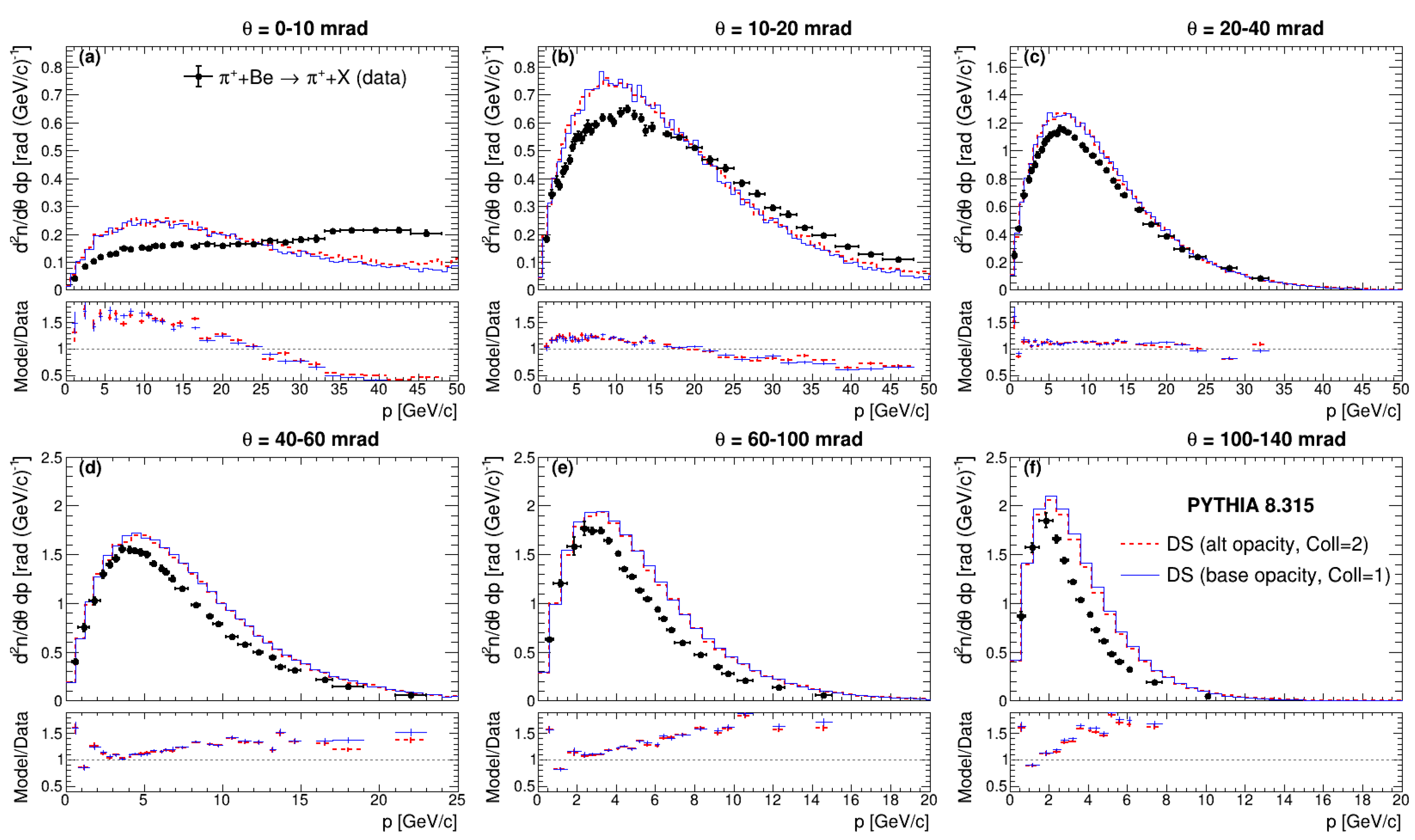
Figure 1 isolates the opacity-mapping systematics within Angantyr’s Double-Strikman (DS) geometry by comparing two unsuppressed configurations with identical Monash hadronization: the alternative-opacity variant (Angantyr::CollisionModel=2 (CM=2); red, short-dashed) versus the baseline opacity mapping (Angantyr::CollisionModel=1 (CM=1); blue, thin). The aim is to quantify how the choice of τ ( σ geom ) in the fluctuating-radii eikonal modifies the π + momentum spectra d 2 n / ( d p d θ ) in π + + Be at 60 GeV / c across forward and mid-angle bins. Both unsuppressed DS variants fail to describe the data: they overpredict the yield for p < 15 GeV / c at θ = 0 –10, 10–20, and 20–40 mrad; they underpredict for p > 15 GeV / c in the most forward bins (0–10, 10–20 mrad); they are closer to the data for p > 15 GeV / c at 20–40 mrad; and they overshoot for p > 5 GeV / c at more central angles (40–140 mrad).
The two opacity mappings separate only at the few-percent level: CM=2 sits slightly above CM=1 for p > 30 GeV / c in the forward region ( θ 40  mrad), while CM=1 tends to be marginally higher for θ = 40 –140 mrad. This pattern is consistent with CM=2 modestly enhancing diffractive π N topologies that preserve a leading π + (raising the forward high-p yield), whereas the baseline mapping in CM=1 is more absorptive for compact encounters, slightly increasing soft multiplicity at larger angles.
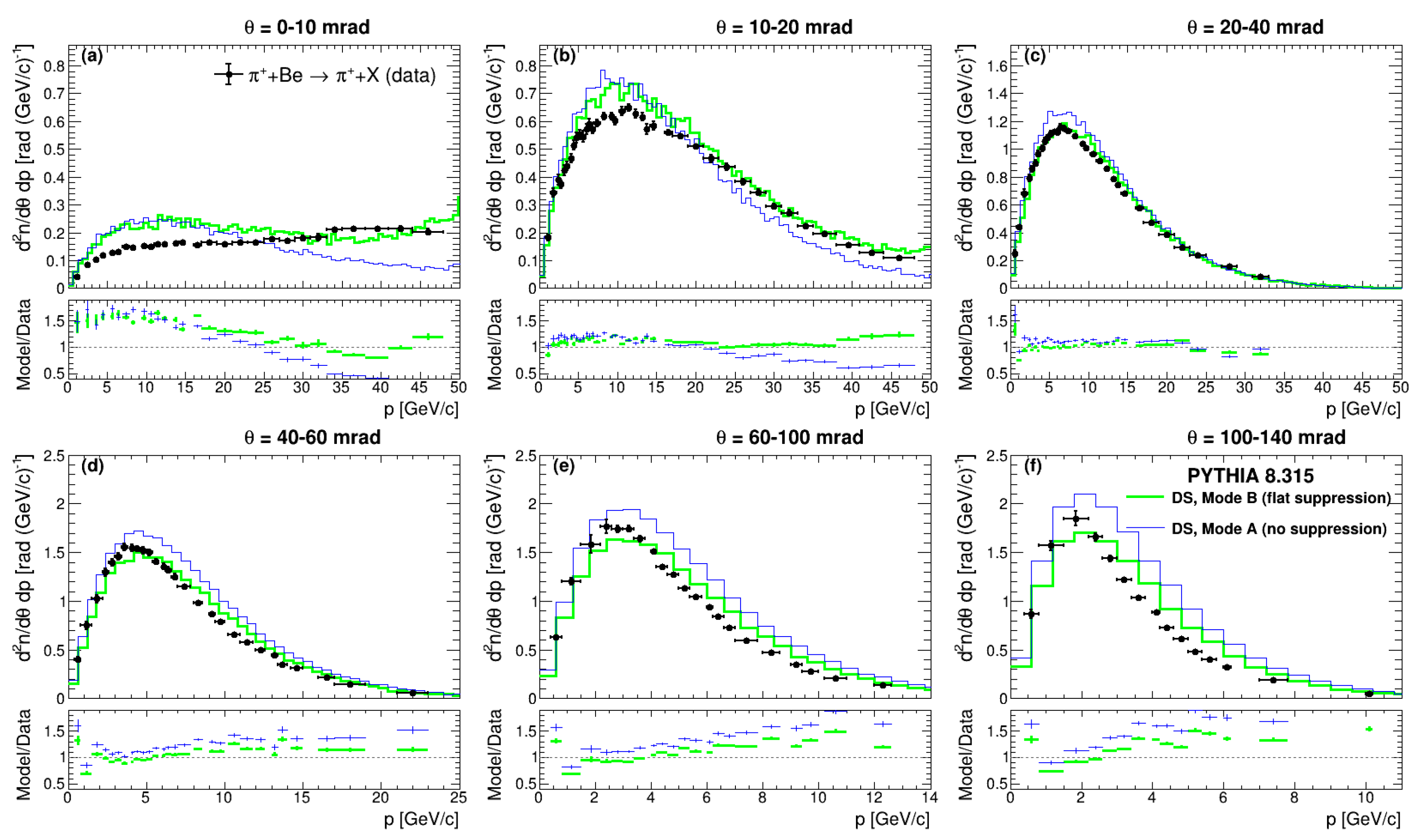
Figure 2 shows the impact of post-classification subcollision suppression on the inclusive π + spectra, d 2 n / ( d p d θ ) , in  π + + Be at p beam = 60 GeV / c . The comparison contrasts the unsuppressed baseline (Mode A) with a flat, b-invariant filter (Mode B) under Angantyr::CollisionModel=1 with the Monash tune. Both overlays use the fluctuating-radii Double-Strikman geometry and identical hadronization; the only difference is the acceptance applied after each candidate π N subcollision has been tagged as ND/SD/DD/EL (Section 2.4). Blue, thin curves denote Mode A (no suppression), and green, thick curves denote Mode B (flat, channel-wise suppression). Operationally, Mode B reduces the admitted fractions of selected channels without altering the internal event generation of each admitted subcollision. Phenomenologically, this reweights soft non-diffractive production and diffractive feed-down, hardening the forward-angle tail while attenuating low-p strength at larger θ . Relative to Mode A, Mode B improves agreement at p 20 GeV / c for θ = 0 –10 and 10–20 mrad, and reduces the low-p excess for θ 20 –40 mrad.
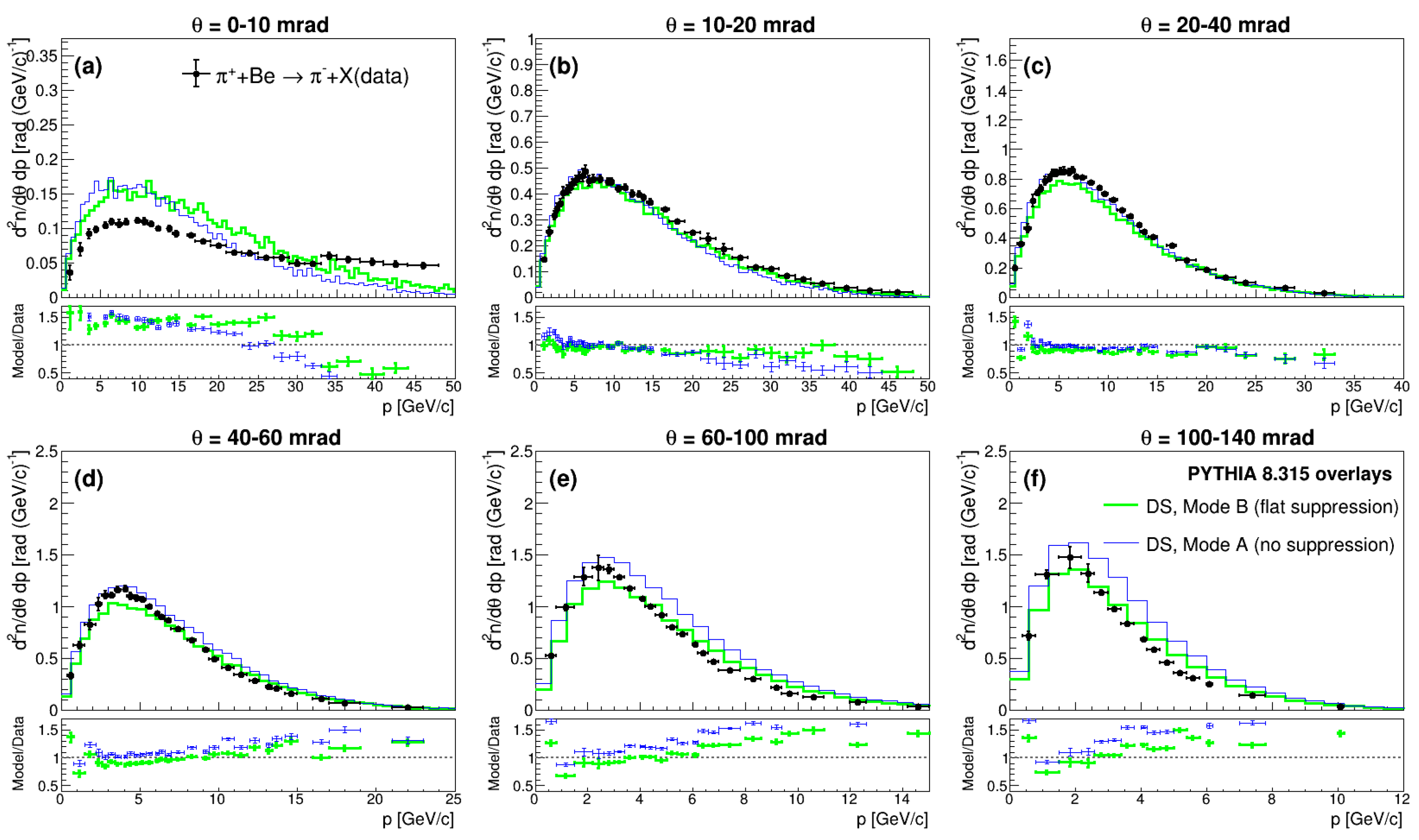
Figure 3 contrasts the unsuppressed Double-Strikman baseline (Angantyr:: CollisionModel=1, Mode A) with a flat, b-invariant post-classification suppression (Mode B) for the inclusive π spectra. In the most forward bin ( θ = 0 –10 mrad), Mode B mildly hardens the spectrum and raises the yield for p 30  GeV/c relative to Mode A, yet it still undershoots the far tail. At  θ = 10 –20 mrad, Mode B suppresses the soft region ( p 15  GeV/c) and enhances the harder part, improving agreement. For  θ = 20 –40 mrad the two modes are broadly similar, with Mode A reproducing 3 < p < 15  GeV/c slightly better. A comparable pattern persists at θ = 40 –60 mrad: Mode A yields more π for 3 < p < 8  GeV/c (closer to data), whereas Mode B reduces the spectrum above 8  GeV/c and better follows the measured falloff. In mid-central bins ( θ = 60 –100 and 100–140 mrad), Mode B lowers the yield for p 2  GeV/c, again moving predictions toward the data.
As seen in Figure 2 and Figure 3, the flat post-classification suppression (Mode B) impacts π + and π asymmetrically. In the forward region ( θ 20  mrad) it hardens the π + spectrum by O ( 15 30 ) % for p 25 –30 GeV/c, whereas the π gain is smaller, O ( 10 20 ) % , and the high-p tail remains under the data. At larger angles ( θ 60  mrad) Mode B suppresses yields by about 10– 25 % for π + and 10– 30 % for π , with only minor differences around θ = 20 –40 mrad.
This pattern follows the Lund leading-particle systematics of π + N string fragmentation and thereby connects directly to the interpretation of Mode B as predominantly removing soft ND activity. The post-classification filter down-weights mainly ND subcollisions, which are the principal source of soft, wide-angle secondaries. Once these are reduced, the spectra become relatively more dominated by fragmentation at the projectile string end. In  π + N collisions the projectile carries valence content u d ¯ , so the forward string end naturally favors the formation of leading π + : the produced hadron can inherit a projectile valence quark at large x F (small θ and high p). By contrast, forward π ( d u ¯ ) production does not receive a comparably strong leading feed from the π + valence endpoint and is therefore less enhanced when the soft ND component is suppressed. The net result is precisely the stronger forward hardening for π + than for π observed in Figure 2 and Figure 3, together with the predominantly angular suppression at large θ where ND secondaries dominate.
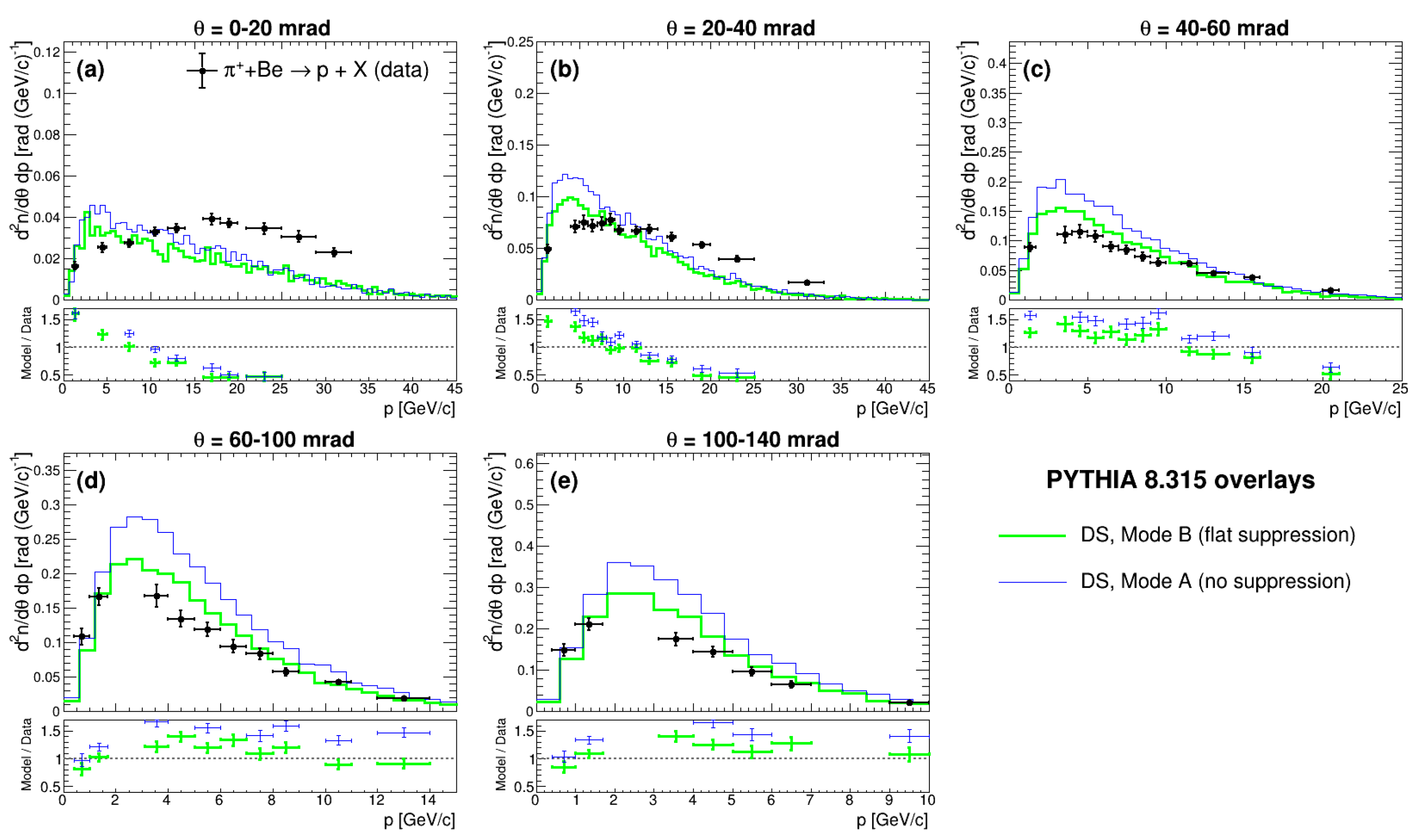
Figure 4 contrasts the unsuppressed Double-Strikman baseline (Angantyr:: Coll- isionModel=1, Mode A) with a flat, b-invariant post-classification suppression (Mode B) for inclusive proton spectra. Unlike the charged-pion case, Mode B lowers the proton yield across all angular intervals, with the suppression strengthening toward larger θ . For θ 40 –60 mrad, Mode B reproduces the spectra over the full momentum range. In the forward bins ( θ = 0 –20 and 20–40 mrad), Mode A lies slightly above Mode B for p 10 GeV / c . Both modes, however, remain at the ∼30% level below the data in the high-p tail.
This behaviour is consistent with a flat post-classification filter that down-weights predominantly ND subcollisions after Angantyr’s ND/SD/DD/EL tagging. This reduces the overall soft activity and the associated non-leading baryon component generated through diquark creation in Lund strings. In  π + N interactions the projectile carries no baryon number, so forward protons originate mainly from target-remnant fragmentation (string ends tied to the struck nucleon) and from non-leading baryon production during string breaking. Consequently, suppressing ND encounters lowers proton yields rather generically across phase space, including at small θ .
A notable limitation emerges, however, in the forward high-p region: even the unsuppressed baseline (Mode A) remains below the data by approximately 30 % , and Mode B does not remove this deficit. This indicates that the remaining discrepancy is not primarily controlled by the ND/SD/DD mixture or the effective number of admitted subcollisions. Rather, it is more plausibly associated with baryon-remnant and baryonization dynamics within the fixed Lund fragmentation scheme used here—in particular, the treatment of target-remnant string ends and the effective diquark suppression. Baryon formation through popcorn-like mechanisms may also contribute. Such effects act at the level of remnant breakup and string hadronization and are therefore not expected to be cured by subcollision reweighting alone.
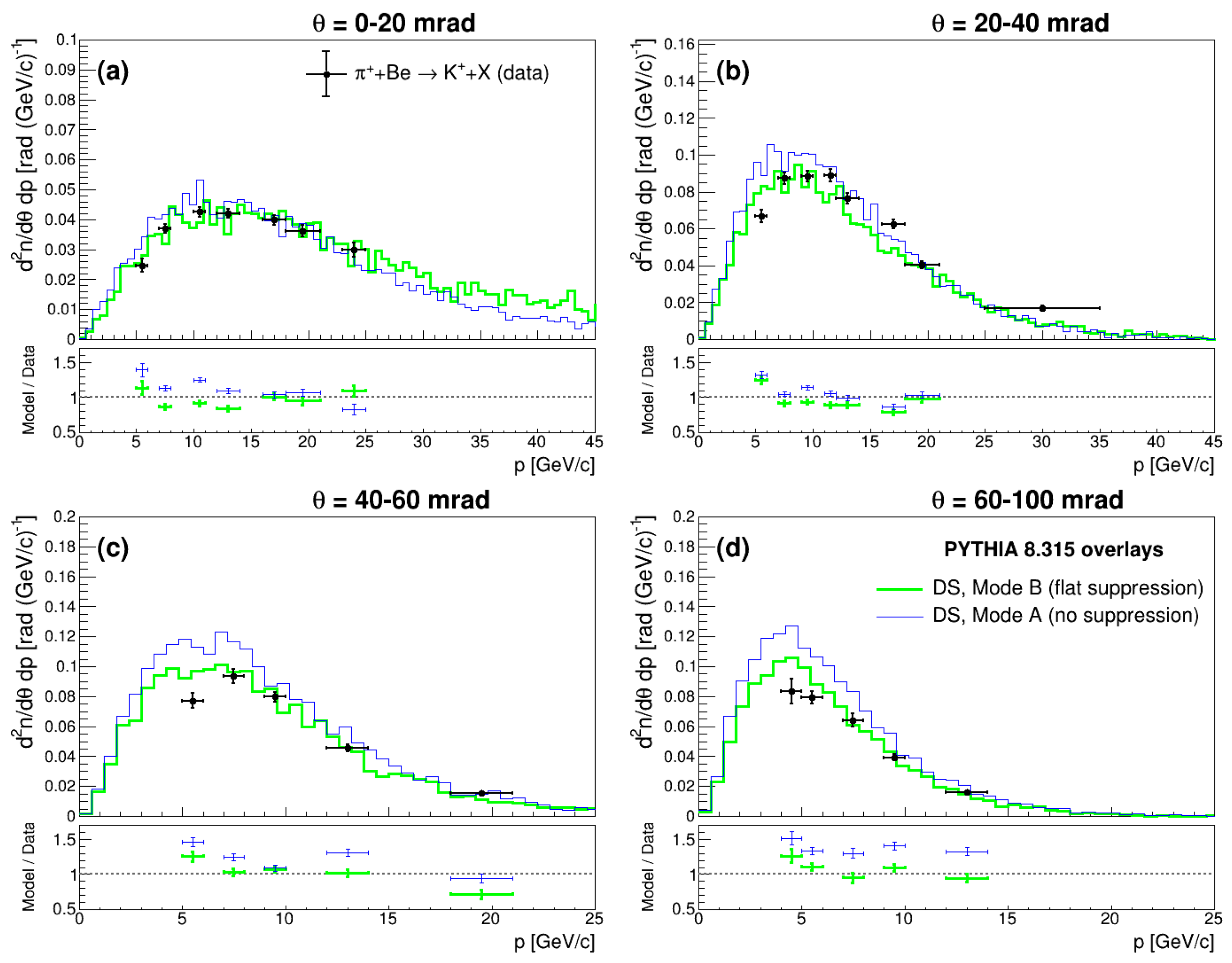
Figure 5 contrasts the unsuppressed Double-Strikman baseline (Angantyr:: CollisionModel=1, Mode A) with a flat, b-invariant post-classification suppression (Mode B) for inclusive K + spectra, d 2 n / ( d p d θ ) . Mode B lowers the K + yield across all angular bins, with the reduction strengthening toward larger θ . In the forward bin ( θ = 0 –20 mrad), Mode B suppresses the soft region ( p 20 GeV / c ) while leaving a slightly harder high-p tail, improving agreement with the data. For  θ 20 –40 mrad the spectra are uniformly reduced, and the description is systematically better than Mode A. The qualitative trend mirrors the π + case (Figure 2): pruning predominantly soft, large- θ non-diffractive secondaries hardens forward production while tempering central yields.
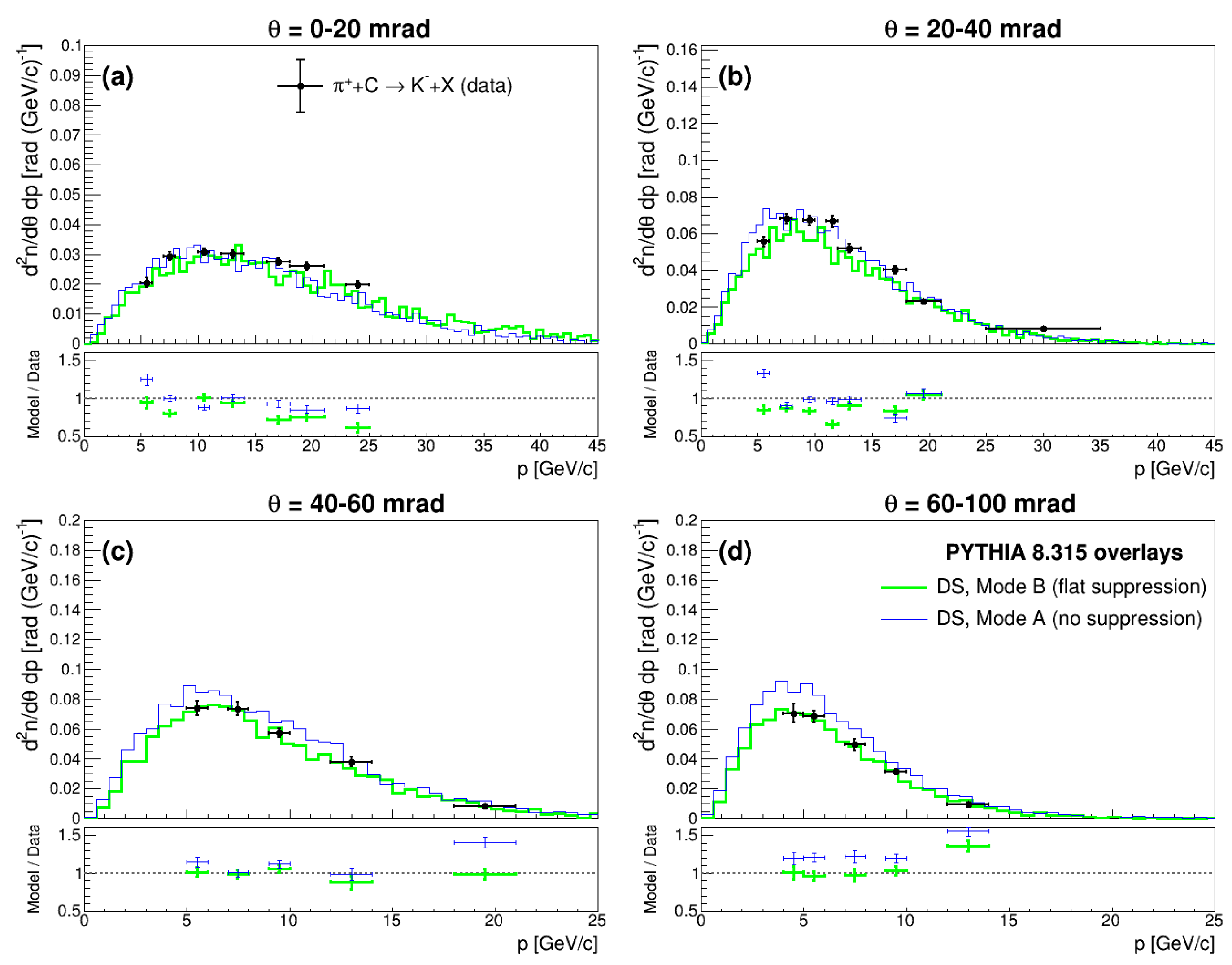
Mode B induces a qualitatively similar pattern for K (Figure 6)—a soft suppression that strengthens with θ —but the separation between Mode A and Mode B is visibly smaller than for K + . Forward hardening is modest; the improvement arises chiefly from a broad reduction at larger angles.
This charge asymmetry follows from Lund fragmentation systematics in π + N strings and is therefore naturally aligned with the trends in Figure 5 and Figure 6. The  K + ( u s ¯ ) channel benefits from two correlated mechanisms. First, a leading-particle bias arises because the projectile carries a valence u, allowing a forward K + to be formed efficiently when string breaking produces an s s ¯ pair and the s ¯ combines with the projectile u at the string end. Second, strangeness production tends to occur in associated topologies, such as K + Λ (or K + Σ ), where the s is tied to a hyperon while the s ¯ feeds the forward kaon, further enhancing small- θ yields. In contrast, K ( u ¯ s ) production has no analogous leading endpoint in a π + beam: it relies more on central s s ¯ creation together with the additional requirement of forming a u ¯ from string breaking (and/or resonance feed-down), which dilutes any forward enhancement.
A flat post-classification suppression that down-weights predominantly soft ND secondaries after Angantyr’s ND/SD/DD/EL tagging therefore acts in a channel-dependent way: it reduces the wide-angle, soft component while leaving the endpoint fragmentation dynamics unchanged. Consequently, the forward K + spectrum hardens (the leading/associated component becomes relatively more visible), whereas the forward response of K is mild and the dominant effect is a broad suppression at large θ . This is exactly the qualitative behavior exhibited in Figure 5 and Figure 6.

Comparison to Prior π + + C Studies at 60 GeV/c

The NA61/SHINE validation at p lab = 60 GeV / c (kinematically close to π + + Be ) confronts identified-hadron spectra with four widely used generators that embody distinct hadronic-physics strategies. QGSP_BERT blends the Quark–Gluon String model (QGS) at high energy with the FRITIOF string model (FTF) at intermediate energy and the Bertini intranuclear cascade (BERT) at low energy. The transitions are implemented via linear handovers, and nuclear de-excitation is handled by the Precompound model [20]. FTF_BIC shares the FTF+Precompound high-energy backbone but replaces secondary reinteractions inside the nucleus with the Binary Intra-Nuclear Cascade (BIC) [21]. FLUKA couples a microscopic intranuclear cascade with pre-equilibrium and evaporation/fission (PEANUT) to a dual-parton/string description for high-energy hadron production. The nuclear geometry is embedded in a Gribov–Glauber picture [5,22,23]. GiBUU implements a quantum-kinetic BUU transport with mean-field propagation and coupled-channel hadron–hadron collisions with resonance dynamics at low/intermediate energies. At higher energies, string-based production with formation times is employed [6].
Across species and angles, none of these baselines achieves a uniformly accurate description of the NA61/SHINE multiplicity spectra [2]. For  π + , QGSP_BERT tends to overshoot forward yields (e.g., θ = 0 –10, 10–20, 20–40 mrad) above a few GeV/c, with deficits emerging at larger angles. FTF_BIC fares better in the two most forward bins but underestimates at mid/large θ . GiBUU typically overshoots at intermediate momenta in the most forward bin and undershoots both the high-p tail and the larger-angle yields. FLUKA provides the most even overall description but still overpredicts forward π + production in the first angular bins—precisely the kinematics that dominate horn-focused neutrino fluxes. For  π , FLUKA and GiBUU describe the forward low-p region reasonably but undershoot the tails. For protons, QGSP_BERT tends to overshoot at low p, whereas GiBUU undershoots forward high-p and overpredicts low-p at larger angles; and FLUKA often undershoots mid-angle high-p yields. For  K ± , only FLUKA reproduces forward production reasonably, with overshoots at larger angles. These persistent forward-angle and species-dependent tensions motivate the post-classification acceptance study performed here within Pythia 8/Angantyr.

4. Summary and Conclusions

Identified-hadron production (protons, π ± , K ± ) in π + + Be at p beam = 60 GeV / c ( s NN 10.6 GeV ) is investigated using Pythia 8.315 (Monash tune) with the Angantyr extension, and compared with NA61/SHINE spectra [2]. The analysis isolates two ingredients at SPS energies: (i) the opacity mapping within the fluctuating-radii Double-Strikman (DS) subcollision scheme, and (ii) a flat, post-classification acceptance layer that reweights the ND/SD/DD/EL mixture after Angantyr’s Good–Walker tagging. Hadronization (Lund string) is kept fixed.
  • Methodology.
Two unsuppressed DS configurations were contrasted to gauge opacity-mapping systematics: Angantyr::CollisionModel=1 (Double-Strikman fluctuating-radii baseline) and Angantyr::CollisionModel=2 (the same framework with an alternative treatment of opacity). The suppression study then operated exclusively on Angantyr:: CollisionModel=1. It applied a geometry-blind, channel-wise acceptance (Mode B) to already-classified π N pairs with constant keep fractions ( ε ND , ε SD , ε DD , ε EL ) .
  • Principal findings.
  • Opacity mapping alone is not decisive. The two unsuppressed DS variants produce only percent-level shape/yield changes. Both overshoot the very soft π + region and undershoot the forward high-p tail, indicating that the default subcollision composition—not the opacity map—is the dominant lever at these energies.
  • π + vs. π : charge-asymmetric response. A flat post-classification suppression that reduces the ND component improves the π + description by hardening the forward ( θ 20 mrad) spectra and lowering large- θ yields, bringing predictions closer to the data across bins. For π the forward-tail enhancement is weaker and the large- θ reduction more pronounced, yet the overall agreement also improves. This asymmetry is consistent with leading-particle effects in π + N strings (projectile u d ¯ end) and the larger reliance of π on central pair production and resonance decays.
  • Protons: broad suppression with residual forward deficit. Mode B lowers proton yields across angles, aligning well for θ 40 –60 mrad over most of the p range. In the forward bins, the high-p tail remains underpredicted, typically at the O ( 30 % ) level for p 10 GeV/c. This suggests that baryon-carrying topologies tied to target remnants are also attenuated by a flat ND reduction.
  • Kaons: improvements, charge-dependent strength. For K + ( u s ¯ ) , Mode B suppresses mid/large- θ yields and modestly hardens the forward spectrum, improving accord with the data. The K ( u ¯ s ) response is similar but milder, consistent with the stronger forward feed for K + from associated-strangeness topologies and the larger s s ¯ -creation share in K production.
Interpretation. At SPS energies the low-p, large- θ yield is populated predominantly by softer secondary ND sources. A geometry-blind post-classification suppression that lowers the ND fraction therefore (i) hardens forward spectra, (ii) reduces central yields, and (iii) produces charge- and species-dependent patterns governed by leading-particle and associated-strangeness mechanisms in Lund fragmentation. The data thus favor a smaller effective ND weight than the Angantyr default when extrapolated to π +A at p beam = 60 GeV / c .
Outlook. The principal open issue is the forward-proton shortfall at θ = 0 –10 and 10–20 mrad, where Modes A and B converge at large p yet undershoot the data by 30 % . With showers and hadronization fixed (Monash) and a flat post-classification acceptance, the present results define a clean baseline. Subsequent work will address this forward discrepancy while preserving the improvements at larger angles.


Funding

This research received no external funding.

Data Availability Statement

The data that support the findings of this article are not publicly available. The data are available from the authors upon reasonable request.

Conflicts of Interest

The authors declare no conflicts of interest.

References

  1. Abi, B.; Acciarri, R.; Acero, M.A.; Adamov, G.; Adams, D.; Adinolfi, M.; Ahmad, Z.; Ahmed, J.; Alion, T.; Monsalve, S.A.; et al. Long-baseline neutrino oscillation physics potential of the DUNE experiment. Eur. Phys. J. C 2020, 80, 978. [Google Scholar] [CrossRef] [Scilit]
  2. Aduszkiewicz, A.; Andronov, E.V.; Antićić, T.; Babkin, V.; Baszczyk, M.; Bhosale, S.; Blondel, A.; Bogomilov, M.; Brandin, A.; Bravar, A.; et al. Measurements of hadron production in π++C and π++Be interactions at 60 GeV/c. Phys. Rev. D 2019, 100, 112004. [Google Scholar] [CrossRef] [Scilit]
  3. Abgrall, N.; Aduszkiewicz, A.; Andrieu, B.; Anticic, T.; Antoniou, N.; Argyriades, J.; Asryan, A.G.; Baatar, B.; Blondel, A.; Blumer, J.; et al. Measurements of cross sections and charged pion spectra in p+C interactions at 31 GeV/c. Phys. Rev. C 2011, 84, 034604. [Google Scholar] [CrossRef] [Scilit]
  4. Allison, J.; Amako, K.; Apostolakis, J.; Arce, P.; Asai, M.; Aso, T.; Bagli, E.; Bagulya, A.; Banerjee, S.; Barrand, G.J.N.I.; et al. Recent developments in Geant4. Nucl. Instrum. Meth. A 2016, 835, 186–225. [Google Scholar] [CrossRef] [Scilit]
  5. Böhlen, T.T.; Cerutti, F.; Chin, M.P.W.; Fassò, A.; Ferrari, A.; Ortega, P.G.; Mairani, A.; Sala, P.R.; Smirnov, G.; Vlachoudis, V. The FLUKA Code: Developments and challenges for high energy and medical applications. Nucl. Data Sheets 2014, 120, 211–214. [Google Scholar] [CrossRef] [Scilit]
  6. Buss, O.; Gaitanos, T.; Gallmeister, K.; Van Hees, H.; Kaskulov, M.; Lalakulich, O.; Larionov, A.B.; Leitner, T.; Weil, J.; Mosel, U. Transport-theoretical description of nuclear reactions. Phys. Rept. 2012, 512, 1–124. [Google Scholar] [CrossRef] [Scilit]
  7. Bierlich, C.; Chakraborty, S.; Desai, N.; Gellersen, L.; Helenius, I.; Ilten, P.; Lönnblad, L.; Mrenna, S.; Prestel, S.; Preuss, C.T.; et al. A comprehensive guide to the physics and usage of Pythia 8.3. SciPost Phys. Codebases 2022, 8, 2203.11601. [Google Scholar] [CrossRef] [Scilit]
  8. Bierlich, J.; Gustafson, G.; Lönnblad, L.; Shah, H. The Angantyr model for heavy-ion collisions in Pythia 8. J. High Energy Phys. 2018, 10, 134. [Google Scholar] [CrossRef] [Scilit]
  9. Glauber, R.J. Cross Sections in Deuterium at High Energies. Phys. Rev. 1955, 100, 242–248. [Google Scholar] [CrossRef] [Scilit]
  10. Miller, M.L.; Reygers, K.; Sanders, S.J.; Steinberg, P. Glauber modeling in high energy nuclear collisions. Annu. Rev. Nucl. Part. Sci. 2007, 57, 205–243. [Google Scholar] [CrossRef] [Scilit]
  11. Good, M.L.; Walker, W.D. Diffraction Dissociation of Beam Particles. Phys. Rev. 1960, 120, 1857–1860. [Google Scholar] [CrossRef] [Scilit]
  12. Sjöstrand, T.; van Zijl, M. A Multiple-Interaction Model for Particle Production in Hadron-Hadron Scattering. Phys. Rev. D 2019, 36, 1987. [Google Scholar]
  13. Sjöstrand, T. The development of MPI modeling in PYTHIA. Adv. Ser. Direct. High Energy Phys. 2018, 29, 191. [Google Scholar]
  14. Andersson, B.; Gustafson, G.; Ingelman, G.; Sjöstrand, T. Parton Fragmentation and String Dynamics. Phys. Rep. 1983, 97, 31–145. [Google Scholar] [CrossRef] [Scilit]
  15. Andersson, B.; Gustafson, G.; Nilsson-Almqvist, B. A model for low-pT hadronic reactions, with generalizations to hadron–nucleus and nucleus–nucleus collisions. Nucl. Phys. B 1987, 281, 289–309. [Google Scholar] [CrossRef] [Scilit]
  16. Capella, A.; Sukhatme, U.; Tan, C.I.; Van, J.T.T. Dual Parton Model. Phys. Rep. 1994, 236, 225. [Google Scholar] [CrossRef] [Scilit]
  17. Abdel-Waged, K.; Felemban, N. Effects of subcollision suppression and hadronic rescattering in PYTHIA8 Angantyr on identified hadron spectra in p+C collisions at 120 GeV/c. Chin. J. Phys. 2025, 98, 711–728. [Google Scholar] [CrossRef] [Scilit]
  18. Alvioli, M.; Strikman, M. Color fluctuation effects in proton–nucleus collisions. Phys. Lett. B 2013, 722, 347. [Google Scholar] [CrossRef] [Scilit]
  19. Sjöstrand, T. Jet fragmentation of multiparton configurations in a string framework. Nucl. Phys. B 1984, 248, 469–502. [Google Scholar] [CrossRef] [Scilit]
  20. Geant4 Collaboration. QGSP_BERT Physics List (Reference Documentation). Available online: https://geant4.web.cern.ch/documentation/dev/plg_html/PhysicsListGuide/reference_PL/QGSP_BERT.html (accessed on 29 November 2025).
  21. Geant4 Collaboration. FTFP_BERT Physics List (Reference Documentation). Available online: https://geant4.web.cern.ch/documentation/dev/plg_html/PhysicsListGuide/reference_PL/FTFP_BERT.html (accessed on 29 November 2025).
  22. Battistoni, G.; Boehlen, T.; Cerutti, F.; Chin, P.W.; Esposito, L.S.; Fasso, A.; Ferrari, A.; Lechner, A.; Empl, A.; Mairani, A.; et al. Overview of the FLUKA code. Ann. Nucl. Energy 2015, 82, 10–18. [Google Scholar] [CrossRef] [Scilit]
  23. Ferrari, A.; Sala, P.R.; Fassò, A.; Ranft, J. FLUKA: A Multi-Particle Transport Code. CERN-2005-10; INFN/TC_05/11; SLAC-R-773, 2005. Available online: https://cds.cern.ch/record/898301 (accessed on 14 January 2026).
Figure 1. (Color online) Inclusive π + momentum spectra, d 2 n / ( d p d θ ) , in  π + + Be at p beam = 60 GeV / c . The figure isolates the effect of the opacity mapping within the fluctuating-radii Double-Strikman subcollision model by comparing two unsuppressed Angantyr settings (Monash tune): red, short-dashed—Angantyr::CollisionModel=2 (alternative opacity); blue, thin solid—Angantyr::CollisionModel=1, Mode A (base opacity). Black points: NA61/SHINE Collaboration (2025) data [2]. Panels (af): θ = 0–10, 10–20, 20–40, 40–60, 60–100, 100–140 mrad; lower subpanels show Model/Data with a unity guide.
Particles 09 00008 g001
Figure 2. (Color online) Inclusive π + spectra d 2 n / ( d p d θ ) in π + + Be at p beam = 60 GeV / c . Black points: NA61/SHINE Collaboration (2025) data [2] (error bars: quoted experimental uncertainties). Curves: Pythia 8.315 (Angantyr) with fluctuating-radii Double-Strikman geometry (Angantyr::CollisionModel=1; Monash tune). Blue, thin—Mode A (unsuppressed); Green, thick—Mode B (flat, b-invariant post-classification channel-wise suppression). Panels (af): θ = 0–10, 10–20, 20–40, 40–60, 60–100, 100–140 mrad; lower subpanels show Model/Data ratios with a unity guide.
Particles 09 00008 g002
Figure 3. (Color online) Inclusive π spectra d 2 n / ( d p d θ ) in π + + Be at p beam = 60 GeV / c . Black points: NA61/SHINE Collaboration (2025) data [2] (error bars: quoted experimental uncertainties). Curves: Pythia 8.315 (Angantyr) with fluctuating-radii Double-Strikman geometry (Angantyr::CollisionModel=1; Monash tune). Blue, thin—Mode A (unsuppressed); Green, thick—Mode B (flat, b-invariant post-classification channel-wise suppression). Panels (af) correspond to θ = 0–10, 10–20, 20–40, 40–60, 60–100, and 100–140 mrad; lower subpanels show Model/Data ratios with a unity guide.
Particles 09 00008 g003
Figure 4. (Color online) Inclusive proton spectra, d 2 n / ( d p d θ ) , in π + + Be at p beam = 60 GeV / c . Black points: NA61/SHINE Collaboration (2025) data [2] (error bars: quoted experimental uncertainties). Curves: Pythia 8.315 (Angantyr) with fluctuating-radii Double-Strikman geometry (Angantyr::CollisionModel=1, Monash tune). Blue, thin—Mode A (no suppression); Green, thick—Mode B (flat, b-invariant post-classification channel-wise suppression). Panels (ae) correspond to θ = 0–20, 20–40, 40–60, 60–100, and 100–140 mrad, respectively; lower subpanels display Model/Data ratios with a unity guide.
Particles 09 00008 g004
Figure 5. (Color online) Inclusive K + spectra, d 2 n / ( d p d θ ) , in π + + Be at p beam = 60 GeV / c . Black points: NA61/SHINE Collaboration (2025) data [2] (error bars: quoted experimental uncertainties). Curves: Pythia 8.315 (Angantyr) with fluctuating-radii Double-Strikman geometry (Angantyr::CollisionModel=1, Monash tune). Blue, thin—Mode A (no suppression); Green, thick—Mode B (flat, b-invariant post-classification channel-wise suppression). Panels (ad) correspond to θ = 0–20, 20–40, 40–60, and 60–100 mrad; lower subpanels (where shown) display Model/Data ratios with a unity guide.
Particles 09 00008 g005
Figure 6. (Color online) Inclusive K spectra, d 2 n / ( d p d θ ) , in π + + Be at p beam = 60 GeV / c . Black points: NA61/SHINE Collaboration (2025) data [2] (error bars: quoted experimental uncertainties). Curves: Pythia 8.315 (Angantyr) with fluctuating-radii Double-Strikman geometry (Angantyr::CollisionModel=1, Monash tune). Blue, thin—Mode A (no suppression); Green, thick—Mode B (flat, b-invariant post-classification channel-wise suppression). Panels (ad) correspond to θ = 0–20, 20–40, 40–60, and 60–100 mrad; lower subpanels (where shown) display Model/Data ratios with a unity guide.
Particles 09 00008 g006
Table 1. Steering parameters and calculation modes (this work). DS denotes the Double-Strikman opacity-variant reference configuration using Angantyr::CollisionModel=2 and no post-classification suppression. Mode A denotes the unsuppressed baseline configuration using Angantyr::CollisionModel=1. Mode B denotes the same baseline augmented by a flat, b-invariant post-classification veto applied after the ND/SD/DD/EL tagging within Angantyr::CollisionModel=1. Fragmentation parameters are listed for completeness.
CategorySteering Key (Symbol)DSMode AMode B
Angantyr geometry
Angantyr::CollisionModel211
Angantyr:NucleusModelB333
Post-classification acceptance (flat; this work)
AngantyrFlat:dropND ( D ND )0.00.00.8
AngantyrFlat:dropSD ( D SD )0.00.00.2
AngantyrFlat:dropDD ( D DD )0.00.00.2
AngantyrFlat:dropEL ( D EL )0.00.00.2
Lund string fragmentation
StringFlav:probQQtoQ0.0810.050.05
StringFlav:probStoUD0.2170.150.15
Note: D c denotes the per-channel suppression (veto) probability applied to already-tagged π N subcollisions (ND/SD/DD/EL); the corresponding admission (keep) probability is A c = 1 D c .
Disclaimer/Publisher’s Note: The statements, opinions and data contained in all publications are solely those of the individual author(s) and contributor(s) and not of MDPI and/or the editor(s). MDPI and/or the editor(s) disclaim responsibility for any injury to people or property resulting from any ideas, methods, instructions or products referred to in the content.