All articles published by MDPI are made immediately available worldwide under an open access license. No special
permission is required to reuse all or part of the article published by MDPI, including figures and tables. For
articles published under an open access Creative Common CC BY license, any part of the article may be reused without
permission provided that the original article is clearly cited. For more information, please refer to
https://www.mdpi.com/openaccess.
Feature papers represent the most advanced research with significant potential for high impact in the field. A Feature
Paper should be a substantial original Article that involves several techniques or approaches, provides an outlook for
future research directions and describes possible research applications.
Feature papers are submitted upon individual invitation or recommendation by the scientific editors and must receive
positive feedback from the reviewers.
Editor’s Choice articles are based on recommendations by the scientific editors of MDPI journals from around the world.
Editors select a small number of articles recently published in the journal that they believe will be particularly
interesting to readers, or important in the respective research area. The aim is to provide a snapshot of some of the
most exciting work published in the various research areas of the journal.
The hadron calorimeter is a central component of the CMS detector, vital for measuring hadron energies and reconstructing missing transverse momentum. This paper reviews its performance before and after the Phase 1 upgrade (completed in 2019), which upgraded both back-end and front-end electronics, including photodetectors and charge-integrating ADC with precise-timing TDC, as well as its depth segmentation in the barrel and endcaps. This paper describes energy reconstruction algorithms that suppress out-of-time signals, along with high-precision timing alignment and multi-step energy calibration procedures to mitigate radiation damage and improve energy resolution Performance evaluations using proton–proton collision data demonstrate that the upgraded detector and reconstruction techniques achieve good resolution and robust operation under high-luminosity conditions.
The hadron calorimeter (HCAL) plays a crucial role in event reconstruction of the CMS detector [1]. Its main purpose is to identify both charged and neutral hadrons and measure their energies, and it is also important for identifying leptons and photons. Its hermetic design, with geometric coverage up to pseudorapidities of , and fine lateral segmentation aid in the estimation of missing transverse momentum ().
Since LHC Run 2 started in 2015, HCAL has adapted to the higher luminosity conditions, including high pileup contamination and high radiation damage. To deal with these challenges, we have developed new energy reconstruction algorithms, improved timing alignment and calibrations, and enhanced the data-quality monitoring system. These are all key aspects of the performance study.
In this paper, we review the performance of the CMS HCAL. We first introduce the CMS detector, with a focus on the HCAL; then, we explain the energy reconstruction algorithms, followed by the alignment and calibration of the HCAL. Lastly, we report on the performance of the reconstruction.
2. The CMS Detector
The central feature of the CMS apparatus is a superconducting solenoid with a 6 m internal diameter, providing a magnetic field of 3.8T. Within the solenoid volume are a silicon pixel and strip tracker, a lead tungstate crystal electromagnetic calorimeter (ECAL), and the HCAL barrel (HB) and endcap (HE). The HB and HE are both brass and scintillator sampling calorimeters with pseudorapidity coverages of approximately and , respectively. Muons are detected in gas-ionization chambers embedded in the steel flux-return yoke outside the solenoid. In addition to the HB and HE, the HCAL subsystem also includes the HCAL outer (HO) detector and HCAL forward (HF) detector. The HO detector is composed of plastic scintillators located between the solenoid and the barrel muon system and measures the energy from very energetic hadronic showers that are not fully contained within the HB and punch through the solenoid. The HF detectoris a quartz-fiber Cherenkov calorimeter with steel absorbers located outside the solenoid, on both sides of CMS, about ±11 m from the interaction point and extends the geometric coverage of the calorimeters up to . Unlike signals in the HB and HE, the signals in the HF detector are contained entirely within a 25 window. A detailed description of the CMS detector and the used coordinate system is presented in Ref. [1].
The HB has an approximately cylindrical structure that extends radially from to 2.950 m and consists of 36 wedges covering the full azimuthal angle () range. The detector is divided into two cylindrical halves symmetrically about ; on the positive side is the HB plus, and on the negative side is the HB minus. Each wedge is made up of 14 copper-alloy absorber plates and 2 stainless-steel plates on the inside and outside faces, alternating with 17 layers of plastic scintillator tiles. The thickness of the brass plates is 5 cm, and that of the scintillating tiles is 3.7 mm, except the first tile, which is 9.0 mm thick. The HB readout has a symmetric 72-fold segmentation along the direction, and it is evenly segmented into 32 projective divisions in the direction (16 each for the HB plus and HB minus); each projective unit in - space (called a “tower”) has lateral dimensions of , where is measured in radians.
The materials and structure of the HE are similar to those of the barrel system. There is one HE calorimeter on either side of the HB, denoted as HE plus and HE minus. Each endcap consists of 18 wedges in the direction and covers and closes one end of the barrel. The HE is constructed of plates separated by staggered spacers that are perpendicular to the beam axis. There are a total of 19 brass absorbing layers with a width of 8 cm in the HE, which provide as many as nine interaction lengths of material for particles produced at the collision point. The projective towers in the HE have a lateral segmentation in - space of () for ().
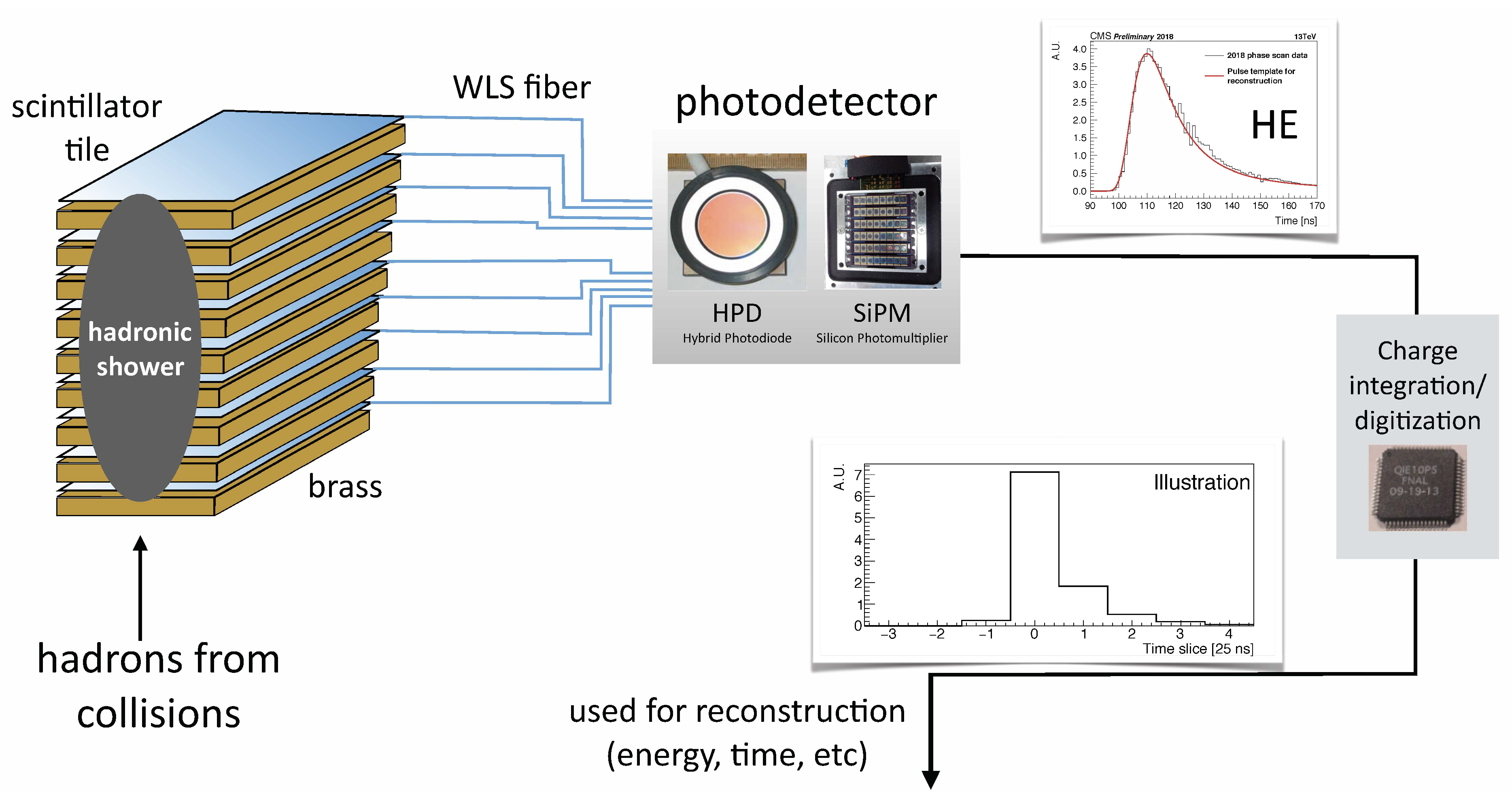
The readout of the HB and HE towers is subdivided radially into separate depths, each of which corresponds to a number of consecutive scintillator layers [2]. The light produced in the plastic scintillating tiles from particles traversing that element of the detector is collected in wavelength-shifting (WLS) fibers, optically summed, and sent to the photodetectors and front-end electronics, where it is converted into a digital electric signal for data processing. An illustration of the HB and HE readout chain is shown in Figure 1.
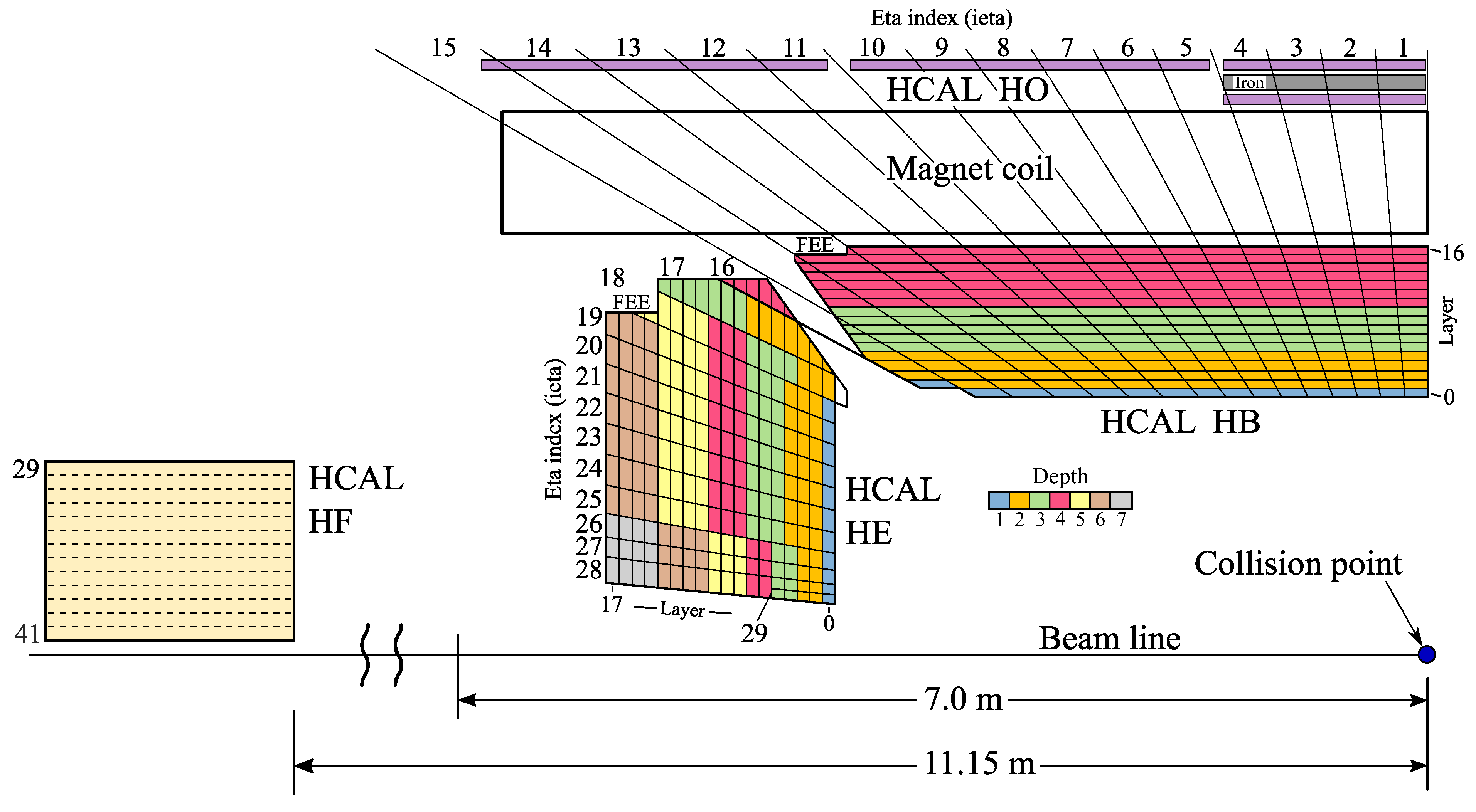
From the perspective of data processing, a detector element—or “channel”—in the HB and HE can be uniquely identified by its location in - space, along with its depth. Integer indices for both and ( and , respectively) are used to designate that location. The value of runs from 1 to 72, whereas runs from +1 to +29 or −1 to −29 on the plus and minus sides, respectively. The , , and depth layout after the Phase 1 upgrade are shown in Figure 2.
The Phase 1 upgrade of the HCAL started in 2017 during LHC Run 2 and finished in LHC long shutdown 2, before Run 3 [3]. The motivation for and the design of the HCAL Phase 1 upgrades are reported in Ref. [4]. The main goals of the HB and HE upgrades were to replace the HPD photodetectors, which produced anomalous signals [5] and showed signal degradation [6]; to increase the segmentation to that shown in Figure 2 to allow for both layer-dependent corrections for the observed radiation damage to the scintillating tiles [7] and better rejection of energy deposits from pileup interactions; to increase the readout bandwidth to allow for a larger number of channels; to add signal arrival-time measurements in the HB, HE, and HF; and to standardize the readout electronics across the different calorimeter systems. For the HF, the PMTs were also replaced because they were a source of anomalous signals [5].
3. Energy Reconstruction Algorithms
The main purpose of the HCAL reconstruction algorithms is to estimate the energy deposited in a given channel in the sample of interest (SOI), defined as the time sample (TS) where the triggered event is placed. Starting from LHC Run 2, each TS corresponds to a 25 interval of the LHC bunch spacing, resulting in significant signal overlapping from out-of-time pileup (OOTPU). Therefore, new energy reconstruction algorithms have been developed to extract the in-time energy deposition, and similar algorithms are employed by the ECAL [8].
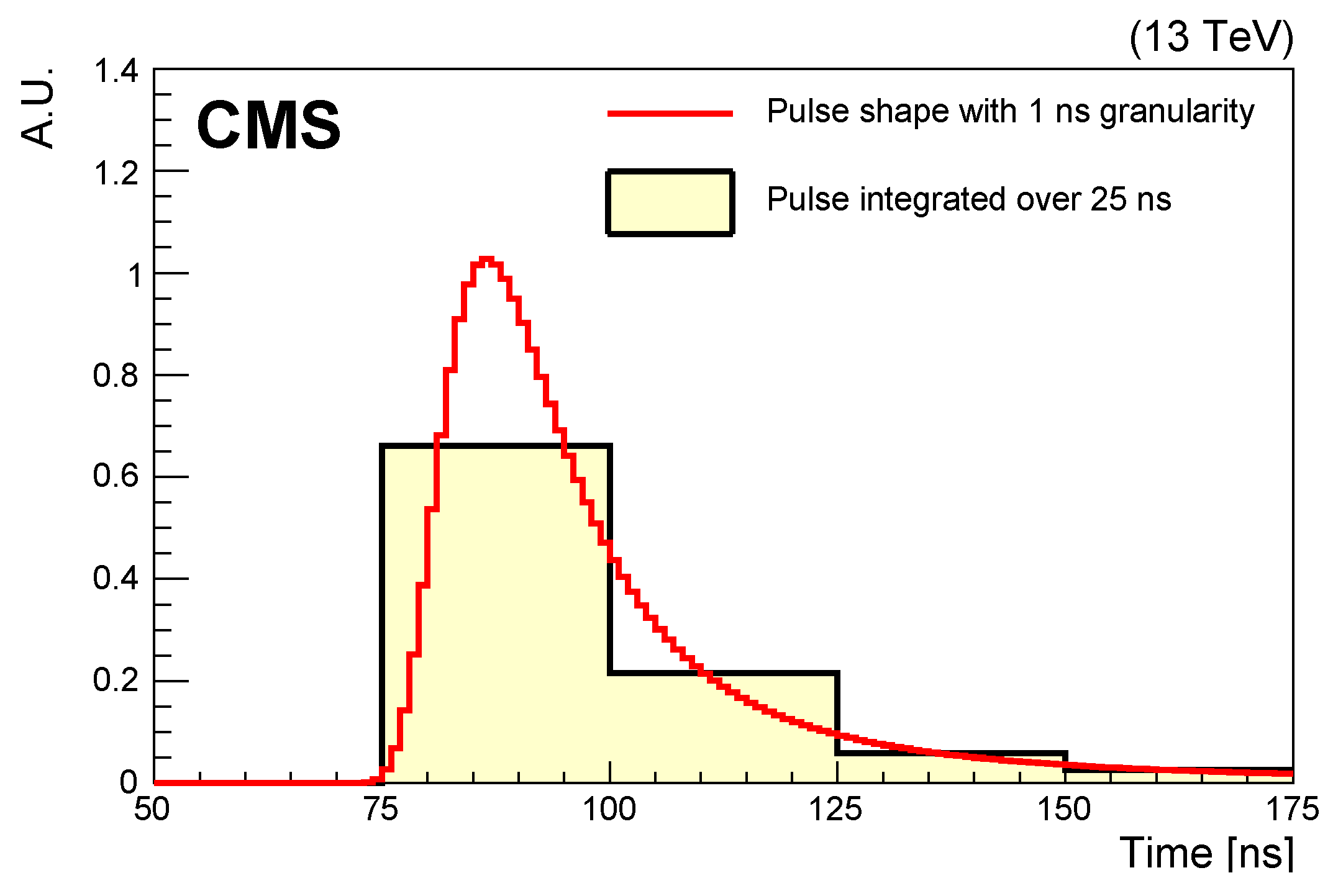
Understanding how the resulting pulse, as measured by the front-end electronics, is distributed as a function of time is critical. The intrinsic pulse shape in the HB and HE is affected by a number of factors, including the scintillation process in the tiles, the optical transmission in the WLS fibers, the photodetectors, and the QIE (Charge Integrator and Encoder) devices. The extraction of the pulse shape was performed by adjusting the time settings of the QIE in 1 increments and measuring the pulses with different phases. Figure 3 shows the pulse shape as a function of time for high-energy depositions in the HE as measured by a SiPM integrated over 1 and 25 bins. The shown pulse shape is an average over all channels in the HE.
The energy reconstruction algorithms subtract the OOTPU by fitting the above pulse-shape templates to the QIE data in 8 TSs. The algorithm currently in use is called MAHI (Minimization At HCAL, Iteratively). There were other algorithms used before MAHI—namely, Method 0 (M0), Method 2 (M2), and Method 3 (M3). Their detailed descriptions can be found in Ref. [9].
The MAHI algorithm constructs an covariance matrix (corresponding to 8 TSs) out of terms for the pulse-shape uncertainty () and the noise (). The noise term includes uncertainties due to QIE quantization, pedestals, and photostatistics. These uncertainties are added to the diagonal elements of the matrix, although correlations (and, hence, off-diagonal elements) will play an increasingly important role in Run 3, when the SiPM dark current is expected to increase. For each pulse template, one covariance matrix () is constructed, leading to a total of eight covariance matrices. The final covariance matrix () is constructed according to
where is the amplitude of the pulse arriving in .
Then, a non-negative least-squares algorithm is run to find , whose values are constrained to be positive, by minimizing
where represents the eight-element vectors that contain the contributions of the pulse templates to each TS and is the vector that contains the QIE measurements after pedestal subtraction. At the beginning, the covariance matrix is initialized with only the noise terms. After the first iteration, the covariance matrix is updated using the values that minimize the value, and the next iteration begins. If the change in between two iterations is less than or the number of iterations goes beyond 500, the iteration stops. Typically, the number of iterations is less than 10. Thus, MAHI incorporates the information used in M2 and extends the number of pulse shapes under consideration (from three to eight) while still being able to run on the HLT within the time budget. For a typical event in the Run 2 dataset with large hadronic activity, MAHI is times faster than M2 but still times slower than M3, independent of pileup.
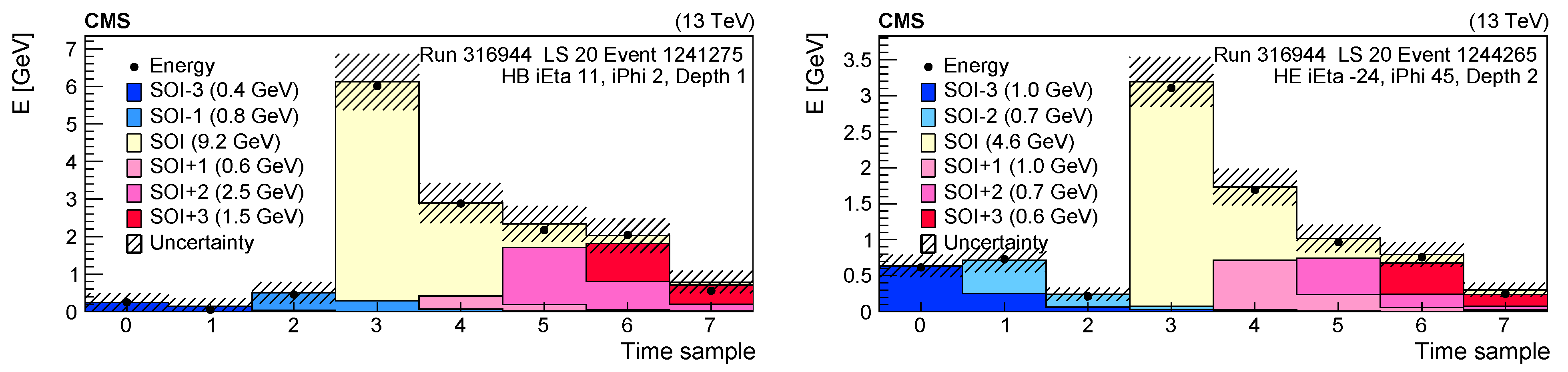
The fit results of MAHI using 2018 pp collision data with ≈50 average interactions per proton bunch crossing are illustrated in Figure 4. Representative fits for both the HB (with the HPD photodetector and QIE8 ADC) and HE (with the SiPM photodetector and QIE11 ADC) are shown. The uncertainty band includes the QIE and SiPM leakage currents, photostatistics, and QIE quantization. When the energy deposition from the SOI is high and dominates over the other TSs, a single pulse shape provides a good fit; however, at lower energies, contributions from the OOTPU are important and must be subtracted to provide a good estimate of the energy in the SOI.
4. Timing Alignment
A couple of timing alignment methods were used before the HCAL Phase 1 upgrade, such as the timing from the M2 reconstruction algorithm. The HB and HE QIEs have a TDC (Time-to-Digital Converter) with 0.5 ns granularity, which is used in the timing alignment in Run 3 [10]. It achieves an ideal alignment such that prompt pulses arrive at the detector simultaneously, consistent across depth and . Four TDC codes are used in the alignment—namely, prompt, slightly delayed, delayed, and no TDC. Optimal alignment is achieved when the fraction of prompt TDC codes is maximized. This ensures that the rising edge of the energy response is placed close to the start of the 25 ns TS of interest and avoids spillover into the previous bunch crossing.
Data from a timing (or phase) scan in which the HCAL clock is scanned relative to the LHC clock enables the evaluation of a range of HCAL alignment settings. Phase scans are run during proton–proton collisions such that the alignment method accounts for both the detector time and energy resolution and the effects of shower propagation through the calorimeter material.
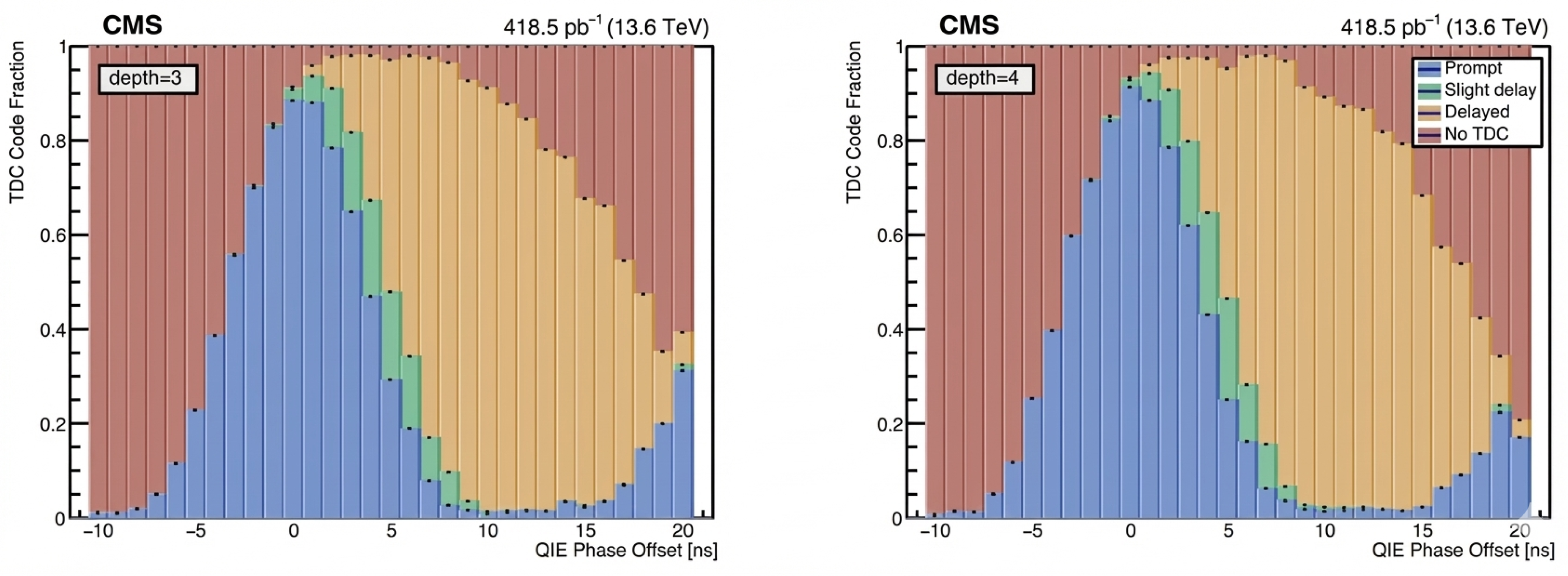
Figure 5 shows a typical TDC code distribution during the 2023 HCAL phase scan, with the 0 ns QIE phase offset representing ideal alignment. The analysis was performed for HB (i.e., ), and results were consistent across all of its values. For channels (individual , , and depth) with deposited energy over 4 GeV, the TDC code fraction is the fraction of channels with each TDC code (four codes). The prompt TDC distribution (blue, TDC ns) shows the prompt pulse-arrival spread and is maximized at an offset of 0 ns. As the phase offset increases, more delayed (green and orange) TDC codes are seen as pulses arrive in the delayed region. The prompt fraction increases as the next bunch crossing enters (phase offset of 20 ns). Ideal alignment places the prompt peak at a phase offset of 0 ns such that the pulse’s rising edge is close to the start of the TS.
5. Energy Calibration
The HCAL energy calibration includes two parts: gain calibration using the laser system and source and response calibrations using collision data [11].
5.1. Gain Calibration
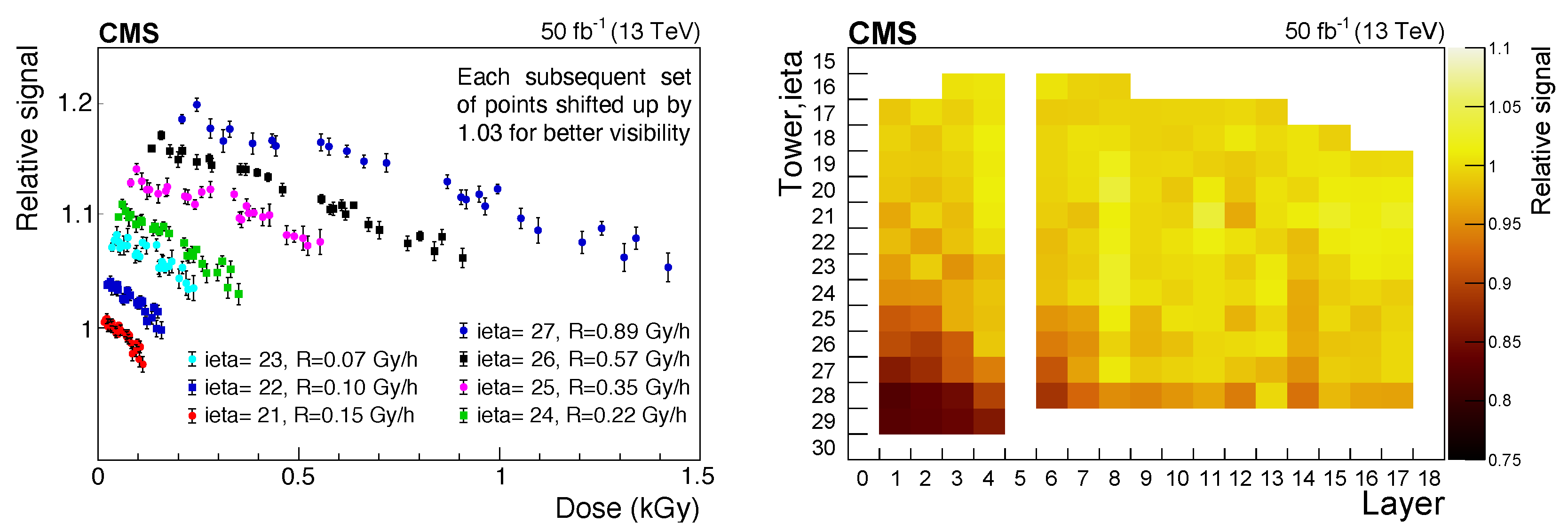
The laser system consists of a triggerable excimer laser and light distribution system that delivers UV light (351 nm) to the scintillator tiles in layers 1 and 7 via quartz fibers, as well as directly to the photodetectors. During data taking, pulses of laser light were injected between LHC fills when there were no collisions. Figure 6 (left) presents the relative signals in layer 1 versus dose for tiles in the range of 21–27. The signals show an approximately exponential decrease during periods of stable luminosity, with slopes that depend on the dose rate. Tiles at smaller valuesshow more damage per dose than those at larger values, implying that at a fixed dose, the damage to the scintillators increases with decreasing dose rate, within the range of our measurements.
Each individual tile in the HCAL is designed to be serviced by a movable radioactive source using small tubes that are integrated into the calorimeter. The source provides photons with energies of 1.17 and 1.33 MeV. The source is attached to a wire that guides it through the tubes. All tiles except those in layers 0 and 5, whose tubes have obstructions, can be accessed. The data are collected during the periods when the LHC does not operate, usually before the start of each year’s data taking. Values of the ratio, averaged over as a function of the scintillating tile layer number and tower index , are shown in Figure 6 (right), measured before 2017 and 2018 data takings. The signal loss is smaller for tiles at farther radial distancesfrom the beam and for layers that are deeper in the calorimeter.
Because the damage depends on the layer number, increased segmentation allows for more accurate damage corrections to be applied as a function of integrated luminosity, reducing the degradation of the resolution.
5.2. Response Calibration
The response of the calorimeter is defined as the ratio of the energy measured in the calorimeter over the true energy of the particle that was absorbed. The first step in the response calibration with collision data is the relative calibration or intercalibration, which equalizes the response in for each ring and depth section. The procedure takes advantage of the -symmetric particle energies and the corresponding -symmetric collected energy from minimum bias (MB) events (events selected with triggers designed to collect inelastic collisions with maximum efficiency while suppressing noncollision events). The layouts of the barrel and the endcap detectors have some dependence because of the absorber structure; the scintillator layers are staggered, and the absorber layers are also used as a part of the support structure. For the forward calorimeter, a radial shift in the beam spot position may also introduce asymmetry in the rings close to the beam pipe, which can change with time. The relative contributions to the asymmetries from materials, inhomogeneous magnetic field, beam spot shift, and miscalibration could, in principle, be understood using simulation. However, the material description in the simulation and the modeling of the beam-spot position is not exact, and the difference between the actual detector and its Monte Carlo description can increase with time because of stresses from the magnetic field, gravity, etc.
Therefore, intercalibration is performed by comparing the average collected energy in a calorimeter channel to the average collected energy in the entire ring. Two different calibration procedures are adopted.
Iterative method: A set of multiplicative correction factors (scale factors) for the uncalibrated energies is determined iteratively by equalizing the mean of the measured energies that satisfy both an upper and a lower threshold. This method works best for energies above 4 GeV.
Method of moments: This intercalibration is carried out using MB events taken without zero suppression by comparing the first (mean) and second (variance) moments of the energy distribution in a calorimeter channel to the mean of the moments of the energy distributions in the entire ring. This method works best for low energies, down to a fraction of a GeV.
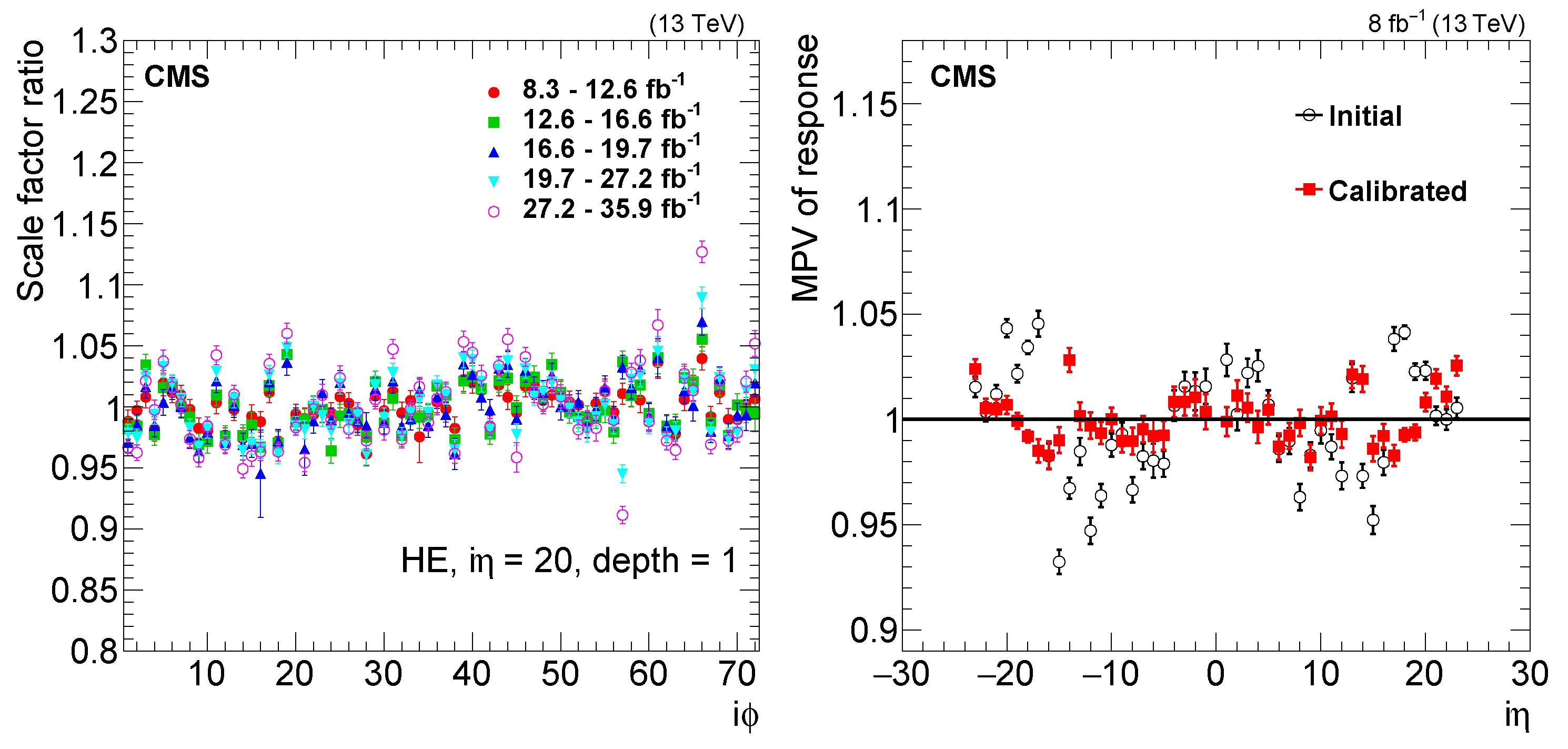
By construction, these two methods use events from disjoint data samples and are statistically independent. Figure 7 (left) shows the calibration scale factors for a typical HE channel as a function of .
The second step of the energy calibration is usually referred to as the absolute calibration, which calibrates the HCAL energy of a charged hadron against its momentum measured by the tracker.
It uses isolation in a cone around the track to reduce contamination from neighboring hadrons and to ensure a more accurate estimation of the hadron energy. The cone algorithm clusters energy based on the linear distance from the extrapolated track trajectory through the HCAL. For each HCAL tower, the distance between two points is determined. The first point is the intersection of the extrapolated track trajectory with the front face of the HCAL. The second point is the intersection of the tower axis (the straight line joining the center of the CMS and the center of the tower) with the plane perpendicular to the extrapolated track trajectory. If this distance is smaller than the radius of a circle on the surface of the HCAL (), the energy from the HCAL tower is included in the cluster. The signal is measured using an of 35 cm, which contains, on average, more than 99% of the energy deposited by a 50 GeV hadron.
The ECAL has a depth of approximately one interaction length; therefore, more than half of the hadrons undergo inelastic interactions before reaching the HCAL. These hadrons are not used for calibration and are rejected by requiring the energy deposited within a cone with a radius of 14 cm around the impact point for the ECAL to be less than 1 GeV. This requirement also removes a large fraction of hadron candidates near a neutral particle, which deposits energy in the signal cone that would otherwise contaminate the measurement.
The HCAL response is defined as the ratio expressed as
where is the signal-region energy of the HCAL cluster, is the corresponding energy deposited in the ECAL explained above, and is the momentum of the track.
Figure 7 (right) shows the HCAL response as a function of before (black circles) and after correction (red squares).
6. Reconstruction Performance
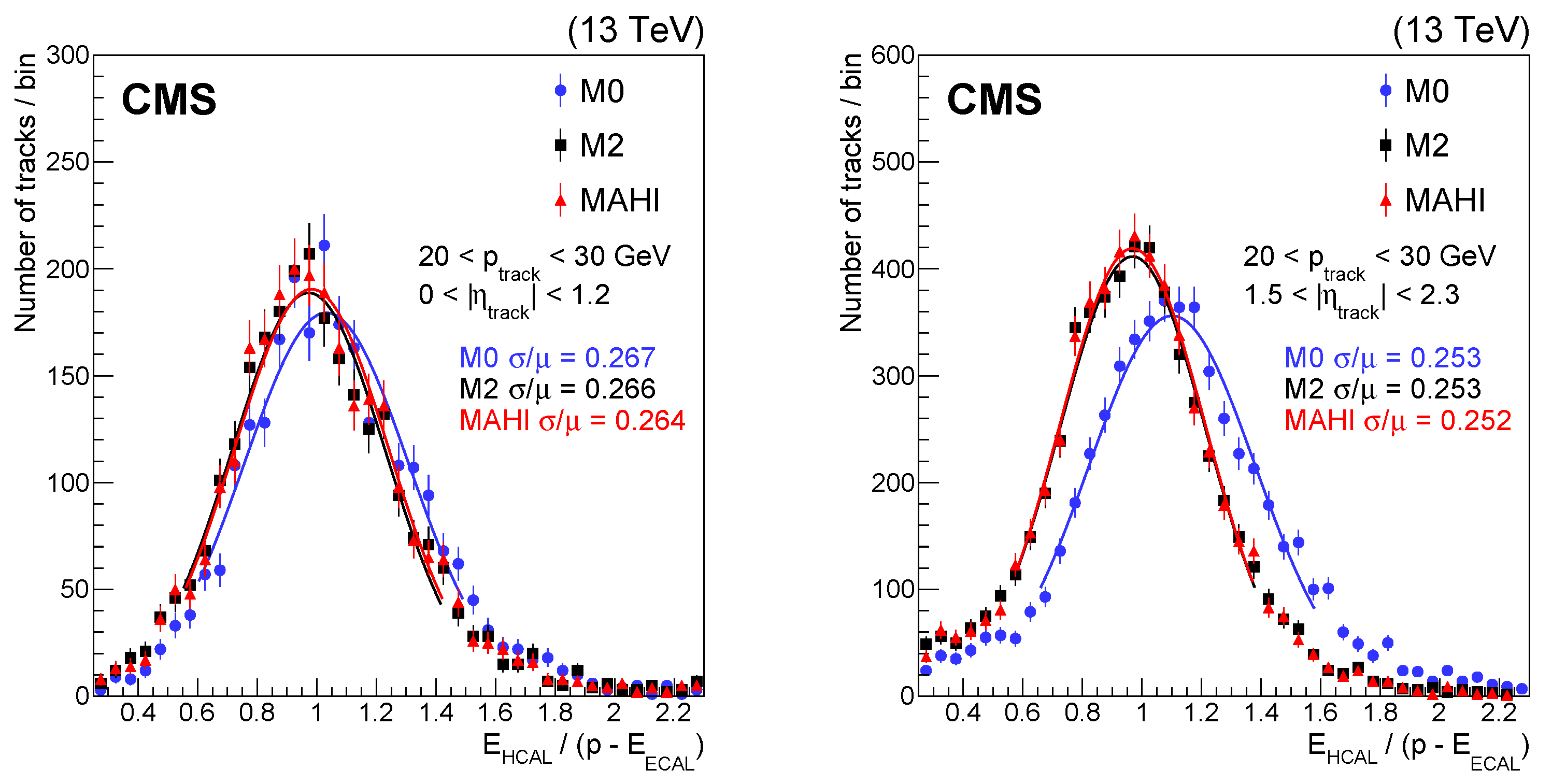
The performance of the various algorithms used to reconstruct HCAL energy can be evaluated in a number of ways. The removal of the OOTPU contribution has more significant effects at lower and higher values. This can be seen in the reconstruction of isolated charged hadrons using the same method explained in Section 5.2. Isolated tracks with momenta between 20 and 30 GeV are selected from a sample of events triggered by an electron or photon to avoid bias from the trigger. Figure 8 shows the ratio of the clustered energy in the HCAL to the track momentum minus the clustered energy in the ECAL for the various algorithms. Each solid line represents a Gaussian fit to the core of the distributions. The fits are dominated by the HCAL resolution; the standard deviation is comparable for M2 and MAHI, which both subtract the OOTPU. At large values, the M0 response is higher due to OOTPU contributions; moreover, the energy response of M0 exhibits more prominent, non-Gaussian tails. HCAL resolution is energy-dependent and is lower at a higher energies. Reconstructed with MAHI, the energy resolution for charged hadrons with momenta between 40 and 60 GeV is around 19%.
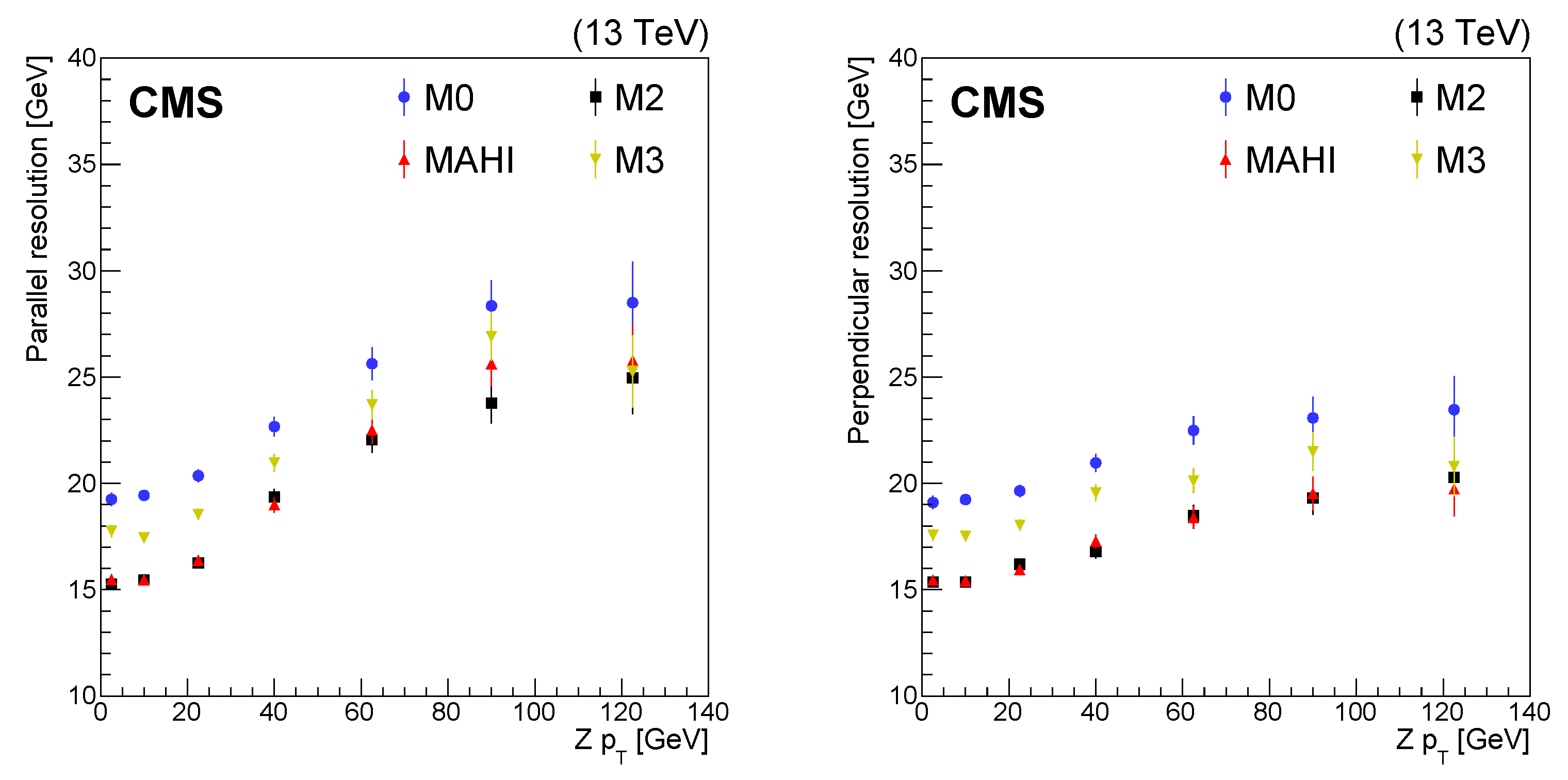
The global performance of the HCAL energy reconstruction algorithms is evaluated in events containing a Z boson (decaying into a muon pair) and hadronic jets. Such events have very little intrinsic ; hence, any reconstructed can be attributed primarily to the detector resolution. The events are required to contain two isolated, oppositely charged muons with and 10 GeV, respectively (driven by trigger turn-on), with their reconstructed invariant mass satisfying GeV. The is calculated as the negative vector sum of the energies in the individual calorimeter towers of the ECAL and HCAL (excluding HF and HO). The parallel and perpendicular components of the are computed as projections with respect to the Z-boson direction, similarly to the resolution study reported in Ref. [12]. Figure 9 shows a comparison of the resolution of the parallel and perpendicular components of the recoil system between M0, M2, M3, and MAHI in 2018 data, with an average pileup around 30. The M2, M3, and MAHI algorithms demonstrate an improved resolution over M0 in both components because of their ability to suppress the OOTPU. Among these three algorithms, the marginally worse resolution of M3 was a motivation for switching to MAHI in 2018.
7. Conclusions
This paper reviews the performance of the CMS HCAL, focusing on developments following its Phase 1 upgrade, which included the replacement of HPD photodetectors with SiPMs, increased depth segmentation, and enhanced timing capabilities. This upgrade mitigates radiation damage and improves out-of-time pileup rejection under high-luminosity conditions.
Key aspects of HCAL performance are discussed, including the MAHI (Minimization At HCAL, Iteratively) energy reconstruction algorithm developed for the Phase 1 upgrade, which effectively estimates signal energy and suppresses contributions from pileup. The paper also introduces the high-precision timing alignment achieved with the upgraded electronics. A multi-step energy calibration procedure is reviewed, which uses laser systems, radioactive sources, and collision data to correct for radiation damage and calibrate detector response. Performance evaluations using proton–proton collision data, including the energy resolution of charged hadrons and resolution in events, demonstrate the success of these upgrades and reconstruction techniques, showing improved energy resolution.
Author Contributions
Conceptualization, H.W.; Writing—original draft, Y.W.; Writing—review and editing, H.W. All authors have read and agreed to the published version of the manuscript.
Funding
This work is supported by the National Natural Science Foundation of China Grants No. 12322503.
Data Availability Statement
No new data were created or analyzed in this study. Data sharing is not applicable to this article.
Conflicts of Interest
The authors declare no conflicts of interest.
References
Chatrchyan, S.; Hmayakyan, G.; Khachatryan, V.; Sirunyan, A.M.; Adam, W.; Bauer, T.; Bergauer, T.; Bergauer, H.; Dragicevic, M.; Erö, J.; et al. The CMS experiment at the CERN LHC. J. Instrum.2008, 3, S08004. [Google Scholar] [CrossRef]
Wang, H. Review of energy reconstruction algorithms in the CMS Hadron Calorimeter. EPJ Web Conf.2025, 320, 00045. [Google Scholar] [CrossRef]
Hayrapetyan, A.; Tumasyan, A.; Adam, W.; Andrejkovic, J.W.; Arnold, B.; Bergauer, H.; Bergauer, T.; Chatterjee, S.; Damanakis, K.; Dragicevic, M.; et al. Development of the CMS detector for the CERN LHC Run 3. J. Instrum.2024, 19, P05064. [Google Scholar] [CrossRef]
Mans, J. CMS Technical Design Report for the Phase 1 Upgrade of the Hadron Calorimeter. CMS Technical Proposal CERN-LHCC-2012-015, CMS-TDR-010, 2012. Available online: https://cds.cern.ch/record/1481837 (accessed on 1 January 2025).
CMS Collaboration. Identification and filtering of uncharacteristic noise in the CMS hadron calorimeter. J. Instrum.2010, 5, T03014. [Google Scholar] [CrossRef]
Shukla, R.A.; Achanta, V.G.; De Barbaro, P.; Dugad, S.R.; Heering, A.; Gupta, S.K.; Mirza, I.; Prabhu, S.S.; Rumerio, P. Microscopic characterisation of photodetectors used in the hadron calorimeter of the Compact Muon Solenoid experiment. Rev. Sci. Instrum.2019, 90, 023303. [Google Scholar] [CrossRef] [PubMed]
Sirunyan, A.M.; Erbacher, R.; Carrillo Montoya, C.A.; Carvalho, W.; Górski, M.; Kotlinski, D.; Lindsey, C.; Ujvari, B.; Ozturk, S.; Muthumuni, S.; et al. Measurements of dose-rate effects in the radiation damage of plastic scintillator tiles using silicon photomultipliers. J. Instrum.2020, 15, P06009. [Google Scholar] [CrossRef]
Sirunyan, A.M.; Tumasyan, A.; Adam, W.; Ambrogi, F.; Bergauer, T.; Dragicevic, M.; Erö, J.; Valle, A.E.D.; Frühwirth, R.; Jeitler, M.; et al. Reconstruction of signal amplitudes in the CMS electromagnetic calorimeter in the presence of overlapping proton-proton interactions. J. Instrum.2020, 15, P10002. [Google Scholar] [CrossRef]
Tumasyan, A.; Adam, W.; Andrejkovic, J.W.; Bergauer, T.; Chatterjee, S.; Damanakis, K.; Dragicevic, M.; Valle, A.E.D.; Hussain, P.S.; Jeitler, M.; et al. Performance of the local reconstruction algorithms for the CMS hadron calorimeter with Run 2 data. J. Instrum.2023, 18, P11017. [Google Scholar] [CrossRef]
Kopp, G.; Tully, C.; Chung, W.; Kennedy, K.; Hoienko, S.; Mans, J.; Krohn, M.; Crossman, B.; Hiltbrand, J.; Skuja, A.; et al. Time Alignment of the CMS Hadron Calorimeter. EPJ Web Conf.2025, 320, 00001. [Google Scholar] [CrossRef]
Sirunyan, A.M.; Tumasyan, A.; Adam, W.; Ambrogi, F.; Bergauer, T.; Brandstetter, J.; Dragicevic, M.; Erö, J.; Valle, A.E.D.; Flechl, M.; et al. Calibration of the CMS hadron calorimeters using proton-proton collision data at √s= 13 TeV. J. Instrum.2020, 15, P05002. [Google Scholar] [CrossRef]
Sirunyan, A.M.; Tumasyan, A.; Adam, W.; Ambrogi, F.; Asilar, E.; Bergauer, T.; Brandstetter, J.; Dragicevic, M.; Erö, J.; Escalante Del Valle, A.; et al. Performance of missing transverse momentum reconstruction in proton-proton collisions at √s = 13 TeV using the CMS detector. J. Instrum.2019, 14, P07004. [Google Scholar] [CrossRef]
Figure 1.
An illustration of the HB and HE readout chain [2].
Figure 1.
An illustration of the HB and HE readout chain [2].
Figure 2.
The longitudinal and transverse HCAL segmentation for Run 3. Within a tower, layers with the same color are routed to the same SiPM. FEE indicates the location of the front-end electronics [3].
Figure 2.
The longitudinal and transverse HCAL segmentation for Run 3. Within a tower, layers with the same color are routed to the same SiPM. FEE indicates the location of the front-end electronics [3].
Figure 3.
Average pulse shape for high-energy depositions in the HE. The red solid line is the pulse shape used in reconstruction algorithms with 1 granularity. The yellow-filled histogram is constructed from the red shape by integrating over each 25 TS. The SOI corresponds to the TS from 75 to 100 [9].
Figure 3.
Average pulse shape for high-energy depositions in the HE. The red solid line is the pulse shape used in reconstruction algorithms with 1 granularity. The yellow-filled histogram is constructed from the red shape by integrating over each 25 TS. The SOI corresponds to the TS from 75 to 100 [9].
Figure 4.
Representative fit results from MAHI in the HB (left) and the HE (right). The recorded pedestal-subtracted charge in the QIE (converted to units of energy) is given by the points, while the filled histograms represent the fitted values for the various pulse shapes. The sum of the fitted energy for each pulse, labeled by its position relative to the SOI, is presented in the legend. The combined uncertainty from the pedestal, photostatistics, and QIE quantization is represented by the hatched areas [9].
Figure 4.
Representative fit results from MAHI in the HB (left) and the HE (right). The recorded pedestal-subtracted charge in the QIE (converted to units of energy) is given by the points, while the filled histograms represent the fitted values for the various pulse shapes. The sum of the fitted energy for each pulse, labeled by its position relative to the SOI, is presented in the legend. The combined uncertainty from the pedestal, photostatistics, and QIE quantization is represented by the hatched areas [9].
Figure 5.
Distribution of TDC codes vs. QIE scan for HB depth 3 and depth 4, where = 10 in the SOI, during the 2023 QIE phase scan. A QIE phase offset of 0 ns represents ideal alignment, with the prompt fraction maximized [10].
Figure 5.
Distribution of TDC codes vs. QIE scan for HB depth 3 and depth 4, where = 10 in the SOI, during the 2023 QIE phase scan. A QIE phase offset of 0 ns represents ideal alignment, with the prompt fraction maximized [10].
Figure 6.
(Left) Relative laser light signal versus the accumulated dose for scintillator tiles in layer 1 and the range of 21–27, measured in 2017. The average dose rate (R) for each set of points is given in the legend. The vertical scale is logarithmic, and subsequent sets are shifted up by a factor of 1.03 relative to the previous set for better visibility. Each set starts at a dose corresponding to an integrated luminosity of 7 fb−1. The vertical bars give the scaled statistical uncertainties. (Right) Ratio of the signals from the source, measured before 2017 and 2018 data takings, for scintillator tiles in the HE as a function of and layer number. Tubes in layers 0 and 5 have obstructions and cannot be accessed [3].
Figure 6.
(Left) Relative laser light signal versus the accumulated dose for scintillator tiles in layer 1 and the range of 21–27, measured in 2017. The average dose rate (R) for each set of points is given in the legend. The vertical scale is logarithmic, and subsequent sets are shifted up by a factor of 1.03 relative to the previous set for better visibility. Each set starts at a dose corresponding to an integrated luminosity of 7 fb−1. The vertical bars give the scaled statistical uncertainties. (Right) Ratio of the signals from the source, measured before 2017 and 2018 data takings, for scintillator tiles in the HE as a function of and layer number. Tubes in layers 0 and 5 have obstructions and cannot be accessed [3].
Figure 7.
(Left) Ratio of the calibration scale factors for a typical HE (, ) channel as a function of in different data-taking periods relative to that obtained in a sample corresponding to the first 8.3 fb−1 of integrated luminosity for five additional data-taking periods during 2016. (Right) Modes of the response with their statistical uncertainties versus from the 2016 data sample before (black circles) and after convergence (red squares). The loose charged-particle isolation constraint is applied [11].
Figure 7.
(Left) Ratio of the calibration scale factors for a typical HE (, ) channel as a function of in different data-taking periods relative to that obtained in a sample corresponding to the first 8.3 fb−1 of integrated luminosity for five additional data-taking periods during 2016. (Right) Modes of the response with their statistical uncertainties versus from the 2016 data sample before (black circles) and after convergence (red squares). The loose charged-particle isolation constraint is applied [11].
Figure 8.
The HCAL energy response of M0, M2, and MAHI measured in an electron/photon-triggered dataset using isolated tracks with GeV and either (left) or (right). The vertical bars show the statistical uncertainty in the number of tracks in each bin. The measured energy resolutions of each method in this sample are comparable [9].
Figure 8.
The HCAL energy response of M0, M2, and MAHI measured in an electron/photon-triggered dataset using isolated tracks with GeV and either (left) or (right). The vertical bars show the statistical uncertainty in the number of tracks in each bin. The measured energy resolutions of each method in this sample are comparable [9].
Figure 9.
resolutions as a function of the Z-boson measured in a dataset triggered by two muons. The left (right) plot is the resolution of the component parallel (perpendicular) to the Z boson’s . Error bars reflect statistical uncertainties [9].
Figure 9.
resolutions as a function of the Z-boson measured in a dataset triggered by two muons. The left (right) plot is the resolution of the component parallel (perpendicular) to the Z boson’s . Error bars reflect statistical uncertainties [9].
Disclaimer/Publisher’s Note: The statements, opinions and data contained in all publications are solely those of the individual author(s) and contributor(s) and not of MDPI and/or the editor(s). MDPI and/or the editor(s) disclaim responsibility for any injury to people or property resulting from any ideas, methods, instructions or products referred to in the content.
Wei, Y.; Wang, H., on behalf of the CMS Collaboration.
Review of the Performance of the CMS Hadron Calorimeter. Particles2026, 9, 1.
https://doi.org/10.3390/particles9010001
AMA Style
Wei Y, Wang H on behalf of the CMS Collaboration.
Review of the Performance of the CMS Hadron Calorimeter. Particles. 2026; 9(1):1.
https://doi.org/10.3390/particles9010001
Chicago/Turabian Style
Wei, Yide, and Hui Wang on behalf of the CMS Collaboration.
2026. "Review of the Performance of the CMS Hadron Calorimeter" Particles 9, no. 1: 1.
https://doi.org/10.3390/particles9010001
APA Style
Wei, Y., & Wang, H., on behalf of the CMS Collaboration.
(2026). Review of the Performance of the CMS Hadron Calorimeter. Particles, 9(1), 1.
https://doi.org/10.3390/particles9010001
Article Metrics
No
No
Article Access Statistics
For more information on the journal statistics, click here.
Multiple requests from the same IP address are counted as one view.
Wei, Y.; Wang, H., on behalf of the CMS Collaboration.
Review of the Performance of the CMS Hadron Calorimeter. Particles2026, 9, 1.
https://doi.org/10.3390/particles9010001
AMA Style
Wei Y, Wang H on behalf of the CMS Collaboration.
Review of the Performance of the CMS Hadron Calorimeter. Particles. 2026; 9(1):1.
https://doi.org/10.3390/particles9010001
Chicago/Turabian Style
Wei, Yide, and Hui Wang on behalf of the CMS Collaboration.
2026. "Review of the Performance of the CMS Hadron Calorimeter" Particles 9, no. 1: 1.
https://doi.org/10.3390/particles9010001
APA Style
Wei, Y., & Wang, H., on behalf of the CMS Collaboration.
(2026). Review of the Performance of the CMS Hadron Calorimeter. Particles, 9(1), 1.
https://doi.org/10.3390/particles9010001