


Abstract
We analyze data indicating that a set of currently marketed FDA/EMA-approved drugs used to treat parkinsonism, extrapyramidal side effects of antipsychotic drugs, or overactive bladder may have the potential to slow the growth of glioblastoma; diffuse midline glioma, H3K27-altered (DMG); and a particular form of DMG growing in the pons of children, diffuse intrinsic pontine glioma (DIPG). These gliomas are typically associated with poor prognosis. Clinical trials evaluating conventional chemotherapeutic drugs have failed to improve DIPG survival. Our analysis of the biochemistry and physiology of DMG and DIPG concludes that neuronal acetylcholinergic agonisms at muscarinic receptors M1 and M3 on primitive oligodendrocyte precursor cells (OPCs) are trophic, growth-stimulating factors in DMG/DIPG growth. A set of muscarinic receptor inhibitors—benztropine, biperiden, and trihexyphenidyl—is used clinically to treat Parkinson’s disease or the parkinsonian side effects from antipsychotic medicines. Another muscarinic inhibitor, oxybutynin, is used to treat overactive bladder. All four drugs may impose dose-related side effects inherent to muscarinic receptor inhibition, such as xerostomia, asthenia, and mild cognitive impairment. We recount the evidence for the inhibition of OPC proliferation and migration mediated by these four M1/M3 inhibitors and report details on the rationale for selecting oxybutynin as the primary candidate for adjuvant therapy in DMG/DIPG. We chose oxybutynin as the first choice to study in DMG and DIPG compared to other antimuscarinic drugs based on its (i) high brain-tissue concentration, (ii) relatively stronger M3 inhibition, (iii) lower side-effect propensity than scopolamine, (iv) wide availability, and (v) the absence of H1 antihistamine or dopaminergic effects. Given the rapidly fatal nature of DMG and DIPG, the potential of oxybutynin for growth slowing may outweigh the associated risks and mild side-effect burdens.
1. Introduction
This note analyzes data indicating that the currently marketed FDA- and EMA-approved drugs used to treat parkinsonism or extrapyramidal side effects of antipsychotic drugs have the potential to slow the growth of glioblastoma; diffuse midline glioma, H3K27 mutated (DMG); and a particular form of DMG growing in the pons of children, diffuse intrinsic pontine glioma (DIPG). Median survival as of mid-2026 is under a year for DMG and DIPG and two to three years for glioblastoma [1,2,3]. These grade 4 gliomas’ physiology, preclinical data and human histology studies analyzed here indicate that muscarinic neuronal inputs contribute to the suite of stimuli and genetic flaws mediating the malignant growth of these tumors particularly prominently so for DMG and DIPG.
The current standard treatment of DMG and DIPG is irradiation. The data analysis herein indicates that several currently marketed anticholinergic drugs have a strong rationale for further study as an adjuvant to standard treatment. Small studies of dordaviprone (ONC201) have reported encouraging DMG survival prolongation, with an overall median survival of 14 months; however, this study specifically excluded children with DIPG [4].
Radiation therapy remains the only established treatment for DIPG. It extends median survival by several months. Our data analysis herein indicates that several currently marketed anticholinergic drugs have a strong rationale for further study as an adjuvant to the standard treatment of DIPG. Physiology of DIPG growth indicates that acetylcholine signaling at muscarinic receptors M1 and M3 drives DIPG cells’ and non-malignant, primitive OPCs’ proliferation, their active migration, and contributes to keeping them in an early, primitive OPC state.
This paper will focus on the relationship between (i) muscarinic signaling, (ii) the consequences of H3K27M or an equivalent failure of trimethylation, and (iii) generic antimuscarinic drugs in common general medical practice use—benztropine, biperiden, scopolamine, trihexyphenidyl and oxybutynin. For reasons outlined below, we focused on oxybutynin as the leading candidate drug for inhibiting DMG and DIPG growth.
1.1. Oligodendrocytes and DMG, DIPG
Mature oligodendrocytes constitute the CNS’s myelin forming cells, developing by stages throughout life from primitive oligodendrocyte precursor cells (OPCs) to pre-myelinating oligodendrocytes, to mature, myelin-forming oligodendrocytes. DMG/DIPG is a malignancy of primitive OPCs arising from failure of repression of OPCs’ early developmental genes, a maturation failure most commonly consequent to a histone mutation, H3K27M. DMG/DIPG is an unusual malignancy in that its underlying pathophysiological basis is better known and seems clearer and simpler than that for many other cancers [5,6,7,8,9,10].
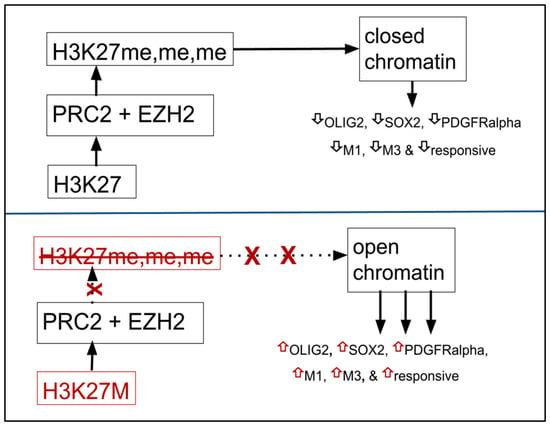
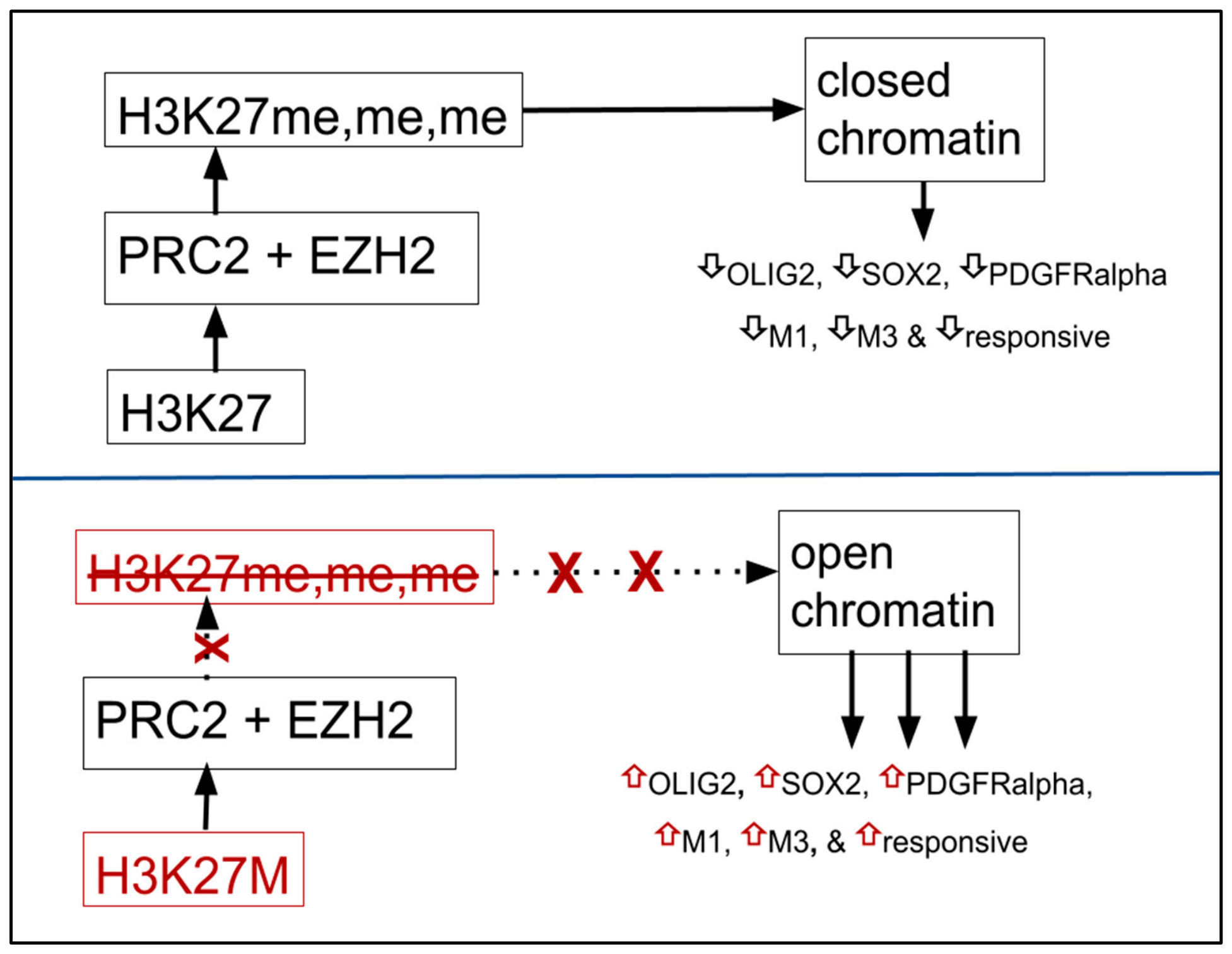
Namely, the H3K27M mutation, or in a minority of cases an equivalent mutation resulting in the failure of H3 histone trimethylation, interferes with the PRC2-EZH2 bimolecular complex’s normal trimethylation of the histone H3K27. Trimethylated H3K27 holds relevant areas of chromatin compacted, inaccessible to transcription factor proteins 32 kDa OLIG2, 34 kDa SOX2, and others. That inaccessibility results in OPC maturation and OPCs being weakly or non-responsive to M1 and M3 stimulation. Unmethylated H3K27 does not hold the relevant chromatin areas compacted, resulting in OLIG2, SOX2 and others’ promotion of genes’ transcription, furthering proliferation and holding OPCs in early developmental stages.
Mutated H3K27M is unable to be methylated by PRC2-EZH2. Furthermore, H3K27M blocks the PRC2-EZH2 methylation site so non-mutated, wild-type H3K27 methylation is also reduced. This leaves relevant chromatin sites open and responsive to ongoing action of OLIG2, SOX2 and PDGFRalpha, and M1 and M3 stimulation. Figure 1 diagrams this for clarity. This has been a simplified recounting of the core process behind most DMG/DIPG and a dozen other physiological inhibiting or enhancing processes interacting with the PRC2-EZH2 trimethylation of H3K27.
Figure 1.
A simplified diagram of the basic connection between the mutational underpinning of DMG/DIPG and M1, M3 cholinergic growth drive. Upper panel: PRC2-EZH2 bimolecular complex normally trimethylates H3K27. Trimethylated H3K27 holds relevant areas of chromatin compacted, inaccessible to transcription factors OLIG2, SOX2 and others, thereby resulting in OPC maturation, and being non-responsive or only weakly responsive to M1, M3 stimulation. ⇩ indicates decreased transcription, translation, or decreased responsiveness. Lower panel: mutated H3K27M is unable to be methylated by PRC2-EZH2. ⇧ indicates increased transcription, translation, increased responsiveness. H3K27M blocks the methylation site so non-mutated, wild-type H3K27 methylation is also reduced. This leaves relevant chromatin sites open and responsive to ongoing action of OLIG2, SOX2 and PDGFRalpha, and M1 and M3 stimulation. References in the text.
Although failure to repress early OPC developmental genes forms the foundation for most DMG/DIPG to form, other abnormalities are required [5,6,7,8].
Primitive OPCs are particularly vulnerable to glioma development [10,11,12]. Primitive OPCs arise in the embryonal ventral ventricular zone, bear PDGF receptor alpha (PDGFRalpha), vigorously express OLIG2 mRNA and related transcription factors, and are highly motile and proliferative cells. H3K27 non-trimethylation, or in a minority of cases other H3’s trimethylation failure, is a core feature of most DMG/DIPG, but alone, trimethylation failure seems insufficient for tumor development. TP53, PDGFRalpha, PIK3CA, KIT, VEGFR, MET, EGFR, activin A receptors, CDKs1/4/6, PTEN, MYC and other mutations or overexpressions are required [5,6,7,8,9,10,11,12,13,14,15,16].
1.2. Muscarinic Signaling, OPC and DMG, DIPG
Acetylcholine signals at five different muscarinic receptors, M1 to M5. The overview of these receptors’ attributes is given in Table 1. Cholinergic muscarinic innervation, mainly from the pedunculopontine nucleus, promotes glioma growth in pons (DIPG), while cholinergic muscarinic innervation, mainly from the laterodorsal tegmentum nucleus, promotes glioma proliferation in the thalamus (young adult, older children and teen DMG). Regarding this, and on the differing clinical pictures, although DMG and DIPG share an H3K27M or related trimethylation failure foundation, we view pediatric DIPG and DMG as slightly different diseases. Both DMG and DIPG share a reciprocal relationship where (i) poorly differentiated pontine OPCs stimulate innervation ingrowth by neurons from the pedunculopontine nucleus (DIPG) or the laterodorsal tegmentum nucleus (DMG) and then (ii) that cholinergic innervation enhances DMG/DIPG growth by neuron produced acetylcholine’s agonism at muscarinic M1 and M3 receptors on OPCs [11].
Muscarinic signaling at M1 and M3 contributes to the maintenance of the primitive, early developmental state of OPCs with ongoing action of protein markers OLIG2, SOX2, and PDGFRalpha, the ongoing non-repression of OLIG2, PDGFRA and related genes, and the inhibition of pro-myelinating, differentiation-promoting genes. Primitive OPCs do not contribute to myelination. They will exit the cell cycle in absence of muscarinic M1 and M3 signaling, stop migrating, and start extending their branching processes and begin their role in synthesizing myelin. Plentiful M1/M3 signaling keeps primitive OPCs in an OLIG2-expressing dominant progenitor phase. Experimental genetic ablation of oligodendrocytes’ M1 receptors triggered their differentiation and beginning of myelination [17,18,19,20,21].
In experimental models, M3 agonism at primitive OPCs blocked oligodendrocyte maturation. An M3 antagonist stimulated oligodendrocytic differentiation/maturation [22].
Also, in glioblastoma, cholinergic neurons are interwoven within the tumor [23]. Acetylcholine suppresses GFAP expression and differentiation of non-transformed astrocytes via their muscarinic receptors [23,24,25]. M3 agonism triggers glioma cells’ DNA synthesis. A muscarinic agonist acting on M3 increased DNA synthesis and proliferation of an astrocytoma cell line but nicotinic agonists did not [26,27]. M3 knockdown lowered in vitro synthesis and release of MMP1, MMP12, CXCL1, CXCL5, and CXCL8 (IL-8) [28]. IL-8 was the major chemotactic signal for neutrophil infiltration and their tumor trophic function [29,30].
Experimental models, in vitro and in mice, oft repeated in different settings, have widely demonstrated acetylcholine acting on muscarinic receptors, mainly M1 and M3, and on OPC to delay OPC maturation to mature, myelin-producing oligodendrocytes [31,32,33,34]. Clemastine, a generic first-generation brain penetrant H1 antihistamine that also has nanomolar inhibitory affinity to all five muscarinic receptors, has been widely studied as an OPC-differentiating drug. Clemastine enhanced OPC maturation to myelin-producing mature oligodendrocytes [31,35,36,37,38,39,40].
1.3. DMG, DIPG Innervation’s Cholinergic Sustaining Feedback Cycle
Cholinergic muscarinic innervation from the pedunculopontine nucleus promotes glioma progression within the pons, DIPG. Cholinergic muscarinic innervation from the laterodorsal tegmental nucleus tends to dominate in proliferation drive to thalamic DMGs. Based on these distinct neuro-anatomical circuits and their clinical presentations, we conceptualize pediatric DIPG and DMG as distinct clinical entities, despite their shared mutational origin in H3K27M or related mutations. A reciprocal signaling axis exists wherein poorly differentiated pontine OPCs stimulate and attract innervation from the pedunculopontine nucleus and, in turn, cholinergic terminals within the developing tumor enhance growth through agonism of muscarinic receptors, predominantly M1 and M3, expressed on the OPCs [11]. We intend to try to stop or reduce feedback with oxybutynin.
Primitive OPCs arise in the embryonal ventral ventricular zone, bear PDGFRalpha, express large amounts of the OLIG2 transcription factor, and are highly mobile and proliferative. Muscarinic signaling at M1 contributes to the maintenance of markers OLIG2 and PDGFRalpha and the inhibition of pro-myelinating, differentiation genes. Primitive OPCs tend to exit the cell cycle in the absence of muscarinic M1,M3 signaling, stop migrating and start extending their branching processes. Plentiful M1,M3 signaling keeps primitive OPCs in an OLIG2-dominant progenitor phase. Experimental genetic ablation of OPCs’ M1 receptor triggered oligodendrocyte differentiation and myelination [17,18,19,20,21].
In experimental models, an M3 agonist acting on primitive OPCs blocked oligodendrocyte maturation. In that model, an M3 antagonist stimulated oligodendrocytic differentiation/maturation and myelin production [22].
1.4. A Note on Glioblastoma
We discuss in this paragraph data on muscarinic drive to glioblastomas. Cholinergic neurons predominantly from the laterodorsal tegmentum nucleus become integral and interwoven with the malignant tumor tissue, resulting in cholinergic inputs mediating increased glioblastoma cell motility via M3 receptors. Clear host neuron to grafted glioma cell synapses can be demonstrated. Downregulation of M3 resulted in decreased xenografted glioblastoma growth [41]. Others confirmed this, finding that presynaptic acetylcholine agonism at M3 promoted glioblastoma growth in a preclinical study, while pan-muscarinic inhibition with scopolamine slowed growth and the acetylcholinesterase inhibitor donepezil that increases muscarinic cholinergic signaling increased growth [11,42,43]. Thompson et al. found no glioma cell proliferative response but did find enhanced migration and increased MMP-9 by M3 cholinergic agonism [23]. Higher M3 expression clinically correlated with shorter glioblastoma survival [25]. Cholinergic stimulation of glioma cells in vitro showed increased vascular endothelial growth factor (VEGF), IL-8 production, and PD-L1 expression [44]. These responses were blocked by tiotropium, a strong M3 antagonist that unfortunately does not penetrate the blood–brain barrier (BBB). Also of interest in this work is that neutrophil infiltration into human glioblastoma biopsy tissue directly correlated with degree of M3 expression [44]. The trophic and angiogenic nature of glioblastoma-infiltrating neutrophils, their delivery of VEGF to a growing tumor, and the potential clinical advantages of pharmacologically reducing their infiltration into glioblastoma have been recently reviewed [29,30].
Conclusion of Section 1: Inhibition of muscarinic receptors M1 and M3 has the potential to inhibit or reduce cholinergic-driven DMG/DIPG migration and proliferation.
2. DMG, DIPG and CNS Penetrant Antimuscarinic Drugs
Benztropine, biperiden, and trihexyphenidyl are muscarinic receptor inhibitors used in psychiatry to reduce extrapyramidal signs of antipsychotic drug induced parkinsonism, acute dystonia, and rigidity. Oxybutynin is a muscarinic receptor inhibitor used to treat spastic or overactive bladder. Scopolamine is a muscarinic receptor inhibitor used mainly preoperatively or intraoperatively to reduce bronchial secretions, but occasionally also to treat motion sickness in otherwise healthy ambulatory people. All five of these muscarinic inhibitors readily penetrate the BBB, are generic drugs, and are FDA/EMA-approved. All five drugs inhibit muscarinic receptors M1 through M5 but each drug has a slightly different binding (inhibiting) profile against each of those five receptor subtypes. Scopolamine and oxybutynin achieve the highest brain tissue levels.
Table 1 gives an overview of the five muscarinic receptor subtypes with some of their salient functions or effects upon agonism [44,45,46,47,48,49,50,51,52,53,54]. Table 2 lists the predominant side effects of selected antimuscarinic drugs. The relative muscarinic binding profile preferences to M1 through M5 differ slightly among benztropine, biperiden, trihexyphenidyl and oxybutynin as listed in Table 3, but the potential CNS side effects between them differ little. Side effects are dose-dependent for all five. Trihexyphenidyl and biperiden tend to have a slight preference for the M1 subtype receptor. Benztropine has a balanced affinity across M1–M4 but also possesses some dopamine reuptake transporter (DAT) inhibition. Oxybutynin shows some selectivity for M1 and M3, weaker antagonism at M2, and no effect on DAT. On these bases, oxybutynin would be the first choice for exploration in the adjunctive treatment of DMG/DIPG.
Table 1.
Overview of the muscarinic acetylcholine receptors. Simplified basic elements of muscarinic receptors M1 to M5. Nicotinic acetylcholine receptor column added for reference. References: [44,45,46,47,48,49,50,51,52,53,54].
Table 2.
Predominant side effects of selected antimuscarinic drugs. Benztropine, biperiden, and trihexyphenidyl differ little in daily clinical practice. Side effects are highly dose-dependent for all these drugs. CNS effects of asthenia and memory impairment are most prominent for scopolamine. Oxybutynin is used to reduce bladder overactivity. DAT, dopamine reuptake transporter; H1, a histamine receptor. For oxybutynin and scopolamine, the CNS half-life is longer than the circulating half-life. Olanzapine is listed here for comparison. References [44,45,46,47,48,49,50,51,52].
Table 3.
Nanomolar Ki results of five antimuscarinic drugs against human recombinant muscarinic receptors expressed in CHO cells according to Bolden et al. [45].
Olanzapine is primarily an antipsychotic drug with prominent D2 dopaminergic receptor inhibition and strong antihistamine effects, listed in Table 2 for reference. The antimuscarinic effects might be too weak to slow glioma growth but a database does show in vitro growth inhibition by olanzapine. That could be related to olanzapine’s dopaminergic D2 inhibition [55,56,57,58,59]. We have known since the 1970s that antipsychotic drugs with greater antimuscarinic effects also exhibit lower incidence and severity of extrapyramidal signs [60]. Scopolamine is essentially devoid of nicotinic antagonist activity and clinically produces the strongest antimuscarinic effects. Olanzapine and scopolamine are shown for comparison.
3. Oxybutynin
Oxybutynin is on the WHO Model List of Essential Medicines and is most commonly used to treat overactive urinary bladder. It obtains high CNS levels and strong M1/M3 potency with clear M1/M3 preference over M2, as shown in Table 3. PET in rats confirms binding to central muscarinic receptors [61,62,63,64,65].
Dry mouth, blurred vision, constipation, and tachycardia are common side effects with oxybutynin. Oxybutynin is readily absorbed from the gastrointestinal tract, is eliminated by hepatic metabolism, and readily crosses the BBB [64,65]. Rat brain tissue oxybutynin level exceeds the plasma level by a 6:1 ratio [66]. The bladder has M3 predominance, forming the basis for the use of oxybutynin for overactive bladder due to oxybutynin’s M3 preference [63].
Arecaidine, a betel nut pyridine alkaloid, is a fairly specific M2 agonist with no agonist activity at M1 and M3. Arecaidine agonism at M2 inhibited in vitro glioma cell line growth and migration [67,68]. That the possibility of such growth inhibition by M2 agonism would apply to DMG/DIPG growth as well contributed to guiding the choice of oxybutynin, the antimuscarinic drug with the greatest M1 and M3 antagonist and the least antagonism at M2. A PET study in monkeys showed cognitive impairment 1h after oral oxybutynin. Impairment was dose-dependent and correlated most strongly with oxybutynin occupancy of muscarinic receptors in the brainstem [62]. Delirium is possible, mainly in the elderly, particularly after higher oxybutynin doses [69].
Another factor militating against benztropine, biperiden and trihexyphenidyl is their inhibition of DAT. Although not strong inhibition, any DAT inhibition may risk adding a growth-promoting element by increasing extracellular dopamine and hence D2 agonism. Oxybutynin is devoid of any DAT inhibition. Both glioblastoma and DMG, DIPG exhibit growth promotion by dopamine acting on the D2 receptor [55,56,57,58,59,70,71,72]. See the discussion below on scopolamine as a candidate drug for treating DMG, DIPG.
4. Discussion
As we see above, many studies show that agonism at M1 and M3 muscarinic receptors promotes DMG, DIPG growth. Although we assessed oxybutynin as the lead candidate drug for study in DMG and DIPG, any of the muscarinic inhibitors listed in Table 3 could be considered for further study in inhibiting DMG, DIPG growth. We chose oxybutynin as the first choice to study in DMG and DIPG based on five attributes of oxybutynin: (i) high brain-tissue concentration, (ii) relatively stronger M3 inhibition, (iii) lower side-effect propensity than scopolamine, (iv) wide availability, and (v) the absence of H1 antihistamine or dopaminergic effects.
Trihexyphenidyl inhibited in vitro glioma DNA synthesis, proliferation, and slightly slowed glioma xenograft growth [73,74], and tiotropium [44], biperiden [75], and scopolamine [43] inhibited in vitro growth.
As shown in Table 3, antimuscarinic agents capable of penetrating the BBB are associated with a spectrum of dose-dependent anticholinergic effects, including xerostomia, blurred vision, urinary retention, and cognitive impairments such as confusion and memory loss. While these side effects are often mild or negligible in clinical practice, pharmacological management frequently requires dose titration for all antimuscarinic drugs to maintain an acceptable patient quality of life. All brain-penetrant antimuscarinics, scopolamine in particular, exhibit antiemetic properties [51].
4.1. Consideration of Scopolamine
Given the likelihood of rapidly fatal outcome of DIPG, scopolamine could be considered for further study in DMG and DIPG in that it has the highest molar potency among the muscarinic antagonists, with particularly high affinity for the M3 subtype, as shown in Table 3. Scopolamine also achieves superior brain parenchyma concentrations.
However, its clinical utility is frequently constrained by more common side-effect burdens characterized by memory impairment, xerostomia, somnolence, and confusion [53]. Given its relatively short half-life, scopolamine might be suitable for nocturnal use in DMG/DIPG. That strategy might allow for the resolution of acute side effects by morning, at which point treatment could transition to better tolerated muscarinic inhibitors for daytime management. An h.s. oral dose of scopolamine may be possible, given the longer half-life of brain levels compared to plasma.
In healthy middle-aged volunteers, decreased cognitive functions peaked 1 to 2 h after a scopolamine s.q. dose with a circulating T1/2 of 3 to 4 h. After 6 to 8 h cognitive functions returned to near baseline [76,77]. Given its potent antimuscarinic activity, particularly at the M3 receptor subtype, and its high CNS distribution, h.s. scopolamine warrants consideration for clinical trials in DIPG.
While scopolamine presents a more pronounced side-effect risk profile compared to benztropine, biperiden, oxybutynin, or trihexyphenidyl, its therapeutic potential may be commensurately higher too. Also advantageous, scopolamine is on the WHO Model List of Essential Medicines.
A commercial, transdermal skin-patch delivery of scopolamine could be considered. In clinical studies involving healthy, working male volunteers, the administration of transdermal scopolamine frequently resulted in daytime fatigue and xerostomia; however, these symptoms did not significantly impair daily work performance. Additionally, a 4–10% incidence of contact dermatitis was observed at the patch application site [78]. In a large study of children 3–14 years old with sialorrhea due to cerebral palsy or other non-progressive neurodevelopmental disability who were treated with transdermal scopolamine ¼ patches (0.375 mg) qd gradually increased as tolerated to full patches (1.5 mg), 34% experienced tachycardia, 14% eye problems NOS, and 10% urinary retention but there were no cases of central anticholinergic syndrome [79]. The drooling was well controlled in most children. It should be noted here that sialorrhea is not entirely benign. Pediatric sialorrhea can cause aspiration, pneumonia, dehydration, choking and skin maceration, in addition to daily caregiver fears and distress [80,81].
A comparative trial of scopolamine versus oxybutynin might be best considered if an initial oxybutynin trial in DIPG gave a strong signal of survival prolongation.
4.2. General Side-Effect Profile of Antimuscarinic Drugs
The clinical application of antimuscarinic agents is complicated by their unfavorable side-effect profile and a current lack of definitive evidence regarding their clinical efficacy in treating DMG and DIPG. Although the preclinical data suggest a deceleration of tumor progression, this has not yet been proven in the clinic. Also, the precise magnitude of this effect, if any, remains to be established. The trade-off between reduced quality of life and potential therapeutic gain is perhaps the most compelling in the context of DIPG. In these cases, the M1 and M3 receptor subtype seems to play a pivotal role in driving tumor growth and migration, potentially justifying the use of these agents despite their associated likely side effects.
Risks of serious side effects for all antimuscarinic drugs increase with age. Use in children is less common but also has greater side-effect risks than for non-aged adults. Rare pediatric cases of elements suggesting a central anticholinergic syndrome (confusion, hallucinations, inanition, incontinence, hyperthermia) have been reported, with risks rising when several antimuscarinic drugs are given simultaneously [82,83,84].
Use of muscarinic inhibition as an adjunctive therapy for DMG/DIPG entails inherent risks of reversible cognitive impairment and fatigue inherent to any CNS penetrant antimuscarinic drug [85]. These adverse effects are mechanistically linked to the inhibition of pontine cholinergic signaling. Since pontine cholinergic signaling is essential for primitive OPC homeostasis, we face an inherent problem for oxybutynin use. While oxybutynin-related toxicities can be significant, their dose-dependent nature potentially may allow for the maintenance of an acceptable quality of life through careful dose titration and the use of an h.s. dose of oral scopolamine. With all current cancer chemotherapies we face this Machiavellian tradeoff balancing benefit and harm [86]. Ultimately, patients and their families may opt to tolerate a degree of memory impairment and daytime lassitude in exchange for an extension of life that is statistically significant and meaningful to patients and their families.
5. Conclusions
Enough preclinical study has given evidence that M1 and M3 inhibition with current anticholinergic drugs may slow the growth of DIPG and DMG, and to warrant the exploration of clinical translation. Among currently marketed antimuscarinic drugs, oxybutynin is the closest to meeting ideal muscarinic receptor-binding criteria for a pilot study in DMG/DIPG.
Author Contributions
All authors approved this manuscript. All authors contributed to it. The IIAIGC Study Center is an international consortium of glioma researchers. This work evolved from glioma discussions over years under the aegis of the IIAIGC Study Center. R.E.K. drafted the manuscript. All authors have read and agreed to the published version of the manuscript.
Funding
This research received no external funding.
Institutional Review Board Statement
No humans or animals or their tissues were used.
Informed Consent Statement
Not applicable.
Data Availability Statement
All relevant data and data analysis has been presented in the paper.
Acknowledgments
No AI was used in the writing, conceptual formulation, or origination of any aspect of this paper.
Conflicts of Interest
The authors have no conflicts of interest to declare.
Abbreviations
BBB, blood–brain barrier; DAT, dopamine reuptake transporter; DIPG, diffuse intrinsic pontine glioma; DMG, diffuse midline glioma; OPC, oligodendrocyte precursor cell.
References
- van den Bent, M.; Saratsis, A.M.; Geurts, M.; Franceschi, E. H3 K27M-altered glioma and diffuse intrinsic pontine glioma: Semi-systematic review of treatment landscape and future directions. Neuro Oncol. 2024, 26, S110–S124. [Google Scholar] [CrossRef] [Scilit] [PubMed]
- Weisbrod, L.J.; Thiraviyam, A.; Vengoji, R.; Shonka, N.; Jain, M.; Ho, W.; Batra, S.K.; Salehi, A. Diffuse intrinsic pontine glioma (DIPG): A review of current and emerging treatment strategies. Cancer Lett. 2024, 590, 216876. [Google Scholar] [CrossRef] [Scilit] [PubMed]
- McVeigh, L.; Patel, T.; Miclea, M.; Schwark, K.; Ajaero, D.; Momen, F.; Clausen, M.; Adam, T.; Aittaleb, R.; Wadden, J.; et al. Updates in Diagnostic Techniques and Experimental Therapies for Diffuse Intrinsic Pontine Glioma. Cancers 2025, 17, 931. [Google Scholar] [CrossRef] [Scilit] [PubMed]
- Arrillaga-Romany, I.; Gardner, S.L.; Odia, Y.; Aguilera, D.; Allen, J.E.; Batchelor, T.; Butowski, N.; Chen, C.; Cloughesy, T.; Cluster, A.; et al. ONC201 (Dordaviprone) in Recurrent H3 K27M-Mutant Diffuse Midline Glioma. J. Clin. Oncol. 2024, 42, 1542–1552. [Google Scholar] [CrossRef] [Scilit] [PubMed]
- Hu, H.; Gao, T.; Zhao, J.; Li, H. Oligodendrogenesis in Evolution, Development and Adulthood. Glia 2025, 73, 1770–1783. [Google Scholar] [CrossRef] [Scilit] [PubMed]
- Vallero, S.G.; Bertero, L.; Morana, G.; Sciortino, P.; Bertin, D.; Mussano, A.; Ricci, F.S.; Peretta, P.; Fagioli, F. Pediatric diffuse midline glioma H3K27- altered: A complex clinical and biological landscape behind a neatly defined tumor type. Front. Oncol. 2023, 12, 1082062. [Google Scholar] [CrossRef] [Scilit] [PubMed]
- Chan, K.M.; Fang, D.; Gan, H.; Hashizume, R.; Yu, C.; Schroeder, M.; Gupta, N.; Mueller, S.; James, C.D.; Jenkins, R.; et al. The histone H3.3K27M mutation in pediatric glioma reprograms H3K27 methylation and gene expression. Genes Dev. 2013, 27, 985–990. [Google Scholar] [CrossRef] [Scilit] [PubMed]
- Tomita, Y.; Shimazu, Y.; Somasundaram, A.; Tanaka, Y.; Takata, N.; Ishi, Y.; Gadd, S.; Hashizume, R.; Angione, A.; Pinero, G.; et al. A novel mouse model of diffuse midline glioma initiated in neonatal oligodendrocyte progenitor cells highlights cell-of-origin dependent effects of H3K27M. Glia 2022, 70, 1681–1698. [Google Scholar] [CrossRef] [Scilit] [PubMed]
- Lapin, D.H.; Tsoli, M.; Ziegler, D.S. Genomic Insights into Diffuse Intrinsic Pontine Glioma. Front. Oncol. 2017, 7, 57. [Google Scholar] [CrossRef] [Scilit] [PubMed]
- Zamler, D.B.; Hu, J. Primitive Oligodendrocyte Precursor Cells Are Highly Susceptible to Gliomagenic Transformation. Cancer Res. 2023, 83, 807–808. [Google Scholar] [CrossRef] [Scilit] [PubMed]
- Drexler, R.; Drinnenberg, A.; Gavish, A.; Yalçin, B.; Shamardani, K.; Rogers, A.E.; Mancusi, R.; Trivedi, V.; Taylor, K.R.; Kim, Y.S.; et al. Cholinergic neuronal activity promotes diffuse midline glioma growth through muscarinic signaling. Cell 2025, 188, 4640–4657.e30. [Google Scholar] [CrossRef] [Scilit] [PubMed]
- Verma, R.; Chen, X.; Xin, D.; Luo, Z.; Ogurek, S.; Xin, M.; Rao, R.; Berry, K.; Lu, Q.R. Olig1/2-Expressing Intermediate Lineage Progenitors Are Predisposed to PTEN/p53-Loss-Induced Gliomagenesis and Harbor Specific Therapeutic Vulnerabilities. Cancer Res. 2023, 83, 890–905. [Google Scholar] [CrossRef] [Scilit] [PubMed]
- Duchatel, R.J.; Savary, C.; Germon, Z.P.; Riley, M.; Ziegler, D.S.; Mueller, S.; Jackson, E.R.; Dun, M.D. Beyond base camp: PI3K/mTOR inhibition for the treatment of pediatric high-grade gliomas. Neuro Oncol. 2025, 27, 2789–2803. [Google Scholar] [CrossRef] [Scilit] [PubMed]
- Dufour, C.; Perbet, R.; Leblond, P.; Vasseur, R.; Stechly, L.; Pierache, A.; Reyns, N.; Touzet, G.; Le Rhun, E.; Vinchon, M.; et al. Identification of prognostic markers in diffuse midline gliomas H3K27M-mutant. Brain Pathol. 2020, 30, 179–190. [Google Scholar] [CrossRef] [Scilit] [PubMed]
- Skinner, K.R.; Koga, T.; Miki, S.; Gruener, R.F.; Grigore, F.N.; Torii, E.H.; Seelig, D.M.; Suzuki, Y.; Kawauchi, D.; Lin, B.; et al. Cooperativity between H3.3K27M and PDGFRA poses multiple therapeutic vulnerabilities in human iPSC-derived diffuse midline glioma avatars. bioRxiv 2023. [Google Scholar] [CrossRef] [Scilit] [PubMed]
- Saratsis, A.M.; Knowles, T.; Petrovic, A.; Nazarian, J. H3K27M mutant glioma: Disease definition and biological underpinnings. Neuro Oncol. 2024, 26, S92–S100. [Google Scholar] [CrossRef] [Scilit] [PubMed]
- Mei, F.; Lehmann-Horn, K.; Shen, Y.A.; Rankin, K.A.; Stebbins, K.J.; Lorrain, D.S.; Pekarek, K.; Sagan, S.A.; Xiao, L.; Teuscher, C.; et al. Accelerated remyelination during inflammatory demyelination prevents axonal loss and improves functional recovery. eLife 2016, 5, e18246. [Google Scholar] [CrossRef] [Scilit] [PubMed]
- Welliver, R.R.; Polanco, J.J.; Seidman, R.A.; Sinha, A.K.; O’Bara, M.A.; Khaku, Z.M.; Santiago González, D.A.; Nishiyama, A.; Wess, J.; Feltri, M.L.; et al. Muscarinic Receptor M3R Signaling Prevents Efficient Remyelination by Human and Mouse Oligodendrocyte Progenitor Cells. J. Neurosci. 2018, 38, 6921–6932. [Google Scholar] [CrossRef] [Scilit] [PubMed]
- Poon, M.M.; Lorrain, K.I.; Stebbins, K.J.; Edu, G.C.; Broadhead, A.R.; Lorenzana, A.J.; Roppe, J.R.; Baccei, J.M.; Baccei, C.S.; Chen, A.C.; et al. Targeting the muscarinic M1 receptor with a selective, brain penetrant antagonist to promote remyelination in multiple sclerosis. Proc. Natl. Acad. Sci. USA 2024, 121, e2407974121. [Google Scholar] [CrossRef] [Scilit] [PubMed]
- Ravichandar, R.; Gadelkarim, F.; Muthaiah, R.; Glynos, N.; Murlanova, K.; Rai, N.K.; Saraswat, D.; Polanco, J.J.; Dutta, R.; Pal, D.; et al. Dysregulated Cholinergic Signaling Inhibits Oligodendrocyte Maturation Following Demyelination. J. Neurosci. 2024, 44, e0051242024. [Google Scholar] [CrossRef] [Scilit] [PubMed]
- Cui, Q.L.; Fogle, E.; Almazan, G. Muscarinic acetylcholine receptors mediate oligodendrocyte progenitor survival through Src-like tyrosine kinases and PI3K/Akt pathways. Neurochem. Int. 2006, 48, 383–393. [Google Scholar] [CrossRef] [Scilit] [PubMed]
- Abiraman, K.; Pol, S.U.; O’Bara, M.A.; Chen, G.D.; Khaku, Z.M.; Wang, J.; Thorn, D.; Vedia, B.H.; Ekwegbalu, E.C.; Li, J.X.; et al. Anti-muscarinic adjunct therapy accelerates functional human oligodendrocyte repair. J. Neurosci. 2015, 35, 3676–3688. [Google Scholar] [CrossRef] [Scilit] [PubMed]
- Thompson, E.G.; Sontheimer, H. Acetylcholine Receptor Activation as a Modulator of Glioblastoma Invasion. Cells 2019, 8, 1203. [Google Scholar] [CrossRef] [Scilit] [PubMed]
- Ozawa, A.; Kadowaki, E.; Horio, T.; Sakaue, M. Acetylcholine suppresses the increase of glia fibrillary acidic protein expression via acetylcholine receptors in cAMP-induced astrocytic differentiation of rat C6 glioma cells. Neurosci. Lett. 2019, 698, 146–153. [Google Scholar] [CrossRef] [Scilit] [PubMed]
- Ozawa, A.; Kadowaki, E.; Haga, Y.; Sekiguchi, H.; Hemmi, N.; Kaneko, T.; Maki, T.; Sakabe, K.; Hara, S.; Yamamoto, M.; et al. Acetylcholine esterase is a regulator of GFAP expression and a target of dichlorvos in astrocytic differentiation of rat glioma C6 cells. Brain Res. 2013, 1537, 37–45. [Google Scholar] [CrossRef] [Scilit] [PubMed]
- Guizzetti, M.; Costa, P.; Peters, J.; Costa, L.G. Acetylcholine as a mitogen: Muscarinic receptor-mediated proliferation of rat astrocytes and human astrocytoma cells. Eur. J. Pharmacol. 1996, 297, 265–273. [Google Scholar] [CrossRef] [Scilit] [PubMed]
- Guizzetti, M.; Costa, L.G. Activation of phosphatidylinositol 3 kinase by muscarinic receptors in astrocytoma cells. Neuroreport 2001, 12, 1639–1642. [Google Scholar] [CrossRef] [Scilit] [PubMed]
- Zhang, B.; Zhao, J.; Wang, Y.; Xu, H.; Gao, B.O.; Zhang, G.; Han, B.; Song, G.; Zhang, J.; Meng, W. CHRM3 is a novel prognostic factor of poor prognosis and promotes glioblastoma progression via activation of oncogenic invasive growth factors. Oncol. Res. 2023, 31, 917–927. [Google Scholar] [CrossRef] [Scilit] [PubMed]
- Kast, R.E. Dapsone as treatment adjunct in ARDS. Exp. Lung Res. 2020, 46, 157–161. [Google Scholar] [CrossRef] [Scilit] [PubMed]
- Kast, R.E. Research Supporting a Pilot Study of Metronomic Dapsone during Glioblastoma Chemoirradiation. Med. Sci. 2021, 9, 12. [Google Scholar] [CrossRef] [Scilit] [PubMed]
- Green, A.J. The best basic science paper in MS in 2013: Antimuscarinic therapies in remyelination. Mult. Scler. 2014, 20, 1814–1816. [Google Scholar] [CrossRef] [Scilit] [PubMed]
- De Angelis, F.; Bernardo, A.; Magnaghi, V.; Minghetti, L.; Tata, A.M. Muscarinic receptor subtypes as potential targets to modulate oligodendrocyte progenitor survival, proliferation, and differentiation. Dev. Neurobiol. 2012, 72, 713–728. [Google Scholar] [CrossRef] [Scilit] [PubMed]
- Ragheb, F.; Molina-Holgado, E.; Cui, Q.L.; Khorchid, A.; Liu, H.N.; Larocca, J.N.; Almazan, G. Pharmacological and functional characterization of muscarinic receptor subtypes in developing oligodendrocytes. J. Neurochem. 2001, 77, 1396–1406. [Google Scholar] [CrossRef] [Scilit] [PubMed]
- Molina-Holgado, E.; Khorchid, A.; Liu, H.N.; Almazan, G. Regulation of muscarinic receptor function in developing oligodendrocytes by agonist exposure. Br. J. Pharmacol. 2003, 138, 47–56. [Google Scholar] [CrossRef] [Scilit] [PubMed]
- Tong, L.Y.; Deng, Y.B.; Du, W.H.; Zhou, W.Z.; Liao, X.Y.; Jiang, X. Clemastine Promotes Differentiation of Oligodendrocyte Progenitor Cells Through the Activation of ERK1/2 via Muscarinic Receptors After Spinal Cord Injury. Front. Pharmacol. 2022, 13, 914153. [Google Scholar] [CrossRef] [Scilit] [PubMed]
- Yamazaki, R.; Ohno, N. The potential of repurposing clemastine to promote remyelination. Front. Cell. Neurosci. 2025, 19, 1582902. [Google Scholar] [CrossRef] [Scilit] [PubMed]
- Myatich, A.; Haque, A.; Sole, C.; Banik, N.L. Clemastine in remyelination and protection of neurons and skeletal muscle after spinal cord injury. Neural Regen. Res. 2023, 18, 940–946. [Google Scholar] [CrossRef] [Scilit] [PubMed]
- Jiang, S.; Wang, X.; Cao, T.; Kang, R.; Huang, L. Insights on therapeutic potential of clemastine in neurological disorders. Front. Mol. Neurosci. 2023, 16, 1279985. [Google Scholar] [CrossRef] [Scilit] [PubMed]
- Cree, B.A.C.; Niu, J.; Hoi, K.K.; Zhao, C.; Caganap, S.D.; Henry, R.G.; Dao, D.Q.; Zollinger, D.R.; Mei, F.; Shen, Y.A.; et al. Clemastine rescues myelination defects and promotes functional recovery in hypoxic brain injury. Brain 2018, 141, 85–98. [Google Scholar] [CrossRef] [Scilit] [PubMed]
- Liu, J.; Dupree, J.L.; Gacias, M.; Frawley, R.; Sikder, T.; Naik, P.; Casaccia, P. Clemastine Enhances Myelination in the Prefrontal Cortex and Rescues Behavioral Changes in Socially Isolated Mice. J. Neurosci. 2016, 36, 957–962. [Google Scholar] [CrossRef] [Scilit] [PubMed]
- Sun, Y.; Wang, X.; Zhang, D.Y.; Zhang, Z.; Bhattarai, J.P.; Wang, Y.; Park, K.H.; Dong, W.; Hung, Y.F.; Yang, Q.; et al. Brain-wide neuronal circuit connectome of human glioblastoma. Nature 2025, 641, 222–231. [Google Scholar] [CrossRef] [Scilit] [PubMed]
- Yang, Y.; Yang, C.; Chen, X.; Jiang, Y.; Lei, X.; Ma, K.; Quan, Y.; Li, T.; Guo, C.; Meng, Y.; et al. Long-range cholinergic input promotes glioblastoma progression. Cancer Cell 2025, 43, 2089–2105.e10. [Google Scholar] [CrossRef] [Scilit] [PubMed]
- Sun, Y.; Wang, X.; Zhang, Z.; Park, K.H.; Wu, Y.; Dong, W.; Zhang, D.Y.; Fu, Y.; Zhang, F.; Binder, Z.A.; et al. Cholinergic neuron-to-glioblastoma synapses in a human iPSC-derived co-culture model. Stem Cell Rep. 2025, 20, 102534. [Google Scholar] [CrossRef] [Scilit] [PubMed]
- Infante Cruz, A.; Saibene Vélez, P.M.; Arasanz, C.; Rosato, M.; Remes Lenicov, F.; Iturrizaga, J.; Abelleyro, M.; Candolfi, M.; Regueira, E.; Hermida, G.; et al. Influence of the Cholinergic System on the Pathogenesis of Glioblastoma: Impact of the Neutrophil Granulocytes. Int. J. Mol. Sci. 2025, 27, 321. [Google Scholar] [CrossRef] [Scilit] [PubMed]
- Bolden, C.; Cusack, B.; Richelson, E. Antagonism by antimuscarinic and neuroleptic compounds at the five cloned human muscarinic cholinergic receptors expressed in Chinese hamster ovary cells. J. Pharmacol. Exp. Ther. 1992, 260, 576–580. [Google Scholar] [CrossRef] [Scilit] [PubMed]
- Brocks, D.R. Anticholinergic drugs used in Parkinson’s disease: An overlooked class of drugs from a pharmacokinetic perspective. J. Pharm. Pharm. Sci. 1999, 2, 39–46. [Google Scholar] [PubMed]
- Bymaster, F.P.; Felder, C.C.; Tzavara, E.; Nomikos, G.G.; Calligaro, D.O.; Mckinzie, D.L. Muscarinic mechanisms of antipsychotic atypicality. Prog. Neuro-Psychopharmacol. Biol. Psychiatry 2003, 27, 1125–1143. [Google Scholar] [CrossRef] [Scilit] [PubMed]
- Bymaster, F.P.; Rasmussen, K.; Calligaro, D.O.; Nelson, D.L.; DeLapp, N.W.; Wong, D.T.; Moore, N.A. In vitro and in vivo biochemistry of olanzapine: A novel, atypical antipsychotic drug. J. Clin. Psychiatry 1997, 58, 28–36. [Google Scholar] [PubMed]
- Caulfield, M.P. Muscarinic receptors--characterization, coupling and function. Pharmacol. Ther. 1993, 58, 319–379. [Google Scholar] [CrossRef] [Scilit] [PubMed]
- Dörje, F.; Wess, J.; Lambrecht, G.; Tacke, R.; Mutschler, E.; Brann, M.R. Antagonist binding profiles of five cloned human muscarinic receptor subtypes. J. Pharmacol. Exp. Ther. 1991, 256, 727–733. [Google Scholar] [PubMed]
- Renner, U.D.; Oertel, R.; Kirch, W. Pharmacokinetics and pharmacodynamics in clinical use of scopolamine. Ther. Drug Monit. 2005, 27, 655–665. [Google Scholar] [CrossRef] [Scilit] [PubMed]
- Giachetti, A.; Giraldo, E.; Ladinsky, H.; Montagna, E. Binding and functional profiles of the selective M1 muscarinic receptor antagonists trihexyphenidyl and dicyclomine. Br. J. Pharmacol. 1986, 89, 83–90. [Google Scholar] [CrossRef] [Scilit] [PubMed]
- Miravalles, C.; Cannon, D.M.; Hallahan, B. The effect of scopolamine on memory and attention: A systematic review and meta-analysis. Eur. Psychiatry 2025, 68, e50. [Google Scholar] [CrossRef] [Scilit] [PubMed]
- Reitz, A.B.; Gupta, S.K.; Huang, Y.; Parker, M.H.; Ryan, R.R. The preparation and human muscarinic receptor profiling of oxybutynin and N-desethyloxybutynin enantiomers. Med. Chem. 2007, 3, 543–545. [Google Scholar] [CrossRef] [Scilit] [PubMed]
- Karpel-Massler, G.; Kast, R.E.; Westhoff, M.A.; Dwucet, A.; Welscher, N.; Nonnenmacher, L.; Hlavac, M.; Siegelin, M.D.; Wirtz, C.R.; Debatin, K.M.; et al. Olanzapine inhibits proliferation, migration and anchorage independent growth in human glioblastoma cell lines and enhances temozolomide’s antiproliferative effect. J. Neurooncol. 2015, 122, 21–33. [Google Scholar] [CrossRef] [Scilit] [PubMed]
- Kast, R.E.; Marques Vieira, B.; Barros da Silva, E., Jr. A New Adjuvant Treatment for Glioblastoma Using Aprepitant, Vortioxetine, Roflumilast and Olanzapine: The AVRO Regimen. Int. J. Mol. Sci. 2025, 26, 6158. [Google Scholar] [CrossRef] [Scilit] [PubMed]
- Kast, R.E. Adding perphenazine to increase effectiveness of standard glioblastoma chemoirradiation. J. BUON 2020, 25, 1676–1686. [Google Scholar] [PubMed]
- Allahgholipour, S.Z.; Farzipour, S.; Ghasemi, A.; Asgarian-Omran, H.; Hosseinimehr, S.J. The Radiosensitizing Effect of Olanzapine as an Antipsychotic Medication on Glioblastoma Cell. Curr. Radiopharm. 2022, 15, 50–55. [Google Scholar] [CrossRef] [Scilit] [PubMed]
- Awuah, W.A.; Kalmanovich, J.; Mehta, A.; Huang, H.; Abdul-Rahman, T.; Cheng Ng, J.; Yarlagadda, R.; Kamanousa, K.; Kundu, M.; Nansubuga, E.P.; et al. Multilevel Pharmacological Effects of Antipsychotics in Potential Glioblastoma Treatment. Curr. Top. Med. Chem. 2023, 23, 389–402. [Google Scholar] [CrossRef] [Scilit] [PubMed]
- Snyder, S.; Greenberg, D.; Yamamura, H.I. Antischizophrenic drugs and brain cholinergic receptors. Affinity for muscarinic sites predicts extrapyramidal effects. Arch. Gen. Psychiatry 1974, 31, 58–61. [Google Scholar] [CrossRef] [Scilit] [PubMed]
- Yoshida, A.; Maruyama, S.; Fukumoto, D.; Tsukada, H.; Ito, Y.; Yamada, S. Noninvasive evaluation of brain muscarinic receptor occupancy of oxybutynin, darifenacin and imidafenacin in rats by positron emission tomography. Life Sci. 2010, 87, 175–180. [Google Scholar] [CrossRef] [Scilit] [PubMed]
- Yamamoto, S.; Maruyama, S.; Ito, Y.; Kawamata, M.; Nishiyama, S.; Ohba, H.; Yamada, S.; Tsukada, H. Effect of oxybutynin and imidafenacin on central muscarinic receptor occupancy and cognitive function: A monkey PET study with [(11)C](+)3-MPB. Neuroimage 2011, 58, 1–9. [Google Scholar] [CrossRef] [Scilit] [PubMed]
- Yamada, S.; Kuraoka, S.; Osano, A.; Ito, Y. Characterization of bladder selectivity of antimuscarinic agents on the basis of in vivo drug-receptor binding. Int. Neurourol. J. 2012, 16, 107–115. [Google Scholar] [CrossRef] [Scilit] [PubMed]
- Yarker, Y.E.; Goa, K.L.; Fitton, A. Oxybutynin. A review of its pharmacodynamic and pharmacokinetic properties, and its therapeutic use in detrusor instability. Drugs Aging 1995, 6, 243–262. [Google Scholar] [CrossRef] [Scilit] [PubMed]
- Douchamps, J.; Derenne, F.; Stockis, A.; Gangji, D.; Juvent, M.; Herchuelz, A. The pharmacokinetics of oxybutynin in man. Eur. J. Clin. Pharmacol. 1988, 35, 515–520. [Google Scholar] [CrossRef] [Scilit] [PubMed]
- Callegari, E.; Malhotra, B.; Bungay, P.J.; Webster, R.; Fenner, K.S.; Kempshall, S.; LaPerle, J.L.; Michel, M.C.; Kay, G.G. A comprehensive non-clinical evaluation of the CNS penetration potential of antimuscarinic agents for the treatment of overactive bladder. Br. J. Clin. Pharmacol. 2011, 72, 235–246. [Google Scholar] [CrossRef] [Scilit] [PubMed]
- Ferretti, M.; Fabbiano, C.; Di Bari, M.; Conte, C.; Castigli, E.; Sciaccaluga, M.; Ponti, D.; Ruggieri, P.; Raco, A.; Ricordy, R.; et al. M2 receptor activation inhibits cell cycle progression and survival in human glioblastoma cells. J. Cell. Mol. Med. 2013, 17, 552–566. [Google Scholar] [CrossRef] [Scilit] [PubMed]
- Guerriero, C.; Fanfarillo, R.; Mancini, P.; Sterbini, V.; Guarguaglini, G.; Sforna, L.; Michelucci, A.; Catacuzzeno, L.; Tata, A.M. M2 muscarinic receptors negatively modulate cell migration in human glioblastoma cells. Neurochem. Int. 2024, 174, 105673. [Google Scholar] [CrossRef] [Scilit] [PubMed]
- Nishtala, P.S.; Chyou, T.Y. Risk of delirium associated with antimuscarinics in older adults: A case-time-control study. Pharmacoepidemiol. Drug Saf. 2022, 31, 883–891. [Google Scholar] [CrossRef] [Scilit] [PubMed]
- Weissenrieder, J.S.; Reed, J.L.; Green, M.V.; Moldovan, G.L.; Koubek, E.J.; Neighbors, J.D.; Hohl, R.J. The Dopamine D2 Receptor Contributes to the Spheroid Formation Behavior of U87 Glioblastoma Cells. Pharmacology 2020, 105, 19–27. [Google Scholar] [CrossRef] [Scilit] [PubMed]
- Mursaleen, M.; Tahir, M.; Suleman, M.U.; Tabassum, S.N.; Khalil, U. The dopamine paradox in glioblastoma oncology: Methylxanthine therapy against nicotine-driven pathogenesis. Ann. Med. Surg. 2025, 87, 6928–6930. [Google Scholar] [CrossRef] [Scilit] [PubMed]
- Venneti, S.; Kawakibi, A.R.; Ji, S.; Waszak, S.M.; Sweha, S.R.; Mota, M.; Pun, M.; Deogharkar, A.; Chung, C.; Tarapore, R.S.; et al. Clinical Efficacy of ONC201 in H3K27M-Mutant Diffuse Midline Gliomas Is Driven by Disruption of Integrated Metabolic and Epigenetic Pathways. Cancer Discov. 2023, 13, 2370–2393. [Google Scholar] [CrossRef] [Scilit] [PubMed]
- Du, R.; Sanin, A.Y.; Shi, W.; Huang, B.; Nickel, A.C.; Vargas-Toscano, A.; Huo, S.; Nickl-Jockschat, T.; Dumitru, C.A.; Hu, W.; et al. Muscarinic receptor drug trihexyphenidyl can alter growth of mesenchymal glioblastoma in vivo. Front. Pharmacol. 2024, 15, 1468920. [Google Scholar] [CrossRef] [Scilit] [PubMed]
- Vargas-Toscano, A.; Khan, D.; Nickel, A.C.; Hewera, M.; Kamp, M.A.; Fischer, I.; Steiger, H.J.; Zhang, W.; Muhammad, S.; Hänggi, D.; et al. Robot technology identifies a Parkinsonian therapeutics repurpose to target stem cells of glioblastoma. CNS Oncol. 2020, 9, CNS58. [Google Scholar] [CrossRef] [Scilit] [PubMed]
- Doello, K.; Mesas, C.; Quiñonero, F.; Rama, A.R.; Vélez, C.; Perazzoli, G.; Ortiz, R. Antitumor Effect of Traditional Drugs for Neurological Disorders: Preliminary Studies in Neural Tumor Cell Lines. Neurotox. Res. 2022, 40, 1645–1652. [Google Scholar] [CrossRef] [Scilit] [PubMed]
- Ebert, U.; Siepmann, M.; Oertel, R.; Wesnes, K.A.; Kirch, W. Pharmacokinetics and pharmacodynamics of scopolamine after subcutaneous administration. J. Clin. Pharmacol. 1998, 38, 720–726. [Google Scholar] [CrossRef] [Scilit] [PubMed]
- Snyder, P.J.; Lim, Y.Y.; Schindler, R.; Ott, B.R.; Salloway, S.; Daiello, L.; Getter, C.; Gordon, C.M.; Maruff, P. Microdosing of scopolamine as a “cognitive stress test”: Rationale and test of a very low dose in an at-risk cohort of older adults. Alzheimers Dement. 2014, 10, 262–267. [Google Scholar] [CrossRef] [Scilit] [PubMed]
- Nachum, Z.; Shupak, A.; Gordon, C.R. Transdermal scopolamine for prevention of motion sickness: Clinical pharmacokinetics and therapeutic applications. Clin. Pharmacokinet. 2006, 45, 543–566. [Google Scholar] [CrossRef] [Scilit] [PubMed]
- Al Jeraisy, M.; AlFuraih, M.; AlSaif, R.; AlKhalifah, B.; AlOtaibi, H.; Abolfotouh, M.A. Efficacy of scopolamine transdermal patch in children with sialorrhea in a pediatric tertiary care hospital. BMC Pediatr. 2020, 20, 437. [Google Scholar] [CrossRef] [Scilit] [PubMed]
- Bradford, C.V.; Parman, A.M.; Johnson, P.N.; Miller, J.L. Pharmacologic Management of Sialorrhea in Neonatal and Pediatric Patients. J. Pediatr. Pharmacol. Ther. 2024, 29, 6–21. [Google Scholar] [CrossRef] [Scilit] [PubMed]
- Orriëns, L.B.; van der Burg, J.J.W.; Maille-Wisse, P.; de Boer, A.; van den Hoogen, F.J.A.; Willemsen, M.A.A.P.; van Hulst, K.; Erasmus, C.E. Understanding posterior drooling in children and young people with neurodevelopmental disabilities: A parental perspective. BMC Pediatr. 2025, 25, 789. [Google Scholar] [CrossRef] [Scilit] [PubMed]
- Holland, M.S. Central anticholinergic syndrome in a pediatric patient following transdermal scopolamine patch placement. Nurse Anesth. 1992, 3, 121–124. [Google Scholar] [PubMed]
- Tune, L.E.; Damlouji, N.F.; Holland, A.; Gardner, T.J.; Folstein, M.F.; Coyle, J.T. Association of postoperative delirium with raised serum levels of anticholinergic drugs. Lancet 1981, 2, 651–653. [Google Scholar] [CrossRef] [Scilit] [PubMed]
- Frampton, A.; Spinks, J. Hyperthermia associated with central anticholinergic syndrome caused by a transdermal hyoscine patch in a child with cerebral palsy. Emerg. Med. J. 2005, 22, 678–679. [Google Scholar] [CrossRef] [Scilit] [PubMed]
- Pistorio, S.; di Tella, G.S.; Canzanella, V.; Merenda, R.; Cuomo, G.; Iacotucci, P.; Carnovale, V.; Bencivenga, L.; Vargas, M.; Manes, A.; et al. Anticholinergic burden and behavioral and psychological symptoms in older patients with cognitive impairment. Front. Med. 2025, 12, 1505007. [Google Scholar] [CrossRef] [Scilit] [PubMed]
- Oronsky, B.; Carter, C.; Scicinska, A.; Oronsky, A.; Oronsky, N.; Lybeck, M.; Scicinski, J. Medical Machiavellianism: The tradeoff between benefit and harm with targeted chemotherapy. Oncotarget 2016, 7, 9041–9045. [Google Scholar] [CrossRef] [Scilit] [PubMed]
Disclaimer/Publisher’s Note: The statements, opinions and data contained in all publications are solely those of the individual author(s) and contributor(s) and not of MDPI and/or the editor(s). MDPI and/or the editor(s) disclaim responsibility for any injury to people or property resulting from any ideas, methods, instructions or products referred to in the content. |
© 2026 by the authors. Licensee MDPI, Basel, Switzerland. This article is an open access article distributed under the terms and conditions of the Creative Commons Attribution (CC BY) license.