
Schwannomas of the Third Cranial Nerve: An Overview and Case Report

 , ,
, ,  and
and
Abstract
1. Introduction
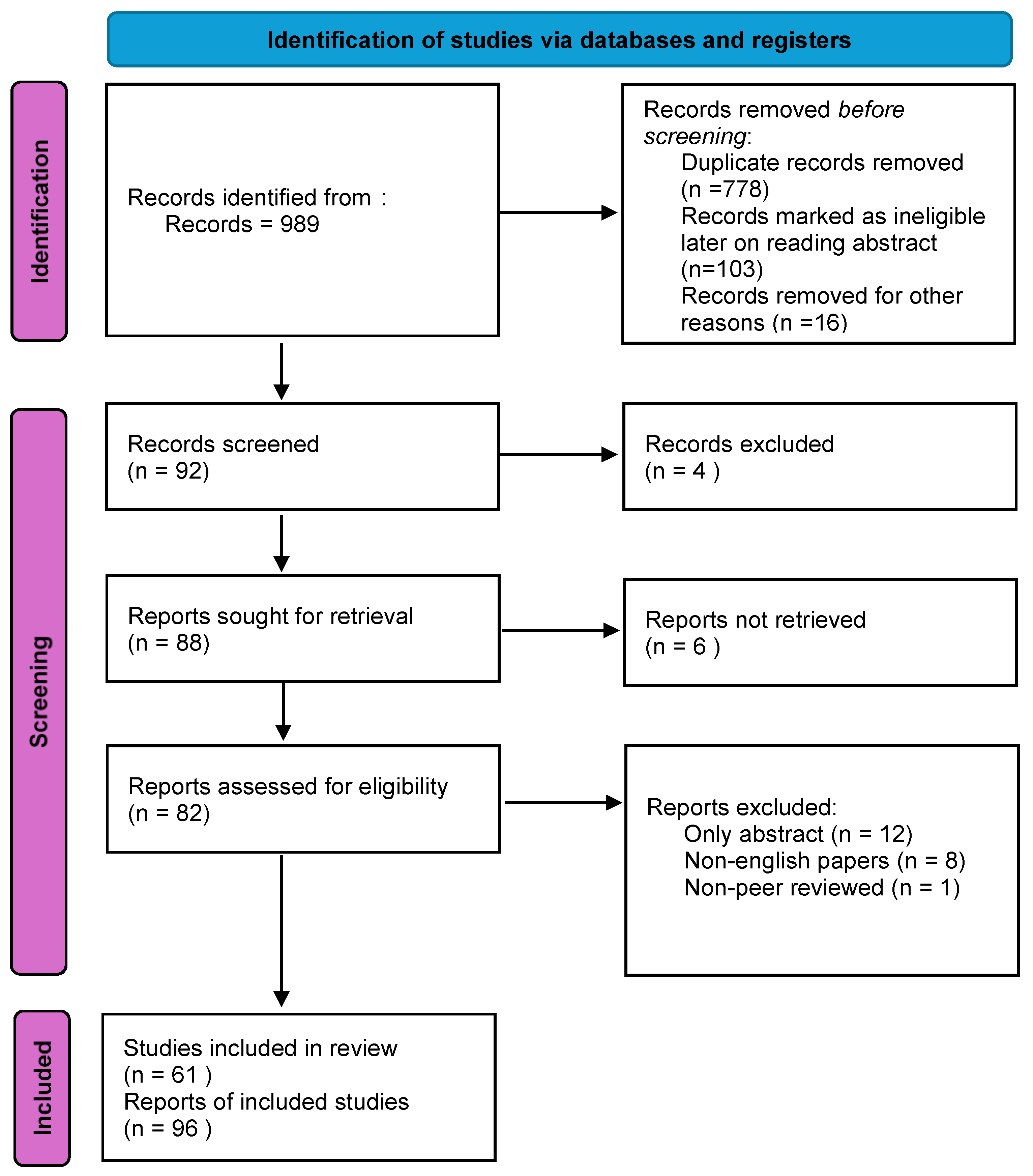
2. Materials and Methods
3. Results
3.1. Clinical Presentation
3.2. Diagnostic Methods
3.3. Treatment Modalities
3.4. Outcomes

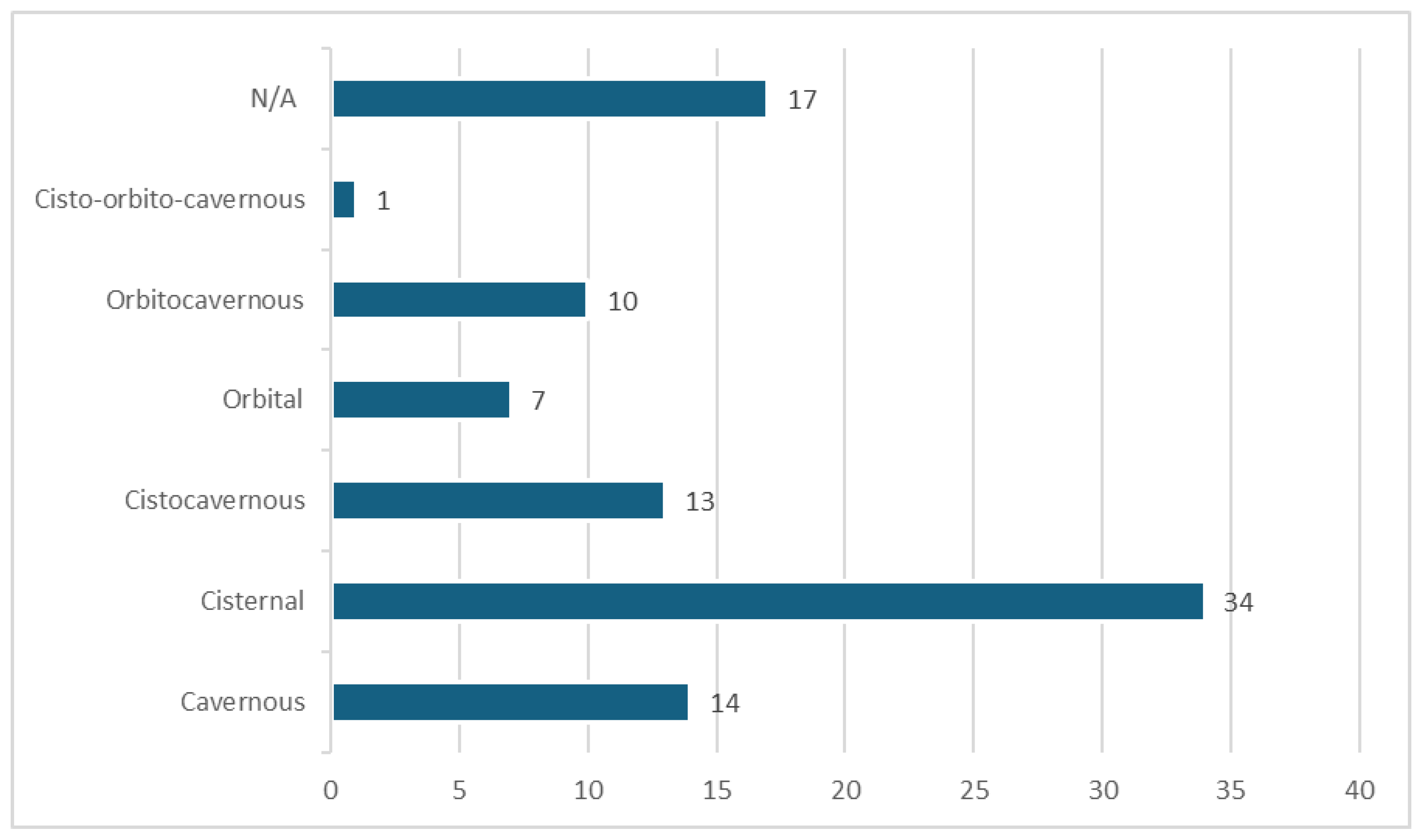
| Author | Year | Age | Sex | Site | Onset | First Line Management | EOR | Approach | Follow Up | Outcome |
|---|---|---|---|---|---|---|---|---|---|---|
| Shuangshoti [13] | 1975 | 64 | F | N/A | Headache and generalized seizure | Surgery | N/A | Pterional | (months) | N/A |
| Broggi e Franzini [27] | 1981 | 45 | M | Cisternal | Slowly progressive R hemiparesis with mild central palsy of facial nerve for 5 years | Surgery | N/A | Subtemporal | N/A | N/A |
| Hiscott e Symon [28] | 1982 | 58 | F | Cisternocavernous | Drowsiness, hemiparesis, minimal ptosis, dementia, headache | Surgery | STR | Fronto-temporal | N/A | III nerve palsy |
| Leunda [29] | 1982 | 11 | M | Cisternal | Headaches, hemiparesis, ophthalmoplegia | Surgery | GTR | Subtemporal | 4 | Worsened CN III palsy |
| Kansu [30] | 1982 | 15 | M | Cisternal | Ophtalmoplegia, ptosis, mydriasis. Recurrent III nerve palsy. Three-day history of periorbital pain and complete ptosis on the R side | Surgery | GTR | Subtemporal | 108 | N/A |
| Takano [31] | 1990 | 65 | F | Cavernous | Ptosis, diplopia | Surgery | STR | N/A | N/A | No signs of involvement of other cranial nerves (non specifica il III nervo) |
| Kurokawa [32] | 1992 | 55 | M | Cavernous | Diplopia (III, V and VI implicated), III nerve paresis | Surgery | GTR | Pterional | 36 | III nerve palsy with complete recovery 5 days later |
| Shen [4] | 1993 | 43 | M | Orbitocavernous | Proptosis with blurred vision for 7 years | Surgery | GTR | Subfrontal craniotomy | 5 | N/A |
| Niazi e Boggan [5] | 1994 | 13 | M | Cisternocavernous | Hemiparesis, diplopia, headache, dysarthria, anisocoria | Surgery | STR | Fronto-temporal | N/A | Improved |
| Kachhara [33] | 1998 | 61 | M | Cisternocavernous | Headache and diplopia | Surgery | GTR | FTOZ | N/A | Persistent III and IV nerve palsy |
| Kachhara [33] | 1998 | 55 | F | Cavernous | Headache, diplopia | Surgery | GTR | FTOZ | 16 | III and IV nerve palsy persistent. VI nerve palsy completely improved after 2 months |
| Asaoka [34] | 1999 | 64 | F | Cisternal | Chronic headache | Surgery | STR | N/A | 36 | Partial III nerve palsy improved |
| Kawasaki [25] | 1999 | 23 | F | Cisternal | Diplopia, nausea and headache | Follow up | N/A | N/A | 36 | Complete recovery |
| Mariniello [35] | 1999 | 8 | F | Cavernous | Diplopia, ophthalmoplegia, ptosis, anisocoria | Surgery | GTR | Pterional | 24 | N/A |
| Katoh [36] | 2000 | 66 | F | Cisternocavernous | Asymptomatic | Surgery | STR | Pterional | 6 | Worsened, complete III nerve palsy |
| Lingawi [37] | 2000 | 53 | M | Cisternal | Headache | Surgery | GTR | Anterior temporal approach | 6 | No change, oculomotor function intact |
| Norman [26] | 2001 | 8 months | F | Cavernous | Anisocoria | Follow up | N/A | N/A | N/A | Worsened, III nerve palsy |
| Norman [26] | 2001 | 3 | F | Cavernous | Exotropia | Follow up | N/A | N/A | N/A | Worsened, III nerve palsy, strabisums surgery |
| Norman [26] | 2001 | 2 months | M | Cavernous | III nerve palsy | Follow up | N/A | N/A | N/A | Worsened, III nerve palsy, strabisums surgery |
| Norman [26] | 2001 | 2 months | M | Cisternal | Ptosis | Follow up | N/A | N/A | N/A | Worsened, III nerve palsy |
| Norman [26] | 2001 | 2 | F | Cisternal | Ptosis | Follow up | N/A | N/A | N/A | Worsened, III nerve palsy |
| Sarma [38] | 2002 | 36 | F | Cavernous | Diplopia | Surgery | GTR | Fronto-temporal | 96 | Improved, III nerve palsy, strabisumus surgery |
| Hatakeyama [6] | 2003 | 33 | M | Cisternocavernous | Diplopia | Surgery | GTR | anterior petrosal approach with temporal craniotomy and zygomatic osteotomy | 7 | Complete recovery |
| Ohata [12] | 2006 | 63 | F | Orbitocavernous | Diplopia, ptosis, eye pain, chemosis | Surgery | STR | Orbytozigomatic infratemporal epidural and subdural approach | 72 | N/A |
| Bisdorff e Wildanger [19] | 2006 | 14 | F | Cisternal | Headaches, ophthalmoplegia, ptosis, diplopia | Follow up | N/A | N/A | 4 | N/A |
| Tanriover [39] | 2007 | 34 | F | Orbitocavernous | Anisocoria, ptosis, headache, exotropia | Surgery | STR | Pterional | 5 | Improved |
| Santarius [8] | 2007 | 42 | F | Cisternal | Diplopia | Follow up | N/A | N/A | 4 | III nerve palsy |
| Kim [16] | 2008 | 19 | F | Cisternal | Ophtalmoplegia | GKS | N/A | N/A | 36 | Unchanged |
| Kim [16] | 2008 | 29 | M | Cisternal | Ptosis | GKS | N/A | N/A | 9 | Unchanged |
| Chewning [20] | 2008 | 3 | F | Cisternal | Ptosis, headaches, III nerve palsy | Follow up | N/A | N/A | N/A | Unchanged |
| Shamim [40] | 2008 | 11 | F | Orbital | Total esotropia, gradual worsening of vision and concomitant limitation of eye movement | Surgery | GTR | Orbital approach | 12 | Residual ptosis, mild to moderate esotropia. No recovery of vision |
| Prabhu e Bruner [41] | 2009 | 38 | F | Cisternocavernous | Headache, occasional diplopia, ptosis dizziness | Surgery | GTR | Pterional | 6 | Complete III nerve palsy |
| Goel e Shah [42] | 2010 | 16 | M | Cisternocavernous | Headache and ptosis | Surgery | GTR | Pterional | 24 | III and IV nerve palsy persisted. The facial sensations had improved |
| Goel e Shah [42] | 2010 | 32 | M | Cisternal | Headache, ptosis and diplopia | Surgery | STR | Basal temporal approach | 52 | Complete recovery of III nerve palsy |
| Hironaka [43] | 2010 | 58 | M | Orbitocavernous | Numbness of the forehead | Surgery | GTR | FTOZ | 6 | Mild III paralysis |
| Furtado e Hegde [44] | 2012 | 21 | M | Cisternocavernous | Diplopia | Surgery | STR | Pterional | 12 | Complete III nerve palsy |
| Furtado e Hegde [44] | 2012 | 25 | M | Orbitocavernous | III nerve palsy, diplopia | Surgery | STR | OZ craniotomy | 15 | Proptosis had recovered, while III NC palsy remained stable |
| Wang [45] | 2013 | 30 | M | Cisternal | Headache, nausea, diplopia, ophthalmoplegia | Surgery | STR | N/A | 0.27 | Unchanged III nerve palsy |
| Yang [46] | 2013 | 3 | M | Cisternal | Irritability, convulsion | Surgery | GTR | Pterional | 12 | Overall worse |
| Iijima [47] | 2014 | 37 | F | Cisternocavernous | Behavioral changes, cognitive impairment, drowsy, disoriented, GCS 8, anisocoria, hydrocephalus | Surgery | STR | Two-stage surgery: pterional approach + 6 weeks later subtemporal route | 3.5 | Improved, oculomotor function intact |
| Nonaka [17] | 2014 | 33 | F | Cavernous | Headache and III nerve palsy | Surgery | GTR | OZ-FT | N/A | Partial III nerve palsy, improved |
| Kumar [11] | 2014 | 29 | M | Cavernous | Diplopia and blurring vision | Surgery | STR | Orbitozigomatic craniotomy | 24 | Worsened, complete III nerve palsy |
| Nonaka [17] | 2014 | 20 | F | Cisternal | Headache, dizziness and vomiting | Surgery | GTR | FTOZ | 12 | III nerve palsy completely recovered |
| Nonaka [17] | 2014 | 18 | M | Cisternal | Intermittent oculomotor palsy | Follow up | N/A | N/A | 24 | Intermittent symptoms |
| Nonaka [17] | 2014 | 58 | M | Cisternocavernous | N/A | Surgery | STR | FT-P | N/A | Partial III nerve palsy |
| Senapati [48] | 2014 | 24 | F | Cisternal | Diplopia, ptosis, headache, vomiting, hypopituitarism | Surgery | GTR | Pterional | 12 | Improving of hormonal status, complete III nerve palsy |
| Kauser [49] | 2014 | 32 | M | Orbitocavernous | Proptosis | Surgery | GTR | Fronto-orbitotomy | 4 | Worsened, complete III nerve palsy |
| Cho [50] | 2014 | 41 | F | Orbitocavernous | Blurred vision | Surgery | STR | Fronto-temporal | 12 | Improved Partial III nerve palsy |
| Shin [24] | 2015 | 43 | M | Orbital | Headache and III nerve palsy | Follow up | N/A | N/A | 108 | Partial recovery |
| Shin [24] | 2015 | 42 | M | Cisternal | Headache and III nerve palsy | Follow up | N/A | N/A | 10 | Partial recovery |
| Shin [24] | 2015 | 23 | F | Cisternal | Headache and III nerve palsy | Follow up | N/A | N/A | 84 | Completely resolved |
| Kim [21] | 2015 | 31 | F | Cisternal | Diplopia, headache and ptosis | Follow up | N/A | N/A | 12 | Partial improvement III nerve palsy |
| Kim [21] | 2015 | 52 | M | Cisternal | Diplopia, headache and ptosis | Follow up | N/A | N/A | 12 | Incomplete recovery of the ophtalmoplegia |
| Shin [24] | 2015 | 41 | F | Cisternal | Headache and III nerve palsy | Follow up | N/A | N/A | 144 | Resolved in 6 months. Just another one episode |
| Yulek e Demer [51] | 2016 | 60 | M | Orbital | Diplopia | N/A | N/A | N/A | N/A | N/A |
| Yulek e Demer [51] | 2016 | 60 | M | Orbitocavernous | Diplopia | N/A | N/A | N/A | N/A | N/A |
| Yulek e Demer [51] | 2016 | 21 | F | Orbital | Diplopia | N/A | N/A | N/A | N/A | N/A |
| Yulek e Demer [51] | 2016 | 55 | F | Cisternal | N/A | N/A | N/A | N/A | N/A | N/A |
| Yulek e Demer [51] | 2016 | 6 | F | Orbital | N/A | N/A | N/A | N/A | N/A | N/A |
| Lee [22] | 2018 | 10 | F | Cisternal | Headache and III nerve palsy | Follow up | N/A | N/A | 24 | Ptosis and headache improved. Exotropia with limitation of ocular movement remained |
| Mariniello [52] | 2018 | 16 | F | Cisternocavernous | III nerve palsy, proptosis | Surgery | GTR | Pterional | 240 | Improved prognosis and outcome of III nerve |
| Mariniello [52] | 2018 | 51 | F | Cavernous | III nerve palsy, proptosis | Surgery | GTR | Pterional | 132 | Unchanged III nerve palsy and improved proptosis |
| Muhammad e Niemela [3] | 2018 | 64 | M | N/A | Exophthalmos and blurry vision | N/A | N/A | N/A | N/A | N/A |
| Abo-Shasha [14] | 2018 | 49 | M | Cisternal | Ophthalmoplegic migraine | RT (25 Gy in 5 daily fractions) | N/A | N/A | N/A | Six months later, the patient reported a reduction in symptoms |
| Mariniello [52] | 2018 | 38 | M | Cavernous | III nerve palsy, proptosis | Surgery | GTR | Pterional | 96 | Unchanged III nerve palsy and improved proptosis |
| Marutirao [53] | 2018 | 27 | M | Cisternal | Headache, vomiting and blurring vision | Surgery | GTR | Fronto-temporal craniotomy with zigotomy; transsyilvian and subtemporal approach | 2 | Improvement in headache with partial recovery of the III nerve palsy |
| El Asri [7] | 2019 | 56 | M | Orbitocavernous | Ocular pain, diplopia and proptosis | Follow up | STR | Endoscopic endonasal approach | 8 | Partial recovery |
| Bentley [18] | 2019 | 69 | F | Cisternal | Diplopia | Follow up | N/A | N/A | 3 | Stable disease |
| Fadel [15] | 2019 | 10 | F | Cisternocavernous | Headaches, ophthalmoplegia, ptosis, diplopia, III palsy | RT (45 Gy over 25 fractions) | N/A | N/A | 58 | Unchanged III palsy. She underwent strabismus correction surgery with subsequent resolution of her diplopia |
| Petruzzelli [54] | 2019 | 16 | M | Cisternal | Headache, photophobia, nausea and ptosis | Follow up | N/A | N/A | 0.25 | Improvement of headache symptoms in about one week |
| Fadel [15] | 2019 | 8 | M | Cavernous | Ophtalmoplegia, exotropia | RT (50 Gy over 25 fractions) | N/A | N/A | 56 | Unchanged III palsy. After 12 months, he underwent strabismus correction and ptosis repair |
| Wesolosky [55] | 2020 | 6 | M | Orbital | Proptosis | Surgery | N/A | Urgent lateral orbitotomy | N/A | Unable to fully elevate in adduction and persistent mydriasis |
| Mrabet [23] | 2021 | 18 | F | N/A | Headaches, intermittent III nerve palsy | Follow up | N/A | N/A | N/A | No longer presented additional episodes |
| Chen [56] | 2021 | 21 | F | N/A | III nerve palsy after resection of a schwannoma located in the left cavernous sinus 7y prior | N/A | N/A | N/A | N/A | N/A |
| Langlois [9] | 2021 | 22 | F | N/A | Diplopia | SRS | N/A | N/A | N/A | N/A |
| Langlois [9] | 2021 | 48 | M | N/A | Diplopia | SRS | N/A | N/A | N/A | N/A |
| Langlois [9] | 2021 | 20 | F | N/A | Diplopia, ptosis | SRS | N/A | N/A | N/A | N/A |
| Langlois [9] | 2021 | 11 | F | N/A | Diplopia, ptosis | SRS | N/A | N/A | N/A | N/A |
| Langlois [9] | 2021 | 71 | M | N/A | Diplopia, ptosis, trigeminal pain | Surgery | N/A | N/A | N/A | N/A |
| Langlois [9] | 2021 | 57 | M | N/A | Diplopia, ptosis, visual loss | SRS | N/A | N/A | N/A | N/A |
| Langlois [9] | 2021 | 19 | F | N/A | Diplopia, ptosis, visual loss | Surgery | N/A | N/A | N/A | N/A |
| Langlois [9] | 2021 | 30 | F | N/A | Diplopia, ptosis, visual loss | Surgery | N/A | N/A | N/A | N/A |
| Langlois [9] | 2021 | 22 | M | N/A | Diplopia, ptosis | Surgery | N/A | N/A | 9 | N/A |
| Langlois [9] | 2021 | 45 | M | N/A | Diplopia, ptosis | SRS | N/A | N/A | N/A | N/A |
| Tian [57] | 2021 | 37 | F | Orbital | Exotropia, diplopia | N/A | N/A | N/A | N/A | N/A |
| Shah [58] | 2021 | 21 | F | Cisternal | Headache, imbalance on walking and slurring of speech | Surgery | GTR | Lateral supracerebellar transtentorial approach | 14 | III nerve palsy persisted |
| Tian [57] | 2021 | 28 | F | Cavernous | Ptosis | N/A | N/A | N/A | N/A | N/A |
| Margolin [59] | 2021 | 78 | F | Cisternocavernous | III nerve palsy, ptosis | Follow up | N/A | N/A | N/A | - |
| Rutkowski [60] | 2021 | 33 | F | Orbitocavernous | Retro-orbital pain, diplopia and III nerve palsy | Surgery | STR | Extended pterional craniotomy with pretemporal transcavernous | 0.5 | Improved |
| Langlois [9] | 2021 | 40 | F | N/A | Visual loss | SRS | N/A | N/A | N/A | N/A |
| Douglas [2] | 2022 | 42 | F | Orbito-cisternocavernous | Diplopia | SRS (27 fraction of 1.8 Gy) | N/A | N/A | 120 | No residual diplopia after strabismus reparative surgery |
| Douglas [2] | 2022 | 63 | F | N/A | Enlarged right pupil | PBT (26 fraction of 1.8 Gy) | N/A | N/A | 60 | Right eye fixed in abduction |
| Douglas [2] | 2022 | 50 | F | N/A | Exotropia | GKS (12 Gy single dose) | N/A | N/A | 12 | Strabismus repaired with surgery |
| Murali [61] | 2022 | 71 | F | Cisternal | One episode of seizure | Surgery | STR | Pterional | N/A | N/A |
| Douglas [2] | 2022 | 46 | F | Cisternal | Migraine | GKS (12 Gy single dose) | N/A | N/A | 72 | Diplopia treated with prism glasses |
| Ishino [10] | 2024 | 7 | F | Cisternal | Diplopia | Surgery | STR | Pterional | 20 | Improved ON function. Ptosis remained |
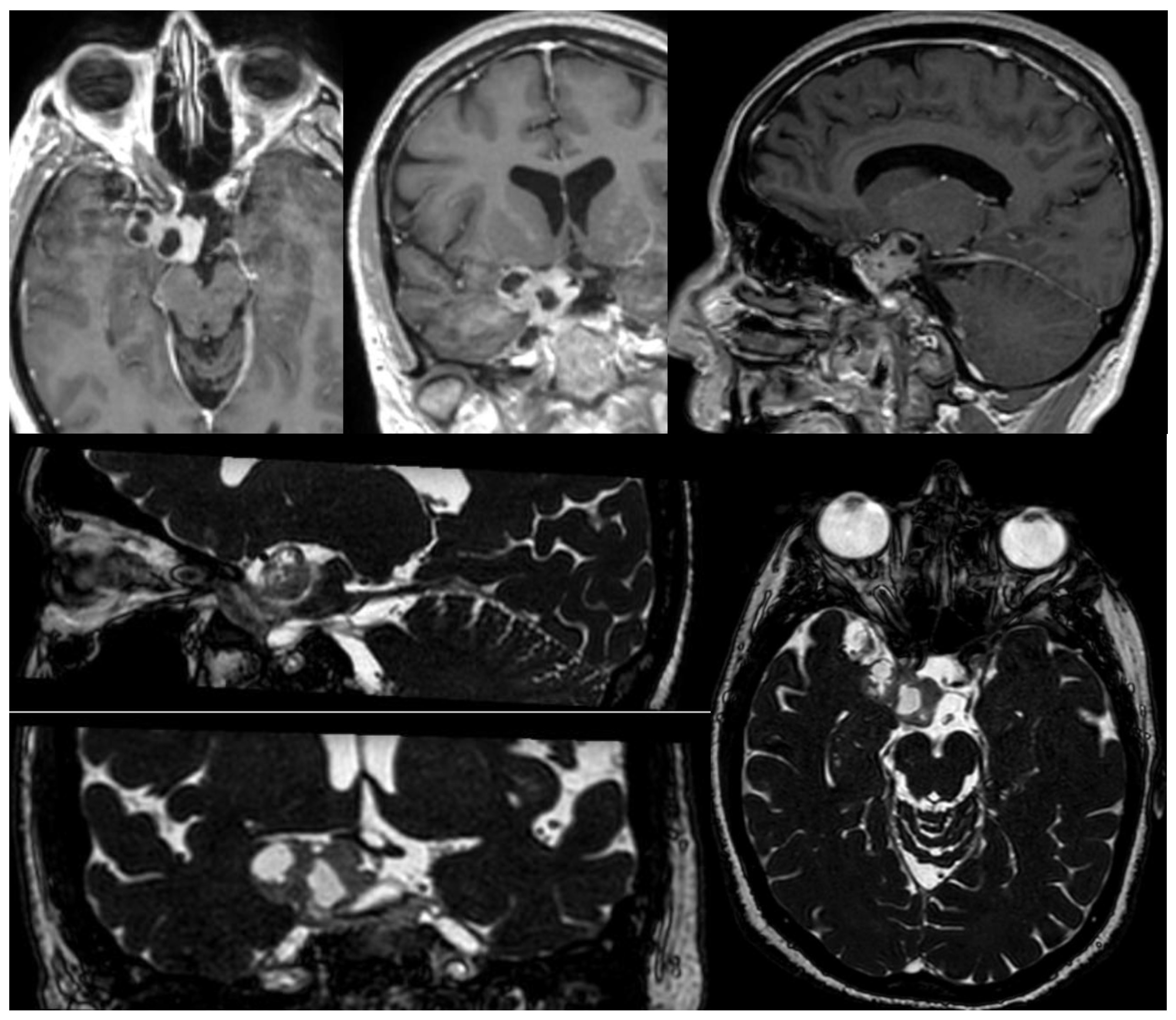
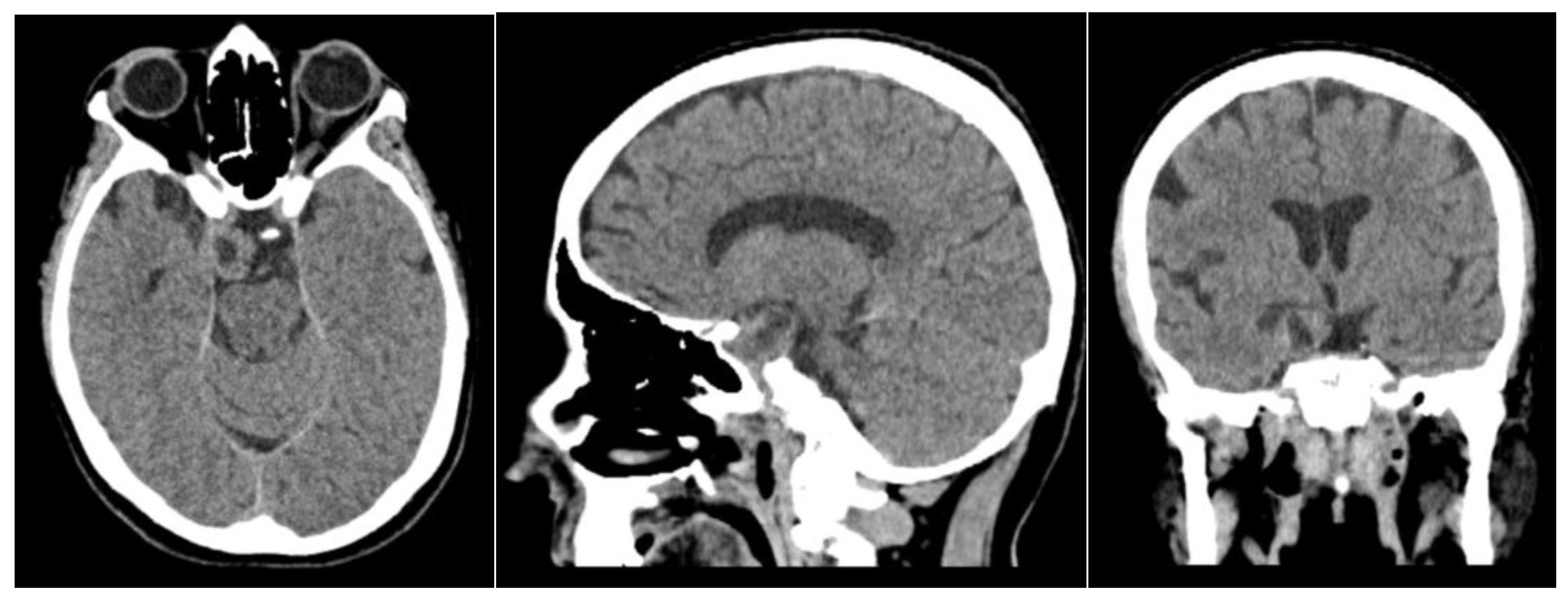
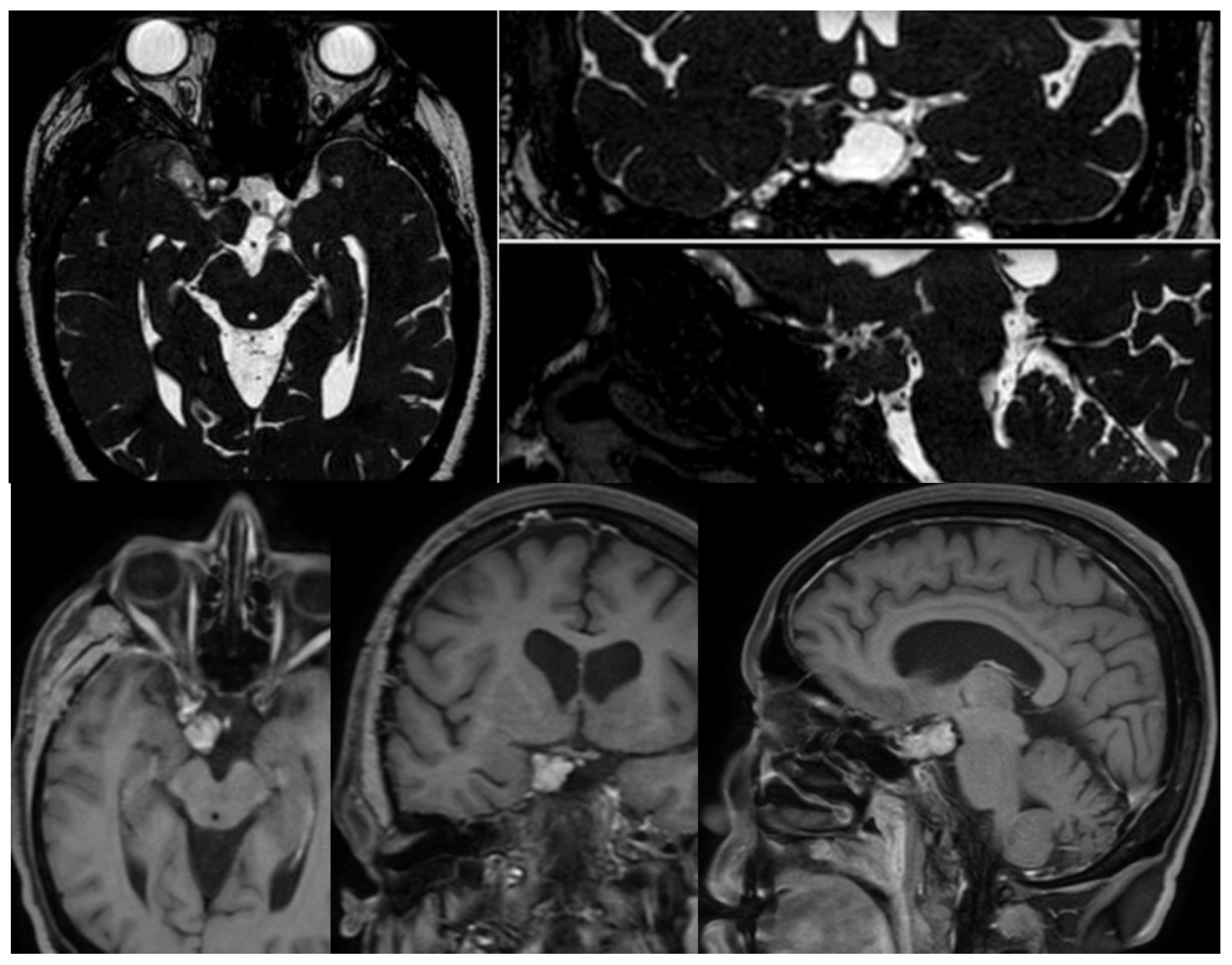
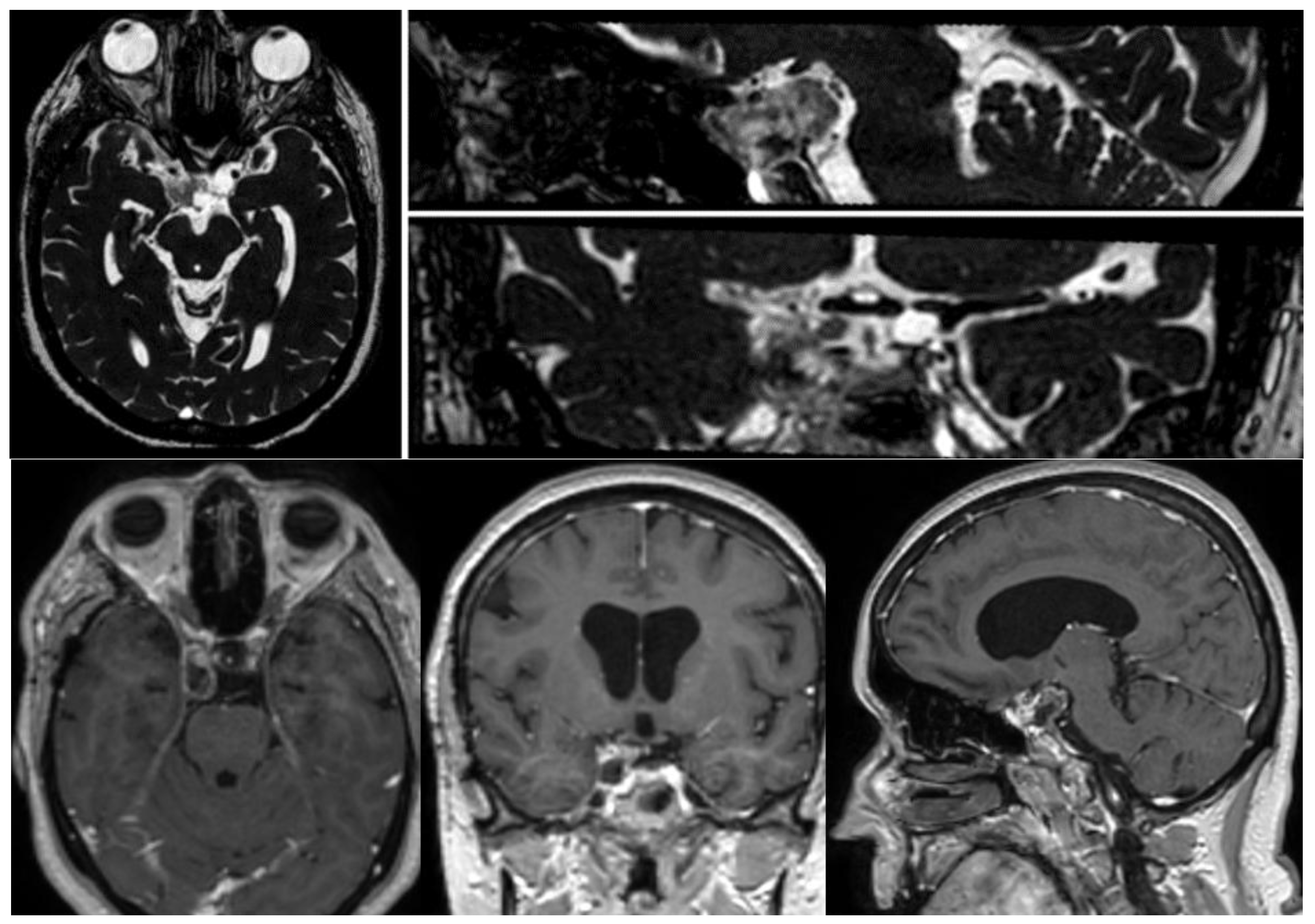
3.5. Our Case
4. Discussion
5. Conclusions
Supplementary Materials
Author Contributions
Funding
Institutional Review Board Statement
Informed Consent Statement
Data Availability Statement
Acknowledgments
Conflicts of Interest
Abbreviations
| ONS | Oculomotor nerve schwannoma |
| STR | Subtotal resection |
| GTR | Gross total resection |
| RT | Radiation therapy |
| SRS | Stereotaxic radiosurgery |
| CT | Computed tomography |
| MRI | Magnetic resonance imaging |
References
- Geethapriya, S.; Govindaraj, J.; Raghavan, B.; Ramakrishnan, B.; Arafath, R.; Vishwanathan, S.; Krishna, M. Cranial Nerve Schwannoma—A Pictorial Essay. Indian J. Radiol. Imaging 2020, 30, 116–125. [Google Scholar] [CrossRef] [PubMed]
- Douglas, V.P.; Flores, C.; Douglas, K.A.; Strominger, M.B.; Kasper, E.; Torun, N. Oculomotor Nerve Schwannoma: Case Series and Literature Review. Surv. Ophthalmol. 2022, 67, 1160–1174. [Google Scholar] [CrossRef] [PubMed]
- Muhammad, S.; Niemelä, M. Management of Oculomotor Nerve Schwannoma: Systematic Review of Literature and Illustrative Case. Surg. Neurol. Int. 2019, 10, 40. [Google Scholar] [CrossRef] [PubMed]
- Shen, W.C.; Yang, D.Y.; Ho, W.L.; Ho, Y.J.; Lee, S.K. Neurilemmoma of the oculomotor nerve presenting as an orbital mass: MR findings. Am. J. Neuroradiol. 1993, 14, 1253–1254. [Google Scholar]
- Niazi, W.; Boggan, J.E. Schwannoma of Extraocular Nerves: Survey of Literature and Case Report of an Isolated Third Nerve Schwannoma. Skull Base 1994, 4, 219–226. [Google Scholar] [CrossRef]
- Hatakeyama, H.; Saito, K.; Nagatani, T.; Patel, S.J.; Yoshida, J. Schwannoma in the Crural Cistern Removed without Permanent Functional Deficits—Case Report. Neurol. Med. Chir. 2003, 43, 95–99. [Google Scholar] [CrossRef]
- El Asri, A.C.; Arnaout, M.M.; Gerges, M.M.; Gazzaz, M.; El Mostarchid, B.; Schwartz, T.H. Prognosis Factor in Oculomotor Schwannoma: A Case of Endoscopic Endonasal Approach and Systematic Review of the Literature. World Neurosurg. 2019, 129, 72–80. [Google Scholar] [CrossRef]
- Santarius, T.; Chia, H.L.; Xuereb, J.H.; Kirollos, R.W. Sporadic Malignant Nerve Sheath Tumour of the Oculomotor Nerve. Acta Neurochir. 2007, 149, 617–622; discussion 622. [Google Scholar] [CrossRef]
- Langlois, A.-M.; Iorio-Morin, C.; Faramand, A.; Niranjan, A.; Lunsford, L.D.; Mohammed, N.; Sheehan, J.P.; Liščák, R.; Urgošík, D.; Kondziolka, D.; et al. Outcomes after Stereotactic Radiosurgery for Schwannomas of the Oculomotor, Trochlear, and Abducens Nerves. J. Neurosurg. 2021, 135, 1044–1050. [Google Scholar] [CrossRef]
- Ishino, N.; Ishibashi, K.; Kunihiro, N.; Yamanaka, K.; Inoue, T.; Goto, T. Successful Surgical Treatment of Oculomotor Palsy Due to Schwannoma of the Cavernous Sinus in a 7-Year-Old Girl: A Case Report. Childs Nerv. Syst. 2024, 40, 1931–1936. [Google Scholar] [CrossRef]
- Kumar, L.P.; Monica, I.; Uppin, M.S.; naidu Kotiyala, V.J. Large Oculomotor Nerve Schwannoma—Rare Entity: A Case Report with Review of Literature. J. Can. Res. Ther. 2014, 10, 1098. [Google Scholar] [CrossRef]
- Ohata, K.; Takami, T.; Goto, T.; Ishibashi, K. Schwannoma of the Oculomotor Nerve. Neurol. India 2006, 54, 437–439. [Google Scholar] [CrossRef]
- Shuangshoti, S. Neurilemmoma of the Oculomotor Nerve. Br. J. Ophthalmol. 1975, 59, 64–66. [Google Scholar] [CrossRef]
- Abo-Shasha, R.; Bauman, G.S.; Fraser, J.A. Stereotactic Radiotherapy for Presumed Oculomotor Nerve Schwannoma Masquerading as “Ophthalmoplegic Migraine”. Can. J. Ophthalmol. 2018, 53, e167–e168. [Google Scholar] [CrossRef] [PubMed]
- Fadel, H.A.; El Ahmadieh, T.Y.; Plitt, A.R.; Neeley, O.J.; Johnson, Z.; Aoun, S.G.; Mohamad, O.; Timmerman, R.; Weprin, B.E. Oculomotor Schwannomas: A Systematic Review and Report of Two Pediatric Cases Treated with Fractionated Cyberknife Stereotactic Radiotherapy. World Neurosurg. 2019, 129, 487–496. [Google Scholar] [CrossRef] [PubMed]
- Kim, I.-Y.; Kondziolka, D.; Niranjan, A.; Flickinger, J.C.; Lunsford, L.D. Gamma Knife Surgery for Schwannomas Originating from Cranial Nerves III, IV, and VI. J. Neurosurg. 2008, 109, 149–153. [Google Scholar] [CrossRef] [PubMed]
- Nonaka, Y.; Fukushima, T.; Friedman, A.H.; Kolb, L.E.; Bulsara, K.R. Surgical Management of Nonvascular Lesions Around the Oculomotor Nerve. World Neurosurg. 2014, 81, 798–809. [Google Scholar] [CrossRef]
- Bentley, E.; Ved, R.; Hayhurst, C. Oculomotor Schwannoma Causing a Progressive Complete Third-Nerve Palsy. BMJ Case Rep. 2019, 12, e230272. [Google Scholar] [CrossRef]
- Bisdorff, A.; Wildanger, G. Oculomotor Nerve Schwannoma Mimicking Ophthalmoplegic Migraine. Cephalalgia 2006, 26, 1157–1159. [Google Scholar] [CrossRef]
- Chewning, R.H.; Sasson, A.D.; Jordan, L.C.; Tamargo, R.J.; Gailloud, P. Acute Third Cranial Nerve Palsy from a Third Cranial Nerve Schwannoma Presenting as a Saccular Aneurysm on Three-Dimensional Computed Tomography Angiography: Case Illustration. J. Neurosurg. 2008, 108, 1037. [Google Scholar] [CrossRef]
- Kim, R.; Kim, J.-H.; Kim, E.; Yang, H.-K.; Hwang, J.-M.; Kim, J.-S. Oculomotor Nerve Tumors Masquerading as Recurrent Painful Ophthalmoplegic Neuropathy: Report of Two Cases and Review of the Literature. Cephalalgia 2015, 35, 825–830. [Google Scholar] [CrossRef] [PubMed]
- Lee, D.; Kim, W.; Kim, M. Recurrent Isolated Oculomotor Nerve Palsy Caused by Schwannoma in a Pediatric Patient. Indian J. Ophthalmol. 2018, 66, 1367. [Google Scholar] [CrossRef] [PubMed]
- Mrabet, S.; Nasri, A.; Kessentini, N.; Ben Djebara, M.; Gargouri-Berrechid, A.; Kacem, I.; Gouider, R. Recurrent Painful Ophthalmoplegic Neuropathy Revealing Oculomotor Nerve Schwannoma. Tunis Med. 2021, 99, 919–923. [Google Scholar] [PubMed]
- Shin, R.K.; Mejico, L.J.; Kawasaki, A.; Purvin, V.A.; Moster, M.L.; Younge, B.R.; Boghen, D. Transient Ocular Motor Nerve Palsies Associated With Presumed Cranial Nerve Schwannomas. J. Neuro-Ophthalmol. 2015, 35, 139–143. [Google Scholar] [CrossRef]
- Kawasaki, A. Oculomotor Nerve Schwannoma Associated with Ophthalmoplegic Migraine. Am. J. Ophthalmol. 1999, 128, 658–660. [Google Scholar] [CrossRef]
- Norman, A.A.; Farris, B.K.; Siatkowski, R.M. Neuroma as a Cause of Oculomotor Palsy in Infancy and Early Childhood. J. Am. Assoc. Pediatr. Ophthalmol. Strabismus 2001, 5, 9–12. [Google Scholar] [CrossRef]
- Broggi, G.; Franzini, A. Value of Serial Stereotactic Biopsies and Impedance Monitoring in the Treatment of Deep Brain Tumours. J. Neurol. Neurosurg. Psychiatry 1981, 44, 397–401. [Google Scholar] [CrossRef]
- Hiscott, P.; Symon, L. An Unusual Presentation of Neurofibroma of the Oculomotor Nerve. Case Report. J. Neurosurg. 1982, 56, 854–856. [Google Scholar] [CrossRef]
- Leunda, G.; Vaquero, J.; Cabezudo, J.; Garcia-Uria, J.; Bravo, G. Schwannoma of the Oculomotor Nerves: Report of Four Cases. J. Neurosurg. 1982, 57, 563–565. [Google Scholar] [CrossRef]
- Kansu, T.; Ozcan, O.E.; Ozdirim, E.; Onol, B.; Gürcay, O. Neurinoma of the Oculomotor Nerve. Case Report. J. Clin. Neuroophthalmol. 1982, 2, 271–272. [Google Scholar]
- Takano, S.; Endo, M.; Miyasaka, Y.; Yada, K.; Ohwada, T.; Takagi, H. Neurinoma of the Oculomotor Nerve: Case Report. Neurol. Med. Chir. 1990, 30, 132–136. [Google Scholar] [CrossRef] [PubMed]
- Kurokawa, Y.; Uede, T.; Honda, O.; Honmou, O. Successful Removal of Intracavernous Neurinoma Originating from the Oculomotor Nerve—Case Report—. Neurol. Med. Chir. 1992, 32, 225–228. [Google Scholar] [CrossRef] [PubMed]
- Kachhara, R.; Nair, S.; Radhakrishnan, V.V. Oculomotor Nerve Neurinoma: Report of Two Cases. Acta Neurochir. 1998, 140, 1147–1151. [Google Scholar] [CrossRef] [PubMed]
- Asaoka, K.; Sawamura, Y.; Murai, H.; Satoh, M. Schwannoma of the Oculomotor Nerve: A Case Report with Consideration of the Surgical Treatment. Neurosurgery 1999, 45, 630–634. [Google Scholar] [CrossRef]
- Mariniello, G.; Horvat, A.; Dolenc, V.V. En Bloc Resection of an Intracavernous Oculomotor Nerve Schwannoma and Grafting of the Oculomotor Nerve with Sural Nerve: Case Report and Review of the Literature. J. Neurosurg. 1999, 91, 1045–1049. [Google Scholar] [CrossRef]
- Katoh, M.; Kawamoto, T.; Ohnishi, K.; Sawamura, Y.; Abe, H. Asymptomatic Schwannoma of the Oculomotor Nerve: Case Report. J. Clin. Neurosci. 2000, 7, 458–460. [Google Scholar] [CrossRef]
- Lingawi, S.S. Oculomotor Nerve Schwannoma: MRI Appearance. Clin. Imaging 2000, 24, 86–88. [Google Scholar] [CrossRef]
- Sarma, S.; Sekhar, L.N.; Schessel, D.A. Nonvestibular Schwannomas of the Brain: A 7-Year Experience. Neurosurgery 2002, 50, 437–449. [Google Scholar] [CrossRef]
- Tanriover, N.; Kemerdere, R.; Kafadar, A.M.; Muhammedrezai, S.; Akar, Z. Oculomotor Nerve Schwannoma Located in the Oculomotor Cistern. Surg. Neurol. 2007, 67, 83–88. [Google Scholar] [CrossRef]
- Shamim, M.S.; Bari, M.E.; Chisti, K.N.; Abbas, A. A Child with Intra-Orbital Oculomotor Nerve Schwannoma without Neurofibromatosis. Can. J. Neurol. Sci. 2008, 35, 528–530. [Google Scholar] [CrossRef]
- Prabhu, S.; Bruner, J. Large Oculomotor Schwannoma Presenting as a Parasellar Mass: Case Report and Literature Review. Surg. Neurol. Int. 2010, 1, 15. [Google Scholar] [CrossRef] [PubMed]
- Goel, A.; Shah, A. “Interdural” Oculomotor Neurinoma: Report of Two Surgically Treated Cases. Acta Neurochir. 2010, 152, 1721–1724. [Google Scholar] [CrossRef] [PubMed]
- Hironaka, Y.; Nakase, H.; Motoyama, Y.; Mishima, H.; Park, Y.-S.; Hirabayashi, H.; Sakaki, T. Orbital Schwannoma Extending to the Lateral Wall of the Cavernous Sinus through the Superior Orbital Fissure—Case Report. Neurol. Med. Chir. 2010, 50, 154–157. [Google Scholar] [CrossRef] [PubMed]
- Furtado, S.V.; Hegde, A.S. Management of Oculomotor Nerve Schwannomas in Two Different Locations: Surgical Nuances and Comprehensive Review. Neurosurg. Rev. 2012, 35, 27–35. [Google Scholar] [CrossRef]
- Wang, Q.; Guo, Y.; Zhang, Y.; Hu, Y.; Li, W.; Lu, W.; Lin, W. 3D MRI of Oculomotor Nerve Schwannoma in the Prepontine Cistern: A Case Report. Clin. Imaging 2013, 37, 947–949. [Google Scholar] [CrossRef]
- Yang, S.-S.; Li, Z.-J.; Liu, X.; Li, Y.; Li, S.-F.; Zhang, H.-D. Pediatric Isolated Oculomotor Nerve Schwannoma: A New Case Report and Literature Review. Pediatr. Neurol. 2013, 48, 321–324. [Google Scholar] [CrossRef]
- Iijima, K.; Tosaka, M.; Nagano, T.; Yaoita, H.; Matsumura, N.; Nakazato, Y.; Yoshimoto, Y. Oculomotor Nerve Schwannoma Associated with Acute Hydrocephalus: Case Report. Neurol. Med. Chir. 2014, 54, 654–658. [Google Scholar] [CrossRef]
- Senapati, S.; Mishra, S.; Das, S.; Parida, D. Giant Oculomotor Nerve Schwannoma Presenting as a Sellar and Suprasellar Mass with Parasellar Extension. Neurol. India 2014, 62, 548. [Google Scholar] [CrossRef]
- Kauser, H.; Rashid, O.; Anwar, W.; Khan, S. Orbital Oculomotor Nerve Schwannoma Extending to the Cavernous Sinus: A Rare Cause of Proptosis. J. Ophthalmic. Vis. Res. 2014, 9, 514. [Google Scholar] [CrossRef]
- Cho, Y.-H.; Sung, K.-S.; Song, Y.-J.; Kim, D.-C.; Choi, S.; Kim, K.-U. Oculomotor Nerve Schwannoma: A Case Report. Brain Tumor Res. Treat. 2014, 2, 43. [Google Scholar] [CrossRef]
- Yulek, F.; Demer, J.L. Isolated Schwannoma Involving Extraocular Muscles. J. Am. Assoc. Pediatr. Ophthalmol. Strabismus 2016, 20, 343–347. [Google Scholar] [CrossRef] [PubMed]
- Mariniello, G.; De Divitiis, O.; Caranci, F.; Dones, F.; Maiuri, F. Parasellar Schwannomas: Extradural vs Extra-Intradural Surgical Approach. Oper. Surg. 2018, 14, 627–638. [Google Scholar] [CrossRef] [PubMed]
- Marutirao, R.; Singh, S.; Bhasiora, K.; Pandey, S.; Sardhara, J.; Das, K.; Srivastava, A.; Jaiswal, S.; Behari, S. Sporadic Cisternal Oculomotor Nerve Schwannoma: A Rare Case with Review of Literature. Asian J. Neurosurg. 2018, 13, 1269–1272. [Google Scholar] [CrossRef] [PubMed]
- Petruzzelli, M.G.; Margari, M.; Furente, F.; Costanza, M.C.; Legrottaglie, A.R.; Dicuonzo, F.; Margari, L. Recurrent Painful Ophthalmoplegic Neuropathy and Oculomotor Nerve Schwannoma: A Pediatric Case Report with Long-Term MRI Follow-Up and Literature Review. Pain Res. Manag. 2019, 2019, 5392945. [Google Scholar] [CrossRef]
- Wesolosky, J.D.; Campos-Baniak, G.; Sharma, V.; Weis, E. Uncommon Presentation of a Rapid-Onset Oculomotor Schwannoma in a Child. Can. J. Ophthalmol. 2020, 55, e28–e30. [Google Scholar] [CrossRef]
- Chen, P.; Beaulieu, R.; Black, E. Aberrant Regeneration of Cranial Nerve 3 Following Schwannoma Resection. Ophthalmic Plast. Reconstr. Surg. 2021, 37, e191. [Google Scholar] [CrossRef]
- Tian, G.; Kardon, R.; Feng, C.; Hong, R.; Sha, Y.; Sun, X.; Wang, M. Oculomotor Nerve Palsy Due to Unusual Causes. J. Neuro-Ophthalmol. 2021, 41, e244–e250. [Google Scholar] [CrossRef]
- Shah, A.; Jhawar, S.S.; Goel, A. The Lateral Cerebral Peduncle Approach to Ventrally Placed Intra-Axial Midbrain Tumors: A Technical Note. J. Clin. Neurosci. 2021, 89, 226–231. [Google Scholar] [CrossRef]
- Margolin, E.; Jeeva-Patel, T.; Al Shafai, L. Recurrent Third Nerve Palsy Secondary to Instrinsic Schwannoma of the Third Cranial Nerve. J. Neuro-Ophthalmol. 2021, 41, e232–e233. [Google Scholar] [CrossRef]
- Rutkowski, M.J. Pretemporal Transcavernous Approach for Resection of an Orbito-Cavernous Oculomotor Schwannoma. J. Neurol. Surg. Part B Skull Base 2022, 83, e621–e622. [Google Scholar] [CrossRef]
- Murali, S.H.; Gohil, J.; Easwer, H.V. A Sporadic Cisternal Cystic Oculomotor Schwannoma—Case Report and Review of Literature. J. Neurosci. Rural Pract. 2022, 13, 571–575. [Google Scholar] [CrossRef]
- Louis, D.N.; Perry, A.; Wesseling, P.; Brat, D.J.; Cree, I.A.; Figarella-Branger, D.; Hawkins, C.; Ng, H.K.; Pfister, S.M.; Reifenberger, G.; et al. The 2021 WHO Classification of Tumors of the Central Nervous System: A Summary. Neuro-Oncology 2021, 23, 1231–1251. [Google Scholar] [CrossRef] [PubMed]
- Nagashima, H.; Yamamoto, K.; Kawamura, A.; Nagashima, T.; Nomura, K.; Yoshida, M. Pediatric Orbital Schwannoma Originating from the Oculomotor Nerve: Case Report. PED 2012, 9, 165–168. [Google Scholar] [CrossRef] [PubMed]
- Scheller, C.; Rachinger, J.; Prell, J.; Alfieri, A.; Rampp, S.; Sel, S.; Scheller, K.; Strauss, C. Intraorbital Oculomotor Nerve Schwannoma Affecting Only the Parasympathetic Fibers. J. Neurol. Surg. A Cent. Eur. Neurosurg. 2012, 74, 120–123. [Google Scholar] [CrossRef] [PubMed]
- Wippold, F.J.; Lämmle, M.; Anatelli, F.; Lennerz, J.; Perry, A. Neuropathology for the Neuroradiologist: Palisades and Pseudopalisades. AJNR Am. J. Neuroradiol. 2006, 27, 2037–2041. [Google Scholar]
- Weiss, S.W.; Langloss, J.M.; Enzinger, F.M. Value of S-100 Protein in the Diagnosis of Soft Tissue Tumors with Particular Reference to Benign and Malignant Schwann Cell Tumors. Lab. Investig. 1983, 49, 299–308. [Google Scholar]
- Murakami, T.; Funatsuka, M.; Komine, M.; Hirayama, Y.; Suzuki, H.; Shishikura, K.; Aihara, Y.; Shibata, K.; Hori, T.; Kobayashi, M.; et al. Oculomotor Nerve Schwannoma Mimicking Ophthalmoplegic Migraine. Neuropediatrics 2005, 36, 395–398. [Google Scholar] [CrossRef]
- Pollock, B.E.; Foote, R.L.; Stafford, S.L. Stereotactic Radiosurgery: The Preferred Management for Patients with Nonvestibular Schwannomas? Int. J. Radiat. Oncol. Biol. Phys. 2002, 52, 1002–1007. [Google Scholar] [CrossRef]
- Altınbaş, E.; Tanrıkulu, B.; Danyeli, A.E.; Özek, M.M. Malignant Nerve Sheath Tumor of Oculomotor Nerve in a Pediatric Patient. Childs Nerv. Syst. 2022, 38, 807–811. [Google Scholar] [CrossRef]
- Jacquesson, T.; Cotton, F.; Attyé, A.; Zaouche, S.; Tringali, S.; Bosc, J.; Robinson, P.; Jouanneau, E.; Frindel, C. Probabilistic Tractography to Predict the Position of Cranial Nerves Displaced by Skull Base Tumors: Value for Surgical Strategy Through a Case Series of 62 Patients. Neurosurgery 2019, 85, E125. [Google Scholar] [CrossRef]
- Yamada, K.; Shiga, K.; Kizu, O.; Ito, H.; Akiyama, K.; Nakagawa, M.; Nishimura, T. Oculomotor Nerve Palsy Evaluated by Diffusion-Tensor Tractography. Neuroradiology 2006, 48, 434–437. [Google Scholar] [CrossRef]
- Ge, M.; Li, S.; Wang, L.; Li, C.; Zhang, J. The Role of Diffusion Tensor Tractography in the Surgical Treatment of Pediatric Optic Chiasmatic Gliomas. J. Neuro-Oncol. 2015, 122, 357–366. [Google Scholar] [CrossRef]
- Huang, J.; Zeng, Q.; Wu, Y.; Zhang, J.; Li, M.; Xie, L.; Li, M.; Feng, Y. Unified Framework for Oculomotor Nerve Reconstruction: Tractography-Based Anatomical Assessment. J. Neuroimaging 2025, 35, e70052. [Google Scholar] [CrossRef]


| III c.n. Function | Surgery (n = 51) | Radiotherapy (n = 16) | Conservative (n = 20) |
|---|---|---|---|
| Improved | 13 (25.5%) | 1 (6.2%) | 10 (50%) |
| Unchanged | 9 (17.6%) | 7 (43.7%) | 4 (20%) |
| Worsened | 22 (43.1%) | 1 (6.2%) | 5 (25%) |
Disclaimer/Publisher’s Note: The statements, opinions and data contained in all publications are solely those of the individual author(s) and contributor(s) and not of MDPI and/or the editor(s). MDPI and/or the editor(s) disclaim responsibility for any injury to people or property resulting from any ideas, methods, instructions or products referred to in the content. |
© 2026 by the authors. Licensee MDPI, Basel, Switzerland. This article is an open access article distributed under the terms and conditions of the Creative Commons Attribution (CC BY) license.
Share and Cite
Curcio, A.; Espahbodinea, S.; Lacava, F.; Raffa, G.; Germanò, A. Schwannomas of the Third Cranial Nerve: An Overview and Case Report. Neuroglia 2026, 7, 9. https://doi.org/10.3390/neuroglia7010009
Curcio A, Espahbodinea S, Lacava F, Raffa G, Germanò A. Schwannomas of the Third Cranial Nerve: An Overview and Case Report. Neuroglia. 2026; 7(1):9. https://doi.org/10.3390/neuroglia7010009
Chicago/Turabian StyleCurcio, Antonello, Shervin Espahbodinea, Francesco Lacava, Giovanni Raffa, and Antonino Germanò. 2026. "Schwannomas of the Third Cranial Nerve: An Overview and Case Report" Neuroglia 7, no. 1: 9. https://doi.org/10.3390/neuroglia7010009
APA StyleCurcio, A., Espahbodinea, S., Lacava, F., Raffa, G., & Germanò, A. (2026). Schwannomas of the Third Cranial Nerve: An Overview and Case Report. Neuroglia, 7(1), 9. https://doi.org/10.3390/neuroglia7010009