Article

Global Nonlinear Dynamics of a Calibrated Pseudoelastic SMA-Wire Oscillator: Multistability, Basin Structure and Routes to Chaos


1
Department of Mechanical and Mechatronics Engineering, Lakehead University, 955 Oliver Road, Thunder Bay, ON P7B 5E1, Canada
2
Department of Mechanical and Manufacturing Engineering, The University of the West Indies, St. Augustine 331310, Trinidad and Tobago
*
Author to whom correspondence should be addressed.
Vibration 2026, 9(2), 39; https://doi.org/10.3390/vibration9020039 (registering DOI)
Submission received: 11 May 2026 / Revised: 1 June 2026 / Accepted: 4 June 2026 / Published: 7 June 2026

Abstract

Hysteretic nonlinear vibration systems can exhibit jumps, coexisting attractors, and strong dependence on the initial state, particularly when material hysteresis is coupled with geometric nonlinearity. This paper investigates the global nonlinear dynamics of a harmonically forced single-degree-of-freedom oscillator incorporating pseudoelastic shape memory alloy (SMA) wires in a perpendicular geometric configuration. Cyclic force–displacement tests on pseudoelastic SMA wires are used to calibrate the constitutive response, after which steady-state dynamics are analyzed using time integration, numerical continuation (COCO), and basin-of-attraction computations over representative excitation frequencies, pre-tension levels, and the number of wires. The calibrated model predicts rich response regimes including jump phenomena, coexisting stable solutions, multistability, asymmetric periodic responses, and the pronounced dependence of the achieved steady response on initial conditions and internal state. Basin computations reveal sensitive partitioning of the state space between competing attractors, highlighting the influence of the initial and internal state in oscillators that combine pseudoelastic hysteresis with geometric stiffening. Additional numerical exploration of a negative pre-tension extension indicates transitions to more complex responses, including quasi-periodic and chaotic behaviour, but these are presented as secondary results outside the directly validated tension-wire regime. The results clarify how calibrated SMA hysteresis and geometric nonlinearity jointly shape multistability and basin structure in pseudoelastic oscillators.

1. Introduction

Nonlinear vibration systems with hysteretic restoring forces can exhibit multivalued frequency responses, jump phenomena, coexistence of attractors, and sensitivity to initial conditions. These behaviours are central to vibration analysis because they determine which steady response is actually realized under a given excitation history, even when the system has only one mechanical degree of freedom. Shape memory alloys (SMAs) are a useful physical source of such behaviour: stress-induced phase transformation can produce large recoverable strains and substantial hysteretic energy dissipation under cyclic loading, while the internal martensitic fraction adds state dependence beyond that of purely geometric nonlinearities [1,2,3,4].
Hysteretic oscillators are more broadly known to exhibit amplitude-dependent resonances and rich nonlinear dynamic behaviour. Previous studies of Masing-type, Bouc–Wen, and related hysteretic oscillators have reported multivalued frequency–response curves, jump phenomena, bifurcations, symmetry breaking, quasi-periodic responses, and chaotic or non-periodic motions [5,6]. Experimentally characterized hysteretic devices have also been embedded in oscillator models and analyzed through combined experiments, continuation, and computations, showing that identified force–displacement loops can lead to softening, hardening, and mixed softening–hardening dynamic responses [7].
For nonlinear oscillators, steady-state FRFs alone do not fully describe the global response structure. Bifurcation analysis, Poincare maps, and basins of attraction provide complementary information on coexisting attractors, response selection from initial conditions, transient behaviour, basin metamorphoses, crisis-related transitions, and global bifurcations [8,9,10]. These tools are therefore important when a hysteretic restoring force permits multiple steady responses under the same forcing conditions.
Nonlinear attachments and absorbers have been widely studied as a means of achieving broadband response shaping compared with classical linear vibration absorbers, which are most effective over narrow frequency bands [11,12]. Concepts such as nonlinear vibration absorbers and nonlinear energy sinks have demonstrated rich dynamics, including bifurcations, quasi-periodicity and chaotic responses, and the potential for enhanced attenuation through nonlinear energy exchanges [13,14,15,16,17,18]. For pseudoelastic SMA oscillators and devices, earlier studies have shown that thermomechanical coupling, loading rate, and an asymmetric tensile–compressive response can substantially alter frequency–response curves and can lead to jumps, bifurcations, and chaotic solutions [3,4]. Experimental work on SMA wires under torsional vibration has also demonstrated softening-type nonlinearity and associated jump phenomena [19], while damper-oriented models highlight the importance of cyclic effects and residual martensite strain in vibration applications [20].
Several studies have explored SMA-based vibration mitigation and adaptive concepts by exploiting variable stiffness and hysteresis [21,22,23,24,25,26,27,28,29]. In parallel, continued interest in improving pseudoelastic performance and fatigue resistance motivates experimental characterization and modelling efforts that support the design-oriented use of SMA components [30,31,32,33,34]. From a modelling standpoint, experimentally driven hysteresis descriptions such as Preisach-type approaches have been highlighted as practical alternatives for capturing the pseudoelastic response in simulation workflows [35]. Despite this progress, a gap remains in systematically linking experimentally calibrated pseudoelastic wire behaviour to global nonlinear vibration features, such as coexistence of attractors, basin structure, asymmetric steady states, and chaotic windows under periodic excitation.
Beyond its dynamical significance, the observed multistability is also relevant from a practical response-interpretation perspective. The basin computations show that the oscillator may converge to different steady responses, with different apparent stiffness and frequency characteristics, under nominally identical excitation conditions depending on its initial state, internal martensitic state, and loading history. Accordingly, in structures incorporating SMA-based damping or adaptive components, such state-dependent variability may influence how response changes or frequency shifts are interpreted, even in the absence of any change in structural parameters [36]. This provides an additional practical motivation for examining basin structure and response robustness.
In this work, we investigate the global nonlinear dynamics of a pseudoelastic SMA-wire oscillator in which nonlinearity arises from a perpendicular wire configuration (geometric hardening) coupled with pseudoelastic phase-transformation hysteresis (softening and dissipation). The pseudoelastic constitutive description is adopted from the established SMA modelling literature [2,37] and calibrated here to reproduce experimentally observed cyclic force–displacement loops; the required material parameters are identified from cyclic tensile testing of SMA wires. Although various methods have been investigated for analyzing nonlinear systems such as those involving Duffing-type oscillators, chaotic dynamics, and power-series-based methods [38,39], local linearization or low-order Taylor expansion would only describe motion near one operating point and would not preserve the transformation-induced hysteresis, multistability, basin dependence, and discontinuity-sensitive branch switching that are central to the present problem. Steady-state responses are therefore computed via time integration and numerical continuation using the Continuation Core (COCO) toolbox to track solution branches and bifurcations across excitation frequency and representative design parameters (e.g., pre-tension and number of wires).
The present work does not propose a fundamentally new pseudoelastic SMA constitutive law. Rather, it combines an experimentally calibrated pseudoelastic SMA-wire response with a perpendicular geometric configuration and uses this calibrated model to investigate the global nonlinear dynamics of the resulting oscillator. The contribution lies in the systematic analysis of frequency–response behaviour, jump phenomena, multistability, basin structure, and related asymmetric and global response features in the calibrated system. Results associated with the negative pre-tension case are retained as a secondary numerical extension outside the directly validated tension-wire regime.
The remainder of the paper is organized as follows. Section 2 presents the model formulation and governing equations for the pseudoelastic SMA-wire oscillator. Section 3 summarizes the experimental cyclic force–displacement testing and the identification of material parameters used to calibrate the constitutive description. Section 4 presents the computed nonlinear response characteristics under harmonic excitation, including frequency–response curves, bifurcation and solution-type evidence, and basin-of-attraction results. Section 5 discusses the implications for nonlinear vibration analysis and outlines directions for future work. Finally, Section 6 concludes with the key response-regime and robustness findings.

2. Materials and Methods

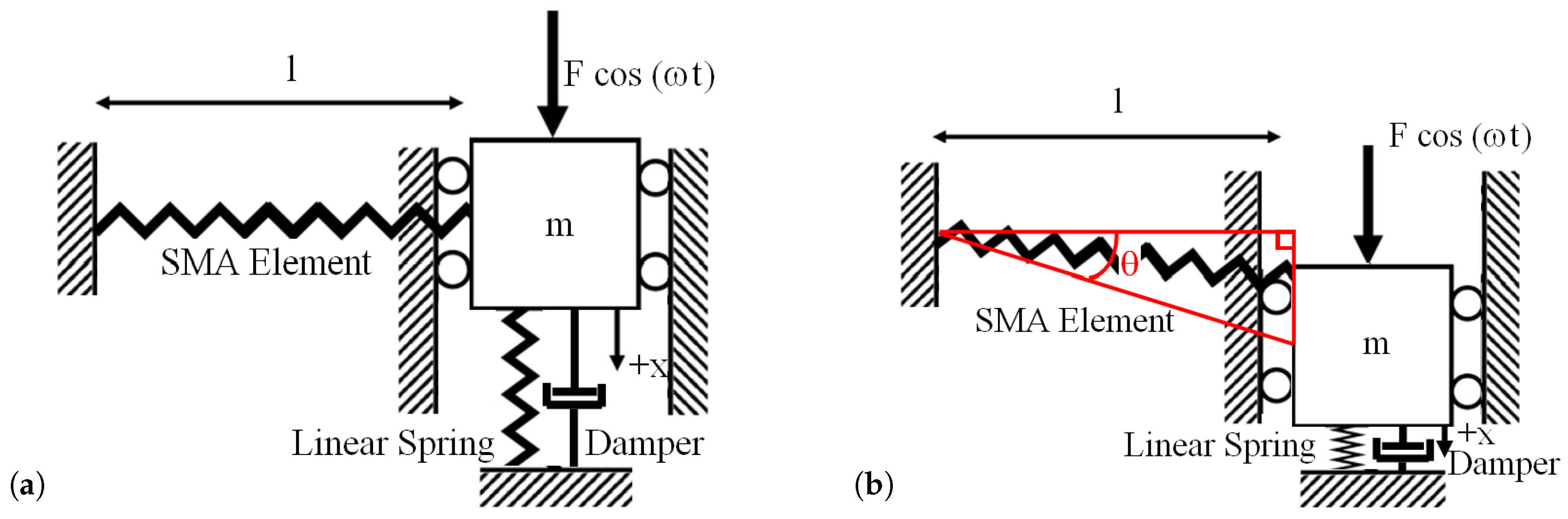
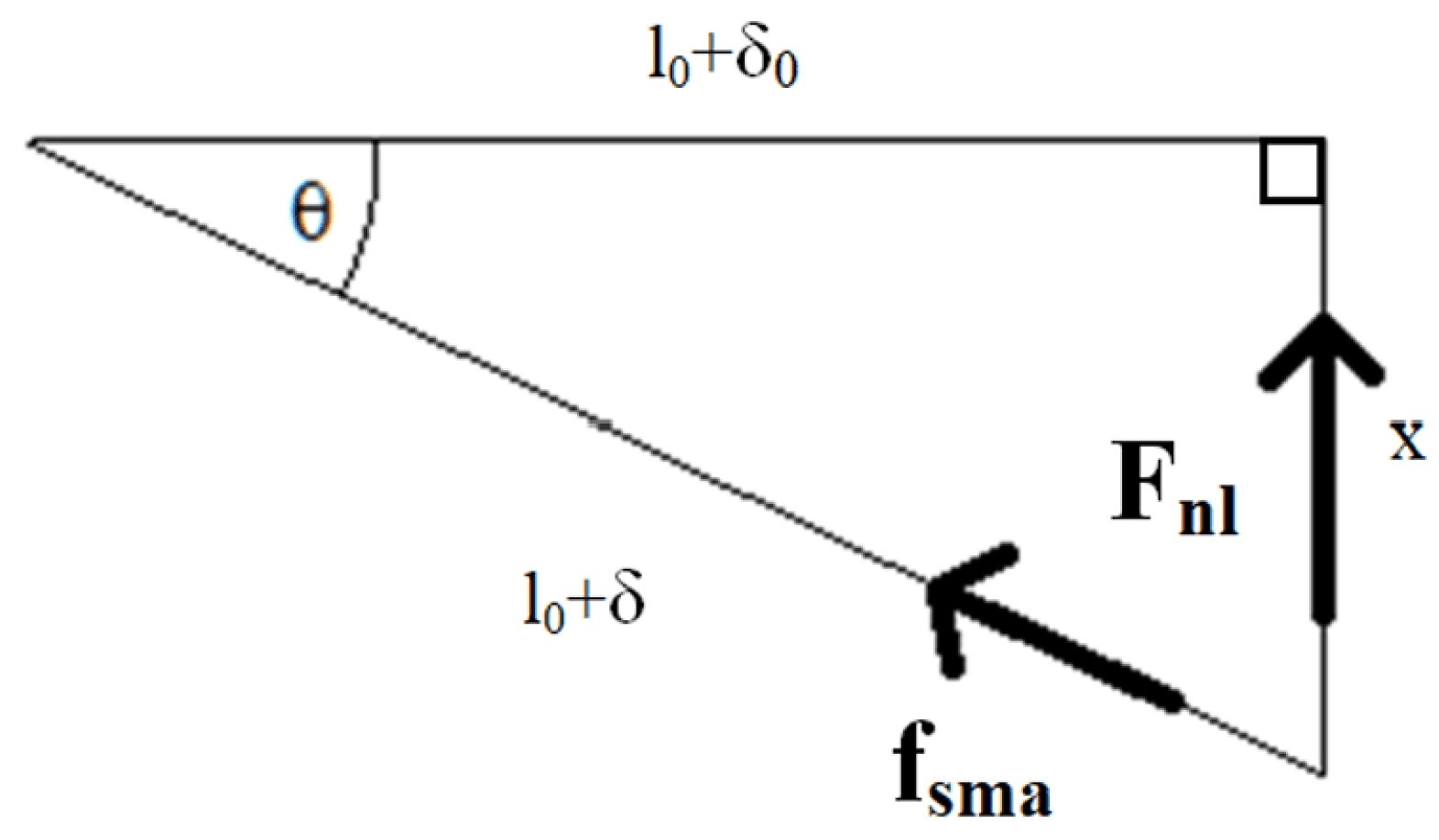
The extension of the SMA element is determined by analyzing the constrained motion outlined by the path made by the triangle shown in Figure 1. The displacements and forces are determined from trigonometry according to Figure 2.
The schematic emphasizes the SMA-wire geometry used to define the nonlinear restoring force. The viscous damping in the oscillator is represented by the ideal damping term C x ˙ in the governing equation rather than by a separately modelled SMA component.
The displacement relationship is given by
δ = x 2 + ( l 0 + δ 0 ) 2 l 0 .
where δ , δ 0 and l 0 are the extension, initial extension, and original length of SMA wire, respectively, and x is the displacement of mass, m. The effective nonlinear force, is given by
F n l = f s m a sin ( θ ) .
where F n l and f s m a are the effective force in the x-direction and force/tension of the SMA wire respectively and
sin ( θ ) = x x 2 + ( l 0 + δ 0 ) 2 .
In this paper, the work by [2] is utilized for developing the constitutive equations of motion of this system. The SMA element is an experimentally calibrated wire element; references below to a pseudoelastic spring or device denote the equivalent axial restoring law of the wire before it is projected through the perpendicular oscillator geometry. This distinction is important because the tested component is a wire, while the model uses its calibrated axial force–extension relation as the restoring element. The governing relations are given by
m x ¨ = F sin ( ω t ) k x f s m a sin ( θ ) C x ˙ ,
e ˙ = f s m a δ ˙ + Q ˙ ,
θ t η ˙ = Q ˙ + Γ ˙ ,
Γ ˙ 0 .
where e is the internal energy, Q ˙ is the rate of heat exchange with the environment, Γ ˙ is the rate of energy dissipation, θ t is the temperature of the SMA wire, η is the entropy, k is the stiffness of the linear spring and C is the damping coefficient.
Equation (4) is the balance of linear momentum, while Equation (5) represents the internal energy balance (First Law of Thermodynamics), and Equations (6) and (7) are the balance of entropy and Clausius–Duhem inequality, respectively (Second Law of Thermodynamics). The thermomechanical framework is presented in this general form for completeness and to state the constitutive setting in which heat exchange, entropy evolution, and dissipation constrain the restoring force and internal-variable evolution. After the free energy and phase-transformation law are specified, these constitutive relations close the mechanical equation of motion in Equation (4). Using the free energy function, Φ = e θ t η , instead of the internal energy, Equation (5) is rewritten using Equation (6) in the following form:
Φ ˙ = f s m a δ ˙ η θ t ˙ Γ ˙ .
To fully define all the unknown functions, five constitutive equations are sought. Assuming primarily convection heat exchange, Newton’s heating law is used:
Q ˙ = h ( θ E θ t ) .
where h 0 is the heat exchange coefficient and θ E is the temperature of the environment. Using Equations (7) and (8) leads to
f s m a = Φ δ , η = Φ θ t , Γ ˙ = Π ξ ˙ 0 .
where Π = Φ / ξ is the thermodynamic force (driving force) conjugated with the phase-transformation rate and ξ ˙ is based on Equation (10). Only two equations for Φ and ξ ˙ are needed to completely specify the model, as it is commonly obtained in thermodynamics systems with internal variables [40]. The following free energy function has been used to model a pseudoelastic spring–mass device [37]:
Φ = K s m a 2 ( δ sgn ( δ ) δ m a x ξ ) 2 + c ( θ t θ 0 θ t ln θ t θ 0 )
+ ( θ t θ 0 ) b δ m a x ξ + a 0 b 0 θ t .
where K s m a > 0 is the elastic stiffness, δ m a x is the maximum martensite–austenite transformation displacement, c > 0 is the heat capacity, b > 0 is the slope in the temperature transformation-force plane, and a 0 and b 0 are the internal energy and entropy of the device in the fully austenitic state at the reference temperature, θ 0 respectively. The constitutive equations for the restoring force, entropy and thermodynamic driving force directly follow from Equation (11) as
f = K s m a ( δ sgn ( δ ) δ m a x ξ ) ,
η = c ln θ t θ 0 b δ m a x ξ + b 0 ,
Π = K s m a δ m a x ( | δ | δ m a x ξ ) b δ m a x ( θ θ 0 ) .
The restoring force, sgn ( δ ) δ m a x ξ , is the pseudoelastic part of the total displacement, and the signum function is introduced to reproduce symmetric responses. The constitutive equation for ξ ˙ describes the evolution of the phase transformations described by
ξ ˙ = G ( Π , ξ , sgn ( ξ ˙ ) ) Π ˙ .
with the hysteresis operator
G = k 1 ( 1 ξ ) [ 1 + tan h ( k 1 Π + k 2 ) ] , i f ξ ˙ > 0 k 3 ξ [ 1 + tan h ( k 3 Π + k 4 ) ] , i f ξ ˙ < 0 .
where an increase in k 1 increases the slope of the phase fraction evolution with respect to Π and an increase in k 2 decreases the value of Π at which the transformation takes place. These are experimentally determined parameters which directly affect the slope of the austenite to martensite transformation section on the hysteresis force–displacement curve and the height at which the transformation begins, respectively. k 3 and k 4 are analogous to k 1 and k 2 , but are instead applicable to the reverse transformation section of the hysteresis loop. When ξ ˙ = 0 , no switching between the forward and reverse branches occurs, and the hysteretic internal state remains unchanged until the loading direction resumes.
The function G clearly depends on the state and whether ξ is increasing or decreasing to describe the transformations A → M and M → A, respectively. Substituting for Equation (14), the relationship of ξ in terms of displacement and temperature is obtained:
ξ ˙ = G b δ m a x 1 + K s m a δ m a x 2 G ( θ ˙ t sgn ( δ ) ) K s m a b δ ˙ .
Rearranging, the system can be expressed in a reduced first order form:
x ˙ = v ,
v ˙ = ( F / m ) sin ( ω t )
k x n w i r e s ( K s m a / m ) ( δ sgn ( δ ) δ m a x ξ ) sin ( θ ) ( C / m ) v ,
ξ ˙ = Z 1 c Z 1 Z 2 [ sgn ( δ ) K s m a c b δ ˙ + h ( θ t θ E ) ] ,
θ t ˙ = 1 c Z 1 Z 2 [ sgn ( δ ) K s m a Z 1 Z 2 b δ ˙ + h ( θ t θ E ) ] ,
where c Z 1 Z 2 > 0 , and
Z 1 = b δ m a x G 1 + K s m a δ m a x 2 G ,
Z 2 = K s m a δ m a x ( | δ | δ m a x ξ ) θ 0 b δ m a x .
Although the thermomechanical framework is introduced in the general form, an isothermal approximation, θ ˙ t = 0 , is adopted here as a practical first modelling assumption for the present thin-wire, low-frequency operating regime. This choice is motivated by the 0.5 mm SMA-wire geometry, for which the characteristic internal thermal diffusion time across the wire radius can be estimated as t d r w 2 / α . Using reported thermal diffusivity values for NiTi SMAs of the order 10 6   m 2 /s [41], the diffusion timescale for the wire used here is of the order of 10 2 s. This estimate is shorter than, or at least comparable to, the oscillation periods considered in the numerical study ( 0.067 0.333 s for 15–3 Hz), supporting the use of the isothermal formulation as a practical approximation for the nonlinear-dynamics analysis. At the same time, thermomechanical coupling is known to influence pseudoelastic response, and isothermal and non-isothermal predictions can differ quantitatively, particularly as the loading rate increases [3]. These limitations are therefore acknowledged: the present model does not resolve rate-dependent self-heating or environmental heat exchange, and non-isothermal effects may become more important for larger wires, higher frequencies, or more severe rate-dependent conditions. Using Equations (10) and (21) gives
Q ˙ = J Z 1 Z 2 sgn ( δ ^ ) δ ^ ˙ .
Using Equations (1), (3) and (24) and non-dimensionalizing gives the equations of motion:
x ^ ˙ = v ^ ,
v ^ ˙ = γ ^ sin ( Ω ^ t ^ ) k ^ x ^ n w i r e s ( δ ^ sgn ( δ ^ ) λ ξ ) x ^ ϕ 2 + x ^ 2 ζ v ^ ,
ξ ˙ = J Z 1 sgn ( δ ) δ ^ ˙ ,
where
δ ^ = ϕ 2 + x ^ 2 ψ ,
δ ^ ˙ = v ^ x ^ ϕ 2 + x ^ 2 .
The hat denotes non-dimensional variables defined as
t ^ = ω n t , x ^ = x x m s , θ t ^ = θ t θ r , G ^ = G b δ m a x θ r ,
Z 1 = G ^ 1 + J λ G ^ , Z 2 = L [ J ( | δ ^ | λ ξ ) + θ 0 ] .
The non-dimensional parameters are
λ = δ m a x δ M s , L = b δ m a x c , h ^ = h c ω n , J = f M s b θ r ,
k ^ j = k j b δ m a x θ r , j = 1 , 3 , ϕ = l 0 + δ 0 δ M s , ψ = l δ M s , k ^ = k K s m a ,
ζ = C 2 ω n m , γ ^ = F f M s , Ω ^ = ω ω n .
Here, λ scales the transformation displacement, J compares the transformation-force scale with the temperature–force slope, γ ^ is the forcing amplitude normalized by the martensitic starting force, Ω ^ is the forcing frequency normalized by the reference frequency, and  ζ is the viscous damping ratio. The parameter ϕ is the normalized pre-tensioned initial SMA-wire length, while ψ is the normalized undeformed wire length used in the instantaneous extension relation. In the baseline parameter set, k ^ = 0 is chosen in order to isolate the restoring-force contribution of the SMA wires and thereby highlight the nonlinear pseudoelastic response of the wire-based oscillator. This does not imply the absence of an effective linear stiffness contribution in the overall response, since pre-tension in the adopted geometric configuration already introduces a linearized stiffness effect. The linear spring in Equation (4) is retained so that additional parallel linear stiffness could be included in future configurations. Here, n w i r e s denotes the number of identical SMA wires arranged symmetrically in parallel, such that each wire follows the same extension–displacement relation and the total restoring force is obtained as the sum of the individual wire forces. This idealization represents a symmetric physical arrangement in which the wire contributions add without introducing net asymmetry.
For the physical interpretation, k ^ i s are more conveniently expressed in terms of the non-dimensional parameters:
q ^ 1 = f M f f M s , q ^ 2 = f A f f A s , q ^ 3 = f A s f M s .
where f M s ,   f M f ,   f A s and f A f are the respective start and finish transformation forces at the reference temperature, θ r , and  r = tanh 1 ( 1 2 n r ) , with  n r denoting the residual martensitic fraction at the conventional start of transformation. This parameterization is used to regulate the smoothness of the tanh-based transition in the pseudoelastic hysteresis approximation. This gives
k ^ 1 = 2 r J ( q ^ 1 1 ) , k ^ 2 = 2 ( 1 θ 0 ) J ( q ^ 1 + 1 ) J ( q ^ 1 1 ) r ,
k ^ 3 = 2 r ( 1 q ^ 2 ) q ^ 3 J , k ^ 4 = 2 ( 1 θ 0 ) q ^ 3 J ( q ^ 2 + 1 ) J ( 1 q ^ 2 ) q ^ 3 J r .

3. Experimental Characterization and Parameter Identification

This research is concerned with utilizing the force–displacement relationship that arises from SMA due to the pseudoelasticity effect in a nonlinear oscillator. This is a nonlinear hysteretic relationship that can be observed through the loading and consecutive unloading (cyclic loading) of an SMA wire while monitoring the displacement and force. Successful testing produced data that were utilized to obtain the parameters required in the mathematical model of the system.

3.1. Experimental Tensile Testing of SMA Wires

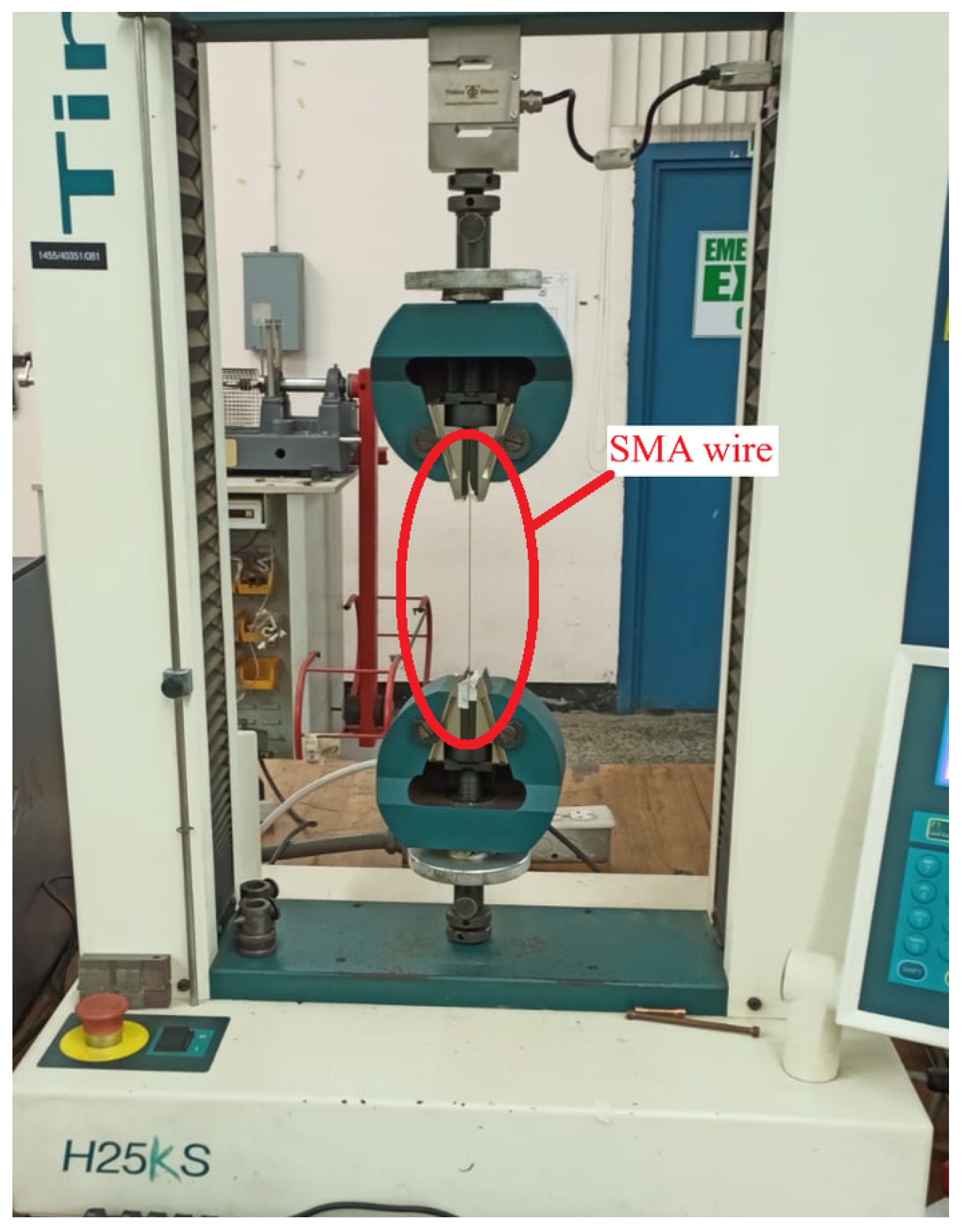
Cyclic loading tests were done on SMA wires using a Tinius Olsen Universal Testing Machine (Model: H25KS, Load Capacity: 25,000 N; Tinius Olsen, Horsham, PA, USA) as shown in Figure 3.
The force–displacement relationship of SMA wire is known to stabilize with an increasing number of cyclic loading; a relationship which is also rate dependent [42]. At present, when even the commercially available higher-performance SMA, Nitinol, undergoes a strain above 5%, high pseudoelastic degradation is experienced at high cyclic load numbers, which may be impractical for vibration-based applications whereby they will be expected to undergo significantly high repetitive loading [43]. This is an interesting area of research for the further development of the fatigue properties of SMAs. To alleviate this current limitation, it was decided to stay below the maximum strain 5%, considering that continuous cyclic loading or oscillations of SMA wires will be experienced. In measuring stabilization, several useful indicators can be used.
The force–displacement graphs were monitored over progressive loading cycles to visualize the resulting pseudoelasticity of the SMA wire. The SMA-wire test specimens used were 10 cm and 20 cm in length, 0.5 mm diameter, black finish Nitinol wire, with item # WSE002000000SO, obtained from Confluent Technologies. The austenitic transformation according to the manufacturer ranges from 5 °C to 15 °C, exhibiting pseudoelasticity at room temperature. This was chosen for convenience as it allows studying the effect of pseudoelasticity of the SMA wire without requiring the need for a heating source (such as an electrical power source for Joule heating). Using this readily available size of wire was also very cost-efficient as many samples had to be discarded after testing, thus allowing sufficient repeatability at minimal cost. Other properties that made this wire desirable included its high fatigue life, strain capability, and corrosion resistance. The maximum strain was limited to approximately 4% (i.e., 0.4 cm and 0.8 cm for 10 cm and 20 cm length, respectively) to avoid the possibility of degradation of the force–displacement relationship and ensure a high cycle life.
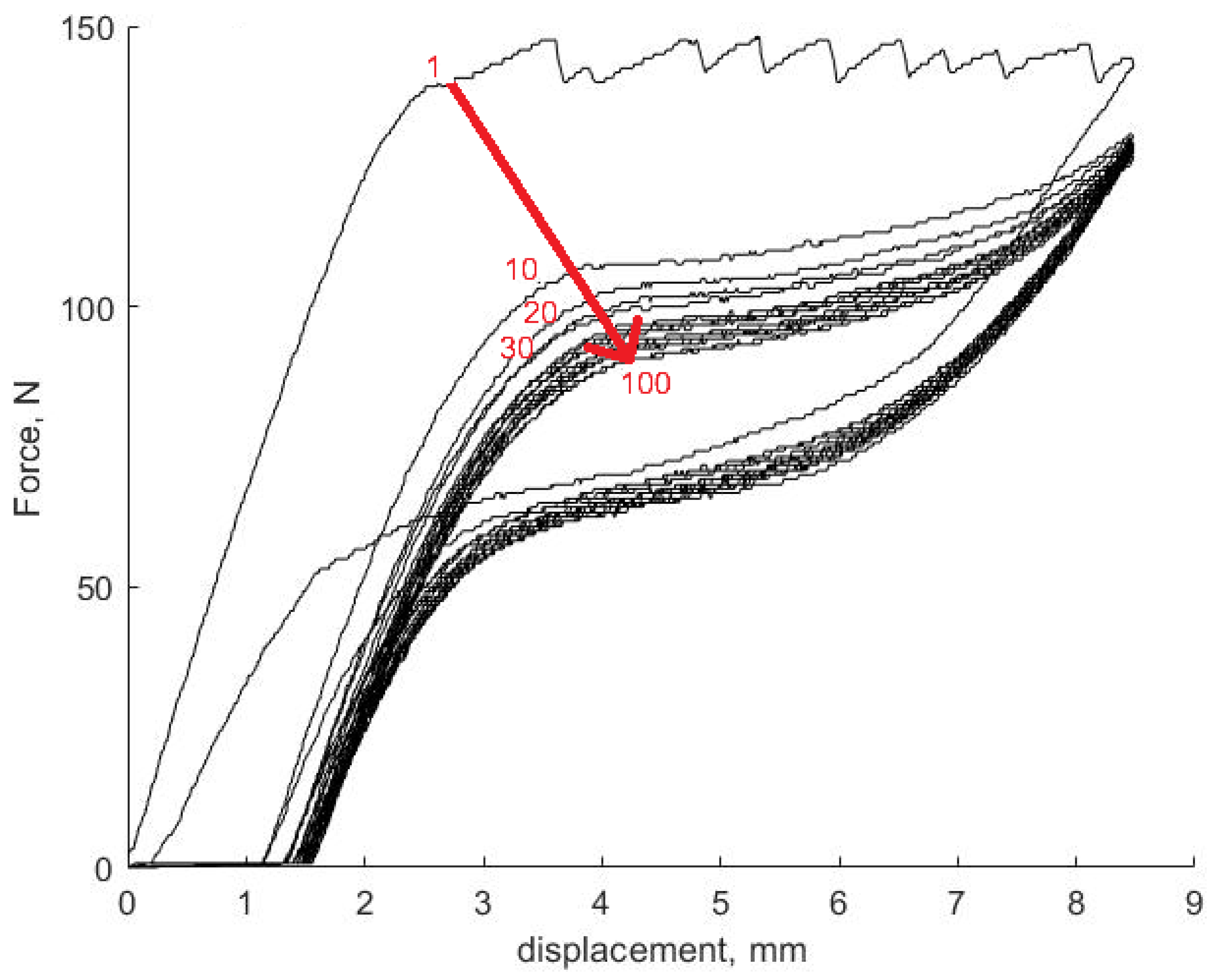
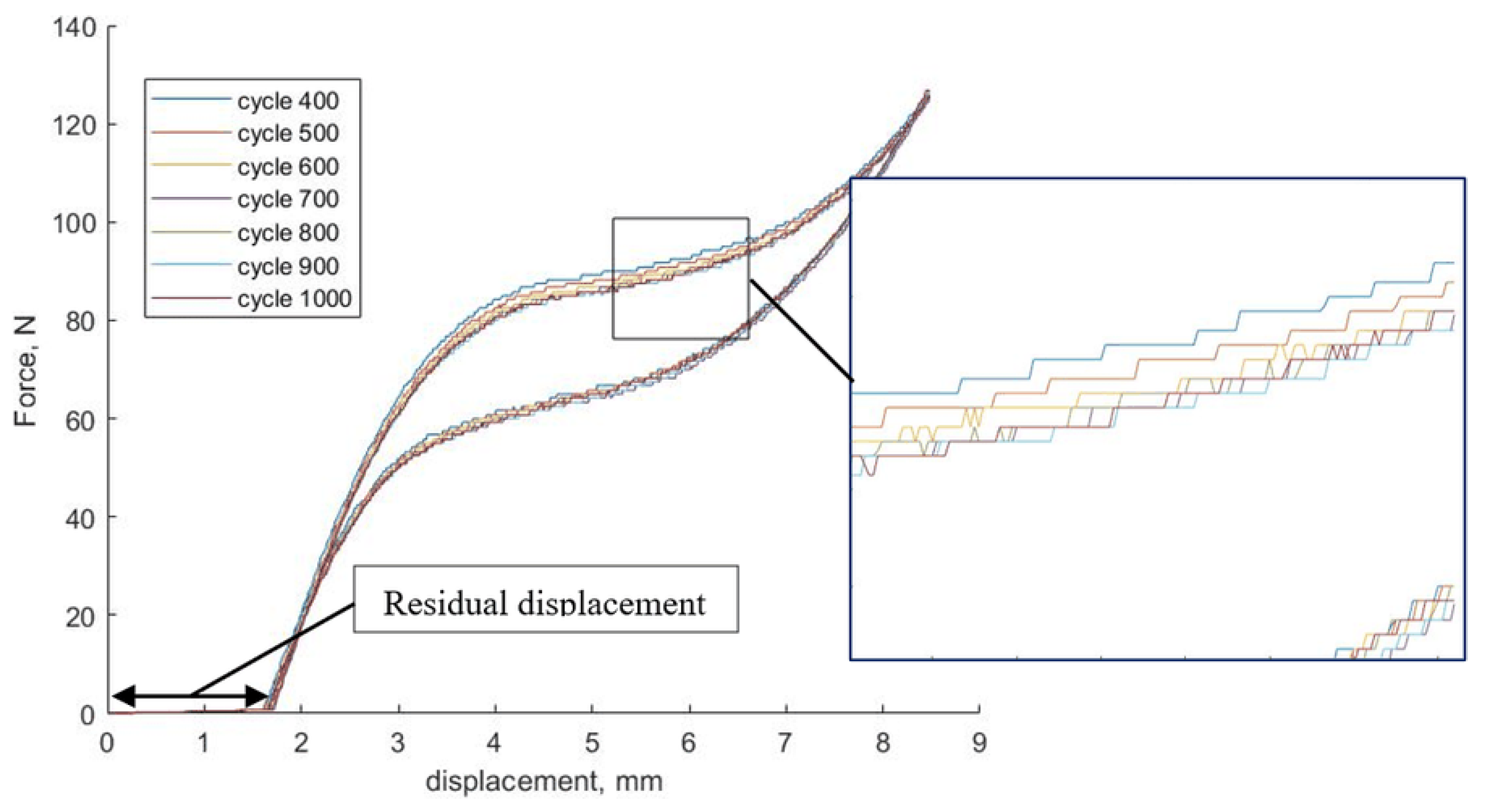
The SMA-wire samples were loaded for 1000 cycles, as stabilization is suggested to occur between 500 to 1000 cycles [42]. Force–displacement graphs were recorded after specified intervals of loading cycles to assess the degradation of the pseudoelasticity until stabilization was obtained. The force–displacement graphs obtained under cyclic loading are shown in Figure 4 and Figure 5. In Figure 4, the data are shown for approximately every 10 cycles for the first 100 cycles.
The initial anomalous force excursions on the first curve occurred as a result of noticeable grip slip. This was avoided in future tests by further tightening of the grips. Various clamping materials were tried, such as bare machine grippers, wood, and sleeves for insulated wire, as a consequence of this. The smooth sheet metal surface was the only option that securely clamped the wires while avoiding premature failure near the clamped ends, which occurred especially with the machine grippers used due to the perforations of the surface inducing stress concentration in the wires which are of relatively small diameter. From the data obtained, most of the stabilizing occurs within the first 100 loading cycles. Figure 5 further shows that the later-cycle force–displacement loops form an apparent plateau over cycles 700–1000, with no visible change in the loop shape relative to the much larger early-cycle evolution. To better measure stability, the relationship of the residual strain or the energy dissipated per cycle with the number of loading cycles may be recorded [44]. The residual strain refers to the strain without load upon unloading, whereas the energy dissipated refers to the loop energy or the energy upon loading minus the energy upon unloading. In this research, the relationships of both the residual strain and the dissipated energy per cycle were found as the number of loading cycles increased, because they conveniently required postprocessing of the same force displacement data.

3.2. Stabilizing of SMA Wires

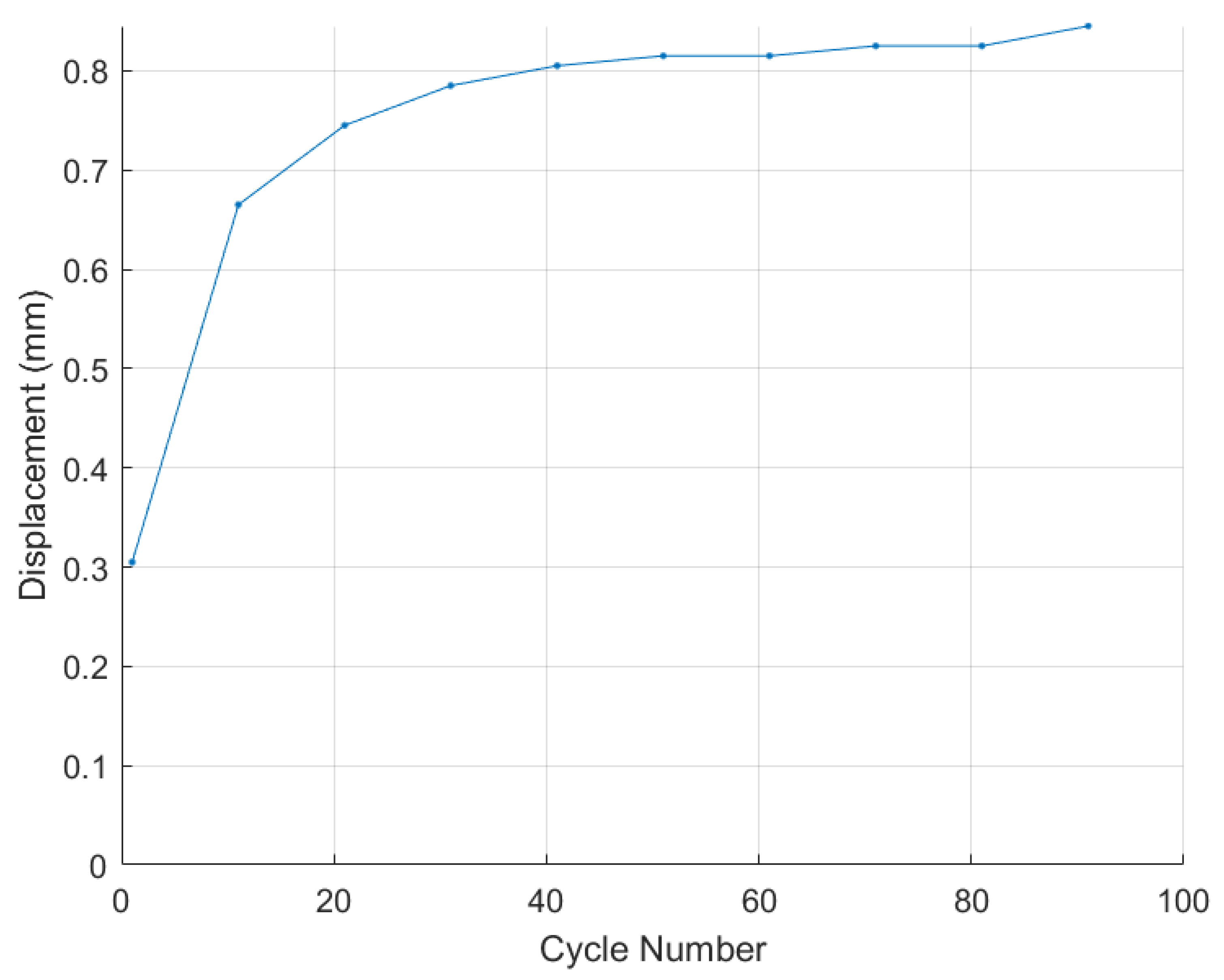
Similarly to previously published work [45], the residual strain/displacement decreases as the number of loading cycles increases, where the residual strain R % = R e s i d u a l D i s p l a c e m e n t O r i g i n a l L e n g t h . The residual displacement is measured as the displacement when the return path of an unloading curve first meets approximately zero. For good practice and consistency, a value of 0.5 N was used instead to determine where the residual displacement was measured. Similar data were obtained for the 10 cm-length SMA-wire sample. To better see this, the residual displacement was also plotted for the first 100 cycles, as shown in Figure 6. Figure 6 quantifies the rapid early decrease in the residual displacement and residual strain, showing that the dominant stabilization occurs in the first 100 loading cycles. The later-cycle loops in Figure 5 then provide the practical stabilization criterion used in this study: once the force–displacement loops become visually indistinguishable over several hundred cycles, the wire is treated as stabilized for parameter identification.

3.3. Closing Remarks

The following are conclusions drawn from the experimental pretesting:
  • Most stabilization occurs in the first 100 loading cycles of the SMA wires, as quantified by the decrease in residual displacement and residual strain in Figure 6.
  • After 700 loading cycles, the force–displacement relationship of the SMA wires reaches a practical plateau, with no visible change in loop shape over cycles 700–1000 in Figure 5.
  • The SMA wires produced equivalent stress–strain curves for both 20 cm and 10 cm-length wires as expected. Hence, it is assumed that the force–displacement curves can be obtained for varying lengths of SMA wire by considering the equivalent stress–strain curves.

3.4. Prelude to Section 4

With the experimental tests performed on the SMA wires, Section 4 begins the computational aspect of the analysis. The force–displacement relationship will first be utilized in the mathematical model of the SMA developed in Section 2 to study the dynamics of the SDOF nonlinear oscillator. The cyclic tensile experiments are used here to calibrate the pseudoelastic restoring response of the SMA-wire element. The frequency–response curves, basin structures, bifurcation evidence, and complex-response regimes reported in the following sections are therefore interpreted as model-based predictions of the calibrated oscillator, rather than as direct experimental validation of the full forced dynamic system.

4. Nonlinear-Dynamics and Steady-State Response Analysis

In order to replicate the force–displacement relationship according to the mathematical relationship developed, several parameters need to be obtained from experimental testing of the force–displacement relationship of the SMA wire.

4.1. SMA Parameter Matching

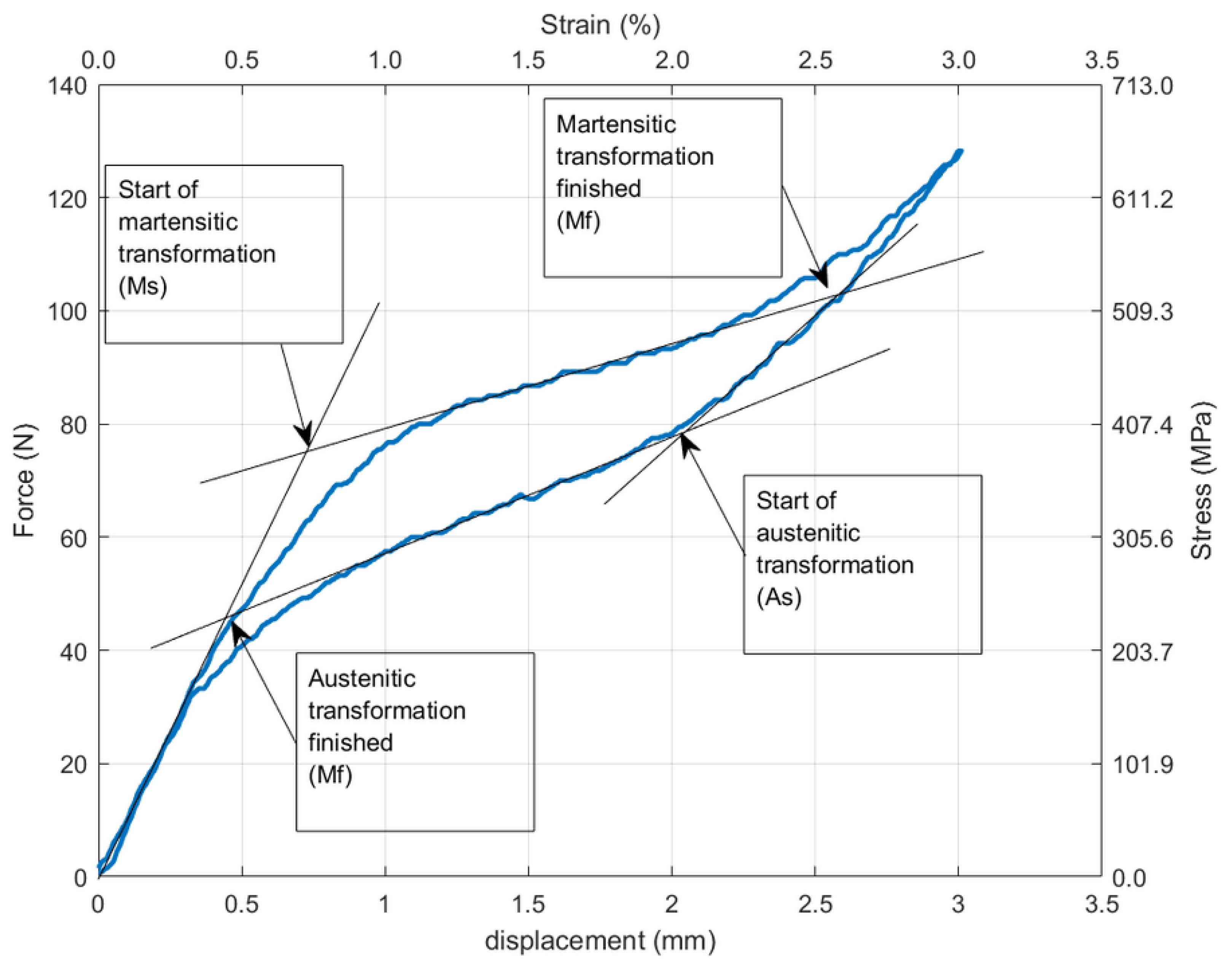
Using an SMA wire of diameter 0.5 mm and length l = 10 cm at a loading frequency of 0.5 Hz, the transformation forces f M s ,   f M f ,   f A s ,   f A f and transformation displacement x m s obtained from Figure 7 are 72.2 N, 101.6 N, 82.05 N, 48.98 N and 0.74 mm, respectively. The stress and strain are determined from F o r c e C r o s s s e c t i o n a l A r e a and D i s p l a c e m e n t O r i g i n a l L e n g t h , respectively.
The non-dimensional parameters q 1 ,   q 2 and q 3 are associated with the transformation-force ratios defined in Equation (32). The experimentally identified transformation forces therefore provide the initial estimates for these ratios, while the final calibrated values are selected by fitting the complete loading and unloading loop rather than only the four transformation points. The parameter-identification procedure was semi-manual rather than based on a single automatic optimization routine. A tanh-based pseudoelastic hysteretic representation was first adjusted to reproduce the measured forward and reverse force–displacement branches. Intermediate return and reloading paths were then constructed iteratively, with branch-matching constants determined through interpolation and root-finding (fsolve) steps. These root-finding steps enforce branch consistency and intersection conditions; they are not a global least-squares fit. The resulting nonlinear force–displacement relation was subsequently approximated in MATLAB R2020a using the Curve Fitting Toolbox functions prepareCurveData, fittype(’poly7’), and fit as a smooth polynomial surrogate for later implementation. The calibration was therefore treated as a model-matching step for the restoring law, rather than as an independent validation of the later forced-dynamic predictions. The following were used in the numerical analysis unless otherwise specified and dimensional quantities are reported in SI units, with  l = 0.10  m, x m s = 0.74  mm, δ = 1.88  mm, f M s = 83.3  N, and  m 1 = 1.09  kg:
q ^ 1 = 1.15 , q ^ 2 = 0.8 , q ^ 3 = 0.9 , x m s = 0.0074 l , b = 6 ( 10 6 ) A , δ = 0.0188 l , λ = δ x m s , θ r = 1.05 , f M s = 83.3 , K s m a = f M s x m s , ξ r = 0.3655 , θ 0 = 0.95 , k ^ = 0 , m 1 = 1.09 , ζ = 0.0166 , δ 0 = 0.1 x m s , γ = 0.06 , n w i r e s = 5 .
In this parameter set, the dimensional quantities are l, x m s , δ , and  δ 0 in metres, b in N/K, f M s in N, K s m a in N/m, and  m 1 in kg; the remaining listed ratios are non-dimensional.
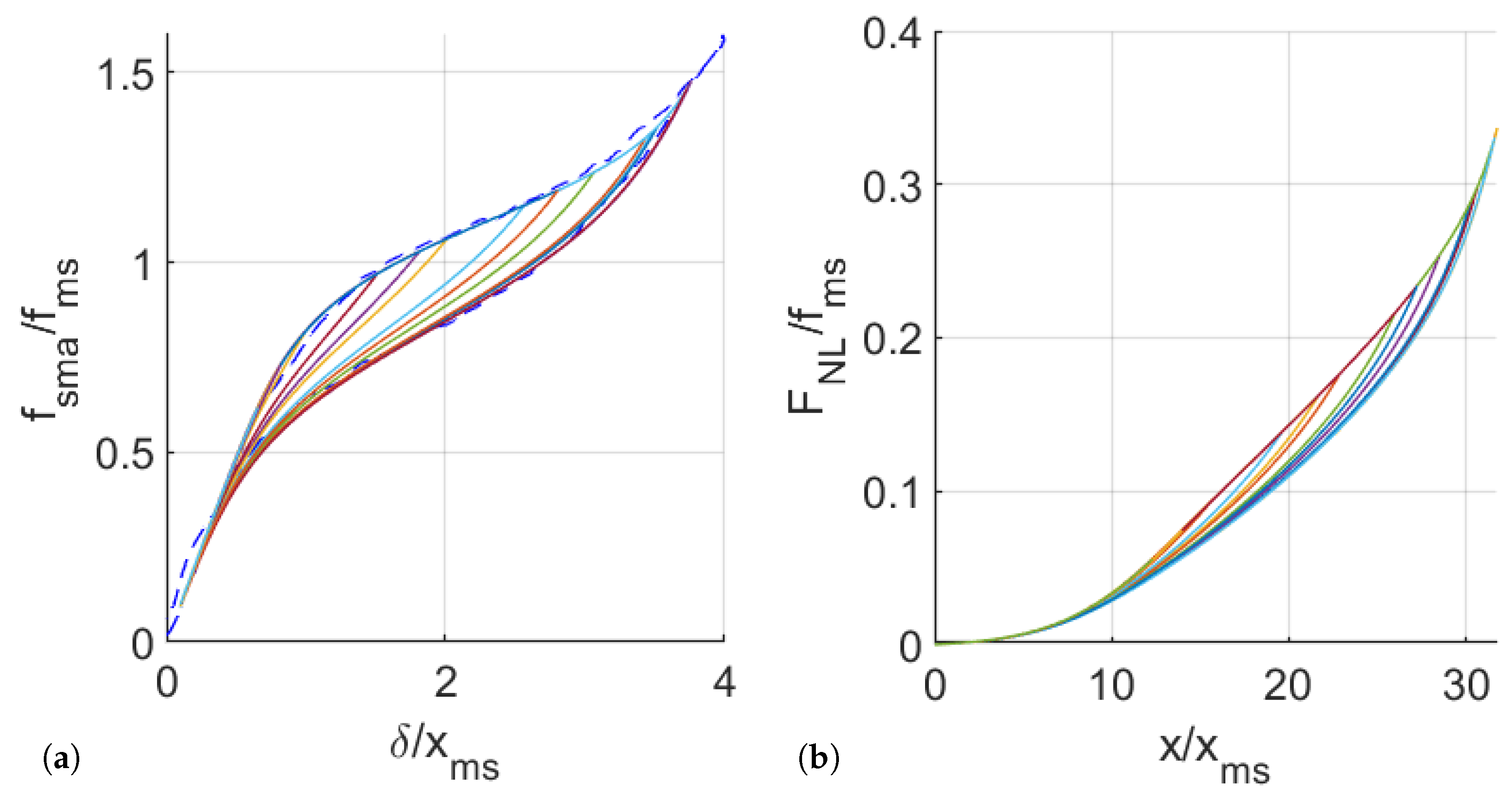
Figure 8a shows the force–displacement relationship obtained by incrementally varying the excitation amplitude and integrating the equations of motion of the SDOF nonlinear oscillator up until it reaches a maximum displacement (from zero) and then returns to zero. The coloured solid lines (numerical data) show that a good approximation to the experimental data (the dashed blue line) was obtained. The final nonlinear force–displacement relation was represented by an odd polynomial surrogate. Lower odd orders were examined, and fifth- and seventh-order forms gave very similar practical agreement. The seventh-order poly7 polynomial was retained as the final surrogate because it provided slightly improved accuracy while remaining a smooth empirical representation suitable for implementation in the subsequent nonlinear-dynamics model. The reported RMSE values correspond to the dimensional force–displacement data used in the final curve-fitting stage, with force in newtons and displacement in metres. The root mean square errors are 0.0167 N and 0.0418 N for the forward and reverse segments, respectively, with corresponding R 2 values of 0.9974 and 0.9818. The RMSE and R 2 values are therefore used here as practical goodness-of-fit measures for the surrogate force–displacement representation. The reverse branch exhibits a lower R 2 and larger residual discrepancy than the forward branch, indicating that unloading behaviour is captured less accurately. Figure 8b shows the restoring-force relationship projected in the perpendicular oscillator direction. The horizontal axis therefore represents the perpendicular displacement x / x m s rather than direct axial wire extension. The physically relevant axial extension is obtained through the geometric relation for δ in Equation (1), while Equation (2), F n l = f s m a sin ( θ ) , is used to evaluate the force in the direction of oscillation of the mass. Accordingly, the extended range in Figure 8b is retained to illustrate the shape of the projected restoring law, while the subsequent dynamic analysis focuses on the practically relevant operating range.
Although the calibrated surrogate reproduces the measured hysteretic behaviour with reasonable agreement, the reverse branch remains less accurately captured than the forward branch and some local mismatch persists. A full uncertainty-propagation study is beyond the scope of the present work. Nevertheless, these discrepancies should be borne in mind when interpreting the quantitative details of the predicted frequency–response curves and bifurcation structure, although the overall nonlinear trends and response regimes remain informative.
The parameters varied for the computational analysis presented in this analysis are ω , δ 0 , γ and n w i r e s which correspond to forcing frequency, initial extension of the SMA wire, amplitude of harmonic forcing and the number of SMA wires in parallel, respectively.

4.2. SDOF System Numerical Computation

Direct time-domain simulations of the forced oscillator were carried out in MATLAB using ode15s with a relative tolerance of 10 5 . In this workflow, the governing equations were treated in their non-autonomous form, with the harmonic forcing retained explicitly. The piecewise pseudoelastic evolution was handled by event-driven switching between the upward and downward transformation branches, so that the appropriate branch was integrated as the response evolved through the transformation conditions. For the cycle–response and FRF calculations, the reported amplitudes were extracted from the final quarter of the simulated time history. For the spectral analysis, the initial quarter of the simulated signal was discarded and the retained steady-state portion was interpolated onto a uniform grid before computing the FFT. This quarter-based trimming was used as the practical transient-removal procedure in the direct simulations, and the adequacy of the retained portion as representative of steady-state behaviour was also checked by visual inspection of the simulated response histories. Poincare maps were obtained by stroboscopic sampling once per forcing period of the retained steady-state response.
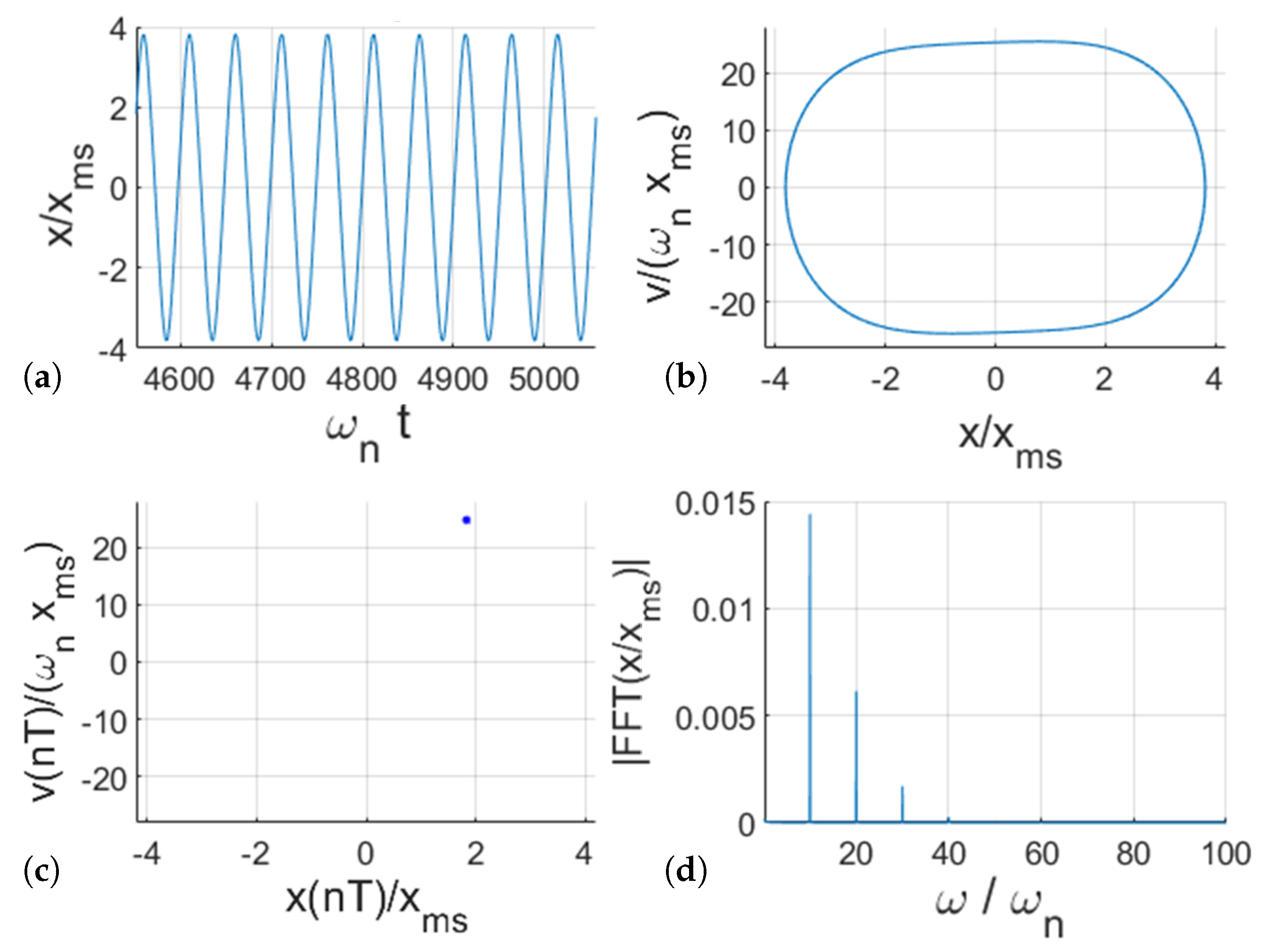
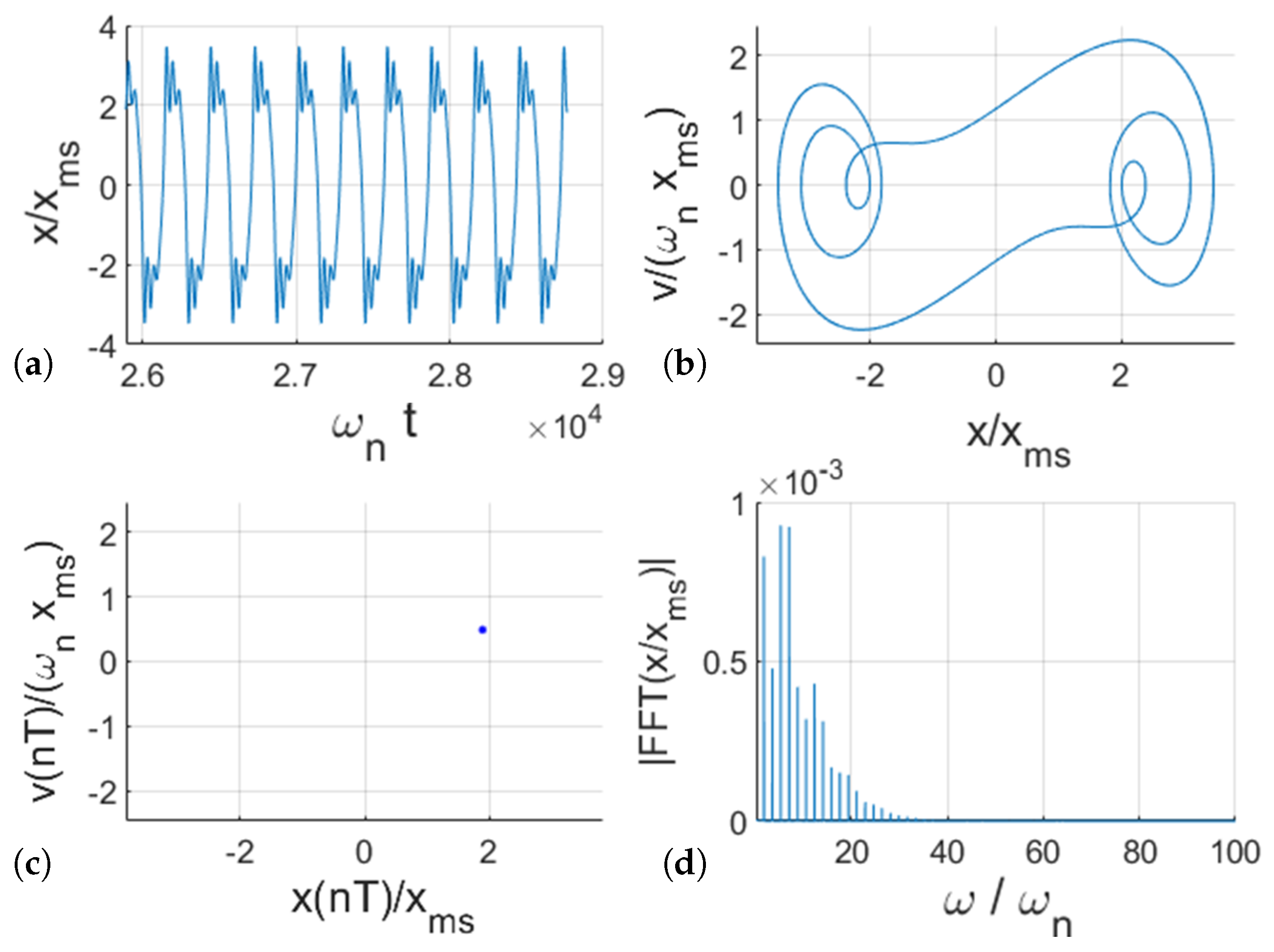
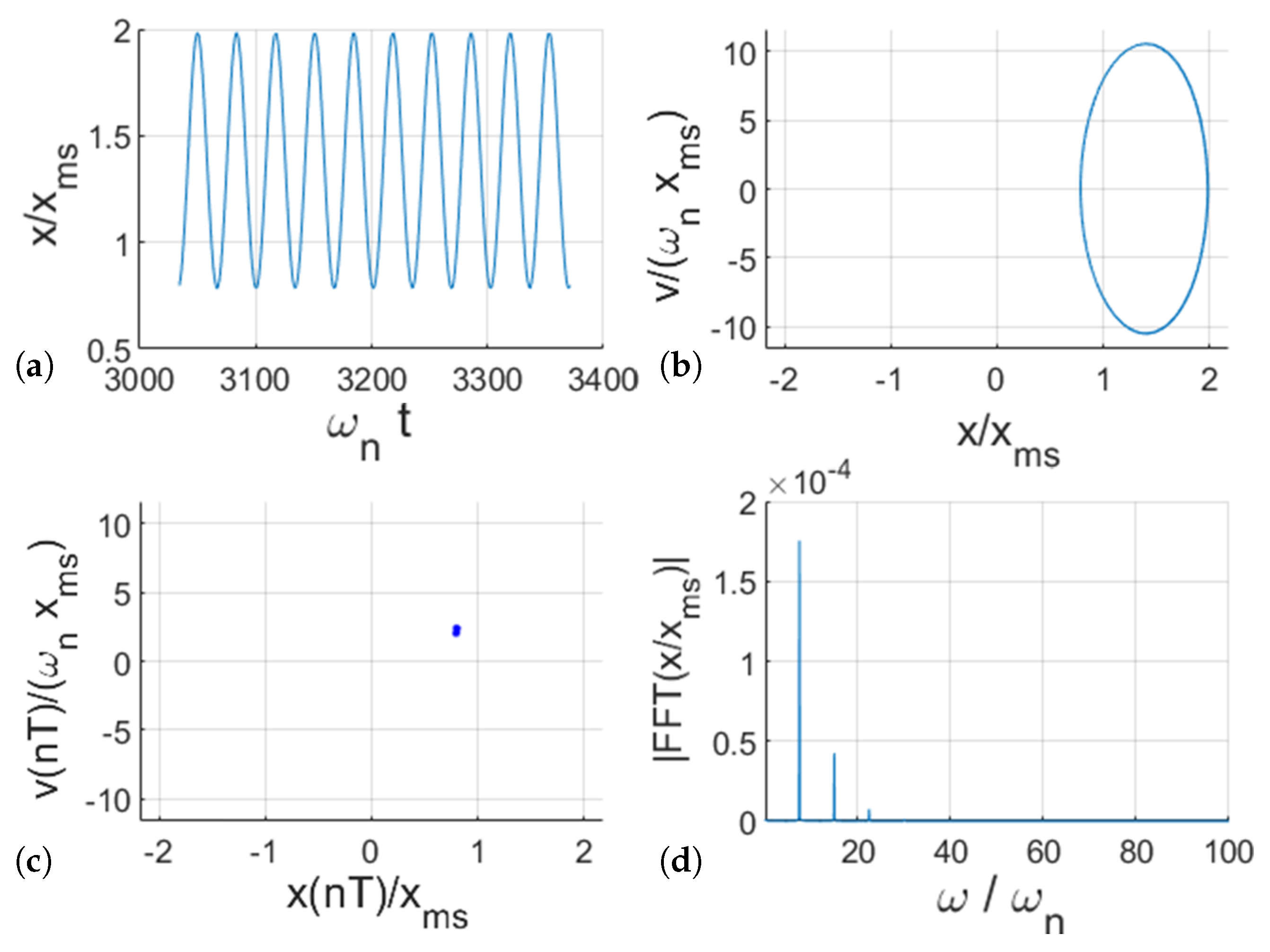
Figure 9 presents the normalized steady-state response for ω = 10 Hz using the baseline parameter set. The time history is shown as x / x m s against normalized time ω n t , while the phase portrait is plotted in the ( x / x m s , v / ( ω n x m s ) ) plane. The corresponding Poincare section is obtained by sampling the normalized response once every forcing period, T, and the FFT panel shows | FFT ( x / x m s ) | as a function of normalized frequency ω / ω n . The single loop and one Poincare point indicate a period-one solution. Although the oscillator has one mechanical degree of freedom, its nonlinear restoring force can generate harmonic content in the response. The peaks associated with the second and third harmonics of the 10 Hz forcing frequency are therefore interpreted as nonlinear response harmonics rather than as additional linear modes.

4.3. Frequency–Response Analysis

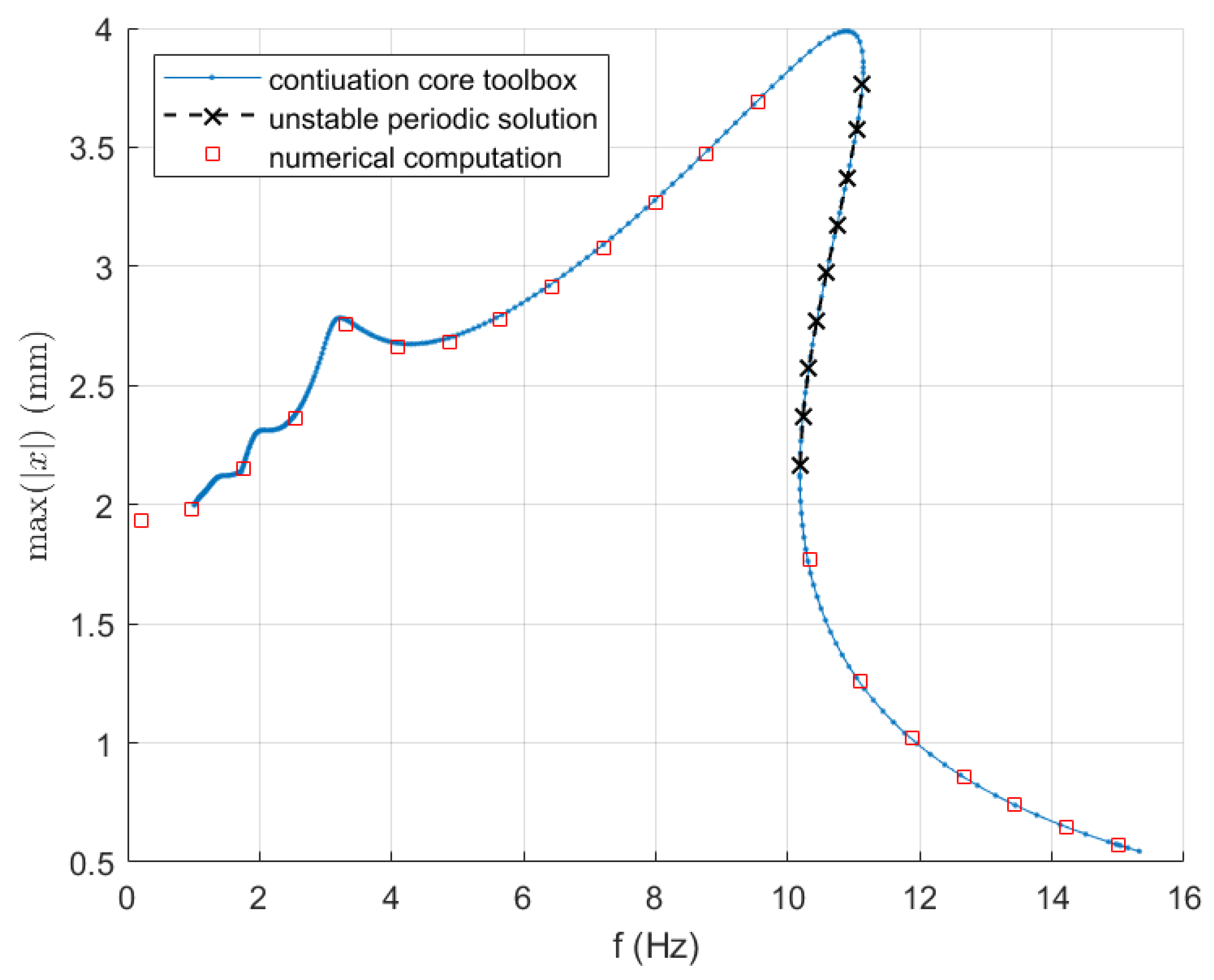
An important parameter of interest is the forcing frequency ω . To study its influence on the system response, the frequency–response function (FRF) is computed as shown in Figure 10, where close agreement is found between time integration and continuation for the calibrated model. The following FRFs are computed from the calibrated mathematical model and should therefore be interpreted as numerical predictions of the oscillator response under harmonic excitation. This FRF plots the excitation frequency against the magnitude of the maximum displacement. The numerical values shown by the red squares are obtained from the direct ode15s simulations described in Section 4.2.
For the continuation-based computation of periodic solution branches, a separate COCO/hspo workflow was used. An initial periodic-orbit seed was generated by MATLAB ode45 integration with a relative tolerance of 10 5 over 50.25 cycles, after which the final one-period segment was extracted and supplied to the hspo formulation. In this workflow, the forced system was recast in autonomous form by introducing auxiliary oscillator states, which enabled robust continuation of the forced periodic response within hspo. The periodic orbit was represented in a four-segment piecewise form so that the forward and reverse pseudoelastic branches could be stitched consistently into a single cycle. The collocation settings were NTST = 50 with NCOL = 6 , 4 , 6 , 4 for the four segments, respectively, and the continuation settings included cont . ItMX = 1000 , cont . h _ max = 20 , cont . NPR = 2 , and corr . ItMX = 200 . The monodromy matrix was computed numerically to determine the stability of each periodic solution.
Unstable solutions exist when any of the eigenvalues of the matrix have a magnitude greater than one, identified by the black dashed line with x symbols in Figure 10. An advantage of the toolbox seen here is the ability to assess stability and compute the full branch of the solution curve, including the unstable solutions. There is a limitation, however, in that, specifically, the ‘hspo’ toolbox used has only been implemented with the ability to compute periodic solutions that can be divided into four subsequent segments corresponding to forward, reverse, and forward and reverse loading of the SMA wire. At around 3 Hz, there is a small resonance peak, which is attributed to the low-frequency response branch associated with the pseudoelastic softening contribution as the transformation region is engaged. The high resonance peak around 11 Hz, however, is of more particular interest here due to its significant amplitude as well as the jump phenomena.

4.4. Varying Forcing Amplitude

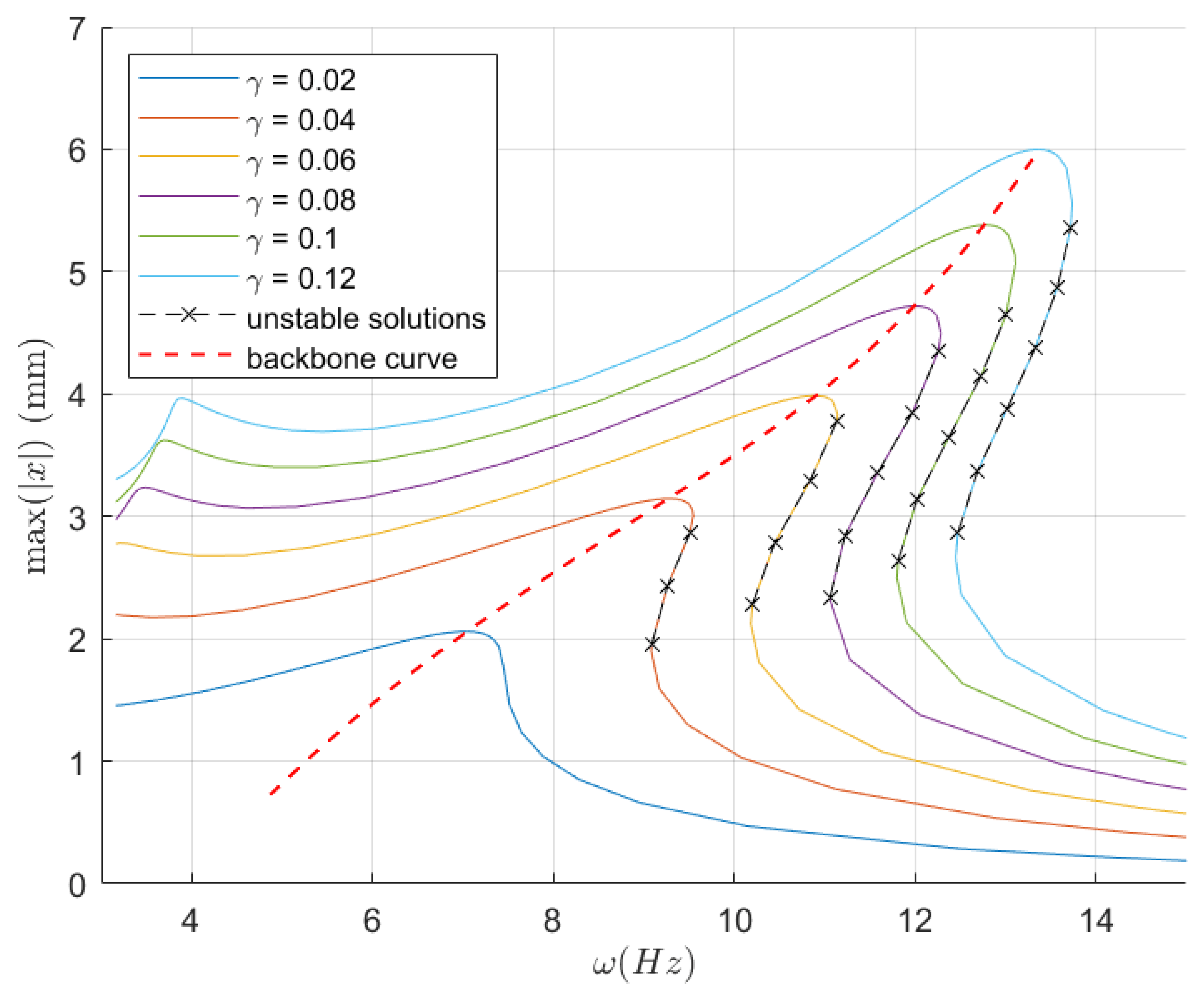
The computed FRFs obtained as the amplitude of harmonic excitation, γ , varies are shown in Figure 11. As the forcing amplitude increases, the oscillator is driven farther into the nonlinear restoring regime, so the response branch rises to larger amplitudes and the jump region broadens. At higher forcing levels, however, the pseudoelastic softening contribution becomes increasingly pronounced, causing reverse bending of the backbone toward lower frequencies within the bistable range. This reversal of the backbone direction reflects the competition between geometric hardening induced by the perpendicular wire configuration and pseudoelastic softening associated with phase transformation. As the response evolves through the bistable regime, the relative dominance of these two mechanisms changes, leading to the observed change in the effective backbone trend.

4.5. Varying Number of SMA Wires

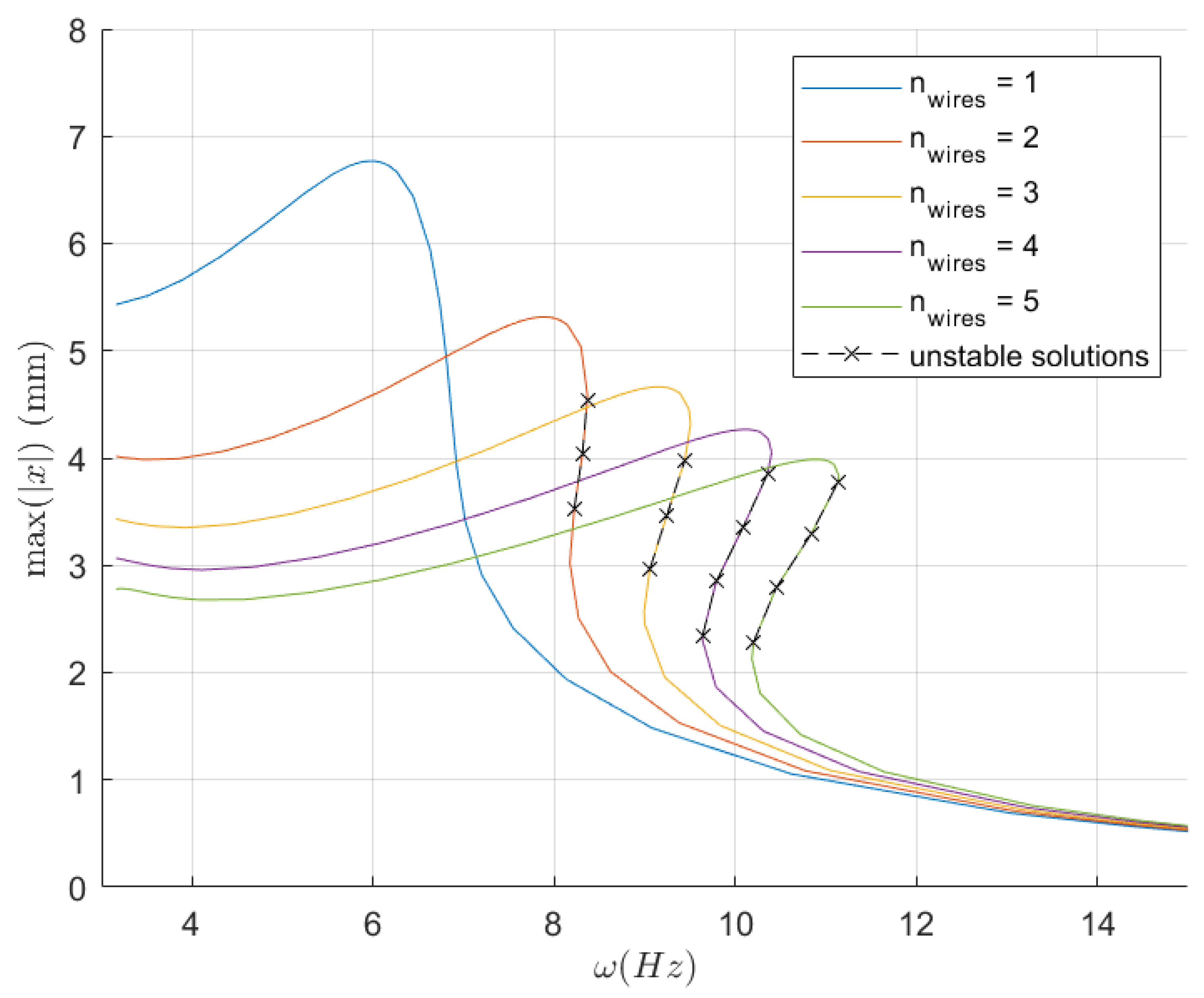
The computed FRFs obtained as the number of SMA wires, n w i r e s , varies are shown in Figure 12. Increasing the number of wires increases the total SMA restoring contribution because the parallel wires add to the same geometric–pseudoelastic restoring force. For a single wire, the response remains much closer to nearlinear behaviour and no clear turning points are observed. From n w i r e s = 2 onward, turning points and jump behaviour emerge, and the jump region widens as the nonlinear restoring effect becomes more pronounced.

4.6. Varying Pre-Tension

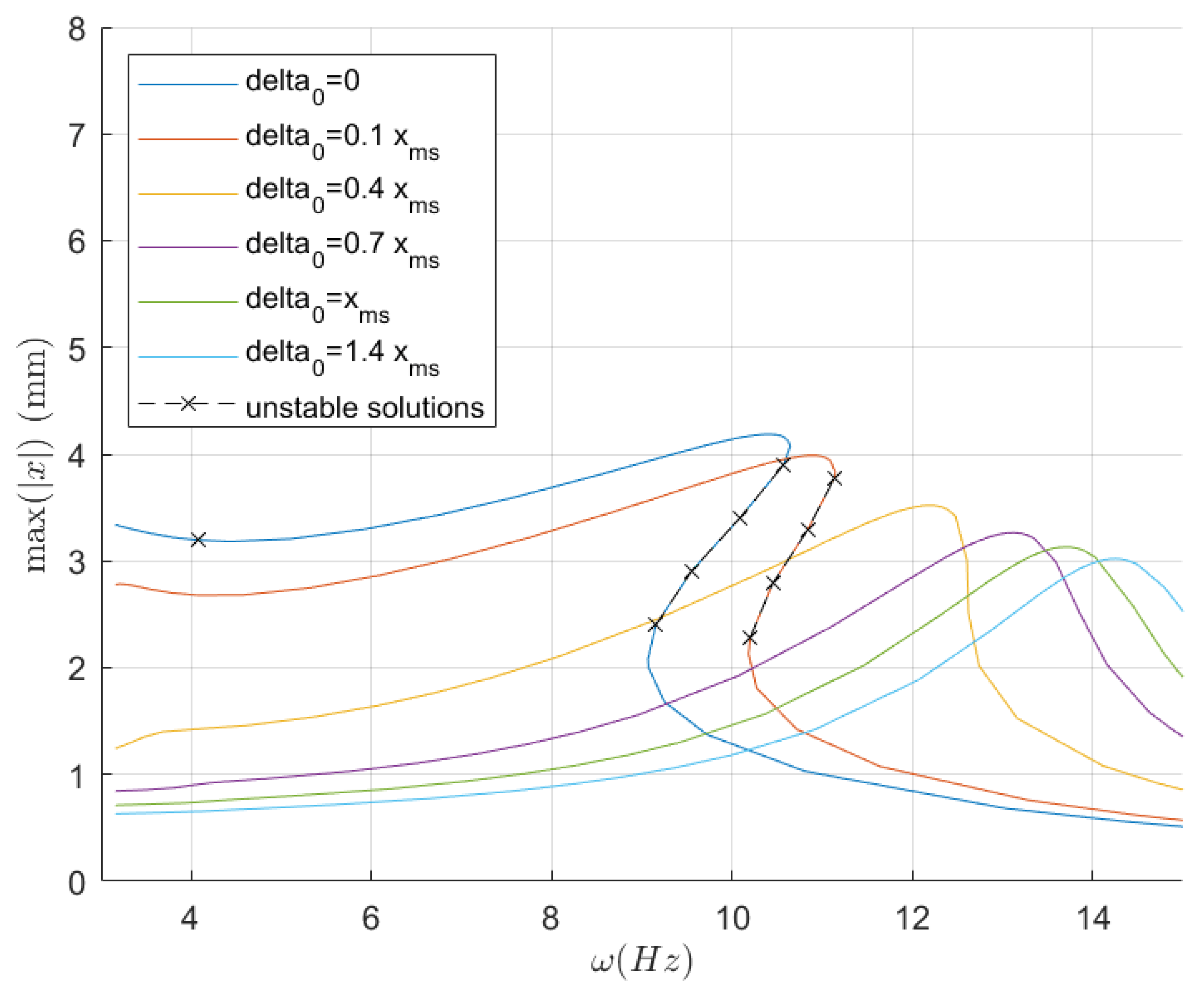
The computed FRFs obtained when the initial extension (producing a pretension) of the SMA wires δ 0 varies are shown in Figure 13. Increasing pre-tension strengthens the effective linear stiffness contribution associated with the perpendicular wire geometry. As a result, the resonance curve shifts toward higher frequencies, the maximum resonance amplitude decreases, and the jump section narrows. For sufficiently large pre-tension, the turning points disappear and the response becomes increasingly dominated by the linear stiffness contribution.

4.7. Effect of Initial Conditions

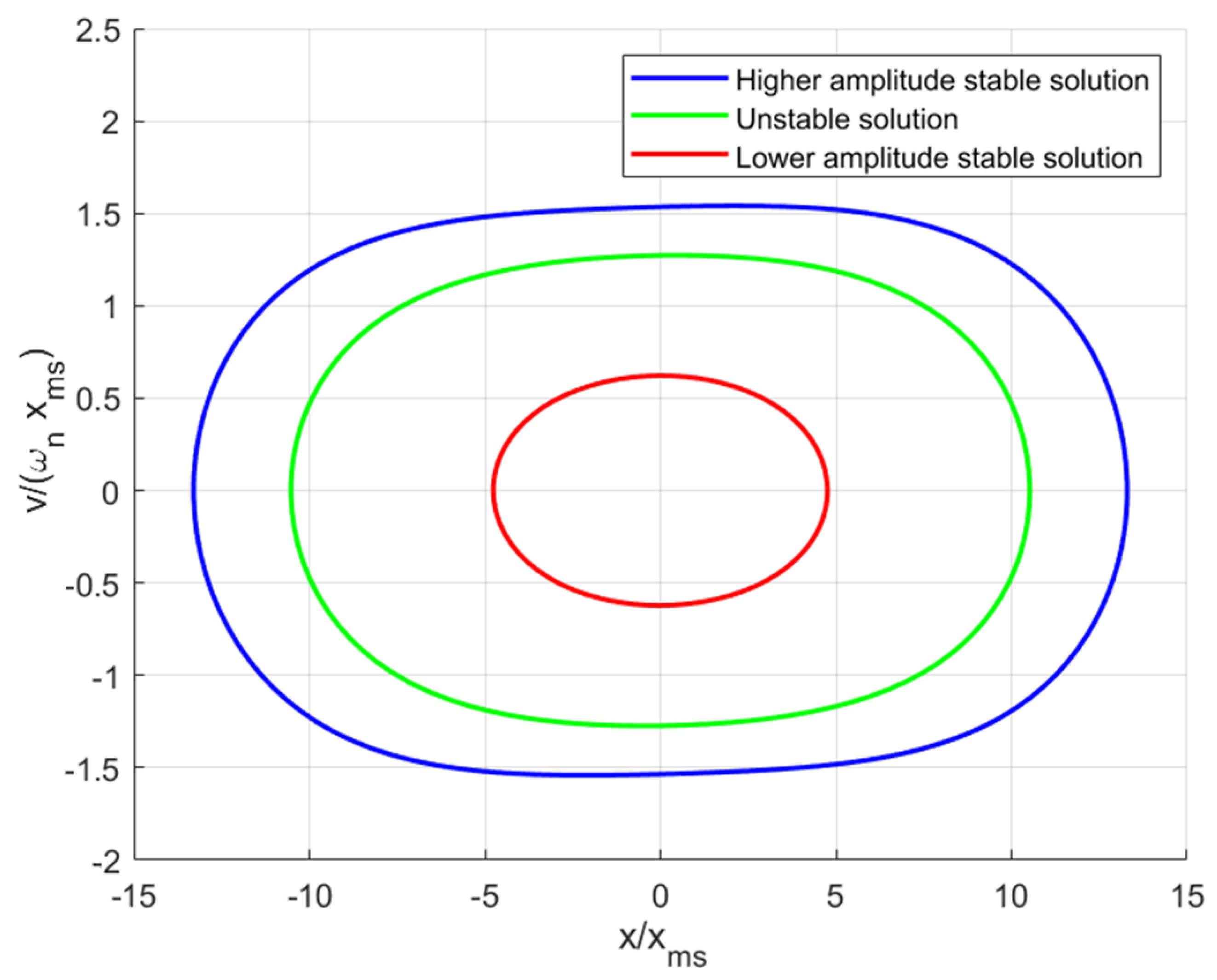
The normalized phase plane shown in Figure 14 gives the three different limit cycles that can be obtained at ω = 10.72 Hz, plotted in terms of x / x m s and v / ( ω n x m s ) . This excitation frequency was selected from the multistable interval of the FRF in Figure 10, between the turning points of the response branch, where two stable periodic solutions and one unstable periodic solution coexist. Two are stable steady-state solutions and one is an unstable solution (in blue, red, and green, respectively). The maximum normalized displacement of the unstable solution lies between the two stable solutions, consistent with the FRF shown in Figure 10.
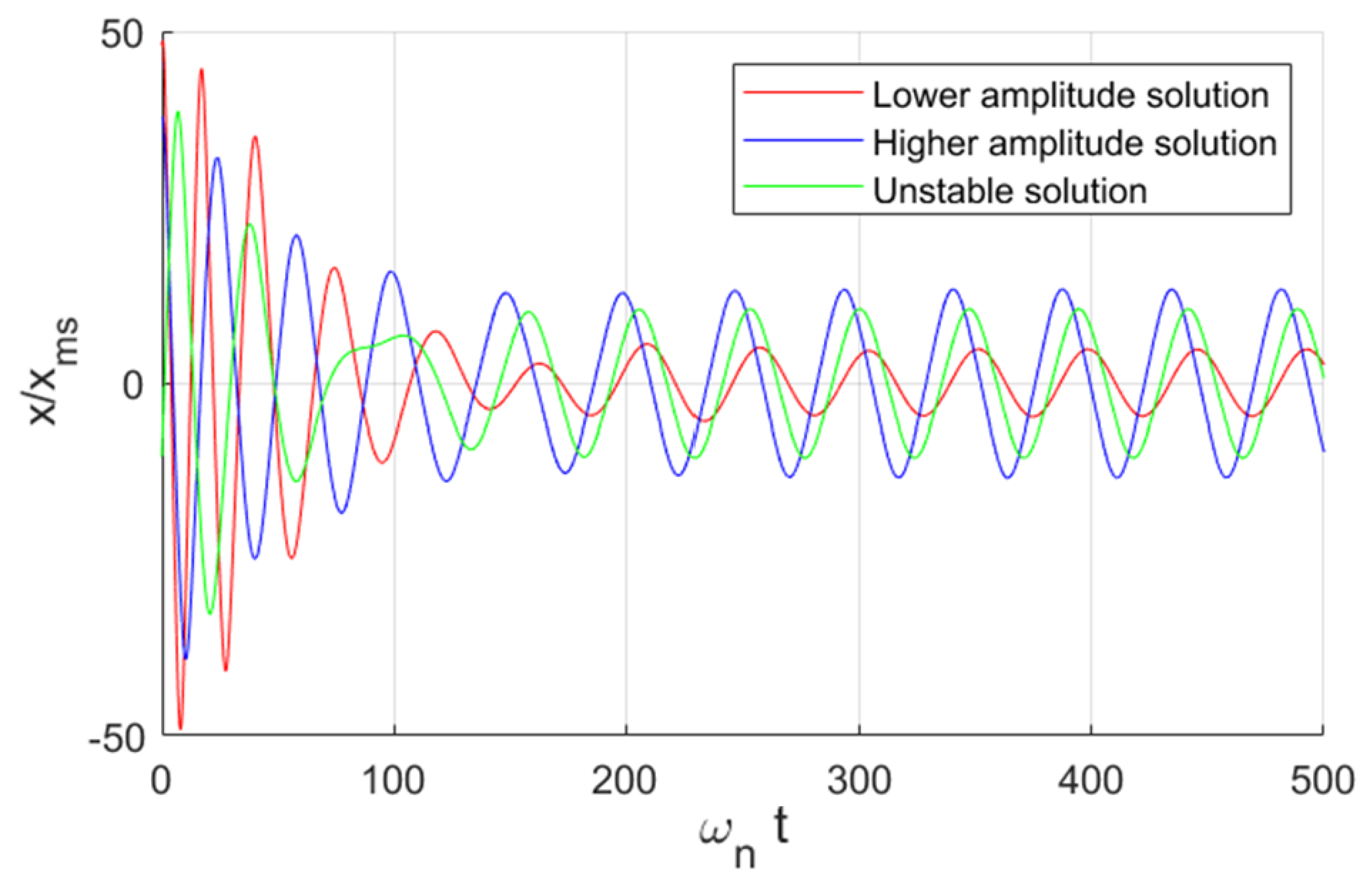
The normalized time responses shown in Figure 15 show these same two stable steady-state solutions and one unstable solution (in blue, red, and green, respectively). Different steady-state solutions are obtained after the transient stage of the response. The red stable solution and green unstable solution are out of phase with the blue stable solution by approximately 90 degrees and 45 degrees, respectively. The determining factor for which the steady-state solution is achieved is based on the initial displacement, velocity, and martensitic composition in the SMA wire. A useful way of visualizing this dependence is through a basin-of-attraction plot.
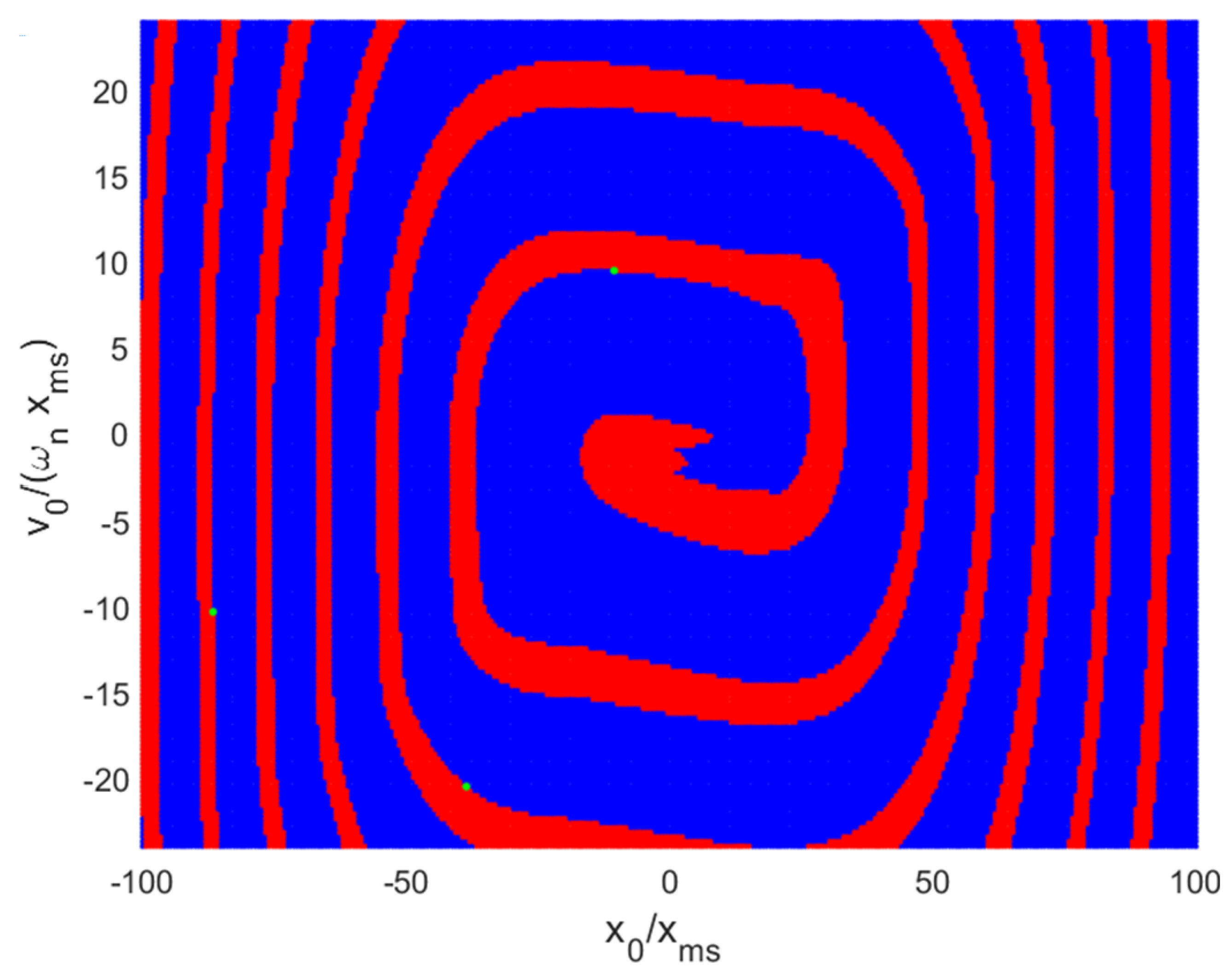
The basins of attraction computed at ω = 10.72 Hz, where the three solutions can exist (two stable and one unstable), are shown in Figure 16, with initial conditions expressed as x 0 / x m s and v 0 / ( ω n x m s ) . These basin calculations are model-based predictions that quantify the sensitivity of the calibrated oscillator to the initial state; they were not measured directly in the experimental tests. The basin plot is used here as a qualitative global-dynamics diagnostic to illustrate the coexistence of attractors and pronounced sensitivity to initial conditions. The blue basin represents the initial conditions that lead to the higher-amplitude stable solution, whereas the red basin represents the initial conditions that lead to the lower-amplitude stable solution. The three green markers denote the numerically identified initial conditions on the unstable separating solution, whose amplitude is between the two stable steady-state solutions. As expected, unstable solutions are difficult to capture by direct time integration, so their role in delimiting the attraction regions is interpreted here qualitatively. The unstable solutions obtained numerically are consistent with the interpretation that the boundary between the stable attraction regions is associated with an unstable invariant set. However, a rigorous quantitative characterization of the basin-boundary geometry was not pursued in the present work, since this would require a denser dedicated computation than was performed here. In these computations, the initial composition of martensite SMA wires ξ 0 is linearly approximated based on the previous solutions. However, it is also worth mentioning that ξ 0 will also affect which steady solution is achieved. In the analysis performed, ξ 0 essentially depends on x 0 and vice versa, and it is another parameter/dimension that can be considered. ξ 0 can also be varied by manipulating the temperature of the SMA wires, but this consideration is out of scope of the current work.

4.8. Negative Initial Pre-Tension

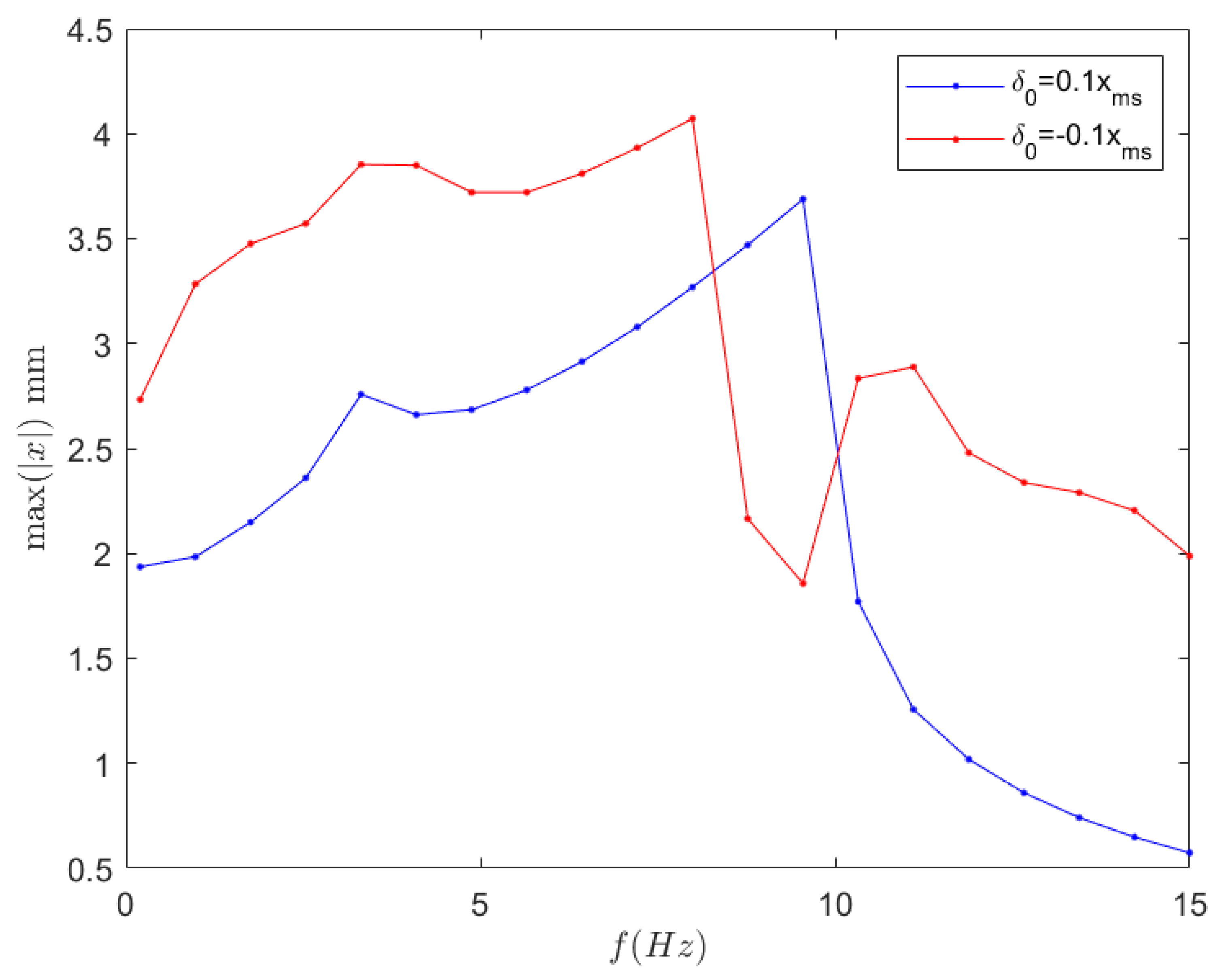
The following negative initial pre-tension case is considered as a theoretical numerical extension of the equivalent pseudoelastic restoring law and does not represent a directly validated operating regime of the tested tension-wire SMA device. This clarification is consistent with the broader distinction made in the revised manuscript between the principal calibrated-model findings and the more exploratory numerical extensions. The physical element calibrated in this work is an SMA wire, which is naturally used in tension. A physical realization of this type of parameter regime would require a different implementation, such as a compression-capable SMA element or an antagonistic wire arrangement, and is not demonstrated experimentally here. A numerical FRF is shown in Figure 17 for an initial extension, δ 0 = 0.1 x m s and 0.1 x m s . Only numerical computation is done here as it was found that for the negative extension, very peculiar responses prohibited the Continuation Core toolbox from computing the entire branch of solutions. Furthermore, the maximum amplitude seems to be significantly higher for frequency excitation above 9 Hz when δ 0 = 0.1 x m s . Accordingly, the responses reported for δ 0 = 0.1 x m s should be interpreted as illustrating possible dynamics of the equivalent restoring law outside the directly validated tension-wire regime, rather than as direct predictions for the physical test configuration.

4.9. Unique Steady State Solutions

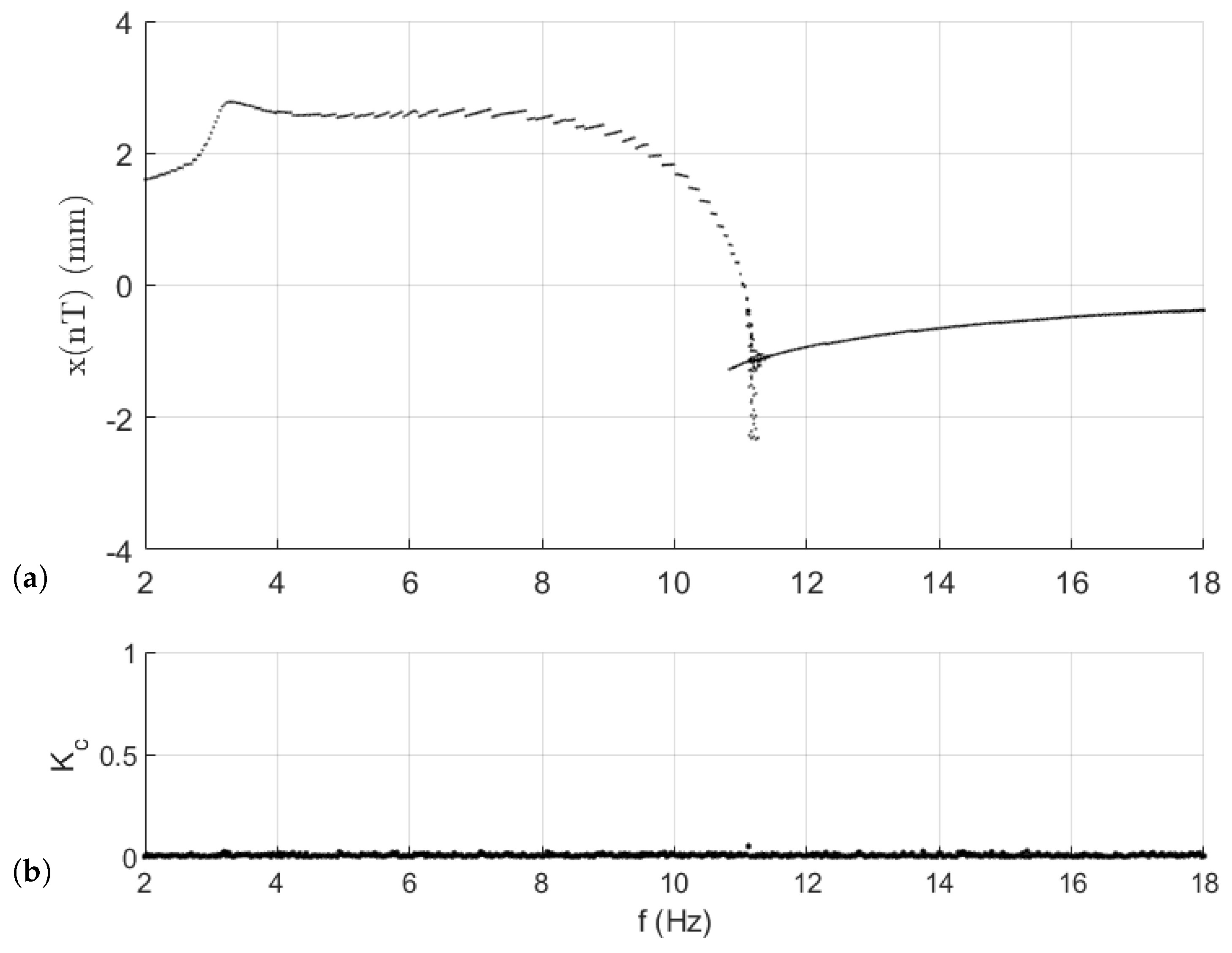
Numerous types of solutions are possible on the basis of initial conditions and excitation frequency. These can include symmetric or asymmetric solutions which may be period-n type, quasi-periodic or even chaotic. The bifurcation diagrams, Poincare sections, FFTs, and 0–1 chaos indicators in this subsection are model-based diagnostics of the calibrated oscillator; they should not be read as direct experimental validation of chaos in the tested wire oscillator. A bifurcation diagram is shown in Figure 18a for δ 0 = 0.1 x m s . The lines intersect around 11.2 Hz near the resonance peak where the jump phenomena occurs, as observed by the FRF in Figure 10. Monitoring the Lyapunov exponents not only determines whether the solutions are stable or unstable, but also indicates that the points of change in stability are saddle node bifurcation points. The analysis conducted thus far indicates periodic solutions and with little suggestion of the existence of chaotic solutions.
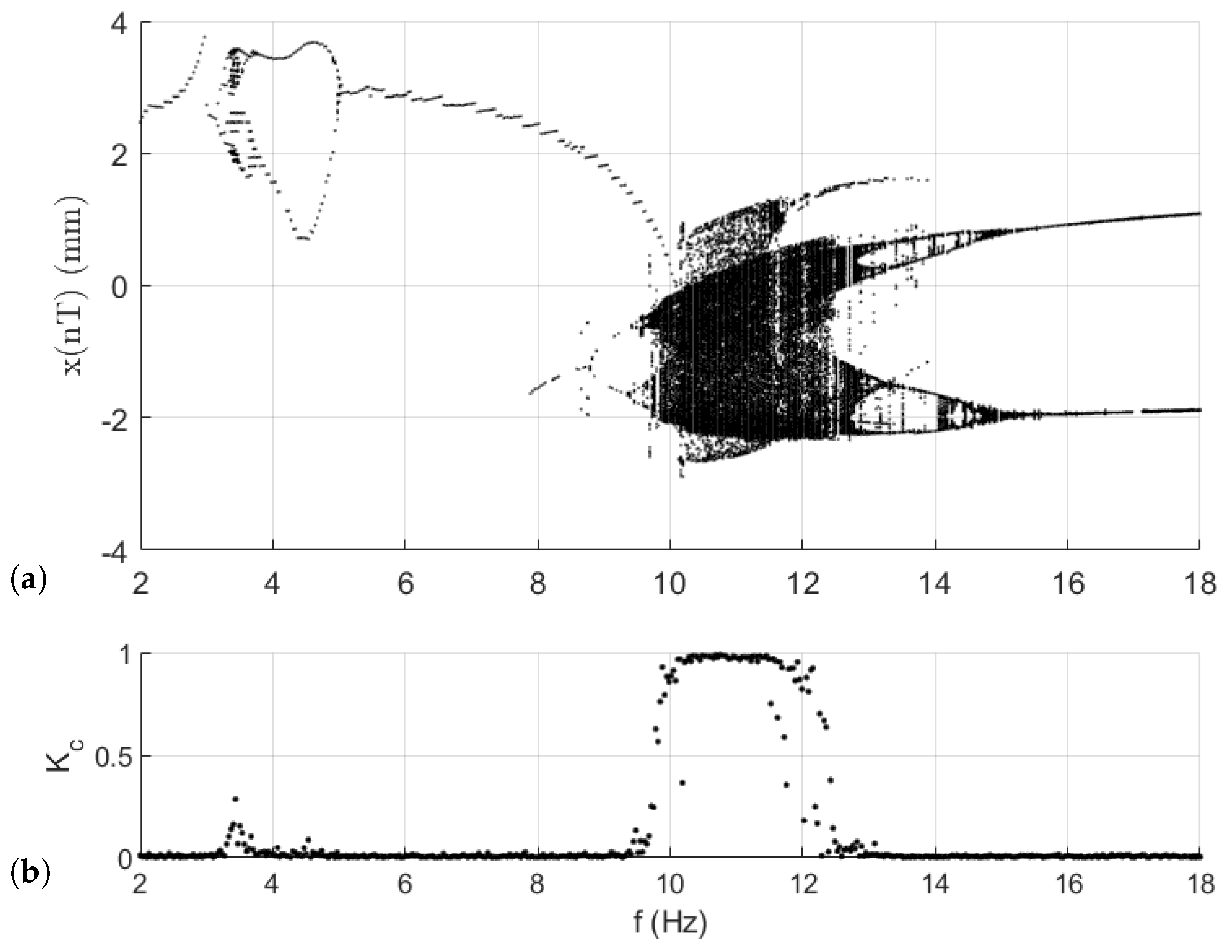
The 0–1 test for chaos was implemented in MATLAB following Gottwald and Melbourne [46]. In the present work, the test was applied to the retained steady-state portion of the simulated displacement response, consistent with the transient-removal procedure described above. For each case, the test was evaluated using multiple randomly selected values of the translation constant c; in the present implementation, N c = 10 was adopted. Within this framework, values of K c approaching zero indicate regular dynamics, whereas values approaching one are indicative of chaotic dynamics. The 0–1 test was used together with the bifurcation diagrams, Poincare maps, and FFT-based response characterization, so that the identification of chaotic regimes was not based on K c values in isolation. In the range of frequency (2 to 18 Hz) shown in Figure 18b, the obtained values of K c are not close to one, indicating regular behaviour for the calibrated positive pre-tension baseline. However, where δ 0 = 0.1 x m s , the values of K c shown in Figure 19b approach one between 10 and 12 Hz, supporting the identification of chaotic responses in this numerical extension. For δ 0 = 0.1 x m s , these results are interpreted within the scope of the exploratory negative initial-extension case described in Section 4.8. The bifurcation diagram shown in Figure 19a shows period doubling consistent with a route to chaotic response in this range. The transient increase around 3.5 Hz is therefore treated as a narrow local feature in the computed response rather than as a standalone basis for classifying chaos.
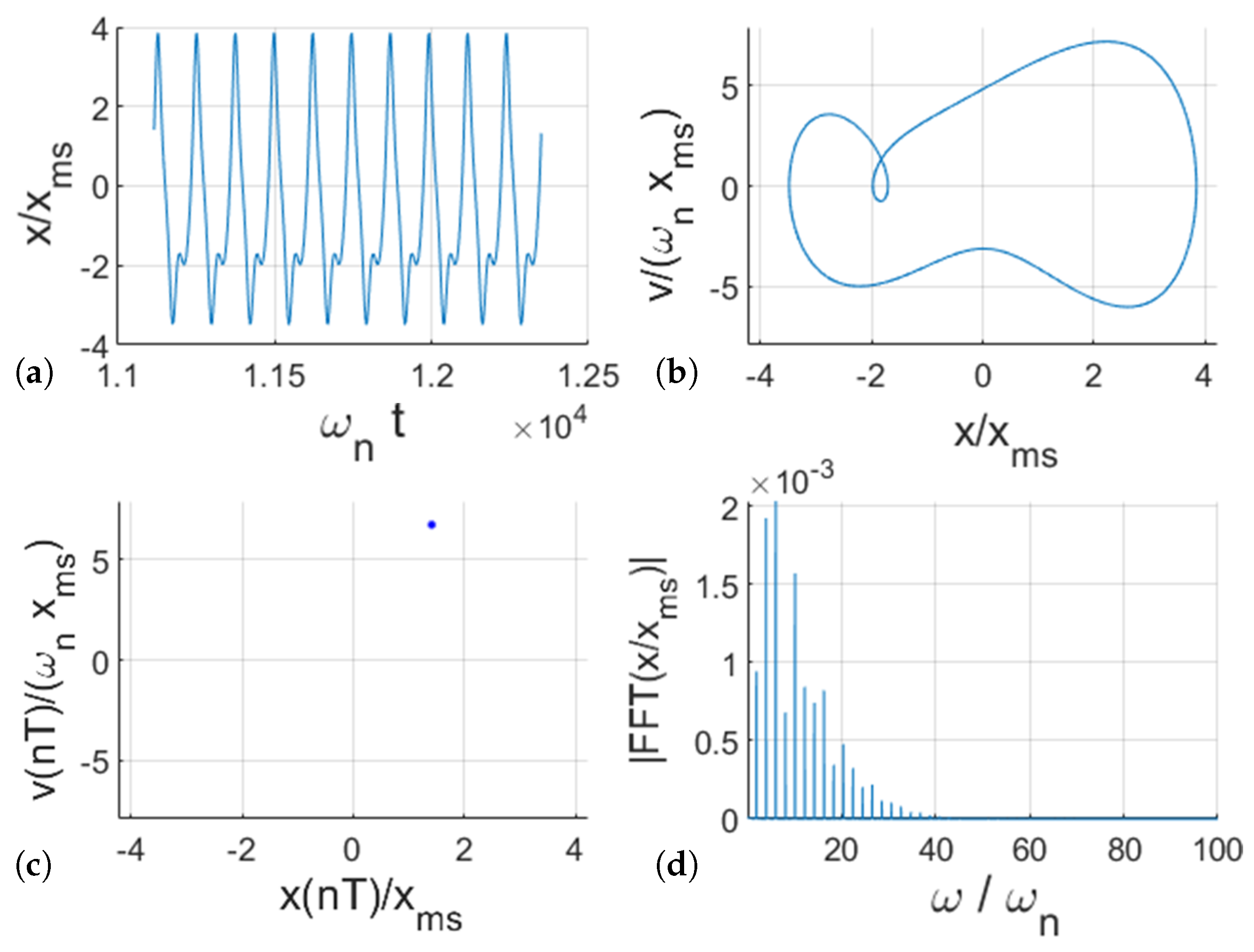
Unique types of responses have been found for δ 0 = 0.1 x m s . Figure 20 presents the normalized steady-state response at a forcing frequency of 1.7579 Hz, with x / x m s plotted against ω n t , the phase portrait and Poincare section shown in the normalized displacement–velocity plane, and | FFT ( x / x m s ) | plotted against ω / ω n . The response is period-one, with a dominant frequency and integer harmonic components. Asymmetric responses can also occur where the base response frequency does not coincide with the forcing frequency, as shown in Figure 21 at a forcing frequency of 4.0947 Hz using the same normalized variables.
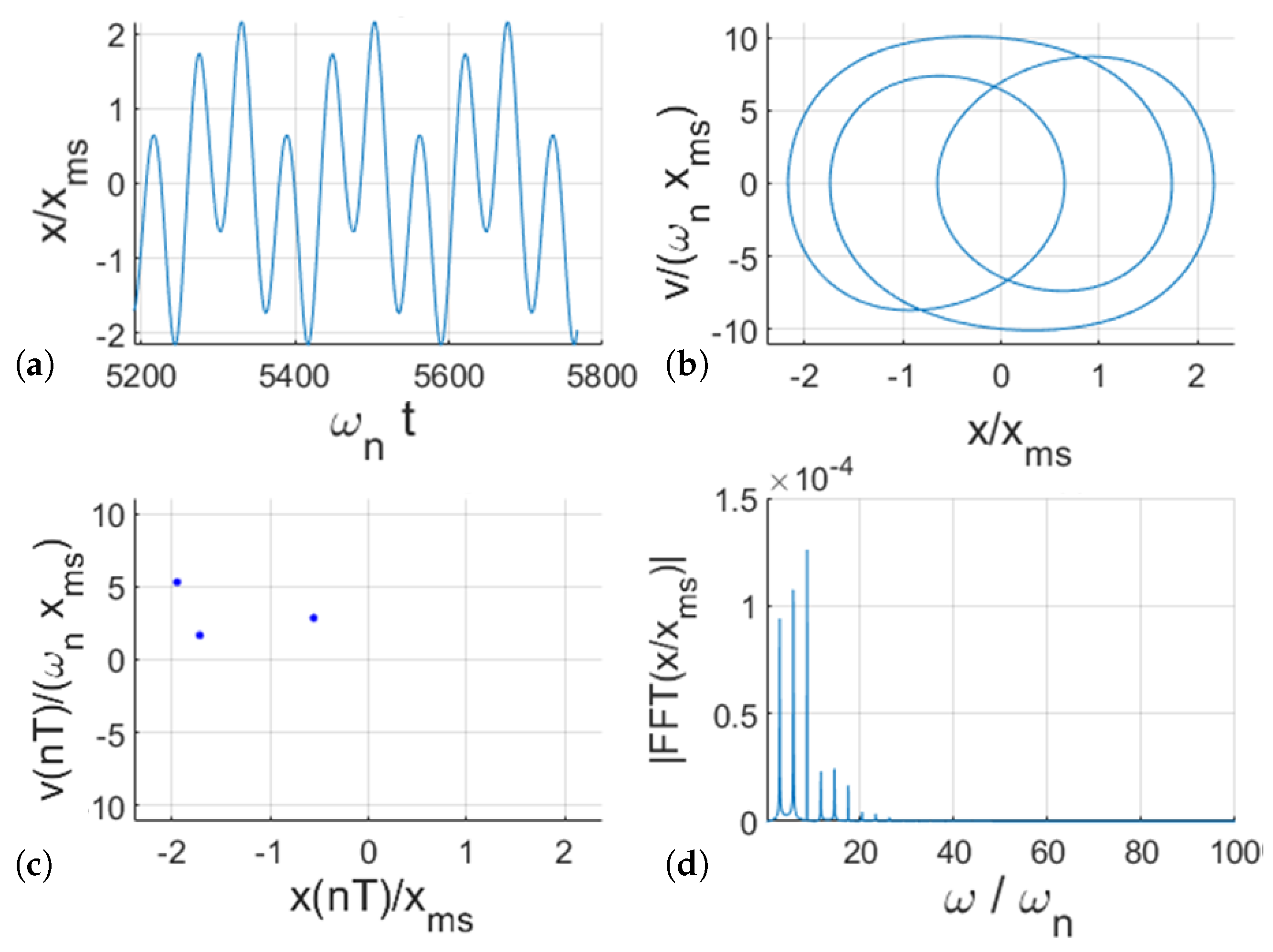
The occurrence of period doubling, as observed with many studied nonlinear oscillators, is observed in the normalized phase portrait, Poincare section, and FFT spectrum of Figure 22 at a forcing frequency of 8.7684 Hz.
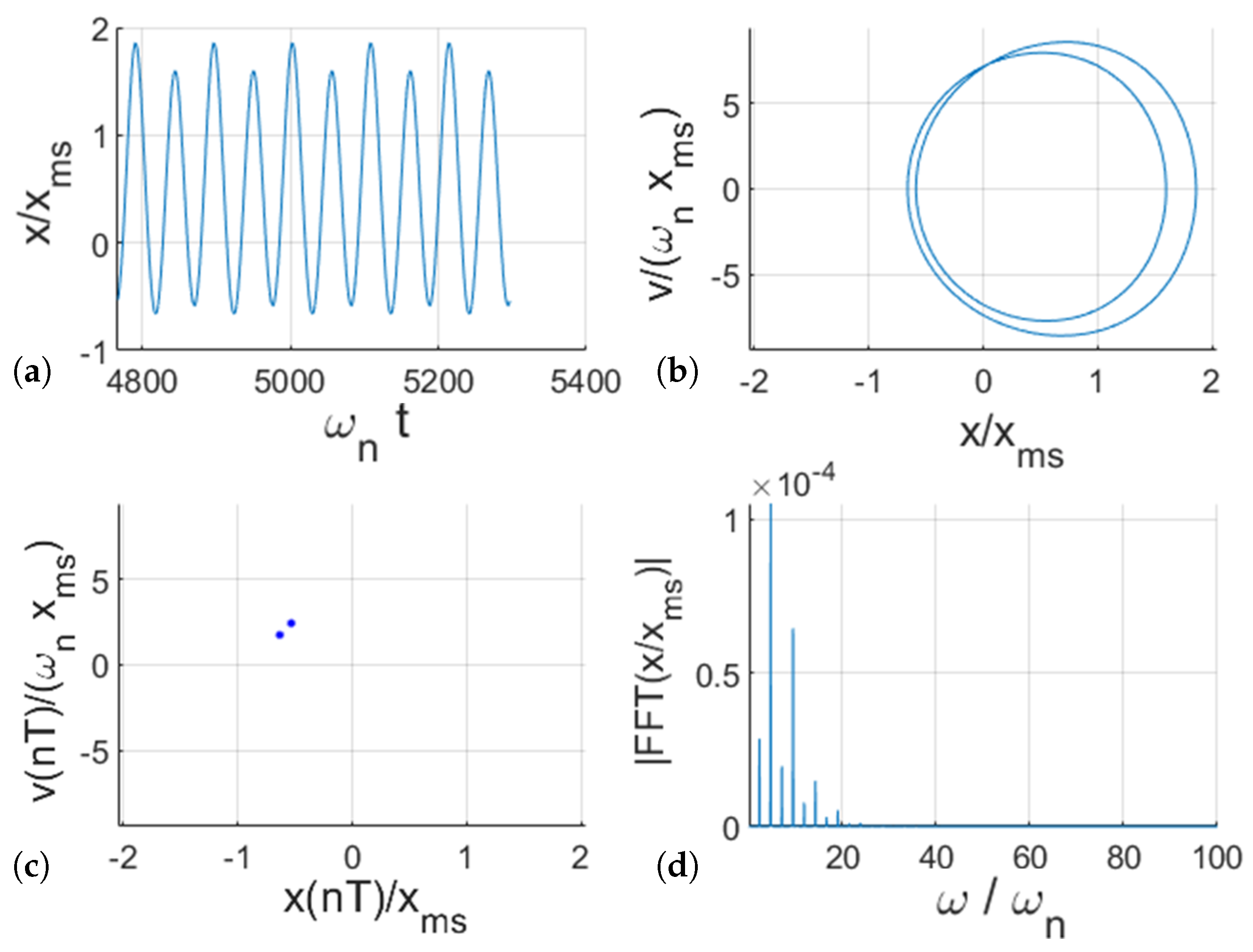
As the excitation frequency increases further, the period number of the solution is reduced instead, as shown by the normalized response in Figure 23 at a forcing frequency of 9.5474 Hz, where an asymmetric two-periodic solution is obtained. Period doubling can also lead to quasi-periodic responses as well.
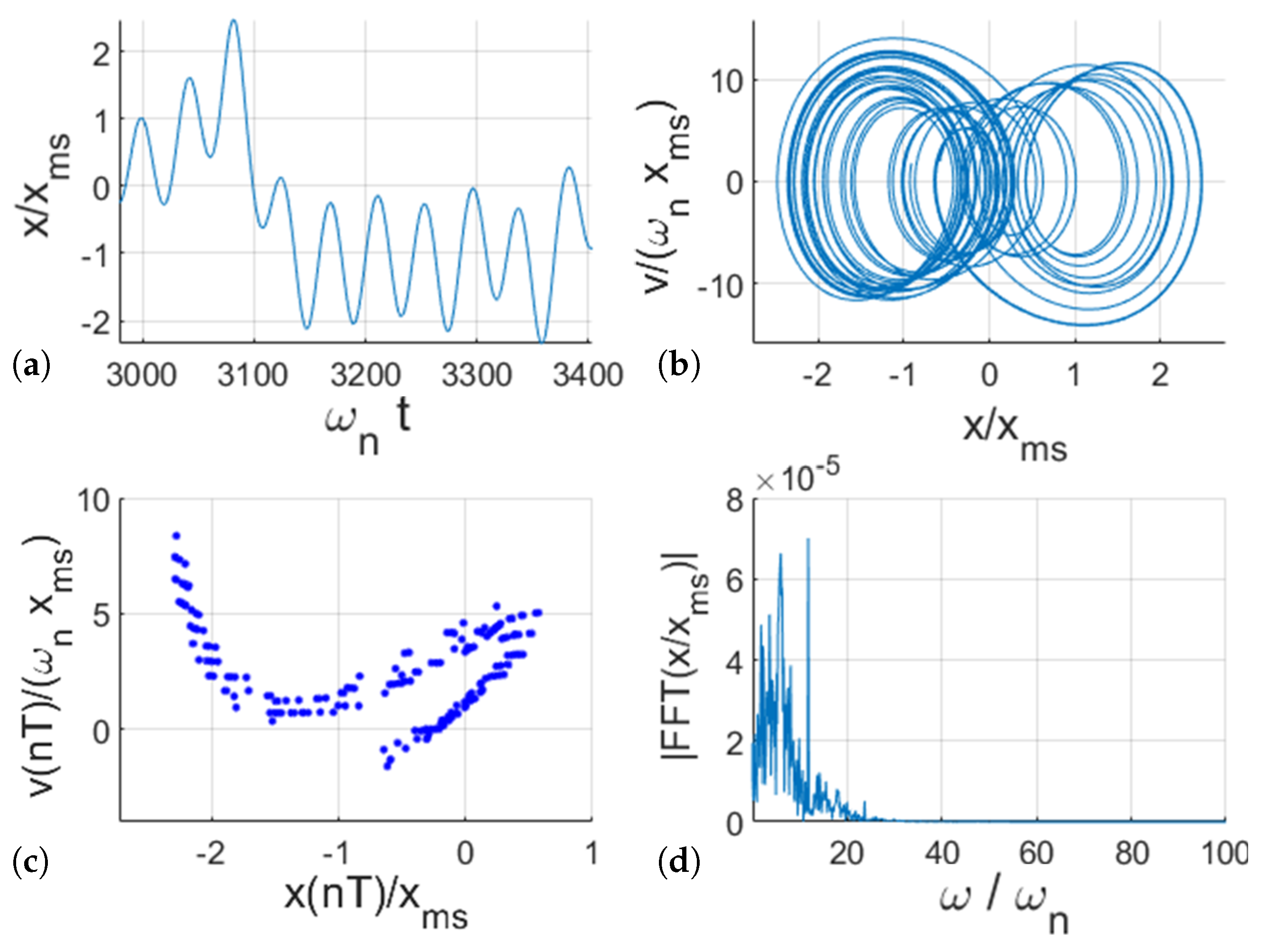
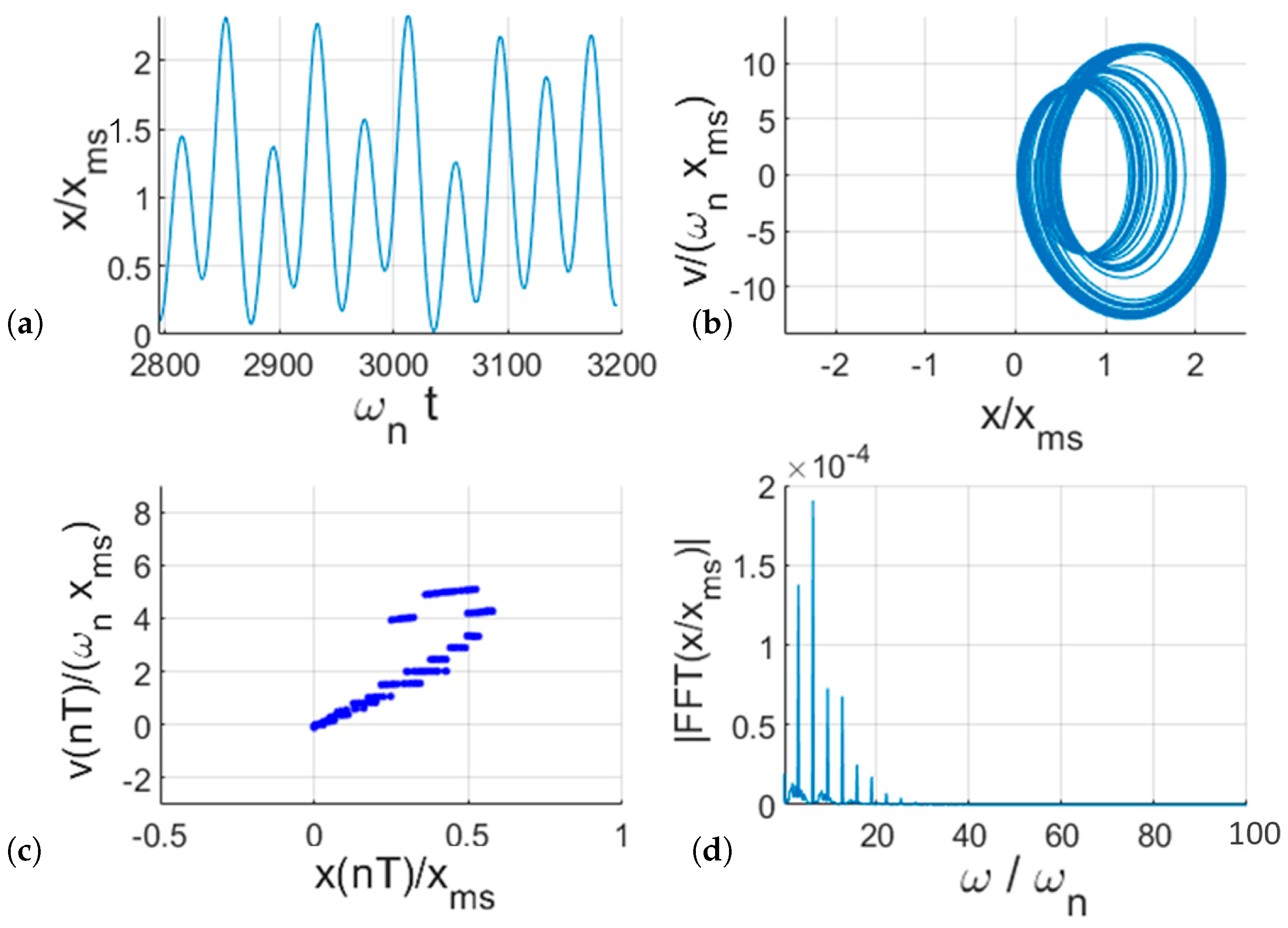
Figure 24 shows that at a forcing frequency of 11.8842 Hz, the motions seem to be quasi-periodic, as the normalized Poincare map traces a curve in the ( x ( n T ) / x m s , v ( n T ) / ( ω n x m s ) ) plane. According to the segment of the normalized time response shown, the oscillator seems to be caught on one side of the positive/negative x / x m s axis and eventually being attracted to the other side. The FFT panel, plotted as | FFT ( x / x m s ) | against ω / ω n , does not show only distinct integer harmonic components but rather fluctuating components over a range of normalized frequency, indicative of chaotic behaviour. This falls in the range where the K c values obtained from the 0–1 test are near one, supporting the classification of the computed response as chaotic within the negative initial-extension numerical extension.
Due to the negative pre-tension, however, it is possible for this oscillator to get caught on one side of the equilibrium point (at zero displacement). At a forcing frequency of 12.6632 Hz, the motions seem to be initially quasi-periodic again from the normalized Poincare map and phase portrait, but this time the oscillations get caught and stay on the positive x / x m s side as shown in Figure 25. The FFT panel shows integer frequency components that are incommensurate with the excitation frequency when plotted against ω / ω n , suggesting a quasi-periodic response. The forcing frequency also falls outside the range where the K c values obtained from the 0–1 test are near one, supporting the classification of the computed response as non-chaotic.
Figure 26 also shows the oscillations that get caught on the positive x / x m s side at a forcing frequency of 15 Hz. The normalized response is periodic; however, the FFT panel indicates components associated with a subharmonic response at half the excitation frequency.

4.10. Summary of Response Characteristics

The following are the findings drawn from the analysis completed in this section.
  • The experimental cyclic force–displacement data were used to calibrate the numerical values of the SMA restoring-law parameters required by the mathematical model.
  • The computed FRFs indicate the possibility of jump phenomena and stable/unstable response branches over selected frequency ranges.
  • Parametric studies show that forcing amplitude, number of wires, and pre-tension can significantly alter the predicted resonance peak, jump range, and backbone direction.
  • Where multiple response amplitudes are predicted at the same frequency, the attained steady state depends on the initial displacement, velocity, and martensitic state.
  • FRFs, time responses, phase plots, Poincare maps, bifurcation diagrams, and 0–1 tests were used to classify the model-predicted steady-state solutions. Periodic, quasi-periodic, and asymmetric responses were obtained, while chaotic behaviour was found only in the secondary negative pre-tension numerical extension.

5. Discussion

The present study establishes how an experimentally calibrated pseudoelastic wire element, when placed in a perpendicular geometric configuration, can generate response regimes that are not apparent from the material loop or the geometry alone. The geometric arrangement tends to introduce hardening-type behaviour, whereas pseudoelastic phase transformation introduces hysteresis and an effective softening contribution. Their coupling explains the non-monotonic backbone behaviour, jump phenomena, and multistability observed in the frequency–response curves. This also shows why reducing the element to a single equivalent stiffness or damping value would miss key vibration features of the system.
The basin results are especially important for interpreting the response of this oscillator. In the multistable frequency range, the forcing frequency and amplitude do not uniquely determine the final steady state; the initial displacement, velocity, and martensitic fraction can select different coexisting attractors. This has practical consequences for repeatability and response prediction, since nominally identical operating conditions may produce different amplitudes if the system is initialized differently. For monitoring or adaptive-device applications, such state-dependent response changes could appear as shifts in apparent stiffness or dominant response frequency even when the underlying structure has not changed. The higher harmonic components seen in the FFTs should also be interpreted in this context: they arise from the nonlinear restoring force and do not imply additional linear modes in the SDOF system.
The present scope was chosen to focus on the coupled effect of geometric nonlinearity and experimentally calibrated pseudoelastic hysteresis. Natural extensions of this framework include non-isothermal modelling for cases where thermomechanical coupling becomes important, particularly for larger wires or higher loading rates, as well as fatigue-aware parameter evolution for long cycling histories. Future work should also embed the calibrated element in a representative host-structure or absorber configuration so that the response regimes identified here can be translated into attenuation, robustness, and operating-map metrics.

6. Conclusions

This paper investigated the global nonlinear response characteristics of a harmonically forced pseudoelastic SMA-wire oscillator in which geometric nonlinearity from a perpendicular wire configuration is coupled with phase-transformation-induced hysteresis. Cyclic force–displacement testing was used to calibrate the pseudoelastic restoring law of the wire, and the calibrated law was then embedded in the oscillator model. The experimental calibration supports the restoring-force model used in the simulations, while the frequency–response curves, basin structures, bifurcation evidence, and complex-response regimes should be interpreted as model-based predictions of the calibrated oscillator.
For the positive pre-tension case corresponding to the directly calibrated tension-wire regime, the computed responses show jump phenomena, coexistence of stable and unstable periodic branches, and strong dependence of the attained steady state on the initial displacement, velocity, and martensitic fraction. The basin-of-attraction calculations show that the same forcing frequency and amplitude can lead to different steady amplitudes depending on the initial state. This sensitivity is important for repeatable operation of SMA-based vibration devices because apparent stiffness, response amplitude, and dominant response features may change without any change in structural parameters.
The parametric results indicate how forcing amplitude, number of wires, and pre-tension alter the predicted resonance peak, jump interval, and backbone direction. These trends are explained by the competition between geometric hardening from the perpendicular wire configuration and pseudoelastic softening and dissipation from the calibrated hysteresis loop. Additional complex responses, including quasi-periodic and chaotic behaviour, were identified mainly in the negative initial-extension case. These results are retained as a secondary numerical extension outside the directly validated tension-wire regime, and they should not be interpreted as direct experimental evidence of chaos in the tested SMA-wire oscillator.
Overall, the study provides an experimentally grounded modelling and analysis framework for examining multistability and basin structure in pseudoelastic SMA oscillators. Future work should extend the framework to non-isothermal and rate-dependent modelling where thermal coupling becomes important, particularly for larger wires or higher loading rates, and should evaluate representative absorber or host-structure configurations so that the predicted response regimes can be translated into application-level attenuation and robustness metrics.

Author Contributions

Conceptualization, S.R. and J.B.; methodology, S.R. and J.B.; software, S.R.; validation, S.R.; formal analysis, S.R. and J.B.; investigation, S.R. and J.B.; resources, S.R. and K.L.; data curation, S.R.; writing—original draft preparation, S.R.; writing—review and editing, S.R., J.B. and K.L.; visualization, S.R.; supervision, J.B. and K.L.; project administration, J.B.; funding acquisition, K.L. All authors have read and agreed to the published version of the manuscript.

Funding

This research was financially supported by Natural Sciences and Engineering Research Council of Canada, Discovery Grants (RGPIN-2023-04815).

Institutional Review Board Statement

Not applicable.

Informed Consent Statement

Not applicable.

Data Availability Statement

The experimental cyclic force–displacement data measured and analyzed during this study and used for parameter identification are available from the corresponding author upon reasonable request.

Acknowledgments

The authors acknowledge The University of the West Indies, St. Augustine, where the doctoral research underlying this study was conducted.

Conflicts of Interest

The authors declare no conflicts of interest.

Abbreviations

The following abbreviations are used in this manuscript:
SDOFSingle Degree of Freedom
SMAShape Memory Alloy
COCOContinuation Core Toolbox
FFTFast Fourier Transform
FRFFrequency Response Function
RMSERoot Mean Square Error
SIInternational System of Units

References

  1. Qian, H.; Li, H.; Song, G.; Guo, W. Recentering Shape Memory Alloy Passive Damper for Structural Vibration Control. Math. Probl. Eng. 2013, 2013, 963530. [Google Scholar] [CrossRef]
  2. Lacarbonara, W.; Bernardini, D.; Vestroni, F. Nonlinear Thermomechanical Oscillations of Shape-Memory Devices. Int. J. Solids Struct. 2004, 41, 1209–1234. [Google Scholar] [CrossRef]
  3. Bernardini, D.; Vestroni, F. Non-isothermal oscillations of pseudoelastic devices. Int. J. Non-Linear Mech. 2003, 38, 1297–1313. [Google Scholar] [CrossRef]
  4. Moussa, M.O.; Moumni, Z.; Doaré, O.; Touzé, C.; Zaki, W. Non-linear dynamic thermomechanical behaviour of shape memory alloys. J. Intell. Mater. Syst. Struct. 2012, 23, 1593–1611. [Google Scholar] [CrossRef]
  5. Lacarbonara, W.; Vestroni, F. Nonclassical responses of oscillators with hysteresis. Nonlinear Dyn. 2003, 32, 235–258. [Google Scholar] [CrossRef]
  6. Casini, P.; Vestroni, F. Nonlinear resonances of hysteretic oscillators. Acta Mech. 2018, 229, 939–952. [Google Scholar] [CrossRef]
  7. Carboni, B.; Lacarbonara, W. Nonlinear dynamic characterization of a new hysteretic device: Experiments and computations. Nonlinear Dyn. 2016, 83, 23–39. [Google Scholar] [CrossRef]
  8. Virgin, L.N.; Todd, M.D.; Begley, C.J.; Trickey, S.T.; Dowell, E.H. Basins of attraction in experimental nonlinear oscillators. Int. J. Bifurc. Chaos 1998, 8, 521–533. [Google Scholar] [CrossRef]
  9. Rega, G.; Salvatori, A.; Benedettini, F. Numerical and geometrical analysis of bifurcation and chaos for an asymmetric elastic nonlinear oscillator. Nonlinear Dyn. 1995, 7, 249–272. [Google Scholar] [CrossRef]
  10. Szemplińska-Stupnicka, W.; Tyrkiel, E. Sequences of global bifurcations and the related outcomes after crisis of the resonant attractor in a nonlinear oscillator. Int. J. Bifurc. Chaos 1997, 7, 2437–2457. [Google Scholar] [CrossRef]
  11. Dimarogonas, A.D. Vibration for Engineers; Prentice Hall: Upper Saddle River, NJ, USA, 1996. [Google Scholar]
  12. Vakakis, A.F.; Gendelman, O.V.; Bergman, L.A.; McFarland, D.M.; Kerschen, G.; Lee, Y.S. Nonlinear Targeted Energy Transfer in Mechanical and Structural Systems; Solid Mechanics and Its Applications; Springer: Berlin/Heidelberg, Germany, 2008; Volume 156. [Google Scholar] [CrossRef]
  13. Gendelman, O.V.; Manevitch, L.I.; Vakakis, A.F.; McCloskey, R. Energy Pumping in Nonlinear Mechanical Oscillators: Part I—Dynamics of the Underlying Hamiltonian Systems. J. Appl. Mech. 2001, 68, 34–41. [Google Scholar] [CrossRef]
  14. Gourdon, E.; Alexander, N.A.; Taylor, C.A.; Lamarque, C.H.; Pernot, S. Nonlinear Energy Pumping Under Transient Forcing With Strongly Nonlinear Coupling: Theoretical and Experimental Results. J. Sound Vib. 2007, 300, 522–551. [Google Scholar] [CrossRef]
  15. Gendelman, O.V.; Sapsis, T.; Vakakis, A.F.; Bergman, L.A. Enhanced Passive Targeted Energy Transfer in Strongly Nonlinear Mechanical Oscillators. J. Sound Vib. 2011, 330, 1–8. [Google Scholar] [CrossRef]
  16. Habib, G.; Detroux, T.; Viguié, R.; Kerschen, G. Nonlinear Generalization of Den Hartog’s Equal-Peak Method. Mech. Syst. Signal Process. 2015, 52, 17–28. [Google Scholar] [CrossRef]
  17. Starosvetsky, Y.; Gendelman, O.V. Attractors of Harmonically Forced Linear Oscillator with Attached Nonlinear Energy Sink II: Optimization of a Nonlinear Vibration Absorber. Nonlinear Dyn. 2008, 51, 47–57. [Google Scholar] [CrossRef]
  18. Pennisi, G. Passive Vibration Control by Using Nonlinear Energy Sink Absorbers: Theoretical Study and Experimental Investigations. Ph.D. Dissertation, National Higher French Institute of Aeronautics and Space, Toulouse, France, 2016. [Google Scholar]
  19. Doaré, O.; Sbarra, A.; Touzé, C.; Moussa, M.O.; Moumni, Z. Experimental analysis of the quasi-static and dynamic torsional behaviour of shape memory alloys. Int. J. Solids Struct. 2012, 49, 32–42. [Google Scholar] [CrossRef]
  20. Parulekar, Y.M.; Reddy, G.R. Nonlinear model of pseudoelastic shape memory alloy damper considering residual martensite strain effect. Adv. Acoust. Vib. 2012, 2012, 261896. [Google Scholar] [CrossRef]
  21. Williams, K.; Chiu, G.; Bernhard, R. Adaptive-Passive Absorbers Using Shape-Memory Alloys. J. Sound Vib. 2002, 249, 835–848. [Google Scholar] [CrossRef]
  22. Tiseo, B.; Koopmann, G.; Concilio, A. SMA-Based Adaptive Tuneable Dynamic Vibration Absorbers for Noise Radiated Control. In Proceedings of the 11th AIAA/CEAS Aeroacoustics Conference, Monterey, CA, USA, 23–25 May 2005; p. 3037. [Google Scholar]
  23. Casini, P.; Vestroni, F. Mitigation of Structural Vibrations of MDOF Oscillators by Modal Coupling Due to Hysteretic Dampers. Appl. Sci. 2022, 12, 10079. [Google Scholar] [CrossRef]
  24. Jacob, K.; Tan, A.S.; Sattel, T.; Kohl, M. Enhancement of Shock Absorption Using Hybrid SMA–MRF Damper by Complementary Operation. Actuators 2022, 11, 280. [Google Scholar] [CrossRef]
  25. Xue, J.R.; Zhang, Y.W.; Niu, M.Q.; Chen, L.Q. Vibration Reduction in a Composite Laminated Cylindrical Shell via Embedded Nitinol–Steel Wire Ropes. Nonlinear Dyn. 2023, 111, 7181–7197. [Google Scholar] [CrossRef]
  26. Kim, H.G.; Kwon, S.C.; Koo, K.R.; Song, S.C.; Yu, Y.; Song, Y.; Park, Y.H.; Oh, H.U. Performance Investigation of Superplastic Shape Memory Alloy-Based Vibration Isolator for X-Band Active Small SAR Satellite of S-STEP Under Acoustic and Random Vibration Environments. Aerospace 2022, 9, 642. [Google Scholar]
  27. Silva, R.S.; Ritto, T.G.; Savi, M.A. Shape Memory Alloy Couplers Applied for Torsional Vibration Attenuation of Drill-String Systems. J. Pet. Sci. Eng. 2021, 202, 108546. [Google Scholar] [CrossRef]
  28. Silva, P.; Peraza Hernandez, E.A. Modeling and Design Exploration of Tensegrity Plate Mechanisms with Energy Dissipation Capabilities Enabled by Shape Memory Alloys. In Proceedings of the International Design Engineering Technical Conferences and Computers and Information in Engineering Conference, Virtual, 17–19 August 2021. [Google Scholar]
  29. Zhan, M.; Liu, J.; Chen, X.; Zhang, L.; Wang, S.; Li, T. Seismic Response Control of T-Shaped Porcelain Column Circuit Breaker Based on Shape Memory Alloy Cables. J. Vib. Eng. Technol. 2022, 10, 2313–2326. [Google Scholar] [CrossRef]
  30. Sinha, S.; Maji, B.C.; Kumawat, B.K.; Singh, R.N.; Krishnan, M. Fabrication of NiTi Shape Memory Alloy Hybrid Composites for Damping Applications; Technical Report; Bhabha Atomic Research Centre: Mumbai, India, 2023.
  31. Radhamani, R.; Balakrishnan, M. NiTi Shape Memory Alloy: Unraveling the Role of Internal Friction in Passive Damping—A Review. Mater. Today Commun. 2023, 37, 107276. [Google Scholar] [CrossRef]
  32. Sun, P.; Wang, Q.; Feng, J.; Ji, P.; Zhang, J.; Yin, F. Effect of Nb on the Damping Property and Pseudoelasticity of a Porous Ni–Ti Shape Memory Alloy. Materials 2023, 16, 5057. [Google Scholar] [CrossRef]
  33. Wang, X.; Leng, J.; Rao, Z.; Yan, X. Experiment and simulation study on the functional fatigue of shape memory alloy beam actuators. Smart Mater. Struct. 2024, 33, 065024. [Google Scholar] [CrossRef]
  34. Sgambitterra, E.; Furgiuele, F.; Maletta, C.; Casati, R. Novel insight into the strain-life fatigue properties of pseudoelastic NiTi shape memory alloys. Smart Mater. Struct. 2019, 28, 10LT03. [Google Scholar] [CrossRef]
  35. Alvares, T.Q.; Dornelas, V.M.; Oliveira, S.A.; Savi, M.A. Thermomechanical description of shape memory alloys using the Preisach model. Smart Mater. Struct. 2024, 33, 035019. [Google Scholar] [CrossRef]
  36. Ditommaso, R.; Ponzo, F.C. Identifying Damage in Structures: Definition of Thresholds to Minimize False Alarms in SHM Systems. Buildings 2024, 14, 821. [Google Scholar] [CrossRef]
  37. Bernardini, D. On the Macroscopic Free Energy Functions for Shape Memory Alloys. J. Mech. Phys. Solids 2001, 49, 813–837. [Google Scholar] [CrossRef]
  38. Ueda, Y. Survey of Regular and Chaotic Phenomena in the Forced Duffing Oscillator. Chaos Solitons Fractals 1991, 1, 199–231. [Google Scholar] [CrossRef]
  39. Abu-As’ad, A.; Asad, J. Power Series Approach to Nonlinear Oscillators. J. Low Freq. Noise Vib. Act. Control 2024, 43, 220–238. [Google Scholar] [CrossRef]
  40. Coleman, B.D.; Gurtin, M.E. Thermodynamics With Internal State Variables. J. Chem. Phys. 1967, 47, 597–613. [Google Scholar] [CrossRef]
  41. Zanotti, C.; Giuliani, P.; Riva, G.; Tuissi, A.; Chrysanthou, A. Thermal diffusivity of Ni–Ti SMAs. J. Alloys Compd. 2009, 473, 231–237. [Google Scholar] [CrossRef]
  42. Ammar, O.; Haddar, N.; Dieng, L. Experimental Investigation of the Pseudoelastic Behaviour of NiTi Wires Under Strain- and Stress-Controlled Cyclic Tensile Loadings. Intermetallics 2017, 81, 52–61. [Google Scholar] [CrossRef]
  43. Sherif, M.M.; Ozbulut, O.E. Tensile and Superelastic Fatigue Characterization of NiTi Shape Memory Cables. Smart Mater. Struct. 2017, 27, 015007. [Google Scholar] [CrossRef]
  44. Moumni, Z.; Zaki, W.; Maitournam, H. Cyclic Behavior and Energy Approach to the Fatigue of Shape Memory Alloys. J. Mech. Mater. Struct. 2009, 4, 395–411. [Google Scholar] [CrossRef]
  45. Strnadel, B.; Miyazaki, S. Modelling Residual Strains During Cycling of Ti–Ni and Ti–Ni–Cu Shape Memory Alloys in a Pseudoelastic Range of Behaviour Conditions. Strain 2011, 47, e457–e466. [Google Scholar] [CrossRef]
  46. Gottwald, G.A.; Melbourne, I. On the implementation of the 0–1 test for chaos. SIAM J. Appl. Dyn. Syst. 2009, 8, 129–145. [Google Scholar] [CrossRef]
Figure 1. (a) SMA oscillator schematic; (b) force–displacement response.
Vibration 09 00039 g001
Figure 2. Geometric force relationship of the SMA element.
Vibration 09 00039 g002
Figure 3. Hysteresis tensile testing of SMA wire using a Tinius Olsen Universal Tester.
Vibration 09 00039 g003
Figure 4. Cyclic loading obtained for 20 cm-length SMA wire for cycles 1–100 (cycles 1, 10 20, 30 and 100 labelled and arrow indicates direction of increasing cycle number).
Vibration 09 00039 g004
Figure 5. Cyclic loading obtained for 20 cm-length SMA wire for cycles 300–1000.
Vibration 09 00039 g005
Figure 6. Residual displacement and strain for increasing cycles.
Vibration 09 00039 g006
Figure 7. Force–displacement and stress–strain relationship with austenitic–martensitic transformation points labelled. The blue curves show the experimental cyclic response, while the black lines are tangent constructions used to identify the labelled transformation points from the graph. Stress was computed using the 0.5 mm wire diameter, corresponding to a cross-sectional area A = π d 2 / 4 0.196   mm 2 ( 1.96 × 10 7   m 2 ).
Vibration 09 00039 g007
Figure 8. Force–displacement relationships used in the calibrated restoring-law construction: (a) longitudinal SMA-wire response, with fitted solid lines overlaid on the experimental data shown by black dashed lines, and (b) projected restoring-force relationship in the perpendicular oscillator direction, plotted against normalized oscillator displacement x / x m s .
Vibration 09 00039 g008
Figure 9. Numerical results for ω = 10 Hz using the baseline parameter set listed in Section 4.1: (a) normalized steady-state time response, x / x m s , plotted against normalized time, ω n t ; (b) normalized phase portrait in the ( x / x m s , v / ( ω n x m s ) ) plane; (c) Poincare map formed by sampling the normalized response once every forcing period T, shown in the ( x ( n T ) / x m s , v ( n T ) / ( ω n x m s ) ) plane; and (d) FFT amplitude spectrum of the normalized steady-state response, | FFT ( x / x m s ) | , plotted against normalized frequency, ω / ω n .
Vibration 09 00039 g009
Figure 10. FRF of SDOF SMA oscillator (displacement) for the baseline parameter set listed in Section 4.1.
Vibration 09 00039 g010
Figure 11. FRF of SDOF SMA oscillator for varying γ .
Vibration 09 00039 g011
Figure 12. FRF of SDOF SMA oscillator for varying n w i r e s .
Vibration 09 00039 g012
Figure 13. FRF of SDOF SMA oscillator for varying δ 0 .
Vibration 09 00039 g013
Figure 14. Normalized phase plane of steady-state solutions of the SDOF SMA oscillator, plotted in terms of x / x m s and v / ( ω n x m s ) at ω = 10.72 Hz.
Vibration 09 00039 g014
Figure 15. Normalized time response of steady-state solutions of the SDOF SMA oscillator, plotted as x / x m s versus ω n t at ω = 10.72 Hz.
Vibration 09 00039 g015
Figure 16. Basins of attraction of the SDOF SMA oscillator at ω = 10.72 Hz, with initial conditions expressed as x 0 / x m s and v 0 / ( ω n x m s ) . Blue initial conditions lead to the higher-amplitude stable solution, red initial conditions lead to the lower-amplitude stable solution, and the green markers denote numerically identified initial conditions on the unstable separating solution.
Vibration 09 00039 g016
Figure 17. FRF of SDOF SMA oscillator for δ 0 = 0.1 x m s and 0.1 x m s .
Vibration 09 00039 g017
Figure 18. (a) Bifurcation diagram for δ 0 = 0.1 x m s and (b) associated K c values from the 0–1 test for chaos.
Vibration 09 00039 g018
Figure 19. (a) Bifurcation diagram for δ 0 = 0.1 x m s and (b) associated K c values from the 0–1 test for chaos.
Vibration 09 00039 g019
Figure 20. Numerical results for ω = 1.7579 Hz and δ 0 = 0.1 x m s : (a) normalized steady-state time response, x / x m s , plotted against normalized time, ω n t ; (b) normalized phase portrait in the ( x / x m s , v / ( ω n x m s ) ) plane; (c) Poincare map formed by sampling the normalized response once every forcing period T, shown in the ( x ( n T ) / x m s , v ( n T ) / ( ω n x m s ) ) plane; and (d) FFT amplitude spectrum of the normalized steady-state response, | FFT ( x / x m s ) | , plotted against normalized frequency, ω / ω n .
Vibration 09 00039 g020
Figure 21. Numerical results for ω = 4.0947 Hz and δ 0 = 0.1 x m s : (a) normalized steady-state time response, x / x m s , plotted against normalized time, ω n t ; (b) normalized phase portrait in the ( x / x m s , v / ( ω n x m s ) ) plane; (c) Poincare map formed by sampling the normalized response once every forcing period T, shown in the ( x ( n T ) / x m s , v ( n T ) / ( ω n x m s ) ) plane; and (d) FFT amplitude spectrum of the normalized steady-state response, | FFT ( x / x m s ) | , plotted against normalized frequency, ω / ω n .
Vibration 09 00039 g021
Figure 22. Numerical results for ω = 8.76847 Hz and δ 0 = 0.1 x m s : (a) normalized steady-state time response, x / x m s , plotted against normalized time, ω n t ; (b) normalized phase portrait in the ( x / x m s , v / ( ω n x m s ) ) plane; (c) Poincare map formed by sampling the normalized response once every forcing period T, shown in the ( x ( n T ) / x m s , v ( n T ) / ( ω n x m s ) ) plane; and (d) FFT amplitude spectrum of the normalized steady-state response, | FFT ( x / x m s ) | , plotted against normalized frequency, ω / ω n .
Vibration 09 00039 g022
Figure 23. Numerical results for ω = 9.5474 Hz and δ 0 = 0.1 x m s : (a) normalized steady-state time response, x / x m s , plotted against normalized time, ω n t ; (b) normalized phase portrait in the ( x / x m s , v / ( ω n x m s ) ) plane; (c) Poincare map formed by sampling the normalized response once every forcing period T, shown in the ( x ( n T ) / x m s , v ( n T ) / ( ω n x m s ) ) plane; and (d) FFT amplitude spectrum of the normalized steady-state response, | FFT ( x / x m s ) | , plotted against normalized frequency, ω / ω n .
Vibration 09 00039 g023
Figure 24. Numerical results for ω = 11.8842 Hz and δ 0 = 0.1 x m s : (a) normalized steady-state time response, x / x m s , plotted against normalized time, ω n t ; (b) normalized phase portrait in the ( x / x m s , v / ( ω n x m s ) ) plane; (c) Poincare map formed by sampling the normalized response once every forcing period T, shown in the ( x ( n T ) / x m s , v ( n T ) / ( ω n x m s ) ) plane; and (d) FFT amplitude spectrum of the normalized steady-state response, | FFT ( x / x m s ) | , plotted against normalized frequency, ω / ω n .
Vibration 09 00039 g024
Figure 25. Numerical results for ω = 12.6632 Hz and δ 0 = 0.1 x m s : (a) normalized steady-state time response, x / x m s , plotted against normalized time, ω n t ; (b) normalized phase portrait in the ( x / x m s , v / ( ω n x m s ) ) plane; (c) Poincare map formed by sampling the normalized response once every forcing period T, shown in the ( x ( n T ) / x m s , v ( n T ) / ( ω n x m s ) ) plane; and (d) FFT amplitude spectrum of the normalized steady-state response, | FFT ( x / x m s ) | , plotted against normalized frequency, ω / ω n .
Vibration 09 00039 g025
Figure 26. Numerical results for ω = 15 Hz and δ 0 = 0.1 x m s : (a) normalized steady-state time response, x / x m s , plotted against normalized time, ω n t ; (b) normalized phase portrait in the ( x / x m s , v / ( ω n x m s ) ) plane; (c) Poincare map formed by sampling the normalized response once every forcing period T, shown in the ( x ( n T ) / x m s , v ( n T ) / ( ω n x m s ) ) plane; and (d) FFT amplitude spectrum of the normalized steady-state response, | FFT ( x / x m s ) | , plotted against normalized frequency, ω / ω n .
Vibration 09 00039 g026
Disclaimer/Publisher’s Note: The statements, opinions and data contained in all publications are solely those of the individual author(s) and contributor(s) and not of MDPI and/or the editor(s). MDPI and/or the editor(s) disclaim responsibility for any injury to people or property resulting from any ideas, methods, instructions or products referred to in the content.