
Article

Nonlinear Characterisation of Wind Turbine Gearbox Vibration Dynamics Driven by Inhomogeneous Helical Gear Wear

by
Khaldoon F. Brethee
1,*,
Ghalib R. Ibrahim
1 and
Al-Hussein Albarbar
2
1
Department of Mechanical Engineering, Engineering College, University of Anbar, Ramadi 31001, Iraq
2
School of Engineering and Environment, Manchester Metropolitan University, Manchester M1 5GD, UK
*
Author to whom correspondence should be addressed.
Vibration 2026, 9(1), 20; https://doi.org/10.3390/vibration9010020
Submission received: 13 February 2026 / Revised: 10 March 2026 / Accepted: 13 March 2026 / Published: 16 March 2026

Abstract

Helical gear transmissions in wind turbine gearboxes operate under high torque, variable speed, and complex rolling–sliding contact conditions, where friction-induced wear evolves in a spatially non-uniform manner. However, most existing dynamic models assume uniform or mild wear and therefore fail to capture the nonlinear coupling between localised tooth surface degradation, gear mesh dynamics, and vibration response. In this work, a nonlinear dynamic model of a helical gear pair is formulated by incorporating time-varying mesh stiffness, elasto-hydrodynamic lubrication (EHL)-based friction forces, and wear-dependent contact geometry. The governing equations of motion are derived to explicitly account for the influence of inhomogeneous tooth wear on the contact load distribution and frictional excitation during meshing. Wear evolution is represented as a spatially varying modification of tooth surface topology, enabling the progressive coupling between wear depth, mesh stiffness perturbations, and dynamic transmission error. The model is employed to analyse the effects of non-uniform wear on system stability, vibration spectra, and dynamic response under wind turbine operating conditions. Numerical results reveal that uneven wear introduces nonlinear modulation of gear mesh forces and generates characteristic sidebands and amplitude variations in the vibration signal that are absent in conventional mild-wear formulations. These wear-induced dynamic features provide mathematically traceable indicators for the onset and progression of uneven tooth degradation. The proposed framework establishes a physics-based link between wear evolution and measurable vibration responses, providing a rigorous foundation for advanced vibration-based diagnostics and model-driven condition monitoring of wind turbine gearboxes.

1. Introduction

Wind turbines often work under complicated duty cycles and severe operating conditions, i.e., overload transmission, high temperatures and dusty/wet environments. Subjecting wind turbines to such harsh operating environments increases both the likelihood of failure and maintenance costs [1]. One such failure could be due to wear on the interface contact of teeth in helical gears. This may be due to a combination of sliding and rolling motions [2] or deterioration in gear lubrication and has the potential to significantly adversely affect the functioning of the wind turbine and reduce its lifespan [2,3,4].
Gear wear begins mainly within a small region and then spreads over the contact tooth surfaces, which is accompanied by a loss of tooth profile and an altered contact patterns [3,5,6]. Such wear would be introduced at the interface contact of gear tooth surfaces non-uniformly due to eccentricity, misalignment and non-uniform tooth root cracking [7,8]. Non-uniform wear distribution could result in modification of the shape of the gear tooth, in which most wear is at the tooth tip and least at the meshing ends [5]. Such non-uniform wear could change the slide-to-roll ratio of gear surfaces when meshing.
Wear of gear teeth surfaces will cause uneven meshing impact, which may change the features and dimensions of gear patterns generating higher induced friction with higher vibration and noise levels [9,10]. The spreading of wear on the tooth surface is not uniform, where extreme wear depth is commonly found near the root and the top regions of helical gears [11]. Vibration monitoring and analysis is a well-known and widely used technology, generally considered as effective for early detection of faults particularly in gears and bearings in wind turbines and their diagnosis, improving reliability [12,13,14]. Such monitoring has become essential for providing better performance and more reliable productivity, particularly for achieving high transmission efficiency. Vibration-based monitoring is commonly used to ensure healthy gear trains and proper operation performance. The deviation on tooth surface wear has a significant effect on the characteristics of vibration, hence wear topography is introduced in various patterns depending on the gear operating condition [15]. This alters tooth profile and leads to inaccurate engagement which extremely influences the dynamic characteristics of the gear and thereby the sensitivity of vibration analysis [16,17]. The analysis of vibration signals can effectively extract reliable features to detect and identify the fault patterns in rotating machinery components of a wind turbine system and support maintenance decisions [8,13,18].
Vibration signals can be measured experimentally or predicted numerically, with very close agreement and can produce effective condition monitoring of machinery using various fault detection techniques [19]. Hence, theoretical models can be used to extract reliable features for condition monitoring and fault diagnosis. Numerical models can be very effective for the better understanding of meshing behaviour and dynamic interaction of gear surfaces in contact and vibration response of the excited gear train. These models can combine various numerical methods to establish a gear wear model based on Archard wear formula [20,21,22] and considering of tooth surface topography deviation [23,24], meshing stiffness behaviour [25], for the design development of gear system. Such a model can be used to simulate various defects, in which their effects on the vibration performance can be characterised for predicting system response and diagnostic tests.
Recently, large models have been developed to predict the nonlinear behaviour of various gear transmission systems [26,27,28,29,30]. Most of these models studied the interactions of gear teeth as they meshed and consequent vibration signals to improve data processing techniques for fault detection and diagnosis. Randall, [31] investigated various models to analyse the vibration response from translational and torsional movements of the meshing teeth, as a tool for gear design. It was stated that mathematical models may have to include numerous different parameters to effectively analyse the dynamic interactions of the meshing teeth, i.e., time varying stiffness, frictional excitation, backlash and unexpected excitations due to gear imperfections.
Despite extensive research on gear dynamics, the numerical simulation of helical gear systems remains a significant challenge, particularly in relation to wear evolution under realistic, time-varying operating conditions. For wind-turbine gearboxes, non-uniform wear is a dominant degradation mechanism that directly influences reliability, vibration signatures, and remaining useful life, yet no established design or assessment framework currently exists to quantify its risk or progression.
This study addresses this critical gap by proposing a novel framework for modelling non-uniform wear in wind-turbine helical gearboxes as a nonstationary random process. A dynamic, nonlinear helical gear model is developed that explicitly incorporates elasto-hydrodynamic, lubrication-induced frictional effects and time-varying contact mechanics. The proposed formulation captures key nonlinearities in vibration response and operating parameters that are typically neglected in conventional models.
By linking wear-induced dynamic responses to measurable vibration characteristics, the model provides new insight into degradation mechanisms and establishes a physically informed basis for condition monitoring and prognostics. The results demonstrate the potential of the proposed approach to enhance early fault detection, improve reliability assessment, and support predictive maintenance strategies for wind-turbine gear transmission systems.

2. Wear Distribution in Helical Gears

Helical gears are commonly used for high loads and their durable transmission capability. However, wear changes along the contact profile and surface topography of the teeth of helical gears. The major wear depth can be found in two regions where the contact surfaces experience severe friction due to the effect of sliding and rolling. Hence, severe wear presents at the first meshing region (base diameter) and the last meshing region (top diameter). As a consequence, more dynamic excitations are induced with the varying action of the meshing gear stiffness. With the proposed wear, the distance between gear centres becomes larger and more severe contact forces apply greater torque to the gear shaft which induce greater excitation of the gears [6,27].
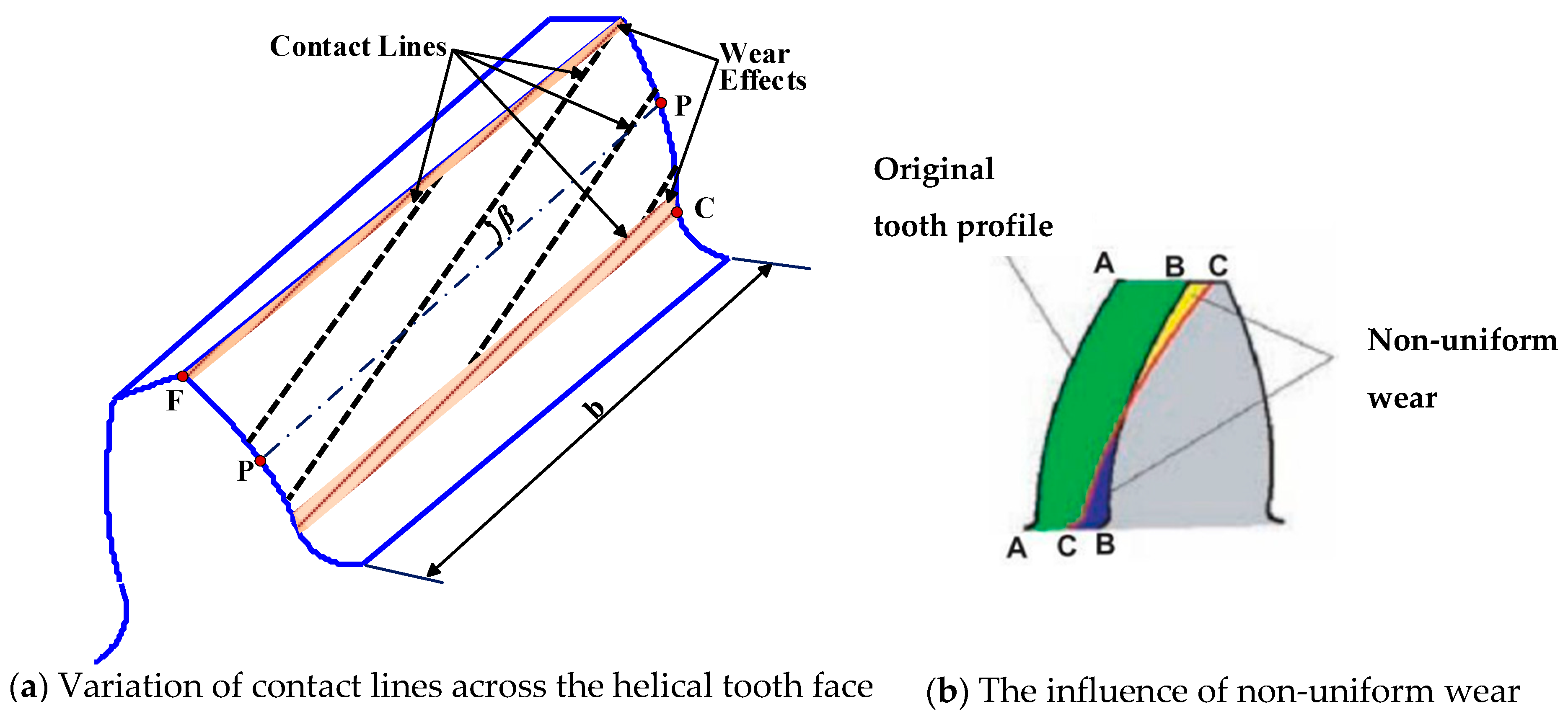
Major excitations of the gear systems can be caused by friction, a changing contact area and variation in the forces on the tooth pairs engaged in the meshing process. It follows that meshing instabilities are proportional to the variation in the length and number of contact tooth pairs across the plane of action of the helical gears, as seen in Figure 1a. We see the contact lines start at point C and move obliquely across the helical tooth face (width b) and finish at point F. The contact and overlap ratios of the meshing gears will determine the number of contact lines (tooth pairs) [26]. Abnormalities in how the meshing stiffness varies due to local imperfections may cause non-uniform wear across the contact surfaces. This would result in a significant reduction in the tooth thickness and could generate a sharp edge to the tooth tip, as denoted in Figure 1b.
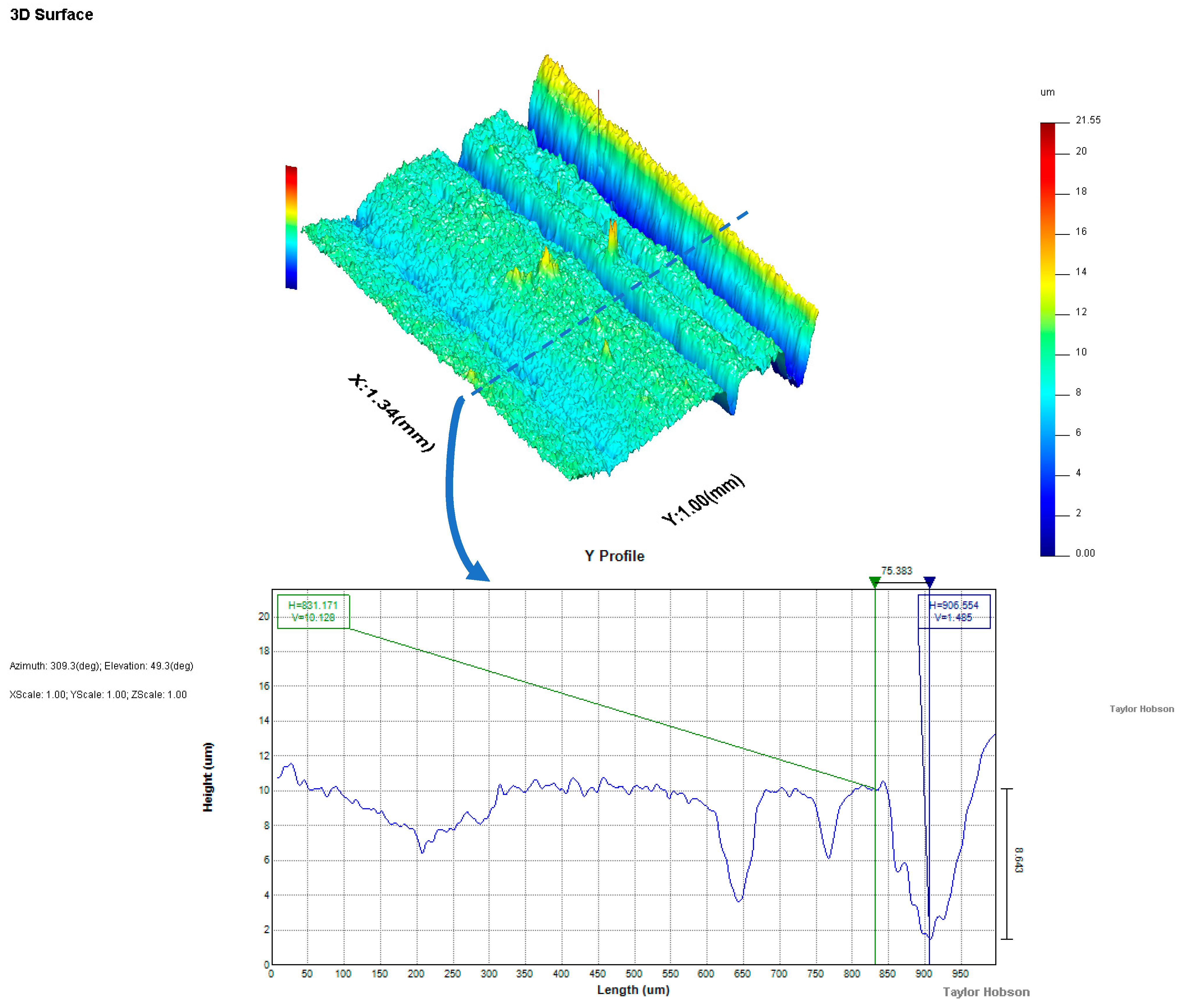
A tooth surface topography of an experiment helical gear measured by a Taylor Hobson surface roughness tester is depicted in Figure 2. The inhomogeneous wear topography on the tooth surface is produced in various highly progressive contact regions, especially on the top and the base of the gear tooth [11]. Hence, non-uniform tooth surface wear is produced with excessive depth near the root and top of the helical gears. These varieties correspond to intense vibration and make the tooth surface more prone to wear.

3. Time Variation in Mesh Stiffness Resulting from Non-Uniform Wear

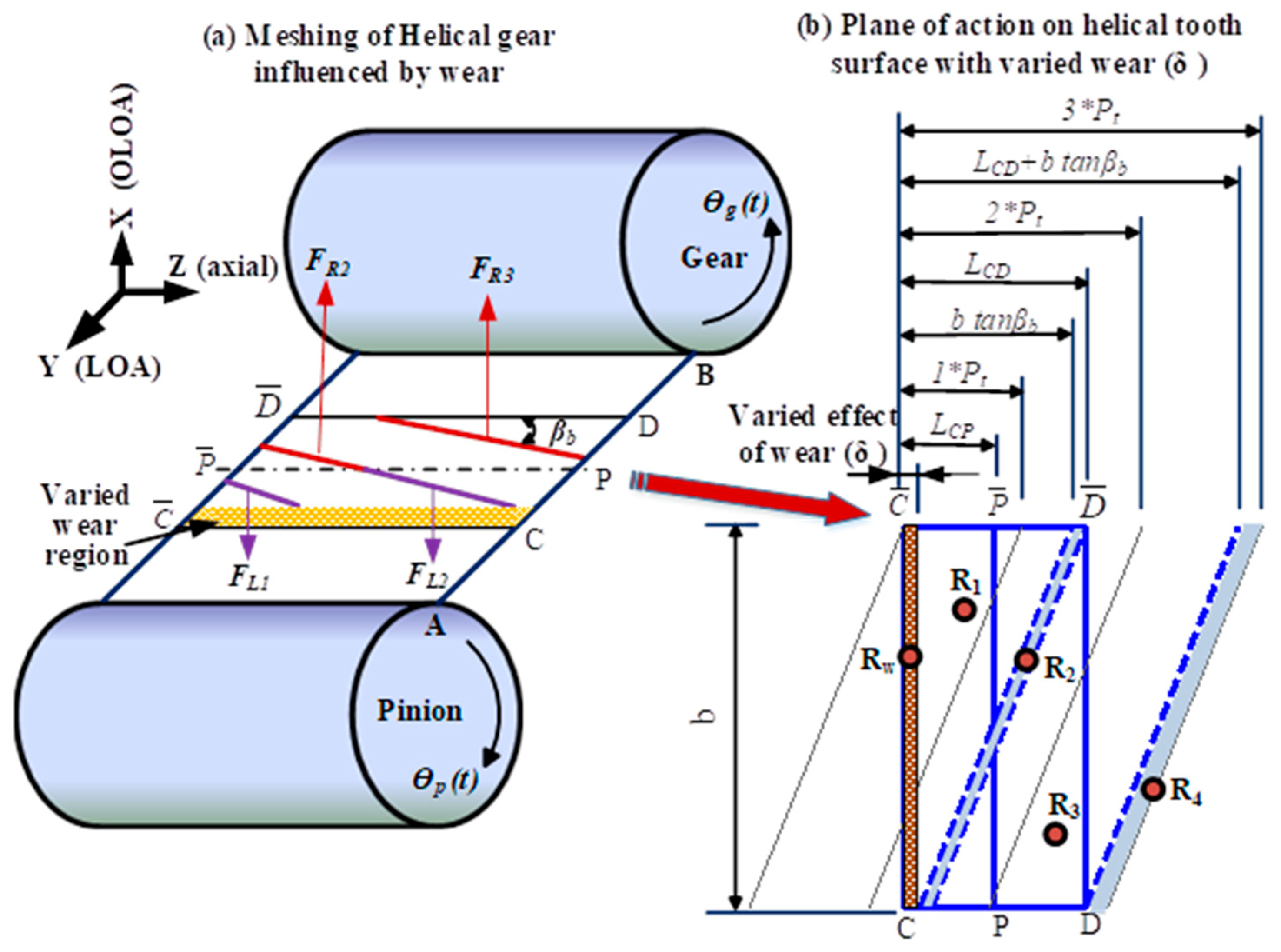
The main cause of vibration in gear trains is suggested as being due to time variation in gear meshing, and the level of excitation will depend on the tooth profile, loading variation and fluctuation in transmitted rotational speed. Further, the fault topography on the tooth surface will generate additional impulses and cause undesirable vibration and noise [27,28,32]. The inconsistency in the stiffness of the mesh is due to the periodic changes in the number of gear teeth engaged in the meshing process. Gear meshing stiffness may be determined conveniently and effectively based upon the entirety of the whole contact line lengths across the contact tooth surface (plane of action), as seen in Figure 3.
According to the ISO Standard Number 6336 [33], we can use the stiffness slicing method to obtain the meshing stiffness of helical gears via the jth contact line on the ith slice at a specific meshing time. It varies proportionally with change in the entire number of contact lines (Li(t)) with variation in the applied load and mesh stiffness density (ki(t)) of each slice [34,35]:
K m i j ( t ) = j = 1 n i = 1 m 0 b L i t   d k i j ( t )
where dkij(t), the mesh stiffness density on each slice, is defined based on the Hertzian contact stiffness dkhij, dkaij, dkbij, dkfij and dksij, which are, respectively, the axial compressive bending, shear, fillet foundation and stiffnesses for the meshing gears, see [27]:
d k i j t = j = 1 n i = 1 m 1 1 d k h i j + 1 d k b i j + 1 d k s i j + 1 d k a i j + 1 d k f i j
For a wider plane of action than the length of the line of action (LOA), btanβb > LOA, and using the analytical method we can determine the length of each contact line with n number of contact pairs, and allow for uneven wear width (δ) as:
L i t = 0 ( D L i ( t ) δ ) csc β b b tan β b csc β b ( L C D + b tan β b D L i ( t ) ) csc β b 0   0 D L i ( t ) < δ δ D L i ( t ) < ( b tan β b + δ ) ( b tan β b + δ ) D L i ( t ) < L C D ( L C D D L i ( t ) ) < ( L C D + b tan β b ) ( L C D + b tan β b ) D L i ( t ) < n P t
where at specific time t, length of a slice contact line is DLi(t) = rp ωp t + (i − 1)pt, and length of line of action is LCD. βb is the helical angle at the base and the angular rotation of the pinion is ωp. With pinion base radius (rp) and zp the number of teeth on the pinion, pt = 2 π rp/zp is the circumferential distance moved per tooth.
Gear meshing stiffness is largely determined by the geometry and composition of the meshing teeth, the former of which changes with both tooth wear and lines of contact. Where the wear takes place and its severity has significant effects on the gear meshing stiffness, which could decrease depending on the circumstances of the defect. Non-uniform wear causes relative decline in the meshing stiffness which will change in proportion to wear depth and severity. The dynamic wear depth hj of each segment (i) of the contact line (j) with unchangeable material hardness and normal pressure (P) at the contact surface and wear coefficient (K), is mathematically expressed as [21,22]:
h j = 0 S K P   d S j = K P   i = 1 N S p j S g j
where dSj is the relative sliding distance of the contact line variations between the two meshing tooth surfaces of the driving (p) and driven (g) gears. The influence of the wear width was simulated as varying non-uniformly with rotation of the gear and time varying meshing stiffness based on the contact line variation DLi(t) and angular rotation θpi. It is obtained from the nonstationary stochastic process of multiple meshing tooth pairs of gears, as
δ i = h j M a x   D L i t   c o s 2 θ p i θ c 2 t
where hjMax is maximum wear depth and θc is the corresponding angle of maximum wear zone at the tooth root and tip. θpi is the angle of rotation of the pinion, which varies with gear rotation, as:
θ p i = ω p   t + ( i 1 )   p t
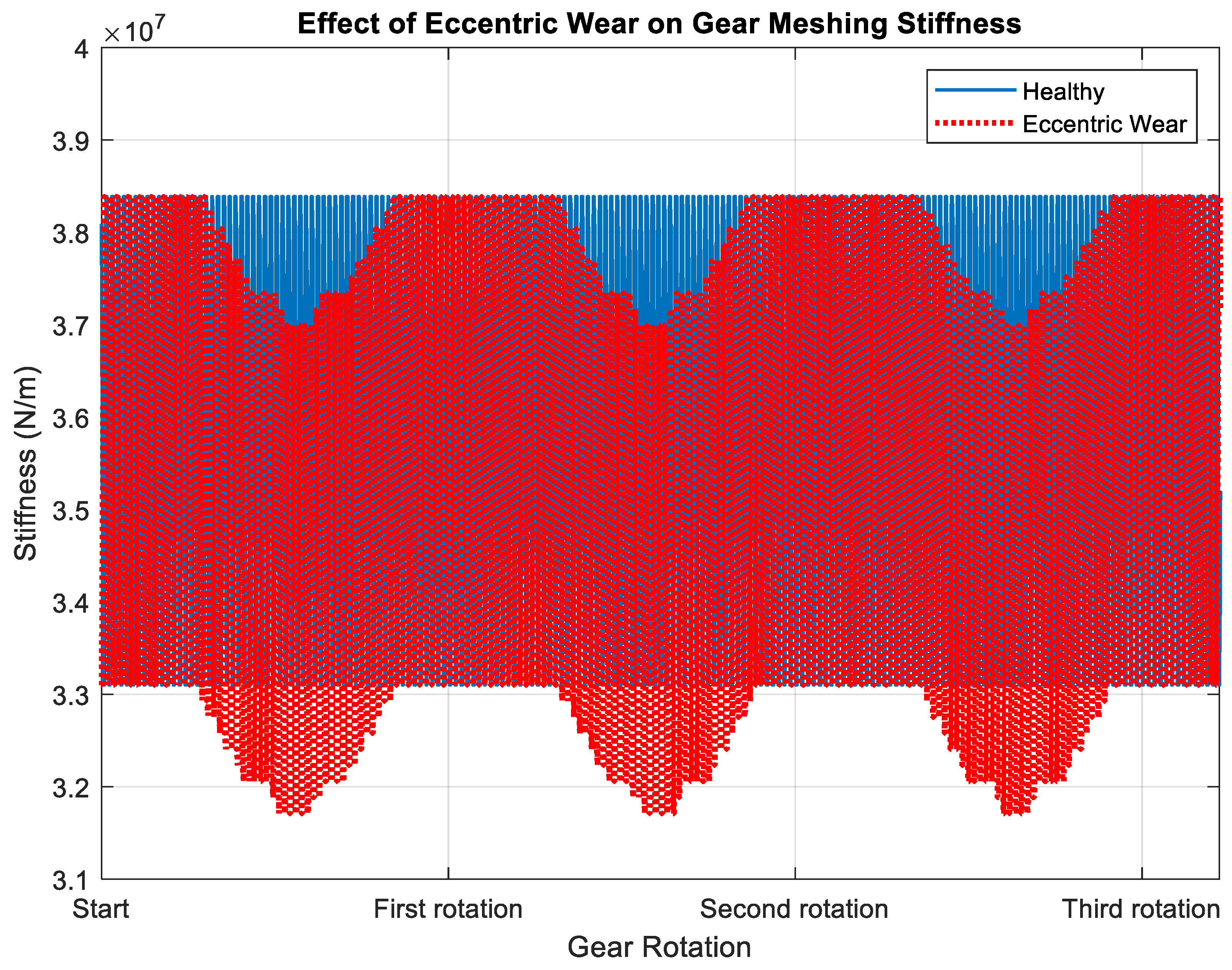
Equation (5) provides new ideas for the evaluating nonstationary random process of non-uniform wear distribution in the contact tooth surfaces of helical gears. The progression of gear wear was applied non-uniformly throughout the meshing process, which is changed periodically with the gear rotation, as illustrated in Figure 4.
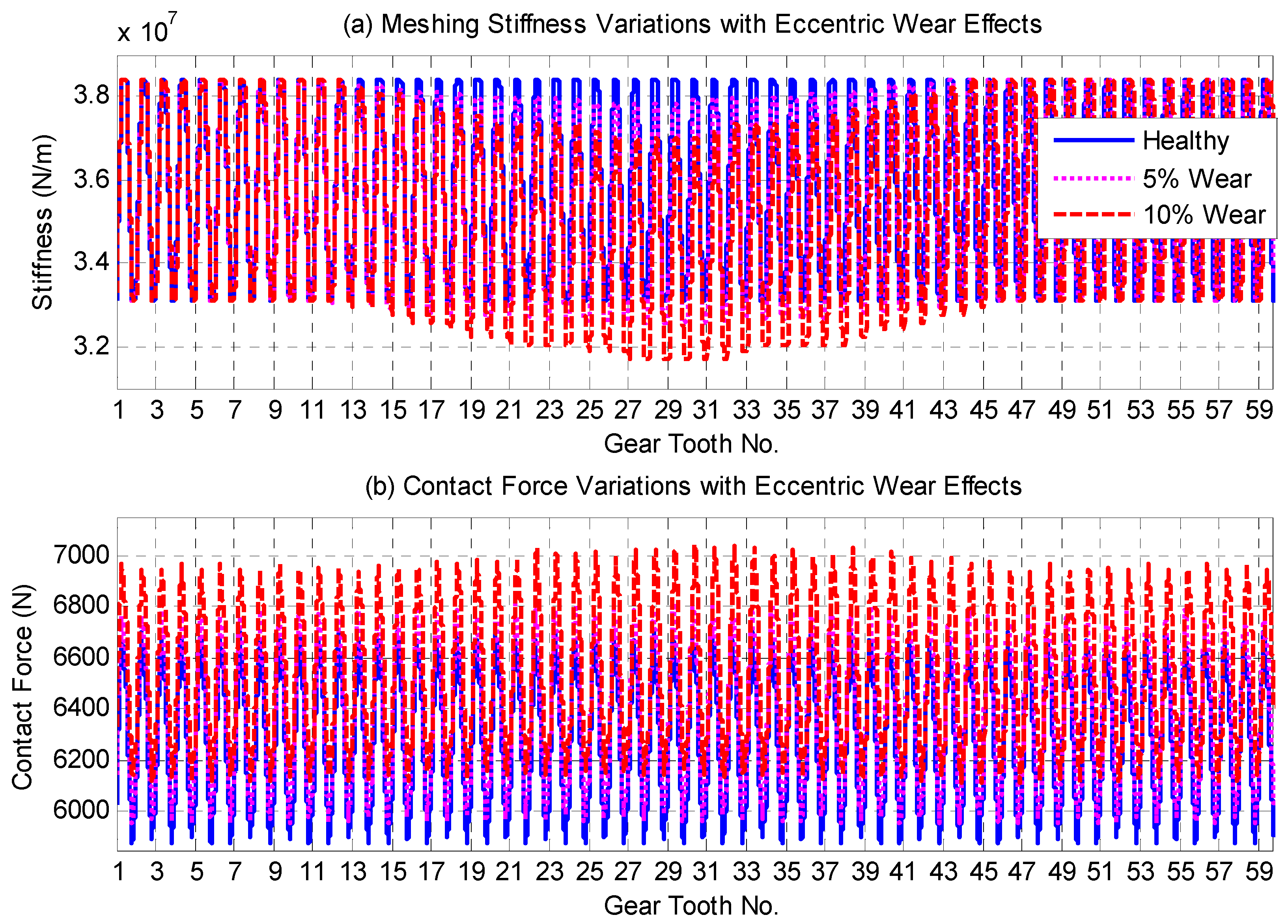
Meshing stiffness changes with wear topography and can influence contact behaviour and cause vibrations (possibly severe) and instabilities in the geartrain. The wear depth is considered to increase with time but in a random manner, which may be defined as a nonstationary random process [9]. Figure 5 shows how eccentric wear effects meshing stiffness over one cycle, where the worn region increases gradually with gear rotation, and then the extent of the wear decreases towards the end of the gear cycle. The process is continued with gear rotation, in which an arbitrary tooth surface would be generated. Based on this theory, the basis of nonstationary random gear wear can be determined, and the nonstationary stochastic process of gear dynamics and vibration characteristics could be evaluated. The contact force Nij (t) is varied with time according to the meshing stiffness and the fluctuation of a dynamic transmission error (TE) between the meshing gears, as:
N i j ( t ) = K i j ( t ) T E i j ( t )
where TE is defined based on the base radii (rbp and rbg) with the angular displacements (θp and θg) and transverse displacement (yp and yg) of pinion and gear, respectively. It also includes the interface displacement excitation e(t) due to intentional modification of the tooth profile.
T E i j ( t ) =   ( r b p θ p r b g θ g + y p y g ) + e i j ( t )

4. Determination of Frictional Excitations

Friction between the meshing gears is considered as the main exciting source responsible for energy losses and nonlinear excitation in the gear transmission systems. It could cause substantial dynamic instabilities and be a major source of noise and vibration [36]. Different approaches have been proposed for numerically describing the interactions of the surfaces of meshing gears when in contact. The numerically determined friction force can be attained based on the variation in contact line length using the stiffness slicing method for the jth contact line and ith slice at a specific time, as:
F f i j ( t ) = j = 1 n i = 1 m μ i j ( t ) N i j ( t )   L r   i ( t ) L l   i ( t ) i = 1 n L i ( t )
where μji(t) is the varying friction coefficient, and Lri(t) and Lli(t) are the sum lengths of the entire right and left teeth contact lines.
The effect of friction was simulated based on elasto-hydrodynamic lubrication (EHL), which is considered as the most effective model to model the effects of lubrication between the meshing gears [37]. The disparity in the friction coefficient is defined based on EHL regions, as proposed numerically by Xu [38]:
μ i j ( t ) = e f ( S R , P h , υ o , S ) P h b 2 S R b 3 V e b 6 v 0 b 7 R b 8
All the parameters used to describe how the coefficient of friction between the meshing gears varies with time have been fully defined in [37,38]. The friction force makes itself felt as an applied torque given by:
T f i j ( t ) = j = 1 n i = 1 m μ i j ( t )   N i j ( t ) i = 1 n L i ( t ) L r   i ( t ) X r   i ( t ) L l   i ( t ) X l   i ( t )
where Xri(t) and Xli(t) represent the normal distance of each frictional force respectively acting on the segments to the right and left of the contact line, as defined in [27,34].
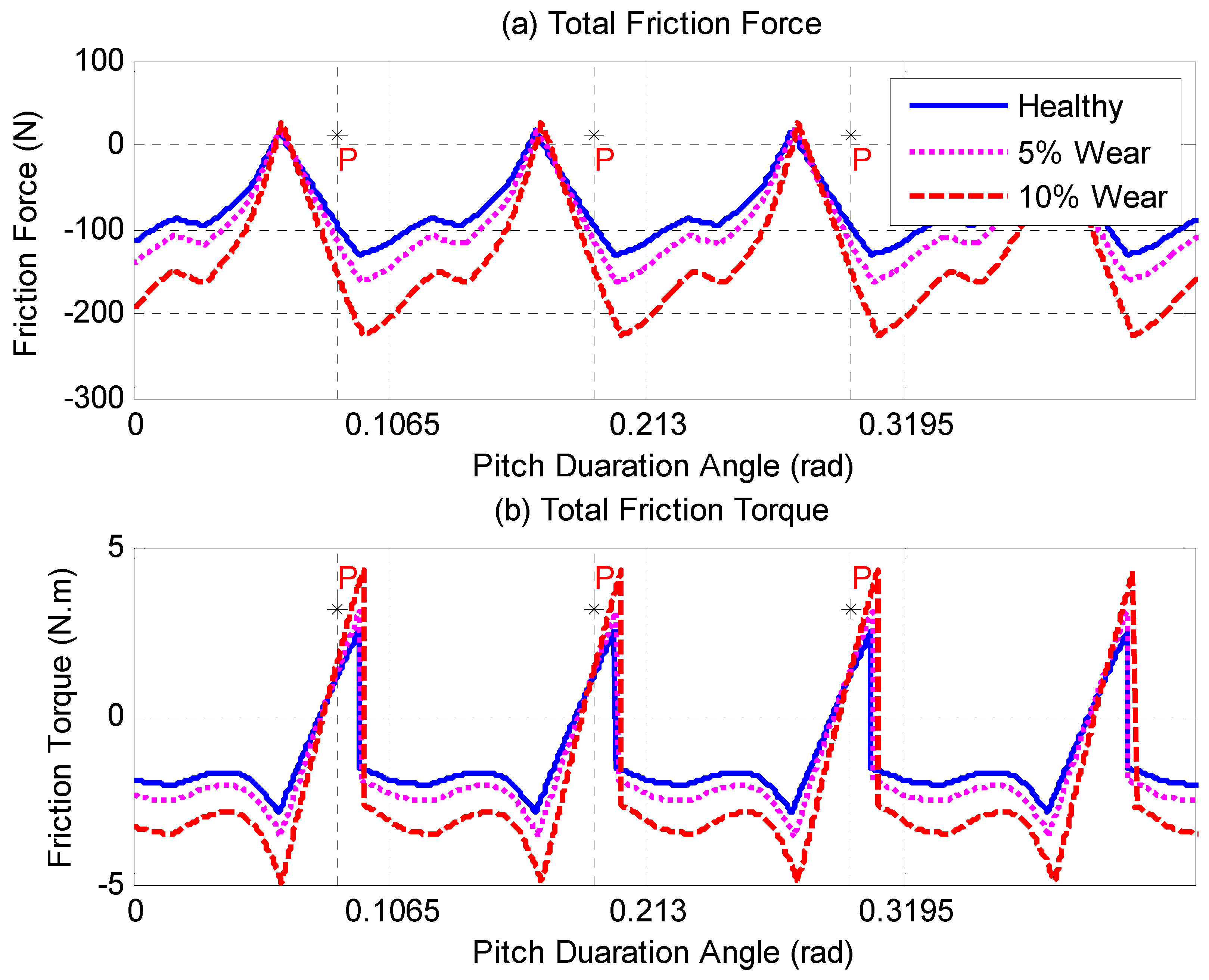
Wear of meshing gears will influence the frictional forces between them and the resulting torque. Figure 6 shows that the frictional forces and consequent wear can have considerable effects on gear meshing. Thus, consideration of the instantaneous lubricant interface between the interacting surfaces is essential when modelling the effect of friction and surface contact of meshing gears by making the analysis of gear vibration more realistic.

5. Numerical Model of a Two-Stage Helical Gearbox

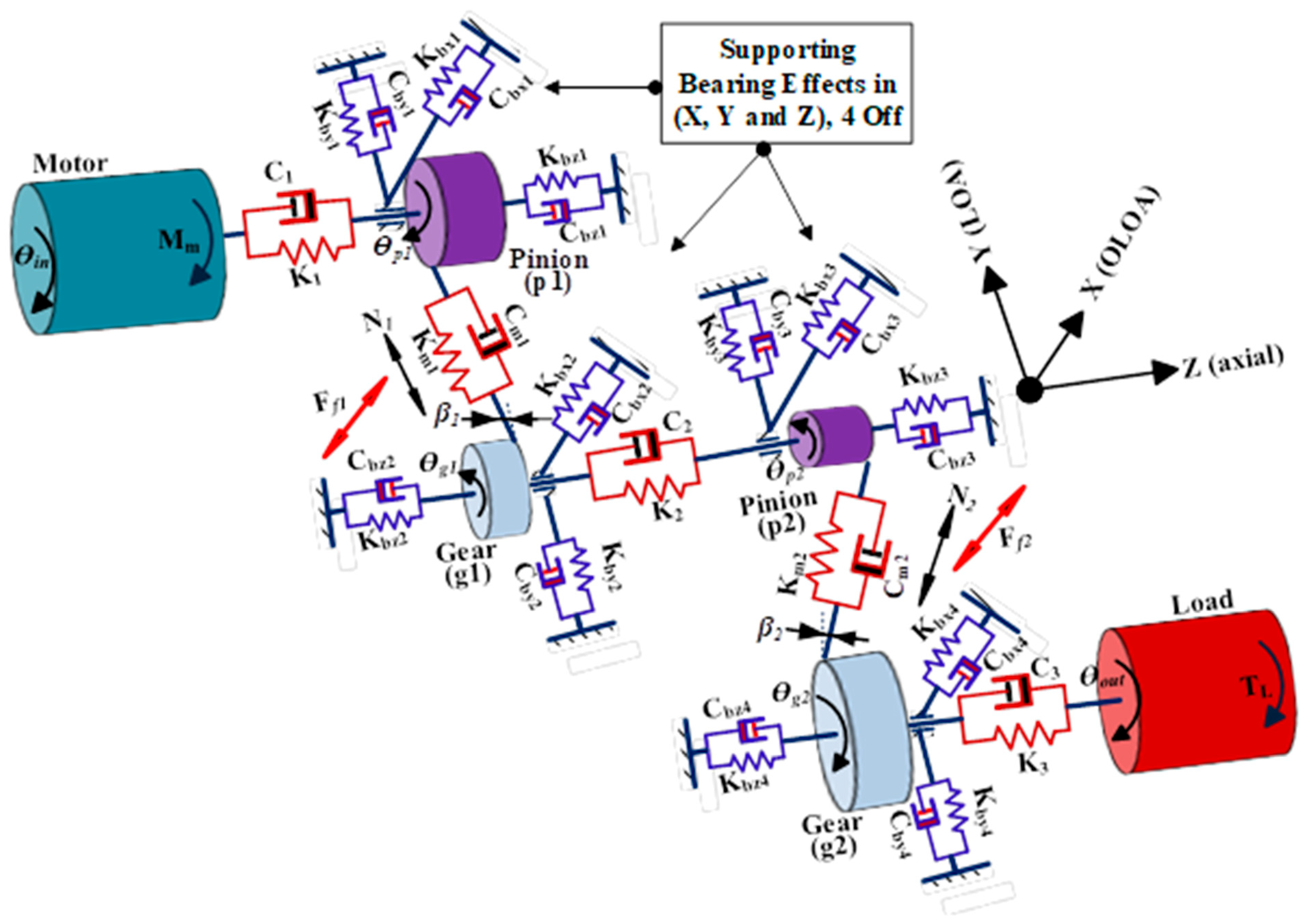
A mathematic model of a two-stage helical gearbox with 18-DoF (Degree of Freedom) as proposed by Brethee et al. [27] is used for a numerical simulation to investigate the dynamic interplay between meshing gears and assess the proposed signal processing techniques for fault diagnostics. The model, as illustrated in Figure 7, has simulated how non-uniform wear affected the dynamic behaviour of the gearbox of a wind turbine. For more realistic simulation, the model considers how the driving motor and applied load affect gear transmission. Non-uniform wear effects were simulated in the first stage of the gearbox, as an uneven meshing impact and greater excitation of vibration and noise. All details of the operating condition for the simulated model and the derived equation of motions for rotational and translational motions are well-defined in Brethee et al. [27].

6. Effects of Operating Parameters

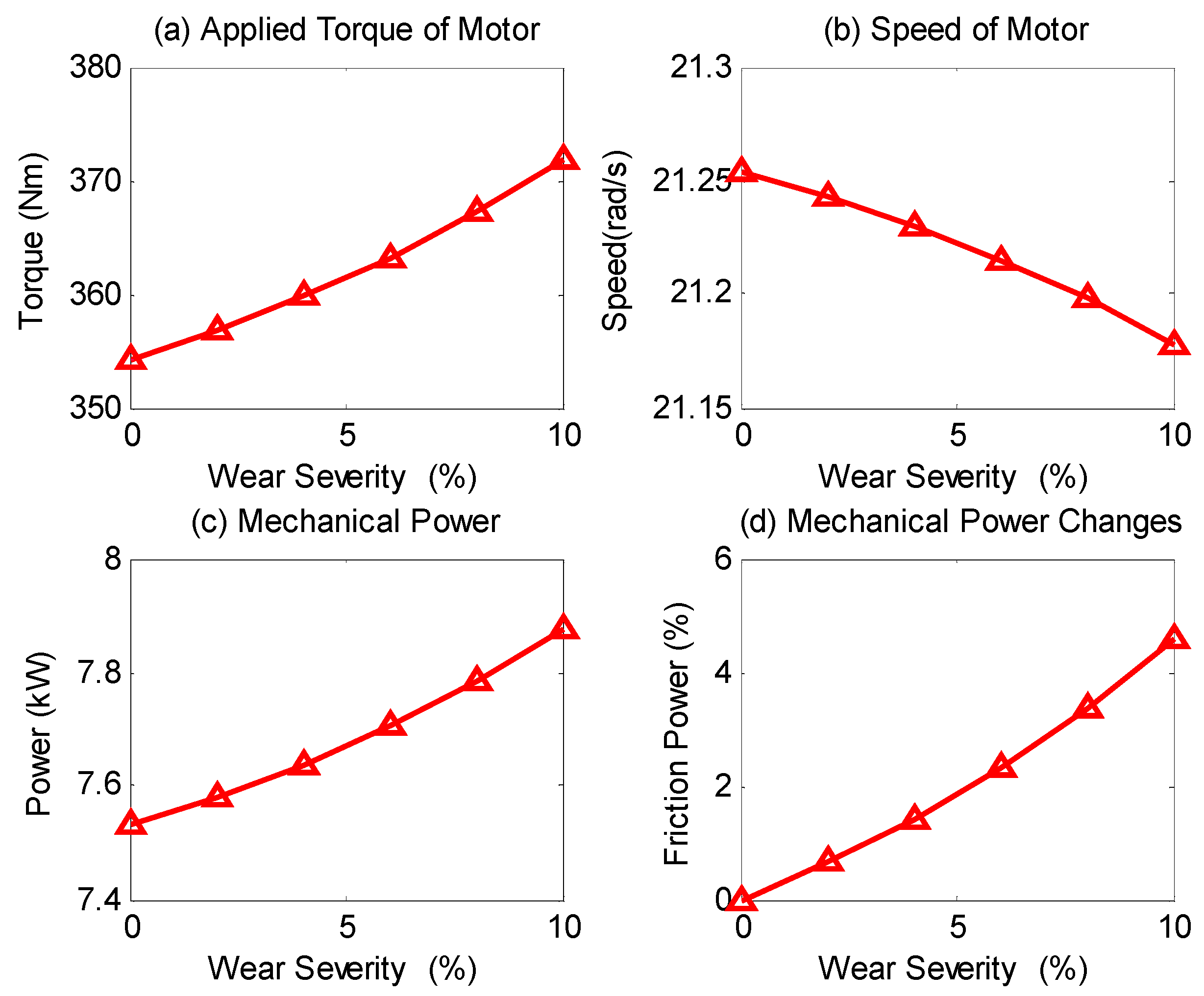
The operating parameters strongly influence the nature and degree of the wear induced between the interacting tooth surfaces in any gear system. To confirm the numerical simulation was close to reality, the operating conditions were kept unchanged when different severities of non-uniform wear were simulated. Thus, the applied torque load was kept at TL = 29.25 Nm, which corresponds to an input motor torque of Tm = 354.3 Nm at an operating speed of 1275rpm. Figure 8 shows how changes in the operating conditions of the driving motor effect non-uniform wear severity. We see that increasing severity of gear wear significantly increases the input torque of the driving motor, alongside a slight decrease in its operating speed. This means additional input power would be required to maintain the operating speed at its desired setting. The input power of the driving motor is increased almost linearly with wear severity with a maximum change of about 5% for a 10% increase in wear severity. The variation in the operating condition parameters of the model prediction shows consistent changes with a realistic operational condition of the gear transmission system.

7. Vibration Spectra Calculations

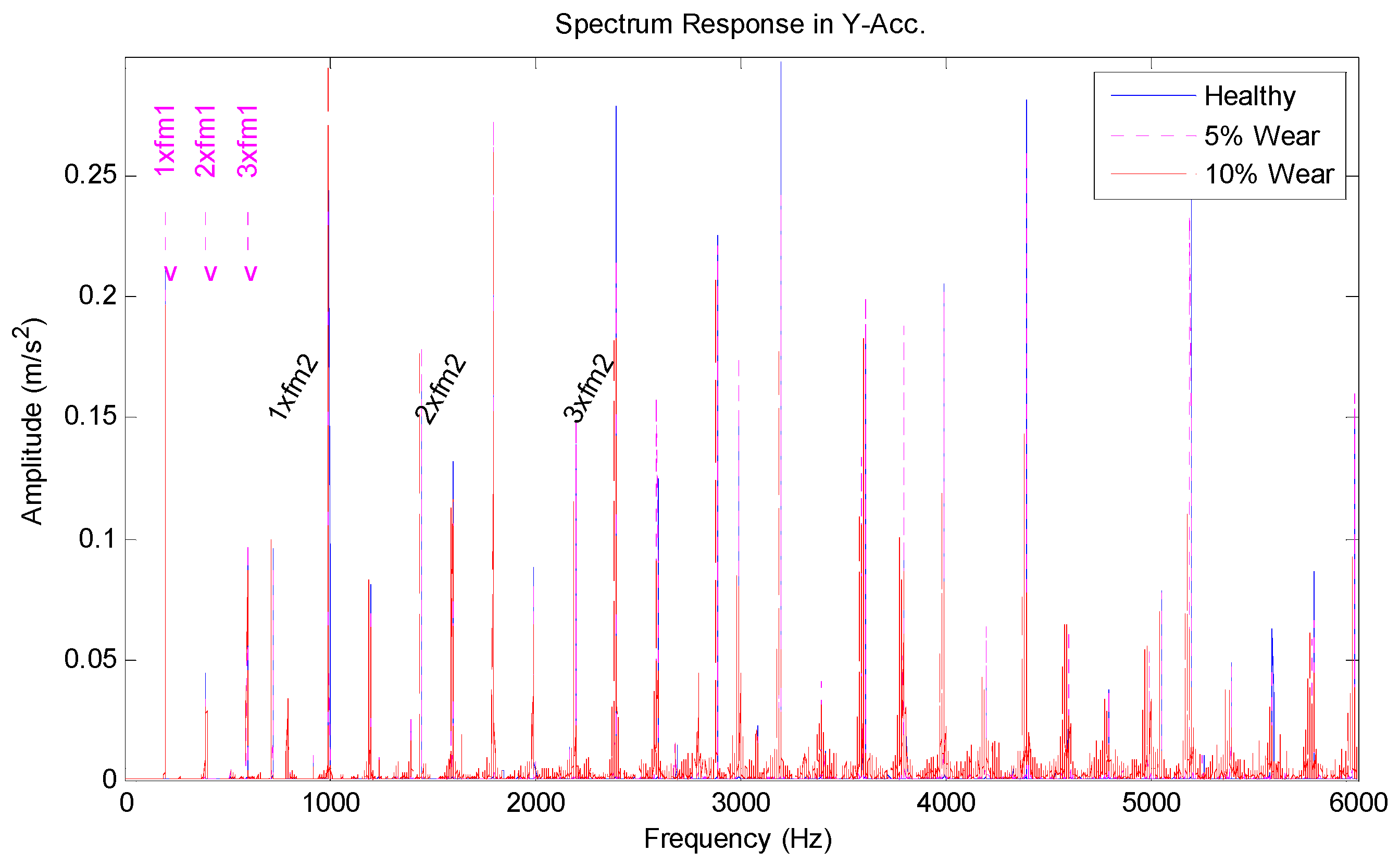
The analysis of noise and vibration spectrums can be a basis for identifying and understanding the source of the generating signal and used to identify nonlinearities within the signal. It can characterise uneven effects and identify abnormal changes in nonstationary signals from which effective diagnostic features can be extracted [13,39]. Spectral analysis of vibration signals from gears is used for in-depth monitoring and interpreted for information regarding wear of the surfaces of the gear teeth. The vibration spectrums of the proposed numerical model with the progression of the non-uniform wear are illustrated in Figure 9. The figure shows the general pattern of acceleration response (amplitude in m/s2) where the spectral peaks are related to the gear meshing frequencies (fm1 = 198 Hz and fm2 = 719 Hz). The spectral peaks exhibit higher excitation with increasing wear severity, and it can be taken as a realistic indication of non-uniform tooth surface wear in helical gears.

8. Vibration at Meshing Frequencies

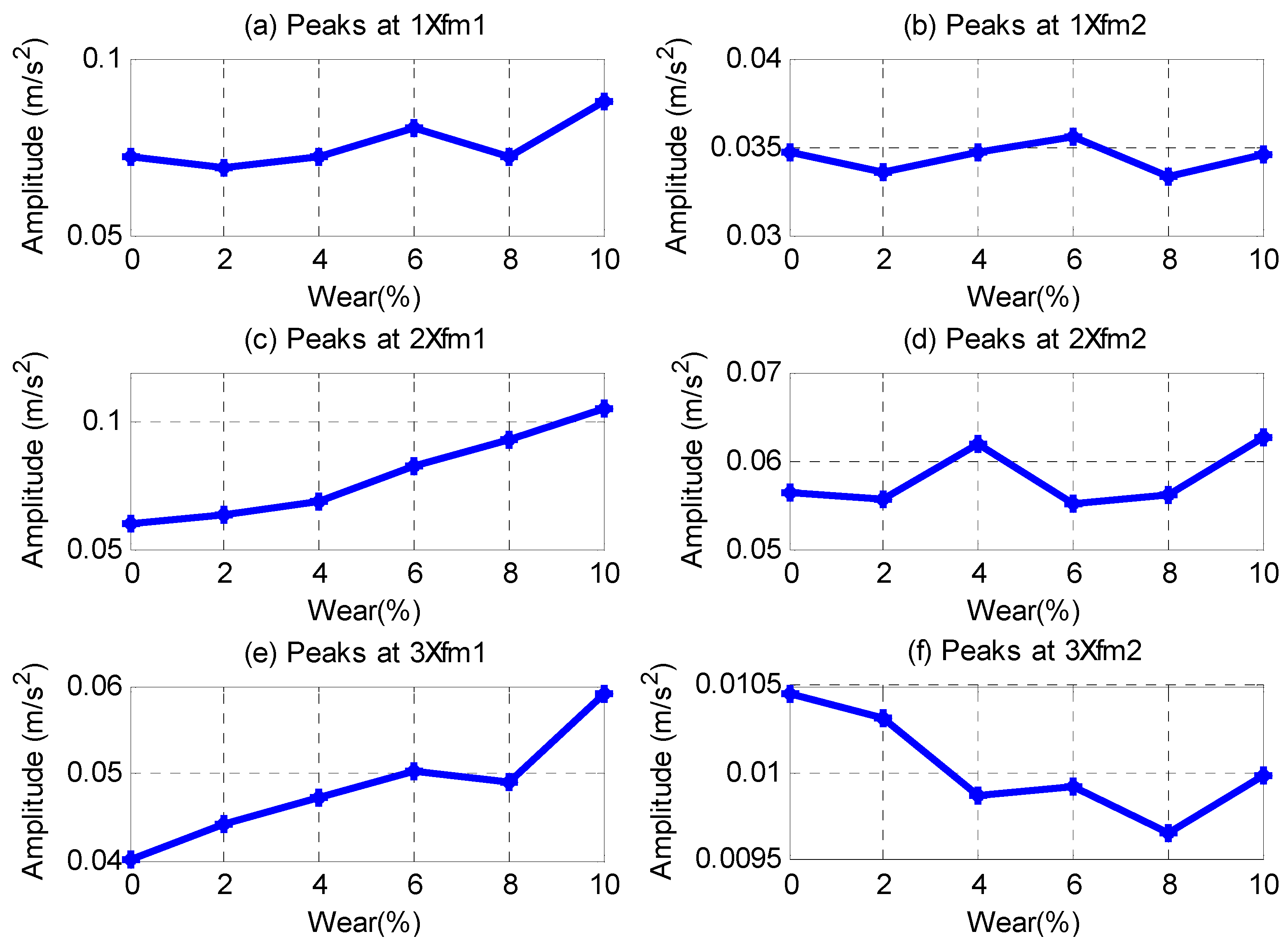
Spectrum analysis closely examines certain waveforms and discretizes the amplitude changes in certain frequency components. Effective features enabling diagnosis of faults can be identified via examination of the variation in the amplitude of the frequencies of interest [13,39]. Hence, if the defect belongs to a specific frequency component, it can easily extract an early indication to its progression. The analysis of spectral performance at the components of the gear meshing frequencies can indicate how wear of the surface of a tooth effects gear meshing. Variation in the amplitudes of the fundamental, second and third harmonics of the gear meshing frequency (fm1, fm2 and fm3, respectively) with the progression of non-uniform wear are seen in Figure 10, where the amplitude of the second and third harmonics increased almost linearly with wear severity, which can be used as the basis of a wear progression indicator. Hereafter, there is the slight and unstable fluctuation in the components of the healthy meshing frequency (fm2).

9. Vibration at Sideband Frequency Components

Typically, spectrum analysis includes unique frequency components that directly relate to the performance of the machinery components; additional frequency components (sidebands) may also be excited due to nonlinear behaviour of the rotating parts. Significant changes in sideband amplitudes can be taken as an early warning of abnormal conditions and the amplitude as an indication of the magnitude of a fault and its progression. Reduction in meshing stiffness and the resulting excitation of nonlinear vibrations will generate additional impulsive sidebands about the gear meshing frequencies [27,32,39].
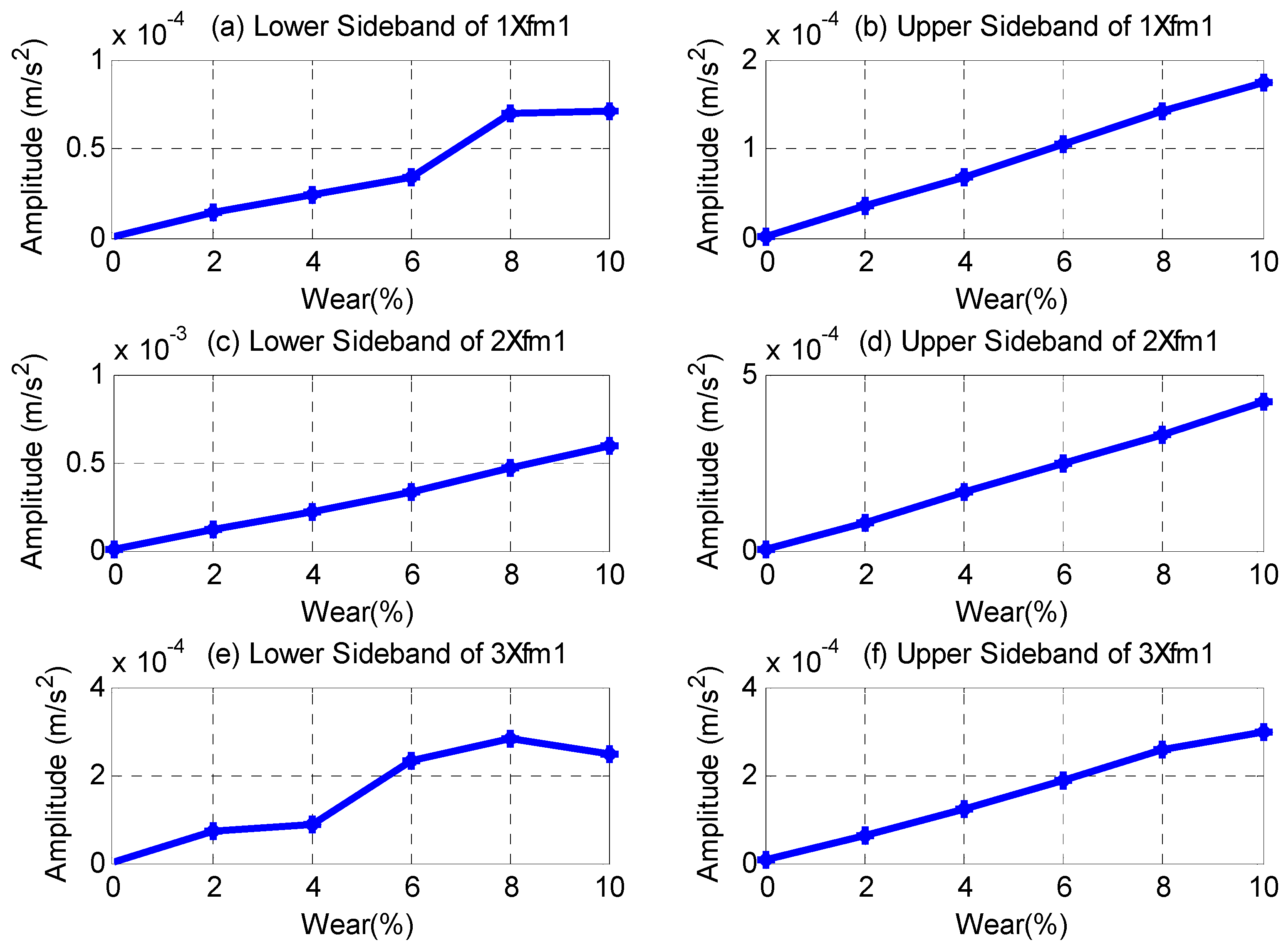
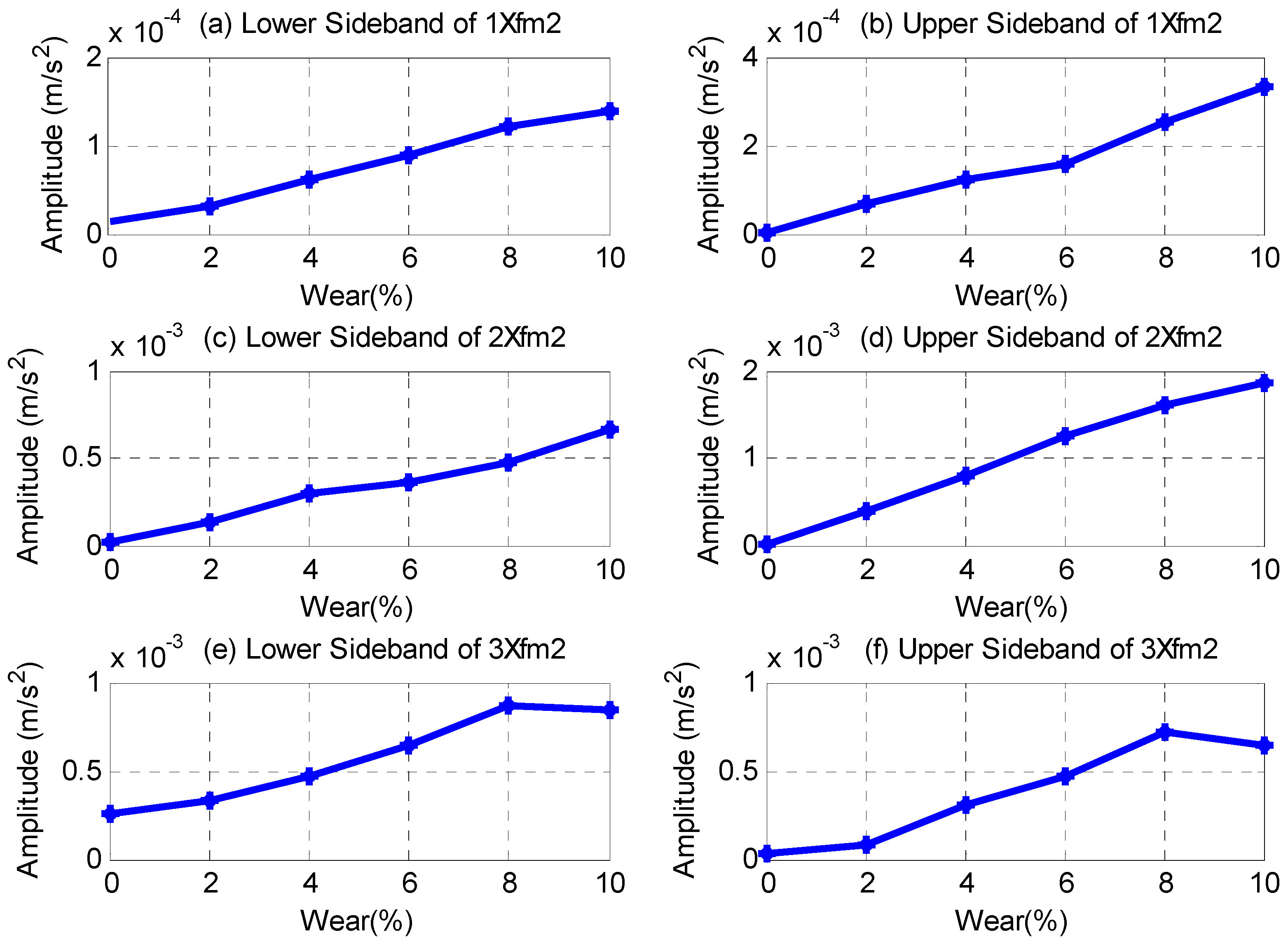
With increasing severity of the non-uniform wear, the spectrum exhibits more sideband components, and amplitudes of already existing sidebands increase. For the average peak amplitudes of those sidebands adjacent to meshing harmonics (fm1,2,3 ± fr) the effects of the progression of non-uniform wear are seen in Figure 11 and Figure 12. We see that every peak displays a clear increase with the progression of non-uniform wear (save for one anomalous reading for the lower sideband for 3 × fm1). For the given results we see that the increase in spectral peak of the upper sidebands for 2 × fm1 is the most significant, and this could be the sideband that would be most sensitive to severity of non-uniform wear.

10. Conclusions

This study has examined the influence of non-uniform gear tooth wear, modelled as a nonstationary random process, on the vibration response and dynamic characteristics of helical gearboxes employed in wind-turbine applications. A dynamic nonlinear model was developed to investigate the coupled interactions between the progression of non-uniform wear on helical gear tooth surfaces and the resulting system-level vibration behaviour, explicitly accounting for elasto-hydrodynamic lubrication friction regimes.
The results demonstrate that non-uniform wear significantly alters meshing conditions, leading to uneven load distribution, increased dynamic excitation, and pronounced changes in vibration signatures.
These effects manifest as elevated frictional losses and reverse torque phenomena, thereby increasing the input power required to maintain steady operation.
The proposed modelling framework provides a new basis for evaluating nonstationary wear-induced dynamics in helical gears and offers physically interpretable indicators that are directly relevant to condition monitoring and prognostics. As such, the findings contribute to improved reliability assessment and support the development of predictive maintenance strategies for wind-turbine gear transmission systems.
Generally, as the severity of the non-uniform wear progressed, there was a clear tendency for the amplitudes of fm1, fm2 and fm3 to increase. But this was not an entirely consistent phenomenon, as seen in Figure 10. However, while the peaks of adjacent sidebands (fm1,2,3 ± fr) showed a smaller increase in amplitude, that increase was more consistent, as seen in Figure 11 and Figure 12. The increases in the peak amplitudes and their sidebands reveal the progression of non-uniform wear severity and have been shown to be useful in indicating imperfections of helical tooth surfaces.
Future work will focus on experimental validation of the proposed model using vibration and operational data from laboratory test rigs and in-service wind-turbine gearboxes. Particular emphasis will be placed on correlating model-predicted nonstationary vibration features with condition monitoring system measurements to enable practical implementation in fault diagnosis and prognostics. In addition, the framework will be extended to incorporate variable wind loading, torque fluctuations, and temperature-dependent lubrication behaviour to more accurately reflect real operating environments. The integration of the proposed model within digital twin and remaining useful life estimation frameworks will also be investigated, with the aim of supporting adaptive maintenance decision-making and enhancing the long-term reliability of wind-turbine gear transmission systems.

Author Contributions

All authors contributed to the conceptualization of the study, writing of the original draft, critical revision of the manuscript, and supervision of the research. All authors have read and agreed to the published version of the manuscript.

Funding

This research received no external funding.

Data Availability Statement

Available upon request sent to khaldon77m@uoanbar.edu.iq.

Acknowledgments

The authors would like to acknowledge the University of Anbar, Iraq.

Conflicts of Interest

The authors declare no conflicts of interest.

References

  1. Salameh, J.P.; Cauet, S.; Etien, E.; Sakout, A.; Rambault, L. Gearbox condition monitoring in wind turbines: A review. Mech. Syst. Signal Process. 2018, 111, 251–264. [Google Scholar] [CrossRef]
  2. Kahraman, A.; Ding, H. Wear in Gears. In Encyclopedia of Tribology; Wang, Q.J., Chung, Y.W., Eds.; Springer: Boston, MA, USA, 2013. [Google Scholar] [CrossRef]
  3. Hamilton, A.; Cleary, A.; Quail, F. Development of a novel wear detection system for wind turbine gearboxes. IEEE Sens. J. 2013, 14, 465–473. [Google Scholar] [CrossRef]
  4. Blau, P.; Walker, L.; Xu, H.; Parten, R.; Qu, J.; Geer, T. Wear Analysis of Wind Turbine Gearbox Bearings; DOE-ORNL/TM-2010/59; US Department of Energy: Oak Ridge, TN, USA, 2010.
  5. Ibrahim, G.; Albarbar, A.; Abouhnik, A.; Shnibha, R. Adaptive filtering based system for extracting gearbox condition feature from the measured vibrations. Measurement 2013, 46, 2029–2034. [Google Scholar] [CrossRef]
  6. Kahraman, A.; Bajpai, P.; Anderson, N.E. Influence of tooth profile deviations on helical gear wear. J. Mech. Des. 2005, 127, 656–663. [Google Scholar] [CrossRef]
  7. Wang, X.; Tang, J.; Wang, Y.; Ruan, J.; An, S. Optimal analysis of TSM fitting considering contact interface TECs of meshing gears. Adv. Mech. Eng. 2021, 13, 16878140211037765. [Google Scholar] [CrossRef]
  8. Gong, Y.; Fei, J.L.; Tang, J.; Yang, Z.G.; Han, Y.M.; Li, X. Failure analysis on abnormal wear of roller bearings in gearbox for wind turbine. Eng. Fail. Anal. 2017, 82, 26–38. [Google Scholar] [CrossRef]
  9. Kharoufeh, J.P. Explicit results for wear processes in a Markovian environment. Oper. Res. Lett. 2003, 31, 237–244. [Google Scholar] [CrossRef]
  10. Yuan, Z.; Wu, Y.; Zhang, K.; Dragoi, M.V.; Liu, M. Wear reliability of spur gear based on the cross-analysis method of a nonstationary random process. Adv. Mech. Eng. 2018, 10, 1687814018819294. [Google Scholar] [CrossRef]
  11. Yin, Z.; Liu, B.; Yang, C.; Wang, H.; Fu, X.; Xu, J.; Fan, Z. Study on the tooth surface wear characteristics of helical gears under mixed elastohydrodynamic lubrication. Mech. Sci. 2025, 16, 565–578. [Google Scholar] [CrossRef]
  12. Scheffer, C.; Girdhar, P. Practical Machinery Vibration Analysis and Predictive Maintenance; Elsevier: Amsterdam, The Netherlands, 2004. [Google Scholar]
  13. Jardine, A.K.; Lin, D.; Banjevic, D. A review on machinery diagnostics and prognostics implementing condition-based maintenance. Mech. Syst. Signal Process. 2006, 20, 1483–1510. [Google Scholar] [CrossRef]
  14. Li, Y.; Yuan, S.; Wu, W.; Liu, K.; Lian, C.; Song, X. Vibration analysis of two-stage helical gear transmission with cracked fault based on an improved mesh stiffness model. Machines 2022, 10, 1052. [Google Scholar] [CrossRef]
  15. Lei, Q.A.; Yuan, L.; Yu, X.; Sun, Y.; Li, H. Experimental-based study of gear vibration characteristics incorporating the fractal topography of tooth surface. Int. J. Mech. Syst. Dyn. 2023, 3, 173–182. [Google Scholar] [CrossRef]
  16. Liao, F.L.; Lu, H.L.; Huang, J.L.; Zhu, W.D. Dynamic characteristics of helical-gear systems considering axial mesh force component. Int. J. Mech. Sci. 2025, 304, 110628. [Google Scholar] [CrossRef]
  17. Mo, S.; Hu, Q.; Wang, L.; Cen, G.; Huang, Y. Research on stochastic dynamics of planetary gear system of wind turbine gearbox considering wear. Proc. Inst. Mech. Eng. Part C J. Mech. Eng. Sci. 2025, 239, 8233–8246. [Google Scholar] [CrossRef]
  18. Aherwar, A. An investigation on gearbox fault detection using vibration analysis techniques: A review. Aust. J. Mech. Eng. 2012, 10, 169–183. [Google Scholar] [CrossRef]
  19. Peng, Z.; Kessissoglou, N.J.; Cox, M. A study of the effect of contaminant particles in lubricants using wear debris and vibration condition monitoring techniques. Wear 2005, 258, 1651–1662. [Google Scholar] [CrossRef]
  20. Sun, X.; Wang, T.; Zhang, R.; Gu, F.; Ball, A.D. Numerical modelling of vibration responses of helical gears under progressive tooth wear for condition monitoring. Mathematics 2021, 9, 213. [Google Scholar] [CrossRef]
  21. Jia, C.; Zhang, G.; Li, G. Numerical analysis of tooth contact and wear characteristics of internal cylindrical gears with curved meshing line. Appl. Sci. 2024, 14, 5399. [Google Scholar] [CrossRef]
  22. Sun, Y.; Li, Y.; Zhang, Q.; Qin, X.; Chen, K. Wear analysis and simulation of small module gear based on Archard model. Eng. Fail. Anal. 2023, 144, 106990. [Google Scholar] [CrossRef]
  23. Mo, S.; Wang, L.; Hu, Q.; Cen, G.; Huang, Y. Coupling failure dynamics of tooth surface morphology and wear based on fractal theory. Nonlinear Dyn. 2024, 112, 175–195. [Google Scholar] [CrossRef]
  24. Poletto, J.C.; Fernandes, C.M.C.G.; Barros, L.Y.; Neis, P.D.; Pondicherry, K.; Fauconnier, D.; Ferreira, N.F.; Seabra, J.H.O.; De Baets, P. Identification of gear wear damage using topography analysis. Wear 2023, 522, 204837. [Google Scholar] [CrossRef]
  25. Mo, S.; Wang, L.; Liu, M.; Hu, Q.; Bao, H.; Cen, G.; Huang, Y. Study of the time-varying mesh stiffness of two-stage planetary gear train considering tooth surface wear. Proc. Inst. Mech. Eng. Part C J. Mech. Eng. Sci. 2024, 238, 279–297. [Google Scholar] [CrossRef]
  26. Andersson, A.; Vedmar, L. A dynamic model to determine vibrations in involute helical gears. J. Sound Vib. 2003, 260, 195–212. [Google Scholar] [CrossRef]
  27. Brethee, K.F.; Zhen, D.; Gu, F.; Ball, A.D. Helical gear wear monitoring: Modelling and experimental validation. Mech. Mach. Theory 2017, 117, 210–229. [Google Scholar] [CrossRef]
  28. Osman, T.; Velex, P. Static and dynamic simulations of mild abrasive wear in wide-faced solid spur and helical gears. Mech. Mach. Theory 2010, 45, 911–924. [Google Scholar] [CrossRef]
  29. Lundvall, O.; Klarbring, A. Simulation of wear by use of a nonsmooth Newton method—A spur gear application. Mech. Struct. Mach. 2001, 29, 223–238. [Google Scholar] [CrossRef]
  30. Bartelmus, W. Mathematical modelling and computer simulations as an aid to gearbox diagnostics. Mech. Syst. Signal Process. 2001, 15, 855–871. [Google Scholar] [CrossRef]
  31. Randall, R.B. A new method of modeling gear faults. J. Mech. Des. 1982, 104, 259–267. [Google Scholar] [CrossRef]
  32. Xu, Z.; Wei, J.; Zhang, S.; Liu, Z.; Chen, X.; Yan, Q.; Guo, J. A state-of-the-art review of the vibration and noise of wind turbine drivetrains. Sustain. Energy Technol. Assess. 2021, 48, 101629. [Google Scholar] [CrossRef]
  33. ISO 6336-1:2019; Calculation of Load Capacity of Spur and Helical Gears. ISO: Geneva, Switzerland, 2025. Available online: https://www.iso.org/standard/63819.html (accessed on 12 March 2026).
  34. Jiang, H.; Shao, Y.; Mechefske, C.K. Dynamic characteristics of helical gears under sliding friction with spalling defect. Eng. Fail. Anal. 2014, 39, 92–107. [Google Scholar] [CrossRef]
  35. He, S.; Gunda, R.; Singh, R. Inclusion of sliding friction in contact dynamics model for helical gears. J. Mech. Des. 2007, 129, 48–57. [Google Scholar] [CrossRef]
  36. Liu, G.; Parker, R.G. Impact of tooth friction and its bending effect on gear dynamics. J. Sound Vib. 2009, 320, 1039–1063. [Google Scholar] [CrossRef]
  37. Li, S.; Kahraman, A. A tribo-dynamic model of a spur gear pair. J. Sound Vib. 2013, 332, 4963–4978. [Google Scholar] [CrossRef]
  38. Xu, H. Development of a Generalized Mechanical Efficiency Prediction Methodology for Gear Pairs. Doctoral Dissertation, Ohio State University, Columbus, OH, USA, 2005. Available online: http://rave.ohiolink.edu/etdc/view?acc_num=osu1128372109 (accessed on 12 March 2026).
  39. Brethee, K.F.; Gu, F.; Ball, A.D. Frictional effects on the dynamic responses of gear systems and the diagnostics of tooth breakages. Syst. Sci. Control Eng. 2016, 4, 270–284. [Google Scholar] [CrossRef]
Figure 1. Effect of non-uniform wear on a helical tooth.
Vibration 09 00020 g001
Figure 2. The evolutions of the inhomogeneous wear topography on the helical tooth surface as measured by the Taylor Hobson surface roughness tester.
Vibration 09 00020 g002
Figure 3. The variation in contact lines and wear effect over the plane of action of helical gears, as in [27]. *—multiplication sign.
Vibration 09 00020 g003
Figure 4. Non-uniform wear and meshing stiffness of helical gears.
Vibration 09 00020 g004
Figure 5. Variation in contact force and meshing stiffness with progression of non-uniform wear across the gear teeth.
Vibration 09 00020 g005
Figure 6. Time varying of frictional excitations with the progression of non-uniform wear.
Vibration 09 00020 g006
Figure 7. Mathematical model of a two-stage helical gearbox as proposed by Brethee, K. F. et al. (2017) [27].
Vibration 09 00020 g007
Figure 8. Time varying operating parameters of the driving motor with the influence of non-uniform wear severity.
Vibration 09 00020 g008
Figure 9. Vibration spectrums derived from the numerical model as the non-uniform wear progresses.
Vibration 09 00020 g009
Figure 10. Spectral peaks of the fundamental meshing frequency with progression of non-uniform wear.
Vibration 09 00020 g010
Figure 11. Amplitudes of sideband peaks of the harmonics of the 2nd meshing frequency (fm1).
Vibration 09 00020 g011
Figure 12. Amplitudes of the sideband peaks around the harmonics of the 2nd meshing frequency (fm2).
Vibration 09 00020 g012
Disclaimer/Publisher’s Note: The statements, opinions and data contained in all publications are solely those of the individual author(s) and contributor(s) and not of MDPI and/or the editor(s). MDPI and/or the editor(s) disclaim responsibility for any injury to people or property resulting from any ideas, methods, instructions or products referred to in the content.