
Suppression Effects and Mechanisms of Fine Water Mist on Methane Explosions in Large-Scale Roadways via Experimental and CFD Studies

 ,
,
Abstract
1. Introduction
2. Experimental
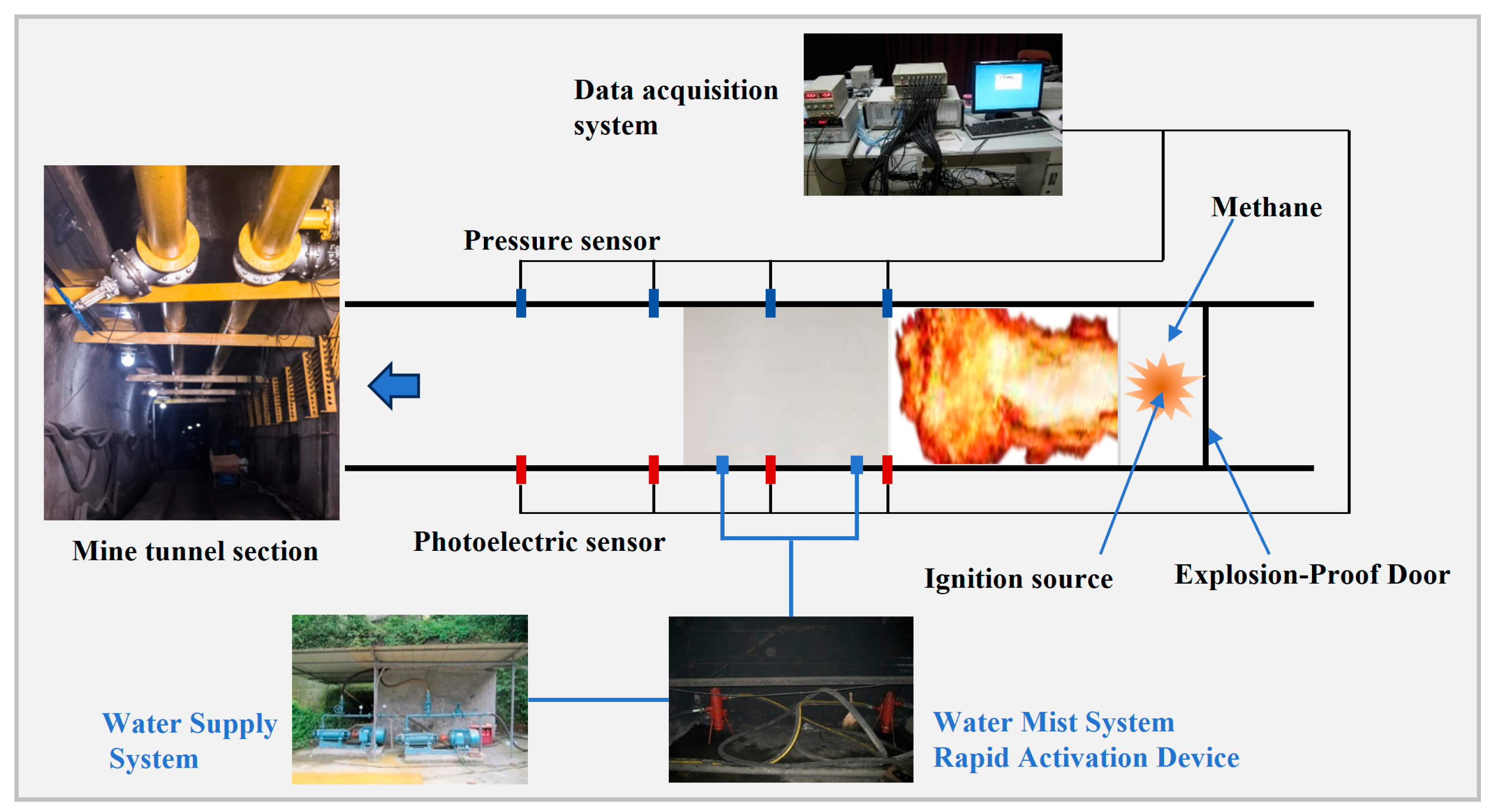
2.1. Experimental Setup
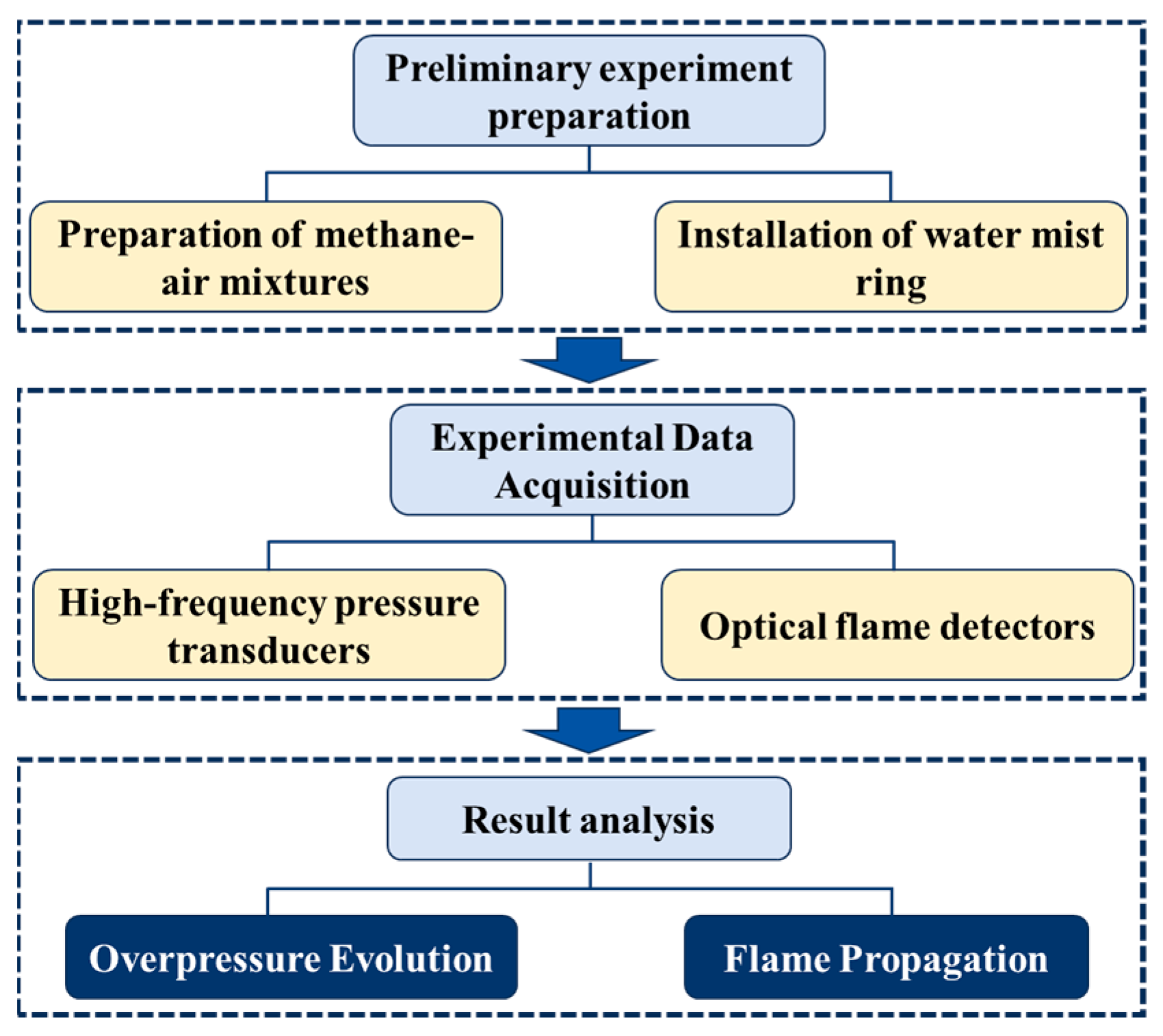
2.2. Experimental Procedure
3. Numerical Models
3.1. Reasonable Assumption
3.2. Mathematical Model
3.2.1. Gas-Phase Governing Equations
3.2.2. The Discrete-Phase Model
3.2.3. Turbulence Model
3.2.4. Two-Phase Coupling Equations
3.2.5. Droplet Breakup Model
3.2.6. Gas-Phase Combustion Model
3.2.7. Radiation Model
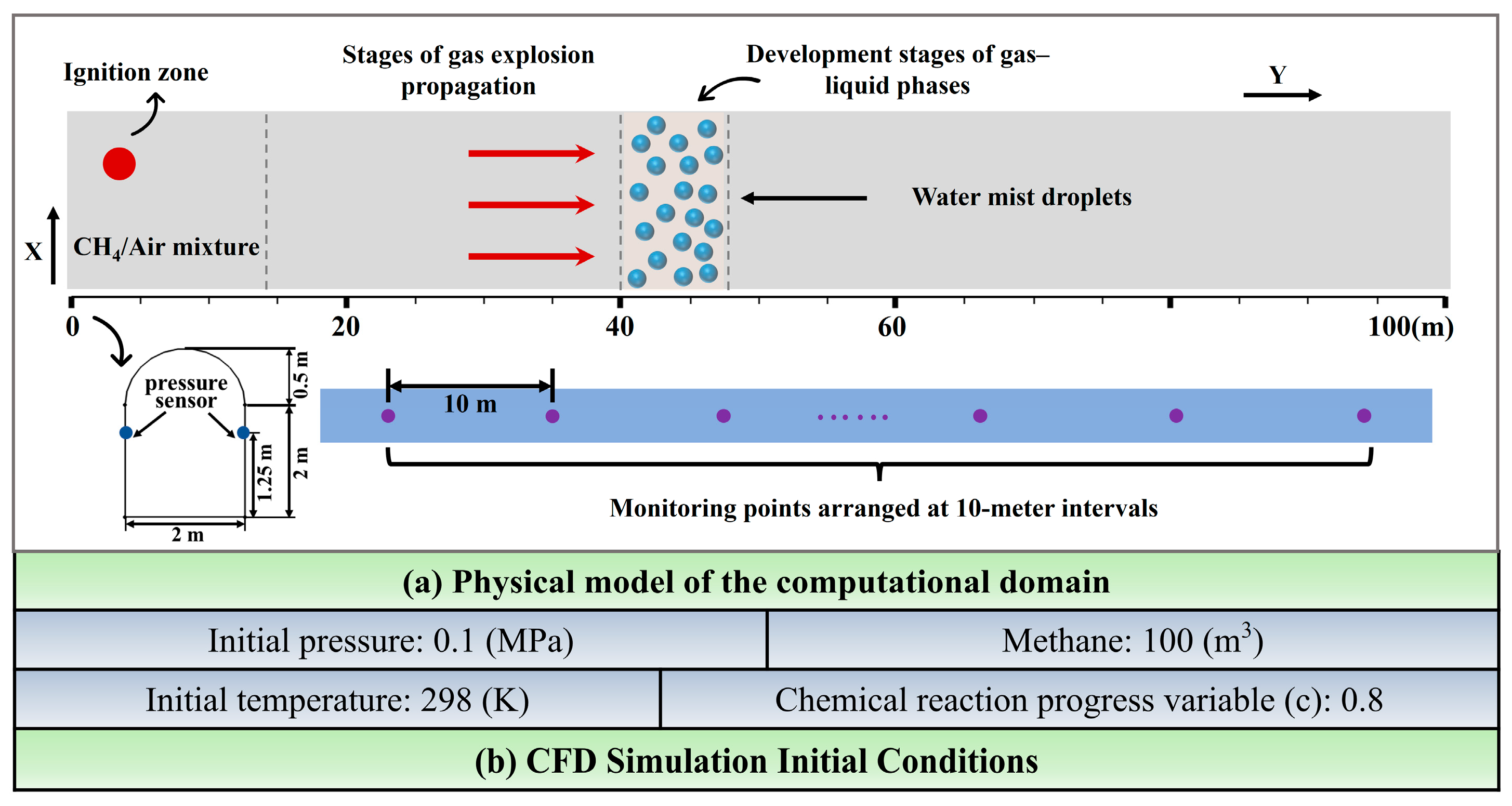
3.3. Physical Model and Initial Conditions
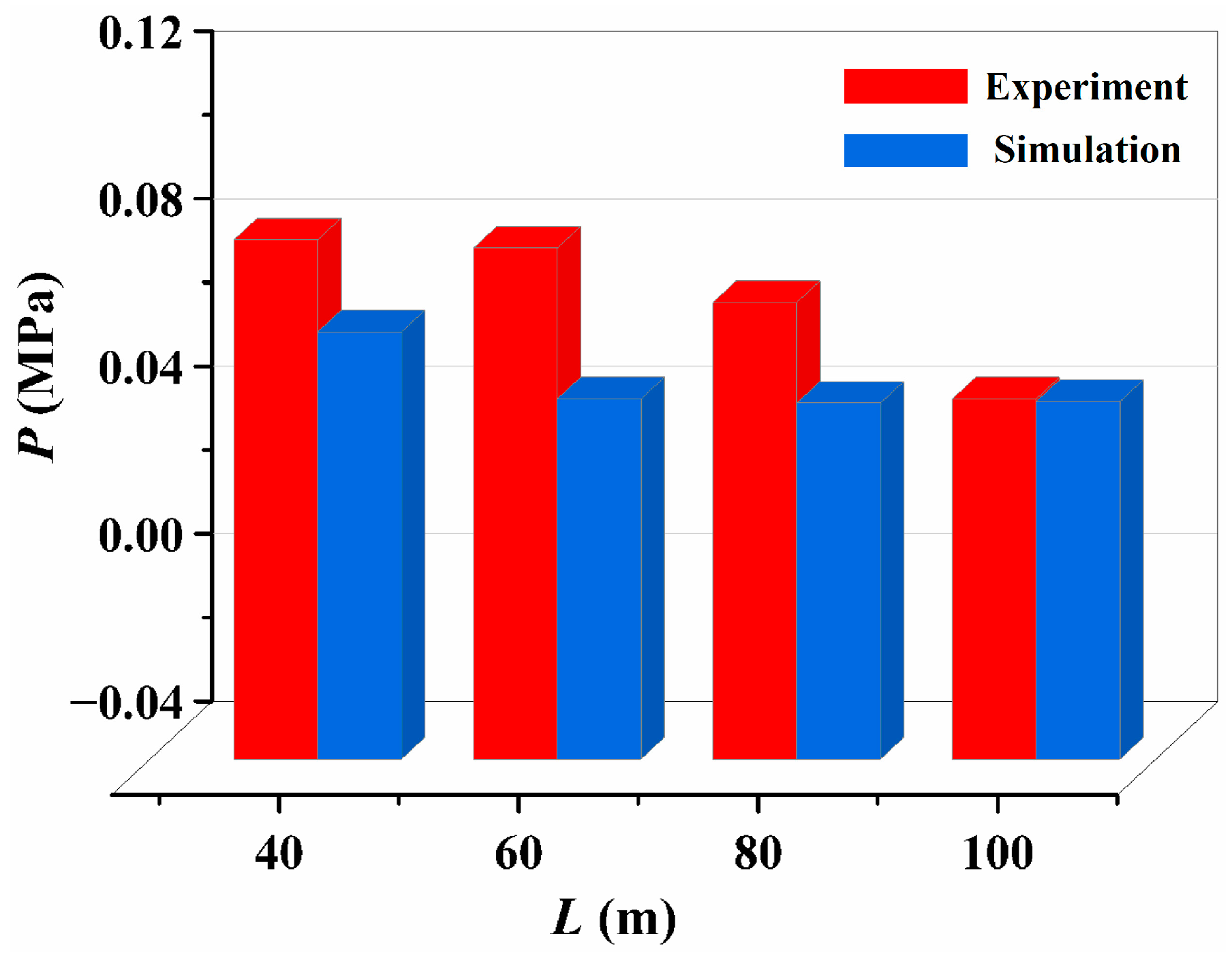
3.4. Verification of Model Reliability
4. Results and Discussion
4.1. Analysis of Experimental Results
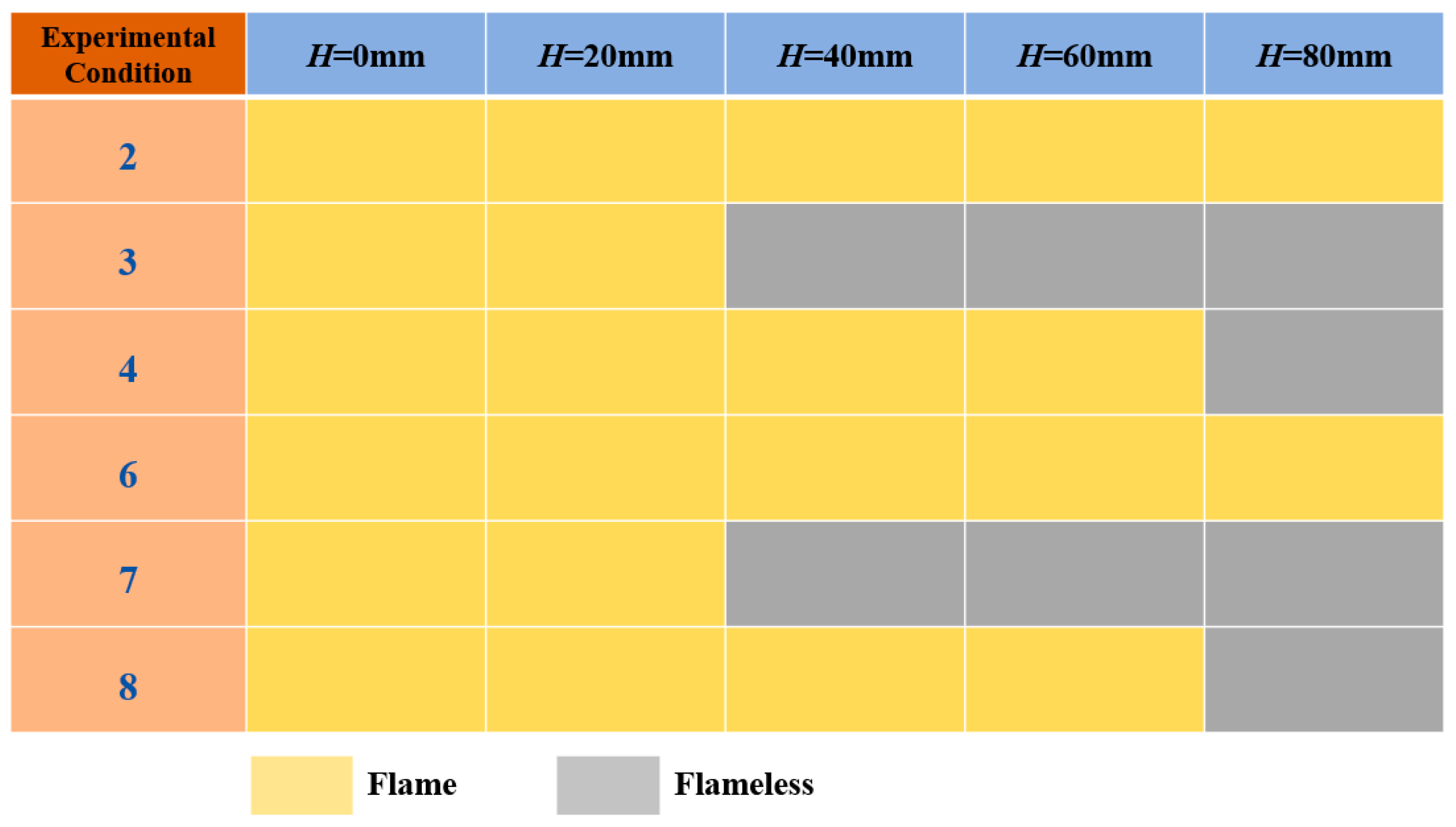
4.1.1. Suppressive Effect of Fine Water Mist on Methane Explosion Flame
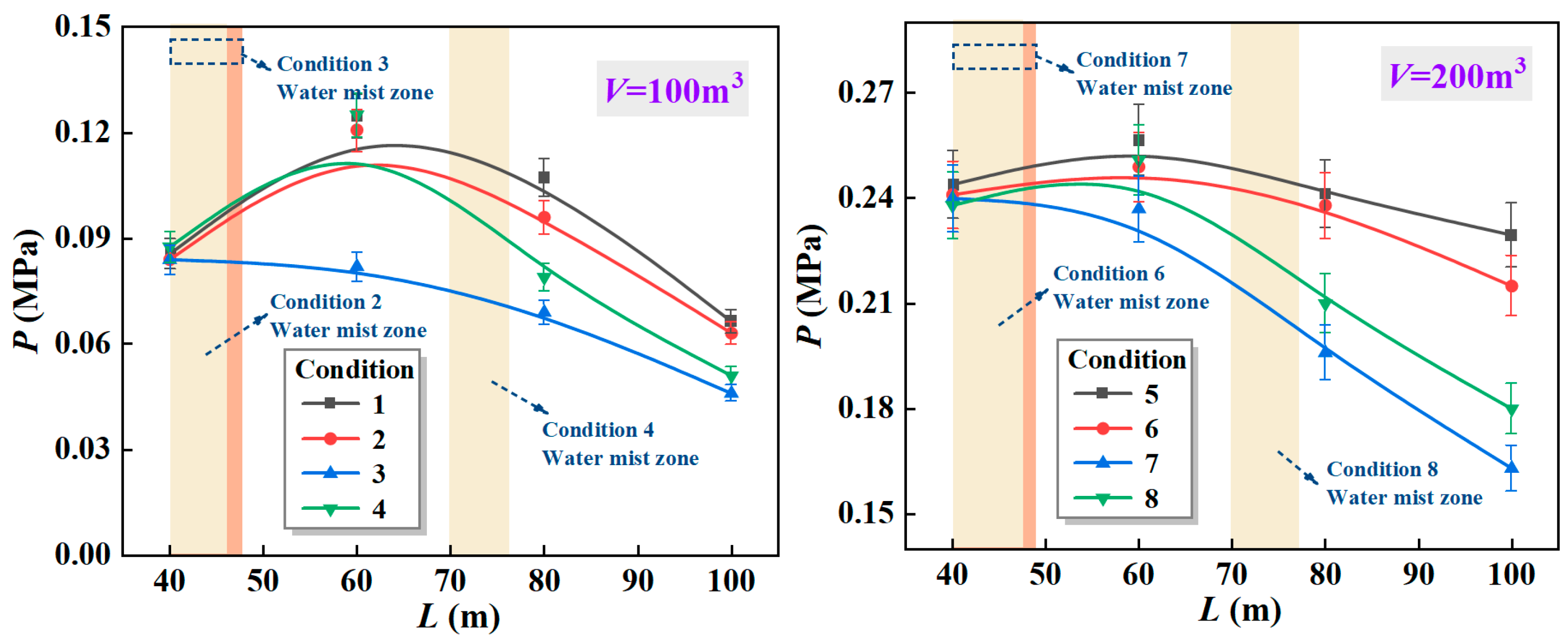
4.1.2. Suppressive Effect of Fine Water Mist on Methane Explosion Overpressure
4.2. Analysis of Simulation Results
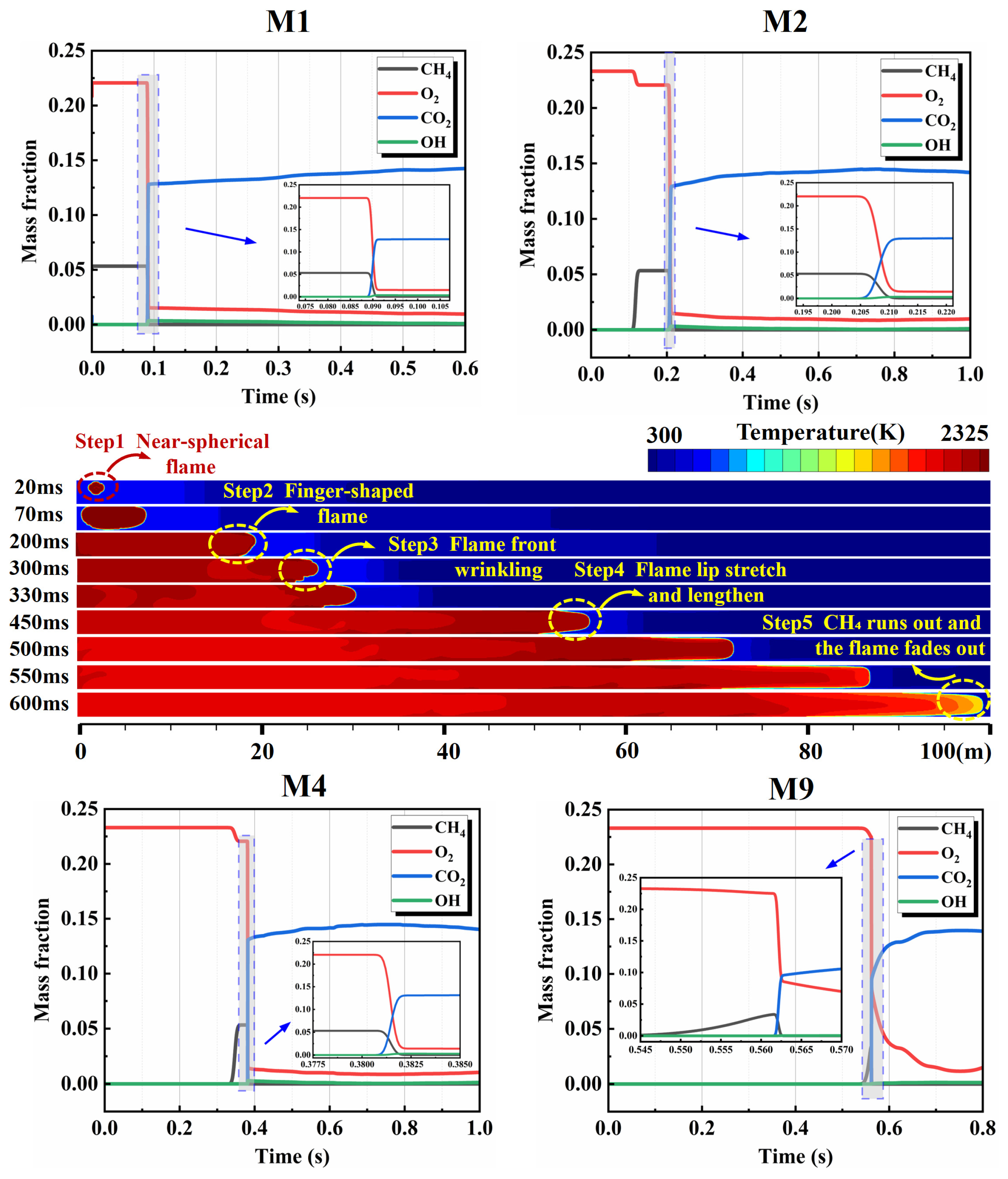
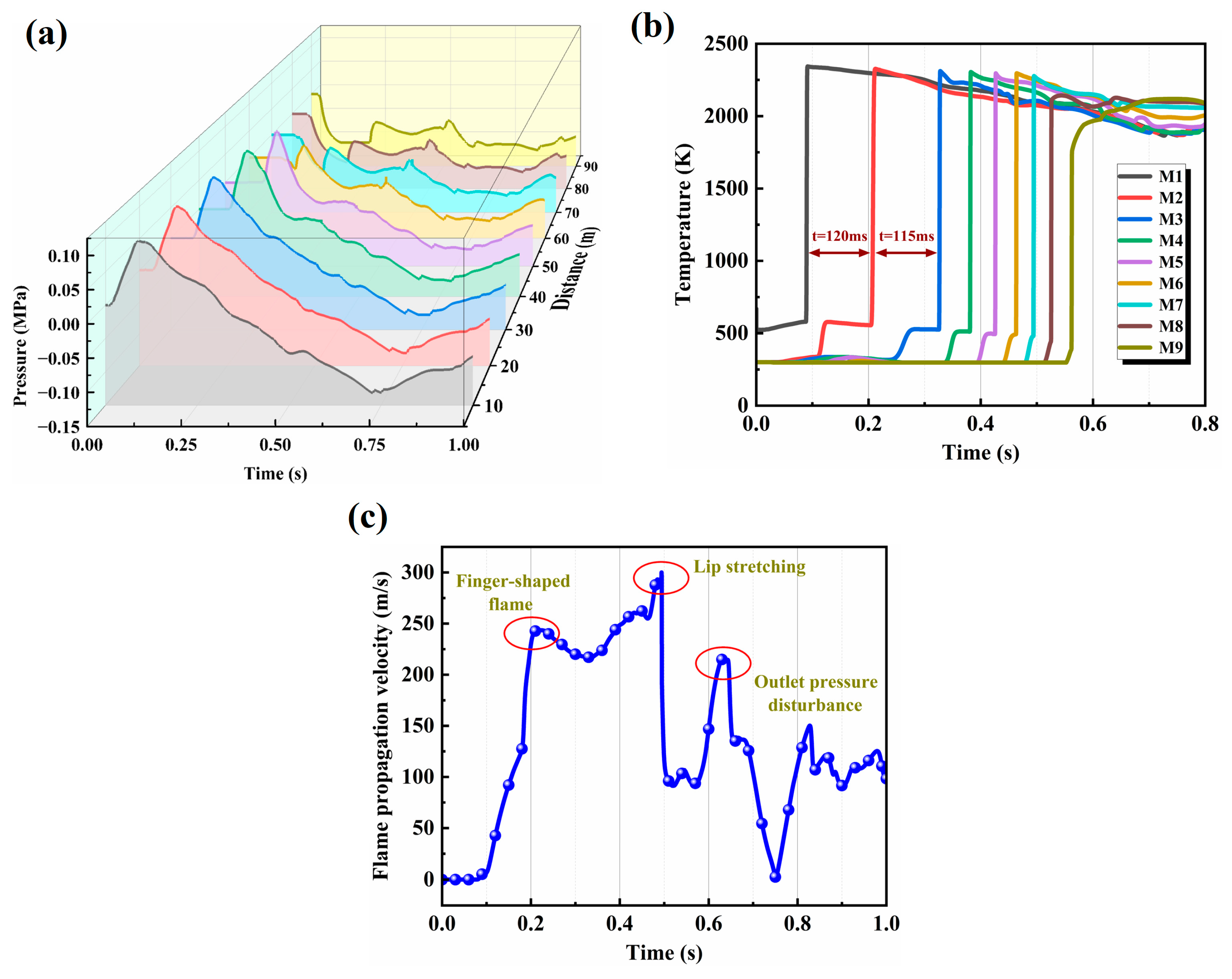
4.2.1. Analysis of Methane Explosion in a Large-Scale Roadway Without Fine Water Mist Suppression
4.2.2. Effect of Water Mist Concentration on Methane Explosion in a Large-Scale Roadway
4.2.3. Effect of Water Mist Placement on the Suppression by Find Water Mist
4.3. Mechanisms of Methane Explosion Suppression by Fine Water Mist in Large Scale Roadways
5. Conclusions
Author Contributions
Funding
Data Availability Statement
Conflicts of Interest
References
- Cheng, C.; Si, R.; Wang, L.; Jia, Q.; Xin, C.; Chen, X. Experimental study on the effect of initial accumulation pattern on gas explosion and explosion suppression in a real roadway. Case Stud. Therm. Eng. 2023, 51, 103544. [Google Scholar] [CrossRef]
- Yin, W.; Fu, G.; Yang, C.; Jiang, Z.; Zhu, K.; Gao, Y. Fatal gas explosion accidents on Chinese coal mines and the characteristics of unsafe behaviors: 2000–2014. Saf. Sci. 2017, 92, 173–179. [Google Scholar] [CrossRef]
- Li, H.; Zhai, F.; Li, S.; Lou, R.; Wang, F.; Chen, X.; Shu, C.M.; Yu, M. Macromorphological features and formation mechanism of particulate residues from methane/air/coal dust gas–solid two-phase hybrid explosions: An approach for material evidence analysis in accident investigation. Fuel 2022, 315, 123209. [Google Scholar] [CrossRef]
- Huang, Z.; Si, R.; Wen, G.; Jin, S.; Xue, S. Experimental Study on the Isolation Effect of an Active Flame-Proof Device on a Gas Explosion in an Underground Coal Mine. Fire 2023, 6, 468. [Google Scholar] [CrossRef]
- Wang, H.; Zhang, Y.; Tian, S.; Hu, Y.; Xu, J. Experimental study on characteristics of methane-coal dust explosions and the spatiotemporal evolution of flow field in early flame. Case Stud. Therm. Eng. 2024, 61, 104978. [Google Scholar] [CrossRef]
- Dong, Z.; Liu, L.; Chu, Y.; Su, Z.; Cai, C.; Chen, X.; Huang, C. Explosion suppression range and the minimum amount for complete suppression on methane-air explosion by heptafluoropropane. Fuel 2022, 328, 125331. [Google Scholar] [CrossRef]
- Yu, M.G.; Zhu, X.N.; Pei, B.; Yang, Y. Experimental study on methane explosion suppression using carbon dioxide and ultra-fine water mist. J. China Coal Soc. 2015, 40, 2843–2848. [Google Scholar]
- Li, M.; Xu, J.; Wang, C.; Wang, B. Thermal and kinetics mechanism of explosion mitigation of methane-air mixture by N2/CO2 in a closed compartment. Fuel 2019, 255, 115747. [Google Scholar] [CrossRef]
- Dounia, O.; Vermorel, O.; Poinsot, T. Theoretical analysis and simulation of methane/air flame inhibition by sodium bicarbonate particles. Combust. Flame 2018, 193, 313–326. [Google Scholar] [CrossRef]
- Wen, X.; Wang, M.; Wang, F.; Yu, M.; Deng, H. Combined effects of obstacle and fine water mist on gas explosion characteristics. Chin. J. Chem. Eng. 2020, 40, 131–140. [Google Scholar] [CrossRef]
- Holborn, P.G.; Battersby, P.N.; Ingram, J.M.; Averill, A.F.; Nolan, P.F. Modelling the mitigation of a hydrogen deflagration in a nuclear waste silo ullage with water fog. Process Saf. Environ. Prot. 2013, 91, 476–482. [Google Scholar] [CrossRef]
- Holborn, P.G.; Battcrsby, P.; Ingram, J.; Auerill, A.F.; Nolan, P.F. Estimating the effect of water fog and nitrogen dilution upon the burning velocity of hydrogen deflagrations from experimental test data. Int. J. Hydrogen Energy 2013, 38, 6882–6895. [Google Scholar] [CrossRef]
- Grant, G.; Brenton, J.; Drysdale, D. Fire suppression by water sprays. Prog. Energy Combust. Sci. 2000, 26, 79–130. [Google Scholar] [CrossRef]
- Zhang, P.; Zhou, Y.; Cao, X.; Gao, X.; Bi, M. Enhancement effects of methane/air explosion caused by water spraying in a sealed vessel. J. Loss Prev. Process Ind. 2014, 29, 313–318. [Google Scholar] [CrossRef]
- Yu, M.G.; An, A.N.; You, H. Experimental study on inhibiting the gas explosion by water spray in tube. J. China Coal Soc. 2011, 36, 417–422. [Google Scholar]
- Back, G.G., III; Beyler, C.L.; Hansen, R. A quasi-steady-state model for predicting fire suppression in spaces protected by water mist systems. Fire Saf. J. 2000, 35, 327–362. [Google Scholar] [CrossRef]
- Shimizu, H.; Tsuzuki, M.; Yamazaki, Y.; Hayashi, A.K. Experiments and numerical simulation on methane flame quenching by water mist. J. Loss Prev. Process Ind. 2001, 14, 603–608. [Google Scholar] [CrossRef]
- Pei, B.; Lyu, H.; Wu, Z.; Jia, C.; Xu, T.; Li, R. Study on the synergistic effect of inert gas and ultrafine water mist on hydrogen explosion suppression. Int. J. Hydrogen Energy 2024, 82, 531–543. [Google Scholar] [CrossRef]
- Ingram, J.M.; Auerill, A.F.; Battersby, P.N.; Holborn, P.G.; Nolan, P.F. Suppression of hydrogen-oxygen-nitrogen explosions by fine water mist: Part 1. Burning velocity. Int. J. Hydrogen Energy 2012, 37, 19250–19257. [Google Scholar] [CrossRef]
- Cao, X.; Ren, J.; Bi, M.; Zhou, Y.; Li, Y. Experimental research on the characteristics of methane/air explosion affected by ultrafine water mist. J. Hazard. Mater. 2016, 324, 489–497. [Google Scholar] [CrossRef]
- Bekele, A.G.; Zhang, B.; Xia, Y.; Wang, B.; Zhang, S.; Yue, W. Experimental Study on the Characteristic Premixed Methane/Hydrogen Deflagration and Water Mist Suppression in a Semi-Confined Duct. Case Stud. Therm. Eng. 2025, 72, 106280. [Google Scholar]
- Han, S.; Jeon, D.; Yun, H.D.; Kim, G.Y.; Kim, K.; Yee, J.J.; Park, S. Explosion scenario analysis of hydrogen refueling stations: Mitigation of blast pressure behind protective walls using experiments and CFD simulations. Int. J. Hydrogen Energy 2010, 152, 11. [Google Scholar] [CrossRef]
- Lucas, M.; Hisken, H.; Skjold, T.; Arntzen, B.J.; Wingerden, K.V. CFD modelling of hydrogen and hydrogen-methane explosions—Analysis of varying concentration and reduced oxygen atmospheres. J. Loss Prev. Process Ind. 2023, 83, 105012. [Google Scholar] [CrossRef]
- Xu, X.; Lu, K. Influence of Ignition Position on Explosion Characteristics in Linked Vessels with a Concentration Gradient. Fire 2026, 9, 56. [Google Scholar] [CrossRef]
- Islas, A.; Fernández, A.R.; Betegón, C.; Martinez-Paneda, E.; Pandal, A. Biomass dust explosions: CFD simulations and venting experiments in a 1 m3 silo. Process Saf. Environ. Prot. 2023, 176, 1048–1062. [Google Scholar] [CrossRef]
- Edalati-Nejad, A.; Fanaee, S.A.; Ghodrat, M.; Salehi, F.; Khadem, J. The time dependent investigation of methane-air counterflow diffusion flames with detailed kinetic and pollutant effects into a micro/macro open channel. Case Stud. Therm. Eng. 2020, 18, 100603. [Google Scholar] [CrossRef]
- Collin, A.; Boulet, P.; Parent, G.; Lacroix, D. Numerical simulation of a water spray—Radiation attenuation related to spray dynamics. Int. J. Therm. Sci. 2007, 46, 856–868. [Google Scholar] [CrossRef]
- Schwer, D.A.; Kailasanath, K. Numerical simulations of the mitigation of unconfined explosions using water-mist. Proc. Combust. Inst. 2007, 31, 2361–2369. [Google Scholar] [CrossRef]
- Holborn, P.G.; Battersby, P.; Ingram, J.M.; Auerill, A.F.; Nolan, P.F. Modelling the mitigation of lean hydrogen deflagrations in a vented cylindrical rig with water fog. Int. J. Hydrogen Energy 2012, 37, 15406–15422. [Google Scholar] [CrossRef]
- Diao, S.; Li, H.; Wei, C.; Wang, J.; Yao, Y.; Yu, M. Numerical simulation on the inhibition effect of water mist capacity on hydrogen/air explosions. Process Saf. Environ. Prot. 2025, 198, 107231. [Google Scholar] [CrossRef]
- Jing, Q.; Wang, D.; Liu, Q.; Chen, X.; Shen, Y.; Wang, Z.; Zhong, Y. Inhibition effect and mechanism of ultra-fine water mist on CH4/air detonation: Quantitative research based on CFD technology. Process Saf. Environ. Prot. 2021, 148, 75–92. [Google Scholar] [CrossRef]
- Cao, X.; Wang, Z.; Lu, Y.; Wang, Y. Numerical simulation of methane explosion suppression by ultrafine water mist in a confined space. Tunn. Undergr. Space Technol. 2021, 109, 103777. [Google Scholar] [CrossRef]
- Luo, J.; Gao, W.; Zhang, K.; Huang, Z.; Jiang, H.; Li, G.; Jin, S.; Si, R.; Wen, G. CFD simulation with detailed chemical reaction mechanism of ultra-lean methane explosion at elevated temperatures. Int. J. Therm. Sci. 2010, 215, 12. [Google Scholar] [CrossRef]
- Xu, M.; Wei, S.; Lu, W.; Yu, M.; Chen, Z. Experimental and numerical study on the suppression of methane/coal dust hybrid explosion by DMMP water mist. Adv. Powder Technol. 2025, 36, 104894. [Google Scholar] [CrossRef]
- Li, J.; Wang, X.; Guo, J.; Zhang, J.; Zhang, S. Effect of concentration and ignition position on vented methane–air explosions. J. Loss Prev. Process Ind. 2020, 68, 104334. [Google Scholar] [CrossRef]
- Li, R.; Xiu, Z.; Liu, Z.; Xiao, F.; Li, M.; Liu, Q. Experimental study on the effect of concentration gradient on explosion dynamics and flame propagation in a methane-filled pipeline. Int. Commun. Heat Mass Transf. 2025, 165, 109110. [Google Scholar] [CrossRef]
- Reitz, R.D. Modeling atomization processes in high-pressure vaporizing sprays. At. Spray Technol. 1987, 3, 309–337. [Google Scholar]
- Zhao, H.; Wu, Z.W.; Li, W.F.; Xu, J.L.; Liu, H.F. Transition Weber number between surfactant-laden drop bag breakup and shear breakup of secondary atomization. Fuel 2018, 221, 138–143. [Google Scholar] [CrossRef]
- Moreno, J.; Casado, C.; Marugan, J. Improved discrete ordinate method for accurate simulation radiation transport using solar and LED light sources. Chem. Eng. Sci. 2019, 205, 151–164. [Google Scholar] [CrossRef]
- Perumal, T.M.; Krishna, S.M.; Tallam, S.S.; Gunawan, R. Reduction of kinetic models using dynamic sensitivities. Comput. Chem. Eng. 2013, 56, 37–45. [Google Scholar] [CrossRef]
- Hu, E.; Li, X.; Meng, X.; Chen, Y.; Cheng, Y.; Xie, Y.; Huang, Z. Laminar flame speeds and ignition delay times of methane–air mixtures at elevated temperatures and pressures. Fuel 2015, 158, 1–10. [Google Scholar] [CrossRef]
- Guildenbecher, D.R.; López-Rivera, C.; Sojka, P.E. Secondary atomization. Exp. Fluids 2009, 46, 371. [Google Scholar] [CrossRef]
- Hsiang, L.P.; Faeth, G.M. Drop deformation and breakup due to shock wave and steady disturbances. Int. J. Multiph. Flow 1994, 21, 545–560. [Google Scholar] [CrossRef]
- Coşanay, H.; Öztop, H.F.; Gür, M.; Bakır, E. Analysis of turbulent wall jet impingement onto a moving heated body. Int. J. Numer. Methods Heat Fluid Flow 2022, 32, 2938–2963. [Google Scholar] [CrossRef]
- Gur, M.; Oztop, H.; Biswas, N.; Selimefendigil, F. Three-dimensional analysis of turbulent twin-swirling jets onto a heated rectangular prism in a channel. Int. J. Numer. Methods Heat Fluid Flow 2025, 35, 1137–1171. [Google Scholar] [CrossRef]





| Experimental Condition | Methane–Air Mixture Volume (m3) | Number of Spray Ring | Spray Ring Location (Distance from Blast Door, m) |
|---|---|---|---|
| 1 | 100 | / | / |
| 2 | 100 | 5 | 40 |
| 3 | 100 | 6 | 40 |
| 4 | 100 | 5 | 70 |
| 5 | 200 | / | / |
| 6 | 200 | 6 | 40 |
| 7 | 200 | 7 | 40 |
| 8 | 200 | 6 | 70 |
Disclaimer/Publisher’s Note: The statements, opinions and data contained in all publications are solely those of the individual author(s) and contributor(s) and not of MDPI and/or the editor(s). MDPI and/or the editor(s) disclaim responsibility for any injury to people or property resulting from any ideas, methods, instructions or products referred to in the content. |
© 2026 by the authors. Licensee MDPI, Basel, Switzerland. This article is an open access article distributed under the terms and conditions of the Creative Commons Attribution (CC BY) license.
Share and Cite
Zhu, P.; Yan, Z.; Jia, Q.; Zhao, J.; Huang, Z.; Lu, Z.; Luo, J. Suppression Effects and Mechanisms of Fine Water Mist on Methane Explosions in Large-Scale Roadways via Experimental and CFD Studies. Fire 2026, 9, 221. https://doi.org/10.3390/fire9060221
Zhu P, Yan Z, Jia Q, Zhao J, Huang Z, Lu Z, Luo J. Suppression Effects and Mechanisms of Fine Water Mist on Methane Explosions in Large-Scale Roadways via Experimental and CFD Studies. Fire. 2026; 9(6):221. https://doi.org/10.3390/fire9060221
Chicago/Turabian StyleZhu, Pikai, Zheng Yan, Quansheng Jia, Jingqing Zhao, Zichao Huang, Zhengkang Lu, and Jing Luo. 2026. "Suppression Effects and Mechanisms of Fine Water Mist on Methane Explosions in Large-Scale Roadways via Experimental and CFD Studies" Fire 9, no. 6: 221. https://doi.org/10.3390/fire9060221
APA StyleZhu, P., Yan, Z., Jia, Q., Zhao, J., Huang, Z., Lu, Z., & Luo, J. (2026). Suppression Effects and Mechanisms of Fine Water Mist on Methane Explosions in Large-Scale Roadways via Experimental and CFD Studies. Fire, 9(6), 221. https://doi.org/10.3390/fire9060221