Article

Suppression Effects and Mechanisms of Fine Water Mist on Methane Explosions in Large-Scale Roadways via Experimental and CFD Studies


1
State Key Laboratory of Coal Mine Disaster Prevention and Control, Chongqing 400037, China
2
Fire and Explosion Pretention Research Brands, China Coal Technology and Engineering Group Chongqing Research Institute, Chongqing 400037, China
3
State Key Laboratory of Fine Chemicals, Department of Chemical Machinery and Safety Engineering, Dalian University of Technology, Dalian 116024, China
*
Authors to whom correspondence should be addressed.
Fire 2026, 9(6), 221; https://doi.org/10.3390/fire9060221
Submission received: 11 April 2026 / Revised: 11 May 2026 / Accepted: 21 May 2026 / Published: 27 May 2026
(This article belongs to the Special Issue Fire and Explosion Safety with Risk Assessment and Early Warning)

Abstract

This study investigated the suppression effects and mechanisms of fine water mist on methane/air explosions through large-scale roadway experiments and numerical simulations. Experiments showed that fine water mist curtains deployed at 40 m and 70 m effectively mitigate flame propagation and reduce overpressure. A coupled gas–liquid numerical model was developed to reproduce flame dynamics and droplet–flow interactions. The simulations revealed droplet breakup, transport, and coupling with the evolving explosion flow field, providing mechanistic insight into gas–liquid interactions in a confined roadway. Suppression by fine water mist is primarily driven by heat absorption and cooling, while radical chain interruption plays a secondary role. These coupled mechanisms significantly reduce flame propagation velocity and pressure rise rate, achieving complete suppression under optimized configurations. This study provides a solid foundation for the design and optimization of water mist explosion suppression systems in large-scale roadways.

1. Introduction

The gas (primarily composed of methane) explosion, ranks among the most destructive hazards in coal mining. It is characterized by sudden occurrence, rapid propagation, extensive damage, and a high potential for triggering secondary disasters [1,2,3]. This poses a severe threat to miners’ lives and underground facilities [4]. Despite long-term efforts in gas drainage, monitoring and early warning, and ventilation management, risks of gas accumulation and accidental ignition persist [5]. These are attributed to complex geological conditions, dynamic production activities, and human factors. Consequently, major gas explosion accidents still occur periodically. They result in immeasurable casualties and economic losses. Therefore, in-depth research on efficient and reliable explosion safety technologies is essential. Such research is crucial for improving the coal mine disaster prevention system and enhancing overall mining safety.
In actual mine roadways, explosion suppressants are typically sprayed following a methane explosion to mitigate hazards [6,7]. Common agents include dry powder, halogenated hydrocarbons, inert gases, and water mist. Fine water mist, produced by efficient atomization devices, generates a dispersion of micron-sized water droplets [8,9,10], which rapidly reduce temperature and gas concentration in the blast zone while suppressing flame propagation. Compared with other suppression materials, fine water mist offers several advantages, including low cost, minimal environmental impact, strong practicality, and stable performance [11,12]. As such, it is widely recognized as an effective measure for mitigating coal mine gas explosions.
Current experimental research on fine water mist for explosion suppression has achieved some progress. Investigations have been conducted under laboratory conditions using small-scale pipes and explosion chambers to explore the influence of fine water mist on gas explosion characteristics. Early research focused on the suppression mechanisms of water mist. Grant et al. [13] summarized the primary mechanisms and characteristics of water mist in fire suppression. It was found that water spray can inhibit combustion through evaporation and heat absorption, but it may also enhance turbulence, promoting the mixing of fuel and air and thus potentially accelerating combustion. A similar pattern was observed in the research by Zhang et al. [14] and Yu et al. [15] Studies by Gerard et al. [16] and Shimizu et al. [17] revealed that the evaporation of water mist into steam, which dilutes oxygen concentration, is one of the main causes of flame extinction. As research progressed, attention shifted to the effect of fine water mist on gas explosion behavior. Suppression effectiveness was found to be related to water mist concentration [18]. Both explosion pressure and flame propagation velocity gradually decrease as water mist concentration increases [19]. A critical suppression concentration exists for water mist. Below this threshold, pressure waves continue to intensify after passing through the mist zone. Using a small, sealed vessel, Cao et al. [20] investigated the effect of fine water mist concentration on flame propagation and overpressure, observing that beyond a certain concentration, further increases did not significantly reduce explosion pressure. Bekele et al. [21] examined the influence of fine water mist on the explosion characteristics of methane/hydrogen mixtures in a semi-confined setup, concluding that obstacles within the experimental pipeline increase combustion velocity and thereby complicate suppression. However, it must be noted that most current experiments are limited by space, cost, and safety. They are usually conducted in setups much smaller than actual mining tunnels. Boundary conditions are highly simplified. Large-scale tunnels have larger spatial dimensions, longer flame propagation distances, and wall effects closer to real tunnels. Traditional small-scale tunnels cannot capture the scale effects on explosion wave propagation, turbulence attenuation, or the diffusion, distribution, and residence time of water mist. Research based on real tunnel environments is urgently needed. Such research will allow a more accurate assessment of water mist technology for gas explosion safety protection.
Conclusions derived from experimental methods, while useful for engineering estimation, often lack generalizability and struggle to reveal underlying physical mechanisms. The development of Computational Fluid Dynamics (CFD) provides a powerful tool to overcome these limitations [22,23]. The core of CFD lies in solving the governing equations for mass, momentum, energy, and species transport [24]. By integrating multiphase flow models and combustion models, the intricate physical details of the entire explosion process can be reproduced with high resolution in a virtual space [25,26]. This enables a deeper understanding of the explosion flow field structure, key species distribution, flame propagation dynamics, and energy release pathways [27,28]. Holbom et al. [29] employed FLACS to simulate the explosion suppression effect of fine water mist in a semi-confined pipe. The influence of vent size on suppression was obtained. However, limited by simulation accuracy, more microscopic mechanisms were not revealed in their results. Within an Eulerian–Lagrangian framework, Diao et al. [30] captured the interaction mechanism between fuel and water mist. The heat absorption due to water mist evaporation was quantified. Jing et al. [31] determined the critical transition concentration of ultrafine water mist required to attenuate a methane explosion to deflagration using numerical simulation. The critical extinguishing concentration for complete suppression within explosion limits was also obtained. However, their study was confined to small pipes, limiting its applicability to real mine roadways. Cao et al. [32] investigated the heat transfer process between ultrafine water mist and explosion flames through numerical simulation. The heat exchange rate within the mist zone was found to be influenced by atomization parameters. Luo et al. [33] simulated the combustion characteristics of mine ventilation gas. The simulated lower explosion limit showed excellent agreement with experimental values. Xu et al. [34] utilized explosion dynamics models to explore the trends of explosion pressure and temperature under the action of suppressants and fine water mist. Relationships between reaction products and explosion parameters were established. Therefore, numerical simulation methods, combined with fluid dynamics, thermodynamics, and explosion propagation theory, can effectively compensate for the shortcomings of experimental approaches. Simulations allow for more intuitive observation of the suppression effects of fine water mist under various conditions. They help reveal microscopic mechanisms, thereby providing more precise guidance for practical applications.
Despite extensive research on fine water mist for methane explosion suppression, most studies have been limited to laboratory conditions, leaving their applicability to actual mine roadways uncertain. Furthermore, existing numerical simulations rarely undergo systematic validation against flame propagation and overpressure evolution in real roadways, restricting understanding of suppression mechanisms under realistic conditions. To address these gaps, the present study performs large-scale experiments in authentic mine roadways, systematically investigating the effects of mist curtain length and installation position on suppression performance and overpressure dynamics. Complementary numerical simulations are conducted to elucidate the mechanisms by which fine water mist affects flow, temperature, and pressure fields at the microscopic level. By integrating experimental and computational analyses, this work clarifies the suppression mechanisms of fine water mist under large-scale roadway conditions. The findings provide a scientific basis for optimizing the design and evaluating the effectiveness of active fine water mist suppression systems, offering practical guidance for real-world applications.

2. Experimental

2.1. Experimental Setup

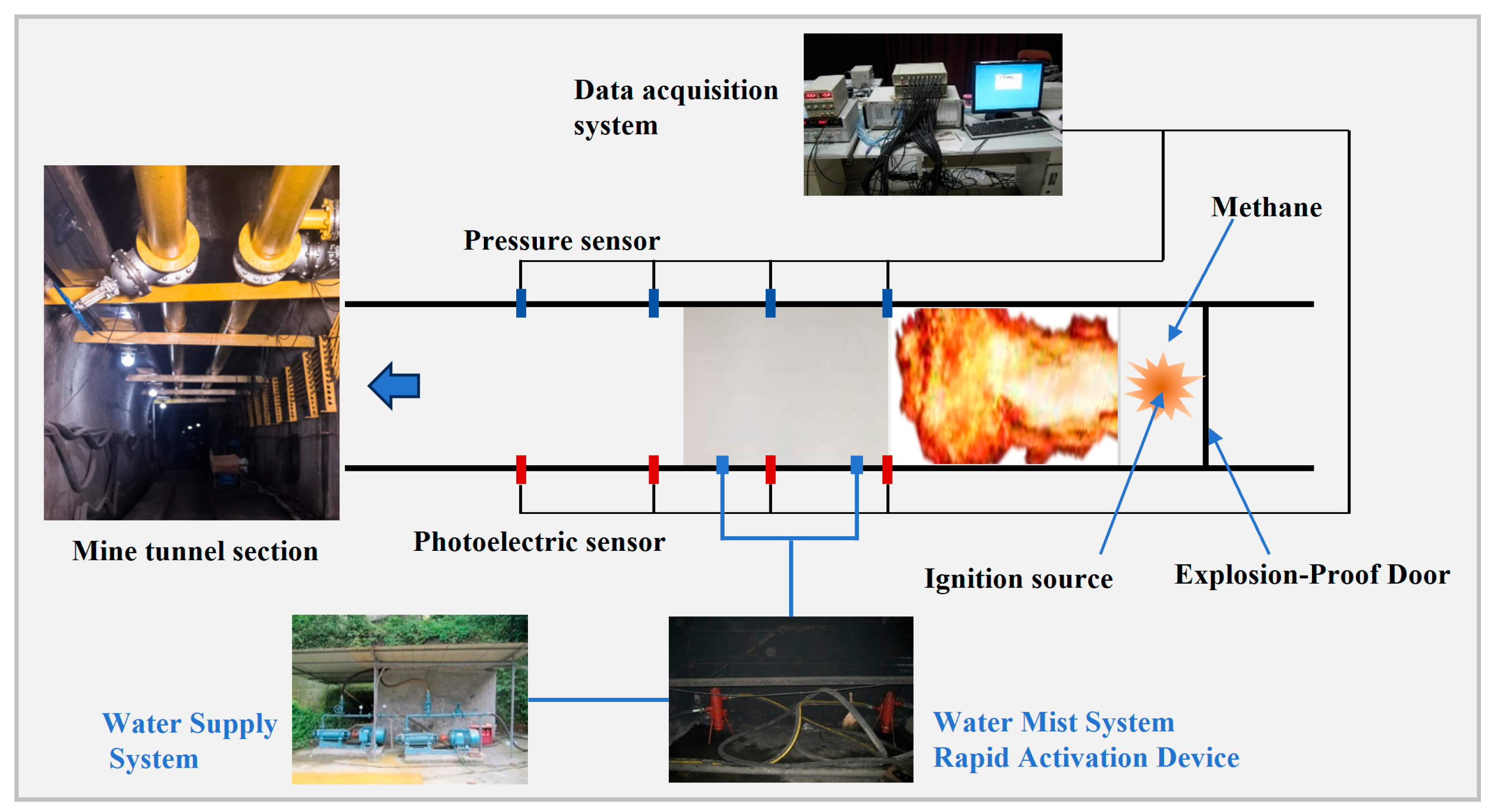
The methane explosion test was conducted in a large-scale roadway with a total length of 896 m and a semi-circular arch cross-section of 7.2 m2. As shown in Figure 1, explosion-proof doors were installed. After closure, the roadways became closed at one end and open at the other. Ignition was initiated from the closed end, and propagation proceeded toward the open end. This configuration approximates a realistic explosion scenario in an underground roadway. The explosion-proof door position was defined as the zero point. The 14 m/28 m roadways sections were sealed using PVC membranes to form 100 m3/200 m3 chambers. These chambers were filled with a methane–air mixture at approximately 9.5% concentration to ensure optimal explosivity [35,36].
The water mist system consists of a series of spray rings. Each ring contains six nozzles with identical performance parameters. The high-pressure atomizing nozzles have a spray angle of 90°. The nozzle spacing is about 0.5 m. They are evenly distributed around the ring. The tested average droplet size is 198 μm. During operation, a group of sequentially arranged spray rings forms a continuous water curtain. Each nozzle is supplied with high-pressure water at 2.5 MPa. The flow rate is 27.60 L/min. The spray system is activated at the same time as ignition. The water source in the tank is stable due to the pipeline connection. Therefore, the water mist lasts throughout the experiment. Due to the electrical signal propagation delay and the switch actuation delay, the device opens the nozzle within 5 ms after receiving the ignition signal, initiating the water mist spray.
To comprehensively capture key parameters during the explosion process, multiple high-frequency pressure transducers and optical flame detectors were deployed along the roadways wall within the 40–100 m range. This formed a distributed and synchronous monitoring network, which accurately recorded the distribution of peak explosion overpressure and flame arrival timing. All sensor signals were transmitted via shielded cables to a high-speed explosion measurement system based on an NI PXIe architecture. The system supported multi-channel synchronous acquisition across several modules. It featured a high sampling rate (≥1 MS/s) and strong anti-interference capabilities. Real-time acquisition and storage of both pressure and flame signals were thus achieved.

2.2. Experimental Procedure

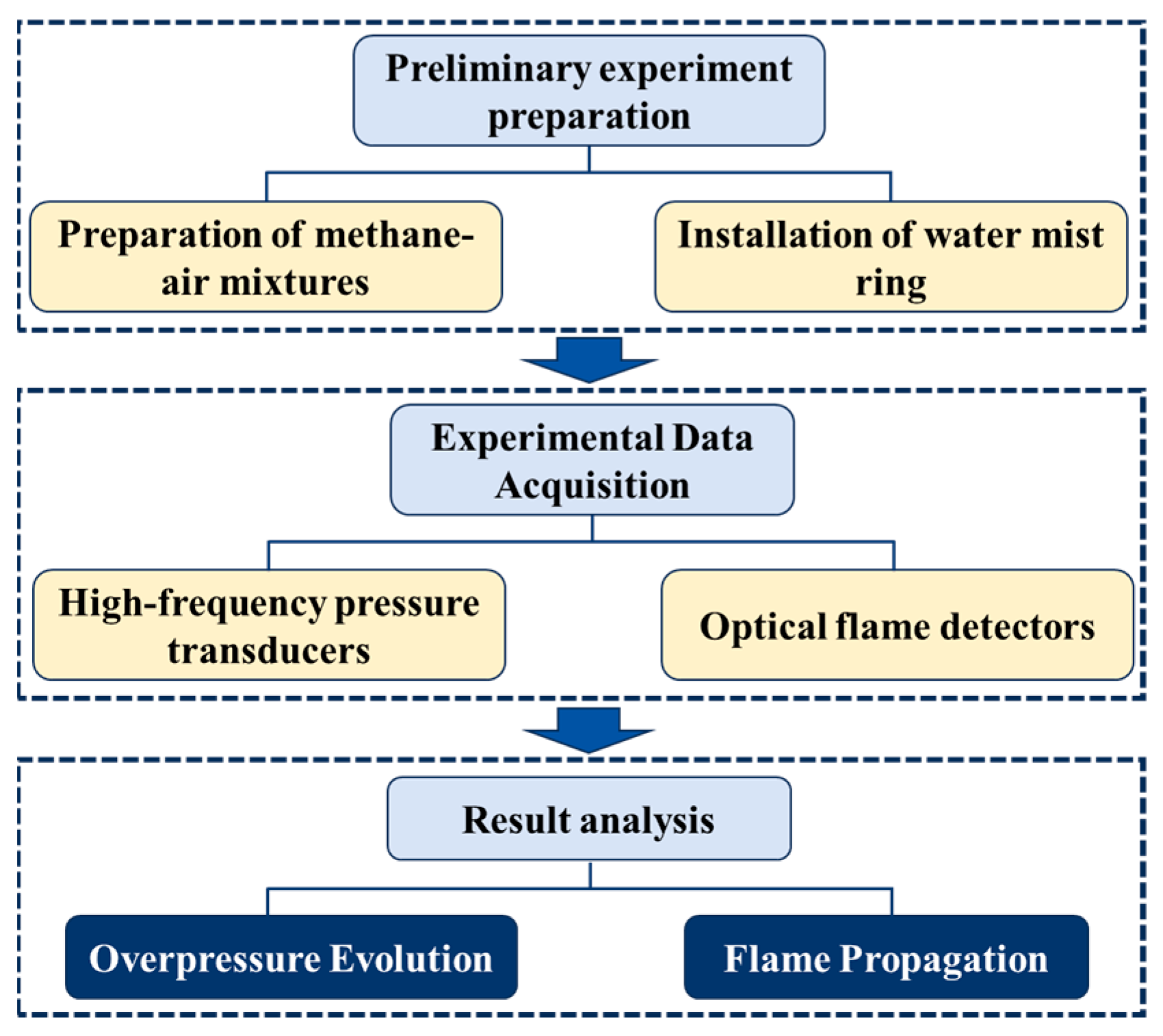
Prior to testing, the automatic water mist suppression system was installed at various locations within the roadways. Its operational status was verified. A methane–air mixture of specified volume was prepared to initiate the experiment. The experimental procedure is illustrated in Figure 2. The mixture was ignited via a high-voltage ignition source. The methane within the chamber was ignited, resulting in a deflagration process. Upon detection of the flame signal, the rapid-activation device was triggered, the nozzles were opened, a high-pressure water curtain was formed, and pressure data were acquired using high-frequency piezoresistive pressure transducers. Rapid response to pressure variations was enabled, strong anti-interference capability was provided, and high-precision measurement of high-frequency pressure signals was achieved. Flame signals were detected by flame sensors equipped with ultraviolet photodiodes. Detection was based on the difference in radiation characteristics between visible light and ultraviolet bands. Ultraviolet radiation from the flame was sensed by the photodiode and the radiation was converted into an electrical signal. Variations in the output signal were used to indicate flame intensity and position. Pressure and flame data under water mist action were recorded synchronously. The number of spray rings and their installation positions were varied. This was done to investigate the explosion suppression effectiveness under different explosion energy conditions. Each experimental configuration was repeated three times. The influence of random errors on the results was thus minimized.
Experimental conditions are shown in Table 1. The minimum number of spray rings required to suppress methane explosions of different magnitudes was determined. The optimal locations within the roadways for effectively inhibiting flame propagation were identified. These findings provide a basis for determining the installation positions of the automatic water mist suppression system in roadways.

3. Numerical Models

3.1. Reasonable Assumption

To ensure reliable simulation results while maintaining computational efficiency, this study adopts a set of reasonable simplifications and assumptions for the coupling process between fine water mist and the flame front, thereby achieving good consistency between numerical predictions and experimental results. All subsequent analyses and discussions are conducted based on the above validated assumptions.
(1) The model accounts for radiative absorption, latent heat evaporation, and pressure-induced droplet breakup. The droplets are assumed to be initially spherical, with a simplified size distribution characterized by a median diameter of 200 μm and a maximum diameter of 400 μm, and are uniformly distributed in space;
(2) Interactions between droplets, such as collisions and coalescence, are neglected to simplify the computational model and reduce its complexity;
(3) The gas is modeled as an ideal compressible fluid, with chemical reactions primarily occurring within the gas phase, forming an ideal compressible reactive flow system.

3.2. Mathematical Model

The suppression of methane explosions by fine water mist constitutes a multi-physics, multiphase coupled process encompassing rapid chemical reactions, gas–liquid interactions, and turbulent transport. Accordingly, this study formulates the fundamental governing equations that couple the gas–liquid phases, combustion, and turbulence.

3.2.1. Gas-Phase Governing Equations

The Navier–Stokes partial differential equations for compressible reactive flows are solved using the finite volume method, primarily encompassing the conservation equations of mass, momentum, and energy.
Conservation of Mass Equation:
ρ t + x i ( ρ u i ) = 0
Conservation of Momentum Equation:
ρ u i t + x j ( ρ u j u i ) = p x j + x j τ i j + ρ g i
Conservation of Energy Equation:
t ρ E + x j ( u j ( ρ E + p ) ) = x j ( J j E + m h m J m + u i τ i j ) + S E

3.2.2. The Discrete-Phase Model

The fine water mist is modeled as discrete-phase particles, with their motion tracked using the discrete-phase model (DPM) within a Lagrangian framework.
d u p d t = F D ( u u p ) + g x ( ρ p ρ ) ρ p

3.2.3. Turbulence Model

The methane deflagration process in large-scale roadways represents a form of turbulent combustion, which is an inherently complex flow phenomenon coupled with chemical reactions. Turbulent flow is simulated using the Realizable k-ε model by solving the transport equations for turbulent kinetic energy and its dissipation rate, expressed as follows:
( ρ k ) t + ( ρ k u j ) x j = x j μ + μ t σ k k x j + ρ ( P k ε )
( ρ ε ) t + ( ρ ε u j ) x j = x j μ + μ t σ ε ε x j + ρ C 1 S ε ρ C 2 ε 2 k + ν ε

3.2.4. Two-Phase Coupling Equations

Fine water mist absorbs heat from the high-temperature gas flow and evaporates upon reaching its boiling point. The temperature evolution of the droplets is governed by the thermal energy balance equation, accounting for the droplet’s internal sensible heat, convective heat transfer between the mist and gas, latent heat exchange, and radiative absorption and emission at the particle surface, as expressed by the following equations:
m p c p ρ d T p d t = h A p T T p + d m p d t h f g f h d m p d t h reac + ε p A p σ θ R 4 T p 4
The transport equation governing mass transfer between the gas phase and the discrete phase is expressed as:
t ς ρ g + ς ρ g v g = R c

3.2.5. Droplet Breakup Model

Droplet fragmentation is driven by the relative velocity between the gas and liquid phases, with the model assuming that both the breakup time and the resulting droplet sizes are dictated by the fastest-growing Kelvin–Helmholtz instability [37,38]. The rate of change in the droplet radius is given by the following expression:
d r d t = r 0.61 Λ 3.726 B r / Λ Ω
Λ r 0 = 9.02 1 + 0.45 O h 0.5 1 + 0.4 T a 0.7 1 + 0.87 W e 1.67 0.6
Ω ρ r 0 3 σ = 0.34 + 0.38 W e 1.5 1 + O h 1 + 1.4 T a 0.6
The mechanism of droplet breakup is governed by the Weber number (We) of the parent droplet:
W e = ρ d ν 2 r 0 σ

3.2.6. Gas-Phase Combustion Model

The methane–air combustion is modeled using a premixed combustion approach. This approach assumes that methane and air are fully mixed at the molecular scale prior to ignition, with the combustion reaction occurring at the flame front, thereby partitioning the computational domain into burned and unburned regions. Flame propagation is determined by solving the transport equations for the reaction progress variable, which can be expressed in the following form:
t ( ρ ¯ c ˜ ) + x j ( ρ ¯ u j ˜ c ˜ ) = x j ( μ + μ L E S S c t c ˜ x j ) + S ¯ c
The reaction progress variable is defined as follows:
c = i = 1 n Y i i = 1 n Y i , e q
In the equation, c denotes the reaction progress variable.

3.2.7. Radiation Model

The methane–air explosion involves thermal radiation from high-temperature flames, particularly due to the strong radiative absorption by combustion products H2O and CO2. In this study, the P1 thermal radiation model is employed to describe the radiative heat transfer process, with the transport equation for the incident radiation expressed as [39]:
( 1 3 ( α + σ s ) G ) α G + 4 α σ T 4 = 0

3.3. Physical Model and Initial Conditions

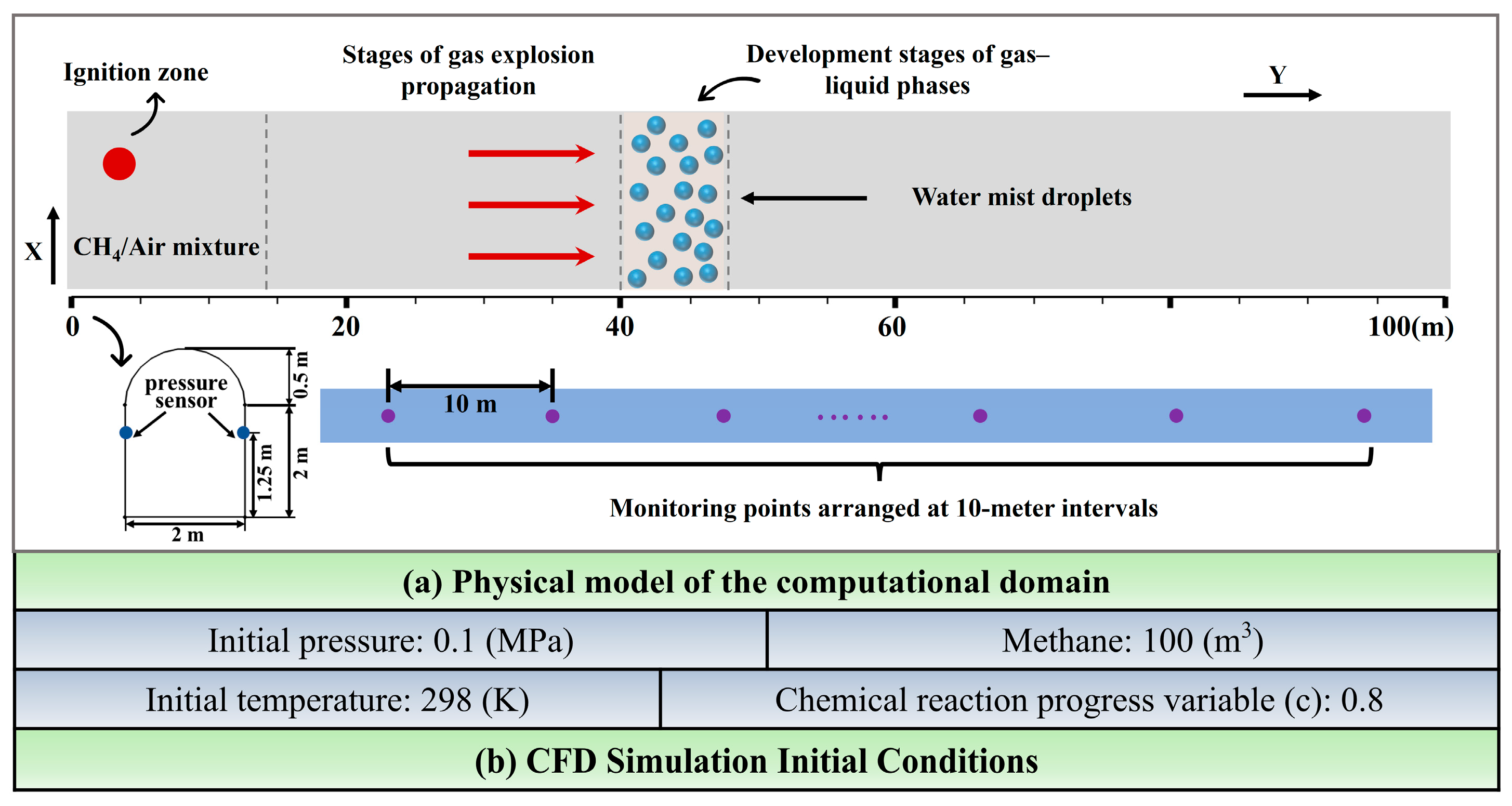
Numerical simulations were carried out using the commercial computational fluid dynamics (CFD) software FLUENT 2022 R1. The computational domain, depicted in Figure 3, measures 100 m along the X direction and 2.6 m along the Y direction. The combustion–explosion process was divided into two successive stages: an initial gas-phase combustion stage, followed by a gas–liquid two-phase coupled stage. The roadway walls were treated as rigid, no-slip, and adiabatic. The domain was initially filled with a stoichiometric CH4/air mixture at 300 K and 0.1 MPa. Ignition was introduced at the left boundary, indicated in red, via a localized hotspot. The downstream region extending 14 m from the ignition source represented the gas-phase combustion stage, during which exothermic reactions increased the gas temperature, while gas expansion drove the propagation of the flame and pressure waves along the roadway. Downstream of the gas-phase reaction zone, two fine water mist regions, each 7.5 m in length, were located at 40 m and 70 m from the ignition source. The droplets, with a characteristic diameter of 400 µm, were assumed to be uniformly distributed and injected 1 ms after ignition, participating in gas–liquid two-phase interactions. As the high-temperature flame entered the water mist regions, enhanced gas–liquid interactions occurred, with interfacial heat transfer and droplet evaporation substantially altering the local thermodynamic state and flow structure, thereby influencing the propagation and dynamics of the combustion–explosion process. To accurately capture these phenomena and ensure numerical stability, a pressure-based transient solver was employed, with PISO pressure–velocity coupling and second-order spatial discretization for both the momentum and energy equations. The mesh was carefully assessed, yielding a minimum orthogonal quality of 0.9989 and a maximum aspect ratio of 1.4556, indicative of a high-quality grid suitable for reliable numerical simulations.

3.4. Verification of Model Reliability

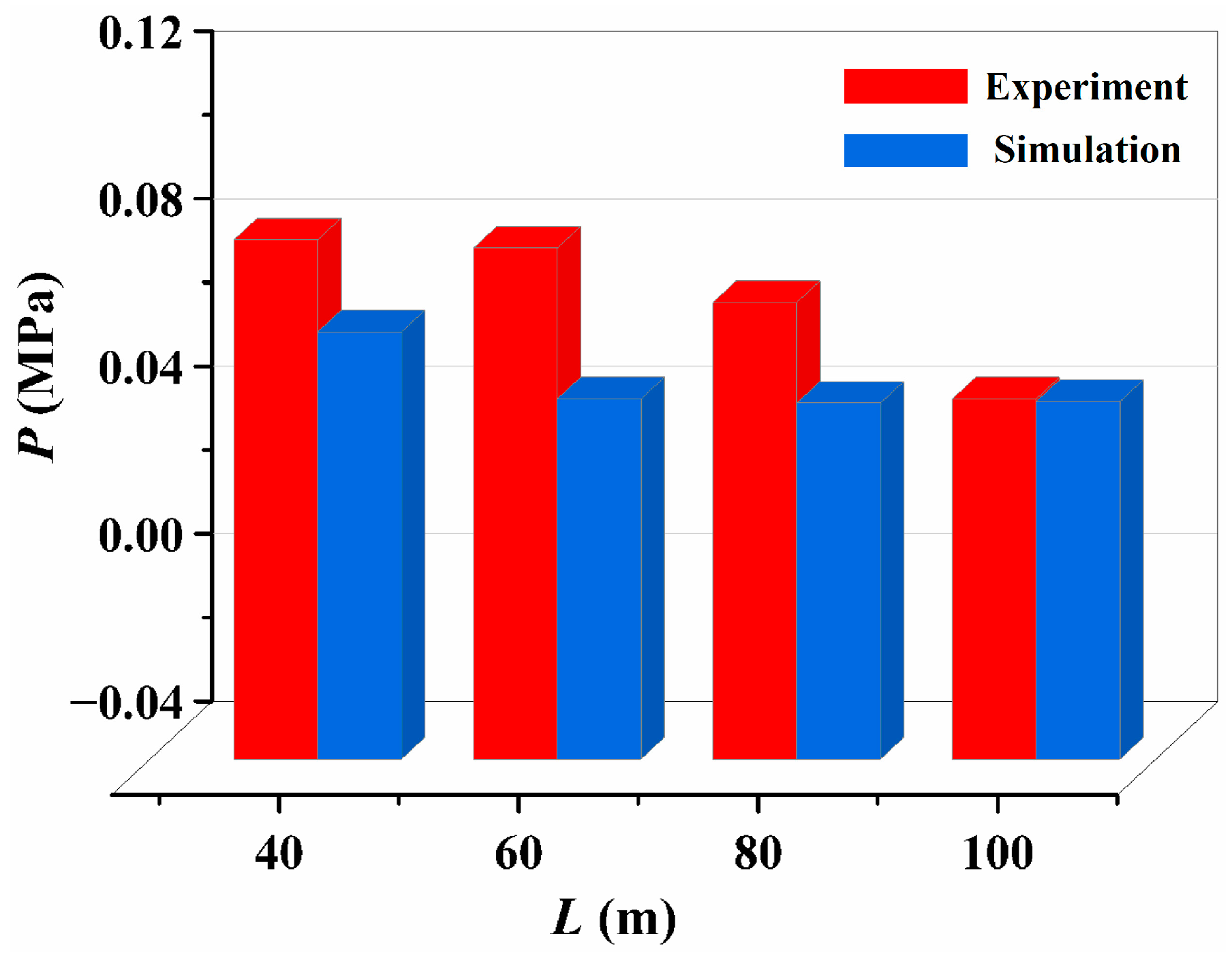
Based on the geometry of the experimental apparatus and the operating conditions, a corresponding numerical model was developed to simulate the suppression of methane explosions by fine water mist in large-scale roadways. The CH4 combustion process was resolved using the GRI-Mech 3.0 mechanism [40,41]. CH4, O2, and H2O constitute the primary components for investigating the coupling effects of water mist and methane/air explosions. Taking Case 3 as an illustrative example, the flame propagation process and pressure histories at monitoring points along the roadways were obtained, as depicted in Figure 4. Comparative analysis reveals that the temporal evolution of flame-front pressure from the numerical simulations exhibits good agreement with experimental measurements. Provided that ignition is successful and numerical convergence is maintained, the peak pressures and their temporal profiles at all monitoring points remain within an acceptable error margin relative to the experimental data. These results demonstrate that the established numerical model can accurately reproduce the propagation characteristics of methane explosions under fine water mist, thereby validating its reliability and computational accuracy in capturing flame propagation and pressure evolution.

4. Results and Discussion

4.1. Analysis of Experimental Results

4.1.1. Suppressive Effect of Fine Water Mist on Methane Explosion Flame

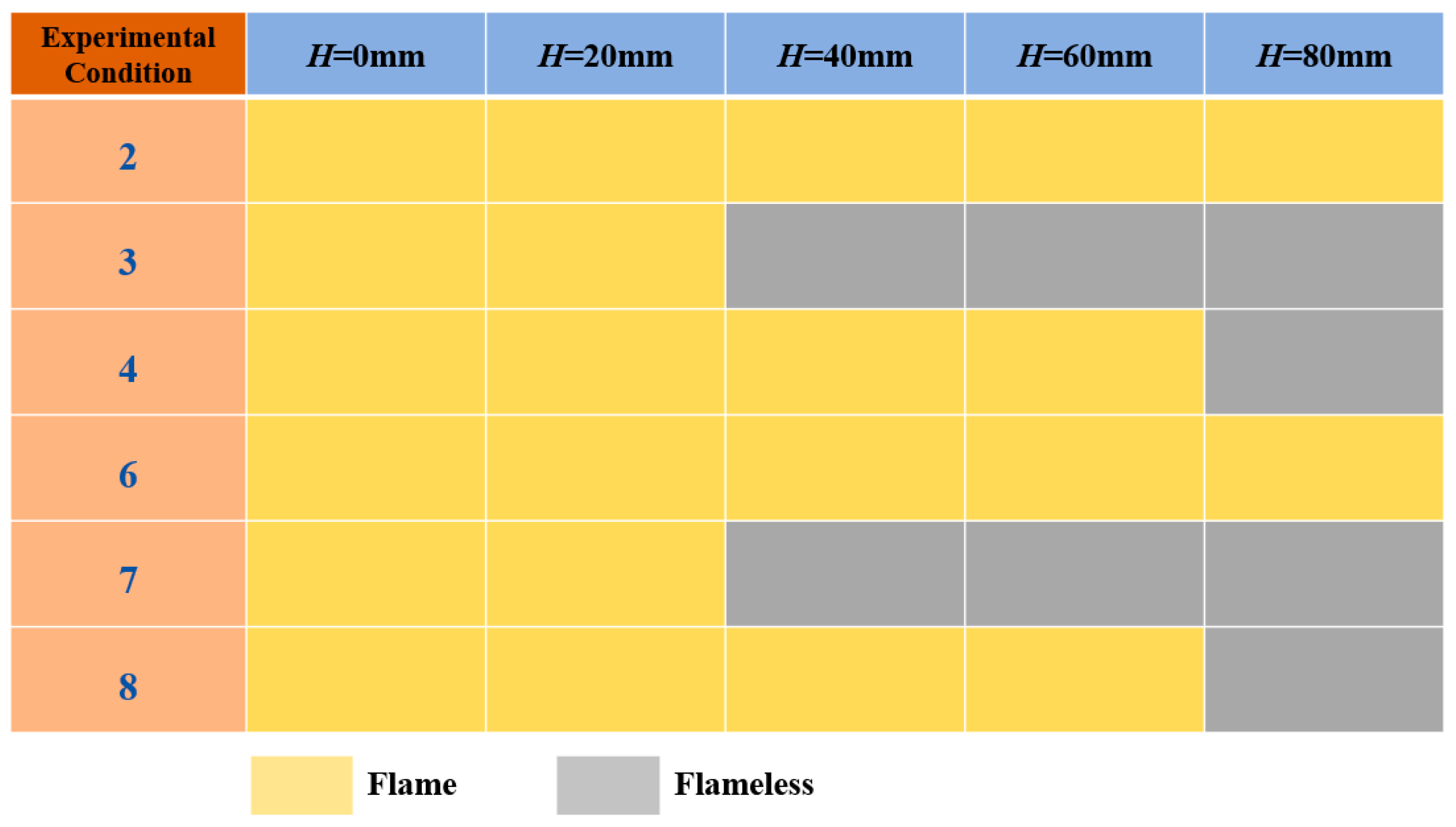
Figure 5 illustrates the effect of varying the number of spray rings and their installation positions on methane flame propagation. The scenario numbers correspond to those listed in Table 1. Experimental results show that when the fine water mist nozzles were positioned 40 m from the explosion-proof door, the deployment of five spray rings failed to completely suppress methane flame propagation. A flame signal was still detected at a distance of 80 m. However, when the number of spray rings was increased to six, flame propagation was successfully blocked. The suppression mechanisms of fine water mist primarily include cooling, oxygen dilution, and thermal radiation blocking. Each spray ring establishes a local suppression zone. Significant latent heat of vaporization is absorbed through water droplet evaporation, lowering the temperature in the reaction zone. Simultaneously, the generated water vapor diffuses into the flame zone, diluting the oxygen concentration and inhibiting the combustion chain reaction. Under the condition that the spray installation position is 40 m, the total cooling capacity and degree of oxygen dilution provided by five spray rings did not reach the critical threshold required for complete flame suppression. Consequently, the flame was able to penetrate the fine water mist zone and continue to propagate. An increase in the number of spray rings extends the longitudinal coverage of the suppression zone. When increased to six, the spatial coverage of the intervention zone was significantly enhanced. The overall heat release rate was further reduced, and the temperature in the reaction zone dropped below the methane combustion limit. Thereby, effective suppression of flame propagation was achieved.
The installation position of spray rings also influences their effectiveness in suppressing methane explosion flame. Based on the analysis presented in Figure 5, when the number of spray rings was fixed at five and installed 40 m from the explosion-proof door, complete flame suppression was not achieved. However, when the installation position was moved to 70 m, Figure 5 shows that no flame signal was detected at the 80 m position. This indicates that flame propagation was effectively blocked earlier. Within a fixed volume of methane–air mixture, as the flame propagates from the ignition source, fuel is continuously consumed and chemical energy is released. Due to wall heat losses, flow expansion, and the thermal resistance of burned gases, the temperature, velocity, and reaction intensity of the flame front gradually decrease with propagation distance. When the spray rings were placed at 70 m, the methane fuel was partially consumed, reactant concentration decreased, and flame intensity was relatively weakened. Additionally, due to heat losses and flow dissipation during earlier propagation, the flame entered a decaying stage. Under these conditions, the combined effects of cooling, oxygen dilution, and free radical scavenging provided by the same five spray rings made it easier for the local heat release rate in the flame zone to fall below the heat dissipation rate. Consequently, the flame temperature was reduced below the combustion limit, leading to the interruption of propagation.

4.1.2. Suppressive Effect of Fine Water Mist on Methane Explosion Overpressure

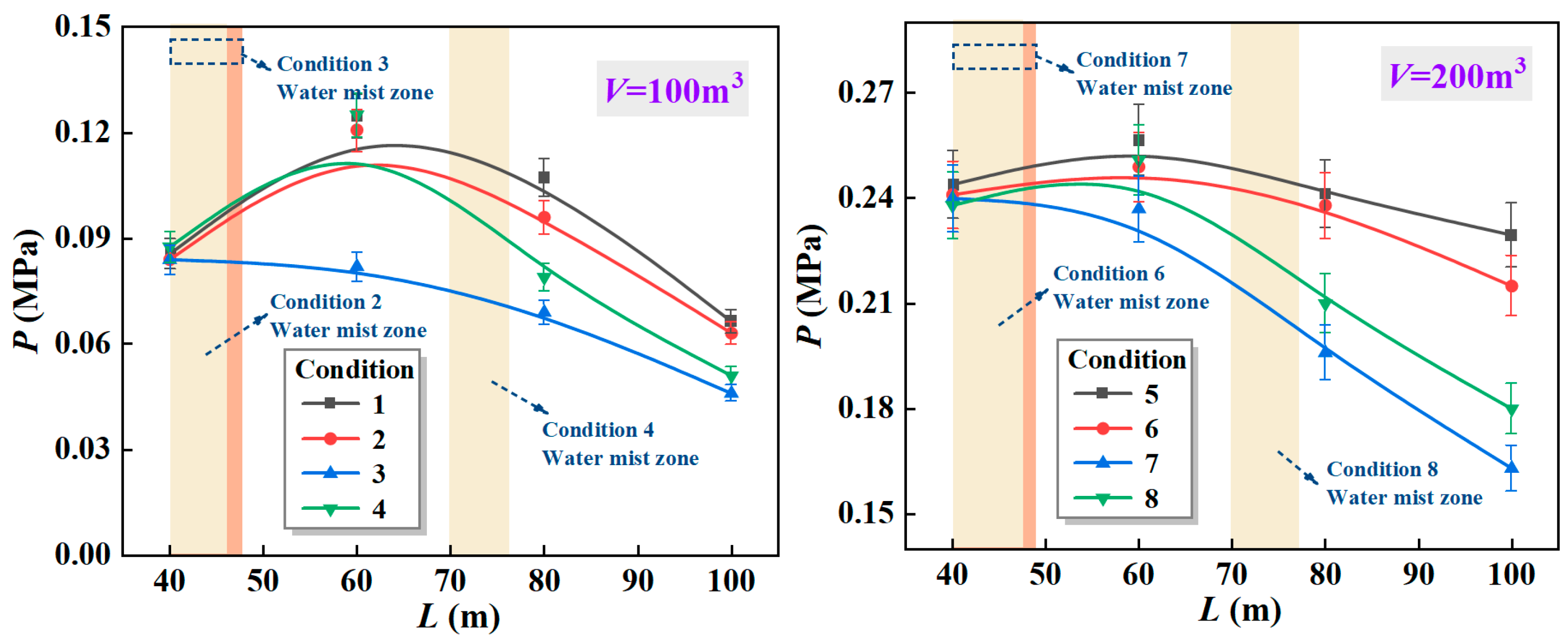
Figure 6 presents the evolution of methane explosion pressure under flammable volumes of 100 m3 and 200 m3. The results show that, despite the difference in scale, the variation trend of explosion overpressure with the number and arrangement of spray rings is generally consistent. Taking the 100 m3 scenario as an example, the maximum explosion overpressure under pure methane conditions was 0.117 MPa. After the introduction of fine water mist spray rings, the explosion pressure decreased to varying degrees. This indicates that even when flame propagation is not completely blocked, fine water mist can partially reduce combustion intensity and energy release rate through evaporative cooling and oxygen dilution. In Condition 3, the explosion pressure after spray activation was significantly lower than in the pure methane case. Furthermore, the pressure attenuation increased with propagation distance. This is because the fine water mist inhibited the accelerated propagation of the flame into the unburned region, weakening the generation and superposition of pressure waves. In Condition 4, the explosion pressure dropped sharply after successful suppression. Compared with the pure methane case, the reduction exceeded 20 kPa. It is noteworthy that the explosion overpressure is significantly correlated with the volume of the combustible mixture. The peak pressure under the 200 m3 condition is consistently higher than that under the 100 m3 condition. This indicates that the explosion pressure increases with the quantity of combustible material. Once the flame is blocked, subsequent unburned gas no longer participates in the reaction. The pressure rise process is thereby truncated. Under the 100 m3 condition, the residual overpressure after complete suppression remains at a relatively low level. Consequently, the pressure decline is observed to be more gradual.
Combined with the previous analysis of flame propagation, it is evident that compared to the rapid suppression of the flame front, the suppression effect of fine water mist on explosion overpressure is relatively limited and exhibits noticeable hysteresis. Under both the 100 m3 and 200 m3 experimental conditions, it was observed that pressure did not immediately decrease after the intervention of fine water mist. Instead, it briefly continued its initial rising trend. This occurs because the pressure wave generated by the explosion propagates at the local speed of sound, which is significantly faster than the propagation speed of the flame front. Therefore, before the fine water mist acts on the flame reaction zone to decelerate or extinguish, the pressure wave produced by the initial combustion has already detached from the flame front and propagates independently. The pressure suppression effect of fine water mist is primarily manifested in inhibiting the generation and superposition of subsequent pressure waves. It cannot immediately eliminate pressure waves that have already formed and are propagating.

4.2. Analysis of Simulation Results

4.2.1. Analysis of Methane Explosion in a Large-Scale Roadway Without Fine Water Mist Suppression

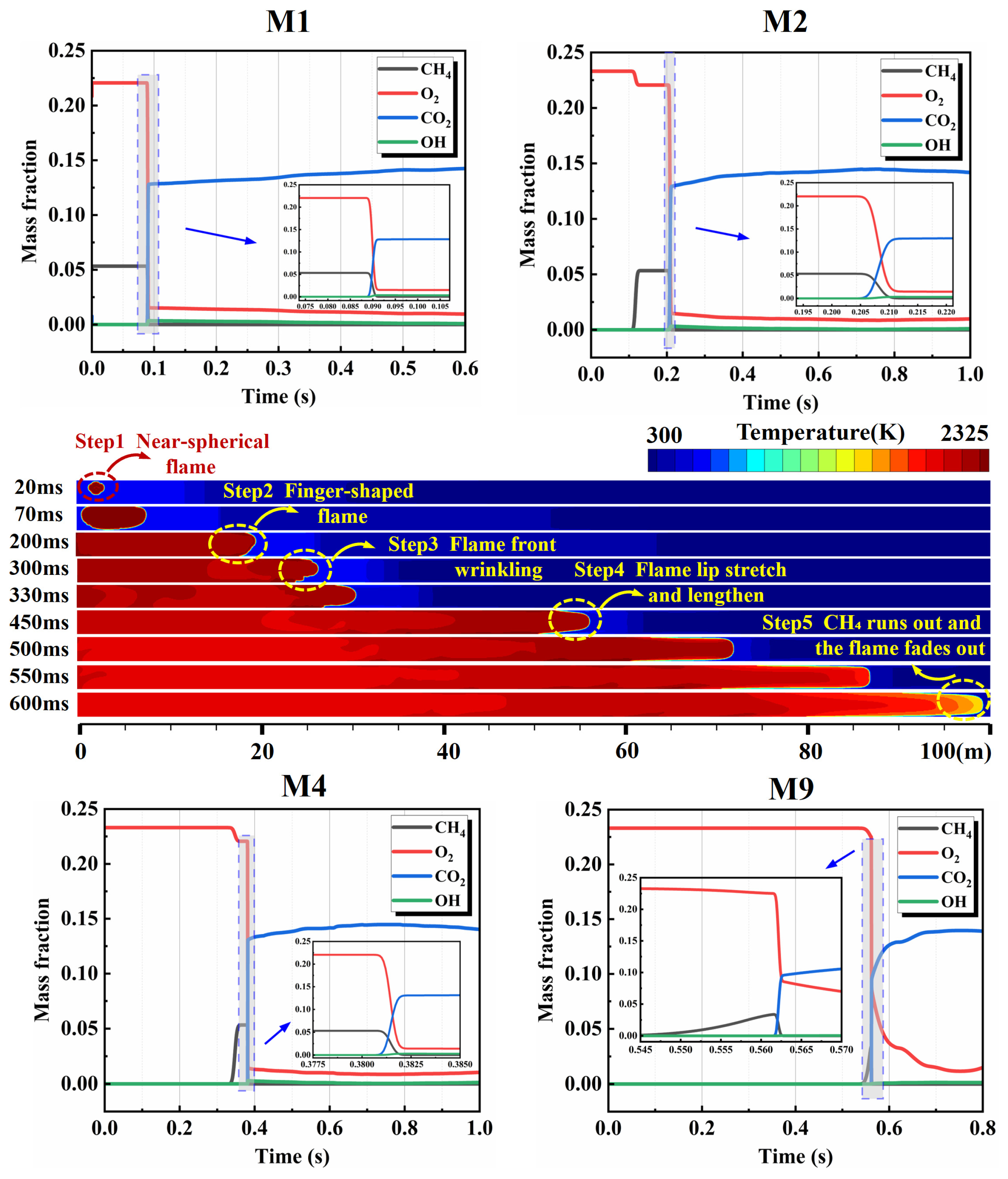
Figure 7 illustrates the evolution of the explosion flow field in a large-scale roadway under CH4/Air mixture conditions, without fine water mist suppression. At the initial ignition stage (M1), the flame is triggered by a local hotspot; the flame front assumes an approximately spherical shape, expanding freely, while the boundary layer exhibits near-laminar combustion characteristics, minimally constrained by the roadways walls. As the flame advances downstream, wall confinement becomes increasingly influential, stretching the flame into finger-like structures and significantly increasing its axial propagation velocity. CH4 and O2 mass fractions decrease rapidly over a short period, indicating that thermal expansion coupled with accelerated axial flow predominantly governs the transformation of flame morphology and the enhanced combustion process. Upon contact between the flame skirt and the wall (M3), boundary layer effects induce localized variations in the velocity field; the flame inclines to form sharp angles, its surface area diminishes rapidly, and local turbulent kinetic energy rises markedly. In the midsection of the roadways (M4), the flame-front lip exhibits pronounced axial stretching. Simulation results reveal that the distribution of flame-front velocity is closely associated with radical concentration gradients, features that are difficult to capture experimentally. At the roadways terminus (M9), CH4 mass fraction approaches zero, O2 persists partially, and the increase in CO2 tends to plateau, while the preheat zone gradually extends, indicating that flame attenuation is primarily driven by fuel consumption and thermal losses. Overall, the flame acceleration stage is concentrated within the 40–80 m region, accompanied by substantial increases in temperature and radical activity, demonstrating a flame propagation process transitioning from stable combustion through accelerated propagation to eventual decay and extinction.
The methane–air explosion flame in a large-scale roadway exhibits a characteristic two-wave, three-zone structure. As the flame propagates downstream, intense combustion within the reaction zone releases substantial heat, leading to a rapid rise in local temperature and pressure and consequently accelerating the flame-front propagation.
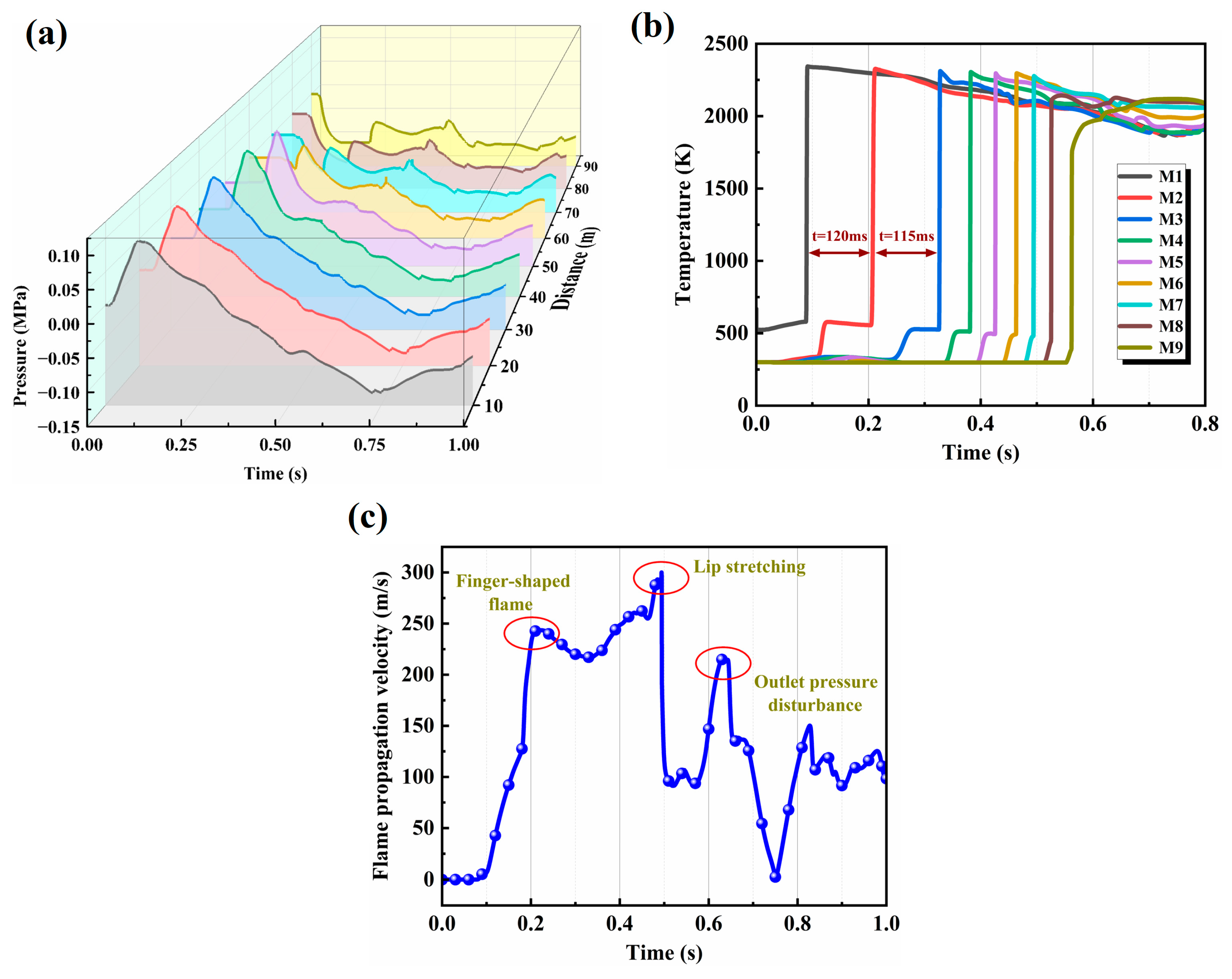
As shown in Figure 8a, pressure disturbances during the explosion exhibit a pronounced spatial distribution along the roadway. At the early ignition stage, rapid methane combustion induces a sharp rise in roadway pressure. The resulting high-pressure gases drive unburned mixtures downstream, generating localized negative-pressure regions that induce the backflow of fresh air, thereby perturbing the flame structure and propagation process and ultimately causing temperature fluctuations near the outlet monitoring location (Figure 8b). The temperature near the ignition source rapidly rises to approximately 2300 K. When the flame front interacts with the wall, local flow compression increases gas density and enhances the reaction rate, resulting in further flame acceleration within the M2–M3 region and a reduction in propagation time from approximately 120 ms to 115 ms. As the flame front progressively stretches and elongates, the propagation velocity increases markedly, as quantified in Figure 8c. A first velocity peak appears during the early explosion stage, corresponding to the rapid advance of a finger-shaped flame. Subsequent wall contact enhances geometric confinement, leading to a temporary velocity reduction. In the 40–80 m region, sustained methane combustion promotes lateral flame expansion and strengthens combustion–flow coupling, resulting in a second velocity peak. Near the outlet, fuel depletion and outlet pressure boundary effects cause a gradual deceleration accompanied by velocity fluctuations. Numerical simulations reveal the transient flame velocity, localized pressure disturbances, and flow-field evolution in the absence of water mist. The results identify the 40–80 m region as a critical flame-acceleration zone, providing a quantitative basis for the optimal deployment of water mist for explosion suppression.

4.2.2. Effect of Water Mist Concentration on Methane Explosion in a Large-Scale Roadway

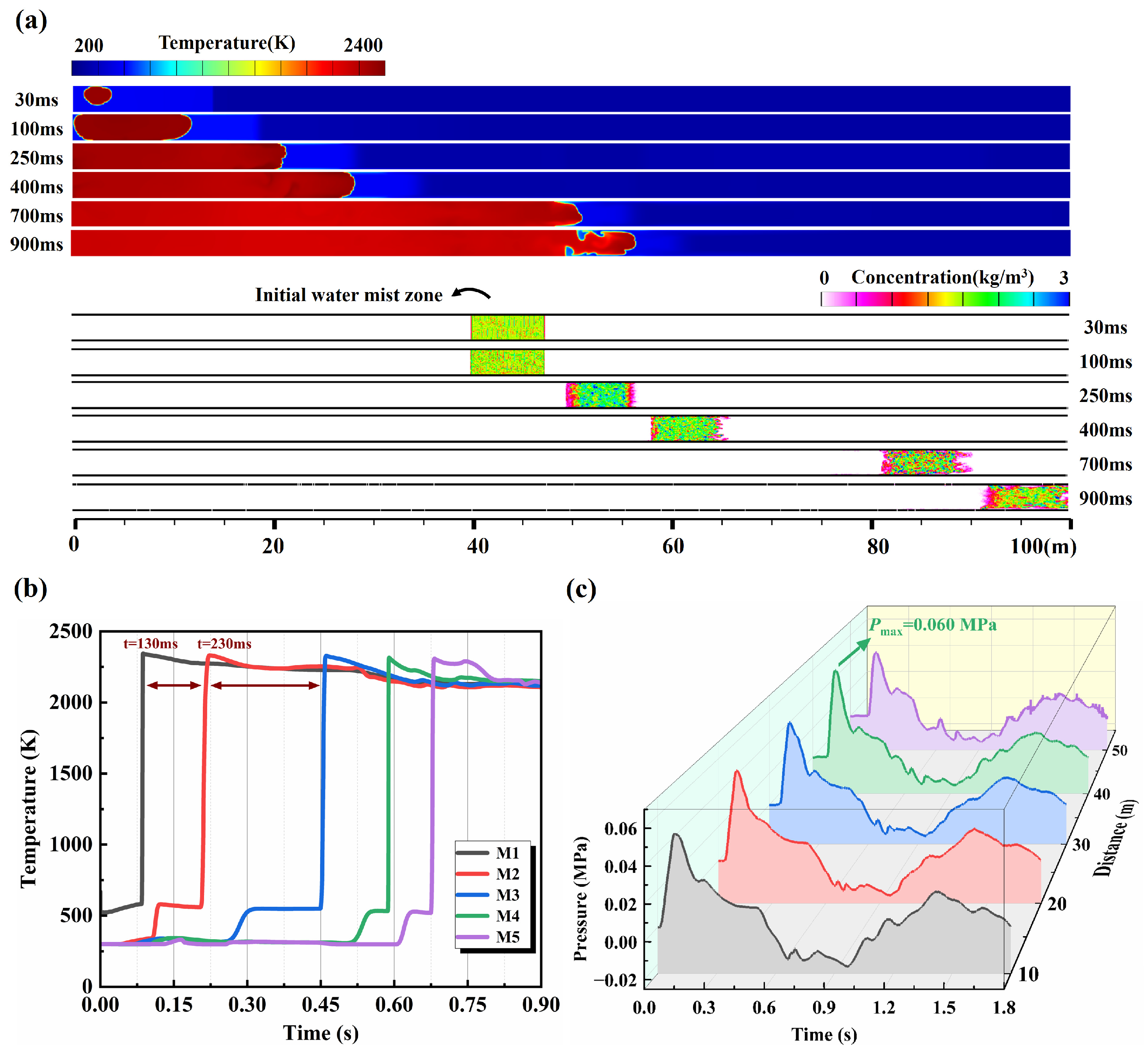
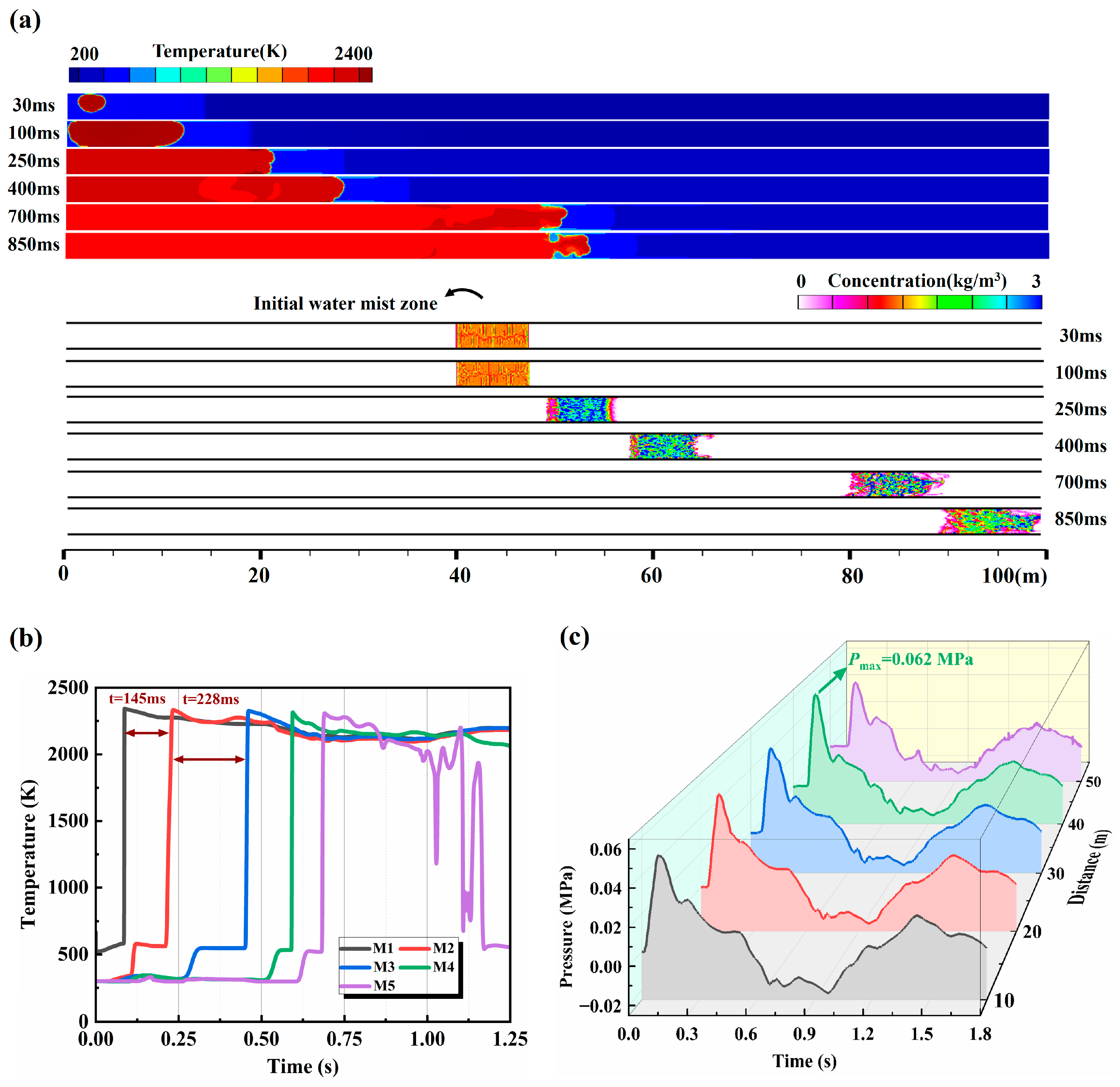
Under water mist-free conditions, methane flame propagation in the large-scale roadway exhibits pronounced unsteady behavior, with peak flame velocities primarily occurring within the 40–80 m region. To systematically evaluate the suppression performance of water mist, two representative locations at 40 m and 70 m along the roadway were selected for spray deployment. First, a fine water mist zone was introduced at the onset of the flame acceleration region, approximately 40 m downstream of the ignition source. As shown in Figure 9a, before the high-temperature flame front fully enters the spray region, droplets undergo partial evaporation driven by radiative and convective heat transfer, leading to localized water vapor formation and a reduction in the downstream flame-front temperature. Figure 9b presents the temporal temperature evolution at the monitoring points along the roadway. Compared with the unsuppressed case, the arrival of the flame front at each monitoring point is delayed, accompanied by a backward shift in the onset of the rapid temperature rise. However, the flame retains a relatively high temperature and continues to propagate rapidly. The pressure evolution shown in Figure 9c indicates that the introduction of water mist leads to an overall reduction in pressure peaks along the roadway, with the maximum overpressure decreasing by approximately 40%. However, owing to the high propagation velocity of the flame, pressure waves accelerate partially evaporated droplets, causing them to exit the roadway before interacting with the flame front [42,43]. Consequently, the droplets do not fully participate in combustion suppression, allowing the flame to continue propagating beyond the spray region.
As shown in Figure 10a, further increasing the water mist dosage at 40 m markedly accelerates droplet evaporation within the high-temperature preheating zone ahead of the flame front, leading to a progressive reduction in local mist concentration over time. This process weakens the thermodynamic conditions at the flame front, substantially shortens the high-temperature zone, and prevents the flame from sustaining a continuous and stable propagation structure. The corresponding temperature response (Figure 10b) shows that, after the flame traverses the spray region, the temperature peak at the downstream monitoring point (M5) rapidly decreases and stabilizes at approximately 500 K. Meanwhile, the temperature exhibits distinctly constrained fluctuations. This behavior is primarily attributed to intensive droplet vaporization induced by heat absorption from the flame, whereby energy exchange between the flame and the water mist significantly reduces the flame-front temperature. These results indicate that sustained flame propagation cannot be maintained downstream of the spray region. The pressure response is also markedly suppressed. As shown in Figure 10c, the maximum overpressure is approximately 0.062 MPa, and the pressure wave rapidly attenuates beyond the spray region, without sustained propagation.
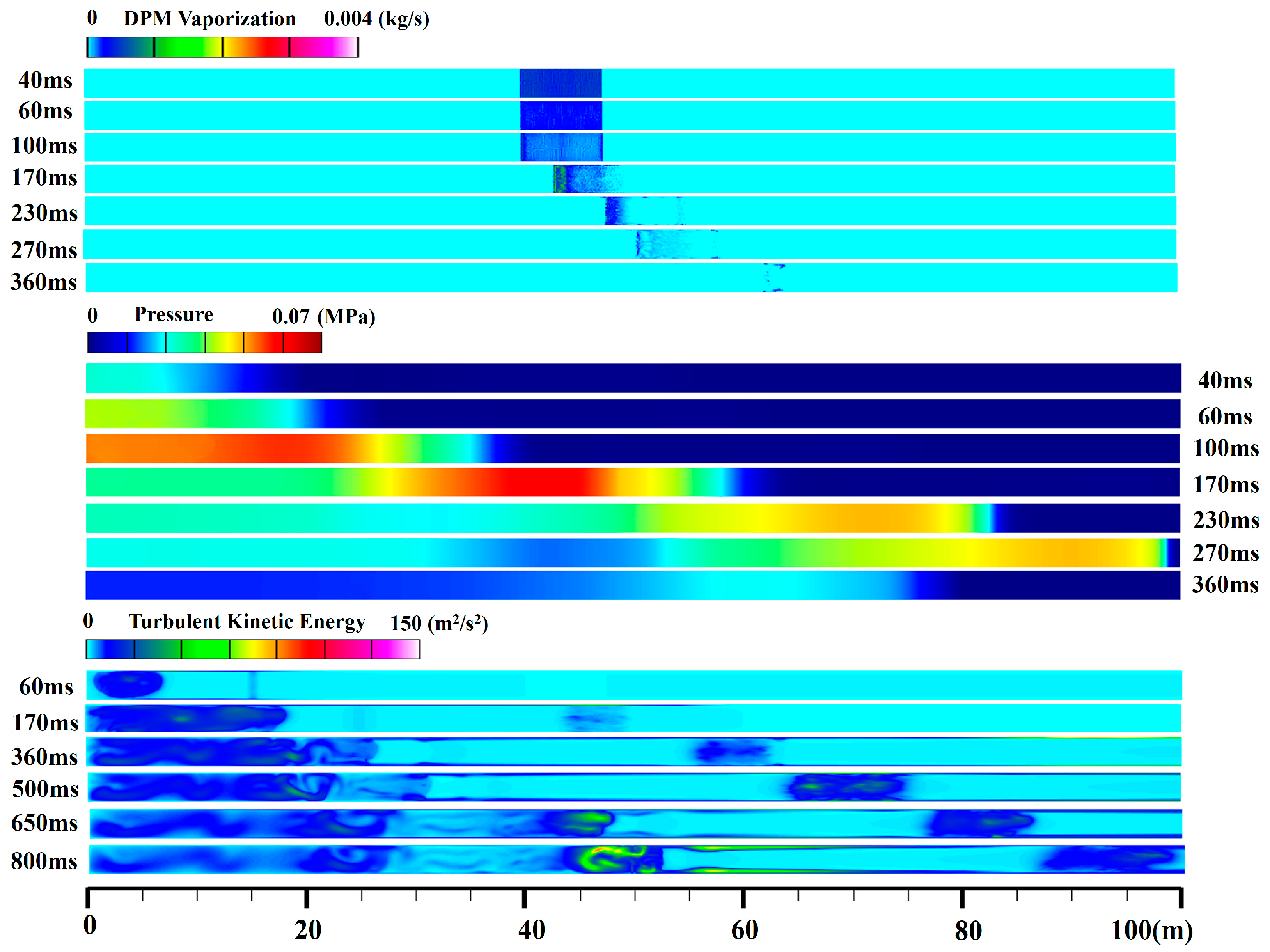
Figure 11 further illustrates the microscopic mechanisms underlying successful methane explosion suppression by water mist at 40 m in the large-scale roadways. The droplet evaporation rate is the key factor governing the effectiveness of water mist in suppressing methane explosions. When the flame front approaches the spray region (~100 ms), the high-temperature flame establishes a local preheating zone, causing water droplets to begin evaporating even before the flame arrives. As the water mist dosage increases (~170 ms), the energy exchange between the evaporating droplets and the flame front intensifies, leading to increased heat absorption, a significant decrease in flame temperature, and consequently a reduction in chemical reaction rates. As the reaction progresses, the water mist is transported by expanding gases and pressure waves, coupling with the flow field; local flow resistance increases and kinetic energy dissipates, resulting in a reduction in flame-front propagation velocity as well as a decrease in peak pressure and pressure wave intensity. The simulations further reveal that, within the flame-front region, droplet evaporation and volumetric expansion induce localized weak turbulence; however, rapid dissipation of turbulent kinetic energy suppresses flame-front wrinkling and planar stretching, hindering sustained accelerated flame propagation. These results elucidate the effects of droplet evaporation, local turbulence [44,45], and flame–water mist coupling on flame propagation, revealing flow-field phenomena that are difficult to observe experimentally.

4.2.3. Effect of Water Mist Placement on the Suppression by Find Water Mist

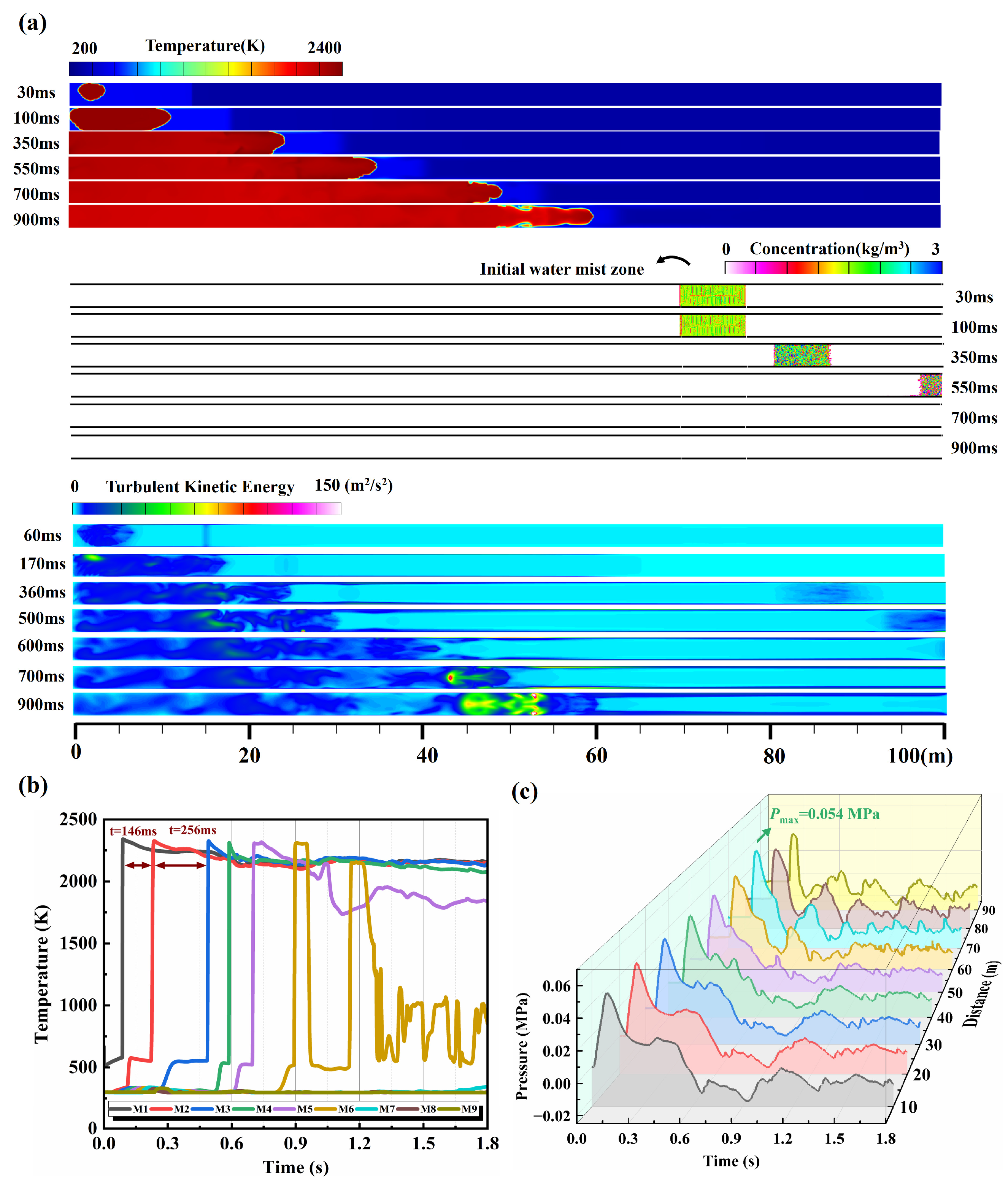
To investigate the effect of water mist placement on the flame propagation behavior of methane explosions, an identical quantity of fine water mist as that used at 40 m was deployed at the 70 m location in the large-scale tunnel. Numerical simulation results indicate that, as shown in Figure 12a, at approximately 100 ms, the flame front gradually evolves from an approximately axisymmetric structure to an inclined planar configuration. The upper portion of the flame propagates significantly faster than the lower portion, impeding overall flame advancement. Consequently, the time for the flame front to reach the same downstream location increases from 146 ms to 256 ms, representing a reduction in propagation efficiency of approximately 75.3%. In contrast, when the water mist is positioned at 40 m, the flame is in a stage of pronounced accelerated propagation, with elevated temperature zones and strong pressure waves, and high-flow-field kinetic energy. Fine water droplets are likely to be carried by the high-speed flow or undergo incomplete evaporation before reaching the flame front, preventing effective heat absorption and kinetic energy dissipation, thereby limiting the suppression effectiveness. At the 70 m location, the flame has released part of its chemical energy and entered a relatively decayed stage. High-velocity jets and pressure gradients are markedly weakened, allowing the water mist to remain longer in the flame front region. As a result, the heat absorption from evaporation and energy exchange with the gaseous flame are more complete. Numerical simulations further reveal that the water mist strongly couples with the local flow field. Although the induced turbulence remains weak, its kinetic energy dissipation efficiency is significantly enhanced, effectively suppressing the development of flame front wrinkling and planar stretching. This markedly reduces both flame propagation velocity and peak pressure, ultimately resulting in flame quenching. This mechanism is further validated by Figure 12b,c, where temperatures and shock pressures at all monitoring points decrease synchronously and significantly. The maximum overpressure is only 0.054 MPa, and the pressure waves rapidly attenuate within the water mist region, indicating an effective weakening of the combustion reaction. The above results elucidate, from a flow dynamics perspective, why the same quantity of water mist is insufficient to suppress the explosion at 40 m but effectively inhibits it at 70 m. It can be concluded that the effectiveness of water mist in suppressing methane explosions is not determined solely by the quantity of water but is synergistically governed by its placement and the flame propagation stage.

4.3. Mechanisms of Methane Explosion Suppression by Fine Water Mist in Large Scale Roadways

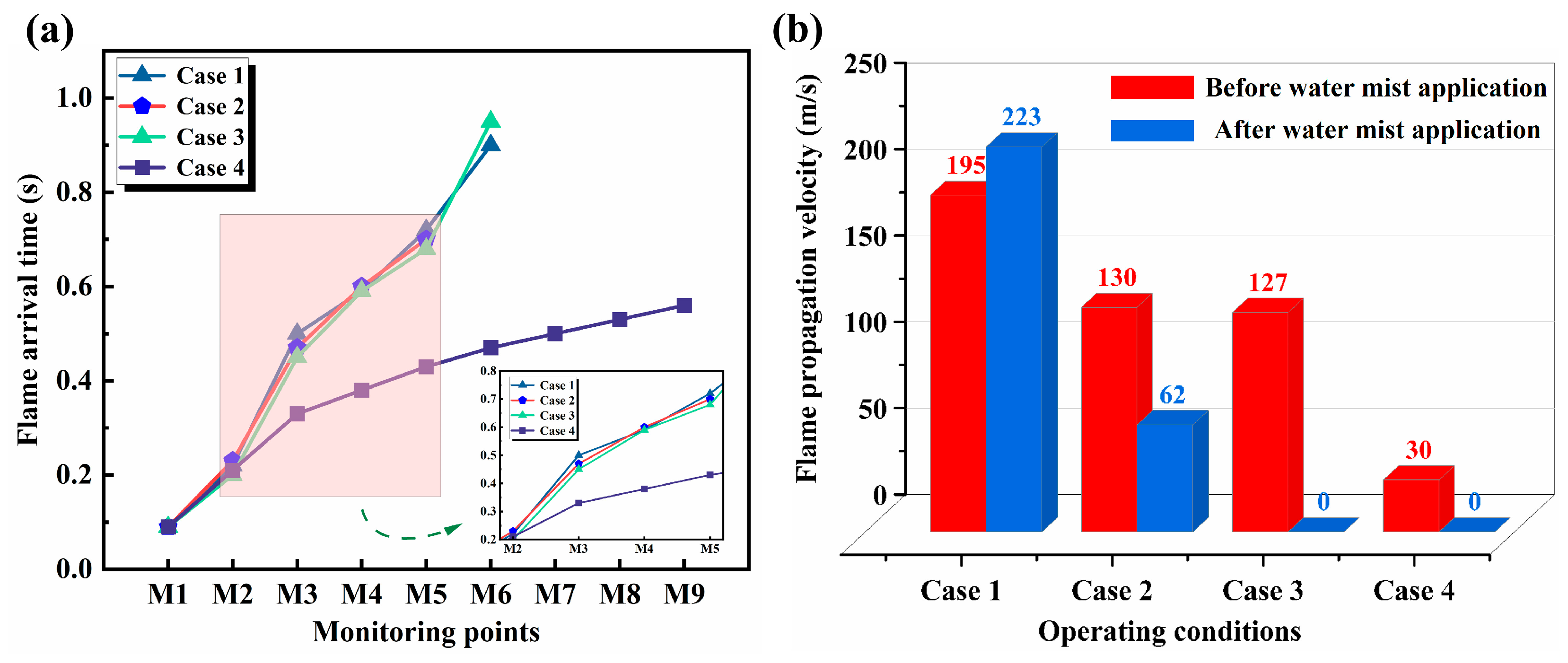
As shown in Figure 13, the dynamics of flame propagation are influenced by both the quantity and spatial arrangement of fine water mist. Figure 13a indicates that within the first 30 m, the flame fronts under all conditions nearly coincide over time, suggesting that the flame propagation is still predominantly controlled by the initial ignition, with reaction kinetics as the main governing factor. At this stage, the fine water mist has not yet effectively participated in the flame–flow interaction, and its suppressive effect remains negligible. As the flame enters the acceleration phase, differences among the conditions are rapidly amplified in the flame velocity evolution, as depicted in Figure 13b. In the absence of water mist (Condition 1), the flame velocity continuously increases, reaching 223 m/s, reflecting a positive feedback mechanism among pressure wave reinforcement, gas expansion acceleration, and flame front wrinkling. Under the condition with water mist deployed at 40 m but without successful suppression (Condition 2), the flame velocity drops markedly from 223 m/s to 62 m/s, yet remains relatively high. This indicates that the water mist at this stage only reduces the flame acceleration intensity without disrupting the coupling between the flame and the high-speed flow; the droplet cooling and momentum dissipation are insufficient to achieve effective suppression. In contrast, for the condition with successful suppression at 40 m, the flame velocity rapidly decays to zero at 50 m, indicating that the fine water mist continuously interacts with the flame front within the acceleration zone, weakening both the gas expansion driving force and the turbulence-induced flame enhancement, thereby preventing self-accelerated propagation. When the water mist is arranged at 70 m (Condition 4), the flame has already released part of its chemical energy, and the propagation momentum and pressure gradient are significantly reduced, such that the same water mist quantity can decelerate the flame to approximately 30 m/s before 60 m and eventually bring it to a complete stop.
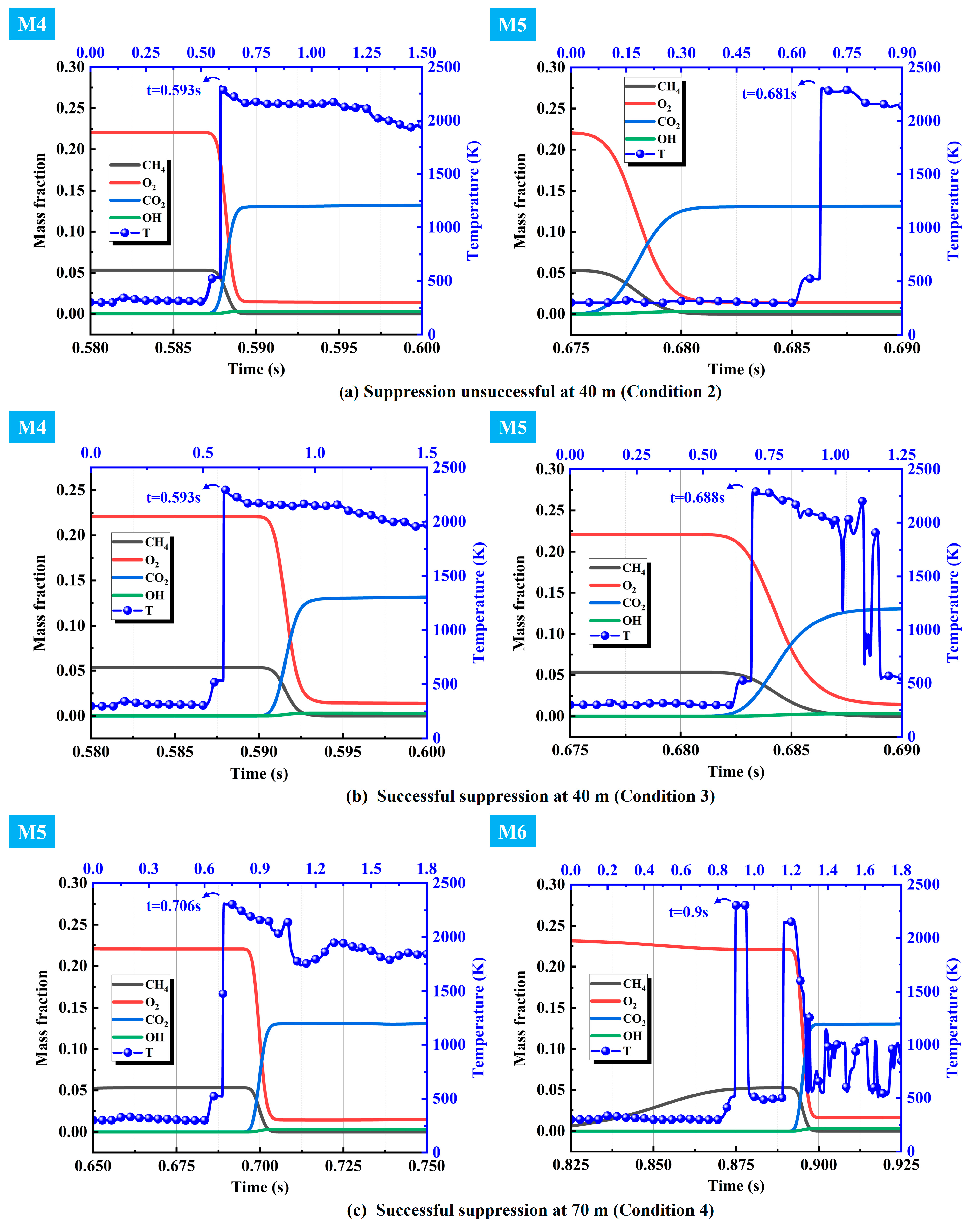
Figure 14 further illustrates the effects of fine water mist on the structure of the flame reaction zone by examining the temporal evolution of species concentrations and temperature before and after suppression under different conditions. In the 40 m unsuccessful suppression scenario (Figure 14a), the consumption rates of CH4 and O2 at monitoring points before and after the water mist region exhibited negligible variation, while CO2 continued to be produced and temperatures remained at elevated reactive levels, indicating that the structure of the reaction zone remained largely intact and the chain reaction was uninterrupted. By contrast, in the 40 m successful suppression scenario (Figure 14b), the onset of CH4 consumption was significantly delayed, the slopes of O2 and CO2 variations were markedly reduced, the reaction duration was prolonged with diminished intensity, and temperatures rapidly fell below the combustion-sustaining threshold, indicating that the radical chain reaction was effectively weakened. In the 70 m successful suppression scenario (Figure 14c), this feature was even more pronounced: the reaction intensity had partially decayed before the flame entered the water mist region, and the fine water mist further reduced the reaction zone scale through evaporative cooling and dilution by water vapor, maintaining low temperatures around 60 m while limiting OH radical levels. In the 70 m successful suppression case (Figure 14c), this effect was further enhanced: the reaction intensity had partially decayed before the flame reached the mist region, and the fine water mist subsequently curtailed the reaction zone through evaporative cooling and water vapor dilution, maintaining low temperatures around 60 m and reducing OH radical concentrations.
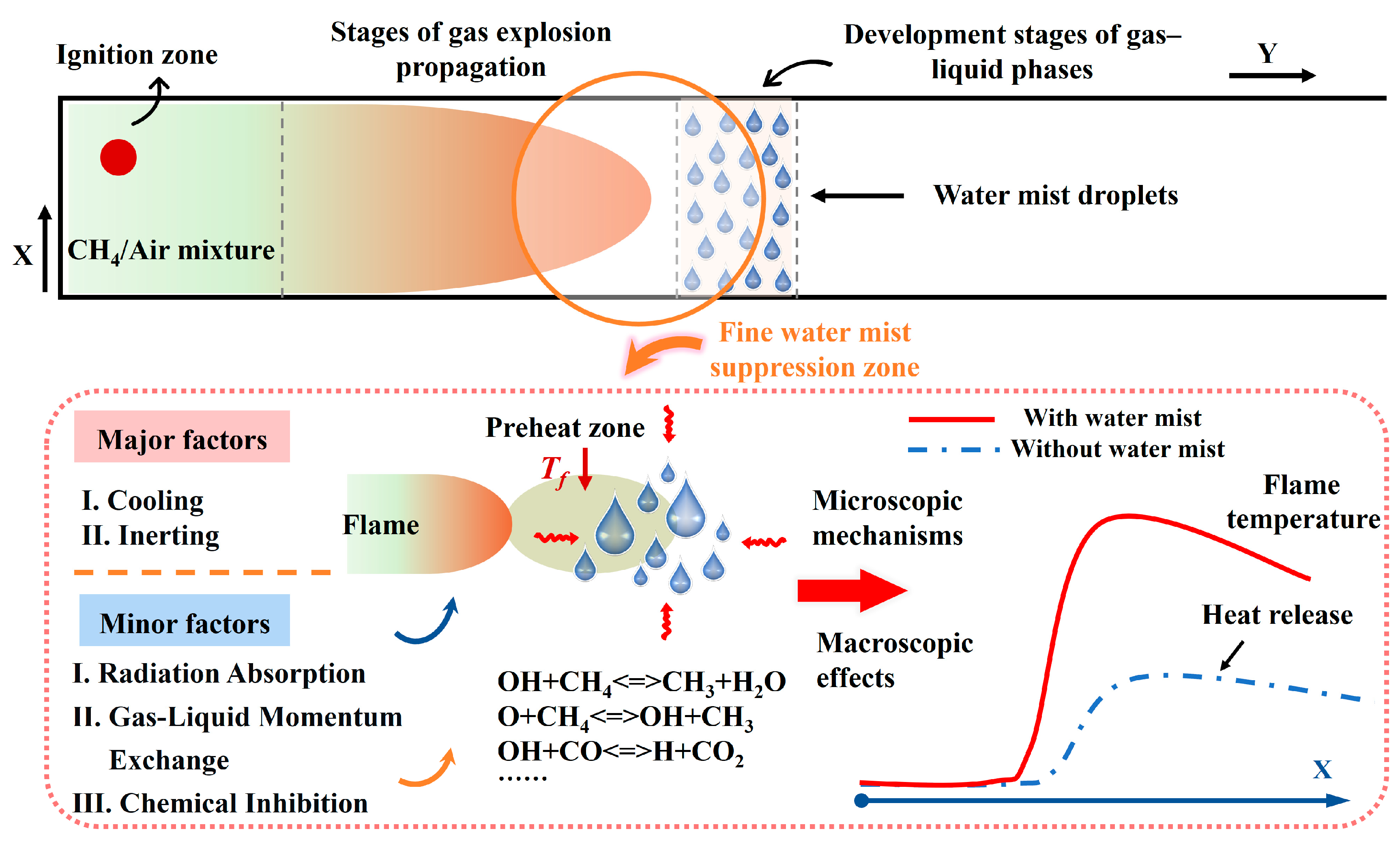
As shown in Figure 15, the suppression mechanisms of fine water mist can be categorized into five main aspects: cooling, inerting, radiation absorption, chemical inhibition, and flame stretching. During the suppression process, flame deceleration and extinction are primarily driven by the physical inhibitory effects induced by the water mist, including heat absorption, dilution, and flow-field restructuring, thereby mitigating explosion intensity. The negligible variation in key radicals such as ·OH indicates that reaction kinetics are not the dominant mechanism.

5. Conclusions

This study combines large-scale tunnel experiments with multiphysics-coupled numerical simulations to systematically investigate the suppression effects and mechanisms of fine water mist on methane/air explosions, leading to the following key conclusions:
(1) The effectiveness of fine water mist strongly depends on the number and placement of spray rings. Insufficient coverage or upstream-only positioning fails to reduce temperature and oxygen concentration below the combustion threshold, whereas complete flame blockage can be achieved by extending mist coverage or deploying it during the flame decay stage. Suppression of explosion overpressure exhibits a notable delay, indicating that engineering applications must address residual overpressure in addition to optimizing mist configuration for effective flame control. Downstream mist suppresses flame most effectively, but upstream deployment gradually attenuates the flame and reduces thermal and pressure risks, thereby enhancing overall safety.
(2) A multiphysics numerical model was developed to quantify the influence of mist concentration and arrangement on flame dynamics and explosion parameters. Simulations reveal that mist positioned at 40 m without achieving suppression allows strong pressure waves to expel most droplets before reaching the flame front, resulting in a flame velocity reduction from 223 m/s to 62 m/s and a maximum overpressure decrease of approximately 40%. Increasing the mist quantity or relocating it downstream enhances droplet evaporation and coupling with the flow field, stabilizing flame temperature around 500 K and achieving effective suppression.
(3) The study elucidates the primary suppression mechanisms of fine water mist in large-scale tunnels, including heat absorption and cooling, gas-phase dilution, and local flow-field restructuring, with chain reaction interruption playing a secondary role. These mechanisms collectively reduce flame-front temperature, disrupt flame–flow coupling, significantly decelerate flame propagation, and enable complete explosion suppression under optimized mist arrangements.
(4) The study does not fully account for three-dimensional flow structures, turbulence–droplet interactions, or potential gradients in mixture concentration and ignition, all of which could influence suppression efficiency and local flame dynamics. Despite these limitations, the results provide a solid foundation for designing and optimizing water mist suppression systems in large-scale tunnels and offer guidance for future three-dimensional simulations and practical engineering applications.

Author Contributions

P.Z.: Writing—original draft, Conceptualization and Formal analysis. Z.Y.: Investigation and Supervision. Q.J.: Investigation. J.Z.: Formal analysis. Z.H.: Supervision and Project administration. Z.L.: Writing—review and editing. J.L.: Writing—review and editing. All authors have read and agreed to the published version of the manuscript.

Funding

This research was funded by the National Natural Science Foundation of China (Grant Nos. 52174226 and 52174227) and Natural Science Foundation of Chongqing, China (Grant No. CSTB2023NSCQ-BSX0018).

Data Availability Statement

Data will be made available on request.

Conflicts of Interest

The authors declare that they have no known competing financial interests or personal relationships that could have appeared to influence the work reported in this paper.

References

  1. Cheng, C.; Si, R.; Wang, L.; Jia, Q.; Xin, C.; Chen, X. Experimental study on the effect of initial accumulation pattern on gas explosion and explosion suppression in a real roadway. Case Stud. Therm. Eng. 2023, 51, 103544. [Google Scholar] [CrossRef]
  2. Yin, W.; Fu, G.; Yang, C.; Jiang, Z.; Zhu, K.; Gao, Y. Fatal gas explosion accidents on Chinese coal mines and the characteristics of unsafe behaviors: 2000–2014. Saf. Sci. 2017, 92, 173–179. [Google Scholar] [CrossRef]
  3. Li, H.; Zhai, F.; Li, S.; Lou, R.; Wang, F.; Chen, X.; Shu, C.M.; Yu, M. Macromorphological features and formation mechanism of particulate residues from methane/air/coal dust gas–solid two-phase hybrid explosions: An approach for material evidence analysis in accident investigation. Fuel 2022, 315, 123209. [Google Scholar] [CrossRef]
  4. Huang, Z.; Si, R.; Wen, G.; Jin, S.; Xue, S. Experimental Study on the Isolation Effect of an Active Flame-Proof Device on a Gas Explosion in an Underground Coal Mine. Fire 2023, 6, 468. [Google Scholar] [CrossRef]
  5. Wang, H.; Zhang, Y.; Tian, S.; Hu, Y.; Xu, J. Experimental study on characteristics of methane-coal dust explosions and the spatiotemporal evolution of flow field in early flame. Case Stud. Therm. Eng. 2024, 61, 104978. [Google Scholar] [CrossRef]
  6. Dong, Z.; Liu, L.; Chu, Y.; Su, Z.; Cai, C.; Chen, X.; Huang, C. Explosion suppression range and the minimum amount for complete suppression on methane-air explosion by heptafluoropropane. Fuel 2022, 328, 125331. [Google Scholar] [CrossRef]
  7. Yu, M.G.; Zhu, X.N.; Pei, B.; Yang, Y. Experimental study on methane explosion suppression using carbon dioxide and ultra-fine water mist. J. China Coal Soc. 2015, 40, 2843–2848. [Google Scholar]
  8. Li, M.; Xu, J.; Wang, C.; Wang, B. Thermal and kinetics mechanism of explosion mitigation of methane-air mixture by N2/CO2 in a closed compartment. Fuel 2019, 255, 115747. [Google Scholar] [CrossRef]
  9. Dounia, O.; Vermorel, O.; Poinsot, T. Theoretical analysis and simulation of methane/air flame inhibition by sodium bicarbonate particles. Combust. Flame 2018, 193, 313–326. [Google Scholar] [CrossRef]
  10. Wen, X.; Wang, M.; Wang, F.; Yu, M.; Deng, H. Combined effects of obstacle and fine water mist on gas explosion characteristics. Chin. J. Chem. Eng. 2020, 40, 131–140. [Google Scholar] [CrossRef]
  11. Holborn, P.G.; Battersby, P.N.; Ingram, J.M.; Averill, A.F.; Nolan, P.F. Modelling the mitigation of a hydrogen deflagration in a nuclear waste silo ullage with water fog. Process Saf. Environ. Prot. 2013, 91, 476–482. [Google Scholar] [CrossRef]
  12. Holborn, P.G.; Battcrsby, P.; Ingram, J.; Auerill, A.F.; Nolan, P.F. Estimating the effect of water fog and nitrogen dilution upon the burning velocity of hydrogen deflagrations from experimental test data. Int. J. Hydrogen Energy 2013, 38, 6882–6895. [Google Scholar] [CrossRef]
  13. Grant, G.; Brenton, J.; Drysdale, D. Fire suppression by water sprays. Prog. Energy Combust. Sci. 2000, 26, 79–130. [Google Scholar] [CrossRef]
  14. Zhang, P.; Zhou, Y.; Cao, X.; Gao, X.; Bi, M. Enhancement effects of methane/air explosion caused by water spraying in a sealed vessel. J. Loss Prev. Process Ind. 2014, 29, 313–318. [Google Scholar] [CrossRef]
  15. Yu, M.G.; An, A.N.; You, H. Experimental study on inhibiting the gas explosion by water spray in tube. J. China Coal Soc. 2011, 36, 417–422. [Google Scholar]
  16. Back, G.G., III; Beyler, C.L.; Hansen, R. A quasi-steady-state model for predicting fire suppression in spaces protected by water mist systems. Fire Saf. J. 2000, 35, 327–362. [Google Scholar] [CrossRef]
  17. Shimizu, H.; Tsuzuki, M.; Yamazaki, Y.; Hayashi, A.K. Experiments and numerical simulation on methane flame quenching by water mist. J. Loss Prev. Process Ind. 2001, 14, 603–608. [Google Scholar] [CrossRef]
  18. Pei, B.; Lyu, H.; Wu, Z.; Jia, C.; Xu, T.; Li, R. Study on the synergistic effect of inert gas and ultrafine water mist on hydrogen explosion suppression. Int. J. Hydrogen Energy 2024, 82, 531–543. [Google Scholar] [CrossRef]
  19. Ingram, J.M.; Auerill, A.F.; Battersby, P.N.; Holborn, P.G.; Nolan, P.F. Suppression of hydrogen-oxygen-nitrogen explosions by fine water mist: Part 1. Burning velocity. Int. J. Hydrogen Energy 2012, 37, 19250–19257. [Google Scholar] [CrossRef]
  20. Cao, X.; Ren, J.; Bi, M.; Zhou, Y.; Li, Y. Experimental research on the characteristics of methane/air explosion affected by ultrafine water mist. J. Hazard. Mater. 2016, 324, 489–497. [Google Scholar] [CrossRef]
  21. Bekele, A.G.; Zhang, B.; Xia, Y.; Wang, B.; Zhang, S.; Yue, W. Experimental Study on the Characteristic Premixed Methane/Hydrogen Deflagration and Water Mist Suppression in a Semi-Confined Duct. Case Stud. Therm. Eng. 2025, 72, 106280. [Google Scholar]
  22. Han, S.; Jeon, D.; Yun, H.D.; Kim, G.Y.; Kim, K.; Yee, J.J.; Park, S. Explosion scenario analysis of hydrogen refueling stations: Mitigation of blast pressure behind protective walls using experiments and CFD simulations. Int. J. Hydrogen Energy 2010, 152, 11. [Google Scholar] [CrossRef]
  23. Lucas, M.; Hisken, H.; Skjold, T.; Arntzen, B.J.; Wingerden, K.V. CFD modelling of hydrogen and hydrogen-methane explosions—Analysis of varying concentration and reduced oxygen atmospheres. J. Loss Prev. Process Ind. 2023, 83, 105012. [Google Scholar] [CrossRef]
  24. Xu, X.; Lu, K. Influence of Ignition Position on Explosion Characteristics in Linked Vessels with a Concentration Gradient. Fire 2026, 9, 56. [Google Scholar] [CrossRef]
  25. Islas, A.; Fernández, A.R.; Betegón, C.; Martinez-Paneda, E.; Pandal, A. Biomass dust explosions: CFD simulations and venting experiments in a 1 m3 silo. Process Saf. Environ. Prot. 2023, 176, 1048–1062. [Google Scholar] [CrossRef]
  26. Edalati-Nejad, A.; Fanaee, S.A.; Ghodrat, M.; Salehi, F.; Khadem, J. The time dependent investigation of methane-air counterflow diffusion flames with detailed kinetic and pollutant effects into a micro/macro open channel. Case Stud. Therm. Eng. 2020, 18, 100603. [Google Scholar] [CrossRef]
  27. Collin, A.; Boulet, P.; Parent, G.; Lacroix, D. Numerical simulation of a water spray—Radiation attenuation related to spray dynamics. Int. J. Therm. Sci. 2007, 46, 856–868. [Google Scholar] [CrossRef]
  28. Schwer, D.A.; Kailasanath, K. Numerical simulations of the mitigation of unconfined explosions using water-mist. Proc. Combust. Inst. 2007, 31, 2361–2369. [Google Scholar] [CrossRef]
  29. Holborn, P.G.; Battersby, P.; Ingram, J.M.; Auerill, A.F.; Nolan, P.F. Modelling the mitigation of lean hydrogen deflagrations in a vented cylindrical rig with water fog. Int. J. Hydrogen Energy 2012, 37, 15406–15422. [Google Scholar] [CrossRef]
  30. Diao, S.; Li, H.; Wei, C.; Wang, J.; Yao, Y.; Yu, M. Numerical simulation on the inhibition effect of water mist capacity on hydrogen/air explosions. Process Saf. Environ. Prot. 2025, 198, 107231. [Google Scholar] [CrossRef]
  31. Jing, Q.; Wang, D.; Liu, Q.; Chen, X.; Shen, Y.; Wang, Z.; Zhong, Y. Inhibition effect and mechanism of ultra-fine water mist on CH4/air detonation: Quantitative research based on CFD technology. Process Saf. Environ. Prot. 2021, 148, 75–92. [Google Scholar] [CrossRef]
  32. Cao, X.; Wang, Z.; Lu, Y.; Wang, Y. Numerical simulation of methane explosion suppression by ultrafine water mist in a confined space. Tunn. Undergr. Space Technol. 2021, 109, 103777. [Google Scholar] [CrossRef]
  33. Luo, J.; Gao, W.; Zhang, K.; Huang, Z.; Jiang, H.; Li, G.; Jin, S.; Si, R.; Wen, G. CFD simulation with detailed chemical reaction mechanism of ultra-lean methane explosion at elevated temperatures. Int. J. Therm. Sci. 2010, 215, 12. [Google Scholar] [CrossRef]
  34. Xu, M.; Wei, S.; Lu, W.; Yu, M.; Chen, Z. Experimental and numerical study on the suppression of methane/coal dust hybrid explosion by DMMP water mist. Adv. Powder Technol. 2025, 36, 104894. [Google Scholar] [CrossRef]
  35. Li, J.; Wang, X.; Guo, J.; Zhang, J.; Zhang, S. Effect of concentration and ignition position on vented methane–air explosions. J. Loss Prev. Process Ind. 2020, 68, 104334. [Google Scholar] [CrossRef]
  36. Li, R.; Xiu, Z.; Liu, Z.; Xiao, F.; Li, M.; Liu, Q. Experimental study on the effect of concentration gradient on explosion dynamics and flame propagation in a methane-filled pipeline. Int. Commun. Heat Mass Transf. 2025, 165, 109110. [Google Scholar] [CrossRef]
  37. Reitz, R.D. Modeling atomization processes in high-pressure vaporizing sprays. At. Spray Technol. 1987, 3, 309–337. [Google Scholar]
  38. Zhao, H.; Wu, Z.W.; Li, W.F.; Xu, J.L.; Liu, H.F. Transition Weber number between surfactant-laden drop bag breakup and shear breakup of secondary atomization. Fuel 2018, 221, 138–143. [Google Scholar] [CrossRef]
  39. Moreno, J.; Casado, C.; Marugan, J. Improved discrete ordinate method for accurate simulation radiation transport using solar and LED light sources. Chem. Eng. Sci. 2019, 205, 151–164. [Google Scholar] [CrossRef]
  40. Perumal, T.M.; Krishna, S.M.; Tallam, S.S.; Gunawan, R. Reduction of kinetic models using dynamic sensitivities. Comput. Chem. Eng. 2013, 56, 37–45. [Google Scholar] [CrossRef]
  41. Hu, E.; Li, X.; Meng, X.; Chen, Y.; Cheng, Y.; Xie, Y.; Huang, Z. Laminar flame speeds and ignition delay times of methane–air mixtures at elevated temperatures and pressures. Fuel 2015, 158, 1–10. [Google Scholar] [CrossRef]
  42. Guildenbecher, D.R.; López-Rivera, C.; Sojka, P.E. Secondary atomization. Exp. Fluids 2009, 46, 371. [Google Scholar] [CrossRef]
  43. Hsiang, L.P.; Faeth, G.M. Drop deformation and breakup due to shock wave and steady disturbances. Int. J. Multiph. Flow 1994, 21, 545–560. [Google Scholar] [CrossRef]
  44. Coşanay, H.; Öztop, H.F.; Gür, M.; Bakır, E. Analysis of turbulent wall jet impingement onto a moving heated body. Int. J. Numer. Methods Heat Fluid Flow 2022, 32, 2938–2963. [Google Scholar] [CrossRef]
  45. Gur, M.; Oztop, H.; Biswas, N.; Selimefendigil, F. Three-dimensional analysis of turbulent twin-swirling jets onto a heated rectangular prism in a channel. Int. J. Numer. Methods Heat Fluid Flow 2025, 35, 1137–1171. [Google Scholar] [CrossRef]
Figure 1. Schematic diagram of the experimental setup.
Fire 09 00221 g001
Figure 2. Experimental procedure.
Fire 09 00221 g002
Figure 3. Physical model of the computational domain.
Fire 09 00221 g003
Figure 4. Validation of explosion pressure distribution under water mist suppression.
Fire 09 00221 g004
Figure 5. Spray-Ring number and position effects on methane flame suppression.
Fire 09 00221 g005
Figure 6. Explosion overpressure curves for methane–air mixtures in 100 m3 and 200 m3.
Fire 09 00221 g006
Figure 7. Methane explosion flow field with species mass fraction distributions.
Fire 09 00221 g007
Figure 8. Temporal evolution of temperature (a), overpressure (b), and flame propagation velocity (c) during a methane–air explosion in a large-scale roadway.
Fire 09 00221 g008
Figure 9. Explosion characteristics and flow-field evolution (Condition 2): (a) Temperature and water mist concentration; (b) Temperature variations over time at each monitoring point; (c) Pressure variations over time at each monitoring point.
Fire 09 00221 g009
Figure 10. Evolution of flame propagation and flow-field structure (Condition 3): (a) Temperature and water mist concentration; (b) Temperature variations over time at each monitoring point; (c) Pressure variations over time at each monitoring point.
Fire 09 00221 g010
Figure 11. Droplet evaporation, pressure, and turbulence dynamics during effective methane explosion suppression by fine water mist.
Fire 09 00221 g011
Figure 12. Flame propagation and water mist flow under unsuccessful methane suppression: (a) Temperature and turbulent flow field; (b,c) Time histories of temperature and pressure at various monitoring points.
Fire 09 00221 g012
Figure 13. Flame front dynamics and propagation velocities under different conditions: (a) Flame front arrival time; (b) Flame front propagation velocity.
Fire 09 00221 g013
Figure 14. Species and temperature evolution in the flame zone before and after suppression under different conditions: (a): Unsuccessful suppression at 40m (Condition 2); (b): Successful suppression at 40m (Condition 3); (c): Successful suppression at 70m (Condition 4).
Fire 09 00221 g014
Figure 15. Mechanisms of gas explosion suppression by fine water mist in large-scale roadways.
Fire 09 00221 g015
Table 1. Experimental conditions (“/” indicates a blank control group without water mist application).
Experimental ConditionMethane–Air Mixture Volume (m3)Number of Spray RingSpray Ring Location (Distance from Blast Door, m)
1100//
2100540
3100640
4100570
5200//
6200640
7200740
8200670
Disclaimer/Publisher’s Note: The statements, opinions and data contained in all publications are solely those of the individual author(s) and contributor(s) and not of MDPI and/or the editor(s). MDPI and/or the editor(s) disclaim responsibility for any injury to people or property resulting from any ideas, methods, instructions or products referred to in the content.