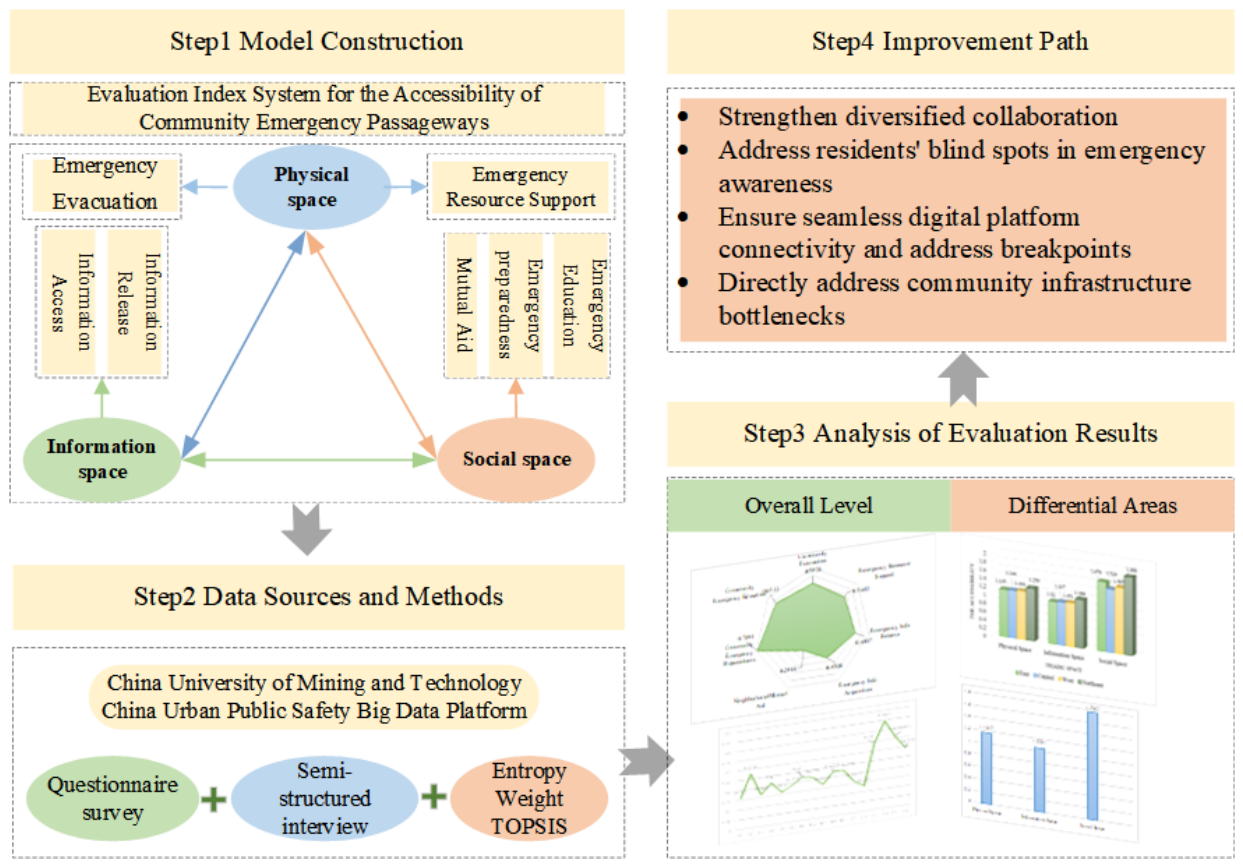


Research on Community Emergency Corridor Systems in Urban Fire Risk Governance: An Empirical Study of 77 Chinese Communities
Abstract
1. Introduction
2. Materials and Methods
2.1. Theoretical Framework
2.2. Indicator System
2.3. Data Sources
2.4. Evaluation Method
3. Results
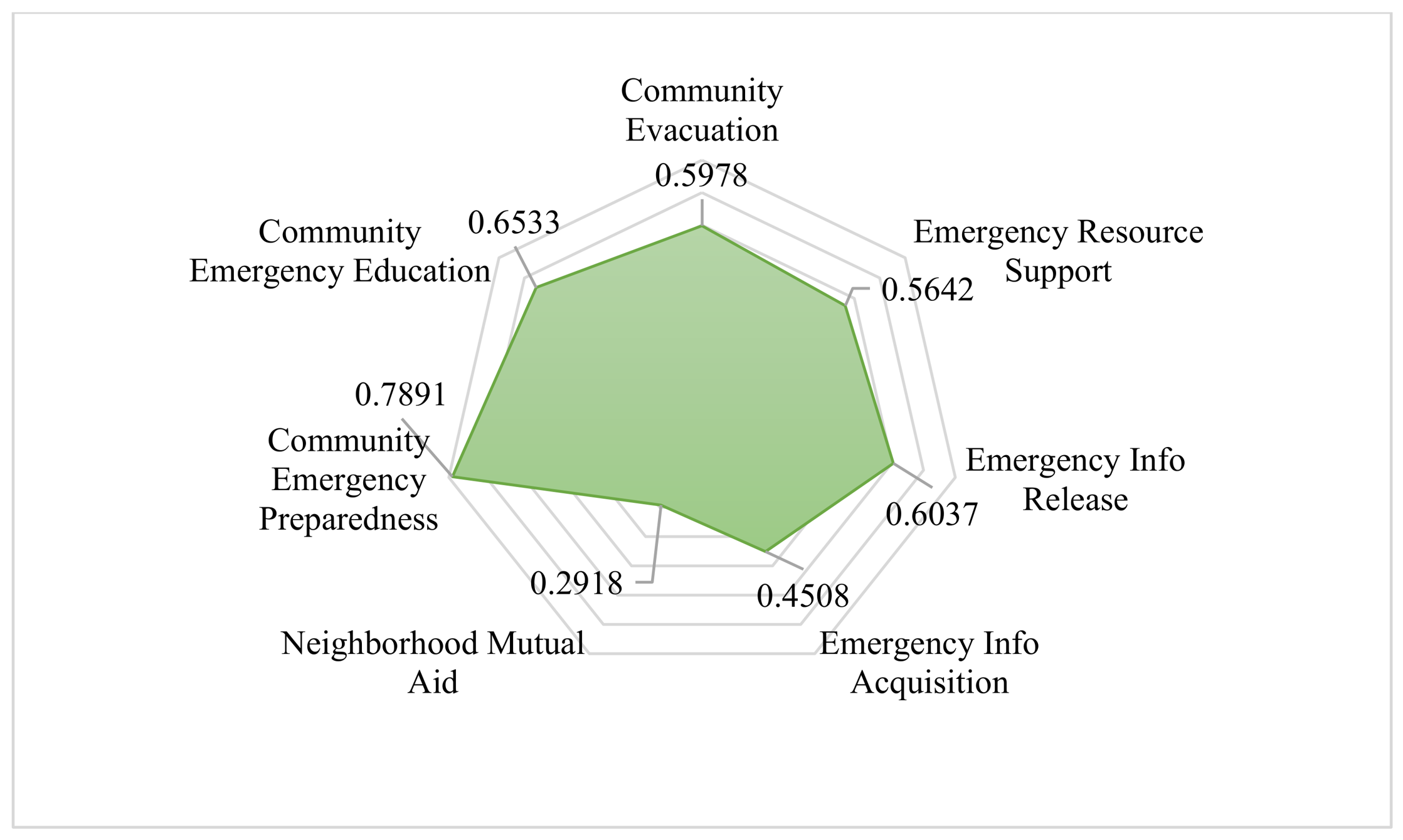
3.1. Overall Analysis
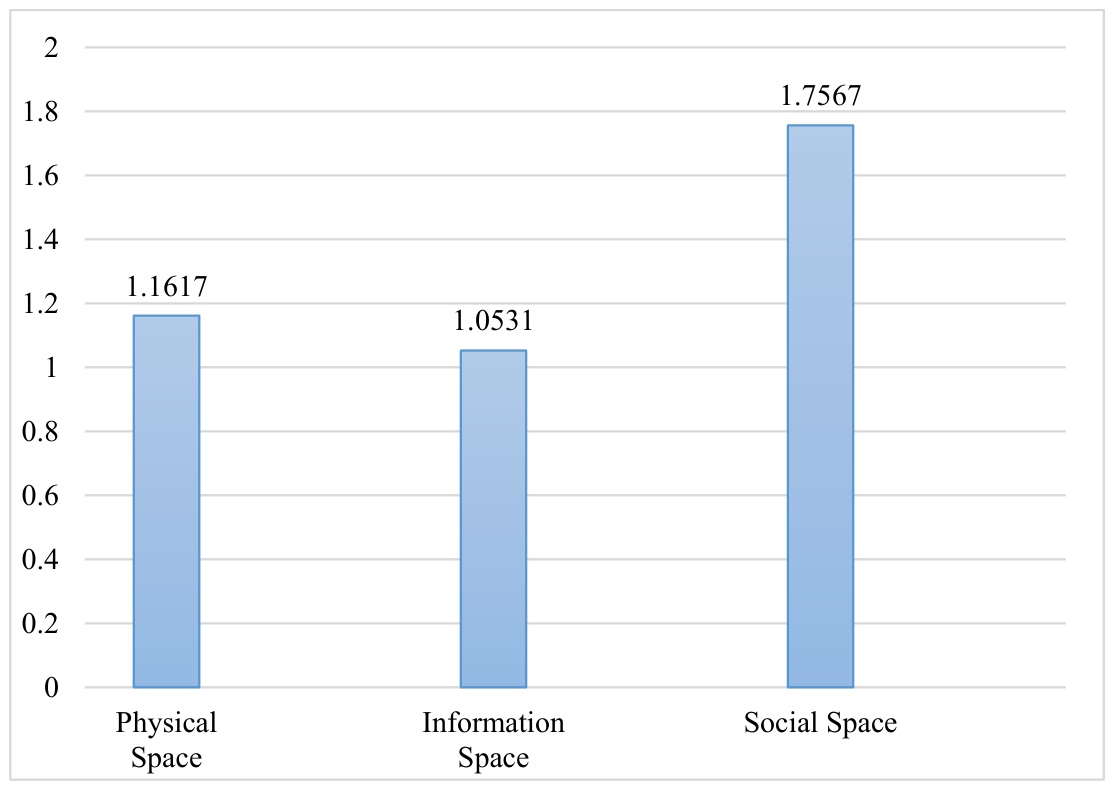
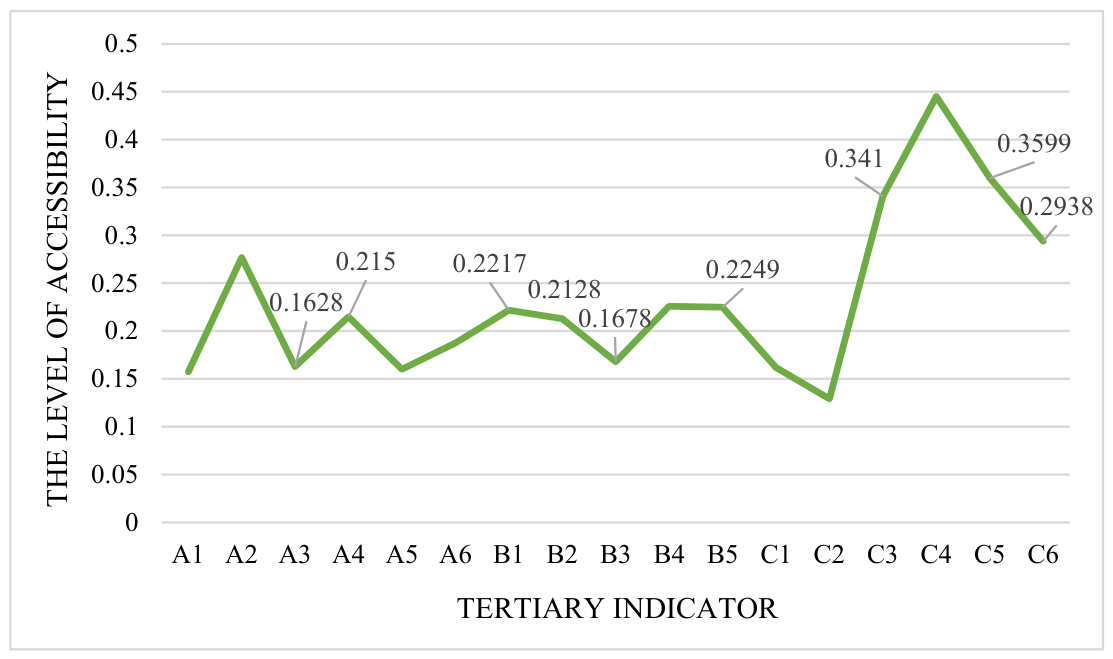
3.2. Sub-Dimensional Analysis
3.3. Regional Analysis
4. Discussion
4.1. Theoretical Contributions
4.2. Cause Analysis
4.3. Path Exploration
5. Conclusions and Outlook
Author Contributions
Funding
Institutional Review Board Statement
Informed Consent Statement
Data Availability Statement
Conflicts of Interest
References
- National Fire and Rescue Administration: National Fires in 2024 Have Five Main Characteristics. Available online: https://news.cctv.cn/2025/01/24/ARTIzxLWxFYy5ewOGCrrZPKV250124.shtml (accessed on 10 November 2025). (In Chinese)
- Li, Y.; Wang, Y.; Gong, J. An integrated metric for rapid and equitable emergency rescue during urban flash flooding events. Int. J. Disaster Risk Reduct. 2025, 118, 105209. [Google Scholar] [CrossRef]
- Guan, X.; Li, W.; Cui, N.; Yu, J.; An, L. Construction of an evaluation indicator system for the emergency management capability of major infectious diseases in urban communities. BMC Health Serv. Res. 2025, 25, 857. [Google Scholar] [CrossRef]
- Zhou, D.; Wang, X.; Peng, L.; Liang, S. Optimizing evacuation strategies in mountain communities to mitigate geohazards risk: A hybrid simulation framework. Int. J. Disaster Risk Sci. 2025, 16, 801–816. [Google Scholar] [CrossRef]
- Liu, D.; Yang, Z.; Xu, X.; Wu, S.; Wang, Y. Assessment and influencing factors of urban residents’ flood emergency preparedness capacity: An example from Jiaozuo City, China. Int. J. Disaster Risk Reduct. 2024, 102, 104294. [Google Scholar] [CrossRef]
- Zhou, J.; Nie, G.; Liu, Y. Multi-criteria comparison analysis of spatial equity for emergency shelters in old and new urban districts: A case study in Wuhua District and Chenggong District of Kunming City, China. Int. J. Disaster Risk Reduct. 2024, 108, 104–107. [Google Scholar] [CrossRef]
- Yang, J.; Alisan, O.; Vijayan, L.; Huang, W.; Ozguven, E.E. Critical Shelter Analysis Considering Social Vulnerability and Accessibility: A Case Study of Hurricane Michael Track Uncertainty. Appl. Spat. Anal. Policy 2025, 18, 30. [Google Scholar] [CrossRef]
- Chu, H.; Wu, J.; Perez, L.; Huang, Y. Exploring Family Ties and Interpersonal Dynamics—A Geospatial Simulation Analyzing Their Influence on Evacuation Efficiency within Urban Communities. ISPRS Int. J. Geo-Inf. 2024, 13, 258. [Google Scholar] [CrossRef]
- Fei, L.; Li, T. Investigating determinants of public participation in community emergency preparedness in China using DEMATEL methodology. Int. J. Disaster Risk Reduct. 2024, 112, 104803. [Google Scholar] [CrossRef]
- Tian, S.; Ning, S.; Li, H.; Chen, L.; Zhu, H.; Gao, G. Relationship of social capital, community identity, and perceived safety resilience during public emergencies in Shanghai. Sci. Rep. 2025, 15, 6608. [Google Scholar] [CrossRef]
- Jia, Z.; Xu, S.; Zhang, Z.; Cheng, Z.; Han, H.; Xu, H.; Wang, M.; Zhang, H.; Zhou, Y.; Zhou, Z. Association between mental health and community support in lockdown communities during the COVID-19 pandemic: Evidence from rural China. J. Rural. Stud. 2021, 82, 87–97. [Google Scholar] [CrossRef]
- Li, Y.L.; Chen, M.Y. Analysis and optimization strategy of multi-subject collaborative network in grassroots emergency management—A case study of the grassroots emergency collaborative network in Changsha. J. Catastrophology 2026, 41, 164–170. (In Chinese) [Google Scholar]
- Li, L.; Li, Z.; Ding, H.; Gao, M. How can digitalization be used to develop community resilience in public health emergencies?: A qualitative comparative analysis from China. PLoS ONE 2024, 19, e0315713. [Google Scholar] [CrossRef]
- Zhou, J.; Feng, Y.; Cao, G. AI-Assisted Regional Collaborative Game of an Emergency Supplies Reserve Supply Chain. Systems 2025, 13, 977. [Google Scholar] [CrossRef]
- Sun, T.; Lu, J.; Li, Q.; Kou, Y. Can digital twin technology revolutionize public health emergency management? Insights from the PPRR framework. Front. Public Health 2025, 13, 1631339. [Google Scholar] [CrossRef]
- Jiang, H.; Wang, Y.; Ma, W.; Wang, J.; Zhang, M. Unlocking the nonlinear Nexus: Accessibility of emergency resource and resident participation in flood response. J. Transp. Geogr. 2024, 118, 103926. [Google Scholar] [CrossRef]
- Wang, Y.; Han, X.; Ma, W.; Wei, Z.; Song, Z.; Zhang, M. Resident Participation in Flood Response: A Machine Learning and Agent-Based Simulation Study of Zhengzhou, China. Appl. Spat. Anal. Policy 2025, 18, 3. [Google Scholar] [CrossRef]
- Elden, S. Understanding Henri Lefebvre: Theory and the Possible; Continuum: New York, NY, USA, 2006. [Google Scholar]
- Wu, Z.Q. Principles Of Territorial Spatial Planning; Tongji University Press: Shanghai, China, 2022. (In Chinese) [Google Scholar]
- Mi, J.N.; Zhang, C.P.; Li, D.Y. “Digital space” government and its research program—Government form transformation induced by the Fourth Industrial Revolution. J. Public Manag. 2020, 17, 1–17+168. (In Chinese) [Google Scholar]
- Yan, J.M.; Feng, S.Y.; Xia, F.Z. Reflections on the modernization of territorial spatial governance system and governance capacity. Chin. Public Adm. 2024, 4, 129–140. (In Chinese) [Google Scholar]
- Chen, K.L. On the ternary interactive structure of China’s national governance. J. Humanit. 2017, 7, 112–118. (In Chinese) [Google Scholar]
- Deng, H.; Fan, Z.; Wei, X.; Deng, Y. An ontology-based approach to dynamic indoor fire emergency evacuation path planning with BIM integration. J. Build. Eng. 2025, 106, 112562. [Google Scholar] [CrossRef]
- Zhuge, H. Cyber-Physical Society—The science and engineering for future society. Future Gener. Comput. Syst. 2014, 32, 180–186. [Google Scholar] [CrossRef]
- Pan, Y.H. Artificial intelligence moving towards 2.0. Engineering 2016, 2, 51–61. (In Chinese) [Google Scholar] [CrossRef]
- Li, G.; Liu, X.T.; Ba, Z.C. Re-cognition of the ternary world theory and its relationship with national security intelligence space. Libr. Inf. Serv. 2022, 1, 14–23. (In Chinese) [Google Scholar]
- Wang, W. Research on the evaluation model and criteria of new smart cities based on the ternary space feedback control structure. J. Syst. Sci. 2023, 31, 58–64. (In Chinese) [Google Scholar]
- Pan, Y.; Tian, Y.; Liu, X.; Gu, D.; Hua, G. Urban Big Data and the Development of City Intelligence. Engineering 2016, 2, 171–178. [Google Scholar] [CrossRef]
- Wang, B.; Shi, Z.Y.; Zhu, J.J. Safety situation awareness path oriented to ternary space. China Saf. Sci. J. 2023, 33, 15–21. (In Chinese) [Google Scholar]
- Wu, Z.Q.; Yu, H. Development direction of urban planning discipline. Urban Plan. Forum 2005, 6, 2–10. (In Chinese) [Google Scholar]
- Dai, J.; Liu, F. Embracing the digital landscape: Enriching the concept of sense of place in the digital age. Humanit. Soc. Sci. Commun. 2024, 11, 724. [Google Scholar] [CrossRef]
- Chai, G.R.; Qiao, H.W.; Sha, Y.Z. Theoretical framework, logical deconstruction and path selection of the digital border strengthening strategy in the new era. Libr. Inf. Serv. 2024, 5, 31–43. (In Chinese) [Google Scholar]
- Gong, Y.X.; Shi, Y.H.; Liu, R.Z. Comprehensive security concept: Theoretical construction of emergency management in megacities—Emergency management practice from Shenzhen. J. Public Manag. 2022, 19, 46–57+168. (In Chinese) [Google Scholar]
- Zou, J.; Shen, F.W.; Tang, P.T. Scene construction, resident integration and digital governance of urban future communities. E-Government 2023, 7, 87–99. (In Chinese) [Google Scholar]
- Liu, Y.P. Digital space: Realistic construction of the internet society. People’s Trib.·Acad. Front. 2023, 10, 103–108. (In Chinese) [Google Scholar]
- Dianna, H. Capability Assessment for Readiness (CAR). Prehospital Disaster Med. 2000, 15, S36. [Google Scholar] [CrossRef][Green Version]
- Zhang, H. Emergency Management Evaluation; China Labor Social Security Press: Beijing, China, 2010; p. 103. (In Chinese) [Google Scholar]
- Henstra, D. Evaluating Local Government Emergency Management Programs: What Framework Should Public Managers Adopt? Public Adm. Rev. 2010, 70, 236–246. [Google Scholar] [CrossRef]
- Wang, X.; Sugumaran, V.; Zhang, H.; Xu, Z. A Capability Assessment Model for Emergency Management Organizations. Inf. Syst. Front. 2017, 20, 653–667. [Google Scholar] [CrossRef]
- Liu, Z.; Hu, X.Z. Construction of a Scientific Evaluation Indicator System for Low-Carbon Tourist Spots. Adv. Mater. Res. 2012, 573–574, 848–853. [Google Scholar] [CrossRef]
- Lu, P.J.; Tang, X.F.; Ding, X.Q. Research on the emergency management capabilities of multi-form grassroots communities under major public health emergencies. Chin. Public Adm. 2023, 2, 124–134. (In Chinese) [Google Scholar]
- Liu, J.; Teng, L.; Yang, Y.; Wang, W.; Luo, X.; Cai, F. Study on the construction and application of a community emergency capacity evaluation model based on a combined weighting-discrete Hopfield neural network. Int. J. Disaster Risk Reduct. 2024, 113, 104851. [Google Scholar] [CrossRef]
- National Bureau of Statistics of China. How Are Economic Zones Divided? Available online: https://www.stats.gov.cn/zt_18555/zthd/lhfw/2021/rdwt/202302/t20230214_1903926.html (accessed on 10 November 2025). (In Chinese)
- Chen, P. Effects of normalization on the entropy-based TOPSIS method. Expert Syst. Appl. 2019, 136, 33–41. [Google Scholar] [CrossRef]
- Hwang, C.L.; Yoon, K.S. Multiple Attribute Decision Making: Methods and Applications; Springer: Berlin/Heidelberg, Germany; New York, NY, USA, 1981; p. 259. [Google Scholar]
- Chen, P. Effects of the entropy weight on TOPSIS. Expert Syst. Appl. 2021, 168, 114186. [Google Scholar] [CrossRef]
- Wang, J.; Li, B. Digital Empowerment of Rural Emergency Management Under the Rural Revitalization Strategy: Influencing Factors and Driving Pathways. Systems 2026, 14, 242. [Google Scholar] [CrossRef]
- Tan, J.; Yuan, Y. Grassroots Organizational Capacity in Community Crisis Governance: A Case Study of Nanhai, China. Land 2025, 14, 2434. [Google Scholar] [CrossRef]
- Horn, C.; Kelly, L.M.; Kijevcanin, J. Community-led disaster resilience: Strengthening preparedness and recovery in regional Australia. Int. J. Disaster Risk Reduct. 2025, 132, 105938. [Google Scholar] [CrossRef]
- Ma, L.; Li, Y.; Yan, H.; Yuan, X.; Sun, M. The New Integration of Information Technology and Community Governance. IEEE Access 2024, 12, 161866–161883. [Google Scholar] [CrossRef]



| Primary Indicator | Secondary Indicator | Tertiary Indicator | Specific Questions | Indicator Interpretation |
|---|---|---|---|---|
| Physical sphere accessibility (0.2857) | Community evacuation (0.1452) | Emergency signs A1 | Community sets safety/emergency signs/indicators in conspicuous locations like shelters/key intersections, posts evacuation route maps. | To measure the standardization, clarity, and identifiability of signs related to emergency corridors in the community. |
| Community has signs for hazardous areas, fire lanes, etc. | ||||
| Fire safety A2 | Community regularly inspects building elevators for safe operation. | To measure the completeness, maintenance effectiveness, and usability of fire safety facilities associated with emergency corridor accessibility. | ||
| Community actively manages illegal parking of electric bicycles. | ||||
| Community electric bicycle parking areas meet fire safety conditions. | ||||
| Evacuation routes A3 | No illegal structures between buildings occupying fire separation distances/fire truck operational areas. | To measure the physical accessibility, width compliance, obstacle-free accessibility, and layout rationality of emergency evacuation corridors. | ||
| Community regularly inspects fire lanes, evacuation routes, exits to ensure they are clear. | ||||
| Emergency resource support (0.1406) | Emergency supplies A4 | Community is equipped with complete emergency facilities, such as fire extinguishers and AED defibrillators. | To measure the stock quantity, storage rationality, and intact availability of emergency materials supporting evacuation. | |
| Community has stocked sufficient emergency supplies. | ||||
| Emergency shelters A5 | Community fully utilizes parks, squares, green spaces, schools, stadiums, community service facilities to meet urgent evacuation/relocation needs. | To measure the site rationality and supporting facility completeness of community emergency shelters. | ||
| There are parks, stadiums, schools, etc., near community usable as emergency shelters. | ||||
| Emergency agencies A6 | Presence of community hospitals, Red Cross, etc., capable of providing emergency medical care. | To measure the institutional completeness and emergency response efficiency of community emergency organizations. | ||
| Community is equipped with emergency supply storage points or mini fire stations. | ||||
| Information sphere accessibility (0.2697) | Emergency info release (0.1532) | Information resources B1 | I often pay attention to emergency disaster info on community apps, government websites, community bulletin boards. | To measure residents’ attention to disaster early warning information and the timeliness of information renewal. |
| I can promptly obtain early warning info (earthquakes, extreme weather) from phone/internet. | ||||
| Information symmetry B2 | I understand policies/regulations released by govt/community for various emergencies. | To measure the balance and trustworthiness of emergency information transmission between residents and community emergency management authorities. | ||
| I have confidence in the government’s or community’s ability to respond to various accidents and disasters. | ||||
| Information openness B3 | I believe that the street and government should disclose relevant information about emergencies and disasters in a timely and complete manner. | To measure residents’ evaluation of the transparency and accessibility of community emergency information. | ||
| I believe the government is very transparent in disclosing emergency response information for sudden incidents. | ||||
| Emergency info acquisition (0.1165) | Information gathering B4 | I learn about disaster info through private WeChat groups, friends/relatives. | To measure residents’ awareness, frequency, and convenience in actively collecting emergency information. | |
| I learn about disaster info through community grid groups, community apps. | ||||
| Information sharing B5 | I actively share learned disaster/response info via WeChat groups, personal accounts. | To measure the transmission efficiency, accuracy, and coverage of emergency information among residents. | ||
| I believe disaster information spreads quickly and truthfully within the community. | ||||
| Social sphere accessibility (0.4446) | Neighborhood mutual aid (0.0704) | Receiving help C1 | In emergencies, my neighbors/friends will proactively help. | To measure the possibility and convenience for residents to receive support from community authorities and neighbors during emergencies. |
| In emergencies, I can receive support/help from the govt/community. | ||||
| Providing help C2 | In daily life, if others face emergencies, I proactively offer help. | To measure residents’ willingness and behavioral performance in proactively assisting others during emergencies. | ||
| In emergencies, I am willing to offer whatever help I can to neighbors in need. | ||||
| Community emergency preparedness (0.2049) | Emergency foundation C3 | Community fully implements grid-based management of disaster/accident risks/hazards. | To measure the implementation of community risk grid management, guidance on residents’ emergency supplies storage, and volunteer team development. | |
| Community encourages/guides families to reserve necessary emergency supplies, promotes family emergency kits. | ||||
| Community has volunteer teams participating in daily comprehensive disaster reduction work. | ||||
| Emergency drills C4 | Community regularly conducts emergency drills for fires, floods, earthquakes, etc. | To measure the frequency, standardization, and participation rate of community emergency evacuation drills. | ||
| I actively participate in community-organized emergency drills. | ||||
| Community emergency drills are very helpful in improving my ability to handle emergencies. | ||||
| Community emergency education (0.1693) | Implementation status C5 | Community organizes activities regularly in various forms for disaster prevention/reduction education. | To measure the progress, quality, and normalization of community emergency management practices. | |
| Community often uses loudspeakers, electronic screens to remind residents of safety hazards. | ||||
| Community regularly holds emergency safety training, distributes family emergency guidance manuals. | ||||
| Education effectiveness C6 | I have participated in community-organized safety/emergency education activities. | To measure the impact of emergency knowledge education on residents’ emergency awareness and behavior. | ||
| I find the safety/emergency education provided by the community very helpful. |
| Region | City | Number of Questionnaires Distributed | Number of Valid Questionnaires | Efficiency | City | Number of Questionnaires Distributed | Number of Valid Questionnaires | Efficiency |
|---|---|---|---|---|---|---|---|---|
| Eastern | Beijing | 200 | 173 | 86.50% | Nanjing | 190 | 166 | 87.37% |
| Tianjin | 200 | 189 | 94.50% | Hangzhou | 208 | 206 | 99.04% | |
| Shijiazhuang | 225 | 223 | 99.11% | Fuzhou | 147 | 143 | 97.28% | |
| Shanghai | 195 | 168 | 86.15% | Xiamen | 288 | 281 | 97.57% | |
| Jinan | 206 | 202 | 98.06% | Haikou | 200 | 186 | 93.00% | |
| Qingdao | 200 | 196 | 98.00% | Guangzhou | 200 | 197 | 98.50% | |
| Ningbo | 215 | 210 | 97.67% | Shenzhen | 200 | 188 | 94.00% | |
| Northeastern | Harbin | 200 | 183 | 91.50% | Shenyang | 208 | 191 | 91.83% |
| Changchun | 200 | 184 | 92.00% | Dalian | 200 | 176 | 88.00% | |
| Central | Taiyuan | 216 | 208 | 96.30% | Hefei | 198 | 187 | 94.44% |
| Nanchang | 200 | 191 | 95.50% | Zhengzhou | 201 | 199 | 99.00% | |
| Wuhan | 199 | 188 | 94.47% | Changsha | 195 | 178 | 91.28% | |
| Western | Kunming | 220 | 209 | 95.00% | Lanzhou | 196 | 193 | 98.47% |
| Hohhot | 200 | 194 | 97.00% | Nanning | 200 | 198 | 99.00% | |
| Xining | 200 | 192 | 96.00% | Guiyang | 199 | 199 | 100.00% | |
| Yinchuan | 200 | 199 | 99.50% | Xi’an | 205 | 189 | 92.20% | |
| Lhasa | 200 | 199 | 99.50% | Chengdu | 201 | 194 | 96.52% | |
| Wulumuqi | 186 | 180 | 96.77% | Chongqing | 200 | 199 | 99.50% |
Disclaimer/Publisher’s Note: The statements, opinions and data contained in all publications are solely those of the individual author(s) and contributor(s) and not of MDPI and/or the editor(s). MDPI and/or the editor(s) disclaim responsibility for any injury to people or property resulting from any ideas, methods, instructions or products referred to in the content. |
© 2026 by the authors. Licensee MDPI, Basel, Switzerland. This article is an open access article distributed under the terms and conditions of the Creative Commons Attribution (CC BY) license.
Share and Cite
Cao, J.; Wang, Y.; Li, C. Research on Community Emergency Corridor Systems in Urban Fire Risk Governance: An Empirical Study of 77 Chinese Communities. Fire 2026, 9, 186. https://doi.org/10.3390/fire9050186
Cao J, Wang Y, Li C. Research on Community Emergency Corridor Systems in Urban Fire Risk Governance: An Empirical Study of 77 Chinese Communities. Fire. 2026; 9(5):186. https://doi.org/10.3390/fire9050186
Chicago/Turabian StyleCao, Jialu, Yibao Wang, and Chong Li. 2026. "Research on Community Emergency Corridor Systems in Urban Fire Risk Governance: An Empirical Study of 77 Chinese Communities" Fire 9, no. 5: 186. https://doi.org/10.3390/fire9050186
APA StyleCao, J., Wang, Y., & Li, C. (2026). Research on Community Emergency Corridor Systems in Urban Fire Risk Governance: An Empirical Study of 77 Chinese Communities. Fire, 9(5), 186. https://doi.org/10.3390/fire9050186