
Article

Research on Community Emergency Corridor Systems in Urban Fire Risk Governance: An Empirical Study of 77 Chinese Communities
School of Public Policy and Management (School of Emergency Management), China University of Mining and Technology, Xuzhou 221116, China
*
Author to whom correspondence should be addressed.
Fire 2026, 9(5), 186; https://doi.org/10.3390/fire9050186
Submission received: 17 March 2026 / Revised: 23 April 2026 / Accepted: 24 April 2026 / Published: 30 April 2026

Abstract

Urban fires are highly destructive with high casualty rates, often causing significant casualties and property losses. The obstruction of the Community Emergency Corridor System is a critical factor exacerbating fire casualties, directly related to residents’ life safety and public security governance effectiveness. Currently, community emergency corridors face severe systemic bottlenecks in the coordinated development of triadic space (physical, social, and information spaces), and the lag of information space has become a fatal shortcoming restricting emergency response efficiency, highlighting the urgent need for a comprehensive evaluation framework. However, existing studies mostly focus on a single spatial dimension, lacking a systematic framework for the coordinated patency of triadic space. Based on this, this study adopts the triadic space perspective, takes 77 typical communities in China as research objects, and uses the Entropy Weighted TOPSIS method to construct an evaluation index system for the accessibility of the Community Emergency Corridor System and systematically measure its level. The results show that the patency of triadic space is unbalanced overall; social space outperforms physical and information spaces (with the latter being the lowest), reflecting deficiencies in emergency information release and acquisition. Regionally, accessibility in Northeast China is significantly higher than in other regions (Northeast > West > Central > East), and eastern China has the lowest scores in physical and information spaces due to high urbanization, dense buildings, and land scarcity. Corresponding countermeasures are proposed to address regional disparities. The triadic space evaluation framework and methodological path provide a replicable analytical tool for urban fire-oriented community emergency management and references for fire resilience governance in other countries or high-density communities.

1. Introduction

Global urban fires, in marked contrast to wildfires, are characterized by distinctive features such as high-rise building density and concentrated populations. Consequently, they exhibit significantly elevated casualty rates and pronounced structural destructiveness, leading to more substantial economic losses. As fundamental units of social governance, grassroots communities are pivotal in preventing and mitigating major safety risks. At the national level, systematic arrangements have been established to advance the modernization of the national security system and capabilities, which underscores the necessity to strengthen grassroots emergency resources and enhance disaster prevention, mitigation, and relief capacities. However, the blockage of emergency corridors in grassroots communities remains a persistent problem in reality. Numerous incidents demonstrate how such obstructions exacerbate disaster consequences—for example, fatalities caused by insufficient water pressure from fire hydrants during fires, or delayed ambulance responses due to private vehicles illegally occupying emergency lanes. These blockages have significantly contributed to preventable casualties. According to a report by the National Fire Rescue Bureau, the China Fire and Rescue Team responded to 908,000 fire incidents in 2024, including 391,000 building fires (43.1% of total). Of these, residential fires accounted for 309,000 cases—79% of all building fires—and were characterized by high casualty rates and extensive damage [1]. The vast majority of these incidents occurred in communities where the emergency corridor was partially or severely obstructed, indicating that blocked passageways are a critical factor in fire-related civilian casualties. Therefore, ensuring unimpeded access to the Community Emergency Corridor System is an urgent imperative.
Current research on Community Emergency Corridor Systems, both domestically and internationally, primarily focuses on three dimensions. First, physical space accessibility: Studies have developed assessment models such as the three-dimensional emergency rescue coordinate system, evaluations of community emergency management capability, five core emergency capabilities, and evacuation planning models [2,3,4]. Relevant scholars have explored how to optimize the emergency preparedness capabilities of community residents from four dimensions, emergency knowledge, skills, awareness, and materials [5], while others have investigated spatial equity in emergency shelter distribution [6,7]. Second, social space accessibility: International research on community emergency response began earlier, with scholars analyzing how interpersonal networks [8], public participation [9], and social capital [10] influence the efficiency of community evacuations. Domestic studies have explored the role of communities within the broader social support system during public health emergencies [11] and the effectiveness of multi-stakeholder collaborative networks [12]. Third, information space accessibility: Researchers have investigated the application of digital technologies in community-level governance [13], as well as the innovative application of artificial intelligence technology and digital twin technology in grassroots emergency management [14,15].
In summary, the Community Emergency Corridor System is a crucial component of emergency response with significant practical relevance. While existing studies have accumulated substantial insights within the respective dimensions of the triadic space framework, they remain fragmented and isolated. Although some scholars have examined the interplay between physical emergency resources and social participation [16,17], few have attempted to integrate the physical, informational, and social dimensions into a cohesive analytical framework capable of revealing the intrinsic structure and operational mechanisms of community emergency passageways—complex systems that inherently couple human, material, and information flows. This gap limits comprehensive, multidimensional assessments of accessibility.
To address these limitations, this study develops an integrated analytical framework based on Triadic Space Theory. First proposed by French philosopher Henri Lefebvre [18] and later expanded by academician Wu Zhiqiang in the context of urban development [19], this theory posits that the world is composed of physical, social, and information space. An increasing number of scholars have introduced this framework into public administration, initiating explorations in areas such as digital space [20], territorial space [21], and national governance [22]. Although existing research has yielded substantial outcomes within this framework, significant gaps remain when focusing on the context of the Community Emergency Corridor System: First, research perspectives remain fragmented. Much of the literature focuses exclusively on physical path planning and facility deployment [23], isolates the impact of social capital on emergency preparedness [10], or unilaterally emphasizes the instrumental value of information technology [13], lacking empirical examinations that integrate the three dimensions within a unified analytical framework to explore their coupled interactions. Second, measurement methods urgently require integration. Existing evaluation systems predominantly rely on subjective weighting or single-dimension indicators, making it difficult to objectively quantify the comprehensive contribution of triadic space to accessibility and its internal structural variations. Third, no optimization pathways have been proposed.
Given this context, this study aims to systematically address the following core questions from a triadic space perspective: (1) How can a comprehensive evaluation framework be constructed to fully characterize the accessibility of physical, social, and information spaces? (2) What are the overall levels of emergency accessibility and the internal structural characteristics in typical Chinese communities, and does a significant spatial imbalance exist? (3) What systematic optimization strategies can address the identified structural deficiencies? To this end, this paper employs the Entropy Weighted TOPSIS model to conduct precise assessment and diagnostic analysis of the accessibility of Community Emergency Corridor Systems in Chinese communities. This approach not only advances emergency management research from a “unidimensional static” paradigm to a “triadic dynamic” framework at the theoretical level but also provides actionable decision-making support for urban and community administrators.

2. Materials and Methods

2.1. Theoretical Framework

With the advancement of digital technology and the transformation of social structures, the domain of human activities is shifting from traditional two-dimensional frameworks to a new three-dimensional paradigm [24]. The world has consequently evolved from a dual “physical–social” space into a tripartite “physical–social–information” space [25]. Within this structure, the three dimensions are interdependent and interact dynamically to collectively constitute the human habitat [26]. Academic research on the triadic space model has expanded into diverse fields, such as public governance [20,27], smart cities [28], information science [29], urban planning [30], and sociology [31]. Similarly, community emergency response encompasses governance paradigms with distinct spatial attributes, particularly in assessing emergency accessibility within specific grassroots community scenarios. “Physical space” refers to all objectively existing entities, forming the essential material foundation for human survival [32]. It supports residents’ daily lives and emergency response through infrastructure such as public venues, emergency facilities, supplies, and shelters. “Social space” denotes the realm of social relations and networks where dynamic interactions occur. Originating in the family sphere and continuously evolving through social interaction [33], it serves as a core dimension of urban governance by strengthening public safety through community networks such as neighborhood mutual aid groups, formal organizations, and residential security systems that enhance living environments and social cohesion. “Information space” emerges from the reciprocal interaction and digital mapping between physical and social spaces [34]. It is a product of the technology-driven digital transformation of human activity. Within the digital space, human society’s living space is continually extended through digital platforms and information carriers [35]. This is evidenced by the efficiency of residents’ access to critical information and the timeliness of digital information dissemination.
Based on Triadic Space Theory, this study develops an assessment model for the accessibility of Community Emergency Corridor Systems by integrating the dimensions of physical, social, and information spaces. The “Community Emergency Corridor System” is conceptualized as a composite system—integrating physical, social, and informational elements—that facilitates the safe, efficient movement of people, materials, information, and energy during emergency preparedness and response phases. Going beyond the conventional understanding of “physical roads,” it emerges as an organic whole formed by the mutual coupling and synergistic interaction of physical space (tangible pathways like roads and facilities), social space (behavioral norms such as resident awareness and organizational coordination), and information space (communication networks for data transmission and warning dissemination). This integrated framework demonstrates systemic integration, multidimensional functionality, and spatial embeddedness. Consequently, the accessibility of the Community Emergency Corridor System reflects the system’s overall capacity to withstand disruptions, sustain essential operations, and function reliably, efficiently, and equitably under crisis conditions. It encompasses not only the removal of physical barriers but also the effectiveness of social coordination mechanisms and the timeliness and accuracy of information transmission.
Specifically, physical space accessibility in community emergency management centers on the functionality of infrastructure. By upgrading physical emergency facilities, communities enhance their resilience and capacity to withstand sudden incidents, thereby increasing residents’ speed and likelihood of safe evacuation. This dimension encompasses two key components: community emergency evacuation and emergency resource support. Emergency evacuation addresses issues such as community fire safety, emergency signs, and the unobstructed nature of evacuation routes. Emergency resource support includes emergency supplies, emergency shelters, and emergency response agencies. Information space accessibility focuses on the efficiency and reliability of information flow, reflecting a community’s ability to maintain functional information systems amid sudden and uncertain risks. It consists of two principal aspects: information release and acquisition. Information release should ensure timeliness, speed, openness, and transparency; information acquisition should guarantee diverse channels, ease of collection, and proactive sharing by the public. Driven by contemporary digital technology, individuals function as essential nodes within social information networks. The public’s ability to accurately assess, rapidly disseminate, and effectively act upon emergency information constitutes a core mechanism for strengthening grassroots emergency management. Emergency accessibility in community social space emphasizes organizational connectivity. This dimension relies on the relational networks and social structures within grassroots communities to withstand public emergencies and enhance response capabilities. It includes three principal elements: neighborhood emergency mutual aid, community emergency preparedness, and community emergency education. Neighborhood emergency mutual aid relies on interpersonal relationships, where neighborly bonds are pivotal for seeking and offering assistance during a crisis. Community emergency preparedness involves the community’s organizational management systems, mobilization mechanisms, and emergency drills. Community emergency education highlights the vital role of local initiatives in emergency awareness and education efforts.
The accessibility of Community Emergency Corridor System stems from the integrated functioning of triadic space: the physical space accessibility of community infrastructure, the social space accessibility of social networks, and the informational space accessibility of communication channels. Only through the coordinated development of these triadic spaces can the overall accessibility of the Community Emergency Corridor System be ensured, thereby strengthening local emergency response capabilities. This integration enables timely interruption of the chain that transforms minor fires into major disasters, ultimately achieving the goal of strengthening grassroots community emergency preparedness. Improving the accessibility of Community Emergency Corridor Systems requires synergistic support across the tripartite dimensions of physical, social, and informational spaces: physical infrastructure provides the material foundation, social organization and mobilization constitute the operational core, while informational data flow amplifies effectiveness. While each space maintains functional independence, they also demonstrate strong coupling effects. Blockages in any single dimension can disrupt the overall Community Emergency Corridor System. Conversely, optimizing a specific dimension can generate positive spillover effects through spatial coordination mechanisms, ultimately enhancing the overall effectiveness of the Community Emergency Corridor System.
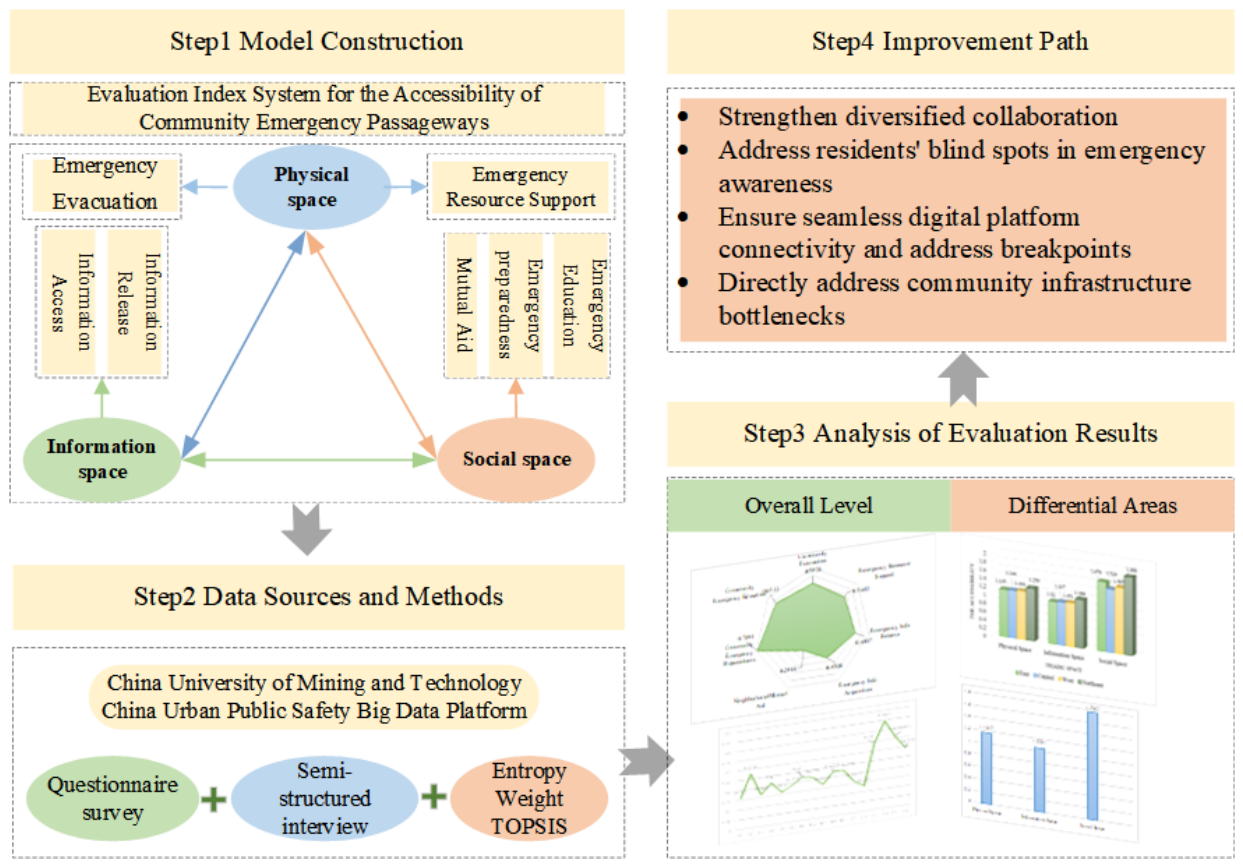
This study adopts a structured research framework of “Indicator system construction–Data collection–Data evaluation–Result analysis–Improvement pathways,” with the technical route illustrated in Figure 1. First, an evaluation indicator system for the accessibility of Community Emergency Corridor Systems was developed based on Triadic Space Theory. Data collection employed a combination of questionnaire surveys and semi-structured interviews. Subsequently, the Entropy Weighted TOPSIS method was applied for comprehensive data assessment. Evaluation results were analyzed by dimension and region, culminating in the proposal of specific optimization pathways to enhance the accessibility of Community Emergency Corridor Systems.

2.2. Indicator System

This study systematically constructs an evaluation indicator system for the accessibility of Community Emergency Corridor System by integrating established frameworks, including the U.S. state government’s Capability Assessment for Readiness (CAR) [36], the U.S. local government’s Local Capability Assessment for Readiness (LCAR) [37], and systems developed by Henstra and Wang et al. [38,39], Guan, X. et al. [40], Lu Pingjun et al. [41], and Jie Liu et al. [42]. During the initial indicator selection phase, based on the Triadic Space Theory framework, existing evaluation elements underwent dimensional deconstruction and reorganization. This formed a set of secondary indicators covering three spatial dimensions: physical facilities, social organizations, and information exchange. These were further refined into 17 quantifiable tertiary indicators, ensuring that each component of the Community Emergency Corridor System assessment could be measured through specific statistical indicators. To validate and refine the system, three rounds of expert consultation (n = 7) were conducted using the Delphi method. The Analytic Hierarchy Process (AHP) was applied to assess indicator validity and assign weights. During the first round, experts were invited to contribute additional critical indicators via an open-ended question format and to assign preliminary weights. Resulting weight coefficients were analyzed, and indicators with values below 0.05 were excluded as insignificant. Combined with expert consensus (Kendall’s W = 0.82), the indicator system was targeted for optimization, ultimately forming a community emergency accessibility assessment framework comprising 3 dimensions, 7 elements, and 17 measures (Table 1). The content in parentheses in Table 1 represents the indicator weights.
The questionnaire is strictly designed in accordance with the principles of indicator correspondence, quantifiability and pertinence. It is developed around the three first-level indicators of community emergency corridor accessibility, namely physical sphere accessibility, information sphere accessibility, and social sphere accessibility, and corresponds precisely to 7 secondary indicators and 17 tertiary indicators in the index system. A total of 28 specific questionnaire items are designed, with 2–3 items for each tertiary indicator, ensuring that every component and dimension of the index system can be reflected through specific questionnaire statistics and fully covering the core evaluation dimensions of emergency corridor accessibility.

2.3. Data Sources

This study utilizes the China University of Mining and Technology China Urban Public Safety Big Data Platform “https://ccps.cumt.edu.cn/ (accssed on 1 April 2026)”, adopting a mixed-methods approach that integrates questionnaire surveys with semi-structured interviews. A data support system was established, prioritizing quantitative analysis as the core methodology. The questionnaire was designed based on the evaluation index system of Community Emergency Corridor System accessibility and administered through targeted field surveys. Residents’ perceptions of the accessibility of Community Emergency Corridor Systems were measured using a five-point Likert scale. All procedures performed in studies involving human participants were in accordance with the 1964 Helsinki Declaration and its later amendments. The protocol was approved by the Institutional Review Board of the School of Public Policy and Management, China University of Mining and Technology, on 20 June 2024 (No. QN-2024-0019). Data collection began after obtaining ethical permission. The recruitment period for this study began on 1 July 2024, and ended on 31 August 2024. Written informed consent was obtained from all participants.
A multistage sampling strategy was implemented, with cities serving as primary sampling units, followed by systematic selection of streets, communities, residential complexes, households, and individual respondents. This ultimately formed a sample network covering 77 communities across 36 cities in eastern, central, western and northeastern China. A total of 7298 questionnaires were distributed, with 6958 valid responses recovered after data cleaning, resulting in a valid response rate of 95.34% (Table 2). All those who recognized the value of this study and understood its purpose and objectives participated. The participants were all adults, and their participation was entirely voluntary after being assured of their anonymity and the academic use of the collected data. The participants have also consented to the submission of the article to the journal. Informed consent was obtained between July and August 2024. The collected data were analyzed using IBM SPSS Statistics (21) software for reliability and validity assessment. Cronbach’s alpha coefficient was 0.964, and the KMO value reached 0.976, indicating high internal consistency and strong construct validity, thereby confirming the dataset’s analytical robustness.
Because the accessibility levels of Community Emergency Corridor Systems in different regions are constrained by objective conditions such as local economic development, this study divides the country into four regions—eastern, central, western, and northeastern—based on the economic zone classification standards established by the National Bureau of Statistics [43]. Accessibility assessments are conducted separately for each region. The eastern region comprises 10 provinces and municipalities: Beijing, Tianjin, Hebei, Shanghai, Jiangsu, Zhejiang, Fujian, Shandong, Guangdong, and Hainan. The central region comprises six provinces: Shanxi, Anhui, Jiangxi, Henan, Hubei, and Hunan. The western region encompasses twelve provinces, autonomous regions, and municipalities: Inner Mongolia, Guangxi, Chongqing, Sichuan, Guizhou, Yunnan, Tibet, Shaanxi, Gansu, Qinghai, Ningxia, and Xinjiang. The northeastern region consists of Liaoning, Jilin, and Heilongjiang. The 77 typical communities selected in this study cover cities of the first-tier, new first-tier, second-tier, and third-tier tiers across China, including four major regions: eastern, central, western, and northeastern China. Meanwhile, they involve diverse community types such as old communities, new commercial residential communities, and migrant communities. The sampling fully considers communities with different development levels, regional characteristics, and construction backgrounds, ensuring the sample can adequately reflect the overall characteristics of urban communities in China and providing solid support for the persuasiveness and universality of the empirical results. The survey results are presented in Table 2.

2.4. Evaluation Method

The study applies the Entropy Weighted TOPSIS method to conduct a comprehensive evaluation of triadic space accessibility for Community Emergency Corridor Systems. The TOPSIS method comprehensively evaluates objects based on their distances from the ideal point. The Entropy Weight method employs information entropy from information theory to determine indicator weights, serving as an objective weighting approach [44]. By integrating the Entropy Weight method into TOPSIS, the combined approach establishes objective dimension weights, thereby reducing arbitrariness in the evaluation process [45,46]. The Entropy Weighted TOPSIS method can determine objective weights of indicators based on the variability of the data itself, effectively avoiding biases caused by subjective assignment by experts. Meanwhile, the TOPSIS technique can rank and evaluate multi-indicator samples, accurately quantify differences in the accessibility of community emergency corridors across communities, and clearly show the development status of each dimension in the triadic space. Therefore, this study adopts the Entropy Weighted TOPSIS method to conduct a comprehensive evaluation of the accessibility of the Community Emergency Corridor System in the triadic space. The specific steps are as follows:
1. Construct the initial evaluation matrix. Assuming there are m survey questionnaires, each comprising n evaluation indicators, establish the community emergency access accessibility indicator matrix A by using Equation (1):
A   =   ( a ij ) m   ×   n   =   a 11 a 12 a 1 n a 21 a 22 a 2 n   a m 1 a m 2 a mn
In Equation (1), aij denotes the value of the jth evaluation indicator from the ith survey questionnaire, where i = 1, 2, …, m; j = 1, 2, …, n.
2. Data standardization: Within the evaluation indicator system, differences in the nature of various indicators result in varying units of measurement. To eliminate the influence of unit discrepancies, standardization of indicator values is necessary.
This study involves no negative indicators. For positive indicators, the standardization formula is applied:
a ij   =   a ij   min a ij max a ij min a ij
In Equation (2), aij denotes the normalized value of the jth evaluation indicator from the ith survey questionnaire. This process results in the standardized dimensionless matrix A by using Equation (3).
A   = ( a ij ) m   ×   n = a 11 a 12 a 1 n a 21 a 22 a 2 n   a m 1 a m 2 a mn
3. Construct an information entropy model. The higher the information entropy value is, the smaller the contribution of that factor to the accessibility of the Community Emergency Corridor System is.
e j = i = 1 m   p ij ln p ij lnm
p ij = a g j = 1 m   a g
d j = 1 e j
In Equation (4), ej denotes the information entropy value of evaluation indicator j. In Equation (5), pij denotes the proportion of questionnaire i relative to indicator j, where 0 ≤ pij ≤ 1. In Equation (6), dj denotes the redundancy of information entropy.
4. Calculate the weights of evaluation indicators by using Equation (7):
w j   =   d j j = 1 n   d j
In Equation (7), wj represents the weight of the evaluation indicator, and 0 ≤ wj ≤ 1.
5. Determine the optimal and suboptimal points. The optimal point is r +   =   r 1 + , r 2 + , , r n + , where r n + is the maximum value of the nth indicator. The suboptimal point is r = ( r 1 , r 2 , , r n ) , where r n is the minimum value of the nth indicator.
6. Compute the distance from optimal and suboptimal points. The weighted Euclidean distances d i j + , d i j between the current point r i j 1 , r i j 2 , , r i j n and the optimal point r+ and suboptimal point r− are defined as
d ij + = k = 1 n   w k r ijk r k + 2
d ij = k = 1 n   w k r ijk r k 2
7. Calculate the scores. The score sij for questionnaire i in indicator system j is defined as s i j = d i j d i j + + d i j .
8. After obtaining scores for each questionnaire across indicator systems, recalculate the comprehensive score using the TOPSIS method.

3. Results

3.1. Overall Analysis

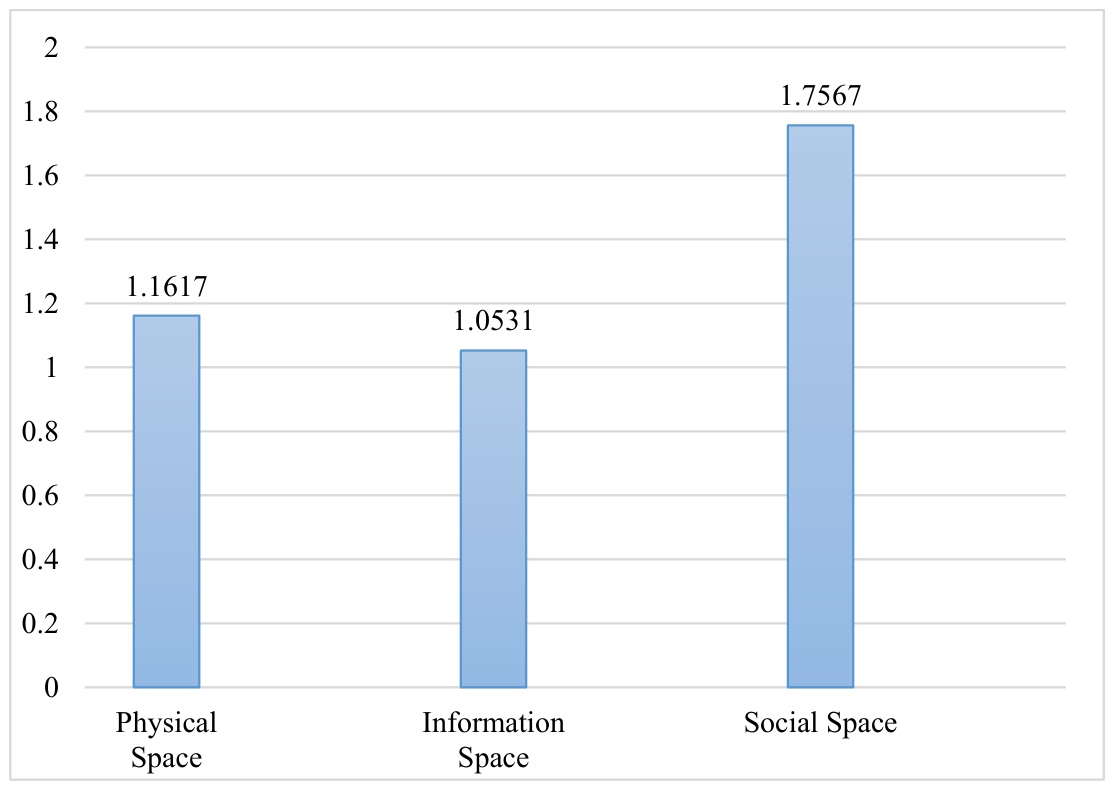
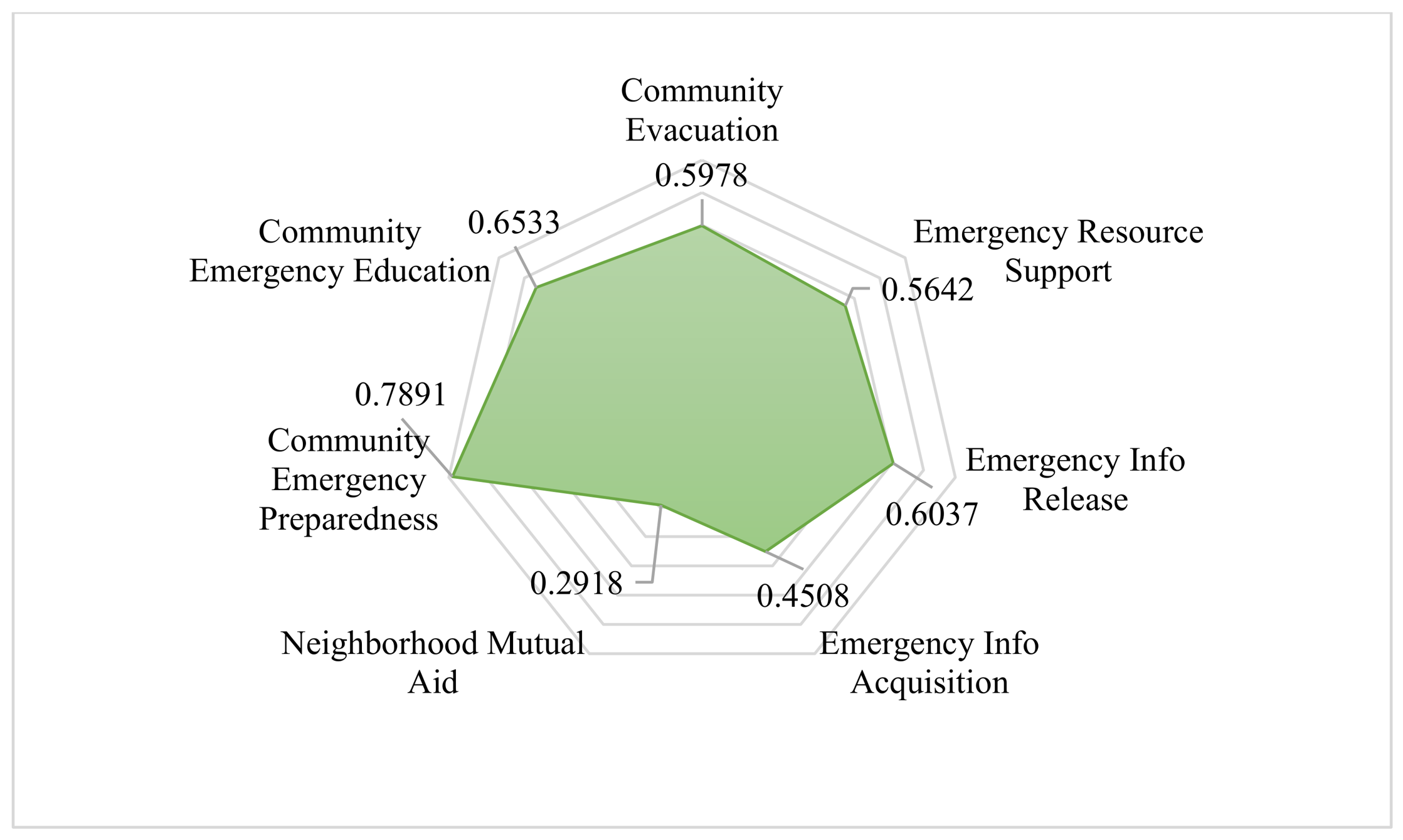
Empirical results from the Entropy Weighted TOPSIS model reveal significant structural imbalances in the accessibility of Community Emergency Corridor Systems across the triadic space, as illustrated in Figure 2. The overall score for emergency accessibility across these domains is 3.9715. Among the primary indicators, the accessibility of the Community Emergency Corridor System in the social space scored highest at 1.7567, while that in the information space scored the lowest at 1.0531, resulting in a gap of 0.7036. Both the physical and information spaces exhibit relatively low accessibility levels, indicating considerable potential for improvement. At the secondary indicator level, community emergency preparedness attained the highest score of 0.7891, reflecting strong emergency awareness in most communities. In contrast, neighborhood emergency mutual aid scored the lowest at 0.2918, reflecting the indifference and social estrangement in contemporary neighborhood relations, as shown in Figure 3. This reveals that the uneven development of Emergency Corridor Systems across the triadic space exposes systemic coordination bottlenecks within community emergency response networks. Structural optimization through spatial element reorganization is urgently needed.

3.2. Sub-Dimensional Analysis

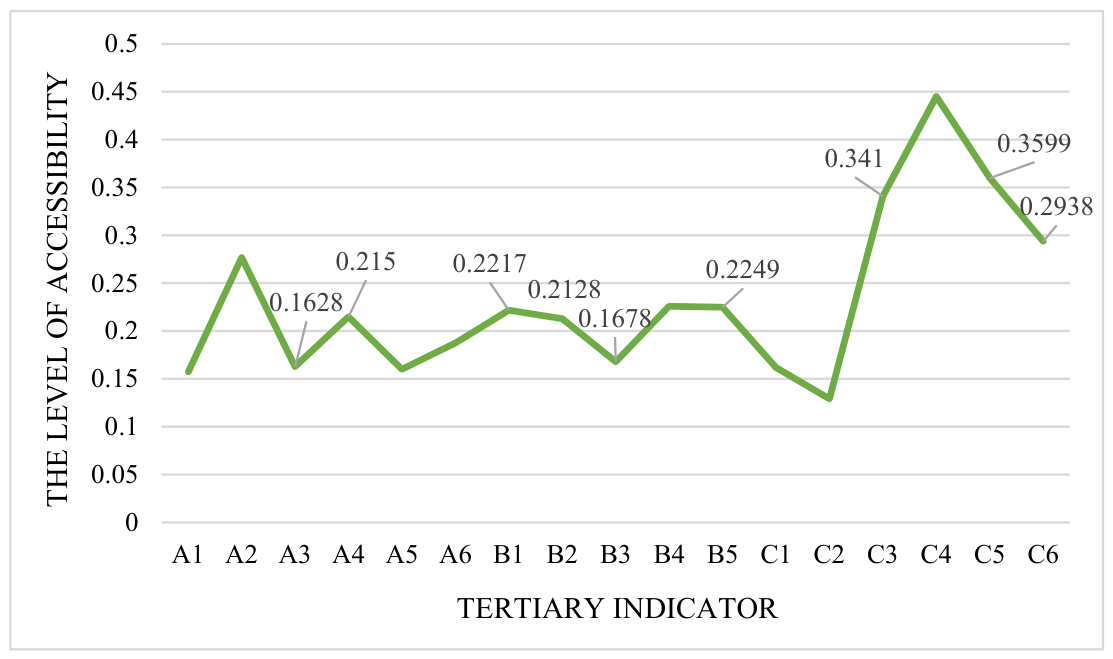
The accessibility score for the physical Emergency Corridor System is 1.1617, indicating a relatively low level. Specifically, community emergency signage constitutes the most significant barrier to the accessibility of the physical Emergency Corridor System, achieving the lowest score of only 0.1572. Community emergency evacuation route diagrams play a crucial guiding role during fires or earthquakes, enabling residents to evacuate more swiftly and safely while reducing congestion incidents. Simultaneously, signage for hazardous zones and fire lanes subtly enhances residents’ emergency preparedness awareness. In terms of physical Emergency Corridor System accessibility, this primarily encompasses community emergency evacuation and emergency resource support. The score for community emergency evacuation is 0.5978, while that for emergency resource support is 0.5642, showing a relatively small difference and indicating a balanced state. Among the tertiary indicators, physical Emergency Corridor System accessibility varies significantly across communities, ranging from 0.1572 to 0.2768, with A1 scoring lowest, A5 scoring the second lowest, and A2 achieving the highest score. Community infrastructure and emergency resources serve as essential hardware support for responding to sudden public incidents, facilitating emergency rescue operations and effectively preventing escalation, thereby safeguarding residents’ lives and property. They represent fundamental pathways for improving the accessibility of Community Emergency Corridor Systems.
As an extension of the dual-space concept, the information space serves as a vital engine for enhancing community emergency corridors. However, overall, the community information space scored the lowest at only 1.0531, indicating persistent gaps in emergency information release and acquisition within communities. As shown in Figure 3, the secondary indicator for emergency information release scored relatively high, reflecting increased emphasis on transparency in emergency communication in recent years, which is also closely linked to improvements in community informatization levels. The low score for residents’ emergency information acquisition reflects how technological advancements have transformed information dissemination channels, methods, and formats. The complex of safety-related information poses significant challenges to residents’ abilities to collect, discern, and access information—particularly among elderly populations, who predominantly rely on neighborhood networks and lack independent information-seeking capabilities. Therefore, communities should establish effective emergency information release mechanisms to improve both the efficiency and effectiveness of information delivery, thereby strengthening residents’ capacity to obtain critical emergency information.
As a key factor influencing the accessibility of Community Emergency Corridor Systems, the social space is closely linked to residents’ daily lives. A safe and stable social space can effectively enhance community emergency response capabilities and individual preparedness, thus promoting the accessibility of Community Emergency Corridor Systems. Currently, the social space score of the Community Emergency Corridor System accessibility is the highest among the three spaces, at 1.7567. Nevertheless, internal weaknesses persist in the social space of emergency corridor accessibility.Secondary indicator scores range from 0.2918 to 0.7891, revealing significant variation. The lowest score is for neighborhood emergency mutual aid (0.2918), indicating weak community neighborly ties and limited interpersonal interaction. The highest score is for community emergency preparedness (0.7891). As shown in Figure 4, among tertiary indicators, the social space score of emergency corridor accessibility ranged from 0.1293 to 0.4453. Indicators C1 and C2, representing the neighborhood emergency mutual aid sub-dimension, scored notably lower than other indicators. Therefore, fostering harmonious and supportive neighborhood relationships and community environments is crucial.

3.3. Regional Analysis

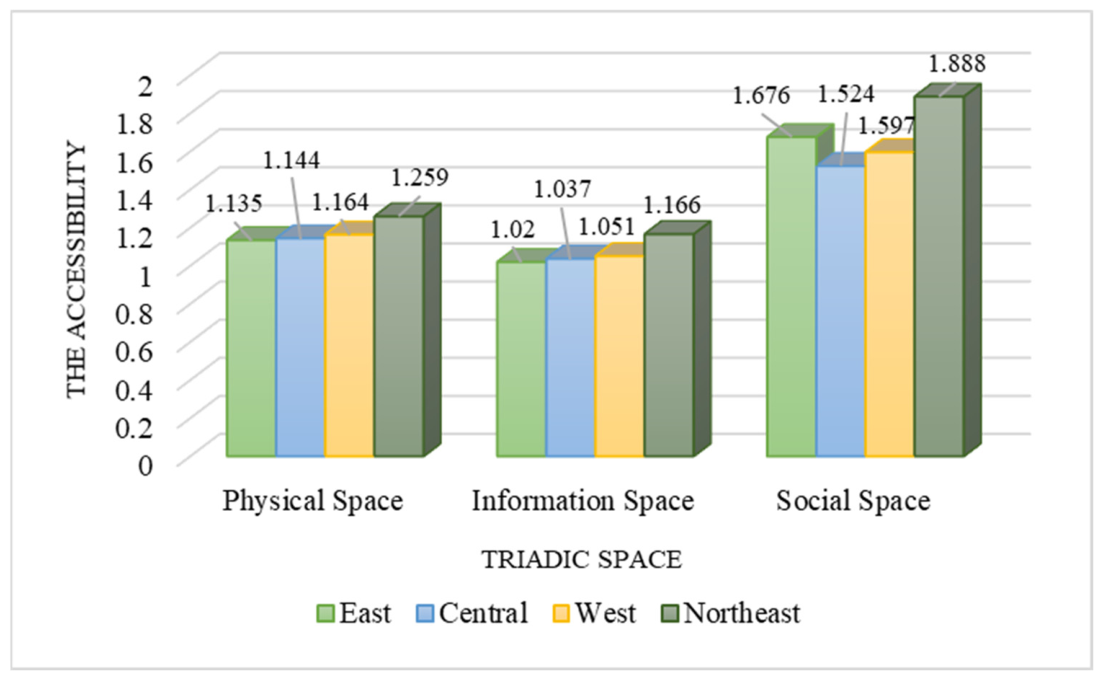
Analysis of accessibility across the four regions reveals that in the triadic space, all regions exhibit a consistent trend: social space accessibility ranks highest, physical space accessibility follows, while information space accessibility remains the lowest.
Comparing accessibility levels across regions, the eastern region scored the lowest in both physical and information space accessibility. With higher urbanization rates, densely packed urban structures, and limited land resources, emergency routes in eastern cities may be squeezed by commercial facilities or residential areas, resulting in insufficient width or lack of alternative paths. In contrast, the central and western regions benefit from abundant land resources, enabling community planning to better incorporate emergency evacuation requirements. Regarding information space accessibility, the eastern region’s high internet penetration rate means residents are more familiar with and reliant on digital communication. This familiarity may lead to lower trust in official warning channels or increased susceptibility to rumors, thereby weakening the effectiveness of information dissemination.
As shown in Figure 5, the central region’s physical and information space accessibility levels are broadly comparable to those of the eastern region. However, it scored the lowest among the four regions in social space accessibility. Social space primarily emphasizes organizational connectivity, encompassing both grassroots communities’ emergency response and coordination capabilities during incidents, and the closeness of neighborly relationships and community cohesion among residents. The development model in central regions relies heavily on government policies and resource allocation, with residents and grassroots organizations accustomed to passively awaiting and executing directives, resulting in lower social connectivity.
The western region generally exhibits moderate connectivity across the triadic space, characterized by relatively fragmented development that necessitates sustained efforts to improve spatial coordination. Modern metropolises like Chengdu and Xi’an in the west demonstrate connectivity characteristics closer to the eastern region, while the vast rural areas and traditional communities align more with the central region’s patterns. The aggregation of subregional scores yields an overall stable trend. Consequently, strengthening grassroots emergency response capabilities in the west cannot rely on direct replication of models from other regions; instead, it demands more resilient and adaptive strategies that account for its internal heterogeneity.
The Northeast region achieved the highest score in triadic space accessibility, reflecting distinct emergency response potential and developmental advantages. As China’s earliest industrialized region, Northeast China initiated urban and community planning that began early, characterized by wide, straight roads, orderly blocks, and ample public space. This reduces obstacles for rescue vehicle access and personnel evacuation. In terms of information space accessibility, grassroots communities in the Northeast predominantly rely on traditional information dissemination methods, such as community announcements and unit leader notifications. Information can reach residents quickly, avoiding social panic and disorderly actions caused by information chaos. Regarding social space accessibility, the “unit-based” community structure established during the planned economy era has cultivated a strong sense of collective identity and a tradition of mutual neighborhood support. This has created a relatively stable “familiar society” where high levels of resident cooperation contribute to reduced communication costs.

4. Discussion

4.1. Theoretical Contributions

This study adopts a triadic space perspective and employs the Entropy Weighted TOPSIS method to evaluate the accessibility of Community Emergency Corridor Systems across multiple representative Chinese communities. The findings reveal that, overall, the accessibility of Community Emergency Corridor Systems across the triadic space exhibits uneven development; social space outperforms physical and information space; regionally, development follows the pattern Northeast > West > Central > East. This study creatively applies Triadic Space Theory to the specific context of grassroots emergency management, theoretically testing and enriching the explanatory power and applicability boundaries of this framework. It also addresses the limitations of previous research that isolated discussions of a single space in grassroots emergency scenarios [47,48,49]. By conceptualizing physical, information, and social spaces as an inseparable organic whole, the study elucidates their interactive relationships and coupling mechanisms, achieving cross-spatial integration. This enhances theoretical understanding of the complexity inherent in grassroots emergency management and advances a paradigm shift in the field—from “unidimensional static” to “triadic dynamic” frameworks. Furthermore, this study innovatively constructs an evaluation index system for assessing the accessibility of Community Emergency Corridor Systems, operationalizing the core concept of triadic space as a set of measurable and evaluable standards. This lays a foundation for subsequent empirical research in grassroots emergency management.

4.2. Cause Analysis

The primary impediment to developing triadic space accessibility in community emergency pathways lies in fragmented spatial integration. Firstly, community physical space planning fails to adequately accommodate residents’ social spatial needs, most evident in the chronic shortage of electric vehicle charging stations. The lack of charging infrastructure within residential compounds readily leads to unsafe practices like bringing electric vehicles indoors or using extension cords for charging, which in turn obstructs emergency corridor routes. This reflects a disconnect between physical infrastructure planning and the mobility behaviors and safety requirements embedded in social space. Secondly, the digital transformation of physical space through the information space remains underdeveloped. The inability to connect the physical and social spaces through information technology limits the effectiveness of coordinated development across the triadic space. With regard to physical emergency accessibility, factors such as regional economic disparities, uneven resource distribution within areas, and varying levels of community development may prevent communities from regularly updating emergency infrastructure or allocating sufficient funds for maintenance. This results in suboptimal physical accessibility.
Compared to the traditional industrial era, information has become a central rather than secondary factor in the risk society of digital age [35]. The quality of information transmission channels and communication within the information space significantly impacts the overall accessibility of Community Emergency Corridor Systems. Key barriers in the information space include limited emergency information dissemination channels, the absence of community-wide emergency information sharing platforms, and residents’ low sensitivity to emergency alerts coupled with inadequate preparedness. Currently, most communities rely on resident group notifications and bulletin board postings for emergency alerts. Although a small number of technologically advanced communities have established integrated emergency information platforms, such cases remain rare nationwide. In terms of emergency information access, most residents demonstrate insufficient awareness of emergency risks and weak preparedness, with the elderly group being particularly affected.
Within the Chinese cultural context, neighborhood mutual aid functions as an informal system in grassroots emergency scenarios. Researchers have identified that community-based mutual assistance represents a “highlight” in urban resilience governance, particularly during events such as urban flooding [36]. However, regarding social space accessibility for Emergency Corridor Systems, the tension between traditional values and modern governance paradigms has subtly reshaped neighborhood relationships and spatial behaviors, emerging as a key obstacle to Emergency Corridor System efficiency. First, regarding neighborly relations, unlike the traditional adage “a good neighbor is better than a distant relative,” modern neighborly interactions increasingly lean toward estrangement, characterized by an “every man for himself” mentality that hinders mutual aid during emergencies. Second, spatial behaviors present challenges. Limited living space combined with traditional notions of resource efficiency leads many elderly residents to store belongings—including recyclables—in stairwells. This practice severely obstructs fire lanes and creates significant safety hazards.

4.3. Path Exploration

The accessibility of Community Emergency Corridor Systems encompasses three dimensions: physical space, information space, and social space. To resolve bottlenecks in accessibility and strengthen grassroots safety defenses, it is imperative to establish an “unobstructed community emergency access space”. This involves identifying convergence points among physical, social and information accessibility at the grassroots community level, thereby creating a triadic barrier-free environment that spans the individuals, communities, and society. The future development of this “barrier-free space for community emergency access” must adhere to the value principle of prioritizing people and lives. It should deliver actionable strategies to enhance accessibility through four dimensions: multi-stakeholder collaboration, awareness enhancement, digital empowerment, and spatial optimization.
Community emergency response systems cannot be built by a single entity operating in isolation. They must rely on the collaboration of multiple stakeholders to establish cooperative mechanisms linking communities, professional teams, and volunteer organizations [41]. Organizational coordination must overcome challenges in emergency response organization. This includes establishing community emergency command teams to centrally coordinate local resources; appointing dedicated emergency grid officers whose roles extend beyond routine oversight to include information dissemination, supply distribution and resident reassurance during emergencies. This ensures rapid response and timely coordination of resources and information within the 15 min emergency response zone. Each residential building should designate a “building manager” to ensure unobstructed community emergency access. The effectiveness of community emergency response is also closely tied to the professional competence of grassroots rescue teams. Volunteer selection and training must follow standardized protocols. In addition to technical skills, volunteers should receive psychological resilience training to remain calm under pressure and effectively guide residents in evacuation or self-rescue. In daily life, organizing neighborhood mutual aid groups can enhance interaction and cooperation. These groups provide everyday support—such as grocery assistance for the elderly or childcare—fostering trust and responsibility among residents, thereby improving social space accessibility within emergency pathways.
Weak emergency awareness among residents is a key factor contributing to the lack of effective self-rescue or mutual aid actions during emergencies. Therefore, enhancing residents’ emergency awareness and self-rescue capabilities—particularly through systematic community safety education—is essential for strengthening community resilience and protecting residents’ lives. To ensure comprehensive emergency education for all residents, communities should establish a safety education system covering all residents by integrating diverse resources based on local realities. Developing a holistic safety education framework, promoting active participation in skills training, and leveraging information technology can effectively enhance residents’ emergency response capacities. Communities can also utilize observances such as International Day for Disaster Reduction and National Disaster Prevention and Mitigation Day to increase engagement. Initiatives may include targeted outreach for older adults, on-site emergency training led by firefighters and first responders, and simulation drills to build practical preparedness. Such measures effectively bridge the gaps in emergency readiness.
Smart communities represent an emerging model of urban development that integrates resources and enhances management and service functions through digital tools [50]. Building smart community management platforms can break down information barriers and improve the efficiency of information sharing. By leveraging IoT and cloud computing, communities can develop integrated emergency management platforms that support monitoring, early warning, and real-time information exchange. Connecting these platforms with critical emergency infrastructure—such as evacuation routes, supply reserves, and shelters—enables sensors, IoT devices, and intelligent monitoring systems to provide continuous updates on facility status and availability. For example, infrared sensors and video surveillance can monitor evacuation route accessibility in real time, detect obstructions promptly, and automatically alert responsible personnel. Inspired by Singapore’s satellite town model, Hangzhou Xiaoshan’s Guali Rainbow Community has developed a “people-centered” digital safety ecosystem. It features a comprehensive, multi-layered security network with no blind spots, including AI-powered one-click emergency alerts for blocked escape routes, substantially reducing labor demands.
As the lifeline of any community, physical space directly impacts emergency response efficiency. Ensuring unobstructed physical pathways requires two core strategies: first, optimizing spatial planning to enable rational allocation of emergency facilities, ensuring swift resident access to shelters and timely assistance during emergencies; second, conducting regular clearance of stairwells and fire lanes to maintain passageway accessibility. In this era of deep integration across three dimensions, overcoming barriers in the accessibility of Community Emergency Corridor Systems requires balanced and coordinated development across physical, information, and social spaces. Accelerate the renewal of aging communities, further upgrade emergency infrastructure, and improve the accessibility of physical emergency pathways. Promote diversified emergency information channels, expedite the construction of emergency information sharing platforms, and strengthen data protection to enhance information space accessibility. Encourage residents to actively participate in emergency governance, raise public safety awareness through sustained educational campaigns and community initiatives, and cultivate a supportive cultural environment to strengthen social space accessibility.

5. Conclusions and Outlook

This study adopts Triadic Space Theory and the core findings are summarized in three aspects. First, the overall score of community emergency corridor accessibility is 3.9715, showing an unbalanced pattern: social space > physical space > information space. The prominent shortcoming of information space restricts the interconnection of the emergency response mechanism. Second, significant regional differences exist in accessibility: eastern and central regions have respective targeted weaknesses, the western region develops steadily, and the northeastern region achieves the highest overall level with balanced development. Third, balanced coordination of the triadic space is the core path to improve community emergency corridor accessibility. It is necessary to allocate resources scientifically and formulate differentiated improvement strategies according to regional economic strength and comprehensive development levels.
Based on the above findings, the core value of this study lies in the innovative construction of an evaluation index system for community emergency corridor accessibility, which enriches the research perspectives of community emergency management. Meanwhile, it provides operable analytical tools and differentiated ideas for practical community emergency corridor governance, effectively responding to the real demand for improving accessibility.
Objectively, this study has limitations, including insufficient sample coverage breadth and depth and inadequate community classification refinement. Future research will expand the sampling scale, adopt scientific stratified sampling to enhance representativeness, establish a systematic community classification framework, explore the coupling mechanism and obstacle causes of triadic space accessibility in different community types, and propose more targeted governance measures to improve the research system and support urban fire prevention and community public security governance.

Author Contributions

Conceptualization:, J.C. and Y.W.; Methodology, J.C.; Software, J.C.; Data curation, J.C.; Formal analysis, J.C.; Writing—original draft preparation, J.C.; Writing—review and editing, Y.W. and C.L. All authors have read and agreed to the published version of the manuscript.

Funding

This research received no external funding.

Institutional Review Board Statement

The study was conducted in accordance with the Declaration of Helsinki and approved by the Institutional Review Board of the School of Public Policy and Management, China University of Mining and Technology, on 20 June 2024 (No. QN-2024-0019).

Informed Consent Statement

Informed consent was obtained from all subjects involved in the study.

Data Availability Statement

The data presented in this study are available on request from the corresponding author due to the limitations of the Emergency Management Big Data Platform of China University of Mining and Technology.

Conflicts of Interest

The authors declare no conflicts of interest.

References

  1. National Fire and Rescue Administration: National Fires in 2024 Have Five Main Characteristics. Available online: https://news.cctv.cn/2025/01/24/ARTIzxLWxFYy5ewOGCrrZPKV250124.shtml (accessed on 10 November 2025). (In Chinese)
  2. Li, Y.; Wang, Y.; Gong, J. An integrated metric for rapid and equitable emergency rescue during urban flash flooding events. Int. J. Disaster Risk Reduct. 2025, 118, 105209. [Google Scholar] [CrossRef]
  3. Guan, X.; Li, W.; Cui, N.; Yu, J.; An, L. Construction of an evaluation indicator system for the emergency management capability of major infectious diseases in urban communities. BMC Health Serv. Res. 2025, 25, 857. [Google Scholar] [CrossRef]
  4. Zhou, D.; Wang, X.; Peng, L.; Liang, S. Optimizing evacuation strategies in mountain communities to mitigate geohazards risk: A hybrid simulation framework. Int. J. Disaster Risk Sci. 2025, 16, 801–816. [Google Scholar] [CrossRef]
  5. Liu, D.; Yang, Z.; Xu, X.; Wu, S.; Wang, Y. Assessment and influencing factors of urban residents’ flood emergency preparedness capacity: An example from Jiaozuo City, China. Int. J. Disaster Risk Reduct. 2024, 102, 104294. [Google Scholar] [CrossRef]
  6. Zhou, J.; Nie, G.; Liu, Y. Multi-criteria comparison analysis of spatial equity for emergency shelters in old and new urban districts: A case study in Wuhua District and Chenggong District of Kunming City, China. Int. J. Disaster Risk Reduct. 2024, 108, 104–107. [Google Scholar] [CrossRef]
  7. Yang, J.; Alisan, O.; Vijayan, L.; Huang, W.; Ozguven, E.E. Critical Shelter Analysis Considering Social Vulnerability and Accessibility: A Case Study of Hurricane Michael Track Uncertainty. Appl. Spat. Anal. Policy 2025, 18, 30. [Google Scholar] [CrossRef]
  8. Chu, H.; Wu, J.; Perez, L.; Huang, Y. Exploring Family Ties and Interpersonal Dynamics—A Geospatial Simulation Analyzing Their Influence on Evacuation Efficiency within Urban Communities. ISPRS Int. J. Geo-Inf. 2024, 13, 258. [Google Scholar] [CrossRef]
  9. Fei, L.; Li, T. Investigating determinants of public participation in community emergency preparedness in China using DEMATEL methodology. Int. J. Disaster Risk Reduct. 2024, 112, 104803. [Google Scholar] [CrossRef]
  10. Tian, S.; Ning, S.; Li, H.; Chen, L.; Zhu, H.; Gao, G. Relationship of social capital, community identity, and perceived safety resilience during public emergencies in Shanghai. Sci. Rep. 2025, 15, 6608. [Google Scholar] [CrossRef]
  11. Jia, Z.; Xu, S.; Zhang, Z.; Cheng, Z.; Han, H.; Xu, H.; Wang, M.; Zhang, H.; Zhou, Y.; Zhou, Z. Association between mental health and community support in lockdown communities during the COVID-19 pandemic: Evidence from rural China. J. Rural. Stud. 2021, 82, 87–97. [Google Scholar] [CrossRef]
  12. Li, Y.L.; Chen, M.Y. Analysis and optimization strategy of multi-subject collaborative network in grassroots emergency management—A case study of the grassroots emergency collaborative network in Changsha. J. Catastrophology 2026, 41, 164–170. (In Chinese) [Google Scholar]
  13. Li, L.; Li, Z.; Ding, H.; Gao, M. How can digitalization be used to develop community resilience in public health emergencies?: A qualitative comparative analysis from China. PLoS ONE 2024, 19, e0315713. [Google Scholar] [CrossRef]
  14. Zhou, J.; Feng, Y.; Cao, G. AI-Assisted Regional Collaborative Game of an Emergency Supplies Reserve Supply Chain. Systems 2025, 13, 977. [Google Scholar] [CrossRef]
  15. Sun, T.; Lu, J.; Li, Q.; Kou, Y. Can digital twin technology revolutionize public health emergency management? Insights from the PPRR framework. Front. Public Health 2025, 13, 1631339. [Google Scholar] [CrossRef]
  16. Jiang, H.; Wang, Y.; Ma, W.; Wang, J.; Zhang, M. Unlocking the nonlinear Nexus: Accessibility of emergency resource and resident participation in flood response. J. Transp. Geogr. 2024, 118, 103926. [Google Scholar] [CrossRef]
  17. Wang, Y.; Han, X.; Ma, W.; Wei, Z.; Song, Z.; Zhang, M. Resident Participation in Flood Response: A Machine Learning and Agent-Based Simulation Study of Zhengzhou, China. Appl. Spat. Anal. Policy 2025, 18, 3. [Google Scholar] [CrossRef]
  18. Elden, S. Understanding Henri Lefebvre: Theory and the Possible; Continuum: New York, NY, USA, 2006. [Google Scholar]
  19. Wu, Z.Q. Principles Of Territorial Spatial Planning; Tongji University Press: Shanghai, China, 2022. (In Chinese) [Google Scholar]
  20. Mi, J.N.; Zhang, C.P.; Li, D.Y. “Digital space” government and its research program—Government form transformation induced by the Fourth Industrial Revolution. J. Public Manag. 2020, 17, 1–17+168. (In Chinese) [Google Scholar]
  21. Yan, J.M.; Feng, S.Y.; Xia, F.Z. Reflections on the modernization of territorial spatial governance system and governance capacity. Chin. Public Adm. 2024, 4, 129–140. (In Chinese) [Google Scholar]
  22. Chen, K.L. On the ternary interactive structure of China’s national governance. J. Humanit. 2017, 7, 112–118. (In Chinese) [Google Scholar]
  23. Deng, H.; Fan, Z.; Wei, X.; Deng, Y. An ontology-based approach to dynamic indoor fire emergency evacuation path planning with BIM integration. J. Build. Eng. 2025, 106, 112562. [Google Scholar] [CrossRef]
  24. Zhuge, H. Cyber-Physical Society—The science and engineering for future society. Future Gener. Comput. Syst. 2014, 32, 180–186. [Google Scholar] [CrossRef]
  25. Pan, Y.H. Artificial intelligence moving towards 2.0. Engineering 2016, 2, 51–61. (In Chinese) [Google Scholar] [CrossRef]
  26. Li, G.; Liu, X.T.; Ba, Z.C. Re-cognition of the ternary world theory and its relationship with national security intelligence space. Libr. Inf. Serv. 2022, 1, 14–23. (In Chinese) [Google Scholar]
  27. Wang, W. Research on the evaluation model and criteria of new smart cities based on the ternary space feedback control structure. J. Syst. Sci. 2023, 31, 58–64. (In Chinese) [Google Scholar]
  28. Pan, Y.; Tian, Y.; Liu, X.; Gu, D.; Hua, G. Urban Big Data and the Development of City Intelligence. Engineering 2016, 2, 171–178. [Google Scholar] [CrossRef]
  29. Wang, B.; Shi, Z.Y.; Zhu, J.J. Safety situation awareness path oriented to ternary space. China Saf. Sci. J. 2023, 33, 15–21. (In Chinese) [Google Scholar]
  30. Wu, Z.Q.; Yu, H. Development direction of urban planning discipline. Urban Plan. Forum 2005, 6, 2–10. (In Chinese) [Google Scholar]
  31. Dai, J.; Liu, F. Embracing the digital landscape: Enriching the concept of sense of place in the digital age. Humanit. Soc. Sci. Commun. 2024, 11, 724. [Google Scholar] [CrossRef]
  32. Chai, G.R.; Qiao, H.W.; Sha, Y.Z. Theoretical framework, logical deconstruction and path selection of the digital border strengthening strategy in the new era. Libr. Inf. Serv. 2024, 5, 31–43. (In Chinese) [Google Scholar]
  33. Gong, Y.X.; Shi, Y.H.; Liu, R.Z. Comprehensive security concept: Theoretical construction of emergency management in megacities—Emergency management practice from Shenzhen. J. Public Manag. 2022, 19, 46–57+168. (In Chinese) [Google Scholar]
  34. Zou, J.; Shen, F.W.; Tang, P.T. Scene construction, resident integration and digital governance of urban future communities. E-Government 2023, 7, 87–99. (In Chinese) [Google Scholar]
  35. Liu, Y.P. Digital space: Realistic construction of the internet society. People’s Trib.·Acad. Front. 2023, 10, 103–108. (In Chinese) [Google Scholar]
  36. Dianna, H. Capability Assessment for Readiness (CAR). Prehospital Disaster Med. 2000, 15, S36. [Google Scholar] [CrossRef][Green Version]
  37. Zhang, H. Emergency Management Evaluation; China Labor Social Security Press: Beijing, China, 2010; p. 103. (In Chinese) [Google Scholar]
  38. Henstra, D. Evaluating Local Government Emergency Management Programs: What Framework Should Public Managers Adopt? Public Adm. Rev. 2010, 70, 236–246. [Google Scholar] [CrossRef]
  39. Wang, X.; Sugumaran, V.; Zhang, H.; Xu, Z. A Capability Assessment Model for Emergency Management Organizations. Inf. Syst. Front. 2017, 20, 653–667. [Google Scholar] [CrossRef]
  40. Liu, Z.; Hu, X.Z. Construction of a Scientific Evaluation Indicator System for Low-Carbon Tourist Spots. Adv. Mater. Res. 2012, 573–574, 848–853. [Google Scholar] [CrossRef]
  41. Lu, P.J.; Tang, X.F.; Ding, X.Q. Research on the emergency management capabilities of multi-form grassroots communities under major public health emergencies. Chin. Public Adm. 2023, 2, 124–134. (In Chinese) [Google Scholar]
  42. Liu, J.; Teng, L.; Yang, Y.; Wang, W.; Luo, X.; Cai, F. Study on the construction and application of a community emergency capacity evaluation model based on a combined weighting-discrete Hopfield neural network. Int. J. Disaster Risk Reduct. 2024, 113, 104851. [Google Scholar] [CrossRef]
  43. National Bureau of Statistics of China. How Are Economic Zones Divided? Available online: https://www.stats.gov.cn/zt_18555/zthd/lhfw/2021/rdwt/202302/t20230214_1903926.html (accessed on 10 November 2025). (In Chinese)
  44. Chen, P. Effects of normalization on the entropy-based TOPSIS method. Expert Syst. Appl. 2019, 136, 33–41. [Google Scholar] [CrossRef]
  45. Hwang, C.L.; Yoon, K.S. Multiple Attribute Decision Making: Methods and Applications; Springer: Berlin/Heidelberg, Germany; New York, NY, USA, 1981; p. 259. [Google Scholar]
  46. Chen, P. Effects of the entropy weight on TOPSIS. Expert Syst. Appl. 2021, 168, 114186. [Google Scholar] [CrossRef]
  47. Wang, J.; Li, B. Digital Empowerment of Rural Emergency Management Under the Rural Revitalization Strategy: Influencing Factors and Driving Pathways. Systems 2026, 14, 242. [Google Scholar] [CrossRef]
  48. Tan, J.; Yuan, Y. Grassroots Organizational Capacity in Community Crisis Governance: A Case Study of Nanhai, China. Land 2025, 14, 2434. [Google Scholar] [CrossRef]
  49. Horn, C.; Kelly, L.M.; Kijevcanin, J. Community-led disaster resilience: Strengthening preparedness and recovery in regional Australia. Int. J. Disaster Risk Reduct. 2025, 132, 105938. [Google Scholar] [CrossRef]
  50. Ma, L.; Li, Y.; Yan, H.; Yuan, X.; Sun, M. The New Integration of Information Technology and Community Governance. IEEE Access 2024, 12, 161866–161883. [Google Scholar] [CrossRef]
Figure 1. Technology roadmap.
Fire 09 00186 g001
Figure 2. Scores for primary indicators of Emergency Corridor System accessibility in triadic space.
Fire 09 00186 g002
Figure 3. Scores for secondary indicators of Emergency Corridor System accessibility in triadic space.
Fire 09 00186 g003
Figure 4. Scores of tertiary indicator for Emergency Corridor System accessibility in triadic space.
Fire 09 00186 g004
Figure 5. The regional scores of Community Emergency Corridor System accessibility in triadic space.
Fire 09 00186 g005
Table 1. The evaluation index system for the accessibility of Community Emergency Corridor Systems.
Primary IndicatorSecondary IndicatorTertiary IndicatorSpecific QuestionsIndicator
Interpretation
Physical sphere accessibility
(0.2857)
Community evacuation
(0.1452)
Emergency signs
A1
Community sets safety/emergency signs/indicators in conspicuous locations like shelters/key intersections, posts evacuation route maps. To measure the standardization, clarity, and identifiability of signs related to emergency corridors in the community.
Community has signs for hazardous areas, fire lanes, etc.
Fire safety A2Community regularly inspects building elevators for safe operation.To measure the completeness, maintenance effectiveness, and usability of fire safety facilities associated with emergency corridor accessibility.
Community actively manages illegal parking of electric bicycles.
Community electric bicycle parking areas meet fire safety conditions.
Evacuation routes
A3
No illegal structures between buildings occupying fire separation distances/fire truck operational areas.To measure the physical accessibility, width compliance, obstacle-free accessibility, and layout rationality of emergency evacuation corridors.
Community regularly inspects fire lanes, evacuation routes, exits to ensure they are clear.
Emergency resource support
(0.1406)
Emergency supplies
A4
Community is equipped with complete emergency facilities, such as fire extinguishers and AED defibrillators.To measure the stock quantity, storage rationality, and intact availability of emergency materials supporting evacuation.
Community has stocked sufficient emergency supplies.
Emergency shelters
A5
Community fully utilizes parks, squares, green spaces, schools, stadiums, community service facilities to meet urgent evacuation/relocation needs.To measure the site rationality and supporting facility completeness of community emergency shelters.
There are parks, stadiums, schools, etc., near community usable as emergency shelters.
Emergency agencies
A6
Presence of community hospitals, Red Cross, etc., capable of providing emergency medical care.To measure the institutional completeness and emergency response efficiency of community emergency organizations.
Community is equipped with emergency supply storage points or mini fire stations.
Information sphere accessibility
(0.2697)
Emergency info release
(0.1532)
Information resources
B1
I often pay attention to emergency disaster info on community apps, government websites, community bulletin boards.To measure residents’ attention to disaster early warning information and the timeliness of information renewal.
I can promptly obtain early warning info (earthquakes, extreme weather) from phone/internet.
Information symmetry
B2
I understand policies/regulations released by govt/community for various emergencies.To measure the balance and trustworthiness of emergency information transmission between residents and community emergency management authorities.
I have confidence in the government’s or community’s ability to respond to various accidents and disasters.
Information openness
B3
I believe that the street and government should disclose relevant information about emergencies and disasters in a timely and complete manner.To measure residents’ evaluation of the transparency and accessibility of community emergency information.
I believe the government is very transparent in disclosing emergency response information for sudden incidents.
Emergency info acquisition
(0.1165)
Information gathering
B4
I learn about disaster info through private WeChat groups, friends/relatives.To measure residents’ awareness, frequency, and convenience in actively collecting emergency information.
I learn about disaster info through community grid groups, community apps.
Information sharing
B5
I actively share learned disaster/response info via WeChat groups, personal accounts.To measure the transmission efficiency, accuracy, and coverage of emergency information among residents.
I believe disaster information spreads quickly and truthfully within the community.
Social sphere accessibility
(0.4446)
Neighborhood mutual aid
(0.0704)
Receiving help
C1
In emergencies, my neighbors/friends will proactively help.To measure the possibility and convenience for residents to receive support from community authorities and neighbors during emergencies.
In emergencies, I can receive support/help from the govt/community.
Providing help
C2
In daily life, if others face emergencies, I proactively offer help.To measure residents’ willingness and behavioral performance in proactively assisting others during emergencies.
In emergencies, I am willing to offer whatever help I can to neighbors in need.
Community emergency preparedness
(0.2049)
Emergency foundation C3Community fully implements grid-based management of disaster/accident risks/hazards.To measure the implementation of community risk grid management, guidance on residents’ emergency supplies storage, and volunteer team development.
Community encourages/guides families to reserve necessary emergency supplies, promotes family emergency kits.
Community has volunteer teams participating in daily comprehensive disaster reduction work.
Emergency drills
C4
Community regularly conducts emergency drills for fires, floods, earthquakes, etc.To measure the frequency, standardization, and participation rate of community emergency evacuation drills.
I actively participate in community-organized emergency drills.
Community emergency drills are very helpful in improving my ability to handle emergencies.
Community emergency education
(0.1693)
Implementation status
C5
Community organizes activities regularly in various forms for disaster prevention/reduction education.To measure the progress, quality, and normalization of community emergency management practices.
Community often uses loudspeakers, electronic screens to remind residents of safety hazards.
Community regularly holds emergency safety training, distributes family emergency guidance manuals.
Education effectiveness
C6
I have participated in community-organized safety/emergency education activities.To measure the impact of emergency knowledge education on residents’ emergency awareness and behavior.
I find the safety/emergency education provided by the community very helpful.
Table 2. Distribution of surveyed cities and valid sample size.
RegionCityNumber of
Questionnaires
Distributed
Number of
Valid Questionnaires
EfficiencyCityNumber of
Questionnaires Distributed
Number of
Valid Questionnaires
Efficiency
EasternBeijing20017386.50%Nanjing19016687.37%
Tianjin20018994.50%Hangzhou20820699.04%
Shijiazhuang22522399.11%Fuzhou14714397.28%
Shanghai19516886.15%Xiamen28828197.57%
Jinan20620298.06%Haikou20018693.00%
Qingdao20019698.00%Guangzhou20019798.50%
Ningbo21521097.67%Shenzhen20018894.00%
NortheasternHarbin20018391.50%Shenyang20819191.83%
Changchun20018492.00%Dalian20017688.00%
CentralTaiyuan21620896.30%Hefei19818794.44%
Nanchang20019195.50%Zhengzhou20119999.00%
Wuhan19918894.47%Changsha19517891.28%
WesternKunming22020995.00%Lanzhou19619398.47%
Hohhot20019497.00%Nanning20019899.00%
Xining20019296.00%Guiyang199199100.00%
Yinchuan20019999.50%Xi’an20518992.20%
Lhasa20019999.50%Chengdu20119496.52%
Wulumuqi18618096.77%Chongqing20019999.50%
Disclaimer/Publisher’s Note: The statements, opinions and data contained in all publications are solely those of the individual author(s) and contributor(s) and not of MDPI and/or the editor(s). MDPI and/or the editor(s) disclaim responsibility for any injury to people or property resulting from any ideas, methods, instructions or products referred to in the content.