
Article

Dynamic Assessment of Reconnaissance Requirements for Fire Response in Large-Scale Hazardous Chemical Logistics Warehouses

1
China People’s Police University, Langfang 065000, China
2
Hebei Key Laboratory of Emergency Rescue Technology, Langfang 065000, China
*
Author to whom correspondence should be addressed.
Submission received: 16 December 2025 / Revised: 29 January 2026 / Accepted: 30 January 2026 / Published: 7 February 2026
(This article belongs to the Special Issue Fire and Explosion Hazards in Energy Systems)

Abstract

At present, large-scale hazardous chemical logistics warehouses are characterized by complex structural layouts, diverse stored materials, and high operational risks, which pose significant challenges to fire emergency response. The awareness of hazardous material inventory, orderliness, and timeliness of on-site reconnaissance directly determine the efficiency and safety of firefighting and rescue operations. In response to these challenges, this study, based on 77 fire cases involving hazardous chemical logistics warehouses, proposes an evaluation framework that integrates a TOWA–TOWGA hybrid operator with complex network analysis. Accordingly, a fire scene core reconnaissance task identification model is developed. The new model is capable of identifying key reconnaissance tasks while capturing the dynamic evolutionary patterns of fire development across three distinct stages. The research findings demonstrate that identifying the fire’s spread direction, locating accessible water sources, and pinpointing the fire’s ignition point constitute the core tasks throughout the entire fire emergency response cycle. The priority ranking of these core tasks exhibits distinct temporal variability as the fire evolves dynamically. This model enables the accurate identification of key reconnaissance tasks and critical operational pathways, thereby providing robust theoretical support and a solid practical foundation for fire rescue teams to optimize resource allocation strategies and formulate science-based reconnaissance protocols.

1. Introduction

Due to the complex structural configurations of large-scale hazardous chemicals logistics warehouses, their diverse functional requirements, and high population density in surrounding areas, such warehouses pose significant challenges in fire emergency response [1,2]. The awareness of hazardous material inventory, orderliness, and timeliness of on-site reconnaissance operations in such environments directly influences the effectiveness and efficiency of firefighting and rescue missions [3,4].
Scholars worldwide have conducted multidimensional research on task evaluation within this domain, achieving progressive advancements in theoretical frameworks, quantitative modeling, and technological support [5,6,7,8,9]. At the level of theoretical foundations and information requirements, researchers have established evaluation frameworks through systematic demand analysis and case studies [10,11]. Regarding risk assessment across sub-scenarios and regional prioritization, quantitative analysis and risk decomposition have emerged as central methodologies [12,13]. Similarly, experimental research and technical evaluation play pivotal roles in assessing operational efficiency and detection technology performance [9,14,15]. With growing demands for refined and integrated evaluation approaches, multi-attribute decision-making and complex network theories have been increasingly adopted in comprehensive ranking and dynamic assessment. Fatih developed a wildfire susceptibility model using the VIKOR method combined with variable weight sensitivity analysis, addressing the lack of systematic multicriteria decision evaluation frameworks. This paradigm is transferable to large building fires, offering algorithmic support for weighting task-related indicators like risk level and operational difficulty [16]. Recently, Tao et al. integrated complex network theory with the ANP algorithm to construct a risk network and evolution model for large-scale chemical facilities, establishing a dynamic node importance evaluation framework [17]. Xia et al. proposed a situation awareness model for oil tank storage facilities via complex networks and evidence theory, resolving multi-source information fusion issues and enriching the dynamic assessment system [18].
Overall, research on fire scene reconnaissance task assessment has achieved comprehensive coverage spanning from macro-level frameworks to micro-level technologies, as well as from generalized to specialized scenarios. Nevertheless, significant limitations regarding scene scalability and the underdeveloped dimension of dynamic assessment remain. Furthermore, the current studies fail to clearly identify the core reconnaissance tasks in complex fire environments or characterize their evolving patterns during fire progression.
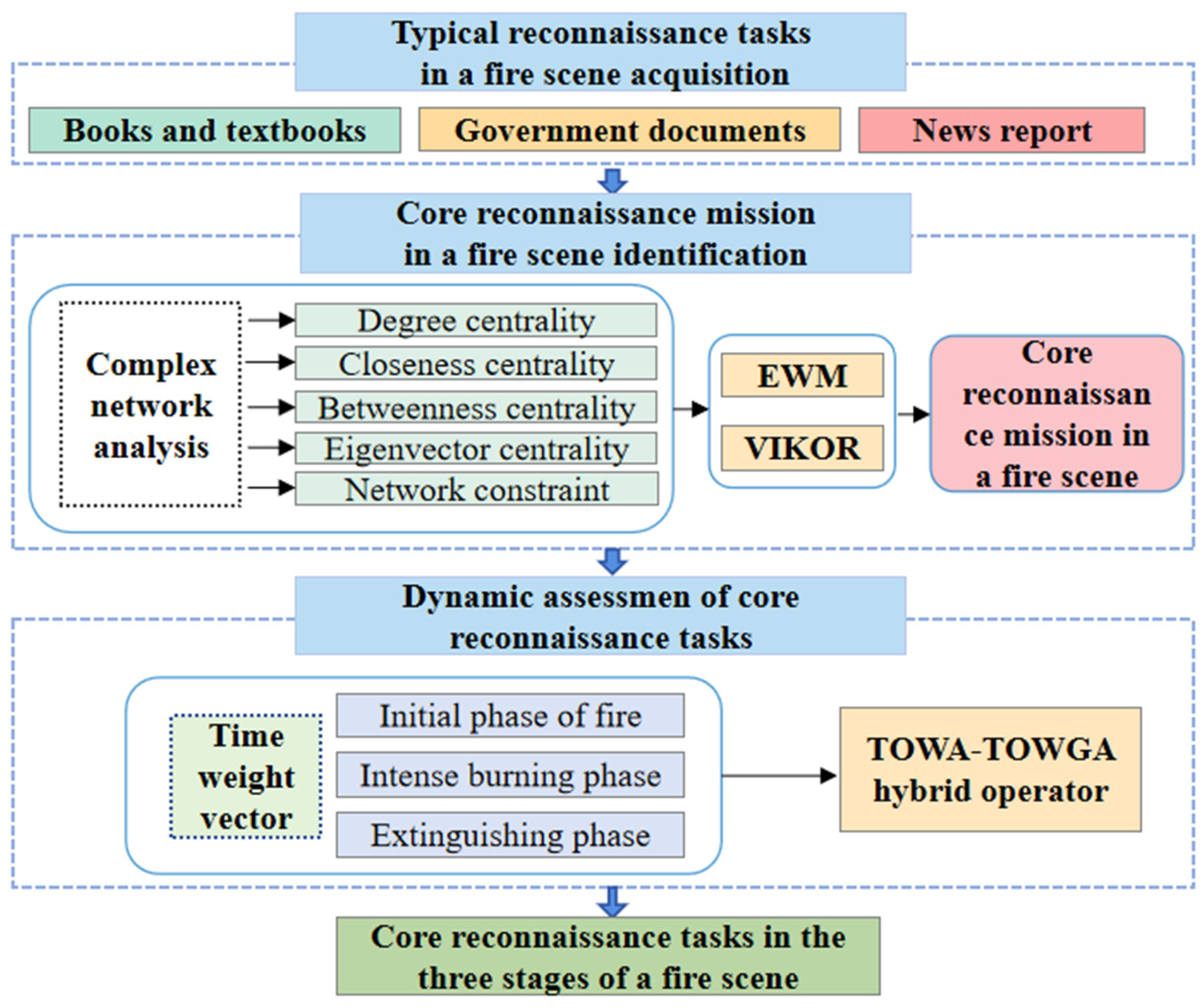
Recognizing that the establishment of a dynamic and real-time assessment system can effectively enhance the comprehensiveness and practical relevance of fire scene reconnaissance research as well as provide efficient decision-making support for rescue operations, this study sets out the following objectives, shown in Figure 1. First, 77 fire cases involving hazardous chemical logistics warehouses are systematically reviewed to extract representative reconnaissance task nodes, based on which a complex network topology model is constructed by considering the logical correlations and spatiotemporal sequences among tasks [19,20]. Second, relevant evaluation indicators are selected, and a static evaluation model is developed by integrating the entropy weight method with the VIKOR approach to objectively calculate node weights and identify core task rankings. Third, to account for the dynamic evolution of fire scenarios, a dynamic assessment model is established by introducing the TOWA–TOWGA hybrid operator and incorporating expert questionnaire data, enabling the output of reconnaissance task priority sequences tailored to the initial, fully developed, and extinguishment stages of a fire. The findings of this study are expected to provide valuable insights and methodological support for enhancing dynamic assessment capabilities and safety management in hazardous chemical logistics warehouses.

2. Acquisition and Construction of Reconnaissance Tasks for Large Hazardous Chemical Logistics Warehouse Fires

2.1. Acquisition of Reconnaissance Tasks for Large Hazardous Chemical Logistics Warehouse Fire Scenes

Specific fire reconnaissance tasks for hazardous chemical logistics warehouses are identified by reviewing 77 fire cases alongside publicly available governmental documents [21] and analyzing critical data and decision-making records from firefighting operations. Case collection shall be focused on the exclusive scenario of large-scale hazardous chemical logistics warehouses, with strict specifications imposed: the storage scale of the warehouse shall not be less than 1000 m2. Fire cases involving ordinary cargo warehouses, small-scale hazardous chemical storage sites, and chemical production workshops shall be excluded to ensure scenario consistency. Furthermore, the collected cases must incorporate key core information, including basic fire information, hazardous chemical information, fire evolution information, reconnaissance and rescue information, and accident conclusions, with no item omitted. Cases lacking three items of information shall be excluded to guarantee information integrity. In the temporal and spatial dimensions, cases from the most recent 15 years shall be covered to account for differences in firefighting technologies and standards across various periods, thereby avoiding insufficient data timeliness. Regarding regional distribution, a balance shall be maintained among cases from different countries: The Chinese cases (50) cover seven major regions including North China and East China, including different climatic conditions, storage scales, and management models. The international cases (22) come from eight developed countries such as the United Kingdom, France, and the United States, all of which are officially disclosed major storage fire cases of hazardous chemicals. They are highly similar to the Chinese cases in terms of warehouse type and risk level, effectively reducing the conclusion bias caused by data from a single region. Although there are differences among countries in fire protection standards, building codes, and tactical preferences, which may lead to regional specificity in the priority ranking of some auxiliary tasks, the core tasks identified in this study (such as active fire points, water source location, etc.) have a priority consistency in cross-border cases. The fundamental reason lies in the fact that these core tasks directly correspond to the essential needs of fire rescue—controlling the spread of the fire, ensuring the safety of rescue personnel, and efficiently allocating emergency resources. They are not affected by regional rule differences and have significant universality. Data sources shall be authoritative and verifiable, with priority given to cases published in official bulletins by government emergency management departments, official fire statistical yearbooks, case studies in core academic journals, and those included in international authoritative fire databases. Cases from non-official channels and scattered cases without detailed documentation shall be excluded to ensure data authenticity. Simultaneously, cases without explicit records of reconnaissance tasks, those with incomplete rescue procedures, and fire cases triggered by unconventional causes such as intentional arson and terrorist attacks shall be explicitly eliminated. These are subsequently refined and organized to establish the fire reconnaissance tasks for hazardous chemical logistics warehouses, as presented in Table 1.
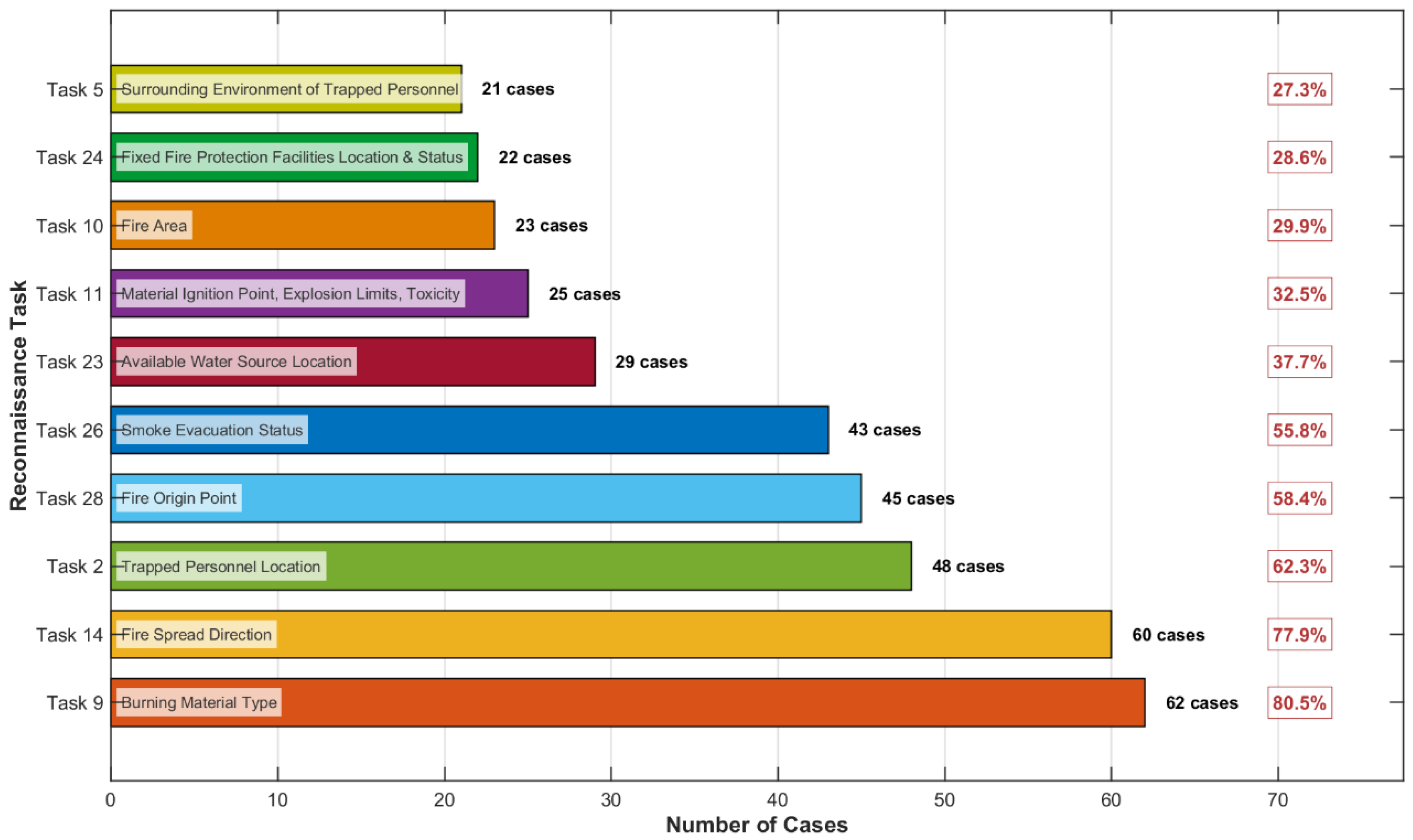
Then, the seven categories of reconnaissance tasks form the core information gathering and situation assessment framework for firefighting and rescue operations. The quality of their execution directly impacts command decision-making and rescue efficiency, necessitating dynamic adjustment according to fire type, building structure, environmental factors, and available resources. Based on actual reconnaissance frequencies across 77 case nodes and applying the core task priority principle, the top 10 most frequently occurring reconnaissance task nodes are identified in Figure 2. It is seen that the main high-frequency reconnaissance tasks include nodes 14, 9, 28, 11, and 12. Personnel safety category tasks include nodes 2, 5, 23, 24, and 26. The significance of these high-frequency tasks is highly consistent with the characteristics of large-scale hazardous chemicals logistics warehouse fires, which include complex combustion dynamics, prominent toxicity risks, strong resource dependence, and numerous secondary accident hazards.
These high-frequency tasks play a critical supporting role in evaluating subsequent reconnaissance activities. Specifically, they serve as core anchors for constructing the evaluation index system, ensuring that the evaluation dimensions closely align with the key demands of real-world firefighting operations and avoiding detachment from actual rescue scenarios. On the other hand, benchmark weights derived from these tasks help anchor evaluation priorities, ensuring that high-value tasks are assigned appropriate weights within the assessment framework. Meanwhile, the dynamic characteristics of these tasks, which evolve with fire development, support the temporal adjustment logic of the evaluation model and enhance the timeliness and adaptability of the assessment. Furthermore, by comparing the model’s evaluation outputs with the actual execution frequency of high-frequency tasks, the rationality and practical applicability of the model can be validated, and any evaluation bias can be identified and corrected. Ultimately, this approach ensures that the reconnaissance task evaluation system is both scientifically rigorous and practically applicable, providing a reliable basis for fire rescue teams to optimize resource allocation and formulate effective reconnaissance plans.

2.2. Constructing a Complex Network Topology Model

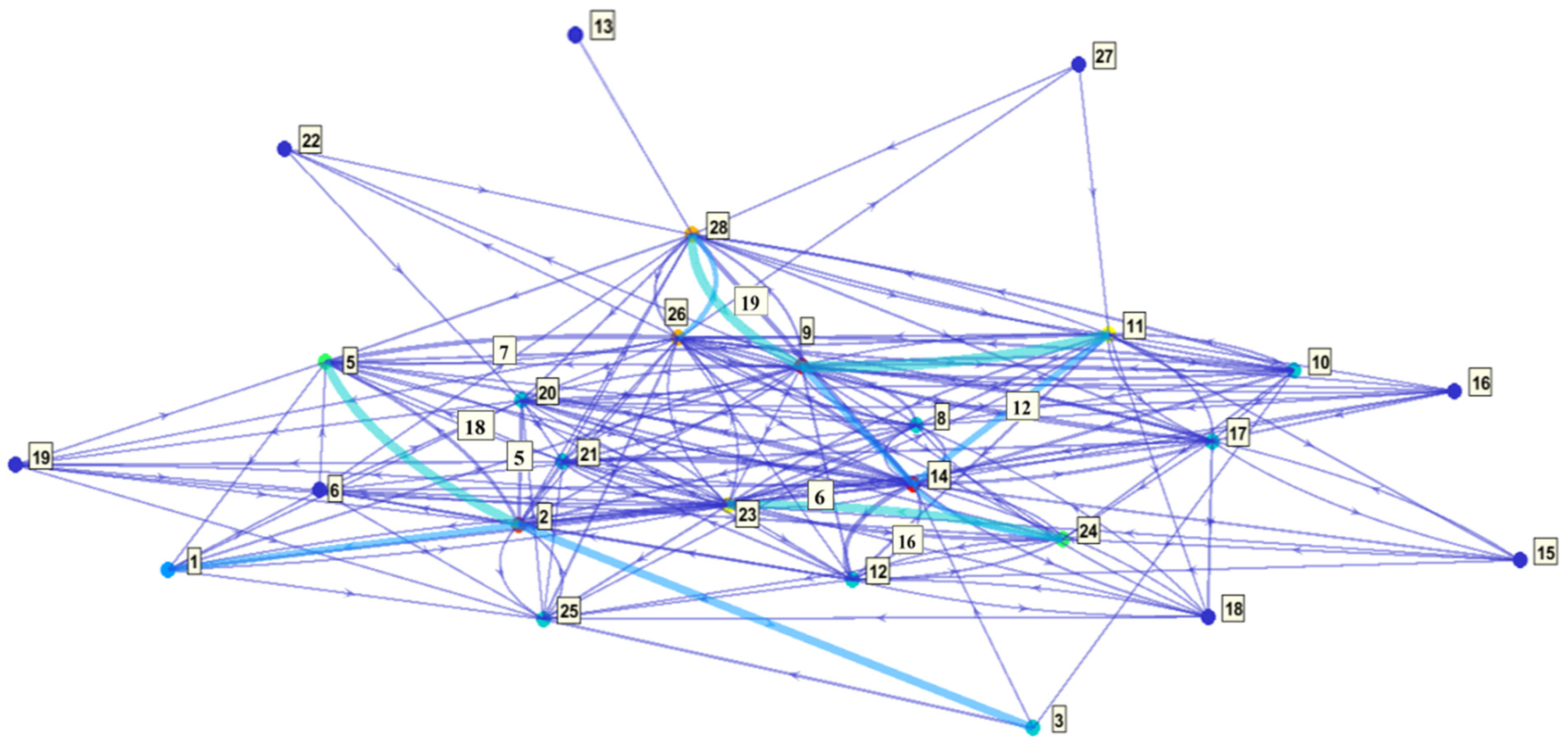
Complex networks, as a type of network model possessing topological characteristics, have found widespread application across numerous fields, including engineering science, information science, and the social sciences [26,27,28,29]. The core rules for constructing the complex network of fire reconnaissance tasks in this study are based on case-based empirical research and logical deduction to ensure the repeatability and scientific nature of the topological structure. The network nodes are defined as 28 reconnaissance tasks selected and analyzed from the cases. The final 28 selected nodes all cover key dimensions such as personnel safety and combustion characteristics, and each node can correspond to specific reconnaissance actions in the fire scene. The establishment of edges between nodes follows the dual criteria of “temporal arrangement and logical association”. If the execution result of task A provides necessary information support for task B, a directed edge is constructed. The weight of the edge is normalized through the frequency of the common occurrence of the two tasks in 77 cases, with a value range of 0 to 1. Meanwhile, to ensure the sparsity and practicality of the network, weakly associated edges with weights lower than 0.05 are eliminated, and redundant nodes with completely consistent functions are merged. Eventually, a network structure consisting of 28 nodes and 187 valid edges is formed. This rule not only conforms to the progressive logic of the actual reconnaissance process but also ensures the objectivity of network construction through quantitative standards. The specific fire scene reconnaissance route can be found in Supplementary Materials Table S1. The systematized results are plotted using MATLAB (R2024a) software, as shown in Figure 3.
Figure 3 illustrates the topological network of fire reconnaissance mission nodes in a large hazardous chemicals logistics warehouse, constructed based on complex network theory. The diagram visually represents the intrinsic relationships among 28 reconnaissance mission nodes and 187 task-related edges, providing intuitive support for analyzing the logical structure and execution pathways of the reconnaissance mission. The strength of node connections and the density of edges directly reflect the degree of task interdependence in actual reconnaissance operations. The brighter the color of a node, the more important it is, a higher edge density indicates that the corresponding task group requires more frequent coordination and execution during fire rescue, thereby constituting the core hub of the reconnaissance process. From a network-structure perspective, the core region is dominated by high-frequency task nodes—such as determining fire spread direction and identifying combustible material types and the locations of available water sources, which possess the largest number of connections and serve as critical links throughout the entire reconnaissance process. Moreover, the network structure objectively captures the essential characteristics of multidimensional collaboration and multi-task coupling in fire reconnaissance, providing an intuitive topological basis for the dynamic assessment of task priorities at different stages.

3. Construction of a Complex Network Evaluation Model for Fire Reconnaissance Tasks

3.1. Selection of Node Importance Evaluation Metrics

Analyzing networks using a single metric presents limitations and bias, leading to imprecise results. Hence, this study employs multiple commonly used centrality metrics for comprehensive node evaluation [30,31,32].
(1) Degree Centrality. Degree centrality (DC) reflects a node’s capacity for direct connections with neighboring nodes. Higher values indicate greater node importance, making it a benefit-oriented metric. By counting task connection frequencies, the DC rapidly identifies core tasks frequently triggered in practical scenarios. In the formula, k i represents the number of nodes directly connected to node i [33].
D C i = k i N 1
(2) Closeness Centrality. Closeness Centrality (CC) reflects the average shortest distance from a node to other nodes. Higher values indicate greater centrality, making it a benefit-oriented metric. The CC is suitable for fire reconnaissance to achieve rapid information access, enabling the selection of pivotal nodes that efficiently coordinate multiple tasks and enhance reconnaissance workflow efficiency. In the formula, d i j represents the shortest path length from node i to node j [33].
C C i = N 1 j i   d i j
(3) Betweenness Centrality. Betweenness Centrality (BC) reflects a node’s information control capability along the shortest paths. Higher values indicate stronger hub functions, where failure may trigger chain reactions, making it a benefit-oriented metric. In hazardous chemical fires, the BC identifies critical tasks for blocking risk propagation, fulfilling the need to pinpoint core control nodes. Here, the g s t denotes all paths between nodes s and t; the g s t   indicates the number of paths between s and t passing through node i [34].
B C i = s < t   g ~ s t i g ~ s t
(4) Eigenvector Centrality. Eigenvector Centrality (EC) reflects the importance of a node and its adjacent nodes, with higher values indicating greater significance—it is a benefit-oriented metric. EC aligns with the hierarchical association characteristic of reconnaissance tasks, facilitating the identification of key nodes that can coordinate high-value tasks and enhance overall reconnaissance efficiency. In the formula, x i represents the eigenvector corresponding to the maximum eigenvalue λ [34].
E C i = λ 1 j = 1 N a i j x j
(5) Network Constraint. Network Constraint (C) reflects the degree to which a node is constrained by other nodes. Higher values indicate lower node importance, making it a cost-based metric. The C identifies edge tasks with strong scenario dependency and low flexibility, refining task classification from core to edge. In the formula, the P i j denotes the ratio of paths traversed from node i to j to the total number of paths [34].
C i = j   ( P i j + q i j   P i q P q j ) 2

3.2. Multicriteria Optimization and Compromise Solution (VIKOR)

Centrality metrics offer only a single-aspect assessment of node importance in complex networks, leading to inherently partial evaluation outcomes. Consequently, reliance on a single evaluation method is insufficient; an integrated multi-method approach is necessary. For the above reasons, this study adopts the entropy weighting method for objective weighting [35]. The VIKOR method represents an optimal compromise solution and constitutes a decision-making approach based on ideal points [36,37]. The computational steps for VIKOR are as follows.
(1) Calculate the positive ideal solution fj* and negative ideal solution fj for each criterion. In these equations, Ω b denotes the benefit-oriented indicator set and Ω c represents the cost-type indicator set.
f j * = m a x f i j j Ω b , m i n f i j j Ω c
f j = m i n f i j j Ω b , m a x f i j j Ω c
(2) Calculate the group utility value S i and individual regret value R i for each scheme. In the EWM–VIKOR method, the weights w j are derived using the EWM method.
S i = j = 1 n ω j f j * f i j f j * f j
R i = m a x ω j f j * f i j f j * f j *
(3) Calculate the compromise values Q i for each scheme.
Q i = v S i S S * S + 1 v R i R R * R
where v represents the decision mechanism coefficient, typically set to 0.5. The compromise value Q i is a comprehensive parameter for evaluating proposals based on both group utility values and individual regret values. A smaller Q i value indicates a superior proposal.
(4) Sort according to Q i to select critical information nodes in the fire reconnaissance process. The compromise solution ranked by Q i constitutes the prioritization scheme for critical nodes, where a lower Q i value indicates greater node importance [38].
(5) Following the ranking of compromise values Q i , the reliability of the ranking must be further validated. The evaluation results are deemed valid when the following conditions are satisfied. The ranking must be based on compromise values Q i , where a smaller Q i indicates a more important node. Furthermore, the compromise value of the top-ranked most important node must be sufficiently smaller than that of the second-ranked less important node [37,39]:
Q a v Q a Λ 1 N 1

3.3. Dynamic Assessment Model Based on TOWA–TOWGA Hybrid Operator

In fire response, “dynamic assessment” refers to a real-time, phase-adaptive evaluation methodology that dynamically adjusts the priority ranking of reconnaissance tasks according to the spatiotemporal evolution of fire scenarios. Specifically, the fire lifecycle is delineated into three distinct phases—initial phase, intense burning phase, and extinguishing phase—with targeted assessments performed based on the heterogeneous risk profiles inherent to each phase. By systematically integrating scenario evolution, risk dynamics, and decision-making demands, this methodology circumvents the inherent rigidity of static evaluation models, thereby ensuring the continued relevance and effectiveness of reconnaissance tasks throughout the entire fire response continuum.
We further employ a dynamic global evaluation methodology that combines time-weighted arithmetic and geometric means, which not only balances functional and equilibrium considerations but also accounts for temporal weight variations. It generates dynamic assessment outcomes that effectively reflect real-time task requirement changes in fire scenarios by coupling the three-phase evaluation results from static model [40].
(1) Time-Weighted moving average (TOWA). Let N = { 1 ,   2 ,   ,   n } , and denote μ i , a i ( i N ) as a two-dimensional array TOWA pair. The function F T O W A of the n-dimensional TOWA operator can be expressed as [41]:
F μ 1 , a 1 , , μ n , a n = j = 1 n w j b j
where μ n is the time-induced component, a n is the data component, and W = ( w 1   , w 2   , , w ) T is the weighting vector associated with F T O W A . j = 1 n w j = 1 , w j = 1 , w j [ 0 , 1 ] ; and b j is the data component of the TOWA pair corresponding to the j -th moment in the time-induced component μ j   ( i     N ) , hence F is called the n-dimensional TOWA operator.
(2) Time-Weighted geometric average operator (TOWGA). Let N = { 1 ,   2 ,   ,   n } , and denote μ i , a i ( i N ) as a TOWGA pair composed of a two-dimensional array. The function G T O W G A for the n-dimensional TOWGA operator can be expressed as [41]:
G v 1 , c 1 , , v n , c n = j = 1 n g j u j
v n is the time-induced component; c n is the data component; W = ( w 1   , w 2   , , w n ) T is the weighted j = 1 n w j = 1 vector associated with GTOWGA, where w j [ 0 , 1 ] ; g j is the data component corresponding to the j moment of the time-induced component v i   ( i     N ) in the TOWGA pair, hence G is referred to as the n-dimensional TOWGA operator.
From the expressions of the two operators, we know that the TOWA operator conducts linear weighting of time series data, while the TOWGA operator is a synthesis of time series data using multiplication. The time weight w j is only related to the j -th position of the time-induced component and is not related to the size and position of the data component.
(3) The determination of the time right vector. The determination of time weight w t k   is critical when using the TOWA–TOWGA hybrid operator model to aggregate the evaluation values of three fire phases, which affects the rationality of the dynamic comprehensive evaluation results [41]. The weights are given in Equations (14) and (15).
m a x k = 1 4 w t k l n w t k
s . t . λ = k = 1 4 N k N 1 w t k k = 1 4 w t k = 1 0 w t k 1
By solving the model, the optimal time weights for two periods can be obtained. In Equation (15), the time weight λ reflects the decision-maker’s prioritization of different periods during the assembly process. A λ value closer to 0 indicates greater emphasis on the winter period’s evaluation, while a λ value closer to 1 reflects greater emphasis on the spring period’s evaluation.
(4) TOWA–TOWGA hybrid operator model aggregation. The definitions of the TOWA and TOWGA operators reveal their distinct priorities. TOWA emphasizes functionality, while TOWGA prioritizes balance, each with its own advantages and limitations. To address this, this study employs a hybrid TOWA–TOWGA model algorithm for dynamic comprehensive evaluation by linearly weighting both operators. The resulting dynamic comprehensive evaluation formula is presented in Equation (16).
Q = α F T O W A t k , y i t k + β G T O W G A t k , y i t k
In the formula, α and β represent the proportions of the TOWA operator and the TOWGA operator, respectively, where α and β are non-negative real numbers satisfying the condition α + β = 1 .

4. Analysis of Core Reconnaissance Tasks in Fire Fields

4.1. In-Out-Degree Analysis of Fireground Reconnaissance Tasks

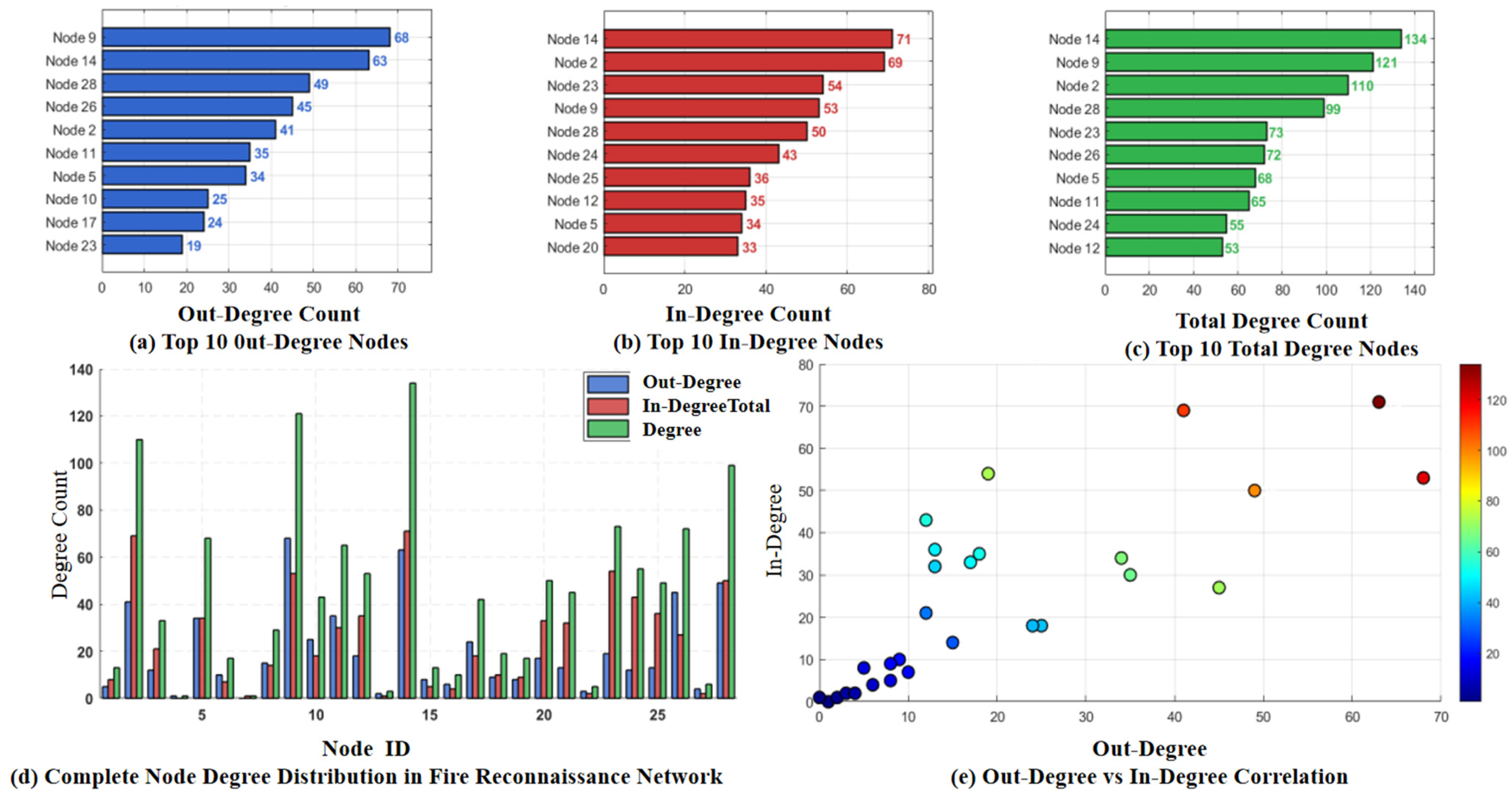
Based on fireground reconnaissance path analysis, the top ten in-degree and out-degree reconnaissance tasks identified from the 77 cases represent the high-frequency nodes in the complex network constructed from these paths. The out-degree of a reconnaissance mission refers to the number of “edges” starting from the current reconnaissance mission node, and the in-degree is expressed as the number of “edges” pointing to the current reconnaissance mission node. These nodes possess the strongest capacity to initiate preceding tasks and trigger subsequent tasks. Their high in-degree and out-degree values fully align with the practical reconnaissance process logic of “interlocking and progressive stages”. Statistical diagrams of node in-degree and out-degree are presented in Figure 4. The specific statistics on the in-degree and out-degree of reconnaissance tasks can be found in Supplementary Data Table S2.
Figure 4a–d shows that the top ten tasks are, respectively, nodes 14 (134 times), 9 (121 times), 2 (110 times), 28 (99 times), 23 (73 times), 26 (72 times), 5 (68 times), 11 (65 times), 24 (55 times), and 12 (53 times). Figure 4e shows a significant positive correlation between the in-degree and out-degree, which is particularly obvious in the top 10 core nodes. The ratio of in-degree to out-degree is between 47% and 53%, forming a bidirectional triggering and balanced interconnection characteristic.
It is worth noting that the in-degree, out-degree, and aggregate statistics are derived entirely from 77 actual cases without subjective assumptions, yielding objectively verifiable results. However, this method has limitations. Firstly, it focuses solely on connection frequency, overlooking critical low-frequency links. Secondly, it struggles to reflect adaptability across different scenarios, potentially neglecting high-risk, specialized tasks. Thirdly, it disregards execution timeliness and difficulty, meaning tasks with high in-out degrees may be unsuitable as priority tasks in complex environments. However, the organization and analysis of the in-degree and out-degree in the cases provided crucial data support for the subsequent construction of complex networks.

4.2. Centrality Analysis of Complex Networks for Fire Reconnaissance Tasks

While in-degree analysis can preliminarily identify high-frequency task nodes, it remains incomplete. Therefore, a comprehensive evaluation incorporating degree centrality, closeness centrality, betweenness centrality, eigenvector centrality, and network constraints is applied to 28 reconnaissance task nodes. Among them, degree centrality reflects general usage frequency, closeness centrality indicates rapid access efficiency, betweenness centrality quantifies the control of critical hubs, eigenvector centrality reveals high-value task association levels, and network constraints demonstrate scenario dependency and flexibility. All calculations are based on actual reconnaissance path topologies, eliminating subjective weightings or hypothetical parameters to ensure objective and verifiable assessment. The calculation results based on Formulas (1)–(5) are shown in Table 2.
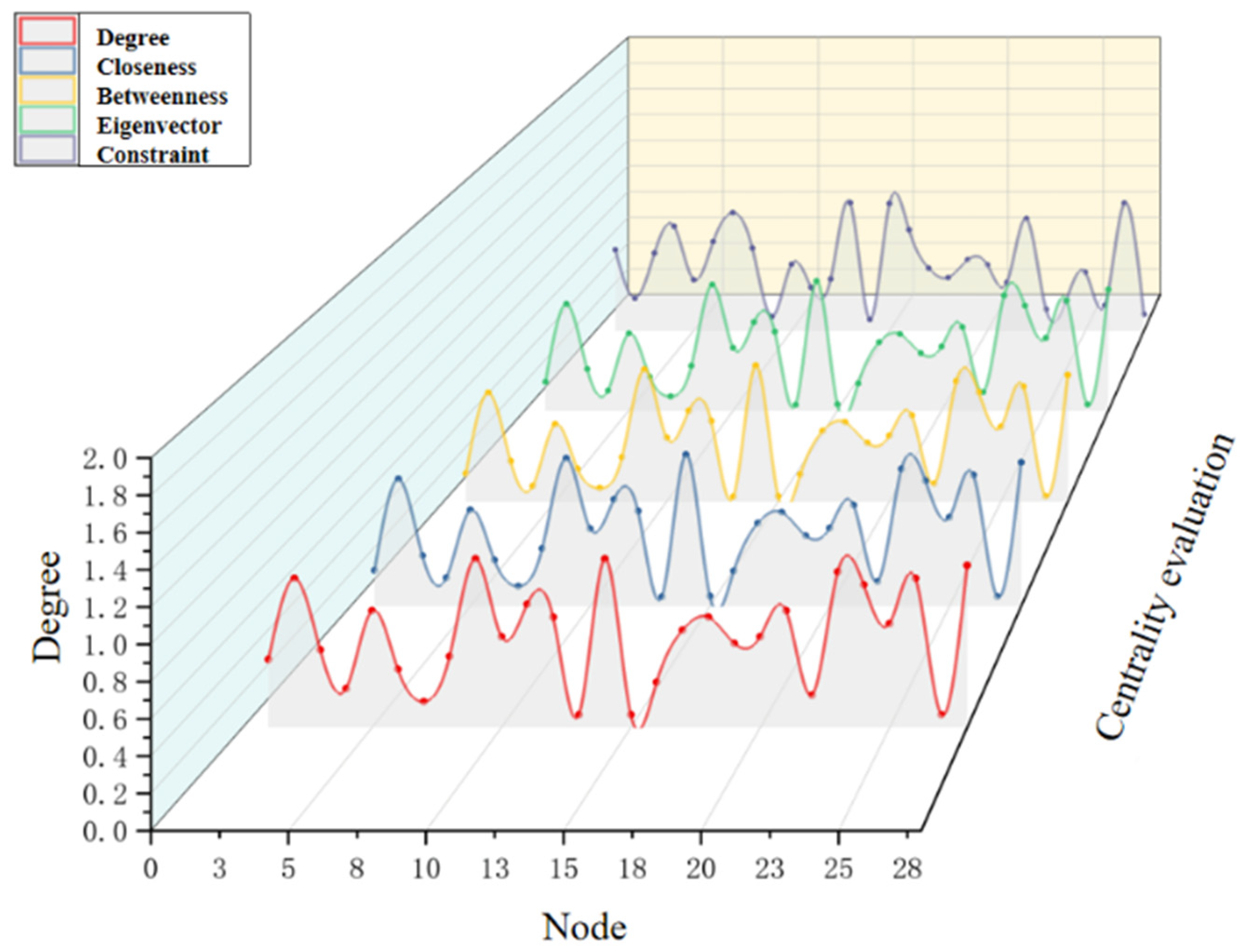
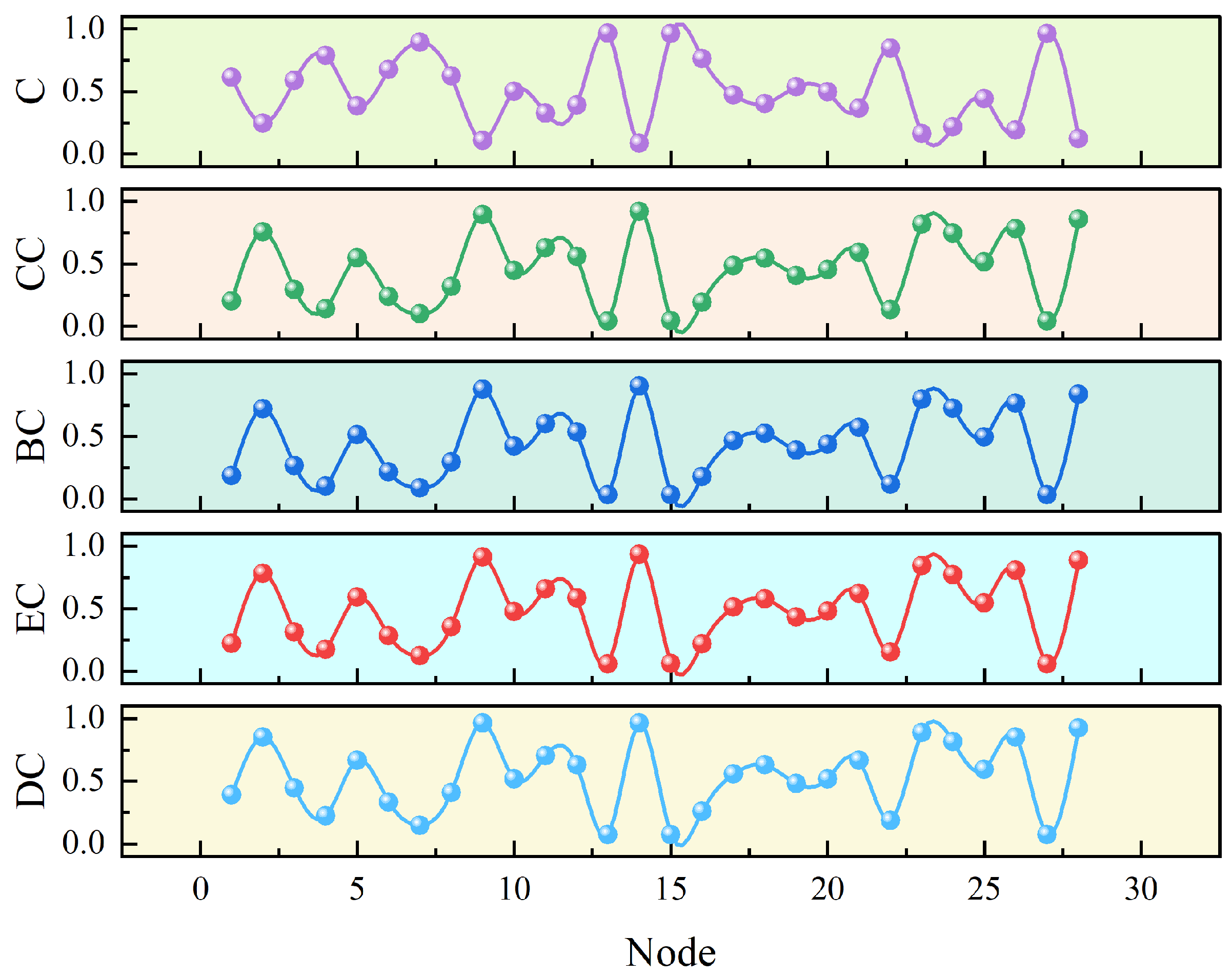
Degree centrality, closeness centrality, betweenness centrality, eigenvector centrality, and network constraints collectively form a multidimensional framework for evaluating node importance. These five metrics map the operational value of reconnaissance tasks from distinct logical dimensions. Figure 4 shows the results of each centrality evaluation. Among them, the first four represent benefit-oriented indicators, while network constraints constitute a cost-oriented indicator. Their differentiated positioning and synergistic effects provide scientific grounds for precisely identifying core reconnaissance tasks. The results of each centrality evaluation are shown in Figure 5.
It can be clearly seen from Figure 5 the distribution results of the five centrality evaluation indicators. The five centrality metrics establish a hierarchical evaluation framework spanning connectivity capacity to associative value. Degree centrality reflects a node’s fundamental connectivity; high-value nodes serve as reconnaissance network hubs. Betweenness centrality indicates rapid access efficiency; high-value nodes function as reconnaissance entry points. Connectivity centrality measures process dominance, with high-value nodes serving as bridges between different modules. Eigenvector centrality reflects strategic value, where high-value nodes correlate with high-priority tasks, triggering strategic-level risk management. Network constraint complements node scenario adaptability assessment. Low-value nodes adapt to multiple scenarios and possess autonomous triggering capabilities. The synergistic application of these five metrics simultaneously identifies highly connected, high-value core tasks while evaluating their scenario adaptability. In large-scale building fires, nodes with low network constraints and high scores across four centrality metrics constitute core focal points, whereas nodes with high network constraints serve only as auxiliary tasks.
In the study of complex networks for fire scene reconnaissance in large-scale hazardous chemical logistics warehouses, DC, EC, BC, CC, and C collectively form a multidimensional evaluation system for node importance. Five types of indicators map the practical value of reconnaissance tasks from different logical dimensions. Among them, the first four types are efficiency indicators, and network constraints are cost indicators. Their differentiated positioning and synergy provide a scientific basis for accurately identifying core reconnaissance tasks. The comparison of the centrality evaluation of network constraints is shown in Figure 6.
It is clearly seen from Figure 6 that there are significant differences between the efficiency indicators and the cost indicators. Network constraints are classified as cost indicators, and their differentiated roles and synergistic effects provide a scientific basis for the accurate identification of core reconnaissance tasks. In summary, the synergistic application of these five metrics avoids the limitations of single-indicator approaches. It identifies core tasks with high connectivity and value while assessing their scenario adaptability through network constraints. In reconnaissance operations for large hazardous chemical logistics warehouses, nodes with low network constraints and high four-class centrality represent the core drivers for establishing standardized reconnaissance procedures and enhancing firefighting and rescue efficiency. Nodes with high network constraints serve only as peripheral auxiliary nodes providing supplementary support.

4.3. Fire Reconnaissance Task Analysis Based on the EWM–VIKOR Combined Optimization Method

Furthermore, single centrality metrics often reflect only local node characteristics in complex network node importance assessment, yielding one-sided evaluation results. To overcome this limitation, multidimensional comprehensive evaluation methods are required. We adopt the entropy weight method to objectively assign weights to the five major evaluation centrality indicators, making the evaluation results more genuine and scientific. The positive ideal solution f j * and negative ideal solution f j are calculated according to Equations (6) and (7).
f j * = 1 , 1 , 1 , 1 , 1
f j = 0 , 0 , 0 , 0 , 0
The weights for each indicator are calculated using the EWM method, with computations performed using MATLAB software. The resulting weight values for each indicator are as follows:
ω i = ω D C ω E C ω B C ω C C ω C = 0.285 , 0.242 , 0.208 , 0.173 , 0.092
Based on the node weights calculated using positive and negative ideal solutions and the EWM method, the group utility values S i and individual regret values R i for each node are computed. The compromise values Q i are then calculated according to Formula (10). The computed group utility values Si, individual regret values R i , and compromise values Q i are presented in Table 3.
In assessing node importance within complex reconnaissance networks for large hazardous chemical logistics warehouses, the group effect value and individual regret value serve as core computational parameters of the EWM–VIKOR method. These parameters jointly support the precise selection of core reconnaissance tasks from the dual dimensions of overall optimization and weakest link avoidance, providing scientific grounds for prioritizing reconnaissance procedures. The group effect value is calculated by weighting a node’s overall proximity to the ideal solution across all evaluation metrics. Its significance lies in mapping the contribution of reconnaissance tasks to the overall effectiveness of the fire reconnaissance network. A lower value indicates that the task approaches optimality across multiple dimensions—such as degree centrality and closeness centrality—enabling better integration into the overall reconnaissance process and synergy with other tasks. For instance, in a fire scenario, the group effect value for “determining the direction of fire spread” is relatively low. This indicates that the task not only excels in connection breadth and hub capability but also effectively links tasks such as “combustible material identification” and “water source deployment”. This ensures that the entire reconnaissance process operates efficiently, preventing disruption to the overall information chain due to weaknesses in any single task.
Individual regret values focus on a node’s maximum deviation in a single metric, identifying critical shortcomings in reconnaissance tasks. Lower values indicate no significant weaknesses across metrics, preventing operational limitations due to metric deficiencies. For instance, in large-scale building fires, a task with high centrality but high network constraint values will exhibit elevated individual regret, suggesting unsuitability as a core task.
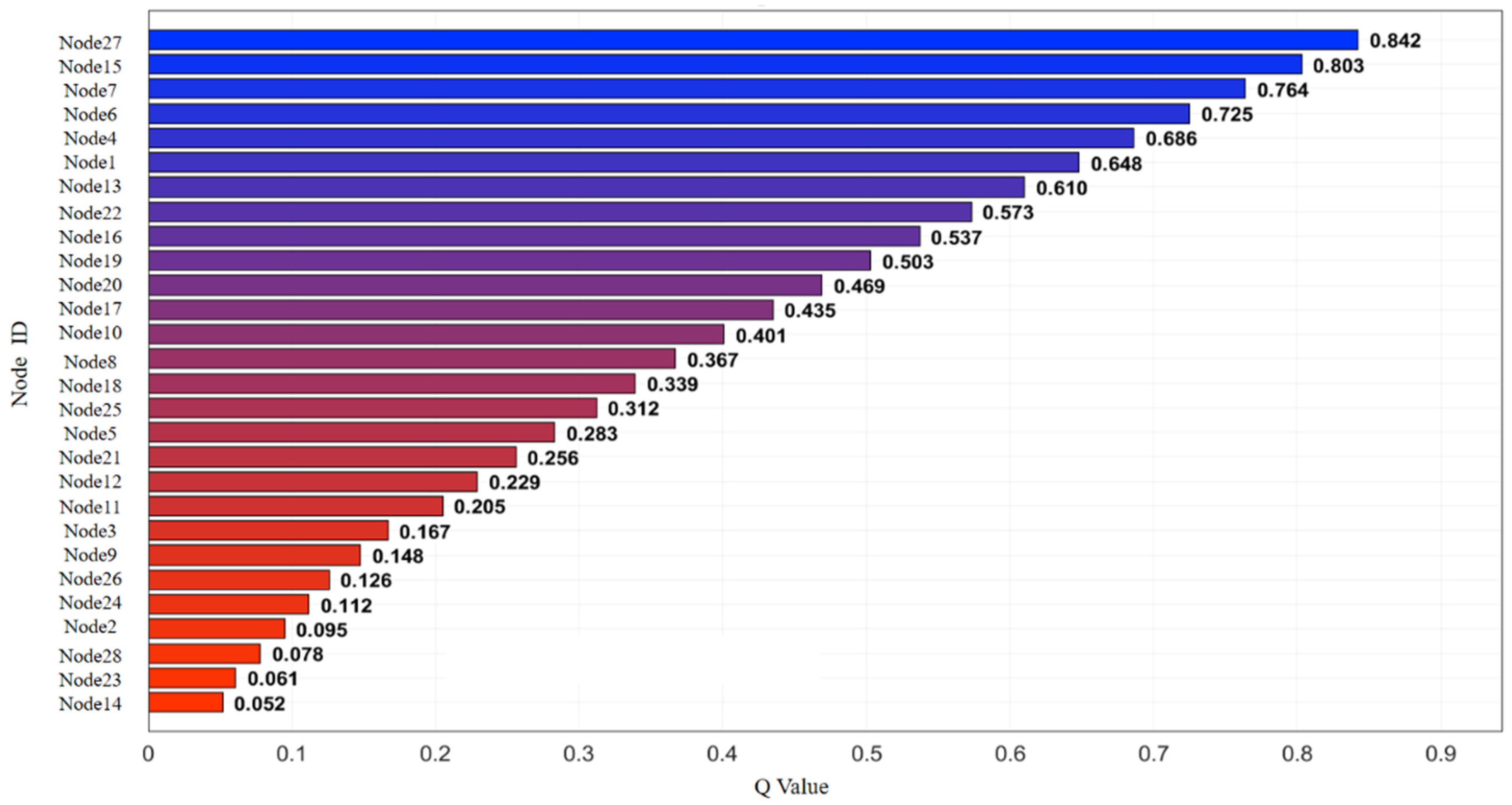
A large disparity between group utility values and individual regret values reflects an imbalance between overall task performance and its weakest dimension. In hazardous chemical warehouse fires, such tasks may serve as conditional core tasks. Core priority tasks are determined by balancing group utility (approaching overall optimality) and individual regret (avoiding worst-indicator shortcomings) via the VIKOR method. The compromise value core reconnaissance tracks sorting, as shown in Figure 7. The smaller the compromise value Q i , the more critical the node. Ranking nodes by importance based on calculated compromise values yields the top ten critical nodes; namely, nodes 14, 23, 28, 2, 24, 26, 9, 3, 11, and 12.
The core priority tasks derived through the VIKOR method, balancing collective utility (overall proximity to optimal state) and individual regret (avoiding worst-indicator shortcomings), closely align with the reconnaissance logic of “first controlling hazards, safeguarding core assets, and strengthening support” in actual operations.
Overall, the top ten core tasks’ sequence aligns exceptionally well with the operational reconnaissance workflow. First, one must understand the patterns of fire development. Then, identify the source of the fire and the available resources, and finally manage the risks. This clearly demonstrates its significant practical application value. It reveals the intrinsic connections within fire reconnaissance tasks, aiding rescue teams in predicting fire progression and prioritizing reconnaissance resource allocation.

4.4. Evaluation of Dynamic Fire Scene Reconnaissance Tasks Based on TOWA–TOWGA

While static assessment based on the EWM–VIKOR method can identify overall core reconnaissance tasks across the entire fire lifecycle, it struggles to adapt to the temporal priority changes of tasks across different fire stages. It is necessary to identify the core task sets at each stage through expert questionnaire surveys. Then, a dynamic assessment model is constructed by introducing a hybrid operator of time-weighted average (TOWA) and time-weighted geometric average (TOWGA), and the final output is a dynamic core reconnaissance tasks sequence that adaptively adjusts with the fire process.
Based on the evolution patterns, combustion dynamics characteristics, and practical logic of fire rescue of 77 large-scale hazardous chemicals logistics warehouse fire cases at home and abroad, and referring to the three-dimensional division principle of “fire controllability–risk intensity–tactical adaptability”, the entire fire scene process is precisely divided into three stages, namely initial, intense, and extinguished. It provides a basic framework for the stage weight setting and task priority ranking of the subsequent dynamic assessment model. Among them, the initial stage is 5 to 15 min after the arrival of firefighters. The burning area is concentrated at a local fire point, has not exceeded the fire compartment or the distance between hazardous chemical stacks, the fire scene temperature is below 600 °C, the amount of toxic gas generated is small, its diffusion is limited, and there is no obvious damage to the building structure. The core risk is that the fire may spread to adjacent stacks of flammable and explosive hazardous chemicals or trigger flashover due to delayed reconnaissance. Flashover marks the entry into the intense stage, during which the combustion intensity reaches its peak, forming three-dimensional combustion or flowing fire. Some hazardous chemicals undergo thermal decomposition, releasing a large number of toxic gases. The temperature at the fire scene rises to 800–1200 °C, steel structures soften, concrete cracks, and the risk of building collapse and a chain explosion of flammable vapor clouds increases sharply. After the open flame weakens, it enters the extinguishing stage, with a significant decline in combustion intensity but prominent residual risks. The open flame turns into a smoldering state, and the damage to the building structure tends to stabilize, but there is a risk of delayed collapse. Unburned hazardous chemicals are prone to reignition due to residual heat. The core risks focus on smoldering reignition, structural collapse, and omissions in the search and rescue of trapped personnel.
To obtain practical data on task importance across fire stages, this study developed an expert survey. Fifteen fire command and emergency management experts with over 10 years of large-scale fire scene command experience were invited to rate the importance of 28 reconnaissance tasks across the three fire stages (1–5 point scale). The survey achieved a 100% valid response rate, with an expert authority coefficient of 0.85 and a Cronbach’s α reliability coefficient of 0.91, indicating the data’s credibility and validity. After calculating weighted averages of the scores, the top ten core tasks by importance for each stage were identified. The expert survey results are presented in Table 4. The specific scores for each reconnaissance task in the three stages are shown in Table S3 of the Supplementary Materials.
The dynamic nature of the TOWA–TOWGA hybrid operator is demonstrated through the configuration of time-weighted vectors. Based on practical scenarios of large building fires, this study establishes the time-weighted vector as (20% initial phase, 50% intense phase, 30% extinguished phase). The time weight settings in the dynamic assessment are not subjective assignments but systematic derivations based on multidimensional empirical data and methodological support. First, by statistically analyzing the probability of accident escalation at each stage in 77 cases, the casualty rates, and the proportion of property losses, it was clearly determined that the intense combustion stage is the critical period for risk prevention and control. Secondly, based on the questionnaire survey data of 15 experts with over 10 years of experience in commanding large-scale fires, the influence coefficients of decisions at each stage on rescue efficiency were calculated, and the weight distribution was significantly positively correlated with this influence coefficient. Finally, the entropy weight method was adopted to objectively weight the three types of indicators: risk intensity, decision influence degree, and the proportion of average duration of each stage (20% initial phase, 50% intense phase, 30% extinguished phase). The rationality of the weight distribution was verified through consistency test (CR = 0.07 < 0.1). Ensure that dynamic assessment can accurately reflect the differences in task priorities at different fire stages. The synergy between the TOWA operator and the TOWGA operator serves as the core technical foundation for the hybrid operator’s dynamism. These two operators capture dynamic changes from the dimensions of “global linear integration” and “critical phase prominence”, respectively, ultimately achieving a balanced dynamic assessment through a fusion coefficient (λ = 0.5) that ensures “neither neglecting the overall picture nor overlooking critical details”. The assessment results are calculated through Formulas (12)–(16). The three-phase dynamic core reconnaissance tasks at the fire scene are shown in Table 5.
The dynamic core nodes in the initial phase of a fire scene are sequentially nodes 14, 23, 28, 9, 24, and 2. These nodes provide critical support for planning internal search and rescue routes, highlighting their initial priority status. The critical burning phase involves five key nodes, namely, nodes 26, 11, 18, 8, and 17. During the fire extinguishing phase, while visible flames have subsided, latent hazards persist. The mission prioritizes eliminating reignition risks and assessing environmental hazards, corresponding to tasks strongly aligned with the extinguishing objectives in the dynamic prioritization system. Key reconnaissance tasks during this phase include nodes 12, 25, 16, 4, and 6.
Overall, the core task sequence corresponding to the three stages of a fire scene is highly compatible with the reconnaissance process logic in actual combat, which is “first grasping the fire dynamics, then identifying the fire source and resources, and finally controlling risks”, and has clear practical value. Meanwhile, the corresponding priority sequences of core reconnaissance tasks at different stages have provided a standardized three-stage reconnaissance task list for emergency rescue teams in the face of dynamically developing fires in hazardous chemicals logistics warehouses, offering a reliable reference for subsequent research.

5. Conclusions

In comparison to existing fire response management models, this study innovates a hybrid static–dynamic evaluation paradigm by integrating the EWM–VIKOR method (for static core task identification) with the TOWA–TOWGA hybrid operator (for phase-adaptive priority adjustment), thereby bridging the longstanding gap between global optimization and real-time scenario adaptation. Concurrently, it clarifies the dynamic adaptation rules of reconnaissance tasks, uncovering the evolutionary logic that transitions from initial phase to intense burning phase and extinguishing phase. The proposed model enables accurate identification of critical reconnaissance tasks and core execution paths, thereby providing both theoretical support and practical guidance for fire rescue teams to optimize resource allocation and formulate scientifically sound reconnaissance strategies. The main conclusions are as follows.
(1)
A complete fire scene reconnaissance task system and complex network model have been constructed. Through case analysis and expert evaluation, 28 typical nodes covering seven dimensions, such as personnel safety and combustion characteristics, are extracted. Based on the logical correlation and spatiotemporal sequence of the tasks, a complex network topology structure containing 28 nodes and 187 edges is constructed, providing framework support for the systematic analysis.
(2)
A task importance assessment system combining static and dynamic aspects has been established. At the static level, five central indicators are integrated through the EWM–VIKOR method to objectively identify the top 10 core tasks and avoid the one-sidedness of a single centrality evaluation index. The TOWA–TOWGA hybrid operator is introduced at the dynamic level, and the priority ranking of the three-stage fire tasks is achieved by combining expert questionnaire data, solving the problem that static assessment is difficult to adapt to the evolution of the fire scene.
(3)
The dynamic adaptation rules of the fire scene reconnaissance task have been clarified. In the initial stage, the focus is on the identification of basic risks, with determining the direction of fire spread and the ignition point of the fire scene as the core. During the intense stage, the focus is on risk control, and the priority of tasks such as the toxicity level of burning substances, is raised. During the extinguishing stage, the focus is on the investigation of potential reignition hazards. The heating state of unburned hazardous chemicals becomes crucial, and determining the direction of fire spread, the location of available water sources, and the ignition point of the fire scene are the core tasks throughout the entire cycle.
The research results provide an efficiency of fire investigation in hazardous chemical logistics warehouses, providing an expandable technical approach for emergency decision-making and task optimization.

Supplementary Materials

The following supporting information can be downloaded at: https://www.mdpi.com/article/10.3390/fire9020072/s1, Table S1: Original path of the case; Table S2: Original data on the entry and exit of reconnaissance mission nodes; Table S3: Questionnaire score for the three-stage fire scene reconnaissance mission.

Author Contributions

B.Q.: Writing—original draft, Visualization, Validation, Methodology. C.W.: Investigation, Resources. D.X.: Supervision, Resources. J.L.: Writing—review and editing, Supervision, Methodology, Data curation, Validation. C.L.: Supervision, Resources. J.S.: Supervision, Resources. J.Y.: Supervision, Formal analysis. Z.C.: Formal analysis. All authors have read and agreed to the published version of the manuscript.

Funding

This work was financially supported by the Key National Research and Development Program Project: Key Technologies and Equipment for Information Reconnaissance (Measurement) Robots in Complex Firefighting Environments (No. 2024YFC3016201).

Data Availability Statement

The original contributions presented in this study are included in the article and Supplementary Material. Further inquiries can be directed to the corresponding author.

Conflicts of Interest

The authors declare that they have no known competing financial interest or personal relationship that could have appeared to influence the work reported in this paper.

References

  1. Kang, Y.; Xia, X.; Wu, Z.; Cheng, Z. Visualization of integrated failure consequences of hazardous chemical leakage and explosion. J. Loss Prev. Process Ind. 2024, 92, 105464. [Google Scholar] [CrossRef]
  2. Jiang, W.; Zhang, M.; Li, M.; Xu, Y. Study on the occurrence path and prediction of unsafe behaviours of hazardous chemical storage personnel. J. Loss Prev. Process Ind. 2025, 96, 105653. [Google Scholar] [CrossRef]
  3. Jiang, W.; Ma, S.; Zhang, Z.; Xu, Y. Study on key causal factors and pathways of fire and explosion accidents in hazardous chemical storage tank area. J. Loss Prev. Process Ind. 2025, 97, 105704. [Google Scholar] [CrossRef]
  4. Yang, J.-F.; Wang, P.-C.; Liu, X.-Y.; Bian, M.-C.; Chen, L.-C.; Lv, S.-Y.; Tao, J.-F.; Suo, G.-Y.; Xan, S.-Q.; Li, R.; et al. Analysis on causes of chemical industry accident from 2015 to 2020 in Chinese mainland: A complex network theory approach. J. Loss Prev. Process Ind. 2023, 83, 105061. [Google Scholar] [CrossRef]
  5. Zhao, J.; Tian, J.; Meng, F.; Zhang, M.; Wu, Q. Safety assessment method for storage tank farm based on the combination of structure entropy weight method and cloud model. J. Loss Prev. Process Ind. 2022, 75, 104709. [Google Scholar] [CrossRef]
  6. Shao, X.; Feng, J.; Wang, J.; Wang, Y. Research on emergency evacuation behavior rules of pedestrians under fire and explosion accidents in chemical parks considering social relationships. J. Loss Prev. Process Ind. 2024, 87, 105244. [Google Scholar] [CrossRef]
  7. Li, Y.; Wang, H.; Bai, K.; Chen, S. Dynamic intelligent risk assessment of hazardous chemical warehouse fire based on electrostatic discharge method and improved support vector machine. Process Saf. Environ. Prot. 2021, 145, 425–434. [Google Scholar] [CrossRef]
  8. He, Z.; Weng, W. Synergic effects in the assessment of multi-hazard coupling disasters: Fires, explosions, and toxicant leaks. J. Hazard. Mater. 2020, 388, 121813. [Google Scholar] [CrossRef]
  9. Zhang, Y.; Yang, M.; Yuan, D.; Li, C.; Ma, Y.; Wang, S.; Wang, S. Fire hazards of PMMA-based composites combined with expandable graphite and multi-walled carbon nanotubes: A comprehensive study. Fire Saf. J. 2023, 135, 103727. [Google Scholar] [CrossRef]
  10. Zhao, J.; Li, Z.; Xu, Y.; Chen, Y. Dynamic risk assessment framework for chemical industrial park storage facilities: Integration of enhanced TOPSIS and Bayesian networks. Process Saf. Environ. Prot. 2025, 201, 107535. [Google Scholar] [CrossRef]
  11. Sun, H.; Ye, J. Research on quantitative assessment method for fire spread risk in enclosed buildings. Fire Technol. 2024, 60, 3709–3738. [Google Scholar] [CrossRef]
  12. Heydari, P.; Babamiri, M.; Tapak, L.; Golmohammadi, R.; Kalatpour, O. Weighing and prioritization of individual factors affecting the performance of industries firefighters. Fire Saf. J. 2022, 127, 103512. [Google Scholar] [CrossRef]
  13. Hansen, N.D.; Steffensen, F.B.; Valkvist, M.; Jomaas, G.; Van Coile, R. A fire risk assessment model for residential high-rises with a single stairwell. Fire Saf. J. 2018, 95, 160–169. [Google Scholar] [CrossRef]
  14. Xie, J.; Li, J.; Wang, J.; Jiang, J.; Shu, C.-M. Fire risk assessment in lithium-ion battery warehouse based on the Bayesian network. Process Saf. Environ. Prot. 2023, 176, 101–114. [Google Scholar] [CrossRef]
  15. Lambert, K.; Merci, B.; Gryspeert, C.; Jekovec, N. Search & rescue operations during interior firefighting: A study into crawling speeds. Fire Saf. J. 2021, 121, 103269. [Google Scholar] [CrossRef]
  16. Sari, F. Assessment of the effects of different variable weights on wildfire susceptibility. Eur. J. For. Res. 2024, 143, 651–670. [Google Scholar] [CrossRef]
  17. Tao, R.; Li, D.; Shi, H.; Pang, S.; Lin, Y.; Li, C. A quantitative analysis method based on network evolution for risk factors of safety production in chemical enterprises. Sci. Rep. 2025, 15, 8173. [Google Scholar] [CrossRef]
  18. Xia, Y.; Shi, J.; Xun, C.; Kong, B.; Chen, C.; Zhu, Y.; Xia, D. Situational awareness for oil storage tank accidents based on complex networks and evidence theory. Fire 2025, 8, 353. [Google Scholar] [CrossRef]
  19. Chen, Y.; Qin, W. Approximate ranking of close centrality of complex network nodes based on ranking learning. Comput. Syst. Appl. 2022, 31, 387–392. [Google Scholar]
  20. Wu, G.; Fang, L.; Li, Z. Evaluation of node importance in complex networks based on multi-index synthesis. Comput. Eng. Des. 2016, 37, 3146–3150. [Google Scholar]
  21. Shang, K.; Xia, D. Typical Cases of Firefighting and Rescue Operations; Chemical Industry Press: Beijing, China, 2020. [Google Scholar]
  22. Kobes, M.; Helsloot, I.; de Vries, B.; Post, J.G. Building safety and human behaviour in fire: A literature review. Fire Saf. J. 2010, 45, 1–11. [Google Scholar] [CrossRef]
  23. Zhang, D.; Xie, H.; Ma, S.; Liu, B. Research on chain risk assessment of fire and explosion disasters in hazardous chemicals warehouses. Ind. Saf. Environ. Prot. 2025, 51, 53–58. [Google Scholar]
  24. Raveendran, A.; Renjith, V.R.; Madhu, G. Dynamic analysis of synergistic domino effects due to multiple combinations of storage tanks under fire or vapour cloud explosion in a major hazardous chemical plant. J. Loss Prev. Process Ind. 2025, 96, 105642. [Google Scholar] [CrossRef]
  25. Dou, Z.; Hu, Y.-H.; Mebarki, A.; Zhang, J.-W.; Wang, Q.-L.; Chen, L.-C.; Shu, C.-M. Pre-evacuation path planning in chemicals-concentrated areas with risk assessment and individual character analysis. J. Loss Prev. Process Ind. 2023, 83, 105076. [Google Scholar] [CrossRef]
  26. Yuan, J.P.; Fang, Z.; Wang, Y.C.; Lo, S.M.; Wang, P. Integrated network approach of evacuation simulation for large complex buildings. Fire Saf. J. 2009, 44, 266–275. [Google Scholar] [CrossRef]
  27. Kang, J.; Wang, H.; Jin, H.; Wang, Z.; Zhang, J. Risk analysis and management of hydrogen station fire and explosion accidents using DEMATEL-ISM and complex network models. Int. J. Hydrogen Energy 2025, 136, 1230–1241. [Google Scholar] [CrossRef]
  28. Zhao, Y.; Yan, H.; Wang, K.; Liu, H. Safety risk analysis and countermeasures for small business premises. Fire 2025, 8, 383. [Google Scholar] [CrossRef]
  29. Lu, C.; Li, S.; Xu, N.; Zhang, Y.; Qin, Y. Hybrid-driven risk assessment methodology for coal and gas outburst: Integration of complex network, disaster mechanism, and multi-level fusion modeling. Process Saf. Environ. Prot. 2025, 199, 107226. [Google Scholar] [CrossRef]
  30. Xian, J. Evaluation Method of Node Importance in Complex Networks Based on Multi-Index Fusion. Master’s Thesis, Dali University, Dali, China, 2021. [Google Scholar]
  31. Rabiei, H.; Zare, A.; Taheri, S.A.; Ebrahimi, N.; Tehrani, A.M.; Malakoutikhah, M. Fire risk assessment of Kashan’s commercial and shopping centers using fire risk assessment method for engineering (FRAME). Fire Mater. 2024, 48, 536–541. [Google Scholar] [CrossRef]
  32. Cleef, L.; Yang, M.; Bouchaut, B.; Reniers, G. Fire risk assessment tools for the built environment-An explorative study through a developers’ survey. Fire Saf. J. 2024, 146, 104169. [Google Scholar] [CrossRef]
  33. Yu, H.; Liu, Z.; Li, Y. Comprehensive evaluation method of node importance in complex networks based on multi-attribute decision-making. Acta Phys. Sin. 2013, 62, 54–62. [Google Scholar]
  34. Li, X.; Zhan, J.; Ren, B.; Zhu, S. Design of node importance evaluation method for complex networks based on neighborhood information. Chin. J. Internet Things 2024, 8, 49–59. [Google Scholar]
  35. Tepic, G.; Djelosevic, M.; Brkljac, N.; Vukovic, M. Probabilistic ranking of Hazmat logistics subsystems under uncertainty using fuzzy AHP. J. Loss Prev. Process Ind. 2025, 94, 105563. [Google Scholar] [CrossRef]
  36. You, B.; Wang, S.; Liu, H.; Yang, M.; Gao, K. Research on evaluation index of human body heat stress based on EWM-VIKOR model. China Saf. Sci. J. 2025, 35, 232–239. [Google Scholar]
  37. Guo, J.; Pu, X.; Gao, X.T.; Zhang, Y. An improved method for calculating weights of multi-objective decision indicators. J. Xidian Univ. 2014, 41, 118–125. [Google Scholar]
  38. Feng, W.; Zhang, X.; Sun, J.; Luo, M. Dynamic monitoring and evaluation of tailings pond safety risk based on AHP-EWM and multi-source data. Metal Mine. 2025, 54, 172–181. [Google Scholar]
  39. Xia, D.; Zheng, C.; Chen, C.; Xin, J.; Zu, Y. Under the incomplete information of major accident emergency decision method research. J. Saf. Environ. 2023, 23, 1498–1504. [Google Scholar]
  40. Kang, J. Research on temporal dynamic risk assessment of oil-hydrogen combined station. J. Saf. Environ. 2024, 24, 2094–2103. [Google Scholar]
  41. Zhao, J. Research on emergency capacity evaluation of new energy power supply enterprises based on TOWA operator. China Occup. Saf. Health 2021, 16, 48–49. [Google Scholar]
Figure 1. Fire scene reconnaissance task assessment flowchart (task acquisition, task identification, and task assessment).
Fire 09 00072 g001
Figure 2. Top ten fire scene reconnaissance task node frequencies.
Fire 09 00072 g002
Figure 3. Topological network diagram of fire reconnaissance task nodes for a large hazardous chemicals logistics warehouse.
Fire 09 00072 g003
Figure 4. Node in-degree and out-degree statistics.
Fire 09 00072 g004
Figure 5. Five centrality evaluation indicators distribution.
Fire 09 00072 g005
Figure 6. Comparison of efficiency indicators (DC, BC, EC, CC) and cost indicator (C).
Fire 09 00072 g006
Figure 7. The ranking of the vulnerability values Qi of the reconnaissance nodes.
Fire 09 00072 g007
Table 1. Key nodes in fire reconnaissance tasks for large hazardous chemical logistics warehouses.
Reconnaissance Task TypeReconnaissance Task
Personnel safety reconnaissanceNumber of trapped personnel (1)
Location of trapped personnel (2)
Health status of trapped personnel (3)
Composition of trapped personnel (4)
Reconnaissance of surroundings near trapped personnel (5)
Building structural safety
Reconnaissance [22]
Building fire resistance rating, load-bearing structure type (6)
Condition of building staircases and lifts (7)
Extent of building damage (8)
Combustion characteristics
reconnaissance [23]
Identify combustible material types (9)
Extent of combustion (10)
Determine ignition points, explosion limits,
and toxicity levels of combustibles (11)
Assess the thermal state of adjacent unburned hazardous chemicals (12)
Impact of ventilation conditions on combustion (13)
Determine fire spread direction (14)
Fire propagation velocity (15)
Smoldering ignition points (25)
Active fire points (28)
Fireground environmental
reconnaissance [24]
Detect fire scene temperature (16)
Detect toxic gas concentration (17)
Determine liquid flow paths and combustible vapor cloud distribution (18)
Mark hazardous zones (21)
Fire scene wind direction and wind speed (22)
Access and breaching pathway
reconnaissance [25]
Assessing accessibility of primary entrances,
evacuation routes, and fire lifts (19)
Feasibility of breaching access routes (20)
Emergency resources and facilities reconnaissanceLocations of available water sources (23)
Positions and operational status of fixed firefighting equipment (24)
Smoke management and monitoring reconnaissanceSmoke evacuation status at the fire scene (26)
Fire monitoring room surveillance status of the fire scene (27)
Table 2. Node metric calculation results.
NodeDCECBCCCC
10.3890.2210.1850.2030.612
20.8520.7840.7210.7560.245
30.4440.3120.2680.2950.587
40.2220.1760.1030.1420.789
50.6670.5930.5120.5480.386
60.3330.2850.2170.2390.674
70.1480.1230.0890.1010.892
80.4070.3560.2940.3180.625
90.9630.9120.8760.8940.108
100.5190.4780.4230.4450.502
110.7040.6590.6010.6280.327
120.6300.5870.5340.5590.391
130.0740.0580.0320.0410.967
140.9630.9350.9020.9180.085
150.0740.0620.0350.0450.961
160.2590.2180.1790.1920.763
170.5560.5120.4680.4850.473
180.6300.5790.5260.5430.402
190.4810.4350.3890.4070.536
200.5190.4820.4370.4540.498
210.6670.6230.5710.5920.365
220.1850.1520.1180.1320.847
230.8890.8460.7980.8170.162
240.8150.7730.7250.7440.218
250.5930.5480.4960.5150.442
260.8520.8090.7630.7810.193
270.0740.0590.0340.0430.964
280.9260.8870.8390.8580.124
Table 3. VIKOR computational evaluation results.
NodeSRQ
140.1260.0850.052
230.1350.0920.061
280.1520.1080.078
20.1730.1240.095
240.1910.1370.112
260.2050.1480.126
90.2310.1650.148
30.2530.1790.167
110.2980.2120.205
120.3250.2340.229
210.3570.2580.256
50.3890.2810.283
250.4230.3050.312
180.4560.3280.339
80.4910.3520.367
100.5320.3840.401
170.5760.4180.435
200.6210.4530.469
190.6680.4890.503
160.7150.5240.537
220.7680.5620.573
130.8230.6010.610
10.8810.6430.648
40.9420.6870.686
61.0050.7320.725
71.0710.7780.764
151.1420.8250.803
271.2180.8730.842
Table 4. Results of the expert survey questionnaire.
Track SortInitial Phase of FireIntense Burning PhaseExtinguishing Phase
1Determine the fire spread directionAssess thermal state of adjacent unburned hazardous chemicalsDetermine fire spread direction
2Identify combustible material typeActive fire pointsLocation of trapped personnel
3Active fire pointSmoke evacuation status at the fire sceneActive fire points
4Determine ignition points, explosion limits, and toxicity levels of combustibles.Extent of building damageHealth status of trapped personnel
5Locations of available water sourcesDetect fire scene temperatureLocations of available water sources
6Smoke evacuation status at the fire sceneDetect toxic gas concentrationIdentify combustible material types
7Extent of building damageFire monitoring room surveillance status of the fire scenePositions and operational status of fixed firefighting equipment
8Positions and operational status of fixed firefighting equipmentComposition of trapped personnelReconnaissance of surroundings near trapped personnel
9Detect toxic gas concentrationBuilding fire resistance rating, load-bearing structure type.Assessing accessibility of primary entrances, evacuation routes, and fire lifts.
10Determine liquid flow paths and combustible vapor cloud distribution.Determine liquid flow paths and combustible vapor cloud distributionDetermine ignition points, explosion limits, and toxicity levels of combustibles.
Table 5. Core reconnaissance tasks in the three stages of a fire scene.
Reconnaissance TasksTOWA–TOWGASortingAdaptation Phase
Determine fire spread direction0.20681Initial. Intense
Locations of available water sources0.22692Initial. Intense
Active fire points 0.25313Initial. Intense
Smoke evacuation status at the fire scene0.26594Intense. Extinguished
Identify combustible material types 0.27885Initial. Intense
Determine ignition points, explosion limits, and toxicity levels of combustibles. 0.32376Initial. Intense
Positions and operational status of fixed firefighting equipment. 0.24527Initial. Intense
Health status of trapped personnel0.72968Initial
Assess thermal state of adjacent unburned hazardous chemical.0.74449Extinguished
Active fire points 0.798610Extinguished
Determine liquid flow paths and combustible vapor cloud distribution0.865411Intense. Extinguished
Extent of building damage0.834212Intense. Extinguished
Detect toxic gas concentration0.897513Intense. Extinguished
Location of trapped personnel1.060314Initial
Detect fire scene temperature 0.978215Intense. Extinguished
Disclaimer/Publisher’s Note: The statements, opinions and data contained in all publications are solely those of the individual author(s) and contributor(s) and not of MDPI and/or the editor(s). MDPI and/or the editor(s) disclaim responsibility for any injury to people or property resulting from any ideas, methods, instructions or products referred to in the content.