Article

Beyond Static Barriers: Modelling the Effects of Water Drop Suppression on Wildfire Spread

1
Bee2Fire, Lda., Rua Quinta do Gato Bravo, 2810-351 Almada, Portugal
2
Physics Department, NOVA School of Science and Technology, Campus de Caparica, 2829-516 Caparica, Portugal
*
Author to whom correspondence should be addressed.
Submission received: 13 December 2025 / Revised: 2 February 2026 / Accepted: 3 February 2026 / Published: 6 February 2026

Abstract

Wildfire suppression is often represented in fire spread simulators as static barriers that completely stop fire propagation and are placed at the start of the simulation. Recent works have begun to simulate barriers introduced at different time frames, but these normally act as static barriers. In reality, many water-based suppression tactics (aerial and ground) only slow the fire spread by temporarily increasing fuel moisture and cooling the fuel bed. To address this limitation, we present a new simulation feature: the Dynamic Water Barrier. Unlike static barriers, this representation captures the temporal transient effect of water application, since it is modeled using a simplified water load and evaporation dynamics to estimate changes in live fuel moisture content (LFMC). Implemented using the Fire Area Simulator (FARSITE), the Dynamic Water Barrier reduces the rate of spread and fireline intensity, delaying but not fully preventing fire propagation, providing a transient influence of water-based suppression. The approach was tested on one North American (NA) and one Portuguese fire, where suppression missions were available. The dynamic barriers led to reductions in Relative Area Difference, reaching 0.234 for the Portuguese fire and 0.006 for the NA fire, outperforming the scenario of no combat and having a comparable performance with the full static barrier (RAD 0.108 and 0.024, respectively), while limiting the creation of unburned areas behind the firefront. Although the validation is limited, these findings illustrate the potential to improve tactical decision support and dynamic suppression planning in wildfire management, requiring further studies of other fires and controlled fire suppression missions.

1. Introduction

Wildfires haves emerged as one of the most consequential natural hazards of the twenty-first century, exhibiting increasing frequency, intensity, and duration under accelerating climatic changes [1]. Beyond their profound ecological consequences, large wildfires threaten human lives, critical infrastructure, and economic systems, emphasizing the urgent need for scientifically grounded suppression and management strategies [2]. In this context, advances in computational modeling, remote sensing, and artificial intelligence have become essential to improving the understanding and prediction of wildfire behavior. These developments have further motivated the implementation of coordinated wildfire resilience and adaptation initiatives across the European Union and the United States [3].
Operational wildfire suppression employs a diverse suite of tactics, encompassing both indirect approaches, particularly the construction of firelines and the exploitation of natural barriers, and direct interventions including aerial drops and ground-based attacks [4,5]. Among these, water application from aircraft (air tankers or scoopers) remains one of the most prevalent strategies, owing to its capacity to provide immediate surface cooling and temporarily increasing fuel moisture within the targeted zone [6]. Nonetheless, the effectiveness of water use is inherently transient, as evaporation and drainage rapidly diminish its suppressive potential. Furthermore, the logistical constraints associated with water transport and deployment substantially limit the spatial and temporal extent of its application [7].
Predictive fire propagation models have become essential tools for understanding, planning, and mitigating wildfire risks, allowing researchers and forest managers to simulate and assess the progression of fire under various environmental and meteorological conditions [8,9,10]. These models vary widely in their approach, sophistication, and application, ranging from highly detailed simulations that consider complex physical processes to more abstract models that provide quicker, albeit less detailed, insights.
A recent review on wildfire simulation approaches divided these models into several categories—physical, semi-empirical, numerical, and emerging machine learning—providing a comprehensive comparison of their respective advantages and limitations [11].
Perimeter fire spread simulators such as Fire Area Simulator (FARSITE) [8], Geographic Information System FIRE (GISFIRE) [12], and Cell2Fire [13] have traditionally represented suppression actions through the construction of control lines or polygons. However, these implementations generally assume “static” barriers, which is a feature that stops fire propagation completely, where suppressed edges will no longer spread [14], while other Cellular Automata (CA) models with a different suppression mechanism transform cells that have been supressed into extinguished cells, where fire no longer spreads through or from that cell  [14,15,16]. Most of these simulators remain primarily focused on fire spread under static conditions and do not adequately represent real operational firefighting actions. Several gaps still exist, such as the dynamic deployment of resources over the course of the simulation and the varying impacts that different resources can have on fire spread [14].
In reality, many suppression actions create conditions that slow down fire spread rather than eliminate spread altogether. This mismatch between models and operational practice can reduce the realism and usefulness of simulation outputs for tactical decision support, a distinction that suppression difficulty models attempt to capture where simple containment algorithms do not  [14,17]. The aforementioned review [11] ultimately recommended the development of hybrid models that integrate the physical interpretability of traditional approaches with the adaptability and predictive capabilities of machine learning. This direction holds potential for enabling more realistic simulations of suppression and firefighting strategies, although it remains a largely underdeveloped area of research.
Water drop suppression primarily affects wildfire behavior through the addition of free liquid water on fuel surfaces rather than by directly increasing bulk fuel moisture content. Upon application, water forms surface films and droplets that act as an efficient heat sink, cooling fuels through sensible heat absorption and evaporation, thereby increasing the energy required for ignition [18]. Only a small fraction of the applied water penetrates fuel pores, and thus meaningful increases in fuel moisture content generally require prolonged wetting, with fine fuels responding more rapidly than coarse fuels. As surface water evaporates, the suppressive effect diminishes, highlighting the transient nature of water drop effectiveness and the importance of application timing relative to fire arrival [18].
To contribute to the study of simulating adaptable suppression mechanisms, the present work leverages the estimation via remote sensing of live fuel moisture content (LFMC) [19], which can be defined as the amount of water held within living vegetation relative to its dry weight and has been considered one of the most influential drivers of wildfire ignition, spread, and intensity. A high value for LFMC means that vegetation can resist burning because more heat is required to evaporate internal moisture before combustion can occur; conversely, low LFMC values make plants highly flammable, enabling rapid fire spread and more extreme fire behavior and its estimation can be used for fire management decision-making [20].
To contribute to the study of simulating adaptable suppression mechanisms, the present work uses the estimation of LFMC and the calculation of water dropped by aerial missions to simulate a Dynamic Water Barrier, conducting systematic tests of water and retardant barriers under realistic aerial delivery volumes ( 250 L to 10 , 000 L ), incorporating multiple half-life times (0.5 h, 4.0 h) and varying lengths of the effective drop zone (200 m to 600 m). The water volumes used in the simulations were selected to reflect typical operational aerial suppression missions as reported in the literature. The size of the suppression barriers was defined based on assumed water drop footprints associated with these missions, rather than on an optimized or adaptive suppression geometry. These footprints do not account for wind speed or direction and will be be defined by an expert user based on operational judgment. These functionalities aim to enhance the physical realism and operational relevance of suppression simulations. Two real-world cases (in the USA and Portugal) were used to validate the model’s performance in simulating barriers that evolve dynamically over time.

State of the Art

The effective simulation of wildfire spread and suppression, including aerial drops, retardant application, and water delivery, has become a rapidly growing area of research. The increasing frequency and severity of wildfires worldwide have heightened the demand for decision support tools capable of modeling suppression effectiveness under diverse environmental conditions. This section highlights the main review literature relevant to this topic, which has been categorized into four main themes: fire spread modeling, suppression simulation, aerial firefighting operations, and retardant decay and effectiveness [11,14,21,22].
A foundational area of research concerns how wildfires propagate as a function of fuel type, topography, and meteorological conditions. A broad review [22] of empirical, semi-physical, and physical models of wildfire spread described how early one-dimensional rate-of-spread models evolved into two-dimensional simulation frameworks. More recent developments, such as FireBench [23], integrate large eddy simulation with ensemble modeling to capture uncertainty in spread rate, fireline intensity, and environmental variability. These advances have improved predictive fidelity but remain computationally demanding, motivating hybrid approaches that combine data-driven and physics-based components [11].
This study employs the FARSITE model [8] to simulate recent fire events and serves as a direct continuation of previous work [24], in which real-world, prolonged fires with minimal intervention were analyzed to assess FARSITE’s performance. That study yielded satisfactory results in terms of the accuracy of the simulated burned areas. This version of FARSITE successfully overcame its geographical constraints, a limitation that still affects other models such as Phoenix RapidFire [25], which remain geographically specialized and therefore less adaptable to global conditions, even though they already include modules that emulate the effects of suppression on fire spread [14].
This paper focuses on a complementary line of research, namely the explicit modeling of fire suppression tactics such as aerial drops and retardant application [21]. A recent study [26] discussed the physical and computational challenges of simulating suppression, emphasizing the multi-scale coupling among thermal, chemical, and fluid dynamic processes. Earlier physically based simulations [27] already highlighted how agent delivery geometry and heat release rate influence suppression effectiveness. More recently, Hamzehpour et al. [28] employed the Fire Dynamics Simulator (FDS) to investigate suppression efficiency in water mist systems under realistic conditions, demonstrating that droplet size and nozzle configuration substantially affect extinction time and coverage efficiency. Although focused on structural fires, these findings provide valuable insights for modeling suppression dynamics and decay in open wildland environments.
Because aerial suppression is among the most expensive yet essential wildfire management strategies, numerous studies have evaluated the performance of aircraft-based suppression operations. Liu et al. [29] proposed a multi-factor coupling framework that integrates CA fire spread models with aircraft behavior, enabling the evaluation of water and retardant drop volumes, flight patterns, and wind effects on suppression effectiveness. Similarly, another group developed an operational simulation to compare the cost-effectiveness of different aircraft types, including helicopters and fixed-wing tankers, considering travel distance, water production rate, and drop accuracy [30]. Such frameworks are directly relevant to analyzing drop volumes ranging from 250 L to 10 , 000 L , as investigated in the present study.
The temporal decay of suppression agent effectiveness, whether water or chemical retardants, is increasingly recognized as a key factor in suppression success. Plucinski and Sullivan [31] introduced quantitative methodologies to compare the effectiveness of retardants using a combustion wind tunnel, showing that exposure duration, application depth, and ambient conditions affect retardant performance over time. However, most simulation frameworks still simplify or ignore decay processes, assuming a constant suppression effect. Incorporating dynamic decay models (e.g., 0.5 h and 4 h half-lives) represents an important step toward realistic operational modeling.
A CA model [32] was used to integrate both fire spread and firefighting operations within a single framework. The approach successfully simulates how suppression actions influence fire propagation; however, the firefighting mechanism is simplified, representing suppression as static, non-burnable “static walls” that completely block fire spread. This binary treatment limits realism, as it ignores partial suppression effects, variable drop volumes, and the temporal decay of effectiveness, which are factors essential for accurately representing real-world aerial and ground combat tactics.

2. Data and Methods

2.1. Dataset

While in previous work [24], the wildfire selection process focused primarily on fires with minimal suppression efforts, this work focuses on fires where it was possible to find available fire suppression reports with geographic placement of the combat activities. Due to this selection process, it was not possible to gather data from locations around the globe, focusing this research instead on two wildfires occurring in the USA and Portugal.
Table 1 summarizes the details for each of the wildfire events, namely the location, duration and burned area. The affected area and timeline of analysis is specified for each case in Section 3. The coordinates in Table 1 are based on the ignition coordinates.

2.2. Data Collection and Validation

Fire-related data, including geographic coordinates, ignition dates, duration, and burned area, were compiled from multiple sources (see Table 1), encompassing government databases and satellite imagery archives. High-resolution Sentinel-2 imagery obtained from the Copernicus Open Access Hub was used to analyze pre- and post-fire conditions. Landcover and vegetation information were derived from the global Landcover dataset [33]. The captions of the figures specify the geographic boundary extent of each image, namely, north, west, south, and east coordinates, as well as the corresponding map scale of the figure.
The processing CPU was an Intel i7-12700KF at 5.0 GHz with 12 cores with a RAM memory of 32 GB. The software environment was as follows: the operating system was Ubuntu 22.04, the programming language was Python 3.10 and the main Python software libraries were cdsapi = 0.7.6, ecmwf-datastores-client = 0.2.0, geopandas = 0.14.4, ee = 0.2, earthengine-api = 0.1.398, geojson = 3.1.0, scipy = 1.14.0, GDAL = 3.6.1, scikit-learn = 1.5.1, scikit-image = 0.24, and numpy = 1.26.4. The FARSITE Ubuntu version was downloaded and integrated from [34].
Spatial datasets were obtained for topography, landcover, and vegetation through the Google Earth Engine (GEE) environment, selecting the highest-resolution sources relevant to wildfire analysis, a digital elevation model (DEM) and Copernicus Landcover, plus tree cover data from MODIS, with each layer reprojected and clipped to study area boundaries, and resampled where necessary to create the Landscape file [34]. Additionally we also produced the maps of Normalized Difference Vegetation Index (NDVI), Land Surface Temperature (LST), Soil Moisture (SM) and Precipitation (PPT) as follows:
  • Digital Elevation Model (DEM)—The DEM was sourced from the Copernicus Global DEM (GLO-30) dataset (COPERNICUS/DEM/GLO30), which provides 30 m resolution elevation, slope, and aspect data. Terrain features are essential in wildfire modeling, as slope and aspect strongly influence fire spread direction and rate.
  • Land Cover—Landcover data were obtained from the Copernicus Global Landcover dataset (2019) (COPERNICUS/Landcover/100m/Proba-V-C3/Global/2019), offering 100 m resolution classifications of major cover types. These were reclassified by combustibility to represent fuel availability and type across the study areas [35].
  • Tree Cover—Tree cover was derived from MODIS FPAR data (MODIS/061/MYD15A2), which approximates canopy cover through vegetation greenness and density at 500 m resolution [36]. Higher FPAR values indicate denser vegetation and greater fuel loads, influencing fire intensity and persistence.
  • Normalized Difference Vegetation Index (NDVI)—The NDVI was calculated using data (COPERNICUS/S2_SR_HARMONIZED) computed as the normalized difference between the near-infrared Band 8 (NIR) and the red Band 4 (RED). The index is defined as
    NDVI = B 8 B 4 B 8 + B 4
    where B 8 and B 4 correspond to the reflectance values of Bands 8 and 4 and provides a proxy for vegetation vigor and greenness, with higher values indicating healthier and denser vegetation [37].
  • Land Surface Temperature (LST)—Daytime Land Surface Temperature was obtained from the MODIS LST dataset (MODIS/061/MOD11A1) at 1 km resolution. LST provides a key proxy for vegetation dryness and thermal conditions, influencing wildfire behavior by affecting fuel moisture and fire spread rates, and it was shown that, when combined with NDVI, it can be used to estimate the live fuel moisture content (LFMC) [38].
  • Soil Moisture (SM)—Soil Moisture data were obtained from the ERA5 dataset [39]. Soil Moisture can influence fuel water content and vegetation dryness, which was also shown to be an indicator of herbaceous fuel moisture content [40].
  • Precipitation (PPT)—Total Precipitation was also obtained from the ERA5 dataset. Hourly precipitation values were summed to compute cumulative totals (in meters) over the study period and converted to millimeters. Precipitation directly affects vegetation moisture and fuel availability, and has also been shown to have an impact on the subsequent LFMC [41].
  • Meteorological Data—The IBM Weather API was used to obtain hourly temperature (°C), relative humidity (%), wind speed (km/h), and wind direction, which were converted to the formats required for fire propagation simulations, supporting real-time forecasting with predictions up to 15 days ahead, which are critical for reliable wildfire behavior simulations [42]. IBM’s weather data combine observations from personal weather stations and satellites with high-resolution modeled outputs [43].
For validation, we relied on the comparison of the burned areas and Geographic Information System-based similarity analysis, using the following metrics: the Tanimoto Coefficient (TC), the Sørensen–Dice Coefficient (SDC), Percentage Area Overlap (PAO) and Relative Area Difference (RAD). This validation strategy is the same as a previous study [24] and is based on the application of the following Equations (2)–(5) where (A) is the burned area derived from FIRMS [44] and (B) is the simulated area under specific conditions.
SDC = 2 | A B | | A | + | B |
TC = | A B | | A B |
PAO = | A B | min ( | A | , | B | ) × 100
RAD = | A | | B | | B |

2.3. Simulation Platform and Fire Suppression Modeling

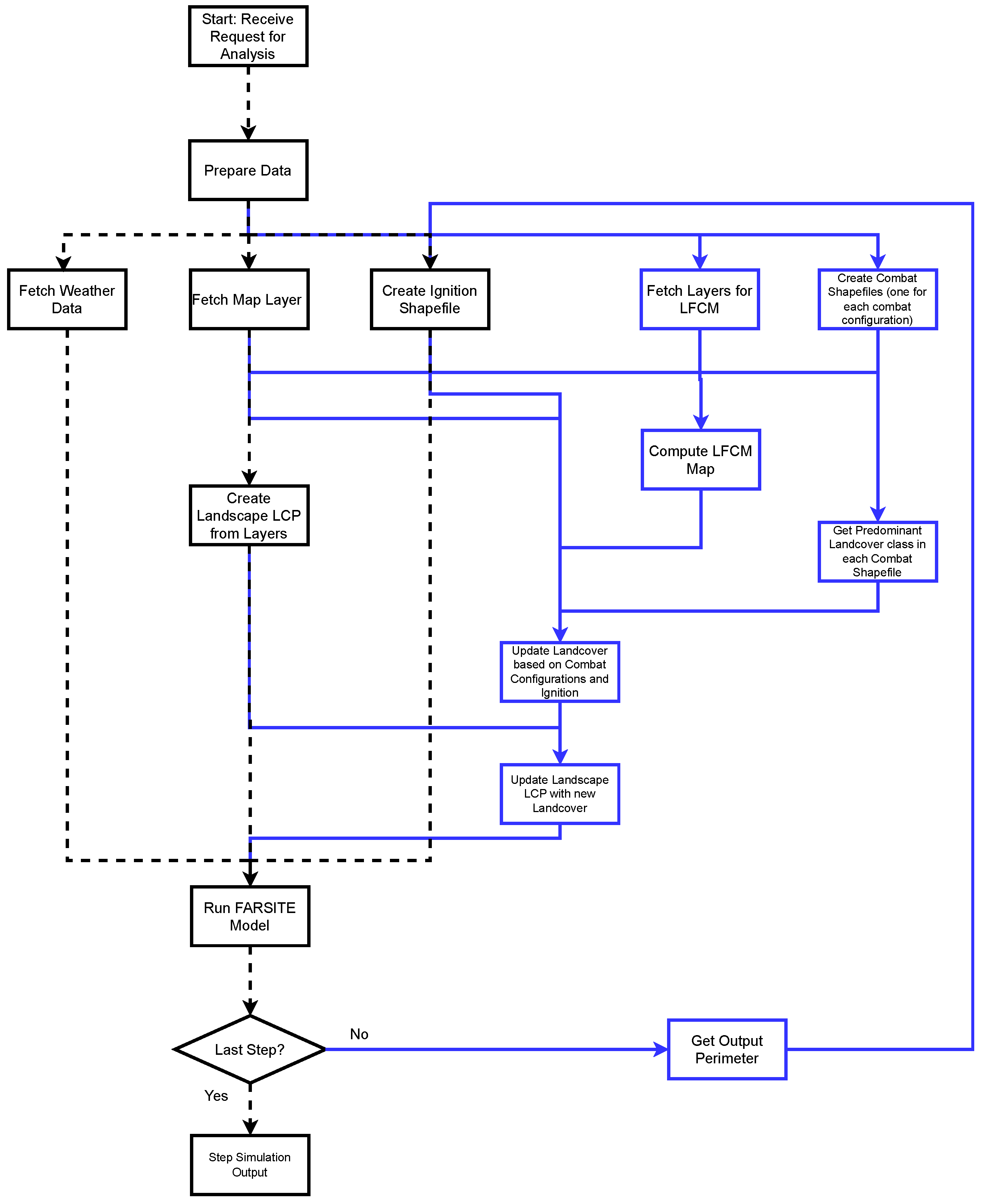
Before running the FARSITE model it is mandatory to create a set of input data. Figure 1 depicts the steps taken in order to create the needed set of data, using the basis of the previously produced workflow (see information in black in Figure 1) [24]. Additional steps were developed to include the new fire suppression modeling (see information in blue in Figure 1).
As previously noted, the Ubuntu version of FARSITE natively only supports static barriers defined prior to simulation. To overcome this limitation and enable the study of Dynamic Water Barriers, the model was extended with new functionalities that update the input landscape and ignition files at each timestep. These modifications allow the simulation to incorporate the transient effects of water application by dynamically adjusting the fuel model properties within the affected area. This implementation enables FARSITE to represent the evolving influence of aerial water drops on wildfire propagation.

Dynamic Water Barriers Algorithm

To assess the impact of Dynamic Water Barriers, the base FARSITE inputs were modified (see blue section in Figure 1), specifically the Landscape (LCP) and ignition shapefiles. Unlike using the standard static barriers, incorporating these barriers requires running FARSITE at each timestep and updating the Landcover layer to reflect changes in fuel conditions within the barrier area.
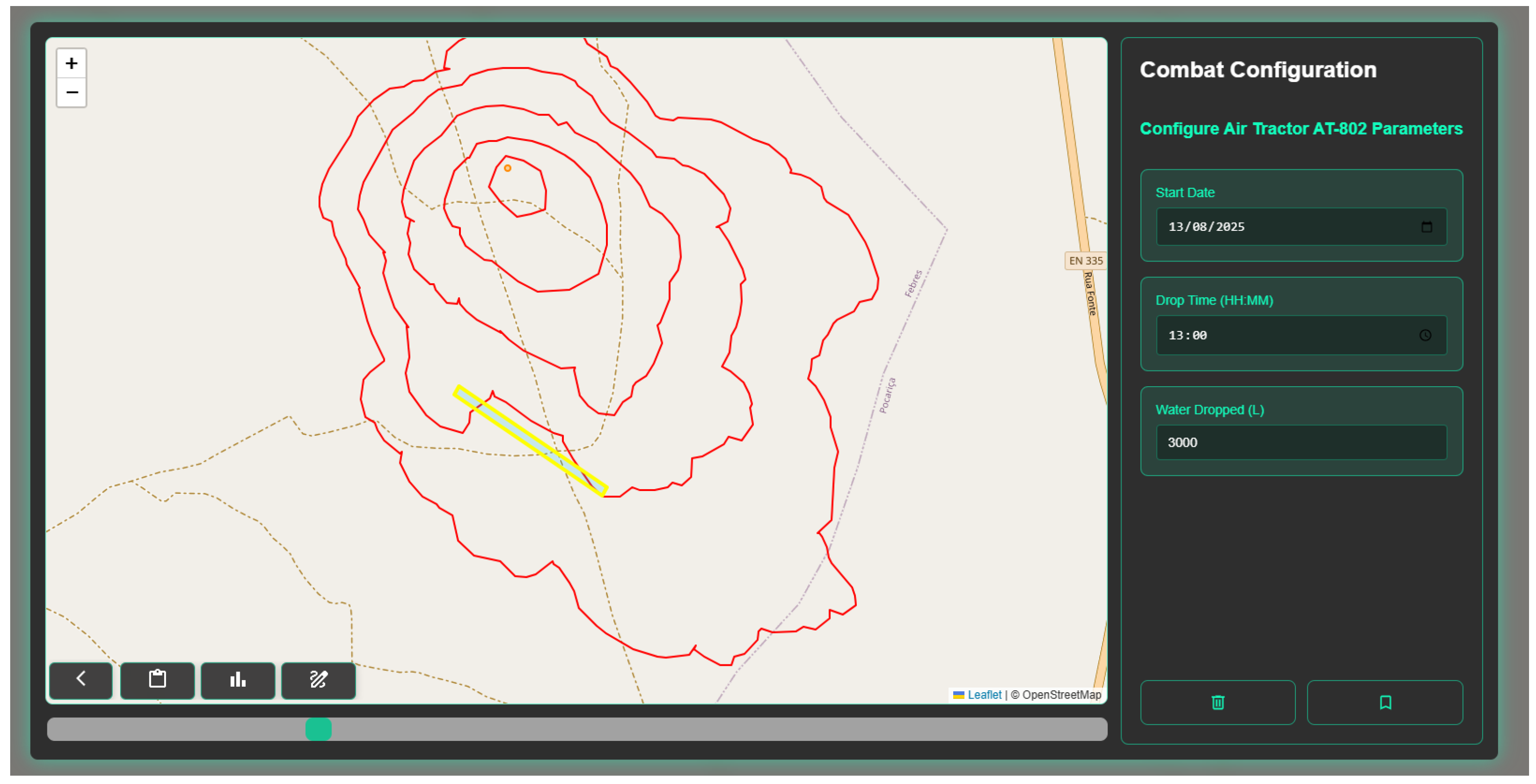
FARSITE supports up to 170 custom fuel models [34,35], allowing each Dynamic Water Barrier to be assigned a unique model whose parameters vary over time. Consequently, a maximum of 170 simultaneous barriers can be represented. To compute each custom fuel model, it is necessary to to create a barrier configuration (see Figure 2) that must include for each barrier the following inputs:
1.
Coordinates of the barrier polygon to calculate the area;
2.
Amount of water dropped in litres;
3.
Drop time, from which it is possible to compute the time since the barrier was created.
Using these data inputs and the layers described in Section 2.2, it is now possible to create a map of the live fuel moisture content (LFMC), which is a critical factor in determining vegetation flammability. The inputs described in Section 2 are used to compute the LFMC using an empirical model that integrates these variables. The model is expressed as
L F M C = a × N D V I + b × ( 1 L S T ) + c × S M + d × P P T + e
which follows a similar strategy to previous empirical regression models of live fuel moisture content, as seen for the Normalized Difference Vegetation Index (NDVI), Land Surface Temperature (LST), Soil Moisture (SM) and Precipitation (PPT) [38,45,46] Each set of weight coefficients can depend on the region’s climate, as seen in Table 2, and was selected as the main inputs to represent the LFMC in the studied regions, and for this study were selected as they gave values of around 80 to 90% in the summer. It is noted that the LFMC calculation is only done inside the barrier and, while most of the algorithms used several random forests for selection, this selection was done on years and years of data, but is not completely usable for real-time applications. It is expected that in the future, datasets of LFMC will be available worldwide and with a good time resolution, which will solve this problem.
To create a new custom fuel model, the original Landcover layer from the Landscape LCP map is required to identify the predominant fuel model [35] inside the combat area. This layer is then modified to reference the new custom fuel model, enabling the computation of fuel properties within the combat zone [35].
For the California case study, reported LFMC values for similar fuel types ranged between 50 and 70% for shrublands and 65–105% for forests at day of year (DOY) 312 (8 November) in previous years of the fire [47]. In the present study, we calculated for 8 November of 2018 that the mean LFMC within barrier pixels was 79.32 ± 10.06 % (average ± standard deviation), with values ranging from 64.69% to 101.23%. These values fall within the range reported for comparable vegetation types and temporal conditions in previous studies.
For the Portuguese fire case, the mean LFMC within barrier pixels was 110.39 ± 10.51 %, with minimum and maximum values of 82.21% and 125.18%, respectively. For comparison, LFMC estimates derived for 30 July 2024 over the 23 pixels overlapping the barriers (500 m spatial resolution) yielded a mean value of 105.23 ± 6.87 %, with values ranging from 83.79% to 118.17%. These estimates were obtained from the operational LFMC dataset for Portugal described in [20]. Overall, the LFMC values used in this study appear to be consistent with independent estimates for similar conditions.
1.
Compute the updated live fuel moisture content (LFMC) for the combat region by augmenting the initial LFMC with an estimated percentage increase determined from the ratio of applied water volume to surface area, which is similar to recreating a sum of “Additional Precipitation” to the LFMC value.
L F M C u p d a t e d = L F M C + l i t r e s _ d r o p p e d a r e a × 100
2.
Obtain an interpolation ratio following
r a t i o = L F M C u p d a t e d L F M C ¯ L F M C M a x L F M C ¯
where L F M C u p d a t e d is the value obtained in the previous step, and L F M C M a x is set to 200, which is a reasonable maximum value for the reference of species of trees in the Mediterranean and North America (mainly Quercus and Pinus) that are studied, as was shown for most of the sampled species in the Globe-LFMC 2.0 Dataset [46] and was reported to range from 40% to 200% in California from 2001 to 2018 [47]. This value can be fine-tuned in the future, depending on the identification of the specific species and seasonal variations [48].
3.
Given the predominant fuel model parameters [35] and the fuel model parameters corresponding to a humid climate, the new custom fuel model is obtained as follows:
P n e w _ f u e l = ( 1 r a t i o ) × P p r e d o m i n a n t + r a t i o × P h u m i d
where P x is the parameter of the given fuel.
4.
The decayed fuel model is then obtained using the decay factor as follows:
λ d f = e λ c × Δ t
where λ c is a decay constant obtained using l o g ( 2 ) H a l f L i f e H o u r s and Δ t is the time in hours since the start of the each specific drop and can be equated to the “critical time ( t q )” for fire spread, which has been defined by [49] as the moment when the total heat release rate exceeds 1 × 10 6 kW , and the simulated fire transitions into a high-intensity regime, indicating a rapid escalation in fire behavior and the reduced effectiveness of suppression actions. For a barrier with a width ranging from 20 m to 80 m, the corresponding critical times vary from roughly 2000 s to 8000 s, also depending on wind speed ( 4 m s 1 to 12 m s 1 ). Based on this, we tested several half-life values (0.5 h and 4 h) to reproduce the observed behaviour, as a previous study [49] was able to explore the temporal sensitivity of the water suppression rather without representing physical evaporation rates.
With this, we can now calculate at each timestep the decayed fuel model parameters for each combat mission as follows:
P d e c a y e d _ n e w _ f u e l = P p r e d o m i n a n t + ( P n e w _ f u e l P p r e d o m i n a n t ) × λ d f
Within this simulation framework, after each timestep the resulting fire perimeter is used to generate the ignition shapefile for the next iteration. However, before producing this new shapefile, the perimeter must be simplified, as FARSITE cannot reliably compute fire propagation when the input ignition geometry is excessively complex.
In order to simplify the new ignition shape, the Douglas–Peucker algorithm was used [50]. Note that, for short-duration simulations the Douglas–Peucker algorithm [50] does not apply any simplification since a small value was chosen for ϵ . To demonstrate the simplification, a bigger ϵ was used. Figure 3 displays this simplification.
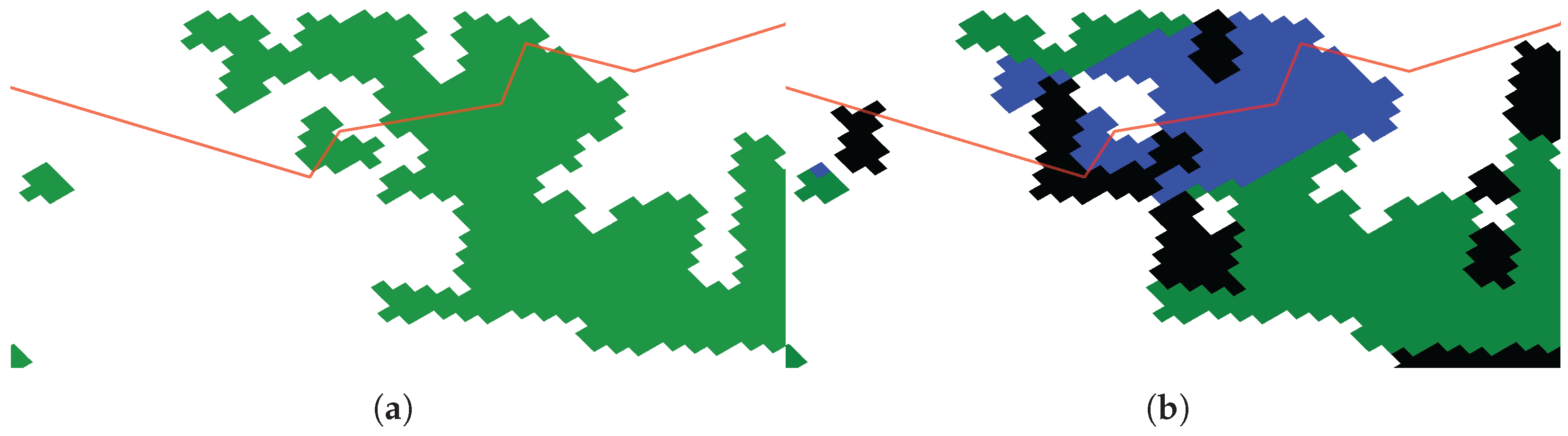
Another identified limitation of the FARSITE version that is being used [34] is that if the ignition overlaps with unparameterized non-burnable fuel pixels, the fire propagation is not computed. To ensure that the new ignition does not intersect such unparameterized areas, a mask was generated from the ignition perimeter. Using this mask in combination with the Landcover data, any unparameterized pixels intersecting the perimeter line, along with a surrounding 10-by-10 pixel neighborhood, were reassigned to a non-propagation fuel model.
For the initial tests, a fuel model with a very low spread rate was used, specifically model number 181, corresponding to low-load compact conifer litter [35]. Once the Landcover has been updated, the layer in the landscape file corresponding to the Landcover must be replaced, as seen in Figure 4.

2.4. Dynamic Water Barrier Functionalities

A synthetic scenario was created in order to demonstrate the capabilities of the Dynamic Water Barriers. An ignition in Portugal during the peak heatwaves of August 2025 was chosen, with an average air temperature of 23.51 °C (1.55 °C above normal) and an average maximum air temperature of 30.78 °C (2.09 °C above normal). Table 3 displays the ignition parameters, namely latitude, longitude, the start date and time, the duration and timestep and the resulting burnt area (ha) at last timestep (2 h 00 m).
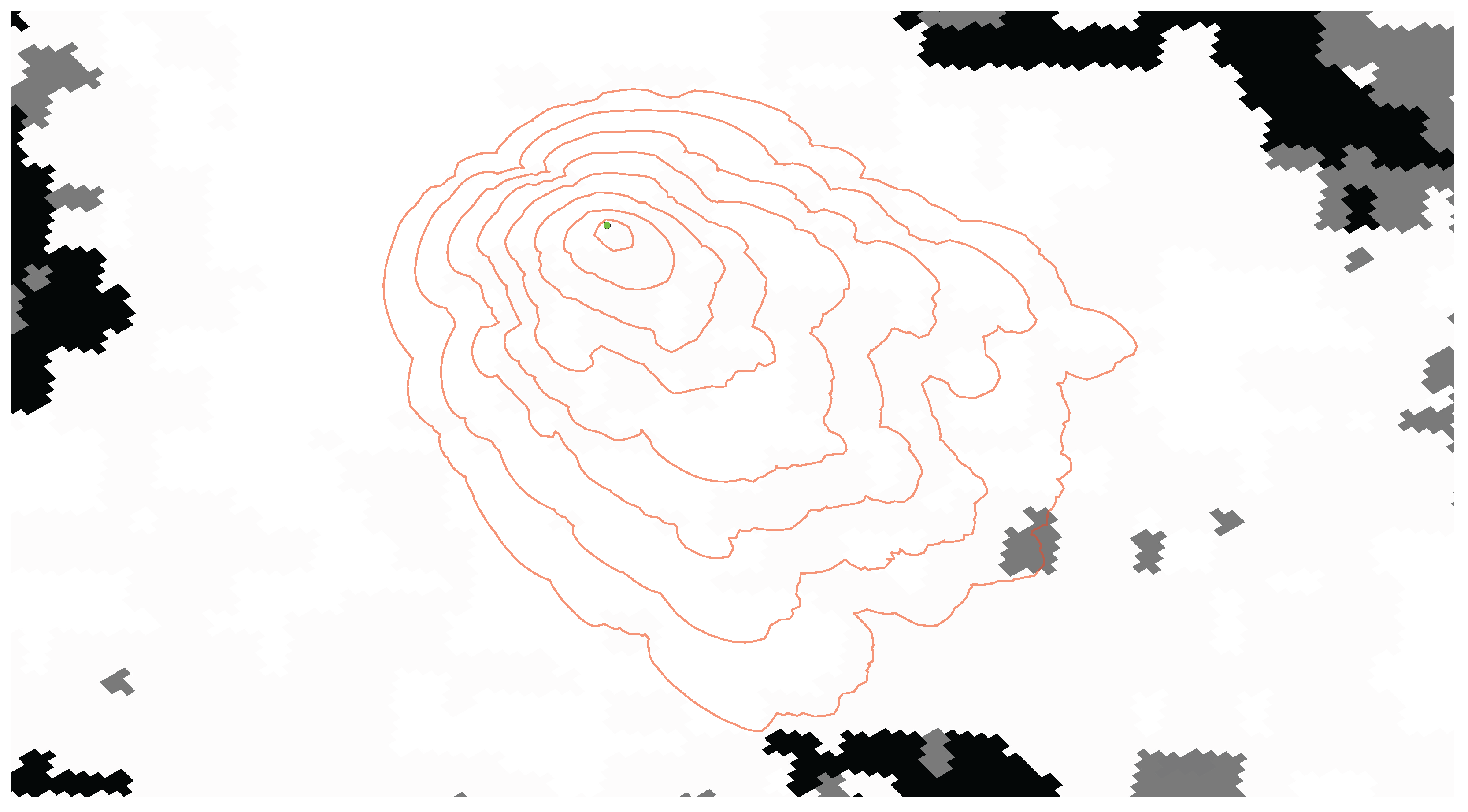
To observe the effects of the Dynamic Water Barrier, an initial simulation without any barrier was run, with Figure 5 showing the resulting fire propagation perimeters based on the ignition parameters in Table 3.
Throughout the tests to be shown in the remainder of Section 2.4 the original propagation was also placed to be used as a guide. Tests were created to analyze different phenomena:
1.
Different water density.
2.
Different drop time.
3.
Different size barriers.
4.
Set of barriers.
Each of the following sections also displays a figure where the effect of a static barrier that completely stops propagation is demonstrated, which is what the FARSITE platform currently allows the user to simulate. In each figure, the background shows the land-cover fuel map, where different shades of gray represent different fuel types.

2.4.1. Water Density Effects

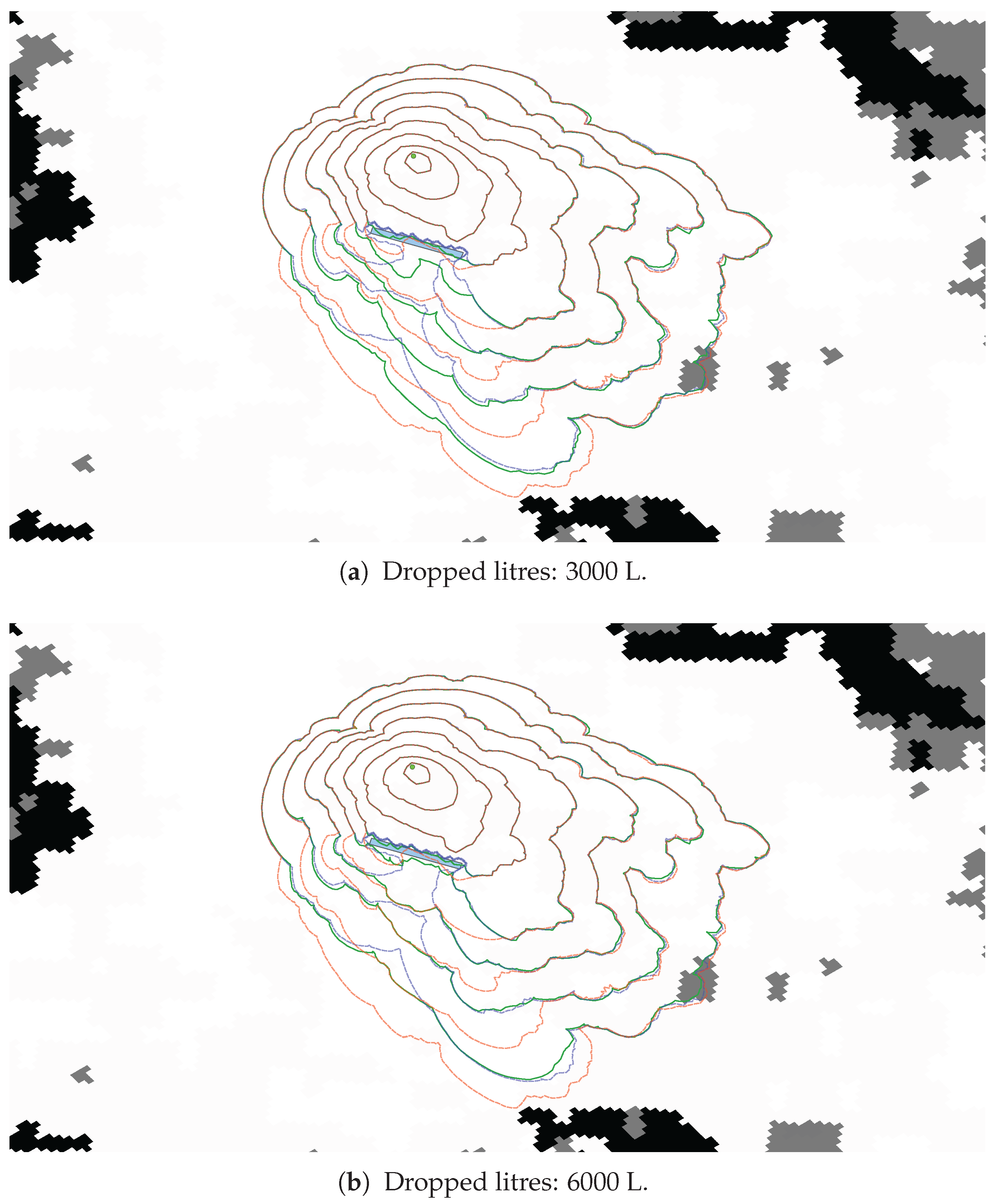
Given a single barrier, it is possible to study the effects of the water density by increasing (or decreasing) the water quantity dropped at a given drop time in a specific area. In other words, by adjusting the water quantity dropped, it is possible to tune the type of barrier, from almost non-existant to an almost full barrier. The barriers configurations, as well as the final burnt area, are displayed in Table 4. Each barrier is a rectangle of 400 m by 30 m and were all placed at 12:45. Is is noted that in this work the full barrier mode is just substituting the fuel pixels inside the barrier with non-burnable fuel pixels instead of using the native FARSITE barriers, which also completely block the spread of the fire.
These tests show that increasing the amount of dropped water reduces the burnt area, with 6000 L already close to a full barrier, and that planes like the Canadair CL-415 (up to 6000 L , see test 107) [51] can be simulated, or an Air Tractor AT-802F, which carries up to 3000 L [52] (see test 104), as displayed in Figure 6. In the future, it would be interesting to integrate numerical simulations of aerial liquid drops to account for liquid fragmentation and dispersion [51], but for now we assume that all water reaches the ground uniformly.

2.4.2. Drop Time Effects

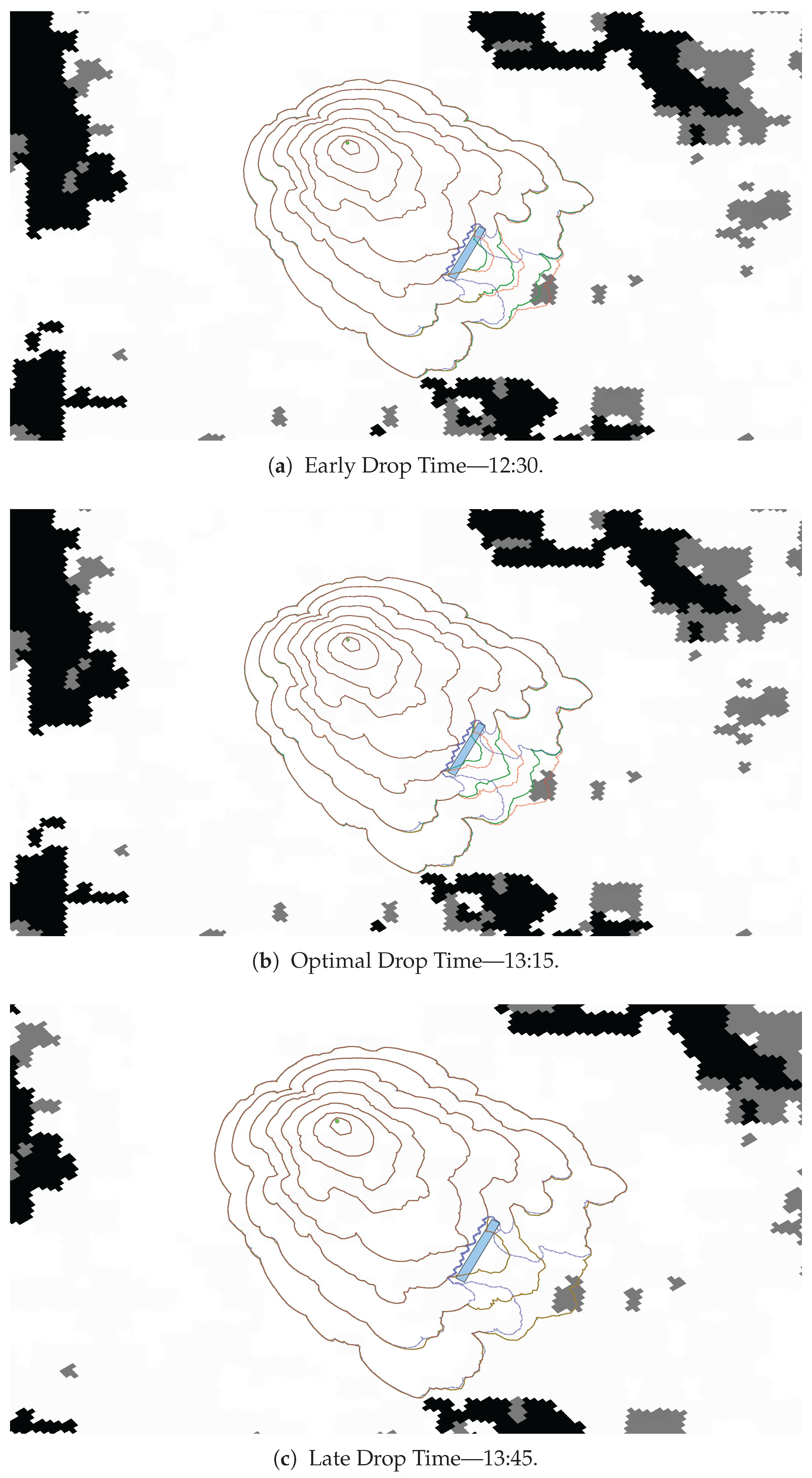
Another important factor to study is the effect of the time elapsed since the placement of the barrier. The decay can be analyzed by placing the barrier at different timesteps of the simulation. The barrier configurations, as well as the final burnt area, are shown in Table 5. Each barrier is considered to be a rectangle of 400 m by 30 m and was created using 3000 L of water.
Table 5 shows the effect of barrier placement timing on the final burnt area, as observed in Figure 7. When the barrier is applied earlier in the simulation (tests 201–204), the burnt area decreases, reaching a minimum of 329.925 ha at 13:15 (test 204). This reduction occurs because the barrier intercepts the fire while it is still spreading. After 13:15 (tests 205–206), the burnt area increases again, as the barrier is deployed after a significant portion of the area has already burned. The full barrier scenario (test 200) demonstrates the maximum reduction in burnt area (310.981 ha), highlighting the cumulative effect of covering the entire barrier length from the start of the simulation.

2.4.3. Barrier Size Effects

Changing the length (and therefore the area) of the Dynamic Water Barrier is equivalent to changing the water quantity (litres) per square meter. In this section, 400 m barriers were used as the standard, and the effect of changing the length to 200 m and 600 m while maintaining the same total water volume was analyzed. In other words, using a 200 m barrier increases the water density, whereas using a 600 m barrier decreases it. Values between 81 m and 430 m have been reported for fixed-wing firefighting aircraft drop pattern lengths, while large and very large aircraft can drop with higher length patterns [21,53]. Subsequently, to keep the water density constant, 1500 L was used for the 200 m barrier and 4500 L for the 600 m barrier. Table 6, Table 7 and Table 8 show the set of tests performed in this section. Note that all barriers had a drop time of 12:45.
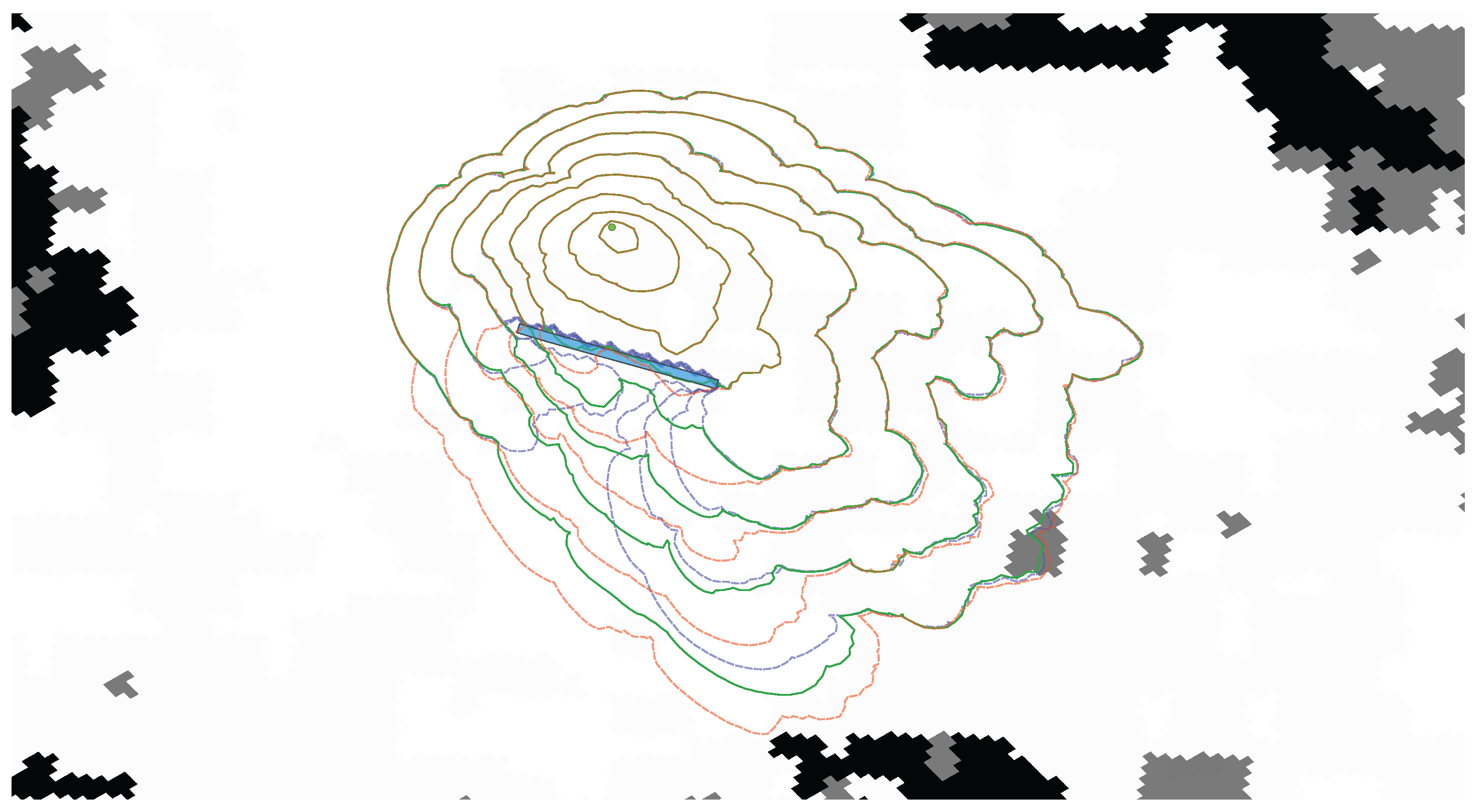
Table 6, Table 7 and Table 8 summarize the tests performed for barriers of different lengths and Figure 8 shows the fire propagation for test 323. For the 400 m standard barrier, the burnt area provides a baseline for comparison. Reducing the barrier length to 200 m while keeping the total water volume constant increases the water density, resulting in slightly more localized suppression values but leaving larger unprotected areas, as seen in Table 6. Conversely, increasing the barrier length to 600 m spreads the same water over a larger area, reducing water density and consequently decreasing the effectiveness of fire suppression, when comparing for example test 311 and 321. To isolate the effect of water density, additional tests were performed with 1500 L for the 200 m barrier and 4500 L for the 600 m barrier, maintaining the same water density as the 400 m barrier; these tests demonstrate that fire suppression effectiveness is strongly dependent on water density rather than barrier length alone. All barriers in these tests were placed at 12:45.

2.4.4. Multiple Barrier Effects

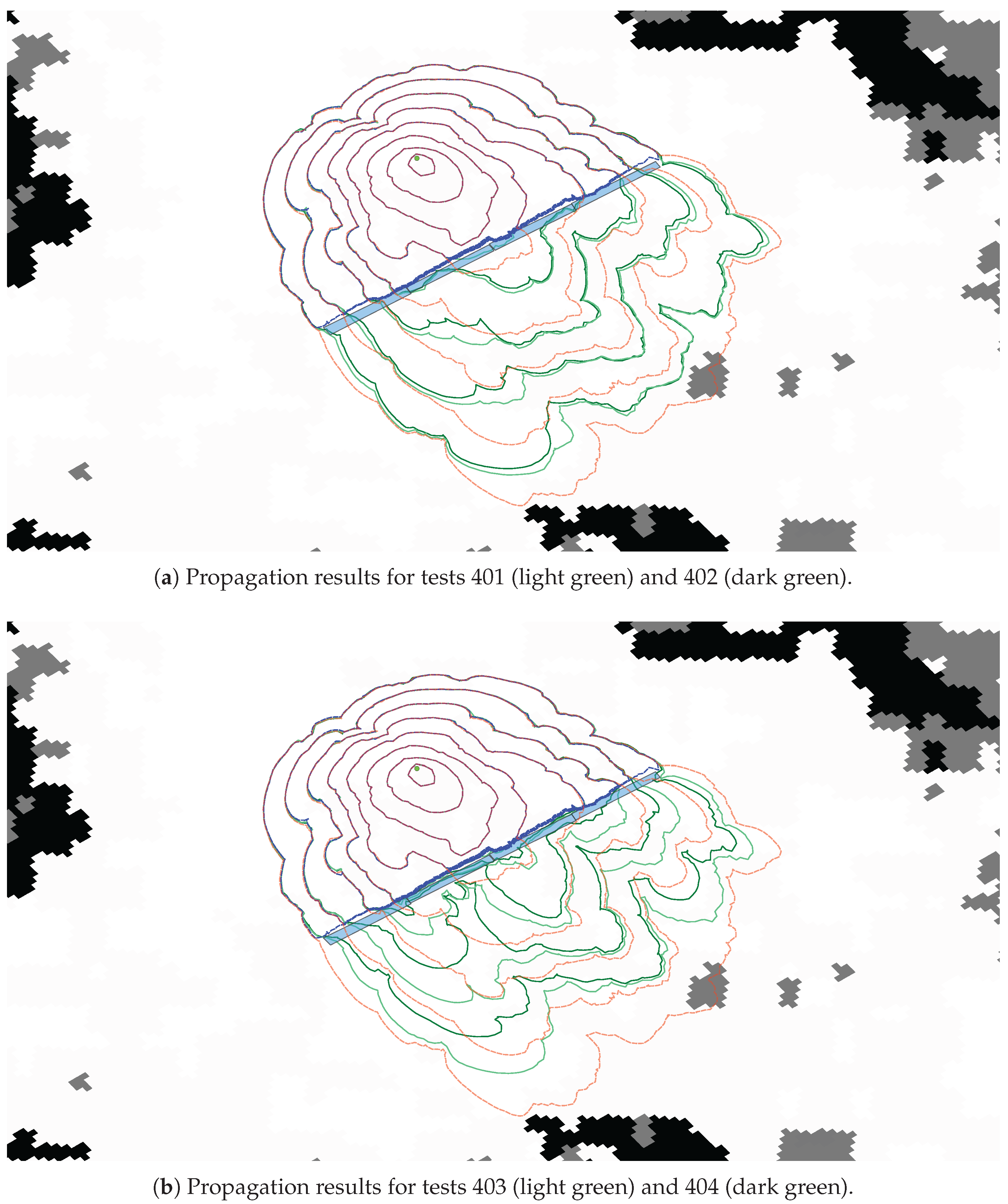
A final example demonstrates that multiple barriers can be placed within the same simulation. Four barriers in a line were used to simulate simultaneous drops from four planes. The barrier configurations, as well as the resulting final burnt areas, are shown in Table 9 (full barrier), Table 10 ( 6000 L barrier), and Table 11 ( 10 , 000 L barrier). In this case, 10 , 000 L drops can simulate the drop of Dash-8 airtankers [51]. With this approach, each barrier can be placed at different times (and its values are decayed according to the drop time) and can be considered independent agents along the simulation, while creating a specific fuel model for each barrier.
Figure 9 displays the propagations obtained with tests 401, 402, 403 and 404.

3. Results

This section presents two examples (Camp Fire and Vinagra) that were first analyzed without any combat tactics. The Dynamic Water Barriers and full static barrier functionalities were then implemented, and the results were compared using similarity coefficients against the points detected by FIRM [44].
To ensure comparability between the first and second case study, namely Camp Fire and Vinagra, respectively, the geospatial preprocessing pipeline was standardized while accounting for regional differences in data availability and modeling requirements. Within the Google Earth Engine (GEE) preprocessing stage, both study areas used identical native image resolutions, namely 100 m for tree cover and 30 m for all remaining layers. A post-processing procedure was subsequently applied to the tree cover dataset to upsample its spatial resolution from 100 m to 30 m, thereby ensuring consistency with the other landscape layers required by FARSITE [34].
For the Vinagra wildfire, the GEE imagery was clipped using a symmetric offset of 0.2° to the north, east, south, and west based on the ignition centroid. In contrast, the Camp Fire, which was considerably larger, had to have those configurations changed, as it was observed that the simulated fire spread frequently reached the western boundary of the generated landscape. To avoid this limitation, a configurable clipping parameter was introduced that allowed users to adjust the spatial extent. For the Camp Fire case study, this resulted in offsets of 0.2° in the north, east, and south directions, and 0.4° westward.
To more accurately represent the terrain and vegetation conditions of the Camp Fire case study, additional modifications were applied to the Landcover layer. The original Landcover dataset derived from Google Earth Engine (GEE) did not include certain relevant landscape features around the North Fork Feather River present within the study area (see Figure 10), as, due to the resolution, some pixels were not added as open water (class 98 [35]). Furthermore, within the city of Paradise, the Landcover classification was incomplete: some pixels were classified as urban (non-burnable), while adjacent areas were incorrectly labeled as forest, which permitted unrealistically rapid fire propagation. As post-event reports indicate that the city ultimately burned, these inconsistent pixels were replaced with a fuel model (namely class 146) [35] representation that allowed fire spread to occur more realistically within the urban area.
Differences in aerial suppression strategies between the two regions were also incorporated. The aircraft operating in the USA fire primarily deployed long-term retardant, resulting in a suppression half-life of approximately 4 h [31]. In Portugal, however, the firefighting aircraft used water drops, which typically exhibit a half-life of around 30 min [49]. These distinctions were reflected in the corresponding suppression models.
Due to the extreme conditions observed during the USA wildfire, the fire exhibited rapid growth and produced very large burning perimeters. With longer simulations FARSITE [34] does not efficiently simulate spread at that scale when operating at its default distance and perimeter resolutions of 30 m. To balance computational performance with simulation fidelity, a dynamic resolution adjustment was implemented: after each simulation step, the current burned area was evaluated, and the spatial resolution was increased as necessary. By the end of the USA simulation, FARSITE was operating with resolutions of up to 100 m. This approach provides a practical compromise, which can improve computational speed during fire growth at a large scale at the cost of a gradual reduction in spatial precision.

3.1. Case Study: Camp Fire, Butte County, California, 8 November 2018

The Camp Fire ignited on 8 November 2018 at approximately 06:33 local time near Camp Creek Road at Jarbo Gap (Pulga), Butte County, California [54]. Severe weather conditions, including strong downslope winds (> 20 m s 1 ), extremely low relative humidity (the collected IBM data [43] provided values between 9% and 20% and other reports confirmed the values going into extreme single digits [54]), and dry fine fuels following a prolonged drought, contributed to extreme fire spread rates [55]. Within the first day, the fire overran wildland urban interface communities such as Paradise, Concow, and Magalia. At its peak, suppression efforts involved hundreds of firefighters, dozens of ground vehicles, and numerous aerial resources. The Camp Fire ultimately became the deadliest and most destructive wildfire in Californian history, burning approximately 62,000 ha, destroying over 18,000 structures, and causing 85 fatalities and has been one of the most studied fires due to its large impact [54,56,57].
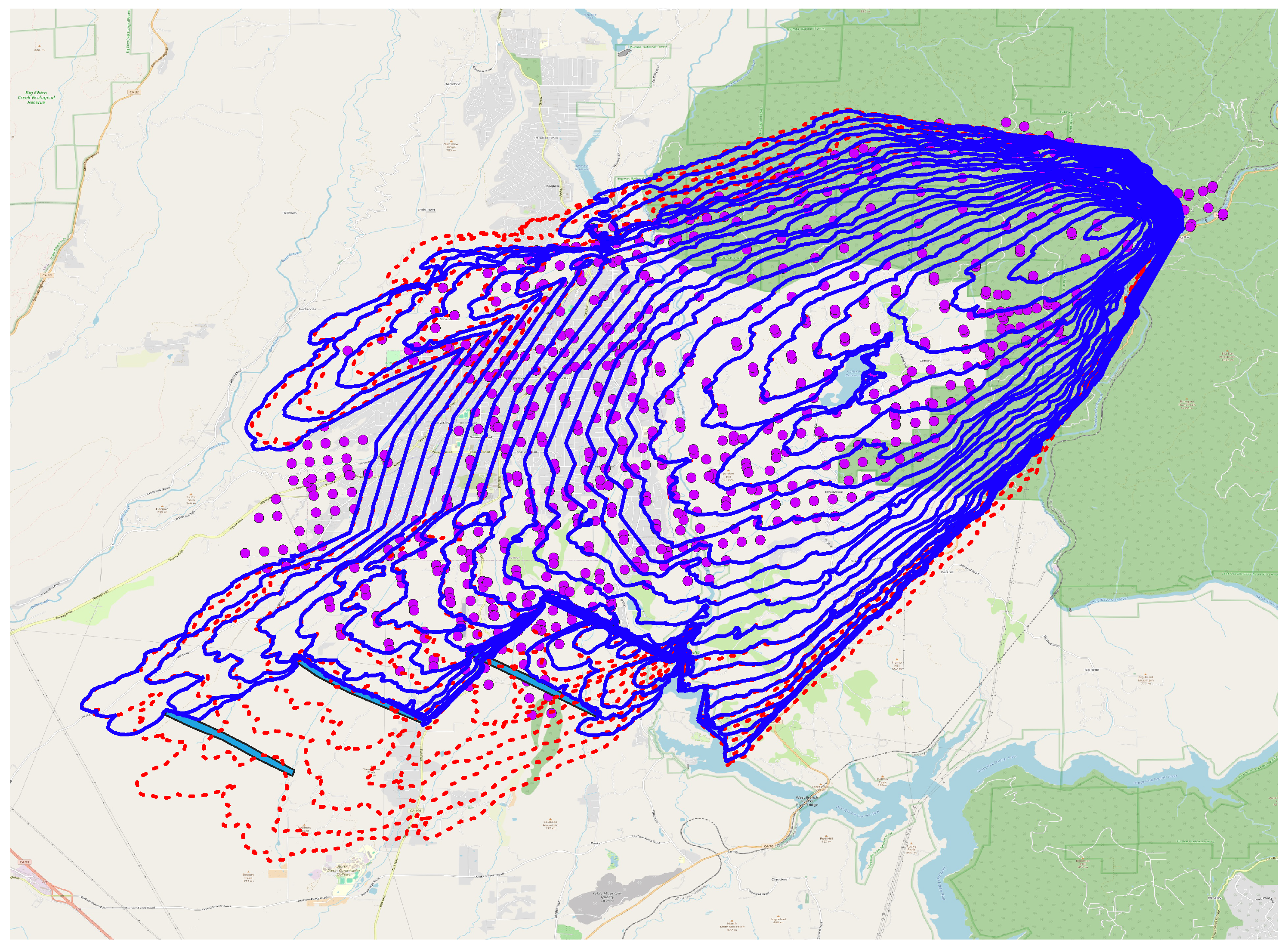
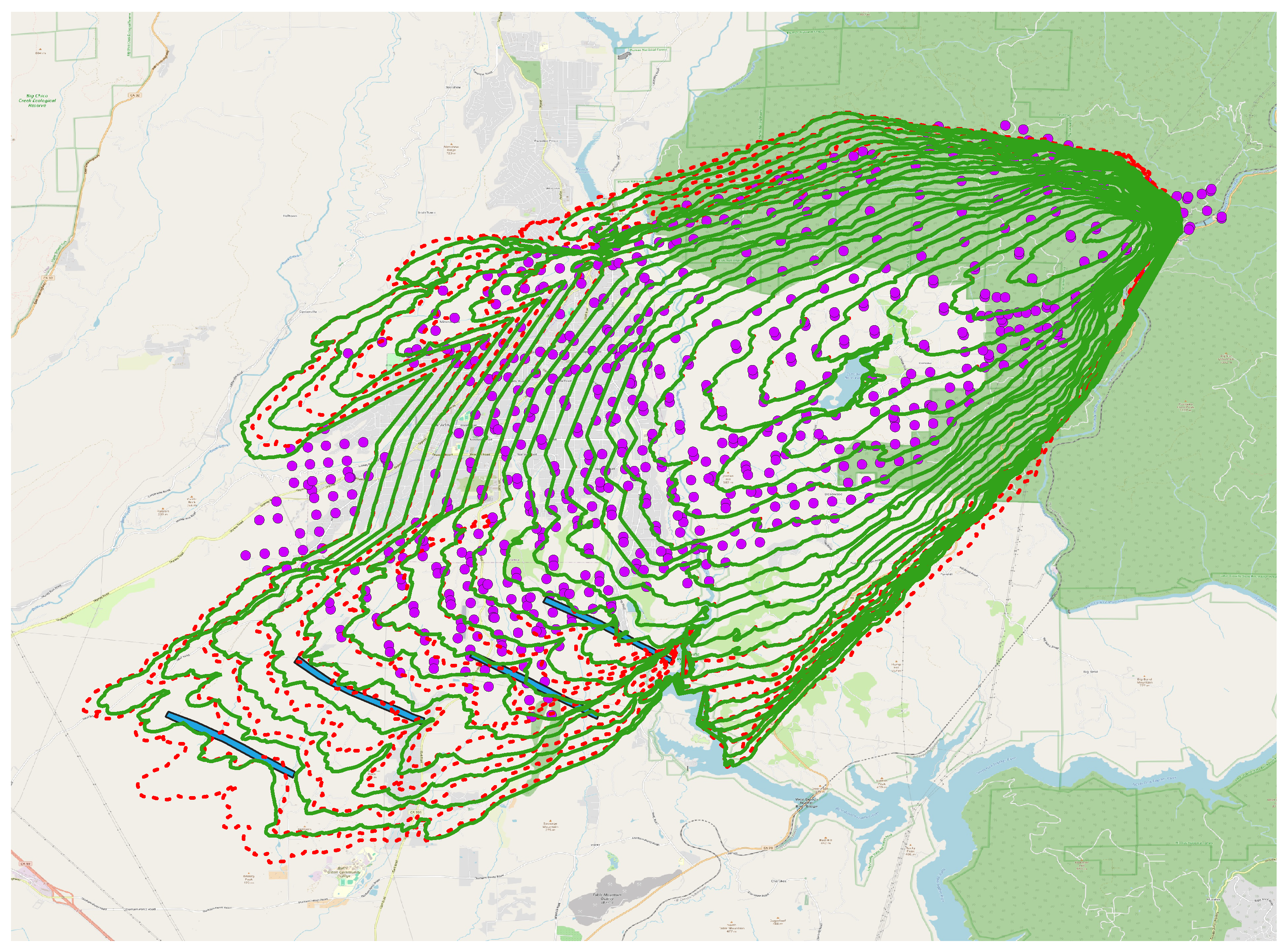
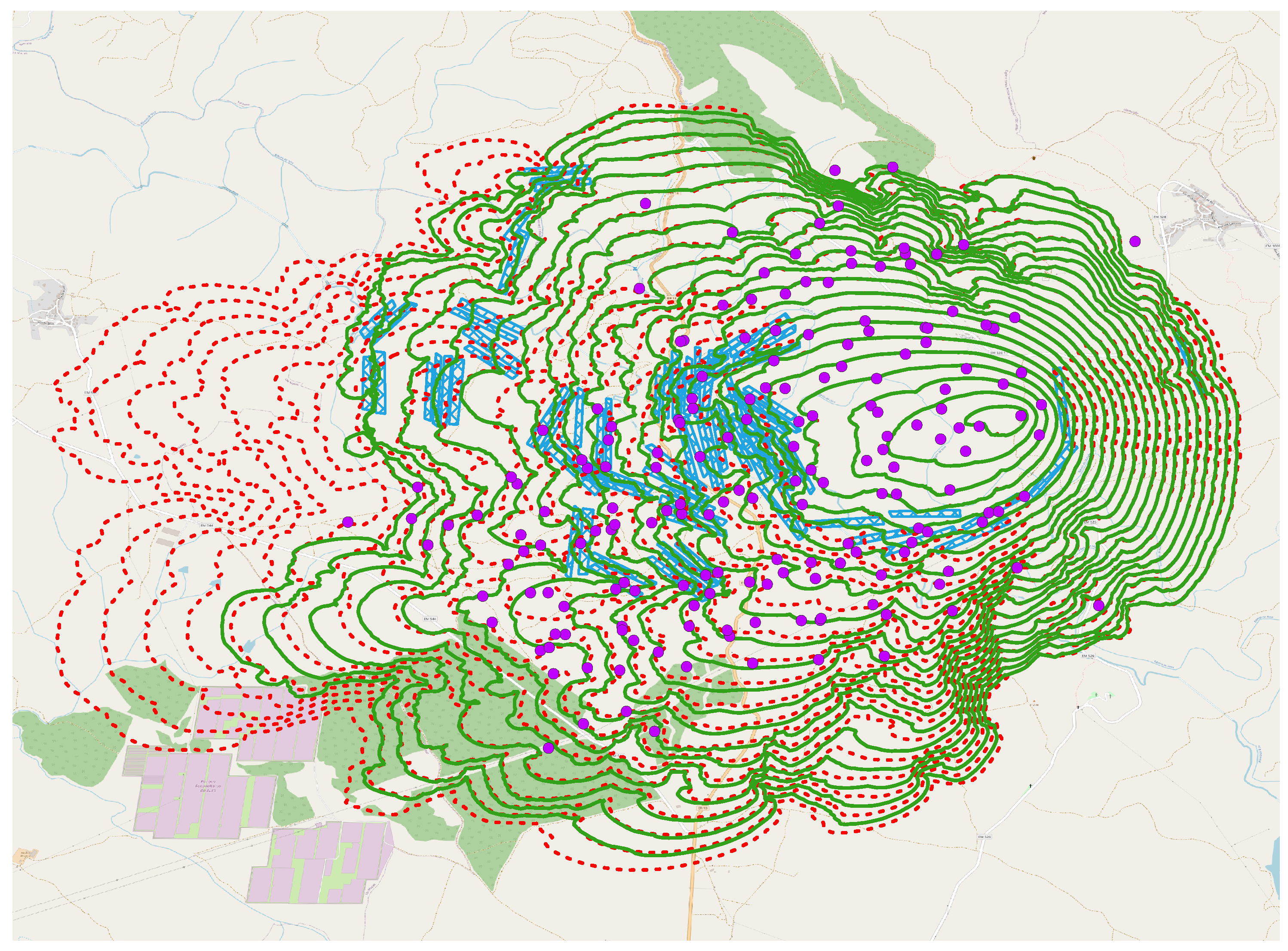
For this study, the simulation was initialized at 06:30 and terminated at 18:00 local time, using 30-min time steps (for a total of 23 simulated time steps). Aerial suppression operations were reported to have begun at approximately 13:00, once wind conditions had slackened sufficiently to allow fixed-wing air tankers to operate effectively. Nine air tankers operated over the following four and a half hours: five S-2s, one DC-10, and three other large air tankers. Collectively, they dropped more than 69,000 U.S. gallons (260 m3) of fire retardant on November 8 alone and ceased operations at approximately 17:30 [54]. Based on this information, four missions were assigned to each aircraft at 13:00, 14:30, 16:00, and 17:30 to allow sufficient time for refueling and mission preparation. A load of 925 gallons was used for each S-2 mission, 2100 gallons for each mission of the large air tankers, and 6600 gallons for the DC-10, resulting in a total of approximately 70,000 U.S. gallons (266 m3) of retardant applied in the simulation. To facilitate the creation of the barriers, we integrated each jointed mission into one polygon of around 3200 m by 150 m, as seen in Figure 10 and Figure 11. It is noted that while the true geolocalization of the the aerial missions was not possible to determine, it is possible to make an educated guess based on the timings and the spatial propagation of the wildfires. This is still one of the biggest limitations of the work.
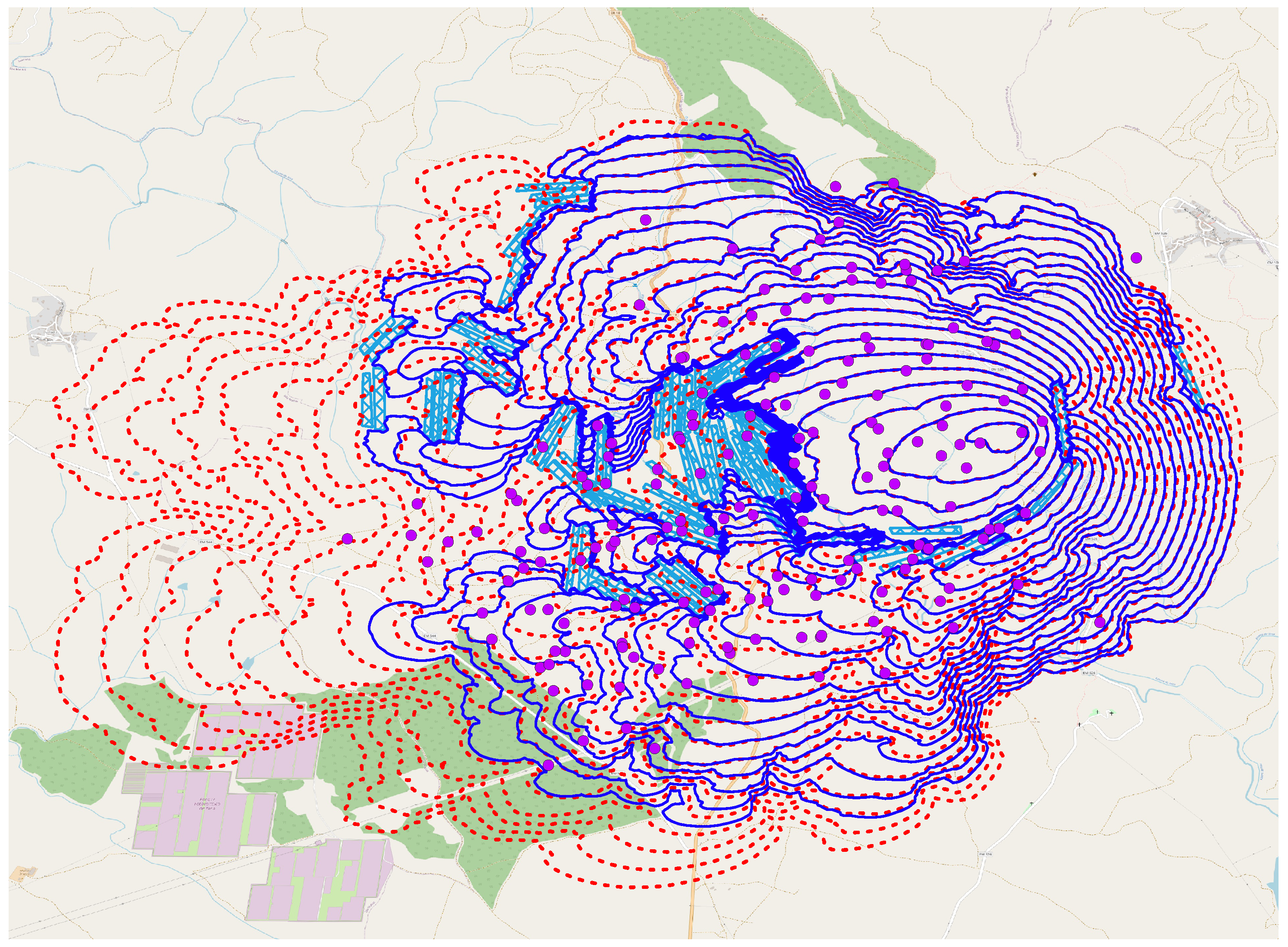
FIRMS satellite data was used to compare the simulated propagation of the first hours of the fire (until 15:00). A comparison is made with the Dynamic Water Barriers, as shown in Figure 10, while the full barriers from FARSITE are presented in Figure 11. Similarity coefficients for both cases (as well as the scenario with no combat) are provided in Table 12.

3.2. Case Study: Vinagra (Nisa) Wildfire, 29 July 2025

The Vinagra wildfire, located in the municipality of Nisa (Portalegre, Portugal), ignited on 29 July 2025 at 12:32 local time under hot and dry summer conditions; namely, the collected IBM data [43] showed temperatures between 30 °C and 36 °C, relative humidity between 9% and 16%, and wind speeds ranging from 3 m s 1 to 6 m s 1 .
The fire originated in a mixed forest landscape dominated by pine and eucalyptus stands, vegetation types known for their high flammability and rapid fire spread potential. The event prompted precautionary evacuations in nearby settlements, including Vinagra and Pé da Serra, and led to the temporary closure of the N18 road.
At its peak, suppression efforts mobilized approximately 336 firefighters, 108 ground vehicles, and seven aerial units, as reported by the Portuguese National Authority for Emergency and Civil Protection, with the number of aerial missions registered in Table 13. According to reports, the wildfire transitioned from an active propagation phase to resolution within three days, being declared under surveillance by 2 August 2025, with the majority of the fire propagation observed on the first day. Field and satellite assessments indicate that the burned area extended over 1300 hectares, consistent with intensity fires with moderate frequently observed in inland central Portugal during late summer.
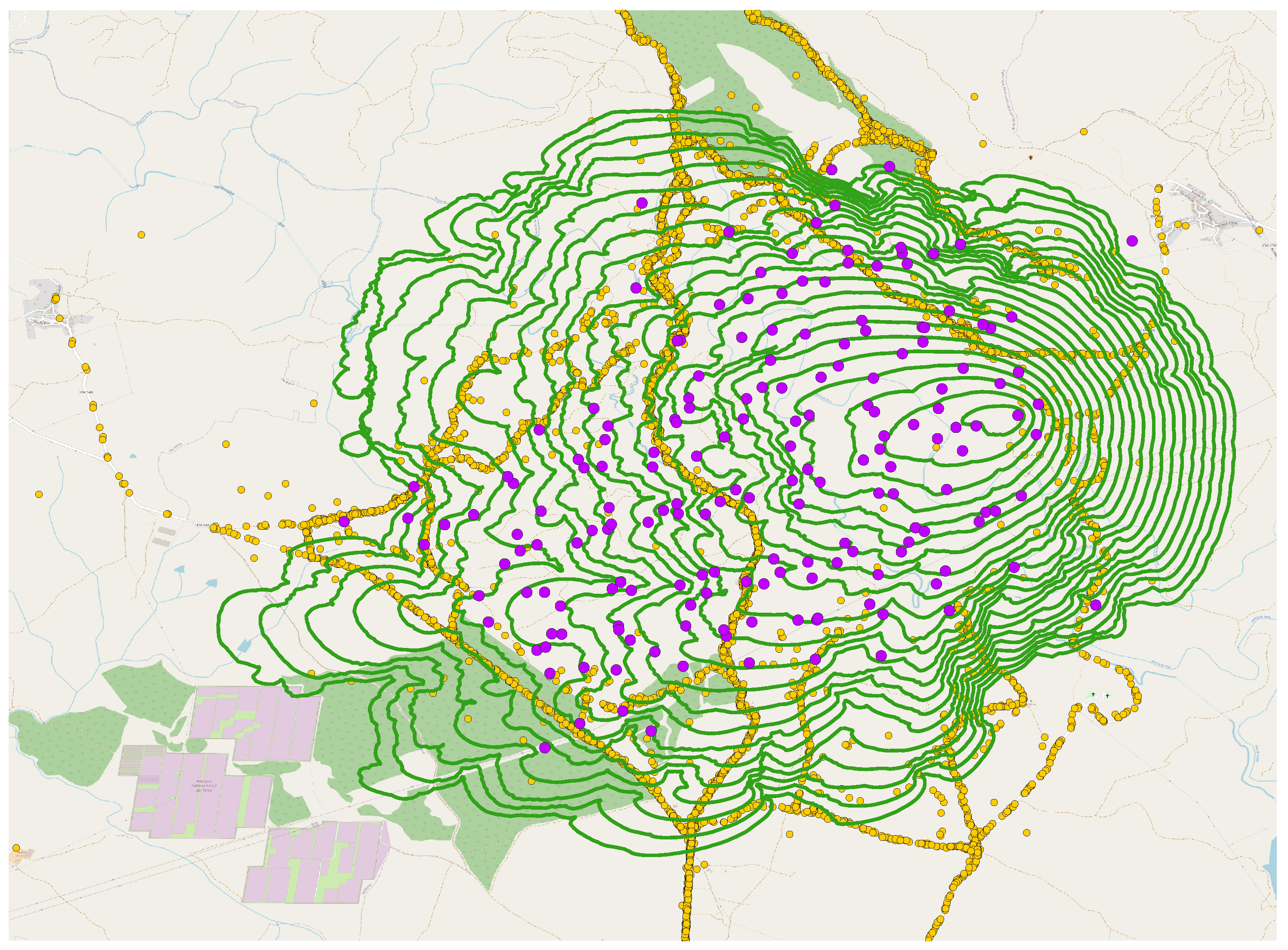
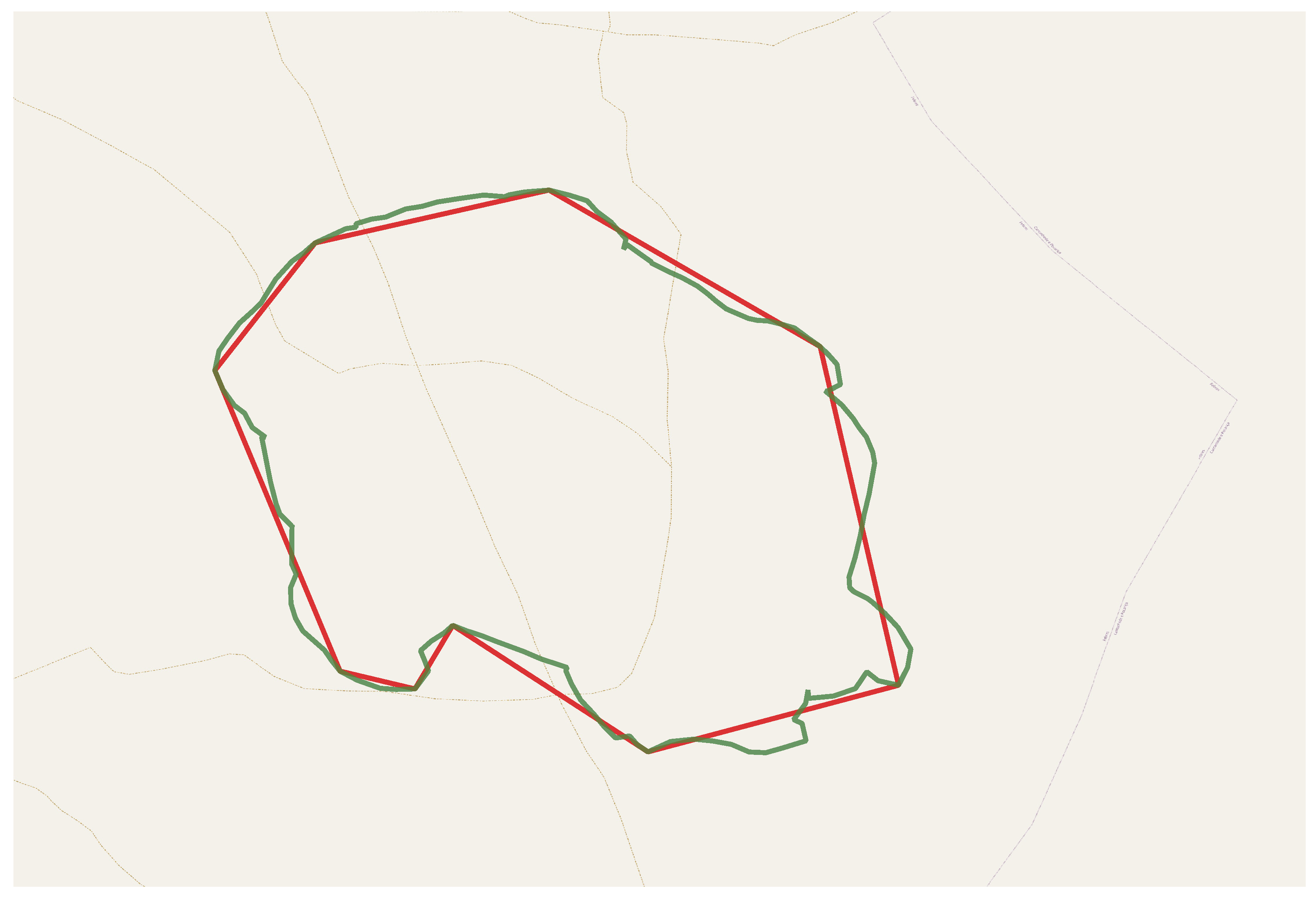
Figure 12 shows the simulation of the fire with dynamic barriers, starting at 12:30 and ending at 18:00, which was when aerial missions (see Table 13) started to be downscaled and the fire was completely controlled by the ground forces, as seen in Figure 13. Each combat mission was done with a polygon of approximately 400 m by 30 m and 6000 L , as the maximum capacity for the Canadair CL-415 [51]. The full static barriers from FARSITE are presented in Figure 14, and it is not noted that the true geolocalization of the the aerial missions was also not possible to determine.
Table 14 shows the similarity coefficients for both cases (as well as the comparison with the scenario with no barriers) against the points obtained by FIRMS, for the simulations ending at 18:00.

4. Discussion

While a formal sensitivity analysis was not conducted, the results illustrate the model’s sensitivity to suppression-related inputs. Using identical ignition and meteorological conditions, variations in water drop placement and barrier extent produced substantially different fire propagation outcomes, highlighting the strong influence of operational interventions, as seen in Section 2.4. Overall uncertainty is therefore dominated by input data quality, particularly meteorological fields and fuel characterization.
It also is noted that uncertainty is inherent in the comparison between simulated and observed fire behavior. Temporal and spatial sampling limitations in FIRMS introduce uncertainty in fire arrival timing, leading to omission and commission errors that directly affect similarity metrics, which are highly sensitive to detection timing, perimeter alignment, and spatial resolution. Accordingly, discrepancies between simulations and observations are given equal weight to agreements, as they reflect model limitations and data constraints rather than isolated anomalies, and provide critical insight into pathways for improvement.

4.1. Case Study: Camp Fire, Butte County, California, 8 November 2018

As reported by the California Department of Forestry and Fire Protection [54], by 10:45 the fire was already burning in the city of Paradise, including the Ridgewood Mobile Park, near the town limits. All the simulations reached the first town limit at 10:30 and had already entered it by 11:00. By 18:00 (see Figure 10), 22,200 ha were already burned with an extension of 17 miles. All the simulations showed a maximum extent of around 16.8 miles (as the barrier were not placed to protect the area near the Skyway road, which had the maximum extent in all cases). In terms of burned area, the case for no barrier burned trough 25,911 ha, while with the dynamic barriers, we observed an area of 25,085 ha, for a difference of 826 ha with the introduction of the barriers.
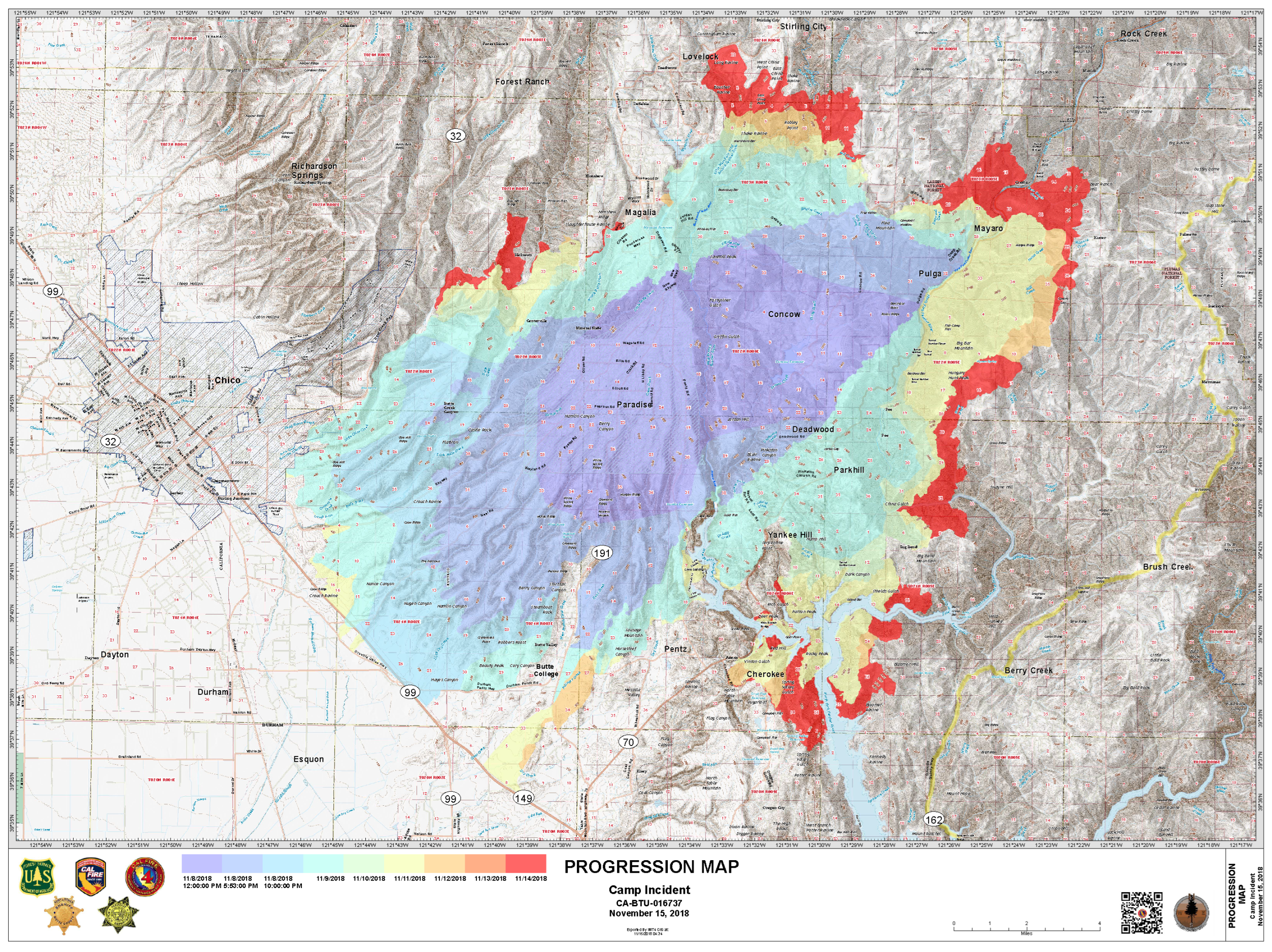
The case with the full barrier combat showed a total burned area of 22,274 ha. This is very close to the reported statistic and it is observable in Figure 15 that the area near State Route 70 (southeast of the fire) is ’extra’ and that the simulation progressed towards it. It was not observed by FIRMS but the simulation also burned in that direction on the first day. It is noted that eventually that area ended up burning on the next days of the fire.
The analysis at 15:00 (which encompasses only the first two missions at 13:00 and 14:30) shows that the introduction of Dynamic Water Barriers led to minor changes in the spatial similarity metrics when compared with the ’no combat’ scenario. Both the Sørensen–Dice (SD) and Tanimoto coefficients (TC) were essentially maintained, with a very slight decrease from 0.825 to 0.824 and from 0.703 to 0.700, respectively. The Relative Area Difference (RAD) decreased from 0.010 to 0.006, indicating a small improvement in total burned area agreement. However, the Percentage Area Overlap (PAO) also decreased marginally from 83.41% to 82.87%, which can be attributed to the deflection and redirection of the fire front induced by the dynamic barriers, leading to small localized spatial shifts without significantly altering the global agreement.
In contrast, the use of full barriers resulted in a different and less favorable pattern across the metrics. While the PAO remained nearly unchanged at 82.73%, both the SD and TC decreased more noticeably to 0.807 and 0.676, respectively, reflecting a degradation in shape similarity relative to both the ‘no combat’ and dynamic barrier scenarios. Furthermore, the RAD increased to 0.024, indicating a worsening in the agreement of total burned area. These outcomes show that, for this case, full barriers introduced excessive constraints on fire spread, leading to poorer shape representation and reduced overall agreement with observations. These results suggest that while full barriers effectively constrained the total burned area, they did so at the expense of spatial realism (e.g., the fire front was completely blocked and it started to be deflected), whereas the dynamic barriers offer more balanced improvements across metrics related to both fire extent and spatial overlaps.

4.2. Case Study: Vinagra (Nisa) Wildfire, 29 July 2025

For the Vinagra (Nisa) fire, the case for ‘no combat’ exhibits a comparable agreement with the observed fire (see Table 14), with a Percentage Area Overlap (PAO) of 99.63%, indicating that nearly the entire burned area is captured. However, the shape similarity remains moderate, with a Sørensen–Dice coefficient (SDC) of 0.659 and a Tanimoto coefficient (TC) of 0.491, while the Relative Area Difference (RAD) of 0.339 indicates a noticeable overestimation of the burned area, especially on the left side, as seen in Figure 12.
The introduction of dynamic barriers substantially improves all similarity metrics, with the SDC increasing to 0.756 and the TC to 0.608, reflecting a marked enhancement in shape agreement. At the same time, spatial coverage remains very high (PAO = 98.82%), and the RAD decreases to 0.234, indicating a more accurate estimation of the total burned area without compromising coverage.
Meanwhile, the use of full barriers (see Figure 14) yields the highest shape similarity, with the SDC and TC further increasing to 0.764 and 0.618, respectively, and the RAD dropping to 0.108, denoting a strong improvement in total burned area accuracy. However, this gain comes at the expense of spatial coverage, as the PAO decreases to 85.67%, indicating that a non-negligible portion of the observed burned area is no longer captured. As observed previously, full barriers can improve shape and area accuracy but reduce overall spatial realism when compared with dynamic barriers, and can overly protect certain areas that the combat missions might not be able to succeed in.
As mentioned, Figure 13 shows that after 18:00 the simulation of the fire is already outside the perimeter of the operational land vehicles and firefighters on the ground, so the simulation was stopped at that time.
Both California and Portugal are part of Mediterranean-type climate ecosystems, characterized by dry summers, wet winters, and fire-adapted vegetation. Despite these shared traits, regional differences influence suppression effectiveness [58]. In California, fires often ignite in relatively isolated areas and can grow large before initial attack, favoring sustained fire spread and longer barrier persistence once suppression is established. In Portugal, most ignitions are detected and attacked rapidly due to the dense wildland–urban interface, but complex fuel mosaics, steep terrain, and highly variable winds reduce barrier persistence and increase the likelihood of fire re-engagement. Consequently, suppression effectiveness in southern European contexts is more sensitive to short-term weather variability, highlighting the need for dynamic, adaptive suppression strategies tailored to regional Mediterranean fire regimes [58].

5. Conclusions

To the best of our knowledge, this study has introduced a new methodology capable of conducting both retrospective and near real-time fire propagation simulations of fire aerial combat missions.
The implemented algorithm integrates the estimation of live fuel moisture content (LFMC) to dynamically adjust the fuel inside an area of dropped water in the fire propagation model. The model captures temporal changes in vegetation flammability driven by moisture availability. Furthermore, the introduction of a decay function to simulate the progressive loss of water (or retardant) effectiveness over time provides a more realistic representation of post-suppression conditions and the transient nature of moisture in fuels. This approach enhances the physical consistency of the model and its responsiveness to environmental variability. The main functionalities were demonstrated using a synthetic scenario in Portugal, driven by meteorological data from August 2025, which was reported as the hottest August in the last 94 years by the Portuguese Institute for the Sea and Atmosphere.
In this work, a uniform distribution of water following aerial suppression was assumed, whereas real-world drops are subject to substantial spatial variability driven by atmospheric conditions, aircraft parameters, and vegetation structure. This simplification may affect the modeled suppression effectiveness. In addition, uncertainty in the estimated locations of aerial drops can introduce spatial misalignment between simulations and observations, potentially influencing spatial similarity metrics and contributing to uncertainty in the interpretation of results.
It is also noted that in modeling frameworks, the transient cooling and ignition delays induced by water drops could be approximated by short-term increases/decreases in other fuel variables and its applicability can be studied in future works.
The case study provided one representative example of wildfire dynamics in a Mediterranean-type ecosystem and one for a North American ecosystem, where fuel structure, vegetation type, and weather conditions interact to influence both fire spread and suppression complexity.
The results obtained demonstrate that the proposed approach produces fire propagation patterns that are more realistic and closer to observed behavior than those generated using rigid or static barriers. In North America, which experienced a very large fire, Dynamic Water Barriers improved the similarity coefficients and reduced the Relative Area Difference compared with the ‘no combat’ scenario, while full barriers reduced the total burned area discrepancy to nearly zero but also decreased spatial overlap and shape similarity. In Portugal, which experienced a smaller fire, increasing the dynamic barriers maintained almost complete coverage of the burned areas (PAO around 98%) while full barriers increased the shape similarity metrics more substantially but caused a significant reduction in PAO, indicating that large portions of the burned area were not captured. These results highlight that Dynamic Water Barriers can offer a more balanced and spatially realistic strategy across different regions, whereas full barriers can reduce total burned area but at the expense of spatial accuracy.
It is noted that ground forces were included in the Vinagra wildfire study to account for the simultaneous impact of crew-based suppression, as it was observed that after 18:00 the fire was contained due to the presence of multiple ground units (firefighters and ground vehicles), highlighting the potential value of developing future agents capable of mimicking their tactics alongside aerial interventions.
This work could be a significant step forward in representing how fires interact with dynamic and heterogeneous landscapes and how fire combating can be simulated. However, considerable work remains to be done: the model parameters need to be better tuned to specific fuel types, terrain conditions, and climatic regimes to ensure accurate generalization across different regions. Additionally, future tests should explore the effects of smaller, more localized barriers to represent the operational use of land vehicles and firefighters on the ground, allowing for a more practical and detailed simulation of firefighting tactics. This could be done by studying the area of effect of these combat tactics and how much water they use per mission.
In conclusion, while not intended to represent operational readiness, the model offers a flexible decision support tool that can be applied immediately after the first simulation of a wildfire event. It might allow planners to explore strategies, assess potential outcomes, provide guidance before suppression teams arrive, and support training scenarios with the aim of improving how fire emergencies are managed globally. Realizing its full potential will require further development, including enhanced functionalities, such as simulating ground combat with firefighters and vehicles to identify optimal routes and resource placements, and the main priority is to arrange close collaboration with firefighters and civil protection units, validated through controlled burns and geolocalized combat exercises.

Author Contributions

Conceptualization, all authors; methodology, L.M. and A.M.; software, L.M. and A.M.; validation, L.M. and A.M.; formal analysis, L.M. and A.M.; investigation, L.M.; resources, P.V.; data curation, L.M.; writing—original draft preparation, L.M. and A.M.; writing—review and editing, all authors; visualization, L.M.; supervision, P.V.; project administration, P.V.; funding acquisition, P.V. All authors have read and agreed to the published version of the manuscript.

Funding

This research has been supported by project PRR New Space Portugal, funded by the European Union (NextGenerationEU). Ref: 02/C05-i01.01/2022.PC644936537-00000046.

Institutional Review Board Statement

Not applicable.

Informed Consent Statement

Not applicable.

Data Availability Statement

The data presented in this study is available on request from the corresponding author.

Acknowledgments

The authors would like to thank ITGest for supporting this research work and ANEPC for the provided assistance.

Conflicts of Interest

Author Leonardo Martins and author António Maia was employed by the company Bee2Fire. The remaining authors declare that the research was conducted in the absence of any commercial or financial relationships that could be construed as a potential conflict of interest.

References

  1. Abatzoglou, J.T.; Williams, A.P. Impact of anthropogenic climate change on wildfire across western US forests. Proc. Natl. Acad. Sci. USA 2016, 113, 11770–11775. [Google Scholar] [CrossRef]
  2. Rigolot, E.; Fernandes, P.; Rego, F. Managing Wildfire Risk, Prevention, Suppression. In Living with Wildfires, What Science Can Tell Us. EFI Discussion Paper; European Forest Institute: Joensuu, Finland, 2009; Volume 15, pp. 49–52. [Google Scholar]
  3. Kalapodis, N.; Sakkas, G.; Kazantzidou-Firtinidou, D.; Alcasena, F.; Cardarilli, M.; Eftychidis, G.; Koerner, C.; Moore-Merrell, L.; Gugliandolo, E.; Demestichas, K.; et al. Towards resilient critical infrastructure in the face of extreme wildfire events: Lessons and policy pathways from the US and EU. Infrastructures 2025, 10, 246. [Google Scholar] [CrossRef]
  4. Plucinski, M.P.; Sullivan, A.L.; Hurley, R.J. A methodology for comparing the relative effectiveness of suppressant enhancers designed for the direct attack of wildfires. Fire Saf. J. 2017, 87, 71–79. [Google Scholar] [CrossRef]
  5. Attri, V.; Dhiman, R.; Sarvade, S. A review on status, implications and recent trends of forest fire management. Arch. Agric. Environ. Sci. 2020, 5, 592–602. [Google Scholar] [CrossRef]
  6. Wheatley, M.J.; Cotton-Gagnon, A.; Boucher, J.; Wotton, B.M.; McFayden, C.B.; Jurko, N.; Robinson, J. Exploring the impact of airtanker drops on in-stand temperature and relative humidity. Int. J. Wildland Fire 2023, 32, 1269–1276. [Google Scholar] [CrossRef]
  7. Hansen, R. Estimating the amount of water required to extinguish wildfires under different conditions and in various fuel types. Int. J. Wildland Fire 2012, 21, 778. [Google Scholar] [CrossRef]
  8. Finney, M.A. FARSITE: Fire Area Simulator—Model Development and Evaluation; Technical Report; USDA Forest Service Research Paper RMRS-RP-4; Forest Service, Rocky Mountain Research Station: Fort Collins, CO, USA, 1998.
  9. Sullivan, A.L. Wildland surface fire spread modelling, 1990–2007. Int. J. Wildland Fire 2009, 18, 349–368. [Google Scholar] [CrossRef]
  10. Silva, J.; Marques, J.; Gonçalves, I.; Brito, R.; Teixeira, S.; Teixeira, J.; Alvelos, F. A systematic review and bibliometric analysis of wildland fire behavior modeling. Fluids 2022, 7, 374. [Google Scholar] [CrossRef]
  11. Singh, H.; Ang, L.M.; Lewis, T.; Paudyal, D.; Acuna, M.; Srivastava, P.K.; Srivastava, S.K. Trending and emerging prospects of physics-based and ML-based wildfire spread models: A comprehensive review. J. For. Res. 2024, 35, 135. [Google Scholar] [CrossRef]
  12. i Jové, J.F.; i Petit, A.G.; Casanovas-García, J. Simulation of aerial suppression tasks in wildfire events integrated with GisFIRE simulator. In Proceedings of the 2020 Winter Simulation Conference (WSC), Orlando, FL, USA, 14–18 December 2020; IEEE: Piscataway, NJ, USA, 2020; pp. 736–746. [Google Scholar] [CrossRef]
  13. Pais, C.; Carrasco, J.; Martell, D.L.; Weintraub, A.; Woodruff, D.L. Cell2Fire: A cell-based forest fire growth model to support strategic landscape management planning. Front. For. Glob. Change 2021, 4, 692706. [Google Scholar] [CrossRef]
  14. Duff, T.J.; Tolhurst, K.G. Operational wildfire suppression modelling: A review evaluating development, state of the art and future directions. Int. J. Wildland Fire 2015, 24, 735–748. [Google Scholar] [CrossRef]
  15. Alexandridis, A.; Russo, L.; Vakalis, D.; Bafas, G.V.; Siettos, C.I. Wildland fire spread modelling using cellular automata: Evolution in large-scale spatially hetero-geneous environments under fire suppression tactics. Int. J. Wildland Fire 2011, 20, 633–647. [Google Scholar] [CrossRef]
  16. Avcı, M.G.; Avcı, M.; Battarra, M.; Erdoğan, G. The wildfire suppression problem with multiple types of resources. Eur. J. Oper. Res. 2024, 316, 488–502. [Google Scholar] [CrossRef]
  17. Rodríguez y Silva, F.; O’Connor, C.D.; Thompson, M.P.; Molina Martínez, J.R.; Calkin, D.E. Modelling suppression difficulty: Current and future applications. Int. J. Wildland Fire 2020, 29, 739–751. [Google Scholar] [CrossRef]
  18. Grant, G.; Brenton, J.; Drysdale, D. Fire suppression by water sprays. Prog. Energy Combust. Sci. 2000, 26, 79–130. [Google Scholar] [CrossRef]
  19. Yebra, M.; Dennison, P.E.; Chuvieco, E.; Riaño, D.; Zylstra, P.; Hunt, E.R.; Danson, F.M.; Qi, Y.; Jurdao, S. A global review of remote sensing of live fuel moisture content for fire danger assessment: Moving towards operational products. Remote Sens. Environ. 2013, 136, 455–468. [Google Scholar] [CrossRef]
  20. Benali, A.; Baldassarre, G.; Loureiro, C.; Briquemont, F.; Fernandes, P.M.; Rossa, C.; Figueira, R. A Near-Real-Time Operational Live Fuel Moisture Content (LFMC) Product to Support Deci-sion-Making at the National Level. Fire 2025, 8, 178. [Google Scholar] [CrossRef]
  21. Struminska, A.; Filippone, A. Flight performance analysis of aerial fire fighting. Aeronaut. J. 2024, 128, 1895–1923. [Google Scholar] [CrossRef]
  22. Sullivan, A.L. A review of wildland fire spread modelling, 1990–present III: Mathematical analogues and simu-lation models. Int. J. Wildland Fire 2007, 16, 389–403. [Google Scholar] [CrossRef]
  23. Wang, Q.; Ihme, M.; Gazen, C.; Chen, Y.-F.; Anderson, J. FireBench: A high-fidelity ensemble simulation framework for exploring wildfire behavior and data-driven modeling. arXiv 2024, arXiv:2406.08589. [Google Scholar] [CrossRef]
  24. Martins, L.; Almeida, R.V.; Maia, A.; Vieira, P. Analysing fire propagation models: A case study on FARSITE for prolonged wildfires. Fire 2025, 8, 166. [Google Scholar] [CrossRef]
  25. Tolhurst, K.; Shields, B.; Chong, D. Phoenix: Development and application of a bushfire risk management tool. Aust. J. Emerg. Manag. 2008, 23, 47–54. [Google Scholar]
  26. Tieszen, S.R.; Lopez, A.R. Issues in Numerical Simulation of Fire Suppression; Sandia National Laboratories: Albuquerque, NM, USA; Livermore, CA, USA, 1999. Available online: https://www.osti.gov/biblio/5805 (accessed on 12 December 2025).
  27. Pietrzak, L.M.; Johanson, G.A. Analysis of fire suppression effectiveness using a physically based computer simulation. Fire Saf. Sci. 1986, 1, 1207–1216. [Google Scholar] [CrossRef][Green Version]
  28. Hamzehpour, A.; Verda, V.; Borchiellini, R. Simulation study on suppressing shielded fires by water mist systems. Fire 2023, 6, 129. [Google Scholar] [CrossRef]
  29. Liu, H.; Liu, S.; Tian, Y. Flight simulation of fire-fighting aircraft based on multi-factor coupling modeling of forest fire. Aerospace 2024, 11, 267. [Google Scholar] [CrossRef]
  30. Alander, J.; Honkasilta, L.; Saastamoinen, K. Simulating the aerial ballet: The dance of fire-fighting planes and helicopters. Eng. Proc. 2024, 68, 54. [Google Scholar] [CrossRef]
  31. Plucinski, M.P.; Sullivan, A.L. Methodologies for quantitatively comparing the effectiveness of chemical retardants for direct and indirect wildfire suppression using a combustion wind tunnel. Fire Saf. J. 2024, 143, 104056. [Google Scholar] [CrossRef]
  32. Mutthulakshmi, L.; Kumar, N.S.; Rani, S.S. Simulating forest fire spread and fire-fighting using cellular automata. Ecol. Model. 2020, 431, 109180. [Google Scholar] [CrossRef]
  33. Buchhorn, M.; Smets, B.; Bertels, L.; Smets, B. Copernicus Global Land Cover Layers—Collection 2. Remote Sens. 2020, 12, 1044. [Google Scholar] [CrossRef]
  34. Edward, M.B. FARSITE: Fire Area Simulator (FARSITE) for Wildfire Spread Simulation. 2022. Available online: https://github.com/mbedward/farsite (accessed on 13 March 2025).
  35. Scott, J.H. Standard Fire Behavior Fuel Models: A Comprehensive Set for Use with Rothermel’s Surface Fire Spread Model; US Department of Agriculture, Forest Service, Rocky Mountain Research Station: Fort Collins, CO, USA, 2005. [CrossRef]
  36. Baret, F.; Hagolle, O.; Geiger, B.; Bicheron, P.; Miras, B.; Huc, M.; Berthelot, B.; Niño, F.; Weiss, M.; Samain, O.; et al. LAI, fAPAR and fCover CYCLOPES global products derived from VEGETATION: Part 1: Principles of the algorithm. Remote Sens. Environ. 2007, 110, 275–286. [Google Scholar] [CrossRef]
  37. Rouse, J.W.; Haas, R.H.; Schell, J.A.; Deering, D.W. Monitoring vegetation systems in the Great Plains with ERTS. In Proceedings of the Third Earth Resources Technology Satellite (ERTS) Symposium, Washington, DC, USA, 10–14 December 1973; Available online: https://api.semanticscholar.org/CorpusID:133358670 (accessed on 12 December 2025).
  38. Chuvieco, E.; Cocero, D.; Riaño, D.; Martín, M.P.; Martínez-Vega, J.; de la Riva, J.; Pérez, F. Combining NDVI and surface temperature for the estimation of live fuel moisture content in forest fire danger rating. Remote Sens. Environ. 2004, 92, 322–331. [Google Scholar] [CrossRef]
  39. Ersbach, H.; Bell, B.; Berrisford, P.; Hirahara, S.; Horányi, A.; Muñoz-Sabater, J.; Nicolas, J.; Peubey, C.; Radu, R.; Schepers, D.; et al. The ERA5 global reanalysis. Q. J. R. Meteorol. Soc. 2020, 146, 1999–2049. [Google Scholar] [CrossRef]
  40. Sharma, S.; Carlson, J.D.; Krueger, E.S.; Engle, D.M.; Twidwell, D.; Fuhlendorf, S.D.; Patrignani, A.; Feng, L.; Ochsner, T.E. Soil moisture as an indicator of growing-season herbaceous fuel moisture and curing rate in grass-lands. Int. J. Wildland Fire 2021, 30, 57–69. [Google Scholar] [CrossRef]
  41. Ma, W.; Zhai, L.; Pivovaroff, A.; Shuman, J.; Buotte, P.; Ding, J.; Christoffersen, B.; Knox, R.; Moritz, M.; Fisher, R.A.; et al. Assessing climate change impacts on live fuel moisture and wildfire risk using a hydrodynamic vegetation model. Biogeosciences 2021, 18, 4005–4020. [Google Scholar] [CrossRef]
  42. Zigner, K.; Carvalho, L.M.; Peterson, S.; Fujioka, F.; Duine, G.J.; Jones, C.; Roberts, D.; Moritz, M. Evaluating the ability of FARSITE to simulate wildfires influenced by extreme, downslope winds in Santa Barbara, California. Fire 2020, 3, 29. [Google Scholar] [CrossRef]
  43. IBM The Weather Company. TWC Data Package Summary; IBM The Weather Company: Atlanta, GA, USA, 2019. [Google Scholar]
  44. Hewson, J.; Davies, D.; Olsina, O.; Quayle, B.; Radov, A.; Giglio, L.; Hall, J. Informing Wildfire Needs: The Expanded User Interface of NASA’s Fire Information for Resource Management System (Firms). In Proceedings of the 57th Meeting of the Asia Pacific Advanced Network (APAN57), Bangkok, Tailand, 29 January–2 February 2024. [Google Scholar]
  45. Costa-Saura, J.M.; Balaguer-Beser, Á.; Ruiz, L.A.; Pardo-Pascual, J.E.; Soriano-Sancho, J.L. Empirical Models for Spatio-Temporal Live Fuel Moisture Content Estimation in Mixed Mediter-ranean Vegetation Areas Using Sentinel-2 Indices and Meteorological Data. Remote Sens. 2021, 13, 3726. [Google Scholar] [CrossRef]
  46. Yebra, M.; Scortechini, G.; Adeline, K.; Aktepe, N.; Almoustafa, T.; Bar-Massada, A.; Beget, M.E.; Boer, M.; Bradstock, R.; Brown, T.; et al. Globe-LFMC 2.0, an enhanced and updated dataset for live fuel moisture content research. Sci. Data 2024, 11, 332. [Google Scholar] [CrossRef] [PubMed]
  47. Kang, Z.; Quan, X.; Lai, G. Assessing the Effects of Fuel Moisture Content on the 2018 Megafires in California. IEEE J. Sel. Top. Appl. Earth Obs. Remote Sens. 2023, 16, 868–877. [Google Scholar] [CrossRef]
  48. Pellizzaro, G.; Duce, P.; Ventura, A.; Zara, P. Seasonal variations of live moisture content and ignitability in shrubs of the Mediterranean Basin. Int. J. Wildland Fire 2007, 16, 633–641. [Google Scholar] [CrossRef]
  49. Satoh, K.; Viegas, D.; Liu, N.; Xie, X.; Tu, R. CFD study of effect of water drop by aerial firefighting to protect forest fire growth. In Advances in Forest Fire Research 2018; Viegas, D.X., Ed.; Chapter 3—Fire Management; Imprensa da Universidade de Coimbra: Coimbra, Portugal, 2018; ISBN 978-989-26-16-506. [Google Scholar] [CrossRef][Green Version]
  50. Saalfeld, A. Topologically consistent line simplification with the Douglas-Peucker algorithm. Cartogr. Geogr. Inf. Sci. 1999, 26, 7–18. [Google Scholar] [CrossRef]
  51. Calbrix, C.; Stoukov, A.; Cadière, A.; Roig, B.; Legendre, D. Numerical simulation of aerial liquid drops of Canadair CL-415 and Dash-8 airtankers. Fire Sci. Technol. 2023, 32, 1515–21921. [Google Scholar] [CrossRef]
  52. Plucinski, M.P.; Pastor, E. Criteria and methodology for evaluating aerial wildfire suppression. Int. J. Wildland Fire 2013, 22, 1144–1154. [Google Scholar] [CrossRef]
  53. Sun, H.; Wu, C.; Wu, Y.; Zhang, D.; Hu, R.; Wang, Y.; Sun, J. Modelling research on the drop pattern of the aerial firefighting system. J. Phys. Conf. Ser. 2025, 2977, 012060. [Google Scholar] [CrossRef]
  54. California Department of Forestry and Fire Protection (Cal Fire). Camp Fire Incident Information. Cal Fire, 2018. Available online: https://www.fire.ca.gov/incidents/2018/11/8/camp-fire (accessed on 12 December 2025).
  55. Jin, Y.; Yu, L.; Liu, Z.; Zhang, W. Analysis of the 2018 Camp Fire in California: Environmental and meteorological drivers. Atmosphere 2019, 11, 47. [Google Scholar] [CrossRef]
  56. Seto, D.; Jones, C.; Trugman, A.T.; Varga, K.; Plantinga, A.J.; Carvalho, L.M.V.; Thompson, C.; Gellman, J.; Daum, K. Simulating Potential Impacts of Fuel Treatments on Fire Behavior and Evacuation Time of the 2018 Camp Fire in Northern California. Fire 2022, 5, 37. [Google Scholar] [CrossRef]
  57. Syifa, M.; Panahi, M.; Lee, C.-W. Mapping of post-wildfire burned area using a hybrid algorithm and satellite data: The case of the Camp Fire wildfire in California, USA. Remote Sens. 2020, 12, 623. [Google Scholar] [CrossRef]
  58. Keeley, J.E.; Bond, W.J.; Bradstock, R.A.; Pausas, J.G.; Rundel, P.W. Fire in Mediterranean Ecosystems: Ecology, Evolution and Management; Cambridge University Press: Cambridge, UK, 2011; ISBN 978-0-521-82491-0. [Google Scholar] [CrossRef]
Figure 1. Algorithm flowchart. Black: base workflow. Blue: extra steps taken to include Dynamic Water Barriers.
Fire 09 00071 g001
Figure 2. Creation of a barrier and its inputs. Green and yellow: barrier; red: original propagation (no barrier); (image coordinates: N: 40.40; W: −8.62; S: 40.37; E: −8.57; and scale—1:7000).
Fire 09 00071 g002
Figure 3. Ignition simplification. Green: output of previous step simulation—area 42.48 ha; red: simplified ignition obtain using Douglas–Peucker algorithm—area 43.00 ha (image coordinates: N: 40.39; W: −8.61; S: 40.38; E: −8.59; and scale—1:3500).
Fire 09 00071 g003
Figure 4. Before (a) and after (b) updating unparameterized pixel operation (image coordinates: N: 40.38; W: −8.60; S: 40.36; E: −8.58; and scale—1:3122). Green: unparameterized pixels. Blue: updated pixels. Red line: fire perimeter. Black: parameterized pixels.
Fire 09 00071 g004
Figure 5. Propagation without barriers. Green point: ignition; red line: propagation (image coordinates: N: 40.40; W: −8.62; S: 40.37; E: −8.57; and scale—1:7000).
Fire 09 00071 g005
Figure 6. Water density effects. Green point: ignition; red line: propagation with no combat; green line: propagation with dynamic barrier combat; blue line: propagation with static combat; light blue polygon: combat area (image coordinates: N: 40.40; W: −8.62; S: 40.37; E: −8.57; and scale—1:7000).
Fire 09 00071 g006
Figure 7. Different Drop Time Effects. Green point: ignition; red line: propagation with no combat; green line: propagation with dynamic barrier combat; blue line: propagation with static combat; light blue polygon: combat area (image coordinates: N: 40.40; W: −8.62; S: 40.37; E: −8.57; and scale—1:7000).
Fire 09 00071 g007
Figure 8. Propagation for test 323. Green point: ignition; red line: propagation with no combat; green line: propagation with dynamic barrier combat; blue line: propagation with static combat; light blue polygon: combat area (image coordinates: N: 40.40; W: −8.62; S: 40.37; E: −8.57; and scale—1:7000).
Fire 09 00071 g008
Figure 9. Multiple barrier effects. Green point: ignition; red line: propagation with no combat; blue line: propagation full barrier; light green line: propagation combat (once); dark green line: propagation combat (multiple); light blue polygon: combat area (image coordinates: N: 40.40; W: −8.62; S: 40.37; E: −8.57; and scale—1:7000).
Fire 09 00071 g009
Figure 10. Propagation for the first day of the Camp Fire, Butte County. Purple points: observed points for the first day from firms (last detected till 15:00); red dashed line: propagation with no combat; green line: simulation of propagation with dynamic water barriers; light blue polygons: combat area (image coordinates: N: 39.86; W: −121.73; S: 39.63; E: −121.41; and scale—1:75,000).
Fire 09 00071 g010
Figure 11. Propagation for the first day of the Camp Fire, Butte County. Purple points: observed points for the first day from FIRMS (last detected till 15:00); red dashed line: propagation with no combat; blue line: simulation of propagation with full barriers; light blue polygons: combat area (image coordinates: N: 39.86; W: −121.73; S: 39.63; E: −121.41; and scale—1:75,000).
Fire 09 00071 g011
Figure 12. Propagation for the Vinagra (Nisa) fire. Purple points: observed points for the first day from FIRMS (last detected till 21:43); red dashed line: propagation with no combat; green line: simulation of propagation with dynamic water barriers; light blue polygons: combat area (image coordinates: N: 39.59; W: −7.70; S: 39.53; E: −7.61; and scale—1:20,000).
Fire 09 00071 g012
Figure 13. Layout of the ground combat for the Vinagra (Nisa) fire. Purple points: observed points for the first day from FIRMS (last detected till 21:43); orange points: position of the ground combat units; green line: simulation of propagation with Dynamic Water Barriers (image coordinates: 39.59; W: −7.70; S: 39.53; E: −7.61; and scale—1:20,000).
Fire 09 00071 g013
Figure 14. Propagation for the Vinagra (Nisa) fire. Purple points: observed points for the first day from FIRMS (last detected till 21:43); red dashed line: propagation with no combat; blue line: simulation of propagation with full barriers; light blue polygons: combat area (image coordinates: 39.59; W: −7.70; S: 39.53; E: −7.61; and scale—1:20,000).
Fire 09 00071 g014
Figure 15. Progression map of the Camp Fire incident, Ref: CA-BTU-016737 [54], with different hours for the first day, 12:00, 17:53, 22:00, and different colors for the following days of the fire.URL: https://web.archive.org/web/20181203080158/https://ftp.nifc.gov/public/incident_specific_data/calif_n/!CALFIRE/2018_Incidents/CA-BTU-016737_Camp/GIS/Products/20181115/Progression_E_land_20181115_Camp_CABTU016737_opt.pdf (accessed on 12 December 2025).
Fire 09 00071 g015
Table 1. Summary of wildfire data collected for analysis.
IDLocationCoordinatesStart Date
(Country)(Long, Lat)(D/M/Y)
Combat1USA, California39.82, −121.438 November 2018
Combat2Portugal, Portalegre39.57, −7.6329 July 2025
Table 2. LFMC weight coefficients.
RegionNDVI (a)LST (b)SM (c)PPT (d)Offset (e)
Mediterranean100500.50.330
North America (California)95550.40.2530
Table 3. Ignition parameters and burnt area (ha) at last timestep (2 h 00 m).
LatLongStart DateStart TimeDuration (min)Timestep (min)Burnt Area (ha)
40.390−8.60113 August 202512:0012015335.755
Table 4. Barrier configuration and burnt area (ha) at last timestep (2:00).
Test IDDrop Quantity (L)Burnt Area (ha)
101250324.279
102500323.819
1031000322.883
1043000314.900
1054000310.192
1065000309.870
1076000308.233
100Full Barrier307.741
Table 5. Barrier configuration and burnt area (ha) at last timestep (2 h 00 m).
Test IDDrop TimeBurnt Area (ha)
2011230332.548
2021245332.547
2031300332.162
2041315329.925
2051330335.389
2061345335.755
200Full Barrier310.981
Table 6. Barrier configuration and burnt area (ha) at last timestep (2 h 00 m) using barrier with length 200 m.
Test IDDrop Quantity (L)Burnt Area (ha)
3011500334.550
3023000334.442
3034500335.215
300Full Barrier334.276
Table 7. Barrier configuration and burnt area (ha) at last timestep (2 h 00 m) using barrier with length 400 m.
Test IDDrop Quantity (L)Burnt Area (ha)
3111500320.386
3123000314.900
3134500311.023
310Full Barrier307.741
Table 8. Barrier configuration and burnt area (ha) at last timestep (2 h 00 m) using barrier with length 600 m.
Test IDDrop Quantity (L)Burnt Area (ha)
3211500320.712
3223000315.880
3234500310.009
320Full Barrier284.823
Table 9. Barrier configuration and burnt area (ha) at last timestep (2 h 00 m) using full barriers.
Test IDDrop TimeBurnt Area (ha)
400Full Barrier134.700
Table 10. Barrier configuration and burnt area (ha) at last timestep (2 h 00 m) using 6000 L per barrier.
Test IDDrop TimeBurnt Area (ha)
4011245304.640
4021245; 1300; 1315297.658
Table 11. Barrier configuration and burnt area (ha) at last timestep (2 h 00 m) using 10 , 000 L per barrier.
Test IDDrop TimeBurnt Area (ha)
4031245281.618
4041245; 1300; 1315252.894
Table 12. SDC, TC, PAO, and RAD values for the Camp Fire, analyzed at 15:00.
Type of CombatSDCTCPAORAD
No Combat0.8250.70383.410.010
Dynamic Barriers0.8240.70082.870.006
Full Barriers0.8070.67682.730.024
Table 13. Aerial missions reported over time for the Vinagra (Nisa) fire.
TimeCountTimeCountTimeCountTimeCount
12:30014:45517:00519:155
12:45015:00217:15519:304
13:00215:15217:30619:454
13:15615:30417:45620:003
13:30715:45518:00620:152
13:45716:00418:15520:300
14:00716:15018:30520:450
14:15716:30418:45421:000
14:30616:45419:00321:150
Table 14. SDC, TC, PAO, and RAD values for the Vinagra (Nisa) fire.
Type of CombatSDCTCPAORAD
No Combat0.6590.491199.630.339
Dynamic Barriers0.7560.60898.820.234
Full Barriers0.76370.617785.670.108
Disclaimer/Publisher’s Note: The statements, opinions and data contained in all publications are solely those of the individual author(s) and contributor(s) and not of MDPI and/or the editor(s). MDPI and/or the editor(s) disclaim responsibility for any injury to people or property resulting from any ideas, methods, instructions or products referred to in the content.