
Current Experiences in Economic Incentives Boosting Coordinated Fuel Reduction for Wildfire Risk Mitigation in Catalonia (Spain)


Abstract
1. Introduction
2. Materials and Methods
2.1. Case Studies
- (i)
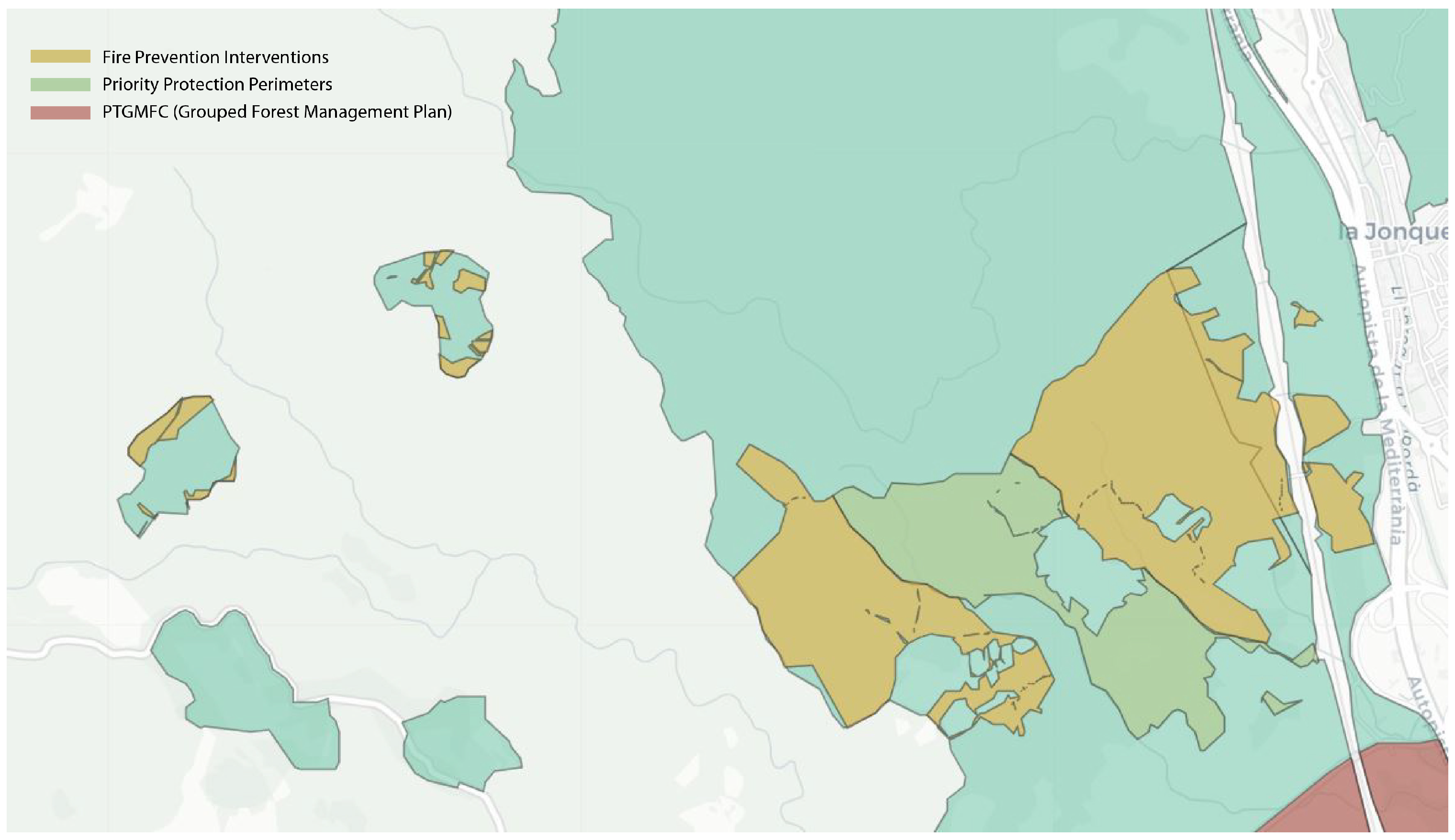
- Wildfire prevention subsidies, funded by the Catalan CO2 tax on vehicles channelled through the Fund for Natural Patrimony in the 2022–2025 calls. This cost-covering grant covers fuel reduction through thinning (since 2023, also including sapling thinning and shoot selection), and forest road repair works. This mechanism was selected due to its prioritisation criteria, which award higher scores to proposals implemented in strategic wildfire prevention areas within a grouped Forest Management Instrument (IOF). This implies prior cooperation among landowners for its development. Requesting landowners’ grouping for subsidy eligibility was identified as an effective cooperation trigger in previous calls on post-windstorm and pest outbreak events in Catalonia.
- (ii)
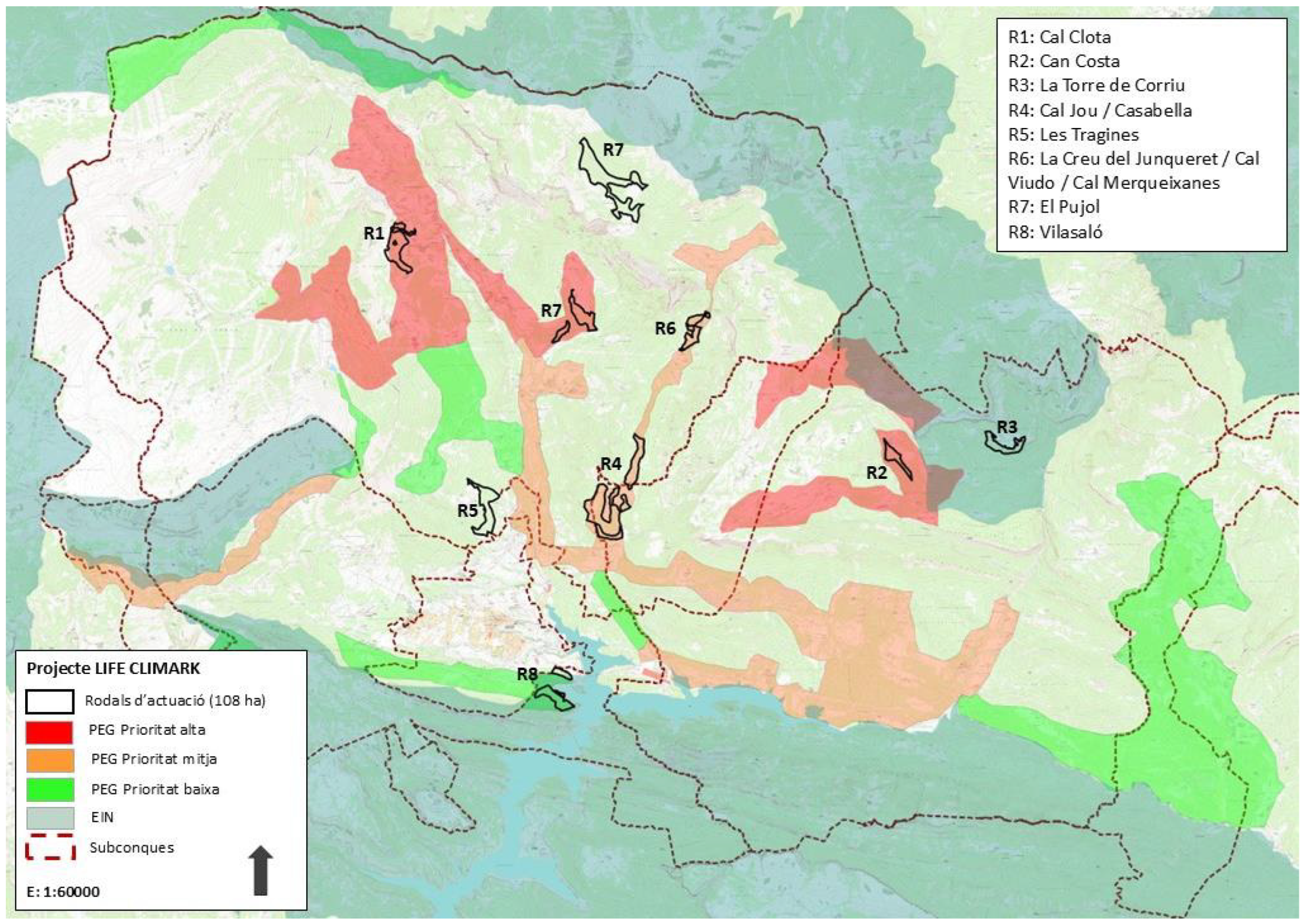
- Forest Climate Credits, which operate in the voluntary market for carbon and other ecosystem services. The Catalan Government Agreement 270/2023 establishes the Climate Credit system. This system creates a market for climate credits based on multifunctional forest management [19]. Unlike traditional approaches focused solely on reforestation, this system also includes active forestry. Through this scheme, companies and individuals can fully or partially finance projects that improve biodiversity, increase water availability, enhance carbon sequestration, and prevent wildfires.
2.2. Conceptual Framework
2.3. Methodological Approach and Analysis
3. Results
3.1. Effects of Incentives on Spatial Coordination
3.1.1. Subsidies for Fuel Management
- Effectiveness
- Promotion of Spatial Coordination
- Functioning of the grant
“We’re talking about work that costs 3000 euros per hectare, right? If I have very large areas and at most, I can request 200,000 euros, if the unit cost is very high, even if I agreed with all the landowners, I still can’t act on everything, because it’s not enough, right?”—FOA9
“Because in X I’ve already told you that we are small landowners. Of course, how do you expect this to have forest certification? They don’t have it, nor do they have a technical plan, nor have they downloaded the joint plan… This is nonsense, this is like saying in X we give you nothing”—FOA3
“So, at the Generalitat, in order to get paid you must have paid first. And paying means that you have to take the money from one place or another”—FOA1
“Because, as it is not a legally constituted entity, they do not have a current account and a tax identification number for all of them, but rather each one is an individual, although there is one who puts it in his name and gives his bank account. And this, apart from the inconvenience, creates a certain fiscal insecurity. Because the owner who says, I will deposit here the 200,000 euros from the income of all four of them, their advisers tell them, oh, be careful with this deposit, because it is a lot of money. Yes, when it comes to paying taxes, they will charge him in full”—FOA9
3.1.2. Forest Climate Credits
- Effectiveness
- Promotion of spatial coordination
“FOA1: Yes, the other thing about Climark is that it is not the same management, although it also favours fire prevention, obviously, it is not such a drastic action, like…I: It is not so focused.FOA1: On fire prevention, the magnitude of the clearings and so on, but rather more focused on restructuring a forest with its model more… better than it should have. And furthermore, the big difference is that all the grants that we have today, whether from the Provincial Council or from the Generalitat, in recent years as well, the department has launched important lines of fire prevention, and moreover very much designed for the associations, all these grants are restricted to the priority areas. Outside the priority areas, practically, you can do very little, and one of Climark’s objectives is that we can act with different actions, isn’t it?”
- Functioning of the incentive
“We believe that the ones who should pay for forest work are the members of society. And within society, who has the money? Companies. We believe that it should be the companies that provide the funding for this management.”—FOA7
“If you find profitability, then the forest takes care of itself. Because if you have to rely on subsidies, it’s not sustainable; it’s bread for today but hunger for tomorrow.”—FOA3
3.2. On the Ability of the Mechanisms to Encourage Cooperation Among Forest Owners
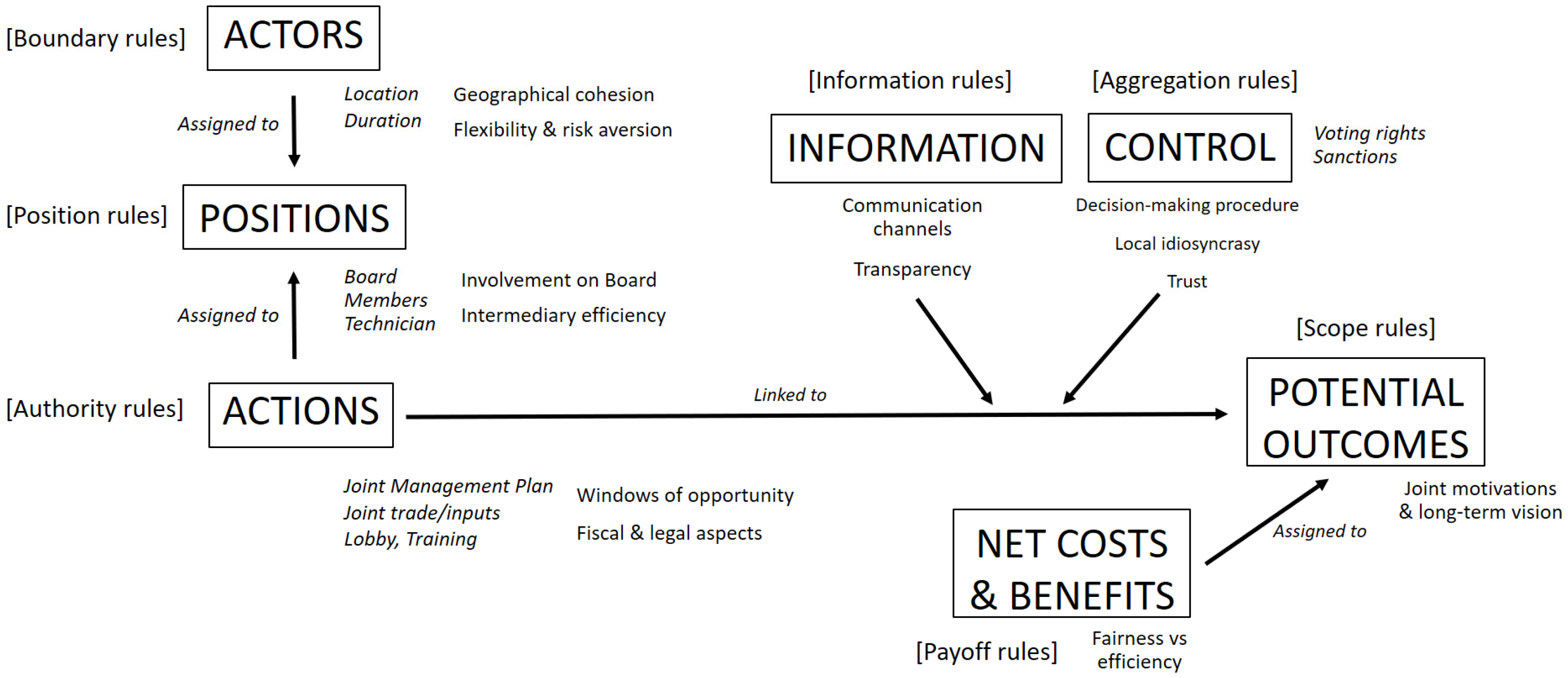
3.2.1. Scope Rules: Effects on Joint Motivation and Attractive Long-Term Vision
3.2.2. Payoff Rules: Effects on Cost–Benefit Balance, and the Fairness vs. Efficiency Challenge
3.2.3. Aggregation Rules: Effects on Trust, Local Idiosyncrasy and Decision-Making Procedure
“And then, as a consequence of these first jobs that they started doing, from the protection perimeter grants, and when we could say that we were of some use, that we weren’t useless, well, there were people who became interested and five or six more people joined.”—FOA4
“But what I see most is that they [the Administration] haven’t provided clear directives. I think that because they rushed, they didn’t get in contact either with the firefighters or with anyone else. And the technical way of doing it, they still don’t know now. And we find ourselves, in our view, doing fire prevention actions in Strategic Management Points, and elsewhere, damn it, we carry out actions that are too conservative and don’t serve any purpose, but well, we have been doing it.”—FOA3
“FOA7: No, the first day they explained CLIMARK [project] to me, I didn’t understand it.I: But apart from not understanding, the first time they told you “dead wood,” what did you say? How did you react?FOA7: Well, maybe not, maybe they didn’t tell us about the dead wood the first day. Of course, we have been assuming knowledge. When they told me I wasn’t surprised. We understood it, yes, and it’s not something that, yes, people see as good. And to leave… well, in this forest we did it, we left wood on the ground, we left standing dead wood, we cut trees at 1 metre, yes.”
“FOA6: The (…) technical staff of the Provincial Council [guided the decision on which states to reduce fuel].I: So, you didn’t really decide much yourselves, right?FOA6: No, because it doesn’t make sense for each person to decide; there must be someone superior [sensu knowledgeable] who decides.”
3.2.4. Boundary Rules: Effects on Geographic Cohesion, Actors’ Flexibility and Risk Aversion
“Yes, well, four of us founded it and we made a call. We started working seeing if anyone wanted to join, we organised a meeting with many forest owners, because at the end of the day we would go and carry out the work at these people’s homes. No, we didn’t go looking for them because they were owners, but because our action had to take place at their property. And the response was mostly to join the association, and now we represent 8000 hectares out of 12,000.”—FOA7
3.2.5. Position Rules: Effects on Involvement in the Board, and Efficiency of the Intermediary
“We are 9 people. You can well say that in these associations it’s very hard to get people to come to the board. Those who come to the board—some are on the board and hardly ever come, others do come but only come to the board meetings—and from those who come to the board and work from one meeting to the next, you’re left with the fingers of one hand cut in half. That’s true of any association you talk about.”—FOA1
3.2.6. Authority Rules: Effects on Windows of Opportunity and Fiscal Aspects
3.2.7. Information Rules: Effects on Communication Channels
4. Discussion and Conclusions
Supplementary Materials
Author Contributions
Funding
Informed Consent Statement
Data Availability Statement
Acknowledgments
Conflicts of Interest
Abbreviations
| FOA | Forest Owner Association |
| IOF | Forest Management Instrument |
| ORGEST | Guidance of Sustainable Forest Management |
| PROMACC | Forest Projects for Climate Change Mitigation and Adaptation |
| VAT | Value Added Tax |
| ZIF | Forest Intervention Zones |
References
- Dalmau Rovira, F.; Parrilla de Diego, M.; Gorgonio Bonet, E.; Belenguer Peris, E.; Calero Julià, I. Análisis Sobre El Estado Del Abandono Rural y Su Relación Con La Emergencia Climática y Los Incendios Forestales En España En 2020. In Proceedings of the 8° Congreso Forestal Español, Lérida, Spain, 27 June–1 July 2022; Sociedad Española de Ciencias Forestales: Lérida, Spain, 2022; p. 36. [Google Scholar]
- Sánchez-Hernández, G.; Turco, M.; Repeto-Deudero, I.; Royé, D.; Baudena, M.; Montávez, J.P.; Pietroiusti, R.; Provenzale, A.; Santin, C.; Torres-Vázquez, M.Á.; et al. Record-Breaking 2025 European Wildfires Concentrated in Northwest Iberia. Glob. Change Biol. 2025, 31, 31–33. [Google Scholar] [CrossRef] [PubMed]
- Canadas, M.J.; Novais, A. Forest Owners and Fuels Management Coordination. When Neighbours’ Actions Matter. Scand. J. For. Res. 2019, 7581, 67–77. [Google Scholar] [CrossRef]
- Crowley, C.S.L.; Malik, A.S.; Amacher, G.S.; Haight, R.G. Adjacency Externalities and Forest Fire Prevention. Land Econ. 2009, 85, 162–185. [Google Scholar] [CrossRef]
- Villamayor-tomas, S.; Thiel, A.; Amblard, L.; Zikos, D.; Blanco, E. Diagnosing the Role of the State for Local Collective Action: Types of Action Situations and Policy Instruments. Environ. Sci. Policy 2019, 97, 44–57. [Google Scholar] [CrossRef]
- Weiss, G.; Lawrence, A.; Hujala, T.; Lidestav, G.; Nichiforel, L.; Nybakk, E.; Quiroga, S.; Sarva, Z.; Suarez, C.; Ivana, Ž. Forest Ownership Changes in Europe: State of Knowledge and Conceptual Foundations. For. Policy Econ. 2019, 99, 9–20. [Google Scholar] [CrossRef]
- Rojo Alboreca, A. El Reto de La Ordenación de Los Montes Privados En España. Cuad. Soc. Española Cienc. For. 2015, 297, 275–297. [Google Scholar] [CrossRef]
- Sanz-Hernández, A. Privately Owned Forests and Woodlands in Spain: Changing Resilience Strategies towards a Forest-Based Bioeconomy. Land Use Policy 2021, 100, 104922. [Google Scholar] [CrossRef]
- Wunder, S.; Calkin, D.E.; Charlton, V.; Feder, S.; Martínez de Arano, I.; Moore, P.; Rodríguez y Silva, F.; Tacconi, L.; Vega-García, C. Resilient Landscapes to Prevent Catastrophic Forest Fires: Socioeconomic Insights towards a New Paradigm. For. Policy Econ. 2021, 128, 102458. [Google Scholar] [CrossRef]
- Fraccaroli, C.; Górriz-Mifsud, E.; Varela, E.; Wunder, S. Economic Incentives for Reducing Wildfire Risk: Taking Stock of an Emerging Field. J. Environ. Manag. 2026, 397, 128296. [Google Scholar] [CrossRef]
- Ascoli, D.; Plana, E.; Oggioni, S.D.; Tomao, A.; Colonico, M.; Corona, P.; Giannino, F.; Moreno, M.; Xanthopoulos, G.; Kaoukis, K.; et al. Fire-Smart Solutions for Sustainable Wildfire Risk Prevention: Bottom-up Initiatives Meet Top-down Policies under EU Green Deal. Int. J. Disaster Risk Reduct. 2023, 92, 103715. [Google Scholar] [CrossRef]
- Górriz-Mifsud, E.; Olza, L.; Montero, E.; Marini Govigli, V. The Challenges of Coordinating Forest Owners for Joint Management. For. Policy Econ. 2019, 99, 100–109. [Google Scholar] [CrossRef]
- Republic of South Africa National. Veld and Forest Fire Act. 1998. Available online: https://www.gov.za/sites/default/files/gcis_document/201409/a101-98.pdf (accessed on 10 November 2025).
- Paveglio, T.B.; Carroll, M.S.; Stasiewicz, A.M.; Edgeley, C.M. Social Fragmentation and Wildfire Management: Exploring the Scale of Adaptive Action. Int. J. Disaster Risk Reduct. 2019, 33, 131–141. [Google Scholar] [CrossRef]
- Valente, S.; Coelho, C.; Ribeiro, C.; Soares, J. Forest Intervention Areas (ZIF): A New Approach for Non-Industrial Private Forest Management in Portugal. Silva Lusit. 2013, 21, 137–161. [Google Scholar]
- Cunha, J.; Marques, A.; Gorriz-Mifsud, E. Collective Forest Management and Land Consolidation Approaches to Overcome Land Fragmentation. In IA 3.2 Brief: Development and Implementation of Incentive Mechanisms at Regional Policy Level to Support Fire-Resilient Landscapes; Deliverable D3.4.; FIRE-RES Project: Solsona Spain, 2025; pp. 38–49. [Google Scholar]
- Pezdevšek Malovrh, Š.; Avdibegović, M.; Morelli, S.; Paletto, A. Evolution of Private Forest Owner’s Cooperation: A Bibliometric Network Analysis. Small-Scale For. 2024, 23, 393–421. [Google Scholar] [CrossRef]
- Fletas, M.; Bayona, M.; Cervera, T. Estructura de La Propietat Forestal de Catalunya. Anàlisi de Dades Cadastrals; Centre de la Propietat Forestal: Santa Perpetua de Mogoda, Barcelona, 2012. [Google Scholar]
- Cervera Zaragoza, T.; Gili Jáuregui, I.; Baiges Zapater, T.; Vega-García, C.; Palero Moreno, N.; Casals Tortras, P. Diseño de Un Mercado Local de Créditos Climáticos Para La Promoción de Una Gestión Forestal Multifuncional En Catalunya. In Proceedings of the 8° Congreso Forestal Español, Lleida, Spain, 27 June–1 July 2022; SECF: Lleida, Spain, 2022; p. 23. [Google Scholar]
- Cervera, T.; Baiges, T.; Rabascall, X.; Porras, D.; Palero, N.; Ameztegui, A.; Vega, C.; Rodrigues, M.; Alcasena, F.; Vayreda, J.; et al. Metodologia de Càlcul de l’impacte de La Gestió Forestal En Els Serveis Ecosistèmics: Carboni, Aigua i Biodiversitat; Centre de la Propietat Forestal (CPF): Santa Perpètua de Mogoda, Spain, 2022. [Google Scholar]
- Ostrom, E. Beyond Markets and States: Polycentric Governance of Complex Economic Systems. Am. Econ. Rev. 2010, 100, 641–672. [Google Scholar] [CrossRef]
- Quivy, R.; van Campenhoudt, L. Manual de Recerca En Ciències Socialsy; Herder Editiorial: Barcelona, Spain, 1997. [Google Scholar]
- Francis, J.J.; Johnston, M.; Robertson, C.; Glidewell, L.; Entwistle, V.; Eccles, M.P.; Grimshaw, J.M. What Is an Adequate Sample Size? Operationalising Data Saturation for Theory-Based Interview Studies. Psychol. Health 2010, 25, 1229–1245. [Google Scholar] [CrossRef]
- Hamilton, M.; Evers, C.; Nielsen-Pincus, M.; Ager, A. Matching the Scales of Planning and Environmental Risk: An Evaluation of Community Wildfire Protection Plans in the Western US. Reg. Environ. Change 2024, 24, 93. [Google Scholar] [CrossRef]
- Colonico, M.; Tomao, A.; Ascoli, D.; Corona, P.; Giannino, F.; Moris, J.V.; Romano, R.; Salvati, L.; Barbati, A. Rural Development Funding and Wildfire Prevention: Evidences of Spatial Mismatches with Fire Activity. Land Use Policy 2022, 117, 106079. [Google Scholar] [CrossRef]
- Santos, J.L.; Martins, A.; Novais, A.; Canadas, M.J. A Choice-Modeling Approach to Inform Policies Aimed at Reducing Wildfire Hazard Through the Promotion of Fuel Management by Forest Owners. Forests 2021, 12, 403. [Google Scholar] [CrossRef]
- Leone, V.; Tedim, F.; Xanthopoulos, G. Fire Smart Territory as an Innovative Approach to Wildfire Risk Reduction. In Extreme Wildfire Events and Disasters. Root Causes and New Management Strategies; Tedim, F., Leone, V., Mcgee, T.K., Eds.; Elsevier: Amsterdam, The Netherlands, 2020; pp. 201–215. [Google Scholar]
- Guiomar, N.G.; Pereira, J.M.C.; Fernandes, P.M. A Planning Model for Fire-Resilient Landscapes in Portugal Is Riddled with Fallacies: A Critical Review of “FIRELAN” by Magalhães et al., 2021. Fire 2021, 6, 398. [Google Scholar] [CrossRef]
- Bertomeu, M.; Pineda, J.; Pulido, F. Managing Wildfire Risk in Mosaic Landscapes: A Case Study of the Upper Gata River Catchment in Sierra de Gata, Spain. Land 2022, 11, 465. [Google Scholar] [CrossRef]
- Navascués Ramos, P.; Llobet Just, S. La Gestión de Montes Privados En Regeneración a Través de Asociaciones de Propietarios Forestales. Cuad. Soc. Esp. Cienc. For. 2007, 21, 61–66. [Google Scholar]
- Canadas, M.J.; Novais, A.; Marques, M. Wildfires, Forest Management and Landowners’ Collective Action: A Comparative Approach at the Local Level. Land Use Policy 2016, 56, 179–188. [Google Scholar] [CrossRef]
- Parkhurst, G.M.; Shogren, J.F. Spatial Incentives to Coordinate Contiguous Habitat. Ecol. Econ. 2007, 64, 344–355. [Google Scholar] [CrossRef]
- Varela, E.; Górriz-Mifsud, E.; Ruiz-Mirazo, J.; López-i-Gelats, F. Payment for Targeted Grazing: Integrating Local Shepherds into Wildfire Prevention. Forests 2018, 9, 464. [Google Scholar] [CrossRef]
- Cosma, S.; Cosma, S.; Gambarelli, L.; Pennetta, D.; Rimo, G. Political Elections and Market Reactions: The ‘Trump Effect’ on Green Stocks. Econ. Lett. 2025, 249, 112261. [Google Scholar] [CrossRef]
- Canadas, M.J.; Leal, M.; Novais, A.; Ribeiro, P.F.; Santos, J.L. The Current Policy Focus Shift from a Sectoral to a Territorial Governance of Wildfire Reduction Is Aligned with Forest Owners’ Preferences. Land Use Policy 2024, 146, 107313. [Google Scholar] [CrossRef]



| Subsidy Calls | 2022 | 2023 | 2024 | Accumulated |
|---|---|---|---|---|
| Available budget (€) | 4,497,534.51 | 4,197,534.51 | 4,929,675.43 | 13,624,744.45 |
| Amount granted (€) | 4,497,499.04 | 4,465,796.94 | 4,923,331.30 | 8,963,295.98 |
| Selected applications | 54 | 51 | Not available | 105 |
| Fire prevention area managed (ha) | 1339.77 | 1237.91 | 3275.58 | 5853.26 |
| PROMACC Name | Climate Credits | Credits Sold | Amount Mobilised (€) | ||||
|---|---|---|---|---|---|---|---|
| For Sale | Acquired | 2022 | 2023 | 2024 | 2025 | ||
| Serra de Collserola | 40 | 40 | 9 | 31 | 0 | 0 | 137,800 |
| AFG Les Arenes | 45 | 45 | 15 | 30 | 0 | 0 | 125,640 |
| Vall de Lord | 108 | 108 | 0 | 0 | 1 | 107 | 443,124 |
| Conca Segre-Rialb | 80 | 12 | 0 | 0 | 9 | 3 | 38,472 |
| Serres Miralles-Ancosa | 34 | 6 | 0 | 6 | 0 | 0 | 20,922 |
| Vall de la Muga | 58 | 17 | 0 | 7 | 9 | 1 | 75,293 |
| Les Gavarres | 35 | 0 | 0 | 0 | 0 | 0 | 0 |
| Vall de Bianya | 30 | 30 | 0 | 0 | 30 | 0 | 98,130 |
| Collserola V. Occidental 1 | 56 | 35 | 0 | 0 | 0 | 27 | 142,030 |
| Collserola Baix Llobregat 1 | 56 | 0 | 0 | 0 | 0 | 0 | 0 |
| Total | 542 | 293 | 24 | 74 | 49 | 138 | 1,088,071 |
| Joint Action Rules | Interactions Identified with the Analysed Incentives |
|---|---|
| Aggregation rules |
|
| Payoff rules |
|
| Scoping rules |
|
| Boundary rules |
|
| Position and Information rules |
|
| Authority rules |
|
Disclaimer/Publisher’s Note: The statements, opinions and data contained in all publications are solely those of the individual author(s) and contributor(s) and not of MDPI and/or the editor(s). MDPI and/or the editor(s) disclaim responsibility for any injury to people or property resulting from any ideas, methods, instructions or products referred to in the content. |
© 2026 by the authors. Licensee MDPI, Basel, Switzerland. This article is an open access article distributed under the terms and conditions of the Creative Commons Attribution (CC BY) license.
Share and Cite
Górriz-Mifsud, E.; Rovellada Ballesteros, M. Current Experiences in Economic Incentives Boosting Coordinated Fuel Reduction for Wildfire Risk Mitigation in Catalonia (Spain). Fire 2026, 9, 70. https://doi.org/10.3390/fire9020070
Górriz-Mifsud E, Rovellada Ballesteros M. Current Experiences in Economic Incentives Boosting Coordinated Fuel Reduction for Wildfire Risk Mitigation in Catalonia (Spain). Fire. 2026; 9(2):70. https://doi.org/10.3390/fire9020070
Chicago/Turabian StyleGórriz-Mifsud, Elena, and Marc Rovellada Ballesteros. 2026. "Current Experiences in Economic Incentives Boosting Coordinated Fuel Reduction for Wildfire Risk Mitigation in Catalonia (Spain)" Fire 9, no. 2: 70. https://doi.org/10.3390/fire9020070
APA StyleGórriz-Mifsud, E., & Rovellada Ballesteros, M. (2026). Current Experiences in Economic Incentives Boosting Coordinated Fuel Reduction for Wildfire Risk Mitigation in Catalonia (Spain). Fire, 9(2), 70. https://doi.org/10.3390/fire9020070