

Experimental Study on Critical Ventilation Speed in Asymmetric V-Shaped Tunnel Fires


Abstract
1. Introduction
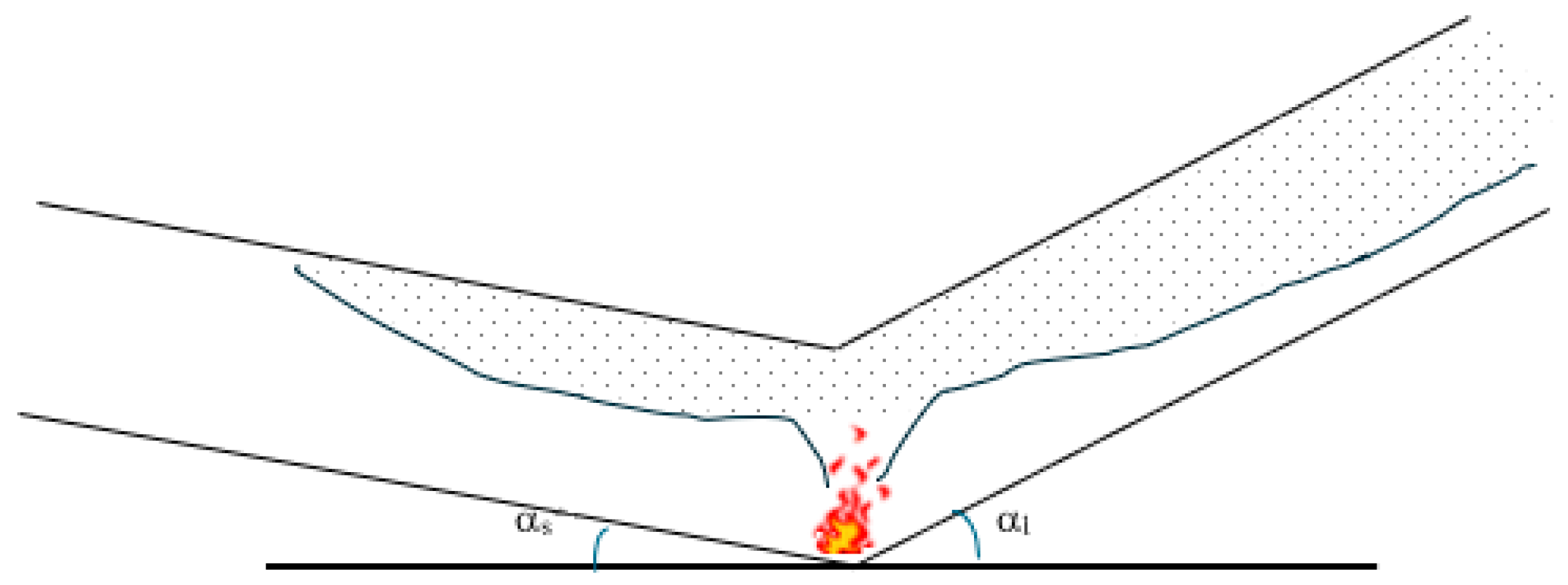
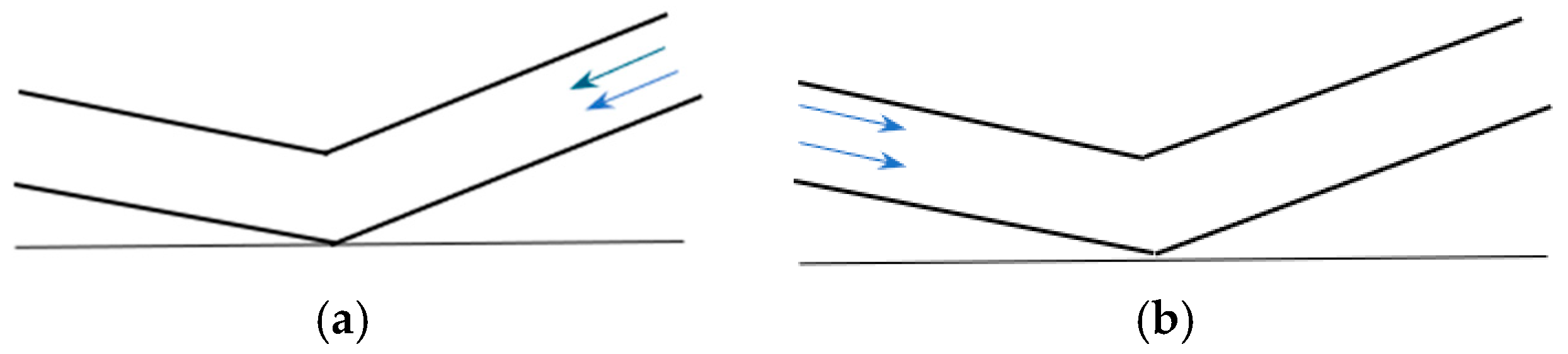
2. Theoretical Analysis of Smoke Flow in V-Shaped Tunnels
3. Experimental Studies
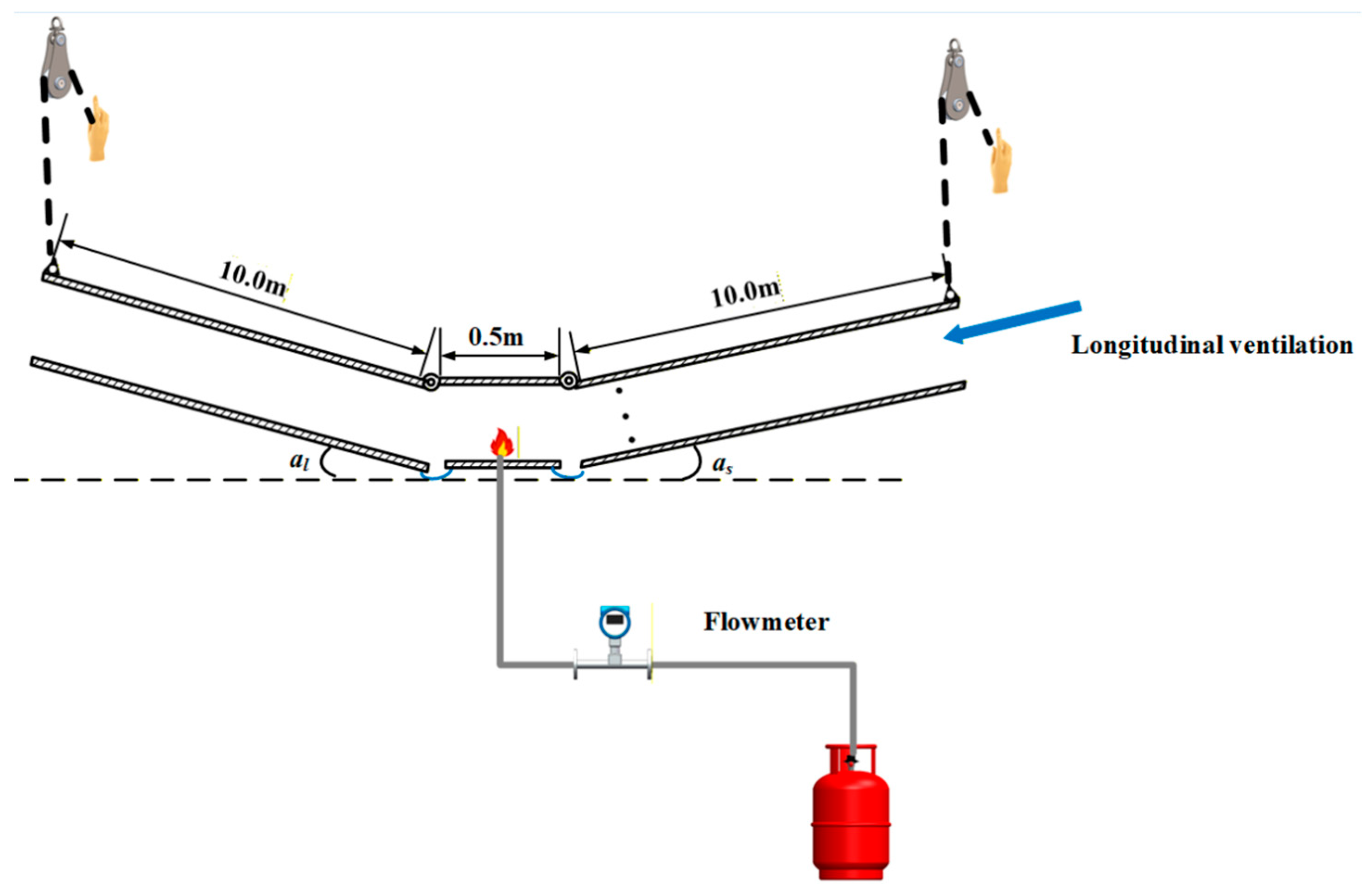
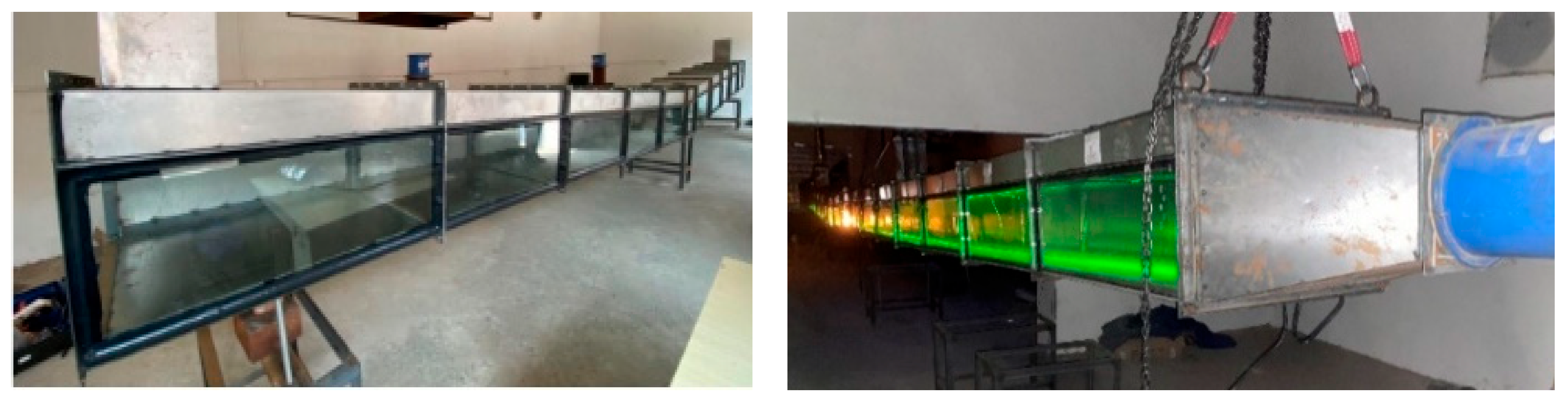
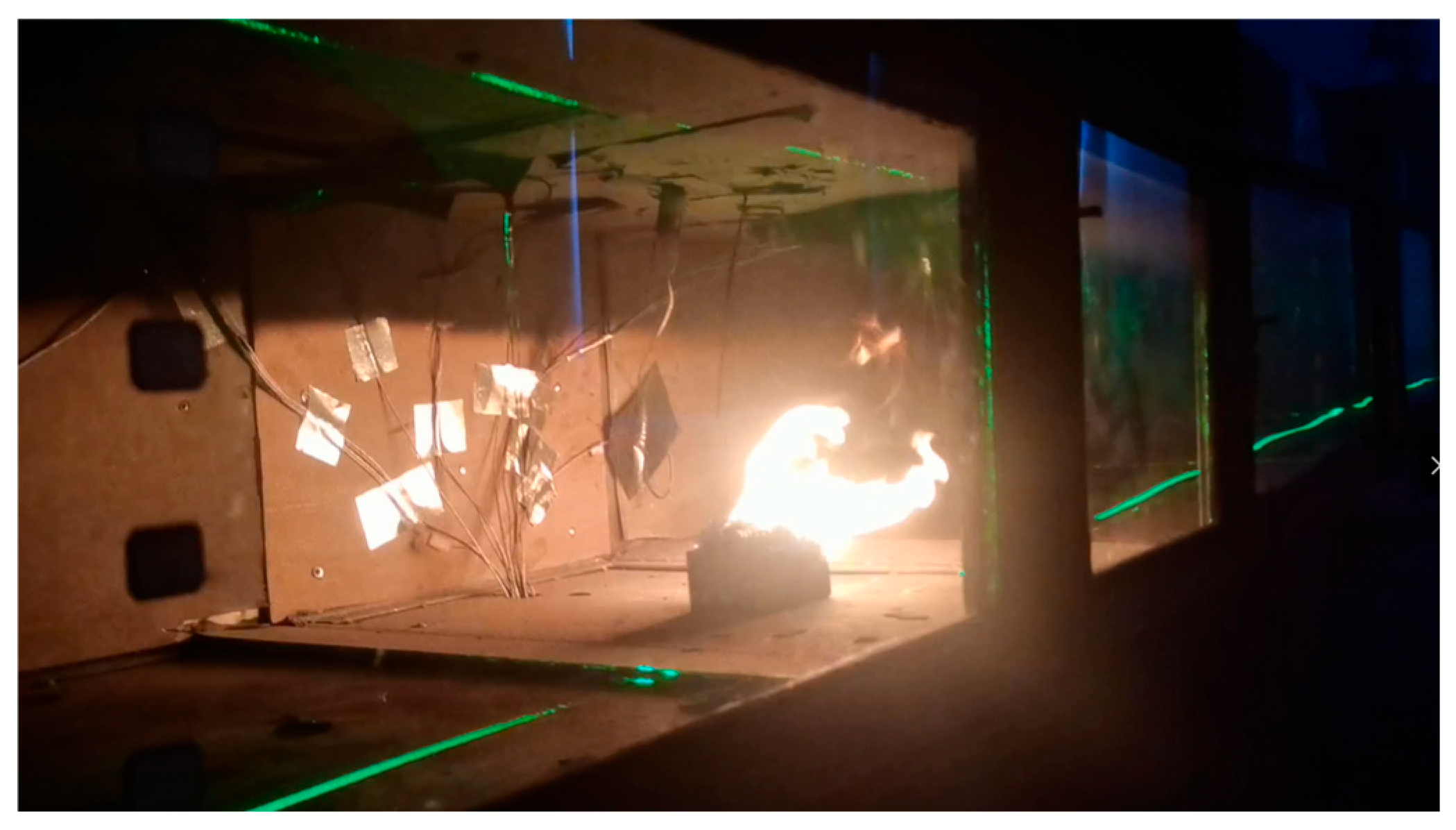
3.1. Small-Scale Model Tunnel
3.2. Experimental Scenarios
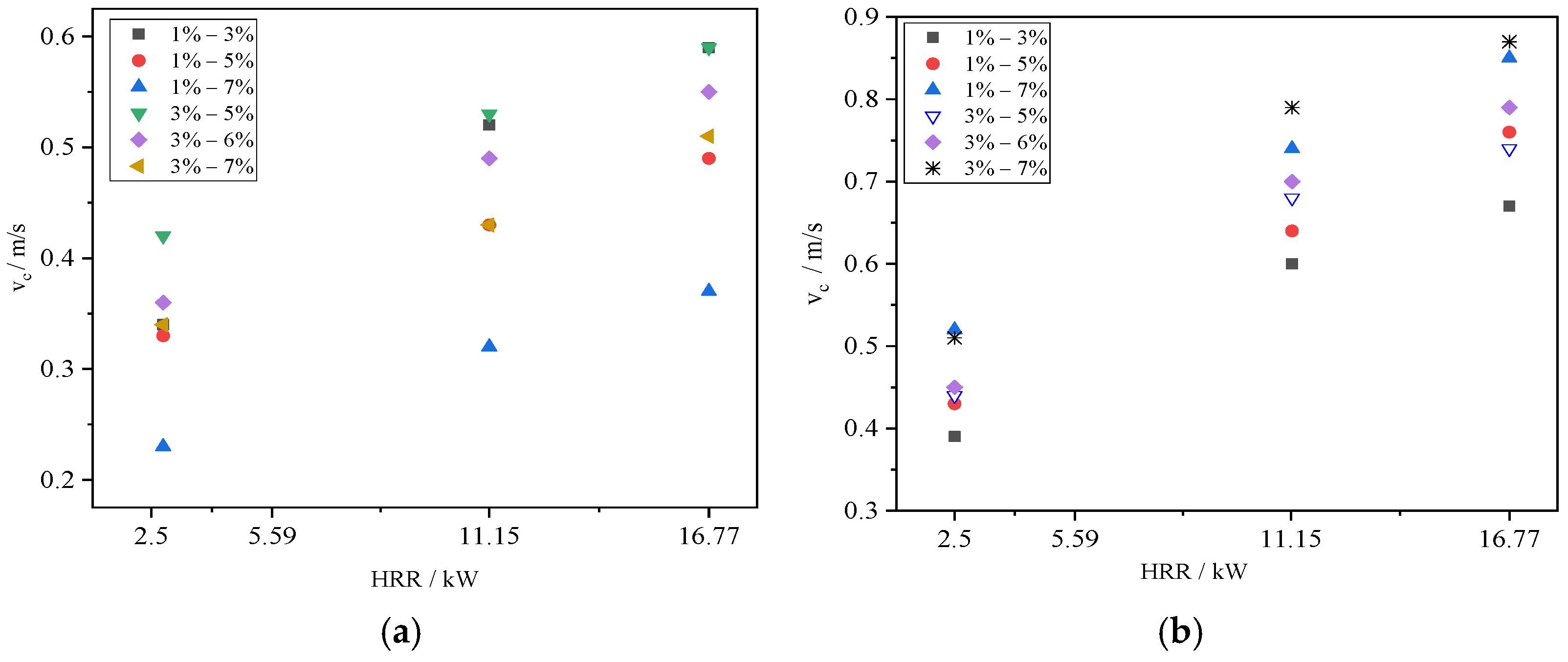
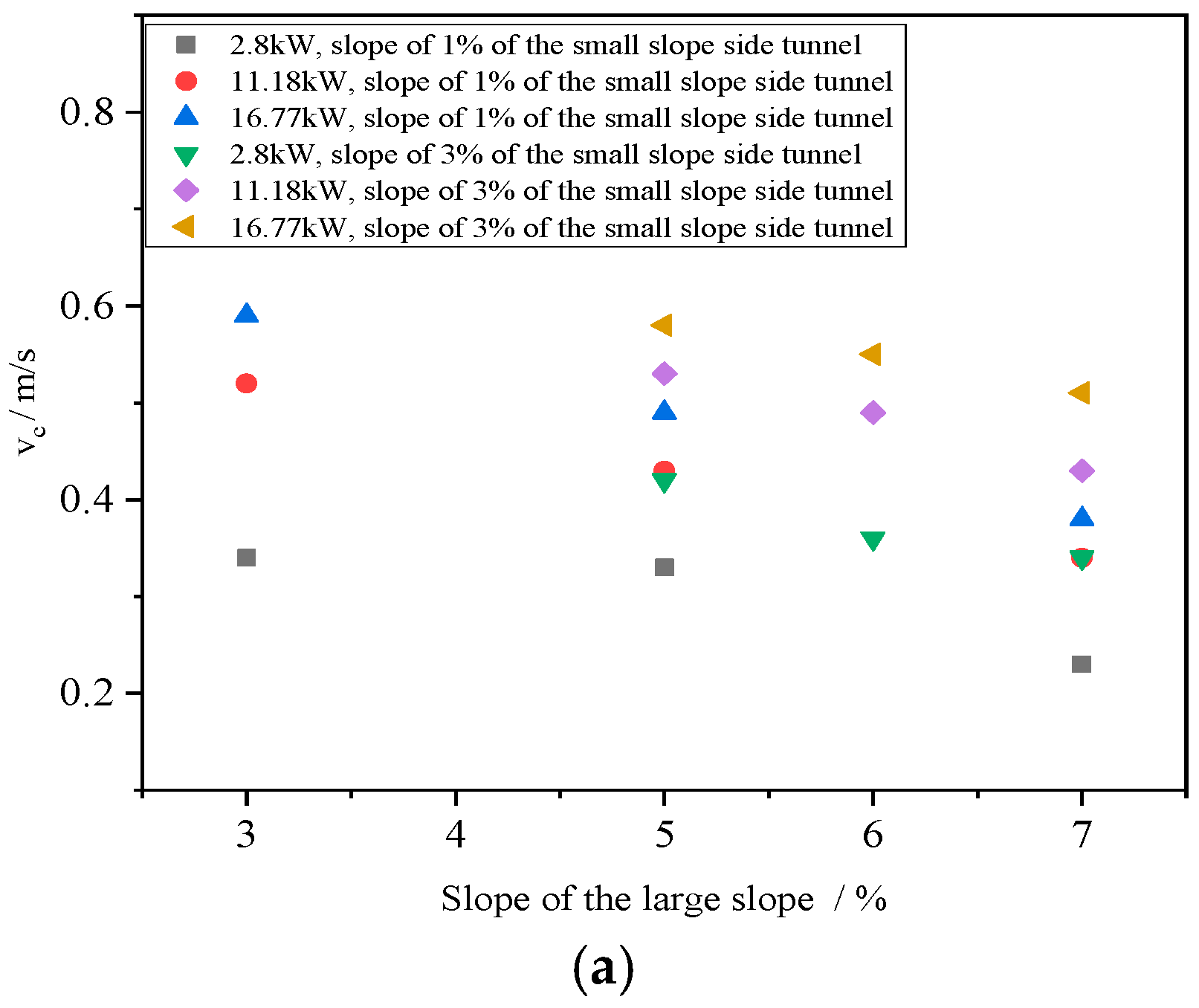
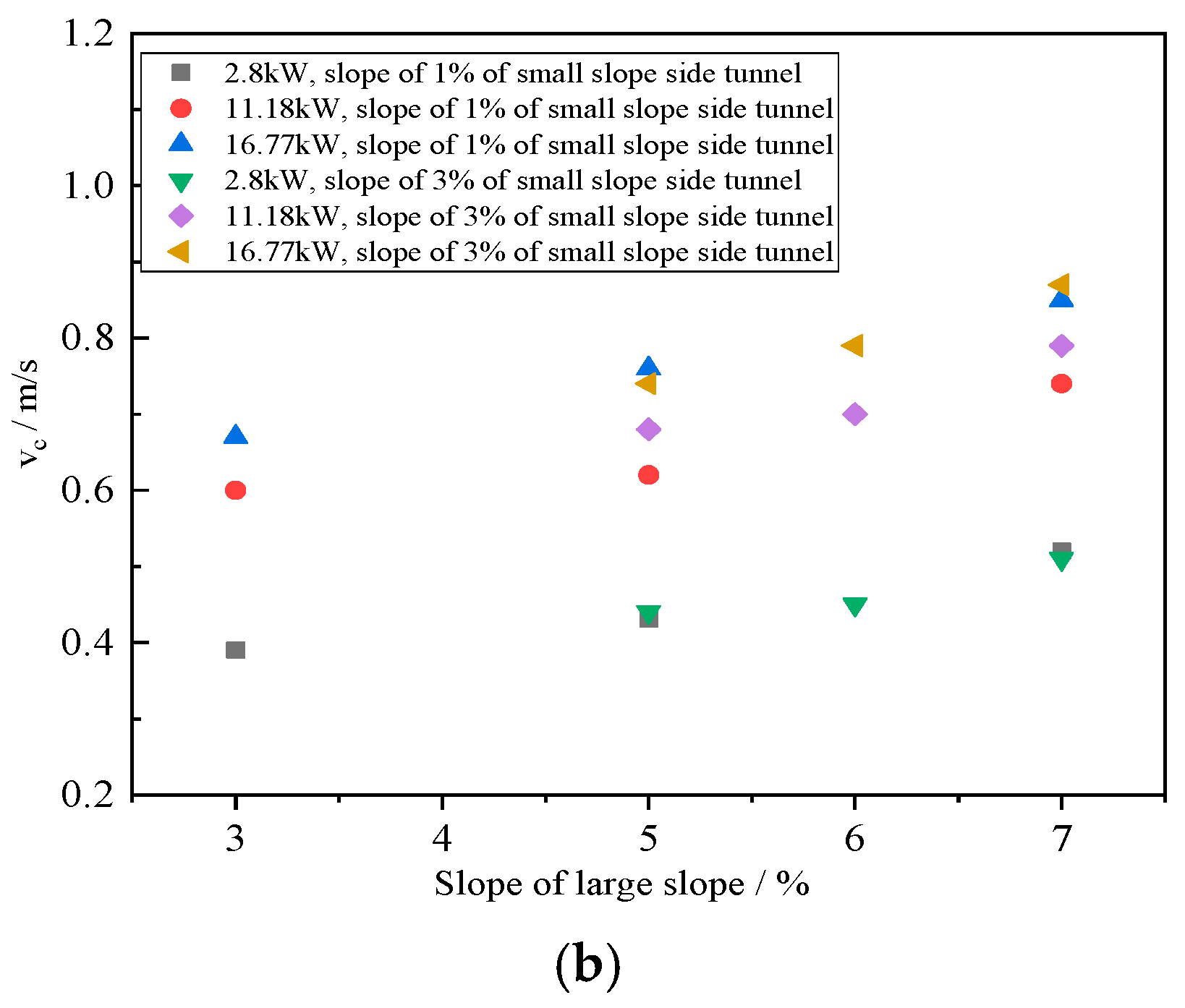
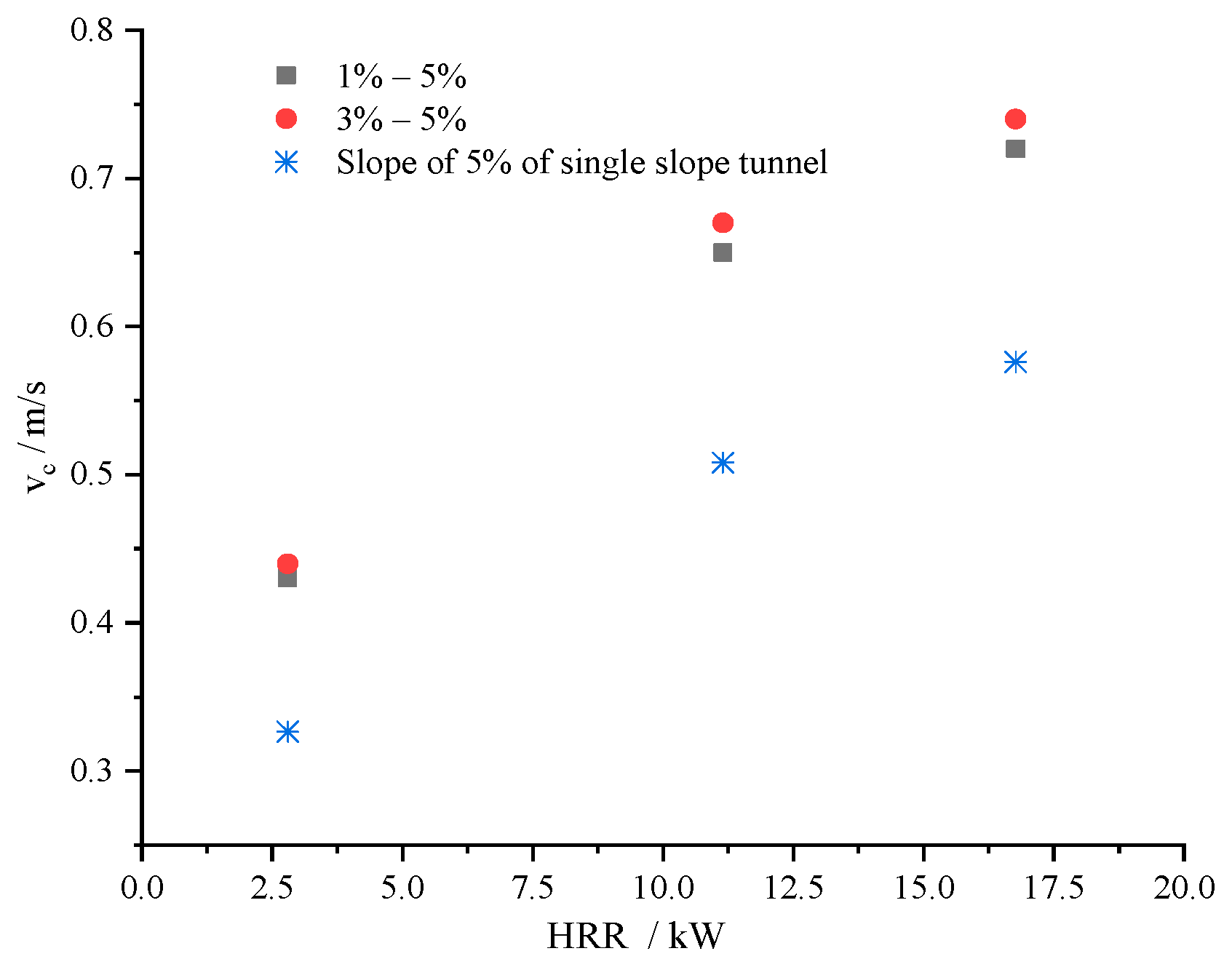
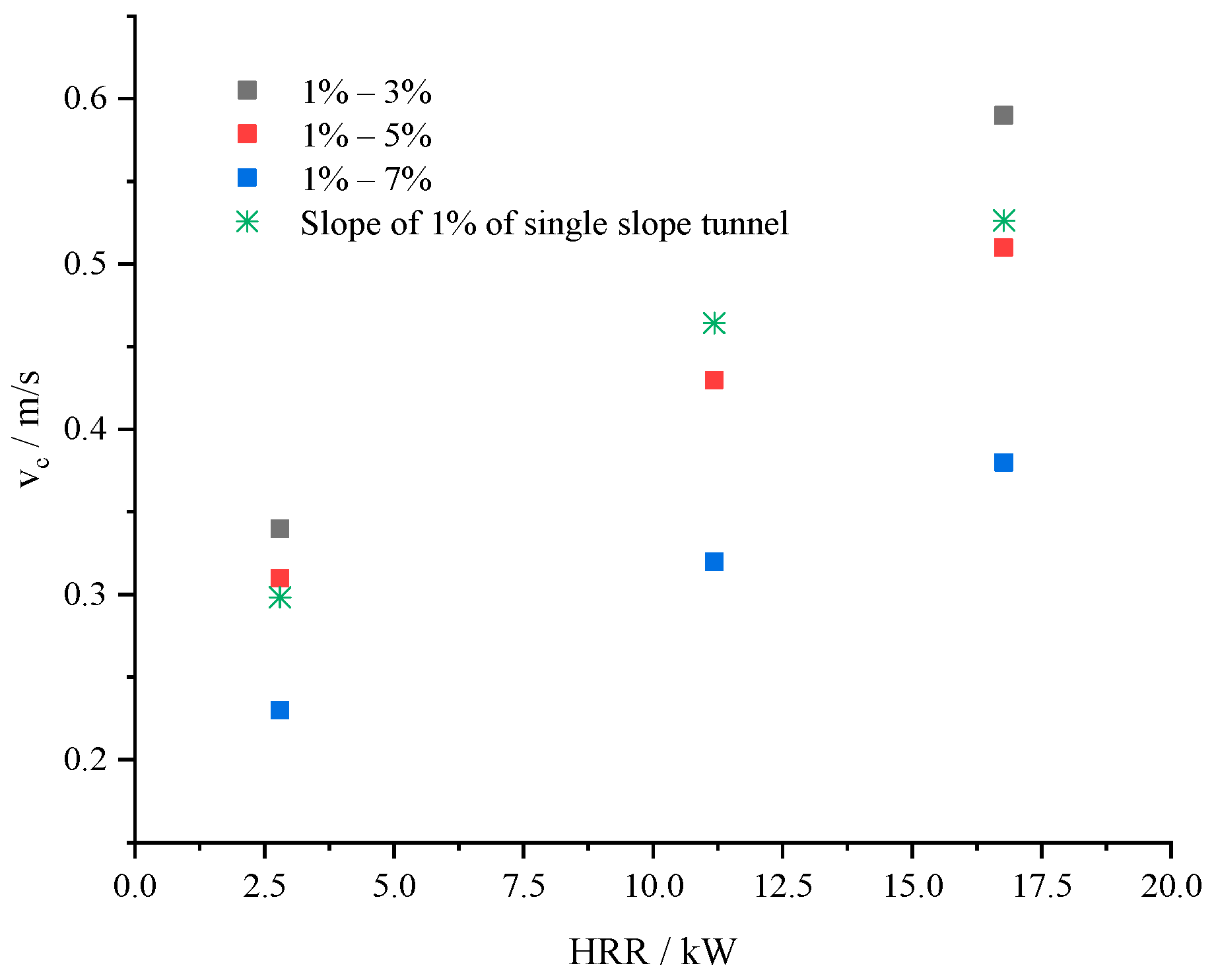
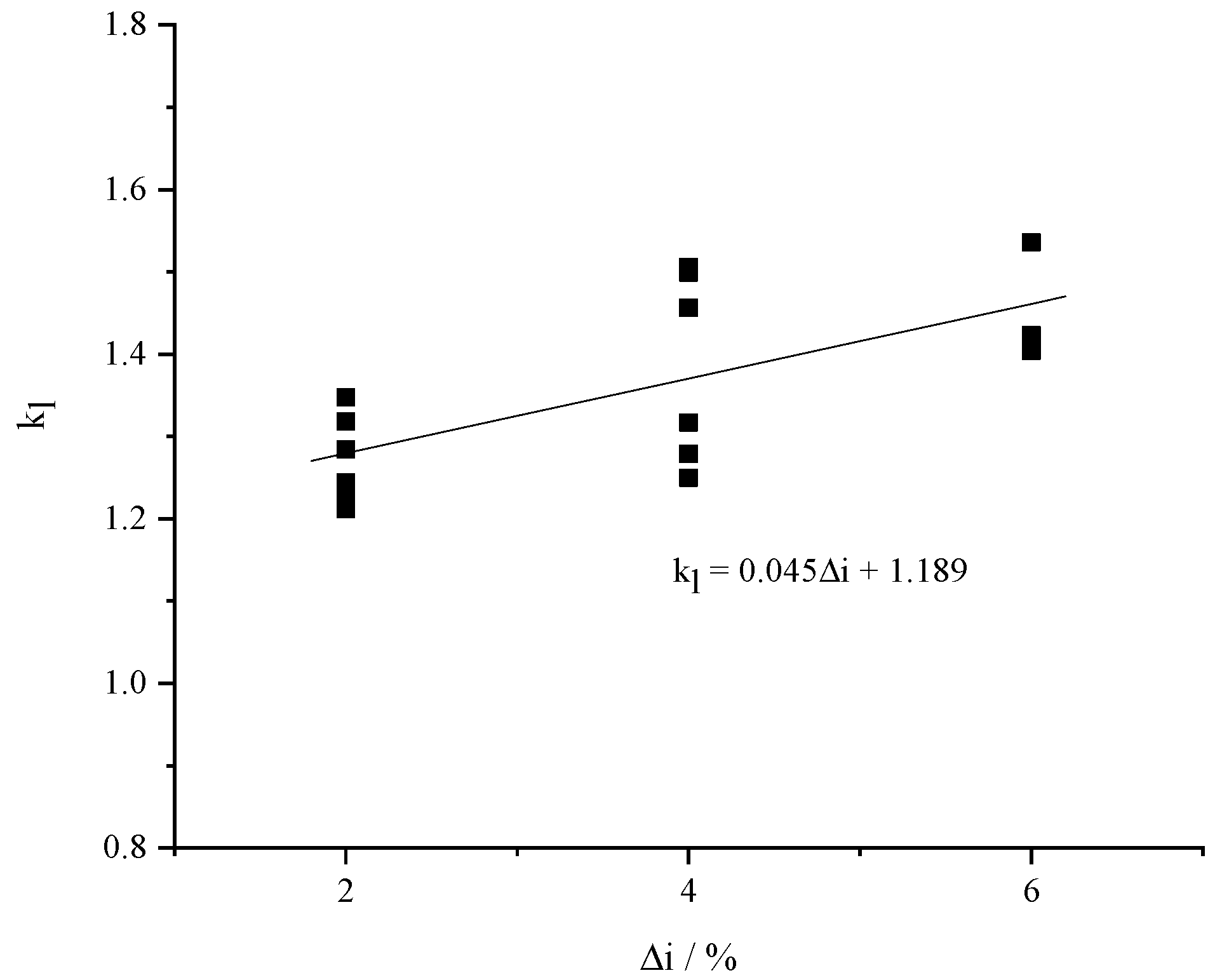
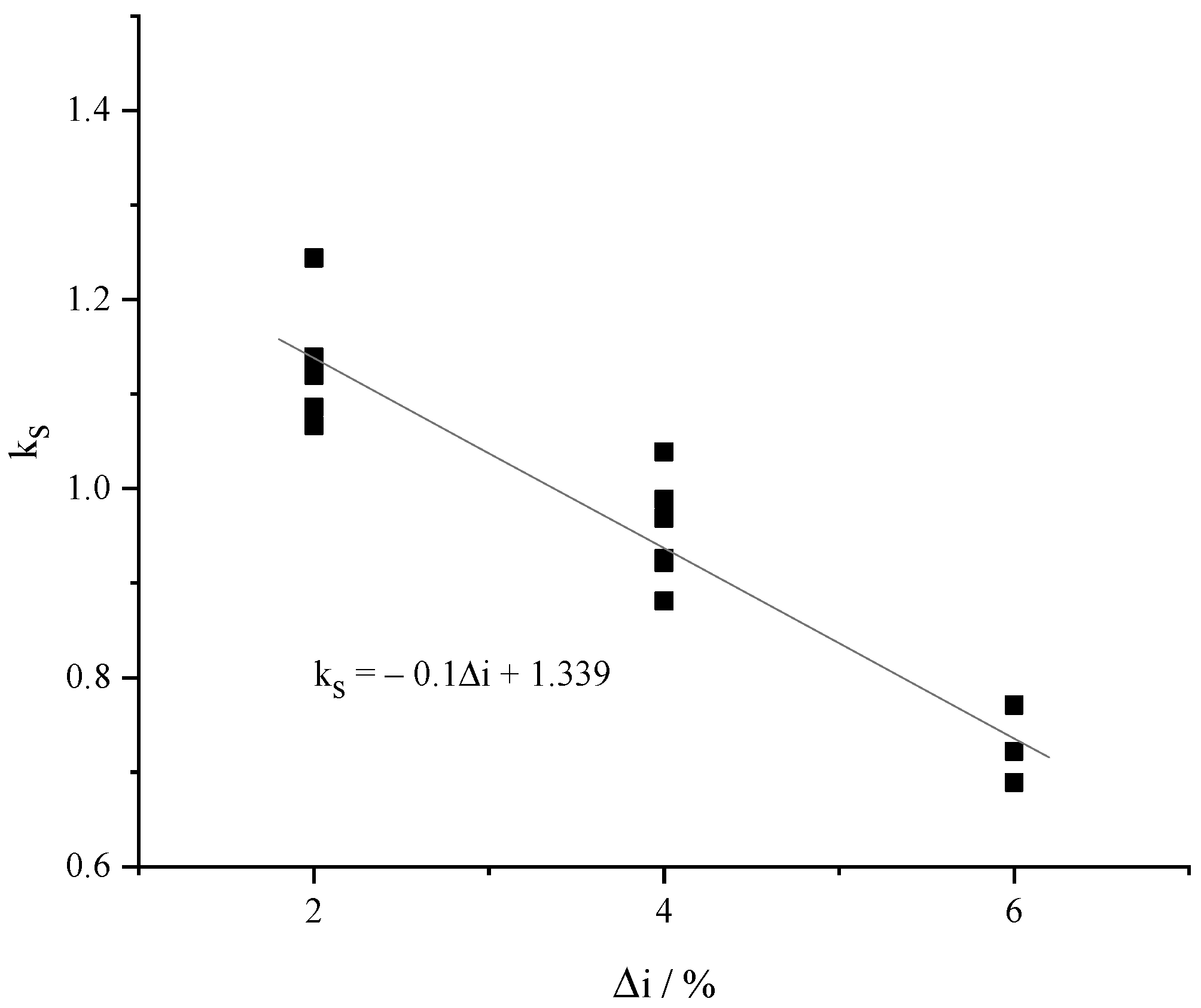
4. Results and Discussions
- (1)
- For critical ventilation speed from the small slope side, vcVs can be calculated as follows:
- (2)
- For critical ventilation speed from the large slope side, vcVl can be calculated as follows:
5. Conclusions
- (1)
- The critical ventilation speed in the V-shaped tunnels increases with the rise in the heat release rate of fire.
- (2)
- For the same fire power and slope composition, the critical ventilation speed when longitudinal ventilation is implemented from the large slope side is much larger than that when longitudinal ventilation is implemented from the small slope side. When longitudinal ventilation is implemented from the side with the small slope, the critical ventilation speed decreases as the slope on the side with large slope increases. When critical ventilation speed is implemented on the large slope side, the critical ventilation speed increases as the slope of the large slope side increases.
- (3)
- Due to the influence of local resistance at the slope change point and the thermal pressure difference caused by the asymmetric slopes on both sides, when longitudinal ventilation is applied from the small slope side, there is a critical slope difference compared with the critical ventilation speed of the single-slope tunnel. Greater than this slope difference, the critical ventilation speed on the small slope side is less than that in the single-slope tunnel with same slope; conversely, the critical ventilation speed on the small slope side is greater than that in the single-slope tunnel. When longitudinal ventilation is applied from the side with a large slope, the critical ventilation speed is greater than that of a single-slope tunnel with the same slope.
- (4)
- Based on theoretical analysis and small-scale experimental results, the empirical equations of the critical ventilation speed in V-shaped tunnels were obtained as follows:
- (a)
- For critical ventilation speed from the small slope side:
- (b)
- For critical ventilation speed from the large slope side:
Author Contributions
Funding
Data Availability Statement
Conflicts of Interest
References
- Dong, Q.; Li, J.; Li, Y.; Lu, H.; Zhao, H. Experimental study of the influence of an asymmetric tunnel structure on the maximum ceiling temperature in a V-Shaped tunnel fire. Fire 2024, 7, 483. [Google Scholar] [CrossRef]
- Tu, D.; Li, J.; Li, Y.; Xu, D. Numerical study on the influence of the slope composition of the asymmetric V-shaped tunnel on smoke spread in tunnel fire. Fire 2024, 7, 363. [Google Scholar] [CrossRef]
- World Road Association. Fire and Smoke Control in Road Tunnels; World Road Association: Paris, France, 1999. [Google Scholar]
- NFPA 502; Standard for Road Tunnels, Bridges, and Other Limited Access Highways. National Fire Protection Association: Quincy, MA, USA, 2020.
- JTG/T D70/2-02-2014; Guidelines for Design of Ventilation of Highway Tunnels. China Merchants Chongqing Communications Technology Research & Design Institute Co., Ltd.; People’s Communications Publishing House Co., Ltd.: Beijing, China, 2014. (In Chinese)
- DG/TJ08-2033-2017; Road Tunnel Design Code. Shanghai Tunnel Engineering & Rail Transit Design and Research Institute; Tongji University Press: Shanghai, China, 2017. (In Chinese)
- CJJ 221-2015; Code for Design of Urban Underground Road Engineering. Ministry of Houseing and Urban-Rural Development of the People’s Republic of China; China Architecture Publishing & Medis Co., Ltd.: Beijign, China, 2015. (In Chinese)
- Thomas, P.H. The Movement of Buoyant Fluid Against a Stream and the Venting of Underground Fires; Fire Research Station: Borehamwood, UK, 1958. [Google Scholar]
- Thomas, P.H. The Movement of Smoke in Horizontal Passages Against an Air Flow; Fire Research Station: Borehamwood, UK, 1968. [Google Scholar]
- Danziger, N.H.; Kennedy, W.D. Longitudinal ventilation analysis for the Glenwood canyon tunnels. In Proceedings of the 4th International Symposium of Aerodynamics and Ventilation of Vehicle Tunnels, York, UK, 23–25 March 1982; pp. 169–186. [Google Scholar]
- Oka, Y.; Atkinson, G.T. Control of smoke flow in tunnel fires. Fire Saf. J. 1995, 25, 305–322. [Google Scholar] [CrossRef]
- Wu, Y.; Bakar, M.Z.A. Control of smoke flow in tunnel fires using longitudinal ventilation systems—A study of the critical velocity. Fire Saf. J. 2000, 4, 363–390. [Google Scholar] [CrossRef]
- Atkinson, G.; Wu, Y. Smoke control in slopping tunnels. Fire Saf. J. 1996, 27, 335–341. [Google Scholar] [CrossRef]
- Chow, W.K.; Gao, Y.; Zhao, J.H.; Dang, J.F.; Chow, C.L.; Miao, L. Smoke movement in titled tunnel fires with longitudinal ventilation. Fire Saf. J. 2015, 75, 14–22. [Google Scholar] [CrossRef]
- Li, J.; Li, Y.F.; Cheng, C.H.; Chow, W.K. A study on the effects of the slope on the critical velocity for longitudinal ventilation in titled tunnels. Tunn. Undergr. Space Technol. 2019, 89, 262–267. [Google Scholar] [CrossRef]
- Yi, L.; Xu, Q.; Xu, Z.; Wu, D. An experimental study on critical velocity in sloping tunnel with longitudinal ventilation under fire. Tunn. Undergr. Space Technol. 2014, 43, 198–203. [Google Scholar] [CrossRef]
- Jiang, X.; Chen, X.; Xiao, N.; Liao, X.; Fan, C. Influence of the competitive effect of V-shaped slope tunnel on smoke characteristics. Tunn. Undergr. Space Technol. 2014, 118, 104193. [Google Scholar] [CrossRef]
- Xie, E.; Zhao, W.; Xu, Z.; Zhang, X.; Xu, W.; Wang, T.; He, L. A numerical study on smoke back-layering length in V-shaped tunnels under natural ventilation. Fire Mater. 2022, 46, 1208–1221. [Google Scholar] [CrossRef]
- NFPA 92; Standard for Smoke Control System. National Fire Protection Association: Quincy, MA, USA, 2018.



| Longitudinal Ventilation on the Small Slope Side | Longitudinal Ventilation on the Large Slope Side | ||||
|---|---|---|---|---|---|
| Scenario Number | Fire HRR | Slope Combination | Scenario Number | Fire HRR | Slope Combination |
| S-1 | 2.8 kW | 1–3% | L-1 | 2.8 kW | 1–3% |
| S-2 | 1–5% | L-2 | 1–5% | ||
| S-3 | 1–7% | L-3 | 1–7% | ||
| S-4 | 3–5% | L-4 | 3–5% | ||
| S-5 | 3–6% | L-5 | 3–6% | ||
| S-6 | 3–7% | L-6 | 3–7% | ||
| S-7 | 11.18 kW | 1–3% | L-7 | 11.18 kW | 1–3% |
| S-8 | 1–5% | L-8 | 1–5% | ||
| S-9 | 1–7% | L-9 | 1–7% | ||
| S-10 | 3–5% | L-10 | 3–5% | ||
| S-11 | 3–6% | L-11 | 3–6% | ||
| S-12 | 3–7% | L-12 | 3–7% | ||
| S-13 | 16.77 kW | 1–3% | L-13 | 16.77 kW | 1–3% |
| S-14 | 1–5% | L-14 | 1–5% | ||
| S-15 | 1–7% | L-15 | 1–7% | ||
| S-16 | 3–5% | L-16 | 3–5% | ||
| S-17 | 3–6% | L-17 | 3–6% | ||
| S-18 | 3–7% | L-18 | 3–7% | ||
| Fire HRR | Slope Composition | Relative Error of the Critical Ventilation Speed from Small Slope Side | Relative Error of the Critical Ventilation Speed from Large Slope Side |
|---|---|---|---|
| 2.28 kW | 1–3% | −0.13% | 2.85% |
| 1–5% | −9.83% | 4.07% | |
| 1–7% | −4.56% | −4.85% | |
| 3–5% | −8.51% | −5.03% | |
| 3–7% | −5.25% | −9.02% | |
| 11.18 kW | 1–3% | 1.63% | 4.05% |
| 1–5% | 1.17% | 7.15% | |
| 1–7% | 6.75% | 4.05% | |
| 3–5% | 4.77% | −2.94% | |
| 3–7% | 6.31% | −8.59% | |
| 16.67 kW | 1–3% | 1.54% | 5.63% |
| 1–5% | −3.30% | 9.66% | |
| 1–7% | 1.91% | 2.69% | |
| 3–5% | 6.69% | −0.38% | |
| 5–7% | 1.61% | −5.90% |
Disclaimer/Publisher’s Note: The statements, opinions and data contained in all publications are solely those of the individual author(s) and contributor(s) and not of MDPI and/or the editor(s). MDPI and/or the editor(s) disclaim responsibility for any injury to people or property resulting from any ideas, methods, instructions or products referred to in the content. |
© 2025 by the authors. Licensee MDPI, Basel, Switzerland. This article is an open access article distributed under the terms and conditions of the Creative Commons Attribution (CC BY) license.
Share and Cite
Li, J.; Zhao, H.; Liu, W.; Li, Y. Experimental Study on Critical Ventilation Speed in Asymmetric V-Shaped Tunnel Fires. Fire 2026, 9, 8. https://doi.org/10.3390/fire9010008
Li J, Zhao H, Liu W, Li Y. Experimental Study on Critical Ventilation Speed in Asymmetric V-Shaped Tunnel Fires. Fire. 2026; 9(1):8. https://doi.org/10.3390/fire9010008
Chicago/Turabian StyleLi, Junmei, Hengxuan Zhao, Wenbo Liu, and Yanfeng Li. 2026. "Experimental Study on Critical Ventilation Speed in Asymmetric V-Shaped Tunnel Fires" Fire 9, no. 1: 8. https://doi.org/10.3390/fire9010008
APA StyleLi, J., Zhao, H., Liu, W., & Li, Y. (2026). Experimental Study on Critical Ventilation Speed in Asymmetric V-Shaped Tunnel Fires. Fire, 9(1), 8. https://doi.org/10.3390/fire9010008