Article

Inactivation Effect and Influencing Factors of Cold Atmospheric Plasma Treatment with Bacteria on Food Contact Materials


1
Children’s Hospital, Zhejiang University School of Medicine, Hangzhou 310003, China
2
School of Energy and Electrical Engineering, Chang’an University, Xi’an 710018, China
*
Authors to whom correspondence should be addressed.
Plasma 2025, 8(4), 46; https://doi.org/10.3390/plasma8040046
Submission received: 23 September 2025 / Revised: 5 November 2025 / Accepted: 7 November 2025 / Published: 10 November 2025
(This article belongs to the Special Issue Feature Papers in Plasma Sciences 2025)

Abstract

This study investigated the inactivation effect and influencing factors of cold atmospheric plasma (CAP) treatment with Salmonella typhimurium and Staphylococcus aureus populations on three food contact materials (FCMs)—kraft paper, 304 stainless steel, and glass. The CAP was generated as an atmospheric helium plasma jet (15 kV, 10.24 kHz, He 4 L/m), and the experimental results indicated that its inactivation effects on two bacterial species gradually increased as the plasma treatment duration increased (0, 1, 2, 3, 4, and 5 min). Three classical sterilization kinetic models (Log-linear, Weibull, and Log-linear + Shoulder + Tail) were employed to evaluate the inactivation efficiency of plasma against bacteria FCMs. Combined with the coefficient of determination (R2), accuracy factor (Af), and bias factor (Bf), together with the root mean square error (RMSE), it can be concluded that the Log-linear + Shoulder + Tail model had the highest fitting degree among the three sterilization kinetics models. Salmonella typhimurium exhibited weaker resistance than Staphylococcus aureus to the same CAP treatment. Under the same conditions, CAP had the strongest bactericidal effect on the bacteria on the glass surface, followed by those on the 304 stainless steel, and had the weakest bactericidal effect on the bacteria on the kraft paper surface, which might be related to the surface hydrophilicity and roughness of the FCMs. The above results indicated that CAP’s inactivation effect may be influenced by the microbial species as well as the surface characteristics of FCMs. This study provides useful information for future applications of CAP in enhancing food safety.

1. Introduction

Food contact materials (FCMs), which have direct or indirect contact with food products, are highly susceptible to harboring various pathogenic microorganisms during food processing, packaging, and storage [1]. These microorganisms can migrate into the food, causing contamination and thus affecting food safety and consumer health. Therefore, it is crucial to inactivate microorganisms on the surface of FCMs rapidly and effectively to ensure food safety [2].
The most commonly used methods for disinfecting and sterilizing FCMs include chemical disinfectants, high-temperature treatment, ultrasonic cleaning, and ultraviolet light-emitting diodes (UV-LEDs). Although disinfectants are convenient and inexpensive, they are associated with disadvantages like residual odors and toxic residues. Other methods have drawbacks such as long processing times, high energy consumption, and high costs [3,4,5,6]. In recent years, cold atmospheric plasma (CAP), as a novel and highly efficient non-thermal sterilization technology, has gained significant attention and application in the food industry [7,8,9,10]. CAP can be conveniently generated at atmospheric pressure, is rich in various reactive species, exhibits high bactericidal efficiency, and leaves no harmful residues. Furthermore, its macroscopic temperature is low, at close to room temperature, which can avoid thermal damage to treated objects; thus, it has broad application prospects in food production and processing [11,12].
Pathogenic bacteria causing foodborne illnesses include Salmonella typhimurium and Staphylococcus aureus, which are representative Gram-negative and Gram-positive bacteria, respectively [8]. Gounadaki [13] detected pathogenic microorganisms on the surfaces of knives, cutting boards, and meat grinders used in sausage processing plants. The detection rate was 26.4% for Salmonella and 11.7% for S. aureus, both of which pose a threat to consumer health. Huang [14] investigated the bactericidal effects of dielectric barrier discharge (DBD) plasma on Salmonella typhimurium and Staphylococcus aureus under different operating conditions (voltage amplitude, frequency, working gas, and exposure time) and different bacterial environments (bacterial suspensions and inoculation on solid surfaces), identifying the key role of reactive oxygen and nitrogen species in bacterial inactivation. Samioti [15] selected six pathogenic and six non-pathogenic foodborne bacteria to treat with a kINPen plasma jet and evaluated its sterilization efficacy and kinetic characteristics using linear and nonlinear models.
Extensive and in-depth research on CAP treatment with various bacterial suspensions has been carried out previously, examining direct and indirect plasma treatment through different plasma generation methods [16,17,18,19,20]. However, studies on the efficacy, influencing factors, and sterilization kinetics of CAP treatment for pathogenic bacteria on FCMs remain insufficient, and further research is necessary. According to the national food safety standard GB4806.1-2016 “General Safety Requirements for Food Contact Materials and Products” in China, food contact materials are divided into nine categories: glass products, paper and cardboard materials, metal products, enamel products, ceramic products, plastic resins, plastic materials, coatings, and rubber materials. Among these FCMs, paper products such as kraft paper, glass products, and metal products such as 304 stainless steel are widely used and can be easily obtained for study. In addition, many gases such as air, N2, O2, argon, and helium are used to generate CAP. Among these gases, helium enables easier ionization and, consequently, higher production quantities of electrons, excited molecules, and atoms. Under the same experiment conditions (power source and electrode structure), a more uniform discharge plasma and lower gas temperature can be obtained if helium is used as the working gas, which is beneficial for treating heat-sensitive materials [21,22,23,24]. Therefore, we chose three commonly used FCMs (kraft paper, stainless steel, and glass) and two typical pathogenic bacteria (Salmonella typhimurium and Staphylococcus aureus) as the research objects. An atmospheric helium plasma jet was used to treat three materials surface-inoculated with bacteria to evaluate its inactivation effect. Three classical sterilization kinetic models (Log-linear, Weibull, and Log-linear + Shoulder + Tail) were selected to investigate the kinetic laws governing plasma inactivation of bacteria on FCMs. The influences of the bacterial species and the FCM surface characteristics on the plasma’s bactericidal efficacy were investigated. This study’s findings can provide a theoretical basis and technical support for the practical application of CAP technology in the food industry.

2. Materials and Methods

2.1. Food Contact Materials

Three FCMs—kraft paper, 304 stainless steel sheets, and glass slides—were purchased. In order to investigate the influence of the FCMs’ surface characteristics on bacterial adhesion and plasma inactivation efficacy, the water contact angle of the material was measured and analyzed through an automatic contact angle meter (OCA20, DataPhysics Co. Ltd., Stuttgart, Germany). In addition, the surface morphology and average roughness were measured using a confocal laser scanning microscope with a view field of 1280 μm × 1285 μm (OLS4100, Olympus Corporation, Tokyo, Japan). Five different locations on each material were selected as test points, and the results were expressed as mean value ± standard deviation.

2.2. Bacterial Suspension Preparation and Inoculation on the Material Surface

Salmonella typhimurium (CICC 21484) and Staphylococcus aureus (ATCC 6538) were purchased from the China Industrial Microbial Culture Collection and Management Center. They were activated twice, separately, in soybean casein agar medium. Then, a single colony was selected and inoculated into soybean casein liquid medium. It was cultivated in a shaker at 37 °C and 120 r/min for 12 h; after, it was centrifuged at 4000 r/min and 4 °C for 10 min to remove the supernatant. Then, the bacteria were washed twice with sterile physiological saline, and finally, the bacteria were resuspended in sterile physiological saline, and the bacterial suspension concentration was adjusted to approximately 108 CFU/mL [6].
The steps for inoculating bacteria on FCM surfaces were as follows: Firstly, the material surface was wiped with 75% alcohol and allowed to dry. Then, a circular area with a diameter of 4 mm on the materials’ surfaces was drawn using a hydrophobic pen. Next, 10 μL of the prepared bacterial suspension was dropped onto the circular area. Finally, the materials were placed on a super-clean workbench for 2 h of ventilation and drying to allow bacteria to fully adhere to the materials’ surfaces.

2.3. CAP Treatment with Bacteria on the Material Surface

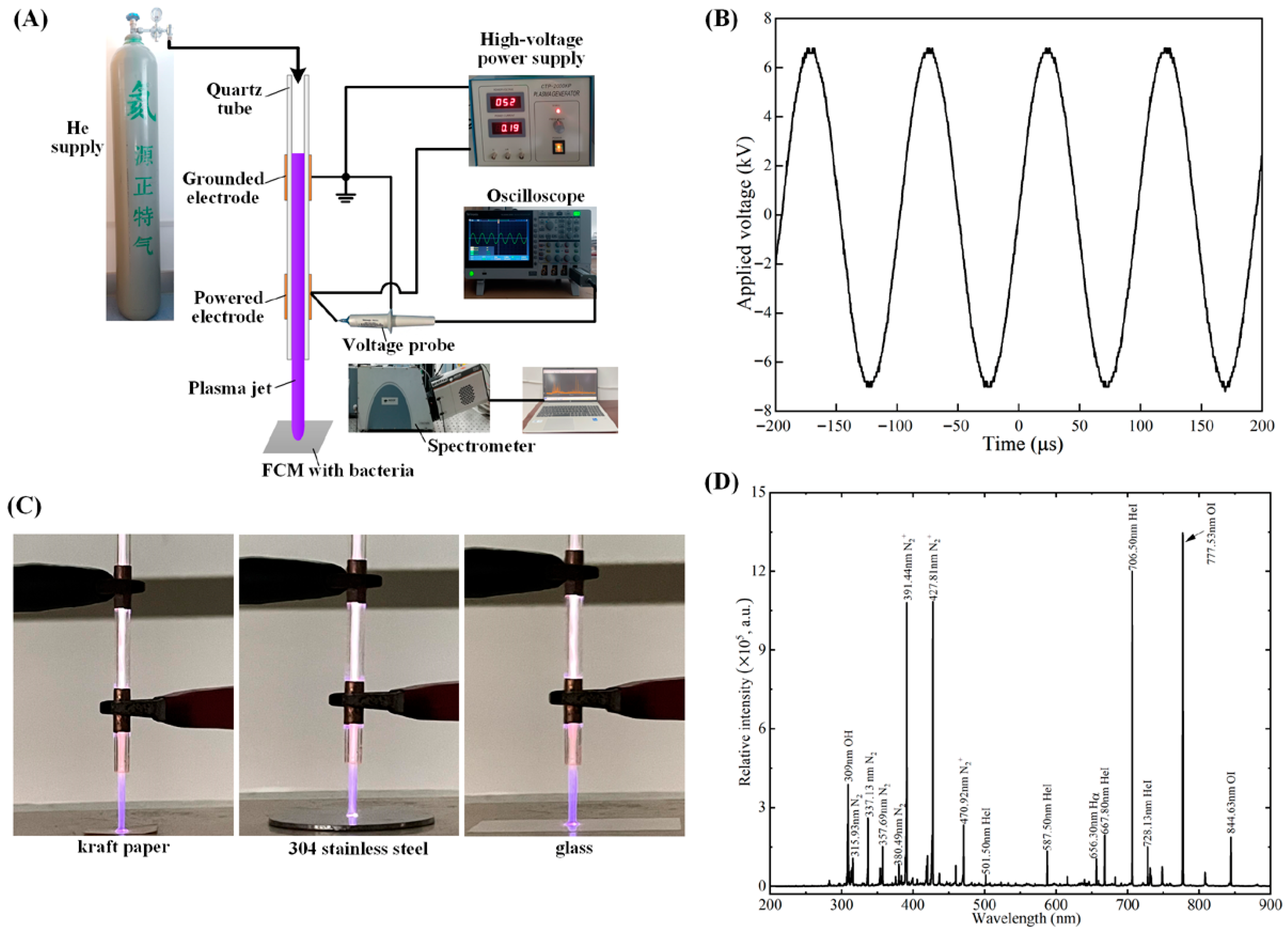
The device used in this study to produce CAP was the same as previously described [25,26,27]. As shown in Figure 1A, it consisted of a quartz tube with an inner radius of 1 mm and an outer radius of 2 mm. Two copper coaxial double-rings with a thickness of 0.15 mm and a width of 10 mm were wrapped around the quartz tube as electrodes. The distance between the two electrodes was 16.5 mm, while the distance between the powered electrode and the tube nozzle was 10 mm. The flow rate of the working gas (helium, 99.9999%) was adjusted through a rotameter. The powered and grounded electrodes were connected to a resonant high-voltage power supply (CTP-2000 K, Suman Electronics Co. Ltd., Nanjing, China), and the applied voltage with a peak–peak value Up-p between two electrodes was measured through a high-voltage probe (P6015A, Tektronix Inc., Beaverton, OR, USA); this signal was recorded by an oscilloscope (TBS2104B, Tektronix Inc., Beaverton, OR, USA). In order to generate a stable plasma jet, the power supply frequency, voltage amplitude, and gas flow rate were fixed at 10.24 kHz, 14 kV (Figure 1B), and 4 standard liters per minute, respectively. The FCMs inoculated with bacteria were placed directly below the plasma jet, in which the distance between the FCMs’ surfaces and the tube nozzle was 10 mm, as shown in Figure 1C. The bacteria were exposed to CAP for different durations (1, 2, 3, 4, and 5 min), and for the control, the bacteria on the material surface were left untreated (0 min). In addition, the emission spectra of the plasma jet (Figure 1D) were acquired through an optical fiber, which was placed perpendicular to the jet flux 10 mm away and coupled with an optical spectrometer (Mechelle 5000, Andor Technology Ltd., Belfast, Northern Ireland). The spectrometer’s range allowed measurements from 200 nm to 900 nm with a resolution of 0.06 nm.

2.4. Incubation and Enumeration of Surviving Bacteria

After the CAP treatment, the sterile sampling swabs were used to wipe substances from the surface of the FCMs into centrifuge tubes. Next, centrifugal oscillation was performed to ensure complete detachment of bacteria. The eluate was subjected to 100-fold serial gradient dilution; then, 100 μL of the diluted solution was spread evenly onto plate count agar. After incubation at 37 °C for 48 h, the colonies were counted, and the number of survivors was expressed as log10 CFU/mL ± standard deviation.

2.5. Bacterial Inactivation Kinetic Models and Statistical Analysis

The inactivation curves were constructed by plotting the surviving bacteria against CAP treatment time. Three classical models (Log-linear, Weibull, and Log-linear + Shoulder + Tail) were employed to determine the kinetic parameters and describe the inactivation effect of the CAP treatment [14,15,28].
The Log-linear model was used as shown in Equation (1):
l o g 10 N = l o g 10 N 0 t / D
where N is the number of colonies after CAP treatment (CFU/mL), N0 is the initial number of colonies on the material (CFU/mL), t is the CAP treatment time (min), and D is the time required to inactivate 90% of the bacteria (min).
The Weibull model was employed as shown in Equation (2):
l o g 10 N = l o g 10 N 0 b × t n 1
where b is the scale parameter and n1 is the shape parameter.
The Log-linear + Shoulder + Tail model, developed by Geeraerd [29], was used to fit the experimental data. This microbial inactivation curve model consists of a shoulder phase, a log-linear inactivation phase, and a tail phase. It was described as shown in Equation (3):
l o g 10 N = ( l o g 10 N 0 l o g 10 N r e s ) × e k m a x × t × e k m a x × t s 1 + ( e k m a x × t s 1 ) × e k m a x × t + l o g 10 N r e s
where Nres is the residual number of colonies on the material (CFU/mL), kmax is the maximum specific inactivation rate (1/min), and ts is the duration of the shoulder (min).
The Origin 2021 software was used for model fitting, and the goodness-of-fit of the three models was evaluated through the accuracy factor (Af), bias factor (Bf), and coefficient of determination (R2), together with root mean square error (RMSE). The Af, Bf, and RMSE were calculated according to Equations (4), (5) and (6), respectively:
A f = 10 l o g 10 N m / N p n
B f = 10 l o g 10 N m / N p n
R M S E = N m N p 2 n 1
where Nm is the measured value of the bacterial count on the material surface (CFU/mL), Np is the predicted value of the bacterial count on the material surface (CFU/mL), and n is the number of experimental groups.
Among these parameters, Af indicates the agreement between the measured and predicted values, with a smaller value indicating a better model fit. Bf indicates the degree of deviation between the measured and predicted values, with a value closer to 1 indicating a better model fit. An R2 value closer to 1 and a smaller RMSE value indicate a better model fit [13,28].
All experiments in this study were conducted in triplicate to ensure reproducibility. Statistical analyses were performed using SPSS 23.0 software. One-way analysis of variance (ANOVA) was employed to assess the overall differences among groups. Post hoc pairwise comparisons between different FCM groups were conducted using Tukey’s test. Additionally, Student’s t-test was utilized to evaluate the differences in kinetic parameters between two species of bacteria on the same FCM. p < 0.05 was considered statistically significant.

3. Results

3.1. Inactivation Effect of CAP Treatment on Bacteria

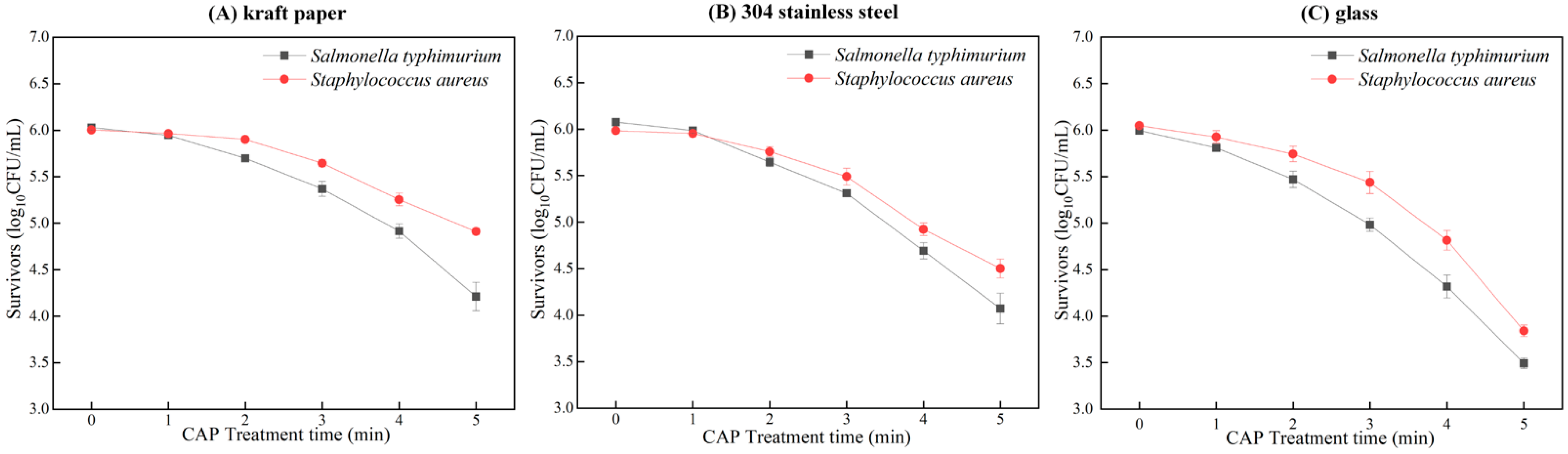
The CAP treatment’s bacteria-inactivating effect on the FCMs is shown in Figure 2. It can be observed that the two species of bacteria gradually decreased in number with increasing plasma treatment duration. On the kraft paper (Figure 2A), the initial number of Salmonella typhimurium and Staphylococcus aureus cells was 6.029 ± 0.025 and 6.003 ± 0.009 log10 CFU/mL, respectively. After 3 min of CAP treatment, the number of survivors decreased to 5.369 ± 0.081 and 5.645 ± 0.039 log10 CFU/mL (p < 0.05), respectively. When the CAP treatment time reached 5 min, the number of survivors further decreased to 4.212 ± 0.154 and 4.911 ± 0.035 log10 CFU/mL (p < 0.05), respectively. On the 304 stainless steel (Figure 2B), there was a population reduction of 2.004 ± 0.12 log10 CFU/mL for Salmonella typhimurium and 1.482 ± 0.06 log10 CFU/mL for Staphylococcus aureus after 5 min of plasma exposure, respectively. Lastly, on the glass (Figure 2C), Salmonella typhimurium and Staphylococcus aureus populations also decreased by 2.501 ± 0.09 and 2.207 ± 0.05 log10 CFU/mL after 5 min plasma exposure, respectively. Notably, on all three FCMs, Salmonella typhimurium presented a higher level of reduction and seemed to be more sensitive to the CAP treatment time than Staphylococcus aureus under identical conditions.

3.2. Kinetics Model Analysis

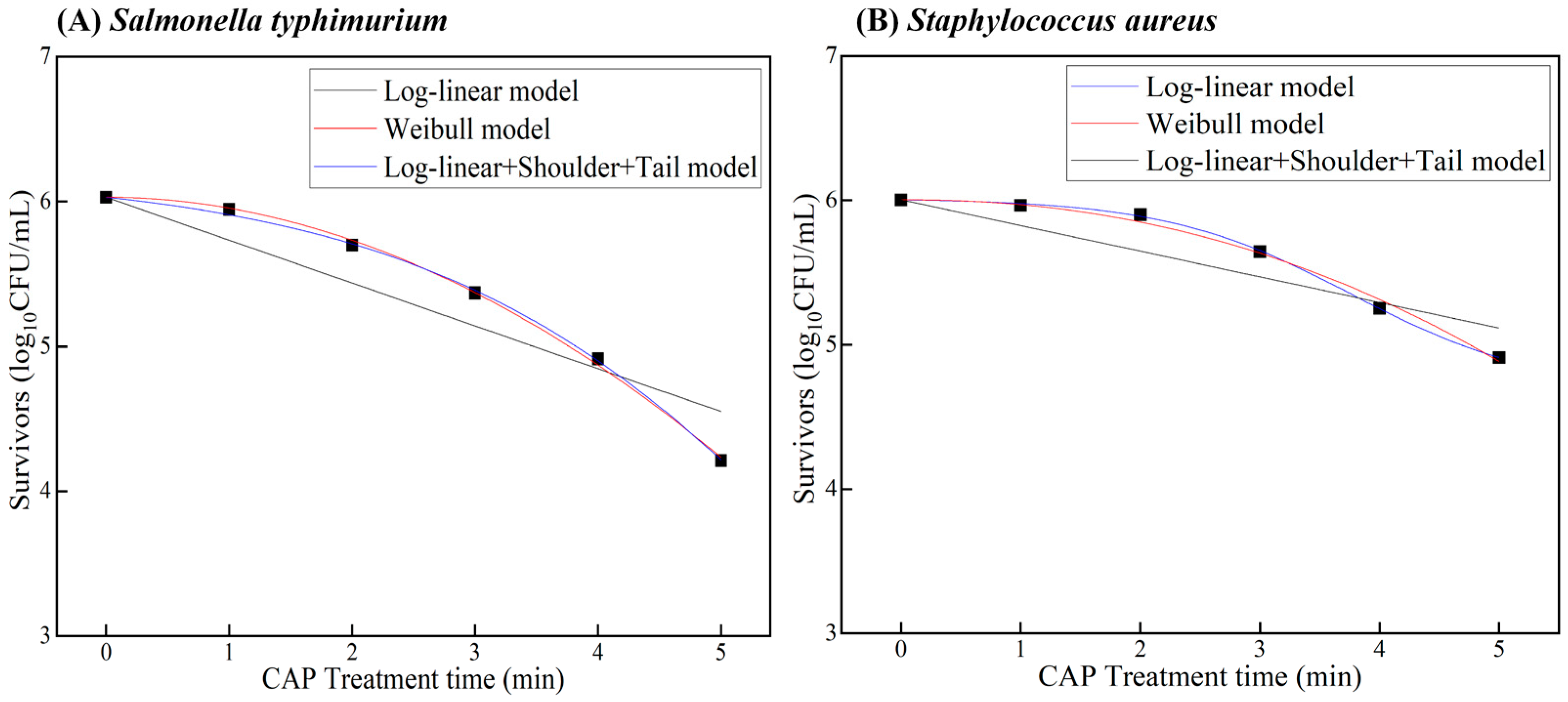
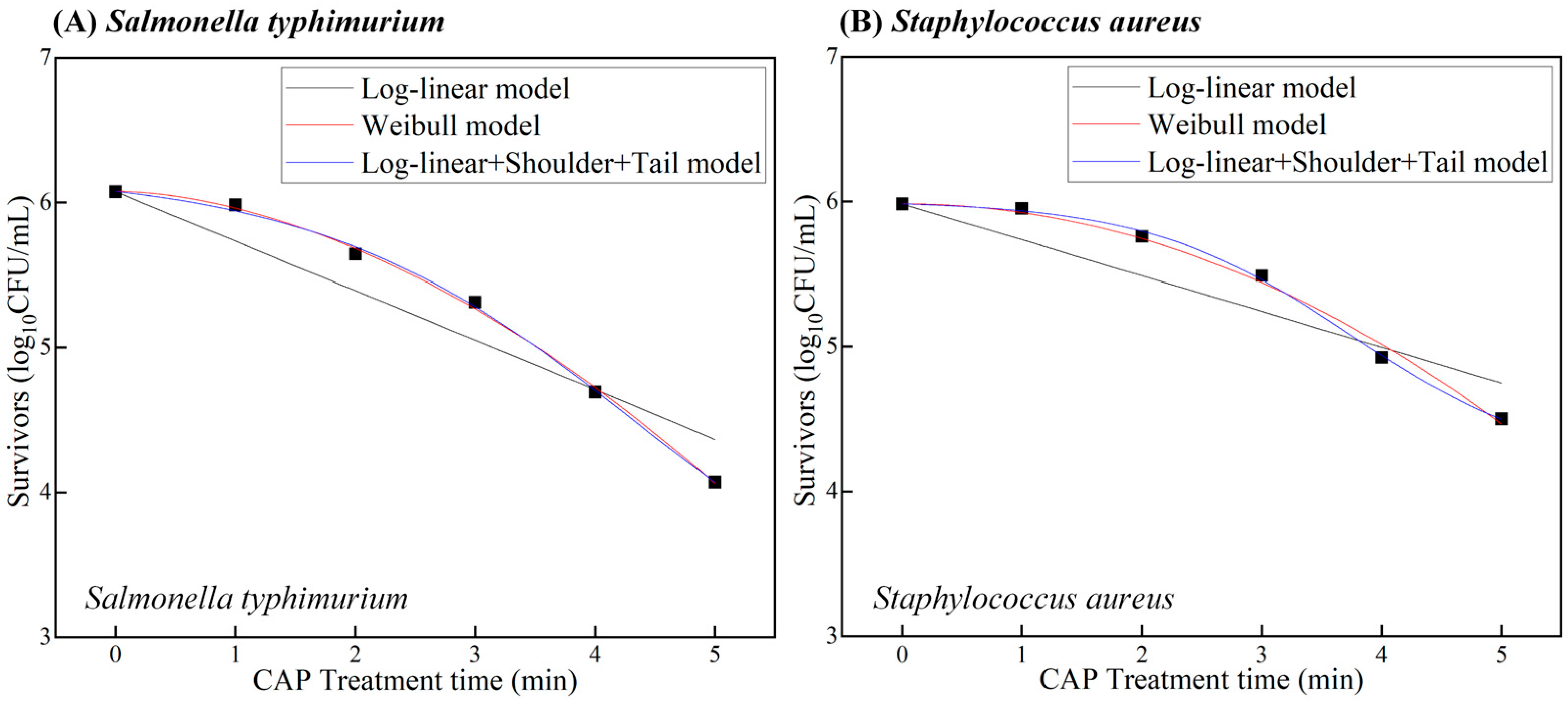
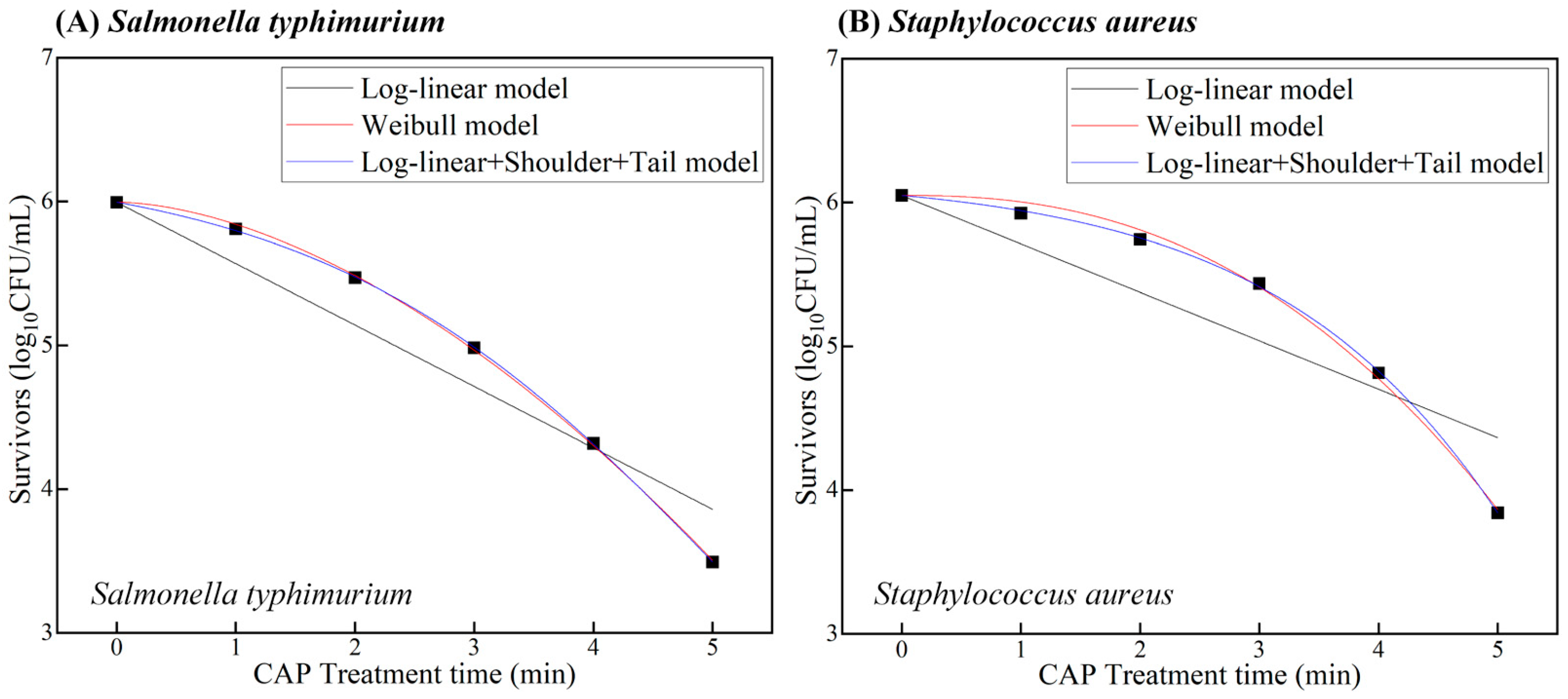
Using the Log-linear, Weibull, and Log-linear + Shoulder + Tail models, the kinetic curves of bacterial inactivation were fitted and are presented in Figure 3, Figure 4 and Figure 5, respectively. In addition, the corresponding fitting and evaluation parameters of the three models are listed in Table 1 and Table 2, respectively.
For the Log-linear model, the highest R2 value was 0.919 for the CAP-treated Salmonella typhimurium on glass, and the R2 values for the CAP-treated Staphylococcus aureus on kraft paper, 304 stainless steel, and glass were 0.84, 0.864, and 0.822 (<0.900), respectively. In addition, combined with the Af, Bf, and RMSE values in Table 2, it can be deduced that the Log-linear model was not suitable for describing the CAP treatment’s bacterial inactivation effect on the FCM surfaces.
For the Weibull model, it can be seen that the R2 values for all of the groups were higher than 0.900, with the highest value being 0.963 for the CAP-treated Staphylococcus aureus on 304 stainless steel, indicating that this model had high fitting accuracy. From Figure 3, Figure 4 and Figure 5 and the data in Table 1, it can be seen that the shape parameter (n1) value for all of the groups was higher than 1, and the curves were convex. Moreover, the b values for the CAP-treated Salmonella typhimurium on kraft paper, 304 stainless steel, and glass were 0.076, 0.114, and 0.154, respectively. Considering that the scale parameter (b) is related to the CAP’s inactivation effect, the above-mentioned data indicate that the bactericidal effect of CAP-treated FCMs increased in the following order: kraft paper, 304 stainless steel, and glass. Similarly, the b values for the CAP-treated Staphylococcus aureus on kraft paper, 304 stainless steel, and glass were 0.034, 0.045, and 0.06, respectively, indicating that the CAP’s bactericidal effect increased in the same sequence.
For the Log-linear + Shoulder + Tail model, the R2 values for all of the groups were over 0.995, and they were also higher than those for the Log-linear and Weibull models for the same CAP treatment group. Combined with the Af, Bf, and RMSE data in Table 2, it can be concluded that the Log-linear + Shoulder + Tail model had the highest fitting degree of the three models. The maximum specific inactivation rate (kmax) is a crucial parameter in modeling bacterial death, as it provides important information about the treatment’s efficiency [15]. The value of this parameter for Salmonella typhimurium (average 1.071 min−1) indicated a more intense effect (i.e., faster inactivation) of CAP treatment, compared to that for Staphylococcus aureus (average 0.577 min−1). For the same bacteria, the kmax value, and thus the CAP’s bactericidal effect, increased in the following sequence: kraft paper, 304 stainless steel, and glass.

3.3. Surface Characteristics of FCMs

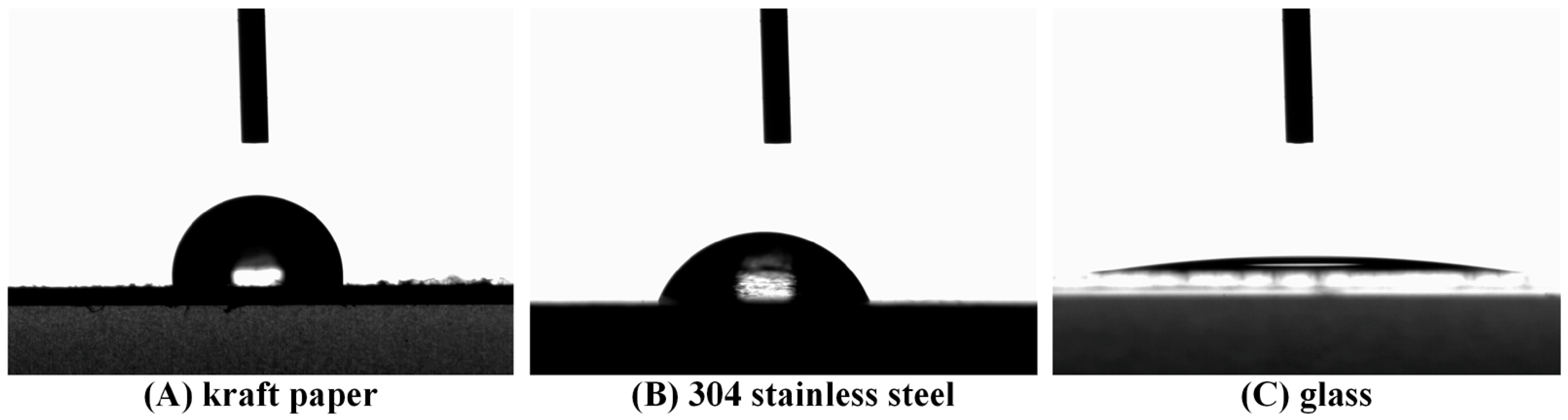
The water contact angle behavior on the surface of the three FCMs without bacteria was measured and images of the water droplets on the FCMs are shown in Figure 6. Using the measuring instrument’s system software (SCA20), the water contact angles of kraft paper, 304 stainless steel, and glass were calculated as 93.8 ± 1.65°, 68.9 ± 1.32°, and 11.4 ± 1.07°, respectively. It is generally believed that materials with a water contact angle less than 65° are surface hydrophilic materials, while materials with a water contact angle greater than 65° are surface hydrophobic materials [30].
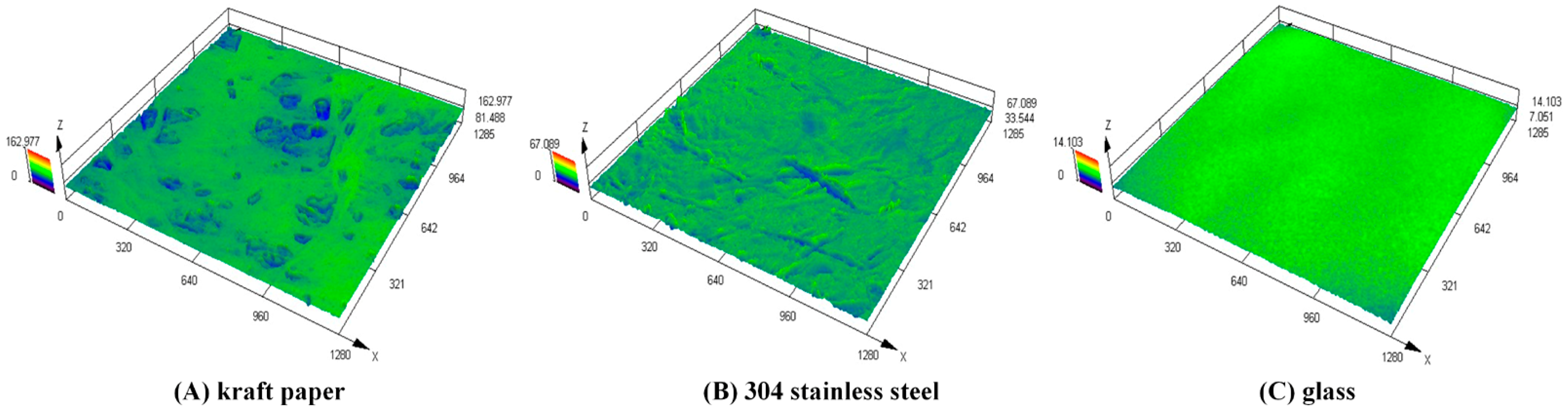
Using a confocal laser scanning microscope, the surface average roughness of kraft paper, 304 stainless steel, and glass was measured as 3.19 ± 0.9 μm, 1.27 ± 0.23 μm, and 0.18 ± 0.07 μm, respectively. In addition, the 3D FCM surface morphologies are displayed in Figure 7. From this information, we can see that the surface of the kraft paper is the roughest, while the surface of the glass is the smoothest.

4. Discussion

Salmonella typhimurium and Staphylococcus aureus are two typical foodborne microorganisms; Salmonella typhimurium is responsible for nearly 8 × 10⁷ food poisoning incidents annually, whereas Staphylococcus aureus is widely distributed in various foods such as meat, eggs, and milk [14,31]. Therefore, choosing these two bacteria as the research objects is of great significance for ensuring the microbiological safety of food; numerous studies have been conducted to investigate CAP’s effects on these two bacteria. For example, Samioti et al. examined the efficiency of CAP in reducing Salmonella typhimurium and Staphylococcus aureus when using argon as the carrier gas under constant flow (4.0 L/min) at a frequency of 1MHz and an electrical voltage of 2–6 kV. They found that after 15 min of exposure to plasma radiation, the total reductions in the bacterial populations were 1.12 log10 CFU/mL for Salmonella typhimurium and 0.88 log10 CFU/mL for Staphylococcus aureus. Kim et al. evaluated the antibacterial effect of floating electrode–dielectric barrier discharge (FE-DBD) plasma (1.1 kV, 43 kHz, N2 1.5 m/s, 1–60 min) against Staphylococcus aureus and Salmonella Typhimurium in fried fish paste. When FE-DBD plasma was used for treatment for 1, 5, 10, 20, 30, and 60 min, Staphylococcus aureus numbers decreased by 0.16–1.13 log10 CFU/g, and Salmonella Typhimurium numbers decreased by 0.25–1.13 log10 CFU/g [32]. Barkhade et al. investigated the antibacterial effect of 2.45 GHz non-thermal microwave plasma on Staphylococcus aureus and Salmonella abony suspended in phosphate-buffered saline (PBS), and a 6-log reduction in both bacterial strains was achieved within 300 s of plasma exposure [33].
The observations reported in our work were in full agreement with the results of the above-mentioned researchers. CAP can generate a range of active species, including radicals, ions, excited molecules, and ultraviolet (UV) photons [34]. As shown in Figure 1D, besides plenty of excited-state He (He Ⅰ), other emission lines, including OH (A2Σ→X2Π), N2 s positive band (C3Πu→B3Πg), N2+ first negative (B2Σu→X2Σg), Balmer Hα, and O (3p5S–3s5S) lines were also observed [35]. It is well known that these ROS and RNS have strong oxidizability and play a very important role in the process of microbial inactivation. As a result, the atmospheric helium plasma jet used in this study had a marked sterilization effect on the two bacteria investigated. Meanwhile, as shown in Figure 2, Salmonella typhimurium exhibited weaker resistance to the CAP treatment compared to Staphylococcus aureus. This difference could be attributed to differences between the cell walls of these Gram-positive and Gram-negative bacteria [36,37]: Gram-negative bacteria have a thin peptidoglycan layer with an outer membrane, consisting of lipopolysaccharides and phospholipids, making it easier for bactericidal reactive species in plasma to penetrate these cells [38,39]. Therefore, under the same treatment conditions, Salmonella typhimurium was more easily inactivated by plasma than Staphylococcus aureus.
Different kinetic models were used in order to more accurately predict the relationship between CAP’s sterilization effect and the treatment time. The low values of the root mean squared error (RMSE) and the high values of the coefficient of determination (R2 > 0.92) indicate the models’ good fit to the experimental data. For the data obtained from the inactivation of the two species of bacteria, the models of Weibull and Log-linear + Shoulder + Tail provided a very good fit, as demonstrated by the respective values of RMSE and R2 in Table 2. In addition, the data indicated that the Log-linear + Shoulder + Tail model had the highest fitting degree for the CAP sterilization curve among the three models. Furthermore, through dynamic analysis of the Log-linear + Shoulder + Tail model, it was found that Salmonella typhimurium was more sensitive to plasma compared to Staphylococcus aureus.
In addition to the bacteria’s different levels of resistance to the same CAP treatment, the characteristics of the material surface on which the bacteria are coated need to be taken into consideration. Dasan et al. used a gliding arc discharge (GAD) microplasma system to investigate the decontamination effect on stainless steel (SS), silicone (Si), and polyethylene terephthalate (PET) surfaces artificially contaminated with Escherichia coli and Staphylococcus epidermidis. Significant reductions of 3.76 ± 0.28, 3.19 ± 0.31, and 2.95 ± 0.94 log CFU/mL of S. epidermidis, and 2.72 ± 0.82, 4.43 ± 0.14, and 3.18 ± 0.96 log CFU/mL of E. coli on SS, Si, and PET surfaces, respectively, were achieved after 5 min of plasma treatment (p < 0.05) [38]. Schnabel et al. compared the plasma decontamination efficiency between rapeseeds, molecular sieves, and glass beads with glass helices. The results displayed that the glass substrates had an improved inactivation efficiency, while the molecular sieves showed even lower reductions than the rapeseeds [40]. In another study, by Han et al., the inactivation rates of three foodborne pathogens were examined in fresh vegetables, fruits, nuts, and powdered food samples in response to cold plasma treatment, and it was revealed that the surface roughness was negatively correlated with the inactivation rate, and even surfaces showed higher microbial reduction [41].
According to the results presented in Section 3.3, the three FCMs employed in this study exhibited distinct surface properties: glass was hydrophilic and had the smoothest surface, while kraft paper and 304 stainless steel were both hydrophobic, the former showing the greatest hydrophobicity and the highest roughness. It is known that bacteria strongly adhere to the surface of hydrophilic materials [42,43]; therefore, for hydrophilic glass, the bacterial suspensions were more likely to adhere to and spread on its surface, allowing more bacteria to be exposed to the active substances in CAP. When the bacterial suspension was dropped onto the surface of the hydrophobic materials—kraft paper and stainless steel—the bacterial suspension was more likely to form an up-and-down stacking structure, which prevented some bacteria from fully contacting the active substances in CAP [44]. Therefore, under the same conditions, CAP had the strongest bactericidal effect on the bacteria on the glass surface, followed by those on the 304 stainless steel, and had the weakest bactericidal effect on the bacteria on the kraft paper surface.
Microbial sterilization kinetics are of great significance for the application of CAP sterilization technology. After determining an accurate mathematical model for sterilization kinetics, the plasma treatment time required to reduce microorganisms under certain conditions can be calculated. The results of the present study revealed that the Log-linear + Shoulder + Tail model had the highest fitting degree among the three sterilization kinetics models (Log-linear, Weibull, and Log-linear + Shoulder + Tail) and indicated that the CAP’s bactericidal effect on the FCMs may have been affected by the microbial species and surface characteristics of the contact materials. It should be noted that there are various factors influencing CAP’s sterilization effect. Further study is necessary to optimize the parameters of CAP, such as, for example, using a plasma jet array composed of multiple tubes to increase the plasma treatment area, and changing the gas flow rate or applied voltage to improve the sterilization efficacy of CAP against pathogenic bacteria on FCMs.

5. Conclusions

In conclusion, our study’s findings demonstrated that CAP can effectively inactivate microbial pathogens on FCMs, and the inactivation kinetics of Salmonella typhimurium and Staphylococcus aureus can be accurately predicted using three mathematical models. Due to differences between the cell walls of Gram-positive and Gram-negative bacteria, Salmonella typhimurium exhibited weaker resistance to the CAP treatment than Staphylococcus aureus. In addition, the CAP’s bactericidal effect on the same bacteria increased in the following order of FCMs: kraft paper, 304 stainless steel, and glass. This could be attributed to the three FCMS’s different surface hydrophobicity and roughness values. However, further research needs to be carried out to better understand the mechanisms of bacterial inactivation and the effects of material surface characteristics on CAP’s sterilization effects.

Author Contributions

Methodology, M.C.; software, C.W.; validation, M.C.; formal analysis, T.X.; investigation, M.C.; data curation, M.C., C.W., and T.X.; writing—original draft preparation, M.C.; writing—review and editing, Z.C. and G.X.; visualization, M.C.; project administration, Z.C.; funding acquisition, G.X. All authors have read and agreed to the published version of the manuscript.

Funding

This research was funded by the Natural Science Basic Research Plan in Shaanxi Province of China (No. 2024JC-YBMS-785).

Institutional Review Board Statement

Not applicable.

Informed Consent Statement

Not applicable.

Data Availability Statement

The data are contained within the article.

Conflicts of Interest

The authors declare no conflicts of interest.

References

  1. Groh, K.J.; Muncke, J. In Vitro Toxicity testing of food contact materials: State-of-the-art and future challenges. Compr. Rev. Food Sci. Food Saf. 2017, 16, 1123–1150. [Google Scholar] [CrossRef]
  2. Corcoran, M.; Morris, D.; De Lappe, N.; O’Connor, J.; Lalor, P.; Dockery, P.; Cormican, M. Commonly used disinfectants fail to eradicate Salmonella enterica biofilms from food contact surface materials. Appl. Environ. Microbiol. 2014, 80, 1507–1514. [Google Scholar] [CrossRef]
  3. Otto, C.; Zahn, S.; Rost, F.; Zahn, P.; Jaros, D.; Rohm, H. Physical methods for cleaning and disinfection of surfaces. Food Eng. Rev. 2011, 3, 171–188. [Google Scholar] [CrossRef]
  4. Gilca, A.F.; Teodosiu, C.; Fiore, S.; Musteret, C.P. Emerging disinfection byproducts: A review on their occurrence and control in drinking water treatment processes. Chemosphere 2020, 259, 127476. [Google Scholar] [CrossRef]
  5. Prasad, A.; Du, L.H.; Zubair, M.; Subedi, S.; Ullah, A.; Roopesh, M.S. Applications of Light-Emitting Diodes (LEDs) in food processing and water treatment. Food Eng. Rev. 2020, 12, 268–289. [Google Scholar] [CrossRef]
  6. Xiang, Q.S.; Dong, S.S.; Fan, L.M.; Ma, Y.F.; Bai, Y.H. Bactericidal kinetics of ultraviolet C light-emitting diodes against bacteria on food contact materials and factors influencing it. Food Sci. 2022, 43, 17–25. [Google Scholar]
  7. Thirumdas, R.; Sarangapani, C.; Annapure, U.S. Cold plasma: A novel non-thermal technology for food processing. Food Biophys. 2015, 10, 1–11. [Google Scholar] [CrossRef]
  8. Ekezie, F.G.C.; Sun, D.W.; Cheng, J.H. A review on recent advances in cold plasma technology for the food industry: Current applications and future trends. Trends Food Sci. Technol. 2017, 69, 46–58. [Google Scholar] [CrossRef]
  9. Ganesan, A.R.; Tiwari, U.; Ezhilarasi, P.N.; Rajauria, G. Application of cold plasma on food matrices: A review on current and future prospects. J. Food Process. Preserv. 2021, 45, e15070. [Google Scholar] [CrossRef]
  10. Kim, S.H.; Roy, P.K.; Park, S.Y. Synergistic Effects of combined flavourzyme and floating electrode-dielectric barrier discharge plasma on reduction of Escherichia coli biofilms in squid (Todarodes pacificus). Microorganisms 2024, 12, 1188. [Google Scholar] [CrossRef]
  11. Dharini, M.; Jaspin, S.; Mahendran, R. Cold plasma reactive species: Generation, properties, and interaction with food biomolecules. Food Chem. 2023, 405, 134746. [Google Scholar] [CrossRef]
  12. Nwabor, O.F.; Onyeaka, H.; Miri, T.; Obileke, K.; Anumudu, C.; Hart, A. A cold plasma technology for ensuring the microbiological safety and quality of foods. Food Eng. Rev. 2022, 14, 535–554. [Google Scholar] [CrossRef]
  13. Gounadaki, A.S.; Skandamis, P.N.; Drosinos, E.H.; Nychas, G.J.E. Microbial ecology of food contact surfaces and products of small-scale facilities producing traditional sausages. Food Microbiol. 2008, 25, 313–323. [Google Scholar] [CrossRef] [PubMed]
  14. Huang, M.M.; Zhuang, H.; Wang, J.M.; Yan, W.J.; Zhao, J.Y.; Zhang, J.H. Inactivation kinetics of Salmonella typhimurium and Staphylococcus aureus in different media by dielectric barrier discharge non-thermal plasma. Appl. Sci. 2018, 8, 2087. [Google Scholar] [CrossRef]
  15. Samioti, V.; Kriti, E.; Spanou, A.; Tsironi, T.; Panagou, E.Z. Inactivation kinetics of pathogenic and nonpathogenic bacteria upon in vitro treatment with cold atmospheric pressure plasma (CAPP). Int. J. Food Sci. 2024, 2024, 7464133. [Google Scholar] [CrossRef]
  16. Goree, J.; Liu, B.; Drake, D.; Stoffels, E. Killing of S-mutans bacteria using a plasma needle at atmospheric pressure. IEEE Trans. Plasma Sci. 2006, 34, 1317–1324. [Google Scholar] [CrossRef]
  17. Mai-Prochnow, A.; Clauson, M.; Hong, J.M.; Murphy, A.B. Gram positive and Gram negative bacteria differ in their sensitivity to cold plasma. J. Appl. Microbiol. 2016, 6, 38610. [Google Scholar] [CrossRef] [PubMed]
  18. Zhao, Y.M.; Ojha, S.; Burgess, C.M.; Sun, D.W.; Tiwari, B.K. Inactivation efficacy and mechanisms of plasma activated water on bacteria in planktonic state. Sci. Rep. 2020, 129, 1248–1260. [Google Scholar] [CrossRef]
  19. Guo, L.; Yang, L.; Qi, Y.; Niyazi, G.; Huang, L.; Gou, L.; Wang, Z.; Zhang, L.; Liu, D.; Wang, X.; et al. Cold atmospheric-pressure plasma caused protein damage in methicillin-resistant Staphylococcus aureus cells in biofilms. Microorganisms 2021, 9, 1072. [Google Scholar] [CrossRef]
  20. Rotondo, P.R.; Aceto, D.; Ambrico, M.; Stellacci, A.M.; Faretra, F.; Angelini, R.M.D.; Ambrico, P.F. Physicochemical properties of plasma-activated water and associated antimicrobial activity against fungi and bacteria. Sci. Rep. 2025, 15, 5536. [Google Scholar] [CrossRef]
  21. Joh, H.M.; Kim, S.J.; Chung, T.H.; Leem, S.H. Comparison of the characteristics of atmospheric pressure plasma jets using different working gases and applications to plasma-cancer cell interactions. AIP Adv. 2013, 3, 092128. [Google Scholar] [CrossRef]
  22. Engelhardt, M.; Kartaschew, K.; Bibinov, N.; Havenith, M.; Awakowicz, P. Silicon surface modifications produced by non-equilibrium He, Ne and Kr plasma jets. J. Phys. D Appl. Phys. 2017, 50, 015206. [Google Scholar] [CrossRef]
  23. Javanmard, S.; Pouryoussefi, S.G. Comparison of characteristics of atmospheric pressure plasma jets using argon and helium working gases. Curr. Appl. Phys. 2023, 46, 61–69. [Google Scholar] [CrossRef]
  24. Van Doremaele, E.R.W.; Kondeti, V.S.S.K.; Bruggeman, P.J. Effect of plasma on gas flow and air concentration in the effluent of a pulsed cold atmospheric pressure helium plasma jet. Plasma Sources Sci. Technol. 2018, 27, 095006. [Google Scholar] [CrossRef]
  25. Xu, G.; Geng, Y.; Li, X.; Shi, X.; Zhang, G. Characteristics of a kHz helium atmospheric pressure plasma jet interacting with two kinds of targets. Plasma Sci. Technol. 2021, 23, 095401. [Google Scholar] [CrossRef]
  26. Chen, M.; Chen, J.; Xie, T.; Chen, Z.; Xu, G. Effects of cold atmospheric plasma-treated medium on HaCaT and HUVEC cells in vitro. Plasma Process. Polym. 2024, 21, e2400132. [Google Scholar] [CrossRef]
  27. Liu, J.; Wang, X.; Cui, Y.; Xu, G.; Lu, J.; He, Z.; Xu, Y.; Li, R.; Gao, L.; Wang, H.; et al. Plasma-activated liquid mediated sensitization of cisplatin in chemoresistant ovarian cancer by disrupting DNA damage response. J. Phys. D Appl. Phys. 2025, 58, 135207. [Google Scholar]
  28. Liu, Y.; Fu, T.; Liu, C.; Chen, G.; Wang, J. Bactericidal efficacy and kinetics of cold plasma against Staphylococcus aureus and Pseudomonas aeruginosa. Mod. Food Sci. Technol. 2021, 37, 127–135. [Google Scholar]
  29. Geeraerd, A.; Herremans, C.; Van Impe, J.F. Structural model requirements to describe microbial inactivation during a mild heat treatment. Int. J. Food Microbiol. 2000, 59, 185–209. [Google Scholar] [CrossRef]
  30. Tian, Y.; Li, H.; Wang, M.; Yang, C.; Yang, Z.; Liu, X. Insights into the stability of fluorinated super-hydrophobic coating in different corrosive solutions. Prog. Org. Coat. 2021, 151, 106043. [Google Scholar] [CrossRef]
  31. Majowicz, S.E.; Musto, J.; Scallan, E.; Angulo, F.J.; Kirk, M.; O’Brien, S.J.; Jones, T.F.; Fazil, A.; Hoekstra, R.M. The global burden of nontyphoidal Salmonella gastroenteritis. Clin. Infect. Dis. 2010, 50, 882–889. [Google Scholar] [CrossRef] [PubMed]
  32. Kim, S.H.; Roy, P.K.; Jeon, E.B.; Park, S.Y. The efficacy of floating electrode-dielectric barrier discharge plasma against Staphylococcus aureus and Salmonella Typhimurium on fried fish paste. Appl. Sci. 2024, 14, 1875. [Google Scholar] [CrossRef]
  33. Barkhade, T.; Nigam, K.; Ravi, G.; Rawat, S.; Nema, S.K. Investigating the effects of microwave plasma on bacterial cell structures, viability, and membrane integrity. Sci. Rep. 2025, 15, 18052. [Google Scholar] [CrossRef]
  34. Graves, D.B. The emerging role of reactive oxygen and nitrogen species in redox biology and some implications for plasma applications to medicine and biology. J. Phys. D Appl. Phys. 2012, 45, 263001. [Google Scholar] [CrossRef]
  35. Gazeli, K.; Svarnas, P.; Held, B.; Marlin, L.; Clément, F. Possibility of controlling the chemical pattern of He and Ar “guided streamers” by means of N2 or O2 additives. J. Appl. Phys. 2015, 117, 093302. [Google Scholar] [CrossRef]
  36. Gaunt, L.F.; Beggs, C.B.; Georghiou, G.E. Bactericidal action of the reactive species produced by gas-discharge nonthermal plasma at atmospheric pressure: A review. IEEE Trans. Plasma Sci. 2006, 34, 1257–1269. [Google Scholar] [CrossRef]
  37. Das, S.; Gajula, V.P.; Mohapatra, S.; Singh, G.; Kar, S. Role of cold atmospheric plasma in microbial inactivation and the factors affecting its efficacy. Health Sci. Rev. 2022, 4, 100037. [Google Scholar] [CrossRef]
  38. Dasan, B.; Onal-Ulusoy, B.; Pawlat, J.; Diatczyk, J.; Sen, Y.; Mutlu, M. A new and simple approach for decontamination of food contact surfaces with gliding arc discharge atmospheric non-thermal plasma. Food Bioprocess Technol. 2017, 10, 650–661. [Google Scholar] [CrossRef]
  39. Xu, Z.; Tang, Y.; Hu, S.; Lan, Y.; Xi, W.; Han, W.; Wu, D.; Yang, F.; Cheng, C. Inactivation of Staphylococcus aureus in water by dielectric barrier discharge plasma jet: The role of inorganic ions, organic matter, and turbidity. J. Water Process Eng. 2023, 56, 104449. [Google Scholar] [CrossRef]
  40. Schnabel, U.; Niquet, R.; Krohmann, U.; Winter, J.; Schlüter, O.; Weltmann, K.D.; Ehlbeck, J. Decontamination of microbiologically contaminated specimen by direct and indirect plasma treatment. Plasma Process Polym. 2012, 9, 569–575. [Google Scholar] [CrossRef]
  41. Han, J.Y.; Song, W.J.; Eom, S.; Kim, S.B.; Kang, D.H. Antimicrobial efficacy of cold plasma treatment against food-borne pathogens on various foods. J. Phys. D Appl. Phys. 2020, 53, 204003. [Google Scholar] [CrossRef]
  42. Arima, Y.; Iwata, H. Effect of wettability and surface functional groups on protein adsorption and cell adhesion using well-defined mixed self-assembled monolayers. Biomaterials 2007, 28, 3074–3082. [Google Scholar] [CrossRef]
  43. Yang, K.; Shi, J.; Wang, L.; Chen, Y.; Liang, C.; Yang, L.; Wang, L. Bacterial anti-adhesion surface design: Surface patterning, roughness and wettability: A review. J. Mater. Sci. Technol. 2022, 99, 82–100. [Google Scholar] [CrossRef]
  44. Kim, D.K.; Kang, D.H. Effect of surface characteristics on the bactericidal efficacy of UVC LEDs. Food Control 2019, 108, 106869. [Google Scholar] [CrossRef]
Figure 1. Schematic diagram of CAP device used in this study (A); the waveform of applied voltage on two electrodes (B); photos of plasma jet treatment of bacteria on the surface of kraft paper, 304 stainless steel, and glass, respectively (C); and the emission spectra of plasma jet under the applied voltage of 10.24 kHz/14 kV (D). The a.u. means arbitrary unit.
Plasma 08 00046 g001
Figure 2. Surviving bacteria on kraft paper (A), 304 stainless steel (B), and glass (C).
Plasma 08 00046 g002
Figure 3. Fitting curves of Salmonella typhimurium (A) and Staphylococcus aureus (B) on kraft paper using three models. All points are actual values and lines are fitted values from three models.
Plasma 08 00046 g003
Figure 4. Fitting curves of Salmonella typhimurium (A) and Staphylococcus aureus (B) on 304 stainless steel using three models.
Plasma 08 00046 g004
Figure 5. Fitting curves of Salmonella typhimurium (A) and Staphylococcus aureus (B) on glass using three models.
Plasma 08 00046 g005
Figure 6. Water contact angle measurement images showing the behavior of kraft paper (A), 304 stainless steel (B) and glass (C) surfaces in contact with water droplets.
Plasma 08 00046 g006
Figure 7. Three-dimensional surface morphology of kraft paper (A), 304 stainless steel (B), and glass (C).
Plasma 08 00046 g007
Table 1. Parameters of the kinetics models for the inactivation of bacteria on FCMs by CAP.
BacteriaFCMsLog-Linear ModelWeibull ModelLog-Linear + Shoulder + Tail Model
Dbn1Nres (log10 CFU/mL)kmaxts
Salmonella typhimuriumkraft paper 3.378 ± 0.322 a0.076 ± 0.008 a1.968 ± 0.067 a9.02 ± 2.38 a0.744 ± 0.138 a6.767 ± 2.216 a
304 stainless steel2.924 ± 0.315 b0.114 ± 0.011 b1.784 ± 0.064 b2.749 ± 0.73 b1.183 ± 0.128 b4.405 ± 0.584 b
glass2.342 ± 0.376 c0.154 ± 0.007 b1.729 ± 0.031 b0.308 ± 0.45 c1.286 ± 0.063 c5.321 ± 0.242 c
Staphylococcus aureuskraft paper 5.618 ± 0.243 a*0.034 ± 0.009 a*2.138 ± 0.169 a*4.687 ± 0.042 a*0.549 ± 0.118 a *3.77 ± 0.064 a *
304 stainless steel4.032 ± 0.304 b*0.045 ± 0.009 a*2.013 ± 0.155 a*4.159 ± 0.132 b*0.578 ± 0.026 b *3.744 ± 0.154 a*
glass2.967 ± 0.489 c*0.06 ± 0.014 b*2.411 ± 0.132 b*3.64 ± 0.47 c*0.603 ± 0.071 c*8.35 ± 2.704 b*
Data represented as means with standard deviations. Different small letter superscripts of a, b and c in the same columns of two units indicate significant differences (p < 0.05). * indicates significant differences in kinetic parameters between two species of bacteria on the same FCM (p < 0.05).
Table 2. Evaluation parameters of the kinetics models.
BacteriaFCMsLog-Linear ModelWeibull ModelLog-Linear + Shoulder + Tail Model
R2AfBfRMSER2AfBfRMSER2AfBfRMSE
Salmonella typhimuriumkraft paper 0.8831.6651.220.2660.9281.0520.9890.030.9991.0381.010.023
304 stainless steel0.9081.6431.2330.2660.9311.071.0040.0360.9971.0651.0070.036
glass0.9191.7671.2610.3060.9501.0430.9860.0220.9991.0190.9960.01
Staphylococcus aureuskraft paper 0.841.4521.1630.1980.9211.0381.3030.1810.9991.0211.0060.01
304 stainless steel0.8641.6221.2140.2480.9631.1081.020.0570.9971.01910.026
glass0.8222.1071.3040.3960.9451.1140.9520.0580.9991.0290.9910.016
Disclaimer/Publisher’s Note: The statements, opinions and data contained in all publications are solely those of the individual author(s) and contributor(s) and not of MDPI and/or the editor(s). MDPI and/or the editor(s) disclaim responsibility for any injury to people or property resulting from any ideas, methods, instructions or products referred to in the content.