1. Introduction
Zirconia ceramics stabilized with lanthanide rare-earth oxides are widely used in various applications, including in wear-resistant components such as grinding balls and bearings, cutting tools such as scissors and knives, and biomedical devices such as dental implants and femoral heads [
1,
2,
3,
4]. Research and development in this field continue to expand. These materials exhibit superior mechanical strength and high fracture toughness compared with other oxide ceramics [
5], enabling their use in demanding structural applications. Garvie et al. [
6] proposed that their exceptional mechanical performance arises from a fracture mechanism associated with a diffusion-less (martensitic) transformation similar to that observed when austenitic stainless steel is quenched. Takagi et al. [
7] further confirmed the involvement of martensitic transformation through in situ X-ray diffraction (XRD) during laser-induced fracture of zirconia. Regarding strength, Trunec et al. [
8] reported a four-point bending strength of 1020 MPa. For zirconia doped with 3 mol% Y
2O
3, Cui et al. [
9] reported a fracture toughness of 4.5–8.6 MPa·m
0.5. In a recent study, Alves et al. [
10] reported that in 3 mol% yttria-stabilized zirconia (3Y-TZP), increasing the sintering temperature and dwell time led to significant grain growth from 0.65 μm to 2.20 μm, which in turn resulted in a considerable decrease in flexural strength from 1210 MPa to 910 MPa. This statement is consistent with the widely accepted understanding that ceramics with higher density and finer grain size generally exhibit higher strength. Also, commercial zirconia ceramics with the same composition are typically evaluated by three-point bending, and their flexural strength is generally limited to approximately 900–1200 MPa [
11,
12,
13].
Furthermore, the fracture toughness is known to correlate with the concentration of the stabilizer Y
2O
3, and Vasylkiv et al. [
14] confirmed that zirconia ceramics containing 1.5 mol% Y
2O
3 achieved a fracture toughness of 15–17 MPa·m
0.5 using the indentation fracture (IF) method. Recently, Matsui et al. [
15,
16,
17] reported a value of 22–23 MPa·m
0.5 for the same composition using a similar method.
Zirconia for structural applications typically possesses a tetragonal crystal structure and achieves high strength when the relative density exceeds 97%. However, conventional density measurements rely on the Archimedes method, which becomes unreliable for nearly fully dense ceramics. Likewise, microstructural characterization using scanning electron microscopy (SEM) and transmission electron microscopy (TEM) is limited to narrow surface regions. These limitations hinder accurate assessment of internal microstructure and obscure the correlation between microstructural defects and mechanical properties.
We previously developed cubic transparent ceramics, including materials for lasers and Faraday rotators, and demonstrated that minute internal pores can be quantified using transmission and polarized-light microscopy with visible-wavelength illumination [
18]. Furthermore, we established methods for detecting nanoscale defects such as secondary phases and nanoscale grain-boundary films and for eliminating such scattering sources, enabling the fabrication of advanced optical ceramics with performance exceeding that of high-quality single crystals [
19,
20].
Zirconia ceramic, known for its exceptional mechanical properties, crystallizes in the tetragonal system and exhibits strong intrinsic birefringence, which typically causes significant optical scattering at visible wavelengths. Consequently, internal observation of these ceramics using conventional optical microscopy is generally not feasible. To overcome this limitation, we employed an infrared transmission microscope with a 1.2–1.7-μm light source, allowing internal examination of dense tetragonal zirconia ceramics.
We found that the four-point bending strength of virtually pore-free zirconia ceramic was ~2.29 GPa, nearly double that of zirconia samples with relative densities exceeding 99.9% and of commercially available zirconia ceramics. During the fracture of these high-strength, pore-free ceramics, intense electrical sparks were observed near the fracture surfaces. This phenomenon is likely caused by the release of shared electrons when covalent bonds between cations (Zr4+) and anions (O2−) in the zirconia lattice break a newly identified fracture mechanism involving electrical discharge.
Traditionally, microstructural defects, such as considerably large residual pores, have been considered the primary origins of ceramic fracture, leading to reduced material strength [
21]. However, ceramics without microstructural defects at the micrometer to sub-micrometer scale exhibit markedly enhanced strength.
2. Experimental Procedures
The starting material was a 3 mol% Y2O3:ZrO2 powder with a primary particle size of 80 nm, a specific surface area of 10 m2/g, and a purity of >99.9% (ZrO2 + HfO2 + Y2O3). To this powder, 2 wt% acrylic binder, 0.5 wt% dispersant, and 0.2 wt% colloidal alumina (as a sintering aid) were added. The powder mixture was ball-milled with yttria-toughened zirconia balls for 15 h in ethanol. The resulting slurry was spray-dried at 80 °C, yielding powders with spherical granules of approximately 30 µm.
The powder was then pressed into compacts measuring 120 mm × 10 mm × 40 mm in size at 10 MPa and subsequently cold isostatically pressed at 98 MPa. Debinding was performed at 700 °C for 3 h in air. Pre-sintering was conducted in an oxygen atmosphere at 1250 °C for 2 h (Sample A) and 1300 °C for 5 h (Sample B), resulting in relative densities of 98–99%. Samples A and B were subsequently hot isostatically pressed at 1270 °C for 2 h and 1320 °C for 2 h, respectively, under 176 MPa of Ar gas. Sample C was prepared under the same conditions as Sample A, except a lower hot isostatic pressing (HIP) pressure of 49 MPa was used.
For microstructural observation, HIP-treated samples were machined into specimens measuring 8 mm × 20 mm × t1 mm (three specimens per sample), with two 8 mm × 20 mm faces mirror-polished. Surface features were examined using a reflected-light optical microscope (Olympus BX51, visible light, Tokyo, Japan). Internal structures were observed using an infrared transmission microscope (Olympus BX50, Tokyo, Japan) equipped with a filter that blocks wavelengths below 1200 nm and an infrared camera (ACH2 Technology FS1700-SWIR-ACH, Saitama, Japan) for imaging in the 1.2–1.7 μm range.
The crystalline phase was identified via XRD (Bruker, D2, Karlsruhe, Germany). After thermal etching at 1200 °C, the microstructure was analyzed using SEM (JEOL, JSM-6510, Tokyo, Japan). Four-point bending strength was measured on specimens (3 mm × 4 mm × L40 mm) following Japanese industrial standards (JIS R1601), which is equivalent to ASTM C1161. Fracture toughness was determined using the single-edge pre-cracked beam method, with a notch tip radius of 100 μm, in accordance with JIS R1607, which is comparable to ASTM C1421.
3. Results and Discussion
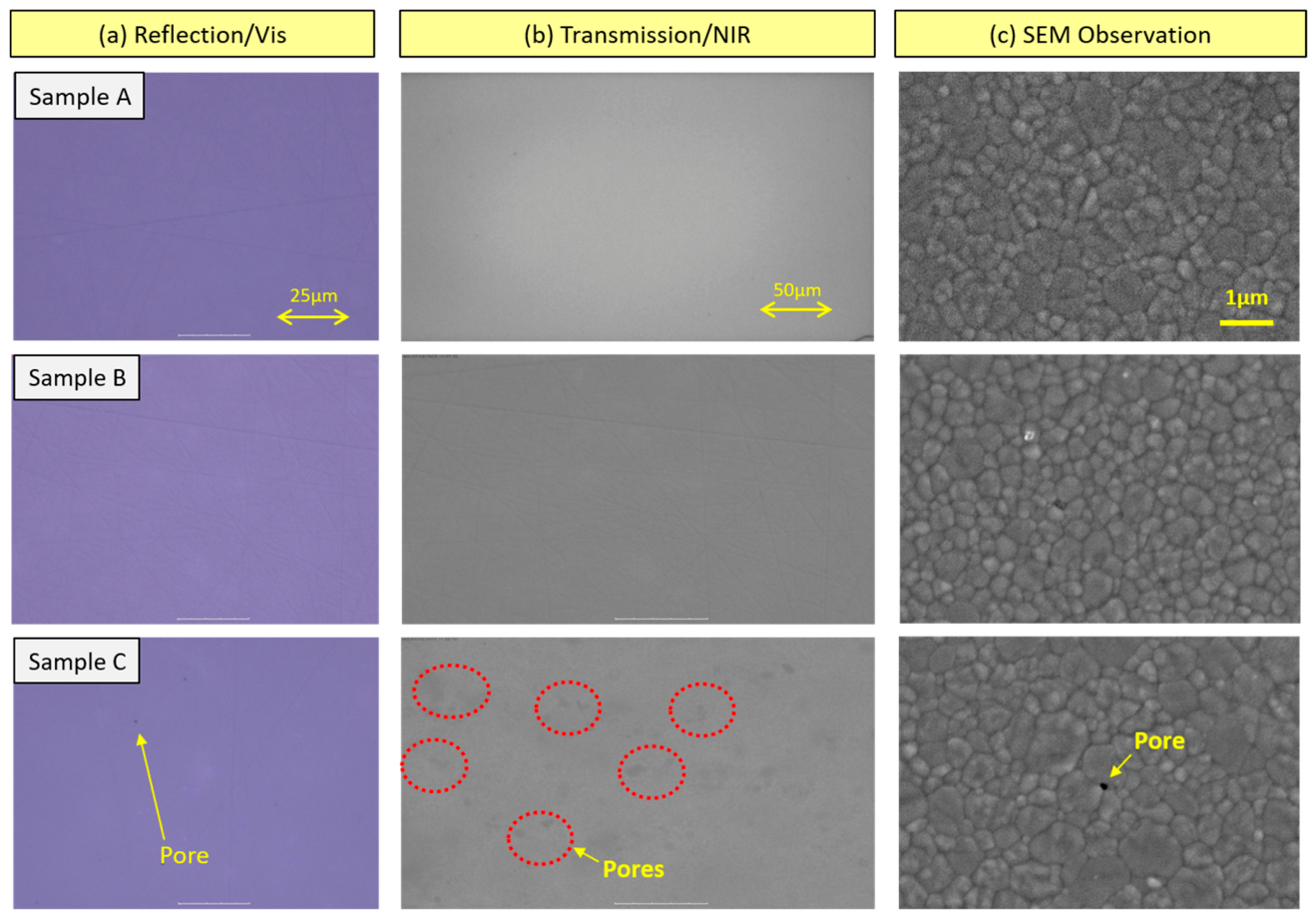
Figure 1 shows the microstructures of Samples A, B, and C, examined using reflection microscopy, infrared transmission microscopy, and SEM. For reflection microscopy, three 8 mm × 20 mm × t1 mm specimens were utilized, and all six 8 mm × 20 mm surfaces (front and back of each specimen) were inspected. No surface pores were observed in Samples A or B. By contrast, Sample C, which was HIP treated at a lower pressure, exhibited several submicron surface pores (<1 μm) at one face.
Infrared transmission microscopy revealed no internal pores in any of the three specimens of Samples A or B. However, Sample C exhibited numerous submicron (pore size: <1 μm) pores arranged in colony-like clusters throughout the depth, extending approximately 1000 μm from the surface within a 500 μm × 300 μm field of view. Density measurement using the conventional Archimedes method is inherently limited for the present material due to the extremely small pore size and the difficulty in quantifying the number of residual pores. Nevertheless, based on the authors’ prior experience with a number of transparent ceramics evaluated using the same approach [
19], the pore volume in the present material is expected to be well below 0.1%. Because surface polishing substantially reduces the likelihood of internal pores being exposed to the surface, conventional reflection microscopy, SEM, or even high-resolution TEM generally cannot detect such pores in dense sintered ceramics. Although infrared microscopy operates at considerably long wavelengths (1.2–1.7 μm) and thus has limited spatial resolution, it is nevertheless capable of detecting these submicron pores. Furthermore, the surfaces of Samples A–C were thermally etched and examined by SEM since it is not accurate to determine the pore size only from the optical image alone. No residual pores were observed in Samples A and B, whereas three residual pores with a size of approximately 0.3 μm were detected on Sample C across its six surfaces (two 8 mm × 20 mm surfaces of each of the three specimens). The size of these pores is consistent with those identified by both reflected-light optical microscopy (visible light source) and transmitted infrared microscopy, which also indicated pore sizes of ~0.3 μm. Although no residual pores were detected in Samples A and B (three specimens of 8 × 20 × t1 mm), the possibility of undetectable nanoscale pores cannot be excluded due to the limited spatial resolution of the characterization techniques. In contrast, Sample C—despite reaching the theoretical density (6.02 g/cm
3) by the Archimedes method (i.e., relative density > 99.9%)—was found to contain internal pores. These extremely fine and sparse microstructural defects are considered to contribute to the lowering of mechanical strength, as discussed below.
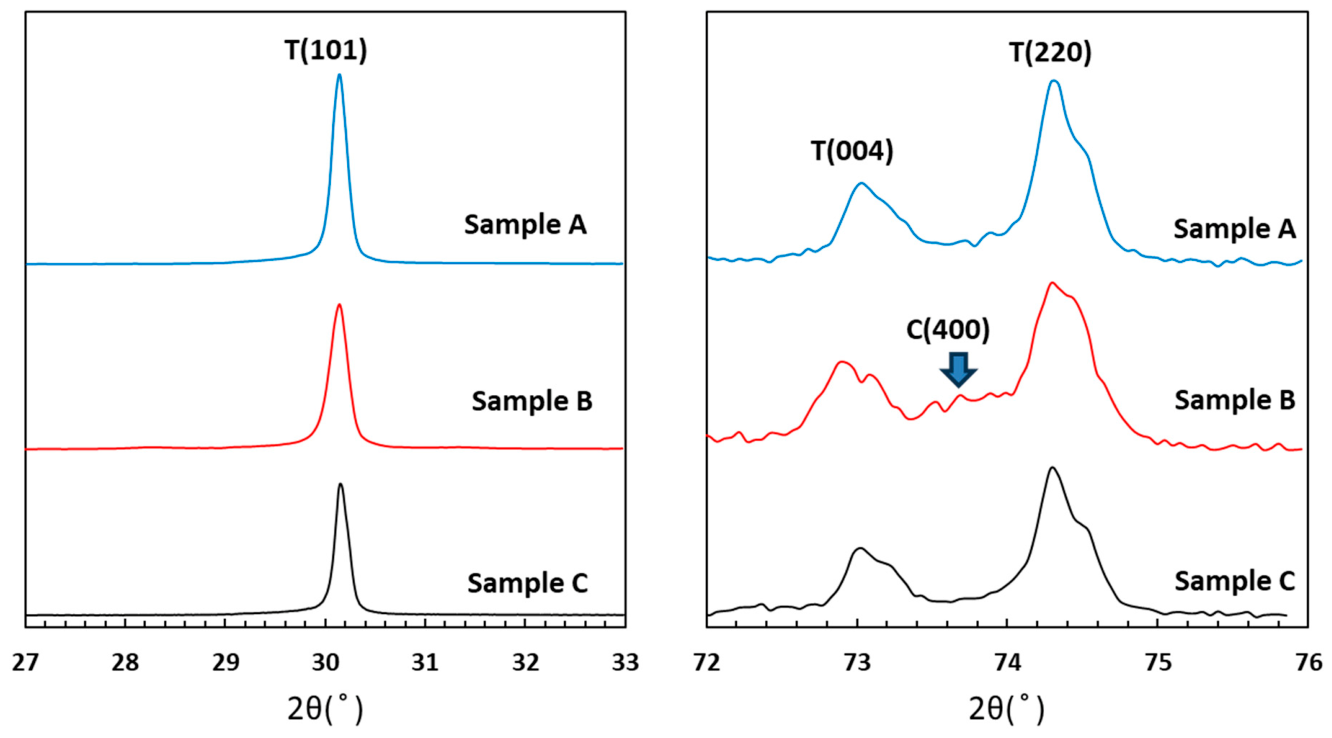
Figure 2 shows the XRD patterns of Samples A, B, and C. The diffraction peaks at 28–32° correspond to the (101) plane of the tetragonal (T) phase, while those at 72–76° correspond to the (004) and (220) planes of the T phase. Samples A and C exhibit only peaks associated with the T phase, indicating that both materials are single-phase. By contrast, Sample B shows an additional peak from the (400) plane of the cubic (C) phase, located between the (004) and (220) T-phase peaks, demonstrating the presence of mixed cubic-phase grains.
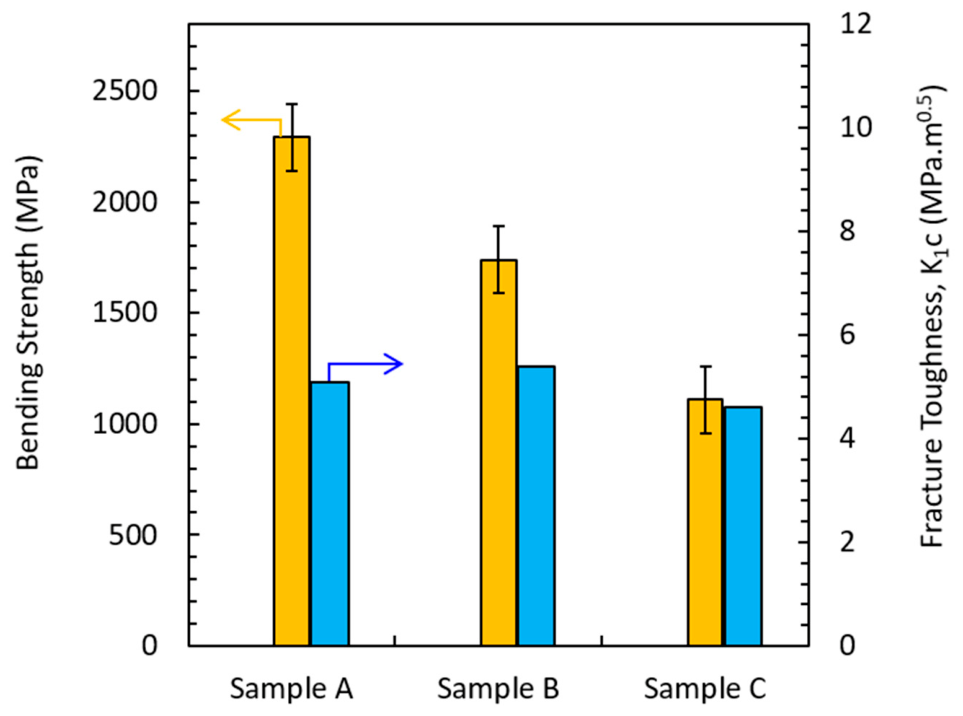
Figure 3 shows the four-point bending strength and fracture toughness of Samples A–C. Sample C exhibits a four-point bending strength of 1.11 GPa (1110 MPa) and a fracture toughness of 4.8 MPa·m
0.5. By contrast, Sample A demonstrates nearly double the bending strength, reaching 2.29 GPa (2290 MPa), while maintaining a comparable fracture toughness. Likewise, although Sample B shows no notable improvement in fracture toughness, its bending strength increases by ~1.7 times (i.e., 1.74 GPa (1740 MPa)) compared to Sample C, even in the presence of mixed cubic phases. The superior mechanical strength of Sample A is likely attributable to the absence of internal microstructural defects, particularly residual pores. Sample B was intentionally included as a reference specimen to demonstrate that, even in virtually pore-free zirconia ceramics, the presence of a small fraction of cubic phase and a slightly larger grain size adversely affect mechanical strength. Although numerous studies have examined the mechanical behavior of 3 mol% Y
2O
3-stabilized zirconia ceramics [
8,
10,
15,
22,
23,
24], no prior report has documented a four-point bending strength as high as 2.29 GPa (2290 MPa). Commercial zirconia ceramics with the same composition, typically evaluated using the three-point bending method, exhibit strengths mostly ranging from 0.9 to 1.2 GPa [
11,
12,
13]. It is remarkable that Sample B still exhibited a bending strength higher than that typically reported for conventional 3Y-TZP ceramics. This result suggests that the elimination of residual porosity is an important factor in achieving high strength, even when a small amount of cubic phase and grain growth remained. Although the correlation between internal defect characteristics and mechanical strength is well-established [
25], this study is distinctive in that it not only investigates residual pores but also clarifies the mechanical behavior of partially stabilized zirconia in which such defects are eliminated.
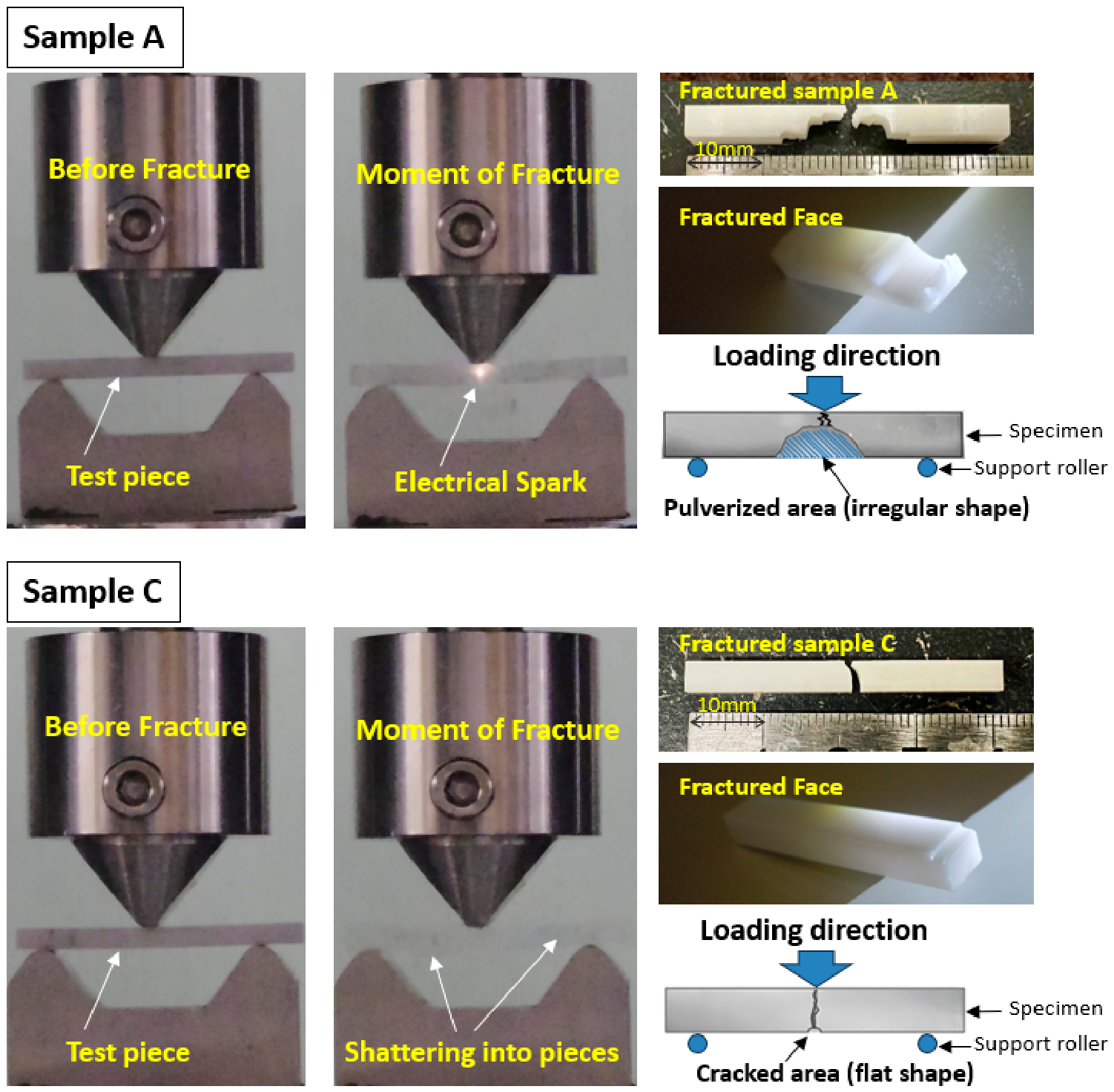
Figure 4 shows video observations of the fracture moment and the post-fracture states of Sample A and Sample C obtained by three-point bending tests. The three-point bending configuration was employed to concentrate fracture initiation near the loading point. Although a specially designed fixture was used to facilitate observation of the fracture event, the curvature radii of the loading and support rods were identical to those specified in JIS R1601. It was also confirmed in advance that the measured bending strengths obtained using this fixture were comparable to those measured under the standard test configuration. In three-point bending tests, Sample A exhibited a bending strength of 2.55 GPa, which is approximately 2.5 times higher than that of Sample C. For Sample C, fracture initiated only in the vicinity of the loading point, and it was fractured into two pieces. At the moment of fracture in Sample A, intense fracto-emission (visible electrical discharge) was clearly observed over a relatively large volume subjected to tensile stress. This region was violently fragmented, followed by scattering of the fractured pieces, indicating a markedly different fracture behavior from that of Sample C. Post-fracture observations also revealed that the volume of the pulverized region was significantly larger for Sample A than for Sample C, as shown in the figure. The markedly superior bending strength of Sample A compared with Sample C is reasonably attributed to the elimination of residual pores (μm to sub μm scale fracture origins). In the absence of such defects, the tensile-stressed region near the support points can extend and accumulate a larger amount of elastic strain energy prior to catastrophic failure. The rapid release of this stored energy during fracture likely results in the dramatic increase in bending strength and the accompanying electrical discharge. The fracture events were recorded using a conventional smartphone camera under ambient lighting conditions. Because the frame rate was limited to 60 fps (frames per second), the captured images do not necessarily correspond to the moment of maximum electrical discharge.
Although many studies have reported the mechanical properties of conventional zirconia ceramics, their strength strongly depends on microstructural factors such as grain size and the size and distribution of defects. Ceramics with finer grains, smaller defect sizes, and fewer fracture sources generally exhibit higher strength. High-resolution SEM and TEM analyses in previous studies have demonstrated dense, uniform microstructures without detectable pores [
26]. However, the same studies have revealed relatively large residual pores when imaged at low magnification during indentation-depth evaluation using the IF method. Thus, for samples with densities lower than the theoretical value, it remains uncertain whether surface observations were sufficiently accurate, and, more critically, internal observations have rarely been conducted. Owing to the absence of definitive evidence regarding internal fracture sources, the highest possible mechanical strength of zirconia has not yet been realized. Even with the near-complete elimination of residual pores achieved in this study, the material cannot yet be considered to possess “ultimate” strength. Following the removal of microstructural defects at the μm to sub-μm scale in this study, the next challenge is to eliminate nanoscale and atomic-scale defects, such as grain-boundary segregation of alumina (added as a sintering aid) or yttria (used as a stabilizer). Addressing these issues will be essential for revealing the true ultimate mechanical performance of zirconia ceramics.
When microstructural defects such as residual pores are eliminated, fracture occurs either along grain boundaries or within grains. In both cases, cracking initiates at dislocations, atomic-scale defects, or through the rupture of Zr–O bonds in zirconia, particularly the covalent electron pairs. This bond rupture may emit electrons from the disrupted covalent structure.
As shown in
Figure 4, the fracture surface of Sample C appears relatively smooth. By contrast, the region near the fracture surface of Sample A exhibits complex fracture patterns, with the fragmented pieces reduced almost to powder. This contrast suggests differences in the stress state experienced by each material immediately before fracture.
The mechanical strength commonly reported for 3 mol% Y2O3:ZrO2 ceramics is ~0.8 GPa in four-point bending (~1.2 GPa in three-point bending). However, these values represent ceramics that still contain micrometer-scale defects, such as residual pores, and therefore do not reflect the inherent or ultimate strength of partially stabilized zirconia. Herein, specimen surfaces for the bending test were ground with #200 abrasive grit, producing surface scratches tens of micrometers in depth. Because these scratches, similar to residual pores, can act as fracture origins, further strength enhancement may be possible with additional surface polishing.
In conventional 3 mol% Y
2O
3:ZrO
2 ceramics, fracture typically initiates from residual pores that act as fracture origins, and cracks propagate progressively from these defects. Because the fracture front (i.e., the emission source) advances locally and sequentially along the crack propagation path, the associated light emission is generally weak. The author previously confirmed this behavior by high-speed camera observations conducted in a dark room. Electrical discharges from Sample C (with a bending strength of ~1 GPa) and from commercially available 3 mol% Y
2O
3:ZrO
2 ceramics could be detected at 4000 fps; however, only very weak signals were obtained. Photon emission associated with the fracture of oxide ceramics such as MgO, Al
2O
3, and ZrO
2 has been reported previously by Shiota et al. [
27,
28], but the emission is typically very weak and can only be detected under dark conditions. According to their report, commercially available zirconia ceramics exhibit extremely short emission durations, typically less than about 1 ms, and the emission intensity is also very low.
Thus, this study, which removes all structural defects except those at grain boundaries, provides a foundation for future investigations into how grain-boundary structure governs mechanical strength. The results also demonstrate that high-performance optical ceramics, comparable to or exceeding the performance of single-crystal materials, can be achieved by eliminating scattering centers, such as residual pores and inclusions, and by producing clean grain boundaries. Pores and inclusions constitute microstructural defects at the micrometer to sub-micrometer scale and act as optical scattering centers. At the same time, grain-boundary phases and dislocations represent defects at the nanometer to atomic scale. Similarly, the complete removal of residual pores is essential for improving the performance of engineering ceramics. Precise control of grain-boundary phases and dangling bonds at the nanometer to atomic scale, facilitated by appropriate sintering aids, will therefore become increasingly important.