Article

Grain Versus Grain-Boundary Contributions to Thermal Conductivity in Prospective Oxide Ceramics for Next-Generation Thermal Barrier Coatings


by
Roman Aleksandrovich Shishkin
Institute of Solid State Chemistry of the Ural Branch of the Russian Academy of Science, Yekaterinburg 620990, Russia
Ceramics 2026, 9(5), 52; https://doi.org/10.3390/ceramics9050052
Submission received: 22 April 2026 / Revised: 12 May 2026 / Accepted: 18 May 2026 / Published: 21 May 2026
(This article belongs to the Special Issue Ceramic and Glass Material Coatings)

Abstract

Thermal barrier coatings (TBCs) require materials with intrinsically low thermal conductivity and high grain-boundary thermal resistance to maximize the temperature gradient across the top coat. In this work, the effective thermal conductivity of more than 40 prospective TBC oxides belonging to seven structural families (YSZ/YSH, pyrochlores/fluorites A2B2O7, defective fluorites A3BO7, fergusonite/monazite ABO4, and perovskites ABO3) was systematically deconvoluted into intrinsic grain thermal conductivity (kgrain) and grain-boundary (Rgb) contributions. It is shown that grain-boundary Kapitza resistance dominates heat transport in virtually all advanced oxides, contributing 60–90% to the total thermal resistance of polycrystalline samples. The lowest kgrain values (4–12 W m−1 K−1) are found for cerates and certain tantalates, while the highest Rgb (up to 7.2 × 10⁻⁶ m2 K W−1) are characteristic of high-entropy and heavily doped perovskites. Orthorhombically distorted SrCeO3-based and high-entropy perovskites combine moderate kgrain (4.7–27.9 W m−1 K−1), high Rgb, and tunable thermal-expansion coefficients (10–13 × 10−6 K−1), making them the most promising candidates for next-generation TBCs. These findings provide a rational basis for microstructure engineering and composition design aimed at maximizing the temperature drop across TBC layers while maintaining phase stability and CMAS resistance.

1. Introduction

Thermal barrier coatings (TBCs) constitute a critical protective system for the hot-section components of gas-turbine engines, mitigating the combined effects of extreme temperatures, oxidation, and corrosive degradation [1,2]. Typical TBC architectures consist of a metallic bond coat and an overlying ceramic top coat [3]. The bond coat prevents oxidation of the underlying nickel-based superalloy substrate while accommodating the mismatch in coefficients of thermal expansion (CTE) between the substrate and the ceramic layer. The ceramic top coat, in turn, provides the primary thermal insulation, enabling surface temperatures to exceed 1500 °C while sustaining through-thickness thermal gradients of up to 300 °C [4,5]. Selection of an optimal top-coat composition therefore remains one of the most pressing technological challenges in advanced turbine-engine design.
For more than four decades, the industry-standard top-coat material has been 6–8 mol.% yttria-partially stabilized zirconia (YSZ). This material offers a favorable combination of low thermal conductivity (1.6–2.5 W m−1 K−1 at 1000 °C), a CTE of 10.4–11.0 × 10⁻⁶ K−1, and high hardness (13–15 GPa). Nevertheless, prolonged exposure above 1200 °C triggers a series of detrimental phase transformations (t′ → t + c → m) that produce an approximately 4% volume expansion, promote sintering, and sharply increase thermal conductivity. In addition, YSZ exhibits pronounced susceptibility to corrosion by molten calcium–magnesium–alumino-silicate (CMAS) deposits [6].
Consequently, intense research efforts have focused on alternative ceramic systems that satisfy the stringent TBC requirements: melting temperature > 2000 °C, dense-ceramic thermal conductivity ≤ 2.5 W m−1 K−1 (corresponding to 0.9–1.2 W m−1 K−1 in the sprayed or sintered coating), phase stability over 25–1500 °C, CTE in the range 10–15 × 10−6 K−1, low oxygen-ion conductivity, high CMAS resistance, and fracture toughness > 1.0 MPa m1/2 [1,2,5]. Promising candidate materials include:
  • rare-earth (RE = La–Gd) pyrochlores RE2Zr2O7 and RE2Hf2O7 (RE = La–Gd) [7,8], which combine intrinsically low thermal conductivity (0.76–1.8 W m−1 K−1), excellent phase stability, and CTE values up to 12 × 10−6 K−1;
  • fluorite-structured cerates (RE2Ce2O7) and RE3MO7, (M = Nb, Ta) [9,10], offering thermal conductivities of 1.2–1.7 W m−1 K−1 and CTEs of 11.7–12.2 × 10⁻⁶ K−1;
  • fergusonite-type REMO4 (M = Ta, Nb) [11,12] phases exhibiting exceptionally low thermal conductivity (0.8–1.5 W m−1 K−1) together with superior CMAS resistance;
  • rare-earth silicates RE2SiO5 and RE2Si2O7 [13] (thermal conductivity ≈ 1.5–2.0 W m−1 K−1, albeit with somewhat lower CTEs);
  • perovskite oxides (SrCeO3, BaZrO3 and their solid solutions) [14], with CTEs of 11.6–12.4 × 10⁻⁶ K−1 and thermal conductivities of 1.2–3.5 W m−1 K−1;
  • magneto plumbite aluminates (e.g., LaMgAl11O19) [15] and phosphates REPO4 [16] displaying enhanced hardness and phase stability;
  • high-entropy ceramics (HECs) based on multicomponent pyrochlores, fluorites, perovskites, and tantalates, in which configurational entropy simultaneously stabilizes the structure, intensifies phonon scattering, and yields thermal conductivities comparable to those of amorphous solids (0.8–1.5 W m−1 K−1), while improving hardness and sintering resistance [4,17].
Despite substantial progress in synthesis and deposition techniques—atmospheric plasma spraying (APS), suspension plasma spraying (SPS), electron-beam physical vapor deposition (EB-PVD), and plasma spray–physical vapor deposition (PS-PVD)—the effective thermal conductivity of both real TBCs and laboratory-sintered specimens remains strongly microstructure-dependent. Porosity, pore morphology, and especially grain size exert decisive influence [18,19,20]. In polycrystalline ceramics the measured (effective) thermal conductivity is the net result of two distinct contributions: (i) the intrinsic lattice (grain) thermal conductivity kgrain, which approaches the single-crystal value, and (ii) the additional thermal (Kapitza) resistance at grain boundaries, Rgb. The latter increases markedly with decreasing grain size owing to enhanced phonon scattering and interfacial disorder [21,22,23].
Reliable ranking of candidate TBC materials therefore requires quantitative separation of kgrain from Rgb across a broad spectrum of chemistries. Only such a decomposition eliminates confounding microstructural artifacts and identifies compounds that combine the lowest possible intrinsic grain conductivity with a grain-boundary resistance that remains technologically acceptable. This information is essential for maximizing the temperature drop across the coating and thereby raising overall gas-turbine efficiency.
The objective of the present study is to apply established mathematical frameworks—principally effective-medium models that treat grain boundaries as discrete thermal resistors in series with the grain interiors—to extract kgrain and Rgb for a wide range of next-generation TBC ceramics. The work is devoted to a systematic re-analysis and synthesis of published data. Systematic comparison of these intrinsic parameters will enable identification of the most promising materials for future high-performance thermal barrier coatings.

2. Materials and Methods

2.1. Initial Materials Selection

The complete list of prospective TBC oxides, together with synthesis and sintering conditions, is presented in Table 1. All materials and the associated microstructural and phase-purity data originate from previously published studies; the present work performs a systematic re-analysis of their thermal-transport properties. The following abbreviations are used: SSR is solid state reaction; SCS is solution combustion synthesis, CP and CIP are cold uniaxial and isostatic pressing correspondingly, SPS is spark plasma sintering.

2.2. Correction for Sample Porosity

The present study employs previously reported experimental thermal-conductivity data obtained both by the authors [31,32,34], and by leading international research groups active in the field of thermal barrier coatings. In cases where the original publications did not apply a porosity correction to the measured effective thermal conductivity keff, the Maxwell–Eucken effective-medium model for a continuous solid matrix containing dispersed spherical pores was used. This model relates the effective conductivity keff of the porous body to the intrinsic conductivity of the solid phase ks, the conductivity of the pore phase kp, and the pore volume fraction φ.
k e f f = k s · k p + 2 k s + 2 φ · k p k s k p + 2 k s φ · k p k s
When the pores are thermally insulating (kp << ks), which is a valid approximation for oxide ceramics at moderate temperatures where kp ≈ 0, the equation simplifies to
k e f f = k s · 2 1 φ 2 + φ
The conductivity of the fully dense (pore-free) material ks is then obtained by rearrangement of the Formula (2). The Maxwell–Eucken model is strictly valid for low porosity (φ < 0.15) and has been shown to provide excellent agreement with experimental data for porous oxide ceramics.
Although the Maxwell–Eucken model is formally most accurate for low porosity, it has been extensively and successfully applied in the TBC literature to oxide ceramics with porosities up to 30–35%. In the present study the large majority of samples exhibit φ ≤ 0.10; for the small subset of higher-porosity high-entropy compositions the calculated dense-body conductivities ks should be regarded as conservative estimates. Because the fractional grain-boundary contribution fgb is relatively insensitive to a uniform scaling of ks, the principal conclusions of the work remain robust irrespective of moderate variations in the porosity-correction scheme.

2.3. Calculation of Grain-Boundary Thermal Resistance

In polycrystalline ceramics, grain boundaries introduce an additional interfacial (Kapitza) thermal resistance Rgb arising from phonon scattering. This resistance reduces the overall effective thermal conductivity. The Kapitza-resistance model treats each grain boundary as an infinitesimally thin layer possessing a discrete thermal resistance. After correcting the measured keff. for porosity to obtain the dense-body conductivity ks, the total thermal resistance of the polycrystal is expressed as the sum of the intrinsic grain resistance and the cumulative resistance of the grain boundaries [23].
1 k s = 1 k g r a i n + n R g b =   1 k g r a i n + R g b d
where kgrain is the intrinsic thermal conductivity of the grain interior, W·m−1·K−1; n is the number of grain boundaries intersected per unit length of heat-flow path, m−1, and d is the average grain size, m, so that n ≈ 1/d for equiaxed grains. Here Rgb represents the specific Kapitza resistance of an individual grain boundary; the number of boundaries intersected per unit length of heat flow is n ≈ 1/d. The model is grounded in classical phonon-transport theory and has been extensively validated by both experimental measurements and atomistic simulations for a wide range of oxide ceramics [22].
Rearrangement shows that grain size directly influences the measured conductivity: smaller grains increase the density of boundaries and therefore lower keff. Under the physically reasonable assumptions that (i) Rgb is temperature-independent in the range ≈ θD/2 to θD (where θD is the Debye temperature) and (ii) phonon–phonon (Umklapp) scattering dominates the intrinsic grain conductivity, one obtains kgrain~1/T. Substituting this temperature dependence yields:
1 k s = a T + n R g b
where a is a material-specific constant. Consequently, a plot of 1/ks versus temperature T is linear. The slope provides 1/a (hence kgrain at any chosen temperature, conventionally 300 K), while the intercept directly gives the grain-boundary contribution nRgb (and thus Rgb once d is known). Both quantities are therefore extracted graphically with high reliability.
Uncertainties in the extracted parameters were estimated by propagating the dominant sources of error. The 5.25% systematic uncertainty in Cp (Mustafa method) contributes ≈ ±5–7% to both kgrain and Rgb. Additional minor contributions to uncertainty arise from (i) grain-size determination (±10–20% typical for SEM-derived average d), (ii) porosity correction via the Maxwell–Eucken model (±2–5% for φ < 0.15), and (iii) scatter in the 1/ksT regression (standard error of the fit, typically ±3–8%). Overall combined relative uncertainties are therefore estimated as ±8–12% for kgrain and ± 10–15% for Rgb.
To quantify the relative contribution of grain-boundary thermal resistance to the overall thermal resistivity of the polycrystalline ceramics, the fractional grain-boundary contribution (fgb) was calculated according to the relation:
f g b = n R g b 1 / k s = 1   k s k g r a i n

2.4. Calculation of Specific Heat Capacity

Specific heat capacities Cp of the oxide systems under consideration were calculated using two independent additive approaches suitable for complex oxides. The Neumann–Kopp (NK) rule (simple molar additivity of the constituent binary oxides) and the Mustafa (M) polynomial method were both implemented via the well-established empirical polynomial form:
C p = a + b · 10 3 T + c · 10 6 1 T 2 + d · 10 6 T 2
where the coefficients a, b, c, and d for the Neumann–Kopp evaluation were taken from standard thermodynamic compilations [36] and those for the Mustafa method were adopted directly from the corresponding reference [37]. The two methods provide mutually consistent values over the temperature range relevant to thermal-barrier-coating operation and were used interchangeably to ensure robustness of the derived thermal-transport parameters.

3. Results and Discussion

3.1. Assessment of the Accuracy of Specific-Heat-Capacity Calculations

The laser-flash technique is the principal experimental method for determining thermal conductivity at elevated temperatures. It yields the thermal diffusivity α of the specimen; the thermal conductivity k is subsequently calculated from the relation.
k = α ρ C p
where Cp is the specific heat capacity and ρ is the density. Consequently, the reliability of the derived k values is directly governed by the accuracy with which Cp is known.
The temperature dependence of the specific heat capacity of complex oxides is routinely estimated using either the empirical Neumann–Kopp additivity rule [38,39,40] or the Mustafa et al. method, which is also based on molar additivity of the constituent binary oxides [37]. In an earlier study [34], the predictive accuracy of both approaches was validated for two high-entropy perovskite-like oxides by direct comparison with experimental differential scanning calorimetry (DSC) data. The present work extends this assessment to a substantially broader set of perovskite oxides, specifically: SrCe0.95M0.05O3, where M = Y, La, Pr, Sn [31], the solid solution series SrCe1−xSnxO3 [32] and high-entropy compositions SrNi0.2Nb0.2W0.2Ti0.2N0.2O3, where N = Fe, Mn [34].
The mean relative errors obtained with each method are summarized in Table 2. The Mustafa approach consistently provides superior accuracy for these complex multicomponent oxide systems. The Neumann–Kopp rule systematically overestimates Cp, yielding an average positive deviation of 8.43 ± 1.53%, whereas the Mustafa method produces markedly smaller deviations both at room temperature and in the high-temperature regime (T > 800 K). Relative errors were quantified using the standard expression:
δ C p =   C e x p   C t h e o r C e x p · 100 %
where Cexp and Ctheor denote the experimental (DSC) and theoretically predicted specific-heat-capacity values, respectively.
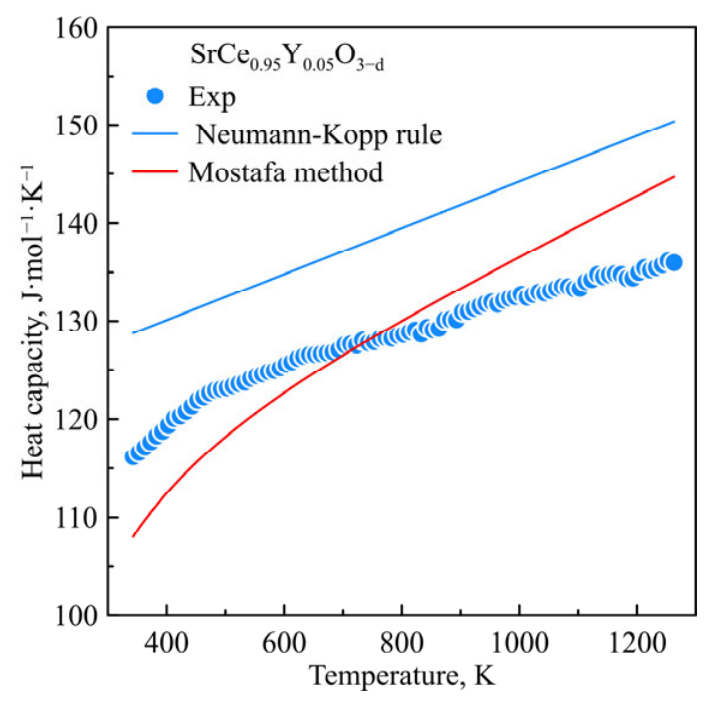
An illustrative comparison of experimental and calculated Cp(T) curves for the representative composition SrCe0.95Y0.05O3−d is presented in Figure 1.
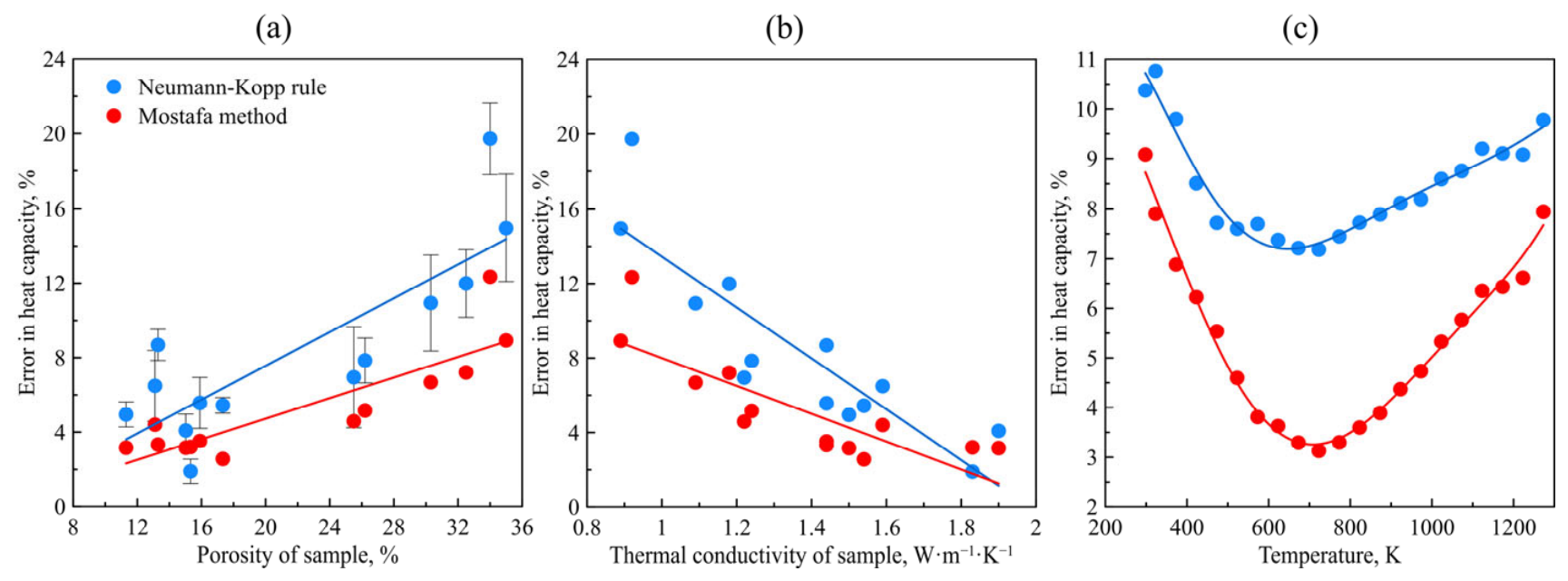
The observed scatter in the error values within individual compositional series is attributable to microstructural effects. High porosity combined with intrinsically low thermal conductivity generates significant temperature gradients across the DSC specimen, thereby distorting the measured Cp values. As shown in Figure 2a,b, the average error exhibits a strong linear correlation with both porosity (Pearson R = 0.858 for Neumann–Kopp and R = 0.826 for Mustafa) and specimen thermal conductivity (R = 0.879 and 0.822, respectively). The dependence of the averaged error on measurement temperature follows a parabolic trend, reaching a minimum in the interval 600–700 K (Figure 2c).
The accurate determination of specific heat capacity Cp is critical to the main objective of the present study—the reliable separation of intrinsic grain thermal conductivity kgrain and specific grain-boundary Kapitza resistance Rgb. In the laser-flash technique, thermal diffusivity α is measured experimentally, whereas thermal conductivity is calculated using the relation (7). Consequently, the quality of Cp(T) directly governs the accuracy of the porosity-corrected conductivity ks, which in turn forms the sole input data for the Kapitza-resistance analysis (linear regression of 1/ks versus temperature). The present section therefore evaluates and validates two additive methods for calculating Cp of complex multicomponent oxides by comparison with experimental DSC measurements, thereby establishing confidence in the subsequent extraction of kgrain and Rgb across all oxide families examined.

3.2. Binary Oxides

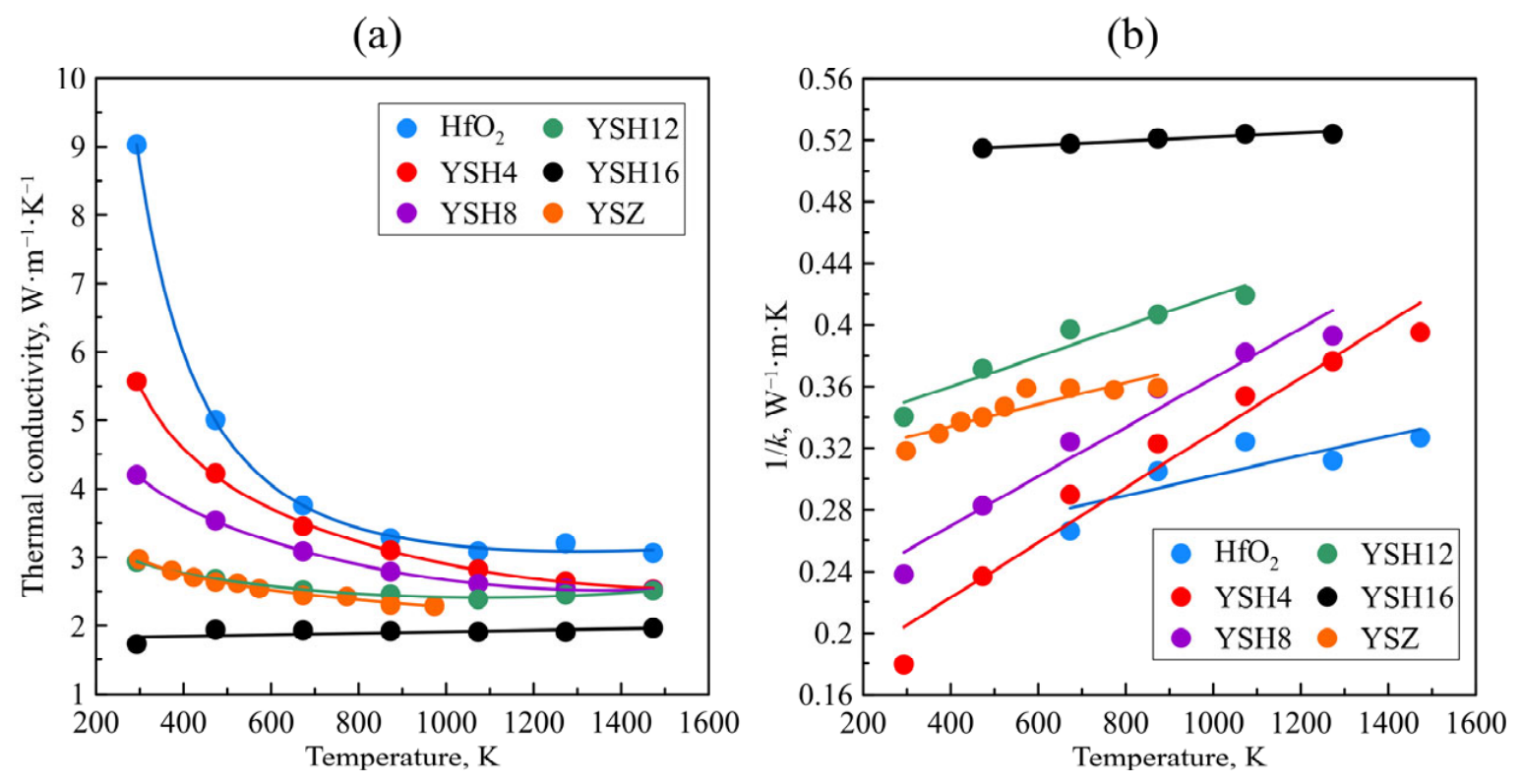
Yttria-stabilized zirconia (YSZ) remains the most widely adopted ceramic top-coat material for thermal barrier coatings. Its closest structural and functional analogue is yttria-stabilized hafnia (YSH). Both systems exhibit intrinsically low thermal conductivity, which originates primarily from the high concentration of oxygen vacancies introduced by the trivalent yttrium dopant. These vacancies act as highly effective phonon-scattering centers. The effect is already pronounced at modest doping levels: incorporation of only 4 mol.% Y2O3 into HfO2 produces a dramatic reduction in thermal conductivity (Figure 3a) [24]. Up to approximately 12 mol.% yttria, the temperature dependence of thermal conductivity retains the characteristic 1/T behavior expected for lattice (phonon) conduction. Further increase in Y3+ content, which substitutes for Hf4+ (or Zr4+), generates additional oxygen vacancies and progressively flattens the conductivity–temperature curve. At the highest doping level examined (YSH16), thermal conductivity becomes essentially temperature-independent. This behavior violates a central assumption of the Kapitza-resistance model and precludes reliable extraction of the intrinsic grain conductivity kgrain and the grain-boundary thermal resistance Rgb within the framework employed here.
Nevertheless, for the majority of compositions the experimental data above the Debye temperature (θD ≈ 700–750 K) are satisfactorily described by a linear relationship in the coordinates 1/k versus T. This permits extraction of kgrain and Rgb with acceptable accuracy (Table 3). The calculated intrinsic grain conductivity for pure HfO2 (51.78 W·m−1·K−1) substantially exceeds the literature value of 11.95 W·m−1·K−1 reported at 300 K for monoclinic HfO2 [41]. A similar, albeit less pronounced, discrepancy is observed for YSZ when compared with experimental data for single-crystal cubic 10YSZ [42] and first-principles calculations (~10 W·m−1·K−1 at 500 K) [43]. However, these figures represent the intrinsic grain conductivity of the stabilized cubic/fluorite phase after rigorous separation of the grain-boundary term. Monoclinic HfO2 literature values (~12 W·m−1·K−1) cannot be directly compared because the phase transformation itself alters phonon dispersion. First-principles calculations and single-crystal measurements for cubic stabilized zirconia confirm room-temperature lattice conductivities of 20–60 W·m−1·K−1 when grain-boundary resistance is negligible, confirming that the present results are physically realistic rather than fitting artifacts.
The dominant mechanism responsible for the reduction in effective thermal conductivity within the Hf1−xYxO2−d system is the systematic increase in grain-boundary thermal resistance Rgb. This finding is fully consistent with established phonon-scattering theories at interfaces (acoustic-mismatch and diffuse-mismatch models). Concurrently, the extracted kgrain appears to rise with increasing yttria content. This trend is not a genuine physical effect but an artifact of the model. At high dopant concentrations, phonon scattering by oxygen vacancies within the grain interiors becomes the prevailing mechanism even above θD/2, thereby violating the fundamental assumption that Umklapp (phonon–phonon) processes dominate and that kgrain ~1/T. Consequently, the linear regression in 1/k versus T coordinates yields systematically overestimated values of kgrain for heavily doped compositions.
Attributing the apparent increase in kgrain to an electronic contribution is physically unjustified. Both YSZ and YSH exhibit negligible electronic conductivity (electronic transference number te ≪ 1), and heat transport remains overwhelmingly lattice (phonon) in character. Application of the Wiedemann–Franz law confirms that the electronic thermal conductivity constitutes only a minute fraction of the total conductivity and cannot account for the observed behavior.
Thus, the series-resistance (Kapitza) model provides a robust description for compositions with moderate yttria doping (up to approximately 8–12 mol.%). For heavily doped materials such as YSH16, however, its application requires caution and must be supplemented by explicit consideration of strong intragranular defect scattering.

3.3. Fluorite and Pyrochlore Oxides A2B2O7

One of the most intensively investigated classes of candidate materials for the ceramic top coat of thermal barrier coatings comprises complex oxides with the general formula A2B2O7 that adopt either the ordered pyrochlore structure (space group Fd3m) or the disordered fluorite-type structure (space group Fm3m). The particular structure realized depends on the ionic-radius ratio r A 3 + / r B 4 + : the ordered pyrochlore phase is stable for rA/rB ≈ 1.46–1.78, while smaller ratios favor the disordered fluorite-like arrangement [44]. Because these two structures share the same nominal chemistry and exhibit closely related phonon-transport mechanisms, they are treated jointly in the present analysis.
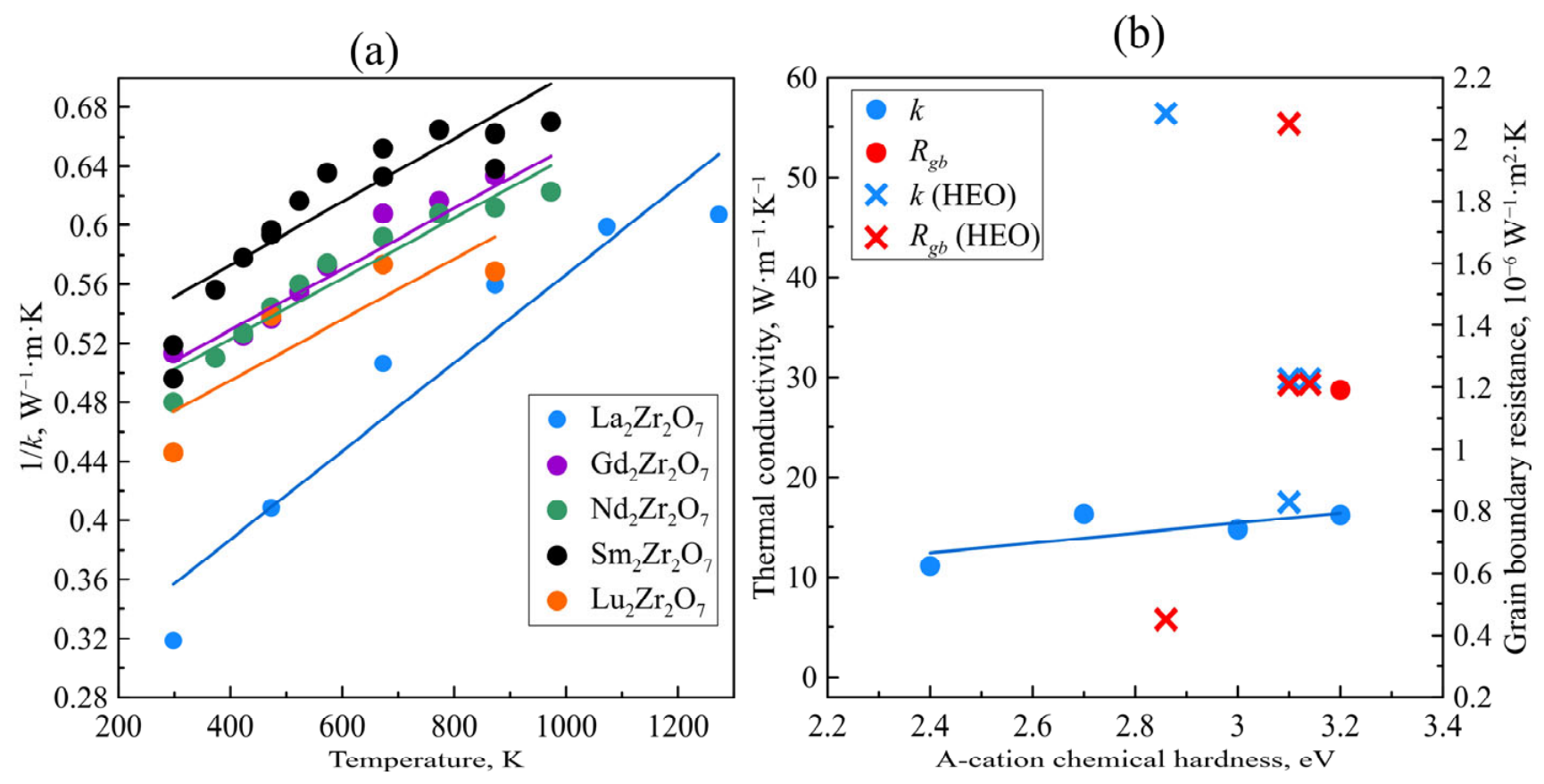
For the rare-earth zirconates RE2Zr2O7 the calculated intrinsic grain thermal conductivity kgrain lies in the range 7–22 W·m−1·K−1. A clear positive correlation exists between kgrain and the chemical hardness of the A-site cation, together with an inverse correlation with its ionic radius (Figure 4b). These trends are fully consistent with phonon-scattering theory: stiffer cations (characterized by higher electronegativity) enhance lattice anharmonicity and thereby shorten the phonon mean free path within the grains. Due to the limited number of available grain-size values for rare-earth zirconates RE2Zr2O7 (RE = La, Gd, Nd, Sm, Lu), it was not possible to establish a quantitative dependence of grain-boundary thermal resistance Rgb on A-site cation properties within this structural family.
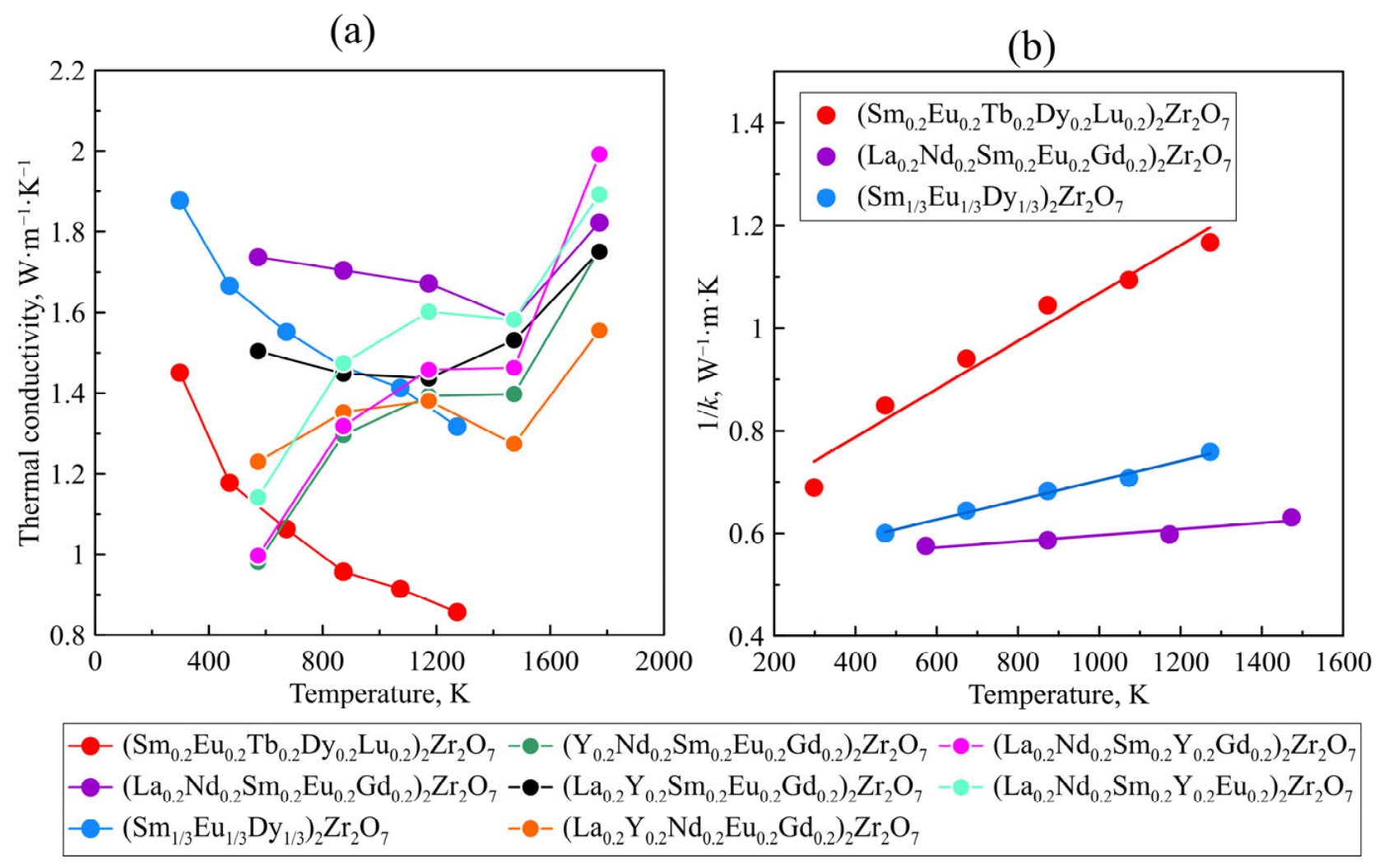
High-entropy oxides (HEOs) within the zirconate family are of particular interest. For many of these compositions the temperature dependence of thermal conductivity is non-monotonic: above approximately 1000–1200 K an anomalous increase in k is observed (Figure 5a). Such behavior is atypical for purely lattice (phonon) conduction and indicates a breakdown of the central assumption of the Kapitza-resistance model (kgrain ∝ 1/T when Umklapp phonon–phonon scattering dominates). Quantitative application of the Wiedemann–Franz law to the measured electrical conductivities of these compositions indicates a minor electronic thermal conductivity contribution of 0.1–0.6 W·m−1·K−1 at 1273 K, sufficient to produce the observed non-monotonic temperature dependence and to cause overestimation of kgrain when the classical lattice model is applied.
The extracted kgrain values for the zirconate HEOs span a wide range from 11.1 to 56.4 W·m−1·K−1 (Table 4), yet virtually all compositions exhibit exceptionally high grain-boundary thermal resistances Rgb (0.45–2.40·10−6 m2·K·W−1). These results corroborate earlier conclusions drawn from Kapitza-resistance studies: in highly disordered, high-configurational-entropy systems the dominant contribution to the suppression of effective thermal conductivity arises from phonon scattering at grain boundaries rather than from intragranular defects [22,45]. Particular attention should be drawn to the anomalously high intrinsic grain conductivity of 56.4 W·m−1·K−1 extracted for (La0.2Nd0.2Sm0.2Eu0.2Gd0.2)2Zr2O7. This value is considered a model artifact arising from the breakdown of the kgrain ∝ 1/T assumption caused by the non-monotonic k(T) behavior observed at elevated temperatures (Figure 5a) and the low specimen density (71.1%). Such deviations are characteristic of highly disordered high-entropy systems and may reflect additional heat-transport mechanisms (e.g., minor electronic or radiative contributions). Accordingly, this datum is excluded from the summary ranges and does not alter the overall conclusion regarding the dominance of grain-boundary resistance.
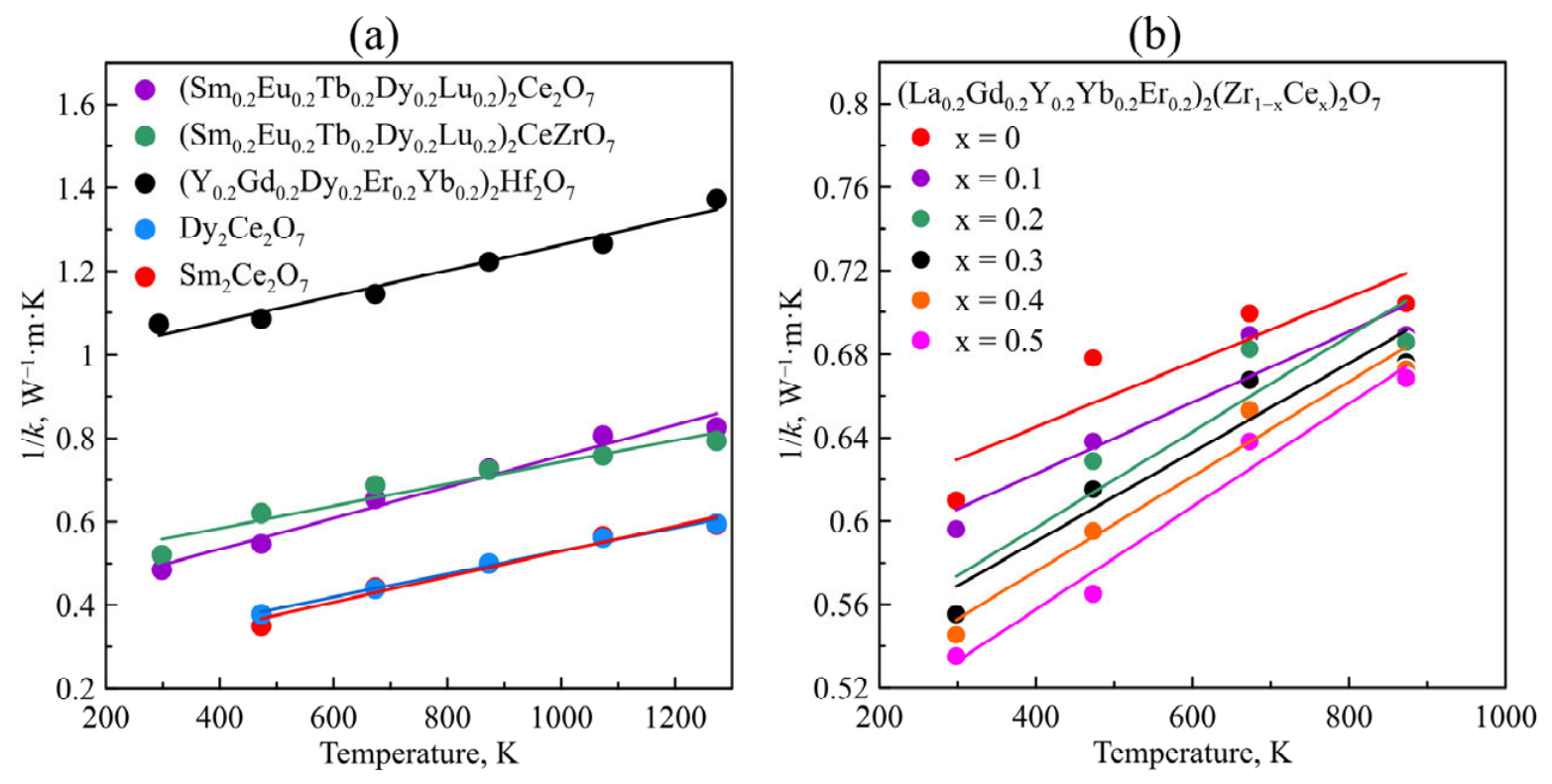
The cerates and hafnates RE2Ce2O7 and RE2Hf2O7 display, on average, slightly lower intrinsic grain conductivities kgrain ≈10–12 W·m−1·K−1 than their zirconate counterparts (Figure 6a). In the solid-solution series RE2(Zr1−xCex)2O7, progressive substitution of Zr4+ (r = 0.72 Å) by the larger Ce4+ (r = 0.87 Å) simultaneously decreases kgrain and increases Rgb (Figure 6b). This effect is attributed to the enhanced lattice disorder produced by the substantial mismatch in cation radius and mass, which intensifies phonon scattering both within the grains and at the grain boundaries.
The complete set of calculated values for the A2B2O7 family is summarized in Table 4.
The results obtained confirm that, in polycrystalline A2B2O7 oxides, the principal mechanism responsible for the low effective thermal conductivity is the exceptionally high grain-boundary thermal resistance Rgb, particularly in high-entropy and extensive solid-solution systems. This insight highlights promising avenues for further optimization of next-generation thermal barrier coatings through deliberate microstructural engineering and compositional tailoring, enabling the attainment of maximal temperature gradients while preserving phase stability across the operating temperature range.

3.4. Defective Fluorite Oxides A3BO7

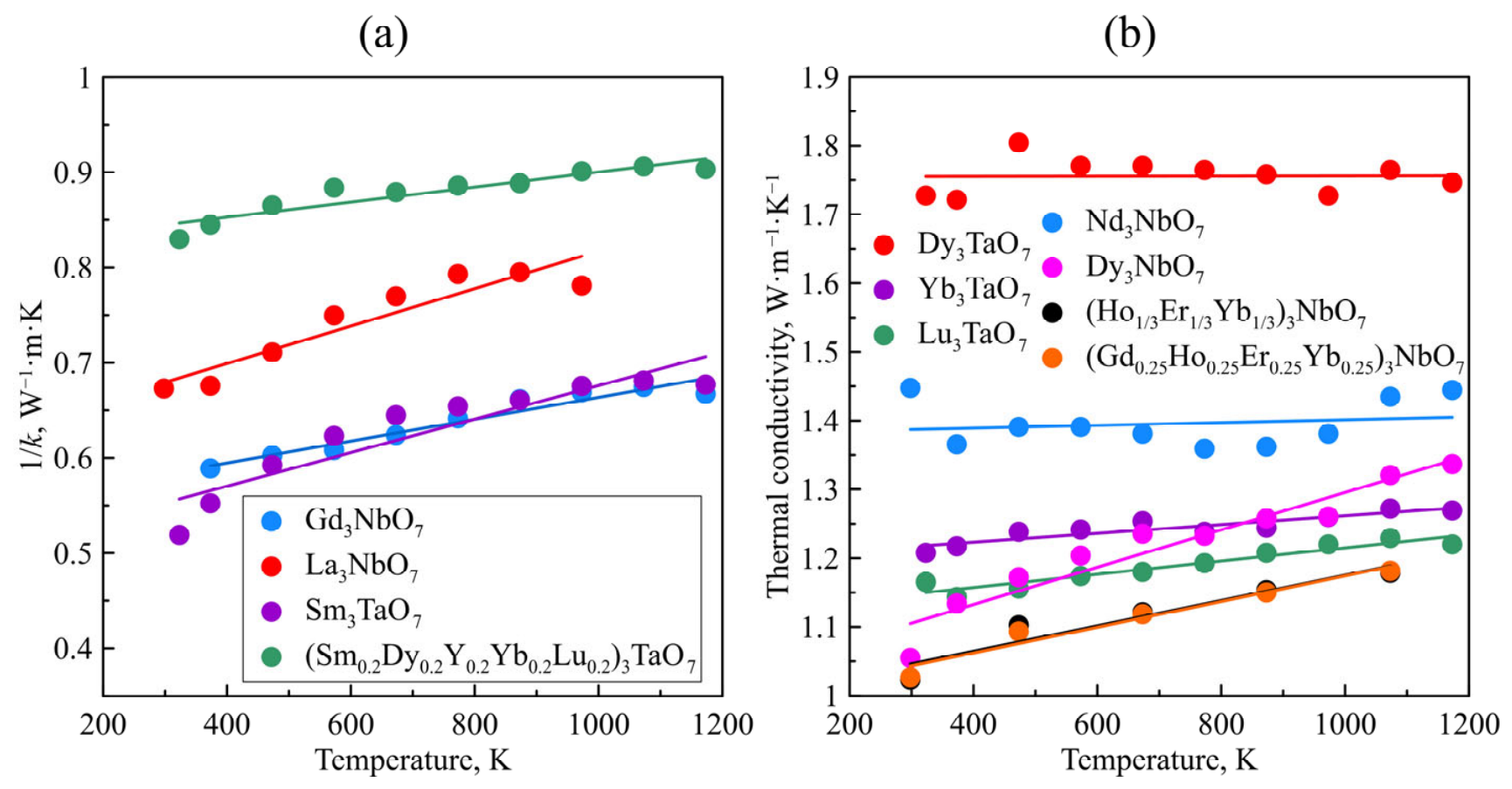
Oxides with the general formula A3BO7 (A = rare-earth element, B = Nb or Ta) crystallize in a defective fluorite-type structure (space group Fm3m with ordered anion vacancies). These compounds are considered promising candidates for thermal-barrier-coating top coats owing to their excellent phase stability over the temperature range 25–1500 °C, comparable to that of the A2B2O7 pyrochlores [9,29]. The high concentration of anion defects (oxygen vacancies) results in intense phonon scattering within the grains, manifested as a nearly temperature-independent thermal conductivity (Figure 7a). Such behavior deviates from the classical lattice (phonon) conduction expected under the central assumption of the Kapitza-resistance model (kgrain ∝ 1/T when Umklapp phonon–phonon processes dominate). Consequently, a straightforward linear regression in 1/k versus T coordinates cannot reliably separate the intrinsic grain conductivity kgrain from the grain-boundary thermal resistance Rgb for these highly defective compositions.
Nevertheless, the extracted kgrain values for the A3BO7 family are systematically higher than those obtained for A2B2O7 pyrochlores and fluorites (Table 5). This difference can be rationalized by three key structural features. First, the cation ratio A:B = 3:1 in A3BO7 yields a lower relative concentration of oxygen vacancies compared with the formally more oxygen-deficient A2B2O7 compounds. Second, the ordered arrangement of vacancies on the B (Nb/Ta) sublattice reduces intragranular phonon scattering relative to the fully disordered pyrochlore lattice. Third, the higher average atomic mass and atomic number of the B-site cations (Nb, Ta) lower the frequencies of optical phonon modes while simultaneously increasing the acoustic contrast, thereby extending the mean free path of low-frequency acoustic phonons within the grains. As a result, the intrinsic single-crystal conductivity remains comparatively high despite the presence of defects. The exceptionally large grain-boundary resistances Rgb (1.64 × 10⁻⁶ m2·K·W−1 for the high-entropy composition) confirm that phonon scattering at grain boundaries constitutes the dominant contribution to the suppression of effective thermal conductivity keff in polycrystalline specimens, in accordance with the diffuse-mismatch model.

3.5. Fergusonite, Monazite, and Related ABO4 Oxides

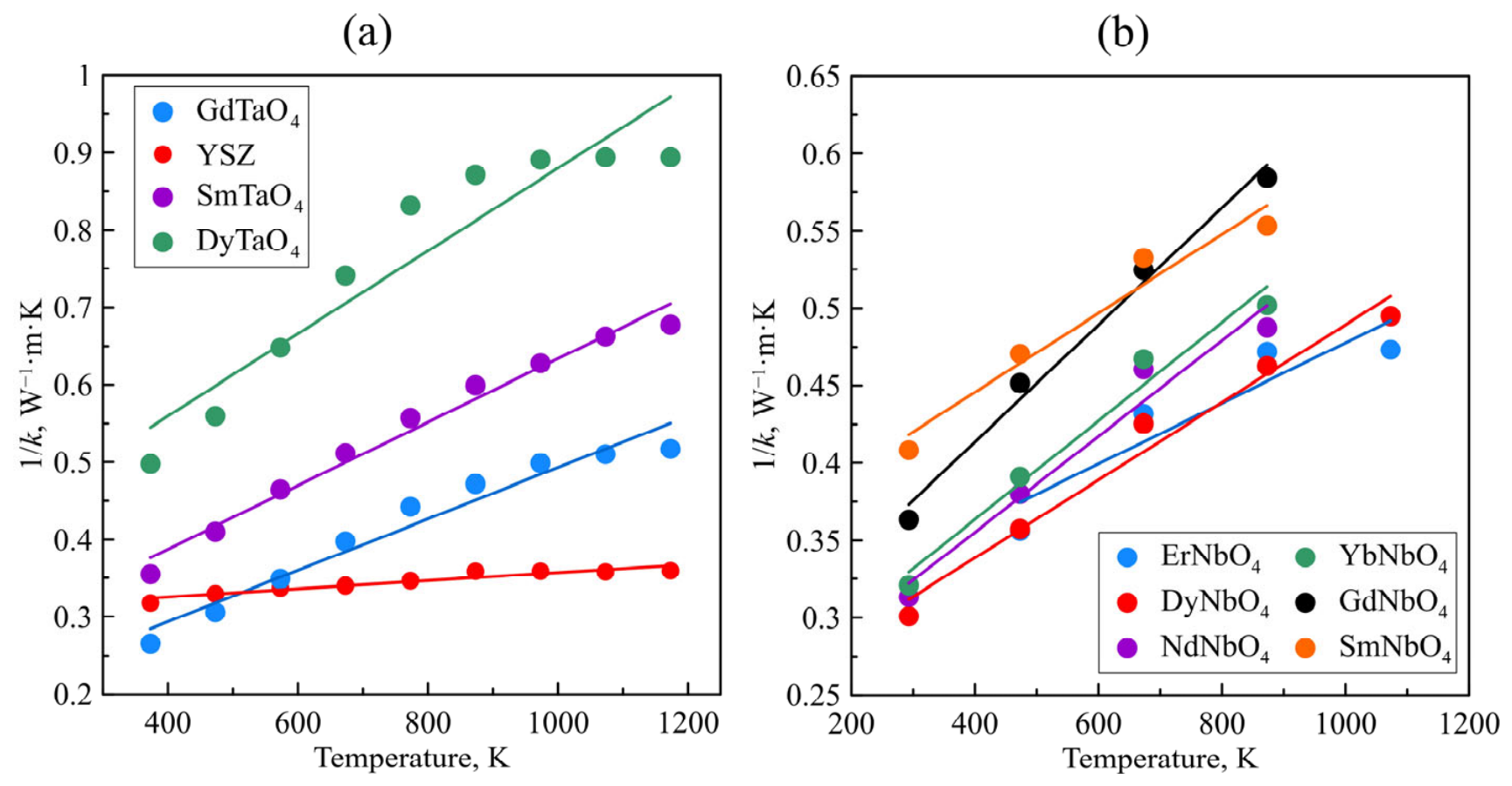
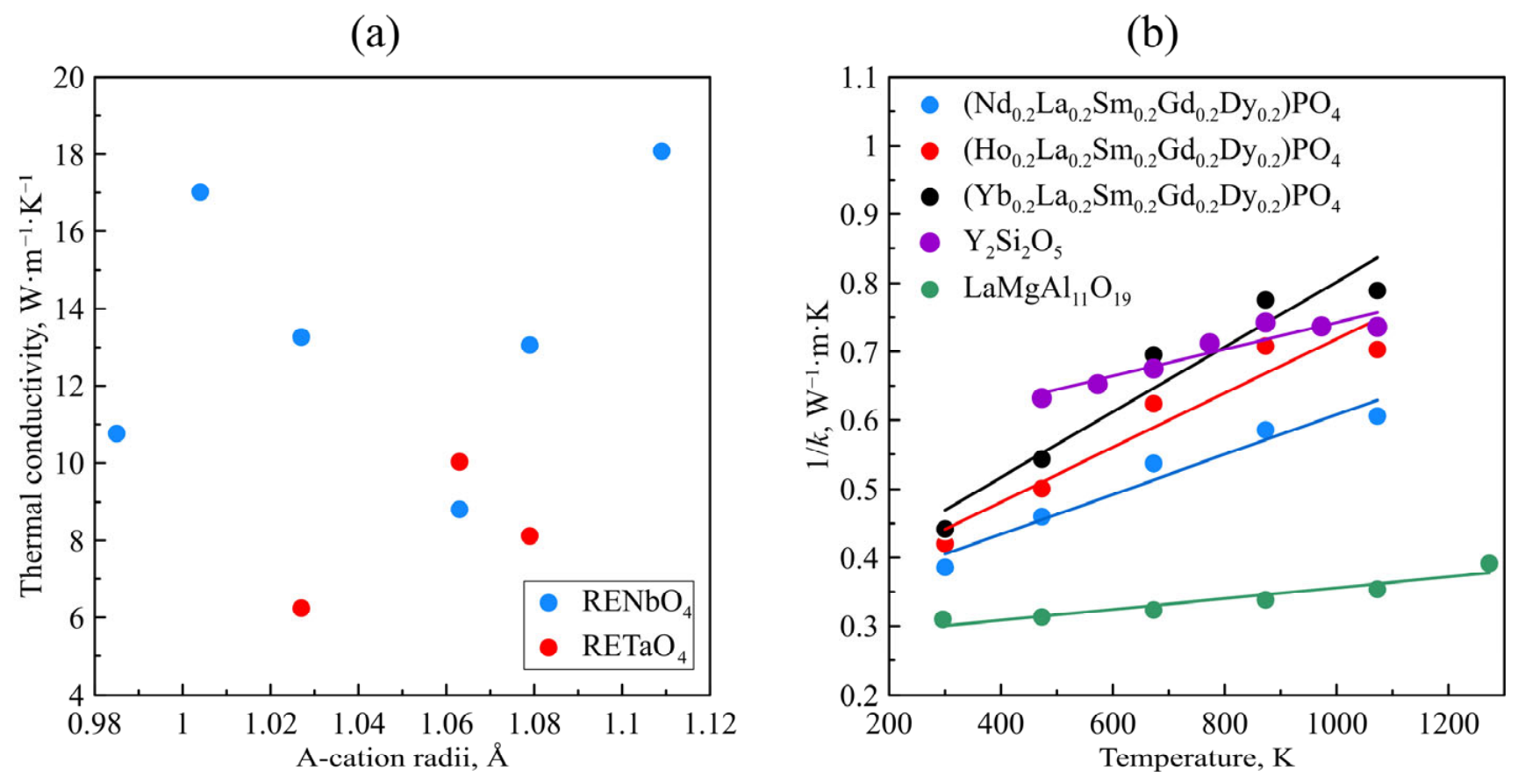
Niobates and tantalates of rare-earth elements with the general formula ABO4 (A = RE) adopt the monoclinic fergusonite structure (space group C2/c), which arises from a distortion of the tetragonal scheelite lattice. These phases exhibit high phase stability up to 1500 °C, superior resistance to CMAS corrosion, and, in most cases, lower thermal conductivity than YSZ, rendering them attractive for next-generation thermal barrier coatings [11,12]. All fergusonites examined display classical phonon-type thermal conductivity with well-defined linear regions in 1/k versus T coordinates (Figure 8), allowing accurate and unambiguous determination of both kgrain and Rgb [11,12].
For the niobates RENbO4 an inverse dependence of kgrain on the ionic radius of the A-site cation is observed (Figure 9a): larger rA increases the average atomic mass and lowers optical-phonon frequencies, thereby intensifying phonon scattering [13,15,16]. An analogous trend is expected for the tantalates RETaO4, although the limited dataset precludes a statistically robust correlation. Despite the similar ionic radii (r(Nb5+) ≈ r(Ta5+) ≈ 0.64 Å) and electronegativities of niobium and tantalum, the intrinsic grain conductivities of the tantalates are systematically lower than those of the niobates (Table 6). This difference originates from the substantially greater atomic mass of tantalum (180.9 u versus 92.9 u for niobium), which reduces acoustic-phonon velocities, lowers the Debye temperature, and enhances lattice anharmonicity and phonon–phonon scattering. Thus, the heavier B-site cation (Ta) more effectively suppresses kgrain without appreciably altering Rgb.
Oxides ABO4 that crystallize in the monoclinic monazite structure (P21/n)—including the phosphates REPO4, as well as certain silicates (e.g., Y2Si2O5) and aluminates (LaMgAl11O19)—are also regarded as promising. Their primary limitation for TBC top-coat applications is a relatively low coefficient of thermal expansion; however, this property makes them well suited for environmental barrier coating (EBC) layers. The phosphates exhibit low intrinsic thermal conductivity combined with very high grain-boundary resistances Rgb (1.60–3.10 × 10⁻⁶ m2·K·W−1). These elevated values arise from the complex (PO4)3− anionic groups, which induce strong phonon scattering at grain boundaries, and from the low structural symmetry, which introduces additional interfacial resistance through thermal-conductivity anisotropy.
The data presented demonstrate that, across the A3BO7 defective fluorites and ABO4 fergusonite/monazite families, grain-boundary thermal resistance remains the primary mechanism governing the reduction in effective thermal conductivity of polycrystalline ceramics. This finding underscores the potential for targeted microstructural design—particularly grain-size refinement and controlled defect engineering—in the development of next-generation thermal barrier coatings.

3.6. Perovskite Oxides ABO3

Perovskite oxides with the general formula ABO3 (A = alkaline-earth or rare-earth cation, B = transition-metal cation) constitute one of the most structurally versatile classes of complex oxides for thermal-barrier-coating applications. The extensive possibilities for isovalent and aliovalent substitution on both the A- and B-sites enable precise tuning of the coefficient of thermal expansion (CTE), phase stability, CMAS corrosion resistance, and, crucially, thermal conductivity. Particular attention has been devoted to orthorhombically distorted perovskites (space group Pnma), in which lattice distortions introduce additional phonon scattering through reduced symmetry and enhanced anharmonicity. Among these, strontium cerate SrCeO3 and its solid solutions stand out for their intrinsically low thermal conductivity combined with an acceptable CTE [31,32,46].
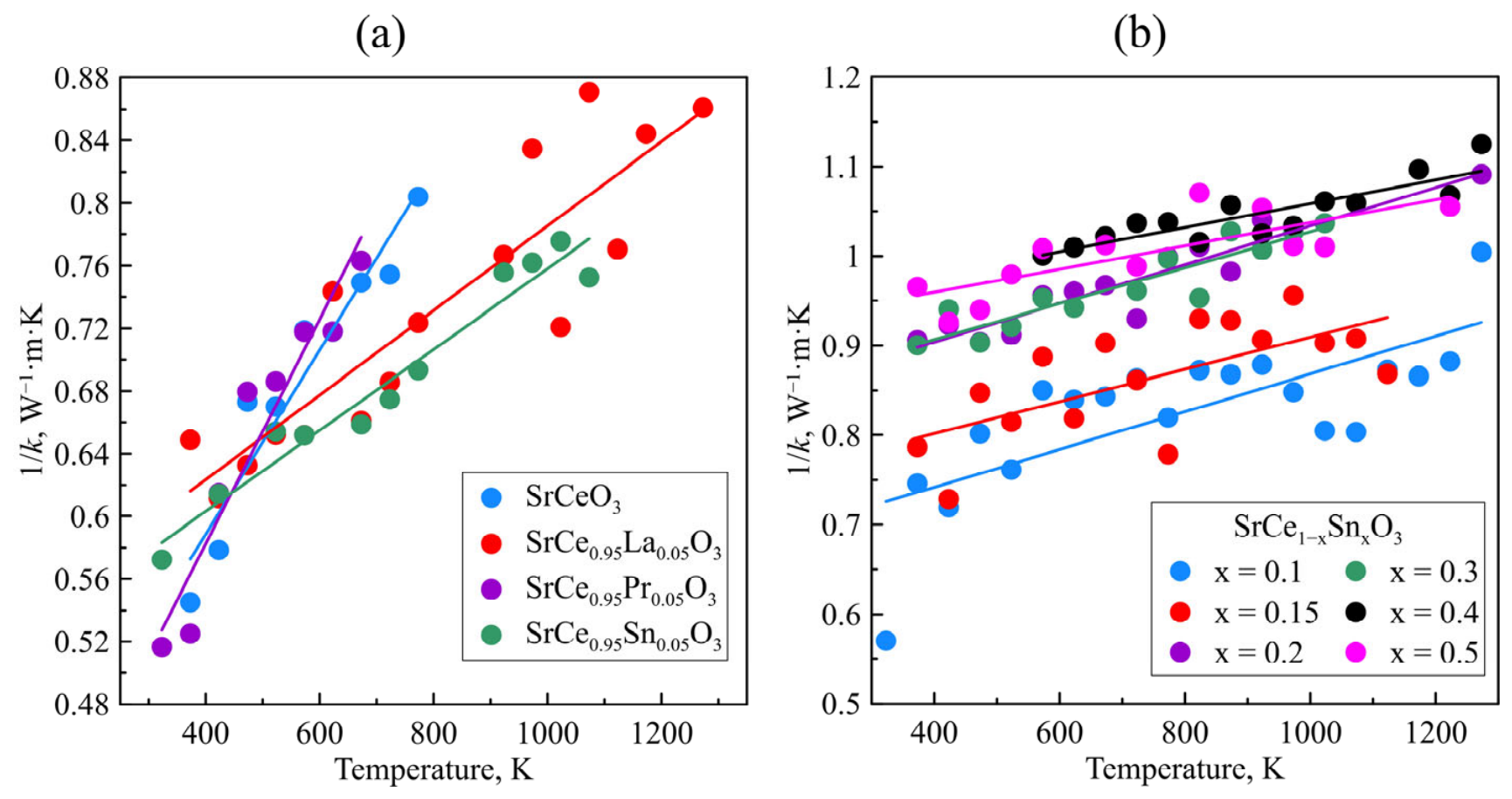
The intrinsic grain thermal conductivity of single-crystal SrCeO3 is kgrain = 5.7 W·m−1·K−1 (Table 7), in excellent agreement with first-principles calculations [46]. This low value arises from intense phonon scattering by oxygen vacancies and the orthorhombic lattice distortion. The grain-boundary thermal resistance is also substantial (Rgb = 2.09 × 10⁻⁶ m2·K·W−1, which is a feature typical of perovskites possessing significant ionic conductivity. Light doping (5 mol.%) with La3+, Pr3+ or Sn4+ leaves kgrain essentially unchanged (12.4–12.9 W·m−1·K−1) but increases Rgb up to 4.35 × 10⁻⁶ m2·K·W−1 (Figure 10a). This enhancement is attributed to the local accumulation of oxygen vacancies near grain boundaries, which amplifies interfacial phonon scattering in accordance with the diffuse-mismatch model.
Progressive substitution of Ce4+ by Sn4+ (x = 0.1–0.5) simultaneously raises both kgrain (reaching 27.9 W·m−1·K−1 at x = 0.1) and Rgb (up to 7.74 × 10⁻⁶ m2·K·W−1). Several mechanisms underlie this behavior: the smaller ionic radius of Sn4+ (r = 0.69 Å) relative to Ce4+ (r = 0.87 Å) contracts the unit-cell volume, increasing acoustic-phonon frequencies and thereby reducing intragranular scattering (higher kgrain); concurrently, the greater mismatch in cation mass and radius intensifies local lattice distortion at grain boundaries (higher Rgb); and at high Sn contents, partial vacancy ordering may further suppress phonon–phonon scattering inside the grains (Figure 10b). Consequently, Sn doping offers a powerful means of fine-tuning the relative contributions of kgrain and Rgb, although careful microstructural control is required to avoid excessive grain growth.
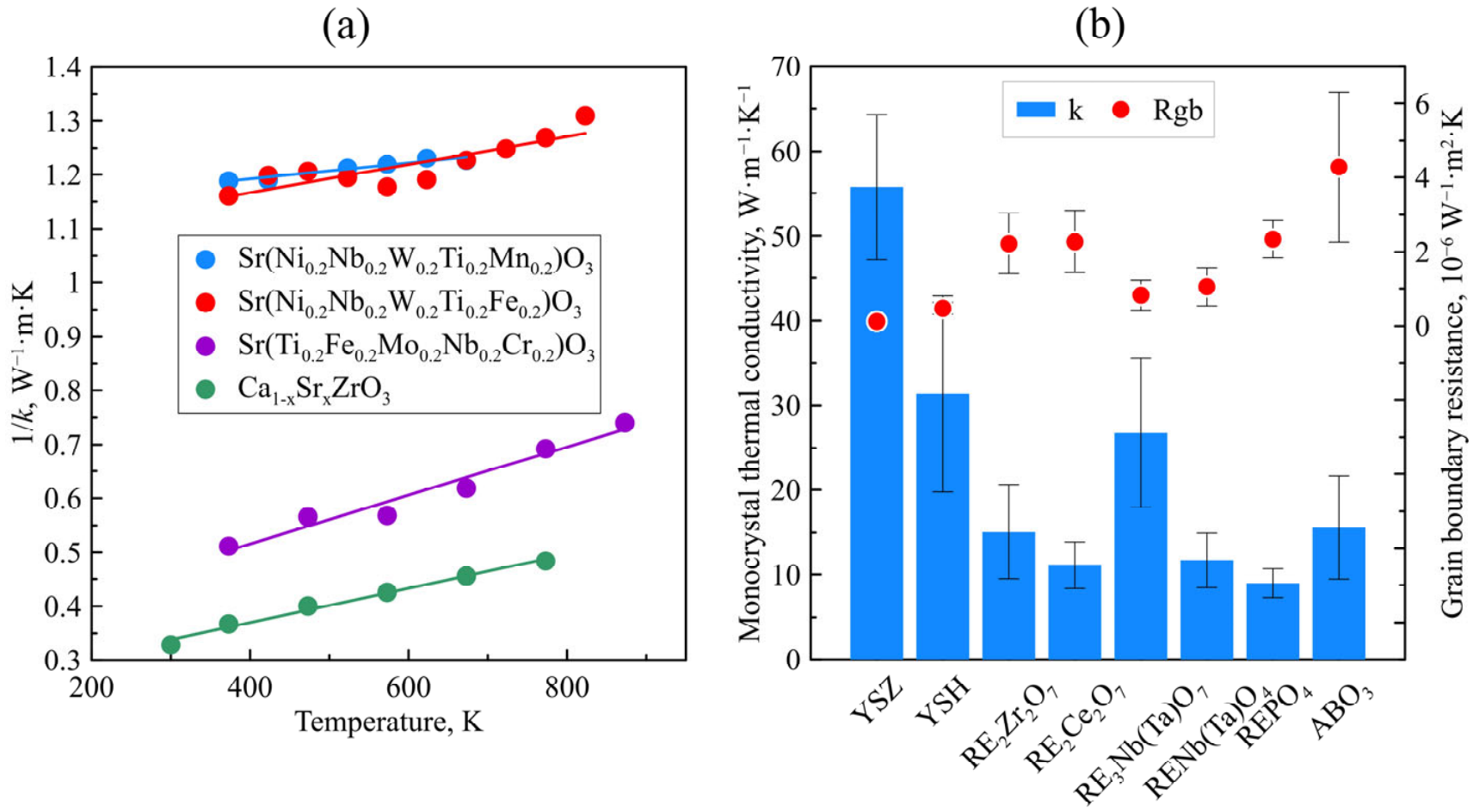
High-entropy perovskites exhibit thermal conductivities comparable to those of conventional compositions (Figure 11a). The low effective thermal conductivity keff is achieved predominantly through suppression of grain growth (high configurational entropy stabilizes a fine-grained microstructure) and exceptionally high grain-boundary resistances Rgb (2.0–7.74 × 10⁻⁶ m2·K·W−1), rather than through extremely low intrinsic kgrain (Figure 11b). The combination of orthorhombic distortions and multicomponent disorder on the B-site provides strong intragranular phonon scattering, yet the decisive contribution to the reduction in keff arises from the grain boundaries [33,34,35].

3.7. Comparative Analysis of All Oxide Classes as Candidate Materials for Next-Generation Thermal Barrier Coatings

The systematic decomposition of effective thermal conductivity into its intrinsic grain kgrain and grain-boundary Rgb components (Table 8) enables a clear ranking of the different oxide families according to their potential for future thermal barrier coatings.
The extracted specific grain-boundary resistances Rgb (0.29–7.74 × 10⁻⁶ m2·K·W−1) are significantly higher than literature values for simple oxides (typically 10−9–10−8 m2·K·W−1) obtained by direct local-probe methods. Nevertheless, these magnitudes are fully consistent with the highly disordered, vacancy-rich, and multicomponent nature of the present TBC candidate materials. Enhanced phonon scattering arises from vacancy segregation, space-charge effects, and increased acoustic impedance mismatch at the boundaries—mechanisms that are deliberately exploited in high-entropy and heavily doped systems to suppress effective thermal conductivity. The reported Rgb values therefore underscore the considerable potential of microstructural engineering (grain-size refinement and controlled interfacial chemistry) for next-generation thermal barrier coatings.
The resulting fgb values for the oxides examined in this study lie in the range 60–90%, confirming that grain-boundary (Kapitza) resistance constitutes the dominant factor governing the effective thermal conductivity of these prospective thermal-barrier-coating materials. Representative examples include, fgb (SrCeO3) = 68%, fgb (Gd2Zr2O7) = 88%, fgb (GdTaO4) = 63%, fgb (Sm2Ce2O7) = 76% and fgb (HfO2) = 83%. For high-entropy oxides the fractional contribution is typically even higher (85–90%), owing to their exceptionally large specific grain-boundary resistances Rgb and relatively small average grain sizes.
The mean relative uncertainty of 5.25% associated with the Mustafa Cp values (Table 2) propagates directly into the derived thermal conductivity ks and the extracted parameters kgrain and Rgb. Because the bias is largely systematic across the temperature range, it introduces a relative uncertainty of comparable magnitude (≈±5–7%) in kgrain and Rgb while leaving the fractional grain-boundary contribution fgb unchanged. This invariance ensures that the principal conclusions regarding the dominance of grain-boundary resistance remain unaffected.
This quantitative demonstration of the predominant role of grain-boundary thermal resistance provides a clear rationale for additional microstructural-engineering strategies—such as controlled grain-size refinement, dopant segregation, and high-entropy design—that can further enhance the insulating performance of thermal barrier coatings and improve the overall efficiency of gas-turbine engines.
The highest kgrain values are found for niobate defective fluorites (A3NbO7) and pure HfO2 (up to 52 W·m−1·K−1), rendering them less attractive. The lowest values belong to cerates and certain tantalates (4.7–12 W·m−1·K−1). Although the phosphates REPO4 combine promisingly low thermal conductivity with high Rgb, phosphorus sublimation above 1200 °C and a low CTE severely restrict their use as TBC top coats. Similar CTE limitations apply to fergusonites REMO4. High-entropy zirconates suffer from a noticeable electronic contribution to thermal conductivity at elevated temperatures, diminishing their overall performance.
Collectively, the orthorhombically distorted SrCeO3-based perovskites and their high-entropy analogues offer the most attractive compromise among all evaluated families: moderate intrinsic grain thermal conductivity kgrain (4.7–27.9 W·m−1·K−1), record-high grain-boundary resistance Rgb (up to 7.74 × 10⁻⁶ m2·K·W−1), and thermomechanical properties (10–13 × 10−6 K−1, phase stability, and CMAS resistance) that are fully compatible with current TBC architectures. This multifaceted superiority justifies their designation as the most promising candidates for next-generation thermal barrier coatings.

4. Conclusions

The present study provides the first systematic quantitative separation of intragranular thermal conductivity (kgrain) and grain-boundary Kapitza resistance (Rgb) across the principal families of oxide ceramics considered for next-generation thermal barrier coatings. Using porosity-corrected laser-flash data and the series thermal-resistance model, we demonstrate that Rgb constitutes the dominant contribution (typically 60–90%) to the overall thermal resistance of polycrystalline specimens in virtually all examined systems. This finding reconciles apparent contradictions in the literature and confirms the classical predictions of the acoustic-mismatch and diffuse-mismatch models: phonon scattering at interfaces is far more efficient than defect scattering within grains when acoustic impedances differ significantly.
Comparative analysis reveals distinct performance profiles among structural families. Defective fluorites A3BO7 and pure HfO2 exhibit the highest kgrain (17–52 W m−1 K−1), rendering them less attractive despite excellent phase stability. Pyrochlores and fluorites A2B2O7 offer intrinsically low kgrain (7–22 W m−1 K−1) but moderate Rgb. Fergusonites REMO4 (M = Nb, Ta) achieve the lowest lattice conductivity (6–18 W m−1 K−1) yet suffer from low thermal-expansion coefficients. Monazite-type phosphates REPO4 combine high Rgb with acceptable kgrain, but phosphorus sublimation and CTE mismatch limit their applicability in TBCs.
Orthorhombically distorted perovskites ABO3, especially SrCeO3-based solid solutions and high-entropy compositions, emerge as the most balanced candidates. They simultaneously provide moderate kgrain (4.7–27.9 W m−1 K−1), exceptionally high Rgb (up to 7.74 × 10⁻⁶ m2 K W−1), and tunable CTE values (10–13 × 10−6 K−1) that ensure mechanical compatibility with metallic substrates. The observed increase in Rgb upon controlled doping (La, Pr, Sn) or high-entropy alloying is attributed to vacancy segregation and lattice distortion at grain boundaries, offering a direct route for microstructure optimization.
These results underscore a paradigm shift in TBC material design: future efforts should focus not only on minimizing lattice conductivity but, more importantly, on engineering grain-boundary resistance through grain-size control, controlled vacancy doping, and high-entropy strategies. The developed methodology—combining Maxwell–Eucken porosity correction with linear 1/k–T analysis—provides a robust, experimentally validated framework for rapid screening of new oxide compositions.
Limitations of the present work include the assumption of temperature-independent Rgb above θD/2 and the neglect of possible electronic contributions in heavily doped perovskites at very high temperatures. Future studies should incorporate direct measurements of grain-boundary thermal resistance (e.g., by spatial-domain thermoreflectance or 3ω-method) and extend the analysis to multilayered and nanostructured TBC architectures. Ultimately, the quantitative decoupling of grain and grain-boundary contributions presented here supplies a rational foundation for the accelerated development of thermal barrier coatings capable of operating beyond 1500 °C while maintaining long-term durability and efficiency in gas-turbine engines.

Funding

The research was funded by the Russian Science Foundation (project No. 24-79-10025), https://rscf.ru/project/24-79-10025/ (accessed on 20 April 2026).

Institutional Review Board Statement

Not applicable.

Informed Consent Statement

Not applicable.

Data Availability Statement

All data will be made available upon request.

Conflicts of Interest

The author declares no conflicts of interest.

References

  1. Wei, Z.-Y.; Meng, G.-H.; Chen, L.; Li, G.-R.; Liu, M.-J.; Zhang, W.-X.; Zhao, L.-N.; Zhang, Q.; Zhang, X.-D.; Wan, C.-L.; et al. Progress in Ceramic Materials and Structure Design toward Advanced Thermal Barrier Coatings. J. Adv. Ceram. 2022, 11, 985–1068. [Google Scholar] [CrossRef]
  2. Mondal, K.; Nuñez, L.; Downey, C.M.; Van Rooyen, I.J. Recent Advances in the Thermal Barrier Coatings for Extreme Environments. Mater. Sci. Energy Technol. 2021, 4, 208–210. [Google Scholar] [CrossRef]
  3. Ma, X.; Rivellini, K.; Ruggiero, P.; Wildridge, G. Novel Thermal Barrier Coatings with Phase Composite Structures for Extreme Environment Applications: Concept, Process, Evaluation and Performance. Coatings 2023, 13, 210. [Google Scholar] [CrossRef]
  4. Xiang, H.; Xing, Y.; Dai, F.; Wang, H.; Su, L.; Miao, L.; Zhang, G.; Wang, Y.; Qi, X.; Yao, L.; et al. High-Entropy Ceramics: Present Status, Challenges, and a Look Forward. J. Adv. Ceram. 2021, 10, 385–441. [Google Scholar] [CrossRef]
  5. Thakare, J.G.; Pandey, C.; Mahapatra, M.M.; Mulik, R.S. Thermal Barrier Coatings—A State of the Art Review. Met. Mater. Int. 2021, 27, 1947–1968. [Google Scholar] [CrossRef]
  6. Zhang, J.; Guo, X.; Jung, Y.-G.; Li, L.; Knapp, J. Lanthanum Zirconate Based Thermal Barrier Coatings: A Review. Surf. Coat. Technol. 2017, 323, 18–29. [Google Scholar] [CrossRef]
  7. Wan, C.; Zhang, W.; Wang, Y.; Qu, Z.; Du, A.; Wu, R.; Pan, W. Glass-like Thermal Conductivity in Ytterbium-Doped Lanthanum Zirconate Pyrochlore. Acta Mater. 2010, 58, 6166–6172. [Google Scholar] [CrossRef]
  8. Wu, J.; Wei, X.; Padture, N.P.; Klemens, P.G.; Gell, M.; García, E.; Miranzo, P.; Osendi, M.I. Low-Thermal-Conductivity Rare-Earth Zirconates for Potential Thermal-Barrier-Coating Applications. J. Am. Ceram. Soc. 2002, 85, 3031–3035. [Google Scholar] [CrossRef]
  9. Cao, J.; Zhang, M.; Ma, X.; Zhao, S.; Jiang, T.; Wen, W. Synthesis and Thermal Behavior of Rare-Earth-Niobate Ceramics with Fluorite Structure. Ceram. Int. 2024, 50, 42299–42308. [Google Scholar] [CrossRef]
  10. Ren, K.; Wang, Q.; Cao, Y.; Shao, G.; Wang, Y. Multicomponent Rare-Earth Cerate and Zirconocerate Ceramics for Thermal Barrier Coating Materials. J. Eur. Ceram. Soc. 2021, 41, 1720–1725. [Google Scholar] [CrossRef]
  11. Wang, J.; Li, J.; Jiang, C.; Song, J.; Yang, X.; Ma, X.; Luo, K.; Wu, P.; Chong, X.; Feng, J. Advanced Rare Earth Tantalate RETaO4 (RE=Dy, Gd and Sm) with Excellent Oxygen/Thermal Barrier Performance. J. Rare Earths 2024, 42, 1595–1603. [Google Scholar] [CrossRef]
  12. Zhang, P.; Feng, Y.; Li, Y.; Pan, W.; Zong, P.; Huang, M.; Han, Y.; Yang, Z.; Chen, H.; Gong, Q.; et al. Thermal and Mechanical Properties of Ferroelastic RENbO4 (RE = Nd, Sm, Gd, Dy, Er, Yb) for Thermal Barrier Coatings. Scr. Mater. 2020, 180, 51–56. [Google Scholar] [CrossRef]
  13. Sun, Z.; Li, M.; Zhou, Y. Thermal Properties of Single-Phase Y2SiO5. J. Eur. Ceram. Soc. 2009, 29, 551–557. [Google Scholar] [CrossRef]
  14. Shishkin, R.A. State-of-the-Art and Prospective Materials for Thermal Barrier Coatings. Phys. Usp. 2025, 68, 232–245. [Google Scholar] [CrossRef]
  15. Sun, J.; Wang, J.; Hui, Y.; Chen, X. Preparation and Properties of LaMgAl11O19 Thermal Barrier Coatings Doped with Gd2O3. Ceram. Int. 2020, 46, 4174–4179. [Google Scholar] [CrossRef]
  16. Lin, Y.; Yang, Y.; Dai, J.; Zou, L.; Guo, L. High-Entropy Strategy Makes Rare-Earth Phosphates More Suitable for Use as Thermal Barrier Coating Materials. Ceram. Int. 2025, 51, 59120–59129. [Google Scholar] [CrossRef]
  17. Akrami, S.; Edalati, P.; Fuji, M.; Edalati, K. High-Entropy Ceramics: Review of Principles, Production and Applications. Mater. Sci. Eng. R Rep. 2021, 146, 100644. [Google Scholar] [CrossRef]
  18. Qadir, D.; Sharif, R.; Nasir, R.; Awad, A.; Mannan, H.A. A Review on Coatings through Thermal Spraying. Chem. Pap. 2024, 78, 71–91. [Google Scholar] [CrossRef]
  19. Satyavathi Yedida, V.V.; Vasudev, H. A Review on the Development of Thermal Barrier Coatings by Using Thermal Spray Techniques. Mater. Today Proc. 2022, 50, 1458–1464. [Google Scholar] [CrossRef]
  20. Fan, W.; Bai, Y. Review of Suspension and Solution Precursor Plasma Sprayed Thermal Barrier Coatings. Ceram. Int. 2016, 42, 14299–14312. [Google Scholar] [CrossRef]
  21. Badry, F.; Ahmed, K. A New Model for the Effective Thermal Conductivity of Polycrystalline Solids. AIP Adv. 2020, 10, 105021. [Google Scholar] [CrossRef]
  22. Smith, D.S.; Puech, F.; Nait-Ali, B.; Alzina, A.; Honda, S. Grain Boundary Thermal Resistance and Finite Grain Size Effects for Heat Conduction through Porous Polycrystalline Alumina. Int. J. Heat Mass Transf. 2018, 121, 1273–1280. [Google Scholar] [CrossRef]
  23. Vitiello, D.; Kieliba, I.; Honda, S.; Nait-Ali, B.; Tessier-Doyen, N.; Marschall, H.U.; Smith, D.S. Analysis of Microstructural Effects on the Thermal Conductivity of Alumina-Spinel Refractories Compared to Alumina Ceramics. Ceramics 2026, 9, 26. [Google Scholar] [CrossRef]
  24. Li, C.; Ma, Y.; Xue, Z.; Yang, Y.; Chen, J.; Guo, H. Effect of Y Doping on Microstructure and Thermophysical Properties of Yttria Stabilized Hafnia Ceramics. Ceram. Int. 2018, 44, 18213–18221. [Google Scholar] [CrossRef]
  25. Ren, K.; Wang, Q.; Shao, G.; Zhao, X.; Wang, Y. Multicomponent High-Entropy Zirconates with Comprehensive Properties for Advanced Thermal Barrier Coating. Scr. Mater. 2020, 178, 382–386. [Google Scholar] [CrossRef]
  26. Li, F.; Zhou, L.; Liu, J.-X.; Liang, Y.; Zhang, G.-J. High-Entropy Pyrochlores with Low Thermal Conductivity for Thermal Barrier Coating Materials. J. Adv. Ceram. 2019, 8, 576–582. [Google Scholar] [CrossRef]
  27. Zhang, Y.; Xie, M.; Wang, Z.; Song, X.; Mu, R.; Gao, J.; Bao, J.; Zhou, F.; Pan, W. Unveiling the Underlying Mechanism of Unusual Thermal Conductivity Behavior in Multicomponent High-Entropy (La0.2Gd0.2Y0.2Yb0.2Er0.2)2(Zr1-xCex)2O7 Ceramics. J. Alloys Compd. 2023, 958, 170471. [Google Scholar] [CrossRef]
  28. Cong, L.; Li, W.; Wang, J.; Gu, S.; Zhang, S. High-Entropy (Y0.2Gd0.2Dy0.2Er0.2Yb0.2)2Hf2O7 Ceramic: A Promising Thermal Barrier Coating Material. J. Mater. Sci. Technol. 2022, 101, 199–204. [Google Scholar] [CrossRef]
  29. Sang, W.; Zhang, H.; Zhang, H.; Liu, X.; Chen, X.; Xie, W.; Hou, R.; Ma, H.; Li, S.; Wang, N.; et al. Novel (Sm0.2Lu0.2Yb0.2Y0.2Dy0.2)3TaO7 High-Entropy Ceramic for Thermal Barrier Coatings. Ceram. Int. 2023, 49, 9052–9059. [Google Scholar] [CrossRef]
  30. Jiang, B.; Fang, M.H.; Huang, Z.H.; Liu, Y.G.; Peng, P.; Zhang, J. Mechanical and Thermal Properties of LaMgAl11O19. Mater. Res. Bull. 2010, 45, 1506–1508. [Google Scholar] [CrossRef]
  31. Shishkin, R.A.; Reznitskikh, O.G.; Suntsov, A.Y.; Kozhevnikov, V.L. Properties of SrCe0.95M0.05O3 (M = La, Pr, Y, Sn) Thermal Barrier Materials. Ceram. Int. 2022, 48, 27003–27010. [Google Scholar] [CrossRef]
  32. Shishkin, R.A. Structure and Thermal Properties of SrCe1-xSnxO3 (X = 0.1…0.5) as a Promising Thermal Barrier Coating. Ceram. Int. 2023, 49, 31539–31548. [Google Scholar] [CrossRef]
  33. Yang, L.; Liu, Y.; Zhang, W.; Zhou, G.; Jiang, D.; Chen, H.; Yang, G.; Nian, H.; Liu, B. High-temperature Mechanical and Thermal Properties of Ca1−x SrxZrO3 Solid Solutions. J. Am. Ceram. Soc. 2020, 103, 1992–2000. [Google Scholar] [CrossRef]
  34. Shishkin, R.A.; Tyutyunnik, A.P.; Bykov, V.A.; Yurev, I.O. Structure and Thermal Properties of High-Entropy Perovskites SrNi0.2Nb0.2W0.2Ti0.2M0.2O3, Where M = Fe, Mn. J. Alloys Compd. 2025, 1022, 179797. [Google Scholar] [CrossRef]
  35. Banerjee, R.; Chatterjee, S.; Ranjan, M.; Bhattacharya, T.; Mukherjee, S.; Jana, S.S.; Dwivedi, A.; Maiti, T. High-Entropy Perovskites: An Emergent Class of Oxide Thermoelectrics with Ultralow Thermal Conductivity. ACS Sustain. Chem. Eng. 2020, 8, 17022–17032. [Google Scholar] [CrossRef]
  36. Binnewies, M.; Milke, E. Thermochemical Data of Elements and Compounds, 1st ed.; Wiley: Hoboken, NJ, USA, 2002. [Google Scholar]
  37. Mostafa, A.T.M.G.; Eakman, J.M.; Montoya, M.M.; Yarbro, S.L. Prediction of Heat Capacities of Solid Inorganic Salts from Group Contributions. Ind. Eng. Chem. Res. 1996, 35, 343–348. [Google Scholar] [CrossRef]
  38. Leitner, J.; Voňka, P.; Sedmidubský, D.; Svoboda, P. Application of Neumann–Kopp Rule for the Estimation of Heat Capacity of Mixed Oxides. Thermochim. Acta 2010, 497, 7–13. [Google Scholar] [CrossRef]
  39. Schick, M.; Watson, A.; To Baben, M.; Hack, K. A Modified Neumann–Kopp Treatment of the Heat Capacity of Stoichiometric Phases for Use in Computational Thermodynamics. J. Phase Equilibria Diffus. 2019, 40, 104–114. [Google Scholar] [CrossRef]
  40. Joubert, J.-M.; Kaplan, B.; Selleby, M. The Specific Heat of Al-Based Compounds, Evaluation of the Neumann-Kopp Rule and Proposal for a Modified Neumann-Kopp Rule. Calphad 2023, 81, 102562. [Google Scholar] [CrossRef]
  41. Xiang, X.; Fan, H.; Zhou, Y. The Lattice Thermal Conductivity of Hafnia: The Influence of High-Order Scatterings and Phonon Coherence. J. Appl. Phys. 2024, 135, 125102. [Google Scholar] [CrossRef]
  42. Agarkov, D.A.; Borik, M.A.; Korableva, G.M.; Kulebyakin, A.V.; Lomonova, E.E.; Milovich, F.O.; Myzina, V.A.; Popov, P.A.; Tabachkova, N.Y. Thermal Conductivity of Single Crystals Zirconia Stabilized by Scandium, Yttrium, Gadolinium, and Ytterbium Oxides. Mod. Electron. Mater. 2022, 8, 1–6. [Google Scholar] [CrossRef]
  43. Zhang, F.; Fan, Q.B.; Wang, F.C.; Zhang, H.L. Perturbation Molecular Dynamics Simulation of Thermal Conductivity of Zirconia. Key Eng. Mater. 2008, 368–372, 1325–1327. [Google Scholar] [CrossRef]
  44. Popov, V.V.; Menushenkov, A.P.; Yaroslavtsev, A.A.; Zubavichus, Y.V.; Gaynanov, B.R.; Yastrebtsev, A.A.; Leshchev, D.S.; Chernikov, R.V. Fluorite-Pyrochlore Phase Transition in Nanostructured Ln2Hf2O7 (Ln = La-Lu). J. Alloys Compd. 2016, 689, 669–679. [Google Scholar] [CrossRef]
  45. Swartz, E.T.; Pohl, R.O. Thermal Boundary Resistance. Rev. Mod. Phys. 1989, 61, 605–668. [Google Scholar] [CrossRef]
  46. Liu, Y.; Chu, K.; Zhou, Y.; Li, Y.; Li, W.; Liu, B. Discovery of Orthorhombic Perovskite Oxides with Low Thermal Conductivity by First-Principles Calculations. J. Adv. Ceram. 2022, 11, 1596–1603. [Google Scholar] [CrossRef]
Figure 1. Comparison of experimental (DSC) and calculated specific heat capacities for SrCe0.95Y0.05O3−d.
Ceramics 09 00052 g001
Figure 2. Influence of (a) porosity, (b) specimen thermal conductivity, and (c) measurement temperature on the error in calculated specific heat capacity.
Ceramics 09 00052 g002
Figure 3. (a) Temperature dependence of the thermal conductivity of YSZ and YSH compositions; (b) graphical determination of kgrain and Rgb from linear regression in1/k versus T coordinates [24].
Ceramics 09 00052 g003
Figure 4. (a) Graphical determination of kgrain and Rgb for RE2Zr2O7 from linear regression in 1/k versus T (b) dependence of kgrain on the chemical hardness of the A-site cation [7,8,10].
Ceramics 09 00052 g004
Figure 5. (a) Temperature dependence of thermal conductivity for zirconate-based high-entropy oxides; (b) graphical determination of kgrain and Rgb [10,26].
Ceramics 09 00052 g005
Figure 6. (a) Temperature dependence of thermal conductivity for cerium- and hafnium-based and high-entropy oxides; (b) graphical determination of kgrain and Rgb [10,26].
Ceramics 09 00052 g006
Figure 7. (a) Graphical determination of kgrain and Rgb for A3BO7 oxides from linear regression in 1/k versus T coordinates; (b) temperature dependence of thermal conductivity [9,29].
Ceramics 09 00052 g007
Figure 8. Graphical determination of kgrain and Rgb for (a) tantalates and (b) niobates of the ABO4 family [11,12].
Ceramics 09 00052 g008
Figure 9. (a) Dependence of kgrain on A-site cation radius for fergusonite-type ABO4 oxides; (b) graphical determination of kgrain and Rgb for phosphates [13,15,16].
Ceramics 09 00052 g009
Figure 10. Graphical determination of kgrain and Rgb for (a) the solid-solution series SrCe0.95M0.05O3 and (b) SrCe1−xSnxO3 [31,32].
Ceramics 09 00052 g010
Figure 11. (a) Graphical determination of kgrain and Rgb for ABO3 perovskites; (b) comparative overview of thermal conductivity across oxide families.
Ceramics 09 00052 g011
Table 1. Prospective TBC synthesis and consolidation techniques.
FormulaCompoundSynthesisSinteringReference
AO2YSH, YSZSSR 1600 °C 5 hCP 200 MPa
1600 °C 5 h
[24]
A2B2O7RE2Zr2O7Co-precipitation
1600 °C
HP 50 MPa
1500 0.5 h
[8]
RE2Zr2O7Co-precipitation
600 °C 2h
SPS 50 MPa
1200 °C 30 min
1700 °C 30 s
[25]
RE2Zr2O7Reaction sinteringCIP 200 MPa
1500 °C 3 h
[26]
RE2(Zr1−xCex)2O7Reaction sinteringCIP 200 MPa
1600 °C 6 h
[27]
RE2Ce2O7Reaction sinteringCIP 200 MPa
1600 °C 2 h
[10]
RE2Hf2O7SCS 1200 °C 2 hCIP 300 MPa
1600 °C 10 h
[28]
ABO4RETaO4Reaction sintering
SPS 70 MPa
1500 °C 15 min
Carbon removal
1500 °C 2 h
[11]
RENbO4SSR 1250 °C 10 hCIP 220 MPa
1600 °C 10 h
[12]
REPO4Co-precipitation
900 °C 4 h
CP 300 MPa
1600 °C 10 h
[16]
A3BO7RE3NbO7SSR 1250 °C 2.5 hCP 200 MPa
1600 °C 5 h
[9]
RE3TaO7Sol–gel 1000 °C 2 hCP 12 MPa
1600 °C 10 h
[29]
A2BO5Y2SiO5SSR 1500 °C 2 hCIP 260 MPa
1500 1 h
[13]
REAB11O19LaMgAl11O19SSR 1300 °C 4 hCIP 270 MPa
1700 °C 6 h
[30]
ABO3SrCe0.95M0.05O3SSR 900 °C 10 hCP 1200 °C 12 h[31]
SrCe1−xSnxO3SSR 1000 °C 10 hCP 1600 °C 12 h[32]
Ca1−xSrxZrO3SSR 1350 °C 4 hCIP 180 MPa
1750 °C 5 h
[33]
SrMO3SSR 1000 °C 12 hCP 1600 °C 12 h[34]
SrMO3SSR 1223 °C 10 hCP 1277 °C 10 h[35]
Table 2. Relative error in the calculated specific heat capacity of ABO3-type perovskite oxides.
CompoundNK Error in Cp (%)Mean Deviation (NK) (%)M Error in Cp (%)Mean Deviation (M) (%)
SrCeO31.900.653.201.05
SrCe0.95Y0.05O38.690.843.331.63
SrCe0.95La0.05O35.440.422.561.3
SrCe0.95Pr0.05O34.090.883.161.59
SrCe0.95Sn0.05O34.950.673.161.54
SrCe0.9Sn0.1O36.491.904.402.42
SrCe0.85Sn0.15O35.571.373.521.80
SrCe0.8Sn0.2O37.851.215.162.88
SrCe0.7Sn0.3O36.952.714.592.54
SrCe0.6Sn0.4O310.942.586.684.29
SrCe0.5Sn0.5O311.991.827.214.14
SrNi0.2Nb0.2W0.2Ti0.2Fe0.2O319.721.9212.353.71
SrNi0.2Nb0.2W0.2Ti0.2Mn0.2O314.962.878.933.99
Average8.431.535.252.53
Table 3. Intrinsic grain thermal conductivity kgrain and grain-boundary thermal resistance Rgb calculated for YSZ and YSH compositions.
Compositionkgrain,
W·m−1·K−1
keff at 300 K,
W·m−1·K−1
Rgb, 10−6
m2 K W−1
Grain Size,
µm
ρ, %R2
YSZ47.2–64.33.00.121.496.10.90
HfO251.89.00.291.294.00.70
YSH418.75.60.342.296.00.95
YSH820.84.20.472.394.20.96
YSH1234.02.90.792.596.50.94
Table 4. Intrinsic grain thermal conductivity kgrain and grain-boundary thermal resistance Rgb calculated for A2B2O7 oxides.
Compositionkgrain,
W·m−1·K−1
keff at 300 K,
W·m−1·K−1
Rgb, 10−6
m2 K W−1
Grain Size,
µm
ρ, %R2
La2Zr2O711.13.1- 97.30.92
Gd2Zr2O716.21.91.192.796.00.92
Nd2Zr2O716.32.1 94.00.92
Sm2Zr2O714.01.9 98.00.89
Lu2Zr2O716.22.2 0.75
(Sm1/3Eu1/3Dy1/3)2Zr2O717.52.02.054.0 0.99
(Sm0.2Eu0.2Tb0.2Dy0.2Lu0.2)2Zr2O77.11.92.404.098.90.96
(La0.2Nd0.2Sm0.2Eu0.2Gd0.2)2Zr2O756.41.00.450.871.10.92
(La0.2Gd0.2Y0.2Yb0.2Er0.2)2Zr2O721.5 1.172.098.80.79
(La0.2Gd0.2Y0.2Yb0.2Er0.2)2(Zr0.9Ce0.1)2O719.6 1.803.398.20.89
(La0.2Gd0.2Y0.2Yb0.2Er0.2)2(Zr0.8Ce0.2)2O714.5 2.144.298.60.87
(La0.2Gd0.2Y0.2Yb0.2Er0.2)2(Zr0.7Ce0.3)2O715.6 2.394.798.70.91
(La0.2Gd0.2Y0.2Yb0.2Er0.2)2(Zr0.6Ce0.4)2O714.7 2.435.098.40.96
(La0.2Gd0.2Y0.2Yb0.2Er0.2)2ZrCeO713.5 2.535.598.50.97
Sm2Ce2O712.02.92.379.498.20.97
Dy2Ce2O710.92.60.974.398.80.99
(Sm0.2Eu0.2Tb0.2Dy0.2Lu0.2)2Ce2O79.02.11.092.888.00.97
(Sm0.2Eu0.2Tb0.2Dy0.2Lu0.2)2CeZrO712.71.95.8212.197.00.93
(Y0.2Gd0.2Dy0.2Er0.2Yb0.2)2Hf2O710.80.90.570.674.70.97
Table 5. Intrinsic grain thermal conductivity kgrain and grain-boundary thermal resistance Rgb calculated for A3BO7 oxides.
Compositionkgrain,
W·m−1·K−1
keff at 300 K,
W·m−1·K−1
Rgb, 10−6
m2 K W−1
Grain Size,
µm
ρ, %R2
Gd3NbO729.01.6- 0.93
La3NbO717.01.5- 0.87
Sm3TaO718.91.9- 0.85
(Sm0.2Dy0.2Y0.2Yb0.2Lu0.2)3TaO742.11.21.642.095.70.86
Table 6. Intrinsic grain thermal conductivity kgrain and grain-boundary thermal resistance Rgb calculated for ABO4 oxides.
Compositionkgrain,
W·m−1·K−1
keff at 300 K,
W·m−1·K−1
Rgb, 10−6
m2 K W−1
Grain Size,
µm
ρ, %R2
GdTaO410.03.81.348.496.00.96
SmTaO48.12.81.77.694.60.98
DyTaO46.22.01.975.797.90.89
ErNbO417.03.40.772.799.50.85
DyNbO413.33.30.692.999.50.97
NdNbO418.13.21.033.599.70.97
YbNbO410.83.10.612.699.20.96
GdNbO48.82.80.512.098.90.99
SmNbO413.12.51.755.199.50.95
(La0.2Sm0.2Gd0.2Dy0.2Nd0.2)PO411.52.62.337.393.30.95
(La0.2Sm0.2Gd0.2Dy0.2Ho0.2)PO48.42.43.109.691.50.92
(La0.2Sm0.2Gd0.2Dy0.2Yb0.2)PO47.02.31.604.987.50.93
LaMgAl11O1942.11.60.784.895.90.90
Y2Si2O517.03.22.652.898.00.89
Table 7. Intrinsic grain thermal conductivity kgrain and grain-boundary thermal resistance Rgb calculated for ABO3 oxides.
Compositionkgrain,
W·m−1·K−1
keff at 300 K,
W·m−1·K−1
Rgb, 10−6
m2 K W−1
Grain Size,
µm
ρ, %R2
SrCeO35.71.752.095.9284.70.92
SrCe0.95La0.05O312.41.354.358.4382.70.8
SrCe0.95Pr0.05O34.661.52.267.6285.00.91
SrCe0.95Sn0.05O312.91.452.745.4888.70.95
SrCe0.9Sn0.1O327.91.417.7410.5386.90.73
SrCe0.85Sn0.15O318.51.365.807.9584.10.7
SrCe0.8Sn0.2O315.51.085.877.1873.80.88
SrCe0.7Sn0.3O316.70.644.785.7974.50.85
SrCe0.6Sn0.4O324.80.655.826.2969.70.77
SrCe0.5Sn0.5O325.81.087.278.0167.50.77
Ca1−xSrxZrO310.63.041.837.593.10.99
SrNi0.2Nb0.2W0.2Ti0.2Mn0.2O322.20.896.775.9866.00.93
SrNi0.2Nb0.2W0.2Ti0.2Fe0.2O312.70.932.352.2265.00.75
SrTi0.2Fe0.2Mo0.2Nb0.2Cr0.2O37.41.960.290.85 0.96
Table 8. Summary ranges of kgrain and Rgb (averaged by structural class).
Oxide Classkgrain, W·m−1·K−1Rgb, 10−6 m2·K·W−1Principal AdvantagesPrincipal Limitations
Pyrochlore/fluorite A2B2O77–220.45–5.82Very low kgrain, high CMAS resistanceLow CTE, tendency to order
Defective fluoriteA3BO717–421.64Excellent phase stabilityRelatively high kgrain
Fergusonite ABO46–180.51–1.97Lowest kgrain valuesLow CTE
Monazite REPO47–11.5 1.60–3.10High RgbPhosphorus sublimation, low CTE
Perovskite ABO34.7–27.9 0.29–7.74Optimal balance of kgrain and Rgb, tunable CTEPossible electronic conduction at high doping
Disclaimer/Publisher’s Note: The statements, opinions and data contained in all publications are solely those of the individual author(s) and contributor(s) and not of MDPI and/or the editor(s). MDPI and/or the editor(s) disclaim responsibility for any injury to people or property resulting from any ideas, methods, instructions or products referred to in the content.