
Review

Advances in High-Performance Ceramic Materials for Aerospace and Defence Applications: A State-of-the-Art Review

by
Alfredo Aguilar-Elguezabal
,
Armando Reyes-Rojas
,
Hilda Esperanza Esparza-Ponce
,
Daniel Lardizábal-Gutiérrez
and
Miguel Humberto Bocanegra-Bernal
*
Centro de Investigación en Materiales Avanzados (CIMAV S.C.), Miguel de Cervantes 120, Complejo Industrial Chihuahua, Chihuahua 31136, Mexico
*
Author to whom correspondence should be addressed.
Ceramics 2026, 9(4), 39; https://doi.org/10.3390/ceramics9040039
Submission received: 3 February 2026 / Revised: 26 February 2026 / Accepted: 2 March 2026 / Published: 2 April 2026
(This article belongs to the Special Issue Advances in Ceramics, 3rd Edition)

Abstract

Ceramic materials are indispensable to aerospace and defence technologies, where structural and functional components are required to withstand extreme thermal, mechanical, and chemically aggressive environments. Traditionally valued for their exceptional thermal stability, oxidation resistance, and corrosion resistance, ceramics have nonetheless been constrained by their inherent brittleness, which has limited their widespread adoption in load-bearing structural applications. This review surveys the principal tough ceramic systems currently employed in aerospace and defence, including SiC, Al2O3, ZrO2, Si3N4, SiC/SiC composites, and ultra-high-temperature ceramics (UHTCs) such as ZrB2 and HfB2. In parallel, it outlines advanced processing and manufacturing routes that enable enhanced microstructural control, improved reliability, and scalability for industrial deployment. Special attention is devoted to thermal and environmental barrier coatings (TBCs and EBCs), which provide critical protection against oxidation, corrosion, and severe thermal cycling in propulsion, power-generation, and hypersonic systems. Finally, the review highlights key material selection criteria for aerospace and defence platforms and discusses emerging trends that integrate tough ceramics with next-generation manufacturing technologies, underscoring their pivotal role in enabling high-performance, durable, and resilient systems for future extreme-environment applications.

Graphical Abstract

1. Introduction

Ceramic materials, composed of inorganic, non-metallic elements, have long been essential in engineering due to their strength, hardness, and resistance to heat and corrosion [1,2,3]. Their use in aerospace, automotive, electronics, and medical sectors is constrained by high manufacturing costs and the scarcity of key raw materials such as alumina [4,5], as well as the need for specialized design expertise to meet demanding performance requirements [6]. Nevertheless, ceramics remain indispensable in extreme-environment applications because of their durability and reliability [7]. As technologies operating under harsh conditions, hypersonics, gas-turbine engines, nuclear reactors, and military armour, continue to advance, demand grows for materials that can withstand extreme temperatures, mechanical loads, and radiation. Although refractory metal alloys have historically fulfilled these needs, ceramics are increasingly preferred for their higher melting points and superior behaviour under thermal stress, despite the manufacturing challenges associated with tailoring them for such environments.
Within this class, ultra-high temperature ceramics (UHTCs) have gained particular prominence [8]. Stable above 2000 °C in reactive atmospheres such as atomic oxygen, UHTCs include transition-metal borides, carbides, and nitrides [9,10,11,12,13]. With melting points above 3000 °C and outstanding oxidation and ablation resistance, they outperform metal alloys (<1200 °C), C/SiC composites (≤1650 °C), and C/C composites (>500 °C without coating), maintaining integrity in oxidizing environments above 1800 °C [1,2,3]. Transition-metal diborides combine tuneable densities (4.5–12.5 g·cm−3), moderate coefficient of thermal expansion (CTE) (6.3 × 10⁻⁶–8.6 × 10⁻⁶ K−1), high thermal conductivity (60–120 W·m−1·K−1), and low electrical resistivity (10–30 μΩ·cm), whereas carbides such as HfC show higher resistivity (109 μΩ·cm) and poorer oxidation resistance, and nitrides typically exhibit lower strength, higher CTE (7 × 10⁻⁶–10 × 10−6 K−1), and reduced conductivity (19–23 W·m−1·K−1). Research on UHTCs began in the 1950s with studies on HfB2 and ZrB2 for nuclear reactor applications due to their corrosion resistance at high temperatures [14,15]. Hypersonic-flight programmes from the 1960s to 1980s renewed interest, supported by the U.S. Air Force’s Man Labs initiative focused on oxidation and ablation resistance [16,17]. In the 1990s, NASA’s Ames and Glenn Research Centers advanced composite systems such as HfB2–SiC and ZrB2–SiC [18,19]. Later testing by Sandia National Laboratories and the Air Force Space Command validated their extreme-temperature performance but revealed a persistent limitation: intrinsic brittleness [20,21], prompting recent reinforcement strategies using particulates, whiskers, platelets, and fibres.
Hypersonic aerospace vehicles impose exceptionally severe thermal protection system (TPS) requirements, as components like nose cones and SCRAMJET inlets experience surface temperatures above 2000 °C due to aerodynamic heating and reactive, low-oxygen chemistries [22,23,24,25,26]. Current TPS materials, including SiC and coated C/C composites, show limitations: SiC loses oxidation resistance above 1600 °C [27], and C/C composites undergo ablation during prolonged exposure [28]. Although incorporating ceramic phases has improved performance, protective oxide layers often fail under dynamic thermal loading [29]. The conflict between brittleness and thermal resistance is a major constraint in the design of materials for extreme environments such as aerospace, nuclear energy, automotive, and advanced manufacturing. Toughness, common in ceramics and glasses, limits deformation before fracture, whereas thermal resistance describes the ability to withstand high temperatures without degradation [30]. These properties often oppose each other, making their balance crucial for material development [2,8,19]. Brittle materials, despite their high hardness, fracture readily under stress concentrations or thermal fluctuations, while materials with high thermal resistance, such as refractory ceramics and UHTCs, typically have high melting points and oxidation resistance but suffer from low fracture toughness (KIC) and susceptibility to thermal shock [20,22,31].
Ceramics like alumina (Al2O3) [32] are attractive for hypersonic and re-entry applications due to their oxidation resistance and mechanical strength [33,34,35], yet their brittleness and low ductility produce poor thermal shock resistance [36,37]. Foundational studies by Kingery [38] and Hasselman [39] identified mechanisms of thermal stress and crack propagation, though experimental quenching conditions do not represent the complex thermal gradients and constraints present in real aerospace environments [40]. Brittleness continues to limit ceramic use, contributing to failures in turbine rotors, bearings, metalworking tools, and biomedical implants [41]. Crack formation under transient or steady-state thermal loads remains common [38,42,43], motivating decades of research on improving thermal shock resistance through modelling, microstructural refinement, reinforcement, and defect control [44,45,46,47]. UHTCs remain central to TPS due to their high-temperature capability [23,24], but brittleness-driven thermal shock failure persists as a key disadvantage [48]. Reinforcement strategies have been studied, although few works consider external constraints inherent to real TPS assemblies, limiting prediction accuracy and underscoring the need for system-level evaluation under operational conditions [44]. Similarly, high-temperature electromagnetic-wave-transparent materials, used in radomes and antenna windows, must combine thermal stability, low dielectric constants, and reduced brittleness. Silicon nitride (Si3N4) and silica (SiO2) meet many requirements [49], but brittleness restricts their deployment [50,51]. Emerging nanowire-based composite aerogels improve insulation, stability, and wave transparency while reducing brittleness [52,53]. Overall, extreme-temperature materials often lack the mechanical robustness needed for thermal shock and external stresses. Composite systems and engineered architectures such as ceramic matrix composites (CMCs), aerogels, and multilayers offer promising pathways, but achieving an optimal balance requires integrated consideration of intrinsic properties, environmental loads, and structural constraints for next-generation high-performance materials.

1.1. Justification for Focusing on Tough Ceramics in High-Temperature Applications

Ceramics are widely valued for their thermal stability, corrosion resistance, and low thermal conductivity, yet their inherent brittleness limits their use in demanding environments. The development of tough ceramics, engineered to resist crack propagation, has expanded their applicability, particularly in high-temperature systems. UHTCs, especially transition-metal carbides and borides, have become critical for extreme aerospace environments such as hypersonic flight and atmospheric re-entry, where localized heating can exceed 2400 °C [25,54,55]. Their thermal resistance is attributed to oxide by-products with melting points near 3000 °C [56,57] and to their ability to retain mechanical integrity above 2000 °C, including hardness values over 20 GPa and flexural strength near 200 MPa at 1800 °C. Fine-grained UHTCs exhibit superior properties, and SiC-reinforced diborides show up to 20% higher fracture toughness due to enhanced densification and grain refinement.
Despite these strengths, monolithic UHTCs suffer from brittleness and low fracture toughness, especially under thermal shock and fluctuating loads in oxidative or corrosive environments, posing challenges for applications in aerospace and combustion systems [58,59]. As a result, research increasingly targets tougher UHTC composites that improve mechanical performance without compromising thermal stability. Recent work shows that such composites surpass monolithic UHTCs in tensile strength, Young’s modulus, fracture toughness, and hardness at high temperatures, aided by mechanisms such as high-temperature sintering, microstructural homogeneity, distributed solute phases, and solid-solution strengthening, all contributing to enhanced hardness and stability [60]. Processing advancements, particularly in grain-size control and reinforcement with phases such as SiC, remain essential for improving resilience. Full densification around 2000 °C is required for optimal performance, yet often causes grain coarsening, which improves creep resistance but reduces fracture toughness and structural stability at lower temperatures [54]. Complementary progress in hard ceramic coatings, including carbides, borides, nitrides, and oxides, especially in multilayer and nanocomposite forms, has demonstrated improved hardness, wear resistance, and thermal stability [21,22,57,58], highlighting the broader relevance of tough ceramic systems.
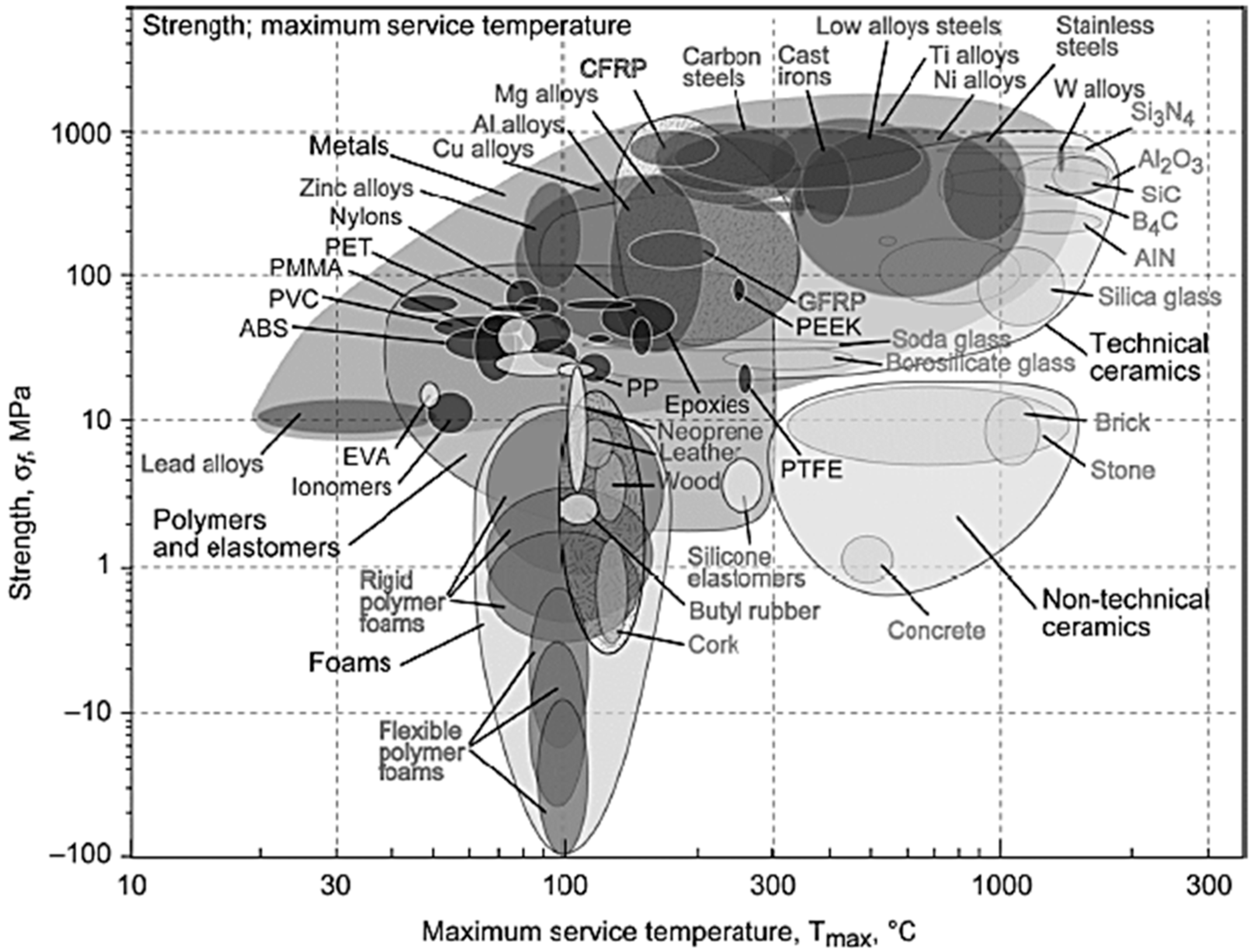
An Ashby-inspired chart (Figure S1) correlating fracture toughness (K_IC) and maximum service temperature is included to compare advanced ceramics, CMCs, and metals. The figure highlights the intrinsic trade-off between toughness and thermal capability, illustrating that even the toughest ceramics remain significantly less tough than metallic materials, thereby clarifying material selection considerations for aerospace and defence systems.
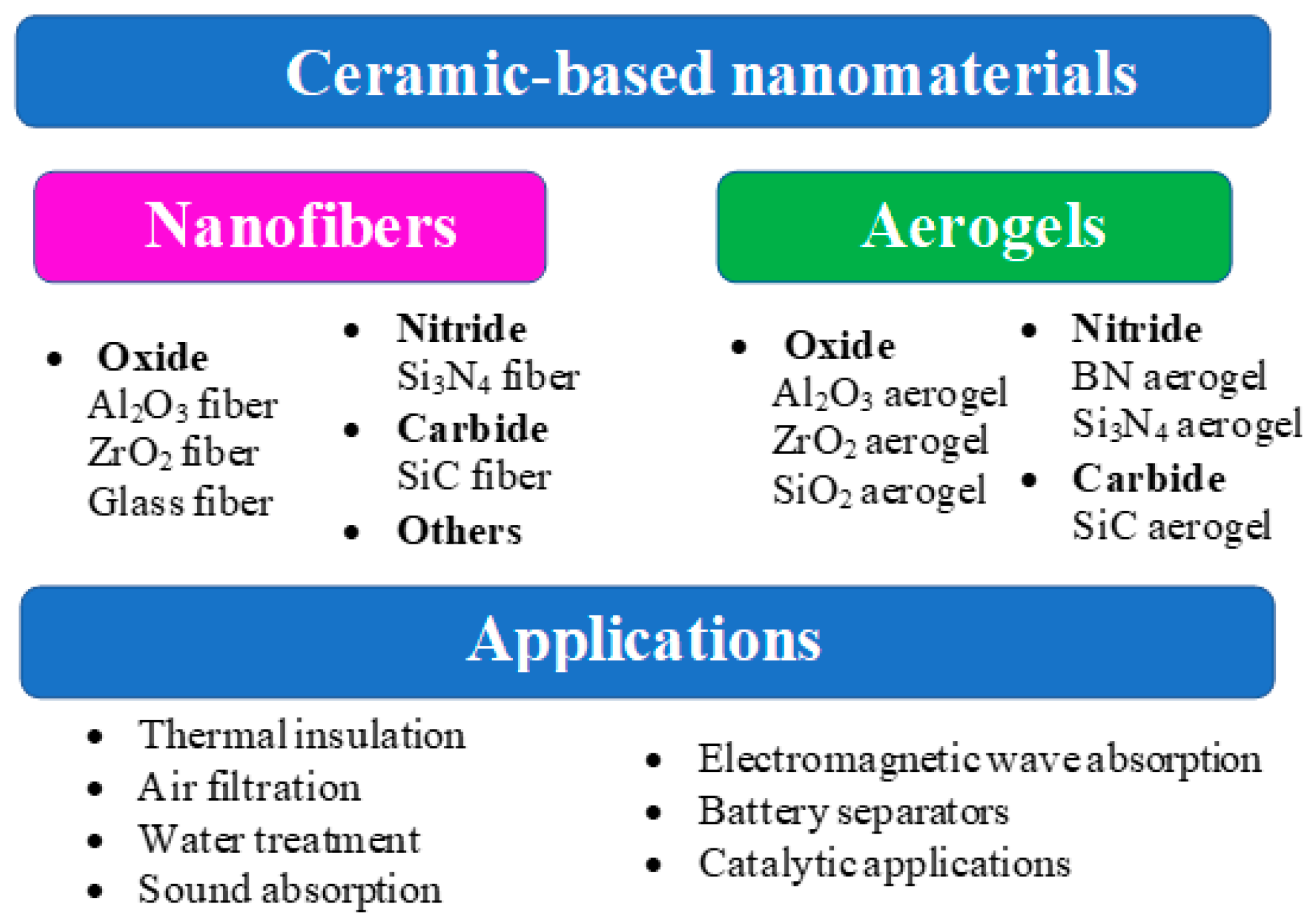
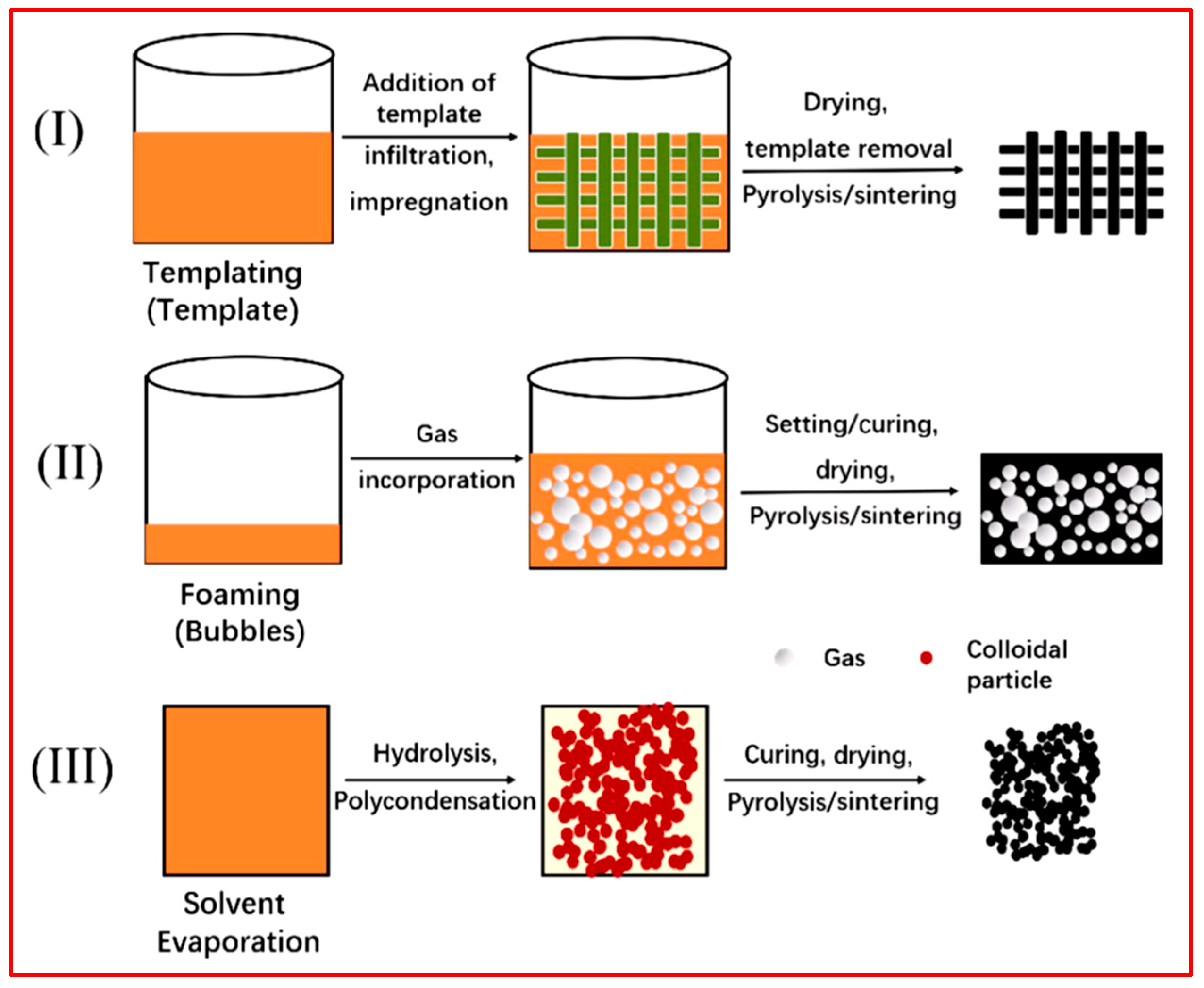
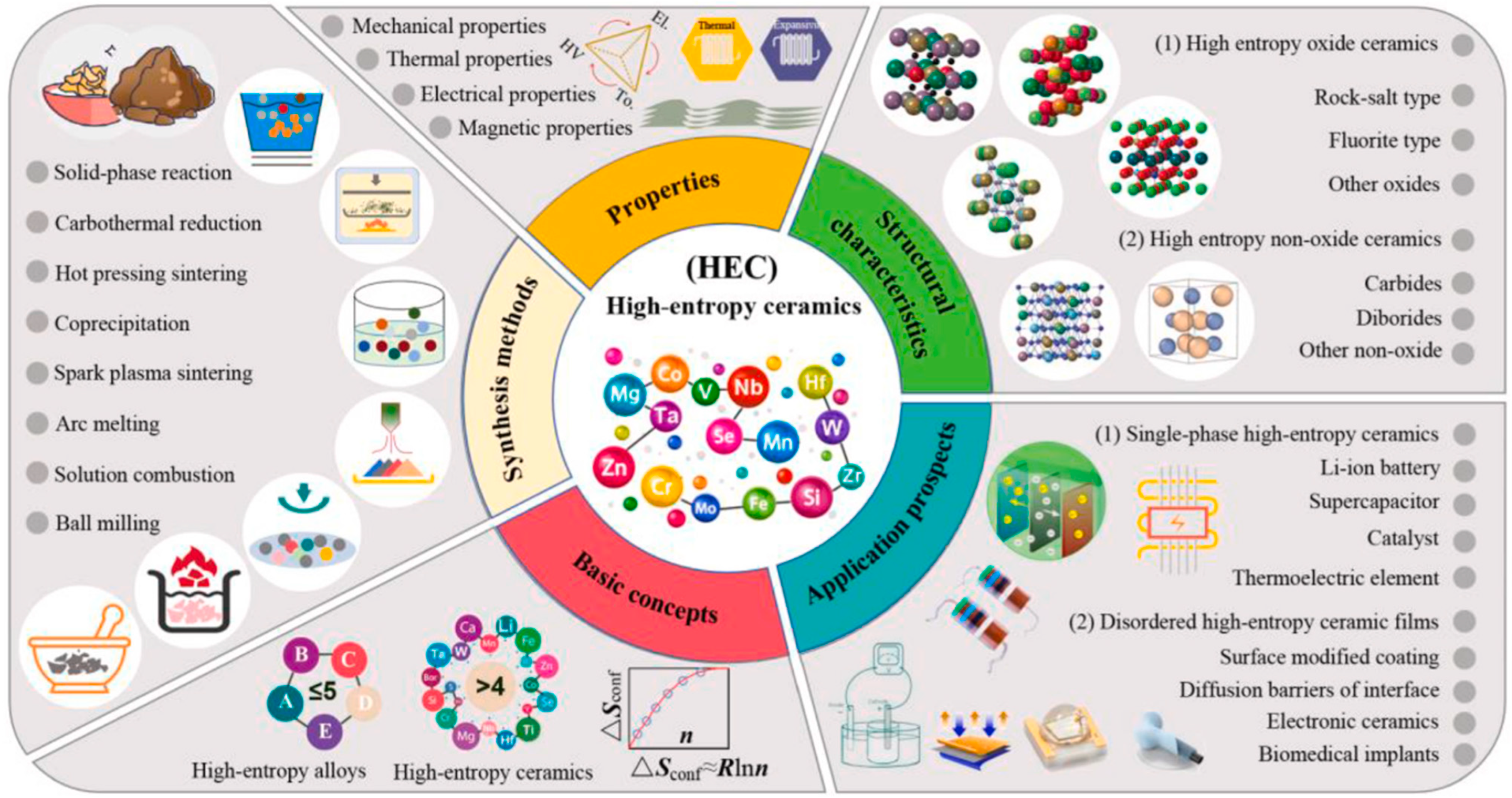
High-temperature thermodynamic stability further underscores ceramics’ importance. High-entropy ceramics (HECs) exhibit lower Gibbs free energy than their single-component or low-entropy counterparts, enhancing phase stability under service conditions [61,62,63]. Additionally, flexible ceramic-based nanofibres, with low density, low thermal conductivity, and chemical resistance (Figure 1), offer new opportunities for high-temperature insulation, filtration, and catalysis [64]. Ongoing advances in ceramic aerogels, fibres, and processing innovation are expected to further expand performance and application range [2]. Ultimately, although UHTCs deliver unmatched thermal performance, their widespread adoption depends on overcoming brittleness and low toughness. Toughened UHTC composites and engineered ceramic architectures represent essential progress toward balancing toughness with high-temperature capability. This review therefore examines recent advances in monolithic ceramics, ceramic matrix composites, and nanostructured systems, with particular emphasis on their performance in high-temperature and high-stress environments relevant to aerospace and defence applications.

1.2. Fundamentals of Tough Ceramics

Advanced ceramics are critical for aerospace, defence, energy, and industrial systems because of their high thermal stability, chemical inertness, low density, and oxidation resistance, enabling operation above 2000 °C [45,52,56]. However, their broader structural application is limited by intrinsic brittleness, low fracture toughness (typically 1–5 MPa·m1/2), and sensitivity to thermal shock. Recent advances in toughened ceramics and engineered architectures have improved crack resistance while maintaining high-temperature capability [19,22,25,34]. Fracture toughness (KIC) controls crack growth resistance, and unlike metals, ceramics rely primarily on extrinsic toughening mechanisms acting in the crack wake. Microstructural strategies such as grain refinement, crack deflection and bridging, transformation toughening, and the incorporation of reinforcing phases enhance damage tolerance. CMCs further mitigate brittleness through engineered fibre-matrix architectures that promote controlled interfacial debonding and progressive, non-catastrophic failure. Their multiscale damage mechanisms, enabled by tailored grain size, secondary phases, fibres, whiskers, and interfaces, activate crack deflection, branching, bridging, and pull-out. A comprehensive description of the associated failure mechanisms is provided in the Supplementary Materials. These effects are particularly effective in anisotropic or laminated designs, making CMCs highly suitable for demanding aerospace, defence, nuclear, and high-temperature propulsion environments under complex loading condition

1.3. Desired Properties for Aerospace and Defence Use

Ceramics are essential in aerospace and defence due to their unique physical, thermal, and chemical properties, enabling components to withstand extreme temperatures, mechanical loads, and harsh environments while maintaining structural integrity. Their use in engines, exhaust systems, thermal protection shields, and high-speed vehicles, including missiles and hypersonic aircraft, relies on oxide, carbide, nitride, glass-ceramic, and CMC systems that operate effectively up to ~2200 °C and resist ablation and thermal shock [25,65,66,67]. Applications span turbine parts, re-entry heat shields, brakes, bearings, seals, insulation, armour, radiators, and optical systems, with increasingly complex components benefiting from advanced manufacturing, such as 3D printing. Overall, ceramic selection is driven by the need for reliable performance in conditions where metals or polymers fail, with key properties summarized in Table 1. To address brittleness limitations, CMCs offer improved toughness, hardness, radiation resistance, and thermal insulation through short or continuous fibre reinforcements, including glass and carbon [68,69]. Short fibres enhance crack-propagation resistance but may still permit catastrophic failure, whereas continuous monofilaments provide superior strengthening and load-bearing capacity [65,70]. As a result, CMCs have become increasingly important in modern aerospace systems, particularly when integrated with carbon fibre composites [66,68,71].
Among structural ceramics used for protection, SiC and boron carbide (B4C) are preferred for their light weight, high hardness, and multi-hit performance, making them effective in body and vehicle armour systems [72]. These materials are deployed in platforms such as C-130 and C-17 aircraft, helicopter armour, and soldier body armour, with B4C suited for small-calibre threats and SiC for larger projectiles [73]. Additional armour ceramics include Al2O3, TiB2, AlN, and Syndite (Synthetic diamond composite), selected for durability in combat environments [72]. For radomes, ceramics must combine mechanical robustness with electromagnetic transparency, requiring low dielectric constant and loss tangent, high thermal and structural resistance, and strong environmental durability [74,75,76]. Suitable candidates include α-Al2O3, which offers thermal stability but is difficult to machine [77,78]; pyroceram, valued for thermal shock resistance though sensitive to stress corrosion; and Si3N4, which provides high strength up to 1300 °C, wear resistance, and low density for advanced radomes and engine components [74,79].
Historically, ceramic armour has been driven by military needs, with major advances promoted by the Defence Advanced Research Projects Agency (DARPA), Department of Defence (DoD), and national laboratories since the Vietnam War, particularly in boron carbide systems, and continues evolving in response to modern conflicts [80].
In gas turbine engines, attempts to replace nickel-based superalloys with monolithic SiC and Si3N4 ceramics were limited by water-vapour-induced recession [81,82]. CMCs have since emerged as superior alternatives, providing high thrust-to-weight ratios, reduced degradation, and improved thermal efficiency. Oxide CMCs (e.g., Al2O3, ZrO2, mullite) offer oxidation resistance and lower cost but limited high-temperature strength, whereas non-oxide CMCs (e.g., SiC, carbon) deliver higher strength, lower thermal expansion, and excellent thermal stability, making them suitable for hot-section engine components. These trade-offs, including cost, strength, and temperature capability, are captured in Table 2 [81]. Modern CMCs are further enhanced through engineered fibre coatings that create weak interfaces for crack deflection and improved load transfer, using commodity-grade oxide and SiC fibres optimized for performance and manufacturability [25,81,83].
Despite their outstanding performance, ceramics require accurate predictive models, linking composition and processing to elasticity and fracture behaviour, to enable broader structural use in aerospace. Such models help determine where ceramics can effectively replace heavier materials, improving efficiency and performance. The drive for weight reduction and thermal efficiency in the $2 trillion aerospace turbine market (2017–2031) continues to accelerate innovation in ceramics and CMCs [81,84]. Their integration into advanced alloys and composite architectures, supported by processing techniques such as forging and casting, further enhances performance, blast resistance, and formability, solidifying the role of ceramics in next-generation aerospace and defence engineering [85].

2. Ceramic Systems in Current Use

Advanced ceramics have become increasingly important in aerospace and defence due to their high efficiency, durability, and resilience under demanding conditions. Modern tough ceramics, such as silicon carbide and alumina, now integrate microstructural enhancements and reinforcement techniques that significantly improve impact resistance, abrasion performance, high-temperature stability, and overall fracture toughness [86]. Ceramic composites reinforced with carbon fibres or nanostructures further provide low weight, high strength, and corrosion resistance, supporting applications ranging from protective equipment to structural aircraft components and military vehicle systems. Nanotechnology continues to elevate the composites’ energy absorption and impact tolerance, while their integration with smart materials and high-temperature alloys strengthens next-generation platforms by improving mobility, payload efficiency, and operational survivability without compromising structural integrity [87].
Despite their strategic importance, the development of advanced ceramics remains costly, complex, and slow to scale, requiring substantial investment, specialized infrastructure, and multidisciplinary collaboration across academia, industry, and government. Innovation within individual companies is often restricted by high barriers to entry, and limited cross-industry technology transfer slows the spread of advances and best practices. Overcoming these challenges is essential to fully exploit the potential of advanced ceramics and expand their adoption across high-value manufacturing sectors. Table 3 summarizes the ceramic materials most frequently used in aerospace and defence based on their key properties and applications.

2.1. Silicon Carbide (SiC)

SiC, or carborundum, first synthesized by Edward G. Acheson in 1891, was initially commercialized for its hardness and thermal stability. Mid-20th-century technological developments expanded its applications from abrasives to structural ceramics and later to high-performance semiconductors for high-power and high-temperature electronics. As a highly stable IV–IV covalent compound with multiple polytypes, most notably β-SiC and α-SiC, it is widely employed in radio-frequency and power electronic devices [88,89]. Today, SiC is indispensable in aerospace and defence systems requiring thermal and radiation resistance, as well as in energy technologies and electric vehicles, with ongoing research aimed at improving both performance and cost efficiency.
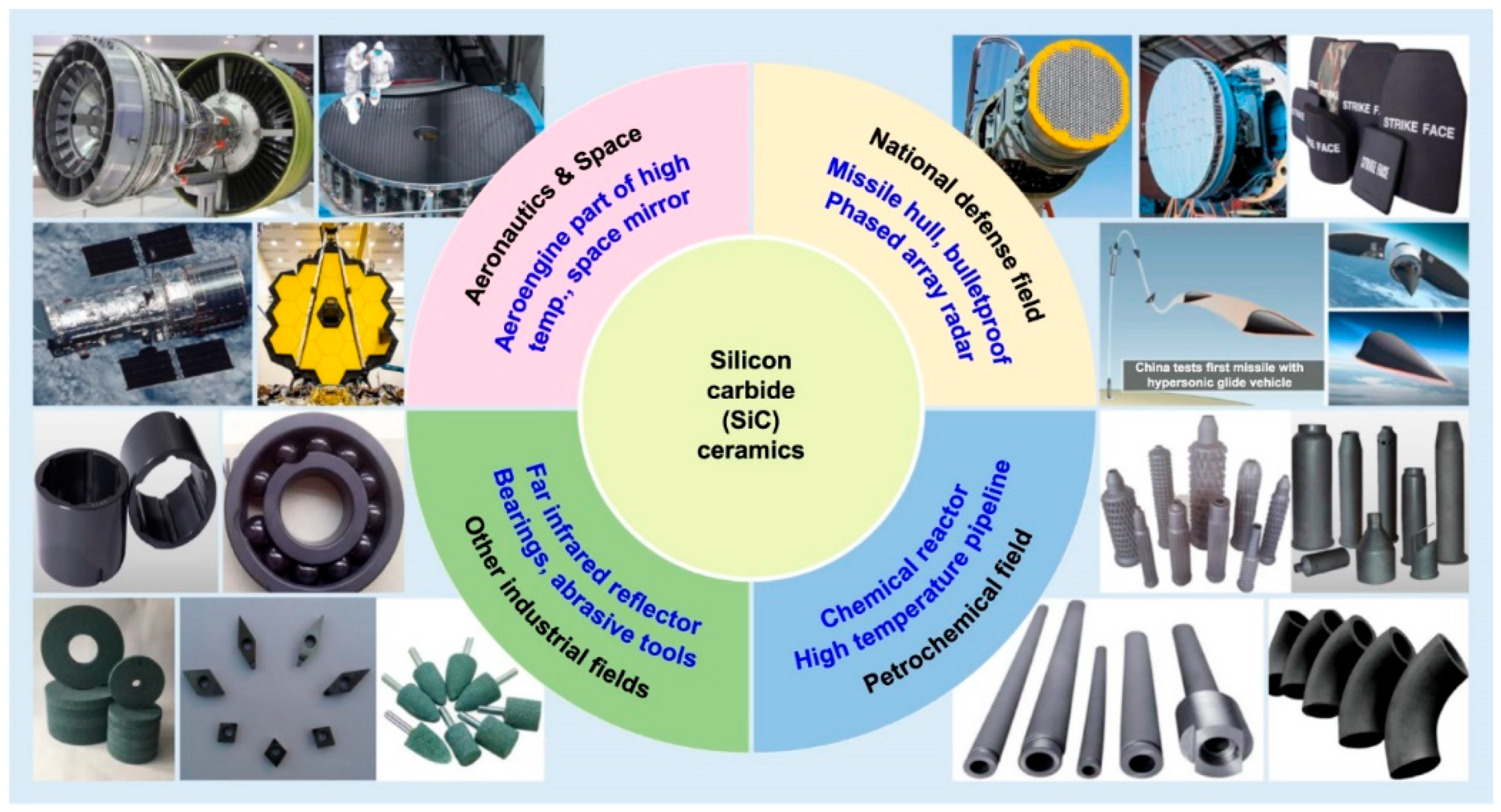
As noted above, silicon carbide ceramics are extensively used across multiple industries [90] due to their high strength, low thermal expansion, and strong resistance to wear and corrosion [91,92], as illustrated in Figure 2 [93]. Their applications range from space mirrors [94,95] to chemical reactors, pipelines [96,97], and wear-resistant components such as bearings and grinding wheels [98]. Although SiC was once limited mainly to refractory uses, its exceptional thermal, mechanical, and electrical properties [99] have established it as a critical engineering material. Because sintering strongly determines the resulting microstructure and performance, the fabrication of SiC ceramics remains challenging: the material’s strong covalent Si–C bonding and low self-diffusion require extreme sintering conditions (∼2500 °C, 50 MPa), often making sintering aids necessary to achieve adequate densification.
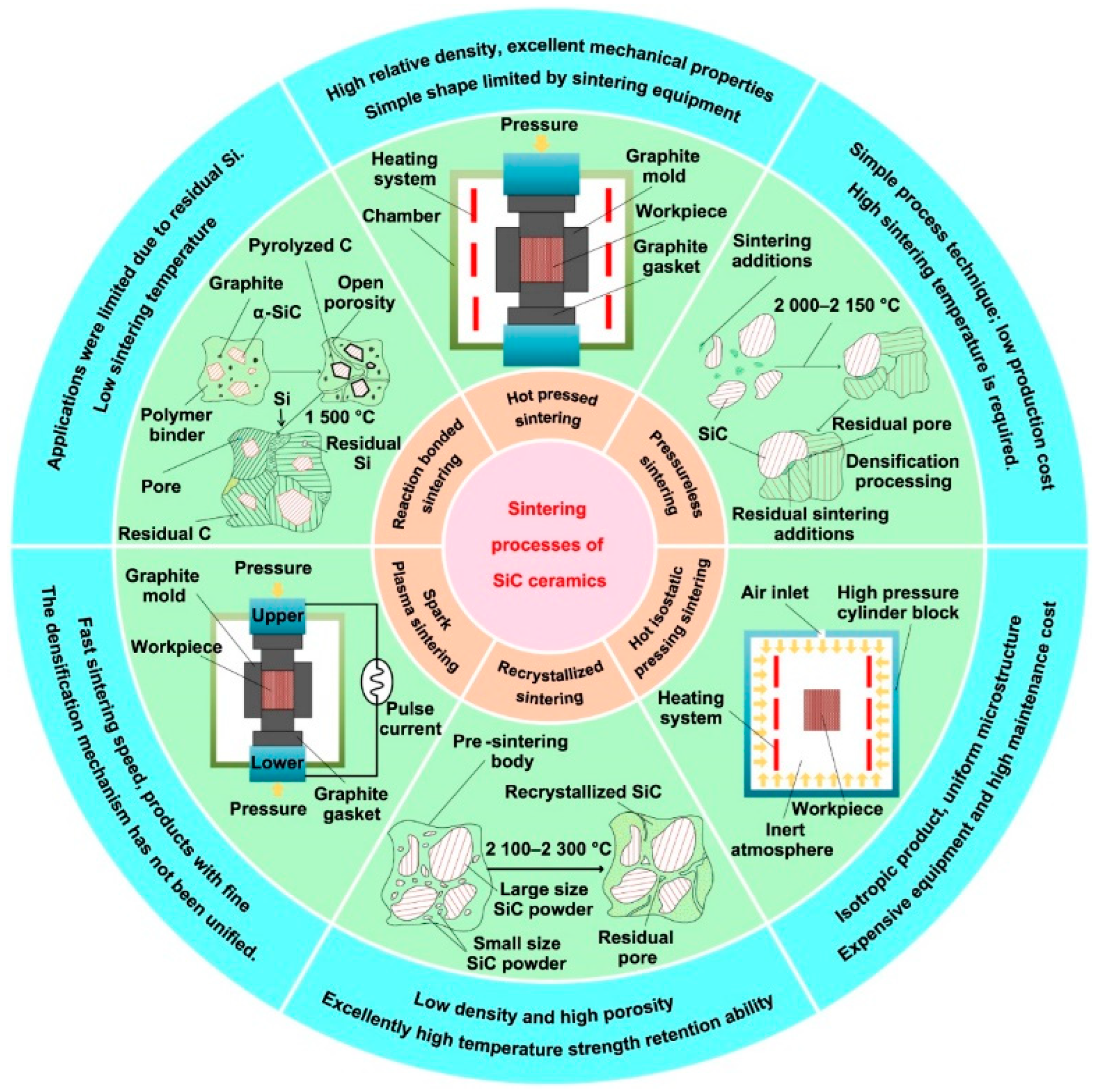
As shown in Figure 3 [93], common methods for the densification of SiC ceramics, include reaction-bonded sintering (RBS) [100], pressureless sintering (PLS) [101], hot-pressed sintering (HPS) [102], hot isostatic pressing (HIP) [103], recrystallized sintering [104], and spark plasma sintering (SPS) [105]. The various sintering methods used for densifying silicon carbide ceramics result in different material properties.
Selecting an appropriate processing method is crucial for achieving the desired properties of SiC components for specific applications. Table 4 compares the resulting physical characteristics across methods. For complex-shaped SiC parts used in aerospace and defence, RBS-SiC [100] and HIP [103], often combined with PLS, remain among the most widely applied techniques. Additive manufacturing followed by sintering is an emerging option for producing highly precise and intricate geometries. Choosing SiC for aerospace and defence systems requires assessing material properties that match the extreme environments and functional demands of these sectors, namely exceptional thermal stability, high specific strength, strong chemical and radiation resistance, and multifunctionality spanning structural, electronic, and optical performance.

2.2. Alumina (Al2O3)

Al2O3 is one of the earliest and most extensively studied advanced ceramics, valued for its low cost, ease of processing, and favourable mechanical, electrical, thermal, and chemical properties [108]. With a high modulus of elasticity, refractoriness, hardness, and strong commercial viability, it provides an excellent cost–benefit ratio among engineering ceramics. These characteristics have established alumina as a key material in aerospace and defence, where its mechanical strength, thermal stability, and electrical insulation are essential. In aerospace applications, alumina is widely used in thermal barrier coatings, electrical insulators, sensor housings, and satellite structural components, ensuring reliability under extreme temperatures, vibrations, and high-voltage environments. In defence systems, its hardness and durability support applications in body and vehicle armour, missile guidance systems, radar equipment, and fusing mechanisms, where it withstands severe mechanical, thermal, and electromagnetic stresses.
The performance of Al2O3 ceramics is highly sensitive to processing parameters such as sintering temperature, atmosphere, impurity content, and grain size. Although multilayer shields using alumina offer good ballistic performance at reasonable cost, their relatively high density (≈3.9 g·cm−3) compared with SiC (≈3.2 g·cm−3) and B4C (≈2.6 g·cm−3) can increase armour weight and reduce mobility [109], while their low fracture toughness limits protection against higher-calibre threats. To address these drawbacks, small additions of oxides such as ZrO2, MgO, Y2O3, and Nb2O5 are used to enhance mechanical properties [110,111], reinforcing alumina’s role in advanced aerospace and defence technologies. For specialized applications such as radomes, alumina remains critical due to its thermal stability, chemical resistance, hardness, and low thermal expansion, outperforming organic materials at high temperatures and enabling use in missile systems operating above Mach 2 [112,113]. High-purity alumina (≥97%) withstands temperatures above 1760 °C, while Lucalox (99.9% Al2O3), stabilized with magnesium oxide, offers even greater density and thermal stability [114]. Table 5 [74,79,112] summarizes the essential physical and electrical properties of alumina grades commercially employed in advanced radome structures. However, machining complex-shaped alumina components with diamond tools remains costly, up to 80% of total manufacturing expenses. Advanced fabrication methods such as digital light processing (DLP) printing with photosensitive resins present a promising alternative for producing intricate alumina components for defence and other high-performance applications.
Al2O3 ceramics offer excellent dielectric performance for electromagnetic transmission, though their processing-induced contraction depends on raw material selection [115]. Recent advances include alumina–graphene nanoplatelet composites, which show higher density and fracture toughness and can be rapidly densified by high-frequency induction heat sintering [116,117]. These composites also exhibit reliable high-temperature behaviour and strong wear resistance under vacuum, making them suitable for next-generation aerospace components, as demonstrated by Gao et al. [118]. Space missions require thermal insulation materials with low density, low thermal conductivity, and high thermal stability [119,120], especially for cryogenic fuel tanks (−253 °C for liquid hydrogen, −183 °C for liquid oxygen) and spacecraft exposed to thermal cycles between −180 °C and +180 °C or propulsion environments up to 1000 °C [121]. Alumina fibres meet these requirements due to their stability, low conductivity, corrosion resistance, and strength [122,123], and low-cost Al2O3 fibres developed by Sinkó et al. [124] advance scalable TPS solutions. Oxide materials such as alumina also enhance turbine hot-section durability under extreme conditions [125,126,127]. Alumina performance depends on purity, microstructure, and processing: high-purity grades (99.8–99.9%) excel in dielectric behaviour and stability for radar insulators, TPS elements, and hypersonic components; ~99.5% alumina offers strong mechanical and thermal performance for engine and control-system parts, and technical grades (85–95%), sometimes reinforced, are used in armour, refractory linings, and thermal-shock-resistant structures where cost efficiency is key. Selecting the appropriate grade, balancing purity, grain size, reinforcement, and mission conditions, is critical for ensuring reliability, longevity, and optimal performance in aerospace and defence systems.

2.3. Zirconia (ZrO2)

ZrO2 is a high-performance ceramic widely used in aerospace and defence due to its mechanical strength, thermal stability, and chemical resistance. Its unusually high fracture toughness results from stress-induced tetragonal-to-monoclinic transformation toughening (TT), which absorbs energy and suppresses crack growth [128]. This makes zirconia ideal for severe-load applications such as TBCs in jet engines and hypersonic vehicles, as well as for lightweight armour and high-reliability electronic components [129]. YSZ is the leading TBC material because of its low thermal conductivity and high melting point (~2700 °C), with modern TBCs typically using 6–12 wt.% Y2O3. However, adhesion issues during thermal cycling continue to cause cracking and spallation [130]. Zirconia enables next-generation military and aerospace engines by tolerating temperatures up to 1600 °C (with cooling), reducing component weight by as much as 60%, lowering centrifugal loads, and improving efficiency through simplified cooling designs [131]. Since turbine inlet temperature governs thrust-to-weight and fuel consumption, zirconia ceramics and zirconia-based CMCs are critical for engines operating above 1500 °C, well beyond the <1200 °C limits of alloys and intermetallic [122,125,126].
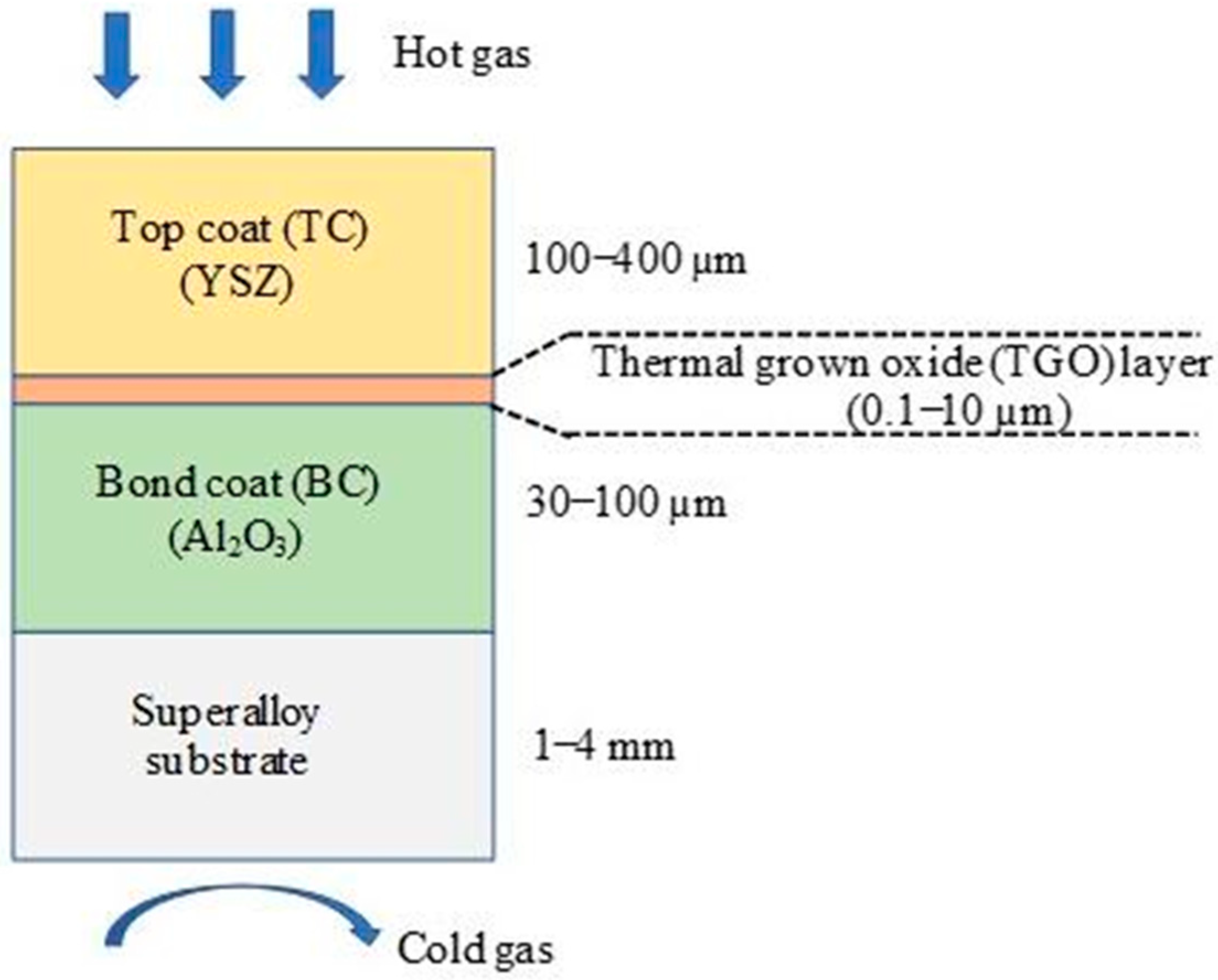
Ceramics also improve fuel efficiency, reducing diesel consumption by over 30% by insulating combustion chambers and enhancing exhaust-energy recovery, while their durability supports long-life automotive sensors exposed to extreme thermal and chemical environments [132]. Thin-film zirconia coatings, adapted from aerospace, reduce heat dissipation in pistons and cylinder liners to produce lighter, more efficient engines [132,133]. In the transition toward sustainable propulsion, TBCs remain essential for thermal management, protecting components, raising combustion temperatures, and reducing emissions. Typical TBCs incorporate a metallic substrate, a bond coat, and a ceramic topcoat [134], often using ZrO2, mullite, or Al2O3 for their thermal stability and insulation performance [130,134]. Comparative effectiveness of these materials is presented in Table 6 [134].
Composite ceramic TBCs remain essential in aero-engines for enhancing thermal insulation and extending hot-section component life, with YSZ being the most widely used option [135]. As reported by Patdure et al. [127] and Darolia [136], TBCs can reduce surface temperatures by ~170 °C, lower cooling-air demand and fuel consumption, and substantially increase blade durability. Among candidate materials, 6–8 wt.% YSZ continues to dominate due to its low density, low thermal conductivity from high point-defect concentration, compatible CTE, and strong strain tolerance [137,138]; although, it is limited to <1200 °C, vulnerable to hot corrosion and environmental deposits, and prone to accelerated thermally grown oxide (TGO) because of high oxygen-ion diffusivity in ZrO2-based ceramics [139]. No superior alternative has yet outperformed YSZ.
To further raise turbine inlet temperatures, modern aero-engines rely on TBCs on metallic components and the use of SiC/SiC CMCs protected by EBCs [83,140,141]. EBCs are required because SiC forms volatile Si(OH)4 when its SiO2 layer reacts with water vapour in combustion gases [142]. Although wrought, cast, and single-crystal superalloys have improved temperature capability [143], metals alone remain thermally constrained, making TBCs and advanced cooling strategies indispensable [144]. A typical TBC consists of a ceramic topcoat, metallic bond coat, and metal substrate, with a TGO that forms between them during service; the bond coat reduces thermal-expansion mismatch and limits oxidation, producing a protective α-Al2O3 TGO. A schematic of this multilayer structure is shown in Figure 4 [145].
TBC development began in the 1950s, with the first applications thereof in the 1960s [146]. The introduction of YSZ marked a major advancement due to its low thermal conductivity, high thermal expansion, toughness, phase stability, TGO compatibility, and slow sintering rate [137,140]. TBCs are primarily applied by thermal spraying or electron beam physical vapour deposition (EB-PVD). Thermal-spray methods, atmospheric plasma spray (APS), plasma spray physical vapour deposition (PS-PVD), and high-velocity oxy-fuel (HVOF), melt the feedstock and accelerate it toward the substrate using plasma or high-velocity gas jets [145,146]. Coating performance depends strongly on deposition method and adhesion; Almeida et al. [147] demonstrated that EB-PVD provides superior adhesion and columnar microstructures that accommodate thermal expansion. Ongoing global research continues to seek oxides with improved high-temperature capability and lower thermal conductivity to potentially replace 7YSZ, given the critical importance of fracture toughness for resisting impact, erosion, and spallation.
TBCs protect turbine and engine components from extreme temperatures, while TPSs shield entire aerospace vehicles, including spacecraft and missiles, from severe aerothermal loads encountered in high-speed flight and atmospheric re-entry [66]. As highlighted by Zarko [67] and Venkatapathy et al. [148], TPSs function as single-point-of-failure subsystems that must provide reliable thermal protection without sacrificing structural integrity or adding excessive mass. Next-generation TPSs require materials with high melting points, thermal shock resistance, oxidation resistance, and controlled thermal conductivity [149]. Oxide ceramics (alumina, zirconia, mullite) offer high-temperature stability and low cost, but their limited mechanical performance reduces structural reliability at elevated temperatures [149]. Non-oxide ceramics exhibit higher strength and creep resistance but are oxidation-sensitive [123,140,142], motivating the adoption of CMCs such as SiC/SiC, which provide improved damage tolerance and are integrated with EBCs and TBCs in advanced propulsion systems.
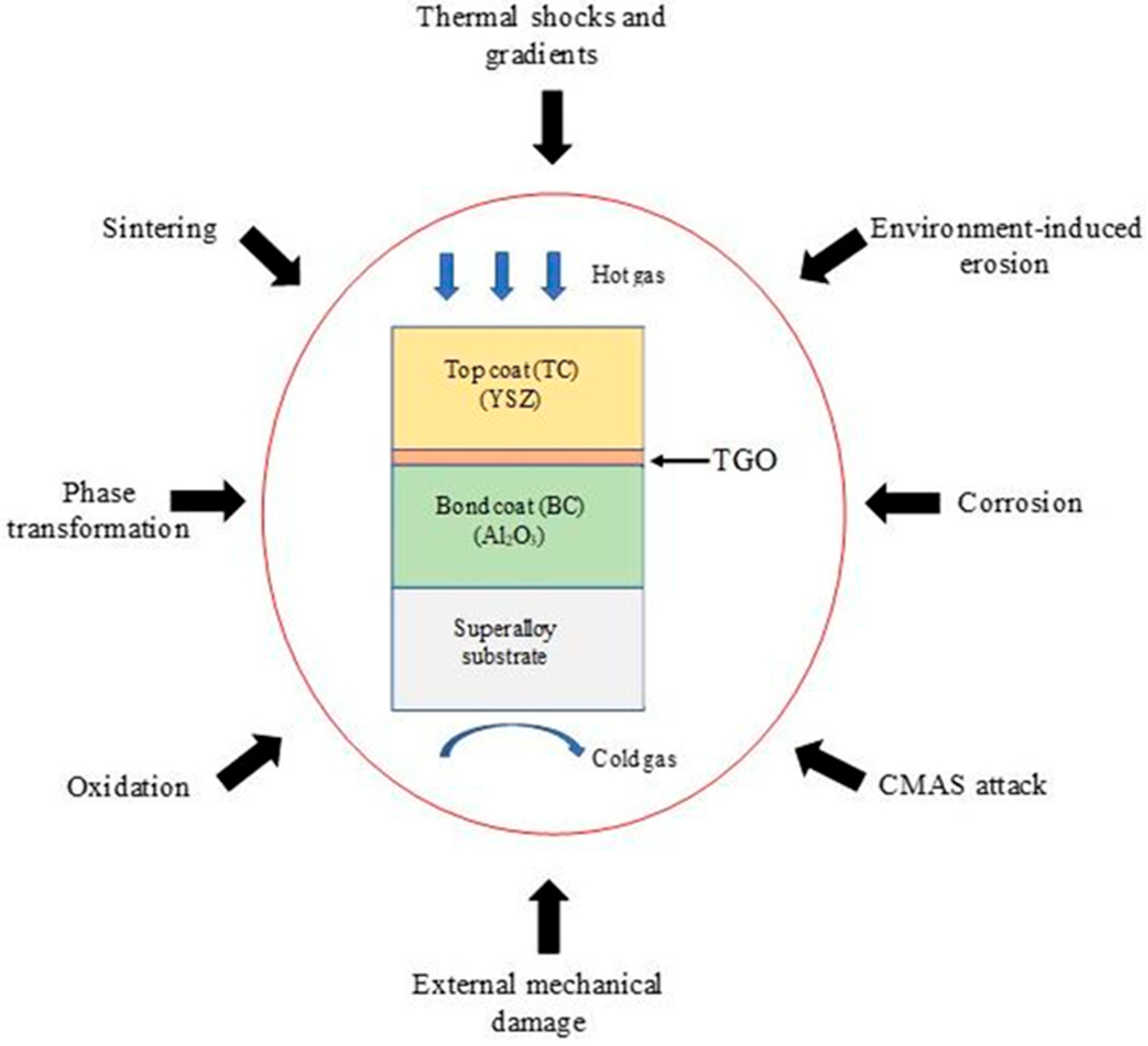
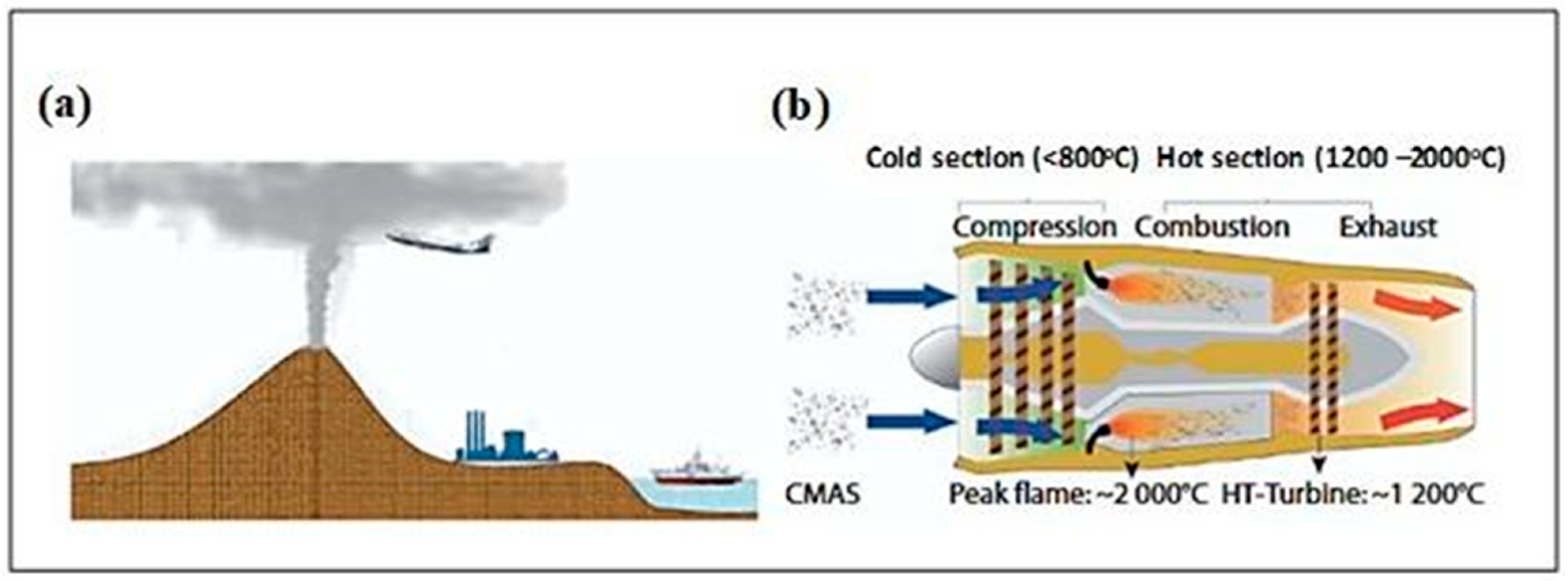
Zirconia-based materials continue to play a central role in heat-resistant aerospace systems, though challenges in high-temperature stability, service lifetime, and energy efficiency still constrain progress in hypersonic and next-generation vehicles. Research efforts now target improved thermal protection materials (TPMs) and the development of new systems, with aerogels gaining rising interest for exceptional thermal insulation. Despite limited comprehensive reviews, ZrO2 aerogels, first synthesized by Teichner in 1976 [150], show high-temperature resistance, wear and corrosion resistance, chemical stability, and Mohs hardness above 7, making them promising TPS candidates. Their main limitation is poor structural stability at high temperatures due to phase transformations that cause volumetric change and pore collapse; therefore, improving the high-temperature robustness and structural integrity of ZrO2 aerogels is a major goal for next-generation TPSs. TBC degradation arises from diverse mechanisms, including thermal shock, thermal gradients, sintering, phase transformations, oxidation, impacts, calcium–magnesium–aluminosilicate (CMAS) infiltration, corrosion, and environmental erosion, with thermal fatigue, corrosion, and erosion identified as the dominant failure modes [151]. Thermal fatigue results from cyclic thermal stresses; corrosion involves high-temperature oxidation or attack by aggressive species; and erosion is driven by high-velocity particle impacts, ranging from gradual wear by fine particles to severe foreign object damage (FOD) from larger ones. A schematic of these interacting mechanical, thermal, and chemical degradation mechanisms is shown in Figure 5 [66].
Advances in zirconia-based ceramics and processing technologies have enabled the broad application of TBCs on critical air-cooled turbine engine components, including combustors and high-pressure turbine vanes and blades. Since their commercial adoption in the 1980s [67], TBCs have outperformed other materials, such as nickel-based superalloys, by lowering metal temperatures in high-pressure turbines by up to 100 °C, with future improvements potentially exceeding 200 °C through advanced low-thermal-conductivity coatings [67,151].

2.4. SiC/SiC Ceramic Matrix Composites (CMCs)

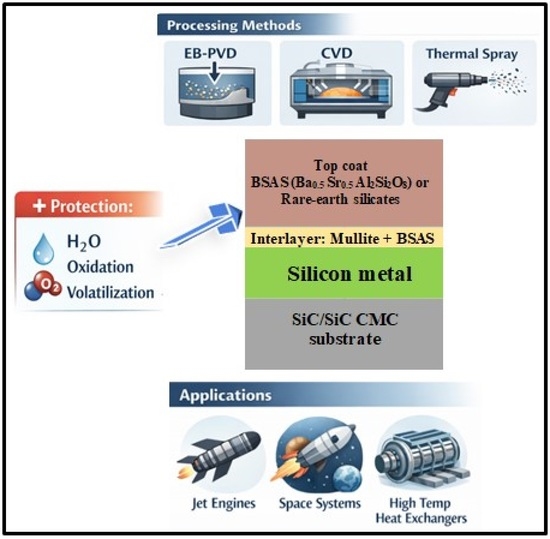
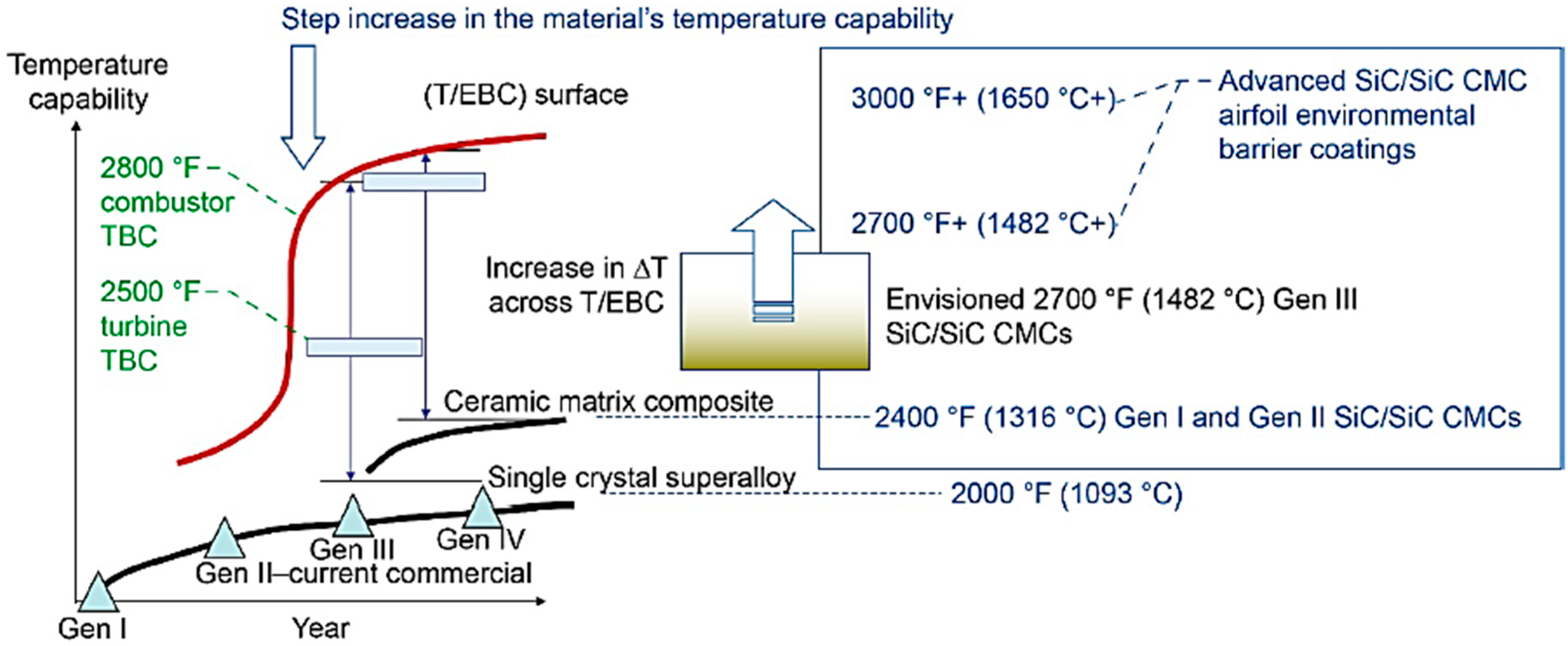
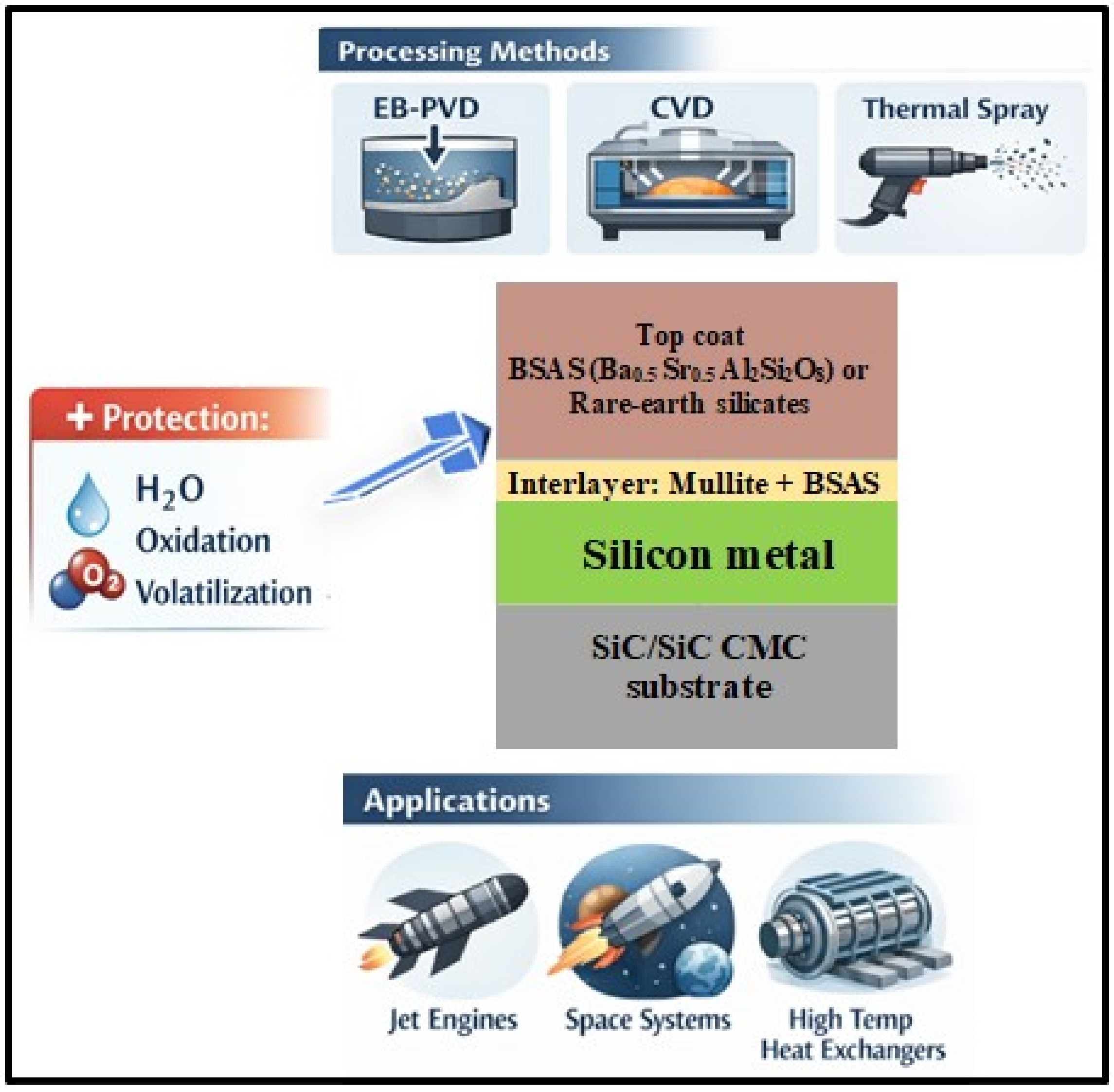
SiC/SiC CMCs, composed of fine polycrystalline SiC fibres (10–15 μm), have become leading structural materials for extreme aerospace and defence environments due to their high strength, low density (2.5–3.0 g/cm3), thermal shock resistance, and chemical and oxidation stability [142,146,149,152]. Their ability to operate reliably above 1300 °C, unlike conventional superalloys, enables higher engine efficiency, reduced cooling demands, and weight savings, making them essential for next-generation gas turbines, hypersonic platforms, and advanced aerospace structures [66,153,154]. A critical limitation of SiC/SiC CMCs arises in high-temperature, moisture-rich environments, where the protective SiO2 layer volatilizes into Si(OH)4, leading to surface recession and structural degradation [66]. To mitigate this, EBCs are required. These multilayer systems typically include a silicon bond coat, an intermediate layer such as mullite (3Al2O3·2SiO2), and a top barrier made of barium–strontium–aluminosilicate (BSAS) or rare-earth silicates like Yb2Si2O7, which provide chemical resistance and high-temperature stability [155,156]. As illustrated in Figure 6 [142], current Generation II CMCs operate up to ~1316 °C, with future systems projected to reach 1482 °C, supported by advanced SiC fibres, improved matrices, and EBCs with strong adhesion, low thermal conductivity, and thermal-cycling resistance.
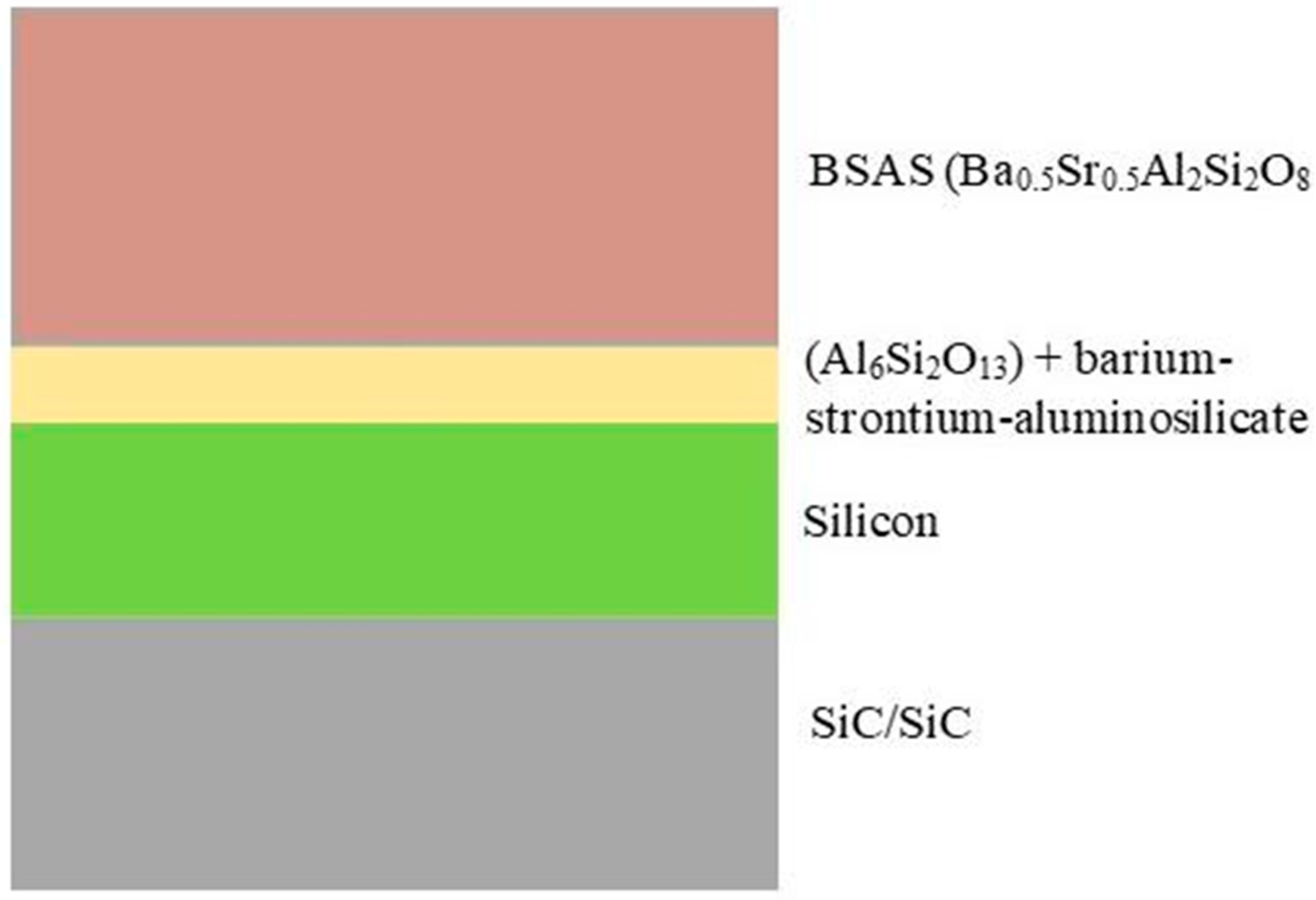
The first generation of EBCs, developed in the 1990s for CMC combustor liners in solar turbine engines, employed a BSAS topcoat over a silicon bond layer and a mullite interlayer, demonstrating ~14,000 h of reliable operation and validating EBCs for long-duration use [157,158,159]. However, BSAS showed performance limits above 1350 °C, including phase instability and volatilization. To address these issues, second-generation EBCs emerged in the early 2000s under NASA’s UEET programme, incorporating rare-earth silicates such as ytterbium and gadolinium silicates, which offered higher melting points, improved thermal and chemical stability, and enhanced compatibility with SiC substrates under thermal cycling [156]. A notable architecture developed in NASA’s HSCT program with GE and United Technologies featured a three-layer plasma-sprayed system consisting of a silicon bond coat, a graded mullite–BSAS interlayer, and a BSAS topcoat in the Celsian phase (Ba0.5Sr0.5Al2Si2O8), the latter requiring post-deposition heat treatment to ensure full crystallization and optimal resistance to steam-induced corrosion [160,161]. Figure 7 schematically depicts this multilayer EBC architecture designed to protect SiC/SiC CMCs from oxidation and volatilization in high-temperature, water-vapour-rich environments, thereby ensuring long-term structural and thermal stability in advanced aerospace propulsion systems.
EBC development continues to advance rapidly, with current research exploring alternative rare-earth systems, improved bond coats, and optimized deposition methods to enhance durability and operating temperature capability. Progress in EBCs is closely linked to improvements in SiC fibre quality, matrix fabrication, and interface engineering, which collectively determine the thermal–mechanical performance of SiC/SiC CMCs. Because EBCs prevent the volatilization of the protective silica layer in steam-containing atmospheres, they are essential for the reliable use of SiC-based composites in propulsion, TPSs, and defence applications [160]. As metal alloys reach their thermal limits, SiC/SiC CMCs, capable of operating near 1400 °C with densities roughly one-third that of nickel-based superalloys, are emerging as leading candidates for next-generation turbine components, offering improved thrust-to-weight ratios and fuel efficiency, as noted by Spitsberg and Steibel [162]. Rare-earth (RE) silicate-based EBCs have become particularly important; Eaton et al. [158] report that their low thermal expansion coefficients and stability above 1480 °C enable thousands of hours of operation.
Despite these material advances, EBC performance strongly depends on deposition technique. Basu et al. [163] achieved dense crystalline mullite coatings via chemical vapour deposition (CVD), though this method remains limited by slow deposition rates and hazardous precursors. Xu and Yan [164] produced thin but uniform ytterbium disilicate layers using plasma spraying and sol–gel approaches, yet their coatings were insufficiently thick for turbine environments. Richards et al. [165] found that APS introduced microcracks and gaps, compromising durability, while slurry dip coating, though economical, often produced drying and sintering cracks leading to spallation [166]. Consequently, integrated TBC/EBC systems have become essential. In this multilayer architecture, the TBC reduces gas temperatures from ~1700 °C to ~1480 °C, creating conditions in which the EBC can function effectively under oxidizing, moisture-rich, high-velocity flows [167]. At these temperatures, the EBC must provide thermal stability, chemical resistance, low oxygen permeability, thermal expansion compatibility, and protection against moisture-driven silica volatilization. The combined TBC–EBC system is thus fundamental to enabling SiC/SiC CMCs as durable hot-section materials for advanced turbines, supporting lighter, more efficient, and thermally robust propulsion systems [167].
Considering these developments, Table 7 summarizes the key material and performance criteria governing EBC design for SiC/SiC CMC protection in high-temperature turbine environments. These include environmental stability in oxidizing and steam-rich atmospheres, thermal expansion matching, resistance to water vapour-induced volatilization, strong adhesion via silicon bond coats, and chemical compatibility across the multilayer architecture, requirements essential for long-term coating integrity and resistance to spallation under severe thermal and mechanical stresses.

2.5. Silicon Nitride (Si3N4)

Si3N4 is a high-performance ceramic widely used in aerospace and defence due to its high strength, fracture toughness, thermal-shock resistance, and fatigue resistance under extreme conditions [52,111,117]. These properties support its use in turbine rotors, combustor liners, high-speed bearings, seals, and lightweight structural components. In defence applications, Si3N4 offers high hardness, corrosion resistance, thermal stability, and favourable dielectric characteristics for armour, missile components, and low-observable technologies [171]. Advances in manufacturing, including additive methods such as lithography-based ceramic manufacturing (LCM), now enable complex Si3N4 components such as aerospike nozzles with precise flow and cooling features [172,173]. A major milestone was JAXA’s in-orbit demonstration of a fully Si3N4 ceramic engine during the Akatsuki mission, confirming global leadership in ceramic propulsion technologies [174].
In high-speed aerospace systems (Mach 3–5), Si3N4’s ability to sustain extreme thermal–mechanical loads makes it indispensable. Si3N4 bearing balls surpass steel in weight, hardness, stiffness, smoothness, and thermal stability, improving efficiency and service life; NASA’s use of Si3N4 bearings in RS-25 Space Shuttle turbopumps highlights this mission-critical role [175]. Once applied mainly in semiconductor systems, Si3N4 now performs in high-temperature aerospace environments exceeding 300 °C during heat soak-back [176]. Its strength retention up to ~1400 °C and low density support its integration into turbine blades, rings, and air bearings, with CMCs mitigating brittleness [177]. Si3N4 has also gained strategic value in modern defence systems amid rising global conflict risks [178,179]. Its lightweight, high-performance ballistic resistance enhances unmanned aerial vehicles (UAVs), helicopters, armoured personnel carriers (APCs), and body armour [178]. In advanced energy systems, elongated-grain Si3N4 is being evaluated in the U.S. Department of Energy (DOE) Microturbine Programme to increase efficiency (>40%), reduce emissions, and improve reliability, emphasizing probabilistic design based on real component geometries [180,181]. Reduced FOD sensitivity in microturbines further promotes ceramic adoption [182].
However, FOD remains a significant limitation, as brittle ceramics are sensitive to crack initiation from debris impacts [183]. Studies on various projectile types assess critical velocities, residual strength, and damage mechanisms to support life-prediction models [184,185]. Mitigation strategies include grain-toughened Si3N4, optimized designs, and protective coatings. Reinforcing Si3N4 with CNTs improves fracture toughness and impact resistance via crack bridging, pull-out, and deflection mechanisms [186]. CNT/Si3N4 composites show promise for aero-engine rotors, hypersonic vehicles, and defence components, though challenges remain with CNT dispersion, interfacial bonding, and oxidation above 500–600 °C. Advances in powder processing, functionalization, and sintering are enabling high-performance CNT/Si3N4 composites, while protective measures are required to prevent CNT degradation in oxidative high-temperature environments [187,188]. Table 8 summarizes approaches for extending CNT usability under extreme aerospace conditions.
Although CNTs offer promising toughening mechanisms for Si3N4, their use does not always produce consistent improvements. Reported fracture toughness values for CNT-reinforced Si3N4 show significant scatter, even at similar CNT concentrations, due to differences in processing methods (HPS, SPS, and PLS), raw material quality, and microstructural features including CNT dispersion, grain size, and porosity. Variability in measurement techniques, such as single-edge notched beam (SENB), indentation fracture (IF), and chevron-notched methods, further contributes to inconsistencies. Nonetheless, a general trend indicates that low CNT contents (~1 wt.%) typically enhance fracture toughness through mechanisms like crack bridging, pull-out, and crack deflection [189,190]. Higher CNT loadings often fail to improve, and may degrade, mechanical properties due to agglomeration, weak interfacial bonding, or increased porosity. Thus, the optimization of processing parameters, dispersion, and CNT content is essential to achieve reliable performance. CNT-based ceramic nanocomposites hold substantial potential for aerospace systems; NASA’s Ames and Johnson Space Centers have explored their use in thermal radiation shielding and impact protection [191,192]. However, knowledge gaps remain regarding specific aerospace applications where CNT-reinforced ceramics yield maximal benefit. Current research aims to clarify their contributions to structural performance and operational efficiency, positioning CNT–ceramic composites as promising next-generation aerospace materials pending further validation.
In aerospace and defence technologies, optimizing Si3N4 processing, sintering route, atmosphere, additives, and temperature profile are crucial for achieving the required mechanical strength, toughness, oxidation resistance, and thermal performance. The microstructure–processing relationship ultimately determines Si3N4’s suitability for propulsion systems, thermal protection, and ballistic-resistant structures. Table 9 summarizes how different fabrication methods affect key physical properties of Si3N4 ceramics, highlighting the processing–property link essential for advanced applications [193].
The α-Si3N4 and β-Si3N4 polymorphs play a decisive role in defining the mechanical, thermal, and chemical behaviour of silicon nitride ceramics, particularly in high-temperature aerospace and defence applications. β-Si3N4 is preferred for structural use due to its superior toughness, thermal stability, and creep resistance, making control of the α → β transformation during sintering essential for achieving high-performance microstructures. Optimizing β-phase content and grain morphology is therefore critical for components exposed to extreme thermal and mechanical conditions [194]. Advancing Si3N4 technologies for aerospace also requires addressing integration challenges, as joining Si3N4 with metals, ceramics, and composites is essential for complex engine assemblies and multifunctional systems where dissimilar interfaces must retain mechanical integrity under harsh environments.
Ongoing research has examined the joining behaviour of Si3N4 using active braze interlayers with liquidus temperatures from 750 °C to 1240 °C. This effort evaluates the self-joining of commercial Si3N4 grades (Kyocera and St. Gobain) using a ductile Cu-based active braze alloy containing titanium (Cu-ABA). The resulting joint microstructures, compositions, hardness, and strengths underscore the importance of Si3N4 integration technologies for aerospace systems that require robust hybrid structures capable of enduring severe service conditions [194,195]. Overall, Si3N4 is positioned to play a pivotal role in future aerospace and defence applications, as advanced propulsion and hypersonic technologies demand lightweight, durable materials; Si3N4, especially when combined with reinforcing systems, offers a strong pathway for high-temperature turbine components, armour solutions, and structural elements [194].

2.6. Zirconium Diboride (ZrB2) and Hafnium Diboride (HfB2)

UHTCs such as ZrB2 and HfB2 are critical TPS materials in aerospace and defence due to their extreme thermomechanical performance, including very high melting points (~3250 °C and ~3400 °C), oxidation resistance (enhanced with SiC), hardness, and thermal conductivity [17,20,196,197]. They enable components exposed to >2000 °C in hypersonic flight and re-entry, nose cones, leading edges, SCRAMJET combustors, and nozzles [198,199]. Although research originated in the late 1800s [90], major development occurred during the Cold War for heat shields, rocket motors, and spacecraft structures [200,201], including foundational U.S. work at Manlabs by Clougherty and Kaufman using HPS and floating-zone processing to obtain high-purity ZrB2/HfB2 [202,203]. Interest resurged in the 1980s–1990s with hypersonic systems and SCRAMJETs, supported by NASA Ames, Sandia, and the U.S. Air Force [203].
ZrB2 and HfB2 exhibit high thermal conductivity (60–120 W·m−1·K−1) [92], low CTE (~5.9 × 10⁻⁶ K−1 for ZrB2) [204,205], and better processability than nitrides [20], though oxidation resistance declines above 1500 °C. Composite approaches, e.g., 20 vol% SiC or silica-forming additives, improve protection [20,206]. Hypersonic vehicles face surface temperatures of 1200–2300 K or higher [207], beyond the limits of C/C composites, SiC, or Si3N4. UHTCs like ZrC and HfC offer superior stability [55,202,208,209], but monolithic UHTCs are brittle, leading to the development of ultra-high temperature ceramic matrix composites (UHTCMCs), which enhance toughness through fibres, whiskers, and compliant phases [22,210].
Research on ZrB2- and HfB2-based UHTCMCs has grown across the U.S., Europe, China, and Japan [211,212], focusing on sharp leading edges, propulsion components, air intakes, and vertical stabilizers [213,214]. Their stable oxides, especially with continuous C-fibre or SiC reinforcement, maintain structural integrity above 2500 °C [215], and these materials are also promising for nuclear applications. Persistent challenges include oxidation resistance, toughness, and thermal-shock performance above 2000 °C [216]. Processing remains difficult because these non-oxide powders are oxygen-sensitive and exhibit low self-diffusivity, which complicates densification [20,210], prompting efforts to optimize powder synthesis, consolidation, coatings, and additive strategies. Table 10 compares monolithic and modified ZrB2/HfB2 systems. Hypersonic programmes such as DARPA’s Falcon HTV-2 have renewed the demand for TPS capable of withstanding low-pressure, radical-rich flows and curved shock interactions [217,218,219,220,221,222]. ZrB2/HfB2 UHTCs show strong performance in sharp leading edges under shock loading [223,224,225], functioning like passive heat pipes that dissipate heat efficiently. Advanced processing routes, including reactive melt infiltration (RMI), precursor infiltration and pyrolysis (PIP), CVD, and additive manufacturing (AM), are enabling more cost-effective and high-performance UHTCs and UHTCMCs [13,226,227,228]. Remaining barriers include oxide-volatility under high-velocity flow, oxygen ingress after removal of molten layers, and large inconsistencies in reported melting points (up to 500 °C) [229,230].
UHTCs also play an important role in the defence sector, supporting the development of advanced ballistic missile nozzles, high-temperature armour, and aero-thermal structures requiring extreme thermal survivability [231]. Their integration into critical components ensures structural integrity and performance during high-speed atmospheric flight and precision strike operations. Overall, ZrB2- and HfB2-based UHTCs are strategic materials that enable high-speed flight, extended mission duration, and enhanced operational capability under severe thermal and mechanical conditions [210]. A recurring issue in the ceramic-materials literature is the interchangeable use of terms such as Ultra-High Temperature Materials (UHTMs) and UHTCs, which can lead to confusion in the material selection for aerospace, defence, and energy applications. UHTCs represent a specific subset of ceramic compounds, mainly transition-metal diborides, carbides, and nitrides, capable of service above 2000 °C, whereas UHTMs encompass a much broader range of materials, including refractory metals, composites, and other high-temperature systems. Overlap in applications such as TPS and hypersonic structures contributes to this ambiguity, but while UHTMs cover a wide material spectrum, UHTCs are uniquely valued for their extreme thermal stability and structural reliability in the harshest environments, including aerospace TPS and advanced nuclear systems.
The outlook for ZrB2 and HfB2 in aerospace and defence remains highly promising despite inherent challenges, such as poor sinterability and oxidation sensitivity at intermediate temperatures. Continued advances in processing, e.g., SPS, AM, along with the use of additives and composite reinforcement, are progressively mitigating these limitations. As manufacturing technologies mature, these ceramics are expected to become increasingly central to next-generation aerospace and defence systems. In 2025, the aerospace and defence sectors underwent a major transformation driven by artificial intelligence (AI), 3D printing, robotics, and blockchain, with an emphasis on innovation and sustainability. These technologies support decarbonization, next-generation defence platforms, and improved supply-chain transparency, accelerating the transition toward efficient, secure, and environmentally responsible operations [232].

3. Processing and Manufacturing

The processing and manufacturing of tough ceramics for aerospace and defence applications have evolved into critical and rapidly advancing fields, driven by the stringent performance demands of next-generation propulsion, protection, and hypersonic systems. Modern aerospace components must endure extreme environments characterized by ultra-high temperatures (>1500–2000 °C), rapid thermal cycling, high mechanical stresses, corrosive atmospheres, and intense particle erosion. Under these harsh conditions, traditional ceramics, despite their high melting points and chemical stability, are limited by their intrinsic brittleness and low tolerance to flaws. Consequently, the development and extreme manufacturing of tough ceramics, such as SiC, ZrO2, Si3N4, ZrB2, HfB2, UHTC composites, and CMCs, has become a foundational enabler for advanced aerospace and defence systems [66,67,91,160,161,162].
These tough ceramics offer superior fracture toughness, enhanced resistance to crack initiation and propagation, and improved reliability when subjected to severe thermal–mechanical loads. Their ability to maintain structural integrity during conditions such as hypersonic flight (>Mach 5), turbine inlet temperatures exceeding 1500 °C, or ballistic impacts is directly tied to innovations in manufacturing that allow precise tailoring of microstructure, phase composition, and grain morphology. To achieve the required performance, extreme manufacturing approaches go far beyond conventional sintering or powder compaction. Techniques such as HP, HIP, SPS, reaction sintering, and advanced AM enable unprecedented levels of control over densification, grain growth, and defect distribution. HP and HIP remain essential for producing dense structural ceramics with minimal porosity, ensuring high strength and thermal conductivity stability. SPS, with its rapid heating rates and pulsed electric current, allows for fine-grained microstructures and tailored interfaces that enhance toughness through mechanisms such as crack deflection, bridging, and grain pull-out [100,101,102,103,104,105].
Meanwhile, AM has transformed the design possibilities for tough ceramics. Methods such as stereolithography (SLA), LCM, directed energy deposition (DED), binder jetting (BJ), and robocasting now allow for the fabrication of complex, lightweight components with integrated cooling channels, graded architectures, and novel geometries previously impossible with traditional machining. These capabilities are particularly important for aerospike nozzles, turbine rotors, lattice-reinforced armour tiles, hypersonic leading edges, and multi-functional TPS. In UHTCs like ZrB2 and HfB2, extreme manufacturing also includes reactive SPS, field-assisted sintering, and nanocomposite engineering, which refine microstructures to withstand oxidation, ablation, and thermal gradients during hypersonic re-entry [223,224,225,226,227,228]. For CMCs such as SiC/SiC, multi-step processing, chemical vapour infiltration (CVI), PIP, slurry infiltration, and melt infiltration (MI), is used to achieve a balance of toughness, stiffness, and oxidation resistance, enabling their deployment in turbine hot sections and missile propulsion systems [84,88,91,92,210].
Ultimately, the transition from brittle to tough ceramic systems in aerospace and defence is inseparable from advances in extreme manufacturing. By enabling microstructural precision, defect minimization, multimaterial integration, and high-performance geometries, these processing innovations unlock the full potential of tough ceramics for mission-critical applications. As hypersonics, high-efficiency propulsion, and next-generation protection systems continue to evolve, extreme manufacturing methods will remain central to producing ceramics capable of surviving and thriving in the world’s most demanding engineered environments. Given the extensive scientific literature available on advanced ceramic manufacturing, only a brief description of the fundamental methods will be provided here, focusing on those techniques that are most critical for achieving the toughness, reliability, and performance required in aerospace and defence applications.

3.1. Advanced Ceramic Forming Methods

The development of high-performance ceramic components for aerospace and defence increasingly relies on advanced manufacturing techniques that go beyond conventional forming methods. These processes are specifically designed to overcome the inherent brittleness and processing limitations of ceramics, enabling the fabrication of complex shapes with superior mechanical strength, thermal resistance, and oxidation stability, which are essential for UHTC like ZrB2 and HfB2 used in hypersonic vehicles and re-entry systems [13,233].

3.1.1. Additive Manufacturing Technology (AM)

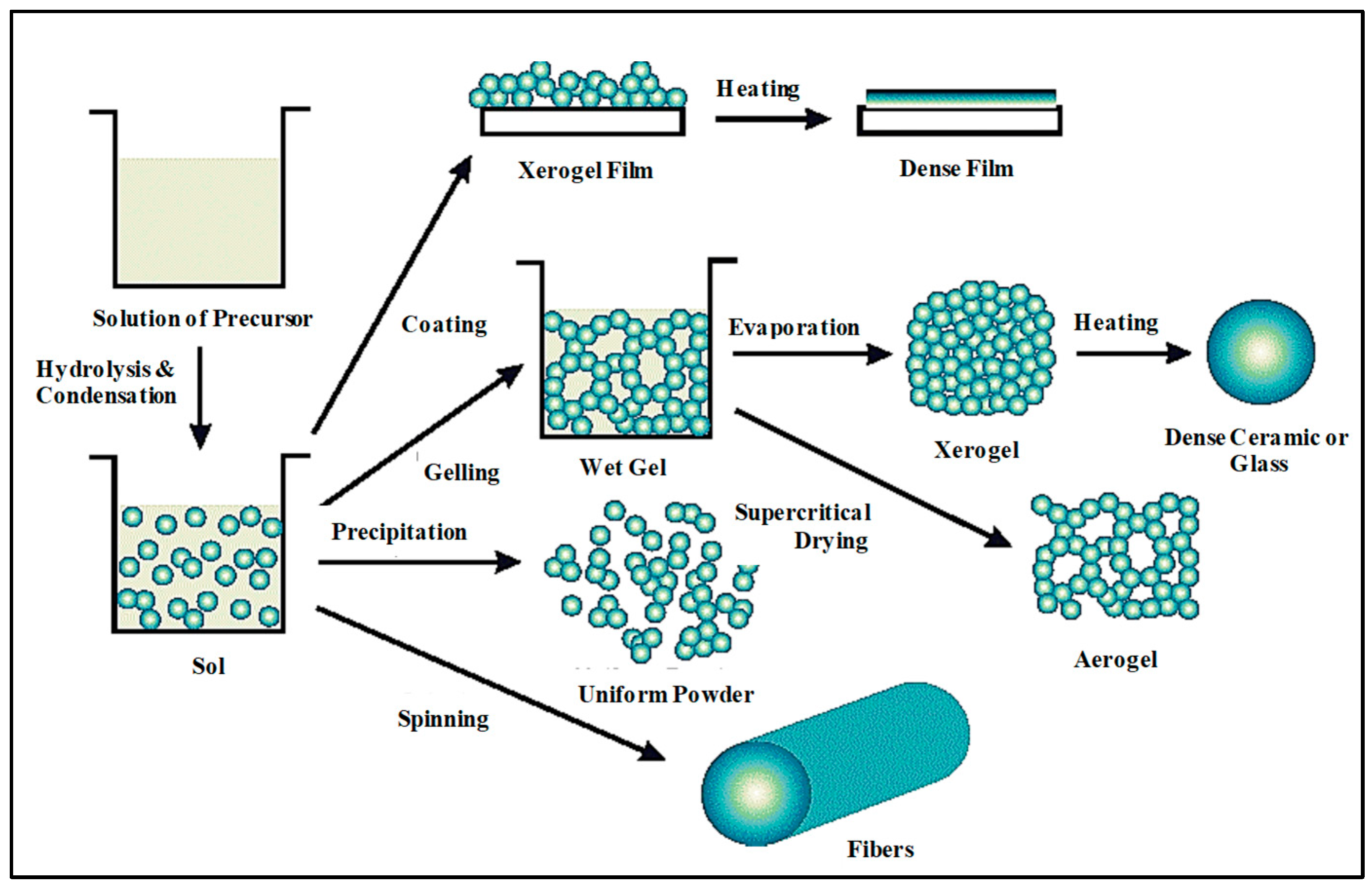
AM has emerged as a powerful approach for producing complex ceramic geometries with internal channels or graded compositions, offering greater design flexibility and reduced waste while enabling multifunctional aerospace and defence components [6,172]. When combined with sintering additives and nano-reinforcements, AM enhances crack resistance and thermal shock performance. Ceramic oxides such as Al2O3 and ZrO2 remain widely used due to their excellent properties [234,235,236], supporting applications in turbine blades, nozzles, and combustion liners where they improve thermal efficiency and reduce emissions [127,237]. Traditional methods like extrusion moulding, slip casting, and sol–gel processing face limitations in mould fabrication, geometric complexity, and reliance on solid-state sintering, leading to long processing times, shrinkage, and porosity [238,239]. AM overcomes these barriers through layer-by-layer fabrication, eliminating moulds, reducing post-processing, and enabling shorter production cycles and greater design freedom [240,241,242]. Consequently, AM enhances the feasibility of producing high-performance, complex ceramic oxide components for demanding aerospace and defence applications [236].

3.1.2. Robocasting

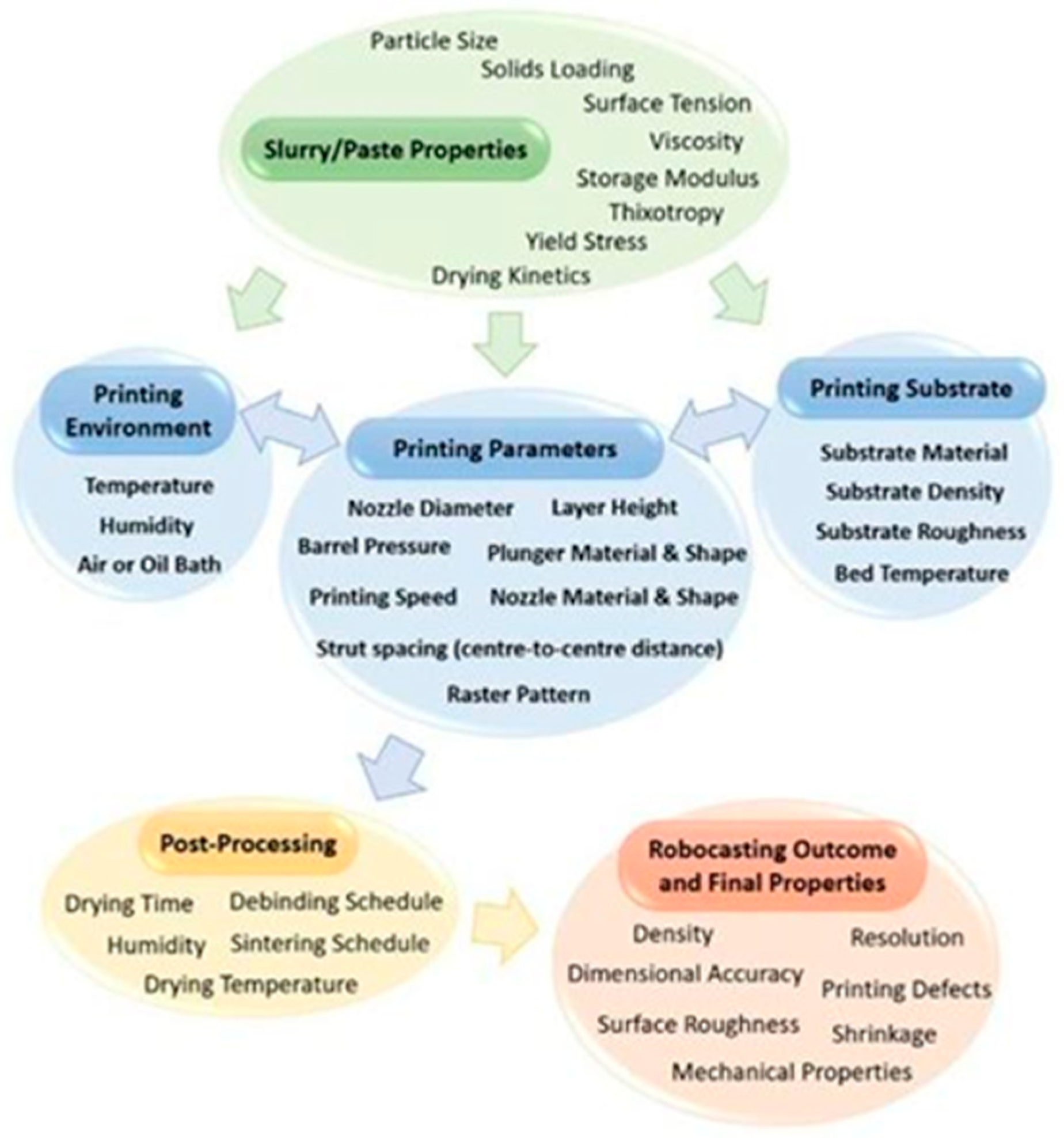
Robocasting, also known as direct ink writing (DIW) [243], is an extrusion-based additive manufacturing method that enables the layer-by-layer fabrication of complex ceramic structures, including lattices, graded porosity, and internal channels that are difficult to achieve with traditional forming techniques [244]. It is particularly suited for producing green bodies of tough ceramics such as SiC, ZrO2, and Al2O3 composites used in aerospace and defence applications. Robocasting inks require high solid loading, shear-thinning behaviour, and carefully optimized additives to ensure printability, stability, and minimal shrinkage [243,244,245,246]. After printing, parts undergo drying, debinding, and sintering or pressure-assisted densification to achieve high mechanical and thermal performance. A comprehensive mapping of key robocasting variables, encompassing both the properties of the initial ceramic paste and post-printing parameters, and their influence on the final structural and functional properties of printed ceramic components are shown in Figure 8. Originally developed at Sandia National Laboratories [247] and patented in 2000 [248], robocasting continues to advance, offering tailored porosity, functionally graded structures, and digital manufacturing advantages that support next-generation aerospace and defence components [245].
Robocasting has proven effective for producing CMCs reinforced with short carbon fibres in ceramic matrices such as Al2O3, SiC with Al2O3–Y2O3, and SiC–B4C systems [6,236]. Feilden et al. [249] demonstrated that HfB2 components with complex geometries, uniform microstructures, and high strength, ~350 MPa at room temperature and ~200 MPa up to 1950 °C, can be fabricated by robocasting, comparable to conventionally processed materials. Ongoing advances in ink formulation, process monitoring, AI-driven optimization, and hybrid post-processing are expected to enhance reliability and broaden the technique’s applicability, positioning robocasting as a key technology for next-generation aerospace and defence ceramics.

3.1.3. Selective Laser Sintering (SLS)/Selective Laser Melting/(SLM)

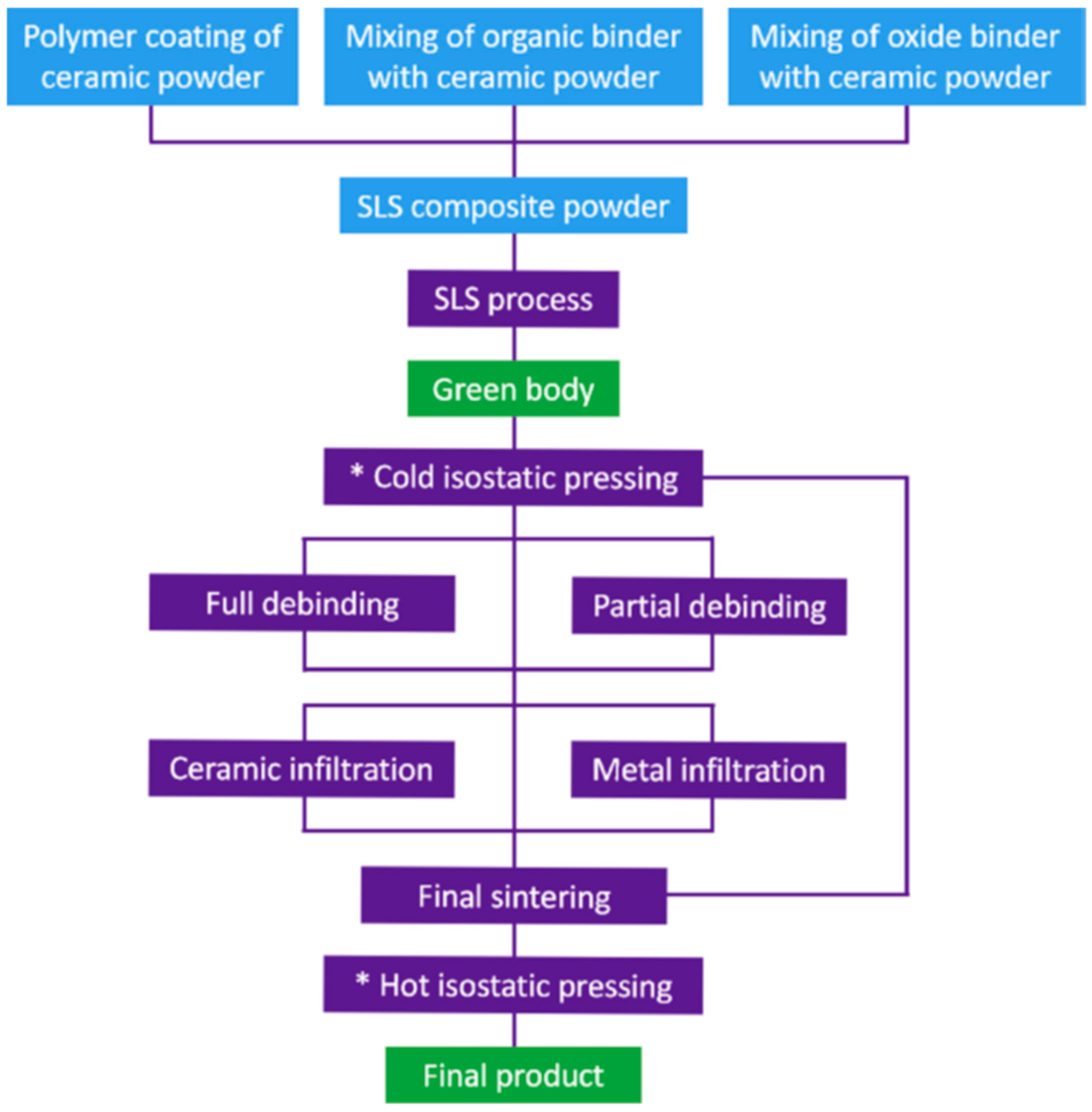
SLS and SLM are key AM methods for processing UHTCs such as in ZrB2, HfB2, and SiC systems [6,250]. While SLM fully melts powders and SLS relies on localized sintering, both face challenges due to the extreme melting points, low optical absorption, and brittleness of UHTCs. Strategies including preheating, fine powders, and sintering aids or secondary phases (e.g., SiC, MoSi2) improve densification, with SLS often supplemented by post-sintering or HIP [251,252]. Successful demonstrations include SiC and ZrB2–ZrC–B4C coatings by King et al. [253] and near-theoretical-density HfB2 with strength >200 MPa up to 2000 °C. However, SLS ceramics still suffer from high shrinkage and porosity, as seen in Al2O3 composite microspheres with <50% density [254,255], necessitating post-processing such as infiltration or isostatic pressing [256]. Process-optimization routes to reduce porosity and enhance mechanical performance are summarized in Figure 9 [239]. Persistent challenges remain, particularly sintering temperature and final density; optimal laser energy, which is dependent on material thermal properties and powder packing, is crucial for successful SLS, as noted by Muthukutti et al. [254].
SLS sinters ceramic powders below their melting point, yielding partially fused, porous parts, whereas SLM fully melts the powder to produce dense components with superior mechanical properties, making it more suitable for high-strength structural applications [254]. Emerging hybrid strategies, such as combining SLM with reactive sintering, laser-assisted deposition, or infiltration, aim to overcome current limitations. Continued advances in processing and materials are positioning both SLS and SLM as key technologies for manufacturing UHTC components in aerospace propulsion, thermal protection, and hypersonic systems [251,257,258].

3.1.4. Binder Jetting (BJ)

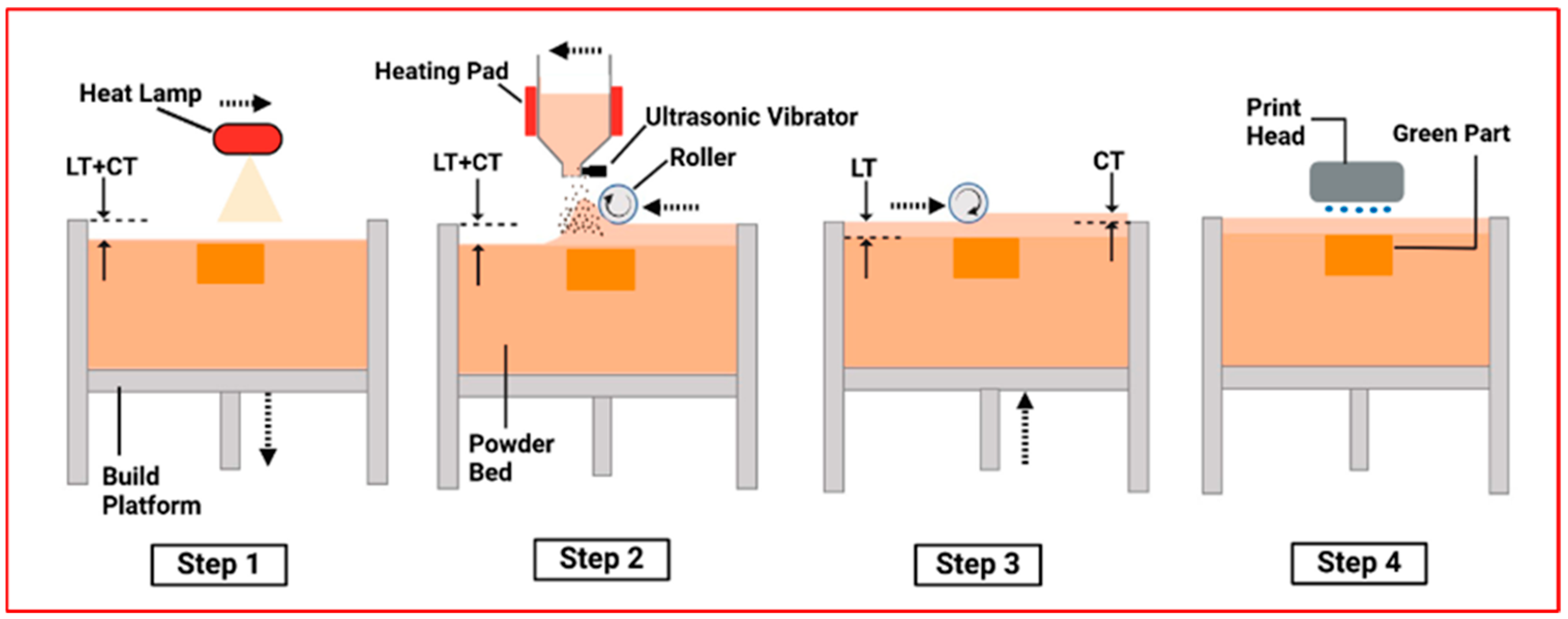
BJ, first developed at MIT in the late 1980s [259,260] and later standardized by ASTM as a binder-based powder-joining process [261], enables flexible and scalable fabrication of ceramic parts without the high thermal gradients of laser-based methods. In this technique, a liquid binder selectively bonds powder particles to form a green body, which is later strengthened through debinding, sintering, or infiltration [262,263]. As illustrated in Figure 10, the process involves powder deposition, spreading, optional compaction, and binder application, with various powder-dispensing approaches available [264,265] and compaction not included in all systems [266]. After layer-by-layer printing and drying, the part is removed, cured, and post-processed to achieve the required density and mechanical performance [263].
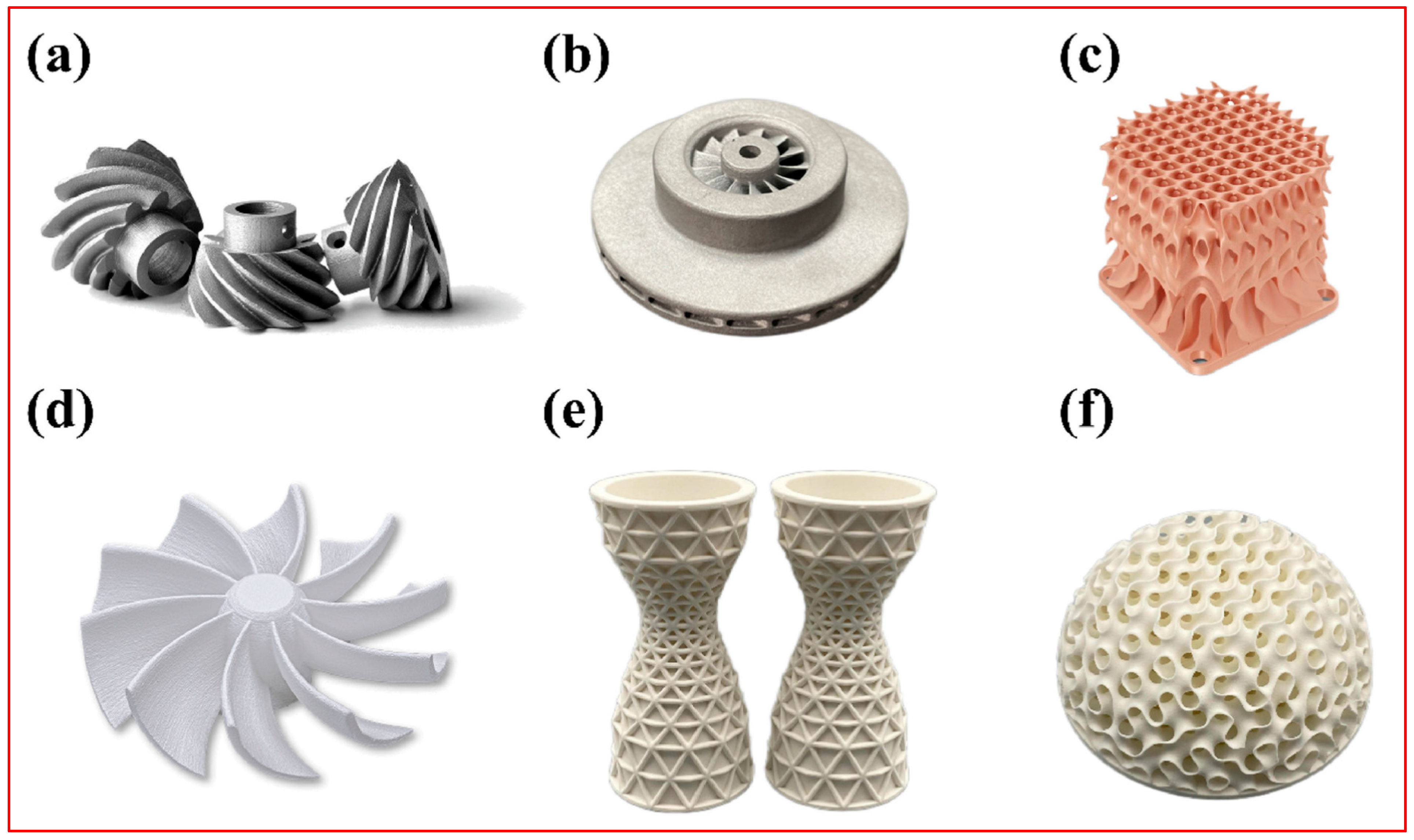
BJ offers key advantages such as low cost, no thermal stresses, high production rates, and broad material compatibility [267,268,269], making it suitable for ceramics like SiC used in turbines, gears, and heat exchangers [270]. However, low density and strength remain major challenges, as green density strongly affects shrinkage and defects [263]. Critical parameters influencing density include layer thickness [271,272], compaction thickness [263], roller speed [273], binder saturation [274], and ultrasonic intensity [271]. Strategies to improve density fall into materials preparation (e.g., particle coating [275], granulation [276], mixed particle sizes [277], and slurry feedstocks [278]), process optimization [272,279], and post-processing, such as infiltration [280] and isostatic pressing [281]. Studies on Al2O3 show that additives like hydrophilic fumed silica improve flowability and green strength [282], while sol concentration and coating enhance shell properties [283]. Sintering behaviour indicates that additives promote low-temperature densification, though BJ-printed Al2O3 often remains below 80% relative density. Examples of complex BJ parts are shown in Figure 11a–f [284]. Overall, BJ is emerging as a versatile AM technology, with ongoing advances in resolution, material capability, and post-processing expanding its potential across ceramics, metals, and other powders.
BJ is not yet a complete solution for aerospace-grade ceramics, but it shows strong potential for components requiring complex geometries, thermal insulation, and weight reduction. With continued advances in material science and post-processing, it may become a key technology for next-generation ceramic parts in hypersonics, propulsion, and TPS. Recent developments highlight active efforts by NASA to refine BJ for high-performance ceramic components that are difficult to produce through conventional manufacturing.

3.1.5. Laminated Object Manufacturing (LOM)

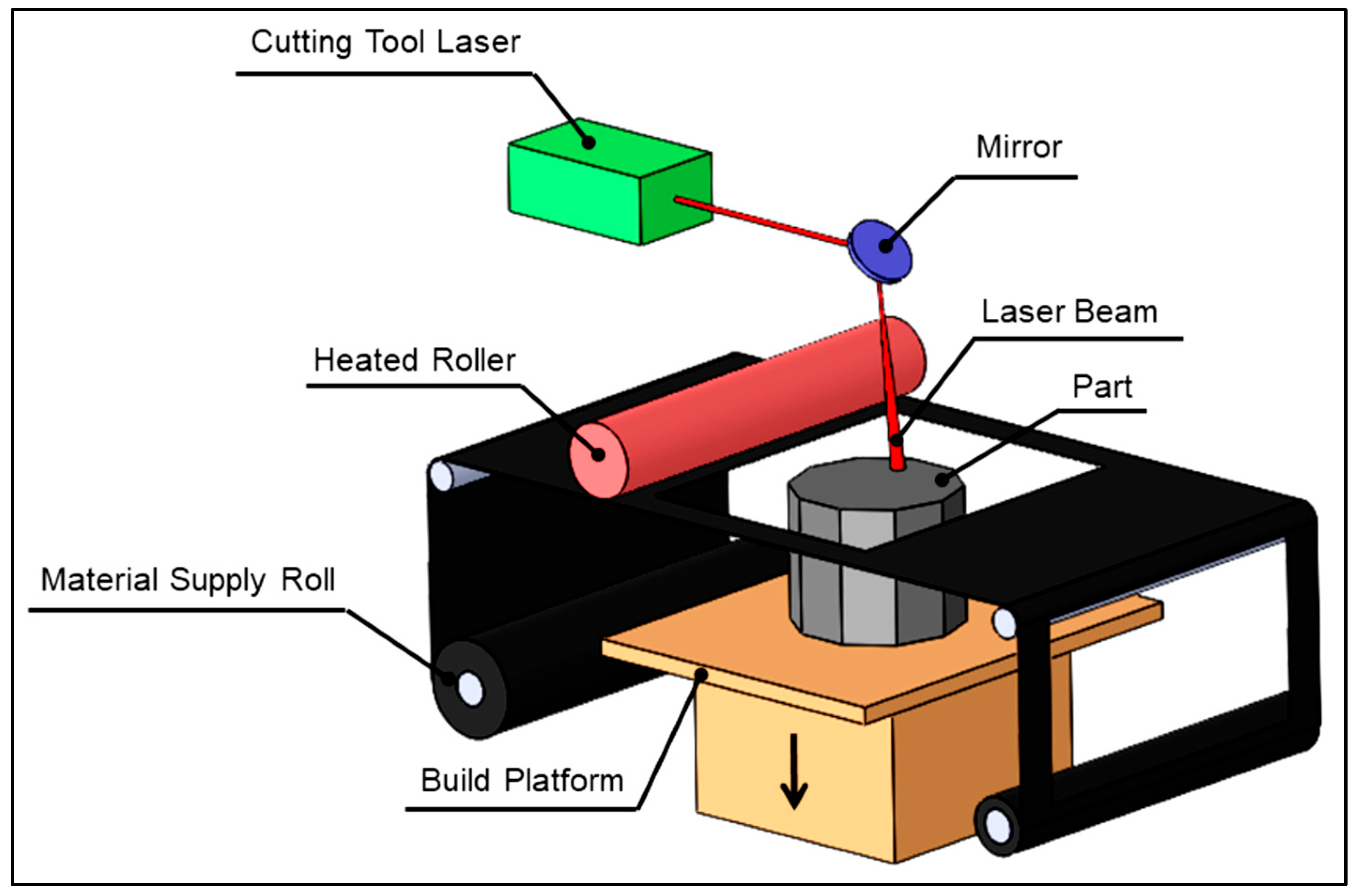
LOM (Figure 12) builds 3D parts by bonding and cutting stacked material layers [285,286]. Recent advances allow LOM to process technical ceramics using laminated green tapes, which are later debound and sintered for densification [284]. LOM enables the fabrication of large, complex ceramic components with low residual stresses, since it avoids high-energy melting, making it suitable for aerospace structures exposed to thermal and mechanical cycling [284]. Its high deposition rates also support the production of large ceramic tiles and armour systems for defence applications.
LOM reduces tooling costs and manufacturing time but suffers from poor surface quality, lower dimensional accuracy, and slow removal of excess material, making it unsuitable for highly complex geometries [287]. Ceramic materials commonly used in LOM include Al2O3, SiC, Si3N4, and ZrO2, chosen for their performance and process compatibility [288]. Despite moderate porosity, LOM-fabricated parts can achieve competitive flexural strength, such as Si3N4 components reaching 475 ± 34 MPa [289], comparable to PLS results [290] and far exceeding gel casting (54.5 ± 2.3 MPa) [291]. Limitations, however, arise from interlayer defects such as delamination and shrinkage mismatch [288]. A DARPA-funded curved-layer LOM advancement improved fibre continuity, reduced waste, and enhanced surface finish, expanding CMC applicability and strengthening LOM’s potential for aerospace and defence structures [292]. Table 11 summarizes the advantages, limitations, and applications of major ceramic AM methods.
In aerospace, AM contributes to weight reduction, lowering fuel consumption and CO2 emissions, while also enabling innovative geometries that enhance performance. In defence, its ability to produce custom, mission-critical components on demand, even in remote or supply-limited environments, enhances operational readiness and reduces dependence on traditional supply chains. Beyond large corporations, AM’s growing accessibility has democratized innovation, allowing participants from small enterprises to established research centres [293]. However, it is in the high-performance demands of aerospace and defence where additive manufacturing proves its highest value, pushing design limits, shrinking development timelines, and delivering agile, cost-effective solutions where conventional manufacturing falls short [294].
Among additive manufacturing technologies, only SLM and DED have demonstrated single-step shaping and sintering of advanced ceramics. DED, in particular, plays a strategic role in aerospace and defence applications, where it enables repair, refurbishment, and near-net-shape fabrication of high-performance metallic and ceramic components. Its applications span turbine engine repair, titanium airframe structures, space propulsion systems, and in situ manufacturing for long-duration missions. In defence contexts, DED enhances operational readiness through rapid field repair, reinforcement of armoured and naval systems, and corrosion-resistant overlay deposition.

3.2. Thermal Barrier Coatings (TBCs) and Environmental Barrier Coatings (EBCs)

EBCs and TBCs protect CMCs and metallic substrates from severe thermal, oxidative, and corrosive conditions [106,130]. These multilayer ceramic systems, typically based on YSZ, rare-earth silicates, and Al2O3, are produced using specialized deposition methods selected according to thermal-gradient resistance, oxidation protection, cycling performance, and substrate compatibility [134,140,144,151]. APS and EB-PVD remain standard for TBCs, while chemical vapour deposition/chemical vapour infiltration (CVD/CVI) is widely used for EBCs. Emerging AM and hybrid approaches aim to enable more complex and durable coating architectures.

3.2.1. Atmospheric Plasma Spray (APS)

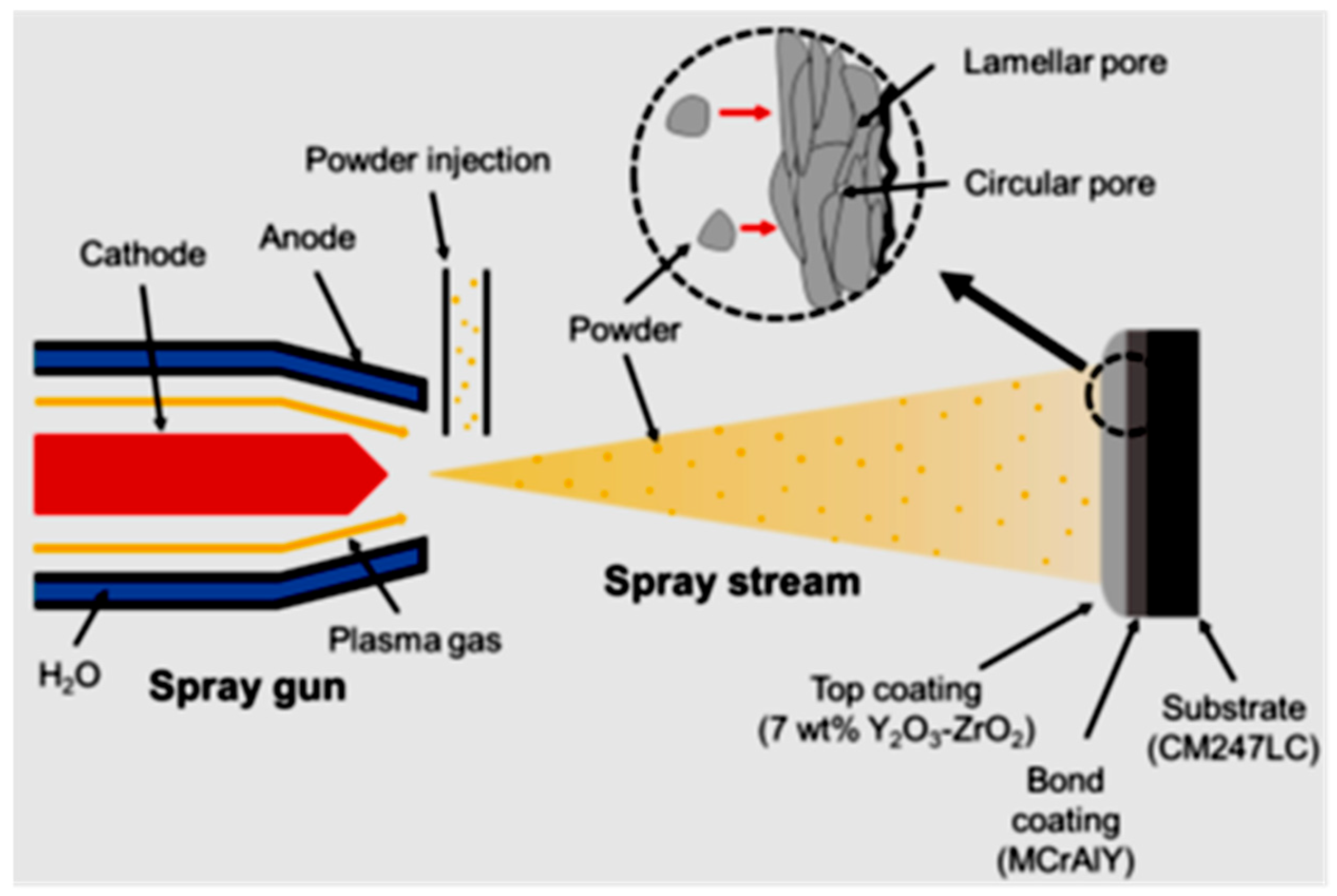
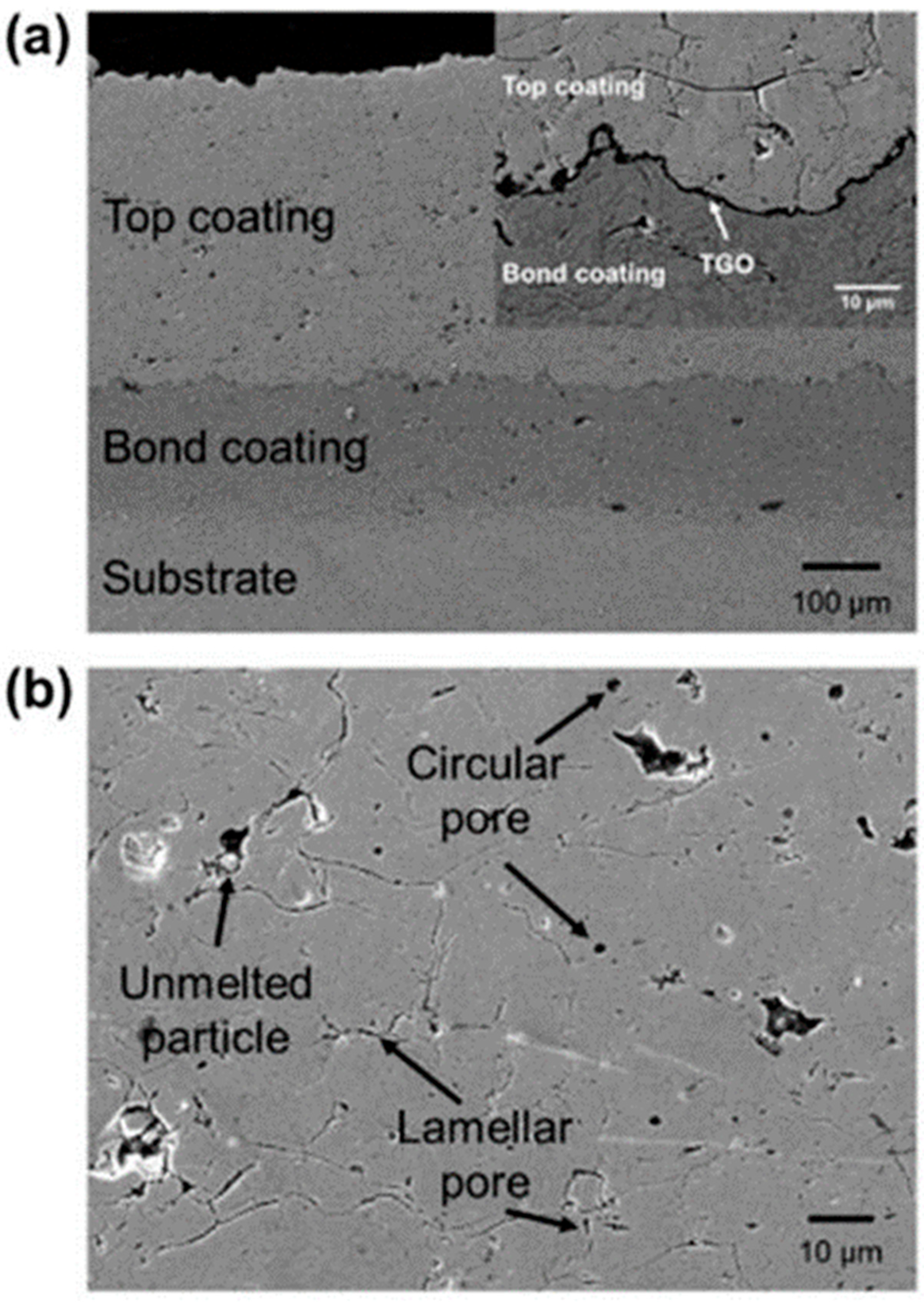
APS is a widely used process for depositing TBC and EBC layers, producing thick (100–500 µm), strain-tolerant coatings through the melting and propulsion of ceramic powders in a plasma jet, with applications across aerospace, automotive, and energy industries [295]. It offers high deposition rates, versatility across materials and geometries, and enhances resistance to corrosion, wear, oxidation, and heat [296,297]. Advancements in such coatings have supported major technological progress, including gas turbine temperature increases from 400 °C in 1933 to 1600 °C in 2011, with goals of 1700 °C [298]. A schematic of the APS system is shown in Figure 13 [299], illustrating the formation of pores influenced by spray conditions [300], while bond coats improve adhesion and reduce thermal stresses. A cross-sectional TBC view is presented in Figure 14 [299], showing the topcoat, bond coat, substrate, and TGO.
Figure 14b shows an enlarged view of the coating microstructure, where high-velocity plasma deposition produces a layered arrangement with two main pore types: small circular pores (<2 µm2) from partially melted particles, and horizontally aligned lamellar pores formed by the stratified deposition process.
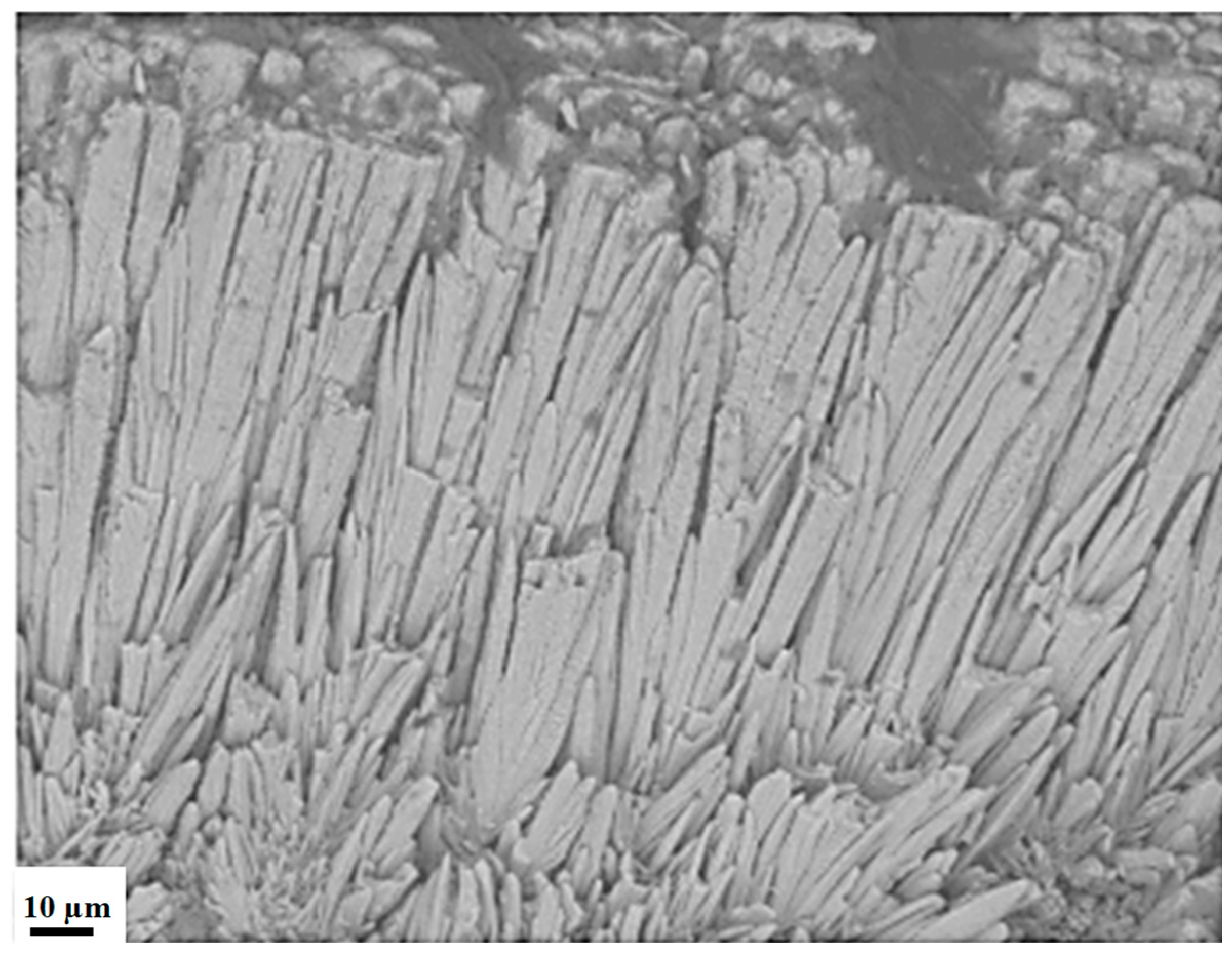
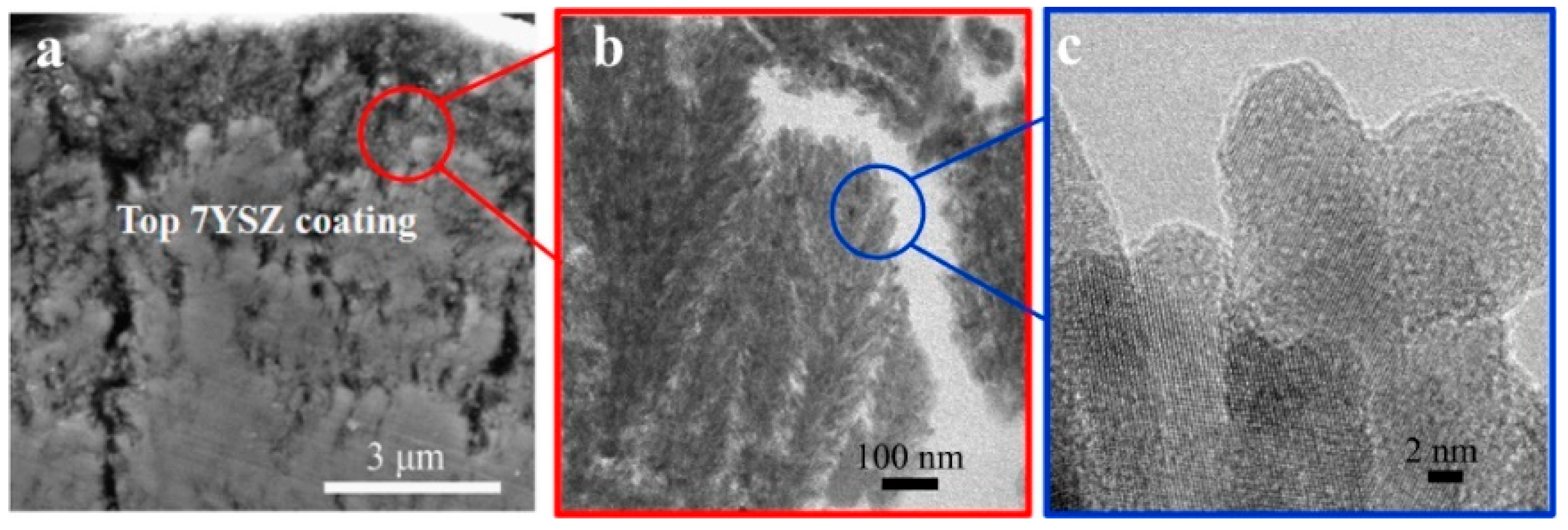
Thermal conductivity in APS-deposited TBCs is mainly governed by lamellar pores, while circular pores have a lesser effect. Their formation can be reduced by optimizing spray distance, particle temperature, powder feed rate, substrate preparation, and torch speed. As TBC requirements evolve alongside advances in hot-section materials, deposition methods have progressed from APS to EB-PVD and, more recently, to PS-PVD [301]. APS TBCs could not endure the high rotational speeds (>20,000 rpm) and thermal cycling of turbine blades in the 1980s [302,303], leading to the adoption of EB-PVD, which provides excellent cycling performance due to its strain-tolerant columnar structure despite its higher thermal conductivity [304,305]. However, EB-PVD’s thermal conductivity (1.6–2.3 W/m·K) remains a limitation [306]. PS-PVD, introduced in the 2000s, offers a third-generation solution with multiphase deposition and higher vapour-phase concentration, enabling dendritic, feather-like 7YSZ coatings as shown in Figure 15a–c [301], and positioning it as a strong candidate for next-generation TBCs [307,308].
The main challenges of PS-PVD, a third-generation TBC deposition method, involve its high process complexity, requiring precise control of plasma conditions, temperature, pressure, and feed rate, and the significant cost of advanced plasma equipment. Although potentially cheaper than EB-PVD in some aspects, PS-PVD still requires expensive systems and faces additional limitations such as restricted material compatibility in its multiphase environment, challenges in porosity control, and scalability issues for uniformly coating large or complex components.

3.2.2. Electron Beam Physical Vapour Deposition (EB-PVD)

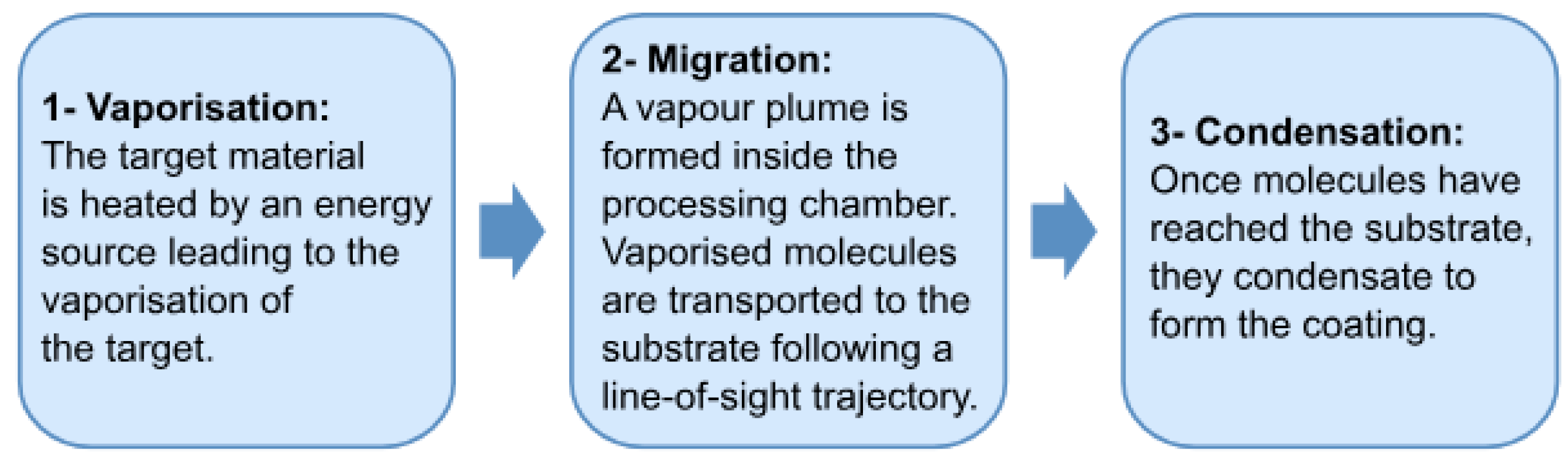
Several methods exist for producing TBCs [301], but EB-PVD remains the most widely used for coating high-pressure/high-temperature (HPHT) turbine blades operating at temperatures above the alloy melting point [309]. Its main advantage is the formation of columnar microstructures that provide excellent strain tolerance during thermal cycling. However, EB-PVD faces challenges when evaporating novel or complex materials. In general, physical vapour deposition (PVD) is a vacuum-based technique in which material is vaporized from a target and transported through a low-pressure chamber before condensing on the substrate to form thin films ranging from nanometres to micrometres [310,311]. The three main stages of the PVD process are shown in Figure 16 [310].
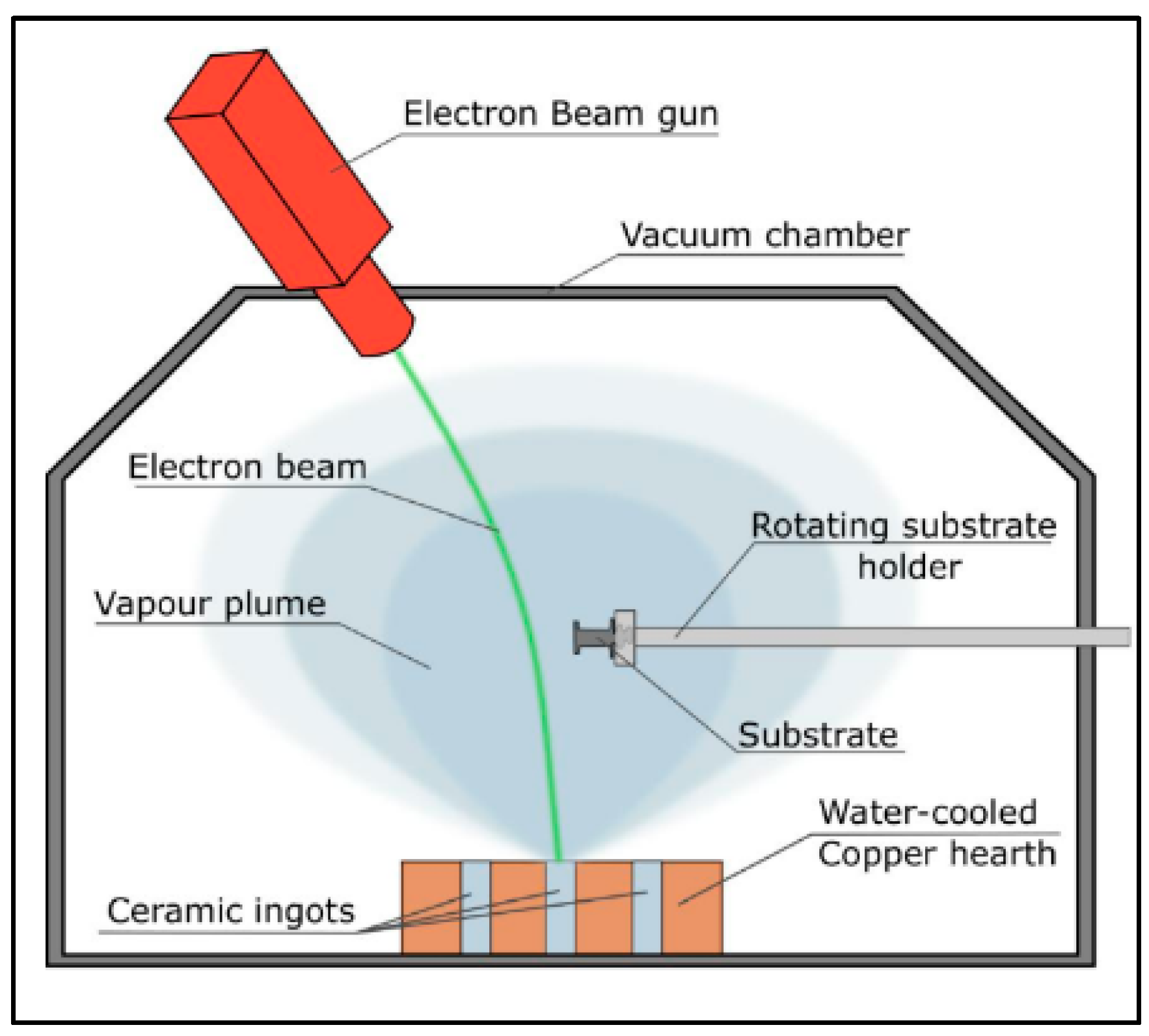
In EB-PVD, a focused electron beam serves as the energy source, enabling much thicker coatings, often hundreds of micrometres, due to higher deposition rates compared to other PVD methods such as sputtering. The specialized equipment used for EB-PVD is shown in Figure 17 [310], and a detailed description of the technique is provided in reference [312].
In EB-PVD, gas-phase species accumulate on the substrate to form a columnar microstructure, but the lack of transverse discontinuities reduces its thermal insulation capability [313,314]. Research has shown that thermal conductivity increases with coating thickness [315], while variations in deposition parameters can adjust coating morphology, with intra- and inter-columnar porosity strongly influencing thermal conductivity [316]. A typical EB-PVD partially Y2O3-stabilized ZrO2 (PYSZ) coating with uniform, independently grown columns and horizontal discontinuities is illustrated in Figure 18 [314].
The columnar microstructure of EB-PVD coatings strongly influences TBC thermal performance, with higher porosity near the bond coat reducing conductivity and lower porosity near the surface increasing it. Designing layered coatings to enhance porosity can further decrease effective conductivity, while Y2O3 doping increases phonon scattering in ZrO2, lowering conductivity through reduced phonon mean free path [313,314]. These combined microstructural and compositional strategies improve thermal insulation, ensuring that EB-PVD remains essential for aerospace and defence applications requiring extreme thermal protection and superior thermal cycling resistance.

3.2.3. Chemical Vapour Deposition (CVD)

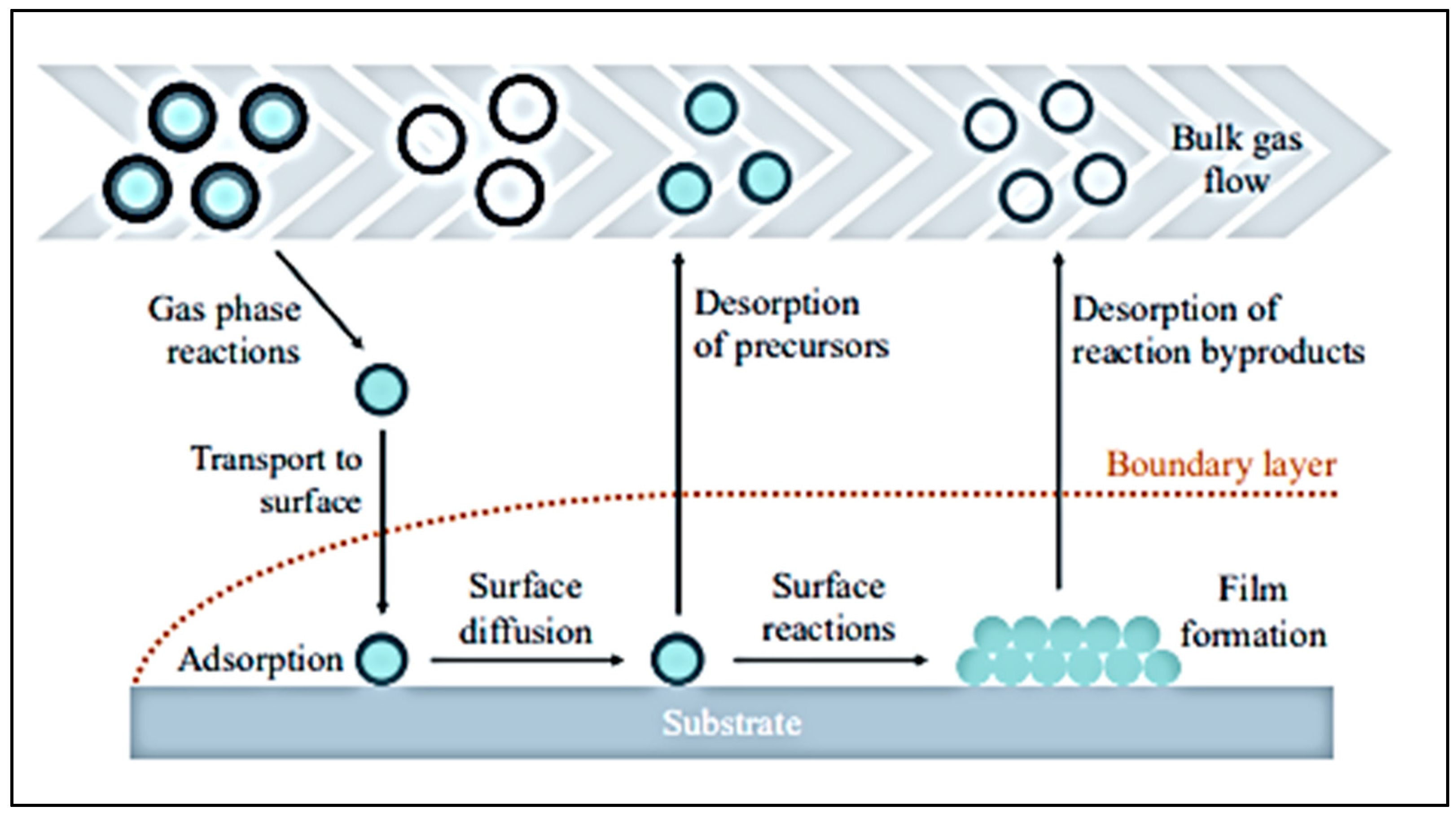
APS and EB-PVD remain standard TBC deposition methods for aircraft engines and industrial gas turbines [316], but both are limited by their “line-of-sight” nature, making uniform coating of complex geometries difficult without advanced robotics. EB-PVD adoption is further constrained by high equipment cost, prompting interest in alternative technologies offering comparable coating quality without geometric or economic limitations [316]. Current TBC/EBC methods include APS, EB-PVD, sputtering, slurry deposition, PS-PVD, and CVD, with APS most common for EBCs [317,318]. EB-PVD also faces challenges in achieving proper stoichiometry, particularly due to the low vapour pressure of silica, increasing interest in CVD [319] and emerging sol–gel/slurry approaches [320].
CVD enables the deposition of dense, uniform TBCs and EBCs with excellent control of thickness, composition, and microstructure, producing materials such as YSZ for TBCs [316,321] and rare-earth silicates for EBCs [322]. Its ability to conformally coat complex geometries, including internal surfaces, is a major advantage [323], and the process can yield columnar microstructures under suitable conditions [324]. Effective bonding requires proper surface preparation. Multiple CVD variants exist, including low-pressure CVD (LPCVD), plasma-enhanced CVD (PECVD), metal–organic CVD (MOCVD), atomic layer deposition (ALD), Hot-Wall, and Cold-Wall systems, each tailored to specific applications [325,326]. Figure 19 illustrates the transport and reaction steps of typical CVD processes [326], with a more detailed description available in Ref. [324].
The deposition technique has a strong impact on coating microstructure and thus on properties such as thermal conductivity, strain tolerance, and durability. CVD provides several major advantages for TBCs and EBCs in advanced turbine engines and extreme environments [321,322,323], including excellent conformality on complex or internal geometries, strong coating–substrate adhesion for improved thermal cycling life, precise control of thickness and composition for graded or multilayer architectures, and compatibility with high-temperature ceramic materials such as SiC, Si3N4, SiO2, Al2O3, Y2O3, and ZrO2 [322,326]. Although CVD is generally more costly and slower than plasma spray methods, its superior coating quality and lower deposition temperatures make it highly valuable for mission-critical aerospace applications requiring long service life and reliability.

3.2.4. Sol–Gel Processing

The sol–gel process is a versatile soft-chemical technique for producing advanced inorganic materials, especially ceramic coatings such as TBCs and EBCs. It converts a precursor “sol” into a solid “gel” through hydrolysis and condensation, followed by deposition and heat treatment to create dense or porous ceramic layers [327,328]. The method provides precise control of composition and microstructure, enabling tailored thermal, mechanical, and corrosion-resistant properties. For TBCs, sol–gel processing allows deposition of materials like YSZ onto metallic turbine components. The fundamental steps of the process are shown in Figure 20 [327].
The sol–gel method enables the low-temperature deposition of compositionally tuneable coatings with controlled porosity and uniform coverage, including on complex internal geometries, using dip, spray, or hybrid deposition strategies [329,330]. At the industrial scale, EB-PVD [309,313] and APS [295,299] dominate TBC fabrication, producing columnar and lamellar microstructures, respectively, while the sol–gel approach offers a low-cost alternative with equiaxed morphologies, adaptable porosity, and strong substrate coverage [321]. Advances such as precursor-powder dispersion and multimodal mixtures have yielded homogeneous YSZ coatings with excellent durability, surviving >55 cycles at 1100 °C and retaining performance up to 1150 °C [327,329,331]. Studies at Cirimat [332] showed sol–gel YSZ TBCs enduring >1000 cycles at 1100 °C, aided by stabilization of the metastable t′-phase and optional fibre reinforcement [333,334]. Surface cracking remains a challenge, but optimized sintering and multi-pass deposition significantly improve life, enabling >1500 oxidation cycles and revealing distinct failure modes compared with EB-PVD [333]. Sol–gel processing is also advancing EBC development using rare-earth silicates for CMC protection. Recent tests demonstrated sol–gel TBCs withstanding 1485 cycles (1 h at 1100 °C) without major degradation [335]. CMAS infiltration remains a critical threat to TBCs [336], with APS showing greater resistance than EB-PVD [151,337,338]. Sol–gel coatings offer a tuneable, low-temperature route to CMAS-resistant layers [336]. CMAS-induced thermomechanical and thermochemical attacks have caused severe turbine damage, with a notable case reported by Song and Guo [339]. Awareness of volcanic ash hazards increased dramatically after the 2010 Eyjafjallajökull eruption (see Figure 21).
Coatings doped with ytterbium (Yb) and dysprosium (Dy) enhance CMAS resistance in TBCs, as 6 at % additions promote the formation of a new surface phase, potentially apatite, that creates a sealing layer on top of TBC columns without damaging the underlying structure [336]. Although mechanical durability and thermal-cycling stability remain concerns, sol–gel coatings continue to offer a promising route for CMAS mitigation. Ongoing research on rare-earth-doped sol–gel layers is expected to support next-generation TBCs capable of operating under harsher conditions and higher TET levels. Overall, the sol–gel process shows strong potential for future TBC/EBC manufacturing and CMAS resistance due to its chemical flexibility, cost-effectiveness, compatibility with current systems, and ability to address environment-specific threats.
The degradation of thermal barrier coatings under CMAS exposure cannot be interpreted as a simple surface contamination phenomenon; rather, it represents a multi-scale instability involving thermochemical reactivity, phase destabilization, microstructural densification, and evolving mechanical incompatibilities.
CMAS attack reveals intrinsic vulnerabilities in conventional YSZ-based systems that stem directly from the very microstructural features that make them effective thermal insulators. At the microscale, capillary-driven infiltration transforms a compliant, strain-tolerant porous architecture into a stiffened, glass-infiltrated composite. At the crystallographic level, yttria depletion and dissolution–reprecipitation processes compromise the metastable tetragonal phase, reducing transformation toughening capability and promoting monoclinic formation with associated volumetric expansion. At the mesoscale, these mechanisms generate stiffness gradients and residual stress concentrations that intensify during thermal cycling.
A critical insight emerging from this analysis is that CMAS attack and sintering are not independent degradation pathways but mutually reinforcing processes. Intrinsic high-temperature sintering already reduces porosity and increases elastic modulus over service time; CMAS infiltration accelerates and localizes this densification. The resulting loss of compliance undermines the fundamental design principle of TBCs: strain accommodation under severe thermal gradients. Consequently, spallation becomes a mechanically inevitable outcome once a critical stiffness threshold and interfacial stress state are reached. Furthermore, phase instability introduces a second-order reliability concern. The t → m transformation not only induces microcracking but also progressively diminishes the toughening mechanisms that initially delay catastrophic failure. In this context, the degradation is cumulative and self-amplifying: chemical destabilization enhances mechanical fragility, which in turn accelerates crack propagation under cyclic loading. On the other hand, from a materials design standpoint, these findings underscore several strategic imperatives: (i) the reduction in microstructural permeability without excessively compromising strain tolerance, (ii) improved thermochemical compatibility through compositions resistant to silicate dissolution, (iii) enhanced phase stability at ultra-high temperatures to prevent yttria depletion and destabilization, and (iv) sintering-resistant architectures, particularly for long-duration high-temperature exposure [336,339].
Importantly, mitigation strategies must balance chemical resistance with mechanical compliance. Dense or highly CMAS-resistant coatings may reduce infiltration but risk premature failure due to thermal mismatch stresses. Conversely, highly porous systems improve strain tolerance but remain vulnerable to capillary attack. The future of advanced TBC systems, therefore, lies in multi-layered designs that decouple permeability, compliance, and chemical resistance functions. Therefore, CMAS attack should be conceptualized as a coupled thermochemical–thermomechanical instability that progressively erodes microstructural integrity, phase stability, and mechanical reliability [336]. The durability of next-generation ceramic coatings will depend not only on compositional innovation but on integrated control of processing, architecture, and high-temperature evolution mechanisms.

4. Sintering of UHTC Coatings

Bulk UHTCs are typically densified using SPS, HP, and MWS to achieve near-theoretical densities, refined microstructures, and high-temperature mechanical performance, making them suitable for leading edges and nose caps, though brittleness and oxidation susceptibility require protective coatings [340]. UHTCs are increasingly used in TBCs and EBCs, where systems such as ZrB2–SiC and HfB2–SiC improve oxidation resistance through silica-scale formation, while carbides and nitrides provide ablation resistance; coating methods include plasma spraying, CVD, slurry deposition with sintering, and laser-assisted processes [106,313]. Sintering provides structural integrity in bulk UHTCs and consolidation/adhesion control in coatings, but for TBCs, the key factor is the deposition method, since excessive sintering during service degrades performance. Porosity is beneficial in TBCs, while EBCs require high density, and additives such as SiC, rare-earth oxides, and graded layers improve thermal compatibility and environmental stability [313]. Coating performance depends on the sintering-driven control of adhesion, grain size, porosity, and formation of protective secondary phases such as SiO2 from SiC-containing UHTCs [83,140,141]. Strategies to overcome poor UHTC sinterability include adding SiC/Si3N4, silicides (MoSi2, WSi2), rare-earth oxides, and nanopowders [208,341]. As shown in Figure 22 [342], UHTC development for hypersonic applications proceeds from pellet processing and sintering optimization to full property characterization, qualification testing in plasma arc jets [343,344], plasma wind tunnels [345], and oxyacetylene rigs [346], supported by computational modelling. Final component fabrication remains challenged by the difficulty of achieving full densification without grain coarsening and by microstructural degradation from non-uniform sintering temperatures [20].
To address the challenges associated with dimensional scalability and the fabrication of large-scale ceramic components, critical aspects of the UHTC development cycle, Mukherjee and Basu [342] provide, in Figure 23, a comprehensive overview of the UHTC development pathway and its application in hypersonic technology.
The precise optimization of sintering parameters, processing routes, and additive compositions is essential to achieving the desired microstructure–property balance in UHTCs, which, after aerothermal performance evaluation and TPS design, are scaled up, machined into complex geometries, and ultimately validated through flight testing. A key distinction exists between traditional UHTC coatings and those produced via sol–gel methods: sol–gel-derived coatings are intentionally sintered as part of their consolidation process [327,328], whereas many conventional coatings remain partially porous. Sol–gel routes have been extended to UHTC precursors such as ZrB2, HfB2, SiC, and ZrC using organometallic or polymeric sources [347], in which precursor layers are deposited and pyrolyzed at 1200–1600 °C to yield dense nanoscale-sintered coatings, though thickness and precursor stability limit their applicability [348,349]. Porous UHTC sol–gel processing generally follows templating, foaming, or solvent-evaporation approaches, as depicted in Figure 24I–III [348].
The templating method infiltrates a porous template with a pre-ceramic sol, followed by drying and heat treatment up to 1600 °C to form porous UHTCs via carbothermal reduction. The final ceramics replicate the template morphology with some shrinkage, with UHTC phases forming around 1200 °C and fully developing between 1300 °C and 1500 °C, accompanied by weight loss. This approach enables varied porosities and pore sizes in systems such as ZrC, ZrC/SiC, ZrB2, and ZrB2/SiC [341,348,349,350].
For hypersonic flight (>Mach 5, 1715 m·s−1), UHTCs like ZrB2 and HfB2 are key TPS candidates, though their oxide by-products (ZrO2, HfO2) undergo phase transformations that cause cracking. Dopants are used to stabilize these oxides and improve oxidation resistance. Zheng [347] produced submicron HfB2 powder (~200 nm) using a modified sol–gel method with carbothermal reduction, mitigating cracking and enhancing high-temperature oxidation resistance. Figure 25 shows the synthesis route for submicron HfB2 powder.
The sol–gel-derived HfB2 powders produced via carbothermal reduction (Figure 26) exhibited a mean particle size of 0.19 μm and a surface area of 2.98 m2·g−1, markedly finer than commercial Tribacher HfB2 (1.90 μm, 1.92 m2·g−1). Their ultrafine nature is linked to the small HfO2 nuclei in the precursors, and purity was enhanced by adding excess boron to offset losses during reduction. Despite varying the nominal Hf:B:C ratios of 1:2:5 to 1:3:5 and 1:4:5 (Figure 26a–c), particle size remained largely unchanged, with all powders remaining significantly finer than commercial material, as shown in Figure 26d.
The particle size of HfB2 is crucial for hypersonic ceramics. Fine particles enhance sinterability, densification, and oxidation resistance, leading to stronger, more durable microstructures. In contrast, coarse particles reduce densification, increase defects, and weaken performance under hypersonic conditions. In the near future, the sol–gel method will evolve from a specialized domain synthesis route into a strategic platform for engineering UHTCs with customized morphologies and multifunctional properties, particularly for lightweight, high-performance TPS and aerospace components exposed to extreme thermo-oxidative environments. Its compatibility with low-temperature processing, nanoscale design, and advanced manufacturing techniques positions sol–gel as a key enabler of next-generation ceramic solutions in aerospace technology.

5. Materials Selection for Aerospace and Defence Systems

The integration of aerospace and military technologies has strengthened operational capabilities, with 2025 global defence spending reaching $1.8 trillion and over 60% of defence systems relying on aerospace innovations. Unmanned aerial vehicle (UAV) deployment has increased by more than 50% since 2023, while hybrid propulsion systems can cut fuel use by up to 30%. Companies in both sectors show 10% annual growth, and the U.S. Department of Defence plans a 25% rise in prototyping, supported by dual-use projects such as NASA’s Artemis programme [351]. Aerospace-derived materials significantly enhance protective equipment: carbon-fibre composites reduce weight, multi-layer ceramics improve impact resistance by up to 30%, AM is projected to grow 20.9% to $35.6 billion by 2027, smart materials may cut armour weight by up to 50%, and thermal barrier coatings boost durability by 40% [351]. Ceramics remain vital for aerospace due to their thermal resistance and low density [170,352,353], enabling lighter, more efficient components [170,353]. They are essential in turbine blades [353,354], re-entry tiles [352], and sensors, with recent advances such as Y-Al-Si-O glass-coated oxide–oxide ceramic matrix composites (OCMCs) for thrust chambers [355], despite challenges of brittleness and processing [165]. Current research targets tougher CMCs [65,356], AM-based fabrication, and novel SiCN–YSZ–CNT multilayer composites that offer 22.5% lower thermal conductance and electromagnetic interference (EMI) shielding [357].
Advances in nanotechnology and hybrid materials are driving the development of ceramics with higher fracture toughness, lower weight, and improved thermal resistance for more efficient engines and robust spacecraft [352]. Weight reduction remains central to aerospace design, relying on dual alloys and ceramic, metallic, and polymer composites, along with thin-walled, buckling-resistant structures. Designers must balance functional demands with constraints to achieve optimal material and design combinations through an iterative process, supported by early physical understanding to reduce lifecycle costs [358]. Material selection evolves from broad, approximate comparisons during concept development to precise data and internal testing for critical components. As indicated in Figure 27, polymers and light alloys (Zn, Mg, and Al) lose effectiveness above 300 °C, titanium alloys and high-strength steels function up to 600 °C, superalloys (Ni, Fe, and Co) are required beyond this range, and extreme conditions demand refractory metals (e.g., tungsten) or ceramics (SiC, Al2O3). The proper selection of advanced ceramics, especially UHTCs, TBCs, and EBCs, is essential for aerospace and defence systems operating in severe environments such as hypersonic flight, propulsion, and turbine components.
Each candidate ceramic material must undergo rigorous qualification protocols, thermal cycling, oxidation and ablation resistance tests, creep and fracture-toughness evaluations, and microstructural stability assessments, to define its true performance envelope and match it to aerospace or defence requirements. Material selection is therefore a systematic, multidisciplinary process, as an incorrect choice can compromise efficiency, durability, or safety, while the correct one ensures structural integrity, thermal protection, and long-term reliability. A five-step framework (Figure 28) guides this selection by integrating technical requirements, operational constraints, and organizational factors to optimize component performance.
The deliberate selection and validation of advanced ceramics enable higher operating temperatures, improved fuel efficiency, reduced weight, and greater mission resilience, highlighting their essential role in advancing aerospace and defence technologies through the synergy of materials science, engineering design, and operational needs.

6. Innovative Trends in Ceramics for Aerospace and Defence Applications

The aerospace and defence ceramics market is expanding rapidly, driven by demand for materials that withstand extreme temperatures, investments in propulsion technologies, and advances in ceramic composites. UHTCs, projected to grow 8–10% annually, are essential for hypersonic vehicles, space propulsion, and TPS, with progress in ZrB2 and HfB2 improving thermal stability and oxidation resistance while R&D addresses brittleness and manufacturing challenges [359,360,361]. Sustainability, nanotechnology, and AM further accelerate adoption, and North America and Asia-Pacific lead market growth. Key materials include SiC, B4C, ZrB2, HfB2, and TiC. TBCs and EBCs remain critical for extreme-condition aerospace applications, supporting higher engine temperatures beyond the ~1100 °C limit of alloys [127,362,363]. Emerging ferroelastic rare-earth tantalates show promise for next-generation TBCs with operation at ≥1600 °C [363]. Rising service temperatures, ~1700 °C in the F119, nearly 2000 °C in the F135-PW-100, and >2000 °C in future engines [127,358,364,365], along with >2000 °C re-entry heating on the X-37B [366,367,368], demand superior coatings. Lunar missions also require erosion-resistant ceramics due to highly abrasive lunar dust, as highlighted by Wiesner et al. [369] and addressed through NASA’s Artemis and LO-DuSST initiatives.
Entropy-stabilized ceramics containing five or more principal elements have accelerated the development of HECs across nitrides, oxides, carbides, borides, and related chemistries [370,371]. Their highly disordered lattices provide low thermal conductivity, high phase stability, and strong resistance to oxidation and sintering, enabling next-generation TBCs capable of operating above 1200 °C in turbines, hypersonic vehicles, and rockets [372,373,374]. Techniques such as plasma spraying, EB-PVD, and SPS demonstrate their manufacturability, while ongoing research focuses on optimizing composition, phase stability, and structural design. Deploying HECs in extreme aerospace and defence environments requires evaluating thermophysical, mechanical, chemical, and microstructural properties, as well as processing and integration challenges. Emerging strategies, including entropy-based design, multilayer architectures, and functionally graded materials, enhance performance, and Figure 29 summarizes the key factors governing HEC applications [375].
This emerging material system has drawn strong research interest because of its unique structure and exceptional performance. As outlined by Wang et al. [375], a comprehensive framework, encompassing fundamental concepts, synthesis methods, material properties, structural characteristics, and application prospects, enables clearer pathways for optimizing HECs and unlocking their potential for next-generation aerospace, defence, and ultra-high-temperature energy systems.

7. Conclusions

According to Padture [25], aerospace ambitions are imposing unprecedented demands on propulsion systems, positioning advanced structural ceramics as essential materials for meeting extreme thermal, mechanical, and environmental requirements. Ceramics are central to technologies such as TBCs and EBCs, where materials like YSZ dominate, and SiC- and oxide-based CMCs are increasingly used in hot-section and propulsion components. For the harshest conditions, UHTCs are indispensable, though their inherent brittleness necessitates reinforcement; continuous fibre-reinforced UHTCMCs, supported by engineered interphases and optimized architectures, provide the most significant gains in toughness and fracture resistance.
Emerging processing approaches, particularly AM, are reshaping ceramic manufacturing by enabling lightweight, complex geometries with high precision. Although challenges remain, fatigue behaviour, surface finish, certification, AM offers major advantages for critical aerospace parts and even supports in situ resource utilization in space. Concurrently, research is advancing hybrid processing routes to overcome the inefficiencies of traditional CVI and PIP while exploring matrix chemistries beyond ZrB2–SiC.
Overall, continued investment in advanced ceramics is strategically vital as aerospace and defence move toward hypersonic systems, reusable spacecraft, and next-generation UAVs. These materials not only address current engineering limitations but also enable future high-performance platforms. Their adoption also aligns with global sustainability goals: reduced weight and improved thermal management decrease fuel consumption and emissions. As nations seek lighter, stronger, and more resilient defence systems, ceramics play a key role in enhancing mobility, efficiency, and survivability. Future progress will depend on integrating manufacturing innovations with advances in damage modelling, non-destructive evaluation, and high-temperature testing. Together, these efforts confirm advanced ceramics and ceramic composites as indispensable enablers of next-generation aerospace and defence technologies.

Supplementary Materials

The following supporting information can be downloaded at: https://www.mdpi.com/article/10.3390/ceramics9040039/s1.

Author Contributions

Conceptualization, writing—original draft, A.A.-E.; validation, formal analysis, visualization, writing—review and editing, A.R.-R.; investigation, formal analysis, writing—review and editing, H.E.E.-P.; formal analysis, validation, writing—review and editing, D.L.-G.; conceptualization, investigation, methodology, validation, writing—original draft, M.H.B.-B. All authors have read and agreed to the published version of the manuscript.

Funding

Financial support was provided internally through Centro de Investigación en Materiales Avanzados, CIMAV S.C.

Data Availability Statement

No new data were created or analyzed in this study. Data sharing is not applicable.

Conflicts of Interest

The authors declare no conflicts of interest.

Abbreviations

The following abbreviations are used in this manuscript:
3Al2O3·2SiO2Mullite
AIArtificial intelligence
Al2O3Alumina
ALDAtomic layer deposition
AMAdditive manufacturing
APCsArmoured personnel carriers
APSAtmospheric plasma spray
B4CBoron carbide
BJBinder jetting
BSASBarium–strontium–aluminosilicate
CMASCalcium–magnesium–aluminosilicate
CMCsCeramic matrix composites
CNTCarbon nanotube
CTECoefficient of thermal expansion
CVDChemical vapour deposition
CVD/CVIChemical vapour deposition/chemical vapour infiltration
CVIChemical vapour infiltration
DARPADefense Advanced Research Projects Agency
DEDDirected energy deposition
DIWDirect ink writing
DLPDigital light processing
DoDDepartment of Defence
DOEDepartment of Energy
DyDysprosium
EBCsEnvironmental barrier coatings
EB-PVDElectron beam physical vapour deposition
EMIElectromagnetic Interference
FODForeign object damage
HECsHigh-entropy ceramics
HfB2Hafnium diboride
HIPHot isostatic pressing
HPHTHigh-pressure/high-temperature
HPSHot-pressing sintering
HPSNHot-pressing silicon nitride
HVOFHigh-velocity oxy-fuel
IFIndentation fracture
KICFracture toughness
LCMLithography-based ceramic manufacturing
LOMLaminated object manufacturing
LPCVDLow-pressure CVD
MIMelt infiltration
MOCVDMetal–organic CVD
OCMCsOxide–oxide ceramic matrix composites
PECVDPlasma-enhanced CVD
PIPPrecursor infiltration and pyrolysis
PLSPressureless sintering
PS-PVDPlasma spray physical vapour deposition
PVDPhysical vapour deposition
RBSNReaction-bonded silicon nitride
RMIReactive melt infiltration
RBSReaction-bonded sintering
SEMScanning electron microscopy
SENBSingle-edge notched beam
Si3N4Silicon nitride
SiCSilicon carbide
SiO2Silica
SLAStereolithography
SLMSelective laser melting
SLSSelective laser sintering
SPSSpark plasma sintering
SRBSNSintered reaction-bonded silicon nitride
SSNSintered silicon nitride
SynditeSynthetic diamond composite
TBCsThermal barrier coatings
TGOThermally grown oxide
TPMsThermal protection materials
TPSThermal protection systems
TTTransformation toughening
UAVUnmanned Aerial Vehicle
UAVsUnmanned Aerial Vehicles
UHTCMCsUltra-high temperature ceramic matrix composites
UHTCsUltra-high temperature ceramics
UHTMsUltra-high temperature materials
YbYtterbium
ZrB2Zirconium diboride
ZrO2Zirconia

References

  1. Ekanem, I.I.; Ikpe, A.E.; Ohwoekevwo, J.U. A systematic review of the trends in ceramic materials and its viability in industrial applications. J. Mater. Charact. Appl. 2024, 2, 63–78. [Google Scholar]
  2. Otitoju, T.A.; Okoye, P.U.; Chen, G.; Li, Y.; Okoye, M.O.; Li, S. Advanced ceramic components: Materials, fabrication, and applications. J. Ind. Eng. Chem. 2020, 85, 34–65. [Google Scholar] [CrossRef]
  3. Richerson, D.W.; Lee, W.E. Modern Ceramic Engineering: Properties, Processing and Use in Design, 4th ed.; CRC Press: Boca Raton, FL, USA, 2018. [Google Scholar]
  4. Paladugu, S.R.M.; Sreekanth, P.R.; Sahu, S.K.; Naresh, K.; Karthick, S.A.; Venkateshwaran, N.; Shanmugam, R. A comprehensive review of self-healing polymer, metal, and ceramic matrix composites and their modeling aspects for aerospace applications. Materials 2022, 15, 8521. [Google Scholar] [CrossRef] [PubMed]
  5. Barshilia, H.C. Surface modification technologies for aerospace and engineering applications: Current trends, challenges and future prospects. Trans. Indian. Natl. Acad. Eng. 2021, 6, 173–188. [Google Scholar] [CrossRef]
  6. Feilden, E. Additive Manufacturing of Ceramics and Ceramic Composites via Robocasting. Ph.D. Thesis, Imperial College London, London, UK, 2017. [Google Scholar]
  7. Fernie, J.A.; Drew, R.A.L.; Knowles, K.M. Joining of engineering ceramics. Int. Mater. Rev. 2009, 54, 283–331. [Google Scholar] [CrossRef]
  8. Ni, D.; Cheng, Y.; Zhang, J.; Liu, J.-X.; Zou, J.; Chen, B.; Wu, H.; Li, H.; Dong, S.; Han, J.; et al. Advances in ultra-high temperature ceramics, composites, and coatings. J. Adv. Ceram. 2022, 11, 1–56. [Google Scholar] [CrossRef]
  9. Telle, R.; Sigl, L.S.; Takagi, K. Boride-based hard materials. In Handbook of Ceramic Hard Materials; Riedel, R., Ed.; Wiley-VCH: Weinheim, Germany, 2000; pp. 802–945. [Google Scholar]
  10. Fahrenholtz, W.G.; Hilmas, G.E. Oxidation of ultra-high temperature transition metal diboride ceramics. Int. Mater. Rev. 2012, 57, 61–72. [Google Scholar] [CrossRef]
  11. Eakins, E.; Jayaseelan, D.D.; Lee, W.E. Toward oxidation resistant ZrB2–SiC ultra-high temperature ceramics. Metall. Mater. Trans. A 2011, 42, 878–887. [Google Scholar] [CrossRef]
  12. Guo, S.Q. Densification of ZrB2-based composites and their mechanical and physical properties: A review. J. Eur. Ceram. Soc. 2009, 29, 995–1011. [Google Scholar] [CrossRef]
  13. Binner, J.; Porter, M.; Baker, B.; Zou, J.; Venkatachalam, V.; Rubio Diaz, V.; D’Angio, A.; Ramanujam, P.; Zhang, T.; Murthy, T.S.R.C. Selection, processing, properties and applications of ultra-high temperature ceramic matrix composites (UHTCMCs): A review. Int. Mater. Rev. 2020, 65, 389–444. [Google Scholar] [CrossRef]
  14. Liu, P.C.; Zhang, P.C.; Pang, X.X.; Wang, Q.; Liu, T. A study on fabrication technique of ZrB2 target. Procedia Eng. 2012, 27, 1305–1312. [Google Scholar] [CrossRef]
  15. Nasseri, M.M. Comparison of HfB2 and ZrB2 behaviors for using in nuclear industry. Ann. Nucl. Energy 2018, 114, 603–606. [Google Scholar] [CrossRef]
  16. Glaser, F.W.; Post, B. System zirconium-boron. JOM 1953, 5, 1117–1118. [Google Scholar] [CrossRef]
  17. Opeka, M.M.; Talmy, I.G.; Wuchina, E.J.; Zaykoski, J.A.; Causey, S.J. Mechanical, thermal, and oxidation properties of refractory hafnium and zirconium compounds. J. Eur. Ceram. Soc. 1999, 19, 2405–2414. [Google Scholar] [CrossRef]
  18. Opila, E.; Levine, S.; Lorincz, J. Oxidation of ZrB2- and HfB2-based ultra-high temperature ceramics: Effect of Ta additions. J. Mater. Sci. 2004, 39, 5969–5977. [Google Scholar] [CrossRef]
  19. Cotton, J. Ultra-high-temperature ceramics. Adv. Mater. Process 2010, 168, 26–28. [Google Scholar]
  20. Fahrenholtz, W.G.; Hilmas, G.E.; Talmy, I.G.; Zaykoski, J.A. Refractory diborides of zirconium and hafnium. J. Am. Ceram. Soc. 2007, 90, 1347–1364. [Google Scholar] [CrossRef]
  21. Hwang, S.S.; Vasiliev, A.L.; Padture, N.P. Improved processing and oxidation-resistance of ZrB2 ultra-high temperature ceramics containing SiC nanodispersoids. Mater. Sci. Eng. A 2007, 464, 216–224. [Google Scholar] [CrossRef]
  22. Liu, Y.; Wang, H.; Hao, J.; Cheng, Y.; Dong, S.; Hu, P.; Han, W.; Zhang, X. Key materials for extreme high-temperature environments: Ultra-high-temperature ceramics and their composites. Extreme Mech. Lett. 2025, 1, 38–66. [Google Scholar] [CrossRef]
  23. Sziroczak, D.; Smith, H. A review of design issues specific to hypersonic flight vehicles. Prog. Aerosp. Sci. 2016, 84, 1–28. [Google Scholar] [CrossRef]
  24. Gao, Z.H.; Xu, J.J.; Zhang, Z.W.; Qian, Y.H.; Li, M.S. Effects of ZrB2 and SiC dual addition on the oxidation resistance of graphite at 1600–2000 °C. Corros. Sci. 2013, 76, 182–191. [Google Scholar] [CrossRef]
  25. Padture, N.P. Advanced structural ceramics in aerospace propulsion. Nat. Mater. 2016, 15, 804–809. [Google Scholar] [CrossRef]
  26. Xiong, W.; Guo, A.X.Y.; Zhan, S.; Liu, C.T.; Cao, S.C. Refractory high-entropy alloys: A focused review of preparation methods and properties. J. Mater. Sci. Technol. 2023, 142, 196–215. [Google Scholar] [CrossRef]
  27. Yan, C.; Liu, R.; Cao, Y.; Zhang, C.; Zhang, D. Ablation behavior and mechanism of C/ZrC, C/ZrC–SiC and C/SiC composites fabricated by polymer infiltration and pyrolysis process. Corros. Sci. 2014, 86, 131–141. [Google Scholar] [CrossRef]
  28. Zhang, Y.; Wang, H.; Li, T.; Fu, Y.; Ren, J. Ultra-high temperature ceramic coating for carbon/carbon composites against ablation above 2000 K. Ceram. Int. 2018, 44, 3056–3063. [Google Scholar] [CrossRef]
  29. Abdollahi, A.; Ehsani, N.; Valefi, Z. High temperature ablation-oxidation performance of SiC nanowhisker toughened-SiC/ZrB2–SiC ultra-high temperature multilayer coatings under supersonic flame. J. Alloys Compd. 2018, 745, 798–809. [Google Scholar] [CrossRef]
  30. Rubesa, D.; Smoljan, B.; Danzer, R. Main features of designing with brittle materials. J. Mater. Eng. Perform. 2003, 12, 220–228. [Google Scholar] [CrossRef]
  31. Brostow, W.; Hagg Lobland, H.E. Brittleness of materials: Implications for composites and a relation to impact strength. J. Mater. Sci. 2010, 45, 242–250. [Google Scholar] [CrossRef]
  32. Liu, C.; Cai, C.; Xie, J.; Guo, W.; Qin, H.; Gao, P.; Xiao, H. Effect of surface brittle-to-ductile transition on high-temperature thermal shock resistance of Al2O3 ceramics. Ceram. Int. 2022, 48, 20627–20638. [Google Scholar] [CrossRef]
  33. Xu, X.; Lao, X.; Wu, J.; Zhang, Y.; Xu, X.; Li, K. Synthesis and characterization of Al2O3/SiC composite ceramics via carbothermal reduction of aluminosilicate precursor for solar sensible thermal storage. J. Alloys Compd. 2016, 662, 126–137. [Google Scholar] [CrossRef]
  34. Zhang, D.; Feng, J.; Hu, P.; Xun, L.; Liu, M.; Dong, S.; Zhang, X. Enhanced mechanical properties and thermal shock resistance of C_f/ZrB2–SiC composite via an efficient slurry injection combined with vibration-assisted vacuum infiltration. J. Eur. Ceram. Soc. 2020, 40, 5059–5066. [Google Scholar] [CrossRef]
  35. Zake-Tiluga, I.; Svinka, V.; Svinka, R.; Grase, L. Thermal shock resistance of porous Al2O3–mullite ceramics. Ceram. Int. 2015, 41, 11504–11509. [Google Scholar] [CrossRef]
  36. Li, J.; Ma, L. Influence of cobalt phase on mechanical properties and thermal shock performance of Al2O3–TiC composites. Ceram. Int. 2005, 31, 945–951. [Google Scholar] [CrossRef]
  37. Li, D.; Li, W.; Wang, R.; Kou, H. Influence of thermal shock damage on the flexure strength of alumina ceramic at different temperatures. Mater. Lett. 2016, 173, 91–94. [Google Scholar] [CrossRef]
  38. Kingery, W.D. Factors affecting thermal stress resistance of ceramic materials. J. Am. Ceram. Soc. 1955, 38, 3–15. [Google Scholar] [CrossRef]
  39. Hasselman, D.P.H. Strength behavior of polycrystalline alumina subjected to thermal shock. J. Am. Ceram. Soc. 1970, 53, 490–495. [Google Scholar] [CrossRef]
  40. Kim, H.S.; Roberts, S. Brittle–ductile transition and dislocation mobility in sapphire. J. Am. Ceram. Soc. 1994, 77, 3099–3104. [Google Scholar] [CrossRef]
  41. Danzer, R. On the relationship between ceramic strength and the requirements for mechanical design. J. Eur. Ceram. Soc. 2014, 34, 3435–3460. [Google Scholar] [CrossRef]
  42. Hencke, H.; Thomas, J.R., Jr. Role of material properties in the thermal-stress fracture of brittle ceramics subjected to conductive heat transfer. J. Am. Ceram. Soc. 1984, 67, 393–398. [Google Scholar] [CrossRef]
  43. Hasselman, D.P.H. Unified theory of thermal shock fracture initiation and crack propagation of brittle ceramics. J. Am. Ceram. Soc. 1969, 52, 600–604. [Google Scholar] [CrossRef]
  44. Li, D.; Li, W.; Li, D.; Shi, Y.; Fang, D. Theoretical research on thermal shock resistance of ultra-high temperature ceramics focusing on the adjustment of stress reduction factor. Materials 2013, 6, 551–564. [Google Scholar] [CrossRef]
  45. Cheng, T.B.; Li, W.G.; Fang, D.N. Thermal shock resistance of ultra-high temperature ceramics under aerodynamic thermal environments. AIAA J. 2013, 51, 840–848. [Google Scholar] [CrossRef]
  46. Cheng, C.M. Resistance to thermal shock. J. Am. Rocket Soc. 1951, 21, 147–153. [Google Scholar] [CrossRef]
  47. Li, W.G.; Cheng, T.B.; Li, D.Y.; Fang, D.N. Numerical simulation for thermal shock resistance of ultra-high temperature ceramics considering the effects of initial stress field. Adv. Mater. Sci. Eng. 2011, 2011, 757543. [Google Scholar] [CrossRef]
  48. Collin, M.; Rowcliffe, D. Analysis and prediction of thermal shock in brittle materials. Acta Mater. 2000, 48, 1655–1665. [Google Scholar] [CrossRef]
  49. Zhang, W.; Su, L.; Lu, D.; Peng, K.; Niu, M.; Zhuang, L.; Feng, J.; Wang, H. Resilient Si3N4@SiO2 nanowire aerogels for high-temperature electromagnetic wave transparency and thermal insulation. J. Adv. Ceram. 2023, 12, 2112–2122. [Google Scholar] [CrossRef]
  50. Zou, C.R.; Zhang, C.R.; Li, B.; Wang, S.; Cao, F. Microstructure and properties of porous silicon nitride ceramics prepared by gel-casting and gas pressure sintering. Mater. Des. 2013, 44, 114–118. [Google Scholar] [CrossRef]
  51. Wang, Q.; Meti, P.; Gong, Y.D.; Kim, T.; Lee, K.Y.; Mahadik, D.B.; Park, H.H. Ultralow dielectric constant trifluorophenylvinyl-functionalized silica aerogels with excellent hydrophobicity and enhanced mechanical properties. Ceram. Int. 2022, 48, 34855–34863. [Google Scholar] [CrossRef]
  52. Yang, H.X.; Ye, F. Microtexture, microstructure evolution, and thermal insulation properties of Si3N4/silica aerogel composites at high temperatures. RSC Adv. 2022, 12, 12226–12234. [Google Scholar] [CrossRef]
  53. Lu, D.; Su, L.; Wang, H.J.; Niu, M.; Xu, L.; Ma, M.; Gao, H.; Cai, Z.; Fan, X. Scalable fabrication of resilient SiC nanowires aerogels with exceptional high-temperature stability. ACS Appl. Mater. Interfaces 2019, 11, 45338. [Google Scholar] [CrossRef]
  54. Nisar, A.; Hassan, R.; Agarwal, A.; Balani, K. Ultra-high temperature ceramics: Aspiration to overcome challenges in thermal protection systems. Ceram. Int. 2022, 48, 8852–8881. [Google Scholar] [CrossRef]
  55. Opeka, M.; Talmy, I.; Zaykoski, J. Oxidation-based materials selection for 2000 °C+ hypersonic aerosurfaces: Theoretical considerations and historical experience. J. Mater. Sci. 2004, 39, 5887–5904. [Google Scholar] [CrossRef]
  56. Shojaie-Bahaabad, M.; Bozorg, M.; Najafizadeh, M.; Cavaliere, P. Ultra high temperature ceramic coatings in thermal protection systems (TPS). Ceram. Int. 2024, 50, 9937–9951. [Google Scholar] [CrossRef]
  57. Shojaie Bahaabad, M.; Hasani Arefi, A. Ablation properties of ZrC–SiC–HfB2 ceramic with different amount of carbon fiber under an oxyacetylene flame. Mater. Res. Express 2020, 7, 038901. [Google Scholar] [CrossRef]
  58. Devarajan, D.K.; Rangasamy, B.; Amirtharaj Mosas, K.K. State-of-the-Art Developments in Advanced Hard Ceramic Coatings Using PVD Techniques for High-Temperature Tribological Applications. Ceramics 2023, 6, 301–329. [Google Scholar] [CrossRef]
  59. Kuo, C.C.; Lin, Y.T.; Chan, A.; Chang, J.T. High Temperature Wear Behavior of Titanium Nitride Coating Deposited Using High Power Impulse Magnetron Sputtering. Coatings 2019, 9, 555. [Google Scholar] [CrossRef]
  60. Meshram, J.K.; Karwande, R.L.; Imran, Q. A review on synthesis of ultra-high temperature ceramic for various application. Int. Res. J. Mod. Eng. Technol. Sci. 2022, 4, 515–524. [Google Scholar]
  61. Sun, J.; Guo, L.; Zhang, Y.; Wang, Y.; Fan, K.; Tang, Y. Superior phase stability of high entropy oxide ceramic in a wide temperature range. J. Eur. Ceram. Soc. 2022, 42, 5053–5064. [Google Scholar] [CrossRef]
  62. Fu, Q.; Zhang, P.; Zhuang, L.; Zhou, L.; Zhang, J.; Wang, J.; Hou, X.; Riedel, R.; Li, H. Micro/nano multiscale reinforcing strategies toward extreme high-temperature applications: Take carbon/carbon composites and their coatings as the examples. J. Mater. Sci. Technol. 2022, 96, 31–68. [Google Scholar] [CrossRef]
  63. Xiang, H.; Xing, Y.; Dai, F.Z.; Wang, H.; Su, L.; Miao, L.; Zhang, G.; Wang, Y.; Qi, X.; Yao, L.; et al. High-entropy ceramics: Present status, challenges, and a look forward. J. Adv. Ceram. 2021, 10, 385–441. [Google Scholar] [CrossRef]
  64. Zhang, J.; Zhang, X.; Wang, L.; Zhang, J.; Liu, R.; Sun, Q.; Ye, X.; Ma, X. Fabrication and Applications of Ceramic-Based Nanofiber Materials Service in High-Temperature Harsh Conditions—A Review. Gels 2023, 9, 208. [Google Scholar] [CrossRef]
  65. Karadimas, G.; Salonitis, K. Ceramic Matrix Composites for Aero Engine Applications—A Review. Appl. Sci. 2023, 13, 3017. [Google Scholar] [CrossRef]
  66. Shvydyuk, K.O.; Nunes-Pereira, J.; Rodrigues, F.F.; Silva, A.P. Review of Ceramic Composites in Aeronautical and Aerospace: A Multifunctional Approach for TPS, TBC and DBD Applications. Ceramics 2023, 6, 195–230. [Google Scholar] [CrossRef]
  67. Zarko, V.E. The Prospects of Using Nanoenergetic Materials in Solid Rocket Propulsion. In Nanomaterials in Rocket Propulsion Systems; Yan, Q.L., He, G.Q., Liu, P.J., Gozin, M., Eds.; Elsevier: Amsterdam, The Netherlands, 2019; pp. 3–30. [Google Scholar]
  68. Patole, R.; Ambhore, N.; Agrawal, D. Carbon Composites in Aerospace Application—A Comprehensive Review. Int. Mater. Rev. 2023, 5, 12. [Google Scholar]
  69. Sudhin, A.U.; Remanan, M.; Ajeesh, G.; Jayanarayanan, K. Comparison of properties of carbon fiber reinforced thermoplastic and thermosetting composites for aerospace. Mater. Today Proc. 2020, 24, 453–462. [Google Scholar] [CrossRef]
  70. Krenkel, W. Ceramic Matrix Composites: Fiber Reinforced Ceramics and Their Applications; John Wiley and Sons: New York, NY, USA, 2008. [Google Scholar]
  71. Li, L.B. Damage development and lifetime prediction of fiber-reinforced ceramic matrix composites subjected to dwell-fatigue loading at elevated temperatures in oxidizing atmosphere. J. Ceram. Soc. Jpn. 2018, 126, 516–528. [Google Scholar]
  72. Kumari, A. Effectual analysis of ceramics engineering in military and defense applications. Int. J. Comput. Bus. Res. (IJCBR) 2015, 6. Available online: https://www.researchmanuscripts.com/January2015/3.pdf (accessed on 10 June 2025).
  73. Immarigeon, J.P.; Holt, R.T.; Koul, A.K.; Zhao, L.; Wallace, W.; Beddoes, J.C. Lightweight materials for aircraft applications. Mater. Charact. 1995, 35, 41–67. [Google Scholar] [CrossRef]
  74. Nag, A.; Ramachandra, R.; Panda, P.K. High temperature ceramic radomes (HTCR)—A review. Ceram. Int. 2021, 47, 20793–20806. [Google Scholar] [CrossRef]
  75. Suzdal’tsev, E.I.; Kharitonov, D.V.; Anashkina, A.A. Analysis of existing radioparent refractory materials, composites and technology for creating high-speed rocket radomes. Part 1, Analysis of the level of property indices and limiting possibilities of radioparent inorganic refractory materials. Refract. Ind. Ceram. 2010, 51, 202–205. [Google Scholar] [CrossRef]
  76. Suzdal’tsev, E.I. Radio-transparent ceramics: Yesterday, today, tomorrow. Refract. Ind. Ceram. 2015, 55, 377–390. [Google Scholar] [CrossRef]
  77. Zhang, L.; Olhero, S.; Ferreira, J.M.F. Thermo-mechanical and high-temperature dielectric properties of cordierite–mullite–alumina ceramics. Ceram. Int. 2016, 42, 16897–16905. [Google Scholar] [CrossRef]
  78. Lee, C.; Kim, I.S.; Lee, B. Slow crack growth in a cordierite-based glass–ceramic missile radome due to stress corrosion. Eng. Fail. Anal. 2018, 93, 76–86. [Google Scholar] [CrossRef]
  79. Riley, F.L. Silicon nitride and related materials. J. Am. Ceram. Soc. 2000, 83, 245–265. [Google Scholar] [CrossRef]
  80. McCauley, J.W. Institutional and technical history of requirements-based strategic armor ceramics basic research leading up to the multiscale material by design materials in extreme dynamic environments (MEDE) program. Part I. Brief history of institutional changes and relevant major research programs. Int. J. Ceram. Eng. Sci. 2023, 5, e10176. [Google Scholar]
  81. Ramachandran, K.; Bear, J.C.; Jayaseelan, D.D. Oxide-Based Ceramic Matrix Composites for High-Temperature Environments: A Review. Adv. Eng. Mater. 2025, 27, 2402000. [Google Scholar] [CrossRef]
  82. Ueno, S.; Jayaseelan, D.; Ohji, T. Development of Oxide-Based EBC for Silicon Nitride. Int. J. Appl. Ceram. Technol. 2005, 1, 362–373. [Google Scholar] [CrossRef]
  83. Padture, N.P. Environmental degradation of high-temperature protective coatings for ceramic-matrix composites in gas-turbine engines. npj Mater. Degrad. 2019, 3, 11. [Google Scholar] [CrossRef]
  84. Nikkisha, S.; Rohan, S.; Pragyan, P.; Ankit Kumar, M.; Dheva, D. Review Study on Mechanical and Thermal Properties of Ceramic Materials for Future Aerospace Applications. Mater. Charact. 2022, 1, 107–113. [Google Scholar]
  85. KPMG. Military Materials: Challenges and Opportunities. 2021. Available online: https://assets.kpmg.com/content/dam/kpmg/in/pdf/2021/03/military-materials-challenges-and-opportunities.pdf (accessed on 10 June 2025).
  86. Lucideon Ceramics in Aerospace and Defence 2025. Available online: https://www.lucideon.com/lucideon-whitepapers/ceramics-in-aerospace-and-defence (accessed on 10 June 2025).
  87. Defence Industries Advanced Materials in Defence Manufacturing: Enhancing Strength and Performance. Available online: https://www.defence-industries.com/articles/advanced-materials-in-defence-manufacturing-enhancing-strength-and-performance (accessed on 10 June 2025).
  88. Zhang, S.; Ren, Y.; Yang, X.; Ma, W.; Chen, H.; Lv, G.; Lei, Y.; Zeng, Y.; Wang, Z.; Yu, B. Crystal growth principles, methods, properties of silicon carbide and its new process prepared from silicon cutting waste. J. Mater. Res. Technol. 2025, 34, 2593–2608. [Google Scholar] [CrossRef]
  89. Soltys, L.M.; Mironyuk, I.F.; Mykytyn, I.M.; Hnylytsia, I.D.; Turovska, L.V. Synthesis and properties of silicon carbide. Phys. Chem. Solid State 2023, 24, 5–16. [Google Scholar] [CrossRef]
  90. Shore, P.; Cunningham, C.; DeBra, D.; Evans, C.; Hough, J.; Gilmozzi, R.; Kunzmann, H.; Morantz, P.; Tonnellier, X. Precision engineering for astronomy and gravity science. CIRP Ann. 2010, 59, 694–716. [Google Scholar] [CrossRef]
  91. Willander, M.; Friesel, M.; Wahab, Q.U.; Straumal, B. Silicon carbide and diamond for high temperature device applications. J. Mater. Sci. Mater. Electron. 2006, 17, 1–25. [Google Scholar] [CrossRef]
  92. Zhang, G.H.; Huang, M.; Chen, G.L.; Li, J.S.; Liu, Y.; He, J.G.; Zheng, Y.Q.; Tang, S.W.; Cui, H.L. Design and optimization of fluid lubricated bearings operated with extreme working performances—A comprehensive review. Int. J. Extrem. Manuf. 2024, 6, 022010. [Google Scholar] [CrossRef]
  93. Li, C.; Wang, K.; Zakharov, O.; Cui, H.; Wu, M.; Zhao, T.; Yan, Y.; Geng, Y. Damage evolution mechanism and low-damage grinding technology of silicon carbide ceramics. Int. J. Extrem. Manuf. 2025, 7, 022015. [Google Scholar] [CrossRef]
  94. Grinchuk, P.S.; Abuhimd, H.; Akulich, A.V.; Kiyashko, M.V.; Solovei, D.V.; Stepkin, M.O.; Toropov, V.V.; Shashkov, M.D.; Khort, A.A.; Liakh, M.Y. High thermal conductivity silicon-carbide ceramics for large-size space optics. Dokl. Nats. Akad. Nauk. Belarusi 2019, 63, 223–234. [Google Scholar] [CrossRef]
  95. Lou, Z.Z.; Yan, Y.D.; Wang, J.Q.; Zhang, A.X.; Cui, H.L.; Li, C.; Geng, Y.Q. Exploring the structural color of micro-nano composite gratings with FDTD simulation and experimental validation. Opt. Express 2024, 32, 2432–2451. [Google Scholar] [CrossRef]
  96. Robinson, J.; Kingman, S.; Irvine, D.; Licence, P.; Smith, A.; Dimitrakis, G.; Obermayer, D.; Kappe, C.O. Electromagnetic simulations of microwave heating experiments using reaction vessels made out of silicon carbide. Phys. Chem. Chem. Phys. 2010, 12, 10793–10800. [Google Scholar] [CrossRef] [PubMed]
  97. Gutmann, B.; Obermayer, D.; Reichart, B.; Prekodravac, B.; Irfan, M.; Kremsner, J.M.; Kappe, C.O. Sintered silicon carbide: A new ceramic vessel material for microwave chemistry in single-mode reactors. Chemistry 2010, 16, 12182–12194. [Google Scholar] [CrossRef]
  98. Murzin, S.P.; Balyakin, V.B. Microstructuring the surface of silicon carbide ceramic by laser action for reducing friction losses in rolling bearings. Opt. Laser Technol. 2017, 88, 96–98. [Google Scholar] [CrossRef]
  99. Xu, M.; Girish, Y.R.; Rakesh, K.P.; Wu, P.Y.; Manukumar, H.M.; Byrappa, S.M.; Udayabhanu, N.; Byrappa, K. Recent advances and challenges in silicon carbide (SiC) ceramic nanoarchitectures and their applications. Mater. Today Commun. 2021, 28, 102533. [Google Scholar] [CrossRef]
  100. Wu, Q.D.; Yang, C.C.; Zhang, H.Q.; Yin, C.X.; Darvell, B.W.; Fan, X. Fabrication and characterization of reaction-bonded silicon carbide with poly(methyl methacrylate) as pore-forming agent. Ceram. Int. 2013, 39, 5295–5302. [Google Scholar] [CrossRef]
  101. Ghezelbash, H.; Zeinali, A.; Ehsani, N.; Baharvandi, H.R. The effect of aluminum additive on pressureless sintering of SiC. J. Aust. Ceram. Soc. 2019, 55, 903–911. [Google Scholar] [CrossRef]
  102. Li, J.K.; Ren, X.P.; Zhang, Y.L.; Hou, H.L. The role of Mg2Si additive in sintering silicon carbide. Mater. Charact. 2021, 171, 110809. [Google Scholar] [CrossRef]
  103. She, J.H.; Guo, J.K.; Jiang, D.L. Hot isostatic pressing of α-silicon carbide ceramics. Ceram. Int. 1993, 19, 347–351. [Google Scholar] [CrossRef]
  104. Guo, W.M.; Xiao, H.N.; Xie, W.; Hu, J.L.; Li, Q.; Gao, P.Z. A new design for preparation of high-performance recrystallized silicon carbide. Ceram. Int. 2012, 38, 2475–2481. [Google Scholar] [CrossRef]
  105. Li, C.R.; Li, S.; An, D.; Xie, Z.P. Microstructure and mechanical properties of spark plasma sintered SiC ceramics aided by B4C. Ceram. Int. 2020, 46, 10142–10146. [Google Scholar] [CrossRef]
  106. Yin, X.W.; Cheng, L.F.; Zhang, L.T.; Travitzky, N.; Greil, P. Fibre-reinforced multifunctional SiC matrix composite materials. Int. Mater. Rev. 2016, 62, 117–172. [Google Scholar] [CrossRef]
  107. Wang, X.; Gao, X.; Zhang, Z.; Cheng, L.; Ma, H.; Yang, W. Advances in modifications and high-temperature applications of silicon carbide ceramic matrix composites in aerospace: A focused review. J. Eur. Ceram. Soc. 2021, 41, 4671–4688. [Google Scholar] [CrossRef]
  108. Eftekhari, A.; Movahedi, B.; Dini, G.; Milani, M. Fabrication and microstructural characterization of the novel optical ceramic consisting of α-Al2O3 amorphous alumina nanocomposite core/shell structure. J. Eur. Ceram. Soc. 2018, 38, 3297–3304. [Google Scholar] [CrossRef]
  109. Silveira, P.H.P.D.M.; Silva, T.T.D.; Ribeiro, M.P.; Rodrigues de Jesus, P.R.; Credmann, P.C.R.D.S.; Gomes, A.V. A Brief Review of Alumina, Silicon Carbide and Boron Carbide Ceramic Materials for Ballistic Applications. Acad. Lett. 2021, 3742, 1–11. [Google Scholar] [CrossRef]
  110. Milak, P.; Minatto, F.D.; Faller, C.; Noni-Junior, A.; Montedo, O.R.K. The Influence of Dopants in the Grain Size of Alumina—A Review. Mater. Sci. Forum 2015, 820, 280–284. [Google Scholar] [CrossRef]
  111. Rashed, A.; Yazdani, M.; Babaluo, A.; Hajizadeh Parvin, P. Investigation on high-velocity impact performance of multi-layered alumina ceramic armors with polymeric interlayers. J. Compos. Mater. 2016, 50, 3561–3576. [Google Scholar] [CrossRef]
  112. Kumar, S.; Gupta, P. A Review on Ceramic and Polymer Materials for Radome Applications. In Proceedings of the IEEE Indian Conference on Antennas and Propagation (InCAP), Ahmedabad, India, 19–22 December 2019; pp. 1–4. [Google Scholar]
  113. Dasgupta, S. Polymer Matrix Composites for Electromagnetism in Aircraft Structures. J. Indian Inst. Sci. 2015, 95, 275–296. [Google Scholar]
  114. Burke, J.E. Lucalox alumina: The ceramic that revolutionized outdoor lighting. MRS Bull. 1996, 21, 61–68. [Google Scholar] [CrossRef]
  115. Zhang, D.; Liang, Z.; Chen, X.; Pang, C.; Guo, X.; Xu, X. Alumina Ceramics for Armor Protection via 3D Printing Using Different Monomers. Materials 2024, 17, 2506. [Google Scholar] [CrossRef]
  116. Bhat, A.; Budholiya, S.; Raj, S.A.; Sultan, M.T.H.; Hui, D.; Shah, A.U.M.; Safri, S.N.A. Review on nanocomposites based on aerospace applications. Nanotechnol. Rev. 2021, 10, 237–253. [Google Scholar] [CrossRef]
  117. Ahmad, I.; Subhani, T.; Wang, N.; Zhu, Y. Thermophysical properties of high-frequency induction heat sintered graphene nanoplatelets/alumina ceramic functional nanocomposites. J. Mater. Eng. Perform. 2018, 27, 2949–2959. [Google Scholar] [CrossRef]
  118. Gao, X.; Fu, Y.; Liang, D.; Wang, D.; Yang, J.; Weng, L.; Hu, M.; Sun, J. Structural, mechanical, and tribological properties of WS2-Al nanocomposite film for space application. Tribol. Lett. 2018, 66, 137. [Google Scholar] [CrossRef]
  119. NASA. State of the Art of Small Spacecraft Technology, Chapter 7. Thermal Control. 2025. Available online: https://www.nasa.gov/smallsat-institute/sst-soa/thermal-control (accessed on 10 June 2025).
  120. Fischer, M. Flexure to put NASA thermal insulation technology to work Space. Saf. Mag. 2012. Available online: https://www.spacesafetymagazine.com/aerospace-engineering/spacecraft-design/flexure-put-nasa-thermal-insulation-technology-work/ (accessed on 10 June 2025).
  121. Ádám, P.; Dudás, L.; Temesi, O.; Nagy, A.; Sinkó, K. Porous aluminum oxide insulation materials tested in space mission. CEAS Space J. 2023, 15, 671–680. [Google Scholar] [CrossRef]
  122. Clauss, B.; Schawaller, D. Modern aspect of ceramic fiber development. Adv. Sci. Technol. 2006, 50, 1–8. [Google Scholar] [CrossRef]
  123. Gumen, V.; Ul Haq, A.; Illyas, B.; Maqsood, A. High-temperature thermal conductivity of ceramic fibers. J. Mater. Eng. Perform. 2001, 10, 475–478. [Google Scholar] [CrossRef]
  124. Sinkó, K.; Temesi, O.; Ádám, P.; Nagy, A. Process for the Production of 100% Alumina, Porous, Fibrous Material Hungarian. Patent P2100158. 2021. Available online: https://patents.google.com/patent/HUP2100158A1/en?oq=Patent+P2100158 (accessed on 18 June 2025).
  125. Levi, C.G. Emerging materials and processes for thermal barrier systems. Curr. Opin. Solid State Mater. Sci. 2004, 8, 77–91. [Google Scholar] [CrossRef]
  126. Clarke, D.R.; Levi, C.G. Materials design for the next generation thermal barrier coatings. Annu. Rev. Mater. Sci. 2003, 33, 383–417. [Google Scholar] [CrossRef]
  127. Padture, N.P.; Gell, M.; Jordan, E. Thermal barrier coatings for gas turbine engine applications. Science 2002, 296, 280–284. [Google Scholar] [CrossRef] [PubMed]
  128. Garvie, R.C.; Hannink, R.H.J.; Pascoe, R.T. Ceramic steel? Nature 1975, 258, 703–704. [Google Scholar] [CrossRef]
  129. Clauseen, N.; Ruble, M.; Heuer, A.H. (Eds.) Advances in Ceramics. In Science and Technology of Zirconia; The American Ceramic Society: Westerville, OH, USA, 1984; Volume 12. [Google Scholar]
  130. Swab, J.J. Role of Oxide Additives in Stabilizing Zirconia for Coating Applications. Army Res. Lab. 2001. Available online: https://apps.dtic.mil/sti/tr/pdf/ADA396607.pdf (accessed on 18 June 2025).
  131. Zirconium World. Application of Chemical Zirconia Ceramics in Aeroengines. 2025. Available online: http://www.zirconiumworld.com/application-of-chemical-zirconia-ceramics-in-aeroengines/ (accessed on 18 June 2025).
  132. Innovacera. Zirconia Ceramic Materials in Automobiles. 2025. Available online: https://www.innovacera.com/news/zirconia-ceramic-materials-in-automobiles.html (accessed on 18 June 2025).
  133. Kaviyarasu, P.; Revathi, M. Cooling of gas turbine blades by yttria stabilized zirconia based Thermal barrier coating—A review. Int. J. Eng. Res. Technol. 2015, 3, 1–5. [Google Scholar]
  134. Aruna Prabha, K.; Prasad Kumar, P.; Balashowry, K.; Swetha, S.; Morampudi, P. A Review on Thermal Barrier Coating on Piston of I.C Engine. In Proceedings of the ICAMMSD-2024, Kurnool, India, 22–23 November 2024; pp. 923–933. [Google Scholar]
  135. Liu, Q.; Huang, S.; He, A. Composite ceramics thermal barrier coatings of yttria stabilized zirconia for aero-engines. J. Mater. Sci. Technol. 2019, 35, 2814–2823. [Google Scholar] [CrossRef]
  136. Darolia, R. Thermal barrier coatings technology: Critical review, progress update, remaining challenges and prospects. Int. Mater. Rev. 2013, 58, 315–348. [Google Scholar] [CrossRef]
  137. Cao, X.Q.; Vassen, R.; Stoever, D. Ceramic materials for thermal barrier coatings. J. Eur. Ceram. Soc. 2004, 24, 1–10. [Google Scholar] [CrossRef]
  138. Xue, Z.; Ma, Y.; Guo, H. Synthesis, thermal conductivities and phase stability of Gd3TaO7 and La doped Gd3TaO7 ceramics. J. Alloys Compd. 2018, 732, 759–764. [Google Scholar] [CrossRef]
  139. Jones, R.L. Some aspects of the hot corrosion of thermal barrier coatings. J. Therm. Spray Technol. 1997, 6, 77–84. [Google Scholar] [CrossRef]
  140. Guo, L.; He, W.; Chen, W.; Xue, Z.; He, J.; Guo, Y.; Wu, Y.; Gao, L.; Li, D.; Zhang, Z.; et al. Progress on high-temperature protective coatings for aero-engines. Surf. Sci. Technol. 2023, 1, 6. [Google Scholar] [CrossRef]
  141. Alibrandi, W. Forecast International Predicts Tremendous World Growth for Gas Turbines over Next 15 Years. 2014. Available online: https://www.forecastinternational.com/press/release.cfm?article=13049#.VvV59kuv9e9 (accessed on 18 June 2025).
  142. Zhu, D. Aerospace Ceramic Materials: Thermal, Environmental Barrier Coatings and SiC/SiC Ceramic Matrix Composites for Turbine Engine Applications; NASA/TM-2018-219884; Glenn Research Center: Cleveland, OH, USA, 2018. [Google Scholar]
  143. Vaen, R.; Bakan, E.; Mack, D.E.; Guillon, O. A perspective on thermally sprayed thermal barrier coatings: Current status and trends. J. Therm. Spray Technol. 2022, 31, 685–698. [Google Scholar] [CrossRef]
  144. Wei, Z.Y.; Meng, G.H.; Chen, L.; Li, G.R.; Liu, M.J. Progress in ceramic materials and structure design toward advanced thermal barrier coatings. J. Adv. Ceram. 2022, 11, 985–1068. [Google Scholar] [CrossRef]
  145. Cheong, A.C.H.; Sivanesan, S. Perspective Chapter: The Application of Yttria-Stabilized Zirconia (YSZ). In Zirconia—New Advances, Structure, Fabrication and Applications; IntechOpen: London, UK, 2023. [Google Scholar]
  146. Clarke, D.R.; Oechsner, M.; Padture, N.P. Thermal-barrier coatings for more efficient gas-turbine engines. MRS Bull. 2012, 37, 891–898. [Google Scholar] [CrossRef]
  147. Almeida, D.S.; Silva, C.R.M.; Nono, M.C.A.; Cairo, C.A.A. Electron beam-physical vapor deposition of zirconia co-doped with yttria and niobia. Mater. Sci. Forum 2005, 498–499, 453–458. [Google Scholar] [CrossRef]
  148. Venkatapathy, E.; Szalai, C.E.; Laub, B.; Hwang, H.H.; Conley, J.L.; Arnold, J. Thermal Protection System Technologies for Enabling Future Sample Return Missions; NASA: Washington, DC, USA, 2009. [Google Scholar]
  149. Sengupta, P.; Manna, I. Advanced High-Temperature Structural Materials for Aerospace and Power Sectors: A Critical Review. Trans. Indian Inst. Met. 2019, 72, 2043–2059. [Google Scholar] [CrossRef]
  150. Teichner, S.J.; Nicolaon, G.A.; Vicarini, M.A.; Gardes, G.E.E. Inorganic Oxide Aerogels. Adv. Colloid Interface Sci. 1976, 5, 245–273. [Google Scholar] [CrossRef]
  151. Kumar, V.; Balasubramanian, K. Progress update on failure mechanisms of advanced thermal barrier coatings: A review. Prog. Org. Coatings 2016, 90, 54–82. [Google Scholar] [CrossRef]
  152. Schonfeld, K.; Klemm, H. Interaction of fiber matrix bonding in SiC/SiC ceramic matrix composites. J. Eur. Ceram. Soc. 2019, 39, 3557–3565. [Google Scholar] [CrossRef]
  153. Ceramics and Glass in the Aerospace Industry. 2025. Available online: https://ceramics.org/about/what-are-ceramics/aerospace-and-outer-space/ (accessed on 19 June 2025).
  154. Fenetaud, P.; Jacques, S. SiC/SiC ceramic matrix composites with BN interphase produced by gas phase routes: An overview. Open Ceram. 2023, 15, 100396. [Google Scholar] [CrossRef]
  155. Lee, K.N.; Fox, D.S.; Eldridge, J.I.; Zhu, D.; Robinson, R.C.; Bansal, N.P.; Miller, R.A. Upper Temperature Limit of Environmental Barrier Coatings Based on Mullite and BSAS. J. Am. Ceram. Soc. 2003, 86, 1299–1306. [Google Scholar] [CrossRef]
  156. Lee, K.N.; Fox, D.S.; Bansal, N.P. Rare Earth Silicate Environmental Barrier Coatings for SiC/SiC Composites and Si3N4 Ceramics. J. Eur. Ceram. Soc. 2005, 25, 1705–1715. [Google Scholar] [CrossRef]
  157. Lee, K.N. Environmental barrier coatings for SiCf/SiC Chapter 15. In Ceramic Matrix Composites: Materials, Modeling and Technology; Wiley: Hoboken, NJ, USA, 2014. [Google Scholar]
  158. Eaton, H.E.; Linsey, G.D.; Sun, E.Y.; More, K.L.; Kimmel, J.B.; Price, J.R. EBC Protection of SiC/SiC Composites in the Gas Turbine Combustion Environment—Continuing Evaluation and Refurbishment Considerations. In Proceedings of the ASME Turbo Expo 2001: Power for Land, Sea, and Air, New Orleans, LA, USA, 4–7 June 2001. ASME Paper, 2001-GT-0513. [Google Scholar]
  159. More, K.L.; Tortorelli, P.F.; Walker, L.R.; Kimmel, J.B.; Miriyala, N.; Price, J.R.; Eaton, H.E.; Sun, E.Y.; Linsey, G.D. Evaluating Environmental Barrier Coatings on Ceramic Matrix Composites After Engine and Laboratory Exposures. In Proceedings of the ASME TURBO EXPO 2002: Ceramics, Industrial and Cogeneration Structures and Dynamics, Amsterdam, The Netherlands, 3–6 June 2002. ASME Paper, 2002-GT-30630. [Google Scholar]
  160. Corman, G.S.; Luthra, K.L. Melt Infiltrated Ceramic Composites (Hipercomp®) for Gas Turbine Engine Applications; Continuous Fiber Ceramic Composites Program Phase II Final Report, OSTI, ID: 936318; Office of Energy Efficiency and Renewable Energy: Washington, DC, USA, 2006. [Google Scholar]
  161. Corman, G.S.; Luthra, K.L.; Dean, A.J.; Brabetz, S.; Kebbede, A.; DiMascio, P.S.; Orenstein, R.M. Processing and High-Pressure Combustion Rig Testing of Melt Infiltrated SiC/Si Composites. In Proceedings of the 24th Annual Conference on Composites, Advanced Ceramics, Materials, and Structures, Cocoa Beach, FL, USA, 23–28 January 2000; American Ceramic Society, Ed.; ISBN 0470375698, 9780470375693. [Google Scholar]
  162. Spitsberg, I.; Steibel, J. Thermal and environmental barrier coatings for SiC/SiC CMCs in aircraft engine applications. Int. J. Appl. Ceram. Technol. 2004, 1, 291–301. [Google Scholar] [CrossRef]
  163. Basu, S.N.; Kulkarni, T.; Wang, H.Z.; Sarin, V.K. Functionally graded chemical vapor deposited mullite environmental barrier coatings for Si-based ceramics. J. Eur. Ceram. Soc. 2008, 28, 437–445. [Google Scholar] [CrossRef]
  164. Xu, Y.; Yan, Z.T. Investigation on the preparation of Si/mullite/Yb2Si2O7-environmental barrier coatings onto silicon carbide. J. Rare Earths 2010, 28, 399–402. [Google Scholar] [CrossRef]
  165. Richards, B.T.; Zhao, H.; Wadley, H.N. Structure, composition and defect control during plasma spray deposition of ytterbium silicate coatings. J. Mater. Sci. 2015, 50, 7939–7957. [Google Scholar] [CrossRef]
  166. Al Nasiri, N.; Patra, N.; Pezoldt, M.; Colasc, J.; Lee, W.E. Investigation of a single-layer EBC deposited on SiC/SiC CMCs: Processing and corrosion behaviour in high-temperature steam. J. Eur. Ceram. Soc. 2019, 39, 2703–2711. [Google Scholar] [CrossRef]
  167. Bordia, R.K.; Peng, F.; Delvaux, J.M. Integrated TBC/EBC for SiC Fiber Reinforced SiC Matrix Composites for Next Generation Gas Turbines; Final Report; Clemson University: Clemson, SC, USA, 2021; DE-FE0031281. [Google Scholar]
  168. Lee, K.N. Current status of environmental barrier coatings for Si-based ceramics. Surf. Coat. Technol. 2000, 133–134, 1–7. [Google Scholar] [CrossRef]
  169. Lee, K.N. Oxidation and pore formation at the Mullite/SiC interface in air and water vapor. In Fundamental Aspects of High Temperature Corrosion; Shores, D.A., Rapp, R.A., Hou, P.Y., Eds.; The Electrochemical Society: Pennington, NJ, USA, 1997; pp. 124–138. [Google Scholar]
  170. Lee, K.N. Key durability issues with mullite-based environmental barrier coatings for Si-based ceramics. J. Eng. Gas Turbines Power 2000, 122, 632–636. [Google Scholar] [CrossRef]
  171. Kaczmarczyk, M.; Roth, M.D.; Thompson, S. Silicon Nitride: From Supersonic to Hypersonic. Ceram. Ind. 2019, 14–16. Available online: https://www.coorstek.com/media/4728/silicon-nitride-from-supersonic-to-hypersonic.pdf (accessed on 26 June 2025).
  172. Dong, X.; Wu, J.; Yu, H.; Zhou, Q.; Wang, W.; Zhang, X.; Zhang, L.; Li, L.; He, R. Additive manufacturing of silicon nitride ceramics: A review of advances and perspectives. Int. J. Appl. Ceram. Technol. 2022, 19, 2929–2949. [Google Scholar] [CrossRef]
  173. Zeilinger, A. Silicon Nitride: The High-Performance Ceramic for Extreme Conditions—From the Human Body to Outer Space. 2024. Available online: https://www.3dnatives.com/en/silicon-nitride-high-performance-ceramic-for-extreme-conditions-170420245/ (accessed on 26 June 2025).
  174. Japan Aerospace Exploration Agency (JAXA). Orbit Control Maneuver Result of the Venus Climate Orbiter ‘AKATSUKI’. 2010. Available online: https://www.jaxa.jp/press/2010/07/20100706_akatsuki_e.html (accessed on 26 June 2025).
  175. Goldberg, M. Materials Science in Aerospace: Silicon Nitride and The Space Shuttle. 2019. Available online: https://maxwellgoldberg.com/silicon-nitride-and-the-space-shuttle/ (accessed on 26 June 2025).
  176. Matsuda, S. Fracture characteristics of silicon nitride ceramic ball subjected to thermal shock. J. Mater. Sci. 2016, 51, 5502–5513. [Google Scholar] [CrossRef]
  177. Pintejin Ceramic Mould Co., Ltd. Introduction of Silicon Nitride Ceramics and Its Application in Aerospace. 2024. Available online: https://machiningceramic.com/introduction-of-silicon-nitride-ceramics-and-its-application-in-aerospace/ (accessed on 26 June 2025).
  178. Siengchin, S. A review on lightweight materials for defence applications: Present and future developments. Def. Technol. 2023, 24, 1–17. [Google Scholar] [CrossRef]
  179. Collier, P.; Hoeffler, A. Chapter 23 Civil War. In Handbook of Defense Economics; Sandler, T., Hartley, K., Eds.; Elsevier: Amsterdam, The Netherlands, 2007; Volume 2, pp. 711–739. [Google Scholar]
  180. Lin, H.T.; Ferber, M.K. Characterization of Mechanical Reliability of Silicon Nitride Microturbine Rotors. Key Eng. Mater. 2005, 287, 393–403. [Google Scholar] [CrossRef]
  181. Summary of the Microturbine Technology Summit. Microturbine Technology Summit (Orlando, FL) 1999, DOE/ORO 2081. Available online: https://docs.nrel.gov/docs/fy04osti/34783.pdf (accessed on 26 June 2025).
  182. Busovne, B.J., Jr.; Pollinger, J.P. Development of Silicon Nitride Engine Components for Advanced Gas Turbine Applications; Paper No: 89-GT-259; American Society of Mechanical Engineers: New York, NY, USA, 1989; p. V002T04A010. [Google Scholar] [CrossRef]
  183. Choi, S.R. Foreign object damage behavior in a silicon nitride ceramic by spherical projectiles of steels and brass. Mater. Sci. Eng. A 2008, 497, 160–167. [Google Scholar] [CrossRef]
  184. Akimune, T.; Akiba, T.; Ogasawara, T. Damage behaviour of silicon nitride for automotive gas turbine use when impacted by several types of spherical particles. J. Mater. Sci. 1995, 30, 1000–1004. [Google Scholar] [CrossRef]
  185. Tsuruta, H.; Masuda, M.; Soma, M.; Matsui, M. Foreign object damage resistance of silicon nitride and silicon carbide. J. Am. Ceram. Soc. 1990, 73, 1714–1718. [Google Scholar] [CrossRef]
  186. Qadir, A.; Pinke, P.; Dusza, J. Silicon Nitride-Based Composites with the Addition of CNTs—A Review of Recent Progress, Challenges, and Future Prospects. Materials 2020, 13, 2799. [Google Scholar] [CrossRef]
  187. Hampshire, S. Silicon nitride ceramics—Review of structure, processing and properties. J. Achiev. Mater. Manuf. Eng. 2007, 24, 43–50. [Google Scholar]
  188. Estili, M.; Sakka, Y. Recent advances in understanding the reinforcing ability and mechanism of carbon nanotubes in ceramic matrix composites. Sci. Technol. Adv. Mater. 2014, 15, 064902. [Google Scholar] [CrossRef]
  189. Balázsi, C.; Wéber, F.; Kövér, Z.; Shen, Z.; Kónya, Z.; Kasztovszky, Z.; Vértesy, Z.; Biró, L.P.; Kiricsi, I.; Arató, P. Application of carbon nanotubes to silicon nitride matrix reinforcements. Curr. Appl. Phys. 2006, 6, 124–130. [Google Scholar] [CrossRef]
  190. Pasupuleti, S.; Peddetti, R.; Santhanam, S.; Jen, K.P.; Wing, Z.N.; Hecht, M.; Halloran, J.P. Toughening behavior in a carbon nanotube reinforced silicon nitride composite. Mater. Sci. Eng. A 2008, 491, 224–229. [Google Scholar] [CrossRef]
  191. Belmonte, M.; Vega-Díaz, S.M.; Morelos-Gómez, A.; Miranzo, P.; Osendi, M.I.; Terrones, M. Nitrogen-doped-CNTs/Si3N4 nanocomposites with high electrical conductivity. J. Eur. Ceram. Soc. 2014, 34, 1097–1104. [Google Scholar] [CrossRef]
  192. Ramachandran, K.; Boopalan, V.; Bear, J.C.; Subraman, R. Multi-walled carbon nanotubes (MWCNTs)-reinforced ceramic nanocomposites for aerospace applications: A review. J. Mater. Sci. 2022, 57, 3923–3953. [Google Scholar] [CrossRef]
  193. Syalons. Different Types of Silicon Nitride Ceramics. 2025. Available online: https://www.syalons.com/resources/articles-and-guides/silicon-nitride-ceramics/ (accessed on 27 June 2025).
  194. Singh, M.; Asthana, R. Joining and integration of silicon nitride ceramics for aerospace and energy systems. In Proceedings of the 33rd International Conference and Exposition on Advanced Ceramics and Composites, Daytona Beach, FL, USA, 18–23 January 2009. [Google Scholar]
  195. Xie, R.J.; Mitomo, M. Joining of silicon nitride ceramics for high-temperature applications. J. Mater. Res. 2000, 15, 136–141. [Google Scholar] [CrossRef]
  196. Al-Jothery, H.K.M.; Albarody, T.M.B.; Yusoff, P.S.M.; Abdullah, M.A.; Hussein, A.R. A review of ultra-high temperature materials for thermal protection system. IOP Conf. Ser. Mater. Sci. Eng. 2020, 863, 012003. [Google Scholar] [CrossRef]
  197. Behrens, B.; Müller, M. Technologies for Thermal Protection Systems Applied on Re-Usable Launcher. Acta Astronaut. 2004, 55, 529–536. [Google Scholar] [CrossRef]
  198. Kovalev, V.; Kolesnikov, A. Experimental and Theoretical Simulation of Heterogeneous Catalysis in Aerothermochemistry (a Review). Fluid Dyn. 2005, 40, 669–693. [Google Scholar] [CrossRef]
  199. Monteverde, F.; Guicciardi, S.; Bellosi, A. Advances in Microstructure and Mechanical Properties of Zirconium Diboride Based Ceramics. Mater. Sci. Eng. A 2003, 346, 310–319. [Google Scholar] [CrossRef]
  200. Love, E.S. U.S. Air Force and National Aeronautics and Space Administration Joint Conference on Manned Hypervelocity and Reentry Vehicles: A Compilation of Papers; Presented NASA Report TMX 67563; Langley Research Center: Langley Field, VA, USA, 1960; pp. 39–54. [Google Scholar]
  201. Mathauser, E.E. U.S. Air Force and National Aeronautics and Space Administration Joint Conference on Manned Hypervelocity and Reentry Vehicles: A Compilation of Papers; Presented NASA Report TMX 67563; Langley Research Center: Langley Field, VA, USA, 1960; pp. 559–570. [Google Scholar]
  202. Fahrenholtz, W.G.; Wuchina, E.J.; Lee, W.E.; Zhou, Y. (Eds.) Ultra-High Temperature Ceramics: Materials for Extreme Environment Applications; Wiley: New York, NY, USA, 2014. [Google Scholar]
  203. Loehman, R.; Corral, E.; Peter Dumm, H.; Kotula, P.; Tandon, R. Ultra-High Temperature Ceramics for Hypersonic Vehicle Applications. Sandia Rep. Sand 2006, 2006–2925. Available online: https://www.osti.gov/servlets/purl/887260 (accessed on 27 June 2025).
  204. Bajpai, S.; Dubey, S.; Venkateswaran, T.; Singh, S.S.; Balani, K. An insight to wetting and joining of HfB2 and ZrB2 based ultra-high temperature ceramics: A review. Chem. Eng. J. 2024, 495, 153387. [Google Scholar] [CrossRef]
  205. Zapata-Solvas, E.; Jayaseelan, D.D.; Lin, H.T.; Brown, P.; Lee, W.E. Mechanical properties of ZrB2- and HfB2-based ultra-high temperature ceramics fabricated by spark plasma sintering. J. Eur. Ceram. Soc. 2013, 33, 1373–1386. [Google Scholar] [CrossRef]
  206. Lespade, P.; Richet, N.; Goursat, P. Oxidation Resistance of HfB2–SiC Composites for Protection of Carbon-Based Materials. Acta Astronaut. 2007, 60, 858–864. [Google Scholar] [CrossRef]
  207. Justin, J.F.; Jankowiak, A.J.; Guérineau, V.; Mathivet, V.; Debarre, A. Ultra-High Temperature Ceramics: Developments for hypersonic applications. CEAS Aeronaut. J. 2020, 11, 651–664. [Google Scholar] [CrossRef]
  208. Monteverde, F.; Bellosi, A.; Scatteia, L. Processing and properties of ultra-high temperature ceramics for space applications. Mater. Sci. Eng. A 2008, 485, 415–421. [Google Scholar] [CrossRef]
  209. Squire, T.H.; Marschall, J. Material Property Requirements for Analysis and Design of UHTC Components in Hypersonic Applications. J. Eur. Ceram. Soc. 2010, 30, 2239–2251. [Google Scholar] [CrossRef]
  210. Sonber, J.K.; Murthy, T.S.R.C.; Majumdar, S.; Vivekanand, K. Processing of ZrB2- and HfB2-Based Ultra-High Temperature Ceramic Materials: A Review. Mater. Perform. Charact. 2021, 10, 89–121. [Google Scholar] [CrossRef]
  211. Azam Rishad, S.M.; Islam, M.A.; Dipayan, M. Innovative Fabrication Pathways for Ultra-High Temperature Ceramic Matrix Composites: Progress, Properties Enhancements and Future. Perspect. Open Ceram. 2025, 23, 100817. [Google Scholar] [CrossRef]
  212. Tang, S.; Hu, C. Design, preparation and properties of carbon fiber reinforced ultra-high temperature ceramic composites for aerospace applications: A review. J. Mater. Sci. Technol. 2017, 33, 117–130. [Google Scholar] [CrossRef]
  213. Nasuti, F.; Bianchi, D. Carbon-carbon nozzle erosion and shape-change effects in full-scale solid-rocket motors. J. Propuls. Power 2012, 28, 820–830. [Google Scholar] [CrossRef]
  214. Johnson, S.; Gasch, M.; Lawson, J.; Gusman, M.I.; Stackpoole, M. Recent developments in ultra-high temperature ceramics at NASA Ames. In Proceedings of the 2009 16th AIAA/DLR/DGLR International Space Planes and Hypersonic Systems and Technologies Conference, Bremen, Germany, 22 October 2009. [Google Scholar]
  215. Rubio, V.; Ramanujam, P.; Binner, J. Ultra-high temperature ceramic composite. Adv. Appl. Ceram. 2018, 117, s56–s61. [Google Scholar] [CrossRef]
  216. Wang, Z.; Wang, B.; Li, S.; Jin, X.; Zhang, X.; Meng, S.; Fang, G. Temperature-dependent oxidation kinetics and mechanical properties degradation of Cf/ZrB2-SiC composites. Corros. Sci. 2023, 224, 111479. [Google Scholar] [CrossRef]
  217. Chamberlain, A.L.; Fahrenholtz, W.G.; Hilmas, G.E.; Ellerby, D.T. High-Strength Zirconium Diboride-Based Ceramics. J. Am. Ceram. Soc. 2004, 87, 1170–1172. [Google Scholar] [CrossRef]
  218. Zhang, S.C.; Hilmas, G.E.; Fahrenholtz, W.G. Pressureless Sintering of ZrB2–SiC Ceramics. J. Am. Ceram. Soc. 2008, 91, 26–32. [Google Scholar] [CrossRef]
  219. Brown-Shaklee, H.J.; Fahrenholtz, W.G.; Hilmas, G.E. Densification Behavior and Microstructure Evolution of Hot-Pressed HfB2. J. Am. Ceram. Soc. 2011, 94, 49–58. [Google Scholar] [CrossRef]
  220. Mukhopadhyay, A.; Raju, G.B.; Basu, B. Ultra-High Temperature Ceramics: Processing, Properties, and Applications. In MAX Phases and Ultra-High Temperature Ceramics for Extreme Environments; Low, I.M., Sakka, Y., Hu, C.F., Eds.; IGI Global Scientific Publishing: Hershey, PA, USA, 2013; pp. 49–99. [Google Scholar]
  221. Forsthoefel, K.; Sneddon, L.G. Precursor Routes to Group 4 Metal Borides, and Metal Boride/Carbide and Metal Boride/Nitride Composites. J. Mater. Sci. 2004, 39, 6043–6049. [Google Scholar] [CrossRef]
  222. Wuchina, E.J.; Opeka, M.M. Oxidation of Hf-Based Ceramics. Proc. Electrochem. Soc. 2000, 99, 477–488. [Google Scholar]
  223. Tallon, C.; Slater, S.; Gillen, A.; Wood, C.; Turner, J. Ceramic Materials for Hypersonic Applications. Mater. Aust. Mag. 2011, 45, 28–32. [Google Scholar]
  224. Parthasarathy, T.A.; Rapp, R.A.; Opeka, M.M.; Kerans, R.J. A Model for the Oxidation of ZrB2, HfB2 and TiB2. Acta Mater. 2007, 55, 5999–6010. [Google Scholar] [CrossRef]
  225. Monteverde, F. Progress in the Fabrication of Ultra-High-Temperature Ceramics: In-Situ Synthesis, Microstructure and Properties of a Reactive Hot-Pressed HfB2–SiC. Compos. Compos. Sci. Technol. 2005, 65, 1869–1879. [Google Scholar] [CrossRef]
  226. Mohammadzadeh, B.; Jung, S.; Lee, T.H.; Van Le, Q.; Cha, J.H.; Jang, H.W.; Lee, S.H.; Kang, J.; Shokouhimehr, M. Manufacturing ZrB2–SiC–TaC Composite: Potential Application for Aircraft Wing Assessed by Frequency Analysis through Finite Element Model. Materials 2020, 13, 2213. [Google Scholar] [CrossRef]
  227. Nisbet, H.; Migdisov, A.A.; Williams-Jones, A.E.; Xu, H.; van Hinsberg, V.J.; Roback, R. Challenging the thorium-immobility paradigm. Sci. Rep. 2019, 9, 17035. [Google Scholar] [CrossRef]
  228. D’Angio, A.; Zou, J.; Binner, J.; Ma, H.B.; Hilmas, G.E.; Fahrenholtz, W.G. Mechanical properties and grain orientation evolution of zirconium diboride-zirconium carbide ceramics. J. Eur. Ceram. Soc. 2018, 38, 391–402. [Google Scholar] [CrossRef]
  229. Rogl, P.; Potter, P.E. A critical review and thermodynamic calculation of the binary system: Zirconium boron. Calphad 1988, 12, 191–204. [Google Scholar] [CrossRef]
  230. Nasseri, M.M. The behavior of HfB2 under neutron irradiation. Nucl. Sci. Tech. 2016, 27, 27. [Google Scholar] [CrossRef]
  231. Ramachandran, A. Revolutionizing Ultra-High-Temperature Ceramics: The Transformative Role of Advanced AI in Material Science and Sustainability. 2025. Available online: https://www.researchgate.net/publication/387793822_Revolutionizing_Ultra-High-Temperature_Ceramics_The_Transformative_Role_of_Advanced_AI_in_Material_Science_and_Sustainability (accessed on 3 July 2025).
  232. Niranjana, R. Aerospace and Defense Outlook—Technologies Transforming the Industry. 2025. Available online: https://www.logic-fruit.com/blog/avionics/aerospace-and-defense-outlook/ (accessed on 3 July 2025).
  233. Ceramic Manufacturing Methods: Your Guide to Super Cool Ceramics. 2025. Available online: https://ceramicrod.com/ceramic-manufacturing-methods-guide/ (accessed on 4 July 2025).
  234. Fan, Z.; Tan, Q.; Kang, C.; Huang, H. Advances and challenges in direct additive manufacturing of dense ceramic oxides. Int. J. Extrem. Manuf. 2024, 6, 052004. [Google Scholar] [CrossRef]
  235. Pappas, J.M.; Thakur, A.R.; Dong, X.Y. Effects of zirconia doping on additively manufactured alumina ceramics by laser direct deposition. Mater. Des. 2020, 192, 108711. [Google Scholar] [CrossRef]
  236. Lakhdar, Y.; Tuck, C.; Binner, J.; Terry, A.; Goodridge, R. Additive manufacturing of advanced ceramic materials. Prog. Mater. Sci. 2021, 116, 100736. [Google Scholar] [CrossRef]
  237. Hagedorn, Y. Laser additive manufacturing of ceramic components: Materials, processes, and mechanisms. In Laser Additive Manufacturing; Brandt, M., Ed.; Elsevier: Amsterdam, The Netherlands, 2017; pp. 163–180. [Google Scholar]
  238. Wu, J.M.; Yang, Y.Q.; Wang, C.; He, Y.N.; Shi, T.; Gan, T.; Chen, S.; Shi, Y.S.; Wang, W. Photopolymerization technologies for ceramics and their applications. J. Mech. Eng. 2020, 56, 221–238. [Google Scholar]
  239. Chen, Z.W.; Li, Z.Y.; Li, J.J.; Liu, C.B.; Lao, C.S.; Fu, Y.L.; Liu, C.Y.; Li, Y.; Wang, P.; He, Y. 3D printing of ceramics: A review. J. Eur. Ceram. Soc. 2019, 39, 661–687. [Google Scholar] [CrossRef]
  240. Chen, A.N.; Su, J.; Li, Y.J.; Zhang, H.B.; Shi, Y.S.; Yan, C.Z.; Lu, J. 3D/4D printed bio-piezoelectric smart scaffolds for next-generation bone tissue engineering. Int. J. Extrem. Manuf. 2023, 5, 032007. [Google Scholar] [CrossRef]
  241. Han, W.; Kong, L.B.; Xu, M. Advances in selective laser sintering of polymers. Int. J. Extrem. Manuf. 2022, 4, 042002. [Google Scholar] [CrossRef]
  242. Wei, S.S.; Zhang, J.L.; Zhang, L.; Zhang, Y.J.; Song, B.; Wang, X.B.; Fan, J.X.; Liu, Q.; Shi, Y.S. Laser powder bed fusion additive manufacturing of NiTi shape memory alloys: A review. Int. J. Extrem. Manuf. 2023, 5, 032001. [Google Scholar] [CrossRef]
  243. CIMUPC. Direct Ink Writing (DIW). 2025. Available online: https://www.cimupc.org/en/technologies/technologies-direct-ink-writing/ (accessed on 7 July 2025).
  244. Shahzad, A.; Lazoglu, I. Direct ink writing (DIW) of structural and functional ceramics: Recent achievements and future challenges. Compos. Part B 2021, 225, 109249. [Google Scholar] [CrossRef]
  245. Peng, E.; Zhang, D.; Ding, J. Ceramic robocasting: Recent achievements, potential, and future developments. Adv. Mater. 2018, 30, 1802404. [Google Scholar] [CrossRef] [PubMed]
  246. Lamnini, S.; Elsayed, H.; Lakhdar, Y.; Baino, F.; Smeacetto, F.; Bernardo, E. Robocasting of advanced ceramics: Ink optimization and protocol to predict the printing parameters—A review. Heliyon 2022, 8, e10651. [Google Scholar] [CrossRef] [PubMed]
  247. Cesarano, J.I.I.I.; King, B.H.; Denham, H.B. Recent developments in robocasting of ceramics and multimaterial deposition. Proc. Solid Freeform Fabricat. Symp. 1998, 697–703. Available online: https://scispace.com/pdf/recent-developments-in-robocasting-of-ceramics-and-49kasonx64.pdf (accessed on 4 July 2025).
  248. Cesarano, J.I.I.I.; Calvert, P.D. Free Forming Objects with Low-Binder Slurry. U.S. Patent US6027326A, 22 February 2000. [Google Scholar]
  249. Feilden, E.; Glymond, D.; Saiz, E.; Vandeperre, L. High temperature strength of an ultra-high temperature ceramic produced by additive manufacturing. Ceram. Int. 2019, 45, 18210–18214. [Google Scholar] [CrossRef]
  250. Childs, T.; Berzins, M. Selective laser sintering of an amorphous polymer—Simulations and experiments. Proc. Inst. Mech. Eng. 1999, 213, 333–349. [Google Scholar] [CrossRef]
  251. Bertrand, P.; Bayle, F.; Combe, C.; Goeuriot, P.; Smurov, I. Ceramic components manufacturing by selective laser sintering. Appl. Surf. Sci. 2007, 254, 989–992. [Google Scholar] [CrossRef]
  252. Leu, M.C.; Adamek, E.B.; Huang, T.; Hilmas, G.E.; Dogan, F. Freeform Fabrication of Zirconium Diboride Parts using Selective Laser Sintering. Proc. Solid Freeform Fabricat. Symp. 2008, 194–205. Available online: https://scholarsmine.mst.edu/cgi/viewcontent.cgi?article=5146&context=mec_aereng_facwork (accessed on 4 July 2025).
  253. King, D.; Middendorf, J.; Cissel, K.; Key, T.; Carney, C. Selective laser melting for the preparation of an ultra-high temperature ceramic coating. Ceram. Int. 2019, 45, 2466–2473. [Google Scholar] [CrossRef]
  254. Muthukutti Gopal, P.; Kavimani, V.; Gupta, K.; Marinkovic, D. Laser-Based Manufacturing of Ceramics: A Review. Micromachines 2023, 14, 1564. [Google Scholar] [CrossRef]
  255. Shahzad, K.; Deckers, J.; Boury, S.; Neirinck, B.; Kruth, J.P.; Vleugels, J. Preparation and indirect selective laser sintering of alumina/PA microspheres. Ceram. Int. 2012, 38, 1241–1247. [Google Scholar] [CrossRef]
  256. Wohlert, M.; Bourell, D. Rapid prototyping of Mg/SiC composites by a combined SLS and pressureless infiltration process. Proc. Int. Solid Freeform Fabricat. Symp. 1996, 79–87. [Google Scholar]
  257. Nelson, J.C.; Vail, N.K.; Barlow, J.W.; Beaman, J.J.; Bourell, D.L.; Marcuss, H.L. Selective Laser Sintering of Polymer-Coated Silicon Carbide Powders. Ind. Eng. Chem. Res. 1995, 34, 1641–1651. [Google Scholar] [CrossRef]
  258. Juste, E.; Petit, F.; Lardot, V.; Cambier, F. Shaping of ceramic parts by selective laser melting of powder bed. J. Mater. Res. 2014, 29, 2086–2094. [Google Scholar] [CrossRef]
  259. Sarila, V.; Koneru, H.P.; Pyatla, S.; Cheepu, M.; Kantumunchu, V.C.; Ramachandran, D. An Overview on 3D Printing of Ceramics Using Binder Jetting Process. Eng. Proc. 2024, 61, 44. [Google Scholar]
  260. Cima, M.J.; Sachs, E.; Fan, T.; Michaels, S.P.; Khanuja, S.; Lauder, A.; Lee, S.J.J.; Brancazio, D.; Curodeau, A.; Tuerck, H. Three-Dimensional Printing Techniques. U.S. Patent US5387380A, 4 June 1993. [Google Scholar]
  261. ExOne. History. 2025. Available online: https://www.exone.com/About-ExOne/History (accessed on 9 July 2025).
  262. Pasha, M.M.; Arman, M.S.; Khan, F.; Pei, Z.; Kachur, S. Effects of Layer Thickness and Compaction Thickness on Green Part Density in Binder Jetting Additive Manufacturing of Silicon Carbide: Designed Experiments. J. Manuf. Mater. Process. 2024, 8, 148. [Google Scholar] [CrossRef]
  263. Moghadasi, M.; Miao, G.; Li, M.; Pei, Z.; Ma, C. Combining powder bed compaction and nanopowders to improve density in ceramic binder jetting additive manufacturing. Ceram. Int. 2021, 47, 35348–35355. [Google Scholar] [CrossRef]
  264. Chen, H.; Zhao, Y.F. Process parameters optimization for improving surface quality and manufacturing accuracy of binder jetting additive manufacturing process. Rapid Prototyp. J. 2016, 22, 527–538. [Google Scholar] [CrossRef]
  265. Mao, Y.; Li, J.; Li, W.; Cai, D.; Wei, Q. Binder jetting additive manufacturing of 316L stainless-steel green parts with high strength and low binder content: Binder preparation and process optimization. J. Mater. Process. Technol. 2021, 291, 117020. [Google Scholar] [CrossRef]
  266. Moghadasi, M.; Du, W.; Li, M.; Pei, Z.; Ma, C. Ceramic binder jetting additive manufacturing: Effects of particle size on feedstock powder and final part properties. Ceram. Int. 2020, 46, 16966–16972. [Google Scholar] [CrossRef]
  267. Mostafaei, A.; Elliott, A.M.; Barnes, J.E.; Li, F.; Tan, W.; Cramer, C.L.; Nandwana, P.; Chmielus, M. Binder jet 3D printing—Process parameters, materials, properties, modeling, and challenges. Prog. Mater. Sci. 2021, 119, 100707. [Google Scholar] [CrossRef]
  268. Ziaee, M.; Crane, N.B. Binder jetting: A review of process, materials, and methods. Addit. Manuf. 2019, 28, 781–801. [Google Scholar] [CrossRef]
  269. Du, W.; Ren, X.; Pei, Z.; Ma, C. Ceramic binder jetting additive manufacturing: A literature review on density. J. Manuf. Sci. Eng. 2020, 142, 040801. [Google Scholar] [CrossRef]
  270. Thomas, J.; Banda, M.; Du, W.; Yu, W.; Chuang, A.; France, D.M.; Singh, D. Development of a silicon carbide ceramic-based counter-flow heat exchanger by binder jetting and liquid silicon infiltration for concentrating solar power. Ceram. Int. 2022, 48, 22975–22984. [Google Scholar] [CrossRef]
  271. Miyanaji, H.; Rahman, K.M.; Da, M.; Williams, C.B. Effect of fine powder particles on quality of binder jetting parts. Addit. Manuf. 2020, 36, 101587. [Google Scholar] [CrossRef]
  272. Mendoza Jimenez, E.; Ding, D.; Su, L.; Joshi, A.R.; Singh, A.; Reeja-Jayan, B.; Beuth, J. Parametric analysis to quantify process input influence on the printed densities of binder jetted alumina ceramics. Addit. Manuf. 2019, 30, 100864. [Google Scholar] [CrossRef]
  273. Chen, W.; Chen, Z.; Chen, L.; Zhu, D.; Fu, Z. Optimization of printing parameters to achieve high-density 316L stainless steel manufactured by binder jet 3D printing. J. Mater. Eng. Perform. 2023, 32, 3602–3616. [Google Scholar] [CrossRef]
  274. Enneti, R.K.; Prough, K.C. Effect of binder saturation and powder layer thickness on the green strength of the binder jet 3D printing (BJ3DP) WC-12% Co powders. Int. J. Refract. Met. Hard Mater. 2019, 84, 104991. [Google Scholar] [CrossRef]
  275. Du, W.; Ren, X.; Ma, C.; Pei, Z. Ceramic binder jetting additive manufacturing: Particle coating for increasing powder sinterability and part strength. Mater. Lett. 2019, 234, 327–330. [Google Scholar] [CrossRef]
  276. Miao, G.; Du, W.; Moghadasi, M.; Pei, Z.; Ma, C. Ceramic binder jetting additive manufacturing: Effects of granulation on properties of feedstock powder and printed and sintered parts. Addit. Manuf. 2020, 36, 101542. [Google Scholar] [CrossRef]
  277. Du, W.; Roa, J.; Hong, J.; Liu, Y.; Pei, Z.; Ma, C. Binder jetting additive manufacturing: Effect of particle size distribution on density. J. Manuf. Sci. Eng. 2021, 143, 091002. [Google Scholar] [CrossRef]
  278. Grau, J.E. Fabrication of Engineered Ceramic Components by the Slurry-Based Three-Dimensional Printing Process. Ph.D. Thesis, Massachusetts Institute of Technology, Cambridge, MA, USA, 1998. [Google Scholar]
  279. Li, M.; Wei, X.; Pei, Z.; Ma, C. Binder jetting additive manufacturing: Observations of compaction-induced powder bed surface defects. Manuf. Lett. 2021, 28, 50–53. [Google Scholar] [CrossRef]
  280. Zhang, W.; Melcher, R.; Travitzky, N.; Bordia, R.K.; Greil, P. Three-Dimensional printing of complex-shaped alumina/glass composites. Adv. Eng. Mater. 2009, 11, 1039–1043. [Google Scholar] [CrossRef]
  281. Díaz-Moreno, C.A.; Lin, Y.; Hurtado-Macías, A.; Espalin, D.; Terrazas, C.A.; Murr, L.E.; Wicker, R.B. Binder jetting additive manufacturing of aluminum nitride components. Ceram. Int. 2019, 45, 13620–13627. [Google Scholar] [CrossRef]
  282. Kwon, M.; Choi, J.H.; Kim, J.H.; Choi, J.H.; Kim, U.S.; Hwang, K.T.; Kang, Y.M.; Han, K.S. Optimization of inorganic powder properties for manufacturing ceramic filter using binder jetting process. Addit. Manuf. 2023, 70, 103564. [Google Scholar] [CrossRef]
  283. Peng, L.; Jiang, W.; Yang, L.; Chen, Z.; Li, G.; Guan, F.; Fan, Z. Effect of silica sol on performance and surface precision of alumina ceramic shell prepared by binder jetting. Ceram. Int. 2022, 48, 24372–24382. [Google Scholar] [CrossRef]
  284. Zhao, K.; Su, Z.; Ye, Z.; Cao, W.; Pang, J.; Wang, X.; Wang, Z.; Xu, X.; Zhu, J. Review of the types, formation mechanisms, effects, and elimination methods of binder jetting 3D-printing defects. J. Mater. Res. Technol. 2023, 27, 5449–5469. [Google Scholar] [CrossRef]
  285. Razavykia, A.; Brusa, E.; Delprete, C.; Yavari, R. An Overview of Additive Manufacturing Technologies—A Review to Technical Synthesis in Numerical Study of Selective Laser Melting. Materials 2020, 13, 3895. [Google Scholar] [CrossRef]
  286. Asad, H.; Ihsanullah, K. A Review of Laminated Object Manufacturing (LOM) Aspects and Various Processes used in It. IJAERS 2023, 10, 46–54. [Google Scholar] [CrossRef]
  287. Ngo, T.D.; Kashani, A.; Imbalzano, G.; Nguyen, K.T.Q.; Hui, D. Additive manufacturing (3D printing): A review of materials, methods, applications and challenges. Compos. Part B 2018, 143, 172–196. [Google Scholar] [CrossRef]
  288. Zocca, A.; Colombo, P.; Gomes, C.M.; Gunster, J. Additive Manufacturing of Ceramics: Issues, Potentialities, and Opportunities. J. Am. Ceram. Soc. 2015, 98, 1983–2001. [Google Scholar] [CrossRef]
  289. Liu, S.; Ye, F.; Liu, L.; Liu, Q. Feasibility of Preparing of Silicon Nitride Ceramics Components by Aqueous Tape Casting in Combination with Laminated Object Manufacturing. Mater. Des. 2015, 66, 331–335. [Google Scholar] [CrossRef]
  290. Penas, O.; Zenati, R.; Dubois, J.; Fantozzi, G. Processing, Microstructure, Mechanical Properties of Si3N4 Obtained by Slip Casting and Pressureless Sintering. Ceram. Int. 2001, 27, 591–596. [Google Scholar] [CrossRef]
  291. Wang, S.; Jia, D.; Yang, Z.; Duan, X.; Tian, Z.; Zhou, Y. Effect of BN Content on Microstructures, Mechanical and Dielectric Properties of Porous BN/Si3N4 Composite Ceramics Prepared by Gel Casting. Ceram. Int. 2013, 39, 4231–4237. [Google Scholar] [CrossRef]
  292. Mailunas, R. Laminated Object Manufacturing-Based Design Ceramic Matrix Composites. 2001, (Northrop Grumman Corporation Integrated Systems Sector Technology Development, Materials and Manufacturing Directorate Air Force Research Laboratory Air Force Materiel Command). Available online: https://apps.dtic.mil/sti/tr/pdf/ADA393080.pdf (accessed on 4 July 2025).
  293. Colibrium Additive. Metal 3D Printing. Now We’re Shooting It into Space. 2025. Available online: https://www.colibriumadditive.com/news/metal-3d-printing-now-were-shooting-it-space (accessed on 13 July 2025).
  294. Metal Working International. Additive Manufacturing in Aerospace & Defense Industries. 2024. Available online: https://metalworkingmag.com/market-overview/83328-additive-manufacturing-in-aerospace-defense-industries (accessed on 13 July 2025).
  295. Oerlikon Metco. Technical Brochure: Atmospheric Plasma Spray Processes. 2022. Available online: https://www.oerlikon.com/metco/en/solutions-technologies/technology/thermal-spraying-processes/atmospheric-plasma-spray/ (accessed on 12 July 2025).
  296. Miranda, F.; Caliari, F.; Essiptchouk, A.; Pertraconi, G. Atmospheric Plasma Spray Processes: From Micro to Nanostructures. In Atmospheric Pressure Plasma—From Diagnostics to Applications; IntechOpen: London, UK, 2018. [Google Scholar] [CrossRef]
  297. Fauchais, P. Understanding plasma spraying. J. Phys. D Appl. Phys. 2004, 37, R86–R108. [Google Scholar] [CrossRef]
  298. Breeze, P. Gas-Turbine Power Generation, 1st ed.; Academic Press: Cambridge, MA, USA, 2016. [Google Scholar] [CrossRef]
  299. Kim, K.; Kim, W. Effect of Heat Treatment on Microstructure and Thermal Conductivity of Thermal Barrier Coating. Materials 2021, 14, 7801. [Google Scholar] [CrossRef]
  300. Medřický, J.; Curry, N.; Pala, Z.; Vilemova, M.; Chraska, T.; Johansson, J.; Markocsan, N. Optimization of High Porosity Thermal Barrier Coatings Generated with a Porosity Former. J. Therm. Spray Technol. 2015, 24, 622–628. [Google Scholar] [CrossRef]
  301. Zhang, X.; Deng, Z.; Li, H.; Mao, J.; Deng, C.; Niu, S.; Chen, W.; Song, J.; Fan, J.; Liu, M.; et al. Al2O3-modified PS-PVD 7YSZ thermal barrier coatings for advanced gas-turbine engines. npj Mater. Degrad. 2020, 4, 31. [Google Scholar] [CrossRef]
  302. Vardelle, A.; Moreau, C.; Akedo, J.; Ashrafizadeh, H.; Berndt, C.C.; Berghaus, J.O.; Boulos, M.; Brogan, J.; Bourtsalas, A.C.; Dolatabadi, A.; et al. The 2016 thermal spray roadmap. J. Therm. Spray Technol. 2016, 25, 1376–1440. [Google Scholar] [CrossRef]
  303. Sudhangshu, B. High Temperature Coatings, 2nd ed.; Butterworth-Heinemann: Oxford, UK, 2018; pp. 199–299. [Google Scholar]
  304. Matsumoto, M.; Kato, T.; Yamaguchi, N.; Yokoe, D.; Matsubara, H. Thermal conductivity and thermal cycle life of La2O3 and HfO2 doped ZrO2–Y2O3 coatings produced by EB-PVD. Surf. Coat. Technol. 2009, 203, 2835–2840. [Google Scholar] [CrossRef]
  305. Shen, Z.; He, L.; Xu, Z.; Mu, R.; Huang, G. Rare earth oxides stabilized La2Zr2O7 TBCs: EB-PVD, thermal conductivity and thermal cycling life. Surf. Coat. Technol. 2019, 357, 427–432. [Google Scholar] [CrossRef]
  306. Vaßen, R.; Jarligo, M.O.; Steinke, T.; Mack, D.E.; Stöver, D. Overview on advanced thermal barrier coatings. Surf. Coat. Technol. 2010, 205, 938–942. [Google Scholar] [CrossRef]
  307. Niessen, K.; Gindrat, M.; Refke, A. Vapor phase deposition using plasma Spray-PVD™. J. Therm. Spray Technol. 2010, 19, 502–509. [Google Scholar] [CrossRef]
  308. Li, J.; Huang, H.; Ma, T.; Eguchi, K.; Yoshida, T. Twin-structured yttria-stabilized t′ zirconia coatings deposited by plasma spray physical vapor deposition: Microstructure and mechanical properties. J. Am. Ceram. Soc. 2007, 90, 603–607. [Google Scholar] [CrossRef]
  309. Xu, H.; Guo, H.; Gong, S. Thermal barrier coatings. In Developments in High-Temperature Corrosion and Protection of Materials; Woodhead: Derbyshire, UK, 2008; pp. 476–491. [Google Scholar]
  310. Chevallier, J.; Isern, L.; Forcen, K.A.; Chalk, C.; Nicholls, J.R. Modelling evaporation in electron-beam physical vapour deposition of thermal barrier coatings. Emergent Mater. 2021, 4, 1499–1513. [Google Scholar] [CrossRef]
  311. Mattox, D.M. Handbook of Physical Vapor Deposition (PVD) Processing; Noyes Publications: Park Ridge, NJ, USA, 1998. [Google Scholar]
  312. Faraji, G.; Kashi, H.T.; Kim, H.S. Severe Plastic Deformation—Methods, Processing and Properties; Elsevier: Amsterdam, The Netherlands, 2018. [Google Scholar] [CrossRef]
  313. Hass, D.D.; Parrish, P.A.; Wadley, H.N.G. Electron beam directed vapor deposition of thermal barrier coatings. J. Vac. Sci. Technol. A 1998, 16, 3396. [Google Scholar] [CrossRef]
  314. Qiu, S.Y.; Wu, C.W.; Huang, C.G.; Ma, Y.; Guo, H.B. Microstructure Dependence of Effective Thermal Conductivity of EB-PVD TBCs. Materials 2021, 14, 1838. [Google Scholar] [CrossRef]
  315. Rätzer-Scheibe, H.J.; Schulz, U.; Krell, T. The effect of coating thickness on the thermal conductivity of EB-PVD PYSZ thermal barrier coatings. Surf. Coat. Technol. 2006, 200, 5636–5644. [Google Scholar] [CrossRef]
  316. Renteria, A.F.; Saruhan, B.; Schulz, U.; Raetzer-Scheibe, H.J.; Haug, J.; Wiedenmann, A. Effect of morphology on thermal conductivity of EB-PVD PYSZ TBCs. Surf. Coat. Technol. 2006, 201, 2611–2620. [Google Scholar] [CrossRef]
  317. Miller, R.A. Thermal Barrier Coatings for Aircraft Engines: History and Directions. J. Therm. Spray Technol. 1997, 6, 35–42. [Google Scholar] [CrossRef]
  318. Abdul-Aziz, A. Durability Modeling Review of Thermal- and Environmental-Barrier-Coated Fiber-Reinforced Ceramic Matrix Composites Part I. Materials 2018, 11, 1251. [Google Scholar] [CrossRef] [PubMed]
  319. More, K.L.; Tortorelli, P.F.; Walker, L.R. Effects of High-Water Vapor Pressures on Oxidation of SiC-Based Fiber-Reinforced Composites. Mater. Sci. Forum 2001, 369, 385–394. [Google Scholar] [CrossRef]
  320. More, K.L.; Tortorelli, P.F.; Walker, L.R.; Miriyala, N.; Price, J.R.; van Roode, M. High-temperature stability of SiC-based composites in high-water-vapor-pressure environments. J. Am. Ceram. Soc. 2003, 86, 1272–1281. [Google Scholar] [CrossRef]
  321. Lee, K.N.; Harder, B.J.; Puleo, B.J.; Almansour, A.S.; Kiser, J.D.; Setlock, J.A.; Fox, D.S.S.; Cuy, M.D.; Kalluri, S.; Bhatt, R.T. Manufacturing Process Development and Rig Validation of Slurry Environmental Barrier Coatings for SiC Ceramic and SiC Composite Sub-Components. Coatings 2022, 12, 1635. [Google Scholar] [CrossRef]
  322. Choy, K.L. Chemical vapour deposition of coatings. Prog. Mater. Sci. 2003, 48, 57–170. [Google Scholar] [CrossRef]
  323. Lach, L.; Svyetlichnyy, D. Recent Progress in Heat and Mass Transfer Modeling for Chemical Vapor Deposition Processes. Energies 2024, 17, 3267. [Google Scholar] [CrossRef]
  324. Choy, K.L. (Ed.) Chemical Vapour Deposition (CVD): Advances, Technology and Applications; CRC Press: Boca Raton, FL, USA, 2019. [Google Scholar] [CrossRef]
  325. Linde. Chemical Vapor Deposition. 2025. Available online: https://www.linde-amt.com/resource-library/articles/chemical-vapor-deposition (accessed on 3 August 2025).
  326. Huang, J.J. Surface-Controlled Chemical Vapor Deposition of Silicon Carbide. Ph.D. Thesis, Linköping University, Linköping, Sweden, 2022. [Google Scholar]
  327. Ikpe, A.E.; Ekanem, I.I.; Ikpe, E.O. A Comprehensive Study on Thermal Barrier Coating Techniques in High Temperature Applications. Mech. Technol. Eng. Insights 2024, 1, 29–46. [Google Scholar]
  328. Ramezani, M.; Mohd Ripin, Z.; Pasang, T.; Jiang, C.P. Surface engineering of metals: Techniques, characterizations and applications. Metals 2023, 13, 1299. [Google Scholar] [CrossRef]
  329. Viazzi, C.; Bonino, J.P.; Ansart, F. Synthesis by sol-gel route and characterization of Yttria Stabilized Zirconia coatings for thermal barrier applications. Surf. Coat. Technol. 2006, 201, 3889–3893. [Google Scholar] [CrossRef]
  330. Fenech, J.; Viazzi, C.; Bonino, J.P.; Ansart, F.; Barnabe, A. Morphology and structure of YSZ powders: Comparison between xerogel and aerogel. Ceram. Int. 2009, 35, 3427–3433. [Google Scholar] [CrossRef]
  331. Sniezewski, J.; Le Maoult, Y.; Lours, P. Oxidation and spallation of FeCrAl alloys and thermal barrier coatings: In situ investigation under controlled temperature gradient. Mater. High Temp. 2010, 27, 101–108. [Google Scholar] [CrossRef]
  332. Delon, E.; Ansart, F.; Duluard, S.; Bonino, J.P.; Monceau, D.; Rouaix, A.; Mainguy, R.; Thouron, C.; Malié, A.; Joulia, A.; et al. Outstanding durability of sol-gel thermal barrier coatings reinforced by YSZ-fibers. J. Eur. Ceram. Soc. 2018, 38, 4719–4731. [Google Scholar] [CrossRef]
  333. Pin, L.; Ansart, F.; Bonino, J.P.; Le Maoult, Y.; Vidal, V.; Lours, P. Optimized sol–gel thermal barrier coatings for long-term cyclic oxidation life. J. Eur. Ceram. Soc. 2014, 34, 961–974. [Google Scholar] [CrossRef]
  334. Pin, L.; Ansart, F.; Bonino, J.P.; Le Maoult, Y.; Vidal, V.; Lours, P. Processing, repairing and cyclic oxidation behaviour of sol–gel thermal barrier coatings. Surf. Coat. Technol. 2011, 206, 1609–1614. [Google Scholar] [CrossRef][Green Version]
  335. Blas, F.; Ansart, F.; Lours, P.; Bonino, J.P.; Duluard, S.; Vidal, V.; Pin, L.; Pujol, G.; Bonina, L. Processing thermal barrier coatings via sol-gel route: Crack network control and durability. Surf. Coat. Technol. 2018, 334, 71–77. [Google Scholar] [CrossRef]
  336. Nair, R.B.; Brabazon, D. Calcia magnesia alumino silicate (CMAS) corrosion attack on thermally sprayed thermal barrier coatings: A comprehensive review. npj Mater. Degrad. 2024, 8, 44. [Google Scholar] [CrossRef] [PubMed]
  337. Pujol, G.; Ansart, F.; Bonino, J.; Mali, A.; Hamadi, S. Step-by-step investigation of degradation mechanisms induced by CMAS attack on YSZ materials for TBC applications. Surf. Coat. Technol. 2013, 237, 71–78. [Google Scholar] [CrossRef]
  338. Wellman, R.G.; Nicholls, J.R. Erosion, corrosion and erosion-corrosion of EB PVD thermal barrier coatings. Tribol. Int. 2008, 41, 657–662. [Google Scholar] [CrossRef]
  339. Song, W.; Guo, H. CMAS dilemma in jet engines: Beginning or ending? Mater. Lab. 2023, 2, 220042. [Google Scholar]
  340. Licheri, R.; Orrú, R.; Locci, A.M.; Cao, G. Efficient synthesis/sintering routes to obtain fully dense ZrB2–SiC ultra-high-temperature ceramics (UHTCs). Ind. Eng. Chem. Res. 2007, 46, 9087–9096. [Google Scholar] [CrossRef]
  341. Bellosi, A.; Monteverde, F. Ultra-Refractory Ceramics: The Use of Sintering Aids to Obtain Microstructure Control and Properties Improvement. Key Eng. Mater. 2004, 264–268, 787–792. [Google Scholar] [CrossRef]
  342. Mukherjee, R.; Basu, B. Opportunities and challenges in processing and fabrication of ultra-high temperature ceramics for hypersonic space vehicles: A case study with ZrB2–SiC. Adv. Appl. Ceram. 2018, 117, s2–s8. [Google Scholar] [CrossRef]
  343. Purwar, A.; Thiruvenkatam, V.; Basu, B. Experimental and computational analysis of thermo-oxidative-structural stability of ZrB2–SiC–Ti during arc-jet testing. J. Am. Ceram. Soc. 2017, 100, 4860–4873. [Google Scholar] [CrossRef]
  344. Savino, R.; De Stefano, F.M.; Paterna, D.; Di Maso, A. Arc-jet testing of ultra-high-temperature-ceramics. Aerosp. Sci. Technol. 2010, 14, 178–187. [Google Scholar] [CrossRef]
  345. Monteverde, F.; Savino, R.; De Stefano, F.M.; Di Maso, A. Plasma wind tunnel testing of ultra-high temperature ZrB2–SiC composites under hypersonic re-entry conditions. J. Eur. Ceram. Soc. 2010, 30, 2313–2321. [Google Scholar] [CrossRef]
  346. Han, J.; Hu, P.; Zhang, X.; Meng, S.; Han, W. Oxidation-resistant ZrB2–SiC composites at 2200 °C. Compos. Sci. Technol. 2008, 68, 799–806. [Google Scholar] [CrossRef]
  347. Zheng, P. Chemically-Modified Hafnium Diboride for Hypersonic Applications: Synthesis and Characterisation. Ph.D. Thesis, Loughborough University, London, UK, 2016. [Google Scholar]
  348. Li, F.; Huang, X.; Liu, J.X.; Zhang, G.J. Sol–gel derived porous ultra-high temperature ceramics. J. Adv. Ceram. 2020, 9, 1–16. [Google Scholar] [CrossRef]
  349. Simonenko, E.P.; Simonenko, N.P.; Sevastyanov, V.G.; Kuznetsov, N.T. Preparation of HfB2/SiC Composite Powders by Sol–Gel Technology. Russ. J. Inorg. Chem. 2016, 61, 1483–1498. [Google Scholar] [CrossRef]
  350. Sonber, J.K.; Murthy, T.S.R.C.; Hubli, R.C.; Suri, A.K. Processing Methods for Ultra High Temperature Ceramics. In MAX Phases and Ultra-High Temperature Ceramics for Extreme Environments; Low, I.M., Sakka, Y., Hu, C.F., Eds.; IGI Global: Hershey, PA, USA, 2013; pp. 180–202. [Google Scholar]
  351. MoldStud. Exploring the Synergy Between Aerospace Engineering and Defense Innovations Latest Insights. 2025. Available online: https://moldstud.com/articles/p-exploring-the-synergy-between-aerospace-engineering-and-defense-innovations-latest-insights (accessed on 22 August 2025).
  352. Khan, T. The Role of Ceramics in the Aerospace Industry. 2024. Available online: https://www.azom.com/article.aspx?ArticleID=23720 (accessed on 25 August 2025).
  353. Dhanasekar, S.; Ganesan, A.T.; Rani, T.L.; Vinjamuri, V.K.; Rao, M.N.; Shankar, E.; Kumar, P.S.; Golie, W.M. A comprehensive study of ceramic matrix composites for space applications. Adv. Mater. Sci. Eng. 2022, 2022, 6160591. [Google Scholar] [CrossRef]
  354. Fox, A.; Lynch, S.; Young, J.C.; Frick, C.P.; Hankins, J.; Kuhn, K.; Brinckmann, S.A.; Fertig, R.S. Design and Cooling Performance of Additively Manufactured Ceramic Turbine Vanes. J. Turbomach. 2024, 146, 061007. [Google Scholar] [CrossRef]
  355. Bach, C.; Wehner, F.; Sieder-Katzmann, J. Investigations on an all-oxide ceramic composite based on Al2O3 fibres and alumina–zirconia matrix for application in liquid rocket engines. Aerospace 2022, 9, 684. [Google Scholar] [CrossRef]
  356. Katz-Demyanetz, A.; Popov, V.V., Jr.; Kovalevsky, A.; Safranchik, D.; Koptioug, A. Powder-bed additive manufacturing for aerospace application: Techniques, metallic and metal/ceramic composite materials and trends. Manuf. Rev. 2019, 6, 5. [Google Scholar] [CrossRef]
  357. Jia, Y.; Ajayi, T.D.; Wahls, B.H.; Ramakrishnan, K.R.; Ekkad, S.; Xu, C. Multifunctional ceramic composite system for simultaneous thermal protection and electromagnetic interference shielding for carbon fiber-reinforced polymer composites. ACS Appl. Mater. Interfaces 2020, 12, 58005–580017. [Google Scholar] [CrossRef]
  358. Arnold, S.M.; Cebon, D.; Ashby, M. Materials Selection for Aerospace Systems; NASA/TM—2012-217411; NASA: Washington, DC, USA, 2012. [Google Scholar]
  359. Market Research Intellect. Ultra-High Temperature Ceramics (UHTC) Market Forecast by Type and Application with Key Trends. 2025. Available online: https://www.linkedin.com/pulse/ultra-high-temperature-ceramicsuhtc-market-forecast-vdsse (accessed on 28 August 2025).
  360. BCC Research. Aerospace Ceramics Market Forecast to 2029: Advancing High-Performance Materials. 2025. Available online: https://www.bccresearch.com/pressroom/avm/aerospace-ceramics-market-forecast-to-2029 (accessed on 1 September 2025).
  361. Matizamhuka, W.R. Advanced ceramics—The new frontier in modern-day technology: Part I. J. S. Afr. Inst. Min. Metall. 2018, 118, 757–764. [Google Scholar] [CrossRef]
  362. Ou, Y.X.; Wang, H.Q.; Ouyang, X.; Zhao, Y.Y.; Zhou, Q.; Luo, C.W.; Hua, Q.S.; Ouyang, X.P.; Zhang, S. Recent advances and strategies for high-performance coatings. Prog. Mater. Sci. 2023, 136, 101125. [Google Scholar] [CrossRef]
  363. Chen, L.; Li, B.; Feng, J. Rare-earth tantalates for next-generation thermal barrier coatings. Prog. Mater. Sci. 2024, 144, 101265. [Google Scholar] [CrossRef]
  364. Shin, S.M.; Wang, Q.Y.; Luo, J.; Chen, R.K. Advanced materials for high-temperature thermal transport. Adv. Funct. Mater. 2020, 30, 1904815. [Google Scholar] [CrossRef]
  365. Liu, B.; Sun, J.; Guo, L.; Shi, H.; Feng, G.; Feldmann, L.; Yin, X.; Riedel, R.; Fu, Q.; Li, H. Materials design of silicon based ceramic coatings for high temperature oxidation protection. Mater. Sci. Eng. R 2025, 163, 100936. [Google Scholar] [CrossRef]
  366. Zeng, Q.; Chen, X. Combustor technology of high temperature rise for aero engine. Prog. Aerosp. Sci. 2023, 140, 100927. [Google Scholar] [CrossRef]
  367. Langston, L.S. Fahrenheit 3600. Mech. Eng. 2007, 129, 34–37. [Google Scholar] [CrossRef]
  368. Le, V.T.; Ha, N.S.; Goo, N.S. Advanced sandwich structures for thermal protection systems in hypersonic vehicles: A review. Compos. Part B Eng. 2021, 226, 109301. [Google Scholar] [CrossRef]
  369. Wiesner, V.; Lew, D.R.; Fransen, N.S.; Das, L.; Wohl, C.J. Developing Wear Resistant Coatings for Lunar Dust Tolerant Applications. In Proceedings of the 44th Annual Meeting of the Adhesion Society, New Orleans, LA, USA, 21–24 February 2021; Langley Research Center: Hampton, VA, USA, 2021. [Google Scholar]
  370. Akrami, S.; Edalati, P.; Fuji, M.; Edalati, K. High-entropy ceramics: Review of principles, production and applications. Mater. Sci. Eng. R 2021, 146, 100644. [Google Scholar] [CrossRef]
  371. Toher, C.; Oses, C.; Hicks, D.; Curtarolo, S. Unavoidable disorder and entropy in multi-component systems. npj Comput. Mater. 2019, 5, 69. [Google Scholar] [CrossRef]
  372. Zhang, R.Z.; Reece, M.J. Review of high entropy ceramics: Design, synthesis, structure and properties. J. Mater. Chem. A 2019, 7, 21458–21462. [Google Scholar] [CrossRef]
  373. Zhang, W.; Liaw, P.K.; Zhang, Y. Science and technology in high-entropy alloys. Sci. China Mater. 2018, 61, 2–22. [Google Scholar] [CrossRef]
  374. He, Q.; Ding, Z.; Ye, Y.; Yang, Y. Design of High-Entropy Alloy: A Perspective from Nonideal Mixing. JOM 2017, 69, 20292–20298. [Google Scholar] [CrossRef]
  375. Wang, Y.; Zhang, J.; Wu, T.; Huang, G. Full-scale insight into high-entropy ceramics from basic concepts, synthesis technologies, structural characteristics, and properties to application prospects. J. Mater. Res. Technol. 2024, 33, 398–430. [Google Scholar] [CrossRef]
Figure 1. Progress of ceramic-based nanofibers in terms of materials and applications. Adapted from Ref. [64]. Copyright: © 2023 by the authors. Under the terms and conditions of the Creative Commons Attribution (CC BY) licence (https://creativecommons.org/licenses/by/4.0/).
Ceramics 09 00039 g001
Figure 2. Versatile industrial roles of sic ceramics: from aerospace to petrochemicals. From Ref. [93]. © 2025 The Author(s). Under the terms and conditions of the Creative Commons Attribution 4.0 licence (https://creativecommons.org/licenses/by/4.0/).
Ceramics 09 00039 g002
Figure 3. Densification strategies for silicon carbide ceramics: reaction-bonded, pressureless, hot-pressed, HIP, recrystallized, and SPS methods. From Ref. [93]. © 2025 The Author(s). Under the terms and conditions of the Creative Commons Attribution 4.0 licence (https://creativecommons.org/licenses/by/4.0/).
Ceramics 09 00039 g003
Figure 4. Illustration of the layered architecture and integrated thermal, mechanical, and environmental protection functions of a thermal barrier coating system. Adapted from Ref. [145]. © 2023 The Author(s). Under the terms of the Creative Commons Attribution Licence (http://creativecommons.org/licenses/by/3.0).
Ceramics 09 00039 g004
Figure 5. Schematic representation of key degradation mechanisms in thermal barrier coating systems operating under extreme environmental conditions, emphasizing the interaction between thermal stresses, mechanical loads, and chemical reactions. Adapted from Ref. [66]. © 2023 by the authors. Under the terms and conditions of the Creative Commons Attribution (CC BY) licence (https://creativecommons.org/licenses/by/4.0/).
Ceramics 09 00039 g005
Figure 6. The integration of SiC/SiC CMCs with next-generation ceramic EBCs is projected to significantly enhance the high-temperature performance of gas turbine hot-section components. Second-generation CMCs demonstrate thermal capabilities up to 1316 °C, representing notable progress, while upcoming material systems are expected to endure temperatures approaching 1482 °C through the use of advanced SiC fibres and matrix technologies. From Ref. [142].
Ceramics 09 00039 g006
Figure 7. Schematic illustration of a typical EBC on a SiC-based CMC substrate. Author’s own elaboration.
Ceramics 09 00039 g007
Figure 8. Diagram illustrating the interdependencies between robocasting parameters, covering initial ceramic paste characteristics, post-processing conditions, and their combined impact on the final quality and performance of printed ceramic parts. From Ref. [246]. © 2022 The Author(s). Under the CC BY-NC-ND licence (http://creativecommons.org/licenses/by/4.0/).
Ceramics 09 00039 g008
Figure 9. Flowchart outlining the key processing stages involved in enhancing the porosity control and mechanical strength of ceramic components. From Ref. [239]. © 2018 The Author(s). Under the CC BY licence (http://creativecommons.org/licenses/BY/4.0/). (Processes marked with asterisk * are optional).
Ceramics 09 00039 g009
Figure 10. Schematic representation of the four main stages in the binder jetting process with powder bed compaction, highlighting layer thickness (LT) and compaction thickness (CT). From Ref. [262]. © 2024 by the authors. Under the terms and conditions of the Creative Commons Attribution (CC BY) licence (https://creativecommons.org/licenses/by/4.0/).
Ceramics 09 00039 g010
Figure 11. BJ printed parts. (a) Gears produced in 17-4 PH stainless steel. (b) Ti64 parts. (c) Pure copper radiator. (d) Engine blade printed with alumina. (e) Rocket nozzles printed with aluminum silicate resin. (f) Gradient-index lens printed by purity alumina. From Ref. [284]. © 2023 The Authors. Published by Elsevier B.V. Under the CC BY-NC-ND licence (http://creativecommons.org/licenses/by/4.0/).
Ceramics 09 00039 g011
Figure 12. Schematic representation of the LOM process. From Ref. [285]. © 2020 by the authors. Licensee MDPI, Basel, Switzerland. Under the terms and conditions of the Creative Commons Attribution (CC BY) licence (http://creativecommons.org/licenses/by/4.0/).
Ceramics 09 00039 g012
Figure 13. Schematic representation of the APS system used for the deposition of a TBC. From Ref. [299]. © 2021 by the authors. Licensee MDPI, Basel, Switzerland. Under the terms and conditions of the Creative Commons Attribution (CC BY) licence (https://creativecommons.org/licenses/by/4.0/).
Ceramics 09 00039 g013
Figure 14. Scanning electron microscopy (SEM) image corresponding to TBC cross-section magnified at (a) ×200 and (b) ×1000. (inset) TGO between topcoat and bond coat. From Ref. [299]. © 2021 by the authors. Licensee MDPI, Basel, Switzerland. Under the terms and conditions of the Creative Commons Attribution (CC BY) licence (https://creativecommons.org/licenses/by/4.0/).
Ceramics 09 00039 g014
Figure 15. Dendritic-like columnar 7YSZ coating by PS-PVD. (a) Top microstructure of 7YSZ coating showing columnar structure, (b) magnified microstructure of (a) showing the feather-like structure, and (c) magnified microstructure of (b) showing nano-sized columns. From Ref. [301]. © The Author(s) 2020. Under a Creative Commons Attribution 4.0 International Licence (http://creativecommons.org/licenses/by/4.0/).
Ceramics 09 00039 g015
Figure 16. Steps of the PVD process. From Ref. [310]. © The Author(s) 2021. Under a Creative Commons Attribution 4.0 International (http://creativecommons.org/licenses/by/4.0/).
Ceramics 09 00039 g016
Figure 17. Schematic diagram of EB-PVD equipment. Additional heat sources for substrate pre-heating can also be present in the form of heating elements in the chamber, heating elements in a loading chamber or a secondary electron-beam gun. From Ref. [310] © The Author(s) 2021. Under a Creative Commons Attribution 4.0 International Licence (http://creativecommons.org/licenses/by/4.0/).
Ceramics 09 00039 g017
Figure 18. Scanning electron microscopy (SEM) micrograph of an EB-PVD thermal barrier coating system. To mitigate thermal expansion mismatch between the substrate and the ceramic topcoat, a metallic bond coat was applied. The substrate is a K3 nickel-based superalloy, the bond coat is composed of NiCoCrAlY, and the ceramic topcoat is made of 8 mol% yttria-stabilized zirconia (8YSZ). Adapted from Ref. [314]. © 2021 by the authors. Under the terms and conditions of the Creative Commons Attribution (CC BY) licence (https://creativecommons.org/licenses/by/4.0/).
Ceramics 09 00039 g018
Figure 19. Schematic depiction of essential transport and reaction phenomena in CVD processing. From Ref. [326]. © Jing-Jia Huang (2022). Under a Creative Commons Attribution-NonCommercial 4.0 International Licence (http://creativecommons.org/licenses/by-nc/4.0/).
Ceramics 09 00039 g019
Figure 20. Illustrative diagram of the sol–gel process. From Ref. [327]. Licensee System Analytics. Under the terms and conditions of the Creative Commons Attribution (CC BY) licence (http://creativecommons.org/licenses/by/4.0).
Ceramics 09 00039 g020
Figure 21. Visualizations of CMAS effects in jet propulsion systems: (a) Potential risks from CMAS interaction with engine parts, and (b) volcanic ash-related CMAS infiltration in jet engines. From Ref. [339]. © 2023 by the Authors. Under the terms of the Creative Commons Attribution Licence (http://creativecommons.org/licenses/by/4.0).
Ceramics 09 00039 g021
Figure 22. Schematic representation of the progression from concept to technology in UHTCs. From Ref. [342]. © 2018 The Author(s). Under the terms of the Creative Commons Attribution-NonCommercial-NoDerivatives Licence (http://creativecommons.org/licenses/by/4.0/).
Ceramics 09 00039 g022
Figure 23. Progression of UHTC research and utilization in hypersonic systems. From Ref. [342]. © 2018 The Author(s). Under the terms of the Creative Commons Attribution-NonCommercial-NoDerivatives Licence (http://creativecommons.org/licenses/by/4.0/).
Ceramics 09 00039 g023
Figure 24. Scheme of sol–gel methods for the preparation of porous UHTCs. From Ref. [348]. © 2019 The Author(s). Under the licence (http://creativecommons.org/licenses/by/4.0/).
Ceramics 09 00039 g024
Figure 25. Schematic of the synthesis of HfB2 powder via carbothermal reduction reaction, from sol–gel derived precursor to sub-micro-sized HfB2 powder. From Ref. [347]. © Pengxiang Zheng. Under the Creative Commons Attribution-NonCommercial-NoDerivatives 4.0 International (CC BY-NC-ND 4.0) licence. (https://creativecommons.org/licenses/by-nc-nd/4.0/).
Ceramics 09 00039 g025
Figure 26. Comparison of the particle size and morphology of the (ac) HfB2 powders synthesized by carbothermal reduction reaction from sol–gel derived precursors with different Hf:B:C ratios and (d) commercial HfB2 powders. From Ref. [347]. © Pengxiang Zheng. Under the Creative Commons Attribution-NonCommercial-NoDerivatives 4.0 International (CC BY-NC-ND 4.0) licence. (https://creativecommons.org/licenses/by-nc-nd/4.0/).
Ceramics 09 00039 g026
Figure 27. A plot illustrating the relationship between elastic limit strength and maximum service temperature across various materials. From Ref. [358].
Ceramics 09 00039 g027
Figure 28. Schematic illustrating material selection strategy with five specific steps: design requirements, material screening/rejection, ranking, research and organizational cultural constraints. From Ref. [358].
Ceramics 09 00039 g028
Figure 29. Schematic representation of the study framework for HECs. From Ref. [375]. © 2024 The Authors. Published by Elsevier B.V. Under the CC BY licence http://creativecommons.org/licenses/by/4.0/.
Ceramics 09 00039 g029
Table 1. Key properties required of ceramic materials for use in aeronautics and defence applications.
PropertyImportance in Aerospace and Defence
High hardnessResists abrasion and penetration, critical for armour and high-speed components.
Low densityReduces weight in aircraft, spacecraft, and armour systems.
High melting pointWithstands extreme temperatures, such as those in re-entry or engine components.
Thermal shock resistanceHandles rapid temperature changes without cracking—important in high-speed flight.
Chemical inertnessResists corrosion and oxidation in harsh environments.
High compressive strengthWithstands high loads, important in structural and armour applications.
Low thermal conductivityActs as an insulator, protecting sensitive equipment from heat.
Electrical insulationPrevents electrical interference and shorts in avionics and sensors.
Fracture toughnessHelps resist crack propagation, improving durability under stress.
Radar transparency (for some applications)Allows radar waves to pass through, used in radomes and stealth tech.
Creep resistanceMaintains shape under prolonged high-temperature stress, useful in engines.
Table 2. Oxide vs. non-oxide CMCs: a comparison of key characteristics and uses [81]. Copyright: © 2025 The Author(s). Advanced Engineering Materials published by Wiley-VCH GmbH. Under the terms of the Creative Commons Attribution-Non-Commercial Licence, Licence CC BY-NC 4.0.
FeaturesNon-Oxide CMCsOxide CMCs
Matrix compositionNon-oxides like SiC, B4C, or COxide ceramics like Al2O3, ZrO2, 3Al2O3–2SiO2
Fibre reinforcementCarbon fibres, SiC fibres, and boron fibresAl2O3 and SiO2
Temperature stabilityHighly stable (>1200 °C)Low temperature stability (<1200 °C)
Mechanical propertiesHigh strength, stiffness, and fracture toughness, especially at high temperaturesGood thermal shock resistance, but may have lower strength and toughness at high temperatures
Oxidation resistanceLower oxidation resistance unless protectedExcellent oxidation resistance
CostGenerally, more expensive due to the complexity in processingUsually less expensive
Environmental resistancePoor resistance in wet environments (unless treated)Good resistance to moisture and certain corrosive environments
ApplicationsAerospace, automotive (brake components, engine parts) and energy (nuclear reactor components)High-temperature applications, including aerospace (thermal protection systems) and furnace linings
Table 3. Material properties and strategic applications of advanced ceramics in defence.
MaterialKey PropertiesTypical Applications
Silicon Carbide (SiC)
-
High thermal conductivity
-
Thermal shock resistance
-
Very hard, lightweight
-
Heat shields
-
Engine components
-
Telescope mirrors
-
Armour
Alumina (Al2O3)
-
Excellent electrical insulator
-
High hardness
-
Cost-effective
-
Radomes
-
Electrical insulators
-
Substrates
-
Wear parts
Zirconia (ZrO2)
-
High fracture toughness
-
Thermal insulation
-
Corrosion resistance
-
Thermal barrier coatings
-
Oxygen sensors
-
Missile parts
Boron Carbide (B4C)
-
Ultra-hard
-
Lightweight
-
Neutron absorber
-
Body and vehicle armour
-
Blast shields
-
Neutron shielding
Silicon Nitride (Si3N4)
-
Strong under high stress
-
Wear & thermal shock resistance
-
Bearings
-
Turbine blades
-
Engine parts
UHTCs (e.g., HfC, ZrC, TaC)
-
Extremely high melting points (>3000 °C)
-
Chemically stable
-
Leading edges of hypersonic vehicles
-
Re-entry thermal protection systems
Transparent Ceramics (e.g., AlON)
-
Optical transparency
-
High hardness
-
Lightweight
-
Transparent armour
-
Sensor windows
-
Optical domes
CMCs (e.g., SiC/SiC)
-
High strength-to-weight ratio
-
Crack resistance
-
Tougher than monolithic ones
-
Jet engine components
-
Spacecraft structures
-
Thermal shields
Table 4. Comparison of the physical properties of SiC ceramics produced using various sintering techniques [84,88,89,91,93,94,101,106,107].
PropertyPressureless Sintered SiC (SSiC)Hot-Pressed SiC (HPSiC)Hot Isostatic Pressed SiC (HIPSiC)Reaction-Bonded SiC (RB-SiC)Spark Plasma Sintered SiC (SPS-SiC)
Density (g cm−3)3.10–3.153.15–3.203.213.00–3.053.15–3.21
Porosity (%)<1<0.5<0.255–15<1
Flexural Strength (MPa)350–550450–600640250–400500–750
Fracture Toughness (MPa·m1/2)3–43.5–4.53.82–34–5.5
Hardness (Vickers GPa)22–2624–2718–20.520–2425–30
Thermal Conductivity (W·m−1 K−1)120–200150–20022016–120140–220
Electrical Resistivity (Ω·cm)>106>106-10–103>106
Grain Size (µm)1–51–100.2–5.05–150.2–1.5
Sintering Temperature (°C)2000–22001900–21001100–2000~14001700–2000
Sintered AtmosphereArgon/NitrogenVacuum/Inert gasArgonSilicon vapour/N2Vacuum/Inert gas
Table 5. Essential physical and electrical characteristics of alumina for use in advanced radome structures [74,79,112].
PropertyAlumina (Purity 99%)
Density (g/cm3)3.9
Dielectric constant (10 GHz) 25 °C
1000 °C
9.6
11.4
Loss tangent (10 GHz) 25 °C
1000 °C
0.0001
0.0014
Flexural strength (MPa) 25 °C
1000 °C
270
220
Coefficient of thermal expansion (CTE) (10−6/°C)5–9
Thermal shockFair
Water absorption (%)0
Rain erosionExcellent
Table 6. Comparative performance of thermal barrier coating materials. From Ref. [134]. Copyright: © The Author(s) 2025. B. S. Babu et al. (Eds.), Proceedings of International Conference on Advanced Materials, Manufacturing and Sustainable Development (ICAMMSD-2024), Advances in Engineering Research 257. Under the terms of the Creative Commons Attribution-Non-Commercial 4.0 International Licence (http://creativecommons.org/licenses/by-nc/4.0/).
DataAl AlloyZrO2TiO2
Brake Thermal Efficiency10.329%12.223%11.137%
Indicated Thermal Efficiency24.604%29.136%26.278%
Mechanical Efficiency41.980%41.953%42.381%
Volumetric Efficiency47.663%51.816%49.783%
Air–Fuel Ratio10.57513.26411.611
Table 7. Summary of the key requirements for a successful EBC [155,157,168,169,170].
RequirementDescriptionRelevant Materials/NotesReferences
Environmental StabilityCoating must resist degradation in high-temperature, steam-rich, oxidizing environments.Rare-earth silicates are preferred for their stability.[168]
Thermal Expansion CompatibilityCoefficient of thermal expansion (CTE) must closely match the CMC substrate to reduce thermal stresses and prevent cracking during thermal cycling.Mullite, BSAS, and rare-earth silicates offer a good CTE match with SiC/Si3N4.[168]
Water Vapour StabilityLow volatility in water vapour is critical to prevent material loss and coating recession.Volatility ranking: SiC > Mullite > BSAS > RE disilicate > RE monosilicate.[168]
AdherenceOxides and silicates require bond coats to adhere well to CMCs; poor adhesion can lead to crack formation and spallation under thermal cycling.Silicon is the most effective bond coat due to oxidation resistance and CTE match.[155,168,169,170]
Chemical CompatibilityCoating layers must be chemically stable with each other to avoid reactive low-viscosity interfacial zones that promote spallation under shear stress.Careful material selection to prevent reactions at oxide–silicate interfaces.[168]
Table 8. Summary of strategies for protecting CNTs in CNT-reinforced Si3N4 composites under high-temperature conditions. The table outlines key approaches aimed at mitigating CNT degradation, including oxidation and volatilization, during processing and service.
StrategyProtection MechanismEffective Temperature RangeNotes
Ceramic Matrix EncapsulationLimits oxygen exposureUp to ~1000 °CMost common
baseline
CNT Surface CoatingCreates local oxidation barrierUp to ~1000–1200 °CRequires uniformity
Inert/Reducing ProcessingPrevents degradation during fabricationN/A (processing only)Not sufficient alone
Environmental Barrier Coating (EBC)Surface-level protection from hot gasesUp to ~1500 °CUnder active research
Functionalization/HybridizationEnhances bonding and thermal stabilityDepends on systemStill experimental
Table 9. Typical physical property data for Si3N4 obtained via different manufacturing processes. RBSN: Reaction-bonded silicon nitride; HPSN: hot-pressing silicon nitride; SRBSN: sintered reaction-bonded silicon nitride; SSN: sintered silicon nitride. Adapted from Ref. [193].
PropertyRBSNHPSNSRBSNSSN
3-point RT Modulus of Rupture (MPa)200700700850
RT Young’s Modulus of Elasticity (GPa)175300300300
RT Hardness Vickers Hv0.3 (kg/mm2)800165014501450
Fracture Toughness K1C (MPa·m1/2)2.54.56.07.5
Density (g/cc)2.33.23.33.24
Porosity (%)30050
Thermal Expansion Coeff. (0–1200 °C) (10−6/K−1)3.23.23.13.1
RT Thermal Conductivity (W/m/K)10262522
Thermal Shock Resistance (ΔT °C)400700700800
RT Electrical Resistivity (ohm·m)1010101010101010
Table 10. Comparative analysis of monolithic and additive-assisted ZrB2 and HfB2 ceramics.
PropertyMonolithic ZrB2Monolithic
HfB2
ZrB2 with Additives (e.g., SiC, MoSi2, B4C)HfB2 with Additives (e.g., SiC, B4C, WC)References
Melting Point (°C)~3250~3400Slightly reduced due to eutectic interactionsSlightly reduced due to eutectic interactions[20,217]
Density (g/cm3)~6.08~10.5~6.1–6.3 (depends on additive and porosity)~10.5–10.8[17,218,219]
Thermal Conductivity (W/m·K)60–12070–11540–90 (varies with additive and porosity)50–95[219,220]
Coefficient of Thermal Expansion (10−6 K−1)5.9–6.36.4–6.86.0–6.56.5–7.0[219,220]
Hardness (GPa)~20–22~21–23~18–22~20–23[20,220]
Fracture Toughness (MPa·m1/2)2–32–3.53–5 (with SiC or fibres)3.5–5.2[17,20,218]
Sintering Temperature (°C)>2000 (pressureless)>2100 (pressureless)~1650–1900 (with sintering aids)~1700–1950 (with sintering aids)[17,217,218]
Typical AdditivesSiC, B4C, MoSi2, WCSiC, B4C, WC, Ni[17,217,218]
Sintering MethodHot-pressing or SPS requiredHot-pressing or SPS requiredPressureless sintering possible with aidsPressureless sintering possible with aids[17,20,217,218]
Table 11. Pros, cons, and aerospace/defence applications of ceramic AM methods [6,236,243,250,260,262,286,288].
MethodAdvantagesDisadvantagesAerospace & Defence Applications
SLS
(Selective Laser Sintering)
High precision and good mechanical properties.
No need for support structures.
Suitable for complex geometries.
High thermal stresses.
Limited to specific ceramic powders.
Expensive equipment.
Turbine blades, thermal protection systems.
Lightweight brackets and housings for satellites.
High-temp ceramic parts for hypersonic vehicles.
Robocasting
(Direct Ink Writing)
Excellent control over porosity and architecture.
Room temperature processing.
Can print highly viscous ceramic slurries.
Low printing speed.
Limited to extrusion-compatible materials.
Post-sintering shrinkage.
Porous ceramic insulation for re-entry vehicles.
Custom-shaped dielectric ceramics for radar systems.
Bio-ceramic implants for military med-tech.
LOM
(Laminated Object Manufacturing)
Low material waste.
Good for large parts.
No need for powder handling.
Can preserve fibre alignment.
Limited resolution.
Mechanical properties depend on interlayer bonding.
Limited commercial use.
Large CMC structural components (e.g., engine ducts, control surfaces).
Prototyping of aircraft heat shields and armoured panels.
Directed Energy Deposition (DED)Repair and remanufacturing capability.
Large-scale fabrication.
Functionally graded materials (FGMs).
High deposition rates.
Multi-material processing.
Reduced material waste.
Lower dimensional accuracy.
Microstructural anisotropy.
Residual stresses & distortion.
Process complexity.
Porosity and defect risk.
Turbine engine components.
Structural airframe components.
Rocket & space systems.
Tooling & moulds.
Armoured vehicle components.
Naval systems.
Military aircraft maintenance.
Weapon systems.
Binder Jetting
(BJ)
Fast printing speed.
No thermal distortion.
Wide material compatibility.
Cost-effective for large batches.
Requires extensive post-processing.
Lower as-printed density.
Fragile green parts.
Nozzle throats, ceramic cores for investment casting of turbine parts.
Lightweight components for UAVs (Unmanned Aerial Vehicles).
Complex ceramic parts for missile systems.
Disclaimer/Publisher’s Note: The statements, opinions and data contained in all publications are solely those of the individual author(s) and contributor(s) and not of MDPI and/or the editor(s). MDPI and/or the editor(s) disclaim responsibility for any injury to people or property resulting from any ideas, methods, instructions or products referred to in the content.